Volume 103, Issue 7, 2025
August-September 2025

- Title:
- Volume 103, Issue 7, 2025
- Issue Name:
- August-September 2025
- Date Issued:
- 2025-08-01
- year:
- 2025
- Season:
- Summer
- Publisher:
- Nebraska Game and Parks Commission
- Format:
- Periodical
- volume:
- 103
- issue:
- 07
- number:
- 103.07
- Decade:
- 2020s
- Type:
- Rights Holder:
- Copyright Nebraskaland Magazine/Nebraska Game and Parks Commission, all rights reserved.
- Extracted Text:
-
magazine
$4.95
To renew your subscription or change your
address call 1-800-632-5263
I N S P I R I N G O U T D O O R A DV E N T U R E S I N C E 1 92 6
AU GU S T-S E P T E M B E R 20 25
Celebrating
20 Years
The Missouri River
Outdoor Expo
See page 30
PLUS
National Archery in the Schools Program Spike the Owl Goes Viral
Bullwhackers and Muleskinners Cottonwood-Steverson WMA
Confessions from the Sunflower Patch Crow Butte
2
Nebraskaland • August-September 2025
August-September 2025 •
Nebraskaland
3
Volume 103 No. 7
August-September 2025
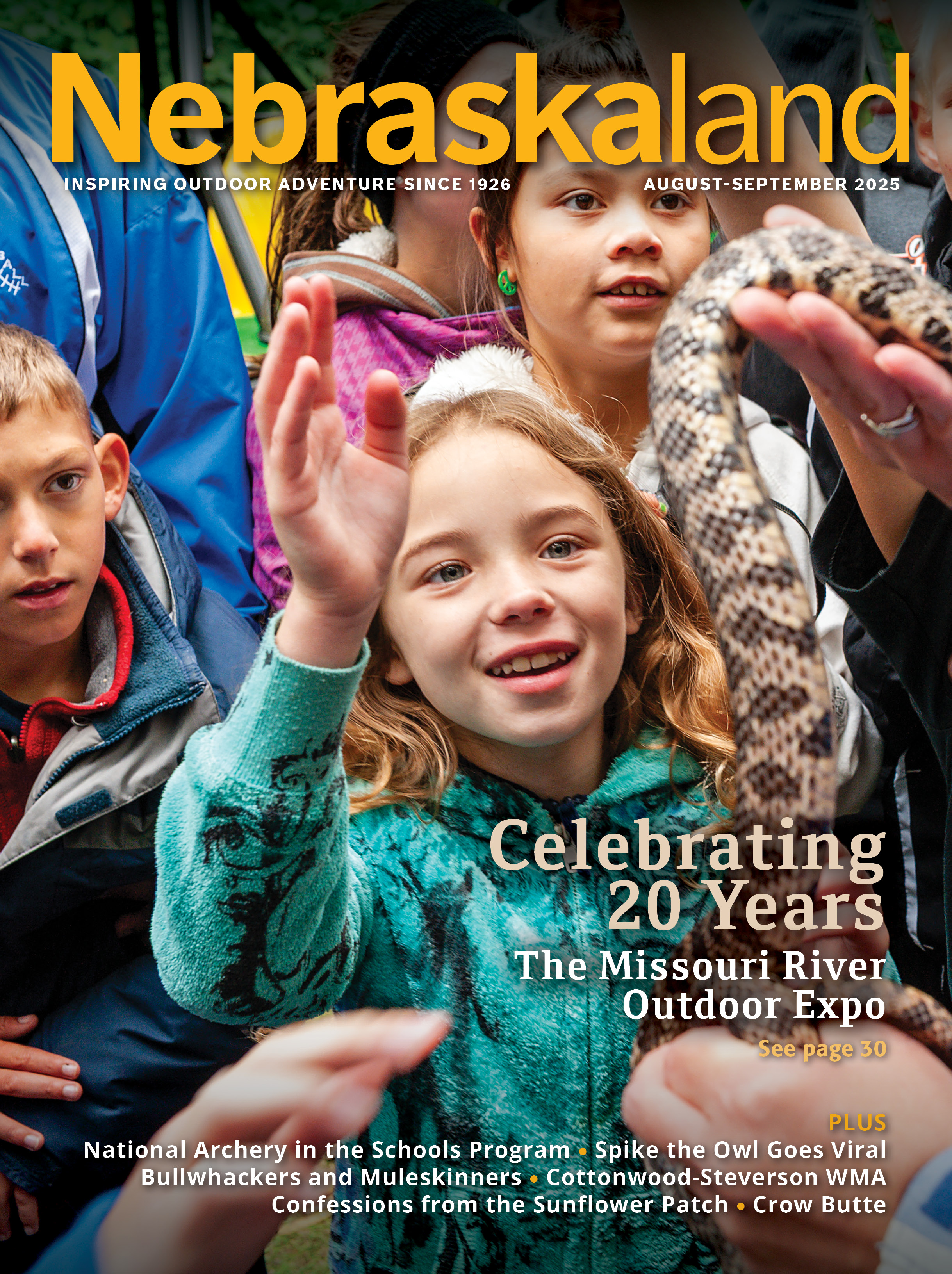
Cover: For the past 20 years, the Missouri River Outdoor
Expo at Ponca State Park has been giving school
children the chance to experience outdoor activities and
learn about nature, including getting an up-close look at
a fox snake.
ERIC FOWLER, NEBRASKALAND
FEATURES
22
CROW BUTTE
28
OUTDOOR NEBRASKA
This page: A storm cloud forms over the Middle Loup
River at Harold W. Andersen Wildlife Management Area
near Dannebrog. ERIC FOWLER, NEBRASKALAND
Story and photos by Justin Haag
What to Do in August and September
By Renae Blum
30
WHERE PEOPLE AND NATURE MEET
The Missouri River Outdoor Expo Celebrates 20 years
By Jenny Nguyen-Wheatley
40
BULLWHACKERS AND MULESKINNERS
44
CONFESSIONS FROM THE SUNFLOWER PATCH
50
NASP
By David L. Bristow, Nebraska State Historical Society
Story and photos by Gerry Steinauer
National Archery in the Schools Program
Story and photos by Eric Fowler
56
A LITTLE OWL GOES BIG PLACES
60
COTTONWOOD-STEVERSON WMA
By Renae Blum
Story and photos by Justin Haag
DEPARTMENTS
8
12
66
76
78
Your Nebraska
In the Field
Mixed Bag
Portraits From the Past
The Last Stop
ON THE WEB
For more articles and
information, visit
NebraskalandMagazine.com
4
Nebraskaland • August-September 2025
Nebraskaland (VOL. 103 / NO. 7 ISSN 0028-1964) is published monthly, except for the combined Jan./Feb. and Aug./Sept. issues, by the Nebraska Game and Parks Commission, 2200 N. 33rd
St., Lincoln, NE. Periodicals postage paid at Lincoln, Nebraska, and additional mailing offices. POSTMASTER: Send all UAA to CFS. (See DMM 507.1.5.2); NON-POSTAL AND MILITARY
FACILITIES: send address corrections to Nebraskaland, P.O. Box 30370, Lincoln, NE 68503-0370.
August-September 2025 •
Nebraskaland
5
Magazine Staff
magazine
Communications Director Christy Firestone
Public Relations Manager Shawna Richter-Ryerson
Published by the Nebraska Game and Parks
Commission since 1926. The Commission is
dedicated to the conservation and protection
of all the state's natural resources and the
people who use them.
Editor Jeff Kurrus
Associate Editor Jenny Nguyen-Wheatley
Regional Editors Eric Fowler, Julie Geiser,
Justin Haag
Contributing Editor Michael Forsberg
Regular Contributors Renae Blum,
Chris Helzer, Chris Masada, Todd Mills,
Ryan Sparks, Gerry Steinauer
Art Director Tim Reigert
Graphic Designer Mel Severin
Videographer Nick Sauvageau
Photo Librarian Jaclyn Cruikshank Vogt
Administration
Director Tim McCoy
Chairman - John Hoggatt, Kearney
Vice Chairman - Donna Kush, Omaha
Kurt Arganbright, Valentine
Scott Cassels, Omaha
Dan Hughes, Venango
Kent McNeill, Papillion
Steve Mossman, Lincoln
Lisa Roskens, Omaha
Doug Zingula, Sidney
Commission Offices
Headquarters/Southeast District Office
2200 N. 33rd Street Lincoln, NE 68503
Phone 402-471-0641
Northeast District Office
2201 N. 13th St. Norfolk, NE 68701
Phone 402-370-3374
Southwest District Office
301 E. State Farm Rd. North Platte, NE 69101
Phone 308-535-8025
Northwest District Office (temporary)
1317 W 3rd St., Alliance, NE 69301
Phone 308-763-2940
Bassett Office
524 Panzer St., Box 508 Bassett, NE 68714
Phone 402-684-2921
South Central District Office
1617 First Ave. Kearney, NE 68847
Phone 308-865-5310
Schramm Education Center
21502 W. Highway 31 Gretna, NE 68028
Phone 402-332-3901
Omaha Office
8495 Frederick Street, Omaha, NE 68124
Phone 402-595-2144
OutdoorNebraska.gov
The Nebraska Game and Parks Commission does not discriminate
based on race, color, ethnicity, national origin, sex, pregnancy, sexual
orientation, gender identity, religion, disability, age, genetic information,
veteran status, marital status, and/or political affiliation in its programs,
activities, or employment. Any person who believes he or she has been
discriminated against in any program, activity, facility, or service,
should contact the Nebraska Game and Parks Commission, Lincoln, NE
402-471-0641, the Nebraska Equal Opportunity Commission, Lincoln,
NE 402-471-2024, TTY/TDD 800-642-6112; Director, Office of Diversity,
Inclusion and Civil Rights, U.S. Department of Interior, 1849 C Street,
NW, Washington, D.C. 20240.
6
Magazine Subscriptions
For address changes, magazine and subscription
questions, 800-632-5263 or visit
nebraskalandmagazine.com
Advertising
For advertising information, contact:
Shane G. Gilster, 402-742-0125
shanegilster@solotreemedia.com
Nebraskaland Magazine Copyright 2025, all rights reserved.
Nebraskaland is available in audio from the Nebraska Library Commission
Talking Book and Braille Service, Suite 120, 1200 N St., Lincoln, NE 68508.
800-742-7691. Nebraskaland Magazine and the Nebraska Game and Parks
Commission reserve the right to reject any advertising not in keeping with
the agency mission.
Rates: $18 for one year; $33 for two years; $44 for three years. Nebraska
recipients must add appropriate sales tax. To subscribe call
1-800-NEBLAND (632-5263), or go online to:
NebraskalandMagazine.com.
Conservation Officers
ADMINISTRATION
Jeff Clauson
402-471-5531
Lincoln HQ
Administrator
Travis Shepler
402-471-5531
Lincoln HQ
Asst. Administrator
Stacey Lewton
402-471-5531
Lincoln HQ
Asst. Administrator
Mike Thome
402-471-5531
Lincoln HQ
Asst. Administrator
(Includes counties covered)
Vacant
NORTHWEST
308-430-0572
Captain
EAST SUB-DISTRICT
Jerod Hahn
308-520-5539
Sergeant
308-280-4320
Hunter Lee
Keith, Deuel, Arthur
Jaden Porter
308-289-2274
Garden, Grant, Keith
Tyler Stueck
308-289-6260
Keith, Arthur, Grant
Keith Jadlowski 531-310-2869
Keith
WEST SUB-DISTRICT
Sean McKeehan 308-672-1824
Sergeant
KayLynn Miller
308-665-8440
Dawes, Sioux, Sheridan
Cassidy Harwood 308-562-9099
Box Butte, Sheridan
Josh Widhelm
308-279-9133
Scotts Bluff, Banner, Sioux
Brandon Wallace 308-280-4488
Scotts Bluff, Banner, Sioux
Travis Schultz
308-279-1292
Morrill, Scotts Bluff, Box Butte
Casey Gehrt
402-617-2112
Dawes, Sheridan, Sioux
NORTHEAST
Dale Davis
402-760-0712
Captain
WEST SUB-DISTRICT
Jeff Jones
402-762-5022
Sergeant
Greg Hesse
308-546-7464
Rock, Brown, Keya Paha
Nebraskaland • August-September 2025
False boneset is blooming.
JON FARRAR, NEBRASKALAND
Jonathan Andreasen
402-340-3981
Madison, Pierce, Stanton
Trevor Stahlecker
402-928-9099
Knox, Antelope, Pierce
Mitch Johnson
402-613-8612
Cedar, Knox
EAST SUB-DISTRICT
Cory Krause
402-380-6410
Sergeant
Kyler Prochaska 402-830-8278
Platte, Colfax
Matt Costello
402-317-4014
Dodge, Colfax
Kelbi Abke
402-237-2537
Washington, Burt
Nicholas Fix
402-508-0261
Dixon, Dakota, Thurston
Kyle Hansen
531-739-7392
Dodge
CENTRAL SUB-DISTRICT
Doug Pollard
308-730-7050
Sergeant
Daryl Teter
308-440-1863
Howard, Greeley, Merrick
Matt Brandt
308-202-0819
Sherman, Howard
Klint Gill
402-613-5800
Nance, Wheeler, Boone, Polk
Garrett Zimmer 402-416-5736
Garfield, Loup Valley
Tim Williams
308-380-7331
Hall, Hamilton
SOUTHWEST
Brian Piernicky 308-330-8780
Captain
NORTH SUB-DISTRICT
Alex Hasenauer
308-660-4671
Sergeant
308-395-6001
Jacob Stoinski
Lincoln, Perkins
Frank Miller
402-389-0444
Cherry, Hooker
Luis Nuñez
531-333-6093
Blaine, Custer, Thomas
Brandon O’Neal 308-530-3157
Lincoln, McPherson, Logan
SOUTH SUB-DISTRICT
Kelsey Glodowski 308-242-9000
Sergeant
Bryce Streger
308-537-0404
Dawson, Gosper
Tyler Adelman
402-314-4783
Dawson, Gosper, Furnas
Sophia Gobber
308-222-0368
Chase, Dundy, Hayes, Hitchcock
SOUTHEAST
Matt Seitz
402-806-0915
Captain
WEST SUB-DISTRICT
Matt Taylor
402-200-9597
Sergeant
402-902-2017
Vacant
Adams, Clay, Webster
Justin Gress
308-629-9335
Thayer, Nuckolls, Fillmore
Vacant
308-920-2762
Harlan, Franklin, Phelps
Ethan Teter
308-440-3847
Buffalo, Kearney
EAST SUB-DISTRICT
Heath Packett
402-210-0888
Sergeant
Brett Greenfield 531-350-0915
Cass
Russell Mort
402-209-1506
Otoe, Johnson
Rich Berggren
402-619-1355
Douglas
Brian Arp
531-530-9011
Douglas, Sarpy
Mike Luben
402-443-6392
Saunders
Bryan Adams
402-429-1924
Nemaha, Pawnee, Richardson
CENTRAL SUB-DISTRICT
Curt Prohaska
402-470-1298
Sergeant
308-430-5500
Ben Keller
Gage, Jefferson
Mark McDonald 402-805-2353
Lancaster
Mark Sullivan
402-741-0636
Lancaster, Seward, Butler
Jarrod Messman 531-739-9760
Lancaster, Saline, York
YOUR NEBRASKA
Instagram Photos
Follow us @nebraskaland
and tag us in your photos
to be featured in an
upcoming issue.
Connie Allen, Grand Island
Bee on Aster
Roger Richters, Utica
Green-eyed Moth
8
Nebraskaland • August-September 2025
Mat Custer, Omaha
White-tailed Deer Buck
August-September 2025 •
Nebraskaland
9
Roy Liesegang, Bellevue
House Sparrows
Correction: Eric Fowler was the
photographer for the Lake
McConaughy photo published
on pages 26-27 of the July issue.
Chuck Hackenmiller, Lincoln
Autumn Rainbow for Dad
10
Nebraskaland • August-September 2025
Send your comments and
photos to:
Jeff Kurrus, Editor
Nebraskaland Magazine
P.O. Box 30370
Lincoln, NE 68503
or email Jeff.Kurrus@Nebraska.gov
Please include your postal address
and telephone number. Letters
may be condensed and edited.
Photographs are also welcome.
August-September 2025 •
Nebraskaland
11
IN THE FIELD
ASH HOLLOW
Ruts created by covered wagons
traveling the Oregon and
California trails in the mid-1800s
are still visible on Windlass Hill at
Ash Hollow State Historical Park
near Lewellen.
ERIC
C FOW
FO
O LE
LER,
L
E NEB
ER
BRASKA
RASK
ASK
SKALAN
ALAND
ALA
12
Nebraskaland • August-September 2025
August-September 2025 •
Nebraskaland
13
IN THE FIELD
Refining rifle steadiness and accuracy is just one reason to hunt squirrels this fall.
JEFF KURRUS, NEBRASKALAND
A CASE FOR SQUIRRELS
By Jeff Kurrus
It’s understandable why you don’t squirrel hunt. The
weather might be hot, often muggy, and despite all of your
readings, you’re still not quite sure you can distinguish
between Virginia creeper and poison ivy.
But you’re missing out. Start, or re-kindle, your love for
squirrel hunting for these reasons.
Shoot Better
The margin for error when shooting squirrels with a
rimfire rifle is small. But for young or inexperienced shooters,
practicing with an inexpensive 3-9x40 scope atop a Ruger
10/22 provides the perfect pre-season classroom for big
game firearm season. Squirrel hunting forces the shooter to
slow down, allowing them to look for the head or heart shot
necessary to bring down this quick-moving quarry.
Hunt Better
Tree identification can become a huge advantage for
hunters of various species. While deer will spend the majority
of their feeding time in crop fields, knowing when walnuts,
acorns and other tree nuts drop helps hunters determine
travel routes for these big game animals — and determine
where squirrels can be found throughout the season that
14
Nebraskaland • August-September 2025
begins Aug. 1 and doesn’t close until Jan. 31.
Fish Better
In-line spinners made by Mepps are one of the most
recognizable and versatile fishing lures on the market, and
they are interested in your squirrel tails. Mepps provides an
opportunity for you to recycle the tails of harvested squirrels
for money or Mepps fishing lures. Visit Mepps.com/squirreltail for more information.
Cook Better
After a successful hunt, enjoy squirrels at the dinner table.
Tasting similar to rabbit — perhaps a bit darker — squirrel
meat is nothing to scoff at. Quarter the squirrel(s) into smaller
pieces and remove as much silver skin as you can to prevent
toughness. Then batter and fry the pieces for a simple meal of
fried squirrel. Another option is to simmer them in a stew or
gravy, leaving the silver skin on, until tender. Squirrel pot pie
or squirrel and dumplings come to mind.
Regardless of how you cook and serve squirrel, the first
step is to go to the woods and hunt. Although there are many
more reasons to hunt this small game, enjoying them at the
dinner table is good motivation alone.
IN THE FIELD
HOPPERS
By Monica Macoubrie, Wildlife Education Specialist
True bugs, classified under the order Hemiptera, include
a variety of families, such as cicadas, leaf hoppers, plant
hoppers and shield bugs. One of the defining features of
true bugs is their specialized mouthparts, known as stylets,
which are adapted for piercing and sucking fluids from plants
or other organisms. These mouthparts are often enclosed
within a beak-like structure.
With a name like “hopper,” it’s no surprise that these
insects can leap great distances. Young plant hoppers can
leap around 3 feet in a single bound. While this might not
sound impressive to humans, it’s astonishing when you
consider their entire body is only up to a half-inch long.
While leaf hoppers and plant hoppers share some
similarities, they exhibit distinct differences in their
morphology and behavior. Leaf hoppers, members of the
family Cicadellidae, are typically characterized by their small
size, often ranging from 2 mm to 8 mm, and their flattened,
wedge-shaped bodies. They exhibit a unique appearance
with prominent, sometimes colorful patterns or markings
that provide camouflage.
Leaf hoppers’ feeding habits involve using their specialized
mouthparts to pierce plant tissues and extract sap, which can
lead to characteristic damage, such as stippling (when leaves
have a spotted appearance) and the yellowing of leaves.
In contrast, plant hoppers belong to the family Delphacidae,
and they tend to be slightly larger and have more varied body
shapes, often with a more pronounced, angled or triangular
profile. Their feeding behavior also involves piercing plant
tissues to feed on sap, but they are known for their ability to
produce a notable frothy substance, which can be seen on the
plants they infest.
Treehoppers, part of the family Membracidae, are
renowned for their often elaborate physical features. These
small- to medium-sized insects, typically ranging from
4 mm to 15 mm in length, are easily recognizable due to
their pronounced, horn-like structures or exaggerated body
projections, which can resemble various shapes such as
spikes, plates or ridges. These unique adaptations serve as
camouflage or deterrents against predators. Treehoppers
possess specialized mouthparts adapted for piercing and
sucking plant sap, and their feeding can sometimes cause
deformities or stunted growth in plants.
Plant hoppers, like this one from the genus Stobaera, have an angled or triangular profile and are known to pierce plant
tissues to feed on sap. BRIANNA NUGENT
16
Nebraskaland • August-September 2025
IN THE FIELD
High-quality bluegills, like this one, can be targeted in August and September on weed lines.
JEFF KURRUS, NEBRASKALAND
FROM WORST TO FIRST
By Jeff Kurrus
August in Nebraska is hot. There’s no way around it.
Because of the weather, and the belief that fish don’t “bite”
this time of year, many rods and reels gather dust until
cooler temperatures return. But Nebraska Game and Parks
Commission Fisheries Biologist Daryl Bauer suggests
otherwise.
“Fish are eating the entire time in August,” he said.
Nebraska’s fish are cold-blooded, meaning their body
temperature is proportional to the water temperature, and
they’re constantly feeding and burning calories. But they can
also find something to eat pretty easily during warm weather.
By late August, however, a couple of factors increase angler
chances of catching a nice fish. One, fish begin to put on
weight as water temperature and metabolism lower. Second,
the baitfish population in our water bodies thins, making
fishing easier for those willing to sweat through a few casts
for them.
Channel catfishing is one of Nebraska’s most productive
species during this transition from August to September.
18
Nebraskaland • August-September 2025
“When channel catfish finish spawning in July,” Bauer
said, “they go hard until the first part of October. If you’re
catfishing in September, it’s on.”
Another warmwater species that starts feeding more is
bluegill. They can be found on weed lines and deeper water.
“It’s different than the shallow spawn bite in the early
spring,” Bauer said. “But some really big fish can be caught.”
A third species to target during this transition is wiper.
“Bites begin to last longer,” Bauer said. Instead of a 20-minute
feeding at the beginning or end of the day, he said, a topwater
bite might last for an hour or two.
If coldwater stream fishing is what you’re after, the main
change is fly choice. “August and early September is hopper
time,” Bauer said.
The changes this time of year will be subtle, but anglers
willing to go from short-sleeves to jackets will see the skinny
fish they’re catching in August start to transition to fatter
ones in September — fish looking to eat and anglers dealing
with less competition for their lures in the water.
August-September 2025 •
Nebraskaland
19
IN THE FIELD
Hasenpfeffer served with buttery mashed potatoes.
JENNY NGUYEN-WHEATLEY, NEBRASKALAND
GERMAN RABBIT STEW
By Jenny Nguyen-Wheatley
Also called hasenpfeffer, this
German rabbit stew was brought to
my attention by Nebraskaland writer
Gerry Steinauer, whose father loved
the dish. Although marinating the
rabbit for two days in vinegar might
raise some eyebrows, the method
works. The acidity provided the right
balance when serving the stew with
heavily buttered mashed potatoes.
This is my version of hasenpfeffer.
But first, a word of caution: Do not use
plain white vinegar in this dish. The
smell will stink up your house, and you
won’t want to eat it. Trust me. Aside
from apple cider vinegar, red or white
wine vinegar would also work.
Servings: 4
Prep Time: 48 hours
Cooking Time: 2-3 hours
Ingredients:
2 cottontails or 1 jackrabbit or 1
domestic rabbit
2 tbsp. of oil, separated
⅓ cup of all-purpose flour
1 onion, chopped
1 tbsp. of sugar
2 sprigs of fresh thyme
2 sprigs of fresh rosemary
1 bay leaf
•
•
•
•
•
•
•
•
20
Marinade
1 cup of water
1 cup of dry red wine
1 cup of apple cider vinegar
2 bay leaves
4 whole cloves
4 cloves of garlic, thinly sliced
2 large shallots, thinly sliced
2 sprigs of fresh rosemary
2 sprigs of fresh thyme
1 tsp. of juniper berries, crushed
¼ tsp. of ground allspice
1 tbsp. of kosher salt
•
•
•
•
•
•
•
•
•
•
•
•
1. In a saucepan, combine marinade
ingredients and bring to a boil. Set
aside and allow to cool completely.
Quarter rabbit(s) into smaller pieces
and place them inside a zip-top bag.
When marinade is cool, pour it over
the rabbit and seal. Refrigerate for 48
hours, flipping the bag occasionally.
2. Preheat oven to 350 degrees
Fahrenheit. Remove rabbit from
the marinade. Strain the marinade,
discarding solids only, and then set the
liquid aside.
3. Heat 1 tablespoon oil in an
enameled Dutch oven (raw cast iron
will react to the acid in the vinegar
and wine) over medium-high heat.
Nebraskaland • August-September 2025
Coat rabbit with the flour, shaking off
excess, and brown on both sides. Do
not crowd the pan and add more oil as
needed. Remove browned rabbit and
set aside.
4. Lower heat to medium. Add the
remaining oil to the pot and sweat
chopped onion until translucent.
Then add the reserved liquid from the
marinade and 1 tablespoon of sugar,
scraping the bottom of the pan with
a wooden spoon to loosen up the
browned bits.
5. Return browned rabbit to the pot
and add 2 sprigs each of rosemary
and thyme and 1 bay leaf. Bring to a
simmer and then take off heat. Cover
the pot with aluminum foil, then set
the lid on top of the foil — this creates
a tighter seal.
6. Bake in a 350-degree oven for
1-2 hours, or until the rabbit meat
can be easily pulled from the bone.
I suggest checking after an hour —
younger or raised rabbits will become
tender sooner than older or wild ones.
Jackrabbits might take longer to cook
as well.
Serve hasenpfeffer over buttery
mashed potatoes, boiled potatoes or
spaetzle.
August-September 2025 •
Nebraskaland
21
Crow Butte
Story and photos by Justin Haag
Legends
vary, but
scenic
value
certain
Crow Butte stands on private
property as one of the most
prominent landmarks in the
Pine Ridge. The south side is
rarely seen by the public.
22
Nebraskaland
• August-September 2025
August-September 2025 •
Nebraskaland
23
T
hree and a half miles southeast
of Crawford stands Crow Butte.
The towering sentinel rises
conspicuously above the White
River Valley on private property that
borders Ponderosa Wildlife Management
Area. Perhaps no other landform in the
Pine Ridge can be seen from so many
different vantage points — a fact that
has made it a frequent subject for me
and other nature photographers.
The landform, about 400 feet tall, is
captivating, as are the legends of its
naming. Accounts vary, but all center
around a territorial feud between two
Native American tribes — the Sioux and,
of course, the Crow.
One account, which is said to have
happened in the 1860s, has a band
of Crows from the north entering the
butte’s vicinity, recognized as Sioux
territory. After a few days of fighting,
the Crow retreated to the top of the
great landform to use its high vantage
for fortification. The Sioux knew there
was only a narrow path up the butte on
its south side, so they guarded the exit
while tending to their sick and wounded.
Facing starvation and inevitable
defeat, a few of the oldest men in the
group of Crows made a sacrificial,
last-ditch effort. The men stationed
themselves on the guarded side of the
butte and began chanting to distract the
Sioux. Meanwhile, the others created
ropes from whatever fabric they had to
lower themselves from the steep north
side and escape. The Sioux, however,
caught on before their descent and
surrounded the butte.
This is where the story gets fantastical.
As a lighted mist came upon the butte,
three beautiful Indian maidens appeared
in the sky, and the old men were lifted
into the heavens on the wings of white
birds. After some discussion, the Sioux
elders determined the maidens had
been sent from the Great Father as
messengers of peace. The perceived
message resulted in a friendly compact
between the Sioux and Crow.
24
Nebraskaland
• August-September 2025
The sun sets behind Crow
Butte, at right, and Little Crow
Butte, ending a winter day.
August-September 2025 •
Nebraskaland
25
A different account in a 1901 Omaha
World-Herald — said to be firsthand
from an unidentified person who
witnessed the events in the winter
of 1869-70 — said it was exactly 27
Crows who dismounted horses and
climbed the butte with only their
blankets, rifles and ammunition.
One difference in the story is that
just one elder Crow was assigned
to distract the Sioux, and did so by
zigzagging around the south side
firing a rifle at night — an attempt to
give the appearance of multiple people
trying to escape.
Instead of the harmonious ending of
the other legend, the old man was said
to have been forced at dawn back up the
butte, where he jumped to his death.
The 26 others had already descended
to the prairie on their makeshift ropes,
but they were on foot and soon caught
and killed by the Sioux.
Like the peaceful ending of the first
story better? As with most legends, it’s
impossible to know how much, if any,
of the stories are true. One thing is for
sure: We’ll continue to be captivated
by the sight of this picturesque
landform standing resolute over the
White Valley. N
TOP LEFT: Cattle graze on the lush
grass as fog hangs among the butte’s
crags in spring.
TOP RIGHT: With the ice of Fort
Robinson State Park’s Grabel Ponds in
the foreground, Crow Butte and Little
Crow Butte are silhouetted by the
pre-dawn sun.
BOTTOM LEFT: Fog rises from a private
pond with Crow Butte in the distance.
BOTTOM RIGHT: The crepuscular rays
of morning grace the sky above Crow
Butte and the Pine Ridge.
26
Nebraskaland
• August-September 2025
August-September 2025 •
Nebraskaland
27
Outdoor Nebraska
By Renae Blum
What to Do in August and September
Watch biologists banding
wild birds
The first hints of fall usher in the flap of wings, as birds
begin to migrate. New hunting seasons arrive, with
some relief from July’s heat. And, as always, there is
something new to discover.
Typically late August to early October, around
sunrise, from Tuesday to Saturday | Wildcat
Hills State Recreation Area and Chadron State
Park
Want to see beautiful, and perhaps uncommon, wild
birds up close? The Bird Conservancy of the Rockies
operates bird banding stations each fall at Chadron
State Park and Wildcat Hills State Recreation Area. If
conditions allow, biologists use fine mist nets to capture
their subjects. After recording measurements, they fit
each bird’s leg with a tiny metal band. You’re welcome to
watch! If a banding is canceled due to weather, you can
still enjoy great birding on the trails. Contact each park
for more information. JUSTIN HAAG, NEBRASKALAND
Experience the first waterfowl
season of the fall
Early teal season is Sept. 6-14 | Statewide
Catch brook trout in Pine Ridge streams
If you enjoy watching wetlands and waterways come alive in the
morning, teal season is for you, whether you harvest a bird or
not, said Hunter Education Coordinator Kyle Gaston. Nebraska
is a popular flyway and sees large flocks of teal land on public
hunting areas, he said. Gaston recommends dressing in thin layers,
practicing with your shotgun, and scouting the area before the
season starts, as water levels can change quickly.
Year-round | Nebraska’s far northwestern corner
For fisheries biologist Daryl Bauer, it’s not difficult to explain the appeal of brook
trout fishing in the Pine Ridge. It’s “some of the prettiest fish in the state in some
of the prettiest country.” These trout may not be huge, but feature gorgeous
coloring, particularly during spawning season in late fall. They’re not hard to
catch either, if you don’t spook them. Pretend you’re hunting deer on foot: Sneak,
be quiet, tread lightly and wear camouflage.
JUSTIN HAAG, NEBRASKALAND
JUSTIN HAAG, NEBRASKALAND
Explore a unique wildlife
refuge via a guided hike
Aug. 2, 10 a.m. to 12 p.m. | Meet at the parking
area on the west end of Hackberry Lake
With its unplowed prairies, diverse habitats and
interesting relics, the Valentine National Wildlife
Refuge is well worth exploring. Join a local nonprofit, the
Sandhills Prairie Refuge Association, for a free, 2/3-mile,
easy hike through this landscape, led by two biologists.
You’ll learn about native prairie plant identification,
birding and 1930s Nebraska history — and perhaps
experience incredible views from an observation deck at
an old fire tower. Registration is required. Learn more at
sandhillspra.org.
Celebrate the Cowboy
Trail atop an iconic
landmark
Sept. 5, 7-8:30 p.m. | Meet at the Cowboy
Trail parking lot, just east of Valentine on
Highway 20
Enjoy panoramic views of the Niobrara River,
while helping celebrate 30 years of the Cowboy
Trail. Earlier that day, you can join other outdoor
enthusiasts for a fundraising bike ride and dinner,
capped with a free Bridge Social in the evening.
Cowboy Trail fans will gather atop an iconic former
railroad bridge, enjoying spectacular views while
sipping drinks, chatting and watching the sun set.
Learn more at Calendar.OutdoorNebraska.gov.
CHRISTY FIRESTONE
28
Nebraskaland • August-September 2025
August-September 2025 •
Nebraskaland
29
Missouri River
20 thAnniversary
Where
People and
Nature Meet
By Jenny Nguyen-Wheatley
T
he Missouri River Outdoor
Expo at Ponca State Park
has served over half a million
visitors and provided countless
memories and outdoor recreation
“firsts.” In 2025, visitors can expect
more than 90 vendors, activities and
demonstrations Sept. 20-21. And on
the school day preceding the public
event, upwards of 700 children from
approximately 35 schools will fill the
canyons with laughter. From fishing
and shooting, kayaking and river boat
rides, to lumberjack demonstrations,
dog shows and the smells of funnel
cake, barbecue and kettle corn — the
atmosphere is like that of a fair for
outdoor lovers.
This annual outdoor event, in this
quiet corner of Nebraska, is the largest
of its kind in the Midwest. Nebraska
Game and Parks staff and volunteers,
Aerial view of Ponca State Park’s visitor center during the Missouri River Outdoor Expo.
and the town of 1,000 that pulls it off
each year, have much to look back on
this vicennial anniversary — and they
have a lot to be proud of.
Challenging Start
Busloads of children attend the Missouri River Outdoor Expo school day on the
Friday preceding the public event. ERIC FOWLER, NEBRASKALAND
30
Nebraskaland • August-September 2025
The expo is the brainchild of a
small team of staff and local citizens,
including Parks Division Administrator
Jeff Fields, who was then the
superintendent at Ponca State Park,
and Deputy Director Jim Swenson,
who was then eastern regional park
manager. This team envisioned a
long-term event that would exemplify
the Ponca State Park tagline: “Where
people and nature meet.”
“We wanted an event that had the
same kind of feeling as a county fair
but was focused around the outdoors
and what our agency represents,”
Fields said. Visitors would gain hands-
on experiences, such as shooting a gun
or bow.
They wanted it to be free to attend
because Fields saw the expo as a longterm investment — introducing people
to the outdoors in ways they would not
have a chance to experience otherwise.
The expo would help “plant the seed”
to growing the next generation of
hunters, anglers and outdoors people.
Fields knew the event would need
NICK SAUVAGEAU, NEBRASKALAND
strong regional support and ownership.
A team of staff and volunteers worked
to secure community buy-in, which
led to the creation of the Missouri
River Outdoor Expo Board, an advisory
committee made up of representatives
from
Ponca
and
surrounding
communities, such as Sioux City and
Newcastle, as well as groups, including
local chapters of Pheasants Forever,
Ducks Unlimited and the National Rifle
August-September 2025 •
Nebraskaland
31
Volunteer Don Andersen cleans shotguns at the shooter’s village.
visitors would be able to “touch, see and
smell the Missouri River.” Attractions
in this area have included a heritage
encampment with living history
volunteers, boat tours (when conditions
JOSHUA CARLSON
allow), logging demonstrations, and
cooking and eating contests.
The visitor center, built in 2003,
provides visitors a break from the
elements. It houses additional vendors
Volunteer Don Andersen
Children get close and personal with Nebraska’s reptiles, including this fox snake.
Association. Board members became
spokespeople for the expo and vital to
fundraising and recruiting volunteers,
which they needed by the hundreds.
The educational aspect of the expo
made fundraising easy; generous
sponsors contributed and continue to
today. These dollars go toward paying
for the demonstrations, entertainment
and activities offered, such as the
dock dog show, Axe Women Loggers
of Maine, delivery and set up of the
rock wall and ropes course, and many
more. Logistical costs include renting
32
ERIC FOWLER, NEBRASKALAND
shuttle trailers, port-a-potties and golf
carts.
Don Andersen, a longtime resident
and former mayor of Ponca, became
one of the expo board’s first members.
He remembers the day Fields called
him.
“Jeff had a vision of what we were
going to do,” Andersen said. Andersen
believed in the vision, too, and spent
the next 10 years on the board helping
grow community support.
Fields knew staff buy-in also would
be critical to the event’s success, and
Nebraskaland • August-September 2025
Game and Parks’ northeast district
were more than willing to roll up their
sleeves. No matter which division staff
worked in, they participated in the expo
handling different aspects of the event.
With these pieces in place, execution
was the next step, and the first expo in
September 2004 became the true test.
That weekend, Ponca set a record
for the most rain in a two-day period;
8 inches of rain flooded the riverfront
where activities were stationed,
forcing everyone to move up to the
visitor center. Still, 1,500 to 2,000
people showed up.
“I think that tested our wherewithal
a little bit with the group that helped
organize it,” Fields said, but “we
thought, ‘If that many people show up
under those cruddy conditions, what
could we do if we had a nice weekend?’”
It motivated them to keep moving
forward.
Evolution
One of the venues established early
on was the riverfront. Being the expo’s
namesake, the team was adamant
Ponca resident Don Andersen was a charter member of the Missouri
River Outdoor Expo Board. He helped raise considerable funds to
get the first expo rolling, and his boots were on the ground when
volunteers were called to help complete the Eric Wiebe Shooting
Complex in 2013, the site of the expo’s shooter’s village.
Although the former mayor of Ponca and member of the Better
Ponca Foundation has retired from many of his official roles, the
84-year-old has yet to miss an expo as a volunteer. Andersen leads the
shotgun shooting range and recruits his own volunteers — about 30
— and he maintains the 20-some shotguns and dozen muzzleloaders
that need regular cleaning during the course of the weekend. Last
year, they went through 8,700 rounds of shotgun shells during the
expo.
Andersen returns every year simply because of his passion for
introducing people to shooting. As an avid hunter, it’s important to
him to introduce guns to people in a safe, informative way.
“My [volunteers], they take it real seriously to get that beginner to do
it the right way. And I think when you see them hit the target, it’s a lot
of self-satisfaction,” Andersen said. “I see guys smiling. I see those kids
when they walk away — how they’ve got a smile on their face.” It also
tickles him that it’s often the women who are better shots than their
boyfriends or husbands.
Andersen’s wife, Jane, also volunteers, helping to register school
children during the Friday school day. On Saturday and Sunday, you’ll
likely find her answering questions at the information booth.b
August-September 2025 •
Nebraskaland
33
Behind the Scenes
In November 2024, Katie Leware
was named Ponca State Park’s
superintendent, and the 2025 event
will be her fifth expo. At the helm, she
and new expo coordinator, Jessica Rich,
are in the thick of meeting with expo
board members and sponsors, working
on contracts and making bids with
vendors. Leware feels the weight of the
20th anniversary on her shoulders.
“I guess what’s daunting going
into 20 years is the expectation of
this event and what’s going to be new
and different,” Leware said. “To be
honest with you, we’ve had almost full
turnover of permanent staff here at the
park in the last year and a half and so,
we’ve got a fairly new team, which is
really great because there are tons of
Former Nebraska Game and Parks Commission Biologist Tom Welstead teaches a boy how to shoot a muzzleloader.
JENNY NGUYEN-WHEATLEY, NEBRASKALAND
and the Better Ponca Foundation silent
auction, which helps fund the expo.
The area surrounding the visitor center
is where activities such as kayaking,
fishing, the rock wall, ropes course and
dog shows are located.
The shooter’s village is the third
venue of the expo. Although the
shooting area has been there since the
park was established in 1934, a formal
shooting range was built in 2013 thanks
to memorial dollars from the family of
Eric Wiebe, a former Game and Parks
conservation officer and one of the
34
expo’s earliest proponents, who died
of cancer in 2009, in conjunction with
corporate and nonprofit donations,
including from Scheels.
During the expo, visitors can shoot
archery, shotgun, muzzleloader, .22
long rifle, pellet guns, slingshot, atlatl
and tomahawk — all equipment
provided — at the complex.
In the early years, the expo offered
20 to 40 activities. Now, the event
has grown twice as large. The expo’s
blueprint covers nearly 57 acres of
beautiful, hilly terrain.
Nebraskaland • August-September 2025
Gap Year
There was no expo in 2020 as
COVID-19 forced restrictions around
the globe. At the time, Ponca staff felt
they could not do the event justice
while maintaining social distancing.
But skipping a year had its risks. As
organizers saw across the country,
many events and activities did not
return after the pandemic.
In 2004, the Missouri River Outdoor
Expo was one of maybe seven or eight in
the Midwestern area. Over time, it has
outlasted most in the country, Fields
said. The gap year in 2020 broke 15
years of momentum, but the expo team
forged ahead in 2021 under the park’s
new superintendent Scott Oligmueller,
and they were glad they did. Crowds
have returned, but at more manageable
sizes than the peak years when 20,000
people attended, lines were long and
patience was short.
“People are enjoying it again,” Fields
said. “That’s critical to keeping these
events going — making sure it’s a
quality experience for the staff and the
volunteers, along with the public.”
Kayaking on Ponca State Park’s pond is one of the Missouri River Outdoor Expo’s
most popular activities. ERIC FOWLER, NEBRASKALAND
August-September 2025 •
Nebraskaland
35
“It’s probably a five-page to-do list
just to get the shooting range ready,”
Leware said.
“This is a massive park, and we have
a massive event,” she said. “This event
doesn’t happen with one person. The
team that we have and the support from
the agency, all of our volunteers — I
mean, this event didn’t make it 20 years
without everybody who’s involved.”
Team
A family walks down the path that leads through the Eric Wiebe Shooting Complex.
The bike trail is a recently added activity at the Missouri River Outdoor Expo.
JENNY NGUYEN-WHEATLEY, NEBRASKALAND
36
Nebraskaland • August-September 2025
JENNY NGUYEN-WHEATLEY, NEBRASKALAND
new ideas … but we’re also running this
massive event as a new team, which
has its own challenges.”
The Missouri River Outdoor Expo
is not an event park staff plan mere
months or weeks ahead. The expo is
part of their day-to-day operations,
Leware explained. They think about
the expo year-round, about the small
details that allow the event to run
safely and smoothly. For instance: Who
is providing portable toilets? Do food
vendors have their health inspections
and legalities in order? How many extra
golf carts do they need?
Safety is also a priority. Leware
ensures first responders and an
ambulance are on site, and she
facilitates the relationship between
local paramedics and the expo’s
emergency management team. Also
throw in local law enforcement and
conservation officers, whom she meets
to discuss evacuation and emergency
plans and lost-kid protocols. Even
helicopter landing zones have to be
identified in the event someone needs
to be airlifted to the hospital.
Then leading up the event, it’s
all hands-on deck with staff and
volunteers setting up.
Ask Fields, Swenson and Leware to
name what they’re most proud of in
running the expo, and they will give
you similar answers: being part of a
great team, community involvement,
the camaraderie, the passion and being
part of a grassroots effort that has
outlasted most of its kind.
“Those relationships that were
established are longtime friends,
longtime supporters of our agency.
Those can’t be replaced. So that is, to
me, probably the most important of
everything the event stands for,” Fields
said. The Ponca expo depends on 300 to
700 volunteers annually who fill a wide
range of vital roles, such as setting up
and tearing down, directing traffic and
parking, collecting trash, teaching
outdoor skills, demonstrating hands-on
activities and more.
Perhaps volunteer birding expert
Mark Brogie described it best: “It’s
kind-of like Old Home Week because
we see a lot of the other presenters that
come up … a lot of people that we know
have been doing presentations there for
years and years and years,” he said. “It
is a fun event.”
Brogie and his brother Ed, retired
high school science teachers, now
scratch the itch to teach through their
bird banding demonstrations at Ponca
State Park and elsewhere. Mark and
Ed have been involved since the first
Missouri River Outdoor Expo in 2004.
Husband-and-wife
team
Leon
and Merrie Hansen also are familiar
faces. They joined the expo in 2007.
Although the couple have relocated to
Wichita, Kansas, to be closer to their
Volunteers Ed and Mark Brogie
Brothers Ed and Mark Brogie have been involved with the expo since
day one. Known for their expertise on birding, they run the expo’s
bird banding station, where visitors can watch the brothers catch a
variety of live birds with nets before banding them. They often catch
species such as white-breasted nuthatches, chickadees, woodpeckers,
warblers, catbirds and many species of sparrows.b
“The kids, once they see a white-breasted nuthatch up close,
hopefully they’ll gain ownership of that bird a little bit. [We] let them
touch it, and hopefully they’ll never want to ever go shoot one with a
BB gun again, because they’ve seen it up close and personal,” Mark
said.
It’s older brother, Ed, who still carries a federal bird banding permit;
Mark gave up his permit some time ago. The process for obtaining
a permit is rigorous, and when issued, keeping it active is just as
in-depth. Only a handful of people in Nebraska have one.b
Another notable feature of the Brogies’ station is the study
skins borrowed from Wayne State College — their alma mater —
affectionately referred to as “birds on a stick.” Painstakingly preserved
by biologist Wayne Molhoff of Ashland over 40 years ago, these study
skins allow visitors to observe specimens up close. The collection of
200 birds is representative of birds found in Nebraska.
Local birder Bill Huser is a regular presenter, along with Ed’s wife,
Lee. The team loves interacting with return students, teachers and
parents, who come back with new questions and growing interest in
birds.
Outside of the expo, Ed and Mark regularly volunteer at other Ponca
and Niobrara state park educational events. Ed also teaches archery at
National Archery in the Schools Program events and offers mentorship
at local Pheasants Forever youth hunts. Mark is an active community
member in Creighton, having served on several boards; he is currently
the treasurer of the Ashfall Chapter of the Friends of the University of
Nebraska State Museum.
Brothers Mark, left, and Ed Brogie have been running the bird banding
station since the expo’s first year. JOSHUA CARLSON
August-September 2025 •
Nebraskaland
37
Volunteers Merrie and Leon Hansen
Husband-and-wife team Leon, left, and Merrie Hansen of Wichita, Kansas, draw in
crowds each year during their outdoor cooking demonstrations.
JENNY NGUYEN-WHEATLEY, NEBRASKALAND
grandchildren, they faithfully return
to the expo to offer their popular
outdoor cooking demonstrations, as
well as help set up during the week
ahead.
This event is primarily run by
volunteers, Leware said. And they’re
always looking for more, especially on
Sunday afternoon when everyone’s
eager to get home.
“When it’s over, we’re all so thankful,
but it is such a rewarding experience
overall,” she said.
38
It takes a lot of heart, gumption
and sweat to make an event of this
magnitude possible. But to execute
year after year, for two decades,
introducing untold thousands to the
outdoors in an accessible way — that’s
a mission statement realized many
times over. The expo’s impact has been
immeasurable.
“It’s one of those places you can go
and see parents, grandpa, grandma,
the kids, the dog — all in one family
Nebraskaland • August-September 2025
unit,” said Deputy Director Jim
Swenson, who often hears from people
who chose careers in conservation
because of the expo. “In today’s world
of distraction and all kinds of options
for families to consider, this is an
event that brings them where they can
truly find themselves and brings them
outdoors. It keeps them connected —
that connectivity to the landscape is
critical to conservation.”
The Missouri River Outdoor Expo is
where people and nature meet. Come
experience it for yourself the third
weekend of September. N
Volunteer Jase Gerdes helping board
member Diana Kincaid pick a
monarch butterfly for tagging and
release. JENNY NGUYEN-WHEATLEY, NEBRASKALAND
Merrie and Leon Hansen earned their nicknames “Cold Feet” and
“Hot Tin,” respectively, while backpacking the Appalachian Trail, where
it’s customary for hikers to call each other by fun monikers — Merrie
was always cold, and Leon was always cooking.
Their outdoor cooking demonstrations at the expo are extremely
popular. They’ve cooked a variety of dishes, including roasted turkey
in a cardboard box, Dutch-oven pizza, bison stew, cakes, pies,
biscuits, eggs in orange peel cups and more. In addition to their
demonstrations, the couple also arrives days prior to lend a hand with
setting up the tents and putting up banners and signage. They’ve also
helped build some of the new structures on the riverfront.
Merrie and Leon grew up and met in southeastern Nebraska, and
subsequently, the U.S. Air Force took their family to Texas, Alaska,
Missouri, Kansas, Montana and Colorado. All that traveling came
with many outdoor adventures with their two boys, who are now
grown. Leon is a lifelong outdoorsman, having been a Boy Scout as
a child and serving as scoutmaster for 28 years. The Hansens have
backpacked and kayaked all over the country.
“Being outdoors is just part of who we are. And since we have to
eat, I think that’s how the cooking ends up being a part of it,” Leon
explained. Despite their nomadic lifestyle, the couple finds the time to
return to the Ponca Expo regularly.
“The park people and the local Ponca people — they’ve always been
good to us. So that’s a good reason to go back — just to see people,”
Merrie said.b
Ponca State Park
One of Nebraska’s most visited state
parks, Ponca State Park is popular for
its forested hills, scenic vistas, great
wildlife watching, Missouri River
access, and beautiful and varied
lodging options. It is a destination for
all types of family gatherings, from
family vacations to weddings.
Children and parents fishing at Ponca State Park’s pond.
JENNY NGUYEN-WHEATLEY, NEBRASKALAND
August-September 2025 •
Nebraskaland
39
Bullwhackers and Muleskinners
By David L. Bristow
Nebraska State Historical Society
here is heard the lumbering of these prairie schooners,
the bellowing oxen — braying of mules, creeking [sic]
of the long lariats, which for me is a show of itself to see
the dexterity with which the drivers use them.”
So wrote a Nebraska City woman to her sister in 1866.
She was describing the freight wagons crowding downtown
streets. “There is the hollowing [sic], yelling of teamsters
mingled with more oaths than I ever heard before in all my
life together.”
‘T
Illustration of freighting in Nebraska City, 1865.
A woman bullwhacker was a rare enough sight to be sold
as a photographic print. The scene is along the Sidney to
Deadwood Trail in 1876. Gold seekers were flooding the
Black Hills, leading to war with the Lakota. LIBRARY OF CONGRESS
40
Nebraskaland
• August-September 2025
Not all the wagons crossing Nebraska belonged to wouldbe settlers seeking a new home. Prior to the development of
railroads following the Civil War, teamsters drove thousands
of heavy freight wagons from Missouri River steamboat
landings to points farther inland. Nebraska City was the
territory’s leading freight center in the early 1860s, followed
by Omaha and Brownville.
While horses pulled freight wagons back East, on the
plains a draft animal needed to keep up its strength on
forage alone. According to William Lass — whose 1972 book,
“From the Missouri to the Great Salt Lake” is still the best
account of overland freighting in these parts — the choice
was between oxen and mules. Oxen were relatively cheap,
durable and less likely to stampede or be stolen, but mules
were faster and more manageable. Driving a mule team
required more skill, so “muleskinners” were better paid than
“bullwhackers.”
But both classes of teamsters were considered dirty and
disreputable. They usually wore broad-brimmed felt hats
and red- or blue-checked flannel shirts, with trousers tucked
NSHS RG2294-0-6
into high boots and held up with a broad belt that also held a
bowie knife and revolver. They rode all day in a cloud of dust
and slept on the ground with no place to wash up. “No one,”
said Lass, “except possibly buffalo skinners, had as much
opportunity to become physically repulsive.”
A typical wagon train required about 300 oxen, 26 wagons
and 30 men to haul about 60-75 tons of cargo. Doing so
required physical courage and considerable skill. An oxdrawn wagon usually had six yoke, carefully arranged.
Out front, the two leaders were the best-trained pair,
August-September 2025 •
Nebraskaland
41
Mule-drawn freight wagons in Nebraska city.
NSHS RG3368-0-2
The Nebraska City steam wagon, 1862.
Nebraska City, ca. 1870.
42
Nebraskaland
NSHS RG2294-0-4
• August-September 2025
usually Texas longhorns. The strongest pair — the
“wheelers” — were hitched next to the wagon. The next
strongest pair were the “pointers,” hitched just ahead of the
wheelers. In between the pointers and the leaders were the
least experienced “swing cattle,” which were sometimes
completely wild.
“The first pop I ever heard from the bull whip gave me
a shock such as one might expect from the unlooked-for
explosion of a cannon just a few steps behind you,” recalled
Henry Palmer of his 1860 introduction to freighting. He
said the whip was usually 12 to 16 feet long, and was used
with precision by the bullwhackers, who were “not afraid of
anything in this world or in the next.”
The teamsters circled the wagons at night to keep the
animals corralled. Yoking them up in the morning was the
most dangerous part of the day. Trails tended to follow rivers
especially the Platte, so water was usually available — but
former teamster Herman Lyon recalled that the trip to Denver
NSHS RG2592-1-3
included a waterless 40-mile stretch between Julesburg and
Court House Rock. Considering that they made only about
12 miles a day, that was a considerable hardship.
Naturally, entrepreneurs considered how new technology
might change the game. What if you built a steam locomotive
that didn’t need rails? In 1862, a New York City man named
Joseph Renshaw Brown built a 10-ton “steam wagon” with
rear wheels more than 10 feet in diameter. This monster
departed from Nebraska City bound for Denver but broke
down only 5 miles outside of town — a monument marks
the spot.
The steam wagon was an idea ahead of its time. While the
railroads eventually put the long-haul freight wagons out of
business, the steam wagon was an early attempt to solve a
problem later addressed by paved highways and semi-trailer
trucks. N
Visit NSHS’s website at history.nebraska.gov.
August-September 2025 •
Nebraskaland
43
Confessions from
the Sunflower
Patch
I have a confession to make to Midwestern farmers. In a region of
immaculately clean, weed-free crop fields and road ditches, it might get
me blacklisted — or at least earn a good scolding: I admire the common
sunflower, a plant most farmers consider a weed.
Story and photos by Gerry Steinauer, Botanist
A juvenile dickcissel perches
on a common sunflower stem
on the author’s farm.
44
Nebraskaland • August-September 2025
August-September 2025 •
Nebraskaland
45
ABOVE: On a cool late-summer morning, a northern paper wasp warms itself on a sunflower leaf.
OPPOSITE: Prairie meadow katydids, common in eastern Nebraska prairies, use their needle-like ovipositor
to lay eggs in plant stems and soil.
Y
ou’ve surely seen this tall, stout-stemmed
annual with broad leaves. It grows in road
ditches, pastures and other areas that aren’t
farmed. Its late-summer flush of golden blooms is
hard to miss.
As its name implies, the common sunflower is
indeed common. But before modern agriculture —
with its 50-foot-wide cultivators, Roundup Ready
corn, soybeans and other crops, and a “not an odd
corner can be spared the plow” mindset — it was
even more so.
Back then, farmers, their kids and hired hands
spent long, hot, sweaty days earning blisters, hoe in
hand, chopping sunflowers and any other plant that
wasn’t a crop from between the rows. The sunflower
competed with crops for moisture and sunlight, and
in the fall, its dry, tough stalks jammed harvesters.
Justly hated by farmers, it never shook its bad
reputation.
But those were different times, when biodiversity
46
Nebraskaland • August-September 2025
was less appreciated. Overlooked in building its
reputation were the insects and wildlife that thrived
among sunflowers.
Now another confession. My wife, Grace,
and I promote the disrespected sunflower on
our southeastern South Dakota farm in a longabandoned crop field and a degraded prairie pasture.
In fall, we spray the smooth brome and Kentucky
bluegrass with the herbicide glyphosate. Both are
non-native grasses that dominate these sites. We
also graze the prairie in spring when the brome and
bluegrass are growing most actively. Both practices
reduce the non-natives, favor remnant native plants
and expose bare soil, which allows the sunflowers to
germinate and thrive for a couple of years until the
grasses regain control.
We fully accept the social consequences of our
behavior. We’ve heard through the grapevine that
our “weeds” are a source of local gossip. A visiting
cousin had the courage to say, “The pasture is
August-September 2025 •
Nebraskaland
47
starting to look a bit shabby.” Grace
promptly explained that his “shabby”
was our “habitat.”
For us, enjoying the bugs and birds
drawn to the sunflowers outweighs
the social risks. In early summer,
hen pheasants lead their broods
into the sunflower patches. In the
openness beneath the shading canopy,
vulnerable chicks can wander freely
and forage on plentiful grasshoppers
and other insects, all while sheltered
from the hot sun, wily foxes and
hovering hawks. In late summer, bees,
butterflies — including migrating
monarchs — and other pollinators are
attracted to the flowers’ sweet nectar
and abundant pollen. While pheasant
hunting the patches in fall and winter,
I often see sparrows and goldfinches
flitting about, plucking the calorierich, oily seeds still clinging to the
dried flower heads. And lastly, I can
imagine deer mice and meadow voles
rustling below the stalks on a cold,
calm, moonlit night, searching for
fallen seeds.
Although the common sunflower is
an eyesore or a weed to some, for those
attuned to the summer hum of insects
or the brown flash of a winter sparrow,
it brings unapologetic pleasure. N
The sun sets behind
the blooms of
common sunflower,
which open in late
summer.
Painted lady butterflies feed on nectar, favoring tall plants like common sunflower.
They migrate south in fall to overwinter in Mexico.
48
Nebraskaland • August-September 2025
August-September 2025 •
Nebraskaland
49
NASP
National
Archery in the
Schools Program
Story and photos by Eric Fowler
A
rchery does not discriminate.
To succeed, you don’t have to be the tallest, fastest
or strongest. To shoot well, you just have to focus, refine your
technique and practice. Or, you can just shoot for fun and not
worry about how many bullseyes you hit.
Those aspects are what have made the National Archery
in the Schools Program so successful and popular among
participants — now 23.5 million and counting — and
instructors since it began in 2002.
Safety official Nick Fischer, assistant
superintendent at Indian Cave State Park,
helps archers score their targets during
the 2024 Nebraska National Archery in the
Schools Program State Tournament at the
Sandhills Global Event Center in Lincoln.
Our School Sport
Mater Dei Academy, a parochial school in Omaha with
approximately 120 students from grades K through 12, has no
team sports programs. Except archery. Nearly every student
from fourth grade and up participates, and this tradition
grows every year.
NASP by the Numbers
• 23.5 million students in more than 9,500
•
•
•
•
•
50
schools across the U.S. have participated
since 2002
66 percent were first-time archers
105,000 educators have been trained
Half of participants are female, and half male
$4 million in scholarships have been awarded
to students
Credited, in part, for an increase in archery
participation from 7 million to 19.2 million
Nebraskaland • August-September 2025
“It’s our school sport,” said Sara Cerise, a senior. “Our
school has been doing this for a very long time. I like to do my
teachers proud. It’s a lot of fun, too.”
Mater Dei was one of the first schools to sign up for NASP.
It doesn’t have the budget to travel to weekend tournaments.
Instead, the school focuses on one tournament: The State
Tournament. This competition, hosted in Lincoln each
March, draws an ever-increasing number of participants. In
2025, the event drew more than 700 archers from 33 schools,
a big jump from the 100 who participated in the first state
tournament in 2006.
This year, Mater Dei brought about 80 students to state,
where its high school team won its 10th title to go with
another six runner-up finishes. Their elementary and middle
school teams also have two state titles and six runner-up
finishes combined. When possible, the high school team
travels to the Eastern National Tournament. This year, it
placed 84th out of 265 teams.
“A lot of these little low budget schools, they don’t get a
chance to really go out and make a name for themselves in
sports and stuff,” said senior Michael Geckle, who shot his
personal best of 293 out of 300 to finish 25th among 2,554
high school boys at the national tournament. “Archery, they
can kind of resort to and become famous like we did.
“And it gives everyone a good chance to work as a team
because in other sports, it’s mainly one position as the star of
the show. So as a team here, you can really uplift each other
and encourage the entire school to bring their game up.”
Bishop Mark Pivarunas, a bowhunter himself, was already
teaching archery to Mater Dei students with a hodge-podge of
sighted bows when the school joined NASP. The basic NASP
equipment, and having the students shoot instinctively,
simplified things and made it challenging as well. “For me,
I enjoy the children getting better and better and feeling a
sense of self-accomplishment,” Pivarunas said.
Students practice daily in the church basement. Girls in
the boarding program have a target range outside of their
dorm. “If you want to be really good, you’ve got to practice a
lot,” Pivarunas said. “And if you want to be the best, you’ve
August-September 2025 •
Nebraskaland
51
Members of the Mater Dei Academy practice in the basement of the Mary Immaculate Church in Omaha, where a statue of
Jesus watches over their range.
got to practice even more. And they do. They really put their
minds and hearts into it.”
That, he said, will carry over later in their lives. “If you put
your mind to it and you work at something hard enough, you
can be good at whatever you do.”
“Archery, in general, has taught me to be disciplined,”
Cerise said, “[to] use your time well, and you got to really
work for your goals. It’s not just going to happen. You got to
work for it.”
The Yorkshire coaches appreciate the fact that NASP
caters to everyone, no matter their abilities or strengths, and
that it has both individual and team aspects. “And there’s
no running and no weightlifting,” said Caitlynn Howard,
another parent and coach on the team.
Members of the Yorkshire Homeschool Archers compete during the school year and also gather to shoot at other times,
including taking advantage of the opportunity to use a range set up for an archery camp in York in June.
Yorkshire fifth grader Kemper Marquart hadn’t shot a bow
prior to NASP but thought he would be good at it. After just
a few weeks of practice, he was and has since won a few
medals and trophies at area shoots. What he enjoys about
the program is simple: “I like how when I pull back the bow, I
can make the arrow go where I want it to,” he said.
The Yorkshire Homeschool Archers
A Family of Archers
The Yorkshire Homeschool Archers is one of several teams
of homeschooled youths that participate in NASP. Last year,
their second in the program, they had 23 students from York
and the surrounding communities participate, with more
interested in joining next year.
“One of the things we’re trying to do is build this so kids
who are looking for something to do and needing something
to do can have a positive place to come,” said Charla Stark,
one of the parents who serves as a coach on the team. “They
can jump right into it. You can come from having never picked
up a bow before to shooting with hundreds of archers on the
line at state.
“Whatever you want to make of the sport, you can make
it. If you want to just have fun and make it recreational, you
can do that. There’s no pressure on you. But if you want to
succeed and go on to further things, you can do that, too.”
Milford is one of several schools in Nebraska that is allin on NASP, regularly placing at state and qualifying for
nationals. When she was in eighth grade, Natalie Nutzman
found immediate success in her first year of NASP, finishing
third among middle school girls in the state tournament. The
following year, she won the state girls title as a high school
freshman despite having fallen and injuring her elbow. That
injury, however, led to nerve damage in her hand that didn’t
appear until she went to the national tournament that same
year. At full draw, she was in extreme pain.
“I was actually really bummed because I didn’t want to
give up this sport that I loved,” Nutzman said.
Worried she wouldn’t be able to find a way to keep shooting,
her coach and coaches from other teams helped her find
the answer in a mouth tab. Rather than pull the bowstring
back with her fingers, she bites a tab attached to the string,
52
Nebraskaland • August-September 2025
Archers score their targets during the 2024 Nebraska
National Archery in the Schools Program State Tournament.
releasing the arrow by relaxing her bite.
She was initially disappointed when she didn’t fare as well
at state the following year. “When I got home, I had to just
take a second and be like, ‘Wait, I’m the only one that does
this in the state. Why am I bummed about 15th?” she said,
adding she did better this year and hopes to improve more as
a senior.
Getting to know her teammates and people from other
teams is something she always enjoys. “It’s weird because
we come from different backgrounds, and you just meet all of
these amazing people that you wouldn’t have met otherwise.
It just becomes a family,” she said.
From the Line to the Stand
One of the goals of NASP is to increase participation in
the shooting sports. That has certainly happened since the
program began in 2002: Participation in archery hunting and
target shooting has grown from 7 million to 19 million.
While it’s not implicitly stated — hunting doesn’t even
garner a mention in the curriculum — another goal of NASP
was to increase participation in bowhunting. That is why
in most cases the program is coordinated by state wildlife
agencies. The connection has still happened, though, as
the current count of 3.7 million bowhunters is a 23 percent
August-September 2025 •
Nebraskaland
53
NASP History and Curriculum
NASP began in Kentucky in 2002 and quickly
grew to include 20 states by the time the Nebraska
Game and Parks Commission launched its program
in 2005 with 32 schools adding archery to their
curriculum. During the past school year, 350 schools
and homeschooled groups and 33,000 students
participated in Nebraska.
In most schools, NASP is simply 10 hours of the
curriculum in physical education or other classes,
taught by teachers who have been certified as
Basic Archery Instructors. Game and Parks provides
equipment at a reduced cost thanks to national
grants.
Everyone in the country uses the same Genesis
compound bow and aluminum Easton arrows, an
aspect that is key for those teaching the class. “I
don’t want to have to give Suzie a different bow
than Johnny, and have to know how both of those
bows work and how to adjust both of those bows,”
said Megan Price, hunting and shooting sports
outreach coordinator at Game and Parks. “They need
something that’s easy and consistent.”
For students, not having to compete against others
using pricey bows with sights, stabilizers or other
accessories common in both hunting and target
bows simplifies the sport as well. “They are all on
the same playing field, so it makes it about your
technique and not the extras,” Price said.
Perfecting that technique can quickly improve
scores, boosting a student’s confidence. That,
according to annual surveys of students who
participate in the basic program, produces benefits
beyond shooting: Students say they work harder and
have better focus in school, and feel more connected
to their school. Outside of class, they are more
confident.
At about 10 percent of the schools, NASP doesn’t
end when the PE bell rings. Students who wish to
do so can shoot competitively, often in clubs that
increase from 2000.
Silas McDaniel of Lincoln is one of those new bowhunters.
The first time he picked up a bow was in sixth-grade physical
education class at Pound Middle School in Lincoln. That
same year, he visited the NASP booth at the Nebraska Deer
and Game Expo and shot 3D targets.
That, and the urging of a classmate and fellow NASP
participant, piqued his interest not only in archery, but also
bowhunting, something that no one in his family did. His
father, Brendan, bought Silas a bow and the teenager kept
shooting during the summer, passed his hunter education
class and joined Pound’s after-school NASP club in seventh
grade. That fall, he signed up for the Nebraska Game and
54
Nebraskaland • August-September 2025
JJ Ozuna, PE teacher and NASP Coach at Minatare High
School, one of the smaller schools involved in the
program, helps Jericho Timmens score his target during
practice. If not for NASP, “Not a lot of kids are going to
touch a bow,” Ozuna said. “It’s giving them a chance to
be a part of that and introduce some skills.”
PHOTO BY JUSTIN HAAG, NEBRASKALAND
meet before or after school. In some cases, the same
teachers who deliver the program in class lead the
competitive program. In others, dedicated volunteer
instructors do so.
Archers can compete at local and regional
tournaments hosted nearly every weekend starting
in January and leading up to the Nebraska state
tournament, held in Lincoln each March. Any team or
individual from a NASP school can participate in the
state tournament.
Each year, several teams and individuals
from Nebraska advance to one of two national
tournaments, the Western National in Utah and the
Eastern Nationals in Louisville, Kentucky. The latter
drew 15,000 archers in 2025, making it the largest
archery tournament in the world.
Parks Commission Youth Mentor Hunt Program. He has since
harvested three deer and a turkey with his bow.
“I like the feeling after you get a deer or a turkey,” said
Silas, now a freshman. “And I like just sitting in the tree and
watching wildlife do its thing.”
Silas credits NASP for his interest in archery. His father
credits both programs for his. “Between NASP and the mentor
program, it has opened the door for me,” Brendan said. “I own
a bow now, and Silas and I will go out and we’ll hunt together.
Very quickly it turned into something that was a way for him
and I to connect. It’s just such an amazing experience.”
While hunting was left out of the NASP curriculum by
design, with the hope that more schools would participate,
Wanting to continue shooting in NASP after a hand injury left Natalie Nutzman of Milford unable to pull back a bow, she
adapted by learning to shoot with a mouth tab.
efforts are underway to improve the connection, including
the addition of a 3D target competition at tournaments in
recent years.
But even if participants only shoot in PE class and never
shoot again, the National Archery in the Schools Program
has been a tremendous success and continues to grow each
year.
Simply getting youths involved in the sport was the goal,
said Aaron Hershberger, Outdoor Skills Education supervisor
and former coordinator of NASP in Nebraska.
“It’s still kind of surprising to folks that we harnessed the
attraction in the flight of the arrow into a school curriculum
taught during the school day,” Hershberger said. N
How to Get NASP
in Your School
Silas McDaniel of Lincoln began shooting a bow in NASP and
graduated to Game and Parks’ Youth Mentor Hunt program,
where volunteers have helped him harvest three deer,
including this whitetail buck in 2024. JOHN HAY
Grants from state and national organizations
help defray much of the cost of equipment
needed to start a program. The first 12 schools
to submit an application are guaranteed to
receive a kit, which includes 13 bows, 5 targets,
arrows, an arrow curtain and a repair kit. If more
than 12 apply to join the program, staff will work
to find funding to keep the cost of additional kits
down.
Game and Parks staff will also travel to
new schools to train teachers and help them
secure the required Basic Archery Instructor
certification.
For more information, contact Megan Price at
Megan.Price@Nebraska.gov or 402-471-6133.
August-September 2025 •
Nebraskaland
55
A Little Owl
Goes Big Places
An eastern screech owl named Spike,
who lives at Fontenelle Forest in
Bellevue, has sparked fan art, donations
and adoration from fans around the
world — much to the staff’s surprise.
PHOTO COURTESY OF FONTENELLE FOREST
Spike, an animal ambassador at Bellevue’s Fontenelle
Forest, is winning hearts around the globe.
By Renae Blum
S
omething squeezes the heart
when you look at Spike, a
5-inch-tall eastern screech
owl living with a raptor
conservation organization in Bellevue.
One of his eyes perpetually squints,
giving him a bewildered expression.
And both eyes — huge, bottomless,
round, seemingly seeing everything
and nothing at once — appear slightly
off-kilter, not perfectly in sync.
In one video, now viewed more than
9 million times on Instagram alone,
Spike’s handler and one of his main
caregivers, Ell Kinsey, gently waves
a hand close to the bird’s face, as if
checking for signs of life.
Spike doesn’t appear to react, and
she explains, “He’s just not all there.
He doesn’t have that typical wild
awareness that a normal screech owl
should have.”
Despite that, the 3- or 4-year-old owl
is alert, calm and seemingly content in
his second chance at life — millions of
online admirers in tow.
A Chance Encounter
In September 2023, a railroad
employee rescued Spike from inside
a sweltering train car in Fremont. No
one knows how long he’d been trapped
inside, but by the time he was rescued,
Spike was starving, and the heat had
56
permanently damaged his brain.
Staff at the Raptor Conservation
Alliance near Elmwood got him back
to a better weight, but realized he
could not be released back into the
“The fact that he made it to
adulthood says a lot about the kind
of hunter he was before the train car,”
Kinsey said. “Every now and then, we
get a glimpse of that hunter.”
New Beginnings
Raptor Care Specialist Ell Kinsey is
one of Spike’s main caretakers and
appears with him in many of his most
popular videos.
PHOTO COURTESY OF FONTENELLE FOREST
wild. He could still fly, but his ability to
hunt, and his natural fear of predators,
was gone.
Kinsey believes that before this,
Spike — who she named for a railroad
spike — was indeed a mighty hunter.
Generally, only one in four screech
owls survive their first year, and many
don’t make it through their first winter.
But Spike was at least a year old
when he was found.
Nebraskaland • August-September 2025
When the Raptor Conservation
Alliance deems a bird non-releasable,
the next stop may be Fontenelle Forest.
One of Nebraska’s oldest conservation
organizations, Fontenelle is home
to 27 non-releasable raptors. They
receive specialized care, customized
enclosures and the opportunity to live
new lives as educational ambassadors.
Some live in the Raptor Woodland
Refuge, a large exhibit open to public
view. Others, like Spike, aren’t on
public display, because they’ve shown
the aptitude to educate people in other
ways.
These birds travel with Kinsey
and other staff to local communities,
appearing in programs at schools,
senior care facilities and day camps.
“[Spike] went on his first program
probably about a month after we got
him,” Kinsey said. “He was a real, real
good bird — easy to train.”
During the summer, Spike may
appear at up to three events a week,
though his schedule is quite flexible.
Staff keep a careful eye on each bird
August-September 2025 •
Nebraskaland
57
according to Kinsey. “He’s the hardest
one to resist petting,” she said.
How to Help
Raptors
“There are raptors all around
you,” said Ell Kinsey, one of
Spike’s main caregivers. A few
simple actions, like these, can
help prevent future raptor
injuries and deaths:
• Put trash away instead
of tossing it along roadsides.
That attracts rodents, which
attracts hungry raptors to busy
roadways. It’s not uncommon
for rehabbers to see birds hit
by cars, Kinsey said.
• Choose lead-free fishing
weights and ammunition.
As hunters and anglers shift
to lead-free alternatives in
their gear, it can have a huge,
positive impact for raptors
and other wildlife. “All it takes
is lead the size of a grain of
rice to kill a fully-grown eagle,”
Kinsey said.
• Avoid harmful pesticides.
Certain pesticides and
insecticides introduce toxins
into the ecosystem, and the
effect spreads. “If a rabbit is
poisoned, it doesn’t leave the
food chain when the rabbit
dies,” Kinsey explained. She
recommends asking your local
plant nursery about more
natural alternatives.
• Consider catch-andrelease traps for pests. Some
pest traps, like glue traps or
fly ribbons, pose a threat to
raptors seeking an easy lunch
— who may then get stuck
themselves and struggle
to escape.
and rotate between them, sometimes
swapping one bird for another on a
given day, to ensure none of them are
stressed or exhausted.
“Spike and George back each other
up,” Kinsey said, referring to Spike’s
roommate, a 12-year-old eastern
screech owl with an eye injury.
George had rejected multiple previous
roommates, either refusing to eat or
picking fights.
58
A Star is Born
Omaha-based artist, author and educator Regan Ralston focuses on the magic of
the everyday in her artwork. Spike’s curious stares reminded her of “the wonder
we share with all living things.”
But on their first night in the
same enclosure, staff were amazed
to see the older bird bring Spike his
leftover mouse from the night before
— something only a mate or parent
typically does. Kinsey can’t be sure,
but she believes George sensed Spike’s
limitations.
“He seemed to know, OK, this guy
needs a little bit of extra help,” Kinsey
said.
Life at Fontenelle
Dozens of people aided in Spike’s
recovery and are now part of his
everyday life. But Kinsey is “the mouse
bringer,” as she calls herself.
Despite that prestigious title, and
despite working with Spike and
George for years, she doesn’t believe
they recognize her visually.
“But I know when they hear my
voice, that usually means ‘mouse’ or
‘glove’ or something to that effect,”
she said.
At the end of the day, staff lock the
Nebraskaland • August-September 2025
Spike’s first video appearance
came from an idea of Kinsey’s: “I saw
that stupid trend online of showing
someone something they had never
seen before. I was like, oh my gosh, we
have to do that with one of our birds!”
She encouraged the team to pick
Spike for the video, and he was a
natural — gazing at a water fountain,
break room freezer, wall certificate and
more, all with the same wide-eyed,
seemingly amazed expression.
“We thought that was viral. It got,
like, 100,000 views,” she recalled.
But Spike’s true breakthrough
moment came later, when Kinsey
appeared alongside him in a video
“introducing” him to their audience.
Kinsey
still
remembers
the
moment she realized how big the
video had gotten. She was hiking
and had stopped to sip water and
check Instagram. A rising Brooklynborn singer-songwriter, INIKO, had
commented and clicked the “heart”
button on the post.
“I remember freaking out at that,”
Kinsey said. “I texted our social media
manager … and it just blew up from
there.”
Fans began sending staff their Spike
and George fan art. Donations came
in from places like Canada, Germany,
Italy and Australia. And in one
year, Fontenelle Forest’s Instagram
following increased by more than 700
percent.
“It’s amazing, the influence and
reach that he has,” Kinsey said.
Seizing the moment, Fontenelle
staff created a Spike and George
T-shirt to sell in the gift shop, and in
June, a sold-out crowd attended an inperson meet-and-greet with Spike and
George. Virtual and in-person private
meetings are also in the works.
With a Little Help from
My Friends
Why has Spike become so beloved?
Peek through the comment sections
and you’ll see mostly good-spirited
humor — “I would die for Spike” or
“Spike is my spirit animal” — but also
sincere emotion.
One person wrote, “I’m having such
a rough day, and seeing Spike, and
how he doesn’t let his limitations hold
him back, really inspires me. … Seeing
Spike made me smile.”
Kinsey fondly remembers one
visitor who flew in from Chicago after
requesting a private meeting.
“She was having some medical
issues, and she said that Spike was a
big part of her healing journey,” Kinsey
said. “I think she appreciated the
quality of life that we’re able to give
the birds here.
“And that’s something that’s really
important to me. The broken birds are
not going to get tossed aside,” she said.
“We don’t just discard something that
doesn’t work right. I think that meant
a lot.” N
To see more of Spike’s adventures,
follow Fontenelle Forest on Facebook,
Instagram, X, YouTube or LinkedIn.
Learn more at fontenelleforest.org.
Rachel Whitner of Birmingham,
Alabama, found inspiration in each
raptor’s unique face.
gates, and then the raptors get their
evening meal. Spike eats one mouse
each day. “It’s 20 grams, so I always
compare that to, like, 20 paperclips,”
Kinsey said.
Kinsey is hesitant to assign a wild
animal more human qualities, or to
speculate about what his personality
might be. In Spike’s case, mentally, “I
don’t think there’s a lot going on,” she
said. But she and the staff do recognize
signs of stress versus contentment,
which they monitor for.
If Spike does have a personality,
“derpy” is the best word for it,
In June, visitors from across the country gathered at Fontenelle Forest for its first-ever “Spike Spectacular,” a sold-out
meet-and-greet with Spike and his roommate, George (pictured above). PHOTO BY RENAE BLUM
August-September 2025 •
Nebraskaland
59
CottonwoodSteverson
Two n a me s .
Thr e e la ke s .
Co u n t le s s
oppo r t u n it ie s .
Story and photos by Justin Haag
I
n a region of more than 1,500 lakes, it can be a challenge
to find anything distinct to say about just one — or, in this
case, three — of them.
Perhaps what makes these Sandhills lakes stand out is how
remote, yet accessible, they are. One need not travel a long
stretch of bumpy road to experience Cottonwood-Steverson
The sun rises behind Steverson Lake, which has the most surface area of the property’s three lakes.
An angler in a boat at Cottonwood-Steverson Wildlife
Management Area.
60
Nebraskaland • August-September 2025
Wildlife Management Area. The 2,902-acre property with
more than 1,000 acres of water is centrally located on the
67-mile stretch between Hyannis and Merriman, just off the
asphalt of Nebraska Highway 61.
Because of the name of the WMA, two of the lakes often
get lumped together in descriptions, and the third is rarely
mentioned. On the south end of the property, along Carver
Road, is Steverson Lake, the largest and most-accessible
of the three at about 540 surface acres. The 230-acre
Cottonwood Lake is just north of Steverson and connected
by a narrow channel. Northeast of the two, standing alone, is
the 340-acre Home Valley Lake.
To understand Cottonwood-Steverson, it helps to know
a little about geology and history. Droughts of centuries
ago formed the dunes of the Sandhills. Wetter times of late
stabilized the dunes with grasses, and the massive Ogallala
Aquifer feeds the low spots with groundwater to give the
region the special trove of lakes present today.
At this locale, the Sandhills’ elevation varies more than it
does in most parts. Upon driving into the property, visitors
are taken up and over a vantage point more than 100 feet
above Steverson Lake and its wetlands below — something
of a cliff in the massive expanse known for its rounded hills.
The variance of elevation isn’t just above the surface. The
lakes in this area are deeper than most in the Sandhills, and
Cottonwood, which reaches 20 feet, is considered to be the
deepest of natural public water bodies in the region.
At more than 1½ miles from the access road, a visit to
Home Valley requires some hiking or time on a horse, and
gets traffic in winter when anglers are allowed to ride an ATV
over ice to the north end of Cottonwood and follow a trail the
last half-mile over land. After ice-out, some take the same
approach by paddling and pulling kayaks, float tubes and
August-September 2025 •
Nebraskaland
61
The day’s last moments of light reflect from the water’s surface and silhouette the cattails along the shoreline at
Cottonwood-Steverson Wildlife Management Area in the Sandhills.
other small vessels.
Anglers who make the trip to Cottonwood-Steverson are
often rewarded, sometimes with a catch not found in many
other Nebraska water bodies. Steverson and Cottonwood
have an ample population of muskellunge, with surveys
reporting some topping 40 inches.
Other species swimming at Cottonwood-Steverson include
crappies, wipers, walleyes, saugeyes, bluegills, yellow perch,
largemouth bass and common carp. Unlike many shallower
Sandhills lakes, those of Cottonwood-Steverson showed no
signs of winterkill in early 2023.
Home Valley has a special fishing regulation. It limits the
15-fish daily bag limit of panfish to include no more than five
yellow perch 10 inches or greater of which only one can be
12 or more inches. The lake has had a history of producing
trophy perch and the regulation was put in place to manage
62
Nebraskaland • August-September 2025
for its quality potential.
Hunting opportunities include mule deer, white-tailed deer,
grouse, pheasant and waterfowl, to name a few. Elk have
even been seen on the property. Birdwatchers will find a wide
variety of other species, whether it be shorebirds and waders,
songbirds of the grasslands, or warblers in the towering
riparian habitat at the southwestern corner of Steverson Lake.
The Game and Parks Commission’s habitat management
efforts have improved the area. It has divided the area
into four cattle grazing allotments that rotate annually
in conjunction with two adjoining landowners. A high
intensity, low duration grazing system in early spring
suppresses problematic cool-season grasses and bolsters the
native warm-season ones typical to the Sandhills. Prescribed
burns have been used to manage the wetland and upland
vegetation on the western end.
A yellow-rumped warbler (Setophaga coronata) briefly clings
to a branch at Cottonwood-Steverson WMA.
A willet (Tringa semipalmata) forages along the shoreline at
Cottonwood-Steverson WMA.
August-September 2025 •
Nebraskaland
63
The western end has a fen, defined as a type of peataccumulating wetland fed by mineral-rich ground or surface
water. The western prairie fringed orchid (Platanthera
praeclara), one of Nebraska’s rarest plants, has been known
to grow there.
Cottonwood and Steverson lakes have been among
the Game and Parks holdings since 1997 when they were
purchased for $543,761, the most ever paid for a parcel of
property by the agency to that point. Home Valley was added
64
Nebraskaland • August-September 2025
about a year later.
The property has retained its primitive charm. It does
feature a concrete boat ramp, compliant with the Americans
with Disabilities Act, but no dock. Boats are restricted to 5
mph. There also are no restrooms or trash service there.
Sure, the Sandhills feature more than 1,500 lakes, and
these are just three of them. Each lake is special in its own
way, and Cottonwood, Steverson and Home Valley are
certainly no exception. N
ABOVE: Cottonwood-Steverson Wildlife Management
Area has three lakes, including the largest, Steverson.
Cottonwood Lake and Home Valley Lake can be seen to the
left in the distance, as well as Piester Lake, at right, which
is on private property. The 2,900-acre WMA is accessible by
Carver Road which intersects with Nebraska 61.
Cottonwood-Steverson WMA
C
MAP RIGHT: Located in Cherry County, Nebraska,
Cottonwood-Steverson WMA is about 30 miles north of
Hyannis or 35 miles south of Merriman.
August-September 2025 •
Nebraskaland
65
MIXED BAG
OPENING DAY DOG CARE
By Todd Mills
A wise dog trainer told me years
ago that a hunting dog really has no
off-season. Although true, the reality
is life can get in the way. Summer
activities, kids’ activities, lack of
training ground and weather all play
factors in losing focus on getting your
dog in early season form. More times
than not, your dog can get neglected.
If you want your dog to perform at its
best, the work doesn’t start in the blind
or the uplands — it starts in August.
A few focused weeks can make the
difference between a sluggish pup and
a strong, steady hunter.
The Earlier, the Better
Coming off a long winter, especially
in the Midwest, many dogs have spent
months with limited activity. By early
August, it’s time to build their stamina.
Begin with daily walks, gradually
working in short training sessions and
longer off-leash runs. If your water
dog hasn’t seen water in a while,
reintroduce these retrieves. Even just
30 minutes a day of consistent activity
helps condition joints, build endurance
and sharpen focus. Walking them is
not enough here. The more you can
replicate hunting situations, the better
your dog will adapt in September.
Todd Mills and his 11-year-old Labrador retriever, Hope, hunting teal from a
Platte River sandbar in Hall County. JEFF KURRUS, NEBRASKALAND
Know Your Dog
Just like us, every dog is different.
Some bounce back quickly, others need
more ramp-up time. Pay attention to
how your dog handles heat, terrain
and pressure. Watch for signs of
fatigue and any early signs of heat
stroke. Training in the early mornings
or evenings is preferable. The key is
consistency without overdoing it —
don’t expect your dog to be in midseason shape on day one. For example,
I have an 11-year-old Lab that spends
a lot of time in the water before we
go on land in early August. Water
66
is better on her joints and builds up
her cardiovascular system without
compromising her hips.
Feed for Performance
As activity levels rise, your dog’s
nutritional
needs
change,
too.
Transition from maintenance food to
a performance formula with higher fat
and protein content. Stay consistent
with feeding times and ensure your
dog has plenty of clean, cool water —
especially after training. Hydration is
just as crucial as calories.
Nebraskaland • August-September 2025
A word of caution here: The most
important factor for keeping your dog
in the field longer as they age is keeping
their weight down. Over the years I’ve
seen dogs and hunters pack on the
weight in the off-season, hindering
their ability to hunt hard once opening
day comes. Also, don’t skimp on the
quality of food. A recent change in my
older dog’s diet has probably added a
year or two to her hunting career.
Do this work now so you have a
quality hunting partner all season
long.
August-September 2025 •
Nebraskaland
67
MIXED BAG
DEER RUBS
The science and behavior of deer rubs or signposts
By Brian Peterson
Deer rubs, scientifically described
as signposts, are markings made on
trees, fenceposts and a variety of
other wooden structures, including —
literally — posts on road signs. For
deer, rubs serve several purposes, such
as communicating with other deer
both visually and through scent. For
larger bucks, it is their billboard, a way
to mark their territory.
Deer typically select aromatic
trees with smooth bark along heavily
used trails adjacent to bedding areas
or food sources. New rubs are easily
identified, as freshly removed bark or
wood exposes the brightly-colored,
non-weathered wood beneath it.
Not all deer rubs are created equal.
Some are used only for a short time
as bucks are shedding antler velvet
or as males thrash and scrape small
diameter trees, saplings or bushes
in the presence of other bucks to
intimidate them prior to sparring.
The more impressive rubs on trees
or posts 3 to 5 inches in diameter,
and sometimes even larger, are
community rubs frequented by
multiple deer throughout the season.
These signposts might be used year
after year depending on location,
habitat changes and seasonal
food availability.
Community rub use increases from
the time velvet is shed in September,
peaking in early November and then
decreasing until antlers are cast. They
serve two primary purposes: First, it’s
a visual, attention-getting “street”
sign within a high-traffic area, and
second, it’s a chemical scent holder
and dispenser that communicates the
individual’s presence and breeding
status with both rival male and female
white-tailed deer in the area. Studies
show that the oldest bucks typically
make the largest rubs, whereas
younger bucks and females may visit
and interact with the rub, but rarely
maintain it.
Through studies with camera traps, I
have observed and recorded consistent
behaviors as deer utilize these
signposts. Deer will often approach
an established rub, scent check it from
a distance, and then move closer to
smell and sometimes lick the post.
Bucks will then aggressively scrape
and scar the post or tree with the
jagged, sharp burrs and tines on their
antlers.
Following the rubbing sequence,
bucks rub scent glands located on
their forehead on the newly-exposed
Deer will rub wooden posts or trees, removing enough wood or bark through time
and changing their shape. BRIAN PETERSON (LEFT) AND LOGAN DIETRICH (RIGHT)
68
Nebraskaland • August-September 2025
Larger diameter community rubs,
such as the one on this abandoned
deer stand along the Platte River in
central Nebraska, can become a hub
of communication between all deer
and are used year after year.
BRIAN PETERSON
wood to leave their chemical signature.
Bucks often vocalize by grunting prior
to, during and following rubbing.
Mature females visit these
community rubs to gain information
relating to herd dynamics in the area
and are sometimes observed licking or
rubbing their forehead directly on the
signpost.
As you investigate and perhaps
set game cameras on fresh rubs in
the woods this fall, try to determine
whether it was a rub that was used
only once, or if it was a community
signpost. If it is the latter, hanging a
stand nearby might put you on the
road to a nice buck come deer season.
Brian Peterson is a biologist at the
University of Nebraska at Kearney and
coordinates the M.S. Biology Online
Program. His research has focused on
white-tailed deer antler metrics. For
more information, contact petersonbc@
unk.edu. He would like to thank Larry
Bragg for allowing camera trap access to
his property for research investigations.
August-September 2025 •
Nebraskaland
69
MIXED BAG
REDHEAD ON THIS YEAR’S WATERFOWL STAMP
By Justin Haag
The Nebraska migratory waterfowl
stamp features a redhead duck painted
by Stephanie Zhang of Scottsbluff, a
14-year-old student of Bluffs Middle
School.
A panel chose Zhang’s acrylic
painting as best of show from 550
entries during judging at Scottsbluff’s
West Nebraska Arts Center in March.
The artwork then advanced to national
junior duck stamp competition, where
it finished in the top 25.
The annual contest, administered
by the U.S. Fish and Wildlife Service,
is open to students in kindergarten
through 12th grades.
The Nebraska contest winner is
honored by placement on the Game
and Parks Commission’s migratory
waterfowl stamp, a required purchase
for duck and goose hunters in the state.
70
This redhead duck painting by Stephanie Zhang, a 14-year-old student from
Scottsbluff, will be placed on the Nebraska Game and Parks Commission’s
migratory waterfowl stamp.
Nebraskaland • August-September 2025
August-September 2025 •
Nebraskaland
71
72
Nebraskaland • August-September 2025
August-September 2025 •
Nebraskaland
73
MIXED BAG
CLEAN, DRAIN AND DRY DURING
WATERFOWL SEASON
By Jerry Kane
As waterfowl season kicks off, the
Nebraska Game and Parks Commission
reminds hunters to help prevent the
spread of damaging aquatic invasive
species.
Zebra mussels, Eurasian watermilfoil,
curly-leaf pondweed, brittle naiad and
other aquatic invasive species can
“hitchhike” on hunting gear and be spread
by droplets of water or even tiny plant
fragments.
Aquatic
invasive
species
cause
irreparable harm to aquatic ecosystems
and waterfowl habitat, severely impeding
hunting, fishing and boating for future
generations.
Nebraska is one of the few states in the
Midwest left without widespread zebra
mussel invasions. The only water bodies
in the state that have established zebra
mussel populations are the Missouri River,
Lewis and Clark Lake/Lake Yankton,
Beaver Lake in Plattsmouth and Offutt Air
Force Base Lake.
Game and Parks’ AIS staff have noted
an increase in invasive aquatic plants
across Nebraska. These plants likely are
being spread from one water body to the
next by some boaters, anglers and hunters
not taking sufficient precautions against
the spread of these species. Hunters also
should avoid using invasive plants, such
as phragmites — an invasive, noxious
wetland plant often used as camouflage
— in their hunting blinds.
“Nebraska is home for us and we
urgently need the public’s help to keep
After waterfowl hunts, check decoys for invasive species just like you would a
our waters invasive-free and stop these
boat. JEFF KURRUS, NEBRASKALAND
critters in their tracks,” said Kristopher
boaters conduct clean, drain and dry procedures before
Stahr, Game and Parks’ aquatic invasive species program
leaving a water body. They are not allowed to arrive at a
manager. “Take a few moments to Clean, Drain and Dry your
water body with any water from another water body. Hunters
gear, and choose camouflaging plants wisely for your blind to
should remove any visible plants or mud from their gear and
help stop the spread of these aquatic invasive species.”
then clean with high pressure or hot water. They also should
Nebraskans hunting out-of-state should be especially
ensure all water is drained before leaving and to let gear dry
cautious to not spread invasive species into Nebraska waters.
for at least five days or wipe it dry before re-using.
Game and Parks regulations require anglers, hunters and
74
Nebraskaland • August-September 2025
August-September 2025 •
Nebraskaland
75
PORTRAITS FROM THE PAST
Mounted Boy Scout troop at the Douglas County Fair, 1930
A mounted Boy Scout troop handling the crowds at the Douglas County Fair. My father, William Hannan, is to the far right.
My three brothers, William, Robert and James Patrick, and I, still own the original farm along Highway 64 just west of Leshara
(5 miles west of Valley). Robert owns the farmstead with the original farm house built in 1902. William built his house on
10 acres along Highway 64. James lives in Mead and I live in Greeley, Colorado. The remaining 190 acres of the original 300
are farmed by cousin Matt Hannan who lives north of the farm. We do not know the whereabouts of any of the other nine
horsemen of the mounted Boy Scout troop, but if magazine subscribers have any knowledge, they can write to me.
– Richard Hannan, Greeley, Colorado
Deer hunting at Swanson Reservoir, 1976
From left: Leon Barkdahl; his son, Chip; Ken Drinkwyne; Bob
Turpin; Scott Mcdonald; and my dad, Jerry Mittelstadt. Bob
was the superintendent at Swanson. Leon, Ken, Scott and my
dad all worked for the Department of Corrections, then called
the Reformatory. Navy, Air Force and Marines represented. The
deer check station was in Trenton on the big hill going north
out of town. Legend has it that Scott’s Datsun needed some
help getting up the hill. That was Dad’s first trip there. We have
hunted that area ever since. I still have Dad’s canceled permit,
and that deer is now mounted. – Matt Mittelstadt, Lincoln
Pike fishing at Calamus Reservoir, 1990
My dad, LaVerne Vrbka, and me. My dad had a love for
the outdoors, both hunting and fishing. I caught both of
these northern pike on July 15, 1990. The one my dad was
holding weighed 7 pounds and the one I was holding was
14 pounds. I was generous enough to let him hold the
smaller one. We caught these at Calamus Reservoir, and
this photo was taken in front of Homestead Knolls. They
were caught off number 5 Mepp spinners. Not pictured is
my uncle Bob Vrbka who caught a 13-pound, 10-ounce
northern pike the next day. We both received Master
Angler awards.
– Neal Vrbka, Omaha
Send contributions to: Portraits from the Past, Nebraskaland Magazine, P.O. Box 30370, Lincoln, NE 68503-0370. Or e-mail to Tim.Reigert@Nebraska.gov.
Photos should show people enjoying Nebraska outdoor activities, such as camping, boating, hunting or fishing, and must have been taken before 2000. We will give
priority to unusual photos or activities. When possible, please include a story about the photograph and identify the people, places and approximate date it was
taken. Text may be edited and photos adjusted for reproduction. All photos will be returned.
76
Nebraskaland • August-September 2025
August-September 2025 •
Nebraskaland
77
THE LAST STOP
A pair of sandhill cranes walk through wheat stubble in Dawes County on Aug. 9, 2024.
JUSTIN HAAG, NEBRASKALAND
SUMMER CRANES
By Justin Haag
Sometimes, wildlife prompts a double take.
That happened last August when my eyes caught sight of
a pair of sandhill cranes in wheat stubble near Crow Butte in
northwestern Nebraska — yes, the Crow Butte featured in
this month’s magazine.
Sandhill cranes are among Nebraska’s most photographed
birds during their annual stopover in the Platte Valley during
spring, but not commonly seen in the Pine Ridge. Here, most
of the sandhill crane sightings happen during fall migration
when flocks are singing their familiar song thousands of feet
above.
The fall crane migration doesn’t pick up until October, so
an ornithologist friend told me this was probably a pair that
failed to nest and was biding time moving around the region
prior to migration. Although cranes occasionally nest in
Nebraska, no young birds were near these two.
78
Nebraskaland • August-September 2025
Unlike the cranes of so many Nebraska spring photographs,
these two featured remarkable rusty red plumage. Sandhill
cranes improve their camouflage during the nesting season
by preening with the mud of iron-rich soils in the north. Later
in the year, the red fades and the birds return to being mostly
gray.
As is often the case with wildlife, I wish I could ask them
where they’ve been.
According to a map I found online, one area not too far
away with soils of high iron content is west-central South
Dakota. With the ability to fly 400 miles per day, it’s hard to
tell where they had been spending most of their time that
summer, though.
Regardless, I hope the pair had safe travels south, followed
by time on the Platte in spring and better luck nesting after
that.
August-September 2025 •
Nebraskaland
79
Position: 443 (23 views)