Volume 103, Issue 6, 2025
July 2025
- Title:
- Volume 103, Issue 6, 2025
- Issue Name:
- July 2025
- Date Issued:
- 2025-07-01
- year:
- 2025
- month:
- July
- Season:
- Summer
- Publisher:
- Nebraska Game and Parks Commission
- Format:
- Periodical
- volume:
- 103
- issue:
- 06
- number:
- 103.06
- Decade:
- 2020s
- Type:
- Rights Holder:
- Copyright Nebraskaland Magazine/Nebraska Game and Parks Commission, all rights reserved.
- Extracted Text:
-
magazine
$4.95
To renew your subscription or change your
address call 1-800-632-5263
I N S P I R I N G O U T D O O R A DV E N T U R E S I N C E 1 92 6
J U LY 20 25
Into
Whooperland
A photographer’s journey
See page 38
INSIDE
A Water Quest The Science of Coolers UV Careful
When Rain Followed the Plow Homeschool Hikes at Schramm
Whistling-Ducks Mid-season Bloomers The Angler’s Downfall
Volume 103
July 2025
No. 6
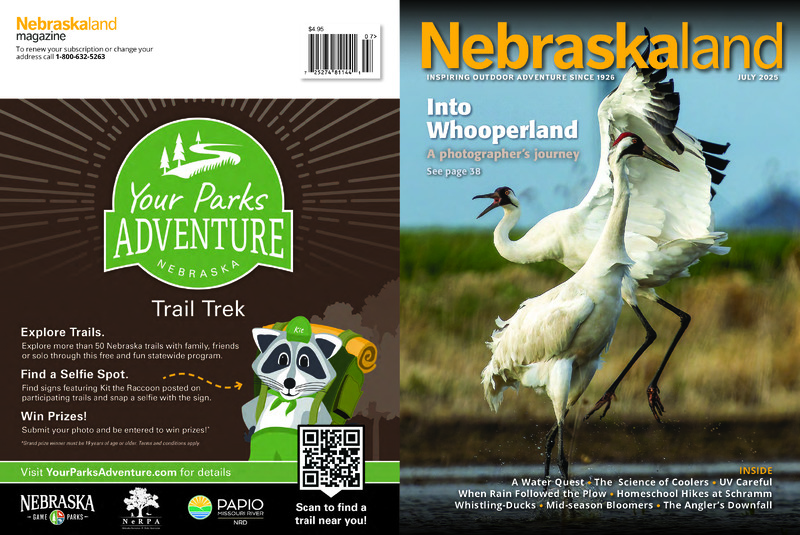
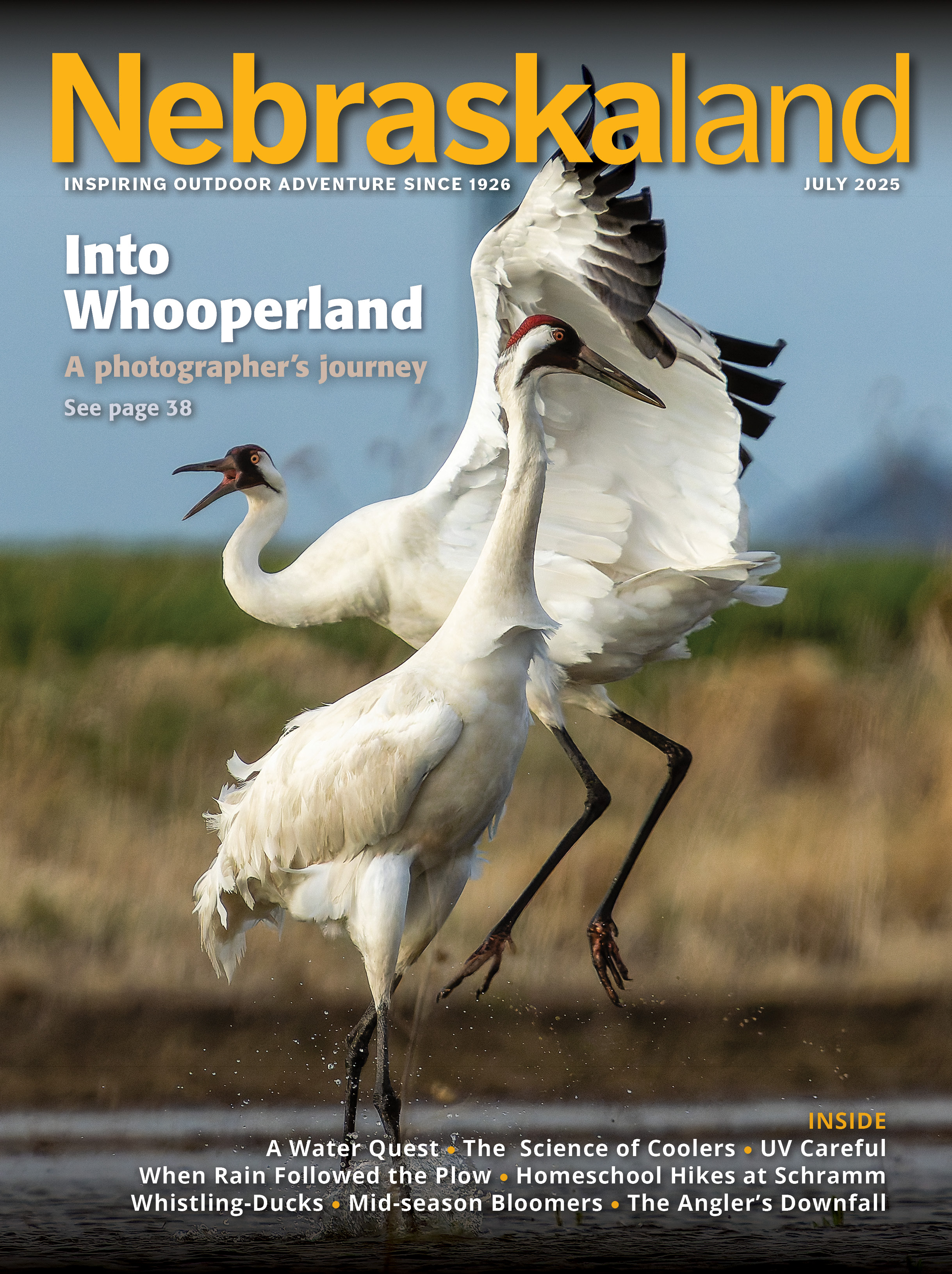
Cover: Two whooping cranes dance with each other at
Funk Wetland Protection Area in Phelps County.
See story on page 38.
MICHAEL FORSBERG
This page: A damselfly at Smith Lake Wildlife
Management Area in Sheridan County.
FEATURES
20
A WATER QUEST
28
OUTDOOR NEBRASKA
JUSTIN HAAG, NEBRASKALAND
Story by Jeff Kurrus
Photos by Eric Fowler and Justin Haag
What To Do in July
By Renae Blum
30
HOMESCHOOL HIKES AT SCHRAMM
34
WHEN RAIN FOLLOWED THE PLOW
38
INTO WHOOPERLAND
Story by Jennifer Ruyle
Photos by Jenny Nguyen-Wheatley
By David L. Bristow, Nebraska State Historical Society
A Photographer’s Journey
Book review by Jeff Kurrus
Photos by Michael Forsberg
DEPARTMENTS
6
10
44
52
54
Your Nebraska
In the Field
Mixed Bag
Portraits From the Past
The Last Stop
ON THE WEB
For more articles and
information, visit
NebraskalandMagazine.com
Nebraskaland (VOL. 103 / NO. 6 ISSN 0028-1964) is published monthly, except for the combined Jan./Feb. and Aug./Sept. issues, by the Nebraska Game and Parks Commission, 2200 N. 33rd
St., Lincoln, NE. Periodicals postage paid at Lincoln, Nebraska, and additional mailing offices. POSTMASTER: Send all UAA to CFS. (See DMM 507.1.5.2); NON-POSTAL AND MILITARY
FACILITIES: send address corrections to Nebraskaland, P.O. Box 30370, Lincoln, NE 68503-0370.
2
Nebraskaland • July 2025
July 2025 •
Nebraskaland
3
Magazine Staff
magazine
Communications Director Christy Firestone
Public Relations Manager Shawna Richter-Ryerson
Published by the Nebraska Game and Parks
Commission since 1926. The Commission is
dedicated to the conservation and protection
of all the state's natural resources and the
people who use them.
Editor Jeff Kurrus
Associate Editor Jenny Nguyen-Wheatley
Regional Editors Eric Fowler, Julie Geiser,
Justin Haag
Contributing Editor Michael Forsberg
Regular Contributors Renae Blum,
Chris Helzer, Chris Masada, Todd Mills,
Ryan Sparks, Gerry Steinauer
Art Director Tim Reigert
Graphic Designer Mel Severin
Videographer Nick Sauvageau
Photo Librarian Jaclyn Cruikshank Vogt
Administration
Director Tim McCoy
Chairman - John Hoggatt, Kearney
Vice Chairman - Donna Kush, Omaha
Kurt Arganbright, Valentine
Scott Cassels, Omaha
Dan Hughes, Venango
Kent McNeill, Papillion
Steve Mossman, Lincoln
Lisa Roskens, Omaha
Doug Zingula, Sidney
Commission Offices
Headquarters/Southeast District Office
2200 N. 33rd Street Lincoln, NE 68503
Phone 402-471-0641
Northeast District Office
2201 N. 13th St. Norfolk, NE 68701
Phone 402-370-3374
Southwest District Office
301 E. State Farm Rd. North Platte, NE 69101
Phone 308-535-8025
Magazine Subscriptions
For address changes, magazine and subscription
questions, 800-632-5263 or visit
nebraskalandmagazine.com
Advertising
For advertising information, contact:
Shane G. Gilster, 402-742-0125
shanegilster@solotreemedia.com
Conservation Officers
ADMINISTRATION
Jeff Clauson
402-471-5531
Lincoln HQ
Administrator
Travis Shepler
402-471-5531
Lincoln HQ
Asst. Administrator
Stacey Lewton
402-471-5531
Lincoln HQ
Asst. Administrator
Mike Thome
402-471-5531
Lincoln HQ
Asst. Administrator
(Includes counties covered)
NORTHWEST
Dan Kling
308-430-0572
Captain
Bassett Office
524 Panzer St., Box 508 Bassett, NE 68714
Phone 402-684-2921
Jerod Hahn
Ak-Sar-Ben Aquarium/Schramm Education
Center
21502 W. Highway 31 Gretna, NE 68028
Phone 402-332-3901
Omaha Office
8495 Frederick Street, Omaha, NE 68124
Phone 402-595-2144
OutdoorNebraska.gov
The Nebraska Game and Parks Commission does not discriminate
based on race, color, ethnicity, national origin, sex, pregnancy, sexual
orientation, gender identity, religion, disability, age, genetic information,
veteran status, marital status, and/or political affiliation in its programs,
activities, or employment. Any person who believes he or she has been
discriminated against in any program, activity, facility, or service,
should contact the Nebraska Game and Parks Commission, Lincoln, NE
402-471-0641, the Nebraska Equal Opportunity Commission, Lincoln,
NE 402-471-2024, TTY/TDD 800-642-6112; Director, Office of Diversity,
Inclusion and Civil Rights, U.S. Department of Interior, 1849 C Street,
NW, Washington, D.C. 20240.
4
Nebraskaland • July 2025
JUSTIN HAAG, NEBRASKALAND
Nebraskaland Magazine Copyright 2025, all rights reserved.
Nebraskaland is available in audio from the Nebraska Library Commission
Talking Book and Braille Service, Suite 120, 1200 N St., Lincoln, NE 68508.
800-742-7691. Nebraskaland Magazine and the Nebraska Game and Parks
Commission reserve the right to reject any advertising not in keeping with
the agency mission.
Rates: $18 for one year; $33 for two years; $44 for three years. Nebraska
recipients must add appropriate sales tax. To subscribe call
1-800-NEBLAND (632-5263), or go online to:
NebraskalandMagazine.com.
Northwest District Office
East Hwy. 2, Box 725 Alliance, NE 69301
Phone 308-763-2940
Kearney Office
1617 First Ave. Kearney, NE 68847
Phone 308-865-5310
Bighorn sheep ewes and lambs
congregate in nursery groups.
EAST SUB-DISTRICT
308-520-5539
Sergeant
308-280-4320
Hunter Lee
Keith, Deuel, Arthur
Jaden Porter
308-289-2274
Garden, Grant, Keith
Tyler Stueck
308-289-6260
Keith, Arthur, Grant
Keith Jadlowski 531-310-2869
Keith
WEST SUB-DISTRICT
Sean McKeehan 308-672-1824
Sergeant
KayLynn Miller
308-665-8440
Dawes, Sioux, Sheridan
Cassidy Harwood 308-562-9099
Box Butte, Sheridan
Josh Widhelm
308-279-9133
Scotts Bluff, Banner, Sioux
Brandon Wallace 308-280-4488
Scotts Bluff, Banner, Sioux
Travis Schultz
308-279-1292
Morrill, Scotts Bluff, Box Butte
Casey Gehrt
402-617-2112
Dawes, Sheridan, Sioux
NORTHEAST
Dale Davis
402-760-0712
Captain
WEST SUB-DISTRICT
Jeff Jones
402-762-5022
Sergeant
Greg Hesse
308-546-7464
Rock, Brown, Keya Paha
Jonathan Andreasen
402-340-3981
Madison, Pierce, Stanton
Trevor Stahlecker
402-928-9099
Knox, Antelope, Pierce
Mitch Johnson
402-613-8612
Cedar, Knox
EAST SUB-DISTRICT
Cory Krause
402-380-6410
Sergeant
Kyler Prochaska 402-830-8278
Platte, Colfax
Matt Costello
402-317-4014
Dodge, Colfax
Kelbi Abke
402-237-2537
Washington, Burt
Nicholas Fix
402-508-0261
Dixon, Dakota, Thurston
Kyle Hansen
531-739-7392
Dodge
CENTRAL SUB-DISTRICT
Doug Pollard
308-730-7050
Sergeant
Daryl Teter
308-440-1863
Howard, Greeley, Merrick
Matt Brandt
308-202-0819
Sherman, Howard
Klint Gill
402-613-5800
Nance, Wheeler, Boone, Polk
Garrett Zimmer 402-416-5736
Garfield, Loup Valley
Tim Williams
308-380-7331
Hall, Hamilton
SOUTHWEST
Brian Piernicky 308-330-8780
Captain
NORTH SUB-DISTRICT
Alex Hasenauer
308-660-4671
Sergeant
308-395-6001
Jacob Stoinski
Lincoln, Perkins
Frank Miller
402-389-0444
Cherry, Hooker
Luis Nuñez
531-333-6093
Blaine, Custer, Thomas
Brandon O’Neal 308-530-3157
Lincoln, McPherson, Logan
SOUTH SUB-DISTRICT
Kelsey Glodowski 308-242-9000
Sergeant
Bryce Streger
308-537-0404
Dawson, Gosper, Custer
Tyler Adelman
402-314-4783
Dawson, Gosper, Furnas
Sophia Gobber
308-222-0368
Chase, Dundy, Hayes, Hitchcock
SOUTHEAST
Matt Seitz
402-806-0915
Captain
WEST SUB-DISTRICT
Matt Taylor
402-200-9597
Sergeant
402-902-2017
Eric Javins
Adams, Clay, Webster
Justin Gress
308-629-9335
Thayer, Nuckolls, Fillmore
Pat George
308-920-2762
Harlan, Franklin, Phelps
Ethan Teter
308-440-3847
Buffalo, Kearney
EAST SUB-DISTRICT
Heath Packett
402-210-0888
Sergeant
Brett Greenfield 531-350-0915
Cass
Russell Mort
402-209-1506
Otoe, Johnson
Rich Berggren
402-619-1355
Douglas
Brian Arp
531-530-9011
Douglas, Sarpy
Mike Luben
402-443-6392
Saunders
Bryan Adams
402-429-1924
Nemaha, Pawnee, Richardson
CENTRAL SUB-DISTRICT
Curt Prohaska
402-470-1298
Sergeant
308-430-5500
Ben Keller
Gage, Jefferson
Mark McDonald 402-805-2353
Lancaster
Mark Sullivan
402-741-0636
Lancaster, Seward, Butler
Jarrod Messman 531-739-9760
Lancaster, Saline, York
YOUR NEBRASKA
Instagram Photos
Follow us @nebraskaland
and tag us in your photos
to be featured in an
upcoming issue.
Marquene Koontz, Ogallala
Bullsnake
6
Nebraskaland • July 2025
July 2025 •
Nebraskaland
7
Kirk Pridell, Papillion
Great Blue Heron
Corrections:
May 2025 issue
Page 45 – The holes for the sides and
floor of the house wren nest box are
labeled 1¼” — they should be just ¼” for
ventilation and drainage.
David Ruder’s name was misspelled in
“Live Well. Go Fish.”
June 2025 issue
Page 38 – Caption should have read:
“Lily Bloomfield of Minden paddles
a whitewater kayak on one of the
•
Chuck Hackenmiller, Lincoln
Water Skier at Pawnee State Recreation Area
8
Nebraskaland • July 2025
•
•
rapids with other participants during a
University of Nebraska – Lincoln Outdoor
Adventures trip.”
Page 58 – The Walk to the Rock trail
is managed by the Nebraska State
Historical Society Foundation on 360
acres adjacent to the Chimney Rock
National Historic Site, which is managed
by the Nebraska State Historical Society.
The two properties operate independently
and have separate fees. This separation
was not clear in the story.
•
Send your comments and
photos to:
Jeff Kurrus, Editor
Nebraskaland Magazine
P.O. Box 30370
Lincoln, NE 68503
or email Jeff.Kurrus@Nebraska.gov
Please include your postal address
and telephone number. Letters
may be condensed and edited.
Photographs are also welcome.
July 2025 •
Nebraskaland
9
IN THE FIELD
STRANGE
FORMATIONS
Eroded layers of
sandstone and siltstone
left by ancient rivers
create the unique
geologic formations that
give Toadstool Geologic
Park its name.
E
ERIC
FOW
OWLER,
L
NEBRASK
NEB
RASK
RAS
ASKALAN
A
AL
ALAN
D
10
Nebraskaland • July 2025
July 2025 •
Nebraskaland
11
IN THE FIELD
Citizens are encouraged to participate in this year’s summer turkey survey, which provides valuable information to biologists
regarding wild turkey management throughout the state. JUSTIN HAAG, NEBRASKALAND
PARTICIPATE IN THE SUMMER
TURKEY SURVEY
By Julie Geiser
Citizen scientists are key components to many aspects
of biological research, including Nebraska’s wild turkey
population. This year, the public can help biologists learn
more about turkeys and their reproductive success by
participating in the Nebraska Game and Parks Commission’s
annual summer turkey survey, which starts July 1 and goes
through Aug. 31.
This research provides useful estimates about annual
production by wild turkey hens and the survival of
young turkeys, or poults, through the summer months —
information essential for turkey management.
During the two-month survey participants are asked to
record all turkeys they see, including hens, poults, males
and those you couldn’t classify. Visit OutdoorNebraska.gov
and search “turkey brood survey” for reports since 2020,
including the Rural Mail Carrier Survey, and instructions for
this year’s survey. The survey link can be bookmarked on a
phone for easy use in the field or printed off and submitted
later.
12
Nebraskaland • July 2025
“Turkey surveys are truly the lifeblood of population
management,” said Carlie Saline, wild turkey manager with
Game and Parks. “Without baseline knowledge of abundance
and reproduction, we could not responsibly set hunting
season parameters. Records of sightings give us an index
of where and how many individuals are utilizing certain
parts of the state, and poult-per-hen ratios lend insight into
females’ nest successes and poult survival. We are grateful
to the volunteers who have offered their knowledge over the
years so we can best conserve this species and our hunting
heritage.”
Information gathered through the survey includes:
Average brood sizes of poults per documented brood.
Percentage of adult hens with poults.
Percentage of males in the adult portion of the population.
Annual Production Index = total number of poults/total
number of adult hens.
These results will be evaluated annually, helping managers
understand why populations are succeeding or not.
•
•
•
•
IN THE FIELD
The black-bellied whistling-duck is undergoing a dramatic population increase and range expansion.
TOBIN BROWN
WHISTLING-DUCKS PUSH NORTH
By Joel Jorgensen
Population sizes and geographic ranges of animals are
rarely static. While some changes may occur at time scales
imperceptible to most people, other species’ populations and
ranges undergo rapid change often associated with recent
human activities. Sometimes that may cause a species to
disappear from a place like Nebraska, but other times it
results in a new species moving in.
The black-bellied whistling-duck is one species undergoing
a dramatic population increase and range expansion. This
striking member of the waterfowl clan, with its black and
chestnut plumage and nifty orange-pink bill, was historically
restricted to the very southern tip of Texas in the U.S. through
most of the 20th century. It was not until the 1970s that the
species began to push north aided somewhat by nest boxes,
which the species readily uses, as well as releases of captivereared birds in states like Louisiana.
In the late 1980s and 1990s, as the core population continued
to thrive, individuals and small groups ventured far to the north
of Texas. Nebraska garnered its first record of this dapper bird
in 1989 when a hunter harvested one in Clay County. It would
be another 10 years before Nebraska would claim its second
14
Nebraskaland • July 2025
record, but it would again come from Clay County.
Since 2000, the whistling-duck occurrence in the state
has steadily increased. Presently, it remains a rare find
but it now occurs annually during warmer months. The
first records involved singles or pairs, but now flocks in the
double digits are being seen. In 2019, a pair with ducklings
was observed at Funk Waterfowl Production Area in Phelps
County and since then three more nesting records have been
documented. Interestingly, all breeding records have been in
August and September, which is much later than the typical
nesting season of most bird species, including waterfowl.
It seems nearly certain that black-bellied whistling-ducks
will continue to increase in Nebraska as the years go on.
Breeding now occurs annually in Kansas, and it seems logical
that regular nesting is in Nebraska’s future. These beauties
are readily at home at ponds in parks and near human activity,
so do not be surprised if this summer you come across this
new member of the Nebraska breeding bird roster.
Joel Jorgensen is the nongame bird program manager for the
Nebraska Game and Parks Commission.
IN THE FIELD
UV CAREFUL
By Julie Geiser
Summer brings heat, sun and outdoor fun, but it also
means you’re at a higher risk of sunburn and exposing your
skin to harmful ultraviolet sun rays. Ultraviolet rays that
reach the Earth’s surface come in two varieties: ultraviolet A
(UVA) and Ultraviolet B (UVB).
UVA rays make up about 95% of all the rays that reach the
Earth’s surface. These rays can penetrate deep into skin and
even pass through glass. UVA rays can damage the collagen
and elastin in your skin, causing wrinkles, sagging and age
spots.
UVB rays make up
only 5% of the rays
from the sun and can
also cause skin damage.
These rays produce tans
and sunburns and are
largely responsible for
skin cancers, such as
melanoma, and long-term
eye damage.
One severe sunburn
doubles your chances of
developing skin cancer,
and the damage becomes
permanent. This summer,
protect your skin while
enjoying time outside.
30 or higher and is water/sweat resistant. Reapply sunscreen
every two hours and after swimming or sweating. Pay
attention to areas that are most exposed, such as your face,
lips, ears, neck, shoulders, back, knees and the tops of your
feet. Be aware of the expiration date on sunscreen.
Use extra caution near water. Water can reflect the
damaging rays of the sun, increasing your chance of sunburn.
Keep infants under six months old in the shade,
preferably wearing sun-protective clothing. If this is not
possible, use a lotion sunscreen with an SPF of 30 or higher
and be sure to wash it off
as soon as you are home.
Be aware that certain
medications can make
your skin more sensitive
to UV rays. Consult
your doctor if you have
questions about your
medication.
•
•
•
Sunburn Relief
If you get sunburned,
take a cool bath or shower
to help relieve the pain.
Gently pat your skin dry.
Soothe your skin with
products containing aloe
vera or soy.
Calamine lotion, damp
Skin Protection
washcloths and oatmeal
Hit the shade. Avoid
Skincare products are endless. For optimal protection, choose
overexposing your skin sunscreen that has a SPF of 30 or higher and is water/sweat resistant. baths can aid in pain relief.
JEFF KURRUS, NEBRASKALAND
Ibuprofen can reduce
to the sun without
swelling and pain.
protection,
especially
Hydrocortisone creams can help treat swelling and
between 10 a.m. and 4 p.m., which is when the sun’s rays are
irritation. Purchase 1% hydrocortisone over the counter, or a
at their highest intensity.
doctor can prescribe a stronger version.
Wear clothing and a hat that provides UV protection.
Be sure to drink extra water and electrolytes to rehydrate
Wear sunglasses. Photokeratitis is an inflammation of
your skin and body — your body will send extra fluids to
the cornea, which is the clear covering on the front of the eye.
sunburned areas.
Sunglasses with UV protection can help prevent damage to
Examine your skin often to detect skin cancer as soon
the cornea and other parts of the eye.
as possible. See your doctor right away if you notice any
Wear sunscreen. Even on cloudy days, UV rays can cause
abnormally dark or discolored patches or spots, bleeding,
burning through cloud cover. Choose sunscreen that provides
areas of flaking or crusting skin, or changes in the color, size
broad-spectrum protection from both UVA and UVB rays.
or shape of a mole.
Some people prefer mineral-based sunscreen containing zinc
In July, UV rays are at the highest in Nebraska, so make
oxide and titanium dioxide as opposed to chemical formulas.
sure to protect yourself while having fun in the sun.
Make sure the sunscreen has a sun protection factor (SPF) of
•
•
•
•
16
Nebraskaland • July 2025
July 2025 •
Nebraskaland
17
IN THE FIELD
Wild turkey pho is an easy, flavorful way to use the leg and thigh meat from your turkey.
RYAN SPARKS
WILD TURKEY PHO
By Ryan Sparks
For those unfamiliar, pho
(rhymes with duh) is a Vietnamese
noodle soup. A rich, clear broth
is paired with rice noodles, meat
and plenty of herbs. Pho was
popularized throughout the world,
especially in the U.S. and Canada,
by refugees after the Vietnam
War. Pho is an excellent way to
transform wild turkey legs and
thighs into tender bits of meat
that are then added to an enriched
stock.
Servings: 6
Cooking Time: 1 hour of active
cooking, 4-6 hours of waiting.
Ingredients:
2 wild turkey legs and thighs
2 yellow onions, roughly
chopped
1 (4-inch) piece of ginger,
sliced into thick coins
12 cups turkey or chicken
stock, homemade if you have
it
¼ cup fish sauce
•
•
•
•
18
•
Nebraskaland • July 2025
• 1 star anise pod
• 2 tablespoons brown sugar
• 1 (1-pound) package dried rice
•
•
•
•
•
noodles
1 small bunch Thai basil (or
any variety of basil)
2 jalapenos, thinly sliced
2 limes, quartered
1½ cups chopped cilantro
leaves and stems
1 bunch thinly sliced scallions
1. Place turkey thighs and legs
in a slow cooker and barely cover
with water or stock. Set the heat to
high and cook until the meat easily
separates from the bone (around 5
hours).
2. When the meat is nearly done,
cook the onions and ginger in a dry
pan over high heat until they are
charred.
3. In a large Dutch oven or stock
pot, combine onions, ginger, stock,
fish sauce, star anise and brown
sugar. Bring to a boil, then reduce
the heat and simmer for around
45 minutes. While the stock is
simmering, remove the meat from
the slow cooker, let it cool slightly
and shred it with your hands or
two forks, making sure to remove
all bones and tendons.
4. Cook the rice noodles
according to the instructions on
the package. Drain and set aside.
5. Remove onions, ginger, and
the star anise pod from the pot.
Add the shredded turkey meat
and bring the mixture to a simmer.
Taste the soup for salt and add
more fish sauce if it needs more
salt.
6. Arrange the limes, basil, and
sliced jalapeno on a platter and set
on the table.
7. Divide rice noodles, cilantro,
and scallions evenly among large
soup bowls, then ladle the hot
stock over the top, making sure
each bowl gets an ample portion
of turkey. Serve immediately
accompanied by the platter of
garnishes. Remember the hunt.
July 2025 •
Nebraskaland
19
A Water Quest
Theresa Fowler of Lincoln and Regina
Osburn of Valentine look out over
Merritt Reservoir State Recreation
Area in Cherry County.
ERIC FOWLER, NEBRASKALAND
Story by Jeff Kurrus
Water — during July in
Nebraska, it’s a necessity. No
amount of shade can prevent
the onslaught of sweat that
accompanies hiking, biking
and the host of other outdoor
activities we covet during the
summer.
20
Nebraskaland
• July 2025
July 2025 •
Nebraskaland
21
TOP LEFT: A personal watercraft pulls a skier across Branched Oak State
Recreation Area in Lancaster County. ERIC FOWLER, NEBRASKALAND
BOTTOM LEFT: Raelin Campbell of Wood River plays in the water at Cheyenne
State Recreation Area in Hall County. Her father, Riley, fishes and her
mother, Sarah, and brother, Ethan, watch. ERIC FOWLER, NEBRASKALAND
BELOW RIGHT: Children play in Bone Creek at Keller Park State Recreation
Area in Brown County. ERIC FOWLER, NEBRASKALAND
We can wake up early and adventure
late, but come midday there’s only one
place to be: in or near water.
Yet this commodity has been
hard to come by the past couple of
years across the state. Drought has
affected many of our state parks, but
a plethora of locations remain where
we can stake our tents or park our RVs
near the one place that forever draws
us when a person couldn’t imagine it
getting any hotter — water.
22
Nebraskaland
• July 2025
July 2025 •
Nebraskaland
23
Enjoy these areas and
more throughout the
state as you feel yourself
pulled by the one
magnet we all seem to be
attracted to this time of
year. N
Steve Peterson of
Vermillion, South Dakota,
sails on Lewis and Clark
State Recreation Area in
Knox County.
ERIC FOWLER, NEBRASKALAND
ABOVE: Zoe Balero of Fort Morgan,
Colorado, fishes near her campsite at
Bridgeport State Recreation Area in
Morrill County. JUSTIN HAAG, NEBRASKALAND
BELOW: Kayakers float the Niobrara
National Scenic River at Fort Niobrara
National Wildlife Refuge in Cherry
County. JUSTIN HAAG, NEBRASKALAND
24
Nebraskaland
• July 2025
July 2025 •
Nebraskaland
25
Campers line the shoreline in the No Name
Bay area at Lake McConaughy State Recreation
Area in Keith County.
To check water levels at any of
Nebraska’s state parks or recreation
areas, visit OutdoorNebraska.gov/parks
and search “Find a Park.”
26
Nebraskaland
• July 2025
July 2025 •
Nebraskaland
27
Outdoor Nebraska
By Renae Blum
Beat the summer heat by having too much fun to notice, whether you’re
kayaking a beautiful lake, celebrating the Fourth of July or even
indulging in some holiday cheer. N
What To Do in July
Enjoy a Fourth of July
barbecue
July 4, 11 a.m. to 1 p.m. | Fort Robinson
State Park, on west lawn near main lodge/
office
Celebrate the Fourth western-Nebraska-style, with
an outdoors barbecue set against the rugged, epic
backdrop of Fort Robinson State Park. This popular
annual barbecue kicks off after Crawford’s town
parade finishes around 11 a.m., leaving plenty of
time for afternoon park activities like Jeep tours
and guided horseback rides. In the evening, many
participants head back into town for a rodeo and
fireworks. The meal of burgers, beans and potato
salad has a fee, and a vehicle park entry permit is
required. JUSTIN HAAG, NEBRASKALAND
Enjoy a sunrise trail ride
Tuesday mornings | Niobrara State Park, 2½ miles west of
the town of Niobrara
During Niobrara State Park’s new sunrise trail rides, visitors will
experience breathtaking views atop the river bluffs, watching the
sun rise over the Niobrara and Missouri rivers. “It’s one of the most
spectacular sunrises you’ll ever see,” said park superintendent Cogan
Thompson. Rides typically accommodate up to six people and last
45-50 minutes. Ages 6 and up are allowed, and no prior experience is
needed. Rides cost $30 per person. Book your ride through the park
office by 6 p.m. the day before at 402-857-3373. RV THERE YET? TV
Celebrate National Bison Month
Throughout July | Statewide
July is National Bison Month — a fantastic opportunity to celebrate America’s
national mammal, the American bison. In Nebraska, these large, beautiful
animals help support prairie ecosystems through the wallows they create by
rolling and lying on the ground. Take the opportunity to view bison this month
at places like Fort Robinson State Park, Pioneers Park Nature Center in Lincoln,
the Crane Trust Nature and Visitor Center near Alda, Wildlife Safari Park near
Ashland or Niobrara Valley Preserve in Brown County.
JUSTIN HAAG, NEBRASKALAND
Kayak at a beautiful
southwestern park
Spring and summer best times | Red Willow State
Recreation Area, located 11 miles
north of McCook
This summer, explore one of southwestern Nebraska’s
best parks for kayaking. Red Willow State Recreation
Area offers more than 1,600 acres of water, along with
striking views and three secluded coves to explore. “As
you paddle along, you’re tucked into what feels like
a large canyon,” said regional park supervisor Tyler
Francisco. “You kind of forget that you’re in Nebraska.”
Kayak fishing is popular, too. Launch from one of three
boat ramps or the sandy day-use beach area.
JULIE GEISER, NEBRASKALAND
28
Nebraskaland • July 2025
Attend ‘Campfire
Christmas in July’ event
July 25 from 6-10 p.m. and July 26 from 11
a.m. to 10 p.m. | Indian Cave State Park,
located 10 miles south of Brownville
Sometimes a touch of holiday cheer is exactly what
you need during a Nebraska summer. Now in its 12th
year, this festive celebration offers activities for both
children and adults. Stop by to enjoy tractor-drawn
Polar Express hayrack rides, Christmas-themed
crafts and games, visits with Santa, a yule log quest,
food trucks and even a campsite decorating contest.
Learn more at Calendar.OutdoorNebraska.gov.
ERIC FOWLER, NEBRASKALAND
July 2025 •
Nebraskaland
29
Homeschool
Hikes at
Schramm
Story by Jennifer Ruyle, Outdoor Education Specialist
Photos by Jenny Nguyen-Wheatley
E
very third Wednesday and
Thursday of each month —
except in June and July — a
group of homeschool families
assemble in the lobby of Schramm
Education Center near Gretna to
prepare for a guided hike. Led by a
Nebraska Game and Parks naturalist,
the Homeschool Hikes program
welcomes a different group each week.
Participants might be just two moms
and their kids or a crowd of 80 people.
The hike invites strangers and
friends to meet. Kids who know each
other hang back and walk together.
Babies in chest carriers come along,
too. It seems like there’s always one
curious 6-year-old who finds their
way to the front of the pack to hike
alongside the naturalist, chatting
about their favorite animal or their dog
or their weekend plans.
In fall and winter, we may hike in
rain, single-digit temperatures or
several inches of snow. Sometimes we
are blessed with the most gorgeous
“false-spring” with clear blue skies
and 70-degree days. Unsurprisingly,
our spring and summer programs
usually draw big groups, when the park
Kelsey Wood, Luanne Wood and Oliver Wood of Millard look out onto the Platte River during a Homeschool Hike.
Naturalist Alena Carlson points at a bird during a Homeschool Hike at Schramm
Park State Recreation Area.
30
Nebraskaland • July 2025
is green and in full bloom. Whatever
the conditions, we hit the trails for
adventure and fun.
The program offers opportunities for
learning about local plants, animals,
ecosystems and natural phenomena.
Families who attend throughout the
year are able to witness and appreciate
the phenology of the park, from the
first snow geese that pass overhead
in February to the last monarchs that
leave in October. It’s also become an
opportunity for homeschool families to
find nature-loving community. Many
parents and caregivers specifically
join the Homeschool Hikes program
to meet other outdoorsy homeschool
families.
Each month’s hike features a
different topic, which is planned
around the happenings at Schramm
Park at different times of the year. Our
naturalists keep a close eye on what
wildlife is doing. For example, in March,
we noticed the sudden reappearance
of red-winged blackbirds the same
week we held Homeschool Hikes, so
it became that month’s theme. One
November, we had a hike that focused
on turkeys, and we were rewarded with
the chorus of our resident wild turkeys
gobbling during our excursion.
We also lean on the strengths of
our seasonal naturalists to determine
topics for the year ahead. Some
naturalists are knowledgeable about
wildflowers and grasses, while others
are lifelong birders. Several have been
avid anglers and can share information
about all the fish in the area and the
aquatic creatures that coexist within
the ponds in our park. Past themes
have included “Frogs and Toads,”
“Wetlands,” “Lichen” and less tangible
July 2025 •
Nebraskaland
31
Janna O’Mally of Omaha, left, and Katelynn Moore of Seward
learn with their children during a Homeschool Hike program.
Families hike on a trail following the Platte River at Schramm Park State Recreation Area.
themes, such as “Relationships in
Nature.”
While we do prepare a lesson plan
for each month, we allow room for
“rabbit holes” and fully embrace being
in nature without a rigid schedule.
One day, while hiking in December, we
noticed bullfrog tadpoles swimming
underneath the ice. Of course we had
to stop and investigate. This random
encounter allowed an opportunity for
32
Nebraskaland • July 2025
great questions: Aren’t the tadpoles
cold? What do they eat when the
pond is frozen over? Why haven’t they
turned into frogs yet?
Even on days when we only see
“ordinary” things, time spent in the
park with our homeschool hikers
always feels well spent. With that
said, we have had some spectacular
moments during hikes simply because
we took the time to be outside in the
right place, at the right time, with
people who are observant. A few of my
favorite Homeschool Hikes moments
include:
• While walking on the river trail in
January, we witnessed two bald eagles
locking their talons and cartwheeling
through the sky in a mating ritual.
• Discovering an alien-like orange,
spiky caterpillar crawling on the
underside of a leaf while looking for
snails and slugs.
• Spotting bright yellow chicken
of the woods mushrooms growing
on a tree and sharing the excitement
of my first find with the homeschool
students.
• Looking for animal scat and
instead finding a huge owl pellet on
the trail. We dissected it on the trail
and found it contained the skull of a
squirrel.
• “Borrowing” horse poop from
the stables at Platte River State Park
to bait dung beetles for students to
observe, and then successfully finding
dung beetles in it during our hike!
Through the program, we hope
to create space for families to make
memories and find community, and
to learn new information and practice
their science skills at the park.
Learning in nature allows for deep,
meaningful connections to take
place. As any “ologist” will tell you,
observing nature in the field makes
concepts much more memorable and
understandable than reading about
them in a textbook.
Science is all about asking and
investigating your own questions,
letting your curiosity lead the way, and
the pleasure of making conclusions
through observation and trial and
error. N
Homeschool Hikes are open to
everyone. To view upcoming events,
visit Calendar.OutdoorNebraska.gov and
search “Homeschool Hikes.”
Join Us
Homeschool Hikes is a
monthly nature exploration
program hosted by Schramm
Education Center geared
toward homeschool
families. During the
program, participants are
encouraged to ask questions,
draw, observe and make
discoveries in nature.
The cost to participate is $5
per person per program. This
includes admission to the
Schramm Education Center
after the hike. Schramm
Family Pass members
participate free.
Homeschool Hikes are
recommended for ages 5
and up. Participants should
dress in season-appropriate
layers and wear closed-toed
shoes that can get dirty.
Register in advance so
naturalists can estimate
attendance at Calendar.
OutdoorNebraska.gov.
Note that there are no
Homeschool Hikes in June
and July for summer break.
July 2025 •
Nebraskaland
33
When Rain Followed the Plow
By David L. Bristow
Nebraska State Historical Society
ainfall follows the plow” is one of the most consequential
ideas in Nebraska history. That doesn’t mean it was a
good idea.
For centuries, Nebraska’s Native American inhabitants
planted corn in the east and hunted bison in the west. When
a U.S. military expedition crossed the region in 1820, the
soldiers noted the lack of trees and the increasingly arid
conditions as they moved west. After that, maps labeled the
Great Plains as the GREAT DESERT. The region was “almost
wholly unfit for cultivation, and of course uninhabitable by a
people depending upon agriculture for their subsistence,” in
the words of an early geographer.
As a result, the U.S. government was happy to leave the
Great Plains as a permanent “Indian Country” into which
displaced eastern tribes could be moved. But by the 1850s,
the U.S. was planning to build a transcontinental railroad
through that region and opened it to settlement. Following
the Civil War, hundreds of thousands of settlers poured into
the new state of Nebraska, pushing ever farther west into
‘R
“Using all the farm for crops — plowing corn in door yard.” Custer County, 1888. Photo by Solomon D. Butcher.
Detail of a map from Stephen Long’s 1820 expedition.
The South Platte River runs along the top; today the spot
numbered 22 is the location of the city of North Platte. The
future Nebraska and Kansas are labeled GREAT DESERT.
STEPHEN H. LONG AND EDWIN JAMES, “COUNTRY DRAINED BY THE MISSISSIPPI” (1823)
34
Nebraskaland
• July 2025
country with less and less rain. West of the 100th meridian
(in other words, west of Cozad), rainfall averaged less than 20
inches a year. Good luck farming with that.
In 1880, a University of Nebraska professor named Samuel
Aughey published a book explaining how plowing the prairie
would allow rain to penetrate more deeply. Plowed land
would soak up rain like a sponge. The broken sod would
slowly evaporate moisture, which would create more rain. In
the words of another writer, “rainfall follows the plow.”
Railroads and town boosters had a strong incentive
NSHS RG2608-0-2023S
to promote Nebraska’s land and climate, and they were
enthusiastic for this new, scientific-sounding explanation.
The Burlington and Missouri River Railroad even paid a
stenographer to record Professor Aughey’s speeches, printing
them as pamphlets to be distributed as far away as Europe.
July 2025 •
Nebraskaland
35
When rain didn’t follow the plow in the 1890s, Nebraska communities hired professional rainmakers who used explosives,
smoke and chemical reactions to create rain. It didn’t work but sometimes they got lucky. NSHS RG2545-0-9
A Clay County farm, showing its owners’ humbler previous residence in Ohio. Published in 1882, A.T. Andreas’ “History of the
State of Nebraska” is full of flattering images of prosperous farms, usually shown with plantings of trees.
“Farmers attending a siphon tube irrigation demonstration,” Clay County, Nebraska, 1948. Soil Conservation Service photo.
NSHS RG2570-18-45
36
Nebraskaland
• July 2025
And for several years in the 1880s, it
all seemed to be true. Rainfall really did
increase across Nebraska even as more
land was plowed. A modern scientist
would have warned people not to
confuse correlation with causality, but
nobody worried too much about that.
Then came the drought years of the
1890s, which were worse than anything
most non-Indigenous people had seen.
The new settlers hadn’t lived here long
From the promotional material on the back of “Map of Burlington and Missouri
enough to know that such extremes are
River Railroad Lands in Nebraska, Columbus District, 1890.” NSHS M782 1890 B92b
normal. And in many cases, they didn’t
even know the area’s recent history. In
Most of the Great Plains became cattle country. Successful
his book “The Last Days of the Rainbelt,” geographer David
farming in arid regions came only after the development of
Wishart writes that due to recurring drought, some parts of the
irrigation. Rain doesn’t follow the plow, but you might say
high plains (including southwestern Nebraska) were settled
the plow follows the center pivot. N
and abandoned by “three or more waves of homesteaders
before successful farming took root.”
Visit NSHS’s website at history.nebraska.gov.
July 2025 •
Nebraskaland
37
Into Whooperland
A Photographer’s Journey
Book review by Jeff Kurrus
Photos by Michael Forsberg
ichael Forsberg’s newest
book, “Into Whooperland
— A Photographer’s
Journey with Whooping
Cranes” is a celebration and warning
to readers regarding one of the world’s
rarest birds.
The book starts where Forsberg is
at his best — in the field. A journal
M
entry prepares readers for what is yet
to come: “A flash of lightning from
a predawn thunderstorm lit up the
roost and revealed a glimpse of white
among the thousands of dark shapes.
As the storm passed and the veil of
night lifted, there he was: a rare white
wonder standing tall above the noisy
pulsing masses of sandhill cranes.”
An hours-old whooping crane chick receives its first health check by Marianne Wellington, senior aviculturist,
and Cindy Gutter, assistant curator of birds, at the International Crane Foundation in Baraboo, Wisconsin.
38
Nebraskaland • July 2025
Two whooping cranes
dance with each other
at the Funk Wetland
Protection Area in
Nebraska.
July 2025 •
Nebraskaland
39
science. “Into Whooperland” provides
insight into Forsberg’s many hours in
a crane blind, and sometimes, in the
most unexpected places, the reader
finds humor. “The mosquitoes are
fierce inside the blind this morning.
Somewhere there is a breach.”
“Into Whooperland” is divided
into the following sections, which
read like chapters: “Winter Grounds,”
“Migration North,” “Summer Nesting,”
“Migration South,” “The Central
Flyway” and “New Beginnings.” It is
in the Central Flyway where Forsberg
chronicles his trip with Boyer in the
Cessna as he attempts to follow the
whooping crane’s migration path
through the heart of the continent.
The book is part love story, part
coffee table book and all documentary.
The reader learns that these birds
mingle. They jostle. They most
certainly dance.
The reader also learns all the
difficult steps to rearing a chick
Bird keeper Rebecca Arnold carries a young whooping
crane named Fog to be checked by the veterinarian at the
Freeport-McMoRan Audubon Species Survival Center in New Orleans.
in the wild and in captivity at the
International Crane Foundation in
Baraboo, Wisconsin, and how the
population got so low in the first place.
“Whooping crane biology would
Forsberg, alongside International Crane Foundation scientist Andy Caven, spent eight days in two separate
photo blinds to capture this whooping crane nest at Wood Buffalo National Park in Canada. A two-day-old chick
explores its new world.
This description of seeing a lone
whooping crane on the Platte River in
Nebraska is indicative of this book’s
most resonating strength: When
Forsberg decides to tackle a subject,
he is all-in. His work goes beyond
photography, which is as stunning as
it’s ever been.
To create “Into Whooperland,” he
enlisted the help of what seems a
countless list of scientists, landowners
and other conservationists to deliver a
simple message. This is written by
Rich Beilfuss, President and CEO of
the International Crane Foundation, in
the book’s introduction: “We must find
sustainable solutions for our lands and
waters, for the wildlife we love and for
our own livelihoods and future.”
This theme pervades throughout
40
Nebraskaland • July 2025
the book, the message hitting you
on every page. Forsberg wants you
to know that the world’s whooping
crane population fell to fewer than 20
birds during the 1940s, and readers are
reminded of this number across the
book’s more than 220 pages. The story
of the whooping crane is a warning
of what has happened and what will
happen if we don’t protect this bird —
if we don’t protect all wildlife.
Another dedicated member of
Forsberg’s team was Chris Boyer, who
traveled with the author in a Cessna
1957 prop plane along Whooper
Highway, the migration route from the
Texas Gulf Coast to northern Canada. Or
the International Crane Foundation’s
co-founder George Archibald, known
for “dancing” with captive cranes and
encouraging Forsberg to write this
book. Or scientist Andy Caven, who
was his photo partner in the chapter
entitled “Eight Days in a Blind,”
where Forsberg chronicles his time
in a photo blind deep in the heart
of whooping crane nesting grounds
in the boreal wetlands, forests and
plains of Canada.
“One of us always watched the nest,
except roughly between 11 p.m. and 2
a.m., when we both tried to sleep. The
last thing I would do before nodding
off was manually focus my lens on
the nest. I kept a shutter release cable
next to my head so I wouldn’t miss a
photograph … .”
Drawings and other findings came
from the trip. Observations became
field notes and field notes became
The braided channels of the Platte River in central Nebraska near Rowe
Sanctuary provide critical stopover habitat for whooping cranes along
their migration through the Central Flyway.
have made them especially vulnerable
to hunting and egg collection,” writes
Beilfuss. “They are long-lived, become
flightless when they molt their primary
flight feathers every two to three years,
reach breeding maturity at three to five
years old, and raise one or (rarely) two
chicks per year that require intensive
parental care for about three months
until fledgling … . The birds’ preference
for breeding in wetlands of the fertile
tallgrass and northern mixed-grass
prairie regions, made them highly
vulnerable to habitat loss as settlers
plowed and drained those lands for
farming.”
Alongside the book’s educational
components are Forsberg’s images.
Close-ups of whooping crane chicks
and landscapes of nesting grounds.
Workers in crane suits. Juveniles
with their parents. Birds in Canada,
Nebraska, Texas and parts in-between.
As a longtime contributor and former
staffer for “Nebraskaland Magazine,”
Forsberg is known for entrenching
himself in his subjects — whether it be
whooping cranes in his latest book or
sandhill cranes in his first coffee table
picture book — “On Ancient Wings.”
The book also contains a chapter
entitled “Building the Backup Flock”
by Rene Ebersole. This tells the
fascinating story of Tex, Gee Whiz
July 2025 •
Nebraskaland
41
A harvested whooping crane.
Circa 1888 in Elm Creek,
Nebraska. JOEL SARTORE ESTATE
a Canus — three whooping cranes
and
who
have profoundly impacted
w
the
world’s current population
th
of
o whooping cranes. Their story
reminds
readers of the human
re
affects
on these extraordinary birds
a
and
an how science, love and common
sense
problem-solving have helped
se
maintain
this species.
m
Lastly, Forsberg shares a tip for
the
th aspiring photographer: “I’ve
found
that the key to using blinds
fo
with
cranes is to be in them before
w
the
th birds arrive and to climb out of
them
only after they have left the
t
area.
It’s also necessary to live by
a
the
mantra of being comfortable
t
with
being uncomfortable. Blind
w
work
is a solitary experience. You
w
must
cope with being alone with
m
your
own thoughts, and often in
y
physically awkward positions.
Other
challenges: weather
extremes; myriad insects that buzz,
bite and sting; knowing how to keep
the blood flowing to your extremities
at all times; and keeping your mind
active. The moment you let your
guard down is always when the action
happens. Always.”
These words are a microcosm
for handling difficult situations in
conservation as a whole and for life
in general.
This mindset has also allowed the
population of one of the world’s rarest
species that fell to fewer than 20 birds
rise to roughly 830 known individuals
today with names like Yay, Nay and
even Husker Red.
Michael
Forsberg’s
“Into
Whooperland” reminds us to not let
our guard down.
“Into Whooperland — A Photographer’s
Journey with Whooping Cranes” recently
won the gold medal in the Nature
category of the 2025 Independent
Publisher Book Awards and is
available at MichaelForsberg.com.
Pipped whooping
crane egg hours
before it hatches
at the International
Crane Foundation in
Baraboo, Wisconsin.
Pilot Chris Boyer and Michael Forsberg at the Aransas County Airport in Texas. ALEX WILES
42
Nebraskaland • July 2025
July 2025 •
Nebraskaland
43
MIXED BAG
MID-SEASON BLOOMERS
By Chris Helzer, The Nature Conservancy’s Director of Science in Nebraska
July is a great time to see some of Nebraska’s most spectacular wildflowers across the state. After all, it’s smack in the middle
of the growing season and prairies have really hit their stride. While droughts are common in Nebraska and can mute the
vibrant green of prairies, many wildflower species, including the ones featured here, can flourish during and after those dry
periods. They’re as tough as the Nebraskans who live in and around their favorite habitats. PHOTOS BY CHRIS HELZER
Hoary vervain (Verbena
stricta). Found statewide, it is
important for butterflies and
other pollinators but often
seen as a weed. Hoary vervain
is not eaten by cattle and
expands under heavy grazing,
though it’s a poor competitor
against lightly grazed grasses.
Black-eyed Susan (Rudbeckia hirta). Located across Nebraska
except some of the southwestern counties, this short-lived
perennial can be abundant in some years and less in others,
depending on rainfall and land management.
Upright prairie coneflower (Ratibida columnifera). One of
the characteristic wildflowers of the mixed-grass prairie,
but can found across the entire state, its petals can be
yellow or red. This species is often confused with its
taller cousin, the grayhead coneflower, which is native
to the very eastern edge of Nebraska but is often used in
wildflower plantings farther west.
Plains sunflower (Helianthus petiolaris). Nebraska has seven
perennial and two annual sunflower species. This image is
of one of the annuals and is common in the Sandhills and
other sandy soils across the state, especially in areas with
exposed, bare soil.
Fourpoint evening primrose
(Oenothera rhombipetala).
A biennial species found
throughout much of the
state on sandy soils, it has
tall, branched stems and
large flowers, making it one
of the state’s most striking
wildflowers.
Purple prairie clover (Dalea
purpurea). Located statewide,
this long-lived perennial
legume is one of the most
attractive of our summer
flowers for bees, especially
sweat bees and other small
species. Purple prairie clover
also provides good forage for
cattle.
44
Nebraskaland • July 2025
July 2025 •
Nebraskaland
45
MIXED BAG
THE SCIENCE OF COOLERS
By Eric Fowler
Years ago, after shelling out a few
bucks for another bag of ice while on
a fishing trip in the Sandhills, a friend
of mine gave me some sage advice that
has stuck with me: “I can make that
stuff for next to nothing.”
Since my bloodlines include some
frugal genes, I’ve been making block
ice in the freezer using various sizes
of plastic containers ever since, and
smashing it into bits with a hammer
when I need cubes.
I also have some nerd genes in me,
so I’ve often questioned the science
behind ice, coolers and keeping stuff
in them cold. There are plenty of tips
online, but are they fact or old wives’
tales? Having forgotten most of what I
learned about thermodynamics in high
school and college physics classes,
I asked an expert on the subject: Dr.
Christian Binek, a physics professor at
the University of Nebraska – Lincoln.
Block or Cube?
You used to be able to buy blocks
wherever ice was sold, but I can’t tell
you the last time I’ve seen it for sale. It
seems to last longer, but does it?
Indeed it does, Binek says, due to
the increased surface area of cubed ice
compared to a block weighing just as
much. There is a misconception about
cooling. It’s not that cold goes into
something. Rather, it is that heat flows.
This flow of heat is called the current
entity, and the temperature difference
between what you are keeping cool
and the ice determines the magnitude
of the current.
“If you have smaller cubes of ice,
or crushed ice, then you significantly
increase the surface area it can flow
through, and then the heat transport
is just more efficient, or faster,” Binek
says.
This is the type of science Binek
studies
at
the
Voelte-Keegan
Nanoscience Research Center where
he works. They look at things on a
nanoscale, where the number of atoms
on the surface of a particle can be
greater than the atoms within it. Ice
melts quickly at that scale.
All that said, block ice isn’t always
the best way to go. “Let’s say you put
your beer in the cooler, but the beer
was not initially cold. Crushed ice
would be an advantage because it will
cool it faster,” Binek said. “But if your
beer was cold and your goal is to keep
it cold longer, then it might be a good
idea to go with a solid block.”
To Drain or Not to Drain?
So what about the water that begins
to pool in the bottom of the cooler as
the ice melts? I’ve read or heard both
sides of the cooler soup story.
“Water, as you say in the language
of thermodynamics, has a high heat
capacity,” Binek says, adding that
property is what makes it an ideal fire
extinguisher.
Water can also take on three forms,
depending on the temperature:
solid, liquid and vapor. During the
transition between those phases, the
temperature does not change.
“Let’s say you have ice, and that ice
is pretty much at 0 degrees Celsius,
or 32 degrees Fahrenheit. Then you
feed in heat, and the ice starts to melt.
Until the last piece of ice is gone the
temperature hasn’t changed a bit, not
at all. It always stays at 32 Fahrenheit.
“Basically, if you drain it out, you
waste that potential to keep stuff
cool.”
So leave the water unless you have
a ready source of ice. A cooler holding
a sandwich or other food, however, is
another story. “It’s just nasty to have
water floating around and making
things soggy,” Binek says.
Dead Air?
Homemade block ice can easily be made into “cubes” with a hammer. Just be sure to hold it in a gloved hand and wear eye
protection. ERIC FOWLER, NEBRASKALAND
46
Nebraskaland • July 2025
Another popular theory is that filling
the airspace in a cooler increases ice
retention. In reality, air is the secondbest insulator there is, trailing only
a vacuum, Binek says. It is actually
what makes the insulation we use in
our homes, and coolers, work, not the
materials those insulations are made
with. “Air has little material, so it has
a tendency not to transfer heat very
well,” Binek says.
“Now, what makes air bad for your
cooler is simply when you open and
close your cooler and the air escapes,
or a large fraction of it will, and you
exchange the cold air with air from the
outside. That, of course, is bad because
you bring in heat.”
Filling pockets to limit that
exchange has value, Binek said, as does
keeping the cooler closed. “Practically
speaking, what’s the good of the cooler
if you cannot open it?”
Super Coolers?
High-dollar, thick-walled coolers,
some seeming to weigh as much as
the beverages you could fill them
with, have been the rage for some time
now. Are they worth it? That depends,
Binek said.
“Let’s say you go fishing in a more
remote area, and you are off the grid
and off access to ice or whatever for
multiple days. Then, it is a very valid
investment,” he said. “You can keep
your beer literally passively cold for
multiple days, up to a week, if you
have a very expensive cooler. But if
you’re just sitting at a lake for a couple
of hours, then it’s overkill.”
For now, Binek, a native of Germany,
keeps his trips to the lake simple, his
small, standard-issue cooler filled with
cubed ice and a few beers he can sip
while waiting for a catfish to bite.
“Contrary to a far-reaching myth,
Germans do not drink warm beer,”
he said. “And honestly, I have the
impression that if you don’t have a
beer, they just don’t want to bite. I
don’t know why that is. Maybe you
are more relaxed then, and somehow
it goes through the rod and through
the bobber. Or maybe it’s the hops
that gives you more patience, because
fishing can have something to do with
patience.”
Either way, he doesn’t need a super
cooler. “My beer is usually gone before
it has a chance to get warm.”
Ice and
Coolers
ERIC FOWLER, NEBRASKALAND
Here are some tips for
making ice and making it last
longer.
• When making block
ice, know that thin plastic
containers can crack as
water freezes and expands.
But don’t use your wife’s best
Rubbermaid to make block
ice, as it can damage the
inner coating.
• Throw what’s left of your
block ice back in the freezer
when you get back from a
trip to use on the next one.
• If you will be far from
an ice vendor and have
cargo space, fill a quality
cooler with block ice you can
transfer to other coolers as
needed.
• Keep your cooler out of
the sun and your ice will last
much longer.
• Precool everything in the
refrigerator before you put
them in the cooler. Freeze
some of your water bottles
and use them as ice. They
will be partly thawed by the
time you need them.
• If you store your cooler in
a hot garage, bring it inside
the day before your trip and
it won’t eat some of your ice
when you fill it.
• Coolers are just as good
at carrying empty bottles and
cans home as they are at
carrying full ones to the lake.
Leave no trace.
July 2025 •
Nebraskaland
47
MIXED BAG
48
Nebraskaland • July 2025
July 2025 •
Nebraskaland
49
MIXED BAG
NATIONAL MOTH WEEK
By Brianna Nugent, Community Science Program Manager
As the sun sets over Nebraska’s
expansive plains and rolling hills,
a hidden world comes to life — the
realm of moths, creatures of the night
whose diversity and adaptations
often go unnoticed. From bustling
urban areas to tranquil prairies and
dense woodlands, this diverse group
of insects have evolved to possess
a remarkable set of adaptations
that enable them to thrive in their
respective niches.
Moths are incredibly diverse in their
coloration and wing patterns, which
often serve as camouflage to evade
predators or attract mates. Some moths
mimic the appearance of leaves or tree
bark to blend seamlessly into their
surroundings, while others display
vibrant colors to warn predators of
their toxicity.
They are also experts in navigation.
Males have highly sensitive antennae
that can detect pheromones released
by potential mates over several miles
away, allowing them to locate partners
in the dark.
Additionally, nocturnal moths are
believed to navigate using celestial
bodies, such as the stars and moon. To
ensure they are always flying upright,
moths can adjust their flight track
to keep the light source at a constant
angle to their eye. When you see
moths chaotically gathering near your
porch light, they are attempting to
orientate themselves to the light. As
they constantly turn inwards to keep
the light at their backs, they are met
with flight limitations, causing them
to spiral until they inevitably collide
with the artificial light source.
One of the most impressive
adaptations that some moth species
have developed is their ability to
disrupt bat sonar. Moths and bats have
been in an evolutionary arms race of
survival for roughly 60 million years,
50
Nebraskaland • July 2025
July 19-27
While setting up a DIY moth light trap in my backyard last year, a Carolina Sphinx
moth was resting on the fence near the garden. PHOTO BY BRIANNA NUGENT
and scientists have been perplexed by
the various adaptations that moths
have developed to confuse or deter
their bat foes.
How to Celebrate Moths
This year, celebrate National Moth
Week July 19-27. We encourage you
to observe and document moths in
your local environments to gain a
deeper appreciation for the beauty
and ecological importance of moths.
These insects play vital roles as
pollinators, food sources for wildlife
and indicators of environmental
health. Understanding and conserving
Nebraska’s moth diversity contributes
to the preservation of our natural
heritage for future generations to
enjoy.
Whether
you’re
a
seasoned
entomologist or a curious amateur
naturalist, there are many ways to
participate:
• Moth Storytime at Elleinad Books
in Lincoln, July 24, 10-10:45 a.m.
• Moth Night at Schramm Education
Center in Gretna, July 26, 8:30-10:30
p.m.
• Backyard Mothing - Set up your
own moth trap using a light source and
a white sheet or screen.
• Documentation - Capture photos
of moths you encounter and share
them on citizen science platforms,
such as iNaturalist or Project Noah.
Your observations contribute to our
understanding of moth distributions
and behavior.
• Create Moth Habitats - Plant
native vegetation that moths prefer,
such as native wildflowers and grasses,
to provide food and shelter for these
beneficial insects.
July 2025 •
Nebraskaland
51
PORTRAITS FROM THE PAST
Deer hunting in the Oak Canyons, 1998
This picture was taken in November 1998 northeast
of Ord, Nebraska in the oak canyons. The way this
scenario played out my dad was able to harvest
this buck with an incredible free hand shot, which
in the canyons is very rare for us to do. He is using
his trusted Model 70 Winchester .270 he purchased
in 1977 and still uses to this day. I was 11 in this
photograph and was anxiously awaiting next
year’s season as I knew next year I would be able
to complete my training and carry a rifle. My dad is
now 70 and I am 38, and I still look forward to deer
hunting together every year.
– Evan Klanecky, Utica
Pheasant hunting near Milford,
Milford 1995
Good day with the roosters, near Milford in 1995.
Left to right are Brian Isenberger, my brother Scott Tate, Buck the dog and me (in the cool hat).
– Mark Tate, Hallam
Deer Hunt west of Ashland, 1963
This is a photo of my friend, Katherine Hancock, with her first deer.
Katie took many deer in her lifetime. She passed away in 2020 at the
age of 73. She was a lifelong hunter and angler and excelled at both. I
hunted squirrels with Katie, and she was a crack shot.
– Stan Krause, Lincoln
Pheasant hunting in Harlan County, 1990
Pictured from left: Bill Applebee (me), Jim Applebee (my brother) and Vachel Applebee (my father). My father passed away
in October 2021. We have many fond memories of pheasant hunting in Harlan and Franklin counties.
– Bill Applebee, Huntington Beach, California
Send contributions to: Portraits from the Past, Nebraskaland Magazine, P.O. Box 30370, Lincoln, NE 68503-0370. Or e-mail to Tim.Reigert@Nebraska.gov.
Photos should show people enjoying Nebraska outdoor activities, such as camping, boating, hunting or fishing, and must have been taken before 2000. We will give
priority to unusual photos or activities. When possible, please include a story about the photograph and identify the people, places and approximate date it was
taken. Text may be edited and photos adjusted for reproduction. All photos will be returned.
52
Nebraskaland • July 2025
Pheasant hunting near
Dorchester, 1972
Pictured is Karl T. Feeken
(my oldest nephew) at age
14 with his first pheasant
shot on granddad’s farm.
Formerly of Dorchester,
Karl now is a retired college
professor in California.
– Gary Koci, Lincoln
July 2025 •
Nebraskaland
53
THE LAST STOP
Mike Marvin, from Omaha, has it right during a fishing trip at Two Rivers State Recreation Area. Every once in a while fish from
the bank so at least you can go home with everything you came with. JEFF KURRUS, NEBRASKALAND
THE ANGLER’S DOWNFALL
By Jeff Kurrus
I know why so many pairs of sunglasses are at the bottom
of lakes. The human brain can only process so many synapses
simultaneously, and sometimes, fishing gear overloads the
circuit board.
Rods, reels, bait. Seems simple enough, but if you want to
change your bait? That requires, at least, a different pocket
or container.
What if it’s a different catfish bait? You definitely can’t
have two repulsively smelling substances hanging out
together. And you would never have your less foul option in
the company of your “when all else fails” bait option.
Don’t even get started on why it’s mandatory to put six
rods and reels in your john boat when bass fishing. One for
a shallow-diving crankbait, one for a spinnerbait, one for a
54
Nebraskaland • July 2025
buzzbait, one for a scumfrog, one for a soft plastic and one
last option when whimsy takes over after you verbally claim,
“I know what they’ll hit.”
Plus, there are drinks and food to be had, plus a good pair
of snips and a place to put fish if you happen to actually luck
into one or two. Add sunscreen, bug repellent, somewhere to
occasionally sit if you’re bank fishing, and a safe place to put
your keys.
But what about your favorite lure? Where did you put
that? It’s not in your tackle box. You would never put it in
your catfish bait box. How about at the end of your rod?... No,
it’s not there either.
Your hat. That’s right. Maybe you put it there.
Plop. There goes your sunglasses.
July 2025 •
Nebraskaland
55
Position: 541 (20 views)