Volume 103, Issue 5, 2025
June 2025
- Title:
- Volume 103, Issue 5, 2025
- Issue Name:
- June 2025
- Date Issued:
- 2025-06-01
- year:
- 2025
- month:
- June
- Season:
- Spring
- Publisher:
- Nebraska Game and Parks Commission
- Format:
- Periodical
- volume:
- 103
- issue:
- 05
- number:
- 103.05
- Decade:
- 2020s
- Type:
- Rights Holder:
- Copyright Nebraskaland Magazine/Nebraska Game and Parks Commission, all rights reserved.
- Extracted Text:
-
magazine
$4.95
To renew your subscription or change your
address call 1-800-632-5263
I N S P I R I N G O U T D O O R A DV E N T U R E S I N C E 1 92 6
J U N E 20 25
INSIDE
When Sunday Baseball Was a Crime Daytime Froggin’
Rockford Lake State Recreation Area The Northern Catalpa Tree
The North Fork Water Trail What to Do in June The Last Stop
Volume 103
June 2025
No. 5
FEATURES
20
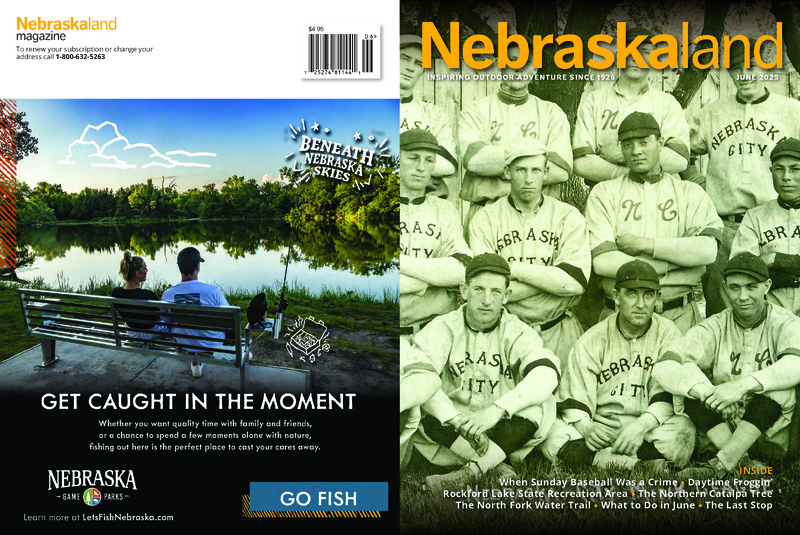
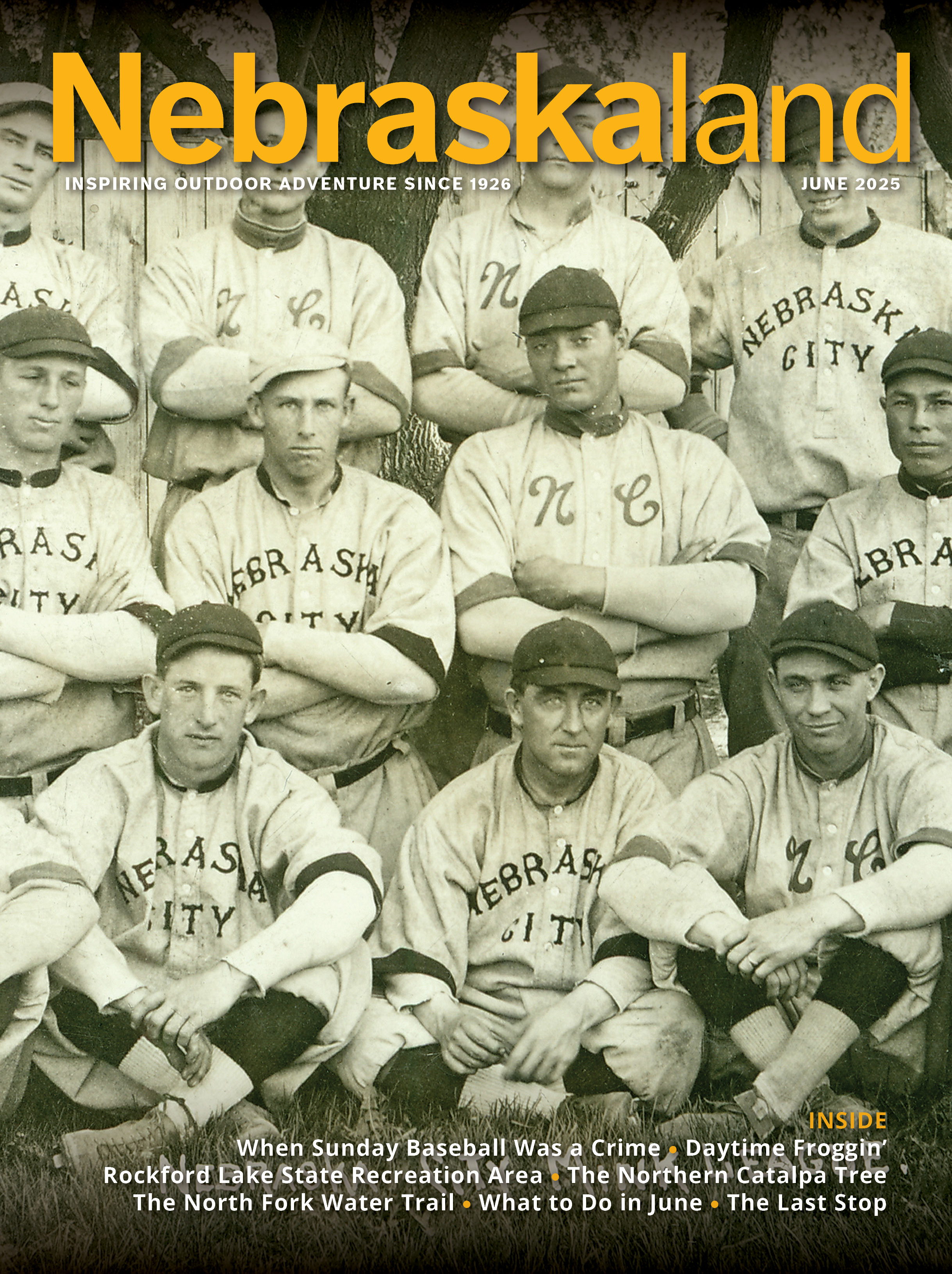
Cover: The Nebraska City Foresters, circa 1910-1913.
It was illegal to play baseball on Sunday in Nebraska
until 1913. See story on page 30.
NEBRASKA STATE HISTORICAL SOCIETY
This page: The sun sets beneath a passing thunderstorm
at Cottonwood Lake State Recreation Area near
Merriman.
ERIC FOWLER, NEBRASKALAND
ROCKFORD LAKE SRA
Forever Away
Story and photos by Jeff Kurrus
28
OUTDOOR NEBRASKA
What to Do in June
By Renae Blum
30
WHEN SUNDAY BASEBALL WAS A CRIME
34
THE NATURAL HISTORY OF THE
NORTHERN CATALPA TREE
By David L. Bristow, Nebraska State Historical Society
By Gerry Steinauer
38
SURF’S UP IN NORFOLK
North Fork Whitewater Park
Story and photos by Eric Fowler
DEPARTMENTS
6
10
44
56
58
Your Nebraska
In the Field
Mixed Bag
Portraits From the Past
The Last Stop
ON THE WEB
For more articles and
information, visit
NebraskalandMagazine.com
Nebraskaland (VOL. 103 / NO. 5 ISSN 0028-1964) is published monthly, except for the combined Jan./Feb. and Aug./Sept. issues, by the Nebraska Game and Parks Commission, 2200 N. 33rd
St., Lincoln, NE. Periodicals postage paid at Lincoln, Nebraska, and additional mailing offices. POSTMASTER: Send all UAA to CFS. (See DMM 507.1.5.2); NON-POSTAL AND MILITARY
FACILITIES: send address corrections to Nebraskaland, P.O. Box 30370, Lincoln, NE 68503-0370.
2
Nebraskaland • June 2025
June 2025 •
Nebraskaland
3
Magazine Staff
magazine
Communications Director Christy Firestone
Public Relations Manager Shawna Richter-Ryerson
Published by the Nebraska Game and Parks
Commission since 1926. The Commission is
dedicated to the conservation and protection
of all the state's natural resources and the
people who use them.
Editor Jeff Kurrus
Associate Editor Jenny Nguyen-Wheatley
Regional Editors Eric Fowler, Julie Geiser,
Justin Haag
Contributing Editor Michael Forsberg
Regular Contributors Renae Blum,
Chris Helzer, Chris Masada, Todd Mills,
Ryan Sparks, Gerry Steinauer
Art Director Tim Reigert
Graphic Designer Mel Severin
Videographer Nick Sauvageau
Photo Librarian Jaclyn Cruikshank Vogt
Administration
Director Tim McCoy
Chairman - John Hoggatt, Kearney
Vice Chairman - Donna Kush, Omaha
Kurt Arganbright, Valentine
Scott Cassels, Omaha
Dan Hughes, Venango
Kent McNeill, Papillion
Steve Mossman, Lincoln
Lisa Roskens, Omaha
Doug Zingula, Sidney
Commission Offices
Headquarters/Southeast District Office
2200 N. 33rd Street Lincoln, NE 68503
Phone 402-471-0641
Northeast District Office
2201 N. 13th St. Norfolk, NE 68701
Phone 402-370-3374
Southwest District Office
301 E. State Farm Rd. North Platte, NE 69101
Phone 308-535-8025
Nebraskaland Magazine Copyright 2025, all rights reserved.
Nebraskaland is available in audio from the Nebraska Library Commission
Talking Book and Braille Service, Suite 120, 1200 N St., Lincoln, NE 68508.
800-742-7691. Nebraskaland Magazine and the Nebraska Game and Parks
Commission reserve the right to reject any advertising not in keeping with
the agency mission.
Rates: $18 for one year; $33 for two years; $44 for three years. Nebraska
recipients must add appropriate sales tax. To subscribe call
1-800-NEBLAND (632-5263), or go online to:
NebraskalandMagazine.com.
Conservation Officers
ADMINISTRATION
Jeff Clauson
402-471-5531
Lincoln HQ
Administrator
Travis Shepler
402-471-5531
Lincoln HQ
Asst. Administrator
Stacey Lewton
402-471-5531
Lincoln HQ
Asst. Administrator
Mike Thome
402-471-5531
Lincoln HQ
Asst. Administrator
308-289-6260
Doug Pollard
Jerod Hahn
Omaha Office
8495 Frederick Street, Omaha, NE 68124
Phone 402-595-2144
OutdoorNebraska.gov
The Nebraska Game and Parks Commission does not discriminate
based on race, color, ethnicity, national origin, sex, pregnancy, sexual
orientation, gender identity, religion, disability, age, genetic information,
veteran status, marital status, and/or political affiliation in its programs,
activities, or employment. Any person who believes he or she has been
discriminated against in any program, activity, facility, or service,
should contact the Nebraska Game and Parks Commission, Lincoln, NE
402-471-0641, the Nebraska Equal Opportunity Commission, Lincoln,
NE 402-471-2024, TTY/TDD 800-642-6112; Director, Office of Diversity,
Inclusion and Civil Rights, U.S. Department of Interior, 1849 C Street,
NW, Washington, D.C. 20240.
4
Nebraskaland • June 2025
EAST SUB-DISTRICT
308-520-5539
Sergeant
308-280-4320
531-310-2869
WEST SUB-DISTRICT
Sean McKeehan 308-672-1824
Sergeant
KayLynn Miller
308-665-8440
Dawes, Sioux, Sheridan
Cassidy Harwood 308-562-9099
Box Butte, Sheridan
Josh Widhelm
308-279-9133
Scotts Bluff, Banner, Sioux
Brandon Wallace 308-280-4488
Scotts Bluff, Banner, Sioux
Travis Schultz
308-279-1292
Morrill, Scotts Bluff, Box Butte
Casey Gehrt
402-617-2112
Dawes, Sheridan, Sioux
NORTHEAST
Dale Davis
402-760-0712
Captain
WEST SUB-DISTRICT
Jeff Jones
EAST SUB-DISTRICT
308-289-2274
Bassett Office
524 Panzer St., Box 508 Bassett, NE 68714
Phone 402-684-2921
Hunter Lee
Keith, Deuel
Jaden Porter
Garden, Grant
Tyler Stueck
Keith, Arthur
Keith Jadlowski
Keith, Arthur
Jonathan Andreasen
402-340-3981
Madison, Pierce, Stanton
Trevor Stahlecker
402-928-9099
Knox, Antelope, Pierce
Mitch Johnson
402-613-8612
Cedar, Knox
402-380-6410
Sergeant
Kyler Prochaska 402-830-8278
Platte, Colfax
Matt Costello
402-317-4014
Dodge, Colfax
Kelbi Abke
402-237-2537
Washington, Burt
Nicholas Fix
402-508-0261
Dixon, Dakota, Thurston
Kyle Hansen
531-739-7392
Dodge
(Includes counties covered)
NORTHWEST
Dan Kling
308-430-0572
Captain
Ak-Sar-Ben Aquarium/Schramm Education
Center
21502 W. Highway 31 Gretna, NE 68028
Phone 402-332-3901
GERRY STEINAUER
Magazine Subscriptions
For address changes, magazine and subscription
questions, 800-632-5263 or visit
nebraskalandmagazine.com
Advertising
For advertising information, contact:
Shane G. Gilster, 402-742-0125
shanegilster@solotreemedia.com
Northwest District Office
East Hwy. 2, Box 725 Alliance, NE 69301
Phone 308-763-2940
Kearney Office
1617 First Ave. Kearney, NE 68847
Phone 308-865-5310
Yucca plants are in bloom.
402-762-5022
Sergeant
Greg Hesse
308-546-7464
Rock, Brown, Keya Paha
Cory Krause
CENTRAL SUB-DISTRICT
308-730-7050
Sergeant
Daryl Teter
308-440-1863
Howard, Greeley, Merrick
Matt Brandt
308-202-0819
Sherman, Howard
Klint Gill
402-613-5800
Nance, Wheeler, Boone, Polk
Garrett Zimmer 402-416-5736
Garfield, Loup Valley
Tim Williams
308-380-7331
Hall, Hamilton
SOUTHWEST
Brian Piernicky 308-330-8780
Captain
NORTH SUB-DISTRICT
Alex Hasenauer
308-660-4671
Sergeant
308-395-6001
Jacob Stoinski
Lincoln, Perkins
Frank Miller
402-389-0444
Cherry, Hooker
Luis Nuñez
531-333-6093
Blaine, Custer, Thomas
Brandon O’Neal 308-530-3157
Lincoln, McPherson, Logan
SOUTH SUB-DISTRICT
Kelsey Glodowski 308-242-9000
Sergeant
Bryce Streger
308-537-0404
Dawson, Gosper, Custer
Tyler Adelman
402-314-4783
Dawson, Gosper, Furnas
Sophia Gobber
308-222-0368
Chase, Dundy, Hayes, Hitchcock
SOUTHEAST
Matt Seitz
402-806-0915
Captain
WEST SUB-DISTRICT
Matt Taylor
402-200-9597
Sergeant
402-902-2017
Eric Javins
Adams, Clay, Webster
Justin Gress
308-629-9335
Thayer, Nuckolls, Fillmore
Pat George
308-920-2762
Harlan, Franklin, Phelps
Ethan Teter
308-440-3847
Buffalo, Kearney
EAST SUB-DISTRICT
Heath Packett
402-210-0888
Sergeant
402-209-1506
Russell Mort
Otoe, Johnson
Rich Berggren
402-619-1355
Douglas
Brian Arp
531-530-9011
Douglas, Sarpy
Mike Luben
402-443-6392
Saunders
Bryan Adams
402-429-1924
Nemaha, Pawnee, Richardson
CENTRAL SUB-DISTRICT
Curt Prohaska
402-470-1298
Sergeant
Mark McDonald 402-805-2353
Lancaster
Mark Sullivan
402-741-0636
Lancaster, Seward, Butler
Jarrod Messman 531-739-9760
Lancaster, Saline, York
YOUR NEBRASKA
Instagram Photos
Follow us @nebraskaland
and tag us in your photos
to be featured in an
upcoming issue.
Traeton Harimon, Bayard
Nighttime Chimney
Boni Edwards, North Platte
Short-eared Owl Chasing a Northern Harrier
6
Nebraskaland • June 2025
Roger Richters, Utica
Fall Color Impressions
June 2025 •
Nebraskaland
7
Oakley Meister, Lincoln
Foggy Dekes
Send your comments and
photos to:
Jeff Kurrus, Editor
Nebraskaland Magazine
P.O. Box 30370
Lincoln, NE 68503
or email Jeff.Kurrus@Nebraska.gov
Chuck Hackenmiller, Lincoln
Winter Cardinal
8
Nebraskaland • June 2025
Please include your postal address
and telephone number. Letters
may be condensed and edited.
Photographs are also welcome.
June 2025 •
Nebraskaland
9
IN THE FIELD
JUNE MOON
A waning gibbous
moon hangs over the
rugged landscape of
Buffalo Creek Wildlife
Management Area in the
Wildcat Hills.
JUSTIN HAAG,
AAG
G NEBRASKALAN
ALAN
ND
10
Nebraskaland • June 2025
June 2025 •
Nebraskaland
11
IN THE FIELD
Wes Batman of Gretna holds a channel catfish he caught while fishing at Flanagan Lake in Douglas County.
JEFF KURRUS, NEBRASKALAND
SHALLOW CATS
By Jeff Kurrus
Channel catfish are Nebraska’s last spawners, making
them the ideal fish to catch during the summer months — as
long as the angler understands what’s going on beneath the
water’s surface.
“Catfish spawn in July,” said Nebraska Game and Parks
Commission fisheries biologist Daryl Bauer, “which means
in June they’re moving shallow.”
Males are the first to arrive, looking for cavities, holes
and even riprap to stake their claim. This is when Bauer and
his colleagues get a number of reports of surprise catfish
catches as males guard their newfound territory and become
aggressive as they attempt to coerce a female.
The aggression continues as males fight off other males
and even drag females into the shallows, leading to many of
the summertime scars that anglers often see on these fish
when they’re caught.
“You’ll see all kinds of wounds on catfish,” said Bauer.
“They’re very rough on each other.”
To use this aggressive behavior to your advantage, keep
12
Nebraskaland • June 2025
baits shallow and off the lake bottom. Close to the bottom
is fine, but these predatory fish will gladly feed just above
the riprap or submergent vegetation. Topwater also works
well, with reports coming from across the state of catfish
destroying any number of topwater options during the
spawning season.
“Fresh-cut bait is always good,” said Bauer. “Bait doesn’t
have to sit in the yard until it stinks. Cut up a bluegill and
use it.”
Anglers should also be active, similarly to flipping or
pitching for largemouth bass.
“Take a jig and fill it with nightcrawlers,” Bauer added.
“This works especially well later into June and July when fish
are sitting on the nest. Dangle it right in front of their face.”
These “surprise” catches should encourage anglers to
spend some time in the shallow water each year, knowing
that middle-of-the-lake casts aren’t nearly as effective. Rest
the shoulders and pitch just a few feet from the bank — some
of the lake’s biggest fish are just a stone’s throw away.
IN THE FIELD
THE DECEPTIVE CONEFLOWERS
By Gerry Steinauer, Botanist
The prairie coneflower and pale purple coneflower
are native perennials that grow in dry to moist prairies
in Nebraska, while the non-native purple coneflower is
commonly planted in flower gardens and prairie restorations.
In early summer, each coneflower stem develops a single
flower head with a ring of pink to rose-red, spreading to
drooping petals.
Like most wildflowers, the coneflowers’ showy, colorful
blooms are designed to attract pollinators, mainly butterflies
and bees. However, these plants, along with other members
of the sunflower family, use a bit of trickery. What looks
like a single large flower is actually a cluster of many small
flowers, arranged to mimic one big bloom.
About 60 to 70 million years ago, when sunflowers first
appeared on Earth, their flowers were small and drab. Back
then, their pollen was carried between plants by the wind,
so there was no need for nectar or bright colors to attract
pollinators. But as insects diversified and more became
pollinators, it became more efficient for the plants to rely on
them instead of the whimsies of the wind. This shift led to
more seeds and better survival.
To attract pollinators, coneflowers adapted by arranging
their small flowers into a domed, reddish-brown disc, with
those in the outer ring developing petals. The tubular, petal-
petal
stamen
pistil
ray flower
disc flower
ovary
The typical flower structure of a sunflower family member.
ILLUSTRATION BY TIM REIGERT, NEBRASKALAND
less disc flowers contain both male, pollen-producing stamens
and a female pistil that produces a seed. Surrounding them,
the ray flowers — those with petals — are sterile, serving
only to attract butterflies and bees.
The continued survival of coneflowers shows that
deception has its rewards.
Purple coneflower growing in a flower garden on Nebraska Game and Parks Commission property in Lincoln.
JEFF KURRUS, NEBRASKALAND
14
Nebraskaland • June 2025
IN THE FIELD
Daytime frogging can be just as productive as midnight frogging.
JEFF KURRUS, NEBRASKALAND
DAYTIME FROGGIN’
By Jeff Kurrus
There is a 10 p.m. cap for some people. Regardless of how
late they slept that day, by the time the local news hits the
TV, they may not make it to the weather.
Yet they still have a desire for pan-fried frog legs.
No fear, early sleepers, for daytime bullfrogging can be just
as productive as its midnight counterpart of flashlights and
hand-grabbing. There are just a few more things to consider.
Beware the Hunters
also work.
From the bank, approach the frog from behind with a cane
pole baited with anything from a scum frog to nightcrawlers
and dangle this offering in front of the frog. Because of their
extreme aggressiveness, bites will be plentiful.
Using nets is another effective tactic, but there’s just
something about talking a frog into striking a lure that
conjures a smile.
A bullfrog’s field of vision is nearly 180 degrees, allowing
them a panoramic view. Because of this trait, nighttime
hunters shine lights into their eyes, disabling their most
powerful attribute. But there’s no amount of light during the
day that will offer a hunter the same assistance. Therefore,
approach from behind when bank hunting, maintaining as
much distance as possible before striking.
Time of Day
What to Strike With
How bullfrogs and other amphibians find water is an
amazing act of nature. New water can be golden for frogs,
so access it if possible. Early-season trips are also best, such
as this time of year west of Highway 81, where the season
is open year-round, or on Aug. 15 east of Highway 81, where
the season is open until Oct. 31 and a minimum length of 4½
inches from snout to vent is required.
Regardless of when the desire to hunt begins, just know it
doesn’t have to be at midnight to be productive.
Check out the Fishing Guide at OutdoorNebraska.gov for
more information.
Is daytime hand-grabbing possible? You bet, especially at
dawn and dusk, but a preferred method is casting or even
cane-poling for them. The first tactic involves using some
sort of topwater plug, such as a scum frog, and casting
toward the frog from a good distance. The key to this method
is the lure itself. Its body has to be soft enough for the frog to
get it in its mouth and for the hunter to set the hook. Hardbodied frogs are often ineffective. If the frogs are on sand or
other bare banks where vegetation is low, then traditional
treble-hooked lures, such as torpedoes or other prop lures,
16
Nebraskaland • June 2025
If a hunter maintains distance, and can stay out of eyesight,
then time of day doesn’t matter. Later in the summer, it’s
common to see bullfrogs on the surface near mats of aquatic
vegetation. Casting or cane-poling will continue to work in
these circumstances.
New Water
June 2025 •
Nebraskaland
17
IN THE FIELD
Savory hushpuppies made of catfish and sweet corn.
JENNY NGUYEN-WHEATLEY, NEBRASKALAND
CATFISH HUSHPUPPIES
By Jenny Nguyen-Wheatley
Why are hushpuppies called
hushpuppies? One often-told story
tells of a group of anglers or hunters
cooking at camp. In an effort to quiet
their excitable, hungry dogs, the cooks
fried up morsels of cornmeal bread as
a treat, thus hushing the puppies and
quieting their evening.
While most hushpuppy recipes I’ve
seen are sweet, often enjoyed with
honey or syrup, I decided to make a
savory meat-filled version. This recipe
is perfect for using up those odds
and ends in the freezer or fish that’s
slightly freezer burned.
Although traditional hushpuppies
include cornmeal, I skipped it. Instead,
I added sweet corn kernels to the
batter. Use drained canned corn if you
have to, but we all know nothing beats
Nebraska summer sweet corn.
Servings: 2-4
Prep Time: 40 minutes
Cooking Time: 20 minutes
Ingredients:
1½ pounds boneless catfish fillets
•
18
Nebraskaland • June 2025
• Salt, to taste
• Vegetable oil for frying
Batter
1 cup all-purpose flour
2 tsp. baking powder
½ tsp. paprika
½ tsp. sugar
1 tsp. onion salt
¼ tsp. garlic salt
¼ tsp. cayenne pepper
1 tsp. Lawry’s Seasoned Salt
2 green onions, finely chopped
1 large egg, lightly beaten
¼ cup sweet corn kernels
⅓ cup buttermilk, plus extra
Dipping Sauce
½ cup mayonnaise, preferably
Kewpie
Hot sauce, to taste
5 dashes Worcestershire sauce
1 tsp. Cajun/Creole seasoning,
such as Tony Chachere’s
1 tbsp. honey
•
•
•
•
•
•
•
•
•
•
•
•
•
•
•
•
•
1. Season catfish fillets with salt.
Heat 1 tablespoon of oil in a pan and
sear fish until cooked through. Break
up fish into very small pieces and set
aside to cool.
2. In a large bowl, combine flour,
baking powder, paprika, sugar, onion
salt, garlic salt, cayenne and Lawry’s
seasoned salt. Then add chopped
cooked catfish, green onion, beaten
egg and corn. Finally, mix in buttermilk
and stir until a sticky, thick batter
forms. Use more or less buttermilk as
needed.
To test for seasoning, cook a small
dab in a pan with oil and taste. Then
cover the bowl and chill for at least 30
minutes in the refrigerator.
3. Meanwhile, combine dipping
sauce ingredients. Chill until ready to
use.
4. Heat frying oil to 350 degrees
Fahrenheit. Lightly grease a spoon
with oil or cooking spray to prevent
sticking. Use the spoon to scoop and
drop ping-pong-ball-sized fish batter
into the hot oil, and fry until golden
on all sides, flipping as needed. Do not
crowd the pan or fryer. Drain and serve
warm with dipping sauce.
June 2025 •
Nebraskaland
19
Rockford Lake SRA
Skarlett Jones of Gretna and Delaney
Madson of Lincoln fish from the bank
at Rockford Lake State Recreation Area
in Gage County.
Forever Away
Story and photos by Jeff Kurrus
20
Nebraskaland
• June 2025
June 2025 •
Nebraskaland
21
‘H
ow have I not been here before?”
I said as I pulled into the park’s
entrance, camera in my lap as I
eyed the blues of the water and
greens from the surrounding forest.
“Uh, where are we?” said Skarlett
Jones, a family friend who, along
with her friend, Delaney Madson, had
decided an afternoon away from the
metro to relax and fish a little seemed
like a fantastic idea.
“Rockford Lake,” I replied, sitting atop
a hill overlooking the state recreation
area as a lone boat and accompanying
skier made waves across the water while
one RV sat in the campground.
“It’s gorgeous,” Jones said, her eyes
surveying everything in front of her.
The area was so beautiful that
questions naturally began to form. How
have I not fished here before? Is this area
always so void of people? Is this place
new?
No, not new. Just new to me.
TOP LEFT: A group of teenagers swim at Rockford Lake State Recreation Area.
BOTTOM LEFT: Midweek boaters pulling tubers have the entire lake to
themselves.
BELOW: Delaney Madson of Lincoln fly-fishes from the bank at Rockford
Lake SRA.
The History of
Rockford Lake
The Rockford Township was founded
by William Girl in 1858 and is named for
the rock quarries near Mud Creek. More
than a century later, Mud Creek featured
a prominent role in the development
of Rockford Lake State Recreation
Area. According to records from the
Gage County Historical Society, the
Mud Creek Watershed in the Rockford
Township became Nebraska’s first
watershed to include recreation as an
additional primary purpose.
The lake had originally been planned
as a 62-acre flood-control structure,
but the Small Watersheds Act of 1962
broadened its scope, increasing its size
for recreation purposes as well.
In a 1970 Lincoln Journal-Star article,
Dean Terrill writes: “What distinguishes
the 150-acre recreation jewel [Rockford
Lake State Recreation Area] is the
funding behind it, first of its kind in
Nebraska.”
The
article
states
that
the
combination of federal and Game and
Parks Commission funds, a 50/50
22
Nebraskaland
• June 2025
June 2025 •
Nebraskaland
23
split, was unique. The price tag of
$300,000 was to pay for the land and
gravel roads, as well as the beach,
boat ramp, two shelter houses and
picnic tables.
Construction began in 1964, and
Rockford Lake State Recreation Area
opened in 1970. “Rockford,” Terrill
wrote, “will further Gage County’s
claim as ‘the Watershed capital of
Nebraska.’”
And judging from a photo of the
packed beaches on Memorial Day
weekend that year, that statement
seemed to hold true.
Forever Away
On the day we visited, however,
there were no crowded beaches or
campgrounds. Just a couple of kids
taking in the sun between casts.
Meanwhile, a group of other teenagers
24
Nebraskaland
• June 2025
goofed around in the water nearby
while a handful of RV campers enjoyed
the afternoon quiet.
Usually on days like this, I approach
and ask everyone about their day.
But I already knew that answer. They
had come to Rockford Lake State
Recreation Area to get away from
everything. To ski, to fish, to hike, to
simply be — and do so just a few miles
from Beatrice and what seemed like
forever away.
Rockford had been constructed with
recreation in mind. And sometimes
recreation is best spent in a quiet
place away from everyone, including a
newcomer like me. N
TOP RIGHT: Skarlett Jones of Gretna
sits lakeside at Rockford Lake SRA in
Gage County.
For more information about Rockford
Lake State Recreation Area and the
rest of the Nebraska park system, visit
OutdoorNebraska.gov/Parks.
Rockford Lake State Recreation Area
consists of approximately 300 land
acres around a 150-acre lake. The area
offers boating, fishing, picnicking,
swimming and camping.
BELOW: People recreate at their RV
campers at Rockford Lake.
Rockford Lake SRA
June 2025 •
Nebraskaland
25
TOP RIGHT: With 90
picnic tables on-site,
there is always a place
to have a picnic or chat
at Rockford Lake SRA in
Gage County.
LEFT: Kayakers float at
Rockford Lake.
Nebraskaland
• June 2025
Rockford’s first-come, first-served
shaded campground offers a variety of
camping options. It offers 30 camping
pads with 30- and 50-amp electrical
hookups, as well as two camping pads
and 40 non-pad sites without electricity.
Water and vault toilets are available,
but showers, modern restrooms and a
dump station are not. The nearest dump
station is at Rock Creek Station SRA, a
45-minute drive away.
The lake holds a variety of fish species,
including bluegill, channel catfish,
crappie, largemouth bass and other
species.
A 1-mile hiking trail, swim beach, 90
picnic tables, 88 grills and two shelters
are also available.
For more information about parks
near Rockford or across the state, visit
OutdoorNebraska.gov/parks/find-a-park.
Bluegill
Channel
catfish
Black
crappie
FISH ILLUSTRATIONS BY JOSEPH TOMELLERI
26
Amenities
Largemouth
bass
June 2025 •
Nebraskaland
27
Outdoor Nebraska
By Renae Blum
Summer is here, with great fishing, camping and
plenty more to do outside. Find a loved one and try
one of these opportunities this month! N
What to Do in June
Attend a ‘Moon Walk’ on
the Cowboy Trail
June 11, 7:30 p.m. – 9:30 p.m. | Meet at
the Cowboy Trail parking lot about
5 miles west of Norfolk
Help celebrate 30 years of the Cowboy
Trail with a fun evening stroll. The “Stars,
Strolls & S’mores” event on June 11 kicks off
with a scavenger hunt and hike to Broken
Bridge, followed with s’mores by the fire and
presentations from local experts. This event
is free and open to the public, so invite your
friends and family. See more details and what to
bring at Calendar.OutdoorNebraska.gov.
ERIC FOWLER, NEBRASKALAND
Attend a bioblitz
June 21, 7 a.m. to 11 p.m. | Ponca State Park
Boat and fish at Lake Minatare
All month | Lake Minatare State Recreation Area
At over 2,000 acres, Lake Minatare is the Panhandle’s largest body of water.
June is a prime time for both boating and fishing at this popular destination,
with many visitors combining the two. Boaters and campers alike love the
wooded scenery, and in June, water levels typically reach the tree-lined
shores, offering prime fishing opportunities for species like walleye and
channel catfish. Learn more and make reservations at OutdoorNebraska.gov.
If you enjoy exploring nature, this event is for you. A bioblitz allows you to
work alongside wildlife experts, discovering and documenting as many plant
and animal species as possible in a single location across a short period of
time. No experience is necessary, all ages are welcome, and the data you collect
contributes to real scientific research. Bring water, sunscreen and bug spray, and
dress for the outdoors, with comfortable walking shoes. For details on different
sessions throughout the day, see the calendar entry at
Calendar.OutdoorNebraska.gov. RENAE BLUM, NEBRASKALAND
JUSTIN HAAG, NEBRASKALAND
Participate in the Nebraska
Bumble Bee Atlas
Catch smallmouth bass in
the Missouri River
June 1 – Sept. 30 | Statewide
Peak is May and June
Northeastern Nebraska
Have fun exploring, learning and helping wildlife
with this fun community science project. Since 2019,
hundreds of Nebraskans like you have participated
in the Nebraska Bumble Bee Atlas, helping scientists
document bumble bees across the state. Participating
is easy, and no previous experience is required. Attend
an in-person training in June and July or use the online
training portal to get up to speed. Learn more and sign up
at BumbleBeeAtlas.org. BRIANNA NUGENT
The Missouri River in northeastern Nebraska —
specifically the stretch above Lewis and Clark Lake
— is considered the best smallmouth bass fishery in
the state, and right now is a peak time to catch them.
As they prepare to spawn, the bass will be relatively
shallow, active and easier to catch. Bring your boat
and have fun exploring this wild stretch of river,
which changes constantly, forever providing new
things to find. JEFF KURRUS, NEBRASKALAND
28
Nebraskaland • June 2025
June 2025 •
Nebraskaland
29
When
Sunday
Baseball
Was a
Crime
The
Nebraska City
Foresters,
circa
1910-1913.
By
David L. Bristow,
Nebraska State
Historical
Society
30
Nebraskaland
• June 2025
NSHS, RG3064-21
June 2025 •
Nebraskaland
31
t was illegal to play baseball on Sunday
until 1913. It was one of Nebraska’s socalled “blue laws” restricting Sunday
activities.
Nebraska City ignored the law until a
local group called the Law & Order League
pressured the sheriff in 1902. But when
the sheriff tried to stop a game, “an angry
crowd surrounded him and hustled him
violently,” in the words of the Nebraska
City Daily Tribune. “His revolver was taken
away from him.”
Nevertheless, the sheriff arrested four
players and took them to the courthouse
to post bond. “A number of the city pastors
were at the justice’s office and when they
left, friends of the players threatened and
jostled them,” and one man was hit with a
thrown rock.
Baseball was unquestionably America’s
sport. It was also an intensely local sport.
The major leagues existed, but without TV
or even radio, the only way to enjoy a game
was to attend in person. Many Nebraska
towns had minor league or semi-pro teams,
“Look Who’s Here Again,” Omaha Daily Bee, March 12, 1913.
and even relatively small towns recruited
out-of-state players.
Lincoln Evening Journal noted that “Omaha is
But passion for baseball ran up against an older tradition
the principle one, but there everything is wide
of keeping the Sabbath. A state statute prohibited not only
open on that day.” (“Everything,” meaning
baseball, but any “sporting” on Sunday, including hunting
bars, brothels and gambling halls — Omaha
and fishing.
had a reputation.) The Journal complained
Various Nebraska teams were arrested at one time or
that the “inability to play Sunday baseball has
another, but some cities did not enforce the law. In 1902, the
kept Lincoln out of any league for some years,”
because teams struggled to remain solvent
without the big crowds a game could draw on
Sunday.
Back in Nebraska City, the sheriff eventually
ticketed the entire team, but a local judge
threw out the case. The Otoe County Attorney
appealed all the way to the Nebraska Supreme
Court, which upheld the law and cited the
Bible’s fourth commandment in doing so.
After that, Sunday baseball became as much
of a hot-button issue as the death penalty
or votes for women. In 1913, the Nebraska
legislature changed the law to allow counties
and towns to make their own decisions.
Baseball bans and other Sunday laws began
to go away as Nebraskans let their neighbors
decide for themselves how to spend their day
of rest. N
I
Omaha Evening World-Herald, July 15, 1902.
32
Nebraskaland
• June 2025
Unidentified ballplayer with Nebraska plates on his car, 1910s.
Opening day in Falls City, Thursday, May 18, 1911.
NSHS RG3064-0-20
NSHS RG3064-0-4
Visit NSHS’s website at history.nebraska.gov.
June 2025 •
Nebraskaland
33
The Natural History
of the Northern
Catalpa Tree
By Gerry Steinauer, Botanist
he northern catalpa is a tree you
likely recognize but may not know
by name. Perhaps you’ve seen it
adorned with striking clusters of
large, white flowers, standing out like
a snow cone amid otherwise green
woodlands. Or maybe, as a child, you
were grudgingly sent outside to rake
up its huge fallen leaves cluttering the
yard. Most memorably, you and your
friends may have ventured into the
woods, plucked a few of the catalpa’s
cigar-shaped seed pods and pretended
to smoke them.
The tree is native to the central
Mississippi River valley where it is
called the Catawba tree (cuh-tah-buh).
For reasons unknown, early settlers
T
or botanists in this region named the
tree after the Catawba people, a local
Native American tribe. The northern
catalpa has been widely planted in the
eastern half of Nebraska, mainly as an
ornamental and as a source of fence
posts, where it has escaped cultivation
and now grows in the wild in moist
bottomlands with well-drained soils.
Several years ago, I gathered seed
pods from a catalpa tree growing near
an abandoned house up the road from
our farm. I planted seeds in pots and
transplanted several seedlings into
our yard. I’ve been impressed by the
trees’ rapid growth, shapely form and
diversity of pollinators attracted to the
flowers. Recently, I read that catalpa
Northern catalpa seed pods release their many flat, winged seeds, which the wind
spreads in late winter or early spring. GERRY STEINAUER
34
Nebraskaland • June 2025
worms, a prized catfish bait, live on the
trees. This summer I plan to pay even
closer attention to this interesting tree
… as I love to catfish.
Natural History
The northern catalpa is a stouttrunked tree that, in Nebraska’s drier
climate, can reach about 40 feet in
height and live up to 150 years in age.
Its pale-colored wood is weak yet
durable when in contact with the soil,
making it historically popular for fence
posts. To form the best post, saplings
were cut back to the ground after the
first or second year of growth and then
only one or two of the best sprouts were
left un-thinned to grow to post-size.
The tree’s telltale heart-shaped
leaves can reach an impressive 4 to
10 inches long and 3 to 8 inches wide.
The bell-shaped, 2-inch-long flowers
bloom from late May to mid-June. The
seed pods, which can reach an amazing
20 inches in length, ripen from green
to purplish-brown in late summer and
hang from the tree through winter.
These distinctive pods give the tree
two of its other common names: the
Indian bean tree and cigar tree.
The nectar-rich flowers attract
a variety of pollinators including
hummingbirds, native bees and
bumble bees, and night-flying moths.
The lower flower petal has purple lines
and yellow blotches that act as guides
A young northern
catalpa tree in bloom at
the author’s farmyard
in southeastern South
Dakota. GERRY STEINAUER
June 2025 •
Nebraskaland
35
A catalpa worm feeding on catalpa leaves.
in length and are usually black on
the back with a broad yellow stripe
along the side. They have a single
thorn-like, black horn at the tail end.
When fully developed, the caterpillars
drop from the leaves and burrow
into the soil where they overwinter,
metamorphosize and emerge as adult
moths the following spring.
In the South, these caterpillars are
called Catawba worms, and anglers
prize them as bait for bass, bluegill,
catfish and other fish. Fishermen
pick the worms individually from the
underside of leaves where they hang
GETTY IMAGES
out or shake a branch or tree to collect
entire coffee cans full of the fallen
worms. Some anglers turn the worms
inside out on the hook, claiming that
their soft, juicy insides better entice
fish. Lastly, it’s rumored that smart
fishermen never reveal the location of
their favorite Catawba worm tree.
It’s likely that northern catalpa trees
will continue to spread in Nebraska.
How much of a nuisance they become
remains unknown. On the positive
side, in the coming decades, Nebraska
anglers may have a new go-to fish
bait. N
Northern catalpas bloom for just a few weeks in late spring. Native Americans and early settlers reportedly used the flowers
in herbal remedies for respiratory problems and infections. GERRY STEINAUER
for incoming pollinators, which are
drawn to the blooms by their sweet,
citrus- or jasmine-like fragrance.
Honeybees also swarm to catalpas,
making the trees a beekeeper’s delight.
In Nebraska, the northern catalpa
can only be confused with its cousin,
the southern catalpa. The latter is
native to the Gulf Coastal states, is
less suited to the rigors of the Plains
and has been planted sparingly in
our southeastern towns and cities. A
few distinguishing characteristics:
the northern catalpa has larger and
more pointed leaves, larger but fewer
flowers, and longer, thicker seed
pods than the southern catalpa.
Interestingly, their leaf scents also
36
Nebraskaland • June 2025
differ — when crushed, northern
catalpa leaves emit a sweet fragrance,
while their southern cousin’s leaves
produce a foul odor.
While the southern catalpa has
never escaped cultivation in Nebraska,
the northern catalpa escape into
the wild has raised concerns among
conservationists. For instance, along
the central Platte River valley, the tree
is taking hold along wet riverbanks and
sandbars, displacing native vegetation.
In addition, this stretch of the
Platte River is critical spring roosting
habitat for migrating sandhill and
whooping cranes. There, the open,
sandy channel provides the birds with
a clear view of approaching predators
and encroaching trees obstruct this
visibility, reducing the cranes feeling
of safety and potentially limiting their
use of the area. Local conservation
groups are cutting and grinding larger
catalpas and other invasive trees on
the riverbank and disking sandbars to
uproot saplings in an effort to maintain
an open channel.
Catalpa Worms
The catalpa sphinx moth is named
for its caterpillars, called catalpa
worms, which feed exclusively
on
catalpa
leaves,
sometimes
defoliating entire trees. The moth has
migrated northward and westward
from its native range, following
planted catalpas. Over the past two
decades, my friend Mark Brogie, who
attracts moths with night lights,
has photographed several catalpa
moths in his backyard in Creighton
in Knox County. “A catalpa tree just
down the street is the likely source
of these moths,” Brogie said. If the
catalpa sphinx moth has reached as
far northward and westward as Knox
County, it could be present wherever
catalpas grow in Nebraska.
In spring, the female moths lay
masses of eggs on the underside of
catalpa leaves. Typically, two broods
of caterpillars hatch each summer.
Mature caterpillars can reach 2 inches
Catalpa sphinx moths are most active at night, using a strong sense of smell to
find nectar-rich flowers. During the day, their brownish-gray color and speckled
wings help them blend into tree bark and avoid predators. PHOTO BY MARK A. BROGIE
June 2025 •
Nebraskaland
37
Surf’s Up
in Norfolk
Story and photos by Eric Fowler
T
here is a lot of screaming in
downtown Norfolk these days,
especially on a hot summer day.
Some are screams of fear, but
most are joy from children and a fair
share of adults. You hear them nearly
every time someone goes over one of
the seven drop structures on the North
Fork Whitewater Park on an innertube
or kayak.
You might also occasionally hear
someone say: “Surf’s up, dude.”
The water park, which opened last
June, grew from an effort to revitalize
the North Fork of the Elkhorn River
and the riverfront around it, including
the historic Johnson Park. The end
result includes the whitewater park
and its unique surf wave, a 2.6-milelong water trail that stretches across
the city.
The number of people who floated
the river and braved the new rapids
during the park’s first summer of
operation, even before the finishing
touches were done, was more than
most could have imagined.
A River Reimagined
One of the first endeavors of the
settlers who arrived in what is now
Norfolk in 1866 was to build the Sugar
Jacob Stuthman of Norfolk does a trick on a boogie board as his dad, Tony, rides a surfboard on the surf wave on the
North Fork Whitewater Trail in Norfolk.
Jess Callahan of Enfield, Connecticut, paddles a whitewater kayak on one of the
rapids with other participants during a University of Nebraska – Lincoln Outdoor
Adventures trip.
38
Nebraskaland • June 2025
City Cereal Mills. A dam was built
on the North Fork north of what is
now 1st Street and Norfolk Avenue
to power the grist and sawmill. The
pool below the mill dam became a
swimming hole where people cooled
off in the summer. In 1937, during the
Great Depression, a Works Progress
Administration crew built Johnson
Park below the dam. The park and
its ornate gardens, however, were no
match for the power of the river and
the 17 floods that occurred between
its construction and 1962.
That year, following a spring flood
that sent water spilling over 90 city
blocks, local officials and the U.S.
Army Corps of Engineers finalized
plans to build a 4.5-mile-long canal to
carry floodwaters around the east side
of the city.
The river still flowed through town,
with water levels controlled by gates
where it branched off from the flood
channel. But it was neglected and,
for the most part, forgotten, so much
so that Nebraska Avenue was built
through Johnson Park, separating it
from the river. The mill dam, which
had also been producing hydropower
before it closed, remained as an
obstacle.
“The entire area was unsafe for
recreation, and it was kind of an
unsightly mess,” Josh Moenning, who
served four years on the Norfolk City
Council and eight as mayor before
stepping down in 2024, said of the
river flowing through downtown. “You
would see, on occasion, people fishing
down there, but certainly nobody was
in the water.”
Efforts to revive the river began
in 1974, when the Lower Elkhorn
Natural Resources District and the
city discussed removing the dam and
creating a linear park along the North
Fork. Other efforts followed, but they
remained ideas until local leaders
formed a Riverfront Development
Group in 2008 and began focusing on
creating a River Walk.
Tony Stuthman also had ideas for
improving the river after paddling a
canoe down it with a friend in 2013.
“As I floated, I wondered why in the
heck nobody was using the river for
anything,” Stuthman said. “It was
beautiful, and it was neat that it felt
like you were in a different place. It
didn’t feel like you were in Norfolk, or
in a downtown area.”
He spoke with someone working
on a housing development along the
June 2025 •
Nebraskaland
39
1st St.
Benjamin Ave.
Benjamin Ave.
1st St.
Elm Ave.
Revitalization
Realized
n
or
kh
El
With city and other leaders sold
on the idea, the Lower Elkhorn NRD
contributed $1 million to get the
project started. Private donations
and grants covered the rest of the
rk
Fo
Winter Park
put-in
4th St.
2
r
ve
Ri
“The first three years, it was
relatively difficult to even convince
people to float [the North Fork]
because they considered it a drainage
ditch,” Stuthman said. “Once I got
them convinced, then it was plain. It
wasn’t the excitement of Niobrara.”
And the 1.5-mile trip was short, taking
an hour in a kayak, 90 minutes on a
tube. Stuthman hoped the dam could
North 1st Street
put-in
1
h
rt
No
North Fork on 1st Street on the north
edge of town about creating a put-in
for float trips. The developer donated
the land to the city, which developed
a put-in and parking area there. The
city also built a take-out above the old
mill dam and in 2014, Stuthman and
his wife started outfitting kayak and
tubing trips on the North Fork and on
the Elkhorn River southwest of town.
Norfolk
Point 1 to point 2: 1.2 miles
Point 2 to point 3: .6 miles
Point 3 to point 4: .8 miles
d.
Blv
ide
ers
Riv
Elizabeth and Mya Silva of Norfolk body surf down one of the waves in Johnson
Park.
North Fork Whitewater Park
be removed and the trips extended.
A few years later, when talk of a
whitewater park surfaced, Suthman
and a friend floated over the old dam
on innertubes and sent a video to
Riverwise Engineering, a Colorado
company specializing in building
whitewater parks around the country.
They asked, “What could we do with
this?” Riverwise said the dam, while
an obstacle, provided opportunity: The
12-foot drop below it could be spread
across eight shorter drops that could
create whitewater features. Riverwise
also said the North Fork had two more
features a whitewater park needed:
sufficient river flows for most of
the year and — being a block from
downtown — the proximity to people
who will use it.
h
rt
No
rk
Fo
n
or
kh
El
W Norfolk Ave.
A family rides a stand-up paddleboard, kayaks and a tube down the North Fork beneath the 1st Street bridge.
40
Nebraskaland • June 2025
MAP ILLUSTRATION BY TIM REIGERT
1st St.
r
ve
Ri
Park
3 Johnson
take-out
East Bluff Park
4
take-out
June 2025 •
Nebraskaland
41
North Fork Outfitting operates the Riverpoint Surf Shop steps from the
whitewater park.
People kayak, swim and relax around the North Fork Whitewater Park in Johnson Park, located blocks from downtown Norfolk.
$3.8-million cost of removing the
mill dam and building the whitewater
park. Limestone slabs salvaged from
a historic building at the Norfolk
Regional Center were used to build the
water features, line some of the banks
and for landscaping and walking paths
to the river.
It was all part of a $17-million
project that included a new vehicle
bridge across the river on 1st Street
and the removal of the portion of
East Nebraska Avenue that separated
Johnson Park from the river. The park
also was renovated and now boasts
a community festival space and
amphitheater that can host concerts,
markets and other events during the
summer, and in the winter, an iceskating rink. A multi-use trail follows
42
Nebraskaland • June 2025
the river, passing beneath the 1st
Street bridge and two pedestrian
bridges cross it, providing spectators
a birds-eye view of the action on the
whitewater features below.
And with the dam removed, the
water trail now stretches from the
north to the south end of town. At
the start of the trail, the North Fork
flows beneath the branches of trees
overhanging the river, opening up after
it passes beneath Benjamin Avenue.
After flowing past ball fields and
businesses, through a few backyards
and Winter Park (where another putin was built) it crosses the first point
in the whitewater park, a 3-foot drop
structure that creates a wave people
can ride on surf boards or kayaks, a
feature few parks of this type have.
Six more drop structures dot the next
third of a mile.
Most of the whitewater park is in
Johnson Park, where the North Fork
spreads out into a wide, shallow pond
with a lush lawn on the north side
and a beach on the south. On either,
parents can sit back and watch their
children splash in the water. Below
the last feature, just past East Norfolk
Avenue, floaters can haul their gear up
a rock access to the parking lot and call
it a day, or grab their tubes and walk
the hike-bike trail back to the top and
do it all again.
They can also continue floating the
North Fork for nearly another mile
to the final take-out point off Bluff
Avenue on the southeastern corner
of town.
Gates on the flood channel direct
flows into the North Fork’s original
channel, allowing the city to keep
flows at the optimum level for the
whitewater park, as long as there is
enough flow in the river. Excess flows
are sent down the flood channel.
If You Build It ...
Officials estimated 30,000 people
would use the river in a year. Stuthman
said he thinks that number might have
been reached in the first three months.
He and his wife opened a surf shop
steps from the North Fork and the
surf wave. They rent kayaks, surf and
boogie boards and tubes to folks who
want to walk right down to the river
and also offer shuttle service for those
who want to float the entire trail.
Most people using the river outfit
their own trips, bringing tubes or
kayaks from home, but Stuthman said
he is doing as much business in one
weekend as he did in an entire year
before the whitewater park opened.
On one August weekend last summer,
he said all he could see looking up and
down the river near his shop were
groups of tubers and kayakers. And in
the park, the beach “was just wall-towall people.”
Those visitors came from throughout
eastern Nebraska. But the whitewater
kayaking and surfing culture is
unique, and those who are into it will
travel long distances to visit water
parks that are popping up around the
U.S., especially people who live in
the Midwest, far from mountains. In
its first year, people from at least 13
states visited the park, including some
from both coasts.
“It’s an amazing addition for
the state of Nebraska and the city
of Norfolk,” said Brett Mjelde, a
whitewater enthusiast from Council
Bluffs, during his second visit to the
park last September with his son and
daughter.
While city leaders anticipated an
increase in tourism from the water
park, Moenning is equally pleased,
if not more so, at the local interest,
especially youths who flocked to the
river during the heat of summer.
“A lot of times, these were kids
whose families might not have been
able to afford a pass to the water park.
This was an opportunity for them to
enjoy a natural resource in the middle
of their community that’s easy to
access. They can ride their bikes to it,
and it’s free,” he said.
So if you find yourself in Norfolk
this summer, don’t be surprised if you
see kids, or adults, walking or biking
across Norfolk with inner tubes or
body boards slung over their back. Or
if you hear screaming coming from the
North Fork of the Elkhorn River. It’s all
good fun. You might be wise to pack
your swimsuit and join them. N
What’d You
Call It?
The North Fork of the
Elkhorn River is what gave
Norfolk its name. The city’s
founders had submitted
Nor’Fork, or some other
variation of a contraction
of the river’s name, to the
post office, but somewhere
down the line, postal
officials thought it was a
spelling error and changed
it. Ask anyone who lives
there, however, and many
from Nebraska, and you
won’t hear an “L” in the
pronunciation.
June 2025 •
Nebraskaland
43
MIXED BAG
ENDANGERED SPECIES SPOTLIGHT
The Blowout Penstemon
By Ruby Rolland, Environmental Specialist, Nebraska Game and Parks
The sandy blowouts this penstemon needs are less common as the wildfires and
grazing bison that created them have been eliminated. JON FARRAR, NEBRASKALAND
Nebraska lists 32 plant and animal
species as threatened or endangered.
The blowout penstemon, a species of
flowering plant, is listed as endangered
in the state of Nebraska and can be found
in a variety of Nebraska’s northwestern
counties within the Sandhills.
Where most other plants would
wither, perish and be swept away by
the wind, the blowout penstemon
and its lavender blooms rise like a
victory flag from one of the Sandhills’
most harsh ecosystems, an open and
generally bare sand blowout.
Blowouts are a unique habitat
feature born when topsoil loses its grip,
and northwesterly winds swirl across
the exposed surface of the sandhills
to carve out a sandy crater. Tumbling
amongst the grains of sand, blowout
penstemon seeds are “scarified” or
sanded down, and when settled into
the earth, seedlings burst free of their
thinned shells to take root. A pioneer
species, the blowout penstemon was
traditionally one of the first plants to
44
Nebraskaland • June 2025
colonize these sandy hollows.
As they spread by their roots, the
plants quickly stabilize and branch
out to withstand the eroding winds.
Being the first to grow, the penstemon
receives all the sun, nutrients and
pollinators it wants; however, as time
goes on and the blowout begins to
form topsoil once again, the blowout
penstemon proves to be a poor
competitor and eventually dies. While
you may think its rather submissive
lifestyle must be the reason for the
penstemon’s decline, it is actually the
decline in blowout formation that has
pushed this plant to the brink.
Today, the sandy blowouts this
penstemon needs are less common
as the wildfire and grazing bison that
historically drove their creation have
been eliminated from the landscape.
Cattle now replace the bison, but do not
graze in the same pattern or intensity,
and while landowners are making
strides with prescribed fire to restore
grass and fight red cedar, it is still very
Nebraska’s List
Threatened Species
Eastern black rail
Piping plover
Rufa red knot
Thick-billed longspur
Mountain plover
Southern flying squirrel
Lake sturgeon
Northern redbelly dace
Finescale dace
American burying beetle
Timber rattlesnake
Western massasauga
Western prairie fringed orchid
Ute ladies’-tresses
American ginseng
Small white lady’s slipper
Endangered Species
Eskimo curlew
Whooping crane
Interior least tern
Black-footed ferret
Swift fox
Gray wolf
Northern long-eared bat
Pallid sturgeon
Topeka shiner
Sturgeon chub
Blacknose shiner
Salt Creek tiger beetle
Scaleshell mussel
Blowout penstemon
Colorado butterfly plant
Saltwort
hard to mimic historic fire regimes in a
space as large as the Sandhills.
But all is not lost. Partners across the
Sandhills have been working together
to devise new grazing rotations,
burn plans, transplantation of handraised penstemon, and maintenance
of shifting blowouts already on the
landscape. Advances in rangeland
management and knowledge of the
natural history of the Sandhills have
continued to evolve and grow since
the 1987 listing of this plant, and
this author looks forward to what
future landowners and biologists may
bring to the conservation of blowout
penstemon.
For
more
information,
visit
OutdoorNebraska.gov.
June 2025 •
Nebraskaland
45
MIXED BAG
THE ‘WHY?’ OF BIG GAME CHANGES
By Eric Fowler
opened to hunting in 1961, management shifted to issuing
Reductions in deer and pronghorn permits approved by
a certain percentage of buck-only and either-sex permits for
the Nebraska Game and Parks Commission for 2025 will help
each unit. Since 2009, all regular November firearm permits
those big game species recover from population declines
have been either sex.
caused by several years of drought, hard winters and disease,
“That’s a huge change from the way we’ve been doing
and cuts in elk permits will improve trophy quality of bulls.
things,” said Luke Meduna, big game program manager for
Total deer harvest across all seasons in 2024-25 was
Game and Parks. “The cuts that we made starting four years
the lowest since 1993, and the hunter success rate of 34.6
ago in normal years would’ve
percent was the second-lowest
been fine to moderate what’s
on record, two numbers that
going on, but we’re finally to the
are telling when it comes to the
point where there’s very little
deer population.
left to cut, particularly in the
About 8,000 fewer antlerless
Elkhorn unit. Those populations
deer tags will be issued
just aren’t responding to the
statewide in 2025, the fourth
changes we’ve already made.”
straight year those numbers
Additionally, the only firearm
have been cut. Antlerless tags
permits that will include bonus
issued had increased 45 percent
antlerless tags this fall will be
to 110,000 from 2017 to 2020,
for the Plains and Sandhills
when populations were high.
units, where biologists are
Given four years of decreasing
primarily managing for mule
populations, that number has
deer. Roughly two-thirds of the
been cut to just 40,000.
units had bonus tags in 2020.
The
reasons
for
the
To help buck numbers
population decline include
rebound, there will be 800 fewer
drought, which has affected
firearm permits combined in the
fawn production and survival,
Elkhorn, Frenchman Whitetail,
and recurring outbreaks of
Missouri and Platte Whitetail
epizootic hemorrhagic disease,
units.
especially in whitetails in
Still, while pockets of
northeastern Nebraska, where
Nebraska have few deer, there
EHD has been an issue for four
The number of antlerless deer permits was reduced for
are still places with many.
straight summers.
the fourth straight year for 2025.
Like deer, pronghorn have
Additionally, the area open
also suffered from several years of EHD, drought and a hard
for river antlerless permits has been reduced or eliminated in
winter in 2022, all coming on the heels of an effort to trim the
all or parts of seven deer management units. The area open to
herd. This year, 13 fewer either-sex and 30 fewer doe/fawn
hunting within 3 miles of many of the state’s rivers this year
permits will be issued.
covers 6,500 square miles, down from 15,500 in 2020. None of
For elk, there were 19 fewer general and landowner bull
the Elkhorn River is open to that permit this year, nor are the
tags authorized for Units 1, 2 and 3 in the Pine Ridge, bringing
North and South Platte and White rivers and large portions
the total back to where it was before harvest was increased in
of the Republican, Loup and Missouri rivers that have been
2020 in response to landowner concerns about crop damage.
part of this season.
Another change will be the split of Unit 13 in southwestern
To further limit doe harvest, all November firearm permits
Nebraska to better manage the two distinct elk populations
in the Elkhorn, Frenchman Whitetail and Calamus East
in the area and the hunters who pursue them.
management units will be buck-only. A unit hasn’t been 100
The application period for landowner elk and pronghorn
percent buck-only since 1992, and the Elkhorn unit hasn’t
permits is May 19-30. Applications for general permits in
been in that slot since 1968.
deer draw units, pronghorn and elk will be taken June 2-13.
All permits were buck-only when deer hunting resumed
Permits in remaining deer units go on sale July 9.
in Nebraska in 1945. As the herd grew and the entire state
46
Nebraskaland • June 2025
June 2025 •
Nebraskaland
47
MIXED BAG
WHOSE CATCH IS IT ANYWAY?
By Jeff Kurrus
The photo doesn’t quite say it all.
Then again, it does.
My son, Eli, and I were fly-fishing for
carp on a creek that feeds the Platte
River outside of Louisville. Using
mulberry imitations and a nine-weight
rod has become a summer pastime for
our family.
On this particular day, I eyed what I
thought to be a big fish feeding on the
surface, scooping up every mulberry
it could find. Because of the fish’s
wariness to onlookers, especially those
with fishing tackle in their hands, I
kept my distance but was able to make
a nice cast feet away from the fish.
It turned immediately and engulfed
the mulberry, bending my rod double
and stripping line as this species once
again proved it’s one of Nebraska’s
most ferocious fighters.
“E,” I called to my son, “get the net.
Better yet, take this fish.” I extended
my arm to hand him the rod.
“No,” he said.
“No?”
“I’m not touching that fish.”
His eyes were huge, seemingly
convinced that the carp was a
freshwater shark.
“Then take the net.”
“No,” he repeated, the thought of
being even closer to that fish raising
even more red flags in his mind.
Meanwhile, the fish continued to
make its runs up and down the steepbanked creek.
“You have to do something,” I said.
“Take the rod.” This time, my tone
must have changed, as he took the rod
from me and fought the fish for the
next few minutes.
I slid down the bank, net in my
hand, and after several failed attempts
finally scooped up the fish.
“Eli, hold the fish so I can get a
Eli Kurrus holding the Nebraska master angler carp he caught while fishing in a
creek that feeds the Platte River in Sarpy County.
48
Nebraskaland • June 2025
photo ” Curiously
photo.”
Curiously,
this step took no convincing. He
gladly pulled the fish from the net and
smiled.
Later that day, when our family got
back together, Eli turned to me. “Dad,
can you show Mom my fish?”
“Your fish?”
“My fish,” he said with a grin. Then,
“Dad, are you going to turn my fish in
for a Master Angler Award?”
“Your fish?” I repeated.
“My fish,” he said.
And, after talking to Tony Barada,
division administrator for the fisheries
division for the Nebraska Game and
Parks, Eli might be right.
“Who had the rod in their hand
when the fish was landed?” Tony
asked during a recent conversation,
his smile coming through the phone.
“Eli did.”
“Well, we don’t have a definitive
policy on this issue,” Tony answered.
“Having handed many fish to kids
through the years, I always thought of
it as their fish.”
“He definitely claims it’s his fish,” I
said. “That Master Angler Award is the
first thing you see when you enter his
room.”
Tony laughed. “Who was it more
meaningful to? That’s the way I
determine it.”
The photo easily answers that
question. Case closed.
Visit OutdoorNebraska.gov to see
the species qualifications, including the
length and weight requirements, for a
Master Angler Award.
June 2025 •
Nebraskaland
49
MIXED BAG
SAFETY TIPS FOR BOATING THIS SUMMER
By Julie Geiser
When warm summer weather hits, many people love to be
out in a boat. If that’s you, follow these safety tips to keep
everyone on the water safe this summer.
Take a boater safety course — Those born after Dec.
31, 1985, must take this course to learn about navigating
Nebraska waters. Find an in-person or online class at
OutdoorNebraska.gov; search for “boater education.”
Check equipment — Before you launch, ensure your
boat, kayak, personal watercraft or other vessel is in good
operating condition. Have a life jacket for every person on
board. A throw cushion, fire extinguisher and bailing device
also are required on most boats. An engine-cut-off device or
switch also is a good idea. Check the 2025 Boating Guide for
more information.
Tell someone your plans — Before leaving home, let
someone know where you are going and when you expect
to return. Carry a cellphone in a waterproof pouch in case an
emergency occurs.
Wear a life jacket — Life jackets are no good stored away
if an emergency occurs. Children age 12 and under, personal
watercraft users, and those being towed on skis, tubes or
similar devices are required by law to wear a U.S. Coast Guardapproved personal flotation device. Life jackets are required
for all paddleboard users, no matter their age.
Be wary of surroundings — According to the U.S. Coast
Guard, operator inattention, improper lookout, operator
inexperience, excessive speed and machinery failure were
the top five primary contributing factors in boating accidents
across the United States. Pay attention to reduce incidents.
Avoid alcohol — Nearly one-third of all recreational
boating fatalities occur when someone is boating under the
influence, which is enforced in Nebraska. Always designate
a sober driver.
Watch the weather — Storms can pop up quickly in
Nebraska. Check the weather in advance and monitor it
throughout the day.
Avoid hypothermia — Even though temperatures are
rising, water still can be cold in spring and early summer.
Hypothermia is caused by exposure to cold weather or water.
Keep it legal — Make sure you’ve registered your
boat and, if a nonresident, purchase an Aquatic Invasive
Species Stamp. Anyone operating a motorboat or
personal watercraft in Nebraska must be at least 14 years
of age.
Learn more about Nebraska’s boating regulations at
OutdoorNebraska.gov; search “Go boating.”
Boaters hold up the orange safety flag while the tubers they are pulling get back on board on Victory Lake at Fremont Lakes
SRA in Dodge County. ERIC FOWLER, NEBRASKALAND
50
Nebraskaland • June 2025
June 2025 •
Nebraskaland
51
52
52
Nebraskaland
N
Ne
eb
brra
assk
ka
ala
lan
nd
d • June
JJu
une
e2
2025
02
0
25
June
2025
JJu
un
ne
e2
02
0
25 •
Nebraskaland
Ne
N
eb
brras
ra
asska
kala
lan
nd
d
53
5
3
MIXED BAG
STURGEON — NEBRASKA’S LIVING DINOSAUR
By Monica Macoubrie, Wildlife Education Specialist
Sturgeon are in the Acipenseridae family, which globally
includes about 25 species of large primitive fish. They are
true living fossils, as these fish haven’t changed much over
thousands of years.
Fish in this family are technically known as bony fishes,
but their skeleton is largely made of cartilage. Other features
include elongated bodies; rows of bony scutes, or plates on
the body; barbels, which are whisker-like projections in the
front of the mouth; and a protrusible, vacuum-like mouth.
Specimens over 18 feet have been found in the wild and
calculated at more than 100 years old.
The name sturgeon in European languages translates
to “the stirrer,” on account of the fish using their barbels,
located on the underside of their mouth, to direct food into
it. Their toothless, protrusible mouth can extend in and out
to vacuum aquatic insects, mussels, worms and crustaceans
off the river floor. Sturgeon are opportunistic feeders and will
pretty much eat anything they can suck up.
Sturgeon are one of the few fishes that have taste buds on
the outside of the mouth, which is helpful for food selection;
normally, the taste buds on fish are found on the tongue or
the inside of the mouth.
Acipenseridae is one of the oldest families of bony fish in
existence and sturgeons are one of the few vertebrate taxa
that retains a notochord into adulthood. A notochord is a
skeletal rod that supports the body. Most animals have this
rod in the embryonic stage, but lose it as they grow into
adults — sturgeons retain it.
Out of the roughly 25 species of sturgeon found globally,
Nebraska is lucky to be home to three of those species:
the shovelnose sturgeon, the lake sturgeon and the pallid
sturgeon.
The pallid sturgeon was listed as a federally endangered
species in 1990 due to extensive habitat modification, lack
of reproduction, commercial harvest and hybridization with
shovelnose sturgeon. Much like other long-lived species of
fish, pallid sturgeon don’t reach sexual maturity until 7-9
years for males and 9-15 years for females. Males generally
spawn every 2-3 years and females tend to spawn on a 3- to
5-year cycle.
Recovery efforts by many state wildlife agencies, including
the Nebraska Game and Parks Commission, include strategies
such as protection from harvest, protection of habitat and
stocking of hatchery-raised fish. These efforts also have been
extended to include research and monitoring studies critical
to the reproduction and spawning of these ancient fish.
The pallid sturgeon was listed as a federally endangered species in 1990 due to extensive habitat modification, lack of
reproduction, commercial harvest and hybridization with shovelnose sturgeon. KEN BOUC, NEBRASKALAND
54
Nebraskaland • June 2025
June 2025 •
Nebraskaland
55
PORTRAITS FROM THE PAST
Fishing at Enders Reservoir, 1963
Picture taken on our family farm
south of Wauneta in 1963, I believe. We
pulled these lunkers — white bass and
one walleye — from Enders Reservoir
in southwestern Nebraska. Farm work
always came first, and we didn’t get to
fish often, but when we did, it was like
Christmas Day. From left: me; my sister,
Kim, who joined us for the picture; my
dad, Neil; and brother, Terry.
They are gone now; they left way too
early for that big fishing hole in the sky.
– Lonnie Kit, Schuyler
Fishing on the Republican River, 1998
Terry Fraser of Hastings, sons and grandsons enjoyed a fun day of fishing in 1998 on the Republican River near Alma.
Pictured from left: sons Mark and Mike, dad Terry, and son Mitch. Grandsons helping to hold fish are Kellen, Travis and Tyler.
Cheryl, Mitch’s wife, took the picture after helping with the catch. Thanks so much; we enjoy reading Nebraskaland.
– Sharon Fraser, Hastings
Deer hunt on James Ranch, 1966
Back row, from left: Mel Steen, Dana F. Cole, George James, Jim Inzerello, Dr. Paul Hoff, Paul Coburn, Jack Clark, T.R. Hughes,
Aage Peterson, Les Piper, John Kurtz, Alfred P. Minervini.
Front row, from left: Fiki Zimmerman, Stu Hissam, Tom Darden, John Binning, Chip Coburn, Cletus Bender.
– Randy James, Crawford
Send contributions to: Portraits from the Past, Nebraskaland Magazine, P.O. Box 30370, Lincoln, NE 68503-0370. Or e-mail to Tim.Reigert@Nebraska.gov.
Photos should show people enjoying Nebraska outdoor activities, such as camping, boating, hunting or fishing, and must have been taken before 2000. We will give
priority to unusual photos or activities. When possible, please include a story about the photograph and identify the people, places and approximate date it was
taken. Text may be edited and photos adjusted for reproduction. All photos will be returned.
56
Nebraskaland • June 2025
Hunting blind in Richardson
County, 1973
This photo is my brother
Bruce Morehead, age 11,
and me, Karen Morehead
Stevenson, 13, in 1973, at our
blind in Richardson County.
We were there with our
father John H. Morehead, who
together with my mother, Amy,
took us and our other three
siblings, Marc, Kristine and
Amalia, camping, hunting and
trapshooting. As kids, we spent
every possible moment outside,
planting trees, horseback
riding, walking beans and
detasseling corn — things
that were near and dear to the
hearts of many Nebraska kids.
What an amazing privilege to
grow up this way!
– Karen Stevenson,
June 2025 •
Nebraskaland
57
THE LAST STOP
Blanding’s turtles, which thrive in the Sandhills and hardly anywhere else, are moving westward as far as Chadron.
JUSTIN HAAG, NEBRASKALAND
BLANDING’S TURTLES ON THE MOVE?
By Justin Haag
While running the trails near Chadron State College’s
Briggs Pond in October, my neighbor Loni Watson
encountered a turtle in her path that didn’t look like all
of the painted turtles (Chrysemys picta) she was so used
to seeing there.
Turns out it was a darling species of our state’s
conservationists — a Blanding’s turtle (Emydoidea
blandingii). The species, which seems to be thriving in the
Sandhills but hardly any other place in the world, is listed
on “tier one” among conservation needs in Nebraska’s
wildlife action plan, the Natural Legacy Project, and is
rarely seen this far west.
After being told of the discovery, I remembered that
coworker Matt Steffl, a Game and Parks Commission
wildlife manager, had found a Blanding’s turtle in Chadron
years earlier and released it at the one-acre pond. “Ah, it’s
been rediscovered,” I thought.
58
Nebraskaland • June 2025
By examining photos of that turtle, found in 2015,
we realized the patterns of the two shells’ scutes didn’t
match, however. Different turtle!
Nebraska herpetologist Dan Fogell said it’s the fourth
Blanding’s turtle to be confirmed in Dawes County in
recent years, so he suspects the species is moving into the
region — not just being captured elsewhere and dropped
off, which is not legal. Besides the two in Chadron, one
was found a few miles southwest of the city and another
at Fort Robinson State Park.
After the turtle had become well acquainted with
the kids in the neighborhood, I was given the honor
of releasing it back to the pond. True to the species’
reputation, it was shy. My daughter and I waited an hour
and a half on the pond’s bank before it stuck out its head
for a photo. Such a fine-looking turtle, it was well worth
the wait.
June 2025 •
Nebraskaland
59
Position: 511 (21 views)