Volume 103, Issue 4, 2025
May 2025
- Title:
- Volume 103, Issue 4, 2025
- Issue Name:
- May 2025
- Date Issued:
- 2025-05-01
- year:
- 2025
- month:
- May
- Season:
- Spring
- Publisher:
- Nebraska Game and Parks Commission
- Format:
- Periodical
- volume:
- 103
- issue:
- 04
- number:
- 103.04
- Decade:
- 2020s
- Type:
- Rights Holder:
- Copyright Nebraskaland Magazine/Nebraska Game and Parks Commission, all rights reserved.
- Extracted Text:
-
magazine
$4.95
To renew your subscription or change your
address call 1-800-632-5263
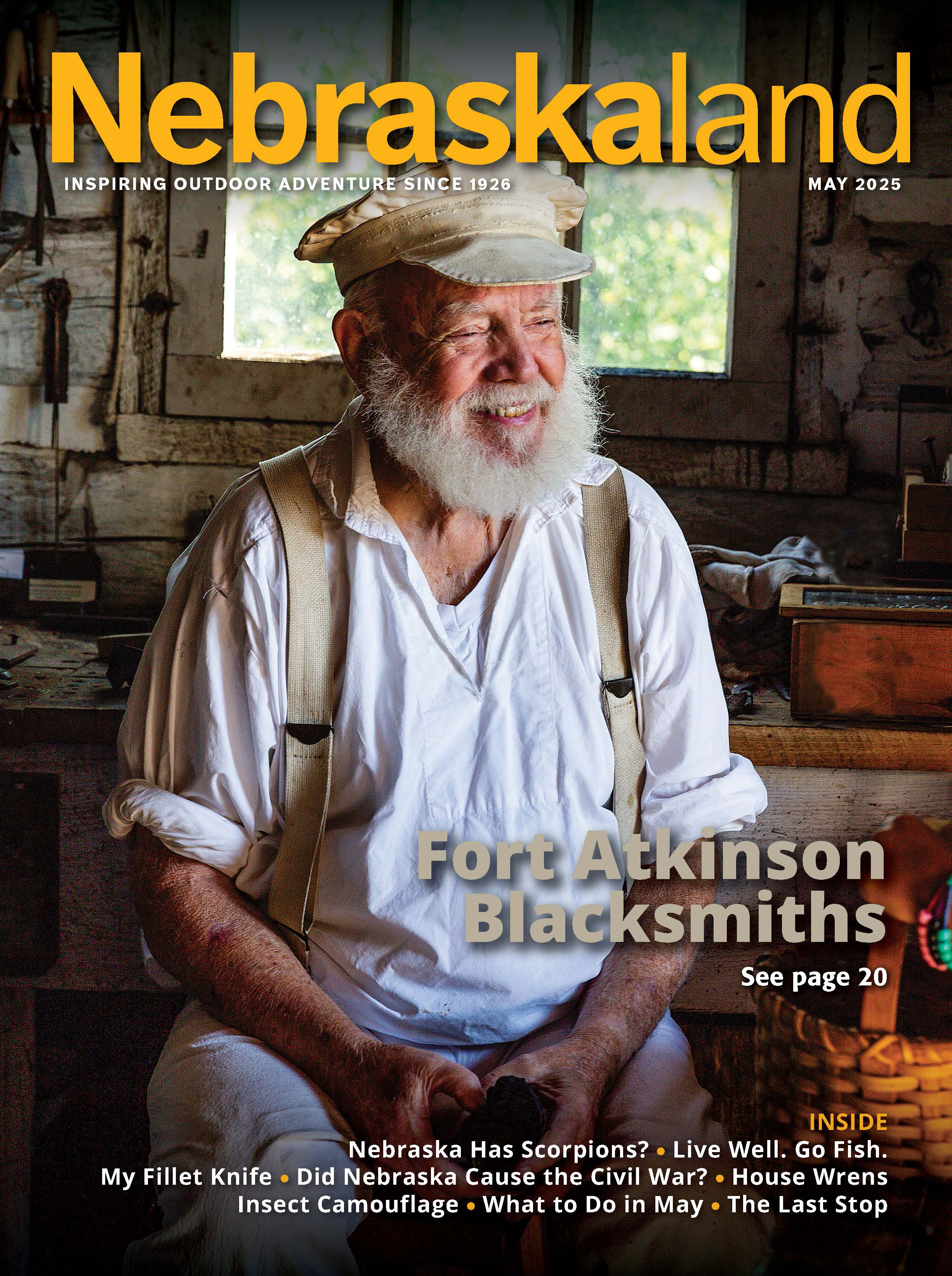
I N S P I R I N G O U T D O O R A DV E N T U R E S I N C E 1 92 6
M AY 2 0 2 5
Fort Atkinson
Blacksmiths
See page 20
INSIDE
Nebraska Has Scorpions? Live Well. Go Fish.
My Fillet Knife Did Nebraska Cause the Civil War? House Wrens
Insect Camouflage What to Do in May The Last Stop
2
Nebraskaland • May 2025
Volume 103
May 2025
No. 4
FEATURES
20
28
30
A HAMMER, AND A GOOD SWING
Fort Atkinson Blacksmiths
Story and photos by Jenny Nguyen-Wheatley
OUTDOOR NEBRASKA
JJENNY NGUYEN-WHEATLEY, NEBRASKALAND
T page: Vince Gewinner of
This
Weeping Water fishes for largemouth
W
bbass from a kayak with a set of
homemade wooden fishing lures
h
aat Verdon State Recreation Area in
Richardson County.
R
JJEFF KURRUS, NEBRASKALAND
What to Do in May
By Renae Blum
LIVE WELL. GO FISH.
Catching Fish, and Smiles
Story and photos by Eric Fowler
36
DID NEBRASKA START THE CIVIL WAR?
40
CUTTING BACK TO ANOTHER TIME
42
THE BOISTEROUS, BUSY HOUSE WREN
46
C
Cover:
The late blacksmith Tom
McDowell speaks to visitors during a
M
lliving history event at Fort Atkinson
SState Historical Park. See story on
ppage 20.
By David L. Bristow, Nebraska State Historical Society
By Justin Haag
A Natural History with Nesting Habitats
Story and photos by Justin Haag
INSECT CAMOUFLAGE AND MIMICRY
Story and photos by Brianna Nugent
DEPARTMENTS
12
50
60
62
In the Field
Mixed Bag
Portraits from the Past
The Last Stop
ON THE WEB
For more articles and
information, visit
NebraskalandMagazine.com
Nebraskaland (VOL. 103 / NO. 4 ISSN 0028-1964) is published monthly, except for the combined Jan./Feb. and Aug./Sept. issues, by the Nebraska Game and Parks Commission, 2200 N. 33rd
St., Lincoln, NE. Periodicals postage paid at Lincoln, Nebraska, and additional mailing offices. POSTMASTER: Send all UAA to CFS. (See DMM 507.1.5.2); NON-POSTAL AND MILITARY
FACILITIES: send address corrections to Nebraskaland, P.O. Box 30370, Lincoln, NE 68503-0370.
4
Nebraskaland • May 2025
May 2025 •
Nebraskaland
5
Magazine Staff
magazine
Communications Director Christy Firestone
Public Relations Manager Shawna Richter-Ryerson
Published by the Nebraska Game and Parks
Commission since 1926. The Commission is
dedicated to the conservation and protection
of all the state's natural resources and the
people who use them.
Editor Jeff Kurrus
Associate Editor Jenny Nguyen-Wheatley
Regional Editors Eric Fowler, Julie Geiser,
Justin Haag
Contributing Editor Michael Forsberg
Regular Contributors Renae Blum,
Chris Helzer, Chris Masada, Todd Mills,
Ryan Sparks, Gerry Steinauer
Art Director Tim Reigert
Graphic Designer Mel Severin
Videographer Nick Sauvageau
Photo Librarian Jaclyn Cruikshank Vogt
Administration
Director Tim McCoy
Chairman - John Hoggatt, Kearney
Vice Chairman - Donna Kush, Omaha
2nd Vice Chairman - Ken Curry, Columbus
Kurt Arganbright, Valentine
Scott Cassels, Omaha
Dan Hughes, Venango
Kent McNeill, Papillion
Steve Mossman, Lincoln
Doug Zingula, Sidney
Commission Offices
Headquarters/Southeast District Office
2200 N. 33rd Street Lincoln, NE 68503
Phone 402-471-0641
Northeast District Office
2201 N. 13th St. Norfolk, NE 68701
Phone 402-370-3374
Southwest District Office
301 E. State Farm Rd. North Platte, NE 69101
Phone 308-535-8025
Nebraskaland Magazine Copyright 2025, all rights reserved.
Nebraskaland is available in audio from the Nebraska Library Commission
Talking Book and Braille Service, Suite 120, 1200 N St., Lincoln, NE 68508.
800-742-7691. Nebraskaland Magazine and the Nebraska Game and Parks
Commission reserve the right to reject any advertising not in keeping with
the agency mission.
Rates: $18 for one year; $33 for two years; $44 for three years. Nebraska
recipients must add appropriate sales tax. To subscribe call
1-800-NEBLAND (632-5263), or go online to:
NebraskalandMagazine.com.
Conservation Officers
ADMINISTRATION
Jeff Clauson
402-471-5531
Lincoln HQ
Administrator
Travis Shepler
402-471-5531
Lincoln HQ
Asst. Administrator
Stacey Lewton
402-471-5531
Lincoln HQ
Asst. Administrator
Mike Thome
402-471-5531
Lincoln HQ
Asst. Administrator
308-289-6260
Doug Pollard
Bassett Office
524 Panzer St., Box 508 Bassett, NE 68714
Phone 402-684-2921
Jerod Hahn
Ak-Sar-Ben Aquarium/Schramm Education
Center
21502 W. Highway 31 Gretna, NE 68028
Phone 402-332-3901
Omaha Office
8495 Frederick Street, Omaha, NE 68124
Phone 402-595-2144
OutdoorNebraska.gov
The Nebraska Game and Parks Commission does not discriminate
based on race, color, ethnicity, national origin, sex, pregnancy, sexual
orientation, gender identity, religion, disability, age, genetic information,
veteran status, marital status, and/or political affiliation in its programs,
activities, or employment. Any person who believes he or she has been
discriminated against in any program, activity, facility, or service,
should contact the Nebraska Game and Parks Commission, Lincoln, NE
402-471-0641, the Nebraska Equal Opportunity Commission, Lincoln,
NE 402-471-2024, TTY/TDD 800-642-6112; Director, Office of Diversity,
Inclusion and Civil Rights, U.S. Department of Interior, 1849 C Street,
NW, Washington, D.C. 20240.
6
Nebraskaland • May 2025
EAST SUB-DISTRICT
308-520-5539
Sergeant
308-280-4320
531-310-2869
WEST SUB-DISTRICT
Sean McKeehan 308-672-1824
Sergeant
KayLynn Miller
308-665-8440
Dawes, Sioux, Sheridan
Cassidy Harwood 308-562-9099
Box Butte, Sheridan
Josh Widhelm
308-279-9133
Scotts Bluff, Banner, Sioux
Brandon Wallace 308-280-4488
Scotts Bluff, Banner, Sioux
Travis Schultz
308-279-1292
Morrill, Scotts Bluff, Box Butte
Casey Gehrt
402-617-2112
Dawes, Sheridan, Sioux
NORTHEAST
Dale Davis
402-760-0712
Captain
WEST SUB-DISTRICT
Jeff Jones
EAST SUB-DISTRICT
308-289-2274
NORTHWEST
Dan Kling
308-430-0572
Captain
Hunter Lee
Keith, Deuel
Jaden Porter
Garden, Grant
Tyler Stueck
Keith, Arthur
Keith Jadlowski
Keith, Arthur
Jonathan Andreasen
402-340-3981
Madison, Pierce, Stanton
Trevor Stahlecker
402-928-9099
Knox, Antelope, Pierce
Mitch Johnson
402-613-8612
Cedar, Knox
402-380-6410
Sergeant
Kyler Prochaska 402-830-8278
Platte, Colfax
Matt Costello
402-317-4014
Dodge, Colfax
Kelbi Abke
402-237-2537
Washington, Burt
Nicholas Fix
402-508-0261
Dixon, Dakota, Thurston
Kyle Hansen
531-739-7392
Dodge
(Includes counties covered)
Northwest District Office
East Hwy. 2, Box 725 Alliance, NE 69301
Phone 308-763-2940
Kearney Office
1617 First Ave. Kearney, NE 68847
Phone 308-865-5310
MAY PHENOLOGY
Watch for flying June bugs. GETTY IMAGES
Magazine Subscriptions
For address changes, magazine and subscription
questions, 800-632-5263 or visit
nebraskalandmagazine.com
Advertising
For advertising information, contact:
Shane G. Gilster, 402-742-0125
shanegilster@solotreemedia.com
402-762-5022
Sergeant
Greg Hesse
308-546-7464
Rock, Brown, Keya Paha
Cory Krause
CENTRAL SUB-DISTRICT
308-730-7050
Sergeant
Daryl Teter
308-440-1863
Howard, Greeley, Merrick
Matt Brandt
308-202-0819
Sherman, Howard
Klint Gill
402-613-5800
Nance, Wheeler, Boone, Polk
Garrett Zimmer 402-416-5736
Garfield, Loup Valley
Tim Williams
308-380-7331
Hall, Hamilton
SOUTHWEST
Brian Piernicky 308-330-8780
Captain
NORTH SUB-DISTRICT
Alex Hasenauer
308-660-4671
Sergeant
308-395-6001
Jacob Stoinski
Lincoln, Perkins
Frank Miller
402-389-0444
Cherry, Hooker
Luis Nuñez
531-333-6093
Blaine, Custer, Thomas
Brandon O’Neal 308-530-3157
Lincoln, McPherson, Logan
SOUTH SUB-DISTRICT
Kelsey Glodowski 308-242-9000
Sergeant
Bryce Streger
308-537-0404
Dawson, Gosper, Custer
Tyler Adelman
402-314-4783
Dawson, Gosper, Furnas
Sophia Gobber
308-222-0368
Chase, Dundy, Hayes, Hitchcock
SOUTHEAST
Matt Seitz
402-806-0915
Captain
WEST SUB-DISTRICT
Matt Taylor
402-200-9597
Sergeant
402-902-2017
Eric Javins
Adams, Clay, Webster
Justin Gress
308-629-9335
Thayer, Nuckolls, Fillmore
Pat George
308-920-2762
Harlan, Franklin, Phelps
Ethan Teter
308-440-3847
Buffalo, Kearney
EAST SUB-DISTRICT
Heath Packett
402-210-0888
Sergeant
402-209-1506
Russell Mort
Otoe, Johnson
Rich Berggren
402-619-1355
Douglas
Brian Arp
531-530-9011
Douglas, Sarpy
Mike Luben
402-443-6392
Saunders
Bryan Adams
402-429-1924
Nemaha, Pawnee, Richardson
CENTRAL SUB-DISTRICT
Curt Prohaska
402-470-1298
Sergeant
Mark McDonald 402-805-2353
Lancaster
Mark Sullivan
402-741-0636
Lancaster, Seward, Butler
Jarrod Messman 531-739-9760
Lancaster, Saline, York
YOUR NEBRASKA
Instagram Photos
Follow us @nebraskaland
and tag us in your photos
to be featured in an
upcoming issue.
Don Brockmeier, Eustis
Blue Jay on Black
8
Nebraskaland • May 2025
May 2025 •
Nebraskaland
9
YOUR NEBRASKA
Curt Blum, Lincoln
Blood Moon near Dunbar
Mat Custer, Omaha
A Serene Foggy Morning
Correction: On page 48 of the April
issue, the “Loup River Water Trail” story
should have read: “The last diversion
located near Genoa sends a majority of
the river’s flows down a canal that feeds
Loup Power District power plants.”
– Jeff Kurrus, Editor
Lee Major, Valentine
Above the Niobrara
10
Nebraskaland • May 2025
Send your comments and
photos to:
Jeff Kurrus, Editor
Nebraskaland Magazine
P.O. Box 30370
Lincoln, NE 68503
or email Jeff.Kurrus@Nebraska.gov
Please include your postal address and
telephone number. Letters may be condensed and edited. Photographs are
also welcome.
May 2025 •
Nebraskaland
11
IN THE FIELD
SWIFT FOX AND PUPS
A female swift fox tends to
her pups as they play near the
den in the Panhandle Prairies
Biologically Unique Landscape
in Sioux County.
JUST
JUS
STIN
ST
TIN
N HAAG,
AAG
AG
AG,
G NEB
BRASK
ASK
AS
SKALAN
AL
LAN
L
AN D
12
Nebraskaland • May 2025
May 2025 •
Nebraskaland
13
IN THE FIELD
NEBRASKA HAS SCORPIONS?
By Theo Huber and Keith Geluso
In 2023, researchers at UNK began to study scorpions in
Franklin County. To date, we have learned they are dormant
from late October to mid-March, during which they are
underground and decrease their activity. Being at the
northernmost extent of their distribution, this dormancy is
longer than southern populations where warmer climates
either shorten or eliminate dormancy altogether.
These scorpions are known to climb on trees, shrubs and
human-made structures to ambush prey or reduce predation
risks. We also have observed them climbing on native forbs
in prairie ecosystems. Because this species is most active at
night, our current research surveys are conducted in the dark
to investigate their feeding habits. We commonly find them
during the day by flipping over rocks.
In much of the southern United States, this species
is considered a pest due to its tendency to enter homes.
While its sting is not typically harmful to humans — it is
comparable to a bee or wasp — it can potentially pose a
significant risk to those allergic to stinging insects. Despite
this defense mechanism, these scorpions are generally not
aggressive and sting only when provoked.
As we investigate further, we hope to learn more about
the distribution of this species. If you know other areas with
populations in the state, please reach out to us.
Scorpions hiding under a rock during daylightbhours in
Franklin County. PHOTO BY KEITH GELUSO
Scorpions are often associated with arid, desert
environments of the south and west. Therefore, Nebraskans
likely are unfamiliar that one species of scorpion inhabits
parts of south-central Nebraska along the Kansas border.
The striped bark scorpion (Centruroides vittatus) was first
documented in Thayer County in the 1940s, but our research
team at the University of Nebraska at Kearney has recently
observed them in Franklin County in upland mixed-grass
prairies. This species is about 2 inches long and is tan to
brown with two parallel black stripes that run along its
back.
The striped bark scorpion ranges throughout much of the
south-central United States, from New Mexico to Louisiana,
and from northern Mexico to southern Nebraska. While
commonly found in arid environments, this species also
thrives in grasslands, woodlands and even urban areas.
They frequent rocky outcroppings, canyon walls and even
visit homes. This species is most active at night and easily
observed using ultraviolet light.
14
Nebraskaland • May 2025
Theo Huber is an undergraduate student at the UNK and is
conducting this research. Keith Geluso is his professor. For more
information, contact gelusok1@unk.edu.
The striped bark scorpion is most active at night and can be
observed using ultraviolet light. PHOTO BY KEITH GELUSO
IN THE FIELD
A FREE-FOR-ALL
Story and photos by Julie Geiser
One day each year, it’s free to try out fishing and making
new memories at a state park or state recreation area. This
year, Free Fishing and Park Entry Day will be May 17.
Maybe you have never fished before and don’t want to take
the plunge of buying a permit until you test the waters first.
This day gives you the opportunity to see if fishing is in your
future. Also, many parks across the state host free fishing
events, providing gear, so you can wet a line without having
to invest in tackle.
Even if you don’t catch anything or aren’t interested in
Tent camping is a popular activity at Smith Falls State Park
near Valentine, where visitors also hike, view the falls and
float the river on tubes and kayaks.
All ages can enjoy Free Fishing and Park Entry Day at nearly
80 state parks and state recreation areas across Nebraska.
16
Nebraskaland • May 2025
fishing, come share a laugh with family or friends, catch
a toad along a muddy bank or enjoy the fresh air and
sunshine to kick off the new park season.
With nearly 80 state parks and state recreation areas in
Nebraska, chances are you won’t have to travel far to find a
great place to visit. Go for a drive, hike a trail, learn history,
have a picnic or play games. There are many ways to enjoy a
day outside.
Plan your day at OutdoorNebraska.gov/parks/find-apark/.
Fort Kearny State Recreation Area near Kearney has seven
pit lakes that total 21 acres of water.
From boating, fishing and the popular swim beach, Red
Willow Reservoir State Recreation Area near McCook offers
something for everyone.
IN THE FIELD
Perch flavored with blackened seasoning is served in tacos with avocado sauce.
JENNY NGUYEN-WHEATLEY, NEBRASKALAND
BLACKENED PERCH TACOS
By Jenny Nguyen-Wheatley
Blackened seasoning goes well with just about any fish. I
don’t know why it took me so long to try out this pairing, but
the bold, spicy Cajun flavor just makes sense in a taco, while
cool avocado sauce complements the heat.
I typically like to coat fish generously with blackened
seasoning. But be aware that different brands will have
different amounts of salt added. Taste first to make sure
you’re not oversalting fish.
Use whatever fish you have for this recipe, including
walleye, bluegill, crappies, drum or catfish.
Servings: 4
Prep Time: 15 minutes
Cooking Time: 15 minutes
Ingredients:
8 perch fillets, skinless
Blackened seasoning, to taste
4 tbsp. butter
8 corn tortillas
Shredded cabbage
Diced tomato
Diced red onion
Queso fresco cheese, crumbled
Hot sauce
•
•
•
•
•
•
•
•
•
18
Nebraskaland • May 2025
Avocado Sauce
1 medium avocado
¼ cup cilantro
3 tbsp. sour cream
Juice of half a lime
1 clove of garlic
3 green onions, coarsely chopped
¼ tsp. kosher salt
•
•
•
•
•
•
•
1. In a food processor, combine avocado sauce ingredients
and pulse until smooth. Season to taste. Add more sour
cream as needed. Scrape sauce into a sandwich-size zip-top
bag. Refrigerate until ready to use.
2. Generously season perch with blackened seasoning. In
a medium-size pan, melt butter until it reaches a slightly
hazelnut color. Add perch and cook until deeply golden on
both sides.
3. Warm tortillas in a hot skillet or over open flames until
slightly splotchy brown. Assemble tacos with cooked fish,
cabbage, red onion and tomato.
4. Snip the corner of the zip-top bag with avocado sauce
and use it to drizzle over the tacos. Garnish with crumbled
queso fresco cheese. Serve immediately with hot sauce on
the side.
A Hammer, and a
Good Swing
Blacksmith Dean Slader of
Valley has been a living history
volunteer at Fort Atkinson
State Historical Park in Fort
Calhoun for nearly 50 years.
He also does demonstrations
at the Missouri River Outdoor
Expo at Ponca State Park.
Fort Atkinson Blacksmiths
Story and photos by Jenny Nguyen-Wheatley
D
ean Slader has tried retiring his
hammer and anvil several times.
The 82-year-old blacksmith’s
relationship with Fort Atkinson State
Historical Park “goes back.” While a
student at Fort Calhoun High School,
the archaeological dig down the road
made a lasting impression on the
teenage Slader.
Abandoned by the U.S. Army in
1827, the site of Fort Atkinson was
converted to farmland, and in 1961,
concerned Washington County locals
rallied for the restoration of the site,
thus creating the Fort Atkinson
Foundation that same year. Slader’s
mother, Genevieve Dorsey Slader, was
a founding member. Her son took such
a strong interest in the area’s history
that he went on to teach high school
social studies for 35 years, retiring in
2001 in Valley.
In the 1960s, Slader threw himself
into buckskinning, a subset of
historical reenactment concentrating
on the fur trade. He also became
involved with the Fort Atkinson
Muzzleloaders group. As a competitive
shooter, Slader started building his
own guns, including the ironwork of
fashioning trigger guards and butt
plates, which led him down the path of
blacksmithing.
“I got ahold of an anvil and a forge
and some basic small tools sometime in
the mid-to late-’70s and started down
that direction and never built another
gun,” Slader said. It became what he
calls an avocation, a self-sustaining
hobby. His passion for blacksmithing
has everything to do with his interest
in the past.
“My craft is a 3,000-year-old craft,”
he said. “Historically, a hammer is a
hammer. A pair of tongs for handling
iron is a pair of tongs. A chisel is —
that hasn’t changed. A punch hasn’t
changed. It’s because the form follows
function.”
To be a part of living history is to
be a part of ongoing research, Slader
explained. It’s the same for the
tinsmith, the weavers and spinners. In
many ways, Slader’s story follows the
dawn of the state historical park, its
renowned living history program and
dedicated volunteers.
Friends of Fort Atkinson
Slader showing a nail he made bearing his “DS” stamp.
20
Nebraskaland • May 2025
The early days of living history
at Fort Atkinson were informal. The
earliest volunteers came from the
Fort Atkinson Muzzleloaders group,
which amounted to three or four
people, Slader said, including himself.
May 2025 •
Nebraskaland
21
A variety of blacksmithing tools hanging on the wall at the blacksmith shop.
To-do list of projects at the blacksmith shop include Christmas nails, tent stakes
and Fort Atkinson hooks.
Then the Bicentennial Wagon Train
Pilgrimage came through Nebraska in
1976 to commemorate the westward
movement of white American settlers
in the 19th century. Fort Atkinson SHP
was one of the stops, an event that
Slader attributes to the genesis of the
fort’s living history program.
“And then it just grew from there,
from maybe half a dozen of us, and
then into the teens, and then 20s, and
so on and so forth, as far as numbers,”
Slader said. The volunteer program
grew so large in the 1980s and ’90s that
it finally had to be formally organized,
22
Nebraskaland • May 2025
hence the creation of the Friends of
Fort Atkinson group.
By the time the Bicentennial Wagon
Train came through, Slader had made
his transition from mountain man to
blacksmith permanent — a position
he still holds today, some 50 years
later. It’s a unique occupation in the
military, Slader said. Not only can
a blacksmith make his own tools,
he’s also responsible for making and
repairing tools for everyone else, from
shovels, to axes, to hoes and rigs,
hinges, latches and clasps.
“Like most things in the army, you
This photo, taken with a slow shutter speed during a Candlelight Tour, shows blacksmiths Doug Appel at the forge, Slader’s
ghost-like form hammering at the anvil to the right and Lauren Joyce sitting at the work bench in the back.
needed it yesterday,” he said. “To
run a post of this size, we know from
the enlistment records, they had 24
blacksmiths.”
Naturally, the Friends of Fort
Atkinson
experiences
frequent
turnover with its volunteers. People’s
life circumstances change — they get
busy, move away or have children.
Some, like Slader, have stuck around.
Fort Calhoun local Doug Appel,
who worked alongside Slader in the
blacksmith shop for nearly 15 years,
volunteered until he was no longer
able before his death in 2020. Despite
attempts to retire and the loss of a dear
friend, the fort keeps calling Slader
back.
“There’s a passion, and it’s a part of
home. It becomes a part of what you do.
It becomes part of a thought process
that you have. You can’t stay away,”
Slader said. “Some of those volunteers,
within their family, they’re on second
or third generation. And I’ve always
said, people who do live in history —
they’re a different breed of cat.
“We’re always looking for new
volunteers,” he added.
Over the decades, Slader, Appel and
others have striven to provide visitors
an insightful view of the day-to-day
operations of blacksmithing at Fort
Atkinson. Not only is the accuracy
of their research and performance of
living history important, volunteers
also are conscientious of their role in
representing the Nebraska Game and
Parks. They are essentially on stage.
“Nothing will take place at Fort
Atkinson that will jeopardize the
experience for the visitor. It’s not
written anywhere, but if there’s a
guiding rule, I guess that’s one of
them,” he said. “It can become a heavy
weight to bear sometimes.”
This unwritten mission statement,
Slader has passed down to his latest
apprentices, Thomas Bansen of Blair
and Kody Keefer of South Sioux City
— both in their early 30s. Their timely
arrival has brought both elation and
relief to the veteran blacksmith.
“They’re godsends,” Slader said with
no attempts of hiding his excitement.
“I now feel much more comfortable
about what we do at the blacksmith
shop, and so on, continuing. Because
they exhibit the same passion and
attitude.”
May 2025 •
Nebraskaland
23
receptive to new ideas and ways to
approach projects, Keefer said. In
return, Slader’s apprentices eagerly
receive
the
older
gentleman’s
knowledge with reverence. All have
committed to the ongoing work of
research and practice that is the
beating heart of living history.
“Dean has no problem standing right
there with you and maybe bumping
you or whatever. ‘Hey, lift your
elbow like this.’ Or, ‘Hey, turn your
hand … ’,” Keefer said. “Every single
time that I’m with him, it’s always a
learning experience.”
Perfection
Despite
Bansen’s
previous
education, tending a coal forge at Fort
Atkinson and setting the temperature
on his propane forge at home was
night and day different. Getting used
to the early-1800s setup was his
Living
History
Schedule
May 3-4
May 31-June 1
July 5-6
Aug. 2-3
Sept. 6-7
Oct. 4-5
Nov. 1 - Candlelight Tour
A park entry permit is required
of all vehicles entering Fort
Atkinson SHP. Paid reservation
required for the Candlelight
Tour.
For more information, visit
fortatkinsononline.org or call
402-468-5611.
The late blacksmith Tom McDowell speaking to visitors during a living history event. He often sat in this corner,
Slader said, making Fort Atkinson medallions. Visitors who purchased one at the shop could have their initials stamped on it.
New Blood
As a child, Bansen frequently visited
Fort Atkinson with family. He became
drawn to the blacksmith shop more
than anywhere else on the fort, and
years later, a college professor noted
Bansen’s interest in historical weapons
and armory and connected his student
with a blacksmithing instructor in
2012. Bansen started taking lessons
once a week and, in 2015, struck out
on his own.
In addition to general ironwork,
Bansen’s interest lies in making
24
Nebraskaland • May 2025
knives, swords and axes; one of his
favorite creations is a 13th century
knight’s arming sword. Bansen finds
fascination in the enduring history of
ironwork, its role in the progression of
technology, and the creative outlet the
craft provides. After several years of
encouragement, Bansen finally made
the leap to join Slader’s fort shop in
2022, following a career change that
freed up more time.
Keefer showed up at Slader’s door
with no experience in blacksmithing.
His path to Fort Atkinson came by
way of the Missouri River Outdoor
Expo at Ponca State Park, where he
volunteered at the muzzleloading
station annually with his father
and uncle. During breaks, Keefer
would wander down to the heritage
encampment by the riverfront, where
he befriended several Fort Atkinson
volunteers, including Slader, who
invited him to events at the fort.
In early 2022, Keefer’s father and
uncle unexpectedly passed away
within three weeks of each other.
Despite his grief, their deaths spurred
Keefer to join the Friends of Fort
Atkinson in 2023. He realized that life
was too short.
“If it wasn’t for the unfortunate,
untimely passing of my dad and my
uncle, I never would have had the
gumption to pick up blacksmithing,”
Keefer said. “Dean, with his wisdom
and his years of knowledge and
experience … I figured if I was going
to learn something from somebody, it
had to be him.”
Slader has been an enthusiastic
teacher to his young apprentices,
This style of hook is unique to Fort Atkinson, and during the fort’s height, as many
as 2,800 hooks may have been driven into its walls.
May 2025 •
Nebraskaland
25
Slader’s apprentices Kody Keefer of South Sioux City, left, and Thomas Bansen of Blair take turns striking a piece of metal
on the anvil in the blacksmith shop at Fort Atkinson SHP.
biggest challenge.
“[With] propane or a natural gas
forge, you just set the heat level, and
you forget it. But with coal or charcoal,
you are constantly tending that
because you’ve got to think, ‘Okay, I
might have good heat right now, but
I’ve got to add more coal to make sure
that I still have that good heat five
minutes from now.’”
For example, if a blacksmith was
forge welding — joining two pieces
of metal by heating them to a high
temperature and hammering them
26
Nebraskaland • May 2025
together — the forge would need to be
just under 2,200 degrees Fahrenheit.
However, that borders the temperature
where steel will start to burn.
“It’s a very fine line between the
right temperature and, you’ve entirely
ruined the material,” Bansen said. “If
you look away, if you get to talking
with somebody or, if you just got
too many irons in the fire — this is
where the phrase comes from — your
project’s ruined.”
Keefer describes his education so far
as a love-hate relationship.
“The reality of it is, in this case,
I don’t know hardly anything. You
expect to be able to watch someone
produce a product or work or repair an
item, and then in your head you think
you can do it. Whether or not you can
is soon to be proven by your ability to
manipulate the material or use certain
tools,” he said.
Unlike modern tools and parts,
which are made by machinery and
consistently duplicated, blacksmithing
is a hand craft. Although this human
element brings inconsistency to
products, it allows each blacksmith’s
style
and
technique
to
be
differentiated. No two blacksmiths
will produce the same exact piece of
work. Keefer is learning to embrace
this universal truth: that nothing is
perfect.
The Fort Atkinson Hook
If you’ve visited a living history
event, chances are you’ve heard of or
seen the Fort Atkinson hook. Slader
guessed that at the fort’s height, as
many as 2,800 hooks — minimum
— were driven into the fort’s walls,
bearing all manner of soldiers’ kit.
This unique style of hook is not found
outside of Fort Atkinson, and it is
because of Slader that it still exists.
Around 1991 or 1992, Slader found
an original hook while walking along
the area where the northeastern
barracks are presently located. As
it was the habit of living history
volunteers at the time, he kept his eyes
on the ground that day, in hopes of
finding something interesting that the
archaeologists had missed.
“There it was — the right angular
portion with the curl on the end
and tapered to a point on the other
end,” Slader said. “That became the
beginning of the Fort Atkinson hook,
which was the proof that that’s what
they were using. They needed those
by the thousands, and they had to be
done quickly.”
Slader then conducted his own
archaeology. It took him seven or eight
tries to figure out the process the fort’s
blacksmiths used to produce the hooks.
Bansen explained that by examining
hammer and tool marks on a work,
a person could piece together how
a smith produced an item hundreds
or thousands of years ago. Every
blacksmith that has worked with
Slader at the shop has been schooled
in making the Fort Atkinson hook.
“I’ve burned several hooks during
demonstrations,” Bansen said. “It
looks so simple, but it’s not. And Dean’s
pretty proud of those hooks, and he has
every right to be. That is something
that is both intensely frustrating, but
also incredibly satisfying.”
Slader has produced hundreds of
them. Visitors may purchase souvenir
hooks at the Sutler Store.
How They Do It
The Fort Atkinson Living History
program is one of the best in the
Midwest. While other historical
sites may host one to two events
each year, the park in Fort Calhoun
offers six weekends of living history
Fort
Atkinson
History
Active from 1820 to 1827,
Fort Atkinson held nearly onequarter of the standing U.S.
Army, approximately 1,200
soldiers.bIt was established
to protect the growing
western fur trade and was
the only U.S. garrison west
of the Missouri River. After
the Army reassigned soldiers
elsewhere, the fort was
abandoned and converted
to farmland. In 1961, Fort
Calhoun locals chartered the
Fort Atkinson Foundation.
The group dedicated itself
to the acquisition of the
Fort Atkinson site and its
restoration. With help from
the Nebraska Game and
Parks and the Nebraska State
Historical Society, the park
was completed in 2000 after
the construction of the Sutler
Store.
demonstrations annually, plus a
Candlelight Tour in November.
“Every once in a while, somebody
will show up from another site, and
they’ll start asking questions. ‘How do
you do this?’ ‘How do you sustain it all
these years?’” Slader said. “You know,
it’s a cooperative effort.”
Bansen and Keefer are quickly
learning that living history is not
just about the research and dressing
the part — it’s also about the people.
Fellow volunteers are becoming like
family, and all enjoy the aspect of
interacting with visitors.
“For the most part, when visitors
come to the blacksmith shop, they want
to see some kind of a project or product
produced,” Keefer said. “I feel like there’s
just as much energy given as there is
taken. And that’s probably what makes it
the most fun — and being around a good
group of people.” N
May 2025 •
Nebraskaland
27
Outdoor Nebraska
By Renae Blum
For Nebraskans, May is a time of year when it’s easy to be
excited about spending time outdoors. Here are a few ways to
use that time. N
Forage for wild
asparagus
Late April through May; prime
time is mid- to late-May
statewide
Boasting a fresher, more vibrant
flavor, wild asparagus is a popular
spring edible in Nebraska. It prefers
sunny, moist spots near water in
rich saline or alkaline soil. Try
searching irrigation canals, ditches,
waterways, roadsides, fencerows
and pastures or meadows — even
old homesteads or farmsteads.
Always get landowner permission
and
remember
foraging
for
wild asparagus isn’t permitted
at Nebraska Game and Parks
properties.
Search
“Stalking
Wild Asparagus” at Magazine.
OutdoorNebraska.gov for more tips.
What to Do in May
Go herping
April and May, or as weather allows
statewide, though species will vary
If you enjoy exploring and looking for
wildlife, try “herping.” Herpers search for
reptiles and amphibians, such as snakes,
frogs, turtles and lizards, which can be
found anywhere there is nature — forests,
fields, ponds or even your own backyard.
Places near water are also a great bet. If you
find a critter, don’t pick it up, but do take
pictures –— and share those photos with
others. Learn more by searching “reptiles
and amphibians” at OutdoorNebraska.gov.
JUSTIN HAAG, NEBRASKALAND
Attend the Bob Bruner Memorial
Fishing Derby
May 17, 9 a.m. to noon | Lake 16 at Fremont Lakes State
Recreation Area
Bring the family to Fremont Lakes for a morning of fishing, food and fun.
Youth 15-years-old or younger, accompanied by an adult, are welcome
to compete for prizes in the derby. Other attractions include wildlife
encounters, free sloppy joes and hot dogs, and entertainment from local
civic groups and radio stations. May 17 is also Free Fishing and Park Entry
Day, so take advantage of the chance to fish and visit state parks without
the need for a permit. ERIC FOWLER, NEBRASKALAND
JENNY NGUYEN-WHEATLEY, NEBRASKALAND
Bring your horse on a
spring trail ride
May 10, 9 a.m. MT | Enders Reservoir State
Recreation Area
You may have heard of Enders’ Fall Trail Ride, but did
you know it’s a spring occurrence, too? Bring your
horse, meet other horse enthusiasts and experience
the beauty of Enders in spring, from greening trees to
new wildlife. Riders can also take in lake views and a
scenic landscape of rolling hills. Call the park office to
register at 308-394-5118. Horses are not provided for
the trail ride, and a state park entry permit is required.
ERIC FOWLER, NEBRASKALAND
28
Nebraskaland • May 2025
Visit a historic iris
garden
Blooms mid- to late-April through early
June, peaking around Memorial Day
weekend | Eugene T. Mahoney State Park
Soak in the beauty of spring with this stunning
iris display garden. The Sass Memorial Iris
Garden features collections of award-winning
irises, including some varieties bred right here
in Nebraska by the Sass family, renowned
hybridizers who worked from the 1920s to the
1950s. The garden is easily accessible, with
paved walkways, convenient parking and
nearby restrooms and picnic tables. Check out
the nearby conservatory and education
center, too. JEFF KURRUS, NEBRASKALAND
May 2025 •
Nebraskaland
29
Live Well.
Go Fish.
Catching Fish,
and Smiles
Story and photos by Eric Fowler
orld War II veterans. Ninety-year-old nursing home
residents who had never fished and caught their
first fish. Hospice patients who caught their last.
Alzheimer’s patients. Twenty-somethings who have
been blind since they were infants. Youths from the Boys &
Girls Clubs in Omaha. Those are some of the nearly 10,000
individuals who have boarded the Live Well. Go Fish. boat.
The Lincoln nonprofit knows the therapeutic value of
fishing and simply being on the water. The people they serve
have lost plenty of bobbers, but they also have caught plenty
of fish, and shared an untold number of smiles.
W
Retirement Gig
Live Well. Go Fish. is David Rudder’s retirement venture.
When he left his career, he thought he might be a fishing guide,
but then came up with a better idea: guiding seniors, veterans
and others who wouldn’t otherwise have a chance to fish.
“There are a lot of programs already out there for the kids,
but there’s just not a lot for mainly the seniors and people with
disabilities,” Rudder said.
In 2016, Rudder started knocking on the doors of care,
retirement and veterans’ services centers to see if they would
be interested. Enough of them were that Rudder formed a
nonprofit and ordered a custom-made, U.S.-Coast-Guardapproved 26-foot pontoon boat that could accommodate up to
three wheelchairs. He recruited some volunteers, and in 2017,
started fishing. All but a few trips have been at Lake Wanahoo
near Wahoo. The nonprofit now serves about 75 care facilities
and organizations from 17 counties in eastern Nebraska and
western Iowa.
Rudder is not only the CEO of the organization, he is also
the on-board entertainment, armed with plenty of bad dad
jokes like “Why are the fish so smart? Because they’ve been
in school all day.” He’s also the DJ, starting each trip with a
patriotic song as a salute to veterans, followed by various
fishing-related songs and assorted tunes to fit the crowd.
30
Nebraskaland • May 2025
David Rudder, founder and head of Live Well. Go Fish., takes a photo of Joyce McIntosh, a resident of
Saunders Medical Center Long Term Care in Wahoo, and the bullhead she caught during an outing at Lake Wanahoo.
There is plenty of dancing, even for those who can’t stand and
swing with a volunteer from their boat seat.
During each cruise, they break out the bubble machines and
fire up “Tiny Bubbles” by Don Ho, often for the entertainment
of shore anglers. As they move parallel to U.S. Highway 77 on
the dam at Wanahoo, they all turn into kids, pump their arms
and see how many semi-tractor trailer drivers they can get to
blow their horns — many do. They fly a kite from a fishing pole.
Early on, some people who had signed up for a trip would
cancel when they found it conflicted with their regular bingo
game. So Rudder and company came up with Bobber Bingo,
passing out cards, dumping a bucket of bobbers marked with
letters and numbers overboard and fishing them out with a dip
net.
He is the official photographer for the voyages, posting stills
and videos on social media. He took one step too far back one
day and fell off the dock while taking a photo of residents from
a West Point retirement home and volunteers. He was trying
to make sure he got all 12 people in after realizing their ages
added up to 1,137, a record. Other records include the longest
married couple (73 years) and the longest serving veteran (41
years).
The Seniors
One of the first groups to join them on Lake Wanahoo was
from Saunders Medical Center Long Term Care in Wahoo.
They have been with them ever since.
“I could sit here all day,” Joyce McIntosh, a resident of the
center, said on an outing last summer. “It’s just peaceful. I
forget about the whole world … Who would want anything
more?”
On that day, Shirley Schoenrock did, “I can’t catch the
bugger,” she said, annoyed by the small fish nipping at her
baited hook hanging below the boat.
May 2025 •
Nebraskaland
31
Shirley Schoenrock, a resident at Saunders Medical Center,
smiles as she drives the Live Well. Go Fish. boat on Lake
Wanahoo.
Laura Eivins, enrichment coordinator at Saunders Medical
Center, chats with resident Dorothy Sorensen during a game
of Bobber Bingo.
Both women had fished creeks or ponds growing up and
relived experiences, including McIntosh’s dad stocking fish in
the three ponds built on their farm, and Schoenrock catching
bullheads for breakfast.
As an adult, Schoenrock couldn’t ski, so she drove the boat
when her family went to the lake on Sundays. She’s driven
the boat nearly every time she’s been out with the Live Well.
Go Fish. crew. They presented her with two awards on the
same trip last year: One was for Honorary Captain. The other
was for Ornery Captain.
Joking around and friendly banter are part of each trip.
Saunders residents and staff were quick to point out that
Dorothy Sorensen was a noted cheat at bingo. “This is a new
experience,” she said with a wry smile. “Cheating at fishing,
it’s a little difficult.”
She had a plan, though. While she didn’t catch a fish, she
already knew what she would tell others back at the center.
“I got several,” she said. “They weren’t too big, but there were
5 or 6. I’ll explain it when we get back.”
trips for days.
Laura Eivins, another enrichment coordinator at the
center, was on one of the first Live Well. Go Fish. voyages.
She has many memories of those who have participated, but
one sticks with her of a couple who were regulars on the boat.
The husband was a lifelong angler living on his own, but
joined his wife, a resident at the center, who simply enjoyed
sitting back and watching her husband fish. When he died,
she was reluctant to get back on the boat.
“I told her she needed to do that as a tribute to her
husband,” Eivins said. “The first time back I held her, and
we shed a lot of tears. It was very emotional but, at the same
time, very healing for her.”
Water Therapy
The value of the recreational therapy for participants,
whether they are residents in assisted living homes, under
memory care for Alzheimer’s or dementia, or at a home for a
short time for rehabilitation, can’t be understated.
“It’s hard,” said Kayla Massa, life enrichment coordinator
at Saunders. “A lot of them lose a lot of freedom the second
they walk in here. Just being able to get them out there just
to kind of feel alive again, honestly, it’s one of the best things
that I’ve ever been able to do for them.”
Some residents simply go out and take a nap in the sun.
Some are eager to go every time. They all talk about their
32
Nebraskaland • May 2025
The Last Fish
Live Well. Go Fish. grew to accommodate patients in
hospice care. That led to a partnership with the Dreamweaver
Foundation, an Omaha-based group that, among other
things, helps make bucket-list wishes come true for older
adults and others with life-limiting illnesses.
Initially, Rudder wasn’t sure whether volunteers would
want to work with hospice patients. Those trips “kind of tore
your heart out,” he said, but are some the most rewarding
for the volunteers because of what it means for the patients
and their families. Together, they came up with a motto:
“Everybody remembers their first fish. We try to make sure
nobody forgets their last.”
Some participants include a young man who was an avid
hunter and angler but is now confined to a wheelchair by
illness; he wanted to spend a day fishing with friends. A
74-year-old woman simply wanted to go on a boat ride with
her family. A 95-year-old man wanted to fish with his great-
The 26-foot Live Well. Go Fish. pontoon boat can hold 14 people, but never carries more than 13 on its outings. It has room for
three wheelchairs, and once hosted a hospice patient in a hospital bed.
grandson. Another grew up fishing with his brother and
wanted to spend one more day on the water, enjoying nature,
sipping on a cold beer. Some Dreamweaver participants
arrive at Lake Wanahoo in an ambulance. Others, or their
family and friends, arrive in limousines.
Covid Shift
Coronavirus shut Live Well. Go Fish. down for a time.
When it resumed operations, there were concerns about
the lingering health risks to seniors, which had made up 90
percent of the clientele. So Rudder and the board reached out
to other organizations serving special needs patients, which
led to a relationship with the Nebraska Commission for the
Blind and Visually Impaired. That group in 2023 set the
record for the most fish caught in an outing: 128, including
81 by one boat.
Jon Herron, blind since 2021, was on that trip. The 62-yearold retired U.S. Air Force officer remembers spending summer
days catching sunfish from a creek near his home, but hadn’t
since. “I would say it can be harder without vision, but what
you want to do is to use your sense of touch. So when one
sense goes away, the other senses kick in,” he said. “So my
hearing is better now, my sense of smell is better now, my
sense of touch is better now.”
“In order to read the braille and stuff, you really do have
to have sensitive fingers,” said Makenzie Gray, 23, who lost
her eyesight when she was 6 months old. “My fingers are
Volunteer Robin Taylor and Dennis Jeppson, a resident at
Saunders Medical Center, are all smiles after Jeppson landed
a small wiper.
May 2025 •
Nebraskaland
33
very sensitive.”
Gray has been fishing with Live Well. Go Fish. since 2021.
“I love to be on boats,” she said. “The fishing is pretty fun. I
absolutely love this program.”
Honoring Veterans
Charli Saltzman, above, a counselor with the Nebraska
Commission for the Blind and Visually Impaired, holds
and feels a bluegill she caught. Below, Makenzie Gray, a
participant in commission programs, lets a nightcrawler
slither across her hand, giving a play-by-play of what she
was feeling as it did.
Veterans are a big part of Live Well. Go Fish. The American
flag always flies from the back of the boat. There are days
set aside to honor those who have served in different wars,
including the Women’s Army Corps. Rudder didn’t serve but
had uncles who did, including one who died in Korea. He and
the volunteers appreciate those who did, and the freedom
they fought to defend. “We wouldn’t be doing this without
them,” he said.
The group works with veterans homes, county veterans’
services offices, nonprofits and hospice groups that work with
veterans, VFW and American Legion clubs, and Women’s and
Family auxiliary groups.
Rudder is still amazed by the group of four World War II
veterans they hosted on D-Day in 2018. On the boat was a
soldier who landed on Normandy Beach in France and then
marched into Berlin, another who worked undercover as a
spy in a German concentration camp, and one who helped
liberate those camps.
Some of the Live Well. Go Fish. volunteers are veterans
who enjoy working with veterans. Better able to relate to
each other, guides and passengers are apt to open up and
share stories they might not share with others.
The Volunteers
Rudder is the only paid member of Live Well. Go Fish.
Helping him are 48 volunteers, who come from as far away as
Nebraska City and West Point and last year donated nearly
1,500 hours of their time to the program.
“This program works because of the volunteers,” Rudder
said. “You see them catch a fish and they hand the rod to
somebody. They’re not in it for themselves.”
Tom Lanz is a longtime volunteer hunter education
instructor for the Nebraska Game and Parks Commission and
has mentored many young hunters and anglers.
He often saw Rudder and the Live Well. Go Fish. boat when
he was fishing at Lake Wanahoo. After learning what the
group was about, he told Rudder he would be happy to help
if they ever needed him. He’s now a member of the board of
directors.
“I’ll tell you what, it’s about as rewarding as anything you
can do,” Lanz said. “Everybody does a lot of things for kids,
and that’s the future of hunting and fishing. But there’s a
little bit of payback for a lot of these elderly people and the
people who can’t get out.”
It brings things full-circle Lanz said, just as taking his
elderly grandfather fishing decades after he taught him to
hunt and fish did.
34
Nebraskaland • May 2025
Kayla Massa, enrichment coordinator at Saunders Medical Center, helps resident Dennis Jeppson off the bus for an outing
at Lake Wanahoo.
Beth Alberts and Carla Hiatt both worked with Live Well.
Go Fish. when they were activities directors at retirement
villages in Lincoln. Hiatt never got to go on the boat. “Our
van was always full and I wanted our residents to go,” she
said. “So, when I retired, I said I want to volunteer.”
Alberts did the same. The two appreciate the smiles they
see on the boat, especially from memory care patients who
struggle remembering parts of their past or current day-today lives, but can sing along with many of the songs Rudder
asks Siri to play, and the other memories the trips spark.
“They don’t really know what they are getting into, but then
when they get here, they are like, ‘I was at Johnson Lake.’ Or
they say, ‘Oh we used to go to Minnesota.’ Or ‘We used to go
to Canada fishing.’ It just brings back so many memories,”
Alberts said.
“It just fills my heart every time I step off the boat.”
The Future
Care homes pay a fee to the organization that helps cover
the cost of the boat, insurance and other expenses. Donations
from individuals and corporations pay the fee for veterans
and other groups. Rudder said he believes there is enough
demand and support for the program that it could expand,
forming chapters in different communities. “This is probably
never going to be a Pheasants Forever or a Ducks Unlimited,
but I think it could be,” he said.
Last year, Live Well. Go Fish. brought youths from the
Boys & Girls Club of the Midlands on board, one of a handful
of youth organizations they have served. They work with
Apace, formerly Region V Services, which supports people
with intellectual and developmental disabilities, and others
serving those with special needs. They take cancer patients
from an Omaha hospital fishing. And active senior groups
such as Aging Partners.
They fish primarily at Lake Wanahoo, settling there to
draw from both the Lincoln and Omaha areas, not knowing
what the demand would be from just one of the communities.
The first year was slow. “We were begging people to try us,”
Rudder said. Those who came back told others. Now they
host two or more trips a day, most on weekdays, from May to
mid-October. Sometime in May, Rudder expects the number
of people they have served to top 10,000, a number he didn’t
foresee.
The benefits to the seniors, veterans and others who
participate extend to the volunteers.
“They’re helping us, too. We learn from them … empathy,
care, respect. It unites us,” Rudder said.
“We all go fishing, but the fishing is just a bonus.” N
May 2025 •
Nebraskaland
35
Did
Nebraska
Start the
Civil War?
By David L. Bristow,
Nebraska State Historical Society
hat did the founders of the Republican Party
call themselves before they called themselves
Republicans? “Anti-Nebraska Men.”
The early GOP had nothing against Nebraska
as a place. What they opposed was a certain feature
of the law organizing the territory. The KansasNebraska Act of 1854 sparked a huge national
controversy and was one of the main events leading
to the Civil War. It is a story of railroads, Native
Americans, backroom politics and slavery.
In the early 1850s, the only states west of Iowa
were Texas (1845) and California (1850). Maps
showed most of the Great Plains as a vast area
W
ABOVE: This skylight window, formerly in the U.S.
Capitol, shows the Nebraska Territory’s official seal.
“Popular Sovereignty” was a controversial phrase in
the context of the times. NSHS 7434-1
RIGHT: Nebraska and Kansas as they appeared in
1856. Early maps often spelled Kansas with a “z.”
NSHS M78 1856 C72
36
Nebraskaland
• May 2025
May 2025 •
Nebraskaland
37
Stephen Douglas, senator from
Illinois and namesake of Douglas
County, Nebraska, circa 1860.
LIBRARY OF CONGRESS
labeled “Nebraska,” along with the names of rivers and of the Native tribes that still
controlled the region.
Talk of a transcontinental railroad was getting serious, but it would be expensive.
Most people assumed that only a single line would be built to the West Coast. The route
mattered — in part because the cities at either end stood to profit. While Southern
politicians wanted a southerly route, Sen. Stephen Douglas of Illinois wanted to lay
track west from Chicago.
The Platte River Valley was the best route for Chicago, but it faced two obstacles. The
first was that it was still “Indian Country.” Starting in the 1840s, Douglas introduced
legislation to open Nebraska to white settlement, but this was blocked by the second
obstacle: the politics of slavery.
Back in 1820, Congress admitted Missouri as a slave state while prohibiting slavery
in the vast area later known as Nebraska. In 1820, it seemed like a place where farmers
would never settle. Now Southerners feared it would become several new free states
and upset the national balance. So, they made a deal with Douglas. His new bill split
Nebraska into two territories and — crucially — reopened the question of slavery,
which would be left to territorial voters and legislatures in the name of “Popular
Sovereignty.” The Kansas-Nebraska Act became law on May 30, 1854. Just like that,
This 1860 cartoon was published the year Douglas lost a four-way presidential election to Abraham Lincoln. “You have been
a bad boy Steve, ever since you had anything to do with that Nebraska bill ….” The “Maine law” probably refers to a state law
defying the federal Fugitive Slave Act. LIBRARY OF CONGRESS
38
Nebraskaland
• May 2025
Nebraska City, as pictured in Frank Leslie’s Illustrated Newspaper, Jan. 8, 1859.
the famous Missouri Compromise was repealed.
It’s hard to overstate the sense of shock and betrayal
among many Northern voters. “We were thunderstruck and
stunned; and we reeled and fell in utter confusion,” said
Abraham Lincoln in a speech in Peoria, Illinois, on Oct. 16.
“But we rose each fighting, grasping whatever he could
first reach — a scythe — a pitchfork — a chopping axe, or a
butcher’s cleaver.”
Lincoln was speaking metaphorically, but the violence
soon became real as free-state and pro-slavery settlers
fought each other in “Bleeding Kansas.” Nebraska saw little
violence, but Nebraska City and Falls City soon became
stopping points for Northern settlers pouring into Kansas
— and for smaller numbers of enslaved people making their
NSHS RG2294-0-11
way to freedom.
The new Republican Party coalesced from the ruins of
the now-defunct Whig Party and anti-Nebraska Democrats.
Slavery was the big issue. Even so, few white people were
abolitionists. (Nebraska had legal slavery until 1861.) Fewer
still believed in racial equality. Mostly, they feared that
aristocratic Southern planters were about to dominate the
entire country.
Did “Nebraska” really start the Civil War? In fairness, it
was part of a long chain of events, but it was a turning point.
From then on, the nation increasingly became what Lincoln
called “a house divided.” N
Visit NSHS’s website at history.nebraska.gov.
Bellevue, circa-1855, illustration by Polish artist S.W.Y. Schimonsky.
May 2025 •
NSHS RG2683-0-2
Nebraskaland
39
Cutting Back to
Another Time
By Justin Haag
I
occasionally pull it from the drawer
to run it through the catch of the
day. With its familiar wooden
handle, conditioned by about 40 years
of handling, this fillet knife has been
with me for most of my fishing days,
and my history with it is rooted in a
favorite celebrity encounter.
It began when my dad took me to
McCook’s new Walmart (back in the
early ’80s when the L and M were still
separated by a star) to see a living
legend in action.
As a preteen kid
who loved to fish, I
was excited. Behind
a small table near
the sporting goods
section stood the
same grandfatherly
figure
who
had
shared his fishing
adventures
with
me through the
television set on
many a cold winter
Saturday. It was
Harold Ensley, the
founding host of
the “Sportsman’s Friend.” At the
time, Ensley was about 30 years
into a remarkable 48-year run of the
television program he began in Kansas
City in 1953.
In his hand was the same model
of knife prominently hanging on
a display rack nearby. Its wooden
handle, decorated with an autograph
facsimile, and straight blade now
seem as practical as the Ford
Country Squire station wagon he
drove. Its Japanese construction and
plastic sheath seemingly bridge one
40
Nebraskaland
• May 2025
generation to another.
We watched closely as he pulled
bluegills from a cooler and gave us
pointers on filleting fish. While doing
it, he extolled the assets of his knife’s
design. Of course, we each left with a
new cutting utensil that day.
Ensley is recognized as a pioneer in
outdoor television — and television in
general. He capitalized on the medium
as TV sets were just becoming
common in homes.
His approach to
it seems worlds
apart from today’s
shows. An ordained
minister with roots
in
the
western
Kansas town of
Healy, he used a
soft-spoken delivery
to narrate over the
top of the action
footage from a cabinthemed studio.
When he started,
video cameras didn’t
record audio, and
there was none of
the whooping and hollering, or ampedup music, that have become staples
of today’s programming. Just a guy
showing us experiences of doing what
he loved with friends and family. He
closed each episode by hanging a
“Gone Fishin’” sign over the fireplace.
Bill Snead of the Lawrence JournalWorld related Ensley’s impact in a
profile piece:
“Ensley’s show and his athletic,
teetotaling image helped change the
public’s perception of hunters and
fishermen,” Snead wrote. “Many non-
A wooden-handled fillet knife marketed by legendary outdoorsman Harold Ensley in the 1980s still serves
to process countless bluegills, crappies and other panfish. JUSTIN HAAG, NEBRASKALAND
sportsmen thought most outdoorsmen
were usually an arm’s length from a
case of beer or within range of a nohunting sign filled with bullet holes.
Ensley helped bring a new level of
respectability to outdoor sports.”
The show took Ensley to premier
fishing and hunting destinations and
brought him considerable fame.
He fished with some of the biggest
celebrities of the day and even
appeared in guest roles on “Gunsmoke”
and “The Beverly Hillbillies.” Of
course, he was named to the National
Fresh Water Fishing Hall of Fame and
garnered countless other honors.
With Ensley’s proximity to Nebraska,
some readers surely have firsthand
memories of the “Sportsman’s Friend.”
Whenever Ensley was mentioned in
my family, someone would reference
when he was the keynote speaker at
my alma mater, Beaver Valley High
School, when my aunt graduated. It
happened before I was born, and I’ve
always felt a little cheated that I didn’t
get to see it.
Not surprisingly, he made his way
into this publication. He was on the
cover of Outdoor Nebraska, the former
name of Nebraskaland, in September
1960 holding a shotgun and two
sharp-tailed grouse.
“I’ve hunted the chicken in Canada
and had some fine shooting, but this
sharptail hunting in your Sand Hill
country is the best shooting I’ve had
yet,” he said in the article. “Nebraskans
are mighty lucky people.”
In my research, I learned that
Harold Ensley was a friend of Walmart
founder Sam Walton. Walton would
have been a handy friend to have
if you were looking to peddle some
goods.
The knife is not the only
merchandise with Ensley’s name on it.
Perhaps more popular were his lures,
such as a plastic bait known as “The
Reaper,” a jointed crankbait called
the “Sneaky Snake” and a hair jig,
“Tiny Tot.”
The knife has timeless utility,
but it is especially good at evoking
nostalgia. When it’s in my hand, I
think about the TV show and those
summer evenings bellying up to an old
metal ironing board to fillet fish with
my dad and grandpa.
They were special times, reliving
the day’s experiences. No doubt, some
of the conversations at those sessions
involved something I’d seen on TV —
Ensley, Virgil Ward or perhaps the
younger fellas, Bill Dance and Jimmy
Houston. With the cold wind blowing
outside, those shows certainly helped
build excitement for warmer days.
After decades of sharing his love of
the outdoors, Ensley died in 2005 at
age 92. The legacy of the “Sportsman’s
Friend,” however, lives on in the
stories he produced and today’s
outdoor entertainment industry. And,
of course, in my drawer of fish and
game cleaning utensils. N
May 2025 •
Nebraskaland
41
The
Boisterous,
Busy House
Wren
A Natural History with
Nesting Habits
Story and photos by Justin Haag
T
he northern house wren
(Troglodytes aedon) presents
remarkable gusto in a small
package.
The tiny, energetic bird, with its
inconspicuous brownish-gray plumage,
is the most common of at least nine
wren species observed in Nebraska. It
quickly flits among dense vegetation as
it feeds on small invertebrates such as
millipedes, spiders and snails. It’s often
heard before seen, making its loud,
chattering, exuberant call that seems
impressive for such a small animal to
make. It’s a lot of music coming from a
bird weighing about half an ounce and
measuring just 5 inches long.
House wrens have an expansive
breeding range, spanning across
the northern United States and into
Canada at locations from sea level to
elevations of 10,000 feet. After the
wrens spend winter in the southern
United States and Mexico, nesting
season occurs from late April through
July. Females usually produce one or
two broods, but sometimes produce
as many as four, as one Scottsbluff
birdwatcher observed.
The male of the species is especially
busy early in nesting season when he’s
trying to impress the female with his
ability to choose and develop prime real
estate. The wren is an opportunistic
cavity nester that uses old woodpecker
holes, fabricated boxes and about any
other hole they can find. At multiple
locations, the male wren collects and
piles twigs in the cavities, topped with
a soft bed of grass or other small fibers.
If he does a suitable job, the female
chooses one of the sites for laying eggs
and raising young with him.
In finding locations, wrens often
A house wren makes a brief stop along the Jim MacAllister Nature Trail at
Smith Falls State Park.
42
Nebraskaland
• May 2025
May 2025 •
Nebraskaland
43
HOUSE WREN
nest box
Using cedar, or non-treated wood is preferable
Its bubbling call and fervent energy make the house wren one of
the most enjoyable backyard birds. They readily accept nest boxes
placed between 5 and 10 feet above the ground. The protection of
building eaves or a tree is attractive to wrens. Scribing a circle around a
quarter produces a perfect 1-inch entrance hole appropriate for wrens.
Wrens will use a house that is solidly supported or hung from an eye-hook and wire.
They hunt for insects in shrubs, low bushes, wood piles and brush. Highly manicured
yards are less attractive to them. Do not use a perch under the entrance hole. Sparrows
often will take up the perch and defend the hole, even though they are too large to enter.
As soon as young wrens fledge, clean out the nesting material, and a new nest will
surely follow.
1¼" holes
A house wren perches on a cut branch in the Pine Ridge Ranger District of the Nebraska National Forest in Dawes County.
A male house wren gathers nesting materials. Males build numerous nests in
spring, hoping one will be suitable for a female.
44
Nebraskaland
• May 2025
4"
SIDE
(2)
8"
ROOF
8¼"
5½"
5½"
5½"
pivot nail
in back
1⅛"
hole
FRONT
BACK
11"
pivot nail
in front
5½"
nail or screw holds side closed
5½"
11"
BACK
Two "pivot" nails allow side to swing out for
cleaning. Use one nail at bottom to close side.
8"
8¼"
8"
8"
FRONT
ROOF
SIDE
SIDE
4"
LUMBER:
One 1" x 6" x 4'
FLOOR
wrens into two species. Those ranging
from southern Mexico southward are
now known as the southern house
wren (Troglodytes musculus). While
numerous subspecies of the northern
house wren have been distinguished,
all in Nebraska are Troglodytes aedon
parkmanii.
While the house wren may have
suffered population declines in the
20th century with the introduction of
the house sparrow to North America,
its population appears to be stable
now.
House wrens were named for
their tendency to nest near homes
and in birdhouses, so they’re an
ideal backyard species. People can
attract house wrens by installing
nest boxes. Position them facing
east about 5 feet off the ground
near the edge of a wooded area. The
birds are drawn to trees, shrubs and
brush piles that provide both cover
for them and habitat for insects they
like to eat. N
NOTE: Make the entrance hole 1"
in diameter for wrens or 1⅛" for
wrens and chickadees. A hole of
1¼" or larger will admit sparrows.
Place center of hole 1⅝" from top
of front board.
8"
their eggs if they find a place they
want.
The “northern” part of the name is
new. In 2024, ornithologists split house
5½"
fiercely compete with other birds,
such as house sparrows and starlings.
Wrens sometimes evict other bird
species from cavities and destroy
FLOOR
waste
May 2025 •
Nebraskaland
45
Insect Camouflage
and Mimicry
Story and photos by Brianna Nugent, Community Science Program Manager
C
amouflage and mimicry are two fascinating adaptions
that insects have developed for survival. These
strategies not only help insects avoid predators but
also enhance their chances of success in a world
teeming with threats. While both camouflage and mimicry
involve deception, they are distinct in their methods and
outcomes.
Camouflage — Blending Into the
Environment
When you hear the word camouflage, perhaps you imagine a
barred owl perfectly melding into the bark of an old cottonwood
tree or a sharp-tailed grouse disappearing into an endless sea
of grass. Animals can use coloration, shape, patterns, or all
three to conceal themselves within their environments.
Insects, too, have all sorts of tricks of their own when it
comes to hiding in plain sight, making them nearly impossible
to spot, even when you are trying to look for them. As
someone who is a hobby macro photographer, finding insects
can be the most challenging part.
Threats are everywhere when you are insect-sized. From
birds and other insects to nosy humans with cameras, the
attacks are endless. By using patterns and coloration, insects
can effortlessly hide out in the open. Many are covered in
different shades of browns and greens to blend in with the
plants and trees where they frequently forage.
Camouflaged looper caterpillar dressed in yarrow petals.
Camouflage, But Make It Fashion
The larva of the wavy-lined emerald moth takes
camouflage to another level. Also known as the camouflage
looper caterpillar, this inchworm will chew off bits of flowers
and attach the pieces to its body using silk from spinnerets
located under its mouth. The caterpillar becomes the flower
and is virtually invisible to potential predators. When the
caterpillar moves to a different flower, it can change its
“outfit” to match its new surroundings.
Invisibility Cloak
This katydid has the perfect built-in leaf disguise.
46
Nebraskaland
• May 2025
Although they are considered arachnids and not insects,
I couldn’t leave out these spectacular spiders. In Nebraska,
we have two notable crab spider species — the white-banded
crab spider and the goldenrod crab spider — that perform
an elaborate disappearance act. These tiny magicians can
shift their coloration between white and yellow depending
on the flower from which they choose to ambush their prey.
To accomplish this sorcery, they spend two to three days
either mobilizing sequestered pigments or synthesizing new
pigments. There are only a few arachnids in the world known
to have this adaptation.
White-banded crab spider using its color-shifting
ability to blend in on a black-eyed susan.
May 2025 •
Nebraskaland
47
change an animal’s appearance to copy another species. A
common example is moth and butterfly species that have
“owl eye” markings on their wings to ward off predators.
There are also quite a few caterpillars that mimic snake heads
or even bird excrement to fool other animals that might try to
eat them.
Insects such as katydids, walking sticks, mantids and
treehoppers have adopted the appearance of various plant
parts like leaves, sticks, thorns and flowers.
Müllerian Mimicry — A Mutual Benefit
Butterflies like the common buckeye have distinct
eye-like markings to confuse predators.
Crab spiders, like other pollinators, also see in ultraviolet,
using this to their advantage by reflecting UV light. This
adaptation allows them to further their superpower of
invisibility.
Mimicry
While animals rely on their environments to practice
camouflage, mimicry involves physical adaptations that
Müllerian mimicry, named after the biologist Fritz Müller,
involves two or more harmful or unpalatable species evolving
to resemble each other. This form of mimicry benefits all the
mimics by reinforcing the avoidance behavior in predators.
For instance, several species of bees and wasps have evolved
similar warning coloration — bright stripes and markings
of yellow, black, red and orange. This shared appearance
ensures that predators quickly learn to avoid these species,
benefiting all involved through collective recognition and
avoidance.
The hidalgo mason wasp (below) and brown-belted bumble
bee (opposite) both have similar black and yellow stripes that
signal to predators that they are toxic.
Brown-belted bumble bee.
Batesian Mimicry — The Deceptive
Imitator
Hidalgo mason wasp.
48
Nebraskaland
• May 2025
Coined after the naturalist Henry Walter Bates, Batesian
mimicry involves a harmless insect evolving to resemble
a harmful or unpalatable species. In Batesian mimicry, the
success of the mimicry relies on the abundance of the model
species (the harmful or unpalatable one). If the model is
rare, the predator might not learn the association between
appearance and unpleasant experience, making the mimicry
less effective.
The monarch and viceroy butterfly species are the perfect
example of how both mimicry methods can be utilized.
Monarch butterfly larvae feed on milkweed species that
contain a toxic white sap. This makes both the larva and
adult stages poisonous for predators to consume. As adults,
monarchs use their bright orange coloration to warn
predators of their toxicity.
The viceroy butterfly, which is usually non-toxic, has
developed almost identical coloration and markings to
the monarch in the hopes of tricking predators. However,
scientists recently discovered that in areas where monarchs
and viceroys do not co-exist, viceroys can store toxins from the
willow leaves they fed on as caterpillars to equip themselves
with their own dose of poison. This adaptation allows them
to ward off predators without relying on mimicry, revealing
one more tool to help these insects survive their dangerous
habitats. N
Monarch butterflies (above) use their bright orange
coloration to warn predators of their toxicity. The
viceroy (below), usually non-toxic, has developed
similar markings in hopes of tricking predators.
Viceroys have a thick black band across their
hindwings (circled in red), whereas monarchs do not.
VICEROY PHOTO BY CHRIS MASADA
May 2025 •
Nebraskaland
49
MIXED BAG
HUMBLING OF THE HOUSE SPARROW
By Joel Jorgensen
Wise people will tell you to avoid thinking too highly
waste, and outcompeted several native bird species. They
about yourself when things go right and not getting down
also never lived up to the hype of controlling problematic
on yourself when they do not. The reason for this life lesson
insects. At their peak, perhaps a half billion house sparrows
is that your circumstances can change despite and in spite
inhabited North America and were introduced to parts of
of yourself. If capable of self-reflection, this may be the
South America, Africa, Australia and New Zealand.
collective view of house sparrows in North America as their
Fortunately, as time has marched on into the modern
story has seen a tremendous rise and unceremonious fall.
era, the house sparrow’s heyday has come and gone. Since
Presently there is high
the 1970s, this species’
awareness
about
the
population in North America
ecological and economic
decreased by more than 75
risks
and
dangers
of
percent, and as numbers
introducing
non-native
have decreased so have the
species to places where they
problems associated with
do not belong. However, in
this species. Reasons for
the 1800s, when invasive
its decline are changes in
species introductions were
agriculture practices, modern
all the rage, a contingent
building techniques that
of
European-American
limit nesting locations, and
settlers strongly advocated
increases in avian predators
introducing the familiar
that specialize in preying on
house sparrows to North
small birds. In addition, the
America from Europe as a
house sparrow also faces
way to control insect pests.
competition from the house
In 1850, the first house
finch, a species native to
sparrows were released in
western North America that
Brooklyn, New York, and
has expanded across the
they quickly spread. If that
continent both naturally and
were not enough, continued
via introduction in New York
introductions elsewhere in
City in 1940. House finches
North America hastened the
also are not a nuisance in the
species’ rapid spread and
same ways the house sparrow
eventual takeover of the
is, even when they occur in
House sparrow in Chadron in Dawes County.
JUSTIN HAAG, NEBRASKALAND
continent.
large numbers.
In Nebraska, some of
House sparrows remain
these birds were imported from Philadelphia and released
a fairly common bird in Nebraska and throughout North
in Nebraska City in the early 1870s. House sparrows quickly
America, and there is no evidence suggesting they will
spread from town to town, apparently aided by railroads. By
disappear altogether. However, the species has also seen
the 1880s, house sparrows had colonized Lincoln, Blair and
substantial declines over its native range in Europe and
Beatrice, but it took until 1895 for the species to be found
Asia. During a recent vacation to Spain, I was initially
in places like Gordon in northwestern Nebraska. At the
dumbfounded to see locals had put up nest boxes on a building
beginning of the 20th century, though, the house sparrow
to attract this species, hoping as we would for purple martins
had consolidated its range in the state and over most of the
to nest in artificial gourds.
continental United States.
But after a little thought this all made sense, bringing us
It did not take long for views of this species to sour, as it was
back to that important lesson: Circumstances can change
quickly realized that releases were misguided, and the house
despite and in spite of yourself.
sparrow was soon deemed a pest. Hordes of house sparrows
consumed grain, built nests in openings in buildings and
Joel Jorgensen is the Nongame Bird Program Manager for the
homes, made messes of structures and walkways with their
Nebraska Game and Parks Commission.
50
Nebraskaland • May 2025
May 2025 •
Nebraskaland
51
MIXED BAG
WHAT’S HAPPENING TO OUR OAKS?
By Rich Wehmeyer, Game and Parks Horticulturist
Old Wolf Oak at Ponca State Park,
one of Nebraska’s oldest trees, has died.
It was a bur oak living more than 380
years and had become an often-visited
woodland destination for parkgoers.
But it’s not the only oak to die this year
from stresses from natural causes.
Visit state parks along Nebraska’s
eastern edge, and you’ll find large
areas of mature trees that are dead or
in decline. While trees are resilient and
rarely succumb to a single stressor,
Two-lined
Chestnut
Borer (Agrilus
bilineatus). PHOTO
COURTESY OF JENN FORMAN
ORTH
Nebraska Game and Parks
and its partners identified
multiple ones leading to
massive die-offs among the
region’s deciduous trees.
The plight they face is
immense, but so is the plan to save as
many trees as possible and embrace
renewed landscapes going forward.
The Role of Drought
The past two years have seen
extreme drought conditions across
Nebraska. While native species like
the bur oak are drought-tolerant,
they do have their limits. Prolonged
drought causes dieback in the canopy
and root systems, weakening the tree’s
defenses. This creates an opening for
pests and pathogens. When the tree’s
ability to compartmentalize decay
or produce biochemical defenses
declines, it becomes more vulnerable
to infection.
Bur Oak Blight and the TwoLined Chestnut Borer
Photographed two years ago in 2022, Ponca State Park’s historic Old Wolf Oak is
now dead. This bur oak was aged and found to be a sapling in 1644, making it one
of the oldest of Nebraska’s trees. ERIC FOWLER, NEBRASKALAND
52
Nebraskaland • May 2025
Before the drought, Nebraska Game
and Parks Commission staff had
already been monitoring and, where
possible, treating bur oaks for bur
oak blight (Tubakia iowensis). While
this disease is unlikely to kill a tree,
it weakens it, allowing other pests,
like the two-lined chestnut borer, to
invade. Bur oak blight primarily affects
a subspecies of bur oak, Quercus
macrocarpa var. oliformis, which
is found in upland areas, hilltops,
ridges and southwest-facing slopes
— regions that have been especially
stressed by the drought.
Bur oak (Quercus macrocarpa) native species range in Nebraska. Source: U.S. Geological Survey.
The Emergence of Hypoxylon
Canker
A new threat, hypoxylon canker
(Biscogniauxia atropunctata) has also
emerged among drought-stricken
trees. This fungus is normally
benign, found on the bark of many
tree species. But with tree defenses
already compromised, it has invaded
the vascular systems of many species.
Hypoxylon canker feeds on the
sapwood, cutting off the tree’s ability
to transport water and nutrients. As
the fungus spreads, it causes the bark
to slough off, revealing a grey-white
fungal mat beneath, which produces
spores that can infect other nearby
trees.
Once hypoxylon canker enters the
vascular tissue, the tree is doomed.
This disease is not species-specific;
it has also been found on elms and
hackberries in the same woodlands.
Unfortunately, no treatments are
currently available to eradicate the
fungus.
Embracing Change
Though discouraging, Game and
Parks sees this as an opportunity
for ecological renewal. The loss of
trees represents a natural reset of the
ecosystem, allowing the reimagination
of management strategies for these
areas that have remained unchanged
for so long.
After consulting with experts from
states facing similar challenges,
Game and Parks has developed a
comprehensive response plan that
includes the immediate removal and
destruction of infected trees and limbs.
To prevent the spread of infection,
infected material must be destroyed
on-site without further stressing the
surrounding still-healthy trees.
Additional focus will be needed
on controlling the spread of invasive
species and taking advantage of
the newly exposed areas of land to
encourage native vegetation to grow.
These efforts will include testing
different management techniques —
including periodic prescribed burns
— to ensure a resilient, sustainable
landscape in the future.
MAP ARTWORK BY TIM REIGERT, NEBRASKALAND
Game and Parks is committed to using
this setback in our deciduous forests
as an opportunity for growth, both
in land management practices and
in the interactions with the public
witnessing these changes firsthand
during their ventures among the trees.
Long-Term Vision
Land managers, including Game and
Parks, must approach this challenge
with a blend of science and creativity.
The problem cannot be eradicated
swiftly, and responses will affect the
broader ecosystem moving forward.
An example of advanced hypoxylon
canker on a tree.
PHOTO COURTESY OF HUGH DARLINGTON
May 2025 •
Nebraskaland
53
54
Nebraskaland • May 2025
May 2025 •
Nebraskaland
55
56
Nebraskaland • May 2025
May 2025 •
Nebraskaland
57
MIXED BAG
CHIMNEY ROCK TRAIL
By Justin Haag
New trail at the monument ready for visitors
As emigrants moved across the continent on the Oregon
Trail in the 1800s, they often made note of Chimney Rock in
their diaries. Visitors these days may be taking note as a new
trail gives them a closer look at Nebraska’s iconic 350-foottall landmark south of Bayard.
Thanks to the opening of the newly constructed Walk to the
Rock trails in late summer 2023, visitors now can get within
300 yards of the landform’s base. The system of 10-foot-wide
trails courses over 2 miles on the land that spans between
Chimney Rock and its Abbott Visitors Center. Those points
are just under a mile apart as the crow flies.
The trails were surfaced with finely crushed gravel and
include two 130-foot bridges over small ravines. A new
parking lot with a small shelter at the south edge of the
property allows people to get near the landmark with a
shorter hike.
Loren Pospisil, Chimney Rock site supervisor, said the trail
has been popular as most who come to the visitors center take
a stroll through the property. Not only do they get closer to
Chimney Rock, but they also experience the natural features
of the Wildcat Hills escarpment.
“Visitors have always wanted to get closer to the rock when
coming here and this allows them to do it,” Pospisil said.
The trail became a possibility in 2018 when the Nebraska
State Historical Society Foundation purchased the 360 acres
of land between the visitors center and the landform from the
family of the late Gordon Howard, a pioneer of tourism who
operated a popular wagon train operation there for decades.
The Nebraska Environmental Trust and a private Lincolnbased foundation made large financial contributions to the
purchase.
The trail construction followed a $1.8-million renovation
to the visitors center, which highlights the geographic,
environmental and cultural significance of the site. It was
originally opened in 1996.
Chimney Rock and the 80 acres surrounding it have been
managed by the Nebraska State Historical Society since 1941.
The site earned a National Historic Landmark designation in
1956.
Visitors may take in the full Chimney Rock experience
by visiting when the Abbott Visitors Center is open, 9 a.m.
to 4 p.m. each day of the summer months and Tuesday to
Saturday in the off-season. For those just wanting to take a
hike, the trail is open during daylight.
The Walk to the Rock hiking trails opened to the public in 2023. Visitors to the landmark attraction can walk on four, 10-footwide hiking trails, ranging in length from .20 miles to 1.76 miles, and two 130-foot bridges. JUSTIN HAAG, NEBRASKALAND
58
Nebraskaland • May 2025
May 2025 •
Nebraskaland
59
PORTRAITS FROM THE PAST
Duck (goose) hunting near Kearney, 1972
My father, Robert, and I were hunting ducks on the Platte River west
of Kearney on Nov. 25, 1972. We rarely saw geese in that part of the state
back then, so we were surprised when this lone goose flew by. We didn’t
have any goose decoys in our spread, let alone a goose call. My father had
a knack of imitating many different animal sounds, and he was able to
“call in” the goose using his voice. We talked and laughed about that hunt
many times in the years to follow. Dad and I were able to hunt waterfowl
together until he was 88 years old.
– Larry Bragg, Kearney
Coyote hunting in Boone County, 1989
This photo of Ron Cruise calling coyotes was taken by Tim
Simmons November 1989 in Boone County. We had recently
purchased a new Pentax camera and I was hoping to get some
wildlife shots, coyotes my dad would call in. The coyotes did not
cooperate, the rifle was silent. But the shot of the day came at
dusk of my dad in his element.
– Kris Simmons, Otoe
Grouse hunting near Chambers, 1980
Sometime around 1980 on the Wagon Hammer Ranch west of Chambers. My good friend Billy Lemburg shown on the right,
and I enjoying a good day of grouse hunting and a good laugh.
– Bud Breiner, Lincoln
Pheasant hunting near Loup City, 1989
Pheasant opener at Sherman County Lake near Loup
City. From left: my uncle, John Lucas, Jr.; his son, Mark;
and myself. Lots of weedy draws, shelterbelts and corn
fields all over. An annual event for us.
– Bill Anderson, Platte City, Missouri
Mule deer hunting near Crawford, 1960
This is a photo of myself with my dad (Danny). This mule deer was shot
in November 1960 on the family ranch near Crawford. The rifle was a Parker
Hale .270. I had just turned 1 year old that September.
– Mark Staman, Grand Island
Send contributions to: Portraits from the Past, Nebraskaland Magazine, P.O. Box 30370, Lincoln, NE 68503-0370. Or e-mail to Tim.Reigert@Nebraska.gov.
Photos should show people enjoying Nebraska outdoor activities, such as camping, boating, hunting or fishing, and must have been taken before 2000. We will give
priority to unusual photos or activities. When possible, please include a story about the photograph and identify the people, places and approximate date it was
taken. Text may be edited and photos adjusted for reproduction. All photos will be returned.
60
Nebraskaland • May 2025
Pheasant hunting near Pender, 1966
Picture (shown left to right) of myself, Barry
Linstrom, Paul Hayduska and Frank Volcek with our
limit of pheasants while hunting near Pender in what
we called “soil bank” back in December 1966. Paul
and Frank have both passed away and Barry gave up
hunting so I have been hunting with my wife Linda
who took up hunting after she retired in 2007.
– Ed Baburek, Omaha
Goose hunting near Sutherland, 1978
Here is a hunting picture of my husband Ike Miller (shown
on the right) and our friend Andy Young (on the left). They
were going to jump some ducks on the Applegate drain,
west of Sutherland, and ended up with a couple of geese
also. This picture was taken in December of 1978.
– Patty Miller, North Platte
May 2025 •
Nebraskaland
61
THE LAST STOP
Vandals broke a rule on the sign they shot at the shotgun range at Pawnee State Recreation Area. ERIC FOWLER, NEBRASKALAND
THIS IS WHY WE CAN’T HAVE NICE THINGS
By Eric Fowler
Shaking my head. I can’t tell you how many times I’ve
been left to do that when visiting our state’s parks and
wildlife areas.
Some people are slobs. I don’t understand how people can
carry a full pop or beer can to the lakeshore, but not carry
it back empty, when it weighs much less. Or leave a pile of
empty shotshells in the food plot where they were shooting
doves. Again, they weigh less.
Others are destructive. I have no clue what the people
who started a fire ON TOP of a picnic table were thinking.
Or tossed one of those tables into a lake. Or when they shot
a sign off the side of a new concrete latrine (Is it bad that I
secretly hope that scofflaw met a fate worse than Ralphie in
“A Christmas Story” and actually did shoot their eye out?).
But one of my least favorite sights is when I visit a
shooting range or wildlife area and see that folks have used
something other than a target for practice. That was the
case on a recent visit to the shotgun range at Pawnee State
Recreation Area near Emerald, where vandals shot up a
62
Nebraskaland • May 2025
sign with the range rules. It’s not the first time the sign was
replaced. Vandals have also shot up benches and the fence
behind the range. Why?
I know our fine Nebraskaland readers are smart enough
to NOT do stupid stuff like this. I wish there was a good
way to let the folks who do know that they pay for the
signs they shoot up or the picnic tables they ruin, and they
will pay to replace them. Park and hunting permit fees pay
for development and maintenance of park and wildlife
areas, respectively. And when people purchase guns and
ammunition, they pay federal excise taxes that, through
the Pitman-Robertson Act, come back to the states to fund
not only wildlife management but also shooting range
development and maintenance.
So if you ever see some dufus doing stupid stuff like
this, report them to the authorities. Along with a ticket,
they can also get this valuable lesson: The more money we
spend fixing things you ruin, the less we have to spend on
nice, new things.
May 2025 •
Nebraskaland
63
Position: 626 (18 views)