Volume 103, Issue 1, 2025
January-February 2025
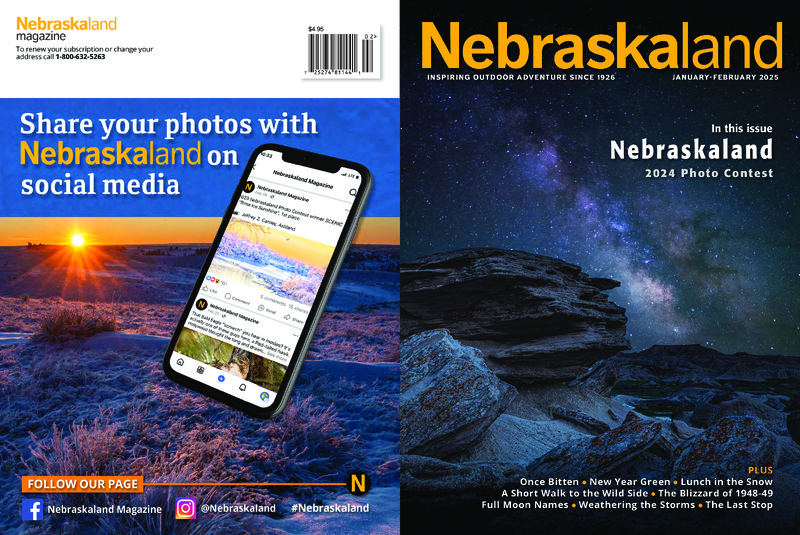
- Title:
- Volume 103, Issue 1, 2025
- Issue Name:
- January-February 2025
- Date Issued:
- 2025-01-01
- year:
- 2025
- Season:
- Winter
- Publisher:
- Nebraska Game and Parks Commission
- Format:
- Periodical
- volume:
- 103
- issue:
- 01
- number:
- 103.01
- Decade:
- 2020s
- Type:
- Rights Holder:
- Copyright Nebraskaland Magazine/Nebraska Game and Parks Commission, all rights reserved.
- Extracted Text:
-
magazine
$4.95
To renew your subscription or change your
address call 1-800-632-5263
I N S P I R I N G O U T D O O R A DV E N T U R E S I N C E 1 92 6
JA N UA RY- F E B RUA RY 20 25
In this issue
Nebraskaland
2 0 2 4 Pho t o Con t e s t
PLUS
Once Bitten O New Year Green O Lunch in the Snow
A Short Walk to the Wild Side O The Blizzard of 1948-49
Full Moon Names O Weathering the Storms O The Last Stop
2025
Make it an
Outdoor Year
Make 2025 the year you step outside and
embrace adventure.
Blaze new trails, discover new landscapes,
try new things. Sleep in a hammock
instead of a tent; try your hand at fly
fishing; hunt turkeys in the fall as well as
the spring. Bring your family, reconnect
with friends or just go solo.
You have 365 days to enjoy adventure.
And there’s no better place to do it than
outdoors, beneath Nebraska skies.
With over 70 state parks, hundreds of
miles of rivers and reservoirs, and a million
acres of publicly accessible land, there’s a
new experience around every corner.
2
Get your 2025 Permits today at OutdoorNebraska.gov
Nebraskaland • January-February 2025
Give a Nebraskaland gift subscription at NebraskalandMagazine.com
January-February 2025 • Nebraskaland 3
Volume 103 No. 1
January-February 2025
FEATURES
16
2024 PHOTO CONTEST
34
OUTDOOR NEBRASKA
Photos submitted by Nebraskaland Magazine readers
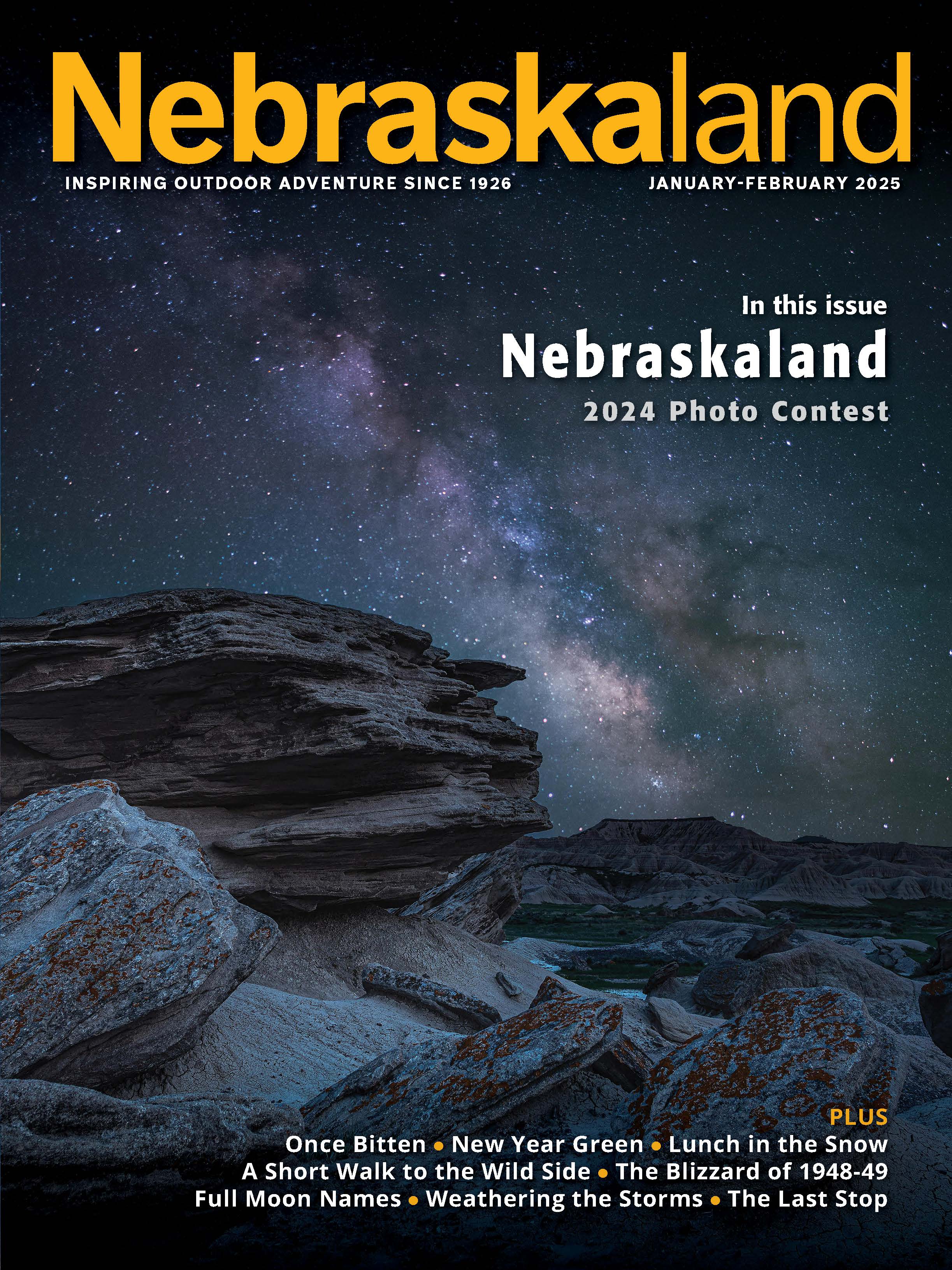
Cover: Mark Karrer, of Sioux City,
C
IIowa, won Best of Show in the
22024 Nebraskaland Photo Contest
ffor his image entitled “Nebraska
M
Moonscape.” See page 16.
T page: A snowstorm, labeled a
This
“
“bomb
cyclone,” makes it difficult for
w
white-tailed
deer to move across the
l
landscape
in the Pine Ridge of Dawes
C
JUSTIN HAAG, NEBRASKALAND
County.
What to Do in January and February
By Renae Blum
36
LUNCH IN THE SNOW
A Cure for Cabin Fever
Story and photos by Jenny Nguyen-Wheatley
40
A SHORT WALK TO THE WILD SIDE
46
SNOWBOUND
Photos and story by Justin Haag
The Blizzards of 1948-49
By Patricia G. Gastor, Nebraska State Historical Society
48
BIGGER BASS
Better Waters Ahead
By Eric Fowler
DEPARTMENTS
8
52
64
66
In the Field
Mixed Bag
Portraits from the Past
The Last Stop
ON THE WEB
For more articles and
information, visit
NebraskalandMagazine.com
4
Nebraskaland • January-February 2025
Nebraskaland (VOL. 103 / NO. 1 ISSN 0028-1964) is published monthly, except for the combined Jan./Feb. and Aug./Sept. issues, by the Nebraska Game and Parks Commission, 2200 N. 33rd
St., Lincoln, NE. Periodicals postage paid at Lincoln, Nebraska, and additional mailing offices. POSTMASTER: Send all UAA to CFS. (See DMM 507.1.5.2); NON-POSTAL AND MILITARY
FACILITIES: send address corrections to Nebraskaland, P.O. Box 30370, Lincoln, NE 68503-0370.
January-February 2025 •
Nebraskaland
5
Magazine Staff
magazine
Communications Director Christy Firestone
Public Relations Manager Shawna Richter-Ryerson
Published by the Nebraska Game and Parks
Commission since 1926. The Commission is
dedicated to the conservation and protection
of all the state's natural resources and the
people who use them.
Editor Jeff Kurrus
Associate Editor Jenny Nguyen-Wheatley
Regional Editors Eric Fowler, Julie Geiser,
Justin Haag
Contributing Editor Michael Forsberg
Regular Contributors Renae Blum,
Chris Helzer, Chris Masada, Todd Mills,
Ryan Sparks, Gerry Steinauer
Red foxes will breed through March.
Art Director Tim Reigert
Graphic Designer Mel Severin
Videographer Nick Sauvageau
Photo Librarian Jaclyn Cruikshank Vogt
Administration
Director Tim McCoy
Deputy Director Jim Swenson
Assistant Director Roger Kuhn
Commissioners
Chairman - Doug Zingula, Sidney
Vice Chairman - John Hoggatt, Kearney
2nd Vice Chairman - Donna Kush, Omaha
Pat Berggren, Broken Bow
Rick Brandt, Roca
Scott Cassels, Omaha
Ken Curry, Columbus
Dan Hughes, Venango
Kent McNeill, Papillion
Magazine Subscriptions
For address changes, magazine and subscription
questions, 800-632-5263 or visit
nebraskalandmagazine.com
Advertising
For advertising information, contact:
Shane G. Gilster, 402-742-0125
shanegilster@solotreemedia.com
Nebraskaland Magazine Copyright 2025, all rights reserved.
Nebraskaland is available in audio from the Nebraska Library Commission
Talking Book and Braille Service, Suite 120, 1200 N St., Lincoln, NE 68508.
800-742-7691. Nebraskaland Magazine and the Nebraska Game and Parks
Commission reserve the right to reject any advertising not in keeping with
the agency mission.
Rates: $18 for one year; $33 for two years; $44 for three years. Nebraska
recipients must add appropriate sales tax. To subscribe call
1-800-NEBLAND (632-5263), or go online to:
NebraskalandMagazine.com.
Commission Offices
Conservation Officers
Headquarters/Southeast District Office
2200 N. 33rd Street Lincoln, NE 68503
Phone 402-471-0641
ADMINISTRATION
Jeff Clauson
402-471-5531
Lincoln HQ
Administrator
Travis Shepler
402-471-5531
Lincoln HQ
Asst. Administrator
Stacey Lewton
402-471-5532
Lincoln HQ
Asst. Administrator
Mike Thome
402-471-0480
Lincoln HQ
Asst. Administrator
Northeast District Office
2201 N. 13th St. Norfolk, NE 68701
Phone 402-370-3374
Southwest District Office
301 E. State Farm Rd. North Platte, NE 69101
Phone 308-535-8025
(Includes counties covered)
Northwest District Office
East Hwy. 2, Box 725 Alliance, NE 69301
Phone 308-763-2940
NORTHWEST
Dan Kling
308-430-0572
Captain
Bassett Office
524 Panzer St., Box 508 Bassett, NE 68714
Phone 402-684-2921
Jerod Hahn
Kearney Office
1617 First Ave. Kearney, NE 68847
Phone 308-865-5310
Ak-Sar-Ben Aquarium/Schramm Education
Center
21502 W. Highway 31 Gretna, NE 68028
Phone 402-332-3901
Omaha Office
8495 Frederick Street, Omaha, NE 68124
Phone 402-595-2144
OutdoorNebraska.gov
The Nebraska Game and Parks Commission does not discriminate
based on race, color, ethnicity, national origin, sex, pregnancy, sexual
orientation, gender identity, religion, disability, age, genetic information,
veteran status, marital status, and/or political affiliation in its programs,
activities, or employment. Any person who believes he or she has been
discriminated against in any program, activity, facility, or service,
should contact the Nebraska Game and Parks Commission, Lincoln, NE
402-471-0641, the Nebraska Equal Opportunity Commission, Lincoln,
NE 402-471-2024, TTY/TDD 800-642-6112; Director, Office of Diversity,
Inclusion and Civil Rights, U.S. Department of Interior, 1849 C Street,
NW, Washington, D.C. 20240.
6
ERIC FOWLER, NEBRASKALAND
EAST SUB-DISTRICT
308-520-5539
Sergeant
308-280-4320
Hunter Lee
Keith, Arthur, Deuel
Jaden Porter
308-289-2274
Keith, Garden, Grant
Tyler Stueck
308-289-6260
Keith, Arthur, Grant
Keith Jadlowski 531-310-2869
Keith
WEST SUB-DISTRICT
Sean McKeehan 308-672-1824
Sergeant
KayLynn Miller
308-665-8440
Dawes, Sioux
Cassidy Harwood 308-562-9099
Box Butte, Morrill
Josh Widhelm
308-279-9133
Scotts Bluff, Banner, Sioux
Brandon Wallace 308-280-4488
Scotts Bluff, Banner, Sioux
Travis Schultz
308-279-1292
Morrill, Scotts Bluff
Casey Gehrt
402-617-2112
Dawes, Sheridan
NORTHEAST
Dale Davis
402-760-0712
Captain
WEST SUB-DISTRICT
Jeff Jones
Vacant – Holt, Boyd
Nebraskaland • January-February 2025
402-762-5022
Sergeant
Greg Hesse
308-546-7464
Rock, Brown, Keya Paha
Jonathan Andreasen
402-340-3981
Madison, Pierce, Stanton
Trevor Stahlecker
402-928-9099
Knox, Antelope, Pierce
Mitch Johnson
402-613-8612
Cedar, Knox
EAST SUB-DISTRICT
Cory Krause
402-380-6410
Sergeant
Kyler Prochaska 402-830-8278
Platte, Colfax
Matt Costello
402-317-4014
Dodge, Colfax
Kelbi Abke
402-237-2537
Washington, Burt
Nicholas Fix
402-508-0261
Dixon, Dakota, Thurston
Kyle Hansen
531-739-7392
Dodge
CENTRAL SUB-DISTRICT
Doug Pollard
308-730-7050
Sergeant
Daryl Teter
308-440-1863
Howard, Greeley, Merrick
Matt Brandt
308-202-0819
Sherman, Howard
Klint Gill
402-613-5800
Nance, Wheeler, Boone, Polk
Garrett Zimmer 402-416-5736
Garfield, Loup Valley
Tim Williams
308-380-7331
Hall, Hamilton
SOUTHWEST
Brian Piernicky 308-330-8780
Captain
NORTH SUB-DISTRICT
Alex Hasenauer
308-660-4671
Sergeant
308-395-6001
Jacob Stoinski
Lincoln, Perkins
Frank Miller
402-389-0444
Cherry, Hooker
Luis Nuñez
531-333-6093
Blaine, Custer, Thomas
Brandon O’Neal 308-530-3157
Lincoln, McPherson, Logan
SOUTH SUB-DISTRICT
Kelsey Glodowski 308-242-9000
Sergeant
Bryce Streger
308-537-0404
Dawson, Gosper, Custer
Tyler Adelman
402-314-4783
Dawson, Gosper, Furnas
Sophia Gobber
308-222-0368
Chase, Dundy, Hayes, Hitchcock
Vacant – Red Willow
SOUTHEAST
Matt Seitz
402-806-0915
Captain
WEST SUB-DISTRICT
Matt Taylor
402-200-9597
Sergeant
402-902-2017
Eric Javins
Adams, Clay, Webster
Justin Gress
308-629-9335
Thayer, Nuckolls, Fillmore
Pat George
308-920-2762
Harlan, Franklin, Phelps
Ethan Teter
308-440-3847
Buffalo, Kearney
EAST SUB-DISTRICT
Heath Packett
402-210-0888
Sergeant
402-209-1506
Russell Mort
Otoe, Johnson
Rich Berggren
402-619-1355
Douglas
Brian Arp
531-530-9011
Douglas, Sarpy
Mike Luben
402-443-6392
Saunders
Bryan Adams
402-429-1924
Nemaha, Pawnee, Richardson
CENTRAL SUB-DISTRICT
Curt Prohaska
402-470-1298
Sergeant
402-890-6463
Dina Barta
Lancaster
Mark McDonald 402-805-2353
Lancaster
Mark Sullivan
402-741-0636
Lancaster, Seward, Butler
Jarrod Messman 531-739-9760
Lancaster, Saline, York
IN THE FIELD
MOVE, TURKEYS
Tom wild turkeys walk
across a white landscape
following a spring snow
in Sioux County.
JUSTIN HAAG
HAAG, NEBRASKALAND
NEB
E RASKALAND
8
Nebraskaland • January-February 2025
January-February 2025 •
Nebraskaland
9
IN THE FIELD
A drake mallard, or greenhead, in Clay County.
JEFF KURRUS, NEBRASKALAND
NEW YEAR GREEN
By Todd Mills
When most sane duck hunters have given it up for the
season, I’m trying to figure out a way to get one more
chance at late-season mallards. It can be feast or famine, but
for me, fooling just one group is worth the effort.
Trying to find and harvest mallards in late January brings
an extra set of challenges. By this point, they’ve seen it all.
Decoys, calling and motion decoys aren’t nearly as effective,
and unless you get harsh weather, field hunting can be
tough as nocturnal feeding has become the norm.
If you can find water and you’ve got time to scout, you
can find greenheads. Here are a few tips once you’ve found
loafing birds.
drake “hum,” or soft hen quacks, especially early in the day,
can be highly effective as they search for a mate.
Pair Them Up
Quick warm ups can cause bodies of water to open
back up, especially if you’re hunting big water or river
systems. Look for points and coves that are exposed
to wind. Even a small open hole can provide some
great gunning.
One word of caution here: If you’re using a dog, make
certain they have enough room to retrieve without walking
on thin ice. Having your dog walk on thin ice with current or
deep water underneath is a recipe for disaster.
By early January, most mallards are looking to find a
partner. With ducks often traveling in pairs, the most
seasoned duck hunter has no chance at fooling them.
Decoy set-ups need to be different and adjusted frequently.
Setting paired mallards outside the spread can be effective,
especially when you’re around a large number of ducks.
Keep your calling to a minimum, and unlike earlier in the
year when you work on hens, focus on single drakes. The
10
Nebraskaland • January-February 2025
Winds of Change
In early November, a brisk northwest wind gets every
duck hunter fired up. Mid- to late-January is completely
different. Already at their wintering grounds, ducks are
anxious to get back to their breeding territory. A couple of
days with warm temps followed by a south wind can get
birds moving north. These birds can be hungry and anxious
to find a place to loaf and drink.
Find Water and Find Birds
IN THE FIELD
This hand-warming pouch, or muff, has become a lifesaver on Nebraska’s frigid days.
JUSTIN HAAG, NEBRASKALAND
ONCE BITTEN
By Justin Haag
The heater felt so good that January day. As the
warm air filled the cab of the truck, the numbness
left my body. Well, almost.
As I was warming up after a morning of
photographing a Pine Ridge wild turkey capture
in sub-zero temperatures, sensitivity was not
returning to my right thumb. In hindsight, it
shouldn’t have been unexpected since the thumb
had been outside my fleece glommits all morning,
pressing the bone-chilling cold focusing button on
the camera.
As I watched my thumb turn black from frostbite
in the coming days, it was obvious that I needed to
find a better system for keeping my hands warm. It
seems my digits have always been quick to get cold,
but it happens even quicker as I get older.
I’m glad to report success. A hand-warming
pouch, or muff, that hangs by a sling from my neck
and a rechargeable hand warmer have been gamechangers. Now, whenever my fingers start getting
12
Nebraskaland • January-February 2025
cold, my hands retreat to a toasty microclimate.
In just a few moments, they are ready to return to
the camera, ice-fishing rod or other important tool
without the numbness experienced so many times
before.
I still usually wear lightweight running gloves,
which allow enough dexterity to press buttons
and even work with touch-screen electronics. They
provide just enough warmth for most winter days
when my hands are outside the muff and are thin
enough to layer up with heavier gloves, such as
my trusty-but-not-so-trusty old glommits, when
temps go from cold to bone-chilling — such as that
January day with the turkeys.
Anyone who has had frostbite probably knows
the affected area is more sensitive to cold than
before, and my thumb is no exception. With the
muff-glove-warmer approach, I am more prepared
for whatever Old Man Winter and Jack Frost deal
me, though. Just wish I’d figured it out sooner.
IN THE FIELD
A casserole of pheasant, potato, leeks, cheese and cream.
JENNY NGUYEN-WHEATLEY, NEBRASKALAND
CREAMY PHEASANT AND POTATO BAKE
By Jenny Nguyen-Wheatley
Seared or poached pheasant breasts
will be easiest, but if you plan on
using pheasant thighs and/or legs,
first cook them in a slow cooker with
some broth until they’re pull-off-bone
tender before adding the meat into
the casserole. This is a to-your-taste
kind of dish. You can add as much or
as little pheasant as you like.
Although you don’t technically
need a mandolin to slice the potatoes,
having one does mean the difference
between an “easy” recipe and a labor
intensive one.
Servings: 6-8
Prep Time: 20 minutes
Cooking Time: 2 hours
Ingredients:
1 cup cooked pheasant meat,
diced
2 tbsp. butter, separated
3 leeks
2 pounds Yukon Gold potatoes,
plus extra
1 tsp. kosher salt, plus extra
Freshly cracked pepper, to taste
1
⁄2 cup grated mild cheddar cheese
•
•
•
•
14
•
•
•
• 1 cup grated Gruyere cheese, plus
•
•
•
•
•
extra
2 cloves garlic, minced
1 sprig of thyme
1 bay leaf
11⁄4 cup of heavy creamy
1
⁄4 tsp. ground nutmeg
1. Trim leeks by cutting off the green
tops and root ends. Slice the white/
light green parts in half lengthwise
and rinse between the layers to
remove dirt and sand. Then, thinly
slice the leeks. In a pan with a lid,
melt 1 tablespoon of butter. Add sliced
leeks and a pinch of salt. Cook on
low, covered, for 10 minutes, stirring
occasionally. When leeks become
soft, turn off heat and set aside.
2. Peel potatoes and cut into 1⁄8-inch
slices with a mandolin (or knife). In
a large bowl, toss potato slices with
1 teaspoon of kosher salt and freshly
cracked pepper. Grease a 2-quart
gratin or casserole dish.
3. Layer about a third of the sliced
potato in the bottom of the dish,
overlapping them. Then distribute
Nebraskaland • January-February 2025
a third of the cooked leek, half of
the pheasant meat, half of the grated
cheddar and a third of the grated
gruyere. Then repeat with another
third of the potato slices, third of
the leek, third of the gruyere and
remaining pheasant and cheddar.
Finally, top off the casserole with
remaining potato, leek and gruyere
cheese. Grate more gruyere and
prepare more potato if needed. Place
casserole onto a rimmed cookie sheet
and set aside.
4. Preheat oven to 350° Fahrenheit.
In the pan where you cooked the
leeks, melt a pat of butter with minced
garlic, thyme and bay leaf, and stir for
30 seconds over medium-low. Then
add heavy cream and ground nutmeg,
and simmer for 5 minutes, stirring
often. Pour the cream mixture over
the potato layers. Cover the casserole
with foil and bake for 1 hour and
15 minutes, or until potato becomes
tender. Then remove foil and bake
longer until golden on top, about 20
minutes. Allow casserole to cool about
10 minutes before serving.
2024
P ho t o
C o nt e s t
While this year’s entry format changed, the quality of images in
the Nebraskaland Photo Contest did not. With the categories of
Scenic, Wildlife, Recreation and Macro, it took hours to teem down
the winning images. But it was not without some debating, especially
in the Macro and Wildlife categories where several worthy images
didn’t place.
This year’s Best of Show winner, “Nebraska Moonscape,” by Mark
Karrer of Sioux City, Iowa, was taken at Toadstool Geologic Park in
Sioux County.
“I went there because it is considered to be a dark sky area with
little light pollution, and I had always wanted to photograph the
Milky Way. This was my first attempt.”
And a good attempt it was.
We thank everyone who participated in this year’s contest and look
forward to seeing our wonderful state through your eyes next year.
Happy shooting.
Jeff Kurrus, Editor
Nebraskaland Magazine
BEST OF SHOW
Nebraska Moonscape
Mark Karrer, Sioux City, Iowa
16
Nebraskaland • January-February 2025
January-February 2025 •
Nebraskaland
17
SCENIC
FIRST PLACE — Autumn’s Glow
Erik Johnson, Lincoln
18
Nebraskaland • January-February 2025
January-February 2025 •
Nebraskaland
19
SCENIC
SECOND PLACE — Grassland Sunset
Isabella Neuhaus, Omaha
THIRD PLACE — Sunset Beach
Derrill Grabenstein, Lincoln
20
Nebraskaland • January-February 2025
January-February 2025 •
Nebraskaland
21
MACRO
FIRST PLACE — Sweat Bee Busy
Kristin R. Hartner, Omaha
22
Nebraskaland • January-February 2025
January-February 2025 •
Nebraskaland
23
MACRO
SECOND PLACE — Golden Glow
Tyler Moore, Omaha
THIRD PLACE — Nature’s Symmetry
Kimberly Carroll Steward, Lincoln
24
Nebraskaland • January-February 2025
January-February 2025 •
Nebraskaland
25
RECREATION
FIRST PLACE — The Bridge to Autumn
Tiara Brown, Omaha
26
Nebraskaland • January-February 2025
January-February 2025 •
Nebraskaland
27
RECREATION
SECOND PLACE — The Sky’s the Limit
Chelsae Beyer, Bridgeport
THIRD PLACE — Eagle vs. Decoy
Jeff Mullinix, Columbus
28
Nebraskaland • January-February 2025
January-February 2025 •
Nebraskaland
29
WILDLIFE
FIRST PLACE —
Sentinel Sunset
Mark Coe, Elkhorn
30
Nebraskaland • January-February 2025
January-February 2025 •
Nebraskaland
31
WILDLIFE
THIRD PLACE — The Chosen One
Kacie Clark, Bayard
SECOND PLACE — The Battle
Rick Rasmussen, Doniphan
32
Nebraskaland • January-February 2025
January-February 2025 •
Nebraskaland
33
Outdoor Nebraska
By Renae Blum
You don’t have to wait for warmer weather to have fun outdoors.
Put on a few extra layers and enjoy activities like ice-fishing,
snowshoeing and park events. N
What to Do in January and February
Celebrate Valentine’s
Day at Niobrara State
Park
Feb. 7-8 and 14-15 | About 2.5 miles west
of Niobrara
Niobrara State Park is where you go to escape. It’s
a scenic haven from all the noise and bustle. Take
advantage of the park’s Valentine’s Day special
to unlock a 30 percent discount on a minimum
two-night stay at one of the park’s eight cozy
modern cabins, Feb. 7-8 and 14-15. This getaway
includes early check-in, late check-out and a
complimentary package from local businesses.
Reservations are limited; call to book your stay at
402-857-3373. JENNY NGUYEN-WHEATLEY, NEBRASKALAND
Attend Cold Days, Warm
Hearts event
Go snowshoeing at
Fort Robinson State Park
Jan. 11, 1-3 p.m. | Eugene T. Mahoney State Park
As weather allows | 3.8 miles southwest of Crawford
Get outdoors for a fun, family-friendly winter activity — and
maybe try ice-fishing for the first time. Meet at Owen Marina
to enjoy winter crafts, nature programs with park naturalists
and potentially ice-fishing and s’mores if the weather allows.
Both ice-fishing gear and instruction will be provided.
Food specials, including hot dogs, chips, hot chocolate and
popcorn, will be available for a small fee. JEFF KURRUS, NEBRASKALAND
Don’t let snow stop you from enjoying a walk outdoors — go snowshoeing!
Fort Robinson State Park, with its natural beauty and numerous miles of
hiking trails, is an excellent location for this. Try the 3-mile White River Trail
for an easier route. Those looking for a challenge can venture into the Red
Cloud and Cheyenne Butte trails. The park has no lodging this time of year,
but you can find Airbnbs nearby, and Crawford has a small motel. Watch the
weather and call the park ahead of your visit. GETTY IMAGES
Crow hunting
Introduce a kid to ice-fishing
Season is Jan. 11 – March 13 | Statewide
As safe ice allows | Statewide
Sharpen your shooting skills with crow season,
which is particularly good in February or late winter.
Crow hunting is great for youth and allows you to get
more hunting in if you’re having a slow day hunting
waterfowl. Use a “crow fight” sound on your electronic
call, and place it 100 to 200 feet away from you. Point
the speaker on the caller straight up in the air; the birds
will circle that area. JUSTIN HAAG, NEBRASKALAND
Ice-fishing is a fantastic opportunity for kids to get out of
the house and have fun on the ice. Do some planning to
make it a great experience: Choose a day with pleasant
weather and bring snacks. Dress appropriately, with warm
clothes, boots and extra gloves. An ice shelter brings added
comfort if you have it. If the fish aren’t biting, kids can still
have fun throwing snowballs, ice skating, playing tag or
tossing a ball around. JUSTIN HAAG, NEBRASKALAND
34
Nebraskaland • January-February 2025
January-February 2025 •
Nebraskaland
35
LUNCH IN THE SNOW
A Cure for Cabin Fever
E
Venison heart stew
heating over an open
bed of coals on a
winter’s day. Pre-made
biscuits warm up easily
near the fire.
Story and photos by Jenny Nguyen-Wheatley
relief after what seemed like the longest, most stifling bout
very January or February, I come down with the
of cabin fever in my nearly 12 years of living in Nebraska.
dreaded, mind-numbing angst of cabin fever. I don’t
And lunch? Hot food simply tastes better when the
have motor oil in my veins, as I’ve heard said about
weather is cold. Here are tips for enjoying a meal in the snow.
tough Nebraskans, so when extremely cold temperatures
strike and the roads are bad, I might stay inside for days,
fighting the urge to rip out my hair. So, on those rare nice
days — and by “nice,” I mean the wind isn’t howling and the
To build a campfire, you need to build heat gradually, and
temperature is above 30 degrees — I make the effort to get
the three main components are tinder, kindling and wood.
outside.
In the winter, don’t count on being able to find dried sticks
Last winter was
and leaves, especially
especially
brutal.
after a recent snow.
After
back-to-back
Instead, avoid the
snowstorms and frigid
frustration of having
conditions in January,
to ignite a wet fire
the weather finally
starter by bringing
broke. Missing the
your own tinder and
ability to cook outside,
kindling.
my husband, Rick,
Old
newspaper,
and I bundled up and
paper grocery bags,
spent an afternoon
dryer lint and cotton
at Two Rivers State
balls
make
good
Recreation Area to
tinder because they
enjoy lunch in the
ignite quickly. For
snow.
kindling, buy fatwood
Using a deer sled,
fire starter, which are
we dragged wood
sticks of pitch pine
and cooking gear
that are impregnated
from the truck, dug
with resin and are
out a fire ring and
highly
flammable.
as the venison stew
Use only local wood
heated, Rick and I
to prevent the spread
stood back to enjoy
of pests and make sure
The three main components of building a campfire are tinder, kindling and
the warmth of the fire
the wood is dry. Lastly,
wood.
Use
local
wood
only
to
prevent
the
spread
of
pests.
while soaking up the
bring a shovel in case
special kind of silence
you need to dig out
only heard in winter. Although I have visited Two Rivers on
snow inside the fire ring.
numerous occasions, January offered a stark contrast to the
First, assemble the tinder and kindling: Lay down several
activity and noise of the high season. Not a soul was in sight.
pieces of fatwood side by side, with an inch or two of space in
No tent or camper obstructed my view. It was one of those
between them. Then lay the same number of fatwood sticks
rare windless days. Despite my general feelings about winter,
on top perpendicular, with space in between — the spacing
that particular afternoon was by no means unpleasant. While
is important for airflow. Next, place pieces of tinder on top of
sipping from my hot mug of Irish breakfast, I felt a wave of
the fatwood. Then lay pieces of fatwood around the tinder
36
Nebraskaland
Building a Campfire
• January-February 2025
January-February 2025 •
Nebraskaland
37
getting wet if I have to kneel in the snow while tending to
the food and fire.
What to Cook
Winter outdoor cooking is not the time and place for fancy
culinary tricks. Pick food that is hot, filling and easy to cook
or warm up — don’t keep people waiting. Your companions
will be more willing to stay out longer if their bellies are full
and warm.
Stew, soup or chili are good choices because you can
prepare them at home, and they’re one-pot meals. Pack it up
Serve food that you can prep at home and easily reheat on
the campfire, such as stew, soup or chili.
Rick Wheatley of Omaha builds a campfire with fatwood fire starter, dryer lint and local wood. He brought a shovel to dig out a
fire ring full of snow. A deer sled makes easy work of dragging gear over the snow.
like a teepee.
Use matches or a lighter to ignite the tinder, which should
catch quickly. When the tinder gets hot enough, it will ignite
the fatwood. Add more tinder as needed to increase heat.
Once the fatwood is burning well, you can then add firewood
on top, but only a couple pieces at first. If needed, add more
In addition to the items previously mentioned, and
whatever dinnerware and utensils you need, don’t forget the
following:
• Over-the-fire grill grate, if applicable
• Dutch oven or cast-iron pan
• Lid lifter
• Mixing/serving spoons, ladle or tongs
• Heat resistant gloves
• Tea kettle
• Percolator or French press
• Paper towels
• Trash bag
38
Nebraskaland
• January-February 2025
Pack out leftover food and trash. If you need to clean out a
pot or mug, use the snow. While you’ll still have to give your
cooking gear a proper once-over at home, snow is slightly
abrasive and will help remove most food particles. To prevent
rust, clean and dry cast iron thoroughly, and lightly coat it
with oil when you get home. With outdoor cooking, the more
you keep things simple, the easier cleanup will be.
fatwood to keep the heat going until the firewood starts
taking. Then add more wood as needed.
Allow the wood to burn, while enjoying the warmth,
conversation and coffee. When the flames die down and the
wood starts to look more like embers of coal, that’s when your
campfire is ready for cooking.
Equipment
Wheatley adds more fatwood to the fire to help it along.
Clean-Up
Also, don’t let poor clothing decisions dampen your meal
outdoors. As with any outdoor winter activity, wear clothing
and shoes that are warm and will keep you dry. Although
Rick, being old school, will opt for jeans every time, I prefer
wearing waterproof or water-resistant pants to keep from
Choose cast iron for campfire cooking. It will stand up to the
rigors of the outdoors and the test of time.
in leak-proof containers and simply reheat it in a Dutch oven
when you get to your destination. If you’ve got leftover stew
or soup sitting in the freezer, this is the time to use it. Stir
often if your stew or chili is on the thicker side to prevent the
bottom from scorching.
Prebake biscuits and breads at home. Wrap them in foil to
prevent blackening from the campfire soot while reheating.
A hot beverage is a must. If you’re not a coffee snob and
can do without a French press, bring a large thermos of
ready-made coffee. Spiced cider or hot mulled wine might be
appreciated, too, where alcohol is allowed. Bring a kettle for
boiling water if offering tea bags or instant hot chocolate or
coffee. Have everyone bring their own insulated mugs to keep
down the trash, as park services might not be fully available
this time of year.
After lunch, provide marshmallows for making s’mores.
Add more wood to the hot embers to get the fire going again.
This winter, keep an eye on the forecast. If there’s a nice
day on the horizon or if you have the ability to pick up and go
at the last minute, get out and share a meal with family and
friends in the wintery landscape. It just might be the cabin
fever cure you’ve been searching for. N
Use snow to roughly clean cookware. When you get home,
thoroughly clean, dry and oil cast iron to prevent rust.
January-February 2025 •
Nebraskaland
39
A Short Walk
to the Wild Side
Photos and story by Justin Haag
A
s a regional editor in the
Panhandle, my job takes
me to some of the most
magnificent public lands in the
state. Nebraskaland readers know
the Pine Ridge, Sandhills and
Wildcat Hills have no shortage
of natural wonders that serve a
nature photographer well.
Perhaps the destination I
am most thankful for does not
show up on most maps, and isn’t
even outside the city limits of
my home, Chadron. As a matter
of convenience, the Thompson
Natural History Preserve and
adjacent land owned by Chadron
State College is my go-to when I
need a quick fix of the outdoors.
At less than 200 steps from
my house, I almost daily enter
a system of trails that course
around two ponds and hills
overlooking the town from a
vantage of more than 200 feet
above. With a diverse mix of wide,
multi-use trails of concrete or
buffalo grass, and undeveloped
single-track, the property serves
well for running, biking and
hiking. Our dog seems to love it
even more than I do.
In total, the trails cover about
200 acres of open property owned
by Chadron State College and the
Chadron State Foundation. Some
points of interest include Briggs
Pond, the landmark C Hill and a
makeshift labyrinth of stones in
the deep footprint of the city’s
old cistern. After a 2006 wildfire
scorched the ponderosa pines on
the hills, much of the property
evolved from forest to grassland.
Wildlife is still plenty attracted
to it.
Lightning strikes during
a thunderstorm at the
Thompson Natural History
Preserve at Chadron State
College in Dawes County.
40
Nebraskaland • January-February 2025
January-February 2025 •
Nebraskaland
41
It’s a pleasure to encounter the many wild creatures that
inhabit this property at various times of the year. It may be
mule deer and red foxes along the drainages, sharp-tailed
grouse on the hillsides, Canada geese and songbirds around
the ponds or tree swallows in nest boxes. From the first
pasque flower in March to the sunflowers blooming when
Jack Frost arrives, the plant community puts on its own
show. The state champion peachleaf willow tree is on the
property.
When the college was founded in 1911, a large footprint
was allotted to the school. The 50 acres with Briggs Pond,
a dam built in 1938 as part of a livestock and farming
operation, wasn’t included. When the Chadron State
Foundation signed an option to buy those acres in 1974,
Harold and LaVerne Thompson of Culver City, California,
donated the $40,000 to buy it.
The property not only serves as a recreational resource,
but also is an asset for the college’s science programs,
including range and wildlife management.
LEFT: A Virginia opossum captured with
a camera trap at Chadron State College’s
Thompson Natural History Preserve.
TOP RIGHT: Briggs Pond and a system of
trails attract visitors to the Thompson
Natural History Preserve.
BOTTOM RIGHT: Fog and frost decorate
the scene at Briggs Pond.
42
Nebraskaland • January-February 2025
January-February 2025 •
Nebraskaland
43
As studies show people are becoming
less connected to nature, such “urban”
slices of the wild are important, and
every community should make the
most of what they have. Whenever
I see Chadron kids have parked their
bikes and gathered at the pond’s muddy
banks to pursue bullfrogs and sunfish, I
know the Thompsons would be happy
with their investment. I’m even a little
envious of those kids.
When I was growing up in the village
of Danbury in the southwestern corner
of the state, there was no pond or trail
system to explore so conveniently.
Regardless, my best friend and I made
the most of whatever nature we could
find. In our minds, the strips of trees
along properties owned by the school
and village might as well have been
100,000-acre forests, and were enough
to rouse our sense of adventure.
That sense is rekindled every
time I enter the Thompson Natural
History Preserve. Wildest place in the
Panhandle? Surely not. But it is wild
enough. N
44
Nebraskaland • January-February 2025
ABOVE: Fibers shed from the sword-shaped leaves of a soapweed
plant at the Thompson Natural History Preserve.
BELOW: An orange-crowned warbler moves along the branches of a
buckthorn shrub.
OPPOSITE: Walkers visit the concrete trails south of the Chadron
State College campus.
January-February 2025 •
Nebraskaland
45
Snowbound
The Blizzards of 1948-49
Mrs. Ben J. Fuelberth on the road
south of Osmond. NSHS RG3139-0-67
By Patricia G. Gaster,
Nebraska State Historical Society
he winter of 1948-49 brought Nebraskans the most
prolonged battle with the elements in the state’s
history. The first snowstorm hit Nov. 19, 1948, and the
second on Dec. 29, to be followed by another on Jan. 2-5,
1949. State and local highway crews found that no sooner
had they opened a stretch of road that it was closed again by
drifting or by fresh snow. Trains were stalled, and for days in
many areas the only effective transportation was by air.
The Nebraska National Guard was called out, and
volunteers worked to rescue trapped livestock, homes
and even whole communities. But the job was too big for
Nebraska and other western states alone. On Jan. 28, 1949,
Maj. Gen. Lewis A. Pick was named to direct one of the U.S.
T
Digging a cow out of a drift in a canyon bottom on Eldon
Miller’s property near Belmont. NSHS RG33139-0-80
46
Nebraskaland
• January-February 2025
Train buried in the snow near Ashby after the Blizzard of
1949. NSHS RG6165-21-3
Army’s most extensive rescue operations in peacetime.
They called it Operation Snowbound. The Fifth Army moved
in with bulldozers and M29 Weasels (a tracked vehicle used in
World War II). During 23 days of operation, the Army put up
impressive numbers: opening 87,073 miles of road, liberating
152,196 persons from snowbound homes, transporting 35
sick persons to receive medical care or hospitalization, and
delivering feed for more than 3,500,000 head of livestock.
Everyone who lived through the “Blizzard of ’49” had a
story to tell. Irene Woodburn of Wausa, for example, recalled
how rain began to fall on Nov. 18:
“During the night it turned into heavy wet snow with
high wind. This continued until the early morning of the
20th, leaving 30 inches of snow. I was a night operator at
the telephone office. … I was able to get to work every night,
but many times thought I wouldn’t make it. Only main street
lights were on to conserve power. Cleanup operations hardly
started when wind drifted it all shut again.
“This and more snow was to be the pattern until well into
April. At last there was no place to shovel the snow, so no one
did, and we walked over banks. Several thick layers of ice in
the snow banks made clearing of snow impossible in places,
as snow plows couldn’t move it, so dynamite was used in
some places. One snowplow operator from Iowa said, ‘I didn’t
know Nebraska had concrete in their snowbanks.’
“Farmers used many different kinds of rigs to take groceries
and other needed items home. All roads were blocked and
many remained that way until spring. A
local man who had been a pilot in WWII,
flew a ski-plane, taking medicine,
groceries, etc., also bring[ing] some sick
people to the doctor and hospital when
needed … .
“The army men came with a machine
called a weasel. It could be driven over
snowbanks to reach homes. Highway
81 was the only hard surfaced road into
Wausa at that time, so it was possible
to get supplies when the road was
open. Other towns weren’t as fortunate.
The handcar on the railroad was used
between Wausa and Bloomfield. ... The
final total of snow was 90 inches. Some
snowbanks were 25 to 35 feet.”
Each winter this incredible storm
returns to the memories of those who
lived through it, and for good reason. N
Visit NSHS’s website at
history.nebraska.gov.
Unidentified individuals stand in front of a snow-covered window in this photo
from a series of Gov. Val Peterson’s visit to Alliance. NSHS RG3139-0-113
A man carries loaves of bread delivered by airplane, somewhere in Nebraska.
January-February 2025 •
NSHS RG3139-0-133
Nebraskaland
47
Bigger Bass
Better Waters Ahead
By Eric Fowler
F
isheries biologists are hoping
anglers fishing four reservoirs
in southeastern Nebraska will
go home and have a fish fry after a
successful day on the water. And they
are hoping largemouth bass will be on
the menu.
Bass? What? You can’t keep bass!
Yes, bass. Few anglers harvest bass,
thanks to decades of promoting catchand-release fishing for the species. Yet
harvesting small bass, which, at times,
have dominated the fish populations
at Duck Creek, Prairie Queen, Prairie
View and Wagon Train lakes, is
what biologists think is needed
to produce more big largemouths
in those waters.
To facilitate the harvest, a new,
experimental protected slot limit goes
into effect this year on those four
waters requiring anglers to release all
bass 15- to 18-inches in length, with
only one fish over 18 inches allowed
in the bag. The lakes previously had
a 21-inch minimum length limit on
largemouth bass, a departure from the
statewide 15-inch minimum.
Aaron Blank, southeast district
fisheries manager, said new or
renovated waters are loaded with
nutrients and can sustain a lot of fish.
“You get really good year-class
strength out of the first stocking, but
the problems really begin as you start
stacking on multiple year classes,” he
said. “This creates an environment
with lots of competition for food and
typically slows growth rates.”
The result is often lots of bass in
the 11- to 14-inch range, with few
fish growing to longer lengths, and
those taking longer to get there than
biologists or anglers would like.
An Experiment at Four Locations
Marty Hughes of Aurora lands a largemouth bass from a kayak at Duck Creek Recreation Area in Nemaha County.
ERIC FOWLER, NEBRASKALAND
Case Studies
These four
“experimental”
waterbodies are
requiring anglers to
release all bass 15- to
18-inches in length,
with only one fish over
18 inches allowed to
keep (previously it
was 21 inches at these
lakes).
For the rest of the
state’s waters, it
remains a 15-inch
minimum.
48
Nebraskaland • January-February 2025
At Prairie Queen, in Papillion, for
example, scales collected from bass
in 2021 to estimate the age of fish
found that, on average, fish didn’t top
15 inches in length until age 6. Blank
hopes the new regulation will help fish
reach that length a year or two sooner.
In 2022, Wagon Train, located near
Hickman, was drained and renovated
to remove gizzard shad, white perch
and common carp that had found their
way into the lake since it was last
renovated in 2001. It was restocked
in 2022 and 2024, and while drought
conditions persist and the lake remains
more than 10 feet below normal, when
trees and other vegetation that have
sprouted from the dry lakebed are
flooded, habitat conditions will be as
good as they can get for fish.
Wagon Train will be the best test
of how the slot limit works on new
or renovated lakes. “We have a really
good idea of how the bass populations
are going to develop over the first
four to five years under a 21-inch
minimum,” Blank said. “If we can
reduce those densities in those early
years, we might be able to produce and
sustain even more large bass in the five
years post-renovation.”
Prairie View, near Bennington,
was completed and stocked in 2000.
Electrofishing surveys in 2022 showed
the lake had a robust bass population,
yet while 60 percent of the fish were 12
to 15 inches in length, just 8 percent
topped 15 inches. Harvest of bass there
will hinge on the success of upcoming
efforts to control curly-leaf pondweed,
a non-native invasive aquatic plant,
that covers the lake by early spring
and basically shuts down the lake to
fishing.
Prairie Queen and Duck Creek, near
Peru, on the other hand, are just about
a decade old.
At Prairie Queen, bass densities
increased substantially for the first
four years. While sampling catch
rates declined after 2017, the bass size
structure remained fairly constant
until 2024, when the number of fish
sampled 15 inches or longer jumped
from 10 percent to 25 percent. One
third of the bass sampled in 2024 were
8 to 12 inches.
Duck Creek also has seen sampling
catch rates decline, but not as much.
January-February 2025 •
Nebraskaland
49
Sampling in 2023 found just 3 percent
of the bass topped 15 inches, with 60
percent measuring 8 to 12 inches and
another 37 percent 12 to 15 inches.
Angler Perspectives
Marty Hughes can attest to that. The
kayak fishing guide and tournament
angler moved to Auburn in 2017 and
started fishing Duck Creek as soon as it
opened the following spring. “We had
incredible days that first and second
year fishing out here,” he said. “It was
really good. There were a lot of 15- to
17-inch bass.”
Hughes has organized adult and
youth kayak fishing leagues for
several years, during which anglers
measure every fish they catch. Those
numbers show the same trend as the
electrofishing survey data. In 2024, 11
percent of fish caught during events
were longer than 15 inches and 60
percent were in the 12- to 13-inch
range.
Hughes and anglers he fishes with
still catch an occasional 18- to 20-inch
fish. But he believes there should be
more and hopes the new regulation
will help produce them. “I think it’s
a good idea because here you have
Largemouth bass (Micropterus salmoides) caught at Flanagan Lake in Douglas
County. JEFF KURRUS, NEBRASKALAND
this incredible fishery with lots of
little bass,” he said. “I fish a lot of
Nebraska lakes, and Duck Creek has
the habitat to grow huge bass, and it’s
not happening.”
Blank thinks the slot limit will
do just that, but noted managing
waters with bass and panfish can be
a balancing act as a lake can only
support so many pounds of either
type of fish; sometimes it’s a choice of
Marty Hughes of Aurora measures a largemouth bass while fishing from a kayak
at Duck Creek Recreation Area in Nemaha County. ERIC FOWLER, NEBRASKALAND
50
Nebraskaland • January-February 2025
Parmesan
Bass
having big bass or big panfish.
Big Bass or Big Panfish?
The hordes of small bass commonly
found in newly renovated lakes are
good at thinning out the annual crop
of bluegills and crappies. This leaves
more food for and leads to faster
growth of the panfish that survive
the gauntlet. Imposing a 21-inch
minimum length limit on these waters
to help maintain higher bass densities
has been the norm, providing anglers
the chance to catch large panfish and
high catch rates of bass, Blank said.
Bass densities decline as lakes age,
but the goal of fisheries managers is to
have 30 percent of the bass 15 inches
or longer. In this scenario, however,
a lake can end up with lots of small
panfish due to the optimum foraging
theory and propensity of big fish to eat
big fish. “A 4-pounder has no problem
eating an 8-inch bluegill,” Blank said.
“They’re not going to eat a lot of age
1 bluegills. It doesn’t make sense for
them if they can get four times the
food and nutrients with four times less
effort.”
So while it is not the norm, Blank
hopes they can maintain the already
quality panfish populations in these
lakes while also having bigger bass.
“I think we can do both,” he said. To
by Jenny Nguyen-Wheatley
Fried largemouth bass coated in Italian-style breadcrumbs and Parmesan, served
with Caesar salad dressing for dipping. JENNY NGUYEN-WHEATLEY, NEBRASKALAND
make sure they’re on track, fisheries
biologists plan to intensively sample
the lakes to get population estimates,
while also conducting repeat surveys
to measure the response.
Culture of Bass Catch-andRelease
For the most part, a 21-inch
minimum length limit on Nebraska
lakes has acted as a total catch-andrelease regulation for bass, with only
trophy bass being kept to mount.
Creel surveys conducted at nine
southeastern Nebraska reservoirs
with the regulation in place found
just 547 of 131,910 bass caught were
harvested.
The number harvested might not
have been much higher without the
regulation. Creel surveys at two other
southeastern reservoirs with a 15-inch
minimum between 2014 and 2019
found only 1.4 percent of the 11,800
bass caught were kept.
That could be attributed to Ray
Scott, bass fishing tournament
pioneer and the founder of the Bass
Anglers Sportsman’s Society. In 1972,
he began incentivizing anglers in his
tournaments to have live wells so
fish could be released after weigh-ins.
That conservation-minded incentive
led to catch-and-release being the
norm for the majority of bass anglers.
Tournament anglers now release 95
percent of the fish they catch, and
some have never taken a bass home
for dinner.
The mentality has also led to lakes
with stunted bass populations in
places besides Nebraska. In 2022,
Oklahoma changed its statewide bass
size limit from a 14-inch minimum
length to one fish over 16 inches. Their
goal was the same as it is for the new
regulation on four Nebraska lakes:
That anglers would dial back their
catch-and-release ethic and harvest
the small bass dominating most of
In a wide, shallow bowl,
combine 1⁄3 cup Progresso
Italian-style breadcrumbs
and 3 tablespoons of grated
Parmesan cheese. In a
second bowl, beat 1 egg and 1
tablespoon of milk. In a third
bowl, add 1⁄4 cup of all-purpose
flour. Preheat vegetable oil to
325-350 degrees F. Coat fish in
this order: flour — shaking off
excess, egg mixture and then
breadcrumb mixture. Multiply
coating ingredients as needed.
Deep fry coated fish in batches
until golden and crispy. Season
with salt to taste.
their waters in order to allow more
bass to get bigger.
“Not every bass has the genetics
to be a 20-inch fish, and that’s
not necessarily the goal for this
regulation,” Blank said. “What we
want to do is shift the size a couple of
inches so instead of catching 12- or 13inch fish, we’re catching 15- or 16-inch
fish.”
If harvesting bass helps make that
happen, it will lead to better fisheries
and better angling opportunities. N
January-February 2025 •
Nebraskaland
51
MIXED BAG
HELP NONGAME WILDLIFE
SPECIES WITH TAX DONATIONS
By Julie Geiser
Whooping cranes along the Platte
near Brady. JULIE GEISER, NEBRASKALAND
This tax season, consider donating a
portion of your refund to the Nebraska
Wildlife Conservation Fund when
filling out your 1040N form. The
fund supports Nebraska’s nongame
and endangered wildlife that do not
fall under the Pitman-Robertson Act,
which protects game and furbearing
species.
Over 2,000 species of birds,
mammals, fish, reptiles, amphibians
and plants are considered nongame
species in Nebraska, representing
over 95 percent of all species in the
state. Some of these species are
declining, endangered or on the brink
of extinction.
The Nebraska Wildlife Conservation
Fund is the state’s primary source of
funding for monitoring, researching,
managing and conserving at-risk
species, such as the whooping crane,
swift fox, western prairie fringed
orchid and blowout penstemon. By
supporting the fund, you are taking
52
an active part in conserving our state’s
diverse and priceless wildlife for future
generations.
Donations have a big impact as
they are matched with other grants,
so every dollar donated becomes
$4 for helping wildlife. The Wildlife
Conservation Fund makes a variety of
projects possible, including:
• Improving habitat across
Nebraska for at-risk species by using
funds to restore prairies and control
invasive species. Habitat created with
these funds also benefits many game
species, providing needed cover and
food sources.
• Preventing future endangered
species
listings
by
funding
reintroduction projects, such as the
now-thriving peregrine falcon, while
continuing to fund pollinator and
bat surveys, reptile and amphibian
research, and a long-billed curlew
habitat study.
• Connecting wildlife and
Nebraskans through projects like
“wildcams” for peregrine falcons and
ospreys where people can watch these
spectacular bird species on video.
Funding generated through the
1040N tax form is vital. Without it,
education and research programs
would not be possible. You may donate
all or a portion of your tax refund to
the Wildlife Conservation Fund.
For those not receiving a state
tax refund, check contributions
can be made by mail to:
Nebraska Wildlife Conservation
Fund, Nebraska Game and Parks
Commission, P.O. Box 30370, Lincoln,
NE 68503-0370.
Donations can be made online
at OutdoorNebraska.gov; search
“Wildlife Conservation Fund” and
follow the secure link.
Nebraskaland • January-February 2025
Conservation
License Plates
Nebraska
Game and
Parks offers
five specialty
license plates
at the Nebraska
Department of
Motor Vehicles.
Plate designs
that benefit
the Wildlife
Conservation
Fund include
the bighorn
sheep, sandhill
crane and
ornate box
turtle.
Two other plates also
support Game and Parks
efforts. The Bike/Walk
Nebraska plate supports trail
maintenance at state parks.
Nebraska has hundreds
of miles of trails, including
hiking, biking, horseback
riding, snowmobiling, cross
country skiing and water
trails.
Mountain lion conservation
plates benefit the Game
and Parks education fund
to provide youth education
programs relating to wildlife
conservation practices.
A specialty plate is $5 or $40
for a personalized one. The $5
fee goes directly to the Wildlife
Conservation Fund, Game and
Parks State Park Improvement
and Maintenance Fund or
Game & Parks Commission
Education Fund. Of the
$40 fee, $30 goes to the
conservation fund and $10
goes to the DMV Cash Fund.
January-February 2025 •
Nebraskaland
53
MIXED BAG
FULL MOON NAMES
By Monica Macoubrie, Wildlife Education Specialist
The night sky has long been a source of wonder and
inspiration, with lunar cycles observed and celebrated by
cultures across the world. In North America, full moon
names offer fascinating glimpses into the cultural traditions,
folklore and natural rhythms that shaped Native American
and European American views of the cosmos.
Each name reflects the unique characteristics and
significance of its respective lunar cycle, serving as a
reminder of the interconnectedness between the celestial
realm and the terrestrial world.
January
The Wolf Moon
January’s full moon is
often dubbed the Wolf Moon.
According to Native American
and European folklore, wolves
were believed to howl more
frequently during this time of
the year, perhaps due to hunger
or heightened activity during the winter months. The moon’s
eerie glow on the wintry landscape highlights the harshness
of the January wilderness.
February
The Snow Moon
As winter’s grip tightens
and snow blankets the land,
February’s full moon is aptly
named the Snow Moon, as
known by various Indigenous
peoples across North America.
In some traditions, it’s also called the Hunger Moon, as food
supplies may run low during this harsh month, intensifying
the struggle for survival.
March
The Worm Moon
As temperatures begin to rise
and the earth thaws, March’s
full moon heralds the arrival
of spring. Named the Worm
Moon by Native Americans,
this designation refers to the
emergence of earthworms from the thawing soil, signaling
the onset of spring planting and the renewal of life. It’s a
time of awakening and rejuvenation after the dormancy
of winter.
54
Nebraskaland • January-February 2025
April
The Pink Moon
Contrary to its name, April’s
full moon doesn’t actually
appear pink. Instead, the Pink
Moon derives its name from the
vibrant pink phlox flowers that
bloom around this time of year in North America. This name
is attributed to Native Americans, who marked the arrival
of spring by the blooming of these flowers that paint the
landscape with hues of pink and purple.
May
The Flower Moon
May’s full moon brings with
it the beauty and fragrance
of blooming flowers, earning
it the moniker of the Flower
Moon. As spring reaches its
peak and flora bursts forth
in a riot of colors, this name
encapsulates the abundance and fertility of the season. It’s
a time of celebration and growth, as nature flourishes in full
splendor.
June
The Strawberry Moon
In
June,
as
summer
approaches, the luscious
red berries of the strawberry
plant ripen, marking the onset
of the strawberry harvest
season. Hence, June’s full moon
is known as the Strawberry Moon, a name attributed to
Native Americans who used it as a cue for gathering these
delectable fruits. It’s a time of sweetness and abundance, as
the earth yields its bounty.
July
The Buck Moon
As summer reaches its peak
and the antlers of male deer
begin to grow, July’s full moon
is aptly named the Buck Moon.
This designation originated
from Native Americans who
observed the growth of male
deer antlers during this time of year. It symbolizes strength,
virility and the cycle of life as nature reaches its apex.
August
The Sturgeon Moon
In August, as summer draws
to a close, the waters teem with
the abundance of sturgeon,
making it an opportune time
for fishing. Hence, August’s full
moon is dubbed the Sturgeon Moon by Native Americans,
who relied on fishing for sustenance during this time of
year. It’s a reminder of nature’s cyclical rhythms and the
interconnectedness of all life.
September
The Harvest Moon
As the autumn equinox
approaches,
September’s
full moon takes on special
significance as the Harvest
Moon. Named by European farmers who recognized the
moon’s role in illuminating the fields, the Harvest Moon’s
bright glow provided ample light for farmers to work into the
night, ensuring a bountiful harvest. This moon symbolizes
abundance, gratitude and the fruits of labor.
October
The Hunter’s Moon
In October, as the nights grow
longer and colder, the Hunter’s
Moon graces the sky, casting
its silvery light upon the earth.
Named by Indigenous peoples,
this moon provided ample illumination for hunters to track
prey and prepare for the coming winter months. It’s a time of
preparation and survival, highlighting the primal instincts of
hunting and gathering.
November
The Beaver Moon
As temperatures plummet
and winter’s chill sets in,
November’s full moon is
named the Beaver Moon. The
name originated by Native
Americans who recognized it
as the time to set beaver traps
before the waters froze over, ensuring a steady supply of
fur for warmth and trade during the winter months. The
Beaver Moon symbolizes resourcefulness, preparation and
adaptation to the changing seasons.
December
The Cold Moon
Rounding
out
the
year,
December’s
full
moon is fittingly dubbed
the
Cold
Moon
as
temperatures
plunge.
This name underscores
the
harsh
conditions
of the winter season,
with long nights and bitter cold prevailing. It’s a time of
introspection, huddling close to loved ones for warmth
and finding solace in the quiet stillness of the winter
landscape.
While some of this information is common knowledge, much
of the lore is from darksky.org, sci.news, snexplores.org and
The Old Farmer’s Almanac.
Night Sky Ecology
y
The moon plays a key role in
Nebraska’s animal behaviors. For
nocturnal predators like owls, the
moon’s phases affect hunting.
During a full moon, owls can spot
prey more easily, but they also become more
visible, so they may adjust their hunting locations
or times. Small prey animals, like rodents, are
especially vulnerable during full moons and often
reduce movement or hide to avoid detection.
Migratory birds, such as ducks and geese, use
moonlight to navigate, continuing their journeys
even after sunset.
The moon also influences breeding. Some fish,
like Nebraska’s channel catfish, spawn around
lunar cycles to time reproduction for optimal
conditions. Amphibians like frogs and toads
synchronize their mating calls with the full moon
in spring, attracting mates across wetlands and
ponds. The moon subtly guides these natural
behaviors, shaping survival and reproduction in
Nebraska’s ecosystems.
It’s not just the moon — stars also play a role
in guiding species across Nebraska. Migratory
birds use the near-static North Star to stay on
course during night flights, while dung beetles
navigate using the Milky Way. This night sky
ecology examines how natural light sources shape
the behavior and survival of nocturnal animals,
revealing how animals rely on the sky to thrive.
January-February 2025 •
Nebraskaland
55
MIXED BAG
A NEW YEAR’S TRADITION
By Renae Blum
The holidays are over, but for
hundreds of Nebraskans, the arrival of
New Year’s Day means there’s still one
celebration left to enjoy: a First Day
Hike.
First Day Hikes are a nationwide
initiative to get people outdoors on
Jan. 1 to enjoy state parks through
free, guided hikes. Started in 2016 in
Nebraska, the tradition has continued
to grow. Last year, a record number of
22 Nebraska state parks participated,
with more than 1,000 hikers in total.
Joining the fun in 2025 is the
Cowboy Trail, which is offering a First
Day Hike for the first time in honor of
its 30th anniversary.
When people come out on that
day — despite the cold, despite the
temptation to sleep in — they’re
often surprised by how fun it is, said
Bob Hanover, an assistant parks
administrator with Nebraska Game
and Parks.
And each park puts its own twist
on the experience. Past hikes have
included activities such as sledding,
winter birding, horseback riding and
looking for wildlife tracks. Last year,
Schramm Park State Recreation Area
opened a classroom at the education
center so people could create winter
art on mini canvases after the hike.
The park’s trail routes also featured
mini paintings dangling from trees for
children to find.
At Ash Hollow State Historical
Park, a First Day Hike is “like a family
reunion,” said Lisa Albee, a resident
of Lewellen. The park hosts a potluck
for attendees after the hike, featuring
soup and leftover holiday goodies.
The event is filled with camaraderie,
Albee said. “We chatter, chatter,
chatter all the way up and down,” she
said, laughing. She recalls one year,
when the park got a lot of snow, a
75-year-old gentleman was having a
56
Participants in the First Day Hike at Schramm Park State Recreation Area on
Jan. 1, 2024. RENAE BLUM, NEBRASKALAND
great time making snow angels.
“It’s become a celebration of the new
year and of nature — sort of a spiritual
connection with nature to kick off the
new year,” Albee said.
Phil Miles, a superintendent at Red
Willow Reservoir State Recreation
Area near McCook, has been surprised
by the turnout at their First Day Hikes.
Last year, 82 people attended, making
it one of the most well-attended in the
state.
“We’re way out here in the middle of
nowhere. To get that many people to
do a First Day Hike is pretty incredible,
I think,” he said. “It puts Red Willow
on the map.”
Nebraskaland • January-February 2025
Most hikes are in the morning and
are 1-2 miles long, with a low level
of difficulty. Everyone is welcome,
including children and dogs on a 6-foot
leash, though hikes are generally not
stroller-friendly.
If you attend a First Day Hike, dress
for the weather, bring water and
plenty of snacks, and wear appropriate
footwear. You can expect educational
interpretation along the way, and
often a bonfire and treats afterward.
To find a hike near you, search “First
Day Hikes” at OutdoorNebraska.gov.
A park entry permit is required at
all locations, except for the Cowboy
Trail.
January-February 2025 •
Nebraskaland
57
58
Nebraskaland • January-February 2025
January-February 2025 •
Nebraskaland
59
60
Nebraskaland • January-February 2025
January-February 2025 •
Nebraskaland
61
MIXED BAG
WEATHERING THE STORMS
By Jeff Kurrus
A look at the forecast this time of
year often seems repetitive: Cold, with
periods of snow. But a conscientious
viewer of the weekly forecast can
see openings that some people don’t,
glimpses of memorable days afield
right around the corner. Here’s what
to look for:
Ice-Fishing
When ice-fishing, pay attention
to the same weather patterns that
produce good results during the open
water. Clouds, before a storm, can
cause a feeding frenzy. Otherwise,
look for stable weather over a period of
days, especially as it warms toward a
thaw, for the best bite.
Upland Hunting
Sleep in if you’re an upland hunter.
Pheasants will feed early and
then return to cover. If there is any
precipitation, they may feed even
longer.
For quail, most definitely stay in bed
and wait until 10 a.m. to hit the field,
giving birds time to put scent on the
ground for dogs. Overall, bypass windy
days as birds can be overly skittish
and often flush wild. Calm, sunny days
are often more productive, especially
after a fresh snow when birds can be
tracked.
Goose Hunting
During extremely cold, sunny days,
Canada geese will sometimes sit on
the roost for as long as possible, not
flying past your decoys until well after
shooting time has expired.
If there is moisture in the air,
however, they will eat early. And
knowing their food supply could soon
be buried, birds will feed up to, and
during, a snowstorm.
Late in the season, if there are two
to three days of warm weather with
62
Drew Beard of Gretna holds a bluegill caught at a pond near Louisville. Three days
of cloudy weather produced a banner day for Beard, a newcomer to ice-fishing,
and his friends last January. JEFF KURRUS, NEBRASKALAND
southerly winds, get to the field or
water immediately. You’ll have some
birds heading back north to decoy.
Deer Hunting
Deer will also feed long in front of
storms before hunkering when it hits.
Be sure to sneak back into the woods
when the snow stops falling, as deer
emerge to feed once more.
Squirrel Hunting
Nebraskaland • January-February 2025
When squirrel hunting, look for nice
weather. Those same warm afternoons
that hunters like when they are in the
field are the same ones that brings
squirrels out of their nests.
When it comes to winter hunting,
weather is key. There is always quarry
within reach. You just have to be
adaptable.
Thanks to Daryl Bauer, Eric Fowler,
Todd Mills, Jeff Rawlinson, Ryan Sparks,
Gerry Steinauer, Mark Vrtiska and Greg
Wagner for their expertise regarding
winter hunting.
January-February 2025 •
Nebraskaland
63
PORTRAITS FROM THE PAST
Pheasant hunting in Fillmore County, 1991
The night before this photo was taken we had
a new 3-inch blanket of snow. The best thing
about hunting in the snow is that it gives one
the opportunity to track game. On this hunt, Jeff
shot at a rooster and clipped a wing. The rooster
glided and went down in a harvested milo field.
We found where the rooster had hit down in
the snow and began tracking it. Eventually the
rooster stopped and hid, and Daisy pointed him.
Harvesting this rooster enabled us to limit out
on this snowy day hunt. The hunt took place in
Fillmore County on Jan. 5, 1991.
From left: Lonnie Shafer, Daisy,
Jeff Shafer.
P.S. Jeff and I have been hunting together since
1983. I am now 79 years old, and we still pheasant
hunt together. Jeff was 18 years old in this photo.
– Lonnie Shafer, York
Pheasant hunting near Harbine, 1970s
Pictured from left are Jerry Beckman; Jim McConnel (deceased);
myself, Rod Heim; Don Rademacher (deceased); and Loy Marotz.
The four on the left were members of the East High School
mathematics teaching staff and Marotz was an East High
principal. The group made an annual hunting trip to Jerry
Beckman’s farm. Almost all of the hunting was done in milo fields.
– Rodney Heim, Lincoln
W ll
Walleye
fi
fishing
hi at L
Lake
k M
McConaughy,
C
h 1999
999
People were commenting on walleye being too big at the lake. My good friend Mark Walters and I
would go out at 1 a.m. and fish until sunup. We caught three walleyes over 10 pounds, released two
and one is on my wall. What a night!
– Mike Wolken, Tecumseh
Send contributions to: Portraits from the Past, Nebraskaland Magazine, P.O. Box 30370, Lincoln, NE 68503-0370. Or e-mail to Tim.Reigert@Nebraska.gov.
Photos should show people enjoying Nebraska outdoor activities, such as camping, boating, hunting or fishing, and must have been taken before 2000. We will give
priority to unusual photos or activities. When possible, please include a story about the photograph and identify the people, places and approximate date it was
taken. Text may be edited and photos adjusted for reproduction. All photos will be returned.
64
Nebraskaland • January-February 2025
Bullhead fishing near Columbus, 1982
This is my 4-year-old son, Tony, of Columbus and
the stringer of 14 bullheads he caught on his first
time fishing. We were fishing a farm pond north of
Columbus. In the picture he is showing his fish to the
owner of Geno’s Baitshop in Columbus.
Dad never got a line in the water — too busy
unhooking and baiting for the little Master Angler!
– LaRoy Edie, Columbus
January-February 2025 •
Nebraskaland
65
THE LAST STOP
This is final text.
Timmmmm, an option
is in Working. See if
you like the squirrel’s
positioning. I obviously
have other options:)
JK
This photo of an eastern red fox squirrel in Washington County was one of 625 images shot over a
30-second span. One would say that is slight overkill. JEFF KURRUS, NEBRASKALAND
A MIRRORLESS RETIREMENT
By Jeff Kurrus
Cameras are fancy. Always have been. Historically,
they have always been on the cutting edge of technology,
seemingly boasting more wonder and options than a
spaceship. Many years ago, while visiting with longtime
Nebraskaland and world-renowned photographer Michael
Forsberg at Rowe Sanctuary near Gibbon, he looked at his
camera. “I have no idea what most of these buttons even
do.”
One of the latest innovations are mirrorless cameras. No
more opening and closing shutters in 1/5000 of a second,
everyone, because creating an image from that sort of speed
seems infantile, right? Now, the shutter doesn’t open at all.
Light passes through the lens into the camera body, this light
is converted into a digital signal, and this signal becomes
image data.
Got it? I know I don’t.
What I do know is that my mirrorless camera works
silently. No more clicks when you press the button, and no
more delayed clicks when there’s not enough light to keep
your photo subject sharp. And to add injury to insult, the
camera is insanely fast. Holding down the trigger for five
66
Nebraskaland • January-February 2025
seconds can result in more than 100 images being taken.
Thus, my newest nightmares — as I have seemingly
forgotten everything I have learned from shooting for more
than 30 years, nearly 18 for this publication.
Who needs 225 images of the same squirrel on the same
limb in the same light with the same confused look on his
face?
More importantly, who needs 399 blurry images of this
same animal?
I never would have realized how bad I needed the sound
of that shutter to open and close, not only as a reminder
of laying off the Gatling gun every once in a while but also
knowing my own shaky ability to keep my camera still as
light begins to fade.
Perhaps I will go back to a less civilized camera, back to
the days of hearing that shutter open and close considerably
faster than a hummingbird can flap its wings in a second.
Or, I could stay with what I got. There has to be a button or
two on there somewhere that can help, right?
Maybe Forsberg will know.
Hmm … probably not.
January-February 2025 •
Nebraskaland
67
Position: 541 (20 views)