Volume 102, Issue 10, 2024
December 2024
- Title:
- Volume 102, Issue 10, 2024
- Issue Name:
- December 2024
- Date Issued:
- 2024-12-01
- year:
- 2024
- month:
- December
- Season:
- Autumn
- Publisher:
- Nebraska Game and Parks Commission
- Format:
- Periodical
- volume:
- 102
- issue:
- 10
- number:
- 102.10
- Decade:
- 2020s
- edition:
- Liftout
- Type:
- Rights Holder:
- Copyright Nebraskaland Magazine/Nebraska Game and Parks Commission, all rights reserved.
- Extracted Text:
-
magazine
$4.95
To renew your subscription or change your
address call 1-800-632-5263
I N S P I R I N G O U T D O O R A DV E N T U R E S I N C E 1 92 6
D EC E M B E R 20 24
INSIDE
What is Nature? Venture Parks
Pine Bark Psychology O Calling Raccoons
Chasing Nebraska Skies O An Ice-fishing To-do
Muzzleloading for Deer O John Nelson’s Historical Photos
O
2
Nebraskaland • December 2024
December 2024 •
Nebraskaland
3
Volume 102 No. 10
December 2024
FEATURES
20
CHASING NEBRASKA SKIES
26
OUTDOOR NEBRASKA
By Renae Blum
Photos by Matt Hollamon
What To Do in December
By Renae Blum
28
VENTURE PARKS
54
JOHN NELSON’S NEBRASKA
58
PONDEROSA PSYCHOLOGY
62
WHAT IS NATURE?
A Public-Private Partnership
By David L. Bristow, History Nebraska
Photos and story by Chris Helzer
How We Communicate Our Interpretation of
Nature Is a Powerful Question
By Grace Gaard
DEPARTMENTS
8
12
66
76
78
Your Nebraska
In the Field
Mixed Bag
Portraits from the Past
The Last Stop
ON THE WEB
For more articles and
information, visit
NebraskalandMagazine.com
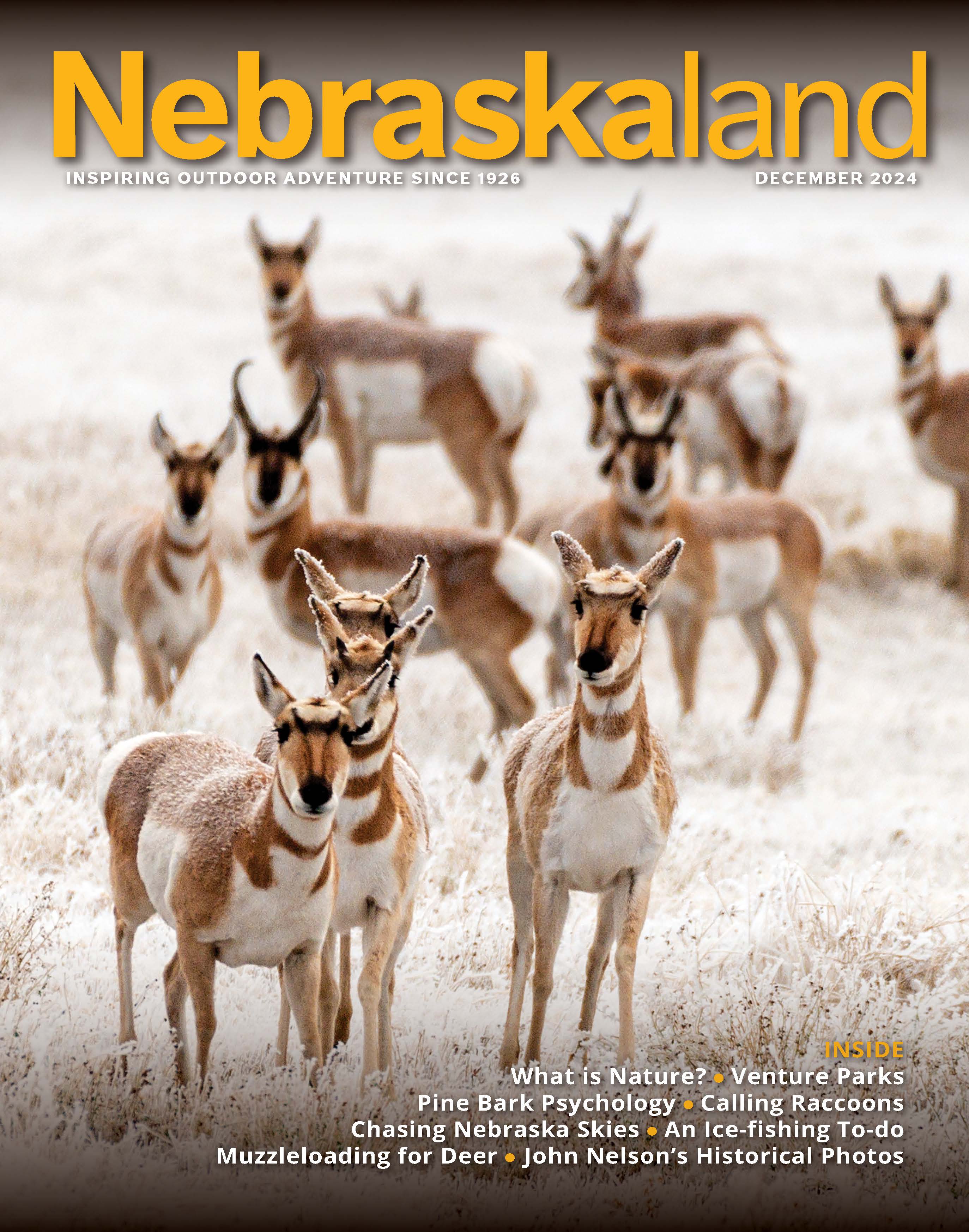
Cover: Pronghorn, one of Nebraska’s native species,
move across a frost-covered grassland in Dawes County.
See the story “What Is Nature?” on page 62.
JUSTIN HAAG, NEBRASKALAND
Nebraskaland (VOL. 102 / NO. 10 ISSN 0028-1964) is published monthly, except for the combined Jan./Feb. and Aug./Sept. issues, by the Nebraska Game and Parks Commission, 2200 N.
33rd St., Lincoln, NE. Periodicals postage paid at Lincoln, Nebraska, and additional mailing offices. POSTMASTER: Send all UAA to CFS. (See DMM 507.1.5.2); NON-POSTAL AND MILITARY
FACILITIES: send address corrections to Nebraskaland, P.O. Box 30370, Lincoln, NE 68503-0370.
4
Nebraskaland • December 2024
This page: The winds of winter blow as a snow drift
engulfs snowflowers in Sheridan County.
JUSTIN HAAG, NEBRASKALAND
December 2024 •
Nebraskaland
5
Magazine Staff
magazine
Published by the Nebraska Game and Parks
Commission since 1926. The Commission is
dedicated to the conservation and protection
of all the state's natural resources and the
people who use them.
Administration
Director Tim McCoy
Deputy Director Jim Swenson
Assistant Director Roger Kuhn
Commissioners
Chairman - Doug Zingula, Sidney
Vice Chairman - John Hoggatt, Kearney
2nd Vice Chairman - Donna Kush, Omaha
Communications Director
Christy Firestone
Public Relations Manager Shawna RichterRyerson
Editor Jeff Kurrus
Associate Editor Jenny Nguyen-Wheatley
Regional Editors Eric Fowler, Julie Geiser,
Justin Haag
Contributing Editor Michael Forsberg
Regular Contributors Renae Blum,
Chris Helzer, Chris Masada, Todd Mills,
Ryan Sparks, Gerry Steinauer
Art Director Tim Reigert
Graphic Designer Mel Severin
Videographer Nick Sauvageau
Photo Librarian Jaclyn Cruikshank Vogt
Magazine Subscriptions
For address changes, magazine and subscription
questions, 800-632-5263 or visit
nebraskalandmagazine.com
Advertising
For advertising information, contact:
Shane G. Gilster, 402-742-0125
shanegilster@solotreemedia.com
Look for bald eagles near open water.
ERIC FOWLER, NEBRASKALAND
Pat Berggren, Broken Bow
Rick Brandt, Roca
Scott Cassels, Omaha
Ken Curry, Columbus
Dan Hughes, Venango
Kent McNeill, Papillion
Nebraskaland Magazine Copyright 2024, all rights reserved.
Nebraskaland is available in audio from the Nebraska Library Commission Talking Book and Braille Service, Suite
120, 1200 N St., Lincoln, NE 68508. 800-742-7691. Nebraskaland Magazine and the Nebraska Game and Parks
Commission reserve the right to reject any advertising not in keeping with the agency mission.
Rates: $18 for one year; $33 for two years; $44 for three years. Nebraska recipients must add appropriate sales tax.
To subscribe call 1-800-NEBLAND (632-5263), or go online to: NebraskalandMagazine.com.
Commission Offices
Conservation Officers
Headquarters/Southeast District Office
2200 N. 33rd Street Lincoln, NE 68503
Phone 402-471-0641
Northeast District Office
2201 N. 13th St. Norfolk, NE 68701
Phone 402-370-3374
Southwest District Office
301 E. State Farm Rd. North Platte, NE 69101
Phone 308-535-8025
ADMINISTRATION
Jeff Clauson
402-471-5531
Lincoln HQ
Administrator
Travis Shepler
402-471-5531
Lincoln HQ
Asst. Administrator
Stacey Lewton
402-471-5532
Lincoln HQ
Asst. Administrator
Mike Thome
402-471-0480
Lincoln HQ
Asst. Administrator
(Includes counties covered)
Northwest District Office
East Hwy. 2, Box 725 Alliance, NE 69301
Phone 308-763-2940
NORTHWEST
Dan Kling
308-430-0572
Captain
Bassett Office
524 Panzer St., Box 508 Bassett, NE 68714
Phone 402-684-2921
Jerod Hahn
Kearney Office
1617 First Ave. Kearney, NE 68847
Phone 308-865-5310
Ak-Sar-Ben Aquarium/Schramm Education
Center
21502 W. Highway 31 Gretna, NE 68028
Phone 402-332-3901
Omaha Office
8495 Frederick Street, Omaha, NE 68124
Phone 402-595-2144
OutdoorNebraska.gov
EAST SUB-DISTRICT
308-520-5539
Sergeant
308-280-4320
Hunter Lee
Keith, Arthur, Deuel
Jaden Porter
308-289-2274
Keith, Garden, Grant
Tyler Stueck
308-289-6260
Keith, Arthur, Grant
Keith Jadlowski 531-310-2869
Keith
WEST SUB-DISTRICT
Sean McKeehan 308-672-1824
Sergeant
Josh Widhelm
308-279-9133
Scotts Bluff, Banner, Sioux
Brandon Wallace 308-280-4488
Scotts Bluff, Banner, Sioux
Travis Schultz
308-279-1292
Morrill, Scotts Bluff
Casey Gehrt
402-617-2112
Dawes, Sheridan
NORTHEAST
Dale Davis
402-760-0712
Captain
WEST SUB-DISTRICT
Jeff Jones
The Nebraska Game and Parks Commission does not discriminate
based on race, color, ethnicity, national origin, sex, pregnancy, sexual
orientation, gender identity, religion, disability, age, genetic information,
veteran status, marital status, and/or political affiliation in its programs,
activities, or employment. Any person who believes he or she has been
discriminated against in any program, activity, facility, or service,
should contact the Nebraska Game and Parks Commission, Lincoln, NE
402-471-0641, the Nebraska Equal Opportunity Commission, Lincoln,
NE 402-471-2024, TTY/TDD 800-642-6112; Director, Office of Diversity,
Inclusion and Civil Rights, U.S. Department of Interior, 1849 C Street,
NW, Washington, D.C. 20240.
6
Nebraskaland • December 2024
402-762-5022
Sergeant
Holt, Boyd
Greg Hesse
308-546-7464
Rock, Brown, Keya Paha
Jonathan Andreasen
402-340-3981
Madison, Pierce, Stanton
Trevor Stahlecker
402-928-9099
Knox, Antelope, Pierce
Mitch Johnson
402-613-8612
Cedar, Knox
EAST SUB-DISTRICT
Cory Krause
402-380-6410
Sergeant
Kyler Prochaska 402-830-8278
Platte, Colfax
Matt Costello
402-317-4014
Dodge, Colfax
Kelbi Abke
402-237-2537
Washington, Burt
Nicholas Fix
402-508-0261
Dixon, Dakota, Thurston
Kyle Hansen
531-739-7392
Dodge
CENTRAL SUB-DISTRICT
Doug Pollard
308-730-7050
Sergeant
Daryl Teter
308-440-1863
Howard, Greeley, Merrick
Matt Brandt
308-202-0819
Sherman, Howard
Klint Gill
402-613-5800
Nance, Wheeler, Boone, Polk
Garrett Zimmer 402-416-5736
Garfield, Loup Valley
Tim Williams
308-380-7331
Hall, Hamilton
SOUTHWEST
Brian Piernicky 308-330-8780
Captain
NORTH SUB-DISTRICT
Alex Hasenauer
308-660-4671
Sergeant
308-395-6001
Jacob Stoinski
Lincoln, Perkins
Frank Miller
402-389-0444
Cherry, Hooker
Luis Nuñez
531-333-6093
Blaine, Custer, Thomas
Brandon O’Neal 308-530-3157
Lincoln, McPherson, Logan
SOUTH SUB-DISTRICT
Kelsey Glodowski 308-242-9000
Sergeant
Bryce Streger
308-537-0404
Dawson, Gosper, Custer
Tyler Adelman
402-314-4783
Dawson, Gosper, Furnas
Red Willow, Frontier, Hayes, Hitchcock,
Furnas
Sophia Gobber 308-222-0368
Chase, Dundy, Hayes, Hitchcock
SOUTHEAST
Matt Seitz
402-806-0915
Captain
WEST SUB-DISTRICT
Matt Taylor
402-200-9597
Sergeant
402-902-2017
Eric Javins
Adams, Clay, Webster
Justin Gress
308-629-9335
Thayer, Nuckolls, Fillmore
Pat George
308-920-2762
Harlan, Franklin, Phelps
Ethan Teter
308-440-3847
Buffalo, Kearney
EAST SUB-DISTRICT
Heath Packett
402-210-0888
Sergeant
402-209-1506
Russell Mort
Otoe, Johnson
Rich Berggren
402-619-1355
Douglas
Brian Arp
531-530-9011
Douglas, Sarpy
Mike Luben
402-443-6392
Saunders
Bryan Adams
402-429-1924
Nemaha, Pawnee, Richardson
CENTRAL SUB-DISTRICT
Curt Prohaska
402-470-1298
Sergeant
402-890-6463
Dina Barta
Lancaster
Mark McDonald 402-805-2353
Lancaster
Mark Sullivan
402-741-0636
Lancaster, Seward, Butler
Jarrod Messman 531-739-9760
Lancaster, Saline, York
YOUR NEBRASKA
Instagram Photos
Follow us @nebraskaland
and tag us in your photos
to be featured in an
upcoming issue.
Joshua Redwine, Lincoln
Windmill at Natick
8
Nebraskaland • December 2024
December 2024 •
Nebraskaland
9
Mat Custer, Omaha
Ducks On a Log
Roger Richters, Utica
Rural Splendor
Marquene Koontz, Ogallala
The Hunt
Send your comments and
photos to:
Jeff Kurrus, Editor
Nebraskaland Magazine
P.O. Box 30370
Lincoln, NE 68503
or email Jeff.Kurrus@Nebraska.gov
Please include your postal address
and telephone number. Letters
may be condensed and edited.
Photographs are also welcome.
10
Nebraskaland
December 2024 •
Nebraskaland
11
IN THE FIELD
WINTER FROST
Hoarfrost formed by
fog rising from Lake
McConaughy, covering a
grove of trees in a pasture
south of the lake.
ERIC FOW
FOWLER,
LER NEB
NEBRASK
RAS ALAN
A D
12
Nebraskaland • December 2024
December 2024 •
Nebraskaland
13
IN THE FIELD
Kevin Bergstrom and wife, Gwen, prepare to take a shot with an inline muzzleloading rifle.
JULIE GEISER, NEBRASKALAND
REASONS TO HUNT THE
MUZZLELOADER SEASON
By Julie Geiser
The muzzleloading deer season runs the entire month of
December, giving hunters more time in the field and a few
other reasons to hunt this season.
Re-Pattern
You may see the “leftovers” from the firearm season when
it comes to bucks, which may include smaller year-classes,
or you might come across those big boys that have evaded
high-power rifle hunters. Bucks that you’ve never seen
before may have moved into an area from hunting pressure
and as the second rut sets in.
Fewer hunters will be in the field distributing less human
scent and pressure on deer, but this doesn’t mean the deer
weren’t educated by hunters during previous deer seasons.
Whether hunting an area you know or one you haven’t
hunted before, scout or re-scout areas as deer may follow
different patterns during the December season. Look for food
and water sources; all deer, including bucks, will be feeding
heavily during colder months, and food sources will start
to be depleted. Also keep in mind, as vegetation dies off,
bedding areas may change to areas that provide more cover.
Second Rut
Hunt the Calm
Does not bred during the main rut will come back into
estrus, typically in December, which sets bucks back into
breeding mode. These bucks may start making new scrapes
and using different trails in the search for unbred does. Using
trail cameras in these areas will tell the story of who is using
them. Some bucks will even come in to calls, rattling and
scent lures.
During the second rut, key in on the does. Doe family
groups will herd-up and are somewhat predictable in
their movements from bedding to feeding and watering
areas. Using more than one tree stand or blind is critical.
Having a stand for morning and afternoon locations allows
hunters to focus on morning bedding and afternoon feeding
movements.
If the weather is cold, use that to your advantage by
hunting calm breaks in weather, focusing on a couple
days leading up to a storm or right after a storm as deer
will come out of cover to feed and water during those
calm times. Deer will bed down at daybreak near feeding
areas in tree or shrubby areas as they try to conserve
energy in cold weather, which is the coldest time of the
day. Cedar trees provide warmth for deer, so finding trails
and setting up a stand near cedar areas may catch deer
as they move from cover to feeding or watering areas.
Many hunters yearn for the challenge of primitive hunting,
and muzzleloader hunting is no easy task. Knowing the
differences between hunting this month and other times of
the year is crucial to your success.
Leftovers
14
Nebraskaland • December 2024
IN THE FIELD
NEWLY DISCOVERED MUSHROOMS
By Gerry Steinauer
This past June, I spent a week collecting mushrooms with
Northern Prairies Land Trust ecologist Chance Brueggemann
and mycologist Derek Zeller at The Nature Conservancy’s
Niobrara Valley Preserve, spanning Brown and Cherry
counties. The preserve is home to a unique mix of western
pine, eastern deciduous and northern birch woodlands, and
no mushroom survey had ever been conducted here before.
This offered us an exceptional opportunity for discovery.
Due to drought, we mostly found mushrooms in the
heavily shaded, moist springbranch canyons that cut deep
into the river’s south bluff, with few specimens in the drier
upland pine and deciduous woodlands. Navigating these
narrow canyons was challenging; we often found ourselves
ankle-deep in cold water, climbing steep slopes and swatting
away mosquitoes.
A golden pholiota mushroom sprouts from a log at the
Niobrara Valley Preserve. GERRY STEINAUER
Despite these difficulties, over the course of the week,
we collected about 100 species. Each evening in our cabin,
Brueggemann and Zeller spread the mushrooms on drying
racks and organized their field notes, while I, the project
manager — exhausted from trying to keep up with the
energetic younger duo — recovered on the couch.
Surveys and Website
This marked our second year of extensive mushroom
surveys in eastern Nebraska. In 2023, Brueggemann and
Zeller concentrated on the deciduous woodlands at Indian
Cave State Park, where they gathered nearly 450 specimens.
This past summer, efforts expanded to include Fontenelle
Forest preserves near Omaha, Rock Creek Station State
Historical Park and the Niobrara Valley Preserve.
Since many mushroom species look nearly identical, we
use DNA analysis to help differentiate them. So far, we
have conducted DNA analysis on 200 species collected in
16
Nebraskaland • December 2024
Sliced open to reveal its fleshy, spore-producing interior,
this truffle from the genus Tuber was collected at Indian
Cave State Park. GERRY STEINAUER
2023, and the results suggest we may have discovered a few
species new to science. Among our finds are five species
of truffle and truffle-like mushrooms, groups never before
reported in Nebraska. The spore-producing body of these
species, the “mushroom,” develops and remains hidden
underground. Once mature, they emit a pungent odor that
attracts squirrels, deer and other animals, which dig them
up, eat them and spread the spores through their droppings.
Brueggemann discovered three truffle species by enlarging
holes in the ground he suspected were made by animals
searching for them.
One morning at Indian Cave, Brueggemann excavated a
truffle from the genus Tuber. Without a collection bag handy,
he placed the mushroom in his lunchbox. Unbeknownst
to him, the scent of these mushrooms, which include the
gourmet European white truffle and Oregon black truffle,
can easily transfer to food. Unfortunately, his truffle emitted
an odor reminiscent of foul broccoli, forcing him to toss his
entire lunch.
One of our goals is to share our discoveries through
creation of the Mushrooms of Nebraska website. Zeller and
his collaborator Mitchel Pigsley developed and maintain this
educational website, which serves as an online mushroom
field guide.
It allows visitors to search for mushroom species by
genus, type — such as toadstool or puffball, color and
edibility. The website includes photographs of each species,
along with details about its habitat, growth season and key
identification features.
Currently, the site focuses on mushrooms from Indian
Cave State Park, but we’ll soon be adding species
from our other survey sites. You can explore it at
nebraskamushrooms.org. Enjoy!
IN THE FIELD
‘HEAT AND EAT’ DEER SHANK ENCHILADAS
By Ryan Sparks
The past few years my ace-in-thehole recipe for deer shanks has been
“heat and eat enchiladas.” You can
make a half dozen trays of enchiladas
to freeze and have ready for days when
you don’t want to cook or do dishes.
Depending on how many shanks
you have, you can double or even
quadruple the recipe. We usually aim
to put four to six trays in the freezer.
Use this two-tray recipe as a base.
Servings: 5-6 per tray
Prep time: 20 minutes
Cooking time: 3 hours
Ingredients:
2-3 tbsp. canola or vegetable oil
2 deer shanks
10 flour tortillas
Enchilada sauce (see below)
2 (4-oz.) cans diced green chilies
2 white onions, diced
8 oz. shredded cheese, plus extra
•
•
•
•
•
•
•
Enchilada Sauce
¼ cup vegetable oil
2 tbsp. flour
¼ cup chili powder
¼ tsp. cumin
¼ tsp. garlic powder
8 oz. tomato sauce
1½ cups shank water
Salt to taste
•
•
•
•
•
•
•
Equipment Needed
2 (9x13) aluminum baking trays
Vacuum sealer and 15x18 vacuum
sealer bags
Aluminum foil
•
•
•
1. Coat the shanks with cooking
oil and salt lightly. Brown the shanks
on all sides in a cast iron skillet over
medium-high heat or in a 425˚ oven
for 10-15 minutes. Place the browned
shanks in an electric slow cooker or
18
Nebraskaland • December 2024
Deer shank enchiladas, “heat and eat” style.
large stock pot and cover with water.
Bring the water to a steady simmer,
cover, and reduce the heat to low. If
using an electric slow cooker, use the
“high” setting. Cook until the meat
easily separates from the bone.
2. In a 3-quart saucepan or large deep
skillet, heat ¼ cup oil over medium
heat. Once hot, add 2 tablespoons of
flour and ¼ cup chili powder and cook
until lightly browned. Stir constantly
to prevent burning. Stir in cumin and
garlic powder and continue cooking
for 1-2 minutes. Gradually stir in the
tomato sauce and water from your
shank pot. Simmer for 10 minutes.
Taste for salt.
3. When the shanks are very tender,
separate the meat from the bones and
tendons.
4. Create an assembly line with
all your ingredients in individual
containers (tortillas, meat, cheese,
green chilies, white onion and
enchilada sauce).
RYAN SPARKS
5. Pour enough enchilada sauce in
the baking trays to lightly coat the
bottom. Dip a tortilla in the enchilada
sauce on both sides and then place
it in the aluminum baking tray. Put a
fistful of shank meat in the tortilla,
along with a scattering of white onion,
diced green chilies and cheese. Roll the
tortilla up with the seam side down.
Continue assembling until the tray is
full. Repeat for the second tray.
6. Once both trays are assembled,
use aluminum foil to create a tight
seal over each tray. Place each tray
in a vacuum sealable bag, label the
contents and vacuum seal before
freezing. The trays stack nicely and
will last a year or longer.
7. To heat and eat, remove the tray
from the vacuum sealed bag and place
in a 375˚ oven for one hour or until
the enchiladas are warmed through.
Remove the aluminum foil, add extra
cheese to the top and return to the
oven until melted.
December 2024 •
Nebraskaland
19
Chasing Nebraska Skies
After starting his day stormchasing in Denver,
Matt Hollamon of Martell photographed this
supercell in the Nebraska Sandhills.
By Renae Blum
Photos by Matt Hollamon
20
Nebraskaland
• December 2024
December 2024 •
Nebraskaland
21
Hollamon photographed
this tornado near Farnam
in May 2019.
Hollamon shot this scene at his home in Martell. “I love being able to walk out of the house and capture images like this one.
This little shower rolled over the house, and the sun just lit up the sky,” he said.
W
hen he was 46 years old,
Matt Hollamon saw his
first tornado — and was
immediately hooked.
Invited to tag along on a friend’s
storm chasing excursion in Kansas,
Hollamon found himself gazing at a
storm “that looked like a spaceship,”
he said. “It was just being in that
position — hearing the tornado sirens
going off in this little town. It was such
a cool experience.”
A lifelong Nebraskan, Hollamon
lives in Martell and had been taking
pictures for a couple of years prior
to this. He already knew he loved
photographing the sky, especially
sunsets and lightning. But this wild
evening in 2016 introduced him to
something new — the art of storm
chasing. And he hasn’t stopped since.
Today, Hollamon estimates he’s
22
Nebraskaland
• December 2024
seen about 80 tornadoes — though
tornadoes aren’t necessarily the goal.
“I’m kind of a structure junkie,” he
said. “I like a storm that looks like a
spaceship. When the wind carves out
something that has those layers on it
and it looks like a stack of pancakes, I
love that.”
The immensity of these supercells
leaves him in awe. “They go 50,000
feet in the air at the cloud tops. It
makes you feel insignificant, like
there’s something bigger out there,”
he said. “I don’t feel like I have to go to
church to be in church.”
For Hollamon, photography and
storm chasing is a vital part of life —
the way he recharges from work as a
nurse at Tabitha Hospice in Lincoln.
“The job that I do, it’s a high burnout
deal. I’ve done it for five years,”
Hollamon said. “And if you last five
years doing what I do, you have to be
able to take care of yourself. … I need
my photography for me, as much as
anything else.”
Working full-time means it isn’t
easy to find time for storm chasing.
Hollamon finds opportunities where
he can and each spring, usually in May,
he tries to take a two- or three-week
“chase-cation.”
During that time, Hollamon might
put as many as 8,000 miles on his
vehicle, hopping from Oklahoma one
day to Colorado the next, sticking
mostly to the Great Plains. He chases
alongside a good friend and fellow
photographer he met on Instagram,
Justin Snead.
While Hollamon knows some
photographers who chase storms solo,
he prefers having a chase partner. “I
think it’s a big advantage,” he said. “I
December 2024 •
Nebraskaland
23
On this day, Hollamon started chasing storms by Hebron, Nebraska. He then moved back northeast and noticed the lightning
ramping up as storms merged. “As fate would have it, it chased me right to one of my very favorite spots,” he said. “Lightning
was dropping all around me when I got there.”
have the utmost trust in him. I know
that he’s going to keep us safe, and I’m
going to keep us safe, too.”
Strangely enough, the storms
themselves aren’t the most dangerous
part of what he does. It’s the other
drivers, Hollamon said — people out
doing the same thing he’s doing.
“There are times in the spring where
24
Nebraskaland
• December 2024
the weather’s pretty targeted to one
area and you may have 2 or 3 thousand
people on the road just chasing
storms,” Hollamon said. “It gets wild.”
Road conditions and nearby
lightning can also pose hazards. Asked
how he balances the need for safety
with getting a good shot, Hollamon
said, “Safety first, because there’s no
shot if you’re not safe.”
At the same time, he will admit
to accepting some level of risk:
“Sometimes you have to just risk it for
the biscuit, so to speak.”
Hollamon insists he’s not an
adrenaline junkie — or even much of a
risk taker. “I’m pretty reserved. I’m not
a big roller coaster rider,” he said. “I
don’t chase storms for the adrenaline
part of it. It’s the awe of nature —
that’s what I do it for.”
Most of his best shots come from
timelapses, something Hollamon
began doing in 2017. His goal in the
field is to capture seven to 10 seconds’
worth of images — enough for a good
clip in an eventual storm chasing film.
Hollamon has created six timelapse
films, each about five to 10 minutes
long. They feature stirring music set
over clips of dramatic skies and are
among his proudest creations.
His most recent project, called
“Finding the Light,” was his biggest
challenge yet. A month after starting
work on this project, tragedy struck:
In August of 2023, Hollamon lost his
youngest son, Trey. He was just 23
years old.
“Parents aren’t supposed to lose
their kids,” Hollamon said, wiping
away a tear. “It’s been really hard. …
And it’s absolutely killed some of my
creativity.”
When he began working on the
project again, he did so with Trey in
mind. “Kind of what I tried to convey,
even with the quote at the start of the
movie, was just a lot of light and dark.
He was a real light,” Hollamon said.
“And that part of it, as a photographer,
that’s what we strive for. It’s chasing
light.”
His work as a storm chaser and
photographer has led to some bigger
insights. “It shows me, more than
anything, that we’re really not in
control,” Hollamon said. “There’s
bigger things at work.”
As a setting for revealing truths
like this, Nebraska is special, he said.
“I wouldn’t change where I live for
anything. I love Nebraska,” Hollamon
said.
Asked what suggestions he has for
an aspiring storm chaser, Hollamon
recommended educating yourself
first. He and Snead use the National
Weather Service to track storms, and
“generally they’re very accurate,”
Hollamon said.
But you’ll need to learn how to read
models and know which models to
trust, he said. Websites like Tornado
Titans are a good starting place.
Friends of his began a grassroots
movement called Girls Who Chase,
another solid resource. Beginning
storm chasers can also book trips with
tour companies and see their process.
The photographer, shown here on a
country road with mammatus clouds
behind him, has been photographing
storms since 2016. PHOTO BY JUSTIN SNEAD
“I kind of learned on the fly,”
Hollamon said. “I went with
experienced storm chasers to start
with. If you know a storm chaser that’s
experienced that you can get out with,
that’s a great way to learn, too.”
Does he have a favorite storm?
Honestly, no, Hollamon said. “Every
storm is its own. They’re all relevant
on their own terms.
“Man, I’ve seen some beautiful
stuff,” he added. “So I’m lucky in that
regard.” N
To see more of Matt Hollamon’s work,
visit him on Instagram, Facebook and
Flickr. View his storm chasing films on
Vimeo and YouTube.
December 2024 •
Nebraskaland
25
Outdoor Nebraska
By Renae Blum
Head outdoors to escape the rush and bustle of the holiday season. There,
you can find wildlife watching opportunities, chances to hunt and even
shooting stars. N
What To Do in December
Watch the
Geminids meteor
shower
Peaks the night of Dec. 13-14
Statewide
Take in one of the best meteor showers
of the year, which is expected to produce
up to 75 meteors per hour. Find a nice
dark area away from city lights, like
a state park. Dress warmly and bring
whatever you need for an epic night
of stargazing — lawn chairs, blankets
and a hot mug of cocoa or coffee. Hope
for cloudless skies and expect the best
views to come just after midnight.
GETTY IMAGES
Participate in Project FeederWatch
November to April | Nationwide
Turn your love for watching birds into data scientists can use. Join Project
FeederWatch, a community science project by the Cornell Lab of Ornithology and
Birds Canada. Each year, from November to April, anyone can sign up to count
birds from wherever you prefer to watch them. The schedule is flexible, too; you
can participate as often — and for as much time — as you wish. Learn more at
feederwatch.org. PHOTO COURTESY OF CURTIS BLUM
Stay in a cabin at Chadron State Park
Through Dec. 31 | Park is about 10 miles south of Chadron
Chadron State Park’s modern duplex cabins make for a cozy winter stay — or
a fun group getaway. These two-bedroom cabins offer a kitchen, living room,
queen bed and two twin beds. They come fully furnished with blankets,
towels, stoves, refrigerators, silverware and cooking utensils. Reserve your
spot before Dec. 31 at OutdoorNebraska.gov. JUSTIN HAAG, NEBRASKALAND
Call raccoons
Late December and early January | Statewide
On beautiful, sunny mornings when the thermometer
climbs above freezing, calling raccoons can provide
some excitement. Action is best after calm nights
when temperatures stay above 20 degrees. Use
electronic calls that mimic young or fighting raccoons
and look for locations with den trees — usually larger
trees with hollows in them. Call on the opposite side
of the hollow opening to bring the raccoon fully out.
If you don’t see any raccoons in 4-5 minutes, move to
the next likely spot. MIKE FORSBERG, NEBRASKALAND
26
Nebraskaland • December 2024
Attend the
Yule Log Festival
Dec. 21, noon – 5 p.m.
Platte River State Park
Get into this festive time of year with a
fun event. The Yule Log Festival includes
kid-friendly crafts, a cookie decorating
contest, marshmallow roasting, camp
games and pictures with Santa. Gather
a team to compete in the yule log quest,
then finish the day with a bonfire and free
lighted hayrack rides. All you need is a
park entry permit. See details at
Calendar.OutdoorNebraska.gov.
JENNY NGUYEN-WHEATLEY, NEBRASKALAND
December 2024 •
Nebraskaland
27
EUGENE T. M A HONE Y S TAT E PA RK
N E B R A S K A’ S
O UT DOOR
Venture Parks
A PUBLIC-PRIVATE PARTNERSHIP
PLATTE RIVER STATE PARK
SCHRAMM PARK STATE RECREATION AREA
LOUISVILLE STATE RECREATION AREA
December 2024 •
Nebraskaland
29
y
e
n
o
h
a
M
.
T
e
n
e
Eug
FROM A DREAM TO REALITY
AT VENTURE PARKS
STAT E PA RK
The Nebraska Game and Parks Foundation and Commission embarked on an
incredible journey of collaboration — engaging with our park visitors, students,
staff, and donors to dream up the future of our state parks. Over the past
100 years, these parks have welcomed tens of millions of guests, and we
envisioned ways to bring even more people together to experience the beauty
and excitement they offer.
Nebraska’s Venture Parks — a four-park
complex — is the most successful publicprivate partnership in the history of our
Commission. This initiative has united
donors, communities, schools, educators,
park guests, staff, and volunteers to
invest in our parks’ future, creating a
vibrant complex that will attract visitors
for generations. Each park within the
complex features five zones designed
for imagination, education, discovery,
serenity, and adventure.
The Venture Park Complex sits
on the Platte River. Each park is
no more than a 15-minute drive
away from each other.
Thank you for joining us on this
remarkable journey, making our state
parks even better. Together, we are
creating spaces for everyone to learn,
explore, and play.
Nebraskaland • December 2024
The aquatic center expansion
includes three new waterslides
and a spacious pool deck area.
31
Eugene T.
Mahoney SP
66
PL
AT
TE
Schramm
Park SRA
RIV
ER
10 miles to
Omaha
Exit 426
31
50
Louisville
SRA
66
16 miles to
Lincoln
30
Eugene T. Mahoney State Park, one of Nebraska’s top tourist attractions, is a bustling hub for family
adventures and outdoor excitement. Recent improvements include an expansive addition to the aquatic
center, a stunning group lodge for large events, a renovated conservatory and education center, and
engaging features like a rock climbing wall, sledding hill, and aerial adventure ropes course.
The improvements and new amenities
added are remarkable. From a stateof-the-art education center to modern,
family-friendly camping facilities,
swimming areas, aquatic play zones,
playgrounds, Americans with Disabilities
Act-accessible parking, enhanced trails,
and much more. The boost in lodging,
visitor numbers, and economic impact
from increased promotion by our tourism
partners is significant. Some attractions
have even been voted among the best in
Nebraska by local communities and park
guests.
Our park guests are as diverse as
Nebraska’s landscapes, each seeking
unique experiences beyond just a walk in
the park. Today’s visitors crave excitement
and adventure, serene escapes,
meaningful interactions with nature, and
educational experiences.
ALL WITHIN
A 15-MINUTE
DRIVE
UNLEASH THE ADVENTURE
66
Platte River SP
50
Visitors slip down the tubing waterslide at the center.
Two single-person slides are also featured.
December 2024 •
Nebraskaland
31
RIGHT, BELOW: Tables are
decorated for a wedding at
Mahoney State Park’s Crete
Carrier Riverview Lodge, the
11,600-square-foot, multifunction facility overlooking the
Platte River.
e
t
a
r
b
e
l
e
C
A climber navigates the Go Ape Treetop Adventure ropes
course.
The James Family Conservatory and Education Center is another
option for large groups at Mahoney State Park.
Rental bikes are available at Eugene T. Mahoney State Park.
32
Nebraskaland • December 2024
The Go Ape course offers challenging obstacles for all ages.
Visitors navigate various elements of the Go Ape course.
The James Family Conservatory and Education Center.
December 2024 •
Nebraskaland
33
ABOVE: Visitors celebrate
International Mud Day at
Mahoney State Park.
TOP: On-site snow
machines assure winter
visitors always have
powder at Mahoney’s
sledding hill.
LEFT: A rock climber
scales a wall at the
activity center.
The bouldering wall at the activity center gives another
option for climbers of all ages.
December 2024 •
Nebraskaland
35
r
e
v
i
R
e
Platt
STAT E PA RK
FIND YOUR WILD SIDE
Platte River State Park is your go-to destination for
connecting with nature and finding your wild side.
Our first project here was an interactive stream,
followed by glamping cabins, a natural playground,
a two-tier spray park, modern cabins, and a new
campground. We’ve expanded the well-known trail
system, creating some of the best technical biking
and hiking trails in the Midwest.
A curved wall is available for experienced riders.
TOP, ABOVE: Kids play at Platte River State Park’s
two-tier spray park.
RIGHT: Attractions at the spray park include water
shooters.
OPPOSITE: The mountain bike trail at Platte River
State Park features trails for beginners to experts
over various terrain.
36
Nebraskaland • December 2024
Explore
December 2024 •
Nebraskaland
37
LEFT: The family cabins overlook the Platte River..
BELOW: The recreational vehicle campground at Platte River State Park features
48 full-hookup sites.
A family enjoys dinner in front of their camper at Platte River State Park’s RV
campground.
ABOVE: A visitor has a lot to share while playing at Crawdad Creek.
LEFT: Kids play in Crawdad Creek near Jenny Newman Lake.
38
Nebraskaland • December 2024
December 2024 •
Nebraskaland
39
RIGHT: A kid hangs on to the zipline at Platte River State Park’s natural
playground.
BELOW: The natural playground features various obstacles to climb over or
through.
Relax
RIGHT: Each of the park’s three glamping
cabins features a bed that can roll onto
the deck so visitors can sleep under the
stars.
BELOW: A couple enjoys their time on a
glamping cabin deck.
The natural playground.
40
Nebraskaland • December 2024
December 2024 •
Nebraskaland
41
k
r
a
P
Schramm
Big Snap Daddy, the world’s
largest captive common
snapping turtle, swims in a
Schramm Education Center
aquarium.
STAT E RECRE ATION A RE A
LEFT: At a school
day event at the
Schramm Education
Center, a student
reaches toward
a shovelnose
sturgeon in the
touch tank.
BELOW: The
Schramm Education
Center.
Schramm Park SRA’s interactive stream offers hands-on educational opportunities for visitors.
AN EXCITING ‘EDVENTURE’
Schramm Park State Recreation Area is where
people connect with Nebraska’s natural world.
The new Education Center and Aquarium
showcases native fish, interactive displays,
exhibits on unique ecosystems, and indoor/
outdoor classroom spaces perfect for field
trips. A healing garden welcomes visitors, and
the learning treehouse and interactive stream
offer fairy-tale-style educational adventures.
Additionally, improved canoe and kayak
launches provide easy access to the Platte
River for float trips.
Students learn about ornate box turtles at the Schramm
Education Center.
42
Nebraskaland • December 2024
A visitor does yoga at the Serenity Garden.
The natural playground is adjacent to the Schramm
Education Center.
December 2024 •
Nebraskaland
43
RIGHT: The round rafting
adventure is perfect for
families wanting to get on the
water together.
BELOW, RIGHT, OPPOSITE:
Students participate in a
journaling activity at the
learning treehouse.
BOTTOM: The learning
treehouse features both
indoor and outdoor education
areas.
Learn
Rock-skipping on the river trail gives visitors another option during their family hikes.
December 2024 •
Nebraskaland
45
e
l
l
i
v
s
i
u
o
L
STAT E RECRE ATION A RE A
A N AT U R A L P L A C E T O G E T A W AY
Louisville State Recreation Area promises
adventure, family fun, and water play. The floating
playground, now a sensation, attracts swimmers
of all ages to its obstacle course. Other water play
features include rentable stand-up paddleboards
and kayaks. The new Americans with Disabilities
Act-accessible fishing enhancements including
shoreline access and a fishing pier, king-of-the-hill
play area, and river access enhance the overall
experience.
TOP, ABOVE: At Louisville SRA, visitors can
rent paddleboards and waterbikes.
LEFT: Visitors of all ages climb on the
floating playground.
46
Nebraskaland • December 2024
December 2024 •
Nebraskaland
47
ABOVE: A visitor rides a pedalboard.
TOP RIGHT: Kids play at the park’s Bounce Village.
BELOW: The floating playground remains a popular
summer destination.
Hikers take advantage of 2 miles of trail developments.
Fishing advancements include this accessible pier, providing
opportunities for all ages to enjoy..
Anglers fish from one of the updated piers at Louisville SRA.
Play
48
Nebraskaland • December 2024
December 2024 •
Nebraskaland
49
s
k
r
a
P
l
l
A
N E B R A S K A’ S
O UT DOOR
IMPROVEMENTS
Education is at the
heart of what we
do. Each park offers
educational and
naturalist programs,
wildlife watching,
guided hikes, the
Becoming an Outdoors
Woman program, field
trips, fishing and flytying events, and more.
Students participate
in a natural journaling
workshop at the learning
treehouse at Schramm
Park SRA.
Kayakers access the
Platte River from Decker
Creek at Platte River
State Park. The access
point, a few yards from
the creek’s mouth on
the river, serves as a
stopping point on a water
trail between Schramm
Park SRA and Louisville
SRA.
50
Nebraskaland • December 2024
Venture
Parks
Projects
Safety, accessibility, and
modernity were priorities in
our improvements, leading to
added IT infrastructure, fiber
cables, additional restrooms,
and Americans with
Disabilities Act-accessible
parking. More shelters and
picnic benches now provide
ample opportunities for rest.
Eugene T. Mahoney State Park
Opened in
Go Ape Ropes Course and Zip Line
Spring 2018
Indoor Rock Climbing and Bouldering
Fall 2018
Sledding Hill
Winter 2018
Go Ape Journey (Youth) Ropes Course and Zip Line
Summer 2020
Crete Carrier Riverview Lodge
Summer 2021
Rental Bikes
Spring 2022
Mudville Annual Event - National Mud Day June 29th
Summer 2023
James Family Conservatory and Education Center
Winter 2023
Mahoney Pool, Raging River Waterslides
Summer 2024
Mini Golf Course
Fall 2024
Platte River State Park
Opened in
Crawdad Creek
Spring 2017
Glamping Cabins
Summer 2018
Two-Tier Spray Park
Summer 2018
River Access Canoeing/Kayaking
Summer 2018
Full Service RV Campground with Dog Park
Spring 2020
State-of-the-art Mountain Biking Trail
Spring 2020
Natural Playground with Climbing
Features, Rope Courses and Zip Lines
Spring 2021
Family Friendly Cabins
Summer 2024
Schramm Park State Recreation Area
Opened in
River Access Canoeing/Kayaking
Summer 2018
Schramm Education Center and Aquarium
Spring 2019
Naturalist Programs and Educational Programs
Spring 2019
Serenity Garden
Fall 2022
Picnic Facilities
Fall 2022
Education Trail
Summer 2023
Round Rafting Adventure and Kayak Cove
Summer 2023
Skipping Rocks on the River Trail
Summer 2024
Natural Playground
Summer 2024
Learning Treehouse and Interactive Stream
Fall 2024
Louisville State Recreation Area
Opened in
Floating Playground
Summer 2018
Watercycle, Paddleboard, Kayak Rentals
Summer 2018
River Access (Canoe/Kayak/Airboat Landings)
Fall 2019
Picnic Facilities
Spring 2020
Bounce Village
Summer 2023
King of the Hill
Summer 2023
Fishing Enhancements
Summer 2024
Trail Development and Interpretation
Summer 2024
December 2024 •
Nebraskaland
51
THANK YOU TO OUR
GENEROUS SUPPORTERS
Nebraska’s state parks and natural spaces are treasures that make life here truly
special. We must continue investing in these parks while caring for the spaces
we’ve been blessed to manage. Your investments, visits, and support help us make
one of the nation’s best state park systems even better.
We’ve witnessed smiles, heard laughter, and shared countless first-of-their-kind
moments in nature at our Venture Parks. These moments are possible thanks to our
generous supporters, including donors, the Nebraska Game and Parks Foundation,
the Legislature, staff, and park guests.
Thank you for making our parks a place for everyone to learn, explore, and play.
TEXT BY CHRISTY FIRESTONE
LAYOUT AND DESIGN BY MEL SEVERIN
PHOTOS BY CHRISTY CHRISTIANSEN, CHRISTY FIRESTONE, ERIC FOWLER, JEFF KURRUS, JENNY NGUYEN-WHEATLEY AND NICK SAUVAGEAU
JOHN NELSON, SELF-PORTRAIT. NSHS RG3542-5-1
John Nelson’s
Nebraska
By David L. Bristow, Nebraska State Historical Society
ohn Nelson did not find much gold in Colorado, but
Nebraskans are fortunate he found photography.
Born in Sweden in 1864, Nelson immigrated to
Nebraska with his parents when he was 17. As a young
adult, he homesteaded in Wheeler County, but later sold out
and headed west to Colorado to prospect for gold. During his
travels, he became interested in photography, opening his
own studio when he returned home.
Nelson was a prominent resident of Ericson, Nebraska,
until his death in 1942. In addition to his photography
business, he served as county surveyor for more than 30
years and retained a strong interest in agriculture. A year
before his death, the Wheeler County Independent reported
J
he was advising a local high school agriculture class on the
finer points of judging calves.
As a professional photographer, Nelson advertised his
studio portraiture, but most of his hundreds of photos in
the Nebraska State Historical Society collection were taken
in the field. Local businesses hired him to take promotional
photos, and he photographed local events and scenes to sell
as picture postcards. In 1928, for example, he offered “20
Kodak views of the Wheeler County Fair, including views of
the grounds, the Indians, and the bucking broncos” for one
dollar.
Nelson’s photos also record changing technology in central
Nebraska, with early photos of auto mechanics and the
Telephone
switchboard
operator.
NSHS RG3542-95-34
Cutting ice from lakes and ponds was
an important business in the prerefrigeration days, but the presence of
women indicates this is a gag photo.
NSHS RG3542-95-12
54
Nebraskaland
• December 2024
When the fishing is good.
December 2024 •
NSHS RG3542-141-10
Nebraskaland
55
Showing off the new “Pennsylvania Oilpruf Tire” at G. W. Morgan’s garage in
Spalding. NSHS RG3542-122-2
Outside a general store, 1910s.
NSHS RG3542-95-33
L.C. Avery, veterinarian, Spalding, Nebraska.
NSHS RG3542-95-9
local telephone exchange. In 1924, the Norfolk Daily News
reported that Nelson listened to broadcasts from Norfolk’s
WJAG on a radio receiver that he made by mounting a tube
and dials on an old derby hat.
In 1932, when Prohibition was still the law of the land,
Nelson promoted his photography in the Ericson Journal in
an article formatted as if were a radio broadcast with Nelson
reading his customers’ letters on the air. After a series of brief
letters praising the quality of his work, he threw in a bit of
self-deprecating humor:
“And here is one from my friend R. C. M., Chapman,
Nebraska: Dear Friend John, what have you been drinking?
56
Nebraskaland
• December 2024
Waiting patiently for the photographer before digging in.
NSHS RG3542-102-17
You got my pictures numbered so much different from the
negatives … I don’t know just when you will get your money.
Well, I will forgive you this time, but don’t let it happen again,
or I will be after coming up there.”
Nelson replied, “This is serious. No, I don’t mean to make
mistakes in filling orders, that is easily fixed. But as to my
bootlegger, I hope to goodness, he don’t give me any bad
booze. What times! It is so hard to get good stuff and when
you get it you can’t quite trust it. I feel like swearing off.”
Having a sense of humor, Nelson was remembered as
Inside a bank.
NSHS RG3542-5-1
“a man of kindly and genial disposition.” That disposition
helped him earn the trust of his neighbors and allowed him
to compile a vivid visual record of life in his community. N
Visit NSHS’s website at history.nebraska.gov.
December 2024 •
Nebraskaland
57
Ponderosa
Psychology
Photos and story by Chris Helzer
Y
ou’ve probably gazed at clouds and seen familiar objects or animals,
right? (“Wow, that cloud looks like a squirrel riding a turtle!”) If
you’re a fan of that game, I invite you to try “What’s that bark
pattern look like?”
Based on years of experience, the game works best with mature
ponderosa pine trees. If you can find some that have survived a recent fire,
that’s even better, but not absolutely necessary. Once you’ve located your
trees, all it takes is a little imagination and you’re set for hours.
It’s fun to play by yourself, of course, but it can also be entertaining
and educational to engage with friends or family. You might learn a lot
about people close to you and the surprisingly odd ways their brains
work. Some psychologists use Rorschach inkblots to gain insight into
people’s personality and emotional stability. Similarly, pine bark pattern
interpretation seems like a completely valid way to assess those around
you.
In a totally hypothetical example, let’s say you and your wife are looking
at what is obviously a cow’s head in profile. The eye and nostril are clear as
day, and you can even see a pretty well-defined horn curling upward. And
yet, your wife insists she sees a momma penguin feeding a baby penguin.
What does this mean? Well, in this very specific case, it means nothing.
She’s perfectly within her rights to see a couple of penguins instead of a
cow. Especially because she’ll probably read this (Hi Sweetie!).
Seeing shapes in bark: This is the cow head profile or penguin feeding a baby penguin ... depending on who you ask.
58
Nebraskaland • December 2024
This is clearly a face, right?
December 2024 •
Nebraskaland
59
Do you see the woodpecker chick peering out of its hole?
The giraffe/scorpion conundrum.
Even if you don’t buy into the scientific value of ponderosa
pine bark patterns, you can still enjoy them purely
recreationally. If nothing else, they make a great distraction
while hiking up steep hills in the Pine Ridge or along the
Niobrara River, especially if your companions are in better
aerobic shape than you. “Hey!” you might say, “Come back
down here and look at this. What do you think it looks like?”
60
Nebraskaland • December 2024
By the time your friends stop arguing about whether it’s a
giraffe or a scorpion, you’ll have caught your breath and be
ready to keep climbing. N
Chris Helzer is The Nature Conservancy’s Director of Science
and Stewardship. He is a regular contributor to Nebraskaland
Magazine with his first story appearing in 1995.
Ponderosa pines with fire scars at
The Nature Conservancy’s Niobrara Valley Preserve.
December 2024 •
Nebraskaland
61
What Is Nature?
How we communicate our interpretation of
nature is a powerful question
By Grace Gaard, Aquatic Ecology Education Specialist
F
ill in the blank. Nature is ___________.
If you had to think of your top words, what would they
be? How would you describe what nature is to you? Some
of your answers may likely overlap, while others would be
vastly different.
I know what my answers would be. And if you’re reading
this, it’s likely that we share values like time outdoors and
an appreciation for Nebraska’s beauty. Our words for nature
might look something like this.
• Awe-inspiring
• Peaceful
• Safe
• Reciprocal
But what about those who answer differently? What
about those who may never visit a park or take the time to
watch the sun sink into color-soaked clouds because their
definition of nature is much different? How would they fill in
the blank? Maybe it would look something like this.
Nature is:
• A resource
• Separate
• Scary
• A place to recreate
• Inconvenient
• Something to consume or control
Nature is:
• A part of me
• Beautiful
Everyone’s thoughts here on nature are valid, based on
personal experience and years of developing values based on
those experiences. How we communicate our interpretation
of nature is a powerful question to keep in mind.
Your Ecological Identity
Many children first experience nature at an event, such as
this Outdoor Expo. JENNY NGUYEN-WHEATLEY, NEBRASKALAND
62
Nebraskaland
• December 2024
If you’re unsure where you land on the “what is nature?”
spectrum, I’d encourage you to explore your “ecological
autobiography.” This term was introduced to me recently
by Dr. Ruth Wilson, but the concept has been around for a
while. Essentially, what is your life’s story through the lens
of your connection to nature? This exercise can be a great
way to explore your own “ecological identity” and awaken
memories or past experiences that led you to where you
are today. Whether you write it down or merely think it
through, here are a few prompts to help you through the
process:
1. Think of a species encounter or natural system that
stands out in your personal memory.
The author works to honor her connection to nature through artwork that educates about Nebraska’s species and landscapes.
ILLUSTRATION BY GRACE GAARD
a) Did you have a favorite tree growing up, or a
special place you went to?
b) Did you have a close encounter with something,
alive or not?
c) Was there a specific habitat you visited that had
an influence on you?
d) This could be over a span of time or one
particular experience that influenced you. For
this prompt, focus on describing what you
remember of the natural world.
2. Reflect on your experiences from the first prompt and
now write about how they made you feel or what they
made you think.
a) What influence did this have on your ideas or
personal growth?
b) Have these places or species changed in any
way since you last experienced them?
c) Have there been any big shifts for you since the
experience?
Understanding our connection to nature from the past
can be helpful in processing how we arrived at the beliefs
we hold today. And while it is guaranteed that we’re all
different, I would take a bold guess and say that most of us
will look back and find that nature gave us something.
Reciprocity
Nature is reciprocal. If you’re not familiar with the term
reciprocity, it’s essentially the practice of exchanging things
with others for mutual benefit. I learned about this concept
from Dr. Robin Wall Kimmerer. I recommend reading her
essay, “The Serviceberry.”
Additionally, Kimmerer’s book Braiding Sweetgrass is a
personal favorite, capturing nature, what it is, and how
we interact with one another, better than most works I
have read. An enrolled member of the Citizen Potawatomi
Nation, Kimmerer blends her traditional ecological
knowledge with incredible storytelling and accurate
science flawlessly.
December 2024 •
Nebraskaland
63
Birdwatching at the Outdoor Discovery Program leads to a
nature connection at Wildcat Hills State Recreation Area.
JUSTIN HAAG, NEBRASKALAND
The Nature Connectedness Scale.
INFOGRAPHIC BY GRACE GAARD
In her essay “The Serviceberry,” Kimmerer writes:
This abundance of berries feels like a pure gift from the land.
I have not earned, paid for, nor labored for them. There is no
mathematics of worthiness that reckons I deserve them in any
way. And yet here they are — along with the sun and the air and
64
Nebraskaland
• December 2024
the birds and the rain, gathering in the towers of cumulonimbi.
You could call them natural resources or ecosystem services, but
the Robins and I know them as gifts. We both sing gratitude with
our mouths full …
Gratitude is so much more than a polite “thank you.” It is the
thread that connects us in a deep relationship, simultaneously
physical and spiritual, as our bodies are fed and spirits
nourished by the sense of belonging, which is the most vital of
foods. Gratitude creates a sense of abundance, the knowing
that you have what you need. In that climate of sufficiency,
our hunger for more abates and we take only what we need, in
respect for the generosity of the giver.
If our first response is gratitude, then our second is
reciprocity: to give a gift in return. What could I give these
plants in return for their generosity? It could be a direct
response, like weeding or water or a song of thanks that sends
appreciation out on the wind. Or indirect, like donating to my
local land trust so that more habitat for the gift givers will
be saved, or making art that invites others into the web of
reciprocity.
Gratitude and reciprocity are the currency of a gift economy,
and they have the remarkable property of multiplying with
every exchange, their energy concentrating as they pass from
hand to hand, a truly renewable resource. I accept the gift from
the bush and then spread that gift with a dish of berries to my
neighbor, who makes a pie to share with his friend, who feels
so wealthy in food and friendship that he volunteers at the food
pantry. You know how it goes.”
The author uses her “Grace’s Guide to the Outside” series
to shine a light on species Nebraskans may encounter
outdoors. ILLUSTRATION BY GRACE GAARD
If you are still unsure, let’s ask another question. How do
you place your Self versus Nature?
The infographic on page 64 may help make this question
clearer. When you hold yourself up next to nature, where do
you sit in relation?
For me, nature has given me joy and beauty that I
choose to reflect to others through art. It’s also given me
opportunities to challenge myself, grow and pay attention.
It’s been the place where some of my most important
relationships have taken root.
Everything that sustains me comes from nature. I have a
microbiome of bacteria and other living organisms inside my
own body. Nature is a part of me, not apart from me. There’s
a relationship there that is so much more than simply the
word “nature.” Nature is our connection to self. For me,
nature is everything.
Wherever you’ve landed along this journey, I hope you
know that there are no wrong answers. Although I hope that
you have a relationship with the sky and the river and the
living parts of our world that leads you to advocate for it, not
everyone is in that space yet, and that’s OK. I hope you take
all the time you need to reflect on what nature is or isn’t for
you.
In the end, I do hope you’ll find that a connection with
nature is a connection with your soul.
What is nature? Fill in the blank.
Nature is ___________. N
Self to Nature
What has nature given you? A bunch of mosquito bites
and muddy shoes, or is it something more? What is that
reciprocal relationship with nature that you share? What
kinship exists there, if any?
Many hunters and anglers admire being part of nature more than shooting a gun or catching a fish.
The benefits they receive often mirror those of non-consumptive users. JULIE GEISER, NEBRASKALAND
December 2024 •
Nebraskaland
65
MIXED BAG
READY FOR THE HARD WATER?
Before you get on the ice, remember to complete these tasks.
By Julie Geiser
When the ice is right, your fishing
equipment and safety measures should
have been long since planned. Use our
advice to prepare before venturing out
on the ice the first time this season.
Checklist
• Purchase a fishing license and park
permit (if applicable).
Make sure auger blades are sharp.
If not, buy replacements through the
manufacturer, have them sharpened or
sharpen them yourself. Bring plenty of
gas or batteries depending on the type
of auger you have.
Replace line on reels and tip-ups.
Monofilament should be changed
every year, fluorocarbon lines about
every third year, and braided line will
last several years. Store line in cool,
dry places to preserve its strength.
Gather ice-fishing rod holders, a
multi-tool, hook remover and small
jigging lures.
Purchase wax worms, trout eggs or
PowerBait to tip your jigs.
Find ice cleats to avoid slipping.
Small and more aggressive cleat styles
are available.
Check your sled or ice shelter for
holes and repair if necessary.
Test your portable propane heater.
Bring a cordless drill and ice stakes
to secure equipment, including ice
shelters, on windy days.
Pack plenty of food, like soup and
sandwiches and protein snacks like
jerky and energy bars. Dehydration,
because you simply don’t see it coming
this time of year, should also be
safeguarded against by having plenty
of water.
•
•
•
•
•
•
•
•
•
Safe Ice
Safety precautions should include
wearing a personal floatation device,
66
Nebraskaland • December 2024
Proper planning before the season can lead to results such as this once you’re on
the ice. JULIE GEISER, NEBRASKALAND
testing edge ice with a spud bar,
carrying ice spikes around your neck,
and packing 50 feet of rope tied to
a throwable flotation device in case
someone needs assistance.
It’s impossible to judge the strength
of ice by its appearance, thickness,
daily temperature or snow cover alone.
Ice strength is dependent on all four
factors, plus water depth under the
ice, the size of the water and water
chemistry, currents, and distribution
of the load on the ice. Test-drill holes
or use a spud bar about every 10 yards
as you cross ice.
Moving water under the ice from
rivers or springs can create weak spots
in ice. Springs from groundwater flow
is warmer and rises toward the surface,
weakening ice from underneath. Many
smaller lakes have open water on the
west and northern portions caused by
underwater flows.
In shallow water, sandy bottom
lakes do not absorb heat like a silt
or mud bottom lake. So, less heat is
radiated back, making the ice above it
thin. As the water gets deeper, there is
less effect on the underside of the ice.
It takes a minimum of 3 to 4 inches of
blue lake ice to support a single angler
and about 6 inches of ice will support a
group. Slush ice is only about one-half
as strong as clear lake ice, so double
the minimum thickness requirements
when encountering such conditions.
Ice weakens with age, and
honeycombed or black ice is unsafe.
Stay away from objects that stick up
through the ice like muskrat lodges,
trees, and logs, which store heat from
the sun and weaken surrounding ice.
Ice fishing remains one of winter’s
most exciting activities, so make sure
your work is done before you head out.
Your efforts will be rewarded.
December 2024 •
Nebraskaland
67
MIXED BAG
CURIOSITY KILLED THE PIKE
By Eric Fowler
pick the wrong spot to go for a swim. Daryl Bauer, a fisheries
I love to fish for northern pike, one of the most aggressive,
biologist at Nebraska Game and Parks, tells me he has seen
hardest-fighting fish swimming in our state. And I love to eat
or heard of both northern pike and channel catfish eating
them, but that requires removing those pesky Y bones while
muskrats, as well as largemouth bass eating kangaroo rats
cleaning the fish. A tip from a friend has proven true: Clean
and smallmouth bass eating mice. A Wisconsin Department
fish shorter than 26 inches and you end up with little scraps
of Natural Resources report lists unlucky squirrels and
of meat after removing those bones, but bigger fish are worth
sandpipers as occasional entries on a pike’s dinner menu.
the effort.
Occasionally, their eyes and appetite are bigger than their
That said, I wouldn’t normally keep a 20-inch pike. But
gullet, and pike will choke to death on their prey. They aren’t
one such fish I caught from Hackberry Lake on the Valentine
National Wildlife Refuge
forced me to break that rule.
This fish had a bulging belly,
and I just had to know what
it had been eating. What I
found when I opened the
fish was what was left of
two meals: a small bluegill
that had measured 5 or 6
inches when it was whole,
and the back half of a baby
muskrat.
All fish are opportunistic
feeders. If they see it and
can catch it, they will eat it.
The larger members of the
genus Esox that we have
swimming in our waters —
northern pike, muskellunge
and their hybrid, the tiger
muskie — are no exception.
An apex predator that
swims at the top of the
aquatic food chain, pike Pike are opportunistic feeders. This one had eaten a bluegill and muskrat. ERIC FOWLER, NEBRASKALAND
are built for hunting. Their
afraid to eat their brethren, either. I once landed a pike that
pointed head, for which they are named, slices through the
had the tail of a smaller pike hanging out of its mouth. I’m not
water, leaving a clear path for their torpedo-like body. Their
sure how he thought he was going to swallow my crankbait.
olive-green bodies, covered with drab yellow spots, provide
Pike eat five to seven times their weight each year for
the camouflage they need to hide in vegetation and wait for
their first two years and three to four times their weight
any unsuspecting fish, mammal or reptile to swim by. When
afterward. Their appetite, and that of other Esox, has led to
that happens, they can accelerate like they’ve been shot out
the creation of some creative fishing lures, the list of which
of a cannon, reaching speeds of 8 to 10 mph or more — a bit
includes rats, bats, mice, ducklings, birds, snakes and yes,
faster than the 5.1 mph average speed of American swimmer
even muskrats. “Remember, big baits equals big fish,” Bauer
Caleb Dressel when he set the world record in the men’s
likes to say.
50-meter freestyle.
I think I will ask Santa for one of those fancy, and pricey,
The canine teeth that ring their lower jaw and the brushmuskrat lures for Christmas, and head to the Sandhills next
like teeth on the top jaw almost guarantee no prey will
spring and test it out. If I’m lucky, I’ll catch a pike longer than
escape its bite. That includes mammals, whether they are
26 inches and have a fish fry.
born around water, like muskrats, or any prey that happens to
68
Nebraskaland • December 2024
December 2024 •
Nebraskaland
69
MIXED BAG
CARING FOR LEATHER HUNTING BOOTS
By Jenny Nguyen-Wheatley
From dew-soaked upland fields, to January blizzards, to the
muck of the late-season thaw, our hunting boots continually
take a beating. While synthetic boots can be easier to clean and
maintain, leather boots are the top choice for many hunters
and hikers because of their durability, natural waterproofing
and support. A good pair of leather boots can be serviceable
for years — provided that you take care of them.
Water, dirt and heat are enemies of leather. They draw
out natural oils, which makes leather dry, brittle and less
resistant to moisture. Also, ignored stuck-on dirt, mud and
grit can penetrate deeper into leather as you walk, which
adds further wear. Without care, leather boots will eventually
crack and lose their waterproofing.
Effax. The Leder-Combi leather cleaner is a thin liquid that,
when applied with an old rag or sock, easily dissolves mud —
and is strong enough to dissolve horse muck.
To follow-up, Effax’s Leder-Balsam is a versatile wax-like
conditioner; I’ve used it on hunting boots, hiking boots, tall
riding boots, horse tack and even my leather furniture at
home. Although the conditioner is pricey, I’m still using the
same jar from 2016.
Additionally, a hard bristle brush is useful for scrubbing off
caked-on mud. To apply leather conditioner, I prefer round
disposable sponges, which are about 3 inches in diameter;
they fit perfectly inside a jar of Effax’s Leder-Balsam.
Leather Care Products
After every hunting season, or every spring, clean off mud
and dirt and condition leather boots before putting them
away for the summer. Before the hunting season, wipe off
the dust and condition your boots again to make sure the
leather is still protected.
Throughout the season, clean and condition boots as
needed. You don’t have to treat them after every outing,
but make sure you’re not neglecting them either. Clean and
condition your boots sooner rather than later, especially
following wet or muddy hunts, to make sure they last long
into the future.
To keep your boots in tip-top shape, you will need a leather
cleaner and a leather conditioner. Leather cleaner is a solvent
that removes dirt, mud and debris, which is a necessary step
before applying conditioner. Leather conditioner is typically
made of a combination of oils and/or wax to restore leather’s
suppleness and water repellency. Conditioner does not work
as well on dirty leather.
As a hunter, equestrian and former backcountry
backpacker, I’ve tried a variety of products over the years,
and my favorite by far is made by a German company called
When to Clean
A good pair of leather boots can be serviceable for years — provided that you take care of them.
70
Nebraskaland • December 2024
JENNY NGUYEN-WHEATLEY, NEBRASKALAND
December 2024 •
Nebraskaland
71
72
Nebraskaland • December 2024
December 2024 •
Nebraskaland
73
MIXED BAG
FISHING WITH FORWARD-FACING SONAR
By Eric Fowler
water. As a fisheries biologist, he has concerns. With it, he
Some call it video game fishing. That it’s cheating. They
said he has caught more than 1,000 crappies in a year from
say fish don’t have a chance, and it will ruin fishing. Others
one of the Salt Valley Lakes near Lincoln, releasing all but a
say it’s just another tool in the tacklebox. Whatever the
few for the occasional fish fry.
case, most will agree forward-facing or live-imaging sonar
“It changes the way you present your bait and how you
is one of the most debated advancements to enter the
approach different structure,” Blank said. Now, instead of
fishing world.
ripping his jig through a tree pile blindly, hoping to not get
Forward-facing sonar gives anglers a live, real-time view
snagged, he can downsize to a 1/32- or 1/64-ounce jig, walk
of the lake bottom, structure and fish under and around
it over the top of a tree he knows is holding fish “and hold it
their boat or ice hole, as well as their bait or lure. Those who
right where the fish are.”
really know how to use it can judge the size and species of
One of the top concerns for Blank and fisheries managers
the fish, put their bait right in front of its nose and catch it.
across the country is
All three major marine
how the technology will
electronics
companies
affect bluegill and crappie
offer their own version of
populations. Considering
the technology. Garmin
FFS is still in its infancy,
was the first, introducing
only a handful of studies
Panoptix 2015. That was
have
looked
at
its
followed by Lowrance’s
effectiveness.
Active Target in 2019 and
Kansas conducted one
Humminbird’s MegaLive in
of the first in December
2021. The technology isn’t
2021, dividing 32 biologists
cheap, with transducers
into teams on the 6,800alone running $1,500 and
acre Cedar Bluff Reservoir
the screen to display it
to fish one side of the lake
starting at around $750.
with FFS on one day and
But each year, more anglers
A
Garmin
LiveScope
shows
panfi
sh
suspended
in
and
above
a
tree
the other side without the
are jumping on board.
pile in Wildwood Lake.
next. Anglers caught one
Anglers using it to
more crappie, 2 more fish and slightly larger crappie while
locate big walleyes are dominating the leaderboards of
they were using it than when they weren’t, a difference
most tournaments on the professional circuits. The same
deemed statistically insignificant.
was happening on the pro bass circuits, and late this year,
Creel surveys in Texas and Arkansas found crappie
one circuit announced a ban on FFS for 2025, and another
anglers using FFS caught twice as many fish as those who
limited how much of this technology anglers could have on
didn’t, but didn’t harvest twice as many fish. Arkansas’
their boat next year. This is a sport where some boats carry
study also found the length of crappies harvested similar
$30,000 in electronics and as many screens as your local
in both groups, showing anglers weren’t using live sonar to
sports bar.
“cherry pick” big crappies. The Texas study also surveyed
Younger anglers who have been immersed in technology
bass anglers and found those using FFS caught only a few
throughout their lives have been quick to adopt FFS. And
more fish, and very few anglers harvest bass.
many believe it is attracting some kids who had preferred to
stay home and play video games rather than go fishing with
Blank said that while some aspects of these studies might
mom or dad: Now they get to do both.
apply in Nebraska, one part doesn’t. “Down in Texas or
Yet whether this technology really helps anglers catch
Arkansas, where you can grow a 10-inch crappie in a year
more fish, and whether that additional harvest affects fish
or two, that’s a lot different than in southeastern Nebraska
populations, is still in question.
where it takes 4 to 5 years to grow a 10-inch crappie,” he
Aaron Blank, the southeast district fisheries manager
said. “If people are more successful in catching them, and if
with Game and Parks, has been using the Garmin system
they harvest more of the larger crappies, it just takes longer
for four years. As an angler, he said it’s a game changer,
for us to catch up.”
especially when targeting fish that suspend in cover or open
Game and Parks fisheries staff is preparing to launch its
74
Nebraskaland • December 2024
Aaron Blank of Ceresco reels in a small crappie he located using forward-facing sonar on Wildwood Lake.
PHOTOS BY ERIC FOWLER, NEBRASKALAND
own forward-facing sonar study, putting its own spin on
what Kansas did. Each of the five districts now has a FFS
unit, and biologists are learning how to use them. Starting
next spring, they will meet at 225-acre Flanagan Lake
in Omaha. Like Kansas’ study, they will spend a half day
fishing one side of the lake with FFS and a half day fishing
the other side without. The exercise will be repeated in the
summer, fall and on the ice, giving them a look at how catch
rates could differ throughout the year.
“A lot of studies have been done on 2,000-acre reservoirs
or bigger,” Blank said. “FFS likely will not have as big of
an effect on a larger body of water as it does on a 100-acre
reservoir in the middle of Omaha where you’ve got a big
population, heavy pressure and it’s easier to break down
water and find fish. What we want to see is in smaller bodies
of water what effects will live sonar have?”
Technology has come a long way since the sonar flasher
was introduced in 1957 and began replacing a weight on
a rope as the depth finder of choice. That flasher allowed
anglers to not only know the depth, but also “see” fish
beneath them.
More recently, high-resolution down-scan, side-scan and
360-degree sonar have painted an even clearer picture of
what lies beneath the surface. Similarly, GPS technology
has led to better lake contour maps and helped anglers
easily revisit a stump, creek channel or rock pile that seems
to always hold fish. Each of these advancements have made
it easier for anglers to find fish, but they haven’t always
helped them catch more fish.
An old adage in fisheries management says that 10
percent of anglers catch 90 percent of the fish, due in part
to time spent on the water learning when, where and how
to catch them. Some adopted the technology, and some
continue to catch plenty of fish without live sonar. While
the 90 percent might catch the most fish, it doesn’t mean
they harvest the most fish, said Tony Barada, assistant
fisheries administrator at Game and Parks.
“Forward-facing sonar might just catch somebody a
limit faster. It doesn’t mean they can keep more fish by any
means,” Barada said, noting bag and possession limits still
apply.
The technology is a regular topic in monthly Zoom
meetings among the heads of fisheries managers
nationwide. Some states have discussed outright bans of
the technology.
“When it’s reaching that level of decision makers, it is a
pretty hot topic,” Barada said, “because we, as agencies, are
hearing it from both sides.”
Barada doesn’t see a ban coming due to the simple
fact that it would be hard to tell anglers who invested in
the technology they can’t use it. But he could see more
regulations coming, be it in bag or length limits. Just this
year, Mississippi reduced bag limits on five of its prime
crappie waters in response to increased use of live sonar,
which jumped from 20 percent of anglers in 2021 to 70
percent in 2023.
Game and Parks creel surveys began measuring FFS use
in 2023. With only four lakes surveyed, use has ranged from
9 percent of boat anglers at Cunningham Lake to 21 percent
at Sherman Reservoir. As those numbers increase, fisheries
managers will be keeping a close eye on the resource.
“It’s a technological advancement that we can manage
and overcome through regulations if we view it as having a
large impact,” Barada said.
December 2024 •
Nebraskaland
75
PORTRAITS FROM THE PAST
Fishing Lake McConaughy, 1972
I was fishing with an Abu-Reflex from
the bank near Paul Petersen’s cabin around
dusk. The walleye was an 8-pound, 8-ounce
Master Angler. I was a very happy guy
that day!
– Tru Connealy, Boise, Idaho
(Formerly of Lincoln and Ogallala)
Incidentally, Paul Petersen is a Marine, a
retired Ogallala school teacher and is 102
years old! He still resides in Ogallala.
Love Nebraskaland!
– Leslie Walt Connealy, Tru’s wife
Boise, Idaho
Duck hunting at Bell Creek
near Craig, 1989
Pictured is me (right) and my cousin
Kevin Olson, aka Little Buddy. Kev was a
gentle giant who loved the outdoors and
would do anything for you.
The hunt was south of Craig on Lefty
Moeller’s farm. We still live south of Craig
on a farm and run an auction business.
Still enjoy hunting — not so much about
limits anymore, but about a dog working
well and someone harvesting a bird who
hasn’t had opportunity to in a long time or
even better yet, a kid getting his first bird.
We would hunt on Bell Creek in
November and saw some mallards tucked
up by the bank one-fourth to three-eighths of a mile off the road. We dumped three drakes but they all went down on
the other side of the creek. Dink the Lab wasn’t a year old. She wasn’t sure what to do and not sure where they went
down. We took a corn cob and threw it to the other side of the creek. First time she brought back the cob! But she got
it figured out and retrieved all three mallards. One of my favorite stories of Kev when I was just old enough to hunt. I
stayed out with them and wanted to go duck hunting. The ponds were frozen and probably not a duck in the state but
Kevin chopped a while in the ice, and we duck hunted. A book could be written about him for sure. Kevin passed away
two years ago. I miss him, but I can think back to time spent, and it always makes me smile.
– Ed Olson, Craig, Nebraska
Deer hunting near Oakdale, 1967
This photo was taken in 1967 in the Elkhorn unit outside of Oakdale. Left to right is Daryl Bretz, Donnie Marsh, Raymond
Crosier (Dad) and Jim Kopish. All have passed except for my dad who is 97 and still hunting. He has had a permit for the
Elkhorn unit every year since its opening.
– Steve Crosier, Castle Rock, Colorado
Fishing and camping at
Lake McConaughy, 1986
We enjoyed many
weekends of camping and
fishing at Lake McConaughy
when we lived in Ogallala.
Here we have a nice stringer
of white bass. In the photo
are Pamela Scheinost Pavek,
Sandy Scheinost and Vicki
Scheinost Barry.
– Steve Scheinost,
Lincoln, Nebraska
Send contributions to: Portraits from the Past, Nebraskaland Magazine, P.O. Box 30370, Lincoln, NE 68503-0370. Or e-mail to Tim.Reigert@Nebraska.gov.
Photos should show people enjoying Nebraska outdoor activities, such as camping, boating, hunting or fishing, and must have been taken before 2000. We will give
priority to unusual photos or activities. When possible, please include a story about the photograph and identify the people, places and approximate date it was
taken. Text may be edited and photos adjusted for reproduction. All photos will be returned.
76
Nebraskaland • December 2024
December 2024 •
Nebraskaland
77
THE LAST STOP
Snow carved by the wind decorates the landscape at the historical site of the Red Cloud Agency at Fort Robinson State Park.
The monument marking the site was dedicated in 1932. JUSTIN HAAG, NEBRASKALAND
RED CLOUD AGENCY MONUMENT:
A SILENT SENTINEL
By Justin Haag
Fort Robinson State Park is most popular in summer, but
visiting in the depths of winter seems to trigger the most
profound experiences. When there’s nary a tourist to be
found, one is given time to ponder and reflect on the fort’s
storied history. Such pondering happened last winter as I
photographed this old monument surrounded by snow in
freezing temperatures.
After capturing this image, I was compelled to research
the marker’s origins. The monument, signifying the
location of the Red Cloud Agency, was commissioned for
construction by the Daughters of the American Revolution
chapter and dedicated in 1932.
First, a little history about Indian agencies. They were
created by stipulation of the Fort Laramie Treaty. This one,
assigned in the 1870s to issue supplies to about 13,000
Native Americans in the region in exchange for land, was
the forerunner to the Pine Ridge Reservation to the north.
It was the site of prominent tensions between Native
Americans and whites. During its operation, a military
camp — Camp Robinson — would be established. The
military post would soon move 1½ miles west to what
would become the busy outpost Fort Robinson.
According to newspaper accounts, the monument’s 1932
dedication was attended by Red Cloud’s only living child,
78
Nebraskaland • December 2024
Mrs. John Kills Above, and other living relatives. Red Cloud’s
grandson, Chief James H. Red Cloud, spoke through an
interpreter to represent the Sioux, and was joined by teen
daughter Agnes Red Cloud in unveiling the marker which
had been covered by an American flag.
From a front-page story in the Crawford Tribune, May 13,
1932:
“The marker contains foundation stones from the old
agency buildings, around which three tons of petrified wood
is laid, the whole forming a pillar 4 feet square at the base,
about 7 feet high, tapering toward the top. A marble tablet
giving the duration of the agency’s location at the spot,
1873-1877, and the year of the monument’s erection, is set
in the face of the marker.”
During sunrise and sunset, I often find myself gravitating
to this area of the park. It provides a great view of the Red
Cloud Buttes — another of the park’s features named after
the chief — with a vantage above the White River. I’m sure
those selecting the agency’s location in the 1870s made
note of the same view. And, the site has surely prompted
countless others to reflect on the region’s often troubled
past.
Just like the buttes, the marker seems to be holding up
well as it transcends generations.
December 2024 •
Nebraskaland
79
Position: 387 (25 views)