Volume 102, Issue 7, 2024
August-September 2024
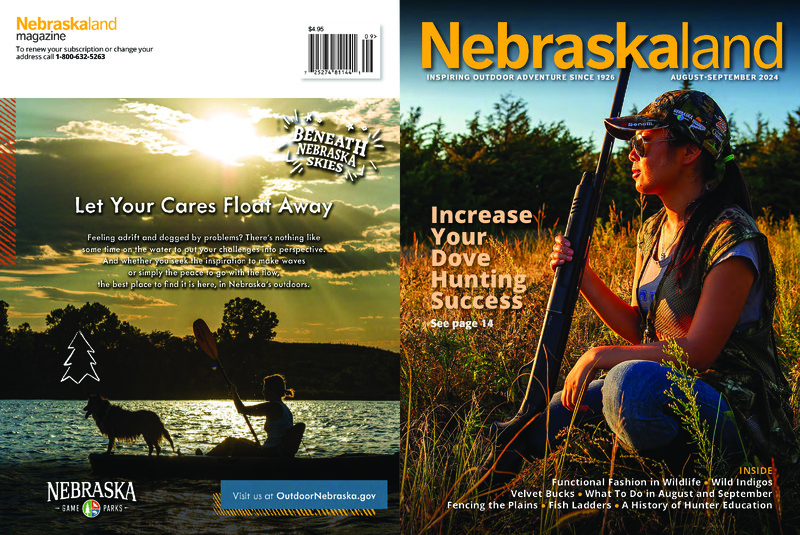
- Title:
- Volume 102, Issue 7, 2024
- Issue Name:
- August-September 2024
- Date Issued:
- 2024-08-01
- year:
- 2024
- Season:
- Summer
- Publisher:
- Nebraska Game and Parks Commission
- Format:
- Periodical
- volume:
- 102
- issue:
- 07
- number:
- 102.07
- Decade:
- 2020s
- Type:
- Rights Holder:
- Copyright Nebraskaland Magazine/Nebraska Game and Parks Commission, all rights reserved.
- Extracted Text:
-
magazine
$4.95
To renew your subscription or change your
address call 1-800-632-5263
I N S P I R I N G O U T D O O R A DV E N T U R E S I N C E 1 92 6
AU GU S T-S E P T E M B E R 20 24
Increase
Your
Dove
Hunting
Success
See page 14
INSIDE
Functional Fashion in Wildlife O Wild Indigos
Velvet Bucks O What To Do in August and September
Fencing the Plains O Fish Ladders O A History of Hunter Education
2
Nebraskaland • August-September 2024
August-September 2024 •
Nebraskaland
3
Volume 102 No. 7
August-September 2024
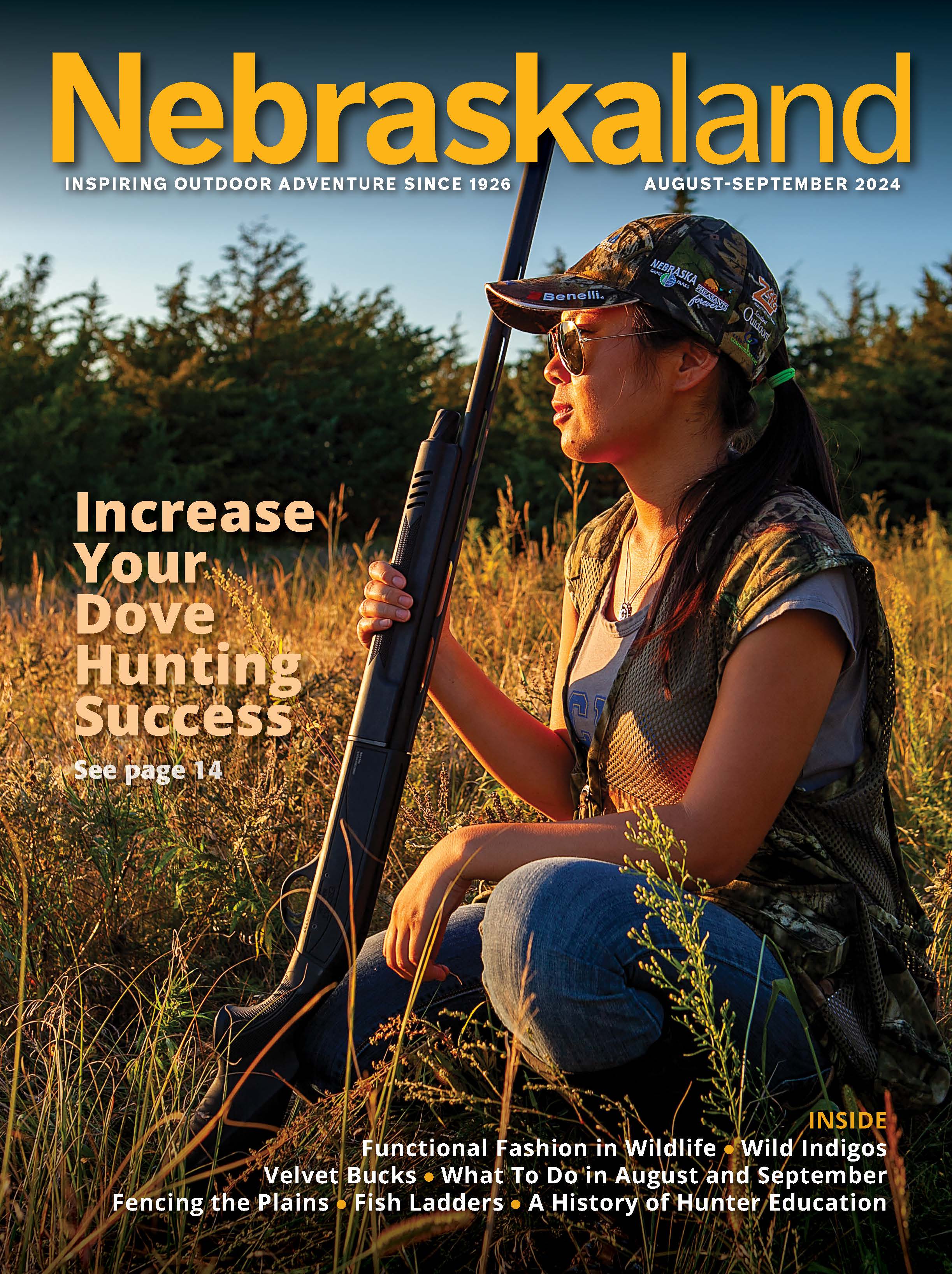
Cover: Jenny Nguyen-Wheatley hunts doves at Grove
Lake Wildlife Management Area in Antelope County.
JEFF KURRUS, NEBRASKALAND
This page: Oyster mushrooms grow on a tree trunk at
Wilderness Park in Lancaster County.
FEATURES
20
CHRIS MASADA
FUNCTIONAL FASHION
In Wildlife
Story by Lauren Salick, Photos by Alex Wiles
26
WILD INDIGOS
30
OUTDOOR NEBRASKA
Story and photos by Gerry Steinauer
What To Do in August and September
By Renae Blum
32
50 YEARS EDUCATING HUNTERS
42
VELVET BUCKS
By Eric Fowler
The Science of Antler Velvet and When to Harvest
By Brian Peterson
46
FENCING THE PLAINS
50
FISH LADDERS
By David L. Bristow, History Nebraska
Something Could Mean Everything
Story and photos by Eric Fowler
DEPARTMENTS
8
12
54
64
66
Your Nebraska
In the Field
Mixed Bag
Portraits from the Past
The Last Stop
ON THE WEB
For more articles and
information, visit
NebraskalandMagazine.com
Nebraskaland (VOL. 102 / NO. 7 ISSN 0028-1964) is published monthly, except for the combined Jan./Feb. and Aug./Sept. issues, by the Nebraska Game and Parks Commission, 2200 N. 33rd
St., Lincoln, NE. Periodicals postage paid at Lincoln, Nebraska, and additional mailing offices. POSTMASTER: Send all UAA to CFS. (See DMM 507.1.5.2); NON-POSTAL AND MILITARY
FACILITIES: send address corrections to Nebraskaland, P.O. Box 30370, Lincoln, NE 68503-0370.
4
Nebraskaland • August-September 2024
August-September 2024 •
Nebraskaland
5
Magazine Staff
magazine
Published by the Nebraska Game and Parks
Commission since 1926. The Commission is
dedicated to the conservation and protection
of all the state's natural resources and the
people who use them.
Communications Director Christy Firestone
Public Relations Manager Shawna RichterRyerson
Editor Jeff Kurrus
Associate Editor Jenny Nguyen-Wheatley
Regional Editors Eric Fowler, Julie Geiser,
Justin Haag
Contributing Editor Michael Forsberg
Regular Contributors Renae Blum,
Chris Helzer, Chris Masada, Todd Mills,
Ryan Sparks, Gerry Steinauer
In the middle of August, sumac fruit
start to turn crimson. GETTY IMAGES
Art Director Tim Reigert
Graphic Designer Mel Severin
Videographer Nick Sauvageau
Photo Librarian Jaclyn Cruikshank Vogt
Administration
Director Tim McCoy
Deputy Director Jim Swenson
Assistant Director Roger Kuhn
Commissioners
Chairman - Doug Zingula, Sidney
Vice Chairman - John Hoggatt, Kearney
2nd Vice Chairman - Donna Kush, Omaha
Magazine Subscriptions
For address changes, magazine and subscription
questions, 800-632-5263 or visit
nebraskalandmagazine.com
Advertising
For advertising information, contact:
Shane G. Gilster, 402-742-0125
shanegilster@solotreemedia.com
Pat Berggren, Broken Bow
Rick Brandt, Roca
Scott Cassels, Omaha
Ken Curry, Columbus
Dan Hughes, Venango
Nebraskaland Magazine Copyright 2024, all rights reserved.
Nebraskaland is available in audio from the Nebraska Library Commission
Talking Book and Braille Service, Suite 120, 1200 N St., Lincoln, NE 68508.
800-742-7691. Nebraskaland Magazine and the Nebraska Game and Parks
Commission reserve the right to reject any advertising not in keeping with
the agency mission.
Rates: $18 for one year; $33 for two years; $44 for three years. Nebraska
recipients must add appropriate sales tax. To subscribe call
1-800-NEBLAND (632-5263), or go online to:
NebraskalandMagazine.com.
Commission Offices
Conservation Officers
Headquarters/Southeast District Office
2200 N. 33rd Street Lincoln, NE 68503
Phone 402-471-0641
ADMINISTRATION
Jeff Clauson
402-471-5531
Lincoln HQ
Administrator
Travis Shepler
402-471-5531
Lincoln HQ
Asst. Administrator
Stacey Lewton
402-471-5531
Lincoln HQ
Asst. Administrator
Mike Thome
402-471-5531
Lincoln HQ
Asst. Administrator
Northeast District Office
2201 N. 13th St. Norfolk, NE 68701
Phone 402-370-3374
Southwest District Office
301 E. State Farm Rd. North Platte, NE 69101
Phone 308-535-8025
(Includes counties covered)
Northwest District Office
East Hwy. 2, Box 725 Alliance, NE 69301
Phone 308-763-2940
NORTHWEST
Dan Kling
308-430-0572
Captain
Bassett Office
524 Panzer St., Box 508 Bassett, NE 68714
Phone 402-684-2921
Jerod Hahn
Kearney Office
1617 First Ave. Kearney, NE 68847
Phone 308-865-5310
Ak-Sar-Ben Aquarium/Schramm Education
Center
21502 W. Highway 31 Gretna, NE 68028
Phone 402-332-3901
Omaha Office
8495 Frederick Street, Omaha, NE 68124
Phone 402-595-2144
OutdoorNebraska.gov
EAST SUB-DISTRICT
308-520-5539
Sergeant
308-280-4320
Hunter Lee
Keith, Arthur, Deuel
Jaden Porter
308-289-2274
Keith, Garden, Grant
Tyler Stueck
308-289-6260
Keith, Arthur, Grant
Keith Jadlowski 531-310-2869
Keith
WEST SUB-DISTRICT
Sean McKeehan 308-672-1824
Sergeant
Josh Widhelm
308-279-9133
Scotts Bluff, Banner, Sioux
Brandon Wallace 308-280-4488
Scotts Bluff, Banner, Sioux
Jacob Stoinski
308-615-9017
Sioux, Dawes
Travis Schultz
308-279-1292
Morrill, Scotts Bluff
Casey Gehrt
402-617-2112
Dawes, Sheridan
NORTHEAST
Dale Davis
402-760-0712
Captain
The Nebraska Game and Parks Commission does not discriminate
based on race, color, ethnicity, national origin, sex, pregnancy, sexual
orientation, gender identity, religion, disability, age, genetic information,
veteran status, marital status, and/or political affiliation in its programs,
activities, or employment. Any person who believes he or she has been
discriminated against in any program, activity, facility, or service,
should contact the Nebraska Game and Parks Commission, Lincoln, NE
402-471-0641, the Nebraska Equal Opportunity Commission, Lincoln,
NE 402-471-2024, TTY/TDD 800-642-6112; Director, Office of Diversity,
Inclusion and Civil Rights, U.S. Department of Interior, 1849 C Street,
NW, Washington, D.C. 20240.
6
WEST SUB-DISTRICT
Jeff Jones
402-762-5022
Sergeant
402-314-9257
John Bauer
Holt, Boyd
Greg Hesse
308-546-7464
Rock, Brown, Keya Paha
Nebraskaland • August-September 2024
There will be a supermoon on Sept.
17. A supermoon is when a full moon
occurs at the closest point to Earth.
JUSTIN HAAG, NEBRASKALAND
Jonathan Andreasen
402-340-3981
Madison, Pierce, Stanton
Trevor Stahlecker
402-928-9099
Knox, Antelope, Pierce
Mitch Johnson
402-613-8612
Cedar, Knox
EAST SUB-DISTRICT
Cory Krause
402-380-6410
Sergeant
Kyler Prochaska 402-830-8278
Platte, Colfax
Matt Costello
402-317-4014
Dodge, Colfax
Kelbi Abke
402-237-2537
Washington, Burt
Nicholas Fix
402-508-0261
Dixon, Dakota, Thurston
Kyle Hansen
531-739-7392
Dodge
CENTRAL SUB-DISTRICT
Doug Pollard
308-730-7050
Sergeant
Daryl Teter
308-440-1863
Howard, Greeley, Merrick
Matt Brandt
308-202-0819
Sherman, Howard
Klint Gill
402-613-5800
Nance, Wheeler, Boone, Polk
Garrett Zimmer 402-416-5736
Hamilton, Polk, York
Tim Williams
308-380-7331
Hall, Hamilton, York
SOUTHWEST
Brian Piernicky 308-330-8780
Captain
NORTH SUB-DISTRICT
Alex Hasenauer
308-660-4671
Sergeant
402-389-0444
Frank Miller
Cherry, Hooker
Luis Nuñez
531-333-6093
Blaine, Custer, Thomas
Brandon O’Neal 308-530-3157
Lincoln, McPherson, Logan
SOUTH SUB-DISTRICT
Taylor Dixon
308-217-2108
Sergeant
Bryce Streger
308-537-0404
Dawson, Gosper, Custer
Tyler Adelman
402-314-4783
Dawson, Gosper, Furnas
Kelsey Glodowski
308-242-9000
Red Willow, Frontier, Hayes, Hitchcock,
Furnas
Sophia Gobber 308-222-0368
Chase, Dundy, Hayes, Hitchcock
SOUTHEAST
WEST SUB-DISTRICT
Matt Taylor
402-200-9597
Sergeant
402-902-2017
Eric Javins
Adams, Clay, Webster
Justin Gress
308-629-9335
Thayer, Nuckolls, Fillmore
Pat George
308-920-2762
Harlan, Franklin, Phelps
Ethan Teter
308-440-3847
Buffalo, Kearney
EAST SUB-DISTRICT
Heath Packett
402-210-0888
Sergeant
402-209-1506
Russell Mort
Otoe, Johnson
Rich Berggren
402-619-1355
Douglas
Brian Arp
531-530-9011
Douglas, Sarpy
Mike Luben
402-443-6392
Saunders
Bryan Adams
402-429-1924
Nemaha, Pawnee, Richardson
CENTRAL SUB-DISTRICT
Matt Seitz
402-806-0915
Sergeant
402-890-6463
Dina Barta
Lancaster
Mark McDonald 402-805-2353
Lancaster
Mark Sullivan
402-741-0636
Lancaster, Seward, Butler
Jarrod Messman 531-739-9760
Lancaster, Saline
Curt Prohaska
402-470-1298
Lancaster
YOUR NEBRASKA
Instagram Photos
Jakob Oates, Denver, Colorado
From Our Antelope County Farm
Follow us @nebraskaland
and tag us in your photos
to be featured in an
upcoming issue.
Roger Richters, Utica
Bumble Bee
Steve Frederick, Scottsbluff
Bald Eagle
8
Nebraskaland • August-September 2024
August-September 2024 •
Nebraskaland
9
Gordon Warrick, Valentine
Wild Honeysuckle
Mat Custer, Omaha
Barred Owl
Correction: On pages 10-11 of
the July issue, the photo was
incorrectly attributed. It was Justin
Haag’s image of swamp milkweed.
We regret the error.
Marquene Koontz, Ogallala
Lake Ogallala
Correction: On pages 4-5 of the
May issue the photo was identified
as western wallflower — it is, in
fact, a hairy puccoon. We regret
the error.
Send your comments and
photos to:
Jeff Kurrus, Editor
Nebraskaland Magazine
P.O. Box 30370
Lincoln, NE 68503
or email Jeff.Kurrus@Nebraska.gov
Please include your postal address
and telephone number. Letters
may be condensed and edited.
Photographs are also welcome.
10
Nebraskaland • August-September 2024
August-September 2024 •
Nebraskaland
11
IN THE FIELD
HEADING SOUTH
A painted lady butterfly,
the most widespread
butterfly species on
the planet, feeds on a
Maximilian sunflower
at Lake Wanahoo in
Saunders County. Like the
monarch, painted ladies
migrate, and in years
when populations are
high, the late summer,
southerly migration can
be spectacular.
ERIC FOWLER,
FOW
OWLER,
LER NEB
NEBRASK
RASKALAN
RASK
ALAN
LA D
12
Nebraskaland • August-September 2024
August-September 2024 •
Nebraskaland
13
IN THE FIELD
Angelo Becerra of Omaha hunts doves with his sons, Angelo Jr. and Adrian, in a food plot planted with
sunflowers at Helmuth Marsh Public Access Area in Lancaster County. ERIC FOWLER, NEBRASKALAND
INCREASE YOUR DOVE HUNTING SUCCESS
By Julie Geiser
Dove hunting is one of the most challenging hunts around;
these fast-flying acrobats of the sky can outmaneuver some
of the best wing shooters. Here are a few tips to increase your
dove hunting success.
Pattern that Shotgun
The first item on your to-do list is to pattern your shotgun.
This important step allows shooters to gain knowledge
on how their shotgun shoots while using different brands
of ammunition at different distances and with different
chokes. For doves, most hunters use lead shot size 7 to 9;
if you’re hunting in an area that requires steel shot, use
No. 6. Most dove hunters use an improved or modified
choke for doves at ranges 25 to 35 yards. Pattern your
shotgun using different combinations to find what
works best for you.
When you determine which brand, load and shot size
produce the best pattern at the distance you normally take
most of your shots, buy a few boxes of those shells and head
for the practice range.
Practice Shooting
Shooting sporting clays is probably the best way to
increase your accuracy for doves, as these clays are fast
moving and can change direction. It will also allow you to
correct mistakes in form and technique and learn to estimate
leads at various angles and distances.
14
Nebraskaland • August-September 2024
Scout for Birds
Scouting for birds is the next step for success. Finding
watering holes, food sources, roosting areas and flyways
frequently used between each of these areas will help you
pattern doves. Scout several locations before the season
so you can move from place to place. Too much hunting
pressure in one area can quickly ruin the hunt. Always ask
for permission on private lands.
Stay still and hidden once you find a location to hunt.
Dress in camouflage that matches the location. Doves can
quickly flare at movement and colors that don’t fit in the
terrain. Find cover by using the landscape, vegetation and
shaded areas to conceal yourself.
Decoys
Use decoys to put birds at ease and bring them in range for
a shot. Clip decoys to sunflowers, fence wires or tree branches
for a realistic setup. Set decoys at different distances to help
you determine whether a bird is close enough to shoot. One
tip: If you can see a dove’s feathers and they appear dark, the
bird is most likely in range. If the bird is a light gray blur, it’s
probably too far out.
Last, hunt later in the season. Once other dove hunters
have stopped hunting, a new set of doves may come to use
an area. A good cold spell in northern areas can send birds
migrating south, giving hunters another chance at doves
before they migrate onward.
IN THE FIELD
Trophies awarded at the Nebraska Youth Smallbore Silhouette Invitational at Pressey Wildlife Management Area.
JULIE GEISER, NEBRASKALAND
NEBRASKA YOUTH SMALLBORE
SILHOUETTE INVITATIONAL
By Julie Geiser
Bullets will travel downrange
at steel targets of chickens, rams,
turkeys and pigs at the 48th annual
Nebraska Youth Smallbore Silhouette
Invitational on Sept. 28. The youth .22
competition is set in the rolling hills
of Pressey Wildlife Management Area,
where young shooters from across
the state will participate for free.
Established in 1977, this competition
is the longest-running organized youth
shooting event in Nebraska.
The competition is open to all
youth ages 11 and older who have
successfully
completed
Hunter
Education and have not yet graduated
high school. Shooters are grouped into
classes according to age, rifle weight,
16
Nebraskaland • August-September 2024
sight type and experience level. They
may compete individually or as part of
a team. The competition consists of 40
rounds fired in two five-round stages
at silhouette targets at 40, 60, 77 and
100 meters. Competitors must shoot
their rifle unsupported at each steel
silhouette target.
The event is lauded for its familyfriendly atmosphere and the
camaraderie among youth and their
families and friends.
Pressey WMA is located 17 miles
south of Broken Bow in Custer
County. For more information
about this event, contact Matthew
Haumont at 308-527-3403 or
nebraskasilhouette@gmail.com.
IN THE FIELD
NATIVE AMERICAN GROUSE ‘TACOS’
By Jenny Nguyen-Wheatley
One of the latest cookbooks I’ve
acquired is called The Sioux Chef’s
Indigenous Kitchen by Sean Sherman
with Beth Dooley. A James Beard
Award winner, Chef Sherman’s book
is a modern reclamation of Native
American cooking in the Dakotas and
Minnesota regions. One recipe that
stands out is “Indigenous Tacos.”
Using fried corn mush rounds as
base, Chef Sherman tops his tacos with
bison meat, which he seasons with
native flavorings such as juniper, sage
and sumac. He also drizzles the tacos
with a fruit sauce called wojape, which
he prepares with seasonal berries
such as chokecherries, blueberries,
raspberries and elderberries.
I piled these tacos with Nebraska
sharp-tailed grouse and wojape made
with prickly pears, which grow wild
in the western part of Nebraska where
I hunt sharpies, and also mulberries,
which my husband and I gather and
freeze every summer.
Servings: 2
Prep Time: 20 minutes
Cooking Time: 1 hour
Ingredients:
4 sharp-tailed grouse breasts,
boneless (2 birds)
8 juniper berries, finely ground
Dried sumac, to taste
Salt, to taste
2 to 3 tbsp. of duck fat or oil, plus
extra
1 medium shallot, finely minced
1 to 2 tbsp. apple cider vinegar
1
⁄2 cup brown or yellow onion,
chopped
Small bunch of sage leaves,
chopped
•
•
•
•
•
•
•
•
•
Corn Cakes
3 cups of water
•
18
Grouse meat, sage, onion and wojape on corn cakes.
• ⁄ tsp. fine sea salt
• 1 cup coarse grind yellow
1
2
cornmeal or polenta
Fruit Sauce
3 large prickly pears (about 1½
cups of flesh)
1 cup mulberries
2 tbsp. honey, or to taste
•
•
•
1. Set out grouse breasts on the
counter for an hour prior to cooking.
To make the corn cakes: In a medium
saucepan, bring 3 cups of water to a
boil. Gradually whisk in cornmeal and
sea salt, and stir to get rid of all lumps.
Turn heat to low and cook covered for
30 minutes, stirring often to prevent
scorching. When cooked, set corn
mush aside to cool.
In a small bowl, combine minced
shallot and vinegar, and set aside to
soak. Note that Native Americans do
not traditionally use vinegar in their
cooking.
2. Meanwhile, make the fruit sauce:
Slice off prickly pear ends, slice down
the skin and peel. Chop the seedy flesh
and place in a small saucepan with
the mulberries. Crush the fruit with
Nebraskaland • August-September 2024
JENNY NGUYEN-WHEATLEY, NEBRASKALAND
a potato masher, bring to a simmer
and cook for 15-20 minutes, stirring
occasionally. Stir in honey to taste.
Then run fruit and juice through a fine
mesh strainer or food mill, squeezing
out as much juice as possible. Discard
pulp and seeds. If needed, return
juice to the saucepan and continue to
simmer to thicken. Set aside to cool.
3. To prepare the meat: Season
grouse breasts with salt, finely
ground juniper berries and generous
sprinklings of sumac. Heat duck fat
or oil in a pan over medium-high
heat and sear on both sides. Remove
breasts and loosely cover in foil to
finish cooking and to keep warm. In
the same pan, sauté chopped onion
and sage to soften over medium heat
with a pinch of salt.
4. With your hands, form corn mush
into cakes about 3-4 inches in diameter
and 1⁄2-3⁄4 inch thick. Heat fat in a pan
over medium-high heat, and brown
cakes on both sides until golden and
crispy. Chop grouse into small pieces.
Serve meat on top of corn cakes with
drained “pickled” shallot, onion and
sage, fruit sauce and finishing salt. Eat
them with your hands.
August-September 2024 •
Nebraskaland
19
Functional
Fashion
In Wildlife
Story by Lauren Salick
Photos by Alex Wiles
ike a trusty, utilitarian pair of cargo shorts, the
“accessories” genetics gifted to wild animals not only
provide style but also varying adaptations for survival.
Animals use their functional body adornments to
protect themselves from predators, acquire food, navigate
their environment, thermoregulate and even attract mates.
While cargo shorts aren’t exactly the human ideal of “sexy,”
many species use functional fashion to display messaging of
strong genetics and lineage to prospective partners. Animal
“fashion” is the perfect intersection of function. And many
of these adaptations exist at the microscopic level.
L
Feathers
Whether pokey or soft, colorful or camouflaged, feathers
generally come in seven unique “styles” — wing, down,
tail, contour, semiplume, filoplume and bristle. Each type
of feather supports the bird in unique ways. Stemming from
a firm, yet supple central pillar called the rachis are thin
The fragile, overlapping scales on the wing of a black swallowtail butterfly under a microscope. The delicate veining in the
bottom left corner carries air for structural support of the wing, not blood as with other types of veins.
The interlocking barbule segments on a wild turkey’s
contour feather show slight iridescence under light.
20
Nebraskaland • August-September 2024
filaments called barbs, which branch further into barbules.
Zoomed in, these teeny-tiny barbules possess interlocking
structures that hold the barbs “zipped” together, creating
tension to ensure a smooth surface for air or water to glide
across — such as on a “wing” feather.
Yet some feathers are less uniform: Down feather barbs
billow in chaotic fashion, trapping warm air closer to the
body of the animal. A bristle feather, by contrast, sports a
few barbed filaments at the beginning, and then a towering,
naked rachis. These hair-like feathers are often found
around a bird’s eyes and beak, offering contextual sensory
information to the animal in whisker-like fashion.
While some feathers sprout from the bird’s skin, others,
such as the primary wing feathers, will actually grow out
of, and be attached to, the bird’s wing bones. These stout
feathers are filled with pulp as they grow. When the pulp
recedes back into the bone, it leaves the hollow, quill-like
feather, long used by humans as writing instruments.
Wing Scales
Lepidoptera, the taxonomic order that makes up butterflies
and moths, means “scale wings” in Latin. While the
surfaces of butterflies and moths’ wings look smooth and
uninterrupted to the human eye, it is actually adorned in
thousands of colored, microscopic scales. The entire wing is
also veined with delicate, air-filled structures that provide
support and strength. When we take a closer look, these
delicate structures are easily rubbed off and give these
winged insects their brilliant colors and patterns. Anyone
who has caught a butterfly and come away with fine, dustlike particles on their hands has experienced this personally.
Physically, the scales are made of overlapping pieces
of chitin — a strong natural biopolymer — layered on top
of two thin membranes that create the wing, fed by even
smaller veins. Together, they make brilliant patterns of spots,
stripes, swirls and colorful blocking — making some wings
real runway showstoppers and others, more demure and
camouflaged.
But scales are not just a flashy accessory. These shingle-
August-September 2024 •
Nebraskaland
21
Quills
Some snakes have an apex-like ridge on the middle of their scales called the keel, while others are smooth. The skin from a
black rat snake as shown here has a slight keel.
like structures can also help the insect stay warm. On sunny
days, you might see a butterfly basking with its wings
open, its darker pigmented wing scales soaking up the solar
radiation.
Other types of specialized scales possessed by some male
Nebraskaland • August-September 2024
While not always seen while swimming or on the ground,
the pastel blue of a blue-winged teal’s upper wing coverts
are distinctive in flight.
example of convergent evolution.
Convergent evolution happens when animals that are
not closely related, such as porcupines and hedgehogs, or
do not share a common ancestor, adopt similar features or
characteristics on their bodies to meet a similar need — in
this case, for protection.
But could this “fashion” be fatal? Porcupines climb
trees, and as they are not the most agile of animals, often
butterflies called androconia release provocative pheromones
for breeding. Some scales affect air flow, reducing drag, as the
insect flies aiding in its aerodynamic abilities. Some species’
scales are even hydrophobic — capable of shedding water
and dirt.
Images of the tip of an albino North American porcupine’s quill. The cuticular “scales” seen extending away from the tips act
as barbs, embedding in the skin as the victim attempts to pull out the quill.
22
Quills are a type of modified hair armor-plated in sheaths
of keratin. While they’re not “shot” from the animal like
urban legend might claim, quills do often possess irritating
backward-facing barbules near the tip that ensure difficult
removal from the skin of a would-be predator. Nebraska’s
sole quill-wearer, the North American porcupine, has quills
approximately the diameter of an 18-gauge hypodermic
needle, but only requires half the amount of force to break
the skin barrier than said needle.
A fine protective coat, animals also use quills to send a
message of warning. This is known as aposematism, or
deterring predators with color or body coverings. Flaring
them wide or rattling them together, a porcupine can deter
an animal it deems a threat in an intimidating display. Often,
the quills used in this acoustic form of aposematism are
hollow for enhanced noise-making, such as those on African
species of porcupines.
It’s important to note that quills are different from
another pokey accessory — spines. Quills are a type of spine
that fall out easily and have different shapes and lengths
depending on where they are located on the body. “Spine” is a
generalized term for any hardened, keratinized modified hair,
encompassing even those that are deeply embedded into an
animal body — such as with the hedgehog. Both of these
spines evolved separately in different species and are thus an
While some barbules are “zipped” up tight, others, like that in the tail feather of a ring-necked pheasant, are more softly
interlaced.
August-September 2024 •
Nebraskaland
23
The neon-colored rachis, or central pillar, of a yellow-shafted flicker feather — the meaning of its namesake.
In this photo, you can just visualize the scaled keratinized cuticle, lining the outermost layer of the hair, in the coarse guard
hairs of a Virginia opossum.
subsequently fall out of them. Dislodged quills can embed
themselves into the porcupine’s skin in a luckless condition
known as “self-quilling.” It turns out these reclusive rodents
have a plan for that, too — studies have shown that North
American porcupine quills are covered with free fatty acids,
providing antibacterial properties that prevent infection
from self-inflicted stabs.
inspired by animal body coverings are sure to continue in our
future. N
Lauren Salick is the education director for Nebraska Wildlife
Rehab, dedicating her career to fostering respect and harmony
between humans and wildlife. Alex Wiles is the creative
director of NEW Multimedia.
Functional Fashion — Always in
Season
The delicate pennaceous branching of a bristle feather of a wild turkey near the beginning of the rachis (closer to the body of
the animal).
24
Nebraskaland • August-September 2024
Like humans and clothing, animal body coverings are
a genetic response to their ecology and habitat. Carefully
curated over generations, feathers, fur, scales and quills
represent the dominating phenotype that is most successful
for survival. If a fish’s scales are the “cargo shorts,”
then a phenotype is the outfit — or a set of observable
characteristics, including the fins, gills, coloration and other
adornments on an animal’s body. While one species may
have varying phenotypes, there is generally one that is
predominant — and this “trending” outfit became popular
not via the runway, but by fitness in an animal’s environment.
While fanciful feathers, embellished scales and rattling
quills may seem analogous to the fripperies of haute couture
— when we take a closer look, animal fashion serves much
more than just for show. Exciting discoveries and inventions
The mottled plumage of a common nighthawk. The stark
contrast of colors work together to provide camouflage for
the animal when seen as a whole plumage.
August-September 2024 •
Nebraskaland
25
Wild Indigos
Exceptional Native Ornamentals
Story and photos by Gerry Steinauer, Botanist
sk any horticulturalist what
wildflowers
make
good
ornamentals, and wild indigos
are usually near the top of
their list. Fortunately, Nebraska is
home to three native wild indigos —
plains, blue and white — all of which
are easily started in greenhouses and
transplanted as seedlings into flower
gardens or established from seed or
transplants in backyard prairies.
For many, the most appealing aspect
of wild indigos as ornamentals is their
bush-like shape and tall, colorful
spikes of spring-blooming flowers. I am
a fan of their large, inflated seed pods
that remain attached to the spikes
well into fall; they add a unique touch
A
to our small backyard prairie in Aurora.
But best of all, once established, these
deep-rooted, hardy perennials require
little care and will add beauty to your
landscape for years to come.
Nebraska’s Wild Indigos
Belonging to the pea family and
also known as false indigos, our state’s
three wild indigos inhabit tallgrass
prairie in southeastern Nebraska.
Cattle tend to avoid grazing wild
indigos, so they are usually more
abundant in grazed pastures compared
to un-grazed or hayed prairies.
Plains
wild
indigo
(Baptisia
bracteata) is our most common and
Plains wild indigo adds beauty to a flower garden in Aurora. With their bushy
growth, large flower spikes, long lifespan and low maintenance, wild indigos are
appealing ornamentals.
26
Nebraskaland • August-September 2024
widespread species. It is a muchbranched, stout plant reaching a foot
in height and coated throughout in
short, velvety hairs. Its large, creamyyellow flowers begin blooming in early
May, somewhat earlier than our other
wild indigos. The flower spikes spread
outward with their tips often touching
the ground, and their oval seed pods
reach 2 inches in length, tapering to a
sharp-pointed tip.
In contrast, blue wild indigo (B.
australis) is the rarest of our wild
indigos. Botanists speculate that prior
to Euro-American settlement, it grew
in Nebraska only on limestone soils
in Jefferson County. In the mid-1900s,
many crop fields in southeastern
Nebraska were replanted with prairie
grass seed harvested in Kansas, where
the plant is common. It is likely blue
wild indigo seed was occasionally
harvested along with the grass seed,
establishing additional populations of
the wildflower.
Blue wild indigo plants are 1 to 2 feet
tall and, unlike plains wild indigo, have
stems and leaves that are hairless, but
unlike white wild indigo, they are not
waxy. Their upright flower spikes are
adorned with intense blue to blueviolet blooms, which begin to open in
late May. The oblong seed pods have a
sharp-pointed tip and reach 2 inches in
length.
White wild indigo (B. alba), perhaps
the most grazing-tolerant of our wild
indigos, can survive even in heavily-
Plains wild indigo
blooms in a tallgrass
prairie in Lancaster
County.
August-September 2024 •
Nebraskaland
27
grazed pastures. Typically reaching
about 3 feet tall in prairies, it can
tower to over 5 feet in gardens. The
wildflower has smooth, waxy bluishgreen stems with many ascending
branches, each plant producing one to
several flower spikes that stretch to an
impressive 18 inches in length, rising
well above the foliage. The white
flowers, which bloom from late May
through June, are about an inch long
and have a distinct purple spot at the
base of the uppermost petal. In midsummer, the inch-long, short-beaked,
oval seed pods ripen from a vibrant
chartreuse green to a light charcoal
black.
Greenhouse Seedlings
Bob
Henrickson,
Horticulture
Program coordinator for the Nebraska
Statewide Arboretum in Lincoln, has
been growing and selling wild indigos
for over 20 years. While heartily
promoting the natives, he avoids
cultivating the many wild indigo
hybrids and crosses, such as “Screamin
Blue wild indigo flowers in a prairie restoration in Hamilton County. This species
has endured in this restoration for nearly 45 years.
28
Nebraskaland • August-September 2024
Yellow,” which has over a 100 flower
spikes per plant, or “Dutch Chocolate,”
which has dark brown flowers. “People
are smitten by the hybrids’ colors, but
I see more bumblebees on the flowers
of the native wild indigos,” said
Henrickson. Bumblebees, the primary
pollinators of wild indigos, may prefer
the natives over the hybrids because
they provide more nectar and pollen
for them to consume. The Arboretum
annually grows and sells several
hundred white and blue wild indigo
plants.
“They
go
fast,”
remarked
Henrickson. He collects the seeds for
growing white indigo plants from a
prairie in Cass County, while the blue
indigo seeds are harvested from garden
plants originating from Kansas seed.
The plants are too few and far between
in Nebraska to support seed collection.
Henrickson only occasionally grows
plains wild indigo. This is because, in
most years, he cannot collect enough
seed from local wild populations to
grow greenhouse plants due to the
baptisia seed borer. This tiny black
weevil with a long snout lays its eggs
inside plains wild indigo pods, and the
maturing grubs consume nearly all the
seeds. The borer prefers this species
and is far less attracted to white and
blue wild indigo pods, allowing them
to consistently produce seed.
Before
planting,
Henrickson
scarifies the hard-coated indigo seeds
by placing them in a coffee can, adding
hot water just below the boiling
point, and letting them sit overnight.
The heat breaks down the seed coat,
allowing germination. He then plants
the seeds in small containers filled
with potting soil and places them in a
cooler for a month.
Wild indigo seeds, and those
of most other native plants, must
undergo a period of cold temperature
to germinate. This prevents them from
germinating in their first summer
or fall and exposing their tender
seedlings to the harsh winter cold.
In late February, after stratification,
Henrickson places the containers
in a warm greenhouse, and the wild
indigo seedlings are ready for sale
and transplanting in May. The firstyear seedlings are rather scraggly
with few leaves, which turns off
some customers, but these plants
will survive transplanting. Secondyear seedlings are more robust,
and the plants often bloom in their
third year.
“People need to be patient with wild
indigos; the payoff takes time,” said
Henrickson.
He recommends transplanting the
seedlings into well-drained soil in full
sun. Wild indigos can survive in partial
shade, but their foliage and blooms
will be less vigorous. Once established,
the mature, deep-rooted plants will
not survive transplanting.
A Top 10 Native Ornamental
Based on their showiness, hardiness
and ease of care, Henrickson ranks
wild indigos among his top 10 favorite
White wild indigo seed pods adorn a backyard prairie in Aurora. The pods remain
attached to the flower spikes through the fall.
A greenhouse-grown, four-month-old
plains wild indigo seedling is ready for
transplanting.
wildflowers for use as ornamentals. In
addition to their beauty, he admires
their pest resistance, hardiness and
drought tolerance. He has planted wild
indigos in gardens as far west as Scotts
Bluff County, where they do well with
watering. In eastern Nebraska, mature
plants require little to no watering.
He also appreciates that the plants
are long-lived. Case in point, a friend of
mine still enjoys the plains wild indigo
he planted in his Lincoln flower garden
over 20 years ago. In my backyard
prairie, the white wild indigos I seeded
nearly 25 years ago are still thriving.
Lastly, another important reason
for using wild indigos as ornamentals
is that they are native plants.
Unfortunately,
many
non-native
ornamentals introduced from Europe,
Asia and other distant lands, such as
yellow flag iris, Amur honeysuckle and
ox-eye daisy, have escaped cultivation
and invaded wetlands, woodlands
and prairies, displacing native plants.
Wild indigos pose no such threat to
Nebraska’s landscapes.
In conclusion, if you’re looking to
enhance your landscaping, I strongly
encourage you to go native and plant
wild indigos. Ornamentals don’t get
much better than this. N
August-September 2024 •
Nebraskaland
29
Outdoor Nebraska
By Renae Blum
These transitional months are a great time to stay active outdoors. Take
advantage of fall hunting seasons, and try your favorite outdoor activity
at a Nebraska state park! N
Participate in
archery deer
season
Sept. 1 – Dec. 31, 2024
Statewide
Hunting deer with a bow and arrow
is an intense experience, said Aaron
Hershberger, a hunting and shooting
sports outreach coordinator with
Nebraska Game and Parks. You’ll get
to see deer up-close, sometimes just
yards away. Plus, the season is a long
one, offering diverse experiences and
a range of settings to choose from for
your hunt. Hershberger recommends
scouting ahead of the season. “Know
where those deer are and where
they’re finding food,” he said. “Once
you know that they’re there, get out
whenever you can.”
What To Do in August and September
Fish for channel catfish
at Merritt
A peak time is August and September
Merritt Reservoir State Recreation Area
It’s late summer, and fishing can be tough.
However, catfish can still be caught; they’re a
warm-water species, have finished spawning
and are feeding now to get ready for winter.
While you might catch more catfish in other
places, you’ve got the best chance at big catfish
at Merritt Reservoir, up to 20 pounds and maybe
more. You can fish from either a boat or the
bank, and blood baits are a favorite this time of
year. DARYL BAUER, NGPC FISHERIES
Try the Go Ape ropes course
Dates vary; generally Fridays to Mondays in August
and September | Eugene T. Mahoney State Park
Whether you’re looking for a fun afternoon with family or
friends, a team-building activity or a rush of adrenaline, you
can find it with this treetop experience — the only one like it in
Nebraska. This high-ropes adventure course features suspended
obstacles, breathtaking zip lines and incredible views. A lessintense course, Treetop Journey, is available for kids, while
Treetop Adventure is designed for adults. Make a reservation
or learn more at GoApe.com/location/Nebraska-Ashland or by
calling 1-800-971-8271. JEFF KURRUS, NEBRASKALAND
JEFF KURRUS, NEBRASKALAND
Attend the Enders Fall
Trail Ride
Sept. 28, 9-11 a.m. | Enders Reservoir
State Recreation Area
Saddle up your horse for two-and-a-half
to three hours of riding through gorgeous
scenery and seeing wildlife such as deer,
turkey and pheasants. The park has hosted
a spring and fall trail ride annually for three
years now. “The biggest thing people can
experience [at the event] is new friendships,”
said ride leader Dayna Scherbarth. “You get
to meet other people who love horses just as
much as you do.” See additional details at
Calendar.OutdoorNebraska.gov.
ERIC FOWLER, NEBRASKALAND
30
Nebraskaland • August-September 2024
Look for cicada killer wasps
In Nebraska, time frame to see them is
July and August | Statewide
While these insects have an intimidating name — and
even an intimidating appearance, thanks to their large
bodies and the stingers that females have — they are
not aggressive toward humans, and usually only sting
people if directly handled or threatened. Spot them
around lawns, sidewalks, driveways, golf course sand
traps and garden beds. Females are busy hunting and
capturing cicadas for their nests, which serve as food
for the larvae. Cicada killer wasps help control insect
populations and assist in pollination, so rather than
fear them, be thankful for them! JULIE GEISER, NEBRASKALAND
August-September 2024 •
Nebraskaland
31
50 Years
Educating
Hunters
Conservation
Officer Larry
Elston teaches
firearm safety to
a young student
during a Hunter
Education class
in 1981.
JACK CURRAN,
NEBRASKALAND
used for Hunter Safety training programs, giving states the
funding needed to hire staff to manage the programs, recruit
and train volunteers and provide classroom materials.
“Without that funding source, we would have established
a program, but would it be as robust as it is today? Probably
not,” said Jeff Rawlinson, an assistant division administrator
at Nebraska Game and Parks who oversees Hunter Education
staff and has been involved in the International Hunter
Education Association for many years. “Federal funding was
crucial.”
The Nebraska Hunter Safety Program was launched by the
Nebraska Game and Parks Commission in September 1972.
By Eric Fowler
N
ebraska has always had a proud hunting tradition, but
by the 1970s, an increase in the number of incidents in
the field was becoming a big concern. Some incidents
had deadly consequences. Additionally, many hunters didn’t
know the game laws or how to hunt ethically.
Many factors could have played into the increase.
The state’s population was growing rapidly, and baby
boomers were taking to the field. The population also was
becoming increasingly urban, so more kids were growing
up on playgrounds instead of hunting rabbits on the farm
after learning how to safely use the .22-caliber rifle they
got for Christmas. Most of the incidents involved young,
inexperienced gun handlers.
Regardless of the cause, the need to teach people how
to hunt safely was real. In 1974, the Nebraska Legislature
recognized this need and passed a bill requiring youths ages
12 to 15 to pass a Hunter Safety course before they could hunt.
The results have been what was hoped for and expected: The
number of accidents began to decline, a trend that continues
to this day.
The Need
The roots of Hunter Education stretch to 1949, when the
National Rifle Association worked with the state of New York
to develop the nation’s first Hunter Safety training program to
address a problem: Many hunters knew little about firearms,
hunting or how to hunt safely.
That program served as the basis for programs now taught
and required, in some form, in every state. A few other
states followed New York’s lead and launched Hunter Safety
programs. Elsewhere, including in Nebraska, there were
voluntary programs taught by NRA members, sportsmen’s
clubs and 4-H groups.
In 1970, a major change was made to the 1937 PittmanRobertson Act, which distributes federal excise taxes
collected on firearms and ammunition to states for wildlife
management and restoration work. Through the DingellHart Act, a portion of a new excise tax on handguns could be
32
Nebraskaland • August-September 2024
Hunter Education teaches hunters, especially youths, how to be safe as they begin their time in the field.
It is required for anyone age 12 to 29. JEFF KURRUS, NEBRASKALAND
August-September 2024 •
Nebraskaland
33
The Mentored Youth Hunt Program Endures
by Eric Fowler
Jeff Rawlinson, outdoor education specialist and education manager with Game and Parks, speaks to volunteer instructors
during the Nebraska Hunter Education Conference at Eugene T. Mahoney State Park in 2023. ERIC FOWLER, NEBRASKALAND
Libby Badtke of Omaha hunts with guide Pat McCloskey
of Elkhorn during a mentored youth hunt at Pheasant
Haven Shooting Preserve near Elkhorn in 1996, the second
such hunt hosted in the state. KEN BOUC, NEBRASKALAND
34
Nebraskaland • August-September 2024
In the year prior, the agency had recruited and trained 200
volunteer instructors. The program, however, was voluntary.
When the Legislature passed its bill in 1974, Game and
Parks immediately boosted its efforts to recruit and train
instructors in every corner of the state, ensuring those
required to take the class were given the opportunity. By the
time the full bill took effect in 1976, 2,900 instructors were on
board and 17,439 youths had taken the in-person, classroom
course. Many schools offered the class as well.
At the core of the program is firearm and hunting safety,
things like safe gun handling and situations when it is or
isn’t safe to shoot at game. These are topics that youngsters,
especially 12-year-olds, might not understand or appreciate.
But Hunter Education is so much more. It covers the game
laws and regulations and why they exist, the importance of
being a responsible and ethical hunter — things that students
might not learn at home. The class also teaches the basics
of how to hunt and how to track and care for game. And it
delves into wildlife identification, behavior, management
and conservation, helping foster a greater appreciation of the
species the youths will pursue.
“We wanted hunters to have more knowledge, skills and
abilities,” Rawlinson said. “So that’s been the premise of the
program, and from that comes safety and compliance.”
because you know
Some kids grow
you had an impact
up hunting with
by putting them in a
their parents,
tree stand a bunch
grandparents
of times,” Sheets
or other family
said. “Some of the
members. Others
best days of my life
become interested
have been building
through other
relationships with
means, be it a friend,
those young people.”
something they read,
The mentored hunt
or something they
program has grown
saw on TV or the
substantially since.
internet.
Hunter Education
Both are required
staff continues to
to complete a Hunter
organize archery and
Education class.
muzzleloader deer
When that task is
hunts. Pheasants
complete, one of
Forever, a partner in
those kids can head
Since 1974, instructor Wes Sheets has been mentoring students like
that first mentored
back to the field. The
Grant Stutzman, shown here with the buck he harvested in 2022 on
hunt, has had more
other might have no
City of Lincoln property.
than 16,000 youths
place to hunt, and no
attend its youth mentor pheasant and dove hunts
one to take them.
since 1996. More recently, it has offered a Next Steps
Since 1995, Game and Parks and its partners have
program to pair young hunters and a family member
been helping Hunter Education graduates take that
with an experienced hunter to pursue wild birds.
next step with its mentored youth hunt program,
Game and Parks conservation officers have organized
allowing them to spend time in the field with
many turkey, waterfowl and other hunts. Several
experienced hunters.
National Wild Turkey Federation and Ducks Unlimited
The program began in March 1995 at Pheasant
chapters offer learn-to-hunt programs, as well.
Haven Shooting Preserve near Elkhorn.
“These programs let Hunter Education graduates
Announcements were sent to 800 recent graduates,
put to use what they learn in the course in actual
and 300 youths applied for 45 spots, illustrating
hunting situations,” said Aaron Hershberger, mentor
the need for such a program. They learned about
hunt coordinator. “For the ones who don’t have the
pheasants, shot clay targets and had a chance to hunt
contacts or resources to do it on their own, that’s
live birds.
really important.”
That December, five youths were selected to
Now the mentoring program has expanded to help
participate in an archery deer hunt on the Lincoln
another type of Hunter Education graduate take
Water System well field near Ashland. Wes Sheets,
then wildlife division administrator with Game and
their first steps in the field: adults. LearnHunting.org,
Parks and a Hunter Education instructor since 1974,
an innovative program developed by Nebraska and
helped organize that first deer hunt and has been
other states, pairs new hunters with certified Hunter
mentoring young archers ever since. Last fall, he
Education instructors who teach them more outdoor
mentored youths on nearly 50 hunts at the age of 84.
skills, including things like setting up a tree stand,
Sheets remembers some youths who would beg to
field dressing game and taking them hunting. “These
go hunting 25 times a year. He still hears from some
people have the knowledge, skills and abilities to
of the young hunters he mentored, some just calling
mentor and to be some of the best mentors in the
to let him know about a recent hunt or the bird dog
world,” Rawlinson said. “Some instructors are really
they got and trained.
liking that. It’s almost hunter ed in its truest form,
“When those stories come along, you just love them
taking someone hunting.”
Safety and Ethics
Hunting incidents didn’t only involve city dwellers.
Russ Mort of Nebraska City has been a Game and Parks
conservation officer for 47 years. Like many of his classmates
at Pawnee City High School, he grew up on a farm, had
experience with guns and spent time hunting.
His father, however, wouldn’t let him hunt with other kids.
“He was always scared of me getting hurt,” Mort said. “He
said, ‘I doubt if you will shoot yourself, but your friend might
shoot you.’”
August-September 2024 •
Nebraskaland
35
Joe Bober – 50 Years and 10,000 Safe Hunters
by Jeff Kurrus
Volunteer instructor Dave Haumont of Broken Bow teaches David Anderson of McCook how to shoot a .22-cal. rifle during a
Game and Parks-sponsored Youth Outdoor Skills Camp at the Nebraska State 4-H Camp in the Nebraska National Forest near
Halsey in 2003. ERIC FOWLER, NEBRASKALAND
Mentor Tom Lanz shows Christian Gates a deer scrape
during the first mentored deer hunt near Ashland in 1995.
KEN BOUC, NEBRASKALAND
36
Nebraskaland • August-September 2024
Mort was among the first graduates of Game and Parks’
new Hunter Safety program, passing the course in 1972 while
in high school. His father sat through the class with him. “To
be honest, he grew up not realizing things were illegal,” Mort
said. “I’m sure he learned that and he wanted to bring me up
correctly.
“I know when I took hunter ed, I learned a lot of stuff that
I didn’t know before. I learned why there are laws, and you
understand the need for laws. I think that’s huge.”
After becoming a conservation officer, he saw hunters’
knowledge and compliance with game laws grow, and he
believes Hunter Education played a big part in that. “That’s
about the only education we have nowadays, because a lot of
the parents, they don’t hunt anymore,” said Mort, who helps
teach classes.
When he sees Hunter Education graduates violate game
laws, it is often because they are hunting with someone who
doesn’t respect the laws and is bowing to peer pressure. But
it also goes the other way. “Kids will influence their parents,
too,” Mort said.
“The hunter ed card is pretty important to the kids.
That’s one of the first things they pull out of their billfold. It
definitely affects how they do things.”
“Dead is dead.”
“Just because it’s legal doesn’t
mean it’s right.”
“I almost killed one of my
friends.”
The quotes roll off volunteer
Hunter Education instructor
Joe Bober’s tongue like he has
said them a time or two before.
A good guess would say that’s
probably true since this is
Bober’s 50th consecutive year
as a Hunter Education instructor
and he has certified more than
10,000 students and 100 future
instructors.
Having taught that many
students, another fair assumption
would be that Joe simply likes
to give back. But it’s more than
that. “I’m a very selfish person,”
he said. “I want them to be safe
and knowledgeable. I do it for me.
It makes me feel so good when I
turn off the light at night because
I know that the people I taught
are going to be safe, responsible
hunters.”
A not-so-safe situation is one of
the main reasons Bober became
an instructor in the first place. In
his early 20s, during a pheasant
hunting trip with his friends, it
started pouring rain. Bober and his
buddies quickly climbed into their
vehicle, guns still loaded.
Bober attempted to unload his
shotgun, but his wet hand slipped
and the gun went off when he
closed its action. He blew a hole
through the roof of the car, and
powder burns covered his friends
in the back seat. It scared Bober so
much that he almost quit hunting,
but it did trigger a desire to help
educate others around him.
Over the next few years, Bober
began running AKC field trials. He
met a number of people, many of
them affiliated with the Nebraska
Game and Parks Commission.
Among them was Dick Turpin, the
first coordinator of Nebraska’s
Hunter Safety program.
“He was just starting to get the
program off the ground and, in
December of 1974, he certified me
to teach,” said Bober, who hasn’t
missed a year since.
“After I taught my first class, I
figured out I wasn’t as smart as I
thought I was,” Bober said. He also
admitted he learned something
new from every class he has
instructed. “It’s not about hunting.
It’s about right and wrong,” Bober
said. “If you got a covey of quail
J
JEFF
KURRUS,, NEBRASKALAND
and it’s 3:30 in the afternoon on a
really cold day, is it right to break
them up when they might not be
able to get back together before
nightfall? It’s not illegal. But is it
right?”
His classes are a mix of hands-on
instruction and videos, a reminder
of how some things have changed
through the years. “When I started,
we were using 16mm reel-to-reel
film. I got really used to fixing it.
Then we went to the VCR. Then the
DVD. Now it’s the iPad and laptop.”
Technology has changed the way
classes are taught. “When someone
didn’t understand something in
1974, they asked Uncle Jake or
Aunt Sally,” Bober said. “In 2024,
they type it in the iPad. That’s
a great thing. But there’s also a
drawback because people go to
YouTube and learn the wrong way.
But students do come in more
prepared.”
Bober has also adapted to
online Hunter Education classes,
something he vehemently opposed
initially. “I teach with passion,” he
said. “I explain why I teach. How
you can never bring a person
back.”
He tells a story about a young girl
he knew who was accidentally shot
in the spine with a pistol and spent
the rest of her life unable to take
care of herself. He asks his classes:
What would it be like if they had
done this to their brother, sister or
best friend? How would they feel?
“This is when I see the class turn,”
he said. “The light bulb comes on.
This just isn’t about hunter safety.”
Bober learned that, even with
the online course, his passion
would come out when he got those
students in an in-person Hunt
Safe session. “One of my prize
moments,” he said, “was when I
had four University of NebraskaOmaha students show up to class.
But they had no desire to get their
Hunter Education certificate. ‘Our
professor had his son take your
class,’ they said. ‘How you teach
with passion was why we were sent
here.’”
Because of his passion, Bober
has no plans to stop teaching
anytime soon, and the quotes
keep coming with each lesson he
provides.
“The only person I’ve ever seen
with eyes in the back of their head
was my mother. And that is why
you have to have proper shooting
zones.”
“Hunting is the only sport you
play with no referees. You have to
know right from wrong.”
“Whether you’re 11 or 73 years
old, you are an adult when you
have a gun in your hand. So you
and your buddies need to act like
adults.”
Every once in a while, even after
thousands of hours in the field and
in front of students, Bober runs
across a question he can’t answer.
“No problem,” he said. “If I can’t
answer it, I know someone who
can.”
August-September 2024 •
Nebraskaland
37
Brenda Fulk – Not Just for Boys
by Justin Haag
Brenda Fulk of Mitchell has long
known that hunting is not just for
the boys.
“More women are hunting and
shooting than 25 years ago,” she
said, thinking back to when she
was certified as a Hunter Education
instructor in 1999.
Statistics back that up. An
estimated quarter of hunters in the
U.S. are now women, and they’re
often referred to as the pastime’s
fastest-growing demographic.
When Fulk started, only 3 percent
of Nebraska’s Hunter Education
instructors were women. That
number, 28, has since doubled.
The 56 women teaching Hunter
Education in the state today
represent 11 percent of the total.
Game and Parks welcomes
female perspectives in the
classroom and on the range. Of
course, we’ve known that women
are as capable shooters as men
since Annie Oakley became an
international sensation, but
anatomical differences make
the process dissimilar between
genders.
“Women hold firearms a
bit differently and the sights
sometimes don’t line up,” she said.
“The male instructors don’t always
understand that.”
She knows one of the male
instructors well. Her husband,
Brad, has attained the title of
master instructor. The two have
PHOTO COURTESY OF BRENDA FULK
taught courses at sites throughout
the Panhandle, passing on the
knowledge they’ve learned in the
field. That knowledge and love
of hunting was also passed on to
their four now-adult sons.
One harrowing experience
stands out in Brenda’s mind and
New Requirements, Same Outcome
The Hunter Education program has undergone changes
over the past 50 years, including increases and decreases in
classroom instruction time, how it is offered, who must take
it, and even the name, which has evolved from Hunter Safety
to Hunter Education.
One of the major changes was the addition of a mandatory
Bowhunter Education program in 1993, addressing a need to
educate hunters in a growing sport that required a slightly
different skill set.
In 1996, new regulations required anyone born on or
after Jan. 1, 1977, to pass a firearm or Bowhunter Education
course, a move that would eventually require all hunters to
have completed training, as was already the norm in some
states. In 2008, recognizing that this requirement might
cause those unwilling to invest the time to take a course
38
Nebraskaland • August-September 2024
has prompted her to emphasize
teaching the budding hunters in
her classes to be prepared.
In September 2012, she was
hunting doves with her youngest
son and his friend when they
discovered the body of a man who
had been missing for four days
in a canal that crosses their Sioux
County ranch.
She said it was a traumatic
experience, but she uses the
experience in the classes to this
day, stressing the importance
of being aware of location and
surroundings, having ample
supplies, and having a plan to
contact help in an emergency when
in the field.
“I talk about how rural of an
area we live in. You cannot put
our address in GPS and get to our
house,” she said, illustrating the
necessity of these lessons and how
every hunter should take them
seriously.
Her memories of the outdoors
and the classroom are positive.
Brenda said she and Brad are
teaching the children of those who
took their classes years ago. The
couple doesn’t have plans to stop
doing it anytime soon.
“We will keep teaching until we
can’t anymore,” she said.
to simply forgo hunting altogether, and that the majority
of accidents involved hunters under the age of 30, the law
was changed to require hunters ages 12 to 29 pass a course
before hunting. An exemption certificate was also created
in 2008, allowing those who have not completed a course to
hunt with an experienced hunter, a change made to provide
opportunities for individuals who get a last-minute invite to
hunt from a friend or family member, possibly helping recruit
a new hunter.
In 2001, as youths were becoming more involved in sports
and other activities, an independent study course was
offered as an alternative to classroom work. In 2013, online
courses were offered to meet the requirement for those age
16 and older, and hybrid courses for youths ages 12 to 15 were
added. This included an online course and a two-hour Hunt
Safe session that emphasizes firearm, archery and tree stand
Justin Herbig and his mentor, Tony Morrow, both of Elba, scan the countryside in Boyd County for turkeys during a mentored
hunt for recent Hunter Education graduates sponsored by the Central Nebraska Chapter of the National Wild Turkey
Federation in 2001. ERIC FOWLER, NEBRASKALAND
safety, and includes shoot/don’t shoot scenarios.
“Here in Nebraska, we felt kids still needed to get in front
of an instructor and handle firearms,” Rawlinson said. “That
was a very radical way of looking at Hunter Education.”
Some states have gone entirely to online classes. Studies
have shown that even with fewer hours in the classroom,
the goal of the program — producing safe hunters — is being
met. The IHEA has a set of minimum standards each state
meets, but the states develop their own courses and methods
of delivery. Since the 1970s, states have informally agreed
to honor certificates issued in other states. This reciprocity,
important to those wanting to travel, is now being formalized.
A Vital Component
The key to the success of the Hunter Education program
has been the volunteers who teach the classes, giving up their
free time during evenings or weekends to do so. Throughout
its history, there have been thousands of instructors, coming
from all walks of life. Twenty-nine of them have been at it for
40 or more years.
“They’re dedicated and passionate and give back to the
system, and we couldn’t do it without them,” Rawlinson said.
“They’re the most important part of the whole deal because
they give thousands of hours every year of their time and
talent.”
The involvement of the instructors stretches well beyond
the classroom. “The cool thing was when we started Hunter
Visitors stop at the Hunter Safety booth at the Nebraska
State Fair in Lincoln in 1978. DICK TURPIN, NGPC PHOTO LIBRARY
Education, you all of a sudden started getting these volunteer
instructors that had incredible hunting and outdoorsmantype skills,” Rawlinson said. “They became part of the
hunter ed family and are an integral part of all of our outreach
programs.” The volunteers have always been among the first
to step up and help out at shooting ranges at the Nebraska
August-September 2024 •
Nebraskaland
39
State Fair, Outdoor
Skills
Camps,
Outdoor
Expos,
mentored
hunts
and more. “They
carry a huge load in
Nebraska because
they’re just that
type of person,”
Rawlinson said.
The
move
to
online classes has
posed
challenges.
Some
instructors
Dick Turpin, shown here in 1989,
became the state’s first Hunter
felt
the
move
Education Coordinator in 1973 and is
would cheapen the
widely considered the father of the
program, and others
program in Nebraska, training many
of the first instructors. The Turpin
felt they were no
Outdoor Education Center in Lincoln
longer needed. “That
is named in his memory.
couldn’t be further
from the truth, as hunter ed is going to continue to evolve,”
Rawlinson said.
While they spend less time teaching in the classroom,
instructors have come to appreciate the ease of setting up
a Hunt Safe session and that students arrive knowing the
basics, allowing them to focus on key safety elements.
Volunteers have also been key in getting LearnHunting.org
off the ground. The program pairs adult Hunter Education
graduates with volunteer instructors, who serve as mentors.
More than 60 instructors are participating, with more coming
on board each year. That program is one of many that are part
of the nationwide R3 efforts to recruit, retain and reactivate
hunters, something states hope will increase and diversify
participation. These goals are critical as it is hunters who,
through their purchase of permits and the taxes they pay
on guns, bows and ammunition, are the primary source of
funding for wildlife conservation and management in the
United States.
The hours volunteer instructors contribute are the state’s
match to acquire federal funding to support the Hunter
Education program. Hours spent teaching Hunt Safe sessions
and participating in the Learn Hunting program count toward
the hours they need to work to retain their certification each
year.
It Works
From 1958, the first year records were kept in Nebraska,
to 1977, an average of 20 hunting-related incidents occurred
each year, four of them fatal. During the past 10 years, that
average has dropped to five incidents and less than one
Jade Wawers – Teaching the Next Generation
by Jenny Nguyen-Wheatley
Every hunting season since Jade
Wawers was born, she’s been
out in the field with her parents
chasing deer, pheasants or
waterfowl. The eldest of four girls,
Wawers caught the hunting bug
the hardest. She began working at
the Dick Turpin Education Center
at age 17 and, at the time, knew
she wanted to make a career of
studying wildlife and helping future
hunters.
“The second I turned 18, I was
asked to become an instructor. I
knew about hunting and hunter
safety,” Wawers said. “It was a
great way for me to get more
involved with the agency and what
they do for hunting and hunters.”
Wawers, now 25, keeps busy as a
master’s student at the University
of Nebraska-Lincoln working on a
wild turkey monitoring project. Her
research often pulls her to western
Nebraska, sometimes as long as
seven months out of the year.
She’s conducting a trail camera
study to evaluate the distribution
and composition of mesopredator
communities in Nebraska and how
they affect wild turkey populations.
Turkey also happens to be her
favorite game to hunt. “I hear a
lot of people say that turkeys are
dumb — that they’re a stupid bird,”
Wawers said, “but try hunting them
and you see how smart and clever
JENNY NGUYEN-WHEATLEY, NEBRASKALAND
they can really be.”
Although Wawer’s job as a UNL
wild turkey technician keeps her
busy, she continues to teach
Hunter Education one to three
times per year, from two-hour
Hunt Safe sessions to the longer
8-hour classroom courses. She
prefers the longer format, as it
allows time for students to practice
on the firearm or archery range.
They’ll also practice crossing
fences, and she might even
simulate a blood trail or do a mock
pheasant hunt to get students
engaged.
fatality.
“The proof is in the performance for Hunter
Education,” said Kyle Gaston, coordinator of the
program. “The number of yearly hunting incidents has
decreased dramatically. That is the main goal of Hunter
Education. It has succeeded.
“It is one of the most successful and scalable
educational programs state wildlife agencies have ever
offered.” N
Instructor Jade Wawers teaches a Hunt Safe session at the Dick Turpin Outdoor Education Center in Lincoln in 2023.
JENNY NGUYEN-WHEATLEY, NEBRASKALAND
40
Nebraskaland • August-September 2024
Visit HuntSafeNebraska.org to learn more about
the program. Interested in becoming an instructor?
Contact Kyle Gaston, Hunter Education coordinator, at
402-471-6134 or Kyle.Gaston@Nebraska.gov.
In 2022, she recognized a need
for an adult-only classroom and
organized a Hunter Education
course for college students and
other prospective hunters age
18 and older. Most prospective
hunters her age don’t necessarily
want to take a class with a “bunch
of 11-year-olds,” she said. Not
only was the adult class wellreceived, it was also one of her
more memorable experiences as a
hunter education instructor.
“I love teaching adults because
they are capable of going out and
hunting after the class, so you can
keep up with their success stories.
They’ll send me pictures of their
first deer, first turkey ... It makes
me so incredibly happy and proud
to see them going out,” Wawers
said. In contrast, she doesn’t
necessarily receive the same
follow-up from younger students
who attend classes under the
mentorship of their parents.
Hunter Education instructors
aren’t paid for their time. Wawers
says she teaches because she
wants to be a part of bringing
along the next generation of
hunters.
“Safe hunting is something that
can be overlooked,” she said.
Hunter Education should be taught
early, and sometimes, parents
need the reminders, too.
The Facts
Through June 1, 2024, 383,715
people have received their
Hunter Education certificate.
In 2023, about 400 volunteers
donated 7,394 hours to teach 313
3
classes and certify 5,371 students.
Of the current volunteer instructors, 29 have 40 or
more years of service, and five have 50 or more.
Shown here is the first Hunter Education patch
given to students in 1972.
August-September 2024 •
Nebraskaland
41
Velvet Bucks
The science of antlers and
when to harvest a buck
By Brian Peterson
I
n 2014, at the request of hunters,
the Nebraska Game and Parks
Commission opened archery season
Sept. 1 so hunters could have an
additional opportunity to harvest
a velvet-antlered buck. Nebraska is
one of a handful of states that offer
an archery season early enough to
provide this opportunity, but what is
the likelihood there will still be velvet
bucks in Nebraska when the season
opens? And what biological factors
are at play that hunters should know
about?
Growing Antlers
Growing antlers is a complicated
process that involves a number of
factors, as well as pitfalls, for bucks.
The growing process lasts about six
months. Deer antlers are one of the
fastest-growing living tissues on
Earth, typically reaching one-quarter
inch per day for white-tailed deer, and
more in larger deer species, such as elk
and moose. However, growing antlers
is energetically costly and causes
bucks to enter a state of temporary
osteoporosis as they demineralize
skeletal bones, primarily from their
ribs, to acquire large amounts of
essential minerals, such as calcium
and phosphorus, to feed antler growth.
Antler development is a highly
metabolic process during the velvet
stage. Velvet covers and protects the
A white-tailed buck’s antlers are wrapped in velvet near DeSoto National Wildlife Refuge in
Washington County during a summer evening in late July. ERIC FOWLER, NEBRASKALAND
An example of a buck in the process of shedding his velvet while rubbing on a
wooden post. COURTESY BRIAN PETERSON
42
Nebraskaland • August-September 2024
tissues that contain blood vessels
and nerves as the bone forms. It is
sensitive to touch, and bucks will learn
to avoid physical rubbing or contacting
trees and other obstacles in their
environment. An injury to the antlers
during the velvet stage can affect the
growth, final size and shape of antlers.
Newly-grown
antlers
remain
covered in velvet until testosterone
levels are high enough to cause blood
flow to stop. As blood flow ceases, the
velvet covering begins to dry, crack
and peel away from the fully formed,
hardened antler bone.
Triggered by shorter days that come
as fall approaches, the shedding of
velvet occurs during a short window
from late August into September.
Bucks accelerate shedding by rubbing
and thrashing antlers on trees, bushes
and other vegetation. The process can
take anywhere from a few hours to
several days. Bucks then carry their
hard, calcified antlers for the remaining
six months of the antler cycle.
Fuzzy to Calcified
Recently, researchers at the
University of Nebraska at Kearney,
including
undergraduate
Bodin
Wilson, graduate Logan Dietrich and
me, conducted a study to determine
the time frame in which white-tailed
deer in Nebraska shed their velvet,
and compared velvet shedding
between younger and older bucks. Our
focus area included the South Loup
and Platte rivers in central Nebraska.
We strategically placed 33 trail
cameras in areas with high deer
density from July through October
2022. We found no detectible
differences between river drainages.
White-tailed bucks shed velvet
during a 35-day window, with the
earliest observations of complete
velvet shedding occurring by Aug.
August-September 2024 •
Nebraskaland
43
University of Nebraska at Kearney fisheries graduate student Garrett Rowles harvested this mature
buck still in velvet on Sept. 2 a few years ago. COURTESY BRIAN PETERSON
22 and the latest date deer were seen
retaining velvet Sept. 25. By Sept. 1,
the beginning of Nebraska’s archery
season, more than 12 percent of bucks
had already shed their velvet. By Sept.
15, 67 percent of bucks had shed their
velvet and by Sept. 20, 90 percent
had done so. On average, we observed
older deer completely shed velvet 13
percent, or three to four days, sooner
than younger bucks.
Opposite: The best representation
of our research as it is the same
individual based on antler
configuration and split ear within
the same location. It shows the deer
in full velvet in July and 100 percent
clean antler by Sept. 5, which aligns
with our findings.
COURTESY BRIAN PETERSON
44
Nebraskaland • August-September 2024
Even with our intensive efforts, we
only observed a few individuals in the
process of velvet shedding, indicating
this process occurs during a short
time frame for individuals. Our study
represents a snapshot of bucks during
a single season.
Best Opportunities
Based on our findings in Nebraska,
the best opportunity to harvest a
mature, velvet-antlered white-tailed
deer is during the first seven days of
the archery season, with around 50
percent of males still retaining velvet.
By mid-September, just 20 percent of
the more sought-after mature bucks
still retained velvet.
From my experience, bucks tend
to be easier to pattern during early
September. So, if you want a chance
to harvest a velvet-antlered deer, you
had better grab your license and bow
or crossbow, play the wind, endure the
heat, ticks and mosquitoes, and give it
your best effort early in the season. N
Brian Peterson is a biologist at the
University of Nebraska at Kearney
and coordinates the M.S. Biology
Online Program. His research focus
is white-tailed deer antler metrics.
For more information, please contact
petersonbc@unk.edu. He would like to
thank the many landowners for allowing
access to their properties, and Bodin
Wilson and Logan Dietrich for their
contributions to the research findings.
August-September 2024 •
Nebraskaland
45
Fencing
the Plains
By David L. Bristow, History Nebraska
t takes a good fence to keep livestock out of a farmer’s
crops or garden. In the heavily wooded eastern United
States, this was often done with split-rail fences. But how
do you build a fence on the plains, where trees are scarce?
Nebraska historian Everett Dick wrote that pioneers used
to hobble or tether horses to keep them from wandering, but
controlling herds was a bigger problem. Until Nebraska’s 1870
herd law, it was your responsibility to fence your neighbor’s
livestock out, and not the stockman’s responsibility to fence
them in.
Osage orange hedgerows were once popular in southeastern
Nebraska. Seedlings were planted close together and their
branches carefully intertwined to grow into a hedge that was
I
Barbed wire marked the end of the free-range cattle era. Undated Solomon Butcher photo, probably Custer County.
HISTORY NEBRASKA RG2608-0-1756-B
Omaha Daily Bee, May 19, 1890.
46
Nebraskaland
• August-September 2024
“hog tight, horse high, and bull strong.” Daniel Freeman’s
circa-1875 hedgerow still remains at Homestead National
Historical Park near Beatrice.
But hedgerows were too thirsty for much of Nebraska.
The opening of lumberyards (and railroads to supply them)
created more options, but a small landowner might have to
pay more for fencing than for the land itself.
Barbed wire transformed Nebraska. Invented in Illinois
in the 1870s, it solved a huge problem for prairie farmers,
but also sparked controversy. One manufacturer tried to
establish a monopoly by claiming patent rights. Until the
courts intervened, the company threatened to sue farmers
who bought from its competitors unless they paid a license
fee.
In cattle country, some big ranchers used barbed wire to
illegally fence public land for their exclusive use. One night
in 1885, Custer County settlers cut 15 miles of barbed wire
fence around a local ranch.
August-September 2024 •
Nebraskaland
47
The Nebraska Farmer, Oct. 7, 1892.
Hastings Journal, Feb. 19, 1880.
Wilbur Irvin Cram family at their sod house in Loup County, 1886. Cattle liked to rub against sod houses; a good fence kept
them away. HISTORY NEBRASKA RG2608-0-1059
48
Nebraskaland
• August-September 2024
Omaha residents needed strong fencing to keep roaming hogs out of their gardens. The view is east from the old capitol
grounds (present site of Central High School), 1868. HISTORY NEBRASKA RG2341-2-P06
A strand of barbed wire protects University of Nebraska
grounds in this photo taken between 1887 and 1900.
University Hall, the original building on campus, was razed
in 1948. HISTORY NEBRASKA RG2758-1-24
Entrepreneurs, meanwhile, made barbed wire easier
to use. “Any boy 12 years old can operate the machine,”
boasted Josiah M. Robinson of Kenesaw, describing his
patented wire reel. Robinson soon moved his manufacturing
operation to Hastings and sold his product for several years
in the 1890s. He is an example of a long Nebraska tradition:
the farmer-inventor-entrepreneur.
Livestock-proof fences weren’t only for farms. They also
protected property in Nebraska’s 19th century cities, where
residents commonly kept chickens, milk cows and even
hogs.
“Has the University no rights that cows are bound
to respect?” asked the University of Nebraska student
newspaper in 1879. “A number of these quadrupeds may be
seen every day watching around the corner of the building
to pounce upon the first blade of grass that makes an
appearance. Have ’em before the discipline committee!”
Groundskeepers planted a hedge and strung barbed wire,
and in 1892 enclosed the campus with a wrought iron fence
(which now lines O Street beside Wyuka cemetery). But by
then the fence probably had more to do with controlling
humans than cows. N
Visit History Nebraska’s website at history.nebraska.gov.
August-September 2024 •
Nebraskaland
49
Fish
Ladders
Something Could
Mean Everything
Photos and story by Eric Fowler
M
ost everyone knows fish can jump. But there
are few species swimming in rivers and streams
in Nebraska that can launch themselves 3 feet
from a pool into a culvert that runs under a
roadway and continue swimming upstream.
Yet in a test run to study the effectiveness of fish ladders
installed to bridge that gap, a western blacknose dace, a rare
native minnow, was able to navigate a 3-foot drop and keep
swimming up Willow Creek north of Newport. The results
there and on two other streams that feed the Niobrara River
in northeastern Nebraska have Game and Parks Commission
fisheries and wildlife staff looking to do more to reconnect
streams fragmented by barriers, especially culverts.
Making It Back Upstream
There are more than 16,000 miles of rivers and streams in
Nebraska. And 194,000 miles of roads. The two cross more
than 110,000 times. Exactly how many of those crossings
impede fish movement isn’t known: There has not been a
A creek chub previously captured by biologists and given a
red mark on its side was recaptured below the fish ladder
on Willow Creek.
50
Nebraskaland • August-September 2024
Fisheries biologists Kali Boroughs and Hunter Swanson use electrofishing equipment to sample minnows in Willow Creek
below a culvert fitted with a fish ladder in Rock County.
formal study.
At most of these intersections, the rivers and streams flow
freely beneath a bridge: There are an estimated 55,000 to
75,000 bridges in the state. On the smaller streams, however,
it is often culverts, large or small, that carry the water under
roads. Whether they are round sections of corrugated steel or
square box culverts made of concrete, culverts are much more
economical to install and maintain. When they are installed
level to the stream’s flow, fish can swim through them freely.
Some, however, are level on the upstream side and drop a few
inches to a few feet on the downstream side. When culverts
are too small, increased velocities, even under normal flows,
can erode the streambed on the downstream side and leave a
culvert perched.
Some fish, including larger creek chubs, are capable
of making the jump and continuing upstream. For most,
however, it is the end of the road. Even when water levels
rise to the level of the culvert during heavy rains, stream
velocities can be too swift for small fish to navigate.
While some fish spend their entire lives in one section of
stream, others need to move to reach spawning or feeding
areas. “Most of our minnow species have an innate pull to go
upstream, to the extent that they’re able, to find new habitat
or for spawning,” said Cassidy Wessel, a Game and Parks
wildlife biologist in northeastern Nebraska.
Some are pelagic spawners, releasing their eggs to drift
downstream. If those eggs drift through a perched culvert
and the young are not able to make it back upstream, it can
affect the overall population.
Fragmentation is one of several reasons nine of the 30
native fish found in cool-water streams in Nebraska are listed
as endangered, threatened or at risk.
Fish Need a Ladder
The impetus for the study came a decade ago, when Wessel
led a survey of at-risk species, such as the northern redbelly
dace, on three streams from their headwaters to their
confluence with the Keya Paha River.
“We just ran into a lot of potential barriers,” Wessel said.
And there are more barriers today following historic
flooding in the spring of 2019, and another round of localized
flooding on Long Pine Creek and others in the fall of that year.
“Those floods just accelerated what was happening slowly in
a lot of streams,” Wessel said. “We were looking around and
thinking, ‘My gosh. Is there any way we can help?’”
August-September 2024 •
Nebraskaland
51
John Lorenzen, a student at South Dakota State University,
was a technician on that survey. Later, for his master’s thesis,
he tested several fish ladder designs on perched culverts in
the lab and on streams in eastern South Dakota and the Black
Hills. What he found was a Denil-type ladder, with a series of
flat-topped baffles that allow fish to ascend a short rise and
then rest, was the most effective. In lab studies, all 14 species
stocked in tanks were able to move up the ladder, and in the
field, 23 species did so.
Wessel had followed his work with interest, and in 2020,
with funding from the Game and Parks cool-water stream
program, had a machine shop in Hartington build a ladder
based on Lorenzen’s design, and then installed it on a culvert
on a branch of Bone Creek south of Ainsworth, simply as a
proof of concept. “Until people can put eyes on it, it doesn’t
seem like it’s a real option for them,” Wessel said.
In 2021, Wessel and fisheries biologists identified three
stream and road crossings where the ladders could be installed
on culverts with varying levels of drop: Bone Creek west of
Ainsworth and Willow and Oak creeks north of Newport.
That year, they used electrofishing equipment to survey fish
populations 150 meters above and below the culverts and
then installed the fish ladders with traps at the top to see
if any fish ascended them during a one-week period. Heavy
rains caused the fish trap on Oak Creek to fail. Just two fish,
including the western blacknose dace, were found in the trap
on Willow Creek, but that site, with a 3-foot drop, would have
been the most difficult for small fish to navigate. On Bone
Creek, where the ladder was installed on a 1-foot drop, they
found 93 fish. Most of those were white suckers and creek
chubs, which have more jumping ability than other small
minnows. “Did they jump up the 12-inch drop or did they
go up the ladder? I don’t know,” said Joe Spooner, a fisheries
biologist. “Regardless, we still caught fish utilizing them. So
that answered the question: Will they actually provide the
opportunity? Yes.”
Realizing the site on Oak Creek could be problematic,
another site was chosen on Sand Draw, a stream northwest
of Ainsworth, with a similar 2-foot drop.
Biologists sampled the streams in the spring, summer and
fall in 2022 without fish ladders attached, and again in the
spring of 2023 before attaching the ladders. Fish received a
yellow mark on their side if they were captured above the
culvert and red mark if caught below. Without fish ladders,
13 creek chubs and white suckers marked below the culverts
were found above them.
Before the ladders were removed in the fall of 2023,
sampling found three marked fish that had moved upstream:
Biologists Emily Clark, Kali Boroughs and Marcila Goben sample fish below a culvert on Bone Creek west of Ainsworth.
a creek chub on both Bone Creek and Sand Draw and a
western blacknose dace on Willow Creek. The latter, Spooner
said, could only have moved via the ladder.
“That’s not to say that fish moved and didn’t continue on
up the stream out of our sampling site,” Spooner said, noting
that fish may have also swam up the ladder and returned
downstream. “I think these fish we were sampling move a lot
more than we think throughout the seasons, so the chances
of recapturing them was minimal at most.”
More Studies, More Questions
Biologists Cassidy Wessel, Joe Spooner and Hunter Swanson sort, measure and record the number of fish sampled below a
culvert fitted with a fish ladder on Bone Creek west of Ainsworth.
52
Nebraskaland • August-September 2024
The effects of stream fragmentation on native fish are
being studied throughout the world, but Wessel said there is
still much to be learned about fish in the Great Plains. Studies
like this one, she said, leave biologists asking questions, like
why were the fish trying to go up stream, what triggered the
movement, and how different would the fish communities
be on these streams if everything could get upstream that
wanted to?
It also has them asking which fragmented streams could
benefit most from fish ladders. Wessel and Spooner are now
looking for those streams, as well as stream restoration
projects to address erosion below barriers. Work will likely
focus on the Niobrara River basin, which is home to a high
percentage of both cool-water streams and imperiled fish
species. A stream with rare native fish, and lacking non-
native species, where several barriers could be bridged with
ladders to reconnect several miles of streams, would be
ideal. South Dakota State has resumed fish ladder research
and is looking at ways to use pit tag readers to monitor fish
movement that would provide more reliable data.
Facilitating fish movement throughout fragmented
streams could become increasingly important as climate
change progresses. Warming temperatures could increase
the use of groundwater, which is the primary source for all of
the state’s cool-water streams. Further declines could reduce
stream flow and increase water temperature. If a section of
stream were to dry up above a perched culvert, there would
be no way fish could repopulate it on their own, Spooner said.
“I’ll guarantee we’d be very, very hard pressed to find any
stream in Nebraska that doesn’t have two or three significant
barriers along it somewhere,” Wessel said. “Some fish are
going to be able to make those small leaps, but we have some
that are probably just quite terrible jumpers. Even where it
is just a small drop, that can still mean something for some
species.”
And for species like the blacknose shiner and Topeka
shiner, listed as endangered in Nebraska, the threatened
finescale and northern redbelly dace, or the northern pearl
dace, western blacknose dace, plains topminnow and other
species at risk of making those lists, something could mean
everything. N
August-September 2024 •
Nebraskaland
53
MIXED BAG
NERD OF THE MARSH
By Joel Jorgensen, Nongame Bird Program Manager
Nebraska’s birds possess so much beauty. Whether it
be the elegance of an American avocet, refinement of the
black-necked stilt, charm of an eastern bluebird, grandeur
of a whooping crane or grace of the Forster’s tern. For all the
aesthetically magnificent birds in the state, there are also
those species that were absent on the day when admirable
attributes were being handed out. Chief among the species
that fail to inspire awe in us humans is the American coot.
Often found among several dapper duck species in marshes
and wetlands, coot flocks can dominate a wetland but
usually fail to attract attention. Its sooty gray color does
not compare to the green-headed mallards or amber-headed
canvasbacks. It plods along in the marsh making squawking
noises. And perhaps the oddest appendage is revealed when
this bird clumsily takes flight. Unlike the webbed feet of
waterfowls that are delicately tucked close to the body
when they take flight, the green feet with lobed toes of the
coot dangle haplessly below its body. However, like most
creatures not burdened by beauty, there is often more to the
indomitable coot than its appearance.
Perhaps the most entertaining aspect of the American
coot are the territorial quarrels they engage in during spring.
Males defend territories and fend off rivals by raising their
wings and extending their necks over the water and charging
toward each other. Actual physical contact is not infrequent,
and their awkward feet are used as weapons to claw at
each other. These scuffles can be constant on marshes with
favorable habitat when males are establishing territories in
spring. Occasionally, the turf battles can result in death of
the weaker bird.
Outside the breeding season, coots will often form dense
flocks on just about any water body. Sometime these flocks
will make landfall, and birds will move onto shore where
they will graze on vegetation. If they are approached by a
perceived predator, including humans, they will collectively
sprint back to the water in an exercise of organized chaos.
While coots may be the Rodney Dangerfield of the bird
world, they also represent an important part of our state’s
birdlife, and unlike Rodney, they can get plenty of respect
and appreciation.
An American coot takes flight at Conestoga State Recreation Area in Lancaster County.
54
Nebraskaland • August-September 2024
ERIC FOWLER, NEBRASKALAND
August-September 2024 •
Nebraskaland
55
MIXED BAG
SIGHT IN YOURSELF
By Jeff Kurrus
56
Nebraskaland • August-September 2024
JEFF KURRUS, NEBRASKALAND
“Don’t let someone else sight in your rifle,” is the advice
many new shooters hear when they buy their first gun. The
main reason to take this opportunity yourself is the fun of
shooting. You bought the rifle to squeeze the trigger, so do so.
In most other cases, said Outdoor Education Specialist and
Education Manager with Game and Parks Jeff Rawlinson,
having someone else sight-in your scope can work but it’s
not ideal for all shooting. “When using a rifle sighted in by
someone else, any consistent differences to the shooting
process will result in misses.”
However, he added, because most shooters use consistent
techniques, the differences are often very small. “So this may
not be an issue for an elk hunter, but could pose a huge issue
for a squirrel hunter or target shooter in competition where
the margin for error is extremely small.”
Like any other skill, continual practice will make you a
better shooter. You’ll be able to figure out if your breathing
and other pre-shot procedures are consistent — mandatory
when shooting opportunities arise during a hunt.
For a complete list of public sight-in locations and days, visit
outdoornebraska.gov/hunt/prepare-to-hunt/sight-in-days/.
August-September 2024 •
Nebraskaland
57
MIXED BAG
RICK HOLLAND MEMORIAL FUND
Leaving a lasting impact on Nebraska’s natural resources and future fisheries biologists
By The School of Natural Resources, University of Nebraska-Lincoln
The legacy of preparing young
scientists at the University of
Nebraska-Lincoln to manage fisheries
in Nebraska and beyond will continue
even after the passing of Rick Holland,
a well-known fisheries biologist,
researcher and mentor.
Holland, who died April 28, led
the fisheries research program at the
Nebraska Game and Parks Commission
for 30 years. The Nebraska alum also
was actively engaged in graduate
student mentoring as an adjunct
graduate faculty member of the School
of Natural Resources. He mentored
more than 80 graduate students there
and at three other universities who
have landed careers in 30 states.
A graduate student scholarship has
been created in his name through the
University of Nebraska Foundation
to support the education of future
fisheries biologists. The School of
Natural Resources scholarship is a
testament to Holland’s commitment
to natural resources management and
student mentoring for the future.
“He was a staunch advocate for
students to learn and gain as much
experience as possible — inside and
out of the classroom. He challenged
students to learn how to navigate
complex, real-world issues natural
resource professionals often face,” said
Mark Pegg, professor of Fish Ecology in
SNR.
Holland designed research that
involved graduate students, with
the intent to develop them and
gather needed data or understanding
of Nebraska’s fisheries resources.
Projects ranged from studying panfish
in Sandhills lakes and walleye and
white bass at Lake McConaughy to fish
communities in the Platte and Missouri
rivers. He also led long-term research
58
NGPC fisheries biologists and a Wayne State student and volunteer, remove
scales and otoliths from bluegills captured at Stagecoach State Recreation Area in
Lancaster County as part of a growth rate study of the fish. ERIC FOWLER, NEBRASKALAND
at Harlan County Reservoir to collect
data that would justify the minimum
flows needed in the Niobrara River to
protect water rights for conservation
and recreation.
Holland didn’t seek recognition
for his role in his students’ work;
he always wanted the credit and
recognition going to the students and
professors who were most involved,
said Tony Barada, a fisheries biologist
at Game and Parks and another
Nebraska graduate student mentored
by Holland.
That humbleness spread to awards
he earned, such as the Golden Pillar
from the Nebraska Coop Unit and the
Distinguished Service Award and the
Award of Excellence from the Nebraska
Chapter of the American Fisheries
Society. Those closest to him often did
not know he had received them.
“In the end, what satisfied
him most was seeing research
products applied to on-the-ground
management, benefiting Nebraska’s
Nebraskaland • August-September 2024
natural resources while providing
students valuable real-world learning
experiences,” Barada said. “I think
when we look around and we see the
research and things going on with
fisheries in the state, we’ll be able
to witness Rick’s legacy live on, and
that’ll be pretty cool.”
Donations to
the Rick Holland
Memorial Fund
can be made at
NUFoundation.
org/rickholland.
Or gifts may
be sent to the
RICK HOLLAND
Rick
Holland
Memorial Fund for School of Natural
Resources Graduate Student Support at
the University of Nebraska Foundation,
P.O. Box 82555, Lincoln, NE 68501-2555.
Checks should be made payable to the
University of Nebraska Foundation
and include on the memo line the fund
number 01167620.
August-September 2024 •
Nebraskaland
59
60
Nebraskaland • August-September 2024
August-September 2024 •
Nebraskaland
61
MIXED BAG
FORT HARTSUFF CELEBRATES 150 YEARS
By Michaela Clemens
A reenactor sits outside the Commanding Officer’s Quarters at Fort Hartsuff State
Historical Park in Valley County. ERIC FOWLER, NEBRASKALAND
In 1874, a grasshopper plague
decimated crops across the Great
Plains, destroying the lives of many
homesteaders, including those in
Nebraska’s North Loup River Valley.
During the same time, the perceived
threat of conflicts with Native
Americans struck fear into settlers,
and wildfires in previous years made
wood scarce.
Needless to say, life wasn’t easy.
Yet because of these circumstances,
the construction of one of Nebraska’s
most interesting military outposts
— Fort Hartsuff — came to fruition.
Located north of Elyria, the fort is now
a State Historical Park.
Named for Maj. Gen. George L.
Hartsuff, who served in the Seminole
War of 1855 and the Civil War,
the originally named “Post on the
North Fork of the Loup River” was
constructed in response to the Lakota
raids on Pawnee villages near Genoa
and the death of a settler in a skirmish
near Pebble Creek, near present-day
Burwell, in early 1874.
In September of that year,
62
construction began at a site along
the North Loup selected by Maj. Gen.
Edward O. C. Ord, then commander of
the Department of the Platte. Much
of the work was done by settlers from
the nearby town of Calamus and
elsewhere in the region, who were
grateful for work that could see them
and their families through the winter.
With little wood available, a lime
and concrete mixture was used for the
buildings. Soldiers traveled north to
Jones Canyon to cut timber for roofs,
verandas and trim. They also brought
saplings of cottonwoods and pine to
plant at the fort, which sat in the open
prairie.
The
infantry
barracks
were
completed just before Christmas 1874.
In mid-January 1875, a fire consumed
the officers’ quarters while it was
under construction and work had to
begin anew on that structure.
The post was originally intended
to house two companies, one cavalry
and one infantry. By spring 1875,
orders from headquarters reduced the
size of the garrison to one company
Nebraskaland • August-September 2024
of infantry. The structure intended
for the cavalry barracks became the
quartermaster’s storehouse. Where
cavalry officers’ quarters would have
been built, a hospital was erected
instead. The hospital, laundress
quarters, bakery and guardhouse were
completed in fall 1875.
The need for the fort was short lived,
and it was abandoned in 1881. Thanks
to their unique construction, Fort
Hartsuff ’s buildings outlasted many
other forts of the era. By the time the
state acquired the site in the 1960s,
nine original buildings remained,
though many were in significant stages
of decay. Restoration of the concrete
buildings and reconstruction of other
wood structures, like the blacksmith
and carpenter shop, by park staff
continued well into the 1990s.
As we celebrate the 150th anniversary
of its construction, Fort Hartsuff stands
today as one of the most complete
examples of the small prairie forts from
the Plains Indian Wars.
Fort Hartsuff
150th
To commemorate this historic
milestone, Fort Hartsuff is
hosting a two-day event
Aug. 31 - Sept. 1 on Labor
Day weekend. The celebration
will include military and
civilian reenactments and
demonstrations, speakers,
activities for kids, food vendors
and more. A detailed schedule
of activities will be announced
at Calendar.OutdoorNebraska.
gov prior to the event.
Daily admission is $4 for
those age 13 and older; $1
for those ages 2-12 and free
for those 2 and younger.
A Nebraska Park Permit is
required.
August-September 2024 •
Nebraskaland
63
PORTRAITS FROM THE PAST
Deer hunting near Moorefield, 1982
This photo shows the deer that were shot after a
weekend of hunting, hanging in a windmill tower.
They were hunted in pastures near Moorefield, which
is near Curtis, in 1982.
Posing with the deer are me, my brother-in-law
Henry (Butch) Gunther, my father-in-law Fritz
Gunther, Deloit Cross and Uncle Rudie Gunther.
– Bob Bauer, Fairbury
Pheasant hunting near Menominee, 1999
The best way to encourage young kids to hunt and
appreciate nature is to start them young — also including
them in the festivities afterward.
Left to right: Nick Kleinschmit, Luke Kleinschmit, Kevin
Kleinschmit (me), dog Mesa; James Kleinschmit, dog Buck.
– Kevin Kleinschmit, Fordyce
Another photo of pheasant hunting at the Kleinschmit
farm east of Menominee — 18 years later — same kids. Our
pheasant opener lasted about 2 hours. Left to right: me;
James, Nick, dogs Melvin and Sam, and Luke. The first time
Luke and James shot their first turkey, they had buck fever
so bad they couldn’t talk from shaking.
Many years subscribing — great magazine.
Pheasant hunting near Clatonia, 1980
Pictured is Chris Flogstad (left), and my father Daryl Jilek and dog Jenny.
When my dad introduced me to pheasant hunting in the ’90s, he told me of a spot where he and his buddies almost always
limited out! His honey hole was near Clatonia but my first experience with pheasant hunting in this exact spot was walking
all morning with a .410 to only see a rabbit and a hen pheasant. But in the late ’70s and early ’80s, this was my dad and his
buddies’ honey hole. They would have a limit by noon and head to a local café for lunch and still have the afternoon to watch
football. I just wish I could have seen the “heyday” of Nebraska pheasant hunting.
– Zach Jilek, Omaha
Attention Nebraskaland Subscribers
We are quickly running out of submissions for “Portraits from the Past.”
If you send us yours, we may be able to get it into an upcoming issue
relatively soon (first-come, first-served).
Send your originals (or good reproductions) to the address below,
and we will be sure to return them.
If e-mailing pictures, please send JPEGs scanned at 100 percent original size,
at a high resolution (i.e. 300 dpi) to tim.reigert@nebraska.gov. Call (402) 4714595 if you have questions. Please include a story about the photograph,
identifying people, places and approximate date the photo was taken.
Send contributions to: Portraits from the Past, Nebraskaland Magazine, P.O. Box 30370, Lincoln, NE 68503-0370. Or e-mail to Tim.Reigert@Nebraska.gov.
Photos should show people enjoying Nebraska outdoor activities, such as camping, boating, hunting or fishing, and must have been taken before 2000. We will give
priority to unusual photos or activities. When possible, please include a story about the photograph and identify the people, places and approximate date it was
taken. Text may be edited and photos adjusted for reproduction. All photos will be returned.
64
Nebraskaland • August-September 2024
August-September 2024 •
Nebraskaland
65
THE LAST STOP
A group of strangers pose for a dove hunting bagshot during the 2023 season.
JEFF KURRUS, NEBRASKALAND
DOVE HUNTING STRANGERS
By Jeff Kurrus
We didn’t hunt together. We didn’t even know each other.
But the photograph says otherwise, with five hunters —
including two kids — all smiles after an opening day dove
hunt.
I took my son, Eli, and his hunting buddy Wes Batman on
a patch of public ground in eastern Nebraska. There was one
vehicle in the lot when we arrived, and we heard shooting in
the distance.
We walked to the food plot, waving to another hunter as
we took another spot a safe distance away from him. A bird
swooped in his direction, and a bird went down. Another one
flew his way, and another bird dropped.
The man continued to shoot well, killing a few more birds
as we watched, while we shot a bird or two ourselves. Then
he started walking toward us.
“I’m out of shells,” he said, still a couple of hours before
sunset. “Why don’t you take my spot. The boys will get
plenty of shooting there.”
It was a lie. There was no way he was out of shells. I
remain convinced of this. I thanked him for his hospitality,
and we parted ways.
For the rest of the afternoon the boys boomed and banged
at passing birds, downing their fair share and missing even
66
Nebraskaland • August-September 2024
more. We heard several more shots near the parking area but
thought little about it.
On the walk out, we celebrated our wins and shook our
heads at our losses, those “gimme” shots that aren’t ever as
gimme as we seem to think they are.
In the parking lot, three guys, including the one who
helped us, were chatting about their day. They asked the boys
about their afternoon, intently listening to the 11-year-olds
recount their hunt and then sharing their own experiences.
Then the proposal:
“How about we take a picture together, all of us?” one of
the guys said.
We lined the birds on the tailgate as if we were longtime
friends, shot the photo, shook hands and said goodbye.
In my 40-plus years in the field, I have never taken a
photograph like this with total strangers.
Hopefully, I won’t have to this year.
Instead, I’d rather run across these same guys in the field,
the ones who gave up their hunting spots for a couple of
young kids and stayed around long enough to see how those
new hunters fared.
And maybe, if we’re lucky, we’ll simply hunt together.
Then we won’t be strangers at all.
August-September 2024 •
Nebraskaland
67
Position: 664 (17 views)