Volume 102, Issue 6, 2024
July 2024

- Title:
- Volume 102, Issue 6, 2024
- Issue Name:
- July 2024
- Date Issued:
- 2024-07-01
- year:
- 2024
- month:
- July
- Season:
- Summer
- Publisher:
- Nebraska Game and Parks Commission
- Format:
- Periodical
- volume:
- 102
- issue:
- 06
- number:
- 102.06
- Decade:
- 2020s
- Type:
- Rights Holder:
- Copyright Nebraskaland Magazine/Nebraska Game and Parks Commission, all rights reserved.
- Extracted Text:
-
magazine
$4.95
To renew your subscription or change your
address call 1-800-632-5263
I N S P I R I N G O U T D O O R A DV E N T U R E S I N C E 1 92 6
J U LY 20 24
INSIDE
Much To Do in July O Wet vs. Dry
Fort Robinson Turns 150 O With Camera in Hand
Marbleseed O Hunt Testing Dogs O Elijah O Getting Low
Volume 102
July 2024
FEATURES
18
MUCH TO DO IN JULY
26
OUTDOOR NEBRASKA
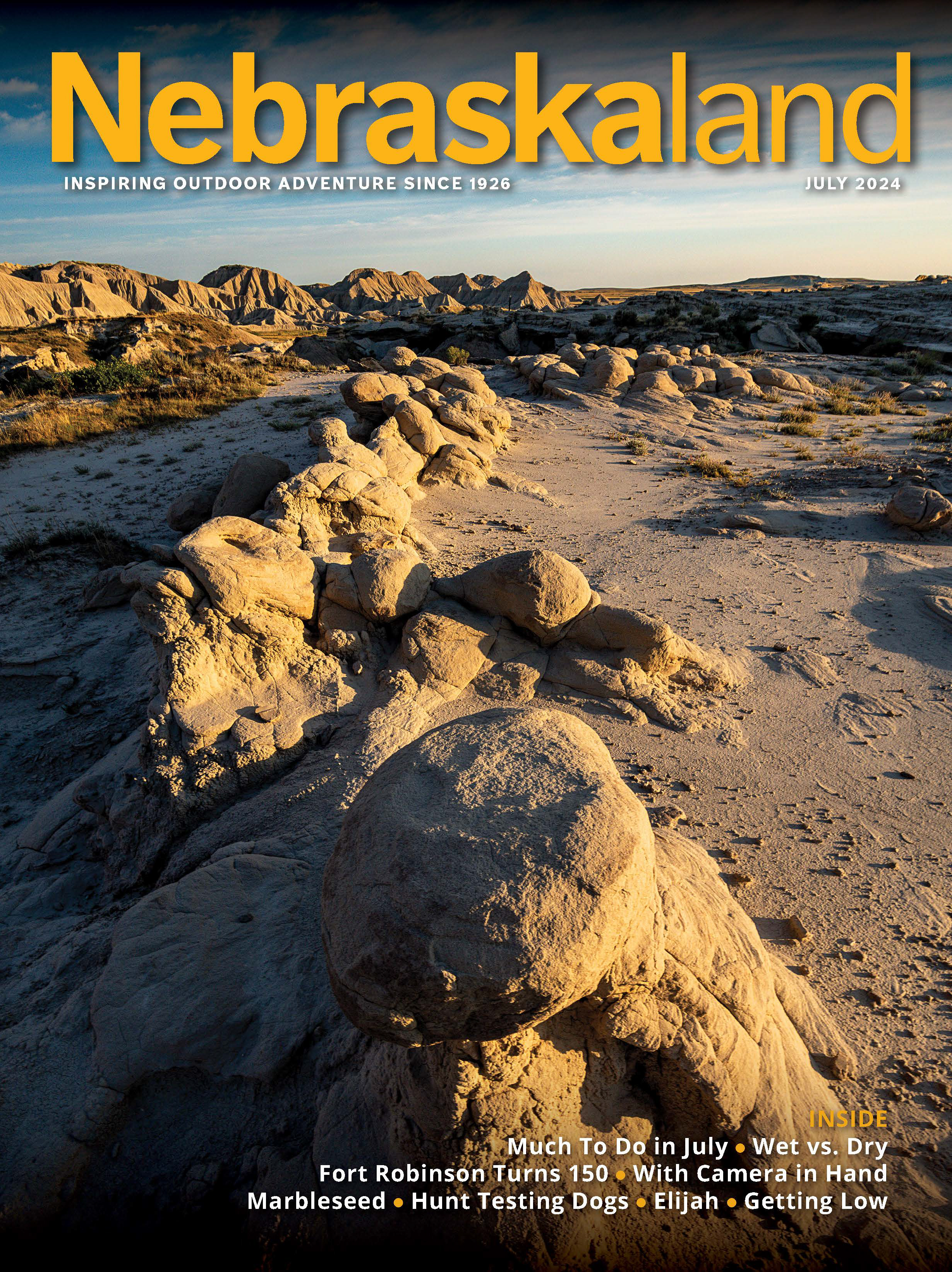
Cover: Morning sunrise at Toadstool Geologic Park,
Oglala National Grassland, Sioux County.
JUSTIN HAAG, NEBRASKALAND
This page: Sunflowers are silhouetted by the setting
sun at Merritt Reservoir State Recreation Area in Cherry
County.
ERIC FOWLER, NEBRASKALAND
By Nebraskaland Staff
What To Do in July
By Renae Blum
28
WET VS. DRY
34
FORT ROBINSON TURNS 150
38
WITH CAMERA IN HAND
42
MARBLESEED
44
No. 6
Story and photos by Ethan Freese
By David L. Bristow, History Nebraska
Story and photos by Jeff Kurrus
An Admired Plant
By Gerry Steinauer
ELIJAH
Finding Your Place
Story and photos by Eric Fowler
48
HUNT TESTING DOGS
50
ALL I HAVE IS TIME
By Todd Mills
Nebraska’s 96-year-old Deer Hunter: Shorty Hahn
Story and photo by Jeff Kurrus
DEPARTMENTS
6
10
52
60
62
Your Nebraska
In the Field
Mixed Bag
Portraits from the Past
The Last Stop
ON THE WEB
For more articles and
information, visit
NebraskalandMagazine.com
2
Nebraskaland • July 2024
Nebraskaland (VOL. 102 / NO. 6 ISSN 0028-1964) is published monthly, except for the combined Jan./Feb. and Aug./Sept. issues, by the Nebraska Game and Parks Commission, 2200 N. 33rd
St., Lincoln, NE. Periodicals postage paid at Lincoln, Nebraska, and additional mailing offices. POSTMASTER: Send all UAA to CFS. (See DMM 507.1.5.2); NON-POSTAL AND MILITARY
FACILITIES: send address corrections to Nebraskaland, P.O. Box 30370, Lincoln, NE 68503-0370.
July 2024 •
Nebraskaland
3
Magazine Staff
magazine
Published by the Nebraska Game and Parks
Commission since 1926. The Commission is
dedicated to the conservation and protection
of all the state's natural resources and the
people who use them.
Administration
Director Tim McCoy
Deputy Director Jim Swenson
Assistant Director Roger Kuhn
Commissioners
Chairman - Doug Zingula, Sidney
Vice Chairman - John Hoggatt, Kearney
2nd Vice Chairman - Donna Kush, Omaha
Communications Director Christy Firestone
Public Relations Manager Shawna RichterRyerson
Editor Jeff Kurrus
Associate Editor Jenny Nguyen-Wheatley
Regional Editors Eric Fowler, Julie Geiser,
Justin Haag
Contributing Editor Michael Forsberg
Regular Contributors Renae Blum,
Chris Helzer, Chris Masada, Todd Mills,
Ryan Sparks, Gerry Steinauer
Art Director Tim Reigert
Graphic Designer Mel Severin
Videographer Nick Sauvageau
Photo Librarian Jaclyn Cruikshank Vogt
Cicadas are buzzing this month.
MIKE FORSBERG, NEBRASKALAND
Magazine Subscriptions
For address changes, magazine and subscription
questions, 800-632-5263 or visit
nebraskalandmagazine.com
Advertising
For advertising information, contact:
Shane G. Gilster, 402-742-0125
shanegilster@solotreemedia.com
Pat Berggren, Broken Bow
Rick Brandt, Roca
Scott Cassels, Omaha
Ken Curry, Columbus
Dan Hughes, Venango
Commission Offices
Conservation Officers
Headquarters/Southeast District Office
2200 N. 33rd Street Lincoln, NE 68503
Phone 402-471-0641
ADMINISTRATION (Lincoln)
402-471-5531
Jeff Clauson (Administrator)
Travis Shepler (Asst. Administrator)
Mike Thome (Asst. Administrator)
Stacey Lewton (Asst. Administrator)
Northeast District Office
2201 N. 13th St. Norfolk, NE 68701
Phone 402-370-3374
Southwest District Office
301 E. State Farm Rd. North Platte, NE 69101
Phone 308-535-8025
Northwest District Office
East Hwy. 2, Box 725 Alliance, NE 69301
Phone 308-763-2940
Bassett Office
524 Panzer St., Box 508 Bassett, NE 68714
Phone 402-684-2921
Kearney Office
1617 First Ave. Kearney, NE 68847
Phone 308-865-5310
402-471-5531
402-471-5531
308-293-8746
402-890-7140
NORTHWEST (Includes counties covered)
Dan Kling (Lieutenant)
308-430-0572
SOUTH SUB-DISTRICT
Jerod Hahn (Sergeant)
Hunter Lee (Keith, Arthur, Deuel)
Jaden Porter (Keith, Garden, Grant)
Tyler Stueck (Keith, Arthur, Grant)
Keith Jadlowski (Keith)
NORTH SUB-DISTRICT
308-520-5539
308-280-4320
308-289-2274
308-289-6260
531-310-2869
Sean McKeehan (Sergeant)
Josh Widhelm (Scotts Bluff, Banner, Sioux)
Brandon Wallace
308-672-1824
308-279-9133
308-280-4488
Jacob Stoinski (Sioux, Dawes)
Travis Schultz (Morrill, Scotts Bluff)
308-615-9017
308-279-1292
(Scotts Bluff, Banner, Sioux)
Ak-Sar-Ben Aquarium/Schramm Education
Center
21502 W. Highway 31 Gretna, NE 68028
Phone 402-332-3901
NORTHEAST (Includes counties covered)
Dale Davis (Lieutenant)
402-760-0712
Omaha Office
8495 Frederick Street, Omaha, NE 68124
Phone 402-595-2144
Jeff Jones (Sergeant)
John Bauer (Holt, Boyd)
Greg Hesse (Rock, Brown, Keya Paha)
Jonathan Andreasen
402-762-5022
402-314-9257
308-546-7464
402-340-3981
Trevor Stahlecker(Knox, Antelope, Pierce)
Mitch Johnson (Cedar, Knox)
402-928-9099
402-613-8612
WEST SUB-DISTRICT
(Madison, Pierce, Stanton)
EAST SUB-DISTRICT
OutdoorNebraska.gov
Cory Krause (Sergeant)
Kyler Prochaska (Platte, Colfax)
Matt Costello (Dodge, Colfax)
Kelbi Abke (Washington, Burt)
Nicholas Fix (Dixon, Dakota, Thurston)
402-380-6410
402-830-8278
402-317-4014
402-237-2537
402-508-0261
Justin Gress (Thayer, Nuckolls, Filmore)
Pat George (Harlan, Franklin, Phelps)
Ethan Teter (Buffalo, Kearney)
308-629-9335
308-920-2762
308-440-3847
SOUTHWEST (Includes counties covered)
Brian Piernicky (Lieutenant)
308-330-8780
NORTH SUB-DISTRICT
Alex Hasenauer (Sergeant)
Frank Miller (Cherry, Hooker)
Brandon O’Neal
(Lincoln, McPherson, Logan)
SOUTH SUB-DISTRICT
308-660-4671
402-389-0444
308-530-3157
Taylor Dixon (Sergeant)
Bryce Streger (Dawson, Gosper, Custer)
Tyler Adelman (Dawson, Gosper, Furnas)
Kelsey Glodowski
308-217-2108
308-537-0404
402-314-4783
308-242-9000
Sophia Gobber
308-222-0368
(Red Willow, Frontier, Hayes, Hitchcock, Furnas)
(Chase, Dundy, Hayes, Hitchcock)
SOUTHEAST (Includes counties covered)
EAST SUB-DISTRICT
Heath Packett (Sergeant)
Russell Mort (Otoe, Johnson)
Rich Berggren (Douglas)
Brian Arp (Douglas, Sarpy)
Mike Luben (Saunders)
Bryan Adams
(Nemaha, Pawnee, Richardson)
WEST SUB-DISTRICT
Matt Seitz (Sergeant)
Dina Barta (Lancaster)
Mark McDonald (Dodge, Washington)
Luis Nuñez (Lancaster)
Mark Sullivan (Lancaster, Seward, Butler)
Curt Prohaska (Lancaster)
402-210-0888
402-209-1506
402-619-1355
531-530-9011
402-443-6392
402-429-1924
402-806-0915
402-890-6463
402-805-2353
531-333-6093
402-741-0636
402-470-1298
CENTRAL (Includes counties covered)
NORTH SUB-DISTRICT
The Nebraska Game and Parks Commission does not discriminate
based on race, color, ethnicity, national origin, sex, pregnancy, sexual
orientation, gender identity, religion, disability, age, genetic information,
veteran status, marital status, and/or political affiliation in its programs,
activities, or employment. Any person who believes he or she has been
discriminated against in any program, activity, facility, or service,
should contact the Nebraska Game and Parks Commission, Lincoln, NE
402-471-0641, the Nebraska Equal Opportunity Commission, Lincoln,
NE 402-471-2024, TTY/TDD 800-642-6112; Director, Office of Diversity,
Inclusion and Civil Rights, U.S. Department of Interior, 1849 C Street,
NW, Washington, D.C. 20240.
4
Nebraskaland • July 2024
Doug Pollard (Sergeant)
Matt Brandt (Sherman, Howard)
Daryl Teter (Howard, Greeley, Merrick)
Klint Gill (Nance, Wheeler, Boone)
SOUTH SUB-DISTRICT
Matt Taylor (Sergeant)
Tim Williams (Hall, Hamilton, York)
Eric Javins (Adams, Clay, Webster)
308-730-7050
308-202-0819
308-440-1863
402-613-5800
402-200-9597
308-380-7331
402-902-2017
Nebraskaland Magazine Copyright 2024, all rights reserved.
Nebraskaland is available in audio from the Nebraska Library
Commission Talking Book and Braille Service, Suite 120, 1200 N St.,
Lincoln, NE 68508. 800-742-7691. Nebraskaland Magazine and the
Nebraska Game and Parks Commission reserve the right to reject any
advertising not in keeping with the agency mission.
Rates: $18 for one year; $33 for two years; $44 for three years. Nebraska
recipients must add appropriate sales tax. To subscribe call
1-800-NEBLAND (632-5263), or go online to:
NebraskalandMagazine.com.
YOUR NEBRASKA
Alan Nash, Scottsbluff
Through the Looking Glass
Instagram Photos
Follow us @nebraskaland
and tag us in your photos
to be featured in an
upcoming issue.
Roger Richters, Utica
Bee on Purple Coneflower
6
Nebraskaland • July 2024
July 2024 •
Nebraskaland
7
YOUR NEBRASKA
Curt Blum, Lincoln
Northern Lights at Branched Oak Lake
Send your comments and
photos to:
Jeff Kurrus, Editor
Nebraskaland Magazine
P.O. Box 30370
Lincoln, NE 68503
or email Jeff.Kurrus@Nebraska.gov
Please include your postal address
and telephone number. Letters
may be condensed and edited.
Photographs are also welcome.
8
Nebraskaland • July 2024
July 2024 •
Nebraskaland
9
IN THE FIELD
MILKWEED AT KIOWA
The sun rises over swamp
milkweed at Kiowa Wildlife
Management Area near
Morrill.
ERIC FOWLER, NEBRASKALAND
10
Nebraskaland • July 2024
July 2024 •
Nebraskaland
11
IN THE FIELD
Participants of citizen science at Indian Cave, Denton Prairie, and Chadron State Park Bioblitz.
RENAE BLUM, JUSTIN HAAG
BIODIVERSITY IN STATE PARKS
By Alie Mayes, Community Science Specialist
Do you remember the awe of exploring nature as a child?
Many of my favorite memories stem from discovering the
plants and animals that lived in nearby state parks. Flipping
logs to discover what lived underneath. Sneaking up on frogs
and turtles basking near the edge of the water. Constantly
asking my parents, “What’s this?”
A new project from Game and Parks hopes to connect
park-goers with the child-like wonder of taking a closer look
at nature around them. The project, Biodiversity in State
Parks, is an invitation to slow down, look closely and to share
observations of the plants, animals and fungi you find in
your favorite state park area.
With more than 70 locations to visit — state parks, state
recreation areas and state historical parks — Nebraska’s Park
System has something for everyone, including a variety of
activities and amenities and a diversity of habitats to explore
and wildlife to view.
What is Biodiversity in State Parks?
Biodiversity in State Parks is an effort to learn more about
the animals and plants that call our state parks home. To
do this, we are utilizing community science. Community
science, also known as citizen science, refers to research
projects that include community volunteers. For Biodiversity
in State Parks, we are asking volunteers to upload their
wildlife observations to the app iNaturalist.
After creating a free account, users can make wildlife
observations by uploading “evidence” in the form of photos
or audio files, such as bird or frog calls. This evidence allows
12
Nebraskaland • July 2024
sightings to be verified. This is especially important in the
case of rare species, species recorded in new locations and
species of conservation importance. All observations made
within the boundary of a park area will count toward this
project.
Tips for Making Quality Observations
You can take images directly through the app, but it may
be helpful to take pictures and upload them later. This lets
you pick the best images to upload. Here are a few other tips:
Because you can upload multiple photographs for each
observation, include different angles.
Frame your image — it can be helpful to crop an image to
make it clear what the reviewer is focusing on.
Always complete the “What did you see” field. If you
know something is an oak tree, but are unsure what kind, type
or select “Oak Trees” from the list. iNaturalist has a helpful
feature that generates a list of possible identifications. This
is a helpful tool that may allow you to narrow down your
choices.
Be respectful — getting a good photo is never worth
negatively impacting wildlife.
•
•
•
•
Whether you’re participating in a naturalist program,
attending a bioblitz event or just hiking the trails, you can
contribute to science and learn more about the biodiversity
in Nebraska using iNaturalist as you explore your Nebraska
state parks this summer. For more information about using
iNaturalist, visit inaturalist.org/pages/getting+started.
IN THE FIELD
During low water situations, looking for frogs near lake edges is an exciting activity for kids. With net in hand, places like Two
Rivers State Recreation Area, seen here, are prime locations for discovery. JEFF KURRUS, NEBRASKALAND
LET’S GET LOW
By Jeff Kurrus and Monica Macoubrie
Fill a balloon with air. Then let out half of it. That’s what
many Nebraska lake shorelines look like this time of year.
Either drawn down for irrigation or drought stricken, these
shorelines aren’t eye-appealing. At least not for adults.
But for kids, a few extra feet of exposed shoreline is
beautiful, especially considering that their eyes will be glued
to the sand below.
What They’ll Find
From frogs and fish to shells and rocks, there are endless
possibilities for discovery in the sand. Old and new fishing
lures, tadpoles and marble-sized toads, a walk through the
sand will bring any number of surprises. Digging in the sand
can also bring observations of invertebrates such as worms,
beetles or snails. In certain areas, kids could stumble on
historical artifacts such as arrowheads or pottery fragments.
These discoveries can spark curiosity and wonder about the
stories behind them.
What They’ll Need
A net is a must. It is a teacher and classroom all by
itself. Nothing is more fun than watching a kid try to catch
significantly faster fish with a hand net. If the netting is
smaller, then there is a better chance to catch minnows and
even tadpoles.
14
Nebraskaland • July 2024
Also bring a small container of some sort. It’s not worth
catching something if you can’t look at it for a little while
before releasing it. This curiosity will encourage children to
ask questions, leading them to discover so much more right
at their feet.
What They’ll Learn
The lessons are endless. Tadpoles will begin to grow
legs, or morph, at different sizes; those fish fry are not all
“minnows,” some are small versions of the big fish you’re
catching; leopard frogs are wicked fast; there are crayfish in
your lake; there are also fossils; and there are some beautiful
rocks to be discovered as well.
A kid’s interest will vary considerably from your own.
The great part about the low water is that both of you can
pursue the passions of your choice — whether it’s your late
afternoon jaunt to catch dinner or your child’s desire to catch
just about anything. Exploring shorelines can teach children
about the impacts of human activity in the environment as
well, as they may encounter erosion or litter, which can lead
to discussions about conservation and stewardship.
By engaging with nature in this way, kids can foster a sense
of wonder and respect for the world around them, setting the
foundation for lifelong appreciation of the environment —
whether the shorelines are eye-appealing or not.
IN THE FIELD
RYAN SPARKS
CAJUN PIKE CAKES
By Ryan Sparks
Pike get a bad rap. Not because they
aren’t delicious, but because of their
pesky Y-bones. There is a technique
to filleting pike that leaves you with
five boneless fillets, but an easier
method is to fillet them normally and
make pike cakes. By gently poaching
the fillets and then flaking the meat
from the bones, you’re left with a pile
of flaky white fish that makes my
favorite pike dish.
Think of pike cakes as a template
rather than a strict recipe. You can
substitute almost anything in the
recipe (including what type of fish
you use), and they will still turn out
great. For this variety, I went with a
Cajun-inspired recipe using the “holy
trinity” of bell peppers and onion. I
made these pike cakes with the rib
meat from three pike. That’s a lot of
good fish that would have otherwise
been wasted. Try this version first and
then play around with your own pike
cake recipe.
Servings: 4 (makes 6 pike cakes)
Prep Time: 20 minutes
Cooking Time: 15 minutes
Ingredients:
1
⁄2 pound cooked, flaked pike
•
16
Nebraskaland • July 2024
• 1 egg
• 1 cup crushed saltine crackers (a
•
•
•
•
•
•
•
•
•
•
little more than half a sleeve)
1
⁄4 cup finely diced green bell
pepper (about half a small bell
pepper)
1
⁄4 cup finely diced red bell pepper
(about half a small bell pepper)
1
⁄4 cup finely diced white onion
2 tablespoons mayonnaise
11⁄2 teaspoons Cajun seasoning
1
⁄2 teaspoon salt
1
⁄2 teaspoon black pepper
Mixed salad greens
3 tablespoons butter
Lemon wedges (for serving)
Remoulade Sauce - makes 1½ cups
1 cup mayonnaise
3 tablespoons coarse mustard
1 tablespoon lemon juice
1 tablespoon chopped parsley
1 tablespoon Louisiana-style hot
sauce
2 cloves garlic, minced
1 teaspoon Worcestershire sauce
1 teaspoon smoked paprika
2 green onions, minced
1
⁄4 teaspoon salt
1
⁄8 teaspoon cayenne pepper
•
•
•
•
•
•
•
•
•
•
•
1. Start by gently poaching your fish
in water. Chicken stock, white wine
or even milk (my personal favorite)
will also work. When the fish is just
cooked through, transfer it to a plate
to cool.
2. While the fish cools, mix all the
other ingredients (except butter, mixed
greens, lemon wedges and remoulade
sauce) in a bowl.
3. When cool to handle, flake the
flesh from the bones. Be thorough.
Add boneless fish to the bowl with
the rest of the ingredients and mix
thoroughly.
4. Grab a handful of the mixture,
turning it your hand and slightly
squeezing while simultaneously
pressing with your thumb. This
method creates perfectly sized and
shaped fish cakes.
5. When your cakes are formed,
melt the butter in a nonstick pan
over medium heat. When it begins to
foam, add the cakes and cook on each
side for five minutes or until they are
perfectly browned.
6. Place the cakes on a bed of mixed
greens, top with remoulade sauce and
serve with a lemon wedge.
July 2024 •
Nebraskaland
17
Much To Do In July
By Nebraskaland Staff
The Buttes at Sowbelly Canyon, in Sioux
County’s Pine Ridge, contribute to a
picturesque afternoon in the Panhandle.
JUSTIN HAAG, NEBRASKALAND
18
Nebraskaland
• July 2024
July 2024 •
Nebraskaland
19
O
f course it’s hot. It’s July.
But if you can just get past the urge to
stay near air conditioning and venture
outside, there are so many things across the
state to see and do.
Here are a few of our favorites. N
LEFT: Watch a sunrise and catch
a fish like Brooklyn Phelphes of
Bellevue with her sister, Taylor.
While some of the best times to
fish can still be in the heart of sun
and sweat, nothing beats an early
morning on the water — regardless
of the month.
JEFF KURRUS, NEBRASKALAND
ABOVE: If you do miss the sunrise
alarm clock, there’s nothing wrong
with a midday fly-fishing venture
— as seen here with Vance Haug
of Chadron fishing for trout at
Sowbelly Creek in Sioux County.
JUSTIN HAAG, NEBRASKALAND
RIGHT: A mule deer doe and fawn
stand on railroad tracks in Dawes
County. JUSTIN HAAG, NEBRASKALAND
20
Nebraskaland
• July 2024
July 2024 •
Nebraskaland
21
LEFT: A closer look at the flowers
blooming this late in the year will
reveal pollinators that have much
less concern for you than their
current activity. JUSTIN HAAG, NEBRASKALAND
ABOVE: An afternoon drive in western
Nebraska reveals a rancher working
in a hayfield with Roundtop Butte in
the distance. JUSTIN HAAG, NEBRASKALAND
TOP RIGHT: Laila Jones Fairgood
(front) and Preyah Fairgood from
Omaha ride ponies at Eugene T.
Mahoney State Park — where there
is always some new adventure to
explore — near Ashland.
JEFF KURRUS, NEBRASKALAND
BOTTOM RIGHT: A turkey vulture
perches on a dead pine tree at
Ponderosa Wildlife Management Area
in Dawes County, reminding viewers
there is always something interesting
to see in the outdoors.
JUSTIN HAAG, NEBRASKALAND
22
Nebraskaland
• July 2024
July 2024 •
Nebraskaland
23
TOP LEFT: A house wren perches on a limb near Sand Creek in Oglala
National Grassland in Sioux County, an excellent location for summer
birders. JUSTIN HAAG, NEBRASKALAND
BOTTOM LEFT: A late-day stroll near the 1909 Officers Quarters at Fort
Robinson State Park will show you the history and present-day beauty
of the park. JUSTIN HAAG, NEBRASKALAND
ABOVE: A grass spider stands on a beaver pond filled with ramshorn
and bladder snails, moss and rushes — a reminder that sometimes all
we need to see this time of year is right at our feet. ERIC FOWLER, NEBRASKALAND
24
Nebraskaland
• July 2024
July 2024 •
Nebraskaland
25
Outdoor Nebraska
By Renae Blum
What To Do in July
Participate in a bioblitz
It’s summer — and the outdoors is calling. Have you ever
been to a bioblitz or foraged for wild raspberries? Try
something new this month, and bring the family! N
Pick wild
raspberries
Time frame varies; usually
starts late June in the south
and early July in the north|
Eastern third of Nebraska
and the northern tier of
counties across the state
Next to wild strawberries, wild
raspberries are Nebraska’s
tastiest wild fruit. Found on a
thorny shrub, wild raspberry
grows in partial shade on the
edge of woodlands, fence lines
or road ditches. They ripen from
a whitish-green to red to a dark
purple; harvest them in the latter
stage. This is a good activity
to enjoy while you’re out doing
other activities, like fishing or
hiking. LEXI CHRISTENSEN
Evening of July 19 and morning of
July 20 | Wildcat Hills State Recreation
Area
Discover the amazing diversity of animals
and plants that call the Wildcat Hills home.
People of all ages are invited to join natural
resource professionals as they search the park
for creatures, including birds, insects, small
mammals and reptiles. This data will help
researchers learn about the area — while you
get to have fun interacting with experts and
discovering wildlife. Bring sunscreen, bug
spray and hiking boots. For more information,
call the Wildcat Hills Nature Center
at 308-436-3777.
JUSTIN HAAG, NEBRASKALAND
Visit the aquatic center at Ponca
State Park
Pool hours begin Memorial Day weekend through Labor
Day weekend | Ponca State Park
Ponca State Park’s aquatic center is the perfect opportunity to
cool down with family and friends. The facility features a heated
zero-depth entry pool, 172-foot-long water slide, climbing wall,
diving board, spray features, pool games such as basketball and
volleyball, and a concession area. The pool is open 1-6 p.m. Monday
to Thursday and 12-6 p.m. Friday to Sunday. Stop by to relax after
hiking the park’s 22 miles of trails or enjoying educational activities
led by naturalists. JENNY NGUYEN-WHEATLEY, NEBRASKALAND
Fish for white bass and
wipers at Harlan Reservoir
Photograph deer with fawns
Anytime in July; peak time is usually late July
and August | Harlan County Reservoir
June and July | White-tailed deer found
statewide; mule deer in western half of the state
Harlan is full of white bass and wipers right
now — in fact, it’s one of the best spots in the state
for both. Anglers can expect to see wipers up to and
over 20 inches, and white bass up to and over
15 inches. Most white bass and wiper fishing is
done from a boat — though shoreline fishing
is possible, too. Fisheries biologist Daryl Bauer
advises keeping a little distance and casting to
the fish, rather than roaring right into the middle
of them. Also, look for the gulls; they’ll be feeding
where the fish are located.
Fawns are typically born in June, giving photographers a
unique chance to get a family portrait in July. Look in any
expanse that you frequently see does; once the fawns
are up and moving around with mom at a couple weeks
of age, they’ll use those spaces, too — typically feeding
areas next to thick security cover. Be patient and don’t
pressure the deer by trying to get close. Position yourself
in places they might travel past, rather than trying to
sneak toward them. And remember that if you find a
fawn alone, don’t move it. Mom is often not far away,
even if she is gone for hours at a time.
JENNY NGUYEN-WHEATLEY, NEBRASKALAND
BOB GRIER, NEBRASKALAND
26
Nebraskaland • July 2024
July 2024 •
Nebraskaland
27
Wet vs.
Dry
Story and photos by Ethan Freese
I
f you’ve visited one of Nebraska’s many wetlands in the
past year, there’s a good chance that you may have come
across a landscape that was anything but wet. A dry
wetland might be a discouraging sight if you’re a waterfowl
hunter or birder, but wet and dry cycles are a natural process
for many wetlands in the Great Plains, a region known for
both deluge and drought.
I had the chance to witness these changes firsthand while
working with the Platte Basin Timelapse and the Nebraska
Game and Parks Commission on the Wetlands of Nebraska
project between 2020 and 2023. During the project, I produced
a film and photo essay about playa wetlands in Nebraska.
Nebraska is home to four complexes of playa wetlands,
including the Rainwater Basin. Playas are wind-formed
wetlands that are often circular in shape and are located
on flat, farmed landscapes. Due to a heavy layer of clay in
the soil, playas pond water on the surface from rainfall,
A small playa wetland in southwestern Nebraska in August
2020. Playas receive all their water from precipitation,
resulting in water levels that vary dramatically from year to
year depending on the weather.
28
Nebraskaland
• July 2024
Smartweed blooms at sunrise in a playa wetland. The flowers and seeds of smartweed are a
valuable source of food for pollinators, waterfowl and a wide variety of other wildlife.
July 2024 •
Nebraskaland
29
snowmelt and overland flow. Because they are largely reliant
on precipitation, water levels in playas can vary dramatically
from year to year.
In spring 2020, Nebraska was still in the midst of a relatively
wet period. Almost every wetland I visited was full of water
and hosted an incredible diversity of birds. As the season
progressed, I watched as the annual procession of waterfowl
stopped over in Nebraska’s wetlands. Starting with northern
pintails and snow geese, the cast of birds gradually changed
to blue-winged teal, northern shovelers and an eclectic mix of
shorebirds. One of my more memorable experiences occurred
in April 2020 when I belly-crawled across a large mudflat in
the Rainwater Basin to photograph a flock of American white
pelicans as they seined for food in the murky water.
As the project progressed, drought gradually began to take
hold across the state. In March 2020, we installed a timelapse
camera at North Lake Basin Wildlife Management Area, a
large playa wetland in the Rainwater Basin near Utica. When
the camera was installed, there was no shortage of water, and
we donned our muck boots to get to the old windmill where
we mounted the camera. As the year progressed, the wetland
Nestled within a pocket of thin green sedges and grasses, a northern leopard frog finds refuge at sunset. In these playa
landscapes, cattle help to graze vegetation, unintentionally creating depressions in the soil where water pools and new
life emerges. DAKOTA ALTMAN
30
Nebraskaland
• July 2024
Soil cracking in the Rainwater Basin in August 2020. These
large cracks that form in dry conditions help recharge
groundwater when wet weather eventually returns.
American white pelicans were a common sight in the Rainwater Basin in the spring of 2020,
when water levels were still relatively high.
July 2024 •
Nebraskaland
31
gradually dried until there was no water within the entirety
of the camera’s view. With this disappearance of water, an
abundance of plant life, including smartweed, barnyard grass
and coreopsis, flourished on the recently exposed soil.
Through the fall and winter of 2020, the wetland remained
dry and was passed over by waterbirds on their fall migration.
However, in spring 2021, a large precipitation event quickly
brought water back to North Lake Basin. The abundant seeds
produced the previous fall provided fuel for the thousands
of migratory birds that stopped over on their migration. If
wetlands don’t periodically dry out, many of the plants that
provide a critical food source for wildlife would disappear.
The cyclical nature of playa wetlands is also important
for amphibians. In permanent bodies of water, fish will
eat the eggs of frogs, toads and salamanders. Because
playas periodically dry up, most playas do not have fish,
making them an ideal habitat for amphibians able to wait
underground for wet conditions to return.
Even when wetlands are dry, they still provide valuable
habitat to a suite of wildlife. In August 2020, a small team
from the Platte Basin Timelapse and Nebraska Game and
Parks traveled to southwestern Nebraska to photograph and
film the aptly named Southwest Playas. During our trip, most
of the wetlands were dry and, at first glance, they seemed
A Leconte’s sparrow perches on a patch of smartweed in the
Rainwater Basin. The abundant seeds found in dry wetlands
are an important food source for migratory birds like this
passerine.
Smartweed and sunflowers bloom on a dry playa in southwestern Nebraska. While at first glance dry wetlands might seem
like barren wastelands, closer inspection reveals a rich diversity of life.
devoid of life. However, when we got out of our vehicles
and started to explore the wetland on foot, we were quickly
drawn to the abundance of wildflowers and pollinators on the
parched playa.
Bees and hoverflies filled the air with frantic buzzing as
they visited the light pink blooms of smartweed and vibrant
yellow sunflowers that added color amongst the dry grasses
that carpeted the ground. The countless insects undoubtedly
provided the area’s pheasants and other grassland birds with
a reliable food source that summer.
Take the time to appreciate wetlands even when they aren’t
wet. It’s a good reminder that even though dry conditions
present a number of challenges to people and wildlife, those
challenges have resulted in resilient ecosystems that are well
adapted to the dramatic weather of Nebraska.
Whether wet or dry, wetlands provide beauty and life. N
An abundance of migratory waterfowl stopped over at North Lake Basin Wildlife Management area near Utica in March 2020.
Less than six months later the wetland was almost completely dry.
32
Nebraskaland
• July 2024
For more information on the Wetlands of Nebraska project
visit NebraskaWetlands.com
A northern pintail drake performs a courtship display for a
nearby hen. In dry years, land managers will pump water
into select wetlands to ensure habitat is available for
migratory waterbirds.
July 2024 •
Nebraskaland
33
Fort Robinson
Turns 150
By David L. Bristow, History Nebraska
L
ongtime Fort Robinson Museum curator Tom Buecker used
to say that the most common question he heard was,
“Where’s the fort?” Visitors expect to see a stockade,
but like most Great Plains forts of its era, Fort Robinson
was built without outer walls. It started as a tent camp 150
years ago and grew to become one of the largest military
installations on the northern Plains.
The Army sent more than 900 soldiers from Fort Laramie
to northwestern Nebraska in March 1874. Their tent camp
This 1875 view is the earliest known photo of Camp Robinson, renamed Fort Robinson in 1878. Though it lacked a permanent
outer wall, in the early days it had a temporary stockade made of stacked cordwood — which gradually
disappeared into the camp’s stoves. HISTORY NEBRASKA, RG5895-0-7
Spotted Tail, an important Brule Lakota chief (third from
right) at breakfast in the home of Maj. J.W. Paddock at Camp
Robinson, July 18, 1877. Maj. Paddock is in the center, and
Spotted Tail’s wife and daughter are at left.
HISTORY NEBRASKA, RG5899-9-2
34
Nebraskaland
• July 2024
was soon named in honor of Lt. Levi
Robinson, who had been killed earlier
that year by Native Americans from
nearby Red Cloud Agency. The first
post commander was Captain Arthur
MacArthur — the father of Gen. Douglas
MacArthur of World War II fame.
The soldiers had come to protect
Red Cloud Agency, where the U.S.
LT. LEVI ROBINSON
government distributed annuity goods
to Lakotas in fulfillment of an earlier treaty. Tensions were
mounting as Lakotas resented continued encroachments
into their territory.
And things were about to get a lot worse. Later that year, Lt.
Col. George Custer led an expedition that confirmed rumors
of gold in the nearby Black Hills. When the Lakotas refused
to sell the land, the U.S. launched what became known as the
Great Sioux War of 1876. The famous Lakota
war leader Crazy Horse surrendered his band
of followers at Camp Robinson in May 1877.
In September, Crazy Horse was killed while
trying to avoid being imprisoned in the
camp’s guardhouse.
The following year saw another tragedy
at the post, this time involving a group
of Northern Cheyenne who had escaped
from their reservation in Indian Territory
(Oklahoma) and were trying to return to
their homeland in present-day Montana. The
army captured Chief Dull Knife and 149 of
his followers and locked them in a barracks
without food or fuel, hoping to pressure them
to agree to go back to the reservation.
On the night of January 9, 1879, the
An 1877 view of Camp Robinson, showing buildings that framed the
southwest corner of the old parade ground. The long building on the left is
barracks; to its right is the guard house where Crazy Horse was killed.
HISTORY NEBRASKA, RG5899-3-3
July 2024 •
Nebraskaland
35
The 1874 officers’ barracks on Fort Robinson’s old parade ground, shown in the late 1880s and today (below photo). The Black
children are either the children of servants or of the soldiers of the all-Black Ninth Cavalry. HISTORY NEBRASKA, RG1517-93-47A
Undated photo of the Eighth Infantry in their barracks.
Cheyennes broke out of the barracks and, using weapons
they had hidden, shot the guards and held off the other
soldiers in a running fight known as the Cheyenne Breakout.
Most of the Cheyennes were recaptured or killed.
While some of the buildings from that early era remain,
others — such as the guardhouse and the Cheyenne
Breakout barracks — have been reconstructed on site based
on archeological excavations. Today, it’s common to see
bundles of sage left by Lakota visitors on the Crazy Horse
marker in front of the guardhouse. And every January, the
Northern Cheyenne hold a ceremony at the Fort to honor
their ancestors.
These stories and photos provide a glimpse of the Fort’s
earliest years, but barely scratch the surface of its long history.
Fort Robinson was home to African American “Buffalo
Soldier” regiments in the 1880s and 1890s, trained cavalry
horses as an Army Remount Depot following World War I,
and became a prisoner of war camp and war dog training
center in World War II. Today, Fort Robinson is a popular
state historical park where visitors enjoy the outdoors while
experiencing many layers of the past. N
Visit History Nebraska’s website at history.nebraska.gov.
36
Nebraskaland
• July 2024
HISTORY NEBRASKA, RG1517-119-2
Part of a nearby Arapaho village northwest of Camp
Robinson in 1876 or 1877. A child’s “play” tipi stands next to
the main lodge. Little girls often played “house” in the tipis
they made under their mothers’ supervision.
HISTORY NEBRASKA, RG5899-6-2
July 2024 •
Nebraskaland
37
With Camera
in Hand
There is more than one shot to
make during a hunting trip
Story and photos by Jeff Kurrus
A
nyone who has hunted with me knows that
I’ll have a camera in hand as often as my
gun.
I have such a fear of missing a good
photo — because of all the ones I have already
missed — that I’m willing to concede a shot from
my barrel to focus on a shot from my SLR.
The scenario was no different this day on a Cass
County quail hunt.
It was my son’s first hunt for bobs, and I wanted
to make sure I chronicled it for the family photo
album — which we still have in leather-bound,
1970s-style form.
But to do so effectively — and to hopefully help
you in your quest of pursuing game and preserving
memories at the same time — I had to shoot as
many different aspects as I could in the morning.
And I needed to do so before my son’s 11-yearold legs completely left him for the day.
Here is what I came up with.
ABOVE: Jerry Beck, Ryan Sparks and English setter, Willie, walk a gravel road in Cass County.
LEFT: Eli Kurrus walks through a field in Cass County during a foggy morning quail hunt.
38
Nebraskaland • July 2024
July 2024 •
Nebraskaland
39
T
his hunting season, every once
in a while, trade your gun for your
camera — even if it’s your cell
phone. There is nothing like sitting
down after the long grind of another
hunting season and remembering those
days in the field.
It’s just a little bit easier to remember
when you have some pictures to help
you do so. N
LEFT: Bobwhite quail droppings in a
field indicate where birds have been
feeding.
BELOW: Jerry Beck (right) hunts beside
Eli Kurrus as a bobwhite quail flushes
from the grass near Beck’s English
setter, Willie, during the hunt.
RIGHT: Willie quail hunts in Cass
County. Always include a photo of
dogs from your hunt.
40
Nebraskaland • July 2024
July 2024 •
Nebraskaland
41
Marbleseed
An Admired Plant
By Gerry Steinauer, Botanist
Also admirable, marbleseed is an
you might expect, most of these are
hen appearing as a guest on
extremely hardy plant. It grows in
not rare or super showy plants, but
podcasts or radio shows, I am
upland prairies throughout the state,
rather the salt-of-the-earth type. One
often asked, “What is your
excluding the Sandhills and southern
such plant is the perennial marbleseed
favorite plant?” I suppose
Panhandle, but thrives in very dry,
(Onosmodium molle).
the interviewer thinks this is a great
gravelly or rocky hilltop prairies where
One reason I admire this plant is
icebreaker and that I will have a
only the tough survive. In addition,
its folksy name, marbleseed, which
pat answer. I don’t, however, and
its coarse, hairy leaves
there’s
always
an
make it unappealing
uncomfortable pause as
to grazing livestock,
I ponder.
allowing it to flourish
The problem is that
in overgrazed pastures
I don’t have a favorite
where
most
other
plant. Nebraska has
wildflowers succumb to
more than 1,500 native
the constant nipping of
plants. How would I pick
hungry mouths.
just one? Furthermore,
Then
there’s
the
as a botanist, I find the
plant’s elusive beauty,
question
somewhat
starting with its leaves,
socially inappropriate,
which are rigid, have
like asking a parent,
prominent veins and
“Which is your favorite
are covered in dense,
child?”
bristly hairs, giving
Being
polite,
I
them a distinct texture
eventually
provide
and strong lines. I find
the interviewer with
the leaves to be the most
the answer they seek,
photogenic of our native
saying that my favorite
plants, especially when
plant is a beautiful
covered with dew early
orchid or one of our
on a summer morning.
state’s few threatened
Marbleseed flowers bloom in June, attracting bees and butterflies as
their primary pollinators. GERRY STEINAUER
Another
artistic
or endangered plants,
aspect of marbleseed
allowing them to relax.
is its overall form. Arising from a
accurately describes its roundish, hard
Then comes the standard follow-up
stout, woody root, it often grows as
seeds. I can imagine dusty, barefooted
question: “Why is it your favorite
stiff, multi-stemmed clumps reaching
kids branding it with this name as they
plant?” And the lies continue. “Oh, it
3 feet tall. In hard-grazed pastures,
played with handfuls of its seeds in the
is so stunning, so rare, so … whatever.”
these clumps stand out like sculptures
prairie outback behind their sod house.
Ok, I’m exaggerating a bit.
ascending above the short grass,
The plant’s other common name is
Although I don’t have a single
unbending to strong prairie winds, as
false gromwell which, by comparison,
“favorite” plant, there are many native
if placed there by a wandering artist.
I find rather boring.
plants I greatly admire. Unlike what
W
42
Nebraskaland • July 2024
Finally, consider the flowering
heads that emerge in June as dense
clumps that gradually unfold into agile
arches resembling a scorpion’s tail.
The individual flowers consist of five
hairy, greenish, sharp-pointed sepals
surrounding five whitish-green petals
fused into a tube. Protruding from
this tube is a long stinger-like style
that persists well after the petals have
fallen. Styles are the stalks on which
the pollen-collecting stigma sits.
While the flowers are rather drab, I
view the spiraled flower heads, with
their arrangement of sharp sepals,
tubular petals and projecting spiky
styles, as abstract floral art, as if nature
used geometry, rather than colorful,
showy petals, to create beauty. Nature
is strange that way.
After heaping all this praise on
marbleseed, I might have convinced
myself it’s my favorite plant. But
honestly, I admire all the native plants
that grace Nebraska’s landscapes —
even the ones with boring names. N
A robust marbleseed plant grows in a prairie restoration along the
Platte River of Hall County. CHRIS HELZER, THE NATURE CONSERVANCY
A controlled prairie fire cleared away the thatch, exposing a cache of marbleseed seeds hidden by a rodent.
The heat from the fire also caused the seeds to darken from white to tan. CHRIS HELZER, THE NATURE CONSERVANCY
July 2024 •
Nebraskaland
43
Elijah
Riley scans the sky
while hunting geese
near Lincoln.
finding your place
Story and photos by Eric Fowler
ome people live their entire
lives searching for some place,
any place, where they feel
comfortable. It didn’t take
Elijah Riley that long. Late in high
school, when he picked up a bow and
arrow and headed to the woods, is
S
when he knew.
“I felt like for a long time I didn’t
know my place in the world,” said Riley,
soon to be a senior at the University of
Nebraska-Lincoln, “but getting back in
nature has helped me find that.”
And a whole lot more.
Riley shows off a largemouth bass he caught at Camp Cornhusker in 2012.
44
Nebraskaland
• July 2024
Introductions and
Reintroductions
While growing up fishing and
camping with his family near Lincoln,
Riley remembers how his dad would
announce, “We got groceries,” when
they left the lake with a stringer full of
channel catfish in hand.
“I never really put two and two
together on what ‘groceries’ meant
until I was older,” Riley said. “We were
putting food in the fridge.”
He learned more outdoor skills in
Cub Scouts, from building a campfire
to paddling a canoe. He feverishly
watched YouTube and outdoor reality
shows on the History and Discovery
channels. Swamp People was a favorite
of his.
“I was wanting to do everything I
was watching and thinking that was
the coolest thing in the world,” he
said. He fished often in middle school
and walked more than one patch
of tallgrass looking for pheasants,
thrilled by the hunt despite never
downing a bird.
Then, like time is for many teenagers
and young adults, the outdoors took a
backseat to Riley’s everyday life. Most
of his high school years were filled
with studies and sports until multiple
knee injuries — and the subsequent
recoveries — halted his playing career.
Competing on the Lincoln High trap
team his junior year, participating in
Cornhusker Boys State and a job at
Scheels introduced him to people who
knew much more about hunting and
July 2024 •
Nebraskaland
45
Riley shows Henry Robert-Innocent and other Malone Center students how to cast during a field trip to a private pond near
Lincoln. “I would say a lot of the populations that I want to work with are the minority kids that don’t have a chance to
engage in this type of thing,” Riley said. “The big goal down the line is to make this so any kid who wants to engage in this sort
of thing can do it at no cost, because I feel that is going to be the best way to meet them where they are and give them the
opportunities.”
fishing than him. Some of those people became mentors,
sharing their knowledge and pulling him back in.
Riley bought a used bow on an online marketplace and had
many unsuccessful deer hunts on public land near Lincoln.
Still, he was hooked.
“I think it was how much time I spent in the woods with
nothing happening,” Riley said. “There were a lot of times
where it was just anticipation, and every time a squirrel
would bark or run up and down a tree, I’d think it was a deer,
and I would start getting the shakes.”
Seeing his passion, an uncle who had quit deer hunting
took Riley under his wing and guided him on a rifle hunt
that ended in his first deer. “The feeling I had once I was
down on the ground with that deer was the most surreal and
overtaking feeling I think I have ever had,” he said.
He has since hunted, fished and backcountry camped in
several states, and he even fished in Costa Rica. “I would say
the biggest reason I like these things and engage in them is I
get a surreal feeling in myself, just like peace and calmness,
when I’m in nature. It’s a good chance to reset and just find
yourself in the world again.”
Big Gumdrop Outdoors
One day in high school, Riley and his friends were sitting
in class giving each other goofy nicknames. “Shorter and
fluffier” than he is today, his friends tabbed him with Big
Gumdrop, a name that stuck.
In 2019, Riley began Big Gumdrop Outdoors, posting videos
of his hunting and fishing exploits on YouTube, TikTok and
46
Nebraskaland
• July 2024
Instagram. “I had the idea, the
vision, that I’m creating this
stuff so other kids who look
like me are able to see someone
that’s in the industry and doing
it, and they feel comfortable
and confident to go out and do it
themselves,” he said.
However, Riley had little
engagement to his videos. So,
in 2023 he pivoted to handson education. Riley and other
members of the Minorities in
Agriculture, Natural Resources
and Related Sciences club
at UNL had worked with the
Malone Community Center
in Lincoln on a series of
Riley and Kyndall Hudson help Jeremiah Davis and Monnie and Adonis Garrett and other
educational sessions, including
students set up a tent during an after-school program at Everett Elementary School in Lincoln.
wildlife identification and calls,
ecosystems and agriculture. Staff asked if they could do
more, and when Riley returned from studying abroad in Costa
Rica in 2023, he developed an eight-week summer program.
With the help of friends and Malone staff, kids learned
Hunters and anglers are predominantly white,
about wildlife, the food chain, ecosystems in Nebraska and
making up more than 77 and 75 percent of the
conservation storytelling. They learned about camping and
participants, respectively. African Americans make
up 11 percent of hunters and anglers nationally.
took a field trip to set up tents, build a fire and make s’mores.
Just 4 percent of African Americans hunt and
They helped clean up trash around Holmes Lake. And they
12 percent fish, compared to 6 percent and 17
learned about fishing, later taking another field trip to a
percent of whites. Participation among Hispanics
private pond near Lincoln where every kid who went caught a
also trails whites, while a greater proportion of
fish. During the spring semester, he worked with the Lincoln
Asian Americans hunt and fish.
Community Learning Center to put on after-school programs
Elijah Riley’s work could help change those
numbers in Nebraska. But even if it doesn’t, it will
at three Lincoln schools.
make a lasting impact for those he’s teaching and
Riley is working with the Malone Center again this
mentoring.
summer. “We have a lot of kids who love going outside and
love being outdoors but don’t really have the education or the
parental guidance to learn or experience what is right in their
backyard of Lincoln,” said Cristian Clinton, youth supervisor
participate will become mentors when they get older. From
at the center.
there, he hopes to expand to schools in Omaha and beyond.
“Elijah loves doing what he does. He does great with the
Eventually, he hopes the program will grow to the point that
kids. He takes his time with the lesson plans, so being able to
it can be his full-time job — his career.
see that and then see the kids gravitate toward the lessons
His enjoyment of the outdoors and the pleasure of seeing
and the things that he’s teaching them is just something
kids enjoy his programs are what drives him. That was
that we loved and want to continue doing here at the Malone
evident during a fishing trip he took with the Malone Center
Center. He’s left a lasting impression on some of our kids for
students last summer, when all 14 kids caught a fish, most of
sure.”
them their first. Riley, with the help of fellow UNL students,
managed the chaos with patience and ease.
“It was just so much fun to see their excitement,” Riley
said. “That right there reminded me of all those times when
Riley is working to establish a nonprofit through which he
I was a kid, catching fish with my dad and just being on the
will deliver these environmental education programs, and he
highest level, on cloud nine, just excited. And seeing those
has even grander aspirations. He hopes within three years he
kids go through that same thing re-sparked those emotions,
can have the program in every elementary, middle and high
and it makes me happy.” N
school in Lincoln, and that some of the younger students who
A Lasting Impact
Next Steps
Riley and Masiey Ratliff watch Maya James show off a
bluegill she caught.
July 2024 •
Nebraskaland
47
Hunt Testing Dogs
By Todd Mills
T
he first real gun dog I’d ever owned cost me $50. A
buddy of mine knew I’d been looking and knew of a litter
with just one pup left. His recommendation and the
owner telling me the puppies were born in a barn in the
middle of January was all it took to get me to pull the trigger.
Although I had no clue on what I was doing, I knew
somebody who did. That same friend who told me about the
litter offered to help train my dog. What started as a quest to
train a $50 farm dog has now turned into a love affair. The
fascination with training dogs still burns inside me some 35
years later.
I was enamored with the idea of competing with my dog,
so I decided to enter the hunt test world with my second Lab.
It was an excruciating process, filled with constant failure
and countless ups and downs. What came from it, however,
was a deeper understanding of my dogs — not only how to
train them, but also how to understand and relate to them in
stressful and overwhelming situations. The ability to keep
a dog under control, in the most competitive environments,
taught me invaluable lessons for working with them during
actual hunting scenarios.
Here are a few of the lessons I learned.
Todd Mills of Gretna dog trains his
Master Hunter Labrador retriever,
Gracie, at the Missouri Valley Hunt
Club in Douglas County.
JEFF KURRUS, NEBRASKALAND
Anatomy of a Hunt Test
Although AKC and HRC are slightly different organizations,
the hunt test levels they offer are similar. We’ll focus on
AKC here. There are currently three different titles (Junior,
Senior and Master) with each level higher offering more
challenging obstacles. It’s not so much a competition against
other handlers and their dogs; rather, each dog is assessed on
its individual performance.
Judges will score dogs based on marking, retrieving and
delivery to hand. Also, they will score steadiness, control,
response and trainability. In some cases, especially at the
Master level, the test can be set up to create absolute chaos for
the dog and handler.
Obedience Matters
If you’re incapable of keeping your dog under control, hunt
tests aren’t for you. If any aspect of training is skipped over and
not repeated almost daily, your dog will certainly fail under
the lights. Basic commands of sit, here and heel are a must.
Use a whistle with all your training and get them accustomed
to sitting and coming to that instead of your voice.
Provide distractions, such as gunshots, to tempt them to
break the rules. Only after your dog is completely steady in
any and all circumstances can you move forward. Also, make
sure you train in a variety of weather conditions and terrain.
If your dog becomes too accustomed to the same property, it
becomes a safe place. Provide as much distraction and variety
as you can so your dog can perform in any and all conditions.
Pat Baughman, from Chapman, prepares to honor
his dog while Barry Brandt, from Unadilla, handles.
TODD MILLS
From Test to Field
Although running a dog in a hunt test is valuable, without
strict boundaries, it doesn’t always translate back to the field.
Hunting situations can create all kinds of ways for your dog to
cheat. Hunting with other dogs can create chaos, especially if
the other dog is not steady.
However, it doesn’t mean you can’t do both; it just takes
some restraint and control. Forego shooting during those
first hunts and focus on handling and controlling your dog.
This will pay dividends for both a test dog and a hunting dog.
The ability to control your dog in almost any situation is not
only rewarding, but can avoid some potentially dangerous
situations when dealing with current, big bodies of open
water and working with other dogs.
Your dog may need some slight tuning up when you return
to hunt test season, but when done correctly, the test dog is
capable of doing things most other dogs and owners can’t. N
Currently, there are four clubs in Nebraska that host retriever
hunt tests: the Missouri Valley Hunt Club in Valley, Nebraska
Dog and Hunt Club in Unadilla, Central Nebraska Retriever Club
in Grand Island, and the West Nebraska Retriever Club in North
Platte. Find one near you to watch and understand how they are
run, or visit entryexpress.com and hrc.dog for more information.
48
Nebraskaland • July 2024
Handler Susan Norras, from Pleasant Hill, Missouri,
receives a bird to hand at a recent hunt test. TODD MILLS
July 2024 •
Nebraskaland
49
All I Have is Time
Nebraska’s 96-year-old deer hunter: Shorty Hahn
Story and photo by Jeff Kurrus
N
inety-six-year-old Dwayne “Shorty”
Hahn sat on a couch in the family’s
hunting lodge in Hordville, his eyes
closed as I approached. Then he turned his
head and smiled. “I was napping,” he said,
urging me to sit beside him so we could talk
about his life of hunting.
“Shorty, how are you today?” I asked.
“Pretty good … considering my age.” He
grinned as he said it, both matter-of-fact
while also getting the joke.
Shorty started hunting in 1962 when he
was in his early 30s, a reminder that it’s
never too late to start a lifetime passion,
which he has continued for a simple reason.
“I like to watch the sun come up and the sun
go down,” he said.
When asked about what else thrills him,
or if he even gets nervous anymore when he
sees a nice buck, he shook his head. “No.”
Even when he shot his biggest buck — a
13-pointer — a couple of years ago? “Noooo.
After 60 years … I don’t think so. Noooo.”
We discussed the nuances of hunting,
from his ability to still field dress his own
deer — “You get used to it” — to the knife
he uses when skinning. “I use one from the
’50s. We got a lot of knives, but I use that old
one. Got good steel.”
With his hand now resting on my arm, like
we were old friends, Shorty and I hopped
from topic to topic — from Nebraskaland
Magazine and fishing to how he’s never
seen a bobcat while hunting. He then asked
about my family.
“How old is your dad?”
“76,” I answered.
“76,” he repeated. “Oh. Just a kid.”
He then told me his thoughts about deer
hunting. “I got a little propane burner. I
don’t have any fancy clothes. Just work
clothes. Old pair of pants. I’ll hunt morning
and night. I see most of my deer in the
morning. Animals move about the same
[as they always have]. You don’t have to be
there when it’s dark. You can’t see when it’s
dark anyhow. I park my pick-up about half a
block from the stand. Deer here follow the
same path every year … most between 7:30
and 9 o’clock. I don’t worry about the time.”
When asked if he’s ever taken a shot he
wanted back, his answer was quick and
self-assured. “No. No. I got to have a clean
shot, or I won’t shoot.”
He hunts every day of the firearm season
unless it gets too cold. “I get a little bit fussy
when it gets cold. I don’t stay really long. If
I haven’t seen anything by 9, I’ll go home.”
Last season, at the age of 95, Shorty saw
four or five bucks early in the week that
were all “keepers.”
“But I waited, see. I don’t want to spoil my
fun right away.”
“You have time,” I said.
“All I have is time,” he said with a
smile. N
Nicknamed because he was the smallest of three brothers, Shorty — at 96 years old — is one of
Nebraska’s oldest deer hunters. Since the first time he hunted in 1962, he has always shot the same
1945 Winchester .270. “I pull it out of the safe and go deer hunting.” JEFF KURRUS, NEBRASKALAND
50
Nebraskaland
• July 2024
July 2024 •
Nebraskaland
51
MIXED BAG
52
Nebraskaland • July 2024
July 2024 •
Nebraskaland
53
MIXED BAG
COPE’S GRAY TREEFROGS
By Monica Macoubrie, Wildlife Education Specialist
Meet the Cope’s gray treefrog (Hyla chrysoscelis), a
captivating amphibian found across eastern North America.
Sporting subtle grays and greens adorned with intricate
patterns on its skin, this arboreal frog is celebrated for its
adaptability and enchanting calls. Despite its small size,
this treefrog plays a vital role in the forest and wetland
ecosystems where it lives.
Appearance
leaf litter or soil. They accumulate glycerol and glucose in
their tissues, which act as a natural antifreeze to prevent
ice crystals from forming within their bodies. In this frozen
state, their metabolism slows dramatically, allowing them
to survive freezing temperatures until warmer conditions
return in spring.
Distribution and Habitat
When considering a treefrog, our minds often
envision vibrant colors that mirror the lush foliage and
flowers of the rainforest. In Nebraska, the Cope’s gray
treefrog’s striking appearance blends seamlessly with its
arboreal habitat.
Usually ranging 1.5 to 2 inches long, this amphibian
displays a muted spectrum of gray or green tones along
its dorsal (upper) surface. Its skin is often decorated
with intricate markings, varying from dark blotches to
elaborate arrangements of lines and spots, offering effective
concealment amidst tree bark and foliage. A distinctive dark
mask extends from the snout to the eye, accentuating its
expressive appearance.
Large, adhesive toe pads enable the Cope’s gray treefrog
to effortlessly climb and cling to various surfaces, aiding its
arboreal lifestyle.
The Cope’s gray treefrog inhabits a variety of habitats
across the state. From the sprawling prairies to the lush
woodlands and wetlands, these adaptable amphibians can be
encountered in a range of environments. They demonstrate
a preference for moist habitats near water bodies such as
ponds, marshes and slow-moving streams, where they find
ample opportunities for breeding and foraging. However,
they are also known to thrive in suburban gardens, parks
and agricultural areas with suitable vegetation and
moisture levels.
Despite their versatile nature, habitat loss and
fragmentation due to urbanization, agriculture and land
development pose significant threats to their populations
in Nebraska. Conservation efforts aimed at preserving and
restoring their preferred habitats are crucial for ensuring the
continued presence of the Cope’s gray treefrog throughout
the Cornhusker State.
Behavior and Special Adaptations
Reproduction and Lifecycle
In Nebraska, Cope’s gray treefrogs exhibit fascinating
behaviors and possess special adaptations that enable them
to thrive in diverse environments. These amphibians are
predominantly nocturnal, seeking refuge in shaded areas or
tree cavities during the day and emerging at night to forage.
Their cryptic coloration and markings provide effective
camouflage against predators such as birds, snakes and
mammals.
Cope’s gray treefrogs are renowned for their remarkable
climbing ability on various surfaces, including tree bark
and foliage. Their adhesive toe pads also facilitate efficient
hunting, as they can quickly snatch insects and other small
invertebrates from vegetation.
Furthermore, these frogs possess specialized vocal sacs
that allow males to produce loud, melodious calls during
the breeding season, serving to attract potential mates and
establish territories.
During winter, Cope’s gray treefrogs experience a
remarkable adaptation known as crypsis, where they undergo
a process called cryoanesthesia. As temperatures drop, these
amphibians enter a state of dormancy and seek shelter in
In Nebraska, the lifecycle and reproductive habits of the
Cope’s gray treefrog follow a seasonal rhythm intertwined
with the state’s climate. Breeding typically occurs from late
spring to early summer, with males congregating near water
bodies, filling the night air with their melodious calls to
attract females. The call of the Cope’s gray treefrog resembles
a series of high-pitched trills or peeps, adding to the soothing
nighttime chorus in Nebraska’s wetlands.
Upon successful mating, females lay their eggs in
shallow water, attaching them to submerged vegetation
or debris. These eggs hatch into tadpoles, which undergo
metamorphosis over several weeks, eventually emerging as
miniature froglets.
Environmental factors such as temperature and
precipitation play critical roles in determining the timing and
success of reproduction.
54
Nebraskaland • July 2024
Conservation Status and Threats
In Nebraska, conservation of the Cope’s gray treefrog
faces a complex array of threats amidst efforts to preserve
its populations. While currently categorized as a species of
Cope’s gray
treefrogs
NGPC PHOTO LIBRARY
least concern on the International Union for Conservation
of Nature Red List, these amphibians confront significant
challenges that warrant attention. Habitat loss and
fragmentation due to urbanization, agricultural expansion
and land development pose primary threats to their
survival. Wetland degradation and pollution from pesticides,
herbicides and runoff further degrade their breeding habitats
and impact water quality, jeopardizing their reproductive
success.
Additionally, climate change presents an emerging threat,
altering precipitation patterns and temperatures, which
could disrupt breeding cycles and habitat suitability. These
cumulative stressors highlight the urgency of conservation
efforts to safeguard Cope’s gray treefrog populations in
Nebraska.
Collaborative
initiatives
involving
government
agencies, conservation organizations, researchers and
local communities are essential to implementing habitat
restoration, monitoring programs and education outreach to
mitigate these threats and ensure the long-term viability of
this species in the state’s ecosystems.
Community Science and Engagement
Community science plays a vital role in monitoring and
conserving Cope’s gray treefrog populations in Nebraska.
Through community science programs, volunteers can
contribute valuable data on frog distribution, abundance
and habitat preferences through frog call surveys, habitat
assessments and population monitoring initiatives.
These efforts not only provide scientists with important
information for research and management but they also
foster a deeper connection between people and nature.
Community scientists become ambassadors for the Cope’s
gray treefrog, advocating for its conservation and inspiring
others to take action to safeguard Nebraska’s natural heritage
for future generations.
“FrogWatch USA is a nationwide program working to help
volunteers learn about wetlands and conserve amphibians by
recording frog calls. To find training with a chapter near you,
visit akronzoo.org/frogwatch-use-chapterlist. You could collect
and contribute data that helps the Cope’s gray treefrog for years
to come.
July 2024 •
Nebraskaland
55
MIXED BAG
FROM THE LAKE TO THE TANK
By Jerry Kane
Each year, thousands of visitors to the Nebraska State
Fair enjoy the 6,000-gallon aquarium at the Nebraska Game
and Parks Outdoor Encounter exhibit. Many folks make the
aquarium their first stop when they get to the fair.
They see common fish, odd-looking fish, bigger fish and
smaller fish. They see fish they’ve caught and fish they wish
they could catch. They see invasive fish and fish that don’t
occur in their part of the state.
“We have a lot of different fish species that inhabit
Nebraska waters from north to south and east to west,”
said Tony Barada, Game and Parks’ fisheries management
assistant division administrator. “We’re trying to provide
the diversity of fish that’s in Nebraska both in our lakes and
reservoirs and in the rivers and streams.”
Curiosity may be what draws people to the aquarium to
see about 150 fish representing 35 species. “We try to get
fish species that folks will likely encounter while fishing in
Nebraska,” said Brad Eifert, south central district fisheries
supervisor. “We select for larger specimens as the awe factor
is greater. It is the State Fair, after all, and we only want to
display purple ribbon quality fish.”
The fish come primarily from Johnson Lake and several
Interstate 80 Lakes. Several trout species are taken from the
Commission’s hatchery system. “‘Where do the fish come
from’ is the most often asked question from parkgoers,” said
Eifert. “It is easier to collect them closer to Grand Island
if possible. Most are swimming in public lakes just days
before the fair. And we try to release most back to where we
collected them.”
During the week leading up to the opening of the fair,
which occurs on a Friday, fisheries biologists collect fish
from reservoirs, lakes, rivers and hatcheries. Most of the fish
are captured by electrofishing, a method in which specialized
equipment administers an electric current in the water to
temporarily stun the fish.
Others are at the fairgrounds preparing the aquarium for
deliveries of fish. Between Monday and Thursday, staff have
to collect fish, transfer them from boats to hauling tanks,
deliver them to the fair and transfer them to the aquarium.
“The aquarium provides a unique opportunity to view
how fish maneuver around and react with each other in their
underwater environments,” said Eifert. “Each species tends
to find its own niche within the confines of the aquarium,
and while we do see some predation, most tend to agree to
get along during their two-week stay.”
In all, about 15 Game and Parks fisheries staffers are
involved in the effort. They also are available to answer
questions about the fish during the fair’s 11-day run in Grand
Island, which ends Sept. 2.
“It’s a team effort and it takes a lot of coordination,
especially from our staff stationed at our Kearney office,”
Barada said. “In the end, it’s a pretty cool product.”
A channel catfish swims in the aquarium at the Nebraska Game and Parks Commission’s Outdoor Encounter at the Nebraska
State Fair in Grand Island. JENNY NGUYEN-WHEATLEY, NEBRASKALAND
56
Nebraskaland • July 2024
July 2024 •
Nebraskaland
57
MIXED BAG
THE NATURE OF THINGS
By Monica Macoubrie, Wildlife Education Specialist
One day, my 5-year-old posed a
question that stumped me: Since our
dogs fart, do other animals?
Here’s what I found out.
Mammals
In
mammals,
flatulence
is
primarily a by-product of digestion.
Microorganisms within the digestive
tract break down ingested food,
resulting in the production of gases
such as carbon dioxide or methane.
Furthermore, the elongated intestines
of mammals, coupled with their
slow digestion, result in fecal matter
lingering within the digestive
tract for extended periods of time.
Consequently, gases generated at any
point along the mammalian intestines
have ample time to accumulate before
reaching the end.
The American bison, once
numbering in the millions across the
Great Plains, have the digestive system
of a ruminant, relying on fermentation
in their multi-chambered stomachs to
break down tough grasses. As a result,
bison are known to produce copious
amounts of methane gas. While this
gas is primarily expelled through
burping, the occasional release of
wind is not uncommon.
Unlike other mammals of similar
size, bats have a relatively short gut,
resulting in reduced intestinal tissue
and less food retention within their
58
Nebraskaland • July 2024
bodies. This adaptation minimizes
weight, thereby making flight less
energetically demanding. With such
a shortened gut, food traverses the
entirety of a bat’s digestive tract in a
brief span of 15-30 minutes. This rapid
transit time may imply that bats have
insufficient opportunity for flatulence
to accumulate.
Birds
Unlike mammals, birds do not
possess a separate large intestine
where gas could accumulate and be
expelled. Instead, their digestive tract
consists of a relatively short intestine
leading to a cloaca, a common opening
for digestive, urinary and reproductive
purposes. This efficient design allows
birds to extract nutrients quickly
from their food, minimizing the
fermentation processes that produce
gas in mammals.
Additionally, birds have a specialized
digestive process that involves the
use of a gizzard to grind food and the
secretion of gastric enzymes to break
down nutrients efficiently.
the insect’s exoskeleton that facilitate
respiration and gas exchange.
Remarkably, evidence of insect
flatulence has been found preserved
in amber, akin to the scenario in
Jurassic Park where a mosquito is
trapped in tree sap. Gas bubbles can
be seen emanating from the anuses
of these preserved insects, providing
compelling evidence of gas-producing
gut microbes at work.
Termites, despite their size, are
prolific gas producers due to their
unique digestive systems. Within
the termite gut resides a complex
community of microorganisms.
Remarkably, termites are estimated
to be among the top contributors to
methane emissions globally, rivaling
even the methane output of ruminant
livestock. Their collective flatulence
holds significant implications for
climate change and ecosystem
dynamics.
So, to answer my 5-year-old’s
question, other animals do indeed fart.
Insects
Insects possess both an anus and a
digestive tract, referred to as the gut
by scientists. Several journals have
observed that insects generate gas as
a byproduct of digestion, which is then
absorbed into their hemolymph, or
blood, before being released through
spiracles. Spiracles are tiny openings in
July 2024 •
Nebraskaland
59
PORTRAITS FROM THE PAST
Pronghorn hunting near Berwyn, 1968
This is a picture of my grandfather, James O. Ward, and
my great uncle, Glendale Ward, after a successful antelope
hunt near Berwyn in Custer County.
– Jason Ward, Fremont
Deer hunting near Niobrara River, 1958
Our dad with his 6x6 mule deer buck taken
with a 65-pound Ben Person longbow. Shot
near the Niobrara River in Sheridan County in
December.
– Stuart Hardin, Gordon
Trout fishing at Keystone
Canal, 1988
This picture from September
1988 is of Lacey and Jason
Miller holding the trout their
dad, Ike Miller, helped catch.
The rainbow trout were caught
in the Keystone canal. The one
Lacey is holding was a Master
Angler Award, weighing 6
pounds and 10 ounces and 25
inches long.
– Patty Miller, North Platte,
Sen
Send
end
d cont
ccontributions
ontrib
ributi
utions
ons to:
to: Portraits
Portrai
Port
raits
ts from
from the
the Past,
Pastt Nebraskaland
Pas
Nebras
Neb
raskal
kaland
and Magazine,
Magaz
Ma
gazine
ine P.O.
P O Box
Box 30370,
30370
3037
0 Lincoln,
Lincol
Lin
coln
n NE 68503-0370.
68503
685
03 037
0370
0 Or ee-mail
m to Tim.Reigert@Nebraska.gov.
Photos should show people enjoying Nebraska outdoor activities, such as camping, boating, hunting or fishing, and must have been taken before 2000. We will give
priority to unusual photos or activities. When possible, please include a story about the photograph and identify the people, places and approximate date it was
taken. Text may be edited and photos adjusted for reproduction. All photos will be returned.
60
Nebraskaland • July 2024
Waterfowl hunting near Tekamah, 1987
East of Tekamah, right on the Missouri River, Don Blodget’s farm. Birds were falling straight down into the blind.
From left: Joe Ficenec, Jr.; Sean Rensch; Paul Jessen and son, Chad; Pat Rensch; Drew and Andy Sibbernsen. Sean’s dad, Dick
Rensch, is the shadow taking the picture — lucky we had a camera. Pete Jessen could not make it that day. Notice the Grand
Wagoneer in the background. The boys were all about 8 to 9 years old.
– Andy Sibbernsen, Omaha
July 2024 •
Nebraskaland
61
THE LAST STOP
Horticulturist Steve Brey scans the trees in a Cass County Forest.
JEFF KURRUS, NEBRASKALAND
A FOREST SONG
By Jeff Kurrus
Steve Brey walked through the Cass County forest,
eyes scaling up and down seemingly every tree he saw.
“Bur oak,” he mumbled, taking a few more steps before
pointing once more. “Ash.” Then, “Walnut.”
Watching him methodically identify trees was like
listening to a guitarist playing a song at your request by
memory.
The lack of effort was amazing.
I had originally talked Steve, since retired but at the time
a Nebraska Game and Parks Commission horticulturist,
into visiting this patch of woods for a story on how
hunters can become better hunters by knowing which
trees are which, pinpointing when squirrels and even
62
Nebraskaland • July 2024
deer will visit particular areas because of the mast they
produce.
So on this day he helped me identify trees by leaf and
bark formations, tying placards to their branches for easy
identification later. There wasn’t a tree we passed —
common or otherwise — that he couldn’t identify, and I
shot photographs of everything on our path.
Yet this photograph is the one I constantly return to
from that day. Of an expert gazing at his surroundings,
50-plus years of his mastered craft effortlessly emerging
from every look from his eyes.
While there was no guitar in sight, the sound of music
seemed to resonate from the woods all around him.
July 2024 •
Nebraskaland
63
Position: 798 (13 views)