Volume 102, Issue 5, 2024
June 2024
- Title:
- Volume 102, Issue 5, 2024
- Issue Name:
- June 2024
- Date Issued:
- 2024-06-01
- year:
- 2024
- month:
- June
- Season:
- Spring
- Publisher:
- Nebraska Game and Parks Commission
- Format:
- Periodical
- volume:
- 102
- issue:
- 05
- number:
- 102.05
- Decade:
- 2020s
- Type:
- Rights Holder:
- Copyright Nebraskaland Magazine/Nebraska Game and Parks Commission, all rights reserved.
- Extracted Text:
-
magazine
$4.95
To renew your subscription or change your
address call 1-800-632-5263
I N S P I R I N G O U T D O O R A DV E N T U R E S I N C E 1 92 6
Bird Tools
O
J U N E 20 24
INSIDE
Sherman Reservoir SRA O The Crappie Shed
The Great Depression through John Vachon’s Lens
Wildlife Porcelain Painter O Milkweeds and Monarchs
Volume 102
June 2024
No. 5
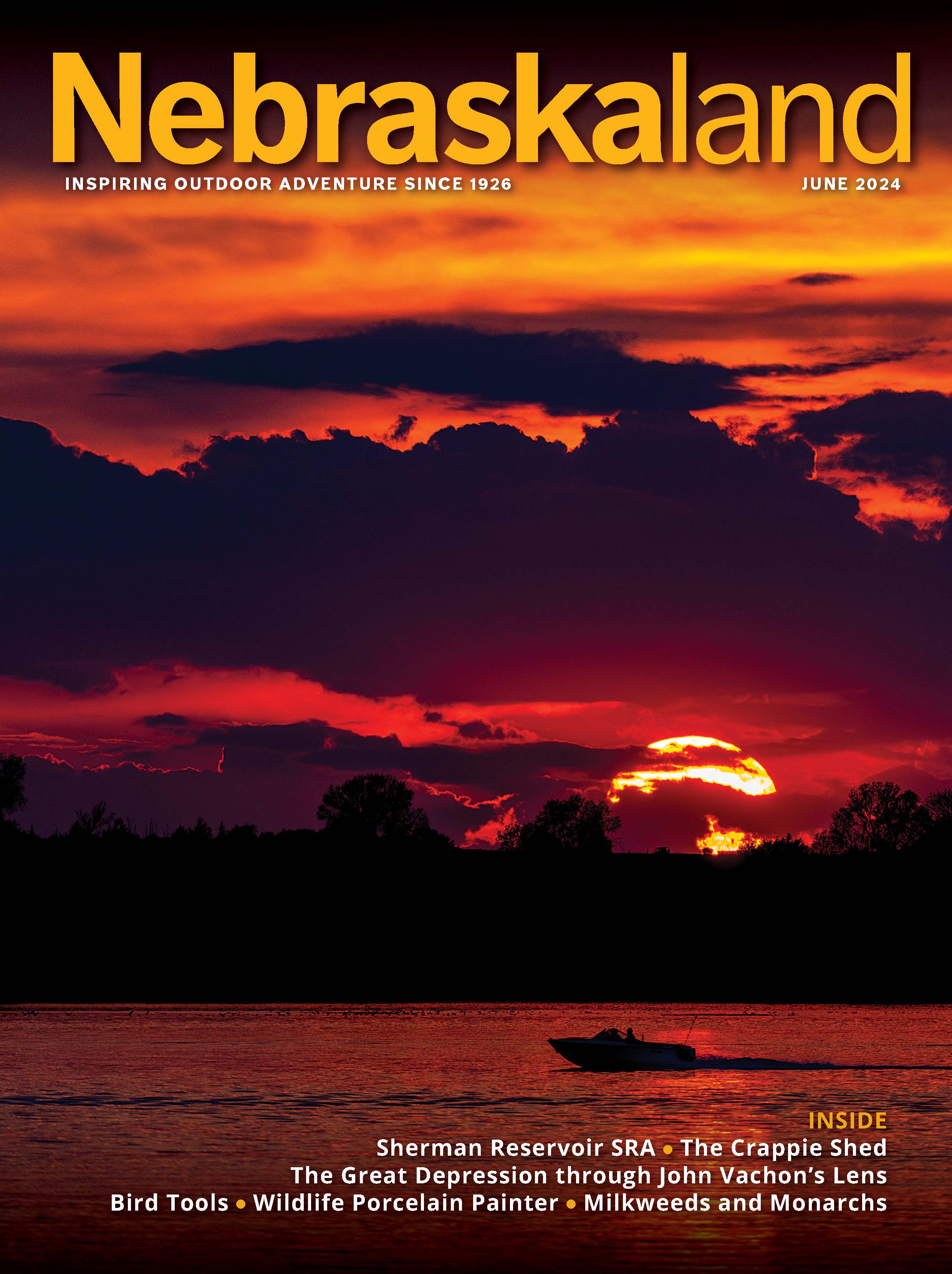
Cover: A boat heads back to the marina as the sun sets
over Sherman Reservoir. See page 18.
ERIC FOWLER, NEBRASKALAND
This page: Distant lights illuminate clouds above
ponderosa pine trees at Chadron State Park on a starry
night.
FEATURES
18
26
SHORELINE TO SPARE
Sherman Reservoir SRA
Story and photos by Eric Fowler
OUTDOOR NEBRASKA
What To Do in June
By Renae Blum
28
WILDLIFE PORCELAIN PAINTER
34
BIRD TOOLS
38
44
JUSTIN HAAG, NEBRASKALAND
Story and photos by Jenny Nguyen-Wheatley
An Ornithologist’s Primer
By Elsa Forsberg
MANAGING GRASSLANDS FOR MILKWEEDS
AND MONARCHS
Story and photos by Gerry Steinauer
THE GREAT DEPRESSION THROUGH
JOHN VACHON’S LENS
By David L. Bristow, History Nebraska
DEPARTMENTS
6
10
48
60
62
Your Nebraska
In the Field
Mixed Bag
Portraits from the Past
The Last Stop
ON THE WEB
For more articles and
information, visit
NebraskalandMagazine.com
Nebraskaland (VOL. 102 / NO. 5 ISSN 0028-1964) is published monthly, except for the combined Jan./Feb. and Aug./Sept. issues, by the Nebraska Game and Parks Commission, 2200 N. 33rd
St., Lincoln, NE. Periodicals postage paid at Lincoln, Nebraska, and additional mailing offices. POSTMASTER: Send all UAA to CFS. (See DMM 507.1.5.2); NON-POSTAL AND MILITARY
FACILITIES: send address corrections to Nebraskaland, P.O. Box 30370, Lincoln, NE 68503-0370.
2
Nebraskaland • June 2024
June 2024 •
Nebraskaland
3
Magazine Staff
magazine
Published by the Nebraska Game and Parks
Commission since 1926. The Commission is
dedicated to the conservation and protection
of all the state's natural resources and the
people who use them.
Communications Director Christy Firestone
Public Relations Manager Shawna RichterRyerson
Editor Jeff Kurrus
Associate Editor Jenny Nguyen-Wheatley
Regional Editors Eric Fowler, Julie Geiser,
Justin Haag
Contributing Editor Michael Forsberg
Regular Contributors Renae Blum,
Chris Helzer, Chris Masada, Todd Mills,
Ryan Sparks, Gerry Steinauer
Art Director Tim Reigert
Graphic Designer Mel Severin
Videographer Nick Sauvageau
Photo Librarian Jaclyn Cruikshank Vogt
Administration
Director Tim McCoy
Deputy Director Jim Swenson
Assistant Director Roger Kuhn
Commissioners
Chairman - Doug Zingula, Sidney
Vice Chairman - John Hoggatt, Kearney
2nd Vice Chairman - Donna Kush, Omaha
Coneflowers begin blooming in prairies
and near roadsides. JEFF KURRUS, NEBRASKALAND
Magazine Subscriptions
For address changes, magazine and subscription
questions, 800-632-5263 or visit
nebraskalandmagazine.com
Advertising
For advertising information, contact:
Shane G. Gilster, 402-742-0125
shanegilster@solotreemedia.com
Pat Berggren, Broken Bow
Rick Brandt, Roca
Scott Cassels, Omaha
Ken Curry, Columbus
Dan Hughes, Venango
Commission Offices
Conservation Officers
Headquarters/Southeast District Office
2200 N. 33rd Street Lincoln, NE 68503
Phone 402-471-0641
ADMINISTRATION (Lincoln)
402-471-5531
Jeff Clauson (Administrator)
Travis Shepler (Asst. Administrator)
Northeast District Office
2201 N. 13th St. Norfolk, NE 68701
Phone 402-370-3374
Southwest District Office
301 E. State Farm Rd. North Platte, NE 69101
Phone 308-535-8025
Northwest District Office
East Hwy. 2, Box 725 Alliance, NE 69301
Phone 308-763-2940
Bassett Office
524 Panzer St., Box 508 Bassett, NE 68714
Phone 402-684-2921
Kearney Office
1617 First Ave. Kearney, NE 68847
Phone 308-865-5310
Ak-Sar-Ben Aquarium/Schramm Education
Center
21502 W. Highway 31 Gretna, NE 68028
Phone 402-332-3901
Omaha Office
8495 Frederick Street, Omaha, NE 68124
Phone 402-595-2144
OutdoorNebraska.gov
NORTHWEST (Includes counties covered)
Dan Kling (Lieutenant)
308-430-0572
EAST SUB-DISTRICT
Jerod Hahn (Sergeant)
Hunter Lee (Keith)
Brandon Wallace (Keith)
Jaden Porter (Keith, Garden)
Tyler Stueck (Keith)
Travis Schultz (Morrill, Cheyenne)
WEST SUB-DISTRICT
Sean McKeehan (Sergeant)
Josh Widhelm (Scotts Bluff)
Justin Gress (Box Butte, Sheridan, Grant)
Jacob Stoinski (Sioux, Dawes)
4
Nebraskaland • June 2024
308-520-5539
308-280-4320
308-280-4488
308-289-2274
308-289-6260
308-279-1292
308-672-1824
308-279-9133
308-629-9335
308-615-9017
NORTHEAST (Includes counties covered)
Dale Davis (Lieutenant)
402-760-0712
NORTH SUB-DISTRICT
Jeff Jones (Sergeant)
John Bauer (Holt, Boyd)
Tyler Adelman (Rock, Brown, Keya Paha)
Jonathan Andreasen
402-762-5022
402-314-9257
402-314-4783
402-340-3981
Mitch Johnson (Knox, Antelope, Pierce)
402-613-8612
(Madison, Pierce, Stanton)
SOUTH SUB-DISTRICT
Cory Krause (Sergeant)
Kyler Prochaska (Platte, Colfax)
Matt Costello (Dodge, Colfax)
Kelbi Abke (Washington, Burt)
Mark McDonald (Dodge, Washington)
Nicholas Fix (Dixon, Dakota, Thurston)
402-380-6410
402-830-8278
402-317-4014
402-237-2537
402-805-2353
402-508-0261
NORTH SUB-DISTRICT
Alex Hasenauer (Sergeant)
Frank Miller (Cherry, Hooker)
Brandon O’Neal
(Lincoln, McPherson, Logan)
SOUTH SUB-DISTRICT
Taylor Dixon (Sergeant)
Bryce Streger (Dawson, Gosper, Custer)
Kelsey Glodowski (Dundy, Hitchcock)
Sophia Gobber
(Chase, Dundy, Hayes, Hitchcock)
308-660-4671
402-389-0444
308-530-3157
308-217-2108
308-537-0404
308-763-8226
308-222-0368
SOUTHEAST (Includes counties covered)
Stacey Lewton (Lieutenant)
402-890-7140
EAST SUB-DISTRICT
Heath Packett (Sergeant)
Russell Mort (Otoe, Johnson)
Rich Berggren (Douglas)
Brian Arp (Douglas, Sarpy)
Mike Luben (Saunders, Butler)
Bryan Adams
(Nemaha, Pawnee, Richardson)
WEST SUB-DISTRICT
Matt Seitz (Sergeant)
Dina Barta (Lancaster)
Luis Nuñez (Lancaster)
Mark Sullivan (Lancaster, Seward, Butler)
Trevor Stahlecker (Lancaster, Saline)
Curt Prohaska (Lancaster)
402-210-0888
402-209-1506
402-619-1355
531-530-9011
402-443-6392
402-429-1924
402-806-0915
402-890-6463
531-333-6093
402-741-0636
402-314-9641
402-470-1298
CENTRAL (Includes counties covered)
Mike Thome (Lieutenant)
308-293-8746
NORTH SUB-DISTRICT
The Nebraska Game and Parks Commission does not discriminate
based on race, color, ethnicity, national origin, sex, pregnancy, sexual
orientation, gender identity, religion, disability, age, genetic information,
veteran status, marital status, and/or political affiliation in its programs,
activities, or employment. Any person who believes he or she has been
discriminated against in any program, activity, facility, or service,
should contact the Nebraska Game and Parks Commission, Lincoln, NE
402-471-0641, the Nebraska Equal Opportunity Commission, Lincoln,
NE 402-471-2024, TTY/TDD 800-642-6112; Director, Office of Diversity,
Inclusion and Civil Rights, U.S. Department of Interior, 1849 C Street,
NW, Washington, D.C. 20240.
402-471-5531
402-471-5531
SOUTHWEST (Includes counties covered)
Brian Piernicky (Lieutenant)
308-330-8780
Doug Pollard (Sergeant)
Matt Brandt (Sherman, Howard)
Daryl Teter (Howard, Greeley, Merrick)
Klint Gill (Nance, Wheeler, Boone)
SOUTH SUB-DISTRICT
Matt Taylor (Sergeant)
Tim Williams (Hall, Hamilton, York)
Eric Javins (Adams, Clay, Webster)
Pat George (Harlan, Franklin, Phelps)
Ethan Teter (Buffalo, Kearney)
308-730-7050
308-202-0819
308-440-1863
402-613-5800
402-200-9597
308-380-7331
402-902-2017
308-920-2762
308-440-3847
Nebraskaland Magazine Copyright 2024, all rights reserved.
Nebraskaland is available in audio from the Nebraska Library
Commission Talking Book and Braille Service, Suite 120, 1200 N St.,
Lincoln, NE 68508. 800-742-7691. Nebraskaland Magazine and the
Nebraska Game and Parks Commission reserve the right to reject any
advertising not in keeping with the agency mission.
Rates: $18 for one year; $33 for two years; $44 for three years. Nebraska
recipients must add appropriate sales tax. To subscribe call
1-800-NEBLAND (632-5263), or go online to:
NebraskalandMagazine.com.
YOUR NEBRASKA
Instagram Photos
Follow us @nebraskaland
and tag us in your photos
to be featured in an
upcoming issue.
Tyler Moore, Omaha
Cuckoo Wasp
Ozan Aktas, Lincoln
Sunset Kayaking at Holmes Lake
6
Nebraskaland • June 2024
Steve Krout, Papillion
Red-headed Woodpecker
June 2024 •
Nebraskaland
7
Roger Richters, Utica
Ice Bubbles
Send your comments and
photos to:
Jeff Kurrus, Editor
Nebraskaland Magazine
P.O. Box 30370
Lincoln, NE 68503
or email Jeff.Kurrus@Nebraska.gov
Jeffrey Z. Carney, Ashland
Summer Lake Wrestling
8
Nebraskaland • June 2024
Please include your postal address
and telephone number. Letters
may be condensed and edited.
Photographs are also welcome.
June 2024 •
Nebraskaland
9
IN THE FIELD
STONE CREEK FALLS
Hiking a quarter-mile down
the trail will take you to
this small waterfall at
Platte River State Park.
ERIC FOWLER, NEB
NE RASKALAND
D
10
Nebraskaland • June 2024
June 2024 •
Nebraskaland
11
IN THE FIELD
THE CRAPPIE SHED
By Tim McNeil
He’s known for his jelly-skirt jig. His gold-painted Crown
Dave Armstrong can be excused for his boyish enthusiasm
Royal jig is also popular with crappie fishermen. And he’s
for fishing. After all, he was only 10 when he caught a
putting the finishing touch on his latest creations — a
22-pound carp out of Rotary Island-Optimist Lake, the pondgravedigger jig and a double-bladed road runner.
size lake on the north end of Auburn.
Armstrong’s time spent painting jigheads doesn’t mean
Onlookers watched him drag the beast by a chain stringer
he’s no longer on the water. He has fished in 20 states and
through town, and after the 11-block trek back to his house,
travels the country to compete in crappie tournaments.
he was exhausted.
Last November, he was invited to represent Nebraska in
“I cleaned and ate the fish when I got home,” Armstrong
the prestigious Dale Hollow Shootout, a $50,000 crappie
remembers.
tournament in Celine, Tennessee.
Armstrong owns the Crappie Shed in Sterling, Nebraska.
“I’m not a great fisherman, but
He opened his first bait shop
I learned from great fishermen,”
in Auburn in November 2020
Armstrong said.
on a whim, when Armstrong
Now he wants to pass his
and two of his buddies sat in
knowledge and passion on to
his unattached garage eating
fried fish, swapping fish tales
kids. Adopted by an Auburn
and watching a Nebraska
couple when he was 2 months
Cornhuskers game.
old, he knows how important the
One of his friends said, “You
outdoors are to kids.
should open a bait shop.”
“I couldn’t ask for better
A week later, Armstrong was
parents,” he said. “I’m so grateful
selling bait from his garage.
for what they did for me. They
“People were coming and going
gave me a home. Because of my
from my garage every night that
parents, I have a special calling to
fall,” Armstrong said.
give back to kids.”
He moved the Crappie Shed
He donates bait, tackle boxes,
to Sterling two years later. The
fishing poles and reels to a pair
master closet-size store has Dave Armstrong in his crappie shed. JEFF KURRUS, NEBRASKALAND of youth tournaments — the
nearly 1,000 plastic lures on its
Nebraska State Youth Kayak
walls.
Championship and Old Man River Days. The Crappie Shed and
Armstrong paints, powder coats and bakes the jigheads
bait shop Anglers Allie in Prague, Nebraska, are co-sponsoring
he sells. The process ensures the longevity of the paint. He
a tournament next May at Czechland Lake.
offers 38 colors, compared to larger retailers, who might
To support church fundraisers and families with cancer
provide 10-15 colors.
and other life-changing challenges, Armstrong has donated
His plastics come from small suppliers, and he sells his
guided fishing trips.
homemade jigheads exclusively to mom-and-pop bait shops,
On weekends, he takes open-water and ice-fishing clients
but only after he tries every one of his creations.
to one of five southeastern Nebraska lakes — Czechland,
“I’ll stand and field-test for hours from the Duck Creek
Branched Oak in Lincoln, Iron Horse in DuBois, Burchard
Recreation Area dock [in Nemaha County],” Armstrong said.
Lake in Burchard and Duck Creek in Peru. He likes when
“I don’t sell until I test. I’m not interested in selling a lure to
clients bring their children.
make a buck. I want everyone who goes fishing to have a
What motivates him the most is the opportunity to bring
favorable experience.”
joy to someone in need. Recently, a client with spina bifida
Armstrong said he can paint 200 to 300 jigheads in a night.
climbed from his wheelchair and into Armstrong’s boat. The
Some have one eye. Others have a metallic-like finish that
determined angler’s face lit up when he caught his first fish.
mimics scales falling from a shad. The effect attracts fish to
“It’s all about the smile,” Armstrong said with boyish
the bait.
enthusiasm and a sparkle in his eyes.
12
Nebraskaland • June 2024
IN THE FIELD
FROM BOTH SIDES OF THE DOOR
By Ryan Sparks
Growing up on a Nebraska farm, I was blessed with an
abundance of land to hunt, but when I moved out of state,
I learned the importance of creating relationships with
landowners. Having been on both sides of the door — being
the one knocking and also seeing what influenced my
family to give permission — has provided me with a unique
perspective. Here are my top takeaways:
Know Who Owns the Land
Just because someone lives adjacent to where you want
to hunt doesn’t mean they own it. Resources like OnX or
county assessor GIS maps (nebraskamap.gov) will give you
a good understanding of land ownership. It’s also a good
way to identify small properties that might go unnoticed or
to identify landowners with multiple properties. You might
gain permission to hunt several places by knocking on a
single door.
Ask Permission Well Ahead of the Season
Not only does showing up the week before season make
you seem unprepared, you also want the first shot at asking
permission. Most landowners give permission to a single
person. You want it to be you.
Present Yourself in the Best Light
Look respectable, be polite, clearly state where and when
you want to hunt and go from there. If they say no, ask if they
know anyone in the area who might let you hunt, and then
thank them and move on.
Start Small
Not many people are going to give you permission to hunt
giant bucks on their property, but a lot of landowners don’t
think twice about squirrels, quail or even turkeys. If you
are hunting to fill the freezer, let them know you are more
than happy to shoot a doe. Some landowners prefer archery
hunters. Establish yourself as a respectful hunter with your
actions.
Be Clear with Your Intentions
Some landowners want to know exactly when and where
you want to hunt. Let them know what vehicle you will be
driving, where you plan to park and give them your phone
number in case they have questions.
Treat Landowners and Their Land with Respect
Don’t drive off-road without permission, and don’t drive
down roads when it’s muddy and leave ruts that will have
to be repaired, or worse, get stuck and have to be pulled out.
Pick up any trash you find as well as your spent shotgun
shells or rifle cartridges. Leave gates the way you found
them and don’t invite friends that haven’t clearly also been
given permission.
Let Them Know How Much You Appreciate
Hunting on Their Place
Asking permission to access someone’s land well ahead of
when you plan to arrive builds trust. JUSTIN HAAG, NEBRASKALAND
14
Nebraskaland • June 2024
Send photos of the success you have and offer them some
of the meat. With these things in mind, you will have places
to hunt for years to come.
IN THE FIELD
JENNY NGUYEN-WHEATLEY, NEBRASKALAND
CATFISH AND CHIPS
By Jenny Nguyen-Wheatley
Servings: 4
Prep Time: 3 hours
Cooking Time: 30 minutes
Ingredients:
4 catfish fillets
4 large starchy potatoes
Vegetable/peanut oil for frying
Beer Batter
1 cup of flour, plus extra
11⁄2 teaspoon of baking powder
1 teaspoon of fine sea salt, plus extra
1 to 11⁄4 cups of lager beer
•
•
•
•
•
•
•
1. Cut potatoes, peeled or unpeeled, into desired size
strips. Soak in water for about 2-3 hours.
2. Meanwhile, make the beer batter by combining the
dry ingredients first, and then whisk in the beer. Batter
should resemble thin pancake batter. Refrigerate the
batter, covered, for up to 3 hours until you’re ready to
use it.
16
Nebraskaland • June 2024
3. To fry the chips, drain potatoes and lay them out
onto a large cookie sheet lined with paper or cotton
towels. Dab the potatoes to get them as dry as possible
— water and hot oil do not mix. Then heat oil to 300
degrees Fahrenheit, and fry in batches until potatoes
become tender, about 5 minutes. They should still be
blond at this point. Drain par-fried potatoes on paper
towels or on a cooling rack.
4. Then, crank up the oil temperature to 375 degrees.
Fry the chips again until golden and crispy — do
not crowd the pan to keep the oil temperature from
dropping too much. Transfer chips to a cooling rack,
toss with salt to taste and keep warm. If fries get soggy,
crisp them again in a 400-degree oven.
4. Rinse catfish with cold water, and then pat dry
and season with salt. Next, lightly coat the fish with
plain flour and then dip into the beer batter; gently
stir batter if separation occurs. Fry fish in 375-degree
oil until golden and crispy. Drain before serving
immediately with chips and your favorite condiments.
June 2024 •
Nebraskaland
17
Shoreline to Spare
A maze of bays and coves extend from
the main body of Sherman Reservoir,
providing plenty of water for boaters to
explore. Thousands of acres of wildlife
lands rise from the water.
Sherman Reservoir SRA
Story and photos by Eric Fowler
18
Nebraskaland
• June 2024
June 2024 •
Nebraskaland
19
A
t 2,845 acres and a little more than
4 miles long, Sherman Reservoir
is far from Nebraska’s largest.
Yet between five large bays that
branch off the main lake, and the many
coves found in each of those, the lake
boasts a maze of 77 miles of shoreline
when full. That ranks second among the
state’s lakes, leaving plenty of water for
boaters to explore and shoreline habitat
for fish.
TOP LEFT: Creyton Cumpston of Litchfield fishes from the footbridge over the
inlet at Sherman Reservoir State Recreation Area. Spring fishing at the inlet
for white bass, walleyes and more can be excellent.
BOTTOM LEFT: Boaters drop anchor and float the day away in one of
Sherman’s coves.
BELOW: Cottonwoods and other trees line the shores of Sherman, their roots
exposed by erosion that occurs during the short time each spring that the
reservoir is at full pool. When the lake is full, these roots are submerged and
provide habitat for crappies and other fish.
Full Pool
Completed in 1962, Sherman Dam was
built by the U.S. Bureau of Reclamation
on Oak Creek northeast of Loup City.
The creek, dry except following rain,
doesn’t supply the water for the lake,
however. Instead, water is diverted from
the Middle Loup River at Arcadia Dam,
18 miles to the northwest, and flows
through a canal to the lake, where it
backs up into loess canyons branching
off the main arm. During the summer,
water stored in the lake, owned by the
Farwell Irrigation District, irrigates
49,000 acres of farmland in the Middle
Loup Valley.
Sherman Reservoir State Recreation
Area offers more than 300 primitive
campsites in nine locations around the
lake, including a few in out-of-the way
corners. Until 2023, the only hookups
for RVs were found in the seasonal and
nightly spots offered by the Trade Winds
Marina on the east side of the lake.
Following expansion and improvements,
the West Ridge Area campground now
provides 61 pads with electrical hookups
overlooking Thunder Bay on the south
shore of the lake.
During the summer, boats and personal
watercraft buzz around the lake, many
pulling skiers and tubers, the size and
shape of the lake providing shelter from
the wind on most days. Lacking the sand
beaches offered by several of the state’s
lakes, sun seekers often retreat to a bay,
drop anchor and float the afternoon
away on a hot summer day.
Starting in July, irrigation releases
draw the lake down an average of 9
feet. Unlike some reservoirs, however,
20
Nebraskaland
• June 2024
June 2024 •
Nebraskaland
21
Sherman refills every year. That process
starts in the fall, after irrigation season,
bringing the lake to 5 feet from full.
Diversions resume in mid-April, and by
mid-May, the lake is at full pool.
TOP LEFT: The Oak Creek Area on Trail
11 is one of several locations where
campers can pitch a tent at Sherman.
The layout of the lake provides
kayakers plenty of places to escape the
wind from nearly any direction.
Fishing and Hunting
TOP RIGHT: Kielyn Beezley of Kearney
water skis behind a boat piloted by Rick
Westland of Pleasanton.
Sherman is one of the top walleye
and crappie lakes in the state. It is one
of three lakes where Game and Parks
biologists net walleye during the spawn,
collecting eggs to feed the hatchery
system and raise walleye to stock in
Sherman and other waters around the
state. As such, the area along the dam
is closed to fishing from April 1-20, but
anglers can often find fish there prior
to the closure, and elsewhere during it.
Walleye fishing peaks in May and June.
It can slow considerably in the summer
if gizzard shad, the lake’s forage base,
have a successful hatch, but picks up
22
Nebraskaland
• June 2024
BELOW: A storm cloud fills the sky
above the West Ridge Area campground
on the south side of the reservoir. The
campground was expanded in 2023 and
now provides 61 pads with electrical
hookups.
June 2024 •
Nebraskaland
23
again in the fall.
The crappie bite is best when the lake
fills in May and floods the cottonwood
trees and willows growing on the
shoreline, or the trees that have toppled
into the lake. Fall fishing can be good for
crappies, too.
There are other fish to chase at
Sherman. When water starts pouring
into the lake in April, anglers find white
bass below the inlet in the Fisherman’s
Bridge area. During the summer, white
bass can be found following schools
of shad in the lake. Plenty of channel
catfish, and some big ones, provide
opportunity throughout the summer.
Whatever you’re fishing for, hang on to
your rod, and bring a big net. You might
hook into a northern pike or a flathead
catfish. The flatheads can top 70
pounds, and one caught and released in
2001 measured 6 inches longer than the
current 89-pound state record.
The reservoir is surrounded by 4,721
acres of public land, making it a popular
spot among hunters. White-tailed deer
and turkeys roam the tree- and brushfilled draws, and pheasants, quail and
a few prairie-chickens are found in the
upland prairie and many food plots
on the wildlife management area.
Maintenance trails through the area are
perfect for a long, scenic hike, especially
in the fall, when the cottonwood leaves
turn golden yellow.
A dozen trails lead to the water or the
wildlife lands around the lake. At the
end of each of them — like the coves on
the reservoir itself — you will certainly
find something to your liking. N
TOP LEFT: Goldenrod blooms
in a prairie in the Trail 5
area last August. Grasslands
around the lake are
managed for wildlife.
TOP RIGHT: A boat heads
back to the marina as the
sun sets over the lake.
BOTTOM: Ron Garver nets a
walleye for his brother, Ben,
last fall. Ben, who has fished
the lake his entire life and is
a fishing guide there, called
it “a walleye factory. It just
turns them out year after
year.”
Sherman Reservoir
Sherman Reservoir is located 7 miles
east of Loup City. This 2,845-acre lake
provides camping, fishing, boating,
hunting and more.
24
Nebraskaland
• June 2024
June 2024 •
Nebraskaland
25
Outdoor Nebraska
By Renae Blum
There is no limit to what you can do outdoors this time
of year. This month, try a new trail program, Your
Parks Adventure, or cast a line for catfish, survey for
butterflies and photograph flowers. N
Visit Calamus
Reservoir State
Recreation Area
What To Do in June
All year | 42285 York Point Rd.,
Burwell, Neb.
Once considered a hidden gem, Calamus
sees more visitors every year, with many
first timers planning repeat visits. In
June, you can enjoy great fishing for
walleye and channel catfish, as well as
boating on the reservoir and canoeing
or kayaking Calamus River. Take the
1.5-mile mowed grass trail up into the
hills for amazing overhead views of
the reservoir. Electric plus and basic
tent camping is also available; due to a
repaving project, all camping is firstcome, first-served for the time being, so
call ahead to check availability.
ERIC FOWLER, NEBRASKALAND
Train to survey for butterflies
June 1, 1-5 p.m. CST | Schramm Education Center
Photograph black-eyed Susans
Blooms late June into August | Generally statewide, except southcentral and southwestern Nebraska
Enjoy exploring nature while helping Nebraska’s rare and at-risk butterflies. Sign
up for this training session, where you’ll learn how to become part of the Monarch
and Regal Fritillary Survey. Volunteers like you will help biologists document
monarch and regal fritillary butterflies in Nebraska. Learn more and register by
searching for the event “Butterfly Training” at Calendar.OutdoorNebraska.gov.
JULIE GEISER, NEBRASKALAND
If you have ever been outside in Nebraska from late June to August, odds
are high that you have seen a black-eyed Susan. These flowers may be one
of the most recognizable wildflowers due to their bright yellow petals and
brownish-black centers. These flowers are critical for pollinators; many bees,
butterflies and beetles rely on them for food and nectar. Shoot photos early
and late in the day when the light is warm and golden.
JEFF KURRUS, NEBRASKALAND
Fish a Nebraska river for
channel catfish
Participate in Your Parks
Adventure: Trail Trek
Throughout the month | Statewide
Through Oct. 31, 2024 | Statewide
Nebraska’s rivers are sometimes overlooked as a fishing
opportunity, but you might be surprised at the number of
catfish you can catch there. June is an excellent month to
fish for channel catfish, as they’re migrating up the rivers
for spawning in July. Pick a larger river, like the Platte,
Niobrara, Missouri or the lower Loup rivers, and look for a
deeper spot and cover of some kind. Use your favorite bait
and remember to keep it simple: A hook and sinker is about
all you need.
Looking for new ways to stay active and explore the
outdoors? A new program, Your Parks Adventure,
will help you do just that. Choose from over 40 trails
across the state, some of which are ADA-accessible,
and look for a sign that says “Trail Trek” located
along the trail. Then, you’ll take a selfie with the sign
and submit it online for the chance to win prizes,
including a Nebraska state park cabin stay. To learn
more, visit YourParksAdventure.com.
ERIC FOWLER, NEBRASKALAND
ERIC FOWLER, NEBRASKALAND
26
Nebraskaland • June 2024
June 2024 •
Nebraskaland
27
Wildlife
Porcelain
Painter
Story and photos by Jenny Nguyen-Wheatley
‘M
y joke is that if you paint a
leaf too big or a petal too big,
nobody really notices. But if
you get the nose too big on a dog or
the beak too big on a chicken, people
notice,” said Peg Pelter of Lincoln,
explaining the difference between
painting traditional subjects such
as florals and fruit to animals. Some
of her most recent work highlights
Nebraska wildlife.
In fall 2022, Pelter began painting a
series of plates that would be unveiled
at The Landing retirement community
center in south Lincoln. The porcelain
painter produced a total of 39 pieces
for her exhibit: 16 plates of native
wildflowers; six pheasants; nine blackfooted ferrets, a Nebraska endangered
species; six meadowlarks, our state
bird; and a couple of landscapes.
She called the collection “Nebraska
Treasure.”
Painting History
Past visitors at Arbor Lodge State
Historical Park and Arboretum near
Nebraska City might’ve caught the
artist at work in the Morton Mansion.
During living history weekends fall
Five of six plates that Pelter painted of the meadowlark, the Nebraska state bird. Pelter produced a total of
39 pieces for her “Nebraska Treasure” collection, which features Nebraska wildlife.
Pigments that Peg Pelter of Lincoln uses to paint on porcelain. She describes
porcelain painting like “painting on glass.”
28
Nebraskaland • June 2024
2022 and spring 2023, they might’ve
spotted Pelter working on pieces for
her “Nebraska Treasure” exhibit. She
paints in the sunroom where the light
is best and has been doing so for about
12 years. Pelter’s presence is a tie-in
to the mansion’s history — Caroline
Joy Morton, wife of J. Sterling Morton,
was a porcelain painter, as were many
upper-middle class women in the
1890s to 1920s.
China painting came to the United
States in the late 19th century by way
of the world expositions in Philadelphia
and Chicago, which introduced
Americans to cultures worldwide. First
Lady Caroline Harrison, wife of 23rd
President Benjamin Harrison, could
be credited for the mania around china
painting in the U.S. Harrison’s talent
and interest in the medium captivated
women all over the country, and
many of her pieces are on display in
the White House today, including her
design of the presidential china during
her husband’s term, which would’ve
been used during state dinners.
The rising popularity of this pastime
also coincided with a burgeoning
middle class that found itself with
more leisure time, a major shift in
American society as a result of the
post-Civil War Industrial Revolution.
China painting was deemed an
acceptable hobby for women because
it was a way for them to decorate and
beautify their homes.
“Nobody ever painted china in a
soddie,” Pelter explained. “You had to
have the time and access to a kiln and
access to porcelain. Now porcelain
is cheaper than dirt, but back in the
1890s to 1920s, china was expensive.”
Then in the 1920s, china painting
died out, Pelter said — a casualty of
the Great Depression and World War II.
The Second Wave
Trends come and go, and china
painting was no exception. Four
decades later, the art form made its
June 2024 •
Nebraskaland
29
and began traveling to countless art
and craft shows. Pelter also made a
living painting tiles to decorate the
kitchens, bathrooms and fireplaces in
peoples’ homes. Her dedication to this
art form has spanned close to half a
century.
Painting on Porcelain
ABOVE: Pelter working on a pheasant plate during living history weekend at the
Morton Mansion at Arbor Lodge State Historical Park.
RIGHT: Five of six pheasant plates that Pelter painted for her “Nebraska Treasure”
collection.
comeback in America. Pelter, a college
student at the University of NebraskaLincoln at the time, fortuitously met a
china painter at the Gateway Mall in
Lincoln in 1976.
“I watched her for a while and
thought, ‘I can do that.’ So, I took her
card and ended up taking lessons with
her. To be honest with you, it was
pretty inexplicable,” Pelter said. “I was
a college student, and these lessons
were $75 — I didn’t have that kind of
money, but somehow I did it.”
Like many during that time, Pelter
30
Nebraskaland • June 2024
had caught the second heyday of
china painting, which happened in the
1960s and 1970s, thanks to the advent
of the electric kiln. Previously, kilns
were kerosene- or gas-fired, and they
were dangerous. Also, the exhaust
from these old kilns meant that artists
couldn’t store them in the basement or
garage, another inconvenience.
When Pelter and her husband, Larry,
built their current home in Lincoln in
1985, they built Pelter an art studio.
She took a leap and decided to turn
this decade-long hobby into a career
Pelter compares painting on
porcelain to “painting on glass,” as
there’s no texture to hold the paint in
place, as opposed to canvas or paper,
so technique and brush control are
important skills. Another challenging
aspect of china painting is that
the objects she paints on are rarely
completely flat.
“Most other forms of painting are
done on flat rectangles, so it takes a
sense of design to get the image on
an appropriate piece of china in an
appropriate way,” Pelter said. “It’s
funny how you get hooked on things.
For some reason, I’m really hooked on
porcelain. Canvas and paper just seem
dull. They don’t appeal to me.”
With china painting, pigments are
applied onto a fired, glazed surface
— such as a plate or bowl that you’d
purchase. To set the image, the piece
of porcelain is essentially fired again
to about 1,500 degrees Fahrenheit,
during which the glaze softens,
allowing the pigments to “fall into”
the glaze.
“As the glaze cools, those pigments
get caught in the glaze. And so, it
becomes a permanent surface. The
image is no longer lying on top of the
glaze — it’s lying in the glaze,” Pelter
explained.
Often, Pelter’s paintings may be
inspired by a single color. For example,
she might feel like painting something
“red” one day. The next step would
be deciding what that “red” subject
would be, after which she searches
for a photograph to use as reference.
Pelter claims to have one of the largest
clip files in existence, though Google
has been useful in recent years. Due
to the challenging nature of painting
June 2024 •
Nebraskaland
31
Five of nine plates that Pelter painted of the black-footed ferret, an endangered
species in Nebraska and federally.
animals, the six pheasant plates were
her favorite to paint in the Nebraska
Treasure collection, followed by
the meadowlarks for their vibrant,
contrasting hues.
“Most of my paintings came from
photographs. I’m sure quite a few
of them came from Nebraskaland
Magazine,”
Pelter
said.
While
painting her wildflower pieces, she
often thought of the work of Michele
Farrar, who used her late husband’s
32
Nebraskaland • June 2024
photographs to create etchings
of Nebraska plants and flowers
— Jon Farrar was a Nebraskaland
photographer and writer for over 40
years.
The black-footed ferret is one of
Pelter’s more obscure subjects. She felt
inspired to paint the ferret, a species
listed as endangered in Nebraska and
federally, after a visit to a nearby state
park, where she happened to read some
educational material on the weasel.
Florals are traditional subjects in china painting, which was a popular pastime for upper-middle class
American women from the 1890s to the 1920s.
Once thought to be extinct due to
habitat loss, black-footed ferrets were
rediscovered in the 1980s in Wyoming.
The ferrets’ historic range included
the Great Plains, mountain basins
and semi-arid grasslands in 12 states,
including Nebraska. Biologists guess
there are only 300-350 individuals left
in the wild in all of North America.
“For some reason, that intrigued me
— the idea that these animals are out
there somewhere, but nobody knows
where they’re at,” Pelter said.
Since being on display at The
Landing in October and November
2023, Pelter’s Nebraska Treasure
collection has been “on the road.”
It moved to the Unitarian Church in
winter 2023 and then was displayed at
Bethany Christian Church in Lincoln
through March.
Pelterhouse
Though china painting has fallen
out of fashion again, there remains
a small, dedicated community still
practicing this art. Pelter travels all
over the country to share her skills
at arts and craft seminars, and she
and Larry, who makes pottery, stay
at Custer State Park in South Dakota
three to four weeks every summer/fall
as artists in residency, where they set
up a gift shop and do demonstrations.
And who knows. Consider the
return of sourdough breadmaking
or high-waisted jeans. A third china
painting revival just might be on the
horizon. In the meantime, keep up
with Peg Pelter’s work on Facebook at
Pelterhouse.
Catch Peg Pelter at a living history
event at the Morton Mansion, part of
Arbor State Lodge Historical Park and
Arboretum near Nebraska City. She is
scheduled to appear Oct. 18-20, Nov. 30
and Dec. 1, 2024.
June 2024 •
Nebraskaland
33
Bird Tools
5
An Ornithologist’s Primer
By Elsa Forsberg
J
1. Binoculars or spotting scope — Spotting
birds can be difficult, especially when
looking for small species or viewing
birds from a distance. Binoculars and
spotting scopes can magnify details
to help with bird identification. These
tools can also allow biologists to read
codes on bird bands and observe
behavior without disturbance.
2. Waterproof field journal — Working
outside means working with the
weather, so a waterproof journal is the
best option to make sure important
notes aren’t lost on a rainy day.
ust as there are many kinds of birds in the world, there are also many tools that
biologists use to study them. Tracking changes in survival, body composition,
movement and location allows biologists to learn about the life histories,
behavioral patterns and ecology of birds. Among the many specialized tools needed
to study this diverse group of animals, there are a few standards that most avian
biologists can’t do without. N
3. Bird ID book — While most avian
biologists are skilled at identifying
birds, there are always a few
stumpers. Some species look similar to
each other, and sometimes occasional
migrants or birds on the edge of their
range show up in unexpected places.
A good bird ID book can help confirm
these sightings.
6
4
4. Camera — Cameras are useful tools
for documentation. In addition
to binoculars, the still shots from
cameras can help identify species and
bird band codes.
1
2
7
5
5. Datasheets — The most precious piece
of a biologist’s toolkit are datasheets,
which can hold the information that
will hopefully answer the questions
that the biologist sets out to study.
Once data is entered into a computer
database for analysis, the data sheets
become a physical archive.
6
6. Egg float kit — If a biologist is
searching for and monitoring bird
nests, they will likely want to know
the age of the nest. Egg floating is one
method for determining how soon a
nest will hatch, as the buoyancy of the
eggs can indicate how far along the
nest is in the incubation process.
8
3
4
34
Nebraskaland
Nebras
aska
kalland • June 2024
7. GPS unit — A GPS unit is a useful
tool for logging and keeping track of
observations, survey points and nest
locations, especially when navigating
difficult terrain or returning to
monitor a nest deep in the field.
8. Kestrel — This device records wind
speed and air temperature, which are
metrics that biologists often record in
addition to other observations for the
datasheet.
9
9. Rangefinder — Avian biologists
conduct several types of surveys, such
as point counts, and many require
knowing how far away a bird is at the
time of observation. A rangefinder
offers a quick and accurate estimate.
12
10. Sunscreen and hat — The field season
for an avian biologist can include long
days in the sun. Applying sunscreen
allows biologists to stay out in the
field as long as needed. In addition
to reducing sun glare, hats also
serve as a protective barrier against
undesirable droppings from the sky,
which are increased hazards for avian
biologists.
11. Mist net — To study birds, sometimes
biologists need to catch them. Once
birds fly into the net, biologists
extract them for measurements and
banding before release.
12. Calipers, scale and measuring
equipment — Once a bird is in hand,
biologists take precise measurements
of beaks, legs and other avian body
parts with the help of calipers. A
specialized ruler is used to measure
the length of the wing. Scales are used
to get a mass measurement, usually
while the bird is temporarily placed in
a cloth bag.
10
13
13. Bird bands — Bands are used to
help biologists track birds over
time and analyze their survival and
movements. Metal leg bands are
placed above the ankle joint and are
engraved with a unique number for
each individual that is read when the
bird is in hand. Small color bands are
used to help identify individuals from
a distance. Neck bands are used in a
similar way, often fitted onto larger
waterfowl, such as geese and swans.
14. Neck collar transmitter and backpack
transmitter — GPS transmitters
are helpful for tracking locations of
birds as they forage, raise young and
migrate. The obtained GPS data can
inform how and when birds move
and what habitats are important.
Transmitters are attached in various
ways depending on the size and life
history of each species.
14
11
Elsa Forsberg is a wildlife biologist with the
Nebraska Game and Parks Commission.
ALL PHOTOS BY JEFF KURRUS, NEBRASKALAND
36
Nebraskaland • June 2024
June 2024 •
Nebraskaland
37
Managing Grasslands for
Milkweeds and Monarchs
Story and photos by Gerry Steinauer, Botanist
T
he monarch butterfly is in
trouble. Based on annual surveys
conducted at their wintering
grounds in central Mexico, the
eastern North American monarch
population has declined 80 percent
over the past 25 years. The rapid
decline has spurred the U.S. Fish and
Wildlife Service to consider listing the
butterfly as an endangered species.
Complicating
the
situation,
evolution has painted the monarch
into a corner. They lay their eggs solely
on milkweeds and their caterpillars
Monarchs that breed in the eastern U.S. and southern Canada winter in central
Mexico. Monarchs that breed west of the Rockies winter in southern California.
A monarch caterpillar feeds on a common milkweed leaf. The caterpillars outgrow
their skin and molt five times during their larval stage.
A whorled milkweed colony
on the author’s family
prairie spread via rhizomes
in response to spring
prescribed fire and fall
glyphosate spraying that
targeted smooth brome and
Kentucky bluegrass.
38
Nebraskaland • June 2024
eat only milkweeds, making them
dependent on the plants for survival.
In response to the monarch’s decline
and research in Iowa that showed
declines in milkweed numbers, the
Midwest Association of Fish and
Wildlife Agencies in 2018 set a goal
for conservation groups to increase
milkweed numbers by 1.2 billion plants
across the monarch’s Midwestern
breeding range, which includes
eastern Nebraska. Our state’s portion
of the total was an intimidating 125
million.
Many conservationists, including
myself, questioned the number’s
validity as it was based on limited
research and seemed rather contrived.
Nevertheless, the proclamation set
off a rush to plant greenhouse-grown
milkweed seedlings in yards, parks
and roadsides to help the monarch.
The rush, however, was somewhat
tempered when scientists began to
caution that the planting of milkweeds
alone will not save the monarch.
“‘Plant milkweeds’ was a twoword solution to a complex ecological
problem,” said Mercy Manzanares,
program
coordinator
for
the
June 2024 •
Nebraskaland
39
Monarch Joint Venture in Omaha, a
conservation organization dedicated
to conserving the butterfly. She
explained that in addition to the loss of
milkweeds, other factors contributing
to the monarch’s decline include loss
of their prairie habitat to agriculture,
development and tree encroachment;
the widespread use of pesticides and
herbicides on cropland and lawns; and
climate change, which interrupts the
butterfly’s fall and spring migrations
to and from their wintering grounds.
Manzanares,
however,
still
encourages planting milkweeds, as
they do benefit monarchs and other
pollinators that feed on their nectar
and pollen.
“It is an easy way to involve people
in conservation,” she said. Milkweed
seedlings planted in urban and other
areas will attract monarchs and entice
them to lay a few eggs. Growing
seedlings, however, is labor intensive
and the transplants often need
watering and, when planted in the
Sullivant’s milkweed pods ripen in late summer. The plant’s smooth leaves and
pods distinguish it from the hairier common milkweed.
40
Nebraskaland • June 2024
wild, struggle to survive.
In reality, the only practical ways
to substantially increase milkweeds
and help the monarch is to include
milkweed in the seed mixes used
when restoring prairies and to manage
existing grasslands using methods
that increase the plants. Methods
landowners can use to accomplish the
latter follow.
Intense Spring and Fall
Grazing
Fifteen years ago, my wife, Grace,
and I began testing methods to increase
milkweeds and other wildflowers in a
40-acre tallgrass prairie on her family’s
farm in southeastern South Dakota.
Like many Midwestern prairies,
more than a century of season-long
livestock grazing and, more recently,
annual mid-summer haying, had
stressed the prairie’s native grasses
and wildflowers and allowed nonnative grasses, mainly smooth brome
and Kentucky bluegrass, to invade.
At that time, the prairie supported
few milkweeds or other wildflowers
and had little value for monarchs. But
things were about to change.
First, haying was replaced with
intense spring grazing in most years,
with occasional additional fall grazing,
or spring prescribed fire followed by
rest the remainder of the growing
season. These practices stressed
the spring- and fall-growing brome
and bluegrass while allowing the
summer-growing native grasses and
wildflowers to recover. Small colonies
of common and whorled milkweed
began to dot the grassland. These
plants likely sprouted from the seed
bank and then spread by rhizomes,
underground stems with buds. We
were also delighted to see scattered
plants of the uncommon green and
woolly milkweeds. Other pollinatorfriendly wildflowers, such as purple
coneflower and Missouri goldenrod,
made their appearance as well.
In spring, cattle relish grazing the nutritious early growth of smooth brome and Kentucky bluegrass,
and often shun grazing wildflowers.
Our present renters, two young
cattlemen, graze the pasture with 30
cow/calf pairs from about April 15 to
June 1. This is a heavy stocking rate
and the pasture is often golf-course
short when the cattle are taken off,
but hard grazing is needed to stress
the stubborn brome and bluegrass. At
first, the renters were hesitant to turn
their cattle out in mid-April, fearing
there wasn’t enough grass to sustain
them. I maintained that the young,
tender growth of brome and bluegrass
is packed with nutrients and would
put pounds on their animals. They
consented, and when the animals
came off the pasture that first year,
one of them sheepishly admitted, “Our
calves sure look good.” Many native
plants, including milkweeds, ramp up
their growth in early June and, if left
in the pasture, the cattle will forgo
the brome and bluegrass and eat the
nutritious, early growth of these
plants, setting them back as well.
We begin fall grazing about Sept.
15 and usually take the cattle off the
pasture sometime in November. Cool
fall temperatures trigger brome and
bluegrass to resume growth after
summer dormancy. At this time of
year, the sugars they produce through
photosynthesis are stored in their
roots and used for the next spring’s
growth. Hard fall grazing removes the
leaves, stifling photosynthesis, food
storage and the plants’ future vigor.
Ranchers with multiple pastures
dominated by non-native grasses and
nowhere else to graze their livestock
can select their most wildflowerrich pasture for intense spring and
fall grazing while grazing their lessdiverse pastures during the summer.
Occasionally, they can summer graze
the diverse pastures, burn them or rest
them the entire growing season. Doing
so will benefit wildflowers, milkweeds
and monarchs in at least one of the
pastures.
Herbicide and Seeding
Although it sounds contradictory,
Grace and I also use herbicides to
promote milkweeds. In fall, we search
the pasture for the dried, dormant stems
of common and whorled milkweed and
spray glyphosate herbicide (its many
brand names include Roundup) on
the still-green brome and bluegrass
surrounding the stems. Glyphosate
is a contact herbicide that kills only
actively growing plants — it does not
remain active in the soil. The following
summer, reduced competition from the
non-native grasses allows milkweed
plants to sprout new stems, often
forming dense colonies.
We spray glyphosate only after
at least two hard freezes, where
nighttime temperatures drop to at
least 28 degrees Fahrenheit. The
cold further stimulates the nonnative grasses to move nutrients
from their leaves to their roots for
winter storage, and the herbicide is
carried along for the ride. Once in the
roots, the herbicide is more effective,
killing the entire plant. We spray
only when daytime temperatures
reach 50 degrees or higher for two
consecutive days, spraying on the first
day at a rate of two quarts per acre
along with a non-ionic surfactant and
ammonium sulfate. We have had our
best luck killing brome and bluegrass
by spraying in late November, but
spraying into December can also be
highly effective.
Using a boom sprayer mounted on
an all-terrain vehicle, we also treat
larger areas of brome and bluegrass, up
to about a quarter acre, in the fall, and
then hand-sow milkweed and other
wildflower seed in late fall or early
winter. We only seed in years when the
prairie has been grazed or burned and
has little thatch, as this ensures good
seed-to-soil contact and germination.
Using this method, about 50 butterfly
milkweed plants with glorious orange
blooms now adorn our prairie, while a
few colonies of Sullivant’s and swamp
milkweed grow in moist soil near an
June 2024 •
Nebraskaland
41
intermittent stream. Others have had
success establishing common, showy
and whorled milkweeds from seed.
We collect the milkweed seed from
local wild populations, but milkweed,
as well as other wildflower seed,
can be purchased from local and
online seed dealers. Buy seed grown
in Nebraska or nearby, as seed from
plants grown in distant states may
not be suited for our climate and soils.
The demand for milkweed seed has
driven up prices, so buy what you
can afford. There are more than 4,000
butterfly milkweed seeds in an ounce,
so a little goes a long way. Seedling
survival can be increased by reducing
grass competition for several years
after planting using spring, fall or light
summer grazing, or prescribed fire.
Disking and Tilling
Russ Hamer has been managing
Nebraska Game and Parks wildlife
management areas in northeastern
Nebraska for 24 years. On these areas,
he frequently uses light disking or
tilling from spring through fall to
create early-successional habitat on
grasslands that have been previously
farmed
or
otherwise
heavily
disturbed. These habitats, considered
“weedy” by some, often teem with
common milkweed along with annual
plants including foxtails, ragweeds
and sunflowers. These plants benefit
a variety of wildlife, including
gamebirds and songbirds, as well as all
stages of the monarch lifecycle from
eggs to migrating adults.
Light disking in disturbed native warm-season grasslands, as shown here, and
non-native cool-season grasslands stimulates the growth of common milkweed
and annual plants. CHRIS HELZER, THE NATURE CONSERVANCY
A common milkweed colony on the author’s family prairie rapidly expanded the summer following fall glyphosate
spraying of brome and bluegrass.
42
Nebraskaland • June 2024
He disks and tills only to a depth of 1
to 2 inches. Nonetheless, this shallow
disturbance exposes buried seeds,
allowing their germination, and breaks
the rhizomes of brome and bluegrass,
weakening the plants.
“Of all our management practices,
tilling and disking result in the best
response of common milkweed,” said
Hamer. “The response is best on clay
and loam soils and less so on sandy
soils.” After several years, however,
if the grasses regain vigor and the
milkweeds and annuals decline, the
site may once again need to be disked.
On his WMAs, Hamer has also
stopped planting traditional wildlife
food plots where row crops such as
corn and milo are planted and weeded
with cultivation or herbicides. Instead,
he broadcast plants food plots with
sorghum, milo or mustards and does no
weeding. Although competition from
annual plants diminishes crop yields,
they provide ideal brood-rearing
cover for pheasant, quail and turkey
chicks and support plentiful insects
for the chicks to eat. The food plots’
early-successional plants include
common milkweed as well as annual
sunflowers. Fall-migrating monarchs
flock to the sunflowers for nectar.
Hamer also uses other management
practices to increase milkweeds,
including prescribed fire, grazing
and herbicide spraying, often in
combination. “It’s OK to be aggressive,”
he said. “The more aggressive you are,
the more milkweeds you’ll get.”
In summary, Nebraskans can help
the monarch by boosting milkweeds
anywhere on the landscape. City
dwellers can plant milkweed seeds
or seedlings about their yard and
garden, while farmers, ranchers and
acreage owners can follow the steps
provided above to increase milkweeds.
Monarchs are superb long-distance
fliers, and if you have milkweeds, they
will come. N
Monarch Habitat
The Monarch Joint Venture’s
Pollinator Habitat Help
Desk (337-422-4828) is a
free resource available to
landowners and others
seeking guidance on how
to establish milkweeds or
otherwise enhance or create
monarch habitat.
June 2024 •
Nebraskaland
43
The Great Depression through John Vachon’s Lens
By David L. Bristow, History Nebraska
ohn Vachon (1914-1975) was not yet a famous
photographer when he arrived in Omaha in October
1938. It was his first extensive solo trip shooting photos
for the U.S. government’s Farm Security Administration.
Partly as a way to build support for the New Deal, the agency
was creating a nationwide pictorial record of the Great
Depression.
Vachon’s supervisor gave the 24-year-old a great deal of
leeway in the Omaha assignment. Vachon recognized the
opportunity he had been given: “For the past year, I had been
sedulously aping the masters. And in Omaha, I realized that
I had developed my own style with the camera. I knew that
I would photograph only what pleased me or astonished my
eye, and only in the way I saw it.”
From Omaha, Vachon headed west, photographing scenes
in Lincoln, North Platte and a handful of other Nebraska
communities. The photos he added to the FSA’s files provided
a visual cross-section of the state at that time, capturing the
human drama in ordinary scenes.
Vachon visited Lincoln in 1942 — and this time his camera
bag included a limited supply of color film. He explored a
changing capital city only months after U.S. entry into World
War II.
Together, these photos provide an early example of
Vachon’s emerging style, which became well known to the
public during his long postwar career as a staff photographer
for Look magazine.
Former Look magazine editor Thomas B. Morgan described
Vachon as “a taciturn, brooding, hard-drinking man, a product
of the Great Depression, who traveled about the American
heartland and around the world for nearly 40 years, taking
candid pictures of everyday realities in people’s lives.”
Morgan said Vachon was “a quiet man, shy to the point
of disability,” but clearly he was able to talk strangers into
letting him take their photograph. Vachon provided limited
information for each photo, but mostly he let the scenes and
the faces speak for themselves.
You can see more of Vachon’s Nebraska photos by searching
“Vachon Nebraska” at loc.gov.
J
Visit History Nebraska’s website at history.nebraska.gov.
“Unemployed man, Omaha.”
44
Nebraskaland
• June 2024
June 2024 •
LIBRARY OF CONGRESS
Nebraskaland
45
“Public Works Administration housing project for Negroes, Omaha.” Like many
New Deal projects, public housing was racially segregated. LIBRARY OF CONGRESS
“Flophouse on lower Douglas Street,
Omaha.” Lower Douglas Street, near
Jobbers Canyon, was full of cheap
lodging and pawn shops. Elsewhere,
Vachon noted that many of the city’s
unemployed were found in this
neighborhood looking for work.
LIBRARY OF CONGRESS
“War veteran who sells
pencils, Omaha.”
LIBRARY OF CONGRESS
Downtown Lincoln, 1942. Flags waved proudly, but for months after Pearl Harbor, the news from the Pacific remained grim.
LIBRARY OF CONGRESS
46
Nebraskaland
• June 2024
June 2024 •
Nebraskaland
47
MIXED BAG
THE PERCH
By Mariah Lundgren
Spring is my favorite time in the saline wetlands. The
mosquitos have yet to emerge, the foxtail slowly dances in
the breeze, the temperature is enjoyable, and the birds sing
songs of awakening.
It was a crisp spring
evening, and I was on
a walk at Marsh Wren.
The same walk I always
take — down the gravel
path, past the salt flats
and prairie plants,
around
the
saline
pond and back up the
same path. Sights and
sounds are different
each time I walk this
path, as I usually hear
something I have not
heard before or see
something new and
surprising. One time,
I spent 30 minutes
sitting next to the
pond watching three
or four muskrats about
3 or 4 feet in front of
me diving underwater
and coming up to rest
again. They didn’t
mind my presence as
long as I sat quietly.
Marsh
Wren
Community Wetland
is an enchanting place
located just north of
Lincoln,
Nebraska.
Previously a dog park,
this restored saline
wetland holds water
saltier than the ocean, as well as rare and endangered plants
and insects. In the past 150 years, more than 80 percent of
an estimated 20,000 acres of saline wetlands have been
destroyed by ditching, draining and urban development.
Today, local conservation groups are working hard to restore
and conserve the wetlands that remain.
During my walk on this particular day, I noticed a dead tree
in a way I hadn’t before. I don’t know what exactly made me
stop and look up at this tree, but that is one of the reasons
48
Nebraskaland • June 2024
why I love frequenting the same places again and again, to
watch how they change over time and to notice even the
tiniest things in a different light. I looked up at the leafless
tree, which forked into
two branches perfectly
positioned as inviting
perches. I pondered
what creatures may
choose to land on those
perches and decided
to position a game
camera to watch what
happened over the next
year. What I captured
on that camera was
more amazing than I
could have imagined.
Red-tailed
hawks
feasting on mice and
meadowlarks. Greathorned,
short-eared
and long-eared owls
standing guard in
the night. American
kestrels dining on
spiders.
Raccoons
licking up the remains
from the raptor’s prey.
Songbirds
singing,
resting and playing.
The
camera
even
captured a loggerhead
shrike, which is one of
my favorite birds.
The wildness from
the past still remains
in the saline wetlands,
and the efforts to keep
PHOTO BY MARIAH LUNDGREN
these places intact
are important now more than ever. Watching the exciting
behaviors of the creatures that visited the perch reassured me
that every square inch of these unassuming and fragmented
spaces matter. The next time you are on a walk in nature and
stumble upon a lonely tree perch, I hope you’ll gaze up, smile
and know that its visitors are frequent, and not so lonely
after all.
See “The Perch” video at vimeo.com/768286298.
June 2024 •
Nebraskaland
49
MIXED BAG
MEASURING UP
By Justin Haag
angler award in Nebraska. Show me
Measuring fish is important. For one, a measurement is
a fisherman with a 36-inch bump
often needed to abide by regulations, especially for those who
board, and I’ll show you a pessimist.
harvest fish. For another, it gives a boastful angler baseline
The do-it-yourself bump board
information for bragging to friends who weren’t there.
is one of those projects that can
Many waters in Nebraska have special size regulations
be built as well, and as attractive,
dependent on species and location. They can all be found
as one wants. The main thing is that
in the Nebraska Fishing Guide, available free online and in
h it’s
i’
accurate. Mine is constructed from two 20-inch pieces of
print, in tabular format. The state’s recent regulation change
three-quarter-inch-thick pine hinged in the center.
to allow only one channel catfish over 30 inches long, for
With a table saw, I was able to create angled pieces
instance, exemplifies the importance of knowing the size of
to attach to the
the catch.
sides of the first
The guide also
half,
resulting
has directions for
in
a
trough
how to measure a
for
retaining
fish. It instructs
bigger
species.
to lay it on top of
By making the
the
measuring
snout’s stopping
tool, and not use
height exceed the
a flexible tape
two boards’ width
measure to follow
when
folded,
the contour of the
smaller species
fish’s body. The
can be measured
mouth should be
without extending
closed and the
the tool.
lobes of the tail
Once complete, I
fin pinched to a
covered it with red
point to find its
spray paint and a
definitive end for
couple of coats of
measurement.
polyurethane for
A flimsy tape is
protection from
my least favorite
Among the ways to measure fish are a retractable tape measure and a bump
water and slime.
way to measure a
board. The tape measure gets high marks for portability, but the bump board
shines for ease of use. JUSTIN HAAG, NEBRASKALAND
Then, I added the
fish. Compact, yes,
hinge.
but tape can be a
Manufactured ruler decals, which meet the state’s master
challenge to keep straight while handling a flopping fish.
angler requirements, are easy to install not only on a bump
Such an ordeal hinders the goal of quickly returning fish to
board, but also on the hulls of kayaks, boats and other
the water to ensure survival.
watercraft. My bump board design required two, and a little
A tape measure helps minimize the load while hiking to
help from my daughter’s vinyl cutter to complete the final
secluded fishing spots, but my self-constructed bump board
four inches. Again, why are these manufacturers so set on 36
is the tool of choice for the boat and ice sled. The bump
inches? Pessimists, I tell ya.
board, inspired by watching fisheries biologists as they
To maintain accuracy, it’s important to not attach the decal
quickly measure dozens of fish during surveys, is sturdy with
until after all hardware has been installed. While it may be
a stop on one end for the fish’s snout.
tempting to cut a few inches off the left side of the ruler
Of course, a bump board is nothing rare in fishing. Many
before attaching it — you know, to make photo evidence
plastic and metal versions are available from retailers. As
more impressive when regaling those previously mentioned
anglers know, size matters, though. I discovered that most
friends with fish stories — it might not be a popular option
manufactured bump boards top out at 36 inches or less, short
during a visit with the game warden.
of the 40-inch threshold for a northern pike or muskie master
50
Nebraskaland • June 2024
June 2024 •
Nebraskaland
51
MIXED BAG
PINTAIL – NOT THAT PINTAIL
By Justin Haag
A species that you surely won’t see flying wild in Nebraska
graces this year’s winning entry for the Nebraska Junior Duck
Stamp competition. It is the white-cheeked pintail (Anas
bahamensis).
Brody Mikesell of Scottsbluff, a seventh-grader, topped the
584 entries submitted by Nebraska students in kindergarten
through 12th grades with his acrylic painting of the bird. As
Nebraska’s winning entry, it will be featured on the waterfowl
stamp that hunters purchase from Game and Parks if they
plan to pursue ducks and geese in the state.
Depictions of 48 species of North American wild waterfowl
— ducks, geese and swans — are eligible for the contest, and
the white-cheeked pintail, sometimes called the Bahama
pintail, qualifies … even if not by much. It primarily lives in
the Caribbean, South America and the Galapagos Islands.
The Caribbean is generally considered to be in North America,
chosen as duck stamp winner
and an occasional wild white-cheeked pintail ventures into
Florida — though most U.S. mainland sightings are believed
to be domesticated escapees.
The entry represents the only white-cheeked pintail in
Nebraska’s contest this year and is the first of the species to
win the Nebraska competition. It does bear a resemblance to
an attractive related species that frequents Nebraska’s skies
and waters, the northern pintail (Anas acuta).
Mikesell’s entry was selected by a panel of judges in
Scottsbluff in March. As the winner, it competed against
selections from other states during the national competition
in April.
The annual contest is administered by the U.S. Fish and
Wildlife Service. More information may be found on the Junior
Duck Stamp page at fws.gov.
Brody Mikesell’s winning entry for the Nebraska Junior Duck Stamp competition depicts a white-cheeked pintail, a species that
resembles the northern pintail but primarily lives in the Caribbean, South America and the Galapagos Islands.
52
Nebraskaland • June 2024
June 2024 •
Nebraskaland
53
MIXED BAG
LEAVE WILD BABIES ALONE
By Julie Geiser
Birds
This time of year, people may find wild baby animals
including deer, birds and rabbits. When spotting a baby
animal by itself, it is natural to want to rescue it. The best
thing to do, however, is to leave it alone. In most cases,
the parent is nearby and is keeping its young safe through
camouflage.
JULIE GEISER, NEBRASKALAND
If a bird nest gets blown out of a tree, people can help by
putting the nest and eggs or baby birds back up in a tree
where it is safe to reach. If young, non-feathered birds are
blown out of a nest, simply put them back in the nest if you
can safely reach it. Birds will not abandon their young if
people touch them.
If you find baby birds on the ground that have very few
feathers on them and you cannot reach the nest, make a nest
from a small butter or sour cream tub. Punch holes in the tub
to thread a thin rope through it, and then tie it as high as you
can to a tree. Place some soft tissue and the baby bird(s) in
the tub, and the parent birds will come back to take care of
their young.
If you find baby birds that have a lot of feathers on the
ground, the young birds will be tended to by their parents.
At this stage, the fledged or feathered young birds are taught
vital life skills like finding food, identifying predators and
flying.
Deer
JULIE GEISER, NEBRASKALAND
Does will leave their fawns for hours at a time, returning
only to nurse them. The doe can be seen by predators, so she
leaves the fawn hidden in tall grass, brush or behind large
rocks or trees to draw attention away from its location. During
their first weeks of life, fawns do not try to flee from predators;
they rely on remaining undetected through camouflage and
stillness and are learning critical survival skills during this
time. People sometimes pick up these fawns, thinking they
have been abandoned. The longer the fawn is separated from
its mother, the slimmer the chance that it will be reunited
with her, and its survival decreases.
Rabbits
JEFF KURRUS, NEBRASKALAND
54
Nebraskaland • June 2024
A mother cottontail rabbit will only tend to her nest a
couple of times a day for a few minutes and spends the rest
of the day away from it. She does this to prevent drawing
predators to the nest and to forage for herself. If you find a
nest that looks undisturbed and the mother is nowhere in
sight, that is her plan. Once the young rabbits are old enough
to leave the nest, they will scatter about the area and find
places to feed and hide from danger.
Most wildlife is protected by state or federal law, and it
is illegal to possess them. There are places that can help in
emergencies — the Nebraska Wildlife Rehab, Inc., Raptor
Recovery and the Nebraska Game and Parks Commission are
good resources.
June 2024 •
Nebraskaland
55
56
Nebraskaland • June 2024
June 2024 •
Nebraskaland
57
MIXED BAG
58
Nebraskaland • June 2024
June 2024 •
Nebraskaland
59
PORTRAITS FROM THE PAST
Ice fishing at Grove Lake, 1957
This picture shows my grandfather,
Homer Clemens, ice fishing on Grove Lake in
February 1957.
Homer and his wife, Verna, lived in Neligh.
– Lisa Hadenfeldt, Scottsbluff
Antelope hunt south of Lodgepole, 1980
This is a photo of me, Lynn Gray (left), my good friend Steve Jessen (right) and our scout and guide for the hunt Steve’s dad,
Henry “Hank” Jessen, with two antelope we shot south of Lodgepole.
I left Omaha on a September Friday afternoon after working on the then-new Methodist Hospital in Omaha and met up
with Steve in Lincoln for the 300-mile drive to his parents’ home in Chappell. Steve’s mother, Joyce, taught school in Chappell,
and his dad farmed north of Lodgepole. When we arrived, Hank gave us a scouting report of antelope he had seen recently and
also information he had gathered talking to other area farmers, probably over coffee. We were fortunate to find our antelope
Saturday morning. I had a Winchester Model 94 lever action carbine. We also spent an afternoon fishing at Lake Ogallala
below Lake McConaughy. Steve and his parents are now gone, but I have so many good memories of the trip.
– Lynn Gray, Omaha
Pheasant hunting in Cedar County,
County 1997
Pictured from left: Tom “TJ” Anderson (me), hunting dog named “Dawg,” Dave Pritchard and Casey Anderson.
Limit of birds with my son, Casey, and my best friend, Dave, who passed away two years after this picture was taken. We
had some great hunts together.
– Tom Anderson, Wynot
60
Nebraskaland • June 2024
Send contributions to: Portraits from the Past, Nebraskaland Magazine, P.O. Box 30370, Lincoln, NE 68503-0370. Or e-mail to Tim.Reigert@Nebraska.gov.
Photos should show people enjoying Nebraska outdoor activities, such as camping, boating, hunting or fishing, and must have been taken before 2000. We will give
priority to unusual photos or activities. When possible, please include a story about the photograph and identify the people, places and approximate date it was
taken. Text may be edited and photos adjusted for reproduction. All photos will be returned.
June 2024 •
Nebraskaland
61
THE LAST STOP
The serene water of Carter P. Johnson Lake shines below rugged terrain to the west in June 2023. The lake’s 470-foot dam,
constructed by the Civilian Conservation Corps in the mid-1930s, was intentionally breached for safety reasons late last year.
JUSTIN HAAG, NEBRASKALAND
A TRIBUTE TO CARTER P.
By Justin Haag
I always look forward to June, but this one is a little
bittersweet because it’s the first without an old friend,
“Carter P.”
Carter P. Johnson Lake, that is.
The once beautiful 20-acre lake at Fort Robinson State
Park is now gone after the dam along Soldier Creek was
purposely breached last fall. The Nebraska Department
of Natural Resources had re-classified the dam as a high
hazard in 2020 due to the risk of potential loss of life at
the campground downstream should a failure occur. In
2022, it was determined to be structurally unsound. The
astronomical price estimate for repair forced its removal.
The lake, straddled by the valley’s beautiful backdrops
of towering hills and buttes, was loved by locals and park
visitors. As the largest public lake in Sioux County, the dam
was born during the Great Depression as members of the
Civilian Conservation Corps worked night and day with
horse-drawn equipment to build it.
The lake has long been regarded as one of the Panhandle’s
best waters for big largemouth bass.
My first Carter P. experience came in the mid-1990s when
a beloved college professor taught me ice-fishing there. We
quickly limited out on rainbow trout, and I was hooked.
62
Nebraskaland • June 2024
It was the perfect size for fishing from a kayak, which
is how I spent countless hours there with my kids. On one
trip, my son won the prize for catching the first fish during
the park’s annual kids’ fishing derby. During another winter
outing, one crappie after another rose to bite as soon as my
jig fell below the ice.
A destination in its own right, Carter P. was conveniently
located for a stop while heading upstream to pursue browns,
brookies and cutthroats on the Soldier Creek Wilderness.
I’ve heard it’s the first dam in Nebraska to be destroyed for
safety reasons, and I’ve resigned myself to the fact that it
had to be done.
Let’s end this tribute on a positive note. Our fisheries
team has been working on some fantastic plans to improve
the stream for fishing and access. They also hope to save
and renovate the smaller pond along the stream, known as
Crazy Horse, that has long been silted in. Just a little ways
downstream from the old lake, it would provide anglers
another special opportunity at what we like to refer to as
“Nebraska’s Fishing State Park.”
I look forward to what comes next, but I’ll always look at
the pictures of our old friend, Carter P., with a little mist in
my eye.
June 2024 •
Nebraskaland
63
Position: 971 (3 views)