Volume 101, Issue 10, 2023
December 2023
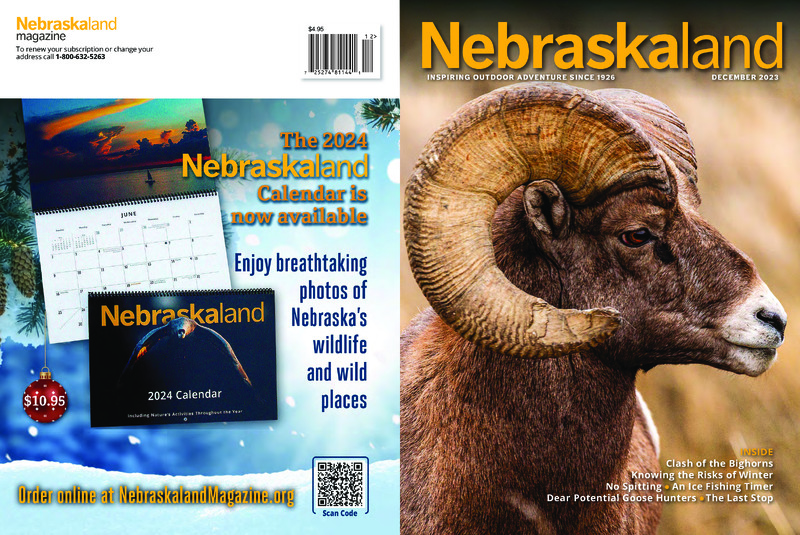
- Identifier:
- nela.2023_101_10
- Title:
- Volume 101, Issue 10, 2023
- Issue Name:
- December 2023
- Date Issued:
- 2023-12-01
- year:
- 2023
- month:
- December
- Season:
- Autumn
- PDF filename:
- NL_101.10.2023_Dec_Spreads_Entire.pdf
- Publisher:
- Nebraska Game and Parks Commission
- Format:
- Periodical
- volume:
- 101
- issue:
- 10
- number:
- 101.10
- Decade:
- 2020s
- Type:
- Rights Holder:
- Copyright Nebraskaland Magazine/Nebraska Game and Parks Commission, all rights reserved.
- Extracted Text:
-
magazine
$4.95
To renew your subscription or change your
address call 1-800-632-5263
I N S P I R I N G O U T D O O R A DV E N T U R E S I N C E 1 92 6
D EC E M B E R 20 23
INSIDE
Clash of the Bighorns
Knowing the Risks of Winter
No Spitting O An Ice Fishing Timer
Dear Potential Goose Hunters O The Last Stop
2
Nebraskaland • December 2023
Volume 101 No. 10
December 2023
FEATURES
20
CLASH OF THE BIGHORNS
26
OUTDOOR NEBRASKA
Photos and story by Justin Haag
What to Do in December
By Renae Blum
28
DEAR POTENTIAL GOOSE HUNTERS
34
NO SPITTING
36
KNOWING THE RISKS OF WINTER
Story and photos by Jeff Kurrus
By Patricia C. Gaster, History Nebraska
By Julie Geiser
DEPARTMENTS
8
12
38
48
50
Your Nebraska
In the Field
Mixed Bag
Portraits from the Past
The Last Stop
ON THE WEB
For more articles and
information, visit
NebraskalandMagazine.com
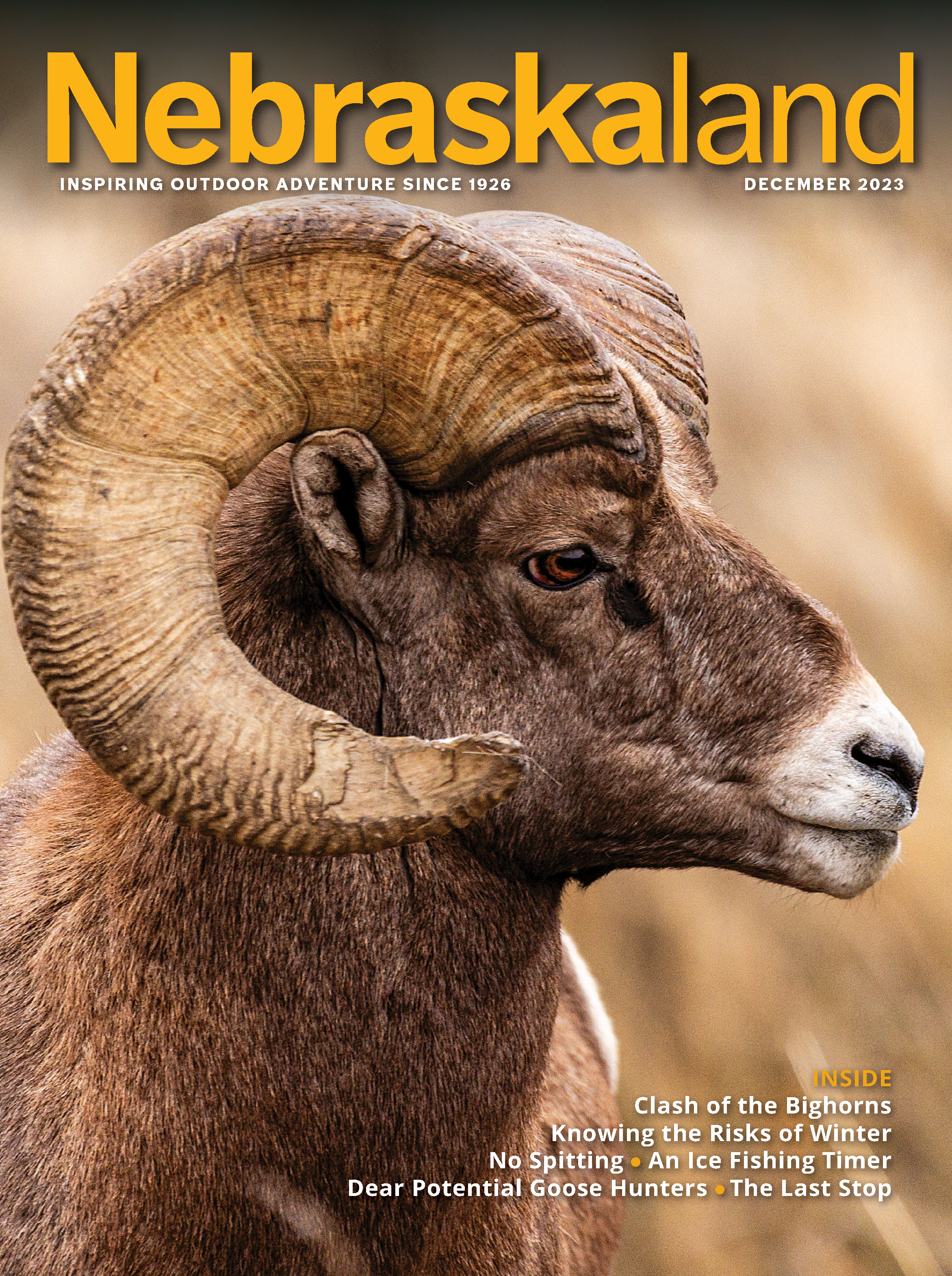
Cover: A bighorn sheep ram
C
ccarries its impressive headgear
aat Williams Gap Wildlife
Management Area in the
M
Wildcat Hills of Banner County.
W
JJUSTIN HAAG, NEBRASKALAND
T page: In the beginning
This
sstages of its eastward journey
aacross the state, water of
tthe North Platte River flows
oover rocks as the sun sets
bbehind Scotts Bluff National
Monument.
M
JJUSTIN HAAG, NEBRASKALAND
4
Nebraskaland • December 2023
Nebraskaland (VOL. 101 / NO. 9 ISSN 0028-1964) is published monthly, except for the combined Jan./Feb. and Aug./Sept. issues, by the Nebraska Game and Parks Commission,
2200 N. 33rd St., Lincoln, NE. Periodicals postage paid at Lincoln, Nebraska, and additional mailing offices. POSTMASTER: Send all UAA to CFS. (See DMM 507.1.5.2);
NON-POSTAL AND MILITARY FACILITIES: send address corrections to Nebraskaland, P.O. Box 30370, Lincoln, NE 68503-0370.
December 2023 •
Nebraskaland
5
Magazine Staff
magazine
Published by the Nebraska Game and Parks
Commission since 1926. The Commission is
dedicated to the conservation and protection
of all the state's natural resources and the
people who use them.
Communications Director Christy Firestone
Public Relations Manager Shawna RichterRyerson
Editor Jeff Kurrus
Associate Editor Jenny Nguyen-Wheatley
Regional Editors Eric Fowler, Julie Geiser,
Justin Haag
Contributing Editor Michael Forsberg
Regular Contributors Renae Blum,
Chris Helzer, Chris Masada, Todd Mills,
Ryan Sparks, Gerry Steinauer
Art Director Tim Reigert
Graphic Designer Mel Severin
Crabapples and rose hips, above, are
an excellent source of winter food
for wildlife. GETTY IMAGES
Photo Librarian Jaclyn Cruikshank Vogt
Administration
Director Tim McCoy
Deputy Director Jim Swenson
Assistant Director Roger Kuhn
Commissioners
Chairman - Pat Berggren, Broken Bow
Vice Chairman - Rick Brandt, Roca
2nd Vice Chairman - Robert Allen, Eustis
Ken Curry, Columbus
Donna Kush, Omaha
Scott Cassels, Omaha
John Hoggatt, Kearney
Doug Zingula, Sidney
Dan Kreitman, Wahoo
Circulation
For address changes and questions about your
subscription, call 800-632-5263
Advertising Sales Manager
For advertising information contact
Shane G. Gilster, 402-742-0125
Email: shanegilster@gmail.com
Nebraskaland Magazine Copyright 2023, all rights reserved.
Nebraskaland is available in audio from the Nebraska Library
Commission Talking Book and Braille Service, Suite 120, 1200 N St.,
Lincoln, NE 68508. 800-742-7691. Nebraskaland Magazine and the
Nebraska Game and Parks Commission reserve the right to reject any
advertising not in keeping with the agency mission.
Rates: $18 for one year; $33 for two years; $44 for three years. Nebraska
recipients must add appropriate sales tax. To subscribe call
1-800-NEBLAND (632-5263), or go online to:
NebraskalandMagazine.com.
Commission Offices
Conservation Officers
Headquarters/Southeast District Office
2200 N. 33rd Street Lincoln, NE 68503
Phone 402-471-0641
ADMINISTRATION (Lincoln)
Craig Stover (Administrator)
Duane Arp (Asst. Administrator)
Travis Shepler (Asst. Administrator)
Jeff Clauson (Asst. Administrator)
Northeast District Office
2201 N. 13th St. Norfolk, NE 68701
Phone 402-370-3374
Southwest District Office
301 E. State Farm Rd. North Platte, NE 69101
Phone 308-535-8025
Northwest District Office
East Hwy. 2, Box 725 Alliance, NE 69301
Phone 308-763-2940
Bassett Office
524 Panzer St., Box 508 Bassett, NE 68714
Phone 402-684-2921
402-471-5531
402-471-5531
402-471-5531
402-471-5531
NORTHWEST (Includes counties covered)
Dan Kling (Lieutenant)
308-430-0572
EAST SUB-DISTRICT
Sean Schultz (Sergeant)
308-760-0145
Jerod Hahn (Deuel, Garden, Grant)
Keith Jadlowski (Keith, Deuel)
Jaden Porter (Keith, Garden)
Tyler Stueck (Keith)
Travis Schultz (Morrill, Cheyenne)
308-520-5539
308-289-9580
308-289-2274
308-289-6260
308-279-1292
(Keith, Arthur)
WEST SUB-DISTRICT
Matt Brandt (Sherman, Howard)
Daryl Teter (Howard, Greeley, Merrick)
Kyle Gaston (York, Polk, Hamilton)
SOUTH SUB-DISTRICT
Matt Taylor (Sergeant)
402-200-9597
Tim Williams (Hall, Hamilton, York)
Eric Javins (Adams, Clay, Webster)
Pat George (Harlan, Franklin, Phelps)
Ethan Teter (Buffalo, Kearney)
308-380-7331
402-902-2017
308-920-2762
308-440-3847
(Thayer, Fillmore, Nuckolls)
SOUTHWEST (Includes counties covered)
Roger Thompson (Lieutenant)
308-530-3097
NORTH SUB-DISTRICT
Ray Dierking (Custer, Thomas, Blaine)
Frank Miller (Cherry, Hooker)
Greg Hesse
308-870-0322
402-389-0444
308-546-7464
308-660-4671
308-530-3157
(Hooker, Thomas, southern Cherry)
Sean McKeehan (Sergeant)
308-672-1824
Kelsey Glodowski
308-763-8226
Alex Hasenauer (Lincoln, Perkins)
Brandon O’Neal
Ak-Sar-Ben Aquarium/Schramm Education
Center
21502 W. Highway 31 Gretna, NE 68028
Phone 402-332-3901
Hunter Pearson
308-360-1817
SOUTH SUB-DISTRICT
Josh Widhelm (Scotts Bluff)
Jacob Stoinski (Sioux, Dawes)
308-279-9133
308-615-9017
(Red Willow, Frontier, Hayes, Hitchcock)
Omaha Office
8495 Frederick Street, Omaha, NE 68124
Phone 402-595-2144
NORTHEAST (Includes counties covered)
Dale Davis (Lieutenant)
402-760-0712
Kearney Office
1617 First Ave. Kearney, NE 68847
Phone 308-865-5310
(Kimball, Banner, Scotts Bluff)
(Box Butte, Sheridan, Grant)
(Sheridan, Dawes, Grant)
NORTH SUB-DISTRICT
Jeff Jones (Sergeant)
402-762-5022
John Bauer (Holt, Boyd)
Tyler Adelman
402-314-9257
402-314-4783
(Knox, Cedar)
(Rock, Brown, Keya Paha)
Jonathan Andreasen
402-340-3981
Mitch Johnson (Knox, Antelope, Pierce)
402-613-8612
(Madison, Pierce, Stanton)
OutdoorNebraska.org
SOUTH SUB-DISTRICT
Cory Krause (Sergeant)
402-380-6410
Kyler Prochaska (Platte, Colfax)
Matt Costello (Dodge, Colfax)
Kelbi Abke (Washington, Burt)
Nicholas Fix (Dixon, Dakota, Thurston)
402-830-8278
402-317-4014
402-237-2537
402-508-0261
(Cuming, Wayne, Stanton)
The Nebraska Game and Parks Commission does not discriminate
based on race, color, ethnicity, national origin, sex, pregnancy, sexual
orientation, gender identity, religion, disability, age, genetic information,
veteran status, marital status, and/or political affiliation in its programs,
activities, or employment. Any person who believes he or she has been
discriminated against in any program, activity, facility, or service,
should contact the Nebraska Game and Parks Commission, Lincoln, NE
402-471-0641, the Nebraska Equal Opportunity Commission, Lincoln,
NE 402-471-2024, TTY/TDD 800-642-6112; Director, Office of Diversity,
Inclusion and Civil Rights, U.S. Department of Interior, 1849 C Street,
NW, Washington, D.C. 20240.
6
Nebraskaland • December 2023
CENTRAL (Includes counties covered)
Mike Thome (Lieutenant)
308-293-8746
NORTH SUB-DISTRICT
Doug Pollard (Sergeant)
(Loup, Garfield, Valley)
308-730-7050
308-202-0819
308-440-1863
402-719-6226
(Lincoln, McPherson, Logan)
Brian Piernicky (Sergeant)
308-340-6627
Bryce Streger (Dawson, Gosper, Custer)
Taylor Dixon (Dawson, Gosper)
Sophia Gobber
308-537-0404
308-217-2108
308-222-0368
(Chase, Dundy, Hayes, Hitchcock)
SOUTHEAST (Includes counties covered)
Stacey Lewton (Lieutenant)
402-890-7140
EAST SUB-DISTRICT
Heath Packett (Sergeant)
402-210-0888
Russell Mort (Otoe, Johnson)
Rich Berggren (Douglas)
Brian Arp (Douglas, Sarpy)
Dan Evasco (Sarpy)
Mike Luben (Saunders, Butler)
Bryan Adams
402-209-1506
402-619-1355
531-530-9011
402-616-5961
402-443-6392
402-429-1924
(Cass)
(Nemaha, Pawnee, Richardson)
WEST SUB-DISTRICT
Dina Barta (Lancaster)
Luis Nuñez (Lancaster)
Mark Sullivan (Lancaster, Seward, Butler)
Trevor Stahlecker (Lancaster, Saline)
Matt Seitz (Gage, Jefferson)
402-890-6463
531-333-6093
402-741-0636
402-314-9641
402-806-0915
YOUR NEBRASKA
Instagram Photos
Follow us @nebraskaland
and tag us in your photos
to be featured in an
upcoming issue.
8
Nebraskaland • December 2023
Jacob Oakes, Denver, Colorado
Neligh Mill
December 2023 •
Nebraskaland
9
YOUR NEBRASKA
Raccoon
Send your comments and
photos to:
Jeff Kurrus, Editor
Nebraskaland Magazine
P.O. Box 30370
Lincoln, NE 68503
or email Jeff.Kurrus@Nebraska.gov
Please include your postal address
and telephone number. Letters
may be condensed and edited.
Photographs are also welcome.
10
Nebraskaland • December 2023
Swallowtail butterfly
Roy Liesegang, of Bellevue, loves to spend
time photographing in his backyard. Here
are a few of our favorites.
Plains garter snake
December 2023 •
Nebraskaland
11
IN THE FIELD
A WALK IN THE FOG
A pair of whitetail does
stand in a hoarfrost- and
snow-covered landscape
along the Calamus River on
a foggy morning in Loup
County.
ERIC FOWLER,
FOW
OWLER,
L
NEBRASK
NEB
RASK
AS ALAN
ALAND
D
12
Nebraskaland • December 2023
December 2023 •
Nebraskaland
13
IN THE FIELD
THE OTHER RUT
By Jeff Rawlinson
Deer hunters have long been fascinated by the rut — when
bucks temporarily seem to lose common sense and become
more active chasing does. Rarely, however, is another rut
discussed as much as it should be: the squirrel rut.
The mating season for Nebraska squirrels takes place this
month when males begin chasing females. During the day,
males become more active and provide hunters increased
access to this species. A few tips:
Sleep in to hunt squirrels, for they often want to remain
in their nests as much as you want to remain in bed. A sunny
afternoon on a cold, December day is also prime time to hunt.
With the leaves having fallen, these quick, agile climbers
will be easier to locate.
With fewer leaves, however, a hunter is also more
•
•
vulnerable to detection. Hide becomes extremely important,
so simply match your camouflage to the habitat.
Knock on doors. With the firearm deer season in the
rearview, squirrel hunters stand a chance approaching
landowners for permission.
Try a squirrel call this time of year. Any sort of chatter
can lure squirrels in your direction.
If you’re shooting a .22 caliber, make sure you have a safe
background as those bullets can travel more than a mile, and
always wear blaze orange to and from the woods.
Turn this winter’s squirrel hunting trip into a
muzzleloader deer scouting trip, or vice versa — just as long
as you understand there is an entirely different type of rut
going on that deserves attention this time of year.
•
•
•
•
A cold, sunny afternoon is prime time to hunt squirrels during the December rut.
14
Nebraskaland • December 2023
JULIE GEISER, NEBRASKALAND
IN THE FIELD
Efficient ice fishing teams consist of one person cutting holes, pictured, and one finding fish.
PHOTO BY JEFF KURRUS
AN ICE FISHING TIMER
By Jeff Kurrus
Staring into an 8-inch hole in the ice, your eyes following
the thinnest fishing line you’ve ever seen, might be the
most addictive activity on the planet. So addictive, in fact,
that a stopwatch is nearly as important to your fishing
success as your rod and reel.
Using this uncommon ice fishing device, an angler can
assure that they will in fact move when the fishing slows.
Set it for 15 minutes when fishing new water. If there are
no strikes, or you don’t see marks on your sonar, change
locations.
Here are a few other tips to increase your efficiency on
the ice.
Two-Person Teams
•
One cuts a set of holes – 20 to 30 is a fine starting
number — and the other person lowers the sonar transducer
into the water. If fish are marked, kick away the snow cone
16
Nebraskaland • December 2023
of ice from the top of the active holes so these spots can be
quickly spotted again.
Share Ideas – You should know how the person beside
you is fishing — from depth to lure to action. It’s also not
a bad idea to ask strangers fishing nearby. The ice fishing
community, at large, is friendly. I’ve never run into a group
of anglers unwilling to share information on the hard
water.
A New Person – Quite often, it’s to your advantage to
take a new person ice fishing. They’ll try things you won’t.
Last season, toward the end of ice, a relatively new ice
angler suggested we look at a spot in the middle of a lake.
While I explained we were nowhere near any sort of
underwater structure, he persisted. Two limits of panfish
and a monstrous channel catfish later, I could only tip my
cap. With a stopwatch in hand, every part of the lake is
worth exploring if the fish are slow.
•
•
IN THE FIELD
GARLIC SHEET-PAN PHEASANT
WITH BLISTERED TOMATOES
By Ryan Sparks
My grandma’s cooking style
embraced simplicity, seasonality and
bringing family together over a homecooked meal. Her garden thrived during
Nebraska’s summer, providing her
with an abundance of fresh produce,
such as tomatoes, cucumbers and a
variety of herbs. She also made a point
to make the most of everything in
her kitchen, including the pheasants
and quail my grandpa hunted. This
isn’t her recipe — having originally
come from Yasmin Fahr, food author
of Keeping it Simple — but I think she
would have liked it for how the bright
flavors pair with the charred tomatoes
and red onions, for the simplicity of
how it comes together, and for how it
squeezes all the goodness out of late
summer while clearing freezer space
for this fall’s pheasants.
Servings: 4 to 6
Prep Time: 10 minutes
Cooking Time: 15 minutes
Ingredients:
1 cup, full-fat Greek yogurt
2 lemons (1 halved and 1 thinly
sliced)
1 teaspoon dried oregano
Salt
2 garlic cloves, minced
2 pounds boneless, skinless
pheasant breasts (about 8
breasts), cut into 2-inch chunks
1 pint grape or cherry tomatoes
1 small red onion, thinly sliced
4 tablespoons olive oil, divided
1
⁄4 cup packed mint leaves, roughly
torn
1 (6-ounce) block feta cheese,
crumbled
1
⁄2 cucumber, sliced
Pita bread or couscous
•
•
•
•
•
•
•
•
•
•
•
•
•
18
Nebraskaland • December 2023
Garlic sheet-pan pheasant with blistered tomatoes.
In a large bowl, combine the yogurt,
the juice of half a lemon and oregano;
season to taste with salt. Transfer
half to a small container and set in
the fridge. Stir the garlic into the
remaining mixture in the large bowl.
Season the pheasant all over with salt,
then add to the bowl; toss to coat
and place in the fridge to marinate
overnight.
Turn on the broiler and place a
rack 6 inches from the heat source.
Combine the tomatoes, red onion and
2 tablespoons of olive oil on a halfsheet tray, season with salt. Add the
last two tablespoons of olive oil to
the bottom of a second half-tray. Add
the marinated pheasant, making one
uniform layer.
Place the pheasant tray on the
top rack and broil until the pheasant
is charred on top, 5 to 7 minutes,
depending on the strength of your
broiler. Meanwhile, place the tray with
the tomato mixture on the rack below
the pheasant, keeping the oven door
RYAN SPARKS
closed while it cooks.
When the pheasant is slightly
charred, remove the tray from the oven
and use tongs to turn the pheasant
pieces over. Scatter the lemon slices
over the top and place back in the
oven. Broil until the pheasant is barely
cooked through and slightly charred.
Remove it from the oven to rest.
Move the tomato tray to the top
rack under the broiler and cook until
it begins to char, around 5 minutes.
Using tongs, stir the tomato and onion
mixture so it cooks and blisters evenly.
If using pita bread, place it on the
bottom oven rack to warm. If using
couscous, prepare it according to the
instructions on the packaging.
Sprinkle the pheasant with some
of the mint. Cut the remaining lemon
half into wedges. Serve the pheasant
and roasted tomato mixture with the
feta, lemon wedges, sliced cucumber,
remaining mint leaves, reserved
yogurt, and your choice of pita bread
or couscous.
clash of the
bighorns
20
Nebraskaland
• December 2023
The bighorn sheep pre-rut provides an incredible
show on Nebraska’s wildlife scene.
Photos and story by Justin Haag
December 2023 •
Nebraskaland
21
Bighorn sheep rams gather to determine dominance during the pre-rut. Since the 1980s, reintroduction efforts
have returned the species’ presence to the steep terrain of the Panhandle’s Wildcat Hills and Pine Ridge.
N
ebraska’s Rocky Mountain
bighorn
sheep
(Ovis
canadensis) and their amazing
climbing capabilities are
enjoyable to watch throughout the
year, but there’s arguably no greater
show than when they put their heavy
headwear to use during fall.
It’s the headwear, after all, that gives
the species its name. With a spread
that can reach almost 3 feet wide,
the horns on a mature ram can weigh
more than 30 pounds. That exceeds
the weight of all the other bones in its
body combined.
During the pre-rut, a period of
fall in which rams work to establish
22
Nebraskaland
• December 2023
dominance among fellow males, the
horns become especially useful. While
subordinate rams occasionally sneak
past the dominant ones for breeding,
researchers estimate that in each herd
the top one to three rams father 60
percent or more of the lambs.
Because mating behaviors by
bighorn sheep and other ruminant
species are triggered by length of
daylight, the timing is predictable.
With that in mind, I ventured to the
Wildcat Hills in early November last
year to see if I could catch the show.
After finding a group of five similarsized rams working to determine
their pecking order below the region’s
rugged landforms, it didn’t take long
to determine it was well worth the
journey.
Similar to gunfighters of the Old
West, rams frequently squared off
in twos and stared each other down.
Sometimes, they reared up on hind
legs in what is called a “threat jump.”
And, occasionally, they’d perform the
best show of all — a head-on collision
creating the cracking sound said to be
audible from miles away.
Scientists have estimated the
collisions generate a force 60 times
greater than that required to crack a
human skull. If one ram is fortunate,
the other will concede until the
following year and more collisions
won’t be required that day. The victor
will mate with the ewes of choice, and
come spring, they’ll deliver offspring
with his winning genetics.
Such collisions require a special
build. Horns are constructed of bone
extending from the skull, covered by
a thick sheath of keratin, the sheep’s
version of the material that forms
human fingernails. Not only are the
horns solid enough to withstand the
collision with minimal damage, the
rams’ skulls are specially constructed
to take a blow. The skulls are segmented
with suture-like seams, giving them
flexibility to lessen the risk of cracking.
In addition, large frontal sinus cavities
protect the brain by distancing it from
the point of impact.
While the clashing of the horns may
be the most dramatic part of the rams’
pre-rut behavior, each blow is usually
preceded by long periods of jostling
that is also captivating. Most of this
group’s time that day was spent in a
huddled mass, nudging one another
with their horns. This activity often
results in wear on the horns’ tips,
known as brooming. During these
sessions, rams use their stout legs to
kick their adversaries, often in the
testicles. No, being a bighorn ram
surely isn’t always fun.
A few hundred yards away from
this group of rams was a large group
of grazing ewes, lambs and smaller
rams. With the new forage that had
emerged from areas recently burned by
wildfires, they seemed uninterested in
the drama between the big males. Yet,
the outcomes of the day’s competition
would determine which males the
females would be spending time with
in the weeks to come.
Furthermore, it would determine
the genetic make-up of the herd for
years to come. For these reasons, and
of course human tendency to marvel
at a “good” wreck, it’s a show worth
watching. N
December 2023 •
Nebraskaland
23
TOP: A pair of rams size each other up.
BOTTOM: Ewes, lambs and young rams
graze on an area burned by wildfire
while large rams compete in the
distance.
TOP RIGHT: A ram puts his previously
determined dominance to court a ewe,
one of many collared and tagged for
research.
BOTTOM RIGHT: During pre-rut, rams
rub horns and kick one another while
gathered in a huddled mass.
24
Nebraskaland
• December 2023
December 2023 •
Nebraskaland
25
Outdoor Nebraska
By Renae Blum
Take a break from the holiday craziness and savor time
outdoors. This could involve deer hunting, a scenic hike in the
snow or simply watching birds at your feeder. N
Fourth annual
Holiday Tree
Decorating Contest
What To Do in December
Nov. 23 - Jan. 2 | Lewis and Clark
State Recreation Area
Decorate the best tree and win a twonight cabin stay at Lewis and Clark.
Choose a tree at the park entrance
to decorate (one entry per household
or group); environmentally-friendly
decorations, such as popcorn garland,
solar-powered lights and bird seed
pine cones, are preferred. To enter,
send a photo of your decorated tree to
ngpc.lewis.clark@nebraska.gov.
For
questions, contact the park at 402-3884169. Remove any non-wildlife-friendly
decorations by Jan. 14.
JENNY NGUYEN-WHEATLEY, NEBRASKALAND
Late-season deer hunting
Season dates vary | Statewide
Things get more challenging in the late period for deer hunting, but don’t put
your gear away yet; just readjust your strategy. Tracks are much easier to see
in the snow, so use that to your advantage. Hunt late afternoons when deer
are more likely to feed this time of year. Also, find places where deer will move
out of high winds. For more tips, search “Tips for late-season deer hunting” at
NebraskalandMagazine.com.
Light Up the Fort
Dec. 2-31 | Fort Robinson State Park
Experience a local tradition 30 years in the making: See Fort Robinson’s
historic buildings and grounds decorated with Christmas lights. Put up by
park staff and local businesses and groups, the lights are turned on each
evening through midnight and make for a fun drive with family and friends.
JULIE GEISER, NEBRASKALAND
JUSTIN HAAG, NEBRASKALAND
Winter hiking
Throughout the month | Statewide
Hiking in the winter can be just as fun as
it is in the warmer months. Getting out in
nature is a great form of exercise, improves
your mental health and boosts your mood.
It’s also an opportune time to view wildlife.
To stay safe on the trails, plan your trip in
advance, tell someone where you’re going,
dress for the weather, stay hydrated and
well-nourished, and hike with a buddy.
JUSTIN HAAG, NEBRASKALAND
26
Nebraskaland • December 2023
Put out suet for birds
Fall through spring | Statewide
Suet is a high-fat food that provides the
extra calories birds need in colder weather.
A variety of species love this proteinpacked offering, including northern
flickers and downy, hairy and red-bellied
woodpeckers. Hang suet in a visible area
near shrubs and trees. You can buy suet
cakes — or make your own — and place
them in a metal suet cage.
JUSTIN HAAG, NEBRASKALAND
December 2023 •
Nebraskaland
27
Dear
Potential
Goose
Hunters
Story and photos by Jeff Kurrus
I
t’s easy to become entranced with these gigantic birds,
their honks seemingly daring you to take the plunge into
the deep water that is Canada goose hunting. But before
you do, I’m going to encourage you not to. Find something,
anything else, to do with your time. You’ll thank me for it.
Just What I Needed
First, you don’t have enough decoys. Well, maybe you do.
But you probably don’t. In the beginning of my Nebraska
On some days, a few full-body decoys like this one are all you need to shoot geese.
On other days, I'm convinced you need a semi-truck filled with full bodies to bring a bird in range.
Knowing the wind direction in a blind is sometimes
the difference between cutting a hunt short or
waiting for a push of birds later in the day.
28
Nebraskaland
• December 2023
goose hunting adventures, I picked up some decoy shells
at a garage sale. I’ve never seen a more seemingly happy
individual giving away good stuff.
My next goose hunting purchase was in the form of fullbody stand-ups. This was a crowning achievement for the
family and, outside of our automobiles, one of our most
expensive purchases. Immediately, I was convinced that
these $60-apiece decoys would be the difference in our group
whispering “Maybe next time” to “Take 'em!”
Our last large purchase was silhouettes — five dozen to be
exact. Because a bigger spread is better, right? But the more
decoys that are out, the more a goose from the air can find
something wrong.
After this multitude of purchases, there's still no telling
how many flocks of birds — or even a single or pair — have
cupped in our direction and peeled off at the last second.
“Something’s not quite right,” one of us will say.
On one morning like this, while hunting with a friend and
my son, Eli, in eastern Nebraska, we had a combination of
stand-ups and shells anywhere from 20 to 40 yards away and
not a single bird would finish.
“If something isn’t working, make an adjustment,” longtime goose hunter and Nebraskaland writer Todd Mills had
told us. So we flip-flopped our spread, moving anything less
than 40 yards farther away and completely out of shooting
range.
As we were returning to our blind, the next group of geese
were cupping their wings between us and the closest decoy.
We were now getting 20-yard, feet-on-the-deck shots and
were done with a two-person limit in 30 minutes.
The next time we tried the same trick, we went home
without firing a single shot.
“It has to be perfect,” my dad, Larry, has told me multiple
times as he often watches from afar. “When you guys
actually shoot any birds, it’s like killing a deer. It’s that
momentous.”
December 2023 •
Nebraskaland
29
opening day of squirrel season.
What’s your other option then, Einstein? The birds are
landing smack dab in the middle of the most wide open bean
field that has ever existed.
“A-frame,” Mills told me years ago.
If you take his advice, sticking one of these blinds in the
middle of a cut bean field, you’ll be convinced it would be
better camouflaged if set in the middle of a Walmart parking
lot. You’ll laugh at him and others like him, condemning their
minor league-ness as you climb into your coffin.
Until you hear guns going off from those blinds and find out
that geese will, in fact, land right on top of an A-frame, as long
as one thing is for sure — the blind is sitting on the X.
Magic
Even when they seem relaxed, there are always a few sentry Canadas, with raised heads, guarding the flock.
Let the Good Times Roll
There is a section of readers right now, after finishing that
last statement, that are scoffing. At this precise moment,
they are right in the middle of birds. But they are in the
minority and should appreciate every second of good fortune.
I wish we had when this was happening to us.
About four years ago, our group was hunting private
ground near the Missouri River, and we were frequently
killing birds. We had just enough standing water on the crop
fields, and birds, more often than not, would work the area
throughout the day.
We were shooting birds nearly every time we hunted.
It became so commonplace that even our picture-taking
slowly diminished. Why photograph these birds after a long
day when there’d be more to take pictures of tomorrow? We
thought these days would last forever.
They did not. The 2019 flood devastated the land where
we hunted, making it unfarmable for a year and altering the
entire region — from the pre- and post-hunt gas station stop
to the land itself.
For a few years, we looked elsewhere. Trips east toward the
river turned into trips west toward the Rainwater Basin. And
while this has led our group to an entirely different part of the
state with its own set of good fortune, we still desired being
near the Missouri where, even for an occasional instance, we
had felt like goose hunters.
30
Nebraskaland
• December 2023
Luckily, last year we were able to return to this spot, and
once again we’re shooting some birds nearly every time
we go. But we no longer take these days for granted. Last
December during the holidays, our crew watched thousands
of geese all afternoon, not one wanting to decoy.
“It’s tough when you’re not on the X,” said Mills, who was
hunting with us that day.
“You think it’s our hide?” I asked, a question you will also
repeat more than any other in your newfound pursuit.
“It always is,” Dad mumbled from his pulpit, both an eyerolling indictment and a proclamation.
You Might Think
You might think a natural hide is the absolute best. Usually,
but not always. Last year, our group hid inside a huge, grassy
ditch in the middle of a cut crop field and every single bird
avoided our spread. A year before, while hunting the same
place, we couldn't keep birds out of our decoys.
Another popular option is a laydown blind. I have one of the
most comfortable ones on the market and hate it immensely.
They are called coffin blinds for a reason. You can’t turn, can’t
sit up, can’t fit your supplies in with you, and they stick out
like any number of inappropriate clichés in church.
But at first, you’re convinced this is the answer — the best
thing you’ve ever sat in until the birds circle, circle, then land
behind you. You go home with a sorer neck than after the
The “X,” as it’s known, is the exact, magical spot where
you’re convinced birds will land when hunting.
Years before my shed and my hunting partners’ garages
and sheds were filled with equipment, an old friend from
Tennessee, Jeff Wages, would go with a group of hunting
buddies to Canada, pulling a trailer of decoys 1,500 miles
for the opportunity to hunt ducks. The group would break in
half, with one group hunting during the morning while the
other group scouted.
Once the hunt was over, the groups would share information
and switch. Hunters became scouters; scouters became
hunters. The scouting was the most important part. They
had to find where birds were specifically working. They were
looking for the X. Once they found birds, their job was to gain
permission as quickly as possible and solidify their hide.
But there remains an issue with the X, whether hunting in
Regardless of hunting success, a blind breakfast is
Canada, Nebraska or all parts in between. Do not think you
always worth the trouble to chase Canada geese.
can hunt the field within sight of the
X, waving your newly purchased goose
flag trying to convince yourself that the
third goose on the left side, the big one,
almost came your way? He wasn’t going
to. It’s as much mirage as it is false hope.
Being on the field next to the X
also won’t work. Why visit you when
there was still corn, and no hunters,
in the next field over the day before?
You might get an occasional curiosity
flock, that's for sure — the group of
birds that veer your way because
they've seen movement outside of the
blind: a wayward retriever, or maybe
two teenage boys throwing dirt clod
footballs. The birds will momentarily
cup their wings — something you and
your buddies will talk about on your
drive home — but they'll turn and land
An impatient Lab retrieves and finally has a little fun during a Sarpy
in the next field over.
County goose hunt.
December 2023 •
Nebraskaland
31
and the orange potato chip bags are properly hidden.
Now their distance is 100 yards ... 80 ... 60. Then they turn
… making a small circle around your blind … and the closest
bird is at 40 yards.
“One more pass,” your hunting partner says. And he’s right.
Why shoot one at 40 when you can shoot four at 20 yards?
But on the circle, something happens. Did your buddy's
son poke his head out of the blind too soon? Did the flock
hear that one bad note — the sound you'll describe later as a
squeak when your hunting partner is out of earshot — from
his goose call. You don’t know what, never will know, but the
birds turn and start lengthening their distance away from
the blind ... 60 ... 80 ... then finally pitching down 100 yards
away from your spread.
You look up, and a group of 10 are coming your way. You
flag desperately, the muscles in your forearms burning as
this second group pitches right into the group of four.
“This isn’t good,” your partner says. “Should we go bust
that other group up?”
This will require one in your group to walk toward the
other birds and scare them, all the while hoping a larger
group doesn’t see this strange movement in the field and bug
On the X? Check. Hide? Check. Weather? Check. All of
out completely, ruining the entire afternoon hunt.
these are a great start, for sure, along with not too little or
Then you have a brilliant idea. “Let’s send Eli.”
not too much calling. But now it gets complicated.
My 10-year-old son puts down his bag of sunflower seeds.
The first group of four birds are making a beeline to your
“I’m in.”
spread, locked in from hundreds of yards away. You do a quick
He runs out of the blind in the direction of the group,
check on your blind mates, just to make sure all of their blondeveryone in the blind commenting how his gray and black
haired children are wearing camo stocking caps or facemasks
snowsuit sort of looks like a Canada
goose. Within 50 yards of the birds, they
bust up and away from our spread.
But there’s another problem. We
hear something. Over Eli’s shoulder,
hundreds and hundreds of yards away,
we see more than 200 birds already
cupping their wings toward our spread.
Eli sees this, too, and without any
instructions, begins his sprint back
toward the blind.
“Faster,” we yell at the kid, who is
dodging and high-stepping between
decoys as he tumbles outside of the
blind and crawls in.
The birds in the air are undeterred.
Their wings remain cupped. 100 ... 50
... 30.
“Take 'em!” your partner yells, but
when you stand up, you realize that the
30-yard estimate is off. They’re farther
than that. But they know you’re there.
This is your only chance.
The air fills with booms, one after
When it all goes right, like it did at this moment for hunter Trevor Johnson
the other as the flock drifts farther and
of Doniphan, there's nothing better.
Because you have to be on … the … spot, and you have to
be hidden. And, probably just as important as these factors is
having the time to make your dreams come to fruition.
So be prepared for an all-day hunt. Yesterday’s 2 p.m.
arrival means you have to cover the four hours preceding
and the four hours after. If you’re going to put this much
windshield time into this type of hunting, you can’t miss it.
Last season, a group of birds — 40 or 50 — had been
working one of our fields. But for any number of reasons,
we couldn’t get our schedules aligned to go. When we were
finally able, it was going to be perfect. An afternoon storm
was pushing through so we would start hunting midday.
However, when I awoke that morning, two inches of snow
had already fallen and I had multiple phone calls from Mills.
When I finally called him back, his voice was somber. “Too
late,” he said. “There are 200 birds in the field.”
I gigantic pit filled my stomach. “Tomorrow,” I replied.
“They’ll be back.”
I was wrong. They never came back.
Touch and Go
32
Nebraskaland
• December 2023
Sometimes flags and a great hide aren't enough to entice birds in your direction.
farther away.
The Lab, appropriately named something akin to Hope,
has been so patient in her kennel beside the blind but will
have to be patient a little while longer. There’s not a single
bird on the ground.
Everyone sits back down, closing their eyes as they shake
their heads.
That was the moment that everything was right. Hide.
The X. Everything.
And we missed it.
Since You're Gone
Dad was right. Every single downed bird is a treasure,
because it doesn’t matter if you shot 90, nine or none last
year, it can all change — for better or worse — in a minute.
The nights when you mess up a flock are bad. You replay
the moment repeatedly, not unlike a wayward shot from the
deer stand or a missed receiver on the game-winning drive of
the football game. It’s painful, because you know how much
work it took to put yourself in that exact spot.
So, you completely understand why that guy was so happy
to get rid of his decoys. It’s too dang hard to get this right.
But … if you ever do get it right, even one time, you have
some major life decisions to make. For there is nothing, and
I mean nothing, that satisfies the hunter’s soul as much as
being on the X with birds on the deck — with some of your
favorite people right next to you. During these moments,
you’re convinced that guy getting rid of those decoys is the
dumbest person in the world. N
Goose Hunting Checklist
Hunting Partners
Find someone you like spending long hours with in
frigid weather. Someone retired helps, as they will be
able to scout. A wealthy friend definitely could help,
but might not want to spend as much windshield time
as you. However, they might be able to get you on the
X better. A wealthy, childhood friend whose wedding
you were in might be perfect.
Vacation Time
Being able to leave immediately is a must.
You have to be on call to do this effectively. The
snowstorm that was supposed to come at noon,
when you told your boss you’d need to leave by
11 a.m. so you have enough hunting time, sped
through Colorado and will be here by 9 a.m. Birds
will want to get their feeding bags on. You will need
a gift for your boss come the Holidays.
Storage
Decoys of various types, including ducks just in case
that becomes a option, are not small. An extra garage
stall is good — a dedicated goose shed is better. You'll
also need to find a place for your new dog, backup
shotgun, shells and bulky hunting clothes. Wader
hooks are nice, so they can easily dry, and you'll
probably want to save some room for your 4-wheel
drive truck. A place to clean birds? Optional. Let's not
be totally outrageous.
December 2023 •
Nebraskaland
33
No Spitting
Norfolk’s
post office
and federal
building was
built in 1904,
two years
before the
anti-spitting
campaign.
By Patricia C. Gaster, History Nebraska
uring the late 19th century, spittoons became a common
feature of saloons, hotels, stores, banks, railway
carriages and other places where adult men gathered.
Many localities passed laws against public spitting other
than into a spittoon, but such laws were seldom enforced.
Some people of this era objected to restrictions on where they
could spit as an infringement on their individual liberty.
Nonetheless, anti-spitting sentiment was growing.
The Norfolk Weekly News-Journal on Sept. 7, 1906, reported
a recent move by the federal government to end spitting
on the floors of federal buildings, ostensibly to prevent the
spread of disease. The News-Journal said:
“In the Norfolk federal building, in several prominent
places, there has been recently hung the following sign:
‘Please Do Not Spit on the Floor. To Do So May Spread
RG5730-0-67
D
A spittoon for visitors adorns Governor Adam McMullen’s
private office at the old Nebraska State Capitol,
Dec. 27, 1927. HISTORY NEBRASKA RG2183-1927-122
Disease.’ There is no demand to stop the practice, but a kind
request, the government believing that an appeal to the
Spittoons are visible on the floor in this circa-1910 photo by John Nelson of Ericson.
34
Nebraskaland
• December 2023
By 1940, a spittoon was a joke gift at the Lincoln Telephone
and Telegraph Company. A.B. Gorman’s desk is covered with
“birthday sentiments,” including a spittoon with a note
attached: “Herein is a lovable chap in a loathsome sort of
way, and So Are You! (from) Norm!” HISTORY NEBRASKA RG6097-2-320
This circa-1880s brass turtle spittoon was covered by a lid
that was opened by stepping on the turtle’s head. It was
used in the parlor of Helen Woods Haecker of Lincoln.
RG3542-95-20
HISTORY NEBRASKA 2817-2
conscience of the general public through kindness will be
more effective and will do more toward checking the practice
than an ‘official command.’ As a result of the government’s
extreme politeness in affixing the word ‘please’ to the notice
there is already a noticeable decrease in the number who
have unintentionally used the post office lobby for a place to
expectorate.
“During the past year the movement to stop the increase
of the ‘white plague’ [tuberculosis] has assumed gigantic
proportions, but not more so than the increase of the disease.
Realizing the deep inroads the plague is making into the ranks
of the American people, especially those of the poorer classes,
the government has started out to do its share in preventing
its further spread, and the first step in this direction, known
of in Norfolk is the new sign warning the people of the danger
caused by their expectorating on the floors.
“Although there is a city ordinance, which provides a fine of
from $1 to $10 for any person caught spitting in public places,
halls, etc., it has not been enforced to any great degree, and
the practice has become as common as before the passage of
the ordinance, which in a measure for the time being, checked
it. It has been pointed out that during the past year there has
not been one arrest for violating this ordinance.
“Several of the local physicians, who have interested
themselves in the disease and made a study of its causes and
effects, are contemplating petitioning Mayor [John] Friday
to order the chief of police to enforce the ordinance, and by
so doing eliminate to a great extent the exposure of Norfolk
people to the tubercular germs, which breed in great numbers
in the sputum expectorated upon the walks by thoughtless
persons.” N
Visit History Nebraska’s website at history.nebraska.gov.
December 2023 •
Nebraskaland
35
By Julie Geiser
Frostbite
Frostbite happens when the skin and outer tissues of
your body become frozen. This condition tends to happen
on extremities such as the fingers, toes, ears and nose. They
may become pale, gray and blistered, and the skin will have a
burning sensation or become numb.
If frostbite occurs, head indoors and place the frostbitten
parts of your body in warm, not hot, water. Warm washcloths
may be applied to frostbitten nose, ears or lips. Do not rub the
frozen areas.
After a few minutes, dry off and cover up with clothing or
blankets, and drink warm liquids. If the numbness persists
for more than a few minutes, seek medical attention.
•
•
Safe Clothing
•
Layering clothes in the winter will help you avoid
hypothermia and frostbite. Wear loose, lightweight, warm
clothing in several layers, especially clothing designed to
wick away moisture from the skin. Avoid cotton and denim,
which traps moisture against your skin. Outer garments
should be tightly woven, water and wind repellent, and
hooded. Wear a stocking hat, as most body heat is lost
through the head.
Keep ears covered to protect them from frostbite, and if
activity allows, wear mittens instead of gloves. Mittens, snug
at the wrist, are warmer than gloves because fingers maintain
more warmth when touching rather than separated.
Avoid dressing active children in clothing with drawstrings
to prevent strangulation, and have them wear a neck warmer
or face mask while playing instead of a scarf.
•
Pet Safety
Car Troubles
GETTY IMAGES
Weak Ice
Hypothermia
Hypothermia develops when body temperatures fall below
normal due to exposure to cold. It often happens to people
outdoors who are not wearing proper clothing in extremely
36
Nebraskaland
• December 2023
Frostbite and hypothermia can result from falling through
ice, a real concern for ice anglers and some hunters. It’s
impossible to judge the strength of ice by its appearance,
thickness, the daily temperature or snow cover alone.
At a minimum, 3 to 4 inches of blue lake ice thickness is
required to support a single angler and about 6 inches of ice
will support a group of anglers. Slush ice is only half as strong
as clear lake ice, so anglers should double the minimum
thickness requirements when encountering such conditions.
The best way to ensure ice is safe is to whack it with a spud
flashlight when the car is turned off.
Exercise from time to time by vigorously moving your
arms, legs, fingers and toes to keep blood circulating and to
keep warm.
ERIC FOWLER, NEBRASKALAND
Participating in outdoor activities
during winter can be tons of fun,
but stay safe in the cold.
bar before stepping onto it.
A few things to look for when traversing ice:
Ice heaves can form when water under the ice fluctuates
and pushes the ice into itself, creating heaves on top of the
ice or sometimes underneath it. These are weak areas and
should be avoided.
Honeycombed or black ice should be considered unsafe.
Also, stay away from areas where objects are sticking up
through the ice, such as muskrat lodges, cattails, trees and
logs, which store heat from the sun and can weaken the
surrounding ice.
Avoid lakes or areas of lakes that are known to have
underground springs, or warm water spots, until ice is
thicker. Stay well away from open-water areas or ice adjacent
to running streams.
Recreate on or near ice with a friend or family member.
Take 50 feet of rope with you in case of emergencies. In the
event you break through the ice, carry ice safety spikes on
your person to help you climb out, and keep extra clothing in
the vehicle in case you do fall through. Wearing wet clothing
in cold weather will quickly result in hypothermia.
GETTY IMAGES
Knowing
the Risks
of Winter
cold weather. Knowing the signs of hypothermia can save a
life.
As hypothermia sets in, a person may shiver, become
lethargic and clumsy, slur speech and experience decline in
body temperature.
If you suspect someone is hypothermic, call 911. Until help
arrives, take the person indoors, remove wet clothing and
wrap them in blankets or warm clothes.
Before hitting the road, make sure your vehicle is up-todate on routine maintenance. Keep the gas tank full, and
check weather conditions before traveling.
As soon as there’s trouble, immediately change the
voicemail on your cell phone telling people what has
happened and where you are, so if your phone goes dead
or you’re out of cell service, people can still hear your voice
message.
If you become trapped in your car during a winter storm,
stay in your car and wait for help to find you. Run your engine
for short periods of time to stay warm. Keep your down-wind
window cracked open and make sure your exhaust pipe is
clear of snow.
Hang a brightly-colored piece of cloth or clothing outside
your car. Turn on the dome light at night when you are
running the engine to help potential rescuers see you. Use a
Hunting dogs can get caught up in the excitement and
push hard before we notice signs of danger. Take breaks to
make sure your dog is getting enough water and rest between
hunting. In the cold, put boots on the dog’s feet to avoid
frostbite on their pads.
Waterfowl dogs should wear a neoprene coat to keep their
bodies warm and provide some buoyancy in the water. Do not
send a dog into dangerous water, such as thin or slushy ice
on lakes or rivers. Even the strongest swimmer can be taken
under the water or ice to their demise.
Upland hunting dogs can wear light coats or stomach
protectors, but neoprene on these hard-working dogs may
make them overheat or get too sweaty, which may cause
them to get too wet and cold.
Don’t take a working dog directly from the field to an
outdoor kennel as soon as you return to the vehicle or home,
as the dog will keep generating heat, which will put moist
air inside the kennel that will quickly turn cold. Let your dog
cool down and dry off first. N
Recreating in the winter comes with an extra set of risks, so it’s
better to be overprepared. Be able to start a fire, build a shelter
and have a way to signal for help. If traveling and recreating in
a remote location, leave an itinerary with a family member or
friend, and stick to your location and time frame so others will
know where to look for you in an emergency.
December 2023 •
Nebraskaland
37
MIXED BAG
NEW HUNTERS ENJOY ‘HISTORICAL’ SANDHILLS HUNT
By Justin Haag
harvesting a whitetail doe. His father died a year later from
The description would surely get attention from near
injuries sustained in an accident.
and far if posted by a real estate agent: “Outstanding mule
“I wanted to continue to foster Cameron’s passion for
deer property with 7,000 acres of pristine ranch land in the
hunting but knew I couldn’t do this on my own,” Chanda said.
Sandhills of northwestern Cherry County. Has not been
While driving back to the
hunted in decades.”
ranch from a morning of no deer
Four budding hunters were
activity near the blind, Schmidt
given the special opportunity to
noticed a distant herd providing a
hunt such a property in December
good ol’ Sandhills spot-and-stalk
2022 during the Nebraska Game
opportunity. The two set out on
and Parks Commission’s first
foot.
mentored muzzleloader hunt at
“I had never shot with a
Bowring Ranch State Historical
muzzleloader or hunted mule
Park near Merriman.
deer before this,” Cameron said.
Jeff Rawlinson, the Game
“Once I had the deer in my sights,
and Parks assistant division
I took a shot, and it dropped. I was
administrator who supervises the
so happy.”
state’s hunter outreach programs,
The mentors assisted the
and Aaron Hershberger, a hunting
hunters in field dressing the deer.
education specialist for the
“Mule deer chili was delicious,”
agency, organized the effort and
Chanda said. “We also had some
were joined by three volunteers in
of it processed into deer sticks
mentoring the hunters.
and summer sausage. It is so
The group arrived at the ranch’s
good.”
visitors center, which served as
The other two hunters were
base camp, on a Friday evening
teen Brody Rouse of Axtell and
for orientation, dinner and card Participant Cameron Copple, left, and mother Chanda
games. After biscuits and gravy Copple of Lincoln with mule deer doe harvested at the BOW participant Dawn Danielthe next morning, the hunters set mentored hunt that took place at Bowring Ranch State Conton of Bellevue. Clifford Cady
Historical Park near Merriman. JUSTIN HAAG, NEBRASKALAND
of Merriman, who works on the
out in the dark to pop-up ground
Bowring Ranch and knows the property well, also served as
blinds that had been erected at various locations of the park.
a mentor.
Not only did the participants get the opportunity to pursue
As another group of aspiring hunters is making plans
mule deer, an emblematic species of the American West, they
to gather at Bowring Ranch this month, the experience
also experienced the magnificence of the region’s landscape,
certainly has the support of one mom.
flora and fauna. The park has long provided visitors insight to
“I am so grateful for this mentorship opportunity that
the workings of a Sandhills cattle operation with grazing on
Nebraska Game and Parks provided,” Chanda said. “Cameron
the surrounding acreage owned by the Nebraska Game and
is now connected to a hunting family that has offered him
Parks Foundation.
future opportunities to hunt. It is beyond incredible.”
Alexandra Sutton of Lincoln, a young mother who got her
itch to hunt in the Becoming an Outdoors-Woman program,
harvested a young buck with guidance from Russ Tooker of
David City, a longtime hunter education instructor. She said
Bowring Ranch State Historical Park opened in July
she’s looking forward to passing on what she learned to her
1987 after being gifted to the Nebraska Game and Parks
young son.
Foundation. It provides the public a view of a quintessential
Later that day, teen Cameron Copple, a recent hunter
working Sandhills ranch. The visitors center’s modern
displays and the ranch’s historical buildings tell of early ranch
education graduate, harvested a mature doe with mentor
life, the development of the region and the lives of Arthur
Todd Schmidt of Gordon and his mother, Chanda, nearby.
and Eve Bowring, each who were prominent in state and
It wasn’t Cameron’s first deer, but it was a special one.
national politics in the early to mid-20th century.
When Cameron was 13, his father, Ben, mentored him in
Bowring Ranch
38
Nebraskaland • December 2023
December 2023 •
Nebraskaland
39
MIXED BAG
40
Nebraskaland • December 2023
December 2023 •
Nebraskaland
41
MIXED BAG
I’M A SHOE GUY
By Jeff Kurrus
I’m a shoe and sock guy — have been since I went hiking
in western Nebraska many years ago and spent a tremendous
amount of off-trail time nursing my aching feet. Since then,
I’ve gotten wise. I leave my cotton socks at the house, on-call
when I’m in for the day. Otherwise, I wear moisture-wicking
only.
As for footwear, that’s a different story. My closet is filled
with shoes and boots, each serving a particular purpose
in my day-to-day life as a writer, photographer, hunter and
angler. Here are my favorites and why.
Danner Hiking Boots
From dove to quail season, these light-weight hikers allow
me to walk any field in Nebraska and cross any ankle-high
creek as well. Because any number of holey obstacles present
themselves along ditches and treelines throughout the state,
these boots have the ankle support I need to hunt long into
the day — injury free.
Low-rise Muck Boots
Perfect for keeping your feet dry on dew-covered mornings
whether you’re fishing or bow hunting. The added benefit is
being able to slip into the office after a morning afield and not
have to bring a second pair of shoes.
Rocky Winter Boots
If my winter boots aren’t covered in mud, and then ice, I’m
not goose hunting or ice fishing enough. My new go-to hiking
boots are the waterproof Rocky Lynx lace-ups.
Shoes are a big deal to me. While folks who know me best
have seen me in more than one pair of $2 thrift shop sneakers,
my outdoor foot apparel is more advanced. The one thing I
refuse to do is cancel an outdoor adventure because of my
feet. Luckily, with the right shoes, I don’t have to.
My Favorite Socks
Sperry Sneakers
My go-to comfort shoes when I’m photographing events.
Available in wide sizes, I’ve never worn a more comfortable
pair of sneakers.
42
Nebraskaland • December 2023
I repeatedly wear two
brands of socks in the field,
and you can’t go wrong with
either — Gordini’s formfitting performance socks
(pictured) and CEP’s athletic
compression line.
December 2023 •
Nebraskaland
43
44
Nebraskaland • December 2023
December 2023 •
Nebraskaland
45
MIXED BAG
46
Nebraskaland • December 2023
December 2023 •
Nebraskaland
47
PORTRAITS FROM THE PAST
Fishing Gavins Point Dam, 1966
Our father Walter and sons Warren (me)
and my brother Wayne Sund after a fishing
trip. Wayne caught a spoonbill, and its head
remained in our parents’ freezer for years.
This photo was taken at our grandparents’
farm near Bloomfield.
– Warren Sund, Verdel
Opening day, 1954
While looking through my mother’s photos, I found the attached slide which was labeled “Opening Day 1954.” It reminds me
of a Norman Rockwell painting. From left is my uncle Phil Lang, my grandfather PJ Lang, and the others, we don’t know who
they were. We researched the weather for that day in 1954, and it was warm, which explains the lack of warm clothes.
– Ed Wieger, Omaha
Pheasant hunt, 1963
William Christensen remembers a memorable hunt 3.5 miles southeast of Hartington in October 1963. That year, their west
80 was planted to milo and across the road to the west there was 320 acres of brome grass soil bank, and to the south another
200 acres. The brome was being hunted by other parties of hunters that morning and Bill remembers the sky was filled with
pheasants. As he watched, William compared the site to flocks of waterfowl migrating.
The picture shows the bag of the opening morning hunt. The weekend ended with a total of 50 pheasants — definitely a
weekend hunt to remember, recalls William.
L to R: Elmer Christensen, Ron Middleton, JoAnne Christensen (Janssen) and Blitz, William Christensen, Leo Doc Middleton
and Arnold Christensen.
William and JoAnne still own the ground that was hunted that morning back in 1963. The irrigated corners are in
CRP, which supplies good habitat for nesting pheasants. Hunts are held every fall on this ground with their children and
grandchildren, many being just as memorable as the one back in 1963.
– Harley Christensen, Hartington
48
Nebraskaland • December 2023
Fishing, early 1950s
This photo was taken when
Swanson Lake was new.
From left: Art Wood, Wayne
Allen (my father) and
Ernest Dutton.
They made many trips to
the lake in its early days.
Eric (my brother) and I got
to go along as little boys.
– Ron Allen, McCook
Send contributions to: Portraits from the Past, Nebraskaland Magazine, P.O. Box 30370, Lincoln, NE 68503-0370. Or e-mail to Tim.Reigert@Nebraska.gov.
Photos should show people enjoying Nebraska outdoor activities, such as camping, boating, hunting or fishing, and must have been taken before 2000. We will give
priority to unusual photos or activities. When possible, please include a story about the photograph and identify the people, places and approximate date it was
taken. Text may be edited and photos adjusted for reproduction. All photos will be returned.
December 2023 •
Nebraskaland
49
THE LAST STOP
Two coyotes peek through grass at a field outside of Aurora.
GERRY STEINAUER, NEBRASKALAND
CURIOUS COYOTES
By Gerry Steinauer, Botanist
I first saw the big, beautiful coyote in early January last
winter during an evening jog with my dog, Ree, around a
grass field on the outskirts of Aurora. He stood rock-solid
about 40 yards away at the edge of a creekside woodland and
stared at us. We stopped and stared back. He held his ground
for a minute or two until we started walking toward him, at
which point he scampered into the woods.
A few days later, as I made another lap around the field,
he appeared on a low, grassy knob at the edge of the woods.
Again, he watched us with no apparent fear. Perhaps, living
near town, he had grown accustomed to humans.
We encountered the coyote sitting or lying on the knob
several more times during the next few weeks. He often
showed up after we had run past a time or two, and I believe
he either smelled or heard us from the comfort of his den
and came out to observe. Ree, who is friendly with other
dogs, instinctively knew something was different about this
“dog” and never tried to approach it, but she also did not
fear it.
In early February, I decided I wanted to photograph the
coyote. For several evenings, I brought my camera and tripod
to the field and set them behind a cedar tree and proceeded to
run laps. The coyote never appeared: He was either camera
shy or my luck was bad, and I gave up on the photo idea.
50
Nebraskaland • December 2023
Then, on a windy, cold, snowy evening in late February,
I was thrown for a loop: two coyotes were on the knob, the
male and a smaller female. Coyotes form pairs in January
and February for breeding and pup-rearing, and the male
obviously had a mate. Thinking back, there were probably
two coyotes all along, as some evenings I thought the coyote
on the knob looked smaller.
I ran home, grabbed my camera and drove back to the
field. The coyotes had left the knob and moved down the
woodland edge about 80 yards away. With the wind shaking
my tripod and snow sticking to my glasses, I snapped a few
quick photos of the coyotes before they slipped into the trees.
After that encounter, the coyotes made no other appearances
on the knob: Perhaps they had moved to a more secluded den
for pupping.
My coyote photos fall well below the standards of
professional wildlife photographers, most of whom would
have set up a blind and waited, hoping they would return. I
pondered the idea, but sitting in a blind is not my style, and
being sneaky would have been a violation of my unspoken,
unaggressive pact with the coyotes. Although they are not
wall hangers, someday down the road my photos will bring
back fond memories of the curious coyotes. In this case, that
is good enough for me.
December 2023 •
Nebraskaland
51
Position: 541 (20 views)