Volume 101, Issue 9, 2023
November 2023
- Identifier:
- nela.2023_101_09
- Title:
- Volume 101, Issue 9, 2023
- Issue Name:
- November 2023
- Date Issued:
- 2023-11-01
- year:
- 2023
- month:
- November
- Season:
- Autumn
- PDF filename:
- NL_101.09_2023_Nov_Spreads_Entire.pdf
- Publisher:
- Nebraska Game and Parks Commission
- Format:
- Periodical
- volume:
- 101
- issue:
- 09
- number:
- 101.09
- Decade:
- 2020s
- Type:
- Rights Holder:
- Copyright Nebraskaland Magazine/Nebraska Game and Parks Commission, all rights reserved.
- Extracted Text:
-
magazine
$4.95
To renew your subscription or change your
address call 1-800-632-5263
I N S P I R I N G O U T D O O R A DV E N T U R E S I N C E 1 92 6
N OV E M B E R 20 23
INSIDE
Booming Bobcats O Red Wing WMA
History of a Hero O What to Do in November
Upland Hunting the Sandhills O The Last Stop
Tips for Cold-weather Camping
2
Nebraskaland • November 2023
Volume 101 No. 9
November 2023
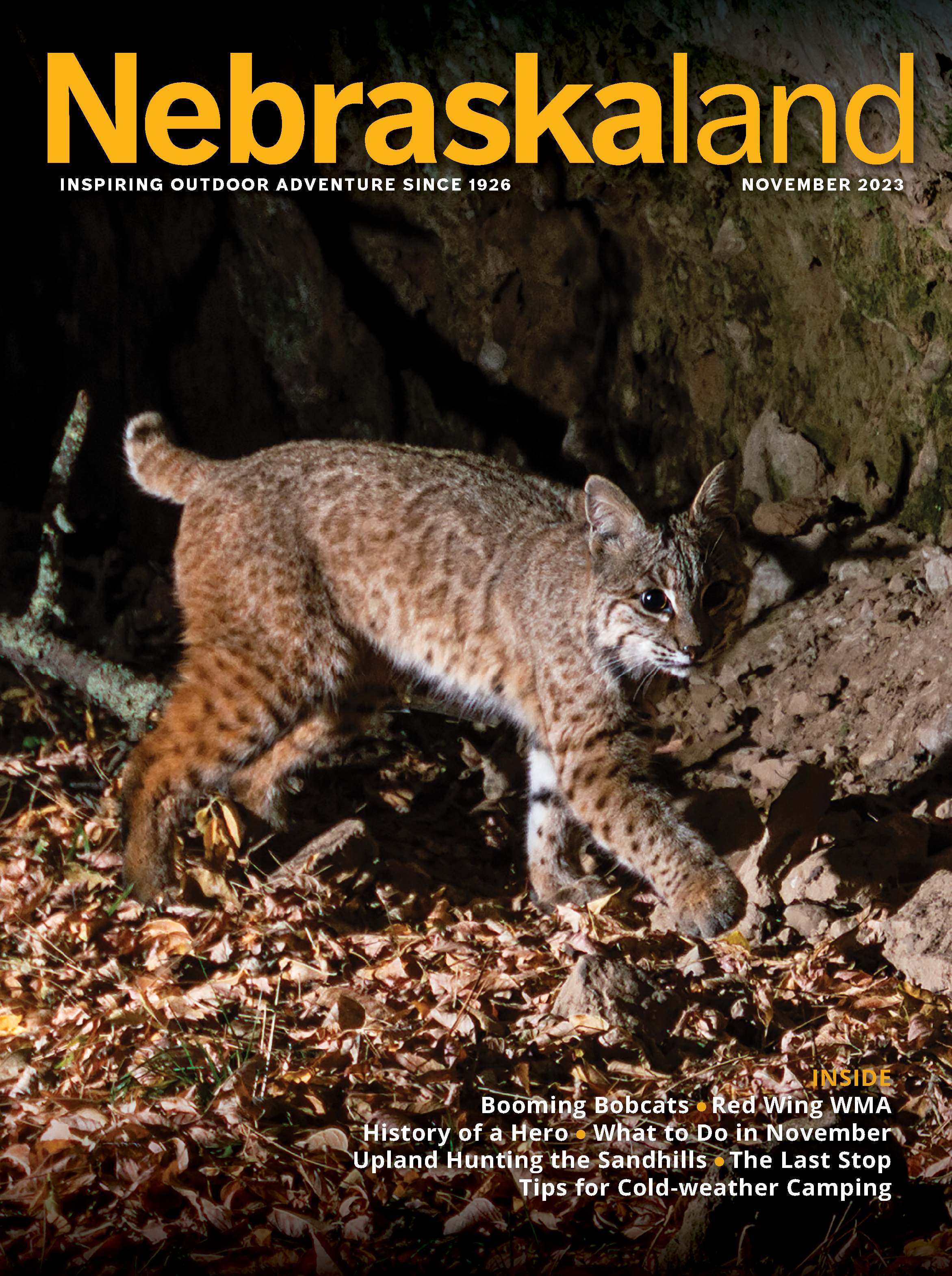
Cover: A bobcat walks near
C
EEast Ash Creek in the Pine
Ridge Ranger District of the
R
Nebraska National Forest in
N
Dawes County.
D
JJUSTIN
U
HAAG, NEBRASKALAND
FEATURES
20
A RIVER USED TO RUN THROUGH IT
T page: Cattails (Typha) at
This
Chadron City Reservoirs in
C
Dawes County distribute their
D
sseeds.
JJUSTIN
U
HAAG, NEBRASKALAND
Red Wing Wildlife Management Area
Story and photos by Eric Fowler
28
OUTDOOR NEBRASKA
What to Do in November
By Renae Blum
30
SHOT DOWN IN WORLD WAR II
34
UPLAND HUNTING THE SANDHILLS
By David L. Bristow, History Nebraska
A Scientific Approach
Story and photos by Justin Haag
40
BOOMING BOBCATS
42
COLD-WEATHER CAMPING
Story and photo by Justin Haag
By Jamie Bachmann, Wildlife Educator
DEPARTMENTS
8
12
44
52
54
Your Nebraska
In the Field
Mixed Bag
Portraits from the Past
The Last Stop
ON THE WEB
For more articles and
information, visit
NebraskalandMagazine.com
Nebraskaland (VOL. 101 / NO. 9 ISSN 0028-1964) is published monthly, except for the combined Jan./Feb. and Aug./Sept. issues, by the Nebraska Game and Parks Commission, 2200 N. 33rd
St., Lincoln, NE. Periodicals postage paid at Lincoln, Nebraska, and additional mailing offices. POSTMASTER: Send all UAA to CFS. (See DMM 507.1.5.2); NON-POSTAL AND MILITARY
FACILITIES: send address corrections to Nebraskaland, P.O. Box 30370, Lincoln, NE 68503-0370.
4
Nebraskaland • November 2023
November 2023 •
Nebraskaland
5
Magazine Staff
magazine
Published by the Nebraska Game and Parks
Commission since 1926. The Commission is
dedicated to the conservation and protection
of all the state's natural resources and the
people who use them.
Communications Director Christy Firestone
Public Relations Manager Shawna RichterRyerson
Editor Jeff Kurrus
Associate Editor Jenny Nguyen-Wheatley
Regional Editors Eric Fowler, Julie Geiser,
Justin Haag
Contributing Editor Michael Forsberg
Regular Contributors Renae Blum,
Chris Helzer, Chris Masada, Todd Mills,
Ryan Sparks, Gerry Steinauer
Art Director Tim Reigert
Graphic Designer Mel Severin
Listen for the last of the cricket calls.
Photo Librarian Jaclyn Cruikshank Vogt
Administration
Director Tim McCoy
Deputy Director Jim Swenson
Assistant Director Roger Kuhn
Commissioners
Chairman - Pat Berggren, Broken Bow
Vice Chairman - Rick Brandt, Roca
2nd Vice Chairman - Robert Allen, Eustis
Ken Curry, Columbus
Donna Kush, Omaha
Scott Cassels, Omaha
John Hoggatt, Kearney
Doug Zingula, Sidney
Dan Kreitman, Wahoo
Nebraskaland Magazine Copyright 2022, all rights reserved.
Nebraskaland is available in audio from the Nebraska Library
Commission Talking Book and Braille Service, Suite 120, 1200 N St.,
Lincoln, NE 68508. 800-742-7691. Nebraskaland Magazine and the
Nebraska Game and Parks Commission reserve the right to reject any
advertising not in keeping with the agency mission.
Rates: $18 for one year; $33 for two years; $44 for three years. Nebraska
recipients must add appropriate sales tax. To subscribe call
1-800-NEBLAND (632-5263), or go online to:
NebraskalandMagazine.com.
Commission Offices
Conservation Officers
Headquarters/Southeast District Office
2200 N. 33rd Street Lincoln, NE 68503
Phone 402-471-0641
ADMINISTRATION (Lincoln)
Craig Stover (Administrator)
Duane Arp (Asst. Administrator)
Travis Shepler (Asst. Administrator)
Jeff Clauson (Asst. Administrator)
Northeast District Office
2201 N. 13th St. Norfolk, NE 68701
Phone 402-370-3374
Southwest District Office
301 E. State Farm Rd. North Platte, NE 69101
Phone 308-535-8025
Northwest District Office
East Hwy. 2, Box 725 Alliance, NE 69301
Phone 308-763-2940
Bassett Office
524 Panzer St., Box 508 Bassett, NE 68714
Phone 402-684-2921
FIELD CRICKET, EPANTHA, GETTY IMAGES
Circulation
For address changes and questions about your
subscription, call 800-632-5263
Advertising Sales Manager
For advertising information contact
Shane G. Gilster, 402-742-0125
Email: shanegilster@gmail.com
402-471-5531
402-471-5531
402-471-5531
402-471-5531
NORTHWEST (Includes counties covered)
Dan Kling (Lieutenant)
308-430-0572
EAST SUB-DISTRICT
Sean Schultz (Sergeant)
308-760-0145
Jerod Hahn (Deuel, Garden, Grant)
Keith Jadlowski (Keith, Deuel)
Jaden Porter (Keith, Garden)
Tyler Stueck (Keith)
Travis Schultz (Morrill, Cheyenne)
308-520-5539
308-289-9580
308-289-2274
308-289-6260
308-279-1292
(Keith, Arthur)
WEST SUB-DISTRICT
Matt Brandt (Sherman, Howard)
Daryl Teter (Howard, Greeley, Merrick)
Kyle Gaston (York, Polk, Hamilton)
SOUTH SUB-DISTRICT
Matt Taylor (Sergeant)
402-200-9597
Tim Williams (Hall, Hamilton, York)
Eric Javins (Adams, Clay, Webster)
Pat George (Harlan, Franklin, Phelps)
Ethan Teter (Buffalo, Kearney)
308-380-7331
402-902-2017
308-920-2762
308-440-3847
(Thayer, Fillmore, Nuckolls)
SOUTHWEST (Includes counties covered)
Roger Thompson (Lieutenant)
308-530-3097
NORTH SUB-DISTRICT
Ray Dierking (Custer, Thomas, Blaine)
Frank Miller (Cherry, Hooker)
Greg Hesse
308-870-0322
402-389-0444
308-546-7464
308-660-4671
308-530-3157
(Hooker, Thomas, southern Cherry)
Sean McKeehan (Sergeant)
308-672-1824
Kelsey Glodowski
308-763-8226
Alex Hasenauer (Lincoln, Perkins)
Brandon O’Neal
Ak-Sar-Ben Aquarium/Schramm Education
Center
21502 W. Highway 31 Gretna, NE 68028
Phone 402-332-3901
Hunter Pearson
308-360-1817
SOUTH SUB-DISTRICT
Josh Widhelm (Scotts Bluff)
Jacob Stoinski (Sioux, Dawes)
308-279-9133
308-615-9017
(Red Willow, Frontier, Hayes, Hitchcock)
Omaha Office
8495 Frederick Street, Omaha, NE 68124
Phone 402-595-2144
NORTHEAST (Includes counties covered)
Dale Davis (Lieutenant)
402-760-0712
Kearney Office
1617 First Ave. Kearney, NE 68847
Phone 308-865-5310
(Kimball, Banner, Scotts Bluff)
(Box Butte, Sheridan, Grant)
(Sheridan, Dawes, Grant)
NORTH SUB-DISTRICT
Jeff Jones (Sergeant)
402-762-5022
John Bauer (Holt, Boyd)
Tyler Adelman
402-314-9257
402-314-4783
(Knox, Cedar)
(Rock, Brown, Keya Paha)
Jonathan Andreasen
402-340-3981
Mitch Johnson (Knox, Antelope, Pierce)
402-613-8612
(Madison, Pierce, Stanton)
OutdoorNebraska.org
SOUTH SUB-DISTRICT
Cory Krause (Sergeant)
402-380-6410
Kyler Prochaska (Platte, Colfax)
Matt Costello (Dodge, Colfax)
Kelbi Abke (Washington, Burt)
Nicholas Fix (Dixon, Dakota, Thurston)
402-830-8278
402-317-4014
402-237-2537
402-508-0261
(Cuming, Wayne, Stanton)
The Nebraska Game and Parks Commission does not discriminate
based on race, color, ethnicity, national origin, sex, pregnancy, sexual
orientation, gender identity, religion, disability, age, genetic information,
veteran status, marital status, and/or political affiliation in its programs,
activities, or employment. Any person who believes he or she has been
discriminated against in any program, activity, facility, or service,
should contact the Nebraska Game and Parks Commission, Lincoln, NE
402-471-0641, the Nebraska Equal Opportunity Commission, Lincoln,
NE 402-471-2024, TTY/TDD 800-642-6112; Director, Office of Diversity,
Inclusion and Civil Rights, U.S. Department of Interior, 1849 C Street,
NW, Washington, D.C. 20240.
6
Nebraskaland • November 2023
CENTRAL (Includes counties covered)
Mike Thome (Lieutenant)
308-293-8746
NORTH SUB-DISTRICT
Doug Pollard (Sergeant)
(Loup, Garfield, Valley)
308-730-7050
308-202-0819
308-440-1863
402-719-6226
(Lincoln, McPherson, Logan)
Brian Piernicky (Sergeant)
308-340-6627
Bryce Streger (Dawson, Gosper, Custer)
Matt Andrews
308-537-0404
308-746-2418
Taylor Dixon (Dawson, Gosper)
Sophia Gobber
308-217-2108
308-222-0368
(Furnas, Gosper, Frontier, Red Willow)
(Chase, Dundy, Hayes, Hitchcock)
SOUTHEAST (Includes counties covered)
Stacey Lewton (Lieutenant)
402-890-7140
EAST SUB-DISTRICT
Heath Packett (Sergeant)
402-210-0888
Russell Mort (Otoe, Johnson)
Rich Berggren (Douglas)
Brian Arp (Douglas, Sarpy)
Dan Evasco (Sarpy)
Mike Luben (Saunders, Butler)
Bryan Adams
402-209-1506
402-619-1355
531-530-9011
402-616-5961
402-443-6392
402-429-1924
(Cass)
(Nemaha, Pawnee, Richardson)
WEST SUB-DISTRICT
Dina Barta (Lancaster)
Luis Nuñez (Lancaster)
Mark Sullivan (Lancaster, Seward, Butler)
Trevor Stahlecker (Lancaster, Saline)
Matt Seitz (Gage, Jefferson)
402-890-6463
531-333-6093
402-741-0636
402-314-9641
402-806-0915
YOUR NEBRASKA
Instagram Photos
Follow us @nebraskaland
and tag us in your photos
to be featured in an
upcoming issue.
Joshua Redwine, Lincoln
Autumn at Smith Falls
State Park
Ray Kappel, Auburn
Life and Art at Burchard Lake
Roy Liesegang, Bellevue
Green Darner
8
Nebraskaland • November 2023
November 2023 •
Nebraskaland
9
YOUR NEBRASKA
Connie Allen, Grand Island
Storm Cloud Over Ponderosa Lake
Congratulations to Curt Blum, of Lincoln,
who won the Nebraskaland award at
the state fair for this image of a crimson
salt flat tiger beetle. The photograph was
captured at Frank Shoemaker Marsh in
Lancaster County.
10
Nebraskaland • November 2023
Send your comments and
photos to:
Jeff Kurrus, Editor
Nebraskaland Magazine
P.O. Box 30370
Lincoln, NE 68503
or email Jeff.Kurrus@Nebraska.gov
Please include your postal address
and telephone number. Letters
may be condensed and edited.
Photographs are also welcome.
November 2023 •
Nebraskaland
11
IN THE FIELD
POUR SOME JOE
Brandon Black of Tilden
pours a cup of coffee while
waiting for ducks to fly
during a hunt at Red Wing
Wildlife Management Area
near Neligh.
ERIC
ER
RIC
RI
IC FOW
OW
WLER
LER,
ER, NE
NE
EB
BRA
BRAS
RASK
R
RAS
ASK
ASKALAN
ALAND
D
12
Nebraskaland • November 2023
November 2023 •
Nebraskaland
13
IN THE FIELD
A ONE-DAY SCOUT
By Jeff Kurrus
Some firearm deer hunters are weekend warriors. Some have been checking trail cameras for months. And some don’t plan on
stepping into the woods until opening day. But there are many reasons not to do the latter. At the least, cross off the following tasks
on your opening morning checklist.
How’s the Weather?
Buy a Permit
It’s fascinating how quickly Nebraska’s weather can
change. A snowy morning can turn into a T-shirt afternoon,
so prepare for both. Wear minimal, moisture-wicking layers
into the stand and finish dressing once there. A quick
check of the weather also will reveal which way the wind is
expected to blow. Plan accordingly with stand location.
This seems obvious, but I have rushed to more than one
library on a Friday night to print a permit for the following
morning.
No Time for Wasps
There’s nothing more distressing than seeing a wasp fly
out from under your deer stand seat while you’re sitting in it.
Counter this by checking your deer stand before opening day.
This is also the time to check for board damage, and attach
your tree strap to the tree so your body harness can be easily
connected on opening morning.
Shooting Lanes
From your stand or blind location, analyze game trails
and see if there are enough shooting lanes. You don’t want
to alter the landscape too much before the big day, but make
sure a safe, accurate shot can be made when the time comes.
Shoot
Don’t ignore one of your most important weapons — your
weapon. For a list of public sight-in locations statewide, visit
OutdoorNebraska.gov, and search “sight-in days.” Where
I hunt, deer numbers decrease immediately when the first
rifle goes off. If possible, practice shooting elsewhere to
avoid this same pitfall, and make your first shot count.
Rubs and Scrapes and Trails
Do a quick walk through the woods. Walk parallel to
game trails and look for rubs and scrapes. If there are creeks
moving through the property, where are deer crossing them?
If you know where large thickets are located, stay away from
these bedding areas but look for game trails leading to and
from them. Then, hang your climbing stand or place your
blind within shooting range of these paths.
If only given one day to scout, do a quick walk across the area to determine game trail locations that travel between bedding
areas and food and water sources. JEFF KURRUS, NEBRASKALAND
14
Nebraskaland • November 2023
IN THE FIELD
Juvenile quail primaries and primary coverts feathers.
Adult quail primaries and primary coverts feathers.
ILLUSTRATION BY KELLIE HAYDEN
ILLUSTRATION BY KELLIE HAYDEN
HOW TO AGE QUAIL IN-HAND
By Kellie Hayden
The features that make our favorite game birds so
charismatic also provide details into the ages of these
birds. When we read the clues that feathers hold, we
can make smart decisions on maintaining high-quality
habitat.
Feathers take time and energy to grow — two things
young birds don’t have much of when they need to quickly
learn how to forage, fly and evade predators. This means
the first set of feathers that many birds are equipped with
are not high quality, and it doesn’t take long for these
feathers to become heavily worn. These ratty feathers can
give us insight into the age of individual quail.
The outer flight feathers, called the primaries, are
counted inward. The outermost primary is called P10, and
the innermost primary is P1. Northern bobwhites molt
their primaries starting with P1, working outwards to
P10. Once P1-P8 are fully molted and replaced with adult
feathers, bobwhites are considered over 150 days old.
When looking at the primaries, you may see that your bird
has retained one or more of their juvenile primaries. If this
is the case, the innermost primaries will look sleek and
strong (adult feathers), while one or two of the outermost
primaries look heavily worn, dull and may even be broken
(juvenile feathers yet to be molted).
16
Nebraskaland • November 2023
Another important clue to reading your bird’s age lies
in the primary coverts. These are the small feathers that
cover the shafts of primaries. In bobwhites, juvenile
primary coverts have light-colored tips. They may also
resemble low-quality juvenile primaries in looking heavily
worn. As bobwhites molt into their adult plumage, these
light-tipped coverts are replaced by uniformly colored
coverts. If your quail has primary coverts with uniformly
light-colored tips, that’s a giveaway your bird is a juvenile.
No buffy or white tips on the coverts indicates an adult.
Examining both the primaries and primary coverts will
give you the best insight into your bird’s age.
Why does aging birds matter? Data about the age
of harvested birds can help inform land management
practices. When managers have insight into the age of
birds on the land they steward, they can better understand
the health of breeding bird populations. This information
can affect and even improve vital practices that maintain
high-quality habitat, such as prescribed burns, grazing
methods and seed mix selection.
And, it’s just fun to know!
Kellie Hayden is a writer, artist and bird-banding apprentice
who is passionate about grassland habitat and conservation.
IN THE FIELD
VENISON AND CHEESE-STUFFED
POBLANO PEPPERS
By Jenny Nguyen-Wheatley
Chile relleno is a Puebla Mexican
dish: charred peppers stuffed with
gooey cheese, dipped in fluffy egg
meringue and then deep fried. The
fresh poblano peppers and melty
Oaxaca cheese are more traditional,
but interchangeable. You may use
Anaheim peppers instead, and
if Oaxaca is difficult to find, try a
combination of mozzarella and
cheddar cheese for the filling.
Prep Time: 5 minutes
Cooking Time: 1 hour
Servings: 6
Ingredients:
1
⁄2 pound of ground venison
6 medium-large poblano peppers
1
⁄2 teaspoon of dried oregano
(Mexican oregano preferred)
1
⁄2 teaspoon of chili powder
10 ounces of Oaxaca cheese,
shredded
Kosher salt, to taste
4 eggs, whites and yolks separated
1
⁄4 cup of all-purpose flour
Crumbled queso fresco cheese, to
taste
Vegetable oil for frying
1 jar of roasted salsa roja (or
homemade)
•
•
•
•
•
•
•
•
•
•
•
Special equipment:
stand/hand mixer
toothpicks,
1. On a rimmed cookie sheet, broil
the poblano peppers until blistered
and fairly charred all over, turning
occasionally. If you have a gas stove,
use tongs to turn the peppers directly
over a medium flame. Transfer peppers
to a bowl and cover to allow them to
steam in their own heat for about 10
minutes.
18
Nebraskaland • November 2023
JENNY NGUYEN-WHEATLEY, NEBRASKALAND
2. Over medium-high heat, brown
ground venison, chili powder and
oregano in 2 teaspoons of oil. Season
with salt and allow to cool.
3. Gently scrape off the skin on the
poblano peppers, being careful not to
break the flesh. Then cut an opening
down the length of each pepper to
make a pocket, being careful not to
cut through the other side. Remove
the ribs and seeds. Stuff the peppers
with a layer of Oaxaca cheese, cooked
ground venison and then more cheese.
Secure the openings with toothpicks.
Be careful not to overstuff the peppers
because they will be difficult to handle
in step five.
4. To make the meringue, separate
egg whites from their yolks. Beat
whites on medium-high speed with a
stand/hand mixer until it resembles
the thickness of whipped cream. Break
the yolks and gently fold them into the
meringue. Do not overmix, because
the meringue will deflate. Heat salsa
roja in a saucepan and keep warm.
5. In a deep-frying pan, preheat
1 to 11⁄2 inches of vegetable oil to
350° F. When the oil nearly reaches
temperature, lightly coat each stuffed
pepper with flour and then carefully
dip them into the meringue to coat.
Fry the chile relleno seam-side down
first, and then flip to brown the other
side. Do not crowd the pan, so fry in
batches; only dip peppers in meringue
just before they go into the oil. Drain
peppers on paper towels/frying rack
and keep warm while you finish frying
the remaining chile rellenos.
6. Ladle hot salsa onto serving
dishes and lay one stuffed pepper on
top. Remove the toothpicks before
serving. Crumble queso fresco on top.
A River Used to
Run Through It
Red Wing Wildlife Management Area
D
Story and photos by Eric Fowler
ams,
diversions
and
development have changed
many rivers in Nebraska. The
Elkhorn River is not one of
them. It still winds its way through the
northeastern Nebraska countryside,
its channel slowly shifting course
from year to year. During floods, those
shifts can be drastic.
That is what happened sometime
early in the 20th century at what
would, in 1977, become Red Wing
Wildlife Management Area between
Clearwater and Neligh. Where the
Elkhorn had taken a right turn and
headed south, it took a hard left and
headed north, soon turning east and
eventually rejoining the main course
more than a mile downstream.
During the most recent flood in
2019, the Elkhorn changed its mind
and jumped back into the channel it
had abandoned a century ago. What
it left behind has become a haven
for wildlife, especially beaver, and a
mosaic of plant species sprouting from
the sand where the river once ran.
A Wild, Meandering
River
The Elkhorn River is, like many
in Nebraska, a meandering, alluvial
river. While it has been straightened
in places and had its banks armored in
others, and irrigation pumps reduce its
flows during the summer, it has only
one small dam on its main stem, and it
hasn’t been diverted for irrigation and
20
Nebraskaland
• November 2023
hydropower.
As such, it still does what wild,
meandering rivers do. It winds its way
like a snake through a broad floodplain,
constantly chewing away at the
outside of each bend, the cut bank,
and depositing that sand and soil on
the inside of the next bend, creating
point bars. Through time, those bends
become wider and the distance across
the neck shorter. Eventually, during
periods of high flow, the water will take
a shortcut across the neck, cutting the
bend off from the river and leaving
oxbow lakes or marshes behind.
Fly over the river in a plane or on
Google Earth, and you will see the
Elkhorn River valley is littered with
oxbows. Some were created many
decades ago, while others are more
recent. Floods in 2010 and 2019
created six cutoffs in Antelope County
alone, including the one at Red Wing
and another upriver at Hackberry
Creek WMA, adding to the 60 or so
that already existed in the county.
The result is a maze of lakes, marshes,
wetlands and cottonwood forests.
My first look at the changed river
at Red Wing came while I was taking
aerial photos of the river in September
2020. Recognizing what I was seeing
was not your typical cutoff, I made
several passes. The abandoned
channel, 2.4 miles in length, was
mostly bare sand, except for a small
ribbon of flowing water. The river’s
new route was only 1.5 miles long,
most of it south of the 316-acre wildlife
A wood duck perches on a fallen tree as a North American beaver lurks below it in a backwater at
Red Wing Wildlife Management Area.
area. It looked new, with massive point
bars on each bend that, like the old
channel, were also bare sand.
Back at the office, I opened Google
Earth and quickly saw the river’s new
course was actually its old course,
a path that for years had been a
backwater and marsh.
When did the river turn north,
I asked? Historic aerial photos did
not answer the question. The first
available were captured in 1938, and
by then the river had been following
its pre-2019 course for some time.
Topographical maps weren’t available
for Antelope County prior to that time
either.
Merlin Bolling, a life-long resident of
the Clearwater area, has seen plenty of
floods in his 73 years. They come about
every 10 years, he said. There were big
ones in the 1940s, 1960s and 1990s.
The biggest was in 2010, although
there could have been others before
records were kept. Bolling suspected a
1918 flood he was told about by other
long-time residents caused the shift. It
was after that flood, the former county
road superintendent said, that a bridge
was moved to the river a few miles
upstream from Red Wing. The long,
narrow oxbow it left behind, the one
now carrying the river’s flow, became
known as Horseshoe Slough.
On a visit to the Antelope County
Museum to peruse old bound volumes
of the Neligh Leader, I found a story
on the front page of the June 7, 1918,
edition of a storm that brought heavy
rain, turned the streets to rivers and
washed out the railroad tracks west
of town in a location where only
temporary repairs had been made
following a previous storm. The story,
short by today’s standards following a
flood, focused more on damage done
by wind and lightning, as though
flooding was passé. Most of the news
in each edition of the paper that year
was coverage of World War I.
The
museum
had
another
interesting relic that may be the best
clue to the river’s shift: An 1884 plat
map, the oldest they have, showed
the main channel of the river flowing
south, where it does today, but also
November 2023 •
Nebraskaland
21
TOP LEFT: Brandon Black of Tilden
retrieves a wood duck he harvested
while hunting a beaver pond in the old
channel of the Elkhorn River at Red
Wing WMA.
BOTTOM: Prior to the 2019 flood, the
Elkhorn River occupied the channel
at the top of this photo captured in
September 2020. The flood sent the
river back into a channel it hadn’t
occupied for a century.
TOP RIGHT: A grass spider stands on a
beaver pond filled with ramshorn and
bladder snails, moss and rushes.
a smaller channel flowing north,
covering part of the course it took prior
to 2019. That leaves me to assume the
1918 flood caused the river to shift its
flows entirely to the north channel,
and also created another cutoff that
remains as an oxbow marsh today.
Boots in the Sand
I set foot in the old river channel
for the first time in May 2021, not
knowing what I would find. Snags and
sand filled most of the upper end of the
old channel, which was disconnected
from the river’s flows. The water that
was trickling down the former course
was, as the case with many Nebraska
rivers, coming from groundwater
below. It began flowing a few hundred
yards downstream and continued
throughout most of its length, with
small streams connecting deeper pools
next to the former cut bank or scoured
around snags by the flood.
In the lower end of the wildlife area,
a backwater had existed for more than
100 years in the river’s former course.
Water taking this path during the 2019
flood completely reshaped this oxbow,
carving away 100 yards of land from
its north end and leaving massive
cottonwoods sunk in a 10-acre pond
dotted with sandbars surrounded by
deep scour holes, a haven for wood
ducks. Eventually, the river took an
easterly, overland route, leaving the
pond, another cutoff, behind. A row of
ash trees that once stood on the east
bank of the old oxbow now stands
on the west bank of an island in the
middle.
The 2-plus miles of mostly dry
riverbed between was dotted with
snags toppled or deposited by the
floodwaters, including a few bur oaks.
Beavers had only begun to get busy,
having built a handful of dams that
I could find no sign of in the aerial
photos I had captured the previous fall.
Their runs were now plainly visible
wherever there was water. Rushes,
grasses, cottonwoods and willows had
begun to sprout from the moist, sandy
bottom of the channel, and shorebirds
were probing the sand for insects.
By the time I returned a month and a
half later, life had exploded. Beavers had
raised the level of their dams and built
more, a theme that would repeat itself
November 2023 •
Nebraskaland
23
TOP LEFT: A stair-step of vegetation
occupying different levels of soil
moisture in the old channel includes,
from left, cottonwoods and willows,
great blue lobelia, partridge pea and
spike rushes.
BOTTOM LEFT: Creek chubs and sand
shiners fill a pool in the old channel.
BOTTOM RIGHT: A bobcat pauses to look
over its shoulder at a camera trap while
crossing a beaver dam.
24
Nebraskaland
• November 2023
with each subsequent visit. In those
waters, I saw more minnows than I had
seen anywhere. In the deeper holes, I
found sunfish, largemouth bass and
schools of recently hatched bullheads.
Thousands of snails crawled through
the shallows. Where they were found
in masses, you could hear their shells
rattling against each other as they
moved. Frogs thrived in the water and
toads on the sand.
Thad Huenemann, rivers and
streams biologist with the Game and
Parks Commission, said aquatic life
often explodes following a flood. What
was left in the deeper pools when
the water receded thrived with the
nutrients carried by floodwaters.
Vegetation continued to spread
and flourish. Gerry Steinauer, a
Game and Parks botanist, joined me
on my next visit to Red Wing two
weeks later. What was happening,
he said, was classic river channel
succession that occurs naturally in
meandering rivers like the Elkhorn.
The river had deposited the seeds of
most of the plants sprouting from
the sand. Many were flashy annuals,
including lovegrasses, nutsedges and
wildflowers, like beggarticks, that are
adapted to growing in these ephemeral
habitats. Some species preferred
higher, drier spots in the sand, and
others, moist soils closer to pools or
the groundwater fed stream. Wetland
plants, such as swamp smartweed and
cattails found a home in the pools.
Knee-high thickets of young plains
cottonwoods and peachleaf willows
were extensive. Given time, they
would mature, thin themselves and
become forests.
By my next visit in the fall,
vegetation had covered most of
the bare sand. Beaver ponds, now
numbering more than 20, stretched
from one dam to the next. Resident
November 2023 •
Nebraskaland
25
LEFT: Water pools behind one of many beaver dams built
across the old channel to hold back flows fed by groundwater.
TOP RIGHT: Allegheny Monkey-flower blooms in the moist soils
of the old channel.
teal and wood ducks were joined by
migrating mallards.
I visited Red Wing four times in
2022. By mid-summer, the old channel
that had been almost entirely bare
sand in early 2021 was now completely
green and vegetated. Snails were still
abundant, but there were far fewer
minnows in the pools. When I returned
late August, in the midst of extreme
drought, there was little water to be
26
Nebraskaland
• November 2023
found. Ponds behind the beaver dams,
and the runs between them, were left
high and dry. With nary a track to be
found, the beavers had no doubt moved
back to the river. Raccoons and other
birds and mammals had likely feasted
on the aquatic life as the pools dried
up. Snail shells littered the bottom of
dry pools.
Soon after the irrigation wells were
shut off for the season, groundwater
levels recovered, and the water began
flowing again. By November, the dams
were full and water flowed between
them, enough to provide a place for
ducks to stop in their fall migration,
and for duck hunters to deploy a decoy
spread.
My only visit in 2023 came during
a hot, dry spell in late July. Beaver
dams still held water in the upper
end of the old channel, but it was low
and not flowing between dams, and I
saw no fresh sign. The middle reach
was dry. The lower end, however,
was brimming. The influence of
groundwater was obviously stronger in
some reaches than others. The beavers
had figured this out. The dams they
built in the wet reaches, once low lines
of tangled sticks, were now several
feet high and covered with mud, from
which trees and other vegetation grew.
One in the lower
end was actually
keeping the water
deeper in a pool
on its downstream
side. That pond was deeper than I was
prepared to explore in my boots. I saw
no minnows in the upper ponds, but I
did see a few small bluegill, bass and
pickerel, as well as snails. How they
got into these pools that were dry a
year earlier is testament to nature.
Perennial wildflowers, rushes and
sedges were filling the marshes.
On rich, moist soils, cottonwoods
and willows were now head-high.
Wildflowers
and
grasses
were
becoming more established on the
higher and drier, sandy soils.
The ebbs and flows of water, and
the life in it, will likely continue at Red
Wing. Will the river stay in its new
channel? The next flood could easily
send water rushing through a low spot
in the upper end of the old channel.
Will it be enough that the still-wild
Elkhorn will change its mind again?
Or will it remain on its new course,
which is actually its old course from a
century ago, something that continues
to amaze me.
Only time will tell. N
November 2023 •
Nebraskaland
27
Outdoor Nebraska
By Renae Blum
Autumn offers much to the outdoors enthusiast; get out there and enjoy it!
This month, make some time for pheasant hunting, trout fishing, hiking and
disc golf. N
What to Do in November
Look for bird nests
while hiking
Throughout the month
Statewide
While you’re enjoying a hike on a crisp
fall day, keep your eyes peeled for birds’
nests. You could even bring along a
nest field guide and try to identify
what species built the nests you see.
Get up close and look at how the nest
was constructed, what materials were
used and where the nest was placed —
all interesting insights into the world
of our feathered friends.
JUSTIN HAAG, NEBRASKALAND
Work on completing the
Trout Slam
Throughout the month | Various locations
Fall is one of the best times to work on completing the
Nebraska Trout Slam — which you can do by catching,
photographing and submitting a photo of Nebraska’s four
trout species. Rainbow trout were stocked in urban and
park waters in October, as were some cutthroat trout,
and trout can be found in cold-water streams in the
northern and western regions of the state. Learn more at
OutdoorNebraska.gov. JUSTIN HAAG, NEBRASKALAND
Play disc golf at Chadron State Park
Throughout the month | Chadron
Chadron State Park’s disc golf course is one of the best in the state, said park
superintendent Gregg Galbraith. Well-designed and full of scenic beauty, this
18-hole course provides the perfect setting for fall fun. The bottom nine holes
are great for families, while the top nine present more of a challenge. Loaner
discs are available, or you can purchase some in the gift shop.
JUSTIN HAAG, NEBRASKALAND
Visit the Wildcat Hills
Nature Center
Throughout the month | Gering
Visit this fascinating site to discover the secrets
of the Wildcat Hills through interactive displays
and interpretive programming. Visitors can also
soak in the area’s ancient past through interpretive
paleontology and archeology displays. Bird viewing
is a must here; the center boasts a large viewing
area with several feeders and a view overlooking the
North Platte River valley.
JUSTIN HAAG, NEBRASKALAND
28
Nebraskaland • November 2023
Bring home a
pheasant for
Thanksgiving
Throughout the month | Statewide
Get out and enjoy Nebraska’s upland bird
hunting tradition this fall — and see if
you can bring home a pheasant for the
Thanksgiving table. They’re tasty and
easy to cook — and if you don’t harvest
enough for the main dish, try pheasant
poppers for appetizers. A rooster’s long tail
feathers will also add a vibrant touch to your
Thanksgiving centerpiece.
JENNY NGUYEN-WHEATLEY, NEBRASKALAND
November 2023 •
Nebraskaland
29
Shot Down in World War II
Ensign John R. Doyle,
USN. Courtesy of the
Doyle Family
By David L. Bristow, History Nebraska
.S. Navy Ensign John Doyle’s chances of surviving World
War II seemed bleak on Nov. 25, 1944, as he struggled to
hold his burning dive bomber on target over the South
China Sea,” writes Samuel Van Pelt. “While attacking a
Japanese heavy cruiser, anti-aircraft fire damaged his plane,
but Doyle still managed to release his bomb and score a hit
on the ship.”
Back home in Lincoln, Nebraska, Doyle’s parents, Lewis
(“Lum”) and Mary, received a telegram saying their 20-yearold son, also known as Dugie, was missing in action. Later,
they received a letter from Captain Dixie Kiefer, commander of
Dugie’s aircraft carrier, the USS Ticonderoga. By coincidence,
the captain was an old friend of Lum’s. He wrote:
‘U
“It was the most heroic case I have seen on this trip
and was over and above the call of duty. His plane
caught fire at 9,000 feet from anti-aircraft. Instead of
getting over friendly natives and using the parachute,
knowing that the cruiser was the biggest type and a
very important target, he went on down and scored a
direct hit, crippling it so others could sink it. He has
been recommended and will receive the Navy Cross.
He then landed in the water and was seen by the rest
to get clear and in a rubber boat.”
A Curtiss “Helldiver” circles above an aircraft carrier in the South Pacific, January 1945.
30
Nebraskaland
• November 2023
U.S. NAVY PHOTO, 80-G-320999
November 2023 •
Nebraskaland
31
Luzon, the Philippines. Robert Ross Smith, United States
Army in World War II, The War in the Pacific: Triumph in the
Philippines. OFFICE OF THE CHIEF OF MILITARY HISTORY, DEPARTMENT OF THE ARMY, 1993
By then, a month had passed, and Dugie was still missing.
He had gone down off the Philippine island of Luzon, but it
was occupied by the Japanese.
In 1993, Dugie Doyle — still very much alive — told his story
to fellow Lincoln attorney Sam Van Pelt. Doyle explained
Doyle and the other rescued fliers aboard the aircraft
tender at the U.S. fleet anchorage near Leyte, January 1945
(left to right): Maurice Nayland; Doyle, N. J. Roccaforte; P. R.
Schleitchy; W. W. King. Nayland, Roccaforte, and King were
killed in an airplane crash soon after the photograph was
taken. COURTESY OF THE DOYLE FAMILY
32
Nebraskaland
• November 2023
The U.S. Navy aircraft carrier USS Ticonderoga (CV-14) lists
to port in the aftermath of a kamikaze attack in which four
suicide planes hit the ship on Jan. 21, 1945. This was Doyle’s
carrier, but he was not aboard at the time of that attack.
U.S. NAVY - U.S. NAVY NATIONAL MUSEUM OF NAVAL AVIATION PHOTO NO. 2000.219.001 [1]
that after he and his crewman took to their raft, they floated
for more than a day waiting for a rescue sub. Then, “all of a
sudden, I never saw this Japanese plane coming. He was right
on top of us.” Doyle and his crewman flipped the raft over
while the Japanese plane flew so close that Doyle could see
the observer’s goggles.
After that, they figured they had better take their chances
on shore. A Filipino man guided them to a small village of
bamboo huts, where local people fed them. But “the word got
out that Americans were up in the hills … We got the hell out
of there just in time.”
A local guerilla leader led them to the hideout of Lt. Colonel
Giles Merrill, who had escaped the Bataan death march in
1942 and had been living in the jungle since. Rail-thin from
malaria and dysentery, Merrill “was a character and would
strap on his pith helmet and his .45” while working with
local Filipinos to protect any Allies who came his way. He
kept up with the latest news in a hut that was “a regular war
room” with a card table, road maps and a bicycle-powered
shortwave radio receiver.
Merrill knew that three downed American flyers were
hiding out in an isolated bay 7 miles distant. Doyle and
his crewman went to join them. Doyle urged Merrill to
come along. At the bay, Doyle argued, they would stand a
better chance of rescue. But Merrill remained at his remote
command post to await the promised return of General
Douglas MacArthur to the Philippines.
At the bay, Doyle and the others signaled passing U.S. planes.
“When they came over, we would catch them with the mirror
and get their attention. Then we would write stuff in great big
letters in the sand, like ‘food,’ ‘fever’ and the code word for a
rescue plane in the navy, ‘Dumbo.’” One day, an army A-20
zoomed the beach but didn’t make it up over the hills.
“He stalled out and crashed. Oh God, the plane’s ammunition
was going off for about three hours.” The next day, Jan. 10,
1945, two of the men on the beach climbed the hill to bury the
plane’s crew. It was then that a Navy PBY “Catalina” flying
boat landed in the bay.
“They must’ve set the world’s dash record coming down that
hill. The natives then rowed us in a wooden bark or hollowed
log canoe out to the PBY, and we all got aboard.”
Doyle and the others were soon back with the U.S. fleet off
the eastern shore of Leyte, where three of the five men were
pronounced fit to “rejoin their outfits or go home.”
But Doyle was sick with malaria. He argued with the
doctor, but was not allowed to board the transport plane with
the others.
Doyle receiving the Navy Cross from Rear
ear
Adm. Arthur C. Davis during Oct. 26,
1945, ceremonies at the University
of Nebraska. Capt. M. D. Matthews,
commander of the university’s
naval ROTC program, left, was also
decorated for wartime service.
COURTESY OF THE DOYLE FAMILY
The transport crashed soon
after takeoff, killing all on board.
“I would have been on that
plane if I hadn’t had malaria or
had won that argument with the
doctor … It was from an Anopheles
mosquito, and it saved my life.”
Back home in Lincoln, Doyle
went on to a distinguished career
as an attorney and as president of
the Lincoln Council on Alcoholism
and chairman of the National John R. Doyle COURTESY OF
Council on Alcoholism. When he CHICK THORNE AND THE COUNTRY
CLUB OF LINCOLN
died in 2013, he was known more
for “his life serving others” (in the words of a Lincoln Journal
Star headline) than for his Navy Cross.
Abiding by Doyle’s wishes, Van Pelt withheld the 1993
interview from publication during Doyle’s lifetime. Nebraska
History Magazine printed the full interview in 2014. You can
find it by searching “Dugie Doyle” at history.nebraska.gov N
Visit History Nebraska’s website at history.nebraska.gov.
November 2023 •
Nebraskaland
33
Upland HunƟng
the Sandhills
A ScienƟfic Approach
A wildlife biologist at the ValenƟne NaƟonal
Wildlife Refuge shares his perspecƟves on one of
his favorite pasƟmes: hunƟng prairie grouse.
but they will be hard to get close to. Areas that are ungrazed,
grazed early in the season so that the grass has recovered,
or lightly grazed areas tend to be good places to look for
prairie grouse. Talking to land managers — be it the ranchers,
federal or state land managers — can be a good start in
figuring out where to hunt. Vegetation height also seems to
be important to grouse. They tend to avoid uniformly short,
ankle-high, and uniformly tall, waist-high vegetation, with
a preference for heights in the mid-shin to knee-high range.
Taller vegetation may be used if there is a lot of shorter cover
mixed throughout.
numbers are down, bagging one grouse in that amount of
time would be a success.
How you cover the ground can make a difference as well;
taking more time to thoroughly walk an area of good cover
can be more effective than covering a lot of miles in a straight
line. The first steep hill to hike up always seems to be the
most challenging to me. Once I’ve gotten up onto a dune ridge
I plan to hunt, the terrain tends to be more rolling than steep
climbs all the time. That said, it helps to do some walking
ahead of the grouse hunting season if you want to enjoy your
hunt.
How much work is required to bag a grouse in the
Sandhills? How’s the terrain for hiking?
Generally, a hunter should be prepared to do some walking
to bag prairie grouse in the Sandhills. If grouse numbers are
good and you are in the right habitat, a limit of three birds
in two to three hours of walking is reasonable. If grouse
How does grouse behavior change throughout the day?
Grouse do have habits throughout the day, which can be
impacted by the weather conditions. Typically, they will
leave the site that they roosted for the night early in the day
to spend some time foraging. Around mid-morning, they will
typically settle into a day roost to rest and digest the food
Story and photos by Justin Haag
M
elvin Nenneman knows birds.
As wildlife biologist for the 71,516-acre
Valentine National Wildlife Refuge the past 21
years, he’s become familiar with flying creatures
that range in size from the huge pelicans cruising the shallow
lakes to minute grasshopper sparrows flittering about the
rolling, grass-covered dunes. He and his coworkers strive to
preserve and maintain the ecosystem for birds and all of the
other plants and animals. From Blanding’s turtles to western
prairie fringed orchids, he’s become intimate with the many
species that make the Sandhills such a special place.
Nenneman’s time at the refuge also has provided
opportunity to pursue a favorite pastime: hunting. Among
his favorite quarries are Nebraska’s native prairie grouse.
While following Nenneman, his dog Patch and a coworker
around the hills in search of upland game during an evening,
the biologist shared his insights. My questions and his
answers follow.
Upon first look, the Sandhills can be intimidating for a
bird hunter — an expanse of rolling hills as far as the eye
can see. Which areas of the hills should hunters focus?
Generally, finding hills that have good grass cover and food
resources will improve your odds of finding birds. Areas that
have been grazed or otherwise disturbed such that the grass
is more uniformly short are not great places to look. If there
is a good food source in these grazed areas, it may have birds,
With the sun low on the horizon, Mel Nenneman and Patch,
an English cocker spaniel, pursue grouse at the Valentine
National Wildlife Refuge.
34
Nebraskaland
• November 2023
November 2023 •
Nebraskaland
35
diversity are good as they tend to have greater abundance of
these invertebrates.
As the season goes on, all prairie grouse tend to switch
to a more vegetarian diet, so finding areas with ample rose
hips and poison ivy berries can be productive. They also
like green vegetation — sprouting flowering plants and
new grass growth is attractive forage. Later in the season,
especially if there is a lot of snow, grouse will consume cedar
cones (often called berries, but actually a cone) or other food
sources available above the snow, such as seeds of trees and
tree buds.
Early in the season, you may find grouse in the shade of
a plum or chokecherry thicket, or tall but open forbs in a
meadow, while late in the season you might find them on a
south-facing slope where the snow has melted off. During
the warm early months of the season, feeding bouts tend
to be shorter as food resources tend to be more plentiful
and energy requirements are lower, while in colder weather,
grouse will spend more time actively feeding to meet energy
demands.
Nenneman loads his shotgun with steel ammunition, which
complies with the refuge’s requirement of non-toxic shot.
that they gathered in their crop (the temporary storage in
their esophagus) that morning. In the mid- to late afternoon,
they will leave their roost to forage again before finding a
place to roost for the night during the last bit of daylight.
On warm days, they will seek day-roost sites that have
shade or cooler microclimates, which are typically the northfacing slopes of dune ridges or patches of shrubs or other tall
vegetation. On colder days, they will seek enough cover to
conserve energy during the day. In rainy conditions, I have
found them in areas with less cover — bare patches of sand in
the hills and cattle loafing areas. If you flush grouse while you
are hunting, make a note of where the grouse flushed from
and hunt similar locations for the time of day and season.
How does grouse hunting change throughout the
season (Sept. 1-Jan. 31)?
Early in the season, young of the year grouse are often
still with the hen, and consuming more animal foods —
grasshoppers and other invertebrates — and it is more likely
to find these birds lower in the landscape, along the edges
of meadows or in meadows with open canopies that allow
the birds to move freely. Areas with a lot of flowering plant
36
Nebraskaland
• November 2023
Both prairie-chickens and sharptails can be found in
your vicinity. Within the region, where do they reside?
Does the habitat vary between species?
Both species need large expanses of grassland habitat with
little development to persist in the landscape. Across the
Sandhills, prairie-chickens are more common to the east and
south, while sharptails are more common to the north and
west in the region, with a lot of overlap of the two species
across the middle region.
Generally, prairie-chickens tend to be found in and adjacent
to the sub-irrigated meadows more often, while sharptails
tend to be out in the Sandhill dune prairie. Prairie-chickens
seem to avoid trees and shrubs more so than sharptails, and
sharptails prefer some of the highest, roughest hills in the
area.
Prairie-chickens seem to exhibit a short-distance
migratory behavior in the late fall and winter, with many
chickens apparently leaving the refuge to find center pivot
agricultural crops. This is based on the observation that
during the spring breeding season, there are roughly equal
numbers of male sharp-tailed grouse and prairie-chickens on
the refuge, while in the fall harvest, most of the birds taken
on the refuge are sharptails. Researchers elsewhere in the
Sandhills have documented prairie-chickens moving from
the Sandhills to center-pivot agricultural areas and feedlots
during the winter.
What’s the status of grouse populations on the refuge/
region? I assume the harsh winter was not good for them.
What weather and climate conditions do grouse need to
thrive?
Prairie grouse, and sharptails in particular, are pretty
well adapted to survive tough winters, and they seem to
have weathered the winter of 2022-23 pretty well based on
lek counts this spring. Weather seems to play a key role in
determining how successful prairie grouse are during the
nesting season.
Researchers have made a connection between temperature
and precipitation during the nesting and brood rearing
seasons on prairie grouse reproduction. Having adequate soil
moisture from precipitation to grow vegetation for nesting
and brood rearing is important, while having too much rain
in June when the chicks are hatching has a negative impact.
Similarly, warmer average temperatures in June positively
influence grouse production, but days over 95 degrees
Fahrenheit had a negative impact on production.
Overall warmer temperatures likely allow increased
productivity in the invertebrates that chicks rely on for rapid
growth and development and increases the amount of time
chicks can spend foraging (versus brooding under the hen).
Temperatures above 95 F can be lethal to young chicks as
they are less able to regulate their body temperature and
cannot travel far to find thermal cover.
Additional research looking at nest sites selected by
hens has found the nest locations to have better thermal
protection against cooler and warmer temperatures and
to help avoid exposing eggs and the hens to the extreme
warm temperatures during the day. Hot temperatures during
the summer are possibly more of a problem for grouse than
cold winter temperatures. Weather conditions that allow
for the production of good food resources and adequate
cover are important, so the “goldilocks” zone of enough
rain but not too much rain, and warmth but not too much
warmth is probably ideal. This summer may have been an
example of good reproductive conditions for grouse; we had
about average rainfall which was spaced out well across
the growing season, there were no extreme hot or cold
temperatures during the critical hatching and early brood
rearing stages, and we avoided storms with hail. An Audubon
Society analysis of potential climate change impacts on birds
suggests warming temperatures and lower precipitation may
combine to make Nebraska and the Sandhills less hospitable
to sharp-tailed grouse, while the trend for prairie-chickens
was stable. Nebraska is the southern extent of the range of
sharp-tailed grouse.
Prairie grouse are not the only upland bird species in
the Sandhills. Tell me about the pheasant population.
Ever see any quail or partridge?
The ring-necked pheasant is an introduced game bird from
Eurasia and was released in Nebraska starting in the early
1900s. The Sandhills are not prime habitat for these birds, but
there is a decent population on the refuge and in pockets on
surrounding ranches.
Pheasant numbers can fluctuate markedly from year to
year, influenced greatly by weather. Cold and snowy winters
tend to negatively affect pheasant populations as they are not
well adapted to these conditions. At Valentine NWR, there is
a population of pheasants that seems to sustain itself. There
is enough cover in the form of cattails and tree rows to get
With leaves fallen, a flock of sharptails gather in a thicket in early November. Nenneman said the birds are drawn to thickets
early in the season for their shade.
November 2023 •
Nebraskaland
37
to drop off one wing from each grouse they harvest. These
volunteer wing return boxes have envelopes that hunters can
place wings in, and they are asked to fill out some information
about their hunt; providing names or address is optional, but
it would be great if the date, number of hunters and number
of birds harvested were filled in. Nebraska Game and Parks
also collects a sample of wings from the east and west prairie
grouse zones. After the grouse season closes, a group of
biologists gets together for the Prairie Grouse Wing Bee —
here, we go through all of
the wings that hunters
submitted and determine
the species of grouse
(sharp-tailed grouse or
greater
prairie-chicken,
and sometimes we can
pick out hybrids), and
then determine from the
wing molt if the bird is an
adult or juvenile (or hatch
year bird = bird hatched in
that year).
We use this information
to calculate a juvenile
to adult ratio from the
Besides the refuge,
harvest, and if hunters
what other nearby public
provide the date of the
lands are good for upland
hunt, we can backdate
bird hunting?
from the known age of a
McKelvie
National
juvenile grouse to figure
Forest has been good for
out an approximate hatch
prairie grouse recently,
date.
and the staff there has
Calculating the hatch
been making a map of its
date can shed some light
grazing program available
on habitat conditions and
each fall to help hunters
how successful hens were
decide where to go on
at hatching their first
the forest. Similar to the
A sharptail forages among the grass. Grouse tend to avoid
uniformly short or uniformly tall vegetation.
nesting attempt versus
refuge, most of their
a second or third try. If
prairie grouse harvest is
there is adequate nesting cover — residual vegetation from
sharp-tailed grouse with a good sprinkling of greater prairiethe previous year — hens can begin nesting earlier (and the
chickens in the mix. There are several Nebraska Game and
peak of hatching would be earlier) than if they need to delay
Parks Commission wildlife management areas nearby that
nesting to use the current year’s growth for concealment,
provide opportunities for both prairie grouse and pheasants
which pushes the peak of hatching later. If there are two
— and the occasional quail. Ballard’s Marsh has a good mix
peaks in hatch dates, it shows that a number of first nesting
of habitat that makes for a nice place to try for grouse or
attempts failed and the hens renested and hatched a second
roosters. Merritt Reservoir and Schlagel Creek WMAs can
attempt. These data provide a measure of the harvest on
also hold some birds.
these public lands, and the ratio of juveniles to adults in the
harvest provides an index of grouse production. When the
Tell me about the wing bee. What have you learned
number of juveniles in the harvest is high relative to the
from it?
number of adults, it represents a year of good production
Valentine and Crescent Lake national wildlife refuges, and
while ratios with more adults show poor reproduction. A
Nebraska National Forest, Bessey Division and McKelvie
ratio with 2.5 or more juveniles per adult in the harvest is
National Forest all have locations for prairie grouse hunters
them through most winters, and plenty of grassland habitat
to sustain the population.
Pheasants tend to do well where there is a matrix of row
crop fields interspersed with grasslands, but there are enough
native food items for them to make a living at the refuge in
the absence of agricultural crops. The pheasant density here
is nothing like you would find in South Dakota, but there are
usually enough here to make it fun to chase them. Bobwhite
quail are usually pretty scarce here, although there is often a
covey or two around. While
they are legal to hunt on
the refuge, I wouldn’t plan
on coming here for a quail
hunt. Bobwhite numbers
here are typically low.
Gray partridge have
been documented on the
refuge in the past, but I
have not encountered one
here, so I would have to say
encountering a partridge
on the refuge would indeed
be a chance encounter.
38
Nebraskaland
• November 2023
Nenneman gives Patch a drink. Especially while covering large expanses, a hunter must tend to the dog’s needs.
indicative of good reproduction and a population that should
grow.
Let’s talk gear. What do you prefer for a shotgun?
I am probably not going to give a very exciting answer
to this, as I’m not that interested in owning every gauge of
shotgun ever made or caliber of rifle produced. I tend to find
a gun that works for me and stick with it, so I hunt upland
birds with a 12 gauge over-and-under shotgun I purchased
off the used gun rack at a Cabela’s about 15 years ago. With
non-toxic shot, I use cylinder and improved cylinder choke
tubes in my gun.
That said, the most effective shotgun and choke tube
combination for any hunter will be a gun they can carry for
hours while walking, comes up to the shoulder well, and that
they can hit flying targets with. You could have the finest,
most expensive shotgun on the market but if it is too heavy
and doesn’t fit you well, you are going to hit less birds.
Any other gear advice?
Grouse hunting can be a minimalist pursuit. Probably most
important among gear is a good pair of hiking or hunting
boots as you’ll only go as far as your feet will take you. Pair
good boots with clothes that keep you comfortable. I like
moisture-wicking shirts that can be layered as needed and a
decent pair of hunting pants that resists stickers and burs.
Also, a hunting vest with enough pockets to carry adequate
water for you and your canine companion, a shotgun and
shells are pretty much all you need. And snacks!
The refuge requires the use of non-toxic shot. Any
preference among the various types, such as bismuth,
tungsten and steel?
I have not tried all the different non-toxic shot available.
I started bird hunting as a relatively poor college student/
biological technician/graduate student, so I used the most
inexpensive non-toxic shot available, which was steel. I’ve had
success using steel shot, so I have not felt the need to use any
other shot types. I usually use 23⁄4-inch shells with 11⁄8 ounce
of No. 4 shot traveling at 1400 fps, which seems to be a great
all-around load for grouse, pheasants and ducks over decoys.
What other special regulations should people be aware
of?
As far as the refuge goes, the main things to know are that
we do not allow camping, fires, or the use of ATVs or UTVs;
hunters are allowed access from 2 hours before sunrise to
2 hours after sunset; and vehicle travel is allowed only on
refuge trails designated as open to motor vehicles. N
The refuge brochure with all regulations is available at
https://shorturl.at/cwBMW
November 2023 •
Nebraskaland
39
Booming Bobcats
Something of a mystery, Nebraska’s bobcat
population remains healthy.
By JJustin
B
i H
Haag
A
s I moved among patches of
shoulder-high weeds at an
abandoned farmstead in search
of pheasants, I glanced over
to see my younger brother, fresh out
of hunter-safety training, become
excited as he entered a clearing.
“Whoa, what was that? It looked
like a lion,” he shouted as an unfamiliar
creature scurried into cover.
Despite any skepticism by those
of us in the hunting party that day,
we now know his exciting encounter,
which happened in the mid-1990s,
was surely a bobcat. While sightings
of the species were rare in years
preceding that hunt, the chance
meeting coincided with an incredible
population boom for the species, and
such encounters have become more
common by Nebraskans in years
since.
One Cool Cat
The bobcat (Lynx rufus) is regarded
as one of Nebraska’s most handsome
wildlife species, especially among catlovers. Notable features include its
spotted fur, facial ruffs, ear tufts and,
of course, the bobbed tail for which it
gets its name.
Bobcats average about 20 pounds,
with the larger toms sometimes
exceeding 30 pounds. They’re about
one-third the size of Nebraska’s other
resident wildcat species, the cougar,
and stand under 2 feet tall.
The bobcat’s reddish-brown, gray
40
Nebraskaland • November 2023
and black-spotted coat provides
camouflage that helps it ambush
cottontail rabbits, its favorite prey.
Studies have shown that more than
90 percent of the bobcat’s diet consists
of cottontails, but the opportunistic
carnivore also will occasionally feed
on ground-nesting birds, rodents
and even deer. Reportedly, it is quick
enough that it can sometimes grab a
low-flying bird from the air. Yes, catlike reflexes.
Individual bobcats have a range of
up to 30 square miles, but must avoid
becoming prey to coyotes, cougars,
foxes, owls and humans. Although
they may growl, meow, hiss or scream
for mating and other reasons, they are
quiet as they hunt for food, find mates
and move between den sites.
The bobcat is highly adaptable and
has a broad distribution throughout
the lower 48 states and bordering
regions of Mexico and Canada. It is
one of four lynx species in the world,
and one of just two in North America.
The other American species is the
less adaptable Canada lynx (Lynx
canadensis) that resides in cold, snowy
climates.
The Boom
Population estimates for such
elusive, primarily nocturnal, species
are difficult to figure, but evidence
shows there are certainly more bobcats
in the state than there used to be. Sam
Wilson, Game and Parks furbearer and
carnivore program manager, said the
species’ harvest records, which date
back to 1941, indicate a remarkable
surge within the past few decades.
Similar to most wildlife species,
the bobcat population suffered during
the westward settlement of EuroAmericans in the late 1800s and early
1900s. It is a survivor, however.
“The historical strongholds for
bobcats were that wild part of the
Niobrara River Valley, the Pine Ridge
and maybe a few around the Wildcat
Hills; those steeper and wilder areas
of the state had a few that could stay
hidden or eke out a living,” Wilson
said.
Bobcat pelts are internationally
coveted and are the most valuable
of Nebraska’s fur-bearing species.
When the market is high, one pelt
can fetch several hundred dollars. At a
certain point in history, more hunters
and trappers began enjoying bobcat
success.
“In the late 1990s, something
changed. Biologists aren’t really
sure what happened,” Wilson said.
“Populations boomed across much
of the Midwest, including Nebraska.
Nebraska’s harvest went from 50 to
200 for about 50 years all the way
to 1,500. Not only did harvest go up,
particularly in the southeast in the
early years, but bobcats spread into
most parts of Nebraska.”
Now, hunters and trappers are
reporting bobcat success in all but just
A bobcat walks along a cliff in the Pine Ridge, which for many years was one of the few places the species could be
found in Nebraska. Now, it’s widely distributed throughout the state. JUSTIN HAAG, NEBRASKALAND
a few Nebraska counties. The counties
without bobcat reports are mostly
covered with corn and soybeans and
void of wooded creek bottoms and tall
grasses.
During the population surge,
the bobcat harvest particularly
skyrocketed in the southeastern part
of the state where few cats had been
reported in years prior. The successful
harvest has continued there and
moved into the south-central and
southwestern regions.
In the agency’s most recent
reporting period, Harlan, Red Willow
(the location of my brother’s sighting
years ago) and Furnas counties on
the state’s southern border had the
highest harvest density, ranging from
5.7 to 7 per 100 square miles.
The bobcats’ appearance varies
by region and time of year and the
individual. The fur is generally
considered to be more attractive, soft
and consequently valuable the farther
north and west they reside.
“A lot of the cats in the southeastern
part of the state are orange and gray,
and you don’t even see spots until you
look close, although a few do have the
classic dark spots,” Wilson said.
The season for hunting and trapping
bobcats runs from Dec. 1 through the
end of February, when their pelts are
prime. A fur harvesting permit and
habitat stamp are required to kill
them. Anyone who harvests a bobcat
must contact Game and Parks to
have it registered and tagged for the
Convention on International Trade in
Endangered Species of Wild Fauna and
Flora.
“This is done in part to ensure
legally harvested bobcat pelts are
not confused with similar pelts of
protected endangered species, like
Iberian lynx,” Wilson said. “This also
allows the Commission to accurately
determine how many bobcats are
harvested each year to ensure the
species is properly managed.”
Sound management will ensure
sightings of the species occur for
generations to come. And excitement
will always be justified when
encountering the elusive, handsome
bobcat, whether it be the Pine Ridge,
the bluffs of the Missouri River, or an
abandoned farmstead in Red Willow
County. N
November 2023 •
Nebraskaland
41
COLDWEATHER
CAMPING
By Jamie Bachmann, Wildlife Educator
I
n Nebraska, high summer reigns as the busiest season
for family camping, but I’m the kind of mom who
prefers to avoid the distractions of busy campgrounds.
Unfortunately, opportunities for isolation can be limited
in the summer. So, when my children were young, I heard
tales — near legends — of families embracing cold-weather
camping. Then in March 2003, a single car camping trip to see
the sandhill crane migration launched nearly two decades of
cold-weather camping.
On that first trip, my oldest was 3 years old and my
youngest was 5 months and still nursing. Yes, there was a
diaper change in the middle of the night when it was below
20 degrees outside. Yes, it was more traumatic for me than
the baby — but it was worth it. Although these trips were
not always easy and comfortable, they’ve become some of
my kids’ favorite and most memorable outdoor experiences.
My boys have grown to become resilient because of those
experiences.
The Advantages of Off-Season
Camping
Gear
When we started cold-weather camping, we simply took
our summer gear and extra layers, and then slowly over the
42
Nebraskaland
• November 2023
years, started upgrading. As any gearhead knows, quality
camping gear is expensive, but please, remember that cold
weather camping is accessible without having to spend a
lot of cash on fancy new gear. Borrow from friends, buy used
or just pack more layers until you know you are dedicated to
continuing this pastime.
SLEEPING BAGS – If you don’t have the extra cash for
a cold-weather bag, line your existing sleeping bag with
another blanket or bag liner to increase the temperature
rating. A tip: The transition from shedding outer layers and
hopping into a cold sleeping bag can be a tough go for kids.
A hot water bottle will warm up a bag, but I worried about it
leaking. So, I switched to hot rocks! Set the kids out to collect
rocks and warm them up by the fire.
CAMP MAT – Without this barrier, the cold ground will
pull heat from your body, making for a miserable night.
Sleeping mats don’t have to be rated for cold weather — use
your summer camp mat and an extra blanket to lie on top.
TENTS – If you have a two- or three-season tent that keeps
out the rain, that will work just fine. The most important
thing is to keep dry — getting wet is the worst when it’s cold,
which can also quickly turn into an emergency.
LAYERS – Mornings and nights will be cold, but dress your
children in layers that they can peel off if you experience a
sunny, warm day. Here is how I dress my kids: I start with
a base layer, something a little tighter fitting that a couple
more layers can fit over. Over the layers, they wear insulated
bib overalls, which can be easily removed during warmer
spells. Next, a shell jacket will help keep them dry and block
out the prairie wind. Cold feet and hands are the quickest
way to put out the fire on a good winter adventure. I keep a
stock of hand warmers to tuck inside pockets and boots. Also,
ear bands will provide protection, even when it’s too warm to
wear a stocking cap.
The P’s
There is just no way around it, the inevitable baring of skin
for the P’s: pee and poo. Boys may have it a little easier than
GETTYIMAGES
girls, but we all end up having to squat at some point in time.
Diaper wipes will always have a place at my camp.
On a related note: When my youngest was 3, we camped
in an ice storm, and a few days after
our family adventure, he broke out in
poison ivy in the only three places that
get exposed in such weather: his hands,
face and groin.
Urushiol is the compound in poison
ivy that is responsible for my son’s
nasty reaction, and it exists in every part of the plant, even
during dormancy and also when it’s dead. Know how to
identify poison ivy in any season and pass on that knowledge
to your children.
If cold-weather camping sounds as though it could scratch
an itch for your family, start by planning a couple of trips
mid- to late fall. Head over to OutdoorNebraska.gov and
search “camping,” and take a look at what Nebraska camping
has to offer in the off-season. N
November 2023 •
Nebraskaland
43
POISON IVY, GETTYIMAGES
Camping is closely tied with the communal fire. While
summer campfires are for cooking and keeping the bugs away
only, in the cold, the warmth of a fire becomes enjoyable. I am
an advocate for letting kids play with a campfire. Poking at
a fire or tossing in pine cones are great ways for children to
develop their risk assessment of fire and learn to respect it.
Cold-weather camping also means you are working with
sunset near 5 p.m. in December versus 9 p.m. in June. Earlier
bedtimes are a symptom of camping in the off season. My
kiddos were always ready to climb into their sleeping bags a
couple of hours earlier than their regular bedtimes.
Cold weather clears out insects and most people, too.
Fewer people means less noise and more wildlife viewing
opportunities.
if you prepare well, winter camping offers solitude, no insects, and quality time with family outdoors.
MIXED BAG
YOUR NEBRASKA STATE PARKS — INDOOR STYLE
By Renae Blum
slides, net bridges and ball pit. Or go next door to the Venture
Climb complex, which features a 42-foot climbing wall and
bouldering structure.
If you enjoy archery and target shooting, or would like to
learn, visit the Turpin Outdoor Education Center in Lincoln.
This family-friendly facility offers indoor archery and firearm
ranges, educational classes, workshops, special events and
instruction for all ages and skill levels.
JENNY NGUYEN-WHEATLEY, NEBRASKALAND
JENNY NGUYEN-WHEATLEY, NEBRASKALAND
When it’s too cold to be outdoors, you don’t have to stay
cooped up at home. Try any of these opportunities for indoor
fun, where you can learn more about nature and Nebraska
history, get active or be entertained.
Educational Opportunities
Interested in learning more about a particular place? Then
you’ll love the Wildcat Hills Nature Center, which explores
the features of this pine-clad butte range, and the Missouri
National Recreational River Resource and Education Center,
located at Ponca State Park, where you can learn more about
the Missouri River. Also check out Schramm Education
Center near Gretna, which explores Nebraska’s aquatic and
terrestrial ecosystems.
Want to learn how fish are raised and stocked across
the state? Visit one of Nebraska Game and Parks’ five fish
hatcheries, many of which offer tours and educational
opportunities.
Museums
Interested in Nebraska history? Many of Nebraska’s state
historical parks offer museums or visitor centers where you
can indulge your curiosity in Nebraska’s past.
Arbor Lodge State Historical Park, located in Nebraska
City, is the home of Arbor Day. During the park’s winter
hours, tour this elegant mansion and learn more about the
Morton family.
Many other park museums and visitor centers are open
only by appointment in the winter months, so you can enjoy
having the place to yourself. This includes Ash Hollow,
Buffalo Bill Ranch, Fort Atkinson, Fort Hartsuff, Fort Kearny
and Rock Creek Station state historical parks.
NOW ON DISPLAY.
OUTFITTED FOR RURAL
SETTINGS
BUDGET FRIENDLY HOMES
10-YEAR STRUCTURAL
& 7-YEAR APPLIANCE
WARRANTY
WE DELIVER AND INSTALL
ALL HOMES
JEFF KURRUS, NEBRASKALAND
Entertainment
Be dazzled by magic tricks and sleight of hand at Eugene
T. Mahoney State Park, which is hosting performances by
magician Ryan Chandler throughout the winter at Kountze
Memorial Theater. Find the schedule at melodrama.net and
reserve your tickets by calling 402-944-2523, ext. 7122.
Recreational Activities
Bring the family to Eugene T. Mahoney State Park’s Activity
Center, which hosts a large indoor playground with fun tubes,
44
Nebraskaland • November 2023
For more information on the activities listed here, visit
OutdoorNebraska.gov. A park entry permit is required at
Nebraska state parks.
November 2023 •
Nebraskaland
45
MIXED BAG
IT’S NOT ABOUT YOU
By Jeff Kurrus
We’ve all messed up at one point here: When introducing a
newcomer to hunting — whether it’s a kid or adult — we try
to make them love exactly what we love. Some do, but many
don’t. To effectively pass on hunting skills, what we need are
smarter ways to welcome people to the sport.
So, the next time you introduce someone to hunting, do so
with this in mind — what type of hunting will match what
you know about their personality?
Here are a few ideas to get you thinking.
Stand Deer Hunting
Hunting from a deer stand is perfect for patient people and
those who like to watch the day, and all the nature around
them, unfold. Anyone who carries around an occasional
paperback book, or likes reading on their electronic device,
can do so in the deer stand. Bird lovers are good candidates,
as well. If firearm hunting during November or January, make
sure your hunter is properly clothed to stay warm. Folks who
don’t like the cold will balk the second time you ask them to
tag along if you didn’t prepare them well the first time.
Spot-and-Stalk Deer Hunting
If your friend wants to add a workout component to their
hunting, this is the sport for them. Adventurers and people
who love to hike or bike will enjoy finding themselves in the
middle of nowhere. Spotting and stalking is for gearheads as
well: people who love using trail cameras, spotting scopes,
binoculars and GPS maps.
Waterfowl Hunting
This type of hunting is for your organizers, your room
cleaners and your arrangers — the kids, or adults, in your
life who simply can’t sit still. For there is always time to
readjust your decoys. Waterfowl hunting is also good for
music lovers; when a blind is filled with hunters who know
how to blow a duck or goose call correctly, it sounds like an
outdoor symphony.
Turkey Hunting
Chasing toms has always reminded me of playing war as
a kid, sneaking, plotting and moving across the terrain like
I’m a pretend sniper. It’s also for the tricksters in your group
and the practical jokers — those who have a knack for luring
in folks for a story or situation, which is a lot like luring a big
tom into a set of hen decoys.
Upland Hunting
Nothing is better for dog lovers than upland hunting. From
pheasants to quail and the prairie-chickens and other grouse
in between, watching a pointer or flusher track down game
is more exciting than pulling the trigger. Upland hunting is
great for walkers as well — those who might enjoy spending
their downtime circling the track at the local high school.
Upland hunting is for hikers and exercise enthusiasts.
JEFF KURRUS, NEBRASKALAND
46
Nebraskaland • November 2023
Right now, I have no idea what type of hunting my 4-yearold son will like. What I do know is that he absolutely loves
to be outside in the dark wearing a headlamp. This has led
us to hunting frogs one to two nights a week since bullfrog
season opened. Eventually, these frog hunts will be replaced
by nighttime fishing trips and, maybe, if we get lucky, a
raccoon hunt or two.
When we introduce newcomers to hunting, we must do so
with one aspect firmly planted in mind — them.
November 2023 •
Nebraskaland
47
48
Nebraskaland • November 2023
November 2023 •
Nebraskaland
49
MIXED BAG
ANIMAL VISION
By Monica Macoubrie, Wildlife Education Specialist
Eyes on the side hide, eyes on the
front hunt.
The size, ability and position
of the eyes of animals can vary
widely depending on the species,
environment and whether the animal
is predator or prey. Some animals
can move their eyes independently;
some can see in ultraviolet light; and
others can’t really see much at all.
Throughout this article, we will take
a closer look into four types of animal
eyes and their uses and functions.
Dragonflies
JUSTIN HAAG
Owls
50
Nebraskaland • November 2023
JEFF KURRUS
Not
many avian
predators can
outrank owls
in vision.
They are
considered
perfect nocturnal hunters, possessing
In
Nebraska,
there are
29 species
of snakes.
Some of these are nocturnal, meaning
they are awake at night, while others
are diurnal, meaning they are awake
during the day. Snakes, overall, have
a diverse set of rods and cones in
their eyes — the specialized cells
in the retina that an animal uses
to detect light. One adaptation is
that snakes have multiple types of
visual pigments inside the cones,
which allows them to see in color
because the pigments are sensitive
to different wavelengths of light. So,
snakes that hunt during the daytime
have lenses in their eyes that block
Contrary
to the
phrase
“blind as a
bat,” these
flying
mammals have extremely sensitive
vision, which helps with their
nocturnal lifestyle. In Nebraska,
the 13 species of bats are known as
insectivores, and to find their food,
they have to do it in the dark and
often while flying, which requires
extraordinary eyesight.
In Nebraska, bats also utilize an
adaptation known as echolocation,
when bats produce sounds which
bounce off objects to help them
navigate to their food. However,
research shows that many bats prefer
to use eyesight as opposed to sound
when they hunt. These species have
particularly sharp vision, and some
can see ultraviolet lights. A few
species of bats can even see in color,
thanks to two light-sensitive proteins
at the backs of their eyes.
ERIC FOWLER
Snakes
Bats
JENNY NGUYEN-WHEATLEY
Dragonflies
are often
considered the
apex predators
of the insect
world, despite
their small
size. They have the ability to catch
food right out of the air during flight,
thanks to their humongous, globular
compound eyes. Compared to African
lions, which have a capture success
rate of 25 percent when pursuing prey,
dragonflies are successful about 95
percent of the time.
A dragonfly’s compound eyes cover
most of its head, and they can see
nearly 360 degrees around them. Two
separate eyes come together at the
top, and within each eye are smaller
lenses. Depending on the species, a
dragonfly’s eyes can be composed of
up to 30,000 facets or little lenses.
ultraviolet light, which allow them
to see clearly in bright conditions —
similar to people wearing sunglasses.
Conversely, nocturnal snakes that
hunt at night have lenses that allow
more UV light in, which help them
see in the dark.
An old myth that is still in
circulation claims that a snake’s pupil
shape can help people determine
whether it’s venomous or nonvenomous. The myth is that all
venomous snakes have ellipticalshaped pupils. Unfortunately, this is
inaccurate, as venomous snakes can
have elliptical, round or even keyholeshaped pupils. Therefore, the presence
or absence of venom has nothing to
do with pupil shape.
many of the adaptations needed to
excel in stalking prey at night. One
characteristic in particular is their
eyes.
An owl’s eyes are located facing
forward on its head, very similar to
humans. This eye arrangement is
effective in tracking the movements
of potential prey. Owls actually have
the most forward-facing eyes out of
any group of birds.
Owls have what is known as 3-D
or binocular vision, a trait they
share with many other predatory
animals. This helps with acute depth
perception and allows them to gauge
distance when planning an attack.
Behind the retina is a layer called
the tapetum lucidum, which catches
any light that may have passed
through the retina and bounces it
back to the sensitive rods. All these
adaptations add up, and some owl
eyes can be as much as 100 times
more sensitive to light than human
eyes.
November 2023 •
Nebraskaland
51
PORTRAITS FROM THE PAST
Deer hunting, 1953
This photo was taken in my grandfather Leon
Klanecky’s “old red barn” back in 1953 after he shot this
mule buck northeast of Ord in the Oak Canyons. I spent
my childhood hunting in these canyons with my dad and
grandpa, and they have taught me everything I know
about deer hunting. My grandpa has since passed away,
but the memories in those hills will last forever. My dad,
Tom Klanecky (of Ord), and I still look forward to deer
hunting together every year.
– Evan Klanecky, Utica
Fishing a farm pond, 1978
My grandfather, Elmer W. Gydesen, was photographed
by my sister, Linda, while they were fishing a farm pond in
1978. His farm was about 9 miles north of Scotia. Some of my
favorite memories were while deer and coyote hunting with
him in my teen years.
– Dennis Kasson, Greenville, Illinois
Turkey hunt, 1980
Deer and turkey hunting were always enjoyed
at the Frank and Mary Prokop family farm in
Spencer.
Pictured from left is my brother Steve Pavlis,
Uncle Emanuel Prokop and my husband Keith
Bonner with their wild turkeys.
– Bev Bonner, Papillion
Fishing at Lake Ericson, 1933
This photo was taken at Lake Ericson in the summer of 1933. Pictured from left: Lawrence; Jim (my dad); Francis;
Grandpa John; Dave (nephew); and Al – all Van Ackerens. I still have the wooden tacklebox with the wooden lures, the South
Bend fishing reel, leather reel case with the maintenance instructions, and his many fishing/hunting licenses.
– Larry Van Ackeren, Yutan
Deer hunting, 1979
This photo was taken
on my family farm near
Haigler in Dundy County in
1979.
Gene Thomsen and I
worked for the Department
of Roads in Lincoln as rightof-way surveyors.
– Mike Olson, Arnold
Send contributions to: Portraits from the Past, Nebraskaland Magazine, P.O. Box 30370, Lincoln, NE 68503-0370. Or e-mail to Tim.Reigert@Nebraska.gov.
Photos should show people enjoying Nebraska outdoor activities, such as camping, boating, hunting or fishing, and must have been taken before 2000. We will give
priority to unusual photos or activities. When possible, please include a story about the photograph and identify the people, places and approximate date it was
taken. Text may be edited and photos adjusted for reproduction. All photos will be returned.
52
Nebraskaland • November 2023
November 2023 •
Nebraskaland
53
THE LAST STOP
BIT BY A BLUEGILL,
NEARLY RUN OVER BY A BEAVER
By Eric Fowler
Red Wing Wildlife Management area is a dangerous place
for wildlife photographers.
During the past three years, as you read earlier in this issue,
I made numerous trips to the area between Clearwater and
Neligh to document changes that occurred in the channel
the Elkhorn River abandoned during flooding in March 2019.
In late June 2021, armed with my mask, snorkel and an
underwater camera, I set out to photograph the abundant
aquatic life in the natural pools and beaver ponds and the
streams between them, all fed by groundwater.
In a backwater at the lower end of the old channel, I found
a male bluegill tending its nest in the midst of beaver-chewed
sticks in 3 feet of water. He swam back and forth, thoroughly
annoyed by my presence, occasionally head butting the dome
port on my camera. After 10 minutes, he’d had enough and
swam up and bit my left index finger while I was gripping the
camera. I’ve been bit by many fish, but only while removing
a hook from their mouths, so this was a first of sorts. I’m glad
it wasn’t a pike.
The following May, I spent an evening sitting in the
willows next to a beaver pond, hoping a flock of blue-winged
teal I spooked from the water earlier would return. When
they didn’t, I walked to the middle of the stream below the
pond to photograph the sunset. I turned to look downstream
and saw a beaver swimming my way.
This was the second time this had happened in less than
an hour. The first time, while walking the channel a few
hundred yards to the west, I was also caught standing in
the open. Wearing camo hip waders and a ghillie suit jacket,
I froze. The beaver kept swimming my way, letting me grab
a few frames as it did. When it swam behind a dam, I prefocused on the spot I hoped it would walk across. Instead, it
sprinted. I captured four blurry or poorly-composed frames,
54
Nebraskaland • November 2023
fired off at 14 frames per second, before it splashed into the
pool above the dam. Seconds later, it emerged long enough
to slap his tail on the surface, his way of giving me the bird,
before continuing upstream.
The second beaver, like the first, kept coming near, but at
a more leisurely pace — closer and closer until my 600mm
lens wouldn’t focus. As a rule, my focus limit switch is set to
on, as my subjects are typically more than 33 feet away. That
no longer being the case, I slowly reached up and turned the
switch off, and I kept firing away until it breached the lens’s
14.4-foot minimum focus distance. And it kept coming.
Have you seen the commercial where a beaver bites into
some heavy-duty work pants and breaks its teeth? But I
wasn’t wearing heavy-duty work pants. So, having no clue
how a beaver would react if startled — would it attack? — I
reached, in slow motion, for the second camera hanging from
my shoulder, fitted with a wide zoom.
Minutes earlier, I was photographing landscapes from a
tripod. I was smart enough to spin the aperture dial to wide
open, but it took way more frames than it should have for me
to realize that wasn’t enough to get the shutter speed fast
enough for hand-held action photos. I slowly and blindly
fumbled to boost the ISO, continuing to click away as the
beaver walked up its run, me looking down as it passed three
feet from mine.
Whether this beaver was dumb, blind or just indifferent, it
didn’t care that I was there. I shadowed it for 400 yards as it
swam and walked up the channel, even moving ahead of it
once, and capturing a few more frame-filling portraits, giving
me 359 photos in all — most of them garbage — in the course
of 16 minutes.
Which was a much better outcome than if it had treated
me the way that bluegill did.
November 2023 •
Nebraskaland
55
Position: 704 (16 views)