Volume 101, Issue 7, 2023
August-September 2023
- Identifier:
- nela.2023_101_07
- Title:
- Volume 101, Issue 7, 2023
- Issue Name:
- August-September 2023
- Date Issued:
- 2023-08-01
- year:
- 2023
- Season:
- Summer
- PDF filename:
- NL_101.07_2023_Aug_Sep_Spreads_Entire.pdf
- Publisher:
- Nebraska Game and Parks Commission
- Format:
- Periodical
- volume:
- 101
- issue:
- 07
- number:
- 101.07
- Decade:
- 2020s
- Type:
- Rights Holder:
- Copyright Nebraskaland Magazine/Nebraska Game and Parks Commission, all rights reserved.
- Extracted Text:
-
magazine
$4.95
To renew your subscription or change your
address call 1-800-632-5263
I N S P I R I N G O U T D O O R A DV E N T U R E S I N C E 1 92 6
AU GU S T-S E P T E M B E R 20 23
INSIDE
Ponca Tribe Powwow
Scissors Grinder Cicadas • Walleye Po’ Boys
The Things That Stick to Us • Row Big Red
A History of Early Road Signs • The Last Stop
2
Nebraskaland • August-September 2023
August-September 2023 •
Nebraskaland
3
Volume 101 No. 7
August-September 2023
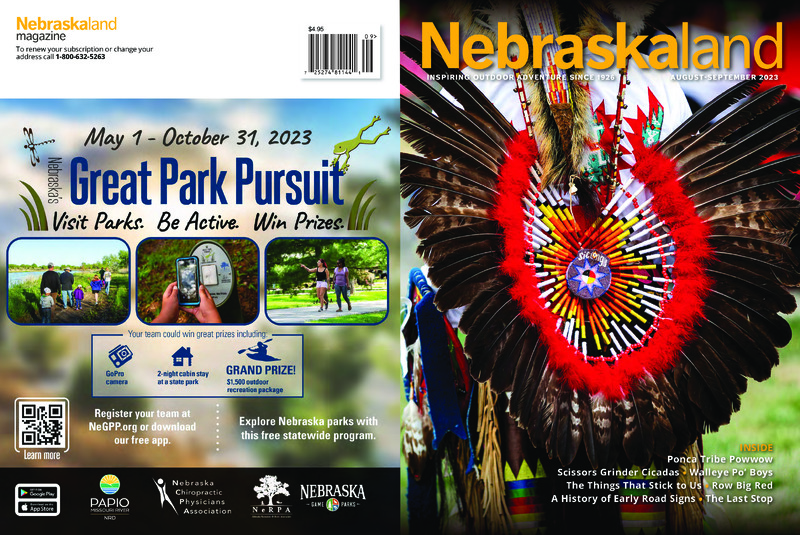
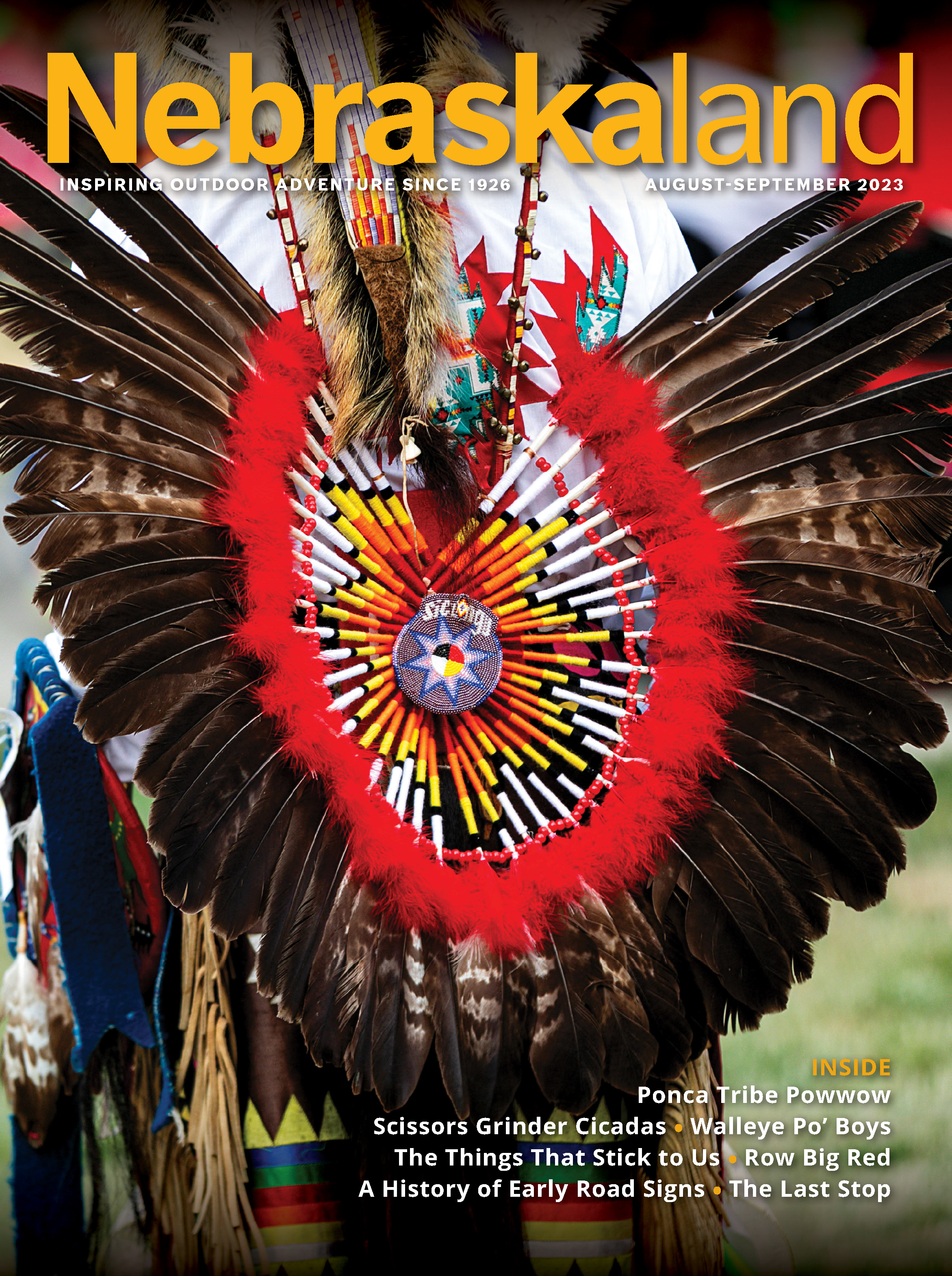
Cover: Feather bustle of the men’s northern traditional dancer’s
C
rregalia at the Northern Ponca Powwow near Niobrara.
JJENNY NGUYEN-WHEATLEY, NEBRASKALAND
T page: The sun sets over Lewis and Clark Lake State Recreation
This
Area, a reservoir on the Missouri River in Knox and Cedar counties.
A
ERIC FOWLER, NEBRASKALAND
E
FEATURES
20
THE THINGS THAT STICK TO US
26
OUTDOOR NEBRASKA
Story and photos by Chris Helzer
What to Do in August-September
By Renae Blum
28
THE PONCA POWWOW
34
EARLY ROAD SIGNS
38
THE SCISSORS GRINDER
42
Story and photos by Jenny Nguyen-Wheatley
By David L. Bristow, History Nebraska
An Annual Cicada
Story and photos by Gerry Steinauer
ROW BIG RED
Story and photos by Eric Fowler
DEPARTMENTS
8
12
48
56
58
Your Nebraska
In the Field
Mixed Bag
Portraits from the Past
The Last Stop
ON THE WEB
For more articles and
information, visit
NebraskalandMagazine.com
Nebraskaland (VOL. 101 / NO. 7 ISSN 0028-1964) is published monthly, except for the combined Jan./Feb. and Aug./Sept. issues, by the Nebraska Game and Parks Commission, 2200 N. 33rd St.,
Lincoln, NE. Periodicals postage paid at Lincoln, Nebraska, and additional mailing offices. POSTMASTER: Send address changes to Nebraskaland, P.O. Box 30370, Lincoln, NE 68503-0370.
4
Nebraskaland • August-September 2023
August-September 2023 •
Nebraskaland
5
Magazine Staff
magazine
Published by the Nebraska Game and Parks
Commission since 1926. The Commission is
dedicated to the conservation and protection
of all the state's natural resources and the
people who use them.
Communications Director Christy Firestone
Public Relations Manager Shawna RichterRyerson
Editor Jeff Kurrus
Associate Editor Jenny Nguyen-Wheatley
Regional Editors Eric Fowler, Julie Geiser,
Justin Haag
Contributing Editor Michael Forsberg
Regular Contributors Renae Blum,
Chris Helzer, Chris Masada, Todd Mills,
Ryan Sparks, Gerry Steinauer
Art Director Tim Reigert
Graphic Designer Mel Severin
Photo Librarian Jaclyn Cruikshank Vogt
Administration
Director Tim McCoy
Deputy Director Jim Swenson
Assistant Director Roger Kuhn
Board of Commissioners
Chairman - Scott Cassels, Omaha
Vice Chairman - Doug Zingula, Sidney
2nd Vice Chairman - John Hoggatt, Kearney
Pat Berggren, Broken Bow
Rick Brandt, Roca
Ken Curry, Columbus
Dan Hughes, Venango
Donna Kush, Omaha
Circulation
For address changes and questions about your
subscription, call 800-632-5263
Advertising Sales Manager
For advertising information contact
Shane G. Gilster, 402-742-0125
Email: shanegilster@gmail.com
Nebraskaland Magazine Copyright 2023, all rights reserved.
Nebraskaland is available in audio from the Nebraska Library
Commission Talking Book and Braille Service, Suite 120, 1200 N St.,
Lincoln, NE 68508. 800-742-7691. Nebraskaland Magazine and the
Nebraska Game and Parks Commission reserve the right to reject any
advertising not in keeping with the agency mission.
Rates: $18 for one year; $33 for two years; $44 for three years. Nebraska
recipients must add appropriate sales tax. To subscribe call
1-800-NEBLAND (632-5263), or go online to:
NebraskalandMagazine.com.
Commission Offices
Conservation Officers
Headquarters and Southeast District Office
2200 N. 33rd Street / P.O. Box 30370
Lincoln, NE 68503-0370
Phone 402-471-0641 / Fax 402-471-5528
ADMINISTRATION (Lincoln)
Craig Stover (Administrator)
Duane Arp (Asst. Administrator)
Travis Shepler (Asst. Administrator)
Jeff Clauson (Asst. Administrator)
Southwest District Office
301 E. State Farm Road
North Platte, NE 69101-0430
Phone 308-535-8025 / Fax 308-535-8028
Northwest District Office
299 Husker Road / P.O. Box 725
Alliance, NE 69301-0725
Phone 308-763-2940 / Fax 308-763-2943
Northeast District Office
2201 N. 13th Street / Norfolk, NE 68701-2267
Phone 402-370-3374 / Fax 402-370-3256
Kearney Service Center
1617 First Avenue / Kearney, NE 68847-6057
Phone 308-865-5310 / Fax 308-865-5309
Bassett Service Center
524 Panzer Street / P.O. Box 508
Bassett, NE 68714-0934 / Phone 402-684-2921
Fax 402-684-2816
Omaha Service Center
8495 Frederick Street / Omaha, NE 68124-3054
Phone 402-595-2144 / Fax 402-595-2569
EAST SUB-DISTRICT
Jerod Hahn (Deuel, Garden, Grant)
Hunter Lee (Keith)
Jaden Porter (Keith, Garden)
Travis Schultz (Morrill, Cheyenne)
Tyler Stueck (Keith)
Brandon Wallace (Keith)
WEST SUB-DISTRICT
308-672-1824
Justin Gress (Box Butte, Sheridan, Grant)
Hunter Pearson
308-629-9335
308-360-1817
Jacob Stoinski (Sioux, Dawes)
Josh Widhelm (Scotts Bluff)
308-615-9017
308-279-9133
(Kimball, Banner, Scotts Bluff)
(Sheridan, Dawes, Grant)
NORTHEAST (Includes counties covered)
Dale Davis (Lieutenant)
402-760-0712
NORTH SUB-DISTRICT
Jeff Jones (Sergeant)
402-762-5022
Tyler Adelman
402-314-4783
(Knox, Cedar)
(Madison, Pierce, Stanton)
John Bauer (Holt, Boyd)
Mitch Johnson (Knox, Antelope, Pierce)
SOUTH SUB-DISTRICT
6
308-520-5539
308-280-4320
308-289-2274
308-279-1292
308-289-6260
308-280-4488
Sean McKeehan (Sergeant)
Jonathan Andreasen
The Nebraska Game and Parks Commission does not discriminate
based on race, color, ethnicity, national origin, sex, pregnancy, sexual
orientation, gender identity, religion, disability, age, genetic information,
veteran status, marital status, and/or political affiliation in its programs,
activities, or employment. Any person who believes he or she has been
discriminated against in any program, activity, facility, or service,
should contact the Nebraska Game and Parks Commission, Lincoln, NE
402-471-0641, the Nebraska Equal Opportunity Commission, Lincoln,
NE 402-471-2024, TTY/TDD 800-642-6112; Director, Office of Diversity,
Inclusion and Civil Rights, U.S. Department of Interior, 1849 C Street,
NW, Washington, D.C. 20240.
402-471-5531
402-471-5531
402-471-5531
402-471-5531
NORTHWEST (Includes counties covered)
Dan Kling (Lieutenant)
308-430-0572
(Rock, Brown, Keya Paha)
OutdoorNebraska.org
A northern painted turtle out on a
hot summer day. JUSTIN HAAG, NEBRASKALAND
402-340-3981
402-314-9257
402-613-8612
Cory Krause (Sergeant)
402-380-6410
Kelbi Abke (Washington, Burt)
Matt Costello (Dodge, Colfax)
Nicholas Fix (Dixon, Dakota, Thurston)
Mark McDonald (Dodge)
Kyler Prochaska (Platte, Colfax)
402-237-2537
402-317-4014
402-508-0261
402-805-2353
402-830-8278
(Cuming, Wayne, Stanton)
CENTRAL (Includes counties covered)
Mike Thome (Lieutenant)
308-293-8746
NORTH SUB-DISTRICT
Doug Pollard (Sergeant)
308-730-7050
Matt Brandt (Sherman, Howard)
308-202-0819
(Loup, Garfield, Valley)
Nebraskaland • August-September 2023
Klint Gill (Nance, Wheeler, Boone)
Daryl Teter (Howard, Greeley, Merrick)
SOUTH SUB-DISTRICT
402-613-5800
308-440-1863
Matt Taylor (Sergeant)
402-200-9597
Pat George (Harlan, Franklin, Phelps)
Eric Javins (Adams, Clay, Webster)
Ethan Teter (Buffalo, Kearney)
Tim Williams (Hall, Hamilton, York)
308-920-2762
402-902-2017
308-440-3847
308-380-7331
(Thayer, Fillmore, Nuckolls)
SOUTHWEST (Includes counties covered)
Brian Piernicky (Lieutenant)
308-330-8780
NORTH SUB-DISTRICT
Ray Dierking (Custer, Thomas, Blaine)
Alex Hasenauer (Lincoln, Perkins)
Greg Hesse
308-870-0322
308-660-4671
308-546-7464
Frank Miller (Cherry, Hooker)
Brandon O’Neal
402-389-0444
308-530-3157
(Hooker, Thomas, southern Cherry)
(Lincoln, McPherson, Logan)
SOUTH SUB-DISTRICT
Taylor Dixon (Dawson, Gosper)
Kelsey Glodowski
308-217-2108
308-763-8226
Sophia Gobber
308-222-0368
Bryce Streger (Dawson, Gosper, Custer)
308-537-0404
(Dundy, Hitchcock)
(Chase, Dundy, Hayes, Hitchcock)
SOUTHEAST (Includes counties covered)
Stacey Lewton (Lieutenant)
402-890-7140
EAST SUB-DISTRICT
Heath Packett (Sergeant)
402-210-0888
Bryan Adams
402-429-1924
Brian Arp (Douglas, Sarpy)
Rich Berggren (Douglas)
Mike Luben (Saunders, Butler)
Russell Mort (Otoe, Johnson)
531-530-9011
402-619-1355
402-443-6392
402-209-1506
(Cass)
(Nemaha, Pawnee, Richardson)
WEST SUB-DISTRICT
Dina Barta (Lancaster)
Luis Nuñez (Lancaster)
Curt Prohaska (Lancaster)
Matt Seitz (Gage, Jefferson)
Trevor Stahlecker (Lancaster, Saline)
Mark Sullivan (Lancaster, Seward, Butler)
402-890-6463
531-333-6093
402-470-1298
402-806-0915
402-314-9641
402-741-0636
YOUR NEBRASKA
Instagram Photos
Follow us @nebraskaland
and tag us in your photos
to be featured in an
upcoming issue.
Gordon Warrick, Valentine
Yucca and the Cowboy Trail
Teresa Giesselmann, Fremont
Meals For Bald Eagles
8
Nebraskaland • August-September 2023
Karen Linot, Gibbon
A Windmill Sun
August-September 2023 •
Nebraskaland
9
YOUR NEBRASKA
Jayson Alder, Omaha
Female Cardinal
Send your comments and
photos to:
Jeff Kurrus, Editor
Nebraskaland Magazine
P.O. Box 30370
Lincoln, NE 68503
or email Jeff.Kurrus@Nebraska.gov
Please include your postal address
and telephone number. Letters
may be condensed and edited.
Photographs are also welcome.
10
Nebraskaland • August-September 2023
Bob Waldeisen, Gretna
Red Fox Kit
August-September 2023 •
Nebraskaland
11
IN THE FIELD
A LONE MUSSEL
Flanked by cottonwood
seedlings, a mussel shell lies
on a Missouri River sandbar
at Ponca State Park in Dixon
County.
ERIC
ERI
ER
RIC
C FOW
OW
WLER,
LER
ER
ER,
R N
R,
NE
NEB
EBRAS
RASK
ASK
A
SK
S
KALAN
KALAN
ALAN
ALA
AN
ND
12
Nebraskaland • August-September 2023
August-September 2023 •
Nebraskaland
13
IN THE FIELD
Scott Stengle from Hickman hunts mourning doves in Lancaster County.
JEFF KURRUS, NEBRASKALAND
DOVE DAY 2
By Jeff Kurrus
For many, the dove opener is the official start of
fall hunting season.
Day 2, however, draws crowds significantly
smaller. And it shouldn’t have to. Here are a few
thoughts on how to extend your season.
1) Try Again
If you’re hunting a high-traffic location, at least
a few people will be there on Day 2. Hunters will
burn the field out, meaning birds will wise up and
not return, but those remaining birds that do will
be looking for food and water. Concentrate on these
two resources to find the largest concentration of
doves.
2) Rest and Repeat
If you’re fortunate enough to have a location to
yourself, give the birds a few days to re-acclimate
to not being shot at repeatedly. Then go and hunt it
again. The only caveat to this tactic is the weather.
If a cold snap happens to come through the area,
birds will move away. However, don’t stop hunting
completely as new birds will continue to filter in
14
Nebraskaland • August-September 2023
from the north.
3) Traditional Flight Paths
Regardless of what food is on the ground, check
areas where you’ve shot doves in the past. If they
have flown there before, odds are they will fly there
again.
4) Food
Even after autumn really sets in, doves will still
be around. Some of my best Nebraska dove hunts
have occurred in October, well after everyone else
has moved on to other hunts. I’ll ride roads and look
for concentrations of birds working a field. Then the
only thing left to do is gain permission.
Kicking off the hunting season with a great dove
hunt is an annual celebration for many. But if
you haven’t quite filled that itch to shoot at these
acrobatic flyers, consider hunting a few more days
using these tips.
I’m pretty sure you won’t be the only person there
… but you just might be.
IN THE FIELD
Try this DIY project to place your trail camera at the perfect angle.
RYAN SPARKS
DIY TRAIL CAMERA MOUNT
By Ryan Sparks
It is the time of year when hunters
start thinking about deer and preparing
for the upcoming season. A part of
that process is placing trail cameras
to take an inventory of the deer on
the property you hunt. The right trail
camera in the right spot can be the
key to tagging the buck of a lifetime.
But getting a trail camera placed just
right is easier said than done. Trees
rarely grow perfectly straight, and
they are seldom the ideal diameter
for a trail camera strap. Screw-in trail
camera mounts are great for getting
your camera in exactly the right spot
and positioned at the perfect angle,
but they are expensive, often sold for
around $25.
Using materials commonly found
at most hardware stores, you can
make your own screw-in trail camera
16
mounts for less than $5. Even better,
the mount takes less than a minute to
assemble. Here’s how to put it together.
Materials:
1
⁄4" x 33⁄4" eye screw
1
⁄4" x 20 x 3" eye bolt
1
⁄4" wing nut
3
⁄8" x 1" hex bolt
3
⁄8" locking nut
3
⁄8" x 11⁄4" fender washers (x3)
•
•
•
•
•
•
Directions:
Add a washer to the hex bolt.
Next, thread the eye screw onto
the bolt next to the first washer.
Add a second washer.
Add the eye bolt.
Add the third and final washer.
Lastly, screw the hex nut onto the
bolt.
•
•
•
•
•
•
Nebraskaland • August-September 2023
•
Add the wing nut to the eye bolt,
screwing it on upside down so you can
use it to secure the trail camera later.
Tighten the nut to your desired
tension with a 9⁄16 wrench or pliers. I like
it tight enough so it won’t move under
the weight of a trail camera, but with
enough give that it allows adjustment
when mounting the camera.
•
Optional: I like to spray my
trail camera mounts with flat
camouflage paint to remove the
shine of the metal.
NOTE: In Nebraska, it is illegal
to place trail cameras on private
property without permission from
the landowner.
Ryan Sparks is a freelance outdoor
writer and photographer. See more of his
work at sparksryan.com.
IN THE FIELD
Fried walleye and coleslaw sandwich.
JENNY NGUYEN-WHEATLEY, NEBRASKALAND
WALLEYE PO’ BOYS
By Jenny Nguyen-Wheatley
Servings: 4
Prep time: 15 minutes
Cooking time: 20 minutes
Ingredients:
4 walleye fillets, skinless and boneless
1
⁄2 cup of fish/seafood breading
Vegetable oil
4 cups of coleslaw mix
1
⁄2 cup of mayonnaise
1
⁄4 teaspoon of celery seed
2 teaspoons of coarse ground mustard
2 tablespoons of apple cider vinegar
1 teaspoon of sugar
Louisiana hot sauce, to taste
Kosher salt, to taste
Freshly cracked pepper, to taste
4 hoagie buns
Sliced tomato
1 to 2 ripe avocados, sliced
•
•
•
•
•
•
•
•
•
•
•
•
•
•
•
18
Nebraskaland • August-September 2023
1. Combine coleslaw, mayonnaise, celery seed,
mustard, vinegar and sugar. Season to taste with hot
sauce, salt and pepper. Cover and refrigerate while you
prepare the fish.
2. In a frying pan, heat about 1⁄4 inch of oil to 350°
Fahrenheit. Meanwhile, check walleye for bones. Rinse
fish under cold water, shake off excess moisture and roll
into the breading.
3. Fry the walleye until golden and crispy on both
sides, carefully flipping halfway through. Drain on
paper towels. If needed, fry fish in batches and keep
warm in a 200° oven until you’re ready to assemble the
sandwiches.
4. Before serving, give the coleslaw a good mix.
Assemble po’ boys with fish, coleslaw, sliced tomato
and avocado. Season tomato and avocado to taste with
salt and pepper.
August-September 2023 •
Nebraskaland
19
The Things That
Stick to Us
A celebration of the ways seeds
transport themselves around the
world and onto our pants and pets.
Story and photos by Chris Helzer
Illustrations by Tim Reigert
W
e’ve all been there. You’re in the middle of a
perfectly pleasant walk through a woodland,
wetland or prairie and you glance down to find
your pant legs covered with sticky seeds.
“Well, dadgum,” you exclaim, “would you look at that
incredible seed dispersal adaptation!”
“Golly,” you continue, “those little hooked spines sure are
effective at catching onto my pants. Ha! They’re on my socks,
as well! I bet they work pretty great on dogs, too. Bowzer,
come! Yep, look at that, they work spectacularly well on
dogs!”
“Hey, Frank,” you call to your friend, “come over here
and check out how sticky these little seeds are. It’s going
to take me hours to get them all off my clothes. Aren’t they
amazing?”
Illinois tickclover at sunrise at Lincoln Creek Prairie near Aurora in Hamilton County.
Stickseeds (Hackelia sp) and foxtail (Setaria sp) on
pants.
20
Nebraskaland • August-September 2023
It’s hard not to admire the way some plants have figured
out how to move their seeds around the world. Sure, it adds
a few hours of work to your outdoor adventure, but when
you put things in perspective, it’s a small price to pay for an
intimate look at a natural wonder, right? Besides, what were
you going to do with all that time, anyway?
There’s a good reason those seeds are so proficient at
adhering to your socks. It’s part of a broader strategy for
reproduction and territory expansion. When you brush up
against a plant and come away with a scad of little marvels
clinging to you, that plant is handing you responsibility for
transporting its children to a new and safe location. I hope
you take that responsibility seriously.
Plants create and release seeds as a way to help their
kids move to exotic new locations. Unfortunately, most of
those seeds never make it to full planthood. They get eaten
or otherwise perish before they land in a spot where there
is bare soil, sufficient light and moisture, and manageable
competition from nearby plants. That’s OK. Only one seed
has to be successful to perpetuate the genetic lineage of its
parent.
Arguably, seeds have the best chance of becoming a plant
near their parent. After all, if the parent is thriving, the site
conditions must be pretty good, right? If the goal was simply
to create successful progeny, plants might all just drop
their seeds straight down, or maybe a few feet away. That
approach, however, only works until a disease, burrowing
badger, or other threat appears at that localized site and
wipes everyone out. So much for that genetic lineage.
Creating seeds that travel gives plants a chance to set up
satellite locations and hedge their bets a little. Hopefully, a
little distance between parents and kids means one or the
other will avoid that fungal infection or badger activity. Over
many generations, a family line might spread across many
acres, or even square miles, and really cement its legacy.
Seed dispersal, then, is a crucial strategy for most plants,
and the ways plants move those seeds across the landscape
can vary widely. Generally, though, most plants create seeds
that can be carried by wind, be ingested and deposited by
animals, or become attached to the hide of a passing creature.
The first of those approaches consists of making
lightweight seeds with little feathery appendages that help
August-September 2023 •
Nebraskaland
21
Needle-and-thread grass seed (Hesperostipa comata) at the Nature Conservancy’s Platte River Prairies in Hall
County.
them float away on a breeze to seek their fortune elsewhere.
Plants can often create hundreds or thousands of those tiny
wind-dispersed seeds per year, and while most still fall to the
ground or get stuck in vegetation close to their parents, a few
may travel many miles.
Wind dispersal sounds like a terrific strategy until you
realize that to reduce weight, seeds can’t carry much food
within their seed coat. That means they don’t have long to
hit the soil and germinate before they die. They also have a
thin seed coat, which means they are vulnerable to damage
from temperature extremes, digestion by animals and
other threats. As a result, the risk for an individual seed is
extraordinarily high.
On the other end of that spectrum, there are plants that
give their seeds heavy-duty protective coverings and try to
attract animals to eat them. In most cases, those seed coats
can protect the integrity of the seed as it passes through an
animal’s digestive tract, and it can emerge and be deposited
far away from where it was consumed. You might say those
seeds are both heavy-duty and heavy-in-doody. You probably
shouldn’t, though.
Making large seeds with robust seed coats, however, takes
a lot of resources from a plant. That investment increases
even more when a plant wraps its seed in a sweet, fleshy
fruit to entice a robin or raccoon to make a meal out of it. As
a result of that high cost, plants generally don’t make very
many of those seeds. The few seeds they do create have a
relatively high chance of surviving their journey, but there’s
still a huge risk that none will be deposited where they can
germinate and grow to adulthood.
Seeds that can hitchhike on animals (or human hikers) kind
of split the difference between those other two strategies.
They tend to be larger and more robust than wind-dispersed
seeds, but the investment in their construction is much less
than is needed to create a plum or raspberry. In most cases,
22
Nebraskaland • August-September 2023
the plant simply adds some spines, hooks or other similar
appendages to the seed coat or seed pod. The variety found
within those attachment features is incredible.
Hitchhiker seeds can latch onto a passing animal’s coat (or
pants, as applicable) when that animal brushes up against
them. They then get carried until they’re dislodged, either
intentionally or unintentionally. Sometimes, there’s a very
short period between attachment and detachment (“Ouch!
What is that? Get it off me!”).
More often, the seed’s courier doesn’t realize it has
passengers until it has moved a fair distance away. In
fact, many seeds are brushed off before an animal
even knows they were there — dislodged as the
animal scrapes against other vegetation or rolls
around in the dirt for a nice, pleasing dust bath.
There are lots of plants that equip their seeds
with hooks, spines or other features that help
them hitchhike on animals, including humans.
Here are six plants that Nebraska outdoors
enthusiasts are likely to encounter. Each has
its own unique characteristics, worthy of your
appreciation.
Needlegrasses
Needlegrasses (Hesperostipa sp) are perennial
grasses that bloom in late May and early June
across Nebraska. Two, in particular, have seeds
that resemble long spears with sharp points.
Needle-and-thread grows mostly in sandy soil and
can be found throughout the northwestern twothirds of the state. Porcupine grass (illustration,
right), which has even larger “spears,” is in the
northeastern two-thirds of the state, meaning that
in much of central Nebraska, you might find both.
Cocklebur (Xanthium strumarium) at the Nature Conservancy’s Platte River Prairies.
The seeds of these needlegrasses are encased in the sharp
“spear head,” which also features stiff hairs that help keep it
from slipping back out of whatever it sticks into. That spear
head is attached to a long awn, similar to a very thick hair,
which acts as the spear’s shaft. As the seeds mature, they
become loose in their moorings. If a furry animal or hiker
brushes against them, those sharp points embed themselves
in fur, clothing or even skin, held firmly in place by the
aforementioned stiff hairs.
It’s easy to imagine this tactic being very effective
when bison roamed most of Nebraska, covered in thick,
curly hair. Of course, it’s also very effective on moisturewicking wool socks and lightweight, breathable pants
made with blends of nylon, polyester and spandex. Once
needlegrass seeds become embedded, further jostling often
pushes them further into whatever material they’re attached
to until they eventually encounter the skin beneath. That’s
usually when they’re detected, yanked out and discarded in
a new location.
After needlegrass seeds are deposited in a new site, the
long awn (the spear’s shaft) gets to display its additional
ability. The awn can repeatedly coil up and straighten as
humidity conditions fluctuate over a period of days. As a
result, the seed can effectively drill itself through thatchy
vegetation and right into the soil where it can germinate and
grow.
Cockleburs
Cocklebur
(Xanthium
strumarium) is a native
annual broadleaf plant
found across Nebraska
that commonly grows
in crop fields or along
wet habitats, often in
bare ground within
dried up wetland basins
or stream banks. Young
cocklebur
seedlings,
which resemble those of
annual sunflowers, can
release toxins into the soil
that can suppress the germination
and growth of nearby plants. The plants themselves,
including the burs, are toxic as well, so try to avoid the
temptation to eat them.
Two seeds are contained within each of the oval-shaped
burs produced by cocklebur plants in the late summer or
fall. Those burs contain hooked spines that effectively
latch onto fur or fabric. Typically, those burs are relatively
easy to detach from pants and socks but can be much more
intractable in longer fur or hair.
August-September 2023 •
Nebraskaland
23
Sandburs
Beggarticks
Sandbur
(Cenchrus
longispinus) is a native
annual grass that grows
statewide
in
dry
habitats and, like
cocklebur,
produces
seeds inside sharppointed burs. It doesn’t
compete well with most perennial plants, so it is often
found in areas of sparse vegetation, or along the edges of
trails and roads. Conveniently, of course, that’s where people
and animals are likely to brush up against them. Sandburs
are native in North America, but we have managed to export
them to Europe, Australia and New Zealand, where they are
appreciated about as much as they are here.
The burs of sandbur contain one to three seeds. Each bur
features robust spines that point in every direction and easily
penetrate clothing or skin. During the late summer and early
fall, the burs are strategically located at ankle height, where
pant legs, socks and boot laces can interact with them.
Beggarticks, aka beggar-ticks,
beggar’s ticks or (obviously)
Spanish needles, are all names
given to a group of annual broadleaf
plants in the genus Bidens. Most
are found in wet habitats, where
some produce showy sunflower-like
blossoms and others don’t. They are
annual plants that often occur where
water level fluctuations or something
else prevents perennial plants from
being strongly established.
The seeds of beggarticks plants are
encased within an elongated, hardened
fruit with barbed awns at one end. Those
awns make the fruits look like multitined spearfishing spear heads. They are
certainly effective at spearing clothing,
but they can also tangle themselves up in
fur or hair.
Stickseeds (Hackelia sp) and foxtail (Setaria sp) on
pants.
Showy tickclover (Desmodium canadensis) at Deep
Well Wildlife Management Area in Hamilton County.
Tickclovers
Tickclover, aka ticktrefoil (Desmodium sp.)
plants are perennial
legumes
with
threepart leaves found in both
prairies and woodlands.
Many of the grassland species
have beautiful flowers that
attract lots of pollinating insects, and
the leaves and stems of younger plants are highly sought out
by grazing cattle. Except for showy tickclover (Desmodium
canadensis), which is statewide, most species are restricted
to the eastern one-third of Nebraska.
The fruits of tickclover plants are called “loments” and
are covered with tiny hooked hairs. They weren’t, as far as I
can tell, but they could have been the inspiration for Velcro®
because they work the same way. They adhere so well to
most shirt and pants fabric, and especially to socks, that
they can usually survive a trip through the laundry, much to
the frustration of people hoping for an easy way to get rid of
them. Each loment is like an envelope that contains a single
very hard-coated seed.
Virginia Stickseeds
Sandburs (Cenchrus longispinus) at the Nature
Conservancy’s Platte River Prairies in Hall County.
24
Nebraskaland • August-September 2023
Beggarticks (Bidens) at the Nature Conservancy’s
Platte River Prairies.
Virginia Stickseed (Hackellia
virginiana)
is
a
short-lived,
biennial forb with small flowers.
It is the most common of the three
Hackellia species in Nebraska and
is found mostly in the eastern half
of the state, but also in places in the
northwest. Stickseed grows in wooded areas, including right
along the edges where a dog or human child might easily
encounter them without having to work very hard.
The fruits of stickseed are called “nutlets,” which sound
fun, and are found in clusters of four along the long flowering
stems of the plant. The nutlets are covered with little barbed
prickles that are extraordinarily good at sticking to clothing
and fur.
Prickle, by the way, is a technical botanical term that
also refers to the spiny parts of rose stems. Fortunately, the
prickles on stickseed nutlets are small enough that they
aren’t painful to the touch of anyone trying to scrape them
off of pants or gently pry them from the fur of a dog.
..............................................................................................
Because most of us aren’t botanists, the commonlyused names of many of these sticky-seeded plants are used
interchangeably. As a result, when you post a selfie showing
off a particularly nice spread of stickseed nutlets on your
pant leg, some of your friends might use names like beggar’slice, beggar-ticks or sticktight in their comments. That’s OK.
The important thing is to celebrate the effectiveness of the
seed dispersal strategies of these plants, regardless of what
you call them.
Even as you revel in the amazing adaptations of these
sticky seeds, however, you will probably want to remove
them from your clothing or pets. There is no single best way
to do this. In some cases, a comb can help remove cockleburs
or sandburs from clothing without getting your fingers poked
by the sharp spines. If you have to use your fingers, many
people recommend wetting your fingers first to make the
process less painful. I’m not sure why that works.
In other cases, you’ll probably have to come up with your
own innovative tactics for seed removal. Otherwise, the
standard method is to simply pry them off one at a time
while humming a little tune to yourself to make the time
pass pleasantly. Try to avoid more drastic measures such
as shaving your dog, burning your clothes or using foul
language.
Most importantly, take time to marvel at the various and
inventive ways these plants have found to transport their
potential offspring to new locales. Don’t whine about those
spines. Don’t be a cur about those burs. Celebrate your
moments with those loments and admire the stick-to-it-ness
of the seeds that have chosen you to help them travel the
world. N
August-September 2023 •
Nebraskaland
25
Outdoor Nebraska
What To Do in August and September
By Renae Blum
Late summer and fall is a wonderful time to be outdoors. Of course, it’s the
start of fall hunting season, but there are also various park events to enjoy,
as well as camping and photography opportunities. N
Photograph
blooming
goldenrod
Prime bloom is August and
September | Statewide
This showy plant grows
quickly and can be found in
prairies, along roadsides and in
overgrazed pastures. Some may
see it as a weed, but for many
insects, such as certain bees,
wasps and beetles, this is one of
their only food sources during
the fall months. Many bees will
use the pollen from goldenrod
to make honey. Snap a photo of
these pollinators at work!
Fall hunting season
Various dates | Statewide
Fall hunting season has officially begun,
and you don’t want to miss it! Plan some
time in the field to take advantage of
the various seasons open this month,
including archery deer, dove and teal.
Bring a young person with you and
introduce them to the sport; there’s
nothing quite like celebrating someone’s
very first harvest.
JEFF KURRUS, NEBRASKALAND
Community Fishing events
Various dates | Papillion, Lincoln, Kearney, North
Platte, Scottsbluff
Would you like to learn how to fish — or perhaps get back
into the sport after years away? That’s what Community
Fishing events are for. At these events, you can take
advantage of free instruction from staff as well as free
loaner equipment such as rods, reels and bait. Find the
event schedule at Calendar.OutdoorNebraska.gov.
JENNY NGUYEN-WHEATLEY, NEBRASKALAND
JEFF KURRUS, NEBRASKALAND
3rd Annual Ash Hollow
Rendezvous
Sept. 8-10
Travel back in time and immerse yourself
in pre-1840s history at this fun event at
Ash Hollow State Historical Park. Watch
demonstrations, such as black powder
shooting and tomahawk throwing; buy goods
on the trader’s row; and enjoy food, live music
and living history. Guests can also sign up to
compete in a mountain man run. Learn more
at Calendar.OutdoorNebraska.gov.
Camping at Pawnee
Throughout the month | Pawnee State
Recreation Area
Conveniently located near Lincoln, Pawnee
State Recreation Area features shady
campgrounds with modern services, a sandy
beach, good picnic locations, trails and a
lake where visitors can enjoy powerboating
and skiing. The campground also offers
water, showers and modern restrooms. Make
reservations at OutdoorNebraska.gov.
ERIC FOWLER, NEBRASKALAND
JENNY NGUYEN-WHEATLEY, NEBRASKALAND
26
Nebraskaland • August-September 2023
August-September 2023 •
Nebraskaland
27
The Ponca Powwow
Story and photos by Jenny Nguyen-Wheatley
T
he 29th Annual Northern Ponca Tribe Powwow is Aug.
11-13, 2023, with grand entries — ceremonial entrances
to the grounds by tribal dancers — at 7 p.m. Friday, 1 p.m. and
7 p.m. Saturday, and 1 p.m. Sunday. The powwow grounds
are located 1 mile west of Niobrara on Highway 12: If coming
from the east, turn left at the Ponca sign, located across
Niobrara State Park, and follow the pavement.
All dancers and spectators are welcome. Ponca Culture
Director Richard Wright Jr. shares insights on this sacred
Native American tradition.
Q: What is the purpose of
the powwow?
A: The powwow is about
our people coming together
with friends and family
and practicing our culture,
traditions and way of life.
I think it’s especially
significant
with
the
Northern Ponca because
we’re so spread out. It gives
us an opportunity to come
together and be one. We’ve
been having this powwow
since 1994, but there were
powwows that took place prior to our termination [by the
United States Congress] in 1962.
Powwow, itself, is relatively modern. You’re talking about
the late 1800s to early 1900s. The word “powwow” actually
comes from an Algonquian word “pau wau,” meaning
“medicine man,” and it got interpreted later on by the early
settlers as a gathering of some kind. So, we actually took that
word back and made it our own.
Our traditional range in Nebraska goes all the way from
Sioux City to the Black Hills and then down south to Lincoln
—Lincoln was where we’d go to collect our salt. The Southern
Ponca Tribe [whose ancestors were Nebraska Ponca people
who were forcibly relocated to Indian Territory in presentday Oklahoma in the mid-1800s] has had a major impact on
the powwow circuit itself, creating the straight dancers, the
fancy dancers and grass dancers. The Ponca songs that were
created have also had an impact — you’ll literally hear them
all across the country at different powwows.
Q: If the powwow is a new tradition, what was the
impetus for its creation?
A: This tradition started — a lot of it — due to the
boarding schools and the breaking up of families. Powwow
was a time for us to come
together.
Q: What are the main
elements of a powwow?
A: Usually, we’ll start
off the morning with a
contest of some kind. This
year, we’re doing archery,
horseshoe and cornhole
tournaments. There’s always
contest, because we love to
compete. We also do a walk/
run for diabetes through our
health department. There
are powwows I’ve seen that
have carnival rides, fireworks
shows — I’ve seen a little bit of everything at different
powwows.
And then we’ll usually go right into Grand Entry and do
a flag song [equivalent to the national anthem], veteran’s
song and prayer song. Next, we’ll go into intertribals [when
all competitors and visitors are welcome to dance], and
within that, each drum group will take turns doing different
intertribal songs.
Our powwow is unique because we invite both southern
and northern drum types — with the northern drum being
a little higher pitched, and there’s a little bit of a different
rhythm to its beat. Another significant thing about northern
drums is that they set up on the outside of the arena around
the circle, and the southern drums will set up in the center of
Above: Dreamcatchers sold by a vendor at the Northern Ponca Tribe Powwow near Niobrara.
Opposite: A couple of elder Ponca men perform the men's northern traditional dance.
28
Nebraskaland
• August-September 2023
August-September 2023 •
Nebraskaland
29
Fancy Dance World Championships — you have to be really
energetic and move a lot. They drop and do the splits in the
end, and it’s really entertaining.
And then we have the men’s straight dancers, who are
generally adorned with otter skin caps and an otter that goes
down their backs. And we also have the grass dancers who
are moving really fast, keeping up with that movement and
imitating the grass blowing in the breeze.
Generally, women’s traditional and women’s fancy dancers
are moving pretty quick, too. And there’s the women’s jingle
dress dance, as well.
Q: How are dancers judged?
A: We do team dances, and it’s judged by individuals who are
selected — generally they’re elders or people who really know
the powwow scene, who have traveled to different powwows
and have seen a lot of these dances at other places. They look
for cadence and rhythm — do dancers stop right at the end of
Southern drums, pictured, set up in the center of the powwow circle, as opposed to northern drums,
which set up on the outside of the arena.
the circle.
Then we have a break around 5 p.m. to stop and eat. Last
year, we had a Ponca poet who read stories.
We’ll have a second grand entry around 7 o’ clock. During
the evening, we also do specials and giveaways, especially to
recognize our previous head staff. We’ll also sing honoring
songs to relatives who passed away.
Q: What is the purpose of the Grand Entry?
A: The Grand Entry is what starts everything up. We line
up in a certain fashion, depending on what kind of dancer
you are and whether you are female or male. In front is the
30
Nebraskaland
• August-September 2023
head man, and he’ll be carrying the Ponca eagle staff. Then
we’ll have three veterans carrying flags: the Ponca flag, U.S.
flag and POW flag. Following behind are the Ponca princesses,
straight dancers, men’s traditional and grass dancers, and then
women’s traditional, fancy shawl and jingle dress dancers.
Q: What do you eat at meal times?
A: All of our meals include fry bread of some kind, and
usually also wojapi, a berry mix that you dip the fry bread in.
A lot of our foods are soup-based, including corn soup. And of
course, we always have buffalo meat.
Q: How is the head man chosen?
A: The head man is selected each year by our powwow
committee. He has to be a Ponca member, and the committee
looks to see who has given their heart out when they’re
dancing.
It’s an honor to be a head man.
Q: What are the different types of dances?
A: There’s the men’s northern traditional. We still do that
up here because many of our members are mixed, especially
with the Lakota and Dakota. There’s the men’s fancy dance,
which we don’t really have any members who dance that
up here, but our southern relatives [in Oklahoma] host the
Women's jingle dress dancers wear gowns that
feature metal cones.
August-September 2023 •
Nebraskaland
31
A: Last year, 1,600 people — give or take — attended the
powwow over the weekend. It was probably the largest
turnout we ever had. I think COVID had a huge impact on
that. I think people who were isolated were really wanting
to get out and be together and have that human interaction,
which is so vital and crucial to Native culture.
Q: Advice for new visitors?
A: I just encourage people to come. I think they’re going to
have a great time participating in and witnessing our culture,
eating great food and listening to good music. If you’ve never
been to a powwow, you need to at least go to one before you
kick the bucket. Our powwow is one of the greatest to attend
because we’re really friendly to outsiders and guests. We
have EMS and security on site. We have plenty of vendors
every year. If you’ve never had an Indian taco, you have to
come and try one. N
For the latest on the Ponca Tribe of Nebraska, follow updates
on social media at facebook.com/PoncaTribeOfNebraska/.
Women's fancy shawl dancers wear moccasins and leggings, along with elaborately decorated shawls that
feature long, colorful fringes.
the beat? How do the dancers’ form look when they’re dancing
together? The judges look for a lot of different things.
We also do a switch dance. That’s when the men dancers
dress like women dancers, and the women dancers dress like
men. It ends up being kind of comical. We also do the men’s
fancy shawl dance, when the women dancers will go out to the
side of the arena and select a guy to do the fancy shawl dance.
We do a potato dance, where teams of two balance a potato
between their foreheads. And the MC will tell them: “You
have to jump up and down now” or “turn around and do a
spin” or “get on your knees.” It ends up being really fun.
Q: What is the significance of the circular set up of a
powwow?
A: You’d see the circular set up at every powwow across the
country. The only difference is that I’ve seen some tribes dance
counterclockwise, whereas most will go clockwise. From
my research, the Ponca used to do things counterclockwise,
and so originally, we would’ve danced “backwards.” But we
slowly changed that over time somewhere in the early 1900s,
and we started dancing clockwise. I couldn’t tell you why
32
Nebraskaland
• August-September 2023
they switched, to be honest, but the circular stage represents
our belief that everything goes full circle. Everything is
never-ending — keeps going.
There are also certain protocols with the arena. When
you enter, you have to go all the way around and come back
out in the same place. If your kids are playing in the circle,
you have to put some money on the head drum — there’s a
respect factor that’s involved. Your kids are not supposed to
be playing inside the arena. That arena is sacred.
Q: Elders, especially, are given respect and reverence
during powwow. What is the role of elders within the
community?
A: Our elders are revered to the highest degree and treated
with the utmost respect with everything we do. It’s ingrained
in our way of life and a part of our culture. They’re the wisdom
and knowledge keepers. They’re the ones we go to if we have
questions about anything, because they generally will have
an answer one way or another.
Q: How many people attend the Ponca Powwow?
Top, Right: The head man, carefully selected each year by the powwow committee,
leads the Grand Entry and carries the Ponca eagle staff.
Above: The Ponca powwow dance circle on a Saturday evening.
August-September 2023 •
Nebraskaland
33
Early Road
Signs
Navigating automobile trails required a good map to interpret telephone pole markers. Here’s a sample of the 38 highways
shown on the 1918 Map of Nebraska with Names of Townships: 23. Black Hills Loop of the Lincoln Highway; 24. North Platte
Valley Highway; 25. Alliance, Chadron, Hot Springs; 26. Alliance, Angora, Bridgeport, Sidney; 27. Alliance, Broadwater, Oshkosh,
Sidney; 28. Bee Line (Missouri Valley, IA, to Fremont, NE); 29. Alliance, Scottsbluff; 30. Alliance, Hay Springs; 31. Alliance,
Crawford, Hot Springs; 32. Lincoln Highway.
By David L. Bristow,
History Nebraska
e take for granted that roads will be marked to show
directions and hazards. That wasn’t always the case.
Early highways were more of a do-it-yourself affair
for private groups and local communities.
Private organizations began promoting “automobile
trails” in the 1910s and ’20s. A group would navigate a crosscountry route along local farm roads and then promote this
dirt-road path as a “highway.” Local communities eager to
attract motorists then marked the route with improvised
signage. Painting colorful stripes on telephone poles was a
popular way to do it.
The raspy “awooga” of a Klaxon auto horn is rarely heard
today, but a century ago, it was part of a national advertising
campaign that changed automobile travel. At the time,
W
car horns were not
Some 3,000 concrete markers
standard equipment,
were erected along the Lincoln
and highways were
Highway in 1928. This one is now
at the Nebraska History Museum
full of unmarked
in Lincoln, but others survive here
hazards.
and there along the route.
HISTORY NEBRASKA, 11920-1
Starting in 1913,
the manufacture
of Klaxon horns began giving 18” x 24” wooden signs to
automobile clubs — such as the one below from Burt County,
Nebraska. Club members placed the signs at dangerous spots.
The Klaxon campaign was not only clever advertising, but
it also helped raise expectations that roadside directions and
hazards would be prominently marked. In time, it made more
sense to devise a publicly funded, standardized system of
road signage. Highway advertising was then left to billboards
and Burma-Shave signs.
Here are a few examples of how Nebraska’s road signage
developed over the first half-century of automobile travel. N
Visit History Nebraska’s website at history.nebraska.gov.
Lincoln Highway marker at Gothenburg, 1919.
HISTORY NEBRASKA, RG3341-3-20-21
34
Nebraskaland • August-September 2023
AWOOGA!
HISTORY NEBRASKA, 11744-52
Installation of Nebraska’s first numbered highway markers, June 5, 1926. Old U.S. Highway 38 is now U.S. 6; old Nebraska 11 is
now U.S. 34. As roads improved and traffic became faster, these small signs were replaced with larger ones that could be read
at a greater distance. NEBRASKA DEPARTMENT OF TRANSPORTATION
August-September 2023 •
Nebraskaland
35
Lighted billboards became common along highways by the 1930s. At modern speeds, a driver wouldn’t have time
to read all the words on this Scottsbluff billboard. HISTORY NEBRASKA, RG1431-64-11
The tradition of privately
funded hazard signs lived on
for years. This Omaha sign
gave drivers something to
think about in 1938.
Do you see the railroad crossing sign? Some drivers didn’t. This photo was taken near
Blue Hill after a 1949 accident. HISTORY NEBRASKA, RG2183-1949-927
LIBRARY OF CONGRESS
Several Nebraska communities built welcome arches over the main highway into town.
town
36
Nebraskaland • August-September 2023
HISTORY NEBRASKA, RG2154-6-78
The intersection of Highway 2 and 56th Street was well southeast of Lincoln in 1949. Stop signs were yellow until 1954. A
concrete marker, like the ones on the left, still stands at 56th Street and Saltillo Road. HISTORY NEBRASKA, RG2183-1949-927-24
August-September 2023 •
Nebraskaland
37
The
Scissors
Grinder
An Annual Cicada
Story and photos by Gerry Steinauer, Botanist
Sunlit exoskeletons of
scissors grinder nymphs
hang from a tree branch
in Aurora.
38
Nebraskaland • August-September 2023
August-September 2023 •
Nebraskaland
39
17-year Cicadas
Recently-emerged scissors grinder adults have light
green and gold bodies.
D
uring the dog days of late summer, the reverberating
call of the scissors grinder cicada (Neotibicen
pruinosus) begins late in the afternoon and continues
into dusk. Emanating from high in the trees, individual calls
initiate softly and build to a loud, shrill, “WHEE-oo WHEE-oo”
crescendo lasting about 20 seconds. Sometimes, it’s a lone
call; other times, it’s a cacophony, an apparent horde singing
in a shrieking chorus. Some find the call a beautiful sound of
nature, a fond tradition of summer; others find it as annoying
as the neighbor’s broken-down, muffler-less lawn mower.
Blame the male scissors grinder for making all the noise.
The insect is so named because in days gone by the call
reminded people of the sound of scissors being sharpened on a
grinding wheel. The call is his means of wooing a female with
which to mate.
The scissors grinder is the 2-inch-long, thick, green-bodied,
bulging-eyed insect that you sometimes see on sidewalks
or in the grass below trees. When disturbed, they often buzz
their wings, spinning their bodies, before taking off in erratic,
apparently drunken, flight. More commonly encountered are
the telltale exoskeletons left on tree trunks and branches by
scissors grinder nymphs as they molt into adults.
Nebraska Cicadas
Roughly 3,000 species of cicada are known worldwide,
a staggering number that makes Nebraska’s cicada fauna,
40
Nebraskaland • August-September 2023
A Cassin’s 17-year cicada perches on an oak leaf in
Douglas County during their 1998 emergence.
Mature scissors grinder adults have a mostly dark green body
with a white stripe on the side.
22 species of annual cicada and 2 species of 17-year cicada
(see sidebar on page 41), seem impoverished. Besides
the scissors grinder, our other annual species include the
southern grass cicada, bush cicada, lyric cicada and plains
dog-day cicada. Some are woodland species, while others
are grassland species. They range from common and fairly
widely-distributed to rare with a limited range in our state.
The scissors grinder is our most common annual cicada,
inhabiting rural and urban deciduous woodlands throughout
much of eastern Nebraska and extending westward along
wooded river valleys. The Walker’s cicada is another
common annual cicada sharing roughly the same range
and habitat with the scissors grinder. Although nearly
identical in appearance, the species are easily distinguished
by their calls. The Walker’s call is louder: a pulsing, droning
“jeeb-jeeb-jeeb-jeeb” rasp. An internet search will provide
recordings of the calls of these species and others.
The Life Cycle
Like all annual cicada, a scissors grinder’s life begins when
a nymph emerges from an egg, which in this case, was laid
in a tree. The tiny hatchling drops from the tree and burrows
into the ground in search of a tree root from which it will
suck sap. The nymph lives underground for three to five
years, molting several times before digging its way out of the
soil, leaving a half-inch exit hole near a tree. Unlike 17-year
cicada, annual cicada emergence is not synchronized; some
individuals emerge each summer.
The nymph’s journey continues as its climbs a tree,
eventually halting and tightly clinging to the trunk or
branch to undergo its final transformation into an adult.
First, the cicada pushes its head and thorax through the back
of the exoskeleton of the nymph. Then the legs emerge and
grab the head of the exoskeleton and pull out the rest of the
body. The adult, still clinging to the exoskeleton, now slowly
and gently unfolds its wings. Once unfurled, the wings and
body begin to harden and change color, at one point turning
a beautiful hue of gold, and voilà, the adult scissors grinder
is ready to rock-n-roll.
Living only four to five weeks, the adults waste no time in
their rush to reproduce. The males climb high into a tree and
begin calling by expanding and contracting an organ on their
abdomen. The females, which emerge a few days after the
males, respond by clicking their wings at a slow, steady pace,
making a sound resembling snapping fingers that attracts
males. After mating, females seek a small branch and,
using their mouthparts — small, sharp, straw-like structures
tucked beneath their head — make several slits in the bark,
in which they lay 20 to 40 eggs. They repeat this process
several times, laying a total of 200 to 400 eggs with the goal
of starting a new generation of treetop singers.
Hopefully, their chorus tugs at your heart strings rather
than rattling your brain. N
The Cassin’s cicada and the pharaoh cicada,
the latter also known as the Linnaeus’s cicada,
are our state’s only species of 17-year cicada.
Inhabiting deciduous woodlands in southeastern
Nebraska, they are easily distinguished from
annual cicadas by their black bodies, orange legs
and wing veins and beautiful reddish-orange
eyes. The pharaoh is distinguished from Cassin’s
by the broad orange stripe on its abdomen.
The life cycle of a 17-year cicada is similar
to that of an annual cicada, except that the
nymphs feed and molt in the soil for 17 years
and all individuals emerge during the same
year. The synchronized emergence, which starts
in early June in Nebraska, may be a strategy to
overwhelm predators, mainly birds. Strangely,
both the pharaoh and Cassin’s cicada are on the
same 17-year cycle, emerging the same year.
They last appeared in Nebraska in 2015.
The pharaoh’s call is a high-pitched “weeeeewhoa” or “pharaoh,” while the Cassin’s call is
a series of ticks followed by a drawn-out buzz,
which rises and falls in pitch. Both calls last only
a few seconds. In prime habitat, the in-unison
calling of tens of thousands of 17-year cicadas is
a raucous event of biblical proportions. Prepare
yourselves: They will come again in 2032.
August-September 2023 •
Nebraskaland
41
Row Big Red
Story and photos by Eric Fowler
Members of the University of Nebraska – Lincoln
Crew team, coxswain Eleanor Dunning of Omaha;
Kiara Pavlik of Wichita, Kansas; Bethany Sessions
of Little Rock, Arkansas; Katie Morland of
Colorado Springs and Grace Fegter of Omaha, row
a four-person sweep boat across Pawnee Lake
during a practice last fall.
42
Nebraskaland
• August-September 2023
August-September 2023 •
Nebraskaland
43
hen Kevin Fierro came to
the University of Nebraska –
Lincoln in the fall of 2020, he
knew little about rowing, much
less that the school had a club crew
team.
“I’d only seen those types of boats
maybe twice in my life on TV,” said
Fierro, a graduate of Grand Island High
School, who like many Americans,
only see the sport every four years
when the Olympics roll around.
This fall, Fierro will start his third
year on the club team, which spends
evenings rowing on Pawnee State
Recreation Area from ice-out in March
through early November, traveling to
regattas around the Midwest in the
spring and fall, and countless hours
on rowing machines in the club’s boat
house on campus and competing in
inland races during winter. These are
not, after all, your typical rowboats.
He is one of many who have hit the
water to Row Big Red.
W
Let’s Row
In 1970, when Allen Maybee of
Scottsbluff first started recruiting
members for UNL’s rowing team, he
didn’t even have an oar, much less a
boat. He promised the prospects he
would by the time the ice went off the
lakes the following spring. He sent
letters to 54 rowing organizations
asking if they had equipment to spare
and spent the winter driving around
the eastern U.S., picking up gear that
was donated or offered for sale. Then,
in the spring of 1971, 40 crewmen
who had never rowed a shell put on an
exhibition at Capital Beach in Lincoln.
A women’s team was formed in 1973.
For the first 50 years, the team
practiced at Branched Oak State
Recreation Area. Equipment was
stored in Mead and transported to
the lake each practice until Maybee
appropriated an unused maintenance
building on campus for its boat house
and, somehow, managed to not get
evicted when officials found out. They
continue to use that building today.
Nebraska’s team was competitive,
at one point rolling off six straight Big
Eight championships in the 1970s.
They regularly competed in the Head of
the Charles, one of the world’s largest
and most prestigious regattas, in the
Boston area. There, they competed
against the likes of Harvard and Yale,
who held the first intercollegiate
competition of any kind when their
crew teams faced off in 1852.
A few team members kept rowing
beyond college, competing on a
national and international scale. Lisa
Rohde, a farm girl from Hubbard, won
a silver medal in rowing in the 1984
Olympics. George Pagano and Caitlin
Miller rowed across the Atlantic Ocean
in 2015.
Still Rowing
In 2021, the club moved its
practices to Pawnee State Recreation
Area, where, in partnership with
the Nebraska Game and Parks
Commission, they leased half of the
renovated marina building, where
they trained on rowing machines and
stored equipment. Outside, there is a
boat pen where the vessels are stored
and new docks.
Membership in the club last school
year was about 20 students, well
below what was in decades past, but
double what it was the year before.
UNL Crew coach Eric Jensen gives instruction to his rowers from a boat driven by
assistant coach Libby Bicak.
Eric Jensen, who in 2021 became the
club’s first paid coach in years thanks
to an active alumni group, Friends of
Nebraska Rowing, hopes to return to
that level in both membership and
competitiveness. Jensen, who got
into rowing after college and coached
a few college teams before moving
to Nebraska, hopes to boost their
numbers to between 40 and 70 in the
near future.
A majority of the current members
are former high school athletes looking
for a competitive outlet in college. Of
the 16 that rowed competitively last
year, just three had some experience
in the sport. Katie Orr was one, having
rowed in high school in Rochester,
Minnesota. She didn’t know Nebraska
had a crew team when she came to
Lincoln but was happy it did when
she found she was “just missing
something.”
“There’s just no other sport like it,”
Orr said. “Every time you push that
oar in the water, there’s some kind of
sound you’re looking for.”
The sport is a full-body workout,
said Jensen, using nearly every muscle
from the legs to the fingers. The
2,000-meter sprint races are compared
to running 2 miles or playing back-toback basketball games. The longer,
5,000-meter head races include sprints
at the beginning and end. Blisters
come quick in the early practices,
eventually turning to callouses.
Then there is the off-season, when
they train all winter long on rowing
machines. “It’s boring as heck,” Jensen
said. “Too bad it’s the longest season.”
But it’s also the time to work on the
physical and technical parts of the
sport. The stroke rate of each person
on the boat has to be perfectly timed
to perform well. If not, you might not
even stay upright, as Fierro knows
all too well. The first time he rowed,
he capsized in his first strokes on a
double. “Instead of puffing air, you’re
The crew team powers an eight-person sweep boat across
Pawnee Lake.
August-September 2023 •
Nebraskaland
45
“When you push the dock away, you
push the world away with it,” Jensen
added.
Rowing for Nebraska
Oar blades on a UNL skulling boat skim across the water during the recovery
portion of the stroke.
sucking on water,” he said.
Assistant coach Libby Bicak learned
to appreciate the mental aspect of the
sport while rowing in college and still
does on the Omaha Rowing Club. “For
an hour and a half, you can’t think
about anything else that’s going on,”
she said.
Team members carry an eightperson shell back to the boat pen in
the marina at Pawnee following a
practice.
The biggest challenge for the
University of Nebraska crew team is
the weather. Each school in the region
has its own battles on that front. Here,
they deal with rain, snow and, of
course, wind. “We row in everything,
just not the hard water,” Fierro said.
The new facilities at Pawnee
will help. The dock in the marina is
protected from the wind and waves,
making it easy to get sculls on and
off the water. As long as there aren’t
whitecaps on the lake, they can
typically find smooth water on one
tree-lined shore or the other. If they
can’t get on the water, they continue
their indoor training.
Last spring, for the first time in
several years, Nebraska sent a team
to the ACRA National Championship
Regatta in Tennessee. Orr was part
of that coxed four team that finished
18th out of 27 teams. Her college career
now over, Orr, like past club members,
will look for the opportunity to row
wherever life takes her next.
Fierro isn’t sure yet after being
plagued by injuries that date to high
school, but also include pulling the lats
muscles in his back. How do you do
that? “Pull to hard,” Fierro said, with a
mix of pride and shame.
“Kevin broke a handle off an oar one
time,” Orr said with a laugh, offering
further explanation on her teammate.
Wherever they go, they will
remember their time rowing for
Nebraska Crew. They will remember the
good and bad weather. And the sunsets
that come earlier every fall practice,
which by season’s end finish up in the
dark, in landlocked Nebraska. N
Rowing 101
Competitive rowing
utilizes one-, two-, fourand eight-person shells
measuring between 27 and
58 feet in length and as
narrow as 10 inches wide.
Typically made of carbon
fiber today, compared to
wood in the past, shells
weigh from 23 to 230
pounds. New boats range in
price from $15,000 to more
than $60,000.
In sweep rowing, each
person has a single oar.
Eight-person sweep boats
always include a coxswain
who coaches the rowers on
the water and steers the
boat via its rudder. Twoand four-person sweep
boats may or may not
include a coxswain.
In sculling, rowers hold
an oar in each hand. These
boats come in one-, twoand four-person versions.
The eight is the fastest,
with top teams reaching
nearly 14 mph, and enough
power to pull a water skier.
Oars are attached to the
boat via riggers. A rower’s
feet are stationary, locked
into a stretcher with special
shoes. Rowers sit on a seat
that slides back and forth
with each stroke.
The UNL Crew team
competes in the American
Collegiate Rowing
Association. The fall season
includes time-trials held on
rivers. While typically
5 km long, the distance can
be shorter depending on
the river. In the spring, the
races are 2 km sprints held
on lakes, with several boats
going head-to-head from
a dead start to the finish
line. The latter is the format
used in the Olympics.
Every school in the Big
Ten Conference has a
rowing team. At some
schools, women’s rowing
is a NCAA varsity sport.
Creighton University has a
women’s rowing team.
MIXED BAG
CAMERA READY
By Jeff Kurrus
When photographing the sunrise, as I did on this morning at Olive Creek State Recreation Area, you can determine where
the sun will rise using one of two methods. One, arrive an hour early, note where the first hints of light are coming from, and
position yourself accordingly. Or, use a photography app like PhotoPills, which allows the user to pinpoint the sun’s exact
location throughout the day at any location.
48
Nebraskaland • August-September 2023
August-September 2023 •
Nebraskaland
49
MIXED BAG
50
Nebraskaland • August-September 2023
August-September 2023 •
Nebraskaland
51
52
Nebraskaland • August-September 2023
August-September 2023 •
Nebraskaland
53
MIXED BAG
THE LATE-SEASON PUSH FOR LARGEMOUTHS
By Jeff Kurrus
Angler Ryan Glatter coaches high school softball in Omaha.
In Nebraska, softball season happens to be played during the
fall, which doesn’t necessarily align with one of his favorite
times of the year to fish. So, when he has a morning here, or
a few afternoon hours there, he has to maximize time. The
following are several ways Glatter fits in fishing during the
dogs days of August afternoons to the cool mornings of late
September.
fishing on top. We catch a lot of fish early on a mouse each
year.”
Think about it like this: Right before ice out in the winter,
anglers often relay stories of catching fish in extremely
shallow water — less than 2 feet in many circumstances.
If fish are feeding just below the surface when the water
temperature is just above freezing, then why wouldn’t they
hit on top long before the first fall frost of the year?
Bush League
When the water lowers in the summer,
Glatter searches for brushpiles, where
he repeatedly finds bass in the summer.
Then, if Nebraska gets late summer or early
autumn rains, he returns and fishes these
brushpiles once they’re covered up. “This
time of year, we’ll move to the secondary
pieces of cover, including brushpiles and
even weed beds, and there are always big
fish nearby.”
Starting Lineup
Rainouts
There is a fine line as relates to precipitation in Nebraska.
If it rains too much, waterbodies with runoff become turbid,
making fishing for sight-fishing species like largemouth
bass difficult. “But,” said Glatter, “fishing gets hard when it
doesn’t rain. Rain adds oxygen to the water and can also cool
it.” These added benefits increase fish activity during these
dog days, so pay attention to the weather forecast.
Top of the Strike Zone
“When there is open water,” said Glatter, “we always have
a topwater lure tied on.” As soon as the first cool evening
hits Nebraska in the late summer, some anglers think their
shallow-water fishing is over. They’ll move deep and slower,
thinking this presentation is a necessity as the water cools.
“Fall anglers put the buzzbait away too soon,” said Glatter,
“just like early spring anglers often wait too long to start
54
Nebraskaland • August-September 2023
Lure choice for Glatter is a combination
of repetition and common sense. “I’m going
to fish a chatterbait when I’m on the water
because I’ve had a lot of success with it, but
I’m also paying attention to the baitfish I
see.”
While cliché, matching the hatch is
correct, as Glatter detailed. Yet he’s not
opposed to fishing brighter colors as well.
“As the year goes on, I’ll also add more vibration to my lure
choices.”
He’s also paying attention to the frog bite. By late July, ping
pong ball-sized bullfrog tadpoles are morphing into bullfrogs,
adding a different looking menu item for largemouths well
into the fall.
Stealing
Glatter is very adamant about his fishing techniques
throughout the year. “I’m a shallow water guy,” he said.
“Less than 6 feet in open water. But because I’m a coach, I’m
used to listening and stealing everything I can from those
around me. If it’s working for someone else, I’ll try it.”
From reading Twitter posts to watching online videos,
Glatter is looking for any edge he can find, which is exactly
what someone with a very hectic schedule would do when
allowed just a little time on the water.
August-September 2023 •
Nebraskaland
55
PORTRAITS FROM THE PAST
Pheasant hunting, 1983
These pheasants were taken opening day in 1983. Five limits of pheasant
hunting with my high school (Hastings High, class of 1948) best friend,
Joe Mc Keone then from Cozad. Front row left to right: Kert McKeone, Tod
McKeone and their father, Joe McKeone. Back row: Dave Martin and Joe’s
son, Mark McKeone. I’m now 92, but the memories of that hunt make me
want to try it again!
– David W Martin, Lakeland, Florida
Paddlefish, Gavins Point Dam, 1975
My wife, Jan, of now 61 years along with
our three sons (Greg, Steve and Roger) were
spoonbill fishing below Gavins Point Dam.
Four gates were open so there was a lot of
action that day. We caught several spoonbills,
but this was the largest.
I still go spoonbilling whenever I can get a
permit.
Love your magazine for a long time now.
– Donald Ortmeier, Fremont
Platte River State Park, 1990
This picture was taken in 1990 on the steps
of the commons area of the six Wild Strawberry
cabins at Platte River State Park. My wife,
three children and I stayed at PRSP the first
two years it was open. After that, the next 38
years, my six siblings and their children have
gone together every July or August. The annual
reunion generates biblical amounts of trash,
some scientific cabin stuffing, lots of giggles,
grins, games and memories for a lifetime. All
of the park personnel have been great through
the years with their help and patience. The
family names here are the Brannens, Flemings,
Hereks and Joneses.
– Tom Brannen, Bellevue
56
Nebraskaland • August-September 2023
Nebraska record whitetail, 1961
This is a picture of my brother, Jeff Nelson, on the left and Todd Wackel
on the right. My dad, Larry Nelson, took this picture in 1961 of the
Nebraska record whitetail that Todd’s dad, Robert Wackel, shot in
Washington County. At the time, it broke the state record by 18 inches. It
scored 1926⁄8 and still stands as the fifth largest in the state.
– Bryan Nelson, Fremont
Send contributions to: Portraits from the Past, Nebraskaland Magazine, P.O. Box 30370, Lincoln, NE 68503-0370. Or e-mail to Tim.Reigert@Nebraska.gov.
Photos should show people enjoying Nebraska outdoor activities, such as camping, boating, hunting or fishing, and must have been taken before 2000. We will give
priority to unusual photos or activities. When possible, please include a story about the photograph and identify the people, places and approximate date it was
taken. Text may be edited and photos adjusted for reproduction. All photos will be returned.
August-September 2023 •
Nebraskaland
57
THE LAST STOP
DRAGONFLY ENCOUNTER
By Chris Helzer
I first spotted her while I was lying propped up
on my elbows in about a foot of sludgy water along
the edge of the Niobrara River. She was hovering
right at the surface of the little backwater wetland
and repeatedly tapping her tail on the water. Right
above her, another dragonfly — this one with a
bright white abdomen — was also hovering in the
air. He aggressively charged at any other dragonfly
that dared come near, but never went more than
a couple feet away from his mate. After all, he
needed to make sure she successfully laid the eggs
he had just fertilized.
My son sat nearby and watched bemusedly as
I stealthily army crawled through the mud and
water, keeping my camera just above water. I
wanted to go slowly enough that I didn’t spook
the dragonflies, but quickly enough that she didn’t
finish laying eggs before I got into decent camera
58
Nebraskaland • August-September 2023
range. The cricket frogs I’d been photographing
scampered out of the way as I slid past them. I
wondered distractedly how many leeches might
have already attached themselves to my lower
body.
I eventually got close enough that my 105mm
macro lens could capture the action. I laid there
clicking away as the male chased numerous
competitors and the female doggedly deposited
egg after egg in the water. Eventually, she finished
her job, and the two dragonflies drifted away in
opposite directions, their brief relationship over.
The eggs were on their own to develop into new
common whitetail dragonflies, assuming they
didn’t get eaten by something first. I hope at least
one of them makes it.
Speaking of one, that’s how many leeches there
were, in case you were wondering.
August-September 2023 •
Nebraskaland
59
Position: 664 (17 views)