Volume 101, Issue 3, 2023
April 2023
- Identifier:
- nela.2023_101_03
- Title:
- Volume 101, Issue 3, 2023
- Issue Name:
- April 2023
- Date Issued:
- 2023-04-01
- year:
- 2023
- month:
- April
- Season:
- Spring
- PDF filename:
- NL_101.03_2023_Apr_Spreads_Entire.pdf
- Publisher:
- Nebraska Game and Parks Commission
- Format:
- Periodical
- volume:
- 101
- issue:
- 03
- number:
- 101.03
- Decade:
- 2020s
- Type:
- Rights Holder:
- Copyright Nebraskaland Magazine/Nebraska Game and Parks Commission, all rights reserved.
- Extracted Text:
-
magazine
$4.95
To renew your subscription or change your
address call 1-800-632-5263
I N S P I R I N G O U T D O O R A DV E N T U R E S I N C E 1 92 6
A P R I L 20 23
IIn
n this
this issue
issue
N EBRASKA’s
DARK SKY
DESTI NATION
M er r it t R e s e r v oi r
PLUS
Hunter’s Harvest
Snappers • Your Nebraska
Trapping Turkeys • Aerial Humor
A Soldier Returns to Fort Atkinson
Volume 101
April 2023
No. 3
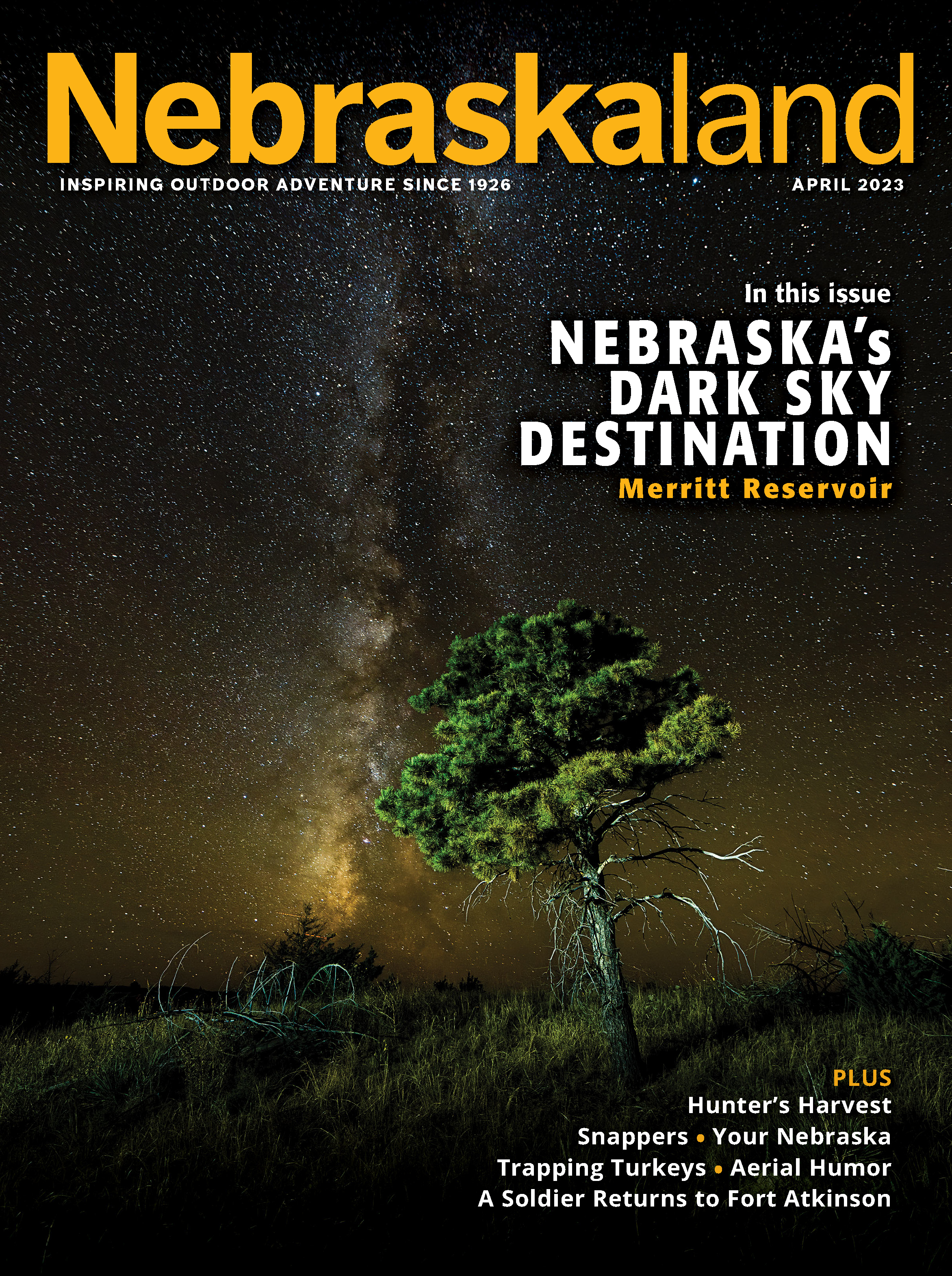
Cover: Light painting with a spotlight illuminated a ponderosa pine tree in
C
a grassland on the east side of Merritt Reservoir State Recreation Area in
Cherry County. See the story on page 18.
C
ERIC FOWLER, NEBRASKALAND
E
T page: A Canada goose swims through steam fog rising from a farm
This
ppond in Lancaster County on a chilly April morning. ERIC FOWLER, NEBRASKALAND
FEATURES
18
MAGNIFICENTLY DARK
28
OUTDOOR NEBRASKA
By Justin Haag
What to Do in April
By Renae Blum
30
HUNTER’S HARVEST
36
A SOLDIER RETURNS TO
FORT ATKINSON
42
Story by Jenny Nguyen-Wheatley
Photos by Jesse Deuring
By Eric Fowler
TRAPPING TURKEYS
Photos and story by Justin Haag
DEPARTMENTS
6
10
48
56
58
Your Nebraska
In the Field
Mixed Bag
Portraits from the Past
The Last Stop
ON THE WEB
For more articles and
information, visit
NebraskalandMagazine.com
Nebraskaland (VOL. 101 / NO. 3 ISSN 0028-1964) is published monthly, except for the combined Jan./Feb. and Aug./Sept. issues, by the Nebraska Game and Parks Commission, 2200 N. 33rd
St., Lincoln, NE. Periodicals postage paid at Lincoln, Nebraska, and additional mailing offices. POSTMASTER: Send address changes to Nebraskaland, P.O. Box 30370, Lincoln, NE 68503-0370.
2
Nebraskaland • April 2023
April 2023 •
Nebraskaland
3
Magazine Staff
magazine
Published by the Nebraska Game and Parks
Commission since 1926. The Commission is
dedicated to the conservation and protection
of all the state's natural resources and the
people who use them.
Communications Director Christy Firestone
Public Relations Manager Shawna RichterRyerson
Editor Jeff Kurrus
Associate Editor Jenny Nguyen-Wheatley
Regional Editors Eric Fowler, Julie Geiser,
Justin Haag
Contributing Editor Michael Forsberg
Regular Contributors Renae Blum,
Chris Helzer, Chris Masada, Todd Mills,
Ryan Sparks, Gerry Steinauer
Art Director Tim Reigert
Graphic Designer Mel Severin
Photo Librarian Jaclyn Cruikshank Vogt
Administration
Director Tim McCoy
Deputy Director Jim Swenson
Assistant Director Roger Kuhn
Board of Commissioners
Chairman - Scott Cassels, Omaha
Vice Chairman - Doug Zingula, Sidney
2nd Vice Chairman - John Hoggatt, Kearney
Robert Allen, Eustis
Pat Berggren, Broken Bow
Rick Brandt, Roca
Ken Curry, Columbus
Dan Kreitman, Wahoo
Donna Kush, Omaha
Circulation
For address changes and questions about your
subscription, call 800-632-5263
Advertising Sales Manager
For advertising information contact
Shane G. Gilster, 402-742-0125
Email: shanegilster@gmail.com
Conservation Officers
Headquarters and Southeast District Office
2200 N. 33rd Street / P.O. Box 30370
Lincoln, NE 68503-0370
Phone 402-471-0641 / Fax 402-471-5528
ADMINISTRATION (Lincoln)
Craig Stover (Administrator)
Duane Arp (Asst. Administrator)
Travis Shepler (Asst. Administrator)
Jeff Clauson (Asst. Administrator)
Northwest District Office
299 Husker Road / P.O. Box 725
Alliance, NE 69301-0725
Phone 308-763-2940 / Fax 308-763-2943
Northeast District Office
2201 N. 13th Street / Norfolk, NE 68701-2267
Phone 402-370-3374 / Fax 402-370-3256
Kearney Service Center
1617 First Avenue / Kearney, NE 68847-6057
Phone 308-865-5310 / Fax 308-865-5309
Bassett Service Center
524 Panzer Street / P.O. Box 508
Bassett, NE 68714-0934 / Phone 402-684-2921
Fax 402-684-2816
Omaha Service Center
8495 Frederick Street / Omaha, NE 68124-3054
Phone 402-595-2144 / Fax 402-595-2569
EAST SUB-DISTRICT
Jerod Hahn (Deuel, Garden, Grant)
Jaden Porter (Keith, Garden)
Tyler Stueck (Keith)
Travis Schultz (Morrill, Cheyenne)
Hunter Lee (Keith)
402-200-9597
Tim Williams (Hall, Hamilton, York)
Eric Javins (Adams, Clay, Webster)
Pat George (Harlan, Franklin, Phelps)
Ethan Teter (Buffalo, Kearney)
308-380-7331
402-902-2017
308-920-2762
308-440-3847
(Thayer, Fillmore, Nuckolls)
SOUTHWEST (Includes counties covered)
NORTH SUB-DISTRICT
Ray Dierking (Custer, Thomas, Blaine)
Frank Miller (Cherry, Hooker)
Greg Hesse
308-870-0322
402-389-0444
308-546-7464
308-660-4671
308-530-3157
(Hooker, Thomas, southern Cherry)
308-672-1824
Hunter Pearson
308-360-1817
SOUTH SUB-DISTRICT
Josh Widhelm (Scotts Bluff)
Jacob Stoinski (Sioux, Dawes)
308-279-9133
308-615-9017
(Red Willow, Frontier, Hayes, Hitchcock)
(Kimball, Banner, Scotts Bluff)
(Sheridan, Dawes, Grant)
NORTHEAST (Includes counties covered)
Dale Davis (Lieutenant)
402-760-0712
NORTH SUB-DISTRICT
Jeff Jones (Sergeant)
402-762-5022
John Bauer (Holt, Boyd)
Tyler Adelman
402-314-9257
402-314-4783
(Knox, Cedar)
Jonathan Andreasen
402-340-3981
Mitch Johnson (Knox, Antelope, Pierce)
402-613-8612
Cory Krause (Sergeant)
402-380-6410
Kyler Prochaska (Platte, Colfax)
Matt Costello (Dodge, Colfax)
Kelbi Abke (Washington, Burt)
Nicholas Fix (Dixon, Dakota, Thurston)
402-830-8278
402-317-4014
402-237-2537
402-508-0261
(Cuming, Wayne, Stanton)
Nebraskaland • April 2023
Matt Taylor (Sergeant)
Sean McKeehan (Sergeant)
SOUTH SUB-DISTRICT
4
308-520-5539
308-289-2274
308-289-6260
308-279-1292
308-280-4320
SOUTH SUB-DISTRICT
Alex Hasenauer (Lincoln, Perkins)
Brandon O’Neal
WEST SUB-DISTRICT
(Madison, Pierce, Stanton)
The Nebraska Game and Parks Commission does not discriminate
based on race, color, ethnicity, national origin, sex, pregnancy, sexual
orientation, gender identity, religion, disability, age, genetic information,
veteran status, marital status, and/or political affiliation in its programs,
activities, or employment. Any person who believes he or she has been
discriminated against in any program, activity, facility, or service,
should contact the Nebraska Game and Parks Commission, Lincoln, NE
402-471-0641, the Nebraska Equal Opportunity Commission, Lincoln,
NE 402-471-2024, TTY/TDD 800-642-6112; Director, Office of Diversity,
Inclusion and Civil Rights, U.S. Department of Interior, 1849 C Street,
NW, Washington, D.C. 20240.
402-471-5531
402-471-5531
402-471-5531
402-471-5531
NORTHWEST (Includes counties covered)
Dan Kling (Lieutenant)
308-430-0572
(Rock, Brown, Keya Paha)
OutdoorNebraska.org
MICHAEL RAMSDELL
Nebraskaland Magazine Copyright 2023, all rights reserved.
Nebraskaland is available in audio from the Nebraska Library
Commission Talking Book and Braille Service, Suite 120, 1200 N St.,
Lincoln, NE 68508. 800-742-7691. Nebraskaland Magazine and the
Nebraska Game and Parks Commission reserve the right to reject any
advertising not in keeping with the agency mission.
Rates: $18 for one year; $33 for two years; $44 for three years. Nebraska
recipients must add appropriate sales tax. To subscribe call
1-800-NEBLAND (632-5263), or go online to:
NebraskalandMagazine.com.
Commission Offices
Southwest District Office
301 E. State Farm Road
North Platte, NE 69101-0430
Phone 308-535-8025 / Fax 308-535-8028
In April, newly emerged zebra
swallowtail butterflies are flying in
the woodlands.
CENTRAL (Includes counties covered)
Mike Thome (Lieutenant)
308-293-8746
NORTH SUB-DISTRICT
Doug Pollard (Sergeant)
308-730-7050
Matt Brandt (Sherman, Howard)
Daryl Teter (Howard, Greeley, Merrick)
Kyle Gaston (York, Polk, Hamilton)
308-202-0819
308-440-1863
402-719-6226
(Loup, Garfield, Valley)
(Lincoln, McPherson, Logan)
Brian Piernicky (Sergeant)
308-340-6627
Bryce Streger (Dawson, Gosper, Custer)
Matt Andrews
308-537-0404
308-746-2418
Taylor Dixon (Dawson, Gosper)
Sophia Gobber
308-217-2108
308-222-0368
Kelsey Glodowski
308-242-9000
(Furnas, Gosper, Frontier, Red Willow)
(Chase, Dundy, Hayes, Hitchcock)
(Dundy, Hitchcock)
SOUTHEAST (Includes counties covered)
Stacey Lewton (Lieutenant)
402-890-7140
EAST SUB-DISTRICT
Heath Packett (Sergeant)
402-210-0888
Russell Mort (Otoe, Johnson)
Rich Berggren (Douglas)
Brian Arp (Douglas, Sarpy)
Mike Luben (Saunders, Butler)
Bryan Adams
402-209-1506
402-619-1355
531-530-9011
402-443-6392
402-429-1924
(Cass)
(Nemaha, Pawnee, Richardson)
WEST SUB-DISTRICT
Dina Barta (Lancaster)
Luis Nuñez (Lancaster)
Mark Sullivan (Lancaster, Seward, Butler)
Trevor Stahlecker (Lancaster, Saline)
Matt Seitz (Gage, Jefferson)
Curt Prohaska (Lancaster)
402-890-6463
531-333-6093
402-741-0636
402-314-9641
402-806-0915
402-470-1298
YOUR NEBRASKA
Instagram Photos
Follow us @nebraskaland
and tag us in your photos
to be featured in an
upcoming issue.
6
Nebraskaland • April 2023
Don Brockmeier, Eustis
Bald Eagle Fishing
April 2023 •
Nebraskaland
7
YOUR NEBRASKA
Denise Kent, Lincoln
Trying to Hide
Erik Johnson, Lincoln
Pronghorn
Send your comments and
photos to:
Jeff Kurrus, Editor
Nebraskaland Magazine
P.O. Box 30370
Lincoln, NE 68503
or email Jeff.Kurrus@Nebraska.gov
Lynette Hahne, Lincoln
Osprey and Great Blue Heron
8
Nebraskaland • April 2023
Please include your postal address
and telephone number. Letters
may be condensed and edited.
Photographs are also welcome.
April 2023 •
Nebraskaland
9
IN THE FIELD
CURIOUS GEORGE
An eastern fox squirrel hangs
onto the side of a tree on its
way to raid a backyard bird
feeder in Lancaster County.
E C FOW
ER
ERIC
OWLER,
L
LER
LER,
NEB
EBRASK
RASK
R
ASK
KALAN
ALAN
LAND
D
10
Nebraskaland • April 2023
April 2023 •
Nebraskaland
11
IN THE FIELD
Jenny Feeken, of Gretna, begins to clean a mess of crappies after an April midday fly-fishing trip. Allowing the water to warm
up, as well as get a few extra winks, isn’t a bad idea this time of year. JEFF KURRUS, NEBRASKALAND
LUNCHTIME IN APRIL
By Jeff Kurrus
The early bird gets the worm, right? Not necessarily
in April. While it’s nice to watch the sun rise as many
days as possible any time of the year, it’s unnecessary this
month. Plenty awaits you once you decide to enter nature
at lunchtime.
Turkey Hunting
Dawn for show, noon for dough the gobbler-chasing cliché
goes, but it’s never truer than in April. With unpredictable
weather during the early spring, seeing flocks in the morning,
when toms are still henned up, is the norm. Midday can
become a different story, however, as birds begin to separate
and toms start to display their first moments of insecurity.
Be there when they do.
Fishing
The warmer the water becomes in April, the more active
the fish. Another good reason to sleep in is the sheer coldness
of the water on your hands on these mornings. The brain
tells you it’s no longer winter, so you underdress almost
naturally, and any sort of gloves are nearly forgotten entirely.
Midday sun will warm up those digits and allow you to spend
even more time on the water, when the fish are truly starting
to become alive.
12
Nebraskaland • April 2023
Hiking
Whether for the start of mushrooming or just to reacquaint
yourself with the woods, midday hikes in April are spectacular.
Every little ounce of color is coming to fruition all around
you. There’s no better time to be afield. Just make sure you’re
wearing some hunter orange to keep you and those sharing
the woods with you safe.
Biking
Not too hot, not too cold. April is the time to take a stroll
through a park. Despite the ideal weather, still bring enough
water, especially if riding on one of the state’s many trails.
Boating
As excited as you might be, early April in Nebraska is
usually not the time to knock the dust off the water-skiing
rope. But it is the time to imagine what that will feel like
very soon from your spot on the water. If early summer is the
first time your boat gets on the water, we have some things
to discuss.
Sleep now, for everything you want to see will be there
when you finally arise. Unless you’re a photographer. If this
is the case, get up with the turkeys.
IN THE FIELD
PILLBUGS
By Julie Geiser
undersides. Females have a brood pouch called a marsupium
Everyone has seen a roly-poly bug. Their ability to tuck
on their underside where fertilized eggs are incubated and
into a little ball, called conglobation, has amazed children
hatched after three to seven weeks. Broods can range from
and adults alike. But what exactly is a roly-poly bug, and
seven to 200 eggs, and females may have one to three broods
what is its purpose in nature?
a year, typically during warmer months. The young survive
The roly-poly bug is sometimes called woodlouse or wood
on nutrients received through marsupial fluid from their
shrimp, but its official name is pillbug or Armadillidium
mother. Newly hatched young may stay in the pouch around
vulgare. The pillbug is an isopod; iso- means same or equal
6 to 12 weeks before venturing out on their own. Developing
and pod means foot. Actually, the pillbug isn’t a bug at
young that have left
all. They are terrestrial
the pouch are called
crustaceans and closely
mancas. Mancas molt
related to shrimp, crabs
several times to gain the
and crayfish, and they
seventh segment of their
have adapted to live
body, their seventh pair
entirely on land.
of legs and a hardened
Pillbugs are most
exoskeleton. Pillbugs
active at night and
molt throughout their
breathe through gilllifetime, which can occur
like structures that
every two to five years.
require moisture, which
Pillbugs are scavengers
is why we see them in
and decomposers. They
moist
environments
eat decaying matter from
in soil, under logs,
dead plants and animals,
leaves
and
other
along
with
other
decomposing vegetation.
decomposing materials,
Although they need The pillbug isn’t a bug at all, they are terrestrial crustaceans,
and return essential
humid environments, meaning they are closely related to shrimp, crabs and crayfish but
have adapted to live entirely on land. JULIE GEISER, NEBRASKALAND
nutrients back into the
they cannot survive
soil. They even eat their own feces. When they poop, pillbugs
underwater.
lose copper, an essential element they need to survive.
Roly-polies range in size but average from ¼ to ½
Therefore, pillbugs help to rid soil of heavy metals by taking
inches long. Their body parts include a head, thorax and
in copper, zinc, lead, arsenic and cadmium. Pillbugs can live
abdomen. The head consists of jaw-legs that pass food to the
in contaminated soils where other species can’t, and they
mouthparts and two compound eyes. The leg-bearing thorax
have a positive impact on the ecosystem as they increase
consists of seven hardened plates resembling an armadillo.
mineral layer nutrients consisting of nitrogen, phosphorous
Their gray to brown color keeps them camouflaged from
and potassium. They also eat fungal matter that, if left
predators, such as birds, lizards, frogs and spiders, and when
alone, would increase carbon dioxide being released into the
rolled into a ball, strong body plates make it difficult for
atmosphere.
predators to get to their soft underside. Pillbugs also produce
Pillbugs are sensitive to environmental changes and thus
unpleasant secretions, which repel potential predators.
serve as biological indicators for the health of the ecosystems
Unlike other crustaceans, isopods have unstalked
where they are found.
compound eyes on their head instead of eyes at the end of a
Finally, roly-polies don’t bite or sting and pose no risk to
stalk that are attached to the head. They have two antennae
humans. They rarely eat living plants or crops in agricultural
with sensory setae, or stiff hairs, attached to them along
lands. If they do venture into your home, they cannot survive
with a smaller pair of antennules; both are used to find food
for more than a few days unless they find humid conditions
and detect scented chemicals called pheromones produced
to live. These creatures simply provide their services to the
by other pillbugs. This is how they locate other pillbugs and
ecosystem and give us all the pleasure of watching them
suitable habitats to feed.
transform into little balls.
Males and females can be distinguished by their
14
Nebraskaland • April 2023
IN THE FIELD
Crispy fried egg rolls filled with ground venison, morel mushrooms and melted cheese.
JENNY NGUYEN-WHEATLEY, NEBRASKALAND
MORELS AND VENISON EGG ROLLS
By Jenny Nguyen-Wheatley
This is a versatile recipe. You can
use just about any kind of meat. I used
ground venison, but shaved or thinly
sliced meat would work, too. If you
like, substitute the shredded carrot
and cabbage with finely chopped
green pepper to the sauté for a more
Philly cheesesteak-like vibe
Aside from mozzarella, melty
cheeses such as provolone, fontina and
Gruyere are delicious. American and
provolone cheeses are classic choices.
Servings: 4-6 (about 15 eggrolls)
Prep Time: 30 minutes
Cooking Time: 30 minutes
Ingredients:
1 pound of ground venison
2 tablespoons of olive oil
6 green onions, all parts chopped
2 tablespoons of Worcestershire
sauce
Salt and pepper, to taste
Handful of morel mushrooms,
finely chopped
Handful of coleslaw salad mix/
mixture of shredded cabbage and
carrot
•
•
•
•
•
•
•
16
Nebraskaland • April 2023
•4
•
•
•
•
•
•
cups of shredded mozzarella
cheese
3 cups of ketchup
2 tablespoons of powdered
mustard
Half cup of brown sugar
Tabasco sauce to taste
1 package of egg roll wrappers
Frying oil
1. Heat olive oil in a large skillet over
medium-high heat. When oil begins
to shimmer, add venison and brown,
breaking up the meat with wooden
spoon. Then add chopped green onion,
chopped mushrooms and coleslaw mix.
Sauté until cabbage and carrot have
wilted. Mix in Worcestershire sauce,
salt and pepper to taste. If there’s a lot
of moisture from the meat, cook longer
to reduce. You want this meat mixture
to be fairly dry.
Set aside to cool completely. Once
cool, mix in shredded mozzarella
cheese.
2. Meanwhile, make the dipping
sauce by combining ketchup, powdered
mustard, brown sugar and Tabasco
sauce. Set aside until ready to serve.
3. Pour water into a small bowl.
Assemble egg rolls: lay an egg roll
wrap in front of you on a dry, clean
surface so that it looks like a diamond
with one corner pointing toward you.
Place a moderate amount of the meat
and cheese mixture along the middle
of the wrap and then tightly fold the
bottom corner over the filling. With
your fingers, wet the two corners to
the left and right with the water and
fold those over. Wet the top corner and
roll neatly to seal. Repeat with the rest
of the egg rolls. Set aside and cover
with a tea towel.
(Keep the rest of the unused
wrappers covered with a tea towel or
plastic wrap while you work to prevent
them from drying out.)
4. Heat frying oil to 325-350 degrees
Fahrenheit. Fry egg rolls seam-side
down first until golden brown and
then turn over to brown the other side.
Drain before serving and keep warm.
Fry in batches — do not overcrowd the
pan. Serve with the dipping sauce. Egg
rolls will be hot!
April 2023 •
Nebraskaland
17
Magnificently
Dark
For those wanting to observe the night
sky, Nebraska’s remote locations
are tops. One such place has earned
official confirmation of its brilliance
after dark.
By Justin Haag
Stars and wispy
clouds hang above the
Boardman Creek area of
Merritt Reservoir State
Recreation Area, which
has been designated
as Nebraska’s first
International Dark
Sky Park.
Nikon D850, 28mm, f/3.2,
20 seconds,
ISO 5000.
JUSTIN HAAG, NEBRASKALAND
18
Nebraskaland • April 2023
April 2023 •
Nebraskaland
19
or lovers of solitude, it is hard to
imagine a better place to be. The
occasional howl of a coyote, hoot
of an owl, moos from cows. The
eerie sound of ice forming over a lake
on a cold December night. On occasion,
the quiet, but growing, roar of a truck’s
engine advancing from miles away.
They are about the only things
reminding you that you are not
completely alone.
Perhaps it is what is seen that is most
magnificent about this place, though.
Look above to see the seemingly
endless array of stars in the sky, each
speck more than 20 trillion miles away.
Among them is that gorgeous, giant
swath known as the Milky Way.
The Nebraska Sandhills is this
place, and it is that great view of the
stars and other celestial bodies that, in
2022, garnered Merritt Reservoir State
Recreation Area a new designation as
an International Dark Sky Park to add
to its long list of attractive attributes.
It is the first location in Nebraska to
earn the title from the International
Dark-Sky Association, the recognized
authority on light pollution, putting
it in company with some of America’s
most breathtaking national and state
parks.
All one has to do is look at one of
the dark sky maps on the Internet to
realize why. They show almost the
entire United States east of Columbus
and Norfolk to the nation’s coast lit
up with varying degrees of intensely
bright colors, which represent the
severity of light pollution. Throughout
the West, though, about 10 sizable
expanses show up dark on the map.
The easternmost of them is the
Nebraska Sandhills.
Even though the designation is
new, the exceptional view of the
night sky at Merritt Reservoir has not
F
The Milky Way rises above a camper
in the Beed’s Landing campground at
Merritt.
Nikon D850, 15mm, f/2.8, 25 seconds,
ISO 4000.
ERIC FOWLER, NEBRASKALAND
20
Nebraskaland • April 2023
April 2023 •
Nebraskaland
21
A Photoshop composite of 198 images
shows the movement of Earth in relation
to the stars between 2 a.m. and 4 a.m. on
Oct. 26, 2022. Polaris, or the North Star, is at
the center of the circles, which are partially
reflected on the still water’s surface near
the boat ramp at Beed’s Landing.
Nikon D6, 16mm, f/4, 30 seconds, ISO 5000.
JUSTIN HAAG, NEBRASKALAND
22
Nebraskaland • April 2023
April 2023 •
Nebraskaland
23
Stars seem to shine through the
spinning blades of a windmill on
the Samuel R. McKelvie National
Forest, located adjacent to
Merritt Reservoir.
Nikon D810, 20mm, f/2.8, 25
seconds, ISO 3200.
ERIC FOWLER, NEBRASKALAND
24
Nebraskaland • April 2023
April 2023 •
Nebraskaland
25
been a secret. Each July for the past 29 years, it has hosted
the Nebraska Star Party, drawing professional and amateur
astronomers from across the country. The throng of attendees
revel in the view of the night sky through both high-powered
telescopes and the naked eye. During the day, they enjoy the
area’s many other features: 9,000 acres of nature and 44 miles
of shoreline with white-sand beaches. The park is known for
its outstanding fishing, boating and camping opportunities.
No matter where you live, an overnight trip to Merritt
Reservoir is worth the drive. Those who stay awake after the
sun goes down will be sure to like what they do — and don’t —
hear. And, they will especially love what they see. N
Light painting with a spotlight illuminated a
ponderosa pine tree in a grassland on the east
side of Merritt as the Milky Way extends skyward.
Nikon D850, 14mm, f/2.8, 25 seconds, ISO 4000.
ERIC FOWLER, NEBRASKALAND
26
Nebraskaland • April 2023
A dark sky map shows the areas of most and least light pollution in the United States. The dot represents Merritt Reservoir.
OPENSTREETMAP
To learn about the International Dark-Sky Association’s efforts to combat light pollution, visit Darksky.org. Information about the 30th annual
Nebraska Star Party may be found at Nebraskastarparty.org.
April 2023 •
Nebraskaland
27
Outdoor Nebraska
What To Do in April
By Renae Blum
Look for blooming
pasque flowers
As spring unfurls, take some time to soak in the outdoor
beauty it offers. Opportunities this month include fishing,
hunting, looking for wildflowers and enjoying unique
lodging. N
Throughout the month | Statewide
Easily recognized by its purple flower and
hairy leaves and stems, pasque flowers are
one of the earliest flowers that you can
see blooming in the spring. These small
purple flowers are usually found in northern
Nebraska and along the Niobrara River.
Normally found in prairies, they can bloom
anywhere with lots of sun and dry, rocky
soil. JUSTIN HAAG, NEBRASKALAND
Stay overnight in a caboose
Available April 15 through September | Two Rivers State
Recreation Area
Listen for boreal chorus frogs calling
Have an adventure and stay overnight in a remodeled caboose. At Two
Rivers State Recreation Area, 10 Union Pacific cabooses have been
restored for park lodging. They are air-conditioned and sleep six people.
Each is equipped with a modern bathroom and shower, along with a
stove, microwave and refrigerator. Learn more at OutdoorNebraska.org/
TwoRivers. ERIC FOWLER, NEBRASKALAND
Calamus Reservoir
Mid-March through summer | Statewide
Davis Creek Inlet
Minitare Reservoir
Boreal chorus frogs, which are brown and green with stripes running
through their eyes and down their backs, are one of the first frogs to start
calling in the spring. Their call has been described as someone running their
fingers over a fine-toothed comb. These frogs are usually in large groups,
making the sound deafening, with hundreds calling at once. Look and listen
for these frogs near ponds, road ditches, lakes and wetlands.
Sherman Reservoir
Sutherland Reservoir
Harlan Reservoir
JUSTIN HAAG, NEBRASKALAND
Fish for white bass
Mid- to late April | Statewide
You can find some good fishing for white bass in
several larger reservoirs in the state, such as Harlan
and Calamus. Other good spots include Davis Creek
inlets and Sutherland, Sherman and Minatare
reservoirs. In April, white bass are heading for
shallow water, with spawning beginning in late
April. Feeder streams and creeks are good areas to
try, as well as windswept shorelines. Small jigs work
well, too. JENNY NGUYEN-WHEATLEY, NEBRASKALAND
28
Nebraskaland • April 2023
Spring turkey shotgun
season
April 15 to May 31 | Statewide
There’s nothing more exciting in the spring
than calling in a turkey and seeing him
strut in a full display. Nebraska has lots of
opportunities across the state, so be sure
to scout and find the best spots near you.
Remember to bring a new hunter with you
and enter the Take ’em Hunting challenge
for a chance at prizes; see details at
OutdoorNebraska.org/TakeEmHunting.
JEFF KURRUS, NEBRASKALAND
April 2023 •
Nebraskaland
29
Hunter’s
Harvest
Story by Jenny Nguyen-Wheatley
Photos by Jesse Deuring
T
he year was 1958. “Volare”
dominated the Billboard Hot 100.
NASA got its start, and the first
Intel microchip was created. In
Nebraska, the Blackstone Hotel made
its own history. Primarily known for
its invention of the famous Reuben
sandwich, the Omaha landmark
also bears a vibrant, storied past. Black
and white photographs hanging in
the renamed Kimpton Cottonwood
Hotel pique interest, especially among
hunters.
“The photos kind of remind me of The
Shining, when they flash back to the
old photo of the people in the hotel,”
said Executive Chef Jason Sirois. “We
learned early on that they used to do
a wild game dinner here back when
it was a Schimmel hotel, called the
Blackstone. We wanted to recreate that
and bring it back to life.”
The Past
Several photos were taken in 1958,
evidence of one of the most premier
social and culinary gatherings of the
season. Beyond a sea of unknown,
A 1958 photo of one of the original wild game dinners that took place at the historical Blackstone Hotel in Omaha.
At the time, these dinners were open to men only. PHOTO COURTESY OF THE KIMPTON COTTONWOOD HOTEL
Bison tartare with pickled okra, cured egg yolk, garlic aioli and fry bread.
30
Nebraskaland • April 2022
monochromatic faces, meal identifiers
on the buffet line included antelope,
venison, raccoon and bear. The party
took place in the rooftop Schimmel
Ballroom, and guests appeared to be
bucks only — an elite group of well-todo men who were dressed to the nines.
The wild game dinner was a highlyanticipated annual event, one that
existed during the lifetime of the hotel.
“The Midwest was in its heyday
then,” wrote Elizabeth Weil for Saveur
magazine. Weil’s grandfather, Charles
Schimmel, founded the Blackstone
in 1916, along with a string of other
prodigious hotels in Omaha and
Lincoln that brought people from all
over the country to eastern Nebraska.
“The railroad was grand. So were my
family’s hotels. They had fancy dining
rooms with white-gloved waiters
rolling silver carts for haute French
table service … [The men] were proud,
prominent, going places …”
The Blackstone gained icon status
through the Roaring Twenties, serving
as a luxury stopover between San
Francisco and Chicago along the Old
Lincoln Highway. President John F.
Kennedy and First Lady Jacqueline
Kennedy spent their fifth wedding
anniversary at the Blackstone, and
on Dec. 15, 1967, Richard Nixon
announced his candidacy for the
presidency from the rooftop ballroom.
The hotel’s The Orleans Room
restaurant won Holiday magazine’s
“Award for Excellence” 16 consecutive
years.
The hotel remained popular
throughout its lifetime until 1976, and
for unclear reasons, the building was
converted for office use in the 1980s.
In 2017, local investors renovated the
space with the vision of bringing the
Blackstone back to its former grandeur.
In 2020, the Kimpton Cottonwood
Hotel opened in the midst of the
coronavirus pandemic. The Blackstone
name was dropped to avoid confusion
with The Blackstone in Chicago.
Today, the historic hotel is an
elegant blend of the past and present.
It’s new art deco with a touch of nature
— a contemporary reimagining of the
opulence and glamour of the 1920s
April 2022 •
Nebraskaland
31
Duck Cassoulet: roulade of duck breast and foie gras, duck jus, white beans and
duck skin tuille.
and glimpses of iridescent pheasant
tail feathers and sun-bleached antlers.
A stunning seven-course meal of bison,
sturgeon, duck, venison and wild
boar delighted taste buds, as well as
more unusual indigenous ingredients,
such as eastern redcedar (juniper),
huckleberry, chanterelle mushrooms,
sunchoke, yucca and “husker banana,”
also known as pawpaw. And across the
centerpieces were not just influential
men staring back at one another, as it
was during the Blackstone days.
“I think it’s fun to see a table like
that, with people like Betsie [Freeman
of the Omaha World-Herald], who
hadn’t tasted many of those items,
or people like yourself or the hunters
you were sitting across from enjoying
foods they’ve hunted and cooked for
themselves, and maybe comparing
that to the dishes that they’ve created,”
Sirois said.
The menu also paid homage to
along with motifs of Nebraska’s state
tree, the cottonwood, prominently
featured. Visitors enter the lobby
traversing Blackstone original stone
tiling. Vintage details were restored
wherever possible and updates were
made to stay true to the former hotel’s
heart and history. The property is listed
on the National Register of Historic
Places.
Wild boar chops to be served with yucca, husker banana, crispy sunchoke and sofrito, a Latin sauce of peppers and aromatics.
The Present
When Chef Jason Sirois joined
the Cottonwood’s culinary staff in
November 2020, he quickly set his
sights on reviving the Blackstone’s
wild game dinners. Sirois saw the
event as an exciting way to bring
back a piece of hotel history and also
encourage engagement among the
greater Nebraska community. In fall
2022, the Hunter’s Harvest Dinner
came to fruition.
On an October night, hungry guests
sat elbow-to-elbow at a long community
table, decked with picture-perfect
autumn squash, flickering wax candles
32
Nebraskaland • April 2022
Venison Wellington with carrot, sorghum, huckleberry, golden chanterelle
mushrooms and truffle demi glace.
Nebraska’s Native American origins:
a delectable bite of bison tartare
served atop Indian fry bread; bison
short rib and striploin paired with
the three sisters of corn, beans and
squash; and a Latin-inspired wild boar
chop garnished with slivers of fried
sunchoke — the starchy, edible root of
a common wild species of sunflower
(Helianthus tuberosus) historically
harvested by indigenous peoples of
North America for food.
“There’s a lot of Native American
influence here in the prairie, and I
think it’s important that we include
that in what we do,” Sirois said.
“There’s also an awesome LatinAmerica community here and Italian,
too. We have our own little Midwestern
melting pot, so it’s fun for us to use
local ingredients and prepare them in
not only different techniques but also
cultures.”
Other dishes at the Hunter’s Harvest
Dinner were refreshing takes on Old
World classics — a deconstructed duck
cassoulet with foie gras and venison
Wellington with huckleberry. For
dessert, an eye-catching sweet potato
cake exposed this humble New World
tuber to classic pastry techniques.
The fish course offered the most
memorable bite: pumpkin seed-crusted
lake sturgeon with a clever eastern
redcedar-infused aioli.
“There are juniper trees on this
property,” Sirois said. “We cut the
branches, heated oil to 375 degrees and
fried a ton of juniper branches. And
that’s the oil we used to make the aioli,
and it worked. It really came through.
I thought it was one of the best things
we put on a plate that night.”
Sirois and his team of seven
managing chefs, plus cooks and
dishwashers, made this wild game
dinner happen on top of regular service
at the hotel. Each chef researched
and tackled a different dish, which
was paired with wine by a consulting
sommelier from Synergy Fine Wines
in Omaha. The menu’s focus was to
highlight Midwest hunting, fishing,
foraging and small-scale farming
heritages.
Sirois’s appreciation for wild and
local ingredients runs deep. He lived
in Steamboat Springs, Colorado,
throughout his teens and 20s and
dedicated many hours to fly-fishing
Alpine lakes and hunting elk in the
Buffalo Pass wilderness. As such,
the harvest dinner was an amazing
opportunity to work with and form
relationships with local producers.
Sirois’s
culinary
team
sourced
April 2022 •
Nebraskaland
33
Bison and Three Sisters: short rib, strip loin, corn, beans, squash and berries.
Upper Missouri River sturgeon with pumpkin puree, pickled pear, juniper aioli and
pear gastrique.
Sweet potato cake with hay custard, vanilla pecan crumble, cinnamon meringue
and clove sorbet.
34
Nebraskaland • April 2022
Guests sat down to dinner at a community table decorated with autumn squash, lit candles and
accents of pheasant tail feathers.
ingredients from farmers and ranchers
all over the Midwest, as many as
possible from Nebraska.
“Everyone thinks Nebraska is just
a bunch of corn and soybean and
commodity farmers, but that’s not true
at all. There are so many fun, small
operations around the area that are
doing great things,” he said.
One example, Central Nebraska
Buffalo, produces great bison meat.
Bison was hunted at one time, Sirois
said, and as an ecologically and
historically significant species of
the Great Plains, it deserves a place
on American menus. Inspired by
the harvest dinner, the chef plans
on incorporating more bison into the
regular menu at the Cottonwood’s
Committee Chophouse.
Another impetus for these dinners
is to bring the Cottonwood back into
regional conversations as a premier
dining spot, as it was during the
Blackstone Hotel’s heyday.
“I want people in like Chicago or
Kansas City to hear about some of the
stuff that’s going on here and make the
trip. I really want to be able to showcase
our local ingredients, so that they leave
Nebraska with a sense of ‘Oh, wow.
It’s not a culinary wasteland out here.
They’re doing some amazing food.’
I want people to leave these dinners
feeling satisfied, feeling that they’ve
expanded their horizons and broadened
their palates,” Sirois said.
These dinners are also a lot of fun for
the staff. They’re opportunities for the
culinary team to flex their creativity
and collaborate beyond the day-today, often monotonous, tasks of hotel
dining. They hope to put on these
harvest dinners twice a year in the
spring and fall. Sirois anxiously looks
ahead to the future.
“In the spring, we have all these
beautiful, small local farms and people
growing amazing produce. So, to
showcase some of those items, we’ll
make dinner a little lighter as the
weather is warming up. We’re looking at
the end of April,” he said. Morels likely
will make an appearance and possibly
rabbit, lamb and walleye. Eventually,
Sirois hopes the success of these
dinners will encourage other chefs and
wine purveyors to collaborate.
Keep an eye out for the next
harvest dinner at the Kimpton
Cottonwood Hotel on their website,
thecottonwoodhotel.com. The food will
beat raccoon off a buffet line in 1958 by
a long shot. Suit and tie not required. N
April 2022 •
Nebraskaland
35
A Soldier Returns to Fort Atkinson
By Eric Fowler
ere it not for happenstance, we might know little
about Lt. Gabriel Field. When John “Jack” Rathjen
uncovered a portion of his headstone while plowing
a crop field in 1954, it led to the exhumation of six
graves, including Field’s, north of where Fort Atkinson, the
first U.S. military fort in what was to become Nebraska, had
once stood.
In the years that followed, historians, both professionals
and amateurs, searched through military and genealogical
records trying to answer the obvious question: Who was
Gabriel Field? They uncovered many details about the life
and military career of Field, the soldier who helped build Fort
Atkinson and met his untimely death there in 1823 that, were
it not for a farmer’s plow, might remain footnotes in history.
On April 16, the 200th anniversary of his death, Field will
W
The Monument to the Deceased at Fort Atkinson State Historical Park was dedicated in 2013. Funded by the Fort Atkinson
Foundation, it includes a boulder with a plaque recognizing the 313 soldiers and civilians who died while serving at Fort Atkinson
between 1819 and 1827, a plaque listing their names, and a headstone for Gabriel Field. ERIC FOWLER, NEBRASKALAND
return to Fort Atkinson, where his remains will be reburied in
the Monument to the Deceased, an event that will fulfill the
wishes of the man who found his headstone.
Lt. Gabriel Field died at Fort Atkinson in 1823. Nebraska
History archeologists identified his remains and
commissioned a facial reconstruction based on cranial
structure. HISTORY NEBRASKA
36
Nebraskaland
• April 2023
The Soldier
Gabriel Field was born near Louisville, Kentucky, in 1794 or
1795, according to research by Gayle Carlson, an archeologist
with History Nebraska, formerly the Nebraska State
Historical Society, who spent years researching the soldier.
His parents, Abner Field and Jane Pope, had moved there from
Virginia, where they were well-known and influential. Maj.
Abner Field was a commander in the Revolutionary War and
senator in Virginia. Pope came from an aristocratic family.
Among Field’s distant relatives were two presidents, George
Washington and, through marriage, John Quincy Adams, as
well as one of the country’s most famous explorers, William
Clark.
Field gained military experience in the War of 1812, serving
in the Kentucky Volunteers and Kentucky Militia. After the
war, he worked as a field surveyor in northwestern Missouri
in 1815 and 1816.
April 2023 •
Nebraskaland
37
Lt. Field’s body
found in this area.
An aerial photo looking to the northwest shows Fort Atkinson State Historical Park on the edge of Fort Calhoun.
Archaeologists found the remains of Gabriel Field and four others in the field northwest of the park. Soldiers built Cantonment
Missouri, their winter camp, in 1819, on the west bank of the Missouri River, which has since shifted, leaving that location on
the Iowa side of the river in the upper right portion of this image. ERIC FOWLER, NEBRASKALAND
In May 1817, he sought and received a commission as a
second lieutenant in the Army’s Rifle Regiment. In 1818,
the regiment was assigned to the Yellowstone Expedition.
Under the command of Col. Henry Atkinson, the expedition
was to establish a series of forts along the Missouri River
between St. Louis and the mouth of the Yellowstone River
in Montana to protect the growing fur trade and prevent
British encroachment from the north. In all, it included 1,126
members of the Rifle Regiment and Infantry, one fourth of
the young nation’s army.
Field, having been promoted to first lieutenant, was one of
10 officers to lead 347 enlisted men of the First Battalion of the
Rifle Regiment, under the command of Col. Talbot Chambers,
up the Missouri River as an advance party of the Yellowstone
Expedition. According to the journals of John Gale, the
surgeon with the regiment, they left Fort Belle Fontaine near
St. Louis on August 30. Just as members of the Lewis & Clark
Expedition had done nearly 20 years earlier, they rowed,
poled and pulled 10 keelboats up the river. They made it as far
as Cow Island, north of present-day Weston, Missouri, where
they made winter camp on October 18, having traveled more
than 360 miles in 50 days. They remained there, awaiting
38
Nebraskaland
• April 2023
the arrival of Atkinson and the rest of the expedition, which
wouldn’t set out from Belle Fontaine until July 4, 1819.
That winter, Field led or was part of several parties that
explored the region, visiting a Kansas Indian village, and
tracing the Platte and Nodaway rivers in Missouri. The
following spring, he led a party to Manual Lisa’s trading post
just north of present-day Omaha and was to remain there until
the battalion arrived. He apparently went farther, advancing
to Council Bluff, the hill overlooking the Missouri River on
the east edge of present-day Fort Calhoun, where Lewis and
Clark held council with the Oto and Missouria Indians in 1804
and a site Clark identified in his journals as a good location for
a trading establishment. On August 16, Gale wrote that Field
“arrived from Council Bluff destitute of subsistence,” with no
explanation as to why he returned to Cow Island.
Atkinson and his troops left Fort Belle Fontaine in three
steamboats loaded with supplies. The crafts, still in their
infancy, weren’t able to navigate the snags, sandbars and
current of the river and were left behind, leaving troops
to transport supplies in keelboats and barges. A fourth
steamboat, carrying the smaller scientific and exploration
party of the expedition and led by Maj. Stephen Long, made
to explore the Platte River west to the Rocky Mountains.
it to Cow Island. Field and a party of soldiers in a keelboat
Atkinson’s troops remained, but flooding inundated Camp
accompanied Long as he continued north, setting up winter
Missouri, forcing them to relocate to high ground on Council
camp, Engineer Cantonment, just north Manuel Lisa’s Post.
Bluff. There, they built a fort that in 1821 would be named
The rest of the soldiers continued north, arriving between
for their commander, Atkinson, who had been promoted to
late September and early October at what would be their
general and moved on, replaced by Col. Henry Leavenworth.
winter camp, Cantonment Missouri, on the banks of the river
That fall, Field went to back to work on the Trace, making
two miles north of Council Bluff. This was well short of their
some corrections in the course to make it easier for wagons
intended goal of reaching the Mandan Indian Villages in
and to reduce the number of bridges and crossings soldiers
central North Dakota.
would build on the rivers and streams it crossed. He kept
The excruciating work took its toll on the troops. “Nearly
a second journal, but the original and one known copy
every man had suffered severely from sickness, and
have been lost. It may have contained the true distance he
many experienced relapses, before arriving at our point of
destination; nor did we then cease to suffer from
dysentery, catarrh and rheumatism,” Gale wrote in
his journals.
While the exhausted troops took to building
winter quarters, Field was given another
assignment. With his background as a surveyor,
he was to plot a course from Council Bluff to the
location of the nearest post office near present
day Brunswick, Missouri. With 10 enlisted men
on horseback, he completed the task in 28 days,
crossing what Field estimated to be 340 miles of
what was then the Missouri Territory.
Field described the route, which he dubbed Field’s
Trace, in his journal, the original copy of which now
resides in the National Archives in Washington,
D.C. In it, he writes often of the expansive prairie
that stretched for miles, the woodlands and rich
soil they traversed. He mentions several times
crossing trails made by Native Americans that had
been recently traveled and meeting a band of Iowa
Indians. He named each of the 60 streams they
The fragment of Field’s headstone found by John “Jack” Rathjen in 1954
crossed, including Elk Creek, where their hunter
now resides in the Washington County Museum in Fort Calhoun.
ERIC FOWLER, NEBRASKALAND
killed the first elk on the route. “The Country here
is more abundant in game than any we have passed
measured by surveyor’s chain of 257 miles. The trace would
through, which is in consequence of their having more
become more than a mail route. Staff with History Nebraska
shelters to cover them from pursuit,” Field wrote.
and other historians found settlers used it when they arrived
Surveying the route was a difficult task, but things didn’t
in the 1850s, and mills and towns were built at some of the
get easier when the party returned to Camp Missouri. It
crossings.
would be January before the quarters were nearly completed,
Further budget cuts to the military in 1821 reduced the
and it was a cold winter. The expedition wasn’t sufficiently
troop strength at Fort Atkinson by half to 548. Field was
supplied, and many of the food supplies had spoiled.
retained and transferred to the Sixth Infantry, showing his
Subsisting on salted and smoke-dried meat, and lacking
value as an officer. He became quartermaster, a position he
vegetables and fruit and vitamin C, scurvy first appeared in
resigned a year later when Leavenworth refused his request
the camp in late January. By February, most were affected,
to build a new storage facility. He remained at the fort,
and it wasn’t until April, when natives showed them wild
however, completing other significant assignments.
vegetables, such as wild onion, that had begun to sprout that
the troops recovered. The malady had taken its toll, though,
claiming more than 160 soldiers. Studies of Field’s remains
showed he was one of hundreds who survived scurvy.
Due to the lack of progress and high cost, congress halted
The details surrounding Gabriel Field’s untimely death are
the Yellowstone Expedition, and instead ordered Long
few. According to a paper by Carlson, Field was injured March
Amputation and Death
April 2023 •
Nebraskaland
39
An 1820 sketch by Titian Ramsay Peale shows Engineer Cantonment and the steamboat Western Engineer on the Missouri
River north of Omaha. During the Yellowstone Expedition in 1819, Field and a party of soldiers accompanied Maj. Stephen Long
from Kansas to this winter camp. It was the farthest a steamboat had traveled up the river. AMERICAN PHILOSOPHICAL SOCIETY
31, 1823, at Robidoux’s trading post, also known as Cabanne’s,
located near what is now N.P. Dodge Park in northern Omaha.
He was brought back to Fort Atkinson by boat and, on April
5, partially relieved of his duties “since illness may only be
temporary.” On April 12, he was relieved of all duties, and his
leg was amputated. He died on April 16.
“It has become the painful duty of the Col. Comdg to
announce to his command that the gallant active and
generous Lieut. Gabriel Field is no more. He died last evening
at 10 o’clock in consequence of an accidental wound in the
thigh with a sharp pointed knife by which the main artery
and nerve were severed,” Leavenworth announced to his
troops on April 17, 1823.
According to an account published in the Blair Courier in
September 1890, Capt. Benjamin Contal, who lived at Fort
Atkinson as a boy, said the injury was by Field’s own hand.
“Lieutenant Field was playing with his knife, shutting it
and throwing it one day, and it slipped and struck him in the
thigh. This caused the amputation of his leg.”
The journal of another soldier also mentions the
amputation. Yet military records and surgeon Gale’s log say
nothing about his injury or the amputation of his leg. Jason
Grof, superintendent of Fort Atkinson, and Susan Juza,
a historian at the park, speculate Field had already been
discharged from the military and was preparing to return to
Kentucky.
Trading posts were off limits to soldiers because of the
alcohol they might procure there. Yet that is where Field and
Capt. Charles Pentland ended up. When Pentland showed up
for roll call the next day, he had to answer to where his friend,
40
Nebraskaland
• April 2023
Field, was. Court martial records from later that year show
Pentland was charged with neglect of duty for leaving his
post unattended. Witnesses say he was intoxicated. Field is
mentioned, but nothing specific. Grof and Juza believe that is
because he was a civilian and not under military law. “It’s all
speculation, but I’ll say because of the place it happened, we
can assume alcohol was involved,” Grof said.
Regardless of how the accident occurred or what Field’s
military status was at the time, Grof and Juza aren’t surprised
at the outcome. The lack of sanitation and available medical
science on the frontier would have been similar to that of the
Civil War era, when it is well documented that many soldiers
would have survived their wounds had it not been for the
infection that followed. There were no antibiotics to ward off
infection, and no anesthesia to accompany the amputations
that were often conducted to try and stop its spread.
“Just a shot of whiskey and a block of wood [to bite down
on]” Juza said.
“Even though they amputated his leg, personally, I don’t
think he would have survived,” Grof said. “Everything was
stacked against him.”
Discovery of Tombstone and Remains
When Fort Atkinson was abandoned in 1827, so was
the cemetery that contained the graves of the hundreds
of soldiers and civilians who died there. As was the case
with the fort’s structures, they had mostly deteriorated and
disappeared by the time settlers began arriving in the 1850s.
Soon, the town of Fort Calhoun and farm fields covered
the site.
In the early 1900s, graves were found in two locations west
of the fort. Portions of other headstones also were found. Jack
Rathjen’s discovery of a broken piece of limestone, 16 inches
wide, and 2¼ thick, inscribed with “Gabriel Field, 1st. Lieut.
6th Regt. Born in Jefferson Coun …” about one mile north of
the location of the fort, however, was significant.
In 1956, Marvin Kivett, director of the state museum with
History Nebraska, led an excavation at the location. In the 50foot by 5-foot trench, they found five graves, two containing
adult males, two containing children and one empty, with no
artifacts to indicate the military standing of the males.
Two years later, Kivett returned after amateur archeologists
uncovered another grave only feet from his earlier work. In
it they found the remains of an adult male in a hexagonal
coffin, the right leg having been amputated. At the foot of
the grave, in a rectangular wooden box, they found the rest
of that right leg. The headstone, examination of the skeleton
and two historical references to Field’s amputation, however,
left historians certain these remains were that of Field.
There is no record of the location of the Fort Atkinson
cemetery. The location of these graves so far north of the
fort, however, makes sense to historians. It is on the edge of
the bluff overlooking the location of Camp Missouri, where so
many died of scurvy that first winter. With so many buried,
it made more sense to continue using that cemetery rather
than creating a second.
Most grave markers were made of wood and lost to the
elements. Because Field’s was made of limestone, “That
shows how much he was liked here from his troops, the
people he was stationed here with,” Grof said.
the park today.
His father always hoped Field’s remains would be reburied
at Fort Atkinson, Bill said. Work by Game and Parks staff
to do just that began in the 1990s. In 2013, with funding
provided by the foundation, the Monument to the Deceased
was dedicated east of the Visitor Center. In recent years, staff
followed up on previous genealogical searches conducted
by Carlson to see if there were relatives of Field who might
want to claim his remains. None were found in Kentucky,
where Field is a common name. Other descendants were
known to have lived in Ohio and Indiana. Few were found,
and none knew of Gabriel Field. That cleared the way for
Field’s remains, which have been housed in the archives of
the Smithsonian Institution, History Nebraska and other
locations for the past 65 years, to return to Fort Atkinson.
That pleases Bill Rathjen and his wife, Glenda, and would
please Jack, as well, they said.
“It’s something that is important for Bill and me to pass
down to our grandkids,” Glenda said. “We want them to
know this story and their great-grandfather Jack’s part in it.”
Like Jack, “He was a veteran, and we need to honor our
veterans,” she added.
“Dad was always concerned that he wasn’t reburied,” Bill
said. “It bothered him that he was, for years, in a drawer in
Lincoln and then in the Smithsonian.
“He would have been thrilled to know [Field] was going to
be reburied at Fort Atkinson.” N
A reinterment ceremony for Lieut. Gabriel Field will be held at
noon, April 16, 2023, at Fort Atkinson State Historical Park in
Fort Calhoun.
Reburied at Fort Atkinson
Bill Rathjen is the fifth generation to farm the ground
north of Fort Atkinson. His great, great, grandfather, Henry
Frahm, settled there in 1856. Bill was born a century later,
in 1956, two years after his father, Jack Rathjen, uncovered
Gabriel Field’s headstone.
He grew up hearing the stories of the area’s history, and the
discovery of Field’s grave, from his father, who passed away
last September. “He was always a history buff,” Bill said. “He
was interested in the local history. He lived all that as a kid.
He got stories from the generations before him. He loved to
tell stories and he retained all that.”
Bill’s parents supported the effort to preserve the fort that
began with the creation of the Fort Atkinson Foundation
in 1961. The foundation and the Nebraska Game and Parks
Commission purchased the property in 1963, creating Fort
Atkinson State Historical Park. Bill remembers University
of Nebraska students staying in tents on their farm
during excavations that followed and helped guide the
reconstruction of the stockade and other buildings found at
Archaeologists uncovered Gabriel Field’s remains, including
his amputated leg, in 1856. HISTORY NEBRASKA
April 2023 •
Nebraskaland
41
Trapping
Turkeys
Photos and story
by Justin Haag
new research effort is aiming to
uncover mysteries about Nebraska’s
wild turkeys.
University of Nebraska-Lincoln
researchers have teamed up with
Nebraska Game and Parks to trap
turkeys, measure them, collect samples
and outfit them with GPS transmitters
and leg bands. Over time, researchers
will learn about turkey movements,
habitat selection, nesting success and
genetic diversity.
These variables all play a role in wild
turkey population numbers, which have
shown a decline in many regions of the
state and nation in recent years.
Trapping began in late January and
February at multiple sites near Crawford
and Trenton. About 60 turkeys, with a
desired ratio of toms, hens and juveniles,
will be tagged in each the northwest
and the southwest regions for three
consecutive years. Data collected will be
used to inform management of the game
bird, which has a lifespan of 3 to 5 years.
“Understanding
wild
turkey
populations will allow us to hone in on
the most important variables leading
to their declines,” said Andrew Little,
assistant professor at Nebraska and
co-lead on the project. “We know with
any ground-nesting bird, it’s a complex
situation.”
He looks forward to calls from hunters
who harvest banded turkeys this
spring. Hunters will learn a little about
their birds, including where they were
trapped. N
Follow along with the project at
awesmlab.unl.edu, necoopunit.unl.edu or
outdoornebraska.org.
A
42
Nebraskaland
• April 2023
Erin Ulrey of the University of Georgia carries a turkey to its release after
equipping it with a GPS transmitter and leg band. Two members of Georgia’s
personnel joined early trapping efforts to assist with training.
April 2023 •
Nebraskaland
43
TOP LEFT: A sock with its closed end
cut off is placed over the turkeys’
heads to keep them calm during
processing.
BOTTOM LEFT: Kayli Newkirk,
research technician for the Nebraska
Applied Wildlife Ecology and Spatial
Movement Lab, assesses a turkey’s
body condition as it is held by
Nicholas Bakner of the University of
Georgia.
RIGHT: Chris Becker, Game and Parks
wildlife biologist, carries a turkey to
be processed.
44
Nebraskaland
• April 2023
April 2023 •
Nebraskaland
45
TOP RIGHT: Erin Ulrey uses a
rivet gun to place a leg band on
a turkey.
BOTTOM RIGHT: Nebraska
doctoral student Surya Deepika
Garagu releases the first
turkey to be processed during
capturing efforts. Watching the
release is Nicholas Bakner of
Georgia.
TOP LEFT: A trap sits empty after turkeys were removed for
processing. Researchers attract turkeys to the enclosures with
feed. They trigger the door’s closure from a blind nearby.
BOTTOM LEFT: A researcher equips a turkey with a GPS
transmitter.
BOTTOM RIGHT: Researchers take blood samples and a variety
of measurements before returning them to the wild.
46
Nebraskaland
• April 2023
April 2023 •
Nebraskaland
47
MIXED BAG
FORT ROBINSON HORSEBACK UPGRADES
By Justin Haag
Horseback riders are among those sure to appreciate
upcoming improvements to Fort Robinson State Park.
Plans include a $1.2 million addition of campsites and
facilities for visitors traveling with horses, said Jim Miller,
park superintendent.
Late this summer, construction will begin on an expansion
to the equestrian campground at the northwest corner of
the main park complex, doubling its size. Included will be 24
additional sites with hook-ups to 50-amp electricity, water
and sewer. Also new will be an adjacent 30-pen enclosure
for stalling horses outside. That facility will complement the
recently renovated historic Mare Barn, which also still will be
available for boarding horses.
“Not everybody likes to have their horses stalled inside,
especially during the hot weather,” Miller said. “They’ll have
a choice this way.”
Horse trailers with living quarters are a common site at the
equestrian campground at Fort Robinson State Park.
JUSTIN HAAG, NEBRASKALAND
Horse owners will find themselves even more at home at Fort Robinson State Park’s equestrian campground.
JUSTIN HAAG, NEBRASKALAND
48
Nebraskaland • April 2023
April 2023 •
Nebraskaland
49
MIXED BAG
WINTERKILL
By Justin Haag
Winter Storm Diaz, the massive blizzard that moved across
the state in December 2022, has claimed less visible victims
— countless fish in at least 35 lakes of the Sandhills and
other parts of northern Nebraska.
Low oxygen levels were recorded in many of the region’s
shallow, highly vegetated lakes this winter, and ice anglers
reported dead plants and fish on their underwater cameras,
said Al Hanson, fisheries supervisor for the Nebraska Game
and Parks Commission’s northwestern district. Winterkills
can occur when ice is thick and deep snow covers a lake for
a long time. These variables combined prevent light from
reaching the plants below.
“When the photosynthesis stops, imagine that as a big
hay meadow down there and all that hay has died,” he said.
“As it decays, it creates hydrogen sulfide, reduces oxygen
levels, and creates toxic conditions for fish and other aquatic
species. Unfortunately, we can’t do anything about it.”
Low water levels from drought worsened the problem.
Oxygen tests administered by Hanson and his coworkers
found numerous lakes below the level at which fish begin to
die, about 1½ parts per million.
Fisheries staff are conducting surveys to assess winterkill
severity. Hanson is hopeful some fish have survived to
serve as breeding stock for coming years. Based on survey
results, Game and Parks will prioritize lakes that need initial
restocking with largemouth bass, bluegills and yellow perch,
and hatcheries will do their best to meet demand.
He is optimistic the lakes will recover and offer outstanding
fisheries as they have in the past.
“In three growing seasons, we can have perch up to 10½
inches in these lakes. Bluegill get about 7 inches and bass
about 12 to 14. We’ll rebound, but it’s not going to be a oneyear thing.”
Hanson said this winter is similar to those of 1996-’97,
1984-’85 and 1978-’79, when prior large winterkills occurred.
Anglers wanting updates about specific lakes may contact
fisheries staff at Game and Parks offices in Alliance or Norfolk.
Low Oxygen — Not Just A Winter Thing
Low concentrations of dissolved oxygen can be problematic
to fish in summer, too. Oxygen is quick to escape warm water
because molecules move faster than they do in cold.
Algal blooms can prompt summerkill. Although algae
produces oxygen through photosynthesis during the day, it
consumes it during night. Furthermore, bacteria, which thrive
in heat, consume oxygen as they feed on organic matter.
Waters with poor circulation polluted by excess nitrogen and
phosphorous are especially susceptible to fish die-offs.
Deep snow and thick ice covers Walgren Lake in this bird’s eye view captured about two months after Winter Storm Diaz.
JUSTIN HAAG, NEBRASKALAND
50
Nebraskaland • April 2023
April 2023 •
Nebraskaland
51
MIXED BAG
SNAPPERS
By Monica Macoubrie
In the United States, biologists recognize three snapping
turtle species — the common snapping turtle, native to
Nebraska, the alligator snapping turtle and the Suwannee
alligator snapping turtle, which is native to the southeastern
portion of the United States. Both species of alligator
snapping turtle are not found in Nebraska, yet common
snapping turtles and the two alligator snapping turtles
are distant cousins and look oddly similar to each other.
Upon further inspection, however, you’ll notice some pretty
striking differences.
The Shell
The carapace, or the top of the shell, of the alligator
snapping turtle is more like that of a cactus. This turtle shell
has three prominent ridges down the back. These spikes, or
projections, really give this animal that prehistoric look. In
contrast, the common snapping turtle’s shell is smoother.
Alligator Snapping Turtle.
JEFF KURRUS, NEBRASKALAND
The Body
The Head, Mouth & Face
On average, an adult common snapping turtle in Nebraska
has a shell length of 9-11 inches and weighs less than 50
pounds. However, larger specimens have been observed,
including “Big Snap Daddy” at the Schramm Education
Center aquarium; he weighs around 100 pounds. Alligator
snapping turtles are much larger, though. Typically, this
species weighs 175 pounds but can be as much as 250 pounds
or more. They are the largest freshwater turtles on the planet.
To start, the common snapping turtle has an oval-shaped
head, while the alligator snapping turtle’s head is more
triangular-shaped. Both turtles have a beak, made of keratin,
with the common snapping turtle having a slight hook to
theirs.
Inside their mouths, the alligator snapper has a blood-filled
appendage affixed to the animal’s tongue. This appendage is
lure-like, mimicking the color, shape and movement of a
worm. By wriggling this, and keeping the
rest of its body perfectly still, this turtle
will draw an unsuspecting fish into its
open jaws. Being able to hold its breath
for around 50 minutes gives the alligator
snapper plenty of patience to outwait
their prey and strike when they get within
distance.
A surprising feature of the common
snapping turtle is the bite force – which is
greater than that of their cousin. Common
snapping turtles have around 209 Newtons
of force, while alligator snapping turtles
have a less forceful bite of around 158
Newtons — surprising given their big
size difference. To put this in perspective,
humans can exert around 1,300 Newtons
between our second molars.
Despite their many differences, one
similarity pervades. It’s probably not a
good idea to be bitten by either one.
Common Snapping Turtle.
52
JEFF KURRUS, NEBRASKALAND
Nebraskaland • April 2023
April 2023 •
Nebraskaland
53
MIXED BAG
54
Nebraskaland • April 2023
April 2023 •
Nebraskaland
55
PORTRAITS FROM THE PAST
Trout fishing from Lake McConaughy, 1973
Kevin Clemens, David Isom and Jeanne
Clemens around 1973 with trout from Otter
Creek at Lake McConaughy. Submitted by
Kevin’s sisters, Lisa Hadenfeldt and Kim
Schaaf.
– Lisa Hadenfeldt, Scottsbluff
Waterfowl hunting main Loup River, 1935
My grandfather, Lavern “Curly” Jacobsen (left), and
Virgil Welsh (right). Dr. Leschinsky took this photo of
72 mallard drakes and one goose shot on the main Loup
River between Palmer and Fullerton. At the time, the
limit was 35 ducks a piece.
Curly taught his children and grandchildren to hunt,
fish and love the outdoors. He served on the Game
Commission for a period of time and was instrumental
in the building of Sherman Reservoir, even donating
the water rights to the project. Virgil owned Citizens
Bank, and both resided in St. Paul. Dr. Leschinsky was a
dentist in Grand Island.
– Shane Jacobsen, Park City, Montana
Deer hunting near Crawford, 1967
Circa 1967: Pictured from left to right: “Unknown military
GI from Texas” and the late brothers, Lester and Lawrence
Hillen, of Leigh. By Lawrence’s account, he and Lester were
with a hunting party on a ranch on the Pine Ridge south of
Crawford. After a morning set, the entire party walked back
to the ranch house for lunch. The GI from Texas spotted this
deer on an opposing ridge, leaned against a pine tree and took
the buck with one shot. Lawrence estimated the shot at “300
paces,” based on the walk to retrieve the deer after the shot.
– Lawrence’s grandson, David Franzen, Columbus
Send contributions to: Portraits from the Past, Nebraskaland Magazine, P.O. Box 30370, Lincoln, NE 68503-0370. Or e-mail to Tim.Reigert@Nebraska.gov.
Photos should show people enjoying Nebraska outdoor activities, such as camping, boating, hunting or fishing, and must have been taken before 2000. We will give
priority to unusual photos or activities. When possible, please include a story about the photograph and identify the people, places and approximate date it was
taken. Text may be edited and photos adjusted for reproduction. All photos will be returned.
56
Nebraskaland • April 2023
Trout fishing near Chadron, 1950s
When my uncle passed away a few years ago, he had a large collection of family slides. Upon reviewing them
over time, I found this beautiful slide of my grandmother circa 1950. We believe this may have been taken by
Chadron. Her name was Amelia “Millie” Lang. She lived in Omaha and enjoyed fishing with her husband, PJ Lang.
Such style and class! Thanks for considering.
– Grandson Ed Wieger, Omaha
April 2023 •
Nebraskaland
57
THE LAST STOP
AERIAL HUMOR
By Eric Fowler
If you spend any time perusing online maps featuring
satellite photos, or you’re one who opts for the window seat
when you fly, you’ve surely seen what is a growing trend —
rooftop advertising.
But people were spelling things out on the ground to be
read from the air long before the Internet came along. The
first time I stumbled across it was on a photo flight that
took me over Wagon Train Lake State Recreation Area
near Hickman. There, spelled out in trees in the wildlife
management area on the southeastern corner of the area,
was the year the trees were planted — 1967. I laughed,
knowing the staff in what was then known as the Resource
Services Division had a sense of humor.
Those trees at Wagon Train have grown up, and others
have grown up beneath them, making the year hard to read.
But if you turn the history slider back in Google Earth every
time I fly over that corner of the lake, I smile.
I saw some more creativity in 2020 while I was flying
between Calamus Reservoir and Goose Lake. Spelled out in
cedar trees on the hillside behind the house on a Sandhills
ranch was “Sostad Forest.” Jon Sostad, of Kearney, said
he couldn’t recall if it was his father, Dale’s, idea, or a plan
hatched by the people planting trees on the property in the
1990s.
I laughed again in 2009 when I was capturing aerial photos
of the construction of Maple Creek Reservoir near Leigh. Soil
was needed to build up Highway 91, which would serve as a
58
Nebraskaland • April 2023
sediment dam protecting the lake, and plans called for it to be
taken from a borrow pit along the road. But Game and Parks
Commission staff helping design fish habitat in the lake told
Matt Pruss of Pruss Excavation in Dodge, which was doing
the dirt work on the site, they didn’t want a simple, square
pit: they wanted an undulated bottom that would be more
fish friendly.
The request gave Pruss an idea, and that night at home,
he “spent way too long on the computer” designing letters
nearly 300 feet high, 150 feet wide and 10 feet deep that
spelled out “Pruss” in the lakebed. When he presented his
plan to the powers that be, they loved the idea.
Pruss heard more than once from those who viewed his
creation from Highway 91 that the name was up-side-down.
But the tech-savvy businessman didn’t intend for it to be
read from the road. It would, after all, be under water. He
knew which way was up when it came to maps, and hoped
new aerial or satellite imagery would be captured before
the lake filled. It was, in June of 2009, and for a time, Google
Maps and Earth displayed the name. It can still be read using
the time slider in Earth.
Also a fisherman, Pruss knew his creation would still be
viewed by anglers looking for contour maps of Maple Creek.
“I knew there would be a lake map and knew it would be
impossible to miss that,” Pruss said. “I figured I’d leave a
mark on the world that way.”
Well played, Mr. Pruss. Well Played.
April 2023 •
Nebraskaland
59
Position: 820 (12 views)