Volume 101, Issue 1, 2023
January-February 2023
- Identifier:
- nela.2023_101_01
- Title:
- Volume 101, Issue 1, 2023
- Issue Name:
- January-February 2023
- Date Issued:
- 2023-01-01
- year:
- 2023
- Season:
- Winter
- PDF filename:
- NL_101.01_2023_Jan_Feb_Spreads_Entire.pdf
- Publisher:
- Nebraska Game and Parks Commission
- Format:
- Periodical
- volume:
- 101
- issue:
- 01
- number:
- 101.01
- Decade:
- 2020s
- Type:
- Rights Holder:
- Copyright Nebraskaland Magazine/Nebraska Game and Parks Commission, all rights reserved.
- Extracted Text:
-
magazine
$4.95
To renew your subscription or change your
address call 1-800-632-5263
I N S P I R I N G O U T D O O R A DV E N T U R E S I N C E 1 92 6
JA N UA RY- F E B RUA RY 20 23
INSIDE
An Upland Hunt Among Friends
Wildlife Crimestoppers • Your Nebraska
Why Kearney Will Become a Second Minneapolis
Tapping for Liquid Gold • Listening for Bats
2
Nebraskaland • January-February 2023
January-February 2023 •
Nebraskaland
3
Volume 101 No. 1
January-February 2023
FEATURES
20
28
HAVE DOGS, WILL HUNT
Story and photos by Eric Fowler
OUTDOOR NEBRASKA
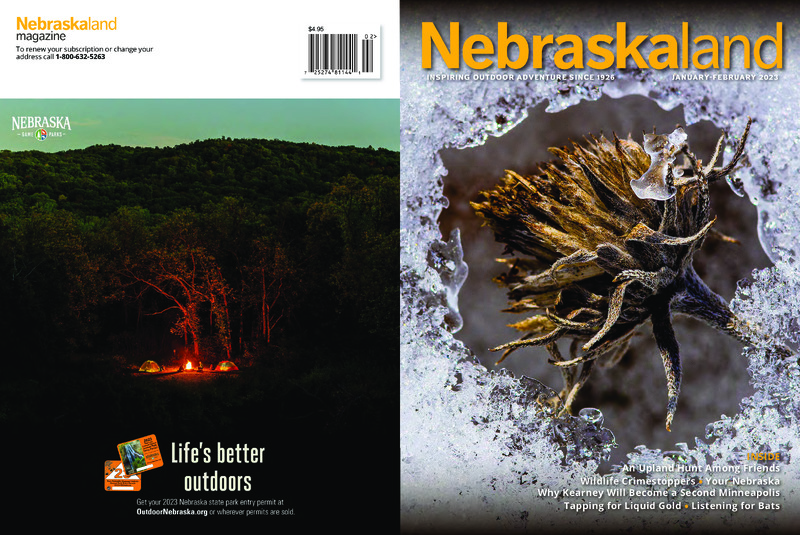
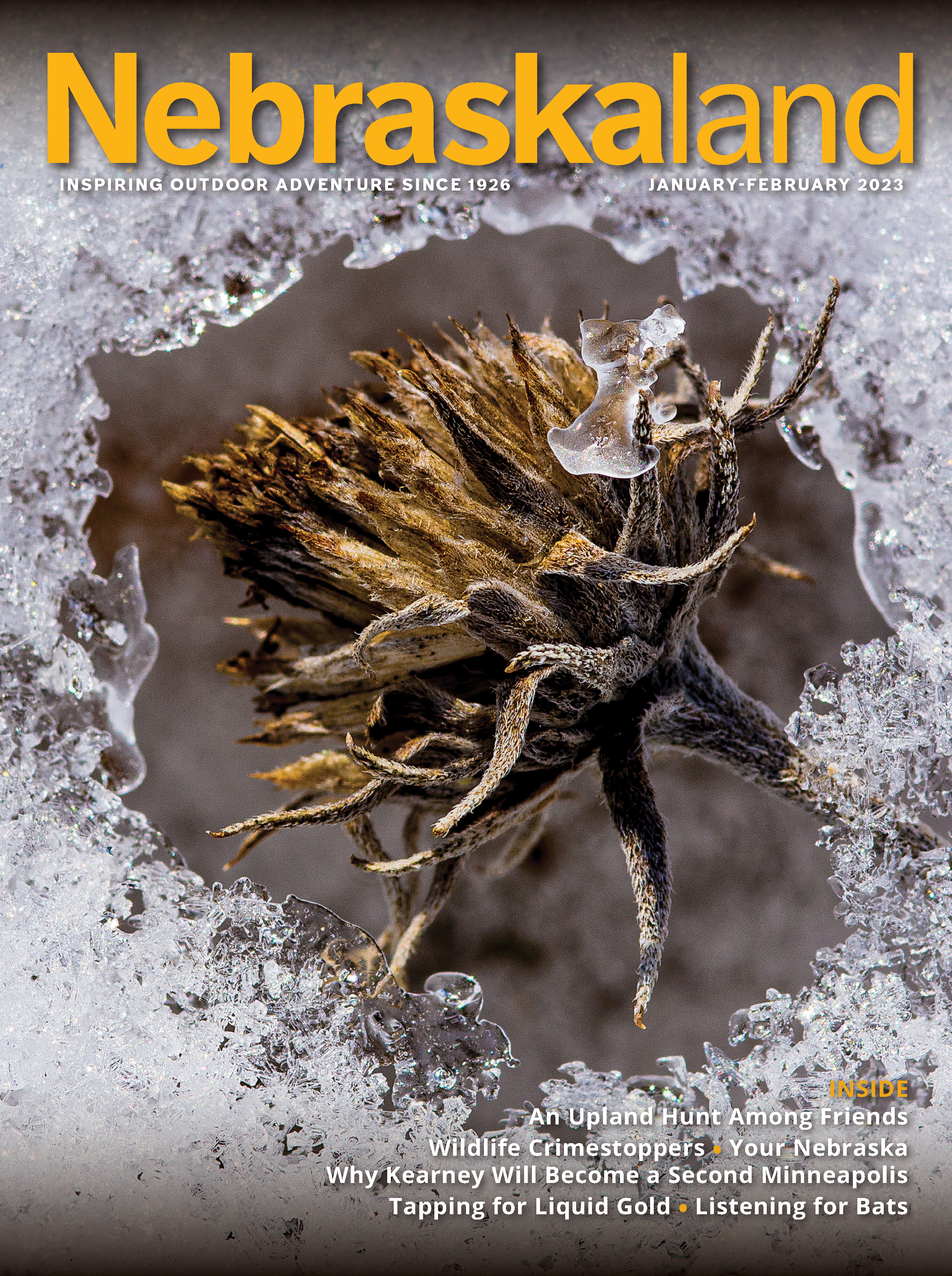
Cover: A Maximilian sunflower
C
head lies in a window of
h
melting snow at Lincoln Creek
m
PPrairie in Aurora. Many of
Nebraska’s “winter” birds visit
N
tthis prairie, including Harris’s
ssparrows, pine siskins and
m
more. Story on page 48.
CHRIS HELZER
This page: Fresh snow covers
the landscape at Stagecoach
State Recreation Area in
Lancaster County.
ERIC FOWLER, NEBRASKALAND
What to Do in January and February
By Renae Blum
30
TAPPING FOR LIQUID GOLD
34
WHY KEARNEY WILL BECOME A
SECOND MINNEAPOLIS
40
Story and photos by Renae Blum
By David L. Bristow, History Nebraska
LISTENING FOR BATS
Surveying and Monitoring Nebraska Species
By Leslie Reed
DEPARTMENTS
8
12
42
52
54
Your Nebraska
In the Field
Mixed Bag
Portraits from the Past
The Last Stop
ON THE WEB
For more articles and
information, visit
NebraskalandMagazine.com
Nebraskaland (VOL. 101 / NO. 1 ISSN 0028-1964) is published monthly, except for the combined Jan./Feb. and Aug./Sept. issues, by the Nebraska Game and Parks Commission, 2200 N. 33rd St.,
Lincoln, NE. Periodicals postage paid at Lincoln, Nebraska, and additional mailing offices. POSTMASTER: Send address changes to Nebraskaland, P.O. Box 30370, Lincoln, NE 68503-0370.
4
Nebraskaland • January-February 2023
January-February 2023 •
Nebraskaland
5
Magazine Staff
magazine
Published by the Nebraska Game and Parks
Commission since 1926. The Commission is
dedicated to the conservation and protection
of all the state's natural resources and the
people who use them.
Communications Director Christy Firestone
Public Relations Manager Shawna RichterRyerson
Editor Jeff Kurrus
Associate Editor Jenny Nguyen-Wheatley
Regional Editors Eric Fowler, Julie Geiser,
Justin Haag
Contributing Editor Michael Forsberg
Regular Contributors Renae Blum,
Chris Helzer, Chris Masada, Todd Mills,
Ryan Sparks, Gerry Steinauer
Art Director Tim Reigert
Graphic Designer Mel Severin
Photo Librarian Jaclyn Cruikshank Vogt
Administration
Director Tim McCoy
Deputy Director Jim Swenson
Assistant Director Roger Kuhn
Commissioners
Chairman - Pat Berggren, Broken Bow
Vice Chairman - Rick Brandt, Roca
2nd Vice Chairman - Robert Allen, Eustis
Circulation
For address changes and questions about your
subscription, call 800-632-5263
Advertising Sales Manager
For advertising information contact
Shane G. Gilster, 402-742-0125
Email: shanegilster@gmail.com
Ken Curry, Columbus
Donna Kush, Omaha
Scott Cassels, Omaha
John Hoggatt, Kearney
Doug Zingula, Sidney
Dan Kreitman, Wahoo
Nebraskaland Magazine Copyright 2023, all rights reserved.
Nebraskaland is available in audio from the Nebraska Library
Commission Talking Book and Braille Service, Suite 120, 1200 N St.,
Lincoln, NE 68508. 800-742-7691. Nebraskaland Magazine and the
Nebraska Game and Parks Commission reserve the right to reject any
advertising not in keeping with the agency mission.
Rates: $18 for one year; $33 for two years; $44 for three years. Nebraska
recipients must add appropriate sales tax. To subscribe call
1-800-NEBLAND (632-5263), or go online to:
NebraskalandMagazine.com.
Commission Offices
Conservation Officers
Headquarters/Southeast District Office
2200 N. 33rd Street Lincoln, NE 68503
Phone 402-471-0641
ADMINISTRATION (Lincoln)
Craig Stover (Administrator)
Duane Arp (Asst. Administrator)
Travis Shepler (Asst. Administrator)
Jeff Clauson (Asst. Administrator)
Northeast District Office
2201 N. 13th St. Norfolk, NE 68701
Phone 402-370-3374
Southwest District Office
301 E. State Farm Rd. North Platte, NE 69101
Phone 308-535-8025
Northwest District Office
East Hwy. 2, Box 725 Alliance, NE 69301
Phone 308-763-2940
Bassett Office
524 Panzer St., Box 508 Bassett, NE 68714
Phone 402-684-2921
Kearney Office
1617 First Ave. Kearney, NE 68847
Phone 308-865-5310
Ak-Sar-Ben Aquarium/Schramm Education
Center
21502 W. Highway 31 Gretna, NE 68028
Phone 402-332-3901
Omaha Office
8495 Frederick Street, Omaha, NE 68124
Phone 402-595-2144
Jerod Hahn (Deuel, Garden, Grant)
Keith Jadlowski (Keith, Deuel)
Jaden Porter (Keith, Garden)
Tyler Stueck (Keith)
Travis Schultz (Morrill, Cheyenne)
Hunter Lee (Keith)
WEST SUB-DISTRICT
Tim Williams (Hall, Hamilton, York)
Eric Javins (Adams, Clay, Webster)
Pat George (Harlan, Franklin, Phelps)
Ethan Teter (Buffalo, Kearney)
308-380-7331
402-902-2017
308-920-2762
308-440-3847
SOUTHWEST (Includes counties covered)
NORTH SUB-DISTRICT
Ray Dierking (Custer, Thomas, Blaine)
Frank Miller (Cherry, Hooker)
Greg Hesse
308-870-0322
402-389-0444
308-546-7464
Alex Hasenauer (Lincoln, Perkins)
Brandon O’Neal
308-660-4671
308-530-3157
(Hooker, Thomas, southern Cherry)
(Lincoln, McPherson, Logan)
Hunter Pearson
308-360-1817
Brian Piernicky (Sergeant)
308-340-6627
Josh Widhelm (Scotts Bluff)
Jacob Stoinski (Sioux, Dawes)
308-279-9133
308-615-9017
Bryce Streger (Dawson, Gosper, Custer)
Matt Andrews
308-537-0404
308-746-2418
Taylor Dixon (Dawson, Gosper)
Sophia Gobber
308-217-2108
308-222-0368
(Sheridan, Dawes, Grant)
NORTHEAST (Includes counties covered)
Dale Davis (Lieutenant)
402-760-0712
NORTH SUB-DISTRICT
Jeff Jones (Sergeant)
(Knox, Cedar)
John Bauer (Holt, Boyd)
Tyler Adelman
402-762-5022
402-314-9257
402-314-4783
SOUTH SUB-DISTRICT
(Red Willow, Frontier, Hayes, Hitchcock)
(Furnas, Gosper, Frontier, Red Willow)
(Chase, Dundy, Hayes, Hitchcock)
Kelsey Glodowski
(Dundy, Hitchcock)
assigning new number
Jonathan Andreasen
402-340-3981
SOUTHEAST (Includes counties covered)
Stacey Lewton (Lieutenant)
402-890-7140
Mitch Johnson (Knox, Antelope, Pierce)
402-613-8612
Heath Packett (Sergeant)
402-210-0888
Cory Krause (Sergeant)
402-380-6410
Kyler Prochaska (Platte, Colfax)
Matt Costello (Dodge, Colfax)
Kelbi Abke (Washington, Burt)
Nicholas Fix (Dixon, Dakota, Thurston)
402-830-8278
402-317-4014
402-237-2537
402-508-0261
Russell Mort (Otoe, Johnson)
Rich Berggren (Douglas)
Brian Arp (Douglas, Sarpy)
Dan Evasco (Sarpy)
Mike Luben (Saunders, Butler)
Bryan Adams
402-209-1506
402-619-1355
531-530-9011
402-616-5961
402-443-6392
402-429-1924
SOUTH SUB-DISTRICT
6
402-200-9597
(Thayer, Fillmore, Nuckolls)
308-672-1824
(Kimball, Banner, Scotts Bluff)
(Madison, Pierce, Stanton)
The Nebraska Game and Parks Commission does not discriminate
based on race, color, ethnicity, national origin, sex, pregnancy, sexual
orientation, gender identity, religion, disability, age, genetic information,
veteran status, marital status, and/or political affiliation in its programs,
activities, or employment. Any person who believes he or she has been
discriminated against in any program, activity, facility, or service,
should contact the Nebraska Game and Parks Commission, Lincoln, NE
402-471-0641, the Nebraska Equal Opportunity Commission, Lincoln,
NE 402-471-2024, TTY/TDD 800-642-6112; Director, Office of Diversity,
Inclusion and Civil Rights, U.S. Department of Interior, 1849 C Street,
NW, Washington, D.C. 20240.
308-520-5539
308-289-9580
308-289-2274
308-289-6260
308-279-1292
308-280-4320
Matt Taylor (Sergeant)
Sean McKeehan (Sergeant)
(Rock, Brown, Keya Paha)
OutdoorNebraska.org
SOUTH SUB-DISTRICT
402-471-5531
402-471-5531
402-471-5531
402-471-5531
NORTHWEST (Includes counties covered)
Dan Kling (Lieutenant)
308-430-0572
EAST SUB-DISTRICT
Look for red-tailed hawks along roads
and highways. JUSTIN HAAG, NEBRASKALAND
(Cuming, Wayne, Stanton)
CENTRAL (Includes counties covered)
Mike Thome (Lieutenant)
308-293-8746
NORTH SUB-DISTRICT
Doug Pollard (Sergeant)
308-730-7050
Matt Brandt (Sherman, Howard)
Daryl Teter (Howard, Greeley, Merrick)
Kyle Gaston (York, Polk, Hamilton)
308-202-0819
308-440-1863
402-719-6226
(Loup, Garfield, Valley)
Nebraskaland • January-February 2023
EAST SUB-DISTRICT
(Cass)
(Nemaha, Pawnee, Richardson)
WEST SUB-DISTRICT
Dina Barta (Lancaster)
Luis Nuñez (Lancaster)
Mark Sullivan (Lancaster, Seward, Butler)
Trevor Stahlecker (Lancaster, Saline)
Matt Seitz (Gage, Jefferson)
Curt Prohaska (Lancaster)
402-890-6463
531-333-6093
402-741-0636
402-314-9641
402-806-0915
402-470-1298
YOUR NEBRASKA
Instagram Photos
Follow us @nebraskaland
and tag us in your photos
to be featured in an
upcoming issue.
Steve Krout, Papillion
Great Horned Owl
Tyler Hayes, Lincoln
White-tailed Deer
Brandon Maxon, Minden
Fancy the Horse
8
Nebraskaland • January-February 2023
January-February 2023 •
Nebraskaland
9
YOUR NEBRASKA
Britton Bailey, Aurora
Red-tailed Hawk
Send your comments and
photos to:
Jeff Kurrus, Editor
Nebraskaland Magazine
P.O. Box 30370
Lincoln, NE 68503
or email Jeff.Kurrus@Nebraska.gov
Sam Williams, Valentine
Autumn at Smith Falls
10
Nebraskaland • January-February 2023
Please include your postal address
and telephone number. Letters
may be condensed and edited.
Photographs are also welcome.
January-February 2023 •
Nebraskaland
11
IN THE FIELD
COLD RAIN
Ice-coated honeysuckle
berries sparkle in the
morning sunshine at
Pawnee Lake State
Recreation Area in
Lancaster County
after being doused
with freezing rain the
previous January night.
ERIC
ER
RIC FOW
FOWLER,
LER NEB
N RASK
KALAN
LAND
D
12
Nebraskaland • January-February 2023
January-February 2023 •
Nebraskaland
13
IN THE FIELD
Wildlife Crimestoppers and Commission law enforcement agents use this Crimestoppers traveling trailer to educate the
public on a variety of wildlife-related topics, including the harms of poaching. JEFF KURRUS, NEBRASKALAND
HELPING WILDLIFE CRIME STOP
By Jeff Kurrus
Helping law enforcement eliminate poaching in Nebraska
just got a little easier, thanks to a new program by the
Nebraska Game and Parks Commission’s Law Enforcement
division and continued support from Wildlife Crimestoppers.
The program debuts in January and allows people to
anonymously report those suspected of wildlife violations.
“You submit online,” said Commission Law Enforcement
Assistant Administrator Duane Arp. “Describe the situation
and the location. Then answer if you want to be contacted
by an officer. You can submit pictures of the violation, and
even tell if you’re interested in a
reward.”
The reward money is raised
by Wildlife Crimestoppers, the
flagship program of the Nebraska
Wildlife Protectors Association.
Roger Roberts, one of 18 Wildlife
Crimestoppers board members across
the state, said their mission to protect the state’s natural
resources is simple. “99 percent of the people in the outdoors
are wonderful folks. We just want to help those people anyway
we can because the game belongs to everyone. We just want
to make sure people can’t rob the bank.”
“This is a great group to work with and extremely
supportive of law enforcement,” added Arp. “They ask us
what we need to do our job, and they help us with it.”
What law enforcement often needs is funding, and Wildlife
14
Nebraskaland • January-February 2023
Crimestoppers garners this through banquets, raffles, private
donations and a number of other ways. This funding goes
toward a number of areas, including aircraft details and
flight charges, the traveling trailer used by law enforcement
at public events and rewards.
In a poaching case a few years ago, Roberts said, an illegal
number of dead pronghorn were found in Morrill County but
law enforcement had no leads. After a conversation between
Arp and the Crimestoppers members, a $2,000 reward for
information was posted in the area the animals were found.
Within a day, law enforcement had a suspect.
“We have to rely on the public’s interest and care to get
involved,” said Arp. “Wildlife Crimestoppers helps so much
with that.”
And now, people will have another option to help others
abide by Nebraska’s wildlife laws. Once a person fills out the
online form at OutdoorNebraska.org/wildlifecrimestoppers
and hits submit, the field officer in that county is contacted.
Assistant Division Administrator Travis Shepler, who
created the new online site, said, “In today’s information
age, we’re happy to offer a digital option to report wildlife
violations. With this form, we’ll be able to utilize technology in
new ways to collect more accurate and timely information to
our conservation officers to assist with their investigations.”
With continued support from Wildlife Crimestoppers, this
new method will try to ensure that the bank never gets
robbed.
IN THE FIELD
Bluegill and yellow perch on the ice.
ERIC FOWLER, NEBRASKALAND
DOES WIND AFFECT FISH UNDER ICE?
By Jeff Kurrus
Open water anglers know the advantages and
disadvantages of wind. Sight anglers want no wind,
shallow-water walleye and wiper anglers want wind-swept
shorelines, and clear water casting anglers want just enough
wind to break up the surface.
But what about ice anglers? It doesn’t seem like wind
could affect them, given the gigantic block of ice blocking
the wind, but Nebraska Game and Parks fisheries biologist
Daryl Bauer said wind is part of a larger story.
“It’s the factors along with the wind,” he said. Typically,
Bauer continued, a north or west wind means the weather is
nasty and the fishing slows down. When it’s from the south,
stable weather and consistent fishing are in order. An east
wind is atypical, meaning some sort of strange weather is on
the horizon. Be ready for anything, he said.
And this goes for fishing hard water as well.
“The biggest thing that changes under the ice is water
temperature,” said Bauer. “When the water is warmest, the
fish are the most active.”
So, pay attention to whatever weather patterns generate
16
Nebraskaland • January-February 2023
warmer water, especially after the mid-winter lull when
snow cover on the ice has blocked out the sun’s ability to
warm the water and also generate oxygen from aquatic
vegetation by photosynthesis.
Then, look for those south winds that blow into Nebraska
every late winter. They are the first sign of not only an
impending spring but also a ravenous bite that will soon
occur under the surface of the ice.
Travel Note: If you are planning a trip to a
shallow water lake to ice fish, pay attention
to the weather conditions before it ices. If
it was extremely windy just before freezing,
there will be increased turbidity until the
water settles. If possible, give these waters
a couple of weeks before visiting so you
get that beautiful, clear water so often
associated with ice fishing.
IN THE FIELD
Gumbo is a good way to use up strongly flavored game, such as waterfowl.
JENNY NGUYEN-WHEATLEY, NEBRASKALAND
GOOSE GUMBO
By Jenny Nguyen-Wheatley
Servings: 4
Prep Time: 10 minutes
Cooking Time: 3-4 hours
Ingredients:
1 pound of goose (or duck), not including bone weight
½ pound of andouille sausage
¼ cup of canola or vegetable oil
¼ heaping cup of all-purpose flour
1 small onion, diced
1 rib of celery, diced
1 green bell pepper, diced
1 carrot, diced
1 quart of low-sodium or unsalted chicken stock
1 cup of water
Creole or Cajun seasoning, such as Tony Chachere’s, to
taste
About 2 cups of frozen or fresh cut okra
Kosher salt, to taste
4 servings of cooked white rice
Chopped green onion
•
•
•
•
•
•
•
•
•
•
•
•
•
•
•
1. Heat oil in a heavy-bottomed pan on medium-low
heat. When oil warms, whisk in all-purpose flour and cook
the roux until its color is between milk chocolate and dark
18
Nebraskaland • January-February 2023
chocolate, stirring often; this could take up to 40 minutes.
Take browned roux off the heat and allow to cool for 5
minutes. Remember, the roux will continue to brown after
you take it off the heat — do not burn it.
2. Preheat oven to 300 degrees Fahrenheit. Add diced onion
to the warm roux and turn the heat back on to medium.
Sauté for about 5 minutes, or until onion becomes soft. Then
add diced green bell pepper, carrot and celery, and sauté for
another 5-7 minutes.
3. Meanwhile in an oven-proof pot, bring chicken stock
and water to a boil. Gradually stir in the roux and vegetable
mixture. Add goose meat and andouille sausage. Stir in
Creole or Cajun seasoning to taste. If the roux breaks, don’t
worry — it will emulsify in the oven. Bring the pot back to a
simmer, cover and cook in a 300-degree oven for 2 to 3 hours,
or until the goose becomes tender and shreddable.
4. During the last 10 minutes of cooking, stir in cut okra
and simmer until tender. The okra will thicken the gumbo —
add more or less according to taste. Fish out goose and shred
into bite-size pieces and return to the pot. Discard bones, if
any.
Season the gumbo to taste before serving. If you serve the
gumbo with rice, slightly over-salt the stew. Garnish with
chopped green onion.
January-February 2023 •
Nebraskaland
19
Have Dogs,
Will Hunt
Mike Plate of Alma takes aim
at a covey of quail he flushed
while hunting a field enrolled
in the Open Fields and Waters
Program in Furnas County.
Story and photos by Eric Fowler
20
Nebraskaland • January-February 2023
January-February 2023 •
Nebraskaland
21
W
ith pheasant and quail season heading into its third and final month,
roughly one-third of upland hunters have packed it in for the year. Not Mike
Plate and Aric Werner.
Plate grew up in Kimball, hunting pheasants and quail behind his father’s
pointers around the Panhandle. Werner hunted pheasants in central Nebraska with his
father while growing up in Grand Island, sans dogs.
ABOVE: A bobwhite quail perches in a tree.
OPPOSITE: Aric Werner of Republican City walks through a Conservation
Reserve Program field in Furnas County in search of pheasants and
quail.
22
Nebraskaland • January-February 2023
January-February 2023 •
Nebraskaland
23
You can bet they will be out after a snow, or any moisture. But not if it’s bitter
cold. They’re to the point in life that they don’t like the cold any more than their
short-haired pointing dogs. And the birds don’t need the added stress, Plate said.
With eight pointing dogs between them, five for Plate and three for Werner, they
pretty much have to hunt.
“They get fat and my wife gets frustrated because they have so much energy
when they get in shape,” Werner added. “It gives me a good excuse to get out quite
a bit.”
“You’ve got to feed them all summer,” Plate added. “You might as well hunt them
all winter.”
The two, who live in Alma and Republican City, respectively, have been hunting
together since they met after Plate moved back from California in 2014. They hunt only
a little in Nebraska early, and in recent years, travel to Wyoming or Montana to chase
grouse and Hungarian partridge. But come late November, after rifle deer season closes,
you will find them combing through grasslands, weedy draws and thickets of southcentral Nebraska nearly every weekend in search of pheasants and quail.
The slow start isn’t about avoiding the early season rush of hunters. It’s waiting
for the weather to cool off. “Once it gets cold, those birds kind of move into the cover
where you can approach a little bit easier,” Werner said.
24
Nebraskaland • January-February 2023
RIGHT: Mike Plate cradles a
double-barreled shotgun.
ABOVE: Aric Werner takes aim
at a pair of rooster pheasants
pointed and flushed from a
thicket by Mike Plate’s pointer,
Jeb.
January-February 2023 •
Nebraskaland
25
Jokes aside, the two, like anyone who has ever hunted behind a good dog, will tell you
watching those four-legged machines work is why they hunt. And why, whether bird
numbers are up or down, they will see the season through to the end. N
ABOVE: Aric Werner and Mike Plate hold their day’s bag of pheasants
and quail.
OPPOSITE: Mike Plate’s Llewellin setter, Rock, holds a point.
26
Nebraskaland • January-February 2023
January-February 2023 •
Nebraskaland
27
Outdoor Nebraska
By Renae Blum
Head outdoors this month and take in the wintry wonderland. You
could enjoy some pheasant hunting or ice fishing in the Sandhills.
Or head indoors for some rock climbing and time at a state park cabin
for Valentine’s Day. Read more about these fun options below. N
What to Do in January and February
Look for shed
antlers
Mid-January to April
Statewide
Looking for shed antlers is a
great way to get outdoors this
time of year, and it’s fun for the
whole family. In winter, seek
areas where deer concentrate to
feed or where they bed down to
sleep. Spots where deer have to
jump, such as fences, creeks and
ditches, are also good spots.
JENNY NGUYEN-WHEATLEY, NEBRASKALAND
Rock climbing at Mahoney State Park
Year-round
Ice fishing at Frye Lake
As conditions allow
Stuck inside? Mahoney State Park’s Venture Climb is a fun way to spend an
afternoon indoors. This state-of-the-art addition to the Activity Center features a
42-foot climbing wall with both auto- and top-rope belays, as well as a bouldering
structure. Venture Climb is suitable for both novice and experienced climbers.
Learn more at OutdoorNebraska.org/Mahoney.
JEFF KURRUS, NEBRASKALAND
Frye Lake is one of Nebraska’s best ice fishing spots. A beautiful, quiet location
in the Sandhills, Frye Lake also has an abundance of fish, including nice
panfish, lots of bass and big crappies. There’s a lot of water to fish, so if you
aren’t catching anything, keep moving and keep drilling holes.
JEFF KURRUS, NEBRASKALAND
Spend Valentine’s Day at a
state park cabin
Statewide
Make Valentine’s Day extra special and spend it at a
state park! You will enjoy an escape from the crowds in a
peaceful, beautiful setting, plus reduced lodging fees at
select parks. Check our calendar at
Calendar.OutdoorNebraska.gov for special
Valentine’s Day offers.
JEFF KURRUS, NEBRASKALAND
28
Nebraskaland • January-February 2023
Late-season pheasant
hunting
Through Jan. 31 | Statewide
Breathe in the cool, crisp January air and
work on your resolution to get more fit with a
late-season pheasant hunt. There’s still great
opportunity because there’s less pressure on
the birds, and they’re concentrated in areas
with thick cover. A smaller group is more
effective, so just you, your best buddy and a
dog or two is perfect.
ERIC FOWLER, NEBRASKALAND
January-February 2023 •
Nebraskaland
29
Tapping for
Liquid Gold
Story and photos by Renae Blum
he tree sap begins to flow. It
looks — and almost tastes —
like water. But, after being boiled
for an hour, it reduces into what
Dan Hejl calls “liquid gold” — syrup he
collects himself.
It’s a tradition Hejl looks forward
to every year. The Pleasant Dale,
Nebraska, man collects sap from the
same woods he hunts in, and gifts
landowners with a jar of the highly
prized black walnut syrup.
Black walnut syrup is similar to
the maple kind, but with a rich nutty,
butterscotch taste. Hejl’s favorite way
to enjoy the syrup is spooned over
vanilla ice cream.
“Most people don’t think of black
walnut trees when they think of syrup,
but in my opinion, they make the most
T
Dan Hejl checks a spile to confirm sap
is flowing.
30
delicious and uniquely flavored syrup
you can imagine,” Hejl said.
Black walnut syrup is also produced
commercially, but it’s expensive. And
in Hejl’s opinion, it’s far more fun and
rewarding to make it yourself. “The
results are unsurpassed by anything
you can buy in the store,” he said.
Collecting the Sap
You can collect sap from a variety of
trees, the process of which is generally
the same, but you’ll need a few things
to get started:
10-40 spiles, 5/16” size
A cordless drill and bit
Clean 5-gallon buckets with lids
A fine-screen strainer
Clean plastic milk jugs, with 5/8”
hole drilled near the top
A large stainless steel stock pot
A candy thermometer
An outdoor turkey fryer
Cheesecloth
Clean canning jars
Conditions are right for tapping in
late winter and early spring, when
daytime temperatures are in the high
30s to 50s, and nighttime temperatures
drop below freezing. This fluctuation
in temperature causes sap to flow.
Though tapping trees at Nebraska
state park areas isn’t permitted, Hejl
thinks landowners would be open to
allowing it on their property. “Find
a private landowner and just ask
permission,” he said.
Trees should be a minimum of 10-12
Nebraskaland • January-February 2023
•
•
•
•
•
•
•
•
•
•
Hejl gathers black walnut tree sap in jugs and pours it through a strainer into 5-gallon buckets.
inches in diameter to accommodate
a single tap; trees over 25 inches in
diameter can handle two or three taps
at a time.
Using a 5/16" drill bit, drill a hole
into the tree at a slight upward angle,
about 3 feet up from the ground. The
hole should be 2 to 2½ inches deep
for standard-size spiles. Hejl wraps
masking tape 2¼ inches from the tip
of his drill bit for easy reference. He
recommends drilling on the south side
of the tree where sap will flow better
because it warms under the sun.
Lightly hammer a spile into this hole
until it fits snugly. Sap should start
dripping almost immediately. Place a
milk jug onto the spile, and then move
on to the next tree.
Hejl collects sap daily, removing the
jug and pouring the sap through a fine
mesh strainer into a clean 5-gallon
bucket. This removes any bark or bugs
that may have gotten into it. Then
replace the jug.
“When I get home, I put the bucket
of sap into the fridge,” Hejl said. “Treat
the sap as if it was milk.”
Sap will last about 10 days in the
fridge, or you can freeze it until you
have time — and enough — to make
syrup.
You can tap trees until buds appear
on them and leaves are on the verge of
forming. This is the end of the season,
when you should remove your spiles.
According to tree experts, the tree
will then heal itself naturally over
time from the drilling. If you tap the
same tree again next year, drill about 6
inches away from previous holes.
Making the Syrup
It takes 10 to 15 gallons of sap to
make 1 quart of syrup and 40 to 62
gallons to produce 1 gallon. But once
you have enough, the process is simple.
Pour the sap into a stainless-steel
pot and boil it until the excess water
is gone and just sugary syrup remains.
Keep in mind, you can add sap
January-February 2023 •
Nebraskaland
31
What Kind of Trees
Can I Tap?
Any kind of maple tree
can be tapped for syrup,
yet historically, only silver
maples and box elders are
found natively within the
state, said forester Jorden
Smith, who works for the
Nebraska Forest Service.
“Most syrup production is
based on sugar maple, black
maple and red maple, and
all three of those species
really like cool, wet summers
with cold, windless winters.
Sadly, Nebraska doesn’t
quite fit that ecotype,” he
said. “Sticking to our native
trees is a better long-term,
sustainable syrup supplier.”
Smith said that walnuts
Silver maple. GETTY PHOTO
and birches can also be
tapped, but with a few
caveats. Tapping a walnut tree destroys the value of its timber,
and birches may be unable to handle the stress of being tapped.
Other potential syrup sources, such as lindens, sycamores, elms
and hickories, may require a long boiling process, are susceptible
to disease after being drilled, or are poor choices for tapping
thanks to their scarcity and size.
ABOVE: Hejl pours the raw sap from
the jugs through a strainer into
5-gallon buckets.
LEFT: Hejl’s favorite way to enjoy
black walnut syrup is over ice cream.
JENNY NGUYEN-WHEATLEY, NEBRASKALAND
throughout the boil-down phase.
The process takes time and produces
a lot of humidity. If you are working
with less than 5 gallons of sap, you can
use your stovetop; otherwise, complete
this step outdoors in a propane turkey
fryer or two. If you are running two
pots at a time outdoors, Hejl estimates
it will take about one hour for each
gallon of sap to boil off.
Hejl recommends finishing the boildown process on your kitchen stove so
you can closely monitor temperature
32
Nebraskaland • January-February 2023
and the final transition from sap to
syrup — the tricky part.
Sap turns to syrup when it reaches
7½ degrees over the boiling point
of water, a number that varies
slightly depending on where you live.
Determine at what temperature water
boils at your location, then add 7½
degrees to find the temperature at
which your sap will become syrup.
“This is critical, and it happens
very quickly once it gets close to
that temperature, so monitor it very
closely,” Hejl said.
Once you’ve created the syrup,
remove the pot from the stove and
allow it to cool slightly. Then, pour the
syrup through cheesecloth to remove
any impurities. Hejl typically runs it
through clean cheesecloth several
times.
The final step is pouring the syrup
into jars with lids. Kept in the fridge,
the syrup will last for at least a year.
A Fun Pastime
Tapping trees for syrup isn’t a wellknown hobby, at least in Nebraska.
That could be because people either
don’t know about it, Hejl said, or find
the process intimidating. However,
once you understand the steps, it’s
fairly simple, he said.
He recommends this hobby to
anyone who enjoys the outdoors and is
looking for something new to do.
“I just go out into nature and take
what nature wants to give me,” Hejl
said. “I can’t wait for spring to do
it again.” N
Hejl with the final, packaged
walnut syrup.
January-February 2023 •
Nebraskaland
33
Why Kearney Will Become a Second
Minneapolis
Kearney’s Central Avenue, then known as Wyoming Avenue, boasted
electric streetcars and miles of wire. From The City of Kearney, Nebraska.
HISTORY NEBRASKA
By David L. Bristow, History Nebraska
January-February 2023 •
Nebraskaland
35
Illustration from The City of Kearney, Nebraska.
Kearney’s early electrical grid used hydropower in addition to coal. Built mainly
for irrigation, the Kearney Canal was completed in 1886. HISTORY NEBRASKA, RG2101-1-2
Front cover of the 1889 promotional book The City of Kearney, Nebraska. Kearney long advertised itself as being exactly 1,733
miles from both San Francisco and Boston. That was true along early railroads. HISTORY NEBRASKA, RG3268-11-14
earney was booming in 1889
when city boosters commissioned
a promotional book The City of
Kearney, Nebraska. A copy of
this boastful, lavishly illustrated book
is in History Nebraska’s collections.
Divided into brief sections, the
book covers topics such as “Why
K
36
Nebraskaland
Kearney Must Become a Railroad
Center,” “Why Kearney Will Be a Large
Manufacturing Center,” “Why Kearney
Will Become a Second Minneapolis,”
and others. Most pages also feature
beautiful engravings of local scenes.
Kearney was serious. This wasn’t
even the first time local boosters had
• January-February 2023
aimed high. In 1870, local resident
Moses Sydenham led an effort to
convince the federal government to
relocate the U.S. capital to the Fort
Kearny military reservation, to be
renamed “New Washington.” Congress
didn’t go along with the plan, but today
the site is a state historical park.
HISTORY NEBRASKA
By 1889 Kearney was in the midst of
a water-powered real estate boom. The
new Kearney canal promised direct
waterpower and hydroelectric power
to manufacturers. Kearney introduced
the first electric streetcars west of the
Missouri River and got into the textile
business by opening a cotton mill
in 1892.
A local resident named Maud
Marston Burrows described the
Kearney real estate boom in a 1937
speech for the Nebraska State
Historical Society (today’s History
Nebraska). She remembered that the
city had “an oatmeal mill, a cracker
factory, a woolen mill, a candy factory,
a bicycle factory that turned out an
excellent wheel.” (The high-wheel
bicycles of the day were often simply
called “wheels.”)
Work began on a railroad from
Kearney to the Black Hills. It got as far
as the Custer County town of Callaway
January-February 2023 •
Nebraskaland
37
ABOVE: Kearney Cotton Mills ad.
HISTORY NEBRASKA, 6089-2
BELOW: George W. Frank lost much of his fortune during the depression of the
1890s, but his grand, red sandstone house remains. From The City of Kearney,
Nebraska. HISTORY NEBRASKA
ABOVE: The Kearney Cotton Mill
employed hundreds of workers, many
of them women and children. Each
year, they transformed some 50,000
bales of Texas cotton into 76,000
yards of fabric. In winter, the waterpowered mill periodically ground to
a halt when the canal froze. The mill
declared bankruptcy in 1901.
HISTORY NEBRASKA, RG2178-2-7
Buffalo County Courthouse, built in 1890 and replaced in 1974.
38
Nebraskaland
• January-February 2023
HISTORY NEBRASKA, RG2101-2-7
before the boom collapsed following
a nationwide financial crisis and the
beginning of a prolonged drought.
Burrows said that most of the new
homes and businesses in Kearney were
heavily mortgaged. Many people lost
everything.
The city eventually recovered, but
never again would local leaders think
that Kearney was on its way toward
becoming a major city. The City of
Kearney, Nebraska, documents the
high-water mark of local ambitions.
A much larger monument to
Kearney’s boom years stands on the
campus of the University of Nebraska
at Kearney. A local architect named
George W. Frank was among the
city’s biggest boosters. He invested
aggressively but paid the price when
the boom ended. He lost much of his
fortune, but his grand, red sandstone
house remains. One of the first homes
west of the Mississippi to be wired for
electricity, it is open as the G. W. Frank
Museum of History and Culture. N
January-February 2023 •
Nebraskaland
39
Listening for Bats
Surveying and Monitoring Nebraska Species
By Leslie Reed, University of Nebraska-Lincoln
babies together in a tree,” he said. “Sometimes as you walk
lusive creatures of the night, bats fly silently and
by the tree, you can hear them chatting to each other with
erratically in the dark. They hide in nooks and crannies
high squeaking noises, somewhere between a mouse and
and caves. Because of these ghostly qualities, humans
a bird.”
often don’t realize when bats are nearby.
Fill, who has studied bats in Nebraska for almost 5 years,
A University of Nebraska–Lincoln scientist is working
said about 13 bat species have been found in Nebraska. Most
with the U.S. Geological Survey, the Nebraska Game and
are tree-loving species found in the wooded areas of the
Parks Commission and other federal and state agencies to
eastern part of the state, but some of these also follow the
use acoustic detectors to survey bat species and populations
Missouri and Niobrara river valleys into the upper Panhandle
in Nebraska to identify where different species occur.
near Chadron and the Pine Ridge.
Christopher Fill, a research
According to the monitoring
scientist with the Nebraska
program, bats are important
Cooperative Fish and Wildlife
to
the
maintenance
of
Research Unit in the Institute
healthy
ecosystems
and,
of Agriculture and Natural
because of their longevity and
Resources, has served as the
sensitivity to changes in their
Nebraska coordinator for the
environment, are considered
North American Bat Monitoring
to be important bioindicators
Program since 2020.
for ecosystem health. They
“Many landowners don’t think
contribute
to
agriculture
they have any bats on their
because they consume large
property, because they don’t see
numbers of insects during the
them,” he said. “I conduct bat
growing season.
acoustic surveys all summer, and
The most common species
I hardly ever see them. But if you
found statewide in Nebraska
set out acoustic detectors, you Christopher Fill is Nebraska coordinator for the
North American Bat Monitoring Program.
are big brown bats, eastern red
learn bats are out there — you
JUSTIN MOHLING, UNIVERSITY OF NEBRASKA-LINCOLN COMMUNICATION
bats, hoary bats and silverjust didn’t know it.”
haired bats. Three species of bats vulnerable to white-nose
As coordinator of Nebraska’s bat monitoring program,
syndrome, a fungal disease discovered in North America
Fill works with about 100 Nebraska landowners and a
in 2006, also occur in Nebraska: northern long-eared bats,
crew of volunteers from Nebraska Game and Parks and the
little brown bats and tri-colored bats. Northern long-eared
university’s Master Naturalist program to place bat-detecting
bats have been listed as a federally threatened species,
acoustic equipment at over 100 locations across Nebraska.
while efforts are underway to designate all three species
The sound-activated detectors identify the presence of bats
as endangered.
by recording their calls, which vary by species according to
Nebraska has been part of the North American Bat
frequency and pattern.
Monitoring Program, which also covers Canada and Mexico,
Bat calls normally are outside human hearing range,
since 2015. Last year, Nebraska collected its fewest number
except when they’re frightened or angry. Fill said he’s also
of northern long-eared bat calls since the program began.
heard mother bats chirping to their babies in trees, used as
After spending most of his summer traveling to detection
maternity colonies during the spring and summer.
sites, Fill has completed this year’s fieldwork and now is
“For some bat species, several female bats will rear their
E
40
Nebraskaland • January-February 2023
Fill holds an evening bat
(Nycticeius humeralis).
PHOTO COURTESY OF CHRIS FILL
compiling and analyzing data. Although bats remain active
in autumn, researchers don’t want to interrupt mating,
hibernation and migration preparations that occur in the fall.
Fill said initial results for 2022 indicate even fewer northern
long-eared bat identifications.
More analysis is required before conclusions can be drawn.
Analysis may additionally be hampered from an inability
to sample a majority of sites in 2019 and 2020 because of
historic flooding and the COVID-19 pandemic.
“The program standardizes the data collection process
so that it’s uniform and comparable,” Fill said. “This allows
researchers from across the country to get a better idea of bat
distributions, trends and declines along with a better sense
of how bats are doing. It’s not perfect, but bats are so difficult
to study, it’s hard to come up with anything that would be.”
Fill supplements data collected via stationary detectors
with mobile driving surveys using a detector attached to the
top of a car, as well as occasional capture surveys.
“After sunset, we’ll drive a route between our sampling
points, often along gravel and dirt back roads, to collect bat
calls,” he said. “With this particular detector, we can see and
hear the bats when they fly over the car.”
In a previous project in 2018 and 2019, Fill set up arrays
of acoustic detectors in farm fields, prairies and wooded
areas near Homestead National Monument outside Beatrice,
Nebraska. In addition to tracking northern long-eared bats
and white-nose syndrome, he developed “heat maps” that
showed bats’ foraging patterns in different landscapes. He
found bats are most active along the edges of fields and near
wooded areas and streams, which may encourage farmers
to retain those landscape features to maximize the insectreduction benefit they receive from bats. N
Leslie Reed is the director of public affairs at the University of
Nebraska-Lincoln’s Communication and Marketing Department.
This is her first appearance in Nebraskaland Magazine.
January-February 2023 •
Nebraskaland
41
MIXED BAG
ARCHERY TURKEY SHOTS
By Julie Geiser
Getting your bow sighted in and choosing a good broadhead
are important, but don’t forget shot placement when aiming
at a turkey this season. A turkey’s body is covered with more
than 4,000 feathers in multiple layers. Add muscle, cartilage
and bone, and you’re contending with a thick shield of
protection and a small kill zone the size of a softball. Archers
will need to study shot placements in order to make a clean
kill.
Shot Placement
A straight-on shot through the chest is a high percentage
kill shot. If the turkey is facing you, place an arrow between
the base of the neck and the
beard. The feathers in this
area typically form a vertical
line that serve as an aiming
point. The arrow should break
the back as it exits the body,
which will cause damage to
the heart or lungs. Just be
careful not to sever the beard.
When a bird is standing
with its back toward you and
its head is up, aim for the
Straight-on shot.
spine between the wings; JEFF KURRUS, NEBRASKALAND
this shot will sever the spine
and possibly hit the vitals.
If the turkey is feeding or
walking with its head down,
don’t take the shot — be
patient and wait for another
shot or make a cluck call to
encourage him to stand up.
A hit in the head or neck
can drop a bird on the spot,
especially if you use a
broadhead meant for hitting Back shot.
JUSTIN HAAG, NEBRASKALAND
this area, but it also presents
a small target. For success,
get the bird in close and make
the shot while the turkey is
still. This shot will either
result in a good clean kill or
a miss.
If the turkey is broadside,
aim for the base of the
turkey’s wing where the wing
Head or neck shot.
connects to the turkey’s body JEFF KURRUS, NEBRASKALAND
42
Nebraskaland • January-February 2023
just below the spine. This is
a relatively high position on
the body, but the shot will
pin the wing to the body or
break it and hit vital organs.
If the bird is strutting
broadside, draw a vertical
line just in front of the bird’s
legs and go up to the point
where that line intersects
a horizontal line drawn
from about 2 inches below
the fleshy skin at the base
of the neck. Aim at the
intersection, which is near
the crease formed by the
upper wing feathers. A shot
in this region will penetrate
the vital area for a quick and
clean kill.
A vent shot on a strutting
gobbler facing straight
away offers a presentable
shot. Aim here and your
broadhead is sure to hit
vital organs and may sever
the spine.
Taking a quartering shot
will depend on how the bird
is standing. For strutting
or half struts, imagine a
horizontal line going back
from between the base of
the neck and the beard, and
a vertical line coming up
from the back leg — this
intersection marks the vital
area. For a bird standing still
upright, draw the horizontal
line from the beard to meet
with the vertical line from
the back leg.
Now is the time to prepare
for the March archery
turkey season. Learn shot
placements, practice and
hopefully you’ll bag that
gobbler this spring.
Broadside shot.
JULIE GEISER, NEBRASKALAND
Strutting broadside shot.
JEFF KURRUS, NEBRASKALAND
Vent shot.
JEFF KURRUS, NEBRASKALAND
Quartering shot.
JULIE GEISER, NEBRASKALAND
January-February 2023 •
Nebraskaland
43
MIXED BAG
44
Nebraskaland • January-February 2023
January-February 2023 •
Nebraskaland
45
MIXED BAG
FIVE WONDERFUL WINTER TRAILS
By Renae Blum
Get outdoors this winter and enjoy the invigorating fresh
air of a winter’s day on a Nebraska state park trail. These five
trails are excellent choices, offering wildlife viewing, shelter
from the wind and beautiful, scenic views to appreciate.
Bring a friend and take in the unique beauty that this time
of year offers.
Turkey Run Trail
Wildcat Hills State Recreation Area
Shielded from the winter wind, this 1.2-mile trail at
Wildcat Hills State Recreation Area near Gering is a great
choice for a walk on a winter’s day. Hikers will see a diversity
of topography, including rocky buttes and interesting rock
formations, as well as stunning views of the ponderosa pines
and the North Platte River Valley. Make sure to check out the
layers of sandstone and siltstone in the rock; the trail will let
you get a close-up look. There’s a chance to see wildlife, as
well: deer, turkey, songbirds and even coyotes or bobcats.
Groomed Cross-Country Skiing Trails
Ponca State Park
If you enjoy cross-country skiing, Ponca State Park offers
two groomed trails for visitors to enjoy. The first is 1.5 miles
and winds through the park’s shooting complex and G8
group tent area. This area is pristine and quiet, with a lot of
beautiful scenery and the chance to see deer along the way.
The second trail is 2 miles and snakes along the riverfront,
offering gorgeous views of the water. It’s very flat, making it
a good choice for beginners.
Not interested in cross-country skiing? The park
has 22 miles of other trails to enjoy; learn more at
OutdoorNebraska.gov/poncatrails.
South Shore Trails
Lewis and Clark State Recreation Area
Roughly 4 miles of trails meanders through the South
Shore area at Lewis and Clark State Recreation Area. They’re
an easy walk and give visitors the chance to see the park’s
cedar and oak woodlands, as well as bluffs overlooking Lewis
and Clark Lake and Gavins Point Dam. It’s a gorgeous view.
Park superintendent Leslie Donner described the trails as a
hidden gem. “A lot of people don’t realize we have trails there,
so once you’ve tried them, you’re kind of hooked,” Donner
said.
Riverview Trail
Schramm Park State Recreation Area
The Riverview Trail at Schramm Park State Recreation
Area takes only about five minutes to walk, but there’s plenty
to see. It runs down to the Platte River and offers the chance
to view bald eagles, beaver-chewed logs, raccoon prints in
the mud and fish coming up to the shoreline. The trail’s short
distance and flat surface also make it ideal for families with
young kids or those with limited mobility.
If you’d like to extend your trip and try other trails in the
park, the Hackberry Trail and Red Cedar Trail, which ramble
through the park’s forest, are great choices. The trees offer
shelter from the wind, and with fewer leaves on the trees,
there’s better visibility to spot wildlife, such as raptors,
turkey or deer.
Steamboat Trail
Chadron State Park
Steamboat Trail at Chadron State Park offers stunning
scenery in the Nebraska Panhandle. JUSTIN HAAG, NEBRASKALAND
46
Nebraskaland • January-February 2023
Chadron State Park’s Steamboat Trail offers stunning
scenery, especially when it snows. At 1.3 miles, it takes
you through ponderosa pines and curves gently up into the
buttes, making it moderately challenging but not a difficult
hike. It also takes visitors up to Steamboat Butte, named
for its resemblance to the steamboats that once sailed the
Missouri River. With scenic views and convenient parking,
Steamboat Trail is a perfect choice for winter hiking.
When you hike, remember to dress for the weather,
bring water, walk with friends, and tell someone where
you’re going. For more information about these and
other trails, or to see an interactive trail map, visit
OutdoorNebraska.gov/HikingTrails.
January-February 2023 •
Nebraskaland
47
MIXED BAG
UNIQUE BIRDS OF WINTER
By Olivia DaRugna, Watchable Wildlife Biologist
While not everyone is excited about the cold and snowy weather of winter, like any change in seasons, the arrival of
a harsh weather also means the presence of new birds in the state. Some new species show up in winter after migrating
from their breeding grounds in the boreal forests and vast tundra of northern Canada. No matter where you are in the
state, you don’t have to go far to appreciate the grit and beauty of winter birds.
ROCKY HOFFMANN, NEBRASKALAND
winter as a way to defend their
patch of fruit-bearing trees. In the
western half of Nebraska, watch for
an inconspicuous gray bird with a
contrasting yellow bar extending
down its wings as it flutters to pick a
ripe berry off a tree.
A Great Plains specialty, Harris’s
sparrows spend their winters in only
a few states, and Nebraska is one of
them. The southeastern third of the
state is an especially good place to see
this species. They often show up to
bird feeders and in pathways foraging
on the ground with other sparrows.
They stand out for their large size,
along with pink bills and variable
black face and bib.
Rough-legged Hawk
Pine Siskin
When this Arctic breeding hawk
shows up, you know winter is coming.
On drives through the open country,
watch for this hawk perched on fence
and utility poles. Although variable,
look for their dark belly when perched
and dark wrist patches while in flight.
Their feathered legs, small bill and feet
help keep them less exposed to the
cold.
Although they occur year-round,
during some winters, flocks of
hundreds of siskins can crowd bird
feeders. The energy they gain from
seeds helps them survive cold nights
when they ramp up their metabolic
rates. Visit parks with bird feeders,
such as Wildcat Hills State Recreation
Area, where you may observe over
a hundred pine siskins. Look for a
heavily streaked, brown bird with
yellow in the wings and tail. Listen for
their rising “buzz zeeee” calls.
JOEL JORGENSEN
While you may long for the musical
melodies of birds singing nonstop in
springtime, the Townsend’s solitaire
can offer some reprieve with their
sweet song during the winter. This
berry-loving bird will sing throughout
48
GETTY IMAGES
Townsend’s Solitaire
Common Redpoll
While not always a reliable winter
bird, when they are here, there are
Nebraskaland • January-February 2023
GETTY IMAGES
JUSTIN HAAG, NEBRASKALAND
Harris’s Sparrow
usually hundreds across the northern
half of the state. This tiny finch
adds a pop of color to snowy days
with its yellow bill, red cap and pink
chest. Look for this beautiful bird in
sunflower fields and roadside patches.
If you’re lucky, one may even show up
to your bird feeder.
There are many other winter birds
to watch for, including gray-crowned
rosy-finch and a variety of darkeyed juncos. Keep your bird feeders
stocked and don’t be afraid to go out
and explore. To learn more about
winter birding opportunities, visit
NEBirdingGuide.org.
January-February 2023 •
Nebraskaland
49
MIXED BAG
SNOWBOARDING PARKS
By Jeff Kurrus
Several years ago, I made a decision regarding my Nebraska
winters. If I didn’t find something to tide me over, freezing
temperatures were going to destroy me. Merely sledding with
the kids just wasn’t going to work.
Put a snowboard in my hand, however, and I started
watching the weather forecast for “fresh powder,” electing
to take my chances upright when my young kids were sitting
their way down the hill. And there were hills aplenty.
Try these dedicated toboggan runs throughout the state to
add a little variety to your sledding trips:
Eugene T. Mahoney – The dedicated toboggan hill lies on
the east side of the Activity Center, featuring multiple runs
and even smaller entry points for younger or less experienced
riders.
Ponca State Park – Ponca’s sled hill can be seen before the
turn into the Scout Hill Loop portion of the park.
Chadron State Park – The designated sled hill lies next to
the archery range on the west side of the park.
These are not our only parks worthy of carving out your
own slopes, as Fort Robinson and Niobrara state parks and
Wildcat Hills State Recreation Area have enough rolling hills
to create your own snowboarding, and sledding, destinations
— as long as you don’t mind the walk back up the hill at any
of these winter getaways.
Betsy Mayfield, of Omaha, snowboarding down a snow hill at
Ponca State Park. JEFF KURRUS, NEBRASKALAND
The sledding hill at Eugene T. Mahoney State Park also makes for a great snowboarding run.
50
Nebraskaland • January-February 2023
JEFF KURRUS, NEBRASKALAND
January-February 2023 •
Nebraskaland
51
PORTRAITS FROM THE PAST
Early sandhills hunts, 1910
This photo shows ducks and grouse
from the Edwards Ranch in Cherry
County. This picture was taken around
1910. Left to right: Oscar Anderson
from Moline, Illinois, Charlie, Joe and
Ellis Edwards.
Walter Adamson was the grandfather
of Marv and me. Our dad, Elvin
Adamson, also served as a Game and
Parks commissioner and was a state
senator. Joe Edwards and Dan Adamson
were our great-grandfathers.
– Marge Adamson Harris, Lincoln
Raccoon hunt near Falls City, 1944
My dad, Dale Linderman, with a
nice size raccoon he shot with the
rifle he is holding (and now I am the
proud owner of the rifle, which he
purchased at the Western Auto store
in Falls City).
The picture was taken on the
place they farmed a few miles south
of Falls City. Years later in the early
’70s, I worked on that same farm but
it was on the construction of a dam
for the same family that owned it
when this was taken.
– Mike Linderman, Buckeye, AZ
Raccoons hunted near Genoa, 1963
My grandfather, Philip Swantek,
(whom I was named after) was
photographed here in March 1963 with
raccoons he had harvested that month.
He used the dogs to tree the raccoons
and shot them from there.
Grandfather worked on the University
of Nebraska farm in Genoa at the time.
– Phil Swantek, Kearney
Send contributions to: Portraits from the Past, Nebraskaland Magazine, P.O. Box 30370, Lincoln, NE 68503-0370. Or e-mail to Tim.Reigert@Nebraska.gov.
Photos should show people enjoying Nebraska outdoor activities, such as camping, boating, hunting or fishing, and must have been taken before 2000. We will give
priority to unusual photos or activities. When possible, please include a story about the photograph and identify the people, places and approximate date it was
taken. Text may be edited and photos adjusted for reproduction. All photos will be returned.
52
Nebraskaland • January-February 2023
January-February 2023 •
Nebraskaland
53
THE LAST STOP
SKUNKWALK
By Justin Haag
When I began using a camera trap to capture imagery
of mountain lions and other nocturnal species years ago,
one creature of the night became a frequent photo subject.
The striped skunk (Mephitis mephitis) is not active during
daylight, but it certainly gets around after the sun goes
down.
At first, the many skunk photos were treasured. I was
excited to capture imagery of any wildlife, and to get photos
of skunks without a face-to-rear encounter was a bonus.
However, the excitement wore off. Now, I delete a lot more
skunk photos than I keep.
That said, one
image stood out to
me when reviewing
a set of photos
from last January.
Similar to models
on the catwalk
(or should it be
skunkwalk?), these
three
attractive
characters appeared
to be strutting for
the camera. A little
accidental
lens
flare even alludes,
albeit falsely, to the
familiar musky odor
from the skunks’
rear. I was once
again reminded of
the species’ beauty.
Beauty? Skunks?
You bet. There is
historical financial evidence to back up the notion.
In the early 20th century, skunk attained status of the
most prominent fur on the market. The species was amply
available to trappers, and a little creative advertising helped
make it desirable. Marketed as “Alaskan sable” or “American
sable,” the attractive fur with its long, glossy guard
hairs found its way to the formal wardrobes of countless
unknowing women.
In 1919, the Burlington Free Press newspaper of Vermont
had this:
“According to a correspondent of the New York Post,
writing from Albany, the prices of ‘Alaskan sable’ skins
have become so attractive that dogs must forthwith cease
54
Nebraskaland • January-February 2023
to bother the little animals that produce this valuable fur.
You would not recognize a skunk skin under this euphonious
name which rolls mellifluously from the tongue as
‘Alaskan sable.’”
In the 1950s, popularity plummeted. The Fur Products
Labeling Act of 1951 required that apparel must be labeled,
advertised and invoiced with the actual English name of the
animal from which the fur is taken. Apparently, no matter
how striking the apparel may be, not many consumers
want to be associated with the animal most known for its
repugnant odor. Today, skunks can be harvested year-round,
and a good pelt sells
for about $4.
The
species,
regardless
of
repute, continues to
thrive. Omnivorous
opportunists that
are not picky about
what they eat, the
skunks’ range spans
throughout most of
North America. The
woodland creatures
have become well
adapted to farms,
suburban areas and
small towns, and
they are largely
considered pests.
Solitary animals
most of the year,
some skunks gather
in a communal den
in the winter to stay warm — usually a few females with
perhaps a male.
Males are most active during the mating period of midFebruary to mid-March. In true Pepé Le Pew fashion, a
male travels up to 5 miles per night in search of females.
Consequently, this is when you are likely to see — and smell
— the most “dead skunks in the middle of the road,” made
famous in the old Loudon Wainwright song.
Maybe the three skunks in my photo are den mates just
venturing out for dinner. Or, perhaps they are a group of
supermodels looking for their big break. Whatever the case,
I’m glad they made their way down my camera’s “runway.”
Fashionable characters, indeed.
January-February 2023 •
Nebraskaland
55
Position: 798 (13 views)