Volume 100, Issue 9, 2022
November 2022
- Identifier:
- nela.2022_100_09
- Title:
- Volume 100, Issue 9, 2022
- Issue Name:
- November 2022
- Date Issued:
- 2022-11-01
- year:
- 2022
- month:
- November
- Season:
- Autumn
- PDF filename:
- NL_100.09_2022_Nov_Spreads_Entire.pdf
- Publisher:
- Nebraska Game and Parks Commission
- Format:
- Periodical
- volume:
- 100
- issue:
- 09
- number:
- 100.09
- Decade:
- 2020s
- Type:
- Rights Holder:
- Copyright Nebraskaland Magazine/Nebraska Game and Parks Commission, all rights reserved.
- Extracted Text:
-
$4.95
magazine
To renew your subscription or change your
address call 1-800-632-5263
I N S P I R I N G O U T D O O R A DV E N T U R E S I N C E 192 6
N OV E M B E R 20 2 2
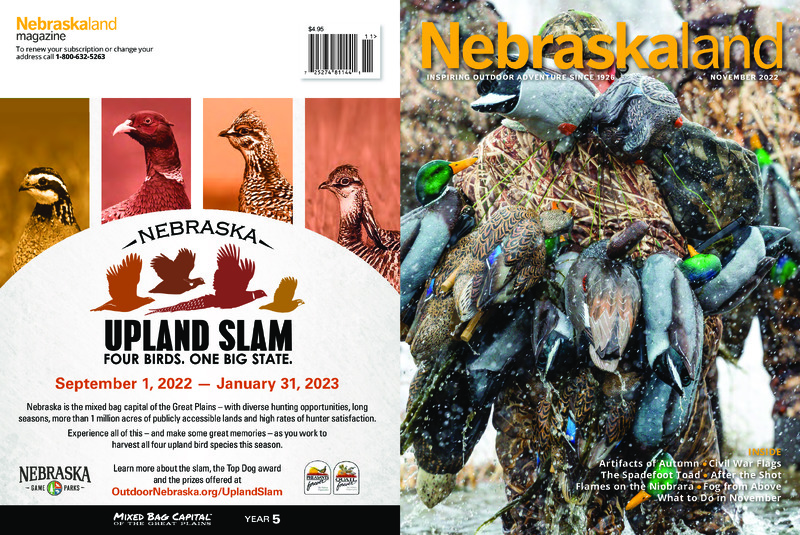
September 1, 2022 — January 31, 2023
Nebraska is the mixed bag capital of the Great Plains – with diverse hunting opportunities, long
seasons, more than 1 million acres of publicly accessible lands and high rates of hunter satisfaction.
Experience all of this – and make some great memories – as you work to
harvest all four upland bird species this season.
Learn more about the slam, the Top Dog award
and the prizes offered at
OutdoorNebraska.org/UplandSlam
YEAR 5
INSIDE
Artifacts of Autumn O Civil War Flags
The Spadefoot Toad O After the Shot
Flames on the Niobrara O Fog from Above
What to Do in November
2
Nebraskaland • November 2022
Volume 100 No. 9
November 2022
FEATURES
20
28
30
ARTIFACTS OF AUTUMN
Story and photos by Chris Helzer
OUTDOOR NEBRASKA
What to Do in November
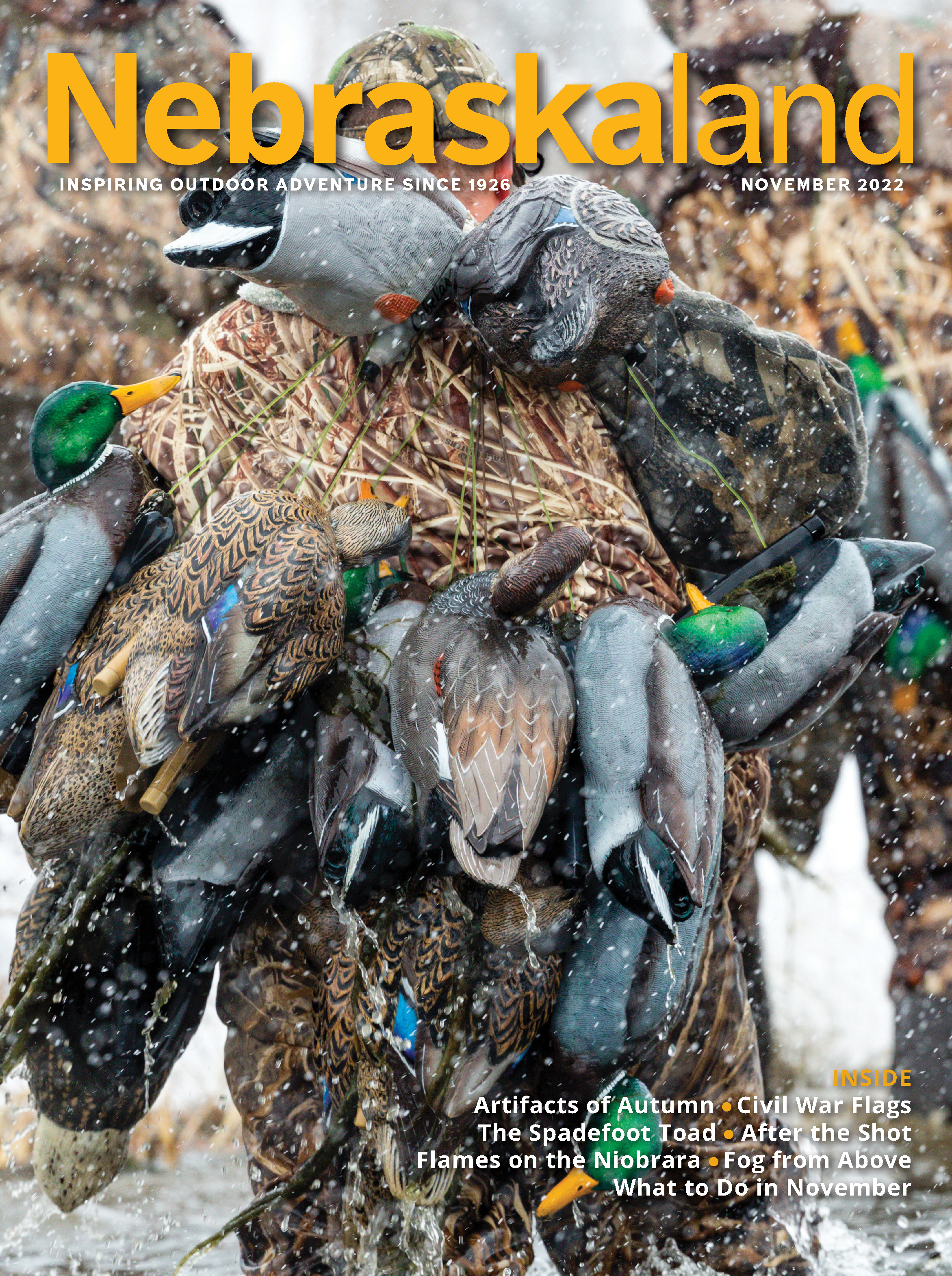
Cover: Trevor Johnson of
C
Doniphan hauls out decoys
D
aafter a waterfowl hunt
near Grand Island in Hall
n
County. This image, “CleanC
up,” recently won first
u
pplace at the Association for
C
Conservation Information’s
annual conference in the
people category of the photo
competition. Learn more at
Nebraskaland.com.
JEFF KURRUS, NEBRASKALAND
This page: A fall color leaf on
private land in Sarpy County.
JEFF KURRUS, NEBRASKALAND
By Renae Blum
FLAMES ON THE NIOBRARA
The Story of a Prescribed Burn
Story and photos by Gerry Steinauer
38
NEBRASKA’S CIVIL WAR FLAGS
40
FOG FROM ABOVE
48
DISAPPEARING ACT
50
AFTER THE SHOT
By David L. Bristow, History Nebraska
Photos and story by Eric Fowler
Story and photos by Chris Helzer
By Ryan Sparks
DEPARTMENTS
8
12
56
64
66
Your Nebraska
In the Field
Mixed Bag
Portraits from the Past
The Last Stop
ON THE WEB
For more articles and
information, visit
NebraskalandMagazine.com
Nebraskaland (VOL. 100 / NO. 9 ISSN 0028-1964) is published monthly, except for the combined Jan./Feb. and Aug./Sept. issues, by the Nebraska Game and Parks Commission, 2200 N. 33rd St.,
Lincoln, NE. Periodicals postage paid at Lincoln, Nebraska, and additional mailing offices. POSTMASTER: Send address changes to Nebraskaland, P.O. Box 30370, Lincoln, NE 68503-0370.
4
Nebraskaland • November 2022
November 2022 •
Nebraskaland
5
Magazine Staff
magazine
Published by the Nebraska Game and Parks
Commission since 1926. The Commission is
dedicated to the conservation and protection
of all the state's natural resources and the
people who use them.
Communications Director Christy Firestone
Public Relations Manager Shawna RichterRyerson
Editor Jeff Kurrus
Associate Editor Jenny Nguyen-Wheatley
Regional Editors Eric Fowler, Julie Geiser,
Justin Haag
Contributing Editor Michael Forsberg
Regular Contributors Renae Blum,
Chris Helzer, Chris Masada, Todd Mills,
Ryan Sparks, Gerry Steinauer
Art Director Tim Reigert
Graphic Designer Mel Severin
Photo Librarian Jaclyn Cruikshank Vogt
Administration
Director Tim McCoy
Deputy Director Jim Swenson
Assistant Director Roger Kuhn
Commissioners
Chairman - Pat Berggren, Broken Bow
Vice Chairman - Rick Brandt, Roca
2nd Vice Chairman - Robert Allen, Eustis
Ken Curry, Columbus
Donna Kush, Omaha
Scott Cassels, Omaha
John Hoggatt, Kearney
Doug Zingula, Sidney
Dan Kreitman, Wahoo
Commission Offices
Conservation Officers
Headquarters/Southeast District Office
2200 N. 33rd Street Lincoln, NE 68503
Phone 402-471-0641
ADMINISTRATION (Lincoln)
Craig Stover (Administrator)
Duane Arp (Asst. Administrator)
Travis Shepler (Asst. Administrator)
Jeff Clauson (Asst. Administrator)
Southwest District Office
301 E. State Farm Rd. North Platte, NE 69101
Phone 308-535-8025
Northwest District Office
East Hwy. 2, Box 725 Alliance, NE 69301
Phone 308-763-2940
Bassett Office
524 Panzer St., Box 508 Bassett, NE 68714
Phone 402-684-2921
CHRIS MASADA, NEBRASKALAND
Circulation
For address changes and questions about your
subscription, call 800-632-5263
Advertising Sales Manager
For advertising information contact
Shane G. Gilster, 402-742-0125
Email: shanegilster@gmail.com
Nebraskaland Magazine Copyright 2022, all rights reserved.
Nebraskaland is available in audio from the Nebraska Library
Commission Talking Book and Braille Service, Suite 120, 1200 N St.,
Lincoln, NE 68508. 800-742-7691. Nebraskaland Magazine and the
Nebraska Game and Parks Commission reserve the right to reject any
advertising not in keeping with the agency mission.
Rates: $18 for one year; $33 for two years; $44 for three years. Nebraska
recipients must add appropriate sales tax. To subscribe call
1-800-NEBLAND (632-5263), or go online to:
NebraskalandMagazine.com.
Northeast District Office
2201 N. 13th St. Norfolk, NE 68701
Phone 402-370-3374
Common loons visit large lakes and
reservoirs.
402-471-5531
402-471-5531
402-471-5531
402-471-5531
NORTHWEST (Includes counties covered)
Dan Kling (Lieutenant)
308-430-0572
EAST SUB-DISTRICT
Sean Schultz (Sergeant)
308-760-0145
Jerod Hahn (Deuel, Garden, Grant)
Keith Jadlowski (Keith, Deuel)
Jaden Porter (Keith, Garden)
Tyler Stueck (Keith)
Travis Schultz (Morrill, Cheyenne)
308-520-5539
308-289-9580
308-289-2274
308-289-6260
308-279-1292
(Keith, Arthur)
WEST SUB-DISTRICT
Matt Brandt (Sherman, Howard)
Daryl Teter (Howard, Greeley, Merrick)
Kyle Gaston (York, Polk, Hamilton)
SOUTH SUB-DISTRICT
Matt Taylor (Sergeant)
402-200-9597
Tim Williams (Hall, Hamilton, York)
Eric Javins (Adams, Clay, Webster)
Pat George (Harlan, Franklin, Phelps)
Ethan Teter (Buffalo, Kearney)
308-380-7331
402-902-2017
308-920-2762
308-440-3847
(Thayer, Fillmore, Nuckolls)
SOUTHWEST (Includes counties covered)
Roger Thompson (Lieutenant)
308-530-3097
NORTH SUB-DISTRICT
Ray Dierking (Custer, Thomas, Blaine)
Frank Miller (Cherry, Hooker)
Greg Hesse
308-870-0322
402-389-0444
308-546-7464
308-660-4671
308-530-3157
(Hooker, Thomas, southern Cherry)
Sean McKeehan (Sergeant)
308-672-1824
Kelsey Glodowski
308-763-8226
Alex Hasenauer (Lincoln, Perkins)
Brandon O’Neal
Ak-Sar-Ben Aquarium/Schramm Education
Center
21502 W. Highway 31 Gretna, NE 68028
Phone 402-332-3901
Hunter Pearson
308-360-1817
SOUTH SUB-DISTRICT
Josh Widhelm (Scotts Bluff)
Jacob Stoinski (Sioux, Dawes)
308-279-9133
308-615-9017
(Red Willow, Frontier, Hayes, Hitchcock)
Omaha Office
8495 Frederick Street, Omaha, NE 68124
Phone 402-595-2144
NORTHEAST (Includes counties covered)
Dale Davis (Lieutenant)
402-760-0712
Kearney Office
1617 First Ave. Kearney, NE 68847
Phone 308-865-5310
(Kimball, Banner, Scotts Bluff)
(Box Butte, Sheridan, Grant)
(Sheridan, Dawes, Grant)
NORTH SUB-DISTRICT
Jeff Jones (Sergeant)
402-762-5022
John Bauer (Holt, Boyd)
Tyler Adelman
402-314-9257
402-314-4783
(Knox, Cedar)
(Rock, Brown, Keya Paha)
Jonathan Andreasen
402-340-3981
Mitch Johnson (Knox, Antelope, Pierce)
402-613-8612
(Madison, Pierce, Stanton)
OutdoorNebraska.org
SOUTH SUB-DISTRICT
Cory Krause (Sergeant)
402-380-6410
Kyler Prochaska (Platte, Colfax)
Matt Costello (Dodge, Colfax)
Kelbi Abke (Washington, Burt)
Nicholas Fix (Dixon, Dakota, Thurston)
402-830-8278
402-317-4014
402-237-2537
402-508-0261
(Cuming, Wayne, Stanton)
The Nebraska Game and Parks Commission does not discriminate
based on race, color, ethnicity, national origin, sex, pregnancy, sexual
orientation, gender identity, religion, disability, age, genetic information,
veteran status, marital status, and/or political affiliation in its programs,
activities, or employment. Any person who believes he or she has been
discriminated against in any program, activity, facility, or service,
should contact the Nebraska Game and Parks Commission, Lincoln, NE
402-471-0641, the Nebraska Equal Opportunity Commission, Lincoln,
NE 402-471-2024, TTY/TDD 800-642-6112; Director, Office of Diversity,
Inclusion and Civil Rights, U.S. Department of Interior, 1849 C Street,
NW, Washington, D.C. 20240.
6
Nebraskaland • November 2022
CENTRAL (Includes counties covered)
Mike Thome (Lieutenant)
308-293-8746
NORTH SUB-DISTRICT
Doug Pollard (Sergeant)
(Loup, Garfield, Valley)
308-730-7050
308-202-0819
308-440-1863
402-719-6226
(Lincoln, McPherson, Logan)
Brian Piernicky (Sergeant)
308-340-6627
Bryce Streger (Dawson, Gosper, Custer)
Matt Andrews
308-537-0404
308-746-2418
Taylor Dixon (Dawson, Gosper)
Sophia Gobber
308-217-2108
308-222-0368
(Furnas, Gosper, Frontier, Red Willow)
(Chase, Dundy, Hayes, Hitchcock)
SOUTHEAST (Includes counties covered)
Stacey Lewton (Lieutenant)
402-890-7140
EAST SUB-DISTRICT
Heath Packett (Sergeant)
402-210-0888
Russell Mort (Otoe, Johnson)
Rich Berggren (Douglas)
Brian Arp (Douglas, Sarpy)
Dan Evasco (Sarpy)
Mike Luben (Saunders, Butler)
Bryan Adams
402-209-1506
402-619-1355
531-530-9011
402-616-5961
402-443-6392
402-429-1924
(Cass)
(Nemaha, Pawnee, Richardson)
WEST SUB-DISTRICT
Dina Barta (Lancaster)
Luis Nuñez (Lancaster)
Mark Sullivan (Lancaster, Seward, Butler)
Trevor Stahlecker (Lancaster, Saline)
Matt Seitz (Gage, Jefferson)
402-890-6463
531-333-6093
402-741-0636
402-314-9641
402-806-0915
YOUR NEBRASKA
Instagram Photos
Follow us @nebraskaland
and tag us in your photos
to be featured in an
upcoming issue.
Jimmy Myers, Hebron
A Boykin’s First Hunt
Joni Wimmer, Raymond
Day’s End
Lisa Gleason, Lincoln
A Love of Leaves
8
Nebraskaland • November 2022
November 2022 •
Nebraskaland
9
YOUR NEBRASKA
JUSTIN HAAG, NEBRASKALAND
Box turtles are considered one of the most heavily trafficked animals in the United States.
Simply put, many of these animals are poached from the wild and exported across the country
or shipped out internationally for food, medicine or for wealthy collectors for their novelty and
beauty.
In our October issue of the magazine, you may have noticed there was an eastern box turtle on
the cover. Although not native to Nebraska, turtles, and many other reptiles, are often found
in areas that are atypical for them. Many times people will pick up these animals while on
vacation in different states, keep them as pets, and then decide at a later time to release them
back into the wild.
The eastern box turtle is native to the eastern part of the country, but was found in Sarpy
County when its photo was taken. This leads us to believe it probably was a pet brought from
another state and later released into the wild.
Nebraska does have one native terrestrial turtle, and that is the ornate box turtle shown here.
Rebecca Johnson, Central City
Northern Prairie Skink
Send your comments and
photos to:
Jeff Kurrus, Editor
Nebraskaland Magazine
P.O. Box 30370
Lincoln, NE 68503
or email Jeff.Kurrus@Nebraska.gov
Please include your postal address
and telephone number. Letters
may be condensed and edited.
Photographs are also welcome.
10
Nebraskaland • November 2022
November 2022 •
Nebraskaland
11
IN THE FIELD
TRAIL THROUGH
THE BLUFFS
An aerial photo shows a
trail running through the
forested bluffs at Indian
Cave State Park.
ER
ERI
ERIC
E
RIC
RIC
C FOW
OW
WLER
LE NE
LER,
NEB
EBRASK
RAS
SK
KALAN
ALA
A D
12
Nebraskaland • November 2022
November 2022 •
Nebraskaland
13
IN THE FIELD
SAFETY TIPS FROM HUNTERS
By Jeff Kurrus
We often think hunter safety is common sense: Don’t
point your gun at anything you don’t want to shoot, always
be aware of your background, and all of the many other tips
hunters hear yearly. Yet every season, there is a long list of
hunter-related incidents and even more near misses.
Start with being honest about what you see, said Nebraska
Game and Parks Commission hunter safety coordinator
Hunter Nikolai. “Have you ever been muzzle swept by one
of those hunters?” he said. “I have. Whether it is someone
in my hunting party, or someone I don’t know, I always
speak up when I see it. I kindly
tell them what they did wrong
and correct their action, in
hopes that they never do it
again. Speak up when you see
something.”
Here are a few other,
sometimes not thought about,
tips from the people who know
best — hunters themselves.
Eric Fowler — You never
want to glass another hunter
and see them pointing a rifle at
you. This has happened to me
twice. Buy a pair of binoculars,
even cheap ones, to view your
surroundings when hunting.
regardless of the result, control your emotions. Do not
become too excited or irritated.
Andy Bishop — Always have situational awareness.
Rivers are unforgiving, especially in waders. Recently, while
hunting the Loup, I fell into a sink hole with water up to my
thigh. I was stuck. I looked upstream and a big chunk of ice
was floating my way. My hunting buddy had to pull me out.
Always hunt with a partner.
Gerry Steinauer — I’ve
walked multiple times with
other hunters and seen their
guns go off. Always make sure
your safety is on. Another
note: If you have a kid who
has left for college, he or she
will find any hunting buddy
they can.
During this time of my own
life, I saw most of my hunter
safety issues. Remind your kid
that the hunter safety rules
you instilled are not always
followed by others.
Hunter Nikolai — Don’t
get careless around your furry
hunting companions. Hunting
dogs have been the culprit
Todd Mills — Don’t overload
of hunting incidents in both
your waterfowl boat. This
upland and waterfowl hunting
seems logical, but folks often Wearing hunter orange is not required for upland game
hunting but is strongly encouranged. JEFF KURRUS, NEBRASKALAND
scenarios. Dog steps on gun
do it. Pay strict attention to
laying on the ground, gun fires, shoots hunter. Dog retrieves
your boat’s weight capacity. Also, make sure you have life
duck and jumps back in the boat, steps on the shotgun’s
jackets for everyone in the boat, as well as an extra.
trigger — hunter shot. Yes, these are freak occurrences, but
they do happen and can be prevented with vigilance and
Leslie Hershberger — Even if the distance is safe, do not
practicing simple firearm safety.
set up right in line with other hunters when waterfowl or
dove hunting to avoid pellet spray. Safety glasses are also a
Today, hunting is one of the safest recreational activities
nice add-on.
in America, according to a report by the National Shooting
Sports Foundation. Annual hunting incidents in Nebraska
Daryl Bauer — Make sure you know exactly how many
have decreased by over 70 percent since the introduction
shells you have loaded in your gun, and whether your gun
of Nebraska’s Hunter Education Program in 1974. For more
has its plug.
information, view the Nebraska Hunting Incident Report at
HuntSafeNebraska.org.
Travis Shepler — First, make a clean, safe shot. Then,
14
Nebraskaland • November 2022
IN THE FIELD
Preserve your hunting season by taking care of your feet.
JUSTIN HAAG, NEBRASKALAND
HUNTING FEET
By Jeff Kurrus
Sore feet have kept many outdoor enthusiasts, myself
included, from getting out of bed. Follow these tips to have
more time afield and less time making excuses why you
can’t go hunting the next day because you’re convinced
the “I can’t go because my feet hurt” response won’t play
well with your buddies.
Start with non-cotton socks as a base layer. Cotton
absorbs moisture and its fibers can put microincisions on
the foot. On a Pine Ridge hike in 2006, I butchered my feet
so badly wearing cotton socks that I had to try something
new. At the time, I went to full synthetic or wool socks and
most recently, have started wearing CEP’s Hiking Light
Merino socks almost exclusively.
Wearing high- or low-tops boots is a matter of
preference, but they must be waterproof. Even if you’re
upland hunting or don’t plan on walking far or into deep
cover, dew-covered ground makes for soaked feet.
If the temperatures are colder, place a pair of foot warmers
16
Nebraskaland • November 2022
in between your base layer of socks and a wool or synthetic
outer layer. The days of three and four pairs of socks are
over. The toe warmers keep your extremities in good shape,
and this combination of materials keep my feet warm in
sub-zero temperatures ice-fishing each winter.
If and when your feet get wet, because this will
eventually happen, immediately change socks and boots.
I carry a pair of thick cotton socks to soak the moisture
from my feet and then reapply the same steps: non-cotton
base, toe warmers and wool outer layer.
Then, after your adventure, make sure to have a pair of
cotton socks and sneakers in the vehicle to change into.
The cotton will soak up any moisture your feet have taken
on, and the sneakers provide lighter footwear to go to the
diner or driving back to the house.
Plus, this re-sets your feet for your next challenge —
tomorrow’s adventure. N
Visit Cepcompression.com.
IN THE FIELD
Marinated quail smoked with lemon halves.
JENNY NGUYEN-WHEATLEY, NEBRASKALAND
SMOKED QUAIL
By Jenny Nguyen-Wheatley
Servings: 4
Prep Time: 8-24 hours
Cooking Time: 1 hour
Ingredients:
8 whole quail, skin on
2 lemons, cut in half
•
•
Yogurt Marinade
8 ounces of plain Greek yogurt
8 cloves of garlic, minced
2 teaspoons of dried oregano
1 teaspoon of dried basil
Grated zest of 1 lemon
Juice of 1 lemon
1 tablespoon of olive oil
1½ teaspoons of kosher salt,
plus extra
•
•
•
•
•
•
•
•
Basting Sauce
¼ cup of olive oil
½ teaspoon of dried oregano
18
•
•
Nebraskaland • November 2022
•½
•
•
teaspoon of Hungarian
paprika
½ teaspoon of dried basil
¼ teaspoon of garlic powder
1. With kitchen shears, remove
the backbone from each quail. Turn
them breast-side up and flatten with
the palm of your hand to break the
wishbone, thus spatchcocking them.
This preparation will allow the quail
to sit flat on the smoker grates and
help them cook evenly.
2. In a bowl, combine marinade
ingredients. Transfer spatchcocked
birds to a zip-top bag and pour in
the marinade. Massage the bag
to evenly distribute the marinade
and refrigerate for at least 8 hours
but no longer than 24. Flip the bag
occasionally. Take the quail out
of the refrigerator 1 hour prior to
cooking.
3. Preheat smoker to 275°
Fahrenheit. Meanwhile, brush excess
yogurt marinade off each quail and
lay them on a cookie sheet or large
plate. Sprinkle a small amount of salt
over the quail.
In a small saucepan, combine the
basting sauce ingredients and heat
until warmed through.
4. When your smoker is ready,
brush each quail with the basting
sauce. Lay the birds onto the smoker
along with 2 halved lemons, close
the lid and smoke for 1 hour at 275°.
After the hour and before taking
the birds off the smoker, baste them
again with leftover sauce. Serve
immediately with smoked lemons on
the side.
November 2022 •
Nebraskaland
19
Artifacts
of Autumn
Story and photos by Chris Helzer
H
iking a prairie or wetland in November
can feel like visiting a museum dedicated
to the previous growing season. Relics
and reminders of that season are all around, some
well-preserved and others not-so-much. Most of
the vibrant autumn hues that are characteristic
of September and October have dulled, but
there are still plenty of treasures to reward an
observant wanderer.
Bright colors are rare in November, but not
nonexistent. For example, rose hips, the tart
ABOVE: The fruits (hips) of wild rose provide flashes of bright color in
November prairie.
LEFT: This late blooming black-eyed Susan flower didn’t quite finish
flowering before a hard freeze ended its season.
20
Nebraskaland • November 2022
November 2022 •
Nebraskaland
21
Indiangrass seeds, backlit by
evening light. The hairs and
awns help grab onto passing
animals or hikers.
22
Nebraskaland • November 2022
November 2022 •
Nebraskaland
23
fruits of those thorny plants, look like small, red light bulbs
against a dull brown background. An even more scarce and
sublime find is a freeze-dried flower. Late in the season,
especially after a shot of rain, some short-lived plants will
make a quick and desperate attempt to bloom and produce
seed before cold temperatures end their life. If a hard freeze
hits while those blossoms are still open, much of the flower
color is preserved for at least a few weeks.
After most leaves have dropped and stems have dried, an
24
Nebraskaland • November 2022
abundance of seeds can still be found on plants or scattered
around the nearby landscape. Windblown seeds in particular,
typically with big feathery plumes attached to them, often
get hung up on neighboring plants. Those pappi (plural
of pappus, the technical term for many of those feathery
plumes) catch the light and glow attractively, especially
early and late in the day.
Even the pods, capsules and husks that hold (or held)
seeds are attractive. Seed heads often stand in stark
ABOVE LEFT: The feathery pappus on
many wind-dispersed seeds allow them
to travel on the breeze, but also catch
easily on other plants.
ABOVE RIGHT: Common milkweed seed
at Lincoln Creek Prairie in Aurora.
BELOW RIGHT: Fingernail-sized seeds of
entire-leaf rosinweed.
November 2022 •
Nebraskaland
25
ABOVE: Common milkweed seed pods silhouetted against a
sunrise at Lincoln Creek Prairie.
LEFT: Invasive narrow-leaf cattail seedhead releasing its
seeds. Those seeds can travel long distances, colonizing new
wetlands far from its parent plant.
contrast to their surroundings, adding pleasing accents to
the increasingly muted landscape. Upon close inspection,
the complex architecture of each structure is eminently
functional but also beautiful — like a finely crafted piece of
furniture.
Don’t give up on the season just because the leaves have
26
Nebraskaland • November 2022
fallen and the nip in the air is starting to feel like a full-blown
bite. A November hike might provide glimpses of hardy
animals sticking around for the coming cold or others just
showing up from places where winter is even more frigid. If
you’re especially observant, though, and can tune in to the
late autumn ambience, you’ll discover much more. Artifacts
from the recent past abound, providing reminiscences of the
just-completed growing season but also promises of those to
come. N
Chris Helzer is the Nebraska Director of Science for The
Nature Conservancy and is based in Aurora.
When he isn’t searching for obscure subject matter
to photograph and write about, he conducts research and
captures lessons from the Conservancy’s land management and
restoration work.
Chris is a regular contributor to Nebraskaland Magazine with
his first story appearing in 1995.
November 2022 •
Nebraskaland
27
Outdoor Nebraska
By Renae Blum
November is a big month for deer hunting, of course, but there’s so much more to
do. Find some time to enjoy fishing, bird feeding, camping and stargazing, too. N
What to Do in November
Try late-season
camping
Throughout the month |
Statewide
Late-season camping offers great
wildlife watching and fewer crowds;
give it a try this month. This time of
year, Nebraska Game and Parks offers
a $5 discount on all types of camping,
except primitive camping. Water
services at several parks are winterized
beginning in mid-October, so RV
users should contact parks to confirm
service. ERIC FOWLER, NEBRASKALAND
Fish for walleye and sauger
at Lewis and Clark Reservoir
Hunt mule deer in the Pine Ridge
Season dates vary
Throughout the month
The Pine Ridge is big country, and it has some big deer, too. Set your
sights on the Pine Ridge this fall and spend some time scouting to find
the best spots. Plenty of public access land is available. Hunting food
sources can be good in the morning and evening, and during midday,
hunt the timber where bucks may be chasing does.
Fishing slows down in November, but as one of
Nebraska’s larger reservoirs, Lewis and Clark has plenty
of opportunity this month. The lake has a decent
walleye population as well as other game fish. Try
vertical jigging using jigs and slap spoons, and keep a
constant watch of your depth finder.
JUSTIN HAAG, NEBRASKALAND
JEFF KURRUS, NEBRASKALAND
Feed your backyard birds
Throughout the month | Statewide
You can make a big difference for your backyard
birds by feeding them this winter. Black oil
sunflower seeds and Nyger thistle seed are great
options. Try different feeder types to attract
different kinds of birds, and make sure to leave out
some water as well. Remember to keep seeds fresh
and clean your feeders.
ERIC FOWLER, NEBRASKALAND
Watch the Leonid
meteor shower
Peak is Nov. 17-18 | Statewide
Take the opportunity to enjoy some
stargazing this month. The Leonid meteor
shower will be visible Nov. 3 to Dec. 2 and
reaches its peak Nov. 17-18, when you can
expect to see 10-15 meteors per hour from a
dark sky location. You can view meteors as
soon as it’s dark, but the best viewing is after
midnight until dawn. Dress warm and bring a
blanket or lawn chair.
ERIC FOWLER, NEBRASKALAND
28
Nebraskaland • November 2022
November 2022 •
Nebraskaland
29
Flames
on the
Niobrara
the story of a
prescribed burn
M
By Gerry Steinauer, Botanist
y introduction to the central Niobrara River Valley
came in 1984 when, fresh out of college, I interned on
The Nature Conservancy’s Niobrara Valley Preserve
located east of Valentine. My job on the recentlyacquired preserve was to design and build nature trails,
help move cattle between pastures on horseback, and fix
windmills and fences, along with other miscellaneous ranch
duties.
On evenings and weekends, I explored. For a kid from the
outskirts of Omaha that didn’t travel much while growing
up, the 56,000-acre preserve was terra incognito. I hiked
rocky canyon rims, deep-shaded woods and prairie-covered
dunes, and swam and fished in the cool, sandy waters of the
Niobrara. This young botanist was also enthralled by the
valley’s rich flora: More than 600 plant species are found on
the preserve alone. By summer’s end, the preserve had its
hooks in me.
Throughout my 32-year career with the Nebraska Game
and Parks Commission, I have taken every opportunity
Smith Falls
State Park
The prescribed fire moves through a thinned
ponderosa pine stand on the flat south of
the river bluff. The trail road that served as
the south fire line is visible in the upper right
corner of the photo. CHAD BLADOW
rara River
Niob
Waterfall
Prescribed Burn Area
Brewer Bridge
The prescribed fire unit included 450-acres of the Niobrara
River’s south bluff on The Nature Conservancy’s Niobrara
Valley Preserve in Cherry County, Smith Falls State Park
bordered the unit to the west. TIM REIGERT, NEBRASKALAND
30
Nebraskaland • November 2022
to return to the preserve, whether it be to conduct plants
surveys, help with workshops or assist with prescribed burns.
Case in point: In December 2021, I received an email stating
that a prescribed burn was planned for the next day, and help
was needed. That evening, I packed my fire gear, and the next
morning, I was on the road early for the long drive north. This
is the story of that burn.
The Bluff
Ecosystem
The burn unit was the bluff on the south bank of the
Niobrara River between Brewer Bridge and Smith Falls State
Park. Thousands of canoers, kayakers and tubers float past
these bluffs each year as they occur within a popular 76-mile
stretch of the Niobrara designated as a National Scenic River.
Here, the bluff rises sharply from the river. Its moist, low
slopes are cloaked with deciduous woodlands of bur oak and
a lesser abundance of hackberry, basswood and ironwood.
Deep side canyons cut by spring-fed streams dissect the bluff
and harbor rare, glacial-relic stands of paper birch and aspen
trees. And ponderosa pine woodlands and Sandhills dune
November 2022 •
Nebraskaland
31
a prescribed fire on these bluffs; the aim was to consume the
dry tree piles and ground litter and kill uncut young cedars
and pines. Unfortunately, I had other obligations that day
and missed the burn.
In the years following that burn, the conservancy cut
additional cedars and pines from the bluffs, but the conifers
would not go down without a fight. New seedlings sprouted
and quickly grew to saplings and, if left unchecked, cedars
and pines would again choke the bluffs in a matter of decades.
Now, while trees were young and most vulnerable to heat
and flame, was the time to hit them again with fire.
The Fire
Late in fall 2021, the central Niobrara valley was prime for
prescribed burning. There was no snow on the ground, and it
was unseasonably warm.
On the morning of Dec. 9, I was among the 15-person burn
crew that gathered in the parking lot near Brewer Bridge.
The early arrivals milled about in small groups sipping
coffee, talking and joking, while the latecomers organized
their gear and donned their bright yellow and dull green,
fire-resistant Nomex clothing. Represented were staff of
The Nature Conservancy, Game and Parks, Northern Prairies
Land Trust and Turner Enterprises, Inc., as well as several
volunteers. They were a tight-knit group, most having burned
together in the past. When all were ready, Chad Bladow, the
conservancy’s prescribed fire coordinator and burn boss for
this fire, huddled the crew together for a briefing, and the
mood turned serious.
Maps of the burn unit were passed out, and Bladow
reviewed the ignition pattern, possible danger areas and the
day’s weather. He then assigned each member to one of four
teams and assigned line bosses, his trusted field lieutenants,
to lead each team. Three teams would light the fire using drip
torches, fuel-filled metal canisters with long spouts from
which fuel drips across a burning wick and onto the ground.
The fourth team would patrol the fire breaks in all-terrain
Nebraska Game and Parks Commission wildlife biologist
Cassidy Wessel, left, and retired Commission employee
Marilyn Tabor, right, patrol the south fire line.
GERRY STEINAUER, NEBRASKALAND
Flames creep through an oak grove as darkness settles on
the valley. GERRY STEINAUER, NEBRASKALAND
prairie are interspersed on the dry, sandy upper bluffs, the
latter extending southward to the horizon.
As has happened throughout Nebraska, Euroamerican
settlement has affected the native Niobrara landscape. One
consequence of settlement, fire suppression has allowed
eastern red-cedar, ponderosa pine and other woody plants
to proliferate to unnaturally high levels. Studies of fire scars
in the growth rings of live old trees and the stumps of longdead trees dating back to the late 1600s show that, prior
to settlement, wildfires occurred in the valley on average
every five to 15 years. Frequent fire maintained treeless
prairies; open, vigorous woodlands; and savannas, prairie
with scattered trees. In addition, the wide-burning fires
periodically consumed downed wood, fallen conifer needles
and other fuels, keeping fire intensity low to moderate.
Not allowing fires to burn regularly has led to an overaccumulation of fuels. Now, when wildfires do start, they can
burn hot, as happened during the drought-stricken summer
2012, when lightning strikes set the Niobrara valley ablaze,
charring more than 76,000 acres and destroying miles of
livestock fence and several homes.
Beginning in the early 2000s, the conservancy hired
contractors to cut and pile cedars and smaller pines on the
bluffs near Brewer Bridge and elsewhere to combat the
abundance of trees and fuel. In March 2014, they conducted
32
Nebraskaland • November 2022
The resinous bark of
ponderosa pines is easily
ignited during burns. Winds
can carry embers from
these hot-burning trees
across fire lines posing the
danger of spot fires.
CHRIS HELZER, THE NATURE CONSERVANCY
November 2022 •
Nebraskaland
33
Despite the crew’s rapid response, a few embers landed
vehicles and pickups equipped with water tanks and pumps.
across the trail road, igniting small fires in dry grass beyond.
Their critical job was to prevent flames from creeping across
Before these “spot fires” could grow and intensify, waiting
or jumping the break. Radios were passed out to provide
crew members snuffed them out.
vital communications as the teams spread out and the burn
Spot fires are an expected part of prescribed burns,
progressed.
especially those including hot-burning, ember-producing
With the meeting over, the crew crossed the bridge in
cedars, pines, brush
a caravan of vehicles
piles or tall grass, and
and lumbered up the
on days when low
two-track trail to the
humidity allows the
prairie flat above the
errant embers to easily
bluff. With the wind out
ignite dry grass or dead
of the north, the burn
wood. Skillfully, our
would start here on the
crew, like all trained fire
downwind side of the
crews, predicted and
unit’s east end, with the
was prepared for the
trail road, which ran the
spot fires.
length of the two-mileWith the flaming
long unit serving as the
pines
extinguished,
south fire break.
the crews lighting the
With
Bladow
backfire
continued
orchestrating from the
to work westward.
front seat of his fourOne could now gaze
wheel-drive pickup, one
eastward and see a
crew started lighting
towering smoke plume
the backfire directly off
rising near the river.
the trail. The fire burned
The south line secured
slowly into the wind,
with a wide, firecreating a blackened
blackened buffer, the
fire break. Another crew
third crew had started
followed the first, filling
lighting the headfire
in unburned gaps and
at the base of the bluff
widening the blackened
in the unit’s northeast
area.
Lighting
the
corner. Pushed by the
backfire
along
the
wind
and
burning
south line took several
upslope, the fire sent
hours and was mostly
a wave of heat ahead,
uneventful. Only once
pre-heating and drying
did tension fill the air.
the fuels, intensifying
About noon, as the
the flames and sending
fire burned through a
many smaller cedars
ponderosa pine stand
The bark of a ponderosa pine was charred during the prescribed burn.
GERRY STEINAUER, NEBRASKALAND
and pines to the
near the trail road,
afterlife.
the resin-soaked bark
At this point, I was on the ridgetop, tasked with the duty
of several trees caught fire. The crackling flames quickly
of protecting a plastic deer blind set on short wooden poles
climbed their trunks, sending embers skyward. These trees
by lighting a fire around its perimeter, a practice known as
needed to be quickly extinguished or the wind might carry
blacklining. The grass around the blind had been mowed,
embers over the trail road and outside the burn perimeter.
but blacklining would add protection. As I drove a utility
The call for help went out over the radio, and the dirty work
began. First, crew members pushed through the heat and
vehicle into the unit from the southwest, thick smoke began
smoke of the flaming trees and doused them with streams
to block my path as I neared the blind. When I peered down
of water. With the flames extinguished, they used heavy
the ridge, I saw flames heading my way: The crew lighting
rakes to break still-smoldering bark from trunks and limbs to
the fire along the river had advanced farther than expected. I
prevent the trees from reigniting.
reversed course, leaving the blind to fate.
34
Nebraskaland • November 2022
Trained in Fire
Chad Bladow was raised in
the small town of Hankinson,
North Dakota. He spent his
childhood summers on his
grandparents’ nearby farm
and lake-side cabin where he
roamed the land, camped,
fished and developed a love of
nature.
In 1996, while pursuing
a degree in wildlife and
fisheries from
the University of
North Dakota,
his venture into
prescribed fire
began when
he interned
for a semester
in Florida and
helped burn
pine woodlands.
After college,
Bladow was hired
by The Nature
Conservancy
to manage
preserves in
southern Indiana,
including helping
with prescribed
burns, mainly in
oak woodlands.
By 2002, he
had acquired
enough training
and experience
to become a
conservancy burn boss,
allowing him to lead
prescribed fires on their lands.
By 2010, Bladow had met the
rigorous standards required
to become a federally certified
burn boss, the pinnacle of
the position. This level of fire
leadership requires extensive
knowledge of fire behavior
in a wide range of plant
community types, topography
and weather; leadership and
planning skills; and the ability
to maintain one’s cool under
pressure.
Bladow began traveling from
Indiana to the Niobrara Valley
Preserve to lead burns, and in
2018, he accepted the position
of prescribed fire coordinator
stationed at the preserve. His
duties now included planning
central Nebraska,” said
Scott Wessel, a Commission
wildlife biologist stationed in
Norfolk. Most ranchers and
other landowners throughout
the state have little or no
experience using prescribed
fire and need leadership and
guidance to get fire on the
ground, Wessel said. “Chad
has a knack for understanding
Chad Bladow leads a prescribed burn on the Niobrara Valley Preserve.
CHRIS HELZER, THE NATURE CONSERVANCY
and leading prescribed burns
on conservancy preserves
throughout the state and
helping other conservation
groups and private
landowners in the northern
Sandhills and Niobrara River
valley plan and conduct
prescribed burns.
“Chad has been great
helping us implement
prescribed fire in north-
a landowner’s comfort level
with fire, and if they are
uncomfortable, helping them
work through their concerns.
He has that rare balance
of confidence and humility
needed for his job,” he said.
To date, Bladow has helped
conduct prescribed burns on
15,000 acres of prairie and
woodland in north-central
Nebraska.
November 2022 •
Nebraskaland
35
By late afternoon, the crew lighting the backfire had
reached the unit’s west boundary. They then turned north
and lit along a mowed break that snaked down a gentle slope
of the bluff, tying the fire off to the river. Soon, the crew
setting the headfire would also reach this point, encircling
the unit with fire. Behind them, the backfire and headfire
were merging high on the bluff, like the sides of a slowly
closing zipper, and extinguishing themselves.
In the dimming light of sunset, crew members set fire in
the last unburned patches of oak timber low on the bluff that
the headfire had passed by. Slowed by the evening chill, their
flames crept across the forest floor, casting a pale, eerie glow
onto the sprawling branches above. When the last of these
fires petered out, darkness enveloped the bluff. The burn was
complete. The crew dispersed for a good night’s sleep, except
for a lone sentinel who stayed late into the night to patrol the
burn perimeter.
Hairy puccoon flowers bloom in a now open stand of bur oak and ponderosa pine. Fire-killed eastern
red-cedar saplings and the stumps of cut cedars are visible in the center of the photo. GERRY STEINAUER, NEBRASKALAND
Post-fire
Niobrara Valley Preserve assistant manager Carson Schultz
examines an unscathed aspen in June after the burn. The
tree is caged to prevent deer browsing.
GERRY STEINAUER, NEBRASKALAND
36
Nebraskaland • November 2022
Last June, I hiked the bluff with Bladow and Carson Schultz,
assistant manager at the preserve, to view the results of the
fire. To our delight, many young cedars and pines had died in
the burn. Many of the dead still clung to their slow-cooked
foliage, now brownish-orange, but where the fires burned hot,
these saplings were skeletons of charred stems and limbs.
In the oak woodlands, the fire had top-killed many smaller,
shade-producing ironwoods and hackberries. Although these
trees would eventually re-sprout, more sunlight was now
reaching the forest floor, allowing wildflowers to flourish.
Only a few aspen saplings had been top-killed, but these, too,
would re-sprout.
And the deer blind? The short, mowed grass below the
blind, somewhat miraculously, never caught fire and the
blind survived.
At day’s end, we sat on a high hill and gazed down on a
bluff that hardly resembled its pre-restoration state: The tree
cutting and fires had done their job. Low on the bluff, the oak
woods were now open, and the high slopes were cloaked with
oak and ponderosa pine savanna. The fuel level was visibly
reduced, making the bluff ecosystem more resistant to future
wildfires. This one-time intern glowed with satisfaction. N
November 2022 •
Nebraskaland
37
Nebraska’s Civil War Flags
By David L. Bristow, History Nebraska
s we approach another Veterans Day, here are three
flags belonging to the first soldiers to formally represent
Nebraska in the U.S. Army.
Nebraska Territory had only about 9,000 men of
military age when the Civil War began, but it sent more than
3,000 of them into the Union armies. The First Nebraska
Infantry Regiment fought in two major battles in 1862,
playing a crucial role at the Battle of Fort Donelson and
fighting bravely at Shiloh.
Later, mounted as cavalry, the two Nebraska regiments
guarded overland trails in Nebraska’s Platte Valley. Statehood
followed two years after the end of the war. N
A
Visit History Nebraska’s website at history.nebraska.gov.
In 1863, the First Nebraska was mounted as a cavalry
regiment. It served in the Platte Valley from August 1864
until it was mustered out in July 1866. HISTORY NEBRASKA, 8611-4
Much of this 35-star flag has disintegrated and is mounted on a black backing for protection. Battle honors were commonly
stitched on regimental colors. This First Nebraska flag bears the names of Milford, Donalson (sic), Shiloh, Corinth and Cape
Girardeau. Under the heading “1st Regt. Nebraska Cav.” are Chalk Bluff, Sycamore, Red Bank and Jacksonport.
HISTORY NEBRASKA, 7135-389-(1)
Pvt. James Hutton, age 19, Co. E, First Nebraska, circa 1861.
HISTORY NEBRASKA, RG2057-40
38
Nebraskaland
• November 2022
This ad appeared in the Nebraska Advertiser (Brownville),
on May 23, 1861. The Brownville company traveled by
steamboat to Omaha City, where it was mustered into the
First Nebraska Regiment.
Flag of First Nebraska Regiment,
Company A, 1861. States and territories
organized recruits into thousand-man
regiments, and young men from the
same town usually filled hundred-man
companies. Company A was organized
in Plattsmouth.
Mrs. O. F. Johnson sewed the
company’s flag. It was said she had the
only sewing machine in town. Many
years later, the flag came to History
Nebraska in fragile condition. Its blue
field is all but gone, and at some point,
its remaining 26 stars were mounted to
a new backing — and not very neatly.
Mrs. Johnson’s stripes are a bit uneven,
but we assume she placed her 34
stars with more care. The U.S. had 34
states after Kansas joined the Union
in January 1861. During the war years,
new U.S. flags added stars for Kansas,
West Virginia (1863) and Nevada (1864),
but did not — as a matter of principle —
subtract the 11 seceded states from the
Perpetual Union. HISTORY NEBRASKA, 2046
November 2022 •
Nebraskaland
39
Fog From Above
Photos and story by Eric Fowler
Flying above fog gives you a new
perspective of these clouds on the ground.
Sunlight reflects off the Platte River between
Shelton and Gibbon as sandhill cranes roost on
the river and snow geese fly above it in March
2018. A grain elevator in Hayland and power
plant in Hastings are visible in the distance.
40
Nebraskaland
• November 2022
November 2022 •
Nebraskaland
41
e have all, on occasion, had
our heads in the clouds. I’m
not referring to our tendency
to daydream. I’m referring to
those cool mornings when our world is
shrouded in mystical fog.
On rare occasions, I’ve been lucky to
have a photo flight scheduled on one of
those mornings. In such cases, fog can
be a blessing and a curse. The Federal
Aviation Administration says you can’t
take off in fog. The person who made that
rule obviously wasn’t a photographer.
It’s not that bad, I say. Follow those
runway lights and lets get above it. You
need to be able to turn around and land
if something goes wrong, they say. I
suppose that’s wise.
Twice I’ve waited at an airport for fog
to clear. A few other times, my pilot and
I have taken off and found fog on our
flight path.
The view from above shows you that
fog is indeed stratus clouds resting on
the ground as opposed to their typical
low-level altitude that doesn’t exceed
6,500 feet. Sometimes fog appears as
a blanket. Sometimes it’s more like the
ground is littered in cotton balls, the
space between them varying from some
to none. Other times, it stretches out in
bands across the landscape.
If there’s a slight breeze, you can see
how it clings behind trees and hills or
is strung out in wispy streaks. This
explains why, as you move through fog
on the ground, or it moves past you, the
density can vary from zero to pea soup.
Each time I’ve photographed fog from
above, it has been concentrated in river
valleys, where fog likes to form.
Whatever valley it is in, flight plans
are always tossed out the window. We
can always stop for more fuel. I will
chase fog as long as the light is good or
the sun slowly shrinks the fog bank until
it disappears, and it’s time to get back to
work. It’s always good while it lasts. N
W
Wispy streaks of fog blanket cropland
between shelterbelts and trees along
the Platte River southeast of Fremont in
August 2019.
42
Nebraskaland
• November 2022
November 2022 •
Nebraskaland
43
Grain elevators rise
above fog covering
the southern edge of
North Bend.
44
Nebraskaland
• November 2022
November 2022 •
Nebraskaland
45
TOP LEFT: Fog fills the Missouri River
Valley to the height of the Plattsmouth
Toll Bridge and Burlington Northern
Railroad bridges in September 2020.
BOTTOM LEFT: Sandhill cranes fly above
the fog and trees along the Platte River
in Hall County in March 2018.
TOP RIGHT: Fog clings to the lowlands
along the Elkhorn River near Nickerson
in June 2011.
BOTTOM RIGHT: Fog wafts through the
riparian forest along the Platte River
at Schilling Wildlife Management Area
and Missouri River near Plattsmouth in
September 2020.
46
Nebraskaland
• November 2022
November 2022 •
Nebraskaland
47
Disappearing Act
Story and photos by Chris Helzer
I
was on the way out to The Nature
Conservancy’s Platte River Prairies
when the preserve manager, Cody
Miller, called.
“Hey, have you ever seen a spadefoot
toad?”
“Just once,” I said, “but never along
the Platte. You got one?”
“Yep,” he said. “I saw it hopping
away from the mower, and so I moved
it to safety. It wasn’t the kind of toad
I expected! I’m holding it until you get
here.”
Fifteen minutes later, I arrived to
find Miller holding the little spadefoot
gently in his hand. The spadefoot,
of course, wasn’t interested in sitting
for a portrait. While a grinning Cody
watched from above, I scooted around
on my belly in the mowed grass, trying
to get the spadefoot to stop hopping
long enough for my camera to focus. I
wasn’t having much luck.
Finally, I grabbed the toad and stuck
it on top of a mowed-off pocket gopher
mound, sure it would once again hop
away. Instead, it sat perfectly still,
and I quickly snapped a few photos
before I noticed that its back feet were
shuffling discreetly in the loose soil.
That’s when my brain clicked into gear,
and I realized what was happening.
The
plains
spadefoot
is
colloquially called a toad, but
several characteristics, including its
smooth, moist skin, make it more of
a frog. They’re rarely seen because
they spend most of their lives
underground, emerging only during
or after rainstorms to mate and lay
eggs in puddles. The adults then dig
themselves back into the earth and
their tadpoles try to grow up before
their puddle evaporates.
As Cody and I watched, the
spadefoot in front of us slowly started
1
O
48
Nebraskaland • November 2022
to sink into the gopher mound. It sat
fully upright and slowly rotated as its
hind feet worked the soil from beneath
its body. Within three minutes, the
toad had been completely swallowed
up by the earth, leaving almost no sign
it had been there. It was mesmerizing
and magical to watch.
I took lots of photos of the spadefoot
as it gradually disappeared. In the
moment, I wrestled with whether to
switch to video but decided to stick
to still photos. Afterward, I briefly
considered digging the spadefoot
back out to see if it would repeat the
performance on video, but I quickly
dismissed the thought, and we left the
little guy alone in his subterranean
hideout. N
Chris Helzer is The Nature
Conservancy’s director of science in
Nebraska.
The Plains
Spadefoot
3
O
The plains spadefoot toad
is the only spadefoot toad
in the state. Look at the rear
foot of the toad and you will
find a keratinized spade on it
which no other toad or frog
in the state has. It allows
them to dig into sandy soils.
The plains spadefoot
ranges from southwestern
Canada, throughout the
Great Plains of the western
United States and into
northern Mexico.
4
O
The “spade” on the rear foot
of a Great Basin spadefoot
is similar to the plains
spadefoot’s. PHOTO: ALAN ST. JOHN
Photos 1 – 5: The spadefoot toad
descending into a gopher mound.
2
O
5
O
November 2022 •
Nebraskaland
49
After the Shot
By Ryan Sparks
I
can vividly recall the two animals
I’ve shot and didn’t recover. The
memories still give me a gutwrenching feeling of loss and remorse.
The first loss was a Montana mule
deer I tracked with a friend for several
hours before falling snow made it
impossible to continue. The second
was a Nebraska white-tailed buck. I
searched for him for three days, but
never found him. He’s still the biggest
buck I’ve ever seen.
There are many hunting skills that
are necessary for a successful hunt,
but we usually focus on the ones that
are needed before the trigger is pulled
or an arrow is released. Whether you’re
hunting elk, antelope, mule deer or
whitetail, what you do after the shot
can greatly affect your chances of
recovering the animal.
Analyze the Shot
The first thing to do after a shot is to
mark your location. That’s easy if you
are hunting from a tree stand, but not
so much if you are stalking antelope
or mule deer. Stick an arrow in the
ground, use flagging tape, create a pile
of rocks or mark the location on your
GPS. This marker will provide you with
a reference. Next, make a mental note
of where the animal was standing. If
you have your phone, take a picture
of where the animal was from your
shooting position.
Next, replay the shot in your mind.
Ideally, you should know where you
hit the animal, but with how fast
modern bows are or feeling the recoil
of a rifle while looking through the
scope, sometimes it can be hard to tell.
Reading the landscape after a shot, and moving slowly, are effective methods to finding downed animals.
Reading a blood trail can tell a hunter a lot about where they hit the animal,
making the tracking effort more successful. JEFF KURRUS, NEBRASKALAND
50
Nebraskaland • November 2022
Additionally, shots often occur in lowlight situations.
If you can’t tell where you hit the
animal, think about how it reacted to
the shot. If the animal hunched up, it
might indicate you hit too far back,
perhaps in the liver or intestines. If the
animal favors a side, it could indicate
you hit a leg or broke a shoulder. Usually
on a perfect shot — lungs and heart —
an animal runs away at full speed, not
much different than if you had missed.
However, a heart-shot animal will often
“mule-kick,” but that isn’t always a
sign of a good shot. Knowing how to
read an animal’s body language could
provide clues to where your bullet or
arrow entered.
On a perfect shot, 30 minutes is a
good amount of time to wait before
tracking. Generally, a well-hit animal
will die within 15 minutes, but it’s good
to add extra time. Liver shots require 2-3
hours of waiting, and anything farther
back, you should wait 6-12 hours. You
are waiting because if left unpressured,
the animal eventually will lie down in
heavy cover.
If you don’t wait, at least two
unfortunate things can happen. One,
you can bump the animal from cover and
it can run hundreds, if not thousands,
of yards away on its adrenaline. Two,
if not hit in the heart or lungs, the slow
trickle of blood that formed a meager
trail might be eliminated completely
due to clotting. Both of these can
prevent you from finding the animal at
all later, so wait as long as you can.
Tracking
The next step is to go to the location
where you shot the animal and look
for sign. Inspect the ground and search
for blood. If you are bowhunting, look
for the arrow. If blood on the arrow or
ground is gritty and dark purple or black,
you probably hit the liver or intestines.
If there is green material or bile, you
hit too far back on the animal near the
JEFF KURRUS, NEBRASKALAND
colon or stomach. Solid red blood could
mean a heart or lung shot, and lighter
pinkish blood that sometimes contains
tiny bubbles indicates a lung shot.
Now reassess. Does what you’re
seeing confirm what you thought about
your shot placement? Based on this
sign, decide if you should start tracking
or wait. You don’t want to bump an
injured animal from its bed. This will
leave a smaller blood trail and lower
your chance of success. The farther
an animal gets from the shot site, the
harder it will be to find.
If your shot placement looked good,
you waited 30 minutes and the arrow
or blood at the site of impact is positive,
November 2022 •
Nebraskaland
51
After the shot, give the deer ample time before tracking.
it’s time to track. However, too many
people get ahead of themselves in the
anticipation of finding the animal and
destroy sign along the way. Take your
time. Find blood one spot at a time and
RYAN SPARKS
go from there. Sometimes, even good
shots will leave sparse blood trails.
Don’t just look on the ground. Look for
blood on branches, leaves, grass and
brush. Think about what side you shot
Marking blood trails with tape or flagging allows the hunter to return to the last
spot they saw blood. JEFF KURRUS, NEBRASKALAND
52
Nebraskaland • November 2022
the animal and use that to guide your
search.
Every time you find blood, mark it
with flagging tape, toilet paper or by
dropping a pin on your GPS. There
may be times you will get off the trail
and need to find your way back and
start over.
No matter where you hit the animal,
there will be some sort of sign: tracks,
blood, disturbed vegetation, etc. The
key is to be patient and persistent.
Pay close attention to the tracks of the
animal. Look at the size of them and
the distance apart from each other. I
once tracked a buck that ran off with
several does after the shot. With a
meager amount of blood to follow and
the tracks eventually going different
directions, I figured out which way
the buck went by comparing the stride
distance.
Another way to track a wounded
animal is to read the landscape. An
animal will usually, but not always,
take the path of least resistance until
it reaches an area where it feels safe,
such as thick cover or a bedding area.
That means they will usually travel
downhill, avoid steep creek crossings
or jump fences if they can. Often, the
easiest way for an animal to travel is on
an existing game trail. There is an art to
tracking and like anything else, you get
better at it with practice.
If all else fails, and you think there
is a danger of spoilage, gather as many
people as you can and do a grid search
of the area. Ask the neighbors if you
can search their property. See if there
is someone in your area with a blood
tracking dog. The most important thing
is to do everything you can to recover
the animal. Don’t give up.
The last thing to consider is when
you do find the downed animal, always
approach carefully, ideally with the
wind in your face and from a position
where the animal cannot see you. If an
animal is on a steep hill, approach from
below because if it is still alive and tries
to flee, going uphill is much harder and
will give you a better chance at a followup shot. Get close enough to make sure
the animal has expired before you let
your guard down.
Exceptions to the Rule
Everything in hunting is situational,
and tracking is no different. There are
several situations where you might
have to disregard the wait times
mentioned previously. If I make a
shot in the evening, that will require
tracking in the dark. I might check the
forecast to make sure there is no chance
of snow or rain and wait until the next
morning for better light. Of course, if it’s
hot or I’m hunting in an area with lots
of coyotes, I stick to my regular wait
times and proceed as usual in the dark.
There are also times when it’s more
ethical to start tracking right away
because you are losing the opportunity
to find the animal, like when it’s raining
or snowing. While it’s usually best to
Sometimes, blood trails — even after a well-placed shot — are hard to come by.
The next step is to locate trails for clues. JENNY NGUYEN-WHEATLEY, NEBRASKALAND
wait, there are no clear-cut rules to
every situation. If you have to push
a tracking job, it’s best to have two
people: one person looking for sign and
the hunter looking ahead for the animal
and at the ready to make a followup shot. Treat tracking as if you are
hunting — be quiet and move slowly.
Of course, the best thing you can do
to guarantee the recovery of an animal
is to practice your shooting, know
your limitations and only take highpercentage shots. Do everything in your
power to make a clean, ethical kill. Still,
there are times when things go wrong.
Bad shots happen. Sometimes, animals
jump the string or turn suddenly just as
you are pulling the trigger. Both arrows
and bullets can deflect off branches.
When that happens, remember these
tips to increase your chances of finding
game. It all comes down to the time
you wait, how much effort you put into
finding sign, and how you interpret
what you find. N
Ryan Sparks is a writer and
photographer originally from Cass
County. To see more of his work visit
sparksryan.com.
November 2022 •
Nebraskaland
53
From Field to Freezer
By Ryan Sparks
Some hunters travel less than an hour from their
home to hunt, while others plan special hunts across
the state for deer, antelope and elk each season. The
first time I killed an animal over a day’s drive from
home, the reality of the situation set in — now what?
Taking care of meat in the field and getting it home
in a timely manner requires advanced preparation
and logistical planning. Here are the best practices
for getting meat from the field to your freezer.
Field Dressing
First, consider how you will handle the animal in
the field. If you shoot a deer in an open area, that
might simply mean field dressing the animal and
loading it into a vehicle for the drive home. However,
if you are miles from the truck, hunting in steep
country or in a place where 4-wheeler access isn’t
allowed or feasible, dragging out an entire animal
isn’t an option. In these situations, the best solution
is to quarter the animal in the field and haul it out on
your back.
My favorite approach to quartering an animal is
called the “gutless” method. I prefer it because it
cools the animal down quickly, doesn’t expose the
meat to innards or hair and is easier to accomplish
when you are alone. All you need is a sharp knife
A portable processing kit is an invaluable tool,
especially for those who hunt in remote areas.
and a few game bags. There are many videos online
that do a good job of explaining how to perform the
gutless method, and the overall concept is simple:
Skin the animal on one side, removing the front and
hind quarters, backstrap and neck meat. As you
remove each quarter, place it in a game bag and
hang it, preferably in a shady spot with good air
circulation.
Then flip the animal over, and using the skinned
hide to protect the meat from dirt and debris,
repeat the same process on the other side. In the
end, you will have four quarters and a game bag
containing the backstraps, tenderloins, neck meat
and other trim meat. You can then open the carcass
to remove the heart, liver, kidneys or anything else
you’d like to keep. The process is the same, whether
you’re skinning a pronghorn, whitetail, mule deer
or elk. Keep in mind that in Nebraska, it is unlawful
to separate a deer or antelope carcass into smaller
sections than quarters before checking the animal.
Once you have the animal quartered, it’s time for
the pack out. With a small antelope or deer, this can
usually be accomplished in a single trip depending
on the size of your backpack, but larger animals
will require multiple trips. Once you have the meat
back to your vehicle, you need to decide how you
will get it home without spoiling. This should be a
consideration long before you pull the trigger or
release an arrow.
Long Trip Home
After being quartered in the field, meat is hung in game
bags. RYAN SPARKS
54
Nebraskaland • November 2022
RYAN SPARKS
You have three options to prevent meat from
spoiling on the way home: traveling with a small
chest freezer, using several coolers or dropping off
the animal at a processor and having them ship the
meat to you. I prefer to process an animal myself to
avoid the expense of overnight shipping (or making
the long return drive), but if you are unprepared, a
processor might be your best option.
I recommend bringing the meat home in coolers
or a freezer. I’ve done both ways, and choosing one
method over the other will depend on the specific
situation.
If you’re looking at a multi-day trip home and
have the extra space for a freezer, it’s a nice option.
Small chest freezers are usually big enough to freeze
entire quarters, so you don’t have to worry about
processing until you get home. Just be sure to have
plenty of extension cord to plug in the freezer at
hotels, campgrounds or gas stations. Throwing a
blanket over the freezer will add insulation and keep
the sun from directly hitting the freezer.
Most often, though, I bring meat home in coolers.
If you have a huge cooler that can fit an entire
quartered animal, that’s great, but most people don’t
have one. This space limitation means you will have
to cut the meat into large muscle groups, bag it and
then preferably freeze it before you take it home.
Airbnb and Vrbo are great options for processing
animals because you have a full kitchen, including
a fridge and freezer. On trips like these, I bring a
vacuum sealer, freezer bags and a 6-inch boning
knife — I worked as a butcher for 3 years, and those
items are the basics. Saws and larger knives can
be handy, but not necessary. I prefer cutting the
meat into large muscle groups and bagging any trim
separately to grind later. Freeze everything before
placing meat in coolers for the journey home. If you
prefer to butcher meat on your truck’s tailgate, hotel
and motels generally have freezers they will allow
you to use at a cost, as do meat processors.
Know When Not to Shoot
The most common mistake in the early season is
shooting an animal too far from the truck where it’s
difficult to retrieve meat and cool before spoilage
occurs. In this case, pulling the trigger or releasing an
arrow isn’t ethical. Think about those factors before
you shoot. If you are unsure, don’t take the shot.
Making the right choices in the field, knowing
how to efficiently quarter and pack out game, being
prepared with the necessary tools and having a
game plan to get the meat home safely are the keys
to enjoying game meat all year long.
Short Trip Home
If you are within a day’s drive of home, freezing
the meat isn’t as great of a concern. In this case, dry
ice is a great choice. Dry ice is readily available at
grocery stores, some gas stations, as well as farm
and ranch supply stores — call ahead. Place your
meat in the bottom of the cooler with the dry ice on
top, separated by a piece of cardboard. This will keep
the dry ice from touching and damaging the meat.
Anytime you use dry ice, be sure to crack the cooler
or open the drain port at the bottom so pressure
doesn’t build inside the cooler.
Wet ice is also an option, but it melts and will
eventually soak the meat. If you use wet ice, place it
on the bottom of the cooler with something above
to separate it from the meat. Open the drain in
the bottom of the cooler to drain melted ice water.
Freezer packs also work well, and I often use frozen
water bottles if I have the chance.
If you want less hassle, and heartbreak, know when
to shoot. The top image should always be a no-no, and
the bottom one isn’t much better. Be patient and get a
broadside shot. JEFF KURRUS, NEBRASKALAND
November 2022 •
Nebraskaland
55
MIXED BAG
SOUP’ ON! SOUPÇON!
By Roger Welsch
I once met a man who wouldn’t eat soup. He said he didn’t
like it. I stood there staring at him until he finally snapped
his fingers to see if I was still alive. How can you not like
soup?
Feeling a little uncertain about myself, I checked for a
definition of “soup.” Might just as well try to find a definition
for “food.” Is there anything that can’t be made into soup?
I’ve had cold berry soup with farm workers in northern
Finland and hot chokecherry soup on the Omaha Reservation
in Macy, Nebraska.
I’ve had corn soup
and pumpkin soup
with the Pawnee,
duck blood soup
with
Linda’s
Bohemian
tribe
and buffalo soup
with the Lakota.
(Out of discretion, I
won’t reveal which
tribe treated me to
dog soup.) There’s
onion soup, cheese
soup, potato soup,
fish soup, chicken
soup,
vegetable
soup,
mushroom
soup, split peas,
beans, leeks and
ramps, etc. etc.
etc. ... . My mother
made Schnitzsupp’
from dried mixed
fruit
(Schnitz).
Ambrosial! Rabbit
soup, turtle soup, beer soup, oxtail soup….
I was once faced with the prospect of making chicken soup
for a tribal celebration for 400 people. I asked my friend Clyde
Sheridan how many chickens I would need, and he looked at
me in bewilderment. I’ve come to understand his confusion.
To make chicken soup for 400 people, you need 400 chickens.
Or four chickens. Either one. Does it make any difference?
Same with buffalo. How many buffalo does it take to feed
buffalo soup to everyone at a Lakota Sundance? I guess, as
many buffalo as you happen to have. I once watched Pawnee
cooks making beef soup in a huge cauldron that must’ve
held at least 50 gallons. They stirred it with a wooden canoe
paddle. They had no recipe. “Clean and dice one cow. Add
56
Nebraskaland • November 2022
pounds of assorted pasta and bushels of available vegetables.
Boil. Stir frequently. Serve.”
And that’s another thing: Soup is the great social leveler.
There’s no discussion about who gets the fine cuts of loin
and who gets neck bones. Make soup and everyone gets
everything. Same with chickens. Who wants a drumstick?
Who wants a neck bone? With soup, it’s “one cup or two?”
I used to imagine that Omaha powwow cooks cut up meat
for soup with a chainsaw or dynamite. As my father had
NOW SHOWING AT NEBRASKA HISTORY MUSEUM
history.nebraska.gov/museum
it, “It’s all cow.” His mother, my grandmother, kept a “pot
au feu,” or pot on the fire, a big cast iron pot on the back of
the cook stove, ever bubbling, and always ready to accept
any offerings from leftovers to trimmings, crusts or crumbs.
What did it taste like? Well, like Grandma’s pot au feu!
Soup is the perfect food, for camp fire and cabin or banquet
hall, two guys in a canoe or 400 Omahas at a handgame. For
sure, it’s the soup du jour.
Roger Welsch was an author, humorist, folklorist and a former
essayist for CBS News Sunday Morning. He was the author of
more than 40 books and contributed to Nebraskaland Magazine
from 1977 until his recent passing on Sept. 30, 2022.
November 2022 •
Nebraskaland
57
MIXED BAG
PRAIRIE PARKS
By Olivia DaRugna, Watchable Wildlife Biologist
Despite drought conditions statewide, there was still
beautiful fall color to see at various natural areas throughout
Nebraska, including Ponca and Indian Cave state parks in the
eastern part of the state. But for those looking to extend their
fall color viewing into November, look no further than the
state’s prairie parks.
Even after the leaves have fallen, the grasses in these
areas give visitors a longer color season until everything is
replaced by winter white.
Rock Creek Station State Historical Park — Enjoy
Rock Creek Station State Historical Park near Endicot.
ERIC FOWLER, NEBRASKALAND
expansive views of tallgrass prairies. The dried, orange
grassy fields bring a feeling of warmth to the cooler weather.
Start on the trail that begins near the visitor center and head
south through the prairie. A closer look in the grasses reveals
some hidden gems — dried seedpods, birds’ nests that were
once camouflaged in the green grass of summer, intricate
spider webs still clinging to dried stems of grass and wildlife
trails that deer and other mammals frequently use.
At adjacent Rock Creek Station State Recreation Area, 13
electric camper pads are available for visitors.
Rowe Sanctuary — More than 200 plant species highlight
the restored tallgrass and mixed-grass prairies of Audubon’s
Rowe Sanctuary. The vast diversity of plant species creates
a mosaic of fall colors and shapes. Visit during early morning
and around dusk when the grasses are aglow with the sun’s
58
Nebraskaland • November 2022
light. Enjoy a close-up look of Nebraska’s native prairie along
the cutback trail (0.7 miles) that starts at the Iain Nicolson
Audubon Center. The trail meanders through the prairie and
alongside the Platte River.
An 8-minute drive away, Windmill State Recreation Area
welcomes campers with 69 electrical camper pads and 20
non-pad, basic sites.
Wildcat Hills State Recreation Area — Wildcat Hills is
where the pines meet the prairie. Take a walk among the pine
forests or continue to enjoy the oranges of November with
swaths of prairies speckled with yucca.
After a stay at one of the area’s 12
basic campsites, take a drive from
Wildcat Hills to Fort Robinson State
Park. The prairies on this drive become
more beautiful as winter approaches,
with the grasses turning from green
to varying shades of yellow, reds and
browns. Watch for pronghorn grazing
in this vast prairie along the way.
Fort Robinson State Park — Upon
arrival, take a scenic drive up through
Smiley Canyon and enjoy the contrast
of bluffs and prairies, where horses
graze and the sounds of pinyon jays can
be heard and seen among the stands of
yellow grass.
Overnight stay options abound at
Fort Robinson State Park, from group
lodging in buildings once used for
housing soldiers stationed at the fort to
102 electrical sites and 28 basic camp
sites.
Merritt Reservoir State Recreation Area — Merritt is
a great jumping off point to explore the Sandhills prairies.
The wide-open landscape offers views like no other and,
arguably, fall is the most beautiful time to visit. The yellow,
orange, red and brown hues of the rolling grass-covered
dunes must be enjoyed in-person, as a single image cannot
capture the beauty and depth of this vast prairie. The
willows in the wetlands between the dunes add a pop of red
to this landscape.
With numerous camping options over several campgrounds,
enjoy spectacular Sandhills sunsets before settling in around
the fire for some stargazing. Then, the next morning, take
the Merritt Dam road on the north side of the reservoir to
continue your adventure to the Samuel R. McKelvie National
Forest.
P H O T O
C O N T E S T
ENTER ON INSTAGRAM USING THE HASHTAG:
#nebraskaland2022
For a complete list of rules,
visit NebraskalandMagazine.com
November 2022 •
Nebraskaland
59
MIXED BAG
PLUS THE TROUT
By Jeff Kurrus
Fall stockings of put-and-take rainbow trout draw anglers
out of the house for a holiday season meal, but where this
autumn ritual gets really interesting are those lakes where
top-notch fisheries already exist. There, you’ll have no idea
what’s fighting on the other end of the line.
Lakes
Grove Lake – The trophy northern pike in this northeastern
Nebraska lake near Royal are just as excited about fall trout
stockings as anglers, and as they put on weight for the
impending winter, they give anglers a much
larger option along with newly stocked rainbow
trout.
CenturyLink Lake – Located at Eugene
T. Mahoney State Park between Omaha and
Lincoln, this 10-acre lake remains a multispecies
hotspot. “I’m always telling people about
CenturyLink,” said Nebraska Game and Parks
Commission fisheries biologist Daryl Bauer.
“This is a good fishery without the trout. Nice
crappie and largemouth bass. Good catfish, too.”
Halleck Lake – Staying in the metro,
Papillion’s Halleck Lake is a “there’s no telling
what you’ll catch” fishery, said Bauer. From
big largemouth bass, channel catfish and an
occasional muskellunge, trout anglers might
just run into a fish of a lifetime.
Bessey Fish Pond – “Forget about the
trout,” Bauer jokingly said about this Nebraska
National Forest at Halsey hotspot. “Go after
the bluegills and big catfish.” But also keep the
recently added rainbows in mind as well.
Carter P. Johnson – One of many angling
options at Fort Robinson State Park in Sioux
County, anglers will find nice largemouth bass
striking the same lures used for rainbow trout
— as long as the lures being used are the right
ones.
3 inches long.
These lures give
anglers multispecies
options.
“Throw a spinner,
and there’s no telling
what you’ll catch,” Bauer
said — especially when you’re fishing these lakes.
To see the full list of put-and-take rainbow trout stockings,
visit OutdoorNebraska.org/fishstockingreports.
Baits
While “the right lures” are a matter of opinion
in fishing, much like the proper political affiliation
or baseball hitting technique, there are definitely
some wrong lures. “If you’re fishing dough bait
or Powerbait,” said Bauer, “you’re probably only
catching trout.” Instead, when fishing this list
of lakes, tie on in-line spinners like roostertails
and size No. 8 husky jerks, which will be about
60
Nebraskaland • November 2022
The opportunity to catch bluegills and put-and-take rainbow trout is just
another reason to fish CenturyLink Lake. JEFF KURRUS, NEBRASKALAND
November 2022 •
Nebraskaland
61
MIXED BAG
WHOSE NEST IS THIS?
By Alie Mayes, Community Science Education Specialist
Birds make nests to raise their babies, and do not use them
outside of breeding season. Different birds make different
types of nests, and during this time of year, the falling leaves
will uncover a range of shapes and sizes. The construction
of each nest corresponds with species-specific factors,
including bird size, clutch size, time and energy needed for
nest building, and the availability of cover, warmth, habitat
and resources.
For example, bald eagles are known for their huge nests,
which they return and add to year after year. Eagle nests
typically measure 5-6 feet in diameter and 2-4 feet tall, but
they can be significantly larger. The largest bald eagle nest
recorded weighed a shocking 2 tons.
In stark contrast, the smallest nest we have here in
Nebraska is that of the ruby-throated hummingbird. These
thimble-sized nests seem fairy-inspired, made with whimsical
materials such as thistle seeds, spiderwebs and lichens.
When complete, these cup nests are only approximately 2
inches wide and 1 inch deep.
So, how can you identify the nest you find? Unless the birds
or eggs are present, this can be tricky business. However,
there are a few clues to help narrow down the field.
structure such as a barn.
On the other hand, a brown thrasher creates a slightly
larger 3.5-inch cup nest of twigs, leaves, dead grass and
rootlets. They hide their bulky nests in the branches of
bushes, with preferences for bushes with thorns.
Hanging Nests
Cavity nesters place their
nests inside a chamber of a
tree, rock face, chimney or
bird house. Primary cavity
nesters are the birds that
can excavate their own
home. A great example of a
primary cavity nester is the
woodpecker.
A woodpecker’s cavity nest in
Secondary cavity nesters, a tree. ERIC FOWLER, NEBRASKALAND
which are birds that use
already excavated chambers, include chickadees, kestrels,
wood ducks and others. The nest placed within the cavity
can vary greatly. For example, mountain bluebirds make a
shallow cup of grass in their cavity. The house wren takes
a more “stuffed” approach, packing in twigs between the
eggs and entrance for extra protection. These birds may also
welcome the presence of spider sacs in their “house” design.
When the spiders hatch, they help eliminate pests such as
mites.
If you are interested in learning more about identifying
bird nests, visit NestWatch.org. It also is home to NestWatch,
a community science project that invites participants to
report nest-related data from their backyards to the Cornell
Lab of Ornithology.
When trees shed
their leaves, one nest
many people notice
is the woven hanging
“socks” of orioles. Often
suspended from the
edge of branches, these
nests are designed with An orchard oriole’s hanging nest.
JUSTIN HAAG, NEBRASKALAND
strands of grass, vine,
hair and even manmade
materials, such as twine and fishing line.
Cup Nests
Cup nests are a
very common form of
nest. When trying to
determine what species
built a cup nest, there
are three clues that can
help: size, materials and
Barn swallow’s cup nests on a
location. For example, bridge. JEFF KURRUS, NEBRASKALAND
a barn swallow builds a
3-inch cup nest made primarily of mud and lined with
feathers. The nest will be found attached to a manmade
62
Nebraskaland • November 2022
Platform Nests
Platform
nests
are the style of
choice for birds such
as ospreys, bald
eagles and herons.
The platforms are
constructed
by
layering twigs and A bald eagle’s platform nest in a tree.
branches. Materials ERIC FOWLER, NEBRASKALAND
such as grass or
feathers are sometimes added to soften and insulate the
structure. Platform nests can be found in trees, cliff edges or
on manmade structures including wooden platforms that are
placed to encourage nesting.
Cavity Nests
November 2022 •
Nebraskaland
63
PORTRAITS FROM THE PAST
Rabbit hunting, 1969
This photo was taken on our family farm near Poole
in December 1969 of Bob and Dale Luce. Dale lives in
Columbus.
Every year, I travel to Nebraska to hunt pheasants in
the fall and during a normal year, turkeys in the spring.
– Bob Luce, Sierra Vista, Arizona
Pheasant hunting, 1976
This is my older brother, David Houtwed, who was so good with
a rifle and shotgun his nickname was “Rifleman” when he was in
high school. These two roosters were just a few that flushed at
the wrong time. I’ve watched him shoot many skeet out of the air
with his .22 rifle. It was not uncommon to see David hit coyotes
on the run with his 25-06 at 400-500 yards. I would not trade the
days I spent hunting with him for anything you could give me. We
grew up in Ruskin where the hunting was plentiful, and we never
missed a chance to bag pheasants, quail, coyotes and deer as we
looked forward to the seasons like a great Husker fan waited for
football.
– Kevin Houtwed, Grand Island
64
Nebraskaland • November 2022
Duck hunting, 1978
This is a picture of my father Don A. Daubert.
Dad grew up in Omaha and still lives there today.
The location is a marsh in south-central Nebraska.
His love of hunting was sparked by his uncle,
Bernard Danowskie, in the 1950s. Dad still loves
to duck and turkey hunt to this day. His love
of hunting has spread to his sons, Doug and
Mike. Several of his grandkids love to hunt with
Grandpa as well.
– Mike Daubert, Omaha
Waterfowl hunting, 1929
This photo was taken in 1929
in Atkinson.
Shown right is Donat Seger,
and left is his son
Johnny Seger.
– Chuck Leiningen, Atkinson
Send contributions to: Portraits from the Past, Nebraskaland Magazine, P.O. Box 30370, Lincoln, NE 68503-0370. Or e-mail to Tim.Reigert@Nebraska.gov.
Photos should show people enjoying Nebraska outdoor activities, such as camping, boating, hunting or fishing, and must have been taken before 2000. We will give
priority to unusual photos or activities. When possible, please include a story about the photograph and identify the people, places and approximate date it was
taken. Text may be edited and photos adjusted for reproduction. All photos will be returned.
November 2022 •
Nebraskaland
65
THE LAST STOP
Take a beginner
hunting,
THE PHOTO I DIDN’T KNOW I WANTED
Win Prizes!
Prizes include...
By Chris Helzer
Sometimes, a photographic opportunity
just presents itself, and all I have to do is take
advantage of it.
I take a lot of crab spider photos. A good portion
of my life is spent looking at flowers, both for
work and on my own time. Crab spiders like to
sit in ambush on flowers, waiting for insects like
bees, flies or other flower visitors to come by. As
a result, I spot a lot of them, and it’s hard to resist
photographing a little spider with its long front legs
extended wide, ready to snap shut on unwary prey.
Sometimes, I’m lucky enough to spot a crab
spider that has just captured a fly, bee or some
other food item. I have to photograph that scene
quickly because spiders usually like to slip beneath
a leaf or flower petal to hide while they eat. That’s
a smart tactic for the spiders but not great for
photographers.
On this particular day, however, that hiding
behavior worked out for both the spider and me.
I’d spotted a crab spider and its captured fly on
the lip of a shell-leaf penstemon flower. By the
time I got my camera out, the spider had taken its
prey into cover. While that ruined my initial plan,
when I peeked inside the flower to see where my
subject had gone, I perked right up. The spider had
framed itself perfectly for the shot I hadn’t known
I wanted.
I took it, and the photo has become one of my
favorites.
GRAND PRIZE
...and
more!
John Deere
XUV590M Gator
in Camo
LEARN MORE AT
OutdoorNebraska.org/TakeEmHunting
66
Nebraskaland • November 2022
November 2022 •
Nebraskaland
67
Position: 664 (17 views)