Volume 100, Issue 8, 2022
October 2022
- Identifier:
- nela.2022_100_08
- Title:
- Volume 100, Issue 8, 2022
- Issue Name:
- October 2022
- Date Issued:
- 2022-10-01
- year:
- 2022
- month:
- October
- Season:
- Autumn
- PDF filename:
- NL_100.08_2022_Oct_Spreads_Entire.pdf
- Publisher:
- Nebraska Game and Parks Commission
- Format:
- Periodical
- volume:
- 100
- issue:
- 08
- number:
- 100.08
- Decade:
- 2020s
- Type:
- Rights Holder:
- Copyright Nebraskaland Magazine/Nebraska Game and Parks Commission, all rights reserved.
- Extracted Text:
-
magazine
$4.95
To renew your subscription or change your
address call 1-800-632-5263
I N S P I R I N G O U T D O O R A DV E N T U R E S I N C E 192 6
O C TO B E R 20 2 2
Fall into Fun
at Nebraska State Parks!
Check our online calendar for
fall events near you
INSIDE
A Fort Robinson Halloween
Low Budget Waterfowling • Hairy Clematis
A Paddlefish History • What to Do in October
Explore Fall Bird Migrations • Often Overlooked Hunts
Calendar.OutdoorNebraska.gov/
2
Nebraskaland • October 2022
Volume 100 No. 8
October 2022
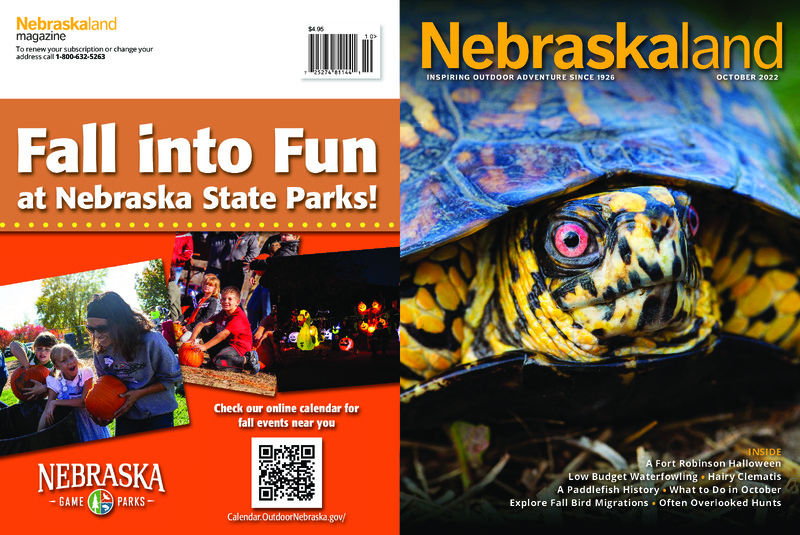
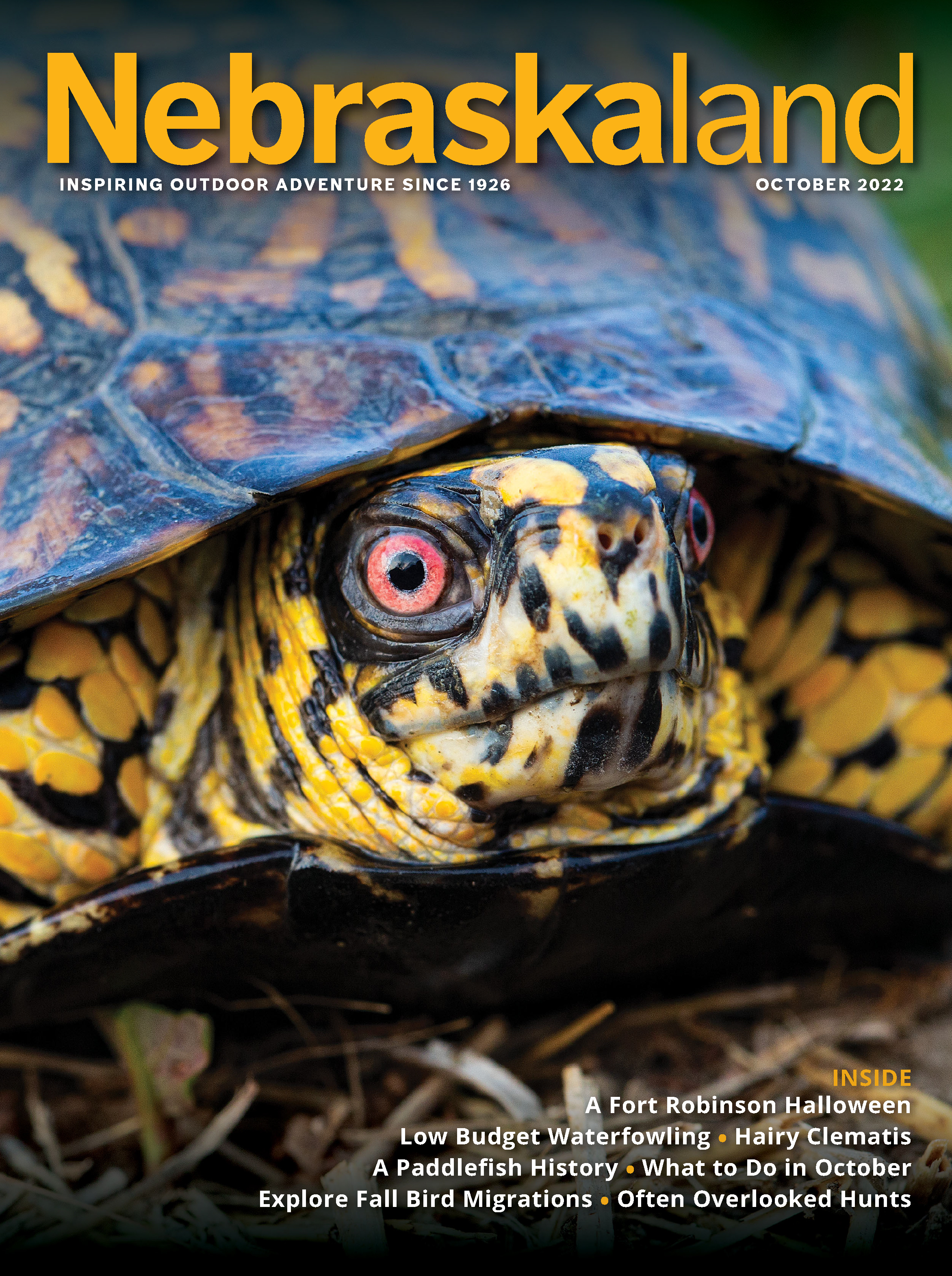
Cover: The ornate box turtle
C
iis Nebraska’s only native
tterrestrial (land) turtle.
JJEFF KURRUS, NEBRASKALAND
FEATURES
20
26
28
HAUNTED HALLOWEEN
At Fort Robinson State Park
Story and photos by Justin Haag
ERIC FOWLER, NEBRASKALAND
OUTDOOR NEBRASKA
What to Do in October
By Renae Blum
PADDLEFISH SNAGGING
A History of a Unique Fishery
By Kirk Steffensen
34
LOW BUDGET WATERFOWLING
36
EARLY LICENSE PLATES AND
DRIVER’S LICENSES
40
T page: Forested bluffs
This
ppainted in fall color rise above
tthe Missouri River Valley
dotted with fog at Indian Cave
State Park in Nemaha and
Richardson counties.
By Todd Mills
By David L. Bristow, History Nebraska
ON THE MOVE AGAIN
Explore Fall Bird Migration
By Olivia DaRugna
46
PIGMENTS OF THE FUR TRADE
48
REDISCOVERING HAIRY CLEMATIS
By Dr. James A. Hanson
Story and photos by Gerry Steinauer
DEPARTMENTS
8
12
50
60
62
Your Nebraska
In the Field
Mixed Bag
Portraits from the Past
The Last Stop
ON THE WEB
For more articles and
information, visit
NebraskalandMagazine.com
Nebraskaland (VOL. 100 / NO. 8 ISSN 0028-1964) is published monthly, except for the combined Jan./Feb. and Aug./Sept. issues, by the Nebraska Game and Parks Commission, 2200 N. 33rd St.,
Lincoln, NE. Periodicals postage paid at Lincoln, Nebraska, and additional mailing offices. POSTMASTER: Send address changes to Nebraskaland, P.O. Box 30370, Lincoln, NE 68503-0370.
4
Nebraskaland • October 2022
October 2022 •
Nebraskaland
5
Magazine Staff
magazine
Published by the Nebraska Game and Parks
Commission since 1926. The Commission is
dedicated to the conservation and protection
of all the state's natural resources and the
people who use them.
Statement of ownership and monthly circulation
of Nebraskaland Magazine
Owner and publisher: Nebraska Game and Parks
Commission
Editor: Jeff Kurrus
Headquarters of Publisher and Publication:
2200 N. 33rd St., Lincoln, NE 68503
Stockholders, Bondholders, Mortgage and
Security Holders: None
Communications Director Christy Firestone
Public Relations Manager Shawna RichterRyerson
Editor Jeff Kurrus
Associate Editor Jenny Nguyen-Wheatley
Regional Editors Eric Fowler, Julie Geiser,
Justin Haag
Contributing Editor Michael Forsberg
Regular Contributors Renae Blum,
Chris Helzer, Chris Masada, Todd Mills,
Ryan Sparks, Gerry Steinauer
Average number of copies
of each issue during
preceding 12 months
A. Total Copies Printed
(net press run) ..................... 20,512 ........... 19,014
B. Paid Circulation
1. Mail subscriptions ........... 16,912 ........... 16,108
3. Single-copy sales ................2,430 ............. 1,750
C. Total Paid Circulation.......... 19,351 ........... 17,866
D. Free Distribution
by Mail ........................................318 ................ 322
D. Free Distribution
Outside the Mail ........................377 ................ 377
E. Total Free Distribution ..............695 ................ 699
F. Total Distribution ................. 20,046 ........... 18,565
G. Copies Not Distributed .............442 ................ 437
H. Total ...................................... 20,488 ........... 19,002
I. Percent Paid and/or
Requested Circulation ........ 96.53% .......... 96.23%
Art Director Tim Reigert
Graphic Designer Mel Severin
Photo Librarian Jaclyn Cruikshank Vogt
Administration
Director Tim McCoy
Deputy Director Jim Swenson
Assistant Director Roger Kuhn
Commissioners
Chairman - Pat Berggren, Broken Bow
Vice Chairman - Rick Brandt, Roca
2nd Vice Chairman - Robert Allen, Eustis
Circulation
For address changes and questions about your
subscription, call 800-632-5263
Advertising Sales Manager
For advertising information contact
Shane G. Gilster, 402-742-0125
Email: shanegilster@gmail.com
Ken Curry, Columbus
Donna Kush, Omaha
Scott Cassels, Omaha
John Hoggatt, Kearney
Doug Zingula, Sidney
Dan Kreitman, Wahoo
Nebraskaland Magazine Copyright 2022, all rights reserved.
Nebraskaland is available in audio from the Nebraska Library
Commission Talking Book and Braille Service, Suite 120, 1200 N St.,
Lincoln, NE 68508. 800-742-7691. Nebraskaland Magazine and the
Nebraska Game and Parks Commission reserve the right to reject any
advertising not in keeping with the agency mission.
Rates: $18 for one year; $33 for two years; $44 for three years. Nebraska
recipients must add appropriate sales tax. To subscribe call
1-800-NEBLAND (632-5263), or go online to:
NebraskalandMagazine.com.
Commission Offices
Conservation Officers
Headquarters/Southeast District Office
2200 N. 33rd Street Lincoln, NE 68503
Phone 402-471-0641
ADMINISTRATION (Lincoln)
Craig Stover (Administrator)
Duane Arp (Asst. Administrator)
Travis Shepler (Asst. Administrator)
Jeff Clauson (Asst. Administrator)
Northeast District Office
2201 N. 13th St. Norfolk, NE 68701
Phone 402-370-3374
Southwest District Office
301 E. State Farm Rd. North Platte, NE 69101
Phone 308-535-8025
Northwest District Office
East Hwy. 2, Box 725 Alliance, NE 69301
Phone 308-763-2940
Bassett Office
524 Panzer St., Box 508 Bassett, NE 68714
Phone 402-684-2921
402-471-5531
402-471-5531
402-471-5531
402-471-5531
NORTHWEST (Includes counties covered)
Dan Kling (Lieutenant)
308-430-0572
EAST SUB-DISTRICT
Sean Schultz (Sergeant)
308-760-0145
Jerod Hahn (Deuel, Garden, Grant)
Keith Jadlowski (Keith, Deuel)
Jaden Porter (Keith, Garden)
Tyler Stueck (Keith)
Travis Schultz (Morrill, Cheyenne)
308-520-5539
308-289-9580
308-289-2274
308-289-6260
308-279-1292
(Keith, Arthur)
WEST SUB-DISTRICT
Matt Brandt (Sherman, Howard)
Daryl Teter (Howard, Greeley, Merrick)
Kyle Gaston (York, Polk, Hamilton)
SOUTH SUB-DISTRICT
402-200-9597
Tim Williams (Hall, Hamilton, York)
Eric Javins (Adams, Clay, Webster)
Pat George (Harlan, Franklin, Phelps)
Ethan Teter (Buffalo, Kearney)
308-380-7331
402-902-2017
308-920-2762
308-440-3847
(Thayer, Fillmore, Nuckolls)
SOUTHWEST (Includes counties covered)
Roger Thompson (Lieutenant)
308-530-3097
NORTH SUB-DISTRICT
Ray Dierking (Custer, Thomas, Blaine)
Frank Miller (Cherry, Hooker)
Greg Hesse
308-870-0322
402-389-0444
308-546-7464
308-660-4671
308-530-3157
(Hooker, Thomas, southern Cherry)
308-672-1824
Kelsey Glodowski
308-763-8226
Alex Hasenauer (Lincoln, Perkins)
Brandon O’Neal
Ak-Sar-Ben Aquarium/Schramm Education
Center
21502 W. Highway 31 Gretna, NE 68028
Phone 402-332-3901
Hunter Pearson
308-360-1817
SOUTH SUB-DISTRICT
Josh Widhelm (Scotts Bluff)
Jacob Stoinski (Sioux, Dawes)
308-279-9133
308-615-9017
(Red Willow, Frontier, Hayes, Hitchcock)
Omaha Office
8495 Frederick Street, Omaha, NE 68124
Phone 402-595-2144
NORTHEAST (Includes counties covered)
Dale Davis (Lieutenant)
402-760-0712
(Kimball, Banner, Scotts Bluff)
(Box Butte, Sheridan, Grant)
(Box Butte, Sheridan, Grant)
NORTH SUB-DISTRICT
Jeff Jones (Sergeant)
402-762-5022
John Bauer (Holt, Boyd)
Tyler Adelman
402-314-9257
402-314-4783
(Knox, Cedar)
(Rock, Brown, Keya Paha)
Jonathan Andreasen
402-340-3981
Mitch Johnson (Knox, Antelope, Pierce)
402-613-8612
(Madison, Pierce, Stanton)
OutdoorNebraska.org
SOUTH SUB-DISTRICT
Cory Krause (Sergeant)
402-380-6410
Kyler Prochaska (Platte, Colfax)
Matt Costello (Dodge, Colfax)
Kelbi Abke (Washington, Burt)
Nicholas Fix (Dixon, Dakota, Thurston)
402-830-8278
402-317-4014
402-237-2537
402-508-0261
(Cuming, Wayne, Stanton)
The Nebraska Game and Parks Commission does not discriminate
based on race, color, ethnicity, national origin, sex, pregnancy, sexual
orientation, gender identity, religion, disability, age, genetic information,
veteran status, marital status, and/or political affiliation in its programs,
activities, or employment. Any person who believes he or she has been
discriminated against in any program, activity, facility, or service,
should contact the Nebraska Game and Parks Commission, Lincoln, NE
402-471-0641, the Nebraska Equal Opportunity Commission, Lincoln,
NE 402-471-2024, TTY/TDD 800-642-6112; Director, Office of Diversity,
Inclusion and Civil Rights, U.S. Department of Interior, 1849 C Street,
NW, Washington, D.C. 20240.
6
Nebraskaland • October 2022
CENTRAL (Includes counties covered)
Mike Thome (Lieutenant)
308-293-8746
NORTH SUB-DISTRICT
Doug Pollard (Sergeant)
(Loup, Garfield, Valley)
308-730-7050
308-202-0819
308-440-1863
402-719-6226
Matt Taylor (Sergeant)
Sean McKeehan (Sergeant)
Kearney Office
1617 First Ave. Kearney, NE 68847
Phone 308-865-5310
Single issue
nearest to
filing date
(Lincoln, McPherson, Logan)
Brian Piernicky (Sergeant)
308-340-6627
Bryce Streger (Dawson, Gosper, Custer)
Matt Andrews
308-537-0404
308-746-2418
Taylor Dixon (Dawson, Gosper)
Sophia Gobber
308-217-2108
308-222-0368
(Furnas, Gosper, Frontier, Red Willow)
(Chase, Dundy, Hayes, Hitchcock)
SOUTHEAST (Includes counties covered)
Stacey Lewton (Lieutenant)
402-890-7140
EAST SUB-DISTRICT
Heath Packett (Sergeant)
402-210-0888
Russell Mort (Otoe, Johnson)
Rich Berggren (Douglas)
Brian Arp (Douglas, Sarpy)
Dan Evasco (Sarpy)
Mike Luben (Saunders, Butler)
Bryan Adams
402-209-1506
402-619-1355
531-530-9011
402-616-5961
402-443-6392
402-429-1924
(Cass)
(Nemaha, Pawnee, Richardson)
WEST SUB-DISTRICT
Dina Barta (Lancaster)
Luis Nuñez (Lancaster)
Mark Sullivan (Lancaster, Seward, Butler)
Trevor Stahlecker (Lancaster, Saline)
Matt Seitz (Gage, Jefferson)
402-890-6463
531-333-6093
402-741-0636
402-314-9641
402-806-0915
YOUR NEBRASKA
Instagram Photos
Follow us @nebraskaland
and tag us in your photos
to be featured in an
upcoming issue.
Don Brockmeier, Eustis
Bobwhite Dive
Kirk Pridell, Papillion
Cicada Killer Wasp
Jayson Alder, Elkhorn
Barred Owl
8
Nebraskaland • October 2022
October 2022 •
Nebraskaland
9
YOUR NEBRASKA
Tiara Brown, Omaha
Sunset Kayaker on Zorinsky Lake
Send your comments and
photos to:
Jeff Kurrus, Editor
Nebraskaland Magazine
P.O. Box 30370
Lincoln, NE 68503
or email Jeff.Kurrus@Nebraska.gov
David Rochford, Waterloo
Monarch Butterfly
Please include your postal address
and telephone number. Letters
may be condensed and edited.
Photographs are also welcome.
10
October 2022 •
Nebraskaland • October 2022
Nebraskaland
11
IN THE FIELD
FALL FOLIAGE
Red currant leaves along
a Pine Ridge stream in
Sioux County north of
Crawford.
BOB
B GRIE
GR
GR
RIE
IE
ER
R,, NE
EBRA
EBR
BRA
RA
ASKA
SKA
SKAL
S
KA
ALAN
AND
ND
N
12
Nebraskaland • October 2022
October 2022 •
Nebraskaland
13
IN THE FIELD
The Blanding’s turtle can be found in north-central Nebraska.
JUSTIN HAAG, NEBRASKALAND
CELEBRATE REPTILES
By Shawna Richter-Ryerson
Nebraska is home to nearly 30 snake, 10 lizard and
nine turtle species, each with unique characteristics,
habits, habitats and food sources. And in October — but
especially on Oct. 21 — we get to celebrate them and their
amazing adaptations during National Reptile Awareness
Day.
Reptile fans have a number of ways to celebrate:
• Children may participate in a kids’ reptile art contest
through Oct. 17 by submitting an original piece of art
featuring a native Nebraska reptile. They can learn
about Nebraska’s reptiles or submit their art through
OutdoorNebraska.gov/ReptileArt.
• Those of any age can attend a reptile-themed event,
such as the “Science of … Lizards” virtual program set for
Oct. 6. Find other events at Calendar.OutdoorNebraska.
gov.
Though some reptiles, including snakes, are often widely
14
Nebraskaland • October 2022
feared, there is a lot to love about Nebraska’s reptiles. They
help maintain healthy animal populations across our state
by serving both as a predator and as prey. They eat rodents
and insects and even small mammals, and in turn, serve as
food for raptors, foxes and coyotes, among others.
Because reptiles are susceptible to pollution, habitat
destruction and wildlife disease, their success or lack
thereof also helps us know when our ecosystems need
help.
And if none of these reasons have convinced you that
National Reptile Awareness Day is worth celebrating, just
take a look at this most loveable set of reptiles: Turtles —
and the Blanding’s turtle in particular. When you see his
built-in smile, with gleaming yellow chin, it’s hard not to
smile, too.
Learn more about this often-misunderstood and diverse
group of creatures at OutdoorNebraska.gov/Reptiles.
IN THE FIELD
Brisk fall winds rustle the stems of common reed at Big Alkali Lake on the Valentine National Wildlife Refuge in the Cherry
County sandhills. GERRY STEINAUER, NEBRASKALAND
HOLD ON TO YOUR HATS
By Martha D. Shulski
From comments in the grocery store check-out line
to social media posts, everyone was sharing stories
about the wind this spring. Every other day, there
seemed to be a high-wind warning and high fire
danger in a pre-green-up landscape. Deadly wildfires
wreaked havoc following our fourth driest winter on
record.
Just how unusual were these winds? For that
answer, we’ll turn to our old friend climatology.
Typically, the average monthly wind speed is in the
10 mph range here in Nebraska. Of course, it can be
significantly higher with the passage of a storm or
frontal boundary.
This April, averages around the state were in the
15 mph range. For a monthly average speed, that
is certainly noticeable and impactful. Furthermore,
wind gusts reached 60 to 70 mph on several occasions.
16
Nebraskaland • October 2022
According to the National Weather Service, wind
gusts of 58 mph or greater are considered severe;
hurricane strength winds begin at 74 mph.
Spring is typically a time of year when winds
can be at their peak, owing to a strong temperature
contrast in the northern hemisphere. Winter hangs
on longer in the north, while conditions can be near
summer-like in the south.
As we go into fall, that strong temperature
gradient is not yet established and winds tend to
be lighter than during spring. Those gradients in
temperature lead to gradients in pressure, which
leads to wind. Is higher than usual wind something
we should expect more of in the future? That is a
tough question without a simple answer. However, if
we’ve experienced it once in Nebraska, chances are
we’ll experience it again.
IN THE FIELD
Perch fish cakes seasoned with Old Bay.
JENNY NGUYEN-WHEATLEY, NEBRASKALAND
PERCH CAKES
By Jenny Nguyen-Wheatley
Servings: 4
Prep Time: 3 hours and 30 minutes
Cook Time: 30 minutes
Ingredients:
1 pound of perch fillets, boneless and skinless
12 ounces russet or yellow potato
Kosher salt, to taste
Olive oil
4 cloves of garlic, minced
2 eggs, beaten
1
⁄4 cup of chopped cilantro, leaves and stems
1
⁄4 teaspoon of cayenne pepper
3
⁄4 teaspoon of Old Bay Seasoning
1
⁄4 cup of panko breadcrumbs
11⁄2 teaspoons of fresh, minced dill
1
⁄3 cup of rice flour, or all-purpose flour
Tartar sauce
Lemon wedges
•
•
•
•
•
•
•
•
•
•
•
•
•
•
1. Peel potato and slice into large pieces. In a small
saucepan, cover potatoes with water and add a generous
pinch of salt. Boil for 15-20 minutes, or until potatoes
soften. Drain, mash and transfer to a medium-size mixing
bowl.
18
Nebraskaland • October 2022
2. Pat fish dry with paper towels and season with salt.
Coat the bottom of a nonstick pan with oil and heat over
medium-high. Brown fish on one side — do not flip — in
batches; add more oil as needed. Transfer cooked fish to a
bowl. Reduce heat to medium and sauté minced garlic until
fragrant, about 30 seconds. Take off heat.
3. When fish is cool enough to handle, gently break it
up into pieces. In the bowl with the mashed potato, mix in
beaten egg, cilantro, cayenne pepper, panko, dill, Old Bay
Seasoning, 1⁄4 teaspoon of kosher salt and sautéed garlic.
Then gently fold in perch. Try not to break up the fish too
much; you want to be able to see the flakes. Cover and
refrigerate for at least 3 hours before frying.
4. Turn oven to 350 degrees Fahrenheit. Pour rice flour
onto a plate. In a skillet, heat 1⁄4 inch of oil over medium
heat. When oil starts shimmering, form cold fish mixture
into 1⁄2-inch thick patties and then coat with rice flour,
shaking off excess. Brown perch patties until golden and
crispy on both sides, allowing plenty of room between the
patties. Add more oil as needed. Keep the cooked patties
warm in the oven while you cook the remaining fish.
5. Serve immediately with tartar sauce and lemon
wedges. To reheat leftovers, deep fry or bake at 400 degrees
Fahrenheit.
Take a beginner
hunting,
Win Prizes!
Prizes include...
GRAND PRIZE
...and
more!
John Deere
XUV590M Gator
in Camo
LEARN MORE AT
OutdoorNebraska.org/TakeEmHunting
October 2022 •
Nebraskaland
19
Haunted Halloween
at Fort Robinson
State Park
Photos and story by
Justin Haag
S
ome say ghosts haunt the historical grounds of Fort
Robinson State Park. Whether it is true, on one
night in late October, the spooky side of the park will
take center stage — and, judging from the previous year’s
success, visitors are anything but scared away.
The staff at Fort Robinson is gearing up for the park’s
second “Haunted Halloween,” an event that features wagon
rides, a chili feed and trick-or-treating, all accentuated by a
cast of spooky characters and decor throughout the Soldier
Creek Campground.
Though 2021 marked the first year for the “Haunted
Halloween,” it was not the park’s first event for the fall
holiday. Students of Chadron State College and nearby
Crawford public schools used to create a haunted house
at the Fort each Halloween. That event eventually moved
into Crawford, but was discontinued after a short time.
Deb Kennedy, a park superintendent, has wanted to
bring a Halloween event back to the park ever since it left.
“I love, I mean love fall and Halloween, and I really
wanted to bring it back to the Fort,” she said.
After the Fort’s annual historical Christmas dinner was
canceled for two straight years for coronavirus precautions,
Kennedy pitched the idea of a Halloween event in the safer
outdoor environment. Despite short time to prepare, the
park employees pulled it off.
“All of the permanent and temporary staff pitched in.
They had great ideas and had a great time working on it,”
she said. “We raided my pumpkin patch, dragged out my
many, many Halloween decorations, a few of us pitched
in some money, and I put some pressure on my family to
participate and bring their campers, and we got it going.”
The event exceeded expectations as hundreds of visitors
from northwestern Nebraska and neighboring states
converged upon the campground.
Although somewhat surprised by the turnout, Kennedy
said a Halloween event is a natural fit for Nebraska’s
largest state park.
“What better place, with the vast history, old
cemetery, large area, lots of parking, beautiful and scenic
campgrounds and protection from the elements? We
couldn’t ask for more,” she said.
This year’s event is set for Oct. 29, and, if Kennedy has
her way, it will top last year’s.
“I have some big ideas and would like to change it up a
bit.”
The public is encouraged to set up camp with candy, or
just bring the family that evening for the chili, a festive
atmosphere and natural autumn splendor. Find more
information at Calendar.OutdoorNebraska.gov. N
The park’s Jeep pulls a load of park visitors across
Soldier Creek.
20
Nebraskaland • October 2022
October 2022 •
Nebraskaland
21
LEFT: Although bodies were
long ago moved from the Fort’s
historical cemetery, the old stones
that remain provide perfect
habitat for skeletons.
BELOW LEFT: Trick-or-treaters
reap the sweet rewards of visiting
campsites.
OPPOSITE: Even witches enjoy the
warmth of an autumn campfire.
22
Nebraskaland • October 2022
October 2022 •
Nebraskaland
23
ABOVE LEFT: Park visitors’
costumes add to the festive
atmosphere.
BELOW LEFT: Have you ever
before seen such handsome
mummies?
ABOVE RIGHT: Diane
Humphries greets trick-ortreaters at her decked-out
campsite.
24
Nebraskaland • October 2022
Is It Haunted?
I
t seems any old building with
character is subject to reports
of paranormal activity. Fort
Robinson
has
many
such
structures: about four dozen, in
fact, with construction dating back
to the 1870s. Combine the old
architecture with a steady stream
of overnight visitors and the fort’s
history of conflict between the U.S.
cavalry and Native Americans, and
the conditions are ripe for ghost
stories.
Four investigators from the
Nebraska Paranormal Society,
an organization that researches
the existence of ghosts and
other unexplained phenomena,
conducted an investigation at Fort
Robinson State Park in 2010 after
hearing reports of phantom cavalry
soldiers, Indians and horses.
The investigators gave Fort
Robinson the same label as most
other locations listed on their
website: “inconclusive.”
October 2022 •
Nebraskaland
25
Outdoor Nebraska
By Renae Blum
Ah, fall. As you enjoy the changing trees and crisp autumn breezes, take some
time to be outside. You can enjoy foraging for mushrooms, hunting, viewing
wildlife and visiting parks. N
View and
photograph orb
weavers
As weather allows | Statewide
Beautiful spiderwebs make for a
great photo. This month, look for
webs made by orb weavers — a
diverse group of spiders that build
large, distinctive wheel-like webs.
You can find them
almost anywhere:
trees, shrubs, prairies,
near streams and on
buildings near lights.
Examples of orb
weavers include the
marbled orb weaver,
the yellow garden
spider and banded
garden spider.
What to Do in October
Hunt
waterfowl
Season dates vary
Statewide
Many waterfowl seasons
open this month, and
you don’t want to miss
it: breakfast in the blind,
watching the sun rise, the
camaraderie of a good hunt
and your dog’s excitement at
retrieving birds. Memories
are waiting to be made! Learn
more in the Small Game and
Waterfowl Guide.
JEFF KURRUS, NEBRASKALAND
Get festive
Throughout the month | Statewide
Find a bit of Halloween fun at parks across the state throughout
October. Compete in campsite decorating contests, go trick-ortreating, roll pumpkins or go back in time during a Halloween-themed
living history event at Arbor Lodge. Parks from Arbor Lodge to Fort
Robinson will be hosting haunted events throughout the month. Find
an event near you at Calendar.OutdoorNebraska.gov.
JENNY NGUYEN-WHEATLEY, NEBRASKALAND
KEN BOUC, NEBRASKALAND
Visit Ash Hollow State
Historical Park
Throughout the year | Lewellen
Once an oasis stopover for pioneers on their journey
west, Ash Hollow is still an attractive place to spend
time. The park offers numerous picnic tables and
nine miles of hiking on beautiful trails, including
one displaying deep ruts carved by covered wagons.
Stop by Wednesdays through Sundays, 9 a.m. to 5
p.m., to explore the visitor center and Ash Hollow
Cave — hours go to appointment only in November,
so hurry over!
Fall fungi foraging
workshop
Oct. 1 | Indian Cave State Park
Join Game and Parks educators as we embark
on a journey through the fungi-filled scenery
of Indian Cave State Park. Biologist Chance
Brueggeman will discuss mushroom facts
and tips for finding them, followed by a
guided hike to look for fungi in the park.
Registration is required; sign up online at
Calendar.OutdoorNebraska.gov.
JENNY NGUYEN-WHEATLEY, NEBRASKALAND
ERIC FOWLER, NEBRASKALAND
26
Nebraskaland • October 2022
October 2022 •
Nebraskaland
27
Paddlefish
Snagging
A History of a
Unique Fishery
By Kirk Steffensen, Missouri River Program Manager
P
addlefish are a group of
ancient fish species with
fossilized records dating
back approximately 125 million
years. They are one of the largest and
longest-living freshwater fish species
in the world, with a lifespan of 30-plus
years, and are easily recognizable by
their elongated rostrums — beaklike
snout — and lack of scales.
Filter feeders, paddlefish swim
with their large mouths open and
filter the microscopic plankton,
mainly zooplankton, out of the water.
Therefore, conventional fishing
methods of baiting are ineffective.
Paddlefish are generally captured
by snagging, which requires casting
and forcefully pulling a hook through
the water until you “foul hook” a
paddlefish. Paddlefish in Nebraska
can, on rare occasions, exceed 100
pounds, and the current snagging
state record stands at 113 pounds and
Paddlefish are filter feeders, using their large mouths to filter microscopic plankton out of the water.
Conventional fishing methods of baiting are ineffective on paddlefish. ALEX WILES MEDIA
4 ounces.
Today, the American paddlefish
(Polyodon spathula) is the only
remaining
paddlefish
species
worldwide, and one of Nebraska's
most fascinating fish species.
Fertilized paddlefish eggs photographed at Gavins Point Fish Hatchery.
ALEX WILES MEDIA
28
Nebraskaland • October 2022
A Natural History
American paddlefish are native to
the Mississippi River basin, inhabiting
large, free-flowing rivers, backwaters
and oxbow lakes. They are extremely
mobile, capable of moving thousands
of miles between major river systems.
In Nebraska, paddlefish are found in
the mainstem Missouri River and the
lower reaches of larger tributaries,
including the Platte River, with the
greatest numbers found in the lower
unchannelized reach between Gavins
Point Dam and Sioux City.
This highly sought-after fish is
generally regarded as tasty among
anglers, but commercial fishermen
are mostly after the female’s eggs,
or roe, which is processed into
caviar. Paddlefish roe has become
more desirable since the collapse of
the Caspian Sea sturgeon market,
primarily from beluga sturgeon (Huso
huso) and other sturgeon, including
the kaluga, Ossetra, sevruga, sterlet
and Siberian sturgeons, and paddlefish
fisheries. Labeled as American
paddlefish caviar, the product can
exceed $400 per pound. Although
commercial fishing for paddlefish
is illegal in Nebraska, the practice
remains open in several other states.
In our part of the Missouri River,
October 2022 •
Nebraskaland
29
Management
Since the closure of Gavins Point
Dam and the inception of the fishery,
the Nebraska Game and Parks
Commission and the South Dakota
Department of Game, Fish and Parks
have jointly managed paddlefish. Over
the next 30 years, daily bag limits and
possession limits were adjusted, and
the season length reduced.
In 1957, a two-fish limit and fourfish possession limit was applied, and
in 1970, the limit was reduced to one
fish and one in possession. The season
length went from year-round to 212
days in 1974, to 151 days in 1983,
and then to 30 days in 1987. Despite
these management actions, anglers
continued to harvest thousands of fish
annually, and the fish they harvested
were getting smaller and younger,
suggesting the fishery was not selfsustaining. Consequently, a public
meeting hosted by Nebraska and South
Dakota biologists prior to the 1989
season informed anglers of declining
harvest. Anglers, in turn, supported
more restrictive management actions
and agreed that the fishery needed
to be managed to protect this unique
fishing opportunity.
As a result of that public meeting, a
derby fishery season was established
prior to the 1989 season. It imposed
a 1,600-paddlefish-harvest quota or
30-day-maximum, whichever came
first, and no harvest outside of the
snagging season. The harvest quota
was based on a 5 percent take of the
estimated population below Gavins
Point Dam. Eager anglers rushed
to the water, and the harvest quota
Sallie Doty of Pierre, South Dakota, caught this 34.5-inch paddlefish near Gavins Point Dam.
JENNY NGUYEN-WHEATLEY, NEBRASKALAND
management efforts have changed
and evolved over the years, all in the
hopes of protecting this unique fishery
for future generations.
Fishery
The modifications to the mainstem
Missouri River created the paddlefish
fishery we have today. Construction
of Gavins Point Dam was completed
in 1955 and Fort Randall Dam in 1958.
The construction of Fort Randall Dam,
just north of the Nebraska-South
Dakota border, formed a 39-mile
30
Nebraskaland • October 2022
riverine reach behind Lewis and Clark
Lake that isolated this population
from the open Missouri River. Below
Gavins Point Dam, 811 river miles
remain open, flowing into the middle
Mississippi and connecting other large
rivers. Although fish below Gavins
Point Dam can swim unhindered, the
dams created a barrier to upstream
movement, causing populations to
aggregate immediately below both
dams, making them more susceptible
to capture.
At the time, as expected, anglers
quickly took advantage of the creation
of this new fishing opportunity. These
newly created tailwaters offered
anglers a unique pursuit, different
from the traditional sport fishing
they were used to. Unfortunately,
this unchecked enthusiasm caused
overexploitation, and the paddlefish
populations quickly suffered.
In 1959, anglers harvested an
estimated 12,850 paddlefish below
Fort Randall Dam, and three years
later, only a few fish were harvested
— indication of how sensitive this
isolated population was between
Fort Randall and Gavins Point dams.
Because of this event, harvesting of
paddlefish above Gavins Point was
prohibited in 1987, and the regulation
is still in effect to this day.
The reach below Gavins Point Dam
remained open to fishing, however, as
these mobile paddlefish populations
were more resilient. Still, management
actions had to be implemented
to protect this fishery from
exploitation. It has been an ongoing
two-state effort.
An angler holding a paddlefish rigging.
JENNY NGUYEN-WHEATLEY, NEBRASKALAND
October 2022 •
Nebraskaland
31
remains at an annual harvest of 1,600
fish, 800 per state. Nebraska issues
1,600 snagging permits, expecting
the success rate will be around 50
percent. Fisheries biologists from
both states continue to work together
to manage the fishery and the
harvest objectives.
Paddlefish snagging is a unique
fishing opportunity, and recreational
fishing is limited to a few Midwestern
states: Montana, North Dakota, South
Dakota, Iowa, Kansas, Oklahoma and
Missouri. Whether you’re interested in
experiencing this unique fishing
experience, enjoy eating paddlefish or
spending outdoor time with family
and friends, snagging is hard work, so
be prepared if you ever decide to cast a
line for paddlefish. N
Kirk Steffensen is the Missouri River
program manager for the Nebraska
Game and Parks Commission. He has
worked on the Missouri River for more
than 20 years.
Anglers fish for paddlefish by boat and bank on the Missouri River near Gavins Point Dam.
JENNY NGUYEN-WHEATLEY, NEBRASKALAND
was reached in just four days during
that novel season. This derby-style
fishery also caused safety concerns
as high numbers of boaters and bank
anglers created long wait lines at the
creel station, boat ramps and limited
parking areas.
The pressure on the paddlefish
fishery remained high and monitoring
was showing a population dominated
by small, young fish with limited
reproduction occurring. Therefore,
prior to the 1992 season, the “slot”
regulation was implemented, which
32
Nebraskaland • October 2022
protected 35- to 45-inch fish by making
them catch-and-release only. Fish in
this size range are the main breeders
in a population, and the regulation
made the fishery more sustainable.
Additionally, a portion of the
tailwaters was closed and hooks were
limited to one-half inch in size from
point to shank to reduce injury and
mortality to fish that were caught and
released. These management actions
had little effect on harvest rates, and
from 1993 to 1996, the harvest quota
was still achieved in just a few days.
Following another public meeting
in 1996, the limited-entry paddlefish
snagging season was established.
Each state issued 1,200 permits
through a free-entry lottery system,
and the season was moved to the
month of October; furthermore,
anglers could only snag between 7
a.m. and 7 p.m. each day.
The number of permits was
increased to 1,400 in 2000 and to 1,600
in 2008 as annual harvest estimates
were below the harvest objective.
Due to the increasing number of
anglers entering the permit lottery
but not participating during the
snagging season, Game and Parks
began charging a $5 application fee
in 2003. Prior to the 2007 season, the
$5 application fee was waived and
successful applicants purchased a
permit ($20 for residents and $40 for
non-residents).
The current permit structure was
adopted in 2016, with a $7 application
fee and permits costing $26 for
residents and $50 for non-residents.
The present management objective
Yancy Krol of Osceola, Nebraska, snags a paddlefish near
Gavins Point Dam. JENNY NGUYEN-WHEATLEY, NEBRASKALAND
October 2022 •
Nebraskaland
33
Low Budget Waterfowling
By Todd Mills
T
humbing through one of my favorite waterfowl
magazines, I stumbled into the new gear section. It
was impossible to turn the page without seeing something
I could use. It made me wonder how we did it before all this
new gear was available.
Long before all the technology and gadgets were invented
and used by kids today, we entertained ourselves with
things that cost less money. My family lived in a house the
size of my current garage, so extra spending money wasn’t
something I could scrape together. We were very creative
and resourceful due to our financial reality. As a kid growing
up in a small lake town in the ’70s, the passion for waterfowl
hunting ran deep in my blood. Hunting was something we
could do on a small budget, and it’s still true today.
There are several ways to keep your budget low and still
enjoy waterfowl hunting. Here are a few ideas that will go
easy on your wallet and fill a few bird straps.
DECOYS
While hunting teal a couple of years ago, I was in a rush to
get out the door and inadvertently grabbed the wrong bag of
decoys. Now faced with the reality of not getting to my spot
on time if I went back, I decided to use what I had. Much to
my surprise, it didn’t make much difference in decoying those
teal. In fact, it made for an enjoyable eye-candy hunt as bigger
ducks, not yet in season, decoyed right. The moral of the story
is, you don’t need the most expensive decoys to kill ducks —
regardless of the waterfowl you pursue. Keep it simple, find
the right price and let your scouting skills do the rest.
KEEP IT CLEAN
You can spend a lot of money on guns. In fact, for some
hunters, it can become an addiction. Not that I’m against
new guns or people that own them, I’ve just always been an
over-and-under guy and through the years have found ways
If the budget is tight, no need to buy that new gun. Take care of the one you have and find time to clean it after
every hunt. It will pay dividends in the long run. JEFF KURRUS, NEBRASKALAND
to keep my guns clean and working properly. As my buddies’
fancy automatics keep jamming, my over-and-under keeps
plugging away.
It’s important to clean your gun after every hunt. Sand and
dirt buildup in an older gun can be a disaster and may lead to
costly repairs. Also remember to remove moisture from your
gun when you get home to avoid rust buildup. If you’re not
interested in looks or having the newest and best, that old
Remington 870 you owned as a kid may still be working.
CALL SAVINGS
Master two or three sounds on that old wooden call and you’ll kill plenty of ducks. JON FARRAR, NEBRASKALAND
34
Nebraskaland • October 2022
Recently, I’ve reunited with an old friend on some
waterfowl adventures. We had our first hunt almost 50
years ago, but seem to always be going different directions
during the season. Not only is he a skilled waterfowler, he’s
a magician at low budget hunting. A couple years ago, I sent
him a double reed call that cost about $25. Even though he
hunts often, he really never figured out how to use a duck call
the right away. Much to my surprise when we got together,
not only could he blow the call, he sounded pretty good.
He had been practicing, and listening, and didn’t need an
expensive acrylic call to fool ducks. Not only that, he had
put together his own motion decoy: A pulsating goose decoy
almost identical to the ones you can buy for a hefty price. He
told me he saved at least $100 compared to buying one new.
Through trial and error, my friend found a way to save
money and still kill ducks. And it doesn’t hurt that his
scouting skills are always on point. N
Finding the right decoy brand is important, but
scouting will create a bigger return on your time and
financial investment. JEFF KURRUS, NEBRASKALAND
October 2022 •
Nebraskaland
35
Early License Plates
and Driver’s Licenses
By David L. Bristow, History Nebraska
ou drive your shiny new car home from the dealership
and park it out front where your jealous neighbors can
see it. Now, it’s time to make the license plate.
That’s what Nebraska motorists did for 10 years in the
early 20th century. The state began registering automobiles
in 1905, but didn’t manufacture license plates until 1915.
Y
In the meantime, the Secretary of State’s office registered
cars and issued numbers. Owners made their own plates by
attaching metal numbers to a piece of leather.
Thanks to History Nebraska’s Government Records
collection, which preserves the state’s early auto license
records, we know who made the license plate shown
An “auto livery” in Merna (Custer County) apparently didn’t bother with license plates in 1910. History Nebraska RG2608-0-2381
John Reuling’s 1911 license plate. History Nebraska 9320-2
A car with an early Nebraska license plate, circa 1910. History Nebraska RG3064-0-20
36
Nebraskaland
• October 2022
above. John A. Reuling of Wymore had this number from 1911
to 1915 for his 30-horsepower Halladay auto. Reuling was
a local jeweler, and later a bank president, who was elected
mayor while he owned the car.
It’s no surprise that the car belonged to one of the wealthier
citizens. Auto ownership was still expensive and exclusive,
but the mass-produced Ford Model T was starting to change
that.
Like license plates, early driver’s licenses were simple. It
took many years for the driver’s license to take on its current
A 1916 license contained only the most basic information.
History Nebraska 8910-44
role as a universal form of identification. The 1916 license
shown above was a “Motor Vehicle License” that was issued
annually and functioned both as a driver’s license and proof
of registration.
By 1930, Nebraska was one of 24 states that required a
October 2022 •
Nebraskaland
37
Driver’s licenses had grown more elaborate by 1930. History
Nebraska 9663-11-(10) and 9663-11-(11).
After Millard’s car was stolen from in front of the Brandeis
Building in downtown Omaha, the police chief mailed
postcards to county sheriffs. History Nebraska 9663-11-(10)
database. To protect the non-laminated license, it came in an
envelope with a little window.
Not only were licensing and registration more primitive in
the early days, so were the methods to recover stolen cars.
The postcard shown above was printed for the Omaha chief
of police and mailed to county sheriffs across the region. This
one was addressed simply to “Sheriff, Falls City Neb.” We
don’t know if Mr. Millard ever got his car back. N
Read more stories by searching “automobile” at History
Nebraska’s website, history.nebraska.gov
driver’s license. (Neighboring South Dakota didn’t issue
driver’s licenses until 1954.) The 1930 license shown above
was issued to a Burwell woman. It had no photo and a
physical description that focused only on skin color. On the
back was a form for a driver’s previous violations, a handy
feature before law enforcement officers could easily access a
38
Nebraskaland
• October 2022
Looking north toward the state capitol on 15th Street in
Lincoln, circa 1912. The car has a nonstandard license plate
that lists the manufacturer. History Nebraska RG3474-47025-015. OPPOSITE PAGE: Nebraska license plates through
the years. Graphic by Ben Kruse, History Nebraska.
October 2022 •
Nebraskaland
39
On the
Move
Again
E x p l o r e Fa l l
B i r d Mi g ra ti o n
By Olivia DaRugna
Watchable Wildlife Biologist
s summer vacations come to an end and a new
season of Husker football begins, many birds
have already begun their journeys from northern
breeding territories to their southern wintering grounds.
Songbirds, shorebirds and waterfowl typically migrate
at night, arriving to new locations to rest and refuel
during the day. This is an exciting time for birders as our
favorite locations can transform literally overnight from
having almost no avian activity to an abundance of new
birds scattered about.
Typically, fall migration is more prolonged than
spring migration, as birds have more time to get to their
wintering areas compared to the rush in spring to arrive
first to claim the best breeding territories. There are also
many more birds on the landscape than in spring, as all
the young birds hatched during the summer attempt
their first migration south. This more relaxed pace of
migration, along with the addition of many more birds,
offers excellent birding opportunities for both novice and
experienced birders.
In Nebraska, fall migration begins as early as late June
with yellowlegs returning, marbled godwits heading
south, and long-billed curlews flocking together before
flying south. Other shorebirds like American avocet peak
their migration from mid to late August. Songbirds and
raptors move through in waves starting in September
A
Along with shorebirds and songbirds, waterfowl — like
these flocks of Canada geese and snow geese in Scotts
Bluff County — usually migrate at night, arriving to new
locations to rest and refuel during the day.
JUSTIN HAAG, NEBRASKALAND
40
Nebraskaland • October 2022
October 2022 •
Nebraskaland
41
Marbled godwits at Kiowa Wildlife Management Area, Scotts Bluff County.
JON FARRAR, NEBRASKALAND
through October, and most waterfowl typically do not pass
through until October. With endless possibilities to view a
variety of species during fall migration, here are just a few
of our favorite places to enjoy this annual autumn spectacle.
Conestoga State
Recreation Area
A Nashville warbler.
42
STEPHEN BRENNER
Nebraskaland • October 2022
Conestoga State Recreation Area has wide-ranging
habitats of a shallow wetland, shrubby fields and a large
waterbody that attracts a variety of migrating birds. The
shrubby fields and adjacent woodlands on the south end of
the lake attract a variety of songbirds like Lincoln’s sparrows
and Nashville warblers. As with most waterbodies across the
state, when water levels are low, the exposed mud flats can
attract a variety of shorebirds during migration. The shallow
wetlands on the northwestern corner of the lake can be an
optimal location to view shorebirds in this area. During late
autumn, the large waterbody draws in hundreds of snow,
Canada and cackling geese as well as large flocks of redhead,
lesser scaup, gadwall, and many other species of ducks.
Lesser yellowlegs loafing in a saline wetland
near Lincoln in Lancaster County.
JON FARRAR, NEBRASKALAND
October 2022 •
Nebraskaland
43
Franklin’s gulls wade at the edge of a sandbar in the Missouri River as it moves through Ponca State Park.
JON FARRAR, NEBRASKALAND
Swainson’s hawk in Garden County.
Lincoln Saline
Wetlands
As songbirds start to migrate south, they rely on a good tail
wind and favorable weather conditions to make their flight
south as easy as possible. If the weather conditions turn bad,
the birds will often land in the nearest area with suitable
foraging habitat. When areas are dominated by development
and agricultural fields, parks can be a little oasis for birds as
they wait for the weather to turn favorable for their next leg
of their journey. The Lincoln Saline Wetlands Nature Center
can often act as this stopover oasis for many songbirds
during their migration south. The availability of water and
shrubby habitat attracts a variety of flycatchers, warblers
and sparrows to this location. Many of the shrubs along the
path are no more than 8 feet high, offering chances to view
migrants near eye-level. At the adjacent Capitol Beach,
hundreds to thousands of Franklin’s gulls congregate and can
often be viewed flying over the saline wetland.
Oliver Reservoir
A Nelson’s sparrow with its short, high, hissing song
emerges from dense marsh vegetation — an uncommon
regular fall migrant in eastern Nebraska. CHRIS MASADA
44
Nebraskaland • October 2022
A gray flycatcher at Oliver Reservoir.
STEPHEN BRENNER
Nestled in the southwestern part of the Nebraska
panhandle, Oliver Reservoir and the nearby town of Kimball
stand out as a beacon of vegetation and water among the
vast, semi-arid grassy landscape of the Great Plains. For birds,
this is like coming across the only gas station for hundreds of
miles during a long family road trip. It is an essential place
to stop, eat and rest before continuing through the expansive
STEPHEN BRENNER
landscape. Not only does this relatively small area attract
solid numbers of expected migrants, but this site also hosts
some uncommon species for Nebraska. Have a field guide
ready as many similar-looking flycatchers and sparrows visit
this location in late August and early September. A variety
of vireos, swallows and warblers, like MacGillivray’s warbler,
also can be observed here.
Not every day in the fall can include early morning trips to
migrant hotspots. For birders interested in catching a glimpse
of migration as it happens in real time, raptors are the perfect
species to watch. Raptors migrate during the day, relying
on tail winds and thermals to help them conserve energy
as they migrate. Raptor migration can be enjoyed almost
anywhere, but it is especially good on cloudier days when
their silhouettes can stand out. Lay back in a camp lounge
chair and look to the sky on days with north winds, and try
to find a stream of raptors flying by. Throughout Nebraska,
watch for Swainson’s hawks as there will usually be multiple
birds soaring together in what is called a kettle. They will soar
in circles as they rise to the top of a thermal before gliding out
to catch the next thermal.
Fall migration is a thrilling time for all birders to view
a variety of species as they make their way back south.
For more ideas on places to enjoy fall migration, visit
NEBirdingGuide.org. Happy birding! N
Olivia DaRugna is a watchable wildlife biologist for the
Nebraska Game and Parks Commission at Wildcat Hills State
Recreation Area and Nature Center in Gering.
October 2022 •
Nebraskaland
45
Pigments of the
Fur Trade
By Dr. James A. Hanson, Historian, Museum of the Fur Trade
T
he following excerpt originally
appeared in the Winter 2021
edition of Museum of the Fur
Trade Quarterly, a publication
based in Chadron, Nebraska.
Because of our reverence for Nebraska
history, this quarterly publication
has been a mainstay for the editors of
Nebraskaland Magazine for many years.
There is no doubt that early
Native Americans were ingenious in
developing earths and other natural
products as pigments for face painting
and artwork. However, the preparation
of those colorants was often a slow
process. At certain times of the year or
in certain locations, it was impossible
to find appropriate materials. Most
of the natural pigments were rather
muted and included shades and tints
of dull red, tan and brown. For these
reasons, native people came to rely on
a steady supply of brilliant colors from
their traders.
For example, before receiving
vermilion, Native Americans had used
native red ochre, but it did not compare
A mid-18th century vermilion keg would have held about 100 pounds. The keg is 12 inches tall and 11 inches in diameter. It is
painted yellow; many French fur trade kegs were brightly painted, perhaps to enable employees to recognize trade goods from
Quebec. PHOTOS COURTESY MUSEUM OF THE FUR TRADE
46
Nebraskaland • October 2022
to the Spanish-Dutch or Chinese
mineral, and they would trade “a
heap of furs” for three times as much
vermilion as would lie on the tip of a
knife. Verdigris, a French colorant, was
used by Native Americans to “paint
their faces green.”
The cover of this issue of the
Quarterly includes a sample of red
ochre obtained from a deposit of the
ore found at Sunrise, Wyoming. It is
known to have been mined there over
10,000 years ago and is listed as a
World Archeological Site by the United
Nations.
In their study of the Omaha
tribe, Alice C. Fletcher and Francis
La Flesche included the following
observations in their remarks on the
changes brought by traders: “Another
saving of labor in comparison with
old methods was involved in buying
paints from the traders. The paint was
sold in small packages not much larger
than a paper of darning needles and
the price of one of those packages in
the last century was the value of 25
cents .… Great quantities of paint were
sold, this article alone yielding a large
profit to the trader.” The authors noted
that the Omaha regularly bought red,
green, blue and yellow paint.
Upper Missouri River fur trader
Edwin Denig stated that the traders
furnished Chinese vermilion, chrome
yellow and verdigris. “Out of all these
an Indian can please himself … .” He
commented that “their native dyes
… have been superseded by those
introduced by the traders, with all but
the Crow Indians. At the present day
they all mostly use the clippings of
different colored blankets and cloth,
which by boiling with the substances
to be dyed, communicates the tint of
the cloth to it in some degree. Thus
rose, green, pale blue and violet colors
are obtained. For black they boil
the inner papers in which Chinese
vermilion is enveloped.”
Opposite, top: 4-ounce buckskin bag of Chinese vermilion, one of several found in
an HBC warehouse at Fort Victoria, British Columbia.
Above: Pigments sold in the fur trade.
Early travelers repeatedly mention
gifts of a few awls or a paper of
vermilion to the Native Americans
they encountered. Vermilion was a
major item in the fur trade along with
guns, powder, knives, axes, tobacco,
blankets and liquor.
Native Americans were practical
people. They learned three centuries
ago that it was easier to drop in at the
nearest trading post and buy a highquality pigment in whatever quantity
they needed. N
For more information on the Museum,
visit furtrade.org.
October 2022 •
Nebraskaland
47
Rediscovering
Hairy Clematis
Story and photos by Gerry Steinauer
W
ith no formal training as a
writer, my Nebraskaland articles
usually require hard work — including
days pondering a storyline, late nights
writing and re-rewriting, as well as
extensive travel to obtain photos.
Recently, however, the storyline and
photos for an article on the rare hairy
clematis (Clematis hirisutissima) fell
into my lap.
The Plant
Although hairy clematis is common
throughout much of the western
United States, it is rare in Nebraska.
Here it has been found in the prairie and
open pine woods of the Pine Ridge in
Dawes and Sheridan counties, where it
appears restricted to soils formed from
rare outcrops of interbedded chalk
and shale, the remains of ancient sea
deposits.
A perennial with a woody root,
hairy clematis has single, urn-shaped
flowers that hang from stem tips. The
unique flowers, which bloom April
through June, have blueish-purple,
hairy, leathery petals with curled
tips, and are the source of the plant’s
other common names: sugarbowls,
vase-flower and leather-flower. The
seeds are clustered, each tipped with
a long, hairy plume designed for wind
dispersal.
Rediscovery
This past May during a meeting,
Chadron State College botanist
Steve Rolfsmeier, Game and Parks
Commission biologist Shelley Steffl,
Bird Conservancy of the Rockies
biologist Chelsea Forehead and Wild
Hairy clematis flowering in the author’s mother-in-law’s garden.
Hairy clematis in seed.
48
Nebraskaland • October 2022
Turkey Federation forester Bryce
Gerlach mentioned they would soon
be visiting a Pine Ridge ranch with
the chalk and shale outcrops to plan
a conservation project. Hearing this,
Rolfsmeier, who knows the history
and distribution of Nebraska’s flora
like no other, asked them to keep an
eye out for the clematis while on the
ranch. He explained that the plant
had been collected in the area in 1974
and never again reported in Nebraska.
Perhaps, it still existed there.
A few days later, while hiking on the
ranch, Forehead saw a single, strange
flower and asked “What is this?”
Having done their research, Steffl
and Gerlach said simultaneously, “It’s
hairy clematis.”
“Steve will be so happy,” added
Steffl.
During their visit, they found about
a dozen clematis plants. On their drive
out, they ran into the rancher and told
him of their botanical discovery. “Oh,
that plant? It’s all over the ranch,” he
responded. Apparently, hairy clematis
is doing well on the site.
Photos Falling Into My Lap
A few days later, Steffl emailed
me the story of their discovery. The
following Sunday, while enjoying our
morning coffee in my mother-in-law’s
South Dakota farmhouse, I relayed the
story to my wife, Grace, who is also
a botanist. “This would make a nice
little Nebraskaland article … if I only
had a photo of hairy clematis to go
along with the story. But it’s too far a
drive for a single photo,” I concluded.
Grace then gave me one of her looks
and said, “Well, I was just outside and
it’s blooming in Mom’s flower garden.”
“What?” I said. I grabbed my
camera, ran outside and photographed
three flowering plants.
Back in the house, Grace explained
that in early 2000s, while doing plant
surveys in the Black Hills, she fell
in love with the beautiful wildflower
and subsequently planted seeds of the
commercially available species in the
garden. During the intervening years,
I surely saw it blooming there, but
having never before encountered the
plant in the wild — I assumed it was
an exotic ornamental and ignored it.
As a botanist, I am a purist interested
only in native plants.
A few weeks later, it was déjà vu all
over again. We were back at the farm
drinking our morning coffee when
Grace said, “I was just outside and last
night’s rain made the clematis seed
heads spread to their full glory.”
“You’re kidding me,” I responded,
again heading outside with my
camera.
Such is luck. N
Gerry Steinauer is a Nebraska Game
and Parks Commission botanist who
has been contributing to Nebraskaland
Magazine since 1990.
October 2022 •
Nebraskaland
49
MIXED BAG
PRIVACY SCHMIVACY!
By Roger Welsch
Linda and I bought an el Cheapo trail camera — you know,
the kind you strap to a tree or post and it automatically takes
a photo every time something goes by. We have long known
that we are the least of the occupants on these 60 acres on
the Middle Loup River and that most of the activity here goes
on after we go to bed; we thought the camera might give us a
better idea about who was really having all the fun here once
the sun went down.
We were a little discouraged when we got our JanuaryFebruary 2020 issue of
Nebraskaland and saw
the magnificent photos,
“The Unseen,” that Eric
Fowler got with his
camera traps at Indian
Cave State Park, down
along the Missouri in
the southeastern part
of the state. But we
decided he invested
more than $50 in his
cameras,
probably
knew a lot more about
what he was doing,
and was working in an
area of Nebraska that
is particularly rich
in wildlife. But what
the heck, we had the
camera, so why not
give it a shot?
From the very first recording chips that we took from the
cameras, we were surprised. Because they were blank. In
the one camera, we had not fully inserted the chip and the
second, we’d forgotten to turn the camera on. OK. Try again.
Well, this time, when we inserted the chips into our computer
reader, we were not only surprised, we were gobsmacked. We
had baited the camera with some roadkill we dragged off
the highway, and apparently, our invitation to a free meal
was taken seriously. We had peeks into the private lives of
raccoons, possums, a coyote, a fox and a couple gorgeous
skunks. (We have often gone to bed here at night wondering
about the rich aroma of a skunk wafting across our yard,
thinking perhaps that a car hit one out here on the highway,
but now we know that it’s all just a matter of the social
interaction that goes down along the river bottoms every
night, all night.) During the day, there were flurries of crows
and a couple of hawks (a red-tailed and a sharp-shinned).
50
Nebraskaland • October 2022
VISIT
The weekly or biweekly viewing of those camera chips
has become our winter entertainment. No matter how often
we got pictures of the same critters, it was fascinating to see
their attitudes toward each other as they all ate at the same
banquet. We enjoyed watching their interactions, keeping
track of the time of night they visited, and how many days
of the week they did. As I sat at my computer, sorting and
deleting hundreds of photos (our camera took as many as
200 images in 24 hours), deciding which of the dozens of
CHIMNEY ROCK MUSEUM
BAYARD, NEBRASKA
history.nebraska.gov/rock
images of fluffy tailed skunks or stealthy foxes I could bear
to delete), I hesitate and only reluctantly discard a moment I
alone got to see in these secretive creatures’ lives.
I’m not Eric Fowler, but I am lucky enough to live on
wooded land along a beautiful Nebraska river. But, honestly,
even if I still lived in Lincoln, I would get a trail camera and
set it up in my backyard. When I did live there, I often saw
foxes, possums and raccoons in my yard and along the city
streets. Heaven only knows what I missed. You never know.
I recommend setting up a trail camera in your own city
yard. You might be surprised. A fox? Possum? A neighbor
stealing your newspaper? Or maybe his dog pooping on your
sidewalk? The night holds a thousand secrets!
Roger Welsch is an author, humorist, folklorist and a former
essayist for CBS News Sunday Morning. He is the author of
more than 40 books and has been contributing to Nebraskaland
Magazine since 1977.
October 2022 •
Nebraskaland
51
MIXED BAG
OUR SPIDER HOUSEMATES
By Chris Helzer
Most people don’t care much for spiders, especially indoors.
After all, spiders have long creepy legs, no one likes an
unexpected web to the face, and some of them are really
dangerous, right?
What if I introduced you to a spider that has relatively
short legs, doesn’t make webs, is completely harmless to
people, and also looks like a cute little teddy bear? Ok, the
teddy bear part might be a bit of a stretch, but some of us do
think they’re cute. Also, they eat flies. Does that help? Meet
the jumping spider.
We almost always have a
few jumping spiders living
in our house. They tend to
hang around our windows
where flies are buzzing
around and bumping
against the glass. Jumping
spiders don’t use webs to
catch prey. Instead, they
creep slowly within range
and then pounce on flies or
other small insects.
When they jump, they
attach a “safely line” of silk
before leaping in case they
miss their target. Instead
of falling to the ground
below, they drop a short
distance before getting
caught by their safety line
and can simply crawl back
up to where they were. In fact, if you can catch a jumping
spider, you can get it to jump from one hand to the other. You
can see the safety line in action if you pull your second hand
away while the spider is in the air. Sold yet?
Another great thing about jumping spiders in the house
is that they’re great roommates. They don’t leave old webs
hanging around, and they spend most of their time hiding in
tiny crevices around windows or other places where they’re
not in your way. They’re also completely silent as they help
reduce the number of flies and other insects flying around
your home. You won’t even notice them most of the time.
When we do see the jumping spiders in our house, they’re
usually either hunting on or near a window or making their
way from one window to the next. If we approach them,
they’ll often turn and look at us through their big gorgeous
eyes. They don’t like us to get too close, but if we’re careful,
they’ll let us watch from a distance as they hunt.
52
Nebraskaland • October 2022
Our household is pretty tolerant of indoor spiders of all
kinds, which I know is a lot to expect from most families.
Apart from the adorable little jumpers, we have funnel web
spiders in the corners of a few windows, skinny cellar spiders
making webs between the ceiling joists of our unfinished
basement, and parson spiders and others crawling around
here and there. Those are just a few examples. We’ll clear out
the webs downstairs when they start getting in the way, but
for the most part, the spiders live their lives and we live ours.
I ’ve
o b s e r ve d ,
photographed and held
thousands of spiders over
my lifetime and have
never gotten bit. The
vast majority of spiders
are no threat to people
and aren’t interested
in biting you unless you
force them into it. Even
then, most can’t break
your skin. Most people
who think they’ve had
spider bites are wrong, and
doctors seem to be getting
better at diagnosing red
painful/itchy spots as the
ingrown hairs, chigger
bites or whatever else they
actually are.
There are, of course,
CHRIS HELZER
a few spiders with
potentially serious bites. It’s a very good idea to know how
to identify brown recluses (violin shape on their back)
and black widows (red bowtie on their belly) so you don’t
try to pick them up. However, while those spiders can be
dangerous, they don’t spend their lives trying to chase you
down or waiting to attack you while you sleep.
I won’t try to talk anyone into going from “burn it with fire”
to hanging a welcome sign out for all spiders. That’s a losing
proposition, and I know it. I would, though, encourage you
to keep an eye out for jumping spiders around your windows.
If you spot one, consider giving it a chance to prove itself as
a worthy roommate. You don’t have to become best friends
right away. As with any relationship, it takes time to build
trust and get used to one another’s weird eating habits. If you
give it a chance, you might find that a little jumping spider
can become a welcome sight. If not, there’s always the cupand-paper method of escorting it gently outdoors.
October 2022 •
Nebraskaland
53
MIXED BAG
TRUCK STUFF
By Jeff Kurrus
I’ve been hunting and fishing for 40 years and have been
tooling around this great state for Nebraskaland Magazine for
almost 20. During all this time, there are certain items that I
never leave home without.
There are always temporary tenants that last a season or
two, but only the most vital of items are welcomed back into
my truck year after year.
Tumbler/Cooler/Drinks
Hip Boots
“You’ll get your butt wet wearing those,” was all I heard
from the old-timers while I was growing up. And while that’s
happened a time or two, they’ve kept my feet dry much more
often — especially during those early-morning hikes when
dew dampens my entire pant legs without these boots.
I don’t like to squint, so multiple baseball caps and pairs of
sunglasses fill my truck. Often polarized and always cheap,
these glasses have saved my eyes on more than one occasion
— from UV rays to flying crankbaits.
Stocking caps are also a must, as Nebraska’s wind gusts are
torture during waterfowl season.
Buzzbait
Headlamp
Following the year I caught three separate Master Angler
fish species on a buzzbait, it’s imperative to have one with
me at all times.
Binoculars
During spring turkey and fall waterfowl seasons, a good
pair of scouting binos are invaluable.
I’m always thirstier than I think I will be, and always have
a water-filled tumbler with me. A cooler with drinks also sits
in the back of my truck. Any number of companies make
heavy-duty versions that will remain in the back of the truck
despite high winds or empty bottoms.
Hat/Sunglasses/Stocking Cap
From an impromptu bullfrog hunt to an after-hours blood
trail, a headlamp is essential truck gear.
Fly-rod
With a handful of flies and a four-piece fly-rod, I’m
always ready to accept someone’s offer when they invite me
to fish.
JEFF KURRUS, NEBRASKALAND
54
Nebraskaland • October 2022
October 2022 •
Nebraskaland
55
MIXED BAG
OFTEN-OVERLOOKED OCTOBER HUNTS
By Jeff Kurrus
By the time October rolls around,
archery season for deer and the
upcoming upland bird seasons are at
the top of my hunting mind. However,
there are a few overlooked autumn
hunts that can give hunters exactly
what many of us want in the first
place — plentiful game and solitude.
Mourning dove in Sarpy County.
JEFF KURRUS, NEBRASKALAND
Mourning Dove
Many Nebraska hunters are
convinced that all mourning doves
migrate south at the first sign of
cold weather, but this is simply not
the case. From the window of our
Nebraskaland offices in Lincoln, I see
doves every winter — even through
the coldest and harshest of storms.
And since I grew up hunting doves
in Tennessee in 20- to 30-degree
temperatures during college, I’m
always reminded of a simple rule: If
you can find food, you can find doves.
And that food can come in a variety
of flavors. “We’ve shot dove over cut
corn, milo, wheat — anything that
seeds,” said Nebraskaland contributor
Larry Kurrus. “As long as there is some
bare dirt on the ground. Dove like a
clean plate when they eat.”
Where you see one, you’ll often see
many. Some of my most memorable
dove hunts in Nebraska have come
during the last two weeks of the
season, long after everyone else has
stopped hunting them.
56
Nebraskaland • October 2022
Squirrel
The mass exodus of leaves from
trees in eastern Nebraska occurs
around Oct. 15 each year, coinciding
with the season’s first freeze. “This
year could be different,” said Nebraska
Game and Parks horticulturist Steve
Brey. “Because it’s been so dry, trees
may begin dropping leaves much
earlier.”
Look for nut trees, including oaks
and walnuts, and squirrels will eat
osage orange balls as well. “As long as
they’re around, squirrels will continue
eating acorns well into October,” said
Brey. As leaves begin to fall off trees,
squirrels become easier to see and will
move on warm, sunny afternoons after
a cold overnight.
Out of all the hunts I’ve been on,
nothing has been more addictive than
an October squirrel hunt, when the
forest canopy slowly opens up and you
can see through the woods forever.
Teal
Also known as an opening weekend
activity, mild weather and low hunting
pressure can hold birds in Nebraska
well into October. “In years with
warmer weather like this year,” said
Nebraskaland contributor and lifelong
waterfowl hunter Todd Mills, “the
An eastern fox squirrel in a Cass
County tree. JEFF KURRUS, NEBRASKALAND
opening day of October waterfowl can
feel like the opening day of September
teal those first couple of hours.”
Hunt these swift fliers the same in
October as you did in September, but
don’t change your big duck decoys
because of them. They’ll decoy into
just about anything. Also, in October,
prepare to shoot more greenwings
as the month progresses toward
November. “As long as a big front
doesn’t push them out, you can find
teal,” Mills said.
Todd Mills’ labrador retriever, Hope, fetches a green-winged teal while hunting in
the Rainwater Basin. JEFF KURRUS, NEBRASKALAND
October 2022 •
Nebraskaland
57
MIXED BAG
58
Nebraskaland • October 2022
October 2022 •
Nebraskaland
59
PORTRAITS FROM THE PAST
Brothers pheasant hunting after school, 1962-63
Good times in Newcastle. My husband, Kirk, is in
the middle. He is 8 years younger than his brother,
Doug, on the left and 10 years younger than his
oldest brother, Buss, on the right. As you can see by
the smile on his face, he was happy they let him
tag along!
Both Buss and Doug served in Vietnam. Doug
was in the Navy and on the USS Enterprise when
an explosion and fire occurred. He served 3 tours.
Buss (Mark) joined the Marines
and served in Vietnam. Kirk and
I got married on opening day of
pheasant season in 1975. Quite
sure the three brothers all bagged
their limits before our 2 o’clock
wedding!
They’ve hunted together for
many, many years.
– Denise Kneifl, Newcastle
Pheasant hunting, early 1951
This is my grandfather, Lurton
Tremain, pheasant hunting on our
family farm near Malcolm.
Here with his hunting dog and a
Winchester shotgun that is over 100
years old now — which I still have.
– John Tremain, Lincoln
60
Nebraskaland • October 2022
Catfishing near Spencer, 1973
This is a picture of Tim Mann, Earl Hipke and Allen Walters (me), all farm boys from O’Neill, after
a night spent along the south bank of the Niobrara River, south of Spencer in 1973. We spent a
few hours sleeping under a tarp in the pouring rain, along the banks of the river. Since none of us
had ever fished along the river, this was all new to us, and we weren’t sure what to expect. Lots
of mud and rain, and as we put out some set lines, the rains started and the catfish also started
biting. After a great night of fishing, we headed to the O’Neill Independent newspaper and had
our picture taken in front of the newspaper office. They placed it in the newspaper the following
week. Tim and Earl are still in the O’Neill area, and I am retired in Buckeye, Arizona.
– Allen Walters, Buckeye, Arizona
Send contributions to: Portraits from the Past, Nebraskaland Magazine, P.O. Box 30370, Lincoln, NE 68503-0370. Or e-mail to Tim.Reigert@Nebraska.gov.
Photos should show people enjoying Nebraska outdoor activities, such as camping, boating, hunting or fishing, and must have been taken before 2000. We will give
priority to unusual photos or activities. When possible, please include a story about the photograph and identify the people, places and approximate date it was
taken. Text may be edited and photos adjusted for reproduction. All photos will be returned.
October 2022 •
Nebraskaland
61
THE LAST STOP
FALL COLOR
By Jeff Kurrus
I’ve seen a thousand campers
during my tenure at Nebraskaland
Magazine — but none that have
stuck out more than this beauty.
Perhaps it’s my affinity for old
vehicles or the owner’s spot-on
paint-matching jobs between the
truck and camper, but when I came
across the combo last October at
Mormon Island State Recreation
Area, I couldn’t stop staring.
Visiting the region to shoot fall
color, I encountered more color than
62
Nebraskaland • October 2022
I had bargained for.
I nearly knocked on the camper
to introduce myself to the owner,
but decided against it. I had come
from Omaha to this region for some
peace and quiet, and I imagined this
person had, too.
Instead, I did my rounds at the
park, photographing the reds
and yellows so reminiscent of a
Nebraska autumn. Then, for good
measure, I added a little aqua blue
for a truly unique fall picture.
October 2022 •
Nebraskaland
63
Position: 769 (14 views)