Volume 100, Issue 2, 2022
March 2022
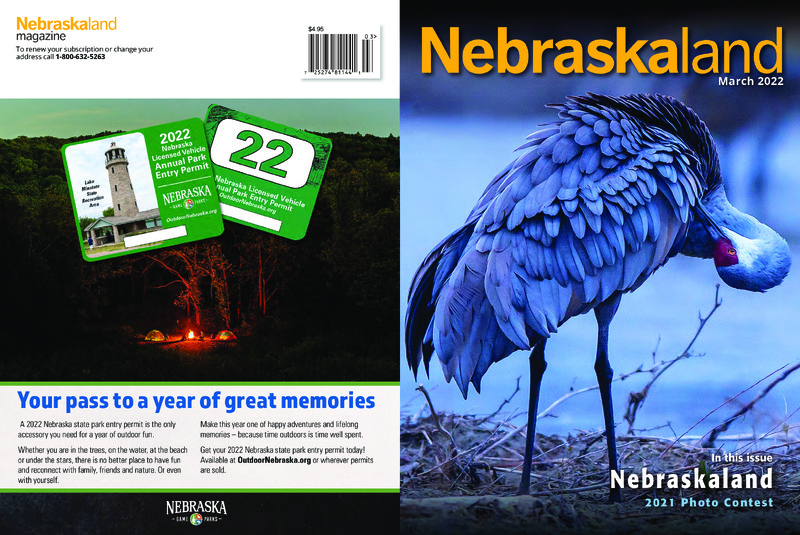
- Identifier:
- nela.2022_100_02
- Title:
- Volume 100, Issue 2, 2022
- Issue Name:
- March 2022
- Date Issued:
- 2022-03-01
- year:
- 2022
- month:
- March
- Season:
- Winter
- PDF filename:
- NL_100.02_2022_Mar_Spreads_Entire.pdf
- Publisher:
- Nebraska Game and Parks Commission
- Format:
- Periodical
- volume:
- 100
- issue:
- 02
- number:
- 100.02
- Decade:
- 2020s
- Type:
- Rights Holder:
- Copyright Nebraskaland Magazine/Nebraska Game and Parks Commission, all rights reserved.
- Extracted Text:
-
magazine
$4.95
To renew your subscription or change your
address call 1-800-632-5263
March
M
a rc
ch 2
2022
022
Your pass to a year of great memories
A 2022 Nebraska state park entry permit is the only
accessory you need for a year of outdoor fun.
Make this year one of happy adventures and lifelong
memories – because time outdoors is time well spent.
Whether you are in the trees, on the water, at the beach
or under the stars, there is no better place to have fun
and reconnect with family, friends and nature. Or even
with yourself.
Get your 2022 Nebraska state park entry permit today!
Available at OutdoorNebraska.org or wherever permits
are sold.
In this issue
Nebraskaland
2 0 2 1 Pho t o Con t e s t
Told Shane to rework bleed
area (again)
2
Nebraskaland • March 2022
March 2022 •
Nebraskaland
3
Volume 100
March 2022
No. 2
20
2021 PHOTO CONTEST
38
OUTDOOR NEBRASKA
44
52
56
BRITTON BAILEY
B
T page: An abandoned house lays witness to March snow in Sioux
This
County in the Nebraska Panhandle. BOB GRIER, NEBRASKALAND
C
FEATURES
40
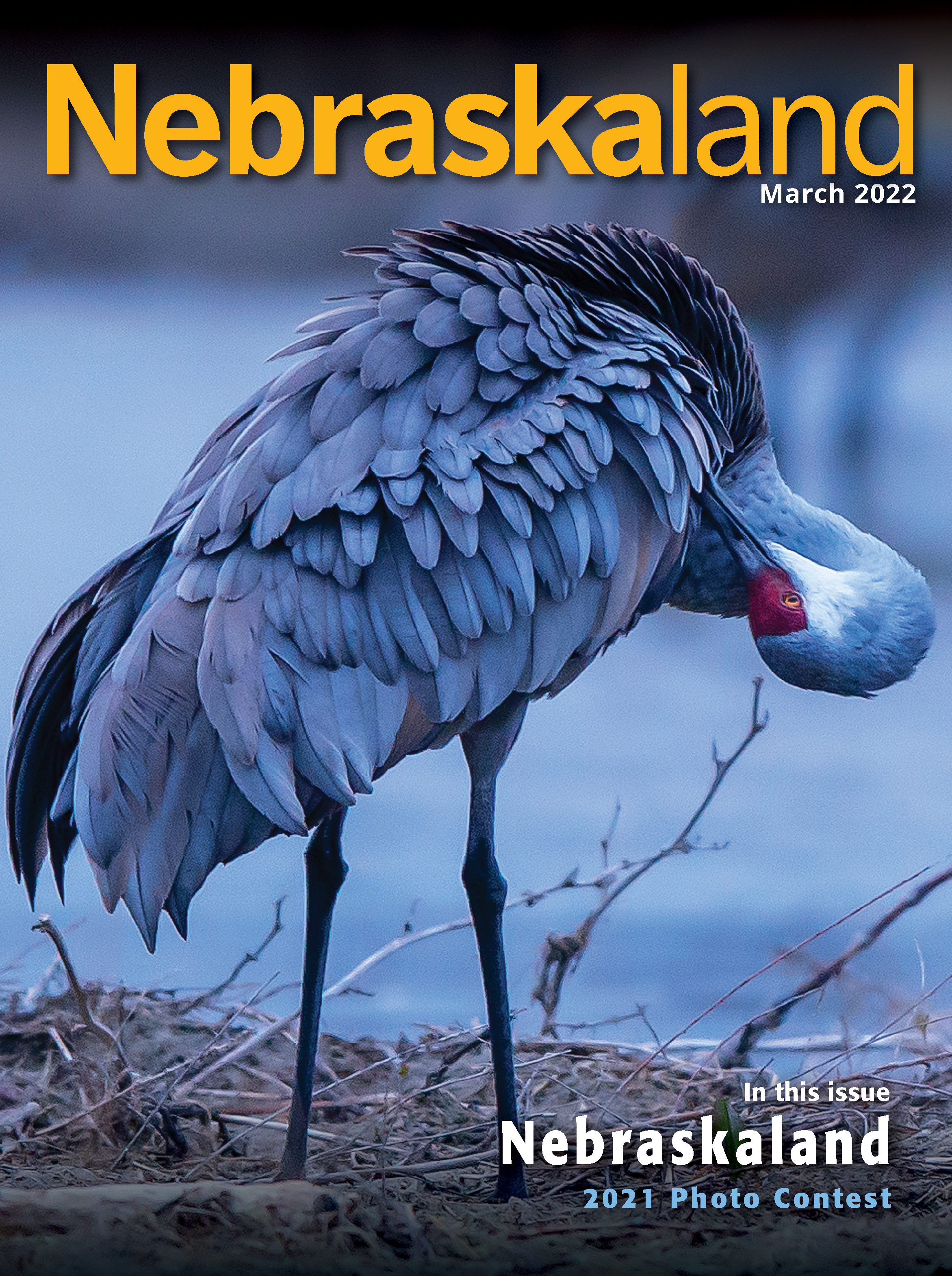
Cover: Britton Bailey’s “Sandhill Crane Preening on Platte River Bank”
C
iimage won Best of Show in the 2021 Nebraskaland Photo Contest. See page 20.
Photos submitted by Nebraskaland
Magazine readers
Nebraskaland (VOL. 100 / NO. 2 ISSN 0028-1964) is published monthly, except for the combined
Jan./Feb. and Aug./Sept. issues, by the Nebraska Game and Parks Commission, 2200 N. 33rd
St., Lincoln, NE. Periodicals postage paid at Lincoln, Nebraska, and additional mailing offices.
POSTMASTER: Send address changes to Nebraskaland, P.O. Box 30370, Lincoln, NE 68503-0370.
What to Do in March
By Renae Blum
NEW LIFE FOR THE
OLD STEVENS
By Justin Haag
A RARE BIRD
Remembering Jon Farrar
By Eric Fowler
WHEN OMAHA WAS
THE CAPITAL CITY
By David L. Bristow, History Nebraska
A MORE FAMILY FRIENDLY
LAKE McCONAUGHY
By Justin Haag
4
DEPARTMENTS
ON THE WEB
8
12
60
68
70
For more articles and
information, visit
NebraskalandMagazine.com
Your Nebraska
In the Field
Mixed Bag
Portraits from the Past
The Last Stop
Nebraskaland • March 2022
March 2022 •
Nebraskaland
5
Magazine Staff
magazine
Published by the Nebraska Game and Parks
Commission since 1926. The Commission is
dedicated to the conservation and protection
of all the state's natural resources and the
people who use them.
Communications Director Christy Firestone
Public Relations Manager Shawna RichterRyerson
Editor Jeff Kurrus
Associate Editor Jenny Nguyen-Wheatley
Regional Editors Eric Fowler, Julie Geiser,
Justin Haag
Contributing Editor Michael Forsberg
Regular Contributors Renae Blum,
Chris Helzer, Chris Masada, Todd Mills,
Ryan Sparks, Gerry Steinauer
Art Director Tim Reigert
Graphic Designer Mel Severin
Photo Librarian Jaclyn Cruikshank Vogt
Administration
Director Tim McCoy
Commissioners
Chairman - Dan Kreitman, Wahoo
Vice Chairman - Pat Berggren, Broken Bow
2nd Vice Chairman - Rick Brandt, Roca
Robert Allen, Eustis
Ken Curry, Columbus
Donna Kush, Omaha
Scott Cassels, Omaha
John Hoggatt, Kearney
Doug Zingula, Sidney
Circulation
For address changes and questions about your
subscription, call 800-632-5263
Advertising Sales Manager
For advertising information contact
Shane G. Gilster, 402-742-0125
Email: shanegilster@gmail.com
Conservation Officers
Headquarters/Southeast District Office
2200 N. 33rd Street Lincoln, NE 68503
Phone 402-471-0641
ADMINISTRATION (Lincoln)
Craig Stover (Administrator)
Duane Arp (Asst. Administrator)
Travis Shepler (Asst. Administrator)
Jeff Clauson (Asst. Administrator)
Southwest District Office
301 E. State Farm Rd. North Platte, NE 69101
Phone 308-535-8025
Northwest District Office
East Hwy. 2, Box 725 Alliance, NE 69301
Phone 308-763-2940
Bassett Office
524 Panzer St., Box 508 Bassett, NE 68714
Phone 402-684-2921
Kearney Office
1617 First Ave. Kearney, NE 68847
Phone 308-865-5310
Ak-Sar-Ben Aquarium/Schramm Education
Center
21502 W. Highway 31 Gretna, NE 68028
Phone 402-332-3901
Omaha Office
8495 Frederick Street, Omaha, NE 68124
Phone 402-595-2144
402-471-5531
402-471-5531
402-471-5531
402-471-5531
NORTHWEST (Includes counties covered)
Dan Kling (Lieutenant)
308-430-0572
EAST SUB-DISTRICT
Sean Schultz (Sergeant)
308-760-0145
Jerod Hahn (Deuel, Garden, Grant)
Keith Jadlowski (Keith, Deuel)
Jaden Porter (Keith, Garden)
Tyler Stueck (Keith)
308-520-5539
308-289-9580
308-289-2274
308-289-6260
(Keith, Arthur)
WEST SUB-DISTRICT
Tim Williams (Hall, Hamilton, York)
Eric Javins (Adams, Clay, Webster)
Pat George (Harlan, Franklin, Phelps)
Ethan Teter (Buffalo, Kearney)
308-380-7331
402-902-2017
308-920-2762
308-440-3847
SOUTHWEST (Includes counties covered)
Roger Thompson (Lieutenant)
308-530-3097
NORTH SUB-DISTRICT
Ray Dierking (Custer, Thomas, Blaine)
Frank Miller (Cherry, Hooker)
Greg Hesse
308-870-0322
402-389-0444
308-546-7464
Alex Hasenauer (Lincoln, Perkins)
Brandon O’Neal
308-660-4671
308-530-3157
(Hooker, Thomas, southern Cherry)
(Lincoln, McPherson, Logan)
308-763-8226
Brian Piernicky (Sergeant)
308-340-6627
Josh Widhelm (Morrill, Scotts Bluff)
Jacob Stoinski (Sioux, Dawes)
308-279-9133
308-615-9017
Bryce Streger (Dawson, Gosper, Custer)
Matt Andrews
308-537-0404
308-746-2418
Taylor Dixon (Dawson, Gosper)
Sophia Gobber
308-217-2108
308-222-0368
(Box Butte, Sheridan, Grant)
NORTHEAST (Includes counties covered)
Dale Davis (Lieutenant)
402-760-0712
NORTH SUB-DISTRICT
Jeff Jones (Sergeant)
402-762-5022
John Bauer (Holt, Boyd)
Jonathan Andreasen
402-314-9257
402-340-3981
Mitch Johnson (Knox, Antelope, Pierce)
402-613-8612
(Knox, Cedar)
Cory Krause (Sergeant)
402-380-6410
Kyler Prochaska (Platte, Colfax)
Nicholas Fix (Dixon, Dakota, Thurston)
402-830-8278
402-508-0261
CENTRAL (Includes counties covered)
Mike Thome (Lieutenant)
308-293-8746
NORTH SUB-DISTRICT
Nebraskaland • March 2022
402-200-9597
(Thayer, Fillmore, Nuckolls)
Kelsey Glodowski
(Cuming, Wayne, Stanton)
6
Matt Taylor (Sergeant)
308-672-1824
(Kimball, Banner, Scotts Bluff)
SOUTH SUB-DISTRICT
The Nebraska Game and Parks Commission does not discriminate
based on race, color, ethnicity, national origin, sex, pregnancy, sexual
orientation, gender identity, religion, disability, age, genetic information,
veteran status, marital status, and/or political affiliation in its programs,
activities, or employment. Any person who believes he or she has been
discriminated against in any program, activity, facility, or service,
should contact the Nebraska Game and Parks Commission, Lincoln, NE
402-471-0641, the Nebraska Equal Opportunity Commission, Lincoln,
NE 402-471-2024, TTY/TDD 800-642-6112; Director, Office of Diversity,
Inclusion and Civil Rights, U.S. Department of Interior, 1849 C Street,
NW, Washington, D.C. 20240.
SOUTH SUB-DISTRICT
Sean McKeehan (Sergeant)
(Madison, Pierce, Stanton)
OutdoorNebraska.org
JUSTIN HAAG, NEBRASKALAND
Nebraskaland Magazine Copyright 2022, all rights reserved.
Nebraskaland is available in audio from the Nebraska Library
Commission Talking Book and Braille Service, Suite 120, 1200 N St.,
Lincoln, NE 68508. 800-742-7691. Nebraskaland Magazine and the
Nebraska Game and Parks Commission reserve the right to reject any
advertising not in keeping with the agency mission.
Rates: $18 for one year; $33 for two years; $44 for three years. Nebraska
recipients must add appropriate sales tax. To subscribe call
1-800-NEBLAND (632-5263), or go online to:
NebraskalandMagazine.com.
Commission Offices
Northeast District Office
2201 N. 13th St. Norfolk, NE 68701
Phone 402-370-3374
Boreal chorus frogs are the first
frogs to start calling this month.
Listen for their call, which can be
deafening.
Doug Pollard (Sergeant)
308-730-7050
Matt Brandt (Sherman, Howard)
Daryl Teter (Howard, Greeley, Merrick)
Trent Howard (Nance, Wheeler, Boone)
Kyle Gaston (York, Polk, Hamilton)
308-202-0819
308-440-1863
308-318-1273
402-719-6226
(Loup, Garfield, Valley)
SOUTH SUB-DISTRICT
(Red Willow, Frontier, Hayes, Hitchcock)
(Furnas, Gosper, Frontier, Red Willow)
(Chase, Dundy, Hayes, Hitchcock)
SOUTHEAST (Includes counties covered)
Stacey Lewton (Lieutenant)
402-890-7140
EAST SUB-DISTRICT
Heath Packett (Sergeant)
402-210-0888
Russell Mort (Otoe, Johnson)
Rich Berggren (Douglas)
Brian Arp (Douglas, Sarpy)
Dan Evasco (Sarpy)
Mike Luben (Saunders, Butler)
Bryan Adams
402-209-1506
402-619-1355
402-530-9011
402-616-5961
402-443-6392
402-429-1924
(Cass)
(Nemaha, Pawnee, Richardson)
WEST SUB-DISTRICT
Dina Barta (Lancaster),
Dudley Sorensen (Lancaster)
Mark Sullivan (Lancaster, Seward, Butler)
Trevor Stahlecker (Lancaster, Saline)
Matt Seitz (Gage, Jefferson)
402-890-6463
402-937-3422
402-741-0636
402-314-9641
402-806-0915
YOUR NEBRASKA
Instagram Photos
Follow us @nebraskaland
and tag us in your photos
to be featured in an
upcoming issue.
Opposite: Rich Hodson, Plainview
Missouri River Smooth
Sonja Brandt, Utica
Full Moon Rising
Clark Landers, Omaha
Decoys over the Platte
8
Nebraskaland • March 2022
March 2022 •
Nebraskaland
9
Send your comments and
photos to:
Jeff Kurrus, Editor
Nebraskaland Magazine
P.O. Box 30370
Lincoln, NE 68503
or email Jeff.Kurrus@Nebraska.gov
Please include your postal address
and telephone number. Letters
may be condensed and edited.
Photographs are also welcome.
Opposite: Chuck Hackenmiller, Lincoln
A Holmes Lake Sunrise
Katie Bresnahan, Osceola
Snowy Day
Erik Johnson, Lincoln
Williams Gap
10
Nebraskaland • March 2022
March 2022 •
Nebraskaland
11
IN THE FIELD
GREATER PRAIRIE CHICKEN
In spring, males gather on
“booming grounds” and
display to attract females. In
display, males lower heads,
raise tails, inflate air sacs,
and stamp their feet while
making a hollow moaning
sound.
RICK
IC RAS
RASMUSS
MUSSEN
EN
12
Nebraskaland • March 2022
March 2022 •
Nebraskaland
13
IN THE FIELD
Sandhill cranes fly in a cloudless sky the morning after a rainstorm in Hall County.
JEFF KURRUS, NEBRASKALAND
IT’S NOT YOU, IT’S MIE
By Martha Shulski
After a weather front has passed, often an
overcast and rainy sky magically transforms into
a crisp indigo-blue with the air so clean you can
almost taste the freshness. This shade of blue
seems to resemble cobalt tropical ocean waters
and can occur without so much as a single cloud
to dot the hemisphere.
What you are witnessing, quite purely in this
case, is Rayleigh scattering, named after an 18th
century British physicist who discovered the
physics of why the sky is blue. Visible light in
the wavelengths emitted from the sun appear
as white light, but is actually composed of all
colors of the rainbow (see “Seeing Double” in
the Aug/Sept 2021 issue). Blue is on the shorter
wavelength end of the visible spectrum, while
red is longer.
In the clearest of air and after a front passes, the
14
Nebraskaland • March 2022
indigo and blue can appear quite vividly. Because
the size of gas molecules and tiny particles in
the atmosphere is similar to that of blue light
(0.00002 inch), this wavelength is very effective
at scattering these hues. For the human eye,
scattering means we see it, sometimes brilliantly.
Contrast this with a warm and humid summer day.
While typically not visible to the naked eye,
microscopic particles such as water vapor,
dust and pollen can be quite prevalent in the
atmosphere. These larger particles result in Mie
scattering, named for a German physicist, which
spreads all wavelengths of solar energy. The
result is often a paler shade of blue, which can
fill either the whole sky or most often just near
the horizon.
But not to worry, the pale shade is not you, it’s
Mie.
IN THE FIELD
The proper amount of turkey hunting preparation leads to spring opportunities like this.
JEFF KURRUS, NEBRASKALAND
SPRING GOBBLER PREP
By Todd Mills
You can never start preparing early enough for turkey
hunting. Planned preparation prevents poor performance,
and although I find this applicable in all facets of life, it’s
crucial for hunting success.
Too many times I’ve not done my homework and paid
for it later. The following are some ideas to help you avoid
mistakes I’ve made in the past:
Confirm with Your Farmers
Nothing can ruin a hunt faster than somebody else
showing up to hunt the land you had permission to hunt.
Although this may lead to new hunting partners, it usually
ends up in a confrontation of some sort. One big mistake
many hunters make is not checking in with landowners
before every season. They just show up assuming they
still have permission. It’s also handy to have them give
you a handwritten permission “slip” each year so you’ve
got proof. Whichever direction you go, don’t make the
mistake of not checking in. And while you’re at it, take
the landowner a gift certificate to their favorite local
restaurant as a thank you.
16
Nebraskaland • March 2022
Gear Check
Don’t wait until the last minute to check your to-do list and
check your gear. I’m ashamed to admit I didn’t check my tent
before going out a few years ago. I didn’t remember that a
brace had broken the year before. That, of course, made for an
interesting hunt as I held up one end of the tent with a long
branch. Make sure you do an inventory on decoys, clothing,
tents, chairs and even the choke you use.
Expand Your Territory
Don’t count on last year’s “honey hole” for gobblers.
Turkeys travel and so should you. Take time in early- to midMarch to drive around the areas you like to hunt. Birds are
usually still really grouped up at this time, and if it’s a nicer
day, they’ll be moving. Knocking on a door early last year led
me to taking a really nice tom on property I had never hunted
before. Expanding your territory will pay dividends.
Todd Mills is a former Avian-X and Mossy Oak pro staffer
who divides his outdoor time between hunting waterfowl and
turkeys.
IN THE FIELD
Goose legs slow-cooked until tender and served on top of cheesy nachos.
JENNY NGUYEN-WHEATLEY, NEBRASKALAND
GOOSE LEG NACHOS
By Jenny Nguyen-Wheatley
Serving size: 2
Time to make: 3 hours and 30
minutes
Ingredients:
Meat:
2 large Canada goose legs and
thighs, skin on
Half an onion, cut into four pieces
3 cloves of garlic, smashed
1 bay leaf
Kosher salt, to taste
1 chipotle pepper in adobo sauce,
plus extra
2 cans of Mexican lager
1 tablespoon of olive oil
½ teaspoon each of cumin,
coriander and onion powder
¼ teaspoon of garlic powder
Freshly cracked pepper, to taste
•
•
•
•
•
•
•
•
•
•
•
Nacho Toppings:
ounces of shredded Mexican
blend of cheeses
¼ cup of chopped cilantro
16 ounces of refried beans,
warmed
• 12
•
•
18
Nebraskaland • March 2022
• Half an onion, chopped
• ½ cup of diced tomato
• 1 to 2 avocados, diced
• 1-2 fresh jalapenos, thinly sliced
or sliced pickled jalapenos
• Crumbled cotija cheese, to taste
• 9 ounces of tortilla chips*
• Other toppings: hot sauce, salsa
and/or sour cream
*Choose a thick, sturdier brand of
tortilla chips.
1. Sprinkle salt all over Canada goose
legs and thighs and place into a heavybottomed pot. Add onion pieces, garlic,
bay leaf, 1 chipotle pepper in adobo
sauce and submerge with beer. Bring
to a boil and then back down to a
simmer. Cover and cook on low for 2
½ to 3 hours, or until tender. Add more
beer or water as needed. Or cook on
low in a Crockpot overnight or while
you’re at work.
2. When goose is tender, pull the
meat and skin off the bones and
shred/cut into smaller pieces. Discard
cooking liquid. Over medium-high
heat, heat olive oil in a pan and sauté
goose meat with cumin, coriander,
onion powder and garlic powder until
slightly toasted. Add salt and pepper
to taste. Add a chopped chipotle
pepper for extra spiciness.
3. Preheat oven to 350-degrees
Fahrenheit. Line a sheet pan with
foil or spray a 12-inch cast-iron pan.
Evenly spread a layer of tortilla
chips on the bottom, only slightly
overlapping the chips, and drop small
dollops of warmed refried beans all
over, a generous sprinkle of shredded
Mexican cheese, chopped onion and
some of the goose meat. Spread
another layer of tortilla chips on top
and continue building layers until you
run out of beans, meat, onion and
cheese. Bake nachos until cheese is
melted, about 5-10 minutes.
4. Sprinkle some of the cilantro,
avocado, diced tomato, sliced jalapeno
and crumbled cotija cheese on top and
serve hot with extra toppings on the side.
March 2022 •
Nebraskaland
19
2021
P ho t o
C o nt e s t
With more than 3,000 entries submitted through
Instagram, the 2021 Nebraskaland Magazine Photo
Contest drew a record number of stunning images
from Nebraska photographers in the categories of
Wildlife, Flora, Scenic and Recreation.
This year’s Best of Show winner, “Sandhill Crane
Preening on Platte River Bank,” by Britton Bailey
of Aurora, was shot at Rowe Sanctuary in central
Nebraska. “To witness the ancient annual spring
migration up close from the bank of the Platte River
cannot be expressed in words,” she said. “So, I hope
my photographs do the talking for me.”
We thank everyone who participated and look
forward to seeing more of your great photographs in
next year’s contest.
Keep shooting.
Jeff Kurrus, Editor
Nebraskaland Magazine
BEST OF SHOW
Sandhill Crane Preening on Platte River Bank
Photo by Britton Bailey, Aurora
@bfbinstailey
20
Nebraskaland • March 2022
March 2022 •
Nebraskaland
21
WILDLIFE
FIRST PLACE – Mother’s Love
Photo by Connie Rathbun, Omaha
©rathbun2682
22
Nebraskaland • March 2022
March 2022 •
Nebraskaland
23
WILDLIFE
SECOND PLACE – Sunflower Bee
Photo by Tyler Moore, Omaha
@drtylermoore
24
Nebraskaland • March 2022
THIRD PLACE – Catch Me if You Can
Photo by Lynette Hahne, Lincoln
@dennishloose
March 2022 •
Nebraskaland
25
FLORA
FIRST PLACE – Milkweed Seed
Photo by Tyler Moore, Omaha
@drtylermoore
26
Nebraskaland • March 2022
March 2022 •
Nebraskaland
27
FLORA
THIRD PLACE – Rise of the Evening Star
Photo by Derrill Grabenstein, Lincoln
@de_grabenstein
28
Nebraskaland • March 2022
SECOND PLACE – Maidenhair Fern
Photo by Britton Bailey, Aurora
@bfbinstailey
March 2022 •
Nebraskaland
29
SCENIC
FIRST PLACE – Winter’s Surreal Moment
Photo by Roger Richters, Utica
@rogerrichters
30
Nebraskaland • March 2022
March 2022 •
Nebraskaland
31
SCENIC
SECOND PLACE – Summer Warmth
Photo by Jayson Basilio, Oakland
@jayson_basilio
32
Nebraskaland • March 2022
THIRD PLACE – A Bright Future
Photo by Melanie Moree, Papillion
@melaniemoree
March 2022 •
Nebraskaland
33
RECREATION
FIRST PLACE – The Second Harvest
Photo by Alexis Mendyk, Dannebrog
@lexi_leighphotography
34
Nebraskaland • March 2022
March 2022 •
Nebraskaland
35
RECREATION
THIRD PLACE – Paddleboard Fisherman
Photo by Tiara Brown, Omaha
@huskertiara
SECOND PLACE – Beach Girl
Photo by Juston Brazda, Valley
@justonbrazda
36
Nebraskaland • March 2022
March 2022 •
Nebraskaland
37
Outdoor Nebraska
By Renae Blum
There’s no telling what the weather will be like this month, but there
are plenty of reasons to get outdoors in any case: spring migration,
turkey hunting, camping and much more. How will you enjoy the
outdoors in March? N
What To Do in March
Early spring
camping
Throughout the month
Statewide
Early spring, before summer crowds
arrive, is the time to enjoy peaceful and
quiet campgrounds. Mild temperatures
and low humidity provide perfect
conditions for long hikes, wildlife
viewing and exploring. Be prepared for
cool and wet weather: pack layers, extra
blankets, footwear for mud and rain gear.
ERIC FOWLER, NEBRASKALAND
Marsh Madness
Science of Salamanders virtual event
Throughout the month; guided viewings on Saturdays,
March 5-26 | Ponca State Park
March 3, 3-4 p.m. Central time | Via Zoom
Salamanders are extremely secretive, and most of us have never seen one. Join
us for this virtual event as we unpack the secrets of salamanders, including
which species call Nebraska home. Registration is required; sign up at
Calendar.OutdoorNebraska.gov. JUSTIN HAAG, NEBRASKALAND
Archery turkey
season
Starting March 25 | Statewide
Get out your bow and round up your
hunting buddies — turkey season is
about to start. With a long season,
affordable permits, great public access
and $8 permits for youth, Nebraska is
your destination for turkey hunting.
Learn more and buy permits at
OutdoorNebraska.org/wildturkey.
JEFF KURRUS, NEBRASKALAND
38
Nebraskaland • March 2022
Witness the peak of migration at Ponca State Park, considered an
“Important Bird Area” by the National Audubon Society. Visitors can
enjoy guided sunrise and sunset waterfowl blind viewings and a 30
percent discount on lodging, with the chance to see whirlwinds of
snow geese, wood ducks, mallards and other waterfowl. Learn more
by calling the park at 402-755-2284 or by visiting Ponca State Park’s
Facebook page. JENNY NGUYEN-WHEATLEY, NEBRASKALAND
Fly-tying Basics class
March 9, 12 | Outdoor Education
Center, Lincoln
Ready to catch some trout and panfish this
spring using your own handmade flies?
Attend this workshop and learn the basics
of fly-tying, with all materials and tools
included to create at least four to six flies
during class. Learn more at
Calendar.OutdoorNebraska.gov.
ERIC FOWLER, NEBRASKALAND
March 2022 •
Nebraskaland
39
New Life
for the
Old Stevens
By Justin Haag
H
eavily marred with dirt, dings,
scratches and rust, it did not
look like much. Despite its
condition, I knew the item
handed to me — a Stevens Springfield
87A .22 semi-automatic rifle — was a
special gift.
I best remember the gun from my
childhood in southwestern Nebraska
in the 1980s; it hung on the rack in
Grandpa Alfred’s beat-up green Ford
as it was parked at his and Grandma’s
service station on Danbury’s main
street. Resting in the rear window, the
rifle was always at the ready during his
evening trips to the farm, his boyhood
home 4 miles north of town.
I was fortunate to be passenger on
many of the daily trips to the place
where he and my dad were raised, and
have memories of Grandpa teaching
me how to use the rifle at a nearby
prairie dog town.
Rifles such as this were not required
to have serial numbers until 1968, but
the barrel has one patent number;
resources indicate it was manufactured
in the model’s first three years of
Even though the Springfield Stevens 87A, purchased by the author’s grandfather about eight decades ago,
shows signs of abuse, it’s been refinished and given new life. JUSTIN HAAG, NEBRASKALAND
Hunters pose with the 60 jackrabbits and one cottontail they harvested near Hay
Springs in 1931. Considered a pest during the Dust Bowl years, many counties
offered bounties to encourage hunting them. L.L. BUTZINE
40
Nebraskaland
• March 2022
production, which began in 1938.
Grandpa often told of how the gun
paid for itself in jackrabbits in short
time. Considered an overpopulated
pest during the Dust Bowl of the 1930s
and into the 1940s, many counties
offered a bounty on the long-legged,
hungry grazers. A newspaper article
from 1940, when Grandpa was 19, tells
of the McCook rendering plant paying 5
cents per jackrabbit. An advertisement
from that year shows the gun could
be bought for $11.61. So, cost of
ammunition aside, I figure that’s about
232 jackrabbits.
As one of more than a million of
this model Stevens sold, the firearm
— one of the first mass-produced semiautomatic .22s — is far from being a
rarity.
I could not even guess how many
rounds it has fired. It helped put food
on the table for my grandparents when
they were newlyweds. Long before I
took aim with it, and years after those
jackrabbit harvests, my dad and uncle
remember it entertaining the family as
a plinker around the farm — especially
on the many nights the TV’s one
station was on the fritz. They say one
of Grandpa’s favorite activities was
lighting and extinguishing matchsticks
with a careful aim. If the farm’s varmint
population needed to be curbed, it was
the go-to tool. During wheat harvest,
it rode on the combine. Despite heavy
use and minimal cleaning, Dad says he
cannot remember it ever jamming or
misfiring.
As Grandpa aged, the rifle was
put into storage with his other guns.
Sometime after he died in 2001, they
were passed on to family. I decided to
clean the Stevens well enough to stop
the rust and keep it as a conversation
piece. Beyond that, I had little optimism
about its future.
After inspecting it, though, I was
pleased to find the bore free of rust and
corrosion, as were all of the mechanics
of the trigger and bolt assembly. A few
blasts of an aerosol gun cleaner had
those parts moving well and looking
fresh again. All of that Red Willow
County dirt came off easy enough, and
the rust on the exterior of the barrel and
magazine relented by rubbing it with
fine steel wool and oil. After cleaning
and oiling, I put the gun in the cabinet.
It stayed there for more than a decade.
March 2022 •
Nebraskaland
41
This winter, while giving guns a
routine cleaning, I decided the rifle
deserved better.
I am certainly no gunsmith, but after
reading message boards and watching
how-to videos online, I gained enough
confidence to tackle a more thorough
restoration. As a weekend do-it-yourselfer, I already had the necessary
tools, and the refinishing products were
easy enough to find at local retailers
and online.
A special cleaning solution helped
remove the little bit of bluing that
remained on the barrel, and a fine wire
brush on a rotary tool helped clean
the tight spots. After getting that
maltreated steel to shine, I was amazed
at how a liquid cold-bluing solution
returned it to an attractive black in a
matter of seconds.
A hot iron over a damp rag lifted
many of the dents from the stock,
and deeper gouges and scratches
were filled with a putty of wood glue
and sawdust, the latter of which was
harvested by drilling a hole under the
butt plate. After sanding the surface
smooth, multiple coats of gun stock
finish made the wood shine. Below the
glossy finish is evidence of all those
dents and dings, but they somehow
add a richness and beauty to its one-ofa-kind appearance that only decades
of abuse can provide.
The rifle is not only a conversation
piece, but also a firearm I am proud to
carry. What’s more, I have found it to
fire as reliably as it did when aimed at
those hordes of jackrabbits of the ’40s.
Advertisements from when the
rifle was new boast not only of its
craftsmanship and affordability, but
also its speed and three-in-one design.
It will fire as not only a semi-automatic,
but also a single-shot and bolt action.
I became familiar with each part of
its action throughout the refinishing
process.
With the stamping of “Chicopee
Falls, Massachusetts, USA” on top of
the barrel, the Stevens Springfield
87A was born in a different era of the
42
Nebraskaland
• March 2022
Above: The author carries the rifle on a small-game hunt in thePine Ridge.
Opposite: A 1946 advertisement for the rifle targets jackrabbit
hunters.
JUSTIN HAAG, NEBRASKALAND
American economy. Even though
it was one of the least expensive
rifles available, it has a quality
of construction present only on
high-end firearms of today — a
collection of sturdy, machined, U.S.
steel parts assembled on a bed of
birch, presumably harvested in New
England.
I did have to replace the stock’s
butt plate, the only piece of plastic on
the entire rifle. Extremely brittle, it
shattered when I fumbled it to the hard
basement floor. Thankfully, I located a
replica from an online retailer.
Perhaps I would have been better
off hiring a professional gunsmith,
who surely would have done a better
job returning the rifle to near mint
condition, without dropping any
pieces. That is not my style, though.
Nor my grandpa’s. There is much
reward in doing the project myself, and
I am glad there are still a few remnants
of the rifle’s many battle scars.
While I consider the rifle a treasure,
I will not be hocking it to embark on
a lavish lifestyle. Rusty relics in this
one’s previous state often sell for a low
bid at farm auctions. Even in pristine
condition, they do not fetch much
more than $150.
To me, though, it is invaluable. It is
an heirloom that bridges generations
and honors the past. Every time I
shoulder it, my hands grip the same
places my grandfather’s did. Also
relatable, my eyesight has degraded
to where I complain about the rear
sight being a little blurry — just as
I remember him lamenting at that
prairie dog town in the ’80s.
Sadly, Grandpa and the old Ford are
gone, the gas station’s closed, and the
old house and other farm buildings
are in disrepair. The state’s jackrabbit
population is scarce. The rifle, however,
endures.
Surely many modern .22 rifles are
much more highly regarded than this
one, but, lacking American artisanship
from the 1930s and ’40s, I wonder
if they will stand up to decades of
such use and abuse. If the objectives
are durability and reliability, I will
place bets on Grandpa’s timeworn,
but reborn, American-made Stevens
Springfield. N
March 2022 •
Nebraskaland
43
A Rare Bird
Remembering Jon Farrar
By Eric Fowler
ogged writer and photographer. Accuracy hound.
of few that were as good of a naturalist as him,” said Gerry
Swearer. Whiskey drinker. That was Jon Farrar.
Steinauer, a longtime colleague.
This colorful character of a man, who spent 42 years
Farrar produced articles with a greater depth than had been
on the staff of Nebraskaland Magazine, passed away
seen previously in Nebraskaland, a depth that makes many of
on March 30, 2021, at the
them reference material still
age of 73. His closest friends
today.
will remember the stories
Often, his work focused
he told, the late-night decoy
on articles about little
carving sessions and how he
known species that could be
disappeared into the Sandhills
considered obscure.
each October, primarily to
hunt ducks. His body of work,
however, including more than
580 articles, several books
Farrar wrote many natural
and tens of thousands of
history pieces during his
photographs honoring, and
career, stories detailing the
trying to conserve, the flora,
life cycle, habits and habitats
fauna and history of our great
of plants and mammals of
state, will live on.
the state. While he wrote
“He is Nebraskaland,” said
several on common species,
longtime colleague and friend
including pheasants, Canada
Michael Forsberg. “Not to
geese and bald eagles, many
take anything away from the
of his subjects were species
others on the staff that were
the magazine’s readers likely
in that same generation, but
had never heard of, much less
he defined it. He set the bar.”
seen. There were stories on
Nebraskaland
employed
shrikes, skinks, wood rats,
writers and photographers
blue-eyed grass, and perhaps
when Farrar was hired, and
Farrar’s favorite, grebes.
he excelled at both. His
In 1984, he wrote “Crested
other passion was research.
Hell
Divers,” a story about
Jon Farrar
He leaned on colleagues for
eared grebes, one of three
insight and read everything he could find on a subject, from
subspecies of the birds found in the state. It is perhaps the
scholarly papers to first-hand accounts, before ever setting
best collection of photographs he captured for a story.
foot in the field. Once there, he recorded his own observations
“Jon didn’t just think those birds were cool, he was in love
in field journals, a practice he began as a youth growing up
with those birds,” Forsberg said. “And every story that he
a short walk from the Loup River in Monroe. Those small,
ever wrote about them, that love was just sort of oozing from
brown, tattered notebooks came to be arranged neatly in a
the page and from the pictures.”
file cabinet in his office, to aid his own or a fellow staffer’s
That collection of eared grebe images provides a glimpse
work long into the future. “As an outdoor writer I can think
of the time Farrar spent in the field. He didn’t just take one
D
The Obscure
In 2000, Jon Farrar photographed this stilt
sitting on a nest brooding its young while
one chick pokes its head out from under
the wing. The nest was located in southern
Sheridan County.
44
Nebraskaland • March 2022
March 2022 •
Nebraskaland
45
As he sometimes did with hard-to-photograph species, Farrar built enclosures (left) to capture images. For example, Farrar
captured this Bailey’s eastern woodrat (Neotoma floridana baileyi) and photographed it at the Niobrara Valley Preserve in 2006.
Farrar once told me this image he captured of a female eared grebe laying an egg in a Sandhills marsh was his “all-time high.”
In “Crested Hell Divers,” he wrote: “The ear grebe’s nest is even flimsier than the western grebe’s. I guess the eared grebe is a
lower middle-class bird living as if he’s wealthy.”
trip, capture a few frames and call it good. He went back time
and time again, brushing aside heat, cold and bugs, to get
the images he needed to tell the story of the lives of these
creatures.
He also cared about his subjects. When photographing
nesting birds, he slowly moved blinds closer, often through
the course of days, hoping they would accept his presence.
In time, he knew which birds would and which ones would
not. One bird he wrote about in “A Tale of Two Stilts” in June
2001, the black-necked stilt, never really did.
As Farrar chronicled, it was hot and there was no wind, and
the stilts, one appearing to have “sheer terror in her eyes,”
were taking turns tending the three chicks that had hatched
that morning and one yet-to-hatch egg, between cooling off
in the water. “The birds were suffering,” Farrar wrote. “I was
torn between doing what was right, and what I had to do. I
had nearly as many days invested in the nest as the stilts.
And, if I left my grass-covered blind only 12 feet from the
stilt nest, I might disrupt the hatching more than if I stayed.
Telling myself that helped briefly. But I knew this was the
most important day of the year for the two stilts panting
and pacing near the nest. By noon, my conscience was
unbearable. I pulled the blind and quickly left the meadow.”
Farrar focused on these lesser-known species partly
because he hated the ordinary. But he also wrote about them
46
Nebraskaland • March 2022
in hopes of fostering greater appreciation among people for
all things wild, and the landscapes and habitats in which
they lived. To him, they mattered, just as much as the game
species with which most people were familiar.
“He was way more interested in the true natives and the
little guys, the underdogs ... the kangaroo rats and blowout
grass species,” said Jim Van Winkle, a long-time friend of
Farrar’s from Wood Lake. “I think he felt that those species
were entitled to recognition. And they were just such an
intrinsic part of the ecosystems up here that they needed
to get the same amount of attention that a ring-necked
pheasant would.”
The Sandhills
Farrar’s true love was the Sandhills. He loved everything
about the region, and in 1977, he produced an entire issue of
the magazine dedicated to it. “Have you got a few minutes?”
he wrote in this issue. “Have another cup of coffee and let
me tell you what I know of these hills and their people. No,
I’m not a sandhiller; didn’t even move here as a boy. But
I wish I had. I’m just passing through, like you, but I’ve
passed through here before and I know something of these
people.”
He wrote about the history, from the Native Americans
Legend has it that Farrar, in 1999, captured this image of a
least weasel in an enclosure he built in his basement, even
leaving a window open to let the snow blow in.
“One of two species of garter snakes common statewide in
Nebraska, the red-sided garter snake (Thamnophis sirtalis)
is most abundant near streams, ponds and marshes,”
wrote Farrar in 2002. “Its principal foods are frogs, toads,
salamanders, fish, tadpoles and earthworms. Its name
comes from its striped pattern, which was similar to the
fancy garters men once wore to support their stockings.”
March 2022 •
Nebraskaland
47
“T
o be in a marsh. The rich, stagnant fragrance of marsh. The gray sky.
Drizzle on the neck. Squads of snow geese and courtship flights of
pintails. The scene cries out for description, yet defies it. A glimpse back
to our origins, a closeness to life other than our own, as if we belonged
somewhere, finally belong somewhere … .”
– Jon Farrar, from “Sky Carp”
for information on those old clubs.”
Farrar collected, built, and, of course, used decoys, so it’s no
surprise that he wrote several pieces on the history of decoys,
including Herter’s, Mason, paper, miniature, Nebraska-made
and even live decoys.
For all of these pieces, Farrar talked to people who were
part of the history. Lots of them. He tracked down old men
who were market hunters, duck club members and ranchers.
He would sit in their kitchens, or in some cases, their rooms
at the local nursing home, turn on his cassette recorder, and
listen to the stories of their lives and those who came before
them. Sometimes he would go back for more.
Some believe that Farrar wrote some of these historical
pieces because he felt that if he didn’t do it, no one would.
“He knew it was getting away,” Van Winkle said. “Like we
all know, we lament the things we didn’t do and the people
we didn’t talk to and the records that we don’t have. He did
something about it.”
Storm clouds and a Sandhills blowout are warmed by the light of the setting sun west of Wood Lake in Cherry County. “Light is
everything,” Farrar once said when talking about what makes a great photograph.
who lived there and passed through on hunts, to the French
explorers, early cattlemen, homesteaders and ranchers. He
wrote about the ecosystem and its origin, from the lakes and
marshes and fens in the valleys to the grass covered dunes to
the blowouts. He wrote about the fish and wildlife, and the
opportunities they provided. And he wrote about the men
and women who now live and work there.
He wrote stories about the black pioneers who homesteaded
near Brownlee, about several ranches and the people who
built them, and on the short-lived potash industry near
Lakeside and Antioch.
“I think it was a combination of the people and the
landscape,” said Joe Hyland, a former colleague and longtime friend. “He was fascinated by the people who lived that
life in the Sandhills, both early and to this day.”
He would disappear for days in the Sandhills, far from
the nearest highway and motel, living out of the back of his
truck. In the fall, he hung his waders at several hunting base
camps in the search for ducks, geese, grouse and pheasants.
But his love for the obscure extended to the field, where his
48
Nebraskaland • March 2022
passion for hunting included snipe and diving ducks.
“He loved a lot of places in Nebraska,” Van Winkle said.
“But he always told me this was his second home up here in
the hills.”
History
True to his position, Farrar wrote about the history of
hunting, fishing and boating in the state. He poured over
columns by Sandy Griswold that ran in the Omaha Bee
and World-Herald in the late 1800s and early 1900s to gain
more insight on hunting, fishing and even wildlife
populations.
He wrote about many old hunting clubs, including Ducklore
Lodge on the North Platte River and The Merganzer Club near
Cody, both run by brewers from Omaha. On his own time, he
wrote a book on the Red Deer Club south of Valentine.
“He just spent an inordinate amount of time piecing
together little details about all of these clubs that haven’t
existed for years,” said Van Winkle. “He was a hound hunting
Colorful autumn leaves, fungi, moss and lichen adorn a fallen paper birch tree in this image Farrar captured in 2005 at the
Nature Conservancy’s Niobrara Valley Preserve.
March 2022 •
Nebraskaland
49
In 1994, Farrar captured this image of a male and female blue-winged teal standing together on a little mound in the middle of
Marsh Lake, located on the Valentine National Wildlife Refuge in Cherry County.
Conservation Issues
Farrar took on many environmental issues, and others, in
a tell-it-like-it-is style. His “A case for shelterbelts” in April
1971 bemoaned the fact that tree claims, planted by settlers
to cut the wind on the prairie, were being bulldozed at an
alarming rate. He pointed out the benefits, both economically,
socially and for wildlife, debunked myths, and simply said:
“If you have a shelterbelt — keep it. If you don’t — plant one.”
The story could be run nearly verbatim and still apply today.
In 1981 or so, on a marsh north of Ashby, Farrar took a selfportrait next to a photography blind he built from conduit
and wire that sat atop of his jon boat. “The two long poles
are conduit, locked in place with thumb screws. They are
the stabilizing rods to hold the boat in place, except when
the wind hits 45 mph. Should have drowned five or six times
in one afternoon on Marsh Lakes, back before the carp got
in there.”
50
Nebraskaland • March 2022
He wrote against channelization of the Missouri River
between Yankton and Sioux City, a dam on the Niobrara
River, the incursion of center-pivot irrigation systems into
the Sandhills, and unethical hunters. He authored many
lift-outs for the magazine that detailed some of the state’s
most sensitive and imperiled lands, including wetlands
in the Rainwater Basin and the rare saline wetlands near
Lincoln, and the Platte River. He ruffled the feathers of
many, including farmers, power companies, developers and
sometimes readers with these works.
“I think what I liked most about Jon’s writing is he had really
a unique way of describing or writing about environmental
problems, and sort of putting the skewer in the sides of people
who were not ethical and really didn’t care about wildlife,”
long-time colleague Carl Wolfe said.
Joe Hyland appreciated “Sky Carp,” a piece Farrar did
in 2001 on snow geese after seasons were liberalized in an
attempt to reduce the population of the bird, which was so
high it was destroying its own nesting grounds in the Arctic.
In it, Farrar detailed nearly every attempt he made
to capture magazine-worthy photographs of the bird
throughout his career, the behaviors he witnessed, what he
learned from them, and how he appreciated them. “He kind
of took the people who look down their nose to snow geese to
task,” Hyland said. “Jon never treated them irreverently. He
didn’t like people calling them sky carp. They deserved better
than that.”
Knock Their Socks Off
Farrar was a great storyteller with a great sense of
humor. Who else would, during his younger days, keep
a small rattlesnake in a coffee can in his office for when
visitors entered? Or walk in front of a colleague’s middle-ofNebraska-nowhere trail camera and make obscene gestures
toward the lens?
His ability to tell a story extended to his work. He was a
master with the keyboard and the camera. “His work is the
standard by which everything else can be measured,” said
Forsberg.
A few years before his passing, he bestowed this advice on
me. “Grind out the stuff you need to do to buy groceries, but
once or twice a year knock their socks off. When you look
back, should you live so long, those will be the ones you’re
glad you did. The ones that last — that some snot-nosed kid
will quote in his Ph.D. dissertation 50 years from now. Yeah, I
know, you’re dead and won’t know, but it would be good now
if you saw you were doing something significant in the longhaul.”
That was Jon Farrar. N
Visit Nebraskalandmagazine.com to read Farrar’s articles
mentioned in this story.
A Love of Wildflowers
Jon Farrar
approached his Field
Guide to Wildflowers
of Nebraska and the
Great Plains, originally
published in 1990
with a second edition
in 2011, with the
same conviction and
care for the species
as the rest of his
projects.
“There is no way
I could pick just
one wildflower as a
favorite,” he wrote.
“Each is special in
its own way, especially when you consider how it
evolved to prosper in its own niche in the world.”
“The number of snow geese staging on Rainwater Basin wetlands during spring migration has increased dramatically since the
1970s,” wrote Farrar in 2004. “Nearly five million snow geese are estimated to pause in these wetlands each spring in recent
years. Large numbers of snow geese migrate through Nebraska on their way to breeding grounds in Canada during late winter
and early spring.”
March 2022 •
Nebraskaland
51
When Omaha
Was the
Capital City
By David L. Bristow, History Nebraska
ere it not for Francis Burt’s
digestive problems, Bellevue might
be Nebraska’s big city and Omaha
its suburb.
Francis Burt was Nebraska Territory’s
first governor, appointed by President
Franklin Pierce. (U.S. territories elected
legislatures but not governors.) Burt
FRANCIS BURT
arrived in Bellevue on Oct. 7, 1854. Why
Bellevue? Towns were springing up all along the west bank
of the Missouri River, but Bellevue was more established,
having served as a trading post and Indian mission for
decades. Burt apparently intended to convene the legislature
there.
But the governor had fallen seriously ill during the fourweek journey from his native South Carolina. He died on
Oct.
18. During the
O
next
crucial months,
n
territorial
secretary
t
Thomas
Cuming served
T
as
acting governor.
a
Cuming
was allied with
C
the
t founders of “Omaha
City”
and made it the
C
capital.
c
W
Thomas B. Cuming,
territorial secretary
and, twice, acting
governor of Nebraska
Territory. History
Nebraska RG2411-01184
52
Nebraskaland
• March 2022
An early-twentieth century postcard preserved this 1865 view of Omaha, numbering the homes of early residents.
The view is northwest from 15th and Douglas streets; the territorial capitol stands atop the hill. RG2341-0-11-a
Cuming ordered a census so he could apportion legislative
districts for Nebraska’s first election. The census showed
twice as many people living south of the Platte River as north
of it. That was not what Cuming and his Omaha backers
wanted to hear. The unbridged Platte was a major travel
barrier and was quickly becoming a political divide. South
Platters didn’t want the capital to be in Omaha.
The acting governor ignored the census results and
assigned most of the legislative seats to the area north of
March 2022 •
Nebraskaland
53
How an illustrator imagined the legislative fistfight of Jan. 6, 1858. From Alfred Sorenson, The Story of Omaha (1923).
the Platte. This helped him protect Omaha’s status as the
territorial seat of government after Cuming convened the
first legislature there.
Cuming’s enemies lambasted him at mass meetings.
In Nebraska City, a 22-year-old aspiring politician named
J. Sterling Morton wrote to President Pierce denouncing
Cuming as an “unprincipled knave.”
Omaha used a combination of bribery and parliamentary
maneuvers to maintain its status, but by early 1858 the antiOmaha men had a clear majority in the legislature. They
planned to introduce a bill to allow the selection of a new
capital. That day, Omaha legislators and their allies launched
a filibuster that quickly erupted into a fistfight on the House
floor. The Omahans prevailed with help from about 50 local
Nebraska Territory’s first capitol was also Omaha’s first
brick building. It stood on Ninth Street between Farnam and
Douglas. The legislature moved to a larger building in 1858.
History Nebraska RG1234-2-10
men waiting in the back of the room.
The next day the anti-Omaha group carried a motion to
adjourn the House and reconvene in Florence. The Omahans
protested that the motion was illegal, and for several days
Nebraska had two rival legislatures, each denouncing the
other as illegitimate.
Nebraska was between governors at the time. The former
appointee had resigned; the new one had not yet arrived.
Tom Cuming was once again acting governor. He refused
to recognize the Florence legislature. Upon arrival, the new
governor agreed with Cuming. Omaha had escaped again.
Omaha’s reign as capital city finally ended after Nebraska
became a state in 1867. An anti-Omaha coalition passed
legislation to select a new capital city. The winner was
required to change its name to Lincoln in honor of the late
president. A committee chose the village of Lancaster, which
at the time had only two stores, a shoe shop, six or seven
houses, and about 30 residents.
“It is founded on fiat,” an Omaha newspaper said of the
new capital city, “no river, no railroad, no steam wagon,
nothing. It is destined for isolation and ultimate oblivion.”
But Lincoln eventually grew into its new role, while
Omaha boomed as a railroad center. Today, Omaha Central
High School stands atop the former Capitol Hill.
As for Bellevue, the former trading post and almost-capital
city remained a tiny town until the Martin Bomber Plant
opened there in World War II. N
Visit History Nebraska’s website at history.nebraska.gov.
Lincoln in 1872, looking northwest from the tower of the
state capitol. The University of Nebraska’s lone building is in
the background. History Nebraska RG2158-23
54
Nebraskaland
• March 2022
March 2022 •
Nebraskaland
55
A More Family
Friendly Lake
McConaughy
By Justin Haag
I
n registering visitors for campsites,
Nebraska’s largest reservoir sailed
uncharted waters in 2021. The
predominant verdict is that it was a
highly successful voyage.
Last April, the Nebraska Game
and Parks Commission implemented
changes needed to create a safer,
family-friendly environment at the
22-mile-long Lake McConaughy and
the smaller reservoir below its dam,
Lake Ogallala.
One
change
was
requiring
reservations during the peak season
for camping at the two state recreation
areas. The new system, largely
implemented to combat problems of
overcrowding, marked a monumental
shift from prior years when beachgoers
could show up and place a tent or
camper into any vacant spot along
Lake McConaughy’s expansive, often
crowded, sandy shoreline.
The new strategy meant visitors
could choose from Game and Parks’
1,500 designated sites — 500 of which
are in nine campgrounds, and another
1,000 spots at 17 beach areas.
The popularity of Lake McConaughy,
owned by the Central Nebraska Public
Power and Irrigation District and
managed for recreation by Game and
Parks, has long posed a challenge.
Many of the lake’s hundreds of
thousands of visitors each year come
from Colorado’s Front Range, where
many see it as the nearest place to
enjoy recreational opportunities most
often found at coastal settings.
Such a large area attracts a diverse
set of users. The excellent fishery
attracts anglers. The big, open
water attracts a variety of boaters
and personal watercraft users.
Campgrounds attract groups of
friends and families. Wildlife attracts
A crowded shoreline in the Arthur Bay area on the July 4th weekend at
Lake McConaughy State Recreation Area in 2020. ERIC FOWLER, NEBRASKALAND
56
Nebraskaland • March 2022
People of all ages enjoy the Kites and Castles event at Lake McConaughy.
hunters and other conservationists.
Sailboaters, picnickers, wind surfers
and scuba divers are also in the mix.
The park often was overcrowded
and congested, overburdening park
infrastructure, and groups of unruly
partiers sometimes demanded the
most attention.
This year’s changes came about
after collaborative discussion by
the Game and Parks Commission
and a local advisory committee that
included business leaders, concession
operators, lake residents, park guests,
area first-responders, local tourism
and economic development officials
and the Keith County Chamber of
Commerce. The committee is open to
anyone who wants to attend.
Officials
say
the
positive
outcomes have exceeded even their
expectations, resulting in better
control, an increased ability to collect
fees, improved collection of visitor
information, capital improvements,
and opportunities for visitation
growth.
Better Control
Perhaps the primary proponents of
the changes are the law enforcement
and emergency personnel tasked with
responding to crime and emergencies
at the big lake.
The equipment for the fire and
rescue service for the two villages
at the north shore of the big lake,
Keystone and Lemoyne, reflects how
the complexity of calls has evolved
during the past four decades. In that
period, it has grown from just two fire
engines to six, plus two rescue boats,
three ATVs and UTVs, and rope rescue
and dive rescue equipment.
The
21-member
department
reported far fewer emergency calls
from park visitors last year. Just three
of the calls, an all-time low, involved
drugs and alcohol. That figure is
usually in the double digits.
Ralph Moul, the department’s chief,
has long been a proponent of reducing
crowd sizes and banning alcohol —
done in 2020 — to alleviate the many
stresses on limited infrastructure and
personnel. He said 2021 was a huge
improvement.
“It’s like night and day compared
to previous years. Our call volume
was cut in half,” he said. “We have a
different crowd here now. We have the
family people back. I’m very pleased
with what has been accomplished, but
it needs to continue.”
Craig Stover, Game and Parks law
enforcement division administrator,
certainly was glad to see the number of
incidents involving assaults, domestic
violence and vandalism down in 2021.
JULIE GEISER, NEBRASKALAND
“The fact that there were fewer
people, and they were able to spread
out, resulted in fewer squabbles among
campers,” he said. “One comment we
heard a lot from the public was ‘We’re
glad to see so many of you officers out
here.’ Well, you know what: When you
reduce the size of the crowds, people
can see you.”
Because crowd control issues were
not demanding as much attention,
Stover said the officers were able to
deal with more enforcement of fish,
game and boating laws.
Fee Collection
and Economic Impact
The park reports that its gross
revenue is up more than 17 percent
from last year — a remarkable figure
considering outdoor attractions
everywhere experienced unusually
high visitation in 2020 from people
March 2022 •
Nebraskaland
57
Bicyclists ride past a pair of
campers on the shoreline in
the No Name Bay area at Lake
McConaughy State Recreation
Area in Keith County.
ERIC FOWLER, NEBRASKALAND
looking for safe entertainment at the
height of pandemic restrictions.
Significant financial indicators
are Keith County’s lodging tax and
sales tax receipts. From May through
September this year, each of the funds
experienced a five-year high.
Deb Schilz, until recently mayor of
nearby Ogallala, has been supportive
of the changes and is looking forward
to working with Game and Parks to
build on the success and make the
parks even more attractive to families.
“I was pleasantly surprised of
how few issues there were with the
process,” she said. “Most of our lake
businesses commented they were on
track from 2019 (didn’t count 2020 due
to COVID) with their sales higher than
2019. Many business owners received
comments on how our visitors enjoyed
their experience with knowing where
they would be camping and being able
to have room for their campers, tents
and other belongings.”
58
Nebraskaland • March 2022
Improved Tracking
Because visitors are required to
reserve campsites through Game and
Parks, the agency now has the best
demographic data that it has ever
had to understand who visits the two
parks. While most of the campers
are from the Denver area, the park
received overnight visitation from all
50 states and beyond. Having such
data is beneficial to Game and Parks,
businesses, and others who market
nearby attractions.
Even though many campers feared
they would not be able to make lastminute plans to stay at the parks,
officials say that was not necessarily
the case. The parks’ electrical sites
were booked weeks in advance, but
aside from the season’s three busy
holiday weekends, campsites without
hook-ups, including beach sites, still
were available every Friday.
Those sites usually did fill by the
end of the day Friday. The park also
experienced an increased number of
campers during weekdays. Park staff
say spreading its visitation over more
days is preferable.
Expanded Camping
Given
the
successes,
to
accommodate more campers, Game
and Parks has contracted with eight
concessionaires to manage additional
campsites around the lake. The goal
is to continue growing those offerings
at a sustainable pace, supporting
economic development and meeting
consumer demand.
Future of Investment
Part of the successes have included
major investments by Game and Parks
over the past five years. About $14
million in improvements have been
made in campground, boating access
and road improvements — all in line with
goals set out in the Lake McConaughy
master plan launched in 2016.
If Game and Parks sees continued
growth and demand at the recreation
areas, it will bring continued need
for investments in infrastructure,
facilities and services to provide the
best opportunities. Changing to the
reservation-only system means Game
and Parks now can better predict its
staffing needs and costs, such as trash
collection — one of the major service
expenses for the parks. Changes to
park entry permits by the Nebraska
Legislature also mean Game and Parks
will see added revenue through higher
nonresident park entry permit fees,
effective in 2022, helping to offset any
new expenses, including to build or
maintain infrastructure.
Other successes have created a win
for two threatened and endangered
species and for the Central Nebraska
Public Power and Irrigation District,
which is tasked with protecting terns
and plovers to maintain its operating
license. Creating designated beach
campsites in 2021 reduced the tern and
plover nest site disturbances that have
long threatened the species’ survival.
The Right Course
Comments from the public
overwhelmingly have been positive,
but concerns have been fielded from
a small number of businesses that
reported decreased revenue in 2021.
However, many locals and visitors say
the changes were overdue.
Frequent lake visitor Kelly
Rohrbouck of North Platte suspects
there are many more supporters of the
changes than opponents, even if they
are not as vocal. Her family of four
now spends its summers in a trailer
at Lake McConaughy, a purchase they
made after five years of camping at
Lake Ogallala and crossing the dam
to McConaughy for fishing and other
day use.
“First and foremost, I feel safer,”
she said. “Crowds are still common,
but seem to be manageable and less
confrontational. Also, the ease of
being able to find a spot on the water
where I didn’t feel like a jerk setting
up my day-use stuff virtually on top
of someone — or five different groups
huddled around a sliver of land — was
amazing.”
Even though the initial reviews
are extremely positive, longtime
law enforcement and emergency
responders have not declared victory
because of one year’s results. Having
seen problems at the lake ebb and
flow like coastal waters over the years,
they temper their optimism with
cautiousness.
Similar to those who take the
helm of sailboats at the big water of
Lake McConaughy, officials consider
changes in management strategy
an exciting — albeit challenging —
adventure. Complications may arise,
but officials believe they, and their
partners, are on the right course. N
March 2022 •
Nebraskaland
59
MIXED BAG
THE COMPANIONSHIP OF DOGS
By Roger Welsch
Twenty years ago I wrote the book A Life with Dogs because
from Start Over Rover, a pet rescue agency in Hastings, and
my life truly has been one rarely without the companionship
there was a three-second glimpse of a dog Linda instantly
of dogs. As a child quarantined with the mumps, I was given
insisted was our dog. There was no question in her mind: that
my first dog to keep me company, and from that point on
dog had to come live with us. Not just a dog, but that dog! We
dogs have been a norm in my life. But never something, well,
contacted Start Over Rover, filled out the papers to prove we
ordinary. For me, dogs have always been something special.
were worthy of dog society, were approved for adoption, and
And yet, inevitably, also a source of the worst pain. Nothing
then ... were told we’d missed our chance. The dog was already
is worse than losing a dog. Whoever invents the 100-year dog
spoken for. Even though we had never met this dog, the
will deserve a Nobel Peace
haunting, dark emptiness
Prize because one of the few
was there again. We were
disadvantages of having a
wretched. To be that close
dog is that their tenure on
to again sharing the joy of a
this earth is so much shorter
dog in the house — that dog
than our own. It was almost
— and yet, disappointment.
10 years ago that our beloved
A couple days later, we
black Labs Abigail and
got a call. The people who
Dunstan died within a few
had spoken for the dog were
weeks of each other. And a
suddenly and unexpectedly
piece of me died, too. Linda
unable to take him. If we
and I then went into a long
still wanted him, we could
period of quiet mourning. At
pick him up. The next day!
my advanced age, I wasn’t
Thus came into our lives
sure I could deal emotionally
His Majesty, Sir Triumph
with the pain of burying
the Wonder Dog! An eightyet another dear canine
year-old terrier-schnauzerfriend, nor, if my own usesomething-something mix,
by expiration date ran out, I
fraught with health issues,
did not want to burden Linda
terrified of fly swatters
with yet another obligation
and aluminum foil, and
in my absence.
yet miraculously an echo
But then the Dark Ages
and compilation of all of
of 2019-2020 crashed in on
the virtues of every dog
us. We lost dear friends and
we’d ever known! He was
relatives, young and old;
instantly perfect for our
Triumph our wonder dog. LINDA WELSCH
terrible floods inundated
household. Even our snooty
our little community of
eight-year-old cat Boo found
Dannebrog; we suffered unexpected health issues of our own;
him, well — “interesting.” It was complete love.
there was the horrific coronavirus pandemic with its death
He was instantly ours. Or more precisely, we were instantly
and disruption; and the entire nation became a maelstrom
his. As it turned out, we didn’t want a dog, we needed a dog.
of political turmoil. Occasionally, friends came by with their
And that, I would argue, is the true status of mankind’s
dogs and I had a much-needed comfort of rubbing a velvety
relationship with dogs: It’s not so much that we want dogs.
dog ear, patting a warm head, sharing again the exuberance
We need dogs. Now, excuse me. Someone needs his tummy
of a wagging tail; and asking again the eternal question,
rubbed.
“Whooo’s a good daaaawg?!” But those moments were too
rare and too far between. The hollowness of our dogless life
Roger Welsch is an author, humorist, folklorist and a former
grew ever greater.
essayist for CBS News Sunday Morning. He is the author of
And then, as so often is the case, came an unexpected
more than 40 books and has been contributing to Nebraskaland
miracle: Linda, almost by accident, saw a brief Facebook post
Magazine since 1977.
60
Nebraskaland • March 2022
March 2022 •
Nebraskaland
61
MIXED BAG
SPOTTED LANTERNFLY
UPDATE
By Julie Van Meter, State Entomologist,
Nebraska Department of Agriculture
Spotted
Lanternfly (SLF)
made the news
last fall when an
adult specimen was
submitted as part of
a 4-H entomology
collection to the
Kansas State Fair. The specimen was collected in Colby,
Kansas, during the summer. Inspectors with the Kansas
Department of Agriculture went to the collection site to
visually check for an SLF infestation. No life stages of SLF
were found at the site or in the surrounding area, and it
remains unknown if the collected insect represents a lone
hitchhiker or indicates an early population. Surveying for
SLF in the area will continue in 2022.
The Nebraska Department of Agriculture, in cooperation
with the USDA, has been conducting visual surveys and
inspecting nursery stock for SLF in the state for several years.
62
Nebraskaland • March 2022
No SLF has been found in Nebraska to date.
SLF was first found in Pennsylvania in 2014 and has
since spread throughout several eastern states. In 2021,
small populations were also confirmed in Ohio and Indiana.
As with any exotic invasive pest, early detection is key to
effective control.
Winter is a good time to scout for SLF egg masses on trees,
outdoor furniture and vehicles. Inspect tree trunks, the under
sides of branches and horizontal surfaces near the ground. It
is especially important to check vehicles that have traveled
into or through infested areas last summer and fall. Look in
the wheel wells, behind spare tires and in all the nooks and
crannies where an insect can hide an egg mass.
Egg masses are a gray-brown
and about 1.5 inches in length. The
female lays approximately 40-60 eggs,
then covers them with a putty-like
substance. As this covering ages, it gets
lighter and cracks.
If you think you’ve found an SLF
egg mass, take pictures or collect a
specimen, and report your suspicions to
your NDA Entomology Inspector, or contact Julie Van Meter,
NDA entomology program manager/state entomologist at
402-471-6847 or Julie.vanmeter@nebraska.gov.
March 2022 •
Nebraskaland
63
MIXED BAG
SEASIDE HELIOTROPE — A DREAM PLANT
By Gerry Steinauer, Botanist, NGPC
Many naturalists keep “life lists” of species they have
observed. A birding and mothing friend, for example,
diligently records every bird and moth species he has seen
in Nebraska by county. I, however, am not a list keeper, but
in the far recesses of my mind, I generally know what plant
species I have encountered over my years of botanizing and
those I dream of encountering. The latter includes the rare
seaside heliotrope (Heliotropium curassavicum).
Seaside heliotrope is a much-branched plant with
distinguishing succulent leaves and small, white flowers
elegantly arranged on a coiled stalk that uncoils with
maturity. Native to the Americas, the plant occurs from
Canada to Argentina, and although common and even weedy
in some regions, it is rare and non-weedy in the northern
Great Plains growing in saline and alkaline wetlands.
Strangely, the plant is a perennial in warm climates and an
annual in cool climates, such as ours. Over recent decades in
Nebraska, botanists have observed seaside heliotrope once in
a Lancaster County salt marsh and a few times in western
alkaline marshes.
Over my career, when in appropriate habitat, I have kept a
keen eye for seaside heliotrope, but alas, my searching was
in vain; that is, until late one afternoon this past September.
While walking across the dike of a small, restored wetland
on our southeastern South Dakota farm, I gazed down on
a drying mudflat and saw a single white-flowered plant
The seaside heliotrope.
64
whose identity baffled me from afar. Approaching the plant, I
noticed the coiled heads of white flowers and nearly jumped
with joy. It was seaside heliotrope, finally.
With the sun low on the western horizon, I ran back to
the farmhouse, grabbed my camera, returned and snapped
a few quick photos of the plant. I also pinched-off a branch
with flowers to press and dry for a herbarium specimen.
These would serve as evidence if my botanist wife or others
doubted my claim.
Because rare plants usually occur in fairly pristine, native
habitats, I questioned why seaside heliotrope was growing in
our recently restored wetland, which was previously a crop
field. After a bit of research, I came up with a theory.
Seaside heliotrope grows in alkaline wetlands in two
South Dakota counties about 100 miles north of our farm. I
speculate that a southward-bound duck or other waterbird
carried a seed from these sites, either undigested in their gut
or imbedded in mud caked to their feet, to our wetland, whose
soils are somewhat alkaline. When the wetland dries, a thin,
white alkaline crust sometimes forms on the soil surface. I
am curious to see if seaside heliotrope will sprout in the
wetland in coming years — I never got back to see if the lone
plant produced seed.
Although I was a bit disappointed not to have found
seaside heliotrope in Nebraska, I am still checking it off my
dream list.
GERRY STEINAUER, NGPC
Nebraskaland • March 2022
March 2022 •
Nebraskaland
65
MIXED BAG
A RECORD YEAR
By Jeff Kurrus
“A Record Year” is how you should plan on describing 2022.
As a rod and reel angler, you have multiple opportunities
across the state to catch a state record fish, and the following
species — and types of waterbodies — offer your best chances.
Species
Blue Catfish – Current record: 100 pounds, 8 oz. The
Missouri River is the place to fish for this monstrous fish,
and fisheries biologist Daryl Bauer believes this record could
have already been broken. “A 100-pound fish is absolutely
doable on the Missouri,” he said. “I believe we’ve had guys
catch several of them already. They’re just turning them
loose.” Anglers use cut bait on the backsides of wing dikes —
in deep water near rocky habitat and fallen trees — to find
these behemoths.
Muskellunge – Current record: 41 pounds, 8 oz. What
makes this potential record fish so intriguing is an angler’s
ability to catch them from the bank from early spring
through June. “Merritt is the place to be,” said Bauer, who
spends time every spring fishing the dam for these toothy
trophies. Find the largest lures in your tackle box and start
casting.
Tiger Trout – Current record: 6 pounds, 13 oz. “We haven’t
reached our growth potential with this fish yet,” said Bauer.
The last two tiger trout state records have come from
Sutherland Reservoir after traveling down the Keystone
Canal from Lake Ogallala. These fish usually don’t survive
the summer, as they are a put-and-take species, but when
they do, they have a shot to grow big.
Forgotten Waters
When looking for trophy panfish this year, also make note
of two other waterbody types — turbid waters and lakes
that have experienced fish kills. When a lake is known for
being muddy, for any number of reasons, fishing pressure
often decreases. “You have to find a lake that everyone has
forgotten about to have sunfish that grow huge,” said Bauer.
Finally, look for lakes that have experienced a fish kill
during the last couple of years. The information usually
circulates by word of mouth, but if you can find these lakes
you may be surprised at the results. “These fish kills don’t
eliminate every fish,” said Bauer. “What survives has a lot
less competition for food.” With less competition, these
leftover fish grow even faster.
Start your record year with a little research, and then hit
the water.
Nebraska’s next state record muskie is predicted to come from Merritt Reservoir, where this fish was caught and released.
DARYL BAUER, NGPC
66
Nebraskaland • March 2022
March 2022 •
Nebraskaland
67
PORTRAITS FROM THE PAST
Mixed Bag, Wisner, early 1960s.
My father, Carl Brasee, in the backyard of his in-laws in
Wisner in the early 1960s. This mixed bag was likely taken in
northeastern Cuming County on my grandfather’s farm. The
black Lab is the first of several — always named Lucky. Dad
learned his hunting, fishing and outdoor pursuits as an adult
and is an avid outdoorsman. He is an accomplished shot with
both rifle and shotgun. Waterfowl hunting is his passion. He
also always out-fishes us with a fly rod. He turned 90 last May.
– Mark L. Brasee, Omaha
Pheasant Hunting in Boone County, 1983.
Opening day of pheasant season in 1983 at the
farm where I grew up in Boone County. Back row
left to right: Me, Gary Lee; my younger brother,
Merlin Lee; Sye Munson; Kent Lee. Front row left to
right: my older brother, Duane Lee; Ron Laux; Terry
Munson. Ron was a teacher and football coach at
Albion High School, and Terry was a teacher. We
had 21 pheasants by 10:30 a.m. I enjoy reading your
magazine.
– Gary Lee, Imperial
Coyotes, Northeast of Pierce, early 1950s.
This is a picture of my dad, John Wesemann, and me, Willie
Wesemann, taken in the early 1950s. We used smoke to get
these young coyotes out of a large pipe. At this time the
county or state paid a bounty for them. It was a large litter.
I still live on the home place, have for 76 years, northeast
of Pierce, Nebraska. I still hunt and fish. I have enjoyed
Nebraskaland for many years. I also enjoy taking young people
hunting and fishing.
– Willard Wesemann, Pierce
Waterfowl hunting near Tekamah, 1963.
This picture is of my dad, Harry Newill, of
Oakland, and my grandpa, Jess Newill, of Lyons. The
year was 1963. They were hunting ducks, geese and
pheasants at Lake Quinnebaugh, which was 12 miles
from Tekamah. Dad has his faithful Chesapeake Bay
retriever, Pepper, who was an amazing hunting dog!
– Paula Stromquist, Oakland
68
Nebraskaland • March 2022
Fishing near Gothenburg, 1964.
The following picture is from Gothenburg, 1964. This was our last fishing trip before we started
college that year. The catch are walleye from Jeffrey Lake of Brady. Pictured left: Captain Douglas Neel,
Merchant Marine, Honolulu, Hawaii. Right: Dr. Samuel H. Perry II of North Platte.
– Samuel Perry, North Platte
Send contributions to: Portraits from the Past, Nebraskaland Magazine, P.O. Box 30370, Lincoln, NE 68503-0370. Or e-mail to Tim.Reigert@Nebraska.gov.
Photos should show people enjoying Nebraska outdoor activities, such as camping, boating, hunting or fishing, and must have been taken before 2000. We will give
priority to unusual photos or activities. When possible, please include a story about the photograph and identify the people, places and approximate date it was
taken. Text may be edited and photos adjusted for reproduction. All photos will be returned.
March 2022 •
Nebraskaland
69
THE LAST STOP
Share your photos
with
on social media
FREEDOM OF THE ROAD
By Jenny Nguyen-Wheatley
I took this photo in April 2013, on a county road somewhere
in northeastern Nebraska. The caption says “Weeder Ranch
strange mailbox” — not much to go on nine years later. I can’t
recall where I was that day or where I was headed. Probably
nowhere in particular. The land was thawing. I was thawing.
I just survived the longest winter of my life, and it was time
to get out and become familiar with my new home.
When editor Jeff Kurrus offered me a position with
Nebraskaland, he told me to stick it out for a couple years. If
Nebraska didn’t fit, I could just pick up and go back home. No
big deal. I was 23 years old, toting a shiny English degree from
UCLA — and not much else. Lots of people, including myself,
had doubts.
70
Nebraskaland • March 2022
In my little rented apartment in Norfolk, I was lost at sea,
but on the road, I felt the least alone. Every road I traveled,
every person I spoke to, every strange, new thing I saw that
made me pick up my camera — my feverish need to see the
state was a way to give myself anchor, to give myself a sense
of place. I wanted to know Nebraska, because only then could
I make it home. That first year, I put 57,573 miles on my work
vehicle, lots of it on gravel roads like this one.
Today, I am 32. I’ve changed. The job has changed.
Becoming a new mom last year has rocked my world again.
But I’ve put down roots. This photo is a reminder of a specific
time in my life — a moment so fraught with uncertainty, yet
so much freedom and possibility.
FOLLOW OUR PAGE
Nebraskaland Magazine
@Nebraskaland
#Nebraskaland
March 2022 •
Nebraskaland
71
Position: 45 (189 views)