Volume 99, Issue 5, 2021
June 2021

- Identifier:
- nela.2021_099_05
- Title:
- Volume 99, Issue 5, 2021
- Issue Name:
- June 2021
- Date Issued:
- 2021-06-01
- year:
- 2021
- month:
- June
- Season:
- Spring
- PDF filename:
- NL_99.05_2021_Jun_Spreads_Entire.pdf
- Publisher:
- Nebraska Game and Parks Commission
- Format:
- Periodical
- volume:
- 099
- issue:
- 05
- number:
- 099.05
- Decade:
- 2020s
- Type:
- Rights Holder:
- Copyright Nebraskaland Magazine/Nebraska Game and Parks Commission, all rights reserved.
- Extracted Text:
-
magazine
$4.95
$9.95
To renew your subscription or change your
address call 1-800-632-5263
JJune
un e 2021
2021
Volume 99
June 2021
No. 5
FEATURES
20
VICTORIA SPRINGS STATE
RECREATION AREA
42
An Adventure Story
An Oasis at the Edge of the Sandhills
26
28
34
Story and photos by Eric Fowler
OUTDOOR NEBRASKA
What to Do in June
By Renae Blum
CONTINUING THE HUNT
How to Pursue Your Passion as You Age
By Todd Mills
BACKPACKING THE PINE
RIDGE TRAIL
52
54
Story and photos by Justin Haag
RED WILLOW STATE
RECREATION AREA
Story and photos by Julie Geiser
NEBRASKA’S FASCINATING
FERNS
Story and photos by Gerry Steinauer
TIPS FOR CATCHING
NORTHERN PIKE
A Toothy, Primeval Fighter
36
Story and photos by Julie Geiser
YOUR CAMERA DOESN’T
SEE LIKE YOU DO
Part 2 of 3
Story and photos by Chris Helzer
DEPARTMENTS
6 Your Nebraska
10 In the Field
60 Mixed Bag
68 Portraits from the Past
70 The Last Stop
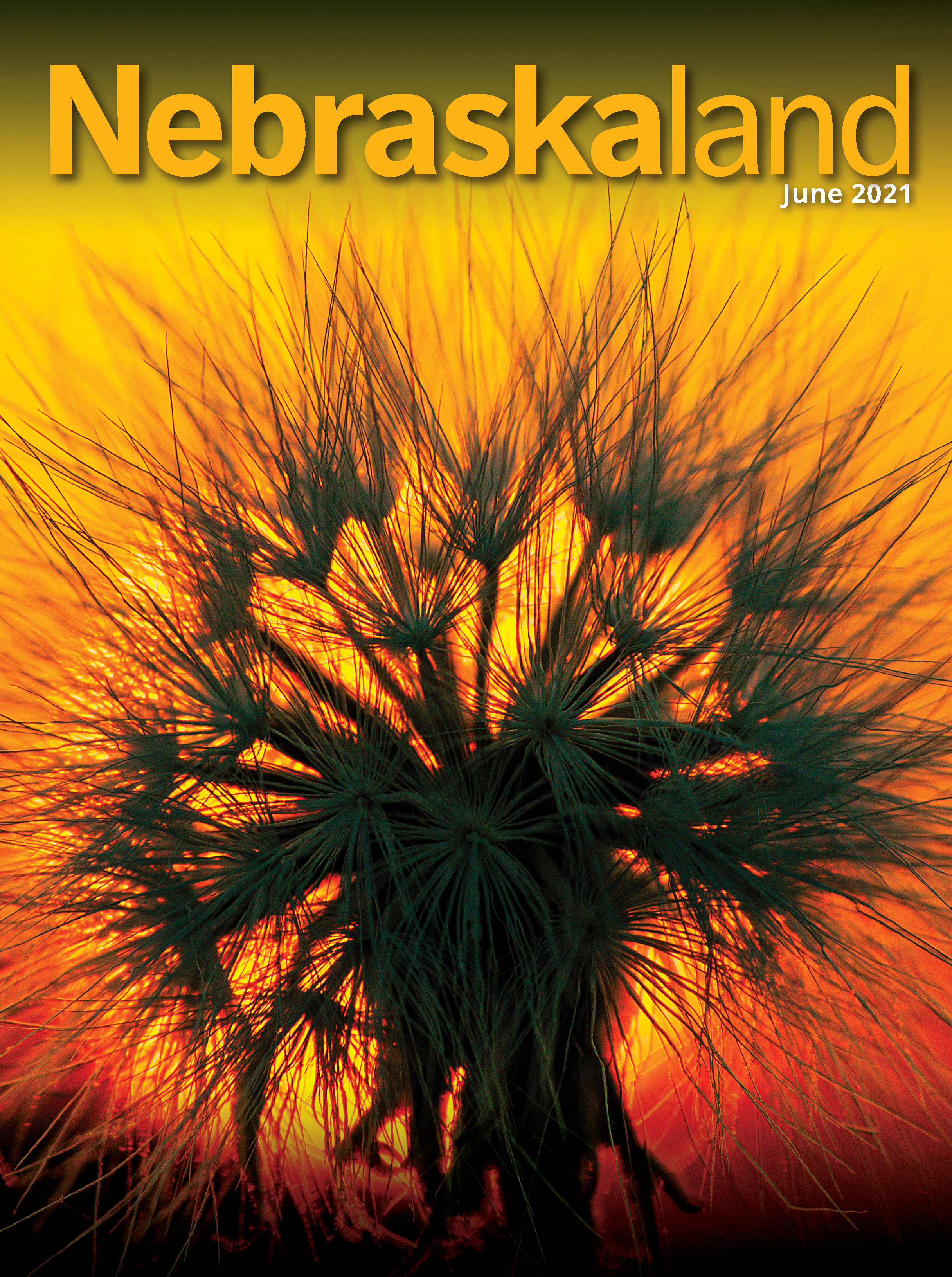
Cover: Prairie-dandelion (Nothocalais
cuspidata) resembles the much maligned
dandelion of yards and gardens but is
a native prairie wildflower in Nebraska.
This seedhead was silhouetted against
a setting sun at Prairie Plains Resource
Institute’s Gjerloff Prairie in Hamilton
County.
CHRIS HELZER
ON THE WEB
For more articles and
information, visit
NebraskalandMagazine.com
This page: Beads of water from the
previous night’s rain slowly fall from a
leaf in the Pine Ridge. By repelling water,
hydrophobic leaves, such as this one,
enhance photosynthesis, decrease risk
of disease and prevent damage from
pollution.
JUSTIN HAAG, NEBRASKALAND
Nebraskaland (VOL. 99 / NO. 5 ISSN 0028-1964) is published monthly, except for the combined Jan./Feb. and Aug./Sept. issues, by the Nebraska Game and Parks Commission, 2200 N. 33rd St.,
Lincoln, NE. Periodicals postage paid at Lincoln, Nebraska, and additional mailing offices. POSTMASTER: Send address changes to Nebraskaland, P.O. Box 30370, Lincoln, NE 68503-0370.
Magazine Staff
magazine
Published by the Nebraska Game and Parks
Commission since 1926. The Commission is
dedicated to the conservation and protection
of all the state's natural resources and the
people who use them.
Communications Director Christy Firestone
Public Relations Manager Shawna RichterRyerson
Editor Jeff Kurrus
Associate Editor Jenny Nguyen-Wheatley
Regional Editors Eric Fowler, Julie Geiser,
Justin Haag
Contributing Editor Michael Forsberg
Regular Contributors Renae Blum,
Chris Helzer, Chris Masada, Ryan Sparks, Gerry
Steinauer
Art Director Tim Reigert
Graphic Designer Mel Severin
Photo Librarian Jaclyn Cruikshank Vogt
Administration
Director Jim Douglas
Deputy Director Tim McCoy
Commissioners
Chairman - Dan Kreitman, Wahoo
Vice Chairman - Pat Berggren, Broken Bow
2nd Vice Chairman - Rick Brandt, Roca
Robert Allen, Eustis
Jim Ernst, Columbus
Donna Kush, Omaha
Scott Cassels, Omaha
John Hoggatt, Kearney
Doug Zingula, Sidney
Circulation
For address changes and questions about your
subscription, call 800-632-5263
Advertising Sales Manager
For advertising information contact
Shane G. Gilster, 402-742-0125
Email: shanegilster@gmail.com
Nebraskaland Magazine Copyright 2021, all rights reserved.
Nebraskaland is available in audio from the Nebraska Library
Commission Talking Book and Braille Service, Suite 120, 1200 N St.,
Lincoln, NE 68508. 800-742-7691. Nebraskaland Magazine and the
Nebraska Game and Parks Commission reserve the right to reject any
advertising not in keeping with the agency mission.
Rates: $18 for one year; $33 for two years; $44 for three years. Nebraska
recipients must add appropriate sales tax. To subscribe call
1-800-NEBLAND (632-5263), or go online to:
NebraskalandMagazine.com.
Commission Offices
Conservation Officers
Headquarters/Southeast District Office
2200 N. 33rd Street Lincoln, NE 68503
Phone 402-471-0641
ADMINISTRATION (Lincoln)
Craig Stover (Administrator)
Duane Arp (Asst. Administrator)
Travis Shepler (Asst. Administrator)
Jeff Clauson (Asst. Administrator)
Northeast District Office
2201 N. 13th St. Norfolk, NE 68701
Phone 402-370-3374
Southwest District Office
301 E. State Farm Rd. North Platte, NE 69101
Phone 308-535-8025
402-471-5531
402-471-5531
402-471-5531
402-471-5531
NORTHWEST (Includes counties covered)
Dan Kling (Lieutenant)
308-430-0572
EAST SUB-DISTRICT
Sean Schultz (Sergeant)
308-672-1824
Northwest District Office
East Hwy. 2, Box 725 Alliance, NE 69301
Phone 308-763-2940
Jerod Hahn (Deuel, Garden, Grant)
Keith Jadlowski (Keith, Deuel)
Jaden Porter (Keith, Garden)
308-520-5539
308-289-9580
308-289-2274
Bassett Office
524 Panzer St., Box 508 Bassett, NE 68714
Phone 402-684-2921
WEST SUB-DISTRICT
Kearney Office
1617 First Ave. Kearney, NE 68847
Phone 308-865-5310
Ak-Sar-Ben Aquarium/Schramm Education
Center
21502 W. Highway 31 Gretna, NE 68028
Phone 402-332-3901
Omaha Office
8495 Frederick Street, Omaha, NE 68124
Phone 402-595-2144
(Keith, Arthur)
Nebraskaland • June 2021
308-520-1031
Ray Dierking (Custer, Thomas, Blaine)
Frank Miller (Cherry, Hooker)
Greg Hesse
308-870-0322
402-389-0444
308-546-7464
308-660-4671
308-530-3157
(Lincoln)
(McPherson, Logan, Hooker, Cherry)
Kelsey Glodowski
308-763-8226
SOUTH SUB-DISTRICT
Josh Widhelm (Morrill, Scotts Bluff)
Jacob Stoinski (Sioux, Dawes)
308-279-9133
308-615-9017
(Red Willow, Frontier, Hayes, Hitchcock)
(Box Butte, Sheridan, Grant)
NORTHEAST (Includes counties covered)
Tom Zimmer (Lieutenant)
402-649-8053
NORTH SUB-DISTRICT
Jeff Jones (Sergeant)
402-762-5022
John Bauer (Holt, Boyd)
Dale Davis (Keya Paha, Brown, Rock)
Jonathan Andreasen
402-314-9257
402-760-0712
402-340-3981
Mitch Johnson (Knox, Antelope, Pierce)
402-613-8612
(Knox, Cedar)
Cory Krause (Sergeant)
402-380-6410
Kyler Prochaska (Platte, Colfax)
Nicholas Fix (Dixon, Dakota, Thurston)
402-830-8278
402-508-0261
(Cuming, Wayne, Stanton)
4
Kevin Bergstrom (Sergeant)
308-672-1824
SOUTH SUB-DISTRICT
Any program that receives federal funding from the National Park
Service, or the United States Fish and Wildlife Service prohibits unlawful
discrimination on the basis of race, color, religion, age, gender, marital
status, national origin, age, disability or political affiliation. Any person
who believes he or she has been discriminated against in any program,
activity, facility, or service, should contact the Nebraska Game and
Parks Commission, Lincoln, NE 402-471-0641, the Equal Opportunity
Commission, Lincoln, NE 402-471-2024, TTY/TDD 402-471-4693; United
States Fish Wildlife Service, Civil Rights Coordinator, 4401 N. Fairfax
Drive, Arlington, VA 22203; Director, Equal Opportunity Program, U.S.
Department of Interior, National Park Service, 1849 C Street NW, Mail
Code 0008, Washington, D.C. 20240-0001.
NORTH SUB-DISTRICT
Sean McKeehan (Sergeant)
(Kimball, Banner, Scotts Bluff)
CENTRAL (Includes counties covered)
Mike Thome (Lieutenant)
308-293-8746
NORTH SUB-DISTRICT
Doug Pollard (Sergeant)
308-730-7050
Matt Brandt (Sherman, Howard)
Daryl Teter (Howard, Greeley, Merrick)
Mark Sullivan (Nance, Polk, Wheeler, Boone)
Kyle Gaston (York, Polk, Hamilton)
308-202-0819
308-440-1863
402-741-0636
402-719-6226
(Loup, Garfield, Valley)
SOUTH SUB-DISTRICT
Matt Taylor (Sergeant)
(Thayer, Fillmore, Nuckolls)
402-200-9597
308-380-7331
402-902-2017
308-920-2762
308-440-3847
SOUTHWEST (Includes counties covered)
Roger Thompson (Lieutenant)
308-530-3097
Alex Hasenauer (Lincoln, Perkins)
Brandon O’Neal
(Madison, Pierce, Stanton)
OutdoorNebraska.org
Tim Williams (Hall, Hamilton, York)
Eric Javins (Adams, Clay, Webster)
Pat George (Harlan, Franklin, Phelps)
Ethan Teter (Buffalo, Kearney)
(Lincoln, McPherson, Logan)
Brian Piernicky (Sergeant)
308-340-6627
Matt Andrews
308-746-2418
Owen Johnson (Dawson, Custer)
Taylor Dixon (Dawson, Gosper)
402-266-1759
308-217-2108
(Furnas, Gosper, Frontier, Red Willow)
SOUTHEAST (Includes counties covered)
Stacey Lewton (Lieutenant)
402-890-7140
EAST SUB-DISTRICT
Heath Packett (Sergeant)
402-210-0888
Russell Mort (Otoe, Johnson)
Rich Berggren (Douglas)
Dan Evasco (Sarpy)
Mike Luben (Saunders, Butler)
Bryan Adams
402-209-1506
402-619-1355
402-616-5961
402-443-6392
402-429-1924
(Cass)
(Nemaha, Pawnee, Richardson)
WEST SUB-DISTRICT
Scott Eveland (Sergeant)
402-853-3273
Dina Barta (Lancaster),
Dudley Sorensen (Lancaster)
Bryce Streger (Seward, Saline)
Trevor Stahlecker (Lancaster)
Matt Seitz (Gage, Jefferson)
402-890-6463
402-937-3422
402-646-0420
402-314-9641
402-806-0915
(Lancaster)
YOUR NEBRASKA
Instagram Photos
Follow us @nebraskaland
and tag us in your photos
to be featured in an
upcoming issue.
@chinmayj97
Hooded merganser
OPPOSITE: Roger Richters, Utica
A black and white bag shot
@ james_steckelberg
Red-tailed hawk
6
Nebraskaland • June 2021
June 2021 •
Nebraskaland
7
YOUR NEBRASKA
@huskertiara
Fishermen at Chalco Hills Recreation Area
Chelsey Fuhrman, Omaha
A great egret
Connor McClellan, La Vista
White-tailed deer
Send your comments and
photos to:
Jeff Kurrus, Editor
Nebraskaland Magazine
P.O. Box 30370
Lincoln, NE 68503
or email Jeff.Kurrus@Nebraska.gov
Please include your postal address
and telephone number. Letters
may be condensed and edited.
Photographs are also welcome.
8
Nebraskaland • June 2021
June 2021 •
Nebraskaland
9
IN THE FIELD
BLACK HILLS OVERLOOK
Sunrise over Chadron State
Park at Black Hills Overlook
Road on Pine Ridge Ranger
District of Nebraska National
Forest in Dawes County.
JUSTIN
JUST
IN HAAG,
HAAG, NEB
NEBRASK
RASKALAN
ALAND
10
Nebraskaland • June 2021
June 2021 •
Nebraskaland
11
IN THE FIELD
JULIE GEISER, NEBRASKALAND
IT’S A HARD KNOCK LIFE
By Julie Geiser
Last summer during an afternoon walk around a pond, I
noticed a huge school of baby largemouth bass swimming
along the shoreline, hiding in the aquatic vegetation. Not
far away, off in deeper water, was a large, adult male bass,
ready to ward off any predators that might threaten his
school. It is the last of many jobs he has in the process of
raising the next generation of bass.
Each spring, largemouth bass, and plenty of other aquatic
species, are instinctively driven to spawn. In preparation,
the male bass — from early May to June depending on
how fast a particular body of water warms — will clear a
bowl-shaped depression on the bottom of a lake or pond by
swishing away the sand or mud with his tail and fins. This
“nest bowl” typically is formed in 1- to 6-feet of water and
can reach a couple of feet in diameter.
After his nest is made, the male tries to attract a female
bass that is ready to spawn and convince her to lay eggs in
his bowl, swimming next to her in the nest while nipping
and butting her belly. If she chooses his nest, the male will
fertilize the eggs as the female releases them. Some males
attract more than one female to their nest.
It’s the male’s job to tend the nest, protecting the eggs
12
Nebraskaland • June 2021
from predators. During the incubation period, the male
will fan the eggs with his tail to move water over them to
remove silt. The eggs hatch in 2 to 10 days, depending on
water temperatures, and the new hatchlings remain in the
bottom of the nest until they are about three-quarters of
an inch in length.
While there, the sac fry depend on a yellow yolk-type
sac attached to their abdomens for nutrition. Once the
yolk sac is used up and the fry are larger, they swim from
the nest and start to feed on microscopic plankton. It is at
this stage that they become very vulnerable to predation
by other fish, including other bass.
As the fry grow into fingerlings, which are 2- to 3-inches
in length, they begin to feed on bugs, invertebrates, other
smaller fish, even their smaller hatchlings, and whatever
else they can fit in their mouths.
The ones that survive are the aggressive fish that will
repeat the reproduction process again and again until their
time is up. These are the fish anglers love to play on their
line, for the sport of a good fight, and the ones I like to
observe as I take a walk along the water’s edge, wondering
what is going on beneath the surface.
IN THE FIELD
Northern lights on the surface of an Oglala National Grassland pond in Dawes County.
BOB GRIER, NEBRASKALAND
NATURE’S LIGHT SHOW
By Martha Shulski
I had the pleasure of living in the Far North for seven years
before calling Nebraska home again. There is much beauty
to behold in the subarctic, not the least of which is the
northern lights. Magnificent, dynamic and colorful displays
that can light up the polar night are called aurora borealis
(or aurora australis if you inhabit the southern hemisphere).
The aurora is a product of space weather and what happens
when solar wind particles are deflected into the earth’s farreaching upper atmosphere. The geomagnetic poles of our
planet are where magnetic field lines come together, both in
the north and the south. Think of longitudinal lines that arc
far around earth and meet around both polar regions.
Aurora typically occur at a distance of 10 to 20 degrees
from these geomagnetic poles, which explains why these
light displays are common at high latitudes. While rare,
the northern lights can be seen in middle latitudes as
14
Nebraskaland • June 2021
well. Geomagnetic storms, or solar storms, can result in
displacement of where aurora typically occur and that’s
when we should train our eyes skyward. Clear nights, away
from light pollution and near the time of a new moon, is the
best recipe to view an auroral glow.
This light can appear red, green, blue, yellow or pink
and is dependent on the type of element — think oxygen
and nitrogen — and frequency of its movement. The forms
you can expect to see range from a glow on the horizon to
patches, arcs, rays and coronas. If you haven’t seen aurora
while standing on earth, try from the air during an overnight
flight.
As a weather person, I find delight in seeing aurora in the
comments section of old hand-written monthly weather
reports. If I take the time to stop and observe, I always find
something interesting.
IN THE FIELD
ERIC FOWLER, NEBRASKALAND
ELK, PRONGHORN PERMITS UP IN 2021
By Eric Fowler
Elk harvest hit record highs for both bulls and cows in
2020 in Nebraska, and pronghorn harvest was the highest
it has been since the 1970s for both bucks and does. Those
numbers are expected to increase again this year thanks to a
substantial increase in the number of permits authorized by
the Nebraska Game and Parks Commission for both species.
The agency will issue 225 bull elk permits, a 53 percent
increase from 2020, and 621 cow elk permits, a 75 percent
increase. For pronghorn, late-season doe tags will be
increased in all but two management units, bringing the
total doe permits to 1,140, a 52 percent jump.
The increases are in response to concerns raised by
landowners in a survey last fall. While the Commission
periodically sends scientific surveys to landowners to gauge
their thoughts on the deer herd, it was the first time they’d
formally asked similar questions to those who have elk and
pronghorn on their land.
Nearly 1,500 individuals were surveyed regarding elk. Of
the 42 percent who responded: 36 percent, most of them
in the North Platte River and Niobrara West management
units, said they felt they had too many elk; 46 percent,
especially among those in the Hat Creek, North Platte
River and Niobrara West units, reported moderate to heavy
damage to crops, fences and stack yards; and 50 percent said
the damage was unacceptable.
Luke Meduna, big game program manager with the
Commission, said to this point biologists around the state
regularly had talked with landowners about elk since the
species reestablished itself in the state. While a few had
expressed concerns, most had wanted to see more elk, and
biologists had been conservative with elk management.
“The ‘Nebraska nice’ thing is real,” said Meduna. “For the
16
Nebraskaland • June 2021
most part, while elk herds were slowly expanding through
the ’90s and early 2000’s, landowners were quite quiet. Some
would mention it, but by and large, most didn’t until there
were way too many. Most enjoyed seeing 5 or 10 and even 20
Deer Permits Increasing
Additional deer permits were authorized for
2021, primarily in an effort to target whitetail
does and control the herd that has recovered
from heavy losses to disease during severe
drought in 2012.
Permit quotas have been increased in five
units, and in four more units where permits
typically don’t sell out, the number of bonus
antlerless tags has been increased. The River
Antlerless season has also been extended
through January.
Special permits also have been created for
Harlan County Reservoir and the Southwest
Reservoirs to allow antlerless harvest on
those public lands, something that had been
prohibited to prevent overharvest.
• 46,275 Firearm Permits, up 2 percent
• 32,100 Antlerless Permits, up 6.5 percent
• Increased bonus tags in Calamus West, Keya
Paha, Plains and Sandhills units
• Increased firearm permits in Blue
Northwest, Blue Southeast, Calamus East,
Elkhorn and Wahoo units
• Increased Antlerless permits in Blue
Northwest, Blue Southeast, Pine Ridge and
Wahoo units
elk, but when it became 40 or 50 or more, their tune changed
and they spoke up. The number of landowners telling us that
we have too many elk has drastically increased in the past
few years.”
The concern among landowners is highest in areas with
row crops interspersed among or adjacent to elk habitat.
“The amount of damage they can do in corn is significant,”
Meduna said.
More and more landowners are doing their part to control
the herd by allowing access to more hunters, helping them
get an elk and then getting the next hunter in to do the same.
In 2020, the number of antlerless elk permits increased by
40 percent from 2019, antlerless harvest went up 84 percent
and success jumped 14 points to 59 percent, the highest rate
ever. Splitting the antlerless season in two more units to
spread out hunting pressure this fall should help maintain
the success.
Meduna said biologists will continue to balance landowner
needs with hunter success as it adjusts permit numbers
in the years to come. The age and trophy quality of bulls
harvested continues to increase, and success remains high
for this once-in-a-lifetime permit.
The increase in pronghorn doe permits also is in response
to landowner concerns. About 1,300 surveys were sent and
500 returned. Of those, 49 percent said there were too many
pronghorns, especially in the southern Panhandle, and 72
percent said they experienced some damage, primarily to
crops and fencing.
Meduna said the increase in doe permits could bring
harvest back to levels not seen since the 1970s, when
hunters took home between 300 and 500 each fall, making
up roughly half of the harvest. Drought and a number of hard
winters in the 1980s reduced the population to the point that
only buck tags were issued for many years, even into the first
decade of this century.
“We’re in the process now of turning that dial back up,”
Meduna said. “Landowners have told us that what we’ve
been doing hasn’t been enough, so we’re definitely trying to
be responsive to that.”
The Commission is also capping the number of nonresident
archery pronghorn tags at 250. Sales of this permit, which
had been unlimited, ballooned from 133 in 2010 to 543 last
year, driven in part by COVID-19 pandemic and also by
eastern hunters looking for something new to try. Resident
archery tags also increased by 200. Many of the new hunters
found their way to public land on the Oglala National
Grassland.
“That had an affect not just on the crowding of the hunters,
but of hunting success for some of the other permits,”
said Meduna, noting that the pressure pushed so many
pronghorn out of the area that firearm success dropped 17
points to 47 percent. The cap on nonresident permits was the
option favored by most pronghorn hunters surveyed by the
Commission this winter.
Hunting Elk in a
Private Land State
Drawing an elk permit in Nebraska isn’t easy:
6,000 people applied for 501 permits in 2020.
And with much of their range on private land,
finding a place to hunt once you draw a tag isn’t
easy either. But it is not as difficult as some
may lead you to believe, and with the desire of
many landowners to reduce the number of elk
on their land, it is getting easier.
With an additional 345 permits available for
the coming season, odds of drawing will be
better but finding a place to hunt could be a
challenge. Luke Meduna, big game program
manager with the Commission, provides these
tips for those lucky enough to draw.
• When you draw a permit, head to your unit
as soon as possible and start knocking on doors.
Landowners are more apt to grant permission
to hunters they meet in person. Do not wait
until the season opens to ask.
• Be flexible. Some landowners only grant
access for a week or less, allowing them to offer
access to more hunters throughout the season.
Most reserve the first week or two of the
general season for bull hunters. Take what you
can get and make the most of it.
For a variety of reasons, cows are more
difficult to hunt and harvest than bulls. These
are herd animals, there are relatively few of
them compared to deer and they are extremely
sensitive to pressure. Don’t expect your hunt to
be anything like a late-season white-tailed doe
hunt.
• Take any advice the landowner gives you.
They know the habits of elk on their property
best.
• While few elk are harvested on public land,
Meduna thinks that is primarily due to lack of
effort. If you don’t find elk one day, they could
be there the next. Four trophy bulls came from
public land or Open Fields and Waters land in
2020.
• You don’t have to pay for access. A
University of Nebraska-Lincoln study surveyed
hunters who had elk permits between 2011
and 2016 found 58 percent of bull hunters and
19 percent of cow hunters paid for access.
Landowners managing for elk are more likely to
charge, especially for bulls, but success tends to
be higher.
• Give yourself time. The same UNL study
found antlerless elk hunters spent an average
of 7 days in the field, bull hunters 6.4 days.
• Be respectful of landowners and thank
them for the opportunity, whether you were
successful or not.
• Contact the Game and Parks office in your
unit. Biologists may be able to point you in the
direction of landowners who allow hunting.
June 2021 •
Nebraskaland
17
IN THE FIELD
JENNY NGUYEN-WHEATLEY, NEBRASKALAND
BUTTER AND BASIL SAUGER
WITH ORZO SALAD
By Jenny Nguyen-Wheatley
Servings: 4
Prep Time: 5 minutes
Cooking Time: 30 minutes
Ingredients:
• 4 to 8 sauger/walleye fillets
• Kosher salt and freshly cracked
pepper, to taste
• 5 tablespoons of salted butter,
separated
• 4 slices of lemon
• 2 tablespoons of freshly chopped
basil, separated
• ½ pound of uncooked orzo
• 2 tablespoons of extra virgin olive
oil
• 1 tablespoon of lemon juice
• ¼ teaspoon of dried oregano
18
Nebraskaland • June 2021
• Small handful of cherry/grape
tomatoes, sliced
• 1 tablespoon of grated Parmesan
cheese
1. Preheat oven to 350 degrees
Fahrenheit. Pat fish fillets dry with
paper towels and lay them on a
rimmed cookie sheet lined with a
large sheet of foil — large enough
to fold over and seal into a packet.
Sprinkle salt and pepper on one side
of the fish. Distribute lemon slices, 1
tablespoon of freshly chopped basil
and 4 tablespoons of butter on top.
Fold over the foil to seal and bake for
20 minutes.
2. Meanwhile, bring a pot of salted
water to a boil and cook ½ pound of
orzo according to package directions.
When orzo is al dente, drain it.
3. Immediately transfer hot orzo
to a mixing bowl. Stir in olive oil and
1 tablespoon of butter while it’s still
warm.
Next, stir in 1 tablespoon of freshly
chopped basil, lemon juice, tomatoes,
oregano, salt and pepper to taste;
start with ½ teaspoon of salt and
adjust from there. Stir in Parmesan
cheese right before serving.
4. Serve baked fish with warm or
room temperature orzo salad on the
side.
June 2021 •
Nebraskaland
19
Vi c t o r i a
Springs
State
Recreation
Area
An Oasis at the Edge of
the Sandhills
Story and photos by Eric Fowler
hen Victoria Springs State
Recreation opened in August
1925, an estimated 4,500 people
attended the celebration. These
days, around 6,000 people visit in an
entire year. It’s a quiet little park, which
is exactly why those who visit do so.
Some folks will say the 60-acre
park is in the middle of nowhere. But
that isn’t true. It’s only 6 miles off the
beaten path of Nebraska Highway 2 if
you head west from Anselmo.
Others have called it “an oasis in
the Sandhills,” but that’s not entirely
true, either. The park sits in a narrow
valley alongside Victoria Creek at the
southeastern edge of the Sandhills,
which you will soon find if you drive
north or west. To the south and east are
the rugged central loess hills.
But the Nebraska Game and Parks
Commission’s second-oldest park is
indeed an oasis. Here you can fish
or take a paddleboat ride around the
picturesque 5-acre spring-fed pond,
have lunch in the picnic area shaded
by towering cottonwoods, take a walk
W
20
Nebraskaland
• June 2021
through a prairie, and spend a night in
the campground or one of two rustic
cabins, which just received a facelift.
The area has a rich history. Charles
Mathews, one of the first settlers in
Custer County, staked his claim along
Victoria Creek in 1874. He built two
cabins there, one his home and the
other the county’s first post office. That
was the beginning of the town of New
Helena, where Mathews’ home would
later become the first general store.
Those cabins stand today, as does the
District No. 2 schoolhouse, completed
in 1889 and used until 1964.
Mathews and his partners also
founded the Victoria Springs Mineral
Co., bottling and selling the mineral
water nationwide for its therapeutic
value. The latter wasn’t entirely true,
either, as science would explain, and
the area never became the health
resort some envisioned.
But there is indeed therapeutic value
in Victoria Springs SRA. For some,
peace, quiet and solitude are indeed the
elixir of life. N
ABOVE: The sun rises over the
spring-fed pond that is the
centerpiece of Victoria Springs
State Recreation Area.
RIGHT: Chris Schaffert
of Aurora pushes his
granddaughter, Nora Rousch,
on a swing in the playground
at Victoria Springs.
June 2021 •
Nebraskaland
21
TOP LEFT: Two log cabins built by
Judge R. Charles Mathews in 1874, one
his home and the other the first post
office in Custer County, are now part of
Victoria Springs State Recreation Area.
MIDDLE LEFT: The Custer County School
District No. 2 was formed in 1876 and
built this school in New Helena in 18881889. It served students until 1964 and
is now part of the SRA.
BOTTOM LEFT: The Riessland and
Kucera families of Pleasanton relax
around a fire in the campground at
Victoria Springs.
TOP RIGHT: Chris and Teresa Schaffert
of Aurora and their grandchildren, Aden
and Nora Rousch, ride paddleboats
around the pond at Victoria Springs.
BOTTOM RIGHT: An aerial view of
Victoria Springs. The boundary to the
SRA is a rectangle. The road in the
foreground travels east (left side) to
west.
22
Nebraskaland
• June 2021
June 2021 •
Nebraskaland
23
Anselmo
Victoria Springs is located 6 miles east
of Anselmo. The 60-acre area includes
historic buildings, cabins, campsites
and a picnic area. Half of the campsites
and the two cabins take reservations up
to a year in advance.
The park will host one of three
signature events celebrating 100 years
of Nebraska State Parks on July 10. It
will feature a vintage baseball game
and walking tours of the historic cabins
and the namesake springs.
TOP RIGHT: Lights illuminate a cabin on
the bank of the pond at Victoria Springs.
The park’s two cabins were remodeled
this spring, with the screened porches
enclosed to expand living space, decks
added overlooking the pond and a ramp
built to make them wheelchair accessible.
BOTTOM LEFT: Ron and Rhonda Kush of
Platte Center walk down a trail that winds
through the grassland and woodlands on
the west edge of the park.
BOTTOM RIGHT: Margy Stoly of Lincoln
fishes from the bank near her cabin on
the pond.
24
Nebraskaland
• June 2021
June 2021 •
Nebraskaland
25
Outdoor Nebraska
By Renae Blum
As the celebration of the centennial of the state park system continues, make sure
to join us for one of the many events taking place across the state. Learn more at
Calendar.OutdoorNebraska.gov or pick one of the 78 park destinations to explore
on your own. N
Attend
“100 Year
Extravaganza”
event
What To Do in June
June 5 | Enders State
Recreation Area
This event offers plenty
to do, from a barbecue
smoke-off to kayaking,
live music, a trick shooting
demonstration, 5-K run and
car show.
JUSTIN HAAG, NEBRASKALAND
Participate in the
Great Park Pursuit
Through September | Statewide
Get out and explore Nebraska’s wide array of parks with this free
program. Teams can visit up to 20 official sites, where you’ll follow
clues and search for a special pole within each park. This year’s
program has a fishing focus and highlights the Nebraska state park
centennial. JUSTIN HAAG, NEBRASKALAND
Attend Chadron’s 100th anniversary
party
June 11-12 | Chadron State Park
It all started here. Come celebrate the 100th anniversary of Nebraska’s first
state park. Activities include a laser light show, paddleboating and kayaking,
a car show, stagecoach rides, Dutch-oven demos, a treasure dive at the pool, a
canoe regatta race, and archery and pellet gun shooting at the new shooting
gallery.
JUSTIN HAAG, NEBRASKALAND
Fish interstate lakes
Throughout the month
Central Nebraska
Enjoy good fishing at the 40 sandpit
lakes along Interstate 80. Almost all
have largemouth bass, bluegills, channel
catfish and a variety of other species.
Nearly all are open to the public, and
they’re close enough together that you
can fish two or three in a day. Find a guide
to fishing this area at
OutdoorNebraska.org/wheretofish.
DOUG CARROLL, NEBRASKALAND
26
Nebraskaland • June 2021
Participate in
Family Fun Day
June 12 | Mormon Island State
Recreation Area
Spend a day at Mormon Island enjoying an
outdoor scavenger hunt, fishing, kayaking,
camping games, archery, tomahawk
throwing, Dutch-oven cooking and animal
identification.
JENNY NGUYEN-WHEATLEY, NEBRASKALAND
June 2021 •
Nebraskaland
27
Continuing
the Hunt
By Todd Mills
How to Pursue Your Passion as You Age
ot
othing
o
drives a human being like pursuing a passion.
And when it comes to hunting, well, some will do
A
most anything to bag a bird or that trophy buck.
m
But
B
u what happens when your physical capabilities
limit
li
it or even stop you from chasing that long-time dream
of hunting when you are past retirement? What once
was a burning desire to strap on those waders and grab
that gun, now gets replaced with “I used to hunt, but my
body just can’t take it anymore.”
It’s hard work to hunt and fish. Two months of running
and gunning for turkeys is not easy on the body, and if
you don’t take care of yourself, those two months turn
into two weekends, which turns into two mornings,
which turns into one opening day hunt. And after that,
N
it dies with your stories of “remember the time when
we ... ”
Old Father Time has a way of catching up faster than
we’d like. But trust me, getting older doesn’t mean you
have to quit hunting. If you do a little maintenance on
your body, just like cleaning your hunting and fishing
gear, you’ll be clawing your way out of the grave when
the good Lord finally comes with that year’s permit still
in hand.
Starting an exercise program is not easy, that’s for
sure, and finding the right combination of exercises can
be even tougher, especially ones that benefit the hunter.
Here is a great place to start, right after you’ve gotten a
physical from your doctor.
Elwood Vick hunts
bobwhite quail in
Lancaster County.
JEFF KURRUS, NEBRASKALAND
28
Nebraskaland • June 2021
June 2021 •
Nebraskaland
29
Upland Hunting
Waterfowl Hunting
Severall years ago, I spentt opening
S
i
weekend in Iowa
hunting pheasants in knee-high grass. Although I was
in good cardio condition, I was not ready physically
to handle “knee ups” all day long. The next day, I
paid for it.
The following are three options to help
condition yourself to the rigors of upland
hunting.
Nothing
N
thi
ttaxes th
the b
body
d quite
it like
lik waterfowl
t f l
hunting. Walking on uneven terrain, carrying
decoys, pushing a boat ... even walking into an
underground blind can be challenging. Now throw
in waders, a gun, your blind bag and some cold
temps. If you’re not in physical shape to handle
these conditions, you’ll fade fast. Believe me, I
have seen it happen to my favorite hunters.
ERIC FOWLER, NEBRASKALAND
Although your cardio program can be similar
to the upland program, core strength is probably
the most important component to add to your
waterfowl conditioning program.
Cardio
Start slowly and allow yourself plenty
of time to get in condition. Start with 20
minutes initially and increase up to 45
minutes.
JUSTIN HAAG, NEBRASKALAND
Treadmill – Gradually add incline to
simulate walking on uneven ground.
Outside – Walk hills as well as on flat
ground two to three times per week.
Cardio
Upper Body
Short Planks – Keep your core tight.
Start with 30 seconds and extend time as
you’re able.
Resistance training, or strength training,
is important to strengthen your arms and
shoulders for carrying a gun.
Push-Ups – Start on your knees if you
need to. Push-ups will strengthen your
upper body and core.
Resistance Bands – Bicep curls and
shoulder raises can easily be done with
bands.
Battle Ropes – If you have access to
ropes, this is a great core-building exercise
that also combines cardio. Start with 30
seconds and continue to add more time
depending on what you can handle.
Dumbbells or Curl Bar – Continue
with the bicep curls and shoulder raises.
Remember to use enough weight to
make it difficult to finish the last couple
repetitions.
Upper Body
Two-three sets per exercise with 10-12
reps.
Resistance Bands – As with upland
hunting, bicep curls and shoulder raises
are necessary.
Lower Body
Body Squats – This exercise will help to
condition your upper thighs. Use your own
weight to start with and eventually you
can use a weighted ball or kettlebell. If you
have access to a plyometric box, use it to
step up and down. Another option would
be to go up and down your stairs several
times.
Dumbbells – Add flat presses as you
gain strength and balance.
Two-three sets per exercise with 10-12
reps.
ALL EXERCISE PHOTOS – JEFF KURRUS, NEBRASKALAND
30
Nebraskaland • June 2021
June 2021 •
Nebraskaland
31
Deer Hunting
Although I’m not a deer hunter, I’ve heard
plenty of stories from hard-core hunters
that deer hunting can be the toughest
of all hunting when it comes to physical
conditioning. In deer hunting, you use
muscles that you don’t normally. Walking
long distances to your favorite spot and
climbing into a stand is one thing, but field
dressing and dragging a deer out takes the
physical exertion to an entirely different
level. JEFF KURRUS, NEBRASKALAND
All of the exercises discussed here can be
used for all aspects of hunting, and mixing
things up is helpful to avoid boredom and to
keep your body from adjusting.
As we age, hunting doesn’t get any easier.
Decreased strength, muscle tone, flexibility,
endurance and particularly motivation can
make hunting difficult. The thrill of chasing
a big buck or getting your boat into your
favorite honey hole can lead to a series of
pulled muscles, shaky legs and gasping for
breath. At almost 60, I am working hard to
make sure these scenarios don’t happen
to me, because I want to hunt well past
retirement. As do you. N
JEFF KURRUS, NEBRASKALAND
Cardio
Walk – Strap a backpack on and go for
a long walk. Find an area that you can
go up and down a slight incline. As your
conditioning improves, adjust your pace to
a fast walk.
Treadmill – If you have access to a
treadmill, you can do the same. Steadily
increase your time and distance as your
conditioning increases.
Rowing Machine – If you have
access, a rowing machine is a great way
to acclimate your body to the pulling
movement of dragging a deer out or
pulling equipment.
Upper Body
Lat Pulldowns – If you have access
to a pull-down machine or TRX bands,
these are perfect for building upper body
strength. Make sure you’re using weight
that’s challenging.
Two-three sets at 12-15 reps.
Lower Body
Lunges – Maybe one of the most
important leg exercises when preparing
for long walks on uneven ground. You
can start with a standing lunge and
then progress to walking lunges as your
condition improves. Do not allow your knee
to go over your toe to get the most benefit
and to prevent putting too much stress on
your knees.
32
Nebraskaland • June 2021
Nutrition as We Age
Although the focus of this article is on physical
conditioning for the aging hunter, nutrition and
recovery are just as critical as the workouts themselves.
It is estimated that on a hunt, you can burn
anywhere from 150 to 500 calories an hour
depending on the conditions. So, having both an “offseason” and “in-season” calorie intake is crucial to
maintaining a weight that will not impede your activity
level. Imagine being 20-30 pounds overweight and
then strapping 20 pounds of hunting gear over your
shoulder. You’ve got no shot to make hunting happen
as you grow older if you’re not at “playing” weight.
OFF-SEASON DIET
There are a lot of theories on fad diets. Bottom line:
It will always boil down to calories in and calories out.
While there is no fast or quick fix to eating right, here
are a few tips to help.
Minimize Empty Calories – No need to stop eating
sugar, just keep it to a minimum. Empty calories such
as alcoholic beverages and dressings can add calories
in a hurry. Like most everything in life, you can eat
most anything in moderation.
Eat Small and Frequently – The typical diet
of many includes no breakfast, small lunch and
a big dinner. That won’t work when trying to lose
weight and especially when trying to speed up your
metabolism. Think about a race car. Only the best
fuel goes in, and it goes in at frequent intervals. Our
human body is no different.
Stay Hydrated – Drinking water frequently also
speeds up your metabolism and helps your body
process foods. Keep a water bottle by you at all times
and avoid sugary drinks. Water is an essential nutrient
for survival. There is a reason for that.
IN-SEASON DIET
You may need to eat more calories this time of
year. Depending on what you’re hunting, hunger and
dehydration can come on in a hurry.
Prepare for the Day – Make sure you pack plenty
of healthy snacks for the day. Since you never know
how things will work out, be prepared for the worst.
Almonds, low-sugar protein bars and dried fruit are all
good options to pack and carry.
DON’T OVERINDULGE
Nothing ruins a hunt like overindulging the night
before. I have seen many hunts ruined due to lack of
hydration and the body not working right. Limit your
alcohol intake, and eat during or after you drink to
avoid binge eating on that duck blind breakfast.
June 2021 •
Nebraskaland
33
Tips for Catching
Northern Pike
Box Butte
Reservoir
A Toothy, Primeval Fighter
Story and photos by Julie Geiser
F
or anglers who love a good fight,
the northern pike, a needletoothed, aggressive — almost
primeval — fish, is highly sought
after.
According to the 2021 Nebraska
Fishing Forecast, Hackberry and
Dewey lakes on the Valentine National
Wildlife Refuge, Box Butte Reservoir
and Lake Wanahoo are this year’s top
picks. Other reservoirs like Elwood,
Enders, McConaughy, Merritt and Red
Willow hold a few big pike. Several
other lakes around the state have
been stocked with pike as well. To find
stocked waters near you, check the
TIP 4
catching pike.
However, jigs with worms and
soft swimbaits can also attract this
voracious feeding fish. Lures of darker
colors are sometimes better in murky
waters.
Valentine NWR Lakes
V
Lake Wanahoo
o
According to the 2021 Nebraska Fishing
Forecast, these are the state’s top northern
pike fishing destinations.
stocking reports on the Nebraska Game
and Parks Commission’s website.
After deciding where to fish, here
are a few tips to make your pike fishing
trip a little more successful.
Don’t get bit.
Pay close attention to the sharp teeth
and gills of pike, as they can easily
cut through your skin. You can land a
smaller northern by gripping it behind
its head: Larger pike might require a
net, but be sure to bring a big one in
case you are lucky enough to hook a
30-inch-plus fish. Lip-gripping pliers
also work well.
Once on the bank or in the boat,
use a jaw spreader and long, needlenose pliers to remove the hooks. Use
caution, as a northern will fight hard
even after it is in the boat or on
shore, the main reason you’re fishing
for them in the first place. N
TIP 3
Use strong equipment.
Gear up with at least a 7-foot,
medium- to heavy-action rod, and a
spinning or baitcasting reel spooled
with a strong braided line of at least
20-pound test or monofilament of at
least 15-pound test.
A pike’s razor-sharp teeth can easily
cut through line, so tip yours off with
a steel or heavy fluorocarbon leader.
Once a pike bites, you’ll have a great
battle on your hands, and you will
need the proper equipment to land a
big fish capable of bending a rod to its
breaking point.
Using lures with treble hooks and
trailer hooks will help catch pike.
Oversized spinners, large plastic lures
and top-water plugs work well for
pike.
For the latest survey information on
northern pike and Nebraska’s other
fish species, visit outdoornebraska.org/
fishingforecast/.
TIP 1
Find the vegetation.
After ice-out in early spring, focus
on shallow, weedy areas near coves
and shorelines where the water warms
faster and pike spawn. Fish areas with
weed beds and submerged logs where
pike patrol for prey.
As the water warms, fish the
flats and points leading into coves,
typically in 3 to 10 feet of water. Look
for structure near drop-offs and weedy
points.
During the heat of summer, larger
pike will head to deeper water, 6 to
10 feet, in search of baitfish schools.
This is when anglers will need to cover
a lot of water to find pike. Trolling is
a good way to locate big northerns,
along with fan-casting to deeper weed
lines. Don’t stay in one place too long
without a bite.
TIP 2
A northern pike is guided into a landing net at Elwood Reservoir in Gosper County.
34
Nebraskaland
• June 2021
Use bright, flashy and noisy baits.
Spinnerbaits, crankbaits, buzzbaits,
spoons and surface plugs with highly
visible colors are often the best for
Jerry Vieyra and Robby Rowland fish for pike at Merritt Reservoir State Recreation Area during the fall.
June 2021 •
Nebraskaland
35
Your Camera
Doesn’t See
Like You Do
Part 2 of 3
Story and photos by Chris Helzer
ave you ever wondered why the photos you take at dusk turn
out grainy or blurry? Why is it that only the left ear of your
deer photo is sharp and the rest of the scene is out of focus?
Simply put, your camera doesn’t see the world like you do.
The first installment of this series, released in the May
2021 edition, covered mainly field of view and focus, but also
mentioned depth of field. This time, we’ll explore depth of
field further, but in the context of exposure and the settings
that control it. As a reminder, depth of field is the distance
between the nearest and farthest objects away from you that
appear in focus simultaneously. In other words, there is a
limited range of space between you and the horizon that can
be in focus when you take a photo.
H
The Shutter Speed/Aperture Tradeoff
Depth of field is influenced by the focal length of a lens
and the proximity of your subject. Within those contexts,
though, you also can also control depth of field by changing
the aperture size (the opening through which light passes
into the camera) in a camera’s lens. A smaller hole creates
greater depth of field than a bigger one. In addition to altering
the depth of field, however, that aperture also influences
exposure, or the amount of light per unit area that hits the
sensor of your camera (or film if you’re a Luddite or artisan).
A big hole lets in more light than a small hole, and more light
makes a brighter image.
What if you need a bigger aperture but don’t want the image
36
Nebraskaland • June 2021
to be brighter? Fortunately, there is a second regulator of light
that allows you to change the aperture without your image
becoming too bright or too dark — the shutter speed. The
shutter speed of a camera is the amount of time the “door”
of the camera stays open and allows light to pass into the
camera. A faster shutter speed lets less light in than a slower
shutter speed because it opens and closes the shutter more
quickly. Fast shutter speeds also help capture sharp images of
moving objects like running deer or swaying flowers.
On your camera, shutter speed increments and aperture
increments (f/stops) are complementary. If you want a
different shutter speed or aperture setting, but don’t want
In this photo, the flower is sharply focused. The background is not totally sharp, but still contributes to the
photo. Wide-angle lenses naturally have more depth of field than lenses with a longer focal length, making depth of field
less of an issue.
your image to be darker or brighter, you can simply adjust
both the shutter speed and aperture the same number of
increments. On most cameras, that means if you rotate your
shutter speed knob three clicks one way, you have to rotate
your aperture knob three clicks the other way to maintain
the same exposure. Depending upon how much control
you want, you can make all those adjustments yourself.
Otherwise, your camera will handle either the shutter speed
or aperture decisions — or both.
However, while shutter speed and aperture are
complementary, the decisions you make about those settings
have important ramifications. For example, if you want more
depth of field and tell your camera to close down the aperture,
you’ll need a slower shutter speed to get enough light to make
a nice image. That can create problems if you’re trying to
freeze the action of a deer jumping a fence or a flower waving
back and forth in a breeze.
Shutter Speed and Blur
A fast shutter speed helps prevent blurry photos as a result
of your hands shaking slightly while holding the camera. For
June 2021 •
Nebraskaland
37
Low light forced me to use a slow shutter speed for this photo, especially
because I wanted a small aperture to maximize depth of field. I used a
tripod and a shutter speed of about ½ second. Note the effect of the slow
shutter speed on the small waterfalls behind the fungus.
most of us, 1/60th of a second is about the slowest shutter speed we can
safely use when hand-holding a camera. With telephoto lenses, you want
to use a faster shutter speed number than the telephoto number (e.g. use at
least 1/300th of a second for a 300mm lens). Vibration reduction technology
in newer lenses can buy you a little leeway there, but it’s still safest to follow
the shutter speed-lens length rule. These issues are why photographers
rely on tripods, which hold the camera steady when you need to use a slow
shutter speed in order to get the depth of field you want in an image.
Deciding what combination of shutter speed and aperture to use for a
photo can be tricky, and you can’t necessarily trust your camera to choose
the best answer. Your camera won’t know that you want both the flower
in the foreground and the hills in the background of an image to be sharp.
Alternately, your camera can’t anticipate that you want to blur out the
distracting background in a close-up photo of a bee on a flower. When you’re
trying to make sure the eye of a bobolink is in sharp focus, your camera
won’t know that you don’t give a flip about depth of field and just need all
the shutter speed you can get.
Setting the Camera on a Priority
One solution is to set your camera on either aperture priority or shutter
speed priority, in which you tell the camera which is more important to
you and let the camera work within that set of parameters. If you set the
camera on aperture priority, you can tell the camera to keep the aperture
set at a generous f/16, which will make sure you have adequate depth of
field to make both the foreground flowers and the background hills sharp.
38
Nebraskaland • June 2021
ABOVE: A fast shutter speed of 1/640
second counteracted the breeze that
was moving these flowers back and
forth.
The camera will then automatically set the shutter speed
to whatever is necessary to make an image with reasonable
brightness.
On the other hand, you can set your camera to shutter speed
priority and tell it to shoot at 1/1000 of a second to make
sure no movement blurs that boblink’s eye. The camera will
take charge of adjusting aperture as you track that bobolink
through alternating patches of shadow and sunlight.
Aperture and shutter speed priority can give you less to
concentrate on if there’s a lot happening. Just remember that
you’re still trusting the camera to make decisions and that it
doesn’t share your artistic vision.
June 2021 •
Nebraskaland
39
The low light on the pre-dawn Platte River made it necessary to use a very high ISO just to capture this image. The image is
grainy, but still holds together fairly well. ISO 1600 and 1/10 sec shutter speed.
ISO Setting
The eye of this bobolink was the only critical focal point in this photo. Shutter speed, not aperture, was the priority for this
image.
40
Nebraskaland • June 2021
There is one other camera setting that can help you increase
shutter speed without losing depth of field or vice versa, but
it also doesn’t come for free. It’s called the ISO, which, oddly,
stands for International Organization for Standardization
— a name you’ll never need to know again. Without getting
deep into the details, when you increase your ISO setting
on a digital camera, it requires less light to make an image.
Unfortunately, as you increase ISO, your images get more
and more grainy. While newer cameras handle ISO better
than older ones, that graininess still increases with higher
ISO numbers and can create images that don’t look good
when enlarged.
If you absolutely can’t get a photo without boosting
ISO, boost it. Otherwise, keep it within a reasonable range.
With many digital SLR cameras, that reasonable range is
somewhere around 800 or lower. Some newer cameras can
create decent images at much higher ISO settings, but most
photographers I know still set it as low as they possibly can.
Letting your camera choose ISO for you can be helpful when
working quickly in low-light situations but don’t forget that
your camera doesn’t know your preference for “graininess”
and you might not always appreciate its choices.
Program Mode
If you’re just getting started in serious photography, you
might choose to set your camera to “program mode” and allow
it to handle aperture and shutter speed decisions while you
concentrate on focal length, composition and focus. That’s
fine for a while, but as soon as you get more comfortable
with the other aspects of your camera, it’s a good idea to start
taking the reins on exposure settings, too. There may still be
times you set the camera on shutter speed priority so you can
make sure that bobolink’s eye is sharp as it moves around
the prairie. However, you’ll probably find that, with some
practice, quick adjustments of exposure settings become
second nature. When that happens, you won’t have to trust
your camera’s brain to see the world the way yours does. N
Look for part three of Chris Helzer’s “Your Camera Doesn’t See
Like You Do” in the July issue of Nebraskaland. The author will
cover how to identify and use light intensity and quality.
June 2021 •
Nebraskaland
41
Backpacking
the Pine
Ridge Trail
An Adventure Story
Story and Photos by Justin Haag
Traversing scenic terrain in the
Panhandle, the Pine Ridge Trail serves
as a rewarding weekend adventure.
hrough work and play, I have been no stranger to the
Pine Ridge Trail. Portions of the route that transects
the heart of public lands in the Pine Ridge escarpment
between Chadron and Crawford have served me well as
a way to access scenic landscapes and wildlife, or just enjoy a
short hike or bike ride.
Though I had been on many parts of the trail, which
measures about 40 miles, I had never connected the dots in
one attempt. That changed in June 2020 when my 17-yearold son, Sawyer, and I decided to backpack the entire trail in
a weekend. It is something I had been considering for years
and, with COVID-19 restrictions in full swing, it seemed to
be the perfect time for such an adventure. To boot, it would
serve as a suitable way to celebrate National Trails Day, an
annual occurrence the first Saturday in June.
Even though covering the distance in three days did not
sound too difficult, I knew it was important to be prepared
— especially considering I had never been on an overnight
backpacking trip before. I pored over websites to gain
information from experienced backpackers and received
guidance from U.S. Forest Service staff.
Overnight hiking has more considerations than day treks,
and I was thankful backpacking has advanced. Provisions
such as tents, sleeping bags, stoves and freeze-dried food
T
42
Nebraskaland • June 2021
The author and his son, Sawyer, stand at the Spotted Tail Trailhead before beginning their hike of the Pine Ridge Trail.
have become optimized for weight and convenience. In the
weeks leading up to our journey, Sawyer and I collected the
necessary gear and knowledge.
While the Pine Ridge Trail may not qualify as a true “thruhike” — serious backpackers consider those to be 300 miles
or longer — it does provide a substantial challenge of three or
four days. You will be hard-pressed to find another wilderness
trail hiking opportunity this long in Nebraska.
Just because it is in Nebraska and not the mountains, the
trail should not be mistaken as easy. After inserting the
mileage, elevation gains and time into an online calculator
for hiking difficulty, I found it doubled the minimum score for
the “extreme” ranking.
Although an occasional ridge or canyon bottom provides
level hiking, the trail does not follow any one valley or
highland. Rather, it crosses a series of steep drainages
through the center of the escarpment. That means many
ups and downs. The elevations range from 3,700 feet near
Chadron State Park to 4,590 feet just east of East Ash Creek.
During the trip, we climbed 5,754 feet and descended 5,662.
Horseback is surely the least physical way to explore a trail
such as this one. A mountain bike is an option, but it surely
will need a lot of pushing.
The trail is not finely manicured. Most of it is unkempt
single-track, with an occasional stretch of two-track. At
times, users must search the landscape for the next marker
post. In early June, we found areas of the trail to be choked
with vegetation and ticks to be abundant, especially near
creeks. An occasional cow pie and patches of poison ivy also
needed to be dodged, though each seemed less frequent as
we traveled west.
Because the Pine Ridge Trail intersects others throughout
the Pine Ridge, you could easily stray off-course if not
continued on page 46
June 2021 •
Nebraskaland
43
dron
t o C ha
Pine Ridge Trail
AREA ENLARGED
We
st A
sh
Cre
ek
Chadron
State Park
United
States Forest
Service
reek
te C
But
nk
Tru
Indian Creek
eek
h Cr
t As
Eas
Crawford
START DAY ONE
Deadhorse Road
ek
Cre
rse
ho
ad
De
C
to
n
ro
d
ha
Spotted Tail Trailhead
Coffee Mill Trailhead
START DAY TWO
Bighorn
WMA
END OF TRIP
East Ash Trailhead
Deadhorse Road
d
Roa
START DAY THREE
East A
Fort Robinson
State Park
West Ash Creek
k
ree
mC
ha
ing
nn
Cu
sh
st A
We
Ponderosa
WMA
Chadron Creek
Ranch WMA
ad
sh Ro
STATE PARK
WILDLIFE MANAGEMENT AREA
U.S. FOREST SERVICE
ROUTE OF 2020 BACKPACKING TRIP
2020 PINE RIDGE TRAIL ADDITION
AND RIM OF THE WORLD ROAD
TIM REIGERT, NEBRASKALAND
44
Nebraskaland • June 2021
June 2021 •
Nebraskaland
45
Prepping for the
Pine Ridge Trail
Necessities for backpacking the Pine Ridge
Trail changes with the seasons, and one of
the biggest considerations is when to do it.
Nebraska’s weather is prone to swings, and each
season brings its own challenges and rewards.
One friend backpacked it a few weeks earlier
in the spring, and others late in the fall last year.
While they may not have had as many ticks with
which to contend, they did have some chilly
nights.
When preparing, backpackers should refer to
a comprehensive checklist. Our backpacks came
with one and outfitters such as the REI Coop
have valuable resources online. YouTube is rich
with backpackers sharing tips.
Water, of course, is essential. The Sawyer
Squeeze system, which comes with pouches
and is compatible with bottles found in the
convenience store cooler, was among our best
investments. Also, don’t go hungry, but don’t
carry too much food.
Other items I would not go without: GPS unit
and smartphone navigation apps, tent, sleeping
bag with pad, comfortable shoes, stove and
mess kit, first-aid kit and, of course, a trowel and
biodegradable paper for abiding by Leave-NoTrace principles when “nature calls.”
While a smartphone camera will be sufficient
to record imagery of the journey for most
hikers, my attempt to meet the photographic
standards of the magazine prompted a separate
unit. Carrying my usual heavy Nikon DSLRs
and tripod was not feasible, so I used the
much lighter hybrid point-and-shoot Panasonic
FZ-2500 with a compact tripod. There were times
I was wishing I had my beefier, more familiar,
gear, but was always grateful not to be carrying
it.
For those worried about encountering a
mountain lion or other agitated critter: bears
are not the only living beings that do not like to
be shot in the face with bear spray.
More resources are available by contacting
the Nebraska National Forests and Grasslands
at fs.usda.gov/nebraska or the Northwest
Nebraska Trails Association at nwnebraskatrails.
com.
attentive. For most navigation, we used the lesser-detailed
imagery of a GPS unit, resorting to apps such as Avenza
and OnX only when we got in a jam. For most of the trip,
we left our smartphones on airplane mode, using them only
minimally to preserve battery.
46
Nebraskaland • June 2021
With thunderstorms fast approaching both nights of the journey, the hikers set up tents in a hurry.
Day One: Spotted Tail to Coffee Mill Butte
Primarily because we live in Chadron and it would be most
convenient for my wife, Cricket, to leave work and drop us off
at the trailhead Friday morning, we decided to hike from east
to west.
With excitement for the journey ahead, we left the Spotted
Tail Trailhead at about 8:30 a.m. under a mix of cotton candy
clouds and surrounded by green grass accented by shellleaf penstemon and other wildflowers. Light winds and
temperatures near 70 made for a beautiful beginning.
Many of the Pine Ridge’s forested areas were ravaged by
wildfires in 2006 and 2012. From the get-go, this journey
served as a study in how wildfire transformed the landscape.
Where towering pines once stood, blackened snags, deadfall
and protruding sandstone landforms accent the sweeping
grasslands. The remaining stands of pines and hardwoods,
still considerably present, are always welcome on the journey
when they appear. Regardless, every mile is beautiful in its
own way.
After the first 3½ miles, we encountered King Canyon
Road — the first of four county roads that the trail intersects.
We took a break and adjusted the straps on our packs. They
were too loose at the top and causing the weight to tug at our
shoulders like a poorly designed harness. The adjustments
made remarkable difference in balance and made us wish we
had done it sooner.
After another 4 miles, we crossed U.S. Highway 385 and
entered Chadron State Park. The timing was right to meet
Cricket and our daughter, Kiera, for lunch under the Lagoon
Shelter. The park is certainly the most comfortable attraction
along the route, and trail users should plan to spend some
time there.
Only the park’s horses are allowed in the park, so with
horseback riders in consideration the official trail courses to
the Outrider Trailhead. It is about one-third of a mile north
of the park along the highway, and has corrals and other
amenities for the equestrian crowd. From there the trail circles
Chadron State Park’s southern border. Hikers and cyclers,
however, have the option to enter the park’s extensive trail
system and hook up with the Pine Ridge Trail from a number
of outlets — certainly convenient, but potentially confusing.
We hopped on the Norwesca Trail behind the park’s duplex
cabins and followed it to an intersection with the Pine Ridge
Trail at the park’s southwest corner.
This is when the hike started getting tough for this shortlegged, middle-aged man. With the afternoon heat and the
stifling air among the trees, the steep climb from the park to
the ridge above was brutal. Once at the top, a windmill with
a full stock tank was a welcome sight. We used a filtering
system to drink the cold water coming from the pipe and
dunked our heads in the tank. It was a glorious pit stop.
Water is one of the most important considerations for a trip
such as this. Carry too much and you become weighed down.
Carry too little and you become dehydrated. It was especially
June 2021 •
Nebraskaland
47
Sawyer uses the Squeeze filtering system, coincidentally
manufactured by the company Sawyer, to drink water from
Indian Creek.
important on this day, as a fellow hiker had told us no other
water sources exist between this point and Deadhorse Road.
From the windmill, we headed south over Chadron Creek
Ranch Wildlife Management Area. It is a beautiful piece of
property I love to explore, but the trail passes along the fence
at its lesser scenic western border. We welcomed the level
terrain, however, and the U.S. Forest Service recently had
been in with chainsaws to clear burned pines fallen on the
trail — a task that has kept workers busy since the 2012 fire.
We will be eternally grateful for their work. With 40 pounds
strapped to your back, the last thing you want to do is step
over a bunch of logs.
After leaving Chadron Creek Ranch and re-entering Forest
Service property, the trail descends to Deadhorse Road. I
had driven this county road countless times, and yet this
2-plus mile section seemed so much longer on foot. Each step
became a challenge, but we knew we had to keep moving to
make camp before dark. Sweating profusely, we were wishing
we had been a little more careful about rationing that water.
Two men working at the sawmill along the road gave as a
holler as we passed.
“On a hike, eh?”
“Yep. Started at Spotted Tail this morning,” I said.
“You’ve been at it a while, then. Looks like you might get a
little wet,” one said with a grin.
We raised our weary eyes, which had been fixed on the
road, to see the dark clouds creeping over the canyon. We felt
a new sense of urgency.
Like children in the back seat during a long road trip, we
often repeated a question. Instead of saying “Are we there,
48
Nebraskaland • June 2021
yet?” the question “Where is the butte?” became our refrain.
After what seemed like an eternity, we saw magnificent
Coffee Mill Butte against the sky above, and at 7:08 p.m.
reached the trailhead where we planned to camp.
We sat down for a break, but with the encroaching storm
clouds, we knew we could not rest long before finding water
to drink.
Looking back, we should have had a better plan. A
topographical map showed a spring nearby, but we found
none in that spot. It was either battle the brush to get to a
marshy area below our campsite, which may or may not
have suitable water, or head back up the road to filter some
beneath the last creek bridge.
We did neither. With the wind picking up and lightning
becoming more frequent, we cowered to human comforts and
headed down the driveway of friends who lived nearby. We
saw some amazing views over the weekend, but their garden
hose may have been the most beautiful sight of the entire
journey.
With our bellies and containers finally full of water, we
hurried back to camp to set up our tents and crawled inside
with the storm fast approaching. Despite all the wind, rain,
lightning and thunder, it felt so relaxing to be off our feet. The
wind continued all night and made for a rough sleep.
When recounting the fatigue, thirst and weather of the
first night, Sawyer would later tell me, “That was one of the
Day 2 – photo taken between Coffee Mill Butte Trailhead and East Ash Creek.
hardest things I’ve done. I thought we were going to die.”
We have since considered petitioning the county for
changing the name of Deadhorse Road to Deadhiker Road.
Day one, 47,939 steps and 17.2 miles down.
Day Two: Coffee Mill Trailhead to East Ash
Creek
The Pine Ridge Trail takes hikers up and down a series of
ridges and drainages, through standing forest, grassland
and burned pines.
At sunrise, we fired up the mini stove to heat water for
freeze-dried meals and, of paramount importance to this old
hiker, Folger’s instant coffee.
With camp packed up, we hit the trail at 8:30 a.m. for what
was surely the most scenic day of the journey. On a related
note, it also had some of the most sizable climbs and descents.
The day began with an immediate 350-foot ascent to
the Coffee Mill Overlook, the first of numerous compelling
vantages of the day.
This stretch of the journey would provide plenty of drinking
water, as we encountered both windmills and coldwater
streams. The trail passes over Turkey Track Spring, Trunk
Butte Creek, Indian Creek and Cunningham Creek. Each
offers peaceful places to take a break and enjoy the soulsoothing sounds only a babbling brook can provide.
The most memorable climb was the one that took us from
Trunk Butte Creek up about 400 feet to the base of Turtle
Rock — a landform that you will not find on most maps, but is
so distinctly chelonian in appearance that it should be noted.
At 5:52 p.m., we arrived at our campsite at the trailhead
on East Ash Creek. Just as the night before, we did not have
much of a rest before storm clouds cleared the canyon walls.
We raced to set up camp to beat the storm. While staking
my tent, it blew from my hands and wound up tangled in a
barbed-wire fence nearby. After careful removal — and a few
swear words — I was more successful on the second attempt.
Sawyer, in contrast, stayed calm and methodical the entire
time.
For the second night, we got inside just before the
downpour started. Thankfully, the storm soon yielded to a
beautiful sunset with a chorus of birds echoing in the calm
of the canyon.
Day two, and another 34,757 steps and 12.9 miles down.
Day Three: East Ash Creek to West Ash Creek
Despite my sore legs and blistered feet, Sunday morning’s
hike was enjoyable, and we seemed to have a spring in our
step knowing the end was near. A better night of sleep also
helped.
The long, steady climb from East Ash Creek offered
attractive views. Once atop the ridge, only one sizable
drainage, which dips about 300 feet, stands between trail
users and the descent to West Ash Creek.
June 2021 •
Nebraskaland
49
footprints and bicycle tracks along the way, counting the
number of other trail users met during the trip was easy: zero.
With a total of 97,817 steps, the trail also served well for
my fitness. When I returned home, the scale showed I had
lost eight pounds. Being our first time, we probably carried
too much stuff. I have since read that backpackers should not
carry more than 20 percent of their body weight. An old dog
like me might want to get that percentage down to 15.
That weekend not only coincided with National Trails Day,
but also with D-Day — the World War II battle of 1944 in
which the Allies stormed the beaches of France under heavy
gunfire and headed inland on foot to fight the Nazis through
dense marshes and hedgerows. Our adventure gave us an
opportunity to contemplate the military members who have
hiked with heavy gear with the fear of being shot, to give us
the freedoms to enjoy a recreational backpacking adventure
such as this.
Clouds glow above East Ash Creek Canyon, the starting point of the adventure’s final day.
As we approached that final descent, we stopped to snap
a final trail marker photo and enjoy the view. After reaching
West Ash Road, we walked north one-third of a mile to the
creek-side picnic area maintained by the Forest Service. Time
of arrival: 12:19 p.m.
Day three and another 15,121 steps and 4.9 miles down.
The GPS unit showed we had covered 37.19 miles in 15 hours,
58 minutes and 56 seconds. We’d been on the trail for two
days, three hours and 53 minutes.
Final Thoughts
The backpackers stop for a selfie before descending to the
West Ash Creek Trailhead.
50
Nebraskaland • June 2021
With some of Nebraska’s most captivating scenery behind
us — not to mention ups, downs, ticks, thunderstorms, cow
pies and patches of poison ivy — we stretched out on a
picnic table with West Ash Creek playing its soothing sounds
nearby.
Cricket and Kiera’s arrival with a bucket of fried chicken
and cold sodas was certainly a joyous occasion, as was an
obligatory stop in Crawford for ice cream.
While traveling U.S. Highway 20 from Crawford to Chadron
in the air-conditioned comforts of the truck, I marveled while
looking south over the open plain. The familiar sight of the
Pine Ridge in the distance, and the land we had covered, had
taken on new meaning to Sawyer and me.
The journey certainly helped us meet our goal of “social
distancing.” Even though we saw some horse prints,
While the backpackers didn’t encounter other hikers, redheaded woodpeckers and other wildlife greeted them along
the journey.
The Pine
Ridge Trail
Four Decades in
the Making
The idea of the Pine Ridge Trail arose more
than 40 years ago from a desire to connect
Chadron and Crawford via the patchwork of
public land in the Pine Ridge. That goal still
stands.
During our 2020 hike, the U.S. Forest Service
was working on installing an additional 2.7mile segment of trail from West Ash Road to
Ponderosa Wildlife Management Area near
Crawford. By using the “Rim of the World”
service road at Ponderosa, trail users can
descend to Squaw Creek Road, which features
multiple parking lots for the WMA.
Although the new section is the first significant
addition in many years, it is just the latest of
many advancements since the trail’s beginnings.
The first chapter of the trail’s construction
was from 1978 to 1981 by the Young Adult
Conservation Corps, one of two federally funded
youth conservation programs from the period.
After the government terminated the program,
the Pine Ridge Ranger District of the Nebraska
National Forest continued construction from
1982 to 1984. During those periods, the sections
from Spotted Tail to Chadron State Park and
from trailheads at Coffee Mill Butte to East Ash
Creek were completed.
In 1992, the Wohlers family granted the
U.S. Forest Service an easement across their
property to link East Ash and West Ash creeks.
In 2008, the Forest Service and the Nebraska
Game and Parks Commission agreed to an
easement for the trail through Chadron Creek
Wildlife Management Area, providing a link from
Chadron State Park to Deadhorse Road.
During the 1990s and early 2000s, a few
shorter additions and reroutes of the trail on
Forest Service land occurred.
Would I backpack the Pine Ridge Trail again? Definitely.
Would I do it all in one chunk? Maybe, but I would surely
allow more time to do so. With our Sunday deadline, it seemed
we were too busy hiking toward our destination to stop and
smell all of those pretty flowers. Short overnighters to places
such as Turkey Track Spring and Cunningham Creek seem
most attractive now.
Regardless, Sawyer and I considered it an outstanding
adventure and a way to gain a deeper appreciation of, and
respect for, our home turf. Moreover, we contracted no viruses
while doing so. N
June 2021 •
Nebraskaland
51
Red Willow
State Recreation Area
A hotspot for outdoor activities
Story and photos by Julie Geiser
N
estled in the canyons of southwestern Nebraska lies
Red Willow State Recreation Area. The focal point of
the area is the 1,628-acre Hugh Butler Lake, named
for the U.S. Senator from Cambridge, and its 35 miles of
shoreline and picturesque water, sand and cliffs. Add in 4,320
acres of public land surrounding the reservoir, and whether
you’re looking to camp, hike, boat, bike, swim, kayak or hunt,
it’s hard to get bored at Red Willow.
Red Willow SRA is a hotspot of outdoor activity during the
summer, but to enjoy all of it, camping is your best bet. Spend
time at one of Red Willow’s 48 electrical pad sites, equipped
with 30- and 50-amp electrical hookups, or “rough it” at one
of 24 basic campsites scattered throughout the park. Modern
conveniences at Willow View campground includes a dump
station, drinking water, restrooms and showers. If you love
archery, bring your gear; a 20-target archery range is located
near Willow View.
Family Fun Nights keep visitors returning to Red Willow.
These free events are offered during the summer months,
and they usually consist of hands-on instruction on
kayaking, fishing and archery. Attendees socialize with other
families around an open fire while enjoying a hotdog cookout
and s’mores.
New to Red Willow are more than 6 miles of hike and bike
trails that wind through the area. In partnership with local
organizations, the Nebraska Game and Parks Commission
is working to expand the hike and bike trails to give visitors
access to more scenic areas of the park and provide a more
challenging ride. Thanks to donations from McCook Youth
Change Reaction, a youth-led community group, 12 bikes are
available for public use through a loaner program.
Fishing, boating and water sports are mainstay activities
at Red Willow. Boaters have three ramps from which to
launch, and there’s plenty of room for everyone when it
comes to kayaking, canoeing or waterskiing. Families who
prefer to stay closer to shore will find plenty of sun and sand
on the beach in the Spring Creek Area. There they can swim,
build a sand castle or have a shore lunch. The beach is getting
a facelift with the addition of 130 tons of sand and will be
ready to use when temperatures start to soar.
Fed by Red Willow and Spring creeks, Hugh Butler
Lake is one of four Southwest Reservoirs built by the
U.S. Bureau of Reclamation in the 1950s and 1960s for
flood control and irrigation. In recent years, its fishery
has undergone several changes to make Red Willow a
great fishing destination, and anglers will be in for a
Red Willow
State Recreation Area
Volunteers are working along with the parks staff to create
a public hike and bike trail at the reservoir.
52
Nebraskaland
• June 2021
Red Willow SRA is located about 11 miles north of McCook.
With 4,320 acres of land surrounding a 1,628-acre lake, it
offers some of the best fishing and hunting in the state.
From boating and fishing to the popular swim beach, Red Willow is a summer vacation destination.
welcome surprise.
With the walleye population declining, fisheries biologists
decided to stock Red Willow with saugeye, which is a cross
between a female walleye and a male sauger. These fish are
better suited for survival in the reservoir than walleye, and
anglers will have a tough time distinguishing between the
two species.
Along with the introduction of saugeye, tiger muskies also
will be swimming the waters at Red Willow. Although these
hybrid fish cannot reproduce, they are excellent predator
fish, which is needed to keep other fish populations in check.
The tiger muskies will have a chance to grow to trophy size,
giving anglers yet another bucket-list fish to catch.
What’s more, as one of the best crappie fisheries in the
state, Red Willow has everything from baitfish to cove
habitat to structure, which includes natural and new manmade structures to help produce big crappies.
Red Willow is also popular among hunters. Full of trees,
shrubs, tall native grasses, canyons, deep valleys and high
vistas, this habitat-rich area around the lake is home to
pheasants, cottontail rabbit, waterfowl, mule deer, whitetailed deer and turkey.
And the reasons that make Red Willow a superb hunting
destination also make it a birdwatcher’s paradise. Grebes,
ducks, geese, gulls and more migrate from summer grounds to
breeding grounds via the Central Flyway, and Red Willow is
within that corridor. Songbirds have a lot of habitat in which
to take cover and nest at the reservoir. The wetland areas on
the west side of the lake are frequented by shorebirds.
Whether you want to enjoy camping, sitting around
the campfire, boating, fishing or simply taking in the
breathtaking views from the top of a hillside, you will find it
all at Red Willow State Recreation Area. N
Visitors can kayak and paddleboard at Family Fun Nights.
June 2021 •
Nebraskaland
53
Nebraska’s
Fascinating Ferns
Sensitive fern
is common
in Sandhills
wetlands.
By Gerry Steinauer, Botanist
pore-producing ferns are ancient
plants, first appearing in fossil
records about 360 million years
ago, a time when amphibians
were venturing out of the oceans to
become the first land vertebrates. For
tens of millions of years thereafter, the
climate was extremely hot and humid
and ferns flourished in the Earth’s
S
expansive swamps, some towering to
tree height.
Although the flowering and
seed-producing angiosperms, such
as deciduous trees, grasses and
wildflowers, eventually came to
dominate the Earth’s flora, ferns
continued to fill vital ecological
roles. Sixty-six million years ago, for
instance, when a massive asteroid
slammed into Earth causing a giant
explosion, ravaging fires and general
cataclysm, as well as extinction of
the dinosaurs and three-quarters of
all other life, ferns, spreading from
refuges via their wind-blown spores,
were the first plants to recolonize the
barren land and begin Earth’s healing.
Mackay’s brittle fern growing on the cool, shaded sandstone wall of Indian Cave at Indian Cave State Park.
54
Nebraskaland • June 2021
June 2021 •
Nebraskaland
55
Today, there are about 12,000
fern species worldwide, ranging
from tree ferns in the tropics to the
feathery-leaved ferns often used as
ornamentals, to small floating ferns in
Nebraska’s playa marshes.
Where are the Seeds?
Nebraska Ferns
Of Nebraska’s roughly 1,500 known
native plant species, only 31 are
ferns. Most of these species inhabit
the moist, bluff woodlands bordering
the Missouri River and its lower
tributaries, but other species grow in
habitats ranging from dry, rocky cliffs
to constantly-saturated spring seeps.
Although a few of our state’s ferns
are common and widespread, such as
the wetland-inhabiting horsetails and
scouring-rushes and the coniferous
and deciduous woodland-inhabiting
fragile fern, most of our ferns are
uncommon or rare. The prairie
moonwort, for instance, which tops
out at a mere 2 inches tall, has been
observed from only one woodland
The maidenhair fern is named for the fine, dark hairs on its roots. In Nebraska,
it mainly grows on cool, moist slopes of Missouri River bluff woodlands, often in
large colonies. The fern is a popular ornamental in shade gardens and also as a
house plant.
which is dominated by bur oak and
cedar in the central Niobrara River
Valley. Its habitat is common and a
survey by a persistent, some might
say obsessive, botanist willing to
spend hours, if not days, on hands and
knees searching the forest floor would
possibly find other populations.
Among Nebraska’s rare ferns is the
As with all ferns, the spores of ebony spleenwort develop in sori, the brownish
bumps located on the underside of the leaves.
56
Nebraskaland • June 2021
powdery cloak fern, so named because
of its white, powdery leaf under surface.
In 1895 it was collected from a limestone
cliff along Weeping Water Creek in Cass
County and never seen again. Perhaps,
it was extirpated by limestone mining in
the area. The nearest populations of this
plant are in eastern Kansas where it also
grows on limestone.
In 1893, the famous botanist P.A.
Rydberg chanced upon the crested
wood fern in a Sandhills marsh on the
upper Dismal River. Botanists have
never again found this plant in our
state. Could it still be hiding out in the
vastness of the Sandhills awaiting
rediscovery? The nearest populations
of this marsh and moist woodland
fern are in eastern Iowa and southeast
North Dakota
Few fern species grow in the
relatively dry, upland prairie, by far
our state’s most abundant native
habitat. Among these are smooth
scouring rush, which ventures out
from wet meadows onto sandy prairie
flats and low slopes. In 1999, while
morel mushroom hunting in Pawnee
County, I discovered the state’s first
and only known population of the
Engelmann’s adder tongue, so named
for the serpent’s tongue shape of its
spore-producing leaf. This diminutive
fern was growing in and around a plum
thicket in tallgrass prairie.
Like other ancient plants, ferns
reproduce
through
microscopic
spores. Early botanists, who had no
knowledge of spores, were baffled as to
how ferns reproduced. “Where are the
seeds?” they pondered.
In medieval Europe, herbalists
concluded the seeds must be invisible.
Better yet, they bestowed invisibility
upon those who possessed them, a
god-send for the superstitious, and
perhaps not-so-wise thieves and
other doers of mischief. Finding the
seed usually involved magic and
roaming the woods at midnight,
sometimes barefooted. If one failed in
this adventure, it was often because
fairies, goblins or demons had, at the
last second, snatched the seed from
the seeker’s grasp.
In the late 1700s and early 1800s,
botanists, using the newly-invented
microscope, unwrapped this fern
mystery, finding “they had no seeds”
and that their young arose from the
“fern dust” that fell from the bumps on
the underside of their leaves. Decades
later, the dust was discovered to be
spores, and the fern life cycle was
finally understood. To this day, the
complicated life cycle, quite different
from that of flowering plants, still
confounds botany students and leaves
them asking, “Why didn’t I major in
psychology?”
Wind-blown Spores
Extremely light, fern spores can
be blown great distances by wind.
They have been found high in the
atmosphere where they survive
extreme cold and intense ultraviolet
radiation. At such altitudes, air
currents could carry spores hundreds,
if not thousands, of miles.
Recently, three colonies of the neverbefore-seen-in-our-state cutleaf grape
fern have been discovered: two in the
woods at Indian Cave Park and one
40 miles to the north near Nebraska
The Fern Life Cycle
The single-celled fern spores develop in elongate to round, brownish
bumps on the underside of the plant’s leaves known as sori. When
ripe and the air is dry, an ingenious lever-like action, which responds
to humidity, catapults the spores skyward to be carried by the wind.
If, by chance, a spore lands on moist soil or other suitable surface, it
germinates and grows into a flat, green, heart-shaped structure that
bookish botanists call a prothallus. Less than a quarter-inch in size,
prothalli are usually hidden by other vegetation and are noticed by
only the most inquisitive.
The prothallus under-surface bears sex cells that produce either
egg or sperm. During rains, or whenever water is present, the sperm
are released and, using their whip-like tails, swim to the egg. Once
fertilized, the egg grows into the well-recognized fern life stage with
roots, stem and leaves.
City. For more than a century, could
botanists have overlooked this plant
in Nebraska, or are the colonies of
recent origin, their spores wind-blown
from populations in northeastern
Kansas? In recent decades, the ebony
spleenwort also appears to have
migrated into southeastern Nebraska,
also likely from Kansas populations. If
these are spore-instigated migrations,
why are they occurring now? Could it
be due to climate change?
Perplexing Distributions
Sensitive fern and marsh fern, both
found in wetlands in the Sandhills and
spring seeps in eastern Nebraska, and
several other mostly woodland ferns
have perplexing distributions. They
grow in eastern North America and
eastern Asia and nowhere else. Why?
The answer to this mystery lies deep in
geological time.
During the early Tertiary Period,
54 to 38 million years ago, the Earth’s
climate was much warmer than today,
allowing deciduous forests to span the
globe at high, northern latitudes. In
North America these forests extended
into Alaska and Greenland and crossed
land bridges westward into Asia and
eastward into Europe. The abovementioned ferns spread throughout
June 2021 •
Nebraskaland
57
Mosquito fern grows among floating-leaf pondweed (center), mud-plantain (upper right) and duckweed (small, green floating
plants) in a playa marsh at Straight Water Wildlife Management Area in Seward County. Green throughout most of the growing
season, the fern turns a brilliant red in fall before dying and sinking to the bottom of the marsh.
this cross-continent forest. As proof,
sensitive fern fossils from the time
have been found in Greenland, the
British Isles and Japan. Later, the
Earth’s climate cooled and the forests
were forced southward, breaking their
continental ties and isolating the ferns
in suitable habitats in North America
and Asia where they persist to this day.
The World’s Smallest Fern
The eastern mosquito fern grows
scattered in central Nebraska’s
shallow playa marshes. Along with
six other mosquito fern species, they
are the world’s smallest fern. The
penny-sized plant floats on the water’s
surface, drifting to the whims of wave
and wind. The branching stems have
many small, overlapping leaves and
a few thread-like, dangling roots. The
name mosquito reflects the belief that
the ferns, when dense and covering
the water’s surface, keep mosquitoes
58
Nebraskaland • June 2021
from breeding.
Mosquito fern spores develop on the
leaf’s underside and are released in
clumps with three small bladder floats
that eventually deteriorate, releasing
the spores. Although they have spores,
mosquito ferns reproduce mainly by
breaking off of the side branches, each
fragment growing into a new plant.
Waterfowl spread the fragments,
enmeshed in mud on their feet, to
other wetlands. Highly sensitive
to herbicides carried into wetlands
by drift and runoff from adjacent
crop fields, the plant has declined in
Nebraska.
Mosquito fern leaves contain
chambers that harbor colonies of the
nitrogen-fixing bacteria Anabaena
azollae, an attribute that is unique
among ferns. This bacteria takes
nitrogen gas from the air, which is
unusable to plants, and converts it to
a nitrate the fern and other plants can
use. In China and Vietnam, mosquito
ferns have long been used as a green
manure in rice paddies, and scientists
are developing technologies to expand
their use to other areas and crops.
Odd Ferns
With round, hollow, jointed stems
and minute leaves that form a ring
of blackish teeth atop each joint, the
Equisetums, whose common names
are horsetail and scouring-rush, look
nothing like other ferns. Until recently,
botanists thought these sporeproducing plants were closely related
to ferns, but not true ferns. Recent
DNA analysis, however, shows close
genetic ties between the two groups:
Equisetums are true ferns that diverged
form-wise from the other ferns
eons ago. Their giant, now extinct
ancestors, the Calamites, soared to
nearly 70 feet in height.
Four species of Equisetum now
inhabit Nebraska. Reaching more than
3 feet in height, common field horsetail,
common scouring-rush and smooth
scouring-rush are widespread, growing
on moist shorelines, floodplain forests
and wet meadows. Field horsetail is our
only somewhat weedy fern. Spreading
via rhizomes, it forms colonies in
roadsides and crop fields where it
draws the ire of farmers. Known from
only a few Sandhills marshes, water
horsetail begins growth submerged in
up to a foot of water before emerging
above the surface.
Many people are familiar with
horsetails and scouring rushes
because of their jointed stems, and
enjoy pulling them apart, joint by joint.
Creative kids have been known to
string the segments together to create
a fern necklace. From a more practical
standpoint, their ridged stems are rich
in silica, and because they often grow
near water, settlers used them to scour
pots and pans. The stems also make a
great emergency fingernail file.
Equisetum’s spore-producing cones,
composed of highly-modified leaves,
are born on stem tips. Unique among
ferns, their spores have four long,
strap-like structures called elaters that
coil and uncoil in response to changes
in humidity. When dry, the elaters
uncoil, creating wind resistance which
helps the spore stay aloft. When the
humidity rises, such as during fog
or after rains, the elaters coil around
the spore and it drops to the ground,
hopefully onto moist soil suitable for
germination.
Smooth scouring-rush
growing on a stream bank
in Richardson County.
A New Fern?
Recently, an ecologist sent me
a photo of a fern he encountered
last summer in oak woods at Rock
Glen Wildlife Management Area in
Jefferson County. Although the photo
is inconclusive, the plant appears to
be of a species of shield fern never
before found in our state. A collection
this coming summer might confirm
this exciting find. Nebraska’s ferns
continue to fascinate. N
June 2021 •
Nebraskaland
59
MIXED BAG
An adult emerald ash borer
(Agrilus planipennis)
DAVID CAPPAERT, MICHIGAN STATE UNIVERSITY,
BUGWOOD.ORG
CHANGES TO EAB REGULATIONS
By Julie Van Meter, State Entomologist
Nebraska Department of Agriculture
In 2020, emerald ash borer was found in several new
counties in Nebraska. Some of these finds were the result of
positive EAB traps, while others were infested trees reported
by sharp-eyed citizens. New EAB-infested counties included
Hall, Kearney, Seward and Washington.
EAB was first discovered in the United States in Michigan
in 2002. Nebraska’s first EAB infestation was confirmed in
Omaha (Douglas County) in June 2016. An additional find
occurred in Greenwood (Cass County) later that summer. The
Nebraska Department of Agriculture enacted the Nebraska
EAB Quarantine on June 8, 2016, restricting the movement
of regulated material from Cass, Dodge, Douglas, Sarpy and
Washington counties, to slow the spread of the pest across
the state. In 2018, NDA revised the Nebraska EAB quarantine
effective Nov. 1, 2018, adding Lancaster, Otoe and Saunders
counties, based on new finds.
The 2020 finds caused the state to review the EAB
quarantine and its regulatory approach. The decision was
made to rescind the state quarantine, effective Oct. 30, 2020.
This change reflected an acknowledgement that EAB is
established in much of the state and will be a long-term pest.
60
Nebraskaland • June 2021
It also shifts resources from a regulatory to a management
approach. The U.S. Department of Agriculture lifted the
federal quarantine on Jan. 15, 2021.
NDA continues to work with the USDA and other partners
to slow the spread of EAB in Nebraska, including conducting
surveys for EAB in non-infested counties and using biocontrol
releases as a long-term management strategy. Additionally,
NDA will continue EAB education and outreach efforts to
promote the responsible disposable of ash materials and the
“Don’t Move Firewood” campaign.
Moving infested firewood is one of the fastest ways
to spread plant pests, including EAB, across the state.
Nebraskans should continue to obtain firewood where you
plan to burn it, to prevent accidental introductions of plant
pests. When ash trees are cut down, use or dispose of the
wood locally to prevent the potential spread of EAB.
Citizens in uninfested counties can report suspect
infestations to NDA, the Nebraska Forest Service or UNL
Extension. For additional information, visit the Nebraska
Forest Service EAB resource page, which includes treatment
guides, at nfs.unl.edu/nebraska-emerald-ash-borer.
June 2021 •
Nebraskaland
61
MIXED BAG
62
Nebraskaland • June 2021
June 2021 •
Nebraskaland
63
MIXED BAG
GREAT NO WAKE
WEEKEND AT
DANISH ALPS SRA
By Lynn Mellick
If you enjoy kayaking, sign up for the Great No
Wake Weekend at Danish Alps State Recreation Area
in Hubbard.
This year, on Saturday, June 12, join the fun at
Danish Alps in a kayak relay race or paddle battle
(kayak tug of war). You and your team — four
members per team — will need your own kayaks and
life jackets for the relay race. Minimum age to enter
the relay race is 16 years old with one member required to be
18 or over. Registration opened May 7 for the relay race.
Paddle battle registration can be made the day of the
event. Other activities include a beginners kayaking area,
fishing and a kids zone.
Watch the Nebraska Northeast Parks Facebook page for
registration forms and additional details. A fundraiser fee of
$40 per person participating in the relay race will fund future
development of Kramper Lake’s kayak accessibility.
All other event activities are free. A Nebraska state park
vehicle permit is required. In 2022, the Great No Wake
Weekend will take place at Summit Lake State Recreation
Area in Tekamah. LYNN MELLICK
CREATING COMMUNITY
By Connor Graham
At one time, Nebraskaland
Magazine or word of mouth were the
only ways Nebraskans could get their
outdoor information. But by the mid2010s, those ways had expanded to
newspaper, radio, TV, the internet and
social media.
Recognizing the value in reaching
Nebraskans where they were at, Jim
Douglas, director of the Nebraska Game
and Parks Commission, formed the
Communications Division and tasked
its members with expanding the ways
Nebraskans could gain information
about the outdoor activities they love.
Expand it, they did.
Nebraskans and out-of-state guests
now have more than a dozen ways to
receive information and communicate
with Game and Parks about hunting,
fishing and recreating across the state.
They include:
Our sister websites —
•
64
Nebraskaland • June 2021
Nebraskalandmagazine.com
and
OutdoorNebraska.org. In addition to
the agency’s news releases, people
can find four blogs covering fishing,
hunting, hunter safety, and outdoor
recreation; magazine content; trip
planners; and more.
Social media — The agency is
on Facebook, Twitter, Instagram,
Pinterest and YouTube, and offers
outdoor news, natural histories,
events, educational content, videos,
recipes and more.
Radio — Nebraska Outdoors
Radio with hosts Jeff Rawlinson and
Aaron Hershberger, The Great Outdoor
Radio Show with host Greg Wagner,
and Panhandle Passages with host
Justin Haag all offer relevant, seasonal
outdoors content.
Podcasts — An all-female set of
hosts releases a weekly podcast, “She
Goes Outdoors,” for women pursuing
•
•
•
@MARY_FRERICHS
outdoor recreation.
E-newsletters — Love to hunt?
Love to fish? Love to go explore state
parks? Game and Parks sends weekly
or seasonal electronic newsletters to
constituents based on interest.
Of course, after nearly 100 years,
the physical copy of Nebraskaland
Magazine remains a stalwart.
•
June 2021 •
Nebraskaland
65
MIXED BAG
OTTER
SEASON
PROPOSED
By Eric Fowler
Just 35 years ago, there were no North
American river otters in Nebraska.
That there could be a trapping season
this fall for the species is testament
to the success of a reintroduction
effort and the conservation efforts
that followed, a rarity in the realm of
threatened and endangered species.
The Nebraska Game and Parks
Commission’s Board of Commissioners
will consider approval of a pilot
trapping season at its meeting June 11
in Chadron. As proposed, the season
would open Nov. 1 to anyone with a
Nebraska Fur Harvest permit. Trappers
would be required to report their catches
by phone or online, and the season
would close three days after a trigger
of 75 otters has been reached or Feb. 1.
This allows trappers the two days time
they are allowed by regulation to check
their underwater traps.
Sam Wilson, furbearer program
manager with the Commission, said
he expects the final harvest total to be
between 75 and 150 otters, a level that
will allow the population to continue
to grow. Monitoring will continue,
and the prospects of more seasons
revisited next year.
The proposed season comes one
year after the river otter was removed
from the state’s list of threatened
species. That move came following
several studies of the distribution and
population density of the species.
Following decades of unregulated
trapping, river otters were extirpated
from Nebraska in the early 1900s,
and gone or rare in 13 other states
in the Midwest by the middle of the
20th century. Nebraska was one of 21
states, including 10 in the Midwest, to
reintroduce otters. Between 1986 and
66
Nebraskaland • June 2021
A family of river otters stands on the edge of a slough along the Platte River
in Hall County. ERIC FOWLER, NEBRASKALAND
1991, biologists released 159 otters,
most acquired from Louisiana or
Alaska, at seven sites on the Calamus,
Cedar, Elkhorn, Niobrara, Platte, North
Platte and South Loup rivers.
Research and monitoring has found
otters have expanded their range
within those river basins and beyond,
with otters likely from Iowa, Missouri
and Kansas moving into the Missouri,
Nemaha, Blue and Republican rivers.
Wilson said there are now likely more
than 2,200 otters in the state.
As the number of otters has
increased, so to have complaints from
owners of ponds, fish farms and fish
hatcheries: Otters are superb hunters
and can affect fish populations in
these locations. A season will provide a
legal means of controlling the species.
Another reason for the proposed
season is that trappers catch some
otters while targeting beavers,
a species that can cause issues for
landowners and must be controlled.
Since reintroduction efforts began,
they have caught 15 to 30 annually,
and are required to deliver those
otters to a Game and Parks office or
Conservation officer.
Trappers have been a valuable
partner in river otter monitoring and
recovery. They have become adept
at avoiding setting traps in locations
where they might catch an otter, and
through annual surveys provided
information that helped biologists
track the expansion of the population.
“This pilot season will allow otters
to be managed more similarly to other
furbearers, where there is less burden
on trappers and provide more options
for people who may have damage,”
Wilson said. “It also provides an
opportunity for people who want to
pursue otters.”
Many Midwestern states, including
those bordering Nebraska, have
already established otter seasons.
Missouri was the first to do so in 1996,
and now harvests between 1,000 and
4,000 animals a year during a 112-day
season. Iowa opened a season in 2006,
Kansas in 2011 and South Dakota in
2020.
The river otter’s recovery is seen
as one of the best examples of the
successful recovery of a threatened
or endangered species. “Here you
have a species that was native
and widespread, but then entirely
extirpated, as far as we know, and
then brought back and they have
flourished not only in Nebraska, but also
across the other Midwestern states,”
Wilson said.
June 2021 •
Nebraskaland
67
PORTRAITS FROM THE PAST
Dead Timber 1955. A field trip to Dead Timber
State Recreation Area back in 1955. District 36, taught
by Miss Marion Terkildsen, took students (pictured):
Gary Suhr; Rodney Ahrndt; Glen Suhr (myself); and
Ruth Spaulding. The hills surrounding the lake were
challenging to climb. The swinging bridge was a treat
and the shelter was relaxing. Always a fun day.
– Glen Suhr, Scribner
Indian Cave State Park 1981. Sposato family visiting the
cave.
– Elizabeth Sposato, Lincoln
Chimney Rock 1985. Blake, Reed, and Dan Anderson.
– Sue Anderson, Lincoln
Rock Creek Station Historical State Park 1985.
This picture was taken not long after the park was
open for camping. Note the lack of trees. After an
afternoon of hiking the park, we took a break on the
logs. Top: Sara Perau and Lori Wolfe. Seated: Brad,
Blaine, and Rose Perau; Mark Wolfe (me); Max, the
dog; Linda and Jim Schmersal. My wife, Marge, took
the picture. Our three families have camped together
for more than 35 years.
– Mark Wolfe, Lincoln
Fremont Lakes 1960s. My parents, Joe and Helene Hladik, loved the state parks. Joe always had a camera handy. This shot
was taken by me in the later 1960s at Fremont Lakes. Not sure which lake. The collie is Cinderella and the Peke/Pom is Rusty.
At least one day out of the week (summer-fall) was a ride to the great outdoors.
– Robert Hladik, Sr., Omaha
Send contributions to: Portraits from the Past, Nebraskaland Magazine, P.O. Box 30370, Lincoln, NE 68503-0370. Or e-mail to Tim.Reigert@Nebraska.gov. Photos
should show people enjoying Nebraska outdoor activities, such as camping, boating, hunting or fishing, and must have been taken before 2000. We will give
priority to unusual photos or activities. When possible, please include a story about the photograph and identify the people, places and approximate date it was
taken. Text may be edited and photos adjusted for reproduction. All photos will be returned.
68
Nebraskaland • June 2021
June 2021 •
Nebraskaland
69
THE LAST STOP
ONE MEMORABLE PHOTOSHOOT
By Jeff Kurrus
I’ve never seen a group of
photographers more excited. While
the rest of the crowd was awaiting
the peregrine falcon release at the
Nebraska Capitol in Lincoln from
ground level, a group of us were being
allowed to photograph the release
from atop the building.
To access this area, we were led by
the Capitol’s security staff through a
series of Hogwarts-like passageways
not open to the general public. The
group, loaded down with video and
still cameras, happily conversed as we
followed Elaine Bachel, a volunteer
from Raptor Recovery, and the bird she
carefully held in her hands.
When we arrived at the 14th floor
deck, each of the photographers —
including Alex Wiles who is now a
Nebraska Game and Parks Commission
videographer and then was covering
the release for Fontenelle — aligned
ourselves on both sides of Elaine, still
discussing our positioning in an effort
to fit everyone in while staying out
of the background of each other’s
images.
The next part happened so suddenly
that none of us quite knew what to
do. Elaine turned left and right, said,
“You ready?” but never waited for a
response.
She suddenly released the bird, and
all of its beauty, as we frantically laid
on our shutter buttons in an attempt to
capture what we could.
The peregrine disappeared into the
sky above Lincoln, and we were left
frozen and dumbfounded by what had
just happened.
Silent and defeated, not a single
person peeked at their images on the
walk back down to the ground floor.
We all knew how bad they were.
70
Nebraskaland • June 2021
Alex Wiles
Elaine Bachel releases the peregrine falcon from the 14th floor of the state capitol
building while I got an image of its behind. JEFF KURRUS, NEBRASKALAND
Jeff Kurrus
My position provided a slightly different angle of the release. While not much better,
at least we aren’t looking directly at its back end. ALEX WILES, NGPC VIDEOGRAPHER
The mood reminded me of flights
home from Las Vegas, where everyone
had gone with hopes of hitting the
jackpot only to end up getting gutpunched.
We probably should have worked
out a plan with Elaine on our way up.
Yea, that would have been a good idea.
However, that’s why it’s one of my
most memorable photoshoots ever.
June 2021 •
Nebraskaland
71
Position: 737 (15 views)