Volume 99, Issue 4, 2021
May 2021
- Identifier:
- nela.2021_099_04
- Title:
- Volume 99, Issue 4, 2021
- Issue Name:
- May 2021
- Date Issued:
- 2021-05-01
- year:
- 2021
- month:
- May
- Season:
- Spring
- PDF filename:
- NL_99.04_2021_May_Spreads_Entire.pdf
- Publisher:
- Nebraska Game and Parks Commission
- Format:
- Periodical
- volume:
- 099
- issue:
- 04
- number:
- 099.04
- Decade:
- 2020s
- Type:
- Rights Holder:
- Copyright Nebraskaland Magazine/Nebraska Game and Parks Commission, all rights reserved.
- Extracted Text:
-
magazine
$4.95
$9.95
To renew your subscription or change your
address call 1-800-632-5263
May
M
ay 2
2021
021
FOXES
In Our Cities
Volume 99
May 2021
No. 4
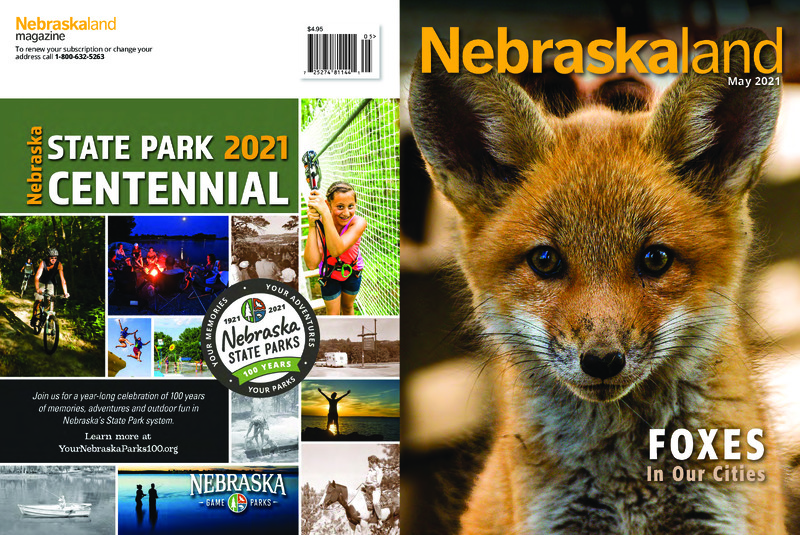
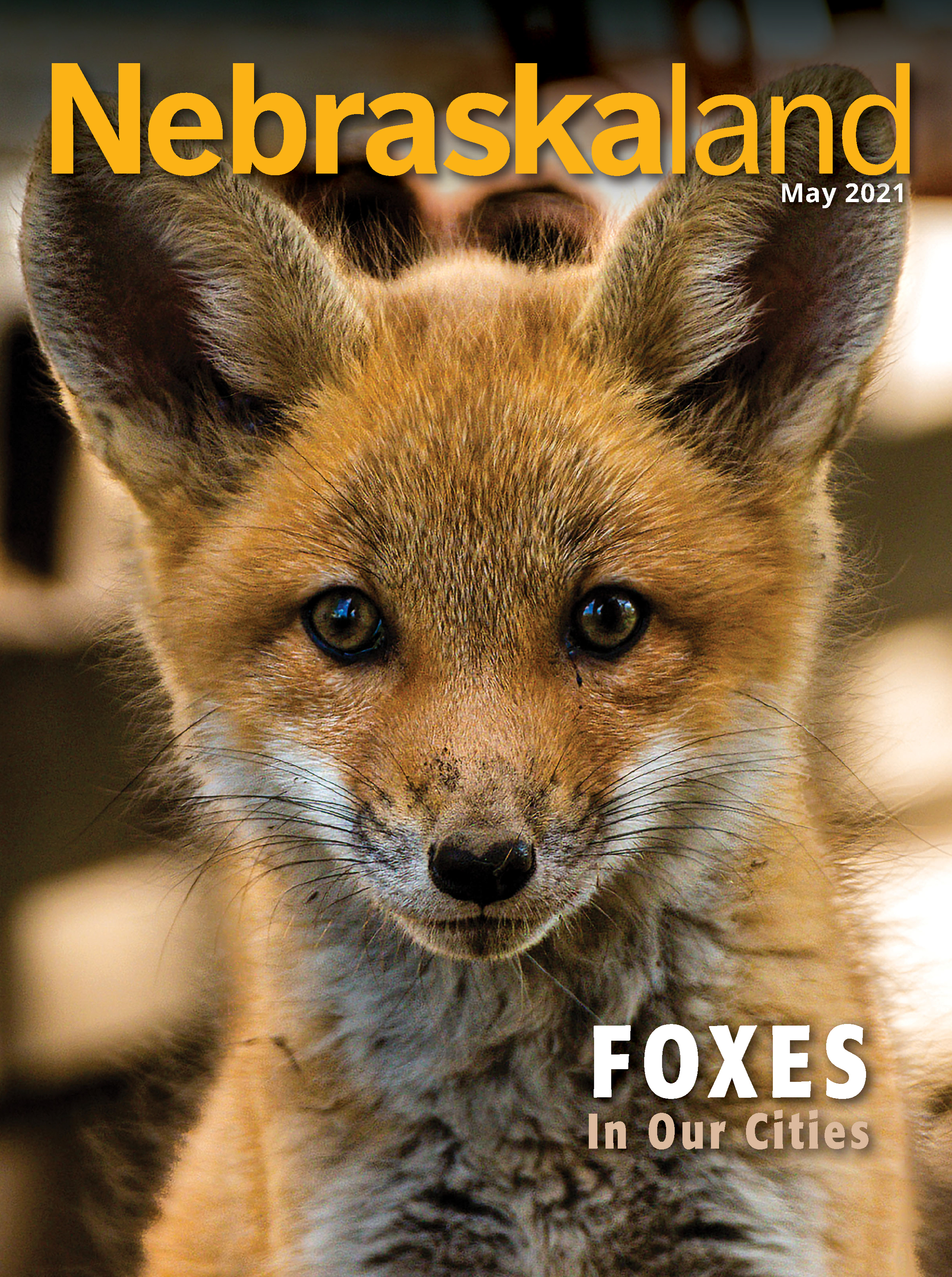
Cover: A fox pup sits outside its den
in a Lincoln backyard.
ERIC FOWLER, NEBRASKALAND
This page: A burrowing owl stares
down the photographer. LUKE KATHOL
FEATURES
20
WESTERN FIREWORKS
26
OUTDOOR NEBRASKA
28
Story and photos by Justin Haag
What to Do in May
By Renae Blum
BUFFALO BILL’S
BIG HOUSE
By David L. Bristow
32
WEATHERING TURKEYS
34
YOUR CAMERA DOESN’T
SEE LIKE YOU DO
By Todd Mills
Part 1 of 3
40
42
50
52
Story and photos by Chris Helzer
THE BEACHES OF
BRIDGEPORT
Story and photos by Justin Haag
OUR FASCINATING
AND FEARLESS FOXES
By Sam Wilson
WALLEYES
Five Top Places to Catch Them
By Julie Geiser
A THORNY SUBJECT
Story and photos by Justin Haag
DEPARTMENTS
6 Your Nebraska
10 In the Field
54 Mixed Bag
64 Portraits from the Past
66 The Last Stop
ON THE WEB
For more articles and
information, visit
NebraskalandMagazine.com
Nebraskaland (VOL. 99 / NO. 4 ISSN 0028-1964) is published monthly, except for the combined Jan./Feb. and Aug./Sept. issues, by the Nebraska Game and Parks Commission, 2200 N. 33rd St.,
Lincoln, NE. Periodicals postage paid at Lincoln, Nebraska, and additional mailing offices. POSTMASTER: Send address changes to Nebraskaland, P.O. Box 30370, Lincoln, NE 68503-0370.
Magazine Staff
magazine
Published by the Nebraska Game and Parks
Commission since 1926. The Commission is
dedicated to the conservation and protection
of all the state's natural resources and the
people who use them.
Communications Director Christy Firestone
Public Relations Manager Shawna RichterRyerson
Editor Jeff Kurrus
Associate Editor Jenny Nguyen-Wheatley
Regional Editors Eric Fowler, Julie Geiser,
Justin Haag
Contributing Editor Michael Forsberg
Regular Contributors Renae Blum,
Chris Helzer, Chris Masada, Ryan Sparks, Gerry
Steinauer
Art Director Tim Reigert
Graphic Designer Mel Severin
Photo Librarian Jaclyn Cruikshank Vogt
Administration
Director Jim Douglas
Deputy Director Tim McCoy
Commissioners
Chairman - Dan Kreitman, Wahoo
Vice Chairman - Pat Berggren, Broken Bow
2nd Vice Chairman - Rick Brandt, Roca
Robert Allen, Eustis
Jim Ernst, Columbus
Donna Kush, Omaha
Scott Cassels, Omaha
John Hoggatt, Kearney
Doug Zingula, Sidney
Circulation
For address changes and questions about your
subscription, call 800-632-5263
Advertising Sales Manager
For advertising information contact
Shane G. Gilster, 402-742-0125
Email: shanegilster@gmail.com
Nebraskaland Magazine Copyright 2021, all rights reserved.
Nebraskaland is available in audio from the Nebraska Library
Commission Talking Book and Braille Service, Suite 120, 1200 N St.,
Lincoln, NE 68508. 800-742-7691. Nebraskaland Magazine and the
Nebraska Game and Parks Commission reserve the right to reject any
advertising not in keeping with the agency mission.
Rates: $18 for one year; $33 for two years; $44 for three years. Nebraska
recipients must add appropriate sales tax. To subscribe call
1-800-NEBLAND (632-5263), or go online to:
NebraskalandMagazine.com.
Commission Offices
Conservation Officers
Headquarters/Southeast District Office
2200 N. 33rd Street Lincoln, NE 68503
Phone 402-471-0641
ADMINISTRATION (Lincoln)
Craig Stover (Administrator)
Duane Arp (Asst. Administrator)
Travis Shepler (Asst. Administrator)
Jeff Clauson (Asst. Administrator)
Northeast District Office
2201 N. 13th St. Norfolk, NE 68701
Phone 402-370-3374
Southwest District Office
301 E. State Farm Rd. North Platte, NE 69101
Phone 308-535-8025
402-471-5531
402-471-5531
402-471-5531
402-471-5531
NORTHWEST (Includes counties covered)
Dan Kling (Lieutenant)
308-430-0572
EAST SUB-DISTRICT
Sean Schultz (Sergeant)
308-672-1824
Northwest District Office
East Hwy. 2, Box 725 Alliance, NE 69301
Phone 308-763-2940
Jerod Hahn (Deuel, Garden, Grant)
Keith Jadlowski (Keith, Deuel)
Jaden Porter (Keith, Garden)
308-520-5539
308-289-9580
308-289-2274
Bassett Office
524 Panzer St., Box 508 Bassett, NE 68714
Phone 402-684-2921
WEST SUB-DISTRICT
Kearney Office
1617 First Ave. Kearney, NE 68847
Phone 308-865-5310
Ak-Sar-Ben Aquarium/Schramm Education
Center
21502 W. Highway 31 Gretna, NE 68028
Phone 402-332-3901
Omaha Office
8495 Frederick Street, Omaha, NE 68124
Phone 402-595-2144
(Keith, Arthur)
Nebraskaland • May 2021
308-520-1031
Ray Dierking (Custer, Thomas, Blaine)
Frank Miller (Cherry, Hooker)
Greg Hesse
308-870-0322
402-389-0444
308-546-7464
308-660-4671
308-530-3157
(Lincoln)
(McPherson, Logan, Hooker, Cherry)
Kelsey Glodowski
308-763-8226
SOUTH SUB-DISTRICT
Josh Widhelm (Morrill, Scotts Bluff)
Jacob Stoinski (Sioux, Dawes)
308-279-9133
308-615-9017
(Red Willow, Frontier, Hayes, Hitchcock)
(Box Butte, Sheridan, Grant)
NORTHEAST (Includes counties covered)
Tom Zimmer (Lieutenant)
402-649-8053
NORTH SUB-DISTRICT
Jeff Jones (Sergeant)
402-762-5022
John Bauer (Holt, Boyd)
Dale Davis (Keya Paha, Brown, Rock)
Jonathan Andreasen
402-314-9257
402-760-0712
402-340-3981
Mitch Johnson (Knox, Antelope, Pierce)
402-613-8612
(Knox, Cedar)
Cory Krause (Sergeant)
402-380-6410
Kyler Prochaska (Platte, Colfax)
Nicholas Fix (Dixon, Dakota, Thurston)
402-830-8278
402-508-0261
(Cuming, Wayne, Stanton)
4
Kevin Bergstrom (Sergeant)
308-672-1824
SOUTH SUB-DISTRICT
Any program that receives federal funding from the National Park
Service, or the United States Fish and Wildlife Service prohibits unlawful
discrimination on the basis of race, color, religion, age, gender, marital
status, national origin, age, disability or political affiliation. Any person
who believes he or she has been discriminated against in any program,
activity, facility, or service, should contact the Nebraska Game and
Parks Commission, Lincoln, NE 402-471-0641, the Equal Opportunity
Commission, Lincoln, NE 402-471-2024, TTY/TDD 402-471-4693; United
States Fish Wildlife Service, Civil Rights Coordinator, 4401 N. Fairfax
Drive, Arlington, VA 22203; Director, Equal Opportunity Program, U.S.
Department of Interior, National Park Service, 1849 C Street NW, Mail
Code 0008, Washington, D.C. 20240-0001.
NORTH SUB-DISTRICT
Sean McKeehan (Sergeant)
(Kimball, Banner, Scotts Bluff)
CENTRAL (Includes counties covered)
Mike Thome (Lieutenant)
308-293-8746
NORTH SUB-DISTRICT
Doug Pollard (Sergeant)
308-730-7050
Matt Brandt (Sherman, Howard)
Daryl Teter (Howard, Greeley, Merrick)
Mark Sullivan (Nance, Polk, Wheeler, Boone)
Kyle Gaston (York, Polk, Hamilton)
308-202-0819
308-440-1863
402-741-0636
402-719-6226
(Loup, Garfield, Valley)
SOUTH SUB-DISTRICT
Matt Taylor (Sergeant)
(Thayer, Fillmore, Nuckolls)
402-200-9597
308-380-7331
402-902-2017
308-920-2762
308-440-3847
SOUTHWEST (Includes counties covered)
Roger Thompson (Lieutenant)
308-530-3097
Alex Hasenauer (Lincoln, Perkins)
Brandon O’Neal
(Madison, Pierce, Stanton)
OutdoorNebraska.org
Tim Williams (Hall, Hamilton, York)
Eric Javins (Adams, Clay, Webster)
Pat George (Harlan, Franklin, Phelps)
Ethan Teter (Buffalo, Kearney)
(Lincoln, McPherson, Logan)
Brian Piernicky (Sergeant)
308-340-6627
Matt Andrews
308-746-2418
Owen Johnson (Dawson, Custer)
Taylor Dixon (Dawson, Gosper)
402-266-1759
308-217-2108
(Furnas, Gosper, Frontier, Red Willow)
SOUTHEAST (Includes counties covered)
Stacey Lewton (Lieutenant)
402-890-7140
EAST SUB-DISTRICT
Heath Packett (Sergeant)
402-210-0888
Russell Mort (Otoe, Johnson)
Rich Berggren (Douglas)
Dan Evasco (Sarpy)
Mike Luben (Saunders, Butler)
Bryan Adams
402-209-1506
402-619-1355
402-616-5961
402-443-6392
402-429-1924
(Cass)
(Nemaha, Pawnee, Richardson)
WEST SUB-DISTRICT
Scott Eveland (Sergeant)
402-853-3273
Dina Barta (Lancaster),
Dudley Sorensen (Lancaster)
Bryce Streger (Seward, Saline)
Trevor Stahlecker (Lancaster)
Matt Seitz (Gage, Jefferson)
402-890-6463
402-937-3422
402-646-0420
402-314-9641
402-806-0915
(Lancaster)
YOUR NEBRASKA
Instagram Photos
Follow us @nebraskaland
and tag us in your photos
to be featured in an
upcoming issue.
Timothy Wilcox, North Platte
Great Blue Heron and Two Bandits
@boni_edwards
Lake Ogallala at Sunset
Haden Jensen, Aurora
Prairie Chickens on the Lek
6
Nebraskaland • May 2021
May 2021 •
Nebraskaland
7
Kirk Pridell, Papillion
Bald Eagles at Johnson Lake
Karen Linot, Gibbon
Frozen Bubble
@wildrose_photography
Fall Color at Mahoney State Park
Send your comments and
photos to:
Jeff Kurrus, Editor
Nebraskaland Magazine
P.O. Box 30370
Lincoln, NE 68503
or email Jeff.Kurrus@Nebraska.gov
Please include your postal address
and telephone number. Letters
may be condensed and edited.
Photographs are also welcome.
8
Nebraskaland • May 2021
May 2021 •
Nebraskaland
9
IN THE FIELD
IN THE MIDDLE OF MAY
An immature crab spider on
a dandelion seed head in a
prairie near Stockham.
C
CHRI
S HE
HELZER
ZER
10
Nebraskaland • May 2021
May 2021 •
Nebraskaland
11
IN THE FIELD
Commissioner Rex Fisher (left) and Director Douglas hunt pheasants in 2016.
JENNY NGUYEN-WHEATLEY, NEBRASKALAND
DIRECTOR JIM DOUGLAS TO RETIRE
By Christy Firestone
The director of the Nebraska Game and Parks Commission
recently informed the agency Commissioners he intends to
retire this November.
Director Jim Douglas said, “In April of this year, I will
have served as director for nine years of my nearly 47-year
career with the Commission. I want to provide extensive
advance notice of my retirement to ensure the Commission
has more than ample time to develop and exercise a robust
recruitment and hiring process for my replacement.”
“Throughout his career, Jim Douglas has been a strategic
leader and manager with the vision to make sure the Nebraska
Game and Parks Commission’s internal organization,
processes, staffing and resources are aligned to achieve the
Nebraska Game and Parks Commission’s mission for both
the short-term and long-term,” said Nebraska Game and
Parks Commission Chairman Dan Kreitman. “Jim’s ability
to look to the horizon, share a vision and strategically align
resources has been instrumental in positioning the agency
for success. Under Director Douglas’ leadership, the agency
has accomplished tremendous success and overcame many
challenges.”
Some of Douglas’ accomplishments include creating a
communications division responsible for strategic marketing,
public relations and outreach efforts; expanding wildlife
research for big game, small and upland game and non12
Nebraskaland • May 2021
game species; increasing agency law enforcement to ensure
greater protection for the people and resources of the state;
leading the charge to upgrade fish hatcheries and improve
coldwater streams; enhancing parks across the state for
the next generation of park guests, including Nebraska’s
Outdoor Venture Parks; growing conservation education
with the development of the fish and wildlife education
division and increasing educational opportunities in parks;
and creating a planning and programming division to help
best prepare the agency for future success.
Director Douglas began his career as a conservation
aide in the North Platte Fish Hatchery in 1974 and served
increasingly responsible leadership positions during his
career in three divisions, including as district supervisor and
chief of the resources services division, chief of the wildlife
division, deputy director of administration and agency
director.
Douglas, a life-long nature enthusiast said, “I love and
enjoy serving the Commission and Nebraska’s citizens and
visitors because we have the opportunity to affect our
constituents in so many positive ways. Since I have several
months left to serve, I will devote all of my time and
energy to doing so; and, as such, I will save most of my
public reflections of service and share them closer to my
retirement.”
IN THE FIELD
Video production at Bowring Ranch State Historical Park in Cherry County with Dan Newburn, Clifford Cady and
Stephanie Arne. JUSTIN HAAG, NEBRASKALAND
ONE HISTORIC ROAD TRIP
By Shawna Richter-Ryerson
Take a trip back in time, right here in Nebraska.
Watch Pony Express riders race across the plains,
soldiers fire a cannon from Civil War times and Philip
James Little Thunder Sr. perform a traditional Native
dance in his ancestors’ honor — all in a new documentary,
Adventures in History: Discovering Nebraska’s State
Historical Parks.
The documentary, from the Nebraska Game and Parks
Commission and NET, Nebraska’s PBS & NPR Stations,
invites viewers to come along on a journey that crosses
the state, exploring Nebraska’s nine historical parks with
program host and narrator Stephanie Arne, an accomplished
conservationist and the former host of Mutual of Omaha’s
Wild Kingdom.
Arne discovers Nebraska’s exciting history nestled among
some of the most beautiful and storied landscapes in the
state. Her trip is filled with a plethora of characters and quite
14
Nebraskaland • May 2021
a bit of lore.
She “meets” larger-than-life Western showman
William F. Cody at Buffalo Bill State Historical Park, learns
about the state’s first female U.S. Sen. Eve Bowring and her
cattle ranch and why Ashfall Fossil Beds State Historical
Park is called the “Pompeii of prehistoric animals.” She also
learns the butt of every good barrel makers’ joke at Fort
Atkinson and just what makes a Champion tree a champion
at Arbor Lodge.
Her journey is revealing. Through exploration and
connection, Arne learns that Nebraska’s people, landscapes
and history have important stories, ones that can help us
understand Nebraska as it is today. But only if we’re willing
to listen.
Catch the documentary debut at 7 p.m. May 23 on NET, or
the repeat showing set for noon May 30 on NET.
Be ready to be inspired.
IN THE FIELD
JEFF KURRUS, NEBRASKALAND
DUMMY LOADS
By Larry Kurrus
Still thinking about that day last duck season when
you only got off one shot, or that time last week your gun
jammed on that tom turkey at first light?
Most sporting goods stores have an item that can safely
check for feeding and ejecting problems. They are called
“dummy loads,” and the cost is nominal at around $12 for
two to three shells.
Or, for those that reload or have a friend who does, you
could make some custom dummy loads.
Here how:
1) Take three empty shotgun shells and resize them so
they will chamber in any like-gauge shotgun.
2) Re-insert the old primers. (No live primers, please!)
3) Substitute sand for powder — same volume.
4) Insert wad cup, add shot and crimp.
Using dummy loads, you can safely and effectively prepare
your shotgun for the rest of turkey season or this fall’s wide
array of shotgunning seasons.
16
Nebraskaland • May 2021
May 2021 •
Nebraskaland
17
IN THE FIELD
RAMPS - OUR FOREST ONION
By Gerry Steinauer and Jenny Nguyen-Wheatley
Ramps, also called wild leek, is
Nebraska’s only forest onion. It
grows singly or in colonies in moist
Missouri River bluff oak forests from
Dixon County southward to Omaha.
First discovered in our state in the late
1980s, botanists might discover the
plant in other Missouri River counties.
Although more abundant eastward,
here at the dry western fringe of its
range, it is uncommon.
JENNY NGUYEN-WHEATLEY, NEBRASKALAND
In early spring, the onion’s fibercoated bulb sprouts one to four fleshy,
tulip-like leaves. Like many woodland
wildflowers, ramps (Allium tricoccum)
start growth before trees leaf out,
limiting sunlight from reaching
the forest floor and, therefore,
photosynthesis. An adaptation to
shade, ramps’ leaves are wide for an
onion, providing more photosynthetic
surface. For comparison, prairie onions
have very narrow leaves with far less
surface area. By June, ramps leaves
have withered, and only then do the
bulbs send forth a leafless flower stalk
topped with a cluster of small, white to
yellowish, bell-shaped flowers.
Ramps’ bulbs and young leaves
are edible. Native Americans ate the
leaves and bulbs raw, boiled and fried.
They harvested bulbs in spring, when
they could be located by the presence
of leaves, and dried them for later use.
Concoctions of the plant were used
medicinally to treat colds, earaches,
croup and worms in children, among
18
Nebraskaland • May 2021
other afflictions.
European settlers learned from the
Indians how to harvest and use ramps
and to this day, towns in the forested
eastern United States celebrate annual
spring ramps festivals. Unfortunately,
over-harvest of the bulbs have
caused populations to decline, and
furthermore, harvested populations
are slow to recover, as it takes seven
years for germinating seeds to mature
to flowering, seed-producing adults.
Harvest of a few bulbs and one leaf
from multiple-leaved plants may not
damage large populations. Also, do
not harvest too heavily from a single
patch. Small populations, however,
should be enjoyed solely for their
beauty and left unharvested.
In recent decades, ramps planted
from seed and bulbs are being grown
as a crop in eastern woodlands. The
best way to enjoy these tasty veggies,
yet conserve wild populations, is to
purchase known cultivated ramps
online or at farmers markets or select
grocery stores.
–G.S.
Wild Garlic Bread
This recipe utilizes both wild ramp
and garlic mustard leaves. If you have
access to only one species, substitution
is fine. Note that ramps are much
more pungent than garlic mustard,
so adjust amounts accordingly. Visit
foodforhunters.com for step-by-step
photos of this recipe. For further
information on garlic mustard, see my
story in Nebraskaland’s May 2020 issue.
–J.N.W.
Ingredients:
1 loaf of frozen Rhodes Bake-NServ® White Bread, thawed
3 tablespoons of salted butter,
softened
3 to 4 wild ramp leaves, minced
•
•
•
• 1 tablespoon of wild garlic mustard
leaves, minced
• ¼ cup of grated Parmesan cheese
• 1 egg, beaten
Special equipment:
Bread pan, cooking spray, parchment
paper.
1. Preheat oven to 350 degrees
Fahrenheit. In a small bowl, combine
softened butter, ramp, garlic mustard
and Parmesan cheese. Set aside.
2. Turn out thawed, risen dough
onto a lightly floured surface and roll
into a ¼ to ½-inch-thick rectangle, the
short side no wider than your bread
pan is long.
3. Evenly spread wild garlic butter
onto the surface of the dough — you
may or may not have to use all of it.
Then starting from the short edge of
the rectangle, gently and tightly roll it;
try not to stretch the dough too much.
For presentation, you want the middle
of the loaf to be slightly thicker than
the ends.
4. Turn the roll seam side down.
Then with a sharp knife, cut the roll
in half lengthwise. With the cut sides
facing up, lay one piece perpendicular
to the other to resemble a cross. Then
overlap the ends to form a figure 8.
Gently pinch the ends together. Spray
a bread pan with Pam, if you haven’t
already, and line with parchment
paper. Transfer the garlic bread dough
into the pan, and cover with a kitchen
towel to rise for 30 minutes before
baking.
5. After 30 minutes of resting, lightly
glaze the top of the dough with egg
wash (you won’t use all of it). Then
bake on the middle rack of a preheated
350-degree oven for 20-25 minutes,
or until bread is golden and cooked
through. Allow bread to cool slightly
before slicing.
JENN
N Y NG
NGUYEN
U
UYEN
-WH
-WHE
W ATLE
T EY,
TLE
Y, NEBRA
EBR SKAL
KAL
AL
LAND
May 2021 •
Nebraskaland
19
Western
Fireworks
In the pursuit of captivating
photography, it sometimes
pays to aim low.
Story and photos by Justin Haag
ABOVE: Purple coneflower (Echinacea) adorns
a roadside at Ponderosa Wildlife Management
Area near Crawford.
LEFT: The white flowers of prickly poppy
(Argemone polyanthemos) stand out against
blackened timber in the Pine Ridge.
20
Nebraskaland
• May 2021
hen developing an interest in nature photography
years ago, capturing the subjects on these pages were
at the bottom of my list.
Yet, on countless mornings of taking photos of
landscapes and wildlife, there they were: Little bursts of color
around my feet. I already knew that pretty sunrises, sunsets
and fauna were even more attractive with wildflowers in the
scene.
Soon, though, I learned a macro lens focused at various
parts of these plants could provide imagery rivaling any burst
of fireworks. The radiating petals of a flower feature the lines
W
that we photographers crave. The presence of a pollinating
insect makes a scene akin to those provided by our biggest
wildlife species. All the while, the plants congenially
remained still enough for me to set up off-camera flash and
multiple poses.
Along the way, I have also learned some things about the
plants, which I value just as much as the imagery. Still too
often, though, some unfamiliar petals catch my eye, and I
think to myself, “You sure are a pretty little thing, but are you
worth the trouble?”
By “trouble,” I mean shooting the photo, entering it into
May 2021 •
Nebraskaland
21
LEFT: Hoary vervain (Verbena stricta)
always makes a suitable photo subject.
RIGHT: Wild bergamot (Monarda
fistulosa), also known as bee balm,
decorates the landscape in the
Nebraska National Forest near
Chadron.
BOTTOM RIGHT: Narrow-leaved
musineon (Musineon tenuifolium)
blooms on rocks along the Lodgepole
Valley below the dam at Oliver
Reservoir Recreation Area.
the digital workflow and, finally, getting the identification
right. That last part usually involves poring over ID books
— the foremost resource is Nebraskaland great Jon Farrar’s
incredible Field Guide to Wildflowers of Nebraska and the Great
Plains.
When all that fails, my pursuit ends with “the email of
shame”: a message to knowledgeable, patient colleagues
such as Game and Parks private lands biologist Shelley Steffl,
botanist Gerry Steinauer or Chadron State College professor
Steve Rolfsmeier.
With identification in hand, I look back and think: Yes, it’s
always worth the trouble. N
22
Nebraskaland
• May 2021
May 2021 •
Nebraskaland
23
ABOVE: A grasshopper climbs the
stem of goatsbeard (Tragopogon
dubius) at Gilbert-Baker Wildlife
Management Area in Sioux County.
RIGHT: A bumble bee (Bombus)
visits the flower of a Canada thistle
(Cirsium arvense) along the White
River in Sioux County.
OPPOSITE: Western wallflower
(Erysimum capitatum) stands tall over
other wildflowers as the sun sets on
the Oglala National Grassland.
24
Nebraskaland
• May 2021
May 2021 •
Nebraskaland
25
Outdoor Nebraska
By Renae Blum
The outdoors is calling. It’s time to plan an outdoor adventure: grab a rod and reel,
get your bird feeder ready, and start visiting Nebraska state park areas for the
Your Parks Adventure Challenge, beginning May 22 (details at
YourNebraskaParks100.org). N
Attract orioles to
your backyard
What To Do in May
May through mid-June
Statewide
As orioles return to Nebraska, see if
you can attract them to your yard
with some sweet snacks, such as
grape jelly, hummingbird nectar,
oranges and grapefruit. Oriole feeders
work well, but you also can place jelly
in shallow dishes and hang fruit from
a small nail. Remember to clean your
feeding place every 7-10 days, and
consider adding native plants and
trees to your yard, which also attract
birds.
JUSTIN HAAG, NEBRASKALAND
Try the Venture Park
Adventure
Year-round | Eastern Nebraska
This unconventional geocaching adventure will take you
to four parks nestled in the Platte River Valley, where
you’ll follow coordinates to solve clues. All you need is a
smartphone! Download the Adventure Lab mobile app
and search for Nebraska Game and Parks: Venture Park
Adventure to get started. JEFF KURRUS, NEBRASKALAND
Hike at Wildcat Hills State
Recreation Area
Throughout the month
Looking for some good exercise and beautiful scenery? Wildcat Hills State
Recreation Area offers 3.5 miles of rugged groomed trails for hikers, bikers and
equestrians winding through canyons and rocky bluffs. Trails vary in difficulty,
from steep inclines to moderate walks. Along the way, enjoy great views,
wildflowers and wildlife, such as deer and wild turkey. JUSTIN HAAG, NEBRASKALAND
Fish for crappie
Throughout the month | Statewide
In May, crappie stay shallow as they
spawn, making them a more accessible
catch. Only simple gear is needed: a
bobber and minnow is hard to beat, but if
live baitfish aren’t allowed, a bobber and
small jig will work just as well.
JEFF KURRUS, NEBRASKALAND
Visit Arbor Lodge
State Historical Park
Year-round | Southeastern Nebraska
This beautiful estate in Nebraska City
was home to J. Sterling Morton, founder of
Arbor Day. From its beginning in 1855 as
a four-room frame house, the magnificent
mansion grew to 52 rooms through several
re-modelings. Make a visit — and mark
this down for the Your Parks Adventure
challenge!
ERIC FOWLER, NEBRASKALAND
26
Nebraskaland • May 2021
May 2021 •
Nebraskaland
27
Buffalo Bill’s
Big House
By David L. Bristow, History Nebraska
he Wild West built this house.
At first glance, an 18-room French Second Empire-style
mansion might not strike you as “Western,” but take a look
at that huge barn! This is what a Western man would build
for his family if he found himself with a lot of extra money in
the 1880s.
William F. “Buffalo Bill” Cody came to Nebraska in 1869 as
a Fort McPherson cavalry scout. Later he made his fortune as
a showman. Buffalo Bill’s Wild West was a traveling outdoor
show that combined elements of theater, circus and rodeo,
with lots of fancy riding and shooting and mock battles against
Native American performers. Buffalo Bill did a lot to create the
popular mythology of the American West. His influence shaped
the Western movies and TV shows of the 20th century.
With show money rolling in, Cody had the house at his Scout’s
Rest Ranch built in 1886. The big barn was added a few years
later. In the early days, Scout’s Rest was a working ranch with
4,000 acres. Cody hired others to manage it, but lived here with
his family between tours.
Cody sold the ranch in 1911. The Nebraska Game and Parks
Commission bought it in 1964 and opened it to the public as the
Buffalo Bill Ranch State Historical Park.
In January 2021, the U.S. Secretary of the Interior added
Scout’s Rest Ranch to its list of National Historic Landmarks. N
T
Visit History Nebraska’s website at history.nebraska.gov.
“Buffalo Bill” Cody (front and center) at Scout’s Rest Ranch.
28
Nebraskaland
• May 2021
May 2021 •
HISTORY NEBRASKA, RG3004-0-44
Nebraskaland
29
Cody wanted trees on his treeless ranch, but it was hard to get them to grow.
The solution? Plant prairie-adapted species such as cottonwoods and box
elders. This early 20th century photo shows the result. HISTORY NEBRASKA, RG3004-0-41
Never shy about self-promotion, Cody had his ranch’s name painted
on the barn roof. Union Pacific Railroad travelers could read the
name from a mile away. HISTORY NEBRASKA, RG3004-49
A circa-1950 photo from inside the
barn shows old Wild West posters
left over from Buffalo Bill’s heyday.
HISTORY NEBRASKA, RG5741-5
30
Nebraskaland
• May 2021
May 2021 •
Nebraskaland
31
Weathering Turkeys
Using the elements to your advantage
By Todd Mills
ith Mother’s Day being the target date to pursue
lonely toms, you can find success at almost any turn if
you’ve paid your dues scouting. However, even the best
laid plans can go to waste if Mother Nature intervenes
and makes your hunting, well, miserable.
On more than one
occasion, I’ve scheduled
a hunting trip around
early to mid-May, only to
be blindsided by weather
that only Nebraska
could provide at that
time of year. On one such
occasion, a good friend
and I sat in rain for three
days, including through
a violent thunderstorm
that had us holding the
blind tent and laying
on the ground to avoid
being blown away or,
worse yet, struck by
lightning. Sticking and
staying was not a good
plan that weekend.
Can
you
harvest
turkeys in adverse weather conditions? Sure, but to do it,
you’ve got to be prepared to put in the time and wait for that
one window of opportunity that only the hard-core hunter
will persevere through.
Here are a few tips on pursuing toms in all types of weather
conditions.
W
RAIN, RAIN GO AWAY
Although you can hunt turkeys in the rain, you’ll need a
good dose of luck to have success. They won’t move much,
and most likely will be in the wide open. Precipitation dulls
their senses, so they tend to hang out in open spaces so they
can hear and see better. If you plan to hunt in moisture, try
and position yourself in a place they could cross when the
rain lets up. Keep your calling to a minimum. They’ll shut up
in rain and most likely will have no interest in a lonely hen.
And don’t forget your rain gear — without it you’ll be in for a
long, miserable hunt.
32
Nebraskaland • May 2021
WIND AND WARY TOMS
Observing what birds do in different weather conditions
can teach you so much. On a windy and hot day in late May
several years ago, I watched several jakes lay in the grass for
hours without moving much except their heads. I later came
to the conclusion that
wind, much like rain,
puts turkeys on high
alert. Even the cracking
of a branch can send
them running. Success
here will depend on
location. Find a secluded
area early in the day that
provides shelter from
the wind, especially if
the wind picks up later
in the day. Find a spot
on the downside of the
wind so that if you have
to cut and run, you can
use the wind to your
advantage. Be patient,
and time your moves
based on cover and what
JUSTIN HAAG, NEBRASKALAND
you think birds will do if
the wind lets up.
SUN AND MID-MAY TOMS
Everything works better in sunshine. Whether it’s
November mallards or mid-May toms, a steady dose of
sunshine may be just what you need to fill that tag. As May
ticks along, hens are anxious to nest. By the middle of the
month, they are either nesting or looking to nest. They’ll
spend less time with toms off the roost. Throw in a sunny day
and they’ll waste no time moving on from the group. Lonely
toms will be active when the sun comes up, and by the middle
of the morning, they could travel miles to find a hen.
Now is the time to crank up the calling. Be aggressive and
don’t be afraid to move if they are not advancing. Chances
are they could circle back. And try and position yourself or
your tent in the shade to avoid any glare or movement that
an educated tom could pick up.
Always use the weather to your advantage. N
Turkey tracks dot mud in a
trail following a rain at Rock
Glen Wildlife Management
Area in Jefferson County.
ERIC FOWLER, NEBRASKALAND
May 2021 •
Nebraskaland
33
Your Camera
Doesn’t See
Like You Do
Part 1 of 3
Story and photos by Chris Helzer
ave you ever taken a picture of a bird or other animal,
only to have it show up as a mere pinprick on the
resulting photo? Why do some photos have large
portions that look blurry and only a few bits that are
in focus? Simply put, your camera doesn’t see the world the
way you do.
The lenses on your camera are constructed very differently
than the lenses in your eyes (though the basics of their
function are surprisingly similar). More importantly, when
you look around, your eyes and brain are constantly working
together to interpret what you’re seeing. Your camera isn’t
integrated with your brain, which creates a lot of discrepancy
between the images captured by your camera and what
appears to be the reality in front of you. In that context, your
camera is giving you the truth; it’s just not the truth you
want to see.
While the disparities between your camera’s view of the
world and your own can be frustrating, they also provide
great opportunities if you know how to take advantage of
them. Once you stop expecting photographs to document a
scene exactly as you experience it, you can concentrate on
simply making great images. That requires you to understand
the primary differences between you and your camera and
learn how to compensate for them.
This three-part series will explore how your camera thinks
and works and help you become a better photographer,
whether you use your phone, a digital SLR camera or an old
large-format camera with glass plates. Part one deals with
H
34
Nebraskaland • May 2021
A wide-angle lens helps show the depth and breadth of this Sandhills landscape.
field of view, focus and basic exposure. Part two dives into
depth of field and the trade-offs between shutter speed and
aperture. Part three is all about light.
Focal Length
The focal length of a lens determines the size of an object
and how much of its surroundings you can capture within an
image. Shorter focal lengths make things look small and far
away but include a broad field of view, which is why lenses
with short focal lengths are often called “wide-angle lenses.”
If you’ve ever tried to photograph a small room and were
frustrated with how little of that room you could capture at
once, you needed a shorter focal length on your lens. Wideangle lenses also are terrific for photographing a dramatic
sky over a sweeping landscape.
However, if you want a big bison to fill the frame of an
image, a wide-angle lens would be a bad choice. You’d have
to get so close to that bison you’d end up as a statistic instead
of a renowned photographer. To make your camera make that
bison — or bird or moon — look like it’s much closer to you,
you need a telephoto lens.
A telephoto lens has a long focal length, which magnifies
an image, and greatly reduces the field of view. It also
compresses what you see, making images at different
distances from you look like they are closer to each other. The
binoculars you use for birdwatching have long focal lengths,
which is why a bird looks bigger when viewed through them
— and why you don’t see much of the bird’s surroundings as
you try to figure out if its beak is straight or slightly curved.
On a 35mm camera, or the equivalent, a lens with a focal
length of 35mm or less is classified as a wide-angle lens. A
lens with a focal length of 85mm is a telephoto lens (though
if you want to photograph birds, 300mm is about the shortest
you’d want). In between those two focal length ranges is
a “normal” lens, a 50mm lens. A normal lens is so named
because it provides a field of view and perspective similar
to what you see with your eyes. For that reason, they are a
favorite of portrait photographers and others who want to
May 2021 •
Nebraskaland
35
Both the badger and sunrise were photographed with the
same telephoto lens.
depict people or scenes accurately. Interestingly, the nature
photographers I know rarely use this focal length.
Focus and Depth of Field
Your eyes focus so quickly and naturally you almost never
think about it — until you reach your mid-to-late 40s and
can no longer focus on anything less than an arm’s length
away. Your brain and eyes collaboratively decide what part
of a scene is most important and focus on that. A camera
doesn’t know what your brain thinks is the focal point of a
scene, so you have to tell it what you want. Making conscious
decisions about something you usually do unconsciously
takes some practice.
Both your eyes and camera can only focus on a portion of
a scene at a time. If one object is close to you and another
is far away, you can only focus on one; the other will look
fuzzy. As you scan your surroundings, your brain constantly
concentrates on what’s most interesting, and you don’t even
notice that everything else is out of focus. In a photograph,
36
Nebraskaland • May 2021
though, the viewer has time to scan the entire static image,
and portions that are out of focus become obvious, especially
if they include something of interest. On the flip side, an
out-of-focus background can help highlight the subject of a
photo, increasing an image’s visual power.
“Depth of field” is the distance between the nearest
and farthest objects away from you that appear in focus
simultaneously. In other words, there is a limited range of
space between you and the horizon that can be in focus when
you take a photo. Focal length and the distance between you
and the subject you focus on both influence depth of field,
but the most important factor is aperture. The aperture of
your lens is the hole through which light enters the camera.
You can adjust the aperture, which is measured in f-stops.
Confusingly, a smaller aperture means a bigger f-stop number,
but remember that f-stops are fractions, so an aperture of f/8
is bigger than f/11.
Now, stop. Take a breath and read that last paragraph one
more time. It’s a lot to remember all at once, but just know
that aperture affects depth of field. A smaller hole creates
more depth of field and a bigger hole creates a shallow depth
of field. In everyday life, your eyes and brain do this all the
time; when you squint your eyes to see something better,
you’re making a smaller aperture to increase your depth
of field.
Depth of field also is influenced by focal length and the
proximity of your subject. Telephoto lenses have much less
depth of field than wide-angle lenses, regardless of aperture
The vegetation behind these sideoats grama flowers is blurred out because of a shallow depth of field. Depth of field becomes
very shallow in close-up photographs, even when the aperture is closed down. Deciding what needs to be focus is key, as in the
spiderwort photo on the right. The droplet is sharply focused and the unfocused flower in the background provides interesting
context.
May 2021 •
Nebraskaland
37
In this image at the Nature
Conservancy’s Cherry Ranch in
Sioux County, the yellow flowers
in the foreground are in focus,
but there is enough depth of
field for the rocky hill in the
background to be relatively
sharp, too.
The only thing in focus in this photo is the eye of the jackrabbit, which is the most critical. Our eyes are always drawn to the
eyes of other creatures.
settings — though aperture still controls depth of field within
the possible range for each lens. Close-up photos always
have a shallow depth of field just because the camera is close
to the subject. Again, aperture matters, but only within the
limitations set by how close the subject is.
Because not everything in an image will be sharp, you have
to decide what the focal point of your photo is and make sure
it’s in focus. Often, the focal point of an image is what drew
you to take the photo in the first place — your friend’s face,
the biggest or closest flower, or a silhouette of a tree against
the sunset.
If you’re photographing an animal, the eye is almost
always the most important thing to have in focus. When you
look at another creature, your eye is automatically drawn to
its eye. Looking at a photo of an animal when the eye is out
of focus is disconcerting. If the eye is sharp, it doesn’t matter
that the nose or ears look a little fuzzy.
If you’re struggling to get multiple parts of an animal,
plant or scene to be in focus simultaneously, sometimes
the answer can be found by changing your own position.
Moving yourself and your camera to a position where two or
more important focal points are the same distance from the
camera might help you defeat a tricky shallow depth of field
situation. It’s usually easier to do some repositioning with
38
Nebraskaland • May 2021
landscapes, flowers and other non-mobile subjects.
If you’re photographing a butterfly or deer and really want
the entire animal to be in focus, asking it to turn slightly so
that it is in a perfectly perpendicular position to your camera
is unlikely to work. More likely, you’ll have to move yourself
and hope it stays put. Otherwise, just make sure that at least
its eye is in focus and take the shot.
Of course, knowing what needs to be in focus and getting
the camera to actually do the job are two different things.
Most of today’s cameras have an autofocus feature, and
camera brains are getting really good at predicting what
you’d like the focal point of an image to be. They’re not
perfect, however, so it’s important to know how your camera
makes decisions and how to override them, when necessary.
Sometimes it’s as simple as touching your phone screen on
the part of an image you want to be in focus. With other
cameras, it can be a little more complicated, but it’s figuring
out (and practicing) the procedure so you’ll be prepared when
the time comes. N
Look for part two of Chris Helzer’s “Your Camera Doesn’t See
Like You Do” in the June issue of Nebraskaland. The author will
cover depth of field and the trade-offs between shutter speed
and aperture.
May 2021 •
Nebraskaland
39
The Beaches of
Bridgeport
Five sandpits in the North Platte valley
have created countless memories.
Story and photos by Justin Haag
Y
ou don’t have to stray far from town-life to enjoy one
of the Panhandle’s premiere getaways with shady
campsites and sandy beaches.
The 200-acre Bridgeport State Recreation Area is located
along the North Platte River at the northwestern edge of the
community for which it is named. It has 78 acres of clear
water in five sandpit lakes with more than 70 first-come, firstserved basic campsites. The lakes are among the Nebraska
Game and Parks’ designated family-friendly locations and
have long attracted boaters, campers, anglers, swimmers and
picnickers.
The lakes were created by the Lyman-Richie Corp., which
provided sand and gravel to the surrounding region in the
early 1900s. The company was most busy in World War II,
providing asphalt for the airfield in Alliance. The waterbodies
were acquired by Game and Parks in 1952.
Most of the park’s campsites are under big cottonwoods
along the shoreline. Forty-five of them are on Center Lake,
the largest of the five. In addition to the many drive-up
campsites, six walk-in sites for tent camping are available at
the park’s northwest lake.
Center Lake, which surrounds an island, allows motorized
boats and personal watercraft as long as they travel
counterclockwise.
Gary Shoemaker oversees the Bridgeport park in his role
as superintendent of the Wildcat Hills State Recreation Area
near Gering. He has ushered numerous improvements to the
park in recent years.
Among the developments are an expanded swimming
area at Center Lake, the addition of a campground host, and
improved signage and boundaries for campsites.
Similar to most parks and public lands,
Bridgeport attracted a lot of attention from people
who were biding time and social distancing in the
summer of 2020. He said the park nearly tripled its
usual traffic last year.
“It looked like a Fourth of July crowd when we
Bridgeport State
Recreation Area
Park visitors enjoy boating, tubing and personal watercrafts at
Bridgeport State Recreation Area.
40
Nebraskaland
• May 2021
Aerial of Bridgeport State Recreation Area in Morrill County. Fall colors adorn Bridgeport State Recreation Area in the North
Platte River valley.
first opened in May,” he said.
Bridgeport boasts opportunity for catching a variety of fish,
including bluegills, channel catfish, crappies, largemouth
bass, rainbow trout, cutthroat trout, walleyes, yellow perch
and northern pike.
Joe Rydell, Game and Parks fisheries biologist, said the
lakes range as deep as 15-20 feet, providing ample room
for fish to roam. Generally, he said sunlight moves fish into
deeper water midday, but they swim shallow early and late.
“There are several shallow humps and ridges that run
around the pits that typically have chara, a type of algae that
looks like rooted vegetation,” he said. “The trout will roam
the open water, but panfish and bass utilize those chara areas
to roam for food and cover. Fallen trees are also good habitat
along the shores.”
While Center Lake caters to boats and personal watercraft
with gasoline engines, electric trolling motors and
paddlecraft are allowed on the other four lakes. The close
proximity of campsites to the water makes Bridgeport a
perfect destination for those with kayaks, canoes and standup paddleboards.
The park also allows hunting by archery, muzzleloader and
Canada geese and goslings swim on Center Lake at
Bridgeport State Recreation Area.
shotgun. Its proximity to the Platte River attracts a diverse
set of wildlife. The park made news in 2015 when a moose,
a rare sight in Nebraska, took up temporary residence on the
island at Center Lake.
Even though moose-sightings are certainly not guaranteed,
visitors are sure to find enough to keep them entertained and
returning to this sandy destination. N
May 2021 •
Nebraskaland
41
Our Fascinating
and Fearless Foxes
Foxes are continuing to populate
our urban areas
By Sam Wilson, Furbearer and
Carnivore Program Manager,
Nebraska Game and Parks
Commission
Red fox puppies play in the backyard of the
author’s home in northeastern Lincoln.
ERIC FOWLER, NEBRASKALAND
42
Nebraskaland • May 2021
May 2021 •
Nebraskaland
43
A male fox and one of its
pups sit on the edge of a
city park in northeastern
Lincoln.
ERIC FOWLER, NEBRASKALAND
A
big dog rushed into my
backyard a few years ago,
likely because it saw a red fox
puppy playing under the bushes. It let
out a deep bark as it saw the adult fox
that was watching over the pups. That
is when things really got interesting.
The adult fox leapt up and raced
toward the big boxer — pretty brave
for a 10-pound fox. It made a loud bark
on its way — a warning that clearly
meant for the pups to hightail it to the
den. Suddenly my yard was churning
with racing canids: orange fur flashing
across the yard, faster puppies leaping
over their slower siblings, and the other
parent fox racing straight toward the
big dog from an adjacent yard. The
dog had keyed onto the first adult and
was chasing it, allowing the second fox
time to dart in and disrupt its focus.
These adults were working in unison
to distract, challenge and divert the
dog, giving their pups time to escape. It
was an amazing thing to watch. Their
technique was perfect, and given the
power of an 80-pound dog, they had to
be. The dog chased one and then the
other as they jumped past, but they
dodged deftly each time it got too close.
After a minute or so of darting in and
dodging out, the owner of the dog was
there to get it back on leash.
The fox pair had protected all of their
pups, also called kits, without so much
as a scratch and clearly demonstrated
how devoted they are as parents. That
was the first of many displays of their
commitment that I would witness
thanks to this fox couple deciding to
den next to my yard for the past six
springs.
Growing up in rural Nebraska, my
dad and I were in a constant, friendly
competition to see who could spot
wildlife first. So I have spent most
of my life scanning field edges, creek
bottoms, wetlands or any other habitat
where I thought I might see wildlife.
My brother often laughs and says,
“Wildlife always comes to see you.”
A few instances of bucks waking me
up while taking a “hunting nap,” or
owls sleeping outside my office window
might give one that impression. To be
fair, I also spend my time trying to see
wildlife — so I always assumed it was
a team effort.
But having a pair of red foxes raise
pups right in my backyard, in the
second largest city in Nebraska, really
made me wonder. I am the furbearer
and carnivore biologist for Nebraska
Game and Parks, and red foxes are one
of the species that I manage. It seems
unlikely that they would raise their
pups right off my patio for six years in
a row. Serendipity!
The first time I knew of foxes in my
neighborhood, I heard them before I
saw them. I was startled awake at 2 a.m.
one January by a periodic and horrific
scream coming from right outside my
bedroom window. In my tired state, it
was hard to imagine what in the world
could make a sound like that. I finally
looked out the window and saw a fox
open its mouth, tighten up its body
and project a scream throughout the
neighborhood. I actually get dozens
of calls each year at Game and Parks
Trail cameras placed by the author near the den have helped him count the number of pups. This image captured the mother
and all seven pups, her largest litter, in 2017. SAM WILSON
44
Nebraskaland • May 2021
May 2021 •
Nebraskaland
45
asking what animal could be making
such a sound. Many think it must be a
mountain lion. All of the recordings I
have heard throughout the years have
been the scream or bark of red foxes.
Foxes can produce a variety of
sounds, from chirps and quick, quiet
barks that communicate with nearby
pups, to the very loud scream that is
used during their mating season and
as a territorial warning. The first time
I heard this scream, it was during the
mating season, but I have also seen
adults challenge dogs at a distance with
this call when they approach their den.
I had seen foxes in Lincoln many
times before, often at the Commission
headquarters on the University of
Nebraska-Lincoln’s East Campus
where habitat is plentiful. But in the
last five to 10 years, the number of calls
I have gotten about foxes in Lincoln
and Omaha has increased dramatically.
That is likely because the number of
foxes has also increased; however, we
don’t track fox population trends in
cities, so this is anecdotal.
Harvest estimates from rural areas
have trended down slightly over the
same time, but foxes remain common
statewide. Biologists believe that
foxes are using urban areas to avoid
being killed by coyotes. Larger canids
kill smaller canids, from wolves to
coyotes, and coyotes to foxes. It is like
picking on your little brother, but it is
a matter of life or death for the smaller
canid. Foxes are adaptable and a little
more tolerant of human presence than
coyotes, so the trade-off of living in
town and risking being hit by cars or
chased by dogs is worth it. Coyotes are
found in urban areas, too, particularly
if there are larger areas of open habitat
like wooded creeks or grasslands. But
they are not found as often in tighter
urban neighborhoods that foxes will
happily use.
The fox family moved in when my
boys were just starting to run around
A male fox stretches after waking from a nap in a northeastern Lincoln park.
46
Nebraskaland • May 2021
the yard, and they have thoroughly
enjoyed growing up with them around.
The pups get used to us pretty quickly,
but it took years for the adults to become
relaxed, especially the female. I should
point out that we never feed them, and
we give them enough space to keep
them wild. Each litter is different, and
we have a few fun memories every
year. My boys are now in a friendly
competition with me to see who can
spot the first pups of the spring — the
tradition lives on. The next game we
play is “count the puppies.” This is
much harder than you might imagine.
For one thing, some puppies want to
play while others just want to nap, so
the count usually starts small and goes
up as more decide to play at the same
time. Even then, with all of the running,
wrestling, jumping, hiding and fleeing,
it is a pretty tall task to agree on a
number. With the help of some trail
cameras, we eventually get it figured
out. The largest litter was seven and
ERIC FOWLER, NEBRASKALAND
University of Nebraska-Lincoln students Katelin Nelson and Kyle Dougherty and professor Elizabeth VanWormer take blood
samples prior to attaching a radio collar to a male red fox trapped in the author’s backyard. Dougherty was researching fox
density and habitat selection in Lincoln. SAM WILSON
the smallest was four. Those numbers
are pretty typical for red foxes. With
seven pups in the den, it is pretty easy
to understand why the female would
slink off to the park for a nap when she
needs some “me time.”
Both coyotes and foxes have plenty
to eat in town. They take advantage of
common roadkill like squirrels, rabbits
and robins, but also hunt those same
species plus mice, voles, moles, ground
squirrels and other species. Foxes are
carnivores, but do eat plants and will
happily eat pet food or discarded human
food that they find. We have seen the
foxes bring all kinds of food, from blue
jays to hotdogs, into our yard. One of
the nice parts about having the foxes
around is that they have kept rabbits
out of my garden, something several
varieties of “rabbit proof” fences have
failed to do. When the pups are growing
and hungry, the parents take turns
hunting and pup sitting day and night.
It is not uncommon to see them come
A fox lets one of her pups nurse while others wait their turn.
ERIC FOWLER, NEBRASKALAND
May 2021 •
Nebraskaland
47
measurements. We placed the latest
GPS collar and ear tags on the animal.
It was surprising how light and dainty
the adult fox was when we had it in
hand. The long legs and fur make it
appear larger than it is. With several
foxes around, it would be a few weeks
before I knew this male was half of
our fox couple. When the battery died,
Kyle sent a command for the collar to
release. That small ear tag remained,
however, allowing me to still identify
the male. The GPS collars showed that
foxes were keying in on open areas
like parks, golf courses and more open
neighborhoods. They were also more
active at night and in the morning.
Foxes have been in Lincoln for
decades and the foxes that are born in
town are very used to seeing people,
cars and dogs. Because it is all they
have ever known, they are not nearly
as wary of people as rural foxes
that have been hunted. They can be
territorial with dogs during the pup
rearing season in the spring and early
summer. One example is an escorting
behavior where they may bark at your
dog while you are on a walk, and then
follow you from a distance until you
are no longer near their den or pups.
Basically, they want to make sure they
know where your dog is until it is safely
away from their pups. They will also
wait until you pass by on the sidewalk
and then walk behind you a few dozen
yards, not being territorial, just trying
to get where they are going.
While the foxes have been a delight
for my family, there are some downsides
beyond the screaming during mating
season. I do have to put a few squirrel
tails in the trash each year. Foxes can
dig under sheds or porches in areas
where they are not welcome and
damage property. In most cases, they
can be fenced out or convinced to move
to another den with a motion alarm or
battery powered radio. Foxes are not
typically dangerous to people given
their slight build and small size. Like
all wildlife, people should not approach
them. Foxes can kill small pets like
kittens, cats, chickens and tiny dogs,
but common sense approaches, such
as keeping cats indoors and dogs on
leashes, prevents the vast majority of
problems. I have seen adult cats square
off with one fox, but go up a tree with
two. We welcomed a small dog into our
family a few years into this and made
the decision to be with him on a leash
when he is outside. It has worked well
for us so far.
Many people across Lincoln have
shared similar experiences where
foxes have “come to see them,”
particularly throughout the last decade
or so. Hopefully, people and foxes can
continue to live together in both rural
and urban areas, as it seems certain
they are here to stay. N
ABOVE: A fox pup carries a vole dropped off at the den by one of its parents.
ERIC FOWLER, NEBRASKALAND BELOW RIGHT: A pup practices its hunting skills by stalking a
bluejay. SAM WILSON
in with five or more mice, shrews or
voles in their mouths, drop them off and
then return to the hunt. This 24-houra-day effort is another example of the
commitment and teamwork of both
parents.
A few other fun memories include:
having the fox pups watch back-andforth in unison as my boys played
soccer; watching the parents hide and
bury mice to teach the pups to search,
smell and hunt; and certain pups like
the one we nicknamed “Floppy Ear”
that had playful personalities. There
was also the time the entire family
came out to meet another adult fox,
which I assume was a daughter from a
previous litter. All 10 foxes celebrated
the reunion, chasing and playing for a
full hour. That third adult fox stayed for
a few days and helped hunt and parent.
The pups usually show themselves
48
Nebraskaland • May 2021
in March, and the family moves to a
new den by June. Foxes typically have
multiple dens, and it is thought that
they move from den to den to help
reduce the burden of fleas and other
insects in the soil of their natal dens.
The pups will disperse and look for
their own territories by late summer
or fall. Red foxes can reproduce at 10
months and typically live 2 to 6 years.
Captive foxes have lived more than 10
years, but few wild foxes would reach
that age.
The apparent increase in urban foxes
led to a research project in 2018-2019
by Kyle Dougherty, a master’s student
at UNL. His objective was to study the
density and habitat needs of urban
foxes. I offered to help Kyle trap the
first fox for his project. Kyle had a good
trap design, and soon enough, we had
a male fox laid out on my patio for
May 2021 •
Nebraskaland
49
Walleyes
Five Top Places to Catch Them
More Than Walleye
For all of your fishing pursuits, take a look at the 2021
Fishing Forecast. The report shows the results of sampling
efforts for several species of fish, including walleye,
conducted by fisheries biologists in waters across the state
in 2020. Charts detail the number and size of fish sampled.
Anglers can pick and choose whether they would like to fish
waters with lots of eating-sized fish, big fish or both. N
By Julie Geiser
very year, the Nebraska Game and Parks Commission
stocks millions of walleye fry and fingerlings in lakes
across the state to provide anglers with plenty of
opportunities to catch this sought-after fish species.
This cool-water fish favors large bodies of water that have
good habitat and an abundance of baitfish. Prized for their
great-tasting fillets, walleyes are a challenge to catch, but
using Nebraska’s 2021 Fishing Forecast can get you on the
path to success.
E
Our Top 5
Merritt Reservoir, Cherry County – has great walleye
habitat, including flooded timber, sand points and smartweed
habitat in the spring and early summer. It is a deep lake with
excellent water quality, and inflows from the Snake River
and Boardman Creek fill the reservoir to full pool each year.
Merritt has an alewife prey base that grows healthy walleye.
Davis Creek, Valley County – has an aggressive, yearly
stocking approach to eliminate missing year classes of
walleye. Davis Creek also has habitat that produces good
walleye populations, including good water quality, a sand
According to the sampling report, these are the top five
walleye lakes from the 2020 surveys:
Merritt Reservoir is a perennial top pick for toothy walleyes.
JEFF KURRUS, NEBRASKALAND
Winters Creek, Scotts Bluff County – had the most 10to 20-inch netted walleye. Shad is the key prey species and
Winters Creek’s main predator species is walleye. Walleye are
stocked annually as these fish grow well and replace what
is harvested by anglers. The lake has not been drawn down
by excessive irrigation
during the past 10 years,
making this a great lake for
producing walleye.
Lake McConaughy, Keith
County – second after
Winters Creek for the most
netted legal-sized walleye
up to trophy class walleye.
With an abundant forage
base of alewife and gizzard
shad, Lake McConaughy
is always a top contender
for big walleye, especially
in the spring. Summer
months can bring success
if you know where to find
walleyes in deep water.
50
Nebraskaland • May 2021
The Fishing Forecast can be found at local vendors or online at
OutdoorNebraska.gov/fishingforecast/.
bottom, deep areas, flats and bays. Here, shad is the major
prey fish for walleye, promoting a thriving population.
Calamus Reservoir, Loup County – has habitat conducive
to good walleye populations with good water quality, sand
bottom, drop-offs, flats, bays and coves. Gizzard shad is the
primary prey, and Calamus has overwinter areas for gizzard
shad to keep the predominately stocked walleye population
thriving.
Once You’re There
Doug Steinke holds a 31-inch walleye he caught from Lake
McConaughy, home of plenty of big ‘eyes. JERRY STEINKE
Spring brings the spawn, and both boat and bank anglers
can have good success, as these fish concentrate in shallow,
rocky shorelines to reproduce. Following a brief post-spawn
lull, anglers often find the best bite of the year in late May
and early June as fish move into shallow water in search of
food. Later, in the heat of summer, catching walleye can be
a challenge, but for those who pursue them, fishing in deep
water can be rewarding. In the fall, anglers who can find
schools of baitfish can find walleye. In the winter, ice anglers
often target fish on structures.
Anglers troll for walleye at sunset on Calamus Reservoir.
ERIC FOWLER, NEBRASKALAND
May 2021 •
Nebraskaland
51
A Thorny Subject
Puncturevine has long been an enemy of outdoor recreation.
Story and photos by Justin Haag
P
eople riding bicycles, walking dogs or strolling
barefoot have surely become familiar with Tribulus
terrestris.
Puncturevine. Goathead. Whatever people call this
plant, they likely agree it is a “terrible tribulation.” The bane
of outdoor enthusiasts wherever it resides.
Puncturevine’s flowers, attractive
to pollinators, serve as little
redemption for its horrible burs.
52
Nebraskaland
• May 2021
“Anybody that lives in a dry, arid climate just about
anywhere in the world has probably experienced
puncturevine,” said Lucinda Mays, a master gardener and
horticulturist at Chadron State College. “It’s not native to
North America, but it’s sure happy here.”
It’s not the plant’s pretty little yellow flowers people hate,
of course. Nor is it the fern-like leaves neatly arranged in
pairs. Rather, it is that nasty, woody bur.
The fruit of the puncturevine, when it dries and separates
from the plant, does so in five demonic pieces, each with two
prominent spines. In most cases, one of those spines points
upward as it rests in wait to inject itself into an unsuspecting
foot or tire. It thrives in disturbed sites such as roadsides and
footpaths.
With puncturevine, it is a numbers game. Each plant can
produce hundreds of those burs, and each of the five pieces of
those burs harbors up to four seeds. Do the math. Or don’t. In
short, each plant can produce a boatload of hardy seed.
With the bur’s woody exterior, it can remain viable for
about seven years before it finds the right conditions to
spawn more plants. And, of course, those piercing spines
often help the bur travel far and wide.
“It’s a real survivor of a plant,” Mays said.
Mays said she combats the species in a couple of ways
The burs of puncturevine, designed to point upward, have
proficiently attached themselves to countless feet and
bicycle tires.
on the college’s 281-acre campus that features more than 4
miles of trails.
On the trails, buffalo grass is used as a weapon. This native
species, highly drought-tolerant with roots 6 feet deep, often
out-competes puncturevine once it becomes established
in a thick enough stand. In the southern United States, St.
Augustine grass is the competitive species of choice.
Mays also encourages pulling puncturevine whenever it is
identified. This works best in late spring and early summer
before the plant begins dropping its burs.
“Carry a bag with you if you go on a hike,” Mays said. “If
you see a goathead, pick the whole plant, put it in a bag and
trash it.”
The plants are proficient at blending in with other species,
so it sometimes takes a trained eye.
“If you can get it before it’s young, before it sets seed, you’ve
done a great job of making sure you don’t have a seed crop for
next year,” she said. “But we don’t usually notice it when it’s
young. We notice it when it’s a big mat on the ground, maybe
two feet across.”
Because puncturevine is an annual, people do not need to
worry about that plant coming back next year or removing
its entire long, skinny taproot. The seeds are the main issue.
A piece of carpet or similar material can be used to lift seeds
that fall on the ground when pulling plants.
Tribulus terrestris is native to southern Eurasia and Africa.
Its list of positives is short. Pollinators (which unfortunately
help the plant reproduce) are attracted to the yellow flowers.
Grazing animals will eat the plant before the burs become too
prickly.
Search for “Tribulus terrestris” on the Internet, and you
will find many people hawking its health benefits. Both
the root and its fruit are marketed as a supplement to boost
testosterone and increase the male libido, among other
health benefits.
Does it work? It’s debated.
While the thought of an army of bodybuilders roaming
the landscape and munching up all of the goatheads should
certainly get people excited, controlled studies have not
proven it to increase testosterone and ingesting it has not
been proven to be safe.
A tribulation, indeed. N
May 2021 •
Nebraskaland
53
MIXED BAG
THREE FLIES FOR BLUEGILLS
By Larry Kurrus, Jarrod Spilger and Jeff Kurrus
Bluegills can be caught with a myriad of flies. Here are
three favorites.
The legendary
White Wulff.
Hoppers
Catching giant bluegills on a hopper is a hoot and
relatively easy during the spawn. Look in shallow coves for
water movement and circular beds, but don’t get too close —
Wulffs
Originally designed for eastern salmonid fishing, the Wulff
family of dry flies works equally well on Nebraska panfish.
There are several variants, but my favorites are the white and
royal.
The White Wulff is my go-to fly in May when bluegills
are slurping the surface beneath cottonwood trees. This allwhite fly resembles a blob of cottonwood seed.
A close second is the Royal Wulff. This dry fly version of
the Royal Coachman has bushy white hair wings that mimic
cotton, plus a red body implying wounded bait. It’s also easier
to find in local fly shops than the White Wulff. –J.S.
A chartreuse and green woolly bugger.
JEFF KURRUS, NEBRASKALAND
Trophy bluegill caught with a hopper.
JEFF KURRUS, NEBRASKALAND
anything less than a few feet from the outer edge will scare
fish away.
Once located, lay a brown hopper just outside their bedding
area, gently twitching it to give it a swimming motion. If
you don’t get a strike, carefully recast your bug closer to the
bed, catching the fish on the outside of the area first before
moving your casts to the interior beds.
The surface explosions are breathtaking, and so are the
massive gillies that you pull to the boat. –L.K.
54
Nebraskaland • May 2021
Woolly Buggers
Up until recently, I had always fished popping bugs for
May bluegill, sight-fishing beds as I found them. Then I was
introduced to the woolly bugger, a sinking fly that allowed
me to fish beneath the surface when fish weren’t feisty
enough to hit on top.
These can be tied, or bought, in a number of colors. Strip
line at a comfortable pace, pausing periodically to allow the
bugger to sink.
Then simply watch your line. At the slightest movement,
set the hook. More often than not, there will be a fish on the
other end of the line. –J.K.
May 2021 •
Nebraskaland
55
MIXED BAG
Zebra mussel found in a moss ball.
Photo: USGS, Public Domain
ZEBRA MUSSELS IN MOSS BALLS
By Julie Van Meter, State Entomologist
Nebraska Department of Agriculture
Recently, Marimo moss balls, infested with zebra mussels,
were found being sold across the United States. These
moss balls are actually a type of green algae, formed into
a ball approximately 2-5 inches in diameter. They are used
to filter water and absorb pollutants in aquariums and are
often sold in pet and aquarium supply stores. The moss balls
were originally imported from the Ukraine before being
distributed across the U.S.
The first report of zebra mussels in moss balls came
from an employee at a pet store in Washington, and the
U.S. Fish and Wildlife Service is coordinating efforts across
the country to respond to the find. This undertaking has
involved federal and state agencies, including the Nebraska
Game and Parks Commission. To date, infested moss balls
have been found in at least 30 states, including Nebraska.
Nebraska Game and Parks staff inspected two Petco
locations in Lincoln and found zebra mussels present in
several moss balls. All Petco and PetSmart locations in
Nebraska were cooperative when asked by Game and Parks
to remove the product from their shelves.
The zebra mussel is one of the most destructive invasive
56
Nebraskaland • May 2021
species in North
America. It is a
D-shaped clam,
with alternating
light and dark bands, about finger-nail size. Zebra mussels
filter large quantities of plankton from water, decreasing
the food supply for native species. Their dense colonies clog
water intakes for power and water plants, block water control
structures, and damage fishing and boating equipment.
Nebraska Game and Parks has provided the following
guidance for anyone who has purchased moss balls:
To prevent the spread of zebra mussels from aquariums,
moss balls should be removed, placed in a plastic bag, frozen
solid and then disposed of in the trash. All aquarium owners
should dispose of tank water away from water sources, such
as a stream, and instead dump water in grass or gravel. Don’t
dump aquarium water down the drain as this can spread
zebra mussels to water bodies.
For questions and to report aquatic invasive sightings,
contact Game and Parks at npgc.ais@nebraska.gov or 402471-7602.
May 2021 •
Nebraskaland
57
MIXED BAG
58
Nebraskaland • May 2021
May 2021 •
Nebraskaland
59
MIXED BAG
BALLISTICS AND BRIBERY
By Chris Helzer
“Ballistics and Bribery” sounds
like a great title for a novel or
action movie. It’s also a pretty apt
description of the two-pronged
seed dispersal strategy of violets.
Seventeen different species of violet
(Viola sp) are listed in The Flora of
Nebraska, including both annuals
and perennials and flowers of blue,
purple, white and yellow. Almost
everyone has seen violets growing
in their yard or in a nearby prairie or
woodland, but few people are aware
of the fascinating ways they move
their seeds around.
When a violet seed pod opens,
it splits into three sections, each
of which holds rows of seeds. The
Blue violets (Viola sororia) in the Nature Conservancy’s Platte River Prairies. CHRIS HELZER
seeds don’t stay there for long. As the
pods dry and shrink, they squeeze
those seeds more and more tightly until they are explosively
ejected into the air. If they don’t hit leaves or other obstacles,
the tiny seeds can travel several feet away from their parent.
I highly recommend a quick internet search on this topic so
you can watch videos of this happening.
Dispersing seeds three to four feet away is an impressive
feat for an unassuming little plant like a violet. Over time,
populations can expand pretty quickly that way. However,
most violet species have evolved a second strategy to help
their seeds embark upon even longer journeys.
Violet seeds have what looks like a small, fleshy appendage
(called an elaiosome) outside the hard seed coat that is rich
The seed pod splits open into three sections, each
in lipids and proteins. As it happens, ants really like to feed
containing rows of seeds. CHRIS HELZER
lipids and proteins to their babies. As a result, when an ant
comes across a violet seed, it often decides to carry the seed
back to its colony.
Once the ant gets the seed to the nest, the nutritious
elaiosome is fed to ant larvae, and the rest of the seed (still
intact within its hard seed coat) is deposited in the colony’s
“compost” pile. That compost pile is full of rotting vegetation
and animal matter. In other words, it’s a damp and rich
environment for violet seeds to germinate and grow.
In short, violets launch baited seeds into their
neighborhoods as a way to trick ants into transporting them
to ideal germination spots. It sounds like a dastardly scheme
except that everyone benefits. The ants get healthy treats for
their kids, the seeds end up in a dark fertilized place, and we
The individual seeds show the small, fleshy appendages
get to admire the whole process.
which ants feed to their larvae. CHRIS HELZER
60
Nebraskaland • May 2021
May 2021 •
Nebraskaland
61
MIXED BAG
TICK TAG GO
By Renae Blum
American dog tick (Dermacentor variabilis) in Chadron, Dawes County.
When you’re participating in community science —
gathering data on the natural world for scientists to use
— often you’re observing something fun, like monarchs or
bumble bees. Usually not parasites.
“Ticks are kind of a hard sell,” acknowledged Louise
Lynch-O’Brien, an assistant professor of insect biology at
the University of Nebraska-Lincoln. She and colleague Jody
Green lead the community science project Tick Tag Go, with
the goal of establishing baseline data of tick distributions in
the state.
While ticks seem like an unlikely subject, the data such a
project can gather is important. Tick populations are shifting
and new species are being identified in Nebraska, so having
records of tick sightings is critical in understanding what
species are found where. In the scientific community, there’s
little time or resources for monitoring ticks, so the public can
be a big help, Lynch-O’Brien said.
Unlike your average community science project, Tick Tag
Go involves passive surveillance. “That just means, if they’re
out and about — hiking, walking their dog, hunting, doing
their normal activities — and they come across ticks, then
we’re asking them to share those interactions and that data,”
62
Nebraskaland • May 2021
JUSTIN HAAG, NEBRASKALAND
Lynch-O’Brien said.
To do so, you simply log on to the iNaturalist app or website,
and share a photo of the tick and information about the
encounter on the Tick Tag Go page. Depending on the photo,
the tick species can then be identified, and the entry is added
to a statewide map showing all tick sightings for the project.
Beyond learning more about Nebraska’s ticks, the founders
of Tick Tag Go have another goal: public awareness. They
want people to still go out and enjoy the outdoors, but also
be aware of the presence of ticks, know about the diseases
they spread, and know how to remove ticks properly. Ticks
should be removed with tweezers, Lynch-O’Brien said, and
tick checks are also important.
By logging tick encounters on iNaturalist, participants
will also have data they can keep for their personal health
records.
“People who join the project won’t just be helping us,
they’ll be helping other Nebraskans and then potentially
themselves, too,” Lynch-O’Brien said.
To participate, join iNaturalist and submit photos,
preferably on the Tick Tag Go page. To learn more about Tick
Tag Go, visit ticktaggo.unl.edu.
May 2021 •
Nebraskaland
63
PORTRAITS FROM THE PAST
Chadron State Park 1954. My mother
would walk with us three children to the
park so we could swim in the wonderful
in-ground outdoor pool. I am looking at
the camera, and my 6-year-old brother, Joe,
is next to me. My 10-year-old sister would
have been swimming in the larger pool.
Wonderful memories.
– Inez Buck, Chadron
Platte River State Park 1983. Our
three families began spending a couple of
weekends each year at Platte River State
Park the year it opened. The parents met
in December to choose the weekends, and
when the reservation window opened in
early January our moms dialed and redialed
until someone managed to get through and
reserve cabins for all three families. I have
continued this tradition with my family and
some friends. Back row: Michael Behrens,
David Lundquist, Kristina Lundquist Leeper,
Andy Farrell. Front row: Jenny Behrens,
Sarah Farrell Hansen, Diana Lundquist.
– Kristina Leeper, Omaha
Smith Falls 1988. My husband (Pat
Shea), my sister (Sharron Walter), and I
(Betty Walter-Shea) checked out a number
of the Nebraska falls, including Smith Falls
in the fall of 1988. (My sister was visiting
from Arkansas.) A “cage and pulley
system” was available for tourists to cross
the Niobrara River to pick up the trail to the
falls. In this picture, Pat is on the other side
of the river helping Sharron (in the cage)
cross the river.
– Elizabeth Walter-Shea, Lincoln
64
Nebraskaland • May 2021
Platte River State Park 1997. At the falls.
– Denise Maack, Lincoln
Send contributions to: Portraits from the Past, Nebraskaland Magazine, P.O. Box 30370, Lincoln, NE 68503-0370. Or e-mail to Tim.Reigert@Nebraska.gov. Photos
should show people enjoying Nebraska outdoor activities, such as camping, boating, hunting or fishing, and must have been taken before 2000. We will give
priority to unusual photos or activities. When possible, please include a story about the photograph and identify the people, places and approximate date it was
taken. Text may be edited and photos adjusted for reproduction. All photos will be returned.
May 2021 •
Nebraskaland
65
THE LAST STOP
MY FAVORITE PHOTOSHOOT
By Jeff Kurrus
When it comes to photography, midday light is often bad.
Really bad. So when I met living history reenactor Megan
Katz for a recent photoshoot, I wasn’t expecting much. I knew
she would be good in front of the camera, because I had seen
her before. What I didn’t know was if I would be any good.
We met at Rock Creek Station State Historical Park to
capture one photo we would use in our recently-debuted
special issue, 100 Years of Nebraska State Parks. Jeff Barger,
the superintendent, was on hand to take us anywhere we
wanted to go on the property.
As I began photographing Megan, who was adorned in
homemade period attire, I kept looking at the noon sky,
unable to place her in a spot that flattered her.
“I can open up one of the buildings if you’d like,” Jeff said.
“Please!” shot from my mouth even before I had time to
66
Nebraskaland • May 2021
think. But sometimes thinking is overrated.
When he opened the door to one of the wooden buildings,
the light I had just been fighting with outside gave me a soft
glow within.
And for the next hour, I kept pressing the camera’s button.
Megan was amazing as a photo subject, from her perfect
look and posture to her willingness to have me go way
overboard on the number of images I made.
What she didn’t know was that I could have spent the rest
of the day photographing her.
When I had finally wore out my welcome, we went back
out in the stark sunlight.
I immediately filed that photo tip for future reference,
knowing I’ll encounter a similar situation again. Hopefully
when I do, I will have a photo subject just as good.
May 2021 •
Nebraskaland
67
Position: 453 (22 views)