Volume 99, Issue 3, 2021
April 2021
- Identifier:
- nela.2021_099_03
- Title:
- Volume 99, Issue 3, 2021
- Issue Name:
- April 2021
- Date Issued:
- 2021-04-01
- year:
- 2021
- month:
- April
- Season:
- Spring
- PDF filename:
- NL_99.03_2021_Apr_Spreads_Entire.pdf
- Publisher:
- Nebraska Game and Parks Commission
- Format:
- Periodical
- volume:
- 099
- issue:
- 03
- number:
- 099.03
- Decade:
- 2020s
- edition:
- Special Issue
- Type:
- Rights Holder:
- Copyright Nebraskaland Magazine/Nebraska Game and Parks Commission, all rights reserved.
- Extracted Text:
-
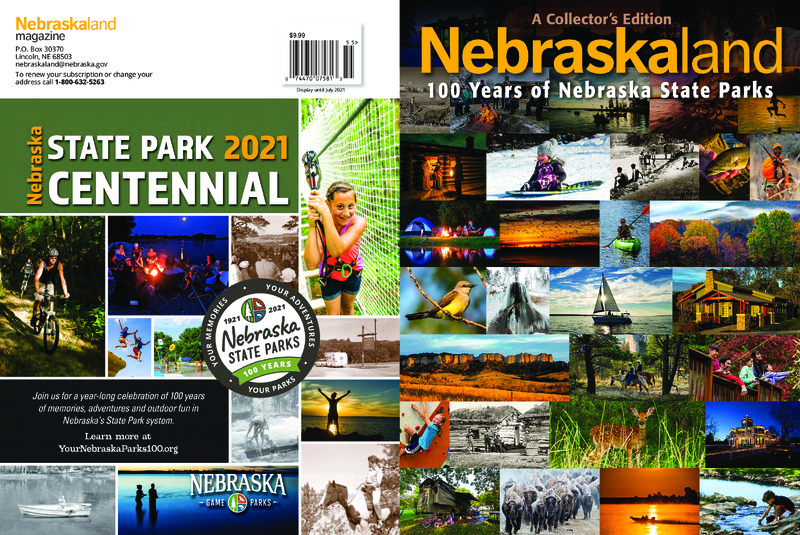
A Collector’s Edition
magazine
P.O. Box 30370
Lincoln, NE 68503
nebraskaland@nebraska.gov
To renew your subscription or change your
address call 1-800-632-5263
$9.99
$9.95
Display until July 2021
100 Years of Nebraska State Parks
4
Nebraskaland • April 2021
April 2021 •
Nebraskaland
5
Volume 99
April 2021
No. 3
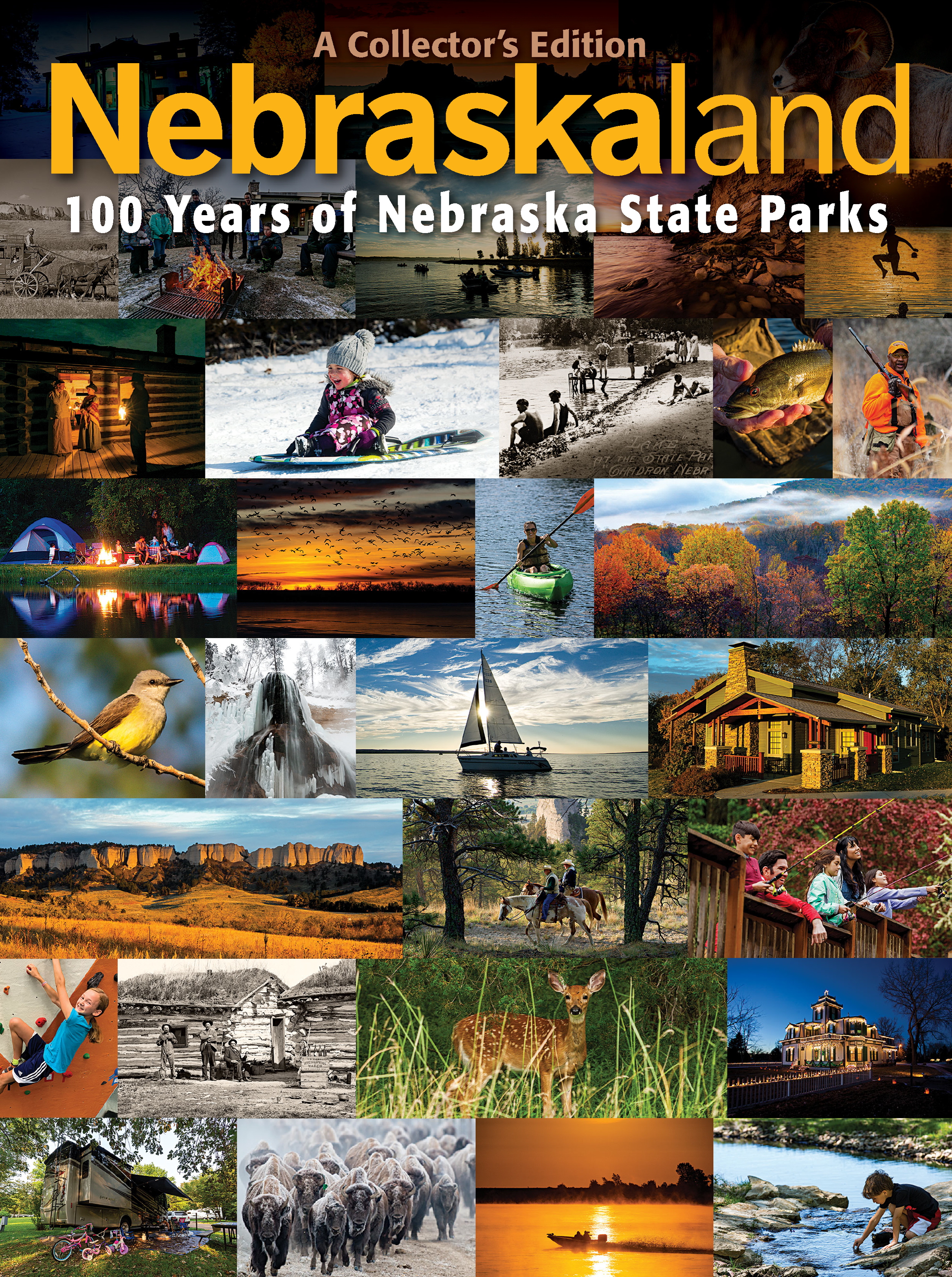
Cover: A multitude of state park and
recreation area-related photos show
the diversity and history of our great
park system in Nebraska.
A unique glimpse of Indian Cave on Oct. 28, 1905, complete with
carvings. Standing is Emma Miller (right), Caroline Greenwald
Miller (left) and seated is a family friend, Edna Weber. All three
women were from Falls City and drove a buggy to Indian Cave
that day for an adventure.
PHOTO COURTESY OF JULIE VAN METER
FEATURES
28
36
38
46
54
56
62
68
70
76
78
88
PARK MEMORIES
Waiting to Be Made
Story and photos by Michael Forsberg
THE FACE OF BUFFALO BILL
A Volunteer Profile
94
96
Marking 100 Years
By Eric Fowler
CHADRON STATE PARK
Western Eden, Where It All Began
Story and photos by Justin Haag
PART OF THE FAMILY
A Volunteer Profile
By Renae Blum
RECIPES AT THE CAMPGROUND
By Jenny Nguyen-Wheatley and Christy Christiansen
PLATTE RIVER STATE PARK
The Hidden Gem
By Jeff Kurrus
FORT KEARNY
“A Sort of One-Horse Affair”
By David L. Bristow, History Nebraska
WILDLIFE IN THE PARKS
By Jeff Kurrus
104
106
114
122
124
132
138
THE FACE OF A FORT
ATKINSON SOLDIER
146
INDIAN CAVE STATE PARK
152
By David L. Bristow, History Nebraska
Pick a Trail, Any Trail
Story and photos by Eric Fowler
HOW MANY COULD I CATCH?
By Jeff Kurrus
A Volunteer Profile
By Renae Blum
EUGENE T. MAHONEY
STATE PARK
You’re Always Welcome
By Renae Blum
A PARKS TIMELINE
MAKING MAGIC
158
By Jeff Kurrus
PORTRAYING A SIMPLER TIME
A Volunteer Profile
By Renae Blum
BIRDING AT THE FORT
Story by Joel Jorgensen, Photos by Justin Haag
PONCA STATE PARK
A Park for All Seasons
By Jenny Nguyen-Wheatley
A SLICE OF 1860
A Volunteer Profile
By Renae Blum
FORT ROBINSON STATE PARK
Big Park, Big Experiences
By Justin Haag
A STATE OF RECREATION
By Julie Geiser
NIOBRARA STATE PARK
Our Northern Vista
By Jenny Nguyen-Wheatley
CAMPING PEOPLE
Story and photos by Mark Harris
SMITH FALLS STATE PARK
Nebraska’s Iconic Waterfall
By Jeff Kurrus
BECOMING ARBOR LODGE
By David L. Bristow, History Nebraska
Nebraskaland (VOL. 99 / NO. 3 ISSN 0028-1964) is published monthly, except for the combined Jan./Feb. and Aug./Sept. issues, by the Nebraska Game and Parks Commission, 2200 N. 33rd St.,
Lincoln, NE. Periodicals postage paid at Lincoln, Nebraska, and additional mailing offices. POSTMASTER: Send address changes to Nebraskaland, P.O. Box 30370, Lincoln, NE 68503-0370.
6
Nebraskaland • April 2021
DEPARTMENTS
12
16
166
178
182
Your Nebraska
In the Field
Mixed Bag
Portraits from the Past
The Last Stop
ON THE WEB
For a complete list of park
locations and amenities, visit
OutdoorNebraska.org/Parks
A Welcome from the Director
Your Nebraska state parks are special for so many reasons. For 100 years,
families have been making memories at our 78 state parks and recreation
areas. You likely have a favorite park area and activities that you enjoy,
whether it be camping, fishing, hiking or nestling around a campfire with your
loved ones. Our 10 unique state historical parks, each with a rich history to
share, provide reflection upon our heritage.
From our first park, Chadron State Park, to our newer Venture Parks, there
are so many opportunities to explore, learn, relax, seek a new adventure or
continue your family traditions.
It is the supporters such as you, our patrons, our donors and our volunteers, who help make your
parks some of the best in the nation. It is our great privilege to manage your state parks, providing
opportunities for Nebraskans and visitors alike to get in touch with nature, spend time outdoors in
a safe environment and make memories that will last a lifetime.
We are committed to preserving your parks and continuing to provide new and exciting
opportunities for outdoor recreation across the state for years and generations to come.
I invite you to celebrate this special centennial year with us — explore the opportunities in
parks, learn about our history or attend a special event. Enjoy this special Nebraskaland Magazine
collector’s edition highlighting our diverse park areas and what makes them unique and the
history and the people who make them the treasures that they are.
Sincerely,
James N. Douglas
Director
8
Nebraskaland
Ne
N
eb
brras
ask
ka
ala
land
nd • April
Apri
Ap
riill 2
2021
02
0
21
ERIC FOWLER, NEBRASKALAND
April 2021 •
Nebraskaland
9
Magazine Staff
magazine
Published by the Nebraska Game and Parks
Commission since 1926. The Commission is
dedicated to the conservation and protection
of all the state's natural resources and the
people who use them.
Communications Director Christy Firestone
Public Relations Manager Shawna RichterRyerson
Editor Jeff Kurrus
Associate Editor Jenny Nguyen-Wheatley
Regional Editors Eric Fowler, Julie Geiser,
Justin Haag
Contributing Editor Michael Forsberg
Regular Contributors Renae Blum,
Chris Helzer, Chris Masada, Ryan Sparks, Gerry
Steinauer
Art Director Tim Reigert
Graphic Designer Mel Severin
Photo Librarian Jaclyn Cruikshank Vogt
Administration
Director Jim Douglas
Deputy Director Tim McCoy
Commissioners
Chairman - Dan Kreitman, Wahoo
Vice Chairman - Pat Berggren, Broken Bow
2nd Vice Chairman - Rick Brandt, Roca
Robert Allen, Eustis
Donna Kush, Omaha
Scott Cassels, Omaha
Jim Ernst, Columbus
John Hoggatt, Kearney
Doug Zingula, Sidney
Circulation
For address changes and questions about your
subscription, call 800-632-5263
Advertising Sales Manager
For advertising information contact
Shane G. Gilster, 402-742-0125
Email: shanegilster@gmail.com
Nebraskaland Magazine Copyright 2021, all rights reserved.
Nebraskaland is available in audio from the Nebraska Library
Commission Talking Book and Braille Service, Suite 120, 1200 N St.,
Lincoln, NE 68508. 800-742-7691. Nebraskaland Magazine and the
Nebraska Game and Parks Commission reserve the right to reject any
advertising not in keeping with the agency mission.
Rates: $18 for one year; $33 for two years; $44 for three years. Nebraska
recipients must add appropriate sales tax. To subscribe call
1-800-NEBLAND (632-5263), or go online to:
NebraskalandMagazine.com.
Commission Offices
Conservation Officers
Headquarters/Southeast District Office
2200 N. 33rd Street Lincoln, NE 68503
Phone 402-471-0641
ADMINISTRATION (Lincoln)
Craig Stover (Administrator)
Duane Arp (Asst. Administrator)
Travis Shepler (Asst. Administrator)
Jeff Clauson (Asst. Administrator)
Northeast District Office
2201 N. 13th St. Norfolk, NE 68701
Phone 402-370-3374
Southwest District Office
301 E. State Farm Rd. North Platte, NE 69101
Phone 308-535-8025
402-471-5531
402-471-5531
402-471-5531
402-471-5531
NORTHWEST (Includes counties covered)
Dan Kling (Lieutenant)
308-430-0572
EAST SUB-DISTRICT
Sean Schultz (Sergeant)
308-672-1824
Northwest District Office
East Hwy. 2, Box 725 Alliance, NE 69301
Phone 308-763-2940
Jerod Hahn (Deuel, Garden, Grant)
Keith Jadlowski (Keith, Deuel)
Jaden Porter (Keith, Garden)
308-520-5539
308-289-9580
308-289-2274
Bassett Office
524 Panzer St., Box 508 Bassett, NE 68714
Phone 402-684-2921
WEST SUB-DISTRICT
Kearney Office
1617 First Ave. Kearney, NE 68847
Phone 308-865-5310
Ak-Sar-Ben Aquarium/Schramm Education
Center
21502 W. Highway 31 Gretna, NE 68028
Phone 402-332-3901
Omaha Office
8495 Frederick Street, Omaha, NE 68124
Phone 402-595-2144
(Keith, Arthur)
Nebraskaland • April 2021
308-520-1031
Ray Dierking (Custer, Thomas, Blaine)
Frank Miller (Cherry, Hooker)
Greg Hesse
308-870-0322
402-389-0444
308-546-7464
308-660-4671
308-530-3157
(Lincoln)
(McPherson, Logan, Hooker, Cherry)
Kelsey Glodowski
308-763-8226
SOUTH SUB-DISTRICT
Josh Widhelm (Morrill, Scotts Bluff)
Jacob Stoinski (Sioux, Dawes)
308-279-9133
308-615-9017
(Red Willow, Frontier, Hayes, Hitchcock)
(Box Butte, Sheridan, Grant)
NORTHEAST (Includes counties covered)
Tom Zimmer (Lieutenant)
402-649-8053
NORTH SUB-DISTRICT
Jeff Jones (Sergeant)
402-762-5022
John Bauer (Holt, Boyd)
Dale Davis (Keya Paha, Brown, Rock)
Jonathan Andreasen
402-314-9257
402-760-0712
402-340-3981
Mitch Johnson (Knox, Antelope, Pierce)
402-613-8612
(Knox, Cedar)
Cory Krause (Sergeant)
402-380-6410
Kyler Prochaska (Platte, Colfax)
Nicholas Fix (Dixon, Dakota, Thurston)
402-830-8278
402-508-0261
(Cuming, Wayne, Stanton)
10
Kevin Bergstrom (Sergeant)
308-672-1824
SOUTH SUB-DISTRICT
Any program that receives federal funding from the National Park
Service, or the United States Fish and Wildlife Service prohibits unlawful
discrimination on the basis of race, color, religion, age, gender, marital
status, national origin, age, disability or political affiliation. Any person
who believes he or she has been discriminated against in any program,
activity, facility, or service, should contact the Nebraska Game and
Parks Commission, Lincoln, NE 402-471-0641, the Equal Opportunity
Commission, Lincoln, NE 402-471-2024, TTY/TDD 402-471-4693; United
States Fish Wildlife Service, Civil Rights Coordinator, 4401 N. Fairfax
Drive, Arlington, VA 22203; Director, Equal Opportunity Program, U.S.
Department of Interior, National Park Service, 1849 C Street NW, Mail
Code 0008, Washington, D.C. 20240-0001.
NORTH SUB-DISTRICT
Sean McKeehan (Sergeant)
(Kimball, Banner, Scotts Bluff)
CENTRAL (Includes counties covered)
Mike Thome (Lieutenant)
308-293-8746
NORTH SUB-DISTRICT
Doug Pollard (Sergeant)
308-730-7050
Matt Brandt (Sherman, Howard)
Daryl Teter (Howard, Greeley, Merrick)
Mark Sullivan (Nance, Polk, Wheeler, Boone)
Kyle Gaston (York, Polk, Hamilton)
308-202-0819
308-440-1863
402-741-0636
402-719-6226
(Loup, Garfield, Valley)
SOUTH SUB-DISTRICT
Matt Taylor (Sergeant)
(Thayer, Fillmore, Nuckolls)
402-200-9597
308-380-7331
402-902-2017
308-920-2762
308-440-3847
SOUTHWEST (Includes counties covered)
Roger Thompson (Lieutenant)
308-530-3097
Alex Hasenauer (Lincoln, Perkins)
Brandon O’Neal
(Madison, Pierce, Stanton)
OutdoorNebraska.org
Tim Williams (Hall, Hamilton, York)
Eric Javins (Adams, Clay, Webster)
Pat George (Harlan, Franklin, Phelps)
Ethan Teter (Buffalo, Kearney)
(Lincoln, McPherson, Logan)
Brian Piernicky (Sergeant)
308-340-6627
Matt Andrews
308-746-2418
Owen Johnson (Dawson, Custer)
Taylor Dixon (Dawson, Gosper)
402-266-1759
308-217-2108
(Furnas, Gosper, Frontier, Red Willow)
SOUTHEAST (Includes counties covered)
Stacey Lewton (Lieutenant)
402-890-7140
EAST SUB-DISTRICT
Heath Packett (Sergeant)
402-210-0888
Russell Mort (Otoe, Johnson)
Rich Berggren (Douglas)
Dan Evasco (Sarpy)
Mike Luben (Saunders, Butler)
Bryan Adams
402-209-1506
402-619-1355
402-616-5961
402-443-6392
402-429-1924
(Cass)
(Nemaha, Pawnee, Richardson)
WEST SUB-DISTRICT
Scott Eveland (Sergeant)
402-853-3273
Dina Barta (Lancaster),
Dudley Sorensen (Lancaster)
Bryce Streger (Seward, Saline)
Trevor Stahlecker (Lancaster)
Matt Seitz (Gage, Jefferson)
402-890-6463
402-937-3422
402-646-0420
402-314-9641
402-806-0915
(Lancaster)
YOUR NEBRASKA
Instagram Photos
Follow us (@nebraskaland)
and tag us in your photos
to be featured in an
upcoming issue.
Eric Wellman, Lincoln
Memphis Lake State Recreation Area
Joshua Redwine, Lincoln
Pawnee Lake State
Recreation Area
Anthony Hixon, Beatrice
Indian Cave State Park
12
Nebraskaland • April 2021
April 2021 •
Nebraskaland
13
Eric Wellman, Lincoln
Branched Oak State Recreation Area
Anthony Hixon, Beatrice
Platte River State Park
Send your comments and
photos to:
Jeff Kurrus, Editor
Nebraskaland Magazine
P.O. Box 30370
Lincoln, NE 68503
or email Jeff.Kurrus@Nebraska.gov
Please include your postal address
and telephone number. Letters
may be condensed and edited.
Photographs are also welcome.
Taylor Montgomery, Scottsbluff
Fort Robinson State Park
14
Nebraskaland • April 2021
April 2021 •
Nebraskaland
15
IN THE FIELD
FISHING THE ALPS
Anglers fish from a boat at
sunrise at Danish Alps State
Recreation Area.
JENN
E
Y NGUYEN
NGUYEN
UYEN
UY
YE -WHE
YEN-WHE
WHEATLE
ATLE
L Y,
LE
Y NEBRA
EB
B SKAL
BRASKAL
SKALAND
AND
16
Nebraskaland • April 2021
April 2021 •
Nebraskaland
17
IN THE FIELD
ERIC FOWLER, NEBRASKALAND
THREATENED AND ENDANGERED SPECIES
IN THE STATE PARK SYSTEM
By Sarah Nevison, Wildlife Biologist
Nebraska’s state park system serves a tremendous role in
conserving the state’s diverse wildlife and plant populations,
including its threatened and endangered species. Nebraska
has 30 state-listed species, several of which can be found in
the park system. Here are a few examples:
Threatened piping plovers and state endangered least
terns nest on sandbars along the Missouri, Niobrara and Platte
rivers, so be on the lookout when you’re visiting Eugene T.
Mahoney, Platte River, Ponca and Niobrara state parks, or the
state recreation areas along these rivers, such as Fort Kearny,
Lake McConaughy, Louisville and Schramm Park.
Whooping cranes can be seen if the time is right either
flying overhead, foraging in fields or roosting on rivers,
particularly during the spring migration. They have been
seen throughout central Nebraska, from the bridge at Fort
Kearny State Recreation Area in particular.
In Nebraska, southern flying squirrels live in forested
areas primarily in the southeastern corner of the state. Some
make their homes at Indian Cave State Park.
Swift foxes can be spotted in the grasslands around Fort
Robinson State Park, as well as the flat grasslands outside of
•
•
•
•
18
Nebraskaland • April 2021
Lake McConaughy State Recreation Area.
You might see northern long-eared bats foraging at night
while camping anywhere across the state. The Nebraska
Game and Parks Commission has confirmed their presence
at Ponca State Park.
River otters have made a comeback in nearly every
major river system in Nebraska and recently were removed
from the state threatened list. You may find tracks or scat
from these creatures at Smith Falls or Niobrara state parks,
or lucky guests may even see one in person.
Ancient-looking pallid sturgeon swim the waters
through Mahoney, Platte River, Ponca and Indian Cave state
parks. In the same muddy waters that pallid sturgeon live,
we also find the tiny sturgeon chub.
Although the public may never see an American burying
beetle, just knowing that they live around Merritt Reservoir
and Calamus Reservoir state recreation areas can increase
our appreciation of the species and the areas.
American ginseng, a plant with clusters of bright red
berries, can be found in forests along the Missouri River,
particularly at Ponca State Park.
•
•
•
•
•
IN THE FIELD
Randy Gallup of Crescent, Iowa, picks his horse’s hooves at the equestrian campground at Danish Alps State Recreation Area.
JENNY NGUYEN-WHEATLEY, NEBRASKALAND
HORSING AROUND
By Jenny Nguyen-Wheatley
Horses can take us to places where motorized vehicles
can’t venture. Alongside tranquil river valleys, into deep
canyon or to the edge of dramatic bluffs, many of Nebraska’s
most breathtaking views are best experienced by horseback.
Those who horse camp already know the drill — Nebraska
state parks and recreation areas offer miles of scenic
equestrian trails and camping amenities across the state.
Don’t own a horse? Several parks keep their own herds for
guided trail riding through the summer season, including:
Chadron State Park (Chadron – northwest)
Fort Robinson SP (Crawford – northwest)
Niobrara SP (Niobrara – northeast)
Ponca SP (Ponca – northeast)
Indian Cave SP (Shubert – southeast)
Buffalo Bill State Historical Park (North Platte – central)
Eugene T. Mahoney SP (Ashland – metro area)
Platte River SP (Louisville – metro area)
•
•
•
•
•
•
•
•
20
Nebraskaland • April 2021
Of these, Fort Robinson, Indian Cave and Niobrara state
parks offer equestrian camping facilities.
Other Nebraska Game and Parks Commission properties
that offer equestrian trails and varying amenities include:
Willow Creek State Recreation Area (Pierce – northeast)
Danish Alps SRA (Hubbard – northeast)
Lewis and Clark SRA (Crofton – northeast)
Branched Oak SRA (Raymond – southeast)
Fort Kearny State Historical Park (Kearney – central)
Rock Creek Station SHP (Fairbury – southeast)
Pawnee SRA (Lincoln – metro area)
Two Rivers SRA (Waterloo – metro area)
Cowboy Recreation and Nature Trail (Norfolk to Valentine,
call ahead for facilities in adjacent towns)
Call ahead before you haul, as trail and camp availability is
subject to change. Reservations, fees and special regulations
may apply.
•
•
•
•
•
•
•
•
•
IN THE FIELD
National Geographic photographer Joel Sartore photographs an at-risk species at the Schramm Education Center.
EMILY BURCH, NEBRASKALAND
THE PHOTO ARK AT NEBRASKA PARKS
By Emily Burch
About 15,000 species live in human
care, residing in zoos and wildlife
sanctuaries across the globe. Joel
Sartore, Nebraska native, National
Geographic photographer and founder
of the Photo Ark project, is on a mission
to document them all.
The Photo Ark is a collection of more
than 11,000 portraits of hope, each
species photographed against a stark
black or white background. The results
are stunningly intimate, even soulful.
The goal is to educate and engage
as many people as possible with our
world’s biodiversity, sound the alarm
for at-risk species and foster human
connection and a desire to protect the
animals in front of the lens.
None of it would be possible without
local conservation efforts, and the
Nebraska state park system has been
tapped more than once in Sartore’s
efforts to reach his goal. Sartore and
his team have traveled from local
parks to national zoos to sanctuaries
around the world, tracking down
undocumented species and scheduling
22
Nebraskaland • April 2021
times to create the images that often
introduce the rare species to the world.
Sometimes, these wildlife havens are
closer to home than you would think.
A wheel bug shot at Indian Cave State
Park. JOEL SARTORE, JOELSARTORE.COM
In 2019, Sartore and his team
arrived at the Schramm Education
Center to photograph nine species:
eight fish and a rare blue bullfrog,
adding them to the Ark. After a quick
round of introductions, Sartore began
directing and working with park staff
to carefully make each species in
front of his lens the star of the show.
And, at the end of the day, he thanked
each staff member for helping him
gain access to those species, even
though nine seems insignificant next
to 11,000.
In 2020, with the pandemic limiting
his travel, Sartore began photographing
insects at Indian Cave State Park to
document invertebrate species because
they “help make the world go ’round,”
as he states in the Vanishing Insects
video at joelsartore.com.
Parks such as Schramm and
Indian Cave serve as vital centers for
biodiversity and species preservation
at a community level. Without these
havens, Sartore’s mission would not
have a chance at succeeding, and
many of the species in his Ark would
already be lost.
This American bullfrog at the
Schramm Education Center is
axanthic, meaning it lacks yellow
pigment. JOEL SARTORE, JOELSARTORE.COM
April 2021 •
Nebraskaland
23
IN THE FIELD
ERIC FOWLER, NEBRASKALAND
POLLINATORS IN YOUR PARKS
By Richard Wehmeyer, Parks Horticulturist
Pollinators, such as butterflies, moths and bumble bees,
are vital to the habitats and ecosystems that other animals
and people rely on for shelter and food. Pollinators are
responsible for one in every three bites of food we eat or
drink, and they provide services to medicine and textile
industries around the world. Unfortunately, pollinators are
in decline in our state and elsewhere. Nebraska is home to at
least 18 insect pollinators that are at-risk.
As a result, Nebraskans have been called to action to
prevent possible endangered- or threatened-status listing
of pollinators. Through donations, citizen-led butterfly
and milkweed surveys, habitat restorations and smaller
gardening projects, concerned Nebraskans have helped the
Nebraska Game and Parks Commission in its mission to
conserve all pollinator species. Alongside this public effort,
Nebraska State Parks staff also have taken action to help
the cause.
The Commission’s pollinator initiative began in the
early 1990s, gaining momentum in 2015 when planning
and programming administrator Kirk Nelson and parks
24
Nebraskaland • April 2021
horticulturist Mike Groenewold orchestrated a grant-funded
pollinator planting and seeding project. In partnership
with the Nebraska Environmental Trust, National Fish
and Wildlife Foundation and the Prairie Plains Resource
Institute, hundreds of acres of pollinator habitat were
installed on public lands across Nebraska. These plantings
not only increased the aesthetic value of parklands, they
also improved the functionality of each space, providing
habitat for wildlife and areas for parkgoers to recreate.
A few examples where pollinator habitat was restored
include areas along the Cowboy Recreation and Nature Trail,
Platte River State Park, the Schramm Education Center,
Wildcat Hills State Recreation Area, Fort Hartsuff and Rock
Creek Station state historical parks.
In addition to planting native grasses and wildflowers,
horticulturist Steve Brey has raised tree species that provide
shelter and food for pollinators, such as native oak, plum,
cherry and maple varieties. Horticulturist Jon Morgenson
also continues to design and install pollinator-loving
landscapes in a number of parks each year.
April 2021 •
Nebraskaland
25
IN THE FIELD
JEFF KURRUS, NEBRASKALAND
THE INVALUABLE CAMPGROUND HOSTS
By Jeff Kurrus
Joanie Stone’s energy is immediately apparent. As she
answers questions about her own history at Eugene T.
Mahoney State Park, her eyes are always toward her
grandkids, who are playing nearby. She’s a multitasker and
a great conversationalist — she’s the ideal campground host.
“When Mahoney State Park originally opened, we were
the second trailer to come into the park,” she said. “We had
traveled a lot back East, and there were campground hosts at
the parks we stopped at.”
So she and her husband, Al, talked to Roger Kuhn and Jim
Swenson, who were both park superintendents at that time.
“‘Maybe,’ they told me. ‘What do those people do?’
“We told them that they give information. They help out
around the park. Soon after, we, along with another couple,
became the first campground hosts in the state.”
Since then, Joanie and Al hosted at Mahoney every year
until his passing in 2015. Following that, Joanie continued to
host, only missing because of the pandemic in 2020.
“Mahoney is home away from home,” she said. “This is
where I feel close to my husband. It’s what we liked to do
together.”
She laughed about the crowdedness of Memorial Day
weekend, how she loves having so many people around.
26
Nebraskaland • April 2021
She’s also looking forward to the days when College World
Series visitors begin showing up again. She likes her time at
Mahoney so much that she’ll be hosting for a month starting
in late May, then return to host during Mahoney’s Halloween
celebration later in the year.
While hosting, Joanie stays in touch with parks
administration about who’s coming and going, she straightens
the bathrooms and helps maintain the cleanliness of the park
and answer peoples’ questions about what to do in the area.
“Go to the zoo, the Wildlife Safari, the little shops in
Ashland to visit,” she tells them. “There are a lot of places
to visit.”
Most importantly for her is letting people know how lucky
they are to have our state parks system.
“I want people to know they’re missing something if
they’re not using their state parks. It doesn’t have to be
Mahoney. It can be Chadron. It can be Indian Cave. They
need to use them. They really don’t know what they have,
that’s for sure.”
It’s a message Joanie will be gladly sharing long into the
future.
For more information, visit OutdoorNebraska.org/
Campgroundhost.
April 2021 •
Nebraskaland
27
Park Memories
Waiting to Be Made
Story and photos by Michael Forsberg
Wintering trumpeter swans in flight over Calamus
State Recreation Area in 2017.
28
Nebraskaland • April 2021
April 2021 •
Nebraskaland
29
Smith Falls and summer
starscape lit by flashlight
in 2019.
Scott Witthoff, then of Lincoln, enjoys winter camping at Indian Cave State Park in January 1993.
I
t was January 1993. I was in my
first month of a dream job as a
staff photographer and writer
for Nebraskaland Magazine, and
I was flustered. Then editor Don
Cunningham had placed a large stack
of hardbound Nebraskaland volumes
on my desk and asked me to become
familiar with the material so I could
pitch him a few of my own story
ideas. Not wanting to fail my first
assignment, I pored over roughly two
decades of issues and hundreds of
stories over the next couple of weeks,
and I consumed every word and photo.
I was born and raised in Nebraska,
but scrolling through those pages I
saw our state and its lovely sweep of
country like I had never seen it before,
from the rugged pine-studded buttes
of the Pine Ridge at Chadron and Fort
Robinson state parks to the broadshouldered forested bluffs along the
30
Nebraskaland • April 2021
Missouri at places like Niobrara, Ponca
and Indian Cave, and its undulating
prairies and the immense wealth of
water that braided it all together. I
also was amazed at the tremendous
diversity of plants and animals that
these lands harbored, from huge bull
elk to ancient pallid sturgeon to the
daintiest of orchids, and I was humbled
by the diverse voices of our people past
and present and their fierce, intimate
connections to the land.
But when I had finished reading, I
went to Don’s office, defeated, and said
that I had no new story ideas to offer
because the magazine had already
told them all. Being the gentle and
wise man that he was, Don looked up
at me over his professorial reading
glasses from his standup desk and said
with a smile, “But those are not your
stories, Mike. Go explore. You’ll find
them.” He was right. Several months
later in December, my first two articles
My first cover image
on Nebraskaland’s December 1993
issue.
appeared in Nebraskaland, a photo
essay “A Day With Eagles” from Lake
McConaughy State Recreation Area,
and “Let it Snow!”, where I tried to
cross-country ski in our state parks
around the state.
April 2021 •
Nebraskaland
31
My first vivid memory in our
state parks system was with my
grandparents who took me to Fort
Kearny State Recreation Area when I
visited them. I’d run my legs off around
the interior of the fort grounds, then
bobber fish for bluegill in the sandpit
lakes, and usually wrap up with a
snack and lemonade under the cool
shade of a stately cottonwood tree.
And I remember the first time my
folks and I took a trip to the Black Hills
in South Dakota, spending an
afternoon at Fort Robinson State
Park along the way, where I hiked to
the base of the Red Cloud buttes. My
imagination soared with a golden
eagle floating effortlessly among what
looked like sandstone castles rising
from a prairie sea.
Later in college, I worked my way
through school as a trip leader for
the Outdoor Adventures Program at
the University of Nebraska-Lincoln,
where each fall we led canoe trips
down the Niobrara River and pitched
our tents in a magical place that soon
would become Smith Falls State Park.
After college, my wife, Patty, and I
spent part of our honeymoon camped
at Merritt Reservoir State Recreation
Area deep in the heart of the Sandhills
under the brightest blanket of stars
we had ever seen. And years later, as
a dad, my two buddies and I would
always have our end-of-summer
excursion to camp with our passel of
young children along the banks of
the Platte River at Louisville State
Recreation Area.
A bald eagle perched on
a stump at Otter Creek
at Lake McConaughy
State Recreation Area in
February of 1993.
32
Nebraskaland • April 2021
Time-lapse photos of the Platte River from Eugene T. Mahoney State Park’s tower,
showing three seasons: summer, fall and winter
Over these last few decades I’ve
pedaled and paddled, wandered and
wondered, and learned so much being
in these parklands across the state.
And while my work as a photographer
has broadened geographically and
has taken me on many adventures far
from my home state, my anchor has
always been in Nebraska, and I am
April 2021 •
Nebraskaland
33
sure it always will be.
Today our lives are focused close
to home, and I know at least for me
and my family, during this past year
through the pandemic these parks
have become an important lifeline.
They have allowed us and our now
34
Nebraskaland • April 2021
grown children places to come
together in nature, where we can take
a hike or go birding, climb a tower and
watch a sunset, find solace along a
river, or silence, or simply be. They
are an inseparable part of not just my
family’s personal story, but so many of
our collective stories, each in our own
intimate way.
So as we continue to venture into
our parks system for another century,
I encourage you to get to know these
places like old friends, seek out their
nooks and crannies, and venture out
into new places, too. As you do, think
about these lands together and their
histories that go back long before us
and our own cultures. Think about the
generations of folks that have worked
in these parks, and about all of us and
our diverse citizenry as stewards of
these lands today. And perhaps most
importantly, consider your own story
in these cherished places and imagine
the new memories that are waiting to
be made. Go explore. They are there
waiting for you to find them. N
A Sandhills sunrise spotlights
wintering waterfowl and eagles
feeding in open water on the upper
reaches of Calamus Reservoir State
Recreation Area in 2017.
April 2021 •
Nebraskaland
35
A Volunteer Profile
The Face of
Buffalo Bill
By Renae Blum
Bruce Richman is a man in demand. He has portrayed
William F. “Buffalo Bill” Cody everywhere from Omaha to
Scottsbluff for the past 20 years, appearing at parades, state
fairs, rodeos, schools, conferences and even birthday parties.
He’s also the face of Buffalo Bill Cody to visitors at Buffalo
Bill Ranch State Historical Park in North Platte, which
showcases the ranch house and barn that Cody built for his
home during the heyday of his famous Wild West Show.
During special events, Richman meets visitors at the door,
dressed for the part, and shares stories about the famed
showman. He also describes what visitors will be seeing
during their tour and asks them to keep an eye out for several
interesting items.
“That makes them look at things a little closer, and that
way their experience will be much more rewarding,” he said.
Richman has meticulously assembled historically accurate
clothing, including a $980 handmade vest and handmade
$600 boots, and learned beadwork so he could embellish his
outfits. Why all the effort? The costume “tells the story in
itself,” Richman said.
He enjoys getting to meet visitors from around the world.
They’ve heard about the legend of Buffalo Bill, like Richman
did growing up, and are curious about where he lived,
Richman said.
“So when I’m there, it makes it a little bit extra special for
them,” he said. N
What you should know about
Buffalo Bill Ranch State
Historical Park
“Scout’s Rest Ranch, with its majestic
barn, mansion, hundreds of artifacts
and photographs, live buffalo corral and
manicured grounds, can be viewed today with
a true feeling of importance,” Richman wrote.
“From here in Nebraska, Cody became the
most famous man in the world. The park is a
genuine gem here on the plains of Nebraska.”
36
Nebraskaland
• April 2021
ERIC FOWLER, NEBRASKALAND
April 2021 •
Nebraskaland
37
A Parks
Timeline
Marking 100 Years
By Eric Fowler
hen Nebraska became a state in 1867,
parks — let alone state parks — weren’t
needed. Nebraskans of the day, and for
years to come, were building homes,
farms, businesses and towns, and with all of that
work to be done, there was little time for leisure.
But the conservation movement had begun,
heightening the nation’s awareness of its pristine
natural resources and prompting the launch of
efforts to preserve them for future generations.
The movement led to the creation of the nation’s
first National Park — Yellowstone — in 1872.
The notion that nature was to be enjoyed
resonated with Nebraskans. Soon after they
planted their roots, they found time to play and
relax outdoors. They would fish, swim or take a
leisurely boat ride at natural lakes, lazy rivers
and the oxbows along them, and, as early as
the 1880s, lakes built specifically for recreation.
Camping, once primarily done in conjunction
W
In 1881, the Nebraska Fish Commission purchased a private fish hatchery on the Platte River south of Louisville and named it
the Santee Fishery. By 1915, the 52-acre site was redesignated the Gretna Fish Hatchery. NGPC PHOTO LIBRARY
This 1936 image shows visitors playing on a slide at Chadron State Park.
ARTHUR ROTHSTEIN, LIBRARY OF CONGRESS, LC-DIG-FSA-8B27683
Judge Charles Mathews, seated, claimed his homestead next to spring-fed Victoria Creek. He built two log buildings in 1873,
one for his home, which would later become Custer County’s first post office, and the other a store, which bottled and sold the
spring water. With Mathews are O.A. Smith (left) and James Forsyth (center). In 1923, Victoria Springs was added to the state
park system, and the buildings still stand today at the state recreation area near Merna. HISTORY NEBRASKA, RG2608-0713A
38
Nebraskaland • April 2021
with hunting or fishing, had become a stand-alone activity.
In 1921, the movement to preserve wild places for
enjoyment by the masses gained enough of a foothold that
the Nebraska Legislature formed the State Park Board, and
Nebraska became the 20th to create a state park when the
board designated a section of school land in the scenic Pine
Ridge south of Chadron as such.
In the years since, the Commission has added 77 parks
and trails for their historic, aesthetic and recreational value.
Some were donated, some purchased and some leased,
including facilities developed around numerous irrigation
and flood-control reservoirs built by irrigation districts and
state and federal agencies.
The result is what is widely recognized as one of the
finest park systems in the nation. Within a short drive of all
Nebraskans, is a state park, historical park or recreation area
where people can explore some of the state’s most scenic
landscapes, stay, learn, play or just relax. These are your
parks.
1921 - Chadron State Park was created.
1923 - Victoria Springs, described as an oasis in the
Sandhills for the mineral springs found there, became the
state’s first state recreation area. The park, near Anselmo,
includes the log home and store of Judge Charles Mathews.
1923 - Arbor Lodge, the mansion and grounds of J. Sterling
Morton, founder of Arbor Day, in Nebraska City, became the
state’s first state historical park.
1925 - Walgren Lake State Recreation Area was established
in Sheridan County.
1925 - The Bureau of Game and Fish began to establish a
statewide system of recreation grounds to supplement the
state parks “to provide fishing and hunting for the thousands
of Nebraska citizens who desire such outdoor recreation.” It
acquired Walgren Lake in Sheridan County that year.
1929 - Fort Kearny State Historical Park was established
on the site of a frontier fort that operated from 1848 to 1871
on the Oregon-California Trail. It was maintained as a picnic
and recreation site until the 1960s, when reconstruction of
historic structures began. A visitor center opened in 1968.
Land was acquired nearby in the 1960s to create Fort Kearny
State Recreation Area, which also opened in 1968.
1929 - The State Park Board was dissolved and merged with
the Bureau of Game and Fish to create the Game, Forestation
and Parks Commission.
1930 - The Commission purchased land near Gering to
create a “big game reserve” today known as the Wildcat Hills
State Recreation Area.
1933 - By the end of 1933, the Game, Forestation and Parks
April 2021 •
Nebraskaland
39
J.W. Dears Trading Post at the Red Cloud Agency in the area of Fort Robinson, 1876.
Commission had established 26 state recreation areas.
1935 - Rock Creek Lake State Recreation Area opened in
Dundy County a few miles downstream from the Rock Creek
Fish Hatchery, which opened in 1926.
1935 - Niobrara State Park at the mouth of the Niobrara
River opened to the public after work by the Civilian
Conservation Corps in 1934 and 1935.
1936 - Ponca State Park opened along the Missouri River in
Dixon County. It was created with the donation of 200 acres
from area residents in 1934 and developed almost entirely
with federal funds through the Civilian Conservation Corps.
Launching a boat at Bluestem State Recreation Area, 1960s.
NGPC PHOTO LIBRARY
40
Nebraskaland • April 2021
HISTORY NEBRASKA, #1392-75
Additions to the park in the 1950s, ’60s, ’70s and 2000s grew
the park to more than 2,000 acres.
1937 - State parks began receiving an appropriation from
the state general tax fund.
1945 - The Commission was granted a 99-year lease by
Central Nebraska Public Power and Irrigation District to
manage recreation grounds on portions of the newly created
Lake McConaughy and other reservoirs in the system,
including Lake Ogallala, Johnson Lake and Gallagher Canyon.
1945 - Box Butte Dam was completed. The Commission
later would lease the property from the U.S. Bureau or
Reclamation as a state recreation area.
1950 - The Dingell-Johnson Act created the Sport Fish
Restoration Program by establishing an excise tax on fishing
equipment. The tax helps fund rehabilitation of lakes and,
more recently, the construction of boat ramps, docks and
other access projects, at parks.
1952 - Enders and Medicine Creek reservoirs opened to
the public, the first of four large flood-control and irrigation
reservoirs built in southwestern Nebraska by the U.S. Bureau
of Reclamation.
1954 - Swanson Reservoir opened to the public as the third
large U.S. Bureau of Reclamation reservoir in the region.
1957 - The Commission opened Fort Robinson State Park
on the site of what had been an active military fort from 1874
to 1948.
1958 - The Commission began requiring a $1 State
Recreation Areas stamp for vehicles entering the parks, its
first foray into a user-pay system similar to that required of
hunters and anglers.
1958 - Lewis and Clark Lake, a U.S. Army Corps of Engineers
reservoir on the Missouri River, opened. It became a Nebraska
Game and Parks State Recreation Area in 1971.
1959 - The Legislature approved a bill that created the
Division of State Parks within the Commission. The bill
also established the State Park Fund and a special mill
levy that would collect 1.3 cents for every $100 in assessed
taxable property value from 1959 through 1968 to fund the
development and maintenance of the park system, replacing
the SRA sticker and the general fund appropriation. It spurred
major projects in the parks. The Commission was assigned
Mike Voorhies explains the intricacies of excavation to
visitors in the “Rhino Barn” at Ashfall State Historical Park
in 1993. DON CUNNINGHAM, NEBRASKALAND
tourism responsibilities for the state.
1959 - Assigned boating safety responsibilities by the
Legislature, the Commission began issuing licenses for
motorized boats.
1960s - Throughout the 1960s, a chain of lakes in central
Nebraska, created by construction of Interstate 80, were
developed as hunting, fishing and recreation areas, including
Mormon Island, Union Pacific, War Axe and Windmill state
recreation areas.
1960 - Two Rivers State
Recreation
Area
opened,
featuring camping, swimming,
fishing and 28 duck blinds for
rent.
1962 - Red Willow Reservoir,
the fourth and final large
U.S. Bureau of Reclamation
reservoir in the region, opened.
1964 - The Commission
began
managing
Lake
Minatare, a U.S. Bureau of
Reclamation reservoir that
was completed in 1915. Its
landmark, 55-foot lighthouse
was built entirely of native
stone between 1937 and 1939
by the Veterans Conservation
Corps Camp BR-1.
1964 - Bluestem and Wagon
Train lakes opened to public
use. These were the first of
Camping at Two Rivers State Recreation Area in Douglas County, 1960s. NGPC PHOTO LIBRARY
April 2021 •
Nebraskaland
41
Park superintendent Roye Lindsay in period dress on the
veranda at Fort Hartsuff State Historical Park in Valley
County in 1974. NGPC PHOTO LIBRARY
eight flood-control reservoirs built by the U.S. Army Corps
of Engineers that would be managed by the Commission
as state recreation areas. Known as the Salt Valley Lakes,
others would include: Branched Oak, Conestoga, Olive Creek,
Pawnee, Stagecoach, and Twin Lakes. Two other Salt Valley
A sod house, water pump and bucket at Bowring Ranch
State Historical Park in Merriman. BOB GRIER, NEBRASKALAND
42
Nebraskaland • April 2021
Lakes, Hedgefield and Yankee Hill, are managed by the
Commission as wildlife management areas.
1964 - Merritt Reservoir State Recreation Area, a U.S.
Bureau of Recreation reservoir on the Snake River, opened.
1965 - Buffalo Bill Ranch was dedicated as a State Historical
Park. The dedication followed extensive restoration work
on the home and barn of famed showman scout William
F. “Buffalo Bill” Cody, which was acquired in 1961. The
Commission acquired 233 acres nearby on the North Platte
River in 1989 to create Buffalo Bill State Recreation Area and
provide a campground, which opened in 1999.
1966 - The first facilities at Ash Hollow State Historical
Park opened. Land acquisition began in 1962 and was
completed in 1968 for this park, an important stop on the
Oregon Trail that also featured a cave with evidence of
human inhabitants in the valley dating back 7,000 to 10,000
years. A visitor center with exhibits highlighting the history
of the area opened in 1978.
1966 - Acquisition of the 10,300-acre James Ranch
expanded Fort Robinson State Park.
1967 - The legislature removed the responsibility for
forestation from the Commission, which was renamed the
Game and Parks Commission.
1967 - Land was purchased in Jefferson County for what
would be the core of Rock Creek Station State Historical Park,
an important point on the Oregon Trail and a Pony Express
station. In 1984, a visitors center, donated by the Burlington
Northern Foundation, opened and work began to reconstruct
historic buildings.
1968 - Fort Hartsuff State Historical Park opened to the
public following restoration of a few of the buildings that
remained from the military fort that served the area from
1874-1881. Acquired in 1960, the park was formally dedicated
in 1973.
1970 - Indian Cave State Park, located in the bluffs along
the Missouri River, opened to day use and primitive camping.
Initial acquisition of land for the park began in 1963. In 2000,
347 acres of bottomland was added to the park.
1973 - Sixteen bison were moved from the Wildcat Hills
State Recreation Area to start a herd at Fort Robinson State
Park.
1973 - The Gretna fish hatchery, the state’s first when it was
acquired in 1881, was closed and became part of Schramm
Park State Recreation Area. The hatchery is now a museum.
1978 - A park-entry permit program, authorized by
the legislature in 1976, was initiated to raise funds for
improvement and maintenance of state parks. Additionally,
the Nebraska Outdoor Recreation and Development Act,
funded by a one-cent tax on cigarettes, began to fund new
park construction.
1979 - The Ak-Sar-Ben Aquarium opened in Schramm Park.
1981 - The Commission released six bighorn sheep in
an enclosure on the buttes at Fort Robinson State Park to
Backpacking on snowshoes at Indian Cave State Park in February of 1971.
establish a resident herd. In 2020, the state had about 290
sheep in the Pine Ridge and the Wildcat Hills.
1982 - Platte River State Park officially opened in the bluffs
above the river for which it was named.
1986 - Calamus Reservoir, a Bureau of Reclamation
irrigation reservoir completed on the Calamus River near
Burwell in 1984, opened.
1986 - Ten cabooses, donated by the Union Pacific Railroad
and converted into cabins, opened to the public at Two Rivers
State Recreation Area.
1987 - The new Niobrara State Park opened, featuring 20
cabins, a campground and more. The old park site, acquired
in 1930, was abandoned because of rising water levels in the
Missouri River following the construction of Lewis and Clark
Lake.
1987 - Arthur Bowring Ranch State Historical Park, a
JON FARRAR, NEBRASKALAND
working Sandhills cattle ranch near Merriman, opened.
Former U.S. Senator Eve Bowring left the 7,202 acre Bar 99
ranch to the Commission in memory of her husband when
she died in 1985.
1989 - Lightning sparked a wildfire July 8, later named the
Fort Robinson Fire after it burned nearly 50,000 acres of the
Pine Ridge, the largest fire in recorded history at the time.
Rains that fell and the following spring washed tons of ash
into the White River, Soldier Creek and Carter P. Johnson
Lake, killing nearly all of the trout.
1990 - A new RV campground opened at Chadron State Park.
1991 - Eugene T. Mahoney State Park opened along the
Platte River between Lincoln and Omaha. Land acquisition
and development, funded in large part by donations, had
begun in 1986.
1991 - Ashfall Fossil Beds State Historical Park opened.
April 2021 •
Nebraskaland
43
Kids play in the touch tank at the Schramm Education Center.
The Niobrara River Bridge on the Cowboy Trail in Cherry
County, 1997. MIKE FORSBERG, NEBRASKALAND
44
Nebraskaland • April 2021
JENNY NGUYEN-WHEATLEY, NEBRASKALAND
Land for the park was acquired in 1987. A partnership
between the Commission and the University of Nebraska
State Museum, it features ongoing excavation of fossils left
nearly 12 million years ago.
1992 -Smith Falls State Park, the site of the state’s highest
waterfall, was established on the Niobrara River near
Valentine.
1994 - A gift from the Rails-to-Trails Conservancy of
321 miles of abandoned Chicago & North Western rail line
across northern Nebraska led to the creation of the Cowboy
Recreation and Nature Trail. When completed, it will be the
longest rails-to-trails conversion in the country.
1995 - The Wildcat Hills Nature Center opened at the state
recreation area south of Gering. A cooperative effort between
the Commission and local civic leaders and groups, the center
serves as an educational facility, museum and interpretive
center. An expansion completed in 2017 nearly doubled the
size of the center.
2000 - Five cabins, the first of 10, open on the shore of
Lewis and Clark Lake.
2001 - The Lake McConaughy Visitor and Water
Interpretive Center opened. The facility includes the Ethel S.
Abbot Theater, aquariums and interactive exhibits depicting
the story of water in Nebraska, and the history, hydrology
and geology of the North Platte River Valley and Lake
McConaughy.
2001 - A forest-thinning project began at Chadron State
Park to improve forest health and reduce wildfire risk. The
work helped stop the West Ash Fire, which burned 58,000
acres in 2012.
2002 - The Lied Platte River Bridge, abandoned by the Rock
Island Railroad, opened as a trail across the river near South
Bend.
2003 - The $7.9 million Missouri National Recreational
River Resource and Education Center, a cooperative effort
with the National Park Service, U.S. Army Corps of Engineers
and Better Ponca Foundation, opens at Ponca State Park.
2003 - The Family Aquatic Center opened at Mahoney State
Park, adding a wave pool, drop slide, aquatic playground and
sun turf to the existing pool and water slides.
2003 - The reconstructed Buffalo Soldiers Barracks were
completed at Fort Robinson. The barracks were home to
Black soldiers in the Ninth Cavalry.
2005 - The first Missouri River Outdoor Expo was held at
Ponca State Park, offering hands-on activities featuring
outdoor education, sports and recreation. The free event still
draws more than 50,000 people annually. It spawned similar
expos at Fort Kearny and Wildcat Hills state recreation areas
and Platte River State Park.
2008 - The first two mini lodges opened at Ponca State
Park. The park now offers 15 mini lodges, 10 two-bedroom
cottages and two green cabins. The park also maintains four
of the rustic cabins built in the 1960s for summer use.
2011 - Roger G. Sykes Outdoor Heritage Complex, the
Commission’s first shooting range, opened at Platte River
State Park.
2015 - The Commission, in conjunction with the Nebraska
Game and Parks Foundation, launched the Venture Parks
initiative. Through the Foundation, donations would cover
$28 million of the $35 million project. Construction began in
2016 and is ongoing.
2015 - Danish Alps State Recreation Area, part of a new
reservoir near Hubbard, opened in May 2015.
2016 - The Wildcat Hills Shooting Sports Complex opened.
2017 - Crawdad Creek at Platte River State Park opened to
become the first completed Venture Park addition.
2018 - Five new Venture Parks features opened at three
parks: Treetop Adventure and the tallest climbing wall in the
region at Mahoney State Park; a spray park and glamping
cabins at Platte River State Park; and a floating playground
at Louisville State Recreation Area.
2019 - The Schramm Education Center, a fully renovated
and greatly expanded iteration of the former Ak-Sar-Ben
Aquarium, opened as part of the Venture Parks.
2020 - The Treetop Journey course and Monkey Drop free
fall activity were added to the Treetop Adventure at the
Mahoney State Park.
2021 - Game and Parks continues to manage 76 areas and
two state trails in its state park system, encompassing more
than 70,000 acres across the entire state. Nebraska state
parks and recreation areas account for about 20 of the top 25
tourist destinations in the state. N
At Louisville State Recreation Area, people participate on the floating playground built in in 2018.
JEFF KURRUS, NEBRASKALAND
April 2021 •
Nebraskaland
45
CHADRON
State Park
Story and photos by Justin Haag
Pine Cone Butte rises above
Chadron State Park. While
the butte looks much the
same as it did in 1921,
the park has many more
activities than it did in its
first year.
OPPOSITE: With a snowfall, Chadron State Park becomes a winter wonderland.
ABOVE: Visitors can join a guided horseback ride. ERIC FOWLER, NEBRASKALAND
Western Eden, Where It All Began
U
nder the headline of “Western Eden,”
the front page of the July 8, 1921,
Chadron Journal proclaimed that the
Nebraska Legislature had “builded better than
it knew” by creating its fi rst state park.
“For years to come all of Nebraska’s
citizendom can point with honest pride to
Nature’s play ground near its western boundary.
It is an inspiration to view this locality, and to
walk its cool shady paths with the knowledge
that it belongs to all of us,” the author wrote.
“A big credit mark is due to the future efforts
which will be put forth to hold this spot in its
pristine beauty and we can pay tribute to the
Creator of Beauty that He gave to all Nebraska
citizens this fi rst state park.”
Chadron State Park has come a long way
since Sen. James Good and Rep. George Snow
introduced the bill to what was then a twohouse legislature, but much of what attracts
people to the park has not changed. As the
newspaper article said, it’s “a real beauty spot.”
48
Nebraskaland • April 2021
From
the tranquil pond and babbling
coldwater stream at the park’s entrance,
to the majestic rock landforms and pineclad vistas above, the 977-acre property
awakens the senses.
Surely, the founders would marvel at what
the park has become. Visitors can stay in one
of the 16 rustic cabins or more modern duplex
units. There’s also a campground suitable for
everything from pup tents to mammoth RVs.
Trails course through the park for hiking,
biking and guided horseback rides. Visitors also
make use of the park’s swimming pool, picnic
shelters, playground equipment, the Trading
Post activities center, a group event facility,
tennis courts, disc golf course and, new this
year, an indoor archery and pellet gun range.
Yes, Nebraskans can still “point with honest
pride” to Chadron State Park and how it has
enriched the citizenry and sparked a movement
to create 77 other places for people to relax, play
and explore. N
ABOVE: The park's buttes and ridges provide an
ideal vantage to catch a sunrise.
RIGHT: The park's campground, situated near
Chadron Creek, offers a quiet getaway.
April 2021 •
Nebraskaland
49
LEFT: Visitors with everything from
tents to RVs will enjoy a stay at
the park. Twenty-five of the park's
campsites recently were upgraded
to 50-amp electrical service.
OPPOSITE: The park features 33
miles of trails that connect to the
Pine Ridge Ranger District of the
Nebraska National Forest Service.
BELOW: The park's swimming pool,
with its view of the Pine Ridge, is
popular in summer.
50
Nebraskaland • April 2021
April 2021 •
Nebraskaland
51
LEFT: Constructed by the
Civilian Conservation Corps
in the 1930s, the 16 cabins at
Chadron State Park are popular
for families. Six modern duplex
units also are among the
lodging options.
Est. 1921
LEFT: White-tailed deer are
among the park's diverse
wildlife.
RIGHT: The park's pond
provides an ideal venue for
paddleboat rides, and also is a
popular fishing spot. The pond,
which was deepened in 2015,
has three species of trout,
smallmouth bass, yellow perch
and hybrid sunfish.
52
Nebraskaland • April 2021
April 2021 •
Nebraskaland
53
A Volunteer Profile
Part of the
Family
By Renae Blum
“Prepare to load … prepare to fire …
Fire!”
At Jerry Gronewold’s command,
the five cannons at Fort Kearny State
Historical Park fire, delighting visitors
at the park’s living history weekends.
Gronewold has volunteered with
the park’s living history group for
more than 25 years, and at age 78,
is its oldest member. Several of the
volunteers, who he’s watched grow
up, still call him “Grandpa Jerry.”
“It’s such a nice group. It’s really
kind of a family group,” Gronewold
said. “I’ve gotten to know so many
wonderful people.”
After the cannons fire, the
volunteers disperse to Civil War-style
tents where they can engage in period
activities and chat with visitors, who
come from across the United States
and as far away as New Zealand and
Germany.
“We’re
just
really
good
ambassadors, all of us are, for Fort
Kearny,” he said. N
What we want you to know
about Fort Kearny
“Fort Kearny played a real important role
during the Oregon Trail and Mormon Trail
migrations, because it was kind of a halfway
point across Nebraska and a stopping-off
point,” Gronewold said. “Kind of a respite
place — what I call ‘the beacon on the plains.’”
54
Nebraskaland
• April 2021
ERIC FOWLER, NEBRASKALAND
April 2021 •
Nebraskaland
55
Recipes
at the
Campground
Recipes by Jenny Nguyen-Wheatley
and Christy Christiansen
Photos by Jenny Nguyen-Wheatley
O
ne of the most enjoyable parts of the camping experience
is preparing food around a campfire and learning how
to create any number of simple, tasty dishes with
ingredients already found around the house.
Food always tastes a little better outside, and dinner prepared
while camping is no exception — especially when the recipes are
this easy.
Breakfast: Corned Beef
and Potato Hash
By Jenny Nguyen-Wheatley
Servings: 4-6
Ingredients:
2 (14.5-ounce) cans of sliced/diced new potatoes, drained
3 tablespoons of unsalted butter
12-ounce can of Hormel corned beef, diced
4 large eggs, beaten
Half a yellow onion, chopped
1 red pepper, seeded and diced
1 cup of shredded cheddar cheese
Salt and pepper, to taste
2 green onions, chopped
Hot sauce, optional
•
•
•
•
•
•
•
•
•
•
1. To save time, dice/chop corned beef, onions and red
pepper at home; store ingredients in zip-top bags and keep
cold until ready to use. If desired, use liquid whole eggs for
convenience.
2. In a large nonstick or cast-iron skillet, melt butter over
medium heat. Add chopped onion and diced red pepper, and
cook for 5 to 7 minutes or until tender, stirring frequently.
56
Nebraskaland • April 2021
Campers prepare
lunch at Two Rivers
State Recreation
Area in Douglas
County.
Breakfast: Beer Pancakes
Next, turn heat to medium high and add well-drained canned
potatoes. Cook potatoes until warmed through and browned
to your liking; flip potatoes with a spatula to prevent
breaking. Next add diced corned beef and beaten eggs, and
gently mix them into the potatoes until eggs are set and
corned beef is warmed through; lower heat if needed. Season
to taste, and sprinkle chopped green onion and shredded
cheddar cheese on top while it’s still hot.
Servings: 4
Ingredients:
1 cup of sifted all-purpose flour
¼ cup of white sugar
¾ teaspoon of baking powder
½ teaspoon of salt
1 egg, beaten
1 cup of beer
2 tablespoons of butter, melted
•
•
•
•
•
•
•
By Christy Christiansen
1. At home, stir together dry ingredients in a zip-top bag.
2. At camp, combine dry and wet ingredients. Prepare your
heat source, such as coals — burning pinecones also are
great for this type of fast cooking. Spray cooking surface,
such as a turned-over Dutch oven lid or a skillet, with Pam,
or use butter. Then pour pancake batter onto the lid. Wait for
bubbles to form on the surface and then flip.
April 2021 •
Nebraskaland
57
“Walking tacos”
are less messy to
serve and eat than
traditional tacos.
Dinner: Campfire Lemon Chicken Foil Dinner
By Jenny Nguyen-Wheatley
Servings: 6
Ingredients:
6 chicken thighs, skin on or off
6 medium shallots, thinly sliced
Olive oil
Montreal Chicken Seasoning
1 package of baby carrots, sliced in half lengthwise
⅓ pound of fresh green beans, ends trimmed
6 small/medium Yukon gold potatoes, cut into small
cubes
1 lemon, thinly sliced
Salt to taste
•
•
•
•
•
•
•
layer to prevent leakage.
3. Cook chicken packets on preheated grill grates for 20-30
minutes, flipping the packets once. The internal temperature
of the chicken should be at least 165 degrees when fully
cooked. Be careful when opening up the packets — hot
steam will escape.
•
•
Lunch: Walking Tacos
Servings: 6
Ingredients:
1 pound of lean ground beef or venison
1 tablespoon of oil
Half an onion, chopped
1 package of taco seasoning mix
¾ cup of water
1 small package of pre-washed shredded iceberg lettuce
1 jar/package of salsa or pico de gallo
1 package of prepared guacamole
Chopped cilantro
1 package of shredded Mexican cheese blend
6 (2-ounce) bags of Original Fritos Corn Chips or Doritos
•
•
•
•
•
•
•
•
•
•
•
• Hot sauce
1. To save time, chop onion and cilantro at home; store
ingredients in zip-top bags and keep cold until ready to use.
2. In a skillet, heat oil over medium-high heat. Add ground
meat and onion, breaking up the meat with a spoon and
stirring until browned. Drain excess fat if necessary, then
add taco seasoning mix and water. (Use half the seasoning
mix if you’re using chips that are already seasoned.) Simmer
meat on medium low for 10 minutes, stirring occasionally.
Meanwhile, set out the other ingredients to offer a taco “bar.”
Cut the chip packages along the long side and allow each
person to fill their own taco bags with meat and fixings.
Lunch: Dutch Oven Cheeseburger Pie
Servings: 8 slices
Ingredients:
1 can Pillsbury pizza crust
1 box pizza crust mix (the kind you mix with water)
Ketchup and mustard, to taste
1½ pounds ground beef, browned (pre-cooked)
1 pound of bacon, cooked
2 cups shredded cheddar cheese
1 medium size onion, chopped
1 small jar hamburger dill pickle chips
1 tomato, diced
•
•
•
•
•
•
•
•
•
58
Nebraskaland • April 2021
By Jenny Nguyen-Wheatley
1. Prepare grill or campfire to medium-high heat, about
375-400 degrees.
2. Cut out 6 large sheets of heavy-duty aluminum foil.
Scatter carrots, green beans and sliced potatoes onto each
sheet, and season with salt and pepper or your favorite
vegetable seasoning. Pat chicken thighs dry with paper
towels, rub with olive oil and Montreal Chicken Seasoning
and place in the middle of vegetables. Lay a slice or two
of lemon on top of chicken and scatter shallot on top. Fold
foil into packets. Cut another set of aluminum foil, lay the
packets seam side down and fold again with this second
Seasoned chicken thigh with green beans, shallot, potato,
baby carrots and lemon to be wrapped in foil for cooking.
By Christy Christiansen
1. Grease the bottom of a 12-inch Dutch oven with
shortening. Spread the pizza dough into the bottom. Top the
dough with cooked hamburger, squirt ketchup and mustard
over the top (about ½ cup ketchup and 1 tablespoon of
mustard) and layer on desired amounts of onion, tomato,
pickles, bacon and cheese. Mix pizza crust mix with
enough water for it to be runny and pour it over the other
ingredients.
2. Use 8 coals on the bottom and 14 coals on the top. Bake
for 20 minutes. Replace spent coals on top and bake for an
additional 10-15 minutes until the pizza crust on top sets.
Campfire foil dinners require no pots or pans to prepare. Each person can assemble their packet the way they like.
April 2021 •
Nebraskaland
59
Dinner: One-Pan Steak Dinner
Servings: 4
Ingredients:
4 ribeye steaks (1 inch thick)
Coarse salt and pepper, to taste
1 tablespoon of oil
4-ounce package of Idahoan instant mashed potatoes
2 cups of water
2 tablespoons of butter, divided
1 package of pre-washed spring salad mix
Your favorite salad dressings
Special equipment: Two gallon-size zip-top bags and
kitchen towels
Note: An hour before you cook, take steaks out of your
cooler to let them warm up a bit — cold steaks do not cook
evenly. I usually start cooking my steaks when they feel like
room temperature to the touch. Keep your steaks covered
to keep away bugs, pets, wild animals and debris. However,
use common sense. Don’t leave your steaks out long if it’s a
scorching 115 degrees outside.
•
•
•
•
•
•
•
•
Dessert: Campfire
Apple-Berry Crisp
By Jenny Nguyen-Wheatley
1. First, make the mashed potatoes. Bring 2 cups of water
to a boil (as stated on the packaging). Meanwhile, line the
first zip-top bag with the other one, and empty the Idahoan
mashed potatoes packet into the bags. This step may require
an extra set of hands — carefully pour boiled water into the
double bag. Squeeze out most of the air and close the bags.
Keep warm and set aside.
2. To cook the steaks, heat oil over medium-high heat.
Dab steaks dry with paper towels and season liberally with
coarse salt and pepper. When oil begins to slightly smoke,
cook each steak for 2-3 minutes on each side for mediumrare. Use a meat thermometer to be sure — shoot for 130
degrees. Place a pat of butter on top of each steak, tent with
foil and allow them to rest for 5 minutes before serving.
3. Carefully massage the mashed potato bag using kitchen
towels to cover your hands — bag will be hot. Serve steak
and mashed potatoes with salad on the side. To make this
dinner extra special, bring a bottle of red wine with you to
camp, where permissible.
By Jenny Nguyen-Wheatley
Servings: 6
Ingredients:
6 tart apples, cored and sliced
Handful of fresh blueberries
Juice of half a lemon
3 tablespoons of flour
½ cup of white sugar
1 teaspoon of cinnamon
1 pinch of salt
1 package of granola*
6 tablespoons of butter, divided
¼ cup of packed light brown sugar, divided
Whipped cream
•
•
•
•
•
•
•
•
•
•
•
Cinnamon bread with canned apple pie filling and brie cheese.
Dessert: Cinnamon, Apple
and Brie Mini Pies
By Jenny Nguyen-Wheatley
Servings: 4
Ingredients:
8 slices of cinnamon swirl bread
1 can of apple pie filling
4-8 slices of brie cheese
Special Equipment: pie iron(s) and cooking spray
•
•
•
Although luxurious, steak dinner is one of the easiest meals to prepare while camping. A bottle of red wine, where permitted,
completes the outdoor dining experience.
60
Nebraskaland • April 2021
1. Prepare your campfire to create medium-hot coals. If
your pie iron is new, follow package directions to season it
if needed. Spray the inside of pie irons with cooking spray.
Then lay one slice of bread onto one pie iron flap. Spread
apple pie filling onto the bread and top with a slice or two of
brie cheese and cover with the second slice of bread. Hinge
the pie iron closed with the second flap. If the bread slices
are bigger than the pie irons, that’s OK. Push down to create
a seal in the bread and cut off excess bread sticking out.
2. Lay the pie irons on top of medium-hot coals and
toast for 5-10 minutes, flipping and rotating occasionally.
Periodically check for doneness — bread should look golden
brown and apple pie filling should be warmed through. (Do
not stick your pie irons directly into the fire — you will burn
the bread black before the inside warms.)
1. Prepare campfire or grill. In a large bowl, combine sliced
apples, blueberries, lemon juice, flour, white sugar, cinnamon
and salt. Lay out 6 squares of heavy-duty aluminum foil and
evenly divide fruit mixture onto each piece of foil. Top each
pile of fruit with granola to taste, sprinkle with brown sugar
and a pat of butter. Fold the foil and crimp edges to make
packets. Then double wrap each pouch with another sheet of
aluminum foil to prevent leakage. Place the packets near the
fire where the temperature is about medium-low. Cook for 20
minutes or until apples and blueberries soften and bubble,
rotating packets occasionally. Be careful when opening up
pouches. Serve with whipped cream on top.
*I recommend granola flavored with toasted coconut.
Dessert cooked by campfire: fresh fruit, granola and whipped
cream.
April 2021 •
Nebraskaland
61
PLATTE
State Park
RIVER
The waters of Stone
Creek Falls are
illuminated by multiple
lights at Platte River
State Park.
By Jeff Kurrus
ERIC
R FOWLER, NEB
EBRASK
RASK
A ALAN
ALAND
D
62
Nebraskaland • April 2021
April 2021 •
Nebraskaland
63
Trisha Kramer of Lincoln rides a
mountain bike through a whale tail
obstacle on the trails at Platte River
State Park.
The playground east of Jenny
Newman Lake is considerably
larger; it spans more than 100
yards farther than the small
portion seen in this image taken
at the end of its construction.
ERIC
E
ER
ERI
RIC
RIC
C FOW
FOW
WLER
LER
LER,
R NEB
EBRASK
EB
ASK
KALAN
ALA D
JEFF KURRUS, NEBRASKALAND
The RV campground
contains 48 fullhookup, 50-amp
campsites, including
five ADA-compliant
campsites. Other
amenities include
a shower facility,
modern restrooms
and fire rings.
JENNY NGUYEN-WHEATLEY,
NEBRASKALAND
D
The Hidden Gem
espite only being a half-hour drive
from Omaha and Lincoln, Platte
River State Park may seem out of the
way. The drive, when compared to bright and
shiny Eugene T. Mahoney down the road,
is a bit longer.
But it is also a bit quieter.
Even when a number of people are at the
park — from mountain bike riders and splash
pad visitors to overnighters at the new RV
campground — it never seems crowded.
I think I know why. If you’ve ever looked
at Platte River State Park from the air, the
park is encased in trees. The only open areas
that stick out are the RV campground and
Jenny Newman Lake.
Maybe that’s what its visitors want you
64
Nebraskaland • April 2021
to see. They want to keep this little secret
to themselves for as long as possible, only
bringing close friends and family to the new,
massive playground by the lake, the trail
leading to the Stone Creek waterfall or the
catch-and-release fish and paddleboat rides at
Jenny Newman Lake.
They also might fail to tell you about the
other lodging accommodations, including
modern and camper cabins as well as the
glamping cabins.
Well … their secret is out now. So visit this
park when the hustle and bustle down the street
is too much to bear, and bring your mountain
bike when you do. And your swimming suit.
And your fi shing rods and reels.
Just don’t tell anyone you’re doing so. N
Platte River State Park has one of
the only two-tiered spray parks
in the region. With a number
of features, including three
water slides, a waterfall and
multiple dump buckets, this park
attraction is the perfect place for a
summertime afternoon or even a
birthday party. JEFF KURRUS, NEBRASKALAND
April 2021 •
Nebraskaland
65
outdoor discovery
day
Annually, for more than 11 years,
approximately 2,000 fourth- and fifthgrade students travel to Platte River State
Park for the Outdoor Discovery Program.
This program is designed to
enhance students’ knowledge and
ethical understanding of wildlife and
the outdoors; encourage health and
wellness by promoting active outdoor
lifestyles; and engage students in fun
interactive activities. It is one of three
such events, with others being at Fort
Kearny State Historical Park and Wildcat
Hills State Recreation Area.
Activities include, but are not limited
to, kayaking, fishing, archery, outdoor
cooking and birdwatching. Hundreds of
volunteers and partner organizations
make this event possible.
The 2021 event will be virtual, however.
It will return to the park in 2022.
OPPOSITE TOP: A student watches her
classmates shoot at the Roger G. Sykes
Outdoor Heritage Education Complex during
the Outdoor Discovery Day.
JEFF KURRUS, NEBRASKALAND
OPPOSITE MIDDLE: Kids play in the fish touch
tank. JEFF KURRUS, NEBRASKALAND
OPPOSITE BOTTOM: Conservation Officer
Ethan Teter instructs students on the proper
techniques of kayak paddling.
JEFF KURRUS, NEBRASKALAND
ABOVE: A view of the Platte River from the
Lincoln Journal Tower at sunset. The Lied
Platte River Bridge, the converted Rock
Island Railroad bridge, is pictured.
ERIC FOWLER, NEBRASKALAND
RIGHT: Dan Marlow of Omaha and his son,
Spencer, shoot a bow in the archery range
at the Roger G. Sykes Outdoor Heritage
Education Complex. ERIC FOWLER, NEBRASKALAND
Est. 1982
66
Nebraskaland • April 2021
April 2021 •
Nebraskaland
67
Fort Kearny as ‘A Sort of One-Horse Affair’
By David L. Bristow, History Nebraska
ort Kearny was an important stop along the Platte
River Road, the route shared by the Oregon, California
and Mormon trails. The army established the post in
1848 south of present-day Kearney. Originally known as
Fort Childs, it soon was renamed in honor of Stephen Watts
Kearny, a U.S. general in the Mexican-American War.
During the 1849 gold rush, the fort was still an unfinished
collection of sod buildings. The sketch below is among the
earliest images.
Travelers differed in their opinions of the place. Some did
F
not think it looked like a fort at
all.
“It is on low land some half
mile from the river,” wrote John
Edwin Banks in 1849. “It consists
of about 20 houses made of sod,
some roofed with the same
material, walls 2 feet thick. They
must be very warm. There is
neither blockhouse or palisade.
Stephen Watts Kearny
A few soldiers and two or three cannon are all the evidence
one has that it is not some outlandish village.”
Writing in 1852, a traveler identified only as S.M.B. told the
Missouri Republican that “Fort Kearny is a sort of one-horse
affair, stuck down in the mud on the wrong side of the river,
and a long distance from wood and every other comfort, the
site of which must have been selected by some person who
did not know what he was doing.”
The army added new buildings over the years. In 1859,
gold miner John T. Gibson described the fort as “quite a
respectable little place. Got dinner at 75 cents a head and
enjoyed the good things of mine host amasingly [sic], but felt
it somewhat odd sitting at a table, instead of squatting on the
ground, as we have been so long accustomed to do.”
Fort Kearny also served as a station for freight wagons and
stagecoaches, and as a post office and Pony Express station.
Never under attack, it served as an outfitting depot for
several military campaigns against Native American tribes.
The fort closed in 1871; it has been a state historical park
since 1959. N
HISTORY NEBRASKA, RG2102-1-8
68
Nebraskaland
• April 2021
April 2021 •
Nebraskaland
69
Wildlife in
the Parks
By Jeff Kurrus
N
ebraska’s state park system serves many functions. From camping and
swimming to fishing and horseback riding, visitors will find no shortage
of outdoor activities. Yet one activity is heavily undervalued — a leisurely
walk or drive that brings visitors closer to wildlife.
Wildlife roams a bit more freely in parks. A hike through the west end of Conestoga
Lake State Recreation Area will lead you to waterfowl in the fall, much like the
Church Grove area at Enders Reservoir State Recreation Area will reveal anything
from white-tailed deer to turkeys.
Photographers also pull off the road at places like Soldier Creek Road at Fort
Robinson State Park to view mule deer and bighorn sheep, while vehicle viewers can
witness bald eagles from the road at Lake Ogallala State Recreation Area. What is a
good rest stop for visitors also might be a place where wildlife find respite.
So drive slow, don’t be hasty and bring your binoculars. Whether walking, driving
or something in between, keep your eyes peeled for wildlife around the bend. N
A white-tailed deer walks near a trail
at Fort Kearny State Recreation Area.
ERIC FOWLER, NEBRASKALAND
70
Nebraskaland • April 2021
A bald eagle carries a fish in its talons at Pawnee State Recreation Area.
April 2021 •
CHRIS MASADA
Nebraskaland
71
OPPOSITE: A Blanding’s turtle
crosses a road at Merritt Reservoir
State Recreation Area. Blanding’s
turtles are listed as an endangered
species in much of their range.
JUSTIN HAAG, NEBRASKALAND
ABOVE: A mourning dove is
silhouetted against the rising sun
at Medicine Creek State Recreation
Area. JUSTIN HAAG, NEBRASKALAND
RIGHT: A pronghorn feeds in a
grassland at Fort Robinson State
Park. JUSTIN HAAG, NEBRASKALAND
72
Nebraskaland • April 2021
April 2021 •
Nebraskaland
73
A Virginia opossum looks for food on a warm, winter afternoon at Lewis and
Clark State Recreation Area. JEFF KURRUS, NEBRASKALAND
ABOVE: Bighorn sheep roam through
the forest after a fresh snowfall at
Chadron State Park.
ERIC FOWLER, NEBRASKALAND
LEFT: Dew sparkles on the web of a
banded garden spider in a grassland
at Olive Creek State Recreation
Area. A favorite activity among
wildlife photographers is hiking
through grasslands on dewy fall
mornings and searching for webs to
photograph. ERIC FOWLER, NEBRASKALAND
A wild turkey feeds on a foggy morning at Wildcat Hills State Recreation Area.
JUSTIN HAAG, NEBRASKALAND
74
Nebraskaland • April 2021
April 2021 •
Nebraskaland
75
The Face of a
Fort Atkinson Soldier
By David L. Bristow, History Nebraska
t. Gabriel Field died of an
accidental knife wound in
1823 and was buried near
Fort Atkinson, Nebraska. He
was never photographed (it wasn’t
invented yet), and no known artwork
captured his likeness. Yet here he is.
How do we know what he looked like?
The story begins in the late 18th
and early 19th centuries, when the
Missouri River was a highway for the
international fur trade. Seeking to
L
Lt. Gabriel Field died at Fort Atkinson
in 1823. Nebraska State Historical
Society archeologists identified his
remains and commissioned
a facial reconstruction based on
cranial structure. HISTORY NEBRASKA
exclude British traders, the United
States built Fort Atkinson in 1820.
Home to 1,000 people at its peak,
the fort was the army’s westernmost
outpost until it was abandoned in 1827.
The crumbling fort stood between
present-day Omaha and Blair. In
1855 a town was founded nearby and
mistakenly named Fort Calhoun (after
the Secretary of War who authorized
the fort’s construction).
In 1954, a local farmer plowed up
a fragment of a headstone inscribed
“Gabriel Field, 1st Lieut. 6th Regt.
Born Jefferson Cou …”. Archeologists
knew the site was just north of where
the fort had once stood. Over the next
few years they found graves, including
a coffin containing a skeleton missing
one leg. The leg was buried separately
in a wooden box. Based on army
records, archeologists deduced that
this must be Gabriel Field.
Field’s injury was minor — or would
have been, had doctors known how
to prevent infection. Instead, Field’s
gangrenous leg was amputated in
hopes of saving his life. He died four
days later.
Life was hard at Fort Atkinson.
Studying army records, personal
correspondence and evidence from
excavations of the fort, archeologists
and historians learned that many
of the men showed signs of poor
nutrition, had poor dental health and
Betty Pat Gatliff with her facial
reconstruction of Tutankhamen,
which she created in 1983 at the
request of an orthopedic surgeon
curious about the pharaoh.
FLORIDA GULF COAST UNIVERSITY LIBRARY
suffered from diseases, such as scurvy.
Few men died in combat. Death came
mostly by illness, accidents, suicide or
fighting with each other.
Gabriel Field was a well-regarded
officer, and his death at age 28 or
29 cut short a promising future. His
remains were reburied, but History
Nebraska commissioned forensic
artist Betty Pat Gatliff to create a
facial reconstruction based on Field’s
cranial structure. Gatliff (1930-2020)
was a pioneer in her field, perhaps
best known for collaborating on a
facial reconstruction of the Pharaoh
Tutankamun. As for Field, Gatliff ’s
work literally put a human face on life
at Nebraska’s first army post. N
HISTORY NEBRASKA
76
Nebraskaland
• April 2021
April 2021 •
Nebraskaland
77
INDIAN
State Park
CAVE
Story and photos by Eric Fowler
78
Nebraskaland • April 2021
Visitors can have a piece of the
forest to themselves at backcountry
campsites at Indian Cave State Park.
April 2021 •
Nebraskaland
79
LEFT: Indian Cave and the ancient petroglyphs
carved in its limestone walls is one of the top
draws at the park. The walkway leading to the
cave was damaged by mudslides in 2019 and
has been closed since. Reconstruction is set to
begin this year.
F
Pick a Trail, Any Trail
or many, those trails, covering more than
22 miles, are the prime attractions at
Indian Cave State Park.
They follow spring-fed streams, the river
bottom and ridgelines in the park, which
stretches more than 4 miles from end to end in
the forested bluffs along the Missouri River in
the state’s southeastern corner. The climb to
the ridgetops will test the mettle of an out-ofshape flatlander. But it’s worth it to take in the
sweeping views of the forest and river valley.
Other than on busy fall weekends, or during
the spring when morel mushrooms hunters
descend on the park, you may not meet another
hiker. Throw a tent or sleeping bag on your back,
and you can stay in the backcountry, picking
from one of 20 Adirondack shelters or primitive
campsites scattered around the park.
Autumn in the forest, the largest oak
woodland in the state, is another big draw at
the park. Dubbed a “miniature Ozarks,” it puts
on a colorful display of purples, yellows and
reds not found elsewhere in the state, thanks to
the diversity of trees at the northern or western
80
Nebraskaland • April 2021
edge of their range.
The forest is relatively new, replacing the
tallgrass prairie that covered these hills when Otoe
Indians called the area home. It may have been
the Otoes who carved images of elk, buffalo and
other symbols on the walls of the cave for which
the park is named. Legend has it that trappers,
outlaws and others took shelter in the cave.
More recent history found at the park is the
town of St. Deroin, established by Joseph Deroin,
the son of French trader, and his Otoe wife
in 1853, the year before Nebraska became a
territory. There, visitors can watch living
historians demonstrate blacksmithing and make
candles and lye soap on weekends from late May
through October.
The town is also the halfway point on the
Haunted Hollow Hayrack Ride, part of the
Halloween festivities held at the park on October
weekends since 1996. The park's campgrounds
are brimming on those weekends, both with
campers and trick-or-treaters. But you are never
far from a trail, where you can escape into the
quiet and splendor of the forest. N
ABOVE LEFT: A patch of blackeyed Susan blooms in a woodland
clearing.
ABOVE RIGHT: Christian Derkatch
and Jill Stofferahn of Bellevue
take a hike through a fall-colored
landscape at Indian Cave State
Park.
LEFT: The full moon and a
fire illuminate a backcountry
campsite.
April 2021 •
Nebraskaland
81
LEFT: On cool fall mornings, fog rolling off the
Missouri River can fill the valley.
ABOVE: Wild turkeys are among the many
species of wildlife seen in the park.
BELOW: Chad and Chrissy Barnhardt of Lincoln
relax in a hammock in a backcountry campsite
while hiking at the park.
With the leaves off the trees and
a dusting of snow, Trail 8 stands
out as it winds along a ridgetop
in the park.
82
Nebraskaland • April 2021
LEFT: Addison Hejl of Malcolm shows off a bag of
morel mushrooms found during the mushroom
hunting contest at the Outdoor Adventure event
in 2015. Plentiful morels draw hunters from
around the region each spring.
BELOW: Carter Rinter of Omaha tends to the fire
in his family's campsite as his parents, Colby and
Amanda, and sister, Amelia, relax.
ABOVE: Members of the Buskatiers, a group
of Volkswagen bus owners, have held
their Bustober gathering every year since
2000 at Indian Cave. The park's numerous
campsites make it popular among groups,
especially Boy Scout troops from the region.
LEFT: Noelle and Finn Schuppan of Omaha
ring the bell in front of the restored
schoolhouse in the historic town of St.
Deroin. When development of the park
began in 1963, the walls of the school,
which closed in 1944, were all that
remained of the town that was founded on
the banks of the Missouri River in 1853.
Rick and Jenny Gropp of Lincoln go all-out and decorate two campsites for the campsite-decorating contest during the annual
Haunted Hollow event at Indian Cave State Park each October.
84
Nebraskaland • April 2021
April 2021 •
Nebraskaland
85
The deck overlooking the forested
bluffs and the Missouri River Valley is
a popular spot for visitors, especially
when fall colors fill the woodlands.
Est. 1970
The shelves in the general store in the old town of St. Deroin are stocked with a
variety of goods from days gone by.
Logan Eutsler of Shelton checks out the well outside the school at St. Deroin.
86
Nebraskaland • April 2021
April 2021 •
Nebraskaland
87
How Many
Could I
Catch?
Scott Buss of Norfolk fishes at Two Rivers State
Recreation Area. JEFF KURRUS, NEBRASKALAND
In 2020, Norfolk resident Scott Buss
put a long thought-out plan into
action. He would travel the state and
see how many species of fish he could
catch — fishing public waters as
much as possible.
By Jeff Kurrus
L
ike many anglers, Scott Buss of Norfolk began planning
his 2020 fishing trips way before the year started. From
researching stocking reports and fishing forecasts to
talking to various anglers throughout the state, he
began writing a list of where he wanted to fish. Yet he did
have one goal that was different than most. After looking
at the number of fish on Nebraska’s state record list, which
is 70, Buss wanted to see how many species he could catch.
By the end of the year, he had caught 52. His plan seemed to
work.
Buss is a recorder of information. From plants to birds, he
writes lists of items he sees in the outdoors. When fishing,
he’s as likely to look into the trees as he is his line in the
water. And since he’s fished since he was a kid, it was natural
for him to begin this personal challenge.
“Sometimes I hear that there are no places to fish in
Nebraska,” he said. “But that couldn’t be further from the
truth. I really wanted to show how good the fishing can be
throughout the state.” So on Jan. 3, 2020, he traveled to Fort
Robinson State Park to put his theory into motion.
By the end of his trip to Fort Rob, he had crossed brown,
brook and rainbow trout off of the list. Then, he spent at least
parts of 81 more days to see how many more he could catch.
88
Nebraskaland • April 2021
Buss caught this brook trout from Soldier Creek near Fort Robinson State Park.
Buss holds a red shiner he caught from the Platte River
while fishing at Two Rivers State Recreation Area.
Yellow perch, Cottonwood Lake State Recreation Area.
JEFF KURRUS, NEBRASKALAND
SCOTT BUSS
Creek chub, Box Butte State Recreation Area.
April 2021 •
SCOTT BUSS
SCOTT BUSS
Nebraskaland
89
Wiper, Willow Creek State Recreation Area.
SCOTT BUSS
His search for various species led him to all corners of the
state, from the Missouri River to Sandhills streams and a
long list of state park system ponds. He visited 13 state parks
and state recreation areas, re-visiting many of them multiple
times, picking up unique fish like a striped bass hybrid and
saugeye at Willow Creek State Recreation Area, pumpkinseed
and yellow perch at Cottonwood Lake State Recreation Area
and shortnose gar at Dead Timber State Recreation Area.
But the state park system offered him more than places to
fish. “Wherever I found myself, there was always a state area
nearby to set up camp. As a bonus, these areas have some of
the most spectacular views Nebraska has to offer. It doesn’t
matter if you prefer eastern river bottom forests, the Sandhills
or the rocky buttes out west, there’s a place to stay in all of it.”
Buss spent the majority of his time fishing public waters
to show people how productive these waters can be. And
he didn’t do it with a large amount of tackle either. Most of
the time he was carrying a shoulder bag, a rod-and-reel or
two and some nightcrawlers. “There is no telling how many
containers of nightcrawlers I bought last year. You can catch
just about any of Nebraska’s fish with a nightcrawler.”
From grass pickerel and river carpsucker to white bass and
northern pike, Buss was thrilled with each of his new catches
— even the ones he couldn’t immediately identify. When he
wasn’t sure what fish he was holding, he would reach out to
other anglers, Nebraska Game and Parks fisheries biologist
Daryl Bauer or search Fishes of Nebraska.
But identifying fish became even more of a challenge
when he added microfishing to his list of techniques, where
catching an inch-and-a-half fish could be the trophy of the
day. “I can still remember fishing with my dad and granddad
when I was younger and seeing a school of minnows swim
by. I told my granddad that I was going to catch one of them.
He laughed, saying I had no chance. A short time later, I was
Grass pickerel, Valentine National Wildlife Refuge.
SCOTT BUSS
Northern pike, Missouri River below Gavins Dam near Lewis
and Clark State Recreation Area. SCOTT BUSS
Sauger, Missouri River below Gavins Dam near Lewis and
Clark State Recreation Area. SCOTT BUSS
Flathead catfish, Missouri River at Indian Cave State Park.
SCOTT BUSS
Stonecat, Elkhorn River near Norfolk.
Pumpkinseed, Cottonwood Lake State Recreation Area.
Cutthroat trout, Grove Lake Wildlife Management Area.
SCOTT BUSS
SCOTT BUSS
90
Nebraskaland • April 2021
Shortnose gar, Missouri River near Lewis and Clark State
Recreation Area. SCOTT BUSS
Rock bass, I-80 Lake near Hershey.
SCOTT BUSS
SCOTT BUSS
April 2021 •
Nebraskaland
91
line and barely a smidge of a nightcrawler or some other bait
to coerce them into biting.
“These fish are awesome,” he said, “and many of them are
beautiful. I love fishing for big fish like muskies, but these
micro species are just as exciting for me.”
The entire process sounds exciting. To fish as many different
waters as you can and see the entire state during the process
sounds like a great way to spend a year … or a lifetime. N
Stay and Play
River shiner, Dry Creek near Foster.
SCOTT BUSS
An example of microfishing gear consists of a small hook
(No. 30 size), small weight, three small bobbers and super
tippet master spec fluoro carbon line. JEFF KURRUS, NEBRASKALAND
holding a shiner in my hand.”
Those “micro” fish not on the state record list include
various shiners, darters, chubs and killfish, and Buss fished
for these armed with size No. 30 tanago hooks, 2-pound test
Plains topminnows, Dry Creek near Foster.
SCOTT BUSS
Johnny darter, Dry Creek near Foster.
SCOTT BUSS
A family fishes from the newly constructed covered fishing pier
at Fort Robinson State Park’s Grabel Ponds. JUSTIN HAAG, NEBRASKALAND
“Fort Robinson State Park was probably my favorite
place to fish,” Buss said. “It was as much about the
scenery as it was the fishing.” Scott enjoyed this
scenery even more intimately by camping, just as
he did at nine other areas across the state. “There’s
nothing better than camping next to a lake or stream,”
he said. “There’s no getting up at 4 a.m. and driving to
the lake. Just wake up, enjoy a Nebraska sunrise, grab
a pole and go fishing.”
To research your next fishing and camping adventure,
visit OutdoorNebraska.org.
Buss microfishes in the creek between Lake No. 3 and No. 4 at Two Rivers State Recreation Area. JEFF KURRUS, NEBRASKALAND
River carpsucker, Elkhorn River near Norfolk.
SCOTT BUSS
92
Nebraskaland • April 2021
April 2021 •
Nebraskaland
93
A Volunteer Profile
Making Magic
By Renae Blum
At Fort Hartsuff State Historical Park’s
living history events, scenes from the
past are everywhere: soldiers drilling
on the parade grounds, the blacksmith
hammering
away,
the
surgeon
displaying his instruments, men playing
cards in the barracks or making meals in
the kitchen.
It’s enough to give you goosebumps,
said Shane Johnson of Columbus, one
of the park’s living history interpreters.
“You see it and you just kind of get
transported back in time,” he said. “You
almost start pinching yourself.”
Johnson, who’s participated in Fort
Hartsuff ’s living history events for over
10 years, is a big part of making them
happen. Johnson hosts, coordinates and
organizes all of the living history events.
It can make reenacting feel like a job,
he said, but “when you put on an event
and it becomes successful, it makes it all
worthwhile.”
Johnson has been fascinated by history
for as long as he can remember, and that
interest continues today. He strives to
provide an accurate portrayal. “I read
voraciously,” he said. “I find myself
constantly looking back and referencing
things and looking things up.”
While
Johnson
has
reenacted
elsewhere, Fort Hartsuff is special to
him because of how fully restored the
grounds are. He believes the park is a
hidden gem.
“Bringing attention to it, bringing
visitors to it by doing the stuff we do, is
definitely rewarding,” he said. N
What you should know about
Fort Hartsuff
When you think of the Wild West, “you think
of cowboys and Indians, soldiers, the railroad,
gunfighters and rustlers, stagecoaches, the
Gold Rush. Fort Hartsuff is definitely a part of
all that,” Johnson said. “Long story short, for
anybody interested in the history of the Wild
West, Fort Hartsuff is definitely a place you
want to visit.”
94
Nebraskaland
• April 2021
ERIC FOWLER, NEBRASKALAND
April 2021 •
Nebraskaland
95
EUGENE
T.
State Park
MAHONEY
By Jeff Kurrus
Lily Riha from Louisville scales
the wall at Mahoney State Park's
Venture Climb attraction.
JEFF KURRUS, NEBRASKALAND
E
You're Always Welcome
ugene T. Mahoney State Park is busy.
Really busy. Whether you’re on the disc
golf course, CenturyLink Lake or the
Family Aquatic Center, you won’t be alone.
People will be in every direction. And this is
exactly why you should experience it.
Because this state park is an experience.
Since 1995, Mahoney has been Nebraska’s
most-visited outdoor destination, and for good
reason. There is always something new to visit.
The latest installments are the Go Ape Treetop
Adventure ropes course, indoor rock-climbing
wall and the toboggan run. But there will
always be more.
Which is why you should come again. The
version of Mahoney you visited last summer
is not the same. Personally, I live 15 minutes
away and feel like I spend half my summer in
this park, but I most recently noticed bicycles
for rent near the World-Herald Row of cabins.
My kids haven’t experienced the Monkey
Drop portion of the Go Ape ropes course or hiked
through the forest.
They also haven’t stayed in one of the park’s
eight mini-lodges, hit a bucket of balls on the
driving range or ridden horses.
In due time, they’ll experience all of these
things. In the meantime, they’ll continue doing
what they’ve done for years, occasionally
standing in line for an activity that is totally
worth the wait, or growing impatient enough
to look in a different direction for a day, or
night, of fun.
They’ll have plenty of options. N
ABOVE: A climber navigates the
Go Ape Treetop Adventure ropes
course at Eugene T. Mahoney State
Park. ERIC FOWLER, NEBRASKALAND
LEFT: Katrina Fairgood of Omaha
gives her daughter, Noriah, a
piggyback ride while Alijah Wilson,
also of Omaha, looks on. JEFF KURRUS,
NEBRASKALAND
Tammy Anderson of Gretna sleds down
the toboggan run at Mahoney with her
daughter-in-law, Katie Herrick of Ralston.
JEFF KURRUS, NEBRASKALAND
The Orrell family from Omaha
relaxes near their RV in the Little
Creek Campground area.
JEFF KURRUS, NEBRASKALAND
98
Nebraskaland • April 2021
April 2021 •
Nebraskaland
99
EUGENE T. MAHONEY
State Park's
Top 5 To Do
3
With all this park has to
offer, these are activities
you don't want to miss.
Ice skate at the pavilion
Mahoney's outdoor pavilion, adjacent to the
Activity Center, is home to weddings and
other events in the summer and an ice skating
rink during the winter. Equipment rentals are
available. Regardless of the season, there is
always a good time to be had at the pavilion.
JEFF KURRUS, NEBRASKALAND
1
Zipline through
the trees
Mahoney's ultimate adventure,
the Go Ape ropes course is a twoto three-hour journey climbing,
maneuvering and ziplining your
way more than 40 feet above the
ground among a forest of trees. For
those looking for an added rush of
adrenaline, try the Monkey Drop
and its 10-foot free fall.
4
JEFF KURRUS, NEBRASKALAND
Climb a 42-foot wall
Mahoney's Venture Climb,
located inside the Activity Center,
features a 42-foot climbing wall
with auto- and top-rope belays.
A bouldering structure is also
on-site, and it is inviting to both
novice and experienced climbers.
Equipment rental is included with
admission price.
JEFF KURRUS, NEBRASKALAND
2
Play at the Family
Aquatic Center
The Family Aquatic Center is the place for
families during the summer. This attraction
includes a swimming pool, two water slides,
diving area, zero-entry wave pool and
enormous tipping bucket that dumps water on
swimmers beneath.
JEFF KURRUS, NEBRASKALAND
5
Celebrate the holidays with
special park events
Santa Claus, among other guests, visit Eugene
T. Mahoney State Park each winter. Other
holiday events have included crafts, hayrack
rides, and of course, pictures with Kris Kringle.
JEFF KURRUS, NEBRASKALAND
100
Nebraskaland • April 2021
April 2021 •
Nebraskaland
101
Enjoy a scenic stay
year-round at the
Peter Kiewit Lodge.
ERIC FOWLER, NEBRASKALAND
ABOVE: Eugene T. Mahoney State Park, located
west of the Platte River near Ashland, is one of
Nebraska's most visited vacation destinations,
and for good reason: A long list of activities is
available at the park. ERIC FOWLER, NEBRASKALAND
ABOVE: Roadside wildlife viewing
throughout the year is a great
family activity at Mahoney. A wild
tom turkey struts in an effort to
impress the hen feeding in the
field. JEFF KURRUS, NEBRASKALAND
RIGHT: Fallen leaves float in an intermittent
stream at Mahoney State Park.
LEFT: Jessica Hilbert, originally
from Cape Cod, Massachusetts,
takes photos at Mahoney.
Wildflower stands throughout
the park make it a prime place to
shoot. JEFF KURRUS, NEBRASKALAND
ERIC FOWLER, NEBRASKALAND
Est. 1991
102
Nebraskaland • April 2021
April 2021 •
Nebraskaland
103
A Volunteer Profile
Portraying a
Simpler Time
By Renae Blum
After decades of participating in mountain man
historical reenactments, Dennis and Peg Souba of
Omaha have gotten a taste of a simpler time, and they
want to share that with others.
During living history events at Arbor Lodge State
Historical Park, Peg demonstrates rigid heddle
loom weaving and Dennis does seed beadwork and
leatherwork. They also helped create Arbor Lodge’s
annual Table Creek Rendezvous, a mountain man
reenactment in which volunteers camp on the park
grounds.
“It brings a lot of traffic into the lodge. [People] see
these white tents and teepees and wonder what the heck
is going on, and so they come in to look,” Dennis said.
“They get a real history. They leave with smiles on their
faces and new education that they didn’t have before.”
The couple is dedicated to helping portray a world in
which it could take an hour to make a cup of coffee. “It
was a hard life, but it was a real simple life. You didn’t
have all the complexities that you have today,” Dennis
said. “People don’t realize what it was like 150 years ago.”
Interacting with visitors is a highlight for both of
them. “When the kids come over and ask you questions,
it really opens your heart,” Peg said. “That’s what I like,
is to see the spark in their eyes when they ask a question
and I answer it.” N
What you should know about
Arbor Lodge
“Arbor Lodge is a hidden gem in
southeastern Nebraska. It has historical
roots that go across the entire country,”
Dennis said, describing J. Sterling Morton’s
establishment of Arbor Day. “More people
need to come and look at it. The staff is so
knowledgeable and friendly, and they can give
you a lot of information.”
104
Nebraskaland
• April 2021
JEFF KURRUS, NEBRASKALAND
April 2021 •
Nebraskaland
105
Birding at
the Fort
By Joel Jorgensen, Nongame Bird Program Manager
Nebraska Game and Parks Commission
Photos by Justin Haag
M
uch of the reason Nebraska
claims a large diversity of birds
is because the state harbors
both eastern and western habitats. One
of the best places to see and hear western
species is at Fort Robinson State Park in
the northwestern corner of the state.
The park’s 22,000 acres hosts a wonderful
diversity of habitats and allows numerous
opportunities to get off the beaten path.
Among the habitats are riparian woodlands
that give way to sprawling prairie slopes,
eventually transitioning to pine-covered
escarpments. In addition, marshes and
open water at Carter P. Johnson Lake and
park-like habitats around the fort itself
add spice for avian inhabitants. While
some species are ubiquitous throughout
the park, each habitat holds its own suite
of specialty birds.
Early summer is a great time to visit and
go birding in the park. Imagine yourself
waking up at Red Cloud campground
early on a June morning to the chatter of
western kingbirds and the liquid whistled
songs of Bullock’s orioles. After a quick
breakfast and a cup of coffee, you take a
casual hike in the woods along the White
River to catch glimpses of lazuli buntings
and northern flickers.
After another cup of coffee, a drive on
gravel roads north of the fort through
prairies yields dozens of western
meadowlarks. Pulling over on the side of
the road and turning off the engine is a
smart move, as it allows you to hear their
morning chorus, the same one that greeted
soldiers during the early days of the fort.
Grasshopper sparrows are equally vocal,
106
Nebraskaland • April 2021
but their insect-like song and skulking
nature allow them to go easily unnoticed.
In the thickets around Carter P. Johnson
Lake, yellow warblers sing loudly while
brown thrashers lurk in the shrubbery.
Farther up the road on fence posts
where prairie transitions to ponderosa
pines, a pair of mountain bluebirds stuns
the eye with their elegant sky blue color.
Moving into the pines, the strident “kipkip-kip” of red crossbills gives away their
presence, and tracking them down to catch
a glimpse is worth the effort. The foray
to find the crossbill also yields pygmy
and red-breasted nuthatches, as well as a
vividly beautiful western tanager.
After returning to the fort, a drive up
Smiley Canyon in areas where ponderosa
pine forest was decimated by fire years ago
may have you fretting that this area will
be devoid of birds. However, the remaining
ponderosa trunks and snags are home to
a number of species, especially cavity
nesters such as red-headed woodpeckers
and American kestrels.
Back at Fort Robinson proper after
evening chow, a stroll around the grounds
finds a raucous family group of blackbilled magpies flying overhead and a Say’s
phoebe hanging out around the horse
corral.
Birds are certainly around during
other times of year, especially fall when
migrants like Swainson’s thrushes can
be found in wooded areas and an osprey
may pop into Carter P. Johnson Lake for
a trout dinner. Whenever you are there,
Fort Robinson is the place to be for a prime
birding experience. N
ABOVE: The Swainson’s thrush is
a common regular spring migrant
statewide.
LEFT: The brown thrasher breeds
statewide, with lower numbers
westward and lowest numbers in
the Panhandle.
OPPOSITE: Black-billed magpie
numbers have been declining
and its range has been retracting
in Nebraska, a trend that began
in the early 2000s. It is an
uncommon regular resident west
and rare elsewhere.
April 2021 •
Nebraskaland
107
ABOVE: The red crossbill is nomadic
in fall and winter; its numbers
are variable and unpredictable.
This species is a common regular
visitor in the west and uncommon
elsewhere.
RIGHT: Ospreys are slowly increasing
as a breeding species in Nebraska,
and it is expected that they will
continue to increase and expand
their range. It is an uncommon
regular spring and fall migrant
statewide and a rare regular breeder
in the west and west-central.
OPPOSITE: Regular breeding of
mountain bluebirds occurs in open
pine woodlands associated with
areas of high relief in the Panhandle.
108
Nebraskaland • April 2021
April 2021 •
Nebraskaland
109
TOP LEFT: The yellow warbler consists of some 38 subspecies.
They are common spring and fall migrants statewide.
TOP RIGHT: The highest abundance of grasshopper sparrows
in North America is centered on the Nebraska Sandhills,
according to the Breeding Bird Survey data from 2007-2013.
MIDDLE RIGHT: While migrants of western kingbirds are
common statewide, including the Panhandle, this species
has a strange affinity for the eastern edge of Eppley Airfield
in Omaha.
BOTTOM RIGHT: The red-headed woodpecker’s breeding
distribution and abundance appears to have changed little
since settlement by European Americans. It is a common
regular breeder east and central, and uncommon west.
110
Nebraskaland • April 2021
TOP LEFT: The peak migration of northern flickers occurs in
late March and early April statewide.
TOP RIGHT: The red-breasted nuthatch is a low-density
winter visitor spread evenly statewide, with small numbers
present each year and erratic increases in certain years.
MIDDLE LEFT: The western meadowlark winters over most of
Nebraska, although numbers vary considerably annually.
MIDDLE RIGHT: The Say’s phoebe breeds commonly
throughout the drier areas in the Panhandle and southwest.
BOTTOM LEFT: Pygmy nuthatches prefer to breed in open
woodlands in dry canyons and on ridgetops west.
April 2021 •
Nebraskaland
111
Go Birding in Nebraska’s State Park System
Rock Creek Station State
Recreation Area
By Joel Jorgensen
Tucked away in the southwestern
corner of the state, this is a hidden
treasure for both birds and birders
alike. Surrounded by prairie and
cropland, this small oasis serves as
an important stopover site for a high
diversity of species during spring
and fall migration. Plus, the placid
lake surrounded by shrubs provides
ample nesting habitat for Bell’s
vireos and yellow-breasted chats,
two vocal species that are more
often heard than seen.
Lake McConaughy and
Lake Ogallala state
recreation areas
The location and habitats
surrounding this human-created
inland sea makes it one of the more
remarkable birding areas in the
central Great Plains. Renowned for
its eagle viewing opportunities and
nesting piping plovers, other unique
sights include the tens of thousands
of western and Clark’s grebes that
spend the warmer months here. The
area boasts a long list of rarities,
which means exciting surprises are
possible during any visit.
Ponca State Park
Yellow-breasted chats can be seen at
Rock Creek Station State Recreation
Area. JUSTIN HAAG, NEBRASKALAND
The mix of oak-covered bluffs, river
bottom and unchannelized Missouri
River translates into a wonderful
diversity of birds any time of year.
In early spring, waterfowl make a
splash as immense flocks push north
and an ever-changing diversity of
migrants continues through May. Do
not overlook summer breeders that
include ruby-throated hummingbirds,
Baltimore orioles and scarlet
tanagers. Keep your ears open for the
mellifluous song of the wood thrush.
Branched Oak Lake State Recreation Area
Bald eagles at Lake Ogallala State Recreation Area.
BOB GRIER, NEBRASKALAND
Platte River State Park
Indian Cave State Park
This is a great birding spot any time
of year. The trail running parallel
to Stone Creek has the distinction
of being the best place in the state
to hear and see the Louisiana
waterthrush, a southeastern species
that barely reaches Nebraska. This
neotropical warbler arrives in early
April and its loud rolling song gives
away its presence into early summer.
Watch for this bird wading like a
sandpiper along the shallow creek,
pumping its tail with every step.
Arguably the most impressive
tract of undeveloped oak
woodland in the state, this
sprawling park hosts a diversity
of eastern breeding species not
found in numbers elsewhere in
the state. Acadian flycatchers,
Kentucky warblers, pileated
woodpeckers and yellow-billed
cuckoos are a few of the staples,
with more eastern visitors present
during spring and fall migration.
Red-headed woodpeckers can be
common here in winter.
Pileated woodpecker at Indian Cave
State Park. ERIC FOWLER, NEBRASKALAND
Spring and fall migration are the periods to visit this and other Salt Valley
lakes. Waterfowl, loons, grebes, pelicans, gulls and bald eagles all pass through
in healthy numbers. During dry periods in spring and fall, the upper ends of the
lake can host a variety of shorebirds attracted to exposed mudflats. Wooded
areas and grasslands around the lake hold additional avian species.
American white pelicans at Branched Oak State Recreation Area.
DINA BARTA
Scarlet tanager at Ponca State Park.
JON FARRAR, NEBRASKALAND
Wildcat Hills State
Recreation Area
Louisiana waterthrushes are best seen
at Platte River State Park’s Stone Creek.
GETTY
112
Nebraskaland • April 2021
Bird feeders bring in a diversity of
finches, nuthatches and sparrows
year-round that can be viewed up
close in the cozy nature center.
This is a great place to study the
odd bill of the red crossbill or
find a Rocky Mountain species
that has wandered into the state.
Watch for lesser goldfinches in
summer. A hike on the nearby trails
through the ponderosa pines will
yield glimpses of more species, as
well as spectacular views of this
magnificent landscape.
Keller Park State
Recreation Area
Lesser goldfinches during the summer
at Wildcat Hills State Recreation Area.
JUSTIN HAAG, NEBRASKALAND
This lesser known SRA is a wonderful
out-of-the-way place to escape from
it all and center one’s life by watching
birds. The extensive mixed forests of
the Middle Niobrara region extends
up along Bone Creek, which bisects
this area. Summer inhabitants
include eastern wood-pewees, blackand-white warblers and American
redstarts. Do not overlook the eastern
phoebe nesting under the picnic
shelter. Overnight campers have
excellent chances of being serenaded
by a chorus of eastern whip-poorwills.
Eastern whip-poor-wills can be heard at night at Keller Park State Recreation Area.
DAKOTA BIRDER
April 2021 •
Nebraskaland
113
PONCA
State Park
By Jenny Nguyen-Wheatley
The Towers of Time at Ponca State
Park are an iconic welcome to one of
Nebraska's best vacation destinations.
JENNY NGUYEN-WHEATLEY, NEBRASKALAND
LEFT: William Marx of Gretna
plays in a hollow stump along
one of Ponca State Park's 22
miles of hiking trails.
JEFF KURRUS, NEBRASKALAND
OPPOSITE: Ponca State Park's
state-of-the-art aquatic center
stays busy from Memorial Day
through mid-August.
JENNY NGUYEN-WHEATLEY, NEBRASKALAND
RIGHT: Kevin Greene of
Omaha clowns around while
snowboarding on the sled hill at
Ponca State Park.
JEFF KURRUS, NEBRASKALAND
BELOW: A Ponca State Park minilodge overlooks the fishing pond
on a fall afternoon. The park
offers modern and rustic cabins
year-round.
JENNY NGUYEN-WHEATLEY, NEBRASKALAND
F
A Park for All Seasons
rom river, to wetland to woodland,
Ponca State Park’s diverse habitats host
thriving communities of flora and fauna.
Visitors all over the world have long appreciated
its wild beauty and historical significance:
The park’s position along an untamed stretch
of the Missouri National Recreational River
attracts boaters, kayakers and canoers spring
through fall. They come to gaze upon the park’s
shale and sandstone bluffs, the same ones that
greeted trailblazers Lewis and Clark in 1804.
The Ponca Nation, the park’s namesake, once
inhabited its forested hills.
Twenty-two miles of hike-bike trails run
through densely wooded backcountry, while
2,200 total acres host a slew of wildlife. In
addition to resident white-tailed deer and
116
Nebraskaland • April 2021
turkey, thousands of migrant birds visit the
park each spring, as well as birdwatchers
looking to check species off their lists. The
National Audubon Society considers Ponca
State Park one of the most important birding
areas in the nation.
An annual event, the park’s Missouri River
Outdoor Expo, is the envy of any park system.
The exposition is the largest of its kind in the
Midwest and draws thousands of people each
year, many from out of state.
Ponca continues to provide visitors many
fi rsts, whether that’s fishing, kayaking, shooting
or watching eagles soar in winter. Modern and
rustic camping opportunities and a state-ofthe-art aquatic center make this northeastern
Nebraska park a must-see destination. N
April 2021 •
Nebraskaland
117
RIGHT: The winning team of the Yule Log Quest in 2016. The
competition is part of Ponca State Park's annual Winterfest
celebration. JENNY NGUYEN-WHEATLEY, NEBRASKALAND
BELOW: Blake and Dean Benson of O'Neill fish from the deck
on the pond at Ponca State Park in Dixon County.
LEFT: Arguably the most
comfortable lodging opportunity
in the Nebraska State Park system
are the 15 mini-lodge cabins at
Ponca State Park.
JEFF KURRUS, NEBRASKALAND
ERIC FOWLER, NEBRASKALAND
ABOVE: Katie Nolan of Omaha
holds a rainbow trout she caught
on the pond while ice fishing at
Ponca State Park.
JEFF KURRUS, NEBRASKALAND
LEFT: Driftwood rests on a sandbar
along the Missouri River at Ponca
State Park. JON FARRAR, NEBRASKALAND
118
Nebraskaland • April 2021
April 2021 •
Nebraskaland
119
The Missouri River
Expo
In 2021, Ponca State Park will celebrate
its 16th Missouri River Expo. The annual
event features more than 90 hands-on,
free activities and demonstrations, made
possible by generous sponsors, educational
exhibitors and hundreds of local volunteers
from the Ponca community and beyond.
Staple attractions include kayaking and
fishing at the pond; shotgun, archery, .22
and muzzleloader shooting at the Eric
Wiebe Memorial Shooting Complex; rock
climbing; a ropes obstacle course and
more. Demonstrations in trick shooting,
outdoor survival, dog shows, a heritage
encampment, outdoor cooking and the
Axe Women Loggers of Maine also have
dazzled visitors of all ages. The Kid's CookOff Competition and Bob's Burger Eating
Contest draw crowds every year.
Missouri River Outdoor Expo attendance
reaches an average 52,000 people per year,
with more than 26 schools that participate
in the Expo's School Day event, reserved for
fifth-grade students only.
World-record-winning archer Matt Stutzman demonstrates
shooting his bow with his feet during the Expo.
JENNY NGUYEN-WHEATLEY, NEBRASKALAND
A student peers at a hognose snake during the School Day.
Mera Greene of Omaha hikes at Ponca State Park.
JENNY NGUYEN-WHEATLEY, NEBRASKALAND
JEFF KURRUS, NEBRASKALAND
Est. 1936
A dog jumps into a pool during a Dock Dogs competition,
a popular attraction at Ponca State Park's Missouri River
Outdoor Expo. JENNY NGUYEN-WHEATLEY, NEBRASKALAND
A monarch butterfly tagging workshop during
the Expo's School Day, open to fifth-grade
students only. JENNY NGUYEN-WHEATLEY, NEBRASKALAND
120
Nebraskaland • April 2021
Game and Parks biologist Tom Welstead instructs a student on using a
muzzleloader rifle during the School Day. JENNY NGUYEN-WHEATLEY, NEBRASKALAND
April 2021 •
Nebraskaland
121
A Volunteer Profile
A Slice
of 1860
By Renae Blum
When it comes to living history, details matter, says
Megan Sothan of Steele City, Nebraska.
“That’s what really allows people to immerse in the
situation,” she said.
For Sothan, a living history volunteer at Rock Creek
Station State Historical Park, that means keeping all
modern intrusions out of sight. It also means lots of
research, trying to nail down what a historically accurate
outfit or meal looks like.
Research often goes in many directions. When making
her clothing, for example, Sothan needed to figure out
what kinds of fabric were available in the area, what
techniques she could use, what was fashionable at the
time and more.
“When people come to see us, they come to see 1860, so
we try to be as authentic as we can with the information
that we have,” she said.
It’s all in service of helping people understand the past.
“I think it’s important to understand where we come from
in order to move forward,” Sothan said.
On a personal level, participating in living history allows
Sothan to learn about history in a way that works for her.
“I’m a very visual learner; I like to touch things, I like to
see things,” she said. “I struggle to really get engaged by
just reading, so I wanted to find a way to learn in my style.”
Now she’s able to pass on her knowledge to visitors. “It
evolved from a tool of personal growth into helping others
also learn about this history in a tangible way,” she said. N
What we want you to know
about Rock Creek Station
“It was a stopping point on the trails west
for people migrating to Oregon and California.
We often call it the ‘Oregon Trail’ today,
but it didn’t just go to Oregon. And so Rock
Creek was a resting point for all those people
traveling,” Sothan said.
122
Nebraskaland
• April 2021
JEFF KURRUS, NEBRASKALAND
April 2021 •
Nebraskaland
123
FORT
State Park
ROBINSON
By Justin Haag
The sun rises over Fort Robinson
State Park's 22,000 acres.
JUSTIN HAAG, NEBRASKALAND
F
Big Park, Big Experiences
ort Robinson’s 22,000 acres exemplify
the American West as well as any other
attraction within the state.
Visitors to this equestrian’s mecca realize
they are in a special place while catching sight
of bison, bighorn sheep and pronghorns among
towering buttes and sweeping grasslands.
This park, situated in the Pine Ridge west of
Crawford, has roots to the 1800s when it was
a post for the U.S. Cavalry. Two of the most
notorious events of the Indian Wars — the
Cheyenne Breakout and death of Oglala-Sioux
warrior Crazy Horse — took place there.
By 1947, it was abandoned by the U.S. Army,
but by the 1970s, land and buildings were
transferred to the state to become the park
thousands enjoy today.
Fitting to its history, park trails provide
spectacular horseback views, and facilities have
been designed with equestrian visitors in mind.
The same historical buildings that once
housed cavalry soldiers now serve as lodging.
For that, and its many activities, the park is
nationally known as a superb place to host a
family reunion.
Other amenities include campgrounds,
a repertory theatre, hotel-style rooms, a
full-service restaurant, indoor pool and two
museums featuring the park’s rich history and
the region's paleontological discoveries. N
ABOVE: The 15-acre Carter P.
Johnson Lake, located on Soldier
Creek, is the largest of 10 fishing
ponds at the park. A multimillion-dollar renovation project
to the ponds is making the park a
premier destination for anglers.
A herd of longhorn cattle adds to Fort
Robinson's remarkable scenery.
JUSTIN HAAG, NEBRASKALAND
JUSTIN HAAG, NEBRASKALAND
RIGHT: A park as big as Fort
Robinson is suited to many types
of transportation. People can
enjoy the sights by climbing
aboard the park’s Jeep, a horse,
a stagecoach or horse-drawn
wagons. ERIC FOWLER, NEBRASKALAND
The Christmas season,
which features
decor on the park's
historical buildings
and a feast, is a
special time at Fort
Robinson.
JUSTIN HAAG, NEBRASKALAND
126
Nebraskaland • April 2021
April 2021 •
Nebraskaland
127
FORT ROBINSON
State Park's
Top 5 To Do
3
Nebraska's largest state
park combines exquisite
scenery with compelling
Old West history.
1
Take in the views
You don't have to ride a horse to enjoy the
park's scenic buttes and valleys. The park
features about 130 miles of trails that are
open year-round. People also can rent a Jeep
ride to the top of the Cheyenne Buttes, or
motor up the Smiley Canyon Scenic Drive or
Soldier Creek Road.
JUSTIN HAAG, NEBRASKALAND
View wildlife along
the Pine Ridge
With such an expanse of land,
Fort Robinson has room for big
animals. Visitors often marvel at
the sight of some of Nebraska's
largest game species roaming
the region. They include bighorn
sheep, mule deer, white-tailed
deer, pronghorn and elk.
4
ERIC FOWLER, NEBRASKALAND
Stay in
historical lodging
Fort Robinson has garnered
national recognition as a great
place to have a family reunion.
One reason is its historical
buildings that have been
converted to visitor lodging.
The buildings are roomy enough
to keep distance between you
and your mother-in-law, while
sleeping under the same roof that
housed an 1800s U.S. Cavalry
officer —a rare opportunity.
JUSTIN HAAG, NEBRASKALAND
2
128
Nebraskaland • April 2021
Go horseback riding
If you were to design a park for horseback
riding, you'd have a hard time coming up
with a better place than Fort Robinson. Its
trails course over incredible topography, and
the fort also boasts a history of enlisting
the U.S. Cavalry's best horsemen. A special
campground and stables are available for the
equestrian crowd.
5
See an old-fashioned rodeo
True to its Old West roots, Fort Robinson
hosts weekly rodeos to entertain guests and
keep staff and other area cowpokes on top
of their skills.
JUSTIN HAAG, NEBRASKALAND
April 2021 •
Nebraskaland
129
LEFT: One way for visitors to cool off
in the summer is a kayak ride on the
White River. The park also has an
indoor pool. ERIC FOWLER, NEBRASKALAND
BELOW: Fitting to its history, Fort
Robinson State Park occasionally
features groups that re-enact the U.S.
Cavalry of yesteryear.
JUSTIN HAAG, NEBRASKALAND
Est. 1957
ABOVE: Rising about 400 feet from the White Valley, the many
buttes and ridges of Fort Robinson provide a prime vantage
point, regardless of the season. JUSTIN HAAG, NEBRASKALAND
LEFT: A bison herd not only connects Fort Robinson to its
past, but also provides meat for the park's restaurant.
JUSTIN HAAG, NEBRASKALAND
BELOW: The duplex-style 1887 Officers Quarters, known as
"the Adobes," are among the many lodging options at the
park. JUSTIN HAAG, NEBRASKALAND
130
Nebraskaland • April 2021
April 2021 •
Nebraskaland
131
A St at e o f
Recreation
By Julie Geiser
Any time of year, state recreation areas offer endless
experiences to suit your interests. They are places where you
can make a lifetime of memories with families and friends,
hear laughter filling the air over an open campfire or where the
beaches will invite you to be a kid again.
Recreation is for those that dare to be in it: It’s where hikers
and bikers go off-road; kayakers paddle calm waters; boaters feel
the warm sting of air over their faces; and hunters experience the
thrill of the flush.
These are your recreation areas, and there are 58 of them. They
are ready for you to explore, relax in, play in. Come find your state
of recreation. N
ABOVE: The moon hangs over a tent at Walgren Lake State
Recreation Area. JUSTIN HAAG, NEBRASKALAND
OPPOSITE: Anthony McPhillips from Norfolk fishes from the boat
dock at Willow Creek State Recreation Area.
JENNY NGUYEN-WHEATLEY, NEBRASKALAND
132
Nebraskaland • April 2021
April 2021 •
Nebraskaland
133
ABOVE LEFT: A family camps at
Wagon Train State Recreation Area.
ERIC FOWLER, NEBRASKALAND
OPPOSITE LEFT: Visitors to Mormon
Island State Recreation Area south
of Grand Island in Hall County
watch thousands of snow geese
roosting on the sandpit lake at the
park. ERIC FOWLER, NEBRASKALAND
ABOVE RIGHT: Park visitors
ride stand-up paddleboards at
Bridgeport State Recreation Area’s
Center Lake. JUSTIN HAAG, NEBRASKALAND
BELOW RIGHT: Mallory Irvine, then
of Chadron, picks up decoys after
a morning of hunting at Box Butte
Reservoir State Recreation Area.
JUSTIN HAAG, NEBRASKALAND
134
Nebraskaland • April 2021
April 2021 •
Nebraskaland
135
ABOVE LEFT: Martin Hrdlicka
readies his telescope for the
Nebraska Star Party at Merritt
Reservoir State Recreation Area.
JUSTIN HAAG, NEBRASKALAND
LEFT: Brett and Chris Naber relax
at the RV campground at Summit
Lake State Recreation Area.
JENNY NGUYEN-WHEATLEY, NEBRASKALAND
TOP RIGHT: A boat pulls a tube
on Victory Lake at Fremont Lakes
State Recreation Area.
ERIC FOWLER, NEBRASKALAND
BOTTOM RIGHT: Visitors ride
their horses at Two Rivers State
Recreation Area.
ERIC FOWLER, NEBRASKALAND
136
Nebraskaland • April 2021
April 2021 •
Nebraskaland
137
NIOBRARA
State Park
By Jenny Nguyen-Wheatley
Fall color graces the Niobrara River
Valley at Niobrara State Park in Knox
County.
ERIC FOWLER, NEBRASKALAND
A view from a scenic overlook at Niobrara State
Park near sunrise: the Missouri and Niobrara river
confluence and Chief Standing Bear Memorial Bridge.
JENNY NGUYEN-WHEATLEY, NEBRASKALAND
S
ABOVE: A boy examines a prairie ring-necked snake at
Niobrara State Park's Outdoor Education Rendezvous,
typically hosted in May. JENNY NGUYEN-WHEATLEY, NEBRASKALAND
RIGHT: This image of two girls playing at Niobrara State
Park, photographed by longtime Nebraskaland Magazine staff
member Jon Farrar in 2010, shows that some things never
change. Kids will be kids. Aside from the Hannah Montana
T-shirt, this scene would look similar to ones taken at the
park today. JON FARRAR, NEBRASKALAND
140
Nebraskaland • April 2021
Our Northern Vista
itting high on top of rolling hills, Niobrara
State Park holds a commanding view. Its
Eagle View Group Lodge offers just that
— a stunning, panoramic scene of the Missouri
and Niobrara river confluence, as well as Chief
Standing Bear Memorial Bridge to the east.
Visitors come to Niobrara State Park for
the summer buffalo cookouts and guided
horseback rides, and they stay for the quiet
and comfort. Many of the park’s camping and
lodging locations offer wide, sweeping vistas.
A basic equestrian campground and 120 acres
of free-range riding is available to those who
trailer their horses.
Fourteen miles of hike/bike trails take
visitors to the park’s most scenic locations
and overlooks, where you might spot whitetailed deer and wild turkeys. Short hiking trails
downhill will lead visitors to water, where
beaver, muskrat and mink call home, and where
bald eagles often are spotted flying above
the river valley.
Fishing opportunities include a lake stocked
with panfish. Boaters and anglers may access
the Missouri and Niobrara rivers at Verdel and
Niobrara landings nearby.
The park's Outdoor Education Rendezvous
draws hundreds of students each spring.
Buffalo cookouts during the summer months
bring in cowboy poets and storytellers, as well
as regular visitors year after year. Ashfall Fossil
Beds, where prehistoric animals lie preserved
for 12 million years, is just down the road.
Considered a crowning jewel of northeastern
Nebraska, Niobrara State Park strikes a balance
between remoteness and familiarity. N
April 2021 •
Nebraskaland
141
Kids cast during a fishing clinic at Niobrara State Park's Outdoor Education
Rendezvous. JENNY NGUYEN-WHEATLEY, NEBRASKALAND
Brittany Sage, a park wrangler from Bloomfield, introduces
a horse to Juliana Scheopner of Omaha, during Labor Day
weekend. JON FARRAR, NEBRASKALAND
RV campers show their Husker pride by decorating their
campsite. JENNY NGUYEN-WHEATLEY, NEBRASKALAND
142
Nebraskaland • April 2021
Niobrara State Park offers 14 miles of hike and bike trails.
The cabins at Niobrara State Park overlook the Missouri River.
ERIC FOWLER, NEBRASKALAND
JENNY NGUYEN-WHEATLEY, NEBRASKALAND
April 2021 •
Nebraskaland
143
LEFT: Kids make s'mores at the
Niobrara Rendezvous.
JENNY NGUYEN-WHEATLEY, NEBRASKALAND
FAR LEFT: The backwaters of the
Missouri River bottom are calm at
dusk as seen from Niobrara State
Park. ERIC FOWLER, NEBRASKALAND
Wildlife, including cottontail rabbits, is abundant. Bike rides and hikes can
quickly turn into wildlife-viewing adventures at this state park.
JON FARRAR, NEBRASKALAND
The early morning sun lights
up the peaceful Niobrara river.
JOSHUA REDWINE
Est. 1935
144
Nebraskaland • April 2021
April 2021 •
Nebraskaland
145
Camping People
Ready for a day
of creek tubing
and squirt-gun
shooting, Coleman
Kennedy of
Kearney is one of a
30-member family
reunion gathering
at Long Pine State
Recreation Area.
Story and photos by Mark Harris
s daytime activities wind down around dinner time,
the scents of charcoal smoke and lighter fluid merge
with earthy outdoor aromas. Campers gather around
picnic tables dappled with sunlight filtered through
quivering leaves. Burgers and brats sizzle as beverages and
side dishes appear from iced-down coolers. Then as the sun
falls behind western trees, family circles tighten. After dark,
campfires create companionship.
Uninterrupted closeness to friends and loved ones — this
ranks high among a long list of reasons why campers are
here. Immersing one’s self in nature — that is the camper’s
most mentioned reason for venturing out. But as much as it
is about loving the outdoors, camping is an attitude.
“It’s about putting yourself in novel and more challenging
situations,” says long-time camper Jeff Cole of Lincoln, a
A
frequenter of Indian Cave State Park. “Camping takes you out
of sleepwalking mode. It’s a form of independence that forces
reliance on your own abilities.”
Although campers’ abilities are not always reflected by
the type of shelter they sleep in, their dwellings do vary in
comfort and convenience. Squatty two-person tents stand
alongside fat, yurt-like nylon domes built for whole families.
Rickety pop-up trailers reside next to $300,000 recreational
vehicles with a dozen other variations nearby. And in the
time of a pandemic with other forms of vacationing cancelled,
these rolling boxes were driven from sales lots onto highways
at a record pace.
The Riffe family from Lewis County, Kentucky, have been
traveling the U.S., but this is their first trip in an upgraded
travel trailer. Although most Americans generally travel
Family and friends share stories at Fort Robinson State Park. At day’s end, family circles tighten at campgrounds across
Nebraska’s eight state parks and 58 state recreation areas.
146
Nebraskaland • April 2021
April 2021 •
Nebraskaland
147
less than 100 miles to their favorite campsites, the Riffes
are among the let’s-see-the-country crowd. Returning from
a 4,500-mile journey to Glacier National Park, their trailer
rests on a concrete slab surrounded by cottonwood trees at
Windmill State Recreation Area east of Kearney.
The three Riffe kids, ranging from 10 to 14 years old, light a
fire of twigs and branches within the ground grill provided to
each campsite. Dinner in their tummies, this is not a cooking
fire. Out here, entertainment shifts from battling Xbox
monsters or watching YouTube videos to millennia-old fire
poking.
“It’s a chance for them to connect with nature,” says their
father, George Riffe, in a clay-thick Kentucky drawl. “They
like going out together to identify plants and look for wildlife,
and that often leads to meeting other camping kids.”
As clarified by the Riffe’s youngest son, Cannon, “You
gotta get out and meet the natives!”
Kayaking the White River is one of many summer activities
available at Fort Robinson State Park.
Coby Kappelmann of Kearney drops a fishing line into the
creek at Long Pine State Recreation Area.
148
Nebraskaland • April 2021
Campground children are a nostalgic sight reminiscent of
far-gone days when hordes of kids wandered neighborhoods
playing, biking, simply roaming – because that was what
kids did and it was wonderful. Frolicking campground kids’
faces exude joyful confidence; this is their place, these are
their neighbors, all in plain sight. Possibilities are unlimited.
There is trust in state campgrounds. Gear and supplies
remain unattended for hours as campers hike and fish far
from home base. “We don’t worry about the kids being out
and about here like we do if we’re staying at some hotel,” says
Darcey Riffe. “We have never met a stranger in these places.”
“It is tough when bad weather traps us in the camper,” says
George Riffe. “Or when everyone is grouchy because of long
drives and we’re still hours from a campsite. But then we just
talk or break out board games. Some mornings, my wife and
I will pull out of a site early while the kids are still in bed and
they may not get up for 100 miles. It’s nice to pull over just
about anywhere and serve up breakfast.”
Camping is on the rise in the U.S. — dramatically so in
the past several years. Currently, about two out of three
American households have at least one person who camps
a few times per year. One of the smaller yet tighter circles of
these campers are the equestrians. If horses are your passion,
you likely camp.
Early spring through late fall, long white horse trailers
with hay bales atop roll into campgrounds behind dualwheeled pickups. Cowboy-boot-wearing people lead beloved
horses into small corrals provided to equestrian sites. On a
calm summer evening at Willow Creek State Recreation
Area, northeast of Norfolk, sit the Jindra family of Hooper
and their horses swishing tails nearby.
Around 7 a.m. each day, the Jindras’ horses provide wake-up
service, whinnying for the grain they know will be breakfast.
Scott Beck and son, Price, of Genoa, enjoy each other’s company as brats and burgers sizzle by their campsite at
Willow Creek State Recreation Area.
“They’re like roosters,” Scott says with a laugh. “And
when one horse starts up, the others join in until the whole
campground is bellowing.” Once horses and riders are fed,
the riding begins. Several state parks are well known as
equestrian locations, such as Branched Oak, Fort Robinson
and Indian Cave.
“It’s about getting away from home, away from the bills
and kicking back,” says Scott. “We all have special bonds
with our horses and these trips strengthen those.” Bonds are
formed between campers, too, such as the time when a horse
became entangled in a hay bag and went berserk. “Everyone
within sight sprinted in to help free the horse.”
There is a universal code in campgrounds when it comes to
helping your neighbors. As Scott Jindra sums it up, “You are
never alone if you have trouble out here.”
Transient as inhabitants are in Nebraska’s state parks
and recreation areas, these are true communities — tighter
than most neighborhoods in some ways. To accelerate the
camaraderie, many campers display who they are and what
they stand for. Flags fly around RVs — lots of them and all
sorts. American flags are predominant, but accompanying
them are mystifying assortments of colors and themes that
reveal campers’ principles, professions and pasts: Yellow
“don’t tread on me” flags fly next door to rainbows. Assorted
military service and first responder flags, along with
countless variants of the Husker theme or amusing slogan
flags, wave quietly as the breeze pushes through verdant
groves of shrubs and trees.
Many RV campsites announce family names on banners or
placards, exuding a curious mom-and-pop, open-for-business
vibe up and down the lots. At Keller Park State Recreation
Fort Robinson State Park is one of several Nebraska state
parks well known for its equestrian opportunities.
April 2021 •
Nebraskaland
149
running water, air conditioning, a kitchen, a comfortable
bed and a warm shower at the end of the day. And camping
usually means unplugging, sometimes with no cell service.
While this might be a nightmare for some, it’s frosting on the
cake for true camping people.
Mick Clark of Broken Bow is one of a 30-strong, 52-yearrunning family reunion gathered at Long Pine State
Recreation Area. Acknowledging that his family’s sizeable
group of teens have some frustrations, he laughed, “If they
really need to check their stuff online, they can always find
the top of a hill and give it a shot. Otherwise, we encourage
them to grab a tube and float down the creek.” Stripped down
to the basics of human interactions, far from routines and
ruts, enduring memories are created in these places, and that
is the treasure camping people seek. “Closeness to ones we
love,” says Mick. “That’s all this is.”
What is the worst thing about camping? Mick Clark’s reply
echoes that of many other campers. It’s not the bugs, not the
heat, not the shelter-rattling, middle-of-the-night storms.
The worst thing about camping for camping people ... “going
home.” N
Carla Ramirez and her children, of Cozad, spend a summer
evening enjoying the cool lake at Windmill State Recreation
Area near Kearney.
Area, in front of a travel trailer and an assortment of tents, a
professionally painted, two-posted wooden sign broadcasts
the presence of “The Bensons.”
Hailing from Chadron, Tyler Benson’s family and
friends toss beanbags in a couple-versus-couple cornhole
tournament in deep shade on a balmy summer evening. A
carload of strangers drives past, waving and smiling with
familiarity. Puzzled but waving back, Tyler asks, “Do we
know them?” “No, man,” says one of Tyler’s clan, “We’re all
just campin’ people!” Other “campin’ people” know what that
means. It is part of the allure that draws them to places like
Keller Park, a gorgeous oasis of deep-green fishing ponds
northeast of Ainsworth along Bone Creek.
Nebraska’s eight state parks are well known; names such
as Mahoney, Ponca and Smith Falls come to mind. But
the scattered, hidden marvels — a staggering 58 of them
— are the state recreation areas. Rockford, Red Willow,
Dead Timber, Danish Alps, Memphis, Medicine Creek — all
regionally known tranquil havens whose mention might
stump folks from other parts. Each has its own character and
unique terrain of trees, trails, creeks, rivers, lakes and ponds,
150
Nebraskaland • April 2021
accessible via narrow rural highways that wind past crops
and pastures miles from towns.
The campgrounds within these recreation areas have a
palpable atmosphere of their own — a mood born of goodwill
and ubiquitous joy, the likes of which is only generated when
everyone involved is vacationing.
“Guilt-free laziness, that’s the best thing about camping,”
Tyler Benson concludes. But don’t be mistaken — every camper
has invested a substantial amount of planning and work to
get here and to set up, which is one factor among a long list
of reasons non-campers are not interested. The more primitive
your mode (tents versus RVs), the more effort required. But
between those moments of work and inconvenience are hours
on end to pursue your deepest kicking-back dreams: Possibly
a morning of hiking or fishing followed by an afternoon of
reading and snacking, capped off with an evening of sipping
beer, storytelling, laughing and gazing into the fire. For
camping people, that is the best day ever.
In campsites, form follows function. Clutter is universal
here, but it is a contented sort of disorder. Bikes, innertubes,
toys and wildly varied arrays of gear jampack grassy lots
alongside tents and trailers lined with lawn chairs, cooking
gear and coolers. Signaling the day’s fun, swimsuits and
beach towels flap in the breeze on long lines stretched
between trees.
Most folks opt for primitive camping and many of them
cherish those childhood tenting experiences. Memories do
have a way of filtering out hardships — those who spend their
nights under the trees generally don’t miss the amenities
that non-camping vacationers require, comforts such as
Anglers at Willow Creek State Recreation Area might hook
bass, catfish, walleye, northern pike and many other
species.
Mark Harris is the director of operations for Civic Nebraska
and author of Rodeo Nebraska.
Tyler Benson and friend Joe Servin, both of Chadron, participate in a cornhole tournament at Keller Park State Recreation east
of Ainsworth.
April 2021 •
Nebraskaland
151
SMITH
State Park
FALLS
By Jeff Kurrus
Smith Falls State Park features the
largest waterfall in the state, and it is
just as beautiful in the winter as the
rest of the year.
JUSTIN HAAG, NEBRASKALAND
S
Nebraska's Iconic Waterfall
mith Falls water is cold. Really cold. If
you do nothing else for a vacation, take
a visit to this north-central Nebraska
destination in Cherry County on a hot, summer
weekend and watch the long line of tubers and
kayakers who take respite at the state’s largest
waterfall. Then start to laugh.
Their reactions, whether they’re visiting
for the fi rst time or repeating an annual
tradition, are always full of smiles. And there
is much coercing, and plenty of head shaking,
when considering whether they should allow
the water from the 70-foot fall to pour
on their faces.
The park, named after Frederic Smith who
fi led for the fi rst homestead patent on the
land that encompasses the falls, is split by
the Niobrara River. The south side, where the
falls are located, is maintained as a natural
area to prevent erosion and to protect plant
species. The north side, where you'll fi nd the
campground, remains one of Nebraska’s most
scenic riverfront destinations.
People, young and old, venture up the wooden
walking trail to the falls. Their reactions are
infectious, and even better is the fact visitors
only remain for a short time.
You’re allowed to witness the same enjoyable
expressions over and over, only to be left with
the mighty sounds of the raging waterfall
when the latest crowd disappears once again.
If you’re feeling really froggy, try dipping
your own toes in the water, which remains
exhilarating all year long. N
ABOVE: A spotted towhee along Jim MacAllister Nature Trail
at Smith Falls State Park. JUSTIN HAAG, NEBRASKALAND
LEFT: Brad Feeken of Gretna, with his daughter, Rylinn,
play in the water beneath Smith Falls during their
summer vacation. JEFF KURRUS, NEBRASKALAND
Water cascades over the falls beneath
golden aspen trees at Smith Falls
State Park.
ERIC
RIC
R
CF
FOW
OW
OWL
LER,
LER
E N
NEB
BR
BRASK
RAS
RASK
RA
ASK
A
AS
S ALAN
SK
LA N D
154
Nebraskaland • April 2021
April 2021 •
Nebraskaland
155
LEFT: Fall color is on full
brilliant display at Smith Falls
State Park in autumn.
JOSHUA REDWINE
RIGHT: Stopping at Smith Falls State Park
while tubing the Niobrara River is a popular
summertime activity. JULIE GEISER, NEBRASKALAND
BELOW: Smith Falls State Park offers tent
camping on the north side of the Niobrara River.
The campground is equipped with picnic tables,
restrooms, pay showers and a reservable group
shelter. JULIE GEISER, NEBRASKALAND
Tubers float by Smith Falls State Park. With various rental locations
along the Niobrara River, tubing remains a popular, easily accessible
recreational activity for visitors of all ages. ERIC FOWLER, NEBRASKALAND
Est. 1992
Oliver Hilbert of Omaha swims in the Niobrara River within sight of the
Verdigre Bridge at Smith Falls State Park. JEFF KURRUS, NEBRASKALAND
156
Nebraskaland • April 2021
April 2021 •
Nebraskaland
157
Becoming
Arbor Lodge
By David L. Bristow, History Nebraska
rbor Lodge State Historical Park in Nebraska City
features a small house that became a 52-room mansion.
It belonged to Arbor Day founder J. Sterling Morton and
later to his son, Joy, the founder of Morton Salt.
When was Arbor Lodge built? That’s complicated. It began
as a two-room house in 1855. During the elder Morton’s
lifetime, the house was remodeled seven times, evolving in
style as it grew in size. After Morton’s death, a major addition
by Joy more than doubled its size and further altered its
appearance. The Morton family donated the mansion to the
state in 1923; it is open for tours and filled with authentic
furnishings and artifacts.
History Nebraska curator Gail DeBuse Potter told the
story of Arbor Lodge’s evolution in the Summer 1992 issue
of Nebraska History Magazine. This series of photos from
History Nebraska’s collections tells that story in brief. N
A
To see a digital version of this 1992 story, visit
history.nebraska.gov/publications/nebraska-history-magazine
A major remodel in 1874 added an elaborate porch and three
Gothic-style dormers to the front of house. Gothic Revival style
was rare in Nebraska. In 1875, the Mortons began calling their
home “Arbor Lodge.” A year later, they added indoor plumbing.
HISTORY NEBRASKA, RG2993-414
The original house had
already grown by the time of
this 1864 photo, which shows
an addition to the rear. Julius
and Caroline Morton didn’t yet
have children when the house
was first built. From the start,
they planned to expand both
the house and the family.
The boy sitting in the chair is likely
Carl Morton, the youngest of the
four Morton boys.
HISTORY NEBRASKA, RG2993-1-3
158
Nebraskaland
• April 2021
April 2021 •
Nebraskaland
159
“Arbor Day is not like
other holidays. Each
of those reposes on
the past, while Arbor
Day proposes for the
future.”
– J. Sterling Morton
This 1880 side view shows the front section
(on the left) expanded to two full stories with an
Italianate façade. HISTORY NEBRASKA, RG2993-4-2
160
Nebraskaland
• April 2021
April 2021 •
Nebraskaland
161
An 1884-85 remodel expanded the house’s rear portion to a full two stories.
HISTORY NEBRASKA, RG2993-4-7
In the early 20th century
century, Arbor Lodge adopted yet another architectural style
style, Neo-Classical
Revival. After his father died in 1902, Joy Morton added a three-story “new house” to the front
and had the old house stuccoed. Joy’s family used the mansion as a summer home. It is shown
in 1914. HISTORY NEBRASKA, RG22352-4-21
162
Nebraskaland
• April 2021
April 2021 •
Nebraskaland
163
“Each generation takes
the Earth as trustees.
We ought to bequeath
to posterity as many
forests and orchards as
we have exhausted and
consumed.”
– J. Sterling Morton
A photo taken last October shows the eastern face of the mansion.
JEFF KURRUS, NEBRASKALAND
Interior of a recent second floor renovation, known as Jane Doe’s Bedroom.
JEFF KURRUS, NEBRASKALAND
164
Nebraskaland
• April 2021
April 2021 •
Nebraskaland
165
MIXED BAG
HUNTING IN THE PARKS
By Eric Fowler
When John Gutierrez climbed down from his tree stand
before setting up a tree stand or ground blind. A few will
one afternoon in early December, he didn’t have far to go to
pitch a tent at one of the backcountry sites or make camp in
get back to camp. He walked just 200 yards to his tent. It’s
an Adirondack shelter. Others will park their camper or set up
one of the many reasons he’s made the trek from his home in
wall tents in one of the park’s campgrounds, where showers
Lincoln for the past 15 years to archery deer hunt at Indian
are kept open as late as the weather allows.
Cave State Park.
Gutierrez puts up three stands, one about a mile and a half
State parks are busy places
from the nearest parking lot.
from late spring, through
He harvests a deer most years,
summer and into fall, filled
switching to muzzleloader for
with campers, picnickers,
the January antlerless hunt.
hikers and bikers. Once the
Ash Hollow and Fort
leaves drop in the fall and
Atkinson state historical
most campers are winterized,
parks also offer some hunting
however, the parks are
opportunities. The types of
quiet. With abundant deer
hunts the parks offer varies,
populations that need to be
and a special free permit is
kept in check, opening the
required. Some like Eugene
parks to late-season hunters
T. Mahoney and Platte River
made sense.
state parks have drawings
Indian Cave is one of seven
that offer a limited number
state parks that allow some
of archery and muzzleloader
kind of hunting, ranging from
deer hunters the chance to
small game to deer, beginning
harvest antlerless deer in
in November or December.
designated areas for a few
With most of its 3,400
weekends
in
November,
acres of forested bluffs and
December
and
January.
Missouri River bottomland,
Expansive Fort Robinson
all of it prime white-tailed
State Park allows small and
deer habitat, open to hunting,
big game hunting on most of
it draws hunters from near
its 22,300 acres throughout
and far: In 2020, 141 people
the hunting season, with a
from 13 states, including as
limited number of hunters
far away as California and
allowed in three zones during
Gutierrez walks to his deer stand at Indian Cave State Park.
Florida, hunted the park. ERIC FOWLER, NEBRASKALAND
the firearm season. Ponca
More than two-thirds were
State Park offers deer hunting
archers and the remainder hunted with muzzleloaders in
in the main park and waterfowl and other hunting in Missouri
January. Combined, they harvested 36 deer.
River bottomland parcels to the north.
Some would consider the hunting pressure on the high
Most of the Commission’s 58 state recreation areas also
side. Gutierrez said it can be during the first few weeks the
allow hunting beginning on the Tuesday after Labor Day and
park is open to hunting, but it’s light the rest of the year.
extending to the end of the spring turkey hunting season. In
Like bowhunters anywhere, there are days when he doesn’t
all parks, hunting is not allowed near any public-use facility,
see deer. But he says he usually sees more bucks than does,
including cabins, campgrounds and picnic shelters.
and some quality bucks at that. And he gets to see them
And whether hunting the park or other nearby public
throughout the rut. “I don’t know of many public places you
or private land, all of the parks make great base camps for
can go to see all of that,” he said.
hunters looking to pitch a tent, park a camper or rent a cabin.
Some hunters stay relatively close to the road. Others get
as far away from it as they can, following the 22 miles of
For more information, go to OutdoorNebraska.org/
trails on foot or mountain bike to get into the backcountry
Stateparkhunting.
166
Nebraskaland • April 2021
April 2021 •
Nebraskaland
167
MIXED BAG
168
Nebraskaland • April 2021
April 2021 •
Nebraskaland
169
MIXED BAG
RV FOR BEGINNERS
By Julie Geiser
If you’re new to camping and considering buying a
recreational vehicle, there are a few things to think about.
What type of camper are you?
First, think about what kind of camping you’ll do the most.
Will you use the RV year round or just during the summer? If
primitive camping is your forte, a camper van, pop-up camper
or small travel trailer is a good choice. These types of campers
offer basic camping amenities with the option of various
upgrades. If you are planning on spending a lot of time in the
RV, you may want to consider a Class A or C-type motorhome
or a large fifth-wheel trailer.
How much space do you need?
Choose an RV that fits your family. What ages are your
children and how much space will you need for their
belongings? Babies tend to need a few extra items, whereas
older children don’t need as much. Be sure there’s room for
pets and items they’ll need, too.
What’s your budget?
Depending on your needs, you can spend in the low
thousands for a fixer-up camper to several hundred thousand
for a state-of-the-art motorhome. Researching trailers online
will give you an idea of the different RV classes, lengths and
styles of trailers, vans and motorhomes.
Dealerships will have new or used units to choose from,
and you’ll be able to compare floor plans, different options
and prices there. Look inside the trailer to visualize what
you’ll want in an RV, such as beds, storage and other comforts
before committing. Buying from private individuals is
another option; online forums and buy-and-sell groups are
great places to look.
Other amenities?
Do you want to pull a boat or separate vehicle behind your
RV? Will you bring bicycles or an all-terrain vehicle? How
about an RV with a built-in outdoor kitchen?
What do you drive?
If you choose a pull-type or fifth-wheel trailer, be sure your
vehicle size matches that of the trailer you plan to pull.
Also, spend time consulting with other RV owners, who
likely will be enthusiastic about converting you to an RV
owner and freely share their successes and mistakes during
their own RV purchases. Last but not least, think about where
you will store your trailer when you’re not using it.
The Foster family of Auburn, Lee, Chris, Charlie and Nick camp at Indian Cave State Park.
170
Nebraskaland • April 2021
ERIC FOWLER, NEBRASKALAND
April 2021 •
Nebraskaland
171
MIXED BAG
172
Nebraskaland • April 2021
April 2021 •
Nebraskaland
173
MIXED BAG
ENHANCING NATURAL AREAS IN OUR PARKS
By Gerry Steinauer, NGPC Botanist
A prescribed fire in the oak
woodlands at Indian Cave State Park
burns into the night.
GERRY STEINAUER, NEBRASKALAND
Our state parks are home to some of Nebraska’s most
pristine and diverse natural areas, and among these are the
rocky, pine woodlands of Wildcat Hills State Recreation Area,
the swaying tallgrass prairies of Rock Creek Station State
Historical Park and the towering oak woodlands of Indian
Cave State Park. These natural wonders entice visitors to the
parks to hike, camp and relax.
Prior to settlement, these plant communities experienced
and became adapted to wildfires, grazing by bison and other
disturbances. Unfortunately, due to tight budgets and busy
staff, the native woodlands, prairies and wetlands in many
parks have received little land management over the years,
and without disturbance, have become stagnant and declined.
At Indian Cave and Ponca state parks, located on the
Missouri River bluffs, for instance, lack of fire in the
woodlands has allowed fire-sensitive hackberries, ironwoods
and other trees to proliferate. The resulting dense shade
stifled wildflowers and halted regeneration of the sun-loving
bur, black and other oaks whose seedlings cannot mature
under closed canopies. As the older oaks died, they were not
being replaced by young oaks.
The good news: Change is underway. A partnership
between the Nebraska Game and Parks Commission’s
parks and wildlife divisions and the Northern Prairies
Land Trust, for instance, has jump-started oak woodland
and prairie management at Indian Cave, Ponca and Rock
Creek Station. The partners obtained grants from the
174
Nebraskaland • April 2021
Nebraska Environmental Trust and other sources allowing
Northern Prairies to hire a three ecologists, as well as to pay
contractors, to conduct prescribed burning, thin fire-sensitive
trees and control weeds in the parks. Staff dedicated solely to
natural area management, and not distracted by day-to-day
park activities, has been key to the project’s success. After a
decade of work, the woods and prairies in the parks are now
more open and sunny and flush with wildflowers.
Adding frosting to the cake, the Nebraska Natural
Legacy Project recently designated these parks, along with
Schramm Park State Recreation Area and Niobrara State
Park, as “Legacy Demonstration Sites.” This designation
adds funding for on-the-ground management and to hold
field days, seminars and install signage to demonstrate
conservation management to visitors and landowners.
Niobrara is slated mainly for interseeding and prescribed
burning to increase the floral diversity in its extensive
hilltop prairies overlooking the Niobrara and Missouri rivers.
Schramm is slated mainly for management of its Platte River
bluff oak woodlands. The Commission hopes funding can be
obtained to expand this effort to other parks.
Woodland and prairie management may cause short-term
inconveniences for park visitors, such as closed hiking trails
and smoky campgrounds during prescribed burns. These
annoyances, however, will be far outweighed by long-term
benefits, including striking scenic views and more wildlife
and colorful wildflowers to raise their spirits.
April 2021 •
Nebraskaland
175
MIXED BAG
176
Nebraskaland • April 2021
April 2021 •
Nebraskaland
177
PORTRAITS FROM THE PAST
Indian Cave State Park 1982. High school friends enjoying a
weekend camp out and the fall colors at Indian Cave State Park in
October 1982. From left, Mike Fisher, Tom Pritchard, John Smith and
Jim Giesler.
– Joseph McCaslin, Omaha
Box Butte Reservoir 1966. This was our
neighbor’s boat car at Box Butte Reservoir.
Driving is Bill Barker, the passenger is
Darlene Barker and in the back seat is
my mom, Bev Wieting. We were nextdoor
neighbors in Chadron. I’ll always remember
how nervous we were the first time we
drove into the water and the funny looks
we got from others when we drove out.
– Mark Wieting, Lincoln
Ponca State Park 1972. Camping and hiking in Ponca State Park are some of the Powley and Miller
families’ favorite memories. Never did we make a trip without visiting the Old Oak. To this day, we don’t
leave the park without checking on the beloved tree.
– Nancy Nelson, West Point
Send contributions to: Portraits from the Past, Nebraskaland Magazine, P.O. Box 30370, Lincoln, NE 68503-0370. Or e-mail to Tim.Reigert@Nebraska.gov. Photos
should show people enjoying Nebraska outdoor activities, such as camping, boating, hunting or fishing, and must have been taken before 2000. We will give
priority to unusual photos or activities. When possible, please include a story about the photograph and identify the people, places and approximate date it was
taken. Text may be edited and photos adjusted for reproduction. All photos will be returned.
178
Nebraskaland • April 2021
April 2021 •
Nebraskaland
179
MIXED BAG
180
Nebraskaland • April 2021
April 2021 •
Nebraskaland
181
THE LAST STOP
A FORTUNATE LIFE
By Jim Swenson, Nebraska Game and Parks Commission Administrator of Parks
Initially the task seemed simple. Find a favorite photo,
describe its meaning. But a single image, one moment in time,
could not capture the significance of a lifetime of enjoyment
outside in Nebraska’s tremendous state parks.
My solution: a collection of snapshots and trinkets pulled
from my office walls and shelves. Images and treasures that
deflect the distractions of a busy world, reminding me who I
am, tempering my commitment to family, an agency mission,
and a team of passionate gatekeepers for Nebraska’s state
park resources.
I am a fortunate son, raised by family that found every
opportunity to enjoy the outdoors; I am grateful. A lifetime
182
Nebraskaland • April 2021
JEFF KUR
KURRUS,
RUS, NEB
NEBRASK
RASKALAN
ALAND
D
rich in outdoor experiences enticed me along a pleasure-filled
career pathway, my steps guided by many caring friends,
coworkers and mentors. I now share those experiences in the
company of kids and grandkids.
Many of “my memories, my adventures” originated in the
very parks that belong to you. Our Game and Parks team
encourages you to “think outside” and recognize that parks
are “gateways into the outdoors.”
We invite you to find a park, step through the gate and
develop “Your Memories,” discover “Your Adventures” and
enjoy “Your Parks.”
Because time outdoors is time well spent.
April 2021 •
Nebraskaland
183
Position: 426 (23 views)