Volume 99, Issue 2, 2021
March 2021
- Identifier:
- nela.2021_099_02
- Title:
- Volume 99, Issue 2, 2021
- Issue Name:
- March 2021
- Date Issued:
- 2021-03-01
- year:
- 2021
- month:
- March
- Season:
- Winter
- PDF filename:
- NL_99.02_2021_Mar_Spreads_Entire.pdf
- Publisher:
- Nebraska Game and Parks Commission
- Format:
- Periodical
- volume:
- 099
- issue:
- 02
- number:
- 099.02
- Decade:
- 2020s
- Type:
- Rights Holder:
- Copyright Nebraskaland Magazine/Nebraska Game and Parks Commission, all rights reserved.
- Extracted Text:
-
magazine
P.O.Box 30370
Lincoln, NE 68503
nebraskaland@nebraska.gov
To renew your subscription or change your
address call 1-800-632-5263
$4.95
March
M
ar ch
h 2021
2021
In this issue
Nebraskaland
2 0 2 0 Ph ot o Con t e s t
2
Nebraskaland • March 2021
Volume 99 No. 2
March 2021
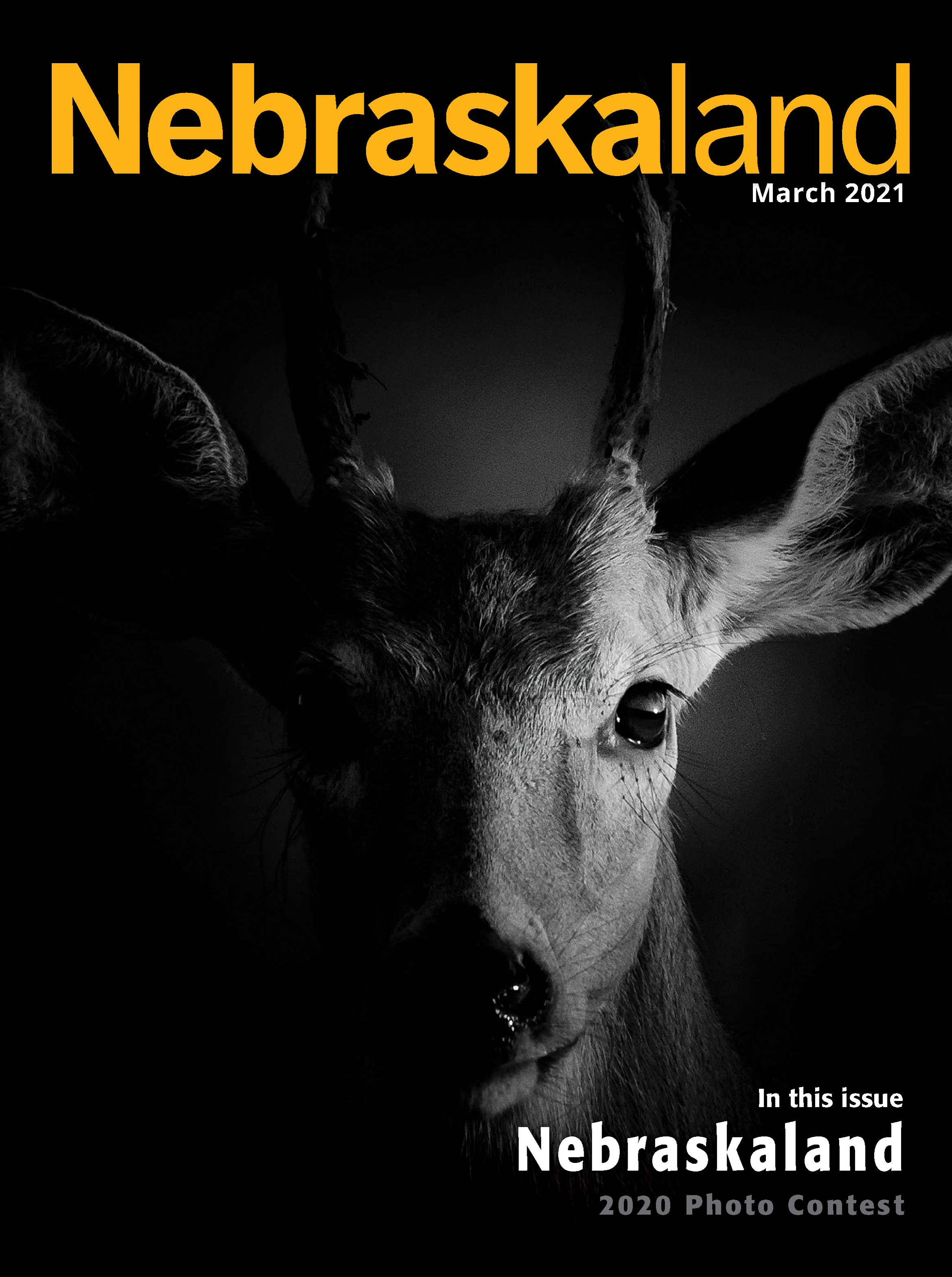
Cover: Karen Kader’s image “Young
Buck” won Best of Show in the 2020
Nebraskaland Photo Contest.
See page 22.
FEATURES
22 2020 PHOTO CONTEST
40
42
Nebraskaland • March 2021
CHADRON CREEK AT CHADRON STATE PARK IN DAWES COUNTY. PHOTO BY JUSTIN HAAG
4
46
Photos submitted by Nebraskaland
Magazine readers
54
CAMPING
for Beginners
By Matt Marx
OUTDOOR NEBRASKA
56
THE SCIENCE OF ANTLERS
By Renae Blum
60
A CONSERVATION
DREAM COME TRUE
What to Do in March
REAL-WORLD
BOWHUNTING PRACTICE
By Ryan Sparks
ROCK GLEN WILDLIFE AREA
A Landscape History
By Gerry Steinauer
By Brian Peterson
A Prairie-Chicken Lek Finds Success
64
By Renae Blum
SLEEPING WITH
THE CRANES
An Adventure Story
Story and photos by Eric Fowler
DEPARTMENTS
8
12
70
76
78
Your Nebraska
In the Field
Mixed Bag
Portraits from the Past
The Last Stop
ON THE WEB
To see additional content including photos,
videos and articles, visit
Magazine.OutdoorNebraska.gov/digital.
Nebraskaland (VOL. 99 / NO. 2 ISSN 0028-1964) is published monthly, except for the combined Jan./Feb. and Aug./Sept. issues, by the Nebraska Game and Parks Commission, 2200 N. 33rd St.,
Lincoln, NE. Periodicals postage paid at Lincoln, Nebraska, and additional mailing offices. POSTMASTER: Send address changes to Nebraskaland, P.O. Box 30370, Lincoln, NE 68503-0370.
Magazine Staff
magazine
Published by the Nebraska Game and Parks
Commission since 1926. The Commission is
dedicated to the conservation and protection
of all the state's natural resources and the
people who use them.
Communications Director Christy Firestone
Public Relations Manager Shawna RichterRyerson
Editor Jeff Kurrus
Associate Editor Jenny Nguyen-Wheatley
Regional Editors Eric Fowler, Julie Geiser,
Justin Haag
Contributing Editor Michael Forsberg
Regular Contributors Renae Blum,
Chris Helzer, Chris Masada, Ryan Sparks, Gerry
Steinauer
Art Director Tim Reigert
Graphic Designer Mel Severin
Photo Librarian Jaclyn Cruikshank Vogt
Administration
Director Jim Douglas
Deputy Director Tim McCoy
Commissioners
Chairman - Dan Kreitman, Wahoo
Vice Chairman - Pat Berggren, Broken Bow
2nd Vice Chairman - Rick Brandt, Roca
Robert Allen, Eustis
Donna Kush, Omaha
Scott Cassels, Omaha
Jim Ernst, Columbus
John Hoggatt, Kearney
Doug Zingula, Sidney
Circulation
For address changes and questions about your
subscription, call 800-632-5263
Advertising Sales Manager
For advertising information contact
Shane G. Gilster, 402-742-0125
Email: shanegilster@gmail.com
Nebraskaland Magazine Copyright 2021, all rights reserved.
Nebraskaland is available in audio from the Nebraska Library
Commission Talking Book and Braille Service, Suite 120, 1200 N St.,
Lincoln, NE 68508. 800-742-7691. Nebraskaland Magazine and the
Nebraska Game and Parks Commission reserve the right to reject any
advertising not in keeping with the agency mission.
Rates: $18 for one year; $33 for two years; $44 for three years. Nebraska
recipients must add appropriate sales tax. To subscribe call
1-800-NEBLAND (632-5263), or go online to:
NebraskalandMagazine.com.
Commission Offices
Conservation Officers
Headquarters/Southeast District Office
2200 N. 33rd Street Lincoln, NE 68503
Phone 402-471-0641
ADMINISTRATION (Lincoln)
Craig Stover (Administrator)
Duane Arp (Asst. Administrator)
Travis Shepler (Asst. Administrator)
Jeff Clauson (Asst. Administrator)
Northeast District Office
2201 N. 13th St. Norfolk, NE 68701
Phone 402-370-3374
Southwest District Office
301 E. State Farm Rd. North Platte, NE 69101
Phone 308-535-8025
402-471-5531
402-471-5531
402-471-5531
402-471-5531
NORTHWEST (Includes counties covered)
Dan Kling (Lieutenant)
308-430-0572
EAST SUB-DISTRICT
Sean Schultz (Sergeant)
308-672-1824
Northwest District Office
East Hwy. 2, Box 725 Alliance, NE 69301
Phone 308-763-2940
Jerod Hahn (Deuel, Garden, Grant)
Keith Jadlowski (Keith, Deuel)
Jaden Porter (Keith, Garden)
308-520-5539
308-289-9580
308-289-2274
Bassett Office
524 Panzer St., Box 508 Bassett, NE 68714
Phone 402-684-2921
WEST SUB-DISTRICT
Kearney Office
1617 First Ave. Kearney, NE 68847
Phone 308-865-5310
Ak-Sar-Ben Aquarium/Schramm Education
Center
21502 W. Highway 31 Gretna, NE 68028
Phone 402-332-3901
Omaha Office
8495 Frederick Street, Omaha, NE 68124
Phone 402-595-2144
(Keith, Arthur)
Nebraskaland • March 2021
308-520-1031
Ray Dierking (Custer, Thomas, Blaine)
Frank Miller (Cherry, Hooker)
Greg Hesse
308-870-0322
402-389-0444
308-546-7464
308-660-4671
308-530-3157
(Lincoln)
(McPherson, Logan, Hooker, Cherry)
Kelsey Glodowski
308-763-8226
SOUTH SUB-DISTRICT
Josh Widhelm (Morrill, Scotts Bluff)
Jacob Stoinski (Sioux, Dawes)
308-279-9133
308-615-9017
(Red Willow, Frontier, Hayes, Hitchcock)
(Box Butte, Sheridan, Grant)
NORTHEAST (Includes counties covered)
Tom Zimmer (Lieutenant)
402-649-8053
NORTH SUB-DISTRICT
Jeff Jones (Sergeant)
402-762-5022
John Bauer (Holt, Boyd)
Dale Davis (Keya Paha, Brown, Rock)
Jonathan Andreasen
402-314-9257
402-760-0712
402-340-3981
Mitch Johnson (Knox, Antelope, Pierce)
402-613-8612
(Knox, Cedar)
Cory Krause (Sergeant)
402-380-6410
Kyler Prochaska (Platte, Colfax)
Nicholas Fix (Dixon, Dakota, Thurston)
402-830-8278
402-508-0261
(Cuming, Wayne, Stanton)
6
Kevin Bergstrom (Sergeant)
308-672-1824
SOUTH SUB-DISTRICT
Any program that receives federal funding from the National Park
Service, or the United States Fish and Wildlife Service prohibits unlawful
discrimination on the basis of race, color, religion, age, gender, marital
status, national origin, age, disability or political affiliation. Any person
who believes he or she has been discriminated against in any program,
activity, facility, or service, should contact the Nebraska Game and
Parks Commission, Lincoln, NE 402-471-0641, the Equal Opportunity
Commission, Lincoln, NE 402-471-2024, TTY/TDD 402-471-4693; United
States Fish Wildlife Service, Civil Rights Coordinator, 4401 N. Fairfax
Drive, Arlington, VA 22203; Director, Equal Opportunity Program, U.S.
Department of Interior, National Park Service, 1849 C Street NW, Mail
Code 0008, Washington, D.C. 20240-0001.
NORTH SUB-DISTRICT
Sean McKeehan (Sergeant)
(Kimball, Banner, Scotts Bluff)
CENTRAL (Includes counties covered)
Mike Thome (Lieutenant)
308-293-8746
NORTH SUB-DISTRICT
Doug Pollard (Sergeant)
308-730-7050
Matt Brandt (Sherman, Howard)
Daryl Teter (Howard, Greeley, Merrick)
Mark Sullivan (Nance, Polk, Wheeler, Boone)
Kyle Gaston (York, Polk, Hamilton)
308-202-0819
308-440-1863
402-741-0636
402-719-6226
(Loup, Garfield, Valley)
SOUTH SUB-DISTRICT
Matt Taylor (Sergeant)
(Thayer, Fillmore, Nuckolls)
402-200-9597
308-380-7331
402-902-2017
308-920-2762
308-440-3847
SOUTHWEST (Includes counties covered)
Roger Thompson (Lieutenant)
308-530-3097
Alex Hasenauer (Lincoln, Perkins)
Brandon O’Neal
(Madison, Pierce, Stanton)
OutdoorNebraska.org
Tim Williams (Hall, Hamilton, York)
Eric Javins (Adams, Clay, Webster)
Pat George (Harlan, Franklin, Phelps)
Ethan Teter (Buffalo, Kearney)
(Lincoln, McPherson, Logan)
Brian Piernicky (Sergeant)
308-340-6627
Matt Andrews
308-746-2418
Owen Johnson (Dawson, Custer)
Taylor Dixon (Dawson, Gosper)
402-266-1759
308-217-2108
(Furnas, Gosper, Frontier, Red Willow)
SOUTHEAST (Includes counties covered)
Stacey Lewton (Lieutenant)
402-890-7140
EAST SUB-DISTRICT
Heath Packett (Sergeant)
402-210-0888
Russell Mort (Otoe, Johnson)
Rich Berggren (Douglas)
Dan Evasco (Sarpy)
Mike Luben (Saunders, Butler)
Bryan Adams
402-209-1506
402-619-1355
402-616-5961
402-443-6392
402-429-1924
(Cass)
(Nemaha, Pawnee, Richardson)
WEST SUB-DISTRICT
Scott Eveland (Sergeant)
402-853-3273
Dina Barta (Lancaster),
Dudley Sorensen (Lancaster)
Bryce Streger (Seward, Saline)
Trevor Stahlecker (Lancaster)
Matt Seitz (Gage, Jefferson)
402-890-6463
402-937-3422
402-646-0420
402-314-9641
402-806-0915
(Lancaster)
YOUR NEBRASKA
Instagram Photos
Follow us (@nebraskaland)
and tag us in your photos
to be featured in an
upcoming issue.
Butch Rohrschneider, Ralston
Ice Form
Will Atkeson, O’Neill
December Rooster
Gordon Warrick, Valentine
Mink with Dinner
8
Nebraskaland • March 2021
March 2021 •
Nebraskaland
9
YOUR NEBRASKA
Melanie Moree, Omaha
Louisville State Recreation Area
Karen Kutz Smith, Omaha
Barred Owl
Bob Foster, Morrill
Bighorn Sheep
10
Nebraskaland • March 2021
Send your comments and photos to:
Jeff Kurrus, Editor
Nebraskaland Magazine
P.O. Box 30370
Lincoln, NE 68503
or email Jeff.Kurrus@Nebraska.gov
Please include your postal address
and telephone number. Letters may be
condensed and edited. Photographs are
also welcome.
March 2021 •
Nebraskaland
11
IN THE FIELD
MARCH MELT
Ice melts even at sunrise
at Grabel Ponds at Fort
Robinson State Park in
Dawes County.
PHO
PHO
PHOT
HOTO B
BY JUS
JU
U TIN
TI HAAG
TI
AA
AAG
AG
12
Nebraskaland • March 2021
March 2021 •
Nebraskaland
13
PHOTO BY JUSTIN HAAG
IN THE FIELD
THE LAST FREEZE
By Martha D. Shulski
Averages of weather conditions sometimes don’t
mean a whole lot in Nebraska. While that is odd
for a climatologist to write, it certainly seems true
in practicality. Any way you examine our weather,
variability reigns. A great illustration is with one
characterization of spring — timing of last freeze.
Spring is considered a shoulder season as we make the
transition from winter to summer. Weather patterns are
active: Winds bring warm southerly air rather than cold
Arctic air, humidity is noticeable, soils thaw and biomes
are brought back to life.
Plant growth begins in earnest after winter’s last
chill. The average date of last freeze (32°F) ranges from
mid- to late April in southeastern Nebraska to early June
in the northern Panhandle. High elevation in the west
keeps the probability of freezing temperatures lasting
longer into the season than in the east. The variability
is obvious when we look at the earliest and latest dates
of the last freeze. Going back only four decades, there is
14
Nebraskaland • March 2021
a two-month spread in these dates of occurrence. The
last date for a frosty ground can be as early as the vernal
equinox, March 21 in the east and May 1 in the high
elevation west. It can also occur as late as May 21 in the
east or even summer solstice, June 21, in the west.
Furthermore, even an exceptionally warm spring does
not necessarily translate into a significantly early last
freeze. Take Nebraska’s hottest and driest year on record
— 2012. Our spring started out exceptionally warm with
a statewide March temperature that was a whopping 15
degrees above average and new monthly record. When
did we have our last freeze that year? About when we
normally do, April or May depending on your location.
Taking note of the average last freeze date for your area
is appropriate, but the range is probably more so since
variability is the rule in Nebraska, not the exception.
Martha D. Shulski, at the University of Nebraska-Lincoln,
is the director of the Nebraska State Climate office.
PHOTO BY JARROD SPILGER
IN THE FIELD
PATTERN PREPARATION
By Jarrod Spilger
Savvy turkey hunters pattern their shotguns before
hunting. Patterning is especially important if using a new
load or choke, as changing either variable can affect a
shotgun’s performance.
The benchmark of 40 yards is a good place to start, so set
up a turkey target at that distance. Unlike wing-shooting
flying birds, the goal of turkey hunting is to hit a stationary
gobbler in the relatively small head and neck vitals with as
many pellets as possible.
Many hunters claim a good turkey-killing pattern places
100 pellets in a 10-inch circle at 40 yards. However, we’re
shooting turkeys, not 10-inch circles. While 100 hits in a
10-inch circle is good, 100 hits in the head and neck vitals is
even better.
This is entirely possible using an extra- or super-full choke
and magnum payloads. Remember, though, that shots inside
40 yards with an ultra-tight turkey choke require rifle-like
aiming precision to avoid a miss.
16
Nebraskaland • March 2021
If shots beyond 40 yards are anticipated, consider using
tungsten-based shot. Tungsten is heavier than lead and
retains greater downrange energy. While tungsten shot may
make it possible to bag turkeys beyond 40 yards, the goal
should always be to call gobblers inside 40 yards. After all,
that’s the real thrill of spring turkey hunting.
It’s recently become vogue to use small #9 Tungsten Super
Shot (TSS) to create ultra-dense patterns, but it should be
noted that shot sizes smaller than #7½s are not legal for
turkey hunting in Nebraska. However, loads with #7 (or
larger) TSS are legal.
Not only should patterns be core dense, they should also
be uniform in pellet distribution. That way if a gobbler moves
his head slightly at the last moment, there’s enough wiggleroom in the pattern to still place sufficient hits in his noggin
to get the job done.
And that means wild turkey is on the menu come
Thanksgiving.
PHOTO BY DOUG STEINKE
IN THE FIELD
Spring snows can be a worthy adversary. Mixing in Canada
decoys can add to the realism of your setup.
SPRING SNOWS ON A BUDGET
By Todd Mills
When winter finally decides to let go, snow goose hunters
are just starting. Traditionally known as one of the most
difficult birds to hunt, light geese can make even the savviest
hunter look ... well, stupid.
In 1999 the Light Goose Conservation Order was enacted
to decrease light goose populations. In those early years,
hunting in the spring was relatively easy. Find the birds and
with little experience or budget, you could find success. But
like so many other aspects of hunting, the more pressure the
birds received, the more difficult they became to hunt. Snow
geese are highly adaptive, and they get smarter every year.
Long-time friend Jerry Johnson has mastered the art of
harvesting snow geese on a budget. Jerry and I first started
pursuing waterfowl 40 years ago, and it was with him that
I harvested my first snow goose. Johnson recently shared a
few tips with me on successful snow goose hunting.
“Snow goose hunting can be very challenging. Weather
that time of year can be up and down, so finding the feed is
critical,” Johnson said.
Most hunters who pursue snow geese know that following
18
Nebraskaland • March 2021
the snow line can help you find birds quickly. Birds are
anxious to push north and often stay right on the edge until
the weather breaks enough to continue their journey to
breeding grounds.
“Scouting is critical,” said Johnson. “You have to be willing
to put on the miles. Spend some additional time once you
find them to locate smaller groups that might be more
susceptible to a smaller setup. I like to hunt those birds that
have been in an area for a week or two. Find a feed they’re
comfortable in and then set up.”
While most experts recommend a large decoy spread with
a minimum of 500 decoys, Johnson has had great success
with 50-100 well-placed decoys. “Use the most realistic
decoys you can afford and add some motion socks with some
high quality silhouettes. I like to place a fairly tight group
and a few feeders 20 yards away to mimic how they walk
looking for food. I’ve also had some success with really large
groups being downwind 30 yards from decoys.”
And one last tip, Johnson added, “A small decoy setup in
a wetland or pond with Canada decoys mixed in is money.”
March 2021 •
Nebraskaland
19
PHOTO BY JENNY NGUYEN-WHEATLEY
IN THE FIELD
PANKO-CRUSTED PERCH
By Jenny Nguyen-Wheatley
Prep Time: 30 minutes
Cooking Time: 30 minutes
Ingredients:
1 pound of boneless perch fillets
2 to 3 large eggs
⅓ cup of all-purpose flour
1½ cup of Panko breadcrumbs
1 teaspoon of kosher salt, plus
extra
Freshly cracked pepper, to taste
1 cup of mayonnaise
4 teaspoons of Sriracha sauce
4 teaspoons of lemon juice
Vegetable oil for frying
Lemon wedges, for serving
•
•
•
•
•
•
•
•
•
•
•
1. To make the spicy mayo, combine
mayonnaise, Sriracha, lemon juice,
and salt and pepper to taste. Add or
20
Nebraskaland • March 2021
subtract amount of Sriracha to taste.
Set aside.
2. Assemble your dredging station:
In a wide bowl, beat eggs until no
whites are visible and mixture begins
to form small bubbles at the edges.
Pour Panko breadcrumbs into a shallow
bowl/dish and season with 1 teaspoon
of salt and pepper to taste. Then pour
flour into another. Heat frying oil to
325 to 350 degrees Fahrenheit.
3. First lightly coat a perch fillet
with flour, shaking off excess, and
then dip it into the egg mixture and
then finally coat with Panko. Fry on
both sides until golden and drain on
paper towels or a cooling rack. Repeat
with the rest of the fish, adjusting
heat as necessary. As you work, keep
fried fish warm in the oven on the
“warm” setting.
Do not overcrowd the fry pan —
oil temperature will drop too quickly,
which will result in greasy fried fish.
Also, do not allow the oil to get too
hot, as Panko breadcrumbs can burn
quickly. Continually keep an eye on the
oil temperature with a thermometer
and adjust the heat as you cook. If
you’re not used to working with Panko,
it helps to have an extra set of hands in
the kitchen.
4. Serve fried fish with spicy mayo
for dipping and lemon wedges on
the side. For a light meal, serve the
fish in butter lettuce cups with sliced
cucumber, pickled carrot and a dollop
of spicy mayo on top.
March 2021 •
Nebraskaland
21
2020
P ho to
C o nt est
With more than 2,500 entries, the
2020 Nebraskaland Magazine Photo
Contest drew a record number of
stunning images from Nebraska
photographers in the categories of
Wildlife, Flora, Scenic and Recreation.
This year’s Best of Show winner,
“Young Buck” by Karen Kader of
Omaha, was shot at Chalco Hills
Recreation Area. She used Lightroom
as her post-image software, adding
shadow and accessing the program’s
color sliders to accentuate the photo.
We thank everyone who
participated and look forward
to seeing more of your great
photographs in next year’s contest.
Keep shooting.
Jeff Kurrus, Editor
Nebraskaland Magazine
BEST OF SHOW
Young Buck
Photo by Karen Kader, Omaha
@kdkader
22
Nebraskaland • March 2021
March 2021 •
Nebraskaland
23
WILDLIFE
FIRST PLACE – Baby Opossum
Photo by Eric Wellman, Lincoln
@ericwellmanphoto
24
Nebraskaland • March 2021
March 2021 •
Nebraskaland
25
WILDLIFE
SECOND PLACE – Bluebird Landing
Photo by Don Brockmeier, Eustis
@donbrockmeier4
26
Nebraskaland • March 2021
THIRD PLACE – Brave Together
Photo by Rebecca Johnson, Central City
@thecoloringtree
March 2021 •
Nebraskaland
27
FLORA
FIRST PLACE – A Burst of Dandelion
Derrill Grabenstein, Lincoln
@de_grabenstein
28
Nebraskaland • March 2021
March 2021 •
Nebraskaland
29
FLORA
THIRD PLACE – Blue False Indigo Bloom
Photo by Britton Bailey, Aurora
@bfbinstailey
30
Nebraskaland • March 2021
SECOND PLACE – Beauty Reflected
Photo by Roger Richters, Utica
@rogerrichters
March 2021 •
Nebraskaland
31
SCENIC
FIRST PLACE – Brace Yourself
Photo by Lindsey Keller, Lincoln
@llarson4
32
Nebraskaland • March 2021
March 2021 •
Nebraskaland
33
SCENIC
SECOND PLACE – Stone Creek Falls
Photo by Eric Wellman, Lincoln
@ericwellmanphoto
34
Nebraskaland • March 2021
THIRD PLACE – Comet NEOWISE Over Abandoned Farmhouse
Photo by Roger Richters
@rogerrichters
March 2021 •
Nebraskaland
35
RECREATION
FIRST PLACE – Green Steel
Photo by Joel Jones, Lincoln
@joel_bo_jones
36
Nebraskaland • March 2021
March 2021 •
Nebraskaland
37
RECREATION
THIRD PLACE – Silhouette Stories
Photo by Tiara Brown, Omaha
@huskertiara
SECOND PLACE – Paddlefishing in October
Photo by Nate Johnson, Lincoln
@lenseswild
38
Nebraskaland • March 2021
March 2021 •
Nebraskaland
39
Outdoor Nebraska
What To Do in March
By Renae Blum
Early spring
photography
Throughout the month
Statewide
Get out and document the
early days of spring. Waterfowl
migration and prairie chicken leks
provide some of this month’s best
photography opportunities, as do
sandhill cranes in central Nebraska.
Late-season blizzards can also offer
beautiful scenery.
SANDHILL CRANES ON THE PLATTE RIVER.
PHOTO BY ERIC FOWLER
TANNER TIERNEY HOLDS A LARGEMOUTH BASS.
PHOTO BY JEFF KURRUS
SNOW-COVERED LANDFORMS AT CHADRON STATE PARK.
PHOTO BY JUSTIN HAAG
Looking for ways to stay active this month? Bird migration
offers a number of wildlife viewing and hunting opportunities,
for starters, but that’s not all. N
Sandhill crane viewing
Throughout the month | Central Nebraska
Take in one of the world’s greatest wildlife viewing spectacles: sandhill
crane migration. More than half a million cranes descend on central
Nebraska each spring. Most crane watchers visit areas between Grand
Island and Kearney, where the largest concentrations occur and resources
like viewing platforms and tours are available.
Bass fishing
Late March or as weather allows | Statewide
Throughout the month
Grab your binoculars or spotting scopes
and enjoy viewing eagles and migrating
waterfowl at Lake Ogallala. In winter,
eagles are attracted to the open water just
below the dam and can be seen flying and
roosting at the lake. View them from your
vehicle along Lake Ogallala’s gravel roads
and along the spillway.
40
Nebraskaland • March 2021
Snow goose hunting
ERIC MORAN HUNTING SNOW GEESE IN JOHNSON COUNTY.
PHOTO BY JEFF KURRUS
View eagles at
Lake Ogallala
AN IMMATURE BALD EAGLE FLYING OVER A SPILLWAY ON LAKE OGALLALA.
PHOTO BY ERIC FOWLER
Early spring is one of the best times of the year for bass fishing; it’s when
some of the biggest bass of the year can be caught. Fish become more
active when the weather warms up, making late March more promising.
Look for small lakes, sandpits and farm ponds, which warm up sooner
than larger bodies of water.
Throughout the month | Central and
eastern Nebraska
Snow geese offer some of Nebraska’s most
challenging waterfowl hunting. Watch for
bird concentrations on public lakes and
private fields. Setting up in the decoys is
a great tactic, and wearing white or snow
camouflage will help you disappear within
your decoy spread.
March 2021 •
Nebraskaland
41
Real-World
Bowhunting
Practice
There is no substitute
for a 3-D target because
they allow you to practice
realistic hunting situations
and teach proper shot
placement.
Proficiency on a foam block
doesn’t always translate to real
hunting scenarios during the
season.
By Ryan Sparks
oo many archery hunters practice archery and not
bowhunting. Setting a foam target in the yard, walking
back to a premeasured distance and flinging arrows all
summer is good practice for hitting a foam target, but
climbing into a blind for turkeys or a tree stand for deer is
completely different. Being an effective bowhunter is about
what you do with the shots you are presented, and shots in
the field are rarely ideal. How many times have you had a
deer walk into your shooting lane, stop perfectly broadside,
look the other direction and stand still for several minutes?
Proficiency on a foam block doesn’t always translate when
you draw back on what might be the one opportunity you
have in a season. Here are some hunting-specific practice tips
and drills you can do to prepare for hunting season.
T
The Obstructed Shot
42
Nebraskaland • March 2021
PHOTO BY RYAN SPARKS
It seems like while bowhunting you are always worried
about a twig, branch or rock deflecting your arrow, so it makes
sense to practice for these situations. Your arrow makes an
arch when it leaves your bow and understanding this arch is
the key to shooting past obstructions. On a bow with a multipin sight, a good way to learn the arch of an arrow is to look at
March 2021 •
Nebraskaland
43
the pin spacing once the bow has been sighted. There might
be a branch over a turkey’s vitals in your line of sight at 40
yards, but if the branch is only 20 yards away your arrow will
easily fly over it before it drops toward the turkey. Practicing
obstructed shots requires access to a safe practice area with
plenty of room in case your arrow is deflected. Recently,
many 3-D archery tournaments have started incorporating
obstructed shots with boulders or tree branches partially
blocking the target. Building a mental picture of your arrow
flight gives you confidence that your arrow will hit its mark.
The Long Hold
Waiting for an animal to move into position might require
you to stay at full draw longer than is comfortable. You’ll need
to keep your pin or aiming point in the right spot without
growing tired and starting to shake. You can easily mimic this
scenario by holding your shot while practicing in conjunction
with a timer. Start short, both in terms of distance and
duration. As you get more comfortable, lengthen the time of
your hold to 30 seconds, then a minute, eventually building
the strength to hold for several minutes. This is a great drill
even if you only have 10 yards in your backyard to practice.
You Get One Shot
In hunting, there are no mulligans or redos — you only get
one shot. Pick a week and limit yourself to one arrow a day.
Pick a distance at random and make the best shot you can.
This is a good way to discover what your weaknesses are and
what you should practice. Use this time as an opportunity to
shoot at in-between distances, instead of always practicing
at 20, 30, 40 yards and so on. Taking one shot and calling it a
day trains you to make every shot count.
Light and Dark
Some people get in the habit of always practicing at the
same time, but the angle and level of sunlight can trick your
brain and change the way you aim or perceive the target.
More light can make a sight pin seem bigger, while less light
makes it difficult for your eye to distinguish the pin against
the target. Different light conditions also change the way you
perceive distance. Try shooting your bow at various times
throughout the day. Shoot toward and away from the sun
as well as with the sun from the side. Considering deer and
many other game animals are the most active at dawn and
dusk, practicing in different light conditions can pay off.
Be Realistic
44
Nebraskaland • March 2021
PHOTO BY JULIE GEISER
PHOTO BY ERIC FOWLER
Shots out of a tree stand are different than from the
ground. Practicing from an elevated position like a tree
stand or deck is excellent preparation for the real thing.
Three-dimensional deer, turkey or elk targets can be
expensive, but they allow you to create realistic hunting
scenarios. Shifting the target so it’s quartering away or
toward you will teach you where to aim to make an ethical
shot. I’ve never seen a deer or turkey with a bull’s eye painted
on its vitals. It’s important to develop the ability to know
where to aim based on how an animal is positioned. With a
realistic target you can recreate all these situations, including
shooting from a tree stand and steep downhill or uphill shots.
If you don’t have the space or money for a 3-D target, try
joining an archery league or shoot a 3-D tournament.
The takeaway to all these tips is to make your practice time
as close to hunting as possible. Late-season hunting requires
gloves, a face mask and extra layers. Practice with your
winter layers to make sure nothing is in the way. If you hunt
on foot, practice shooting from your knees, leaning around a
tree or raising up from the ground. Shoot in the wind. Practice
with your broadheads. Go for a run to get your blood pumping
and then take a few shots. This is the type of practice that
prepares you for bowhunting. N
Would you shoot in this scenario? Knowing the arch of your arrow gives you the knowledge to wait for a better shot or the
confidence that your arrow will hit its mark.
March 2021 •
Nebraskaland
45
Rock Glen
Wildlife
Area
A Landscape History
By Gerry Steinauer, Photos by
Eric Fowler and Gerry Steinauer
estled in the hills of southern Jefferson County, Rock
Glen Wildlife Management Area, as its name implies,
is a rocky land shaped by ancient geological forces,
among them, meandering tropical rivers and grinding
glacial ice.
Euro-American settlers in the region arrived to a picturesque
scene: rolling hills cloaked in tallgrass prairie fingered by
glens, narrow valleys and canyons, filled with sprawling
bur oaks. Too rocky to plow, southern Jefferson County has
survived as an island of prairie amidst a sea of cropland.
Settlement was not kind to the land. Fire suppression
allowed eastern red cedars and other trees to spread, choking
the grasslands and oak woodlands and obscuring the ancient
rock formations. Thanks to decades of recent work, however,
the native plant communities have been restored, and the
landscape is once again scenic.
PHOTO BY ERIC FOWLER
N
Dakota Sandstone
Rock Glen WMA
Located just south of Rock Creek Station, 6 miles
east and 2 miles south of Fairbury, Rock Glen Wildlife
Management Area has 707 acres of virgin prairies and
wood-studded ravines. The WMA is ideal for hiking, bird
watching, hunting and primitive camping.
46
Nebraskaland • March 2021
Bob Diffendal, retired professor and research geologist
with the University of Nebraska-Lincoln, is an expert on the
geology of Jefferson County. Pick a pebble from the ground
and he can name the rock type and its source of origin,
ancient seabed, river channel or glacier. For a portion of his
career, he studied the Dakota Formation, the heart of this
rocky landscape.
The Dakota, composed mainly of sandstone interspersed
with shale, forms the surface bedrock of the region. On
hillsides and flat ridge tops, it is veiled by a thin, mostly
sandy topsoil, but is visible as boulders, shelves and cliffs in
ravines and canyons.
Diffendal explained that the formation was deposited
in the Cretaceous Period more than 100 million years ago,
when Nebraska had a tropical climate. Dinosaurs ruled the
land while giant reptiles swam in the seas and flowering
Rock Glen Wildlife Management Area is nestled in the hills of southern Jefferson County, one of eastern Nebraska’s few
remaining native landscapes. Native prairie covers the hills while bur oak woods fill the ravines.
plants were just coming into their own. The North American
Western Interior Seaway covered much of the continent. The
sea stretched from the Rocky Mountains to eastern Nebraska,
and from the Arctic Ocean to the Gulf of Mexico.
The sea fluctuated in depth and extent, covering eastern
Nebraska with deep to shallow water or coastal vegetation.
“The best analogy of what Nebraska was like when the
Dakota’s sediments were deposited is the present-day coastal
plain of Louisiana,” Diffendal said. “Think of a low floodplain
forest with low relief close to the ocean.”
Rivers flowing westward to the sea deposited sands into
river channels and estuaries where the streams met the
sea, while depositing lighter clays into quiet floodplain
backwaters and tidal marshes. Imperceptibly slow and over
a vastness of time, the Dakota’s sediments accumulated to
great thickness. Later, the sea deepened, and the Dakota
was covered by water-deposited lime and clay sediments
and, when the sea finally receded, by upland sediments.
Now, deeply buried, the Dakota’s sands were compacted and
weakly cemented into soft, white to rusty-red sandstone and
the clays into yellow, pinkish and other pastel-colored shale.
Relatively recently in geological history, the overlying
sediments eroded away, exposing the Dakota on the land
surface. This sandstone exposure extends from southern
Jefferson County through central Kansas and into Oklahoma.
In northern Nebraska, the Dakota remains buried, except
for small outcroppings mainly on river bluffs, making the
Jefferson County landscape unique for Nebraska.
Grinding Glacial Ice
Scattered among Rock Glen’s prairies and woods are
variously-colored boulders, some the size of refrigerators.
Diffendal identified them as quartzites, granites, schists and
March 2021 •
Nebraskaland
47
PHOTO BY GERRY STEINAUER
Pinkish-red Dakota shale is exposed in a ravine at Rock
Glen. Glacial rocks lie on the shale’s surface.
48
Nebraskaland • March 2021
A mere 18,000 years ago, the Wisconsin glacier ground to a
halt in far southeastern South Dakota, its meltwater cutting
a section of the Missouri River Valley. With frigid winds
blowing south off the ice, Nebraska’s climate was cold. The
land was cloaked by northern spruce forest and grassland
and roamed by mammoths, giant ground sloths and other Ice
Age creatures.
During the next few millennia, as the climate warmed and
the glaciers retreated, prairie and deciduous forest plants
slowly migrated northward from glacial refuges to continue
their pre-Ice Age battle for control of the Great Plains.
Simultaneously, humans began migrating to North America
from Asia, traversing the Bering Land Bridge from Siberia
to Alaska, becoming the first Americans. As they moved
A Dakota sandstone cliff. Dakota sandstone and shale lie just below the soil surface at Rock Glen.
southward into the plains and their population grew, their
use of fire would sway the battle in favor of grass over tree.
Today, Rock Glen’s vegetation remains similar to that
viewed by recent Plains Tribes. Open stands of bur oak,
known as savanna, shelter in the less fire-prone ravines and
canyons, and in the deepest canyons, the fire-sensitive green
ash, hackberry, elms and eastern red cedars grow with oaks.
Under this canopy thrive hairy woodbrome, Sprengel’s sedge,
wild strawberries and other woodland plants.
In the partially-shaded oak savanna, fire-hardy and sunloving tallgrass prairie plants mingled with the woodland
flora and spread upward over the hills. Among the tallgrass
flora are the chest-high big bluestem and Indian grass along
with plentiful wildflowers. On dry, wind-swept ridge tops
and steep, eroded slopes, tallgrass prairie surrenders to more
drought-tolerant mixed-grass prairie. Here, on shallow, sandy
soil, the knee-high side-oats grama and little bluestem rise
above an underlying carpet of buffalograss and hairy grama.
A unique, but sparse flora of side-oats grama, catclaw
sensitive briar, cobaea penstemon, dotted gayfeather and
aromatic aster occupy the small shale flats interspersed in
the prairie.
Sedges, rushes, marsh and sensitive fern, the rare bushy
seedbox and other wetland plants grow in soggy soils
bordering spring seeps and the rivulets draining them. The
seeps originate from
rainwater and snowmelt
that
percolates
downward
through
porous sandstone until
it reaches impervious
shale. The groundwater
flows atop this layer,
seeping out in ravines
and on low hillsides.
The rivulets eventually
gather, forming shallow,
stony-bottomed creeks
that wind through Rock
Glen.
Adding
uniqueness
to the local flora, the
sandstone outcrops and
soils provide habitat
for many plant species
A colony of bird’s-foot violet
otherwise rare or absent
grows in rocky, hilltop prairie.
in Nebraska. Among these
is the diminutive bird’s-foot violet. It was first discovered in
the state in 1987 growing on a thin-soiled prairie in Steele
City Canyon a few miles southeast of Rock Glen. A second
PHOTO BY GERRY STEINAUER
PHOTO BY GERRY STEINAUER
Prairie and Woods
PHOTO BY GERRY STEINAUER
A glacier-deposited Sioux Quartzite boulder graces the
prairie at Rock Glen.
other rock types deposited by glaciers.
During the Pleistocene Period — the Ice Age — roughly
2.6 million to 10,000 years ago, four ice sheets descended
southward upon the Central Lowlands: from oldest to
youngest these were the Nebraskan, Kansan, Illinoian and
Wisconsinan. Only the Nebraskan and Kansan reached
Nebraska, covering the eastern fourth of our state with a
mile-high sheet of slowly creeping ice for thousands of years.
The effects the glaciers had on the land were immense.
They sheared off hilltops, filled valleys and pushed rivers
southward. A few miles west of Rock Glen, Diffendal knows
of a sand and gravel outcrop on a hillside. It was the remnants
of the Platte River, which during the Nebraskan Glaciation
was forced south 100 miles of its present location.
As the glaciers bulldozed their way across our state, they
carried rocks, gravel, sand and clay from as far north as
Canada. Later, as they melted, this “glacial till” was left on the
land surface. Throughout most of eastern Nebraska, the till
was later covered by a thick layer of wind-blown silt, known
as loess, and remains so today. The silt was first deposited by
Rocky Mountain and continental glacial meltwater in large
river floodplains, mainly those of the Platte and Missouri,
and then blown onto the surrounding uplands as a fine dust,
accumulating by fractions of an inch per year.
Far from rivers draining the glaciers, the Rock Glen region
received little loess deposition, leaving the till uncovered and
exposed to the elements. Smaller boulders eventually broke
down and water washed away the clays and sands, leaving
only the larger boulders. Erosion also carved ravines and
canyons into the sandstone hills.
Hard, erosion-resistant Sioux quartzite composes most
of the WMA’s remaining glacial boulders. Diffendal said
the pinkish to purple, billion-year-old rocks originated from
the Sioux Falls, South Dakota, area. There, Sioux quartzite
outcrops still bear scars where the ice gouged out the
boulders. At Rock Glen, these now lichen-covered boulders
stand testament to the power of ice.
March 2021 •
Nebraskaland
49
PHOTO BY GERRY STEINAUER
colony was later found at Rock Glen.
Another rare plant is the purple cliff-brake, a small,
evergreen fern found in only seven, mostly southeastern,
Nebraska counties where it sporadically inhabits dry, rocky,
calcareous slopes and outcrops. Rock Glen’s only known cliffbrake colony clings to a sandstone boulder standing alone on
a prairie hillside. Sometime in the past, a wind-blown spore
of the plant landed upon the rock, giving rise to the colony.
Indian-plantain and pale Indian-plantain are two rare
plants growing at the WMA that are not restricted to
sandstone substrates. The former occupies low prairie slopes,
often near seeps, while the latter grows in oak savannas.
Recent management has increased populations of both
species at Rock Glen, while elsewhere in eastern Nebraska,
the plants are becoming increasingly rare.
Restoring the Land
Although still intact, settlement affected Rock Glen’s
woodlands and prairies. Early on, large oaks and other trees
were harvested for lumber and fuel. In some areas, nonnative plants have displaced native plants, and control of
wildfires has allowed hackberry, honey locust and especially
cedar trees to spread from deep canyons into oak savanna
and prairie, shading out their flora and stifling regeneration
of the sun-loving oaks in the savanna.
When the Commission purchased the 707-acre Rock Glen
in 1991, “it was a cedar forest,” said Brad Seitz, the area’s
manager. Ever since, he and fellow biologist Rick Souerdyke
have worked to restore the land. Their goals are two-fold:
50
Nebraskaland • March 2021
PHOTO BY ERIC FOWLER
Recent land management at Rock Glen has increased
populations of the rare Indian plantain.
In 2006 “the big burn” at Rock Glen and surrounding private ranches consumed live eastern red cedars
and piles of cut cedars, which was vital to restoring the area’s prairies and oak woodlands.
return the woodland and prairie to a more pristine state and
also to enhance habitat and hunting opportunities for deer,
turkeys, bobwhite quail and other game species. The latter is
a management objective for all Commission WMAs.
Beginning in 1995, Seitz tried to tackle the cedars
using prescribed fires of a few hundred acres or less in
size, but progress was slow. Cedars, especially small ones,
are susceptible to the flames and heat of fire, and unlike
deciduous trees, do not resprout when top-killed. At Rock
Glen, however, the cedars had grown large, crowding out the
fuel-providing grasses below and standing above flames’
reach. In other words, they had become immune to prescribed
fire.
Seitz realized his only option was to cut the cedars. With
limited staff, heavy equipment and funds, he was forced to
seek grant funds from the Nebraska Environmental Trust
and U.S. Fish and Wildlife Service to hire contractors to do
the work. After a three-year cutting siege, piles of cedars
littered the WMA.
In 2006 came “the big burn,” a 1,300-acre spring prescribed
fire that would kill small cedars not machine-cut and turn
those tree piles into the funeral pyres of the invading horde.
“I had never burned an area that big before,” Seitz said.
“All the planning took a few years off my life.” The prescribed
fire included portions of four adjacent ranches and the
neighboring Rock Creek Station State Historical Park.
Although using the neighbors’ trail roads as fire breaks made
the burn larger, it accomplished similar goals on their lands
and also made the burn less complicated and safer.
On an April morning, after the sun had dried the dew from
the prairie grass, the fire was lit. As the sun climbed and the
temperature rose and the humidity dropped, the fire gained
intensity. Most dramatically, when the grass-eating fire
ignited cedar piles, they boiled out 60-foot-tall flames and
oily pillars of smoke. The towering plume was picked up by
radar and this “isolated storm cloud” baffled the weather
staff of one local news channel.
As the smoky dusk set in and only charred cedar piles still
smoldered, Seitz’s tension eased — the burn was complete. A
new worry, however, entered his mind. When cedar piles near
ravines burned, the flames scorched the trunks and branches
of some oaks, and he feared they would die. Only time would
tell if the bur oaks, Seitz’s favorite tree, would survive.
Through cutting and fire, about 90 percent of Rock
Glen’s cedars have been removed. A few dense stands were
intentionally left in deep canyons where they naturally
occurred as thermal and security cover for deer. Since 2006,
a few hundred acres of the WMA are burned annually to
keep cedars and other woody plants in check and refresh
the prairie. Herbicides also have been applied to the trunks
of hackberry and other spreading deciduous species to speed
March 2021 •
Nebraskaland
51
Recreation
The scenic and ecologically diverse, but remote,
Rock Glen remains relatively undiscovered by
hikers, birders and other nature enthusiasts. One
group that has discovered the WMA, however, is
deer hunters.
“The parking lots are full on the opening
weekends of the rifle and muzzleloader seasons,”
Seitz said. “Hunters take a lot of deer off the
area.” For deer hunters seeking solitude, he
recommends an early-season bow or late-season
muzzleloader hunt during the week. He added
that far fewer turkey and quail hunters visit the
WMA.
A mowed trail starting at the parking lot
in Rock Glen’s far southeast corner provides
walking access to its interior. Primitive camping,
with no open fires, is allowed on the WMA.
Modern camp grounds are available at Rock
Creek Station. The area features ruts in the
prairie left by wagons traveling the Oregon Trail,
a restored Pony Express Station and a visitor
center.
the recovery of the savanna.
For the past two decades, Rock Glen’s prairies have also
been managed with grazing. Using the neighbors’ cattle,
pastures are grazed every few years at a moderate stocking
rate for about two months in the spring, summer or early
fall. Like fire, grazing removes accumulated plant thatch and
allows sunlight to reach the soil and stimulate native plants.
PHOTO BY GERRY STEINAUER
Cedar cutting and prescribed fire at Rock Glen has allowed sun-loving bur oak seedling and saplings
(lower left in the photo) to thrive and eventually grow to maturity.
In addition, spring and fall grazing sets back non-native, coolseason grasses like smooth brome and Kentucky bluegrass.
PHOTO BY ERIC FOWLER
Nature’s Recovery
Bobwhite quail are among the wildlife now thriving at Rock
Glen.
52
Nebraskaland • March 2021
“Recovery of the prairie and woodland at Rock Glen has
been amazing,” Seitz said. A few years after the 2006 burn,
prairie plants, including uncommon species such as the
slender and nodding ladies’-tresses orchids and arrowfeather
three-awn, a grass, had colonized formerly cedar-blanketed
hillsides. These plants survived the decades of shade as
seeds in the soil or as stunted plants in narrow, sun-flecked
gaps between trees.
The cedar cutting, prescribed fire and grazing management
at the WMA also has benefited wildlife. More dense and
diverse plant growth, for example, provides plentiful food
and prime nesting cover for turkeys, quail and other groundnesting birds. The richer flora also supports more insects
for their chicks to eat. In addition, conservation groups
have assisted neighboring ranchers in cutting cedars
and conducting prescribed burns on their prairies. This
management has further benefited grassland birds, such
as prairie-chickens and bobolinks that thrive only in larger,
treeless grasslands that support fewer tree-dwelling nest
predators.
Many of the large oaks scorched by the big burn did not
recover. But even in death, as standing snags they nourished
a variety of life, from insect-scrounging woodpeckers to
wood-consuming mushrooms. To Seitz’s relief, however,
the small to medium-sized charred oaks, though top-killed,
sprouted from their base, creating a new generation. Also, in
Rock Glen’s now more-open savanna, oak seedlings, sprouted
from acorns and released from shade, can rise to maturity.
The WMA is one of the few sites in Nebraska with healthy
oak regeneration.
For Seitz, restoring Rock Glen has been a long but
worthwhile struggle, and he is now enjoying the fruits of his
labor. “I love that there are so many wildflowers. For me, they
indicate the health of the land,” he said. “And with the cedars
gone, I can see the rocks. I love their permanence.” N
March 2021 •
Nebraskaland
53
Camping
for Beginners
or many, car camping at a state park marks the unofficial
beginning of spring. People dust off the family tent, pull
out plastic bins marked “camping gear” and make sure
the old green stove has fuel. Dedicated practitioners
may even revel in “glamping” — short for “glamour camping”
— with palatial motorized accommodations, portable fire
pits and barbecue meat smokers.
But what if you have never been camping and would like
to try it? You might feel hesitant to invest money toward an
activity you’re not sure you will enjoy. How much gear do you
really need to have a successful camping trip? Fortunately,
the answer is “not much.” With the exception of a tent, you
could find most camping essentials around your house.
F
The Tent
The No. 1 piece of equipment is a tent big enough to
accommodate your camping clan. Borrowing a tent has been
an acceptable practice for generations. A few phone calls to
family or friends will usually result in success. Keep a few
things in mind, however.
Quality matters. Cheap, off-brand bargain tents are not
a bargain at all and usually find their way into the nearest
trash barrel after a single use. Dome- and cabin-style tents
are the most appropriate for car camping. Coleman makes a
variety of affordable models.
Size matters. Backpacking and mountaineering tents can
work for car camping since they are usually of higher quality
(with prices to match), but they may be too small for family
comfort. Use the plus two rule: If there are four people in your
family, get a six-person tent. If there are six people in your
family, get an eight-person tent.
Practice matters. Once you have acquired a tent, practice
setting it up before you go camping to make sure it’s in good
shape, has all the poles and stakes required and that you are
familiar with its operation.
If you are unable to borrow a tent and aren’t ready to buy
one, it is possible to rent a backpacking tent from either
the University of Nebraska at Omaha or the University of
PHOTO BY ERIC FOWLER
By Matthew Marx
During the busy fall season, campgrounds fill up fast on weekends but visitors are welcome to pitch tents in a pasture at
Indian Cave State Park in Nemaha and Richardson counties.
Nebraska-Lincoln campus recreation centers. University of
Nebraska at Kearney also has backpacking tents available,
but they currently rent only to students, faculty and staff.
COVID-19 restrictions may limit availability, so check the
current regulations. Visit these sites for more information:
UNO: bit.ly/3czEyir
UNL: bit.ly/3oJ8j2H
UNK: bit.ly/3apqvcx
The Bed
Getting a good night’s rest is essential for a successful
camping trip. A variety of folding cots, air mattresses and
foam camping pads are available for purchase that provide
lightweight comfort. However, there is absolutely nothing
wrong with sleeping on a big pile of comforters, blankets and
pillows, or even using them in place of traditional sleeping
bags. I’ve even seen some people use couch cushions and
bean bags. While they do take up space in the car during
transport, anything soft and fluffy will work to make an
excellent place to sleep. If you are a light sleeper, ear plugs
should be part of your kit.
The Food
PHOTO BY ERIC FOWLER
People relax in the tent campground in the Valley View Flat area at Calamus Reservoir State Recreation Area in Loup County.
54
Nebraskaland • March 2021
While eating a cold can of baked beans or a granola bar
will keep you alive, let’s face it — you’ll want hot food at
the end of a fun day of recreation. A quality camping stove
is a great investment, but you certainly don’t need one to
cook a satisfying meal. The best options for beginners are
traditional: Turn hot dogs on a stick over a wood fire (in a
permanent fire ring), or make hamburgers on a charcoal box
grill, which most Nebraska state parks and recreation areas
provide as permanent fixtures at basic campsites.
Buy locally-sourced wood to reduce pest infestation or
bring charcoal, a wire scrub brush and aluminum foil. While
enjoying a rack of slow-smoked ribs with a side of mashed
potatoes and blackberry compote is something special,
sharing a simply prepared meal around an open fire is the
epitome of camping dining.
The Regulations
A little planning goes a long way. If possible, reserve your
site before you head to the campground, which may be full
during peak seasons and weekends.
Familiarize yourself with the latest camping regulations so
there are no surprises. Depending on the park, there are five
levels of camping in the Nebraska state parks system: full
hookup ($35), electric plus ($30), electric ($25), basic ($15)
and primitive ($10). Most tent campers will want a basic site.
All motorized vehicles require a Park Entry Permit. Many
larger parks have campground hosts, who can be a great
source of local information. There are special regulations at
some parks, so check ahead concerning alcohol consumption,
pets, fireworks and noise restrictions. You can find this
information at OutdoorNebraska.org.
The Attitude
Having fun and making memories with loved ones is the
whole point of camping. You don’t need the most expensive
gear to have a great time; in fact, taking only necessary
and readily-available supplies means you will have less to
keep track of. As with almost everything, having a positive
attitude will determine your experience. Always respect
the park, be kind to the people around you, and leave your
campsite in better shape than you found it. N
March 2021 •
Nebraskaland
55
THE SCIENCE OF ANTLERS
By Brian Peterson
antler
H
BASICS
Antlers grow up to a half inch per day and are one
of the fastest growing living tissues on Earth. Growth
begins days after antler shedding, and antler size
will be determined by age, nutrition and genetics.
Other factors that affect antler size and shape
include drought, disease, injury, mineral availability,
population density or birth date. Freshly shed antlers
are determined by the presence of a skin ring, blood or
hair at an antler's base known as the pedicle seal.
PHOTO BY JENNY NGUYEN-WHEATLEY
orns and antlers, decorative headgear sported
by some of Nebraska’s best-known species,
are not the same. Horns are keratin, a hair-like
sheath, that grows over a bony core throughout an
animal’s life. They are found on pronghorn, bison, cattle,
goats and sheep. Antlers, however, are bones that grow
each spring and summer and are shed, or cast, late the
following winter as the animal’s testosterone levels
decrease. You'll find them on deer and elk.
Finding a trophy antler, like this one from Washington County, is the object of shed hunters. Ninety-nine percent of all whitetailed deer drop their antlers by the beginning of April.
PHOTO BY JEFF KURRUS
PHOTO BY JUSTIN HAAG
when they
A white-tailed deer's antlers are shed each winter as
testosterone levels decrease.
56
Nebraskaland • March 2021
A bison's horns continue to grow each year atop a bony
core.
A
SHED?
s days lengthen each spring, deer testosterone
levels see a rapid decline; these two factors
combined trigger antler shedding.
Checking station and telecheck observations of
harvested bucks and game camera studies determined
that some white-tailed deer drop their antlers as early
as December while others may keep their antlers until
late April. However, the majority of white-tailed deer
in central Nebraska — more than 80 percent — drop
their antlers by early March. Ninety-nine percent of all
whitetails drop their antlers by the beginning of April.
Younger deer typically hold their antlers longer.
Older, stressed or unhealthy deer generally shed their
antlers earlier.
March 2021 •
Nebraskaland
57
A
SPECIES?
how
A
PHOTO BY JEFF KURRUS
A white-tailed deer's antler tines branch from a central
main beam.
deer’s health can be determined by examining the
pedicle seal of shed antlers. Seal depth represents
testosterone levels at the peak of breeding
season. Healthy males with high testosterone levels at
rut will typically have a convex or rounded seal whereas
stressed or unhealthy individuals typically have a seal
that is flat, concave or indented. During 2012, when
Nebraska experienced extreme drought conditions and
an epizootic hemorrhagic disease outbreak, white-tailed
deer had smaller pedicle seal depths compared to normal
years between 2009 and 2016. Additionally, we found
buck fawns born during the 2012 drought had smaller
antlers throughout their life compared to deer not born
under those conditions.
matched
An elk's antlers are easily distinguishable from Nebraska's
deer species by their larger size.
A
A mule deer, like this one in Sioux County, typically has
forked antlers.
OLD?
ntler size, shape and morphology — including points –—
can vary by age and between populations and regions.
Based on eight years of antler measurements and age
data gathered at deer check stations, we developed a few simple
measurements to determine the general age of white-tailed deer.
The deer antler's main beam length can be used to accurately
classify age. Generally, white-tailed deer with antlers less than General deer age can be determined by antler
circumference.
14 inches are 1.5 year olds, 14 to 17 inches are 2.5 years old, and
greater than 17 inches are 3.5 years old or older. Similarly, age can be determined by antler base circumference:
below 3.25 inches are 1.5 years old, 3.25 to 4 inches are 2.5 years old and above 4 inches are 3.5 years old or older.
58
Nebraskaland • March 2021
PHOTO BY JEFF KURRUS
how
PHOTO BY BOB GRIER
PHOTO BY ERIC FOWLER
M
PHOTO BY BRIAN PETERSON
ntlers differ among species and therefore are fairly
easy to identify. Common antlered animals in
Nebraska belong to the deer family and include
white-tailed deer, mule deer and elk. Elk antlers are
larger in size and length compared to deer antlers. To tell
the difference between mule deer and white-tailed deer,
look at the branching of the tines. Mule deer antler tines
typically fork, while white-tailed deer antler tines branch
from a central main beam.
HEALTHY?
Healthy bucks typically have a convex, or rounded, pedicle
seal (left), while unhealthy bucks have an indented, or
concave, seal.
SET?
any shed collectors ask if it is possible
to confirm a set of antlers are from
the same deer. To determine this,
we collected more than 115 assumed match
sets and genetically tested them to confirm
individuality. Once completed, we took
several measurements from each antler side:
total points, main beam length, main beam
circumferences, total score, weight, pedicle
seal depth and area. We determined the best
antler measurements to define a set were antler
circumference, main beam length, pedicle seal
shape and antler mass. The worst measurement
to confirm a match set was total points.
Brian Peterson is a biologist at the
University of Nebraska at Kearney and
coordinates the M.S. Biology Online Program.
He and his colleagues have been collecting
naturally shed antlers and gathering antler
measurements from harvested deer at check
stations for the past 10 years. Their work
and findings have been published in wildlife
journals and highlighted by the National Deer
Association. For more information, contact
petersonbc@unk.edu.
PHOTO BY BRIAN PETERSON
which
When looking for matching sheds, we observed that 1.5-year-olds
shed their antlers, on average, less than 60 yards apart, while older
deer shed antlers at an average distance of 100 yards.
March 2021 •
Nebraskaland
59
A Conservation
Dream Come True
A man-made prairie-chicken
lek finds success
PHOTO BY RENAE BLUM
By Renae Blum
PHOTO BY ERIC FOWLER
Dan Leuenberger of Lincoln stands by a viewing blind on a prairie-chicken
lek he established on his Johnson County property.
t was a calm March morning when Dan Leuenberger first
heard it: the echoing calls of greater prairie-chickens.
Climbing a hill on his Johnson County farm, he spotted
a flock of about 20 birds gathered for mating season. Each
spring, males congregate on leks, or display grounds, to
perform mating rituals that have made the species an icon
of the prairie. They stomp, leap, spin in circles, inflate orange
air sacs on their neck and raise feathers on their head, all in
hopes of attracting females.
Seeing the birds was an exciting moment for Leuenberger.
The previous year, he had set out to do something
conservation professionals say is rare: creating a successful
I
60
Nebraskaland • March 2021
prairie-chicken lek on private property from scratch.
A Vision for Bird Habitat
Leuenberger’s interest in creating game bird habitat goes
back to his childhood, when he started hunting. Leuenberger
is now 77 years old.
“Hunting has always been very, very important to me,
whether it’s birds, deer, whatever,” he said. “I like to hunt.
And I think hunting has made my awareness of nature
much stronger.”
When you first start hunting, your goal is to harvest
Male greater prairie-chickens square
off to defend their territories on a lek
created by landowner Dan Leuenberger.
It’s rare for prairie-chickens to adopt a
man-made lek for their spring mating
displays.
something, Leuenberger said. “As you get older, you still have that objective,
but you start thinking about, ‘How did these birds get here? What do they
need in order to have more of them?’,” he said.
Leuenberger had the chance to explore that interest when he inherited 91
acres of the family farm, located in southeastern Nebraska. He decided to
put all of his land into the Conservation Reserve Program, which provides
landowners with rental payments for taking land out of agricultural
production and instead restoring grassland habitat.
Leuenberger enrolled some of his cropland in the State Acres for Wildlife
Enhancement practice, an option under continuous CRP, to create greater
prairie-chicken habitat. As part of his enrollment, he met with Anna
Ferguson, a resource conservationist for the USDA’s Natural Resources
Conservation Service, to plan how to establish, manage and maintain the
project.
Together they sparked the idea to create a prairie-chicken lek on
Leuenberger’s property, in addition to the program’s usual habitat
requirements. Leuenberger already had many conversations with his bird
hunting partner, Jim Neville, about getting prairie grouse to use his property
for a lek, and he had a promising site. They knew greater prairie-chickens
March 2021 •
Nebraskaland
61
A Journey Toward a Lek
Ferguson enlisted the help of Bruce Sprague, a Pheasants
Forever Farm Bill biologist, and the two began drawing up
plans, setting aside four acres on a hilltop for the lek.
“When you’re developing a lek, you want it to be one of
the highest points on the property, with a good view so the
prairie-chickens can see for a long distance and don’t feel
surrounded,” Ferguson said.
Sprague selected a seeding mix of shorter-growing alfalfa,
blue grama and several types of clover for the lek, and
situated other required habitat components — brood rearing
cover, nesting cover and winter cover — with the lek in mind.
They also asked Leuenberger to mow the lek to keep the
vegetation short and inviting for the chickens. Ferguson
suggested he remove a nearby grove of cottonwoods, which
could attract predators.
Leuenberger completed preparations for the lek in 2017,
and the following spring, Ferguson received an exciting email
from him: news that the birds had come, along with pictures
of them on the lek.
“I was shocked to get the email,” Ferguson said. “I guess I
was surprised that the birds came so quickly.”
Since then, Leuenberger sees about 20 greater prairiechickens at the lek each spring. “It just makes a person feel
good that you contributed to this project — that maybe
you’re doing something good for them,” he said.
The Influence of Habitat
Prairie-chickens rely on native grasslands, which in
Nebraska are mostly “working lands” used for cattle
production. “Grazing creates variable habitat structure,
from short to tall, which is important to prairie-chickens
throughout the year,” said Laux.
Good habitat is also treeless and free of other obstructions,
he explained. That makes invasive trees, such as eastern red
cedar, Siberian elm and Osage orange, a particular threat.
In Nebraska, greater prairie-chickens are considered an
at-risk species, and they are losing their native grassland
habitat to agricultural expansion and other development, tree
encroachment and invasive plants, such as smooth brome.
Populations have declined throughout much of their range,
but the birds continue to thrive in portions of Nebraska.
“Nebraska is still very much a stronghold within their
range, and that’s primarily due to the expansive Sandhills
region, which is still a very intact grassland ecosystem,” said
Laux.
Small remnant populations of prairie-chickens occur
PHOTO BY RENAE BLUM
were already in the area because Leuenberger spotted them
occasionally.
But would those birds actually use a man-made lek? It’s
rare for that to happen, experts say.
“Creating a suitable lek location — a high spot with short
grass — doesn’t necessarily translate into prairie-chickens
using it,” said John Laux, Nebraska Game and Parks’ upland
game program manager.
Leuenberger leads the Copple family — Chanda; Cameron, one of Leuenberger’s hunter education students; and Ben — on a
quail hunt at his Johnson County property. A love of hunting inspired Leuenberger’s lek project.
in a number of counties in southeastern Nebraska, where
Leuenberger lives. Grassland habitat is much more limited
there compared to the Sandhills, but well-managed CRP
fields like Leuenberger’s provide the species with important
habitat.
Leuenberger’s lek project might not be a realistic venture
for all landowners, Laux said. Having the proper surrounding
landscape — large blocks of native grasslands — is crucial.
Even then, success would likely be rare.
“If landowners want more prairie grouse on their property,
they should first focus on providing other necessary habitat
elements, including suitable grassland cover for nesting and
brood-rearing,” Laux said. He called Leuenberger’s project “a
great example of how conservation programs like CRP can
benefit wildlife and be tailored to fit a landowner’s interests.”
Landowners interested in improving habitat for greater
prairie-chickens can contact their local USDA Service Center
or Game and Parks district office or service center.
PHOTO BY ERIC FOWLER
Savoring the Success
Leuenberger mowing the grounds of the lek to keep vegetation short, which is inviting to greater prairie-chickens.
62
Nebraskaland • March 2021
Leuenberger has established two viewing blinds on his
property so he can share the excitement of seeing the birds
with friends and family. The coronavirus pandemic halted
some of the first viewings, but he’s hopeful others can join
him in the blinds this year.
For her part, Ferguson said working on this project was a
highlight of her career. “It’s unique to anything that I’ve been
involved with, and I’m so happy for Dan,” she said. “There
isn’t a nicer guy that deserves to enjoy what he’s wanted to
create and worked so hard for.” N
More Than Just a Lek
Leuenberger’s CRP project went beyond just
establishing a lek. He also planted a mid-height
mix of grasses and wildflowers, including little
bluestem and aromatic aster, as brood-rearing
habitat for game birds. And he planted a tallgrass
mix with species such as big bluestem, Indian
grass and butterfly milkweed as nesting cover
for game birds and other grassland birds. The
wildflowers in these mixes will also provide great
pollinator habitat and a riot of color from spring
through fall.
A dedicated conservationist, Leuenberger has
other conservation projects in the works. In recent
years, he established several food plots on his
land, planting wheat, milo, sunflowers and other
crops as food sources for songbirds, deer, doves,
quail and other game birds.
In one area, he also replaced a stand of invasive
eastern red cedar trees with a planting of 25 bur
oak seedlings. Bur oaks offer habitat and food for
a variety of species, including squirrels, turkeys,
deer, mushrooms and hundreds of species of
insects.
March 2021 •
Nebraskaland
63
Sleeping With
the Cranes
An Adventure Story
Story and photos by Eric Fowler
’m often asked about the best place
to see the sandhill cranes during
their annual spring stopover in
Nebraska. My reply: Do you want to
see the cranes or experience them?
The former requires getting a
reservation in a riverside viewing
blind, several of which are available
in the central Platte River Valley. But
if you really want to experience the
cranes, I tell them, you need to spend
I
the night with the birds on the river.
I’ve spent time pursuing cranes
each spring with my camera since
joining the Nebraskaland Magazine
staff in 2001. But I hadn’t slept with
them until 2015. The year before, my
friend Chad Gideon invited me to come
see the cranes on land his family owns
on the south side of the river between
Wood River and Alda. That reach can
hold more than 40,000 cranes during
A trio of sandhill cranes flies toward the photography blind after leaving their roost on the Platte River in Hall County.
Getting you and your gear to and from an overnight photography blind on an
island in the Platte River at Crane Cabin Retreat requires water and a decoy boat.
64
Nebraskaland • March 2021
the peak of the migration. I chose the
wrong spot in the little time I spent
there, wishing that I had gotten closer
to the birds — you always want to get
closer.
So in 2015, I pitched a tent in the
middle of an island and set up a
homemade layout blind on the west
end. I spent two nights out there,
crawling 30 yards between the blind
and tent in the morning and evening.
The cranes were close, but I wanted to
get closer.
Chad grew up hunting with his
father, Bill, and brother, Matt, but
developed a love for wildlife that
extended beyond hunting. He knew
the crane roost on his family’s land
was something special and wanted
to share it with others. So in 2016, he
started offering open-air crane tours,
guiding customers to a row of lawn
chairs set up behind a screen of brush
on the riverbank. There, his joy is
watching people’s faces light up and
glow as the cranes return to the river in
the evening, flying directly overhead
from every direction, sometimes
seeming like the flight will never end.
In 2017, the Gideons expanded the
operation, offering the family’s cabin
for rent and adopting the name Crane
Cabin Retreat. Chad added a viewing
blind on the riverbank that he rents
Bundles of grass and cut saplings camouflage the island blind. A second blind on
the bank can be seen in the background.
March 2021 •
Nebraskaland
65
out to customers who, if they wish,
can spend the night. A few do. Later
that year, he asked me what I thought
about putting another blind on the
island.
When I’d camped there, I would’ve
preferred to set up on the east end of
the island, knowing it would be closer
to the cranes. But there wasn’t enough
cover to conceal movement between
the tent and blind. And I’m too old to
spend a night in that cozy little blind.
“When can we start?” I said.
We wanted the blind to be big
enough to sleep two, with a little room
to spare, so it’s just shy of 8-feet square.
I wanted lots of windows, both high
and low. It has 12, four on each side
facing water: the main channel to the
north, the smaller side channel to the
south and the wide open river to the
east, facing directly into the rising sun.
The lower windows are located a foot
or 2 above the waterline. That crane’s-
eye view allows you to capture photos
with a perspective not offered by other
photo and viewing blinds on the river,
which are typically built on the bank 4
feet, give or take, above the waterline.
A friend of Chad’s took our notes and
drew up plans, and his cousin framed
the blind, which we bolted together on
the island just in time for the cranes to
arrive in 2018.
Anyone can see the cranes during
the migration, and plenty do, coming
from around the globe to witness this
world-class spectacle. Drive down
almost any county road within a few
miles of the Platte and you can see
thousands of cranes feeding in the
fields. Stand on the bridge over the
Platte on the hike-bike trail at Fort
Kearny SRA or one of the viewing
decks along the river in the morning or
evening, and you can watch thousands
fly overhead.
Visit a riverside blind, however, and
Cranes stand on a submerged sandbar on a foggy morning as others leave the roost.
66
Nebraskaland • March 2021
The interior of the blind is big enough to sleep two, but might require packing lighter than the author does on solo trips, or
stashing gear outside a screened back door when photographing cranes in the evening and morning.
you can literally have thousands of
cranes outside your window. Whether
you’re watching them return to their
roost in the evening or leave to feed
in the morning, they come in waves,
producing a cacophony of sound that
can seem deafening, rivaled in this
state only by the crowd in Memorial
Stadium on a fall Saturday. Not only do
you see and hear the cranes, you feel
them. That sound is what I’m referring
to when I tell people they need to
experience the cranes.
When I christened the island blind
in March 2018, it was everything I’d
hoped it would be. The cranes didn’t
fill the river in front of me until after
sunset. But with birds 30 yards from
the window, I kept photographing
them well into darkness, silhouetted
by the lights from the Grand Island
Interchange.
The cranes will let you sleep at night.
The darker it gets, the quieter they get.
There’s always the chance they will
wake you, though, when something,
I’m never sure what, disturbs them
in the middle of the night, and their
deafening roar returns as the birds rise
from the river and look for another
place to sit back down.
I was awake, sipping coffee I had
packed in a thermos and eating a
muffin, the following morning when
the light murmur of cranes outside
my window turned to a roar. The birds
wouldn’t be as close as I’d liked at
sunrise. That’s life for a photographer.
And there were still photos to be had.
It’s not just cranes you can see and
photograph from Chad’s blind. I’ve
had a beaver crawl up on the sand in
front of the blind. Snow geese were
mixed in with the cranes on one trip. A
northern harrier stopped to chew on a
snow goose carcass stuck on a sandbar
on another. Ducks and Canada geese
are almost always around, and there’s
a good chance white-tailed deer will
cross the river nearby. And last, but
not least, a pair of bald eagles decided
to build a nest in a cottonwood about
200 yards downriver after the island
blind was built.
Staying in this blind is a commitment
and not for the meek. The river isn’t
deep, but you will need chest waders
to reach it, and the strength to pull
through the occasional patch of
“quick sand” you will encounter on
the 150-yard crossing. Chad provides
a small boat you can use to haul your
gear to the blind and a cot to sleep
on, but you’ll need to bring your own
cold-weather camping gear, dinner
and breakfast, and whatever adult
beverage you’d like to sip on while you
listen to the cranes settle in for the
night. And you can’t be bothered by
going to the restroom in something
called a Luggable Loo (Google it.).
And once you’re in the blind, you will
stay there until the cranes leave the
following morning. Fail to do so and
you will scare the birds, spoil your trip
March 2021 •
Nebraskaland
67
Crane Viewing Opportunities
Overnight blinds are a great way for photographers to experience the
sandhill crane migration on the Platte River in Nebraska. And this spring,
thanks to the COVID-19 pandemic, they may be one of the best ways to
do so while staying socially distant.
With the pandemic still at play, The Crane Trust and The Iain Nicolson
Audubon Center at Rowe Sanctuary will once again keep their visitor
centers closed this spring. The Crane Trust has cancelled all offerings,
including its group viewing blind tours and photography workshops. While
subject to change, Rowe Sanctuary is still planning on offering group
viewing blinds tours, but has reduced blind capacity by one-third. It will
also offer its overnight photography blinds. That is slightly better than last
year, when both cancelled most offerings just as the cranes were arriving.
It will be another big loss for these organizations, which rely on income
from the crane season to support their mission the rest of the year.
Rowe upgraded its four overnight photography blinds in recent years,
making them more weather tight and taller than the blinds they had
operated for years. Each holds two people.
Crane Cabin Retreat has two blinds. One on an island requires an
overnight stay. Another on the bank allows visitors the choice of spending
the night or leaving after dark. Guided, open air crane tours are another
option for socially distanced viewing.
The photo blinds are popular and may be in higher demand than
normal, so call for reservations if you are interested. They require visitors
arrive in the afternoon and do not leave until after the cranes have left
the river the following morning. Cold weather camping gear and warm
clothing is essential and not provided. Primitive “restrooms” are provided.
If you can’t make it to the river this spring, The Crane Trust is offering
Virtual Crane Tours and Rowe will continue to offer its popular Crane Cam.
Nearly 30 minutes after sunset, moving cranes and water are blurred by a half-second exposure.
A bald eagle, one of a pair nesting downriver, flies past the blind.
68
Nebraskaland • March 2021
and quite possibly that of those with
reservations in the days to come. And
you won’t be welcomed back.
I’ve spent five nights in the blind.
I would have added another night or
two had I not taken the spring of 2019
off for shoulder surgery. Being on the
river would have been much more fun.
Each day in the blind has been
different. More often than not,
the cranes will be close: other
photographers with better luck have
had them as close as 10 yards. And you
might have birds on three sides of the
blind.
Most photo opportunities come
in the morning. In this reach, the
cranes start piling back into the river
downstream near the Alda bridge
when they return from staging areas
in nearby fields. By the time they fill
the river from east to west and reach
the island, it can be well after sunset.
During the peak of the migration in
mid- to late March, the string of cranes
will extend well to the west of the
blind. When the sun rises, you can
watch them stretch, preen and dance
before they fly off to feed.
Weather makes each day different,
too. I’ve been greeted by cloudless,
bluebird days, colorful sunrises and,
last spring, two straight mornings of
dense fog. I hope to be able to make
time to be there during a snowstorm
at some point. No matter where you
are on the river, changing light and
your proximity to cranes is what keeps
photographers coming back each year.
Each day provides a different photo
opportunity. You simply take what
you’re given and make the most of it.
I’ve captured some great images, but
I’m still waiting to capture the perfect
one. I can see it in my mind.
Which is why I’ll be spending a
night or two with the cranes again this
spring. I hope they’ll be closer. N
•
•
•
Crane Cabin Retreat, Wood River
Two overnight photo blinds, open-air crane tours.
facebook.com/crane-cabin-retreat
308-383-6913
The Crane Trust, Alda
Group viewing blinds and all-inclusive photo tours and workshops,
all cancelled for 2021, will return in 2022.
308-382-1820
cranetrust.org
Iain Nicolson Audubon Center at Rowe Sanctuary, Gibbon
Four overnight photo blinds, group viewing blinds.
308-468-5282
rowe.audubon.org
An overnight blind sits on the bank of the Platte River at Rowe Sanctuary.
March 2021 •
Nebraskaland
69
MIXED BAG
SEED POTATOES
By Julie Van Meter, State Entomologist
Nebraska Department of Agriculture
Invasive plants pests are known to move on firewood and
nursery stock, shipping pallets and even the soles of shoes.
But did you know that potatoes can be a source of invasive
pests?
Nebraska farmers raise around 950 million pounds of seed,
tablestock and processing potatoes annually, in addition to
potatoes produced by homeowners and produce farmers.
This means a large number of seed potatoes are brought into
Nebraska every year, often from other states, to meet the
demand for planting stock.
Seed potatoes can carry a number of plant pests that
would be detrimental to the average backyard gardener,
but could be devastating to the Nebraska potato industry
if introduced to the state. The Nebraska Department of
Agriculture works to protect the state from the introduction
of these pests in several ways.
All potatoes sold as seed potatoes — potatoes intended for
planting — must be certified seed potatoes, indicating they
meet the minimum standards for pest freedom. Additionally,
seed potatoes from states infested with Columbia root knot
nematode (CRKN) must originate from an officially-sampled
70
Nebraskaland • March 2021
field and found to be free of the pest to meet the entry
requirements in Nebraska’s quarantine for the species.
During late winter and early spring, NDA Inspectors are
checking seed potatoes at retail locations to ensure that they
meet Nebraska’s requirements.
NDA staff also conduct two soil surveys annually for CRKN
and potato cyst nematodes; the latter is a federally regulated
nematode known to infest potatoes. Survey data is used to
maintain Nebraska’s status as free from these nematodes,
which helps keep markets open for Nebraska potatoes.
COVID-19 has created a growing interest in home
gardening, and demand for seed and seed potatoes has
greatly increased. If a company indicates that it cannot ship
seed potatoes into Nebraska, it is likely because their seed
potatoes do not meet Nebraska’s entry requirements.
For more information about these nematodes or the
Nebraska CRKN quarantine, visit the NDA website at
nda.nebraska.gov.
March 2021 •
Nebraskaland
71
MIXED BAG
SHE GOES OUTDOORS: AN OUTDOORS PODCAST
FOR WOMEN
are around 30 minutes, which is
Julia Plugge of Lincoln was looking
said. “We were not necessarily telling
intentional, Plugge said, so busy moms
for a certain kind of podcast: female[listeners] what they needed to wear,
like herself can fit in time to listen.
led and focused on the outdoors. She
but more just figuring out together
One episode that stands out to
found quite a few led by experts, but
what the possibilities were.”
Plugge came early on, when she and
none tailored for beginners, like her. So
Plugge and Rahe were new to
she started her own.
podcasting, and it took time
Plugge and coworker
to decide on a name, create
Micaela
Rahe
began
a logo and find software to
the podcast She Goes
edit and record with.
Outdoors in October 2019,
“Our first recordings were
hoping to engage women
— and honestly still are —
with similar interests and
from our phones,” Plugge
inspire them to explore
said. “It’s certainly been
activities such as hunting
fun, and it’s been a learning
and fishing. Since then,
experience.”
hosts have explored a wide
Today,
the
podcast
range of topics, including
enjoys a growing audience,
hunting with a baby bump,
especially after Plugge
picking out turkey blinds,
added new female cobowfishing,
mushroom
hosts from fish and wildlife
hunting, camping and
agencies in Iowa and
Dutch
oven
cooking.
Kansas. Plugge, who works
Rather than presenting
for Nebraska Game and
themselves as experts,
Parks, had partnered with
they make it clear that
them to offer She Goes
they’re learning, too.
Outdoors
subscription
“We don’t want to be the
boxes, with items to keep
podcast hosts that feel like
women active and learning
we know it all, and we’re
about the outdoors through
telling you ‘this is the way
the COVID-19 pandemic.
it should be,’” Plugge said.
From there, it was natural to
“We want our followers to
add her new partners in as
know we are learning with
additional co-hosts.
them, as well as battling
With the new support,
the
same
roadblocks
She Goes Outdoors is now
together.”
on a weekly schedule and
A
typical
episode
expanding its reach.
Julia Plugge is the host of She Goes Outdoors, a new female-led
includes lots of informal
“Every time a new episode
podcast that focuses on the outdoors.
chatting, laughter and
goes out we have more
Rahe investigated women’s options for
sharing of tips and experiences.
followers,” Plugge said. “So I’m happy
hunting apparel.
Many episodes are conversations
to watch it continue to expand and
“It was so fun because we decided to
with women who are knowledgeable
grow.”
venture out and hit a local retail store.
in a particular area, while others
We checked it all out and took a bunch
are seasonal, looking ahead at
She Goes Outdoors is available on
of pictures, and then we came back and
opportunities like pheasant season
iTunes, SoundCloud and Spotify. Learn
chatted about what we found,” she
or camping season. Most episodes
more at sgooutdoors.com.
72
Nebraskaland • March 2021
PHOTO BY JENNY NGUYEN-WHEATLEY
By Renae Blum
March 2021 •
Nebraskaland
73
MIXED BAG
NEW LICENSE PLATES BENEFIT CONSERVATION
AND NEBRASKA TRAILS
By Renae Blum
Nebraskans now have four new
specialty license plates to choose
from for their vehicles to show their
conservation pride.
The newly designed plates became
available at the Department of Motor
Vehicles Jan. 1, celebrating Nebraska’s
diverse wildlife and recreation
opportunities.
The three wildlife options include
a bighorn sheep, sandhill crane and
ornate box turtle. The fourth option,
championed by Bike Walk Nebraska,
includes a trail scene and the words
“The Good Life is Outside.”
The alpha-numeric specialty plates
are $5 per year and custom message
specialty plates are $40 per year.
Revenue from the wildlife plates will
benefit the Wildlife Conservation
Fund, which supports conservation
of Nebraska’s at-risk, threatened and
endangered species. Funds from the
trail plate will benefit trail maintenance
at Nebraska’s state parks.
The new plates join the state’s
mountain lion plate, which was
introduced in 2016 and benefits Game
and Parks’ conservation education fund.
“Our native wildlife and recreation
opportunities are an important part of
our lives and heritage here in Nebraska,
and these plates reflect that,” said
Game and Parks Director Jim Douglas.
“We’re excited that Nebraskans can
show their pride for wildlife and help
fund conservation at the same time.”
To order a plate online, visit
d m v. n e b r a s k a . g o v /s e r v i c e s .
Applications also may be submitted in
person or through the mail at the state
Department of Motor Vehicles.
To see the plate designs and
learn more about the causes they
support, visit OutdoorNebraska.org/
licenseplates.
SCOUTS REST RANCH DESIGNATED AS A
NATIONAL HISTORIC LANDMARK
By Julie Geiser
As of Jan. 13, 2021, the U.S. Secretary of the Interior has
recognized Scout’s Rest Ranch at Buffalo Bill Ranch State
Historical Park in North Platte a National Historic Landmark.
The 8.25-acre historical park was the primary home of
frontiersman and showman William F. “Buffalo Bill” Cody
from 1886 to 1913; Cody developed a
series of “Wild West” vaudeville shows
that incorporated rodeo performances
with historical re-enactments of the
American frontier in the late 1800s.
The park includes the mansion,
barn, outbuildings, irrigation system,
windmill and landscaped lawns.
The ranch, at one time, covered
WILLIAM F. CODY
nearly 4,000 acres of prairie and
74
Nebraskaland • March 2021
supported cattle. Cody dubbed hiss
slice of Nebraska as “Scout’s Rest,” a
name that reflected his career as a civilian
scout for the military and his vision of the ranch as a retreat
where he could relax and plan his entertainment empire.
Cody conducted Wild West business at Scout’s Rest,
including the purchasing, training and stabling of horses. He
also signed contracts with new performers at the ranch and
offered them a place to rehearse.
This National Historic Landmark title designates Scout’s
Rest as significant to American history and culture, and
a special event to celebrate is planned for later this year.
This achievement coincides with the centennial year of the
Nebraska Game and Parks Commission’s state parks system.
The National Park Service contributed to this article.
March 2021 •
Nebraskaland
75
PORTRAITS FROM THE PAST
Here is a picture of me, waving, and my best friend
Rhonda (Miller) Johnson paddle boating at Chadron
State Park in July 1980. Growing up, we were among
a group of families that went camping together. As
kids, we were always excited to go to state parks
that had activities for kids. We enjoyed the horse
trail rides, re-enactments at Fort Robinson, using our
imagination trying to fish with sticks and string, and
so much more. We have so many cherished memories
camping. My husband and I carried on the tradition
with our children.
– Chantel (Leu) Carlson, Pierce
These are pictures of a canoe trip down the Niobrara River in
June 1989 — one of many we’ve taken over the years. We would
canoe down to Smith Falls and camp out on the land next to
the falls, then finish down at Rocky Ford the next day. This, of
course, was before Smith Falls was a state park, and before there
were any boardwalks or a bridge across the river.
One of the photos shows our kids crossing the river using the
hand-cranked cable car — I believe one of the landowners put
that up so his kids could cross the river to get to school.
Back then, when we camped there overnight, the landowner
would come down in the evening to collect a camping fee, then
sit around the fire and swap stories with all the campers.
– Monica Beck and John Oswald, Lincoln
Taken in August 1979 of Don and Jan
Ortmeier’s family at Ponca State Park.
We took our boat loaded with seven
bicycles and camped in a 9-by 9-foot
tent for three days. Don, Jan, Pam, Greg,
Steve, Roger and Sandra rode bicycles in
the hills and also rode horses. We fished
the Missouri River and had a great time
and were busy all the time. After that
we camped at Weigand Campground at
Lewis and Clark State Recreation Area
above Gavin’s Point Dam for another
three days.
– Donald Ortmeier, Fremont
Opening day of pheasant season around
1979. From left: Alan Schmidt (good friend),
Scott Brettmann (me), and my brother, Steve
Brettmann — all in our early 20s.
Photo taken at the Alvin Brettmann farm
southeast of Deshler where Steve and I grew
up.
We did a lot of pheasant and duck hunting
in the 1970s and 80s as teenagers and young
adults.
All three of us were proud to carry Browning
Auto 5 shotguns. We saved up to buy used ones
while still in high school.
– Scott Brettmann, Fremont
Send contributions to: Portraits from the Past, Nebraskaland Magazine, P.O. Box 30370, Lincoln, NE 68503-0370. Or e-mail to Tim.Reigert@Nebraska.gov. Photos
should show people enjoying Nebraska outdoor activities, such as camping, boating, hunting or fishing, and must have been taken before 2000. We will give
priority to unusual photos or activities. When possible, please include a story about the photograph and identify the people, places and approximate date it was
taken. Text may be edited and photos adjusted for reproduction. All photos will be returned.
76
Nebraskaland • March 2021
March 2021 •
Nebraskaland
77
PHOTO BY JEFF KURRUS
THE LAST STOP
THE HANDS OF MANY
By Jeff Kurrus
Matthew Marx, longtime Nebraskaland
Magazine contributor, has perfectly
photogenic hands — not too small, large,
hairy, knuckly, warty, veiny or otherwise.
For more than a decade, the magazine has
featured Matt’s hands many times, holding
anything from fishing reels to shotguns.
Matt is a willing participant. Plus, he’s
knowledgeable about the outdoors — he’s
been fishing for more than 20 years and
comfortable using various firearms. I could
always count on Matt to hold a gun or
other piece of outdoor equipment correctly,
helping to accentuate any scene for
a photo.
But sometimes Matt isn’t around, like
78
Nebraskaland • March 2021
when I was capturing this image of crappies
on the cleaning table last March. That day,
with an idea for a photo in mind, I had to find
a willing participant, which meant I had to
coerce the first person I could find into being
a hand model. This person, who shall remain
nameless, did well enough — almost.
Any seasoned angler would know that you
never fillet a fish without lifting the pectoral
fin first. Unfortunately, I wasn’t smart
enough to see this as the photographer, so I
really missed Matt’s attention to detail that
day. Plus, this friend’s hand was way too
veiny and much too knuckly.
Thanks a lot, Matt, for failing
the magazine.
March 2021 •
Nebraskaland
79
Position: 517 (20 views)