Volume 99, Issue 1, 2021
January-February 2021

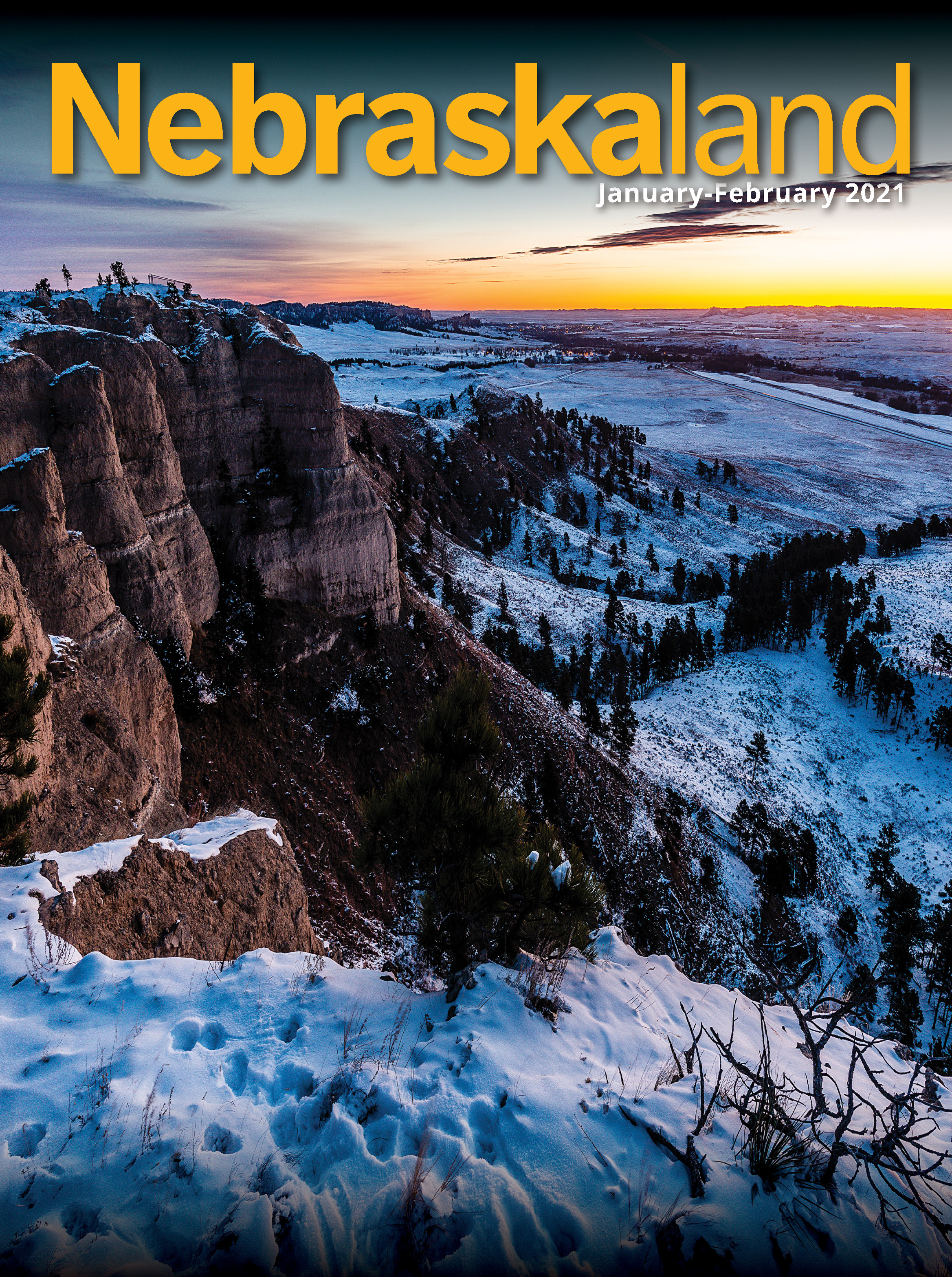
- Identifier:
- nela.2021_099_01
- Title:
- Volume 99, Issue 1, 2021
- Issue Name:
- January-February 2021
- Date Issued:
- 2021-01-01
- year:
- 2021
- Season:
- Winter
- PDF filename:
- NL_99.01_2021_Jan_Feb_Spreads_Entire.pdf
- Publisher:
- Nebraska Game and Parks Commission
- Format:
- Periodical
- volume:
- 099
- issue:
- 01
- number:
- 099.01
- Decade:
- 2020s
- Type:
- Rights Holder:
- Copyright Nebraskaland Magazine/Nebraska Game and Parks Commission, all rights reserved.
- Extracted Text:
-
magazine
P.O.Box 30370
Lincoln, NE 68503
nebraskaland@nebraska.gov
To renew your subscription or change your
address call 1-800-632-5263
$4.95
JJanuary-February
an u ar y Feb ru ar y 2021
2021
le
Vehic
d
e
s
n
a Lice
rmit
brask
e
N
try Pe
n
1
E
k
202
r
al Pa
a.org
Annu
brask
Cover: Each winter, the Cheyenne Buttes
at Fort Robinson State Park serve as a
reminder of the plight of Dull Knife and
his people. See story on page 22..Photo by
Justin Haag.
Park
n State
Chadro
Volume 99 No. 1
January-February 2021
orNe
Outdo
FEATURES
$ 31
22
30
32
The only accessory needed
for a 100-year celebration
40
42
Story and photos by Justin Haag
OUTDOOR NEBRASKA
What to Do in January and February
By Renae Blum
HUNTING LATE-SEASON
WATERFOWL
By Jenny Nguyen-Wheatley
THE LONG WINTERS
By David L. Bristow, History Nebraska
IT’S SNOW
On the Mountain
44 CARP ROUNDUP
Story and photos by Eric Fowler
PHOTO BY JUSTIN HAAG
Nebraskaland • January-February 2021
Solemn and Scenic
Story and photos by Gerry Steinauer
Get your 2021 Nebraska State Park Entry Permit today –
and don’t miss a moment of the year-long celebration of
your state park system. Available at OutdoorNebraska.org
or wherever permits are sold.
4
BUTTES OF THE BREAKOUT
50
52
PARKS CENTENNIAL
Nebraska State Parks Celebrate 100 Years
By Christy Firestone
CONTROLLED SHOOTING AREAS
An Adventure Story
Story and photos by Julie Geiser
DEPARTMENTS
8
12
54
60
62
Your Nebraska
In the Field
Mixed Bag
Portraits from the Past
The Last Stop
ON THE WEB
To see additional content including photos,
videos and articles, visit
Magazine.OutdoorNebraska.gov/digital.
Nebraskaland (VOL. 99 / NO. 1 ISSN 0028-1964) is published monthly, except for the combined Jan./Feb. and Aug./Sept. issues, by the Nebraska Game and Parks Commission, 2200 N. 33rd St.,
Lincoln, NE. Periodicals postage paid at Lincoln, Nebraska, and additional mailing offices. POSTMASTER: Send address changes to Nebraskaland, P.O. Box 30370, Lincoln, NE 68503-0370.
Magazine Staff
magazine
Published by the Nebraska Game and Parks
Commission since 1926. The Commission is
dedicated to the conservation and protection
of all the state's natural resources and the
people who use them.
Communications Director Christy Firestone
Public Relations Manager Shawna RichterRyerson
Editor Jeff Kurrus
Associate Editor Jenny Nguyen-Wheatley
Regional Editors Eric Fowler, Julie Geiser,
Justin Haag
Contributing Editor Michael Forsberg
Regular Contributors Renae Blum,
Chris Helzer, Chris Masada, Ryan Sparks, Gerry
Steinauer
Art Director Tim Reigert
Graphic Designer Mel Severin
Photo Librarian Jaclyn Cruikshank Vogt
Administration
Director Jim Douglas
Deputy Director Tim McCoy
Commissioners
Chairman - Dan Kreitman, Wahoo
Vice Chairman - Pat Berggren, Broken Bow
2nd Vice Chairman - Rick Brandt, Roca
Robert Allen, Eustis
Donna Kush, Omaha
Scott Cassels, Omaha
Jim Ernst, Columbus
John Hoggatt, Kearney
Doug Zingula, Sidney
Circulation
For address changes and questions about your
subscription, call 800-632-5263
Advertising Sales Manager
For advertising information contact
Shane G. Gilster, 402-742-0125
Email: shanegilster@gmail.com
Nebraskaland Magazine Copyright 2021, all rights reserved.
Nebraskaland is available in audio from the Nebraska Library
Commission Talking Book and Braille Service, Suite 120, 1200 N St.,
Lincoln, NE 68508. 800-742-7691. Nebraskaland Magazine and the
Nebraska Game and Parks Commission reserve the right to reject any
advertising not in keeping with the agency mission.
Rates: $18 for one year; $33 for two years; $44 for three years. Nebraska
recipients must add appropriate sales tax. To subscribe call
1-800-NEBLAND (632-5263), or go online to:
NebraskalandMagazine.com.
Commission Offices
Conservation Officers
Headquarters/Southeast District Office
2200 N. 33rd Street Lincoln, NE 68503
Phone 402-471-0641
ADMINISTRATION (Lincoln)
Craig Stover (Administrator)
Duane Arp (Asst. Administrator)
Jeff Clauson (Asst. Administrator)
Travis Shepler (Asst. Administrator)
Northeast District Office
2201 N. 13th St. Norfolk, NE 68701
Phone 402-370-3374
Southwest District Office
301 E. State Farm Rd. North Platte, NE 69101
Phone 308-535-8025
Northwest District Office
East Hwy. 2, Box 725 Alliance, NE 69301
Phone 308-763-2940
Bassett Office
524 Panzer St., Box 508 Bassett, NE 68714
Phone 402-684-2921
Kearney Office
1617 First Ave. Kearney, NE 68847
Phone 308-865-5310
Ak-Sar-Ben Aquarium/Schramm Education
Center
21502 W. Highway 31 Gretna, NE 68028
Phone 402-332-3901
Omaha Office
8495 Frederick Street, Omaha, NE 68124
Phone 402-595-2144
OutdoorNebraska.org
Any program that receives federal funding from the National Park
Service, or the United States Fish and Wildlife Service prohibits unlawful
discrimination on the basis of race, color, religion, age, gender, marital
status, national origin, age, disability or political affiliation. Any person
who believes he or she has been discriminated against in any program,
activity, facility, or service, should contact the Nebraska Game and
Parks Commission, Lincoln, NE 402-471-0641, the Equal Opportunity
Commission, Lincoln, NE 402-471-2024, TTY/TDD 402-471-4693; United
States Fish Wildlife Service, Civil Rights Coordinator, 4401 N. Fairfax
Drive, Arlington, VA 22203; Director, Equal Opportunity Program, U.S.
Department of Interior, National Park Service, 1849 C Street NW, Mail
Code 0008, Washington, D.C. 20240-0001.
6
402-471-5531
402-471-5531
402-471-5531
402-471-5531
NORTHWEST (Includes counties covered)
Dan Kling (District Supt.)
308-430-0572
Sean McKeehan
(Kimball, Banner, Scotts Bluff)
308-672-1824
Josh Widhelm (Morrill, Cheyenne)
308-279-9133
Kelsey Glodowski
(Box Butte, Sheridan, Grant)
308-763-8226
308-289-2274
Jaden Porter (Keith, Garden)
308-458-7650
Terry Brentzel (Deuel, Garden, Grant)
308-760-0145
Sean Schultz (Keith, Arthur)
308-289-9580
Keith Jadlowski (Keith, Deuel)
NORTHEAST (Includes counties covered)
Tom Zimmer (District Supt.)
402-649-8053
402-760-0712
Dale Davis (Keya Paha, Brown, Rock)
Jonathan Andreasen
(Madison, Pierce, Stanton)
402-340-3981
Nicholas Fix (Dixon, Dakota, Thurston)
402-508-0261
308-430-3984
Kyler Prochaska (Platte, Colfax)
402-719-6226
Kyle Gaston (Dodge, Colfax)
402-613-8612
Mitch Johnson (Knox, Antelope, Pierce)
402-762-5022
Jeff Jones (Knox, Cedar)
402-380-6410
Cory Krause (Cuming, Wayne, Stanton)
Ethan Teter (Boating Officer-Dodge, Colfax) 402-620-8129
CENTRAL (Includes counties covered)
Mike Thome (District Supt.)
Matt Taylor (Thayer, Fillmore, Nuckolls)
Mark Sullivan (Nance, Polk, Wheeler, Boone)
Matt Brandt (Sherman, Howard)
Greg Hesse (Buffalo, Kearney)
Tim Williams (Hall, Hamilton, York)
Doug Pollard (Loup, Garfield, Valley)
Eric Javins (Adams, Clay, Webster)
Pat George (Harlan, Franklin, Phelps)
Daryl Teter (Howard, Greeley, Merrick)
Nebraskaland • January-February 2021
308-293-8746
402-200-9597
402-741-0636
308-202-0819
402-440-3847
308-380-7331
308-730-7050
402-902-2017
308-920-2762
308-440-1863
SOUTHWEST (Includes counties covered)
Roger Thompson (District Supt.)
308-530-3097
Matt Andrews
(Furnas, Gosper, Frontier, Red Willow)
308-746-2418
Brian Piernicky
(Red Willow, Frontier, Hayes, Hitchcock)
308-340-6627
John Lee (Dundy, Chase, Hayes, Hitchcock)
308-414-1432
Brandon O’Neal
(Lincoln, McPherson, Logan)
308-530-3157
Alex Hasenauer (Lincoln, Perkins)
308-660-4671
402-266-1759
Owen Johnson (Dawson, Gosper, Custer)
308-870-0322
Ray Dierking (Custer, Thomas, Blaine)
402-389-0444
Frank Miller (Cherry, Hooker)
308-217-2108
Taylor Dixon (Dawson, Gosper)
Kevin Bergstrom (Boating Officer-Lincoln) 308-520-1031
SOUTHEAST (Includes counties covered)
Stacey Lewton (District Supt.)
402-890-7140
402-619-1355
Rich Berggren (Douglas)
402-616-5961
Dan Evasco (Sarpy)
402-210-0888
Heath Packett (Cass)
402-209-1506
Russell Mort (Otoe, Johnson)
402-890-6463
Dina Barta (Lancaster),
402-937-3422
Dudley Sorensen (Lancaster)
402-646-0420
Bryce Streger (Seward, Saline)
402-314-9641
Trevor Stahlecker (Lancaster)
402-853-3273
Scott Eveland (Lancaster)
402-806-0915
Matt Seitz (Gage, Jefferson)
402-443-6392
Mike Luben (Saunders, Butler)
YOUR NEBRASKA
Instagram Photos
Follow us (@nebraskaland)
and tag us in your photos
to be featured in an
upcoming issue.
@bluestemrambler
Tom Turkey
Karen Linot, Gibbon
Coyote on the Lek
Chris Bergstrom, Omaha
Milky Way from Nebraska
8
Nebraskaland • January-February 2021
January-February 2021 •
Nebraskaland
9
YOUR NEBRASKA
@laceyfiorelli
Broken Bow Barn
@huskertiara
Sunset Buck
@bluestemrambler
Backyard Porcupine
10
Nebraskaland • January-February 2021
Send your comments and photos to:
Jeff Kurrus, Editor
Nebraskaland Magazine
P.O. Box 30370
Lincoln, NE 68503
or email Jeff.Kurrus@Nebraska.gov
Please include your postal address
and telephone number. Letters may be
condensed and edited. Photographs are
also welcome.
January-February 2021 •
Nebraskaland
11
IN THE FIELD
WINTER WILDLIFE
An eastern cottontail
rabbit sits on a bed of
snow at Metcalf Wildlife
Management Area near Hay
Springs.
PHO O BY JUS
PHOT
UST
TIN
NH
HAAG
A
12
Nebraskaland • January-February 2021
January-February 2021 •
Nebraskaland
13
IN THE FIELD
DOGS IN THE SKY
By Martha D. Shulski
Winter is my favorite season. There lies
a lot of beauty in the seemingly pulsing
landscape as snow-covered ground melts to
reveal the browns of winter, only to establish
again with the next passing storm. We can
see animals much easier without the cover
of foliage. The pastel optics of a winter sky
are aided by low sun angles and layered
clouds, as opposed to the bright intensity
of summer. An optical phenomenon visible
primarily, but not exclusively, in winter is
called “parhelion.”
Better known as sun dogs, these mock suns
are in the halo family of optical weather. Sun
dogs result from light changing direction, or
refracting, as it passes through ice crystals.
Similar to rainbows, the frozen plate-shaped
crystals act as tiny prisms suspended in cirrus
clouds that are cold and at high altitudes.
Parhelia appear in close proximity to the
14
Nebraskaland • January-February 2021
sun, 22 degrees to be exact, and sometimes
the rainbow of colors are distinguishable,
though muted. If you look closely, you may
see other interesting optics along with these
sun dogs.
A halo is a circular feature surrounding the
sun with parhelia appearing on the east and
west sides. The top of the halo can have arced
features extending skyward.
Viewing these complete set of optical
illusions is quite rare at middle latitudes. One
would need to be in Arctic or Antarctic skies
to get the full experience. Until then, when
thin and wispy cirrus clouds don our view,
look near the low winter sun for these dogs to
illuminate the sky.
Martha D. Shulski, at the University of
Nebraska-Lincoln, is the director of the
Nebraska State Climate Office.
PHOTO BY JUSTIN HAAG
IN THE FIELD
HOLEY HUNTER
By Justin Haag
When people say something is needed like a
“hole in the head,” usually it is to express it is
unnecessary or frivolous. Some predatory fish may
take exception to that notion, however.
The northern pike (Esox lucius) has many
physical characteristics that make it stand out from
other species. With a long toothy snout and tubelike, green camouflaged body, it is to no surprise
that people have nicknamed this fish the “gator.”
Perhaps less noticeable on that head is a series of
holes, or pores, that are important to its survival
and predatory ways.
Complementing the pike’s razor-sharp teeth,
forward-positioned eyes and athletic body, is the
fish’s lateral line that helps it detect movement,
16
Nebraskaland • January-February 2021
vibrations and pressure gradients. All fish have
some form of this system, but those pores, which
have tiny hairs, make a pike’s lateral line more
effective at detecting movement than most other
species. Such attributes of the lateral line are
referred to as neuromasts.
Another less common but highly sought-after
Nebraska predatory fish, the muskellunge (Esox
masquinongy), also has such pores on its lateral
line. In fact, muskies have about double the number
of holes — a characteristic that helps give it an
edge on the prey when hunting at night.
Whenever landing one of these popular game
fish, anglers can probably thank the holes on its
head for helping the fish find its way to the hook.
PHOTO BY JUSTIN HAAG
IN THE FIELD
LATE-SEASON PHEASANTS
By Jeff Kurrus and Gerry Steinauer
Late-season pheasant hunting can be a challenging, but
rewarding, adventure. To the hunters’ advantage, most
others have stowed away their guns for the season and
there is less competition. To the pheasants’ advantage, the
remaining roosters are now well-educated. Here are a few
tips to help you bag those wily roosters.
Pay Attention to Your Cover
The chill and snow of winter has pushed birds into dense,
insulating cover, so hunt thick grass or weed patches or
marshes. Also birds now avoid heavily hunted areas so seek
out-of-the-way places such as the back side of a marsh or
isolated patches of cover far from parking lots if hunting
public lands.
Be Quiet
The slamming of car doors, talking and constantly blowing
your dog whistle will send the now skittish roosters running.
To trap these prone to run roosters, zig-zag through fields in
18
Nebraskaland • January-February 2021
an attempt to push them to field edges, or better yet, corners
where they will be forced to flush.
An After-Breakfast Hunt
There is no need to rush. Wait until mid-morning to hunt
after pheasants have fed in crop fields and settled in mid-day
loafing cover where they will be easier to approach.
More Bang
Late-season roosters tend to flush a bit farther out,
so consider using shells with more bang, perhaps 3-inch
magnums with a larger shot size.
After a Snow
In snow, learn to identify fresh rooster tracks, and trail
them for a flush.
Lastly, be prepared to walk, there are no easy roosters this
time of year.
January-February 2021 •
Nebraskaland
19
PHOTO BY JENNY NGUYEN-WHEATLEY
IN THE FIELD
DUCK (OR GOOSE) AND BEANS
By Jenny Nguyen-Wheatley
Servings: 6
Prep Time: Overnight
Cooking Time: 6 hours
Ingredients:
1½ pounds bone-in duck or goose
legs
1 pound of dried cannellini beans
Water
1 onion, separated
1 rib of celery, roughly sliced
2 carrots, roughly sliced
2 bay leaves
Olive oil
6 ounces of andouille sausage,
sliced
4 cloves of garlic, minced
1 bunch of kale, leaves coarsely
chopped
1 tablespoon of tomato paste
4 sprigs of fresh parsley
Kosher salt and pepper, to taste
1 tablespoon of brown sugar,
optional
•
•
•
•
•
•
•
•
•
•
•
•
•
•
•
20
1. Pour dried beans into a bowl and
submerge with water by 2 inches. Stir
in 2 tablespoons of salt. Allow to soak
for at least for 4 hours and up to 12
hours.
2. In a stock pot, combine duck legs,
8 cups of water, half the onion (reserve
the other half for later), celery, carrots
and 1 bay leaf. Bring to a simmer and
cook on low, partially covered, for
about 2 hours and 30 minutes or until
tender. Shred meat from bones and set
aside/refrigerate until ready to use.
Strain stock and discard solids.
For a richer stock, return the bones
to the pot and continue simmering for
as long as you’d like. However, make
sure that you end up with at least 4
cups of stock in the end.
3. Drain and rinse beans. Add beans
to a pot and submerge by 2 inches of
new water. Add the remaining bay leaf
to the pot and bring to a simmer. Cook
beans until tender, about 30 minutes.
Never allow the pot to come to a hard
Nebraskaland • January-February 2021
boil, which can break the beans.
4. Preheat oven to 250° Fahrenheit. On
the stove, add oil to a 4-quart enameled
Dutch oven and heat over mediumhigh. Brown the sausage and shredded
duck meat. Chop the remaining onion
and sweat with a pinch of salt until
translucent, about 5 minutes. Add the
minced garlic and cook for 30 seconds.
Wilt the kale with another pinch of salt.
5. Drain the cooked beans and bay
leaf and add it to the Dutch oven with
the other ingredients. Dissolve tomato
paste into 1 cup of duck stock and
add it to the pot. Add 2 more cups
of stock, more or less, to submerge
all ingredients. Mix in brown sugar
and season to taste with salt. Drop in
sprigs of parsley. Cover and braise for 3
hours in a 250° oven.
6. To serve, discard the parsley and
bay leaf. Season to taste again. Serve
hot with buttered crusty bread on the
side. Use leftover stock to thin out
leftovers.
January-February 2021 •
Nebraskaland
21
Buttes of the Breakout
Solemn and Scenic
Story and photos by Justin Haag
Bison graze below the Cheyenne Buttes of Fort
Robinson State Park. Both stand as a significant
reminder of the region’s Native American heritage.
22
Nebraskaland • January-February 2021
January-February 2021 •
Nebraskaland
23
From the top of the Cheyenne
Buttes, visitors get a view
of the White Valley. After
escaping, the Cheyennes
followed the river before
heading to higher ground.
A bighorn sheep stands atop a picturesque landform visible from the Cheyenne Butte Trail. Bighorns are attracted to the
area’s many peaks and crags.
T
he Cheyenne Buttes provide
one of the most scenic vantage
points in the Pine Ridge. They
also are forever tied to an
event from Fort Robinson State Park’s
history as a U.S. Cavalry post and got
their name from a notorious event.
Chief Dull Knife of the Cheyenne.
24
Historians rate the happenings of Jan.
9, 1879, among the most significant
events of the Indian Wars.
While that day is certainly
important, it is just one day among a
period of more than three months.
The previous October, the Cavalry
intercepted 149 Cheyenne warriors,
women and children led by Chief
Dull Knife, who were attempting to
return to their Powder River region
homelands from Darlington Agency
in Indian Territory in present-day
Oklahoma. After capturing the
Cheyennes south of Chadron, the
soldiers took them into custody at Fort
Robinson.
At first, the Cheyennes were allowed
to leave the building. By January,
however, the situation became dire as
officials in Washington, D.C., insisted
the group return south, and the Native
Americans were just as insistent on
moving north. The Cheyennes refused
Nebraskaland • January-February 2021
to return to the southern agency, which
by all accounts had become a hellhole,
and the officers at Fort Robinson
eventually attempted to force them
into submission by withholding food,
water and firewood.
The group was determined to
escape, and what happened next
would come to be known as the
Cheyenne Breakout and the “Fort
Robinson massacre.” At about 9 p.m.
on that cold January night, after four
days of hunger, the Cheyennes busted
through the boarded windows of the
log barracks. The escape was aided
by weapons they had smuggled into
the building, and soldiers guarding the
barracks became the first casualties of
the event.
The Cheyennes followed the banks
of the White River until they headed
north and scaled the cliffs that would
later bear their name. Traveling
northwesterly, the landscape of the
January-February 2021 •
Nebraskaland
25
Pine Ridge helped them avoid the
cavalry soldiers.
Some made it as far as a hiding
spot on Antelope Creek 35 miles away
before soldiers caught up with them,
but all of the escapees were eventually
either killed or recaptured. The
tragedy resulted in the death of 64 of
the Native Americans and 11 soldiers.
While most historical materials
refer to the event as the Cheyenne
Outbreak, modern historians have
preferred the term Cheyenne Breakout,
as it provides greater respect to the
Native Americans and more accurately
portrays the event. “Outbreak,” they
say, is a term often used to describe
disease and has connotations the
Cheyennes were the source of the
Fort Robinson visitors can step back to the tense moments of January 1879 at the
reconstructed barracks of the Cheyenne Breakout.
Morning sunlight
illuminates the Cheyenne
Breakout Monument,
just west of Fort
Robinson State Park.
The monument was
constructed in 2016.
From atop the buttes, the grandeur of the Pine Ridge is accentuated by sunrise.
26
Nebraskaland • January-February 2021
January-February 2021 •
Nebraskaland
27
Each winter, the Cheyenne Buttes serve as a reminder of the plight of Dull Knife and his people. In summer, Fort Robinson
State Park provides Jeep rides to the fenced area at left.
trouble.
Today, History Nebraska has many
resources available at the park to
commemorate these events and others
of the Indian Wars.
In 2003, the agency reconstructed
the barracks where the Cheyennes
were held captive, and a striking
28
monument memorializing the incident
was installed below the Cheyenne
Buttes on land owned by Chief Dull
Knife College just west of the park in
2016. Three historical markers also tell
of the events.
Perhaps it is the characteristics
of the buttes, which are rugged
Nebraskaland • January-February 2021
enough to provide some of the
region’s best bighorn sheep habitat,
that best represent the struggle and
determination of the Cheyenne people.
When standing on the landforms,
looking over the White Valley and a
herd of bison grazing below, it is fitting
to think of that cold night in January
and pay respects to this region’s
checkered past.
May the buttes forever carry the
Cheyenne name so visitors will not
forget the role they played in bringing
hope, albeit brief, to a determined
group of cold and hungry Native
Americans. N
Getting to the Top
Visitors to Fort Robinson State Park need not recreate the physical feat
of the Cheyennes to experience these views. They may instead use/hike/
walk the more agreeable Cheyenne Butte Trail. A fenced viewing area is
accessible from Smiley Canyon Scenic Drive, about 400 feet above and
1 mile from the road’s easternmost parking lot. In summer, Fort Robinson
offers guided Jeep rides to this location.
January-February 2021 •
Nebraskaland
29
Outdoor Nebraska
What To Do in January and February
By Renae Blum
Don’t let cabin fever get to you. There are still plenty of ways to
have fun outdoors and stay active; here are just a few. N
Observe animal
tracks
Throughout the month
Statewide
SNOWMOBILING
GETTY IMAGES
SQUIRREL HUNTING IN LINCOLN COUNTY.
PHOTO BY JULIE GEISER
PHEASANT TRACKS AT OAK VALLEY WMA.
PHOTO BY JENNY NGUYEN-WHEATLEY
Finding and observing animal tracks
in fresh snow can be a fun winter
activity. See what you can learn from
your observations, noting the tracks’
pattern, size, distance between tracks,
presence of toes or claws and paw pad
shapes. Field guides such as Scats and
Tracks of the Great Plains by James C.
Halfpenny can aid in identification.
Snowmobiling at Lewis and Clark
State Recreation Area
As weather conditions allow
Through Jan. 31 | Statewide
Winter can be one of the most fun and rewarding times to hunt Nebraska’s
fox squirrels. Get outside on a calm, sunny day with family and friends
to make memories and bring home meat for delicious squirrel stew. Be
stealthy, as squirrels look for movement.
Make outdoors
New Year’s
resolutions
As weather conditions allow
Throughout the month | Statewide
Merritt Reservoir is a traditional
ice-fishing favorite, with a variety of
species that provide good action, including
crappie and other panfish, large catfish,
walleye and perhaps pike or muskie.
Crappie is the No. 1 draw and for good
reason: The reservoir has always had a
good population of larger crappie.
Now is a great time to start planning a
healthy, active year outdoors. That might
mean making a fishing or hunting bucket
list for 2021, writing a list of state parks
and trails to explore, or sketching out
fitness goals for you and your hunting
dog. Have fun and make resolutions
you’ll want to keep.
30
Nebraskaland • January-February 2021
ICE-FISHING AT MERRITT RESERVOIR
PHOTO BY JEFF KURRUS
Ice-fishing at Merritt
Reservoir
HIKING AT PONCA STATE PARK
PHOTO BY JENNY NGUYEN-WHEATLEY
A select number of Nebraska state parks offer snowmobiling.
If you’re deciding where to go, Lewis and Clark may be a good
pick: It’s the only one with groomed snowmobiling trails. Enjoy
beautiful winter scenery and some good camping and fishing, too.
Riders must stay on designated snowmobile trails.
Squirrel hunting
January-February 2021 •
Nebraskaland
31
Snow goose shot over
a farm pond on private
land in Burt County.
HUNTING LATE-SEASON
WATERFOWL
PHOTO BY JENNY NGUYEN-WHEATLEY
By Jenny Nguyen-Wheatley
birds will be coming in toward the late season.”
Rivers also can produce good hunting, that is until they
freeze or form too much slush, says Julie Geiser. “Having
said that, if temperatures do warm during the day, river
slush melts and will attract ducks and geese during the
afternoons,” she says.
Ross Juelfs, who is usually limited to hunting and guiding
on smaller bodies of water along the Platte River, looks to
small warm-water creeks and sloughs close to food sources.
Non-traditional areas include farm ponds and stock dams
where ducks wouldn’t normally be found, says Scott Wessel.
“If you can gain access, most people will walk in, flush
birds simply by their presence, and then set out decoys and
wait for them to return,” he says. “Birds that concentrate in
areas like that ‘feel’ secure and will often return and decoy
readily.”
PHOTO BY JENNY NGUYEN-WHEATLEY
H
unting the late-waterfowl season is not for the faint
of heart. Thick ice, biting temperatures and freezing
equipment are only a few things that the most diehard of waterfowl hunters have to contend with in January
and February. I talked to four of these hunters, who provided
insight on how to best cope with hunting in harsh winter
conditions.
Julie Geiser is a public information officer and Nebraskaland
regional editor for the Nebraska Game and Parks Commission.
She has spent more than 30 years hunting waterfowl and
learning their patterns, calls and how to lure them into a
decoy spread throughout the hunting season.
Terry Bisgard of Omaha has been hunting waterfowl for
over 35 years. He recalls shooting his first duck at 16 and is
now passing on the tradition to his two young sons, Caden
and Cody.
Scott Wessel is a Commission private lands biologist out of
the Norfolk office. His waterfowl hunting experience began
50 years ago on a small reservoir in northeastern Nebraska.
Today, Wessel mostly hunts Sandhill lakes and larger rivers.
Although a lot has changed over the years, the anticipation
of sunrises in the blind with family, friends and dogs is as
great a pull for him today as it was when he was young.
Ross Juelfs has more than 30 years of experience hunting
the North Platte River. His guiding career began 25 years
ago with his father at the Stanco Ranch near Lisco. Juelfs
is currently head guide and hunting manager for Cheyenne
Ridge Outfitters near Scottsbluff, where he has worked for
13 years.
Where to Hunt
Larger bodies of water, sloughs and warm-water creeks are
the last to freeze. Public reservoirs, such as Calamus, Merritt
and McConaughy, and larger Sandhills lakes in western
Nebraska are attractive during the late-waterfowl season for
this reason.
“The wind makes the waves bigger on big water, which
keeps off the ice,” says Terry Bisgard. “I like to set up on the
north to northwest side of a lake because that’s where the
32
Nebraskaland • January-February 2021
Labrador retriever “Bub” retrieves a mallard out of the water.
Bub belongs to Terry Bisgard of Omaha.
January-February 2021 •
Nebraskaland
33
Haider Kazem of Lincoln calls in ducks while hunting at Pawnee Lake State
Recreation Area. PHOTO BY JENNY NGUYEN-WHEATLEY
Before hunting cornfields, Wessel recommends scouting to look for a
field that the birds are using or one that is located along a direct flight
line from a roost. Spinning wing decoys and field decoys work well in this
case, and camouflaging with a layout blind is important. However, there
is one caveat when hunting “roost” sites.
“Hunting roost sites like this is usually a one-and-done affair. Once
they’ve been shot at, they won’t likely return soon or at all,” says Wessel.
“Furthermore, if there are significant numbers of birds using the site,
hunting there may negatively impact other hunter success in the area —
particularly for field hunters.”
Jake and Keith Jadlowski, originally from Ralston, Nebraska, hunt ducks and geese on the Elkhorn River near Tilden.
PHOTO BY JEFF KURRUS
Calling
Ice, frost and snow make decoys look unnatural to birds flying overhead.
During the late season, Terry Bisgard of Omaha leaves his blind as often as
every two hours to clean decoys. PHOTO BY JENNY NGUYEN-WHEATLEY
34
Nebraskaland • January-February 2021
Birds will respond to calls differently later in
the season than earlier. Geiser’s tactic is to do
what they do. Bisgard prefers the minimalist’s
route. Juelfs takes a more proactive approach.
“Birds can get educated as the season goes
on, and I usually go by how much the ducks or
geese are talking, calling as much or as little as
they are,” says Geiser. “If you see birds a ways
off, call to let them know where you are, and
then watch their body language, listen to their
calling and mimic them.”
Like Geiser, Bisgard also emphasizes reading the birds, but
typically during the late season, he says, “The less calling I
do, the better success I usually have. Use soft, low-end type
calling, more feed chuckles and maybe soft quacking, because
it’s colder and the newer ducks coming in will be hungry. The
ducks that are here already are going to be stale, so they’re
used to hearing it by then from other hunters. Sometimes I
don’t call at all. I just let the motion of the decoys do the work.”
Juelfs tends to call more aggressively later in the season,
hoping to trigger a response from a lonely drake mallard.
“Ducks can be very responsive later in the season as they
begin their pair bonding and courtship rituals,” he says.
Breaking Ice
Ice is a challenge during the late season. Keeping water
open and preventing ice from forming on decoys, which can
make them look unnatural, requires a watchful eye.
“Hunting on big reservoirs can be tricky, but if you have
a barge, those boats can break through the ice if it’s not too
thick,” says Geiser. “Bank hunting can be done near spillways
— if legal to hunt there — and other areas with running
water that keep the water open. We do have an underwater
turbine at our private pond that keeps the water rotating, and
it keeps a large area open. We always have heaters running
that keep our gear from freezing up.”
January-February 2021 •
Nebraskaland
35
“An ice eater works well if you have electricity,” says
Wessel. “Open up as big an area as you can upwind of your
blind so you can place decoys there and encourage ducks to
approach in front of the blind.”
Wessel also uses a spade or spud bar to break ice and move
it out of sight, which keeps his hands from getting wet.
“Don’t leave decoys out overnight if there is a risk of icing
in or even a heavy frost. Shiny, frozen decoys or those covered
with frost don’t look natural,” says Wessel.
Bisgard breaks ice in large circles and slides it underneath
the ice.
“It looks more natural. I don’t like shiny broken edges
reflecting in the sun,” he says. “If the ice is thick, I’ll only
make a small circle. I also set decoys on the ice. I put sleeper
or resting decoys around the ice hole, just to make it look
more natural and this will also help cover the shiny jagged
edges of the ice. When waterfowl see other birds sleeping
or resting, it gives them confidence. They’ll see these birds
relaxing, and they’ll want to come down.”
Bisgard keeps a close eye for ice forming on decoys. He goes
out every couple of hours to clean ice off the decoys’ bills.
Decoys
“For geese during the late season, hunters may need to
work the wind more with their decoy spreads,” says Geiser.
“Geese will decoy and land coming into the wind.”
If birds are decoy-shy, Geiser suggests moving the decoy
spread away from your pit or blind, in a location that would
force birds to fly over you as they are looking at your spread.
Also consider competition with other hunters. Wessel
utilizes a bigger spread when there are other hunters in the
area, “but a few decoys will work if pressure is light.” He also
bunches decoys closer together during colder conditions,
which simulates natural behavior.
“I always place goose decoys upwind of ducks,” says
Wessel. “I believe, but don’t know this for a fact, that geese
PHOTO BY JEFF KURRUS
PHOTO BY JEFF KURRUS
Hunters carry out duck decoys after a waterfowl hunt in Hall County on the Platte River.
From his personal blind overlooking the Platte River, a Labrador retriever awaits the next volley of shots from his handlers.
36
Nebraskaland • January-February 2021
will fly over ducks but ducks don’t like to fly over geese as
they approach a landing site. That was what I read a long
time ago in Ralf Coykendall’s book Duck Decoys: And How to
Rig Them.”
Wessel also transitions from using a mixed flock of decoys
— widgeon, gadwall, pintail, teal and mallards — to mostly
mallard and a few green-winged teal later in the season, as
most of the early to mid-season migrants have long headed
south.
“Honestly, I think I’ve killed just as many ducks over
mallard decoys as I do now with really nice ‘other duck
decoys,’” says Wessel. Full-body, non-floating duck decoys
and sleeper goose decoys placed on the ice can be effective
if you have a way to retrieve downed birds, but be careful of
thin ice, he warned.
Bisgard also uses sleeper and resting decoys, especially
during conditions of thick ice where you can’t make a big
hole.
“If there’s no ice, I’ll add two or three dozen more decoys to
my spread to create a bigger profile. I also like motion decoys
to create a more natural look,” says Bisgard.
Juelfs, who typically hunts smaller water, tends to run
smaller and more realistic spreads later in the season.
“I feel that calling will get a better response than a large
decoy spread,” says Juelfs.
Camouflage
Geiser reminds hunters to touch up their blinds and pits
toward the middle or end of the waterfowl season. Focus
on lids, which birds tend to notice first. Collect corn stalks
January-February 2021 •
Nebraskaland
37
Weather and Late-season Waterfowl
By Todd Mills
When hunting during the winter, it is mandatory to constantly clean the snow off of the decoys.
or other matching vegetation to blend in your blind with its
surroundings. However, don’t use phragmites for any blind
construction, as the plant is highly invasive, outcompetes
native plants and displaces some native animals. Also, don’t
make too many paths or tire tracks leading to your blind, she
says.
Bisgard gives himself time to scout before hunting. He
takes photos of potential hunting spots and studies them to
camouflage his boat blind before the hunt.
“If I’m hunting in the Sandhills, I like brush cover. Can’t go
wrong with Mossy Oak shadow grass — it’s my favorite,” says
Bisgard. “I also put a camo vest on my dog to help break him
or her up. Keep the dog still. You don’t want any unwanted
motion in your blind.”
Other Considerations
Although obvious, make sure to wear enough layers and
take advantage of hand and foot warmers during the late
season. Hypothermia is a real risk. Geiser always checks her
hip boots and chest waders for leaks before hunting. Bisgard
switches to wearing Cordura waders with 1,600-gram
Thinsulate.
38
Nebraskaland • January-February 2021
“I go for the 4-in-1 jacket — you can always peel off later.
You need that protective outer shell to keep the wind, snow
and rain out,” says Bisgard. “I have a pair of rubber gloves
that go up to my elbows to pick up decoys in cold water.
Many hunters make the mistake of choosing gear with a
camouflage pattern they like, but it’s only water resistant and
not waterproof. Spend the extra money on waterproof gear
for when conditions are rough.”
As for the gun, Geiser prefers pump shotguns over semiauto loaders, which are generally foolproof. Semi-autos can
malfunction if they freeze.
Bisgard checks over his gun before hunting, making sure
the action is free and working. He warns against over-oiling a
gun before hunting in cold weather.
“The oil can get stiff in the cold, and the action won’t
work,” he says. “Your gun jamming up is the last thing you
want when the birds start come in. For late-season hunting,
I only use a light layer of oil when I need to clean my gun.”
Geiser and her husband keep a small hand broom in the pit
to dust decoys off if there is frost on them or if it’s snowing.
In extreme weather, bring plenty of food and account for
emergency scenarios. N
Tip #1 - Nocturnal Blues
When planning a late-season trip, the first
thing I’ll look at is the moon phase. Because of
pressure, birds will tend to feed by the moon
during late season and come out right before
sunset. Particularly if it’s cold, they’ll sit most
of the day and conserve energy before putting
on the food bag. No matter if hunting field
or water, birds that go nocturnal are almost
impossible to hunt.
waterfowlers like to call a “reverse migration.”
With our weather patterns being very mild in
the last decade, you can experience this as
early as mid-January and as late as February
as most goose seasons are still open. Timing is
everything here, so watch the weather closely
and be ready for some magnificent shooting if
you hit it just right.
Tip #2 - Moisture and Wind
One of the best late-season hunts I had was
on the Missouri River right before a snow
event and arctic cold blast behind it. The day
started with freezing rain and turned to all
snow later in the day. In what I would later
refer to as “survival mode,” birds were in a
frenzy to get food before it was covered up
with ice and snow. You could literally stand up
in the blind that day and they wouldn’t flinch.
Late-season birds can be yarded up in safe
havens, so if you find a field they are using
nearby and open water in that path, it can be
money.
If you’re hunting big water, which is normally
the case late in the year for us, wind can be
your friend. Birds don’t like to sit in open
water with high wind, so they will peel off and
head back into coves out of the wind. Note of
caution here: Anything over 25 mph is not only
dangerous for you, but also shooting birds can
be challenging at best. Choose your spot wisely
on days like that.
Tip #3 - Southerly Reverse
By late January, birds are anxious to get back
to their breeding grounds. A warm up followed
by a strong south wind can provide what us
PHOTO BY DOUG CARROLL
PHOTO BY JEFF KURRUS
Nothing can impact a late-season waterfowl hunt like a weather change. When most hunters may
be packing away their gear, I’m usually busy checking weather forecasts and looking for that perfect
storm that can turn an ordinary late-season hunt into a barrel burner.
During the month of January and early February, most birds have reached their wintering grounds.
You’ll no longer be waiting on a migration event, but instead packing on the miles scouting and
waiting on the weather to get them out of their daily routine. By this time, they’ve seen it all and
heard it all, so every advantage you can get needs to be jumped on. Normally, for me, it’s a drastic
weather event that can do that.
Over the course of the 40 years that I have been chasing ducks and geese, the following three tips
seem to have paid off the most. Of course, these are late-season waterfowl — so no theory is bullet
proof.
A full moon rises while Canada geese loaf in an
iced-over spot of water on the Platte River in
February.
January-February 2021 •
Nebraskaland
39
The Long Winters
By D
B
David
id L.
L Bristow,
Bi
Hi
History N
Nebraska
b k
ebraska’s harshest winters have produced stories of
tragedy and heroism, but for most people, getting
through those long, cold months is more a matter of
patience and making do.
Before four-wheel drive and snowplows, a hard winter
meant isolation for farm families. Maxine Kessinger recalled
the brutal winter of 1936, when she was a 22-year-old farm
wife and mother of three, living 7 miles from Rosalie:
“Every road, even highways were drifted shut for weeks.
The scoop shovel was the only equipment to open the roads.
Some never opened until the spring thaws came and melted
the snow. The Kinning Store, a mile east of us, ran out of
supplies, as no trucks could get through. Sometimes, several
neighbors joined forces and with team and bobsled going
across fields, cutting fences to make it to town for needed
supplies such as groceries, cold or flu remedies, maybe a little
N
coal to enhance the supply of green wood we were trying to
burn — and of course they would bring the mail. Sometimes
a two-week bundle had accumulated as the rural mail carrier
couldn’t even get out of the city limits.”
It wasn’t so easy within city limits, either. The U.S. Postal
Service has long boasted that it is stopped by “neither snow
nor rain nor heat nor gloom of night.” South of Marquette in
Aurora, Wayne Arthur Shaneyfelt worked as a mail carrier
from the 1930s into the 1970s. When he started, carriers on
city routes had no vehicles, so he walked their entire routes
twice a day — about 12 to 15 miles in all.
Writing for I Remember… Family Stories from Hamilton
County, Nebraska (1999), Shaneyfelt recalled that the
“roughest day” of his long career was during his first winter on
the job. Aurora didn’t require people to scoop their sidewalks,
and every house had a mailbox on the front porch. That
This early 1900s photo is a mystery. Marquette never had much more than 300 people at its peak in 1930. Such a quantity of
mailbags may not have been for local delivery. They might have been pulled from a stuck Burlington train after a heavy snow.
History Nebraska RG3828-5-1
40
Nebraskaland
• January-February 2021
morning he waded through 2-foot-deep
snow — and did it again that afternoon.
Everyone on his route received their mail.
Young people, meanwhile, have always
had a different perspective on winter
hardships. During the legendary winter
of 1949, Charlie Wright was 16 years old
and stayed at his uncle’s farm northeast of
Scottsbluff.
Wright says the farmhouse was well
stocked with food, including a freezer full of
mallard ducks they had shot in November
and December.
“We enjoyed roast duck for just about
every noon meal until the county graders
were able to plow us out,” he recalls.
One day, “By 2:30 it was snowing so
hard that you could not see the power
pole about 20 feet south of the house. The
cousins were playing poker and paid little
attention to the storm. [But Uncle Mart
and Aunt Doris] lacked confidence in our
ability to ride out the storm, particularly if
we lost electric power that was necessary
to operate the oil furnace. This was OK with
us because Uncle Mart could teach us some
more poker games.”
They didn’t lose power, but Wright says
he learned “at least 75 different poker
games” that winter, “enough to last me
through six years of college and two years
of active duty in the Navy.” N
Visit History Nebraska’s
history.nebraska.gov.
website
at
A locomotive-driven snowplow approaches Kilgore, Cherry County, in
January 1949. History Nebraska RG1259-0-15
Clearing railroad tracks. Handwritten on reverse side: “Snow! Chadron, Neb
Feb 1949.” History Nebraska RG3139-0-161
January-February 2021 •
Nebraskaland
41
It’s
Snow
on-the-Mountain
Story and photos by Gerry Steinauer
his past summer while taking a
break during a plant survey in the
loess hills of Custer County, my
glance settled on a distant prairie
hilltop. “That’s strange; it’s white,” I
thought. For a second or two my mind
imagined snow. Then, I snapped back
to reality, “It’s August, dummy.” After
a few more moments of squinting and
pondering, it all made sense. “It’s a big
patch of snow-on-the-mountain.” The
person who named the plant may have
had a similar experience.
A native annual found statewide,
snow-on-the-mountain
(Euphorbia
marginata) thrives in disturbed
habitats, such as abandoned farm
fields, roadsides and prairie dog towns.
The hilltop that temporarily baffled
my senses had recently been cleared
of eastern red-cedars and its exposed
T
Snow-on-the-mountain contains a
latex sap that can irritate the lips,
eyes and skin of herbivores, as well as
sensitive humans.
42
soil provided an ideal seed bed for this
opportunistic plant.
Bleeds White
Cut the stem or leaf of snow-on-themountain and it bleeds a white, latex
sap. The sap, which congeals after a
few minutes exposure to air, contains
bitter-tasting and irritating chemicals
known as diterpenes. When the sap
comes in contact with the mouth,
eyes or skin of herbivores, it can cause
inflammation and blistering and
dissuades grazing of the plant. Avoided
by livestock, snow-on-the-mountain
is also abundant in many overgrazed
pastures. Old reports, whether fact or
fiction, claimed that cowboys used its
sap to brand cattle.
Although an irritant to humans
sensitive to diterpenes, Great Plains
tribes used snow-on-the-mountain
as medicine. The Lakota, for example,
used its crushed leaves as a liniment
for swellings. Because of its sap’s
resemblance to milk, the Lakota also
made a tea from the plant to treat
mothers with insufficient breast milk.
The Lakota have two names for snowon-the-mountain. One name, “asan’pi
peju’ta,” translates to milk medicine,
the other, “ito’pta sa’pa tapeju’ta”
translates to black-footed ferret’s
medicine; the plant was abundant
in prairie dog towns where the nowendangered ferret once lived and
thrived. The animal is sacred to the
Lakota.
Nebraskaland • January-February 2021
Snow-on-the-mountain growing in native prairie at Pressey Wildlife Management Area in Custer County.
When viewed from a distance, large patches of the plant appear as snow.
Strange Flowers
Having no real sepals and petals,
individual male and female snow-onthe-mountain flowers are incredibly
small and simple. The male flowers,
for instance, consist of a single, short
pollen-bearing anther with a tiny
bract at its base. Most plants with
simple, non-showy flowers, such as
the ragweeds and lamb’s quarters,
produce prolific pollen that is randomly
dispersed by the wind — not snowon-the-mountain and other members
of the Euphorbia genus. Through
evolution, they have rearranged their
simple flowers into a complex structure
known as a cyathium. Located on
branch tips, the cyathia appear and
function like a single, showy flower
to attract insect pollinators, which are
more efficient at pollination than the
wind.
A cyathium’s cup-like base holds a
single centrally-located female flower
surrounded by several series of male
flowers. To entice pollinators, four
olive-green, nectar-producing glands
with white, petal-like appendages ring
the cup’s rim. The plant’s upper leaves
have broad white margins, further
adding to the cyathias’ flower-like
appearance and providing the plant’s
snowy color.
Its showy upper leaves have allowed
the relatively pest- and disease-free
snow-on-the-mountain to be sold
and grown as an ornamental, more
so in decades past. What better way
to bring a breath of coolness to your
sultry summer yard than to plant
snow-on-the-mountain? N
A cluster of snow-on-the-mountain
cyathia.
January-February 2021 •
Nebraskaland
43
Carp
Roundup
Story and photos by Eric Fowler
C
attle drives are an important
part of one chapter of Nebraska’s
history. For about 20 years in
the late-1800s, cowboys on horseback
would push huge herds of longhorns
from Texas to Nebraska, where the
animals were loaded on trains and
shipped to feed a growing nation.
Cattle drives and roundups remain
a part of everyday life on ranches
throughout the state today. It’s a
pretty simple process, where cowboys
on horseback, ATVs or pickups push
the cows from one place to another.
But sometimes a stubborn old cow, or
a few of them, just won’t do what you
want them to.
Fish drives, on the other hand,
are new to the state. In December
2019, what may be the first fish drive
conducted in Nebraska was held at
Hanson Lake No. 3 near Plattsmouth.
The drive used sound and electricity
to push invasive, non-native Asian
carp into a bay where they could be
seined. And while this roundup was
fairly successful in doing so, capturing
25,000 pounds of mostly silver carp,
just like in a cattle drive, some of the
fish didn’t do what they were supposed
to do.
ASIAN
CARP
have found
their way into every tributary of the
Missouri River in Nebraska, including
the Platte, Elkhorn, Loup or Nemaha
rivers, swimming upstream until a dam
keeps them from going farther. Just
as they found their way into Hanson
Lake, they have found their way into
other lakes as well, especially during
historic flooding in 2019.
“Anything that got flooded at that
time has the potential of having these
Asian carp in it, whether it’s a sandpit
or a pond or a quarry pit that was close
to the river,” said Jeff Blaser, private
waters specialist with the Nebraska
Silver carp netted from an electrofishing boat in Hansen Lake fill a tub.
44
Nebraskaland • January-February 2021
A commercial fishing crew from Minnesota pulls in a seine containing 25,000 pounds of fish, mostly silver carp, from
Hanson Lake No. 3 following two days of work in December 2019 that used sound and electricity to drive the fish into a bay.
Game and Parks Commission.
Blaser has taken calls from quite a
few lake associations on the subject.
He first worked with the folks at
Hanson Lake in 2011 when white
perch and silver carp appeared after
flooding. Then again in 2018.
For those that live in the houses that
line the shore of this 44-acre sandpit
lake, the arrival of the fish, especially
the silver carp, was not welcome.
Silver carp are easily startled and are
known to respond to disturbances
ranging from thrown rocks to passing
motorboats by jumping up to 10 feet
out of the water.
“They’ve just been a real nuisance
jumping into boats and hitting people,”
said Kevin Eastman, a member of the
homeowners association. “People are
scared to go tubing and skiing and
stuff because they might jump up and
hit somebody and hurt them real bad.”
Several people have been hit by “flying
fish,” but none seriously injured.
With the possible liability involved,
the association hired Jeff Reidemann,
a
commercial
fisherman
from
Minnesota, to seine the lake in 2018.
While that operation did remove about
8,000 pounds of Asian carp, estimated
to be 20 percent of the total present,
obstructions on the lake bottom,
including an old truck, snagged the
nets and limited the success.
The bright side to these invasions is
that unlike common carp, Asian carp
do not, except in rare circumstances,
reproduce in still water. Their eggs and
larvae must drift for some time to be
viable. When Blaser aged the fish that
were harvested, he found year classes
that didn’t match flooding events.
Blaser suggested they check any inlet
and outlet structures. When they did,
they found an outlet used to control
lake levels dumped into a ditch that
led straight to the Platte River and was
not fitted with screens to keep fish out.
When water levels were high, “Those
older fish and the young of the year
fish were finding that and following it
up into the sandpit,” Blaser said.
The outlet has since been modified
with a pump station and backflow
preventer to keep fish out.
In 2019, the association brought
the seining company back, along with
Tony Havranek of WSB Engineering,
a Minnesota company. Havranek
brought with him a plan adopted from
similar work being conducted to drive
and round up Asian Carp in the United
States.
DUANE CHAPMAN of the
U.S. Geological Survey in Columbia,
Missouri, has been working on the
biology and control of Asian carp
since 2002. Through that work, he has
developed relationships with fisheries
biologists in China, where these carp
species are raised commercially.
While working on a book with one
of those biologists, one of harvest
techniques used by the Chinese, the
January-February 2021 •
Nebraskaland
45
fish moved the entire length of the lake
in a matter of hours. “The distance that
we’re able to push these fish and the
rapidity with which were able to do it
is frankly amazing,” Chapman said.
“The great advantage we have with
this method when it comes to bycatch
is most of our native fish don’t run
away from the sound like the carp do.”
Using sound, electricity and block
nets to drive the fish to a capture
area, state and federal biologists
and commercial fishermen removed
100,000 pounds of silver and bighead
carp.
Similar efforts have since been
conducted on other lakes in Illinois,
a section of the Illinois River, bays
of Kentucky Lake, and several lakes
in Missouri. At Creve Coeur Lake,
a 2,100-acre lake in suburban St.
Louis, biologists and commercial
fishermen spent three weeks in 2018
driving fish and setting nets and, in
the end, removed about 47,000 silver
and bighead carp, weighing 225,000
Disturbed by an electrofishing boat manned by Kevin Eastman, a Hanson Lake homeowner and Tony Havranek, a biologist
with WSB Engineering in Minnesota, a silver carp jumps out of the water.
Unified Method, jumped out at him. He
traveled to China in 2015 with another
biologist and a commercial fisherman
to learn more about it.
There, floodplain lakes along the
Yangtze River covering thousands of
acres are used as aquaculture facilities.
Each year, during the course of a few
months, fishermen start at one end
of the lake and drive fish to the other.
“They get out there in these wooden
boats and tiny, funky outboard motors
and make a lot of noise and try and
chase them out,” Chapman said. As
they move fish from an area, they set
a series of block nets, suspended from
a “forest of bamboo” poles driven into
the lakebed to keep fish from returning.
When a cell is cleared of fish, they play
“leapfrog” with the nets, moving them
46
down the lake. At the other end of the
lake, they net fish each day and deliver
them to the market live, satisfying
the demand but not overwhelming
it. Fishermen are disappointed if by
year’s end they don’t capture at least
85 percent of the fish in a lake.
Back in the states, Chapman and
others tweaked the method to speed
up the process. “We don’t really
want to spend 31⁄2 months catching
a little bit of the fish every day,” he
said. Rather than simply rely on the
sound of boat motors, they added
sound from underwater speakers and
electrofishing boats.
Electrofishing, a method used to
sample game fish by stunning them
with a light charge of electricity and
netting them when they float to the
Nebraskaland • January-February 2021
surface, doesn’t work well with silver
and bighead carp. Those species sense
the charge and swim from it. Knowing
that, biologists have modified the
electrodes to create a wide field and
reduce the charge when driving fish.
“We don’t want to stun anything, not
even the native fish or the carp, we just
want to tickle them,” Chapman said.
The first test of the method came
in 2016 on a 5-mile long, 500-acre
sandpit lake southwest of Chicago
along Illinois River, where biologists
are fighting to keep silver and bighead
carp from finding their way into Lake
Michigan. Before the test, acoustic
transmitters were implanted in carp
and receivers placed throughout the
lake to measure the effectiveness.
When the speakers were turned on,
Tony Havranek of WSB Engineering
in Minnesota deploys an underwater
speaker used to drive Asian carp in
Hanson Lake.
pounds. Many more fish were released
from the trap nets when ice storms and
scheduling conflicts ended the project.
Not only had the Asian carp become
a nuisance to kayakers and other
users of Creve Couer, they also had
decimated what was a premier crappie
fishery. Chapman suspected several
years ago that crappies would be the
game fish most affected by Asian carp,
and that is coming to fruition.
“In all of these floodplain lakes,
when they get Asian carp in them,
the crappie catch goes through the
floor eventually,” he said. The reason,
he believes, is reduced recruitment
because 2- to 4-inch crappie compete
directly with large carp for that
zooplankton resource. The year carp
were removed, crappie recruitment
was the best it had been since their
arrival, and officials are now working
on a barrier to keep the invasive fish
out for good after the next roundup.
The effects Asian carp can have
on a fishery were evident at Lake
Yankton, located below Gavins Point
Dam. When silver and bighead carp
and other rough fish invaded the
border water during flooding on the
Missouri River in 2011, the game fish
populations collapsed. By the time
the lake was renovated in 2014, rough
fish, primarily silver carp, made up 90
percent of the biomass. Bass, panfish,
catfish and walleye, as well as aquatic
vegetation, have since thrived.
CONSIDERABLY smaller in size,
the work at Hansen Lake No. 3 wouldn’t
require the manpower or equipment
needed at other operations. The first
afternoon on the lake, Havranek,
Riedmann and their crews used boats
with side-scan sonar to survey the
lake. A shallow bay on the east end
of the lake where they planned to net
the fish was devoid of them. A narrow
channel connects this bay to the main
lake where sonar found several large
schools of Asian carp. Using boats
equipped with underwater speakers,
they drove fish out of the western
portion of the lake and left speakers
F
our species of carp —
bighead, silver, grass and
black — were brought to the
United States in the 1960s and
1970s. All but black carp were
brought in to control algae
and vegetation in fish farms
in Arkansas. The black carp,
which feeds on snails and
mussels, arrived in a shipment
of grass carp stock.
Asian carp escaped during
flooding or accidental releases
and have since spread
throughout the Mississippi
River and its tributaries,
including the Missouri, Ohio
and Illinois rivers. Silver carp,
the most abundant and most
annoying of the species due
to their predication to jump as
high as 10 feet out of the water
when startled, especially by a
passing boat, are believed to
be present in at least 17 states.
BIGHEAD
SILVER
GRASS
BLACK
running overnight on the west shore.
The next day, they again used sound
to again push fish east before setting a
block net across the middle of the lake.
Gill nets were set on the ends of the
net and behind a small hole beneath
it in an area that was deeper than the
net. They continued to use sound and
an electrofishing boat to drive fish east
before leaving speakers running on the
block net overnight.
January-February 2021 •
Nebraskaland
47
The fish-shaped marks in this side-scan sonar image are large schools of silver carp
in Hanson Lake.
THE WORK at Hanson Lake was
Havranek’s first attempt at driving
48
silver and bighead carp with sound.
Most of his fisheries management
work involves common carp. Last
winter, he worked with the Minnesota
Department of Natural Resources and
commercial fishermen on a suburban
lake in Minneapolis on a project to
remove common carp. With radio
tags in fish, they knew where a large
number of fish wintered. Because the
shallow bay was strewn with boulders,
it could not be seined. They used
underwater speakers to drive fish from
the area, monitoring the movement
of tagged fish. Weeks later, they used
Asian Carp’s Status in Nebraska
Since first appearing in the Missouri River
in Nebraska in 1996, Asian carp have spread
up every tributary as far as they can, in most
cases only stopping when blocked by a dam.
Silver and bighead carp have been found
on the Platte River as far west as Lexington,
the Elkhorn as far as Neligh, the Loup as
far as Burwell and the Big Nemaha as far
as Tecumseh. The invasive fish are found
in smaller tributaries, including Salt Creek,
a Platte tributary, and other waters in its
watershed.
Fisheries biologists want to know how many
smaller tributaries Asian carp have infested
and how far upstream they have moved. But
surveying small streams is time-intensive
work. They hope a new technology that tests
water for environmental DNA will help. DNA is
naturally released into the water by fish, and
the tests can identify the species present in
an area or farther upstream. The University
of Nebraska-Lincoln is testing the process,
with funding for the work provided by a U.S.
Fish and Wildlife Service grant through the
Nebraska Game and Parks Commission.
When more is known about the range of
silver and bighead carp, biologists will be able
to identify areas of concern and take measures
to remove them or keep them out of sensitive
areas where they could out-compete native
fish for food. Little research has been done
on the effects of Asian carp on native fish in
Nebraska, but biologists have noticed a slight
decline in the body condition of paddlefish,
another filter feeding fish found in the
Missouri River.
Other recent
research
by the
university
found
major
MAP ILLUSTRATION BY TIM REIGERT
On the third and final morning, after
scans found numerous fish in the east
bay, a block net was set to close it
off from the main lake. A 1,250-foot
seine was wrapped around the bay,
and crews pulled in 26,000 pounds of
fish, 80 percent of which were silver
carp, 14 percent bighead carp, and the
remainder bigmouth and smallmouth
buffalo, common carp, grass carp and
gar. Follow-up scans found that some
fish had found their way under the
block net and into the west portion of
the lake and others remained in the
eastern portion of the main lake, but
they estimated that about one third of
the rough fish biomass was removed.
Happy with the results in what was
a learning experience for each of the
parties involved, they are hoping to try
again this winter. “This time, I’m going
to bring enough net to make three
different blocks and really try to crowd
those fish into that eastern part of the
lake,” Havranak said.
Eastman said there were noticeably
fewer jumping fish at the lake this past
summer. “If they can get 80 percent of
what’s left or so, I think that would be
a win.” Residents are already hopeful
they can improve the fishery, and last
year more than tripled their typical
budget for fish stocking.
a block net to cut off their escape
route and directed fish into a seine,
capturing 12,000 pounds. Havranek
used speakers to move carp at other
times during the year, and while there
would be substantial logistics and
planning involved, he sees potential
for use elsewhere to manage carp
populations.
As for using sound to drive and
harvest Asian carp in floodplain lakes,
“This is a no-brainer that this is going
to be an incredible tool,” Chapman
said.
It would be impossible to use it in the
Missouri or other large rivers due to the
current and debris present, Chapman
said. But if suitable netting areas could
be cleared of debris, it may be possible
to harvest fish in tributaries with
sufficient depth and low velocities,
like the mouth of the Big Nemaha
River. “You could drive these fish up
and down there like cattle,” he said.
Like cattle, there will always be fish
that don’t want to cooperate. Unlike
cattle, which are easy to see breaking
from the herd, it’s harder to see fish
making a break underwater, even
with today’s high-tech fish finders.
But it’s certainly a promising control
technique.
So, yee-haw! Get along little fishy! N
Asian carp are found in larger rivers throughout eastern
Nebraska. They are also found in many tributaries of
the Missouri River and the Salt Creek watershed.
Tim Adams, part of commercial fishing crew from Minnesota, checks the contents
of a seine.
Nebraskaland • January-February 2021
Tim McCoy, assistant director of the Nebraska Game
and Parks Commission, watches silver carp jump
around his boat at the mouth of the Little Nemaha
River on a river tour in 2013.
tributaries are likely the primary habitat
for silver and bighead carp, which use the
swift, deep channelized Missouri River to
move between the smaller rivers. The fish
are still numerous in the Missouri, especially
in backwaters and slack water areas behind
training dikes, and below Gavins Point Dam.
Biologists are happy the fish haven’t made it
past that point, something that would open
the Niobrara River and others to the species
and become a headache for recreational
boating in Lewis and Clark Lake. The only
way they could make it farther upstream is
if unknowing anglers using small fish for bait
moved them.
For questions or to report sightings of Asian
carp or other aquatic invasive species, contact
Kristopher Stahr at ngpc.ais@nebraska.gov or
531-500-3746.
Nebraska Game and Parks Commission fisheries
biologists Thad Huenemann, Kirk Steffensen, Jeff
Schuckman, Brad Newcomb and Jeff Jackson, and
Mark Pegg, a fisheries ecology professor in the
University of Nebraska-Lincoln School of Natural
Resources, contributed to this report.
January-February 2021 •
Nebraskaland
49
Celebrate the Nebraska
State Parks 100th
Anniversary with Us
the centennial will be available in late spring 2021. Players
have a chance to win up to $40,000, as well as various
outdoor experiences and other great prizes. Lottery funds
benefit the Nebraska Environmental Trust, which invests in
conservation.
Learn about nature. Habitat tours across the state will
give an in-depth look at the ecology of the state park lands
that Nebraska Game and Parks manages.
Collect some gear. Through a partnership with GROW
Nebraska, merchandise celebrating the centennial including
T-shirts, stickers and more will be available for sale online.
A series of collectible “challenge” coins will be distributed
throughout the state for guests to earn and collect while
participating in events and online contests.
By Christy Firestone
F
Kick
Kic off the year with a
2021 commemorative state
park permit. This year’s state
park
par permits received an eyecatching
upgrade, with a
cat
beautiful
photo of Chadron
be
State
Park. Buy a permit and
St
enjoy
access to state parks
en
during
this special year.
d
50
Nebraskaland
N
b k l d • January-February
J
F
2021
Take advantage of opportunities for students.
Educational programs for students will highlight the
relationship between outdoor recreation and the natural
Get involved. The
centennial celebration
will
include
100
hours of coordinated
volunteer
projects
to build community
relationships through
giving. Tree plantings also will
be coordinated across the state to commemorate the
centennial milestone while adding to the beautification and
preservation of park landscapes. N
To learn more, go to YourNEParks100.org.
Swimming beach at Chadron State Park, circa late 1930s.
Visit a state park for a fun event. The centennial
celebration will include 100 themed events across the state,
including organized hikes, educational events, fun runs, car
shows and more.
Challenge Yourself. A new challenge, Your Parks
Adventure, will inspire guests to share their park experiences
and build lifelong memories with the chance to win exciting
experiences and prizes. Or, take part in the state’s popular
official Nebraska Travel Passport program and visit each
of the featured parks for a chance to win prizes from
Nebraska Tourism.
Watch engaging stories about our parks’ history.
Tune in to a special documentary on Nebraska Educational
Television showcasing Nebraska’s state historical parks,
airing in late spring 2021. Stay tuned for more information
on this special show.
Play games to win prizes. In collaboration with
Nebraska Lottery, a new scratch lottery ticket celebrating
PHOTO BY ALEX WILES
Explore the opportunities. Go to YourNEParks100.
org for information and education, events, parks history
and interactive activities such as downloadable coloring
pages, interactive maps and other ways to share your parks
memories and stories. Find us on social media with the
hashtag #NEParks100.
Celebrate history. A traveling history trailer featuring
artifacts from the state park system will share a hands-on
experience of the parks system’s rich history at events across
the state. Also, a time capsule recording the state parks
system as it is today will be sealed in a commemoration
ceremony, to be opened in 100 years. The capsule will remain
on display at a state historical park location.
NGPC LIBRARY
or decades, visitors from around the globe have enjoyed
all that Nebraska’s state parks have to offer, from
camping, fishing, hiking and boating to wildlife viewing,
living history and more. Whether you are a curious child,
nature lover, outdoors enthusiast or history buff, Nebraska’s
state parks offer something to enjoy year-round.
2021 is a special year for us. One hundred years ago,
Chadron State Park, the first Nebraska state park, was
founded, making this the 100th anniversary of our state
parks system. We invite you to join Nebraska Game and
Parks for a special yearlong celebration that honors our
parks’ rich history and traditions and highlights current fun
opportunities, while looking ahead to an exciting future.
Nebraska state parks are working in collaboration with
partners and sponsors to develop special programming,
events and commemorative items to celebrate this milestone.
Here are a few ways you can join in the celebration this
year:
world. Lesson plans and virtual
rtual
workshops will be available
e for
elementary school educators.
tors.
With a special centennial
nial
video challenge, middle and
high-school students can
an
submit a one- to two-minute
te
video about their favorite
te
state park memory, making
g
sure to highlight the
e
people, place or experience
that made it memorable.
Winners will receive
prizes.
Nebraska’s State Historical Parks, including Arbor Lodge, will be featured on a Nebraska Educational Television documentary.
January-February 2021 •
Nebraskaland
51
Controlled Shooting
Areas
An Adventure Story
Story and photos by Julie Geiser
ontrolled shooting areas have been popping up over the
landscape for several years now, and hunters are taking
advantage of the opportunities available at these
places.
Wanting to try it, our family made a trip to Camp George
just north of Arnold. This trip was a good way to spend some
quality time together while doing what we all love: hunting.
Having never been to one of these areas, none of us really
knew what to expect, but we were excited to see how a
controlled shooting area works.
Traveling to the area we had time to talk about the hunt
and crack jokes about who was going to shoot the most, miss
the most and burn the most shells. As we crested the hills
leading to Camp George, I noticed the abundance of great
habitat and cover on the property. It looked like a place that
would naturally hold pheasants, quail and grouse. When we
arrived, Lester and George Mills, father-son partners at Camp
George, were there to greet us and tell us about the hunt.
C
Camp George
Camp George Controlled Shooting Area is located north
of Arnold in Custer County. The CSA offers hunters
abundant populations of wild pheasants, quail and
sharp-tailed grouse, in addition to released pen-raised
birds.
52
Nebraskaland
• January-February 2021
Lester explained that they have a variety of cover on the
property including CRP, food plots and tree strips. There are
large populations of wild pheasants, quail and sharp-tailed
grouse along with pen-raised pheasants, quail and chukars
at the controlled shooting area. Before we arrived, George
had stocked pheasants and quail, which were the species we
chose to hunt on that day.
As we worked our way through the first field, we traveled
slowly as I watched my dog become birdy; her nose was
leading her to a scent, and her tail started wagging faster and
in a circular motion. Seconds later came the flush of a rooster
followed by a single shotgun blast from our son and my dog’s
first upland retrieve. To see my dog bring back her first bird
was almost like watching a child’s first step, and I was feeling
giddy at that point.
As we worked our way through some shrub and tree
groves, I noticed that small paths had been mowed, making
it easy to walk in while keeping a very natural look and feel
to the area with plenty of places for game birds to hide. I, for
one, liked walking these cut paths; as an aging hunter, I still
have a lot of hop to my step, but this sure made for easier
walking.
As we continued through several fields, my dog and my
husband’s dog got on many birds. A few single and double
pheasants flushed, along with flurries of quail, providing us
with some great shooting and a little joking about missed
shots.
As we hunted, I couldn’t help but think of how this was a
Opposite: The author’s dog, Tikka, retrieves her first pheasant on this family hunting trip to a controlled shooting area.
Above: Poking fun at each other, brothers-in-law Galen Kreifels, left, Dillon Geiser and James Erickson make it look like Geiser
shot all the birds.
great opportunity to get my young dog on birds. It was also
a great field experience that I can apply to hunting walk-in
public hunting areas. Furthermore, the hunt was good for my
husband’s more-experienced dog as a tune-up for the rest of
the upland season. For our family, it was a great way to spend
time in the field together making lasting memories.
The hunting season on controlled shooting areas is an
extended one that runs Sept. 1 through April 15 every year,
which gives hunters more time in the field. New hunters,
especially, might find the extra time useful to gain experience
and to train their dog. N
For more information about controlled shooting areas in
Nebraska, visit OutdoorNebraska.gov/csa/.
Tom Geiser checks out the feathers on a bird he shot at
Camp George.
January-February 2021 •
Nebraskaland
53
MIXED BAG
IT’S SUGARING TIME
By Roger Welsch
Over the years, I’ve been lucky enough to have friends in
the Northeast — Vermont, Connecticut or one of the other
curiously shaped little states up that way that I probably
wouldn’t be able to identify on a map. And sometimes in the
late spring, I get a heavy package from one or two of them
and know this is a friendship I need to keep in good order
because it’s sugaring time. There are plenty of substitutes for
maple syrup, but there is nothing
like real maple syrup.
One spring, about 20 years
ago, I got to thinking (a process
Linda has learned to dread) and
recalled reading that the Native
Americans of the upper Missouri
Valley used to gather maple sap
and boil it down to syrup, candy or
sugar — except they were tapping
box elders, a member of the maple
(Acer) family. Sugar maples carry
a relatively high content of
sugar in their sap when it rises
in the early spring, but there is
nonetheless sugar content in
the sap of other members of the
maple family, too. And I thought
to myself, “Self, around 1980 you
planted a lot of silver maples
down in the old slough by the
river. I wonder ...”.
So I bought a couple of spiles
(the little pipes needed for tapping trees for sap), a hand drill,
some gallon jugs and headed down through the woods where
I found that my maples had done quite well over the years.
About 50 of them were still growing strong and sturdy in the
moist bottom ground and following helpful directions from
my friends in the “Mysterious East,” I set five taps.
The next morning, I went down again into the woods to
see if maybe I had a cup or two of sap in my jugs, whereupon
I learned of the generosity of the genus Acer. The jugs were
filled to overflowing. So I replaced them, and brought the five
full ones up to the house.
Later that day I went back down, still uncertain of how
productive those trees would be and, oh boy, the jugs were
full again. So, for four or five days I was like a bee in
springtime, making hourly trips to check my taps and the
rest of the day trying to locate more plastic jugs.
I knew that it took a lot of sap to boil down to syrup because
I had visited sugaring operations in the East as a tourist,
54
Nebraskaland • January-February 2021
but of course, those operations were professional; they
knew what they were doing, and they had the right kind of
equipment to do the job. I, on the other hand, was bumbling
my way, boiling down sap on the kitchen stove and trying
to learn what heat worked best and finding, to my chagrin,
that it’s a good idea to keep your eye on the product because
one moment it is watery sap, then for a brief moment lovely
amber syrup, and then suddenly
a sticky taffy that so far as I
can tell bonds with metals like a
good weld.
Over the next few days, I also
learned that when cooking down
maple sap, there is apparently a
fog of maple sap that spreads
and settles on everything within
500 yards. Pots and pans coated
with maple lacquer piled up
in the sink. A dark gloom was
cast over the distaff side of the
marriage.
When my first and only
sugaring season ended, I had
several quarts of superb maple
syrup from my own maple
trees, a few cups of gooey taffy
(absolutely delicious) and a
direct order from the Queen of
Our Kitchen that if ever again
I sugared maples, the cooking
would be done outside, well removed from the house. And
downwind.
I’ve decided instead to tenderly foster my friendship with
friends in the Northeast and leave my maples to themselves.
But if you are unmarried, or want to be, I recommend that
you try making your own maple syrup during the spring
thaw.
Information about silver maples: https://bit.ly/2WsxtGR
Tapping sap trees: https://bit.ly/3nlBSaB
Making syrup: https://bit.ly/3nD5GPW
Equipment for tapping trees for sap is simple and
inexpensive, but difficult to find in Nebraska where mapling
is not a common practice. However, hobbyist kits can be
found easily online for $25-50.
Roger Welsch is an author, humorist, folklorist and a
former essayist for CBS News Sunday Morning. He has been
contributing to Nebraskaland Magazine since 1977.
January-February 2021 •
Nebraskaland
55
MIXED BAG
MAKING A WILDLIFE CHARCUTERIE BOARD
By Julie Geiser
Charcuterie
(pronounced
SHärˈko͞odərē or “shahr-ku-tuh-ree”)
boards have become popular in the past
couple of years. Putting one together
with harvested meat can be fun and may
give you some new wild game recipes.
Charcuterie is a French word that
describes varieties of cold-cooked or
cured meats that are the rock stars of a
charcuterie board. Served with cheese,
crackers, bread, fruits and vegetables,
the sky is the limit when making a
simple or elaborate board.
After harvesting deer and waterfowl,
my family processes meat into summer
sausage and corned and smoked meats,
which are great for charcuterie boards.
I also wanted to try some new meat
spreads; I found a duck pâté recipe
through a Google search that fit the
bill.
Start by making a list of the meats to
PHOTO BY JULIE GEISER
56
Nebraskaland • January-February 2021
put on a board, then use a combination
of hard and soft cheeses. Pre-cut hard
cheese into cracker-size pieces that
make it easy to grab and go.
Fill the bare areas of the board with
fresh and dried fruits that will pair well
with the selected meats and cheeses.
Blueberries, grapes, apple slices, figs,
dates, dried apricots and mangos will
help fill the board and give it some
character and different flavors.
There is no right or wrong way
to fill a charcuterie board, so be
creative. The board can be large
plates, platters, cutting boards, wood
serving boards or whatever you have
at home. Add different sizes of bowls
to the board for dips, honey, jams and
spreads or even nuts, olives or berries;
the bowls will break up the space,
making all the components of the
board look nice.
Start arranging the food items by
placing the bowls on the board, using
them to prop up the meats, crackers
and cut cheese as needed. Meats can
be rolled, folded or fanned among
crumbled or sliced cheese for a touch
of flair. Keep texture, shape, color and
flavor in mind when deciding where to
place things. Don’t worry about filling
in all the extra space on the board yet.
After the larger items are on the
board, fill the space with more neutral
items like nuts, berries, crackers, fruits
or vegetables.
After putting everything together,
this board (pictured) consisted of two
types of deer summer sausage — one
jalapeno and one plain, deer jerky,
corned goose, elk sticks, duck pâté,
pickled wild asparagus with carrots and
cauliflower, green olives, homemade
and store-bought crackers, homemade
apricot jam, blueberries, dried apricots
and mangos, four different cheeses,
mixed nuts and some sprigs of minty
wild henbit.
January-February 2021 •
Nebraskaland
57
MIXED BAG
THE FISH THAT NEARLY
KILLED ME
Share your photos
with
on social media
Kevin Green shouldn’t have been smiling like he was in this
image. You can clearly see why if you’ve ever been on the ice
and the conditions look like they do in the background of the
picture.
We were treading on thin ice.
It was late February, and we had one more day to get
out, so we took a bucket of minnows to one of our favorite
farm ponds in eastern Nebraska. The action was fierce. The
higher the sun became, and the warmer the air got, the
hotter the largemouth bass action became. It was not a good
combination.
By mid-afternoon, the fishing got even hotter. Twopounders, like this one in the image, were being replaced by
fours, and the hard edges of our ice holes were being replaced
by soft, smooth underwater versions because we were fishing
in a layer of ice beneath a growing layer of water.
Finally, we had to leave. We couldn’t take any more chances
even though we had never caught fish so big, and so often, so
quickly.
I was the first to walk out and broke through for the first
time ever. I went up to my knees less than 2 feet from the
bank.
When I turned around to look at Kevin, who is about 6
inches taller than me and outweighs me by 40 pounds, his
eyes said it all: Which way do I go?
“This way,” I told him. “It held me this far and it’s shallower
here than over there.”
As he made his way toward me, remnants of good ice tried
their best to hold his weight. Then the entire pond started to
move under his feet. He continued to shuffle his feet in my
direction.
Then he broke through.
He fell to the waist and the breath was taken from him
immediately. Sucking in air, he tried to balance all of the
equipment from his sled before it also went through that hole.
But he was lucky. The water was at a depth where he could
stand. Soaking wet, he lumbered out.
Obviously, this situation could have gone much worse.
Kevin is one of the most physically fit people I know, but if
our location was in the middle of the lake instead of the edge,
I can only imagine how much worse this day would have
gone.
You can always tell yourself you’ll leave when the ice starts
to seem unsafe, but will you when the fish won’t stop biting?
We did, but almost too late.
58
Nebraskaland • January-February 2021
PHOTO BY JEFF KURRUS
By Jeff Kurrus
FOLLOW OUR PAGE
Nebraskaland Magazine
#Nebraskaland
@Nebraskaland
Daryl Bauer, fisheries outreach program manager for the
Nebraska Game and Parks Commission, has the following
tips for late-season ice-fishing:
Ice thins and worsens near shore first, especially near
areas exposed to the afternoon sun. Be especially careful
when you start seeing weak ice in those areas.
Four-inch-thick ice may be fine for early in the season,
but it may not be enough late in the season. Use a spud bar to
check ice thickness and hardness.
Be careful around objects, such as logs, standing trees
or rocks. Anything that might absorb more warmth from the
sun can result in weaker ice adjacent to it.
Check ice conditions throughout the day with a spud bar.
On a warm day on late ice, conditions can change by the hour,
and that is especially true if the wind is blowing.
Be careful about getting on the ice early in the day, then
fishing all day. After a warm day, you might find it hard to get
off the ice where it was no problem in the morning.
Other than a spud bar, have other safety gear, such as
ice picks, close at hand. Fishing late ice with a partner is
recommended.
“There will come a day, maybe even a time during a day,
when you just have to walk away from the ice, so be safe,”
Bauer said.
January-February 2021 •
Nebraskaland
59
PORTRAITS FROM THE PAST
Our successful deer hunt in 1972 while hunting
near Butte. This picture was taken on my brother’s
farm in McLean. From left: me; my son, Brent; our
friend Harold Strelow of Pierce; and my brother,
Leonard, of McLean. I still enjoy hunting with my son
on our farm near Pierce.
I have enjoyed reading the magazine for many years
and look forward to getting it.
– Willie Wesemann, Pierce
My grandpa, Louis N. Hathaway, ran a liquor
and sporting goods store in Auburn. One side
was the liquor, the other side guns, fishing
poles, etc., with deer heads and big fish mounted
on the walls. Of course, I liked the candy counter
with 5-cent salted nut rolls, Clove and Black
Jack gum. Every fall he went hunting with
some buddies — all we ever knew was it was
“out west” in Nebraska. I’d say this picture was
taken in the ‘50s, possibly ‘60s. Grandpa is in the
middle and the other two men are unknown.
– Sharon Porter, Lincoln
Pictured are Rex VanSkiver, left, and his son, Max VanSkiver, at their farmstead east of Davenport. The bucks
were harvested along the Republican River, south of Red Cloud, on opening day of rifle season in 1965.
My grandpa, Rex, introduced me to deer hunting as soon as I was old enough to obtain a permit. I was
immediately hooked and haven’t missed a season since. My dad, Max, and I hunt together every year. I have
been fortunate enough to harvest deer with both rifles in the photo. The Remington Woodsmaster 740 that Rex
is holding resides in my gun safe. My uncle has possession of the Winchester Model 1894 that Max is holding.
– Mark Van Skiver, Hebron
Send contributions to: Portraits from the Past, Nebraskaland Magazine, P.O. Box 30370, Lincoln, NE 68503-0370. Or e-mail to Tim.Reigert@Nebraska.gov. Photos
should show people enjoying Nebraska outdoor activities, such as camping, boating, hunting or fishing, and must have been taken before 2000. We will give
priority to unusual photos or activities. When possible, please include a story about the photograph and identify the people, places and approximate date it was
taken. Text may be edited and photos adjusted for reproduction. All photos will be returned.
60
Nebraskaland • January-February 2021
January-February 2021 •
Nebraskaland
61
PHOTO BY ERIC FOWLER
PHOTO BY JEFF KURRUS
THE LAST STOP
ONEUPSMANSHIP
By Jeff Kurrus
I had a shot at beating Eric Fowler. And a shot is all I
could ask for.
Snow pushed into eastern Nebraska on February
23, 2019, and by the afternoon, there were blizzard
conditions. Conditions so bad that I had the absolutely
logical thought that Fowler might sit this one out since
he had spent a long number of days in the field that
winter and might just want to kick back and enjoy the
snow falling down from his living room window.
Fowler works hard at his photos. From using sun
angle apps and math equations that resemble calculus
to capture his photos, I’ve always admired his desire to
improve his craft. But his efforts aren’t limited to the
office. He’ll lie on his stomach for hours in sub-zero
temperatures to get photos of mallards on the roost or
walk umpteen miles in the Sandhills to get to a spot
62
Nebraskaland • January-February 2021
that hopefully no one has photographed from before.
For me, this was my one chance to get him — then
come back and ask him if he shot during the blizzard.
So I headed east from my house a mere 3 miles to
photograph Canada geese at Wehrspann Wetland.
Because of the conditions and my well-known weather
softness through the office, I stayed there for 30
minutes — just long enough to come back with a photo
on Monday morning.
In my mind, I had at least one win under my belt
because he had, in fact, not ventured out into the cold
that day.
Then I found out the reason why. He already had his
allotted blizzard photography assignment done for the
week, capturing white-tailed deer in a Hall County field.
Well … at least we tied.
January-February 2021 •
Nebraskaland
63
Position: 598 (18 views)