Volume 98, Issue 10, 2020
December 2020
- Identifier:
- nela.2020_098_10
- Title:
- Volume 98, Issue 10, 2020
- Issue Name:
- December 2020
- Date Issued:
- 2020-12-01
- year:
- 2020
- month:
- December
- Season:
- Autumn
- PDF filename:
- NL_98.10_2020_Dec_Spreads_Entire.pdf
- Publisher:
- Nebraska Game and Parks Commission
- Format:
- Periodical
- volume:
- 098
- issue:
- 10
- number:
- 098.10
- Decade:
- 2020s
- Type:
- Rights Holder:
- Copyright Nebraskaland Magazine/Nebraska Game and Parks Commission, all rights reserved.
- Extracted Text:
-
magazine
P.O.Box 30370
Lincoln, NE 68503
nebraskaland@nebraska.gov
To renew your subscription or change your
address call 1-800-632-5263
$4.95
December
D
ecember 2
2020
020
Volume 98 No. 10
December 2020
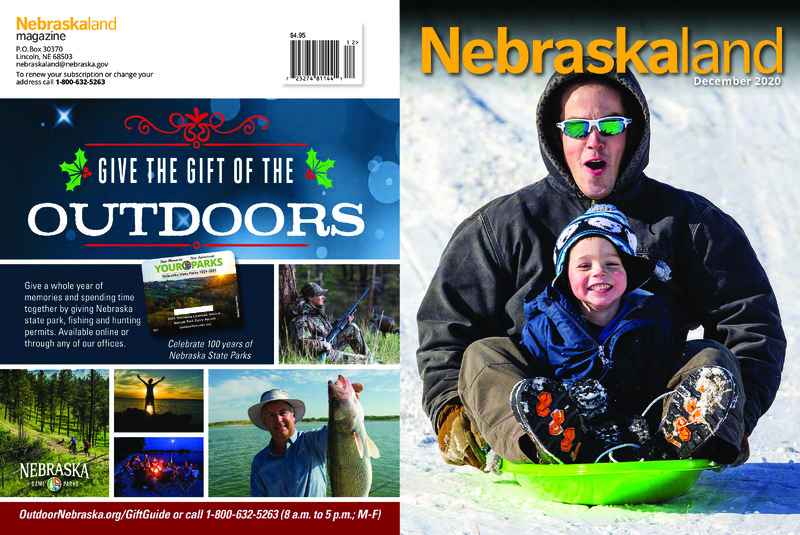
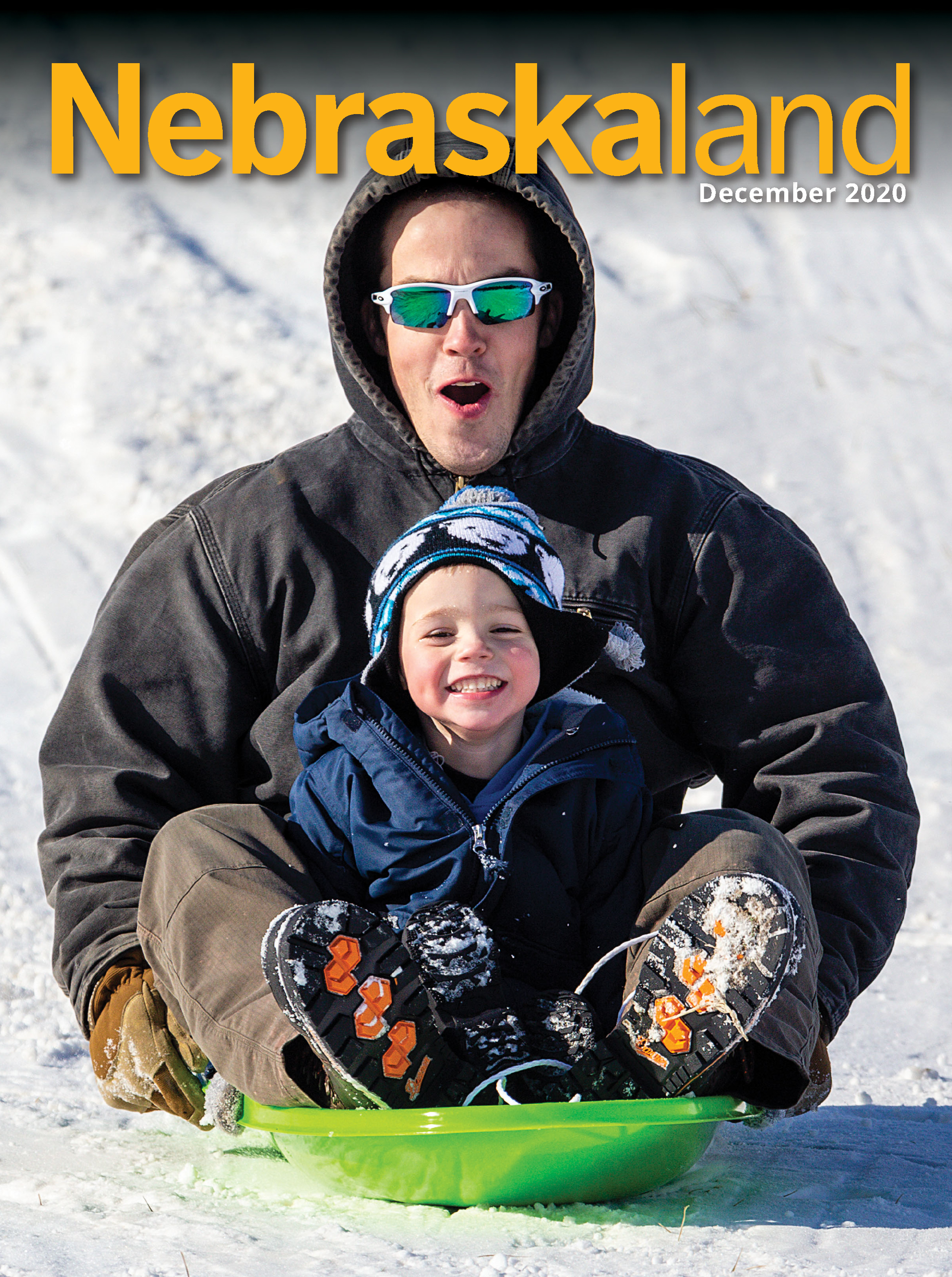
Cover: Darren Kelley and his son,
Maverick, from Ashland sled at
Eugene T. Mahoney State Park.
Photo by Jeff Kurrus
FEATURES
22
THE OUTSIDER
30
OUTDOOR NEBRASKA
32
Story and photos by Jeff Kurrus
What to Do in December
By Renae Blum
ICE BUBBLES
Story and photos by Chris Helzer
40
1,733 MILES FROM SOMEWHERE
42
NOT GOING TO EAT THAT?
46
48
By David L. Bristow, History Nebraska
Your Dog Will
Story and photos by Jenny Nguyen-Wheatley
THE NOT SO PLAIN PLAINS ONION
By Gerry Steinauer
CLEAR CREEK GOOSE HUNT
An Adventure Story
Story and photos by Julie Geiser
DEPARTMENTS
6
10
52
60
62
Your Nebraska
In the Field
Mixed Bag
Portraits from the Past
The Last Stop
ON THE WEB
PHOTO BY ERIC FOWLER
To see additional content including photos,
videos and articles, visit
Magazine.OutdoorNebraska.gov/digital.
Nebraskaland (VOL. 98 / NO. 10 ISSN 0028-1964) is published monthly, except for the combined Jan./Feb. and Aug./Sept. issues, by the Nebraska Game and Parks Commission, 2200 N. 33rd St.,
Lincoln, NE. Periodicals postage paid at Lincoln, Nebraska, and additional mailing offices. POSTMASTER: Send address changes to Nebraskaland, P.O. Box 30370, Lincoln, NE 68503-0370.
Magazine Staff
magazine
Published by the Nebraska Game and Parks
Commission since 1926. The Commission is
dedicated to the conservation and protection
of all the state's natural resources and the
people who use them.
Communications Director Christy Firestone
Public Relations Manager Shawna RichterRyerson
Editor Jeff Kurrus
Associate Editor Jenny Nguyen-Wheatley
Regional Editors Eric Fowler, Julie Geiser,
Justin Haag
Contributing Editor Michael Forsberg
Regular Contributors Renae Blum,
Chris Helzer, Chris Masada, Ryan Sparks, Gerry
Steinauer
Art Director Tim Reigert
Graphic Designer Mel Severin
Photo Librarian Jaclyn Cruikshank Vogt
Administration
Director Jim Douglas
Deputy Director Tim McCoy
Commissioners
Chairman - Dan Kreitman, Wahoo
Vice Chairman - Pat Berggren, Broken Bow
2nd Vice Chairman - Rick Brandt, Roca
Robert Allen, Eustis
Donna Kush, Omaha
Scott Cassels, Omaha
Jim Ernst, Columbus
John Hoggatt, Kearney
Doug Zingula, Sidney
Circulation
For address changes and questions about your
subscription, call 800-632-5263
Advertising Sales Manager
For advertising information contact
Shane G. Gilster, 402-742-0125
Email: shanegilster@gmail.com
Nebraskaland Magazine Copyright 2020, all rights reserved.
Nebraskaland is available in audio from the Nebraska Library
Commission Talking Book and Braille Service, Suite 120, 1200 N St.,
Lincoln, NE 68508. 800-742-7691. Nebraskaland Magazine and the
Nebraska Game and Parks Commission reserve the right to reject any
advertising not in keeping with the agency mission.
Rates: $18 for one year; $33 for two years; $44 for three years. Nebraska
recipients must add appropriate sales tax. To subscribe call
1-800-NEBLAND (632-5263), or go online to:
NebraskalandMagazine.com.
Commission Offices
Conservation Officers
Headquarters/Southeast District Office
2200 N. 33rd Street Lincoln, NE 68503
Phone 402-471-0641
ADMINISTRATION (Lincoln)
Craig Stover (Administrator)
Duane Arp (Asst. Administrator)
Jeff Clauson (Asst. Administrator)
Travis Shepler (Asst. Administrator)
Northeast District Office
2201 N. 13th St. Norfolk, NE 68701
Phone 402-370-3374
Southwest District Office
301 E. State Farm Rd. North Platte, NE 69101
Phone 308-535-8025
Northwest District Office
East Hwy. 2, Box 725 Alliance, NE 69301
Phone 308-763-2940
Bassett Office
524 Panzer St., Box 508 Bassett, NE 68714
Phone 402-684-2921
Kearney Office
1617 First Ave. Kearney, NE 68847
Phone 308-865-5310
Ak-Sar-Ben Aquarium/Schramm Education
Center
21502 W. Highway 31 Gretna, NE 68028
Phone 402-332-3901
Omaha Office
8495 Frederick Street, Omaha, NE 68124
Phone 402-595-2144
OutdoorNebraska.org
Any program that receives federal funding from the National Park
Service, or the United States Fish and Wildlife Service prohibits
unlawful discrimination on the basis of race, color, religion, age, gender,
marital status, national origin, age, disability or political affiliation. Any
person who believes he or she has been discriminated against in
any program, activity, facility, or service, should contact the Nebraska
Game and Parks Commission, Lincoln, NE 402-471-0641, the Equal
Opportunity Commission, Lincoln, NE 402-471-2024, TTY/TDD 402471-4693; United States Fish Wildlife Service, Civil Rights Coordinator,
4401 N. Fairfax Drive, Arlington, VA 22203; Director, Equal Opportunity
Program, U.S. Department of Interior, National Park Service, 1849 C
Street NW, Mail Code 0008, Washington, D.C. 20240-0001.
4
Nebraskaland • December 2020
402-471-5531
402-471-5531
402-471-5531
402-471-5531
NORTHWEST (Includes counties covered)
Dan Kling (District Supt.)
308-430-0572
Sean McKeehan
(Kimball, Banner, Scotts Bluff)
308-672-1824
Josh Widhelm (Morrill, Cheyenne)
308-279-9133
Kelsey Glodowski
(Box Butte, Sheridan, Grant)
308-763-8226
308-289-2274
Jaden Porter (Keith, Garden)
308-458-7650
Terry Brentzel (Deuel, Garden, Grant)
308-760-0145
Sean Schultz (Keith, Arthur)
308-289-9580
Keith Jadlowski (Keith, Deuel)
NORTHEAST (Includes counties covered)
Tom Zimmer (District Supt.)
402-649-8053
402-760-0712
Dale Davis (Keya Paha, Brown, Rock)
Jonathan Andreasen
(Madison, Pierce, Stanton)
402-340-3981
Nicholas Fix (Dixon, Dakota, Thurston)
402-508-0261
308-430-3984
Kyler Prochaska (Platte, Colfax)
402-719-6226
Kyle Gaston (Dodge, Colfax)
402-613-8612
Mitch Johnson (Knox, Antelope, Pierce)
402-762-5022
Jeff Jones (Knox, Cedar)
402-380-6410
Cory Krause (Cuming, Wayne, Stanton)
Ethan Teter (Boating Officer-Dodge, Colfax) 402-620-8129
CENTRAL (Includes counties covered)
Mike Thome (District Supt.)
Matt Taylor (Thayer, Fillmore, Nuckolls)
Mark Sullivan (Nance, Polk, Wheeler, Boone)
Matt Brandt (Sherman, Howard)
Greg Hesse (Buffalo, Kearney)
Tim Williams (Hall, Hamilton, York)
Doug Pollard (Loup, Garfield, Valley)
Eric Javins (Adams, Clay, Webster)
Pat George (Harlan, Franklin, Phelps)
Daryl Teter (Howard, Greeley, Merrick)
308-293-8746
402-200-9597
402-741-0636
308-202-0819
402-440-3847
308-380-7331
308-730-7050
402-902-2017
308-920-2762
308-440-1863
SOUTHWEST (Includes counties covered)
Roger Thompson (District Supt.)
308-530-3097
Matt Andrews
(Furnas, Gosper, Frontier, Red Willow)
308-746-2418
Brian Piernicky
(Red Willow, Frontier, Hayes, Hitchcock)
308-340-6627
John Lee (Dundy, Chase, Hayes, Hitchcock)
308-414-1432
Brandon O’Neal
(Lincoln, McPherson, Logan)
308-530-3157
Alex Hasenauer (Lincoln, Perkins)
308-660-4671
402-266-1759
Owen Johnson (Dawson, Gosper, Custer)
308-870-0322
Ray Dierking (Custer, Thomas, Blaine)
402-389-0444
Frank Miller (Cherry, Hooker)
308-217-2108
Taylor Dixon (Dawson, Gosper)
Kevin Bergstrom (Boating Officer-Lincoln) 308-520-1031
SOUTHEAST (Includes counties covered)
Stacey Lewton (District Supt.)
402-890-7140
402-619-1355
Rich Berggren (Douglas)
402-616-5961
Dan Evasco (Sarpy)
402-210-0888
Heath Packett (Cass)
402-209-1506
Russell Mort (Otoe, Johnson)
402-890-6463
Dina Barta (Lancaster),
402-937-3422
Dudley Sorensen (Lancaster)
402-646-0420
Bryce Streger (Seward, Saline)
402-314-9641
Trevor Stahlecker (Lancaster)
402-853-3273
Scott Eveland (Lancaster)
402-806-0915
Matt Seitz (Gage, Jefferson)
402-443-6392
Mike Luben (Saunders, Butler)
YOUR NEBRASKA
Instagram Photos
Follow us (@nebraskaland)
and tag us in your photos
to be featured in an
upcoming issue.
@sandandsagedesigns
Fort Rob Longhorn
Karen Kutz Smith, Omaha
Burrowing Owl
6
Nebraskaland • December 2020
@Jwine05
Feeling Small? Keep Working
December 2020 •
Nebraskaland
7
YOUR NEBRASKA
Sam Reagan, Grand Island
Evergreen Robin
Send your comments and photos to:
Jeff Kurrus, Editor
Nebraskaland Magazine
P.O. Box 30370
Lincoln, NE 68503
or email Jeff.Kurrus@Nebraska.gov
Please include your postal address
and telephone number. Letters may be
condensed and edited. Photographs are
also welcome.
8
Nebraskaland • December 2020
December 2020 •
Nebraskaland
9
IN THE FIELD
CAUTIOUSLY AWARE
A wary mule deer
(Odocoileus hemionus)
peeks out from behind a
thicket near Chadron in
Dawes County.
PHOT
O O BY
Y JUS
US
STIN
N HAA
HAAG
AAG
AA
10
Nebraskaland • December 2020
December 2020 •
Nebraskaland
11
PHOTO COURTESY OF SOUTH DAKOTA GAME, FISH, AND PARKS
IN THE FIELD
THREATENED AND ENDANGERED:
THE NORTHERN REDBELLY DACE
By Melissa Panella
The northern redbelly dace (Chrosomus eos)
has a name that sounds fitting for the holidays.
This little minnow is among the most colorful
in the state and appears festive in its attire of
glitzy red belly and olive-colored back. Northern
redbelly dace frolic in small, cool-water streams
located mostly in Nebraska’s Sandhills.
In Nebraska, northern redbelly dace have
been limited to the relatively small headwater
tributaries of the Niobrara, Loup and Platte
rivers. They use cool, clear streams with slowmoving water, which are spring-fed from the
Sandhills and are shaded by logs and brush.
Most cool-water streams range in temperature
between approximately 62 and 72 degrees
Fahrenheit. Northern redbelly dace also are
found in the quiet waters of marshes or ponds
built by beavers. They eat algae, plant material,
zooplankton, invertebrates and occasionally
other small fish. Northern redbelly dace do
not seem to have the ability to move from one
river basin into another, so they are dependent
12
Nebraskaland • December 2020
on high-quality conditions and availability of
natural resources where they currently live.
The northern redbelly dace is listed as a
threatened species in Nebraska, because there
are few places that satisfy this minnow’s
specific habitat needs. Changes like channel
modification, culverts and water-control
structures can affect the spring-fed streams
this species relies upon and lead to population
declines. Populations of northern redbelly dace
are vulnerable to threats in several other states
as well.
The good news is that northern redbelly dace
can successfully be conserved in Nebraska.
Their populations can be sustained as long
as the creeks they inhabit are kept in good
condition and not overrun with predatory or
exotic fish. It is also important not to collect
this small minnow as a bait fish. With a bit
of care, northern redbelly dace can continue
to enliven Nebraska’s cool-water streams with
their bright, jolly colors.
PHOTO BY SHARLA MEESTER
IN THE FIELD
AN IRRUPTIVE BUT WELCOME
VISITOR FROM THE NORTH
By Stephen J. Brenner, Nongame Bird Biologist
For many species of birds, annual migrations and seasonal
movements follow relatively predictable patterns. This is not
to downplay the awesome feat of bird migration — flying
from South America to North America and back in the same
year is no easy task. For most species, though, these longdistance routes are more or less the same for generations of
individuals.
Most warblers, vireos and flycatchers, for example, will
leave their wintering grounds in Central and South America to
pass through the Great Plains in spring, breed in the northern
forests of Canada in summer, and then fly back down south
and cross the Gulf of Mexico to get back to the tropics by the
end of autumn.
For some species, however, annual movements, particularly
where individuals will spend the winter, is not so predictable.
These species have “irruptive” movements between breeding
and wintering grounds that can change literally from one year
to the next. These irruptions usually occur due to limitations
or surpluses in a given species’ food supply.
One of the best and most beautiful irruptive North American
species is the common redpoll. Redpolls are a quintessential
songbird of the far north, breeding in the taiga and scrub14
Nebraskaland • December 2020
dominated edges of the tundra in Canada and Alaska. So why
are redpolls considered an “irruptive” finch? Redpolls (like
other breeding finches of the far north) will follow the seed
production of plants like spruce, birch and pine. And in years
when these plants struggle up north, redpolls will move south
to find greener pastures. This is why observers in states like
Nebraska see variable numbers of redpolls in consecutive
winters. In years where the seed crop up north is productive,
Nebraska hosts few redpolls, making our winters much less
colorful.
The good news — experts predict there is a good chance
redpolls will move south in larger numbers this winter. Redpolls
will readily visit feeders and could easily be overlooked when
occurring with groups of more common species, such as the
similarly sized American goldfinch. Redpolls also can be
found in birch trees and weedy fields.
Their plumage is generally frosty white with drab brown
tones featuring extensive streaking on the flanks; they also
have tiny bills. Males sport a bright red cap and even brighter
pink breast, which offers an excellent contrast to the white
plumage of their bellies and the white snow covering your
tray feeder this winter.
PHOTO BY ERIC FOWLER
IN THE FIELD
KATE’S BARS: A REVIEW
By Eric Fowler
Granola bars have been a staple in my pack
forever — a simple, convenient way to keep
fueled up on a pheasant hunt or stoke a fire
on a long, cold day in the photo blind. There
are plenty to choose from, many of which are
loaded with sugar and artificial ingredients:
Things my wife likes to call “crap.”
A line of energy bars from Kate’s Real Food
have none of that. They are made simply,
with organic ingredients including oats,
chocolate, peanut butter and fruit, and are
sweetened with natural honey. There are no
empty calories here, Kate’s says, only real
food and real energy. There’s no gluten either.
As for the taste? Each of the six flavors
16
Nebraskaland • December 2020
offered are excellent, but the Grizzly Bar,
with peanut butter and dark chocolate, tops
the list for me. The Tiki Bar, with mango
and coconut, is a close second. I’m not sure
why anyone would prefer milk chocolate, but
the Tram Bar, which Kate Schade concocted
as a snack to fuel her days on the slopes in
Jackson Hole and was the bar that launched
her company, might be your pick.
So if you’re looking for something to throw
in your pack as you head to the deer stand
or duck marsh this month, look for Kate’s
Real Food energy bars online or at a Natural
Grocers, Whole Foods or Wal-Mart near you.
For more, visit katesrealfood.com.
December 2020 •
Nebraskaland
17
PHOTO BY CHRIS HELZER
IN THE FIELD
CIRCLES IN THE SNOW
By Martha D. Shulski
Snow cover provides a wealth of opportunities for outdoor
enthusiasts. It insulates the ground during cold spells, helps
replenish soil moisture reserves as meltwater percolates and
unfortunately, helps to increase flood risk under the right
conditions. As snow melts, we witness fluxes of energy.
While probably not the phrase you were expecting, a transfer
of energy is ultimately what causes solid crystals to morph
into liquid fortunes.
Energy we receive from the sun, called shortwave radiation,
is one factor that produces snowmelt. The most obvious,
but not the most powerful, is through direct absorption of
sunlight by the snow.
Snow is a great reflector of those solar rays; a lot of energy
— sometimes up to 95 percent — simply bounces off, so to
speak.
However, when this shortwave energy is absorbed by
any object not covered by snow, such as tree trunks, fence
posts or grasses, that’s when the magic happens. These
18
Nebraskaland • December 2020
darker objects absorb sunlight — 80 percent more than
snow — and transform solar into thermal radiation, which
warms the surrounding air. Melt circles start to form around
these objects, and the bright white blanket slowly darkens.
As more ground is exposed, more sunlight is absorbed by
the darker landscape, which heats the surface and the air,
speeding up the melting process.
Other fluxes of energy result in snowmelt also. A warm
ground can transfer heat to the snowpack, nudging the
melting process. Water vapor in the atmosphere can land on
the snow causing melt through condensational warming. In
fact, this has been shown to produce significant melt during
warm spells in the winter when sun angles are low.
Finally, rain on snow is a rapid, but sometime destructive,
way to cause snowmelt; just think of March 2019 as an
example.
Here’s hoping you can enjoy the snow before energy fluxes
transform the white canvas back to familiar hues.
December 2020 •
Nebraskaland
19
PHOTO BY JEFF KURRUS
IN THE FIELD
LET ’EM HUNT
By Todd Mills
Enabling others is a natural action
for many, and much like we can enable
our children, we can also enable our
hunting dogs. We want the best for
them. Why not try and help them by
doing some of the work? I will tell you
why. Your hunting dog has been bred
to hunt. Let ’em hunt.
Growing up in a small northwestern
Iowa town, upland hunting was my
first love. And unlike Nebraska, Iowa
allows hunters to hunt the road sides
and ditches. The shooting hours
also close earlier in the day, at 4:30
p.m., and each day before that time
we would drive dirt roads looking for
birds as they came to the road for
gravel.
Even when we spotted roosters,
the birds would often slip us, either
by running out into the corn field or
just sitting tight. Many times, I would
leave the ditch and quickly get to my
20
Nebraskaland • December 2020
truck, wanting to get on to the next
spot while the dog would mysteriously
stay in the ditch. I would yell at the
“undisciplined” dog for not coming
to my side. Moments later, a rooster
would explode from underneath while
I stood there with no gun and my
mouth wide open.
It was in those early days that I
learned my lesson on paying close
attention to every detail in my dog’s
body language. Here are a couple of
tips that might help you understand
what your dog is trying to tell you.
Water Dogs
Put your dog in a place where she
can see the bird fall. But if you can’t,
then she must be able to take direction
from you. If your dog has been trained
to take hand signals in water and land,
allow her to work the area thoroughly
before giving her any direction.
Dogs that have been enabled are
constantly looking back, hoping you
can provide some help when all they
really need to do is hunt the area
they’ve been sent. And if at all possible,
don’t walk to the area the bird fell
without allowing the dog to search.
Field Dogs
Pretty simple rule here. Stay on your
dog’s tail. Regardless of where you
think the birds might be, your dog
always knows best. Learn the body
language and cues your dog gives
when she’s on a trail.
Training dogs is time-consuming,
repetitive and rewarding. Remember
that just like children, they have to
find their way. Patience and a firm
belief in the process will allow a good
gun dog to prosper in the field.
December 2020 •
Nebraskaland
21
THE OUTSIDER
STORY AND PHOTOS BY JEFF KURRUS
A combination of early-morning sun and smoke
from breakfast in the goose blind make for
interesting rays of light.
22
Nebraskaland • December 2020
December 2020 •
Nebraskaland
23
ABOVE LEFT: Hunters arrange goose decoys on New Year’s
Day outside of Ashland.
BELOW LEFT: A Lab retrieves a Canada goose.
BELOW RIGHT: A hunter looks out of the blind, his lanyard
of calls and bands indicative of his time in a waterfowl blind
throughout the years.
“I won’t,” I smiled. “I can promise you that.”
As a Nebraskaland photographer, you’re along for the ride.
I’ve never been put in an illegal or compromising position,
but I’ve been with multiple people who were unfazed by my
fancy camera equipment, people who simply wanted me to
take whatever was thrown my way.
I received one of these potential curveballs in 2014
while covering the Patriot Hunts program, an organization
dedicated to planning hunts for wounded veterans, first
responders and their families. I walked into a cabin that
housed a group of Purple Heart recipients and knew the
I
know when I’m the outsider. As a longtime Nebraskaland
Magazine writer and photographer, I’m well aware when
I’m interrupting someone’s hunting or fishing trip. So
when I went on a top-secret hunt near Ashland with a group
of hunters I barely knew, I had been gifted an exclusive trip.
But it wasn’t the first time I had been on a hunt like this.
On the night before the open day of pheasant season in
2008, I was at Frank’s Bar with Scott Miller of Lincoln and
his friends before hunting his dad’s land near Trenton. I
was about to witness my first true Nebraska pheasant hunt,
complete with the stop-off trip at Cabela’s on the way out
for last-second supplies, a group dinner and hunting on land
that had been in the family since 1942.
So when Russ Schellpeper, a close friend of Scott’s, came
up to me in the bar — his 6’3 frame gazing down at me in
a not quite grimacing, but definitely not inviting, glare — I
was ready for just about anything.
“It was Scott’s idea to bring you here,” he said. “Not mine.”
I took a sip of my beer and continued to stare at him,
knowing he wasn’t finished.
“We do this every year, and we do things a certain way.
Don’t mess it up.”
24
Nebraskaland • December 2020
December 2020 •
Nebraskaland
25
ABOVE RIGHT: My host poses with a white Lab and mallard
shot near Ashland.
BELOW LEFT: A homemade ice-breaking airboat is employed
during a frosty morning goose hunt near Ashland.
atmosphere before I entered.
They bantered constantly, counting each others’ bullet
holes and shrapnel wounds and searching for anything
they could find to make fun of each other. So when they
said to me, “So you’re the guy they sent from Cosmopolitan
Magazine,” all I could do was smile. Then I immediately
retaliated, knowing they would have swallowed me for sure
if I backed off in any way.
Schellpeper had prepared me to respond to just about any
situation, as I made it a point to hustle like crazy getting
every image I wanted on his opening day pheasant hunt with
him barely knowing I was there. The result: We’ve hunted
together multiple times since and text each other frequently
— usually questionable insults left best off the pages of this
family publication.
So when I was invited into the Ashland blind last winter
26
Nebraskaland • December 2020
with a group of people I did not know, I was extremely
prepared for anything that would come my way. There were
the few, customary questions that arise regarding “how
did you get into this line of work” and “how did you get to
Nebraska in the first place” because of my Southern accent,
but I knew I had not impressed them in any way.
But I was OK with that. See, just as they have their hunting
crew, I have mine. We do things a certain way, invite the
people we want to go and the days’ assignments usually go
like clockwork. It’s smooth. Comfortable.
When we host an outsider, it often works out perfectly. But
there was at least one day I was hunting with a new partner,
and he told me that the tom turkey we were pursuing wasn’t
worth the 400-yard walk through a muddy creek bottom to
get to him. We never hunted together again.
Much like I don’t know if I’ll hunt with the Ashland crew
again. They have their system. They know who’s calling
and who’s calling the shot. They know who’s cooking, who’s
putting out decoys and who’s assigned to the homemade
airboat to retrieve birds or open up a hole skimmed with
ice.
Geese are their preference. While they killed several
mallards, the ducks were an afterthought. I’ve hunted with
duck hunters who travel the entire Central Flyway in pursuit
of greenheads and would never be able to comprehend this.
But you know what? This crew could care less what those
guys think. They’re after Canada geese and, quite frankly,
they didn’t invite you in the first place.
They did invite me, however, and I remain very grateful.
Through my years of working for Nebraskaland Magazine,
the people I have met and the memories I have made and
witnessed are immense. The Summit Lake ice-fishing cook-
out of 2010 ranks right up there with the coyote hunting trip to
the Sandhills with Chris Pokorny in 2012. The quickest turkey
hunt I ever covered was with then-18-year-old Brad Cheloha
of Columbus, and one of the longest was with then-63-yearold Lloyd Warren of Beatrice and his son, James.
My memories of this day near Ashland, less than 15
minutes from my house, as an outsider are just as special.
From the airboat ice breaker to the indelible image of the
retriever walking the dead goose through the decoys, I’ll
never forget this day.
If not for the images I was able to capture, but for one more
reminder of how thankful each of us should be if we have
someone to hunt with. N
Thanks to Andy Mink of Complete Retrievers. Learn more
about his dogs at completeretrievers.com.
December 2020 •
Nebraskaland
27
A Canada goose is retrieved during my
waterfowl hunt near Ashland.
28
Nebraskaland • December 2020
December 2020 •
Nebraskaland
29
Outdoor Nebraska
What To Do in December
By Renae Blum
Stargazing
Throughout the month | Statewide
In December, stargazers can witness a
transition between summer and winter
constellations. Stay up late enough and
you’ll see summer constellations going
down in the west and winter ones coming
up in the east. Also, mark your calendar
for the Geminid meteor shower on Dec. 1314, most likely the best of the year, and the
conjunction of Jupiter and Saturn on Dec.
21. The two will look like a double star in the
western sky.
CROSS-COUNTRY SKIING AT INDIAN CAVE STATE PARK
PHOTO BY ERIC FOWLER
A BLUE JAY AT A FEEDING STATION IN DAWES COUNTY
PHOTO BY JUSTIN HAAG
STARS ABOVE PONDEROSA WILDLIFE MANAGEMENT AREA
PHOTO BY JUSTIN HAAG
It’s a mistake to think there’s nothing to do outdoors in the
winter. There is, with just a little creativity and a warm coat.
Try any of these activities to get started. N
Snowshoeing and cross-country
skiing at Ponca State Park
As weather conditions allow
Throughout the month | Statewide
Food is scarcer for birds in the winter, so give them a boost with a backyard bird
feeder or two. Black oil sunflower seeds, peanut kernels, white proso millet and
Niger thistle are all great options, but you can experiment to see what type of
feed works best in your area. Providing a source of open water also is a great
way to attract birds.
Muzzleloader
deer hunting at
southeastern WMAs
Ice-fishing at
Frye Lake
Nebraska’s Sandhills lakes are generally
great ice-fishing destinations, and Frye
Lake is one of the best right now with
good numbers of quality panfish and lots
of bass. As with any ice-fishing outing,
a good strategy is to keep moving and
cutting holes until you find the fish.
30
Nebraskaland • December 2020
Throughout the month
LARGEMOUTH BASS CAUGHT WHILE ICE-FISHING
PHOTO BY JEFF KURRUS
As ice conditions allow
MUZZLELOADER DEER HUNT WITH JOSHUA NETHERTON (LEFT) AND MENTOR, TOM WELSTEAD.
PHOTO BY JENNY NGUYEN-WHEATLEY
Snowshoeing and cross-country skiing are a draw for visitors
at Ponca State Park. Throughout the winter, the park provides
groomed cross-country skiing trails when there’s adequate
snow. However, visitors are free to snowshoe or cross-country
ski at any time. Come and see the most popular views at the
park during a unique time of year.
Winter bird feeding
Among the wildlife management areas
in southeastern Nebraska, three of them
— Hickory Ridge, Osage and Table Rock
— stand out. These large, heavily wooded
areas have good hunter access, are well
managed, and hold good populations of
game animals. They’re also off the beaten
path, so usually you’ll encounter less traffic.
December 2020 •
Nebraskaland
31
Ice
Bubbles
Story and photos by Chris Helzer
A
s a photographer drawn mostly to small
subjects like bugs and flowers, it can be hard
to find much to photograph after the end of the
growing season. Most invertebrates die, migrate or go
dormant. Plants wither and turn brown. It’s fun to seek
out interesting texture and patterns after a fresh snow
or on a frosty morning, but those opportunities are
relatively uncommon during most winters.
When I start to feel especially stir crazy, one of my
go-to remedies is a trip to a frozen pond or wetland.
As long as it’s cold enough to freeze the surface of
those water bodies, I can usually find something
worth investigating and photographing up close.
ABOVE: Pockets of air trapped in the ice along a wetland edge create intriguing
patterns at the Nature Conservancy’s Platte River Prairies in Hall County.
LEFT: The texture of the ice surface made these bubbles look like part of a painting
at the Nature Conservancy’s Platte River Prairies.
32
Nebraskaland • December 2020
December 2020 •
Nebraskaland
33
Sometimes, I find insects, seeds
or other little treasures encased in
ice. Other times, I enjoy exploring
the shorelines and other edges
where ice freezes, thaws and
refreezes, forming intricate lines
and designs. Those options,
though, pale in comparison to my
favorite subjects: ice bubbles.
I’ve spent many happy hours
wandering across the ice with my
eyes pointed downward, searching
for bubbles. Some might call
that eccentric or strange. I prefer
“peculiar,” but either way, it sure
beats sedentary boredom. Sure,
it’s cold, and I am always worried
about having 4 inches of clear,
solid ice, but the fresh air and
exercise is perfect. Plus, I try to
stick to shallow wetlands or pond
edges where the water is only a
few feet deep.
Besides enjoying the aesthetic
beauty of frozen bubbles, I also
like trying to figure out the science
behind what I’m seeing. I think I
understand the basics, but I can’t
always decipher the chemical and
physical processes that form those
little capsules of air within the ice.
I’ll try to share what I’ve gleaned
from reading and talking to other
scientists, but I know there are
nuances I haven’t yet grasped.
The Science
Trying to figure out the reasons for various bubble/air pocket shapes — as seen above at Lincoln Creek in Aurora — is fun,
but sometimes it’s nice to just appreciate the results.b
34
Nebraskaland • December 2020
To start with, water has in it
a lot of gases, including oxygen,
carbon dioxide and methane.
Oxygen is released by actively
respiring plants. Carbon dioxide
is a byproduct of carbon-based
life forms like plants and animals
being broken down by aquatic
bacteria and other microbes.
Methane is produced when that
same decomposition happens in
the soil beneath the water, where
low levels of oxygen (anaerobic
December 2020 •
Nebraskaland
35
ABOVE: The streams of bubbles from this dead damselfly
larva may be a result of air being forced from its body as it
froze.
LEFT: Wetlands like this one at Deep Well State Wildlife
Management Area can be a treasure trove of frozen bubbles
and other surprises.
conditions) exist. Those and other gases remain dissolved in
the water of ponds and wetlands, where they are repeatedly
cycled in and out of plants, animals and microscopic creatures
of many kinds.
The other important factor to understand is that frozen
water can hold less air (those combined gases) than liquid
water can. Have you ever looked closely at ice cubes when
you pull them out of the tray in your freezer? Often, the
outer edges of the cubes are clear, but the center is opaque.
That opaqueness is the result of countless miniscule bubbles
in the middle of each cube. As the water in the tray freezes
from the outside in, that cooling water forces out the air it
can no longer hold in solution. Much of that air gets pushed
toward the center of the cube until it erupts into tiny bubbles,
36
Nebraskaland • December 2020
around which the remaining water freezes.
As I understand it, bubbles of air in frozen lakes and
wetlands arise from the same basic process. Air is forced out
of cooling water and forced into “clusters of air” (bubbles)
as ice forms around it. I see a lot of variation in the size,
depth and number of ice bubbles during my explorations. I
assume the speed with which the water freezes plays a big
role in that, in addition to some other factors. An example of
one of those other factors is when the top of the ice thaws
on a warm day and then refreezes overnight. The air being
squeezed out by freezing water is prevented from being
pushed continually lower by the layer of hard ice below it.
That has to influence how the resulting bubbles look, but I’m
far from smart enough to predict the result.
Other Phenomena
When I’m out, I also notice and photograph other intriguing
phenomena, such as pockets of air around plant stems and
“streams” of tiny bubbles radiating outward from both plants
and dead animals embedded in ice. The pockets of air around
plant stems, especially close to the top surface of the ice,
might be caused by the ice melting around the edges of those
stems as the sun warms them. The streams of tiny radiating
bubbles are a little trickier for me to explain, but I suppose
it has to do with air being forced out of the saturated dead
insects, leaves or stems as they freeze.
Sometimes, the majority of ice in a frozen wetland is
as opaque as the center of those ice cubes I mentioned
earlier, and there’s not much to photograph. If I were better
organized and analytical, I’d try to keep track of the weather
and other conditions that lead to the formation of opaque
ice. That would save me the disappointment of bundling up
on a cold blustery day, only to find ice I can’t do much with
photographically.
On a good day, though, I’ll find that the surface of a
wetland or lake has numerous layers and patches of ice that
have frozen and formed in various ways. As I explore those
sites, I’ll often find clear ice with bubbles visible several
inches or more below the surface, various colors and tones
of frozen water, and air pockets and streams of tiny bubbles
around frozen plants and other organisms — especially near
the shore.
December 2020 •
Nebraskaland
37
Looking Peculiar
When the conditions are right, I can spend hours happily
hunched over or prostrate on the ice with my camera and
tripod. While I don’t see anything strange about that, I’m
sure others disagree. I usually try to find locations far from
roads, but sometimes I have to endure the periodic pickup
or other vehicle slowing down as they pass by. The driver
usually gives me a side-eye stare — you know, the one with
38
Nebraskaland • December 2020
which they pretend to be looking straight ahead while using
every bit of their peripheral vision to record what I’m doing,
as well as my license plate and general description.
I can imagine the subsequent conversations later, with a
spouse or neighbor:
“Did you notice that peculiar stranger out on the wetland
today? He can’t be ice fishing in a foot and half of water, can
he? What in tarnation do you suppose he’s up to?”
I’m not sure the truth would make them feel any better.
Maybe one of these days, a brave and curious passerby will
stop and make their way out to where I’m photographing
bubbles to ask me about it. If so, maybe we can have a lively
and engaged conversation about the air-holding capacity of
freezing water. Or maybe they will pull out their own camera
and begin photographing ice bubbles, too. N
ABOVE: Radiating streams of bubbles from a plant stem
beneath the ice at the Helzer family prairie.
LEFT: Bubbles, duckweed and rushes in a frozen wetland at
the Nature Conservancy’s Platte River Prairies.
Chris Helzer is the Nature Conservancy’s director of science
in Nebraska.
December 2020 •
Nebraskaland
39
1,733 Miles from Somewhere
By David L. Bristow, History Nebraska
earney has long promoted itself as the “Midway City”
located halfway between the coasts, exactly 1,733 miles
from both Boston and San Francisco. The number 1733
shows up in various places. There was the 1733 Ranch
with what was said to be the world’s largest barn. Local signs
and maps touted the number, and not many years ago, a
Kearney store offered 17.33 percent off during a sale. Back in
the days of the Lincoln Highway (present day U.S. 30), a road
sign boasted that Kearney was “1733 miles to Frisco, 1733
miles to Boston.”
University of Nebraska-Kearney geography professor John
Bauer became fascinated with the number. It didn’t seem to
add up. On a U.S. map, Kearney looks closer to San Francisco
than to Boston. Bauer noted the great circle distances as
1,263 miles between San Francisco and Kearney, and 1,486
between Kearney and Boston. Was 1,733 simply a made-up
promotional claim by local boosters?
K
Shown in about 1890, Kearney’s Midway Hotel (1808 Central
Ave.) advertised itself as being 1,733 miles from both San
Francisco and Boston. History Nebraska RG2178-18
Originally known as the Watson Ranch, the 1733 Ranch
had a 500-foot-long dairy barn that was a Lincoln Highway
landmark. History Nebraska RG2608-0-2951
Digging deeper, he found that some people claimed that the
1,733 distance was based on the old Lincoln Highway. Bauer
checked a 1915 Lincoln Highway guidebook. It measured
1,752 miles from San Francisco and 1,632 miles from New
York City, where the highway ended. The Lincoln Highway
didn’t even go to Boston.
So it was starting to look like 1733 was a made-up number,
or at best a wild guess by Kearney boosters. This is the town,
after all, that once campaigned to replace Washington, D.C.,
as the U.S. capital. What wouldn’t Kearney say to puff itself
up?
Bauer was curious as to when this idea originated and how
it fit with the city’s self-promotion as the “Midway City.” That
led him to sources much older than the Lincoln Highway.
Turns out the boosters were right. Bauer found the answer
by looking at early railroad maps and timetables. The 1,733
figure matches an old railroad route, and has been promoted
by the city since at least 1890.
Bauer’s article, “1,733 Miles from Where? Kearney,
Nebraska’s 1733 Identity” appeared in the Summer 2015 issue
of Nebraska History Magazine. N
Early 1920s photo showing the Lincoln Highway sign erected near the 1733 Ranch. Courtesy of Bob Puschendorf
40
Nebraskaland
• December 2020
The 1733 Ranch’s central location was a big part of its
marketing. History Nebraska RG3316-0-61
Visit History Nebraska’s website at history.nebraska.gov.
December 2020 •
Nebraskaland
41
Not Going
to Eat That?
Your Dog Will
P
Story and photos by Jenny Nguyen-Wheatley
heasant heads, freezer-burned fish, deer liver, duck feet … these are things that
I might have tossed in the past. There are parts of an animal that I simply can’t
use. Or waste from freezer-burned meat. Or meat that ended up not tasting good. I
hate waste, but it happens. So, when my husband and I brought home our 8-weekold Pembroke Welsh corgi puppy last winter, our problems were solved. I’ve come
up with a few creative, easy ideas to use as much of the game and fish that we
accumulate throughout the year as possible.
But first, talk to your pet’s veterinarian before introducing any new foods. Once
you get the OK, have fun exploring these wild treats.
Bird Heads
Pheasant, chukar, grouse, duck, etc., all work here. The bones in the heads of game
birds are soft, and the meat and brains are enticing to dogs. With kitchen shears, cut
off the beaks before offering to your dog (not pictured), which can be sharp and hard.
Do not offer head-shot birds to avoid lead poisoning.
ABOVE: The author’s puppy, Fergus,
enjoying dehydrated walleye skin.
LEFT: The bones in the heads of
game birds are soft, and the meat
and brains are enticing to dogs. The
feathers also could be beneficial to
a dog’s digestion, but make sure you
cut off the beaks before eating (not
shown).
42
Nebraskaland • December 2020
My dog digests limited amounts of feathers OK. According
to many sources, including nakedbeasts.com — who provides
“holistic healing pet treats and chews for dog and cat owners
— fur and feather in a canine’s diet can be beneficial: “The
fur and feathers are fully digestible and provide an essential
source of manganese as well as a natural means of colon
cleansing. By allowing the natural fibers of the fur and hair to
sweep off the excess debris of food and gunk along your pet’s
intestinal walls, they are more readily available to absorb
minerals and nutrients more efficiently.”
Feed fresh or for longer shelf life, dehydrate in a food
dehydrator. To dehydrate, run kitchen sheers along the
neck and top of the head to open up the head cavity, which
will allow them to dry more thoroughly and prevent early
spoilage. Dry times will vary, but I like to dry at 135 degrees
for about 4 hours and then turn the temperature up to 165
December 2020 •
Nebraskaland
43
Venison flank is heavily laced with silver skin, and it’s a chore to clean. However, with minimal effort, you can turn it into jerky
for your dog.
for dogs, so it makes me feel good that I no longer have to
leave most of the liver with the gut pile. I keep it frozen until
we’re ready to make these treats.
Cut the liver into fourths and soak it in water for 30 minutes
to release excess blood. Then rinse and cut into bite-size
pieces, accounting for 30 percent shrinkage. Pat completely
dry with paper towels. Lay on dehydrator trays, allowing
room in between each piece for air flow, and dehydrate at 135
degrees for 3 hours. Then turn up heat to 165 and dehydrate
until fully dried but still chewy.
Duck/Goose Feet
Organ meat should be an essential part of every dog’s diet, and deer liver is fully loaded with vital nutrients. The next time you
shoot a deer, take the liver home to make chews for your dog.
degrees until fully dried. Allow heads to cool completely
before storing them in a partially closed zip-top bag in the
refrigerator. Watch for condensation in the bag, which would
indicate that the heads were not fully dried.
Use within two weeks. Freeze for longer storage.
Fish Jerky
Jerky is a great treatment for freezer-burned fish fillets or
fish that might not taste as good as you’d hope. My husband
caught a whole mess of bullhead catfish one summer, which
were unfortunately unpalatable for the table — no problem
for Fergus though. Dry boneless fillets at 165 degrees for
several hours; dry time will vary.
Store in the refrigerator for up to 1 month. Vacuum seal
and/or freeze for long-term storage.
44
Nebraskaland • December 2020
The bones in duck or goose feet don’t splinter, and they are
full of beneficial cartilage. Wash feet thoroughly and clip off
the toenails before feeding fresh to your dog. For a longerlasting treat, dehydrate waterfowl feet at 165 degrees until
fully dried.
Deer Flank Jerky
That thin flap of belly meat that runs between a deer’s ribs
and its hind end is called the flank. It’s often layered with
silver skin and fat, which I don’t like to run through my meat
grinder because the silver skin binds up my machine. Flank
is too gristly to make jerky for human consumption, and
the thick layers of fat are a pain to remove for slow cooking.
Fortunately, all that won’t matter to your dog. The more
silver skin, the longer the chew will last.
Cut the flank into desired-size pieces and dehydrate at 165
degrees until fully dried. Fat is desirable, but trim off excess
layers; feeding a dog too much fat at one sitting can cause
diarrhea.
Flank jerky will keep in the refrigerator for up to 1 month.
Venison fat can go rancid quickly, so watch for that.
Fish Skin
The bones in duck or goose feet don’t splinter, and they are
full of beneficial cartilage.
Deer Liver Chews
Out of all the wild game and fish I’ve given Fergus, deer liver
chews seem to be his favorite. Organs are highly nutritious
If every angler had a dollar for all the fish they’ve filleted in
their life … . If you can’t turn that work into money, then you
might as well save money by turning the fish skins into dog
treats. Dry fish skins at 165 degrees until fully dried; small
scales are OK. Lay them flat on trays or twist them to make
“sticks.” N
Disclaimer: Feed at your own risk and supervise dogs when
offering wild game treats. Gradually introduce new foods to
avoid stomach upset and account for allergies. Store all treats in
the refrigerator or freezer. If mold occurs, do not feed.
December 2020 •
Nebraskaland
45
The Not So Plain
Plains Onion
wildflowers, to bloom. Abundant soil moisture, for example,
likely stimulates fall leaf growth and photosynthesis
providing the onion with plenty of energy for flowering the
next spring. Well-timed prescribed fire and livestock grazing
in prairies can also stress grasses, reducing competition for
the onion.
In the rough–and-tumble prairie, the Plains onion does not
roll the dice when it comes to flowering and seed production,
which requires extensive energy. In unfavorable years, many
plants survive as a bulb only with no above-ground growth,
or they sprout only leaves and no flowers. The wise little
onion waits patiently for favorable conditions, and only then
does it send forth its beautiful blooms. If lucky, you might be
there to see them. N
Story and photos by Gerry Steinauer
O
f our state’s six species of native onion, the Plains onion,
though small in stature, has the largest, and in my
opinion, most elegant flowers. Unlike the other onions,
its flowers are scented, a sweet fragrance reminiscent of
hyacinths or cloves. Unfortunately, hidden among the prairie
grasses, this uncommon little onion is rarely seen, except
when exposed by its colorful May blooms.
Rose-colored Petals
Aptly named, the Plains onion (Allium perdulce) grows
throughout the central Plains from South Dakota through
central Nebraska and into northern Mexico. In our state, it is
found in mixed-grass prairie mostly on loam to loamy sand
soils, but avoids the pure sands of the Sandhills.
In spring, the plant sprouts two to four slender, grass-like
leaves from a bean-sized bulb with a fibrous coating and
typical onion odor and taste. In favorable years, the bulb also
sends up a single flowering stem at the top of which develops
a tight head of urn-shaped blooms with rose-colored petals
that fade to purple. In the onion’s far southern range, the
flowers are white to pale pink in color, and oddly, nearly
odorless.
After the small, black seeds mature in midsummer, the
stem and leaves wither, and the plant survives the heat of late
summer as a bulb only. In autumn, if moisture is plentiful, the
bulb sprouts a rosette of leaves to harvest the fading sunlight
and replenish its bulb with starches before winter’s onset.
In a rock garden on the warm south side of our brick house,
where the plant is grown as an ornamental, these leaves
persist well into winter, even when covered in snow.
In Nebraska, the Plains onion is most similar in appearance
to the prairie onion (A. textile), which grows in our dry, western
prairies and has white, unscented flowers. The Canada onion
(A. canadensis), common in eastern Nebraska prairies, differs
from the Plains onion by having white to lavender flowers in
an open head. It is also a taller and more robust plant.
The Hidden Onion
The rising prairie sun adorns the delicate flowers of Plains
onion.
46
Nebraskaland • December 2020
During my career, I have crossed paths with the Plains
onion perhaps only 10 times. The first was about 20 years
ago, when I came upon a couple of flowering plants in a small,
degraded prairie in Hamilton County. The largest population
I have encountered was located on a high prairie ridge top
overlooking the Missouri River near Santee and contained a
The Plains onion’s species name perdulce translates from
Latin to “sweet” in reference to its fragrant flowers.
few hundred flowering plants.
The onion grows in a small prairie on our South Dakota
farm where in most springs there are less than 50 flowering
stems. In 2013, the year after the severe drought of 2012, my
wife, Grace, saw a strange phenomenon and called me from
the farm: “There’s a thousand little purple onions blooming
in the prairie.”
“Interesting,” I thought.
The next spring, when the number of flowering onions had
returned to normal, I investigated. On my hands and knees,
I parted the prairie grasses and searched for non-flowering
onions near flowering plants. Sure enough, with leaves
merely a few inches tall, they were far more abundant than
flowering plants. The Plains onion was more abundant in
our prairie, and likely elsewhere, than their blooms typically
indicate.
The 2012 drought set the stage for 2013’s prodigious onion
bloom by stressing the prairie grasses, killing some and
shrinking the roots of others. With plentiful spring rain and
released from competition with the still recovering grasses,
the onion bloomed in abundance and littered the soil with its
long-lasting seed. Prairie management and other aspects of
climate might also entice the onion, as well as other spring
Plains onion bulbs were a food source for Native Americans.
They were eaten raw, fried, roasted or boiled in soups.
The seeds of Plains onion, six per papery capsule, ripen to a
shiny black in midsummer.
December 2020 •
Nebraskaland
47
Clear Creek
Goose Hunt
An Adventure Story
Story and photos by Julie Geiser
Thanksgiving. After that, the refuge
becomes a no-hunting, waterfowl
refuge, and the pits are drawn for by
hunters in the morning at the Clear
Creek check station. This is typically
the peak of the season and drawing for
the blinds is a fair way to make sure all
hunters get a chance to hunt.
Before heading out anywhere, I
like to check the Nebraska Game and
Parks Commission Public Access Atlas
online to view the area with GIS. With
this tool, it’s easier to set up a plan
of attack before stepping foot on the
ground, but having hunted for years
in this area where very little changes
from year to year, I knew the area well.
My husband, Tom, and I usually
hunt together as
it’s a great way to
spend time doing
what we both
love, and it’s safer
to hunt with a
partner. We can
Clear Creek WMA
also carry in more
decoys and gear
that way as decoys
are a must; a dozen
or two usually does
Clear Creek Wildlife Management Area is located about
the trick.
4 miles southeast of Lewellen and encompasses more
than 6,000 acres of riparian woodlands, wetlands, river
Watching
the
channel, lake bed and upland grasslands.
weather recently,
we planned a hunt
love to duck and goose hunt and go
whenever the opportunity presents
itself. One of the first places I
hunted waterfowl years ago was
at Clear Creek Wildlife Management
Area near Lewellen. I still love going
to this public hunting area. For those
who have never been to Clear Creek,
there are a few things to know before
you hunt.
When the duck and goose season
begins, hunters can access the
seasonal refuge and special hunting
areas, which has 10 pit blinds available
for hunters to use. Both areas are open
to hunting, fishing, trapping and other
outdoor activities on a first-come, firstserved basis until the Monday before
I
48
Nebraskaland
• December 2020
Tikka, the author’s dog, retrieves her first duck from the river at Clear Creek, making a special memory of the day.
based on a snow advisory. We packed
three sleds with three dozen duck and
goose decoys consisting of floaters and
shells, along with waders, guns, food,
water and a heater as temperatures
were slated to dip into the single
digits. The third sled was also packed
in anticipation of the birds flying and
us shooting straight.
We were going to lose an hour
driving to the Mountain Time Zone
and knew that other die-hard hunters
would have the same game plan. We
strapped our gear down and loaded
the sleds under the topper of the truck,
ready to get up with the stars the next
morning.
Arriving an hour before shooting
time, we quickly parked and unloaded
our sleds as two sets of headlights
came down the road. We started our
20-minute walk in the snow and cold,
the sleds glided smoothly, and we set
out to get a pit along the river. Along
the trail we met another hunter; he
and two friends were setting up in the
reeds along the river bank. We wished
him luck and kept walking.
As we approached pit eight, the
sound of hundreds of birds thundered
into flight in front of us — who knew
how many ducks and geese were
right in front of the pit. Being pitch
dark, there was no way to avoid
spooking them and getting into the pit
undetected. Tom proceeded to set up
Canada geese land in the slushy water on the North Platte River.
December 2020 •
Nebraskaland
49
Tom and Julie Geiser and their dogs, Tikka and Annie, played a winter advisory just right and had success on ducks and geese
during this hunt.
floating decoys in the river and shells
on the sand bar, while I put together
Robo ducks, got our gear situated in
the pit, hid the sleds in the weeds and
lit the heater. Warming in the pit, we
were glad we weren’t sitting in the
weeds like the young guy we met
along the trail and his friends; we’ve
done that many times in our younger
years.
Luckily, when shooting time arrived,
there were great numbers of ducks and
geese flying back and forth from the
refuge to Lake McConaughy following
along the river channel, giving us
and the guys hunting from the weeds
ample opportunities for shots.
Teal did their normal acrobatic
flight, eluding several of my shots, and
many landed in front of the pit out of
sight along the edge of the river out of
the wind. Mallard after mallard came
to our calls, and we got our fair share
50
Nebraskaland
• December 2020
as we lured them close to our decoy
spread. What really made my day was
watching my dog on her first duck
retrieve.
After the sun popped out, the
geese started to fly, starting with four
that came to check out the dozen
goose shells. With wings cupped, the
big birds called to us and circled in
perfectly for us to drop two. This time,
my dog got to retrieve her first goose
out of the water. Anyone who hunts
with a dog knows how great it is to
watch them work and love what they
were born to do. It also saves birds
from getting away in the current that
my old body could never chase down.
A little while later, a flock of eight
geese came to our calls. The birds
circled three times before locking up
over our decoys. Tom shot two as I
tried to get my shooting finger out of
my fold-over mitten to touch my safety
off. Laughing in disbelief, I shook my
head. What else can you do in the heat
of the moment when things don’t go as
expected?
As the sun came out, the entire area
changed from cloudy and bitterly cold
to a warm 14 degrees.
Our cohorts from downriver were
making their way past our pit back
to the parking area with almost
three limits of ducks — a good day of
hunting for them. Tom and I started to
pack up for the day with seven geese
and six ducks between us — not bad
for a few hours of hunting. We were
glad we packed that third sled.
We’ll be back to hunt Clear Creek
again. Perhaps you should make a trip
there yourself.
For a map of Clear Creek, visit http://
o u t d o o r n e b r a s k a .g o v/ w at e r fo w l
checklist/.
Decoys can be hauled easily across the snow by using decoy bags and sleds. Two or three dozen will do the trick during the
early part of the waterfowl season.
December 2020 •
Nebraskaland
51
MIXED BAG
FOR YOUR TOP-SECRET HUNTING INVITATION
By Jeff Kurrus
Hopefully, a magical moment will happen to you at least
once or twice during your lifetime of hunting. You’ll get
invited to a top-secret hunting destination you’ve always
wanted to go. When this happens, keep a few things in mind.
PHOTO BY JEFF KURRUS
Never go back alone. This should seem obvious, but I’m
convinced now it’s not. Recently, a mutual friend allowed
me and a buddy to fish a lake where he had permission.
As soon as we got off the lake, my buddy was so excited
that he proposed the idea
of bypassing our other
friend and asking the
landowner ourselves.
“Not a good idea,” I
told him. “You just don’t
do that.” As irresistible as
a good hunting or fishing
location might be, this
idea is never OK.
And you definitely
never tell yourself, “He
won’t care,” and go back
yourself. If you ever have
to look over your shoulder
while hunting or fishing,
you know you’re not in
the right place.
Try to do it their way.
This is not the time to
break out your newest
duck call (unless they
When invited to a new spot, like this duck blind near Beatrice, help where you can. Stay as long
ask) or direct where to
as your host wants and be a good hunting partner, and you might get invited back.
take the fishing boat
as soon as you arrive.
Be patient. You’ll have your chance to offer suggestions.
If at all possible, don’t turn it down because it’s bad
Remember, just be happy you got in the door.
timing. You might be making a silent declaration that you
have better things to do than go to the mecca of waterfowl
Leave when they leave. I take this tip directly from my
hunting. Your invitation may be permanently revoked. Do
travels as a Nebraskaland photographer. Unless there’s an
your best to drop everything and go.
emergency, you’re with the group. If they stay all day, you
do, too. There should be no special trips to take you back to
Bring some sort of payback. Jerky, the host’s liquor of
the truck.
choice — something. You definitely won’t be able to pay your
On the Ashland hunt (pages 22-29), I found myself in the
host back, but you’ll certainly show your host you understand
middle of a prairie midday bloodtrailing a deer one of the
how reciprocation works. Personally, I always bring a camera
guys had shot the night before. It never even occurred to me
and try to spend time taking pictures — for this publication
to do anything different. I was along for the ride.
and for the host — just to show my appreciation. Then I send
my results as soon as I can.
If you can follow these simple steps, maybe, just maybe,
you’ll get invited back.
Don’t invite anyone else. This is not a time to ask if your
And if not, be really happy you were invited in the first
buddy can go. The host invited you. Hold off on asking if your
place. There is a long list of people who would love to be in
son or daughter or 89-year-old grandpa can go. Your ticket is
your spot.
for one.
52
Nebraskaland • December 2020
December 2020 •
Nebraskaland
53
MIXED BAG
A GOOD HIDING PLACE
By Jeff Kurrus
not. As seen in the image above, we had too many bare spots
on our blind. The geese came back, just as they did the evening
before, but something wasn’t quite right. They buzzed us right
outside of shooting range and were gone.
Two days later, my son and I tried a different tactic. We hid
two laydown blinds in the same field and worked on our hide
even more. The result: The flock landed 10 yards from the
blinds, which are both pictured below. A few more minutes of
work made all the difference.
Now, if we just could have gotten them to fly before shooting
time was up.
PHOTOS BY JEFF KURRUS
By this point in the year and into January, Canada geese
have seen it all. While the greatest decoy spreads can entice
birds, nothing does better than a great hide. Having written
a number of migration reports for Ducks Unlimited in years
past, the No. 1 piece of advice from guides and hunters across
the nation is hide.
If you can see the birds clearly, then they can see you clearly.
The two images on the page are a prime example. After
seeing a flock of geese land into a cut corn field, our group
gained permission and set up our A-frame the next day. While
I believe the A-frame to be an excellent blind, our hide was
54
Nebraskaland • December 2020
December 2020 •
Nebraskaland
55
MIXED BAG
GIRL SCOUTS TRAINING
In 2020, the Nebraska Department of Agriculture (NDA)
continued outreach and education efforts related to invasive
plant species. One new effort found NDA partnering with the
Girls Scouts Spirit of Nebraska Council, which offered invasive
species training to Girl Scouts troops and their leaders.
Outreach to groups that participate in outdoor activities,
such as the Girl Scouts, can be effective in increasing
awareness about invasive plant pests and their potential
affects on Nebraska. The more people looking for these
pests, the more likely that infestations can be found early, so
mitigation or eradication measures can be implemented.
Two trainings were offered to Girl Scout leaders in the
Lincoln and Grand Island areas, which provided leaders with
information on invasive species of concern to Nebraska,
how Girl Scouts can help monitor for invasive species and
prevent their spread, and ways to include invasive species
information in regular meeting activities or badge work.
NDA also was fortunate to partner with the UNL
Department of Entomology/UNL Bee Lab and Girl Scouts on
a virtual Girl Scouts camp called Insects – The Good, The Bad,
& the Ugly. This camp was hosted twice and included Girl
Scouts from Nebraska and several other states. Participants
received a box full of items to help them investigate the insect
56
Nebraskaland • December 2020
Contents of the box sent to each girl who participated in
the virtual camp.
world; items included a hand lens, sieve and smartphone lens.
They also received materials to build a bumble bee house and
native pollinator homes, and a starter kit to create their own
pollinator garden.
NDA staff taught the Girl Scouts about several invasive
species and the risk of pests moving in firewood. Girl Scouts
were provided a gypsy moth trap and were trained to set and
monitor it in their backyard. They also learned how to report
their findings.
Girl Scouts who participated in the camps were encouraged
to submit original artwork focusing on firewood as a pathway
for spreading invasive species. NDA will be using some of this
artwork to help spread the Don’t Move Firewood message.
The artwork in the ad below was created by Girl Scout Emily
Y. of Troop #20512.
PHOTO COURTESY OF JULIE VAN METER
By Julie Van Meter, State Entomologist,
Nebraska Department of Agriculture
December 2020 •
Nebraskaland
57
PORTRAITS FROM THE PAST
This was taken after the rifle season deer hunt in November of 1988. The four of us graduated from Scotus Central Catholic
High School in Columbus in 1983. We hunted from tree stands along river property near Genoa. Pictured left to right are Dan
Korger (Columbus), Chris Pokorny (Omaha), Dave Koziol (Lincoln) and me, Jim Heimann (Albuquerque, New Mexico).
– Jim Heimann, Albuquerque, New Mexico
This is a picture of my dad, Robert
Duncan, taken in the spring of 1970. The
walleye weighed 9 pounds, 8 ounces,
and was caught at Harry L. Strunk Lake.
He was as proud as could be to receive a
Field and Stream Master Angler Award
later that year.
The picture was taken in front of a
mural that was on the wall of the café he
owned in Lebanon, Nebraska. Later that
year, he, my mother and sister Peggy
moved back to Memphis, Tennessee,
where our families lived.
– Pam Duncan Springer, McCook
I have been getting Nebraskaland Magazine for roughly 35 years. My favorite part is Portraits From the Past.
Pictured above is another successful fall turkey hunt in 1987. From left is Donna Ring, Ed Ludwig and me.
– Dan Ring, Springfield
This photo was taken in late summer 1986 in front
of our cabin at Sherman Reservoir in Loup City. We are
holding channel catfish. Pictured from left are Laura
Vrtiska (me), Ken Andersen (my dad) and Lisa Barcel (my
sister). My parents shared ownership of the cabin with my
grandparents for 20 years. I have so many fond memories
of fishing for crappies, walleyes and catfish during our trips
out there, as well as boat rides, inner tubing, swimming
and family time. We would even go hunting for fishing
“treasures” (lures, weights, bobbers) in late summer as the
water level in the lake would go down due to irrigation
releases.
– Laura Vrtiska, Cedar Creek
Send contributions to: Portraits from the Past, Nebraskaland Magazine, P.O. Box 30370, Lincoln, NE 68503-0370. Or e-mail to Tim.Reigert@Nebraska.gov. Photos
should show people enjoying Nebraska outdoor activities, such as camping, boating, hunting or fishing, and must have been taken before 2000. We will give
priority to unusual photos or activities. When possible, please include a story about the photograph and identify the people, places and approximate date it was
taken. Text may be edited and photos adjusted for reproduction. All photos will be returned.
60
Nebraskaland • December 2020
December 2020 •
Nebraskaland
61
PHOTO BY JUSTIN HAAG
THE LAST STOP
HOME BASE
By Justin Haag
It’s too heavy, takes up too much space, but remains a
significant part of the mission.
When I plunged into the ice-fishing scene about 15 years
ago, I decided I needed a sled to become a “real” ice angler.
I had long admired the ingenuity in the various homemade
sleds encountered on the ice, often being pulled by grizzled
old-timers, and wanted one of my own.
Before Clam and Frabill were constructing the modern
sled-shanty combos that populate today’s frozen waters,
the homemade wooden sled served ice anglers well. A box
situated on skis or sled runners not only provides storage, but
also hole-side seating.
From a sheet of half-inch plywood, a two-by-four and various
pieces of scrap metal, I constructed what would become
the home base for many winter days to come. I designed it
with storage for poles and tip-ups, handles and, of course, a
towrope. Later modifications would include rod holders and
attachments for carrying the spud bar and gas auger.
At just 15 years old, I guess calling this item an antique
would be stretching the definition by quite a bit. Yet, while
it may not be nearly as vintage as many of the sleds that
provided the inspiration for its construction, I’m declaring
that the “new red sled” has evolved to the “old red sled.”
My memory is filled with images of my son and daughter
pulling it across the hard water — whether it be across a layer
of slush on a 45-degree day or the rock-hard surface of a sub62
Nebraskaland • December 2020
zero outing. It started when each of them was about 3 years
old, and, with each passing year, their feet have done a little
less sliding while getting from place to place.
Since the red sled’s construction, our ice-fishing arsenal
has expanded to include many “necessities.” Among them
are a flip-style shanty, which is much lighter, provides cover
from the wind and cold, and, admittedly, probably carries
gear more effectively.
The old red sled sometimes stays home on quick trips. On
family outings, however, you can bet I’ll be throwing it in
(and maybe throwing out my back while doing so). Usually,
we put it in the center of our seven-person hub-style shanty
— a nice mix of old technology and new. It appropriately
serves as seating, and even a table for preparing lunch. The
hub of the hub.
The feet of my once small children — now a high school
senior and an eighth-grader — no longer dangle above the
ice as they sit on the plywood structure. Unlike earlier years,
they pull it without “spinning their wheels” as we arrive and
depart.
The sled’s once shiny paint job is showing some scratches,
but it is otherwise holding up well. Just as it cannot truly be
called an antique, I figure I have a few years to go before I can
claim to be one of those grizzled old-timers. When the day
comes, however, you can bet “old red” will still be up to the
task. We’ll see if I can say the same about my back.
December 2020 •
Nebraskaland
63
Position: 788 (13 views)