Volume 98, Issue 9, 2020
November 2020
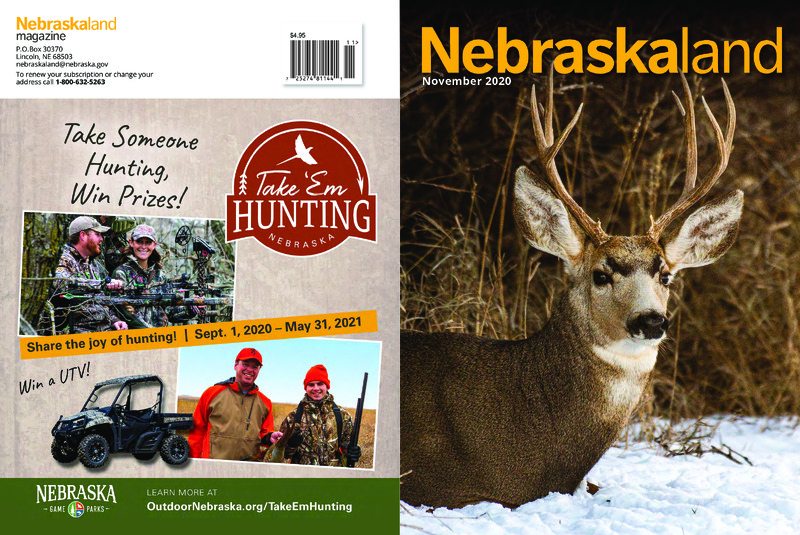
- Identifier:
- nela.2020_098_09
- Title:
- Volume 98, Issue 9, 2020
- Issue Name:
- November 2020
- Date Issued:
- 2020-11-01
- year:
- 2020
- month:
- November
- Season:
- Autumn
- PDF filename:
- NL_98.09_2020_Nov_Spreads_Entire.pdf
- Publisher:
- Nebraska Game and Parks Commission
- Format:
- Periodical
- volume:
- 098
- issue:
- 09
- number:
- 098.09
- Decade:
- 2020s
- Type:
- Rights Holder:
- Copyright Nebraskaland Magazine/Nebraska Game and Parks Commission, all rights reserved.
- Extracted Text:
-
magazine
P.O.Box 30370
Lincoln, NE 68503
nebraskaland@nebraska.gov
To renew your subscription or change your
address call 1-800-632-5263
$4.95
November
N
o ve
ember 2
2020
020
Eric - this is ready to
work up
Volume 98 No. 9
November 2020
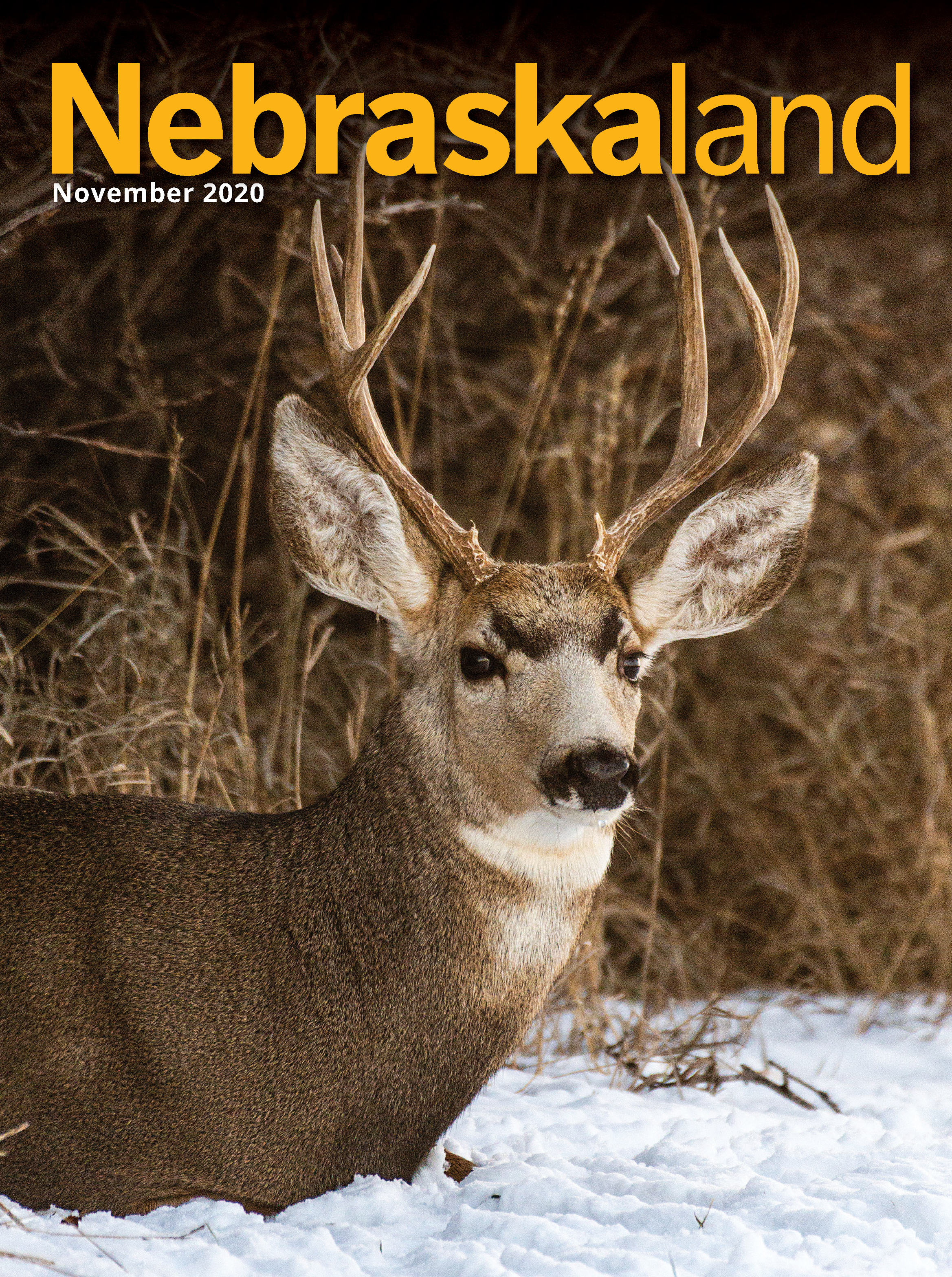
Cover: Mule deer (Odocoileus
hemionus) buck near Chadron in
Dawes County. Photo by Justin Haag.
FEATURES
22
30
32
36
38
44
46
CALAMUS
The Off-Season
Photos and story by Eric Fowler
OUTDOOR NEBRASKA
What to Do in November
By Renae Blum
FINDING THE RIGHT
DUCK CALL
By Todd Mills
HOW A NEBRASKAN HELPED
INVENT THE MODERN
LIVESTOCK INDUSTRY
By David L. Bristow, History Nebraska
AHEAD OF THEIR TIME
Story and photos by Eric Fowler
REFLECTING ON THE
CROWN-TIPPED CORAL
By Gerry Steinauer
JUST AROUND THE CORNER
An Adventure Story
Story and photos by Jeff Kurrus
DEPARTMENTS
6
10
48
56
58
Your Nebraska
In the Field
Mixed Bag
Portraits from the Past
The Last Stop
ON THE WEB
PHOTO BY JUSTIN HAAG
To see additional content including photos,
videos and articles, visit
Magazine.OutdoorNebraska.gov/digital.
Nebraskaland (VOL. 98 / NO. 9 ISSN 0028-1964) is published monthly, except for the combined Jan./Feb. and Aug./Sept. issues, by the Nebraska Game and Parks Commission, 2200 N. 33rd St.,
Lincoln, NE. Periodicals postage paid at Lincoln, Nebraska, and additional mailing offices. POSTMASTER: Send address changes to Nebraskaland, P.O. Box 30370, Lincoln, NE 68503-0370.
Magazine Staff
magazine
Published by the Nebraska Game and Parks
Commission since 1926. The Commission is
dedicated to the conservation and protection
of all the state's natural resources and the
people who use them.
Communications Director Christy Firestone
Public Relations Manager Shawna RichterRyerson
Editor Jeff Kurrus
Associate Editor Jenny Nguyen-Wheatley
Regional Editors Eric Fowler, Julie Geiser,
Justin Haag
Contributing Editor Michael Forsberg
Regular Contributors Renae Blum,
Chris Helzer, Chris Masada, Ryan Sparks, Gerry
Steinauer
Art Director Tim Reigert
Graphic Designer Mel Severin
Photo Librarian Jaclyn Cruikshank Vogt
Administration
Director Jim Douglas
Deputy Director Tim McCoy
Commissioners
Chairman - Dan Kreitman, Wahoo
Vice Chairman - Pat Berggren, Broken Bow
2nd Vice Chairman - Rick Brandt, Roca
Robert Allen, Eustis
Donna Kush, Omaha
Scott Cassels, Omaha
Jim Ernst, Columbus
John Hoggatt, Kearney
Doug Zingula, Sidney
Circulation
For address changes and questions about your
subscription, call 800-632-5263
Advertising Sales Manager
For advertising information contact
Shane G. Gilster, 402-742-0125
Email: shanegilster@gmail.com
Nebraskaland Magazine Copyright 2020, all rights reserved.
Nebraskaland is available in audio from the Nebraska Library
Commission Talking Book and Braille Service, Suite 120, 1200 N St.,
Lincoln, NE 68508. 800-742-7691. Nebraskaland Magazine and the
Nebraska Game and Parks Commission reserve the right to reject any
advertising not in keeping with the agency mission.
Rates: $18 for one year; $33 for two years; $44 for three years. Nebraska
recipients must add appropriate sales tax. To subscribe call
1-800-NEBLAND (632-5263), or go online to:
NebraskalandMagazine.com.
Commission Offices
Conservation Officers
Headquarters/Southeast District Office
2200 N. 33rd Street Lincoln, NE 68503
Phone 402-471-0641
ADMINISTRATION (Lincoln)
Craig Stover (Administrator)
Duane Arp (Asst. Administrator)
Jeff Clauson (Asst. Administrator)
Travis Shepler (Asst. Administrator)
Northeast District Office
2201 N. 13th St. Norfolk, NE 68701
Phone 402-370-3374
Southwest District Office
301 E. State Farm Rd. North Platte, NE 69101
Phone 308-535-8025
Northwest District Office
East Hwy. 2, Box 725 Alliance, NE 69301
Phone 308-763-2940
Bassett Office
524 Panzer St., Box 508 Bassett, NE 68714
Phone 402-684-2921
Kearney Office
1617 First Ave. Kearney, NE 68847
Phone 308-865-5310
Ak-Sar-Ben Aquarium/Schramm Education
Center
21502 W. Highway 31 Gretna, NE 68028
Phone 402-332-3901
Omaha Office
8495 Frederick Street, Omaha, NE 68124
Phone 402-595-2144
OutdoorNebraska.org
Any program that receives federal funding from the National Park
Service, or the United States Fish and Wildlife Service prohibits
unlawful discrimination on the basis of race, color, religion, age, gender,
marital status, national origin, age, disability or political affiliation. Any
person who believes he or she has been discriminated against in
any program, activity, facility, or service, should contact the Nebraska
Game and Parks Commission, Lincoln, NE 402-471-0641, the Equal
Opportunity Commission, Lincoln, NE 402-471-2024, TTY/TDD 402471-4693; United States Fish Wildlife Service, Civil Rights Coordinator,
4401 N. Fairfax Drive, Arlington, VA 22203; Director, Equal Opportunity
Program, U.S. Department of Interior, National Park Service, 1849 C
Street NW, Mail Code 0008, Washington, D.C. 20240-0001.
4
Nebraskaland • November 2020
402-471-5531
402-471-5531
402-471-5531
402-471-5531
NORTHWEST (Includes counties covered)
Dan Kling (District Supt.)
308-430-0572
Sean McKeehan
(Kimball, Banner, Scotts Bluff)
308-672-1824
Josh Widhelm (Morrill, Cheyenne)
308-279-9133
Kelsey Glodowski
(Box Butte, Sheridan, Grant)
308-763-8226
308-289-2274
Jaden Porter (Keith, Garden)
Kyler Prochaska (Dawes, Sheridan, Sioux) 308-430-3984
308-458-7650
Terry Brentzel (Deuel, Garden, Grant)
308-760-0145
Sean Schultz (Keith, Arthur)
308-289-9580
Keith Jadlowski (Keith, Deuel)
308-202-0140
Chance Vordeerstrasse (Keith)
NORTHEAST (Includes counties covered)
Tom Zimmer (District Supt.)
402-649-8053
402-760-0712
Dale Davis (Keya Paha, Brown, Rock)
Jonathan Andreasen
(Madison, Pierce, Stanton)
402-340-3981
Nicholas Fix (Dixon, Dakota, Thurston)
402-508-0261
308-430-3984
Kyler Prochaska (Platte, Colfax)
402-719-6226
Kyle Gaston (Dodge, Colfax)
402-613-8612
Mitch Johnson (Knox, Antelope, Pierce)
402-762-5022
Jeff Jones (Knox, Cedar)
402-380-6410
Cory Krause (Cuming, Wayne, Stanton)
Ethan Teter (Boating Officer-Dodge, Colfax) 402-620-8129
CENTRAL (Includes counties covered)
Mike Thome (District Supt.)
Matt Taylor (Thayer, Fillmore, Nuckolls)
Mark Sullivan (Nance, Polk, Wheeler, Boone)
Matt Brandt (Sherman, Howard)
Greg Hesse (Buffalo, Kearney)
Tim Williams (Hall, Hamilton, York)
Doug Pollard (Loup, Garfield, Valley)
Eric Javins (Adams, Clay, Webster)
Pat George (Harlan, Franklin, Phelps)
Daryl Teter (Howard, Greeley, Merrick)
308-293-8746
402-200-9597
402-741-0636
308-202-0819
402-440-3847
308-380-7331
308-730-7050
402-902-2017
308-920-2762
308-440-1863
SOUTHWEST (Includes counties covered)
Roger Thompson (District Supt.)
308-530-3097
Matt Andrews
(Furnas, Gosper, Frontier, Red Willow)
308-746-2418
Brian Piernicky
(Red Willow, Frontier, Hayes, Hitchcock)
308-340-6627
John Lee (Dundy, Chase, Hayes, Hitchcock)
308-414-1432
Brandon O’Neal
(Lincoln, McPherson, Logan)
308-530-3157
Alex Hasenauer (Lincoln, Perkins)
308-660-4671
402-266-1759
Owen Johnson (Dawson, Gosper, Custer)
308-870-0322
Ray Dierking (Custer, Thomas, Blaine)
402-389-0444
Frank Miller (Cherry, Hooker)
308-217-2108
Taylor Dixon (Dawson, Gosper)
Kevin Bergstrom (Boating Officer-Lincoln) 308-520-1031
SOUTHEAST (Includes counties covered)
Stacey Lewton (District Supt.)
402-890-7140
402-619-1355
Rich Berggren (Douglas)
402-616-5961
Dan Evasco (Sarpy)
402-210-0888
Heath Packett (Cass)
402-209-1506
Russell Mort (Otoe, Johnson)
402-890-6463
Dina Barta (Lancaster),
402-937-3422
Dudley Sorensen (Lancaster)
402-646-0420
Bryce Streger (Seward, Saline)
402-314-9641
Trevor Stahlecker (Lancaster)
402-853-3273
Scott Eveland (Lancaster)
402-806-0915
Matt Seitz (Gage, Jefferson)
402-443-6392
Mike Luben (Saunders, Butler)
YOUR NEBRASKA
Erik Johnson, Lincoln
Chimney Rock Comet
Instagram Photos
Follow us (@nebraskaland)
and tag us in your photos
to be featured in an
upcoming issue.
Gracee Gideon, Wood River
Harlan County Lake
@jenwk
Praying Mantis
6
Nebraskaland • November 2020
November 2020 •
Nebraskaland
7
YOUR NEBRASKA
Kirk Pridell, Papillion
Bald Eagle at Chalco
Chuck Hackenmiller, Lincoln
City Fox
Send your comments and photos to:
Jeff Kurrus, Editor
Nebraskaland Magazine
P.O. Box 30370
Lincoln, NE 68503
or email Jeff.Kurrus@Nebraska.gov
Please include your postal address
and telephone number. Letters may be
condensed and edited. Photographs are
also welcome.
8
Nebraskaland • November 2020
@laceyfiorelli, Custer County
Barn Near Anselmo
November 2020 •
Nebraskaland
9
IN THE FIELD
FALL-COLORED FALLS
Water cascades over a
beaver dam on Clear Creek,
a tributary to the Platte
River in Polk County south
of Columbus.
PHOT
O O BY ER
ERIC FOWLER
10
Nebraskaland • November 2020
November 2020 •
Nebraskaland
11
PHOTO BY JEFF KURRUS
IN THE FIELD
STICK BAITS FOR SUCCESS
By Brian Robinson
Traditionally, stick baits such as
Husky Jerks and Rogues are deadly
when used early and late in the season.
I have found this to be particularly
true in some areas and have found a
few tips that really help catch fish.
For the most part, I lean toward
sticks that suspend, like the above
mentioned weapons. I’ve found that
having a variety on hand will help you
dial in what the fish want. Some days
they want 3-inch baits, some days
4½-inch. Every bait has a different
wobble, roll and appearance at rest
while suspending. Pay attention to
these aspects and let the fish tell you
what they want.
Finding the right cadence is also
important when using sticks. I will
usually cast out, rip them down a few
12
Nebraskaland • November 2020
cranks, then completely stop them.
Then try to figure out if I should
reel slowly, twitch the bait or reel a
couple times and stop it again. Pay
attention to when the fish strike; is it
on the pause or right when you start
cranking again? Once you find the
right cadence, you can be kept busy.
Dressing your hooks is also an
option. A few lures come with this
style hook, but for the ones that don’t,
I have tied a few hooks with mylar
and feathers, adding flash to the
presentation. Once again, let the fish
tell you if they want a flashy bait, or
one that’s a bit dull and slower.
Use these tips, find a pattern that
works, and you’ll be amazed at how
many different species of fish will
strike a well-presented stick bait.
PHOTO BY JENNY NGUYEN-WHEATLEY
IN THE FIELD
FIVE WINGSHOOTING TIPS
By Jeff Kurrus
‘Tis the wingshooter’s favorite time of the year. With
quail, pheasant and waterfowl seasons open, why
wouldn’t it be? Keep these tips in mind this month:
Know the loads you’re shooting. Pellet count,
energy and velocity are big deals when wingshooting.
The more you know about what you’re firing from your
gun, the better you can make adjustments when you’re
afield. It’s much easier to diagnose your problems of the
day when you know what loads you’re firing.
Shoot the same gun. Being comfortable with a gun
never hurts. I’ve seen seasoned hunters shoot a 50-yearold Remington 1100 much better than their younger
contemporaries shooting the latest and greatest. The
main reason: that old timer has been shooting that same
1100 for 50 years.
High dollar doesn’t mean high success. I’ve
been hunting for more than 35 years and have been
at Nebraskaland Magazine for nearly 15 years. I’ve
photographed hunters of all skill levels and pocketbook
sizes, and not one time have I come home after an upland
or waterfowl hunt and thought the hunter’s high-dollar
gun or shells were the reasons why they shot so well.
The price of shotgun shells varies dramatically, from
14
Nebraskaland • November 2020
a few dollars a box for lead field loads to more than $40
a box for some waterfowl loads. Again, find what works
for you by researching and journaling, and pay attention
to the ballistics numbers on the box instead of the price
tag beside it.
Shoot. I stayed away from sporting clay ranges for
years because I was under the impression that because
the clays slowed down each second they flew, it would
hinder me when shooting at birds that never slowed
down in the air. I was wrong. What a really good sporting
clay course can reveal is what shots you consistently
miss, and which ones you should be looking for when
hunting. Plus, it allows you to shoot that same gun over
and over, becoming more comfortable with each pull of
the trigger.
Shoot With Good Shots. I think one of the greatest
attributes to my shooting skills is being on dove fields
as a kid with guys who shot well. Watching birds fall
around me, then picking up a .410 for the first time and
going 2 for 50 made me realize I had a lot of work to do.
To this day, shooting beside a good shooter makes me up
my game, helping me limit my shots to birds in killing
range and making sure every shot counts.
PHOTO BY JONATHAN NIKKILA
IN THE FIELD
CALLING FALL TURKEYS
By Jarrod Spilger
While it’s no secret spring gobblers are
susceptible to calling, many hunters may not
realize fall turkeys can also be called.
The key to calling fall turkeys is knowing
which turkeys you’re talking to. There are two
basic types of fall flocks: hens with poults and
gobbler-only bachelor groups.
To call hens with poults, yelps will certainly
work, but also make some contented feeding
sounds like purrs and soft clucks to simulate a
family group peacefully foraging.
Another essential fall sound is the kee-keerun, an assembly call often used by young
turkeys that get separated from the flock. It
says “where are you” and can vary in loudness
and intensity depending on how desperate the
lost bird feels. The high, whistle-like kee-kee
actually sounds like “doi, doi-doi-doi” followed
16
Nebraskaland • November 2020
by a couple yelps at the end to complete the run.
Boxes and slates easily replicate realistic
yelps, clucks and purrs, but I personally have
to use a mouth call to make kee-kees. It takes
some practice, but is well worth the effort when
a troop of turkeys comes strolling into shotgun
range looking for that missing member of their
flock.
Dealing with gobbler-only groups can be
trickier. In fall, the focus is on survival, not
breeding, so these bachelor flocks of mature
toms and year-and-a-half-old jakes are ultra
wary. Use deep, coarse, drawn-out gobbler
yelps to fool them. Maybe throw in a few purrs
periodically, but be subtle. You don’t want to
blow the birds out of the woods, only peak
their curiosity in the hope that they come
investigate.
September 1, 2020 — January 31, 2021
Nebraska is an upland bird hunter’s paradise – the mixed bag capital of the
Great Plains – with diverse hunting opportunities, long seasons, great access
to public lands and high rates of hunter satisfaction.
Learn more about the third year of the slam and the prizes you could win at
OutdoorNebraska.org/UplandSlam
November 2020 •
Nebraskaland
17
PHOTO BY ERIC FOWLER
IN THE FIELD
WHEN LIQUID TURNS TO SOLID
By Martha D. Shulski
A thick glaze of ice on the landscape. Bent trees and
downed power lines. Hazardous road conditions. What does
this make you think of? Your answer is probably freezing
rain. Precipitation takes on many different forms throughout
the year and these are determined by the state of our
atmosphere.
One type in particular is quite unpleasant when you’re
caught outside in it. As the name implies, this type of rain is
unique in that it freezes on contact. The reason is more than
just a chilly surface around you. The air above you plays a
significant role.
Think of a cylinder stretching above your head all the
way through the atmosphere. When that cylinder has a
shallow layer of sub-freezing temperatures near the ground,
a deep layer of warm temperatures that are above freezing,
then another shallow cold layer to cap the cylinder, that is
when freezing rain occurs. The precipitation can begin their
18
Nebraskaland • November 2020
fall as either rain or snow, pass through a warm layer and
then a second cold layer before meeting the surface. Water
drops freeze on contact in this environment. You’ll find this
setup to occur in a narrow strip in advance of a warm front
associated with a low pressure system moving through
during the colder time of year (fall, winter and spring).
Another setup that causes freezing rain is when the
surface is near freezing, but not saturated, and some of the
rain droplets evaporate as they near a surface. Evaporation
causes cooling to a point below freezing, and this can
confound new weather forecasters when they receive reports
of freezing rain, yet the air temperature is above or just at
freezing. Regardless of the cause, freezing rain is a dangerous
condition hampering travel and our comfort.
Martha D. Shulski, at the University of Nebraska-Lincoln, is
the director of the Nebraska State Climate office.
November 2020 •
Nebraskaland
19
PHOTO BY JENNY NGUYEN-WHEATLEY
IN THE FIELD
VENISON “MEATBALL” SLIDERS
By Jenny Nguyen-Wheatley
I had an unsuccessful rifle season
last year, so I decided to attempt
deer hunting with a muzzleloader
in December. I am a self-proclaimed
“meat hunter,” so a season choice tag
gives me “the best bang for my buck”
— except that I wasn’t looking for
a buck. It turned out that I got one
anyway.
As I turned “her” over, I realized
that she was a “he.” It was the first
time I had ever shot a male deer, and
recalling an Instagram post that I had
seen about a deer testicle sandwich
earlier that week, I became inspired.
My husband winced as he watched me
take more of that deer home than he
would’ve.
If you enjoy rocky mountain
oysters, or I guess “prairie oysters”
in these parts, then you’ll enjoy deer
testicles — the taste is similar. The
deer was young, so sliders, and not a
whole sandwich, was the way to go.
20
Nebraskaland • November 2020
For those who haven’t tried this odd
delicacy, the flavor is mild, like minced
chicken breast, and the texture is soft
and light.
Makes: 2 sliders
Prep Time: 15 minutes
Cooking Time: 15 minutes
Ingredients:
2 deer testicles
2 to 4 tablespoons of Italian-style
seasoned bread crumbs
2 to 4 tablespoons of marinara
sauce
Shredded mozzarella cheese, to
taste
2 King’s Hawaiian Sweet Rolls,
split open
2 teaspoons of olive oil
Red pepper flakes, to taste
•
•
•
•
•
•
•
1. With a sharp knife, cut through
the tough outer membrane of each
testicle. Carefully peel away the soft
interior. I don’t know what it’s like on
older deer, but these were extremely
delicate, and a tad tricky to peel away
from the membranes. I used the edge
of my knife to gently scrape them out.
2. Place each testicle between two
sheets of plastic wrap and gently
flatten them.
3. Spread out half the breadcrumbs
onto a plate, lay the testicles on top
and pour the rest of the breadcrumbs
on top to coat.
4. Heat olive oil in a pan. When it
begins to shimmer, fry the coated deer
testicles in the pan until golden on
both sides. It will firm up as it cooks.
5. Line a small baking sheet with foil.
Assemble the bottom halves of each
roll with a fried testicle, mozzarella
cheese, marinara sauce and red pepper
flakes. Leave the tops of the rolls off,
crust-side facing up. Broil until cheese
melts and bread becomes toasty. Enjoy
and try not to burn your tongue.
November 2020 •
Nebraskaland
21
Calamus
The Off-Season
Photos and story by Eric Fowler
uring the summer, Calamus
Reservoir is bustling with activity.
Anglers ply its waters, and boats
and personal watercraft buzz
across its surface. Campgrounds are
filled with RVs, and people stake claim
to their own stretch of white-sand
beaches.
The 5,200-acre lake, located
northwest of Burwell, gets a bit quieter
when school begins in August, picking
back up on Labor Day weekend and
again in mid-October for the annual
Halloween activities. After that,
things really slow down, and through
the remainder of the fall, winter and
most of the spring, you might have the
entire lake to yourself.
You might have to share the land
around the lake with a hunter or two,
but with 5,000 acres, you won’t know it.
In the surrounding riparian woodlands
and sandhills uplands and the winding
D
Calamus River and its many backwater
oxbow wetlands in the wildlife
management area above it, hunters can
find deer, turkey, grouse, pheasants,
quail, dove, ducks and geese.
Birders can find plenty of nongame
species to watch on the property,
deemed an Important Birding Area
by the National Audubon Society.
Thousands of American white pelicans
stop in the spring and fall. In the dead
of winter, hundreds of trumpeter swans
may be scattered around the lake but
mostly on its upper end and in the river
above. Hundreds of bald eagles flock to
Calamus, often sitting on the edge of
ice next to open water between flights
to pick up dead gizzard shad.
Far from any big city, the highways
here are less traveled, and the night
sky is dark. It’s quiet here in the offseason, but for many, there is no such
thing as too quiet. N
The Calamus River
winds its way
through the wildlife
management area
above Calamus
Reservoir in Loup
County.
Common mergansers swoop in to land in an oxbow wetland on the Calamus River
at Calamus Wildlife Management Area.
22
Nebraskaland
• November 2020
November 2020 •
Nebraskaland
23
TOP LEFT: Fall color emerges from
the fog in a lowland prairie on the
southwest side of Calamus Reservoir.
TOP RIGHT: American avocets feed in
the shallows of the reservoir.
BOTTOM: A kayaker photographs
American white pelicans loafing on a
shallow bar in the upper end of the
reservoir.
24
Nebraskaland
• November 2020
November 2020 •
Nebraskaland
25
ABOVE: The setting sun paints a
reddish hue on a stump inundated
when the reservoir was filled
and left exposed by the annual
drawdown.
RIGHT: A pair of trumpeter swans
glides over the lake.
LEFT: The soil cement reinforcement
on Virginia Smith Dam allows
anglers to walk troll for walleyes
during the spring spawn.
26
Nebraskaland
• November 2020
November 2020 •
Nebraskaland
27
Jim Gross of Lincoln hunts
quail with his yellow
Labrador retriever, Duke, in
the uplands around Calamus
Reservoir.
28
Nebraskaland
• November 2020
November 2020 •
Nebraskaland
29
Outdoor Nebraska
What To Do in November
By Renae Blum
View and photograph
Harris’s sparrows
November is rich with hunting opportunities, but that isn’t the only thing
to do outside. Fishing, wildlife viewing and park visits can all add up to a
month filled with great outdoor memories. N
Early November | Eastern Nebraska
THE SUTLER STORE AT FORT ATKINSON SHP
PHOTO BY JENNY NGUYEN-WHEATLEY
HARRIS’S SPARROW – PHOTO BY CHRIS MASADA
With distinctive black and chestnut
markings, the elegant Harris’s sparrow
stands out. Look for this large sparrow
in plum thickets along rural roads or in
brushy areas on the edges of woodlands.
Harris’s sparrows respond especially well to
“pishing,” or imitating a bird’s “psh-psh-psh”
call to draw them out of the brush. If you’re
not easily embarrassed, give it a try!
WILD TURKEYS
PHOTO BY ERIC FOWLER
Go on a scavenger hunt at
Fort Atkinson
Year-round | Fort Atkinson State Historical Park
Even if the fort interior is closed and there’s no living history going
on, you can still have a good time exploring Fort Atkinson. The
park’s two scavenger hunts, with a history and nature focus, will
take you throughout the grounds looking for answers, watching
videos via QR code, and noticing things you might not otherwise.
Pick up the scavenger hunt sheets at the fort’s west gate.
Harvest your own
Thanksgiving turkeys
Throughout the month | Statewide
Put something “wild” on the holiday table — serve a wild turkey or two that
you harvested yourself. Not only does it give the non-hunter in the family the
chance to try wild game, it’s also a great conversation piece. Remember that
you can easily combine a wild turkey hunt with any other hunt, especially a
deer hunt, and you’re allowed two birds of either sex on one permit in Nebraska.
Fish for trout at
Lake Ogallala
Throughout the month
30
Nebraskaland • November 2020
RAINBOW TROUT
PHOTO BY JEFF KURRUS
Throughout the month
A good trout fishery year-round, Lake
Ogallala offers the biggest trout in the
state, up to 8 pounds and perhaps more.
And unlike some species of warm-water
fish, cold-blooded trout stay active and
catchable into November. Bring a variety
of baits and try your luck for a large trout!
A BLACK LAB RETRIEVES A DUCK – PHOTO BY JENNY NGUYEN-WHEATLEY
Go waterfowl hunting
in Harlan County
A stopover for migrating birds, Harlan
County offers good waterfowl hunting
opportunities. For best success, scout ahead
of time to find where birds are likely to roost
and feed, and set up your decoy spread to
mimic the activity you see. Hunting the
backwater areas of Harlan County Reservoir
may give you an excellent chance at getting
closer to birds.
November 2020 •
Nebraskaland
31
FINDING THE RIGHT
DUCK CALL
I
BY TODD MILLS
remember getting my first “real”
duck call. It was a gift from a friend,
and I couldn’t wait to give it a try.
After several failed attempts to make it
sound like a duck, I realized that maybe
it wasn’t the right call for me or maybe
I just wasn’t very good at blowing it.
It was then that I went on a search to
find the right call for my skill level and
my budget. I forged ahead and found
myself learning everything I could
about calls and, most importantly, how
to make the right sounds with the call
I was using. It became apparent that
not only was the duck-call world full
of different shapes and varieties, but
it seemed everybody had a different
opinion of what call worked best.
When working outdoor shows for
several years, without a doubt the
question I got asked the most was:
“What duck call should I buy?”. You
may have had this same question.
The following is a checklist if you
are looking for a call or are considering
buying one for someone else. After all,
with the holidays fast approaching,
what duck hunter wouldn’t want
another call to add to their collection?
Material is Important
Single Reed or Double Reed?
First mistake I ever made when
diving into the duck call market was
buying a single reed for my first call.
I got talked into it by a sales rep and
was fascinated by the sounds he could
make with it. Unfortunately, I couldn’t
make the thing sound anything like
he did. For the beginner, I would
highly recommend a double-reed call.
A double-reed call doesn’t take as
much air flow and will make the basic
sounds you need to call ducks. It will
not, however, allow you to ring loudly.
Single-reed calls allow for louder,
higher notes and require more air flow
to operate. Intermediate to advanced
Duck calls come in many shapes and varieties. It is a hunter’s job to find which calls
work for her or him.
32
Nebraskaland • November 2020
PHOTO BY JEFF KURRUS
When choosing a duck call, you must
first decide on the type of material
you’re going to use. Duck calls basically
come in three materials: polycarbonate,
acrylic and wood.
The basic difference between acrylic
and polycarbonate is the molding
process. A polycarbonate call will not
last as long but also will be cheaper.
Acrylic is a very dense material and
will last longer and allow you to
produce more volume through the call.
Wood calls can provide great sound,
but are not as versatile or durable.
Bottom line here is your budget. My
personal recommendation — purely
based on investment — is for any
beginner to start with a polycarbonate
call. No need to spend over $100 on a
call when you’re not even sure how to
blow it yet.
November 2020 •
Nebraskaland
33
callers are more suited for a single-reed
call, but either can work depending on
the area you are hunting.
Acrylic
Double Reed
Ree
ed
Custom
Wood, Single
Reed —
Polycarb
Insert
What Terrain are You Hunting?
Seems strange that a duck call choice
can be made on what type of terrain you
are hunting, but different set-ups and
water areas require different sounds. For
example, I hunt a lot of open water and
public areas. When dealing with large
bodies of open water with other hunters
around you, being able to blast a “hail
call” to attract high-flying ducks can be
advantageous. A single-reed call may
be best for you in this type of setting.
When hunting smaller, private waters,
you won’t need an attention-getter call.
Softer, raspier notes with a double-reed
call might be best here.
Acrylic
Single Reed
Open Water
Polycarb
Single Reed
Teal
Keep Your Call Clean
34
Nebraskaland • November 2020
Polycarb DU
U
Double Reed
ed
Custom
Acrylic
Single Reed
Acrylic
Single Reed
Competition
Or
Original
Single Reed
Si
Wood
W
Custom
Custo
Single Reed
Wood
PHOTOS BY ERIC FOWLER
Much like your gun, calls need to be
maintained. When hunting river areas,
sand can build up inside the call around
the reed. After each hunt you should pull
the call apart (if it’s a single mold) and
run hot water through it. Make sure all
small particles are removed. Leave the
call open overnight to dry. Reeds will
need to be changed periodically as well.
When the reed turns a brownish, milky
color, it’s time to change it. Numerous
times I’ve opened someone’s call and the
reed is brittle and the edges dirty. You
don’t want that. Keeping your call clean
will allow it to keep from sticking and
provide a smooth, open chamber for air
flow.
When I first started hunting back in
the 70s, there were only a few duck-call
manufacturers. Obviously, that’s not the
case now. The types of calls and brands
can be overwhelming. Find the call that
fits your needs the best. Some come
with a beginner calling video, which can
be extremely helpful. Most importantly,
once you decide on a call, spend time
learning the right sounds to make. N
November 2020 •
Nebraskaland
35
How a Nebraskan Helped Invent the Modern Livestock Industry
By David L. Bristow, History Nebraska
oday we take for granted that the livestock business
involves large feedlots, management based on
nutritional science and use of the latest technology.
A Nebraskan named Thomas Benton Hord was an
innovator who helped create the modern livestock industry.
From his beginnings in the open-range era, Hord became,
arguably, Nebraska’s first modern cattleman.
Hord started out during the Western cattle boom of the
1880s. He worked with partners and Eastern investors to
build large herds on the unfenced ranges of Wyoming and
Nebraska. Survival was a challenge. A severe winter in 18861887 decimated herds, and a financial panic in 1893 led to
years of economic depression and low livestock prices.
Meanwhile, relations between cattlemen and homesteaders
T
became violent in parts of Wyoming. During the “Johnson
County War” of 1892, cattle barons hired gunmen to go
after alleged rustlers. One of Hord’s foremen, Mike Shonsey,
was involved in the killing of two men; the following year
Shonsey shot to death another man who came seeking
revenge. Shonsey then fled to Nebraska and spent the rest of
his life working at Hord operations in Central City and Clarks.
With the end of the open range, cattlemen began to think
of ways to raise large numbers of animals within limited
boundaries. Based in Central City, Hord began operating everlarger feedlots for cattle and sheep. By 1903, his operation had
13 feed yards and 18,000 acres of crops. In a typical year, Hord
finished 10,000 cattle, 10,000 sheep and 7,000 hogs, feeding
them 8,000 tons of hay and a million bushels of corn. He was
The Thomas Hord feedlot near Neligh, Antelope County. History Nebraska RG4232-2-20
Cowboys, who worked for Thomas Hord, at dinner at the 77 Ranch in Wyoming. History Nebraska RG4232-1-10
36
Nebraskaland
• November 2020
said to have the nation’s largest cattle feeding operation.
Historian Jim Potter researched Hord’s business records
and uncovered not only the operation’s large scale, but also its
innovativeness. Potter writes that Hord used “practices that
seem modern even today. Each feedlot encompassed from 10
to 15 acres and had its own windmill to water the livestock.
The cattle were fed a specific ration, largely shelled corn, in
an amount that they ‘will eat up clean, leaving nothing to
be used for the next meal that has been slobbered over and
made unpalatable.’
“Hord also took advantage of available technology. Each
separate feeding facility was connected by telephone to the
main office at Central City so Hord could keep in touch with
his foremen. His key employees participated in a company
profit-sharing plan in addition to receiving a salary. Purchase
of grain used in the operation, only part of which was grown
on Hord land, injected an average of $300,000 per year into
the regional economy. In 1905, Hord reported shipping a
thousand carloads of cattle to market by rail, most going to
Chicago.”
At a time when factory production was growing rapidly,
Hord applied an industrial mindset to the livestock business.
He has had many imitators. When he died in 1910, he was
hailed as Nebraska’s most successful livestock entrepreneur.
Search “Thomas Hord” at history.nebraska.gov to find Jim
Potter’s complete article and more photos. N
Visit History Nebraska’s website at history.nebraska.gov.
Mike Shonsey at Central City, probably soon after the
Johnson County War. History Nebraska RG4232-5-11
November 2020 •
Nebraskaland
37
Ahead of Their Time
Blaine Dorn and Kobe Clevenger scan the sky for Canada
geese while hunting from layout blinds in a corn field near
Enders Reservoir in Chase County.
Story and photos by Eric Fowler
38
Nebraskaland • November 2020
November 2020 •
Nebraskaland
39
T
here might be a few high school kids who hunted
more than Blaine Dorn and Kobe Clevenger. Or harder.
Or more passionately. But there can’t be many.
From the start of the archery deer season in September
through duck and goose seasons to the end of goose season
in February, these two members of the Chase County High
School class of 2020 in Imperial hunted every chance they
could. They were back in the field for the spring turkey
season, first with bows and then shotguns. They spend the
summers fishing or bowfishing.
“I’d rather be hunting than doing a lot of things,” said
Blaine.
Kobe said, “I like the challenge and the adrenaline you get
from it.”
Don’t bother talking to them about the latest video games,
though. Neither has much use for them. “I’d rather build
fence than play video games,” said Blaine, who does plenty
of that in his job at a feedlot near Wauneta. “It’s much more
fun being outside than it is sitting on a couch.”
Their passion is understandable. Both were raised in
hunting families and started at a young age.
“I don’t remember the first time my dad took me duck
hunting, but I know I wasn’t very old,” Blaine said.
His father, Chad, has a better recollection, recalling Blaine
was about 4 years old when he built a brush blind so he could
take his son turkey hunting. Blaine shot his first turkey the
following year with a .410 shotgun. “When he was younger,
he could do hen clucks with his voice really good,” Chad
said. “In the late season when the birds would get call shy, I
could take him along and he would do it with his voice, and
he could call in birds for us.” Pheasants, waterfowl and deer
followed.
Dorn and Clevenger take a pair of geese they decoyed while hunting a corn field near Enders Reservoir.
Chad and Blaine Dorn and Clevenger laugh at a video
Blaine captured of his father harvesting a turkey.
40
Nebraskaland • November 2020
Kobe’s father, Kelly, got Kobe a shotgun for Christmas
when he was 8 or 9. “We started pheasant and dove hunting,”
he said. “Then when he was 13, he shot his first deer and that
kind of took over a little bit. He’s hunted turkeys and ... you
name it, they’ve hunted it.”
Classmates and friends since pre-school, the two started
hunting together with their parents when they were still in
grade school. Once they turned 16 and could drive, you could
bet that when they weren’t in school, at sports practice or
working, they were hunting.
At that point, “We served a little bit less of a function in the
hunting process,” Kelly said with a laugh and understanding
that most teens would rather spend time with friends than
family.
“It quickly moved from wanting to go every once in a while
to every moment he could possibly go.”
“That’s all they talk about,” Chad said.
And when they talk hunting, they do so with a knowledge
that belies their age. The feeding patterns of deer, ducks and
geese; how switching locations and decoy spreads can keep
you ahead of wary, late-season geese; and how commercial
hunting and leasing has changed the game are topics not
lost on them, even in their short hunting careers. They take
care of the ground people allow them to hunt and help the
landowners with chores or anything they ask of them.
“Blain has got a big passion for all of it, fishing and
hunting and everything,” Chad said, “and he’s pretty good at
November 2020 •
Nebraskaland
41
Clevenger watches for turkeys from a ground blind
along Frenchman Creek near Wauneta.
it. He’s learned a lot over the years.”
He learned some of that watching his father and
grandfather, Gene Bartels, who operates an outfitting
business, Kripple Duck Adventures, guiding deer, turkey,
waterfowl and pheasant hunters. Started in 2003, the business
was mothballed a few years ago when family obligations,
including activities Blaine and his siblings were involved in,
took priority. Blaine helped with that business, serving as a
turkey guide for the first time when he was 14.
Blaine restarted that business and started guiding a few
waterfowl and turkey hunters when he was a sophomore. One
client, a representative of The Allen Company, manufacturer
of hunting and fishing equipment, brought a film crew along,
and Blaine is now featured in promotional video on the
company’s YouTube channel.
Kobe helps out with the guided duck and goose hunts, help
that is needed when you’re working with a 16-foot cargo
trailer loaded with 12 dozen full-body duck decoys and 24
dozen full-body and shell-goose decoys and layout blinds.
“Usually if it’s just the two of us, we kind of have to limit
ourselves to what we put out because we’ve got to think
about how many we’ve got to pick up,” Blaine said.
That collection of gear grew from an opportunity in the
“backyard” of the Dorn’s rural home near Wauneta. Kobe’s
grandfather, Harold Nordhausen, owns farm ground across
Clevenger and Blaine and Chad Dorn leave the Frenchman Creek bottom with a gobbler in hand.
From left, Clevenger and Blaine and Chad Dorn watch for turkeys from a high vantage point above Frenchman Creek.
42
Nebraskaland • November 2020
the road. “It was always full of geese so we figured we’d better
start hunting them,” Blaine said. The boys’ grandparents
started accumulating goose decoys, a collection Blain said
they were fortunate to have been able to take over. “We kind
of got handed a lot of the stuff that you need to be successful
in it, and then just kind of ran with it I guess,” he said.
“And now we’re building 16-foot pits,” said Kobe, who lives
in Imperial.
While the two spend most of their time hunting together,
they take their brothers and fathers along, too, when they want
to go, which isn’t nearly as often as the boys want to hunt.
College will cut into the time they have to hunt together
in the years to come: Blaine headed west to Torrington,
Wyoming, and Kobe east to Lincoln. They were back home
Labor Day weekend trying to sneak within bow range of
mule deer in the pastureland around Wauneta and Imperial.
They will meet back there whenever they can. Blaine plans
on returning to the area after college, starting a welding
business and growing the outfitting business.
Their parents are all right with their son’s chosen hobbies,
even though being gone so much can cause some tension at
home.
“It caused a little stress every once in a while,” Kelly said.
“It was a good trade-off. He was outside and experiencing
all of that good stuff, and it was a lot better than the
alternatives.
“There’s a lot worse things a kid could be doing,” Chad
said. “The kids hunting and fishing is just a great thing.” N
November 2020 •
Nebraskaland
43
Reflecting on the
was cast in a soft and more natural light than if I had used my
camera’s flash.
That day, the reflector came in handy on several photo
opportunities. Thank goodness I had remembered to throw it
in the car that morning.
GETTY
Crown-tipped Coral
By Gerry Steinauer
A reflector is used to redirect sunlight onto a pumpkin
flower in the author’s garden.
Nebraska’s Coral Mushrooms
PHOTO BY GERRY STEINAUER
The crown-tipped coral
(Artomyces pyxidatus)
is the most common
coral mushroom found
in Nebraska. Its most
characteristic feature is
the crown-like shape of
the tips of its branches.
44
Nebraskaland • November 2020
Two words best describe the bizarrely-shaped coral
mushrooms — “really cool.”
Their name, no surprise, reflects their erect, branching
fruiting bodies’ resemblance to coral. Spores develop on the
surface of the branches, whereas on typical toadstool-shaped
mushrooms, the spores develop in gills or pores on their lower
surface.
Chance Brueggemann, ecologist and resident mushroom
expert stationed at Indian Cave State Park, knows of three
species of coral mushrooms that grow in eastern Nebraska.
He said the crown-tipped coral is the most common of the
species. This spring-through-fall growing mushroom is
distinguished by its whitish to yellowish, loosely clumped
branches that are crowned with a cup-like depression
bordered with three to six points. Though never abundant, he
observes them most often growing on rotting hardwood logs
near creeks, but also on logs in moist, wooded ravines higher
on slopes.
The crowned-tipped coral is edible and is said to have
a mild, woodsy flavor with a slight peppery aftertaste.
Mushroom connoisseurs prefer it as a salad garnish, in soups,
crispy fried and made into croutons. Brueggemann has tried
them once. “It had a strange, chewy, noodle-like texture, but
I sautéed it in too much butter and drowned the flavor.” He
is committed to continue his culinary experimentation with
the mushroom.
Also found in our state, the strict-branch coral grows on
or near dead stumps, logs and branches of both deciduous
and coniferous trees. Its light tan-to-brown branches form
a tight upright clump. Interestingly, the form that grows on
hardwoods tends to be a bit more orange in color and is less
bushy than the form that grows on conifers. Brueggemann
said these might be two distinct, but similar-appearing
species. The mushroom’s pungent, anise-like odor and bitter
taste make it poor table fare.
The handsome clavaria is found in Asia, Europe and North
America, including Nebraska. It is identified by its thick base
and pinkish branches that fade to yellow with age. Unlike
our other corals, it grows from soil, not on dead wood, under
deciduous and occasionally conifer trees. Mushroom hunters
beware: This species is slightly toxic, and if consumed, can
result in a stomach ache and other associated, unpleasant
issues. Though toxic, it is used in traditional medicines in
parts of the world.
Brueggemann is on the lookout for the magenta coral,
which grows nearby on the wooded Missouri River bluffs in
Iowa, but has never been found in Nebraska. One mushroom
expert’s image of this elegant mushroom is of a “tiny set of
purple antlers, cast aside on a bed of moss under oaks and
hickories.”
“It would be a great find,” said Brueggemann. “I just need
to be at the right place at the right time.” N
SHUTTERSTOCK
O
… you guessed it … reflect light onto shaded photo subjects. In
canopied forests and other habitats with tall vegetation, they
are a must for close-up photography of insects, wildflowers
or mushrooms. They also can provide fill light to reduce
shadows and hence reduce overall contrast in an image.
My reflector, purchased online for less than $20, has
reversible gold, silver and matte-white surfaces to reflect
varying colors of light. For the crown-tipped coral, I chose
the gold surface to bathe the mushroom in a warm light that
enhanced its tan color.
While I ran the camera, Lang, standing about 10 feet away,
used the reflector to catch and aim a shaft of sunlight that
had pierced the canopy onto the mushroom. The mushroom
PHOTO BY GERRY STEINAUER
ne morning last July, I was riding in a UTV down a trail
at Indian Cave State Park with ecologist Krista Lang,
when I blurted out “Stop, stop, stop!”
What had I seen? What had so excited this botanist?
There, deep in the oak woods, growing on a log, was a
beautiful crown-tipped coral mushroom. One of our missions
that day was to photograph mushrooms, and this was a
perfect specimen — fresh, big and immaculately shaped.
But there was a problem. The mushroom was in dense
shade under shrubs, and I needed light on the subject to
prevent a dull photo. Luckily on this day, this sometimes
forgetful botanist had remembered his reflector. Portable,
lightweight and collapsible, hand-held reflectors are used to
The strict-branch coral (Ramaria stricta).
Clavaria zollingeri is commonly known as the violet or the
magenta coral.
November 2020 •
Nebraskaland
45
Just Around
the Corner
An Adventure Story
Story and photos by Jeff Kurrus
needed a break. I had been sitting
on a bucket for two days coaching
11-year-old softball players. Any
sort of adventure, even a small one,
was going to do me some mental good.
So I went for a drive. This has been a
long-standing mode of decompression
in the Kurrus family going back to my
parents when I was a kid. What was
different on this day, however, was I
was armed with the Explore Nebraska
History app — a tool that would
change these drives forever.
I came across the app by accident,
I
There are 53 marked graves at the New Pennsylvania
Cemetery east of Gretna.
while
looking
for
additional
information on the New Pennsylvania
Cemetery historical marker near my
home and hoping history.nebraska.gov
would be able to tell me something.
The site encouraged me to download
the app.
This is when my adventure began.
The app divided the state’s historical
markers into categories. The Stories
category allowed me to see what
markers were in my area, making any
day-long or multi-day trip as close as
I wanted to drive. For example, when
The Prehistoric Burial Site marker in Eugene T.
T Mahoney State Park is within
eyesight of cabins and the park’s mini-lodges.
46
Nebraskaland
• November 2020
I pulled up my hometown of Gretna,
51 historical markers landed within
20 miles, with the New Pennsylvania
Cemetery being just 1.31 miles away.
I started to drive. My first stop was
at a rest stop just west of Gretna on
Interstate 80 — The Great Platte
Valley. In the distance, nothing
impressed me: a cellphone tower, big
machinery and crop fields. But I still
couldn’t help but think about some of
the words on the marker: “The Pawnee
and Oto established large earthlodge
villages near here … By the late 1850s,
it was estimated that 90% of all traffic
which crossed the Plains followed the
Platte … The famous Pony Express
followed the Platte Valley, as did the first
transcontinental telegraph line.”
So I made a note to myself to further
my research on the Pony Express,
seeking to learn who had written the
quintessential book regarding this
short-lived phenomenon in American
history.
The next closest site, according to
my app, was at Eugene T. Mahoney
State Park — the Prehistoric Burial
Site marker. I had driven by this
marker a hundred times before, not
once allowing this line to resonate:
“Archaeological evidence indicates
that the bodies were exposed to the
elements until only bones remained.
The bones were buried later in a
communal graveyard. The practice of
cemetery burial by these prehistoric
people indicate their deep regard for the
afterlife.”
By this point in the day, with the
light fading, I caught myself speeding
to read one more marker before I
headed back to my real world. The OxBow Trail welcomed me in Ashland,
marking the route that carried
thousands of settlers West beginning
in the 1840s and a quick history lesson
on a body of water that had been an
afterthought for years. “Just west of
here was an important ford across Salt
Creek, where limestone ledges form a
natural low-water bridge.”
Before I finished my drive home, I
refreshed the app and was given an
entirely new set of markers a short
distance away, including the Armour
and Company Icehouse northwest of
Memphis. The discovery was a wellneeded escape for me.
The following afternoon I needed
another short adventure after we
couldn’t throw strikes. I found myself
at the New Pennsylvania Cemetery
just east of Gretna. I read the marker, as
I had the others on my brief adventure,
but then went even farther and started
walking through the cemetery.
Headstones from the 1800s littered
the area, some fighting to stand
upright and others leaning against the
closest tree. Then I saw a small row of
five headstones, each equal in height
and symmetry, and I reluctantly
walked toward them.
Between the 1870s and the early
1890s, A.J. and H.F. Rishel tried to start
or extend their family, yet at least five
times they lost a child — from birth
all the way through 7 years old. With
an 11-year-old, 8-year-old and 1-yearold, each with their own distinct
personality, of my own, I couldn’t help
but realize my own sports stupidity,
where throwing strikes and catching
pop flies didn’t mean as much as it did
10 minutes before.
What filled my thoughts now were
questions. Who were these people?
Did they have other kids who lived?
Were the parents buried there? If not,
why?
Upon returning to my house, I found
myself researching the Gretna Public
Library and ancestry.com looking for
answers as well as other knowledge
about those buried there.
I came to find out 72 people are
buried in the New Pennsylvania
Cemetery, yet only 53 are marked.
In a sense, I had visited two mass
gravesites in the past two days, with
a lot more questions than answers in
my mind.
It was an adventure in the truest
sense of the word. It was mysterious,
thought-provoking and intelligent.
And it was in my own backyard.
Or, as far as I wanted to drive across
Nebraska. N
The N
Th
New
ew P
Penn
Pennsylvania
sylvani
l
ia C
Cemetery
emetery iiss a rema
remarkable
rkabl
k ble di
display
splay
l off Nebrask
N
Nebraska
b
ka hi
histor
history
y iin my own b
backyard
ack
kyard
d off G
Gretna.
retna.
November 2020 •
Nebraskaland
47
MIXED BAG
THE INDIAN CALENDAR: BUT HOW DO I
REMEMBER OUR ANNIVERSARY?
By Roger Welsch
Maybe I should have titled this essay “The Indian
Almanac,” because the “calendar” for Plains Indians before
the arrival of the white man held a lot more information than
our modern, conventional wall calendars do.
The idea of “time” for the modern Nebraskan has only
recently narrowed down to hours and minutes; there wasn’t
much of a need for second-by-second precision, or for that
matter day-by-day, on either side of the frontier for pioneers
nor Indians. But for the tribes, there was nonetheless a need
to know when certain religious festivals should be held, the
right time to prepare for the twice annual buffalo hunts, and
the optimum times to plant and harvest crops or wild foods.
Some tribes, for example the Pawnee, were particularly
interested in astronomy and knew far more about celestial
events than the average Nebraskan today. They kept track
of the appearances of the morning and evening stars, phases
of the moon, positions of constellations, and where the sun
would be in the sky at any particular time of the day and year
— things most Nebraskans have little need to pay attention
to today, and therefore scarcely do.
They watched the various stages and conditions of plants
for information about what they could expect was going on
A nearly 300-year-old Skidi Pawnee Indian star chart on hide. The
vertical line in the center represents the Milky Way.
48
Nebraskaland • November 2020
with other plants, or with their neighbors, the “four-leggeds.”
As Melvin Gilmore noted in his important book, Uses of
Plants by the Indians of the Missouri River Region, “Goldenrod
as ... a sign in their floral calendar. They said that its time of
blooming was synchronous with the ripening of the corn; so
when they were on the summer buffalo hunt on the Platte
River or Republican River, far from their homes or fields, the
sight of the goldenrod as it began to bloom caused them to
say, ‘Now our corn is beginning to ripen at home.’” And they
watched the movements of animals — migrations, nest and
lodge building, molting and shedding — for indications of
when and where different foods would be most abundant or
prime for harvest.
Plains Indians, even farming cultures like the Pawnee or
Omaha, were often on the move. Imagine, then, one Pawnee
telling another when he would like to meet him the next
year to exchange pipestone for flint. Or a chief of one band
arranging with another for the villages or bands to convene
to renew their cultural relationships. And maybe provide
courting opportunities for the young people and gossip
forums for elders. One could simply say the two would come
together just below the forks of the “Plenty Potatoes River”
(Loup) shortly after the “Birds That Look At The
Sky” (sandhill cranes) left the area, when the
turkeys were hatching their broods, or when the
planting moon was brightest. Those observations
would have provided plenty of information for a
successful meeting.
Arrangements like that might take more patience
than we have today, but that’s a good reason,
I suggest, for us to consider slowing down and
paying less attention to the tyranny of calendar
and clock, even — or especially — in these days
of constant scrambling. Maybe we should ignore
clocks and calendars now and then. “Meet you on
the patio sometime tomorrow about the time the
sun is eight fingers above the western horizon.”
That would do it. Or how about, “Let’s get everyone
together for a campout at the big lake on the broad
water when the ironweed is in bloom and the moon
is full.”
Roger Welsch is an author, humorist, folklorist and
a former essayist for CBS News Sunday Morning. He
has been contributing to Nebraskaland Magazine
since 1977.
November 2020 •
Nebraskaland
49
MIXED BAG
NEBRASKA’S BUCKS & BULLS
By Eric Fowler
seasoned
veterans
who spotted their
buck or bull while
scouting, or through a
kitchen window, and
never gave up hope
of getting into gun
or bow range when
the season arrived.
Helmer also tells us
about the hunters,
their background, experience and other things
he gleaned mostly from in-person interviews with the hunter
or, in the case of decades-old trophies, their surviving family
members. And he weaves in some geography and natural and
cultural history to add another layer of depth to the stories.
For a few trophies now in the hands of collectors, the
hunter and their story is unknown, and Helmer relied only
on what he could glean from the Boone & Crockett Club and
Pope & Young Club score sheets. As an official scorer for both
clubs, Helmer knows what separates many of these trophies
from the rest, and includes those scoring highlights, as well
as where the animal ranks in the state and
national record books.
Randy Stutheit, who curates the
Nebraska Game and Parks Commission’s Big
Game Trophy Records Program, wrote the
forward for the book. The records program
began in 1962 and includes 3,986 whitetails,
2,196 mulies, 177 elk, 190 pronghorn and
8 bighorn sheep that meet the minimum
scoring requirements.
By comparison, more than 2 million deer
and 2,700 elk have been harvested in the
state. Stutheit appreciates the stories,
especially those of the early trophies.
“The stories told by the hunters present a
fascinating history of deer and elk hunting
through those decades,” he wrote.
Entertaining and informative, this
collection of stories will serve as an
important chapter in the larger story of big
game hunting in Nebraska and preserve
the stories for generations to come. It is
available from the University of Nebraska
Press online at Nebraskapress.unl.edu/
bison-books and at other retailers.
The story behind Mike Lutt’s hunt in Sioux County in 2014 that led him to this
If you hunt big game, you can appreciate a trophy buck or
bull. To go with each is a story: was it effort, good fortune or
a mix of both that led to the harvest? If you like that type
of story, you will want to read Nebraska’s Bucks & Bulls: The
Greatest Stories of Hunting Whitetail, Mule Deer, and Elk in the
Cornhusker State.
Released in September by the University of Nebraska
Press, the book by Joel Helmer of Seward tells the stories
behind 68 of the top trophy white-tailed and mule deer and
elk harvested in Nebraska since the modern era of big game
hunting began in 1945. There is a story from that first deer
season, and the details behind 24 current and former state
records and one former world record. With each story there
is a photo.
Helmer didn’t have to dig too deep to find the information
for one of the stories he tells. He was there in 2016 when his
daughter, Hannah, then just 14 years old, harvested what is
now the state-record 426 7/8-inch non-typical elk in the Pine
Ridge in northwestern Sioux County. That trophy inspired
him to write the book.
The stories run the gamut, from first-time hunters who
lucked into a trophy some will never see in the wild to
232 2/8 non-typical mule deer is included in Nebraska’s Bucks and Bulls.
50
Nebraskaland • November 2020
November 2020 •
Nebraskaland
51
MIXED BAG
MAKE SAFETY A PRIORITY EVERY DEER SEASON
By Julie Geiser
stand and minimize injuries if a fall should occur.
5. Know your personal limitations. If you are tired or, if
weather conditions make climbing a tree stand unpredictable,
hunt from the ground.
6. Pull any gear up to you with a rope or haul line.
Predetermine the length you need to safely pull a bow or rifle
up to you once you’re tethered to the tree.
7. Keep a light easily accessible, whether it’s a cap light or
headlamp, to quickly illuminate your way when needed.
8. Know and practice the 3 R’s: recover, relief and rescue.
At a safe distance close to the ground, practice and attempt
to recover and return to a stand by pushing off the tree or
swinging back to the stand. Know how to use the suspension
relief device on full-body harnesses.
9. Leave a hunt plan with a spouse or friend. Hunt plans let
family or friends know where you’re hunting and when you
plan to return. Make a map of the area and mark where your
stand is, which will make it easier for others to find you in
case of an emergency.
10. Keep a cellphone in a pocket close to your body, safely
secured and easily accessible if a fall occurs.
11. Finally, don’t take unnecessary chances and
use common sense. If something doesn’t feel right,
don’t do it.
PHOTO BY JEFF KURRUS
Most hunters think that an accident won’t happen to
them, but anyone who has fallen from a tree stand thought
the same thing. Those who have had the misfortune say that
it happened so fast they had no time to react. At the end of
the day, returning home safely should be every tree-stand
hunter’s top priority.
Falls account for the vast majority of injuries and deaths
that involve tree stands. Although modern tree stands are
made better than ever before, accidents remain possibilities.
Keep yourself, your family and friends safe this deer season
by following a few simple guidelines.
1. Inspect all equipment before the season. Check all
welds, nuts, bolts, cables and straps to ensure everything is
in good working condition.
2. Most falls happen when climbing up or down the stand.
Every time you leave the ground, use a life line and full-body
harness. Installing a life line takes only minutes, and it can
save lives. Always attach yourself to a tether at the top of the
stand if not using a life line.
3. Always have three points of contact when climbing up
or down a stand: two hands and foot or two feet and one
hand.
4. Clear all debris at the bottom of the tree. Taking this
precaution will provide a safe base for the bottom of a ladder
52
Nebraskaland • November 2020
November 2020 •
Nebraskaland
53
MIXED BAG
P H O T O
C O N T E S T
ENTER ON INSTAGRAM USING THE HASHTAG:
#nebraskaland2020
For a complete list of rules,
visit NebraskalandMagazine.com
WE WANT YOUR PHOTOS
RACCOON. PHOTO BY RUSS TORRES
GRACEE GIDEON, PHOTO BY CHAD GIDEON
We need your photos. You are whom we want in the outdoors,
and we want to see all the ways you incorporate the outdoors into
your life. Here are two ways you can send them:
E-mail hunting and fishing photographs, including bag shots and
even trail cam photos, to nebtrailcam@gmail.com. Images of kids
in the outdoors are especially welcomed. Send all gorgeous wildlife
and landscape images to jeff.kurrus@nebraska.gov.
Use #Nebraskaland or #NEgameandparks in your Instagram
posts to be included in our social media and a chance to be featured
in Nebraskaland Magazine.
54
Nebraskaland • November 2020
November 2020 •
Nebraskaland
55
PORTRAITS FROM THE PAST
Former commissioner Lynn Berggren, left, and Larry Rutar, right, after a walleye trip to Harlan in the spring of 1968. The
friendship continued with a goose hunt that included Lynn’s son, Pat (middle), near Kearney. The traditions of hunting and
fishing with the Berggrens has grown, even in the absence of Lynn, with sons Kevin and Pat.
– Larry Rutar, Grand Island
Taken on a cold, snowy Saturday
morning in January 1962, my
brother, Ron Ayers, with a jackrabbit
shot while hunting an open field
southwest of Norfolk.
His shotgun was a bolt action,
full-choke 28 gauge. We walked an
open field when the rabbit jumped
and ran. It made the mistake of not
running off, but stopped within gun
range of Ron’s shotgun. The rest is
history and a great stewed rabbit
over homemade biscuits.
This was his first wild game shot.
He was 14 years old, and I was 10.
I have hunted and fished in
Nebraska for over 55 years — great
magazine, great memories, great
state.
– Reg Ayers, York
Send contributions to: Portraits from the Past, Nebraskaland Magazine, P.O. Box 30370, Lincoln, NE 68503-0370. Or e-mail to Tim.Reigert@Nebraska.gov. Photos
should show people enjoying Nebraska outdoor activities, such as camping, boating, hunting or fishing, and must have been taken before 2000. We will give priority
to unusual photos or activities. When possible, please include a story about the photograph and identify the people, places and approximate date it was taken. Text
may be edited and photos adjusted for reproduction. All photos will be returned.
56
Nebraskaland • November 2020
Pictured is my brother, Bob Knerl, upon returning from his duck blind near Ponca State Park in
November of 1958. He was unable to overcome the urge of stopping at our home and proudly showing
the Canada goose that he had just shot to my two sons: Kelly, age 2; and Jeff, age 8. This photo was
taken in the doorway of our home in Ponca as my wife would not allow Bob farther entrance with his
boots and the dead goose. Thanks for a great magazine!
– Phil Knerl, Ponca
This was my dad’s, Harry Newill, houseboat up at Gavins Point Dam in the 1960s. There were gobs of houseboats then; the
dam was completed in 1957. The other picture is of my mom, Ruth Newill, catching a fish while on the houseboat.
– Paula Stromquist, Oakland
November 2020 •
Nebraskaland
57
THE LAST STOP
JAILHOUSE SPIDER
I spent a wonderful five years of my childhood in the
Nebraska panhandle. My memories of those times are of
fresh air, wide-open spaces, fishing, exploring and good
friends. I also remember the natural landmarks of the area.
I particularly remember driving past Chimney Rock and
scrambling around on Courthouse and Jail Rocks.
A couple autumns ago, I traveled to Gering for a conference
and organized my trip so I’d have time to stop at Courthouse
and Jail Rocks on the way. I hadn’t been on site since I was
about 9 years old. Not surprisingly, when I arrived, there
were aspects of the site that matched my memories and
others that didn’t. I had a strong sense of familiarity as I
walked around, but I was also pretty sure the rock formations
were a lot bigger back in the late 1970s.
This was the first time I’d visited the site as a photographer,
and I quickly realized how difficult it was to get both rocks
in the same photo. Even with my wide-angle lens, I was
having trouble finding locations from which I could see
both Courthouse and Jail Rocks. Unhelpfully, the sun was
dropping quickly toward the horizon, giving me a very
limited time window. As I scrambled around, trying to frame
a perfect shot, I had a sudden realization that I was wasting
a great personal experience.
Rather than enjoying the nostalgia of revisiting a
childhood haunt, I was using up all my energy trying to take
a photograph that would look just like thousands of others
already taken. I stopped and took a breath and re-evaluated.
First, I took a few minutes to just look around and soak
58
Nebraskaland • November 2020
in the place. I let my mind flow back to my childhood and
enjoyed the memories of being there as a kid. One of those
includes me standing below Jail Rock and looking up at a
golden eagle on its nest. Now to be clear, maybe there was
a golden eagle nest and maybe there wasn’t, but I remember
one being there, so I enjoyed thinking about it.
After that very pleasant pause, I came back to the present
and decided to spend the rest of my allotted daylight
pursuing photos I actually enjoy taking. For me, that tends
to be photos of flowers, bugs and other small things. Almost
immediately upon making that decision, I started to see
spiders. I photographed a great little nearly-translucent
spider on its web down in a draw. As I was crawling back up
the hill, I spotted a big black-and-yellow garden spider and
sighed with happiness.
I took a few close-ups of the large spider before realizing
that I might still be able to come away from this visit with a
photo that represents my own personal take on Courthouse
and Jail Rocks. I got my wide-angle lens back out, begged the
spider to stay put while I moved very close to it and got my
shot.
A spider hanging in front of a national landmark is a pretty
good representation of how I see the world. Also, because
you can’t see its web in the photo, it looks a lot like a giant
spider is cartwheeling down Courthouse Rock, which makes
me giggle a little. Regardless, it was the perfect capstone on a
great trip down memory lane. Maybe the next time I visit, I’ll
be able to find an attractive little grasshopper or tiger beetle!
PHOTO BY CHRIS HELZER
By Chris Helzer
November 2020 •
Nebraskaland
59
Position: 716 (15 views)