Volume 98, Issue 8, 2020
October 2020
- Identifier:
- nela.2020_098_08
- Title:
- Volume 98, Issue 8, 2020
- Issue Name:
- October 2020
- Date Issued:
- 2020-10-01
- year:
- 2020
- month:
- October
- Season:
- Autumn
- PDF filename:
- NL_98.08_2020_Oct_Spreads_Entire.pdf
- Publisher:
- Nebraska Game and Parks Commission
- Format:
- Periodical
- volume:
- 098
- issue:
- 08
- number:
- 098.08
- Decade:
- 2020s
- Type:
- Rights Holder:
- Copyright Nebraskaland Magazine/Nebraska Game and Parks Commission, all rights reserved.
- Extracted Text:
-
magazine
P.O.Box 30370
Lincoln, NE 68503
nebraskaland@nebraska.gov
To renew your subscription or change your
address call 1-800-632-5263
$4.95
October 2020
Volume 98 No. 8
October 2020
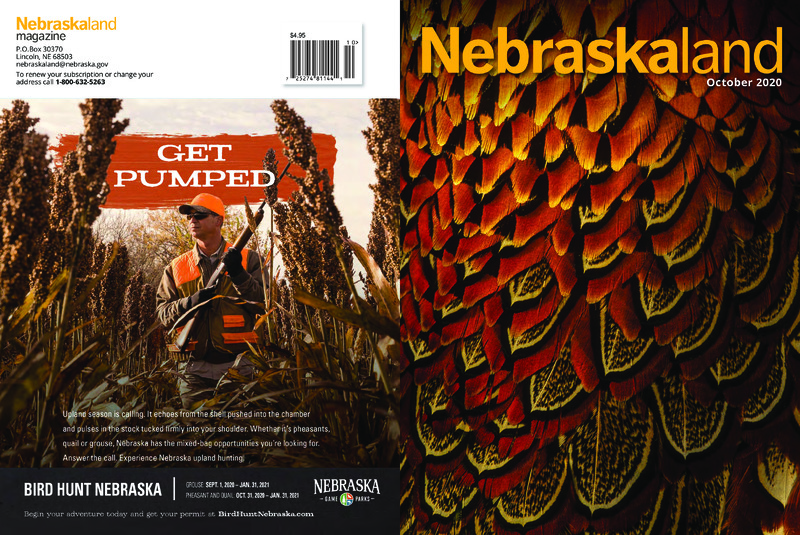
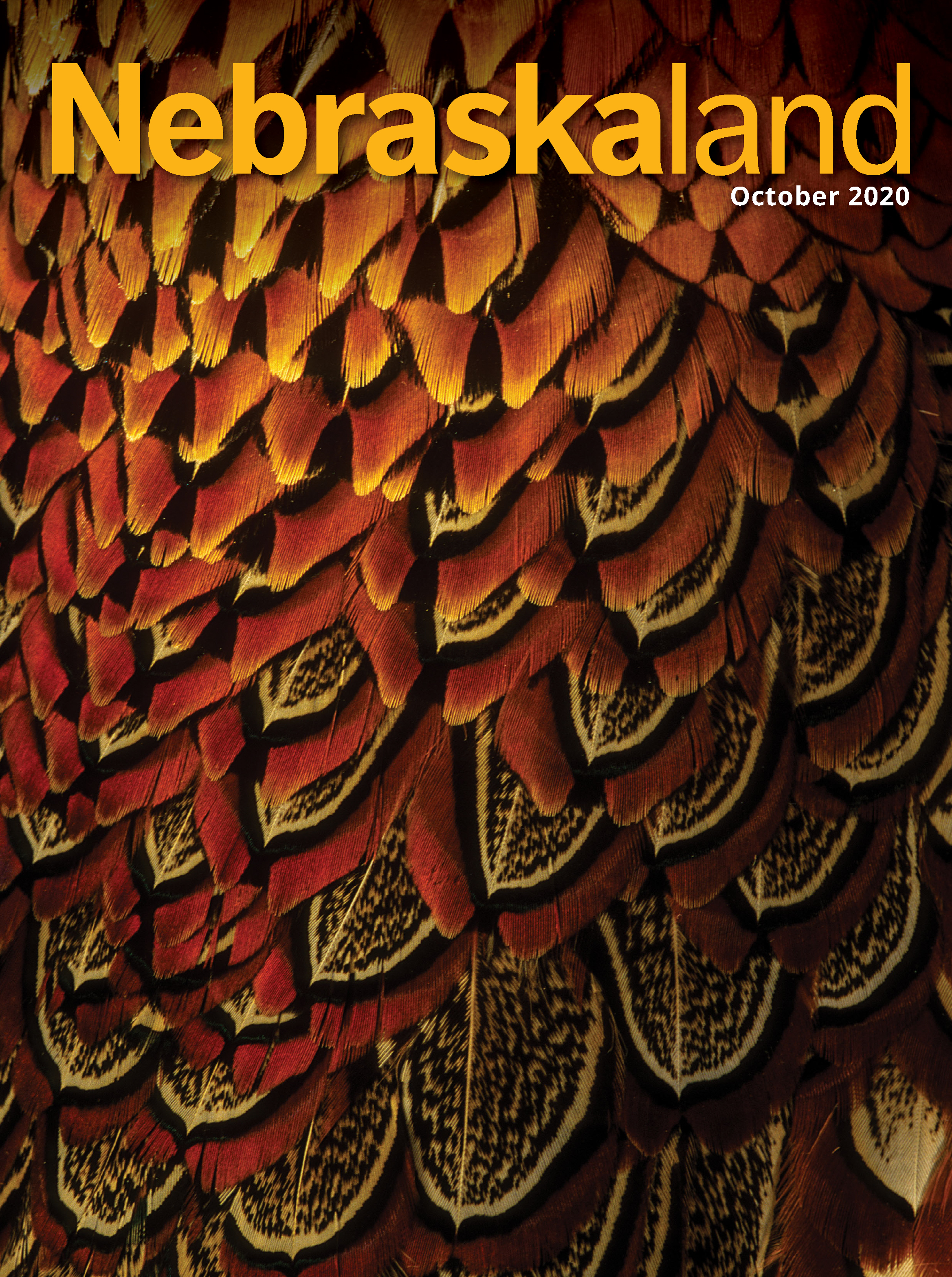
Cover: A close-up photograph of
pheasant feathers reveals the myriad
of colors they feature. Story on page
22. Photo by Gerry Steinauer.
FEATURES
22
28
30
36
38
44
48
FEATHERS
Nature’s Abstract Art
Story and photos by Gerry Steinauer
OUTDOOR NEBRASKA
What to Do in October
By Renae Blum
DUCKS ON THE DELTA
Story and photos by Eric Fowler
FALLING DOWN A WELL ...
AND SURVIVING
By David L. Bristow, History Nebraska
HALLOWFEST
Celebrate Halloween at Ponca State Park
Story and photos by Jenny Nguyen-Wheatley
BARN OWL RESCUE
An Act of Devotion
By Julie Geiser
JUMP-SHOOTING THE
RAINWATER BASIN
An Adventure Story
Story and photos by Jeff Kurrus
DEPARTMENTS
6
10
52
60
62
Your Nebraska
In the Field
Mixed Bag
Portraits from the Past
The Last Stop
ON THE WEB
PHOTO BY ERIC FOWLER
To see additional content including photos,
videos and articles, visit
Magazine.OutdoorNebraska.gov/digital.
Nebraskaland (VOL. 98 / NO. 8 ISSN 0028-1964) is published monthly, except for the combined Jan./Feb. and Aug./Sept. issues, by the Nebraska Game and Parks Commission, 2200 N. 33rd St.,
Lincoln, NE. Periodicals postage paid at Lincoln, Nebraska, and additional mailing offices. POSTMASTER: Send address changes to Nebraskaland, P.O. Box 30370, Lincoln, NE 68503-0370.
Magazine Staff
magazine
Published by the Nebraska Game and Parks
Commission since 1926. The Commission is
dedicated to the conservation and protection
of all the state's natural resources and the
people who use them.
Communications Director Christy Firestone
Public Relations Manager Shawna RichterRyerson
Editor Jeff Kurrus
Associate Editor Jenny Nguyen-Wheatley
Regional Editors Eric Fowler, Julie Geiser,
Justin Haag
Contributing Editor Michael Forsberg
Regular Contributors Renae Blum,
Chris Helzer, Chris Masada, Ryan Sparks, Gerry
Steinauer
Art Director Tim Reigert
Graphic Designer Mel Severin
Photo Librarian Jaclyn Cruikshank Vogt
Administration
Director Jim Douglas
Deputy Director Tim McCoy
Commissioners
Chairman - Dan Kreitman, Wahoo
Vice Chairman - Pat Berggren, Broken Bow
2nd Vice Chairman - Rick Brandt, Roca
Robert Allen, Eustis
Donna Kush, Omaha
Scott Cassels, Omaha
Jim Ernst, Columbus
John Hoggatt, Kearney
Doug Zingula, Sidney
Circulation
For address changes and questions about your
subscription, call 800-632-5263
Advertising Sales Manager
For advertising information contact
Shane G. Gilster, 402-742-0125
Email: shanegilster@gmail.com
Nebraskaland Magazine Copyright 2020, all rights reserved.
Nebraskaland is available in audio from the Nebraska Library
Commission Talking Book and Braille Service, Suite 120, 1200 N St.,
Lincoln, NE 68508. 800-742-7691. Nebraskaland Magazine and the
Nebraska Game and Parks Commission reserve the right to reject any
advertising not in keeping with the agency mission.
Rates: $18 for one year; $33 for two years; $44 for three years. Nebraska
recipients must add appropriate sales tax. To subscribe call
1-800-NEBLAND (632-5263), or go online to:
NebraskalandMagazine.com.
Commission Offices
Conservation Officers
Headquarters/Southeast District Office
2200 N. 33rd Street Lincoln, NE 68503
Phone 402-471-0641
ADMINISTRATION (Lincoln)
Craig Stover (Administrator)
Duane Arp (Asst. Administrator)
Jeff Clauson (Asst. Administrator)
Travis Shepler (Asst. Administrator)
Northeast District Office
2201 N. 13th St. Norfolk, NE 68701
Phone 402-370-3374
Southwest District Office
301 E. State Farm Rd. North Platte, NE 69101
Phone 308-535-8025
Northwest District Office
East Hwy. 2, Box 725 Alliance, NE 69301
Phone 308-763-2940
Bassett Office
524 Panzer St., Box 508 Bassett, NE 68714
Phone 402-684-2921
Kearney Office
1617 First Ave. Kearney, NE 68847
Phone 308-865-5310
Ak-Sar-Ben Aquarium/Schramm Education
Center
21502 W. Highway 31 Gretna, NE 68028
Phone 402-332-3901
Omaha Office
8495 Frederick Street, Omaha, NE 68124
Phone 402-595-2144
OutdoorNebraska.org
Any program that receives federal funding from the National Park
Service, or the United States Fish and Wildlife Service prohibits
unlawful discrimination on the basis of race, color, religion, age, gender,
marital status, national origin, age, disability or political affiliation. Any
person who believes he or she has been discriminated against in
any program, activity, facility, or service, should contact the Nebraska
Game and Parks Commission, Lincoln, NE 402-471-0641, the Equal
Opportunity Commission, Lincoln, NE 402-471-2024, TTY/TDD 402471-4693; United States Fish Wildlife Service, Civil Rights Coordinator,
4401 N. Fairfax Drive, Arlington, VA 22203; Director, Equal Opportunity
Program, U.S. Department of Interior, National Park Service, 1849 C
Street NW, Mail Code 0008, Washington, D.C. 20240-0001.
4
Nebraskaland • October 2020
402-471-5531
402-471-5531
402-471-5531
402-471-5531
NORTHWEST (Includes counties covered)
Dan Kling (District Supt.)
308-430-0572
Sean McKeehan
(Kimball, Banner, Scotts Bluff)
308-672-1824
Josh Widhelm (Morrill, Cheyenne)
308-279-9133
Kelsey Glodowski
(Box Butte, Sheridan, Grant)
308-763-8226
308-289-2274
Jaden Porter (Keith, Garden)
Kyler Prochaska (Dawes, Sheridan, Sioux) 308-430-3984
308-458-7650
Terry Brentzel (Deuel, Garden, Grant)
308-760-0145
Sean Schultz (Keith, Arthur)
308-289-9580
Keith Jadlowski (Keith, Deuel)
308-202-0140
Chance Vordeerstrasse (Keith)
NORTHEAST (Includes counties covered)
Tom Zimmer (District Supt.)
402-649-8053
402-760-0712
Dale Davis (Keya Paha, Brown, Rock)
Jonathan Andreasen
(Madison, Pierce, Stanton)
402-340-3981
Nicholas Fix (Dixon, Dakota, Thurston)
402-508-0261
308-430-3984
Kyler Prochaska (Platte, Colfax)
402-719-6226
Kyle Gaston (Dodge, Colfax)
402-613-8612
Mitch Johnson (Knox, Antelope, Pierce)
402-762-5022
Jeff Jones (Knox, Cedar)
402-380-6410
Cory Krause (Cuming, Wayne, Stanton)
Ethan Teter (Boating Officer-Dodge, Colfax) 402-620-8129
CENTRAL (Includes counties covered)
Mike Thome (District Supt.)
Matt Taylor (Thayer, Fillmore, Nuckolls)
Mark Sullivan (Nance, Polk, Wheeler, Boone)
Matt Brandt (Sherman, Howard)
Greg Hesse (Buffalo, Kearney)
Tim Williams (Hall, Hamilton, York)
Doug Pollard (Loup, Garfield, Valley)
Eric Javins (Adams, Clay, Webster)
Pat George (Harlan, Franklin, Phelps)
Daryl Teter (Howard, Greeley, Merrick)
308-293-8746
402-200-9597
402-741-0636
308-202-0819
402-440-3847
308-380-7331
308-730-7050
402-902-2017
308-920-2762
308-440-1863
Statement of ownership and monthly circulation of
Nebraskaland Magazine
Owner and publisher: Nebraska Game and Parks
Commission
Editor: Jeff Kurrus
Headquarters of Publisher and Publication:
2200 N. 33rd St., Lincoln, NE 68503
Stockholders, Bondholders, Mortgage and
Security Holders: None
Average number of copies
of each issue during
preceding 12 months
Single issue
nearest to
filing date
A. Total Copies Printed
(net press run) ........................ 19,496 ........... 19,214
B. Paid Circulation
1. Mail subscriptions ............... 16,563 ........... 16,678
3. Single-copy sales ................. 1,937 ............. 1,927
C. Total Paid Circulation.............. 19,247 ........... 18,674
D. Free Distribution
by Mail ......................................... 307 ................ 307
D. Free Distribution
Outside the Mail .......................... 324 ................ 324
E. Total Free Distribution ................. 631 ................ 631
F. Total Distribution...................... 19,138 ........... 19,245
G. Copies Not Distributed ................ 358 .................. 19
H. Total ........................................ 19,496 ........... 19,264
I. Percent Paid and/or
Requested Circulation ................97% ............... 97%
SOUTHWEST (Includes counties covered)
Roger Thompson (District Supt.)
308-530-3097
Matt Andrews
(Furnas, Gosper, Frontier, Red Willow)
308-746-2418
Brian Piernicky
(Red Willow, Frontier, Hayes, Hitchcock)
308-340-6627
John Lee (Dundy, Chase, Hayes, Hitchcock)
308-414-1432
Brandon O’Neal
(Lincoln, McPherson, Logan)
308-530-3157
Alex Hasenauer (Lincoln, Perkins)
308-660-4671
402-266-1759
Owen Johnson (Dawson, Gosper, Custer)
308-870-0322
Ray Dierking (Custer, Thomas, Blaine)
402-389-0444
Frank Miller (Cherry, Hooker)
308-217-2108
Taylor Dixon (Dawson, Gosper)
Kevin Bergstrom (Boating Officer-Lincoln) 308-520-1031
SOUTHEAST (Includes counties covered)
Stacey Lewton (District Supt.)
402-890-7140
402-619-1355
Rich Berggren (Douglas)
402-616-5961
Dan Evasco (Sarpy)
402-210-0888
Heath Packett (Cass)
402-209-1506
Russell Mort (Otoe, Johnson)
402-890-6463
Dina Barta (Lancaster),
402-937-3422
Dudley Sorensen (Lancaster)
402-646-0420
Bryce Streger (Seward, Saline)
402-314-9641
Trevor Stahlecker (Lancaster)
402-853-3273
Scott Eveland (Lancaster)
402-806-0915
Matt Seitz (Gage, Jefferson)
402-443-6392
Mike Luben (Saunders, Butler)
YOUR NEBRASKA
Instagram Photos
Follow us (@nebraskaland)
and tag us in your photos
to be featured in an
upcoming issue.
Justin Pence, Omaha
Hummingbird
Britton Bailey, Aurora
Monarchs along Lincoln Creek
6
Nebraskaland • October 2020
October 2020 •
Nebraskaland
7
YOUR NEBRASKA
Chuck Hackenmiller, Lincoln
City Turkeys
Alan Nash, Scottsbluff
Windmill
Karen Kutz Smith, Omaha
Common Yellowthroat
Send your comments and photos to:
Jeff Kurrus, Editor
Nebraskaland Magazine
P.O. Box 30370
Lincoln, NE 68503
or email Jeff.Kurrus@Nebraska.gov
Jes Mikoloyck, Scottsbluff
Storm Over Eagle and Sentinel Rocks
8
Nebraskaland • October 2020
Please include your postal address
and telephone number. Letters may be
condensed and edited. Photographs are
also welcome.
October 2020 •
Nebraskaland
9
IN THE FIELD
FORGING HISTORY
Blacksmithing tools
at Fort Atkinson
State Historical Park
during Heritage Days
in October.
PHOT
HOTO BY
HOTO
Y JEN
E NY
Y NG
GUYE
GUYE
EN-WH
N-WH
W EATL
LEY
EY
10
Nebraskaland • October 2020
October 2020 •
Nebraskaland
11
IN THE FIELD
THREATENED AND ENDANGERED:
THE FINESCALE DACE
PHOTO BY ALEX ENGEL
By Melissa Panella
The finescale dace (Chrosomus neogaeus) is
considered to be a “glacial relict” fish, because the
species expanded into Nebraska when glaciation
was shaping the landscape during the Pleistocene
era. The fish species was then left behind as the
glaciers retreated. Finescale dace live in small
coolwater streams of Nebraska’s Sandhills. These
minnows prefer clear water, often in headwaters of
small creeks or in spring-fed marshes and beaver
ponds.
The finescale dace is small enough that it could
easily fit in the palm of your hand. The female of
the species typically grows a bit larger than the
male. The fish’s tiny scales give it a slick, shiny
appearance, and it has a distinct stripe that runs
along each side of its body. Breeding males are the
most colorful with yellow fins and a red-orange
belly.
This pint-sized predatory minnow feeds in an
interesting way by using its pharyngeal teeth
to grind and crush food in its throat rather than
in its toothless mouth. Finescale dace consume
plankton, algae and small invertebrates such as
aquatic insects and fingernail clams that are in
12
Nebraskaland • October 2020
fact smaller than a person’s fingernail.
Finescale dace are listed as threatened in
Nebraska. Not only do they have a restricted
distribution in the state, but they are also
vulnerable to extended, severe drought conditions
combined with stream dewatering, reduced
water and habitat quality, and predation by and
competition with predatory fish species.
Finescale dace can continue to survive in
Nebraska’s Sandhills as long as their current
populations are not severely impacted. The
conservation of the species depends on
maintenance of quality areas along the streams
where they occur, adequate beaver populations
to create pond habitat and restrictions on the
introduction of fish predators. It is most important
to conserve finescale dace where they are, because
they need exceptional coolwater habitats provided
by groundwater and are reliant on the special
conditions in the Sandhills that resulted from the
last ice age.
Melissa J. Panella is a wildlife biologist for the
Nebraska Game and Parks Commission.
MONARCH BUTTERFLY ON A SWAMP MILKWEED IN A SARPY COUNTY GARDEN
PHOTO BY JEFF KURRUS
IN THE FIELD
MILKWEED IN THE CLASSROOM
By Julie Geiser
Thanks to a grant from the Nebraska Environmental Trust,
a new habitat education program was initiated by Pheasants
and Quail Forever, the University of Nebraska and the Prairie
Plains Resource Institute: Milkweed in the Classroom was
created for classroom use across Nebraska.
Milkweed in the Classroom was developed to address the
current decline of monarch butterfly populations and the
need to educate students about the importance of pollinators
and their habitats. The program encourages students to take
an active role in creating their own pollinator habitats, while
utilizing conservation practices that can positively impact
soil, water, air and wildlife.
Participating classrooms will receive a kit that includes
everything they need to grow native milkweed plants from
seed. Teachers will have access to step-by-step online training
videos that cover a range of topics, including instruction on
how to monitor the project and successfully incorporate
the program into their school’s curriculum to meet national
science standards.
The three-month program starts in February with planting
seeds in the classroom, followed by weeks of growing the
plants alongside activities designed to educate students on
the role pollinators play in producing many of the common
foods we eat. Students will learn about the positive impacts
that pollinator habitats and milkweed plants provide,
including cleaning our water and air, as well as providing
14
Nebraskaland • October 2020
habitat for other wildlife species such as pheasants, quail
and songbirds.
In early May, the milkweed plants should be ready to plant
on a site dedicated to the establishment of a milkweed garden,
preferably on school property. Pheasants Forever chapter
volunteers and staff will provide support to classrooms
on growing and planting milkweed. Once the garden is
established, students will take a survey to evaluate their
knowledge of milkweed and plant ecosystems, pollinators
and knowledge on conservation issues.
Teachers will have the opportunity to monitor milkweed
gardens and gather data on these sites that will be used
to populate the U.S. Fish and Wildlife Service Monarch
Conservation Database, which tracks the progress of planting
1.6 billion milkweed stems by 2038.
This year, the program is looking for pilot classrooms in
Nebraska that can help grow milkweed plants and create
pollinator habitats. Milkweed in the Classroom hopes to
reach a minimum of 500 students. Through these efforts, the
program aims to establish at least 2,000 new milkweed stems
in our state and further develop the curriculum and training
materials for future use.
For more information about Milkweed in the Classroom,
contact Drew Larsen, director of education & outreach at
Pheasants Forever, Inc. and Quail Forever, (308) 293-1194 or
dlarsen@pheasantsforever.org.
PHOTO BY JONATHAN NIKKILA
IN THE FIELD
SURF SCOTER
By Joel Jorgensen
Autumn means duck season for many Nebraskans
but there are a few duck species that most Nebraska
hunters will never bag. The reason may have nothing
to do with skill nor where one hunts, but rather because
there are a small number of ducks that rarely occur in
our state. Among these rare ducks is the surf scoter.
Often referred to as a sea duck, surf scoters breed
in northern boreal forests in Canada and Alaska and
primarily migrate and winter along the coasts. However,
a small number of surf scoters can migrate through the
interior United States, including Nebraska. Most reports
occur in the fall, usually involving immatures whose
general appearance is far less spectacular than their
adult counterparts.
Surf scoters are large ducks sporting big bills. Young
birds appear mostly blackish with contrasting paler
areas on the head and face. Females appear similar
to immatures. Adult male surf scoters are also black
overall, but possess ornately multi-colored bills and
clean white markings on the head. The appearance of
16
Nebraskaland • October 2020
males has led some people to call these birds “skunk
heads,” “clowns” or “candy corn bills.”
Adult males and spring migrants are exceptionally
rare in the state. Mid-October to mid-November is the
peak period when one might find a surf scoter, especially
on the heels of a cold front. Birders specifically search
large reservoirs, lakes and even sewage lagoons to
look for this species and other rarities. Most sightings
in Nebraska involve single birds, pairs or trios, but
occasionally small flocks totaling 5-20 birds are
discovered.
By mere chance and happenstance, Nebraska hunters
do occasionally harvest surf scoter. If this has happened
or will happen to you in the future, consider yourself
among a lucky few. However, preparing a sea duck for
the table might require some additional research since
they are not considered the best-tasting fare.
Joel Jorgensen is the nongame bird program manager for
the Nebraska Game and Parks Commission.
October 2020 •
Nebraskaland
17
WIND TURBINES SPIN AT TWILIGHT ON THE NEBRASKA PUBLIC POWER DISTRICT’S WIND FARM NEAR AINSWORTH
PHOTO BY JENNY NGUYEN-WHEATLEY
IN THE FIELD
BETWEEN DAY AND NIGHT
By Martha D. Shulski
My two favorite times of the day are dawn and dusk
— twilight — that space between day and night. The
sky is transformed in these hours: The landscape becomes
highlighted by changing colors, and we get to start anew.
Animals certainly respond to twilight as some become active
and others come in to roost or bed down.
What defines twilight is the angle of the sun below the
horizon when the sky is still illuminated, and there are three
defined categories. After the sun has dipped below your
horizon (sunset), civil twilight starts and is the brightest
category of twilight. The human eye can distinguish
landforms and terrestrial objects, though the sky is dark
enough that Venus can be seen — sometimes called the
morning or evening star. It is the perfect time to capture
those animals with your camera lens.
A few shades darker is nautical twilight, defined as such
18
Nebraskaland • October 2020
when the sun is 6 to 12 degrees below your horizon. As the
name implies, it is the time when one can use the stars for
navigation and the horizon is distinguishable, assuming
clouds are not in your way.
When the sun is 12 to 18 degrees from your horizon,
astronomical twilight occurs. The dimmest stars can be
visible with the naked eye, though some may find it difficult
to distinguish this faintest of twilight from the dark of
night. How long do we have to capture twilight? About 90
to 120 minutes, varying a bit by time of year. We can thank
our atmosphere and all the particles and gasses therein for
these hours of dawn and dusk. They illuminate our sky by
scattering the light of someone else’s day.
Martha D. Shulski, at the University of Nebraska-Lincoln, is
the director of the Nebraska State Climate office.
October 2020 •
Nebraskaland
19
PHOTO BY JENNY NGUYEN-WHEATLEY
IN THE FIELD
TANDOORI QUAIL
By Jenny Nguyen-Wheatley
I don’t own a tandoor oven. You
probably don’t have a tandoor oven.
Good news, your background charcoal
or wood pellet grill will work just
fine. Inspired by tandoori chicken, a
well-known Indian dish, these grilled,
curried quail make delicious appetizers
or finger food. Thanks to the flavorful
yogurt marinade, the birds come off
the grill tender and juicy.
If you’ve had the Indian dish before,
you might wonder about the lack of
red coloring on my quail. Tandoori
chicken’s signature bright red color
is usually achieved by food coloring,
although bolder recipes might get
their color from generous amounts of
cayenne and red chili powder. I skipped
the food coloring and the screaming
hot peppers — you’re welcome. The
teensy amount of cayenne pepper is
adjustable.
Turmeric stains, so be aware.
20
Nebraskaland • October 2020
Servings: 4
Prep Time: 4 hours
Cooking Time: 10-15 minutes
Ingredients:
8 whole quail, skin on
2 tablespoons of vegetable oil,
plus extra
½ teaspoon of coriander
½ teaspoon of turmeric
½ teaspoon of cumin
½ teaspoon of cayenne pepper
1 teaspoon of onion powder
1 tablespoon of sweet paprika
2 teaspoons of garam masala
powder
Juice of half a lemon
3 cloves of garlic, minced
2 inches of ginger, peeled and
minced
1 teaspoon of kosher salt
¾ cup of plain yogurt
•
•
•
•
•
•
•
•
•
•
•
•
•
•
1. Using kitchen shears, cut open
each quail down the back. Turn each
bird breast-side up and press down
with the palm of your hand to break
the wishbone to flatten birds, and set
aside.
2. In a non-reactive bowl, whisk
together the rest of the ingredients.
Add the quail to the marinade and coat
each bird. Cover and refrigerate for at
least 4 hours or overnight.
3. Remove birds from the refrigerator
one hour prior to cooking. When ready
to cook, prepare grill for medium-high
heat cooking.
4. Brush hot grates with oil. Remove
quail from marinade and shake off
excess. Grill on each side until birds
become golden, slightly charred and
cooked through, about 5-7 minutes on
each side. Serve immediately.
Photographed are blistered shishito
peppers tossed with olive oil and
kosher salt.
October 2020 •
Nebraskaland
21
FEATHERS
Nature’s Abstract Art
Photos and story by Gerry Steinauer
A
bout 20 years ago on a Sandhills hunt, I was arranging
a few harvested grouse for a classic “I shot my limit”
photo when I noticed something far more enticing — the
feathers on the bird’s back accentuated in warm sunlight.
After taking the photo, I was immediately hooked and
have been photographing feather close-ups whenever the
opportunity arises.
ABOVE: Sharp-tailed grouse feathers bathing in warm sunlight. OPPOSITE: Showy rooster pheasants decked out in an array of
iridescent colors.
22
Nebraskaland • October 2020
October 2020 •
Nebraskaland
23
The long neck feathers of male greater prairie chickens are
flared upward during courting displays, resembling horns.
Feathers are an engineering marvel.
Composed of the protein beta-keratin, they
have a central rachis (stem) that branches
into barbs and then barbules. The latter
have hooklets that interlock, like Velcro,
with nearby barbules. Modifications in the
branching pattern allow feathers to serve a
variety of functions.
Fluffy down feathers have flexible barbs
and long barbules that trap air and insulate
birds. Baby ducks, for instance, are born with
a complete coating of natal down to protect
against cold air and water. Due to their tightly
interlocking barbules, long wing feathers are
stiff, flat and air-proof — allowing birds to
fly. They are also anchored to wing bones by
ligaments for precise maneuverability and
strength. Bristles, often consisting of only a
stiff rachis, are the simplest feathers. These
frequently occur on the head where they
serve as protection or are uniquely colored or
shaped for display.
Recent fossil finds in China suggest the first
feathers appeared about 250 million years
ago in reptile ancestors of the dinosaurs. The
early dinosaurs likely had simple feathers
ILLUSTRATION BY ANDREW LEACH, CORNELL LAB OF ORNITHOLOGY
ACADEMY. ALLABOUTBIRDS.ORG
Feather Biology
composed of hollow tubes, which served
to insulate and, if colored, to show off or
camouflage the warm-blooded creatures.
Feathers further evolved during the age of
dinosaurs. The tubes formed into clusters of
barbs, the base of these then fused to form
the rachis. Eventually barbules and hooklets
developed. Archaeopteryx, evolved from a
small flying dinosaur about 150 million years
ago and believed to be the first bird, arrived to
the party decked out in a diversity of feather
types.
GETTY IMAGE
For bird hunters, feathers to photograph are easy to come
by. Gaudy rooster pheasants are decked out in an array of
feather colors and patterns, and waterfowl, prairie chickens,
sharp-tailed grouse, quail and turkeys each have a unique
plumage.
Non-hunters seeking feathers need not fret: Ask a friend to
save you the plumage of their harvested birds, which can be
easily preserved and photographed later. I stretch and pin the
skins of fresh-cleaned birds, feather side down, to cardboard.
Then I sprinkle borax on them and rub it into any remaining
flesh or fat on the skin. Two weeks later, shake off the borax,
and the preserved, odorless plumage is ready for a photo
shoot.
Though illegal to possess non-game, native birds, such
as cardinals or robins, or their feathers, I photograph these
in place when finding recently deceased birds. For example,
the unfortunate blue jay that flew into our picture window
became an ideal candidate. Single feathers, say from the
wing of a sandhill crane or tail of a yellow-shafted flicker
or tom turkey, gracefully perched in nature, are also
photogenic.
I photograph feathers in the early morning or evening,
when low-angle sunlight best refracts iridescent colors from
the feathers and long shadows can add interesting detail (see
page 27 for more on refracted colors). If needed, I use a lens
brush to smooth the feathers and remove distracting flecks of
dried skin or other debris. In my backyard, I place the bird or
Though well-feathered and capable of flight, it is unknown whether Archaeopteryx was a flapper or a glider.
Northern shoveler wing feathers.
24
Nebraskaland • October 2020
October 2020 •
Nebraskaland
25
feathered skin on a low stump and shoot from a tripod using
a 105 mm macro lens. Since the feathers are stationary, I
usually use a smaller aperture for greater depth of field and a
low ISO. The latter provides more detail and color saturation
and less noise, which makes for a better print, especially at
large scale.
With intricate designs and iridescent colors, feather
Feather Colors
Earth’s 10,000-plus bird species are
decorated in an assortment of colors that
are formed in two primary ways: various
pigments in a feather reflect specific colors of
light, or a feather’s structure refracts specific
colors. Reflection is when light bounces
off an object, such as a mirror or pigment,
whereas refraction is when light is bent when
passing through an object, such as a prism
or a feather’s barbules, producing shifting
iridescent colors. Feather color sometimes
results from a combination of reflection and
refraction.
Pigments are colored substances found in
both plants and animals. In feathers, they
consist mainly of carotenoids, melanin and
porphyrins. Carotenoids reflect red and bright
photographs can approach the abstract. Hanging on your
wall, your photos might leave your sophisticated friends
asking, “That’s cool. Is it a Richter? A Pollock?” N
Gerry Steinauer is a botanist for the Nebraska Game and
Parks Commission. He is a regular contributor to Nebraskaland
Magazine.
yellow-colored light, melanin reflects pale
yellows, browns and black, while porphyrins
reflect a wide range of colors including pinks,
reds, browns and greens.
The iridescent colors of many birds, such as
hummingbirds, are a result of the refraction
of incoming sunlight by the microscopic
structure of the barbules. Refraction works
like a prism, splitting the incoming light into
its component colors, such as reds, yellows
and greens. As the viewing angle of the eye
or camera lens to a prism or feather changes,
it sees different components of this color
spectrum — a shifting array of iridescent
colors.
In the below photo, the normally black
turkey breast feathers appear red and silver
not because of camera trickery or Photoshop,
but due to refraction of the sunlight by the
barbules into its component colors. A simple
shift of the lens angle captured these colors.
The iridescent, normally black, color of turkey breast feathers appear red and silver with a change of viewing angle.
The blue of blue jay feathers is a structural color. A layer of air-filled cells near the feathers’ surface reflect blue light waves,
while black pigments located just below these cells absorb all other colors of light.
26
Nebraskaland • October 2020
October 2020 •
Nebraskaland
27
Outdoor Nebraska
What To Do in October
By Renae Blum
Cook fall recipes
From Halloween to harvest and pumpkin-spiced everything, what isn’t
there to love about October? With great weather and fall color, it’s also a
prime time to get outdoors. Here are some fun things to try. N
Throughout the month
Statewide
THE NIOBRARA RIVER VALLEY
PHOTO BY GERRY STEINAUER
GREATER PRAIRIE CHICKEN IN THE SOUTHWESTERN SANDHILLS
PHOTO BY JENNY NGUYEN-WHEATLEY
OYSTER MUSHROOM TACOS. PHOTO BY RYAN SPARKS
Autumn brings with it the rich
flavors of wild game and fall
produce, waiting to be enjoyed. You
can find a selection of fall recipes
by local chefs and cooks, including
venison steak tartare, bobwhite
quail and oyster mushroom tacos,
at NebraskalandMagazine.org —
just search “The Nebraska Table:
Autumn Recipes.”
Enjoy fall color in the central
Niobrara River Valley
Early October
When you think “fall color,” the central Niobrara River Valley may
not spring to mind. But the scenery in this rugged canyon is second to
none. An array of colors can be seen: red sumac, vibrant yellow ash and
cottonwoods, and purplish hues in Sandhills grasses. To enjoy views from
the water, plan a floating trip with a Valentine outfitter.
Hunt for prairie grouse in the Sandhills
Throughout the month
Throughout the month
Elwood Reservoir is consistently one
of the best for walleyes and wipers,
especially in recent years. And October
is a great time to be out fishing, with
fewer anglers on the water and beautiful
weather. Try vertical jigging — as straight
below the boat as possible — to take full
advantage of the fall bite.
28
Nebraskaland • October 2020
View and photograph
cedar waxwings
Year-round | Statewide
These beautiful, berry-loving birds are
migrating through Nebraska on their way
to the southern United States and beyond.
You can find them on berry-laden trees and
shrubs where they will feast before moving
south. Look for juniper, dogwood and wild
cherry trees.
CEDAR WAXWING EATING BERRIES
GETTY IMAGES
Fish for walleye and
wipers at Elwood
Reservoir
ELWOOD RESERVOIR IN GOSPER COUNTY SEEN FROM ABOVE
PHOTO BY ERIC FOWLER
With great public access set in a timeless landscape, the Nebraska Sandhills
offers a good adventure for grouse hunters. Seek out areas with choppy hills
and put the wind to your back; birds are often loafing just on the leeward side
of the ridge. Be ready to cover some ground and look for flocks of grouse flying
to and from feeding spots.
October 2020 •
Nebraskaland
29
Ducks on
the Delta
STORY AND PHOTOS BY ERIC FOWLER
I
n the dark of the early morning,
navigating the delta in the upper
end of Lewis and Clark Lake in a duck
boat can be intimidating if you haven’t
been there before. Or even if you have.
But the maze of channels,
backwaters and chutes separated
by dense stands of bulrushes and
phragmites are a mecca for hundreds
of waterfowl hunters from across the
country each year, drawn by abundant
public land and spectacular flights of
migrating ducks and geese.
Terry Kostinec has been there before,
plenty of times. The Fremont native
first hunted the area in 1983 while he
was a student at Wayne State College
and has been back nearly every year
since. He keeps coming back for the
same reason the birds do. “From the
air it’s very attractive. When the birds
are migrating through this area, you’ve
got these winding back channels and
marsh after marsh after marsh, and it’s
appealing to the birds following the
Missouri River,” Kostinec said. “You’re
always going to see birds along that
stretch of the river.”
A resident of Vermillion, South
Dakota, Kostinec shares a cabin in
Running Water with a friend a mere
200 yards from the ramp where he
most often launches his duck boat.
He also hunts with friends who have
a cabin in Santee, and sometimes sets
out from the ramp there. From either
location, he has plenty of spots to
choose from in this massive marsh
that stretches more than 19 miles from
just above the mouth of the Niobrara
River into Lewis and Clark Lake.
The western portion of this reach
ABOVE: Steve Wilson of Lincoln puts the finishing touches on a decoy spread as the sun rises above the Missouri
River delta above Lewis and Clark Lake. LEFT: Terry Kostinec of Springfield, South Dakota, takes a drake mallard
from his black lab, Blue, while hunting the delta.
is still a river with sandbars, but also
with plenty of cattail marshes and
backwaters, Kostinec said. In the
eastern portion, which Kostinec and
others who frequent the area call
the “head end of the lake,” the river
spreads out into braided channels
and chutes dotted with sandbars and
potholes.
Picking a good spot to hunt begins
with getting off the main channels,
which is swift and can be 20 to 30 feet
deep.
“Most of these ducks want shallow
sheet water with smartweed and
cocklebur and different things growing
in it,” Kostinec said. “You’re going to
30
Nebraskaland • October 2020
look for areas with slack water and
shallow bars, what they call slicks,
where the birds want to sit out of the
wind.”
While you might find some good
spots right off the main channel, some
of the best hunting is often well off it,
Kostinec said. Getting to those spots is
easier than it once was thanks to mud
motors, which handle shallow water
and obstacles better than conventional
outboards, but it is still tricky.
“You’ve got to find ways to shoot
these little chutes,” Kostinec said.
“Once you spend some time on the
river you can figure out how to read
the water to get back into those back
chutes, and sometimes that’s where
the birds are hiding.
“When old birds won’t work a spread
on a sandbar tip, you’ve got to go back
somewhere in the middle of a sandbar
or sand flat. They just avoid spreads
and they go back and look for hiding
places. They’re going out looking
for short grass to hide in, some kind
of marsh grass, bulrush, sedges or
whatever else.”
Finding those spots in the dark can
be a fruitless, not to mention dangerous,
search. That’s why most hunters,
including Kostinec, spend plenty of
time scouting during the day. After
identifying areas they want to hunt,
they leave a track on their GPS on the
way back to the boat ramp that they can
follow out to their spot in the dark the
next morning and not have to second
guess themselves on where those
sandbars or logs are in the river.
Those obstacles are known to take
out lower units or steering cables and
even leave hunters high and dry. “In
some ways it’s nice,” Kostinec said,
referring to the hazards of the area. “It
keeps the amateurs out of this area,
although I’ve had to pull people off
of sandbars before that got rammed
up on them for not knowing how to
read the river.” He’s been there, too,
and has a list of people he can call if
October 2020 •
Nebraskaland
31
what he and his college buddies did
when they started hunting off the old
Ferry Landing Road on Bazile Creek
WMA near Niobrara in the 1980s.
Back then, they would sleep in tents,
in the back of a pickup, or, when it was
really cold, rent a mobile home for $20
a night from a gentleman they met
at the bar in Niobrara. They would
wake up early, throw on their waders
and pull a canoe or bag full of decoys
through the shallows to a good spot.
“Back then, there was a lot of mud,”
he said with a laugh.
While sand has filled some of
those areas and the bottom is more
conducive to wading, Kostinec said
that other than a few young and
energetic high school kids, he doesn’t
see many people hunting the river
that way these days. Commission
conservation officers who work the
area say they don’t see many people
hunting from shore either, but they
do see some hunting from kayaks, and
there is plenty of room for either type
of hunter.
Kostinec has only missed hunting
the area one or two years since his
college days. With the COVID-19
pandemic scratching his annual trip
to Canada, he plans on spending more
time there this fall. He will be there
when teal season opens. And unlike
most years, he will be there in October
when that first big push of small
ducks comes through. He might even
mix it up and find a backwater he can
hunt from his kayak. He’ll be back in
November when the shallow waters
in the Dakotas start to freeze and the
big push of mallards arrives. And he’ll
watch plenty of other birds of various
shapes and sizes pass, too.
“The neatest thing about it is
there’s always a migration going on
the Missouri River, starting with the
shorebirds in August and the teal in
September,” he said. “You’ve got little
birds and you’ve got sandhill cranes
occasionally coming through there. It’s
just a migratory corridor. Even if you’re
not shooting birds, you’re seeing birds
migrating. That’s what makes it fun.” N
Kostinec and Blue wait for the next flight of ducks to come from Lewis and Clark Lake while hunting the tip of the delta.
32
Nebraskaland • October 2020
it appeared on hunting shows and
videos in the 1980s. Since then, on
prime weekends, hunters can expect
to see long lines of rigs with license
plates from across Nebraska and the
Midwest and overflowing parking lots
at the boat ramps. Kostinec has seen
hunters from as far away as South
Carolina and Louisiana.
Most of the locals would rather not
talk about hunting the area, worried
that even more people might come.
But Kostinec doesn’t blame them for
coming, and thanks many of them he
sees at the Ducks Unlimited banquet
in Niobrara in mid-November, where
roughly 80 percent of the attendees
are from elsewhere.
“It’s harder to get permission these
days in a lot of areas, and public water
just draws people,” he said.
Kostinec still chooses to wake
up well before the rooster on some
mornings to beat the rush and up the
odds of getting his preferred spot. But
he and others have found sleeping in
and heading out at first light can lead
to an equally successful hunt. The
direction of the wind often determines
which side of the river bottom birds fly
when moving between their roost, be
it in a pocket on the marsh or rafted
up in the middle of the lake, and the
crop fields they’re feeding in. Watch
that flight at sunrise and set up on the
same pathway, he said, and sometimes
you’ll get yourself into the birds.
Like anywhere ducks and geese
and hunters share the same area for
an extended period of time, birds can
become increasingly difficult to decoy.
“There are times when they just pick
out those boat blinds,” he said. “So
that’s why we go to an A-frame blind
and go back on a sandbar somewhere
and stay away from that boat if we
can’t blend it in real good.”
That type of hunting is closer to
PHOTO COURTESY OF TERRY KOSTINEC
he gets in trouble, which isn’t hard to
do considering the river is changing
constantly. “Every year you get out in
the river and you just erase all of your
marks and trails from the year before
because everything’s different. You’ve
got to start all over, learn the river.”
Wise hunters pick several spots,
knowing that some will be better
than others depending on the wind.
They also know that early risers
might beat them to their first choice,
or even second or third, especially
on a November weekend in the peak
of the migration. All of this marsh is
public land. It was a hidden gem until
During the peak of the migration, the delta can provide a mixed bag for
hunters. On this hunt in 2019, Kostinec and his partners harvested three
goose and six duck species.
October 2020 •
Nebraskaland
33
Hunting the Delta Marsh
The marsh and delta on the Missouri River between
the mouth of the Niobrara River and Lewis and Clark
lake stretches 19 miles and covers more than 20,000
acres of Missouri bottomlands.
The size of the marsh, nearly all of it public, and the
hunting opportunities it provides draws hundreds of
waterfowl hunters from near and far each fall. Tom
Curran, operations project manager with the Corps
at Gavins Point Dam, has hunted the area since the
1990s and said the number of hunters using the area
has increased dramatically in that time.
A survey of more than 1,500 hunters using the boat
ramp at Santee during the 2008 waterfowl found
more than three-fourths of them were from other
states. Many of the out-of-state hunters launch their
boats at Santee due to differing regulations between
the states that share this border water: South Dakota
limits the number of nonresident waterfowl hunters
that can use the area and Nebraska does not.
The Santee ramp is one of four that hunters
typically use to access the marsh from Nebraska.
Another is located north of the village of Niobrara.
Niobrara Confluence WMA offers a primitive ramp.
And Game and Parks staff hopes to repair the Bazile
Creek WMA access road, damaged by flooding in
2019, by waterfowl season so the ramp there can
be used. There are several boat ramps on the South
Dakota side of the river and delta between Running
Water and the lake. Hunters with resident Nebraska
hunting permits can use these ramps to access this
border water.
While most of the area is public, a large portion
stretching from Niobrara to Springfield is managed
by the Nebraska Game and Parks Commission
as Bazile Creek and Niobrara Confluence wildlife
management areas or South Dakota Game, Fish
and Parks as Running Water Game Production Area,
known locally as Springfield Bottoms. These areas
are open only to hunters licensed in the states
that manage them. The remainder of the marsh,
primarily the delta, is managed by the Corps and
open to hunters from both states.
All hunting on the river and in the delta is now
first come, first served. A program allowing a limited
number of permanent blinds was discontinued
in 2019 due to compliance issues and increasing
conflicts between hunters. All blinds and decoys
must be removed each day.
The river and delta are not for novice boaters.
Constantly shifting sandbars and other hazards that
lurk beneath the water can wreak havoc on boats and
motors. Scouting hunting locations in the daylight
and creating a trail on a GPS is recommended.
Spotlights will be needed to navigate the river in the
The delta at the upper end of Lewis and Clark Lake is a maze of river channels and backwaters separated by acres of bulrushes
and phragmites.
34
Nebraskaland • October 2020
Kostinec scans the delta for ducks at sunset the evening before a hunt.
dark. Life jackets are highly recommended.
Hunting the river section with deep, swift channels,
can be especially precarious. “It’s not like hunting a
little marsh,” Curran said. “It’s dangerous. And I’ve
known people who have just about lost their lives
stepping off sandbars into the current.”
The water level in the river is dictated by releases
from Fort Randall Dam. In most years, flows are
reduced at the end of November, but that reduction
can come 10 days earlier in drought years or 10
days later in wet years, Curran said. When flows are
reduced, it can affect access at some boat ramps.
Hydropeaking, daily fluctuations that are the result
of the timing of hydropower production at Randall
that could drop the river and strand unknowing
hunters, is not occurring as it once was due to
changes in power production, Curran said.
Ice can also be a hazard. When temperatures drop,
shallow backwaters and basins at boat ramps can
freeze and slush ice will form on the main channel.
When conditions are right, things can change in a
hurry. In 2013, the Nebraska State Patrol needed
a helicopter to rescue eight hunters in two parties
when the river, free of ice in the morning, froze so
quickly they couldn’t make it back to shore.
Ice can also be an issue on boat ramps, where
water draining from boats and trailers when hunters
pull out can freeze and coat the concrete with a sheet
of ice. When that happens, tire chains are required.
Despite these challenges, the area has and will
always be a draw for hunters and waterfowl.
How the Delta was Formed
The Missouri River in Knox County once bent
back and forth between the bluffs on the South
Dakota and Nebraska shorelines, with farm
fields and wetlands filling the land between
the bends. Gavins Point Dam, the farthest
downstream of six massive dams built on the
river, was completed in 1955 by the U.S. Army
Corps of Engineers, inundating some of this
land.
The creation of the reservoir also slowed
the river’s flow, allowing the 5.1 million tons
of sediment in the river, most of it sand from
the Niobrara River, to settle and accumulate,
forming the delta. This process also raised
groundwater levels, forcing the relocation of
the village of Niobrara in the mid-1970s and
Niobrara State Park in 1987.
Each year, the delta grows by roughly 400
feet, more during floods like those seen in
2011 and 2019. That means more marsh for
hunters, but less water for boaters in the lake,
The reservoir is 8 miles shorter than it once was
and has lost 30 percent of its storage capacity.
Experts estimate it will fill with sediment in 150
years.
October 2020 •
Nebraskaland
35
Falling Down a Well . . and Surviving
.W. Carlin survived a 143-foot fall down a well, but then
he had another problem. Nobody knew he was there,
and no one was likely to come looking for him. If he was
to make it out alive, he would have to do it on his own.
These photos show some other Nebraska wells in the
1880s through about 1900. Well digging was a vital, difficult
and dangerous task on the high plains. Shallow wells could
be dug with an auger, but on tablelands a well might have
to go down 100 or even 200 feet. Before hydraulic drilling,
sometimes the only way to do it was to go down the hole
yourself and have a man to raise and lower the rope.
Professional well-diggers learned their trade by experience.
It wasn’t just the digging. Sections of a well might also need
to be “curbed” with wooden boards to keep them from caving
in. There were a lot of ways to die: cave-ins, falling buckets,
F
or asphyxiation from “the damp” (carbon monoxide).
Abandoned wells could be dangerous, too, as Mr. Carlin
discovered in 1895. Historian Everett Dick told the story
in Conquering the Great American Desert, published by the
Nebraska State Historical Society (aka History Nebraska) in
1975:
“The danger from these deep wells was not confined to well
diggers and those who went down to repair curb or waterraising equipment. After the great exodus of settlers from
western Nebraska in the 1890s, vast expanses of the country
lay unoccupied. Many homesteaders had either abandoned
their claims, allowing them to revert to the government, or
had mortgaged them to Eastern loan companies, which left
their Nebraska property unoccupied. This meant hundreds of
old, deteriorating wells remained on these abandoned claims
Another Cliff Table well, 1889. Photographer Solomon Butcher noted that wells on the high tableland “were from 350 to 400
feet deep.” History Nebraska RG2608-0-3537
36
Nebraskaland
• October 2020
By David L. Bristow, History Nebraska
Mortimer Kress is seated by his well. His sod house was said to be the first in Adams County. History Nebraska RG2035-0-65
— an invitation to disaster to someone who might by chance
fall into one. The best known instance of such an accident
was that of F. W. Carlin, which is widely known in Nebraska
history. While Carlin was on business 15 miles north of
Broken Bow late in the evening, he inadvertently took the
wrong road, which led to some old sod buildings. When one
of his horses stopped, Carlin got out of the buggy and walked
along beside it to see what was the matter. In the twilight, he
stepped into one of these unused wells.
“A well man himself, Carlin immediately realized his
predicament. Placing his feet together, he uttered a prayer:
‘Oh God have mercy on my soul!’ When he struck the water
143 feet below, he was stunned, a rib broken, and an ankle
painfully sprained, but the water was only chest deep. On
examination he found that it was a square well curbed with
wood; and by sheer nerve, indomitable will, and ingenuity,
he was able to whittle footholds with a pocket knife and
otherwise devise means of scaling the difficult walls. After
two days and nights of effort, he reached the top where he
grasped some large sunflower stalks, pulled himself out, and
lay exhausted on the ground for a time. Then he knelt and
thanked God for his deliverance. With a sprained ankle and
a broken rib, he could not walk, but crawled painfully toward
the only house in the whole country, a mile and a half distant.
Famished, he pulled seed pods off wild rose plants along the
road and ate the red meat as he inched his way along to the
house, where he found help.”
Professor Dick says that the incident prompted the state
legislature to pass a law requiring owners of abandoned land
to find these wells and fill them. Not only did this remove
a hazard, but it also provided employment for the povertystricken settlers who remained. N
Visit History Nebraska’s website at history.nebraska.gov.
The well at Len Bisco’s place in West Union Township, Custer
County, 1886. History Nebraska RG2608-0-2207-c
Digging a well near Cliff Table, Custer County, in 1890.
History Nebraska RG2608-0-3537
October 2020 •
Nebraskaland
37
Hallowfest
Celebrate
Halloween
at Ponca
State Park
Photos and story by
Jenny Nguyen-Wheatley
F
or more than two decades, Ponca State Park’s
Hallowfest has thrilled guests of all ages. The park
modeled its event after Indian Cave State Park’s festival,
starting out with just one weekend of haunted hayrack
rides in 1998 and expanding its offerings to two weekends
full of Halloween activities. This fall festival has become a
tradition for families, many of whom begin booking their
cabins and campsites a year in advance.
Hallowfest 2020 falls on Oct. 10 and 17. Guests may
begin making reservations for the haunted ride on Oct. 5
at 8 a.m., but be forewarned, tickets usually sell out within
an hour. This popular 40-minute tour gives parkgoers the
experience of Ponca State Park after dark, but with the
added element of spooky scenes and surprises. Although
there is no age limit, parents should use their discretion in
bringing children under 10 years old. (See page 47 sidebar
for changes due to COVID-19.)
Daytime attractions are fun for the whole family,
and they require no reservations. During a typical year,
activities may include take-and-go crafts, fortune telling,
maze, yard games, pumpkin carving, pumpkin rolling,
“creepy crawly” animal programs and more. Guests and
their pets are encouraged to come in costume.
The campground-decorating contest is another favorite
activity at Hallowfest. Take a stroll near the cabins and
campsites, and you’ll quickly see how much parkgoers love
this holiday. Interestingly, the park owes the creation of
this contest to its guests.
“We are unsure of when this fun began,” said Lynn
Mellick, event coordinator at Ponca State Park.{ “Guests
took it upon themselves to decorate their campsites, and
they also began trick-or-treating in the campgrounds.” In
2012, the contest became an official part of Hallowfest,
with prizes awarded to best-decorated campsites and
cabins.
Kick off your holiday season by celebrating Halloween at
Ponca State Park. Come enjoy the fall colors, and immerse
yourself in the autumn season and all this time of year has
to offer. For more information and/or to make reservations,
contact Ponca State Park at (402) 755-2284. N
Mike Taylor and his son, Ethan Taylor, of Fort
Calhoun carve a pumpkin at Ponca State Park’s
Hallowfest in 2017.
38
Nebraskaland • October 2020
October 2020 •
Nebraskaland
39
LEFT: Skeleton funeral procession
in the park.
BELOW LEFT: The pumpkin rolling
obstacle course is a family favorite
at Hallowfest. Although it will
not be offered in 2020 due to
COVID-19, rest assured that the
attraction will make a comeback.
OPPOSITE: Eden Boko of O’Neill
shows off her carved pumpkin.
40
Nebraskaland • October 2020
October 2020 •
Nebraskaland
41
ABOVE LEFT: Spooky scenes are
scattered all over Ponca State Park
during Hallowfest.
BELOW LEFT: Raelynn and Chris Reed
from Iowa dressed up their dog,
Daisy, as a devil.
LEFT: The mammoth target at Ponca
State Park’s atlatl range gets a
makeover into a circus elephant
during Halloween.
ABOVE: A decked-out mini-lodge
welcomes trick-or-treaters at Ponca
State Park.
42
Nebraskaland • October 2020
COVID-19 Changes
Due to COVID-19, the park will offer haunted drive-thrus
instead of hayrack rides in 2020; guests will self-drive the
route in their own vehicles in order to maintain social
distancing.
Confirmed activities include take-home crafts, “creepy
crawly” animal programs, pumpkin sales, and campground
and cabin decorating contests. The pumpkin rolling obstacle
course will not be available this year. The pumpkin carving
contest is to be determined.
For the most up-to-date information on Hallowfest,
contact Ponca State Park at (402) 755-2284.
October 2020 •
Nebraskaland
43
Barn
Owl
Rescue
An Act of Devotion
By Julie Geiser
Barn owls found in the
loft of the Roskos family
barn near Sutherland.
PHOTO BY JULIE GEISER
44
Nebraskaland
• October 2020
October 2020 •
Nebraskaland
45
PHOTOS BY BONI EDWARDS
N
This young owl just finished eating some meat to keep it
healthy and hydrated after being rescued from the barn.
The author feeds one of the owlets by hand before the owls
are transported to Raptor Recovery.
46
Nebraskaland
• October 2020
was fairly easy, but also loud; the noise they made when
scared or alarmed was one that those observing me rescuing
the owls will not soon forget. These owls didn’t have all the
appropriate feathers that they needed to fly, and it would be
another three to four weeks before they were fully fledged
and able to fend for themselves.
When threatened, barn owls will go on their backs and
protect themselves by clamping down on their perceived
predator with sharp talons. That’s exactly what they did to
my heavy-duty leather gloves as I reached for them, one at
a time. Once they clamped down, I carefully picked them up
and covered their wings so they wouldn’t try to fly, which
could injure them while being transported. Carrying them
down the ladder was fairly easy, but I still needed to pay
attention to their sharp beaks.
Once secured in an enclosed box, I needed to figure out what
to do with the owlets. Sometimes placing the young owls
near their hatching site where the parents will hear them call
for food can be successful. Near the barn was a grain bin with
several openings for parent birds to gain access to the owlets,
while giving the baby owls protection from predators such as
raccoons or foxes. If the adult birds could find their young,
this would be the first option to try.
But after two days, there were no signs of any mice being
brought to the youngsters by their parents, as barn owls will
often stockpile mice to feed their young. The owlets didn’t
cast any pellets, which was another indication that they had
not been fed. The landowners
were also keeping an eye out for
the adult birds, but no sightings
were made.
The young owls’ next journey
would be to the Raptor Recovery
Center in Elmwood, a move
that would depend on a relay of
devoted volunteers who could
transport them to the center.
But until they could be taken,
they needed human care so
they wouldn’t get dehydrated or
hungry. Luckily, I had access to
some game meat in my freezer.
However, the owlets wouldn’t
eat the food I placed in their cage,
so force-feeding was the next
step. While one would typically
give owls food with hair or From left, the author’s granddaughters, Lexus and Paislee, and neighbors Hunter and Jen
feathers, since this is how they Maseberg were curious to learn more about barn owls and to see them up close.
would eat food in the wild, I didn’t
knowing that I might not see them again, but knew in my
have that luxury at the time.
heart that they had a great chance at a life in nature where
Instead, I put food in their mouths when they opened
they belong. N
them; once they figured out they were getting food, they
cooperated and were eager to feed. Adult owls eat around two
mice a night, and owlets usually eat as many as five mice in
a single night to help them grow. This kept them alive until
they could be taken to the Raptor Recovery Center.
There, the owlets were matched with a surrogate male
barn owl that fed and cared for them. Nimbus was an owl
Owl pellets are cast through the mouth of
that couldn’t be released back into the wild, so he became an
an owl and other birds of prey. The pellets
are simply the remains of undigested food,
educational bird and surrogate. Dead mice were provided in
such as the hair and bones of rodents or
the pen to Nimbus, and he in turn answered the calls of the
feathers and bones of small birds. Pellets
hungry young owls and took the mice to them. The owlets
resemble a hairball and, for the curious, can
imprinted on him so there was little human interaction with
be fun to dissect to see what the owls have
the birds.
been eating. Voles, shrews, field mice and
Once the owlets were fully fledged, or feathered, and could
other rodents make up the majority of an
owl’s diet.
fly, they were placed in a flight pen where they learned to
Owl Pellets
hunt on their own like they would have in nature. Mice were
placed in a large stock tank with leaves, litter and weeds so
the owls could learn to search and catch their food. After
learning these skills, they were ready to be released back into
the wild.
In August, I received a call from Rachelle Allbery-McQuade,
a Raptor Recovery volunteer, who told me that she was
releasing the owls that day. She had gotten permission to let
the owls go near a barn a few miles from where they hatched
so they could find protection from weather and predators.
I couldn’t believe how beautiful these once-scraggly
owlets that I rescued had become. Their feathers had all
come in, and they had put on weight and were ready to start
life on their own. As Rachelle let the birds go, I felt a little sad
PHOTO BY JULIE GEISER
ebraska Game and Parks district offices get many calls
about wildlife. The call I received about stranded baby
barn owls was no exception.
A rural family was getting ready to tear down a
dilapidated barn on their property when they noticed a baby
owl peering over a ledge near the rafters. True stewards of
wildlife, they called their local Nebraska Game and Parks
office to find out what they could do. Typically, this type of
information is forwarded to a volunteer at Raptor Recovery,
but at the time, no one was available to respond. Since I had
some experience with barn owls, I decided to go.
At the location, I heaved my ladder up to the barn’s mow,
or loft, and propped it up against the aging and collapsing
barn wall. I could see the young owlet as I made my way up
the rungs, and when I reached the top, I was surprised to find
three owlets peering back at me. Getting the owlets down
Pellets of a barn owl with bones of prey included.
October 2020 •
Nebraskaland
47
Jump-shooting
the Rainwater Basin
An Adventure Story
Story and photos by Jeff Kurrus
told me.
The one thing no one told me,
however, and I’ll tell you, is that even
though you’re planning to jump-shoot
— to stalk — you should always,
always carry decoys with you as well. I
learned this bit of advice the hard way.
With CRP-MAP atlas in hand, I
drove to York, went south on Highway
81, then started riding gravel roads
with binoculars in my lap.
I thought what I would do was glass
ducks from the road then devise a
plan to get to them. As I rode by the
first wetland, I didn’t see a single bird.
However, while glassing the second
wetland, I noticed three mallards flush
from the water and
then put right back
down.
That was exactly
what I was looking
for. A day that I
thought might be
ruled by driving
gravel roads, which
still would have
been a fabulous
day, had already
The Rainwater Basin wetland region is a 4,200-squareproduced a reason
mile loess plain located south of the Platte River in
for me to wade
south-central Nebraska.
through the muck.
Yet, this was
had long wanted to jump-shoot
ducks in the Rainwater Basin
wetlands. Growing up pursuing
this midday passion in Tennessee,
I wanted to get back to where it
all started for me: slowly working
through a slough, ready at any second
for a flush. With this goal in mind, I
started asking questions to folks who
had hunted the area.
“Do that when it’s windy,” one
hunter told me. “The birds will be
pressed against the vegetation and
you’ll have a shot to sneak close.”
“Go during the week if you can,”
another said.
“Bring your binoculars,” another
I
48
Nebraskaland
• October 2020
While I’ve had many adventures throughout my hunting and fi
fishing
shing career,
career my fi
first
rst trip to the Rainwater Basin will always
hold special memories for me. It was mind-boggling in every sense of the word, and I couldn’t be more happy I did it.
when I made my first mistake of the day.
Because I now had the level of 12-yearold excitement flooding through me,
I jumped out of my vehicle, made a
quick plan, and darn near died before
ever taking my first shot. Had I taken
a five-minute ride around the wetland
to see where my easiest access would
be beforehand, I could’ve avoided
that situation. Instead, I threw on my
waders, hunting vest and, with gun
in hand, walked south of the wetland
where the birds were.
“I’ll just work my way through the
cattails until I get to the other side,” I
thought. Man, I was wrong.
I started making my way through
the cattails, as I had planned, but by
the time I figured out that it was a
terribly bad idea, I was too far in to
turn around. I have never seen thicker
cattails, ones where I had to lift my
legs to my chest for every step before
taking another. I began using my
empty shotgun as a walking stick. I
contemplated climbing to the top of
a clump of cattails and rolling across
them, uncaring of how wet I would get.
I even turned around and checked
to see how much daylight I had. It was
11 a.m., and I thought it was 50/50
that I would make it to the other side
of the cattails before nightfall. Plus, I
was getting dehydrated. All the while
ducks continued to quack from the
other side of the worst walk of my
life — and that’s saying something for
some of the places I’ve hiked through.
After checking my Onyx app, a must
when looking to see what lands are
available to hunt, I became even more
frustrated as it told me that I should
be out of the cattails. My legs were
shaking and burning from fatigue.
Finally, I made it into a clearing. I was
past it. Without a duck in sight, I quietly
loaded my gun and began to ease my
way west down the line of cattails.
October 2020 •
Nebraskaland
49
Poorly prepared, I was not ready for the massive amount of ducks trying to work their way back into the wetland where I was
hunting, so I used ducks I had shot as rudimentary decoys to lure birds back to me. It worked well.
A hen pintail flushed, no more than
20 yards away, and I muffed the shot.
Suddenly, a near-deafening “whoosh”
filled the air to my left. When I turned,
my mouth was agape as more than 300
mallards burst into the air. The sounds
of wings and calls filled my world as
I pointed toward the great flock as
it buzzed over me. Yet there were so
many that I couldn’t even pick out a
bird.
I quickly sloshed my way through
These cattails are an excellent reason why you should never hunt the Rainwater
Basin alone. It can get dangerous fast.
50
Nebraskaland
• October 2020
the ankle-high water toward a patch of
grass on the edge of the cattails, then
ducked in to see what would happen
next. If I had decoys, this was when
I could have quickly done some real
damage.
Luckily, they didn’t need decoys
to sit back down, and for the next
20 minutes, I watched greenhead
after greenhead cup its wings toward
the water. I was so awestruck that I
didn’t even think of raising a camera
to photograph or shoot video. I’m not
sure I’ve ever been that mesmerized
while hunting before.
When they all finally sat back down,
I didn’t know what to do. Sixty yards
away, they were not in shooting range
and there was nothing between us. So
I took a chance. I stood up and slowly
walked toward them, knowing that
the overwhelming majority of ducks
would flush — which they did almost
immediately.
However, because I’ve spent a
lifetime jump-shooting ducks and
mourning dove, I knew that every bird
wouldn’t get up. There is always one.
This time, it was a greenhead that
let me get to 20 yards before he flushed
from behind a clump of grass. He was
my first duck of the day.
I grabbed him, as ducks continued
to circle the entire wetland, and
placed him in the biggest patch of
open water I could find — an area no
wider than a backyard swimming
pool, and hid in the same cattails that
tried to kill me earlier. A minute later,
a lone drake cupped his wings straight
toward my “decoy.” Soon after, I had
two decoys sitting in that same open
water.
The birds continued to work the
wetland for the rest of the afternoon.
Eventually, I had to make the longest
300-yard walk I’ve ever made because
my legs were cramping with every
step, and I was in dire need of water.
Once I was able to hydrate, I
returned to where I had shot the
mallards so I could photograph the
sunset. As I did just that, I watched
duck after duck roost in those same
cattails.
I planned to go back the following
morning, yet a blizzard ripped through
central Nebraska overnight, covering
the wetlands and freezing the ground.
Hard-headed, I went the next day,
hoping that the water was still open.
And even though it wasn’t, and there
wasn’t a duck in the air, it forced
me to do something very important
when hunting the Rainwater Basin. I
kept driving gravel roads to find other
publicly accessible wetlands. I found
more than I could ever need.
One of the most exciting adventures
of my hunting life occurred less than
300 yards from a gravel road in sight
of farmsteads and within earshot of
blacktop. But when those mallards
erupted from the water, there wasn’t
another sound in the world. N
For the most up-to-date information
on water level information, visit
O utdo o r Neb ras k a .o rg / wate r fowl
checklist/ and click on Wetland
Conditions.
Basin Tips
Bring extra clothes. Hunting the
Rainwater Basin isn’t necessarily
easy. I’ve gotten wet every time
I’ve hunted or scouted them since
this first day. I’ve stepped in over
my hip boots (which I should
have left at the house), slipped on
muddy ground, or sweated until I
was sopping wet.
Be in shape. These can be long,
difficult walks. Prepare for such.
Don’t go alone. This was my
mistake, and it could have cost
me. Then, two weeks later, I went
to another wetland and a similar
situation happened. The problem
is this: Are you smart enough to
stop chasing ducks when you have
to? I’m not. I should have known
this. I won’t hunt these places by
myself again.
You’ll need supplies. These
include food: water, Onyx app,
charged cell phone, decoys
(enough to fill a vest) and calls.
•
•
•
•
To remember my first day on the Rainwater Basin, I snapped a quick photo with my phone.
The flat terrain and shallow water were not indicative of how difficult a hunt it was.
October 2020 •
Nebraskaland
51
MIXED BAG
PLACES WHOLLY HOLY
By Roger Welsch
PHOTO COURTESY OF HISTORY NEBRASKA (RG2065-09-04)
When we hear a phrase like “holy place” or “sacred site”
societies and religious orders. It is an impressive, steep
most people think of Palestine, Lourdes, Stonehenge or
precipice on the south side of the Platte River just south of
Chaco Canyon. Or maybe an historically memorable place
Fremont. It can be seen easily from Highway 77, but it also
like Gettysburg, the Alamo or Liberty Hall in Philadelphia.
can be visited by approaching it from the south on an access
You know … mythic places far away and long ago. Places not
road near Cedar Bluffs to Camp Cedars, where there is a
in Nebraska.
historical marker and footpath to the crest of the scarp.
Well, there are places that are sacred in Native American
The ancient belief that at the foot of Pahuk, through an
cosmology in Nebraska, and while some are protected, closed
opening either in the Platte or under a giant juniper tree at the
to outsiders, kept secret to this very day, or, for the time
base of the cliff, is the entrance to the subterranean meeting
being, lost to the past, there are sites held in reverence from
place of the Nahurac, the Animal Council, where animal
the past that can be seen, visited and appreciated, regardless
representatives gather to determine the great questions
of the faith of the visitor.
of the cosmos. Pahuk is
There are historically revered
now in the protection of the
sites, sometimes remembered
Nebraska Land Conservancy;
more for the tragedy they
it is a spiritual treasure for all
represent than a spiritual
of us, and I urge the utmost
import: Fort Robinson and the
reverence when visiting this
site of the Cheyenne outbreak
site.
and murder of Crazy Horse,
A less important but
for example. Or Massacre
equally impressive Pahuk
Canyon or the Indian School
rises above the Cedar River,
in Genoa, Nebraska. Or the
just to the south of Fullerton,
mass burials of repatriated
Nebraska, and can be seen
Pawnee remains, also in
from Highway 14. It is private
Genoa.
property and permission
At places like this, it’s not
should be sought before
unusual to find “tobacco
visiting it.
A winter view in 1911 of the Platte River and Pahuk Hill, the
ties,” small bundles often in
Guide Rock on the
holy place of the Pawnee tribe.
red cloth or ribbons tied to a
Republican River near the
nearby tree or fence, or perhaps an offering of food left as a
town of Guide Rock was one of a handful of Pawnee holy
tribute to “those who have gone before,” signs that the site
sites in Nebraska and also is still held in reverence. Black,
is held to be sacred.
or Dark, Island, in the Platte River near Central City is
Many sacred sites are recognized for their mystical or
uncertain; the Dark Island hike/bike trail south of Central
spiritual import. Many of these are carefully protected and
City and across the Platte River provides easy access to the
are not open to visitors or non-tribal members, a necessary
reputed area of Dark Island.
precaution considering a long history of desecration of such
The island may no longer be there or may simply not be
sites. While many of the sites are mentioned in history books
recognized in the maze of islands between Grand Island
and folklore studies, I won’t include them here again because
and Central City. I have floated the river through that area
of that concern of desecration.
many times, and there are many islands that are covered
But other sites are available to visitors, and I feel that
with junipers that might very well be Dark Island, or what
because they are indeed “sacred” they have meaning for
remains of it, and heaven knows, some of my visits to these
all of us, including those who remain open to tribal ways
islands have offered up surprises that would qualify them to
and traditions or even to some who simply respect those
be sites of mystery and wonder.
traditions. Perhaps the most notable and accessible is Pahuk,
a deeply sacred site for the Pawnee as well as other tribes like
Roger Welsch is an humorist, folklorist and a former
the Omaha and Ponca.
essayist for CBS News Sunday Morning. He is also the author
Pahuk is a sacred hill where tribesmen went on a vision
of A Treasury of Nebraska Frontier Folklore and has been
quest or to get instruction in the secrets of tribal clans,
contributing to Nebraskaland Magazine since 1977.
52
Nebraskaland • October 2020
October 2020 •
Nebraskaland
53
MIXED BAG
SHARE YOUR PARK MEMORIES AND PHOTOS
By Jerry Kane
Nebraskaland Magazine is seeking pictures for Parks
Portraits from the Past — a spin on the magazine’s Portraits of
the Past series — to be featured in 2021 during the Nebraska
State Parks 100-year anniversary.
We want your vintage photos (before 2000) and your
memories enjoying outdoor Nebraska activities, such as
boating, camping, hunting or fishing at our state parks and
recreation areas. We will give priority to unique photos or
activities.
Photos may appear in the magazine or on the Nebraskaland
or Nebraska Game and Parks Commission social channels.
To submit your memories and photos, mail or email your
photo to tim.reigert@nebraska.gov or fill out the form at
http://magazine.outdoornebraska.gov/parksportraits/.
Be sure to include a story about the photograph and identify
the people, places and approximate date it was taken.
A unique glimpse of Indian Cave back on Oct. 28, 1905, complete with carvings and petroglyphs.
Standing (right) is Emma Miller, my aunt. Standing (left) is Caroline Greenwald Miller (sister-in-law of Emma). The woman
seated is a family friend, Edna Weber. All three were from Falls City and drove a buggy to Indian Cave that day for an
adventure.
– Fred Miller, Walton, Nebraska
54
Nebraskaland • October 2020
October 2020 •
Nebraskaland
55
MIXED BAG
WOMEN’S OUTDOOR SUBSCRIPTION BOXES
A pilot program is providing Nebraska women the
opportunity to purchase subscription boxes designed to help
them develop and expand their outdoor skills.
The Nebraska Game and Parks Commission; Kansas
Department of Wildlife, Parks and Tourism; and Iowa
Department of Natural Resources have joined Becoming an
Outdoors-Woman and Women in the Outdoors in creating
this opportunity.
Each subscription box, which will include gear, educational
resources, field guides and more, can be purchased for $50.
No long-term commitment is required. Participants pay only
for the boxes they want to receive.
Box themes will change seasonally. The first box, for
September, highlighted pheasant hunting. It contained game
shears, a fillet knife, blaze orange hat, shotgun cleaning
kit and pheasant recipes. The items were accompanied by
a learning objective. Subscribers will have access to online
webinars that teach skills using the tools in the box. Each
quarter, a box will feature a new outdoor skill to learn. The
October box will feature birding. Future boxes will highlight
outdoor cooking, pollinators and fishing.
56
Nebraskaland • October 2020
PHOTO BY JON FARRAR
By Jerry Kane
“We hope the purchase of these boxes will result in ladies
learning a new outdoor skill, even if we can’t get together
for formal in-person events because of COVID-19,” said Julia
Plugge, Game and Parks outdoor education specialist. “Down
the road, we hope these subscribers will purchase licenses,
join outdoor-related organizations and attend events when
the conditions are appropriate.”
For
more
information,
contact
Plugge
at{
julia.plugge@nebraska.gov{or 402-471-6009.
October 2020 •
Nebraskaland
57
MIXED BAG
TAKE ‘EM HUNTING
By Nebraska Hunters
More than 2,175 people participated in last season’s Take ‘Em Hunting challenge.
Here are a few of their stories, and we hope there are even more this year. Take ‘Em
Hunting is now open through May 31, 2021.
Blaine Bader: My daughter, Sophia,
didn’t want her dad to go hunting alone,
so she volunteered to come with me.
She did a great job handling the doe
bleat call. Although we did not harvest
the big buck we were looking for, we had
a nice time sitting quietly in the woods.{
Aaron Donner: My co-worker Brandon
Severson was telling me how he
inherited his grandfather’s Browning
A-5 shotgun but had never been
hunting before. We found some time to
practice shooting blue rock and go over
some gun safety pointers. We went on
a weekend waterfowl hunt in northcentral Nebraska, and there were a few
mallards around. In between the flights,
he said how he wished his grandfather
was still here to tell about all the fun we
had. I replied, “He’s here with us now.”
58
Nebraskaland • October 2020
Adam Guiffredo: It was my friend
Trey’s and my first time hunting. We
were pretty nervous and excited. Trey
wanted to be a part of the hunt, but
wanted to see what it was like before
he decided to hunt with his own tag. I
decided to be the first one to try.
It was an early Sunday morning and
we decided to hunt Whitetail Wildlife
Management Area south of Schuyler
after a recent visit to scout.
After waiting about four hours a
small white-tailed buck approached the
tree we were in. He had no clue we were
there, and my heart was racing. I drew
out my bow, and he came within 15
feet — perfectly broadside — and that’s
when I took my shot.
I couldn’t have asked for a more
perfect and ethical kill. The deer barely
made it 100 feet before falling over.
When we field dressed him, the arrow
had perfectly punctured both lungs and
the heart.
It was definitely an experience
we’ll never forget, and we’ll definitely
continue to hunt and spread the idea
to others.
William Miller: Dawn is a 54-year-old
grandmother who took hunter safety
21 years ago with her son, Derek, but
never hunted until this year when her
son bought her a permit for Mother’s
Day. Dawn comes from a hunting family
and married a hunter. Her husband of
35 years, her son who is now 33 and
her 8-year-old grandson were with her
when she took her first shot, ever.
Jessica Anthony: My daughter, Norah,
is 11 and loves to hunt deer. I think she
loves the quality time, watching wildlife
and probably eating the snacks we pack.
We aren’t ready to let her shoot a rifle
yet, but next year, we’ll get her into a
safety course and let her get her own
permit. This year she used the peace and
quiet to sneak in a nap on my shoulder.
October 2020 •
Nebraskaland
59
PORTRAITS FROM THE PAST
My family loves your magazine. We are grown and live all over the country now, but Nebraska is home!
The year is 1974, one of many hunting trips with our father, John Morehead (not pictured). Left to right in the photo are Marc,
Bruce and Karen Morehead. Dad taught us to love the land, Nebraska in particular. Hunting and conservation was one way to
show it. The location is 20 minutes from Falls City, Nebraska.
I (Kristine) am one of five children to John and Amy Morehead. Photographed are three of my siblings, and we have another
sister, Amalia. The hunting was on private land in Nemaha County near the Missouri River. For a couple of years we built a
wax cotton canvas ‘shack’ and spent the nights in the field — freezing ourselves — but for some reason my dad thought this
was a good idea.
At any rate, we are all hunters and conservationists to this day, and some of the best memories I have are of these days on
the river.
– Kristine (Morehead) Hansen-Cain, Omaha
LEFT: In 1973, Tom Krause showed 10- to 12-year-old
boys how to camp in the winter on the Elkhorn River north
of Fremont. Pictured left to right are Korey Perry, Paul
Swaggerty and Joe Smith. I was the photographer. Tom is
the past president of the National Trappers Association.
OPPOSITE: This is me at age 14 during my first trapping
season on opening day, Nov. 1. I’m holding two muskrats.
These were taken at Hubbard ditch north of Fremont.
– Terry Kostinec, Vermillion, South Dakota
Send contributions to: Portraits from the Past, Nebraskaland Magazine, P.O. Box 30370, Lincoln, NE 68503-0370. Or e-mail to Tim.Reigert@Nebraska.gov. Photos
should show people enjoying Nebraska outdoor activities, such as camping, boating, hunting or fishing, and must have been taken before 1990. We will give priority
to unusual photos or activities. When possible, please include a story about the photograph and identify the people, places and approximate date it was taken. Text
may be edited and photos adjusted for reproduction. All photos will be returned.
60
Nebraskaland • October 2020
October 2020 •
Nebraskaland
61
PHOTO BY JEFF KURRUS
THE LAST STOP
NOT QUITE SURE I PULLED IT OFF
By Jeff Kurrus
I’ve never owned more decoys in my life.
Most of them came when a buddy decided to
upscale his current supply and was looking for
a bargain shopper.
Enter me.
Even though he was willing to easily part
with them, our hunting party marveled at
how green the mallard heads were compared
to the ones we had been hunting over.
We already had a pile of stand-up Canada
geese dekes for field hunting, but during one
of our hunts, several mallards had repeatedly
worked our Canadas, leading us to wonder,
“What would happen if we added mallards
to our set?” There’s always a reason for more
dekes, we have long understood that. And this
was ours.
After the purchase, we moved them into the
62
Nebraskaland • October 2020
shed, and I couldn’t help but stare. Man, they
were green. And when the light hit them just
right, they shone just like they were out of the
box. But did they shine bright enough for a
photo? I was willing to find out.
I spent the better part of two afternoons
asking my kids to repeatedly open and close
the shed doors to varying degrees in an effort
to make photos of my “new” decoys.
Photographers are constantly looking at
scenes and imagining, with the right kind of
soft, early-morning or late-day light, what
that scene might look like through a camera
lens.
To this day, I rearrange the decoys every
time I walk into the shed just because I’m still
not sure if I captured the photo I wanted.
Maybe I just need more decoys.
October 2020 •
Nebraskaland
63
Position: 637 (17 views)