Volume 98, Issue 7, 2020
August-September 2020

- Identifier:
- nela.2020_098_07
- Title:
- Volume 98, Issue 7, 2020
- Issue Name:
- August-September 2020
- Date Issued:
- 2020-08-01
- year:
- 2020
- Season:
- Summer
- PDF filename:
- NL_98.07_2020_Aug_Sep_Spreads_Entire.pdf
- Publisher:
- Nebraska Game and Parks Commission
- Format:
- Periodical
- volume:
- 098
- issue:
- 07
- number:
- 098.07
- Decade:
- 2020s
- Type:
- Rights Holder:
- Copyright Nebraskaland Magazine/Nebraska Game and Parks Commission, all rights reserved.
- Extracted Text:
-
magazine
P.O.Box 30370
Lincoln, NE 68503
nebraskaland@nebraska.gov
To renew your subscription or change your
address call 1-800-632-5263
$4.95
August-September 2020
Volume 98 No. 7
August-September 2020
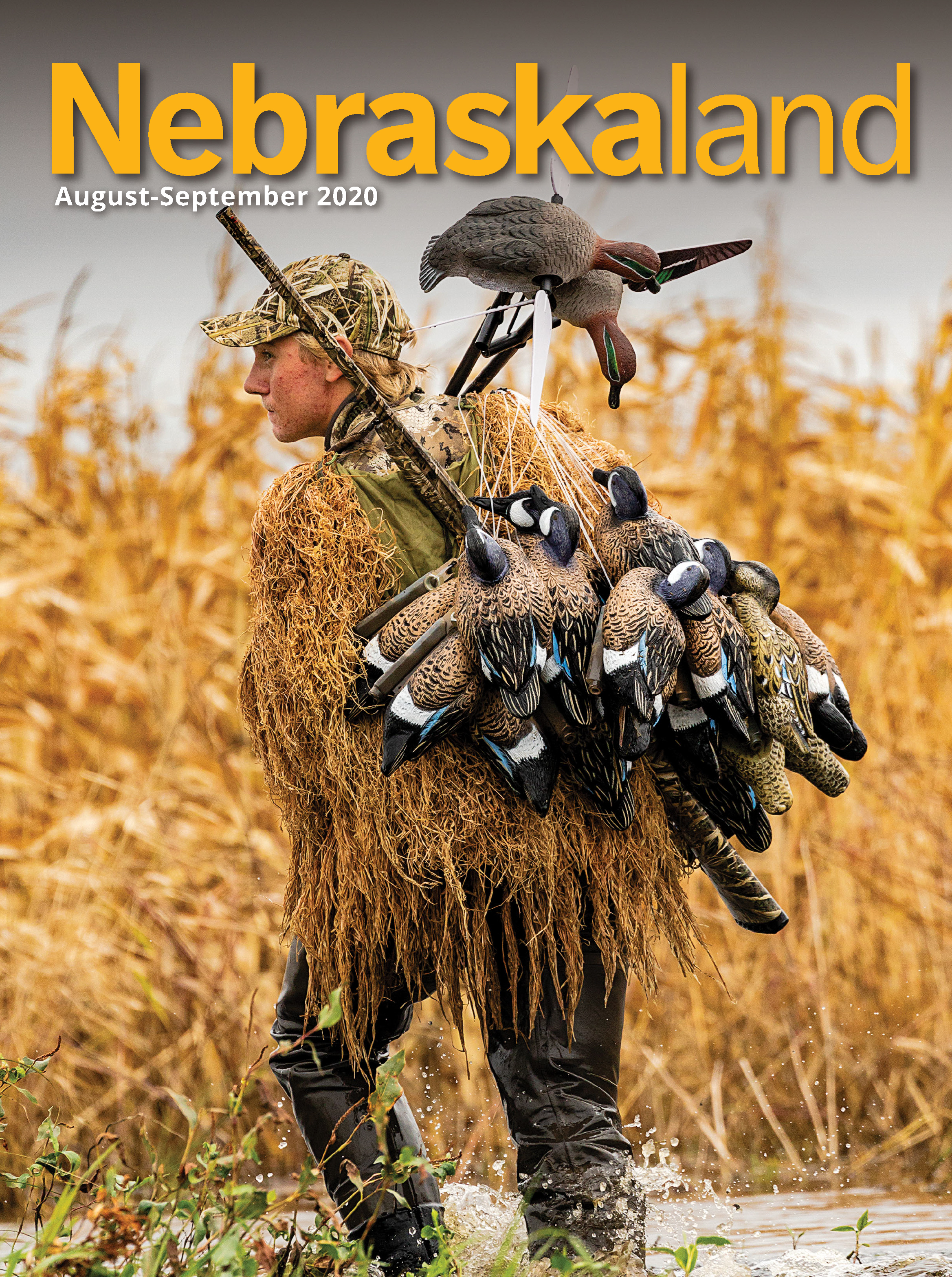
Cover: Blake Steinke makes a midhunt move to a better location while
teal hunting. See story on page 30.
Photo by Doug Steinke.
FEATURES
22
COMMON SCENTS
28
OUTDOOR NEBRASKA
30
By Ryan Sparks
What to Do in August and September
By Renae Blum
IN PURSUIT OF THE BLUE DART
Story by Todd Mills and photos by Doug Steinke
36
THE SILVER BUG OF 1896
38
LARGE MILKWEED BUGS
42
DOVE BANDING
By David L. Bristow, History Nebraska
Story and photos by Chris Helzer
Story and photos by Eric Fowler
DEPARTMENTS
6
10
46
56
58
Your Nebraska
In the Field
Mixed Bag
Portraits from the Past
The Last Stop
ON THE WEB
To see additional content including photos,
videos and additional articles, visit
Magazine.OutdoorNebraska.gov/digital.
PHOTO BY JUSTIN HAAG
Nebraskaland (VOL. 98 / NO. 7 ISSN 0028-1964) is published monthly, except for the combined Jan./Feb. and Aug./Sept. issues, by the Nebraska Game and Parks Commission, 2200 N. 33rd St.,
Lincoln, NE. Periodicals postage paid at Lincoln, Nebraska, and additional mailing offices. POSTMASTER: Send address changes to Nebraskaland, P.O. Box 30370, Lincoln, NE 68503-0370.
Magazine Staff
magazine
Communications Director Christy Firestone
Public Relations Manager Shawna Richter-Ryerson
Published by the Nebraska Game and Parks
Commission since 1926. The Commission is
dedicated to the conservation and protection
of all the state's natural resources and the
people who use them.
Editor Jeff Kurrus
Associate Editor Jenny Nguyen-Wheatley
Regional Editors Eric Fowler, Julie Geiser,
Justin Haag
Contributing Editor Michael Forsberg
Regular Contributors Renae Blum,
Chris Helzer, Chris Masada, Ryan Sparks, Gerry
Steinauer
Art Director Tim Reigert
Graphic Designer Mel Severin
Photo Librarian Jaclyn Cruikshank Vogt
Administration
Director Jim Douglas
Deputy Director Tim McCoy
Commissioners
Chairman - Dan Kreitman, Wahoo
Vice Chairman - Pat Berggren, Broken Bow
2nd Vice Chairman - Rick Brandt, Roca
Robert Allen, Eustis
Donna Kush, Omaha
Scott Cassels, Omaha
Jim Ernst, Columbus
John Hoggatt, Kearney
Doug Zingula, Sidney
Circulation
For address changes and questions about your
subscription, call 800-632-5263
Advertising Sales Manager
For advertising information contact
Shane G. Gilster, 402-742-0125
Email: shanegilster@gmail.com
Nebraskaland Magazine Copyright 2020, all rights reserved.
Nebraskaland is available in audio from the Nebraska Library
Commission Talking Book and Braille Service, Suite 120, 1200 N St.,
Lincoln, NE 68508. 800-742-7691. Nebraskaland Magazine and the
Nebraska Game and Parks Commission reserve the right to reject any
advertising not in keeping with the agency mission.
Rates: $18 for one year; $33 for two years; $44 for three years. Nebraska
recipients must add appropriate sales tax. To subscribe call
1-800-NEBLAND (632-5263), or go online to:
NebraskalandMagazine.com.
Commission Offices
Conservation Officers
Headquarters/Southeast District Office
2200 N. 33rd Street Lincoln, NE 68503
Phone 402-471-0641
ADMINISTRATION (Lincoln)
Craig Stover (Administrator)
Duane Arp (Asst. Administrator)
Jeff Clauson (Asst. Administrator)
Travis Shepler (Asst. Administrator)
Northeast District Office
2201 N. 13th St. Norfolk, NE 68701
Phone 402-370-3374
Southwest District Office
301 E. State Farm Rd. North Platte, NE 69101
Phone 308-535-8025
Northwest District Office
East Hwy. 2, Box 725 Alliance, NE 69301
Phone 308-763-2940
Bassett Office
524 Panzer St., Box 508 Bassett, NE 68714
Phone 402-684-2921
Kearney Office
1617 First Ave. Kearney, NE 68847
Phone 308-865-5310
Ak-Sar-Ben Aquarium/Schramm Education
Center
21502 W. Highway 31 Gretna, NE 68028
Phone 402-332-3901
Omaha Office
8495 Frederick Street, Omaha, NE 68124
Phone 402-595-2144
OutdoorNebraska.org
Any program that receives federal funding from the National Park
Service, or the United States Fish and Wildlife Service prohibits
unlawful discrimination on the basis of race, color, religion, age, gender,
marital status, national origin, age, disability or political affiliation. Any
person who believes he or she has been discriminated against in
any program, activity, facility, or service, should contact the Nebraska
Game and Parks Commission, Lincoln, NE 402-471-0641, the Equal
Opportunity Commission, Lincoln, NE 402-471-2024, TTY/TDD 402471-4693; United States Fish Wildlife Service, Civil Rights Coordinator,
4401 N. Fairfax Drive, Arlington, VA 22203; Director, Equal Opportunity
Program, U.S. Department of Interior, National Park Service, 1849 C
Street NW, Mail Code 0008, Washington, D.C. 20240-0001.
4
402-471-5531
402-471-5531
402-471-5531
402-471-5531
NORTHWEST (Includes counties covered)
Dan Kling (District Supt.)
308-430-0572
Sean McKeehan
(Kimball, Banner, Scotts Bluff)
308-672-1824
Josh Widhelm (Morrill, Cheyenne)
308-279-9133
Kelsey Glodowski
(Box Butte, Sheridan, Grant)
308-763-8226
308-289-2274
Jaden Porter (Keith, Garden)
Kyler Prochaska (Dawes, Sheridan, Sioux) 308-430-3984
308-458-7650
Terry Brentzel (Deuel, Garden, Grant)
308-760-0145
Sean Schultz (Keith, Arthur)
308-289-9580
Keith Jadlowski (Keith, Deuel)
308-202-0140
Chance Vordeerstrasse (Keith)
NORTHEAST (Includes counties covered)
Tom Zimmer (District Supt.)
402-649-8053
402-760-0712
Dale Davis (Keya Paha, Brown, Rock)
Jonathan Andreasen
(Madison, Pierce, Stanton)
402-340-3981
Nicholas Fix (Dixon, Dakota, Thurston)
402-508-0261
308-430-3984
Kyler Prochaska (Platte, Colfax)
402-719-6226
Kyle Gaston (Dodge, Colfax)
402-613-8612
Mitch Johnson (Knox, Antelope, Pierce)
402-762-5022
Jeff Jones (Knox, Cedar)
402-380-6410
Cory Krause (Cuming, Wayne, Stanton)
Ethan Teter (Boating Officer-Dodge, Colfax) 402-620-8129
CENTRAL (Includes counties covered)
Mike Thome (District Supt.)
Matt Taylor (Thayer, Fillmore, Nuckolls)
Mark Sullivan (Nance, Polk, Wheeler, Boone)
Matt Brandt (Sherman, Howard)
Greg Hesse (Buffalo, Kearney)
Tim Williams (Hall, Hamilton, York)
Doug Pollard (Loup, Garfield, Valley)
Eric Javins (Adams, Clay, Webster)
Pat George (Harlan, Franklin, Phelps)
Daryl Teter (Howard, Greeley, Merrick)
Nebraskaland • August-September 2020
308-293-8746
402-200-9597
402-741-0636
308-202-0819
402-440-3847
308-380-7331
308-730-7050
402-902-2017
402-705-9989
308-440-1863
SOUTHWEST (Includes counties covered)
Roger Thompson (District Supt.)
308-530-3097
Matt Andrews
(Furnas, Gosper, Frontier, Red Willow)
308-746-2418
Brian Piernicky
(Red Willow, Frontier, Hayes, Hitchcock)
308-340-6627
John Lee (Dundy, Chase, Hayes, Hitchcock)
308-414-1432
Brandon O’Neal
(Lincoln, McPherson, Logan)
308-530-3157
Alex Hasenauer (Lincoln, Perkins)
308-660-4671
402-266-1759
Owen Johnson (Dawson, Gosper, Custer)
308-870-0322
Ray Dierking (Custer, Thomas, Blaine)
402-389-0444
Frank Miller (Cherry, Hooker)
308-217-2108
Taylor Dixon (Dawson, Gosper)
Kevin Bergstrom (Boating Officer-Lincoln) 308-520-1031
SOUTHEAST (Includes counties covered)
Stacey Lewton (District Supt.)
402-890-7140
402-619-1355
Rich Berggren (Douglas)
402-616-5961
Dan Evasco (Sarpy)
402-210-0888
Heath Packett (Cass)
402-209-1506
Russell Mort (Otoe, Johnson)
402-890-6463
Dina Barta (Lancaster),
402-937-3422
Dudley Sorensen (Lancaster)
402-646-0420
Bryce Streger (Seward, Saline)
402-314-9641
Trevor Stahlecker (Lancaster)
402-853-3273
Scott Eveland (Lancaster)
402-806-0915
Matt Seitz (Gage, Jefferson)
402-443-6392
Mike Luben (Saunders, Butler)
YOUR NEBRASKA
Instagram Photos
Follow us (@nebraskaland)
and tag us in your photos
to be featured in an
upcoming issue.
Erik Johnson, Lincoln
Nebraska’s Northern Lights
6
Nebraskaland • August-September 2020
August-September 2020 •
Nebraskaland
7
YOUR NEBRASKA
Andrea Pfahl, Papillion
Peek-a-Boo Raccoon
Chuck Hackenmiller, Lincoln
Cardinal
James Havenridge, Blair
Blades on Fire
Send your comments and photos to:
Jeff Kurrus, Editor
Nebraskaland Magazine
P.O. Box 30370
Lincoln, NE 68503
or email Jeff.Kurrus@Nebraska.gov
Please include your postal address
and telephone number. Letters may be
condensed and edited. Photographs are
also welcome.
8
Nebraskaland • August-September 2020
August-September 2020 •
Nebraskaland
9
IN THE FIELD
MISTY MORNING
SUNRISE AT WALGREN
The stone shelter and fishing
pier at Walgren Lake appear
especially scenic as mist
billows from the water
PHOTO BY JUSTIN HAAG
10
Nebraskaland • August-September 2020
August-September 2020 •
Nebraskaland
11
IN THE FIELD
THREATENED AND ENDANGERED:
THE SMALL WHITE LADY’S-SLIPPER ORCHID
The small white lady’s-slipper orchid (Cypripedium
candidum) is one of Nebraska’s most bizarre and beautiful
wildflowers. A finicky plant, conservationists are exploring
methods to manage this orchid’s prairie and meadow habitats
to ensure the survival of this
state threatened species.
Historically, the white
lady’s-slipper ranged over
much of northeastern
Nebraska,
extending
westward on the Niobrara
River to Cherry County and
the Platte River to Lincoln
County. Today, it is found
in 30 sites in the Loup
and upper Elkhorn river
drainages.
The long-lived orchid
grows as a single stem or
in clumps reaching 4 to
12 inches tall. Each stem
supports several broad,
lance-shaped leaves with
prominent parallel veins.
The waxy-white flowers, which bloom from late-May into
June, have an inflated lower petal that forms a pouch,
the slipper, designed for intricate insect pollination. The
narrow, green capsules mature in late summer and contain
thousands of tiny, wind-dispersed seeds.
Loss of its prairie habitat and competition from invasive
plants, such as non-native smooth brome and reed canary
grass, have played a key role in the orchid’s decline. The
orchid also appears to be sensitive to long-term livestock
grazing as it is known from only one pasture in our state, and
there, in Valley County, the plants grow in a wet, hummocky
area rarely touched by cattle.
Today, the orchid, and many other prairie wildflowers,
are most abundant in meadows hayed in late summer after
their seeds have ripened and the plants are mostly dormant.
Unfortunately, most Nebraska hay meadows are traditionally
cut in mid-summer when grasses are at the peak of growth
and nutrient content. This practice eliminates the orchid’s
seed capsules and the leaves it needs to restock root reserves
for the next year’s growth through photosynthesis. At several
12
Nebraskaland • August-September 2020
meadows, annual haying has eliminated the lady’s-slipper,
but it persists in adjacent, un-mowed road ditches.
I once saw a strange phenomenon: On an otherwise bare,
gravel ridge pushed up by a road grader grew hundreds of
young lady’s-slippers. Their
source: seeds from plants
in an adjacent meadow.
Historically, flooding and
bison grazing and trampling
often created similar bare
habitats, and I speculate that,
free of grass competition,
this is where orchid
seedlings thrived and grew
to adulthood. Such habitats
are now rare or non-existent
in prairies and meadows. A
management scenario to
promote similar habitats
might include periodic
prescribed fire followed by
heavy livestock grazing to
stress grass regrowth and
create openings for lady’sslipper seedlings. Late summer haying in the intervening
years would allow mature plants to seed and store nutrients.
Another conservation concern is the difficulty of
establishing new lady’s-slipper populations. I once tried to
move 20 orchids that grew in a meadow and adjacent road
ditch near Columbus slated for development. Transplanted to
meadows on the central Platte and Elkhorn river floodplains,
the plants lingered for a year and then died. The soils at these
sites apparently lacked the specific chemistry, moisture
content and/or fungi needed by the orchid. Regarding the
latter, the white lady’s-slipper grows only in soils harboring
certain soil fungi, which aid its roots in absorption of water
and nutrients. The plant’s specific habitat needs also make it
extremely difficult to establish from seed.
The difficulty of transplanting and seeding the white
lady’s-slipper necessitates preservation of its wild
populations. In Nebraska, all but one of these occur on
private lands, mandating that conservationists work with
farmers and ranchers to conserve the species. Only through
such partnerships will the rare orchid survive in our state.
PHOTO BY JON FARRAR
By Gerry Steinauer
PHOTO BY JEFF KURRUS
IN THE FIELD
ANTLER OPTIONS
By Jeff Kurrus
Fun with antlers, especially when you involve a young
hunter, can occur long after the buck is harvested. Here are
some options for your trophy, regardless of its size.
Scoring Antlers
“What did he score?” is the typical question asked after a
nice buck has been harvested. The more mass, tine length,
and symmetry a deer has, the higher the score. Excellent
resources for this process can be found at fieldandstream.com
and Boone-crockett.org, the latter even provides an online
score calculator. Once you get used to the process, scoring one
rack will turn into scoring even more.
Easy European Mounts
Bury the skull in the garden, wrap aluminum foil around
the antlers to help with rodents, and come back in a couple
months. The skull will decompose to the point that, if it’s a
warm autumn, you can finish the clean-up portion before
winter. For me, this step involves a dedicated Crock-Pot filled
with water and a cap full of fabric softener. Once cooked
for 24 hours, cut off any remaining pieces of flesh and set
outside to dry in the sun.
Once the rack is dry, you have some decisions to make.
Depending on the minerals in the ground where it was
buried, the skull will have a particular color to it. If you want
14
Nebraskaland • August-September 2020
the skull bleached white, use hydrogen peroxide for 24 hours
and then let it dry in the sun. Quite often, I go with the
natural, rustic color that the ground gives the skull.
My last step is placing a couple of dryer lint sheets up
the nasal cavity of the buck. As you experiment with this
process, you’ll find what works for you as well.
It can be messy if you don’t allow the bugs to do most
of the work for you when the skull is buried, but there’s no
reason that a buck harvested during the early part of archery
season can’t be a finished product, like the one pictured, by
the time the ground freezes.
Rattling Antlers
Cut a set of antlers at the base, preferably a 4-by-4 or
larger. Next, drill a small hole through the side of each of the
bases and attach them to each other with thin rope.
Crafts
From writing pens to art, deer antlers can be used for a
variety of purposes. Pinterest will give you a starting point
for ideas — your imagination will provide the rest.
When a young hunter sees all of the projects that can be
accomplished with a set of antlers, there’s a good chance that
young hunter will want to build even more — thus, a hunting
partner long into the future.
PHOTO BY JUSTIN HAAG
IN THE FIELD
LARK BUNTING—THE LATE SUMMER
SHOWSTOPPER
By Stephen J. Brenner, Nongame Bird Biologist
The Great Plains host a wide variety of spectacular wildlife,
especially in the summer when migratory birds are busy
establishing territories, finding a mate and raising young.
While small birds may not be the most visible or eye-catching
creatures on the prairie, the lark bunting is one songbird that
is hard to ignore. During the spring and summer months,
the male lark bunting is one of the most recognizable
North American songbirds, sporting a completely black body
contrasted only by a bold white wing patch. Female lark
buntings also have a large white wing patch, but their bodies
are a more subtle brown with occasional black streaking on
their breast and face.
The first thing to know about lark buntings is that they
are neither a lark nor a bunting. Lark buntings are in fact
sparrows, but given their uniqueness among their taxonomic
relatives, we can let early ornithologists off the hook for
this apparent misnomer. Lark buntings are an entirely
North American species, wintering in the southwestern
16
Nebraskaland • August-September 2020
states and northern Mexico and breeding as far north as
southern Saskatchewan. In Nebraska, lark buntings can be
found in the western half of our state during the summer,
predominately in prairie habitats, but occasionally they will
nest in agricultural fields.
Like many migratory birds, lark buntings are most visible
during the early summer months, when males are performing
their singing aerial displays. However, August can be a great
time to observe this species as they begin a fascinating
behavior in preparation for their autumn migration. Lark
buntings will form large “post-breeding” flocks, with numbers
ranging from a few dozen to a few hundred individuals. They
will stay in these flocks throughout their migration and into
the wintering grounds. Keep an eye out along fence lines
and roadsides for this rather large sparrow as flocks of these
white-winged beauties scatter to avoid the perils of fastmoving vehicles. Slow down and take another look as this
species begins to flock up for their next major journey.
August-September 2020 •
Nebraskaland
17
YOUNG CORN GROWING IN DRY ENVIRONMENT, GETTY
IN THE FIELD
DROUGHT
By Martha D. Shulski
A prolonged lack of water, low reservoirs and streamflows,
parched landscape and burnt crops — something that
Nebraskans are quite familiar with. If I were to ask you to tell
me your definition of drought and how it affects you, I bet I
would get as many different answers as there are magazine
subscribers. Drought is often termed an enigma, which
was actually coined as such by a prominent University of
Nebraska-Lincoln scientist. Why so? Unlike most other
natural hazards we experience, drought is difficult to define,
monitor, assess when it exactly begins and ends, and often
(but not always) creeps into an area with a slow onset. As
such, there are several types of drought — meteorological
(lack of adequate precipitation), hydrological (low water
supplies), agricultural (crop failures), socioeconomic
(demand greater than supply), and a new category, ecological
(stressed ecosystems). Drought is a normal part of our
climate and these dry periods stand out in our climate record.
The most prominent of course is the Dust Bowl of the 1930s,
18
Nebraskaland • August-September 2020
which in itself is a complex study in the interaction of
dryness, extreme heat and poor land management practices.
Most recently in Nebraska was the 2012 drought, which was
the warmest and driest year on record. One familiar way
we assess drought in the U.S. is the Drought Monitor (also
established at UNL), that has provided a weekly snapshot of
conditions for the last two decades. This monitor is in part
driven by local reports — impacts felt by those on the ground
and close to the “action.” These impacts, much like the
definition, are also complex and oftentimes interconnected
— increased fire danger, low lake levels, competition for
water, water restrictions, habitat changes or even loss.
Water is one of our keystone natural resources, the lifeblood
pumping through the heart of the Plains. While drought is
inevitable, it gives us pause to appreciate return of the rains.
Martha D. Shulski, at the University of Nebraska-Lincoln, is
the director of the Nebraska State Climate Office.
August-September 2020 •
Nebraskaland
19
PHOTO BY JENNY NGUYEN-WHEATLEY
IN THE FIELD
SHARP-TAILED GROUSE KATSU
By Jenny Nguyen-Wheatley
“Katsu” means cutlet in Japanese,
and it is equivalent to German
schnitzel. Meat — typically pork
or chicken — is breaded in Panko,
deep fried and served in bento box
lunches. Sharp-tailed grouse worked
surprisingly well as katsu, as long as
you don’t overcook it.
Serve sharpies pink in the center;
this bird turns gray easily, and its
flavor goes downhill with it. I kept the
meat cold until the last minute, and
as the breaded pieces hit the hot oil,
the Panko quickly browned while the
inside stayed cool enough that it didn’t
overcook. The meat came out warm,
juicy and rosy. About medium, or 140145 degrees, is perfect with sharptails.
If you can’t find bottled tonkatsu
sauce, make your own. Look for a
recipe online: It’s little more than a
mixture of ketchup, Worcestershire
sauce, oyster sauce and sugar.
20
Servings: 2
Prep Time: 15 minutes
Cooking Time: 30 minutes
Ingredients:
2 grouse breasts and 2 grouse legs
(skin on or skin off)
1 large egg
⅓ cup of all-purpose flour
1½ cup of Panko breadcrumbs
Kosher salt, to taste
Freshly cracked pepper, to taste
Vegetable oil for frying
Bottled tonkatsu sauce, to taste
Freshly chopped green onion, for
garnish
Cooked jasmine white rice
Braised or pickled vegetables
•
•
•
•
•
•
•
•
•
•
•
1. Season grouse pieces with salt.
In a shallow bowl, beat the egg until
all whites are no longer visible, and
it begins to form small bubbles. Pour
flour into another bowl. In a third
Nebraskaland • August-September 2020
bowl, combine Panko breadcrumbs
with ¾ teaspoon of kosher salt and
freshly cracked pepper to taste.
2. In a medium saucepan or deep
skillet, heat 1½ inches of vegetable oil
to 350 degrees Fahrenheit. When the
temperature approaches 325 degrees,
begin breading the grouse: First lightly
coat pieces in flour, and then dip in
egg and then cover with the Panko
mixture.
3. When oil reaches 350 degrees, fry
breaded grouse until golden on both
sides, flipping halfway through. Do
not overcrowd the pan, and fry meat
in batches if necessary. Watch the
oil temperature carefully, and adjust
heat as needed. Drain and rest on a
cooling rack. Serve grouse katsu with
tonkatsu sauce, rice, chopped green
onion and vegetables. Photographed is
burdock root kinpira, a Japanese style
of braising root vegetables.
August-September 2020 •
Nebraskaland
21
Common
Scents
A No-nonsense
Approach to Scent
Control
BY RYAN SPARKS
PHOTO BY JEFF KURRUS
PHOTO BY RYAN SPARKS
Deer use their sense of smell to gain
information about the world in an
unbelievably rich way that is hard for
Humans have about two square inches of nasal cavity surface area. By
comparison, a white-tailed deer has more than 34. Some experts estimate
us to imagine. Evolution has refined
their sense of smell is 1,000 times better than humans.
their sense of smell, particularly
the surface area of the nasal cavity.
Humans have about two square inches of nasal cavity surface
esides Nebraska farmers, no group in the state frets
area. By comparison a good hunting dog, say an English
over the weather more than deer hunters. They study
pointer, usually has around 34 square inches. Researchers
barometric pressure, moon phase, temperature and
at Mississippi State University found that whitetails
daylight hours, trying to figure out when deer will move
have even more nasal cavity surface area, giving them a
and where. Of all these factors, they pay the most attention
sense of smell well over 1,000 times better than humans.
to the wind, and for good reason. While we experience the
Furthermore, scientists say that whitetails can sort through
world through our eyes, deer live in a world of smell, and the
several odors at a time. We might walk into a kitchen and
wind is what delivers that scent to their nose.
B
22
Nebraskaland • August-September 2020
The author doesn’t put on his hunting clothes until he arrives at his hunting location to avoid picking up
scent from his vehicle on the drive.
smell a freshly baked cake. Deer smell eggs, flour, sugar,
butter and milk.
There are hundreds of products marketed to deer hunters
that promise to control, contain or eliminate scent. I’ve
seen everything from scent-absorbing clothing to pills that
promise to eliminate human odor completely. I’ve tried a few
of these products, and truth be told, no matter how hard we
try, we can never eliminate our scent. While there’s nothing
wrong with using sprays, soaps and special clothing, the
best scent-elimination techniques don’t come from a store.
Getting in the habit of scent control makes you a better
hunter, not just because you leave less scent behind, but
because it gets you thinking about the way deer experience
the world — through their nose.
After many days in a tree stand, I have found a scentcontrol routine that works for me. Some hunters will think
it’s overkill. Others will think I don’t go far enough. I’ll be
the first to admit that I still get busted by downwind deer.
However, their initial reaction to encountering my scent
is often confusion, as if they’re not sure what they smell,
where the smell is coming from or how far away it is. This
confusion gives me extra time before they bolt, and I also
believe deer must be closer to me before they realize what’s
going on. Going through the effort of scent prevention gives
me extra time with a deer in range — effort well spent in
my opinion. The extra time is often the difference between
releasing an arrow and watching a whitetail bound into the
distance.
August-September 2020 •
Nebraskaland
23
scent-eliminating detergent. It’s simple — even with scenteliminating soap I don’t want to put my hunting clothes
in a washing machine that has had hundreds of gallons
of scented laundry detergent put through it. I prefer the
simplicity of a garden hose and a clothesline, but if you really
want to use commercially available scent soap, wash your
clothes by hand in a rubber tub.
The Morning of the Hunt
PHOTO BY JEFF KURRUS
The morning of a hunt, I wake up and rinse off in the
shower without soap. When I’m finished, I use the towel
that’s been hanging on the line to dry off. I believe getting
completely dry is important. Have you ever washed your dog
and noticed the characteristic wet dog smell? Although we
don’t notice it, humans put off a similar smell that gradually
goes away as we dry. Drying off with a scentless towel gets
rid of that smell immediately.
After rinsing and drying, I use a scent-free antiperspirant.
While they sell them at outdoor stores, scent-free
antiperspirant is available at most pharmacies and grocery
stores. Take note, there is a difference between antiperspirant
and deodorant. I prefer antiperspirant because it stops scent
from occurring by temporarily blocking your sweat glands
from perspiring rather than trying to neutralize or mask
body odor like deodorant. Antiperspirant also works in other
places besides your arm pits. Any area of your body that
is likely to sweat or smell is a candidate for a swath of
antiperspirant.
After showering, drying and applying antiperspirant, I
put on the clothing that I will drive in to my hunting spot,
including a pair of foam sandals I slip over my socks. By not
wearing my hunting clothing while traveling, I avoid taking
on scent from my vehicle. I place my hunting clothes in a
sealed rubber tub that I put in the back of my truck.
Once I arrive at my hunting location, I change out of the
clothes I’m wearing and put on my hunting clothes, including
a pair of knee-high rubber boots. I like to walk to my stand
with my jacket and other insulating layers in my pack. This
keeps me from sweating while walking and climbing into the
tree. Once I’m in the stand, I layer up and settle in.
Keep in mind that while you walk to the stand you are
leaving a trail of scent behind. This ground scent can alert
Bowhunters must pay particular attention to scent and wind in order to go undetected.
A Scent Control Regimen
24
Nebraskaland • August-September 2020
PHOTO BY JEFF KURRUS
My scent control process starts well before I climb into a
tree stand. Several weeks before bow season opens, I hang
my hunting clothes, which I store in a sealed plastic tub, on
a clothesline outside. I spray them with a hose until they’re
soaking wet and let them air dry. Once they are dry, I leave
them outside until I am ready to use them. Along with my
hunting clothes, I also hang a T-shirt, socks, sweatpants,
sweatshirt and a towel on the line. This is the clothing I
wear in my vehicle on the way to hunt. One precaution,
make sure your clothesline isn’t downwind of your grill, your
neighbor’s fire pit or anything else that might add scent to
your clothing.
I store my clothes outside exposed to the elements during
hunting season. The reason I do this is based on the concept
of off-gassing. Think of your clothing like a sponge that
absorbs and releases scent. When you buy it from the store
it smells like the materials and dyes it’s made from. I hose
it down to help release these smells and as the clothing
continues to hang outside, the smell of fall air replaces the
unnatural scent. After a day of hunting, I hang them back on
the line to begin releasing my human odor and replacing it
with the scent of the ambient air.
I use two pairs of thermal underwear that I rotate. One
hunt I wear the first pair, and the next, I wear the second.
The clothing touching your body will take on the majority
of your scent, so after I’m finished hunting, I hang it on the
line, hose it down and let it dry. By rotating and airing them
out between hunts, I bring less human scent into the field.
I’ve had friends ask why I don’t wash my clothing with
Sporting goods stores have entire sections dedicated to scent control. The author forgoes these products and sticks to
a simpler scent-control system that works for him.
August-September 2020 •
Nebraskaland
25
PHOTO BY RYAN SPARKS
One University of
Alabama study found
that under the right
conditions a white-tailed
buck can smell a doe in
estrous from more than
2 miles away.
During hunting season, the author suggests keeping hunting clothes outside to remove human odors and replace
them with the smell of the woods.
deer to your presence hours after you have passed. Do your
best not to touch anything on the way to the stand. Duck
under branches rather than lifting them out of the way and
be aware of any grass or limbs your clothing might brush
against. If you can, avoid it. Also, if possible, try to approach
your stand from downwind or away from where you think
deer will pass by.
The first thing I do when I arrive back at my truck after
hunting is remove my hunting clothes and store them in the
sealed plastic tub until I get home and hang them on the line.
Thermals
PHOTO BY JEFF KURRUS
There’s no way to defeat a whitetail’s nose, so hunters use
the wind to carry their scent away from deer. What many
don’t realize is that thermal currents also carry scent and can
be as useful or as frustrating as the wind. Thermal currents
are caused by warming and cooling air. In the morning, as
the sun warms the ground, thermal currents rise into the sky,
taking your scent with them. In the evening, the air cools
and does the opposite.
On calm days, I’ve had deer directly under my stand that
never smelled me. In these situations, thermals are your best
26
Nebraskaland • August-September 2020
friend. However, they can be frustrating in the evening as
they push your scent down towards the ground. You can still
use them to your advantage by setting up downhill from a
well-traveled trail or along a creek where the thermals will
push your scent into the creek bed. Of course, you still need
to pay attention to the wind. A steady wind can negate any
effect the thermals have on airflow.
I’ve seen the benefits of these scent reducing practices
and think it’s worth it. Taken individually, each small thing
does little to prevent deer from smelling you, but together
these little details add up to real results. While it’s not going
to allow you to completely disregard the wind, the extra
moments I get when a deer walks downwind, or the extra
yards of distance I get are worth it. Some hunters go even
further, investing in separate washing machines, charcoal
lined closets, ozone-emitting devices that absorb human
scent and special scent capturing suits. That’s too much for
me. I prefer no-nonsense, practical methods to reducing my
scent. N
Ryan Sparks is a freelance outdoor writer and photographer.
See more of his work at sparksryan.com.
August-September 2020 •
Nebraskaland
27
Outdoor Nebraska
What To Do in August and September
By Renae Blum
Hunt for grouse in
Nebraska National
Forest near Halsey
These transitional months between summer
and fall provide rich opportunities for outdoor
exploration and fun. Give any of the following a
try this month! N
At more than 90,000 acres, the section
of the Nebraska National Forest near
Halsey offers spacious and beautiful
expanses of Sandhills grassland for
grouse hunting (and archery deer
hunting). Be prepared for lots of walking;
it’s smart to get you and your dog in
shape well ahead of time, and to bring
dog boots or socks for your hunting
companion.
GROUSE HUNTING IN THE SANDHILLS
PHOTO BY JULIE GEISER
BROOK TROUT CAUGHT IN THE SOUTH FORK OF SOLDIER CREEK
PHOTO BY JUSTIN HAAG
KAYAKING ON NIOBRARA RIVER AT SMITH FALLS STATE PARK IN CHERRY COUNTY
PHOTO BY JUSTIN HAAG
Starting Sept. 1
Float a water trail
Fish for trout in the Pine Ridge
Throughout the month | Statewide
Throughout the month
Traffic on Nebraska’s water trails slows as school resumes, making it a great time
to plan a trip. Hit the water Mondays through Thursdays to enjoy even more
space to yourself, and bring a fishing rod with you to add more outdoor fun to the
experience. Maps and more information can be found at OutdoorNebraska.gov/
watertrails.
The narrow, shallow streams of the Pine Ridge provide some of the
state’s best trout fishing. Right now is particularly good trout fishing,
with abundant grasshoppers to use for bait (or if you’re fly-fishing, a
hopper pattern works). Trout in these small streams spook easily, so
be stealthy.
Hunt for edible
mushrooms
28
Nebraskaland • August-September 2020
Dove hunting at Osage
Wildlife Management Area
Starting Sept. 1
Osage has long been a popular place for dove hunting.
Annually, 50-60 acres of agricultural fields are devoted to
sunflower and wheat plantings, which attract numerous
mourning doves. Prime hunting spots are next to sunflower
or wheat stubble fields, while setting up within flyways
between roosting, feeding and watering areas also provide
good opportunities.
A YOUTH DOVE HUNT
PHOTO BY JEFF KURRUS
Diverse mushrooms can be found
statewide at this time of year, including
puff ball mushrooms in grasslands. In
the woodlands, chicken of the woods
and oyster mushrooms can be found on
oaks and other hardwood trees. Look for
low, moist areas after a period of heavy
rain. For more details and help with
identification, use Mushrooms and Other
Fungi of the Midcontinental United States
2nd Edition by Donald M. Huffman.
CHICKEN OF THE WOODS MUSHROOMS NEAR BRADY
PHOTO BY JULIE GEISER
Throughout the month | Statewide
August-September 2020 •
Nebraskaland
29
IN PURSUIT OF THE
BLUE DART
STORY BY TODD MILLS
PHOTOS BY DOUG STEINKE
A
s a youngster, I cut my teeth
duck hunting on small marshes
in northwestern Iowa. Before the days
of fancy decoys, acrylic calls, robo
ducks and all the rest of modern-day
technology, I would not sleep just so I
could get to my favorite duck “hole.”
It was there that I experienced my
first encounter with this majestic bird
that I would later term the “blue dart.”
Although it’s been over 40 years since I
harvested, or at least tried to harvest,
my first teal, I can still recall it like it
was yesterday. In early fall of 1977,
my older brother, Tim, dragged me to
places in the dark that I never thought
existed. That morning on opening day,
we set out for what would become our
favorite hole.
They came in bunches, fast and
furious and darting by like mosquitos
on a hot summer night. Before I could
say a word, my brother said “take-em.”
I did and missed, and missed again. My
brother loved to joke about that day and
my inadequate shooting. I was neither
prepared nor experienced in the art of
teal hunting, but I knew from that day
forward that besides the mallard duck,
they would be my favorite pursuit.
I’ve hunted teal on small marshes,
large reservoirs and river systems.
Here are some tips for stepping up your
game when going after teal.
Find Vegetation and
You Will Find Teal
You don’t need much water to find
teal. They thrive in flooded grass and
marshland where food and resting
spots are plentiful. Spend a day or two
scouting in late August before the teal
season opens and you’re likely to find
birds. The Rainwater Basin wetlands
scattered throughout Nebraska provide
wonderful teal hunting opportunities.
Although teal prefer marshes, they will
also frequent river systems that have
vegetation.
Take a Kid With You
Teal are the perfect education tool
for the young hunter. The weather is
nice and they tend to decoy almost to
perfection with little to no expertise.
And since the majority of teal are done
moving an hour or two after sunrise,
there is no time for the youngster to
get bored. Bring plenty of shells and
mosquito repellent, though. Fighting
OPPOSITE: Blake Steinke makes a mid-hunt move to a better location in
Hamilton County.
30
Nebraskaland • August-September 2020
August-September 2020 •
Nebraskaland
31
ABOVE LEFT: Blake Steinke and Mitch Rother take advantage
of a flooded bottom of a cornfield in Hamilton County.
BELOW LEFT: A harvested drake blue-winged teal on Deep
Well Wildlife Management Area in Hamilton County.
BELOW RIGHT: Blue-winged teal bank in at Funk Lagoon
Waterfowl Production Area in Phelps County.
make sure you care for them in the right way after harvest.
Move them to a cool place as soon as possible. And because
they are such a small bird, overcooking can happen easily,
particularly when grilling.
My favorite recipe is quick and easy. Clean the birds and
remove the breast meat. Season them liberally with salt
and pepper, and then wrap with a thick piece of bacon and
jalapeño. Use a toothpick to keep the bacon attached to the
meat. The fat from the bacon helps protect the lean piece
off bugs in early September can be an experience killer
for the young hunter. One thing I certainly recommend
before the hunt is to practice shooting clay targets to
prepare yourself for the quick, darting birds.
Low Budget Hunting
Let’s face it. Teal, particularly blue-winged teal, aren’t
smart. They are the non-conformist of the waterfowl
world, breaking most rules that apply to most species
of ducks. Gear yourself with a spinning motion decoy,
a half dozen decoys (hen mallards will do), and you’ll
be in business. There are teal calls available, but quite
frankly, you won’t need them. And if you do use them,
use them sparingly when birds are moving away or on the
corners.
No fancy blind is needed either. A bucket surrounded
by some grass or cattails is all you need for concealment.
If they want in bad enough, you can do a lot of things
wrong and still not screw it up. Don’t forget to bring your
retriever here. These small birds are hard to find in grassy
areas.
32
Nebraskaland • August-September 2020
Pay Attention to Cold Fronts
Teal migrate early and fast. Most blue-winged teal have
moved through the Central Flyway by the end of September.
One dip in temperature, followed by a northwest wind, can
send them packing in a hurry. Coupled with hunting pressure,
the teal season can be a short one. Time your hunts based on
temperature and fronts. However, green-winged teal can be
found as late as November. A smaller bird that tends to travel
in big bunches can provide some mid-season fun. I’ve found
them on larger bodies of water and river systems as late as
mid-December.
Great Table Fare
I love to eat wild game. That has always been a rule I
live by. If you are shooting the game, you are preparing the
game and you are eating the game. My 15-year-old daughter
understands this rule, too.
Not many ducks eat better then teal. If you’ve had it cooked
to perfection, you know what I’m talking about. Since most
of these birds are taken when the temperatures can be hot,
August-September 2020 •
Nebraskaland
33
ABOVE LEFT: Blue-winged teal taken off Twin Lakes in Rock
County.
ABOVE RIGHT: Kirk Palmer and Mitch Rother wait for shooting
time in Hamilton County.
BELOW RIGHT: Kevin Berggren’s dog “Limit” retrieves a teal off
the west end of Lake McConaughy.
34
Nebraskaland • August-September 2020
of teal from burning and it provides great flavor. My wife
thinks this type of waterfowl tastes like a beef filet.
Not much compares to the memories I have from those
early days hunting teal. With most seasons opening in
October during the hunting days of my youth, often teal
had already migrated through by the time you could start
hunting. Now, with most states offering a teal season in
early September, the opportunities to harvest teal are
plentiful. It’s a great opportunity to dust off the rust from
the long off-season — but be prepared for some quick and
fast shooting. More than once the blue dart has humbled
even the best of wingshooters. N
Todd Mills is a former Avian-X and Mossy Oak pro staffer
who divides his outdoor time between hunting waterfowl and
turkeys.
Doug Steinke is a professional hunting and fishing
photographer from Grand Island. To see more of his work,
visit dougsteinke.com.
August-September 2020 •
Nebraskaland
35
The Silver
Bug of 1896
By David L. Bristow, History Nebraska
his metal campaign pin from the Nebraska History
Museum requires some explaining today, but its
meaning was clear to 1896 voters. Pictured at left is
36-year-old William Jennings Bryan of Lincoln, the
Democratic nominee for president. The numbers at right,
16/1, represent the ratio of silver to gold coinage desired by
Bryan’s supporters.
What a boring issue, right? No wonder Bryan lost! But
would you believe that the campaign of 1896 was one of the
most impassioned in U.S. history?
Bryan was both revered as a godly hero and denounced as
a dangerous radical. The country was still reeling
from a severe economic depression, and
nd
many farmers felt that banking interests
had rigged the economy against them.
Opponents accused Bryan of being
practically a socialist and warned that
he would wreck the economy instead off
saving it.
At the center of the fight was the gold
g
standard. There was no federal reserve banking
k
king
system; the nation’s supply of money was tied
to the supply of gold. When the economy grew
e
ew
faster than the gold supply, dollars became
scarcer and gained more buying power.
That was good if you had money or if
people owed you money, but bad if you
were in debt — as most farmers were.
“You shall not crucify mankind
upon a cross of gold!” Bryan roared in
his most famous speech.
Bryan and his followers wanted the
government to mint more silver coins to
expand the money supply. They wanted
to create enough inflation to ease debts
t
ts
and make credit easier to obtain. Republican
b
blican
nominee William McKinley argued that gold made
T
36
Nebraskaland • August-September 2020
for a stable currency, which was
good for business, and thus good for urban wage workers.
The issue was argued in numerous books, pamphlets,
speeches and fistfights. The 1890s saw major droughts,
economic depression, massive unemployment, violent labor
strikes, lynchings and widespread unrest. In such bitter
times, the silver-versus-gold issue became a focal point for
people’s hopes and fears.
That’s the reason for all the gold-and-silver symbolism
in 1896 campaign memorabilia. McKinley supporters often
wore yellow neckties or “gold bug” pins shaped like this one.
(A savvy manufacturer apparently sold them to
both
The stinger, only barely visible
b th parties.)
parrt
here, was
w a lever that moved the wings.
McKinley
won the election and kept the
Mc
M
nation
natio on the gold standard. Why did he
win?
? Opinions vary, but historians often
emphasize
two things. One is that McKinley
empha
raked in
n huge donations from corporations
and wealthy
wealth
h individuals, allowing his campaign
to massively
massive
e outspend Bryan. The other is that
Bryan and
an
nd the free silver platform appealed
mainly
y to rural Americans and not so much
to urban
workers.
ur
u
The
silver platform was dead, but
T
Bryan
himself was nominated by
B
the Democratic Party twice more,
losing to McKinley again in 1900
and to William Howard Taft in
1908. However, Bryan remained a
powerful figure among Democrats
for
years, and he served as U.S.
f
Secretary
of State under President
Se
S
Woodrow
Wilson. N
Wo
oo
Visit History
history.nebraska.gov.
Nebraska’s
website
at
August-September 2020 •
Nebraskaland
37
Large
Milkweed
Bugs
Story and photos by Chris Helzer
I
f you pay attention to milkweed plants during the summer,
you’ll notice a wide variety of insect species feeding on the
nectar produced by milkweed flowers. That nectar is sweet,
nutritious and free of the toxic latex found throughout most
of the rest of the plant. A much smaller group of insects
can be found feeding on the leaves, stems or seeds of those
milkweed plants, both dealing with and taking advantage
of the toxicity. Those insects include monarch caterpillars,
milkweed tussock caterpillars, oleander aphids, longhorned
milkweed beetles and both large and small milkweed bugs.
All of those insects have compelling natural history
stories, but this article focuses on the large milkweed bug,
an insect that is commonly seen, but often misidentified.
The uncreatively-named ‘large milkweed bug’ (Oncopletus
fasciatus) is different from two species of ‘small milkweed
bugs’ (Lygaeus sp), and those are different from boxelder
bugs (Boisea trivittata). It’s easy to confuse them with each
other, speaking from personal experience, but
a few simple visual cues can help you tell
them apart.
First, boxelder bugs are much
more black than orange when
viewed from the top. The orange
is mostly an accent color on an
BOXELDER BUG
otherwise black back. In comparison,
both the large milkweed bug and the various species of
small milkweed bugs have considerable orange coloration.
The large milkweed bug has a longer, more slender body
shape and a solid black band across the middle of its back.
That contrasts with the black hourglass shape and solid
orange ‘X’ on the back of small milkweed bugs. Got it? This
article focuses on the large milkweed bug — the one with the
slender body and a black band across the back.
Large milkweed bugs are specialist herbivores on
milkweed plants, especially common milkweed (Asclepias
syriaca). Milkweed plants produce latex, which is the white
38
Nebraskaland • August-September 2020
An adult large
milkweed bug, left,
and a group of
juveniles (nymphs)
on the right.
August-September 2020 •
Nebraskaland
39
sticky substance you see when you break off a leaf. That
latex is toxic to most creatures, but some invertebrates have
developed techniques to deal with that toxicity and use it
to their advantage. In the case of large milkweed bugs, the
toxic chemicals (cardenolides) are stored inside specialized
compartments and can be released when the insects are
threatened.
The strong orange and black coloration of the large
milkweed bug is similar to that of other invertebrates that
feed on toxic plants and use that toxicity as a defense
mechanism. Monarch butterflies, of course, are in the same
category, along with ladybugs and the smaller milkweed
bugs mentioned above. Large milkweed bugs pass their
toxicity along to their eggs, which are also orange-colored
and, apparently, taste really bad.
Both adult and juvenile large milkweed bugs feed mainly
on the seeds of milkweed, which fuel strong growth and
reproduction. They will sometimes eat other parts of the
milkweed plant — stems, buds or flowers — but they fare
much less well on that diet. Adult large milkweed bugs will
branch out and feed on nectar from various kinds of flowers.
They also have been observed eating monarch eggs, aphids
and even others of their own kind, but it’s not clear whether
this is out of desperation or a common occurrence.
Like other “true bugs” in the order Hemiptera, large
milkweed bugs feed through a straw-like mouthpart called
a rostrum. Milkweed bugs insert that rostrum into seeds and
inject their saliva into the seed, which basically pre-digests
it. They then suck up and consume the liquefied contents of
that pre-digested seed.
Large milkweed bugs lay eggs in or on seed pods. When
those eggs hatch, the young bugs, called nymphs, have a
From left to right, large milkweed bug, small milkweed bug and boxelder bug. Note the solid black band across the back of the
large milkweed bug, the orange X on the small milkweed bug and the much smaller amount of orange on the boxelder bug.
An adult milkweed
bug has its rostrum
(mouthpart) inserted
into a milkweed pod
so it can feed from
the seeds inside.
similar orange and black pattern, but without full-sized
wings. Those nymphs grow and molt four times before
becoming adults, a process that takes roughly a month.
Adults can’t survive cold winters, so many of them migrate
to the south in the fall. A new batch of milkweed bugs then
migrates back to Nebraska the following summer.
After hatching, nymphs of large milkweed bugs tend to
hang out in gangs on milkweed pods. If the pods are open,
they will feed directly from the seeds. However, when the
pods are closed, they may or may not be able to poke through
the pod and into the seeds within. As they grow larger and
more mature, their rostrum lengthens and they’re better able
to reach seeds inside closed pods.
During a period when efforts are aimed at increasing
population sizes of milkweeds, especially for monarch
butterfly conservation, it may seem odd to celebrate an
insect that helps destroy its seeds. However, it’s not the large
milkweed bug’s fault that milkweed numbers have declined.
Milkweed and the various insects that rely upon it for food
have coexisted for many thousands of years. Many of those
insects have used the toxicity of milkweed latex as a defense
mechanism, and they enjoy the benefits of their ability to eat
a plant most other insects eschew, not chew.
Plus, how can you not celebrate the large milkweed bug? It
injects its spit into seeds to predigest them, uses poison as a
weapon and migrates long distances — especially for such a
small insect. The next time you see a mass of orange bugs on
a milkweed pod, don’t dismiss them as boxelder bugs (which
have their own fascinating story, by the way). Instead, pause
a moment and admire the bug’s bold coloration and watch it
suck the predigested juice out of a milkweed seed. Or, just
admire its color. N
Chris Helzer is the Nature Conservancy’s director of science
in Nebraska.
40
Nebraskaland • August-September 2020
August-September 2020 •
Nebraskaland
41
Dove Banding
Story and photos by Eric Fowler
A
nationwide mourning dove banding program has been
helping biologists monitor population trends of the
species while also providing interesting stories of the
movement and longevity of this migratory game bird.
The banding program began in 2003. The information it
provides, combined with more obtained from the examination
of wings of harvested doves, is used to estimate the number of
doves in the nation and the age structure and productivity of
the population.
That information, as well as hunter and harvest data gathered
through the Harvest Information Program since 1999, has been
used by the U.S. Fish and Wildlife Service to develop a series of
Mourning Dove Harvest Strategy plans, with the most recent
approved in 2017. These plans have been used by the states to
set harvest and bag limits within the frameworks established
by the Service.
The dove population is declining, but only slightly, in the
central part of the country, and nationwide was estimated at
249 million prior to the 2018 hunting season and considered
healthy. Since the banding program began, the only change to
Nebraska’s dove season has been an increase in the possession
limit from 30 to 45, in 2015.
Mourning doves breed from southern Canada into Mexico,
nesting in habitats ranging from trees to grasslands and
crop stubble. They have benefited from urbanization and
development and are abundant in cities. Those found in colder
Jacob Durflinger, a Nebraska Game and Parks Commission biologist, releases a mourning dove he trapped and banded in
southeastern Nebraska in 2019.
climates are among the first birds to head south to winter ranges
in the southern U.S., Mexico and beyond, often in large flocks. In
Nebraska, as is the case elsewhere, some doves are year-round
residents, some nest here and move south for the winter, and
some winter here that nested farther north.
They are the most abundant and harvested game bird in the
nation, with hunting seasons in all but Michigan and seven
northeastern states. Seasons start Sept. 1 in all but South Texas,
and in southern states stretch into January. During the 2018-19
season, an estimated 11,600 hunters harvested 189,100 doves in
Nebraska. Nationwide, 694,000 hunters took home 10.3 million
birds.
From 2003 through 2019, 780,532 doves have been banded,
primarily in the states in which they are hunted, with 48,095
returns. That includes 20,101 birds banded in Nebraska and 552
returns.
Nebraska Dove Banding 2003–2019
Doves banded: 20,101
A mourning dove trapped in Nebraska receives a metal leg band as part of a nationwide monitoring program.
42
Nebraskaland • August-September 2020
Recovered 552
Nebraska – 421
Texas - 56
Mexico - 38
Kansas – 15
Oklahoma – 7
Louisiana – 3
Alabama, Tennessee – 2
•
•
•
•
•
•
•
• Arizona,
Colorado, Iowa,
Kentucky,
Minnesota,
Missouri, North
Dakota and
Guatemala – 1
The most interesting aspect of those returns, according to Jeff
Lusk, data and biometry program manager with the Nebraska
Game and Parks Commission, has been the age of some of the
doves that have been banded and harvested.
“I wouldn’t expect a dove to live past 2 years old, but we have
some really old doves being recovered out there,” Lusk said.
One dove banded in Jefferson County in August 2010, the
same year it hatched, was harvested in Mexico more than seven
years later in October 2017. Two other birds banded as adults,
one in Johnson County in 2012 and another in Phelps County in
2013, were harvested in the same counties more than six years
later and could have been even older. The oldest known dove
was harvested in 1998 in Florida, 30 years after it was banded
in Georgia.
As one would expect, most birds banded in Nebraska are
recovered in Nebraska (421) or in states or countries to our
south. The next highest total came from Texas with 56, followed
by Mexico with 38.
The country is divided into three dove management units.
Nebraska is in the central unit, which runs from the Rocky
Mountain States east to the Mississippi River. Lusk said the
units include populations that don’t overlap, so movement east
or west is rare.
“They’re not hard and fast boundaries, so sometimes you do
get vagrants heading into one of the other management units,”
he said.
Only six birds banded in Nebraska were recovered in a
different unit. A dove banded in August 2012 in Platte County
was harvested a month later in northeastern Alabama, 820
miles away. It was one of five recovered in the eastern unit.
August-September 2020 •
Nebraskaland
43
LEFT: A map shows where doves were banded in Nebraska
and where the 552 returns were recorded in North America.
MAP ILLUSTRATION BY MARC MAREAN
The lone return from the western unit was harvested in 2017 in
Arizona, an 850-mile direct-flight in Phelps County, where it was
banded the same year.
Other birds opted to keep flying north the following spring. A
juvenile banded in 2015 in Johnson County was harvested the
following September in Minnesota. An adult banded in 2007 in
Frontier County was harvested three years later in southeastern
North Dakota.
The distance champion was banded as an adult in Dawes
County in July 2003 and recovered six months later in
Guatemala, more than 2,100 miles away. Another bird banded
in Phelps County in 2005 traveled nearly as far, recovered
seven months later on the Yucatan Peninsula in Mexico.
“I do keep my fingers crossed each year that we get some
recoveries from Central or South America,” said Lusk. “But
doves, being generalists, probably stop at the first suitable
habitat they reach where the temps are warmer than where
they came from.”
Band returns can give somewhat of a picture of the timing
of the migration. Of the 72 birds that were harvested in other
states in the same year they were banded, 25 were harvested
during the first two weeks of the hunting season. That may lend
credence to many hunters’ beliefs that doves leave at the first
cold snap, which might even fall before the season opener. N
Biologists use walk-in traps baited with millet to capture mourning doves at 18 locations throughout the state. Banding starts
in July and ends 10 days before the Sept. 1 season opener.
44
Nebraskaland • August-September 2020
Doves – A Great Way to Start Hunting
By Eric Fowler
hunting pressure that is often found
choosing a place to hunt doves,
Getting started in hunting can be
on public lands in heavily-populated
which fly to water to drink in the
daunting. Some pursuits require
portions of eastern Nebraska.
morning and especially the evening
specialized gear. Some require more
Doves are a small target, and
prior to going to roost. Ponds with
knowledge or patience than most
can seemingly fly as fast as and
open shoreline ringed with bare
have to start with. Dove hunting
maneuver like a fighter jet, so
dirt are best. Ponds adjacent to
requires none of those. All you need
hunters are wise to up their odds
food sources are even better. In the
is a shotgun, a few boxes of shells
any way they can. That may mean
Sandhills, overflowing stock tanks
and a bucket to sit on. That makes it
moving to the other side of a food
are a great place to sit on a bucket or
a great place for adults to start, and a
plot or pond if most doves are taking
stool and wait for birds to arrive.
great way for adults to introduce kids
the same approach, which would
Another option is to hunt a food
to hunting.
give you an easier shot. The national
source. Doves prefer to feed on
“Dove hunting really can be a good
average is five to
gateway into
seven shots per
hunting,” said
dove harvested.
John Laux, upland
So while dove
game program
hunters in the
manager with
right location will
the Nebraska
certainly get more
Game and Parks
shooting than a
Commission.
pheasant hunter,
Mourning doves
they might also do
are the most
more missing.
abundant game
“It can be pretty
bird in the country
humbling at times
and found in all
for sure,” Laux
93 of Nebraska’s
said.
counties. Their
Other than
numbers can
plenty of shells and
provide fast action
a shotgun, the only
and lots of it in
gear that’s really
the field, another
needed is darkthing that makes
colored clothing
dove hunting
or camouflage,
attractive. Despite
which with mild
there being a
temperatures,
third as many
Eli Kurrus and Jake Heard of Gretna take a bubblegum break during a hunt in
means only a
dove hunters as
Cass County. Dove hunting is the perfect introduction to hunting for kids.
T-shirt. “It’s pretty
pheasant hunters,
simple, which makes it easy to
seeds on the ground in open areas.
more doves are harvested each year
accommodate youth or other novice
Wheat fields, weedy pastures and
in Nebraska than any other game
hunters,” Laux said.
patches of hemp are good choices.
bird thanks to liberal bag limits and
For those who do want to step it
So are the food plots containing
plenty of opportunity.
up a notch, Laux says decoys can be
sunflowers, millet or wheat that
Laux also appreciates the fact that
extremely effective in getting doves
biologists plant with doves and
dove hunting takes little prep time
closer. He likes to arrange them on
hunters in mind on nearly 60 Game
and can be done on short notice.
a branch where he wants the birds
and Parks wildlife management
“I tend to take my kids out quite a
to land on the edge of the pond he’s
areas around the state. Pick a place
bit,” he said of his 5- and 7-year-olds,
hunting. If there aren’t trees, he will
with bare ground, as doves don’t
who tag along, collect plants, spot
bring his own branch. Spinning wing
like landing in tall vegetation. Action
incoming birds and “play retriever.”
decoys are also effective.
can be best early in the morning. If
“We normally hunt in the evening
Warm weather and the casual
doves aren’t flying, hunters can take
over a pond where I know the last
nature of dove hunting are other
a walk and flush birds from the food
hour is going to be pretty good. It’s
reasons to go. But for many, the
or adjacent cover just like they might
a fairly consistent adventure that
reason to hunt doves is simple:
a pheasant.
you’re going to get a lot of action
It’s the first bird season to open, a
Another place to hunt would be
and you can kind of keep the kids
chance to train a young dog, to shake
the flight path between a food and
interested.”
off the rust, and a sign that fall is
water source. These spots can be
A water source like a pond is
near.
a good place to escape the heavy
one of several good options when
August-September 2020 •
Nebraskaland
45
MIXED BAG
NINE-BANDED HAIRY FOOT?
WHAT’S NEXT? SCORPIONS?
By Roger Welsch
If you really want to see some excitement, tell someone
who is almost out of control to calm down. Oh sure. That
should do it. But I’m getting to the point where I am about
to do that, and what’s more, it’s a woman I am thinking of
throwing cold water on. And you know what they say, “Hell
hath no fury like a woman ...” Yeah, I know there’s that other
part about “scorned,” but my long experience (twice married,
three daughters) instructs me that you can pretty much stop
at “Hell hath no fury like a woman ...”
Another thing “they” say is not to mess with Mother
Nature, but that is the very woman I am about to mix it up
with. Thing is, I don’t mind a little variety in my life, some
change, a bit of adventure, but more and more I get the
impression that there is a disturbance in the force. Some
things, for example, seem to have disappeared. Whatever
happened to magpies? Or hognose puff adders? I used to see
them all the time here.
On the other hand, I grew to be an old man thinking
buzzards were creatures of northwestern Nebraska, but now
they are regulars here, watching us from the village water
tower and even trees in our own backyard. (“Keep moving
and you’ll be okay,” Linda says.) I never saw a groundhog in
my life until six or seven years ago, and now I have to kick
them out of the way to get to the machine shed. Elk on the
Platte? Wolves in Greeley County? I’m still trying to get used
to talking about “lions down by the cabin.” Lions? Nebraska?
What next? Bears and tigers? Oh my.
The only thing that surprises me anymore is that it’s
getting harder to be surprised. But sometimes I am. I was
talking with my friend Jerl a few weeks ago, and he started,
“I know this is hard to believe, but ...,” and I knew I wasn’t
going to be surprised. What now? Piranha in the Missouri?
Oh ... that’s right — old story. They’ve been finding piranha
in the Missouri for years now.
Okay, Jerl, fire away. What is it now?
“Last week I ran over an armadillo.”
An armadillo. Dasypus novemcinctus. Nine-banded hairy
foot (obviously a term of endearment). The “little armored
one,” the translation of armadillo. OK, then I guess I am a
little surprised. An armadillo. I had heard hints of such …
perhaps a hoax, said the skeptics. Brought into Nebraska
with a load of something from the south, was a possible
explanation. The strange looking critters were at home in
Nebraska near what is now Orchard 2-3 million years ago,
as described by my old friend and colleague Mike Voorhies
in his scholarly paper “Fossil Armadillos in Nebraska: The
46
Nebraskaland • August-September 2020
Northernmost Record.” But rumors and reports, prehistoric
remains and prank releases have gradually gained credence
as reports snowballed. Jerl told me that when he reported
his sighting to some Merrick County barflies, they were
understandably doubtful (especially in a tavern, especially
from Jerl), so he dragged his friends to the site where he had
run over the animal and showed them the carcass. And there
it was. Dead. An armadillo. (Worth noting is the curious —
and fatal — habit of the armadillo of leaping straight up
2-3 feet when startled, which would seem counterintuitive
when one finds oneself under a pickup truck speeding along
down a country road. I hope Jerl and his pals didn’t conduct a
close examination of the corpse since armadillos are carriers
of, gulp, leprosy.)
Then a Lincoln newspaper had a front page story and
photo showing an armadillo running down O Street. Another
friend reported one north of Grand Island. And another, and
then another. Fake news? Big Foot? Swamp gas? Moonshine?
Well, you might think so but then came a report from a friend
who looked out her window to find a bizarre, scaly beastie
burrowing and digging up her backyard. No one has sighted
Big Foot stealing turnips out of a vegetable garden. Swamp
gas doesn’t tear up a lawn. Nope, it was an armadillo. They
are among us.
I’m now beginning to have visions of these curiosities
becoming regulars. I can hear Linda now, calling from the
kitchen, “Hey, Rog! Come here and look at this. Something
strange is digging up the backyard!” Oh great. Something
else to worry about in Nebraska. Thanks, Mother
Nature. Sorry I brought it up. And oh … by the way …
https://bit.ly/38Wxybw.
August-September 2020 •
Nebraskaland
47
By Julie Van Meter, State Entomologist
Nebraska Department of Agriculture
The spotted lanternfly (Lycorma delicatula) continues to
expand its range in the United States. This exotic, invasive
insect, first found in the United States in southeastern
Pennsylvania in 2014, has now been confirmed in western
Pennsylvania near the Ohio border and in several other states
including Delaware, Maryland, New Jersey and Virginia.
While spotted lanternfly has not been found in Nebraska,
it is important to continue to survey for this pest. The insect
feeds on more than 65 different plants, including grapes, fruit
trees, oak, walnut and even pines, making it a pest of concern
to the state.
Late summer and fall are excellent times to look for
spotted lanternfly. Adults will aggregate during this time
on the trunks of tree-of-heaven (Ailanthus altissima), their
preferred host.
The adult spotted lanternfly is about 1 inch long and
distinctive, with gray forewings that show black spots at the
upper half and narrow black rectangles on the lower half.
The underwings are red with black wingtips. Early instar
nymphs are black with white spots, but later instars are red
with black patches and white spots.
Egg masses are laid on the
trunks of tree-of-heaven in the SLF Adult
fall, and initially look gray and
mud-like. As they age, they turn
brown and individual eggs laid
in rows within the mass become
visible.
In addition to the insects and
egg masses, look for signs and
symptoms of an infestation, such
as weeping wounds on the tree
trunk caused by spotted lanternfly
SLF Adults
feeding, or an accumulation of
honeydew and sooty mold on
trunks and near the base of trees.
As with any exotic, invasive pest, early detection is key
to effective control. Be vigilant in keeping an eye open
for invaders like the spotted lanternfly. If you think you
have seen this pest in Nebraska, take pictures or collect
a specimen, and report your suspicions to the Nebraska
Department of Agriculture at 402-471-2351.
EMELIE SWACKHAMER,
PENN STATE UNIVERSITY,
BUGWOOD.ORG
SPOTTED LANTERNFLY MARCHES ON
RICHARD GARDNER,
BUGWOOD.ORG
SLF Nymph
LAWRENCE BARRINGER,
PENNSYLVANIA DEPARTMENT
OF AGRICULTURE, BUGWOOD.
ORG
MIXED BAG
SQUIRREL QUESTIONS
By Jeff Kurrus
Ask yourself these questions before squirrel hunting this
season.
What’s Cutting?
This is a squirrel hunter’s most effective knowledge base.
If a hunter knows what a squirrel is eating and at what time,
then their success increases exponentially. In Nebraska,
squirrels eat a variety of nuts, including acorns and walnuts.
A quick midday scout through the woods will reveal what
nuts squirrels are cutting at a particular time, as remnants
will be scattered on the ground.
Partner or Alone?
There’s no quieter way to hunt squirrels than hunting
alone. Plus, you’re able to stalk or sit for however long you
desire with no one else to cater to. However, hunting with a
partner is fun. It gives you another set of eyes in the woods
and, if a squirrel happens to move itself to the opposite side
of a tree, you and your partner can take turns playing dog by
walking to the opposite side of the tree in an attempt to get
the squirrel to move again. Without a squirrel dog, a partner
is the next best option.
.22 or Shotgun?
The jury is always split on this subject, because both have
so many advantages. Hunting squirrels with a .22 allows the
hunter more range and prepares them for hunting deer with a
firearm later in the season. A scoped Ruger 10-22 has improved
my rifle accuracy considerably after practicing during many
squirrel seasons. Plus, an accurate shot to the head will assure
no meat is ruined. However, hunters must always assure there
is a safe background due to the extreme distance (more than
2,000 yards) that a .22 bullet can travel if unimpeded.
Shotguns are great guns for kids to learn with, and with a
full choke, head shots are attainable at short range. The only
drawback is range itself. I’ve always tried to keep my shotgun
range at less than 30 yards, while my rifle limit is around 40. I
can shoot squirrels farther than that, but I worry about bullet
accuracy much past that range regardless of weapon.
Morning or Evening?
48
Nebraskaland • August-September 2020
PHOTOS BY JEFF KURRUS
Great days can be had at both times. The advantage
morning hunts have is allowing you to enter the woods in
the dark and get hidden before squirrels start moving. In the
afternoon, slow walks through the woods can be effective
as squirrels become displaced if taken by surprise. They’ll run
up the closest tree they can. Quite often you can wait them
out.
August-September 2020 •
Nebraskaland
49
MIXED BAG
A NEW LURE FOR FALL
By Jeff Kurrus
Learn to fish a new lure this fall. Regardless of the fish
you’re pursuing, by this time of year, fish have seen a variety
of lures. Why not learn something new. A close friend
started fishing a chatterbait last year for largemouths and,
by this spring, has caught several Master Angler fish. The
chatterbait has become his go-to lure.
A few years ago, I performed a similar exercise and found
how effective Texas-rigged weightless worms can be when
fish get a little sluggish. When all else fails, I know I can slow
down and pick up a few fish using this technique.
This fall, I’m looking at a new creature bait. I couldn’t help
but get excited when, during a recent trip to Scheels, I saw
a number of unique topwater options. From mice to baby
turtles, I chose a spider imitation. And since I bought it, I
can’t stop staring at it
it.
This fall, I’m going to find out if the fish are as excited as
I am.
DIY ROD TUBES
By Ryan Sparks
We’ve all been there. You’ve got a couple hours to fish
after work, but in the rush to get to the water, your rod
gets slammed in the car door, your rod guide breaks from
bouncing around in the vehicle, or picks up a few new
scratches. However, with under $20, you can build a rod tube
that will keep your rods in mint condition for years to come.
The most important material for the rod tube is ABS pipe.
It’s a common material used for plumbing applications, but
it’s also used in protective headgear and whitewater canoes.
Its durability and low weight make it perfectly suited for a
rod tube. First, measure the length of your rod. Many rods
break down into sections, and I like to store my rods broken
down so they take up less space. Keep in mind that one rod
tube can hold up to five rods. I used a 4-inch diameter pipe
to make mine, and it holds three rods in their rod socks.
Once you have a measurement, buy a piece of pipe that
accommodates the length. If the pipe is a bit too long, cut
the excess with a saw. The rest is easy. Make sure the pipe
is clean and glue the endcaps to either side. Once they are
dry, cut a round piece of foam and insert it into either end of
the tube for cushion. Mine came from the foam padding in a
mail-order package.
At this point, you are either done or can continue with a
few customizations. I added a handle by braiding para-cord,
drilling two small holes and attaching it with a knot on the
inside of the pipe (there are many online instructional videos
that demonstrate how to braid para-cord). In hindsight,
50
Nebraskaland • August-September 2020
I would omit the
handle because with
no holes, the entire
setup is waterproof
and you won’t have to
worry about mildew
deteriorating
your
cork handles. With a
marker, label the top of
the tube so you know
what rods are inside.
Since making my
rod tube two years
ago, I’ve had no issues
keeping my rods safe.
Materials
• A saw
• ABS specific
•
•
•
•
•
•
solvent-cement
(glue)
ABS pipe with a diameter that suits your needs
1 closed endcap
1 open female-threaded endcap
1 male-threaded end plug
Foam
Optional: Para-cord, spray-paint, fabric
August-September 2020 •
Nebraskaland
51
MIXED BAG
THOSE DETESTABLE TICKS
southern tick-associated rash illness.
Just reading this article about ticks is likely to make skin
Ticks are most active in May and June, but can be active
crawl. These blood-sucking parasitic arachnids are among
year-round. Sometimes the struggles against these eightthe creepiest of the creepy, but those who spend a lot of time
legged invaders seem futile, but there are things you can do
outdoors are forced to tolerate them.
to lessen the risk of becoming a host.
When populations of the blacklegged tick (Ixodes
When in tick country, fashion should not be a priority. To
scapularis), commonly referred to as the deer tick, were
hinder ticks’ route to a remote spot on your body and easily
confirmed in Douglas, Sarpy and Saunders counties in 2019,
spot them in their attempts, it is best to wear long sleeves of
they joined a list of three other established tick species in
a light color, put hair under a hat, tuck pants into socks, and
the state.
spray tick repellent with permethrin or DEET on shoes, legs
The most wide-ranging and prevalent of tick species in
and arms. Regular doses of a tick and flea control product
Nebraska is the American dog tick (Dermacentor variabilis). It
with the active ingredient fipronil, which attacks the central
is heavily established throughout most of the state, its range
nervous system of the little parasites, will help your canine
extending into the Panhandle from the east. The lone star tick
partner stay free of them.
(Amblyomma americanum), can be found in Nebraska as far
If a tick becomes
east as the Gothenburg
embedded in skin,
area.
The
Rocky
experts say to take care
Mountain wood tick
to remove it slowly so
(Dermacentor andersoni)
it has time to free its
prefers
elevations
mouthparts. Squeezing
about 4,000 feet, and
the tick’s abdomen may
its range extends into
force unwanted fluids
the Panhandle’s highest
into skin. Each measure
places from the west.
lessens disease risk.
Even though a tick’s
It is hard to see the
bite is stealthily painless
good in ticks. It should
to its host, it can be
be noted, however,
fatal — if only rarely.
that ticks provide a
Human risk of disease
valuable food source to
from these species is not
many other organisms
great, but does exist and
in the food chain. For
becomes higher toward
instance, wild turkeys
the end of summer.
like to peck at them and
Ticks are frequently
a Virginia opossum,
associated
with
notably proficient at
carrying Lyme disease,
An engorged American dog tick in Dawes County.
keeping its fur clean as
but it is extremely
it roams wooded areas,
rare in Nebraska. Only
reportedly eats as many as 5,000 ticks during its lifetime.
blacklegged ticks carry it, and spread of the disease is
Ticks also host a variety of other important micro-parasites,
most common in regions where populations have been long
and their disease-causing ways help control populations of
established. Health experts warn, however, that the presence
other animals and keep carrying capacities in check.
of established populations have heightened concern. A
No, these attributes do not rank among the cute and awemobile society and warming climate is causing the ticks to
inspiring characteristics we often adore in other species, and
expand their range.
they certainly do not appeal to us humans on the surface.
The American dog ticks and Rocky Mountain wood ticks
Regardless, humans probably would not like the effect on
are vectors for Rocky Mountain spotted fever, and are known
the ecosystem if ticks were eradicated — even if we would
to spread tularemia, especially among small mammals. The
certainly not miss them crawling up our skin and sucking our
lone star tick can cause the latter malady as well as carry
blood.
heartland virus and pathogens leading to Ehrlichiosis, and
52
Nebraskaland • August-September 2020
PHOTO BY JUSTIN HAAG
By Justin Haag
August-September 2020 •
Nebraskaland
53
MIXED BAG
RAPTOR RECOVERY
By Emily Burch
could do this without them.” Still, they are always looking
for people to get involved, and can always use donations,
especially comprised of food, as the raptor’s diets cost
$80,000-$90,000 a year.
About 50 percent of the birds are unfit for release after
treatment. These enter the Raptor Woodland Refuge in
Fontenelle Forest or are placed in zoos and nature centers
throughout the country, becoming educators, breeders and
foster parents to fledglings. Though unfortunate, these birds
play a critical role in bolstering their population and raising
the next generation of winged hunters, especially during
raptor baby season from March to July when the program
sees fledglings who have fallen from the nest or sky, and uses
foster parent birds to teach the younglings how to raptor. They
also interact with and teach visitors of the Forest, and travel
to schools and outreach programs, reaching approximately
20,000 people a year in Nebraska alone.
Come to Fontenelle Forest and meet these incredible birds,
or have them come to your school, club or program. And keep
an eye out for them when out of doors. If you do happen to
come across one injured, talons thrashing on the ground, give
it a fighting chance to hunt the skies again. Call the Raptor
Recovery hotline at (866) 888-7261, or visit their website at
fontenelleforest.org/raptors/injured-raptor/.
GREAT-HORNED OWL, PART OF RAPTOR RECOVERY, AT EUGENE T. MAHONEY STATE PARK. PHOTO BY JEFF KURRUS
It all starts when the call comes in: a sick or injured hawk,
owl, eagle, kite, vulture or falcon has been found, and it needs
someone to come pick it up. A volunteer drops everything to
drive, sometimes as far as the western edge of the state, to
pick up the bird and transport the new patient to the Raptor
Hospital outside of Elmwood for evaluation, treatment and
rehabilitation. Strong and healthy again, it is released to fly
and hunt as a wild creature once more.
Every year this cycle, the Raptor Recovery program, sees
and treats around 600 birds from Nebraska and western Iowa.
Founded in 1976, it remains the only U.S. Fish and Wildlifelicensed raptor program in the state of Nebraska.
“It’s a lot of work and heartache,” said Denise Lewis,
director of Raptor Recovery. “But it’s a lot of fun, too … and
it never gets old to see these birds come in that are so broken
turn the corner.”
The Raptor Recovery program is staffed by Denise Lewis
and Betsy Finch, the manager of Raptor Rehabilitation, as
well as around 100 volunteers. “We’re really proud of our
volunteers,” Lewis said. “They drop everything, even on
holidays and weekends, to go pick up birds way out in the
corner of the state, bring them in for treatment, then drive
them back to that far corner for release, getting the family
that found the bird involved. There is really no way we
54
Nebraskaland • August-September 2020
August-September 2020 •
Nebraskaland
55
PORTRAITS FROM THE PAST
My grandpa Charlie Feurer on the right, his uncle
Herman Bolz in the middle and Charlie’s brother-inlaw Ernest Wagner on the left.
It looks like they hunted possums, rabbits and
squirrels.
Charlie was probably 20 to 30 years old in the
photo, which would date this photo between 1910
and 1920 in the Johnson area.
– David Feurer, Johnson
Send contributions to: Portraits from the Past, Nebraskaland Magazine, P.O. Box 30370, Lincoln, NE 68503-0370. Or e-mail to Tim.Reigert@Nebraska.gov. Photos
should show people enjoying Nebraska outdoor activities, such as camping, boating, hunting or fishing, and must have been taken before 1990. We will give priority
to unusual photos or activities. When possible, please include a story about the photograph and identify the people, places and approximate date it was taken. Text
may be edited and photos adjusted for reproduction. All photos will be returned.
56
Nebraskaland • August-September 2020
August-September 2020 •
Nebraskaland
57
PHOTO BY GERRY STEINAUER
THE LAST STOP
A FONDNESS FOR DANDELIONS
By Gerry Steinauer
A native of Europe, the dandelion is considered by most in
the United States a weed, a frontline enemy in the battle of
well-manicured lawn versus disorder, neighborly pride versus
slovenliness. My stance in this war is one of conscientious
objector: I am morally opposed to killing them. Ask my
neighbors.
How and when I developed my fondness for dandelions is
unknown, but it certainly was not during my childhood. On
many summer mornings, Mom would march us kids out to
the yard to uproot our quota of dandelions and other weeds
before we could run off and play. I approached this task as a
grumbling sandbagger, filling my bucket mostly with hastily
picked leaves and flowers, and few roots. I had better things
to do than dig dang dandelions.
Perhaps, it was an incident in my early botany career that
enlightened my views on dandelions. I had stopped at a
Sandhills ranch house to ask permission to do a plant survey
and was pleasantly chatting with the rancher’s wife when
the rancher drove up. He walked in, turned to his wife and
said, “What the hell is he selling?” I was a bit rattled.
Thinking fast, she invited me to stay for lunch before I
could be booted down the road. It was during her delicious
meal of fresh-picked dandelion stems sautéed in a white
sauce ladled over boiled potatoes that the grumpy rancher
miraculously mellowed and even chatted a bit with me. Most
amazing, at meal’s end, he grudgingly approved my survey.
58
Nebraskaland • August-September 2020
Was it the savory dandelion sauce that had tempered his
mood and saved my hide? I think so.
As a botanist, I view dandelions as rather harmless in
the ongoing struggle between native and non-native plants
for control of Nebraska’s ecosystems. In frequently hayed
or heavily grazed prairies, the perennial can be abundant,
manifesting itself by a spring carpet of golden blooms and
trailing seed heads. When a disturbance dissipates, however,
the plant tends to fade. Unlike many non-natives, such as
white and yellow sweet clover and reed canary grass, which
I truly despise, the dandelion does not appear to out-compete
native plants. For this, I am grateful.
From an aesthetic viewpoint, in green, monotonous urban
lawns, I find dandelions a welcome splash of color and
beauty. Wildlife also appreciate them. Bees, butterflies and
other pollinators consume their nectar and pollen, while
rabbits nibble the young, tender flower stems. Recently, in
my hometown of Aurora, I flushed a large flock of goldfinches
from a vacant lot billowing with dandelion heads. They were
eating the seeds.
To dandelion haters whom my words have agitated, perhaps
a cup of soothing dandelion tea, made from the roasted
roots, will settle your nerves. Or perhaps a dish of battered
dandelion flowers fried into crispy fritters will mellow your
mood. If those fail, surely a swig or two of sweet dandelion
wine will open your hearts to this poor, misunderstood weed.
August-September 2020 •
Nebraskaland
59
Position: 341 (27 views)