Volume 98, Issue 5, 2020
June 2020
- Identifier:
- nela.2020_098_05
- Title:
- Volume 98, Issue 5, 2020
- Issue Name:
- June 2020
- Date Issued:
- 2020-06-01
- year:
- 2020
- month:
- June
- Season:
- Spring
- PDF filename:
- NL_98.05_2020_Jun_Spreads_Entire.pdf
- Publisher:
- Nebraska Game and Parks Commission
- Format:
- Periodical
- volume:
- 098
- issue:
- 05
- number:
- 098.05
- Decade:
- 2020s
- Type:
- Rights Holder:
- Copyright Nebraskaland Magazine/Nebraska Game and Parks Commission, all rights reserved.
- Extracted Text:
-
magazine
$4.95
P.O.Box 30370
Lincoln, NE 68503
nebraskaland@nebraska.gov
To renew your subscription or change your
address call 1-800-632-5263
June 2020
Nebraska’s Great Park Pursuit
Visit Parks. Be Active. Win Prizes.
May–October 31, 2020
(Program extended – new end date)
Explore Nebraska parks with this free
statewide program.
Learn more and register your team at
NeGPP.org or download our free app.
Volume 98
June 2020
Online
Learning Resources
for All Ages
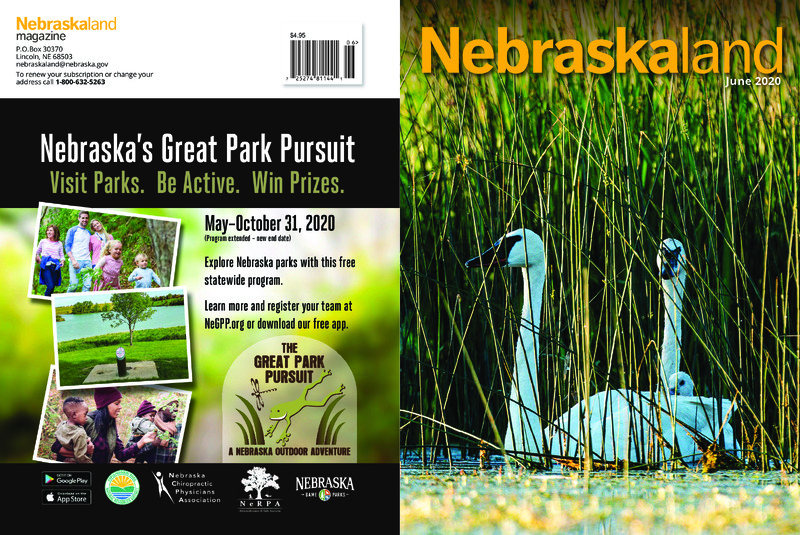
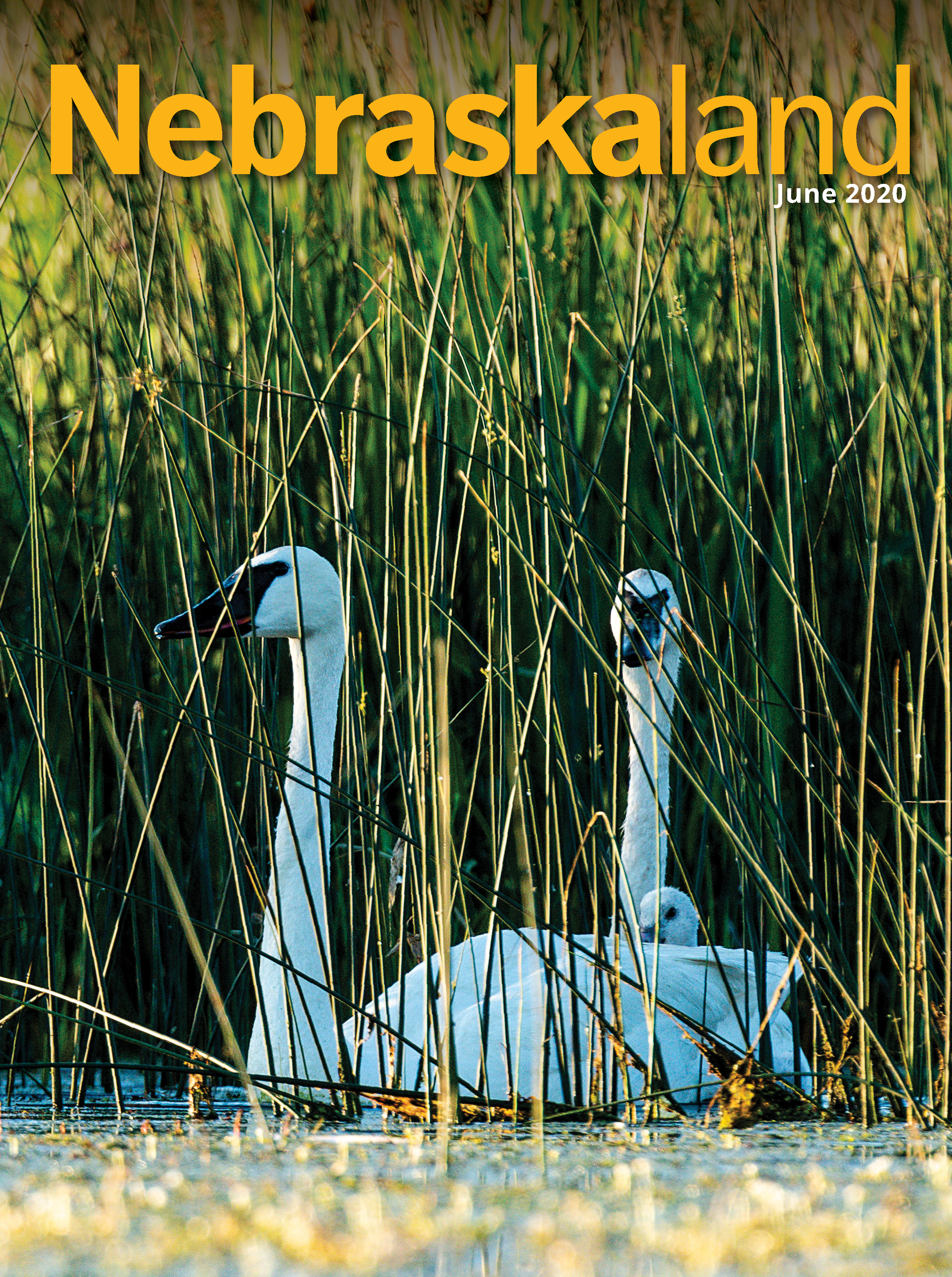
Cover: A pair of trumpeter swans and
their month-old cygnet emerge from
the bulrushes surrounding their nest
on Cottonwood Lake State Recreation
Area near Merriman in Cherry County.
Photo by Eric Fowler.
FEATURES
22
CLOSE TO HOME
30
OUTDOOR NEBRASKA
32
36
Both kids and adults will
stay busy and learn new things
with a wide range of free
educational activities, lesson
plans and resources now
available on our website.
Photos and story by Chris Masada
What to Do in June
By Renae Blum
SAVING SALTWORT
Returning Salt to Salt Marshes
Story and photos by Gerry Steinauer
SURVIVING A 1909 NEBRASKA
GLIDER FLIGHT
By David L. Bristow, History Nebraska
38
PRESERVING THE PINE RIDGE
48
MAKE A LURE
50
SANDHILLS TRUMPETERS
60
TIME TO TRAIN
Story and photos by Justin Haag
Story and photo by Jeff Kurrus
Story by Mark Vrtiska
Photos by Eric Fowler
Story by Todd Mills
Photos by Jeff Kurrus
DEPARTMENTS
6
10
62
72
74
Check us out today at
OutdoorNebraska.org/OnlineEducation
This one-stop compilation offers a variety of resources:
• Wildlife identification guides
• Email experts for your nature questions
• Learning resources for all ages
• Facebook posts and updates
Your Nebraska
In the Field
Mixed Bag
Portraits from the Past
The Last Stop
ON THE WEB
PHOTO BY JUSTIN HAAG
• Fun, age-appropriate lesson plans
• Citizen science projects
• Videos and chats
• Craft activities
No. 5
To see additional content including photos,
videos and additional articles, visit
Magazine.OutdoorNebraska.gov/digital.
Nebraskaland (VOL. 98 / NO. 5 ISSN 0028-1964) is published monthly, except for the combined Jan./Feb. and Aug./Sept. issues, by the Nebraska Game and Parks Commission, 2200 N. 33rd St.,
Lincoln, NE. Periodicals postage paid at Lincoln, Nebraska, and additional mailing offices. POSTMASTER: Send address changes to Nebraskaland, P.O. Box 30370, Lincoln, NE 68503-0370.
Magazine Staff
magazine
Communications Director Christy Firestone
Public Relations Manager Shawna Richter-Ryerson
Published by the Nebraska Game and Parks
Commission since 1926. The Commission is
dedicated to the conservation and protection
of all the state's natural resources and the
people who use them.
Editor Jeff Kurrus
Associate Editor Jenny Nguyen-Wheatley
Regional Editors Eric Fowler, Julie Geiser,
Justin Haag
Contributing Editor Michael Forsberg
Regular Contributors Renae Blum,
Chris Helzer, Chris Masada, Ryan Sparks, Gerry
Steinauer
Art Director Tim Reigert
Graphic Designer Mel Severin
Photo Librarian Jaclyn Cruikshank Vogt
Administration
Director Jim Douglas
Deputy Director Tim McCoy
Commissioners
Chairman - Dan Kreitman, Wahoo
Vice Chairman - Pat Berggren, Broken Bow
2nd Vice Chairman - Rick Brandt, Roca
Robert Allen, Eustis
Donna Kush, Omaha
Scott Cassels, Omaha
Jim Ernst, Columbus
John Hoggatt, Kearney
Doug Zingula, Sidney
Circulation
For address changes and questions about your
subscription, call 800-632-5263
Advertising Sales Manager
For advertising information contact
Shane G. Gilster, 402-742-0125
Email: shanegilster@gmail.com
Nebraskaland Magazine Copyright 2020, all rights reserved.
Nebraskaland is available in audio from the Nebraska Library
Commission Talking Book and Braille Service, Suite 120, 1200 N St.,
Lincoln, NE 68508. 800-742-7691. Nebraskaland Magazine and the
Nebraska Game and Parks Commission reserve the right to reject any
advertising not in keeping with the agency mission.
Rates: $18 for one year; $33 for two years; $44 for three years. Nebraska
recipients must add appropriate sales tax. To subscribe call
1-800-NEBLAND (632-5263), or go online to:
NebraskalandMagazine.com.
Commission Offices
Conservation Officers
Headquarters/Southeast District Office
2200 N. 33rd Street Lincoln, NE 68503
Phone 402-471-0641
ADMINISTRATION (Lincoln)
Craig Stover (Administrator)
Duane Arp (Asst. Administrator)
Jeff Clauson (Asst. Administrator)
Travis Shepler (Asst. Administrator)
Northeast District Office
2201 N. 13th St. Norfolk, NE 68701
Phone 402-370-3374
Southwest District Office
301 E. State Farm Rd. North Platte, NE 69101
Phone 308-535-8025
Northwest District Office
East Hwy. 2, Box 725 Alliance, NE 69301
Phone 308-763-2940
Bassett Office
524 Panzer St., Box 508 Bassett, NE 68714
Phone 402-684-2921
Kearney Office
1617 First Ave. Kearney, NE 68847
Phone 308-865-5310
Ak-Sar-Ben Aquarium/Schramm Education
Center
21502 W. Highway 31 Gretna, NE 68028
Phone 402-332-3901
Omaha Office
8495 Frederick Street, Omaha, NE 68124
Phone 402-595-2144
OutdoorNebraska.org
Any program that receives federal funding from the National Park
Service, or the United States Fish and Wildlife Service prohibits
unlawful discrimination on the basis of race, color, religion, age, gender,
marital status, national origin, age, disability or political affiliation. Any
person who believes he or she has been discriminated against in
any program, activity, facility, or service, should contact the Nebraska
Game and Parks Commission, Lincoln, NE 402-471-0641, the Equal
Opportunity Commission, Lincoln, NE 402-471-2024, TTY/TDD 402471-4693; United States Fish Wildlife Service, Civil Rights Coordinator,
4401 N. Fairfax Drive, Arlington, VA 22203; Director, Equal Opportunity
Program, U.S. Department of Interior, National Park Service, 1849 C
Street NW, Mail Code 0008, Washington, D.C. 20240-0001.
4
Nebraskaland • June 2020
402-471-5531
402-471-5531
402-471-5531
402-471-5531
NORTHWEST (Includes counties covered)
Dan Kling (District Supt.)
308-430-0572
Sean McKeehan
(Kimball, Banner, Scotts Bluff)
308-672-1824
Josh Widhelm (Morrill, Cheyenne)
308-279-9133
Kelsey Glodowski
(Box Butte, S 1/2 Sheridan, Grant)
308-763-8226
308-289-2274
Jaden Porter (Keith, Garden)
Kyler Prochaska (Dawes, Sheridan, Sioux) 308-430-3984
308-458-7650
Terry Brentzel (Deuel, Garden, Grant)
308-760-0145
Sean Schultz (Keith, Arthur)
308-289-9580
Keith Jadlowski (Keith, Deuel)
308-202-0140
Chance Vordeerstrasse (Keith)
NORTHEAST (Includes counties covered)
Tom Zimmer (District Supt.)
402-649-8053
402-760-0712
Dale Davis (Keya Paha, Brown, Rock)
402-340-3981
Jonathan Andreasen (Holt, Boyd)
402-508-0261
Nicholas Fix (Dixon, Dakota, Thurston)
402-719-6226
Kyle Gaston (Dodge, Colfax)
402-613-8612
Mitch Johnson (Knox, Antelope, Pierce)
402-762-5022
Jeff Jones (Knox, Cedar)
402-889-8508
Jon Reeves (Burt, Washington, Thurston)
Andrew Heyer (Pierce, Madison, Stanton) 402-613-2241
402-280-6410
Cory Krause (Cuming, Wayne, Stanton)
402-910-3366
Steve Oberg (Colfax, Platte)
Ethan Teter (Boating Officer-Dodge, Colfax) 402-620-8129
CENTRAL
Mike Thome (District Supt.)
Matt Taylor (Thayer, Fillmore, Nuckolls)
Mark Sullivan (Nance, Polk, Wheeler, Boone)
Matt Brandt (Sherman, Howard)
Greg Hesse (Buffalo, Kearney)
Tim Williams (Hall, Hamilton, York)
Doug Pollard (Loup, Garfield, Valley)
Eric Javins (Adams, Clay, Webster)
Pat George (Harlan, Franklin, Phelps)
Daryl Teter (Howard, Greeley, Merrick)
308-293-8746
402-200-9597
402-741-0636
308-202-0819
402-440-3847
308-380-7331
308-730-7050
402-902-2017
402-705-9989
308-440-1863
SOUTHWEST (Includes counties covered)
Roger Thompson (District Supt.)
308-530-3097
Matt Andrews
(Furnas, Gosper, Frontier, Red Willow)
308-746-2418
Brian Piernicky
(Red Willow, Frontier, Hayes, Hitchcock)
308-340-6627
John Lee (Dundy, Chase, Hayes, Hitchcock)
308-414-1432
Brandon O’Neal
(Lincoln, McPherson, Logan)
308-530-3157
Alex Hasenauer (Lincoln, Perkins)
308-660-4671
402-266-1759
Owen Johnson (Dawson, Gosper, Custer)
308-870-0322
Ray Dierking (Custer, Thomas, Blaine)
402-389-0444
Frank Miller (Cherry, Hooker)
308-217-2108
Taylor Dixon (Dawson, Gosper)
Kevin Bergstrom (Boating Officer-Lincoln) 308-520-1031
SOUTHEAST (Includes counties covered)
Stacey Lewton (District Supt.)
402-890-7140
402-619-1355
Rich Berggren (Douglas)
402-616-5961
Dan Evasco (Sarpy)
402-210-0888
Heath Packett (Cass)
402-209-1506
Russell Mort (Otoe, Johnson)
402-890-6463
Dina Barta (Lancaster),
402-937-3422
Dudley Sorensen (Lancaster)
402-646-0420
Bryce Streger (Seward, Saline)
402-314-9641
Trevor Stahlecker (Lancaster)
402-853-3273
Scott Eveland (Lancaster)
402-806-0915
Matt Seitz (Gage, Jefferson)
402-443-6392
Mike Luben (Saunders, Butler)
Pheasants Forever & Quail Forever
2020 Habitat Tours
Date & Time
Event Name & Descrip on
Loca on
June 10
1:00 to 3:30 pm
CST
The New CRP of 2020: See and understand the many different CRP prac ces that are available to benefit
soil, water, and wildlife. Learn the best op on based on your objec ve to make CRP work for you. Event
will include both indoor and field training with plant iden fica on, wildlife habitat techniques, and
wildlife biology.
Red Willow Fairgrounds
4H Building
1412 West 5th Street
McCook, NE 69001
June 11
1:00 to 3:30 pm
CST
The New CRP of 2020: See and understand the many different CRP prac ces that are available to benefit
soil, water, and wildlife. Learn the best op on based on your objec ve to make CRP work for you. Event
will include both indoor and field training with plant iden fica on, wildlife habitat techniques, and
wildlife biology.
Duncan Building
Main Street
Unadilla, NE 68454
June 20
5:30 to 8:00 pm
CST
Family Nature Night: On the first day of summer, Ducks Unlimited and Pheasants Forever will partner to
provide a fun family nature night at the Verona Complex! Bird song iden fica on, pollinator ne ng
programs, wetland ecology and habitat tours, large grazer management, and more will be provided for
your enjoyment. Come see the birds, bees, and bu erflies that could be in your own backyard! Educa on
events for families and landowners of all ages. A meal will be provided for those who aƩend, please RSVP.
Verona Complex Fallen
Heroes Memorial
Pull Off Area
County Road 315 & R Road,
Northeast of Clay Center, NE
68933
June 24
5:00 to 8:30 pm
MNT
Wildflowers, Wine & Whiskey Wednesday: It's Na onal Pollinator Week. Come celebrate with us at our
habitat tour. We will make stops at habitat areas and learn to iden fy blooming wildflowers. And the best
part?! We will learn about the importance of pollinators to our food and beverages while sampling some
of them! A meal will be provided for those who aƩend, please RSVP.
Imperial JC Hall
East 5th Street,
South end of the Chase
County Fairgrounds,
Imperial, NE 69033
June 27
11:00 am to 1:00 pm
CST
Cody Park
Pollinator Palooza: Join Conserva on Nebraska and Pheasants Forever as we celebrate bees and birds in
1601 North Jeffers Street
your area! Par cipants will have the opportunity to learn from local conserva onists about important
North Pla e, NE 69101
na ve pollinators and birds while building bee hotels and bluebird boxes. We’ll also highlight conserva on
programs for wildlife and visit a local wildflower habitat and view ac ve blue bird nest boxes.
Light snacks will be provided. A concession stand is available on site for those looking to purchase a lunch.
July 23
5:00 to 8:00 pm
CST
Working Lands for Wildlife: It’s for Birds and Beef! Join us for an informa onal evening showcasing the
impact Eastern Red Cedar has on grazing systems, wildlife habitat, and a rancher’s bo om line. The
Working Lands for Wildlife program will be highlighted. Ques ons will be answered on financial and
technical assistance through this program and our partnerships.
A meal will be provided for those who aƩend, please RSVP.
Cast Iron Bar & Grille
806 US-20
Stuart, NE 68780
July 23
11:00 to 3:00 pm
CST
The New CRP of 2020: See and understand the many different CRP prac ces that are available to benefit
soil, water, and wildlife. Learn the best op on based on your objec ve to make CRP work for you. Event
will include both indoor and field training with plant iden fica on, wildlife habitat techniques, and wildlife
biology. A meal will be provided for those who aƩend, please RSVP.
Pierce USDA
Service Center
210 East Main Street
Pierce, NE 68767
July 25
7:00 to 10:00 pm
MNT
Bonding with Bats: Join Pheasants Forever, Nebraska Game and Parks Commission, and Forest Service
staff for a rare opportunity to get up close and personal with a highly misunderstood, flying mammal.
Chadron State Park will host the opportunity to learn about bats and what they need to survive in
Nebraska’s Panhandle. This workshop will start with a presenta on on bat ecology before taking a short
night hike to observe mist ne ng and acous c monitoring techniques. Available for all ages!
Nebraska State Park Permit Required.
Chadron State Park
Lagoon Shelter
15951 Highway 385
Chadron, NE 69337
Shelter is located north of
main entrance
August 8
10:00 to 11:30 am
CST
Walk on the Wild Side: Walk on the wild side as Nebraska Game and Parks naturalists, biologists, and
Pheasants Forever join for a habitat stroll to remember. Par cipants will walk the Ft. Kearny Hike & Bike
path to por ons of the Bassway Strip Wildlife Management Area searching for na ve edibles, iden fying
plants and their uses, bird watching and more! Don’t miss your chance to walk on the wild side. Bikes and
pets welcome; Nebraska State Park Permit required. Turn leŌ at the Brown Shack and follow around to
2nd parking lot.
Fort Kearny
State Recrea on Area
Hike & Bike Trail
1020 V Road
Kearney, NE 68848
September 13
1:00 to 3:00 pm
CST
Monarch Tagging at Lake Wanahoo: Join us for a Monarch Bu erfly tagging event at Lake Wanahoo where
you will have the chance to catch, tag, and release Monarch Bu erflies. See if the ones you tag make it to
Mexico this fall migra on!
Ron Larsen Day Use Area
1651 County Road 16
Wahoo, NE 68066
Workshops are FREE! Visit www.NebraskaPF.com or contact Ashley
at asnelson@pheasantsforever.org for more informa on or to RSVP.
YOUR NEBRASKA
Instagram Photos
Follow us (@nebraskaland)
and tag us in your photos
to be featured in an
upcoming issue.
6
Nebraskaland • June 2020
Karen Kutz Smith, Omaha
Fontenelle Forest Great Horned Owl
June 2020 •
Nebraskaland
7
YOUR NEBRASKA
Suzie Wahlgren, Gothenburg
Cottontail Rabbit
Kris Kitson, Omaha
Yellow-rumped Warbler
Gary Grantzinger, Grand Island
Sunset Reflections
Send your comments and photos to:
Jeff Kurrus, Editor
Nebraskaland Magazine
P.O. Box 30370
Lincoln, NE 68503
or email Jeff.Kurrus@Nebraska.gov
Please include your postal address
and telephone number. Letters may be
condensed and edited. Photographs are
also welcome.
8
Nebraskaland • June 2020
June 2020 •
Nebraskaland
9
IN THE FIELD
LEWIS AND CLARK LAKE
The sun sets at Lewis and Clark
Lake State Recreation Area
marina.
PHOTO
PHOT
O BY EMI
EMILY
LY BURCH
URC
RC
CH
10
Nebraskaland • June 2020
June 2020 •
Nebraskaland
11
PHOTO BY ERIC FOWLER
IN THE FIELD
THREATENED AND ENDANGERED:
THE AMERICAN BURYING BEETLE
By Melissa J. Panella
The American burying beetle (Nicrophorus americanus)
looks like an intimidating specimen, cloaked in fiery orange
and black and measuring over an inch long. But, looks can
be deceiving because this giant beetle is harmless. It is one
of nature’s recyclers. American burying beetles are carrion
feeders – not predators but instead specialized feeders of
dead animals.
American burying beetles will smell a dead animal up
to 2 miles away. As their name implies, a pair of American
burying beetles will bury a carcass by digging diligently to
remove the earth underneath it. The small- to medium-sized
dead animal gradually sinks lower into the ground. The pair
then removes the fur or feathers from the carcass, rolls it
into a rounded shape, and coats it in secretions that slow
decomposition. The beetles do this to provide a food source
that will be ready when their eggs hatch, releasing a dozen
or so hungry offspring to feast.
Animals like the American burying beetle serve an
important function in the natural world by recycling organic
material into ecosystems. They also help to eliminate vast
numbers of microbes from the environment that otherwise
could prove to be harmful to other animals or even to humans.
Unfortunately, this giant carrion beetle is endangered both
in Nebraska and elsewhere in the United States.
12
Nebraskaland • June 2020
Multiple factors likely contributed to the endangered
status. The beetles can be vulnerable to pesticides and
conversion of grassland habitat to other uses. The passenger
pigeon (Ectopistes migratorius), extinct since 1914, used to
fill the sky as the most abundant bird in North America. As
the pigeons were overhunted for food, unregulated sport and
feathered embellishments on hats, their sharp declines were
associated with fewer numbers of the beetles. It is likely that
there was less of a food source for the beetles as the pigeons
were being eliminated.
In Nebraska, American burying beetles live in the Sandhills
and a few other areas in the state. The Commission is
working with conservation organizations and researchers
to monitor and improve habitat for endangered American
burying beetles with a project focused on the Loess Canyons,
Niobrara River and the Elkhorn River headwaters biologically
unique landscapes – areas with known occurrences of at-risk
species and natural communities. In coordination with
dedicated biologists, the Nebraska Natural Legacy Project is
working to prevent the American burying beetle from going
the way of the passenger pigeon.
Melissa J. Panella is a wildlife biologist for the Nebraska
Game and Parks Commission.
PHOTO BY DAN FOGELL
IN THE FIELD
SLENDER GLASS LIZARDS
By Monica Macoubrie
The slender glass lizard (Ophisaurus attenuatus) is one of
the rarest lizards in Nebraska. This species was thought to
be extirpated in the state. Now, biologists have records of
sightings, or a specimen, from only two areas – Franklin and
Johnson counties.
At first glance, it is easy to see how this animal is often
mistaken for a snake, for it has a similar body shape and is
without legs. When you look closer, however, you will notice
three important differences between the slender glass lizard
and its reptile cousins. First off, slender glass lizards have
eyelids and can actually close their eyes. Secondly, unlike
snakes, these lizards have external ear openings, which they
use to pick up sounds. Lastly, they have a lateral skin fold
that extends from the head to the vent. Another difference
is in the way they move. Most people assume that having
no legs, they would slither. However, they actually use their
sides to push themselves off debris or vegetation.
This animal’s long cylindrical body, pointy snout and
narrow head make this legless lizard easily identifiable.
Their color ranges from tan, brown or bronze, with a dark
brown or black stripe running along the middle of the back
from the head to the tail. The sides of the neck have speckled
brown markings, and the belly is usually white or light
yellow. These lizards prefer dry or arid areas, with tall grasses
and loose soil. Here, they burrow and spend a majority of
their time underground.
The slender glass lizard is an appropriate name for this
reptile, given that when caught, it frantically tries to escape,
14
Nebraskaland • June 2020
often breaking its tail into pieces, like glass. The shedding of
its tail is the main defense mechanism for the species. Its tail
will eventually grow back. Yet when it does, it will be darker
and shorter than its original tail. Not only is it rare to find a
slender glass lizard in Nebraska, but it is also rare to find one
with the original tail still intact.
This secretive and rare reptile is considered a “species in
need of conservation” within the state of Nebraska. If you
see one, just leave it alone and enjoy it from afar. Also, report
your findings to the Nebraska Game and Parks Commission
wildlife division so biologists can continue to study this
amazing creature.
Monica Macoubrie is an outdoor educator with the Nebraska
Game and Parks Commission.
In modern times, slender glass lizards have been seen in
only two Nebraska counties: Franklin, at left, and Johnson.
IN THE FIELD
NEBRASKALAND DIGITAL ARCHIVE ONLINE
By Jaclyn Cruikshank Vogt
Nebraskaland Magazine has long been a scrapbook of sorts.
Its pages serve as portals into the history of our state. They
track nearly a century’s worth of conservation work by the
Nebraska Game and Parks Commission and pay homage
to Nebraska’s unique range of flora, fauna, eco-regions
and parklands – as well as the many outdoor recreation
opportunities they afford the people of Nebraska.
Not only do Game and Parks staff frequently consult back
issues of Nebraskaland for research about past and current
outdoor information, but so do our subscribers. The pages of
the magazine are also a source for families looking for long
ago images of loved ones, or even of themselves.
Vintage issues of Outdoor Nebraska, the predecessor of
Nebraskaland, are hard to come by. While we here in the
Nebraskaland staff offices have long been able to thumb
through many of those rare and crumbling pages, even our
own archives lack physical copies of most of those early
issues. In fact, no one repository houses a complete run of the
entire magazine, from start to finish.
Now, in a collaborative effort between the Nebraskaland
16
Nebraskaland • June 2020
Magazine Photo Library and the Center for Digital
Research in the Humanities at the University of
Nebraska-Lincoln, the first 50 years of the publication are
available in the Nebraskaland Magazine Digital Archive:
https://nebraskaland.unl.edu/.
The archive is fully searchable, allowing users to view,
browse and explore all issues of the magazine, 1926-1976.
Additional years will be added as they become available,
with a one-year lag behind the current subscription year.
Whether you’re looking for information about the history
of the Nebraska State Parks system; advice on how and
where to hunt, fish or generally engage with the outdoors;
want to learn more about the incredible diversity of plants,
animals and eco-regions across our state as well as about the
people who enjoy them – the Nebraskaland Magazine Digital
Archive is a good place to start.
Jackie Vogt is the photo librarian for Nebraskaland Magazine
and the Nebraska Game and Parks Commission.
June 2020 •
Nebraskaland
17
IN THE FIELD
GHOST PLANT:
A THIEF IN THE WOODS
By Gerry Steinauer
A ghost plant haunts the deep woods on the Missouri River
From an early age, a ghost plant’s roots, which are clustered
bluff in southeastern Nebraska. Translucent white in color,
into a short, circular mass, are infected by specific soil fungi. The
the plant has forgone photosynthesis and taken up thievery
fungi spread web-like through the soil, also infecting the roots
to obtain its food. Its
of nearby trees. They feed by
appearance and lifestyle
breaking down and ingesting
are indeed strange.
soil organic matter and by
Also called Indian pipe,
taking sugars, produced
ghost plant (Monotropa
through photosynthesis, from
uniflora) can be found in
tree roots. In this mutually
deciduous and coniferous
beneficial relationship, the
forests
throughout
fungi assist the tree roots
much of Canada and the
with the intake of water and
United States, including
nutrients from the soil.
Alaska, but is never
By allowing its roots to be
common. This perennial
infected, the ghost plant tricks
plant lacks chlorophyll,
the fungi into believing they
explaining why the entire
have entered into another
plant is white, except for
beneficial association, but in
occasional black flecking.
reality, the fungi gets nothing
Its unbranched stems grow
in return. In simpler terms, the
singly or in clumps and
ghost plant is stealing from
have reduced, scale-like
both the fungi and the trees: It
leaves. Each stem is topped
gets water and nutrients from
by a single urn-shaped
the fungi, and the fungi act
flower, a characteristic of
as an intermediate to transfer
the blueberry family to
sugars from the trees. We
which the plant belongs.
know this through studies
These appear July through
that have shown radioactive
September. Each flower
marked carbon injected into
blooms for a week or two,
the vascular tissues of trees
after which the stem
later showing up in sugars in
withers, gradually turning
ghost plants.
black, while the dry,
Because it associates with
papery seed capsule forms.
a variety of fungi, which
Relatively few plants
associate with a variety of
When ghost plants emerge from the soil, the young flowers point
have no chlorophyll and
trees, ghost plant grows under
downward and are not flower-like in appearance. At this stage,
obtain their nutrients the plants somewhat resemble white fungus. As they mature, the
many tree species. Indifferent
flowers become more upright.
through means other
to sunlight, ghost plant
than photosynthesis. In
often dwells in the deepest,
Nebraska, only the ghost plant, its close relative pinesap
darkest corners of the woods, where it survives as a clever, though
and four coral-root orchids obtain water and food through
uncommon, thief.
associations with soil fungi. Broomrapes and dodders insert
their roots into the stems or roots of other plants to steal
Gerry Steinauer is a botanist for the Nebraska Game and Parks
nutrients and water.
Commission.
18
Nebraskaland • June 2020
Nebraska Game and Parks biologists shock and net fish from a
resting pool in a fish bypass built at Spalding Dam on the Cedar
River in Greeley County. The fish were caught and tagged as part
of a study to measure the effectiveness of the bypass.
We’re working to preserve beautiful Nebraska for years
– and generations – to come. #MakingItLast
June 2020 •
Nebraskaland
19
IN THE FIELD
Share your photos
with
on social media
PHOTO BY JENNY NGUYEN-WHEATLEY
VIETNAMESE-STYLE JALAPEÑO FISH “POPPERS”
By Jenny Nguyen-Wheatley
Servings: about 20 poppers
Ingredients:
1 pound of boneless and skinless
white-fleshed fish fillets
2 cloves of garlic, coarsely chopped
Half a large shallot, coarsely
chopped
Freshly cracked pepper, to taste
½ teaspoon of kosher salt
½ teaspoon of sugar
1½ tablespoons of fish sauce
1 tablespoon of cornstarch, plus
extra
2 heaping teaspoons of freshly
chopped dill
10 medium to large jalapeños
Oil for shallow frying
Mae Ploy sweet chili sauce, for
dipping
Special equipment: meat grinder and
food processor
•
•
•
•
•
•
•
•
•
•
•
•
1. Partially thaw or partially freeze
20
Nebraskaland • June 2020
fish, and cut into 1-inch cubes. With
the fine die plate attached on your
grinder, grind the fish with garlic and
shallot twice.
Then in a food processor, blend
the ground fish mixture with cracked
pepper, salt, sugar, fish sauce and
cornstarch until you get a smooth, fine
paste. Don’t be afraid to let the food
processor run for a few minutes. (The
texture should be close to that of thick
toothpaste – not the most appetizing
analogy, but there you have it.)
Transfer fish paste to a bowl and
fold in the chopped dill. Cover and
refrigerate for at least 2 hours or up
to 24 hours. Paste must be cold when
you cook it.
2. To prepare the jalapeños, cut them
in half lengthwise. Remove the seeds
and ribs and lightly coat the insides
with cornstarch; this step helps the
fish mixture stick to the jalapeño.
Then, with a spoon, fill the jalapeño
halves with the cold fish paste. Keep
or remove seeds and ribs in jalapeños
to suit your taste.
3. Coat the bottom of a nonstick
skillet with oil and heat over medium.
When the oil is hot, lay the poppers
into the oil fish side down. Cook until
golden brown, and when the fish easily
releases from the pan – do not mess
with them too much while they are
cooking – flip to brown the jalapeño
side. Take off heat when fish paste has
cooked through; internal temperature
should read at least 145 degrees.
If you’re not a fan of peppers or
don’t like spicy food in general, you
can form the fish paste into patties
– with slightly greased hands to
prevent sticking – and shallow fry in
oil without the jalapeño.
4. Serve fish poppers with sweet
chili sauce on the side for dipping.
FOLLOW OUR PAGE
Nebraskaland Magazine
@Nebraskaland
#Nebraskaland
June 2020 •
Nebraskaland
21
Close to
Home
A great blue heron
secures its fresh
panfish breakfast.
Appreciate the many natural
wonders of Nebraska while
communing in place.
Photos and story by Chris Masada
any of us are turning to nature and outdoor activities
to regain some sense of hope, reassurance and
perspective as we navigate these times of uncertainty.
With COVID-19 travel advisories in recent months,
we are rediscovering local opportunities to experience and
appreciate the rich biodiversity of woodlands, prairies and
wetlands in recreation areas, nature centers, city parks and
backyards across our state. In the heart of North America’s
Central Flyway, Nebraska is situated for observing migrations
and seasonal variation while remaining close to home.
Nature’s refuge can be found only minutes away, in both
remote and urban settings. Pursuing local options means
less time and expense in transit and more time outside doing
what we love. Nature and outdoor activities can have greater
presence and priority in our daily lives.
For my part, I enjoy nature and wildlife photography,
an often solitary activity that lends itself especially well
to following social distancing guidelines. Exploring with
a camera forces me to slow down and fully engage with
subjects I otherwise might overlook, and more often than
not, I’m delighted by what I find. A growing list of online
resources and apps, many free of charge, makes species
identification and retrieval of additional background
information readily accessible to all of us. Sharing images
and stories with family, friends and the broader online and
Nebraskaland communities helps us stay connected in this
time of increased social distancing.
The photos for this story were shot locally in Lancaster
County, many at Holmes Lake, a 112-acre reservoir on
Antelope Creek within the city limits of Lincoln. N
M
22
Nebraskaland • June 2020
June 2020 •
Nebraskaland
23
ABOVE: Acorns are an important food source in the
primarily plant-based diet of eastern fox squirrels.
RIGHT: An American kestrel perches with a freshly killed
vole on a chilly, heavily overcast February morning. b
OPPOSITE RIGHT: Local birders were excited to view this
common loon, a breeding adult, on a brief layover at Holmes
Lake in early July 2019. It was observed as a lone individual
but appeared healthy and feeding well.
24
Nebraskaland • June 2020
ABOVE: Killdeer chicks are precocial,
leaving their nest soon after hatching. A
parent vocalizes to keep chicks close on
this mudflat in early August 2019.
LEFT: I was up to my knees and elbows
photographing this frog at eye level
the morning after exceptionally heavy
rains flooded low lying grassy areas of
Holmes Park, July 4, 2018.
OPPOSITE LEFT: Sharp talons and
backlit plumage of a roosting red-tailed
hawk are featured in this photo taken
at the east end of Holmes Lake in late
August 2018.
26
Nebraskaland • June 2020
June 2020 •
Nebraskaland
27
ABOVE: One of a pair of little blue herons wades the
shallows of Holmes Lake. Relatively uncommon spring
migrants in our state, the birds were observed over several
weeks in May 2019.
RIGHT: A house wren perches momentarily in the branches
of a pine. Currently widespread and common across our
state, the house wren’s range is expected to shift northward
with higher global temperatures.
OPPOSITE TOP: A metallic green bee collects pollen and
forages on a native coneflower in Lancaster County.
OPPOSITE BOTTOM: Emerging from a small hole in the ice at
Holmes Lake, a muskrat warms itself at first light this early
February morning.
A Nebraska native and lifelong resident, Chris grew up in
Kimball County and now lives in Lincoln, Nebraska. He is a
regular contributor for Nebraskaland Magazine.
28
Nebraskaland • June 2020
June 2020 •
Nebraskaland
29
Outdoor Nebraska
What To Do in June
By Renae Blum
Photograph the
moon
The outdoor world is vivid and alive right now. Don’t miss your
chance to enjoy it! Here are a few ways you can engage with all
the outdoors currently has to offer. N
MOON PHOTOGRAPH IN LANCASTER COUNTY
PHOTO BY CURTIS BLUM
Photographing the moon, the
brightest object in the night sky, can
be a fun challenge. Nebraskaland
Magazine photographer Justin Haag
recommends investing in a solid
tripod and cable release, shooting in
RAW mode, using a lens with a large
focal length, and planning your shot
ahead of time. June 5 is the next full
moon. For more tips, read Justin’s
article, “Those Alluring Orbs,” at
NebraskalandMagazine.org.
YELLOW CONEFLOWERS
PHOTO BY GERRY STEINAUER
Throughout the month
Statewide
ARCHERY TARGET PRACTICE
PHOTO BY JEFF KURRUS
Photograph and identify
wildflowers at Gjerloff Prairie
Throughout the month | 4 miles west of Marquette on M Road
One place botanist Gerry Steinauer enjoys taking wildflower photos is the
390-acre Gjerloff Prairie west of Marquette. “It’s got really great spring
wildflowers,” he said. Park by the barn-like education center to find the
5-mile mowed trail loop. Expect rolling hills, some steep slopes and a great
view of the Platte. For more information, and to find a trail map, visit
prairieplains.org/gjerloff-prairie.
Practice target shooting
Throughout the month |Statewide
Rather than cramming in last-minute practice, start honing your
target-shooting skills well ahead of fall hunting seasons. Aside from
keeping your shooting form in shape, target shooting is just plain
fun.
The Nebraska Sandhills lakes are
“incredibly productive fisheries,” said
Daryl Bauer, Nebraska Game and Parks
fisheries outreach program manager. You’ll
find various species here, including bass,
pike, bluegill and crappie. Fish here in June
and not only will you likely enjoy good
weather, you’ll also get in before aquatic
vegetation gets too thick.
30
Nebraskaland • June 2020
Hike at Indian Cave
State Park
HIKING AT INDIAN CAVE STATE PARK IN RICHARDSON COUNTY
PHOTO BY ERIC FOWLER
Throughout the month
North-central Nebraska
FISHING AT SMITH LAKE WILDLIFE MANAGEMENT AREA
PHOTO BY JUSTIN HAAG
Fish lakes in the
Sandhills
Throughout the month
7 miles northeast of Shubert in
southeastern Nebraska
Hikers of all skill levels can find something
to enjoy at Indian Cave State Park. You’ll find
more than 20 miles of trails featuring scenic
oak woodlands and views of the Missouri
River. For the best experience, plan your hike
ahead of time with the park map.
June 2020 •
Nebraskaland
31
Saving Saltwort
Returning Salt to Salt Marshes
By Gerry Steinauer
he state endangered plant
saltwort grows in salt marshes in
Lancaster County and nowhere
else in our state. Unfortunately,
decline of the marshes during the past
150 years has left this species hanging
on by a thread. I held little hope of
saltwort surviving in Nebraska until
I recently learned of a creative new
restoration method for returning salt
to the damaged marshes.
Within salt marshes, saltwort
(Salicornia rubra) grows mainly on salt
flats. Wet much of the year, these clay
flats dry in summer and evaporation
wicks salt to the soil surface, forming a
white, crystalline crust. The flats are a
trying environment for plants.
Salt marshes, also known as saline
wetlands, are a rare habitat throughout
the Great Plains. Prior to settlement,
these wetlands occupied about 20,000
acres in Lancaster County, mainly in
the Salt, Little Salt and Rock creek
valleys. Though uncommon in the
Plains, saltwort is common in saline,
inland habitats in western states.
Saltwort is a compact annual
with a waxy stem and tiny, scalelike leaves, features that limit water
loss. A nibble of the stem confirms
Saltwort grows on a submerged saltflat at Little Salt Creek West Wildlife Management Area in Lancaster County.
32
Nebraskaland • June 2020
PHOTO BY GERRY STEINAUER
PHOTO BY JON FARRAR
T
A Uniquely Adapted Plant
the saltiness of the plant’s sap. High
salt levels are needed in the roots for
osmosis to draw water in from the soil.
The wind-pollinated flowers bloom
in late summer and consist of minute
depressions in the stem. The tiny,
green petals ring the depression. A
single seed ripens within the stem as
it fades to scarlet red then brownish in
early fall.
The briny water feeding the marshes,
and on which saltwort depends, is of
ancient origin. During the Cretaceous
Period, some 70 to 160 million years
ago when central North America was
a vast inland sea, the salts were laid
down in shale sediments on the sea
floor. Today, the now deeply buried
salts reach the surface by becoming
dissolved in groundwater that
artesian flow carries upward through
overlying layers of porous sandstone
to the marsh floor. Over millennia,
evaporation has concentrated the
salts in these wetland soils.
Decline of the saline wetlands began
soon after settlement when newly
plowed upland soils washed down into
the marshes burying their salt-laden
topsoil with several feet of sediment.
Many marshes were drained or filled
as the city of Lincoln grew. Beginning
about 1900, stream channelization
turned the shallow, meandering creek
beds bordering the marshes into deep
canals that drained saline groundwater
before it could seep into the marshes.
And finally, increased overland flow of
rainwater and snowmelt from urban
areas and crop fields into the wetlands
further diluted the saline soils, setting
the stage for invasion by the highlyaggressive reed canary grass, narrowleaf cattail and other non-native
plants. As its habitat declined, so did
saltwort.
Today there are 10 known
populations of saltwort remaining
in Lancaster County. Conservation
groups have conserved through
At Marsh Wren, gated irrigation pipe is used to release salty groundwater into the
marshes. The Saline Wetlands Conservation Partnership directed the salt marsh
restorations at this site. The Nebraska Environmental Trust provided project
funding.
acquisition and easements nearly
4,900 acres of land containing saline
wetlands and restoration has occurred
on several of these wetlands, mainly
through the plugging of drainage
ditches. Although this practice
restored wetland hydrology, it did
little to enhance salinity and saltwort
habitat.
Returning the Salt of the
Earth
A few months ago, Dan Schulz,
resources coordinator with the Lower
Platte South Natural Resources
District, told me about the unique
salt marsh restoration occurring at
his agency’s Marsh Wren Wetland,
June 2020 •
Nebraskaland
33
located just north of Lincoln on Salt
Creek. The restoration began in
2016 when contractors scraped 1 to
2 feet of sediment out of two oxbow
wetlands on the site until reaching the
original salty topsoil. Ditches draining
the wetlands were plugged and
trenches were dug just upslope of the
marshes’ upper perimeters to prevent
freshwater runoff from entering them.
Most creatively, saline groundwater
was being pumped into the wetlands
to restore salinity levels. Curious, I had
to see the project.
On a cold, windy day in early March,
I visited Marsh Wren with Schulz and
PHOTO BY GERRY STEINAUER
Dan Schulz sows saltwort seed at Marsh Wren.
PHOTO BY GERRY STEINAUER
A salt crust forms around raccoon tracks in a drying saltflat at Arbor Lake wetland.
These flats not only support saltwort, but are also habitat for the rare Salt Creek
tiger beetle and act as excellent foraging sites for migrating water birds.
34
Nebraskaland • June 2020
Tom Malmstrom, natural resources
coordinator for the City of Lincoln.
Between them, they have decades of
experience restoring wetlands. They
first showed me the two electric wells
that pump salt water from depths of
about 200 feet. Located at the upper
ends of each wetland was a 900foot length of gated irrigation pipe
that slowly disperses the water into
the wetlands. Schulz explained how
gravel-filled trenches located next to
the pipes allowed some salt water to
immediately enter the soil, providing
for both subsurface and surface flow of
the water through the marshes.
Pumping of salt water at Marsh
Wren began in late summer of 2017
and continued through the summers
of 2018 and 2019. Having seen the
area before its restoration, I was
immediately impressed with the
vegetation response. In the north
wetland, reed canary grass and
narrow-leaf cattail were nearly absent
within a roughly 600-foot band below
the pipe (an area of about 15 acres).
“In the past, we did some aerial
herbicide spraying of these invasive
plants, but now the soil is too salty
for them,” Schulz said. In their place
sea blite, saltgrass, marsh-elder and a
few other salt-loving plants now grow.
Their source, no doubt, was seed that
survived in the now-exposed saline
topsoil. Long-lasting seed is a survival
strategy of many wetland plants.
Future pumping likely will expand
the band of salinity and create more
saltflats.
In the south wetland, an area near
the pipe developed a salt crust last
summer, along with a small colony of
saltwort. This colony also originated
from once buried seed. To supplement
its native seed bank, late last summer
Malmstrom collected saltwort seed
from other local marshes. Last winter,
he and Schulz planted the seed at
Marsh Wren.
“I think it will take,” he said. “The
seed I collected last summer seemed
good, the dried stems were thick and
robust. I have seeded saltwort in
other saltine wetlands but the plants
never took. I may have collected that
seed too late, after seed was already
dispersed.”
In coming years, the pumping
of saline groundwater will likely
expand to other Lancaster County
salt marshes. Fortunately, the saline
aquifer below Lancaster County
is unsuitable for domestic and
agricultural uses, leaving plenty of
water for marsh restoration. Returning
the salt of the earth to Nebraska’s salt
marshes might be saltwort’s saving
grace. N
Gerry Steinauer is a botanist for the
Nebraska Game and Parks Commission.
June 2020 •
Nebraskaland
35
Surviving a 1909 Nebraska Glider Flight
By David L. Bristow, History Nebraska
Sorensen used a smoke balloon. He didn’t use a basket. In
n 1909 Ulrick Sorensen faced a decision that would
the photo at (opposite middle) he’s sitting on an iron bar. An
determine his future. It was potentially a life-or-death
unlabeled photo (opposite bottom) from Spalding shows a
choice.
balloon and parachute that are probably Sorensen’s.
This is a story about the early days of aviation in
The first parachutes were
Nebraska. The state’s first
demonstrated in the 1790s,
powered airplane flights
more than a century before
happened in 1910, but
airplanes, but the earliest
a year earlier Sorensen
knapsack parachutes and
made what I believe to
harnesses weren’t invented
be the first manned glider
until several years after
flight in Nebraska.
this photo. What were
Sorensen launched his
parachutes like before
glider near Berwyn in
that?
Custer County. A farmer by
The
parachute
is
background, “Professor”
hanging from the balloon,
Sorenson earned money
and a trapeze bar hangs
in the early 1900s by
from the parachute. Many
making parachute jumps
parachutists would hang
at county fairs and events
from the trapeze bar while
in central Nebraska.
straddling a bit of netting
This is where the story
that served as a kind of
gets a little confusing
safety harness. Sorenson
to the modern reader.
appears to be sitting on
How did he do parachute
the trapeze bar. He used
jumps before there were
no safety harness, only
airplanes?
his hands and the seat
You are correct if you
of his pants. He pulled a
guessed jumping from
release cord to detach the
a balloon. But consider
parachute.
that the modern hot air
By now you may have
balloon, with its onboard
guessed how Sorensen
propane tanks, wasn’t
planned to launch his
invented until 1960. What
glider, which he based on
were balloons like before
a Wright Brothers design.
then?
On June 13, 1909,
Starting
in
1783,
Sorensen attached his
there were two kinds of
glider to his balloon, and a
balloons. Gas balloons
Plans for building a Wright-style glider appeared in the April 1909
crowd watched him go up.
were filled with hydrogen.
issue of Popular Mechanics.
It was reported that the
Smoke balloons were
balloon rose so quickly that the glider’s tail was damaged as
essentially big cloth bags heated over a bonfire. Smoke
it left the ground. But Sorensen didn’t notice it.
balloons didn’t stay up long. They came back down as the hot
Sorensen pulled the release cord at about 3,500 feet, and
air inside them cooled off.
I
36
Nebraskaland
• June 2020
the damaged glider tumbled through the air for the first 500
feet before finally righting itself and pulling into a tight spin.
Witnesses said he hit the ground within about 1 to 1 1/2
minutes – fast enough to knock him out, but not fast enough
to kill him.
Ulrick Sorensen had survived Nebraska’s first plane crash.
Reports appeared in newspapers around the country.
He promised to try again. He was sure he’d get it right
this time. But the 27-year-old Sorensen had a problem. His
17-year-old girlfriend, Cora, told him he could fly again if he
wanted. And she said they could get married. But she made it
clear that one of those two things was not going to happen.
And that was the big decision that Ulrick Sorensen faced
in the summer of 1909. We don’t know if he agonized over
it or if it was easy. But we do know that in 1969, Ulrick and
Cora celebrated their 60th wedding anniversary, still living
on their farm near Berwyn. N
Visit History Nebraska’s website at history.nebraska.gov.
Sorensen inflates his balloon at Litchfield, Nebraska, 1909.
Sorensen at Ord, 1909.
Spalding, Nebraska,
undated. Probably
a Sorensen balloon
and, in the inset, his
parachute. History
Nebraska RG3542111-6
June 2020 •
Nebraskaland
37
Preserving
the
Pine
Ridge
Catastrophic wildfires have ravaged more than half of
northwestern Nebraska’s pine forests. Land managers are
making strides toward a more sustainable future.
Story and photos
by Justin Haag
This scene at Peterson Wildlife
Management Area, with adequately
spaced pines at various points
of the life cycle, is what land
managers would like to see
throughout the Pine Ridge.
38
Nebraskaland • June 2020
June 2020 •
Nebraskaland
39
n this sunny day, Bryce Gerlach is visiting a timberthinning project at Gilbert-Baker Wildlife Management
Area in the northwest corner of the state. Gerlach,
who is a forester funded by the National Wild Turkey
Federation and the Nebraska Game and Parks Commission,
likes what he sees.
“This is the project that is going to save Gilbert-Baker
someday,” he says as he looks over this part of the Pine
Ridge that, unlike other areas of the region, does not bear the
scars of wildfire. Gilbert-Baker, north of Harrison, is recognized
as a jewel among the eight scenic wildlife management
areas that comprise more than 19,600 acres in the Pine
Ridge.
Gerlach is surveying the northwest portion of the property,
O
where sandstone ridges and buttes rise some 1,000 feet
from the Hat Creek Basin and provide a sweeping view of
the grasslands to the north. Mixed among the magnificent
landforms and rugged terrain to the south is the towering
forest of ponderosa pine – the iconic tree of the West for
which the Pine Ridge region is named.
Gilbert-Baker is reminiscent of what once existed
throughout almost all of the Pine Ridge, a roughly 10mile wide escarpment that spans about 100 miles across
northwestern Nebraska between the Wyoming and South
Dakota borders. Only 2 percent of the Cornhusker State
is forested, so the pines and rugged topography here are
especially valued and have long served as a destination for
outdoor enthusiasts.
This before-and-after scene at Gilbert-Baker Wildlife Management Area shows the
extent of an effort to clear pines from a service road to serve as a firebreak.
40
Nebraskaland • June 2020
The Challenge
The management decisions of EuroAmericans and their descendants
were not ultimately beneficial to
the landscape of the Pine Ridge. Prior
to the settlers’ arrival in the 1800s,
lightning strikes caused periodic
wildfires that burned in the understory
of forest and boosted plant diversity. In
addition to natural causes, American
Indians used fire to burn the brown
plant matter on the landscape to start
afresh with green plants – an attractant
that served well for hunting some of
the 30 million bison that once roamed
North America.
With motivations that included
preserving lives and property, the first
generations of Euro-Americans on the
Plains extinguished wildfires at every
chance, and hunted bison to near
extinction. Consequently, pine stands,
especially where logging was not
feasible, grew thick. The result is what
land managers call “dangerous levels of
fuel accumulation.”
As periods of drought gain intensity
with global warming, land managers
know the potential for disaster looms
heavy. The danger was especially
evident, and realized, in 2006 and 2012
when more than 100,000 acres burned
in catastrophic wildfires that raged
across the landscape and charred trees
from bottom to top. The wildfires’ toll
was heavy as about 120,000 acres
Most of the wildlife management areas that were burned in 2012 have tree
regeneration that I do not see from other large fires like in 2006 and 1989. You can
walk through the ’12 footprint and find 1- to 2-foot pines coming in.
— Rick Arnold, Game and Parks wildlife biologist in the Pine Ridge
remain of the estimated 250,000 forested acres in the Pine
Ridge prior to the 1950s.
Simulating Nature
Where possible, land managers thin the forest in a way to
mimic nature. The result is decreased fuel loads and returning
forest structure to historic conditions. The ultimate goal is
sustainability.
In places such as Gilbert-Baker, however, the steep terrain
that gives the land aesthetic appeal eliminates most practical
means of thinning the forest. Moreover, while some pines
have been harvested in the region, the market has not been
strong enough to maintain high demand of timber there.
Thinning is a concept easily related during times of “social
distancing.” If a fire reaches the top of one pine, it will spread
to the crown of another nearby and continue raging as long
as it can. Thinning keeps fires at an intensity low enough
that trees distanced appropriately can survive such events,
and the forest may even be better for them.
The project at Gilbert- Baker, where an old service road has
been cleared of pines at a width of about 100 yards, is a prime
example of methods being used throughout the Pine Ridge to
make immediate impact.
Fred McCartney of the Nebraska Forest Service facilitates
cost-share programs with private landowners and public land
managers to best leverage available money. Much inspiration
for his work, he said, comes from a first thing firefighters
want to know when responding to a blaze: “Where are the
sides of the box?”
That is, where is an accessible break in the trees where the
fire can be stopped? Knowing such locations can help contain
wildfire to established areas and prevent unrestrained spread
The U.S. Highway 385 corridor, which includes Chadron State Park and Chadron Creek Ranch Wildlife Management Area, has
been a focus area for creating a thinning buffer in the Pine Ridge.
June 2020 •
Nebraskaland
41
SOURCES: ESRI, DIGITALGLOBE, GEOEYE,I-CUBED, EARTHSTAR GEOGRAPHICS, USDA, USGS, CNES/AIRBUS DS, AEX,
GETMAPPING, AEROGRID, IGN, IGP, SWISSTOPO, AND THE GIS USER COMMUNITY
Nebraska Forest Service – complete/in progress
United States Forest Service – complete/in progress
Nebraska Game and Parks Commission – complete/in progress
Pine Ridge Shared Stewardship
Project Areas
acres of thinning and logging on lands primarily
between East Ash Creek Road and Bordeaux Road.
Silver Linings
Rick Arnold, a Game and Parks wildlife biologist
who oversees the Pine Ridge WMAs, notes a silver
lining in the cloud of 2012.
“Most of the WMAs that were burned in 2012 have
tree regeneration that I do not see from other large
fires like in 2006 and 1989,” Arnold said. “You can walk
through the ’12 footprint and find 1- to 2-foot pines
coming in.”
Also on the bright side, the wildfires of 2006 and
2012 garnered a lot of attention and prompted needed
funding for some of the region’s forestry demands.
Contractor Alex Gomez uses a skidder to pile cut pines at GilbertThe pines are tall, the terrain is rough, and the Baker Wildlife Management Area.
equipment is large, so thinnings are not cheap. Various
Money from the Nebraska Environmental Trust has
factors play into it, but thinning projects generally
been critical. Support from the trust, which operates
range from $300 to $950 per acre.
with proceeds from the state lottery, dates back more
“With the land being appraised at very close to the high
than two decades, and it has contributed well over
end of those project costs, it is hard to do a landscape-level
$1 million to Pine Ridge forest management since 2006.
job without several partners and adjacent landowners doing
The trust grants often require a sizable match, and that
projects as well,” Arnold said.
2006 and 2012 fire perimeter
A map created by the Nebraska Forest Service shows shared stewardship forestry project areas near
Chadron.
throughout the Pine Ridge. With a system of firebreaks, the
hope is to at least limit the size of wildfires.
“We’re building those box sides and communicating them
to area fire departments,” McCartney said, as he points to a
map of the Pine Ridge with areas shaded in various colors
to show projects in progress and completed. “Absence of a
commodity to pay for the work, this is the best approach; the
best bang for our buck.”
A primary focus area of the collaborative effort has been
the U.S. Highway 385 corridor, which runs north and south
through the ridge near Chadron and features many private
tracts interspersed among public land. Through cooperation
between the Nebraska Forest Service, Game and Parks, the
U.S. Forest Service and the many landowners, a large buffer
has been created through thinning. In the event of another
large wildfire, the area will be invaluable in efforts to stop it
from moving east or west.
An area of emphasis in the collaboration has been Chadron
State Park. Situated along the highway, it had experienced
42
Nebraskaland • June 2020
valuable thinning prior to 2012 and, though that year’s fire
burned through much of the park, it did not charge eastward.
Since then, the park has undergone more thinning and the
removal of burned trees.
The Strategy of Thinning
For thinning, land managers are strategic in selecting
trees to cut. Gerlach prefers an approach he calls “groupyclumpy.” With that method, trees are not spaced uniformly
throughout large areas, but rather in small groups. This
approach keeps crown fires from spreading, yet lessens the
likelihood that the trees will be uprooted or damaged by the
wind. The groups of trees also serve as a seed source.
Gerlach said about 2,200 acres have been treated on state
wildlife management areas in the Pine Ridge with thinning
and removal of “ladder fuels,” the brush and other vegetation
that helps fires climb trees.
The other big public land organization in the Pine
Ridge, the U.S. Forest Service, has completed about 4,000
Game and Parks employees Steve Masek, at left, and Greg Schenbeck burn a pile of pines, a final step in the thinning process.
June 2020 •
Nebraskaland
43
1,500 acres from Chadron Creek Ranch Wildlife Management
Area near U.S. Highway 385 to Deadhorse Road 4 miles to the
west. That burn, which will capitalize on dry conditions of the
season, has a goal of removing the fallen “jackstrawed” timber
that was scorched in 2012. That deadfall is complicating
noxious weed control and hindering access.
Bringing the Forest Back
Those who have long loved the Pine Ridge have resigned
themselves to the prediction they will never see it as rich
with big pines as it was. Although pine growth in burned
areas is occurring, ponderosas are slow-growing trees and
success is sporadic.
An effort to replant 10,000 pines on the hills south of
Chadron State College after wildfire threatened the campus
and community in 2006 yielded virtually no surviving trees,
for instance. On the other hand, annual plantings of deciduous
trees and pines on Bighorn WMA, the Commission’s property
that burned most intensely in 2012, have done well the
past few years. The U.S. Forest Service has planted about
2,200 acres of ponderosa pines and 50 acres of hardwoods
in riparian areas at points throughout the region. The Boy
Scouts of America planted pines at Fort Robinson State Park
for 25 years following the park’s 1989 catastrophic wildfire,
and have conducted similar operations at Chadron State Park
for the past five years with some success.
Nevertheless, planting pines is largely avoided because it
is labor-intensive, unpredictable and costly. A much better
approach, officials say, is protecting pines still standing. “If we
want to ensure that there’s a forested Pine Ridge in the future,
we need to protect these seed sources,” McCartney said.
Regardless, the goal is not to get back to the way things
were, said Tim Buskirk, U.S. Forest Service district ranger.
“I would say we are on the way up when it comes to
recovery, but it’s a relative term,” Buskirk said. “Our goal isn’t
to fix everything that has changed. Our goal is to improve the
While this image from the Pine Ridge of Sioux County may have aesthetic appeal, it bears evidence of the great forestry
challenge in the West. Even though no wildfires were in the immediate region on this September 2017 morning, the smoke
from fires hundreds of miles away was evident.
is where many partners come into play. For Game and
Parks forestry projects, for instance, there is considerable
collaboration and multiple financial supporters.
Another big funding source, especially for private lands, is
the U.S. Forest Service’s State and Private Forestry program.
Money collected from the Pittman-Robertson Act’s excise tax
on sporting goods and State Wildlife Grants, administered
through the U.S. Fish and Wildlife Service, also have been
instrumental.
Cows and Flames
Thinning projects are a benefit to the forest from a fire
perspective and also a wildlife one. For instance, a multi-year
thinning of more than 200 acres underway near the buttes at
Fort Robinson State Park is designed to not only provide fire
protection for the park and nearby community of Crawford,
but also to boost wildlife habitat for species ranging from
bighorn sheep to bats. Just as the vegetation gains diversity
with open areas among tall trees, so too does wildlife.
Managing the density of pines is just one of many aspects
of management in the Pine Ridge, and the changes come with
consequential challenges. Arnold notes that the ecology of
the forest floor changes with removal of shade.
“We are, in theory, just reorganizing the fuels. We went
from a heavy fuel model, the dense forest, to a more open
savannah with grass understory,” he said. “Now, we need to
44
Nebraskaland • June 2020
manage the fine fuels, the grass.”
A point of emphasis has been to create infrastructure
for grazing. He said most of the wildlife areas in the Pine
Ridge do not have adequate livestock infrastructure, such
as fences and water sources. Thanks to partnerships, that
infrastructure is being constructed so grazing can be used to
meet management objectives while not damaging habitat.
Along with thinning, Arnold sees grazing to be
instrumental to balancing the needs of the forest, even if it is
done with cattle instead of bison. Also important, he said, is
reintroducing fire to the land.
“With the right prescription we can put ‘safe’ fire on the
landscape and restore a historic fire regime,” Arnold said.
“Fire is needed to naturally thin and prune ponderosa pines.”
Even though staff is highly trained and prescribed fires
follow strict guidelines, it is not always an easy sell.
“The challenge is mainly a social one,” he said. “The public
sees the catastrophic wildfires and perceives all fire to be
a bad thing and it has been suppressed so many years. Our
goal is to do a forest management timber thinning and then
use fire to maintain these areas so they do not go back to
overgrown stands.”
Fire also can treat areas already struck by catastrophe.
Game and Parks has plans with the U.S. Forest Service and
an adjacent landowner to conduct the largest prescribed burn
ever in the Pine Ridge this fall; it’s an area encompassing about
This sunrise at Bighorn Wildlife Management Area, where the 2012 wildfire burned most intensely, shows there is still ample
beauty throughout the Pine Ridge.
June 2020 •
Nebraskaland
45
call upon its relationship with South Dakota Wildland Fire.
That organization usually has an additional SEAT at nearby
Hot Springs to serve the Black Hills.
“Then, we may have two SEATs reloading at the Chadron
SEAT Base, providing quick and continual aerial suppression
to any Pine Ridge fire,” he said. “In return, we have allowed
South Dakota to utilize our SEAT many times.”
Burning Questions, Uncertain Future
No one knows for certain what the future brings to the
Pine Ridge wildfire scene, but officials are making strides in
preventing past horrors. Healing from catastrophic wildfires
takes time, for both human emotions and the landscape.
Regardless, unrivaled beauty remains in the region, both
in places that have not been scorched and those that have.
While the landscape has been altered, a new kind of splendor
is in these burned areas. The fires uncovered many landforms
previously obscured under the blanket of trees, and in many
places improved the ecology.
The Pine Ridge surely will always be an attraction. Thanks
to the coordinated efforts of many, there is a much better
chance a sustainable pine forest will be there forever, too. N
Although planting is regarded as a costly way to reforest
pines, it will forever be a good way for Boy Scouts and other
youth to invest in the future.
The single-engine air tanker, added to the region’s fire resources after the 2012 wildfires, provides a demonstration during a
forestry workshop at Chadron State Park.
resiliency of the Pine Ridge: Do things that will lessen the
effects of the next fire that comes through the area and begin
to incorporate more prescribed fire along the way.”
No doubt, land managers have plenty of other jobs to keep
themselves busy in the areas that burned.
“Over the next few years, the cleanup will continue.
Building fence and piling trees that continue to fall over,”
Arnold said. “I have been told by others that have seen
the catastrophic fires that it takes 10 years to recover from
infrastructure damages, and I think we are on pace with that
from 2012. I do think in five or 10 years we will see much
more regeneration from the 2012 footprint than we have seen
in the 2006 burn area. There were enough trees that put on
seed before they passed, and we have had several good years
of precipitation to provide for good regeneration.”
Those years of above-average precipitation have helped
buy time to complete forest management projects, but
everyone expects a drought cycle to return soon. When it
does, the Pine Ridge will be more prepared.
Air Support
While the practices of land managers are helping prevent
catastrophic wildfires, the capability to respond to fires also
has improved. With such rugged landscape, it helps to attack
fire from above.
46
Nebraskaland • June 2020
After the wildfires of 2006 and 2012, officials recognized
the need for first-responders to have more resources for
wildfires. One result was increased aerial capabilities from
the Legislature’s Wildfire Control Act of 2013.
In conjunction with the Nebraska Forest Service, the
Nebraska Emergency Management Agency contracts a
single-engine air tanker, known as a SEAT plane, to be
stationed in western Nebraska during fire season. With
designs based on agricultural sprayers, the small aircrafts
can get to places trucks cannot and possess the capability
to make substantial impact by dropping 800 gallons of
water or retardant in a single action. With bases in Chadron,
Valentine, Alliance, Scottsbluff and McCook, the airplane is
serving where Nebraska’s range fire danger is greatest.
Seth Peterson, a Nebraska Forest Service employee who
serves as the SEAT base manager in Chadron, said the goal
is to have the airplane loaded with retardant, off the ground
and communicating with the fire chief within 15 minutes of
receiving a dispatch.
“Our goal is to provide a quick response to volunteer fire
departments on small fires, hopefully keeping them small
before they cause any real problems,” Peterson said.
It seems to be working. He said there has been just one fire
over 500 acres in the Pine Ridge since the program’s inception
in 2013. If a fire is highly active and growing, Nebraska may
Even though the prospects of pine survival in Chadron State Park were uncertain after the 2012 wildfires burned through
the property, many trees survived and it has retained remarkable splendor. Many credit the years of thinning operations.
June 2020 •
Nebraskaland
47
Make a Lure
Have you ever been interested in making a homemade lure? Glen
Oliver of Lincoln shows that you probably have everything you
need to do so within the comfort of your own house.
By Jeff Kurrus
M
ost people have “stuff” lying around the house – a
screw left over from self-installed window blinds,
a rubber band from a pile of bills in the mailbox, or
the frayed ends of a dusty rope in the corner of the garage. By
themselves, they are little more than objects whose lives will
probably end in a landfill.
Yet with a little bit of imagination, these items could be
fashioned into fishing lures – a chance at a story that goes
beyond the catch and centers instead on creating the lure
that caught the fish.
A Box of Lures
Make Your Own
When creating your own lures, you are only limited by
your imagination. First, sift through the drawers in your
house to look for anything colorful or shiny.
Start with single shank hooks at a size you can work with,
then gather a small pile of tools including, but not limited to,
needle-nose pliers, crimpers, scissors, super glue and sewing
thread. For color, use Sharpie markers and fingernail polish.
“A fly-tying vice is sure helpful as well,” Glen said, as it helps
secure the lures while making and drying.
Next, look at the picture opposite and play copycat. One of
Glen’s most ingenious creations was placing a couple of split
shots inside of a section of shrink tubing, then bookending
the tubing with two plastic beads. The lure will rattle as it
moves through the water.
What is Possible
“Glen’s lures are examples of what is possible,” Larry said.
These are especially possible now, as many of us have all
the necessary tools to accomplish this goal, most important
of those is time.
We also have stuff, and many of us have a lot of it. From
using miniature Christmas light bulbs to ear plugs, there is a
fishing lure just waiting to be made in every corner of your
house.
When you begin, don’t worry about how the lure will fish.
It’s not going to be perfect. Just start creating. N
Glen Oliver's collection of homemade lures includes everything imaginable, from pipe cleaners and rubber
bands to shrink tubing and frayed rope. The possibilities for him, and for you, are limitless.
48
Nebraskaland • June 2020
PHOTO BY JEFF KURRUS
Several years ago a box of fishing lures showed up on the
desk of Larry Pape, a Nebraska Game and Parks Commission
fisheries education specialist. This isn’t uncommon, as
people often donate used equipment to the Commission’s
youth programs. When anonymous donations like this
appear, Larry passes them along to youth fishing instructors.
However, the lures in this box were different.
Lures made of nails, chain, beads, brush bristles, pipe
cleaners, shrink tubing, soda straws, jewelry parts – anything
hidden in drawers around the house – were made into fishing
lures. Yet the donation remained anonymous. For some time,
Larry kept the lures on his desk and reveled at them – and so
did his visitors.
Finally, Larry got a call from the culprit – Glen Oliver of
Lincoln – wanting to know if the lures had landed in the right
place. They most certainly did, Larry told him.
“What amazed me about the collection he brought was
the creativity and fine craftsmanship involved,” Larry said.
During Glen’s 85 years, he’s never been formally trained in
making fishing lures. He’s never been to art school nor taken
any classes.
“I’ve just always liked to build,” Glen said. “And I’ve always
liked to fish. This just allowed me to combine both of them.”
It’s hard not to be amazed when you see the lures, yet there
will be a moment when you say, “I can do that.” And you’re
right.
Sandhills
Trumpeters
STORY BY MARK VRTISKA
PHOTOS BY ERIC FOWLER
50
Nebraskaland • June 2020
June 2020 •
Nebraskaland
51
T
he marsh had a lot more cattails
and bulrushes than most
Sandhills lakes, concealing
the trumpeter swans we were after.
The swans themselves were doing
their best to hide by swimming in a
different direction than the large and
loud airboat zigzagging through the
marsh. So, when we burst through a
wall of vegetation, and there were four
swans right in front of us – two adults
52
Nebraskaland • June 2020
and two young, known as cygnets – we
were not sure who was more surprised,
us or the swans. The action instantly
intensified as the swans scattered,
and we gunned the airboat and swung
around to pursue one of the adults.
The big male, as it turned out, was
already in the process of wing molt;
having lost the last of his loose wing
feathers, and unable to fly, he lunged
for the protection of the vegetation. I
managed to get the large hoop net over
his head and rolled him up in the rest
of the net. We had our swan.
We were after these swans to study
their movements and fidelity in the
Sandhills – their faithfulness to return
to the same wintering and breeding
areas each year. To help identify and
direct conservation actions for these
birds and their habitats, these studies
are critical to help us better understand
where and when these birds move
about the landscape. For the most
part, we found these trumpeter swans
neither left Nebraska nor traveled far
from the Sandhills.
Additionally, basic information on
Sandhills trumpeters, such as nesting
and hatching success and cygnet
survival, was lacking. Aerial surveys
indicate that while the Sandhills
population was growing, the number
A pair of trumpeter swans and their month-old cygnet swim through a
wetland at Cottonwood Lake State Recreation Area near Merriman in Cherry
County. When the nest was monitored in 2016, the female laid seven eggs,
only two of which hatched. Neither cygnet survived to fledge.
Previous Page: A trio of swans flies over Blue Creek in Garden County north
of Oshkosh, a major wintering area for swans in the state.
June 2020 •
Nebraskaland
53
Lead field researcher Heather Johnson kisses a swan captured on a private
lake in Cherry County while waiting to place a collar on the bird, an image
that speaks to the docile nature of swans.
Mark Vrtiska, waterfowl program manager with the Nebraska Game and Parks Commission, prepares to net a swan
from an airboat on Ballards Marsh Wildlife Management Area in Cherry County.
of cygnets produced each year was
declining. Therefore, locating swan
nests was the other part of this study.
We needed to determine how many
nests resulted in eggs being laid, how
many eggs hatched and how many
cygnets made it to flight stage.
Capturing, collaring and following
these birds would help us answer
these questions.
Biology and Background
Trumpeter swans are the largest of
waterfowl, and even claim the title of
largest native bird in North America.
Males, also known as cobs, typically
weigh between 24 and 28 pounds and
stand about 4 feet tall, with females
54
Nebraskaland • June 2020
being only slightly smaller. Their
corresponding wingspan is also large,
reaching up to 8 feet. Trumpeters are
solid white except for their bills and
feet. Cygnets have grayish plumage,
which they keep for a year. On rare
occasions, cygnets will display white
plumage similar to their parents.
Trumpeters can be distinguished
from their close cousins, the tundra
swan, by having a totally black bill,
with a little pink or red on the bottom
jaw. Tundra swans have a yellow
marking at the base of their bill,
just in front of the eye. Non-native
mute swans have pinkish bills and a
distinctive head shape, with a bulging
knob at the base of the beak.
Swans are long-lived and known to
have reached age 24 in the wild and
age 33 in captivity. They will pair for
life, but most will obtain another mate
if one perishes. They don’t breed until
they are 3 to 6 years old. Their nest sites
are located overwater and typically
start with muskrat huts on which
adults build the nesting structure.
Swans are quite territorial and only on
the largest lakes or marshes will there
be more than one pair nesting. Despite
being big white birds, they are adept at
hiding themselves and their nesting
sites among the cattails and bulrushes.
Females will lay 4 to 6 eggs during
late April or early May and incubate
them for about 35 days. It takes
Neck collars used in the study also carried a GPS transmitter.
Right: A female swan takes off
from a restored wetland near the
North Platte River in Keith County.
It was one of roughly 60 swans
wintering on the wetland at the
time. The swan was captured and
collared in 2014 on a wetland in
Arthur County, where it also nested.
The bird also wintered on Birdwood
Creek in Lincoln County and, during
warm stretches, returned to the
wetland where it nested.
June 2020 •
Nebraskaland
55
A flock of trumpeter swans flies low over a frozen Calamus Reservoir in Loup County, a major wintering area for swans.
A female swan sits on its nest at Cottonwood Lake SRA as its mate hangs in
the cattails nearby.
56
Nebraskaland • June 2020
cygnets more than 100 days to grow
feathers and attain flight. During this
period, adults will undergo a wing
molt, rendering them flightless.
Trumpeter swans were nearly
extirpated from North America by
the end of the 19th century. EuroAmerican settlers hunted them for
food and market hunters targeted
them for fashion and supplies: soft
swanskins were turned into powder
puffs, quills were made into ink pens
and feathers adorned hats. By the
time the Migratory Bird Treaty Act
was passed in 1918, giving swans
protection, only remnant populations
remained. Yet the decline continued.
The last record of a swan in Nebraska
came from Holt County in 1928. By
1932, only 69 swans were known to
exist in the lower 48 states, with all
of those found in remote locations
around Yellowstone National Park.
Others were later found in remote
parts of Canada and Alaska.
From those remnant populations
in the Greater Yellowstone area,
trumpeter swans were reintroduced
into other western states beginning
in the 1930s and 1940s. That work
resumed in the early 1960s, when
57 cygnets were placed at LaCreek
National Wildlife Refuge near Martin,
South Dakota, a short distance
from the Nebraska border, north of
Merriman. The swans flourished
and soon found their way into the
Sandhills. In 1964, the first cygnets
hatched at Cody Lake near Cody.
The Sandhills is a perfect area for
trumpeter swans, as a number of
its lakes, marshes and rivers have
excellent water quality and are full of
submerged vegetation, their primary
food. From those first nesting birds,
the population has fanned out across
the Sandhills, with recent winter
surveys counting about 1,000 birds.
Even though their status has improved
greatly over the years, they are still
considered a Tier 2 species in the
Nebraska Natural Legacy Plan. Tier 2
species are typically not at-risk from a
global or national perspective, but are
rare or imperiled within Nebraska. In
the case of swans, their limited range
puts them at risk.
Restoration efforts in other parts
of the United States and Canada
have also been successful, with an
estimated 70,000 swans now found
throughout their range. The success
can be seen in eastern Nebraska,
where an increasing number of swans
from restored populations in Iowa and
Minnesota now winter.
Swan Movements
Lucky for us, trumpeters are docile
when captured. In fact, they’ve proven
to be the most docile waterfowl
species we’ve ever had the pleasure
to handle. If these birds reacted in
similar fashion to the Canada geese
we band, we would’ve needed a medic
when capturing and handling them.
Even so, when swans have lunged in
an attempt to escape, the big claws
on their huge feet have easily slashed
holes in waders and hip boots.
From 2014 to 2018, we captured 37
trumpeter swans in Cherry, Arthur,
Grant and Sheridan counties. Each
swan was fitted with a red neck collar
with a unique code to identify the bird.
Also attached to that neck collar was
a solar-powered GPS transmitter that
provided us with accurate locations
of where and when this bird went for
the next 2 to 3 years. Given the lack
of roads in the Sandhills, the ability
to track these birds without having
to physically find them was critical.
Additionally, we were not sure how
far these birds would move once their
breeding marshes froze over.
The collared swans provided us
with a few surprises. One bird spent
part of a winter along the Kansas/
Oklahoma border southeast of Dodge
City, Kansas. This area is not known
as a mecca for wintering waterfowl.
However, summer and fall rains
provided plenty of water, and this
male was thought to be a 2- to 3-year
old adult that may have just wandered
around for a while. A couple of swans
also led us to wintering areas we were
not aware of from our aerial surveys
– one swan used the Platte River. The
vast majority of marked birds stayed
and wintered on the rivers and creeks
in the Sandhills. None of our marked
swans went farther east than Calamus
Reservoir near Burwell, but that may
be more of a reflection of where we
captured the birds than their behavior.
We also saw swans move to a
wintering area, and then, during a
warm spell, go back to their breeding
marshes for a brief period. Once
weather turned cold again and the
lakes froze over, they returned to their
wintering area. As we anticipated,
most swans were faithful in returning
to the same breeding and wintering
areas each year. There were some
departures, with some swans using
different river systems during the
same winter. While a few birds went
south for the winter, most passed
on that seasonal migration. Some
actually traveled north, and some
June 2020 •
Nebraskaland
57
The study found that 92 percent
of the nests we monitored were
successful, hatching at least one
egg, and that a little more than 70
percent of the eggs laid hatched. Both
of these numbers match the high
end of success rates found in studies
from other parts of North America.
However, where we found the biggest
discrepancy between trumpeter swans
in the Sandhills and other populations
was in cygnet survival. Only about 40
percent of cygnets survived to flight
stage, compared to 70 to 85 percent
elsewhere. The biggest difference was
that in lakes with largemouth bass
and northern pike, cygnet survival
was much lower than in lakes without
those aquatic predators. Despite
cygnet survival rates being lower
than in other populations, the swan
population continues to grow in the
Nebraska Sandhills.
The Future
Heather Johnson measures eggs in the nest at Cottonwood Lake SRA.
Her work on the study earned her the nickname “The Swan Lady” among
Sandhills residents she worked with.
went more east than south. Some also
bypassed the wintering area closest to
their breeding marshes.
Swan Nesting
In conjunction with the movement
study, we began assessing how well
trumpeter swans were reproducing in
the Sandhills in 2016 and 2017. Aerial
surveys helped us find a number of
nesting pairs, and observations by
Game and Parks staff, U.S. Fish and
Wildlife Service staff at the Valentine
National Refuge, and tips from local
landowners and other interested
parties helped us find more.
58
Nebraskaland • June 2020
Once a nest was found, Heather
Johnson, who led the field work on
this part of the study, used a kayak
to visit and study the nest. Eggs were
numbered and floated – a technique to
age the stage of incubation – as quickly
as possible to allow the female back on
the nest. After the anticipated hatch
date, or when the pair was observed
with cygnets, Johnson returned to the
nest to determine how many eggs had
actually hatched. Pairs and cygnets
were observed until late summer,
just prior to when they were able to
fly, to determine how many cygnets
survived.
The Sandhills is a unique place
in North America and, indeed, the
world. One aspect of its uniqueness
is that it is relatively undisturbed
compared to other habitats. But
that may change. Swans need water
throughout their life cycle, and water
demand will only increase in the
future, a fact that already has some
looking at ways to move water from
the Sandhills elsewhere. Climate
change could also affect water in the
region. Other threats to swans include
the development of wind and other
energy sources, and the corresponding
transmission lines may alter where
swans can or want to go.
One thing is certain, though.
The beauty and calm splendor of
trumpeter swans in this unique region
will remain. As a biologist, one reward
is the observations that few others
get to have. We had the fortune to
watch a cygnet take its first swim
with its father, while the mother
stayed behind to continue to incubate
the remaining unhatched eggs. The
cob waited patiently as the cygnet
carefully, yet clumsily, made its way
Swans spend an evening on the ice in the upper reaches of Calamus Reservoir. In some years hundreds of swans
winter on the reservoir and on the Calamus River above it. Below: A swan stretches its wings on Blue Creek.
down the large muskrat house from
his nest. Once it reached the water,
the cob started out swimming slowly,
letting the cygnet get used to the cool
water and figure out how to navigate
it. Within minutes, both cob and
cygnet set out exploring the lake.
It is also comforting to know that
thanks to the efforts of ranchers,
landowners, conservation agencies
and the public, trumpeter swans will
continue to thrive in the Sandhills for
generations to come. N
Heather Johnson did much of the field
work for this study and contributed to
this story. We would also like to thank
the landowners who allowed us access;
Game and Parks biologists Al Hansen,
Tom Krolikowski and Zac Brashears;
technicians and other individuals for
their help; and Letitia Reichart at the
University of Nebraska at Kearney.
June 2020 •
Nebraskaland
59
Time to
Train
By Todd Mills
Photos by Jeff Kurrus
P
reparing a dog for hunting season can be a good way to
keep yourself engaged during the long off-season, but
it can also be time consuming.
With the overall shutdown we are experiencing due to
COVID-19, it seems most of us have a lot more time on our
hands. So now may be the perfect time to start getting your
dog prepared for when game day hits in the fall or to help
condition him or her to the rigors of hunting season. It may
be a good time to purchase that new puppy you’ve been
longing for.
Training your own gun dog can be challenging, frustrating
and rewarding all at the same time. It takes commitment on
your part to finish what you start. Whether it’s your first or
your last dog, watching your dog make that first retrieve or
flush that first bird is well worth the time you put into it.
Training is also important because an out-of-control dog
with little discipline can ruin any good hunt.
Here are a few tips that I’ve found helpful when training
my own gun dogs.
Keep Them in Shape
Much like us, a dog who is on a properly structured routine
will perform best. Taking your dog for a “walk” will not allow
him to get in the kind of condition he needs to be in. Dogs need
to be active at a high
level to keep them
running at top speed
during the season. If
you’re a runner, take
them with you. If
you have access to a
field, then use that
area for retrieves and
distance marks. Also
be cognizant of your
dog’s calorie intake
this time of year. For
example, during the
season I’ll feed my
dogs a higher caloric,
higher protein dog food. During the off-season, I’ll switch to
feeding them maintenance food. Come hunting season, an
overweight dog can face joint issues and eventually even
more serious issues like heat stroke.
Back to the Basics
Much like in our daily lives, the first thing that will go
is the “fundamentals” associated with a fine-tuned gun
dog if they’re not being repeated. A backyard is the perfect
place to reinforce the commands of sit, stay, heel and come.
Younger dogs, particularly around the adolescent stage, love
to break the rules when they can. Take 20 minutes a day to
repeat these commands and be stern about your follow up.
If you allow your dog to take an inch, they’ll take a mile. Ask
your family to serve as distractions so you can see how they
handle diversion. After all, you’ll have plenty of those in the
field, the blind and the boat.
Research Dog Training Tips
Developing a connection with your dog will allow you to use
training techniques more effectively.
60
Nebraskaland • June 2020
Whether you’re new to the dog training world, or a
seasoned veteran, you can never learn enough about training
gun dogs. YouTube is a great resource to reference training
techniques. Find a mentor whom you can bounce off ideas
and troubleshoot. In this day of electronic media, you can
find several sources that can guide you in the right direction.
Understanding the dynamics of your dog and the personality
Training your own gun dog can be challenging, but one that comes with great joy if done properly.
they bring can be helpful in your training approach. One
of my favorite resources for discovering this potential and
troubleshooting is the book The Art of Raising a Puppy by the
Monks of New Skete.
Hunt Your Dog
Sounds like a overused cliché, but in the dog world, it’s
fact. You’re going to experience many ups and downs in the
training process. It’s a marathon not a sprint, so ongoing
repetition with your dog is the key to being
successful once hunting season starts.
And don’t be “embarrassed” to hunt your
dog with others, even if you think they
might screw something up. All the training
in the world is no good if you don’t put live
birds in front of your pup. Nothing replaces
shooting birds over your dog. I’ve seen dogs
with very average blood lines excel around
other more “champion” blood lines purely
because they have the most in-game
experience. Stay committed to the process
and take this time to not only improve your
dog’s chances of being successful, but to
also socialize them around others.
One of my favorite quotes comes from
legendary waterfowler Nash Buckingham
circa 1947:
“The best long-range shotgun load to
have in one’s boat for mallards is a fine
retriever.”
A steady dog is a crowd pleaser. Use this down time to instill confidence in your
Well said, Nash. N
dog by reinforcing and repeating the basic commands.
June 2020 •
Nebraskaland
61
MIXED BAG
TAKE THE PICTURE
By Emily Burch
We always search for the image that no one else has taken,
but some landmarks are so spectacular, captivating or out of
place that everyone who passes by has to take a picture. In
Nebraska, the list includes Scotts Bluff National Monument,
Smith Falls and the water towers at Fort Robinson State Park.
Anyone with a camera or smartphone that’s been to any
of these places knows what I’m talking about. The urge to
capture them is irresistible. So give in.
The beauty of taking pictures, besides the final product, is
that no two photographers end up with exact replicas. The
same subject, even the same angle, will turn out remarkably
different depending on the person, the light, the season. So
whether you are a professional photographer or just now
taking up the camera as a social distancing hobby, take
the picture that everyone else has already taken. Take it
unashamedly. And then send it to us.
Water for the Fort
62
Nebraskaland • June 2020
PHOTO BY JUSTIN HAAG
PHOTO BY BOB GRIER
PHOTO BY JENNY NGUYEN-WHEATLEY
Similar to other man-made landmarks on the
High Plains, the water towers at Fort Robinson
State Park sprang from a purpose of utility.
They came during a period of transition for the
U.S. Cavalry, and surely served as a symbol of
reassurance for area residents who feared the
military base would close as the Indian wars
were ending.
The U.S. Army constructed the two towers
in 1903, shortly after squadrons of the Tenth
Cavalry – the black regiment known as “buffalo
soldiers” – were assigned to Fort Robinson. The
new metal structures replaced a wooden tower
that had stood at the northeast corner of the
grounds since 1889.
With a capacity of about 32,000 gallons each,
the towers served the grounds until 2005. That
year, two 90,000-gallon concrete tanks were
constructed, three-fourths underground, near
the ridge northwest of the park’s main campus.
Park superintendent Jim Miller said the towers
still have a function.
“When we have guests who can’t get their
bearings here at the fort, we tell them to stop
and look at the towers. They are the only
structures at the fort that are set due north and
south of each other,” he said.
PHOTO BY EMILY BURCH
By Justin Haag
June 2020 •
Nebraskaland
63
MIXED BAG
NEBRASKA WALNUT TWIG BEETLE UPDATE
By Julie Van Meter, State Entomologist
Nebraska Department of Agriculture
In 2019, staff with the Nebraska Department of Agriculture
set 54 traps for walnut twig beetle in 11 counties across the
state. Traps were up from May through October, and samples
were collected from the traps every two weeks. Walnut
twig beetle specimens were collected from a single location
in Gering. This was the first find of walnut twig beetle in
Nebraska. All other traps in Nebraska were negative.
The beetle can carry the Geosmithia morbida fungal
pathogen that causes thousand cankers disease. The fungus
is particularly lethal to black walnut (Juglans nigra) trees.
Nebraska forests are home to more than 1.5 million black
walnut trees, which are all susceptible to this pest.
The number of beetles trapped at Gering were low, with
2-12 beetles per trap, collected over a six-week period in the
fall. Walnut trees near the traps are relatively isolated, and
other surveillance traps in the county did not collect any
walnut twig beetles. No obvious symptoms of thousand
cankers disease were observed in nearby walnut trees.
The NDA plans to continue to survey for the beetle across
the state in 2020. Trapping will occur statewide, with an
emphasis on Scotts Bluff and surrounding counties. The
64
Nebraskaland • June 2020
NDA will also
set
baited
branches
in
Gering
this
summer
to
determine if
Adult walnut twig beetle (Pityophtoris
any
beetles
juglandis). STEVEN VALLEY, OREGON DEPARTMENT OF
AGRICULTURE, BUGWOOD.ORG
found at a
location
are
carrying the Geosmithia fungus. Walnut branches baited
with a lure will be suspended from a metal pole near black
walnut trees where the beetles have been previously trapped.
At the end of the survey, the branches will be de-barked to
collect any beetles that have infested the branches, and the
beetles will then be tested for G. morbida.
There are no changes to the Nebraska Thousand Cankers
Disease of Black Walnut quarantine at this time. Additional
information from the 2020 survey will be used to determine
if changes are necessary. For more information on the
Nebraska TCD quarantine, visit https://nda.nebraska.gov/
plant/entomology/tcd_quarantine.pdf.
Bighorn Sheep Lottery
(Nebraska residents only)
The Hunt of a Lifetime
Apply online today
OutdoorNebraska.org
June 2020 •
Nebraskaland
65
MIXED BAG
BACKYARD CAMPING
By Monica Macoubrie
boxes and desserts in a cooler instead.
Once dinner is over, remember to keep yourself entertained
with games during the day or into the night. Do a scavenger
hunt or play classic games like Simon says or tag – activities
that don’t require extra packing are always a plus. If none of
these suggestions sound interesting, then invent your own
games with items you have around the house. Encourage
creativity and family fun competitions.
Don’t be discouraged if you don’t have a yard. Many of
these same experiences can be created on a porch, driveway
or even in a living room. S’mores in the microwave are still
just as good. Single tents or homemade forts fit well in
small spaces. What will your campsite look like? Make the
adventure your own.
Remember to take a few photos and share them on social
media with the hashtag #CampAtHomeNE. Those who send
Nebraska Game and Parks a direct message on Facebook or
Instagram with their camp-at-home photo, their name and
address will be automatically entered into a drawing for
prizes. Learn more at OutdoorNebraska.org/campathomene.
PHOTO BY JEFF KURRUS
During these uncertain times with social distancing,
we’re inviting you to look no farther than your own home or
backyard for your next campout experience. The “getaway”
that everyone craves is only a few feet from your front door.
The excitement of sleeping outdoors is fascinating for people
at any age: not just kids. So, get to packing for your next big
adventure right in your own backyard.
So where do you start? Pre-planning for your backyard
adventure as a family gets everyone involved and promotes
anticipation. Treat your backyard like an honest-to-goodness
campsite. Take your tent outside and find the perfect location
for the night. Don’t have a tent? Then use supplies that you
have on hand such as a tarp, rope, big sticks or a clothesline
between two trees with a blanket or sheet on top. It doesn’t
have to be perfect – just make it fun.
One of the best parts about camping is eating around the fire. If
you have a fire pit, it’s easy to roast hot dogs, toast marshmallows
and even make tinfoil packet dinners. Or, if you don’t have a fire
pit, try a small charcoal grill. Of course, you don’t need a campfire
to eat like a camper – pack some sandwiches, trail mix, juice
66
Nebraskaland • June 2020
June 2020 •
Nebraskaland
67
MIXED BAG
68
Nebraskaland • June 2020
June 2020 •
Nebraskaland
69
MIXED BAG
OUTDOOR EDUCATION IN YOUR OWN HOME
By Monica Macoubrie
In response to COVID-19 and social distancing guidelines,
the Nebraska Game and Parks Commission is committed
to helping the public by providing resources, lesson plans,
toolkits and activity guides that still get students outside
in a fun and educational way. For instance, parents and
educators who would like more structure may download
free conservation lesson plans, PowerPoints and videos
on a variety of topics, including birds, pollinators, prairies,
habitats, life cycles, plants and much more.
Project WILD Facebook page from Wild What’s Up
Up.
Many videos are available on the website
website.
If you are looking at taking a more hands-on approach by
getting into the field, then try a Citizen Science project.
Here, you can engage in nature and help scientists from your
own backyard. Look for current Nebraska-based projects,
including searching for spotted skunks, participating in
regal fritillary and monarch butterfly surveys, or tracking
and conserving bumblebees throughout the state with the
Nebraska Bumblebee Atlas. There are also many national
projects to choose from, such as Project FeederWatch,
Budburst and Journey North.
While you’re spending time outside, I’m sure you or your
kids have had some questions about nature. Well, send those
questions to our Wild What’s Up email address and get a
response back from one of our naturalists. If you don’t have
a question, but still would like to gain some knowledge,
check out the Wild What’s Up videos posted about nature
questions that have come in already. These hilarious videos
are a great way for gaining knowledge and having a laugh.
Another great resource we have is our Watchable Wildlife
Guides. If you are looking for less structure and just some
information about species that live in your backyard or in
your area, check out the many different regional guides.
Here, find information on mammals, birds, insects, plants,
reptiles and amphibians. These guides are free and available
for download to aid in your exploration of Nebraska’s
diversity. Not only do they provide species information, they
also provide information on the region and tips for wildlife
viewing.
70
Nebraskaland • June 2020
More than than 700,000 meals have been provided to Nebraskans
in need through Hunters Helping the Hungry.
Your cash contributions are essential to continue this
great program. Help those in need by donating now!
How far will your money go?
$1 gift provides 2 meals
Nebraska Game and Parks Pinterest page
page.
Lastly, check out the new Pinterest page for Game and
Parks. Here you will find fun crafty outdoor education ideas
for kids and families. This page will encourage children’s love
of nature as well as stimulate their creative side.
All of these outdoor education ideas can be found at
OutdoorNebraska.gov/onlineeducation.
Nebraska Game and Parks Citizen Science page
page.
Targeting Hunger in Nebraska
Monica Macoubrie is an outdoor educator for the Nebraska
Game and Parks Commission.
$10 gift provides 22 meals
$50 gift provides 111 meals
Cash donations are tax-deductible.
Donate online at OutdoorNebraska.org/HHH
June 2020 •
Nebraskaland
71
PORTRAITS FROM THE PAST
OPPOSITE PAGE – These photos from the fall of 1952 show a log cabin my friends and I built on an island on the Loup River
west of Fullerton during high school. I was told that in later years the Boy Scouts used it for campouts. From left, Leroy Emery,
Lyle “Zeke” Pierce, Lowell “Coon” Harris and Jay “Eager” Brown.
–Lowell Harris, Central City
Here are a few photos from my childhood in the
mid-to-late ‘70s. All pictures are from the collection
of my parents, Larry and Kay Allen of Grand Island.
– Suzie Hartman, Omaha
Camping at Harry Strunk Lake on Memorial Day
weekend 1977 with kids by the baby pool. From
left, Nicole Hutchison and cousin LaRae Mamot,
Jarrod Allen and sister Suzie Allen (Hartman), Jeni
Dreier (Cook) and sister Tricia Dreier (Camplin).
Visiting Smith Falls in the summer of 1979.
My mom, Kay Allen, is in the front. Others in
the photo were with Third City Archers, an
archery club from Grand Island.
My dad, Larry Allen, and I with the catch of the
day in the summer of 1979 at Pibel Lake.
Send contributions to: Portraits from the Past, Nebraskaland Magazine, P.O. Box 30370, Lincoln, NE 68503-0370. Or e-mail to Tim.Reigert@Nebraska.gov. Photos
should show people enjoying Nebraska outdoor activities, such as camping, boating, hunting or fishing, and must have been taken before 1990. We will give priority
to unusual photos or activities. When possible, please include a story about the photograph and identify the people, places and approximate date it was taken. Text
may be edited and photos adjusted for reproduction. All photos will be returned.
72
Nebraskaland • June 2020
June 2020 •
Nebraskaland
73
PHOTO BY JENNY NGUYEN-WHEATLEY
THE LAST STOP
LEAVE NO TRACE
By Jenny Nguyen-Wheatley
This happens too often: Me, trying
to immerse myself in the beauty and
solace of nature, and then laying
eyes on Styrofoam bait boxes by the
lake, or finding a soiled diaper while
mushroom hunting, or crushed cans
of beer scattered around what was an
illegal campfire.
These sights pull me out of my
reverie. The romance disappears, and
my annoyance becomes blinding.
Trash is a disruption to the experience
of nature, a sad reminder of humanity
in places where I go to get away from
it. How a person could enjoy the
74
Nebraskaland • June 2020
outdoors, yet feel no remorse about
trashing it – I could beat myself up just
thinking about it.
The good news, there are still
good people, and I’m especially
impressed when I see kids picking
up after themselves – and others.
We’ve dedicated many pages and
campaigns to passing on traditions
at Nebraskaland and Game and Parks.
Although Leave No Trace might not be
as exciting as other outdoor lessons, I
believe it is the most fundamental one.
“Time outdoors is time well spent” –
littering not included.
June 2020 •
Nebraskaland
75
Position: 270 (30 views)