Volume 98, Issue 4, 2020
May 2020

- Identifier:
- nela.2020_098_04
- Title:
- Volume 98, Issue 4, 2020
- Issue Name:
- May 2020
- Date Issued:
- 2020-05-01
- year:
- 2020
- month:
- May
- Season:
- Spring
- PDF filename:
- NL_98.04_2020_May_Spreads_Entire.pdf
- Publisher:
- Nebraska Game and Parks Commission
- Format:
- Periodical
- volume:
- 098
- issue:
- 04
- number:
- 098.04
- Decade:
- 2020s
- Type:
- Rights Holder:
- Copyright Nebraskaland Magazine/Nebraska Game and Parks Commission, all rights reserved.
- Extracted Text:
-
magazine
$4.95
P.O.Box 30370
Lincoln, NE 68503
nebraskaland@nebraska.gov
To renew your subscription or change your
address call 1-800-632-5263
May 2020
See
Chris Helzer’s
One Square
Meter
Volume 98
May 2020
No. 4
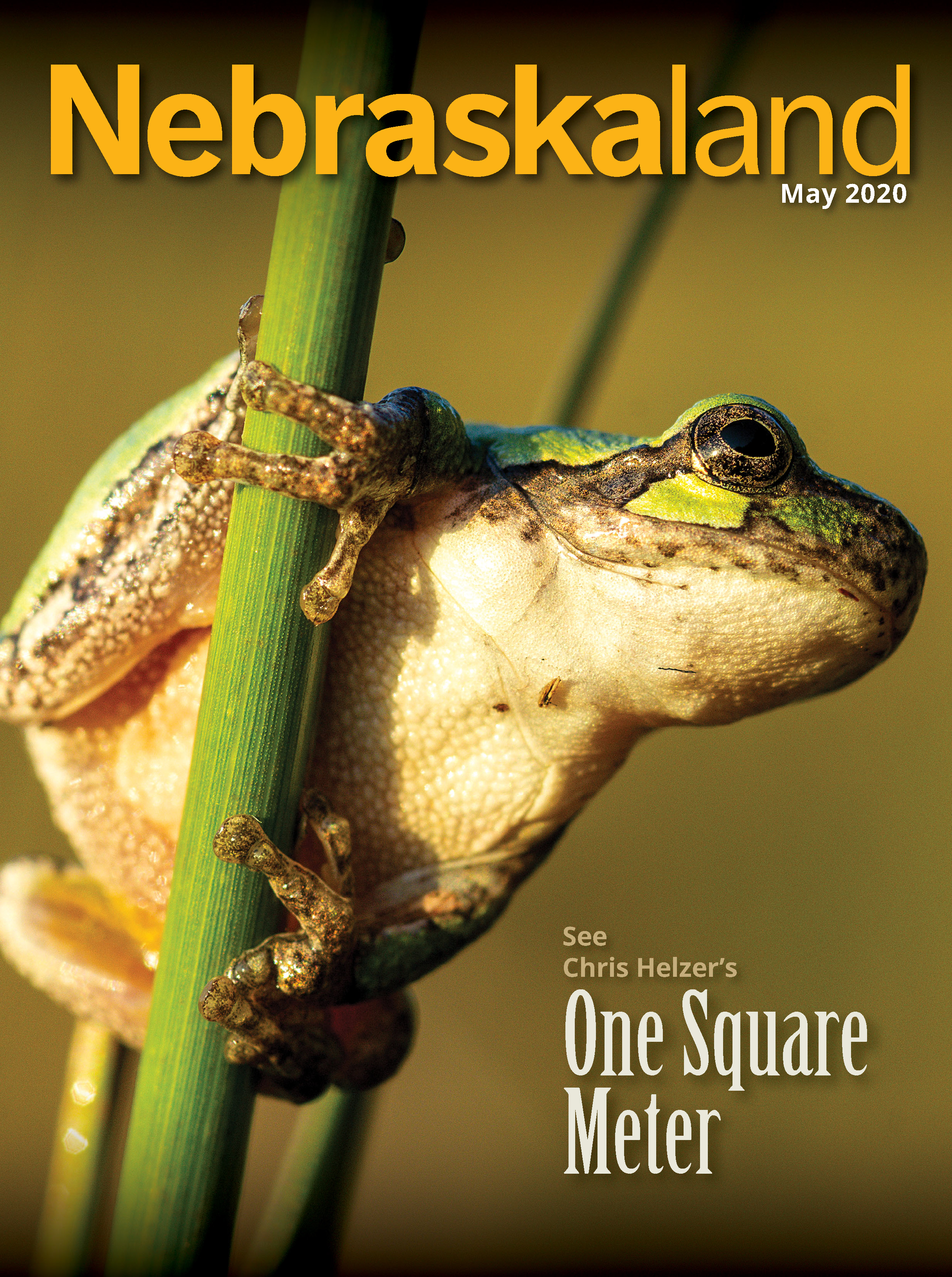
Cover: A Cope’s gray tree frog perches
on a grass stem from a prairie near
Aurora. Photo by Chris Helzer.
FEATURES
22
28
30
38
40
ONE SQUARE
METER
Story and photos by Chris Helzer
OUTDOOR NEBRASKA
What to Do in May
By Renae Blum
PLATTE RIVER STATE PARK
Take a Deep Breath
Story and photos by Jeff Kurrus
HOW LONG WILL CHIMNEY
ROCK LAST?
By David L. Bristow, History Nebraska
THE INVASION OF GARLIC
MUSTARD
Story and photos by Jenny Nguyen-Wheatley
46
KEARNEY WATER TRAIL
50
MAKING A DIFFERENCE
Story and photos by Eric Fowler
PHOTO BY JULIE GEISER
Nebraska’s Master Naturalists
By Renae Blum
DEPARTMENTS
6
10
56
68
70
Your Nebraska
In the Field
Mixed Bag
Portraits from the Past
The Last Stop
ON THE WEB
To see additional content including photos,
videos and additional articles, visit
Magazine.OutdoorNebraska.gov/digital.
Nebraskaland (VOL. 98 / NO. 4 ISSN 0028-1964) is published monthly, except for the combined Jan./Feb. and Aug./Sept. issues, by the Nebraska Game and Parks Commission, 2200 N. 33rd St.,
Lincoln, NE. Periodicals postage paid at Lincoln, Nebraska, and additional mailing offices. POSTMASTER: Send address changes to Nebraskaland, P.O. Box 30370, Lincoln, NE 68503-0370.
Magazine Staff
magazine
Communications Director Christy Firestone
Public Relations Manager Shawna Richter-Ryerson
Published by the Nebraska Game and Parks
Commission since 1926. The Commission is
dedicated to the conservation and protection
of all the state's natural resources and the
people who use them.
Editor Jeff Kurrus
Associate Editor Jenny Nguyen-Wheatley
Regional Editors Eric Fowler, Julie Geiser,
Justin Haag
Contributing Editor Michael Forsberg
Regular Contributors Renae Blum,
Chris Helzer, Chris Masada, Ryan Sparks, Gerry
Steinauer
Art Director Tim Reigert
Graphic Designer Mel Severin
Photo Librarian Jaclyn Cruikshank Vogt
Administration
Director Jim Douglas
Deputy Director Tim McCoy
Commissioners
Chairman - Dan Kreitman, Wahoo
Vice Chairman - Pat Berggren, Broken Bow
2nd Vice Chairman - Rick Brandt, Roca
Robert Allen, Eustis
Dick Bell, Omaha
Scott Cassels, Omaha
Jim Ernst, Columbus
John Hoggatt, Kearney
Doug Zingula, Sidney
Circulation
For address changes and questions about your
subscription, call 800-632-5263
Advertising Sales Manager
For advertising information contact
Shane G. Gilster, 402-742-0125
Email: shanegilster@gmail.com
Nebraskaland Magazine Copyright 2020, all rights reserved.
Nebraskaland is available in audio from the Nebraska Library
Commission Talking Book and Braille Service, Suite 120, 1200 N St.,
Lincoln, NE 68508. 800-742-7691. Nebraskaland Magazine and the
Nebraska Game and Parks Commission reserve the right to reject any
advertising not in keeping with the agency mission.
Rates: $18 for one year; $33 for two years; $44 for three years. Nebraska
recipients must add appropriate sales tax. To subscribe call
1-800-NEBLAND (632-5263), or go online to:
NebraskalandMagazine.com.
Commission Offices
Conservation Officers
Headquarters/Southeast District Office
2200 N. 33rd Street Lincoln, NE 68503
Phone 402-471-0641
ADMINISTRATION (Lincoln)
Craig Stover (Administrator)
Duane Arp (Asst. Administrator)
Jeff Clauson (Asst. Administrator)
Travis Shepler (Asst. Administrator)
Northeast District Office
2201 N. 13th St. Norfolk, NE 68701
Phone 402-370-3374
Southwest District Office
301 E. State Farm Rd. North Platte, NE 69101
Phone 308-535-8025
Northwest District Office
East Hwy. 2, Box 725 Alliance, NE 69301
Phone 308-763-2940
Bassett Office
524 Panzer St., Box 508 Bassett, NE 68714
Phone 402-684-2921
Kearney Office
1617 First Ave. Kearney, NE 68847
Phone 308-865-5310
Ak-Sar-Ben Aquarium/Schramm Education
Center
21502 W. Highway 31 Gretna, NE 68028
Phone 402-332-3901
Omaha Office
8495 Frederick Street, Omaha, NE 68124
Phone 402-595-2144
OutdoorNebraska.org
Any program that receives federal funding from the National Park
Service, or the United States Fish and Wildlife Service prohibits
unlawful discrimination on the basis of race, color, religion, age, gender,
marital status, national origin, age, disability or political affiliation. Any
person who believes he or she has been discriminated against in
any program, activity, facility, or service, should contact the Nebraska
Game and Parks Commission, Lincoln, NE 402-471-0641, the Equal
Opportunity Commission, Lincoln, NE 402-471-2024, TTY/TDD 402471-4693; United States Fish Wildlife Service, Civil Rights Coordinator,
4401 N. Fairfax Drive, Arlington, VA 22203; Director, Equal Opportunity
Program, U.S. Department of Interior, National Park Service, 1849 C
Street NW, Mail Code 0008, Washington, D.C. 20240-0001.
4
Nebraskaland • May 2020
402-471-5531
402-471-5531
402-471-5531
402-471-5531
NORTHWEST (Includes counties covered)
Jim Zimmerman (District Supt.)
308-641-6138
Kelsey Glodowski
(Box Butte, S 1/2 Sheridan, Grant)
308-763-8226
Sean McKeehan
(Kimball, Banner, Scotts Bluff)
308-672-1824
Dan Kling (Sioux, Dawes)
308-430-0572
Kyler Prochaska
(E 1/2 Dawes, N 1/2 Sheridan, W 1/2 Cherry)
308-430-3984
308-458-7650
Terry Brentzel (Deuel, Garden, Grant)
402-389-0444
Frank Miller (Cherry, Hooker)
308-279-9133
Josh Widhelm (Morrill, Cheyenne)
NORTHEAST (Includes counties covered)
Tom Zimmer (District Supt.)
402-649-8053
402-760-0712
Dale Davis (Keya Paha, Brown, Rock)
402-340-3981
Jonathan Andreasen (Holt, Boyd)
402-719-6226
Kyle Gaston (Dodge, Colfax)
402-613-8612
Mitch Johnson (Knox, Antelope, Pierce)
402-762-5022
Jeff Jones (Knox, Cedar)
Jon Reeves
(S 1/2 Thurston, Burt, Washington)
402-889-8508
Andrew Heyer (Pierce, Madison, Stanton) 402-613-2241
Cory Krause
(Cuming, Wayne, Stanton, Dodge)
402-380-6410
Steve Oberg
(Colfax, Platte, Madison, Stanton, Nance)
402-910-3366
Owen Johnson
(Dixon, Dakota, N 1/2 Thurston)
402-266-1759
Doug Pollard (Loup, Garfield, Valley)
308-730-7050
Ethan Teter
(Boating – eastern Nebraska)
402-620-8129
SOUTHWEST (Includes counties covered)
Roger Thompson (District Supt.)
308-530-3097
308-202-0819
Matt Brandt (Sherman, Howard)
308-380-7331
Tim Williams (Hall, Hamilton, Merrick)
Pat George
(Harlan, Franklin, Phelps)
308-920-2762
Matt Andrews
(Gosper, Furnas, Frontier, Red Willow)
308-746-2418
Brian Piernicky
(Red Willow, Frontier, Hayes, Hitchcock)
308-340-6627
John Lee (Hitchcock, Dundy, Chase, Hayes)
308-414-1432
Nicholas Fix (Keith, Perkins)
Bryce Streger (Keith, Arthur)
Sean Schultz (Keith)
Brandon O’Neal
(Lincoln, McPherson, Logan)
Alex Hasenauer
(Lincoln, McPherson, Logan)
Mike Thome (Dawson)
Ray Dierking (Custer, Thomas, Blaine)
Taylor Dixon
(Dawson, N 1/2 Gosper, N 1/2 Phelps)
Eric Javins
(Adams, Clay, Nuckolls, Webster)
Kevin Bergstrom
(Boating – central Nebraska)
Daryl Teter
(Boating – central Nebraska)
Greg Hesse
(Buffalo, Kearney)
308-289-0427
308-289-1169
308-760-0145
308-530-3157
308-660-4671
308-529-8146
308-870-0322
308-217-2108
402-902-2017
308-520-1031
308-440-1863
402-440-3847
SOUTHEAST (Includes counties covered)
Stacey Lewton (District Supt.)
402-890-7140
402-619-1355
Rich Berggren (Douglas)
402-616-5961
Dan Evasco (Sarpy)
402-210-0888
Heath Packett (Cass)
402-209-1506
Russell Mort (Otoe, Johnson)
402-200-9597
Matt Taylor (Thayer, Fillmore, Jefferson)
402-806-0915
Matt Seitz (Gage, Saline)
402-890-6463
Dina Barta (Lancaster)
402-937-3422
Dudley Sorensen (Lancaster, York)
402-314-9641
Trevor Stahlecker (Lancaster)
402-443-6392
Mike Luben (Saunders, Butler, Polk)
Scott Eveland
(Lancaster)
402-853-3273
YOUR NEBRASKA
Instagram Photos
Follow us (@nebraskaland)
and tag us in your photos
to be featured in an
upcoming issue.
Kory McConnell
New Florence, Pennsylvania
Hayes Center Hawk
Hunter Eckert, Valley
Sweet Talkin’
6
Nebraskaland • May 2020
Matt Hollamon, Martell
Severe Thunderstorm
May 2020 •
Nebraskaland
7
YOUR NEBRASKA
Hunter Eckert, Valley
White-tailed Forky
Sheila Stevens, Lincoln
Greater White-fronted Geese
Joshua Redwine, Lincoln
Farming
Send your comments and photos to:
Jeff Kurrus, Editor
Nebraskaland Magazine
P.O. Box 30370
Lincoln, NE 68503
or email Jeff.Kurrus@Nebraska.gov
Please include your postal address
and telephone number. Letters may be
condensed and edited. Photographs are
also welcome.
8
Nebraskaland • May 2020
May 2020 •
Nebraskaland
9
IN THE FIELD
OTHER-WORLDLY ROCKS
Water flows along an
ephemeral stream at Toadstool
Geologic Park following a
spring thunderstorm.
PHOT
PHO
PH
HO O B
BY JUS
US
STIN HAAG
AAG
AG
G
10
Nebraskaland • May 2020
May 2020 •
Nebraskaland
11
FISHING AT VALENTINE NATIONAL WILDLIFE REFUGE
PHOTO BY JEFF KURRUS
IN THE FIELD
DIVIDE AND CONQUER
By Jeff Kurrus
When bank fishing, my dad has always wanted to keep
more than a 6-foot distance. It’s been a joke of ours forever,
me complaining that he never wants to fish beside his
son, then him turning this same comment around when I
choose to move away from him when we’re fishing together.
Because we have practiced social distancing for many years,
we have learned its advantages.
When we start fishing, I don’t want him working the
same habitat that I am. If I’m fishing riprap, for example,
he shouldn’t be. Most bodies of water have various habitats
throughout, including emergent and submergent vegetation,
timber and riprap. There are also subtle and stark contour
changes along with these habitats as well as many other
possible structures in a waterbody.
If one were to spend much time thinking about where
to start, it could drive an angler crazy. Yet as we all know,
each time you fish you’re adding memory and skills to your
12
Nebraskaland • May 2020
growing repertoire of ideas on how to fish that lake or others
like it.
Fishing with a partner just makes it that much easier.
“I’ll go this way,” one of us will say, and each will watch
the other as we fish. One fish doesn’t raise much of an
eyebrow, yet when those numbers start to increase, a quick
phone call always occurs. We discuss habitat, lure and color,
and retrieve speed.
Do we ever fish beside each other from the bank? Yes, there
have been a handful of times, but it was always predicated
on the fish or a juicy piece of family gossip. We can talk later.
It’s time to fish now.
So during this time of social distancing, take advantage by
spreading your crew out across a lake. Learn the area twice
as fast, and always remember that when one of your friends
or family has caught a fish, you’re catching it, too.
As long as you remember how they did it for the future.
PHOTO BY JEFF KURRUS
IN THE FIELD
LATE-SEASON GOBBLES
By Todd Mills
While the majority of turkey hunters have put away their
gear for the season, I usually have not. Since the joy of
hunting turkeys for me comes solely from the experience,
not the harvest, I like to spread out my hunts over the course
of the season. Here are some late-season tactics that have
worked for me.
Establish Where They Are Roosting
By late May many toms are roosting on their own.
Although they still have interest in hens, most hens are
nesting and move quickly from roost to nest. If you can get
close enough, and they can hear you calling, a single tom
may just be curious enough to come investigate. It is crucial
that they hear you from the roost, so getting in the woods
early enough is important. You can also catch them coming
back to roost in the evening as birds tend to sleep in the same
spot if not bothered.
Decoys and Calling
Both should be kept to a minimum. They’ve seen and heard
it all by this time, so thinking a large decoy set-up with a
bunch of calling will trigger them is a recipe for disaster. Late
in the season I’ve used one hen with success, including one
last day hunt close to sunset. The big tom had actually gone
to roost but some purring and soft calling made him curious
enough to come out and find my lone decoy. They are also
not as territorial it seems, so a lone jake decoy doesn’t work
like it does early.
14
Nebraskaland • May 2020
Cut and Run
You need to be mobile this time of year. Because they are
not strutting as much and not moving in big groups, toms
will cover a lot of ground in a day. Any gobbles should be
pursued in a non-traditional way. Get out in front of them
and hope they find a path within range. If you call, only
continue if you get a response. If not, shut it down. Although
it’s not my preference when hunting turkeys, stalking might
be your best option.
Weather Changes
Look for a cool day to get after them late season. Heat
will shut them down and they won’t move near as much.
I’ve seen turkeys lay for hours in the shade once it heats
up. On windier days they tend to be more cautious, but can
also allow you to stalk on the downwind side of them. Look
for early morning and later evening on warmer days as the
turkeys will be more active during that time when it’s hot.
Turkeys are unpredictable creatures. Just when you think
you have them patterned, they can change. However, as
a turkey hunter the single most important ingredient is
knowing your terrain. I spend way more hours scouting than
hunting it seems … and late season this is no exception.
Todd Mills is a former Avian-X and Mossy Oak pro staffer
who divides his outdoor time between hunting waterfowl and
turkeys.
SNOWY PLOVER PHOTO BY JOEL JORGENSEN
IN THE FIELD
THE OTHER PLOVER
By Joel Jorgensen
Plovers are migratory shorebirds with short bills and
long bodies that occupy a variety of habitats ranging from
wetlands to shortgrass prairie. Nebraska has seven plover
species that annually occur within our borders. Many people
may only be familiar with two of these species. The first
is the killdeer, a common, ubiquitous and vocal species
that occupies just about any open habitat: wetlands, gravel
parking lots, or even soccer or baseball fields. The other
well-known species is the piping plover. This plover receives
a great deal of attention because of its status as a state and
federally threatened species.
However, the many other plovers, such as the snowy
plover, deserve some attention. The snowy plover’s size and
coloration is similar to the piping plover, but rather than
having orange on the legs and bill like the piping plover,
the snowy plover’s bare parts are all black. Even if key field
marks are too distant to be observed, the snowy plover’s
behavior compared to the deliberative nature of its relative
usually allows for straightforward identification. The snowy
plover’s feeding style is spastic and frenetic, as birds dart
across mudflats or open sand chasing invertebrates and
other tasty morsels.
16
Nebraskaland • May 2020
Snowy plovers are found along the Gulf and Pacific coasts,
but they also breed at wetlands in the Intermountain West
and southern Great Plains, including central Kansas. Snowy
plovers are rather rare in Nebraska and mostly occur as an
“overshoot” migrant in spring. The term “overshoot” refers
to individuals that migrate north of, or past, their normal
breeding range.
The most reliable area to find a snowy plover are wetlands
in the Rainwater Basin, but individuals can show up at just
about any waterbody with shore or beach habitat. Most
overshoot migrants are one-day wonders, gone the following
day after they were discovered. Snowy plovers occasionally
nest in the state, especially at Lake McConaughy during
drought years when large expanses of habitat are available.
Small numbers have also colonized islands created for other
nesting birds at Lewis and Clark Lake.
So whether you find a snowy plover spending the summer
in Nebraska or see one for just a day in spring, take a little
extra time to appreciate the unique and quirky nature of this
uncommon plover.
Visit birdsofnebraska.org for more Nebraska bird information.
May 2020 •
Nebraskaland
17
PHOTO BY JENNY NGUYEN-WHEATLEY
IN THE FIELD
DUTCH OVEN COOKING
By Julie Geiser
In the summer, cooking with a
Dutch oven outside prevents me from
having to heat up the house, and
while camping, it allows me to cook
a homemade meal. Here are my tips
on using and maintaining cast iron
cookware for outdoor use.
Dutch ovens come in many sizes.
I recommend an 8-inch oven to feed
two or three people, a 10-inch oven
for four and a 12-inch oven for six. For
outdoor cooking, buy an oven with
three 1-inch legs, or longer, to keep
it off the coals. The best iron casting
should be uniform in thickness across
the oven. If an oven has many pits and
excess metal at the mold seams, don’t
buy it. Names such as Lodge, Cabela’s,
Camp Chef, Coleman and Texsport are
good ovens.
Look for a rimmed lid to keep coals
and ash from falling into your food
when you move it. Lids should also
have a handle with an open space to
lift the lid; don’t get an oven with a
solid handle or no handle. Make sure
18
Nebraskaland • May 2020
the lid is tight fitting. I prefer one that
could be turned upside down to use as
a make-shift skillet as well.
To contain my Dutch oven and
charcoals while cooking, I use a
galvanized hog pan to keep fire
hazards at bay in campgrounds and
in my backyard. Large-size, disposable
aluminum foil roasting pans are also
great for camping; when you are done
cooking, cool the coals with water,
fold everything up and throw it in the
trash.
Whatever you can cook in your oven
at home, you can make in a Dutch oven.
The diameter of the oven determines
how many coals to use. To moderate
the temperature of a Dutch oven, use
the rule of two: For a 12-inch oven
you’ll need two coals per inch, or 24
coals total. Divide the coals between
the top and bottom, placing two or
more coals on the top. Space coals
evenly in a circular pattern on the
outside edges of the top and bottom
of the oven, i.e., 10 coals underneath
and 14 on the top with four coals in
the middle of the lid for a steady 350
degrees. Each charcoal equals about
25 degrees, so adding or subtracting
heat is easy.
Hand wash cast iron by scraping
off excess food from the oven with a
rubber scraper. Then fill the oven with
water and heat to remove stuck-on
food by scraping with a brush, scraper
or stainless steel chain scrubber. If
needed, use a small amount of soap to
help remove food – some people will
disagree with this method, but I’ve
used soap for years. Wipe the Dutch
oven dry and coat the entire oven with
a thin layer of oil on a paper towel
before returning to storage.
Useful accessories for Dutch oven
cooking include a good pair of leather
gloves to prevent burns, a lid lifter or
hammer to remove the hot lid and a
lid stand to keep the lid off the ground
when checking your food. There are
many other accessories to add to your
collection as you advance.
May 2020 •
Nebraskaland
19
PHOTO BY JENNY NGUYEN-WHEATLEY
IN THE FIELD
FROM A MUSHROOM EXPERT
By Jenny Nguyen-Wheatley
Tersh Kepler of Omaha is Nebraska’s morel mushroom
expert. Here are his thoughts on the 2020 season.
The 2019 flood is on every mushroom hunter’s mind.
From Kepler’s experience hunting after the previous flooding
event, he isn’t worried about this one.
“The major flood we had in 2011 wiped out the spot I had
been going to for 50 years. It was like walking on the moon,”
Kepler said. “The year after was terrible for hunting, but two
years later, it was unbelievably strong. It was like nature
reset the land, and the morels came back in huge numbers.
I’m actually excited about that.”
However, Kepler urges hunters to continue to avoid flooded
areas this year. The honeycomb-like texture of morels
can easily attract lingering contaminants and grit. Kepler
recommends starting at the river bottoms above the floodline
and working up to higher ground as the season progresses.
After a mild winter and favorable March, this year’s season
could shift a few days earlier. Kepler predicts the season
could begin sooner than April 10 and last through the
20
Nebraskaland • May 2020
third week of May. Start looking for morels when ground
temperatures reach 50-55 degrees Fahrenheit.
“If the dandelions are starting to pop in your yard, that
goes hand-in-hand with morels,” he said.
Search near freshly dead trees that are still holding their
bark and maybe a little greenery at the top, especially around
cottonwood, elm, ash and apple. When you find morels near
a tree, walk out 20-30 feet from it and start working your
way back in.
“Take your time. Most people hunt too fast,” Kepler said.
Use a mesh bag to carry gathered morels, which will allow
spores to disperse while you walk. To preserve his finds at
home, Kepler dehydrates halved morels at 135 degrees until
fully dried; do not wash mushrooms prior to dehydrating.
For gear, Kepler offers “everything but the mushrooms” on
his website morelmushroomsupply.com.
For real-time reports on where morels are popping stateby-state, check morels.com and thegreatmorel.com/morelsightings.
May 2020 •
Nebraskaland
21
One Square
Meter
Story and photos by Chris Helzer
n January 30, 2018, as I inserted
four yellow pin flags into the
frozen ground at Lincoln Creek
Prairie, I had no idea what I was
getting into. I’d just come up with a
quirky way to challenge myself as
a photographer and – hopefully –
demonstrate the abundance of life in
prairies. Those four flags marked out
one square meter of prairie, within
which I planned to photograph as
much life and beauty as I could over
the next year. I hoped the peculiar little
project, if I stuck with it, would at least
O
provide me with something new to talk
about on my blog. It did that, to be sure,
but that peculiar little project also took
me on one of the most inspirational
journeys of my career.
Lincoln Creek Prairie is on the
eastern edge of Aurora and includes
a mixture of small prairie patches,
wooded oxbows and creek channels.
The narrow strip of prairie hosting my
square meter plot was seeded to prairie
vegetation in 1983 by Bill Whitney of
Prairie Plains Resource Institute. A
little-used walking trail passes through
Above: The author and his camera at the square meter plot.
Opposite: This collage highlights 49 of the 113 species of plants and
animals photographed within a square meter of prairie during 2018.
22
Nebraskaland • May 2020
May 2020 •
Nebraskaland
23
A small ant (Lasius neoniger)
backlit on a sunflower leaf.
Four yellow flags mark the square meter plot in January 2018.
This native miner bee (Andrena quintilis) is a specialist feeder on
lead plant flowers.
24
Nebraskaland • May 2020
A monarch butterfly that
stopped at the plot during fall
migration.
An Arabesque orbweaver
spider (Neoscona arabesca)
dangles daintily on a silken
thread.
the strip, and the nearly constant
sound of barking dogs emanates from
the adjacent animal shelter. I placed
my flags between the mowed trail and
a wooded oxbow, selecting a plot that
contained some charismatic plants,
but was representative of the prairie
around me. Over the next year, my
camera and I visited that plot 46 times.
One aspect of my invented
challenge was to document as many
species of animals and plants as I
could within the square meter plot.
My rule was that I could only count
a species if I got a solid publishable
photo of it. That rule definitely limited
my grand total of species. I didn’t, for
example, get to count the juvenile
rabbit that liked to sun itself right
next to my plot. I also missed out on
the vole(s) that had a trail through
the plot but never stuck around to be
photographed. And, of course, there
were countless butterflies, moths,
flies and other wary invertebrates
that I saw but couldn’t photograph
before they escaped. Despite all those
misses, I was still able to document an
astonishing 113 species within that
1x1 square meter.
That grand total of species included
15 different kinds of plants – a
respectable number for a square meter
of restored prairie in central Nebraska.
Apart from one fabulous tree frog,
the rest of the tally consisted of
invertebrates. I photographed 14 kinds
of bees, 18 beetles and an astounding
22 species of flies. The count also
included seven species of spider, seven
true bugs (a distinct category of insect),
five ants, five moths and butterflies,
and many more.
I’ve spent more than 25 years
studying and exploring prairies, so I
knew I’d find quite a few species within
that tiny area of prairie. Nevertheless,
I was blown away by the final total.
I frequently tell people prairies are
incredibly diverse, but that they
usually make you work to find it. I talk
about the way grassland communities
are constantly in flux, with new flowers
blooming as others wilt, and new
insects emerging as others go dormant.
Plants and animals grow, mature
and die, each on their own individual
schedule. As a result, every visit to a
prairie yields a different set of stories
and experiences. I say those things all
the time, but I still didn’t realize the
full extent of those truths about prairie
until I spent a year studying one tiny
piece of it.
My biggest fear about the project was
that I’d end up wasting a lot of great
photography light by sitting by my
plot and not chasing the light across
the prairie. Normally, when the wind is
relatively calm and the sun is close to
the horizon or behind thin clouds, my
camera and I go on long meandering
journeys, searching for interesting
subject matter. Over the years, I’ve
become adept at spotting distinctive
insects or flowers, or just interesting
combinations of light and texture,
while on the move. By covering a lot
of ground, I feel like I take maximum
advantage of what’s available at a
particular site. As a result, the thought
of kneeling and peering into a tiny
square seemed like it might quickly
become frustrating.
The opposite happened. Instead
of being irritated about sitting at my
square meter plot, I found myself
feeling anxious when I wasn’t. I would
be wandering around a beautiful Platte
River meadow or cresting a Sandhills
dune, surrounded by wonder and light,
and all I could think about was what
might be happening back at my little
square. Why? Because once I started
staring into that tiny world, I found
an incredible diversity of narratives,
images and life.
Sitting quietly and staring into
a tiny space allowed me access to
stories I never would have experienced
otherwise. I watched spiders and other
small predators stalk and catch – and
miss – prey. I discovered flies, wasps and
other creatures so small I didn’t notice
them until they moved. I photographed
numerous insect species I’d never seen
May 2020 •
Nebraskaland
25
Smoky haze from western North America wildfires diffuses the
morning sun through stiff sunflower (Helianthus pauciflorus).
Cope’s gray tree frog (Dryophytes chrysoscelis)
European mantis (Mantis
religiosa)
Far left: Beetle
(Coleothorpa
dominicana)
Middle: Butterfly
milkweed seeds
(Asclepias tuberosa)
Left: Big bluestem
flowers/anthers
(Andropogon gerardii)
26
Nebraskaland • May 2020
before, despite more than 20 years of
frequent trips to that same prairie.
In addition, I became invested in the
stories of individual organisms. I felt
bad for the sunflower blossoms being
ravaged by leaf beetles and for the
vigorously blooming milkweed plant
that only managed to produce a single
seed pod. I rooted for both predators
and prey, sitting spellbound as chase
scenes played out. I learned the favorite
perches and trails of individual insects
and was disappointed when they didn’t
appear during my visits.
Repeatedly staring at a square
meter of prairie over an entire year is
an eccentric venture, to say the least,
and I don’t expect others to follow
my example. However, I do earnestly
hope that the diversity and beauty I
documented within one tiny portion of
one small prairie will inspire others to
think about prairies a little differently.
I think it’s fair to say that most people
envision prairies as flat, boring grassy
places that stand between them and
the forests, lakes or mountains they
want to visit. While they are certainly
grassy, and often (relatively) flat,
prairies are only boring to those who
are unfamiliar with them. If you take
a closer look, there is an incredible
abundance of life hiding among the
grasses. N
Chris Helzer is the director of
science for The Nature Conservancy in
Nebraska. He has been a contributor to
Nebraskaland since 1994. Chris blogs at
prairieecologist.com.
The Book
This project has been
captured in a new book
coming out this spring called
Hidden Prairie: Photographing
Life in One Square Meter.
It contains more than 100
photos from the project,
along with a dozen essays
and stories on the species
Helzer observed during the
year he spent photographing
a square meter of prairie.
The book is
available forr
pre-order
from the
University
of Iowa
Press
(uipress.
uiowa.edu).
May 2020 •
Nebraskaland
27
Outdoor Nebraska
Stargaze
at Merritt
Reservoir
By Renae Blum
HIKING TRAIL AT SCHRAMM PARK STATE RECREATION AREA
PHOTO BY JENNY NGUYEN-WHEATLEY
SMALLMOUTH BASS CAUGHT ON A WOOLLY BUGGER FLY
PHOTO BY JEFF KURRUS
Throughout the month |
Merritt Reservoir State
Recreation Area
NEBRASKA STAR PARTY AT MERRITT RESERVOIR SRA
PHOTO BY JUSTIN HAAG
Ready to get outdoors? This is a great month for it. Here
are just a few suggestions of where to go and what to
do. Stay up-to-date with park offerings at
OutdoorNebraska.org. N
What To Do in May
This remote area enjoys some
of Nebraska’s darkest skies and
best stargazing, with no light
pollution to dim celestial sights.
Take advantage of Merritt’s other
opportunities and enjoy some
fishing and hiking, too.
Fish for smallmouth bass in
the unchannelized Missouri
Throughout the month
Northeastern Nebraska
The unchannelized portions of the Missouri in
northeastern Nebraska offer the state’s best smallmouth
bass fishing “by far,” said Daryl Bauer, Game and Parks’
fisheries outreach program manager. “You can spend
days exploring new water and catching fish,” he said.
Crankbaits, jigs and flies work well.
Get some exercise – go hiking
Throughout the month | Statewide
Not only is hiking good for your mental and emotional health, it’s also
a great form of exercise, offering a whole-body workout. In Nebraska,
you can find a range of trails to meet the needs of almost any hiker.
Visit OutdoorNebraska.org/hikingtrails to learn about some of the
state’s most popular trails.
Hunt for turkey
in southeastern
Nebraska
Record bird sightings
on eBird
Throughout the month
Southeastern Nebraska
28
Nebraskaland • May 2020
In the southern half of southeastern
Nebraska, a cluster of wildlife management
areas and Open Fields and Waters sites offer
great turkey hunting. Most areas are fairly
accessible and don’t require tons of walking.
Hunt on weekdays and you’ll feel like you
have the place to yourself. Learn more at
OutdoorNebraska.org/publicaccessatlas.
TOM TURKEY IN SARPY COUNTY
PHOTO BY JEFF KURRUS
Birders have a great tool at their disposal:
the free eBird app. As you’re out birding
this month, use eBird to find more birds
and share and track your sightings.
eBird has many nifty features, including
dynamic maps of birding hotspots and
customizable alerts of bird sightings
submitted by other users.
YELLOW-HEADED BLACKBIRD
PHOTO BY JUSTIN HAAG
Throughout the month | Statewide
May 2020 •
Nebraskaland
29
Platte River
S t a t e Pa r k
Take a Deep Breath
Story and photos by Jeff Kurrus
I
never feel overwhelmed at Platte
River State Park. Whether there
are thousands of kids attending
an Outdoor Discovery day or just
a few vehicles, I can always take a
deep, relaxing breath whenever I pull
into the park. Located three miles
from Louisville – between Omaha and
Lincoln – the park is a welcomed break
from city life. It offers both familyfriendly attractions and solace in its 450
acres, even on the busiest of weekends.
I love playing with my kids at the
spray park, and I could watch them
for hours exploring at Crawdad Creek.
When I can visit alone, fly-fishing at
Jenny Newman Lake keeps me coming
back, while solo hikes through the
woods have been inspiration for many
photographs. I’ve enjoyed climbing the
observation tower to view the forest
and Platte River from afar, and also
walking to Decker Creek to see both
up close. The Roger G. Sykes Outdoor
Heritage Education Complex is where
I go to learn something new, while my
need to get away has led me wandering
to a quiet bench near a waterfall. I
like options when I’m outdoors, and
Platte River State Park continues to
deliver. The park’s newest attraction
is a 4.5-mile addition to its trail
system, fortifying an already-popular
destination for mountain bikers in
eastern Nebraska.
It’s your choice, whatever you decide
to do first. Your first deep breath will
surely be unique from mine. N
The waterfall on Stone
Creek at Platte River
State Park is a mustsee for park-goers.
During an Outdoor Discover day, a student grabs a fish to the excitement of his
peers.
30
Nebraskaland
• May 2020
May 2020 •
Nebraskaland
31
TOP LEFT: Larry Kurrus roll casts while
fly-fishing at Jenny Newman Lake, a
catch-and-release pond perfect for
families and avid anglers alike.
TOP RIGHT: A family photo is taken
at the Walter Scott Jr. Lodge from the
observation tower during the height of
fall color.
BOTTOM RIGHT: Archers take aim at
the Roger G. Sykes Outdoor Heritage
Education Complex.
32
Nebraskaland
• May 2020
PHOTO BY JENNY NGUYEN-WHEATLEY
BOTTOM LEFT: Trophy bluegill can be
caught and released at Jenny Newman
Lake.
May 2020 •
Nebraskaland
33
ABOVE: Kylie Raess of Gretna
finishes her day at the spray park.
RIGHT: Park naturalist Sophia
Gobber of Syracuse holds a
bullsnake.
OPPOSITE: Francis Pesek of Lincoln
is all smiles as he plays in Crawdad
Creek.
34
Nebraskaland
• May 2020
May 2020 •
Nebraskaland
35
Lodging Options
New RV Campground
The new, state-of-the-art campground has 49 full hookup concrete pads with
electric, water and sewer.
Cabins
PHOTO BY JENNY NGUYEN-WHEATLEY
Glamping Cabins – There are three year-round glamping cabins that feature
a queen bed, modern bathroom and furnished kitchen. All have heating and air
conditioning. This is a luxury stay under the stars.
Modern Cabins – There are 21 year-round modern cabins with two, three or
four bedrooms and kitchenettes. Some have fireplaces, and all have heating and
air conditioning along with bathrooms, showers and linens.
Camper Cabins – The 27 camper cabins are grouped around a central showerlatrine building. Each cabin has a refrigerator and bedding. Each also has air
conditioning, except for the Whitetail cabins.
Tepees
Pawnee Tepee Village – For a unique camping experience, four rustic tepees
are available to rent and each accommodates six to eight people. Each has a
platform floor.
The tepee campground
offers a unique camping
experience.
Roll your bed out onto the patio and experience a night in the forest at a Platte River
State Park glamping cabin.
Bike Trails
Platte River State Park offers 17.5 miles of trails, including
challenging obstacles for experienced riders and bypasses
for novice users.
The views from the trails overlooking the Platte River are
amazing and seeing wildlife is a given.
Because of these reasons, this trail is considered one
of the best in all of Nebraska, and it remains a popular
destination for riders throughout the region.
The park’s RV campground has 49 full hookup sites.
36
Nebraskaland
• May 2020
BIKING PHOTOS BY ERIC FOWLER
PHOTO BY ERIC FOWLER
PHOTO BY JENNY NGUYEN-WHEATLEY
Modern cabins at Platte River State Park are nestled into the
trees. The back of this one overlooks Jenny Newman Lake.
The Rohloff and Draheim families of Hampton,
Virginia, stay at a camper cabin.
A series of challenging elements can be found on the new 4.5-mile addition to the Platte River State Park trail system.
Trisha Kramer of Lincoln rides a downhill trail and Paul Hunter of Omaha flies off a limestone ramp.
May 2020 •
Nebraskaland
37
How Long Will Chimney Rock Last?
Artist William
Quesenbury drew
Chimney Rock
in 1851, looking
southwest from
near present-day
Highway 92. History
Nebraska 8783-5
By D
B
David
id L.
L Bristow,
Bi
Hi
History N
Nebraska
b k
he Chimney is rough and looks as if it would not stand
a week,” wrote Franklin Starr in 1849. Starr was one
of hundreds of thousands of emigrants who passed
Nebraska’s most famous landmark on his journey.
More travelers wrote about Chimney Rock than any other
landmark along the Oregon, California and Mormon trails.
While travelers called Chimney Rock “the most remarkable
thing I ever saw” and “a wonderful display of the eccentricity
of Nature,” many people didn’t think it would be around
‘T
much longer.
“It is fast mouldering to ruins and if you don’t look sharp,
my friends, you will never see it,” wrote John Wood in 1850.
Chimney Rock was millions of years in the making. About
38 million years ago, streams and wind started carrying
silt and sand from the Rocky Mountains to the Nebraska
Panhandle. This material built up into layers of clay that are
visible in the Rock and surrounding buttes. Erosion slowly
carved out the North Platte Valley and sculpted Chimney
The exact shape of Chimney Rock depends on where you are standing, and shadows vary with the season and time of day. Still,
the spire is definitely more pointed in this early 1900s view from the east. Oregon Trail pioneer and re-enactor Ezra Meeker
stands in the foreground. History Nebraska RG959-5-1
38
Nebraskaland
• May 2020
Rock into its unusual shape.
So, yes, the “Rock” is mostly clay. This
surprised some emigrants. “It is called
rock, but it is nothing but sand and dirt,”
wrote Alonson Sponsler in 1850. Sponsler
didn’t know it, but it is also accurate –
and more awe-inspiring – to say that
Chimney Rock is made of bits of the Rocky
Mountains, and that it contains a good deal
of volcanic ash besides. Ancient volcanoes
in western Colorado erupted over millions
of years, mixing ash with the clay.
Particularly violent eruptions created two
lighter-colored bands of ash that are visible
in the rock’s base and spire.
About five million years ago, the North
Platte Valley started to erode faster than it
was built up. So why didn’t Chimney Rock
erode away too? It might be the hard cap of
sandstone protecting the spire. Prominent
buttes such as Scotts Bluff are similarly
protected. Even so, wind and water
continue to wear the spire away.
Erosion isn’t the only thing that affects
Chimney Rock’s shape. Pieces have also
been broken off by lightning strikes. And
at least since the 1860s, rumors have
circulated that soldiers used to fire cannons
at the Rock for target practice – but that
seems to be just a story.
An expanded visitor center with new
exhibits is scheduled to open later this year
at Chimney Rock National Historic Site. All
plans are tentative during these unusual
times, but be sure to stop at Chimney Rock
when you next visit western Nebraska
state parks. N
Visit History Nebraska’s website at
history.nebraska.gov.
A bird’s-eye view highlights the Rock’s layers and sharp angles. How long
would it take to carve this using nothing but water and wind? History
Nebraska RG3319-PH1-44
May 2020 •
Nebraskaland
39
The Invasion of
Garlic Mustard
Story and photos by Jenny Nguyen-Wheatley
orel mushroom hunters will know this plant:
Garlic mustard (Alliaria petiolata), a biennial, is
one of the first signs of green-up in Missouri River
woodlands. This low-lying plant prefers moist
soils, shade and limited sun, and while its heart-shaped
leaves might look inviting during the bareness of early
spring, garlic mustard is highly invasive. It outcompetes
native plants and threatens the biodiversity of our woodland
ecosystems.
M
Distribution
The story of how garlic mustard arrived to the New World
is similar to that of other invasive plants. Early European
settlers brought garlic mustard to North America primarily
for food and medicine, and finding conditions exceedingly
favorable, the species escaped from gardens, thrived and
spread uncontrollably. Today, garlic mustard has spread over
practically all of northeastern and midwestern United States.
A biologist uses a
drip torch to target
garlic mustard
plants during a
controlled burn
at Basswood
Ridge Wildlife
Management Area
in Dakota County.
Garlic mustard seedlings are one of the first signs of spring in Missouri River woodlands. Morel mushroom hunters may
recognize the scalloped, heart-shaped leaves.
40
Nebraskaland • May 2020
May 2020 •
Nebraskaland
41
Game and Parks biologists Russ Hamer, Kelly Corman, Bekah Jessen and Josh Kounovsky conduct a
prescribed burn to control garlic mustard at Basswood Ridge WMA in 2014.
It has also made its way into Colorado,
Utah and as far west as Oregon.
In Nebraska, garlic mustard is
becoming an increasing concern and
annoyance among land managers. It is
well established in eastern Nebraska
woodlands, and although infestations
are concentrated along the Missouri
River and its lower tributaries,
biologists have detected populations
as far west as Bassett on the Niobrara
River, Kearney on the Platte River and
Cambridge on the Republican River.
Mustard Advantage
Pulling garlic mustard by hand ensures removal of the seed
source and avoids the use of harmful chemicals.
42
Nebraskaland • May 2020
“Garlic mustard is equipped with a special chemical
called sinigrin, which it releases by its roots into the soil,”
said Chance Brueggemann, a Northern Prairies Land Trust
biologist. “Sinigrin is toxic to many native plants and their
supporting mycorrhizal fungi.”
Chance and Krista Lang, another NPLT biologist, have
been trying to control the infestation at Indian Cave State
Park’s oak woodlands over several years.
When matured, one garlic mustard plant can produce
thousands of seeds, which readily hitchhike on animals that
brush up against it, hikers who get the seeds stuck on their
shoes and clothes, or on the tires of vehicles that collect mud
containing the seeds. According to Lang, garlic mustard can
When controlling garlic mustard by prescribed fire, following up the second year is imperative
to knocking back second-year growth and reducing seed production.
also spread via waterways. The infestation at Indian Cave
appears to have originated from seed that washed down the
Missouri River during floods, she said.
In addition to these advantages, garlic mustard has none
of its natural “enemies” in North America, therefore no
insects, fungi nor diseases to control its populations. Debby
Kleinstein of Columbia University wrote that, in Europe
where garlic mustard originated, more than 30 insects attack
its leaves, stem and seeds; specialist herbivores also use
garlic mustard as a food source.
The plant has few if any benefits to wildlife in North America.
Brueggemann noted that while native pollinators might
find garlic mustard useful in spring, flowers are gone by midJune. Also, garlic mustard’s tendency to create monocultures
outcompetes native plants, eliminating food sources that
would otherwise benefit pollinators and other wildlife.
“This is why biodiversity is so important,” said
Brueggemann. “Deer tend to nibble on garlic mustard once in
a while, but we don’t see a significant amount of herbivory on
it.”
Methods of Control
Methods of controlling garlic mustard include herbicides,
pulling mature plants by hand and the use of prescribed
fires. Brueggemann urges land managers to limit herbicide
treatment to fall or winter to lower the chances of overspray
and killing nearby native plants, which have gone dormant.
Plants pulled by hand should be hauled out and disposed
where seeds can’t spread later on; better yet, make a pile
and burn it onsite. Although pulling garlic mustard is time
consuming, it ensures the removal of the seed source and
May 2020 •
Nebraskaland
43
Step 2: Begin control on the smaller, outlying populations
of the infestation and then work inward toward the areas of
higher densities.
Step 3: Revisit the area annually and continue controlling
the plants.
“Similar to other invasive or exotic species, once garlic
mustard is well established it will be hard to eradicate,”
Wood said. “However, through the various control methods
mentioned, it could be managed to the point where it’s not
damaging woodland ecosystems.”
Garlic mustard produces flowers and seeds during the
second year of growth.
avoids the use of harmful chemicals on the ecosystem.
NPLT biologist Chris Wood, who helps manage the
infestation in northeastern Nebraska, said that a follow-up
prescribed burn is imperative to controlling garlic mustard.
“Something I’ve noticed is that if you conduct a woodland
burn in the fall and don’t follow up with a burn the following
year, it seems to help garlic mustard spread even faster,”
Wood said. “Basically, a fall burn will clean up the debris,
release nutrients and create a perfect space for garlic
mustard to grow. Burning two years in a row will help knock
back some second-year growth by potentially killing plants
and reducing seed production, in addition to killing seedlings,
which will reduce an infestation over time.”
The best plans incorporate all three methods.
What Landowners Should Do
Once established, management of garlic mustard will be
time consuming and ongoing. Early detection is key.
“It’s the ‘ounce-of-prevention-is-worth-a-pound-of-cure’
concept,” said Cassidy Wessel, a Game and Parks Commission
biologist in Norfolk. “As some invasive species become
established, they create a positive feedback loop, altering soil
chemical properties through allelopathic traits, building up a
seed bank and so on. The longer you wait, the tougher it gets
to control it.”
Allelopathy is when an organism produces one or more
biochemicals that are released through its roots into the soil,
making growing conditions less tolerable for other species.
It’s a strategy some plants use to outcompete others, and
in the case of garlic mustard, that is the chemical sinigrin
mentioned previously.
If a landowner detects garlic mustard on his or her property,
Brueggemann recommends taking the following steps.
Step 1: Determine the area of the infestation. “Usually
by the time a landowner notices an infestation of invasive
plants, the population size is often larger than one thinks,”
he said.
44
Nebraskaland • May 2020
Studies
Debate exists among experts on the necessity of controlling
garlic mustard. Lang referenced a handful of land managers
who have stopped actively controlling garlic mustard by
pulling and spraying, and are only employing prescribed fires
as a part of larger habitat goals to limit its density.
“Some sources back East, where garlic mustard has been
established for much longer, suggest that infestations go
through a period of growing in dense patches but then begin
to thin out with time,” Lang said. “Some say garlic mustard
becomes ‘naturalized’ rather than ‘invasive’ after a while,
perhaps a decade or so. If garlic mustard does indeed thin
out and allow space for native plants to once again grow in
some reasonable level of plant diversity, then it is not a huge
problem.”
However, land managers, including Lang, are hesitant to
accept this observation as fact. It is unknown if the plant will
do that in our region.
“It is really hard to just let things go and hope that things
turn out OK,” Lang said.
Studies on controlling garlic mustard are continually
evolving, including a potential bio-control method. Canada
has been testing several insect species with the hopes of
combatting garlic mustard with a natural predator introduced
from Europe. Agriculture and Agri-Food Canada has identified
the root mining weevil (Ceutorhynchus scrobicollis) as most
promising.
In August and December 2018, the Centre for Agriculture
and Bioscience International released C. scrobicollis into the
Canadian wilderness under close monitoring. Before release,
CABI in Switzerland conducted years of safety testing,
including under quarantine conditions at the University of
Minnesota, to demonstrate that the species would effectively
target garlic mustard without negatively affecting native
species.
“If the project is successful, it could be a very important
addition to helping us manage garlic mustard infestations,”
Wood said.
For the time being, Nebraska land managers remain
vigilant. N
Wild Garlic Mustard Pesto
Garlic mustard (Alliaria petiolata) is a biennial flowering
plant that can outcompete native species and quickly take
over forest floors. While common methods to control
garlic mustard include burning, pulling and spraying, few
Americans actually eat it. The whole plant is edible, and
historically, garlic mustard is one of the oldest herbs and
spices used by humans in Europe.
Crush the leaves between your fingers and you will
smell the familiar aroma of its namesake – garlic; and
like mustard, its taste is mildly peppery and spicy, a nice
alternative to common store-bought greens such as
mustard greens, arugula or watercress. Harvest garlic
mustard in the spring when leaves are still young and
mild. Once warm weather arrives, leaves will become
bitter.
Use garlic mustard in a variety of dishes, and eat it raw
or cooked. A few ideas include adding garlic mustard into
a salad mix, substituting lettuce in wraps and sandwiches
or use it in place of spinachbin your favorite egg dishes.
Lightly sauté the leaves and stems with olive oil or butter
for a side dish, adding a dash of sugar and lemon juice or
vinegar to balance out the bitterness.
Or you can make pesto, which is basically a thick Italianstyle herb paste that has many uses: toss it with warm
pasta; use it as a dip for chips or crudités; or spread it
onto bread, sprinkle cheese on top and broil for cheesy
garlic mustard bread.
Important: When foraging wild edibles, make sure
to positively identify wild plants before consuming.
Consume only a little at first to rule out possible allergic
reactions.
Servings: Makes about 1½ to 2 cups of pesto
Prep Time: 20 minutes
Ingredients:
6 cups of young wild garlic mustard leaves, washed
and dried
3 cloves of garlicb
1
⁄3 cup of shelled pistachio nuts
1
⁄3 cup of grated Parmesan cheese, plus extra
3
⁄4 teaspoon of sugar
Juice of half a lemon
3
⁄4 to 1 cup of extra virgin olive oil
Salt and pepper, to taste
•
•
•
•
•
•
•
•
1. If using older garlic mustard plants, trim off woody
stems. In a food processor, pulse cloves of garlic,
pistachios and grated Parmesan cheese until coarsely
crushed. Next, add wild garlic mustard leaves and
pulse until you can get the mixture as finely chopped
as possible, stopping periodically to push down leaves
sticking to the sides.
2. Next, add olive oil in a steady stream while you
work the food processor on low, allowing ingredients to
emulsify into a paste. Add or detract oil as necessary,
depending on how you like the consistency of your pesto.
Finally add lemon juice, sugar and season to taste with
salt and pepper. Pulse a few times to combine. Store
pesto in an airtight container in the refrigerator for up to
a week or freeze leftovers for later use.
3. To make pesto pasta, toss pesto with freshly cooked al
dente pasta in a pan over low heat until warmed through
and fully incorporated. Add cooking liquid from the pasta
to thin out the pesto and create a sauce. Season to taste
with salt, pepper and lemon juice and/or lemon zest.
Sprinkle with plenty of grated or shaved Parmesan cheese
on top, and serve immediately.
May 2020 •
Nebraskaland
45
Kearney
Water Trail
Story and photos by Eric Fowler
t 2.3 miles, the Kearney Water Trail
is undoubtedly one of the shortest
in Nebraska. Despite that fact, it
might also be one of the busiest.
On any given day from April through
October, you’re apt to see kayakers
paddling down the trail, which utilizes
the Kearney Canal and Turkey Creek
on the southwestern corner of this
central Nebraska city of 38,000.
Its location certainly plays into its
popularity.
The trail opened in 2016, a joint
A
effort between the city, the Nebraska
Public Power District, and a group of
paddling enthusiasts who formed the
Kearney Whitewater Association and
spearheaded the effort. Whitewater?
In Nebraska? More on that later.
The idea for the water trail was
first discussed among city staff and
citizens about 20 years ago, but for
various reasons never got off the
ground. It was resurrected by Kearney
resident Bruce Karnatz, who in 2010
was regularly riding his bike on
Michaela Lewis, Betty Warren and Lori Gartner round a bend on Turkey Creek, part of the Kearney Water Trail.
Bruce Karnatz of Kearney paddles a kayak down the Kearney Water Trail. Karnatz
and other water enthusiasts founded the Kearney Whitewater Association and
pushed for development of the trail.
46
Nebraskaland • May 2020
the Kearney Hike-Bike Trail, which
parallels the creek and canal. He had
done some paddling, but didn’t even
own a kayak at the time.
“I always thought this stream is
about like the Dismal River,” Karnatz
said. “It’s perfect for floating. It’s
not too fast. It’s not too little. It’s
dependable.”
Karnatz figured there were others
in the community who thought the
same, and he went online and found
them. They met at a local watering
hole in 2011, approached the city
about opening the creek to recreational
use and officially formed the Kearney
Whitewater Association in 2012.
A few people were already using
the creek, but there was plenty of
work to be done before it could be
opened to the general public. “The first
couple of times I floated it I [capsized]
because there were so many trees and
log jams,” Karnatz said.
Members of the group did some
cleanup on their own. That same
year, the city and the Central Platte
Natural Resources District teamed
up to do more, clearing downed and
overhanging trees and old car bodies.
Nebraska Public Power District,
which operates the canal, granted
permission to use the canal. Through
memberships and fundraisers, KWA
was able to split with the city the
cost of constructing a put-in at Yanney
Park and a take-out at Central Avenue.
And in 2016, the trail opened to the
public. It operates from April through
October when NPPD is diverting water
from the Platte River into the canal for
irrigation and hydropower generation.
A leisurely float down the Kearney
Water Trail begins with a straight shot
south down the Kearney Canal from
Yanney Park. In this half-mile stretch,
the high banks of the canal are lined
on the east by a crop field and on the
west by the park and bike trail. At
the canal’s confluence with Turkey
Creek, the trail turns east and the
stream starts to meander through the
countryside, which isn’t really country
at all. While there are industrial and
housing developments north of the
creek and numerous hotels on the
south, you rarely see them through
the trees, grass, phragmites and high
banks that line it.
You might see wood ducks and
turtles, or fish jumping. Your paddle
will bump bottom on many occasions,
but your kayak won’t often, especially
if you stay on the outside of the bends.
You can occasionally set your paddle
down, but keep it handy, as you will
need it to navigate the many turns.
While you could float the creek in
a tube, the brush and riprap on the
banks are not kind to tubes, and it is
not recommended.
When you re-emerge in civilization
at Second Avenue, the creek narrows
and pours through a short rapid. Less
than two city blocks later you will
reach the take-out point on the right
May 2020 •
Nebraskaland
47
Kearney Water Trail
1
●
Canal
BUFFALO COUNTY
k
il
Betty’s Tra
Betty
’s Tra
Flooding on Turkey Creek
48
Nebraskaland • May 2020
2
●
to Inters
500 ft
Flooding on Turkey Creek in
2019 also toppled many trees in
the creek below Central Avenue,
an unofficial section of water trail
that is now nearly impossible to
navigate.
Before the flood, many
people would continue down
this stretch. Those included
customers of Kearney Water
Sports, a local river outfitter
operated by Jason Thee, a
founding member of the Kearney
Whitewater Association, who
opened a private landing 1.3
miles below Central Avenue.
Others would continue to
Cherry Avenue near the Great
Platte River Road Archway
Monument, adding another 2
miles to the float. A few went
even farther, continuing down
il
Turkey Creek, under Interstate
80, into the North Channel
of the Platte River and on to
another access point developed
by the Nebraska Game and
Parks Commission at Bassway
Strip Wildlife Management Area
at the Interstate 80 Minden
Interchange, roughly 8 miles
below Central Avenue.
Thee and other members of the
Kearney Whitewater Association
are working to clean up the creek
below Central Avenue, which
would allow him to reopen his
business. But he is unsure when,
or even if, that might happen.
Work to repair flood damage to
the Kearney Hike-Bike Trail near
the Archway will limit access at
Cherry Avenue, but should be
complete by fall.
The Kearney Water Trail is a unique
amenity in central Nebraska that attracts
thousands of users each year. The typical
season is April through October. The trail
follows the Kearney Canal, which flows
into Turkey Creek. A launch and parking
area is located at Yanney Park ●
1 . It ends
at a landing on the west side of Central
Avenue ●
2 totaling a distance of 2.3
miles.
bank above Central Avenue. In all, the
trip should take less than an hour.
Flooding on Turkey Creek in July
2019 toppled several trees along
the trail, forcing its closure for the
remainder of the year. Those trees
have been removed, and the trail was
set to reopen in April. That will please
the thousands who utilize the trail,
which sees use nearly every day in the
summer, even for a quick float after
work on a summer weekday, thanks
in part to the ease of only having to
shuttle vehicles 2 miles on city streets.
“That’s probably my favorite
MAP ILLUSTRATION BY TIM REIGERT
ek
Cree
tate 80
Turkey C
re
Second Avenue
Lake
Turk
ey
Central Avenue
Yanney
Yanney Avenue
Yanney Park
k
West 11th Street
There are a few stretches of
whitewater in Nebraska, most
notably on the Niobrara River.
There could soon be another in the
most unlikely place: Turkey Creek
in the city of Kearney.
Members of the Kearney
Whitewater Association, the grass
roots group that helped develop
the Kearney Water Trail, came
up with the idea, even adding
whitewater to the group’s name
when it formed to make sure
people knew what their ultimate
goal was. It also helped pay for a
feasibility study and preliminary
design work.
The city committed $200,000
to the project, which according
to preliminary designs by S2O
Design and Engineering, a Lyons,
Colorado, company that has helped
build whitewater parks around the
country, could cost $600,000. The
association is committed to raising
$550,000 for the remainder of the
outdoor summer recreational activity,
and has been for a number of years,
be it on a kayak or paddleboard,” said
Scott Steinbrook, a teacher and coach
at Kearney High School who uses the
trail at least twice weekly. “It’s a little
slice of heaven out there on the water
in the summer and fall.
“Once you are on the water, with the
embankments going up, it feels like
you’re not even in Kearney anymore.
You might as well be somewhere in
Colorado or Montana or somewhere a
little more isolated.”
At the beginning of the school
year, when Steinbrook shares his
hobbies with students, he asks how
many others have floated the trail.
“I’d say over the years you probably
see about half of the hands come up
in the classroom and say they’ve at
least gotten out there a time or two.
It’s definitely one of Kearney’s most
popular outdoor recreation spots.”
The popularity of the trail pleases
Scott Hayden, director of Kearney’s
cost and unforeseen overruns. For
the second time in as many years,
however, fundraising efforts are on
hold, stopped by flooding in 2019
and the Coronavirus outbreak this
year.
Plans call for two Class II rapids
on the trail, one above and one
below Second Avenue, as well as
locations for those who would
rather portage around the rapids,
and those who just want to watch
from the bank. Located adjacent
to a cluster of hotels and other
businesses at the south entrance
to the city, the project will also
include work to beautify and
landscape the area between
Second and Central avenues.
Man-made whitewater parks are
a growing trend in the U.S. There
are more than 130, including three
in Iowa, and several in Denver and
other Colorado Front Range cities.
For more on the project, visit
kearneywhitewater.org.
Park & Recreation Department. “It’s
kind of cool to drive around town
and see all the kayaks on the roofs of
vehicles in the middle of Nebraska,” he
ILLUSTRATION BY S20 DESIGN AND ENGINEERING
Whitewater in Nebraska?
Centennial
Park
A rendering shows proposed
whitewater features on Turkey Creek
above and below Second Avenue in
Kearney.
said. “It’s great to utilize that resource
and clean it up a little bit and, at the
same time, beautify our entrance to
town.” N
People carry their kayaks to the launch on the Kearney Canal at Yanney Park.
May 2020 •
Nebraskaland
49
Making a Difference
Nebraska’s Master Naturalists
by Renae Blum
Master-naturalistsin-training get a
close-up look at a
bullsnake during
the herpetology
session.
50
Nebraskaland • May 2020
PHOTO BY KAREN KLEIN
F
morning hikes. The two began talking, and Heatherly shared
his passion for the prairie and desire to help.
“Check out the master naturalist program,” the professor
told him.
Creating Home-grown Naturalists
Since 2010, more than 500 people have been trained as
certified master naturalists in Nebraska. This involves 60
hours of in-depth training by natural resource experts that
can cover a wide range of topics including insects, mammals,
reptiles, native plants, geology, grasslands ecology, outdoor
skills, conservation biology and more. No prior in-depth
PHOTO BY MATT JONES
or two years, Joe Heatherly of Lincoln rose before dawn
on Saturdays and drove to Nine-Mile Prairie on the
northwestern edge of the city. He’d settle at a picnic
table to watch the sun rise and then head out to hike
for a couple hours.
“Hiking through there is almost a spiritual experience,”
Heatherly said. “That’s my church every week.”
Over time, though, “you start feeling guilty for enjoying
something that much without putting something back into
it,” Heatherly said. He wondered if there was a way he could
help maintain the prairie so others could enjoy it, too.
The prairie seemingly brought the answers to him, in the
form of an ecology professor Heatherly met during one of his
At the end of a day of master naturalist training in the field, Dan Deffenbaugh of Hastings explores the Niobrara Valley
Preserve’s Norden Chute.
May 2020 •
Nebraskaland
51
PHOTO BY OMAHA’S HENRY DOORLY ZOO AND AQUARIUM
knowledge is needed.
“It’s really a crash course in all these different things,” said
Matt Jones, who coordinates the Nebraska Master Naturalist
Program from its base at University of Nebraska-Lincoln’s
School of Natural Resources. “There’s really not any other
comprehensive training that would give you that much
information, unless you went back for your fish and wildlife
undergrad.”
To keep their certification, a Nebraska master naturalist
must complete at least 20 volunteer hours and eight hours
of continuing education each year. Volunteer opportunities
include education and outreach, citizen science, resource
management and outdoor skills mentoring.
For the program’s 40-some partner organizations, this
volunteering aspect is a godsend.
Nebraska master naturalists helped release lab-reared Salt
Creek tiger beetle larvae back into the wild.
Andrea Jenkins of Lincoln holds a crayfish during a master
naturalist training session on aquatic ecosystems.
52
Nebraskaland • May 2020
The master naturalist experience begins with the training,
which gets rave reviews from participants. Trainings take
place in areas that lend themselves to outdoor learning, such
as Heron Haven in Omaha, Rowe Sanctuary, Spring Creek
Prairie and DeSoto National Wildlife Refuge. Organizers
schedule several trainings each year and try to spread them
out across the state.
Participants can choose from two training formats, a
weeklong version or the “core” training, which covers 24
hours of content across two weekends. While both include
hands-on field activities, the weeklong training, which
includes meals and lodging, is especially memorable.
“It was awesome. You walk out of your cabin and there’s
a mule deer standing right there,” said Debra Kaufman
of Papillion, who completed her training at Cedar Point
Biological Station near Ogallala.
She spoke with excitement about all the activities she
participated in, including examining rocks during the geology
session, taking water samples and getting a close-up look at
nocturnal insects.
“[The training] was intense, but it was a lot of fun,” she
said.
Once initial training is finished, master naturalists enjoy
Carol Hinkle of Lincoln collects seeds of rough gayfeather at Dieken Prairie for Wachiska Audubon Society. Wachiska sold the
seeds to Prairie Legacy Inc. to be used in prairie restoration.
the freedom to explore their interests and fashion a volunteer
life that suits their schedule and personalities. Taking kids
on educational hikes, leading sandhill crane tours or teaching
fishing and hunter safety can all be great options for those
who like working with people. For the less extroverted, there’s
behind-the-scenes opportunities, too: planting pollinator
gardens, tending bluebird boxes, harvesting native seeds and
conducting bumble bee surveys, to name a few.
Kelly Kelly of Omaha found her niche in bur oak
conservation. She adopted a trail assigned to her by the
Iowa-based Hitchcock Nature Center, and over the course of
a year, surveyed every bur oak along it for signs of a harmful
fungus, submitting detailed notes along the way.
“I feel like I’m making a real impact,” she said.
For her, as well as other master naturalists, part of the
program’s draw is its sense of community.
“I’m rather shy,” said Kelly, while attending the program’s
winter celebration with about 100 others from across the
state. “But I come in here today, and I have connections to
almost every table. And I’m so happy to see these people that
are also passionate about the environment.”
PHOTO BY RENAE BLUM
PHOTO BY KAREN KLEIN
The Life of a Master Naturalist
PHOTO BY RENAE BLUM
“Many of those organizations look to us as their arm into
volunteer recruitment,” Jones said.
Being a master naturalist gives you an “in” with them that
the average person doesn’t have, he added.
“Our partnering programs know what that training looks
like and the background of what that individual received, so
it really breaks the ice,” he said.
During training, master naturalists learn about Nebraska’s
native bees, their habitat, their services as pollinators
and the challenges they face. After training, some master
naturalists have volunteered to conduct bumble bee
surveys for the Nebraska Bumble Bee Atlas, a statewide
citizen science project.
May 2020 •
Nebraskaland
53
The Nebraska Master Naturalist Program also connects
its members to the state’s natural resource experts. Andrea
Wiggins had studied citizen science professionally, but
when she moved to Omaha several years ago, she lacked
connections to Nebraska’s citizen science community.
“This gave me a fast track right into the inside circle of
people who are really involved in the state,” she said. “It
also gives me access to a lot of volunteer opportunities to
do citizen science that I don’t think I would necessarily find
otherwise.”
PHOTO BY RENAE BLUM
Bob Wells reaches for a peregrine falcon at Fontenelle
Forest in Bellevue, where he provides interpretive
education for visitors. Wells contributes about 1,000
volunteer hours each year as a master naturalist.
By the Numbers
Nebraska master naturalists’
accomplishments since 2010:
•
Contributed a total of 84,131 volunteer
service hours statewide, valued at $2,139,451
in salary savings to Nebraska’s workforce
Giving Back
These days, Joe Heatherly’s Saturday routine looks a little
different. He still hikes at Nine-Mile Prairie, but twice a
54
Nebraskaland • May 2020
Dan Leuenberger instructs Cameron Copple, one of
Leuenberger’s hunter education students, during a
mentored quail hunt. Teaching fishing and hunter safety
are among the many volunteer opportunities in which a
master naturalist can participate.
To learn more about the Nebraska Master Naturalist Program
and upcoming training dates, visit nemasternaturalist.org.
“It feels like I’m helping
conserve [the prairie],
because there’s not a lot
of it left. It feels like I’m
doing something useful.”
PHOTO BY RENAE BLUM
•
• Positively affected 97,971 acres through
resource and habitat management projects
• Connected with 794,444 people through
education and outreach
Participated in more than 7,000 volunteer
opportunities and projects
One of the program’s top partners is the Nebraska Game
and Parks Commission. Part of the agency’s mission is the
conservation of Nebraska’s natural resources, and through
their volunteering, master naturalists have played an active
role in that mission.
“Their help is greatly appreciated because it expands our
capacity for work,” said Melissa Panella, Game and Parks’
wildlife diversity program manager.
Master naturalists have helped the agency record
sightings of rare species, collect data through citizen science
and conduct large events. In recent years, master naturalists
helped with efforts by Game and Parks and other partners
to conserve the endangered Salt Creek tiger beetle. The
volunteers helped with habitat monitoring, feeding labreared larvae and releasing the beetles back into the wild.
“It was a unique opportunity to literally handle an
endangered species,” Jones said.
Another contribution master naturalists have made to
Game and Parks’ mission has been through their work with
prescribed fire, Panella said. Prescribed fire can be used
to reduce wildfire risk, maintain grassland ecosystems,
control invasive species and increase or maintain wildlife
habitat. Experts say it’s one of the most cost-effective ways
to manage the spread of eastern redcedar, a fast-growing
invasive species that replaces natural grasslands with thick
tree cover.
“We have found ourselves fighting to save our grassland
ecosystem that supports our wildlife,” said Brian Teeter, a
coordinating wildlife biologist with Pheasants Forever.
To help with this effort, master naturalists have attended
prescribed fire workshops and worked with organizations like
the Tri County Prescribed Burn Association and Pheasants
Forever to conduct prescribed fires.
“Over the last few years they’ve been able to positively
impact over 6,000 acres with prescribed fire,” Panella said.
PHOTO BY RENAE BLUM
Helping with a Wider Mission
month, he’s out at Platte River Prairie, helping at The Nature
Conservancy’s volunteer work days. He harvests seeds,
removes thistles, treats invasive species, repairs fences and
collects trash.
“I love my volunteer work,” said Heatherly, who is a social
worker at the Lincoln VA Clinic. “It’s going from helping
people to helping the environment, so I really like that.”
And when he does head back to Nine-Mile Prairie, he
appreciates it more. Before becoming a master naturalist, he
could identify few of the plant species growing there. Now,
Heatherly says, he can stand in any given spot and name two
or three.
The Nebraska Master Naturalist Program was exactly
what he was looking for, he said.
“I tell as many people as I can about it,” Heatherly said.
“If people have any interest in the outdoors, or nature or
environmental issues or conservation, they should really
check it out.” N
Joe Heatherly of Lincoln examines a stalk of smooth sumac at Nine-Mile Prairie, the place that inspired him to become a
master naturalist.
May 2020 •
Nebraskaland
55
BISON AT WILDLIFE SAFARI PARK. PHOTO COURTESY OF THE NEBRASKA TOURISM COMMISSION
MIXED BAG
YOUR CASS COUNTY TO-DO LIST
By Erin Lenz, Nebraska Tourism Commission
Editor’s Note: Though you may or may not be able to travel
right now, Cass County has many great things to see and do. Put
these places on your list of places to go in the future. Remember
to check all state and local health and travel advisories before
making travel plans. Do not travel if you are sick; if you have
a fever of 100.4 or greater; if you have knowingly been exposed
to a person with COVID-19; or have been to an area with
known community spread of the virus. Maintain proper social
distancing of at least six feet and follow the 10-person limit rule.
Follow good hygiene practices with frequent handwashing.
Get out and enjoy Nebraska’s outdoors, but do it safely and
keep your health in mind.
When in Cass County, start at Platte River State Park
(see page 30) and its many opportunities, then visit nearby
Louisville State Recreation Area. Fish for bass, catfish,
bluegill and crappie in the area’s five sandpit lakes, and don’t
forget to try out the new floating playground.
Look for adventure for the whole family right off of I-80
Exit 426. Tour the Strategic Air Command & Aerospace
Museum and experience the flight simulator or view their
large collection of aircraft and spacecraft. After visiting the
museum, head to nearby Eugene T. Mahoney State Park.
Explore the park’s hiking and biking trails, treetop ropes
course and observation tower in the warmer months, and
enjoy indoor rock climbing, sledding and ice skating in the
56
Nebraskaland • May 2020
winter. This park has activities available year-round. Also
off Exit 426 is Lee G. Simmons Conservation Park & Wildlife
Safari. From your vehicle, see elk, bison, white-tailed deer
and more on this 4-mile, drive-through, North American
wildlife experience.
Looking for a new activity to try? Try paintball with Mad
Cow Paintball near Cedar Creek. Located on a family farm, 40
acres of fun has been set aside exclusively for paintball.
Once you’ve worked up an appetite, try Round the Bend
Steakhouse, one of Nebraska’s premier steakhouses. For a
drink with a view, head to Cellar 426 for a tasting of awardwinning Nebraska-crafted wines and beautiful views from
the winery terrace. To satisfy a sweet tooth, head to Bakers
Candies in Greenwood to shop for those delicious renowned
chocolate meltaways and other goodies.
Spend a weekend in Cass County and take advantage of the
unique overnight accommodations in the area. Try glamping
at Slattery Vintage Estates. While there, try Nebraska wine
in their tasting room. Green Gables Inn also is the perfect
place to stay with your family or a group of friends. Located
in peaceful Murdock, this B&B is a rebuilt farmhouse that
sleeps more than 10 people. Relax on the front porch and
enjoy a delicious breakfast each morning.
Begin planning a trip to Cass County today and go to
VisitCassCounty.com or VisitNebraska.com for more
information.
May 2020 •
Nebraskaland
57
MIXED BAG
DEAR DIARY
By Roger Welsch
A nightly ritual here comes about halfway through the
evening news during the weather report. Linda drags out
her battered weather journal, jots down the high and low
temperatures for the day, some notes about the day’s events,
any precipitation, unusual events ... first mourning doves of
spring, the sound of frogs at the pond, an eagle cruising the
river, even personal notes ... visitors, health issues, anything
funny or unexpected that happened. Perhaps as she scans
entries for the previous few years: She’ll report to me that
it was on this day two years ago that we got together with
Jim and Tess, or Daughter Joyce came visiting, or although
we had a high temperature of 78 today, two years ago on this
date the high was only 41.
Then sometimes she mumbles something like “I don’t
know why I do this. One of these days I’m just going to
stop.” I shake my head and maybe even say out loud, “I sure
hope you never do.” I find such memories interesting. But
just as important, they are useful. “Last year we found wild
asparagus down at the cabin” means it just might be a good
time to check down there again.
For a good part of my life I worked as a consultant developing
living history farms – museums where curators work to
recreate life as it was at another time. I like to boast that in
my 80 years, I actually lived in many centuries – the early
1600s as a pilgrim at Plimoth Plantation [sic that spelling],
1700s at the Colonial Pennsylvania Plantation Project
outside of Philadelphia, and the 1800s at Stuhr Museum here
in Nebraska. An invaluable resource in helping us understand
the ordinary farmer’s year in various geographies and
historical periods are journals (or “daybooks,” another word
for “journal”) precisely like Linda’s. Yesterday’s farmer wasn’t
so much interested, however, in renewing old memories
as he was in keeping track of things. If he bred the mare in
February, he needed to remember that she would be due to
foal sometime in November, about 325 days later. The family
cow took about 280 days to bring a calf to delivery. Those are
facts every farmer knew and needed to keep track of.
What farmers on the frontiers did not know was what to
expect in the new geographies they were moving into. And
that was true for the frontiersmen in Iowa as surely as it
was for the pilgrims at Plimoth. So they kept journals, not to
remember but to learn. Put yourself in the shoes of the Swede,
Czech, Irishman or even New Yorker who came to Nebraska
to homestead. Reports from early travelers were not only
sparse and sketchy, they were often downright dishonest.
“Boosters” eager to bring new settlers onto the Plains for
whatever reasons, either out of ignorance or downright
dishonesty, made preposterous claims for the idyllic
58
Nebraskaland • May 2020
geography. You might look at a map or a schoolroom globe and
see that Nebraska’s southern border is the 40th parallel. Why,
that same line around the globe runs through mid-Spain and
Italy, even Turkey! This Nebraska territory should therefore
be prime agricultural ground for cotton, olives, sweet wine
grapes, fine tobaccos and maybe even oranges! Then here
you were, you farmed a season or two, and one winter in the
old sod house put to rest those impossible notions!
So, when can we expect the latest spring frost and
earliest autumn freeze? How much rain is “normal?” When
do the wild plums bloom and what date was it last year
when spawning carp could be harvested at the creek with
a pitchfork? When do we start worrying about clouds of
grasshoppers and how long are the potatoes in the cellar safe
from freezing? The best source for such information for your
specific location was yourself and a faithfully kept daybook.
Thankfully, we still have some of those records from cautious
and conscientious farmers who, like Linda, kept track of the
world around them. Or more precisely, the acres between
them and the horizon.
Linda’s weather journal reminds us of our own lives and
past, and cautions us about the future. And, I would submit,
would do the same for any Nebraskan even now in the 21st
century. Because we are still on the frontier. We haven’t been
here on the Plains all that long and the weather is in constant
flux, so we need to keep track of what exactly it is doing in
hopes of getting some idea of where it is going. Maybe I could
ask a local weatherman, Travis Klenecky, Ken Siemek or Kent
Boughton, the guys we watch, when we last had a month of
weather reports without a new record being established.
Most rainfall in one day, highest temp, lowest temp, highest
low for the day, largest hail, most snow, driest month, most
tornadoes, on and on. (Even as I write these very words we
are in the middle of a record spell of April rain. Ho hum.)
What I hear when I see a report of another Nebraska record
is that we still don’t know for sure what this “Sweet Nebraska
Land” is all about. We haven’t even established the norms –
there is no more ridiculous word to use in any Plains weather
report than “average!” – and now we find that Plains weather
makes not only wild daily, weekly, annual swings but seems
to be shifting all around us.
About the time we feel sure about one set of parameters for
our weather, all at once the wind shifts – a friend once scoffed
at the wind vane I was mounting on our roof, saying, “It’s no
good for Nebraska, Rog. It only points in one direction at a
time!” – and whatever we thought we knew for sure about
this geography’s weather or climate is gone like an April
snow. If we get any snow this April. Or May.
No, Linda, please keep that weather journal going. If it
speaks to us of what has been and cautions us about what
might be, it also amuses us with the constant question that
could be the Nebraska motto: What the heck is going on here?
Roger Welsch is a folklorist, humorist and author.
May 2020 •
Nebraskaland
59
MIXED BAG
RESTORING ANTLERS
By Ryan Sparks
number of coats. For darkly stained antlers, provincial wood
stain is an excellent match.
Starting at the base of the antlers, brush on a light coat of
stain, immediately wiping away any runs. Use as little stain
as possible, brushing the excess up the antler until it’s coated.
Most antlers are darker near the base and gradually lighten
toward the top. This method does a good job of imitating that
color transition. When both antlers are dry, compare them to
the photo of your buck and apply more stain as needed.
At this point, the antlers will be tacky with a slight sheen.
Use fine steel wool and lightly brush the antlers to remove
this gloss. Now the antler should have a natural matte
appearance. Some bucks will have areas that are totally
white, like around the antler tips. For this, use a wire brush
to remove the stain. Then let the antlers dry for an additional
24 hours. Taking the time to breathe life into aging antlers
allows you to remember the hunt for years to come.
Ryan Sparks is a writer and photographer originally from
Cass County. To see more of his work visit sparksryan.com.
PHOTO BY RYAN SPARKS
Have you ever left a deer mount outside for too long and
now the antlers are chalky and bleached? All you need to
restore them is dish soap, a paintbrush, wood stain and fine
steel wool. If the antlers are chalky and porous you will also
need two-part molding compound and fine sandpaper.
Start by cleaning the antlers with soap and water and
allow them to dry. Wrap the skull in paper to protect it during
restoration. When the skull is dry, use molding compound to
lightly coat the antlers, filling in holes and crevices. Again,
this step is only necessary on badly deteriorated antlers.
Use as little compound as possible to preserve the antlers’
character. Once you are finished, allow the compound to dry
for at least 24 hours and sand it smooth.
Antlers are naturally white, but they pick up stains in late
summer when rubbing on trees to remove velvet. One buck
might have rubbed on cedar trees while another picked up
dark blemishes from walnut trees. No two antlers are the
same. If you have a photo of the buck, use it as a reference.
For all but the darkest antlers, I use early American wood
stain. It’s light enough to match most bucks by varying the
Left in the elements for two years, this skull mount was bleached white by the sun. To restore the antler coloration,
Jillian Sparks applies wood stain, working from an original photo of the animal.
60
Nebraskaland • May 2020
May 2020 •
Nebraskaland
61
MIXED BAG
Brown marmorated stink bug
(Halyomorpha halys). Gary Bernon,
USDA APHIS, Bugwood.org
INTRODUCING INVASIVES
By Julie Van Meter, State Entomologist
Nebraska Department of Agriculture
In 2019, much of Nebraska experienced flooding that
devastated towns, agricultural fields and pastures, and displaced
large numbers of livestock. The floodwaters also moved around
large amounts of sediment, vegetation and other materials. This
flood damage left agricultural and natural areas susceptible to
attack by invasive species. Some invasive species may have
been introduced or moved around by the floodwaters, but others
could have arrived on donated goods.
For example, producers in other states sent much-needed
donations of hay bales for livestock feed, which were
stockpiled at several sites across Nebraska for distribution.
While the donations were greatly appreciated, these bales
could potentially have contained exotic insects and weeds
not found in Nebraska. The Nebraska Department of
Agriculture will be conducting surveys in 2020, focusing
on these distribution locations, to identify whether any
exotic pests were introduced. Early detection will allow for
eradication and limit potential long-term environmental and
economic damage. Examples of pests included in this survey
are imported fire ant (IFA), brown marmorated stinkbug
(BMSB) and various state and federal noxious weeds.
62
Nebraskaland • May 2020
Imported fire ants are found throughout much of the
southern and southeastern United States. Fire ants feed on
new plant growth, including corn and soybeans, affecting
yield. These ants have a venomous sting that is injurious to
livestock and people. In rare cases, people can have severe,
life-threatening reactions to IFA stings.
Brown marmorated stinkbugs are native to Asia and feed
on a wide variety of host plants. Damage has occurred on
fruit trees, ornamental plants, soybeans, corn and vegetable
crops. BMSB have become established in most states east
of Nebraska in the past 20 years. A small number have been
reported in eastern Nebraska, though its distribution in the
state is unknown.
Additionally, numerous state and federal noxious weeds
could potentially have been moved in baled hay. Weeds of
concern include thistles, lespedeza and other exotic grasses
and forbs.
Producers who received donated hay, and suspect an
invasive species may have inadvertently been introduced to
their property, should contact NDA at 402-471-2351 or send
an email to agr.plant@nebraska.gov.
May 2020 •
Nebraskaland
63
MIXED BAG
64
Nebraskaland • May 2020
May 2020 •
Nebraskaland
65
MIXED BAG
MORE THAN 1 MILLION CRANES IN NEBRASKA
By Eric Fowler
March, finding about 500,000 cranes on the Central Platte,
believed to be the most accurate count for a given time.
In the fourth survey by the Rainwater Basin Joint Venture
and Fish and Wildlife Service, researchers counted cranes
on the North Platte River between North Platte and the
Wyoming line and the South Platte River between North
Plate and Hershey.
“We tried to use all of these different studies to correct the
biases in each of them and increase the coverage and come
up with an overall estimate of how many sandhill cranes
there are in Nebraska at the peak of the migration,” Caven
said. “That led us to a center point estimate for 2018 of about
1.27 million birds, with 220,000 in the North Platte River
Valley and 1.05 million in the Central Platte River Valley.”
Doubling the estimate in the Central Platte in 20 years is
feasible considering an accepted annual population growth
rate of 3.7 percent. And considering that some cranes arrive
in Nebraska and leave earlier than others, Caven’s study
estimates that on a given year, there may be a peak of
between 1.1 and 1.4 million cranes in Nebraska at one time,
and there are believed to be 1.5 million birds total in the midcontinent population.
Estimates won’t be available for 2020: the Covid 19
pandemic grounded planes for the Fish and Wildlife Service
surveys. Caven said based on his surveys, which counted
both fewer cranes than last year and a prolonged peak, the
overall peak would have been lower this year.
PHOTO BY ERIC FOWLER
For years, it was advertised that there were about 500,000
sandhill crane on the Platte River in Nebraska during the
peak of the spring migration. More recently, the estimate was
bumped up to 650,000. New research has found the number
to be considerably higher – more than one million in fact.
On the heels of another project that looked at the timing
of the peak of the migration, Andrew Caven, director of
research for the Crane Trust, started crunching the numbers
provided by four different aerial surveys to find a better
estimate.
The U.S. Fish and Wildlife Service has been conducting
aerial surveys of sandhill cranes in Nebraska since 1957.
Since 1982, it has counted cranes on the river and in fields
and meadows within 6 miles of the river on the fourth
Tuesday in March. The problem with that survey, however,
was that it didn’t always take place during the peak of the
migration, and in recent years varied from 400,000 to nearly
1 million, a shift that is not biologically feasible.
The Crane Trust has been surveying cranes since 1982 on
the Central Platte and in adjacent fields from mid-February
to mid-April. That survey also has its faults, due to the
number of birds that leave the river prior to the morning
flight. It did, however, show that the migration peaked
anywhere between March 8 and April 8, including 2019,
when its peak found 660,000 cranes on the river.
A third study from 2000 to 2003 used thermal imaging
surveys to count cranes roosting on the river at night in late
66
Nebraskaland • May 2020
May 2020 •
Nebraskaland
67
PORTRAITS FROM THE PAST
Here is a deer bag shot photo for Portraits from the Past. This is from 1984. Pictured from
left is Jerry Kastrap from Laurel, Chuck Hirscman (myself) from Laurel, Dale Hirschman from
Omaha, and Ron Hirschman from Laurel.
– Charles Hirschman, Coleridge
Solomon (Sam) Kufeldt, my dad’s
brother, fishing in the late 1950s.
He wrote on the back of the picture
that the two catfish weighed 7½
pounds and 6½ pounds. The third
is a carp. They were caught on set
lines in the North Platte River near
Bridgeport.
A German from Russia, he
immigrated to the U.S. as a 3-yearold in 1914. World War II veteran,
awarded Purple Heart after his
vehicle struck a mine in North
Africa. He loved to fish!
– Alex Kufeldt, Seward
This photo was taken in 1966, when pheasants were plentiful and hunting them was
pleasurable. Pictured from left is Keith Keller, Cliff Keller (my dad’s uncle), Bud Wilson
(my dad), and myself, Jim Wilson. We hunted north of Harvard. This was my last hunt for
several years as I spent the next four in the United States Navy.
– Jim Wilson, Grand Island
Send contributions to: Portraits from the Past, Nebraskaland Magazine, P.O. Box 30370, Lincoln, NE 68503-0370. Or e-mail to Tim.Reigert@Nebraska.gov. Photos
should show people enjoying Nebraska outdoor activities, such as camping, boating, hunting or fishing, and must have been taken before 1990. We will give priority
to unusual photos or activities. When possible, please include a story about the photograph and identify the people, places and approximate date it was taken. Text
may be edited and photos adjusted for reproduction. All photos will be returned.
68
Nebraskaland • May 2020
May 2020 •
Nebraskaland
69
PHOTO BY JULIE GEISER
THE LAST STOP
BLOWN FROM A TREE
By Julie Geiser
A few summers ago a thunderstorm with massive winds
swept through North Platte. A friend of mine was in her
front yard assessing the damage from downed branches
from a tree in her yard when she came across an entangled
mass lying on the ground that she couldn’t identify. It
looked like a cross between tree bark and some sort of
mushy mushroom, and she wasn’t about to touch it, so she
texted a photo of it to me asking if I knew what this strangelooking thing was.
Excited, I knew it was a mother eastern red bat clinging
desperately onto her babies or pups. They had blown out of
the tree and were on the ground where, if not assisted, could
be preyed upon by dogs or cats or stepped on by unknowing
people while cleaning up debris.
The mother, eventually, could have gotten herself and her
pups back to the tree by clawing her way through the grass
with the thumbs on her wings, but it may have taken a while
70
Nebraskaland • May 2020
as the family was blown a good distance from the tree.
Getting the family back to the tree was simple with some
human intervention. I took a stick that had fallen out of the
tree and gently nudged it next to the entangled mass. Within
seconds, the mother’s tiny feet and one of her pups latched
onto the stick while still tightly clinging together. From
there, I climbed a ladder and laid the stick into a crotch of
the tree. I snapped a couple photos, turned to climb down the
ladder, and when I looked back they were gone, vanished into
the crevices of the tree and blending in so well I could not
find them. I looked several times to see if I could detect any
movement but there was none.
Isn’t it amazing how in nature these animals are so adapted
to their surroundings that sometimes we don’t even know
they are there? It was a great experience to get to help these
little creatures survive another day and to get a glimpse of
them in the wild.
May 2020 •
Nebraskaland
71
Position: 679 (16 views)