Volume 97, Issue 7, 2019
August-September 2019

- Identifier:
- nela.2019_097_07
- Title:
- Volume 97, Issue 7, 2019
- Issue Name:
- August-September 2019
- Date Issued:
- 2019-08-01
- year:
- 2019
- Season:
- Summer
- PDF filename:
- NL_97.07_2019_Aug_Sep_Spreads_Entire.pdf
- Publisher:
- Nebraska Game and Parks Commission
- Format:
- Periodical
- volume:
- 097
- issue:
- 07
- number:
- 097.07
- Decade:
- 2010s
- Type:
- Rights Holder:
- Copyright Nebraskaland Magazine/Nebraska Game and Parks Commission, all rights reserved.
- Extracted Text:
-
magazine
$4.95
P.O.Box 30370
Lincoln, NE 68503
nebraskaland@nebraska.gov
To renew your subscription or change your
address call 1-800-632-5263
August-September
A
u gu
ust September 2
2019
019
Nebraska’s Great Park Pursuit
Visit Parks. Be Active.
Win Prizes.
May 1 –September 16, 2019
E
Explore
Nebraska parks with this free
sstatewide program.
LLearn more and register your team at
NeGPP.org or download our free app.
Volume 97 No. 7
August/September 2019
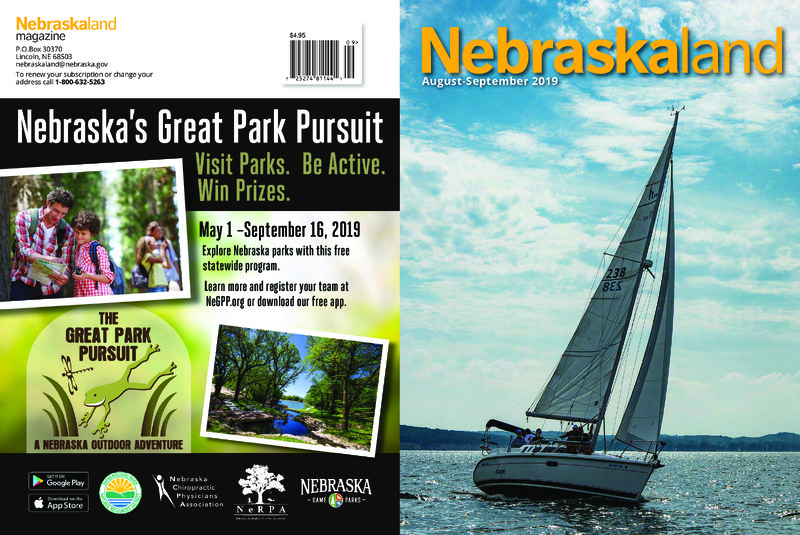
Cover: James Quinn of Omaha sails
with his family on Lewis and Clark
Lake in Knox County, popular among
sailors for its size and reliable winds.
Photo by Eric Fowler.
PHOTO BY BOB GRIER
FEATURES
22
LEWIS & CLARK
30
OUTDOOR NEBRASKA
Paradise in the North
Story and Photos by Eric Fowler
What to Do in August and September
By Renae Blum
32
FROM HI-FI TO HUNT GUIDE
40
150 NEBRASKA STATE FAIRS
42
HEALING WATERS
48
COMING BACK TO SHADOW
Story and Photos by Jenny Nguyen-Wheatley
By History Nebraska
Story and Photos by Eric Fowler
By Gerry Steinauer
DEPARTMENTS
6
10
50
60
62
Your Nebraska
In the Field
Mixed Bag
Portraits from the Past
The Last Stop
ON THE WEB
To see additional content including photos,
videos and articles, visit
Magazine.OutdoorNebraska.gov/digital.
Nebraskaland (VOL. 97 / NO. 7 ISSN 0028-1964) is published monthly, except for the combined Jan./Feb. and Aug./Sept. issues, by the Nebraska Game and Parks Commission, 2200 N. 33rd St.,
Lincoln, NE. Periodicals postage paid at Lincoln, Nebraska, and additional mailing offices. POSTMASTER: Send address changes to Nebraskaland, P.O. Box 30370, Lincoln, NE 68503-0370.
Magazine Staff
magazine
Communications Director Christy Firestone
Public Relations Manager Cara Pesek
Published by the Nebraska Game and Parks
Commission since 1926. The Commission is
dedicated to the conservation and protection
of all the state's natural resources and the
people who use them.
Editor Jeff Kurrus
Associate Editor Jenny Nguyen-Wheatley
Regional Editors Eric Fowler, Julie Geiser,
Justin Haag
Contributing Editor Michael Forsberg
Regular Contributors Renae Blum,
Chris Helzer, Chris Masada, Ryan Sparks,
Gerry Steinauer
Art Director Tim Reigert
Graphic Designer Mel Severin
Photo Librarian Jaclyn Cruikshank Vogt
Administration
Director Jim Douglas
Deputy Director Tim McCoy
Commissioners
Chairman - Robert Allen, Eustis
Vice Chairman - Dan Kreitman, Wahoo
2nd Vice Chairman - Pat Berggren, Broken Bow
Dick Bell, Omaha
Rick Brandt, Roca
Scott Cassels, Omaha
Jim Ernst, Columbus
Doug Zingula, Sidney
John Hoggatt, Kearney
Circulation Donna Robinson
For address changes and questions about your
subscription, e-mail donna.robinson@nebraska.
gov or call 800-632-5263
Advertising Sales Manager
For advertising information contact
Shane G. Gilster, 402-742-0125
Email: shanegilster@gmail.com
Nebraskaland Magazine Copyright 2019, all rights reserved.
Nebraskaland is available in audio from the Nebraska Library
Commission Talking Book and Braille Service, Suite 120, 1200 N St.,
Lincoln, NE 68508. 800-742-7691. Nebraskaland Magazine and the
Nebraska Game and Parks Commission reserve the right to reject any
advertising not in keeping with the agency mission.
Rates: $18 for one year; $33 for two years; $44 for three years. Nebraska
recipients must add appropriate sales tax. To subscribe call
1-800-NEBLAND (632-5263), or go online to:
NebraskalandMagazine.com.
Commission Offices
Conservation Officers
Headquarters/Southeast District Office
2200 N. 33rd Street Lincoln, NE 68503
Phone 402-471-0641
ADMINISTRATION (Lincoln)
Craig Stover (Administrator)
Duane Arp (Asst. Administrator)
Jeff Clauson (Asst. Administrator)
Northeast District Office
2201 N. 13th St. Norfolk, NE 68701
Phone 402-370-3374
Southwest District Office
301 E. State Farm Rd. North Platte, NE 69101
Phone 308-535-8025
Northwest District Office
East Hwy. 2, Box 725 Alliance, NE 69301
Phone 308-763-2940
Bassett Office
524 Panzer St., Box 508 Bassett, NE 68714
Phone 402-684-2921
Kearney Office
1617 First Ave. Kearney, NE 68847
Phone 308-865-5310
Ak-Sar-Ben Aquarium/Schramm Education
Center
21502 W. Highway 31 Gretna, NE 68028
Phone 402-332-3901
Omaha Office
8495 Frederick Street, Omaha, NE 68124
Phone 402-595-2144
OutdoorNebraska.org
Any program that receives federal funding from the National Park
Service, or the United States Fish and Wildlife Service prohibits
unlawful discrimination on the basis of race, color, religion, age, gender,
marital status, national origin, age, disability or political affiliation. Any
person who believes he or she has been discriminated against in
any program, activity, facility, or service, should contact the Nebraska
Game and Parks Commission, Lincoln, NE 402-471-0641, the Equal
Opportunity Commission, Lincoln, NE 402-471-2024, TTY/TDD 402471-4693; United States Fish Wildlife Service, Civil Rights Coordinator,
4401 N. Fairfax Drive, Arlington, VA 22203; Director, Equal Opportunity
Program, U.S. Department of Interior, National Park Service, 1849 C
Street NW, Mail Code 0008, Washington, D.C. 20240-0001.
4
402-471-5531
402-471-5531
402-471-5531
NORTHWEST (Includes counties covered)
Jim Zimmerman (District Supt.)
308-641-6138
Kelsey Glodowski
(Box Butte, S 1/2 Sheridan, Grant)
308-763-8226
Sean McKeehan
(Kimball, Banner, Scotts Bluff)
308-672-1824
Dan Kling (Sioux, Dawes)
308-430-0572
Kyler Prochaska
(E 1/2 Dawes, N 1/2 Sheridan, W 1/2 Cherry)
308-430-3984
308-458-7650
Terry Brentzel (Deuel, Garden, Grant)
402-389-0444
Frank Miller (Cherry, Hooker)
308-279-9133
Josh Widhelm (Morrill, Cheyenne)
NORTHEAST (Includes counties covered)
Tom Zimmer (District Supt.)
402-649-8053
402-760-0712
Dale Davis (Keya Paha, Brown, Rock)
402-340-3981
Jonathan Andreasen (Holt, Boyd)
402-719-6226
Kyle Gaston (Dodge, Colfax)
Greg Hesse
(Greeley, Wheeler, Boone, S 1/2 Antelope)
402-843-6567
Mitch Johnson (Knox, Antelope, Pierce)
402-613-8612
402-762-5022
Jeff Jones (Knox, Cedar)
Jon Reeves
(S 1/2 Thurston, Burt, Washington)
402-889-8508
Andrew Heyer (Pierce, Madison, Stanton) 402-613-2241
Cory Krause
(Cuming, Wayne, Stanton, Dodge)
402-380-6410
Steve Oberg
(Colfax, Platte, Madison, Stanton, Nance)
402-910-3366
Owen Johnson
(Dixon, Dakota, N 1/2 Thurston)
402-266-1759
Doug Pollard (Loup, Garfield, Valley)
308-730-7050
Ethan Teter
(Boating – eastern Nebraska)
402-620-8129
SOUTHWEST (Includes counties covered)
Roger Thompson (District Supt.)
308-530-3097
308-202-0819
Matt Brandt (Sherman, Howard)
308-380-7331
Tim Williams (Hall, Hamilton, Merrick)
Pat George
(Harlan, Franklin, Phelps)
308-920-2762
Matt Andrews
(Gosper, Furnas, Frontier, Red Willow)
308-746-2418
Brian Piernicky
(Red Willow, Frontier, Hayes, Hitchcock)
308-340-6627
Nebraskaland • August-September 2019
John Lee (Hitchcock, Dundy, Chase, Hayes)
Nicholas Fix (Keith, Perkins)
Bryce Streger (Keith, Arthur)
Sean Schultz (Keith)
Brandon O’Neal
(Lincoln, McPherson, Logan)
Alex Hasenauer
(Lincoln, McPherson, Logan)
Mike Thome (Dawson)
Ray Dierking (Custer, Thomas, Blaine)
Taylor Dixon
(Dawson, N 1/2 Gosper, N 1/2 Phelps)
Eric Javins
(Adams, Clay, Nuckolls, Webster)
Kevin Bergstrom
(Boating – central Nebraska)
Daryl Teter
(Boating – central Nebraska)
Scott Eveland
(Boating – western Nebraska)
308-414-1432
308-289-0427
308-440-3847
308-760-0145
308-530-3157
308-660-4671
308-529-8146
308-870-0322
308-217-2108
402-902-2017
308-520-1031
308-440-1863
308-289-0017
SOUTHEAST (Includes counties covered)
Levi Krause (District Supt.)
402-949-0593
402-619-1355
Rich Berggren (Douglas)
402-616-5961
Dan Evasco (Sarpy)
402-210-0888
Heath Packett (Cass)
402-209-1506
Russell Mort (Otoe, Johnson)
William Krause
(Nemaha, Richardson, Pawnee)
402-274-8063
Matt Taylor (Thayer, Fillmore, Jefferson)
402-200-9597
402-806-0915
Matt Seitz (Gage, Saline)
402-890-6463
Dina Barta (Lancaster)
402-937-3422
Dudley Sorensen (Lancaster, York)
402-613-2312
Travis Shepler (Lancaster)
402-314-9641
Trevor Stahlecker (Lancaster)
402-890-7140
Stacey Lewton (Lancaster, Seward)
402-443-6392
Mike Luben (Saunders, Butler, Polk)
YOUR NEBRASKA
Instagram Photos
Follow us (@nebraskaland)
and tag us in your photos
to be featured in an
upcoming issue.
Karen Kutz Smith, Omaha
White-tailed Deer
Richard Jones, Gothenburg
Steel Wool Spinning at Lake Helen
Karen Kutz Smith, Omaha
Scarlet Tanager at Fontenelle Forest
Steve Isom, Valentine
Sunset in the Sandhills
6
Nebraskaland • August-September 2019
August-September 2019 •
Nebraskaland
7
YOUR NEBRASKA
Alan Nash, Scottsbluff
Western Clouds
OPPOSITE: Karen Kutz Smith, Omaha
Eastern Gray Squirrel
Dakota Altman, Lincoln
A Sunset Singer
Terrin Vancura, Sidney
Chimney Rock Retriever
Correction: On page 69 of the July issue
Irene Fisher’s father should have read
Ernest Ehmen. We regret the error.
Send your comments and photos to:
Jeff Kurrus, Editor
Nebraskaland Magazine
P.O. Box 30370
Lincoln, NE 68503
or email Jeff.Kurrus@Nebraska.gov
Please include your postal address
and telephone number. Letters may be
condensed and edited. Photographs are
also welcome.
8
Nebraskaland • August-September 2019
August-September 2019 •
Nebraskaland
9
IN THE FIELD
Take a Dog Hunting
German short-haired pointer
Charlie lovingly looks to her
owner, Aaron Schroder of
Lyons, for direction while
pheasant hunting in Burt
County.
PHOTO BY
PHOT
BY JEN
JE NY
Y NGUYE
NGUYEN-WH
GUYEN
N WHEATL
N-WHEATL
WHEATLEY
EAT EY
Y
10
Nebraskaland • August-September 2019
August-September 2019 •
Nebraskaland
11
IN THE FIELD
PHOTO BY JARROD SPILGER
DOVE LOADS
By Jarrod Spilger
September means dove season to many Nebraska hunters.
It also means stock up on the ammo, because aerobatic
doves can be difficult to hit. The often reported average is
three shells per dove, which personal experience confirms,
although I did manage to bag a limit of 15 doves with 27
shots one rare day last season, for an average of less than
two shells per bird.
Choosing the right ammo can improve your hit rate. While
any shotgun will work, for the sake of economy most hunters
use a 12-or 20-gauge. Target loads are fine, provided velocity
is 1,200 fps or greater. Drop below 1,200 fps and catching up
to speedy doves becomes difficult. Velocities over 1,300 fps
have plenty of speed, but also generate more recoil. A load in
the 1,250-1,275 fps range is a good compromise.
Charge weight can also determine felt recoil. A 12-gauge,
1
1 ⁄8-ounce payload has more pellets and denser patterns than
a 1-ounce charge, but also more kick, the effects of which
quickly become cumulative over the course of an afternoon
dove shoot. In 20-gauge, 1-ounce is too much, 7⁄8-ounce is
good, and 3⁄4-ounce even better, at least in terms of recoil.
Of course, a 16-gauge, 28-gauge, or .410-bore will also bag
12
Nebraskaland • August-September 2019
doves, but again economics factors in since the cost of ammo
for these shotguns is significantly higher.
Regarding shot sizes, stick with No. 8 early in the season,
then switch to larger No. 7½ as the season progresses and
birds become wary and shots get longer.
This year, the Nebraska Game and Parks Commission
challenges you to go hunting, and to take someone new with
you. Whether it’s a grandchild, a child, a spouse, a neighbor, a
colleague or a friend, we challenge you to share your passion
with someone you care about. It doesn’t matter
if they’re brand new to hunting, or if they
just haven’t gone in a few years. Take ’em
hunting.
For hunting ideas, turn the page to see
short intro articles on squirrel, frog and
upland hunting, as well as a reminder of
how vital private landowners are to the preservation
of our hunting passions.
For information about rules and prizes, visit
OutdoorNebraska.org/takeemhunting.
September 1, 2019 — January 31, 2020
Nebraska is an upland bird hunter’s paradise – the mixed bag capital of the
Great Plains – with diverse hunting opportunities, long seasons, great access
to public lands and high rates of hunter satisfaction.
Learn more about the second year of the slam and the prizes you could win at
OutdoorNebraska.org/UplandSlam
IN THE FIELD
PHOTO BY JEFF KURRUS
CALLING SQUIRRELS
By Jarrod Spilger
Many hunters don’t realize it, but squirrels can be called
in just like turkeys or ducks. Under the right conditions, this
tactic can be highly effective. The key to squirrel calling
success is knowing when to call and what to say.
Calling is most effective on calm days so squirrels can
hear you. Also, wait until enough leaves have fallen to make
squirrels more visible, and pick a nice day when they are
more active. A warm afternoon following a cold spell is ideal.
A squirrel’s vocabulary consists mostly of chatters and
barks. Chatters are a series of fast, staccato notes used
to express everything from agitation to curiosity. Barks
are short, sharp, single note sounds usually issued as a
challenge. Making one or two barks, followed by a long series
of chatters, is often all that’s needed to spark a squirrel’s
territorial curiosity and draw them in for a closer look.
Another sound is the distress whistle, which is often made
by young squirrels being attacked by predators. This drives
adult squirrels crazy and encourages them to abandon their
14
Nebraskaland • August-September 2019
treetop hideouts to investigate, just
like kids on a playground come
running to watch a fight.
Most calls are of the basic,
bellows-style design. The
open, barrel-end of the call
is held in one hand, while
the palm of the other hand is
used to quickly compress the
bellows to make barks and
chatters. Some calls also
have a whistle integrated
into the barrel that imitates
distress sounds.
Regardless of what is
said through a call, the key
is to say something. The
squirrels will respond.
IN THE FIELD
PHOTO BY JUSTIN HAAG
YOUR FIRST PRONGHORN HUNT
By Emily Burch
You drew your first Nebraska Pronghorn tag, or you’re
planning on buying one when over-the-counter sales open
Aug. 5. What now? Pronghorn, known for their incredible
speed and vision, are one of Nebraska’s most exciting big
game animals. Bagging one, however, is no easy task. Here
are a few pointers to help turn that first hunt into a success.
Season Dates: Archery season is Aug. 20-Dec. 31.
Muzzleloader hunters have from Sept. 15-30 to harvest their
animal, and the firearm season is Oct. 13-28. Several units
also allow late doe seasons.
Firearms: Pronghorn see the world as if looking through
wide-angle, 8x magnification binoculars. Bowhunters should
prepare for confident 60-yard shots. Muzzleloaders vary
widely in their capability – know the distance at which yours
is powerful and accurate. With a rifle, be comfortable at 200
plus yards. Antelope will push your distance.
Supplies: Like deer, pronghorn do not see color, so clothing
that breaks up your silhouette works as well as desert
camouflage. Dress rugged and lightweight, and do not forget
your blaze orange for the muzzleloader and firearm seasons.
High-powered binoculars will save you miles of trekking,
though sturdy boots are still a must. Kneepads and leather
gloves will protect your limbs when stalking your trophy
through cactus-studded plains. A blind is also a good idea.
Finding Land: Game and Parks has an online interactive
atlas with downloadable map sheets and publishes the Big
Game Guide, which can be found at OutdoorNebraska.org
or sporting goods stores statewide. If you have permission
16
Nebraskaland • August-September 2019
to hunt on private land, communicate with the landowner
about where you plan to hunt. Once you have an area
figured out, put in the time to glass and locate animals. Look
for parcels of land with at least 2 square miles of interior.
Though they like being able to see for miles, they’ll often
disappear into gullies or rolling hills to get out of the wind,
so do not rule out land that isn’t dead flat. They will usually
be within 4 miles of water, too.
Tactics: Getting close to pronghorn is the real trick. Use
everything in the landscape to your advantage. Line up the
posts on a fence-line or get into a slight draw, stay low, and
take your time. Play the wind as well, keeping them upwind
and pushing closer during gusts. Get creative. Pronghorn are
curious animals and more trusting of familiar surroundings,
known to charge a white T-shirt waved just above the grass
or to let several hunters walk into shooting range behind the
cutout of an Angus. If stalking is not your game, use Google
Earth to locate stock tanks near spotted animals. Set up a
ground blind, bring a book and plenty of water for yourself
and settle in. The hottest days are best for this strategy,
especially if rainfall has been light. Additionally, antelope
prefer to duck under fences instead of leaping them, and
these places act like funnels. Setting up near an often-used
high spot in the fence and letting other hunters push them to
you has worked before, and will work again.
Ask experienced hunters about their success, and take
the time to learn the antelope hunting regulations found at
OutdoorNebraska.org/huntingseasons.
IN THE FIELD
PHOTO BY JEFF KURRUS
TAKE ‘EM FROGGIN’
By Jeff Kurrus
If you have young kids and you’re not staying up until the
wee hours of the night hand-grabbing frogs this time of the
year, you’re missing out. Here’s what to expect and what
supplies you’ll need.
Bullfrogs will surround the edges of farm ponds and lakes
throughout the state near nightfall. Hunting for them on the
land can be tough because they can be skittish to sounds
behind them – as they will be facing the water – so a small
johnboat or canoe is ideal.
Supplies are simple – life jackets for the kids, a small,
but sturdy butterfly net, insect repellant, a few hand-held
18
Nebraskaland • August-September 2019
flashlights for scanning the banks, and one spotlight. The
spotlight should be rechargeable in your vehicle by USB or
a 12v outlet.
Shine lights in the frog’s eyes as you quietly approach, and
switch back and forth between handgrabbing and using a
net depending on where the frogs are sitting. Rod-and-reel
tactics can also be used near dusk and dawn using floating
scum frog or mouse imitations.
These trips will be dirty, smelly, and laugh-out-loud funny.
And your kids will love them too. Visit the Nebraska Fishing
Guide for more information.
August-September 2019 •
Nebraskaland
19
IN THE FIELD
PHOTO BY JEFF KURRUS
A THANK YOU TO LANDOWNERS
By Jake Jadlowski
Dear Landowner,
I’m reaching out to say thank you. But before I do, I’d like to
explain myself. I think a lot of hunters who share my passion
would agree.
I love to hunt. Like many of us, my garage is full of decoys,
blinds, generators, camouflage and tools. Whatever doesn’t
fit in the garage stays in the storage unit.
But sometimes it’s hard to find a place to put all that gear
to use. I don’t own any land. My family doesn’t own any
land. In Nebraska, we are lucky to have more than 1 million
acres of land open to public, walk-in access. However, with
Nebraska’s strong hunting culture, our publicly accessible
land can receive a lot of pressure.
So sometimes, I rely on people I don’t know in order to do
the thing that I love. Without them, we can’t always find a
place to hunt.
This past waterfowl season has made that more apparent
to me than ever. It certainly isn’t the first year with
unpredictable weather, early freezes, unseasonably warm
temperatures, high river levels or muddy fields. But for
whatever reason, finding places to hunt was more difficult
than usual for me. And it became clear to me just how much
we rely on landowners to give us an opportunity to hunt.
I know you guys get tired of us knocking on your door. I
know you get tired of picking up the phone and talking to
some guy that you’ve never met about permission. I know you
have better things to do with your time. But we bother you
anyway. And often, you tell us “no.”
But sometimes you say “yes.” Last season, three of us
20
Nebraskaland • August-September 2019
loaded up the trucks and trailer and headed west hoping
to find somebody that would be willing to let us set out some
decoys. We met a farmer who opened his door to us. Not only
did he give us permission to hunt on his land, but he made
phone calls to other landowners on our behalf. He invited
us into his living room to talk. He let us stay in a big shed on
his property that was heated! And he even hunted with us
(a dang good shot, too). Everything about it was awesome.
We got to make new friends and meet new people and
hunt new places. Not to mention, he set us up on one of the
best late-season mallard hunts that a guy could ask for. I
can’t say enough about the way he welcomed us and treated
us.
So to all the landowners that occasionally say “yes,” thank
you.
Thank you for recognizing our passion.
Thank you for the opportunity to do what we love to do.
Thank you for the opportunity to use all of our gear that
we devote so much time and money.
Thank you for giving us a chance to hang out with our
buddies.
Thank you for opening up your property and your homes.
Thank you for sharing stories.
Thank you for hunting with us.
Thank you for letting us make new friends.
To Jim and to Trevor and to Tony and to everyone like you
guys, thank you for giving us a place to hunt.
Sincerely,
Jake
Lewis & Clark
Paradise in the North
22
Nebraskaland • August-September 2019
August-September 2019 •
Nebraskaland
23
STORY AND PHOTOS
BY ERIC FOWLER
here aren’t many places you can pull your boat up
on the bank at Lewis and Clark Lake. Water has
eroded away hillsides ringing much of the lake, leaving
cliffs that reveal colorful layers of Niobrara chalk and
Carlisle shale, part of the geology of the area. Below
those cliffs, more than 100 feet high in places, the
shoreline is just too rocky. Still, boaters make the most
of it, anchoring in the shadow of those cliffs when they
want to hit the pause button and relax in the sun or go
for a swim. The shoreline is one of the most picturesque
backdrops you will see on any water in Nebraska.
There are countless boats on the reservoir on a
summer weekend, but as Nebraska’s second largest
at 15 miles long and 2.5 miles wide, there is plenty of
room for those and more. Some boaters have unfurled
their sails and are riding the prevailing winds across the
water. Some are pulling kids on tubes. Some have their
lines out, drifting or trolling for sauger, walleye, white
bass or catfish, or casting for big smallmouth bass.
When the day is done, some will pull their boat into
a slip at the Weigand Marina at Lewis and Clark State
Recreation Area. The waiting list is long for slips that
are leased seasonally, but a few can be rented daily.
With four boat ramps, getting in and out of the water is
quick and easy.
The marina is just one of the amenities found at the
Weigand and the adjacent Burbach areas. Ten modern
two-bedroom cabins sit on the lakeshore, with spacious
patios and lawns overlooking the water. There are
campgrounds, a swim beach, concession, playground
and more. On most weekends in the summer, and a few
in the fall, special activities are offered in the WeigandBurbach area, including movie nights, hayrack rides and
archery clinics, to name a few. The Nebraska Game and
Parks Commission manages three other areas on the
lake’s south shore – Miller Creek, Bloomfield and South
Shore – all of which offer camping of some sort and boat
T
ramps. In all, there are 250 sites, 150 with electrical
hookups.
The South Shore area has more than 4 miles of trails
open to hikers, horseback riders and mountain bikers
and, in the winter, snowmobilers and cross-country
skiers. The trails wind through the hardwood- and
cedar-forested bluffs and remnant patches of native
prairie above the lake, and in a few spots, take you to the
edge of the cliffs for a sweeping view of the lake. A short
trail is also found at the Miller Creek area.
The reservoir is a wide spot on the Missouri River,
which forms the border between Nebraska and South
Dakota on the northeastern edge of the state. It is
formed by the 1.6-mile-long Gavins Point Dam, which
was completed in 1955. Built and managed by the
U.S. Army Corps of Engineers, the dam’s hydroelectric
facilities produce enough electricity to power 68,000
homes.
Below the dam are more campgrounds managed by
the Corps, as well as Lake Yankton, which recently
underwent a project to remove rough fish and now
provides excellent angling for largemouth bass, as
well as some nice walleye and bluegills. The Nebraska
Tailwaters area is another popular angling spot, with
a chance to catch anything that swims in the reservoir
and, in the fall, snag a prehistoric paddlefish. Above
the spillway area is the Corps’ Lewis and Clark Visitors
Center. The Gavins Point National Fish Hatchery,
operated by the U.S. Fish and Wildlife Service, is also
located below the dam.
The reservoir is named for the Lewis and Clark
Expedition. Members of that party camped at three
locations along this reach of the Missouri River on their
way to the west coast in 1804, and at another on their
way downriver two years later.
Once you see Lewis and Clark Lake, you may not want
to wait two years between visits to this scenic gem. N
A woman rows a stand-up paddleboard along the south shore of Lewis and Clark Lake in
Knox County. The rising sun illuminates the picturesque shale and chalk cliffs that ring
most of the lake.
24
Nebraskaland • August-September 2019
August-September 2019 •
Nebraskaland
25
Gavin and Kaden Jarecki of Norfolk
ride a ski tube behind a boat piloted
by their parents, Jason and Melissa.
Lacey and Seth Gould of
Wausa paddle their kayaks
on Lewis and Clark Lake at
sunset.
With patios overlooking the
lake, cabins in the Burbach
area are popular among
visitors.
26
Nebraskaland • August-September 2019
Cole Bartley and Joe and Mike Zoucha of Omaha
fish for bass in the upper reaches of the reservoir.
August-September 2019 •
Nebraskaland
27
Cory and Wendy
Zimmerman of
Crofton and their crew
participate in the boat
parade during Marina
Days in June at the
Weigand area.
Keaten Gilsdorf and Bentley, Sadie
and Riley Reimers play on the bridge
over Miller Creek behind their families’
campsites at the Miller Creek area.
Kids play on a floating mat in
the Bloomfield area.
A wave rushes
over a rocky
shoreline at the
lake.
28
Nebraskaland • August-September 2019
August-September 2019 •
Nebraskaland
29
Outdoor Nebraska
What To Do in August and September
By Renae Blum
As summer ends and we slip into fall, make sure to get outside
and enjoy hunting, wildlife viewing, and the many Nebraska
state park events taking place across the state, which you can
learn more about at Calendar.OutdoorNebraska.gov. N
Attend the Missouri
River Outdoor Expo
Sept. 21-22 | Ponca State Park
Dates and locations vary by
species
PHOTO BY ERIC FOWLER
GETTY IMAGES
With warmer temperatures and
flowers blooming, now is a good
time to observe butterflies. The
best times tend to be on clear,
warm days around midday, at
locations with lots of flowers.
Species you can find statewide
at this time include the monarch,
black swallowtail, red
admiral and common
checkered-skipper.
PHOTO BY JENNY NGUYEN-WHEATLEY
Observe and
photograph
butterflies
Celebrate our outdoor heritage with
more than 90 free, hands-on exhibits,
demonstrations, vendors and activities
including kayaking, fishing, outdoor
cooking, rock climbing and more. A state
park permit is required for each vehicle
entering the park.
Learn about Native
American history at Fort
Atkinson
Aug. 3-4 | Fort Atkinson State Historical Park
This living history weekend includes the “Wardance and
Gourd Dance of the Umonhon Nation,” a dance honoring
Native American veterans; and a presentation by Eagle
T. Knife Chief, a descendant of a Pawnee leader who
signed the Treaty of Friendship at Fort Atkinson in 1825.
Visitors can also view a traveling Smithsonian exhibit
about the history of Native American veterans in the
U.S. military.
End of
Summer Bash
Aug. 30-Sept. 1,
Lewis and Clark State
Recreation Area
Vintage Baseball
Game
Aug. 17, Buffalo Bill
State Historical Park
See Nebraska Game and
Parks at the state fair
Enjoy fall hunting
Aug. 23-Sept. 2 | Grand Island
Hunting opportunities abound in August
and September. Multiple seasons are
opening, such as archery deer, archery and
muzzleloader antelope, elk, turkey, dove,
grouse and teal.
30
Nebraskaland • August-September 2019
PHOTO BY ERIC FOWLER
PHOTO BY JEFF KURRUS
Various dates | Statewide
The Game and Parks exhibit in the Nebraska
Building features a 6,000-gallon aquarium filled
with fish found in Nebraska waters, an indoor
archery and air gun range, and fun educational
activities for all ages. Outside, you can find a sky
fort, meandering stream, natural playground and
more.
August-September 2019 •
Nebraskaland
31
From Hi-fi
to Hunt Guide
Story and Photos by
Jenny Nguyen-Wheatley
32
Nebraskaland
• August-September 2019
Aaron Schroder of Lyons hunts
on Nebraska CRP land north of
Homer with German short-haired
pointers Charlie and Remington,
and pointing Labrador
retriever Rio.
August-September 2019 •
Nebraskaland
33
schedule. For a time, Aaron worked at Mario Batali’s Lupa.
“So many people opened up doors and we continued to play,”
Aaron said. “I remember we were touring in Scotland, and some
musicians from Germany were discussing why we were doing
what we were doing. One guy said, ‘It’s just adventure. I want
adventure.’ And it just struck me,” Aaron said. “That’s the whole
root of why we’re doing this.”
It wasn’t about the money – there was never really much of that.
Instead, playing music was a cheap way to travel and be away
from work. It was a way to go overseas to “meet interesting people
and have crazy experiences.”
Then one day, Aaron walked away. A nearly 20-year obsession
– gone.
“I was getting older, and then a light came on,” Aaron said. “Jeez,
I was 34 or 35 at the time, and I had been recording and touring
since I was 19. When we arrived at JFK, right then, I knew I was
done. I took my guitar off the airplane and I was like ‘I don’t need
to do this anymore. I feel satisfied.’ ”
After that, Aaron was free to do what he wanted, and around
the same time, April finished her classes at Columbia. The couple
lingered in New York a while longer to figure out their next move.
The pivotal moment came when his father-in-law John called
Aaron to go pheasant hunting.
“John is a big outdoorsman and he always called me up to say,
‘take me pheasant hunting in Nebraska,’ but I never did. I grew up
hunting in Iowa and had dogs, but stopped when I moved away. I
hadn’t done it in such a long time.”
Finally free from a life of band practice and touring, Aaron took
up John’s invitation. He called his uncle Donny in Iowa to set up a
Schroder guides a teal hunt in early September.
aron Schroder lives in Lyons, Nebraska, with his wife,
four dogs and two horses. He drives a truck, appreciates
cheap beer, and enjoys spending time in his “man
cave” – though he probably doesn’t like to call it
that. Hunting gear takes up nearly all the extra space on the
Schroder property, and when the season is in full swing, his
wife, April Goettle, rarely sees him. You may think you know
an Aaron – or two or several – in your life, but meet the real
man, and you can’t help but do a double take.
There’s no missing the weird cat tattoo and the slickbacked, rockabilly hair. That speech – definitely not
Midwestern. Aaron doesn’t seem like someone who’s from
A
34
Nebraskaland
• August-September 2019
around here, let alone someone who would take you on your
first pheasant hunt. Yet Lyons is only 20 miles from Onawa,
Iowa, where he was born and where his parents still live.
Aaron is different because he missed 20 years of living here.
“Everything I do I’m obsessive about, it seems,” said Aaron,
now 44 years old. “It’s just how I am.” His wife can attest to
this behavior.
Enticed by the “opportunity to leave [home] and go do
something,” Aaron left Iowa at 18 to play rock music in
Seattle. He worked at his birth mother’s restaurant during
the day and played music at night. He met April through a
musicians-wanted ad.
“We would work and then spend 3 or 4 hours
a day practicing. It was a big commitment,”
Aaron said, “I toured and made money, had a
record deal.” For 12 years, this was Aaron’s life
in Seattle.
Then an opportunity to go to New York
presented itself, and Aaron and April moved
to Brooklyn to continue to play music
professionally. The restaurant business was
always there by default – the band toured as
much as six months out of the year – and it
was the kind of job that suited a musician’s
Schroder shot this rooster pheasant in January 2015 on
Dakota County CRP ground.
August-September 2019 •
Nebraskaland
35
hunt. John lived in Montana and Aaron was still in New York
at the time. The plan was to meet in Omaha for opening day
of pheasant season.
Thirteen years ago, the three men went hunting on
opening morning in Monona County, Iowa. It was on public
ground, the same places Donny took Aaron hunting when
he was a boy. Though “stoked” to spend time with family,
Aaron admitted to feeling indifferent about the hunt. What
he actually felt was unexpected.
“I remember it was a cold autumn morning,” Aaron said. “I
put a shell in my shotgun, and suddenly boom – like WHOA.
I thought ‘I miss this. I really like this.’ I forgot how much I
liked hunting because I’ve been in a completely different
environment. At that moment, I was pulled right back into it
... We had the worst hunt ever. We didn’t get anything or see
anything. And I didn’t care.
“So I flew back to New York, and I just pushed everything
else aside – my whole life has been like this. All of a sudden,
I was reading and watching videos and wanting to get back
into hunting and training dogs. I ended up flying back here
four times before my hunting license ran out that year.”
Schroder has no idea how many birds he’s cleaned since
becoming a hunting guide. An accomplished cook, he has
prepared pheasant just about every way possible.
Darlin’, a German short-haired pointer, was Schroder’s first hunting dog after his return to hunting. He and his wife,
April Goettle, picked up Darlin’ during their move from New York to Lyons, Nebraska.
36
Nebraskaland
• August-September 2019
Then Aaron’s dad called to say that an acreage in Nebraska
was up for sale. They went to see the house, during the worst
snowstorm Burt County has seen in years, and “somehow
April still went for it.” Aaron loved the place immediately.
They moved to Lyons five months later and picked up Darlin’,
a German short-haired pointer puppy, on the drive from New
York.
“I had paid for her a month or two before. I had everything
laid out, and it was so fun!” Aaron said, barely able to contain
his excitement over the memory. “I got this dog in my lap and
we’re driving to our new house. I’m thinking, ‘Oh my god! My
wife loves me so much!’”
Aaron didn’t have any plans at that point, except to take
whatever odd jobs he could to afford his new hobby. Falling
back on his restaurant experience, Aaron started as head
chef at Pheasant Bonanza in Tekamah, where he introduced
clients to wild game dishes that didn’t come from a can. He
had no intention of turning hunting into a career, but quickly
went from learning to train dogs on the side to becoming
trainer and hunting guide full-time. He dove headfirst at the
August-September 2019 •
Nebraskaland
37
You have to like it.”
Sometimes he wonders when he’ll stop guiding. Maybe
he’ll take a young hunter under his wing, as others have done
for him. “I can just sit, lay down the stories and cook eggs
or something. That’s probably how I will go out,” Aaron said,
amused at the thought, before he quickly brushed it off. That
day isn’t happening anytime soon.
“Those guys that spend 50 years just watching the sky –
that’s just so romantic to me, to just watch the years go by
like that, watching migrating birds and wildlife in general,
and how they’ve adapted to change. These people have such
a long perspective over a span of so many years,” Aaron said.
“I’m just more interested in it as the years go by. I’ll sit out
there for hours and hours, even when nothing is happening,
and it’ll seem like only 10 minutes. It’s weird, to sit for hours
and hours in one spot for so many years.
“I can’t imagine doing anything else. It’s all I think about.
It’s all I want to do. It’s always calling me.”
He isn’t satisfied yet. N
Schroder carries out green-winged teal and wood ducks
after a waterfowl hunt in Burt County.
Schroder’s second dog Charlie is a talented German short-haired pointer. Out of Aaron’s four dogs – two German shorthairs
and two Labrador retrievers – she and Aaron have the most special bond.
opportunity to train for several months with the renowned
John Greer at Tiger Mountain Pointing Labs in Ellensburg,
Washington.
Aaron absorbed all he could, with the same obsession and
tenacity he had for music. This was his new adventure, and
much like his past life as a musician, the unpredictability of
hunting and dog training kept his work exciting.
“The two are a balance – dog training and outfitting. You
get slammed doing one thing, and get tired of it, and then you
switch. It’s like music – playing shows and recording. I can’t
do the same thing over and over again,” Aaron said. “With
hunting, there are always random occurrences that are fun to
deal with, especially when dealing with nature. It doesn’t get
any more random than nature.”
From upland hunting, Aaron then got into waterfowl
hunting, which was an entirely new obsession in itself. A
few years later, Aaron moved on from Pheasant Bonanza to
open his own business: Double A Outfitting and Gun Dogs. It
presented new challenges, which he relished.
“The things I really hated about outfitting at first are the
things I really like now. Something always breaks. There
are so many pieces,” Aaron said. He may get up at 2 or 3 in
38
Nebraskaland
• August-September 2019
the morning – whatever it takes – because he assumes that
something will always go wrong, and he’s had a few close
calls, unbeknownst to customers who show up hours later.
“I dig crazy weather patterns. I really enjoy them. But it
makes working difficult when there’s ice involved. If the
river could talk,” Aaron said, with a scoff. “Whether the
birds show up is one thing, but nobody who comes hunting
or dog training with me will ever suffer from any sort of
shortcomings because something isn’t working. That can’t
happen. In the end, it’s really rewarding when things are how
I want them to be.”
As for wear and tear, life as a hunting guide isn’t a huge
upgrade from the days of sleeping on couches and floors.
Aaron can put in as many as 90 hours per week during the
hunting season. The work is a constant grind, and like many
in the profession, he, too, suffers from aches and pains.
“I work by myself on the river a lot and have had some
compromising times with the river. I remember sitting out
there one morning, really early, and thinking to myself,
‘I’m either really tough or really stupid,’” Aaron said. “I
don’t make a lot of money doing this. I could probably
make more doing something else, but it’s not the same.
A spread of duck decoys sit on a pond at sunrise. Schroder may get up at 2 or 3
in the morning to make sure everything is right before his clients arrive.
August-September 2019 •
Nebraskaland
39
150 Nebraska State Fairs
By David L. Bristow, History Nebraska
ebraskans will celebrate the 150th Nebraska State
Fair Aug. 23-Sept. 2. Can you name the fair’s five host
cities, and the two years the fair was canceled?
Nebraska City hosted a three-day territorial fair
in 1859, and the first two state fairs were there in 1868 and
1869. Brownville hosted for a few years, then Omaha and
Lincoln switched back and forth until Lincoln became the
fair’s longtime home from 1901 to 2009. Grand Island has
been the host city since 2010.
No fair was held in 1898 because host city Omaha
was putting all its efforts into its Trans-Mississippi and
International Exposition, a World’s Fair-type event. And the
U.S. government suspended fairs in 1945 due to World War II.
From the beginning, fair promoters disagreed whether
the fair was primarily about education or entertainment. In
1868, future Nebraska governor Robert Furnas of Brownville
scolded readers of the Nebraska Advertiser: “Don’t go into
sideshows to see fat women, or a calf with two heads and
eight legs, or any other monstrosities; but look at the stock,
N
examine the points and make note of where you can purchase
a fine Short Horn or Chester White, or any other desirable
stock.” At a time when the great majority of Nebraskans
were farmers, Furnas believed that the fair’s main purpose
was to improve people’s lives by improving agriculture.
Meanwhile, gambling and liquor were allowed at the fair
until 1879, and early newspapers complained of “indecent
shows.” The popularity of horse races, entertainers, and
carnival-style midways may have disappointed the purists,
but the fair relied on the big crowds those events drew.
Even Furnas acknowledged that the fair offered “a week of
recreation for every family,” and that “it happens on many
farms that there is really no let up,” making it hard to get
away. By the time they arrived at the fairgrounds, in other
words, most Nebraskans believed they’d earned the right to
enjoy themselves.
Here are a few of our favorite photos from fairs past. N
One of the earliest Nebraska State Fairs, and the first of two held in Brownville, 1870. History Nebraska RG 2304-3-6
Visit History Nebraska’s website at history.nebraska.gov.
Beatrice Simmons of Cozad, 1st Heifer Calf Club, 1924. History
Nebraska RG3356-22-4
You can’t have a fair without fair food. Hamburger stand,
1946. History Nebraska RG2183-1946-904-1
The fairgrounds in
Lincoln in 1888. The
widespread use of trash
receptacles was still
in the future. History
Nebraska RG3356-3-3
Auto racing in the 1920s. History Nebraska RG3356-20-242
40
Nebraskaland • August-September 2019
August-September 2019 •
Nebraskaland
41
Project Healing Waters
STORY AND PHOTOS BY ERIC FOWLER
PROJECT HEALING WATERS got its start at Walter Reed
Army Medical Center in Washington, D.C., in 2005. It was the
brainchild of Ed Nicholson, a Navy captain about to retire
and a cancer patient there. Walking the halls, Nicholson
saw wounded soldiers returning from Iraq and Afghanistan,
many missing limbs. He thought getting them outdoors and
away from the hospital would help. Nicholson took a few
of them fishing, and soon after, others joined to help. They
offered weekly casting lessons on the lawn and fly-tying
classes indoors. From there, Project Healing Waters was born.
Led by volunteers from local chapters of Fly Fishers
International, Trout Unlimited and independent fly-fishing
clubs, the organization now has programs in 219 locations
in every state and Germany. There are two programs in
Nebraska, with Lincoln’s affiliated with the Cornhusker Fly
Fishers, and Omaha’s with Trout Unlimited. Its mission is to
help in the physical and emotional rehabilitation of disabled
active military service personnel and veterans through flycasting, fly-tying and rod building classes and fishing outings
at Department of Defense hospitals, Warrior Transition Units,
and Veterans Affairs medical centers and clinics throughout
the United States.
One of the wounded service
members to take part that first
year was a Nebraska native,
David Folkerts. Folkerts grew
up on a farm near York, joined
the Nebraska Army National
Guard and decided to make
the military a career while
at Wayne State College. He
graduated in 2004, completed
his training and joined the
70th Engineer Battalion, 1st
Armor Division, at Fort Riley,
Kansas.
In March of 2005, Folkerts
was off to Taji, Iraq. His unit’s
job was to make sure roads
were clear of roadside bombs
and provide security for troops
and others on the route. A
month after he arrived, he
volunteered to be on the team
that would lead his platoon
Volunteer Will Sizemore of Omaha helps Jim Titus, an Army and Navy veteran
down a road to a helicopter
from Omaha, fish during an outing at Conagra Lake in Heartland America Park in
crash site. When a roadside
Omaha.
hen a roadside bomb exploded next to the vehicle
David Landon and his fellow soldiers were riding in on
a road in Iraq in 2009, Landon was thrown clear and the
others killed instantly.
When a firefight ensued, others in the patrol had orders to
pull back and nearly left him for dead. But one soldier thought
he saw Landon move, ran into the gunfire and dragged him
back to safety.
That was only one of the horrors Landon experienced.
When he returned home to Omaha, he went into a shell. He
rarely left his bedroom. Once outgoing, he didn’t want to talk
to people, not even family. When Landon would see an outof-place box or backpack alongside a city street while riding
in his mom’s car, he curled up in a ball on the floor.
That has all changed since 2015, when Landon picked up a
fly rod and started fishing with other disabled veterans who
have similar stories. The program that introduced him to the
sport is aptly named: Project Healing Waters. For many of the
8,300 disabled current and former service members taking
part across the country, the therapeutic value of fishing has
been life changing.
42
Nebraskaland • August-September 2019
PHOTO COURTESY OF PAULA KRUGERUD PHOTOGRAPHY
W
David Landon of Omaha, an Army veteran from Omaha, fishes the Big Hole River in Montana on a trip to the
Freedom Ranch for Heroes provided by Project Healing Waters. The trip and program have been life changing
for Landon, who suffers from PTSD.
bomb exploded, it tore through his left arm and caused
profuse bleeding.
“The guys that saw it happen said it blew us up 20 feet in
the air and off road,” Folkerts said.
Emergency surgery in a Baghdad hospital included
grafting a vein from his leg to save his arm. More surgeries
followed at a hospital in Germany after which he was flown
to Walter Reed. He would spend more time in recovery than
he did doing his job on active duty.
“I was very fortunate, one, that I didn’t die, but two, that I
got to save the arm also,” Folkerts said.
For the next three years, he was back and forth between
Walter Reed, where he ran into the folks from Project Healing
Waters, and Fort Riley, which was close enough that he could
go home on weekends.
There are pictures of Folkerts as a child fishing on Beaver
Creek, “a little muddy creek that went through my dad’s cow
pasture. I spent many days as a young boy down there with
my cane pole and a bobber and worms fishing for bullheads,”
Folkerts said.
Fly-fishing, on the other hand, was a foreign concept to
Folkerts. Asked to try it at Walter Reed, he initially declined,
thinking it looked too complicated.
“My left hand was mostly paralyzed at the time and I was
afraid to try it and fail and just be more depressed about my
situation,” he said.
His friends persisted and he eventually did try it, and
quickly learned that his left hand functioned well enough to
strip and retrieve line while he cast with his right. Soon he
went to New York, where he caught his first brook trout on an
outing hosted by the fly-fishing club at West Point.
“I pulled it out of the water and took a look at it and saw
how beautiful it was. I was like. ‘Wow, this is pretty dang
cool.’ I was pretty much hooked there,” he said.
From there he went to every meeting he could, and signed
up for a five-day float trip on the Snake River in Montana.
“Just being out in the wilderness and being on that trip
with six or eight other disabled vets was pretty amazing,”
Folkerts said. “It was an incredibly healing experience for me.
When I came back, I just wanted to spread that. I appreciated
what the program had given to me and I wanted to start
giving back.”
So he started volunteering with Project Healing Waters,
helping others at Walter Reed learn what he now calls “the
proper way to fish.” Having been wounded in battle gave him
“instant credibility” with the soldiers he was helping, and
when he medically retired from the Army in 2008, he became
the organization’s second full-time employee, taking on the
job of starting new programs. Now the national programs
officer, Folkerts is in charge of training volunteers across the
country, organizing destination outings for the vets, rodbuilding, fly tying and casting competitions, and other tasks.
What he likes most about the organization is not the
fishing, but the “magic” of the relationships veterans build
through ongoing activities held at least once a month.
“When you get veterans together in a social setting, it
August-September 2019 •
Nebraskaland
43
of the jungle. Instead, he was assigned to be a medic with
brings back some of that camaraderie they had, and a lot of
the First Division, First Company of the Marines. He became
veterans have a hard time relating or sharing their stories
friends with those soldiers, and saw many of them die.
unless they’re talking to another veteran.”
“I got there in May of 1967 and I didn’t leave until October
The fly-fishing part is good, too, Folkerts said. There is the
of 1968. That’s a helluva time,” he said, pointing to the Tet
sense of accomplishment of building a rod and tying a fly and
Offensive in early 1968 as the worst of it. “We saw kids die
catching a fish. And of course there is the peace and healing
every day. I still have nightmares where a kid grabs my arm
power of being on the water in beautiful places and enjoying
and says ‘Tell my mother I love her.’ How do you absorb that,
nature, and how that can help them cope and deal with their
knowing he’s dying right now? How do you absorb that? This
problems.
is not once, this was … oh my God … I can’t even … I lost track.”
“It’s kind of the opposite of war in Iraq and Afghanistan, or
Like other veterans, Baswell didn’t talk about those
just war in general,” Folkerts said. “War is like an overloading
nightmares
after
he
of your senses of horrible
returned to the states.
images, horrible experiences.
“I was in denial for 50
And then getting out and
years,” he said.
fishing, especially fly-fishing
Now he wants to help
in beautiful places, is like
soldiers returning from Iraq,
overloading your senses
Afghanistan and elsewhere
with positive images and
face their demons and
positive experiences, and it
“realize that their sorrow
works.”
and their pain and their hurt
THE PROJECT HEALING
resonates,” Baswsell said.
WATERS program is not
“We help each other.”
just for those who have
Fishing is the perfect
served in the Global
distraction, Baswell said.
War on Terror. It is also
“When people come out
open to any active duty
here, there are no phones.
military personnel and any
You’re not listening to the
veteran who has suffered
outside world. You’re just
a disability, no matter the
watching the water,” he
disability.
Volunteer Mike Dvorak of Lincoln and Jerry Gustin, an
said. Blocking out the noise
Charles Baswell carried Air Force veteran from Omaha, have some fun with a
can give you peace, which
his mental scars from the bluegill Gustin caught during a Project Healing Waters
event
at
Bowling
Lake
in
Lincoln.
can give you hope.
Vietnam War for decades
Baswell had fished since
before he would even talk
childhood, but not until he joined the program did he take up
about them. He joined Project Healing Waters as a participant
fly-fishing. “It’s my sanctuary,” he said.
four years ago, becoming hooked after an invitation to join
WHEN DAVID LANDON recovered from the knee, ankle
a fly-tying class at the Veteran’s Administration Hospital in
and head injuries he sustained when that improvised
Omaha. He soon volunteered as an instructor and this year
explosive device detonated, he returned to action. His
took over as the program lead for Omaha Project Healing
mother, Jane Landon, now his full-time caregiver, said she
Waters. He also volunteers at the V.A. Hospital, helping
only knows bits and pieces about the things he experienced
veterans cope with post-traumatic stress disorder.
during his time in Iraq – about as much as the therapists
“I work with these kids all day, and to take them fishing
who help him. About getting separated from his unit in Iraq,
is an extension of the recovery center,” he said. “They come
and saving a bullet for himself because he didn’t want to be
scared. They’re completely isolated. They’re completely
captured. About the children who would approach them, and
detached from society. Some of them, at times, they don’t
how some were sent carrying bombs and the decisions that
want nothing to do with anybody. And I understand that.
had to be made.
Coming back from Vietnam, that’s the way I was. I recognize
“These guys have experienced horrors that they want to
myself in these kids.”
lock up in a little box and chain it closed and not deal with it
Baswell has seen veterans come out of their shell through
anymore,” Jane said.
Project Healing Waters. But it doesn’t happen overnight. He
Landon began suffering other maladies. More than once,
is in his fourth year in the program, and it took two years for
when his base was being bombarded by missiles, Landon
him to start talking about what he saw in Vietnam.
was found walking toward the explosions rather than
Baswell volunteered to serve in Vietnam, joining the Navy
running away. One of his friends convinced him to seek help.
because he loved the water and hoped it would keep him out
44
Nebraskaland • August-September 2019
He told the doctors that he saw an English soldier in an old
uniform beckoning him, his mother said. Landon was sent
to a military hospital in Germany. There he began suffering
seizures.
Separated from his friends, “he was a lost soul,” Jane
said. “It was the beginning of the depression, the PTSD, the
anxiety.”
In 2011, Landon was honorably discharged and returned
home to Omaha. Healthy and always outgoing with a
wonderful sense of humor when he enlisted, he was now
“a shell of his former self,” a recluse who had lost so much
weight he was “basically a walking skeleton,” she said.
For four years, little changed. In time, he would come out of
his room when family was over, but he didn’t talk, and didn’t
stay long.
“He could only take so much,” Jane said.
When he became involved in Project Healing Waters in
2015, “there was a little bit of a spark,” Jane said. At first,
it was just as much of a struggle to get him to go to the
meetings as it was to get him to a doctor’s appointment, but
after about a year, he started to open up to the volunteers and
other participants.
What really turned Landon around, Jane said, was a fiveday trip in 2018 to the Freedom Ranch for Heroes in Wise
River, Montana, which hosts hundreds of members of Project
Volunteer Charles Baswell, a Navy veteran from
Omaha, teaches Scott Novve, an Air Force veteran
from Omaha, fly-casting during an outing at Bowling
Lake in Lincoln.
Mark Glover, an Army veteran from Lincoln, fly-fishes during an outing at Conagra Lake in Heartland America
Park in Omaha.
August-September 2019 •
Nebraskaland
45
Healing Waters each year. There, they connect with other
disabled veterans while float fishing the Big Hole River, and
relaxing around a campfire at the lodge. Transportation,
lodging and food is provided, as also everything they need to
fish, from rods to flies to waders. If they have a caregiver, that
person gets to go along at no expense as well.
Landon caught the biggest fish, a brown trout, and also
cutthroat trout.
“I was going down the rapids and catching fish every five
minutes,” Landon said. “It was a blast.”
Landon and the six other disabled veterans on the trip
connected immediately and now stay in touch. “The
camaraderie was absolutely amazing,” Jane said. “When
veterans who have experienced these types of things can
get together, they don’t have to retell these stories to share
Project Healing Waters hopes to one day
serve 30,000 veterans. With 3 million disabled
veterans in the United States, there are plenty
of candidates. While some have physical
disabilities, many more carry emotional scars
of battle.
More than 2.5 million Americans have
served in the Global War on Terror in Iraq,
Afghanistan and elsewhere since the terrorist
attacks on the United States on Sept. 11, 2001.
Nearly 7,000 have been killed and 53,000
wounded. Studies estimate that as many
as 41 percent of returning veterans suffer
from some sort of mental disorder, including
traumatic brain injuries, post-traumatic stress
disorder, depression and substance abuse.
These war-triggered mental health issues
have been around as long as war has existed.
An estimated 30 percent of 2.7 million soldiers
who fought in Vietnam suffered from PTSD at
one point or another. More than 30 percent of
soldiers sent home during World War II were
discharged for psychiatric reasons. The issues
have been referred to, among other things,
as shell shock or battle fatigue. PTSD wasn’t
recognized as a disability by the military until
1980. Treatment has advanced, but there is
no panacea.
Volunteer instructor Ken Wisenhunt of Lincoln shows
Lenny Hiner and Bryan Carroll, both Army veterans
from Lincoln, how to tie flies during a Project Healing
Waters class at the Veterans Affairs Medical Center
in Lincoln.
46
Nebraskaland • August-September 2019
a sense of belonging they don’t necessarily feel when mixed
in with the rest of the society. They know. ‘You guys get it. I
belong here. I fit in.’”
Landon has opened up more and his focus and selfconfidence have improved. He rarely misses a Project Healing
Waters meeting, and when there is a fishing outing, he has
his gear loaded in the car the night before. He has even begun
to take on the role of volunteer, helping others in the program.
Landon had fished before, mostly trolling with his dad, but
not with a fly rod. He likes the challenge and the reward of
catching fish with flies he tied on a rod he built.
“It’s really meditative,” he said. “It keeps you focused. It
gives you something to do other than just sit around and
mope about the past. Doors open up through Healing Waters.
Opportunities with other people and other organizations.
“But mainly I like hanging around the people and just tying
flies and just having fun.”
Jane Landon is grateful for how the program has helped her
son and others, even though she knows there is more work
to do.
Volunteer Gene Svensen of Lincoln helps Michael
Porter, an Air Force veteran from Denver, unhook a
bluegill he caught during a fishing outing at Conagra
Lake in Heartland America Park in Omaha.
“You’ve got to be patient,” she said. “You can’t assume, ‘Suck
it up soldier, march on.’ That may have saved them in Iraq, but
they’ve got to come back to our civilization and the rules that
helped them survive over in Iraq, you can’t do that here.”
She is thankful Landon made it home. Many of the moms
she met in support groups while he was deployed can’t say
that. “But he did come home,” she said. “And the difference
that I have seen in him since he’s really gotten involved in
Project Healing Waters, it just ... it does my heart so good
because I see that he’s got a future. He sees that. He can
laugh again. He sees that there is a purpose to getting up in
the morning and getting going and something to do that is
worthwhile.
“It has basically been a lifesaver for him.”
Fishing? A lifesaver? How many anglers could have
imagined that? N
The implications can be tragic. Suicide rates
are 1.5 times higher among veterans than the
rest of society, and progress at a rate of more
than 20 per day. They are highest among
those who have served since 9/11.
Project Healing Waters in 2018
programs nationwide
• 219
8,307
disabled veterans served
• 4,001 volunteers
spent 294,010 hours
• serving the program.
20 percent are
former participants.
fly-tying classes
• 4,902
1,214
building classes
• 1,464 flrod
y-casting
classes
• 1,124 fly-fishing education
• 1,605 fly-fishing outings classes
• $0 cost to participants
•
To learn more about the program or to find
out how to participate, volunteer or make a
donation, visit projecthealingwaters.org.
August-September 2019 •
Nebraskaland
47
Coming Back to Shadow
By Gerry Steinauer, Botanist, Nebraska Game and Parks Commission
had a most interesting job shadow last summer: a young
woman, whom I have known her whole life, traveled
halfway around the world to get here.
Aurora Bischof is the daughter of my dear friends
Richard and Vilma. I first met the Bischofs in 1998 when
Richard worked as a wildlife biologist for the Nebraska Game
and Parks Commission. In 2004, when Aurora was 5, the
Bischofs moved to Guam and then in 2006 to Ås, Norway,
where Richard is now a professor and Vilma a guidance
counselor at the Norwegian University of Life Sciences. The
job shadow was Aurora’s first trip back to Nebraska.
During her five-week stay, Aurora traveled the state with
me from the oak-wooded Missouri River
I
interest in
OF
HARD BISCH
PHOTO BY RIC
’s
way, Aurora
ntains of Nor
ou
m
e
th
in
e.
Exploring
an early ag
evident from
nature was
bluffs to our western pine escarpments. She met biologists
ranging from ornithologists to woodland ecologists to
entomologists and saw how they worked to conserve nature.
In the end, the job shadow proved useful, confirming her
desire to study ecology.
The Job Shadow Begins
Fresh from high school graduation, Aurora arrived at
Omaha on a Saturday evening in mid-June travel-worn and
tired. The following day would provide little rest as we rushed
to prepare for a plant identification course I was teaching
starting the next day in Holdrege.
Aurora would participate in this advanced course for
biologists,
biologist which covered the difficult grass, sedge and
rush families.
It would be challenging, but what better
fam
way to test a young student’s mettle than by learning
plant taxonomy?
ta
For a week she listened to lectures, used a microscope
to key out plants, and botanized with the class in nearby
prairies
prairie and marshes. It was soon obvious she had an eye
for detail
det and a knack for botany. To her embarrassment,
she did
d so well keying out plants that to the class I
sometimes
referred to her as the “Norwegian sedgesome
keying
keyin champion.” Norway, as you might know, is a
sedge-rich
land.
sedge
Next
Ne up, we traveled to Scottsbluff for a one-day
pollinator
workshop for conservationists held at the
polli
Wildcat
Hills Nature Center. In the morning there were
Wild
discussions
on prairie restoration methods, design
disc
of seed
mixes and the habitat needs of pollinators.
s
During
the afternoon plant identification hike,
Dur
Aurora
actively sought and photographed insects
Au
and
an wildflowers, always asking me their names.
Though
present at an early age, it was evident to me
Th
that
th her passion for nature, a prerequisite of all good
biologists,
had advanced to a new level.
bi
Fun and Games
For a well-deserved break, we traveled to our
South
Dakota farm for a long Fourth of July
S
weekend.
On the trip up, we pondered 12 millionw
48
Nebraskaland • August-September 2019
Her first time shooting, Aurora easily out-shot the author.
year-old rhino fossils at Ashfall Fossil Beds State Historical
Park and the next day toured the remains of a 1,000-year-old
Indian village in Mitchell, South Dakota, but our guest was
most excited about experiencing a traditional Independence
Day celebration.
Grace, my wife, and I aimed to please. The afternoon of the
Fourth we played Frisbee golf on a make-shift, around-thefarmyard course and later shot targets with .22-caliber rifles.
Her first time ever shooting, with cool Norwegian composure,
Aurora easily out-shot me at 30 yards over open sights. That
evening we barbecued, had cherry pie a la mode for dessert,
and then interrupted the peaceful darkness with the flash
of sky rockets, the burst of Blackcats and the lazy twirl of
sparklers. “I wish we did this in Norway,” Aurora mused
afterward.
Back to Work
After the weekend, we drove to Indian Cave State Park in
southeastern Nebraska to meet with local land managers
to discuss oak woodland management. Here, Aurora saw
first-hand how herbicides and prescribed fire were used to
battle invasive plants and maintain the rich woodland flora.
She also saw, what was for her, more new and interesting
wildflowers, mushrooms, birds and insects, and enjoyed the
world’s best homemade glazed doughnuts in the café in the
little burg of Nemaha.
Her last job-shadowing event was a trip to the central
Niobrara River Valley where I collected field data for a
vegetation mapping project. This trip would test Aurora’s
toughness as we would spend several days bouncing over sand
dunes in a utility vehicle and hiking steep, bluff woodlands.
As I guessed, the athletic
Aurora held up well, though
ugh
she was annoyed by “all
all
the ticks and mosquitoes,”
s,”
suggesting they “had a
fondness for Norwegian
an
blood.”
One evening, while
e
staying on the Niobrara
a
Valley Preserve, as an
n
ominous sky approached
d
from the west I feared
Aurora might experience
her first tornado. No
cyclone developed, but
the storm delivered
a show of lightning,
thunder and winddriven hail that banged
against our cabin.
“It was so exciting,”
said Aurora. “I had
Aurora cool
never seen such a
s off below a
waterfall
on the Niobr
storm. The hail was
ara River.
PHOTOS BY
gigantic.”
GERRY ST
EINAUER
A Path Forward
For Aurora, last summer’s greatest challenge was learning
all the botanical terms in English, her second language since
moving to Norway, and dealing with her allergy – of all things
– to corn pollen. Her favorite places were the Niobrara River
Valley and Indian Cave State Park. “They were beautiful,”
she said.
Aurora spent this past school year at the University Pablo
de Olavide in Seville, Spain, taking Spanish courses. She has
decided to continue her education this fall in her hometown
at the Norwegian University of Life Sciences majoring in
ecology and nature management.
“Before the job shadow I was pretty sure I wanted to be a
biologist of some type, but now I am convinced,” said Aurora.
“I can’t see myself doing anything else.” N
August-September 2019 •
Nebraskaland
49
MIXED BAG
PHOTO COURTESY OF THE NEBRASKA TOURISM COMMISSION
VISIT KNOX COUNTY
By Emerson Belitz, Nebraska Tourism Commission
Knox County in northeastern Nebraska is full of unique
attractions and rich history. Journey through the County
along Nebraska Highway 12, designated the Outlaw Trail
Scenic Byway that stretches 231 miles across the state, for
hidden gems, hole-in-the-wall eateries, historical sites and
cultural experiences such as powwows.
One of Knox County’s largest attractions, Niobrara State
Park, boasts an itinerary of fun events and activities. Spend
an evening at a buffalo cookout, take a horseback trail ride
or learn about the park at the J. Alan Cramer Interpretive
Center. From swimming and boating to hiking and biking,
there’s something for everyone.
Nearby is the Ponca Tribal Museum, where you can learn
about the culture and history of the Ponca Tribe. Traditional
headdresses, jewelry and artifacts will open your eyes to the
history of a proud and enduring nation. Learn about Lewis
and Clark’s expedition west at the Lewis and Clark Visitor
Center overlooking the Missouri River. Located on the banks
of the 15-mile-long Lewis and Clark Lake, the center offers
camping, modern cabins, beach fun and a top-notch marina.
Golfers love the challenging and picturesque terrain of
Tatanka Golf Resort in Niobrara. Tatanka was voted 2015
‘Best New U.S. Resort Course’ in Golf Magazine. Ohiya
Resort and Casino, Nebraska’s first of its kind, is just east
of Niobrara. This attraction, owned and operated by the
Santee Sioux Nation, features lodging and more than 400
machines.
At Ashfall Fossil Beds State Historical Park, more than
350 complete skeletons and fossils of 25,000 specimens were
preserved after a prehistoric volcanic eruption. Observe the
ongoing excavation in the Hubbard Rhino Barn, and you may
50
Nebraskaland • August-September 2019
even get to talk to one of the paleontologists working at the
site.
Get a taste of country cooking at Green Gables, which
offers home cooking in a casual dining atmosphere and a gift
shop carrying antiques, clothing and accessories. Save room
for a delicious dessert. Stop in Verdigre for a kolach at the
Verdigre Bakery or homemade meals, pie and soft serve ice
cream at the Cozy Corner Cafe.
Sportsmen’s Bar & Grill and Two Rivers Hotel in Niobrara
provide a nostalgic Old West saloon atmosphere with
exceptional steakhouse dishes. Spend the night at the
Historic Argo Hotel in Crofton; built in 1912, this beautifully
restored hotel is listed in the National Register of Historic
Places.
Interested in hunting? The county features three state
wildlife management areas, two of which are on the Missouri
River. Swanson Hunting Lodge and Whitetail River Lodge
offer lodging as well as controlled hunting grounds.
See what all of the “buzz” is about at The Hive in
Bloomfield. This family-owned restaurant serves a variety
of lunch items and offers an extensive espresso menu. The
Hive carries a wide variety of wines and beers, many of
which were brewed in Nebraska, so pick up a bottle or two
after your meal. Stop by LemonDrop Boutique, conveniently
located above The Hive, for a selection of women’s clothing
and accessories. In addition, this café and shop is also a 2019
Nebraska Passport stop.
Knox county offers adventure for all, whether you search
for it in a brewery, in history, or in the great outdoors.
More
vacation
resources
are
available
at
visitnebraska.com.
August-September 2019 •
Nebraskaland
51
MIXED BAG
ANIMAL HEADGEAR
By Monica Macoubrie
T
he word headgear definitely
does not ooze a sexy persona,
but when it comes to animals and
their “headgear,” this may mean
the difference between getting a
mate, surviving, or even thriving in
their environment. Many animals in
Nebraska have extensions on their
head that can be adaptations used to
help them in their environment. Let’s
take a look at a few cases in Nebraska.
CRESṪCROWN When referring to
crests or crowns people are usually
talking about the top part of a bird’s
head. Many birds have a distinct
crown shape with the peak either
closer to the back or front of the head.
Some species, such as blue jays, can
manipulate their crown by raising
and lowering their feathers to change
shape for courtship displays, to defend
territory or to show aggression.
ANTENNAE A key characteristic of
insects is to have antennae. However,
antennae come in many shapes, sizes
and forms. For instance in longhorn
beetles, their antennae can be
longer than the length of their body.
Alternatively, when looking at moths,
52
Nebraskaland • August-September 2019
they have comb-like or feathery
antennae, which they use as smell
receptors to detect molecules miles
away.
FEATHERY GILLS belong to most
salamanders during their aquatic
tadpole stage. Here they have very
noticeable and feathery gills, which
they use to breathe in the water during
their “eft” or second phase of their
reproductive life cycle. When they
become adults, they will lose their
gills and produce lungs to breathe on
land with instead.
HOODS Something a little terrifying
to not only read about but actually
see in Nebraska is a snake with a hood
on its back. But not to worry, cobras
don’t live here. It’s an Eastern hognose
snake. When scared or threatened,
these non-venomous snakes will
widen or expand the extra skin
around their neck to resemble a hood.
This helps them look bigger and more
intimidating to predators and prey.
PHOTOS BY (FROM TOP LEFT): DEER–JSTOCK, BIGHORN SHEEP, BLUEJAY–JUSTIN HAAG, MOTH–ERIC FOWLER, SALAMANDER AND HOGNOSE SNAKE–STOCK.
ANTLERṠHORNS This is probably
the most common type of animal
headgear. Animals that have antlers
include deer and elk, while horned
animals include bison and bighorn
sheep. Most of these animals have
these head extensions to defend
themselves from predators and to
fight members of their own species for
territory, and ultimately win the girl.
In most cases, only the males have
horns or antlers, but in some species,
females can have them too.
August-September 2019 •
Nebraskaland
53
MIXED BAG
By Julie Van Meter, State Entomologist,
Nebraska Department of Agriculture
The Nebraska Department of Agriculture is conducting
surveys in 2019 to better determine which tick species are
present in Nebraska. American dog tick, winter tick, brown
dog tick and lone star tick are all known to be established
in the state. In 2018, the Gulf Coast tick was found in two
separate instances in Nebraska, indicating the tick may be
expanding its range into our state. Since spring 2019, the
department has confirmed deer tick, or blacklegged tick, in
Douglas, Sarpy and Saunders counties in eastern Nebraska.
Ticks are known to carry a number of diseases that can
be transmitted to humans and animals as the ticks feed.
For example, deer tick can vector Lyme disease, and the
American dog tick can transmit Rocky Mountain spotted
fever and tularemia, all bacterial diseases. The lone star
tick may vector a number of diseases, including human
ehrlichiosis (bacterial) and Heartland virus. The Gulf Coast
tick can infect dogs and humans with Rickettsia parkeri and
Hepatozoon americanum.
The invasive longhorned tick, native to parts of Asia, is
also cause for concern. This tick is known to infest both
livestock and humans, and carries a number of serious
54
Nebraskaland • August-September 2019
American dog tick female.
Lone Star tick.
diseases. It was discovered in the United States in New Jersey
in 2017, infesting sheep. Since that time, infestations have
been confirmed in seven additional states, but the tick has
not yet been found in Nebraska.
Tick feeding also can result in tissue damage to livestock
and wildlife hosts, blood loss, and ultimately weight loss,
health decline or even death.
The department’s surveys will continue through the end
of the year and will likely continue in 2020. Survey methods
include field surveys, carbon dioxide trapping, livestock
surveys and surveys of hunter harvested deer at deer check
stations. Tick specimens will be tested to determine what,
if any, diseases they carried. This data will assist the public,
livestock producers and health professionals by providing a
more complete picture of the distribution of tick species in
the state.
PHOTOS BY SUSAN ELLIS, USDA APHIS PPQ, BUGWOOD.ORG
TICK SURVEY
August-September 2019 •
Nebraskaland
55
MIXED BAG
NOT SEEING IT DOESN’T MEAN IT ISN’T THERE
By Roger Welsch
Extinction is a funny thing. Well, okay, it’s not a funny
thing, like ha-ha funny, but it is a funny thing like “peculiar”
funny. The July 2, 2018, issue of The New Yorker magazine, for
example, had an article about the extinction and grand finale
of the Tasmanian tiger, the last of the species having been
killed 75 years ago or so. Allegedly.
The problem – people south of Australia keep seeing
Tasmanian tigers. Or think they see them. Or remember that
they saw them. The result is doubt: the Tasmanian tiger may
be extinct but no one knows for sure.
Prehistorically, many species have thrived and then
disappeared. Camels once roamed what is now Nebraska, as
well as mastodons, giant bison antiquus, and primal horses.
I find their teeth right here in the river a few hundred yards
from where I sit. The modern bison bison came frighteningly
close to being nothing but a memory but now they are almost
commonplace, even if only inside stout fences.
Currently, the list of endangered plants and animals is
downright depressing. In my lifetime I’ve seen the American
elm and chestnut reduced to scattered survivals. Long-needle
pines and ash trees now face the biological onslaught. Is
it true that cottonwoods are threatened? Whatever even
happened to the jackrabbits I used to see here? And magpies.
I haven’t seen a hog-nose puff adder here for years.
In my lifetime I have seen a lot of things come and go, then
come back again. Whooping cranes are still on the brink,
but the hope is that like the bald eagle, careful husbandry
and strict protection can bring even the endangered back. I
never thought I would live to see a river otter here, and yet
there one morning, one was sitting there looking at me from
the roadside as if I were the one who was out of place. On
the few occasions I have seen a prairie chicken on the gravel
between here and Grand Island I found myself wondering,
“Is that the last one?” The return of the bald eagle doesn’t
mean that it’s now commonplace, either; we never see one
without stopping and gaping, slack-jawed at the beauty.
There have been rumors of wolves spotted not far from here.
Neighbors all around us have seen mountain lions and we
once heard one scream below our yard on a summer night
… unforgettable! Are they here, or not? As elusive as some
wildlife are, one can never be sure. Wild turnips (Psoralea
esculenta) and scarlet globemallow (Sphaeralcea coccinea)
were once common here, but now?
Extinction may not be the last word because 1) it’s amazing
what might be hiding out there in the woods; 2) life has
strange ways of persisting; and 3) sometimes humans, too
often the cause of the problems, may be also the solution.
There was a time (the 1850s) when an aphid called phylloxera
was carried from this country to Europe where it devastated
vineyards. There was some fear that real wine, which is to
say wine from vinifera grapes, would never be tasted again.
American grapes (labrusca) were immune to the plague but
they don’t make very good wine.
Then it was discovered that French vines grew good
grapes when grafted on labrusca rootstocks, and ... voila!
We have wine again! And now French hybrids have been
developed that deal with the root erosion of the pest and we
have European varietals – or close – growing in Nebraska.
“Extinction” was averted.
Will we live to see a revival of the Tasmanian tiger? The
coelacanth fish was thought to have gone extinct 65 million
years ago, but then one showed up again in 1938. My own
hope lies in the return of the mastodon to the Plains. While
I’d probably have to do some work on our fences, my thought
is that the drivers who fly across the bridge here, over a hill,
and around a curve near our home and paying no attention to
the deer crossing warnings, might slow up when they see a
woolly mammoth at a Mastodon Crossing sign.
When I ran across a statement that the Skidi Band of
Pawnee is “extinct,” during a meal I said to my friend and
chief of the Skidi, Pat Leading Fox, “Boy, Pat, for being
extinct, you sure eat a lot!” And now that the Pawnee,
complete with Skidi, are back in Nebraska, the return of the
mammoth doesn’t seem entirely out of the question.
Tasmanian tiger (Thylacinus cynocephalus, extinct in 1936).
Woodcut engraving after a drawing by Robert Kretschmer
(German painter, 1818 - 1872), published in 1875.
56
Nebraskaland • August-September 2019
August-September 2019 •
Nebraskaland
57
MIXED BAG
THOSE TOOL-SHARPENING DAM BUILDERS
By Justin Haag
Anyone who has watched a North
American beaver (Castor canadensis)
gnaw through a tree trunk has surely
been in awe of its proficiency. Using
teeth to whittle on wood, after all, is
a task neither appealing to humans
nor something the American Dental
Association advises us to do.
Those four orange incisors that
protrude as much as one inch from the
top and bottom of a beaver’s mouth
comprise just one remarkable feature
of North America’s largest rodent,
and perhaps its most important tool.
They allow the beavers to not only cut
timber for building lodges and dams,
but also allow them to eat some of
their favorite foods – tree bark and the
thin layer of growing tissue beneath it,
known as cambium.
Remarkably, the beaver’s incisors
continue to grow throughout their life
span, which is typically 10-15 years. In
fact, the beaver’s front teeth can grow
as much as four feet per year – a figure
greater than its body length.
If a beaver would not chew, his teeth
would surely become too long to be
useful. The incisors are designed to
abrade and are self-sharpening. With
strong enamel in front and softer
dentin in the back, they are honed to
a sharp edge with each bite. A set of
16 molars distributed evenly toward
the rear of their mouths complete the
chewing process.
One would think the incisors might
be pearly white, considering that
they are constantly being replaced by
new material. However, the orange
coloration of the front teeth is not
directly from food stains, but rather
is indicative of enamel rich with
iron – the same mineral that makes
blood red. That iron, as opposed to
the magnesium found in the enamel
A close-up of a beaver’s orange
incisors.
of most animal teeth, makes beaver
teeth especially strong, hinders decay
by resisting acid and bolsters strength.
The beaver is certainly worthy
of awe, not only for its increasingly
appreciated value to wetlands but also
for its four orange tools.
PHOTOS BY JUSTIN HAAG
A camera trap image shows a beaver swimming near a felled tree on Little Bordeaux Creek near Chadron.
58
Nebraskaland • August-September 2019
August-September 2019 •
Nebraskaland
59
PORTRAITS FROM THE PAST
Taken in 1979 while pheasant hunting southwest of Elwood. Both shotguns are 12 gauges,
one Remington 870 and one Winchester Model 12. Darwin and Darold Nielsen were from
Stapleton. The coyote was sold whole for $25. The pickup is a 1970 F100 Ford Sport Custom
with Winnebago topper.
From left: Darold Nielsen, Kearney; Troy Nielsen, Kearney; Jeff Nielsen, Wheat Ridge,
Colorado; Mitch Nielsen, Lakewood, Colorado (with coyote).
– Jeff Nielsen, Wheat Ridge, Colorado
Taken in February 1969
from the heydays of Ninemile
Creek in Scotts Bluff County.
I know I always tried to fish
on two specific dates – New
Year’s Day and Super Bowl
Sunday – rarely encountering
another angler.
– Leo Turner, Lisco
This picture shows Charles Glover (left) and Rex Williams (Charle’s brother-in-law) on
opening day of hunting season 1952. Pheasants taken in southwestern Hamilton County.
It was Rex’s last hunting season in Nebraska. He and his wife moved to Alaska in the
spring as he began his career with the U.S. Fish and Wildlife Service.
– Jonathan Pulscher, Palmer
Send contributions to: Portraits from the Past, Nebraskaland Magazine, P.O. Box 30370, Lincoln, NE 68503-0370. Or e-mail to Tim.Reigert@Nebraska.gov. Photos
should show people enjoying Nebraska outdoor activities, such as camping, boating, hunting or fishing, and must have been taken before 1980. We will give priority
to unusual photos or activities. When possible, please include a story about the photograph and identify the people, places and approximate date it was taken. Text
may be edited and photos adjusted for reproduction. All photos will be returned.
60
Nebraskaland • August-September 2019
August-September 2019 •
Nebraskaland
61
THE LAST STOP
By Gerry Steinauer, Botanist
My mom once told me that as a child I must have walked
around with my head down because I was always finding
things. Most memorably, I found a French coin on the
sidewalk in front of the Millard Bank, certainly worth a
fortune I thought, and a pocket knife or two. Probably, I just
brought home a lot of junk.
My oldest brother far outdid me, once finding $600 rolled
up in a rubber band at Swimland located west of town. The
police speculated that somebody won big on the horses at
Aksarben, then lost the wad while lounging on the beach. I
like to think that something more sinister was involved.
My penchant for searching has continued into adulthood.
Fresh out of college and working for the Missouri Department
of Conservation, for instance, one morning my boss said, “You
can find arrowheads over in that soybean field. It used to be
an Indian village.” At lunch, I wolfed down my sandwich,
hustled across the road and found my first arrowhead. I was
hooked, and ever since, whenever walking over bare soil, I
keep an eye out for the sheen of flint.
Most of my other outdoor pursuits also involve searching. I
62
Nebraskaland • August-September 2019
PHOTO BY GERRY STEINAUER
FINDING THINGS
enjoy hunting for morel mushrooms more than eating them.
Nature photography is simply seeking and capturing beauty.
I favor pheasant hunting over other types of hunting because
I get to walk and look for birds, or in the snow, search for their
tracks. Sitting in a morning deer blind and “waiting” makes
me edgy – a half hour of that is about all I can take and then
I am off stalking. Professionally, as a botanist, I sometimes
spend whole days walking through prairie or woodland with
my head down searching for specific plants.
This innate need to search, and ogle with satisfaction
over my finds, I believe goes back to our days as hunters and
gatherers when finding fruits, nuts and game was a necessity;
those with drive and keen eyes survived the winter. I likely
would have been a fat and sassy hunter-gatherer.
In our modern world, this primitive urge to search for
things can still be advantageous. Case in point, back in 1965,
if my brother had invested his newly found $600 with an
Omaha company known as Berkshire Hathaway, today he
would be worth a cool $11 million. Unfortunately for him, he
instead put the money in the bank.
August-September 2019 •
Nebraskaland
63
Position: 769 (14 views)