Volume 97, Issue 6, 2019
July 2019
- Identifier:
- nela.2019_097_06
- Title:
- Volume 97, Issue 6, 2019
- Issue Name:
- July 2019
- Date Issued:
- 2019-07-01
- year:
- 2019
- month:
- July
- Season:
- Summer
- PDF filename:
- NL_97.06_2019_Jul_Spreads_Entire.pdf
- Publisher:
- Nebraska Game and Parks Commission
- Format:
- Periodical
- volume:
- 097
- issue:
- 06
- number:
- 097.06
- Decade:
- 2010s
- Type:
- Rights Holder:
- Copyright Nebraskaland Magazine/Nebraska Game and Parks Commission, all rights reserved.
- Extracted Text:
-
magazine
$4.95
P.O.Box 30370
Lincoln, NE 68503
nebraskaland@nebraska.gov
To renew your subscription or change your
address call 1-800-632-5263
JJuly
ul y 2019
2019
Nebraska’s Great Park Pursuit
Visit Parks. Be Active.
Win Prizes.
May 1 –September 16, 2019
E
Explore
Nebraska parks with this free
sstatewide program.
LLearn more and register your team at
NeGPP.org or download our free app.
Volume 97
July 2019
No. 6
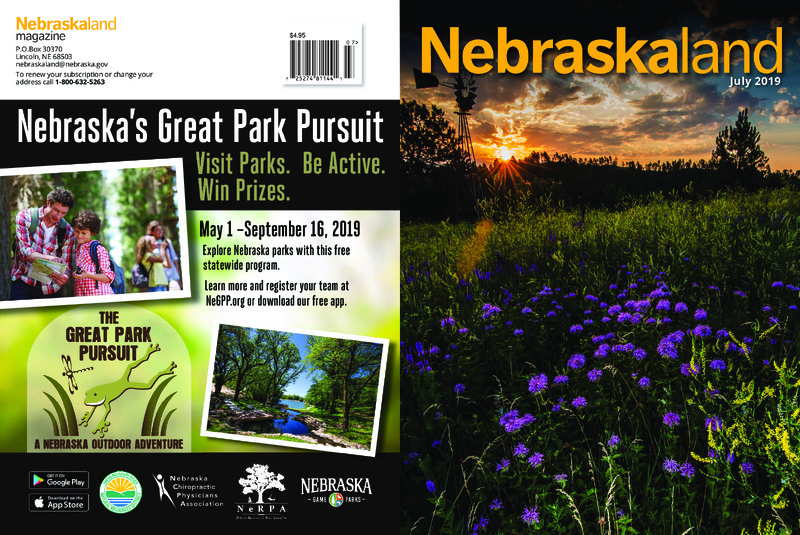
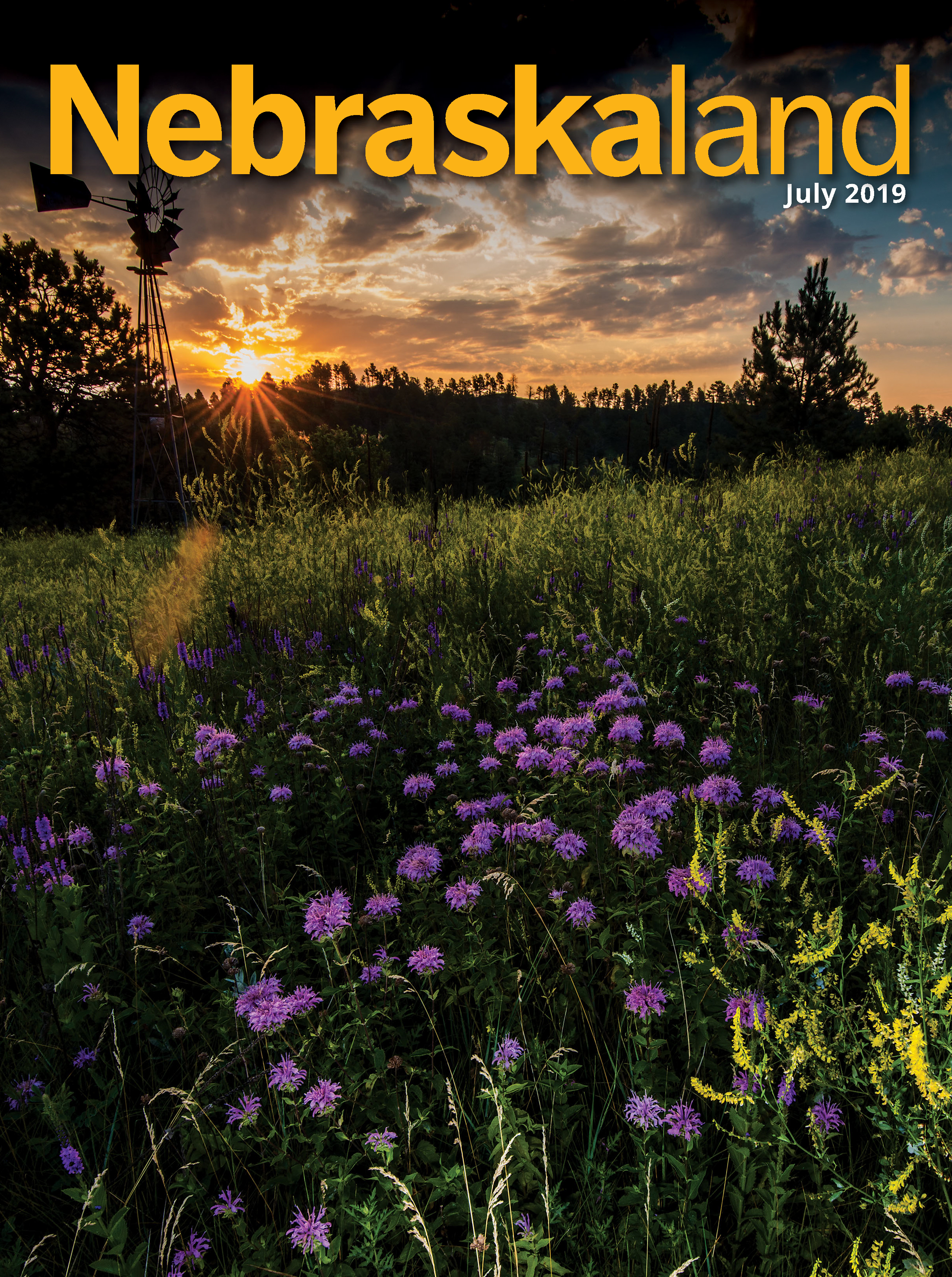
Cover: The sun rises behind a windmill
and wildflowers at Metcalf Wildlife
Management Area near Hay Springs.
Photo by Justin Haag.
FEATURES
20
WILDCAT HILLS
28
OUTDOOR NEBRASKA
30
THE DEVINE DEVIL’S DEN
36
A STITCH IN TIME
42
WHEN THE CARNIVAL
CAME TO TOWN
A Wild Place
Story and Photos by Justin Haag
What to Do in July
By Renae Blum
Story and Photos by Justin Haag
By Renae Blum
By History Nebraska
46
CALAMUS
54
PASTURE FORBS
The Perfect Getaway
Story and Photos by Eric Fowler
Weeds or Wildflowers?
Story and Photos by Gerry Steinauer
DEPARTMENTS
6
10
60
68
70
Your Nebraska
In the Field
Mixed Bag
Portraits from the Past
The Last Stop
PHOTO BY CHRIS HELZER
ON THE WEB
To see additional content including photos,
videos and additional articles, visit
Magazine.OutdoorNebraska.gov/digital.
Nebraskaland (VOL. 97 / NO. 6 ISSN 0028-1964) is published monthly, except for the combined Jan./Feb. and Aug./Sept. issues, by the Nebraska Game and Parks Commission, 2200 N. 33rd St.,
Lincoln, NE. Periodicals postage paid at Lincoln, Nebraska, and additional mailing offices. POSTMASTER: Send address changes to Nebraskaland, P.O. Box 30370, Lincoln, NE 68503-0370.
Magazine Staff
magazine
Communications Director Christy Firestone
Public Relations Manager Cara Pesek
Published by the Nebraska Game and Parks
Commission since 1926. The Commission is
dedicated to the conservation and protection
of all the state's natural resources and the
people who use them.
Editor Jeff Kurrus
Associate Editor Jenny Nguyen-Wheatley
Regional Editors Eric Fowler, Julie Geiser,
Justin Haag
Contributing Editor Michael Forsberg
Regular Contributors Renae Blum,
Chris Helzer, Chris Masada, Ryan Sparks,
Gerry Steinauer
Art Director Tim Reigert
Graphic Designer Mel Severin
Photo Librarian Jaclyn Cruikshank Vogt
Administration
Director Jim Douglas
Deputy Director Tim McCoy
Commissioners
Chairman - Robert Allen, Eustis
Vice Chairman - Dan Kreitman, Wahoo
2nd Vice Chairman - Pat Berggren, Broken Bow
Dick Bell, Omaha
Rick Brandt, Roca
Scott Cassels, Omaha
Jim Ernst, Columbus
Doug Zingula, Sidney
John Hoggatt, Kearney
Circulation Donna Robinson
For address changes and questions about your
subscription, e-mail donna.robinson@nebraska.
gov or call 800-632-5263
Advertising Sales Manager
For advertising information contact
Shane G. Gilster, 402-742-0125
Email: shanegilster@gmail.com
Nebraskaland Magazine Copyright 2019, all rights reserved.
Nebraskaland is available in audio from the Nebraska Library
Commission Talking Book and Braille Service, Suite 120, 1200 N St.,
Lincoln, NE 68508. 800-742-7691. Nebraskaland Magazine and the
Nebraska Game and Parks Commission reserve the right to reject any
advertising not in keeping with the agency mission.
Rates: $18 for one year; $33 for two years; $44 for three years. Nebraska
recipients must add appropriate sales tax. To subscribe call
1-800-NEBLAND (632-5263), or go online to:
NebraskalandMagazine.com.
Commission Offices
Conservation Officers
Headquarters/Southeast District Office
2200 N. 33rd Street Lincoln, NE 68503
Phone 402-471-0641
ADMINISTRATION (Lincoln)
Craig Stover (Administrator)
Duane Arp (Asst. Administrator)
Jeff Clauson (Asst. Administrator)
Northeast District Office
2201 N. 13th St. Norfolk, NE 68701
Phone 402-370-3374
Southwest District Office
301 E. State Farm Rd. North Platte, NE 69101
Phone 308-535-8025
Northwest District Office
East Hwy. 2, Box 725 Alliance, NE 69301
Phone 308-763-2940
Bassett Office
524 Panzer St., Box 508 Bassett, NE 68714
Phone 402-684-2921
Kearney Office
1617 First Ave. Kearney, NE 68847
Phone 308-865-5310
Ak-Sar-Ben Aquarium/Schramm Education
Center
21502 W. Highway 31 Gretna, NE 68028
Phone 402-332-3901
Omaha Office
8495 Frederick Street, Omaha, NE 68124
Phone 402-595-2144
OutdoorNebraska.org
Any program that receives federal funding from the National Park
Service, or the United States Fish and Wildlife Service prohibits
unlawful discrimination on the basis of race, color, religion, age, gender,
marital status, national origin, age, disability or political affiliation. Any
person who believes he or she has been discriminated against in
any program, activity, facility, or service, should contact the Nebraska
Game and Parks Commission, Lincoln, NE 402-471-0641, the Equal
Opportunity Commission, Lincoln, NE 402-471-2024, TTY/TDD 402471-4693; United States Fish Wildlife Service, Civil Rights Coordinator,
4401 N. Fairfax Drive, Arlington, VA 22203; Director, Equal Opportunity
Program, U.S. Department of Interior, National Park Service, 1849 C
Street NW, Mail Code 0008, Washington, D.C. 20240-0001.
4
Nebraskaland • July 2019
402-471-5531
402-471-5531
402-471-5531
NORTHWEST (Includes counties covered)
Jim Zimmerman (District Supt.)
308-641-6138
Kelsey Glodowski
(Box Butte, S 1/2 Sheridan, Grant)
308-763-8226
Sean McKeehan
(Kimball, Banner, Scotts Bluff)
308-672-1824
Dan Kling (Sioux, Dawes)
308-430-0572
Kyler Prochaska
(E 1/2 Dawes, N 1/2 Sheridan, W 1/2 Cherry)
308-430-3984
308-458-7650
Terry Brentzel (Deuel, Garden, Grant)
402-389-0444
Frank Miller (Cherry, Hooker)
308-279-9133
Josh Widhelm (Morrill, Cheyenne)
NORTHEAST (Includes counties covered)
Tom Zimmer (District Supt.)
402-649-8053
402-760-0712
Dale Davis (Keya Paha, Brown, Rock)
402-340-3981
Jonathan Andreasen (Holt, Boyd)
402-719-6226
Kyle Gaston (Dodge, Colfax)
Greg Hesse
(Greeley, Wheeler, Boone, S 1/2 Antelope)
402-843-6567
Mitch Johnson (Knox, Antelope, Pierce)
402-613-8612
402-762-5022
Jeff Jones (Knox, Cedar)
Jon Reeves
(S 1/2 Thurston, Burt, Washington)
402-889-8508
Andrew Heyer (Pierce, Madison, Stanton) 402-613-2241
Cory Krause
(Cuming, Wayne, Stanton, Dodge)
402-380-6410
Steve Oberg
(Colfax, Platte, Madison, Stanton, Nance)
402-910-3366
Owen Johnson
(Dixon, Dakota, N 1/2 Thurston)
402-266-1759
Doug Pollard (Loup, Garfield, Valley)
308-730-7050
Ethan Teter
(Boating – eastern Nebraska)
402-620-8129
SOUTHWEST (Includes counties covered)
Roger Thompson (District Supt.)
308-530-3097
308-202-0819
Matt Brandt (Sherman, Howard)
308-380-7331
Tim Williams (Hall, Hamilton, Merrick)
Pat George
(Harlan, Franklin, Phelps)
308-920-2762
Matt Andrews
(Gosper, Furnas, Frontier, Red Willow)
308-746-2418
Brian Piernicky
(Red Willow, Frontier, Hayes, Hitchcock)
308-340-6627
John Lee (Hitchcock, Dundy, Chase, Hayes)
Nicholas Fix (Keith, Perkins)
Bryce Streger (Keith, Arthur)
Sean Schultz (Keith)
Brandon O’Neal
(Lincoln, McPherson, Logan)
Alex Hasenauer
(Lincoln, McPherson, Logan)
Mike Thome (Dawson)
Ray Dierking (Custer, Thomas, Blaine)
Taylor Dixon
(Dawson, N 1/2 Gosper, N 1/2 Phelps)
Eric Javins
(Adams, Clay, Nuckolls, Webster)
Kevin Bergstrom
(Boating – central Nebraska)
Daryl Teter
(Boating – central Nebraska)
Scott Eveland
(Boating – western Nebraska)
308-414-1432
308-289-0427
308-440-3847
308-760-0145
308-530-3157
308-660-4671
308-529-8146
308-870-0322
308-217-2108
402-902-2017
308-520-1031
308-440-1863
308-289-0017
SOUTHEAST (Includes counties covered)
Levi Krause (District Supt.)
402-949-0593
402-619-1355
Rich Berggren (Douglas)
402-616-5961
Dan Evasco (Sarpy)
402-210-0888
Heath Packett (Cass)
402-209-1506
Russell Mort (Otoe, Johnson)
William Krause
(Nemaha, Richardson, Pawnee)
402-274-8063
Matt Taylor (Thayer, Fillmore, Jefferson)
402-200-9597
402-806-0915
Matt Seitz (Gage, Saline)
402-890-6463
Dina Barta (Lancaster)
402-937-3422
Dudley Sorensen (Lancaster, York)
402-613-2312
Travis Shepler (Lancaster)
402-314-9641
Trevor Stahlecker (Lancaster)
402-890-7140
Stacey Lewton (Lancaster, Seward)
402-443-6392
Mike Luben (Saunders, Butler, Polk)
YOUR NEBRASKA
Instagram Photos
Follow us (@nebraskaland)
and tag us in your photos
to be featured in an
upcoming issue.
Cory Loomis, Bloomfield
Red Fox
Dale Kaminski, Kearney
Wymore Storm
Mark Nutzman, Alma
Sunset near Harlan County Reservoir
Ben Overstreet, Omaha
Northern Cardinal
6
Nebraskaland • July 2019
July 2019 •
Nebraskaland
7
Alan Nash, Scottsbluff,
Sunset on the Western
Coal Lines
OPPOSITE: Cory Loomis,
Bloomfield
Lightning South of Bassett
Cory Loomis, Bloomfield
Honey bee
Cory Loomis, Bloomfield
Merlin
Send your comments and photos to:
Jeff Kurrus, Editor
Nebraskaland Magazine
P.O. Box 30370
Lincoln, NE 68503
or email Jeff.Kurrus@Nebraska.gov
Please include your postal address
and telephone number. Letters may be
condensed and edited. Photographs are
also welcome.
8
Nebraskaland • July 2019
July 2019 •
Nebraskaland
9
IN THE FIELD
A SUNFLOWER GOLDFINCH
An American goldfinch (Carduelis tristis) sits
on a sunflower in front of the Nebraska
Game and Parks Commission headquarters
in Lincoln.
PHO
PHOT
PHOTO
HOTO BY ERI
ER C FOWLER
FOWLER
10
Nebraskaland • July 2019
July 2019 •
Nebraskaland
11
IN THE FIELD
PHOTO BY GERRY STEINAUER
THREATENED AND ENDANGERED:
THE WESTERN MASSASAUGA RATTLESNAKE
By Melissa J. Panella
Snakes – people tend to love ‘em or hate ‘em. Snakes
can stir up all kinds of emotions and have unfortunately
long been considered nothing but trouble, particularly the
venomous variety. But, truth be told, a deer is more likely
to cause injury to a person than a venomous snake. A little
bit of precaution can go a long way toward avoiding a snake
bite. Nearly half of the reported snake bites of humans occur
when a person deliberately handles a snake.
In fact, snakes are fascinating creatures that can offer
benefits to people. For example, without snakes, a major
agent of pest control would be lost.
The western massasauga (Sistrurus tergeminus) is a small
pit viper native to the central and southwestern United
States. They are sit-and-wait predators that typically prey
on small, terrestrial vertebrates found in wet locations.
Massasaugas feed mostly on small mammals such as voles
and shrews. Larger mammals such as raccoons, foxes and
coyotes will prey on massasaugas. They are also taken by
hawks and even other snakes.
Massasaugas prefer moist soils in grassland habitats
located in only a handful of eastern Nebraska counties in the
12
Nebraskaland • July 2019
tallgrass prairie ecoregion. They use crayfish burrows as dens.
These burrows provide seasonal cover for massasaugas and
are an important component of their habitat. Massasaugas
tend to den in locations for overwintering that will be
safe from flooding; however, floods have been known to
eliminate them from locations in the past.
Western massasaugas are on Nebraska’s list of threatened
species. They are susceptible to a number of threats, but the
most significant has been the alteration and loss of their
habitat. As much as 98 percent of Nebraska’s native tallgrass
prairie, which is the crucial habitat of the massasauga, has
been converted to other uses. The remaining massasaugas
rely on tracts of grassland in close proximity to wetlands
or ponds and lakes. Massasaugas are highly vulnerable to
changes in the core areas they inhabit, because they rarely
have access to corridors of habitat that allow them to
traverse distances more than a mile.
Massasaugas provide an important ecological service of
all-natural pest control. They are also a reminder of our
tallgrass prairie heritage. Massasaugas just need some space
in Nebraska’s two percent of tallgrass prairie that endures.
IN THE FIELD
PLAY
Wilson’s Phalarope – Justin Haag
Common Snipe – Jon Farrar
EXPLORE
LEARN
Least Sandpiper – Chris Masada
Long-billed Curlew – Justin Haag
RELAX
FALL MIGRATION IN SUMMER
By Joel G. Jorgensen
It was fun while it lasted, but summer is over. At least that
is the case for a number of shorebirds (plovers, sandpipers,
snipes, phalaropes and others) that have departed their
summer breeding haunts to our north and are now undertaking
their “fall” or southbound migration. Typically, the first
fall migrant shorebirds observed in Nebraska are lesser and
greater yellowlegs, which appear about June 20 and are
quickly followed by the closely-related solitary sandpipers.
By July, more than a dozen species are moving through the
state and heading south.
The commencement of shorebirds’ fall migration comes
a little more than a week after the last of the Arcticbound white-rumped sandpipers pass through the state in
early June. However, some individuals migrate south even
earlier. A female long-billed curlew outfitted with a satellite
14
Nebraskaland • July 2019
transmitter migrated from the Gulf of Mexico to the Nebraska
Sandhills at the end of March in 2010. Presumably it found a
mate and nested, but it departed Nebraska and headed back
south by mid-May, likely because its nesting attempt failed.
Many of the nesting attempts by the other early-arriving
shorebirds in June and early July likely experienced a similar
fate. Others of their kind that beat the odds and whose young
hatched will remain on their nesting grounds longer to tend
to their young. Many of those individuals migrate south at
a later date, and most juveniles will migrate later still, in
August, September and October.
Shorebirds are vagabonds and many individuals travel up
to 20,000 miles in a year. Whatever time of year it may be,
you can rest assured that somewhere on the planet there are
shorebirds migrating.
N E B R A S K A’ S
O UT DOOR
Venture Parks
E.T. Mahoney • Platte River • Schramm • Louisville
OutdoorNebraska.org/VentureParks
IN THE FIELD
PHOTO BY CHRIS HELZER
MYTHS AND REALITIES OF HARVESTMEN,
AKA DADDY-LONGLEGS
By Chris Helzer
Daddy-longlegs, or harvestmen, are commonly seen across
Nebraska in houses and yards, as well as in grasslands and
woodlands. Although they are arachnids, harvestmen are not
spiders. They’re part of a group of creatures called opiliones.
They do have eight legs, but only two eyes, as opposed to the
six or eight eyes most spiders have. Harvestmen also differ
from spiders in that they are unable to produce silk.
There is a great deal of confusion and misunderstanding
about harvestmen and daddy-longlegs. Some stems from
the fact that the name daddy-longlegs is often (incorrectly)
applied to various kinds of spiders, especially a diverse group
called cellar spiders, which also have very long legs. Some
cellar spiders look somewhat like brown recluse spiders
which can have a dangerous bite. As a result, because both
harvestmen and cellar spiders are called daddy-longlegs,
both are often wrongly labeled as dangerous. They’re not.
A more specific myth about harvestmen is that they are
among the world’s most venomous spiders but just don’t
have long enough fangs to puncture human skin. It makes
16
Nebraskaland • July 2019
a titillating story, but it isn’t at all true. In fact, harvestmen
don’t even have fangs, let alone venom, so the story falls
apart pretty quickly.
Speaking of falling apart, while they are harmless,
harvestmen do have a somewhat disturbing habit of breaking
off their legs as a way to escape predation. It might be a
good strategy, but it can be a little creepy to someone just
picking a harvestman up to examine it or move it out of the
house. The strategy also seems counterproductive because
harvestmen’s legs contain thousands of tiny sensory organs
that help it navigate and understand the world around it. In
particular, the second set of legs is used more as antennae
than legs, something you can observe yourself if you manage
to find one that still has all its legs intact.
With or without a full set of legs, however, harvestmen are
innocuous fellow inhabitants of the earth. You might think
they’re cute, you might think they’re creepy, but they won’t
kill you in your sleep, so that’s something to be happy about.
July 2019 •
Nebraskaland
17
IN THE FIELD
HIT THE
PHOTO BY RYAN SPARKS
VENISON SLOPPY JOES
By Ryan Sparks
I love sloppy joes. When I was in high
school, I scavenged extra “joes” from
my classmates who scoffed at them.
These venison sloppy joes will please
even the most discerning sloppy joe
aficionado. Doubling the recipe and
serving it at a party is a great way
to introduce your friends to venison
and get them interested in hunting. I
wouldn’t consider them spicy, but for
those who wince at heat, omit the
sriracha. Serve with potato chips, dill
pickles, additional mustard, cold beer
and, in the fall, Husker football.
Servings: 6 but can easily be
doubled to feed a crowd.
Prep Time: 15 minutes
Cooking Time: 1½ to 2½ hours
Ingredients:
2 tablespoons canola oil
2 pounds ground venison
Kosher salt
1 medium red onion, diced
4 garlic cloves, minced
1 dried chipotle pepper
1 teaspoon cayenne pepper
1 teaspoon smoked paprika
1 teaspoon ground cumin
•
•
•
•
•
•
•
•
•
18
Nebraskaland • July 2019
• ½ teaspoon ground cinnamon
• ½ teaspoon ground allspice
• 1 tablespoon tomato paste
• 2½ cups dry red wine, plus more
•
•
•
•
•
•
•
•
•
for deglazing (think Cabernet
Sauvignon, Malbec, etc.)
3 tablespoons red wine vinegar
1 tablespoon mustard of choice
1 tablespoon sriracha
1 teaspoon smoked salt or ½
teaspoon liquid smoke
¼ cup brown sugar
12-ounce can whole tomatoes
with their juice
2 tablespoons dried oregano
1½ teaspoons white sugar
Soft buns to serve
1. In a large Dutch oven over high
heat, add the canola oil. When it is
hot, add the ground venison, salt it
liberally and cook until it begins to
caramelize. You will likely need to
work in batches to avoid crowding the
pan.
The more you stir the meat the
longer it will take to brown. Let it
be. When all the meat has browned
remove it from the pot and set aside.
2. Reduce the heat to medium, add
the onion and garlic with a pinch of
salt and cook until the onions begin
to look translucent. Push the onion
mixture to the back of the pot and press
the chipotle pepper into the bottom
of the pot until it becomes fragrant.
Repeat on the other side. Add the
cayenne, paprika, cumin, cinnamon,
and allspice, then the tomato paste.
Cook for two minutes.
3. Add a good splash of red wine and
scrape all the browned goodness from
the bottom of the pot with a wooden
spatula. Once you have the bottom
scraped smooth, add the rest of the
wine, vinegar, mustard, sriracha and
brown sugar. Bring the pot to a simmer
and stir to dissolve the sugar. Add the
tomatoes and their juice as well as
the browned meat, oregano and white
sugar. Continue simmering until the
mixture reaches the optimal sloppy
joe consistency, about 45 minutes (if
doubling the recipe it will take around
2 hours). Remove the chipotle pepper,
slap a scoop of meat on a bun and
enjoy.
TRAILS
WITH US
Find horse-friendly campsites
and new trails to explore at
OutdoorNebraska.org/Equestrian.
A Wild Place
Story and Photos by Justin Haag
Whether you’re looking
for state-of-the-art
facilities, or just a great
view in the pines, this
Panhandle park has it.
Just off Nebraska Highway 71
south of Gering is Wildcat Hills
State Recreation Area, with its
modern shooting complex and
nature center.
20
Nebraskaland
• July 2019
H
igh on the list of Nebraska’s captivating scenery
and natural assets are the Wildcat Hills. It seems
an understatement to label this topographical
spectacle as “hills,” as it is actually a land of
rugged buttes, ridges and canyons with topographical
elements rising upwards to 1,000 feet above the North Platte
Valley. Some of the state’s most recognizable landforms –
Chimney Rock, Scotts Bluff, Court House and Jail Rocks – are
part of this region.
Along Nebraska Highway 71 just 10 miles south of Gering,
in the upper elevations of the Wildcat Hills, a special property
highlights the best of what this region has to offer. Thanks
to the Wildcat Hills State Recreation Area, thousands have
developed an appreciation for the region’s natural resources,
paleontology and recreational opportunities.
The recently renovated and expanded Nature Center
with its interactive displays and event space have been a
big hit among visitors, as has the new shooting complex
Children collaborate on a scavenger hunt at one of the Nature Center’s displays.
that features targets for a variety of firearms and archery
equipment. They are among the Nebraska Game and Parks
Commission’s most modern facilities.
In addition to those facilities, 1,094 acres of wilderness
just outside the doors help visitors get in touch with nature.
Many have grown to love the park’s rugged pine-studded
topography, along with a stunning view of Scotts Bluff and
the North Platte Valley.
Camping, picnicking, hiking and biking are just a few of
the activities available for visitors. Perhaps most of all, it is a
great place to take the kids.
Children hike the trails of Wildcat Hills during a field trip. The
park features more than three miles of trails.
22
Nebraskaland
• July 2019
An Expanding Mission
No doubt, this property has changed since the Commission
acquired the initial Wildcat Hills tract in 1929. Once home to
captive bison and elk herds, the property has evolved along
with the public’s wishes.
Visitors realize they are in a special place as they walk into
the Nature Center, the park’s headquarters, and encounter
the branches of a replica 27-foot ponderosa pine tree rising
from the garden level through a hole in the main floor to the
vaulted ceiling.
While the property maintains wilderness appeal, the
center’s wide range of indoor interpretive displays and
programs also highlight nature.
Spearheaded by a team of local visionaries, the Wildcat
Hills Nature Center was constructed in the early 1990s.
Building on the success of that venture, donor support led to
a major expansion of 8,720 square feet, more than doubling
the size of the original 5,300-square-foot structure. The
expanded facility, with new areas for meetings, instruction
and displays, opened in spring 2017.
Taking a Shot
Early this decade, Commission officials recognized an
opportunity, and a need, to promote and facilitate shooting
sports in a family-friendly environment. The adjacent
wildlife management area had become a popular place for
area residents looking for a place to practice shooting.
The Wildcat Hills Shooting Sports Complex, which opened
fall 2016 and is easily seen and accessed from the highway,
features targets for a variety of firearms and archery equipment.
The offerings include a small-bore range for rimfire rifles and
approved handguns, a pellet range with bull’s-eye targets and a
state-of-the-art shooting gallery, an archery range with bull’sJuly 2019 •
Nebraskaland
23
OPPOSITE: The park provides a convenient location to get a
taste of the Wildcat Hills’ scenic, rugged topography.
eye and 3-D targets, a shotgun trap range, and a 100-yard range
for sighting in rifles and precision shooting. A 5-stand sporting
clays range and skeet range are nearing completion.
People may bring approved firearms and bows for all
but the air rifle range, which requires use of the complex’s
guns. Equipment, including firearms, ammunition, bows and
arrows are available for rental, and trained instructors help
people get started.
The facility not only serves experts, but also introduces
youth and novices to shooting sports and consequently
promotes the state’s hunting heritage.
Learning, Naturally
One of Wildcat Hills’ paramount missions is to combat
“nature deficit disorder,” the evidence-based idea that
children and others are spending less time outdoors.
More than 6,000 children annually take part in education
programs at the Nature Center. It is especially popular during
field trip season in spring.
Second-grade teacher Erica Croft of Morrill is among the
educators using the center to complement the curriculum.
She and her teaching partner find the center and its
services helpful in expanding students’ knowledge of their
environment.
“Many of our students have only been to school and to
Scottsbluff, so venturing into the great outdoors is a new
experience for a lot of them,” she said. “The facility itself
offers a unique, multisensory learning environment. They
could look at fossils, bones and habitat recreations. They
could create footprints in sand with molds. They could look
at slides under microscopes and even touch real life animals.”
Three-dimensional elements, such as taxidermy and
fossils, provide outstanding visuals, as do painted murals of
the region’s current ecosystem and how scientists believe it
looked in prehistoric times.
The new classroom provides a comfortable area to
conduct educational activities. Live amphibians and reptiles,
including a Blanding’s turtle and western hognose snake,
give children an opportunity to see species first-hand.
“During the school year, we study different habitats and
ecosystems, so this field trip is a nice complement to our
studies,” Croft said. “It puts the ‘theoretical’ learning into
everyday, tangible experiences for the kids. They get to see
what the prairie looks like, experience the sounds and the
smells, see bugs, animals, etc.”
Most of the field trips are led by Amanda Filipi, a Commission
outdoor education specialist who serves the Panhandle.
“Amanda does an amazing job working and communicating
with the kids,” Croft said. “She has a talent of talking to them
like they are mature, but also really injecting a lot of humor
24
Nebraskaland
• July 2019
into all of the facts that she is presenting. This isn’t always
an easy skill when working with 7- and 8-year-olds.”
In early May, for the second consecutive year, the center
opened its doors to hundreds of students for the annual Outdoor
Discovery Program – a Commission event that introduces
children to nature and a wide variety of outdoor activities. The
Wildcat Hills facilities were inadequate before the latest round
of construction and expansion, so it was previously staged at
the Trails West YMCA Camp in Scottsbluff.
Also for young visitors, the Junior Explorer program
features a 16-page full-color book with activities. The
program has activities requiring children to find and study
natural features, such as animal tracks and plants. The
program has a definite Wildcat Hills flavor, with topics
specific to the area.
The center also plays host to Wildcat Weekends, a series
The shooting complex offers opportunities for a variety of
shooters and archers.
Amanda Filipi, outdoor education specialist, explains a yucca
seed pod to children during a hike.
July 2019 •
Nebraskaland
25
and there are even sometimes reports of bighorn sheep – if
not at the park, they can be found at one of the many public
lands nearby. Even the occasional moose has been reported
on the property. Visitors are reminded to keep an eye out for
another important member of the High Plains ecosystem,
the prairie rattlesnake.
Way Back Wildcats
The 27-foot replica ponderosa pine spans two floors, making even the indoors seem suitable for exploration.
of monthly educational events each with a different theme
targeted to the general population.
Nature on Display
Live displays, such as this active bee hive on the Nature Center’s
garden level, enhance learning opportunities.
26
Nebraskaland
• July 2019
Perhaps one of the greatest attributes of Wildcat Hills is
that visitors are never certain what they might see. Whether
one is hiking more than three miles of trails, or taking in an
unrivaled view of the valley on one of the nature center’s
observation decks situated above the pines, the park is a
visual treat.
A road along the park’s summit links visitors to trails
coursing through evergreen-studded ridges and canyons that
feature mountain mahogany and other western plant species.
The park attracts a lot of wildlife, and it has become
recognized as a premier bird-watching site. Well-stocked
feeders near the center’s dark tinted windows allow visitors
to observe the wide variety of avian species, such as red
crossbills and pine siskins, from the comforts of indoors. In
fall, park visitors get an up-close view of feathered species
at a bird-banding station operated by the Bird Conservancy
of the Rockies.
An active indoor honeybee hive with transparent walls
allows the busy insects to come and go while giving observers
special insight to their work.
Wild turkeys, deer, bobcat and coyotes frequent the park,
The Wildcat Hills Nature Center serves as an important
stop and southernmost point of the Fossil Freeway, a corridor
of seven important paleontological sites that extends
northward to the Mammoth Site at Hot Springs, S.D.
Wildcat Hills is the site of the Millenium’s End Quarry,
a remarkable trove of diverse fossils representing life 23
million years ago that was discovered on the highway rightof-way in 1999.
Past species such as the “bear dog” Ysengrinia and
Prosynthetroceras, a deer-like animal with a slingshot-like
horn protruding from its snout, are brought to life in an
interpretive mural by artist Jan Vriesen.
Appropriate for a facility with “Wildcat” in its name,
a 25-million-year old fossil of two battling saber-toothed
cats entangled in death is housed in the center. Renowned
paleontologist Loren Eiseley discovered it in the Panhandle
in 1932.
Visitors to the Wildcat Hills Nature Center learn not only about
today’s wildlife, but also the deer-like Prosynthetoceras and
other creatures that roamed the area millions of years ago. This
image is from the mural created by artist Jan Vriesen.
A Place to Gather
With the 2017 expansion, the Nature Center gained a
greater capacity to host groups.
The Ponderosa Room is designed to be an ideal location for
meetings, reunions, birthday parties and small weddings. It
seats 125 people in rows or 72 at tables and chairs.
Those who prefer to gather outdoors can capitalize on
some of the park’s historical features. Dating back to the
park’s earliest days are three Great Depression-era stone
shelters that were constructed by the Civilian Conservation
Corps and Works Progress Administration. The shelters are
available on a first-come, first-served basis. The largest of the
three accommodates about 40 people and has fireplaces on
each end. The other two, which each have a picnic table and
fireplace, are ideal for smaller groups.
The park has a camping area with 12 non-reservable sites
for those who do not mind limited amenities, and an area on
the east side of the park has recently been developed into a
camping area for larger groups, such as scout troops. Take
note, though, the areas are not accessible with large RVs and
trailers because of sharp turn-arounds.
Hiking into the Future
No doubt, the new facilities have increased the park’s
popularity. The estimated 35,000 visitors each year represent
a 40-percent increase from before the nature center expansion
and shooting complex construction. In addition, park staff
The park’s three stone shelters constructed during the Great
Depression era with stones from nearby are not only functional
but also rich with charm.
continues developing valuable programs and improving the
park’s environment.
Gary Shoemaker, the park superintendent since 2016, is a
former employee of the Boy Scouts of America and has used
connections from his past job to improve the park. More than
20 Eagle Scout projects have enriched the property since he
was hired, such as a new entrance sign and a bridge on the
Turkey Run Trail.
The true value of Wildcat Hills and its offerings may be best
surmised in the reactions of Croft’s second-grade students.
“As we left our field trip this year, our students were so
excited,” she said. “We know it is a successful field trip when
our students exclaim, ‘I am going to take my mom and dad
here this weekend so we can hike some more.’”
That is quite a testimonial, “especially when these kids
were pretty sure they didn’t want to hike at all,” she said. N
July 2019 •
Nebraskaland
27
Outdoor Nebraska
What To Do in July
By Renae Blum
Don’t sit around waiting for hunting season to begin. There are
many ways to enjoy the outdoors now: wildlife watching,
stargazing, fishing, even sand castle building. Read on for
more. N
Fish for White Bass
and Wipers
PHOTO BY JULIE GEISER
Whether your ideal Fourth of
July includes grilling, fishing,
fireworks, swimming or simply
enjoying the outdoors, you can
find it at a Nebraska state park
or recreation area. Some parks
will also have Fourth of the July
events; learn more at Calendar.
OutdoorNebraska.gov.
PHOTO BY JUSTIN HAAG
July 4 | Statewide
Fishing for white bass and wipers can be
good in July and August. Go early and late
in the day, and be ready: when it happens,
feeding can be intense, but doesn’t last
long. Target the larger reservoirs, such as
Calamus, Sherman and Lake McConaughy.
PHOTO BY ROCKY HOFFMANN
Celebrate the
Fourth of July at
a Nebraska State
Park
Throughout the month | Statewide
where populations can be found
Attend the Nebraska
Star Party
Community
Fishing Night
July 12, 6-8 p.m.
City Park Lake,
Holdrege
July 28-August 2 | Merritt Reservoir
State Recreation Area
Water
Wonders
6th Annual
Campfire
Christmas in July
July 13, 10 a.m.
Wildcat Hills State
Recreation Area
July 26-27
Indian Cave State Park
Attend Kites and Castles
Participate in the Nebraska
Bumble Bee Atlas
July 27 | Lake McConaughy State
Recreation Area
28
Nebraskaland • July 2019
July through September | Statewide
PHOTO BY JEFF KURRUS
PHOTO BY JULIE GEISER
Take a trip out to Nebraska’s largest lake and
spend a fun afternoon sculpting a creation on the
white sandy beaches – you may win an award
in the sand castle building contest! More info at
kitesandcastles.com.
Merritt Reservoir is one of the best places
for stargazing in the nation, and the annual
Nebraska Star Party provides the perfect
opportunity to enjoy it. The Star Party
includes introductory classes for newcomers,
a children’s program, observing challenges,
a photography contest and food. Learn more
and register at nebraskastarparty.org.
You’ve heard about struggling pollinators and some of the
threats they face. The same story is playing in Nebraska with
our native bees, including some of our beloved bumblebees. This
summer, the Xerces Society is launching a project to help track
these essential pollinators and preserve them. Participants
will adopt locations and then conduct surveys for bumblebees
throughout the state. Stay tuned to nebraskabumblebeeatlas.org
for details about upcoming events and how to register.
July 2019 •
Nebraskaland
29
The Devine
Devil’s
Den
STORY AND
PHOTOS BY
JUSTIN
HAAG
Scientists of yesteryear agree:
this crevice in far northwestern
Nebraska is in a class by itself.
estern Nebraska has many landforms labeled
canyons. Each contradicts Nebraska’s “flat”
stereotype, but a true box canyon – one featuring
steep walls on each side with single access for
entrance and exit – is a rarity in the state.
One site in the northwest corner of the Nebraska Game and
Parks Commission’s northwestern-most property fills the bill
as such even though it does not carry the name. The crevice
known as Devil’s Den, which is geologically carved below
the rugged ponderosa pine forest at Gilbert-Baker Wildlife
Management Area, is a gem among the many scenic treasures
at this public land in beautiful northern Sioux County.
Scenic crannies with steep walls at the head of drainages
are not uncommon in the Pine Ridge, but, at more than 500
feet long and as deep as 75 feet in places, this one has to be
the most spectacular. Perhaps what makes it most special is
its width. At only 10-25 feet wide, there are places along the
canyon floor where the sky becomes obscured by overlapping
irregularities of the towering walls above.
My first visit to Devil’s Den came in May 2016 by invitation
of Wayne and Janece Mollhoff of Ashland. Wayne, one of the
state’s most ardent birdwatchers, had stumbled on to the den
on a previous visit to the Pine Ridge and considered it worthy
for a Nebraskaland photographer to see.
Upon meeting at the Gilbert-Baker parking area along
W
30
Nebraskaland
• July 2019
TOP: Devil’s den from above. BOTTOM: A carved inscription from June 1911, the month the expedition visited the crevice.
Monroe Canyon Road, Wayne handed me a photocopied
image of a Nebraska History Magazine cover that featured
a photo from a 1911 University of Nebraska expedition to
Sioux County.
Later, I reveled in reading the journal from that early
20th century expedition, written with astute comments
and splashes of humor by one of the state’s most renowned
naturalists, the late Frank Shoemaker. The journal, which
chronicles the June 17-July 2 excursion of that year, provides
fascinating insight and observations of the natural world at
various sites around Sioux County.
The expedition party, which traveled by train from Lincoln
to Harrison, consisted of Shoemaker and six others, including
Dr. Robert Wolcott, a zoologist at the University of Nebraska
who specialized in ecology and collected beetles, butterflies,
myriopods, reptiles and mites.
Despite all of the notable landforms the team encountered
during its journey, Shoemaker described Devil’s Den “in
a class by itself as regards the geological phenomena of
this region.” Knowing that Wayne Mollhoff had observed
a lot of Pine Ridge country in his pursuit of species such as
white-throated swifts and northern saw-whet owls, my
excitement to witness a scene he determined to be special
was heightened.
From the parking lot, my then 13-year-old son Sawyer and
I set out with the Mollhoffs on the 1.65-mile hike – which
July 2019 •
Nebraskaland
31
FRANK H. SHOEMAKER COLLECTION, ARCHIVES & SPECIAL COLLECTIONS, UNIVERSITY OF NEBRASKA-LINCOLN LIBRARIES
This scene of Devil’s Den was featured in Frank Shoemaker’s journal after visiting the region in 1911.
32
Nebraskaland
• July 2019
Wayne and Janece Mollhoff pose to recreate Frank Shoemaker’s photo from 107 years prior.
July 2019 •
Nebraskaland
33
The mouth of Devil’s Den is scenic in itself. With some of the highest elevations in Nebraska, species rare to the state, such as Rocky
Mountain maple, grow in the area.
34
Nebraskaland
• July 2019
seemed 10 times farther than that over the rugged terrain
– to the chasm featured in the photograph. After all the ups
and downs, the elevation at the ridge above the chasm peaks
at 4,900 feet, about 450 feet higher than our starting point.
After making our way down the steep grade and entering
the mouth of the crevice, we became awestruck with each
step. Our spring visit came 38,315 days after Shoemaker,
Wolcott and their guide, Sioux County rancher Noel Priddy,
visited the site in late June. Wayne was right – it’s a place a
Nebraskaland photographer should see.
Despite that lengthy span of time, the canyon looked
similar to the black and white photo from more than a
century ago. Yes, the floor had surely risen a little with eroded
sediment from soil and sandstone above, but the canyon
retained the same charm. Some fraction of the sediment was
surely produced from dozens of carvings along the wall that
mark decades of visitors to the remote canyon.
The lush vegetation at the mouth of the chasm gradually
gave way to a more barren scene with few signs of plants or
animals – except mountain lion tracks that certainly caught
our attention. Shoemaker’s journal noted nesting sites of
Krider’s hawk (a morph of the red-tailed hawk) and great
horned owl in the canyon, but we noticed no such activity.
A large rotting log propped on the wall along one of the most
narrow parts of the canyon begs wondering how it fell and
how long it has been there.
After Wayne surmised the exact spot Shoemaker’s photo
was taken, we attempted to restage the scene with him and
Janece posing as models. A stubborn shaft of sunlight made
its way straight to the bottom of the canyon at the photo site,
however, almost as curiously as that rotting log did years
before. It created too much of a contrast to overcome by flash.
Instead of waiting for the sun to become more agreeable
to our efforts, we decided to hike back to the vehicles and
perhaps return another day.
Our second effort in May 2018, when the Mollhoffs were
visiting the area for the annual meeting of the Nebraska
Ornithologists Union, proved more successful. With
sunlight cooperating, we did our best to match the focal
length, composition and poses in the original photo. The
1911 research party surely would have enjoyed using the
Nikon DSLR cameras with the wide range of zoom lenses
I was carrying, but nonetheless seemed impressed by the
capabilities of its 5x7 long focus box with a Goerz doubleanastigmat lens and folding “pocket” Kodak they brought to
the region.
Shoemaker’s classic photo gained publicity in 2017 when
a series of paintings with scenes from each county was
released by artist Todd A. Williams. To represent Sioux
County, Williams, too, recreated the photo.
Other than that, I have not noticed much mention of Devil’s
Den. It is not noted on any maps, and I have found only one
mention of it in our Nebraskaland archives. A July 1966 story
When Todd A. Williams produced an oil painting for each
Nebraska county to commemorate the sesquicentennial, he
chose the scene at Devil’s Den to represent Sioux County.
by Richard Williams of Crawford told the tale of how he and
another high school student rappelled to the bottom of the
crevice at one of its most sheer points, much to the chagrin of
the local game warden.
Fortunately, the adventure ended without incident because
Richard Williams later became the first American Indian
student to earn a degree from the University of Nebraska.
Now retired as president and chief executive officer of the
American Indian College Fund, he has received a long list of
commendations for his work promoting civil rights for Native
Americans.
Perhaps someday Devil’s Den will become a popular tourist
destination. Similar to many remote, pristine sites in the
Pine Ridge, area residents scoff at journalists who provide
detailed locations for fear it will be loved to death by too
much visitation. Still today, Devil’s Den is not marked by any
signs and is hard to pinpoint on satellite imagery because of
its narrow outline from above.
Regardless, go for a hike and enjoy this spectacular country.
You will know Devil’s Den if you see it. As Shoemaker wrote,
it is in a class by itself. N
July 2019 •
Nebraskaland
35
A Stitch in Time
In the world of living history, the clothes make the man (and woman)
By Renae Blum
he cannon smoke has mostly dispersed, visitors are
trickling back to the parking lot, and Sarah Dack is
taking a break.
She portrays an officer’s wife at Fort Kearny State
Historical Park’s living history events, and looks every
inch the part. Dack is wearing a big-brimmed sunbonnet,
leather ankle boots, a sky-blue skirt, and a muslin shirt with
pearl buttons, a stand-up collar, and a gathered yoke. Her
accessories include an engraved pocket watch necklace and
small dangling earrings.
At a living history event like this one, it’s a common sight
– men, women and children walking around dressed in
T
Nebraskaland • July 2019
PHOTO BY JENNY NGUYEN-WHEATLEY
36
PHOTO BY RENAE BLUM
Betty Hruska of Firth
designed this Blackfootstyle ceremonial dress
based off of an original
historical garment. She
used a traditional braintanning process on the
hides of three deer she
harvested.
beautiful period clothing, looking as if they’ve stepped out
of a history textbook. But putting that look together isn’t so
simple.
“You don’t go to Walmart to buy anything; everything is
handmade, and it follows a pattern or some historical piece,”
said Betty Hruska of Firth, Nebraska.
There’s also the challenge of being historically accurate.
“In a way, we are educating the public. You’re trying to
portray an accurate look,” said Heather Blazicevich of
Omaha. “We want people to feel like, ‘My time spent here was
good because people really care about historical accuracy.’”
When it comes to finding that perfect outfit, you’ve got a
Interpreters demonstrate military drills during a living history event at Fort Atkinson State Historical Park.
July 2019 •
Nebraskaland
37
Dressing for an 1820s Fort
Like many living history volunteers in Nebraska, the
reenactors at Fort Atkinson State Historical Park
take seriously their duty of educating the public,
and the attention to detail shines through in their
clothing. Many pieces are handmade, and some
are custom-ordered. Pictured are (left to right)
Kristy Ericson of Omaha, dressed as a laundress,
●1
11
●
12
●
●2
●3
●4
●
13
●5
●6
2. Eyeglasses
The prescription reading glasses
Baker is wearing are copies of
an original that dates back to
about 1790. “The lenses in these
do have a bifocal, which is not
something that was made back
then,” he said.
●7
10
●
16
●
14
●
●8
15
●
PHOTO BY JEFF KURRUS
●9
38
Nebraskaland • July 2019
1. Shako
A shako was a leather cap worn
by enlisted men. The color of
the wool pom sticking up from
the top signified that the wearer
belonged to the rifle regiment.
The cap plate – the brass insignia
on the front – is a copy of an
original found on the site of Fort
Atkinson, and shows an eagle
carrying a rifleman’s horn.
3. Undershirt and bowtie
Along with a wool vest, beneath
the coat Baker is wearing is a
long white cotton undershirt.
“They didn’t really have what we
refer to as underwear,” Baker
said; the long undershirt was
worn instead. The bowtie is “a
nod toward civilian fashion,”
Baker said, and also an homage
to the neckstock, a piece of
leather worn by lower-ranking
soldiers that kept them from
looking down at their feet.
4. Coat
This 1812-period wool coat is
something an officer would have
worn in a social setting. “It was
something so ostentatious that it
would draw attention. And as an
officer that’s what you would want
to do in social situations,” Baker
said. “You couldn’t brag about
your rank, but you could certainly
wear something that looks like
you could afford it.”
5. Buttons
Baker has a pewter casting
operation and makes the buttons
the soldiers wear. The design is
based off of buttons uncovered
and her daughters Taylor and Lylah. Bob Baker of
Omaha portrays the captain of the rifle regiment.
Baker’s entire ensemble cost around $2,000, which
is typical for someone portraying a soldier. For him,
the cost is worth it. “I get to share my cost with lots
of people and get a great deal of satisfaction and
enjoyment in the process,” he said.
by archaeological digs at Fort
Atkinson.
6. Officer’s Sash
Sashes indicated rank and were
used to wrap injured soldiers in
and carry them off the battlefield.
They were dyed scarlet/burgundy
to blend in with any arterial blood
that was shed. The fear was that
if nearby soldiers saw how badly
wounded an officer was, they
would become demoralized and
run away, rather than continue
fighting.
7. Gloves
Gloves were typically worn by
officers mostly in ceremonial
situations, just as they are today,
and were made of calfskin or
goatskin. Baker got his from a
period supplier.
8. Trousers
Baker is wearing narrow-fall drop
front trousers. They are made of
hemp, a flexible, durable fabric
similar to denim.
9. Shoes
Baker’s shoes are “almost a
boot,” he says, “what we call a
three-quarter height shoe.” This
height allowed more freedom for
someone on foot, as a company
captain likely would have been.
Baker had his pair custommade at Omaha’s Dehner Boot
Company for about $400.
10. Sword
An officer’s sword was more
ceremonial and not necessarily
used in battle. An officer on
horseback was more likely to
carry a curved sword, or saber, to
avoid cutting the neck of his horse
with his sword when drawing it.
This replica was made in Pakistan
and cost Baker $175.
11. Cap
The working-class women and
girls of Fort Atkinson would
typically have their heads
covered while outside to protect
themselves from the sun and any
debris and insects. Kristy’s head
covering is called a country cap,
and Lylah’s is a colonial cap. Kristy
sewed both using period patterns.
12. Shawl
The wool shawls pictured here
were handmade by the Ericson
family, woven on a triangle loom.
They used wool from Columbia
sheep that Kristy’s mother-in-law
raises.
13. Chemise
Like the men’s undershirt,
the chemise was a long, loose
undergarment that doubled as
sleepwear.
14. Dress
The fashion of the day was the
Empire waistline, falling just
below the bust. Drawstrings at
the neck and bust made it easy
to dress yourself. Work dresses
are made of cotton and feature
earthy, natural tones and a
repeating pattern, which would
have been easy to manufacture at
the time.
15. Apron
Aprons were worn quite
frequently to protect clothing.
They can have other uses, too,
for a living history volunteer:
“I use mine as a hot pad some
days,” Kristy said. “Just super
convenient.”
16. Canteen
This tin canteen was made by
Chris Hagemann, who portrays
a tinsmith at Fort Atkinson and
taught himself how to master the
craft. Hagemann’s workmanship
can be seen throughout the Fort.
Lylah wove the canteen’s strap on
a rigid heddle loom at the fort.
July 2019 •
Nebraskaland
39
PHOTOS BY RENAE BLUM
Opposite: Katelyn Reeder of Kearney portrays an upper-class
civilian at Fort Kearny State Historical Park. Linda Hendrickson
handmade her lace gloves.
few options. If you’re intimidated by a sewing machine, you
can purchase an outfit from a period supplier. And fellow
volunteers are often happy to help, offering to make you
something or provide clothing for trade or lending. But for
the pride of ownership and sheer cost effectiveness, sewing
your own period clothing is, for many people, the way to go.
For some, this is a struggle. For others with a little more
experience, it’s an art form, and even a money-making
venture. Tom Wood of Omaha, who participated in living
history at Fort Atkinson State Historical Park for more than
40 years, sells pieces professionally to buyers around the
world, and has even made clothing for a period wedding.
“It takes a long time to learn certain curves and stuff like
that, or what gives it shape,” Wood said. “Once you figure
that stuff out, it’s easy to make patterns for it.”
Then there is someone like Andrew Gaghagen, who’d done
some basic mending but had never sewn an outfit before
joining Fort Atkinson’s living history program in early 2018.
Gaghagen jumped in headfirst, buying a sewing machine
and throwing himself into online research. He ordered the
wool for his soldier’s jacket from a period supplier in Missouri,
and ended up selling the first batch he received – the weight
of the fabric was incorrect, and the shade of gray was too
Seven-year-old Allene Cummings of Omaha has been reenacting
at Fort Atkinson since she was five months old, says her mother,
Morgan.
40
Nebraskaland • July 2019
brown.
“I kind of feel a sense of duty to get it as historically
accurate as possible, because [Fort Atkinson] is there for
education. So cutting corners like that wasn’t something I
wanted to do,” he said. “If I had that information I was going
to make it as close to how it would have been as possible.”
It took multiple frustrating tries to make something he
was satisfied with. But now, with one season of living history
successfully under his belt, Gaghagen has begun making
clothing for other volunteers.
Some reenactors put their own research behind their
clothing, studying old paintings, visiting museums, checking
out library books, even taking notes from movies like “Pride
and Prejudice.” And thanks to the Internet, resources are just
a click away, and more extensive than ever before.
After a certain point, you develop an eye for period
accuracy. Fort Kearny State Historical Park volunteer Renae
Hunt can watch a historical drama and spot inaccuracies in
the clothing; Blazicevich can do the same thing with patterns.
As she’s discovered, some patterns made by mainstream
companies can look vaguely historical, but turn out to be
riddled with inaccuracies once you take a closer look.
Most volunteers at Fort Atkinson choose clothing patterns
made by companies that specialize in historical accuracy, said
Denise Wenke of Omaha. Some companies “have actually
gone into museums and gotten a chance to get hands-on and
take measurements and see where the curves are, which way
the seams run,” she said. “It’s a much better option for me.”
Sewing period clothing is very different from sewing
modern garments, Wenke said. At first glance, the whole
set-up can be a bit bewildering, even for an experienced
seamstress.
“A lot of the seams aren’t placed where they are in modern
garments, necessarily. There are a lot of curved seams. And
the pattern pieces just do not look like what you’re used to
pattern pieces looking like,” she said. “They just had a very
different idea of how to cover the human body.”
After researching, creating and wearing period garments,
volunteers often gain a unique perspective into the lives
and culture of the people they portray. For soldiers at Fort
Atkinson, standing up straight and tall was an important
part of their image as military men – something living history
volunteers learn as they contend with period-accurate
uniforms so tight-fitting they’re unable to slouch.
And for Wenke, a volunteer at Fort Atkinson, hand-sewing
period clothing gave her insight into the rise of the sewing
machine. “After making something by hand you can appreciate
why people had fewer changes of clothes in this time period,
and why, as soon as the sewing machine was invented, even
though the price was sky-high, they were in such demand
Ella Vance cuts out a pattern at a sewing party organized by
Heather Blazicevich (left), one of the living history volunteers
at Fort Atkinson who helps newcomers create their first period
ensemble.
that communities would band together to buy one.”
While it’s possible to make a living history outfit
inexpensively, some volunteers take it up a notch, investing
in custom-made shoes, specially tailored soldier’s uniforms,
period-style prescription eyeglasses, period-accurate
weaponry, and more. It quickly adds up. People portraying
soldiers can easily spend $2,000 or more on a full kit.
In the end, putting on a handmade, period-accurate outfit
can be a special experience, and it does something valuable
for the person wearing it, too, not just the visitors looking at
him or her.
“Putting that outfit on runs you right back in time,” said
Wade Davis of Bonner Springs, Kansas, who portrays an
Indian trader and interpreter at Fort Atkinson. “It helps
transport you back to the time and place, kind of like an actor
preparing for a role.”
And when the image is complete, the results are pretty
unforgettable. N
Living history events are held at the following Nebraska
state historical parks: Fort Atkinson, Rock Creek Station, Fort
Hartsuff, Buffalo Bill Ranch, Fort Kearny and Arbor Lodge.
Indian Cave State Park occasionally holds events as well. For
more information, visit Calendar.OutdoorNebraska.gov or
contact individual parks.
July 2019 •
Nebraskaland
41
When the Carnival Came to Town
By
History Nebraska
The Flying Baldwins were a popular
feature of the Walter Savidge
Amusement Company. History
Nebraska RG1667-1-15
42
Nebraskaland
• July 2019
July 2019 •
Nebraskaland
43
ears ago, the peak of Nebraska summer entertainment
came with the Walter Savidge Amusement Company as
it pulled into the depot aboard its 20-car, red-and-yellow
Pullman train. The Wayne-based traveling show and
carnival toured Nebraska and surrounding states from 1906
to 1941.
Walter Savidge was born in Holt County in 1886. He
began dreaming of show business at age 12 after attending a
Ringling Brothers circus in Humphrey. He practiced tightrope
walking on a rope tied between his family’s barn and shed.
At age 16 he ran away to “join the circus” and worked as a
professional tightrope walker.
The Savidges were an adventurous clan. You may have
heard of Walter’s aviator cousins from Ewing. The Savidge
Brothers built their first airplane in 1911 and barnstormed
the state for several years.
Walter was no aviator, but he and his brother Arthur
formed an amusement company in 1906, when Walter was
only 20 years old. It started as a one-tent show, with Walter
doubling as an acrobat and Arthur performing as one of the
actors. The brothers split several years later, and Walter and
his wife, Mabel, continued the company. It remained a family
affair, with Mabel managing the finances and playing piano
for the vaudeville acts.
The company got bigger and bigger, with acrobats,
sideshows, an orchestra and dramatic company, carnival
rides and concession stands. It was so big they brought
their electrical plant to power it all. The big tent could seat
1,600 people, and it took 125 employees to keep everything
running.
Y
Some forms of old-time entertainment have not aged well.
Similar to many traveling carnivals of the day, Savidge included
“freak shows” featuring people with physical abnormalities.
Performer George Thompson is shown here with his son.
History Nebraska RG1667-6-1
View from the stage of Savidge Players tent theater. History Nebraska RG1667-1-13
The “Eli Wheel,”
a competitor of
the Ferris Wheel.
History Nebraska
RG1667-3-1
Long Pine Journal, June 2, 1916.
Looking east along Farnam Street, Omaha, 1889. History Nebraska RG2341-28
44
Nebraskaland
• July 2019
The Savidges were known for providing clean, familyfriendly entertainment. Despite the bad reputation of
“carnies,” the Savidge crew “is not made of crude fellows
who ‘flop’ in strange places, no indeed,” said the Omaha
World-Herald. “Savidge and his company are welcomed with
open arms each year in towns that he has played before.”
Interest in the show dwindled in the late 1930s, probably
due to newer forms of entertainment, such as movies. The
Savidges closed their show and retired in 1941. Walter died
eight years later. Mabel lived until 1989, dying at age 104. N
Adapted from Rebecca A. Buller, “The Walter Savidge
Amusement Company,” Nebraska History (Summer 2017).
history.nebraska.gov
Calamus
The Perfect Getaway
STORY AND PHOTOS
BY ERIC FOWLER
n the eastern edge of the Sandhills, tucked into a
narrow valley topped by high dunes, lies Calamus
Reservoir. This summertime oasis, ringed by white sand
beaches, draws sun seekers from throughout the region all
summer long, anglers for much of the year and other outdoor
enthusiasts year-round.
Fishing is the main draw at the 5,200-acre reservoir,
especially for walleyes. With high fishing pressure, anglers
might have to stay a while to find a trophy, but they will find
plenty of keeper-sized fish. The lake is one of the top spots
in the state for white bass and wipers in terms of both the
size and numbers. In the late summer, flocks of gulls picking
gizzard shad from the surface tell anglers they can find white
bass below. Calamus is also a top muskellunge lake in the
state, and those who know and target this predator, as well
as others who luck into one, can find fish up to 40 inches.
Channel catfish are abundant, and Gracie Creek and the
pond it feeds are stocked with keeper-sized rainbow trout
year-round, giving anglers yet another option.
About 5,000 acres of public land, most of it designated
as a wildlife management area, surrounds the reservoir,
including two miles of the Calamus River above the lake. A
variety of wildlife can be found in these rolling Sandhills,
riparian areas and wetlands, including pheasants, quail,
turkeys, prairie grouse, waterfowl and white-tailed and mule
deer.
Calamus Reservoir has been designated an Important
Birding Area by the National Audubon Society for the
diversity of species it is home to, including grasshopper
sparrow and Bell’s vireo, and those it attracts during
migration, including numerous shorebirds and waterfowl,
thousands of American white pelicans in the spring and fall,
and, in the winter, hundreds of trumpeter swans and bald
O
eagles.
There are 132 sites in three campgrounds – Homestead
Knolls, Nunda Shoal and Valley View Flat – where campers
can plug in their RV, and another 52 sites without electricity
for RVs or tents in those campgrounds and Hannaman
Bayou.
The reservoir is the end of the 56-mile long Calamus River
Water Trail, which begins at Highway 7 south of Ainsworth.
Those not up for a multi-day paddle can float the river in
tube or tank through Calamus Outfitters, which provides
other unique recreational opportunities, including Sandhills
eco- and birding tours.
The 96-foot high Virginia Smith Dam, completed in 1986
on the Calamus River northwest of Burwell, forms the
reservoir. Built by the U.S. Bureau of Reclamation, it stores
most of the water the Twin Loups Irrigation District provides
to farmers to water 53,000 acres of cropland. It was and
likely will remain the last large reservoir built in the state.
There isn’t much beach to be found around the reservoir’s
30-plus miles of shoreline until the irrigation season begins
in mid-June. By July, there is plenty of room to play near the
day-use areas and campgrounds, but many hop in their boat
and head out to find a stretch of sand to call their own for the
day. There are four boat docks on the 9-mile long reservoir,
the western half of which limits boats to 5 mph. The wind
seems to blow more often than not in this country, which can
limit boating but is a big draw to windsurfers from around
the region.
Whether you want to ski, land a walleye, enjoy a cool
Sandhills night around the campfire, or just take in a
spectacular view of the western sky from Sunset Bay at
Little York Point, you will find what you’re looking for at
Calamus Reservoir this summer.
Whether they’re casting for white bass, getting one more ride behind the boat or walking the beach, people find plenty
to do at Calamus Reservoir on a summer evening.
46
Nebraskaland • July 2019
July 2019 •
Nebraskaland
47
Jacob Lech of Ord flies behind his sister,
Cali, while wakeboarding on Calamus
Reservoir.
People play volleyball in the shallows of Sunset
Bay, a popular spot next to the day use area on
Little York Point.
A group of kids run and tumble down a
sand bank above the spot their families
chose to park their boats and spend a
summer afternoon.
48
Nebraskaland • July 2019
July 2019 •
Nebraskaland
49
Heidi Hamlin of Lincoln, her daughters
Bianca, Carletta and Brianna and niece
Sierra Herfel, enjoy a boat ride with
Heidi’s cousin, Logan Epp of Burwell.
Campers fill new RV sites in the
Valley View Flat Campground on
the upper end of the reservoir.
Eugene Melechson of Omaha flies
across the reservoir on a sailboard.
50
Nebraskaland • July 2019
July 2019 •
Nebraskaland
51
Monie Carpenter of Wood
River, a fishing guide at
Calamus Reservoir, reels
in one of many doubles he
hooked into while fishing for
white bass during an earlyAugust bite at sunrise.
Chambers elementary school students feed rainbow trout in an outdoor raceway during a tour of the Calamus Fish
Hatchery this spring. Below, Josh Cloeter weighs rainbow trout that Dennis Bridge will take to the Grove Trout Rearing
Station.
Calamus Hatchery
T
he walleye that swim in Calamus Reservoir didn’t
travel far to get there: they were all produced just
below the dam at the Calamus Fish Hatchery, one of
five hatcheries operated by the Nebraska Game and
Parks Commission.
The state’s newest and largest hatchery, which
opened in 1991, produced about a third of the 42.5
million the Commission raised in 2018, including
half of the 8.3 million fingerling and larger fish.
Abundant water provided by the reservoir, and the
technology to aerate well water and regulate its
temperature, makes the Calamus Hatchery the only
one in the state to raise cold-, cool- and warm-water
species. Production includes 11 million miniscule
walleye fry hatched from eggs, 170,000 4- to 5-inch
rainbow trout that are moved to the Grove Trout
Rearing Station to grow larger, and 116,000 10-inch
channel catfish destined for waters across the
eastern half of the state. Other species raised this
year include cutthroat and tiger trout, northern pike,
muskellunge, tiger muskie, largemouth bass, hybrid
sunfish, black crappie, yellow perch and saugeye.
The hatchery has interpretive displays and is open
to the public. To schedule a tour, call (308) 346-4226.
July 2019 •
Nebraskaland
53
Pasture
Forbs
Weeds or Wildflowers?
By Gerry Steinauer, Botanist,
Nebraska Game and Parks Commission
n the world of pasture plants, being
labeled a “weed” is bad news.
Humans view weeds as unsightly,
worthless and even destructive,
attacking with spade, mower and
herbicides.
Merriam-Webster defines a weed as
“a plant that is not valued where it is
growing and is usually of vigorous
growth, especially one that tends to
overgrow or choke out more desirable
plants.” The key word here is “valued,”
as human values differ, particularly
regarding plants.
I
We can all agree that some plants
growing in Nebraska rangelands truly
deserve the title “weed.” For others,
however, there is disagreement. As
a botanist, my “prairie wildflower”
might be a rancher or farmer’s “damn
weed.”
The Vilification of
Native Pasture Forbs
The producer and botanist usually
agree that many non-native plants
deserve the title “weed.” Introduced
A native biennial or short-lived perennial, the late summer-blooming curly cup gumweed prefers disturbed sites,
such as heavily-grazed pastures. It generally decreases in abundance when a disturbance dissipates.
Once viewed only as a crop and pasture weed, common milkweed is now valued and
widely used in pollinator plantings as it is a primary food source for the caterpillars of the
fast declining monarch butterfly.
54
Nebraskaland • July 2019
intentionally or accidentally from
Europe, Asia and elsewhere, and
unleashed in a new land without
native diseases and pests to check
their spread, plants such as Canada
thistle, leafy spurge and smooth
brome run rampant through prairies,
woodlands and wetlands. Botanists
despise them for displacing beloved
native plants, degrading wildlife
habitat and otherwise disrupting
ecosystems. They also draw the ire of
ranchers by out-competing palatable
and nutritious grasses.
Where producer and botanist often
disagree, however, is whether native
pasture forbs, herbaceous plants
other than a grass or sedge, such as a
sunflower or iris, are weeds. Botanists
value all native plants, regardless of
their level of so-called weediness,
whereas many ranchers and farmers
worry when “weedy” native forbs
such as curlycup gumweed, ragweeds
and some goldenrods and sunflowers
become abundant in pastures,
believing they have no value and will
stifle grass growth.
In presettlement times, these
disturbance-tolerant “weedy” forbs
flourished along trampled bison trails
or watering holes and in droughtworn prairie. Stressed prairie grasses
left gaps in the soil and canopy
where these opportunists could root
and grow. Today, they still occupy
disturbed habitats, such as roadsides
and areas heavily grazed and trampled
by livestock. When a disturbance
dissipates, such as when heavy
grazing in a pasture is reduced, the
grasses, with time, regain vigor and
the forbs will fade, although some
perennials may linger.
Land managers often blame the
abundance of disturbance-loving
forbs on the plants themselves, and
not their management. For instance,
an uncle once called: “My pasture
is overrun with stiff goldenrods and
other weeds. What herbicide should I
spray it with?”
July 2019 •
Nebraskaland
55
I have witnessed salesmen preach
that ”all forbs” must be purged from
pastures to increase grass yields.
Of course, broadcast spraying of
entire pastures with their company’s
broadleaf herbicides is the silver
bullet.
Their herbicidal sermons made my
blood boil, and I strained to maintain
my composure. Adding to my chagrin,
they neglected to say that recouping
the cost of herbicide application
through increased grass yields is
doubtful and that broadcast spraying
is destructive to beneficial forbs,
pollinators and other wildlife – such
statements would be bad for business.
Changing Attitudes
Once labeled a weed, a plant’s
tarnished reputation is not easily
redeemed. Recently, however, ecologists
have demonstrated and promoted the
value of native pasture forbs to fastdeclining insect pollinators, game birds,
other wildlife and even livestock.
Milkweed foliage, for example, is the
sole food source of monarch larvae, a
species on a spiraling decline, and the
late summer blooms of sunflowers and
goldenrods are crowded with bees,
beetles and butterflies clamoring for
the rich nectar and pollen within.
Pasture forbs also provide cover for
Hoary vervain is a plant of mixed reputation. Avoided by cattle, landowners generally view it as a weed, whereas
biologists view it as a wildflower.
After an internal sigh, I explained
that many of these forbs are deeprooted and hardly compete with
mostly shallow-rooted grasses, and
most importantly, that if he changed
his grass-negating grazing practices,
“these weeds” would fade. He balked
at my suggestions – having heard
enough from his proselytizing nephew.
Besides, spraying the pasture sounded
easier than changing his grazing, and
blaming the goldenrods was gentler on
the conscience.
I cannot blame ranchers and farmers
56
Nebraskaland • July 2019
for their anti-forb attitudes. For
decades they have been bombarded
with questionable claims that these
plants compete with grasses or are
otherwise bad for livestock.
Nebraska’s weed books and other
agricultural publications have been
a primary source of pasture forb
vilification. Many native plants were
included in the weed publications
because they were “poor forage for
cattle,” enforcing the long-held belief
that “if a cow won’t eat it, it’s a weed.”
Many milkvetches, locoweeds and
other plants have been labeled weeds
because they contain compounds
sometimes toxic to livestock. In truth,
these compounds make the plants so
unpalatable that livestock consume
them only in heavily overgrazed or
drought-stricken pastures with little
other forage.
For wild bergamot and other
wildflowers, no reason is given for
their inclusion in the weed books.
Perhaps not being a grass and having
pretty flowers was crime enough.
The 1962 edition of Nebraska Weeds
dictated near universal sentences for
native pasture forbs: to be “mowed” or
“sprayed with 2,4-D,” a herbicide. The
book went so far as recommending
a good dousing of 2,4-D to eradicate
late goldenrod, Nebraska’s state
flower. This blow to our state pride is
comparable to condemning Herbie
Husker to 10 years of hard labor
for prancing about the sidelines at
Memorial Stadium.
Herbicide companies also proclaim
the evils of pasture forbs. At
agricultural conferences, for example,
The seeds of Illinois bundleflower, as well as those of many other pasture and prairie
forbs, nourish birds and small mammals throughout long Nebraska winters.
July 2019 •
Nebraskaland
57
Battling Non-native Weeds
A decade ago, after marrying into a South
Dakota farm family, I became familiar with the
landowner’s frustration of controlling nonnative weeds. Soon after my vows, my wife and
mother-in-law indoctrinated me to the family’s
“proper method” of digging the tap-rooted musk
thistle, and alongside them, I have since marched
miles through our prairie pastures with spade in
hand.
Four years later, we restored crop fields to
prairie vegetation and our battle against the
sinister Canada thistle began. Each summer and
fall since, my wife and I spent countless days
being jarred about on an ATV while spot-spraying
herbicides on this colony-forming perennial,
only to continually discover new colonies. After
some long days spraying, my spirits sank and
surrendering thoughts surfaced: “I should call in a
crop duster and nuke the whole damn field.” But
we persisted with spot spraying.
In our prairies we also campaign against Eurasian
cool-season grasses, mainly Kentucky bluegrass
and smooth brome. In their homelands, these
grasses have co-existed with livestock grazing for
millennia and have hardened to it, and are now
entrenched in many Great Plains grasslands where
they were introduced. These we attack during their
peak growth in spring and fall with prescribed
fire, haying (fall only) and heavy cattle and horse
grazing. If we ease off on this management
for even a few years, the invaders will regain
dominance from remaining rootstock and seed.
Besides diminishing the non-natives, this
management has spurred the growth of prairie
plants including a flush of disturbance-loving
forbs, mostly western ragweed, goldenrods and
sunflowers. As a result, we have been accused of
the worst of rural crimes: “letting our weeds go.”
Though some may prefer the well-manicured look
of a brome and bluegrass pasture, we prefer the
unkept look of native plant diversity.
Wildlife also prefer it. In summer red-winged
blackbirds, dicksissels and bobolinks now nest in
the rich cover, and hen pheasants hover about
their foraging chicks – just rewards for our efforts.
In late summer, pollinators, such as these tachinid flies, swarm to the flowers of rigid goldenrod, which is common in eastern Nebraska
pastures.
wildlife, and their nutritious seeds
nourish game birds, songbirds and
rodents through our long winters.
In addition, these forbs support a
diverse insect fauna, a critical food
source for pheasant, quail and turkey
chicks. It is no coincidence that
Nebraska pheasant numbers peaked
in the mid-20th century before the
widespread use of herbicides, when
forbs thrived in prairies, pastures and
crop fields.
It has long been known that cattle,
horses and sheep relish the most
nourishing and tender forbs, such
as compass plant and purple prairie
coneflower, which were long ago
grazed out of most Nebraska pastures.
Scientists, however, are finding
58
Nebraskaland • July 2019
that
many
disturbance-tolerant
forbs, previously thought ignored by
livestock, are grazed at certain growth
stages. Cattle, for example, will readily
graze young common milkweed plants
and later nip off their nutritious
blooms.
The widespread and much maligned
western ragweed contains 20 percent
crude protein, comparable to alfalfa,
and is palatable early in the growing
season, albeit avoided by cattle when
mature.
They have also discovered that forbs
can enhance grass growth by providing
protective shade and shelter from
drying prairie winds, reducing heat
stress and water loss. In Kansas mixedgrass prairie, blue grama and buffalo
grass yields were doubled in pastures
with western ragweed compared to
pastures where it was absent. Deeprooted forbs may also bring up micronutrients from the subsoil which are
critical to grass growth and livestock.
As science digs deeper, new
insights will be gained as to the
ecological and economic value of
pasture forbs. Farmers’ and ranchers’
attitudes toward these plants are
already changing. Some producers
now include milkweeds, sunflowers,
goldenrods and other once “weedy”
forbs in conservation plantings on
their lands and are backing off on
herbicide use. Slowly, the once damned
are being transformed from weeds to
wildflowers. N
On the author’s South Dakota farm, spring and fall livestock grazing is used in a tallgrass prairie pasture to set back the
invasive Kentucky bluegrass (foreground) and smooth brome and to promote native forbs.
July 2019 •
Nebraskaland
59
MIXED BAG
PHOTO COURTESY OF THE NEBRASKA TOURISM COMMISSION
VISIT NORTH PLATTE
By Robert Olson, Nebraska Tourism Commission
The heart of Lincoln County, North Platte is made for
people with an adventurer’s soul. Whether you’re looking
to check out the view from Golden Spike Tower or careen
through Potter’s Pasture on a mountain bike, this place has
something for everyone.
Get a good start to the day with a classic American
breakfast at Penny’s Diner, where you can enjoy fantastic
dishes like the Sunrise Skillet in a unique setting of a 1950s
diner. If you need an extra boost to get you going in the
mornings, the Espresso Shop by Caravan can help. You can
also stop by in the afternoon and snag one of their delicious,
made-to-order paninis or salads. You won’t want to miss
out on one of their evening Open Mic nights either. When
it comes to dinnertime, check out one of the local favorites,
the Switchyard Grill & Pub. Located in a 91-year-old building
in downtown, the Switchyard excels when it comes to
American cuisine, such as Nebraska-grown beef, but their
large menu easily accommodates everyone.
Let Dusty Trails Outdoor Specialists help you cross off
an item on your bucket list: tanking! A Nebraska tradition,
floating down the North Platte River in a 700-gallon stock
tank brings joy to locals and visitors alike. It’s just as simple
and fun as it sounds: grab some friends and a cooler full of
drinks, hop into the tank and choose whether to paddle or
just relax while floating down the river. With two-hour to
all-day options, it can easily fit into any schedule.
Exploring the area via horseback is also a popular option;
Dusty Trails Outdoor Specialists offers rides through Buffalo
Bill’s Scout Rest Ranch to give you an authentic western
60
Nebraskaland • July 2019
experience. If you enjoy a different type of riding at a faster
pace, Potter’s Pasture Mountain Bike Trail is sure to get your
adrenaline pumping.
Take in the one-of-a-kind view from the top of the Golden
Spike Tower and Visitors Center. From both the seventh-floor
open-air observation deck and the eighth-floor enclosed
viewing area, you can see nearly every bit of Bailey Yard’s
315 miles of track. As the largest classification yard in the
world, Bailey Yard is a must-see.
If history is what gets you going, there’s plenty of that in
North Platte, too. The Lincoln County Historical Museum is
full of interesting stories and artifacts from important times
in west central Nebraska and the Platte River Valley. Buffalo
Bill Ranch State Historical Park is rich in history as well,
featuring Buffalo Bill Cody’s extravagant mansion that he
built during the heyday of his Wild West Show. Fort Cody
Trading Post, Nebraska’s largest souvenir shop, is an iconic
piece of Nebraska culture where you can see a 20,000 piece,
hand-carved Wild West Show replica.
Book your accommodations at one of the many hotels
available in North Platte, including the new bright and
modern Tru by Hilton hotel, the nice and homey Fairfield
Inn & Suites by Marriott and the recently renovated Holiday
Inn Express & Suites. If you’re feeling more outdoorsy, the
surrounding state recreation areas feature both modern and
primitive campsites. Regardless of which option you choose,
you’ll be welcomed into the community with open arms.
From tanking to trains, to the unique Wild West history,
North Platte has something for you.
July 2019 •
Nebraskaland
61
MIXED BAG
DODDER
By Chris Helzer
62
Nebraskaland • July 2019
A mass of dodder envelopes a small patch of prairie. Typically, an
attack like this doesn’t cause permanent damage to the perennial
plants it covers.
PHOTOS BY CHRIS HELZER
Plants are green. In school, we all learned about
photosynthesis, the ability of plants to convert
sunlight to food using green chlorophyll in their
leaves. It’s one of those foundational ideas upon
which we’ve built our understanding of the world.
Well, as it turns out, the world is a pretty
complicated place, and there are some plants that
aren’t green and that don’t even photosynthesize.
One of those is a crazy-looking plant called dodder
that grows across much of Nebraska. If you’ve ever
seen it, you would be excused for dismissing it as a
mass of discarded orange plastic twine.
Dodder is a parasitic plant that pulls nutrients
from the host plants it wraps itself around. Because
of that ability, dodder doesn’t need to create its
own food from sunlight. There are multiple species
of dodder, each with its own favorite host plants.
Some can be pests on horticultural or agricultural
crops, including alfalfa, but the dodder species
commonly seen in Nebraska prairies tends to attack
sunflower and goldenrod plants.
When a dodder seed germinates in the spring, a
long, thin, orange, thread-like plant emerges from
the soil and begins to elongate. As it does so, it
noses around its surroundings looking for a suitable
host plant. If it finds one, the dodder plant wraps
itself tightly around its victim, spiraling upward
and then reaching out to find other hosts nearby.
It inserts tiny projections called “haustoria” into
the plants it parasitizes, which extract nutrients
out of the host and transport them to the dodder
plant. Once a dodder plant is attached to its host,
its root withers and dies, and the parasite becomes
completely dependent upon the sunflower or
goldenrod plants it is attacking.
Dodder is a native plant in Nebraska and has been
making its living off of sunflower and goldenrod
plants for eons. While it can appear in fairly large
patches – up to the size of a double stall garage or
so – it doesn’t ever seem to become a major problem
for populations of its host plants. After all, dodder
can’t live without the sunflower and goldenrod
plants it feeds upon. Unless it’s attacking your
alfalfa field or entangling your legs as you try to
walk through a prairie, dodder should be seen for
what it is – an odd, innocuous, weirdly attractive
plant that doesn’t follow the rules we all learned
about in grade school.
The flowers of dodder look like tiny garlands wrapped around the
stems of their victims.b
July 2019 •
Nebraskaland
63
MIXED BAG
THE INVASIVE JAPANESE BEETLE
By Julie Van Meter, State Entomologist, Nebraska
Department of Agriculture
64
Nebraskaland • July 2019
TIPHIALARVAEFEEDINGONJBGRUB5171060-PPT
Japanese beetles (Popillia japonica) are exotic, invasive insects,
established in over 30 Nebraska counties. Japanese beetle
grubs and adults feed on hundreds of types of plants, including
roses and lindens, and even soybeans and corn. The Nebraska
Department of Agriculture is partnering with the Oregon
Department of Agriculture and Japanese beetle researchers on
a biocontrol project to release two parasitoid insects in the state
that could help reduce Japanese beetle populations.
Biocontrol uses natural enemies to suppress the
populations of a target pest. Spring tiphia (Tiphia vernalis)
and winsome fly (Istocheta aldrichi) are two Japanese beetle
biocontrol agents with a long and well documented history
of use in the United States. The first releases occurred in
the 1920s, in New Jersey and Pennsylvania. Since that time,
these organisms have become established in several other
states. Importantly, they have not been found parasitizing
any other insects – they only go after the Japanese beetle.
Spring tiphia are small wasps, around one-half-inch
in length. Adults emerge in the spring, and after mating,
the female locates a Japanese beetle grub in the soil and
burrows down to it, stinging the grub and causing temporary
paralysis. She then attaches an egg to the grub. After the
egg hatches, the larva slowly consumes the Japanese beetle
grub alive. After the grub dies, the larva spins a cocoon and
overwinters in the soil, to emerge the next spring.
Winsome fly is a small fly, and adult emergence occurs
mid-spring through mid-summer. Female flies attach a single
egg to an adult Japanese beetle’s pronotum. The egg hatches
and the larva burrows into the beetle, consuming it from the
inside, leaving only the exoskeleton. The feeding irritates
the beetle, which responds by burrowing into the soil, to die
within a few days. The larva overwinters underground inside
the beetle’s exoskeleton, and will pupate and emerge as an
adult the next year.
The department will conduct
surveys for appropriate release
sites in the spring and summer
of 2019. A good site will have
high Japanese beetle numbers,
minimal-to-no pesticide use and
suitable plants for parasitoid
feeding and resting. If appropriate
sites are found, releases could
begin this summer.
July 2019 •
Nebraskaland
65
MIXED BAG
66
Nebraskaland • July 2019
July 2019 •
Nebraskaland
67
PORTRAITS FROM THE PAST
This photo of Pete Pedersen, my father,
was taken in the 1960s after a successful
hunt near the Ponca or Obert areas. He is
holding his homemade .30-06 with walnut
stock.
He fashioned deerhide “blinders” for
his eyeglasses to prevent sun glare when
aiming. He was photographed at his
acreage at Belden. My brothers were Arlen
and Dan, both of whom often went by
“Pete.”
– Jane Pedersen Jensen, Plainview
Families from Omaha, Clay County and Adams County
had a tradition of getting together on opening day of the
pheasant hunting season. 1977 was another successful
hunt with their limit by 9:20 a.m.
Members of this hunting party were Mike Olson, Curtis
Olson, Ron Jensen, Ron Phelps, Mike Murman, Carl
Murman, Craig Murman, Dan Murman, Dennis Murman,
Scott Olson, Elmer Murman and Vaughan Phelps.
– Elmer Murman,
Hastings
This is my dad – Ernest E. Harmon of Syracuse. He loved
his dogs and always had coon hounds. All of my life until he
died at 83 he had to make sure his two dogs had homes. With
my help we did just that. This picture was taken sometime
in the 1950s after a nighttime coon hunt. Usually he had a
companion with him – it started with his Uncle John, and
the last person was Uncle John’s grandson, Don. In between
my two sons Don or Gary went with him.
During my childhood we went to many dog races where
they laid a coon scent trail, and the dogs would follow. The
first one would get it treed and then bark.
Later, he would go to water races, usually a pond with the
same results as the dog races. Always using a live coon. All
during my childhood Dad had a coon to work with his dogs.
Sometimes I had to feed it, and the coon did not like me very
well!
Dad won a lot of trophies from dog races and water races.
– Irene Fisher, Humbolt
This picture is of my son, Joshua, taken the first
day of the first youth hunt season. We were living
in McCook at the time. Josh is now a lieutenant
in the U.S. Army Rangers. Hunting and being in
the great outdoors of Nebraska enabled him to
succeed as an{Army Ranger, lifelong athlete{and
graduate of Doane.
– Michael Hartwell, Lincoln
Send contributions to: Portraits from the Past, Nebraskaland Magazine, P.O. Box 30370, Lincoln, NE 68503-0370. Or e-mail to Tim.Reigert@Nebraska.gov. Photos
should show people enjoying Nebraska outdoor activities, such as camping, boating, hunting or fishing, and must have been taken before 1980. We will give priority
to unusual photos or activities. When possible, please include a story about the photograph and identify the people, places and approximate date it was taken. Text
may be edited and photos adjusted for reproduction. All photos will be returned.
68
Nebraskaland • July 2019
July 2019 •
Nebraskaland
69
THE LAST STOP
TIME WELL SPENT
ROLLING WITH THE CHANGES
By Justin Haag
As cliché as the saying may be, it is true that you don’t
know what you’ve got until it’s gone.
When I started getting serious about wildlife photography
about a decade ago, there were so many deer in northwestern
Nebraska that I became choosy when pushing the shutter
button. Then, not long after, an outbreak of epizootic
hemorrhagic disease during a period of drought blasted the
population, and I began eagerly snapping a photo of every
deer I saw. Since then, the population has been rebounding,
and I am back to being a little more selective. Yet, because
of experience, I surely give more appreciation to every
encounter I have with those whitetails and muleys.
A botanist friend spoke at a recent seminar about his
flora surveys in the Pine Ridge, dating back to the 1980s.
In the early days, he said, there was so much dwarf juniper
(Juniperis communis) on the landscape it was nearly
impossible to document it all. Then, catastrophic wildfires
roared across much of the Pine Ridge in 2006 and 2012. Along
with ponderosa pine, it is still hard to find that coniferous
evergreen in those expansive burned areas.
70
Nebraskaland • July 2019
I often think of species such as these as I encounter a flock
of wild turkeys. Similar to so many animals, Euro-American
settlement of the early 1900s pushed them to extirpation in
our region. Just in my lifetime, they have gone from being a
pretty rare sight to frequent in most places. Reintroduction
and conservation efforts have been incredibly successful,
and now the big birds are highly abundant throughout
Nebraska and beyond.
You never know what nature has in store, so I will keep
photographing those wild turkeys. Moreover, you just never
know when something unusual – such as a fawn whitetailed deer joining the party in the above photo from Sioux
County – might play out while I am in the process. I was
certainly glad I took the time to stop and observe what
appeared to be just another flock of a common species as the
playful youngster emerged from the background.
Whether we are talking species populations over many
years, or chance encounters over moments, the scene may
change quickly. Keep your eyes open and your camera ready.
MAKE THE MOST OF
YOUR TIME TOGETHER.
Visit Nebraska’s State Parks
Learn more at OutdoorNebraska.org
July 2019 •
Nebraskaland
71
Position: 511 (21 views)