Volume 97, Issue 5, 2019
June 2019
- Identifier:
- nela.2019_097_05
- Title:
- Volume 97, Issue 5, 2019
- Issue Name:
- June 2019
- Date Issued:
- 2019-06-01
- year:
- 2019
- month:
- June
- Season:
- Spring
- PDF filename:
- NL_97.05_2019_Jun_Spreads_Entire.pdf
- Publisher:
- Nebraska Game and Parks Commission
- Format:
- Periodical
- volume:
- 097
- issue:
- 05
- number:
- 097.05
- Decade:
- 2010s
- Type:
- Rights Holder:
- Copyright Nebraskaland Magazine/Nebraska Game and Parks Commission, all rights reserved.
- Extracted Text:
-
magazine
$4.95
P.O.Box 30370
Lincoln, NE 68503
nebraskaland@nebraska.gov
To renew your subscription or change your
address call 1-800-632-5263
CONNECT WITH US
Fort Atkinson monthly living history demonstrations
For outdoor news and events,
subscribe to our weekly e-newsletter.
Text “NGPC Newsletter” to 468 311.
Or visit OutdoorNebraska.org to sign up.
Follow us on your favorite social media
June 2019
Volume 97
June 2019
No. 5
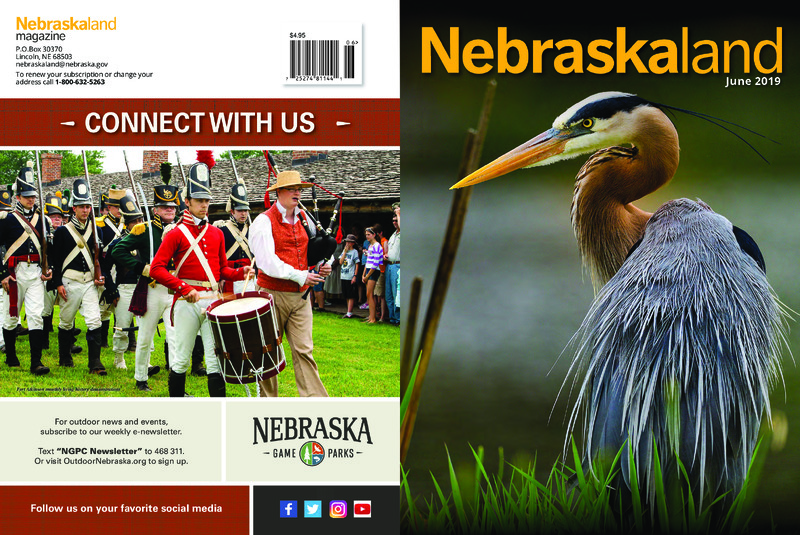
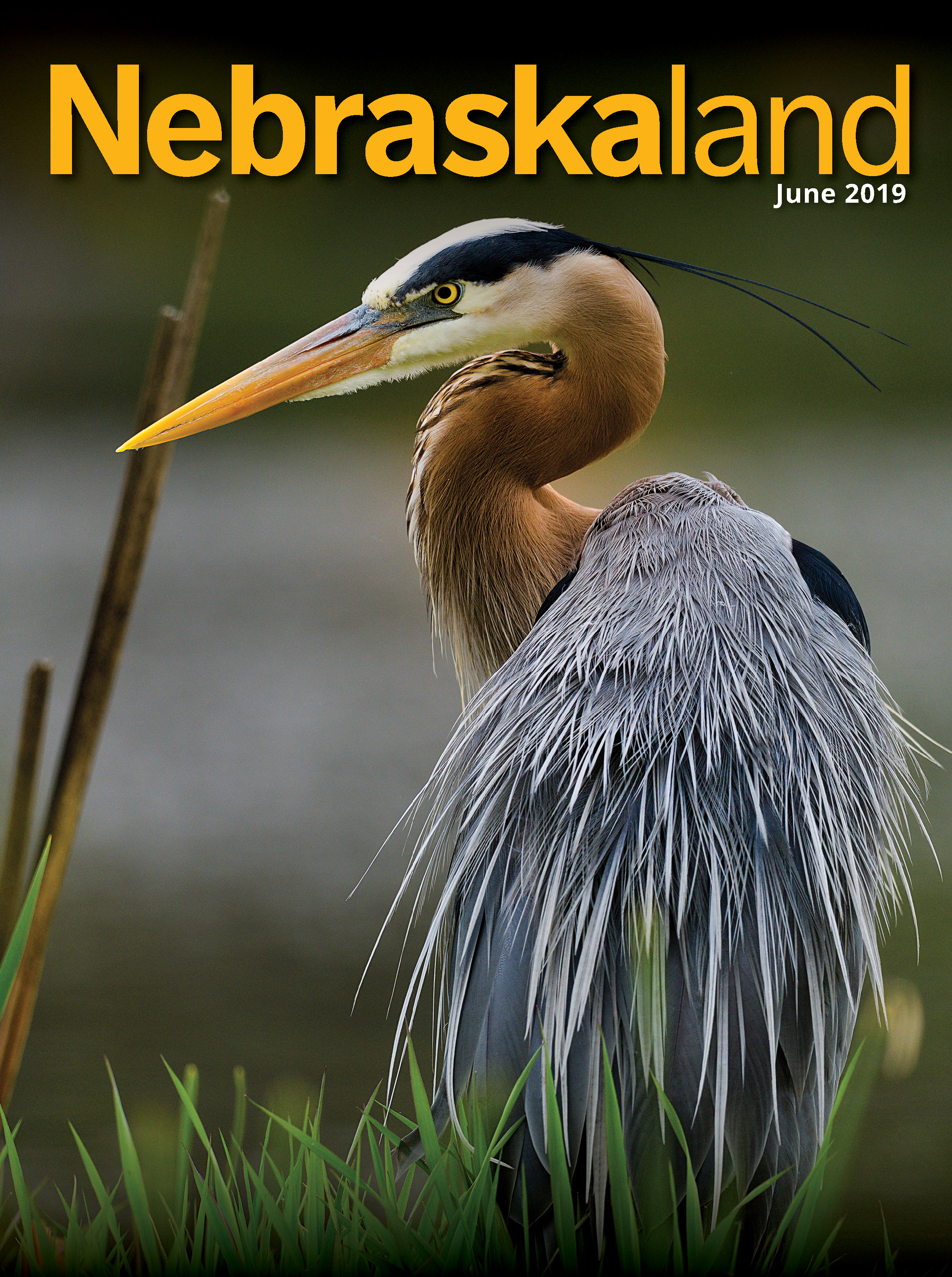
Cover: A great blue heron at Holmes
Lake in Lancaster County.
Photo by Chris Masada.
FEATURES
20
28
TRAVELING THROUGH A
WATERSHED
30
OUTDOOR NEBRASKA
38
Story by Katie Larsen
Photos by Michael Forsberg
What to Do in June
By Renae Blum
NEW OPPORTUNITIES IN
LEARNING Schramm Education
Center
Story and Photos by Jeff Kurrus
SOD HOUSES ON GLASS
PLATES
By History Nebraska
40
THE FIRST 99
46
BOWFISHING
Story and Photos by Justin Haag
Story by Rich Porter
Photos by Jenny Nguyen-Wheatley
DEPARTMENTS
6
10
50
60
62
Your Nebraska
In the Field
Mixed Bag
Portraits from the Past
The Last Stop
PHOTO BY CHRIS MASADA
ON THE WEB
To see additional content including photos,
videos and additional articles, visit
Magazine.OutdoorNebraska.gov/digital.
Nebraskaland (VOL. 97 / NO. 5 ISSN 0028-1964) is published monthly, except for the combined Jan./Feb. and Aug./Sept. issues, by the Nebraska Game and Parks Commission, 2200 N. 33rd St.,
Lincoln, NE. Periodicals postage paid at Lincoln, Nebraska, and additional mailing offices. POSTMASTER: Send address changes to Nebraskaland, P.O. Box 30370, Lincoln, NE 68503-0370.
Magazine Staff
magazine
Communications Director Christy Firestone
Public Relations Manager Cara Pesek
Published by the Nebraska Game and Parks
Commission since 1926. The Commission is
dedicated to the conservation and protection
of all the state's natural resources and the
people who use them.
Editor Jeff Kurrus
Associate Editor Jenny Nguyen-Wheatley
Regional Editors Eric Fowler, Julie Geiser,
Justin Haag
Contributing Editor Michael Forsberg
Regular Contributors Renae Blum,
Chris Helzer, Ryan Sparks, Gerry Steinauer
Art Director Tim Reigert
Graphic Designer Mel Severin
Photo Librarian Jaclyn Cruikshank Vogt
Administration
Director Jim Douglas
Deputy Director Tim McCoy
Commissioners
Chairman - Robert Allen, Eustis
Vice Chairman - Dan Kreitman, Wahoo
2nd Vice Chairman - Pat Berggren, Broken Bow
Dick Bell, Omaha
Rick Brandt, Roca
Scott Cassels, Omaha
Jim Ernst, Columbus
Doug Zingula, Sidney
John Hoggatt, Kearney
Circulation Donna Robinson
For address changes and questions about your
subscription, e-mail donna.robinson@nebraska.
gov or call 800-632-5263
Advertising Sales Manager
For advertising information contact
Shane G. Gilster, 402-742-0125
Email: shanegilster@gmail.com
Nebraskaland Magazine Copyright 2019, all rights reserved.
Nebraskaland is available in audio from the Nebraska Library
Commission Talking Book and Braille Service, Suite 120, 1200 N St.,
Lincoln, NE 68508. 800-742-7691. Nebraskaland Magazine and the
Nebraska Game and Parks Commission reserve the right to reject any
advertising not in keeping with the agency mission.
Rates: $18 for one year; $33 for two years; $44 for three years. Nebraska
recipients must add appropriate sales tax. To subscribe call
1-800-NEBLAND (632-5263), or go online to:
NebraskalandMagazine.com.
Commission Offices
Conservation Officers
Headquarters/Southeast District Office
2200 N. 33rd Street Lincoln, NE 68503
Phone 402-471-0641
ADMINISTRATION (Lincoln)
Craig Stover (Administrator)
Duane Arp (Asst. Administrator)
Jeff Clauson (Asst. Administrator)
Northeast District Office
2201 N. 13th St. Norfolk, NE 68701
Phone 402-370-3374
Southwest District Office
301 E. State Farm Rd. North Platte, NE 69101
Phone 308-535-8025
Northwest District Office
East Hwy. 2, Box 725 Alliance, NE 69301
Phone 308-763-2940
Bassett Office
524 Panzer St., Box 508 Bassett, NE 68714
Phone 402-684-2921
Kearney Office
1617 First Ave. Kearney, NE 68847
Phone 308-865-5310
Ak-Sar-Ben Aquarium/Schramm Education
Center
21502 W. Highway 31 Gretna, NE 68028
Phone 402-332-3901
Omaha Office
8495 Frederick Street, Omaha, NE 68124
Phone 402-595-2144
OutdoorNebraska.org
Any program that receives federal funding from the National Park
Service, or the United States Fish and Wildlife Service prohibits
unlawful discrimination on the basis of race, color, religion, age, gender,
marital status, national origin, age, disability or political affiliation. Any
person who believes he or she has been discriminated against in
any program, activity, facility, or service, should contact the Nebraska
Game and Parks Commission, Lincoln, NE 402-471-0641, the Equal
Opportunity Commission, Lincoln, NE 402-471-2024, TTY/TDD 402471-4693; United States Fish Wildlife Service, Civil Rights Coordinator,
4401 N. Fairfax Drive, Arlington, VA 22203; Director, Equal Opportunity
Program, U.S. Department of Interior, National Park Service, 1849 C
Street NW, Mail Code 0008, Washington, D.C. 20240-0001.
4
Nebraskaland • June 2019
402-471-5531
402-471-5531
402-471-5531
NORTHWEST (Includes counties covered)
Jim Zimmerman (District Supt.)
308-641-6138
Kelsey Glodowski
(Box Butte, S 1/2 Sheridan, Grant)
308-763-8226
Sean McKeehan
(Kimball, Banner, Scotts Bluff)
308-672-1824
Dan Kling (Sioux, Dawes)
308-430-0572
Kyler Prochaska
(E 1/2 Dawes, N 1/2 Sheridan, W 1/2 Cherry)
308-430-3984
308-458-7650
Terry Brentzel (Deuel, Garden, Grant)
402-389-0444
Frank Miller (Cherry, Hooker)
308-279-9133
Josh Widhelm (Morrill, Cheyenne)
NORTHEAST (Includes counties covered)
Tom Zimmer (District Supt.)
402-641-9590
402-760-0712
Dale Davis (Keya Paha, Brown, Rock)
402-340-3981
Jonathan Andreasen (Holt, Boyd)
402-719-6226
Kyle Gaston (Dodge, Colfax)
Greg Hesse
(Greeley, Wheeler, Boone, S 1/2 Antelope)
402-843-6567
Mitch Johnson (Knox, Antelope, Pierce)
402-613-8612
402-762-5022
Jeff Jones (Knox, Cedar)
Jon Reeves
(S 1/2 Thurston, Burt, Washington)
402-889-8508
Andrew Heyer (Pierce, Madison, Stanton) 402-613-2241
Cory Krause
(Cuming, Wayne, Stanton, Dodge)
402-380-6410
Steve Oberg
(Colfax, Platte, Madison, Stanton, Nance)
402-910-3366
Owen Johnson
(Dixon, Dakota, N 1/2 Thurston)
402-266-1759
Doug Pollard (Loup, Garfield, Valley)
308-730-7050
Ethan Teter
(Boating – eastern Nebraska)
402-620-8129
SOUTHWEST (Includes counties covered)
Roger Thompson (District Supt.)
308-530-3097
308-202-0819
Matt Brandt (Sherman, Howard)
308-380-7331
Tim Williams (Hall, Hamilton, Merrick)
Pat George
(Harlan, Franklin, Phelps)
308-920-2762
Matt Andrews
(Gosper, Furnas, Frontier, Red Willow)
308-746-2418
Brian Piernicky
(Red Willow, Frontier, Hayes, Hitchcock)
308-340-6627
John Lee (Hitchcock, Dundy, Chase, Hayes)
Nicholas Fix (Keith, Perkins)
Bryce Streger (Keith, Arthur)
Sean Schultz (Keith)
Brandon O’Neal
(Lincoln, McPherson, Logan)
Alex Hasenauer
(Lincoln, McPherson, Logan)
Mike Thome (Dawson)
Ray Dierking (Custer, Thomas, Blaine)
Taylor Dixon
(Dawson, N 1/2 Gosper, N 1/2 Phelps)
Eric Javins
(Adams, Clay, Nuckolls, Webster)
Kevin Bergstrom
(Boating – central Nebraska)
Daryl Teter
(Boating – central Nebraska)
Scott Eveland
(Boating – western Nebraska)
308-414-1432
308-289-0427
308-440-3847
308-760-0145
308-530-3157
308-660-4671
308-529-8146
308-870-0322
308-217-2108
402-902-2017
308-520-1031
308-440-1863
308-289-0017
SOUTHEAST (Includes counties covered)
Levi Krause (District Supt.)
402-949-0593
402-619-1355
Rich Berggren (Douglas)
402-616-5961
Dan Evasco (Sarpy)
402-210-0888
Heath Packett (Cass)
402-209-1506
Russell Mort (Otoe, Johnson)
William Krause
(Nemaha, Richardson, Pawnee)
402-274-8063
Matt Taylor (Thayer, Fillmore, Jefferson)
402-200-9597
402-806-0915
Matt Seitz (Gage, Saline)
402-890-6463
Dina Barta (Lancaster)
402-937-3422
Dudley Sorensen (Lancaster, York)
402-613-2312
Travis Shepler (Lancaster)
402-314-9641
Trevor Stahlecker (Lancaster)
402-890-7140
Stacey Lewton (Lancaster, Seward)
402-443-6392
Mike Luben (Saunders, Butler, Polk)
YOUR NEBRASKA
Instagram Photos
Follow us (@nebraskaland)
and tag us in your photos
to be featured in an
upcoming issue.
Tom Shield, Kearney
Damselfly
OPPOSITE: Sam Raetz, Omaha
Bison at Fort Niobrara Wildlife Refuge
Arlin Hunter, Papillion
A Duck Blind Sunrise South of
Schuyler on the Platte
6
Nebraskaland • June 2019
June 2019 •
Nebraskaland
7
Karen Kutz Smith, Omaha
Red-breasted Nuthatch
Karen Linot, Gibbon
Ice Drop
Karen Kutz Smith, Omaha
Barred Owl
Kirk Noller, Kearney
From the Trail Cam
8
Nebraskaland • June 2019
Send your comments and photos to:
Jeff Kurrus, Editor
Nebraskaland Magazine
P.O. Box 30370
Lincoln, NE 68503
or email Jeff.Kurrus@Nebraska.gov
Please include your postal address
and telephone number. Letters may be
condensed and edited. Photographs are
also welcome.
June 2019 •
Nebraskaland
9
IN THE FIELD
FORT ROBINSON RADIANCE
A magnificent sky complements blooming
silvery lupine (Lupinus argenteus) as
donkeys graze near the Cheyenne Buttes
at Fort Robinson State Park.
P
PH
PHOT
O BY JUS
JUS
STIN
STIN
T N HAAG
10
Nebraskaland • June 2019
June 2019 •
Nebraskaland
11
IN THE FIELD
PHOTO BY ERIC FOWLER
THREATENED AND ENDANGERED:
THE PIPING PLOVER
By Melissa J. Panella
Though smack dab in the middle of the country and far
from any ocean, Nebraska is positioned perfectly along the
flyway of many shorebird species. Some of the shorebirds
that visit the state are seeking high quality wetlands where
they can stop and refuel during their long migrations. Others
stay longer, finding Nebraska to be a suitable place to raise a
family. One of the shorebird species that breeds in the state is
the threatened piping plover (Charadrius melodius).
In Nebraska, piping plovers historically nested on
midstream sandbar habitat primarily on the Missouri, Loup,
Elkhorn, Niobrara and Platte rivers. Presently, piping plovers
also nest on human-created habitats such as sand and gravel
mines. The male piping plover chooses locations above the
normal high-water line to make multiple shallow cup-like
depressions in the sand known as scrapes. The female of the
pair then chooses her favorite scrape where she will lay her
eggs. These riverine locations offer the resources the plovers
need during their nesting season.
Piping plovers display interesting behaviors during
nesting. Males defend their territories from other males and
intruders. They exhibit a start-stop running style that looks
a bit like a game of chase. Males court the females with their
displays and calls. Both parents share the duty of incubation
and work together when a potential predator is sighted.
Piping plovers are known to skillfully feign a broken-wing
12
Nebraskaland • June 2019
injury to lure a predator away from a nest.
Fluffy piping plover fledglings are up and running several
hours after hatching. The adults stay close by, and the
young are known to crowd underneath a parent for security.
The chicks forage in the soft substrate close to the water’s
edge where they find invertebrates. For the young, it is all
about growing stronger, mastering flight and survival in
preparation to fly south for the winter. Piping plovers banded
in Nebraska are often spotted along the Gulf Coast where
they overwinter.
Piping plovers became threatened because of alteration
to their on-river habitat, invasive species, loss of wintering
habitat and other threats. The Nebraska Game and Parks
Commission has partnered closely with the Tern and Plover
Conservation Partnership led by Dr. Mary Bomberger
Brown to conserve the threatened piping plover and the
endangered least tern, which overlaps in many of its basic
habitat requirements. The Tern and Plover Conservation
Partnership has built solid working relationships with
industry, homeowners and multiple cooperators to protect
these threatened and endangered birds that now find offriver nesting habitat at sand and gravel mine operations
and lakeshore housing developments. To learn more about
this partnership and ways to share the sand with terns and
plovers, please visit ternandplover.unl.edu.
IN THE FIELD
Nebraska’s Great Park Pursuit
Visit Parks. Be Active. Win Prizes.
May 1 –September 16, 2019
Explore Nebraska parks with this free
statewide program.
Learn more and register your team at
NeGPP.org or download our free app.
PHOTO BY CHRIS HELZER
BEE MIMIC ROBBER FLIES
By Chris Helzer
It seems like predators already have all the advantages
they need. Most have some combination of size, speed,
strength, big teeth/claws, and/or venom. If you’re a small,
relatively defenseless creature, all those predatory features
are enough to strike fear into your heart. Allowing a predator
to also look exactly like something harmless is a step too far.
Robber flies are among the scariest of predators (to small
insects). They are super fast flyers with huge eyes and quickacting venom that paralyzes and then liquifies the insides of
their prey. Robber flies can take down prey much bigger than
themselves, often knocking that prey right out of the air
like a surface to air missile. Most robber flies don’t bother
concealing themselves because they don’t need to. They can
sit on a prominent perch and just wait for prospective prey
to fly by.
It’s completely unfair, then, that some big robber flies have
all the traits of normal robber flies but also look just like
14
Nebraskaland • June 2019
bumblebees.
Imagine being a small invertebrate, flying from flower to
flower, just trying to eat enough pollen to survive. As you
fly, you’re constantly scanning the air for birds and aerial
insect predators, scanning nearby vegetation for robber flies
and other threats, and before you land on a flower, you check
carefully for crab spiders, assassin bugs, praying mantids,
and other potential ambush predators lying in wait for you.
Life is scary and frenetic.
Then one day, you go through your entire checklist, avoid
all threats while in the air, and just as you’re landing on a big
sunflower, you do a final scan for predators.
“Let’s see, nothing hiding underneath the flower, no
spiders camouflaged on top of the flower, just a little weevil
on the left and a big harmless bumblebee on the right.
Nothing to worry…” BAM!
Life isn’t fair at all.
IN THE FIELD
PHOTO BY JEFF KURRUS
IS THE CONSERVATION ORDER HELPING?
By Jeff Kurrus
The Light Goose Conservation Order was enacted to
reduce populations of lesser snow and Ross’s geese that were
causing damage to sub-Arctic habitats. The order hasn’t
met its intended objectives, but one reason into why may be
reflected from a recent study by a team of wildlife biologists
– including Nebraska Game and Parks’ Dr. Mark Vrtiska.
A key piece in reducing light goose populations was not
only to increase the overall harvest of geese, but really
increasing the harvest of adult females. Healthy, adult
females are the primary drivers of the population given that
they lay and incubate eggs and then help raise goslings.
Those females that build sufficient fat and protein reserves
during spring migration are more likely to nest and raise more
young. Obviously, there’s no way to identify male or female
geese while flying, but harvesting enough healthy (i.e., geese
with abundant fat and protein reserves) geese would work.
The question is – what geese are being harvested?
To answer that question, researchers compared birds
harvested over decoys and those hunted using jump-shooting
16
Nebraskaland • June 2019
tactics in Arkansas, Missouri, Nebraska and South Dakota in
the springs of 2015 and 2016. The team found that during
the order, adult lesser snow and Ross’s geese harvested over
decoys had less fat than counterparts randomly collected
through jump shooting. Essentially, snow and Ross’s geese
in poorer body condition are more vulnerable to harvest than
healthier birds when hunted over decoys. Individual geese
that are in poorer body condition likely have more willingness
to respond to decoys that may signal food availability.
Because at least 70 percent of the light geese harvested
during the order are over decoys, there are implications to
the effectiveness of the order. In addition to an insufficient
amount of harvest, harvest of individuals exhibiting poorer
body condition suggests that the order primarily removes
individuals from the population that would die of natural
mortality at later stages of migration or may not reproduce.
Thus, the order in turn actually may be aiding light goose
populations than contributing to their reduction.
June 2019 •
Nebraskaland
17
IN THE FIELD
for 6-8 hours or until meat becomes
tender. Remove meat from bones and
finely shred. Remove all pin bones.
2. In a skillet, heat 1 tablespoon
of olive oil over medium heat. Add
grated onion and cook for 2-3 minutes,
or until softened. Then turn up heat
to medium-high and then add the
shredded turkey meat with chopped
chipotle peppers in adobo sauce and
tomato paste. Sauté until meat is
warmed through and slightly toasted.
Take off heat and add chopped
cilantro, salt and pepper to taste. Add
more spicy adobo sauce from the can
if desired. Set meat aside.
3. In a skillet, heat 1 to 2 teaspoons
of vegetable/corn oil over medium
heat. Lay corn tortillas into the warm
oil and flip back and forth to warm
through; warming the tortillas in oil
helps to moisten it, which prevents it
from cracking when assembling tacos
later. Stack warmed tortillas in a bowl
and keep warm. Add more oil to the
pan as necessary.
4. Fill warmed tortillas with about
2 tablespoons of the shredded turkey
mixture and fold over the tortilla,
gently pressing down the taco to
encourage it to keep its shape. Lay all
assembled tacos on a cookie sheet.
When done, place the cookie sheet in
the refrigerator for 30 minutes to firm
up tacos.
5. In a cast iron skillet, heat enough
oil to 350 degrees to shallow fry tacos
– do not fill your cooking vessel more
than 1/3 of the way up to prevent oil
from boiling over. Once oil is heated,
gently drop cold tacos into the oil and
fry for 2 to 3 minutes on each side; do
not overcrowd the pan and be careful
of splatter. When crispy, remove the
fried tacos with tongs and tip to drain
out excess oil. Rest on paper towels.
6. Once tacos are cool enough to
handle, carefully open up the tacos
without cracking the spine, and fill
with shredded romaine lettuce and
cheddar cheese. Serve with your
favorite hot sauce.
TURKEY AND CHIPOTLE FRIED TACOS
By Jenny Nguyen-Wheatley
18
Nebraskaland • June 2019
Servings: 20-25 small tacos
Prep Time: 6-8 hours
Cooking Time: 1 hour and 30
minutes
Ingredients:
2 turkey legs and 2 turkey thighs
8 cloves of garlic, minced
1 tablespoon of salt, plus extra
¼ teaspoon of cracked black
pepper
1 teaspoon of chili powder
½ teaspoon of cumin
2 cans of beer
1 small onion, peeled and halved
1 tablespoon of olive oil
Half a grated onion
2 tablespoons of tomato paste
1 to 2 chipotle peppers in adobo
sauce, chopped
•
•
•
•
•
•
•
•
•
•
•
•
• 2 tablespoons of chopped cilantro,
leaves and stems
• Shredded romaine lettuce
• Shredded sharp cheddar cheese
• 20-25 corn tortillas
• Corn or vegetable oil for frying
• Hot sauce/taco sauce
1. Remove thick areas of silver skin
from turkey legs and thighs. Combine
minced garlic, 1 tablespoon of salt,
cracked pepper, chili powder and
cumin, and then rub it all over turkey.
Place turkey in a slow cooker and pour
in enough beer to submerge the meat
completely. Add a halved onion and
cover the slow cooker with foil. Place
the lid on top of the foil – foil will
prevent steam escaping. Cook on low
PHOTOS BY JENNY NGUYEN-WHEATLEY
This recipe is an homage to all the
cheap Burger King and Jack-in-the-Box
fried tacos I ate as a teenager, except my
version will actually taste good. You’ll
get all the crunchy, greasy goodness
your heart desires, along with a spicy,
real-meat turkey filling hunted by you
– nothing like the gray “meat” paste
the King and Jack used in theirs. These
tacos will be so tasty your family and
friends will gobble them up as fast as
you can make them.
I’ve said it before and I’ll say it
again: Turkey legs and thighs are not
“dog food.” Although tough, they are
flavorful and nothing a bit of heat,
moisture and time can’t tenderize.
Much like hunting, patience is also key
to cooking wild turkey successfully.
June 2019 •
Nebraskaland
19
Traveling Through
a Watershed
A conversation with Mike Forsberg
STORY BY KATIE LARSEN
PHOTOS BY MICHAEL FORSBERG
From a mid-river sandbar camp, the Milky Way rises and small towns glow in
the distance along the Platte River miles downstream of Columbus, Nebraska.
20
Nebraskaland
• June 2019
Follow the Water is a 55-minute documentary about a journey
taken by two men through the Platte River watershed. The
film allows audiences to travel along with conservation
photographer Mike Forsberg and filmmaker Pete Stegen as
they discover where our water comes from. Follow the Water
can currently be viewed at pbs.org/show/follow-water.
In the following interview, Mike Forsberg talks about how
and why this documentary was created, what the journey was
like and his plans for the future.
Q: Long before Follow the Water
was created, you and Michael
Farrell cofounded the Platte
Basin Timelapse project,
which documents changes in
the Platte River watershed.
How did you decide to also
explore the watershed through
a documentary film?
We’ve had the Platte Basin Timelapse
project in place since 2011, and that
project is a long-form, multimedia
documentary that really doesn’t have an
end to it. Its goal is to get people to think
about where their water comes from and
what it means to live in a watershed
today. We have all these time-lapse
cameras that we’ve put in place from
mountains to plains in our watershed;
each one is a different chapter in the
story of that water, and each one has a
story to tell.
I got to a point where I wanted
to do something that would connect
some of these time-lapse cameras from
mountains to plains through a personal
experience, and I started to talk about
that with Pete Stegen. We decided
to tell a longer story about traveling
through a watershed, starting from
Sun rises over a beaver dam along the Sweetwater River, the farthest west headwater drainage of the
Platte River watershed, flowing out of Wyoming’s Wind River Range.
the very farthest away a drop of water
comes from, and eventually finding our
way back to the drain. I drew up the
initial plan on the back of a Subway
napkin.
Q: What planning and
preparation was necessary for
the trip?
Backpackers Pete Stegen, Lindsay Dalton, Mariah Lundgren, Kery Harrelson and
Mike Forsberg rest in an alpine meadow near Kenosha Pass above South Park,
Colorado, as they neared the end of the 17-day backpacking portion of the journey.
22
Nebraskaland
• June 2019
We first lined up our own schedules,
Pete and I, to know what blocks of time
we had, and then there were a couple
key components that we needed to fit.
We had to think about where we were
going to need help. Who was going to
join us along the way, when we needed
to be shuttled, when we needed to trade
bikes for backpacks, when we needed
to trade backpacks back to bikes, bikes
to canoe? Who was going to help us
and when? What were we going to eat?
Where were we going to sleep? What
gear were we going to bring?
We wanted to document this, but
we weren’t necessarily thinking it was
going to be a documentary film. We
knew that we couldn’t haul a big film
crew with, because they weren’t going
to be able to do what we were doing.
When you watch the documentary,
most everything that you see there
is shot on phones and GoPro. We also
ended up having a professional film crew
from Platte Basin Timelapse and NET
Television meet us in a few different
places along the way, but they never
went with us anywhere.
Q: What were some of the
challenges?
The challenges were mostly physical.
I partially tore the meniscus in my knee
early on in the trip. But none of this was
wrought with all sorts of danger – we
were never all that far from help, and we
did stuff very deliberately. It was just
a matter of putting one foot in front of
the other every day, not worrying about
5 hours from now or 5 days from now –
just going.
June 2019 •
Nebraskaland
23
of Nebraska, yes. But we also live in a
watershed, and that watershed doesn’t
pay attention to any straight lines that
we drew on a map. It’s nature’s borders
and boundaries, and we’re all neighbors
together. There’s always somebody
upstream of us, there’s always somebody
downstream of us. All of the people that
are attached to this film are a part of
that community. We all live in the same
place, we all rely on this water in some
way, and it connects all of us together in
a very personal way.
[The purpose of the trip was] to
take people on a journey with us. Not
everybody can do what we did. But, if
we can take you with, and give you a
sense of what it was like, and either
show you some things that you haven’t
seen before, or show you something in
a way that you haven’t seen it before,
then that’s a success, I think.
The longer-term goal and hopefully
the success of this project is to continue
to build community and voice around
this watershed, and then other
watersheds. When I give a talk about
Platte Basin Timelapse to other places
that aren’t here, I’ll always start with
my story from my home country, from
my home watershed, but as I do that,
I want you to think about your own.
Where does your water come from, and
what does that mean, and how are you
intimately connected to it?
Q: What are your future plans?
I hope this project can continue for a
long time. We’d like to make it through
a decade – it’s good statistically, and it
sounds good from a story perspective
– but in a lot of ways, I’d like to see
it continue, and I’d like to continue
to explore my home, as a storyteller.
Being able to stay in one place may
not sound as sexy to some as traveling
the world, but getting to know a place
really well is like getting to know a
friend your entire life. The more time
that you spend, the more layers you
Snowmelt cascades down the wild slopes of Argentine Peak along Colorado’s Front
Range on its way to the South Platte River.
We always had to make sure we were
close to water, though – which was sort
of cool, because I didn’t think about that
until a little bit later. You’ve got to have
water, so you’ve got to think about that
every day. And then when you have that
water, you have to conserve it, because
you may not have very much to draw
from, or you don’t want to go walk 200
yards back down to the lake or the creek
to pump another 20 minutes to get more
water out. You’re thinking about water
almost all the time.
Q: This was a 55-day trip —
over 1,300 miles of hiking,
biking and canoeing. What
was that journey like for you
personally?
Physically it was hard, but mentally
I didn’t think it was all that rough,
because we were with really good people
the whole time. It really made me slow
down, because when you’re operating
under your own power, you’re only going
24
Nebraskaland
• June 2019
as fast as your body will allow you to.
And then when you get on the river
in a boat, you’re only going as fast as
that water’s going to take you. So you
might as well enjoy it. Everything slows
down, and you get into the rhythm of
this place. You get into the rhythm of
the river, you get into the rhythm of the
mountains or the plains.
I wish everybody could do that. We
could get in my truck right now and
drive to the place where we started and
be there in probably 11 hours, and we
could do it in a glass and steel bubble,
and never know where we just went
through. So, 11 hours or 55 days.
Q: What were the goals of the
trip and the documentary,
and do you feel like they were
accomplished?
We wanted to get people to think
about where their water comes from,
and thinking about the watershed as a
place that we live in. We live in the state
Sunrise greets river camp on a sandbar along the central Platte River between Overton and Elm Creek, Nebraska.
June 2019 •
Nebraskaland
25
A crew from NET Television: Emily Kruetz, left, and Mariah Lundgren, right,
interview Peter Stegen along the shoreline of Lake McConaughy in western
Nebraska.
At Schilling Wildlife Management Area near Plattsmouth at the confluence of the Platte and Missouri rivers,
a Platte Basin Timelapse (PBT) camera captures Mike Forsberg and Pete Stegen (top, and bottom right) as they
near the end of their 55-day, 1,300-mile journey by bike, backpack and canoe across the Platte Basin watershed.
Peter Stegen pulls the canoe through a dense stand of cattails during a long
portage around a diversion dam on the North Platte River in western Nebraska.
peel away, the more beauty that you
see. I think that’s important today. I’ve
spent 25 years as a photographer in
conservation, dedicated to my home,
the Great Plains of North America. I’ve
seen a lot, I’ve experienced a lot, I’ve
learned a lot, but I’ve only scratched the
surface.
I love being able to hand what I have
Mike Forsberg and Peter Stegen ending
the bike portion of their journey above
the Platte River near Henry, Nebraska.
26
Nebraskaland
• June 2019
to somebody else, and watch them go
explore too, and see the stories that
they do. Working with students at the
University of Nebraska is really cool, and
so is being able to work with and meet
people that have a passion and a heart
for the natural world, who understand
that we all have to be connected to it and
be good stewards of it moving forward.
We need people to re-engage, and one
of the ways that you do that is to tell
stories. We tell stories, and we learn
from those stories, and we can be moved
by those stories. Through the written
word, and through the power of
photography, and art, and other creative
devices, that’s the way we’re going to
reach people, and the more personal it is,
the more authentic it can be. If I can
continue to help move in that direction
– if I can still be let out of the barn once
in a while to do the work that I’m
passionate about, and be able to bring a
lot of other people along the way and let
them fly and be better than I am — then
I’ll feel good about it. N
June 2019 •
Nebraskaland
27
Outdoor Nebraska
What To Do in June
By Renae Blum
As we move into the warmer months, Nebraska – especially
the state park system – offers a range of amenities and
opportunities for enjoying the outdoors. Here are just a few of
them. N
Enjoy a trail on
National Trails Day
June 1 | Statewide
Nebraska’s state parks have some amazing
hiking and biking trails, whether you’re
interested in an easy stroll or a rugged
mountain biking path. Find one to enjoy on
National Trails Day at OutdoorNebraska.org/
trails.
Go catfishing
PHOTO BY ERIC FOWLER
June is a great month for
catfishing – they’re active
and moving shallow. Get
out your favorite bait and
enjoy some fishing before
the spawn in July.
PHOTO BY JEFF KURRUS
Throughout the month
Statewide
Family
Outdoor Day
PHOTO BY ERIC FOWLER
June 22
Mormon Island State
Recreation Area
Camp at a state park
Throughout the month | Various state
parks and recreation areas
Wildflower
Walk
June 7
Wildcat Hills State
Recreation Area
Show and Shine
Car Show
June 29
Indian Cave State Park
Get away from the daily grind and enjoy some
relaxing time outdoors with a camping trip.
Several Nebraska state parks and recreation
areas offer a variety of camping amenities
and accommodations for tent and/or RV
camping. Learn more at OutdoorNebraska.
org/camping.
Visit a shooting range
Throughout the month | Statewide
28
Nebraskaland • June 2019
Enjoy a state park pool or
aquatic center
PHOTO BY JENNY NGUYEN-WHEATLEY
PHOTO BY ERIC FOWLER
All kinds of shooting opportunities are available
in June at shooting sports facilities across the
state. Bring your family and friends and enjoy a
time-honored tradition that’s not only fun, but
helps keep your shooting skills top-notch for fall
hunting season.
Throughout the month | Various state parks
Cool off by splashing around at a state park! Six state parks
offer swimming facilities, and two have been newly renovated.
Platte River State Park now offers one of the only two-tiered
spray parks in the region, and Ponca State Park’s new aquatic
center features a heated zero-depth entry pool, 172-foot water
slide and more. Find details at OutdoorNebraska.org/swim.
June 2019 •
Nebraskaland
29
New
Opportunities in
Learning
Schramm Education Center
Story and Photos by Jeff Kurrus
Formally Ak-sar-ben Aquarium, this interactive nature
destination sets the bar for outdoor education.
T
wo friends – a third grader and fourth grader –
bounced from one activity to the next at the newly
renovated Schramm Education Center. They hopped
on the virtual reality mountain bikes, then marveled at
at a 90-pound common snapping turtle. They picked up
magnifying glasses, slid down a tree slide, cast line from
a fishing reel and yelled “gross” when they looked at their
own arms beneath a microscope. Then they saw the touch
tank where paddlefish and shovelnose sturgeon swam
inches below the water.
And they had only been at the new center for 15 minutes.
Constantly Changing
“We want you to come in here, so then you want to
spend more time out there,” said Nebraska Game and Parks
Commission Outdoor Education Program Manager Lindsay
Rogers when talking about the newly opened, 14,000
square-foot building. To accomplish this goal, Rogers and a
team of colleagues designed the center looking toward the
future of nature education.
Fifth grade elementary school teacher Melissa Nelson
was no stranger to the center’s predecessor, the Ak-sarben Aquarium. “My family and I frequently came to the
aquarium,” she said during a visit with her class from
Patriot Elementary in Papillion, “but my students absolutely
30
Nebraskaland • June 2019
TOP: Koco Janssen, Averi Bridges and Maddie Kurrus
of Gretna play at the Schramm Education Center.
RIGHT: Kylie Raess of Gretna explores with a
magnifying glass.
love the new place. It’s a lot more hands-on than it was
before. I’m already planning the summer with my own
kids.”
The hands-on portion was a pivotal component of the
Platte River State Park's Crawdad Creek.
Mahoney State Park's GoApe ropes course.
Glamping cabins at Platte River State Park.
Louisville State Recreation Area's floating
playground.
Logann Dostal of Gretna views the farm pond tank at the Schramm Education Center.
redesign. “People learn by touching things,” said Rogers.
“When you get multiple senses involved – hearing, seeing,
touching – you get a more robust learning experience.”
The center has a “maker space” where visitors will
encounter design challenges. For example, students might
be instructed to design a bird habitat that accounts for food,
shelter, water and space. Then, the next time they visit,
their challenge will be something entirely different.
“This is probably my favorite spot in the entire center,”
Rogers said. “You might walk right by it and not notice it
… until you see kids. It’s a place for them to concentrate, to
critically think about what they want to build and how they
want to build it.”
Visitors will also have the opportunity to view scientists
at work in the quarantine area. From a huge window,
guests can watch a biologist give an animal a shot, or see
Nebraska’s mussels up close. “We want to offer transparency
to science and technology,” said Outdoor Education
Specialist Amber Schiltz. “A behind-the-scenes look. A fiveor six-year-old can watch a fisheries biologist work and see
their future role models.”
Some of the permanent attractions are just as dynamic.
"The Venture Parks concept was to make one of the best state park
systems even better. To motivate and connect today’s families,
inviting and enticing future generations to enjoy, experience and
explore the outdoors."
— Jim Abel, Chairman, Nebraska Game and Parks Foundation
32
Nebraskaland • June 2019
Venture Parks
The idea for Venture Parks began in 2014 when Nebraska Game and Parks Director Jim
Douglas asked his colleagues, “Who are we, and what do we want to become?” Despite
offering numerous activities in Nebraska’s 76 state parks and recreation areas, the
team wanted to offer more. Douglas and his staff wanted to provide a series of outdoor
experiences that inspired users to go outside. “We want children to look farther,” he said.
“And our parks are natural gateways for exploring the outdoors.” Education, adventure,
relaxation and being part of the “wildness” that nature can offer were central themes to
the Venture Parks concept.
Through an innovative private/public partnership, nearly $40 million would be re-invested
to the state park system for this concept. Five years since Douglas’ first question, Game
and Parks – with the aid of the Nebraska Game and Parks Foundation and other private
donors – has just completed the first phase of its Venture Parks concept.
June 2019 •
Nebraskaland
33
The woodland play area offers interchangeable displays for visitors.
More than 60 freshwater fish, turtle, frog and snake species
are found at the center, including the world’s largest captive
common snapping turtle, aptly named “Big Snap Daddy”
(see sidebar on page 36). A working beehive is also on
site.
“My favorite part was seeing all the smaller fish you
usually don’t see or catch,” said fifth grader Thad Doble from
Papillion during his visit. “It was also really cool to step into
the bubble and see fish from different points of view.”
The “bubble” that Doble referred to is a display in the
center's aquarium section where visitors can step into
an area and feel like the water completely surrounds
them, offering an even more personal perspective to
view Nebraska’s native fish species. “Even when things
are behind glass,” said Rogers, “we tried to get a sensory
34
Nebraskaland • June 2019
experience happening to them.”
The experience, as on-site aquarium biologist Tony Korth
said, takes about one to two hours to get through for a
family. But he and the educators aren’t expecting the center
to be a one-visit type of attraction.
“We wanted about 20 percent of the center’s displays
permanent and about 80 percent interchangeable,” said
Rogers, “so there is always a new experience for visitors.”
“We want to see what our audience wants,” added Schiltz.
“There is a lot of blank canvas at the center. We want to
offer a menu to our visitors. Depending on grade level, and
what students are learning at the time, we want to have our
own curriculum they can choose from. Since the first day
the center opened, I just can't stop smiling.”
Neither can the visitors.
TOP: Interactive touch screens
teach visitors about the more
than 60 amphibian, reptile and
fish species at the aquarium.
MIDDLE: Virtual reality mountain
bikes allow people to ride the
trails at nearby Platte River State
Park.
BOTTOM: The center has multiple
work stations where students
can use their senses and critically
think about Nebraska's flora and
fauna.
June 2019 •
Nebraskaland
35
Other Amenities
E.F. Schramm – the namesake of
this recreation area – was a University
of Nebraska geology professor who
donated 277 acres to the Nebraska
Game and Parks Commission, which
already owned the 54 acres that
housed the state’s oldest fish hatchery.
Schramm wanted the area to be a
laboratory where the public could
experience nature.
Today, visitors to Schramm can visit
the education center, then begin their
outdoor adventures right out the door.
Hikers, bikers and the like can view
wildlife on more than 331 acres of land
– including three miles of wooded trails
– and visit limestone and shale geologic displays. Canoe and
kayak access to the Platte River is also available.
From playgrounds and picnic areas to birdwatching and a
nearby archery range, the grounds of Schramm Park State
Recreation Area are just as interesting as the new education
center. And it’s just beginning.
Plans for an interactive stream and treehouse classroom
at Schramm are in the near future, providing even more
opportunities for nature-based lessons. “Dr. Schramm
wanted this area to be a living laboratory,” said Douglas.
“We’re going to make it just that.” N
For more information on the Schramm Education Center
and other opportunities at the recreation area, visit
OutdoorNebraska.org/schramm.
Big Snap Daddy
One of Schramm’s most popular displays is a 90-year-old, 90-pound common snapping
turtle named Big Snap Daddy. “He’s just as nasty as the day we got him,” said aquarium
biologist Tony Korth, who has been taking care of Big Snap for 25 years.
He was caught by a fisherman in 1993 from the Missouri River and was housed at Aksar-ben Aquarium before the recent Venture Parks renovations. Having spent the past
year at the University of Nebraska-Lincoln herpetology lab with Dennis Ferraro and his
staff, Big Snap was recently introduced to his new home – a 600-gallon tank substantially
larger than his previous home at Ak-sar-ben before the renovation.
“He’s the largest common snapping turtle you’ll ever see,” said Korth. “He’s good at
educating the public about what these animals look like and how they behave. At this
stage, we don’t think he’d be very good at taking care of himself in the wild. But we’re
happy to take care of him here.”
A birdwatching center allows visitors of all ages to view Nebraska's native bird species.
36
Nebraskaland • June 2019
June 2019 •
Nebraskaland
37
Sod Houses on Glass Plates
The Harvey Andrews
family at the grave of
their son Willie, near
New Helena, Custer
County, 1887.
History Nebraska
RG2068-2360a
By History Nebraska
S
olomon Butcher came to Nebraska in a covered wagon,
but quickly found himself poorly suited to the hard life
of a pioneer. He failed at homesteading, taught school,
briefly attended medical school, served as a rural postmaster,
and opened – and closed – the first photography studio in
Custer County.
Desperate to avoid going back to farm work, Butcher had a
bold idea. He would produce a photographic history of Custer
County. Starting in 1886, he hitched up a wagon and began
visiting homesteads with his photographic equipment,
accepting meals and selling photos, and making images for
his history book.
“Some called me a fool, others a crank,” he recalled, “but I
was much too interested in my work to pay any attention to
such people.”
Butcher’s Pioneer History of Custer County, Nebraska (1901)
gave him the only taste of financial success he ever knew.
Later projects were less successful. But he continued making
photographs, slowly building a collection of nearly 3,500
glass plate negatives, which he later sold to the Nebraska
State Historical Society (today’s History Nebraska).
Butcher believed he was a failure when he died in 1927,
but today his photos are recognized as a uniquely important
record of settlement on the Great Plains. He captured a brief
period after the area’s Native inhabitants were forced out and
before the new settlers had fully established themselves.
Together they are a time capsule of rapid change on the “sod
house frontier.”
An exhibit featuring Solomon Butcher’s photography and
associated artifacts will be at the Nebraska History Museum
in Lincoln from June 15, 2019 to June 1, 2020. N
Learn more at history.nebraska.gov
Sylvester Rawding house, north of Sargent, 1886. The famous “cow on the roof” photo is a bit of an illusion. Look close and
you’ll see that the cow is on a hill behind the house. History Nebraska RG2068-1784
The Chrisman sisters near Gosheen settlement on Lieban Creek, Custer County, 1886. Daughters of a local rancher, each
of the sisters claimed her own homesteads, and took turns living with each other to fulfill the Homestead Act’s residency
requirements. History Nebraska RG2068-1053
38
Nebraskaland
• June 2019
The Shores family near Westerville, Custer County, 1887. Rachel and Jerry Shores (third and fourth from left) were among a
number of former slaves who settled in Custer County. History Nebraska RG2068-1231
June 2019 •
Nebraskaland
39
The
First
99
One shutter - b u t t on
press at a ti m e, t h e
bird photos a d d u p .
STORY AND PHOTOS BY
JUSTIN HAAG
hat the Nebraska Panhandle may lack in
diversity of bird life when compared to eastern
Nebraska it more than makes up for in its varied
landscape. That variation, from the towering sandstone
buttes through the pine forests, sandhill lakes, riparian
woodlands, grasslands, croplands and even residential
areas, is home to a diversity of birds, and some birdwatching gems found nowhere else in the state.
Joel Jorgensen, nongame bird program manager for
the Nebraska Game and Parks Commission, said many
birdwatchers from the east are often attracted to the
Panhandle to see western specimens such as the red
crossbill or pygmy nuthatch.
“You have a number of western species that creep
into the far western part of Nebraska and that makes
it attractive to a lot of birders,” Jorgensen said. “Places
like Sowbelly Canyon, Monroe Canyon and the Oglala
National Grassland harbor a lot of species not found in
other parts of the state.”
Birds deserve a lot of credit for making me a wildlife
photographer. When I invested in a 500mm lens about
W
Nebraska did an excellent job in 1929 picking its
state bird, the western meadowlark (Sturnella
neglecta). Its boisterous song, such as this sunrise
rendition at Peterson Wildlife Management
Area, has surely lifted many a spirit throughout
generations on the Great Plains – including
photographers.
40
Nebraskaland • June 2019
June 2019 •
Nebraskaland
41
LEFT: If one were to choose an official bird of the Pine
Ridge, the red crossbill (Loxia curvirostra) would surely
be a candidate. It has a beak designed for extracting
seeds from pinecones.
MIDDLE: The red-winged blackbird (Agelaius
phoeniceus) is so common in spring that I find myself
shooting photos of it only when the light is best.
Regardless, its presence is always welcome, especially
on a slow photography day.
BOTTOM LEFT: Eastern kingbirds (Tyrannus tyrannus),
with their tuxedo plumage and gangster’s demeanor, are
a frequent subject in summer. Never has photographing
them been more enjoyable than staking out this nest
fashioned from a decaying fence post in July 2017.
LEFT: The American avocet (Recurvirostra americana) is
a common visitor to Panhandle ponds and marshes.
MIDDLE: The coniferous forest loving red-breasted
nuthatch (Sitta canadensis) is at home in the Pine
Ridge.
BOTTOM LEFT: The distinct appearance of the long-billed
curlew (Numenius americanus) stands out on the Oglala
Grassland.
BOTTOM RIGHT: Even though these soured apples may
not look appetizing on a snowy day in early December,
the cedar waxwings (Bombycilla cedrorum) found them
cause for party.
a decade ago, I took to the field to photograph any wildlife
species that crossed my path. Admittedly, my knowledge of
birds was extremely low and my original goal was to capture
the superstars of the Panhandle’s wildlife scene: elk, bighorn
sheep and swift fox, to name a few. The birds, though, kept
me shooting. When other animals eluded me, I could count
on a red-winged blackbird or red-tailed hawk to save the
day and pose for an image or two. Often, I would not know
the species I was photographing until a bird expert would
patiently help me with identification.
Those early bird photos, as much as anything, led me to
the career I have today. The birds still keep me shooting. And
learning.
Just for kicks, on a cold day this winter, I compared my
images in the Nebraskaland database with a checklist of
more than 230 species produced by the U.S. Forest Service:
“Birds of the Nebraska Pine Ridge.” Memories flowed one-byone as I checked the boxes.
While many of the photos were shot from a blind, many
others were captured while I was just going about business
doing other things, whether it be the loggerhead shrike I
photographed during the solar eclipse or the rare-to-the-area
winter wren that struck a pose while I was hunting turkeys.
When making checks, I counted only the images that I
thought were good enough for print and therefore uploaded
to the magazine’s database. The snowy owl that I observed
numerous occasions this winter but remained a little too
elusive for a passable photo? Sadly, no X in that box.
The tally of species: 99. Not quite half of the list, but
a gratifying start. It has become something of a goal to
get as many species on the list as possible, and I will keep
chipping away. Certainly, much of the “low-flying” fruit has
been harvested and the remaining species will be more of a
challenge. Who knows? Before I hang up the camera, maybe
I can get them all. If not, I will certainly be thankful for the
ones that flew my way.
Now, on to 100. N
42
Nebraskaland • June 2019
June 2019 •
Nebraskaland
43
LEFT and MIDDLE LEFT: Three of the four wrens on the
list have passed in front of the camera, including the
rock wren (Salpinctes obsoletus) high on the buttes at
Fort Robinson State Park and a rare sighting of a winter
wren (Troglodytes hiemalis) along Little Bordeaux Creek.
BOTTOM LEFT: This lesser goldfinch (Spinus psaltria)
visited my yard in 2018. The species was first observed
in Nebraska in 1984 and has been expanding its range
from the West. So far, my observations in Chadron are
the farthest east documented in the Pine Ridge.
MIDDLE RIGHT: The colorful feathers of the mountain
bluebird (Sialia currucoides) are well suited for
photography. Western Nebraskans are fortunate to see
both this species and the eastern bluebird (Sialia sialis).
LEFT: Even though the burned ponderosa pines stand
as a grim reminder of catastrophic wildfires, the redheaded woodpeckers (Melanerpes erythrocephalus)
seem to be reveling among them.
MIDDLE LEFT: The tall cliffs in the Pine Ridge are suited
for golden eagle (Aquila chrysaetos) nests.
BOTTOM LEFT: This loggerhead shrike (Lanius
ludovicianus) posed at Bighorn Wildlife Management
Area in the final minutes of the total solar eclipse in
August 2017.
BOTTOM RIGHT: This grasshopper sparrow
(Ammodramus savannarum) appears to be a great
orator.
BOTTOM RIGHT: Although you are more likely to see
gray partridge (Perdix perdix) in northeastern Nebraska,
there are a few in the Panhandle. This is the only one
I’ve noticed in the wild.
44
Nebraskaland • June 2019
June 2019 •
Nebraskaland
45
Bowfishing
BY RICH PORTER
PHOTOS BY JENNY NGUYEN-WHEATLEY
Nebraska’s public waters have enthralled me for more
than 30 years. I first picked up a bow in 1988, and very
quickly, bowfishing became a lifelong passion. Stalking a
fish, unleashing an arrow and hoping for the best – the thrill
is similar to hunting. I will always choose fishing with a bow
over a rod and reel.
Another reason why I love bowfishing so much –
bowfishers still account for a small percentage of anglers
in Nebraska, which means the shooting opportunities are
endless. With so little pressure on our lakes and rivers for
carp and gar, the time to start bowfishing is now.
Where to Bowfish
You won’t find many big reservoirs without an abundance
of common carp. Some have buffalo and gar, and few might
hold big, old grass carp. I’ve had the pleasure of shooting
many lakes in Nebraska, and my favorites are Harlan
County, Medicine Creek, McConaughy, Swanson, Merritt
and Calamus.
Don’t overlook lakes that connect to the canal system
along the Platte River, as well as any lake that gets flooded
by the Missouri, Platte or Elkhorn rivers. All these water
bodies will likely provide plenty of shooting opportunities.
Rivers also can be amazing places to stalk a variety of fish.
Gar, buffalo, grass, silver and the immense bighead carp all
reside in our many rivers and streams.
Gavins Point Dam, considered the mecca among Nebraska
bowfishers, is easy to shoot from the bank or inside a boat.
May and June are the best months to shoot at Gavins
Point, when huge schools of bigheads and silver carp can
be expected below the dam. Opportunities for buffalo carp,
common carp and gar will be plentiful both above and below
the dam.
What to Bring
Garrett Tramp of Allen helps his mentor Zack Hammack of Omaha
reel in a silver carp on the Missouri River.
46
Nebraskaland • June 2019
Wading in a pair of old tennis shoes and shorts is the way most
people got started on bowfishing. Gear is fairly simple. You’ll
need a bow that fits you, several arrows, a reel and components
to attach it to the bow, and a heavy-duty arrow rest.
Bowfishing is tough on equipment so purchase rugged,
simple gear. I prefer a full capture adjustable arrow rest, such
June 2019 •
Nebraskaland
47
Bowfishing Tournaments
as the Carpzilla, and arrows that have sturdy points like
the Cajun Piranha or Muzzy Carp point. Reels specifically
designed for bowfishing are the best. If you use a spin cast
reel, like I do, consider spraying the line down with silicone
before starting your day. Most stores that carry archery
supplies can get you set up.
Another important piece of equipment is polarized
sunglasses to help you see through the water. A ball cap
helps tremendously to shade those glasses, allowing you to
see deeper into the water.
•
•
•
Bowfishing Boat
•
Wyatt Verzani of Allen looks earnestly for telltale
signs of fish from a bowfishing platform.
You don’t need a boat to bowfish, but if you’re looking to
put one together, width is the first aspect to consider. The
wider the boat, the better it will keep 2-4 shooters stabilized
while shooting from the bow.
Second, consider the design of the shooting platform or
deck. I prefer a deck that sits 15-20 inches above the boat
for shooting during daylight hours. This height also allows
room for light placement if you decide night shooting is
something you want to try.
Also, buy the biggest trolling motor and outboard
motor you can afford. A large trolling motor allows you to
continue to fish when the boat becomes weighed down by
fish. It also makes it easier to access areas that are bogged
down with mud and vegetation. Not to mention, if you’re in
fast current, the extra power gives you better control and
maneuverability.
Shooting TIps
The author’s American Eagle bow is equipped with a Carpzilla arrow rest, Muzzy reel, TJE Shoot Thru
Rod, and Archenemy arrow.
48
Nebraskaland • June 2019
The best time to bowfish is on sunny, calm days. Slowly
sneaking up on feeding fish, or maybe getting lucky
and catching the proverbial spawn, is an awesome first
experience. Even though I now own a bowfishing boat, I
still go back to bank fishing on occasion.
My best tip to beginners is to aim low. Then aim lower.
In bowfishing, compensating for water refraction is key.
The deeper the fish, the lower you need to aim. If a fish is
close to the surface or even on the surface, I aim at the very
bottom of the belly and dead center of the target. When a
fish is deeper, you will have to make bigger adjustments. It
is common to shoot 1-2 feet lower than where you see the
fish.
Silence is also golden. Any vibrations from your boat can
easily spook fish, so tread lightly and try not to bang or
drop your arrows. I also turn my trolling motor down or off
and coast into the fish.
The most important thing to remember in bowfishing is
have fun. If you miss a shot, it’s not a problem – the next
target is just around the corner and swimming your way. N
PHOTO COURTESY OF RICH PORTER
The Bowfishers of Nebraska hosts
several tournaments in varying formats.
The 2019 tournament schedule includes:
May 18 - Carp-O-Rama Border Wars on
the Missouri River, weigh-in at Cottonwood
Cove Marina in Blair,
Nebraska
June 8 - Upper
Missouri River Shoot,
weigh-in at Sportsmans
Steakhouse and
Lounge in Wynot,
Nebraska
June 22 – Johnson
Lake and Canal Shoot,
details TBD
July 13 – Lake McConaughy, weigh-in
at Admiral’s Cove Resort and Marina in
Lemoyne, Nebraska
For more information, visit the Bowfishers
of Nebraska Facebook page or contact Rich
Porter at bwfsh69@gmail.com.
The author Rich Porter with a 9-pound long-nose
gar that he shot near Gavins Point Dam on the
Missouri River.
The Nebraska Bowfishing
Mentored Youth Program
Youth ages 10 and up can try bowfishing
with the Nebraska Bowfishing Mentored
Youth Program, hosted by Ponca State
Park and Desoto National Wildlife Refuge.
The course is free and most gear will be
provided.
The Desoto program dates are May
28 and 30, and June 1. Register at registered.com/events/view/140464; for more
information, contact zhickle@yahoo.com.
The Ponca program dates are July 9,
11, 18 and 20. Register at register-ed.com/
events/view/143120; for more information,
contact nntramp@hotmail.com.
•
•
June 2019 •
Nebraskaland
49
MIXED BAG
PHOTO COURTESY OF THE NEBRASKA TOURISM COMMISSION
VISIT CHERRY COUNTY
By Jenn Gjerde, Nebraska Tourism Commission
With more square miles than some small states, Cherry
County has plenty to offer, especially for the outdoor
enthusiast.
Part of Nebraska’s luscious Sandhills, this area’s landscape
and ecological diversity create a nature-filled getaway.
Set your sights on a variety of wildlife among the rolling
meadows of Valentine National Wildlife Refuge.
There are also a variety of local outfitters waiting to help
you tube, kayak or canoe down the Niobrara River. The
spring-fed, slow moving water will gently carry you past
outstanding natural beauty, including the tallest waterfall in
Nebraska at Smith Falls State Park.
Boating, fishing and water sports are part of the fun on
Merritt Reservoir State Recreation Area’s 3,000 acres of
glistening water. A popular Merritt Reservoir event is the
annual Nebraska Star Party. With minimal light pollution,
it’s an ideal place to view stunning starry nights that can’t
be seen from in the city. This stargazing extravaganza can be
enjoyed with or without a telescope.
At Bowring Ranch State Historical Park in nearby
Merriman, visitors can learn about ranching, homesteading,
geology, wildlife and other topics related to the Sandhills and
the Bowring family.
When you’re ready for some cuisine, take a trip to The
Prairie Club Lodge (also a world-renowned golf course)
to experience the cuisine of “cow country.” Peppermill
Restaurant & Lounge is another great option for local
50
Nebraskaland • June 2019
favorites made with Nebraska-produced beef. If you are
looking for something more casual, carhops serve burgers,
sundaes and the like at Frosty Drive-In, so park and revel in
the nostalgia.
Once you’ve had your fill of beef, quench your thirst with
a Happy Juice IPA from Bolo Beer Co., or try one of the
other beers on their menu like the Waggle Scottish Ale. See
the vines and taste the wines not too far from Valentine
at Niobrara Valley Vineyards. While there, sip on their
award-winning Marquette and semi-dry white wine, Boss
Cow.
In Wild West country get your best cowboy attire at
Young’s Western Wear. The third generation family-owned
and run business provides quality western clothing and gear.
If you’re looking for some style for the kids and the ladies
stop in to Broken Spoke Boutique just up the road.
A place with this much excitement will require an
overnight stay. Not only is The Prairie Club great for dining
and golfing, but it offers a few different lodging styles from
a rustic Bunkhouse room, a cabin right on the edge of Snake
River Canyon or a room in the main Lodge. Heartland Elk
Guest Ranch and Niobrara River Ranch are two unique
spots as well, as is the taditional, restful hotel option at The
Niobrara Lodge.
If you are ready to start planning your trip, more vacation
resources are at visitnebraska.com.
June 2019 •
Nebraskaland
51
MIXED BAG
LET’S GO BIRDING
TOGETHER
By Alie Mayes
On June 9, Spring Creek Prairie Audubon Center will host
a Let’s Go Birding Together program designed to bring people
together to explore nature, birds and conservation. Jason
St. Sauver, education and outreach director at Spring Creek,
points out that “It is important to recognize that these
events are for everyone, but it is also an invitation to the
LGBTQ community that they are welcome to come and feel
comfortable to be themselves at this event.”
The program, which started in 2017, has been successful,
according to St. Sauver, with 75 percent of participants
visiting Spring Creek for the first time. Four of those
participants have gone on to become active volunteers with
the center. Audubon took the Let’s Go Birding Together
program national in 2018 with more than 15 programs in
seven states, and St. Sauver hopes to bring even more people
together to connect to the outdoors.
The June 9 event begins at 10 a.m., starting with a bird
walk followed by brunch. Event details for national Let’s Go
Birding Together events will be available at audubon.org.
need photo
PHOTO BY JEFF KURRUS
Andrea Bornemeier, Jason St. Sauver and Kevin Poague
birdwatch at Spring Creek Prairie Audubon Center.
52
Nebraskaland • June 2019
June 2019 •
Nebraskaland
53
MIXED BAG
TYING FISHING KNOTS
By Larry Pape, Fisheries Education Specialist
Do you want to keep that big fish on the line? These three knots will help. Practice before you go so you are familiar with them.
THE IMPROVED CLINCH KNOT
THE PALOMAR KNOT
THE DROPPER KNOT
This is the most commonly taught
fishing knot and can be used on
monofilament line to attach a hook,
lure, or swivel. The knot is simple to
remember and the line retains nearly
all of its strength.
This is another simple and versatile
knot that retains nearly all of the line
strength after it is tied. The Palomar
should be used when fishing with
braided line. An improved clinch knot
will pull loose on
braided line.
The dropper knot forms a loop that
will hold a hook or sinker away from
the line.
1. Form a loop with the line.
1. Thread the loose end of the line
through the eye of the hook, pulling
through plenty of line to make your
knot.
2. Wrap the line around itself,
creating 5 to 7 twists. Too few twists in
the line will result in a knot that pulls
out. Too many twists in the line will
weaken the line. Holding the loose end
secure against the line and turning the
hook with the other hand is an easy
way to create twists in the line.
3. Holding on to the twisted line,
thread the loose end of the line through
the loop near the eye of the hook.
4. Notice the new loop that was
created by threading the line. Run the
loose end of the line through the new
loop.
54
Nebraskaland • June 2019
2. Thread the loose end back through
the eye of the hook, creating a large
loop that passes through the eye of
the hook.
2. Pull one side of the loop down and
wrap it around the standing line. Hold
the point where the turns are made
open, so the number of turns will be
equal on each side of the opening.
3. Make eight or ten turns, then
reach through the center opening and
pull the remaining loop through. Hold
the loop so it will not spring back
through the opening.
3. Holding the loose end against
the line with a thumb and forefinger,
use the other hand to tie a simple
overhand knot with the loop. Do not
tighten the line.
4. Place the hook or lure through
the loop.
5. Pull the loop gently to tighten the
knot down against the eye of the hook.
4. Hold the loop open and pull both
ends of the line, drawing the turns
together on each side of the loop.
5. Pull the
ends tight.
ILLUSTRATIONS BY TIM REIGERT
5. Hold the loose end against the
hook with one hand and with the other
hand, gently pull the line away from
the hook to tighten the knot against
the eye of the hook. Wetting the line
with your mouth before tightening it
will help the line cinch down and will
reduce friction that could weaken the
line.
6. Neaten the knot so that the coils
are stacked up tightly behind the eye
of the hook.
7. Trim any excess line from the
loose end to about one-quarter inch.
1. Thread the loose end of the line
through the eye of the hook, pulling
through plenty
of line.
June 2019 •
Nebraskaland
55
MIXED BAG
INFECTED LEAVES. PHOTO BY C.E. SELISKAR, BUGWOOD.ORG
PROTECT OUR OAK
By Julie Van Meter, State Entomologist, Nebraska
Department of Agriculture
Oak wilt is a serious fungal disease that threatens
Nebraska oak trees (Quercus spp.). Oak wilt damages the
vascular system of the oak tree, disrupting the flow of water
and nutrients, and can ultimately kill an infected oak tree. It
has been confirmed in 24 states, including Nebraska.
Trees in the red oak group, which includes red and pin
oaks, are highly susceptible to oak wilt. The white oak
group, including bur, swamp white and white oak, are less
susceptible.
Infection of red oaks most often occurs in spring and early
summer, and leads to rapid death. Leaves of infected trees
may turn bronze to tan, starting at the leaf tip and moving
back toward the base. Rapid leaf drop is another indicator of
an oak wilt infection. Peeling bark from infected branches
will reveal black to gray vascular discoloration, another
symptom of an oak wilt infection.
Symptoms in white oaks often appear later in the season
and progress more slowly. Infected white oaks may show leaf
drop and branch dieback for several years before dying.
Infected trees will produce a fungal mat under the bark.
Pressure caused by the fungal mat causes the bark to split,
56
Nebraskaland • June 2019
and the spores to become exposed. Sap beetles are attracted
to these wounds and the sweet scent of the spores. The
spores are sticky and become attached to the beetles as they
feed. The beetles then carry the oak wilt spores on their
bodies to uninfected trees, where they cause new infections.
Root grafts, where the roots of two trees fuse together, can
also spread oak wilt.
There is no cure for oak wilt. To minimize the risk of
spreading the disease, avoid pruning oak trees between
April and July, as the pruning wounds may attract beetles.
Infected logs and firewood can disperse spores to uninfested
areas as well. Don’t move firewood. Help protect Nebraska’s
trees by getting your firewood where you plan to burn it.
June 2019 •
Nebraskaland
57
MIXED BAG
LEADPLANT – WHAT’S IN A NAME?
By Gerry Steinauer, Botanist
While traveling with the Astor Expedition up the Missouri
River from St. Louis into the Dakotas in 1811, the naturalist
Thomas Nuttall was likely the first person of European
descent to collect leadplant. In 1814, the botanist Fredrick
Pursh christened the plant with the scientific name Amorpha
canescens.
Amorpha is derived from “amorphos” which in Greek means
“deformed” in reference to the incomplete, single-petaled
flowers characteristic of the genus. Other members of the
Fabaceae, the pea family, typical have five-petaled, pea-shaped
flowers. Canescens is Latin for “gray-haired,” describing the
dense leaden-colored hairs which coat the plant’s foliage.
A short prairie shrub with spikes of red-violet to blue
flowers, leadplant ranges over much of the Great Plains
and nearly all of Nebraska. Though its scientific name is
descriptive, leadplant’s other common names reflect the
history of the Plains.
Native Americans were the first to name leadplant, but the
vast majority of these names were lost to history as cultures
faded. Luckily, a few of them still persist in tribal languages
while others were recorded by ethnobotanists.
The Lakota’s name for leadplant is “zitkatacan’” which
translates to “the bird’s tree” as small birds perched on
this shrub in the tree-less prairie. The Omaha and Ponca
call the plant “te-huntonhi” meaning “buffalo bellow
plant” (“te” means buffalo, “hunton” means bellow and “hi”
58
Nebraskaland • June 2019
PHOTO BY GERRY STEINAUER
Leadplant
growing in
prairie at
Ashfall Fossil
Beds State
Historical Park
in Antelope
County.
means plant) because the buffalo would soon be coming
into rut, the bulls bellowing, when it was in flower. One
Ho-Chunk (Winnebago) name for the plant was “taxumaka”
meaning “burnt medicine,” as the powdered leaves were
moistened and applied as a medicine to scalds. They also
call it “Xawisku” translating to “sweet root,” as the root was
used as a food.
For the Assiniboine and Sioux, leadplant had spiritual
significance and a “medicine” was made of the pounded
roots which was rubbed on the hunter’s clothes, giving him
the power to attract buffalo and to kill as many of them as he
wanted. The Lakota used leadplant’s dried leaves to make a
pleasant-tasting hot tea and as a smoking material. For the
latter, a little buffalo fat was added to the leaves.
Learning the tea-making tradition from the Indians,
European settlers referred to the plant as “wild tea.” They also
called it “prairie shoestring” because its tough, stretching
roots, abundant just below the soil surface, made a popping
sound similar to that of snapping shoestrings when sliced
by their plows. The name “Devil’s shoestring” attests to the
frustration the roots caused the sod-busting settlers. One
might say the rhythmic popping of the roots composed a
swan song apropos to the vanishing prairie.
The name leadplant is now universally used. In areas of
our state, the shrub is still abundant and in the morning sun,
the prairie slopes take on a leaden hue.
June 2019 •
Nebraskaland
59
PORTRAITS FROM THE PAST
Taken in 1948 at Lake McConaughy: from left, my dad, Henry
Adkinson; Floyd Nickolson; Winnie Adkinson; Francis Adkinson
and my mother, Bula Adkinson. Taking the photo was Vada
Nickolson.
Henry and Francis were brothers who married Bula and Winnie,
who were sisters. Floyd and Vada were married. They all lived in
Dundy County and had many great fishing trips and stories to tell.
– Beatrice Hatch, Ogallala
Pictured is me with mink taken from the 1957-58 trapping
season while I was in high school at Tekamah High. I ran a trapline
at night after school basketball practices. A pair of farmers, Ernest
Rojem and Poode Williamson, were kind enough to let me have the
run of their farm ponds and marshes at that time.
I am now 77, but those memories in the outdoors were special as
I reflect on them.
– Fred Lambley, Morse Bluffs
Send contributions to: Portraits from the Past, Nebraskaland Magazine, P.O. Box 30370, Lincoln, NE 68503-0370. Or e-mail to Tim.Reigert@Nebraska.gov. Photos
should show people enjoying Nebraska outdoor activities, such as camping, boating, hunting or fishing, and must have been taken before 1980. We will give priority
to unusual photos or activities. When possible, please include a story about the photograph and identify the people, places and approximate date it was taken. Text
may be edited and photos adjusted for reproduction. All photos will be returned.
60
Nebraskaland • June 2019
A limit of pheasants in Stanton and Madison counties, west of our hometown,
West Point.
From left: me and three of my brothers-in-law – Darrell Bunn, Bob Fredrickson
and Tom Mace.
Hunting opportunities have changed, but the experiences of our many years in
the fields provided great memories.
– Glen Ortmeier, West Point
June 2019 •
Nebraskaland
61
THE LAST STOP
TWO FLY RODS
By Jeff Kurrus
June is a busy month. Between photographing and
following my daughter throughout the state playing softball,
I have to make time to fish. So in recent years I’ve begun
carrying a fly rod with me everywhere I go.
The case easily fits in the front seat of the truck, and
whether I have an extra five minutes or five hours, I’m
always ready for the water.
Last June on one of these softball trips to Hastings, I
decided to pack two fly rods. Maybe, I thought, I could talk
someone into fishing with me.
I found my partner when we left the ballfield one day and
had a few hours before dark to spare. His name was Kalvin
Janssen, an 11-year-old who was staring at a cell phone at
the hotel while his 9-year-old sister and a gob of her friends
62
Nebraskaland • June 2019
ran the halls. The look on his face said he wished to be
anywhere but there.
“You want to fish?” I asked him. “I have all the gear we
need.”
“Yes,” he quickly answered.
We spent the rest of the afternoon at Mormon Island State
Recreation Area wading along the edges looking for bluegill.
The fish were slow and the light wasn’t great, but neither of
us seemed to care.
As far as I was concerned, I had someone to share the
afternoon with. For him, someone had taken him fishing, and
regardless of how the afternoon went, it was a lot better than
his other options.
As it always is.
June 2019 •
Nebraskaland
63
Position: 798 (13 views)