Volume 97, Issue 4, 2019
May 2019
- Identifier:
- nela.2019_097_04
- Title:
- Volume 97, Issue 4, 2019
- Issue Name:
- May 2019
- Date Issued:
- 2019-05-01
- year:
- 2019
- month:
- May
- Season:
- Spring
- PDF filename:
- NL_97.04_2019_May_Spreads_Entire.pdf
- Publisher:
- Nebraska Game and Parks Commission
- Format:
- Periodical
- volume:
- 097
- issue:
- 04
- number:
- 097.04
- Decade:
- 2010s
- Type:
- Rights Holder:
- Copyright Nebraskaland Magazine/Nebraska Game and Parks Commission, all rights reserved.
- Extracted Text:
-
magazine
P.O.Box 30370
Lincoln, NE 68503
nebraskaland@nebraska.gov
To renew your subscription or change your
address call 1-800-632-5263
Come chase wild turkeys through 500,000 acres of public access land in beautiful
Nebraska. Three over-the-counter permits mean you can take home a trio of
birds, including our famous Merriam’s. There are plenty of turkeys in every
county, so no matter where you go, there’s a Tom calling. Will you answer?
Plan a trip today at OutdoorNebraska.org/WildTurkey
$4.95
May 2019
Volume 97
May 2019
No. 4
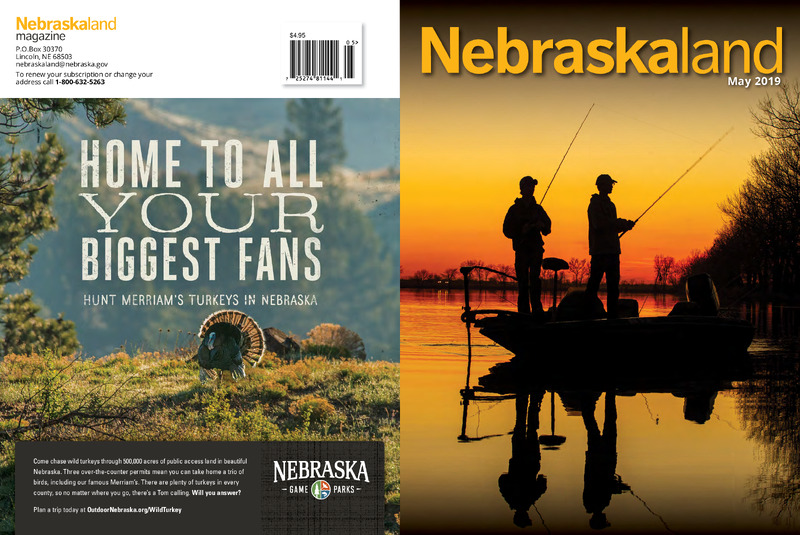
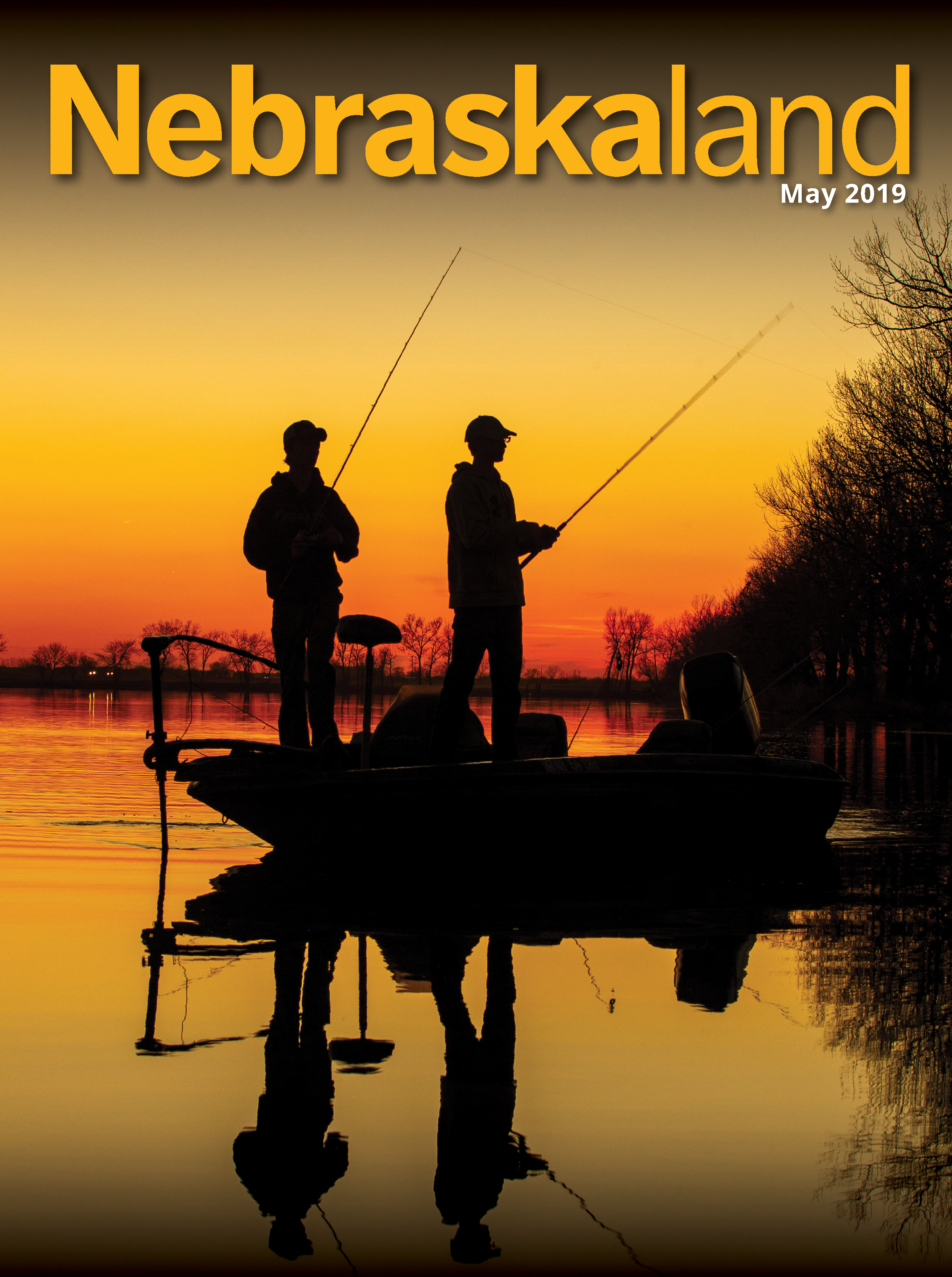
Cover: Two young anglers fish
near sunset at Birdwood Wildlife
Management Area near North Platte.
Photo by Julie Geiser
FEATURES
20
SADDLING UP OUT WEST
26
OUTDOOR NEBRASKA
28
OUTDOOR SENIORS
34
THAT’S WATER-CLOVER
36
RETIRING LURES
40
DO-IT-YOURSELF
DRIED ARRANGEMENTS
Story and Photos by Justin Haag
What to Do in May
By Renae Blum
Edited by Jeff Kurrus
not a lucky four-leaf clover
Story and Photos by Gerry Steinauer
By Ryan Sparks, Daryl Bauer, Jeff Kurrus, Jake Jadlowski,
Eric Fowler and Larry Kurrus
By Renae Blum
42
50 YEARS at the Cornhusker Trapshoot
46
A FARM BOY COMES
TO OMAHA, 1988
By Julie Geiser
By David L. Bristow, History Nebraska
DEPARTMENTS
6
10
48
60
62
Your Nebraska
In the Field
Mixed Bag
Portraits from the Past
The Last Stop
PHOTO BY JUSTIN HAAG
ON THE WEB
To see more content, including photos,
videos and additional articles, visit
Magazine.OutdoorNebraska.gov/digital.
Nebraskaland (VOL. 97 / NO. 4 ISSN 0028-1964) is published monthly, except for the combined Jan./Feb. and Aug./Sept. issues, by the Nebraska Game and Parks Commission, 2200 N. 33rd St.,
Lincoln, NE. Periodicals postage paid at Lincoln, Nebraska, and additional mailing offices. POSTMASTER: Send address changes to Nebraskaland, P.O. Box 30370, Lincoln, NE 68503-0370.
Magazine Staff
magazine
Communications Director Christy Firestone
Public Relations Manager Cara Pesek
Published by the Nebraska Game and Parks
Commission since 1926. The Commission is
dedicated to the conservation and protection
of all the state's natural resources and the
people who use them.
Editor Jeff Kurrus
Associate Editor Jenny Nguyen-Wheatley
Regional Editors Eric Fowler, Julie Geiser,
Justin Haag
Contributing Editor Michael Forsberg
Regular Contributors Renae Blum,
Chris Helzer, Ryan Sparks, Gerry Steinauer
Art Director Tim Reigert
Graphic Designer Mel Severin
Photo Librarian Jaclyn Cruikshank Vogt
Administration
Director Jim Douglas
Deputy Director Tim McCoy
Commissioners
Chairman - Robert Allen, Eustis
Vice Chairman - Dan Kreitman, Wahoo
2nd Vice Chairman - Pat Berggren, Broken Bow
Dick Bell, Omaha
Rick Brandt, Roca
Scott Cassels, Omaha
Jim Ernst, Columbus
Doug Zingula, Sidney
Norris Marshall, Kearney
Circulation Donna Robinson
For address changes and questions about your
subscription, e-mail donna.robinson@nebraska.
gov or call 800-632-5263
Advertising Sales Manager
For advertising information contact
Shane G. Gilster, 402-742-0125
Email: shanegilster@gmail.com
Nebraskaland Magazine Copyright 2019, all rights reserved.
Nebraskaland is available in audio from the Nebraska Library
Commission Talking Book and Braille Service, Suite 120, 1200 N St.,
Lincoln, NE 68508. 800-742-7691. Nebraskaland Magazine and the
Nebraska Game and Parks Commission reserve the right to reject any
advertising not in keeping with the agency mission.
Rates: $18 for one year; $33 for two years; $44 for three years. Nebraska
recipients must add appropriate sales tax. To subscribe call
1-800-NEBLAND (632-5263), or go online to:
NebraskalandMagazine.com.
Commission Offices
Conservation Officers
Headquarters/Southeast District Office
2200 N. 33rd Street Lincoln, NE 68503
Phone 402-471-0641
ADMINISTRATION (Lincoln)
Craig Stover (Administrator)
Duane Arp (Asst. Administrator)
Jeff Clauson (Asst. Administrator)
Northeast District Office
2201 N. 13th St. Norfolk, NE 68701
Phone 402-370-3374
Southwest District Office
301 E. State Farm Rd. North Platte, NE 69101
Phone 308-535-8025
Northwest District Office
East Hwy. 2, Box 725 Alliance, NE 69301
Phone 308-763-2940
Bassett Office
524 Panzer St., Box 508 Bassett, NE 68714
Phone 402-684-2921
Kearney Office
1617 First Ave. Kearney, NE 68847
Phone 308-865-5310
Ak-Sar-Ben Aquarium/Schramm Education
Center
21502 W. Highway 31 Gretna, NE 68028
Phone 402-332-3901
Omaha Office
8495 Frederick Street, Omaha, NE 68124
Phone 402-595-2144
OutdoorNebraska.org
Any program that receives federal funding from the National Park
Service, or the United States Fish and Wildlife Service prohibits
unlawful discrimination on the basis of race, color, religion, age, gender,
marital status, national origin, age, disability or political affiliation. Any
person who believes he or she has been discriminated against in
any program, activity, facility, or service, should contact the Nebraska
Game and Parks Commission, Lincoln, NE 402-471-0641, the Equal
Opportunity Commission, Lincoln, NE 402-471-2024, TTY/TDD 402471-4693; United States Fish Wildlife Service, Civil Rights Coordinator,
4401 N. Fairfax Drive, Arlington, VA 22203; Director, Equal Opportunity
Program, U.S. Department of Interior, National Park Service, 1849 C
Street NW, Mail Code 0008, Washington, D.C. 20240-0001.
4
Nebraskaland • May 2019
402-471-5531
402-471-5531
402-471-5531
NORTHWEST (Includes counties covered)
Jim Zimmerman (District Supt.)
308-641-6138
Kelsey Glodowski
(Box Butte, S 1/2 Sheridan, Grant)
308-763-8226
Sean McKeehan
(Kimball, Banner, Scotts Bluff)
308-672-1824
Dan Kling (Sioux, Dawes)
308-430-0572
Kyler Prochaska
(E 1/2 Dawes, N 1/2 Sheridan, W 1/2 Cherry)
308-430-3984
308-458-7650
Terry Brentzel (Deuel, Garden, Grant)
402-389-0444
Frank Miller (Cherry, Hooker)
NORTHEAST (Includes counties covered)
Tom Zimmer (District Supt.)
402-641-9590
402-760-0712
Dale Davis (Keya Paha, Brown, Rock)
402-340-3981
Jonathan Andreasen (Holt, Boyd)
402-719-6226
Kyle Gaston (Dodge, Colfax)
Greg Hesse
(Greeley, Wheeler, Boone, S 1/2 Antelope)
402-843-6567
Mitch Johnson (Knox, Antelope, Pierce)
402-613-8612
402-762-5022
Jeff Jones (Knox, Cedar)
Jon Reeves
(S 1/2 Thurston, Burt, Washington)
402-889-8508
Andrew Heyer (Pierce, Madison, Stanton) 402-613-2241
Cory Krause
(Cuming, Wayne, Stanton, Dodge)
402-380-6410
Steve Oberg
(Colfax, Platte, Madison, Stanton, Nance)
402-910-3366
Owen Johnson
(Dixon, Dakota, N 1/2 Thurston)
402-266-1759
Doug Pollard (Loup, Garfield, Valley)
308-730-7050
Ethan Teter
(Boating – eastern Nebraska)
402-620-8129
SOUTHWEST (Includes counties covered)
Roger Thompson (District Supt.)
308-530-3097
308-202-0819
Matt Brandt (Sherman, Howard)
308-380-7331
Tim Williams (Hall, Hamilton, Merrick)
Pat George
(Harlan, Franklin, Phelps)
308-920-2762
Matt Andrews
(Gosper, Furnas, Frontier, Red Willow)
308-746-2418
Brian Piernicky
(Red Willow, Frontier, Hayes, Hitchcock)
308-340-6627
John Lee (Hitchcock, Dundy, Chase, Hayes)
308-414-1432
Nicholas Fix (Keith, Perkins)
Bryce Streger (Keith, Arthur)
Sean Schultz (Keith)
Brandon O’Neal
(Lincoln, McPherson, Logan)
Alex Hasenauer
(Lincoln, McPherson, Logan)
Mike Thome (Dawson)
Ray Dierking (Custer, Thomas, Blaine)
Taylor Dixon
(Dawson, N 1/2 Gosper, N 1/2 Phelps)
Eric Javins
(Adams, Clay, Nuckolls, Webster)
Kevin Bergstrom
(Boating – central Nebraska)
Daryl Teter
(Boating – central Nebraska)
Scott Eveland
(Boating – western Nebraska)
308-289-0427
308-440-3847
308-760-0145
308-530-3157
308-660-4671
308-529-8146
308-870-0322
308-217-2108
402-902-2017
308-520-1031
308-440-1863
308-289-0017
SOUTHEAST (Includes counties covered)
Levi Krause (District Supt.)
402-949-0593
402-619-1355
Rich Berggren (Douglas)
402-616-5961
Dan Evasco (Sarpy)
402-210-0888
Heath Packett (Cass)
402-209-1506
Russell Mort (Otoe, Johnson)
William Krause
(Nemaha, Richardson, Pawnee)
402-274-8063
Matt Taylor (Thayer, Fillmore, Jefferson)
402-200-9597
402-806-0915
Matt Seitz (Gage, Saline)
402-890-6463
Dina Barta (Lancaster)
402-937-3422
Dudley Sorensen (Lancaster, York)
402-613-2312
Travis Shepler (Lancaster)
402-314-9641
Trevor Stahlecker (Lancaster)
402-890-7140
Stacey Lewton (Lancaster, Seward)
402-443-6392
Mike Luben (Saunders, Butler, Polk)
YOUR NEBRASKA
Instagram Photos
Follow us (@nebraskaland)
and tag us in your photos
to be featured in an
upcoming issue.
Kelly Cain, Lincoln
Hummingbird
Lacey Fiorelli, Broken Bow
Sunrise Fog
Andy Cronin, Valentine
Camper lights at Merritt Reservoir
May 2019 •
Nebraskaland
7
Allen Kurth, Bellevue
Prairie Chicken
Winner of the Nebraska
State Fair Wild and Scenic
Contest
Bruce Thiel, Lincoln
Autumn on the Big Blue River
Larry Wiehn, Lincoln
Mother Nature’s Artwork
Kelly Cain, Lincoln
Bullsnake at Holmes Lake
8
Nebraskaland • May 2019
Send your comments and photos to:
Jeff Kurrus, Editor
Nebraskaland Magazine
P.O. Box 30370
Lincoln, NE 68503
or email Jeff.Kurrus@Nebraska.gov
Please include your postal address
and telephone number. Letters may be
condensed and edited. Photographs are
also welcome.
May 2019 •
Nebraskaland
9
IN THE FIELD
SANDHILLS RANCH IN MAY
On a ranch in Grant County, towering
cumulonimbus clouds and a rainbow
are reflected in the waters of a shallow
Sandhills lake in early May. Fed by
rainwater above and from the vast
underground Ogallala Aquifer below, these
shallow lakes and wetland complexes
anchor the tremendous diversity of wildlife
found in the Nebraska Sandhills region.
PHOTO
PHOT
O BY MIC
MICHAEL
HA
FORSBER
SBER
E G
10
Nebraskaland • May 2019
May 2019 •
Nebraskaland
11
IN THE FIELD
SALT CREEK TIGER BEETLE. PHOTO BY ERIC FOWLER
THREATENED AND ENDANGERED:
THE SALT CREEK TIGER BEETLE
By Melissa J. Panella
Tiger beetles are a fascinating group of insects. They
may be small at only half an inch long, but they are fierce
predators. They are well equipped with large mandibles
and teeth to hunt their prey, which includes the larvae of
other insects. A larval tiger beetle will sit and wait anchored
underground in its burrow until it senses a potential food
item passing just over its head, then it quickly strikes in
anticipation of catching a meal. The adult tiger beetles will
instinctively pursue just about anything small enough.
Tiger beetles in Nebraska are colored in multiple hues of
red, orange, green, blue and other colors, some with metallic
sheen and bold white or cream markings. Several species
of tiger beetle are found in Nebraska’s saline wetlands – a
biologically unique landscape.
The Salt Creek tiger beetle (Cicindela nevadica lincolniana)
is native to Nebraska. It’s the only known place the species
can be found in the world, within a restricted radius around
Lincoln. Salt Creek tiger beetles are endangered because
the remnant salt marshes where they live are so limited,
and changes to the surrounding landscape result in their
habitat being lost. In some cases, the habitat available to
Salt Creek tiger beetles is only a thin stretch of open salt
flat where the adults can forage and where females can find
12
Nebraskaland • May 2019
adequate moisture and salinity to support their eggs. Tiger
beetles are susceptible to the effects of pollution, chemicals
and urban development. Because there are so few Salt Creek
tiger beetles in a relatively small area, a single localized
catastrophic event could cause their extinction.
Nebraska Game and Parks Commission partners with the
University of Nebraska-Lincoln Entomology Department
to monitor the population of Salt Creek tiger beetles. Each
summer, one or more surveyors brave steep terrain, extreme
heat, copious ticks and mosquitoes, holes and quicksand
that can unexpectedly swallow a biologist’s leg. The most
recent count from summer 2018 fortunately indicated no
net loss of Salt Creek tiger beetles from the year prior. The
next count will take place in May or June 2019, dependent
on weather conditions that influence when the adult tiger
beetles will be most active.
Many groups, including the Saline Wetlands Conservation
Partnership, Lower Platte South NRD, City of Lincoln, Omaha
Henry Doorly Zoo, Lincoln Children’s Zoo, Topeka Zoo,
volunteers and others, are involved in conserving Salt Creek
tiger beetles. The protection and restoration of wetlands, a
captive-rearing program, and recovery plans are keeping this
striking little rare beetle unique to Nebraska.
IN THE FIELD
PHOTO BY CHRIS HELZER
SUN SEDGE
By Chris Helzer
In many Nebraska prairies, the first colorful flower in the
spring isn’t a wildflower, it’s a tiny sedge. Sun sedge (Carex
heliophila) is one of the most common plants in Sandhills
prairies, as well as many other upland grasslands around the
state. However, because of its diminutive size, it blends into
its background well enough that someone walking through
those prairies would be excused for not noticing it at all.
When it blooms, though, its yellow flowers appear like tiny
lanterns against a backdrop of drab brown grasses.
Despite being small, sun sedge plants play an important
role in the ecology of grasslands, especially as a food source
during the dormant season. Most grasses enter dormancy
14
Nebraskaland • May 2019
by October and don’t green up again until at least April,
especially in the northern parts of Nebraska. Sun sedge, on
the other hand, can stay green well into the winter and starts
growing much earlier than grasses in the spring. Because of
that extended growing season, sun sedge provides live forage
to both livestock and wildlife during the colder months of the
year, nicely complementing the cured grasses those animals
otherwise rely on. It is joined by a few other small upland
sedge species, depending upon location, including needleleaf
sedge (C. eleocharis) and blackroot sedge (C. filifolia), both
of which occur in tighter clusters than the more scattered
plants of sun sedge.
IN THE FIELD
PHOTO BY PHIL SWANSON
THE AMERICAN REDSTART
By Joel G. Jorgensen
May is a special month for birds as countless individuals
representing dozens of species return from points south.
Among the arrivals are the warblers, which are small,
brightly colored and lively. Most warblers weigh less than
two quarters but travel immense distances from wintering
sites in Mexico, Central and South America to breeding
areas in temperate and boreal forests of North America.
Some 30 species may occur in Nebraska during the month
as migrants, but only a small number remain to breed during
summer.
The American redstart is a warbler that is both a statewide
migrant and breeder, but summering birds are restricted
to woodlands along the Missouri River, Niobrara River and
in the Pine Ridge. Adult males older than a year are black
with patches of orange on the tail, wings and side. Females
are similarly patterned but are olive and gray rather
than black and possess yellow patches rather than orange
ones.
Redstarts display their orange or yellow patches by fanning
16
Nebraskaland • May 2019
their tails and drooping their wings. Redstarts do this, in
part, to flush insects which they make short acrobatic flights
to capture. Unusual among songbirds is that one-year-old
male redstarts returning to breeding areas possess a plumage
similar to females. These youngsters will hold territories and
sometimes are able to find a mate and breed. All American
redstart males have loud musical, albeit slightly buzzy, songs
which they use to announce their presence to prospective
females and rival males.
Catching a glimpse of an American redstart, and most
other warbler species, requires patience as these birds
quickly move from branch to branch in the woodland canopy.
During May, birdwatchers often suffer from strained neck
muscles due to glaring into the treetops for long periods, an
affliction often referred to as “warbler-neck.” However, a
clear view of an American redstart or any other warbler is
worth the temporary discomfort.
Visit the Birds of Nebraska – Online (birdsofnebraska.org)
for more information about Nebraska birds.
May 2019 •
Nebraskaland
17
IN THE FIELD
PHOTO BY JEFF KURRUS
TAKE ‘EM FISHING
By Cara Pesek
The Nebraska Game and Parks Commission is excited to
announce a new summer-long, statewide challenge in which
anglers can win great prizes just by sharing their love of
fishing.
The Take ‘Em Fishing Challenge encourages experienced
anglers to take a pledge to go fishing with someone who either
has never fished before or who hasn’t fished in several years.
Anglers who take a photo of themselves taking someone
fishing can enter an online drawing for dozens of prizes
including a $500 Scheels gift card, fishing kayak, CampChef
outdoor cooking equipment, a stay in a Nebraska state park,
and the grand prize – a brand new Bass Tracker fishing boat.
“Every angler learned to fish from someone,” said Nebraska
Game and Parks Director Jim Douglas. “We hope this challenge
will inspire our experienced fishermen and fisherwomen to
remember those early trips that helped grow their love of
fishing, and to pass on the tradition to someone new.”
Douglas, who learned to fish from his parents, remembers
catching his first sunfish when he was 4 or 5 years old on
vacation with his family in Missouri. When he thinks back to
that first catch, he remembers the sense of anticipation he felt
then and still feels whenever he goes fishing, as well as the joy
the activity brings him.
“I don’t worry about other things when I’m fishing,” he said.
The benefits of fishing are numerous. Anglers report feeling
more satisfied with their mental health, more inspired at work
18
Nebraskaland • May 2019
and closer to their families than non-anglers, according to the
Recreational Boating and Fishing Foundation.
Fishing is an unusual sport in that it allows groups of
friends or family to spend time together while engaged in
the same activity, no matter the fitness or skill levels of the
various participants. Fishing requires only basic, inexpensive
equipment that can be found at any sporting goods store.
Nebraska Game and Parks stocks ponds and lakes across the
state with sportfish, which means that just about everyone
can find a good fishing spot close by.
Fishing is also crucial to the conservation of our natural
resources. Money generated through the sale of fishing
permits and aquatic habitat stamps is used to maintain
healthy fisheries in Nebraska water bodies, and to improve
access for anglers. But many anglers are getting older, and we
need a new generation of anglers to continue the tradition to
ensure the health and vitality of Nebraska’s aquatic resources
for generations to come.
The Take ‘Em Fishing Challenge will run April 15 to Sept.
15, 2019. Anglers can take the pledge at OutdoorNebraska.
org/FishingPledge. Taking the pledge is not required for
contest entry. For more information about Take ‘Em Fishing
Challenge, including prizes, official rules and how to enter,
visit Outdoornebraska.org/TakeEmFishing. For questions on
getting started in fishing or public places to fish, visit our
website or contact your nearest Game and Parks office.
May 2019 •
Nebraskaland
19
Saddling Up
Out West
American Paint Horse
Association members Ray
Tucker and Ken Graves are
at the head of this group
riding up the Red Cloud
Buttes at Fort Robinson
State Park.
For exploring the rugged and
spacious public lands of the
Panhandle, it is tough to beat
a mode of transportation that
has been around a while.
Story and Photos by Justin Haag
he Panhandle of western Nebraska’s rugged buttes,
sweeping grasslands, rolling hills and ponderosa pine
forests spur an urge of exploration for countless visitors
each year. For many a seasoned cowpoke on down to the
greenest of greenhorns, their most memorable experiences
while visiting this region have been atop a mode of
transportation that has been popular for thousands of years.
That would be the efficient, nimble, high-powered Equus
ferus caballus, better known to most as the horse.
Visitors to Fort Robinson State Park near Crawford soon
realize they are in horse country. A sign at the entrance of
the park’s headquarters evokes visions of the park’s history
as a 19th century U.S. Cavalry post: “Through These Portals
Passed the World’s Finest Horsemen.”
With Fort Robinson’s expansive 22,000 acres, horsemen
and horsewomen of all skill levels revel in a landscape fit for a
Western movie. Deb Kennedy, assistant park superintendent,
said the park offers something for riders of various skills.
“Riders don’t have to stay on the trail. However, for those
not-so-adventuresome people, we do have marked trails,”
Kennedy said. “They can ride leisurely on the prairie, quietly
along the river, or into the buttes for a little more challenging
ride with awesome scenery.”
Kennedy said horseback riding continues to gain
popularity at Fort Robinson, where weekly rodeos entertain
visitors. Annual gatherings of horse enthusiasts, such as
T
20
Nebraskaland • May 2019
May 2019 •
Nebraskaland
21
the American Paint Horse Association, have bolstered the
park’s reputation as first-rate riding ground. Ride the Ridge
is an event at the park each June that showcases Pine Ridge
scenery in a group setting and is open to all who bring a horse.
No special permission is required to ride at Fort Robinson,
but a few rules exist. To ensure park safety and cleanliness,
no riding is allowed near lodging or camping areas. Horses
privately owned are not allowed on the two trail ride routes
while park rides are in session. Overnight guests with horses
must rent a stall, but the barn’s location near the campground
and other lodging ensures that animals will be nearby.
Chadron State Park, a 36-mile drive to the east, also is
known for its scenic views from horseback. While the park
does not allow visitors to bring their horses, it does have a
stable full of trail horses for rent. At both Fort Robinson and
Chadron, wranglers lead trail rides with the parks’ horses
from early morning through mid-afternoon.
Another attractive park in the Panhandle butte country
that allows unguided horseback riding is Wildcat Hills State
Recreation Area south of Gering. Farther east in Oregon Trail
country is Ash Hollow State Historical Park near Lewellen,
where riding is allowed on the park’s property west of U.S.
Highway 26. Neither park has horses for rent, but people may
bring their own.
While some of the other state park areas in the region do
not allow horses, the dozen-plus wildlife management areas
in the region do. The established purpose of the WMAs is to
serve as wildlife habitat, so, no designated trails are marked
in most cases. Organized group rides are prohibited on the
properties but casual riders are welcome.
Hunting is encouraged on the WMA properties, so those
pursuing game have the opportunity to do it by horseback –
just as Native Americans, Cavalry soldiers of Fort Robinson
and Euro-American settlers did generations ago. Regardless
of whether or not horseback riders are looking to bring
home meat for the freezer, they are likely to catch sight of
charismatic wildlife. Riders in the parks farthest north and
west may see bighorn sheep, especially when riding the
ABOVE RIGHT: Riders cross Soldier Creek at Fort Robinson
State Park.
BOTTOM LEFT: Jhett Jelinek participates in the musical
chairs game at the Fort Robinson State Park rodeo. The
event, which features park employees and others from the
surrounding community, entertains visitors one night per
week.
BOTTOM RIGHT: Olivia Hunsperger, a wrangler at Chadron
State Park, tends to one of the trail ride horses. Hunsperger,
a Chadron State College student at the time of this photo,
was among the group of temporary workers who keep
things running at the parks.
22
Nebraskaland • May 2019
May 2019 •
Nebraskaland
23
picturesque WMAs in the Wildcat Hills, or ascending the
majestic Cheyenne and Red Cloud buttes at Fort Robinson.
If the Nebraska Game and Parks properties are not enough,
public lands managed by other agencies, such as the U.S.
Forest Service in the northern Panhandle and the Platte River
Basin Environments to the south, make riders’ opportunities
seemingly limitless and are certainly not to be overlooked.
The Pine Ridge Ranger District of the Nebraska National
Forest consists of 52,000 acres and a 6,600-acre National
Recreation Area.
The 7,794 acres of Soldier Creek Wilderness near Fort
Robinson State Park is another prime destination for
horseback riders. Not only does it provide the wild experience
many horseback riders seek, but it also has corrals at its
trailhead. Because equipment used for mechanical transport,
including bicycles and game carts, is prohibited at this
destination, horses regain popularity as vehicle of choice.
Even the Game and Parks’ fisheries biologists resort to horse
and mule while surveying the two trout streams that flow
through the property.
Other Forest Service access points that have special
amenities for horseback riders are the Outrider Trailhead
near Chadron State Park and the Roberts Tract Trailhead and
Campground south of Whitney. Each of these has corrals and
a mounting ramp, while Roberts has a modern vault toilet, a
hand water pump and picnic tables.
The expansive Oglala National Grassland which borders
South Dakota, also managed by the Forest Service, provides
a change-up of scenery and is equally captivating.
Contacting the agency headquarters for whatever land you
are visiting will help you plan your riding and answer any
questions about regulations and attractions. For instance,
riders should know that any feed brought into Forest Service
properties must be certified free of noxious weeds and weed
seeds.
Beyond that, visitors will be hard-pressed to find a better
dose of freedom on this rough terrain than that provided by
the four-legged animal that has been such an important part
of the region’s history. To experience the Panhandle at its
best, the finest seat may be a saddle.
ABOVE LEFT: A horse stands ready for the annual round-up
of longhorns at Fort Robinson State Park.
ABOVE RIGHT: Visitors enjoy a trail ride at Chadron State
Park in Dawes County.
BOTTOM LEFT: Outfitter Casey Cary of Powell, Wyoming, leads
a packhorse with survey equipment along the south fork
of Soldier Creek. The equipment was used by Commission
fisheries staff to survey the remote trout stream.
24
Nebraskaland • May 2019
Fisheries on Four Legs
Each year, state fisheries professionals take to Nebraska’s
lakes, rivers and streams to survey fish populations. Among the
most unusual of the efforts is one in the Pine Ridge.
Commission fisheries staff members Al Hanson and Joe
Rydell of Alliance in recent years recruited the help of mules
and horses owned by Commissioner Rick Brandt and Wyoming
backcountry outfitter Casey Carey in accessing the upper
reaches of the Soldier Creek Wilderness Area.
Because of its Wilderness Area designation, the property
allows no mechanized vehicles – not even trucks driven by
fisheries biologists, bicycles or game carts. Horses and mules
provide efficient transportation, though – and surely work well
for those carrying a fishing rod, too.
May 2019 •
Nebraskaland
25
Outdoor Nebraska
What To Do in May
By Renae Blum
It’s time to revel in all the outdoors has to offer, from
hunting wild turkey to awesome fishing and countless park
adventures. Here are a few more events and activities to keep
you busy.
View migrating
shorebirds
All month | Anywhere with proper
habitat
Free Fishing
and Park Entry
Day
PHOTO BY ERIC FOWLER
PHOTO BY JUSTIN HAAG
No permit, no problem. On
May 18, spend the day fishing
or exploring a Nebraska state
park, state recreation area or
state historical park without the
need to buy a permit. It’s a great
chance to visit a park you’ve never
been to or see if fishing is for you.
Spring Muster
May 4-5
Fort Hartsuff State
Historical Park
Family Fishing
Night
PHOTO BY JEFF KURRUS
May 18 | All Nebraska
state parks, state
recreation areas and
state historical parks
May is the peak of spring shorebird migration
in Nebraska. With proper habitat – shallow
water and mud – shorebirds will gather in the
Rainwater Basin and eastern saline wetlands,
reservoirs and other bodies of water. It’s great
birdwatching, as shorebirds will let you get
closer than other species. Just take it slow
and give birds a little bit of space.
Mother’s Day weekend at a
Nebraska state park
May 11-12 | Various locations
For this special holiday, spend time with Mom at a
Nebraska state park. Several parks will serve buffets
on Sunday, and Arbor Lodge State Historical Park will
offer live music, china painting demonstrations, special
displays and more throughout the weekend. Learn more at
Calendar.OutdoorNebraska.gov.
May 12, 4-6 p.m.
Riverside Discovery
Center “Zoo Pond,”
Scottsbluff
Schramm Education Center
Grand Opening
Finish spring turkey
season strong
May 18 | Schramm Education Center
PHOTO BY JUSTIN HAAG
To finish spring turkey season strong, adjust your
strategy. Take advantage of the extra cover, and
in the early mornings, target spots such as crop
field edges and shortgrass pastures. A single
decoy – or none – may work best. Also, “don’t
stick with a call they’re ignoring. If you hear a
gobbler consistently answering a real hen, try to
match her cadence and sound,” writes Game and
Parks’ Aaron Hershberger.
26
Nebraskaland • May 2019
PHOTO BY JEFF KURRUS
Late May | Throughout the state
Be one of the first to see Schramm’s new education center, no
park entry fee required. The center includes newly renovated
and expanded aquariums featuring Nebraska’s natural
aquatic habitats, a 2,200-gallon touch tank, 17 live animal
tanks, a virtual reality mountain biking experience and more.
Take a break to enjoy over five miles of amazing hiking trails.
May 2019 •
Nebraskaland
27
Outdoor
Seniors
I
n the March issue of Nebraskaland Magazine,
we shared the story of photographer Ryan
Baker from Imperial and the trend he had
observed regarding high school senior photos:
most seniors he photographs want “hunting”
photos. Especially the girls.
So we sent out a note to our readers to send
28
Nebraskaland • May 2019
RIGHT: Morgan Ekhoff
Aurora High School
Class of 2019
BELOW: Tim Taber
Doniphan-Trumball High School
Class of 2015
us these photos and received a large response
from across the state.
While we weren’t able to publish every
image that was sent, we can promise you this:
our state’s hunting and fishing heritage is
alive and well within the hearts and minds of
this next generation.
May 2019 •
Nebraskaland
29
RIGHT: Shayla Tibbets
Palmer High School
Class of 2015
OPPOSITE: Alex Smith
Ashland-Greenwood
High School
Class of 2019
RIGHT: Vanessa Smith
North Platte High School
Class of 2017
30
Nebraskaland • May 2019
May 2019 •
Nebraskaland
31
LEFT: Nathan Schulte
Gretna High School
Class of 2019
RIGHT: Hunter Kirby
Pius X High School
Class of 2019
LEFT: Trace Fulk
Mitchell High School
Class of 2016
RIGHT: Tinakea Thomas
Sterling Public Schools
Class of 2017
32
Nebraskaland • May 2019
RIGHT: Ashley Tagart
Northwest High School
Grand Island
Class of 2013
May 2019 •
Nebraskaland
33
That’s Water-clover
not a lucky four-leaf clover
E
By Gerry Steinauer, Botanist, Nebraska Game and Parks Commission
very now and then, I get a familiar call: “I found a huge
patch of four-leaf clovers in a wetland. What’s going
on?”
I respond: “Those are water-clover leaves, not those of the
lucky four-leaf clover. So cancel the trip to Vegas.”
Once, a perplexed biologist studying waterfowl food habits
in playa wetlands called: “I found this big, dark brown seed
in a duck’s crop and can’t figure out what plant it is from.” To
him I responded: “It’s not a seed, but the sporocarp of waterclover – a fern.”
“A what?”
“Allow me to explain.”
A Strange Fern
The little known water-clover (Marsilea vestita) grows in
shallow wetlands throughout much of the state, excluding
the Sandhills and far eastern counties. It is most abundant
in the Rainwater Basin playas of south-central Nebraska and
central Platte River Valley barrow pits.
A perennial, Marsilea spreads via shallow, creeping
rhizomes. These horizontal underground stems often form
dense colonies, which explains the “huge patch of four-leafclovers.” Its four-whorled leaves, known as fronds in ferns,
do resemble a rare four-leaf clover, an odd leaf arrangement
of a typically three-leaved legume. Therefore, I am never too
critical of those callers’ botanical skills – so much for those
confusing common names.
In early summer, the leaf stalks of submerged plants are
long, thin and flexible as they elongate to reach the water
surface. As wetlands dry in late summer, the plants become
terrestrial and the stalks grow shorter, thicker and upright.
The fronds become smaller and more firm than they were
earlier in the season.
Starchy tubers form along the rhizomes. These are an
overwinter food source and may tide plants over through dry
years. During the past 10 years, I had never observed waterclover in an old bison wallow in our South Dakota pasture
until last summer when high rainfall filled it. Then, lo and
behold, Marsilea packed the shallow basin. This large colony
could not have formed from spores in a single growing season.
34
Nebraskaland • May 2019
The plants must have revived from long-dormant tubers
and rhizomes when the life-giving water returned. What a
superb survival strategy for a wetland species inhabiting the
droughty Great Plains.
The Sporocarps
Ferns are primitive plants, first appearing in the fossil
record about 360 million years ago, nearly 200 million
years before the flowering plants. Unlike the latter, which
reproduce through flowers and seeds, ferns reproduce
through microscopic spores.
In most ferns, the spores form on the underside of fertile
fronds in clumped casings known as sporangia. In some
ferns, the sporangia are bunched atop stalks that rise from
the plant’s base. The Marsilea are unique among ferns in that
their spores form in small, bean-shaped structures known as
sporocarps.
Located on short, lateral stalks at the base of the plant,
the sporocarps are green, soft and hairy when young. In late
summer, now lying on the soil surface, they mature to dark
brown in color and are smooth, hard and durable. Sporocarps
taken from a 100-year-old herbarium specimen germinated
when placed in water.
Marsileas’ spore dispersal method is distinct. In nearly all
ferns, the sporangia open and the spores are wind-dispersed.
In the water-clovers, the intact sporocarp is moved about
by water, especially flooding, or by waterfowl, which can
transport them to isolated wetlands in upland landscapes,
such as playas or bison wallows.
Ducks and geese either intentionally or accidentally ingest
the sporocarps while feeding for seeds on wetland bottoms.
In their gut, the gizzard’s grinding action and digestive
acids and enzymes scarify the hard coat. Those sporocarps
that survive the digestive journey intact are defecated into
wetlands. Primed for water uptake, they rupture and release
spores.
Water-clover is a tough, wonderfully-adapted fern growing
in erratic Great Plains wetlands where no other fern could
survive. When I run across it in the field I always feel excited
– maybe even a bit lucky.
A late-summer bison wallow covered in water-clover.
Water-clover fronds.
Water-clover sporocarps and horizontal rhizomes.
May 2019 •
Nebraskaland
35
Retiring
Lures
Whether they be worn-out, abused, busted, or simply evoke fond
memories, some of your favorite fishing lures sit on a desk, a shelf, or a
fireplace mantle – a place of honor for retired lures.
Ryan Sparks
Who you are fishing with
is often more important
than what you catch.
From channel catfish
in the Platte River to panfishing
from a dock, some of my fondest memories
are of fishing with my grandfather, or as I call him, “Papa.”
By far Papa’s favorite fish is crappie. He’ll be the first to
tell you that his love of crappie has more to do with eating
than catching. When I was growing up we would fish until
we had enough to make a meal and then our entire family
would gather around a shaded picnic table – aunts, uncles,
cousins, grandparents and close friends – for a fish fry lunch
of scalloped potatoes, hush puppies, garden watermelon,
baked beans and, of course, fried crappie.
Later, I moved to Montana for graduate school and taught
myself to fly-fish. I’m not sure what Papa thinks of it. He’s
a faithful subscriber to the belief that live bait will always
outfish artificial lures, so the thought of using a hook lashed
with chicken feathers and deer hair doubtlessly seems
ridiculous. He’s probably right. However, during a spring
afternoon on a Cass County farm pond I showed him how
effective fly-fishing can be. I caught so many fish the fly
began to fall apart. Its black bucktail frayed, the copper mylar
mangled and the thread wore loose. It kept catching fish.
Eventually, we made calls announcing a fish fry the next
afternoon. I clipped the fly and slipped it in my pocket. The
next day as we sat down to eat I noticed Papa was hanging
36
Nebraskaland
• May 2019
back, letting me fry the fish and watching dishes being
carried to the table. He just leaned against the porch railing
and smiled. That’s when I realized why Papa really loves
crappie – they bring his family together.
Most flies have elaborate names like Royal Wulff, Gold
Ribbed Hare’s Ear or Lefty’s Deceiver. This home-tied fly
doesn’t have a name and it’s about as basic as they come: a
stout hook, lead eyes, some copper flash and a small clump
of bucktail. When I look at it I remember Papa smiling and
recollect that fishing is about much more than fish.
WalleyeChomped Red
Fin
Daryl Bauer
There are no magic
lures that catch fish all of
the time. Every lure or bait
ever made will catch fish when used
in the right place at the right time. They are all just tools, and
the trick is to use the right tool for the job.
With that philosophy, I do not retire lures for sentimental
reasons. If they are catching fish, I want to keep them in the
water. Sure, I have a bunch of them that have caught big fish,
or are special baits for special reasons. But the collection of
old, retired lures that hangs on a section of netting in my
basement is made of baits with busted lips, mangled bodies,
leaks, holes and other major failures. Far too many of them,
including some expensive muskie lures, ended up hanging
PHOTOS BY JEFF KURRUS
A Mangled Fly
on that net because a gust of wind caught a cast and they
crashed on the rocks.
However, there is one – actually all that is left is just the
front end of it – that has a good story behind it. That old silver
Red Fin found its way to retirement one evening on the windswept point of a Nebraska reservoir.
The wiper bite had been very good that evening. As
darkness approached, I had a hunch that a big walleye or
three would show up. I switched to a minnow-imitating
crankbait with good action. The old Red Fins have been a
favorite of mine in shallow-water situations.
It was not more than a cast or two, and I got a good “thunk”
as something ate the bait. Instinctively, I set the hook and
felt the weight of a good fish; big head shakes were indicative
of a nice walleye.
And then, there she was, gone.
Retrieving line, it felt like there was nothing left on the
end, and I suspected the bait had broken off. Then, skipping
across the waves in front of me came the remains of my Red
Fin – just the front few inches and the front treble hook. The
rest of the bait was completely gone, cleanly chomped off.
Must have been a really big walleye.
Oh sure, there must have been an unseen crack in the bait,
something that failed at just the wrong time. But, that lure
will forever be the crankbait that was chomped in half by a
walleye. That is a much better story.
My Kmart Collection
Jeff Kurrus
There is a collection of retired fishing lures on a piece of
driftwood in my office. Whether broken-lipped, failure to
float, or some other angling ailment, they have all been
designated to memory. But there is a set of them that are a
little different from the rest. They are the Kmart lures.
When I was a kid, Dad came home with a 3-pack of shallowrunning, bass-fishing crankbaits. They were crawfish, frog
and bass-colored imitations, and soon after debuted on a set
of farm ponds outside of Senatobia, Mississippi. After their
initial trip, where their square bills ran true, bounced off
underwater timber with rarely a tangle and caught bass at
a rapid pace, Dad went back to Kmart and bought more than
$200 worth.
For the last 30 years, we have continued to search for these
lures as our current supply dwindles. While Kmart only sold
them for a brief time, we have tracked down others at antique
shops, consignment stores and yard sales – sometimes
offering as little as 25 cents for a lure we deem priceless.
And their value is not just because of the fish we know
they’ll catch, or how we’ve never found crankbaits that run
better, but that they take us back to a time when dad and son
wanted to be better fishermen, and we had amazingly found
a set of lures that convinced us that would be could be just
that.
Fire Tiger
Jake Jadlowski
My favorite
place in the world is
Ottertail County, Minnesota.
My family still goes there every year on vacation. As kids, we
spent the mornings catching bluegills by the dozens. It’s the
place that taught me how to fish.
As I got a little bit older, the fun of fishing for bluegill
was replaced by an obsession with northern pike. I wanted
to catch a pike more than I’d ever wanted to do anything. In
my mind, it was a rite of passage. I couldn’t possibly consider
myself a legitimate fisherman until I caught one.
One summer, my dad bought me a box of Daredevil spoons.
And in the box was the Fire Tiger. I didn’t know anything
about it. I didn’t know if it was a good lure or not. All I knew
was that it was the coolest lure that I’d ever seen.
As a kid, I casted that thing thousands of times. I don’t
even think I caught many fish with it. But I know I caught
one. While everyone else was swimming, I grabbed my rod
and I went to the dock and I started casting. I casted that Fire
Tiger as far as my little body would let me toward the reeds
where I hoped a northern was lurking.
In reality, I didn’t think I would catch one, not off the dock.
But that didn’t matter, I loved casting and watching my Fire
Tiger shimmer through the crystal clear water. And then it
happened. I didn’t set the hook. I didn’t have to time think.
All I knew was that my Fire Tiger just got ambushed by
something huge. I’ll never forget the feeling. It wasn’t even
close to huge. It probably wasn’t even big enough to eat, but
I did it. I proved to myself that I could do it. My first northern
pike.
I’ve kept that Fire Tiger in my tackle bag ever since. Even
though I haven’t used it in years, that lure will forever be
immortalized in my mind. Every time I come across it, it takes
me back to my favorite place in the world, a simpler time, and
the journey of a little kid trying to prove to himself that he
was a real fisherman.
An Early
Retirement
Eric Fowler
I’ve had some
great days fishing in
the Sandhills, and this was
one of them. The northern
pike were hammering my
chrome and black Rat-L-Trap, and
I remember looking at the lure and thinking: “I have got
to get a photo of that thing with all those teeth marks on
it.”
38
Nebraskaland
• May 2019
Soon after, I grabbed my leader while landing another
pike and the fish somehow spun, unhooked the snap and
swam away with that lure in its mouth.
I tied the one you see here onto my line. It was the same
size and color, but it had lost a big chunk of chrome off one
side in the few run-ins it previously had with fish.
I don’t know if it was that or it was simply tuned slightly
different, but it would not catch fish. Neither would the only
other chrome and black lipless crankbait of another brand I
had in my box.
So this one is retired. I wish I could’ve retired the other.
Pike Like Tarpon
Larry Kurrus
I have an assortment of old and retired lures I can’t throw
away, and another one that needs to be added to the stillgrowing collection. It is a black and blue spinnerbait with a
red trailer hook.
In May of 2018, fishing partner Mike Groenewold and I took
a four-day trip to the Valentine National Wildlife Refuge. Two
of those days we fished Pelican Lake, where a renovation
project would soon begin in the fall to eradicate carp.
Both days we were immediately into fish. It seemed that
about every third or fourth cast, Mike or I had a fish on. We
caught a few bass, but the northern pike were on every grass
and reed mat we approached. The plan was simple: Throw
your black and blue spinnerbait as far as you could, start
reeling and hang on. The pike would do the rest.
Those two days were amazing. We caught more
than 100 fish. Better than 90 percent were northerns,
with some of them going airborne trying to shake the
spinnerbaits.
Now Pelican Lake has, in a way, been retired to a new life,
one that has the capabilities to produce two-pound bluegills.
My fly rod and I are surely game for that. My black and blue
spinnerbait now hangs from an old fish lamp on my desk
with its retired brethren, its red trailer hook silver from teeth
marks. It reminds me of older Pelican Lake and a time when
big pike would fly like tarpon.
May 2019 •
Nebraskaland
39
Do-It-Yourself Dried
Arrangements
By Renae Blum
Native flowers and plants aren’t just great gardening choices;
they also make stunning dried arrangements that are both fun
and easy to create.
Mary Jane Frogge, a horticulture expert with Nebraska
Extension, sat down with me to share the process. The following
are her words, edited for length and clarity.
– Renae Blum
The Process
It’s good to collect flowers when they’re at their peak of
bloom, so you have nice color. With grasses, the main thing is
to pick ones that aren’t over-mature, so they don’t fall apart
when you hang them.
Try to collect as long of a stem as possible. To cut, use
hand-held pruners, the sharper the better.
Now strip the leaves off with your hands or with gloves
and bundle the stems together. You want to bundle only
about eight to 10 stems to make sure they dry nicely.
Then tie them together. A rubber band seems to work the
best (and is easy to hang), but you can use twine if you like.
Once the plants are bundled, attach them to a hanger or
hook to dry. You want to make sure they hang straight, in an
out-of-the-way place so that you don’t bump them. Pick a
drier, warmer room out of direct sunlight. Depending on the
size, it’ll take six to eight weeks for the bundle to completely
dry.
You can make many types of arrangements with your dried
materials. I will describe how to make a swag arrangement
you can hang on a door or wall. First, take the dry plants,
lay them on a table and arrange them. Start with the dried
grasses and fill in with the flowers. Keep adding until you
have an arrangement you are happy with.
Cut the stems so they are all the same length, then bundle
tight. I like to use rubber bands because they hold better, but
you can also use wire. To hang your arrangement, you can
make a wire loop to hang from a hook or nail. You can add
ribbon, too, to finish it off.
Other Tips
•I
•
•
•
encourage you to grow native plants. It’s good for
pollinators and it’s good for you. Plant in groups with
blooming periods all throughout the spring, summer and
fall, and collect continuously throughout the year.
You don’t have to use flowers or grasses; you can also use
pods, nuts and even branches from a ponderosa pine.
Go to a florist’s shop or look online to get ideas for arranging.
There are so many options.
I would plan for the arrangements lasting about a year,
because they do tend to break apart eventually and lose
their color.
Final Thoughts
Why try this? Because it’s fun! It gets you outside – it gets
you out there looking at what plants you have and maybe
encourages you to plant more native plants. This would be
a great activity for kids, because they’re always collecting
things and bringing them inside.
Dried flower arrangements you make yourself are less
expensive, fresher and of better quality than store-bought
ones. There’s also a satisfaction that you collected them and
grew them from your own garden. I think that makes it more
personal.
These native
Th
ti plants
l t h
hang-dry
d well.
ll R
Read
d on tto find
out the best time for collecting.
June: Larkspur (Delphinium), yarrow (Achillea
millefolium), Queen Anne’s lace (Daucus carota).
July: Bee balm (Monarda), purple coneflower
(Echinacea), hoary vervain (Verbena stricta), gayfeather
40
Nebraskaland
• May 2019
(Liatris), lead plant (Amorpha canescens).
August: Pitcher sage (Salvia azurea), purple lovegrass
(Eragrostis pectinacea), sideoats grama (Bouteloua
curtipendula), little bluestem (Schizachyrium scoparium).
September: Goldenrod (Solidago), prairie dropseed
(Sporobolus heterolepis), big bluestem (Andropogon
gerardi), Indian grass (Sorghastrum nutans).
PHOTO BY DAWN DOWNEY
What Plants to Use
May 2019 •
Nebraskaland
41
50
Years
at the Cornhusker
Trapshoot
ay 2-4 is the 50th year
for
the
prestigious
Cornhusker Trapshoot,
one of the nation’s largest
youth trap shooting tournaments.
Around 2,500 high school and junior
high competitors from Nebraska and
across the nation along with their
family, friends and coaches will visit the
Nebraska Trapshooting Association’s
home grounds in Doniphan, bursting
the small town’s population of about
850 to almost 10,000.
The trapshoot began in 1970 as a duel
between Northeast Community College
and Chadron State College, which was
organized by Dave Wells of Norfolk and
Jim Carlisle of Chadron. In 1971 nine
colleges participated in the shoot.
Expanding in numbers over the
decades, today the tournament
consists of high school and junior
high divisions covering a three-day
event where schools, 4-H teams and
individuals shoot for top places, and
the all-around top high school shooter
M
receives the coveted Cornhusker Cup
award. “I can remember when I started
overseeing the tournament, we didn’t
use all the trap houses. Now almost
every squad and trap is full,” said Terry
Brentzel, conservation officer for the
Commission and tournament director.
This event has grown into one that has
made memories and lasting friendships
over the years. The camaraderie and
safety record displayed by these youth is
exemplary, and the sportsmanship they
exhibit is to be commended. “There are
lots of great stories from the trap shoot;
one special moment I have was when
I gave Maddie Spellman of Aurora her
medal. She was struggling with cancer
and shot from her wheelchair in 2016;
she passed away shortly after that,”
Brentzel stated.
The Nebraska Game and Parks
Commission along with the Nebraska
Trapshooting Association sponsor the
premier event and several directors
ensure the American Trap Association
rules of shooting are followed.
PHOTO BY BOB GRIER
By Julie Geiser
BELOW LEFT: Hall County. 2015
Cornhusker Trapshoot. Photo taken
during Saturday’s competition.
PHOTO BY JULIE GEISER
PHOTO BY JULIE GEISER
ABOVE RIGHT: 38th Annual Cornhusker
High School and Junior High School
Trapshoot, held May 3-5, 2007, at
Doniphan, Nebraska.
BELOW RIGHT: Shooter at 2016
Cornhusker Trapshoot.
42
Nebraskaland
• May 2019
May 2019 •
Nebraskaland
43
PHOTO BY DOUG CARROLL
PHOTO BY DOUG CARROLL
ABOVE LEFT: 38th Annual
Cornhusker High School and Junior
High School Trapshoot, held May
3-5, 2007, at Doniphan.
BELOW LEFT: 41st Annual
Cornhusker High School and Junior
High School Trapshoot, held April
29-May 1, 2010.
ABOVE RIGHT: 42nd Annual
Cornhusker High School and Junior
High School Trapshoot, held April
28-30, 2011.
PHOTO BY DOUG CARROLL
44
Nebraskaland
• May 2019
NGPC ARCHIVES
BELOW RIGHT: May 1977 Doniphan
Cornhusker Invitational Cup Winner
J. Hoppes.
May 2019 •
Nebraskaland
45
A Farm Boy Comes to Omaha, 1888
guess there
h
ain’t
i ’ any end
d to O
Omaha,”
h ” wrote 17
17-year-old
ld
Frisby Rasp in a letter to his parents in 1888. “You can
walk till you are tired out in any direction you choose,
and the houses are as thick as ever …”
Rasp grew up on his parents’ farm in southwest Polk
County, Nebraska, the oldest of six children. Now he enrolled
in the Omaha Business College at 16th and Capitol streets.
He paid $40 for tuition, and one of his teachers helped him
find a boarding house. For the first time in his life, he was on
his own in a big city.
“Big city” is relative. That year’s Omaha City Directory
claimed a population of 125,000, a huge (and probably
“I
exaggerated)
d) jjump over the
h 30,000
30 000 counted
d iin the
h 1880
census.
But it seemed big enough to Frisby. Even the post office on
the northeast corner of 15th and Capitol was enormous, “a
large three story stone [building]. It covers half a block. They
receive over a carload of mail every day.”
He was writing on May 6, one day after he arrived. In his
May 7 letter he reminded his family that “I haven’t got any
letters yet,” but hoped there would be one waiting for him
at the big post office. He admitted he’d been “feeling pretty
lonely.” Two days later he complained, “I haven’t heard from
you yet; you must be dead. I ain’t a going to mail this until I
Looking east along Farnam Street, Omaha, 1889. History Nebraska RG2341-28
46
Nebraskaland
• May 2019
By David L. Bristow,
History Nebraska
d hear.”
do
h
” Two
T
more long
l
days
d
passed
d before
b f
he
h received
i d hi
his
llooked
k d in
i one …”
long-awaited letters from home.
“This is an awful wicked town,” he noted several days
Rasp’s own letters over the next few months show us
later. “The saloons run on sunday [sic] and most all work
something that historic photographs don’t capture: how
goes right on.” A “bad house” operated next door to the
1880s Omaha looked, sounded and smelled to a rural
college, and another brothel stood on the corner across from
Nebraskan of the time. Rasp’s portrait is vivid, though not
his boarding house. Even local newspapers, he wrote, claimed
always flattering.
that if you shut down all the saloons, brothels, and tobacco
“Every thing here is coal smoke and dirt and people,” he
shops, half of Omaha’s businesses would be gone.
wrote soon after his arrival.
Even so, when Rasp toured the county jail he seemed
“It is dusty just as soon as it
disappointed
to
report
quits raining,” he added later,
that “there was nobody in
“and the dust here is the worst
yesterday.”
dust I ever saw. It is all stone
Rasp was an ardent
and manure. Streets that ain’t
tourist of local institutions.
paved, 2 feet deep of mud.”
He marveled at the steam
Omaha was just beginning
printing press at the Omaha
to pave its main streets. Rasp
Republican
(“the
fastest
marveled at the “great steam
printing I ever saw”),
roller” working in front of the
witnessed “1000 carloads of
college. But he soon tired of all
lead and the biggest engine
the noise.
I ever saw” at the lead
“I am getting so I hate to
smelting plant, toured the
hear an engine,” he wrote
city’s electrical power plant
on May 9. There must be at
(another “largest engine I
least 50 at work beside[s] the
ever saw,” powering lights
factories, and they never stop,
that are “40 times as good as
night or day. It is puff-puffgas”), and rode the elevator
puff-puff-toot-toot-toot-brawin a six-story hotel (“it is a
Omaha’s
post
offi
ce
in
1888.
History
Nebraska
RG2341-0-247
braw-braw-puff-puff-puffbeauty”).
puff.”
For all his complaining he
He was overwhelmed by the crowds and anonymity. “I
seemed to be enjoying himself. He just didn’t want to stay.
have seen more people since I came here than every person I
“I wouldn’t live in the City always for anything,” he wrote.
ever saw before I came and with a few exceptions I never see
“Get an education there and a good start in life and then let
the same person twice …” The nationwide bicycle craze was
me have a farm.”
underway and Rasp saw so many that “I am sick a looking at
Which is pretty much what he did. After graduation he
them.”
worked as a bookkeeper in Omaha for two years and later
Omaha was filthy by a country boy’s standards. On May
served as a business college instructor in York and a pastor in
16 he promised to come home on a visit “and quit breathing
Wayland, but spent most of his life on a farm near Gresham.
smoke and drinking filth.” A few days later he added that
He and his wife, Mattie, raised seven children on the farm,
“the water is full of sewerage. I haven’t drank a drop of water
and Rasp died there in 1948. His daughter Naomi Rasp
for a week. I don’t drink anything but coffee. The coffee hides
Frederickson donated his letters to History Nebraska; edited
the filth …”
and introduced by Sherrill Daniels, they were first published
The Rasp family was deeply religious, and Frisby was
in Nebraska History Magazine in 1990.
shocked by Omaha’s vice. “Every other store is a saloon,” he
wrote before adding a quick reassurance: “but I never even
Visit History Nebraska’s website at history.nebraska.gov
May 2019 •
Nebraskaland
47
MIXED BAG
PHOTO COURTESY OF THE NEBRASKA TOURISM COMMISSION
VISIT THE NORTHWEST
By Josie Meister, Nebraska Tourism Commission
Start your summer by exploring the northwestern corner
of Nebraska, where scenic beauty and Old West history
await. With activities such as hiking, biking and horseback
riding, this is a nature lover’s dream destination.
Visit Fort Robinson, the largest state park in Nebraska
and a former active military post. Enjoy the beauty of the
surrounding buttes by horse-drawn wagon, horseback riding
or in an open-top Jeep. History buffs will find the fort’s many
museums and restored and reconstructed exhibit buildings
fascinating.
Just 30 minutes east of the fort, Chadron State Park
is Nebraska’s oldest state park. Located in the heart of the
Nebraska National Forest, hike alongside breathtaking scenery.
Then wet your fishing line at Box Butte Reservoir, which
features a 1,600-acre lake and 612 acres of wilderness to
roam when you’re finished on the water.
For a view of the Nebraska horizon, visit Oglala National
Grassland, the location of the Hudson-Meng Bison Bonebed
and unusual rock formations at Toadstool Geologic Park.
History lovers will also enjoy Agate Fossil Beds, where
mammals roamed 19 million years ago. High Plains
Homestead is a living tribute to the Old West, featuring
log buildings, roaming bison, Native American history and
48
Nebraskaland • May 2019
pottery. Then head to Belmont Tunnel, Nebraska’s only rail
tunnel that spans 698 feet; the last train passed through May
3, 1982.
Hungry? Start your day at Bean Broker in Chadron for a
specialty coffee or sweet treat and stick around for lunch
to try their daily specials, featuring locally grown herbs
and produce. If you’re craving barbecue, try Dairy Sweet in
Crawford for Texas-style smoked barbecue or Wild’s Bar and
Grill for a fresh cut, locally-raised ribeye. Don’t forget dessert!
Stop by Staab’s Drive-In for a cold treat on those hot summer
days.
Plan your trip around northwestern Nebraska’s July
events. Enjoy live music, food and drinks at Chadron’s
Bands on Bordeaux summer concert series every Thursday
of the month. Other events include Crawford’s 4th of July
Celebration July 3-4 and Fur Trade Days in Chadron July
10-14.
Find unique accommodations at Sheepwagon Hideouts
at RuJoDen Ranch or check out one of the region’s many
campgrounds. Chadron has several hotel options.
Whether you are looking for recreational activities,
beautiful scenery, or a taste of the Wild West, your first visit
to northwestern Nebraska won’t be the last one.
May 2019 •
Nebraskaland
49
MIXED BAG
THE RV LADY
By Katie Larsen
If you’ve ever contacted the Reservation Call Center for
Nebraska State Parks, you know who CJ Zajicek is. She’s
the one who’s always nice to you – the one whose positive,
personable attitude and interest in you makes you feel like
you were her only phone call of the day – just the way great
customer service should be.
CJ has been working for the call center since it opened
in 2004, taking calls for the 26 Nebraska state parks and
recreation areas that accept advance reservations. She hears
from people all over the United States and sometimes from
other countries.
Though reservations can be made online, CJ still receives
plenty of calls – and for good reason. Parks Director Jim
Swenson said, because of CJ’s care and compassion, “People
want to talk to her, and know that she’s a person who can
help. And we as an agency can rest assured that those
customers are in good hands with her.”
CJ has several thank-you emails from campers printed
out and hung up by her desk, alongside pictures of her
grandchildren. One such email thanks her for “going above
and beyond the call of duty” while another comments that
she makes customers feel like they are “her No. 1 concern.”
She appreciates the campers as much as they appreciate
her. When asked what she likes the most about her job, CJ’s
answer was immediate. “The people. And being able to help
them – they’re so grateful.”
For more information on camping in Nebraska state parks,
including how to make a reservation, call CJ at 402-471-1414
or visit nebraskastateparks.reserveamerica.com.
PHOTOS BY JEFF KURRUS
50
Nebraskaland • May 2019
May 2019 •
Nebraskaland
51
MIXED BAG
JOHNSON LAKE TRAILS
Each year the Fort Kearny Expo brings together people of
all ages and outdoor experience levels to learn about fishing,
animals of Nebraska, Dutch oven cooking, shooting sports,
archery, kayaking and more. Hands-on activities allow for
that first spark of excitement; visitors can see and touch
what they’re learning. Live turtles, fish and other wildlife are
often featured.
The Fort Kearny Expo takes place Saturday, May 11, from
9 a.m. to 4 p.m. at the Fort Kearny State Recreation Area,
just south of Kearney. The expo is free to all visitors, made
possible by generous sponsors. Only a park permit is required
for vehicles to enter the SRA.
Special guest Sam Larson of Lincoln is a wilderness
instructor, author, and speaker. Last year he won History
Channel’s survival reality TV challenge Alone. Larson
will talk about the show, along with survival skills such
as primitive fire starting, knife skills and the edible and
medicinal plants of Nebraska.
“Outdoor education is education in its oldest and purest
form. I’ll be bringing skills to the expo that help people to be
better informed and be able to enjoy nature more,” Larson
said.
For more information about the event along with a full list
of activities, visit the Nebraska Game and Parks web page at
OutdoorNebraska.gov/fortkearnyoutdoorexpo.
Since water filled Johnson Lake in 1941, its 900 cabins
have been popular among fishermen, boaters, campers, and
family gatherings. Over the years, biking groups formed to
ride the 10-mile loop on shared public roads.
About 25 years ago, a couple’s group called the “South Side
Riders” included Larry Roper, superintendent of the lake’s
state recreation area. He and fellow riders held a common
vision for a dedicated concrete hiking and biking trail that
would stretch all around the lake.
Roper became a moving force for the construction of the
first 1.1-mile segment in the park, costing $370,000 and
paid by Federal Highway Funds administered through the
Nebraska Game and Parks Commission. It was dedicated in
July of 2005 in his memory.
The vision lay dormant for several years until a bike and
vehicle collision. Public concern for hiking and biking safety
rose, which prompted Johnson Lake Development, Inc. – the local
cabin owners’ association – to form the Hike Bike Leadership
Team to plan, raise funds and construct new trail segments.
Central Nebraska Public Power and Irrigation District
became an integral partner, since most of the trail would lie
By Julie Geiser
PHOTO COURTESY OF CHUCK OLSEN
FORT KEARNY EXPO
By Chuck Olsen, Paid Advertisement
on its property. Over the last 10 years, plans were made and
funds were raised for the construction, segment by segment.
To date, 8.5 miles of the 8-foot by 6-inch concrete trail has
been constructed, with only half a mile remaining.
The last mile, a narrow dam road, will remain a shared
road between bikes and vehicles. So far the trails team has
raised $1.2 million in donations and the Central Nebraska
Public Power and Irrigation District has contributed
$500,000 in support, in addition to preparing the trail beds
and constructing the canal bridge crossing.
As neighborhood associations joined the cause, they have
added 21 landscaped rest areas, adding a park-like atmosphere
with benches, trees, gazebos and arches. Johnson Lake Trails
is becoming one of the state’s premier biking destinations,
easily reached within a half day’s drive. One recent trail
event brought in participants from 27 different counties. And
the numbers are increasing!
PHOTOS BY JULIE GEISER
52
Nebraskaland • May 2019
May 2019 •
Nebraskaland
53
MIXED BAG
EXPLORE ARCHERY
GREAT PARK PURSUIT
Explore Archery is a program for kids ages 8 and up who
are interested in learning archery basics. Classes are offered
through the Nebraska Outdoor Education Center in Lincoln.
The next 8-week session begins April 4.
“The special thing about this program is that it is designed
to focus on the fundamentals rather than the target score,”
said Facility Manager Heather Weihe. “We do candy shoots,
treasure shoots, mystery shoots, and other games to focus on
developing proper fundamentals.”
This March, I visited an Explore Archery class and
participated as an adult new to the sport. There were also
five kids in this class, spanning ages 8 to 12.
The class began with safety rules, including whistle signals
for the range, and basic instructions on stance and shooting
technique. Then we each received a bow and three arrows, and
I was silently relieved to see several parents step forward to
pick up bows of their own. Suddenly I didn’t feel quite so alone.
It’s a humbling experience to learn a new skill as an adult
amidst a group of children. After my first arrow fell short of
Nebraska’s park system is filled with beautiful gems that
are great places to spend a relaxing day or weekend. Let us
introduce you to a few of them (and hand out some prizes in
the process) with the 2019 Great Park Pursuit.
Here’s how it works: Sign up your team at negpp.org and
start picking sites to visit from the official list. Once there,
you’ll follow clues to a post hidden somewhere on the
property and submit proof you were there to be entered into a
drawing for outdoor prizes. Past prizes have included an iPad,
free cabin stays, Nebraskaland Magazine subscriptions and
calendars, gift cards, and outdoor recreation packages worth
up to $1,500. The more parks you visit, the better your odds.
Taking part in the pursuit is even easier this year with the
addition of an app that makes logging in your site visits fast
and easy. No need to bring along the crayons and a rubbing
sheet, unless you like the traditional rubbing method. The
app can be found on both iOS and Android.
Since 2008, more than 22,000 Nebraskans have enjoyed
the adventure the Great Park Pursuit offers. The goal of
the pursuit, a partnership between the Nebraska Game
and Parks Commission and the Nebraska Recreation and
Park Association, is to get people active, enjoying the
outdoors, and learning more about Nebraska’s great outdoor
recreation opportunities. It’s free to sign up and participate
in the program – the only cost involved is mailing in your
impressions, if you choose not to use the app; and paying for
entry into some park sites.
By Katie Larsen
By Renae Blum
PHOTOS BY JEFF KURRUS
54
Nebraskaland • May 2019
PHOTO COURTESY OF JANE GUSTAFSON
the target, I found myself watching the 8-year-old boy next
to me to learn from what he was doing. The instructor made
corrections to my stance and had to remind me more than
once to draw the bowstring all the way back to the corner
of my mouth. With his help, after that first failed arrow, I
managed to at least hit the target every time – though the kid
next to me still had better aim.
If you can’t make it to this session, watch for others
beginning this July and January 2020. Sign up through
apm.activecommunities.com/ngpc.
May 2019 •
Nebraskaland
55
MIXED BAG
56
Nebraskaland • May 2019
May 2019 •
Nebraskaland
57
MIXED BAG
INVASIVE SPECIES THREATEN NEBRASKA
By Julie Van Meter, State Entomologist, Nebraska
Department of Agriculture
UNIVERSITY OF ARKANSAS FOREST ENTOMOLOGY LAB, UNIVERSITY OF
ARKANSAS, BUGWOOD.ORG
KENNETH E. GIBSON, USDA FOREST SERVICE, BUGWOOD.ORG
Invasive species are a serious threat to Nebraska, with
the potential to cause millions of dollars in damage to the
state’s agricultural and natural resources. The Nebraska
Department of Agriculture Entomology Program annually
conducts surveys to monitor for the introduction of invasive
plant pests. Early detection of these pests is vital to either
successfully eradicate or limit the spread.
The Department of Agriculture coordinates with the
Nebraska Game and Parks Commission to monitor for
invasive insects at state parks and recreation areas, which
are considered high risk for invasive pest introductions. Most
insect traps are in place by late May and remain in place until
October.
A large purple prism trap in the canopy of an ash tree is
part of the department’s survey for emerald ash borer. The
larvae of this insect is easily transported in firewood, making
Each of these traps is part of an early detection program to
protect our state from invasive species. While the traps may
cause a few second looks, they pose no danger to people.
For more information on the plan pest survey program, visit
the Department of Agriculture’s website at nda.nebraska.
gov/plant/entomology/pest_survey/index.html.
58
Nebraskaland • May 2019
KARLA SALP, WASHINGTON STATE DEPARTMENT OF AGRICULTURE, BUGWOOD.ORG
campgrounds a likely spot for the introduction of this pest.
Another large trap that can be found in parks around the
state is the black cross vein panel trap. This trap is roughly
three feet in height, and hung from a heavy metal pole near
hardwood trees. The target of this trap is the velvet longhorn
beetle, an invasive beetle found in South Dakota in 2018.
Lindgren funnel traps have four to eight black funnels
arranged in an accordion style, with a collection cup at the
bottom. The trap’s appearance mimics a tree trunk. Each trap
is baited with a lure to attract either the walnut twig beetle
or oak ambrosia beetle.
A small, triangular trap tucked into hardwood foliage is
likely a Gypsy moth trap. This delta trap is baited with a
pheromone lure to attract male gypsy moths. More than 500
of these traps will be set statewide.
May 2019 •
Nebraskaland
59
PORTRAITS FROM THE PAST
From left, my dad, Tom Eads; Bob Grier, former
Nebraskaland Magazine regional editor; Barry
Carlson; and Ozzie Randall in 1974. Bob and Barry
went rattlesnake hunting with my dad and neighbor
Ozzie. The article was in the August 1976 magazine
titled “The Viper’s Den.” My dad passed away five
years ago, and I have such memories of him and me
going snake hunting. In fact, I still live where this
photo was taken, and I still hunt with my kids.
– Brenda Eads Fulk, Whitney
This photo was taken in 1918 on the family homestead near Inavale in Webster
County. Pictured, at right, is my grandpa Cooper (Richard I.). On the left is my
great-grandpa Cooper (Allen A.). The story goes that they shot both coyotes with
the same shell. This would be my father’s dad and grandpa. My father is Richard A.
Cooper and he is 88 years old.
Also on the Cooper homestead was a sod house where my father was born. My
dad and aunts used to talk about snakes and other creatures that would try to go
through the outside wall to get inside. My aunt Mable told me she would kill the
snakes with a hoe as they were crawling through the wall.
– Marla Cooper Wademan, Crete
I ran across the
attached photo of my
little brother Steve,
right, and me with
a pair of carp. The
photo is from 1967.
While it looks like we
hooked the carp, our
dad, Tony, shot them
while bowfishing.
Next to fishing, we
liked Batman most!
– Don Blankenau,
Lincoln
Send contributions to: Portraits from the Past, Nebraskaland Magazine, P.O. Box 30370, Lincoln, NE 68503-0370. Or e-mail to Tim.Reigert@Nebraska.gov. Photos
should show people enjoying Nebraska outdoor activities, such as camping, boating, hunting or fishing, and must have been taken before 1980. We will give priority
to unusual photos or activities. When possible, please include a story about the photograph and identify the people, places and approximate date it was taken. Text
may be edited and photos adjusted for reproduction. All photos will be returned.
60
Nebraskaland • May 2019
May 2019 •
Nebraskaland
61
THE LAST STOP
IN A HURRY
By Jeff Kurrus
Sometimes I get in a hurry, especially when the fish are
biting.
Last May, while fishing near West Point, my fishing
partner and I were catching as many bass as we wanted on
any number of lures. Crankbaits, spinnerbaits, topwater – it
didn’t matter. The fish were there for the taking. And with
little wind and steady weather, they remained active all day.
Yet that still didn’t stop me from almost ignoring this
wooden relic, rotting away in a patch of weeds by the lake.
I took a couple of photos, yes, but didn’t do my job as a
photographer. I didn’t step closer to investigate. Perhaps I
would have found the old, cracked plastic from a red and
62
Nebraskaland • May 2019
white bobber or even treble hook scratches from one of the
wooden platforms.
Maybe I would have seen the initials of some kid who
carved his name in that same wood when the fishing was
slow, or the long faded measurement sticker on the hull of
the boat.
Perhaps the owners didn’t fish in it at all.
However, I will never know, for I paused long enough to
make two images before sprinting back to my john boat.
Because I definitely do fish – much like I hope the owners
of this boat did as well – and the fish were calling me back
to the water.
May 2019 •
Nebraskaland
63
Position: 66 (123 views)