Volume 97, Issue 2, 2019
March 2019
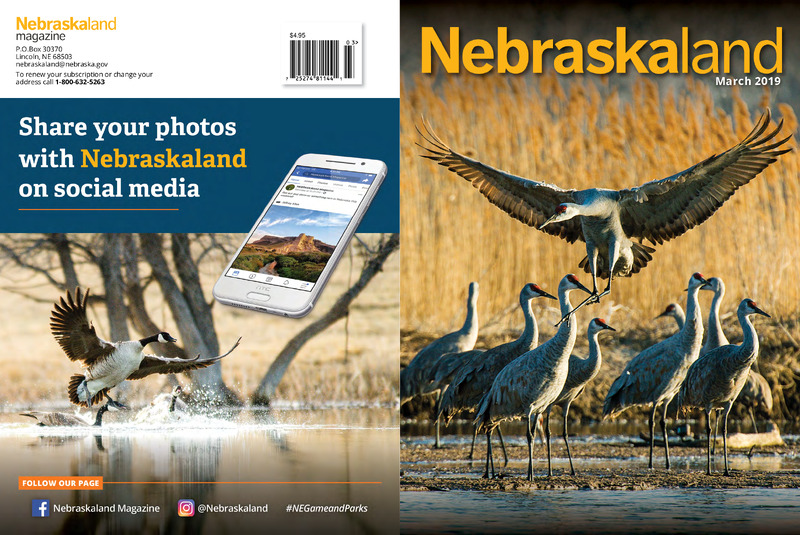
- Identifier:
- nela.2019_097_02
- Title:
- Volume 97, Issue 2, 2019
- Issue Name:
- March 2019
- Date Issued:
- 2019-03-01
- year:
- 2019
- month:
- March
- Season:
- Winter
- PDF filename:
- NL_97.02_2019_Mar_Spreads_Entire.pdf
- Publisher:
- Nebraska Game and Parks Commission
- Format:
- Periodical
- volume:
- 097
- issue:
- 02
- number:
- 097.02
- Decade:
- 2010s
- Type:
- Rights Holder:
- Copyright Nebraskaland Magazine/Nebraska Game and Parks Commission, all rights reserved.
- Extracted Text:
-
magazine
P.O.Box 30370
Lincoln, NE 68503
nebraskaland@nebraska.gov
To renew your subscription or change your
address call 1-800-632-5263
$4.95
March 2019
Volume 97 No. 2
March 2019
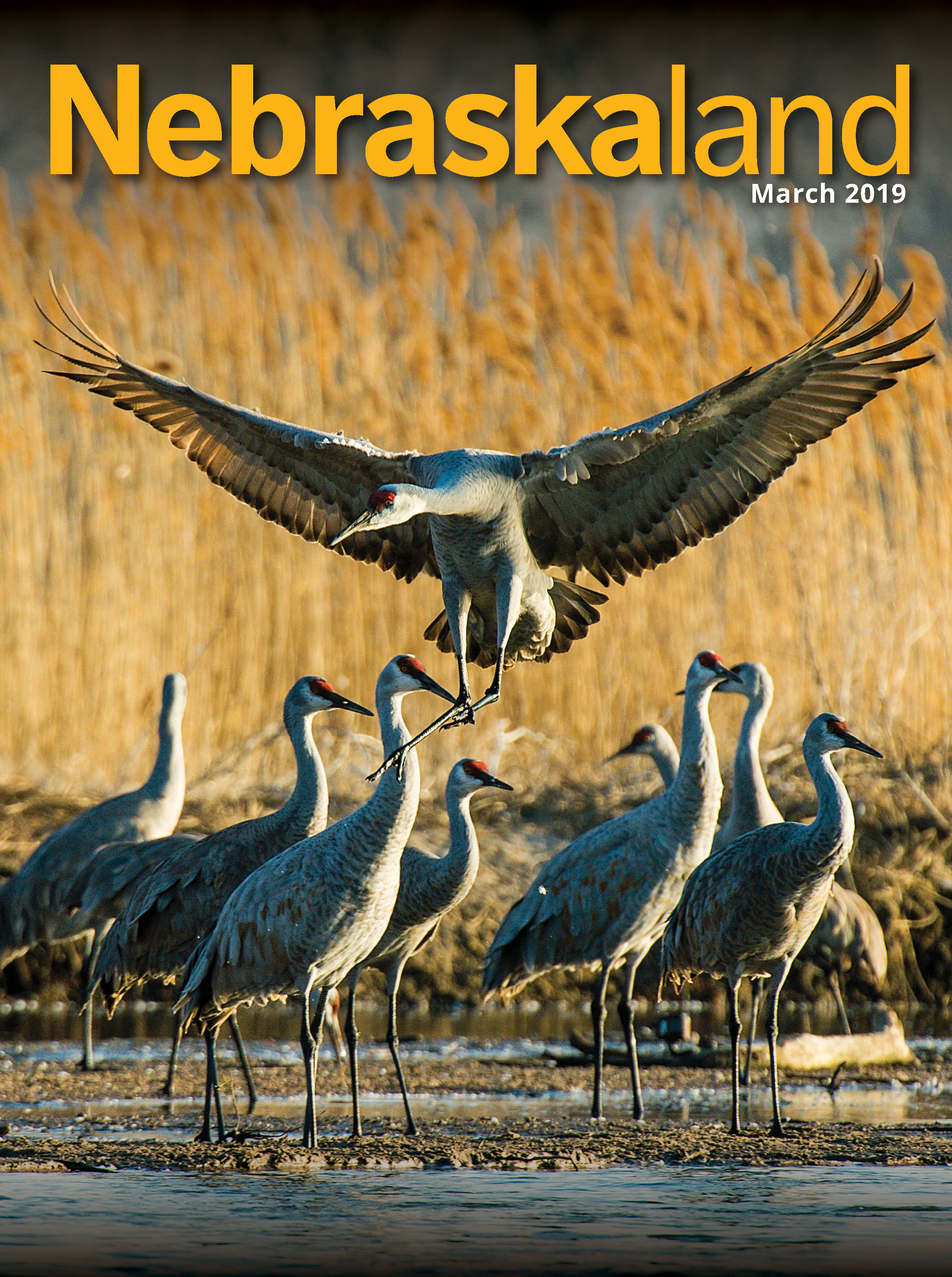
Cover: Sandhill cranes perform
courtship dances while roosting on the
Platte River. Photo by Eric Fowler
FEATURES
20
26
PHOTO BY JUSTIN HAAG
28
THE VALUE OF CONTROLLED
HUNTS
Story and Photos by Jeff Kurrus
OUTDOOR NEBRASKA
DEPARTMENTS
CRANE MOVES
6
10
46
56
58
What to Do in March
By Renae Blum
Sandhill Cranes Arriving Earlier,
Shifting East on Platte
Story and Photos by Eric Fowler
36
EAST ASH ROAD
38
MUCH MORE THAN ANTLERS
42
BIKES, FARMERS, AND “GOOD
ROADS” IN NEBRASKA
Your Nebraska
In the Field
Mixed Bag
Portraits from the Past
The Last Stop
Story and Photos by Erik Johnson
Story and Photos by Ryan Sparks
ON THE WEB
By History Nebraska
To see additional content including photos,
videos and additional articles, visit
Magazine.OutdoorNebraska.gov/digital.
Nebraskaland (VOL. 97 / NO. 2 ISSN 0028-1964) is published monthly, except for the combined Jan./Feb. and Aug./Sept. issues, by the Nebraska Game and Parks Commission, 2200 N. 33rd St.,
Lincoln, NE. Periodicals postage paid at Lincoln, Nebraska, and additional mailing offices. POSTMASTER: Send address changes to Nebraskaland, P.O. Box 30370, Lincoln, NE 68503-0370.
Magazine Staff
magazine
Communications Director Christy Firestone
Public Relations Manager Cara Pesek
Published by the Nebraska Game and Parks
Commission since 1926. The Commission is
dedicated to the conservation and protection
of all the state's natural resources and the
people who use them.
Editor Jeff Kurrus
Associate Editor Jenny Nguyen-Wheatley
Regional Editors Eric Fowler, Julie Geiser,
Justin Haag
Contributing Editor Michael Forsberg
Regular Contributors Renae Blum,
Chris Helzer, Ryan Sparks, Gerry Steinauer
Art Director Tim Reigert
Graphic Designer Mel Severin
Photo Librarian Jaclyn Cruikshank Vogt
Administration
Director Jim Douglas
Deputy Director Tim McCoy
Commissioners
Chairman - Robert Allen, Eustis
Vice Chairman - Dan Kreitman, Wahoo
2nd Vice Chairman - Pat Berggren, Broken Bow
Dick Bell, Omaha
Rick Brandt, Roca
Scott Cassels, Omaha
Jim Ernst, Columbus
Doug Zingula, Sidney
Circulation Donna Robinson
For address changes and questions about your
subscription, e-mail donna.robinson@nebraska.
gov or call 800-632-5263
Advertising Sales Manager
For advertising information contact
Shane G. Gilster, 402-742-0125
Email: shanegilster@gmail.com
Nebraskaland Magazine Copyright 2019, all rights reserved.
Nebraskaland is available in audio from the Nebraska Library
Commission Talking Book and Braille Service, Suite 120, 1200 N St.,
Lincoln, NE 68508. 800-742-7691. Nebraskaland Magazine and the
Nebraska Game and Parks Commission reserve the right to reject any
advertising not in keeping with the agency mission.
Rates: $18 for one year; $33 for two years; $44 for three years. Nebraska
recipients must add appropriate sales tax. To subscribe call
1-800-NEBLAND (632-5263), or go online to:
NebraskalandMagazine.com.
Commission Offices
Conservation Officers
Headquarters/Southeast District Office
2200 N. 33rd Street Lincoln, NE 68503
Phone 402-471-0641
ADMINISTRATION (Lincoln)
Craig Stover (Administrator)
Duane Arp (Asst. Administrator)
Jeff Clauson (Asst. Administrator)
Northeast District Office
2201 N. 13th St. Norfolk, NE 68701
Phone 402-370-3374
Southwest District Office
301 E. State Farm Rd. North Platte, NE 69101
Phone 308-535-8025
Northwest District Office
East Hwy. 2, Box 725 Alliance, NE 69301
Phone 308-763-2940
Bassett Office
524 Panzer St., Box 508 Bassett, NE 68714
Phone 402-684-2921
Kearney Office
1617 First Ave. Kearney, NE 68847
Phone 308-865-5310
Ak-Sar-Ben Aquarium/Schramm Education
Center
21502 W. Highway 31 Gretna, NE 68028
Phone 402-332-3901
Omaha Office
8495 Frederick Street, Omaha, NE 68124
Phone 402-595-2144
OutdoorNebraska.org
Any program that receives federal funding from the National Park
Service, or the United States Fish and Wildlife Service prohibits
unlawful discrimination on the basis of race, color, religion, age, gender,
marital status, national origin, age, disability or political affiliation. Any
person who believes he or she has been discriminated against in
any program, activity, facility, or service, should contact the Nebraska
Game and Parks Commission, Lincoln, NE 402-471-0641, the Equal
Opportunity Commission, Lincoln, NE 402-471-2024, TTY/TDD 402471-4693; United States Fish Wildlife Service, Civil Rights Coordinator,
4401 N. Fairfax Drive, Arlington, VA 22203; Director, Equal Opportunity
Program, U.S. Department of Interior, National Park Service, 1849 C
Street NW, Mail Code 0008, Washington, D.C. 20240-0001.
4
Nebraskaland • March 2019
402-471-5531
402-471-5531
402-471-5531
NORTHWEST (Includes counties covered)
Jim Zimmerman (District Supt.)
308-641-6138
Kelsey Glodowski
(Box Butte, S 1/2 Sheridan, Grant)
308-763-8226
Sean McKeehan
(Kimball, Banner, Scotts Bluff)
308-672-1824
Dan Kling (Sioux, Dawes)
308-430-0572
Kyler Prochaska
(E 1/2 Dawes, N 1/2 Sheridan, W 1/2 Cherry)
308-430-3984
308-458-7650
Terry Brentzel (Deuel, Garden, Grant)
402-389-0444
Frank Miller (Cherry, Hooker)
NORTHEAST (Includes counties covered)
Tom Zimmer (District Supt.)
402-641-9590
402-760-0712
Dale Davis (Keya Paha, Brown, Rock)
402-340-3981
Jonathan Andreasen (Holt, Boyd)
402-719-6226
Kyle Gaston (Dodge, Colfax)
Greg Hesse
(Greeley, Wheeler, Boone, S 1/2 Antelope)
402-843-6567
402-613-8612
Mitch Johnson (Knox, Antelope, Pierce)
402-762-5022
Jeff Jones (Knox, Cedar)
Jon Reeves
(S 1/2 Thurston, Burt, Washington)
402-889-8508
Andrew Heyer (Pierce, Madison, Stanton) 402-613-2241
Cory Krause
(Cuming, Wayne, Stanton, Dodge)
402-380-6410
Steve Oberg
(Colfax, Platte, Madison, Stanton, Nance)
402-910-3366
Owen Johnson
(Dixon, Dakota, N 1/2 Thurston)
402-266-1759
Doug Pollard (Loup, Garfield, Valley)
308-730-7050
Sean Schultz (Keith)
Brandon O’Neal
(Lincoln, McPherson, Logan)
Alex Hasenauer
(Lincoln, McPherson, Logan)
Mike Thome (Dawson)
Ray Dierking (Custer, Thomas, Blaine)
Taylor Dixon
308-760-0145
308-530-3157
308-660-4671
308-529-8146
308-870-0322
(Dawson, N 1/2 Gosper, N 1/2 Phelps)
308-217-2108
(Adams, Clay, Nuckolls, Webster)
402-902-2017
Eric Javins
SOUTHEAST (Includes counties covered)
Levi Krause (District Supt.)
402-949-0593
402-619-1355
Rich Berggren (Douglas)
402-616-5961
Dan Evasco (Sarpy)
402-210-0888
Heath Packett (Cass)
402-209-1506
Russell Mort (Otoe, Johnson)
William Krause
(Nemaha, Richardson, Pawnee)
402-274-8063
Matt Taylor (Thayer, Fillmore, Jefferson)
402-200-9597
402-806-0915
Matt Seitz (Gage, Saline)
402-890-6463
Dina Barta (Lancaster)
402-937-3422
Dudley Sorensen (Lancaster, York)
402-613-2312
Travis Shepler (Lancaster)
402-314-9641
Trevor Stahlecker (Lancaster)
402-890-7140
Stacey Lewton (Lancaster, Seward)
402-443-6392
Mike Luben (Saunders, Butler, Polk)
SOUTHWEST (Includes counties covered)
Roger Thompson (District Supt.)
308-530-3097
308-202-0819
Matt Brandt (Sherman, Howard)
308-380-7331
Tim Williams (Hall, Hamilton, Merrick)
Pat George
(Harlan, Franklin, Phelps)
308-920-2762
Matt Andrews
(Gosper, Furnas, Frontier, Red Willow)
308-746-2418
Brian Piernicky
(Red Willow, Frontier, Hayes, Hitchcock)
308-340-6627
John Lee (Hitchcock, Dundy, Chase, Hayes)
308-414-1432
308-289-0427
Nicholas Fix (Keith, Perkins)
308-440-3847
Bryce Streger (Keith, Arthur)
March 2019 •
Nebraskaland
5
YOUR NEBRASKA
Instagram Photos
Follow us (@nebraskaland)
and tag us in your photos
to be featured in an
upcoming issue.
Barry Major (@bmajorphotos)
White pelicans
Tiara Brown (@huskertiara)
Red fox
Karen Smith (@kasmitty52)
Female cardinal at Chalco Hills
Paul Filsinger (@paul_filsinger)
Sandhill cranes at Elm Island
Crane Viewing Site
6
Nebraskaland
Ne
eb
brras
aska
kala
land
nd • March
Ma
M
arc
rch 2019
2019
01
0
19
March 2019 •
Nebraskaland
7
Karen Smith (@kasmitty52)
Eastern screech owl near Grand Island
Glenda Byerly
South of Bloomfield
Ben Overstreet
Sunflowers and foxtail
Dayna Kush
Canada geese and mallard ducks
8
Nebraskaland • March 2019
Send your comments and photos to:
Jeff Kurrus, Editor
Nebraskaland Magazine
P.O. Box 30370
Lincoln, NE 68503
or email Jeff.Kurrus@Nebraska.gov
Please include your postal address
and telephone number. Letters may be
condensed and edited. Photographs are
also welcome.
March 2019 •
Nebraskaland
9
IN THE FIELD
PHEASANT TRACKS
Pheasant tracks in alkaline-crusted
prairie at The Nature Conservancy’s
Platte River Prairies.
PHO
PHOT
PHOTO
OTO B
BY
Y CH
CH IS
CHR
S HE
HELZE
ELZ
ELZ
LZE
ER
10
Nebraskaland • March 2019
March 2019 •
Nebraskaland
11
IN THE FIELD
PHOTO BY REJEAN BEDARD
THREATENED AND ENDANGERED:
THE WHOOPING CRANE
By Melissa Panella, Wildlife Biologist
The whooping crane (Grus americana) is one of the most
endangered species in the world. Yet amazingly, you have a
chance to see one in Nebraska during their migration every
year. In the 1940s, the global population of whooping cranes
declined to only around 20 birds. The birds had been an easy
target, either for their meat or for collection of their long
beautiful feathers to adorn hats and other apparel. Whooping
cranes were also losing nesting habitat. Without protections
and dedicated efforts to conserve this magnificent bird, the
species would have gone extinct.
In Nebraska, you are most likely to observe whooping
cranes in spring and fall as the population migrates
between breeding grounds at Wood Buffalo National Park
in northeastern Alberta and winter range in and around
Aransas National Wildlife Refuge along the Gulf Coast of
Texas. Whooping cranes in Nebraska most often travel in
small family groups of approximately 3-4 individuals, but the
highest count on record in our state are the 30 birds that flew
over Valentine National Wildlife Refuge in Cherry County in
October 2007. On rare occasions, a whooper is found midsummer in Nebraska. This is typically an immature bird that
hasn’t quite figured out where to go next.
Whooping cranes may live around 30 years in the wild,
and mated pairs will stay together for life. Courtship dancing
12
Nebraskaland • March 2019
is high-energy jumping, running, wing-flapping, tail-feather
shaking, and even stick tossing. Both adult birds build a
nest and will incubate two eggs for a little over a month
until hatching occurs. The chicks are able to walk and swim
within just a few hours of hatching, but they are unable to
fly long distances until around three months of age. The
youngsters do not venture too far from their parents, who
will guide them through migration.
Perhaps the most famous bird species in Nebraska is the
sandhill crane (Antigone canadensis) that migrates through
the central part of the state, with peak numbers reaching
more than 500,000 cranes in mid-March to early April.
During this time, crane watchers may find a single whooping
crane among the flock of sandhill cranes. This individual
hasn’t found his way to other rare whooping cranes or is
simply perfectly content living among the sandhill cranes.
The locals affectionately refer to the lone whooper as Bob. If
you have the good fortune of seeing a whooping crane, enjoy
the moment and please remember not to disturb it as it needs
to save its energy for the marathon of migration.
The current population of whooping cranes recently
surpassed 500 birds. For more information on whooping
cranes in Nebraska, be sure to check out Birds of Nebraska –
Online: birds.outdoornebraska.gov.
March 2019 •
Nebraskaland
13
IN THE FIELD
PHOTO BY JENNY NGUYEN-WHEATLEY
SLOW COOKER DUCK CONFIT
By Jenny Nguyen-Wheatley
Confit is a French cooking technique
that calls for slow cooking meat in fat
– preferably the animal’s own fat. The
low, slow heat breaks down collagen
and the flavor of the fat infuses into
the meat. Domestic ducks have so
much fat on them that they can be
rendered down for later use. And in
many cases, the same can be true for
several species of hunted waterfowl.
For how-to instruction on rendering
your own duck/goose fat, check out
Hank Shaw’s blog post at honestfood.net/how-to-render-duck-fat. The
resulting fat is buttery and nutty. Use
it to sear meat, fry eggs and potatoes,
and to sauté greens ... anything you
would normally do with cooking oil.
If that’s too much work or if you don’t
shoot enough waterfowl throughout
the year to render, buy jarred duck fat
at specialty food stores or online. The
brand I use is Rougie.
14
Nebraskaland • March 2019
Servings: 2-4
Prep Time: 15 minutes
Cooking Time: 10-15 hours
Ingredients:
8 small or 4 large duck/goose legs
and thighs (skin on for choice
birds, skin off for less desirable
species – pictured is snow goose)
Salt and pepper to taste
6 sprigs of fresh thyme
8 ounces of rendered duck fat
Special equipment: Vacuum sealer
and bag or heavy-duty zip-top bag
•
•
•
•
•
1. Pat duck/goose legs and thighs
dry with paper towels and season well
with salt. Place in a vacuum sealable
bag or zip-top bag and add duck fat
and thyme. Remove as much air out of
the bag as possible and seal. (If using a
vacuum sealer, be careful not to let the
vacuum suck out the fat.)
2. Place the bag in a slow cooker
and submerge with water. Cover, turn
slow cooker on low and cook for 10-15
hours, or until meat becomes tender.
Cooking times will vary depending
on size and age of birds. If necessary,
use a heavy bowl/plate to keep the
bag submerged. Flip the bag halfway
through or every few hours for more
even cooking. (Vacuum sealed bags
will inflate as the pressure inside
the bag changes – this is normal. An
advantage in using a zip-top bag is the
ability to check doneness.)
3. Remove legs from the bag. Drop a
tablespoon or two of remaining duck
fat into a pan and heat over mediumhigh. Sear legs on both sides for a nice
brown crust. Season to taste. Serve
with your favorite sides, preferably
something with a bit of tartness
to complement the richness of the
confit, such as a vinegary salad, slaw,
sauerkraut or kimchi.
March 2019 •
Nebraskaland
15
IN THE FIELD
PHOTO BY JOEL G. JORGENSEN
THE OVERLOOKED TOWNSEND’S SOLITAIRE
By Joel G. Jorgensen
The Townsend’s solitaire is an elegant thrush that often
occupies the background while its relatives, such as the
ubiquitous American robin and beloved bluebirds, steal
the limelight. Unlike those other species, and as it names
implies, this sleek gray songbird with a white eye-ring and
a proportionately long tail typically is not found in flocks
or groups. It is a western bird that breeds in mountainous
regions from northern Mexico to eastern Alaska and as close
as the Black Hills of South Dakota. Townsend’s solitaires
visit Nebraska during winter and migrate through the state
in spring and fall. There are, however, a couple of historical
breeding records from the Pine Ridge in northwestern
Nebraska in 1900. The species is most common in western
Nebraska, but rare eastward.
Townsend’s solitaires are often found around junipers,
such as the eastern red cedar, whose berries are an important
winter food source. In fact, Townsend’s solitaires are
territorial; lone individuals will defend their patch of junipers
16
Nebraskaland • March 2019
and the trove of berries from others of its kind. Highest
densities predictably occur in winter in areas of extensive
junipers in the west such as the North Platte River Valley, the
Wildcat Hills and Loess Canyons in Lincoln County. Eastern
red cedars have invaded prairies in certain areas of the state,
such as the Loess Canyons, and have become a serious
problem for agricultural producers and for grassland birds.
However, red cedar expansion has no doubt been a windfall
for the solitaire.
Townsend’s solitaires are most often seen sitting on a
high branch of a juniper tree, but sometimes an observer
needs to “pish” or squeak to coax the bird out into full view.
Always curious, once a bird is prompted into the open, it will
generally offer excellent views.
Visit the Birds of Nebraska –
Online at birdsofnebraska.org for
more information.
March 2019 •
Nebraskaland
17
IN THE FIELD
N E BR A S K A
We congratulate the hunters who have completed the Upland Slam:
PHOTOS COURTESY OF CHRIS HELMS
AN UPLAND SLAM CHALLENGE
By Jeff Kurrus
“Thirteen-year-olds like a challenge,” said Holdrege
resident Chris Helms. “My son Aiden and his friends will
get on YouTube and are always looking for a challenge.” So
when Chris mentioned Nebraska’s Upland Slam to Aiden, it
didn’t take much convincing to get started.
Nebraska’s Upland Slam, introduced by the Nebraska
Game and Parks Commission in 2018 alongside Pheasants
Forever and Quail Forever, challenged hunters to harvest four
birds – a sharp-tailed grouse, greater prairie chicken, ringnecked pheasant and northern bobwhite quail – in Nebraska
to receive an official certificate, pin and to be registered
to win one of several prizes, including a Browning Silver
12-gauge semiautomatic shotgun.
But like many of the 140 other hunters who completed the
Upland Slam, Chris and Aiden were much more interested in
the challenge itself than the potential prizes.
“It definitely motivated Aiden to get in the field with me,”
said Chris, who was also hunting beside their 8-year-old
Brittany spaniel named Molly. “With Molly’s age and Aiden
wanting to do this, it was special for me.”
An upland hunter, Helms usually goes two to three times
a week. “It’s my thing,” he said. “It also helps me stay in shape.
18
Nebraskaland • March 2019
“I knew there’d be challenges with the chickens and
sharpies because of the amount of walking with a 13-yearold,” he continued. “We had multiple 26,000-step days.
During these walks, we might be five miles in before we saw
birds. It was tough.”
Nearly all of their walks were on land open to public access,
where they harvested every bird between them except one.
The only private land bird was Aiden’s quail, which came
less than 50 yards from where Chris shot his first pheasant
as child on land that has been in their family since the
1870s.
It was a challenge where father and son faced constant
adjustments. A 4-H trapshooter, Aiden was not yet used to
pheasants flushing at his feet, something dad had to talk him
through during their hunts. There was also the challenge of a
young hunter carrying a gun for so many miles.
“I learned a ton on these trips,” said Chris, who enjoyed
seeing the look of excitement on Aiden’s face after each new
harvest. “It’s been motivating for me to seek other upland
adventures.”
All in the company of a bird dog in her prime, and a son just
coming into his own.
Scott Aden, Gothenburg, NE
Josh Atkinson, Adrian, MO
Joel Barton, Safford, AZ
Matt Bluett, Columbus, NE
Robert Boettcher, Ong, NE
Leo Boman, Lincoln, NE
Jeff Breitkreutz, Burwell, NE
Patrick Breitkreutz, Ord, NE
Adam Brockmann, West Point, NE
Don Brockmann, West Point, NE
Brian Bruegman, Omaha, NE
Claude Bryant, North Platte, NE
Quinn Burghardt, Hastings, NE
Todd Cattau, Creston, NE
Donald Chilcote, Midland, MI
Casey Colberg, Lincoln, NE
Miles Colson, Imperial, NE
Ryan Connot, Valentine, NE
Travis Connot, Valentine, NE
David Damsky, Broken Bow, NE
Jon Davenport, Lincoln, NE
Jim Davenport, Milford, NE
Mike Douglass, Grand Island, NE
Tyler Douglass, Grand Island, NE
Kurt Doyle, Fort Calhoun, NE
Jeff Duffey, Minden, NE
Chris Eickholt, Lincoln, NE
Tim Engelland, Gering, NE
McKay Erickson, North Platte, NE
Gregory Ernst, Omaha, NE
Gaylen Fischer, Allen, NE
Aaron Fisher, Denver, CO
Adam Forster, Broken Bow, NE
Mark Frickel, North Platte, NE
Matt Fruge, Holdrege, NE
Cole Gathye, Gretna, NE
Larry Gathye, Gretna, NE
Larry Gathye Sr., Omaha, NE
Tom Geiser, North Platte, NE
Kyle Geisler, McCook, NE
Lance Goings, Cherokee, IA
Merle Griess, Champion, NE
David Groothuis, Aurora, NE
Wayne Hahn, Aurora, NE
Benjamin Hansen, Blue Hill, NE
Timothy Hanson, Valentine, NE
Shelby Hardin, Mullen, NE
Bob Heller, Battle Creek, NE
Christopher Helms, Holdrege, NE
Aiden Helms, Holdrege, NE
Heath Henry, Cameron, MO
Kevin Henry, Cameron, MO
Seth Henry, Kearney, MO
Aaron Herring, Alma, NE
Jared Hicks, Seward, NE
John Huff, Madison, WI
Will Inselman, Milford, NE
Joseph Jackson, Papillion, NE
Jeff Jamison, Severance, CO
Nate Jenkins, Imperial, NE
Tod Johnson, Norfolk, NE
Ross Juelfs, Minatare, NE
David Karlberg, Sumner, NE
Kurt Karlberg, Overton, NE
Allyn Kemp, Paxton, NE
Adam Kester, North Platte, NE
Jake Koenig, Yutan, NE
Jeff Kraus, Atkinson, NE
Aaron Kraus, Atkinson, NE
Charles Krysl, McCook, NE
Brison Kuhn, Kearney, NE
Griff Latter, Minden, NE
John Laux, Alma, NE
Mark Lindvall, Valentine, NE
Bryan Linegar, Chadron, NE
Gary Lingle, Gibbon, NE
Tom Lococo, Lincoln, NE
Jeffery Loehr, Orchard, NE
Logan Loker, McCook, NE
Ken Loth, Omaha, NE
Don Loy, Kearney, NE
Monty Mathews, Omaha, NE
William McClure, Ashland, NE
Donald McKenzie, Chattanooga, TN
Joshua Meyer, St Libory, NE
James Millensifer, Oakley, KS
Noel Mues, Arapahoe, NE
Daniel Nelson, Omaha, NE
Roy Niemoth, Grand Island, NE
Brandi Niemoth, Grand Island, NE
Richard Nisley, Papillion, NE
Scott Nowak, Keystone, NE
Ross Oberg, Minden, NE
Glenn Obermeier, Aurora, NE
Andrew Obermeier, Kearney, NE
James Orpet, Laramie, WY
Grant Pavelka, North Platte, NE
Ben Pavelka, North Platte, NE
Jerrod Pavelka, North Platte, NE
Peter Pelster, Anselmo, NE
Brian Piernicky, Culbertson, NE
Michael Plate, Alma, NE
Chris Pokorny, Elkhorn, NE
Randall Porter, Albion, NE
Erik Prenosil, Lincoln, NE
Michael Rambour, Columbus, NE
Steve Rasmussen, Wayne, NE
Wade Regier, Aurora, NE
Todd Reynolds, Broken Bow, NE
Nathan Robertson, Ogallala, NE
Nicholas Robertson, Ogallala, NE
Kevin Robertson, Ogallala, NE
Kelvin Robertson, Ogallala, NE
Bryan Rooney, Stapleton, NE
Tim Ryan, Keystone, NE
Troy Sather, Omaha, NE
Tim Schuckman, Broken Bow, NE
Dan Schumacher, Sidney, NE
Gary Shaw, Selden, KS
Nick Sjuts, Bancroft, NE
Brady Skinner, Lincoln, NE
Brandon Smith, McCook, NE
Brian Smith, Lakewood, CO
Brad Snyder, Aurora, NE
Bryce Spencer, Hartington, NE
Aaron Steffen, Ames, IA
Cody Strong, Holyoke, CO
Kent Swink, Champion, NE
Zebadiah Swink, Lincoln, NE
Shane Teichmeier, Alliance, NE
Larry Teichmeier, Cairo, NE
Theresa Teichmeier, Cairo, NE
Daniel Upton, Strasburg, CO
Chris Varney, Ansley, NE
Scott Vogt, Ashland, NE
Dylan Waller, Wheat Ridge, CO
Erick Wickman, Valentine, NE
Matt Yocom, Cozad, NE
Isaac Young, North Platte, NE
Bob Zimmerman, Lincoln, NE
The Value of Controlled Hunts
A chukar flushes in front of
Bill Heard and his son Jake
of Gretna and a guide during
an upland hunt at Pheasant
Bonanza near Tekamah.
20
Nebraskaland
• March 2019
March 2019 •
Nebraskaland
21
INTERIOR OF LODGE AT PHEASANT BONANZA NEAR TEKAMAH
Story and Photos by
Jeff Kurrus
C
ontrolled shooting areas are a
mystery to many hunters. Defined
as a private location leased or
owned by an individual or group to
hunt upland birds like ring-necked
pheasants, quail, chukars, Hungarian
partridge, and even mallards, during
an extended season – they are often
viewed as hunting spots for the inexperienced.
When I started at Nebraskaland
in 2006, I didn’t see what a
controlled shooting area offered to
an experienced, able-bodied hunter
like myself. After visiting some – and
talking to hunters who had visited
others – I discovered these areas offer
much more than I thought.
So All Can Hunt
My first introduction to a controlled
shooting area was during the fall
of 2006 when I photographed a
Sportsmen Assisting Nebraska’s
Disabled Sportsmen (SANDS) hunt
at Pheasant Bonanza near Tekamah.
Participants who couldn’t walk far – or
at all – were able to watch excellent
pointing dogs work, see flushing birds,
and even shoot pheasants on the rise.
That day, I realized that other
hunters’ needs were different than my
own, an important idea to the owners
of these establishments. “We continue
to provide hunts for people who need
assistance like this,” said Pheasant
Bonanza owner Trent Leichleiter. “We
don’t want to turn anyone down. For
example, maybe we have a person
whose dad introduced them to hunting
and can’t get around like he used
to. We want to make sure we have
opportunities for those hunters as
well.”
Education
Some controlled shooting areas,
like Oak Creek Sporting Club near
Brainard, also provide the skills
22
Nebraskaland
• March 2019
Choosing a Controlled Shooting Area (CSA) to visit is like picking
a dog breed or style of shotgun – you have to find the one that fits
your needs. This can be accomplished by speaking to someone at
the preserve. Ask about the terrain, the length of the hunts, and
exactly what to expect. Tell them if anyone in your group has physical
limitations, and they will let you know if they can accommodate you.
For those who have visited Oak Creek Sporting Club and Pheasant
Bonanza, it’s clear once you arrive that they are completely
different operations – Oak Creek offers a blue-collar experience
while Pheasant Bonanza caters to an upscale audience, both in
accommodations and feel. Both are fine, unique examples in the
world of controlled shooting areas. However, they are not the only
controlled shooting areas in the state. From Dawes to Richardson
counties, Nebraska has 45 commercial (available to the public)
controlled shooting areas to visit. A list of these can be found at
ultimatepheasanthunting.com/usa/Nebraska.
needed before the hunt. When Oak
Creek hosts youth days throughout the
year – with 4-H groups, trapshooting
teams, and the like – participants
study hunter safety, watch dog trainers
work, learn how to appropriately shoot
shotguns and rifles, and actually have
an opportunity to hunt pheasants. For
many young hunters, it is their first
time afield.
“We want to cater to families,”
owner Terry Kriz said. “We love
seeing people get their first bird. From
mothers and daughters to fathers and
sons, we want our guests to see action
– to provide an environment that is
more than a walk in the park.
“We also want to make sure we keep
hunting’s legacy moving forward.”
Volunteer Chad Phillips
demonstrates with his pointing
dog, a small munsterlander,
during a youth day at Oak
Creek Sporting Club near
Brainard.
March 2019 •
Nebraskaland
23
DOG TRAINING FOR A YOUTH DAY AT OAK CREEK SPORTING CLUB
By Ryan Sparks
Whether it’s a new hunter or a new puppy, there’s only one thing
that’s going to get them excited about hunting — birds. That’s why
controlled shooting areas are an excellent resource for introducing
new hunters and their dogs to the sport. It takes birds to make a bird
hunter, and hunting preserves guarantee the birds that will get them
excited about hunting. Hunting all morning on a frigid day without
finding any birds isn’t motivating for anyone.
These preserves are also a way to keep you and your dogs in shape
before and after the hunting season. Heading to a hunting preserve
for a few outings before Nebraska’s regular season opens will shake
off the rust and ensure you are both in top form when opening day
arrives. Then, after your regular hunting season closes, you can
venture to a CSA to extend your good time a bit longer.
A youth day at Oak Creek
Sporting Club features a myriad
of activities, from hunter
safety (top left), trapshooting
(top right), proper shooting
techniques (bottom left), and
shotgun patterning (bottom
right).
24
Nebraskaland
• March 2019
How Do They Fly?
This is a question every hunter has
about a controlled shooting area: How
do the birds fly?
“We don’t raise our own birds at Oak
Creek,” said Kriz. “When they arrive
they’re released shortly after. They
learn to adapt.”
“We cater to ‘your birds are out
there; go hunt them’ method,” said
Pheasant Bonanza’s Leichleiter. “We
want to offer as wild a hunt as possible,
and are constantly releasing more birds
than people are paying for – some the
day of the hunt and some days before a
person’s hunt.”
For example, on a 3-bird hunt,
Leichleiter and his staff will release six
to eight birds. “We want people to see
12 to 15 birds on a 3-bird hunt. And
the more wild the hunter’s experience
is, the better.”
A Controlled Hunt First
Years ago, on a whim, a few buddies
and I took a trip from Tennessee to
Kansas to hunt pheasants. Having no
idea where to go, we hopped around
for two days and never fired a shot.
In hindsight, I wish we would have
started at a controlled shooting area.
From there, we could have talked to
the owners of the area and gotten some
advice on which nearby public areas to
hunt.
Maybe we would have learned
something on that area that helped
us on public land. Perhaps we would
have shot a few birds. And maybe, just
maybe, that same group of guys would
still be hunting together.
In Nebraska, controlled shooting
area upland hunting seasons
open September 1 and close April
15. For more information, visit
Outdoornebraska.org/csa.
March 2019 •
Nebraskaland
25
Outdoor Nebraska
By Renae Blum
The outdoor world is slowly waking up. Don’t miss the start
of spring – try these ideas for outdoor fun this month to stay
active and enjoy time outside with family and friends.
What To Do in March
Trout stockings
Various dates | Various locations
Spot a ringnecked snake
Late March | Eastern
Nebraska
Ring-necked snakes are
one of the first snakes to
emerge from hibernation in
Nebraska, says Nebraska
Game and Parks wildlife
educator Monica Macoubrie.
“During this time, if you flip a
few rocks, logs or pieces of metal,
you might find hundreds of these
snakes huddled in the same spot,”
she writes. “Ring-necked snakes
are some of the smallest snakes in
Nebraska, reaching about the length
of a ruler. They are olive green to
gray on top and bright yellow, red,
and orange on their stomachs.”
Starting about mid-March, fisheries staff
will begin stocking 65,000 rainbow trout into
more than 30 lakes and ponds in Nebraska.
Another 35,000 trout will be released in
April. Look for a news release to be posted
at Outdoornebraska.org/fishstockingreports
announcing stocking locations.
Shootout
at Salt Creek
March 3
Nebraska Outdoor
Education Center,
Attend a spring park event
Throughout the spring | Statewide
Celebrate the spring season at one of the state parks in the coming
months. Your adventures could include mushroom hunting at Indian
Cave State Park, birding tours at Ponca State Park and more! Visit
Outdoornebraska.org/parkevents to find an event near you.
Nebraska Game and
Parks Commission
Meeting
March 14-15
Lied Lodge in Nebraska City
Harlan white pelican watch
March 1 – April 15 | Harlan County Reservoir
Annually, hundreds and sometimes thousands of
American white pelicans land in Harlan County Reservoir
to feed on their way to breeding grounds in the north. For
locals, the arrival of the large birds is a sign that spring
is almost here. The annual White Pelican Watch starts
March 1 and runs through April 15, although dates and
numbers of birds can be variable. Pelicans can generally
be observed during daylight hours from locations all
around the Reservoir. Learn more at harlantourism.org.
26
Nebraskaland • March 2019
Learn to hunt – spring turkey
workshops
Various dates | Various locations
Whether you’re new to hunting or a seasoned hunter looking for additional
tips, the Nebraska Game and Parks spring turkey hunting workshops will
give you a leg up before you head out. Workshops cover hunting basics,
turkey biology, equipment, scouting, hunting strategies and more. Find the
class schedule online at Outdoornebraska.org/workshops.
March 2019 •
Nebraskaland
27
Crane
Moves
Sandhill cranes dance on their roost
on the Platte River in Hall County, part
of a courtship ritual that takes place
during a stopover on their annual spring
migration.
Sandhill Cranes
Arriving Earlier,
Shifting East
on Platte
STORY AND PHOTOS
BY ERIC FOWLER
T
housands of sandhill cranes will have arrived
on the Platte River in central Nebraska by
the time you read this. In the weeks to come,
there may be 600,000 or more on the river on a
given night, with some yet to arrive from their
wintering grounds to the south and others having
already continued their northward migration.
This gathering of more than 80 percent of the
mid-continent population of cranes is one of
the great wildlife spectacles anywhere, drawing
bird watchers from around the world to Kearney,
Grand Island and towns in between.
Changes in flows and habitat on the Platte
and the availability of food around it during the
past century prompted the birds to congregate
in a limited number of reaches within the 76
miles of river they now frequent. And according
to a new study led by Andrew Caven, director
of conservation research at the Crane Trust, the
phenomenon is still evolving. Cranes continue
to move, leaving behind roosts in the western
reaches of the central Platte River Valley for
better habitat in the east. The cranes are also
arriving earlier and staying longer. With more
birds packed into a smaller area, biologists are
left to wonder what the future holds.
Cranes and the Platte
Scientists believe sandhill cranes have been
stopping on the Platte River during their spring
migration for 2 to 10 million years. While
records are sparse, the tall, lanky birds are
thought to have been dispersed throughout its
length in the state before Euroamerican settlers
arrived on the Plains. The wide, braided river
and its many sandbars provided ideal roosting
habitat, and the adjacent meadows held plenty of
28
Nebraskaland • March 2019
March 2019 •
Nebraskaland
29
Aerial photos show the stark
difference in habitat in two reaches
of the central Platte River. Near
Odessa (top), nearly all of the
forested area pictured was river
channel a century ago. At The Crane
Trust’s headquarters south of Alda
(bottom), the river looks like much
like it did a century ago, with both
channels retaining their width, little
woodland encroachment and much
of the surrounding landscape in
meadow. While the width of the river
channel is similar in these reaches
today, the change in character has
caused sandhill cranes to abandon
the area near Odessa.
Small planes are used to conduct
population estimates of sandhill
cranes in the central Platte River
Valley each spring, and also to
monitor whooping cranes.
The succession was not good for
cranes, which soon abandoned the
river above Overton. As accretion and
woodland growth continued to move
eastward, so did the cranes. A 1957
study found that 60 percent of the
cranes stopping on the Platte in the
spring were found between Overton and
Kearney. By the late 1970s, most were
between Kearney and Grand Island.
The Shift Continues
food in the form of invertebrates.
The cranes’ use of the river was
likely disrupted by unregulated spring
hunting until the practice was banned
by the Migratory Bird Treaty Act in
1918. It changed again when settlement
brought farming to the Platte River
Valley, and corn that didn’t make it
into the combine gave cranes a highenergy food source that let them fatten
up for the remainder of their journey.
Irrigation brought more corn, but it
also changed the river. Farmers began
digging ditches to carry water to their
crops in the late 1800s. Large dams
in the basin followed, the first being
Pathfinder Dam on the North Platte
in Wyoming in 1908 and the last and
largest the Tri-County Project, which
began operating in 1938 and included
Kingsley Dam, completed in 1941, and
Lake McConaughy near Ogallala.
30
Nebraskaland • March 2019
With each new dam and diversion
for irrigation or hydroelectric
power, the river dropped, allowing
vegetation to sprout on the exposed,
moist ground. With high spring flows
trapped in upstream reservoirs, there
was nothing to scour the river clean.
Eventually, what once was riverbed
became woodland composed primarily
of cottonwoods at first, and later by
Russian olive and eastern redcedar, and
the remaining flows were restricted to
narrower, deeper, and more winding
channels.
Described by one journalist in the
1880s as “a mile wide and an inch
deep,” the Platte was actually wider
in places. Yet by the 1950s, it spanned
only 50 yards between North Platte,
where most of the water was diverted
by the Tri-County project, and Overton,
where some of that water is returned.
Population estimates of cranes,
while an inexact science, have been
conducted since the 1950s by various
entities, including the U.S. Fish and
Wildlife Service, which does an
intensive air and ground survey of the
valley in late March each year. Since
1998, with the exception of two years,
the Crane Trust has from mid-February
to mid-April conducted weekly survey
flights on the river between Overton
and Chapman. The methods used and
routes flown have been mostly the same
since 2002: From a fixed wing aircraft,
observers estimate the number of birds
on the river and the adjacent fields and
take photographs of selected roosts.
Back on the ground, they analyze the
photographs and adjust their estimates
as needed. Their highest recorded count
of 598,000 came on March 22, 2018, a
figure that does not account for cranes
that left the river for fields farther from
the river than observers could count.
The service’s count, which reaches
farther from the river and continues
west through the North Platte River
Valley, estimated there were a record 1
million cranes on the rivers during the
same week last March.
The Crane Trust’s survey data has
March 2019 •
Nebraskaland
31
Sandhill cranes leave their overnight roost on the Platte
River in Hall County, headed to nearby fields and meadows
to feed.
32
Nebraskaland • March 2019
March 2019 •
Nebraskaland
33
Sandhill cranes take flight from a
cornfield in Hall County. The birds
fatten up on crop residue left in
the fields, providing energy for the
remainder of their migration.
allowed the shift of cranes from west
to east to be quantified in the study,
co-authored by Emma Brinley Buckley
and others from the U.S. Fish and
Wildlife Service, U.S. Geological
Service, Rainwater Basin Joint
Venture and Platte River Recovery and
Implementation Program. The survey
area is divided into 11 segments defined
by highway bridges. Of those, only the
four easternmost segments, from Wood
River to Chapman, show increasing
numbers of cranes.
Interestingly, the eastern segment,
from Highway 34 to Chapman, hosted
so few cranes that it wasn’t included
in any surveys until the late 1990s. Yet
the average count of combined surveys
from 2015 to 2017 found 25 percent
of all cranes in the central Platte in the
two reaches between Grand Island and
Chapman.
The reach between Alda and Grand
Island, where the Crane Trust owns
considerable property that has been
34
Nebraskaland • March 2019
restored to near-historic form, is the
most used segment, boasting a peak
density of 6,400 cranes per mile and 32
percent of the count from 2015 to 2017.
At the same time, crane use has
generally declined in the four segments
west of the Highway 10 bridge
(Minden), which hosted just 4 percent
of the cranes combined. The three
segments between Minden and Wood
River host 20 percent of the cranes, but
numbers in all are also declining, with
the exception of the reach from Minden
to Gibbon that includes the National
Audubon Society’s Rowe Sanctuary
and a considerable amount of restored
land and boasts a stable population.
Why Move?
With the eastward shift of cranes
quantified, the Crane Trust’s study
hoped to determine why they were
moving. Using aerial imagery from
1938, 1998, 2015, and 2016, Caven and
his team looked at changes in channel
width, and with images from 1998 and
2016, he looked at land cover.
“Everyone expected the model to
show why wide channels are good and
prairie is good,” Caven said. “Well, the
model showed that prairie was very
good, and it also showed wide channels
were good. But what’s more important
than just wide channels is the amount
the channel has shrunk since 1938, and
that was a more important variable in
our model, likely because it’s indicative
of the change in the character of the
river there more than just its width.
“That change started in the west
and moved east. The perception was
that the change has stopped, but that’s
not the case. We keep seeing more
islands popping up in the middle that
are becoming stabilized and those are
crappy for cranes.”
The adjacent prairie component
of the equation is likely tied to the
importance of those habitats, as other
studies have found, for the protein
provided by macroinvertebrates, for
pair bonding activities, and also the
cranes’ desire to stage next to the river
in the evening, continuing forage until
dark before returning to roost.
Early Arrivals?
Research suggests that the greater
sandhill crane, which nests primarily in
Alaska, Canada and Minnesota, is the
first to arrive on the central Platte, and
fills eastern segments of the river first.
The lesser sandhill crane, which nests
in Siberia, western-Alaska and northern
Canada, arrives later and fills in western
portions of the region.
The Crane Trust’s survey data,
because it spans the entire timeframe
in which the cranes are on the Platte,
paints a clearer picture of this staggered
arrival, with counts in eastern segments
peaking about two weeks ahead of the
west. It also shows how the overall
peak, which can be influenced by
weather, varies from year to year.
The data also showed that cranes
have been arriving, on average, a little
more than a day earlier each year since
2002. A century ago, the first reports
of cranes arriving on the Platte came
in late March. Now they come in early
February, and a few cranes have even
wintered here in recent years.
The study looked at weather in
wintering areas on the Texas coast
and elsewhere and found it was a
fairly reliable predictor in their arrival
date. “What’s interesting is a 1 degree
average increase in average temperature
in Texas in January and February
basically meant 20,000 more birds
came to Nebraska in week 5 (midMarch) of the surveys,” Caven said.
The advancing migration date is
not exclusive to sandhill cranes. Other
studies have found that whooping
cranes in North America and common
cranes in France are also migrating
earlier, trends Caven said could
be a result of climate change or a
combination of many factors, including
the availability of waste grain or
drought.
“That doesn’t mean that they’re
leaving early though,” Caven said.
“They’re coming 20 days earlier but
they’re staying a little bit longer. So
the peak hasn’t changed as much as the
arrival date.”
have cleared riparian woodlands,
restored grasslands and wet meadows
and, when the river is low, disked the
channel to inhibit growth of vegetation
that can form islands.
Cranes are now concentrated
primarily in areas where that work
has been conducted. The density,
however, has raised concerns about the
increased risk of disease transmission
between sandhill cranes and other
birds, especially whooping cranes.
A continued shift of birds from west
to east and birds staying longer than
the three to four weeks they once did,
coupled with an increasing sandhill
crane population that is two to three
times greater than it was in the early
1970s, could further increase density,
making the work to restore habitat
along the river even more important.
But Caven said conservation partners
will need to look at where and how
the work is being done, as cranes are
even abandoning some reaches of the
river where habitat has been restored.
While some may be tempted to give up
on those areas, maintaining stopover
habitat there is critical because of the
use of those reaches by whooping
cranes.
“We’re probably not restoring areas
that are big enough to redistribute the
cranes,” Caven said.
They will also need to look east
to insure the habitat the cranes are
adopting is maintained. In the two
eastern reaches, the character of the
river remains good and there is a
considerable amount of meadow and
prairie. But less than one percent of the
land within a half mile of the channel
is protected, either through ownership
by a conservation organization or
through a conservation easement,
a pittance compared to the 34 to
67 percent in some other reaches.
“Our major concern is sandpits and
housing developments,” Caven said,
noting that conservation easements
that would prevent such development
while allowing farming and ranching
to continue would be invaluable in
protecting the habitat.
The work along the river isn’t
important only to cranes. An open,
braided river benefits other species
like whooping cranes and least terns.
The large blocks of prairie benefit
prairie chickens, bobolinks, Henslow’s
sparrows and other upland species.
“There’s a lot [in this study] of
sandhill cranes, but they’re really good
umbrella species,” Caven said. “They’re
a really good indicator of habitat quality
because their presence in high numbers
is reflective of the historic structure of
and function of that ecosystem.”
Sandhill cranes feed in open ground
in a snow covered meadow near
the Platte River in Kearney County.
Meadows are important feeding and
loafing habitat for cranes.
What Now?
Researchers watching the
transformation of the Platte as irrigation
expanded recognized the importance of
a wide-open river to cranes and other
wildlife. Since the early 1980s, the
Crane Trust, as well as numerous other
organizations, including the Nebraska
Game and Parks Commission, The
Nature Conservancy, Audubon Society
and, more recently, the Platte River
Recovery and Implementation Program,
have been working to restore and
maintain the river’s historic character
in the central Platte Valley. The groups
March 2019 •
Nebraskaland
35
East Ash Road
Story and Photos by Erik Johnson
he first time I laid eyes on this corkscrew turn nestled
in the Pine Ridge of the Panhandle, I couldn’t help
but question if I had stepped outside the borders of
Nebraska. Such a far cry from the familiar geography
of the Plains, the Pine Ridge is an area that has continually
captivated me and keeps me coming back to discover more.
As the seasons pass, the rugged buttes take on drastically
different appearances and personalities. During the last year
and a half I’ve embarked on a project to capture these changes,
as seen from one specific vantage: a scenic overlook off East
Ash Road between the towns of Crawford and Chadron.
I first photographed the road in late May of 2017. The
bright green shrubs and undergrowth provided a striking
contrast to the blackened tree trunks – remnants of a fire that
scorched the hills in 2012. As I waited for the soft evening
light to cover the landscape, I found myself beneath a fast
moving, isolated rain shower that swept over the hills. The
precipitation cast a veil over the land and glistened against
T
the rays of the setting sun. It was then that I realized my
desire to experience these beautiful surroundings at all times
of the year.
My next visit to East Ash was during a late season snow
shower during the final days of March. I found myself
standing at the same vantage as wet snowflakes dropped
to the ground, accentuating the twisting road. Once again
the thick atmosphere created a haze that concealed the
surrounding buttes. After I returned home I converted the
image to black and white, emphasizing the contrasting tones
between the snow-lined road and barren vegetation.
It wasn’t until late July that I had another chance to visit
the Pine Ridge. I made the drive during the last week of
the month, hoping to capture the region under a dramatic
midsummer storm. As night fell on East Ash, I could see
distant lightning flashes on the horizon. As I waited, the
flashes became brighter and brighter as the storm followed a
direct path toward me. Ultimately, I was forced to retreat as
the lightning became too close and rain
began to fall. Once back in my truck, I
was in awe of the landscape as I scrolled
through the frames to find an image with
three bolts emanating from an ominous
cloud formation.
The fourth and final image was taken
during a quick road trip in mid-October. I
was amazed by the colors I found lining
the hillsides. The bright green vegetation
I was familiar with from past visits was
now a colorful gradient of yellows, golds
and reds. I awoke early on a Sunday
morning to find another beautiful veil of
mist covering the golden hills. I snapped
a frame, and with that, captured my final
season on East Ash Road.
Nebraskaland Magazine would like to
see your seasonal images from one vantage
point. Send to Jeff.Kurrus@Nebraska.gov.
Opposite: May 2017
Top: July 2017
Middle: October 2017
Bottom: March 2018.
36
Nebraskaland
• March 2019
Much More Than Antlers
Shed Hunting in Nebraska
STORY AND PHOTOS BY RYAN SPARKS
L
ate winter can be a trying time for people who love
the outdoors. With closed hunting seasons and thin
ice, spring still seems a long way off. However,
shed hunting is a refreshing mind cleanse that will motivate
you to get outside during the doldrums of winter. Shed
hunting is simply searching for the cast-off antlers of species
like elk, mule deer, and white-tailed deer. Every year these
animals shed and regrow their antlers, leaving clues about
their size, location and travel routes.
Ask a seasoned shed hunter why they enjoy it so much and
they will probably tell you it’s about more than collecting
antlers. Deer trails stick out like I-80 in winter, concentrated
turkey feathers and droppings are a sure sign of a turkey
roost, and all the miles you put on looking for antlers up
your chances of stumbling across some morels (and works
off your winter belly). Searching for sheds makes you
intimately familiar with the land. Of course, there are also
the antlers. Most deer hunters swoon after them whether
they’re attached to a deer’s head or not. They have an almost
magical quality. They also tell you what caliber of bucks are
in the area and make memorable decorations in your home.
Getting Started
Every year bucks cast off
their antlers and those that
are willing to put in the time
and miles are rewarded with
sheds like this one found in
Cass County.
38
Nebraskaland • March 2019
Most people know that bucks shed and grow a new set
of antlers every year, but many don’t know the biology
behind this phenomenon. Biologists agree that antler growth
and dropping is regulated by hormones and daylight hours.
Antler is one of the fastest growing tissues on earth and
can grow more than an inch a day. After rutting activity
has stopped and light levels decrease, a buck’s testosterone
drops significantly. This decrease spurs the creation of
a bone cell called osteoclast. Osteoclast removes the
connective tissue between a buck’s head and antlers by
absorbing the calcium in the bone. Once the connective
tissue weakens, the antler falls off. Osteoclast creates small
striations that feel coarse to the touch causing the base of
a shed antler to feel like sandpaper. Other factors such as
injuries and stress from hunger or extreme cold can cause
testosterone and, consequently, antlers to drop. While bucks
can lose their antlers as early as December and as late as
April, most deer in Nebraska go antlerless between January
and March.
There aren’t any hard rules to when antlers are shed, yet
there are a few tricks to know when it’s time to lace up your
hiking boots. I like to park along a field where I have seen
deer feeding. Using binoculars, I can see if there are any
antlerless bucks in the field. If you find a field filled with
deer, but they all look like does, it probably means there are
some bucks mixed in who have lost their head gear.
It’s a good rule to hike as many miles as you can, but
all that walking won’t do any good if you’re not in an area
with sheds on the ground. In winter, deer are either bedding,
eating or traveling between the two. Start by searching in
the thickest cover you can find. I’ve found that harshly cold
winters concentrate deer around food sources and winter
cover, which also concentrates shed antlers.
My best shed hunting spot is a cluster of cedar trees you
almost have to crawl through. I’ve found several pairs of
sheds lying right next to where a buck has bedded. You
ideally want to find a location with clusters of beds. These
are round patches where deer have laid down and matted the
vegetation. Seeing lots of deer droppings on the ground also
indicates that deer are concentrated in an area. If you find an
antler, look in a grid pattern around where you found it. If
you’re lucky you’ll find its match.
Fields where deer are feeding are also prime locations.
I like to find a high point and use binoculars to scan large
swaths of a field. Once you think you have thoroughly
covered both bedding and feeding areas, walk the adjoining
trails. While hiking, note rubs, scrapes, fence and creek
crossings, and scout for locations to hang a tree stand or
Finding bucks you were hoping to hunt next year
that didn’t make it through the winter is a harsh
reality of shed hunting.
March 2019 •
Nebraskaland
39
This antler was found near a bedding area along
the outside of a thick stand of cedars. After a grid
search of the area we found its matching side.
Mice, squirrels, opossums, foxes and even beavers
will chew antlers for the calcium and phosphorous
they contain.
For a shed hunter, small antlers like this are just as
much of a trophy as their larger counterparts.
40
Nebraskaland • March 2019
place a blind for the next hunting season. Nothing gives you
a better understanding of a property than walking every inch
of it. You can’t work an area too thoroughly. For example,
I walked past my favorite “shed” I’ve ever found dozens of
times over the course of two years before I ever saw it. Then
one day, I decided to walk the creek bottom instead of the
usual trail above and discovered two bucks against the creek
bank who had died because their antlers had locked together
during a fight.
If the area where you hunt doesn’t have many fields
nearby, try searching around forest browsing areas that
contain acorns or other food sources. South facing hillsides
are also one of the best places to find shed antlers. If you
have a pet you’ve probably seen them get up and move to
lay in the sunlight. Deer do the same thing.
It’s one thing to know where you should be looking and
another to actually find sheds. There aren’t any tricks to
spotting antlers, but much like morel hunting, once you see
your first shed of the season your brain seems to imprint the
image and finding the next few seems easier. Don’t expect
to see an entire antler laying in the open. Look for a tine
poking through the grass or a patch of white against the drab
landscape. The largest shed I’ve ever found, a four-foot-long
six-point elk antler, only had a tiny piece visible above the
grass. I’ve also stepped on sheds before I ever saw them.
You walk past more than you find, but knowing that gives
you the desire to work the same area again.
Most new shed hunters will look about 10 feet in front
of themselves as they walk, but I’ve found it best to scan
from 20 to 100 feet. It helps to work slowly, stopping now
and then to look around. Find a different perspective by
standing on a tree stump or squatting close to the ground.
Many antlers are only visible from one angle. After several
hours of shed hunting you get in a Zen-like state where your
entire focus is on the landscape. It’s a fantastic way to enjoy
nature.
Equipment
Gearing up for shed hunting couldn’t be simpler. It’s an
activity where fancy gear doesn’t apply and hard work is
well rewarded. All you really need is a good pair of hiking
boots. The more miles you put on the more sheds you
will come across. Of course, there are a few other pieces
of equipment that make shed hunting more productive.
Sunglasses are helpful on bright days so you don’t have
to squint as you look for antlers. Binoculars are useful for
surveying fields and for when you aren’t quite sure that what
you’re looking at in the distance is an antler. If you find
more than a couple sheds a backpack is handy for hauling
them out of the woods as well as carrying a snack and
water. Finally, if you really want to take your shed hunting
seriously, I’ve known people who carry a GPS to track and
record where and when they find a shed.
Getting permission to shed hunt on private land is a good
way to establish a relationship with a landowner by showing
them you are respectful of their property. Relationships
like these eventually lead to hunting permission. On many
Jillian Sparks walks up on an early season shed during a cold January shed hunting session. She is
perhaps the world’s luckiest shed hunter, since she consistently finds matching sets while her husband
scratches his head in amazement.
properties you will likely be the first person to shed hunt and
that first year is usually incredible because there are several
years of antlers on the ground.
If you have a dog they will certainly enjoy shed hunting
as much as you do. Many people even use them as a tool
for finding antlers. They train their dog to smell, locate
and retrieve shed antlers. In college I read several articles
about shed hunting dogs and got interested in trying it. A
friend and I began training his dog in our backyard. Over
the summer and fall the dog got really good at finding them,
even when we buried them in leaves and brush. We were
excited to see how many more sheds we would find now that
we had a “shed dog.”
On our first outing we quickly realized we had trained him
to smell for the scent of our hands rather than antlers. We
spotted a large shed lying along a field edge, but when the
dog got near it he ran right past it. Even when we showed
it to him he had no interest. He did enjoy his hike, though.
While we failed as trainers, many people won’t go shed
hunting without a dog. If you are interested in trying it for
yourself there is plenty of information available online as
well as books and DVDs on the subject.
Reaping the Benefits
After several seasons of shed hunting, you will probably
have a large collection of antlers. I like to remember where
and when I find my sheds, but this becomes difficult after
a pile of antlers builds up. Now I attach small tags with zip
ties to the base of each antler. A friend in Idaho who has
picked up thousands of sheds places small pieces of painter’s
tape on the pedicle (the place where the antler attaches to the
head) and writes on them with a marker. Cataloging them
like this creates a living history of your shed hunting.
Many people enjoy using them as home decorations.
They are attractive and have hundreds of uses from
chandeliers to lamps to cabinet fixtures and dog chews. I
prefer to place them around the house as they are, and I’ve
found them to be a good conversation starter. People are
always curious about the more interesting sheds I’ve found
like the locked bucks, an antler I found hanging in a tree,
two matching sets of antlers from the same buck, and large
elk sheds.
It’s a good thing shed hunting isn’t just about antlers
because you do a lot more walking than finding. My best
day ever I found eleven antlers. Usually I’m happy if I find
one. The difficulty makes it that much more rewarding.
When you find an antler take the time to admire it and
celebrate the discovery with whoever is around, even if it’s
your dog. Shed hunting is just another way to spend time
outdoors in the company of people you care for. All you
have to do is enjoy the walk, keep your head up, and your
eyes open.
March 2019 •
Nebraskaland
41
Bikes, Farmers, and “Good Roads” in Nebraska
By History Nebraska
It was an unlikely alliance: farmers and
bicycle enthusiasts. Both were dissatisfied
with the muddy, unimproved roads of the
late 1800s. But it would take a lot of tax
dollars to build a modern road system, and
not everyone wanted to spend the money.
And then came a new, noisy, four-wheeled
invention ...
Unidentified Nebraska women’s bicycle outing, circa 1895.
History Nebraska RG3906-7-8
42
42
Nebraskaland
N
Ne
ebras
brras
br
as
a
ska
s
ka
k
ala
lan
nd
d
• March
Mar
M
Marc
Ma
arrc
ch 2019
20
2
01
19
9
March
2019
Ma
M
arc
rch 2
20
01
19
9•
Nebraskaland
Ne
N
eb
brras
aska
kala
land
nd
43
43
ebraska’s early roads were unmarked trails across the
countryside. Railroads received large government
subsidies, but the dirt roads linking farms and towns
were seen only as a local concern.
Most people assume a marked effort to improve roads at
the local level came about because of automobiles. That’s
partly true, but the nationwide “Good Roads” movement
started years earlier. It began with bicyclists.
The invention of the modern “safety bicycle” led to a
nationwide bicycling craze in the 1880s and 1890s. The new
bikes were safer and easier to ride than their high-wheeled
predecessors. Nebraskans formed bicycle clubs and explored
the countryside. Some men and women completed “century
rides” of 100 miles in a day. (Imagine doing that on dirt roads
on a heavy, single-speed bike. And women did this in long
skirts!)
At the time, Nebraska’s larger cities were beginning to pave
their main streets. In rural areas, roads were bare dirt – not
even graveled. Bicyclists soon found allies among farmers
and small town merchants who wanted better farm-to-
N
market roads.
Many Nebraska towns had commercial clubs to promote
local business. Some of these clubs formed Good Roads
committees to raise funds for road equipment. They
sponsored road building “bees” in which rural and town
volunteers labored on sections of roads. Even dirt roads could
be improved by grading or by being dragged with heavy split
logs to smooth the surface.
The Good Roads Movement gained momentum with the
coming of the automobile. City drivers on country roads
infuriated farmers by scattering their chickens, frightening
their horses, raising plumes of dust, and damaging roads that
were often maintained by the farmers themselves.
But as autos became more affordable (starting with the
Ford Model T in 1908), farmers began modifying cars into
early pickup trucks. “If anyone on earth needs the motor car,
it is the farmer,” said the Nebraska Farm Journal in 1911.
Even before paved roads were common, road maintenance
was too big a project for local volunteers or county employees.
Motorists began calling for state and even federal funding of
Polk County was known for its good roads, which were overseen by a county highway commissioner and this road crew.
History Nebraska RG2407-5-3
roads. It took decades of promotion to convince enough voters
and lawmakers that this was a good idea. Nobody wanted
their taxes to go up. Most roads long remained unimproved
as a result.
The bicycle craze faded, but automobiles grew more
popular year by year. In 1916, the number of cars registered in
Nebraska topped 100,000. By then, local groups were working
with multi-state organizations to promote “automobile
trails” – the beginnings of the modern highway system. Roads
such as the Lincoln Highway (more-or-less the future U.S.
Highway 30), the Detroit-Lincoln-Denver or D-L-D Highway
(U.S. 6), the Meridian Road (U.S. 81), and dozens of others
were cobbled together from existing local routes, marked by
The Ford Model T put millions of people on the road. In Hooper, Nebraska, a local Ford agency organized a parade for local
Model T owners. After the 103-car parade, the motorists rallied at the school grounds and posed for a photograph. History
Nebraska RG3347-3-33
44
Nebraskaland
• March 2019
painting telephone poles, and promoted
through maps and guidebooks. Here’s
how the Automobile Blue Book described
a section of the Meridian Road between
Norfolk and Pierce in 1912:
“Turn left from business center and at the
fork ... bear left, following the angling road
straight out of city through edge of Hadar ...
bearing right with road ... Jog left and take first
right. Turn left 1 mile, then right ½ mile. Turn
left 1 mile into Pierce.”
Later, concrete markers were added to
guide adventurous motorists. Sharp-eyed
travelers can still spot some of these markers
along backroads around the state.
The federal system of numbered highways
was adopted in 1925, transforming the old
ld
automobile trails into U.S. highways. That year, Nebraska
adopted a gasoline tax to raise money for roads. Auto travel
gradually became less of an adventure, but faster and more
reliable.
Adapted from “The Good Roads Movement in Nebraska”
by L. Robert Puschendorf, from the Winter 2015 issue of
Nebraska History. Visit History Nebraska’s website at
history.nebraska.gov.
March 2019 •
Nebraskaland
45
MIXED BAG
BASS FISHING AT MASKENTHINE LAKE/JENNY NGUYEN-WHEATLEY
VISIT STANTON
By Josie Meister, Nebraska Tourism Commission
46
Nebraskaland • March 2019
of pheasant, quail, and whitetail deer, the gently rolling hills
provide the perfect backdrop for your hunt.
Learn, connect and relax at Red Roads Herbs Retreat &
Learning Center where you can learn hands-on gardening
skills and purchase fresh and dried herbs at the gift shop. Or
explore the Stanton Public Library, recently placed on the
National Register of Historic Places.
Take a trip to Stanton in the summertime and experience
what this community is all about. Spend Fourth of July
participating in a full day of activities, commencing with a
top-notch fireworks display put on by volunteer firefighters.
A historical community with delicious food and endless
recreational activities, Stanton is where you will want to be
this spring.
ELKHORN ACRES GOLF COURSE
Head up to the northeastern part of the state to discover
what Stanton has to offer! This community is full of hidden
gems that give you the perfect reason to explore.
Spring is coming and what better way to prepare than
enjoying the warm weather that’s on its way? Gear up for this
year’s golf season by planning a trip to the Elkhorn Aces Golf
Course. This course is ranked fifth in the top nine-hole courses
in Nebraska. Or embrace the spring weather and explore the
arboretum and native plant display at Maskenthine Lake.
Established in 1976, this arboretum is a collection of native
and exotic tree species planted in a natural arrangement.
While you’re at Maskenthine Lake, enjoy all the other
recreational activities this area has to offer including hiking,
fishing, hunting and boating.
Looking for delicious food and drinks in the area? Visit one
of Nebraska’s popular breweries, Uptown Brewery, and try
one of their 10 rotating beers on tap. Hungry? Stay for lunch
or dinner and try their “best ever” prime rib. Still hungry?
Stop by Wolf’s Den for the best burger in Stanton and help
them celebrate 38 years in business. Finally, finish off the day
with some homemade pie from the Stanton VFW.
Get ready for hunting season with Cedar Valley Hunt Club.
Go on a hunt led by experienced guides on hundreds of acres
of privately-owned land. With CRP grasslands, food plots,
crop lands, two streams and a large pond, the entire property
is managed for hunting productivity. Home to an abundance
March 2019 •
Nebraskaland
47
MIXED BAG
RECORD MULE DEER
By Jerry Kane
48
Nebraskaland • March 2019
PHOTO COURTESY OF MICHAEL DICKERSON
Michael Dickerson had come up empty in past hunts, but
he finally got his Nebraska trophy this past September.
Dickerson of Davison, Michigan, now holds the Nebraska
record typical mule deer taken by archery. He stalked and
shot the deer, which scored 197 4/8, Sept. 10, 2018, on private
land in the badlands of northern Sioux County.
“It truly was a privilege to have an opportunity at such a
great animal,” said Dickerson, 40.
Dickerson’s deer is the second largest typical mule deer
entered into the Nebraska records regardless of method of
take. The top Nebraska mule deer of 200 3/8 was taken with a
muzzleloader by Miles Lemley of Lyman, Nebraska, in Scotts
Bluff County in 2007. The previous archery record was 187 2/8.
The Pope and Young Club said Dickerson’s trophy, with
its current score, would rank in the top 25 nationally in the
typical mule deer archery records maintained by the club.
Scoring a trophy is a combination of measurements of antler
tine length and mass.
The morning of the hunt, Dickerson watched the deer for
several hours. Eventually, he noticed it bedding with three
other bucks and the stalk began. The bucks began feeding
their way up a valley and into a bowl, which put a small hill
between them and the hunter. Dickerson crept up behind the
hill and took his broadside shot from 57 yards as the deer fed.
Dickerson’s shot hit directly behind the front shoulders
before the buck ran to higher ground, stopped and turned
back toward Dickerson. “He looked back at me almost as if he
didn’t know what had happened,” he said. “Shortly after he
fell over and it was over.”
For more information on the Nebraska Big Game
Records Program, and to browse the record database, visit
Outdoornebraska.org/biggametrophyrecords.
March 2019 •
Nebraskaland
49
MIXED BAG
SUPER TAG
By Jenny Nguyen-Wheatley
PHOTO COURTSY OF HARLIN WELCH
Zachary Welch of Ainsworth is the latest hunter to
complete the Nebraska Game and Park’s resident-only super
tag, which allows for one elk, one antelope, one deer and two
turkeys. The permit is awarded to one hunter annually by
lottery and is valid for two years.
Welch, a 21-year-old student at the University of NebraskaKearney, successfully hunted all five animals within four
months by archery. He harvested a bull elk south of Wellfleet,
a white-tailed buck and two turkeys on his home range in
Keya Paha County, and a male antelope in Brown County.
Welch has been bowhunting since the 6th grade, guided by
his grandfather and father. He has hunted deer, turkeys and
antelope extensively, but coming in, Welch felt the chances
of filling the super tag would be difficult with a bow.
“I worked so hard to prepare for the elk hunt, which has
been at the top of my bucket list,” Welch said. “I had the elk
within 10 yards and was at full drawn twice, but I couldn’t get
a shot. I finally ranged him in at 51 yards.”
“Completing the super tag – I can’t put into words what it
means to me. I put in so many hours, literally thousands of
practice shots throughout the summer and fall. To have it all
come together and pay off, to shoot an animal I’ve dreamed
of hunting in my own state, and to experience it with my dad
and friends, it means the world to me.”
Welch is grateful to all the landowners, wildlife biologists,
and friends who made his success possible.
For more information on the super tag, visit
Outdoornebraska.org/supertag.
SEND YOUR SENIOR OUTDOOR PHOTOS
By Eric Fowler
HANNAH SULLIVAN, WALLACE, CLASS OF 2018. PHOTO BY RYAN BAKER
Ryan Baker, a photographer from Imperial,
contacted us to share an observation that
somewhat surprised him, and pleasantly surprised
us: Baker said most high school seniors he
photographs want “hunting” photos. Especially
the girls.
With the decline in hunting participation
throughout the U.S., it’s good to know that youths
across Nebraska not only have an interest in the
shooting sports, but also want to flaunt them.
Do you know such a senior, or were you
one decades ago, posing with your shotgun
and trap-shooting vest, or your favorite deer
rifle? Send us your hunting, shooting or even
fishing-themed senior photo by March 22 to
jeff.kurrus@nebraska.gov, along with their name,
class and school, and we will publish our own
yearbook in the May 2019 issue of Nebraskaland.
50
Nebraskaland • March 2019
March 2019 •
Nebraskaland
51
MIXED BAG
READING THE FORECAST
By Jeff Kurrus
By Julie Van Meter, State Entomologist,
Nebraska Department of Agriculture
Invasive species threaten the state of Nebraska. From
emerald ash borer attacking ash trees to zebra mussels
damaging our fisheries, threats can be found on all fronts.
Invasive species are any non-native plant, animal, disease
or other organism that can cause harm to the environment,
the economy or human health.
Research finds invasive species cause more than $120
billion in damage to the U.S. economy annually. This includes
invasive weeds in crop fields ($21 billion) and pastures ($6
billion), invasive crop diseases ($18 billion) and crop insects
($13 billion), and invasive forest pests ($4 billion). This
increases production costs and is passed on to consumers.
Invasive species cause tremendous damage to our natural
environment. Invasive plants can suck up water needed by
native plants and crops, change streamflow patterns and
water clarity, and increase water runoff and soil erosion.
They also degrade wildlife habitat, reduce species diversity
and out-compete native species. Over 40 percent of the
species on the Endangered Species Act list are at risk due in
part to invasive species.
Human health is also directly impacted by invasive
species. Stings from fire ants and Africanized honey bees
may require medical attention and can be deadly. Feral swine
carry diseases harmful to humans, and contact with giant
hogweed can result in severe skin blistering and burns.
According to the Nebraska Invasive Species Program,
however, simple steps can make a huge difference in fighting
back. Inspect and remove plants, seeds and dirt from clothing
and shoes, vehicles and equipment, and even your dog before
leaving an area. Clean, drain and dry boats after leaving
any water body to prevent accidental movement of aquatic
invasive species. Dispose of bait properly – don’t toss it in the
lake or dump it on the ground. Finally, buy firewood locally,
and don’t bring it back home. Each of these steps can help
safeguard Nebraska from invasive species.
Report sightings of possible invasive species to the
Nebraska Invasive Species Program at neinvasives.com/
report-a-sighting.
BIRDSEED COOKIES
By Julie Geiser
BIRDSEED COOKIES MADE BY THE AUTHOR
Here is an easy treat you can make for backyard birds.
Servings: 4-5 medium-sized cookies
Prep Time: about 10-15 minutes
Cooking Time: 10-15 hours
Ingredients:
• 2 cups flour
• 1/2 tsp baking powder
• 1/2 cup of sugar
• 2/3 cup vegetable shortening (Crisco)
• 2 eggs
• 3/4 cup birdseed of choice
• 3 egg whites
• Cookie cutters
• Yarn to hang cookies
1. Sift all the dry ingredients together and cut in the
shortening with a blunt knife. Add the eggs. Add the birdseed
and knead until smooth. Allow the dough to chill overnight.
2. Roll out the dough to 1/4 inch thickness and cut into
shapes with cookie cutters. Insert a paper clip into the top of
the shape to act as a hanger. Brush the cookie with beaten
egg whites and press birdseed into the top of the cookie.
3. Bake on an ungreased cookie sheet at 325 degrees
Fahrenheit for 10-15 minutes or until the cookies are hard.
4. String yarn through the paper clip and hang outside.
52
Nebraskaland • March 2019
March 2019 •
Nebraskaland
53
GIANT HOGWEED. PHOTO BY THOMAS B. DENHOLM
One of the most anticipated days of the year is when the
Nebraska Fishing Forecast is released. Not only can you learn
fish numbers and sizes at lakes surveyed across the state, but
you can also read further into the graphs to make this year’s
fishing trips even more successful.
Because I desire to predominantly catch largemouth bass
on rod-and-reel, let’s focus on this species. First, in the 2019
forecast Louisville State Recreation Area (SRA) Lake No. 2
surveyed the largest number of bass per electrofishing hour.
The lake also shows a fair number of fish at different lengths,
meaning that this is probably a place I could take my kids to
fish because there will, on average, be more action than a lake
like Wagon Train, which is near the bottom of the density list.
However, I also have to take into consideration that this
lake gets a considerable amount of water recreation pressure,
namely from its swim beach, paddlers and newly installed
floating playground. If I’m alone, I’ll make sure to hit this one
on a weekday afternoon or early weekend morning. If I’m
with my family, it’s a perfect fish and play location.
If I’m taking a diehard angler and we’re trying to chase
big fish, I look for those lakes with the highest densities,
continuing to weigh angler pressure, location, and even water
clarity into my decisions.
While Wanahoo has the
largest density of >15-inch
largemouths, I might also
look at a place like Alexandria
West, with its partner lake
Alexandria East, for a couple
of reasons. One, Alexandria
is a bit farther away from
the metro so fishing pressure
will be lower. Two, I haven’t
fished Alexandria in years
and it will be like fishing new water again.
I will also cross-compare lake sizes with fish densities. If I
only have a morning to figure out a body of water, I will choose
a lake with a smaller fish density versus a larger lake because
it might take me longer to find fish on larger water.
Because of these fishing forecasts and the note-taking that
follows, I have had epic days on lakes across Nebraska that I
had never even thought of fishing before – Arnold, Ravenna,
Fremont No. 7/8, Burchard, Mayberry, Walnut Creek,
Lawrence Youngman, Grove Lake and others. You can too.
View the 2019 fishing forecast at Outdoornebraska.org/
fishingforecast.
COMBAT INVASIVES
MIXED BAG
STEALING THE SHOW
Paid Advertisement from the Nebraska Safari Club
54
Nebraskaland • March 2019
OLIVIA NALOS OPRE (LEFT)
Safari Club International held its annual convention in
Reno, Nevada Jan. 9-12, 2019. This is the largest hunting
convention in the world. International exhibitors, furriers,
jewelers and more took part in four days of celebrating the
sport we hold so dear: hunting.
Nebraska was well represented on many levels. Hunt
Nebraska, Pheasant Bonanza, Gunderson’s Jewelers and
Zeller Trunks/Chuck’s Wood Barn were exhibitors.
Greg Middleton served as exhibitor services manager, a
title he has held for well over 20 years. Cal Campbell served as
regional representative for Nebraska, Iowa and the Dakotas.
Mary Middleton served not only as the national secretary
for Safari Club Foundation Sables, but also as the Nebraska
chapter president, thus representing Nebraska on the Safari
Club International Board of Directors.
Congratulations to 2003 Mrs. Nebraska Olivia Nalos
Opre, who was presented the C.J. McElroy Award. Olivia is
not a stranger to the hunting awards stage. In 2014, Olivia
received the Diana Award, the most prestigious female
hunting award. It is a difficult award to achieve and an honor
once accomplished. This year, Olivia’s efforts to advocate for
hunting and her achievements in the field crossed paths with
the C.J. McElroy Award.
This award is named after the founder of Safari Club
International. The award honors members of the worldwide
hunting industry who have made tremendous contributions
to the sport of hunting, achieved worldwide hunting
excellence, demonstrated dedication to wildlife conservation
and have a history of service to the global hunting community
and to SCI goals.
Opre’s cohorts with this award include Jeff Rann, Jim
Shockey, Craig Boddington, and Dick Cabela to name a few.
Opre is the first female to achieve this pinnacle award.
March 2019 •
Nebraskaland
55
PORTRAITS FROM THE PAST
Far left is my paternal
grandfather, George Nolda, next his
youngest son, Wilbur. Next Mr. and
Mrs. Fink. (Don’t know their first
names and there’s nobody left to
ask.) Photo taken in Ravenna, circa
1943. George’s two oldest sons,
Herb and Virg, were off fighting in
the War. (Herb was my dad.) Both
sons returned OK from the war and
Grandpa and his three sons greatly
enjoyed pheasant hunting in the
late 40s. Then when the Korean War
broke out, Wilbur was drafted and
sent to Korea. He excitedly wrote
that he saw ring-necked pheasants
over there. It was October and he
lamented that he wasn’t home to go
pheasant hunting with his dad and
brothers, but stated, “I’ll be home
next year and we’ll give ‘em hell.”
He was killed in action a month
later.
– Valerie Vierk, Ravenna
Send contributions to: Portraits from the Past, Nebraskaland Magazine, P.O. Box 30370, Lincoln, NE 68503-0370. Or e-mail to Tim.Reigert@Nebraska.gov. Photos
should show people enjoying Nebraska outdoor activities, such as camping, boating, hunting or fishing, and must have been taken before 1980. We will give
priority to unusual photos or activities. When possible, please include a story about the photograph and identify the people, places and approximate date it was
taken. Text may be edited and photos adjusted for reproduction. All photos will be returned.
56
Nebraskaland • March 2019
March 2019 •
Nebraskaland
57
THE LAST STOP
FRUITION
By Jeff Kurrus
Photographing construction is a slow process.
Assignments are given to Nebraskaland photographers,
including myself, all of the time. On top of our typical field
work, we might shoot family fishing nights, outdoor expos,
shooting or angling tournaments, and the like.
In the last couple of years, however, I’ve had a different
kind of assignment. I was tasked to photograph Venture
Park construction at Louisville and Schramm Park state
recreation areas and Eugene T. Mahoney and Platte River
state parks. From glamping cabins and a floating playground
to rock-climbing walls and ziplines, I’ve had a front seat view
to each of these projects.
For a person used to shooting wildlife and people
participating in outdoor adventures, photographing a new
wall wasn’t thrilling … until it was.
When the steel beams were added to Mahoney’s Activity
Center, where the climbing wall would be located, I shrugged.
Yet when I came back months later, my first response was
58
Nebraskaland • March 2019
“Wow.”
When I photographed the site at Platte River State Park
where the splash pad (pictured) would eventually go, I
shrugged once again. Upon completion, I couldn’t wait for
my kids to see it.
Each of these projects – from beginning to end – drew a
similar response from me.
So as the newly renovated Schramm Education Center
is set to debut later this spring, I am once again excited
about seeing people using it for the first time – while also
remembering the images I took of the sheetrock, mud, and
other materials so typical of a construction site.
I hear the second phase of the Venture Park project will
begin soon. I’ll have to take a deep breath before it starts, for
it will take some time before my excitement is fulfilled.
Then I’ll smile knowing that when these projects do come
to fruition, I’ll be just as giddy as the people visiting them.
March 2019 •
Nebraskaland
59
Position: 105 (58 views)