Volume 96, Issue 10, 2018
December 2018
- Identifier:
- nela.2018_096_10
- Title:
- Volume 96, Issue 10, 2018
- Issue Name:
- December 2018
- Date Issued:
- 2018-12-01
- year:
- 2018
- month:
- December
- Season:
- Autumn
- PDF filename:
- NL_96.10_2018_Dec_Spreads_Entire.pdf
- Publisher:
- Nebraska Game and Parks Commission
- Format:
- Periodical
- volume:
- 096
- issue:
- 10
- number:
- 096.10
- Decade:
- 2010s
- Type:
- Rights Holder:
- Copyright Nebraskaland Magazine/Nebraska Game and Parks Commission, all rights reserved.
- Extracted Text:
-
Publis hed by the Nebr a s k a Ga m e a nd Pa r k s C o m m is s ion si nc e 1926
NEBRASKAland
December 2018
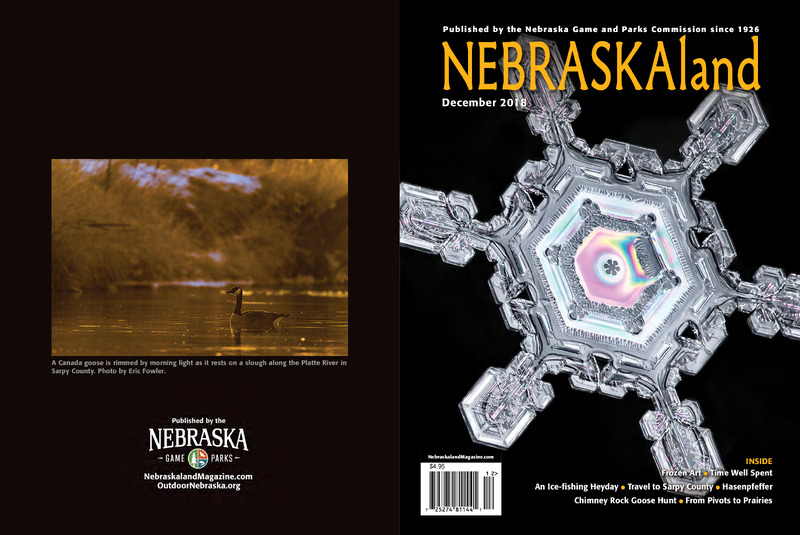
A Canada goose is rimmed by morning light as it rests on a slough along the Platte River in
Sarpy County. Photo by Eric Fowler.
NebraskalandMagazine.com
$4.95
INSIDE
Frozen Art ● Time Well Spent
An Ice-fishing Heyday ● Travel to Sarpy County ● Hasenpfeffer
Chimney Rock Goose Hunt ● From Pivots to Prairies
NEBRASKAland Magazine
Volume 96
●
No. 10
No
●
December
b 2018
201
18
F EAT U R ES . . .
20 Frozen Art
S
R
B ,
26 Time Well Spent
TORY BY ENAE LUM PHOTOS BY
DON KOMARECHKA
What to Do in December
BY RENAE BLUM
28 Search for the Heyday
S
J K
34 Hasenpfeffer
TORY AND PHOTOS BY EFF
URRUS
STORY AND PHOTOS BY GERRY STEINAUER
36 Making Goose Hunters by Chimney Rock
S
J
H
40 Reading Upland Hits
B R S
42 From Pivots to Prairies
TORY AND PHOTOS BY USTIN
AAG
Y YAN PARKS
STORY AND PHOTOS BY GERRY STEINAUER
I N S I D E T H I S I S S U E ...
From Our Readers – Letters, Comments, Etc. .......... 4
Mixed Bag – Threatened and Endangered – the Eastern
Flying Squirrel, Travel to Sarpy County, A Brief History of
34
●
28
●
a Leg in the Grave, Upcoming Events and more ............... 6
Page 49 – Fire in the Sky ............................................ 48
In the Kitchen – Herb and Citrus Roasted Quail ..... 52
Portraits from the Past – Readers' Photos ............. 54
The Last Stop – Little Legs, Big Heart .................... 58
42
●
O N TH E W EB . . .
To see additional NEBRASKAland content
including photos, videos and articles, visit
Magazine.OutdoorNebraska.gov/digital.
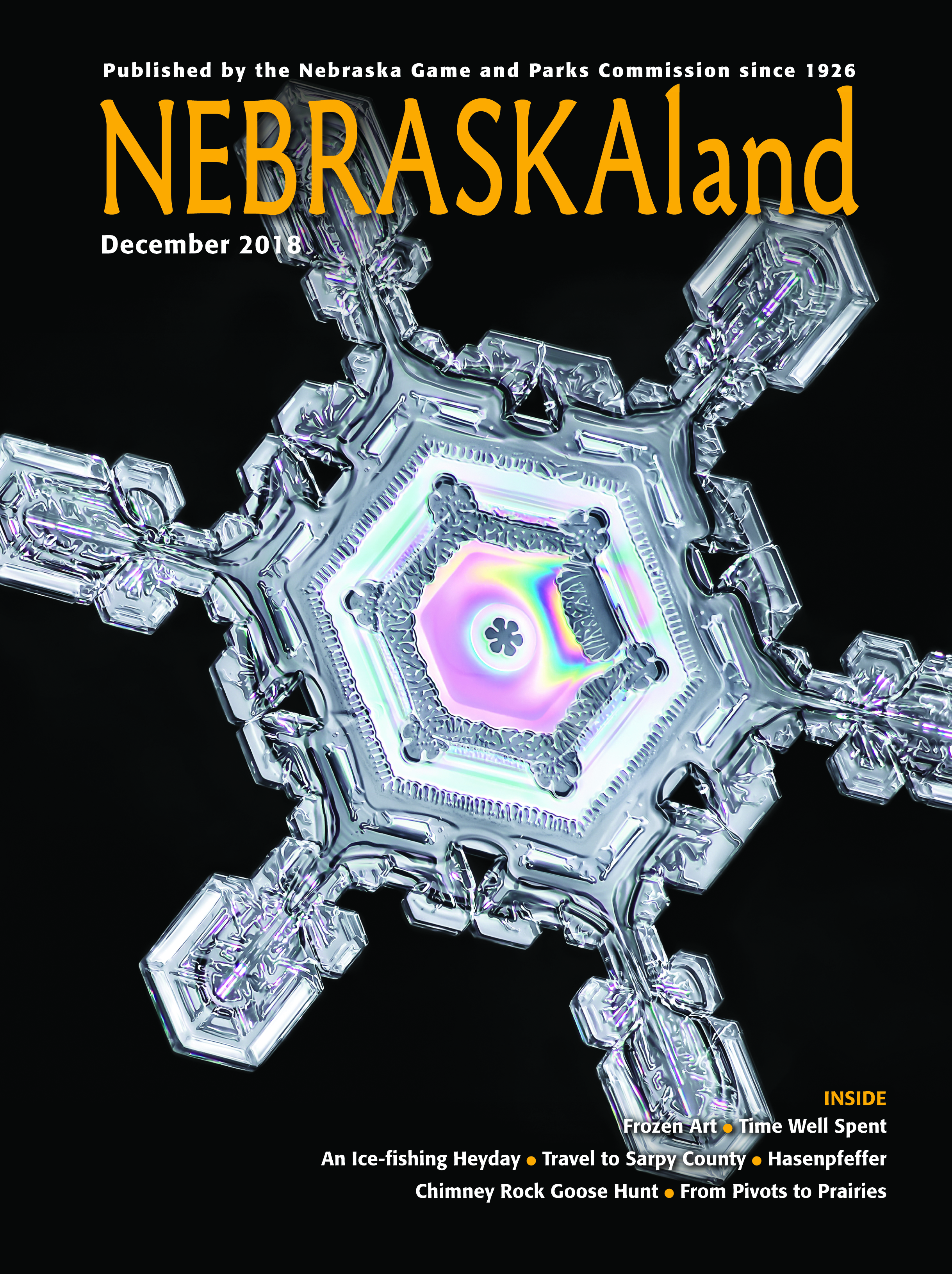
Cover: This snowflake image was taken by Don Komarechka.
Read about his method for snowflake and frozen soap bubble
photography on page 20.
NEBRASKAland (VOL. 96 / NO. 10 ISSN 0028-1964) is published monthly, except
for the combined Jan./Feb. and Aug./Sept. issues, by the Nebraska Game and Parks
Commission, 2200 N. 33rd St., Lincoln, NE. Periodicals postage paid at Lincoln,
Nebraska, and additional mailing offices. POSTMASTER: Send address changes to
NEBRASKAland, P.O. Box 30370, Lincoln, NE 68503-0370.
2 NEBRASKAland • DECEMBER 2018
40
●
DECEMBER 2018 • NEBRASKAland 3
Instagram Featured Photo
Paul L. Filsinger (@paul_filsinger) of
Shelton took this image of sandhill
cranes southwest of Shelton on the
south side of the Platte River. Follow
us (@nebraskaland) and tag us in your
photos to be featured in an upcoming
issue.
Jeffrey Allen of Gering took this photo of
Scotts Bluff National Monument during
the last few days of summer.
ADMINISTRATION
CONSERVATION OFFICERS
Director Jim Douglas
Deputy Director Tim McCoy
Commissioners
Chairman - Dick Bell, Omaha
Vice Chairman - Robert Allen, Eustis
2nd Vice Chairman - Dan Kreitman, Wahoo
Rick Brandt, Roca
Pat Berggren, Broken Bow
Jim Ernst, Columbus
Norris Marshall, Kearney
Doug Zingula, Sidney
Scott Cassels, Omaha
ADMINISTRATION (Lincoln)
Craig Stover (Administrator)
Duane Arp (Asst. Administrator)
Jeff Clauson (Asst. Administrator)
MAGAZINE STAFF
Michelle Hellbusch of
Belgrade took this photo
of her blue spruce tree
after an ice storm.
Karen Linot was excited to photograph
this northern harrier near her home in
Gibbon.
Correction: In the November issue, a
caption on page 25 stated that a hunter
was firearm deer hunting at Oak Glen
Wildlife Management Area. However,
this image was taken during a marketing
photoshoot. It shall be unlawful to use
rifles or handguns, except for .22 rimfire
rifles, to take game, or to discharge rifles
or handguns for any other purpose, within
the boundaries of the Oak Glen Wildlife
Management Area in Seward County.
Send your comments to:
Jeff Kurrus, Editor
NEBRASKAland Magazine
P.O. Box 30370
Lincoln, NE 68503
or e-mail Jeff.Kurrus@Nebraska.gov
Please include your postal address
and telephone number. Letters may be
condensed and edited. Photographs are also
welcome.
Any program that receives federal funding from the National Park
Service, or the United States Fish and Wildlife Service prohibits unlawful
discrimination on the basis of race, color, religion, age, gender, marital
status, national origin, age, disability or political affiliation. Any person
who believes he or she has been discriminated against in any program,
activity, facility, or service, should contact the Nebraska Game and
Parks Commission, Lincoln, NE 402-471-0641, the Equal Opportunity
Commission, Lincoln, NE 402-471-2024, TTY/TDD 402-471-4693;
United States Fish Wildlife Service, Civil Rights Coordinator, 4401
N. Fairfax Drive, Arlington, VA 22203; Director, Equal Opportunity
Program, U.S. Department of Interior, National Park Service, 1849 C
Street NW, Mail Code 0008, Washington, D.C. 20240-0001.
4 NEBRASKAland • DECEMBER 2018
Communications Director Christy Firestone
Editor Jeff Kurrus
Art Director Tim Reigert
Associate Editor Jenny Nguyen-Wheatley
Regional Editors Eric Fowler, Julie Geiser,
Justin Haag
Contributing Editor Michael Forsberg
Regular Contributors Renae Blum,
Chris Helzer, Ryan Sparks, Gerry Steinauer
Photo Librarian Jaclyn Cruikshank Vogt
Circulation Donna Robinson
For address changes and questions about
your subscription, e-mail donna.robinson@
nebraska.gov or call 800-632-5263
Advertising Sales Manager
For advertising information contact
Shane G. Gilster, 402-742-0125
Email: shanegilster@gmail.com
NEBRASKAland Magazine Copyright 2018, all rights reserved.
NEBRASKAland is available in audio from the Nebraska Library
Commission Talking Book and Braille Service, Suite 120, 1200 N St.,
Lincoln, NE 68508. 800-742-7691. NEBRASKAland Magazine and the
Nebraska Game and Parks Commission reserve the right to reject any
advertising not in keeping with the agency mission.
Rates: $18 for one year; $33 for two years; $44 for three years. Nebraska
recipients must add appropriate sales tax. To subscribe call
1-800-NEBLAND (632-5263), or go online to: NebraskalandMagazine.
com.
COMMISSION
CO
COM
C
OM
OMMIS
MIS
SSIO
S ON O
SI
OFFICES
FF
FFI
FICES
C S
Headquarters/Southeast District Office
2200 N. 33rd Street Lincoln, NE 68503
Phone 402-471-0641
Northeast District Office
2201 N. 13th St. Norfolk, NE 68701
Phone 402-370-3374
Southwest District Office
301 E. State Farm Rd. North Platte, NE 69101
Phone 308-535-8025
Northwest District Office
East Hwy. 2, Box 725 Alliance, NE 69301
Phone 308-763-2940
Bassett Office
524 Panzer St., Box 508 Bassett, NE 68714
Phone 402-684-2921
Kearney Office
1617 First Ave. Kearney, NE 68847
Phone 308-865-5310
Ak-Sar-Ben Aquarium
21502 W. Highway 31 Gretna, NE 68028
Phone 402-332-3901
Omaha Office
8495 Frederick Street, Omaha, NE 68124
Phone 402-595-2144
402-471-5531
402-471-5531
402-471-5531
NORTHWEST (Includes counties covered)
Jim Zimmerman (District Supt.)
308-641-6138
Kelsey Glodowski
(Box Butte, S 1/2 Sheridan, Grant)
308-763-8226
Sean McKeehan
(Kimball, Banner, Scotts Bluff)
308-279-9133
Dan Kling (Sioux, Dawes)
308-430-0572
Kyler Prochaska
(E 1/2 Dawes, N 1/2 Sheridan, W 1/2 Cherry) 308-430-3984
Terry Brentzel (Deuel, Garden, Grant) 308-458-7650
402-389-0444
Frank Miller (Cherry, Hooker)
NORTHEAST (Includes counties covered)
Tom Zimmer (District Supt.)
402-641-9590
402-760-0712
Dale Davis (Keya Paha, Brown, Rock)
402-340-3981
Jonathan Andreasen (Holt, Boyd)
402-719-6226
Kyle Gaston (Dodge, Colfax)
Greg Hesse
(Greeley, Wheeler, Boone, S 1/2 Antelope)
402-843-6567
Mitch Johnson (Knox, Antelope, Pierce) 402-613-8612
402-762-5022
Jeff Jones (Knox, Cedar)
Jon Reeves
(S 1/2 Thurston, Burt, Washington)
402-889-8508
Andrew Heyer (Pierce, Madison, Stanton) 402-613-2241
Cory Krause
(Cuming, Wayne, Stanton, Dodge)
402-380-6410
Steve Oberg
(Colfax, Platte, Madison, Stanton, Nance)
402-910-3366
Owen Johnson
(Dixon, Dakota, N 1/2 Thurston)
402-266-1759
308-730-7050
Doug Pollard (Loup, Garfield, Valley)
SOUTHWEST (Includes counties covered)
Roger Thompson (District Supt.)
308-530-3097
308-202-0819
Matt Brandt (Sherman, Howard)
308-380-7331
Tim Williams (Hall, Hamilton, Merrick)
Pat George
(Harlan, Franklin, Phelps)
308-920-2762
Matt Andrews
(Gosper, Furnas, Frontier, Red Willow)
308-746-2418
Brian Piernicky
(Red Willow, Frontier, Hayes, Hitchcock)
308-340-6627
John Lee (Hitchcock, Dundy, Chase, Hayes) 308-414-1432
308-289-0427
Nicholas Fix (Keith, Perkins)
308-289-1169
Bryce Streger (Keith, Arthur)
308-760-0145
Sean Schultz (Keith)
Brandon O’Neal
(Lincoln, McPherson, Logan)
308-530-3157
Alex Hasenauer
(Lincoln, McPherson, Logan)
308-660-4671
Mike Thome (Dawson)
308-529-8146
Ray Dierking (Custer, Thomas, Blaine) 308-870-0322
Taylor Dixon
(Dawson, N 1/2 Gosper, N 1/2 Phelps)
308-217-2108
Eric Javins
(Adams, Clay, Nuckolls, Webster)
402-902-2017
SOUTHEAST (Includes counties covered)
Levi Krause (District Supt.)
402-949-0593
402-619-1355
Rich Berggren (Douglas)
402-616-5961
Dan Evasco (Sarpy)
402-210-0888
Heath Packett (Cass)
402-209-1506
Russell Mort (Otoe, Johnson)
William Krause
(Nemaha, Richardson, Pawnee)
402-274-8063
Matt Taylor (Thayer, Fillmore, Jefferson) 402-200-9597
402-806-0915
Matt Seitz (Gage, Saline)
402-890-6463
Dina Barta (Lancaster)
402-937-3422
Dudley Sorensen (Lancaster, York)
402-613-2312
Travis Shepler (Lancaster)
402-314-9641
Trevor Stahlecker (Lancaster)
402-890-7140
Stacey Lewton (Lancaster, Seward)
402-443-6392
Mike Luben (Saunders, Butler, Polk)
DECEMBER 2018 • NEBRASKAland 5
PHOTO BY EEI_TONY
It seemed as if the four of us were moving in almost perfect
unison as we quickly and carefully exited with our mystery
captive through the sliding doors onto the deck. We pulled
the blanket open, ready to run away screaming if necessary.
There it was – a little southern flying squirrel looking up at
us with its sparkling big brown eyes and pink button nose.
It remained motionless at first as it assessed its new
situation. Then in a split second, it jumped onto a branch
overhanging the deck and was gone into the night. We all
smiled and laughed, grateful that we had the opportunity
to see a flying squirrel up close and that we successfully got
him back to the trees where he belonged.
Southern flying squirrels are considered a threatened
species in Nebraska. They are a nocturnal, woodland species
found in the southeastern part of our state. Flying squirrels
are omnivorous but rely heavily on oak and hickory mast
production for their forage. Extensive stands of mature
oak/hickory woodlands provide suitable nesting cavities.
Flying squirrels do not hibernate during winter, but they will
become less active and sometimes huddle together in tree
cavities for shelter and warmth.
Their geographic range is limited when there are few
woodlands that provide suitable habitat characteristics within
our state. When old oaks and hickories are harvested or
woodlands become fragmented or converted to other uses,
food, cover, and nesting habitat for flying squirrels may be lost.
To conserve flying squirrels in southeastern Nebraska,
management goals should include the maintenance of
healthy woodland structure with native understory plants.
Oak and hickory woodlands can be managed for multi-year
age structure with plentiful large trees to provide nesting
cavities. If timbering is part of management, cutting should
ensure that an adequate number of large, well-spaced trees
remain that can provide nesting sites. Minimum woodland
stand size should be approximately two square miles. Control
of invasive plants such as eastern red cedar and garlic
mustard will also help in maintaining habitat for flying
squirrels and numerous other wildlife species.
Southern flying squirrels don’t actually fly, but they have
wing-like skin that extends from their front and hind paws
that allows them to glide. Maybe if you’re in the right spot at
the right time, you’ll be lucky enough to see a flying squirrel
gliding from branch to branch. They are certainly much
better off in the trees than our chimneys. ■
NEBRASKA'S THREATENED AND
ENDANGERED SPECIES
By Melissa Panella, Wildlife Biologist
6 NEBRASKAland • DECEMBER 2018
could have fallen down the chimney and gotten stuck. It also
occurred to me that there could be some larger animal like a
raccoon in there, and I should proceed with caution.
I probably should have tried to contact someone with the
park and waited on a maintenance person for assistance,
particularly given my condition. But instead, I began
searching closets for a flashlight and a pair of gloves. I found
cleaning gloves but no flashlight. I grabbed the biggest
blanket I could find. I thought a broom might be a good idea
too just in case.
My three cabin mates sauntered through the front door
about the same time and wondered what the pregnant lady
with all the gear was up to. I explained the situation, and we
all anxiously braced ourselves for the creature’s great reveal.
We slowly opened the wood-burning stove’s doors – lo and
behold nothing but darkness. We held the blanket over the
opening and began gently pushing the broom around the
interior of the stove. Within seconds, something “flew” into
the blanket. What was it? Nobody saw it, but nevertheless
we now had it captured within the folds of the blanket!
GOLDHAFEN
In spring 2004, I was attending a National Association
of Interpretation certification and training program as a
naturalist. The daily workshops were interesting, but as is
often the case, the most memorable part of my trip took place
during the meeting off-hours. I was spending the night in a
cabin in the woods. I was also tired and very pregnant at the
time, only a few weeks shy of my due date.
As I was trying to rest, I heard a scratching sound. The
sound stopped, so I closed my eyes again. Several minutes
later as I was dozing off, I heard the noise again. Other than
the scratching, the cabin had been unusually quiet because
my cabin mates were off on an evening adventure. I knew I
wouldn’t be able to sleep until I figured out where the noise
was coming from, so I rolled out of bed curious but also
slightly afraid of what I might find.
After pacing through the cabin, I finally determined with
certainty that the source of the scratching was coming from
the interior of the large wood-burning stove. I couldn’t see
through the closed cast iron doors, so instead I imagined
what might be scratching around. I speculated that a bird
Squirrel, historic Illustration, 1849. Charles d'Orbigny's 'Dictionanaire Universal d'Histoire Naturelle' 1839-1849. Steel engraving.
Original hand coloring.
DECEMBER 2018 • NEBRASKAland 7
Travelogue
Travelogue Sponsor
Visit Sarpy County
Sarpy County
By Josie Meister, Nebraska Tourism Commission
E
xperience the fun to be had
in Sarpy County this winter
season. From light displays
to delicious Christmas treats,
you’re sure to be filled with
holiday spirit in more ways than one.
Explore
See Mr. and Mrs. Claus and their live
reindeer when you visit Washington
Park in Bellevue this Christmas season.
On Dec. 4, Ole Towne Christmas will
be offering warm refreshments, hayrack
rides, holiday light displays, a live
Nativity scene and more.
Get out of your comfort zone and
try an hour-long vinyasa style yoga
class, surrounded by nature, designed
to de-stress and relax you at Fontenelle
Forest every Wednesday in December.
Whether you’re looking to get your
wish list to Santa or to enjoy some
yoga by a fire, Sarpy County is the
perfect place to be.
Do
Eat & Drink
Luckily, there are three meals in
a day when traveling through Sarpy
County. Head over to The Beanery for
morning coffee and try one of their
seven flavors of muffins or Black
Sheep Coffee House for a handcrafted
espresso drink. Also check out Local
Beer, Patio and Kitchen for lunch and
choose from over 100 local craft beers
while enjoying a flatbread pizza or
their signature Local Burger. Or stop
by the Nebraska Brewing Company’s
brewery and taproom for a tour or go
to their brewpub for a pint of their
Cardinal Pale Ale.
Uptown Bakery can satisfy your
sweet tooth in the afternoon with one
of their specialty cupcakes or fresh,
crumbly cookies, and then sit back and
relax for dinner at Wine Cellar 510.
Enjoy a glass of wine or catch one of
their wine tastings happening every
Thursday.
Stay
With all the activities Sarpy County
has to offer, you’re not going to be able
to do them in one day. Book a room at
one of the many hotel options available
including Candlewood Suites, Comfort
Suites, Courtyard by Marriott, Embassy
Suites, Hampton Inn and Suites,
Holiday Inn and more.
Shop
Get your last-minute holiday
shopping done at the Nebraska
Crossing Outlets in Gretna. You can
find premier brands such as Nike, Kate
Spade, Columbia and Fossil all with
outlet prices.
Head to Cabela’s on Dec. 10 and
celebrate Santa’s arrival with Christmas
carols, cookies and hot cocoa. Santa’s
Wonderland lasts the rest of the month
of December at Cabela’s with arts and
crafts, pictures with Santa and more.
Looking for something more
personable?
Oh Darling has unique home décor
that will bring warmth to any home.
Finally, don’t forget to Visit J’Amour
Boutique or Absolutely Her Boutique
for all your holiday outfit needs. ■
PHOTO COURTESY OF NEBRASKA TOURISM
Cozying up with your loved ones
while watching Christmas movies
just seems right during the holidays.
Shadow Lake Towne Center in
Papillion has you covered. Visit Santa’s
workshop and catch a Christmas classic
on Dec. 6! If that doesn’t satisfy your
movie craving, visit Alamo Drafthouse
Cinema to fill your appetite as well.
This Star Wars-themed theater serves
good food, drinks, and a unique
experience all in one place.
Downtown Papillion during the Christmas season.
8 NEBRASKAland • DECEMBER 2018
DECEMBER 2018 • NEBRASKAland 9
A Brief History
One Leg in the Grave
By History Nebraska
(Nebraska State Historical Society)
F
ew people visit their own grave – especially not
when part of their body already lies buried beneath
the headstone. But Omaha police captain James
MacDonald was such a man.
In the early morning hours of Dec. 21, 1921, MacDonald
and several other patrolmen responded to a call that
safecrackers were looting a grocery store at 40th and Dodge.
The safecrackers – or “yeggmen” in the slang of the day –
were attempting to blow open a safe with nitroglycerine.
MacDonald’s police car had barely pulled up when the
burglars opened fire.
“MacDonald had scarcely stepped to the sidewalk … when
a shot from the lookout’s gun shattered his left ankle and the
bone clear to the knee,” the Omaha World-Herald reported in
a Dec. 30, 1928, retrospective. “He slipped to the pavement
and, sitting with his back to a hitching post, continued the
assault with the shotgun he carried, from this position. Here
started a battle in which it has been declared more than one
hundred shots were fired – a fray lasting nearly half an hour,
and heard by neighbors for blocks around.”
As the bandits tried to shoot their way out of the drug
store, MacDonald drove them back inside with his shotgun.
Another bullet struck him in the left knee. The World-Herald
continues:
“‘You got me again!’ Jim called, and fired back, the shot
striking the man’s hand, knocking down his pistol. Checks
and securities, which were wrapped around the handle of the
automatic, fell to the floor covered with blood. ‘You got me
too,’ replied the bandit.”
Did they really
say that, or was it a
bit of storyteller’s
license? The original
1921 reports
don’t include this
particular detail
about the men
politely informing
each other about
the results of their
marksmanship. On
the other hand, each
man may have been
trying to lure his
adversary to come
Omaha police badge, ca. 1920s.
closer. Or they may
History Nebraska 9380-57-(1)
simply have been in
shock.
One of the burglars
threw a bottle of
nitroglycerine, but
it failed to explode.
Finally, “jammed
weapons and lack of
ammunition forced
the cracksmen to
surrender.” The three
men were arrested.
They’d been blowing
safes all over
Omaha for weeks,
but claimed they’d
barely broken even
due to the high cost
Omaha Bee, Dec. 27, 1921.
of explosives.
MacDonald survived, but had to have his left leg
amputated above the knee. While he lay in the hospital, his
wife, mother, and two sisters took his leg to the cemetery
for burial in a child-sized casket transported to the grave by
a hearse. MacDonald later returned to the police force and
A real photo of the "leg" headstone, and an artist's
version of the shootout. Omaha World-Herald,
Dec. 30, 1928.
retired in about 1923 with a captain’s pension.
The 1928 article noted that MacDonald now “gets about
right well” using only a cane. Each Memorial Day he went
to the cemetery to place flowers on the grave where his leg
was buried under a headstone that read, “J. R. MACDONALD /
LEG 1922.”
“It’s a kind of queer feeling to stand by the side of your
grave – to know that part of you is standing above ground
active and well, and the rest of you, your body, I mean, lies
below, dead and buried,” MacDonald said. “But it was a
good leg; it served me for many years, and I’m not going to
forget it.”
Though the 1928 story is whimsical, the leg burial
had a serious point behind it. The family was apparently
celebrating the fact that they didn’t have to bury the rest of
their husband and father. A week after the 1921 shootout,
the World-Herald had run an editorial titled “The Police
Problem,” in which it observed that “a policeman’s lot is not
a happy one,” and that a patrolman “takes his life in hand
to protect the community which pays him a very modest
stipend to serve as the monitor of law and order.”
The rest of James McDonald joined his missing leg at
Westlawn-Hillcrest Memorial Park after his death in 1932.
The “Leg” headstone was replaced with a more conventional
one with the inscription: “He fought a good fight.” ■
Visit History Nebraska’s website at history.nebraska.gov.
Omaha World-Herald, Dec. 27, 1921. The bandits admitted to 18 safe-blowing jobs in about a month's time.
10 NEBRASKAland • DECEMBER 2018
DECEMBER 2018 • NEBRASKAland 11
12 NEBRASKAland • DECEMBER 2018
DECEMBER 2018 • NEBRASKAland 13
New Climbing Wall at Mahoney State Park
14 NEBRASKAland • DECEMBER 2018
PHOTO BY JEFF KURRUS
By Cara Pesek
Nebraska’s state parks and recreation areas – which
annually attract hundreds of thousands of campers, boaters,
anglers and others who love the outdoors – are increasingly
becoming destinations during the winter months, too, with
year-round cabin rentals, snowshoeing, holiday events,
Christmas bird counts, and more.
Perhaps no park is as busy during the winter as Eugene
T. Mahoney State Park, where the Activity Center has long
provided cooped up kids a place to burn off energy on its
indoor playground. This year, a new feature at the Activity
Center provides a place for older kids and adults to get a
winter dose of adventure, too.
Venture Climb, housed in a new, state-of-the-art addition
to the Activity Center, opened in November, just as the
weather turned cold. It features a 42-foot climbing wall
with both auto- and top-rope belays, as well as a bouldering
structure. Walls of varying heights and difficulty offer simple
routes for tykes as young as two or three, and advanced
routes challenge even experienced climbers.
“Mahoney State Park is becoming a destination for visitors
who want to have a unique, memorable and adventurous
experience,” said Jim Swenson, state parks director for the
Nebraska Game and Parks Commission. “We are thrilled to
be able to offer another fun and engaging challenge for our
Alyssa Baldridge of Lincoln ascends the indoor climbing wall at
Eugene T. Mahoney State Park.
park visitors.”
A family could easily spend a whole day at the Activity
Center, which in addition to Venture Climb and the popular
indoor playground, also include an outdoor skating rink
that offers scenic views of the whole park, as well as an
impressive sledding hill, complete with a snow machine.
For pricing, hours and more information for all Activity
Center features visit OutdoorNebraska.org/Mahoney. ■
Presented by
Nebraska EAB Update
Donate Your Hides
T
he 2018 emerald ash borer trapping season has come to
a close. Nearly 700 traps were set in Nebraska, primarily
in the eastern third of the state. The trapping program was a
joint effort of the Nebraska Department of Agriculture and
the U.S. Department of Agriculture. USDA set traps based
on a national model developed by the U.S. Forest Service,
while NDA focused trapping efforts on locations at high risk
for introduction and establishment, primarily campgrounds
and state parks.
In June 2018, NDA discovered a single adult EAB
specimen in a trap at a campground in Eugene T. Mahoney
State Park. A second adult was later collected from the same
trap. Mahoney State Park is located in Cass County, which
had previously been declared infested after EAB was found
in Greenwood in 2016.
PHOTO BY JEFF KURRUS
By Jeff Sneller
The Benevolent and Protective Order of Elks,
known as the local Elks Lodge in most small
towns, is again accepting donated deer hides from
now until the end of the January antlerless deer
season.
Donated hides will be shipped to a tannery to be
turned into soft leather and made into gloves for
veterans who use wheelchairs or used for craft kits
that are distributed to veterans at Veterans Affairs
Hospitals across the world as part of the Elks Help
a Vet program.
Before the hides can be shipped, they have to
have all excess fat, flesh and both heads and tails
removed. Then table or stock salt must be rubbed
into all fleshy surfaces. Volunteers at the dropoff locations do most of this work, but hunters
are welcome to do it themselves before dropping
off the hides. Care must be taken in the skinning
process, however, as even small holes can result
in the hide being ruined during the tanning
process.
Contact your local Elks Lodge for more
information. ■
By Julie Van Meter
State Entomologist, Nebraska
Department of Agriculture
Adult Emerald Ash Borer.
PHOTO COURTESY OF DAVID CAPPAERT, BUGWOOD.ORG
In August 2018, a local arborist contacted NDA to report
a suspect tree in Fremont in Dodge County. NDA staff met
with the arborist, inspected the tree, and found D-shaped
exit holes and serpentine larval galleries, classic signs of an
EAB infestation. EAB had not been previously confirmed in
Dodge County.
A trap set by USDA in Lincoln caught a single adult
specimen, which was confirmed in mid-August. This was the
first confirmation of EAB in Lancaster County.
EAB was first discovered in the United States in Michigan
in 2002. Since that time, it has been confirmed in 35 states,
including Nebraska. Nebraska’s first EAB infestation was
confirmed in Omaha in early June 2016 by Omaha City
Forestry staff, who found EAB larval galleries in an ash tree
in Pulaski Park. A homeowner reported EAB-infested trees
soon after in Greenwood, Nebraska.
NDA enacted the Nebraska EAB Quarantine on June
8, 2016, to slow the spread of the pest. Based on the
new findings in 2018, NDA revised the Nebraska EAB
quarantine effective Nov. 1, 2018. Lancaster, Otoe and
Saunders counties joined Cass, Dodge, Douglas, Sarpy and
16 NEBRASKAland • DECEMBER 2018
Nearly 700 emerald ash borer traps were set in Nebraska.
PHOTO COURTESY OF NICOLE RAMIREZ, NDA
Washington as quarantine counties.
The quarantine prohibits the movement of hardwood
firewood from quarantine counties to non-quarantine
counties, unless the firewood is certified by NDA. Other
regulated materials include all hardwood mulch/chips, ash
nursery stock, ash lumber or any part of an ash tree. For
more information on the Nebraska EAB quarantine, visit
nda.nebraska.gov/plant/entomology/eab/index.html. ■
DECEMBER 2018 • NEBRASKAland 17
The Red Crossbill
by Jerry Kane
Contact the Nebraska Game and Parks Commission at
402-471-0641 or visit OutdoorNebraska.org for more
information. Visit HuntSafeNebraska.org for a list of
hunter education classes and BoatSafeNebraska.org for
a list of boating safety classes.
December 1
Cow Elk Hunting
Season Opens
Private and public land
December 1
Light Up the Fort
Fort Robinson State Park
(SP), Crawford
December 1-2, 7-9,
14-16, 21-23
Christmas at the
Mansion Arbor Lodge
State Historical Park
(SHP), Nebraska City
December 1, 8, 15, 22
Christmas in the Woods
Ponca SP, Ponca
December 1-31
Muzzleloader Deer
Hunting Season
December 1
Archery on Fire
Platte River SP, Louisville
Wildcat Hills State
Recreation Area, Gering
December 9
Women’s Fishing
Instructor Training
Nebraska Game and Parks
Outdoor Education Center,
Lincoln
December 8-9
DeSoto Muzzleloader
Season
December 8-16
Boyer Chute NWR Deer
Hunting
December 9
White-fronted Goose
Hunting first segment
closes
December 15
Crow Hunting
first segment closes
December 15
Christmas Bird Count
Indian Cave SP, Shubert
December 16
Snipe Hunting
December 4
Learn to Hunt
Predators Nebraska
season closes
Game and Parks Outdoor
Education Center, Lincoln
season closes in Zone 2
and 4
December 7-8
Becoming an
Outdoors-Woman
Squirrel Workshop and
Hunt
Nebraska Game and Parks
Outdoor Education Center,
Lincoln
December 7-8, 14-15,
21-23
Christmas at the
Cody’s,
Buffalo Bill Ranch SHP,
North Platte
December 8
Women’s Squirrel
Workshop and
Mentored Hunt
Nebraska Game and Parks
Outdoor Education Center,
Lincoln
December 8
Classic Christmas
Eugene T. Mahoney SP,
Ashland
December 8
Nature’s Gifts:
Decorations from the
Great Outdoors
December 18
Duck and Coot Hunting
December 22
Bighorn Sheep Hunting
season closes
December 25
Duck and Coot Hunting
season closes in Zone 1
December 26
Light Goose Hunting
first segment closes
December 29
Winterfest
Ponca SP, Ponca
December 31
Archery Antelope
Hunting
season closes
December 31
Archery Deer and
Statewide Whitetail
Buck Hunting
seasons close
December 31
Archery Fishing
game fish season closes
December 31
Underwater
Spearfishing season
closes
PHOTO BY JUSTIN HAAG
December 1
Bobcat Hunting and
Trapping season opens
By Joel Jorgensen
The red crossbill is a distinctive finch whose crooked beak usually catches one’s
attention. Rather than being a deformity, the odd beak is an adaptation that the bird
uses to extract its preferred food source – seeds from the cones of conifers such as
pines, spruces and firs. Although its specialized beak may give the red crossbill an
advantage in foraging on its preferred cone type, its relationship with conifer cone
seeds is a double-edged sword that in many ways defines the species' entire life
history. A bumper cone crop influences if and when the species breeds, and poor
cone seed production may force individuals and populations to undertake nomadic
wanderings across the continent in search of food.
The close relationship between bird and seed has also resulted in the evolution
of different populations that are referred to as “types," not unlike the way tropical
hummingbirds have evolved unique bill shapes and lengths as their preferred
flowering plants evolved. Crossbills belonging to different types are biologicallyisolated from each other. Overall size, beak shape and call notes differ among types.
Only one type of red crossbill can generally be found year-round in Nebraska in the
Pine Ridge and Wildcat Hills.
This type of red crossbill is adapted to extracting seeds from the cones of the
common conifer found in these regions – the ponderosa pine. Occasionally, red
crossbills occur anytime of the year in other extensive areas of ponderosa pine,
such as the middle Niobrara River valley or planted forests at Bessey or McKelvie
Nebraska national forests, as well as in cemeteries and at backyard feeders.
Other types of red crossbills can occur anywhere in Nebraska on occasion during
years of poor cone crops of their preferred conifer species. When large numbers
appear suddenly such an event is referred to as irruption. A major red crossbill
irruption occurred in Nebraska in October 2017 and included red crossbill types
that breed in the Pacific Northwest and Intermountain West. This irruption was
short-lived, though, and it is virtually impossible to know when the next one may
occur. Individuals who maintain bird feeders may get lucky and occasionally attract
red crossbills. Otherwise, the bird feeders at Wildcat Hills State Recreation and
Nature Center often host this species where crossbills and their peculiar beak can be
appreciated at close range. ■
NEBRASKAland
Visitor Ending
Last issue’s winner of the Visitor
drawing was Cheri Rychly of
Bennington, who found the arrowshaped micrathena spider on page
54.
This will be the last Visitor for
NEBRASKAland. The Visitor
started back in 2009 and this was
the 89th Visitor. Perhaps we will
have another contest in future
issues.
The arrow shaped micrathena
spider is a brightly colored spider
found in most states east of the
Rocky Mountains, including
Nebraska. This spider is an orb
weaver spider, related to the
common garden spider. The
spider’s common name comes from
its triangular abdomen, which on
females includes several sharp
spines. Females are very colorful,
with yellow, black, red and white
markings. Males are smaller
in size and mostly black. These
spiders overwinter in the egg stage,
hatch in the spring, and spend
the summer and fall eating small
insects that get caught in their
webs. The spiders inject a toxic
venom into their prey that liquefies
the interior of the insect, which
they then consume.
While these spiders
are excellent
predators of small
insects, they pose
no real risk to
humans.
Special thanks to Julie Van Meter,
State Entomologist, Nebraska
Department of Agriculture.
Make sure to see the
all-new look of
Nebraskaland
Magazine with the
upcoming JanuaryFebruary issue.
DECEMBER 2018 • NEBRASKAland 19
Frozen Art
Snowflake Photography
with Don Komarechka
By Renae Blum
D
on Komarechka is a connoisseur of snowflakes.
Give him a random snowflake, and he’ll probably have a pretty good
idea of how and why it likely formed, despite having no background in
science. He can also tell you exactly how to take a macro photograph of that
snowflake in dazzling detail, having photographed thousands.
Komarechka, a self-taught professional photographer from Barrie, Ontario, has
made a career out of photographing what he calls “the unseen world,” including
snowflakes. In his work, these small crystalline structures, which usually measure
just a few millimeters in size, explode in astonishing detail, revealing intricate
patterns and layers that glisten like small jewels.
It’s proof that you don’t need to look far for an amazing macro subject in the
winter – just head outside during any given snowfall and take a closer look.
Komarechka stumbled onto snowflake photography almost by accident. “I
bought myself an extreme close-up lens, and took it with me to work that day.
You’d be surprised how interesting things around the office look at very high
magnification – a typical ballpoint pen, a pushpin in a corkboard.”
Then it started snowing, and Komarechka kept shooting. Needing a darker
background to make the snowflakes pop, he reached for a black mitten his
grandmother had given him for Thanksgiving. It made all the difference.
“[The snowflakes] just sparkled. There was contrast and detail and shape and
form, and it was magical. Every one of my snowflakes has been photographed on
that same black mitten because it was just the perfect surface,” Komarechka said.
“That day when I went home from the office, I just kept shooting. And the
bug had bit me at that point,” he continued. “It became – I don’t want to say an
‘obsession,’ but probably an addiction.”
Snowflake photography dominates Komarechka’s work from December to midMarch every year – the same subject, photographed and edited in almost exactly
the same way, innumerable times.
“You’d think I would get bored with it after a while. But no, you always
discover something new,” he said. “This past season I found many more exotic
snowflakes than I would have expected.
“And when you see something that really breaks the norm, it’s a drug. It really
does have something of an addictive quality.”
Komarechka’s way of photographing snowflakes is unusual. Most
photographers shoot snowflakes on a plate of glass or another transparent surface,
with light coming toward the camera from behind. Komarechka shoots snowflakes
with light reflected off the snowflake from in front of it. Komarechka’s method is
more work-intensive, but also makes it possible to see color in certain snowflakes
– usually vibrant greens and magentas, but also blues, yellows and reds.
“This has to do with the same physics that puts rainbow colors in a soap bubble
20 NEBRASKAland • DECEMBER 2018
DECEMBER 2018 • NEBRASKAland 21
Taking Snowflake
Photographs – Don’s Method
or an oil spot,” he said. “It can only be seen using reflected light. And
because that hadn’t really been explored heavily in snowflake photography
until I started doing it, it was a huge mystery to me as to where these colors
were coming from. It felt good to kind of be discovering things like that.”
For Komarechka, it’s not only the beauty of snowflakes that’s appealing;
it’s also the chance to research and truly understand his subject. Science
never appealed to him in school, but “as soon as you give it a practical use, it
becomes something entirely different,” he said.
To share all that he has learned, Komarechka wrote a 300-page book
including the science behind snowflakes, as well as his process of shooting
these composite images. While his method requires patience and time to
learn, once you understand the technique, “it’s like riding a bike,” he said. “It
becomes muscle memory.”
While Komarechka hoped to inspire others to take up snowflake
photography with his book, he also anticipated most people would be
interested in just looking at the coffee table photographs in the back. And
that’s OK.
“Perhaps you will be inspired to put on your black mittens the next time it
snows, grab a magnifying glass and see what you can find,” writes Kenneth
G. Libbrecht in the book’s foreword. “Each snowfall provides a unique
exhibit of frozen art, and the show deserves an audience.”
In Komarechka’s work, you’ll get a front-row seat. ■
ABOVE: Don Komarechka photographs a snowflake positioned just
beyond the tip of a paintbrush for visual reference.
OPPOSITE and BELOW: Uncommon combinations of temperature
and humidity are at the heart of these unusual snowflake
sculptures, which formed in rarely seen atmospheric conditions.
22 NEBRASKAland • DECEMBER 2018
To take his shots, Komarechka
leaves a black woolen mitten and
a paintbrush outside through the
winter in an enclosed space, keeping
them acclimated to the cold so
the snowflakes don’t melt upon
contact. He then lays the mitten flat
and examines the snowflakes that
collect. Often they are in clusters;
Komarechka uses the paintbrush to
carefully separate them and position
a choice snowflake at a preferred
angle. To make sure he can find the
snowflake again when switching to
his camera, he points the end of the
paintbrush toward it, with the brush
resting on the mitten.
Komarechka then takes a few test
shots to find an angle that gives
the snowflake a glowing, reflective
surface. “And then I start out of focus
on one side of the snowflake and
start rapid-fire shooting, passing
the camera through all the focus
points that I need,” he said. “This will
typically amount to a few hundred
shots while the snowflake is still
relatively unchanged.
“Once I’ve got these images, I’ll
load them up into the computer,
choose the puzzle pieces I need, and
begin a four-hour process of getting a
perfect image of all of them combined
together in Photoshop.”
As far as equipment goes,
Komarechka says any camera that
can accept different lenses will work.
You will also need a specialized
macro lens, sometimes referred to as
an “extreme macro lens,” that goes
well beyond the normal 1:1 life-sized
magnification. Komarechka also
uses a ring flash for all his snowflake
pictures. No tripod is needed.
While any snowfall can produce
beautiful snowflakes, Komarechka
says a temperature of about 14
degrees Fahrenheit is ideal. “So long
as it’s below the freezing point by a
couple of degrees, the exact same
techniques work anywhere in the
world,” he said. Low wind, low cloud
ceilings, and snowfalls during the night
are also promising conditions.
For a complete look at
Komarechka’s method, pick up
his book, Sky Crystals: Unraveling
the Mysteries of Snowflakes, at
skycrystals.ca.
DECEMBER 2018 • NEBRASKAland 23
LEFT: A column-type snowflake that later
grew plate-type crystals from either side
as temperatures dropped slightly.
BELOW LEFT: A “bullet rosette” type
of snowflake featuring multiple column
crystals originating from the same point.
Four crystals forming in symmetry is
quite unusual.
BELOW: An exotic snowflake based on
“arrowhead” crystal growth patterns.
Branches grow outward from the main
repeating body.
OPPOSITE TOP: Large blocky snowflakes
form in lower humidity, with broad
branches and a solid footprint. This one
has added layers of depth within.
OPPOSITE BOTTOM: With side-branches
that resemble razor blades, a snowflake
of this design forms in very stable
conditions. A brief pulse of increased
humidity causes the trident-like branches
to form.
24 NEBRASKAland • DECEMBER 2018
Soap Bubble Magic
Snowflakes are not the only subject
Komarechka photographs during the
winter. Below, Komarechka explains
his method for producing beautiful
pictures of freezing soap bubbles.
“To create a freezing soap bubble
image, at least the way I do it, start by
lighting the bubble from behind with a
bright LED flashlight. A Fresnel sheet
magnifier can be used to refocus the
light to be intensified over the bubble.
To create the bubble, the formula is:
6 parts water
2 parts dish soap
1 part white corn syrup
The white corn syrup serves as a
‘cushion.’ When the bubble is blown
from the end of a drinking straw,
the syrup pools at the bottom of the
bubble. When gently placed onto
snow, this cushion prevents the
bubble from popping instantly.
Temperatures between around -4 F
and 17.6 F work best, with absolutely
no wind. Even a little whisper of wind
will knock the bubble about and it will
pop/shatter.
Freezing soap bubble images are
best taken when the bubble hasn’t yet
completely frozen solid, so that you
can see a variety of ‘puzzle pieces’
all about to connect together. You
need to work fast, as most bubbles
will freeze completely solid in around
10 seconds. There is a lot of trial and
error involved, but once you get the
hang of the technique you can start to
use other foreground objects beyond
just snow. I’ve used mineral samples,
a branch from my Christmas tree,
flowers and more. It’s a fun winter
activity!”
DECEMBER 2018 • NEBRASKAland 25
Time Well Spent
7th Annual
Winterfest
Dec. 29
Ponca State Park
A truly unique outdoor winter
tradition, Ponca State Park’s
annual Winterfest includes a
fruitcake fling and a yule log
quest, as well as seasonal
crafts and lighted hayrack
rides. Come on out to enjoy
the beauty of the winter
season after the Christmas
rush has passed.
What to Do in December
By Renae Blum
O
PHOTO BY JENNY NGUYEN-WHEATLEY
utdoor fun doesn’t stop in the winter. This month, hunters and anglers
will stay busy with muzzleloader deer season and ice fishing; state parks
will host a number of festive holiday events across the state; and the beauty
of a fresh snowfall or line of perfect icicles can draw even the most reluctant
of us outside with our cameras. To read about fun park events across the
state, visit Calendar.OutdoorNebraska.gov.
■
Muzzleloader Deer Season
Winter
Photography
Dec. 1-31
Statewide
Throughout the month
PHOTO BY ERIC FOWLER
There’s no need to put your camera
away during the winter. A fresh
snowfall can provide a stunning
subject, said NEBRASKAland
photographer Eric Fowler, so
bundle up and head outside. It is
important to watch your exposure,
he said, as the brightness of the
snow can fool your light meter
and lead to underexposed photos.
As always, it’s often best to shoot
photos early or late in the day when
the light is soft and warm.
PHOTO BY JULIE GEISER
Enjoy less competition and more time in the field during muzzleloader
deer season, which lasts all month. In addition to these benefits,
muzzleloader hunting also offers a unique challenge. “It takes more
patience, skill and a steadier hand than rifle hunting, and requires
a more close-up encounter with the intended game,” writes Wendy
Horine. If you’ve never hunted with a muzzleloader, give it a try this
year.
Statewide
Ice Fishing
As ice conditions allow
Statewide
Dec. 15
The Christmas Bird Count is a long-standing program of the National Audubon Society that allows
researchers to study the long-term health and status of bird populations across North America.
Thousands of volunteers participate in the count each year, and you can be one of them – no
birding expertise needed. The event is free and no pre-registration is required; binoculars and bird
ID books will be available to borrow. The event begins at the park’s shop at 8 a.m.
26 NEBRASKAland • DECEMBER 2018
PHOTO BY JUSTIN HAAG
Indian Cave State Park
PHOTO BY JENNY NGUYEN-WHEATLEY
Indian Cave Christmas Bird Count
If conditions are right, anglers will be out
enjoying a favorite winter tradition: ice fishing.
People of all ages can enjoy this activity, and it
can be surprisingly addicting for a newcomer.
As always, safety is important. A quick recap:
Make sure to fish with others, wear a life
jacket, tell a friend or family member where
you’ll be fishing, and avoid alcohol. In case
you should fall through, have a long rope with
you so someone can rescue you, and wear a
commercial or homemade ice pick around your
neck to pull yourself to safety. Also, remember
to check ice conditions while working your way
out to your fishing spot. You’ll need a minimum
of four inches of clear, solid ice to support one
person.
DECEMBER 2018 • NEBRASKAland 27
Search
for the
Heyday
With no other soul on the ice,
winter fishing diehard Don Cox
of Mullen fishes at the Valentine
National Wildlife Refuge’s
Pelican Lake. He longs for the
days at Pelican when he’s not
the only one on the ice.
Story and photos by Jeff Kurrus
D
on Cox of Mullen clearly
remembers 28 years
ago. He was at Pelican
Lake on the Valentine
National Wildlife Refuge
ice-fishing with his brother-in-law,
Dave Fehlhafer, near an angler they
nicknamed Red Man. While Red
Man was catching some of the largest
bluegill Don has ever seen, Don and
Dave weren’t doing so well, spending
most of the time second-guessing their
tackle and technique.
Nowadays, Don doesn’t do a lot of
second-guessing. An ice-fishing diehard
with a number of tournament wins and
thousands of hours on the ice, he’s
ready to adjust at a moment’s notice,
yet patient with the process that has
allowed him so much success thus far.
Yet he has one goal that still evades
him – and it goes back to that stranger
on the ice so many years ago on
Pelican Lake. Soon, he thinks, he might
just have a chance to achieve it.
Hooked
On New Year’s Day in 1990 – several
weeks before his first trip to Pelican –
Don awoke to a bucket of fish on his
front porch caught by brother-in-law
Dave. Despite ice-fishing sparingly as a
child with his father and great uncle, he
found himself intrigued.
28 NEBRASKAland • DECEMBER 2018
That afternoon, Don and Dave went
to Calamus Reservoir, which was
supporting 16 inches of ice they had to
cut with a dull, spoon hand auger that
could only manage about two inches of
ice per minute. They were fishing with
two tip-ups and a makeshift outfit that
used a tree branch as the rod. “I caught
one largemouth bass through the ice
that New Year’s Day, but it changed
my life forever.”
He was so hooked, in fact, that
despite a ranching income that at the
time was about half the state’s poverty
level, he talked his wife into giving up
the $25 entry fee for he and Dave to
enter the Valentine Jaycees Ice-Fishing
Tournament at Merritt Reservoir. “It
guaranteed $5,000 in cash and prizes,
and we thought about how much
fishing equipment we could buy if we
won the tournament.”
After a series of mishaps that
included navigating one-way roads
and disposing of a mule deer that had
been hit by another driver’s van – all
to avoid the motel cost of staying in
Valentine for the night – they arrived
40 minutes late to their moneymaker.
It took them an hour and a half to
cut two holes apiece, and their newly
bought rods didn’t have enough line to
get down to the 45 feet they needed to
fish. They had no lunch, no water, and
the beer in their system from the preDECEMBER 2018 • NEBRASKAland 29
could get their hands on. “I would get
In-Fisherman’s ice annual and it was
like getting a Christmas gift,” Don said.
“There we learned about Dave Genz
and Ice Team, and found out that for
$25 per year Ice Team would send four
publications entirely about ice-fishing.”
Eventually, through tournament
experience and practice all over
the country – including Minnesota,
the Dakotas, Idaho, New York, and
Canada, he was asked to join Genz’s
Ice Team in 2002. In 2009 he won that
same tournament that had first skunked
him and Dave, then won it again in
2016 on Big Alkali.
“Those years of tournament fishing
are funny, and eye-opening, when we
look back now,” said Don. “Many of
the faces you see on ice equipment
nowadays were fishing those same
tournaments. We were right in the
middle of the ice-fishing explosion.”
However, as the ice-fishing scene has
expanded throughout the country, there
has been one serious decline that has
continued to affect Don. Because of the
introduction of carp into the Refuge’s
system of lakes, Don’s dreams of
finding his 2-pound bluegill and yellow
perch on public Sandhills lakes were
behind him.
With his years of knowledge, he has
pined for the good old Red Man-sized
fish that he couldn’t catch when he
was getting started but is more than
equipped to catch now.
Because of recent plans by the
Nebraska Game and Parks
Commission, Valentine National
Wildlife Refuge and the Nebraska
Environmental Trust, he won’t have to
wait much longer.
Renovations
A massive renovation project began
earlier this year on the Sandhills
Don is all smiles while ice-fishing at Pelican Lake on the Valentine National Wildlife Refuge.
tournament Calcutta the night before
was gone. With head pounding, Don
starting eating ice from the holes they
had cut as they watched a team near
them haul in fish after fish.
They didn’t catch a single one.
Red Man
After the tournament, Don and Dave
talked to some guys who had fished
Pelican Lake that same day. “When
they showed us their bluegills, I had
no idea what I was looking at,” said
Don. “It wasn’t until I was at my son’s
30 NEBRASKAland • DECEMBER 2018
doctor’s appointment a couple weeks
later that something clicked.”
There was an In-Fisherman Magazine
photograph of a guy holding a 10-inch
bluegill. “I just remember how happy
he looked,” Don said. Then he thought
back to the fish from Pelican not two
weeks before. “There was not a bluegill
close to that small.”
By that Sunday he and Dave were
pulling into Pelican, but they weren’t
alone. “There had to be more than
600 people fishing,” he said. “Finding
a parking spot wasn’t easy. It was a
quarter-mile walk to get to the ice.”
They set up near a man whose area
was dotted with Red Man chewing
tobacco excretions, and watched him
catch three of the largest bluegill that
Don has ever seen. “He was obviously
having a good day,” Don noted. “There
was a 25 mile-per-hour wind and
neither one of his two 5-gallon buckets
where he was throwing fish moved at
all.”
While Red Man never shared his
tackle and techniques – the man only
glared and grunted at them – Don and
Dave made a pact that day to get better
at ice-fishing. They even set personal
goals: two-pound trophies of Nebraska’s
three most popular panfish species –
yellow perch, crappie and bluegill – and
he wanted to do it on a public Sandhills
lake. “I’ve caught several crappie over
two pounds, and been close on the other
species, but I’m not there yet.”
For a long time, he was convinced he
could accomplish this at the Refuge’s
system of lakes. Through the years, he
upgraded his gear and increased his
knowledge to accomplish these goals,
asking questions, researching and
studying other anglers anytime he could.
They were also reading anything they
Don releases a largemouth bass back into Pelican Lake.
DECEMBER 2018 • NEBRASKAland 31
Caught on a private Sandhills lake, Don is convinced bluegills this size will be caught from Refuge lakes after they are renovated.
Above: Don witnessed the ice-fishing explosion firsthand, when popularity increased
in the 2000s and manufacturers like Clam and Vexilar took over the ice-fishing world.
Below: A slab crappie is caught and released on a private Sandhills lake.
32 NEBRASKAland • DECEMBER 2018
lakes on the Refuge to remove and
keep common carp from these prolific
waters.
Native to Europe, carp cloud the
water with their bottom-feeding
activities, hindering the growth of
aquatic vegetation that is the base
of the food chain and limiting the
productivity of sight-feeding fish such
as bluegill, yellow perch, largemouth
bass and northern pike.
Watts Lake was the test subject when
its renovation began in 2014, and by
the 2018 season, keeper-sized fish were
being caught from the lake. Pelican
was next. With work starting in 2018,
the goal is to return this natural lake
– like the other renovation projects on
the Refuge – to its heyday.
“These lakes have a unique ability
to grow big fish,” said Nebraska
Game and Parks Commission Aquatic
Habitat Program Manager Mark
Porath. “They have great vegetation
and invertebrates, which act as great
energy packets for bluegill. They can
grow like crazy.” Because of these
factors, the top-end possibilities are
so much higher compared to other
waterbodies out there, a fact Don
knows as well.
The 2-Pounder
Fish with Don on a private Sandhills
lake, one not beseeched with carp, and
he’ll passionately point every time he
pulls a gigantic bluegill from a hole.
“See! That’s the possibility on those
public lakes!” he says.
When the fish is on the end of your
line, his excitement is even more. “Get
‘em! Get ‘em!” he calls out, as if it’s
1990 all over again and every fish is a
revelation.
In many ways, it is – especially when
he thinks about the future. “I want to
see bluegill so big you can’t fit them
through the hole,” he said. “And when
those Refuge lakes are renovated, that’s
exactly what we’ll see again.”
And he’ll be there to witness it –
probably within eyesight of novice
anglers wondering what tackle and
technique he’s employing.
All they’ll have to do is ask. ■
DECEMBER 2018 • NEBRASKAland 33
Hasenpfeffer
A forgotten family recipe
W
hen I was growing up, once a
year my family would shoot
a few rabbits while hunting
pheasant and quail. The following
weekend, using the rabbits, Mom
would undertake what she called “the
task of making hasenpfeffer.” Then,
my uncles and older male cousins
on the Steinauer side of the family
would gather at our house for an
evening meal of hasenpfeffer and
gravy-smothered dumplings. This was
followed by endless games of fivepoint pitch played for a cow and a
calf (a dollar a game and fifty cents a
set) accompanied by drinking a few
highballs and bickering and laughing
well into the night.
Hasenpfeffer is a traditional German
dish of brined and stewed rabbit.
“Hase” is German for hare or rabbit
while “pfeffer” literally translates
to pepper, referring to the general
spiciness of the recipe which hinges on
a spicy vinegar marinade with a long
soak time. A gravy is usually made
from the brine, in which the rabbit
is cooked, and ladled over noodles,
potatoes or dumplings.
I never participated in hasenpfeffer
feasts. I was so disgusted by the
sour, vinegary aroma of the cooking
rabbit that only near-starvation could
have forced me to consume such
a vile-smelling lagomorph. The
other Steinauers showed no such
nitpickiness and consumed it with lipsmacking vigor.
Last spring, at a gathering of the
extended Steinauer family, a chat
with some cousins somehow turned
to, of all topics, hasenpfeffer. I was
captivated as they reminisced about
long-ago meals of hasenpfeffer at their
own family tables. It was obvious:
hasenpfeffer dinners were once a
tradition in the Steinauer family and I
needed to dig deeper.
I called my source for family
history, my nearly 90-year-old uncle
Clem Steinuaer of Tecumseh. He
vividly recalled eating hasenpfeffer as
a child in Pawnee County.
“I loved it.” he said. “Grandma
Steinauer used to send me out with
orders to shoot a young cottontail
PHOTO BY GERRY STEINAUER
By Gerry Steinauer, Botanist
Hasenpfeffer – a German rabbit stew – served with mashed potatoes and baked apple slices.
The Steinauer Hasenpfeffer Recipe
Ingredients:
• 1 dressed rabbit, cut into pieces
• 2 cups vinegar
• 3 cups water
• ½ cup sugar
• 1 sliced onion
• 2 teaspoons salt
• ½ teaspoon pepper
• 1 teaspoon pickling spice
• ¼ cup fat or oil (I used lard)
• 2 tablespoons flour (I used more)
Soak the rabbit 36 to 48 hours in the pickling
mixture (vinegar, water, sugar, onion, salt, pepper and
34 NEBRASKAland • DECEMBER 2018
pickling spice) in the refrigerator. Roll rabbit pieces
in flour and sear in oil, then boil them in the same
pickling mixture for 45 to 60 minutes or until tender.
Remove the rabbit and thicken the mixture with flour
to make gravy.
After searing, instead of boiling the rabbit, I cooked
the pieces, along with three cups of the pickling
mixture, in a crockpot set on high for four hours.
Cooked this way, the gravy did not need thickening.
Numerous hasenpfeffer recipes using various
pickling mixtures and cooking methods can be
found online. Squirrel, and likely pheasant, can be
substituted for rabbit in the recipes.
or jackrabbit for hasenpfeffer. We
couldn’t afford much store-bought
meat back then, but rabbits were
plentiful.” He may still have a copy
of his grandma’s hasenpfeffer recipe
“stashed somewhere.”
I also talked with my mom, Mary
Ann Steinauer of Omaha. Strangely,
though of full German heritage, her
maiden name was Dahmke, and
raised on a farm on the outskirts
of Millard, she had never heard of
hasenpfeffer until marrying my dad.
Despite cooking hasenpfeffer at my
dad’s request, she, like her squeamish
youngest son, could never bring herself
to eat it. “It must be an acquired taste
from childhood,” she mused.
She thought the recipe she used was
likely the same Steinauer recipe that
Uncle Clem had stashed somewhere.
My sister recently found my mom’s atleast-60-year-old handwritten copy of
this recipe folded in a cookbook.
Recently, to revive a family tradition,
and using two rabbits I harvested last
winter, I used my great grandma’s
recipe and made hasenpfeffer. Would
I Iike it? Or would my tastes still
be tainted from soured childhood
memories?
Well ... first of all, my now more
sophisticated nose found the aroma
of the cooking hasenpfeffer rather
pleasant, slightly tangy, earthy – far
from disgusting. As to the taste, it was
really good. The meat was moist, falloff-the-bone tender with just the right
amount of spiciness and sourness. The
gravy was wonderful over mashed
potatoes.
Now I see why the Steinauer boys
liked their hasenpfeffer. I never would
have guessed it, but they had pretty
good culinary tastes. ■
DECEMBER 2018 • NEBRASKAland 35
Making Goose Hunters By Chimney Rock
Story and photos by Justin Haag
I
f one were to devise a marketing
plan for goose hunting in the
Nebraska Panhandle, a scene
such as this would surely be
considered: “Big group, flying
low from Chimney Rock.”
Those were the words of
outdoorsman Larry Olson of Crawford
as my son Sawyer and I were sitting
in his goose pit near McGrew along
the North Platte River valley – my first
goose hunting experience of the season
and Sawyer’s first goose hunting
experience ever. It is hard to think of
a better place to have my son shoot
his first geese – or a better person to
accompany him while doing it.
Olson is well known in northwestern
Nebraska for his hunting and fishing
passion. A recently retired Chadron
mail carrier, his friendly nature makes
him as popular in the field as he was
on his delivery route. Many Chadron
residents have fond memories of “Larry
the Mailman” and his sidekick Twila
Satchell, who also retired in 2017 after
serving many years as a pleasant face
behind the counter at the Chadron Post
Office.
When Olson is not hunting or
fishing, he puts considerable time and
resources into conservation efforts.
One annual project is helping organize
the banquet for the Pine Ridge chapter
of Ducks Unlimited, a group he has
served as chairman.
Always quick to take to the field with
a shotgun or fishing rod since his youth
in Sidney, Olson is devoting even more
time to the outdoors these days. He
says with a grin that he has spent “only
32 days” hunting in the pit last season.
Not too shabby, considering he makes a
90-plus-mile trip from Crawford to do
it each time.
His log shows that he has had a lot
of company. Last season alone, 54
different people took Olson up on an
invitation to hunt at his pit with its
picturesque south-facing view to the
Wildcat Hills.
“I like to give the experience of
goose hunting to people who otherwise
wouldn’t be able to go,” Olson said.
“Some people can’t pay a lot of money
to do this sort of thing and I like to
give them the experience.”
Even though Olson has made a
sizable investment with the lease and
gear, he does not ask for money from
Chimney Rock and the Wildcat Hills stand as a backdrop for Larry Olson’s goose pit in eastern Scotts Bluff County.
36 NEBRASKAland • DECEMBER 2018
DECEMBER 2018 • NEBRASKAland 37
the late 1990s when I was in a goose
pit for the first time. From glancing
over to Sawyer and hearing his simple
declaration “this is cool,” I could tell
that he was getting the same feeling.
When Olson was not working to
lure geese with the variety of calls
hanging from his neck, he was sharing
his hunting expertise and stories of
past hunting trips. Perhaps it was
Issy, his 9-year-old yellow Labrador
retriever, who worked hardest. Despite
her age, she retrieved like a champion,
although appearing to be a little
annoyed with Olson’s 4-month-old pup
Roxie, also a yellow Lab, shadowing
alongside.
Even though we thought we were
in for a warm day with blue skies, we
were instead greeted with a goosehunt-friendly mix of clouds, stiff north
winds and temperatures not quite warm
enough to melt the blanket of snow
surrounding us. The geese kept us busy
and several big flocks of mallards also
flew high overhead.
With the last goose of a three-man
limit downed, evening sunlight casting
a long shadow from Chimney Rock,
and smiles on our faces, we headed
back north for Chadron. I know the
experience will not be forgotten any
time soon, especially by the youngest
hunter in the blind that day.
Later that evening, as Sawyer and
I were making one more memory for
the day with knives in hand, I was
thankful for the great resource of tasty
meat provided from hunts such as
this and a hunting heritage that helps
bond generations. Perhaps I am most
thankful, though, for hunters such as
Larry Olson who find enjoyment in
sharing that experience and are so
eager to do it. ■
Larry Olson’s yellow Labrador retriever Issy retrieves a goose while pup Roxie tags along.
his guests. Now Olson can count
Sawyer among the many people he has
witnessed shoot their first goose. He
Larry Olson works a goose call from the pit.
38 NEBRASKAland • DECEMBER 2018
said there have been about 35 first-time
goose harvesters at the pit in itself, and
many more at other locations before he
took on the lease.
“I really like taking the kids,” he
said. “They are the future of hunting
and the more hunters we have in
the field the better it is for all of us
because that’s more people paying for
conservation. I’ve also had a lot of
women and girls come down and hunt
and they really seem to eat it up.”
Olson provided us with an exemplary
goose hunting experience from when
we arrived early in the day, including
several doses of time-honored
waterfowling wisdom.
“Sawyer, there’s an old saying
in waterfowl hunting: If you burn
breakfast it’s a good day,” Olson said
just before using a well-worn cast
iron skillet to warm up breakfast
burritos made of goose sausage, eggs
and cheese. He did not burn the tasty
fare but a less experienced hunter
might have as several flocks teased
us. When the first flock approached
the pit that morning, my heart raced
just as much as it did north of Lisco in
Larry Olson, along with puppy Roxie, poses for a photo with guests Justin and Sawyer Haag.
DECEMBER 2018 • NEBRASKAland 39
Reading Upland Hits
The difference between a clean kill and a
wounded bird isn’t black and white
By Ryan Sparks
O
40 NEBRASKAland • DECEMBER 2018
Birds That Come
Down Dead
Puffball: These birds erupt in an
explosion of feathers and immediately
fold up and drop with their head down.
They are the easiest to recover because
they usually remain where they land
and don’t bury themselves in the cover.
If you are hunting with a dog, get it
slightly downwind of where you saw
the bird come down. It shouldn’t take
much effort to find it.
Pinwheel: The bird tumbles head
over tail, tries to set its wings, but spins
sideways like a pinwheel. These birds
drop headfirst and are dead before they
hit the ground. Anytime a bird drops
headfirst is a sign it was a clean kill –
the way you want them to be.
Sky Rocket: These birds fly straight
up in the air when shot. They can
climb a good distance, but then fold
up and tumble back to the earth. This
is especially common with pheasants
and grouse. It’s a rarity, but this can
also happen with gliding birds. On
a grouse hunt several years ago, my
hunting partner had a bird glide 200
yards before suddenly falling like it
hit a wall. After a brief walk, it was
laying right where it fell. I think these
birds are dead but don’t know it yet.
They are running on pure adrenaline,
but when it runs out it’s like an engine
grinding to a stop.
Flinching: You think you missed,
but the bird made a slight cringe
before continuing on its way. These
birds show little reaction to the shot.
Flinching birds are a prime example
of why you should watch as long as
PHOTO BY JEFF KURRUS
n a frosty November morning,
Dad and I dumped my English
pointer, Tippet, into a short draw
that reliably holds a covey of quail.
As we walked the perimeter, the icy
earth squeaked under our boots and
we watched the dog bound through the
brome grass. When she went on point
in a tangled plum thicket, I stomped
around, kicking branches and breaking
limbs until a covey exploded from the
backside. Neither of us had a shot, but
Dad saw where the birds came down.
When we brought the dog over, she
instantly locked up on point again.
This time the covey was spread out
and flushed in two bunches about 10
yards apart. I shot a bird on the covey
rise, then swung on a second that
came down just out of sight. My dad
also shot a pair, and I took my young
pointer to where they had come down.
She quickly found the first three, but
after another 20 minutes of searching,
we couldn’t find the fourth. Finally,
Tippet pointed 30 yards from where
I thought the bird was, and when I
kicked expecting to flush a single,
I found the final bird. Even though
the shot had looked clean, the quail
managed to move a good distance and
wedge itself under a thick layer of
grass. If it hadn’t been for the dog, we
would have never found it.
That day reinforced the importance
of reading a bird’s reaction to a shot.
Nebraska has a wide range of upland
hunting opportunities, and with this
year’s Nebraska Upland Slam, there
has never been a better time to brush
up on your upland hunting skills.
The following descriptions should be
helpful in determining how well you
hit the bird, what it’s likely to do after
the shot and what you should do to
recover it.
Ashley Bales of Lincoln shoots at a flushing rooster over a milo field on a hunt at Yankee Hill Wildlife Management Area.
possible. They might not respond
immediately, but soon their flight starts
to become erratic. Larger birds such
as grouse and pheasants will hit the
ground running or be lying dead where
they fell. The only way to find out is
to make a good mark and get the dog
downwind. More often than not, these
birds were hit in a major blood vessel.
Unlike a squarely hit bird that dies
from trauma, these bleed out in the air
and eventually die from hemorrhaging.
Birds That Come
Down Alive
Cartwheel: Rather than the pinwheel
described above where the bird spins
sideways, these birds tumble head over
tail. Many people take this to be a sign
of a clean hit, but if the bird’s head is
up, it’s still alive. A broken wing causes
birds to cartwheel, but once on the
ground birds can survive a long time
with a broken wing. If you can’t get a
follow-up shot at the bird you need to
get the dog where the bird came down
as quickly as possible before it has a
chance to run or bury itself.
Glider: Healthy pheasants usually
fly a good distance before hitting the
ground running. Quail can glide as far
as pheasants, but most often stay put
once they come down. It you hit a bird
that glides in for a landing without
going far, chances are it’s a cripple.
These are some of the toughest birds
to recover because they have a head
start on you. At longer distances, it’s
also tough to get an accurate mark
where the bird came down. Watch the
bird’s legs. A dangling leg means it’s
wounded, most likely with a broken
leg, and your chances of recovering
it increase significantly. If you have
the opportunity, a follow-up shot on a
gliding bird is the best option.
Low and Behind: The most
frustrating birds let out a puff of
feathers, but continue to glide into
the distance. The feathers make you
think it was a solid shot, but the bird’s
reaction says differently. This usually
means you hit the lower back quarter of
the bird. It’s wounded, and will usually
angle downward with its head up. It
may glide a ways, but it’s looking for a
place to run. Get the dog there as soon
as possible.
Recovering
Crippled Birds
When you have a bird come down
alive it’s going to run, bury itself, or
both. A successful recovery starts with
a good mark so watch the bird until
you’re absolutely sure it’s come down.
Approach your mark from downwind
and look for feathers, which are a sure
sign the bird was hit and is nearby.
Keep the speed and direction of the
wind in mind. It will cause feathers
to drift from the place of impact.
Sometimes you can hear a bird rustling
in the grass or running.
Mark the place where you think it
came down with a blaze orange hat or
on a GPS unit and return to it later if
need be. Also, remember to trust your
dog’s nose. Sometimes a scent will take
it away from where the bird landed.
Don’t call your dog back. Mark the
spot and follow along. There is a good
chance it’s trailing a fleeing bird.
Start paying more attention to not
only whether a bird has been hit, but
how it reacts to the shot. Knowing how
to read your hit and get your dog in the
best position for a recovery will add up
to more birds in your cookpot. ■
Don’t forget to enter your birds at
OutdoorNebraska.gov/uplandslam.
By harvesting a sharp-tailed grouse,
greater prairie chicken, ring-necked
pheasant and bobwhite quail you will
receive an official certificate and be
entered to win one of several grand
prizes.
DECEMBER 2018 • NEBRASKAland 41
A Sandhills family restores grasslands
Story and photos by Gerry Steinauer, Botanist
T
unexpected. Dan wore shorts, T-shirt,
tennis shoes and a ball cap, while
Allyson sported shorts and low-cut
cowboy boots that exposed a colorful
PHOTO BY ERIC FOWLER
wo summers ago, when I pulled
into Dan Frank and Allyson
Dather’s Sandhills ranch just
west of Bassett, their appearance was
Center-pivot-irrigated cropland occupies former prairie on low Sandhill dunes in Keith County. Hundreds of thousands
of acres of Sandhills prairie has been lost to pivot development over the last half century.
tattoo of prairie wildflowers running
the length of her right calf. This was
not standard rancher attire.
Though unconventional in aspects,
Dan and Allyson are traditionalists at
heart who could talk shop with any
weathered Sandhills rancher. On this
day, however, their minds were not on
cattle. They were excited to show me
the prairie they recently restored on
former center-pivot-irrigated cropland.
At day’s end, after bouncing around
for miles in a UTV, I was impressed by
the prairie restorations, their grasp of
prairie ecology and land ethic.
Allyson Dather and Dan Frank pose in a Sandhills meadow.
42 NEBRASKAland • DECEMBER 2018
History of the
Frank Ranch
In the 1930s, Frank’s great
grandfather, Harry Frauen, ranched
with his brother east of Valentine. One
version of the family legend has it that
their wives did not get along so they
flipped a coin to see who would stay
on the ranch and who would leave.
“Great Grandpa lost the flip and was
bought out by his brother. So he bought
this place,” Frank said with a laugh.
The less interesting version of the
story is that during the Dust Bowl the
Valentine ranch could not support two
families, so one had to move on.
The Bassett ranch has stayed in
the Frauen/Frank family ever since.
In 1976 after graduating from high
school in Minneapolis, Dan’s father
Tom moved onto the ranch, working it
with his grandfather. A few years later,
he married his wife Deb. The couple
had two daughters, Nicole and Erin,
followed in 1988 by their son, Dan.
In 2006, Dan left the ranch to attend
the University of Nebraska earning a
degree in diversified agriculture and
a minor in grassland ecology. Like
his father, he returned to the ranch
shortly after graduating, working it
with his parents. Allyson, who grew
up on a Knox County ranch, met Dan
“serendipitously” in 2008 and joined
him on the ranch in 2011.
Broken Ground
The Sandhills, occupying 20,000
square miles of north-central Nebraska,
are our nation’s most intact grassland
ecosystem. Farming in the Sandhills
was limited until the 1950s, when the
invention of the self-propelled centerpivot irrigation system allowed, for the
first time, efficient irrigation of the dry,
sandy dunes. Since then, hundreds of
DECEMBER 2018 • NEBRASKAland 43
A center-pivot irrigation system, once used to water crops, now stands idle on a prairie restoration on the Frank Ranch.
The pivot will eventually be removed.
thousands of acres of Sandhills prairie
have been converted to cropland under
pivot irrigation using water from the
underlying Ogallala Aquifer. Prairie on
the low, rolling dunes and sand flats of
the Sandhills’ periphery has been most
susceptible to pivot development.
Located on the northern fringe of the
Sandhills, much of the Frank ranch was
suitable for pivots. In the 1970s, Dan’s
great grandfather put in a few pivots on
several hundred acres of low pasture.
Beginning in the early 1980s, after
taking over the reins of the ranch after
the death of his grandfather,
44 NEBRASKAland • DECEMBER 2018
Tom Frank added several more
pivots.
Tom had inherited only a small
portion of the ranch from his
grandfather, and he and Deb slowly
bought the remainder from relatives.
They also purchased other lands to add
to the ranch, some of which contained
pivots. By 2011, the Frank ranch
had 17 center pivots growing corn,
sudangrass, alfalfa, and soybeans to
feed their expanding cattle herd and for
market.
“One reason my parents put in and
farmed pivots is that they were buying
land from the mid-1980s through
the late 1990s,” Frank said. “At the
time, increasing and diversifying their
income stream from strictly cattle to
include crops was crucial to help make
the land payments.”
The farming, however, has had
environmental consequences. “Now,
because of farming in the area, we
can’t drink our tap water due to high
nitrate levels,” Frank said. “Sandhill
soils are nutrient poor and crops grown
on the pivots require much nitrogen
fertilizer. We have to apply about 200
pounds of nitrogen per acre to grow
Canada milkvetch (above) and black-eyed Susan (bottom right) are among the first
wildflowers to establish in prairie restorations such as those on the Frank Ranch.
corn. In the 1980s they applied more.”
In areas of the Sandhills the aquifer
literally touches the land surface and
irrigation water easily seeps down
through the porous sands, carrying
nitrates into the groundwater.
Frank was also troubled by other
aspects of farming with center pivots.
“It takes a lot of electricity to run the
pivots, much of which comes from
burning coal,” Frank said. “Also, to
grow crops on dry sand requires an
incredible amount of water. Most of
our pivots pump 900 gallons a minute
and take 48 hours to make a single lap
around a typical 132-acre field to apply
a little over one-half inch of water. You
can do the math.”
In addition, the Frank ranch lies
within the headwaters of the spring-fed
Long Pine Creek, one of Nebraska’s
most pristine cold water streams,
and unfortunately, the pivots’ use of
groundwater can impact stream flows.
On a personal level, Frank also was
tired of spending days on a tractor
planting and harvesting crops and
cutting and baling alfalfa on the pivots.
He desired to be “more rancher and
less farmer.”
Restoring Native
Grasslands
A few years ago, seeking change
on the ranch, Dan and his sisters
approached their parents about seeding
some of the pivots back to grassland.
“We had to do some pleading as it is
hard for any rancher or farmer to break
management tradition or change their
cash flow,” Frank said. “My parents,
however, were never really passionate
about farming, their passion lies in
cattle. They also had come to realize
that farming the Sandhills was not
DECEMBER 2018 • NEBRASKAland 45
Fire and
Wildflowers
College
C
ll
exposed
dD
Dan F
Frank
k
to new methods of grassland
management, one being the use
of prescribed fire. Recently, Dan
and Allyson have learned the art
of conducting burns by attending
prescribed fire workshops and by
assisting conservationist groups
and other ranchers with fires. They
now conduct prescribed burns on
their own ranch.
Prescribed burning has
traditionally been considered
taboo in the Sandhills and is still
little used by ranchers who fear
the fire escaping and rampaging
across the prairie-covered
dunes. Local lore also holds that
burning will expose the sands to
wind erosion and that a pasture
cannot be grazed for a year
or two after burning to prevent
harming sprouting grasses and
the soil. Research is proving
these traditional beliefs false and
that prescribed fire can provide
ecological and economic benefits
in areas of the Sandhills, and be
conducted safely.
“Fire can be vital in maintaining
healthy grasslands,” said Frank.
“In areas with eastern red-cedar
invasion, burning is the only costeffective method of controlling
them. Any rancher with cedar
problems should be a fan of
prescribed fire.”
Dan and Allyson showed me
one pasture they had burned the
previous two springs. “Both years,
we turned cattle onto the pasture
just three weeks after the fire,”
Frank said. “We grazed it really
hard for three to five weeks, then
rested it from June through August
and grazed it again in the fall.”
He has found this management
especially effective in reducing the
spring and fall-growing, non-native
smooth brome and Kentucky
bluegrass that are invading his
low-lying prairies and which he
hates with a passion. As ranchers,
he and Allyson appreciate the
sand bluestem, prairie sandreed
and other cattle-fattening native
grasses this practice promotes.
As prairie enthusiasts, they are
grateful for the lush response of
wildflowers.
46 NEBRASKAland • DECEMBER 2018
great for the environment.”
In the spring of 2016 and 2017, the
Franks planted seven of their center
pivots, totaling 935 acres, back to
grassland using seed mixes containing
60 species of prairie grasses and
wildflowers native to the Sandhills.
Though most of the thousands of
pounds of seed was purchased from
seed dealers, Dan and Allyson also
hand collected the seed of bush
morning glory, silky prairie clover,
rough gayfeather and other wildflowers
from their Sandhills pastures.
“In the spring of both years, I
drove the tractor and drill planted
the clean, purchased seed,” Frank
said. “I scattered the uncleaned seed
we collected from the back of our
UTV while Allyson drove.” Both
summers, Frank irrigated the new
seedings using the pivots resulting in
the rapid establishment of the prairie
plants. The pivots will eventually be
removed.
The Franks will wait three years
after planting before grazing cattle
on the restored prairie and receiving
income off the former cropland.
Meanwhile, with the actual pivots
still on the land those areas’ property
values and taxes will remain
high. “For the first few years the
restorations will be a financial drain.
This is just one of the reasons it’s so
hard for most ranchers and farmers to
do this,” Frank said.
The timing of the restorations,
however, worked nicely for the
Franks. With recent low crop prices
the pivots had become less profitable
and, after over 30 years of ranching
and farming, Dan’s parents were
in a solid financial position and
could now afford to make changes
to their operation – now blending
conservation with production.
“Allyson and I never could have
afforded to restore the pivots back to
prairie without my parents’ help,” said
Frank. “It was too expensive.”
The seed alone for the restoration
cost the Franks more than $100,000,
and there was also the expense of
Allyson Dather stands alongside
shell-leaf penstemons in a recently
burned Sandhills pasture. The tattoo
is a collage of her favorite prairie
wildflowers.
planting and running the pivots to
aid seedling establishment. “Let’s
face it, I was the main initiator of
the restorations, but my parents are
responsible for making it happen. The
passion Allyson, my sisters and I have
for healthy and productive prairie had
rubbed off just enough on my parents
to get this done.”
Because the pivots are in the
sensitive Long Pine Creek watershed,
the Natural Resource Conservation
Service provided the Franks costshare for the seed through their
Environmental Quality Incentives
Program. The Nebraska Game and
Parks Commission, Northern Prairies
Land Trust and U.S. Fish and Wildlife
Service also provided guidance or
cost-share for the plantings.
Last summer, when I visited the
restored prairies, they were already
thick with native grasses and the
vibrant blooms of wildflowers.
Bees and butterflies floated about
in pollinator heaven while the air
hummed with the melodic song of
dickcissels, grasshopper sparrows and
other grassland birds. From a hunter’s
perspective, I saw excellent habitat
for deer, pheasants, quail and prairie
grouse.
A Prairie Ethic
“Though some might think we
restored the pivots just to have pretty
wildflowers, we will still utilize the
land,” said Frank. “Our crop will be
beef, no longer grain.” Frank stressed
that cattle grazing will also be used
as a tool to keep the restorations, as
well as their native Sandhills prairies,
healthy and biologically diverse.
“Prairie continues to be plowed
under, not only in the Sandhills, but
throughout the Great Plains, and in
areas, what prairie remains is terribly
degraded. Allyson and I find this
heart-wrenching and we have decided
do something about it on our ranch,”
Frank said, adding that, as finances
allow, they hope to restore more
pivots to prairie in the years to come.
“We ranch to make a living and
because we enjoy it, but we want to
do it in a manner that enhances our
land for nature and future generations
of ranchers.” ■
DECEMBER 2018 • NEBRASKAland 47
Fire in the Sky
A good reason for a late-night jaunt.
By Roger Welsch
I
48 NEBRASKAland • DECEMBER 2018
meteor showers (or at least promised
meteor showers) I face the northeast
and watch the rise of Cassiopeia. I used
to point that constellation out to my
children, telling them that the big W in
the sky stands, of course, for Welsch.
To be honest, there are very few
nights when I have slept under a clear
Nebraska sky, in any season, when
there is not the occasional “falling star,”
always a surprise, always a wonder.
“Meteor showers” are only nights
when the numbers might be greater
but the Earth is bombarded constantly
by these space dashers, many only as
big as a grain of sand but nonetheless
burning bright because of the cosmic
speed with which they slam into our
atmosphere.
I still remember the surprise of one
night in September more than 60 years
ago when I was camping with friends
near Lincoln and the sky was lit by a
brilliant green meteor flash. Copper
perhaps?
Meteor showers are not rare events:
a listing of notable “showers” shows
more than three dozen such events in
any one year, so while a shower with
particular promise is the sort of thing
that takes me up the hill loaded with
my lounge chair and optimism, any
clear Nebraska night merits attention
overhead.
My next try will be the night of
Dec. 13 for the Geminids display,
which once again, my almanac
promises to be a particularly good one
since the moon will set early, offering a
dark sky. I am partial to the Geminids
too because unlike the Perseids, best
viewed sometime around 2 a.m., the
Geminids will (hopefully!) blast the
sky shortly after 10 p.m., meaning I
can go up the hill, spend a couple hours
in the December chill, and then return
to the house and a warm bed not long
after my usual bedtime.
There is a reason Nebraska hosts
star watching parties, especially in
the Sandhills, where there is less
light pollution and wider horizons.
But anywhere out of city lights can
offer good viewing, for example in
our state parks, perhaps a view across
a lake or river. Given a night in the
Nebraska countryside, a clear sky, and
the whole cosmos offering, perhaps, a
spectacle, there isn’t much room left
for disappointment! ■
ILLUSTRATION COURTESY OF SKY & TELESCOPE/GREGG DINDERMAN
am writing these words early
morning Aug. 12, 2018, once again
coming down from a night up on
the hill behind our house; I went up
last night, anticipating “a perfect
night for the Perseid meteor showers
… 60 to 80 shooting stars per hour”…
having seen but eight. And four of
those flashed from north-northwest
to south-southeast and therefore were
more than likely space junk than
cosmic visitors. The problem with
viewing this time was smoke haze from
fires in the United States Northwest
and Canada. It’s always something.
So last night as I lay back in the
lounge chair I tossed into the back of
my pickup truck, I could see waves of
haze move across the sky from east to
west, and while the stars were brilliant
between the haze lines, even during
clearing interludes, there was a blurring
overcast.
So, how disappointed am I this
morning? Not much, actually. Any
night spent under a Nebraska sky is a
good night. Nothing is as comforting
to me as lying under an open sky, “to
neighbor once again with the stars,”
to rephrase a line from John Neihardt.
There have been periods in my life
when I have spent more nights looking
up at the open sky than a confining
ceiling but … uh, let me put it this way,
“advance maturity” has limited those
overnight adventures.
I have always loved to lie facing
south so I can look out at the passage
of the planets and know I am looking
across the disk of the solar system,
perhaps when the Milky Way is visible
across the disk of our galaxy, in the
winter watching Orion stalk his prey
across the sky through the night; or I
lie with my feet to the north so I can
calculate by the rotating Big Dipper
around the North Star how much time
I have left in my warm sleeping bag
(and yes, I know it is our Earth that is
rotating and not the stars but … literary
license and all), a kind of reverse action
24-hour clock; or on the occasion of
Roger Welsch is an author, humorist,
folklorist and a
former essayist for
CBS News Sunday
Morning. He has
been contributing to
NEBRASKAland
Magazine since
1977.
DECEMBER 2018 • NEBRASKAland 49
50 NEBRASKAland • DECEMBER 2018
DECEMBER 2018 • NEBRASKAland 51
Herb and Citrus Roasted Quail
Little birds make the best finger food.
By Jenny Nguyen-Wheatley
W
hole quail are nearly
impossible to eat with a fork
and knife, so for this recipe,
put those utensils away and
bite in. This is drinking
food at its best. Enjoy with a cold mug
of ale along with other finger-friendly
sides and snacks.
If you are not a hunter but would like
to try this recipe, check out the Asian
Market in Omaha for frozen whole
quail. They are similar to wild birds.
Servings: 2-3
Prep Time: 24 hours
Cooking Time: 15-25 minutes
Ingredients:
6 whole quail, skin on
2-3 fresh sprigs of rosemary,
leaves only
Small bunch of fresh thyme
5 cloves of garlic, crushed or
minced
Grated zest of 2 medium oranges
Juice of 2 oranges
¼ cup of olive oil, plus extra
Juice of half a lemon
¼ cup of chardonnay
¼ teaspoon of cumin
¼ cup of white onion, minced
Kosher salt, to taste
Freshly cracked pepper, to taste
Paprika, to taste
1. To make the marinade, rub
rosemary leaves and thyme sprigs
(keep whole if tender) between your
fingers and palms and then place into
a large bowl. Next add garlic, orange
zest, orange juice, ¼ cup of olive oil,
lemon juice, chardonnay, cumin and
onion. Whisk and set aside.
2. Rinse quail under cold water and
pat dry with paper towels. Sprinkle salt
on the outside and inside of each bird
and place them inside a large zip-top
bag. Give the marinade another good
whisk and pour it into the bag. Remove
as much air from the bag as possible
before sealing. Refrigerate for 24
hours. Flip the bag over occasionally.
52 NEBRASKAland • DECEMBER 2018
PHOTO BY JENNY NGUYEN-WHEATLEY
•
•
•
•
•
•
•
•
•
•
•
•
•
•
3. Take quail out of the refrigerator
one hour prior to cooking. Preheat your
oven to 450 degrees Fahrenheit – at
least 400 if your oven doesn’t go that
high – and once preheated, allow the
oven an additional 30 minutes to get
nice and hot. If you like, you can grill
the quail instead over direct mediumhigh heat.
with olive oil, then rub with paprika
and a light dash of salt. Place them
onto a rimmed cookie sheet and roast
for 15-20 minutes or until the skin
becomes brown and the bird is just
cooked through. (You can tie the legs
together with cooking twine to keep
the birds from touching on the cookie
sheet.) Serve immediately. ■
4. Remove the quail from the
marinade and pat dry with paper
towels. Brush each bird generously
This recipe and photograph
originally appeared on Jenny’s blog at
foodforhunters.com.
DECEMBER 2018 • NEBRASKAland 53
▲
This is a my late father, Russell Boggs, in a picture taken in the early 1920s
in Hershey, where he lived.
– Jim Boggs, Grand Island
▲ From the left is my dad
dad, Art Push,
Push Jr.,
Jr who is now 89
years old and hunted until he was 86; and my uncles Richard
Hamilton, Mike Hamilton, and Bob Hamilton after a successful
day of pheasant hunting west of Lincoln circa fall of 1957. They
are all from Omaha, Nebraska.
– Art Push III, Kennard
▲
Pictured is myself and Fred Bentley (right)
llooking over our duck harvest in my backyard
iin Lincoln on the opening day of the early teal
sseason of 1966. We shot these birds from a
ttemporary blind made of weeds from the then
ffilling Salt Valley lake in southeastern Lancaster
C
County now known as Hedgefield. All birds are
b
blue-winged teal. One of them had a leg band
tthat was attached near Yorkton, Saskatchewan,
C
Canada, in Aug. 20, 1964. I sent it to the U.S.
F
Fish and Wildlife Service and they sent back the
b
banding information to me.
The empty shells were added in an attempt
tto give interest to the picture. I was shooting a
Winchester Model 12 and Fred used his side-bysside double barrel. I believe it was a Parker.
Fred, who died in 1980, was my next-door
n
neighbor and close friend. He was originally from
C
Cleveland, Ohio, and had much experience in
w
waterfowl and upland game hunting in Ohio and
ssurrounding states. He piqued my interest in
gamebird hunting, and we had many good hunts
g
iin the field and from the blind.
– Brick Paulson, Lincoln
Send contributions to: Portraits from the Past, NEBRASKAland Magazine, P.O. Box 30370, Lincoln, NE 68503-0370. Or e-mail to Tim.Reigert@Nebraska.gov. Photos should
show people enjoying Nebraska outdoor activities, such as camping, boating, hunting or fishing, and must have been taken before 1980. We will give priority to unusual photos or
activities. When possible, please include a story about the photograph and identify the people, places and approximate date it was taken. Text may be edited and photos adjusted
for reproduction. All photos will be returned.
54 NEBRASKAland • DECEMBER 2018
DECEMBER 2018 • NEBRASKAland 55
SAFARI
SAFA
RI CLUB
CLUB INTE
INTERNAT
INTERNATIONAL
RNATIONA
RNAT
IONAL
IONA
L
Presented by
NEBRASKA SAFARI
CLUB INTERNATIONAL
Let’s Go Hunting!
T
he first National R3 Symposium was held in Lincoln
May 21-23, 2018. R3 stands for recruitment, retention
and reactivation. Representatives from 40 state fish and
wildlife agencies and many non-profit and industry members
met at the symposium to discuss the future of hunting.
Many have heard that hunter numbers in the United States
are in a decline. The latest (2016) U.S. Fish and Wildlife
Service report released shows hunter numbers are down to
11.5 million in the U.S., which is about 5.6 percent of the
population, and new hunter recruitment at about 3.5 percent.
Furthermore, current estimates for 2018 put that number
down to 10 million.
R3 is a national initiative by most state game and fish
agencies to help reverse this trend. Did you know that
approximately 80 percent of all the dollars that go into
wildlife conservation in North America are the result of
various taxes on the sales of hunting, shooting and fishing
related purchases? The North American Conservation Model
depends on this vital income, so every purchase we make is
important to the success of conservation in our country.
The R3 initiative has many state, federal, industry and
NGO members such as Safari Club International, the
National Wild Turkey Federation and Pheasants Forever.
To improve hunter retention, recruitment and reactivation,
these groups are working together to develop strategic shortterm and long-term partnerships to encourage these goals.
Our own Nebraska Game and Parks Commission is
working as stewards of our resources to protect our interests.
They have worked hard to develop hunter education,
making Nebraska a safe and enjoyable hunting experience
for hunters of all ages. They protect our wildlife with
regulations that improve hunting opportunities.
They have worked with private landowners to make
230,000 acres of private lands available for public hunting
through the Open Fields and Waters program. Hunters will
find many opportunities to enjoy the lands enrolled in this
program.
Nebraska is also a member of the Council to Advance
Hunting and Shooting Sports to protect and promote
participation in hunting and the shooting sports for future
generations. Their action plan includes goals to increase
participation in the hunting and shooting sports.
Please join us in supporting all participants in the R3
initiative. The Nebraska Chapter of Safari Club is a proud
supporter. We sponsor and support education and youth
activities with dollars in our state. ■
For more information please contact us at
nebraska.SafariClubInt@gmail.com or by calling
402-214 -8270. You can also visit our website at
nebraskasafariclubint.com
DECEMBER 2018 • NEBRASKAland 57
Little Legs, Big Heart
T
he grass ruffles ahead, flicking away
ice like specks of glass. A flash of fur
here. Some red and white there. Nose to
the ground, bouncing and zig-zagging,
punctuated by small bursts of short legs
leaping. For brief moments, soggy ears take
flight over vegetation.
Then halt.
Tongue wagging and panting – a little body
still winding with motion despite stopping.
58 NEBRASKAland • DECEMBER 2018
Cate the French Brittany looks back to check
on her hunter, Commissioner Robert Allen,
who follows closely behind.
“Come on!” she seems to say, through bugeyed, larger-than-life expression.
How can you not follow her to the ends of
the earth? ■
Jenny Nguyen-Wheatley
Dec. 14, 2015
DECEMBER 2018 • NEBRASKAland 59
Position: 769 (14 views)