Volume 96, Issue 2, 2018
March 2018
- Identifier:
- nela.2018_096_02
- Title:
- Volume 96, Issue 2, 2018
- Issue Name:
- March 2018
- Date Issued:
- 2018-03-01
- year:
- 2018
- month:
- March
- Season:
- Winter
- PDF filename:
- NL_96.02_2018_Mar_Spreads_Entire.pdf
- Publisher:
- Nebraska Game and Parks Commission
- Format:
- Periodical
- volume:
- 096
- issue:
- 02
- number:
- 096.02
- Decade:
- 2010s
- Type:
- Rights Holder:
- Copyright Nebraskaland Magazine/Nebraska Game and Parks Commission, all rights reserved.
- Extracted Text:
-
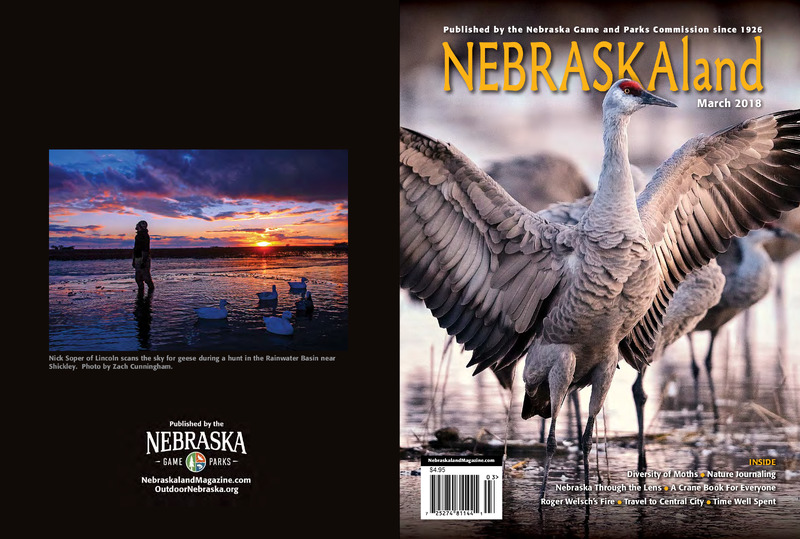
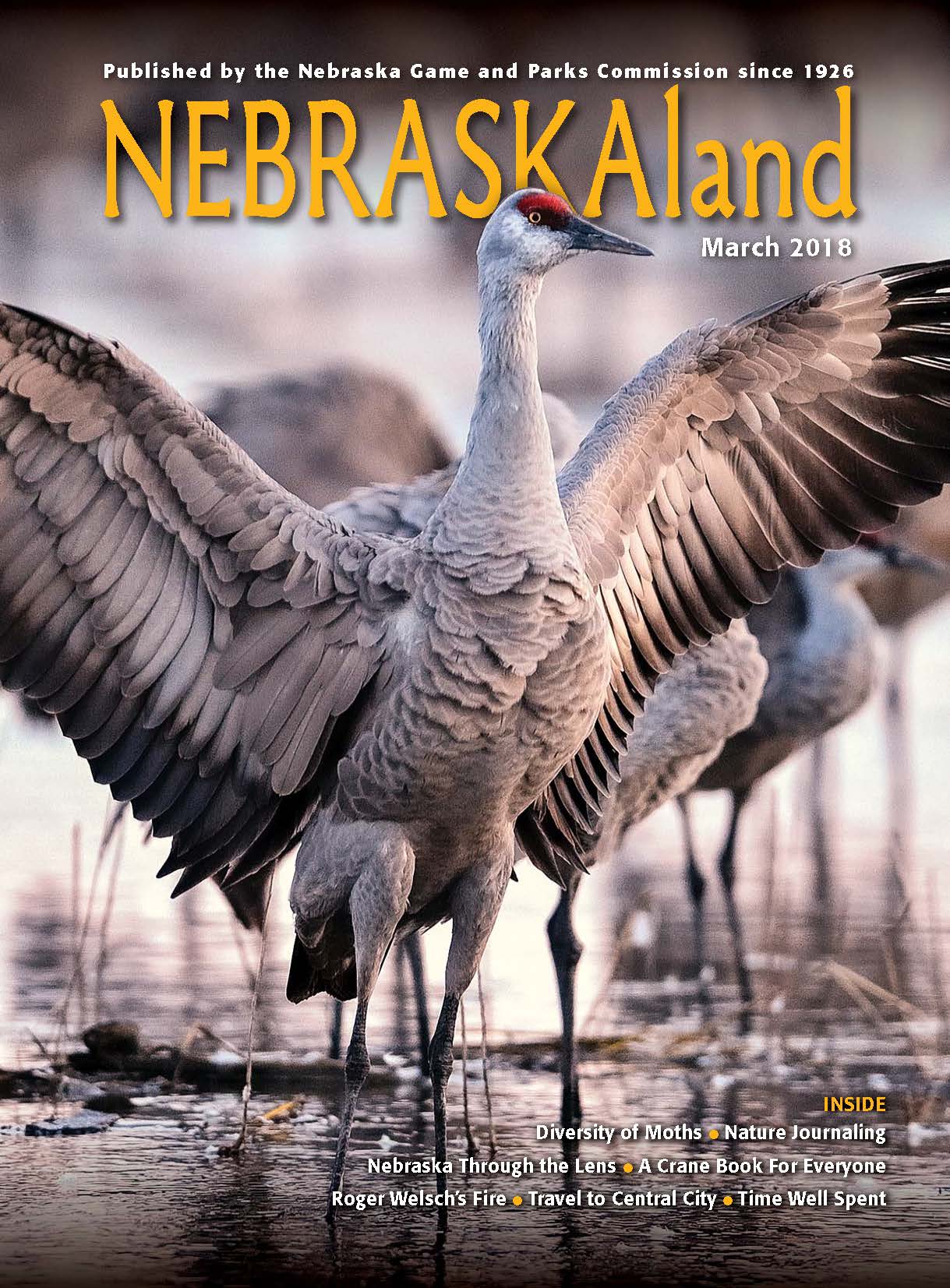
Publis hed by
y the Nebr a s k a Ga m e a nd Pa r k s C o m m is s io n si nc e 1926
NEBRASKAland
March 2018
Nick Soper of Lincoln scans the sky for geese during a hunt in the Rainwater Basin near
Shickley. Photo by Zach Cunningham.
NebraskalandMagazine.com
$4.95
INSIDE
Diversity of Moths ● Nature Journaling
Nebraska Through the Lens ● A Crane Book For Everyone
Roger Welsch’s Fire ● Travel to Central City ● Time Well Spent
NEBRASKAland Magazine
Volume 96
●
No. 2
●
March 2018
F EAT U R ES . . .
18 Nebraska's Moth Diversity
\
Hidden by the Night
BY GERRY STEINAUER
26 Time Well Spent
What to Do in March
BY RENAE BLUM
28 Discovering the Outdoors
Through Nature Journaling
BY RENAE BLUM
34 A Crane Book For All Ages
B J
N
-W
36 Nebraska Through the Lens
Y ENNY
GUYEN
HEATLEY
BY JEFF KURRUS
I N S I D E T H I S I S S U E ...
Mixed Bag – The Southern Bog Lemming, Travel to
18
●
Central City, A Brief History of Corn Bread Day, Turkey
Call Trifecta, Float 'n' Fly, Bug Banter, Upcoming Events,
and more ............................................................................. 6
In the Field – Trout Slam ........................................... 42
Nature Notes – Snake Venom .................................... 44
Portraits from the Past – Readers' Photos ............. 46
In the Kitchen – Cheese & Herb-Stuffed Venison .... 48
Page 49 – Welsch's Fire ............................................... 49
The Last Stop – A-OK with Silence.......................... 50
28
●
26
●
O N TH E W EB . . .
WHEN YOU SEE THIS SYMBOL IN THE PAGES OF
N
NEBRASKALAND MAGAZINE, VISIT
NEBRASKALANDMAGAZINE.COM AND VIEW OUR INTERACTIVE
DIGITAL EDITION FOR MORE INFORMATION.
D
Cover: Shot toward the end of March, these sandhill cranes were
on the south shore of Rowe Sanctuary south of Gibbon. Some
early clouds softened the shadows, making it easier to see the
feather detail. Photo by Chris Masada.
NEBRASKAland (VOL. 96 / NO. 2 ISSN 0028-1964) is published monthly, except
for the combined Jan./Feb. and Aug./Sept. issues, by the Nebraska Game and Parks
Commission, 2200 N. 33rd St., Lincoln, NE. Periodicals postage paid at Lincoln,
Nebraska, and additional mailing offices. POSTMASTER: Send address changes to
NEBRASKAland, P.O. Box 30370, Lincoln, NE 68503-0370.
2 NEBRASKAland • MARCH 2018
36
●
MARCH 2018 • NEBRASKAland 3
NEBRASKAland Magazine
Brenda Creigh saw this fat squirrel at Pier
Park in Grand Island.
Russ Coffey from York checked his trail cameras and caught this interesting picture of deer.
Visitor Letters
I found the cocoon to the right of the
features column on page 3 of my recent
NEBRASKAland Magazine. I think the
cocoon is probably either a butterfly or
most likely a locust cocoon (early life
feature). I have found several when we
plow our garden, but I really did not
know for sure which as we often see
the shells only on trees after emerging
from the cocoon.
Do enjoy the magazine, but Roger
Welsch's articles are a favorite. So often
he tells of things that I encountered
as a youngster growing up in central
Nebraska.
Leo Turner
Lisco, Nebraska
Amazing! Outstanding! Absolutely
gorgeous photography!!! No wonder
the visiting bug didn't want to be seen
in this latest issue.
G. E. Dave Fuller
Lincoln, Nebraska
Jerry Kostal of Papillion photographed this muskrat at Walnut Creek Recreation Area.
4 NEBRASKAland • MARCH 2018
We found the critter on page 35 in
the water – a little black bear!
Brenda and Roger
Sent via e-mail
Star motion by Kyle Styskal.
ADMINISTRATION
CONSERVATION OFFICERS
Director Jim Douglas
Deputy Director Tim McCoy
Commissioners
Chairman - Dick Bell, Omaha
Vice Chairman - Robert Allen, Eustis
2nd Vice Chairman - Dan Kreitman, Wahoo
Rick Brandt, Roca
Pat Berggren, Broken Bow
Jim Ernst, Columbus
Norris Marshall, Kearney
Doug Zingula, Sidney
Scott Cassels, Omaha
ADMINISTRATION (Lincoln)
Craig Stover (Administrator)
Duane Arp (Asst. Administrator)
Jeff Clauson (Asst. Administrator)
MAGAZINE STAFF
Communications Director Christy Firestone
Editor Jeff Kurrus
Art Director Tim Reigert
Associate Editor Jenny Nguyen-Wheatley
Regional Editors Eric Fowler, Julie Geiser,
Justin Haag
Contributing Editor Michael Forsberg
Regular Contributors Renae Blum,
Chris Helzer, Chris Masada, Gerry Steinauer
Photo Librarian Jaclyn Cruikshank Vogt
Circulation Donna Robinson
For address changes and questions about
your subscription, e-mail donna.robinson@
nebraska.gov or call 800-632-5263
Advertising Sales Manager
For advertising information contact
Shane G. Gilster, 402-742-0125
Email: shanegilster@gmail.com
NEBRASKAland Magazine Copyright 2018, all rights reserved.
NEBRASKAland is available in audio from the Nebraska Library
Commission Talking Book and Braille Service, Suite 120, 1200 N St.,
Lincoln, NE 68508. 800-742-7691. NEBRASKAland Magazine and the
Nebraska Game and Parks Commission reserve the right to reject any
advertising not in keeping with the agency mission.
Rates: $18 for one year; $33 for two years; $44 for three years. Nebraska
recipients must add appropriate sales tax. To subscribe call
1-800-NEBLAND (632-5263), or go online to: NebraskalandMagazine.
com.
COMMISSION
C
CO
COM
OM
MMIS
MIS
SSIO
S N OFFICES
OFFI
FF CES
FF
S
Headquarters/Southeast District Office
2200 N. 33rd Street Lincoln, NE 68503
Phone 402-471-0641
Northeast District Office
2201 N. 13th St. Norfolk, NE 68701
Phone 402-370-3374
Kelly Keough of Springview took this
sunset photo before a winter storm in
Keya Paha County.
Send your comments to:
Jeff Kurrus, Editor
NEBRASKAland Magazine
P.O. Box 30370
Lincoln, NE 68503
or e-mail Jeff.Kurrus@Nebraska.gov
Please include your postal address
and telephone number. Letters may be
condensed and edited. Photographs are also
welcome.
Any program that receives federal funding from the National Park
Service, or the United States Fish and Wildlife Service prohibits unlawful
discrimination on the basis of race, color, religion, age, gender, marital
status, national origin, age, disability or political affiliation. Any person
who believes he or she has been discriminated against in any program,
activity, facility, or service, should contact the Nebraska Game and
Parks Commission, Lincoln, NE 402-471-0641, the Equal Opportunity
Commission, Lincoln, NE 402-471-2024, TTY/TDD 402-471-4693;
United States Fish Wildlife Service, Civil Rights Coordinator, 4401
N. Fairfax Drive, Arlington, VA 22203; Director, Equal Opportunity
Program, U.S. Department of Interior, National Park Service, 1849 C
Street NW, Mail Code 0008, Washington, D.C. 20240-0001.
Southwest District Office
301 E. State Farm Rd. North Platte, NE 69101
Phone 308-535-8025
Northwest District Office
East Hwy. 2, Box 725 Alliance, NE 69301
Phone 308-763-2940
Bassett Office
524 Panzer St., Box 508 Bassett, NE 68714
Phone 402-684-2921
Kearney Office
1617 First Ave. Kearney, NE 68847
Phone 308-865-5310
Ak-Sar-Ben Aquarium
21502 W. Highway 31 Gretna, NE 68028
Phone 402-332-3901
Omaha Office
8495 Frederick Street, Omaha, NE 68124
Phone 402-595-2144
402-471-5531
402-471-5531
402-471-5531
NORTHWEST (Includes counties covered)
Jim Zimmerman (District Supt.)
308-641-6138
Sean McKeehan
(Cheyenne, Morrill, Box Butte)
308-279-9133
Scott Brandt
(Kimball, Banner, Scotts Bluff)
308-631-0663
Dan Kling (Sioux, Dawes)
308-430-0572
Kyler Prochaska
(E 1/2 Dawes, N 1/2 Sheridan, W 1/2 Cherry) 308-430-3984
Terry Brentzel (Deuel, Garden, Grant) 308-458-7650
402-389-0444
Frank Miller (Cherry, Hooker)
NORTHEAST (Includes counties covered)
Tom Zimmer (District Supt.)
402-649-8053
402-760-0712
Dale Davis (Keya Paha, Brown, Rock)
402-340-3981
Jonathan Andreasen (Holt, Boyd)
402-719-6226
Kyle Gaston (Dodge, Colfax)
Greg Hesse
(Greeley, Wheeler, Boone, S 1/2 Antelope)
402-843-6567
Mitch Johnson (Knox, Antelope, Pierce) 402-613-8612
402-762-5022
Jeff Jones (Knox, Cedar)
Jon Reeves
(S 1/2 Thurston, Burt, Washington)
402-889-8508
Andrew Heyer (Pierce, Madison, Stanton) 402-613-2241
Cory Krause
(Cuming, Wayne, Stanton, Dodge)
402-380-6410
Steve Oberg
(Colfax, Platte, Madison, Stanton, Nance)
402-910-3366
Owen Johnson
(Dixon, Dakota, N 1/2 Thurston)
402-266-1759
308-730-7050
Doug Pollard (Loup, Garfield, Valley)
SOUTHWEST (Includes counties covered)
Roger Thompson (District Supt.)
308-530-3097
308-202-0819
Matt Brandt (Sherman, Howard)
308-380-7331
Tim Williams (Hall, Hamilton, Merrick)
Pat George
(Harlan, Franklin, Phelps)
308-920-2762
Matt Andrews
(Gosper, Furnas, Frontier, Red Willow)
308-746-2418
Brian Piernicky
(Red Willow, Frontier, Hayes, Hitchcock)
308-340-6627
John Lee (Hitchcock, Dundy, Chase, Hayes) 308-414-1432
308-289-0427
Nicholas Fix (Keith, Perkins)
308-289-1169
Bryce Streger (Keith, Arthur)
308-760-0145
Sean Schultz (Keith)
Brandon O’Neal
(Lincoln, McPherson, Logan)
308-530-3157
Alex Hasenauer
(Lincoln, McPherson, Logan)
308-660-4671
Dale Johnson (Kearney, Buffalo)
308-440-3847
308-529-8146
Mike Thome (Dawson)
Ray Dierking (Custer, Thomas, Blaine) 308-870-0322
Taylor Dixon
(Dawson, N 1/2 Gosper, N 1/2 Phelps)
308-217-2108
SOUTHEAST (Includes counties covered)
Levi Krause (District Supt.)
402-949-0593
402-619-1355
Rich Berggren (Douglas)
402-616-5961
Dan Evasco (Sarpy)
402-210-0888
Heath Packett (Cass)
402-209-1506
Russell Mort (Otoe, Johnson)
William Krause
(Nemaha, Richardson, Pawnee)
402-274-8063
Matt Taylor (Thayer, Fillmore, Jefferson) 402-200-9597
402-806-9084
Dan Zuehlke (Gage, Saline)
402-890-6463
Dina Barta (Lancaster)
402-937-3422
Dudley Sorensen (Lancaster, York)
402-613-2312
Travis Shepler (Lancaster)
402-314-9641
Trevor Stahlecker (Lancaster)
402-890-7140
Stacey Lewton (Lancaster, Seward)
402-443-6392
Mike Luben (Saunders, Butler, Polk)
MARCH 2018 • NEBRASKAland 5
A Mammal
Brief
By Lindsay Rogers
Lindsay Rogers is an outdoor education specialist with the Nebraska Game and Parks Commission.
6 NEBRASKAland • MARCH 2018
PHOTO BY PHIL MYERS, HTTP://ANIMALDIVERSITY.ORG
Although found throughout eastern
Nebraska, the southern bog lemming is
rarely talked about. This is due to two
factors: 1) They are not terribly common
within their range; and 2) They are easily
misidentified as voles. Smaller than a
prairie vole, the southern bog lemming’s
total length is between 4-6 inches and
weighs 21-50 grams (about the weight of a
golf ball).
As their name suggests, southern
bog lemmings are often found in moist
habitats; in Nebraska this includes wetlands,
wet meadows and marshes. They can also be
found in grasslands and deciduous forests. They feed
mainly on grasses and clover but will also eat fruit, fungi, bark, snails,
slugs and beetles. As with other small mammals, they have numerous predators, including domestic dogs and
cats, raptors, badgers, weasels and snakes. They are active throughout the day, but are most active from dusk to
dawn. ■
MARCH 2018 • NEBRASKAland 7
Travelogue
Travelogue Sponsors
Central City
y
Visit Central City
●
By Brenna McFadden, Nebraska Tourism Commission
C
entral City is a small town with
rich, beautiful views of the
Nebraska countryside. If you are
looking for a relaxing getaway
that offers a wide variety of
activities, from biking, shopping at
local boutiques or spending time at a
vineyard, then this is the place for
you.
For bikers, Central City features a
rail-trail of crushed stone more than
8 miles long. The Dark Island Trail
is open year round and travelers are
welcome to ride horses, mountain bike,
walk, run and cross country ski. One
of the most memorable features of
this trail is its 1,072-foot long bridge
that spans the Platte River just south
of Central City. Take a nice walk and
enjoy a beautiful sunset over the water
from a bridge view.
If you are looking to spend more
time in town then plan to visit
Positively You Boutique. Located in
an old Tasty Sweet Shop, they offer
special gift items and home décor
with a personal touch. While you are
browsing you can sip on some coffee
and sample some of their hand-dipped
chocolate truffles.
After spending a day outside or
Positively You Boutique is located on 16th Street in Central City.
strolling through the city you can
make your way over to Prairie Creek
Vineyard & Winery for an appetizer,
dinner and a glass of wine. This familyrun business has been in operation for
12 years, and they offer a welcoming
and comfortable atmosphere for all
who visit.
Central City invites you to create
your next vacation memories with
extraordinary views and exceptional
service from local businesses. Pack up
the car and get ready for a weekend
well-spent of admiring what this small
town in Nebraska has to offer. ■
The Prairie Creek Vineyard & Winery
features a host of white and red wines that
can be tried in their tasting room.
While in the Area
Other places to stay, eat at and visit
in the Central City area:
Lincoln Manor Steak House
Merrick County Historical
Museum
Central City Aquatic Center
Opened in 2007, the Dark Island Trail is an 8-mile long hike/bike trail that extends from
just south of Central City to Marquette along a former railroad. The trail passes through
farmland, densely wooded areas and over a long wooden bridge with spectacular views
of the Platte River.
8 NEBRASKAland • MARCH 2018
Bader Memorial Park in nearby
Chapman
MARCH 2018 • NEBRASKAland 9
A Brief History
Country Editors
Can’t
I e-mailed
David about
Stomach Corn Bread Day
this...
By James E. Potter, Nebraska
State Historical Society
I
n 1899 the Omaha WorldHerald floated the idea of
setting aside a special day to
o
honor corn bread, which it cal
called
llleed
“the Yellow King in food form.”
After all, corn bread had been a staple
staapl
plee
for many of the early pioneers, who
ho ate
atte
ndd
it for breakfast, dinner and supper, and
fff
in many instances it probably staved off
starvation.
olme
mees
The idea fell flat with Editor A. H. Holmes
th
he
of the Wilcox Herald, who had grown up inn the
rig
ight
ght
ht
corn bread era. He thought the idea might be alll right
d, “but
“bu
butt for
bu
for
fo
for those who were unacquainted with corn bread,
ifled out
ouut
us old timers who in bygone years had our intestines rifled
with the rasping roughness because we couldn’t get anything
else, it is entirely unnecessary. We know all about it ... we are
acquainted with it in all its forms: baked, boiled, fried and
fricasseed we have eaten it until for years afterwards the sight
of a corn field would give us the diarrhea. Yes, it is all right to
bring the smooth bore bowels of anterior easterlings in touch
with the rough edges of
the
t rasping corn dodger
but
b us old fellows have
been
there, thank you.”
b
Holmes’s views
resonated
with Cash
r
Martin,
editor of the
M
Alma
A
Journal: “Colonel
Holmes
... kicks on
H
having
to put any more
h
baked,
boiled, fried, or
b
fricasseed
cracked corn
f
into
the interior of his
i
corporeal
system and we
c
see where the colonel is
right.
We remember in
r
the
t days of our childhood
we
w had fried mush for
breakfast,
boiled mush for
b
dinner,
milk and mush for
d
Andy Howland, south West Union,
supper, and for dessert,
Custer County, 1886. NSHS
it was milk de mush,
RG2608-1093
mush on de milk, and on
rare occasions, corn pone on the side. Oh, it was tough on
the intestinal part of our anatomy and we think it would be
detrimental to the best interests of Nebraskans to have a Corn
Bread Day, except perhaps, for the few citizens of our fair
state who fail to swallow their per capita of Early Risers.” ■
10 NEBRASKAland • MARCH 2018
These cowboys are better fed at their chuck wagon in 1898 than
were many newly arrived homesteaders. NSHS RG2575-48
Visit the Nebraska State Historical Society’s website at
history.nebraska.gov.
Turkey Call Trifecta
PHOTO BY JEFF KURRUS
By Jarrod Spilger
There are three main types of turkey calls: box, pan, and
diaphragm. Turkey hunters should be proficient with all
three to maximize their chances of success. Let’s take a look
at each type.
Boxes are the easiest to master. Simply run the paddle-like
lid across the lip of the box’s rectangular sound chamber.
Traditionally, chalk is applied to the lid’s underside to create
the friction that produces turkey sounds, although some
newer models use a synthetic, waterproof coating instead.
Typically very loud, boxes are ideal for windy days.
Pans are another friction-type call. They consist of a round
pan, or pot, which houses a slate, glass or aluminum surface,
and a striker made of wood, plastic or carbon. Volume
and tone varies based on surface type, with slate being the
softest. Cup the pan lightly around its rim with your weakside thumb and index finger and hold the striker in your
strong-side hand like you would a pencil. Turkey sounds
are made by scratching the striker across the pan’s surface.
Small, half circles make yelps, long, straight lines produce
purrs, and short, sharp strokes create clucks. Pans can’t be
beat for making realistic purrs.
Diaphragm, or mouth, calls consist of varying layers of
latex “reeds” stretched across a horseshoe-shaped aluminum
frame covered in surgical tape or foam. The more reeds
the more difficult the call is to operate. Turkey sounds are
made by placing the call against the roof of the mouth and
“huffing” air up from the diaphragm to vibrate the latex. The
tongue controls cadence. Volume can be loud, but usually
not as loud as a box. While some people find them difficult
to master, a mouth call’s main benefit is its hands-free
operation, making it the go-to call for sealing the deal when
gobblers get close. ■
PHOTO BY JARROD SPILGER
Learning how to use each of the three main types of turkey calls – box (top), pan (middle) and diaphragm (bottom) – gives hunters
a variety of methods to lure in a turkey.
12 NEBRASKAland • MARCH 2018
MARCH 2018 • NEBRASKAland 13
Spotted lanternfly
adult
Float 'n' Fly
Bug Banter
By Ryan Sparks
By Julie Van Meter
State Entomologist, Nebraska
Department of Agriculture
14 NEBRASKAland • MARCH 2018
T
PHOTO BY RYAN SPARKS
Dealing with the wind is one
of the biggest challenges in fly
fishing. Large lakes frequently
deliver powerful gales that make
casting difficult if not impossible,
and Nebraska’s spring wind causes
fly anglers to check the forecast
compulsively, waiting for a break
when they can fish again. However,
one technique turns the wind to the
angler’s advantage – the float 'n' fly.
I serendipitously discovered the
float 'n' fly out of necessity. The
farm pond I fished growing up
sits on a high hill. Consequently,
it’s windy more days than not.
I stumbled into the float 'n' fly
The float 'n' fly consists of a jig style fly attached below a lightweight bobber.
by combining small crappie jigs
with bobbers (sometimes called
indicators) traditionally used for
The float 'n' fly consists of a jig style fly attached below
a lightweight bobber. The best aspect of the rig is its
nymphing trout. After catching numerous crappie, bluegill
minimalism. Simply adjust the depth of your jig below
and largemouth bass, I realized how well the system works.
the bobber and lob the rig into the water. At that point, the
After doing some research, I found out I wasn’t the first one
wind moves the float 'n' fly across the water and the chop
to use the technique. In fact, Tennessee anglers invented the
imparts action to the fly. For fly-fishing, I use 1/16th and
rig years before to catch lethargic winter bass.
1/32nd-ounce jig heads tied with craft fur, buck tail or
marabou. These materials undulate and breathe in the water,
adding even more movement. I have also used the rig with
spinning gear, but upsize the jig to a 1/8th ounce. Using
light line, like 3- to 5-pound test, lets the jig move freely as
it bounces under the bobber. Different size floats affect how
your fly rides in the water. Large floats create a tight up and
down jigging, while small bobbers give the fly a wide arching
path. The jig head keeps the hook point up, suspending the
fly in front of fish while avoiding snags on the bottom. Keep
a close eye on the bobber; sometimes fish will take it from
below and lift the fly. This lift causes the bobber to lay over
on its side or spin, but it won’t be pulled under. If the bobber
does anything but bounce in the chop, set the hook.
The float 'n' fly is also an excellent option when the
weather turns cold. Winter temperatures make fish sluggish,
and require a presentation for inactive, suspended fish. The
float 'n' fly does just this, offering the bait in a slow, subtle
manner that even slothful fish can’t resist. On still days, fish
the rig by casting it out and working it back with a series of
short twitches. Pop the rod five or six times and then let the
fly sit for a few seconds. This presentation mimics the dying
minnows that are common in fall and winter.
The float 'n' fly is a simple and effective technique for
a number of species, yet many fly anglers are unaware
of it and head home when the wind picks up. While it is
laughably simple, it will surprise you with its effectiveness
and extend your fishing season to include windy and cold
days. Try it the next time the wind is giving you fits. The
float 'n' fly will turn your frustration into excitement. ■
he spotted lanternfly (Lycorma
delicatula) is an exotic, invasive
insect which recently has been found
in the United States. Its native range
includes China and India, and it likely
was introduced to the U.S. via trade. It
was first discovered in Pennsylvania in
2014, and has recently also been found
in New York, Delaware and Virginia. It
has not been found in Nebraska.
The adult spotted lanternfly (SLF)
is about one inch long with gray
forewings. These wings have black
spots at the upper half and narrow
black rectangles
on the lower half.
The underwings
are red with black
wingtips. Early
instar nymphs are Early instars.
COURTESY OF
black with white PHOTO
LAWRENCE BARRINGER,
PENNSYLVANIA DEPARTMENT
spots, but later
OF AGRICULTURE, BUGWOOD.
ORG.
instars are red
Presented by
with black patches
and white spots.
The females lay
egg masses on trunks
Later instar.
of trees, or any
PHOTO COURTESY OF
LAWRENCE BARRINGER,
smooth surface, in
PENNSYLVANIA
the fall. Egg masses DEPARTMENT OF
AGRICULTURE, BUGWOOD.
initially look gray
ORG.
and mud-like, but
as they age, turn brown and individual
eggs laid in rows within the mass
become visible. Eggs hatch in the
spring, with nymphs seeking out new
hosts on which to feed.
The SLF’s preferred host is the treeof-heaven (Ailanthus altissima), and if
it only fed on this weedy, invasive tree,
it would not be a significant problem in
Nebraska. However, SLF will feed on
more than 65 different plants, including
grapes, fruit trees, oak, walnut and even
pines, making it a pest of concern to
Nebraska.
Both nymphs and adults feed on plant
sap, and similar to other leafhoppers,
have piercingsucking mouthparts.
The SLF does not
feed on foliage or
flowers, but on the
Adults.
Adults
woody parts of
PHOTO COURTESY OF
plants – the trunk
LAWRENCE BARRINGER,
PENNSYLVANIA DEPARTMENT
or branches. Their
OF AGRICULTURE,
feeding may cause BUGWOOD.ORG.
weeping wounds
on trunks, and the insects secrete
honeydew, which can accumulate on and
around the host plants. Infested plants
experience reduced vigor, and fruit trees
and grapes fed on by the SLF will often
produce lower yields. The insects may
also vector other diseases as they feed.
As with any exotic, invasive pest,
early detection is key to effective
control. Be vigilant in keeping an eye
open for invaders such as SLF. If you
think you’ve seen a SLF, take pictures
or collect a specimen, and report your
suspicions to the Nebraska Department
of Agriculture at 402-471-2351. ■
MARCH 2018 • NEBRASKAland 15
Adult cecropia
opia moths can
nch wingspans.
reach 6-inch
Junior Duck
Stamp
Contact the Nebraska Game
and Parks Commission
at 402-471-0641 or visit
OutdoorNebraska.
org for more
information. Visit
huntsafenebraska.org for a list
of hunter education classes and
boatsafenebraska.org for a list of
boating safety classes.
Learn how to hunt spring turkey by
attending a workshop this month.
Dates are listed below.
March 3
Volunteer Youth Fishing Instructor
Training
March 25
Spring Turkey Hunting
Archery season opens
St. Mary’s Parish Center, Bellevue
March 10
Wildlife and Watercolors
Wildcat Hills Nature Center, Gering
Ponca State Park, Ponca
March 16
Nebraska Game and Parks
Commission Meeting
Columbus
March 17
Learn to Hunt Spring Turkey
Workshop
Mid-Plains Community College,
McCook
March 24
National Archery in the Schools
Program State Tournament
Speedway Sporting Village, Lincoln
The 2018 NASP Tournament will
be held on March 24 at Speedway
Sporting Village in Lincoln.
16 NEBRASKAland • MARCH 2018
Nebraska Game and Parks Outdoor
Education Center, Lincoln
March 29
Learn to Hunt Spring Turkey
Workshop
Platte River State Park, Louisville
March 31
Muskrat and Beaver
Trapping seasons close for muskrat
and beaver
March 31
Spring Eggstravaganza
Ponca State Park, Ponca
March 31
Becoming and Outdoors-Woman
Catching Up with the Cranes, Fort
Kearny State Recreation Area, Kearney
Wayne Stang and his daughter, Darian, of Wahoo archery hunt for turkeys during the
spring.
Turkey Hunting: Take a Youth
ARTWORK BY PROMISE RAUMAKER
March 10, 17
Marsh Madness
March 27
Learn to Hunt Spring Turkey
Workshop
By Justin Haag
Students in kindergarten through
12th grade will once again show
off their skills as waterfowl artists
during the Federal Junior Duck Stamp
Competition.
Each year, hundreds of entries
from students throughout Nebraska
are judged at a public event in the
Panhandle. This year’s entries, which
are due March 15, will be judged at the
Educational Service Unit 13 center in
Scottsbluff on March 23.
Promise Raumaker, a 13-year-old
student of the Debie Plog Art Studio
in Omaha, won last year’s Nebraska
competition. Raumaker used colored
pencil, oil pastel and acrylic paint to
create an image of a king eider in flight
– a large sea duck that spends most of
the year in coastal marine environments
and breeds on the Arctic tundra in June
and July.
PHOTO BY ERIC FOWLER
by Jerry Kane
NEBRASKAland
BRASKAla
and
tor
Visitor
h Junior
i Duckk Stamp Conservation
i
The
Program, administered by the U.S. Fish
and Wildlife Service, provides students
throughout the United States a learning
opportunity that combines both art and
science. Every year, artists and wildlife
educators visit schools to introduce the
competition and assist the students.
Each year’s winning entry is
placed on the next year’s Nebraska’s
waterfowl stamp. It also moves on
to compete against other states’
winners and a chance to be chosen
for the national junior duck stamp – a
collector’s item that is available for $5.
For details about the competition,
contact Lydia Patrick, Nebraska’s
contest coordinator, at lydia_patrick@
fws.gov. More information and contest
guidelines may be found at fws.gov/
juniorduck. ■
By Julie Geiser
March is the start of the spring turkey season, and if you go hunting consider
taking a child with you. Whether it is your own child, grandchild or the neighbor
kid, get them in the field to experience the same love you have for the outdoors.
First, visit OutdoorNebraska.org/wildturkey for youth season dates and
complete rules and regulations. Then start by taking the child shooting to teach
them safety and shooting skills, whether with a bow or shotgun.
When taking kids into the field, keep the following tips in mind:
Some kids usually can't sit still for
too long, so keep them occupied with a
simple push button yelper that anyone
can use to call in birds.
Let them look for birds with
binoculars. If you both have
binoculars, try finding different
animals or landmarks and make a quiet
but fun game out of it.
Bring a digital camera and let the
child take photos of the outing, and
print them out later as a keepsake.
You'll need snacks and drinks for
the day. To keep the crackling noises
of most packaged foods down to a low
roar, repackage them in quieter zipclose bags.
Blinds make hunting much more
kid-friendly and enjoyable. Movements
can be concealed more easily in a blind
than sitting in the open. Taking photos,
looking through binoculars or napping
works better inside a blind as well.
Small heaters in a blind make a
chilly morning more comfortable, and
you’ll have another set of hands to haul
gear.
Get a kid in the field. You’ll pass
on a hunting tradition, making great
memories and new experiences. ■
•
•
•
•
•
•
Last issue’s winner of
the Visitor drawing was
Verl Morey of Shelton,
Nebraska, who found the
cecropia moth pupae on page 3.
Readers are encouraged to contact
NEBRASKAland within 10 days after
this issue’s publication with the
correct page number and name of
this issue’s “Visitor” – a critter found
in Nebraska. We will then gather the
correct entries and draw one to win a
NEBRASKAland mug.
To enter each month, write:
NEBRASKAland Visitor
2200 North 33rd Street
Lincoln, NE 68503
Or e-mail: Tim.Reigert@Nebraska.
gov with “Visitor” in the subject line
of the message.
HINT: This issue’s visitor is not on
page 3, 15, 17, or 18-25.
The cecropia moth (Hyalophora
cecropia) is the largest moth
in North America and is found
throughout Nebraska. The
caterpillar has five instars –
a phase between two periods
of molting in the development
of an insect larva – before
pupating in a protective silk
cocoon, and ultimately
emerging as an adult the next
spring. Look for their cocoons
after leaf drop occurs, attached
to branches or twigs. Cecropia
moth caterpillars are small and
black when they first hatch, and
over time become large and green,
with colorful protuberances in
red, yellow and blue. They feed on
a wide range of plants, including
cherry, plum, willow, maples
and elm. Adult moths are brown
to gray with reddish and white
markings and reddish legs, and a
wingspan of up to 6 inches. While
the caterpillars are large and their
host range extensive, they do little
damage and are not
considered plant pests.
Special thanks to Julie Van Meter,
State Entomologist, Nebraska
Department of Agriculture.
MARCH 2018 • NEBRASKAland 17
Hidden by the Night
By Gerry Steinauer, Botanist
A Night of Mothing
On that August evening, as I drove eastward on Highway
59 toward the small town of Creighton in Knox County, the
landscape conveyed predictable eastern Nebraska: corn and
soybean fields dominated, woodlots sheltered farmsteads
and a few surviving prairie pastures and hay meadows
were scattered among the rolling hills and valleys. Arriving
at Brogie’s house on the edge of town, his yard also was
typical: a bluegrass lawn with basswood trees in front, while
a few pines, lilac hedge, black walnut and white mulberry
graced the back. I was baffled that Brogie was capturing
such an abundance of moth species in this rural setting with
PHOTO BY GERRY STEINAUER
A
s a kid I would get excited at the sight of a
huge cecropia moth fluttering about the street
light while we played kick the can at night or a
hummingbird-like sphinx moth hovering about
my mom’s petunias. But for the most part, I
never gave much thought to moths. They were mostly small,
dull creatures of the night, the ugly cousins of the beautiful,
day-flying butterflies.
My short-sighted view of moths recently changed. An
intriguing night of mothing last August with Mark Brogie in
the backyard of his Creighton home enlightened me to the
diversity and splendor of Nebraska’s moths, a diversity that
presently is largely undocumented and awaiting discovery.
PHOTO BY CHRIS HELZER
18 NEBRASKAland • MARCH 2018
few native habitats.
I have known Brogie, who recently retired after 34 years
as a high school science teacher in Creighton, since the late
1970s, when we were both biology majors at Wayne State
College. He was known then as a serious birder and still
is, having observed more bird species in Nebraska (418)
than anyone else. When a waif bean goose or Harris’s hawk
wanders into our state, he will drive miles to see it.
Brogie added mothing as a hobby in 2014. “I was
practicing with the macro lens on my new camera taking
photos of moths attracted to our porch light,” said Brogie.
“Out of interest, I looked up and identified some on
websites.” When Brogie learned that many of these moths
had never been reported for our state he was hooked. “I
discovered that Nebraska was delinquent in moth records,
and I would help us catch up with other states,” he said. On
most summer nights, he now stays up into the wee hours
capturing and photographing moths attracted to an array of
lights set up in his backyard.
On our night of mothing, as darkness descended and the
sounds of crickets chirping replaced that of children playing,
Brogie put the final touches on his mothing stations. He
hung a white sheet below a low, sprawling mulberry branch
with a fluorescent light wired above it. Moths attracted
to the light would land on the sheet. Another light hung
from a branch of the walnut tree, one by the lilacs and yet
another below the back deck, all with sheets spread on the
ground below or hung nearby. The glowing sheets below the
ABOVE: Mark Brogie checks for moths on a sheet illuminated by
a fluorescent light.
OPPOSITE: A white-lined sphinx moth hovers while feeding on a
tall thistle flower. It is one of 32 species of sphinx moths known
in Nebraska.
illuminated trees cast a Halloween eeriness over the yard.
Brogie has experimented with a variety of lights – from
black, mercury halide, incandescent, and soft white to
color-enhanced bulbs – because various moth species are
attracted to different wavelengths of light. While scientists
are not entirely sure why moths are attracted to light, they
have theories. “My sets are Mothing 101 and not very
complicated,” said Brogie. “Some people use various moth
traps and baits to attract them [some moth species will
come only to bait and not lights]. I haven’t had time to
build sophisticated sets, but I hope to someday.” Brogie has
mothed at other sites, such as campgrounds at Indian Cave
and Ponca state parks with electrical outlets. But without
a mobile power source to run lights, his mothing is mainly
restricted to his backyard.
Soon moths began drifting in, circling the lights before
settling on the sheets. Brogie moved between stations
checking for moths with the anticipation of a catfisherman
running his set lines. When a moth sparked his interest he
placed a clear plastic cup over the moth and then slid a
thin piece of cardboard along the sheet, trapping the moth
between it and the cup. He transported the captured moths to
MARCH 2018 • NEBRASKAland 19
Lepidoptera Natural History
PHOTO BY ERIC FOWLER
PHOTO BY CHRIS HELZER
M
Brogie transports captured moths to the railing on his deck where he lets them settle before uncovering and photographing them.
The moths are released and the photos used for identification purposes.
20 NEBRASKAland • MARCH 2018
During our night of mothing, Brogie captured the first pondside
pyralid recorded for Nebraska. Its caterpillars are aquatic,
feeding on duckweeds, pondweeds, sedges and other wetland
plants.
PHOTO BY CHRIS HELZER
moths that mimic bird droppings, a protective measure
against predators.
At one point, I went into the house and talked with Ellen,
Brogie’s wife and also a retired science teacher. “He says
he moths to document new species, but for him it is a whole
PHOTO BY ERIC FOWLER
the railing below the deck light, left them to settle down, and
would return later to uncover and photograph them.
The night was calm, but cool for August and the mothing
was slow compared to warmer nights. Also, a week earlier
the city had sprayed the neighborhood for mosquitos and
“knocked the moths back some.” On good nights, over a
hundred moth species are attracted to Brogie’s lights.
About 11 p.m., the grass now wet with dew, the action
picked up. “Different species come to the lights at different
times of night, and some say 2 a.m. is the best time for
mothing,” said Brogie. He also sees a progression through
the season as different moth species emerge, the lifespan of
many being only a few short weeks. He starts mothing on
warm nights in March and April and continues until the first
autumn frost. Peak mothing is during the heat of summer.
Brogie knew most moths, at least to family, coming
to the lights and often called out their intriguing names:
“chickweed geometer … a cottonwood dagger … a dart
… an owlet.” The largest moth caught that night was
a waved sphinx. We saw no large and spectacular giant
silkworm moths – cecropia, luna or polyphemus. Upon
close inspection, all of the captured moths were interesting.
The bodies and wings of most were intricately patterned or
stunningly colored, their antennae often bizarrely-shaped.
A few moths were shaped like military jets; others were
camouflaged to look like leaves or bark. Brogie has caught
oths
h and
d butterflies
b
fli belong
b l
to the
h order
d off
insects known as Lepidoptera. With about
180,000 known species worldwide, it is the
fourth largest insect order. Roughly 10 percent of
Lepidoptera are butterflies and the remainder are
moths.
A key characteristic distinguishing Lepidoptera
from other insect orders are the scales, which
are actually modified, flattened hairs that cover
their bodies and wings (lepido means scale and
ptera means wings). The dust-like scales form
the dazzling
variety of
patterns
and colors
found among
species. They
also leave the
smudge of
color on your
fingers when
you touch
a moth or
butterfly. Also
characteristic
of Lepidoptera
is the coiled
Unlike moths, butterflies have slender
proboscis
antennae with club-shaped ends.
under their
This painted lady butterfly is using its
proboscis to draw nectar from a flower. heads
which, when
uncoiled,
functions as a straw to draw nectar from flowers.
Except for one primitive group of moths, adult
moths and butterflies lack chewing mouth parts.
Having occupied the Earth for at least 190
million years, Lepidoptera have evolved into
Now fairly uncommon in Nebraska, the cecropia moth
inhabits our eastern woodlands. Belonging to the giant
silkworm moth family, the wing-span of adult females can
reach six inches.
i
a variety
off
forms. “The
popular division
of Lepidoptera
into the familiar
butterflies on
the one hand
and the moths
on the other
[is an] artificial
classification,
with butterflies
… making up
a small, easily
recognized
group of brightly
colored, dayflying insects
with clubbed
antennae. Moths, Similar to all moth caterpillars, the
then, are simply salt marsh moth caterpillar has
all Lepidoptera
chewing mouth parts which it uses
to feed on the foliage of a variety of
other than
plants, including apples, cabbage
butterflies,”
and potatoes.
wrote Stephen
A. Marshall in his
fascinating book, Insects – Their Natural History
and Diversity. The moths include a variety of
sub-groups, some fairly distantly related, with an
array of forms and habits (see sidebar on pages
24-25).
Several characteristics distinguish moths
from butterflies. While butterflies have slender
antennae with clubbed-shaped ends, moth
antennae vary in shape from comb-like or
feathery to slender, but always un-clubbed.
Moths also generally have stout and hairy bodies
and perch with their wings spread, whereas
butterflies have more slender, smoother bodies
and when perched many fold their wings above
their backs. While butterflies are day flyers, moths
generally fly at dusk, night or dawn, though a few
are day flyers.
With their great abundance and diversity in
native ecosystems, moths and butterflies perform
a vital role as pollinators and are a critical
food source for other species. Although some
Lepidoptera species, especially moth caterpillars
such as cornborers, bollworms and gypsy moths,
are crop or forest pests, the benefits most
provide to humans and the health of our planet
far outweigh the negatives. In Nebraska, the
primary threats to moths and butterflies are the
loss of native habitats, pesticides and climate
change. ■
MARCH 2018 • NEBRASKAland 21
PHOTO BY CHRIS HELZER
new arena, and he enjoys the challenge of identifying the
moths,” said Ellen. “Everybody in town knows him and
they know he’s mothing because our backyard is so lit up
they could see it from the International Space Station. The
teenage lifeguards at the pool bring moths over for him to
identify and some nights neighborhood kids help with the
mothing. They get pretty excited. When you can get kids
interested in nature that’s always pretty cool.”
We shut down our mothing about 1 a.m. and hit the
sack. When I awoke the next morning, Brogie was already
sitting at the kitchen table examining photos and identifying
unknown moths from the night before. Since there are
no practical written keys for moths, he identifies most
species by comparing his photos to those in field guides.
For difficult specimens, he posts photos on the websites
BugGuide and Moth Photographers Group where experts
from around the country help with identification.
Among the previous night’s moths was the pondside
pryalid, a new species for his yard and one not recorded for
the state on BugGuide or Moth Photographers Group. Its
closest known populations are in Minnesota and Oklahoma.
In just three summers of mothing, Brogie has identified
nearly 500 moth species in his backyard. If such diversity
During pollination visits, the female yucca moth lays its eggs
in the flowers of yucca plants. The caterpillars develop in the
seed pods, feeding on seeds but leaving enough uneaten that
the plant is still able to reproduce. The yucca moth is the yucca
plant’s sole pollinator and, in this extreme case of evolutionary
specialization, the two species are dependent on each other for
survival.
can be found in a typical small town, it raises the question
of how many species reside throughout Nebraska in native
landscapes – our prairies, woodlands and wetlands?
Nebraska’s Moth Diversity
About 11,000 moth species are known in North America
north of Mexico, but “we really do not know how many of
PHOTO BY GERRY STEINAUER
Wildflower-rich prairies, such as this Sandhills prairie in Brown County, provide a variety of nectar sources for moths, as well as
other insects, and are vital to their survival.
22 NEBRASKAland • MARCH 2018
those occur in Nebraska,” said Neil Dankert, an expert on
Nebraska butterflies who lives in Kearney. “Nebraska is
10th in the nation in butterfly diversity, and if moth diversity
correlates with butterfly diversity we could also be in the top
10 in moth diversity.”
Dankert explained that mountainous states generally
have the greatest Lepidoptera (the order including moths
and butterflies) diversity. Mountains have wider gradients
of elevation, precipitation and soils which in turn support
more diverse plant communities. “Generally higher plant
diversity supports higher moth diversity,” said Dankert.
He said that for an area to support a varied moth fauna it
must provide food for both caterpillars (leaves and other
plant parts) and adults (nectar). In addition, the caterpillars
of most moth species usually feed solely on a single or
closely related group of plants, their host plant(s). There
are countless moth “specialist feeders” found in Nebraska,
including the leadplant flower moth, Virginia creeper sphinx,
phragmites wainscot and yucca moth. These moths survive
only in habitats sustaining their host plants. For example,
the yucca moth lives only in dry, sandy or silty prairies
with yucca. The caterpillars of “generalist moths” feed on a
larger variety of plants, and these species are normally more
common and have wider distributions.
Nebraska’s potential for high moth diversity stems
from the variety and relative intactness of our native plant
communities, ranging from deciduous woodlands in the
east to pine woodlands in the west to prairies statewide.
Dankert believes one potential hotspot for moth diversity is
the deeply-incised Niobrara Valley east of Valentine. Here,
on the river bluffs, western outliers of deciduous woodlands
intermingle with western pine woodlands and remnant
birch forests from glacial times. Also, Sandhills prairie and
mixed-grass prairie cover the south and north bluff tops,
respectively, and wetlands and riparian woodlands occur
along the river and feeder streams. The area is home to
nearly 600 plant species, with most found on The Nature
Conservancy’s 56,000-acre Niobrara Valley Preserve. On the
preserve, Dankert has collected 86 butterfly species. That is
nearly half of the 206 species recorded in the state, including
some that have not been seen in more than 50 years and are
likely extirpated, and others that are rare waifs or migrants.
Panhandle escarpments, primarily the Wildcat Hills and
Pine Ridge that include pine woodlands, several prairie
types, badlands and deciduous trees in seepy draws, may
also support a rich moth fauna. Because the caterpillars
of many moths feed on deciduous trees, especially oaks,
another hotspot might be the 3,000-acre, richly-wooded
Indian Cave State Park located on the Missouri River bluffs
in Nemaha and Richardson counties.
In similar woodlands at Hitchcock Nature Center in the
Loess Hills above the Missouri River in Pottawattamie
County, Iowa, Loren and Babs Padelford of Bellevue caught
122 species in a single night of mothing this past July.
The Padelfords, like Brogie, were avid birders before they
delved into moths in 2010. Much of their mothing has been
at Fontenelle Forest and Neale Woods nature centers near
Omaha. In 2017, they caught and photographed 362 moth
species in Nebraska.
In 2013, the Padelfords attended the first Mothapalooza
conference, “a celebration of the rich and stunningly
beautiful world of moths,” at Shawnee State Park in Ohio.
The annual event attracts 250 participants for presentations
on moths and other pollinators, nights of mothing, and field
trips. “If we held a similar event in Nebraska we might
attract 10 people,” said Babs. “Some states have more moth
enthusiasts and therefore a more thoroughly documented
moth fauna.”
In Iowa, for example, two dedicated self-taught
lepidopterists, Frank Olsen of Cedar Rapids and Jim
Durbin of Marion, have collected and identified nearly
1,800 moth species during the past 15 years. At present,
roughly 2,200 species are known from the state. “Each
year we still identify about 100 new state records,” said
Durbin. “Occasionally we find a moth never before reported
anywhere, a species new to science.”
“A reasonable guess is that Iowa is home to about 2,500
moth species,” said Durbin. Most of the larger species have
been identified and Durbin believes that many of the new
finds will be small, nondescript “micromoths,” some of
which can be less than an eighth of an inch in length. Durbin
can identify many micromoths, but some he must send to
experts for identification.
Olsen and Durbin are considered Iowa’s authorities on
moths. “We became the experts because until recently we
were the only ones collecting and identifying moths in
the state,” said Durbin. “In the last 10 years, more Iowans
have become interested in moths and are collecting and
documenting species.”
Unlike Iowa, most regions of Nebraska have never been
surveyed for moths, and there is no formal list of species
found in the state. If tallied, the moths identified by Brogie,
the Padelfords and a few others may total about a thousand
species.
“I would expect Nebraska to at least equal and likely well
exceed Iowa in moth numbers,” said Dankert. “We have more
butterfly species than Iowa and our landscape is more diverse.”
In other words, there are well over a thousand moth
species in Nebraska waiting to be documented. A few
will likely be species new to science. What the state
needs is more people like Brogie and the Padelfords
who are interested in moths and willing to search for
the undiscovered. Without this citizen interest, our moth
diversity will remain hidden by the night. ■
The best moth guide for Nebraska is the Peterson
Field Guide to Moths of Northeastern North America.
The website Butterflies and Moths of North America
(butterfliesandmoths.org) contains photographs,
range maps and natural history information for many
Nebraska moth species.
MARCH 2018 • NEBRASKAland 23
A Selection of Nebraska Moths
The colors and
pattern of the
Hulst’s flower
moth camouflage
it against the
flowers of white
sage, a native
prairie plant, on
which it feeds and
lays its eggs.
N
EBRASKAland photographer Eric Fowler accompanied me last August on the night of mothing with
Mark Brogie. Using a Nikon D810 or D4 DSLR, a 105mm Micro-Nikkor macro lens and a Nikon
Speedlight in a softbox, Fowler photographed a selection of the moths captured that evening. Some
of the smaller species, which measured as little as 3/16th of an inch in length, required the use of an
extension tube. ■
The caterpillars of the
Montana six-plume
moth feed solely on
snowberries, native
shrubs, probably as
leaf or flower miners.
The moth’s wings are
deeply cleft to the
basal forks of the veins
forming six plume-like
segments.
Common
pinkbands fly
from May through
September with
at least three
generations per
year.
PHOTO LEFT BY GERRY STEINAUER. ALL MOTH PHOTOS BY ERIC FOWLER
The plumose antennae of the male
chickweed geometer are used to detect
female pheromones. This species is
widespread in the eastern United States with
its peak flight period in August.
The elegant grass-veneer belongs
to a family known as “snout moths”
whose caterpillars have elongated,
snout-like mouth parts.
Waved sphinx moths
are found statewide
in Nebraska. Their
caterpillars feed
mainly on ash
trees and pupate
underground in
chambers.
24 NEBRASKAland • MARCH 2018
The obligue-banded
leafroller belongs
to a family known
as “tortrix moths”
which includes more
than 9,400 known
species world-wide.
The pepper-and-salt geometer has
light and dark forms. The dark forms
predominate in areas where industrial
air pollution has darkened trees. The
caterpillars of geometer moths, also called
loopers, are inchworms that loop along
by drawing the hind end up to the front,
then extending the front and repeating the
process.
Caterpillars of the pink-washed aristotelia
feed on native legumes including
prairie-clovers, prairie bush-clover and
tick-clovers. The moth was the smallest
captured by Brogie on this night last
August, measuring just 3/16th of an inch
in length.
The white-speck
moth has a single
white dot (not clearly
visible in the photo)
toward the rear of
each wing. They are
also called armyworm
moths because their
caterpillars move in
lines as a massive
group similar to an army
on the march.
The dark-spotted palthis
moth has tufted, up-turned
labial palps – the hairy
or scaly moustache-like
projections on each side
of the proboscis that have
a sensory function.
The caterpillars of the clover
hayworm moth infest hay
stacks, covering the hay
with white silk, eating dry
clover leaves, and causing
damage.
The cottonwood dagger
inhabits wooded floodplains
where its caterpillars
feed on members of the
poplar family, including
cottonwoods, willows and
aspen.
MARCH 2018 • NEBRASKAland 25
Time Well Spent
What to Do in March
By Renae Blum
W
PHOTO BY ERIC FOWLER
ith warmer months approaching, there’s plenty to look forward to on the horizon,
but don’t forget to take advantage of outdoor opportunities now. The following
are a few ideas to get you started. For more information on outdoor events across the
state, visit Calendar.OutdoorNebraska.gov. ■
Fishing for
Northern Pike
Catching Up with the Cranes
Throughout the month
Statewide
March 31
Fort Kearny State Recreation Area
Part of the Becoming an Outdoors-Woman program, this women’s-only
event brings together photography, local experts, waterfowl, wildlife, coffee,
chili and cranes for an enjoyable day learning about these majestic birds.
Learn more and register at OutdoorNebraska.org/BOW.
PHOTO BY JUSTIN HAAG
PHOTO BY JEFF KURRUS
Early spring is a great time to fish for northern
pike. Spawning is currently underway, which
means pike are coming into the rooted
vegetation of the shallows. During and
immediately after spawning, pike can be caught
by working the shallows with various baits. That
is the time when a pike’s metabolism rate is
ready for it to start feeding.
Prepare for Turkey
Hunting
Marsh Madness
Saturdays Feb. 24-March 17
Throughout the month
Ponca State Park
26 NEBRASKAland • MARCH 2018
Statewide
PHOTO BY JENNY NGUYEN-WHEATLEY
Enjoy the wonders of spring migration
at scenic Ponca State Park during Marsh
Madness, which offers the opportunity
to see large numbers of birds, including
species not regularly found in Nebraska.
See it for yourself on a guided sunrise or
sunset bird tour, and enjoy educational
sessions and crafts during the day. For
more information, contact Ponca State
Park at 402-755-2284 or visit the Game
and Parks calendar.
Take a Boater Safety Course
Throughout the month
Statewide
Before you know it, it’ll be time to get out on the water. Make sure you’re
ready to go by fulfilling boater safety requirements – if you were born after
Dec. 31, 1985, you need to complete a safety course. Learn more and pick a
format that’s right for you at boatsafenebraska.org.
Spring shotgun season is just weeks away. To
prepare, Game and Parks Big Game Program
Manager Kit Hams has a few recommendations:
Pattern your shotgun, buy a box call and practice,
and listen to turkey calls online. He also advises
scouting for places to hunt within 100 miles of
your home. Arrive at first light, listen for
gobbles, use binoculars to search for birds,
s,
and take a walk to locate likely roosting,
feeding and display areas by searching for
birds, tracks or droppings.
Print out this turkey target to
P
pattern your shotgun.
p
MARCH 2018 • NEBRASKAland 27
Discovering the Outdoors
Through Nature Journaling
By Renae Blum
F
Naturalist Alison Bleich keeps track of the cycle of the seasons in her nature journal.
Here, she discovers a flower she journaled about at the same time the previous year.
28 NEBRASKAland • MARCH 2018
The journals of Meriwether Lewis and
William Clark can be considered nature
journaling. Pictured is a coho salmon.
themselves.
“I started thinking about, what is the
best way to help someone fall in love
with nature? Well, in order to do that
you first need to come up with a good
working definition of love,” he said.
“And that can be kind of elusive. But
I think I’ve got a definition that really,
really works.”
For Laws, love is sustained
compassionate attention – the kind that
asks you to invest time, energy and
effort in deeply knowing something
or someone. “It takes work, it takes
effort, and it fundamentally changes
the relationship between the person
who’s paying attention and the other. I
think this is one reason why people fall
in love with their therapists – because
someone’s actually paying attention
and listening to them. So if you want to
strengthen your relationships at home?
Try actively paying attention,” he
COURTESY
COUR
TESY OF CLAR
CLARE
E WALKER
WALKER LES
LESLIE
LIE
PHOTO BY RENAE BLUM
more lasting memories. The calm it
often brings is a plus, too.
Nature journaling is a deeply
personal endeavor, and looks slightly
different for each person. But a helpful
working definition can be found in the
book Keeping a Nature Journal by
Clare Walker Leslie and Charles E.
Roth: “Simply put, nature journaling is
the regular recording of observations,
perceptions and feelings about the
natural world around you. … Whereas
a diary or personal journal records your
feelings toward yourself and others, a
nature journal primarily records your
responses to and reflections about the
world of nature around you.”
It sounds simple, but people have
built careers out of writing about
the process and teaching others
how it works. One such person is
environmental educator John Muir
Laws, whose lectures and writings have
inspired naturalists across the United
States to start teaching the practice
LEWIS AND CLARK JOURNALS
or Holly Green, her peace of
mind during finals in college
could reliably be found in one
place: between the pages of a black
composition notebook.
The formula was pretty straightforward: head to one of the bridges at
Fort Kearny State Recreation Area,
notebook in hand, and just observe: the
morning fog over the water, chunks
of ice floating down the river, brown
bats silhouetted against the moon, the
croaking of the bullfrog she dubbed
“Romeo” for his incessant singing.
Then she would write.
“I’m not a person who writes down
personal thoughts, but I like to capture
a moment outside,” she commented.
She still does – during the summer,
nearly every day.
She’s not alone. People across the
world, and throughout human history,
have used nature journaling as a way
to reconnect with nature, explore the
outdoors more deeply and to make
Clare Walker Leslie, author of the book Keeping a Nature Journal, journaled about sandhill cranes during a 1994 trip to Nebraska.
MARCH 2018 • NEBRASKAland 29
said. “The same thing happens in nature. The
more that you stop and listen and observe, the
more you forge a deep personal connection to
nature.”
What It Looks Like
30 NEBRASKAland • MARCH 2018
COURTESY OF FIONA GILLOGLY
Fiona Gillogly, 14, of Auburn, California, journals nearly
every day. “For me, nature journaling is not about pretty
pictures, it is about observations, and so my self-critic
doesn’t harass me when I’m journaling,” she said.
broad or as narrowly focused as you like. Perhaps you
want to sketch the places you see when you travel,
or record the growth of a plant, or detail experiences
in the field as an angler, birder or hunter for future
reference. Author Doreen Pfost used brief factual
observations about the Platte River she’d written in
3-by-5 notebooks to write a book.
“I couldn’t have captured a lot of detail for my book
without it,” she said. “There were times when there
was something that ended up being key to the point
I wanted to make in an essay, but it was an event I
might have completely forgotten if I hadn’t written it
down. When I sit and read the notes, it puts me back
there in that place.”
Alison Bleich of Lewellen uses her nature journal,
in part, to record changes in the environment over
time, noting when certain plants flower, or when
different species of birds show up, and looks back
at her notes throughout the year to learn more about
where she lives. “That’s why you record the time of
day and year, so you can see how things correlate,”
she said.
The potential uses for a nature journal are endless
– to learn more about plants, to jump-start an interest
Visual artist and graphic designer Lisa Cheney of Boise, Idaho, is
intrigued by “the luscious details of tiny, often overlooked forms.”
PHOTO BY JAN BLENCOWE
COURTESY OF LEENA SAOJI
Leena Saoji of Sunnyvale, California, journaled about this dark-eyed junco.
“A very common bird, but there is so much to observe,” she commented.
Nature journaling has existed in its essence
since the dawn of human history, ever since
the first human took a rock to a cave wall to
draw a buffalo, or made a notch in an antler
to mark the passage of time. It has also been
the bedrock of scientific inquiry and world
exploration. Darwin’s journals and Leonardo
da Vinci’s drawings can both be considered
nature journaling, as can the writings of
Meriwether Lewis and William Clark. “It is as
useful now as it was then,” Laws said. “And
now, in this fast-paced digital world, this
intentionally slow, deeply analog system seems
to have even greater appeal.”
There is no right way or wrong way to
do nature journaling. You can draw, write
poetry, compose music, tape in leaves and
photographs, make leaf rubbings, press
flowers. The subject of your journal can be as
COURTESY
COUR
TESY OF LISA CHE
CHENEY
NEY
COURTESY
COUR
TESY OF JAN BLEN
BLENCOWE
COWE
Journal page by Jan Blencowe of Clinton, Conneticut. See more of Jan’s work, as well as nature journaling tips, on her Facebook
page, “Jan Blencowe The Nature Journal Place.”
“Keeping a sketchbook journal has become an incredibly fulfilling and
happy experience for me,” wrote Jan Blencowe of Clinton, Connecticut.
MARCH 2018 • NEBRASKAland 31
PHOTO BY ELIZABETH GILLOGLY
Laws’ Tips for Beginners
32 NEBRASKAland • MARCH 2018
remember it more vividly, or you were able to come up with
some questions about what you were looking at, or were
more curious about something you saw, then that journaling
experience was successful.”
A First-hand Account
As part of research for this article, I began nature
journaling myself. I quickly encountered the truth of what
I’d been told: this does take discipline. I resisted making
time to do it. Committing to go out with a notebook and
doing something that I wasn’t used to felt like a waste of
time.
The first time I journaled, I felt like a fool. I can’t tell
an oak tree from an elm, but I wanted to emulate the
other journals I’d seen in which every plant drawing was
confidently labeled. Luckily, I work on the University of
Nebraska-Lincoln’s East Campus, where the gardeners have
seen fit to plant numerous signs in their gardens. I plopped
myself on a sidewalk next to a crimson lily and went to
work. (Addendum: I told Laws about my strategy later, and
he encouraged me to observe things I don’t know the names
of, as the point of this is seeing what you can learn and
observe yourself, not through others.)
It was rough. I hadn’t drawn in a long time, and I
quickly became frustrated. But as I stared at the dying
plant, I decided to try Laws’ “it reminds me of” tactic,
and something lit up in the dark recesses of my brain, the
part that spent hours reading English literature for college.
I wrote about the lily’s “long cane-like stalks standing
proudly,” with “pale green and grey leaves strewn at its
feet like discarded laundry.” Discarded laundry. That was
interesting, I thought. It felt like writing poetry – something
that is terrifying to me – but in that moment, it came
perfectly naturally. I didn’t know that part of me was still
there.
The second time I went out, I was more detailed in my
journaling, and ended up making a memory. Looking at the
page now, the day comes back to me in vivid detail: the
lawns of East Campus painted with long shadow and golden
light, the wind sighing through the leaves, boys chasing each
other between the trees. I visited a bright yellow shantung
maple, one of the few trees still holding color on that midNovember day, and studied it, drawing its pointed leaves and
admiring an expertly constructed nest. I went back to my
desk and Googled shantung maples, spending a good half
hour reading about their characteristics and why the leaves
look the way they do. I can’t say that the structure of maple
leaves was something I ever thought I’d find interesting, but
it happened. It was definitely a new experience.
The third time I went out, I noticed a change in my body.
“I feel my heartbeat slow. Stress dissolving,” I wrote. It was
a good feeling, worth going after again.
I’m going to try to keep journaling. It’s not a habit, not
yet, so I expect to still feel some discomfort. But I want to
see that shantung maple’s yellow flowers in the spring. I
want to learn the difference between an oak and an elm. I
want to pick up on the nuances of the seasons as they cycle
through and really see what’s going on around me. Most
importantly, I want to reconnect with the 8-year-old me who
COURTESY
COUR
TESY OF RENA
RENAE
E BLUM
BLUM
good idea to record what Laws calls metadata: date, time,
place, and as many other data points as you find interesting,
such as cloud cover, wind speed, humidity, temperature,
weather conditions, etc. Another helpful technique at the
start of an entry is to make what Laws calls an anchor
drawing – a quick preliminary sketch of something simple
to help warm up the connection between your hand and your
brain.
This done, you can begin thinking about what you want to
put in your journal. Laws advises his students to chase after
Over years of teaching nature journaling to newcomers,
two things: beauty and wonder. Often, these things will not
Laws has developed a set of suggestions to help encourage
announce themselves immediately. With careful observation
success and make the process richer. While nature journaling and attention, they will come into focus, and you’ll discover
can look however you want it to, his recommendations work that even familiar objects like a pinecone are infinitely
well for many people.
complex and beautiful, filled with small mysteries worth
To get started, all you really need is a blank notebook and
thinking and writing about.
something to write with. Laws recommends as large of a
In translating this to the pages of your journal, Laws
notebook as you are willing to carry, to give ample room for advises using what he calls the three languages of nature
drawing, and stowing it in a shoulder bag for easy access in
journaling: writing, drawing and quantification (measuring,
estimating, timing, or counting). Using these
languages in tandem reveals new patterns, spurs
new connections between ideas and stimulates
different parts of the brain.
“Drawing can be anything from maps to
diagrams to cross-sections; it doesn’t have to
be a portrait or likeness of something,” Laws
said. “The writing can be lists, bullet points,
narrative paragraphs, or short sentences or labels
connected to a drawing.”
If you haven’t drawn anything in a while, this
part will probably be a bit scary. But the point
isn’t to make a pretty picture, Laws said. The
point is to get your brain down on paper, to use
drawing as a tool to investigate the world. It
doesn’t matter how good the drawing is, though
if you keep at it, your work will inevitably
improve. Similarly, when writing, don’t worry
about spelling or grammar. Nobody is grading
this; this is a space to play.
The three languages – drawing, writing and
quantifying – will help you describe what you’re
seeing. The second step is to ask questions,
and through pondering them, you can begin to
explain, for yourself, the small mysteries you are
seeing. Use a journalist’s toolkit of questions
to get started: who, what, when, where and
why.
“Keeping a journal has made me more observant and curious about
Laws’ third step is to intentionally draw
everything, even when I’m not journaling,” said 14-year-old Fiona Gillogly.
connections between what you see and other
things you have observed, experienced or already
know, adding a rich personal dimension to the experience
the field. For safekeeping, put your contact information on
and bringing your observations to the next level.
the front inside cover along with a note asking for the finder
These three steps boil down to a series of easily
to return it if lost.
As you figure out what you want your journal to be, you’ll remembered prompts: “I notice,” “I wonder,” and “it
reminds me of.”
probably come up with additional items that you want to
Because of the discipline and effort nature journaling
have along in the field; keep them together in a streamlined
kit that you can grab quickly as you’re heading out the door. takes, it can be discouraging for a beginner. But Laws
recommends reframing the way you think about the
That first blank page can be intimidating, so Laws
experience. “If you go out and journal, and you notice
recommends starting on page two, and taking the pressure
something you otherwise would not have noticed, or you
off with a quick scribble. To begin the entry proper, it’s a
in nature for kids, to become more observant, to relieve
stress. You can also use nature journaling to make better
memories, Laws said, as the part of your brain that handles
attention also handles memory. You’ll notice this if you’ve
ever taken a sketchbook with you on a trip – looking back at
the drawing later, you can often recall the place, object and
experience in vivid detail.
This page from the author’s nature journal demonstrates a
surprising effect: leaves that you tape in will not necessarily
retain their color.
couldn’t go a day without playing outside,
who lost that love for the outdoors as
she grew up. I know it’s still there. In
the pages of this journal, I see it slowly
coming back.
Helpful books on nature journaling include
RENAE BLUM
Keeping a Nature Journal by Clare Walker
Leslie and Charles E. Roth, and The Laws Guide to Nature
Drawing and Journaling by John Muir Laws. Educators
interested in using nature journaling in the classroom can
find a comprehensive curriculum, “Opening the World
through Journaling: Integrating art, science, and language
arts,” at johnmuirlaws.com.
Naturalists at the Nebraska Game and Parks Commission
periodically hold nature journaling workshops. Contact
Alison Bleich of Lake McConaughy State Recreation Area
(alison.bleich@nebraska.gov), Bobbi Holm of Fremont
Lakes State Recreation Area (bobbi.holm@nebraska.gov),
or Holly Green of Fort Kearny State Recreation Area
(holly.green@nebraska.gov) to find out about upcoming
workshops in your area.
MARCH 2018 • NEBRASKAland 33
A Crane
Book For All
Ages
By Jenny Nguyen-Wheatley
An Interview with Jeff Kurrus, author of
Can You Dance Like John?
sketching notes about what happens
when one of these cranes permanently
becomes separated, and then it became
a story about love and trying to cope
with loss.
PHOTOS BY MICHAEL FORSBERG
What was the inspiration behind
the “crane books?” How did these
stories develop?
The first time I saw the sandhill
cranes, there were a couple of things
that stuck out. One was that there are
500,000 to 1 million of them on the
Platte River each spring. Two, they all
look alike. After doing a bit of research
and finding out that they mate for life –
if possible – it became a natural fit for
the first book Have You Seen Mary?
to see what happens when two become
separated. Then during a book signing
at Rowe Sanctuary for Mary, I started
Have you always been interested in
writing children’s books?
I became interested in children’s
books when my daughter, Madeline,
was a baby. As a parent, you read a
bunch of books to your kid. The more
I read, the more I thought that there
just weren’t many fiction books about
nature. And there weren’t many fiction
books that used photography at all. But
when I would read nature magazines
with Maddie, and then look at these
same publications with my younger
son, Eli, they were immediately drawn
to pictures.
I just thought young readers could
find a nature story interesting and
the photos that accompany the story
beautiful.
How does the experience of
reading a book through photographs
differ from drawings? Why have
you chosen to forego traditional
illustrations for your books?
I wanted to show how pretty and
beautiful these birds are, and there was
no better way to do that than working
with world-class photographer and
Lincoln native Michael Forsberg.
Nebraska is still, to many people, a
34 NEBRASKAland • MARCH 2018
flyover state. There are no beaches and
no mountains, and if you want to see
what most people think as gorgeous
Nebraska, you get off of Interstate 80.
But if you want to see one of the most
beautiful, magical spectacles in the
world, you stay right on Interstate 80.
The state has such a nice mix. I really
thought by working with Mike we
could show how beautiful the birds are
and hopefully get people to care about
the species.
There are little messages throughout
both books as well: how hard migration
is for these birds throughout the middle
of the continent – the Central Flyway,
and with that, being able to weave
a story with some natural history of
these birds as well. After reading these
books, kids who have never seen a
sandhill crane should be able to pass a
basic test about them. Where are they
roosting? What do they eat? Are they a
communal bird or are they isolated?
Did you do the kid-review process
this time like you did with your other
two books?
Yes, I asked a bunch of questions to
teachers and students in the Conestoga,
Papillion and Gretna public school
districts. Then I worked with my own
kids as well. The kid process is huge
because they are so honest with their
opinions.
have a lot of them – was important
and concise, which is always the most
difficult part for me. ■
To order, visit haveyouseenmary.com,
nebraskapress.unl.edu/books or your
local bookstore.
What was the most difficult part of
writing and how long did it take you
to write “John”?
I started writing the book in March
of 2012 while visiting Rowe Sanctuary.
Then, over the next few years, I
continued to work on it to make sure
that every scene – because you don’t
MARCH 2018 • NEBRASKAland 35
Nebraska
Through
the Lens
By Jeff Kurrus
N
ebraska Through The Lens,
an online community of
photographers started by Steve
Evans and Jonathan Wagner Jr., was
formed in 2016 and has become the goto for Nebraska-based photographers
showcasing their work.
The Facebook group, who can be found
by searching “Nebraska through the
lens,” features thousands of images of
Nebraska and has more than 132,000
members.
Images range from landscapes and
wildlife to trail cam images and
Americana. As long as the photograph
was taken in Nebraska, it can find a
home on their page.
To post your own images, visit this
group on Facebook. Until then, enjoy
a small collection of the beautiful
Nebraska images they have produced.
Julie Hudson of Omaha shot this image of the Holy
Family Shrine south of Gretna in Sarpy County.
36 NEBRASKAland • MARCH 2018
MARCH 2018 • NEBRASKAland 37
Krista Skarin photographed this Star of Siam tropical water lily at Sunken Gardens in
Lincoln.
Bill Garbez of Crescent, Iowa, shot this image the day after M’s Pub burned in downtown Omaha.
Allen Olson of Holdrege photographed this flock of turkeys in Franklin County.
38 NEBRASKAland • MARCH 2018
MARCH 2018 • NEBRASKAland 39
Casey Mitchell shared this five-shot, bracketed photo of a crib in southwestern Lancaster
County.
Yankee HIll Lake in Lancaster County was the subject for Lincoln photographer Casey Mitchell’s “Summer Dreams” image.
Casey Mitchell also submitted this image entitled “The Lonely Bobber” on a private lake
near Bennet in Lancaster County.
Derrill Grabenstein of Lincoln shared this image of a sunset center pivot near Cortland in Gage County.
40 NEBRASKAland • MARCH 2018
MARCH 2018 • NEBRASKAland 41
Nebraska’s Trout Slam
New challenge aimed at anglers.
By NEBRASKAland Staff
PHOTO BY JEFF KURRUS
T
Rainbow trout (Oncorhynchus mykiss)
PHOTO BY BOB GRIER
Brown trout (Salmo trutta)
PHOTO BY JEFF KURRUS
Brook trout (Salvelinus fontinalis)
PHOTO BY JENNY NGUYEN-WHEATLEY
he Nebraska Game and Parks Commission
recently sent a challenge to anglers: catch all
four species of Nebraska trout – rainbow,
brown, brook and cutthroat – to earn
recognition for doing so through the new
Nebraska Trout Slam.
Starting now, anglers who catch all four of these
species of trout can earn a certificate, pin and
bragging rights. “Nebraska’s cool-water streams
and the great trout fishing opportunities they
provide are one of the state’s best-kept secrets,” said
Commission Fisheries Outreach Manager Daryl
Bauer. “We hope the Trout Slam encourages anglers
to take advantage of this tremendous resource.”
Bauer admits that it might take a day for those
who live in the Pine Ridge to accomplish this feat,
and folks who live in other parts of the state will
have to travel to the northwest to have the chance to
catch a brook trout. The main idea is for anglers to
see all the resources available throughout the state.
“This is part of the reason for offering an angler
recognition program like this – folks may have to
travel to some parts of the state they have not seen
before and see resources they may not have known
even existed in Nebraska.”
The first place to start would be out west, where
trout can be found in numerous public water
streams, including Soldier Creek at Fort Robinson
State Park, the White River and Nine Mile Creek.
Popular trout streams are also in other parts of
the state, notably the North Platte River below Lake
Ogallala in Keith County; Schlagel Creek in Cherry
County; Long Pine, Plum and Bone creeks in Brown
County; and the east branch of Verdigre Creek in
Antelope County.
Additionally, Game and Parks stocks catchablesize rainbow trout at dozens of locations across the
state each year. However, because the tiger trout is
a hybrid species, it will not be considered for Trout
Slam recognition.
“It may take an angler a week, several weeks,
months, or maybe more than a year to complete the
Nebraska Trout Slam,” said Bauer. “No matter, take
as long as needed. When it is accomplished your
award will be coming your way.”
Complete contest rules and regulations, as
well as a link to the entry form, is available at
OutdoorNebraska.gov/troutslam. The web page also
provides links to resources for identifying trout and
an interactive map showing where various species of
trout may be found across the state. ■
Cutthroat trout (Oncorhynchus clarkii)
42 NEBRASKAland • MARCH 2018
MARCH 2018 • NEBRASKAland 43
Snake Venom: Friend or Foe?
A chemical cocktail of many uses.
By Dan Fogell, Herpetologist
T
Venom from this timber rattlesnake can be deadly if you are bitten, but it may also one
day be used in medicine to treat human diseases and disorders.
the difference, here’s an easy way:
poisons are ingested, venoms are
injected. Mushrooms are poisonous.
Bees and spiders are venomous ... and
snakes ... well, some snakes are. So
technically you’d have to eat a snake
and experience harmful effects for that
snake to be poisonous.
Now that the terminology is out
This drop of venom from a copperhead contains the enzyme contortrostatin, which can
help prevent cancer cells from spreading throughout the body.
44 NEBRASKAland • MARCH 2018
of the way, let’s take a closer look at
venom. Venom is a complex cocktail of
chemicals, not all of which are toxins.
Most of the chemicals are proteins,
specifically enzymes. Many people
classify venoms as either hemotoxic
or neurotoxic. In general, hemotoxic
venoms work by destroying blood
cells and upsetting blood’s ability to
clot, and neurotoxic venoms negatively
affect nervous system function in
some way. There are also two
other types of venom toxins:
cytotoxins, which damage cellular
structures, and cardiotoxins, which
disrupt heart function. Any given
venom can have one or all of these
chemicals in varying proportions, but in
most cases one toxin is dominant.
Contrary to what you might think,
venomous snakes do not produce
venom just to kill humans. For the
snake it has three potential functions,
though not all venomous snakes take
advantage of all three. First, it is a
successful way to immobilize prey.
This is the job of the toxins. Prey items
differ depending on the snake species,
so a snake’s venom will contain the
proper toxins for immobilizing its
preferred prey. In fact, venoms can
differ within the same species from
different geographic areas, and even in
PHOTOS BY DAN FOGELL
oxic, poisonous or venomous?
Which word best describes
those snakes which pass a nasty
cocktail through hollow fangs?
Toxins are substances produced
by one organism that have deleterious
effects on other organisms, so I guess
snakes can be toxic. But nobody uses
that word to describe snakes, so let’s
move on. Poisons are substances
that can cause death or serious organ
and tissue damage. Some snakes are
definitely deadly, so poisonous is
probably an acceptable word. But
the question asked which word best
describes those snakes. Venom is a
toxin delivered by way of a biting or
stinging apparatus. Fangs are biting
tools for delivering a toxin. So if you
chose venomous, you chose correctly.
Honestly I’ve grown tired over the
years of correcting people when they
call snakes poisonous but they really
mean venomous, so I no longer correct
them (unless they are herpetologists
who should know better). I can live
with calling them poisonous, but
if you really want to understand
the same snake during different times
in its life ... all depending on prey type.
Snakes that eat mammals, such as
rattlesnakes and other vipers, generally
produce a blend of hemotoxins,
cytotoxins and cardiotoxins. Mammals
have warm bodies and high metabolic
rates with high blood pressures. Toxins
entering the blood stream will rapidly
be delivered throughout the body
and upset organ function, which will
quickly stop the prey from moving.
And the panic caused by being struck
will increase blood pressure and make
it happen even faster.
Snakes that eat lizards and other
snakes, such as cobras and coral
snakes, have venoms in which
neurotoxins predominate. Because
they are ectotherms (“cold-blooded”),
lizards and snakes have low metabolic
rates and blood pressures. Venom isn’t
going to move as quickly through
the blood, and a lizard struck by a
hemotoxic snake can travel a long
distance before it finally stops. This
makes it hard for the snake to catch up
with and find its prey. But neurotoxins
directly affect the nervous system and
can immobilize prey quite rapidly –
regardless of their body temperature or
blood pressure.
While venom is an effective tool for
killing or at least immobilizing prey, it
also has an equally important second
function: digestion. Everyone knows
snakes can swallow enormous prey,
sometimes equal to half of their own
weight. When they do, they get a great
big lump in their bellies. Imagine that
you weigh 150 pounds and you just
ate 30 pounds of food, which is fairly
equivalent to a snake’s body mass to
prey ratio. How easy would it be to
move afterward? Consider that snakes
crawl around on their bellies. Having
that big food lump makes them quite
vulnerable and makes locomotion
difficult. Escaping predators, evading
uncomfortable environmental
conditions, even just finding a place to
rest is cumbersome.
Venomous snakes have an advantage.
Besides having toxins, their venom
yields a cocktail of digestive enzymes
similar to those used by our own
digestive system. When injected, the
venom not only immobilizes prey,
but it also begins digesting it from
Venomous snakes usually cause fear when encountered, but many – like this
copperhead – produce venoms that may save more human lives than they take.
the inside. By the time the snake
completely devours its food digestion
is well underway, and once in the
digestive tract prey will start being
digested from the outside as well. The
increased digestion rate reduces the
vulnerability period after a large meal
and hastens their return to mobility.
The third function of venom is the
one everyone assumes is its primary
function: defense. All snakes tend
to bite when defending themselves.
Honestly, though, what else can they
do? Their teeth are their only real
weapons. Venomous snakes just happen
to have a refined set of teeth with a
built-in venom delivery system. Snakes
can control venom delivery during
a bite. But manufacturing venom is
expensive, energetically speaking, so
they generally choose not to use it on a
defensive bite unless they are strongly
provoked. But the point is that they
have it. And they know it. And they
will use it if they have to.
In the U.S., about 8,000 people
annually – mostly males aged 18-35
– are bitten by venomous snakes.
Only five or so are fatal cases (low,
compared to bee stings at more
than 100 per year), resulting in a
0.06 percent death rate. So, there is
no doubt that snake venom can be
deadly. But researchers are finding
that many chemical components of
venoms can also be beneficial to
humans. Chemicals like procoagulants
(which encourage blood clotting) and
anticoagulants (which inhibit blood
clotting) have been isolated from
venoms and are being used to treat
patients with blood clotting disorders.
But the most promising medicinal
uses of venom may help treat and
even cure cancer patients. Venom
from the copperhead – a Nebraska
native species – yields a unique
chemical known as contortrostatin
(named after the scientific name of the
copperhead, Agkistrodon contortrix).
This protein interacts with cancer cells
and prevents them from attaching to
other cells and tissues. It also hinders
their formation of new blood vessels
(called angiogenesis) which would
help them leave their “home” tissue.
The result: an inability to spread.
And experimental trials have shown a
significantly lower risk of metastasis in
the presence of contortrostatin. Venom
from at least three other snakes is
also being tested for potential cancer
treatment.
We have traditionally looked at
snake venom as a deadly threat. And
venomous snakes are still dangerous
and should be respected as well as
avoided whenever possible. But just as
plant toxins have been studied, tested,
and incorporated into human medicine,
snake toxins will likely be used in future
medicinal treatments. In fact, there may
soon come a time when snake venom
saves more lives than it takes. ■
MARCH 2018 • NEBRASKAland 45
▲
The attached photo shows Hastings residents
Charlie Jenkins (left with light coat), Bob Butz (center
– my father), and Vernon Burt (camo coat) with a limit
of mallards and Canada geese taken from their Platte
River blind located on the Cottonwood Range owned
by the Dr. Ted Peterson family of Holdrege. Their land
was between Elm Creek and Overton. The birds were
probably shot around middle to late November. While
it was common to get your limit of greenheads it was
something special to get the geese in those days. It
was legal to shoot hens, but we always tried to only get
drakes. We had a $10 fine payable to Ducks Unlimited
for those who accidentally shot a hen.
– Bob Butz, Holdrege
▲
This is a photo of me and my first deer taken in November
of 1965. I was 17.
We were hunting in the hills southwest of Scotia. The photo
was taken by my friend John Steffen at his grandfather John
Burton’s farm south of Scotia.
I have enjoyed hunting here in Nebraska every year since.
– Leon A. Bresley, Omaha
▲ From left to right are my uncle Johnny Johnsen (founder of Nebraska
Bookstore and Johnsen Publishing), Folmer Lerager (his brother-in-law),
Glen Mooberry (employee and CPA at NE Book) and Jim Reinkardt (the
criminologist who wrote a book about Charlie Starkweather’s killings).
Pheasant and quail hunting was a great sport in the 50s and 60s near
Cordova!
One more note: Johnny’s (and my dad’s) grandfather, Johannes
Johnsen, immigrated to America from Denmark to avoid being drafted
into Kaiser Wilhelm’s army. Johannes got off a train near Beaver Crossing.
He was hungry but had only a quarter to his name. Years of hard work
allowed him to give each of his eight children a quarter section of land
near Cordova.
– Sara Johnsen Freeouf, Crete
Send contributions to: Portraits from the Past, NEBRASKAland Magazine,
P.O. Box 30370, Lincoln, NE 68503-0370. Or e-mail to Tim.Reigert@Nebraska.gov. Photos
should show people enjoying Nebraska outdoor activities, such as camping, boating, hunting or fishing, and must have been taken before 1980. We will give priority to unusual
photos or activities. When possible, please include a story about the photograph and identify the people, places and approximate date it was taken. Text may be edited and photos
adjusted for reproduction. All photos will be returned.
46 NEBRASKAland • MARCH 2018
MARCH 2018 • NEBRASKAland 47
Blue Cheese-Herb Stuffed
Venison Loin
Flame, Smoke, and Stories
Our primal connection with fire.
By Roger Welsch
Don’t have time to age your meat? Try this.
W
By Jenny Nguyen-Wheatley
I
had more than half a wedge of blue
cheese sitting in my refrigerator,
and I racked my brain hard on
what I should do with it. Cheese is
not cheap, and unfortunately, blue
cheese is one of those items that I’d
buy just to make one dish – usually
salad – and the rest ends up in the trash
because a little goes a long way. As far
as stinky cheeses go, I draw a hard line
in the sand. I can’t help that the aroma
makes me think of old gym socks.
Maybe my palate will grow up one
day, but until then, I was still stuck
with a lot of blue cheese – leftover
after Christmas Eve dinner because no
one else was interested in it. Feeling
bad about wasting this pungent
delicacy, I began nibbling some blue
cheese with leftover prime rib steak
and to my delight, it tasted really good.
It gave the meat just enough funk to
make it taste interesting, but it didn’t
overpower.
Blue cheese and steak go a long way
back, so I’m not introducing anything
new here. But what it did for this
venison loin made me do a double
take. I really enjoy dry-aged meat, but
sometimes this is not possible with
wild game due to weather, location or
storage space. On the flip side, meat
that is too fresh off the carcass lacks
character. This blue cheese and butter
mixture will help. If you’d rather not
stuff the loin, roll the butter and cheese
mixture into a log and wrap with
plastic wrap. Refrigerate it and use
as compound butter over your steaks
instead.
Prep Time: 10 minutes
Cooking Time: 25 minutes
Servings: 2
Ingredients:
1 pound of venison loin
Kosher salt, to taste
Freshly cracked pepper, to taste
•
•
•
48 NEBRASKAland • MARCH 2018
of butter, softened
• 22 tablespoons
ounces
of
blue
• 1 shallot, mincedcheese, crumbled
• 1 to 2 teaspoons of fresh chives,
• chopped
of garlic, minced
• 31 cloves
teaspoon of fresh thyme,
• chopped
• 1 tablespoon of olive oil
1. Preheat oven to 350 degrees.
Combine softened butter, blue cheese,
shallot, chives, garlic and thyme.
Remove all silver skin from loin and
butterfly lengthwise, and then season
the inside with salt and pepper. Fill
with the blue cheese mixture, roll into
a log and secure snugly with cooking
twine. Season the outside of the loin
with salt and pepper.
2. Heat olive oil in a large skillet
over medium-high heat. When oil is hot
and slightly smoking, quickly sear the
loin for a nice crust all around. Transfer
browned loin to a rimmed cookie sheet
and bake in the oven for about 15
minutes or until internal temperature
reaches 130 degrees for medium rare.
Allow loin to rest for 5 minutes tented
in foil. Remove
cooking twine and
slice to serve. ■
This recipe
and photograph
originally appeared
on Jenny’s Food
for Hunters blog at
foodforhunters.com.
hen my family moved this old 1890s house onto
its new foundation here on the north bank of the
Middle Loup River and set about rehabilitating
it to our lives and needs, at the top of the list of
features I insisted on was a fireplace. Oh, I know
fireplaces are inefficient, even counter to my tendencies
toward the eco-friendly. They are dirty, dangerous,
unnecessary polluters. We did what we could to mitigate
these issues by building our fireplace around an “insert,”
which makes it a little more efficient as a heat generator, but
the fact remains, any fireplace
is a totally unnecessary
anachronism.
But a fireplace is in fact
only one manifestation of our
primal connection with fire.
Something more is going on
with man and fire than any
rationalization about “what
happens when the power goes
out in the middle of a blizzard.”
When my buddy Mick comes
out to visit, even during the
warmest evenings of summer,
we sit around the fire pit in
front of the cabin, wasting
wood, sucking in smoke,
staring at the flame, sometimes
in dead silence. There has to be an etymological connection
somewhere along the line between “heat,” “hearth” and
“heart” because there does seem to be a deep, social
and psychological relationship. In some Native religious
ceremonies a pipe of sacred tobacco is lit with a coal from
the fire in the middle of the worshipful circle and passed
around to everyone, thus uniting the congregants with each
other and, more importantly, with the fire.
I am writing a book about a British artist who visited
this area in January 1870, and I am especially drawn to his
etching titled “A Smoke With Friendlies,” an image from
an evening he spent in Pawnee Chief Crooked Hand’s earth
lodge. That’s him (see photo) leaning on a lodge pole, his
back to us, as the pipe comes his way from the hands of his
traveling companion Lord Flynn (the dude with the fancy
hat!). When I fantasize about where I would like to have
been at some point in history, it’s here, in this circle gathered
around the fire, celebrating a new friendship, soaking up
what warmth they could from a Nebraska deep winter fire.
And – I put good money on this – telling stories.
My theory is that our usual form of conversation is person
to person. That is, we talk, often as not, to – someone. But
around a fire we talk to – the fire, just as mankind has done
for tens of thousands of years. Look again at the people in
A. B. Houghton’s etching. See? They are looking into the
fire and almost certainly someone is telling stories.
In my long life I have enjoyed more campfires than I
can count – along Nebraska rivers, in Pawnee, Omaha,
and Lakota circles, with old friends and new, summer and
winter. It has become clear to me over the years that one
of the most distinctive features of a fire, in a fireplace or in
a camp, is the evocative nature of the flame and smoke. It
never fails: give me a fire, a cup of good coffee or tin cup of
whiskey (good or not!), and we’ll have stories. In Crooked
Hand’s lodge, Houghton and
Flynn were perhaps telling
about the wonders of London
or New York, while Crooked
Hand and his kin recited old
legends of battles against the
Lakota or maybe the origins
of humans when the moon
and sun consorted and gave
us – us – we human beings. As
the Pawnee have it, chaticks
si chaticks – we “men among
men!” And fire, because it, too,
is a divine gift.
All around us animals are
born with innate vestiges of
ancient abilities, fears, history,
knowledge and memories. Why
not us? According to recent theory, we partnered with fire
almost two million years ago. Surely that’s long enough a
time for us to have developed something more than a naked
utilitarian relationship with this most primary of tools. I
can’t be the only one who stares into a fire and realizes that
this heat and this light are nothing more than the liberation
of energy stored in a tree for years, perhaps decades, in
some cases generations, and now called on to release once
again that energy for another turn in the cycle of life, not just
warmth and light but also the renewal of ancient memories
and tribal narratives: “Okay, Mick, I’ve probably told you
this before, but I was once camped on an island in the Platte
River somewhere downstream from Grand Island when I
heard, for the only time in my life, the insane cry of a loon. I
said to Dave, ‘Did you hear that?’ and he said ... ” ■
Roger Welsch is an author, humorist,
folklorist and a former essayist for CBS
News Sunday Morning. He is the author
of more than 40 books, including his
most recent Why I’m an Only Child and
Other Slightly Naughty Plains Folktales
available from University of Nebraska
Press.
MARCH 2018 • NEBRASKAland 49
A-OK with Silence
N
EBRASKAland Magazine publishes, on average, more than 640 pages of content per year. From
hunting, fishing, nighttime photography, conservation, visiting small towns and even nature
journaling, we hope to hook you into an outdoor activity of some sort.
The responses we receive from these efforts are quiet, yet we’re a-OK with that.
But, I have to be honest, it is refreshing to come across someone who is in the outdoors because
of something you’ve written. I can remember the time I went to small, quiet Verdon Lake State Recreation
Area in southeastern Nebraska after I had reported about it, and it wasn’t so quiet anymore. It was the first
time I thought my words mattered to someone.
Then, just last March I was at Two Rivers State Recreation Area with my dad and another friend of
mine, Matt Marx, and we were trout fishing. As we fished, a man our group had never met – Dennis Ahl of
Fairbury – started casting with his own fly rod nearby.
Watching him cast and seeing that he was just starting out, my dad went up to him to offer a couple of
suggestions. A little while later, Dad came back and said that Dennis had come to Two Rivers that day
because he had read a story of mine in NEBRASKAland saying how much fun trout fishing on the fly at Two
Rivers could be. So he decided to try it out for himself.
As we left later that day, Dennis was still casting for trout. He didn’t look over his
shoulder as we walked away – just gave a simple wave goodbye before turning his
attention back to the water.
And I, once again, found myself totally a-OK with that silence.
Jeff Kurrus
Feb. 1, 2018
50 NEBRASKAland • MARCH 2018
MARCH 2018 • NEBRASKAland 51
Position: 902 (6 views)