Volume 95, Issue 10, 2017
December 2017
- Identifier:
- nela.2017_095_10
- Title:
- Volume 95, Issue 10, 2017
- Issue Name:
- December 2017
- Date Issued:
- 2017-12-01
- year:
- 2017
- month:
- December
- Season:
- Autumn
- PDF filename:
- NL_95.10_2017_Dec_Spreads_Entire.pdf
- Publisher:
- Nebraska Game and Parks Commission
- Format:
- Periodical
- volume:
- 095
- issue:
- 10
- number:
- 095.10
- Decade:
- 2010s
- Type:
- Rights Holder:
- Copyright Nebraskaland Magazine/Nebraska Game and Parks Commission, all rights reserved.
- Extracted Text:
-
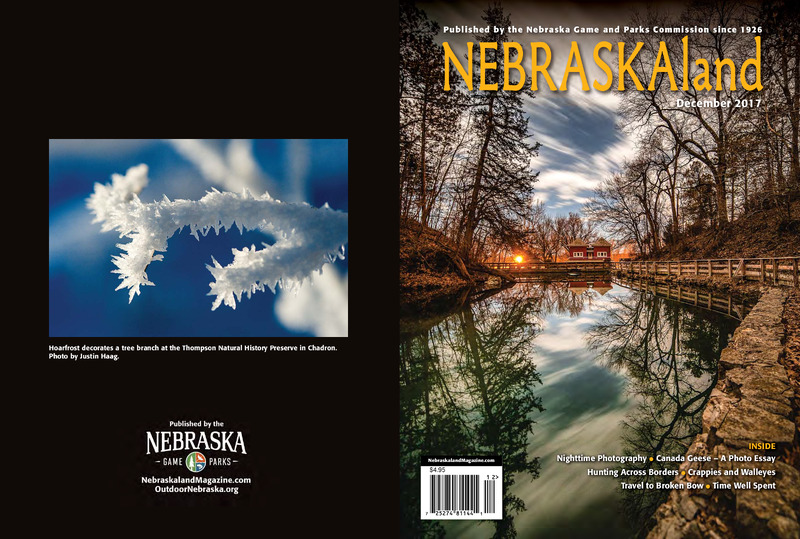
Publis hed by
y the Nebr a s k a Ga m e a nd Pa r k s C o m m is s io n si nc e 1926
NEBRASKAland
December 2017
Hoarfrost decorates a tree branch at the Thompson Natural History Preserve in Chadron.
Photo by Justin Haag.
NebraskalandMagazine.com
$4.95
INSIDE
Nighttime Photography ● Canada Geese – A Photo Essay
Hunting Across Borders ● Crappies and Walleyes
Travel to Broken Bow ● Time Well Spent
NEBRASKAland Magazine
Volume 95
●
No. 10
●
December 2017
F EAT U R ES . . .
24 Night Lights
STORY BY RENAE BLUM AND PHOTOS BY ZACH HANSON
32 Time Well Spent – What to Do in December
BY RENAE BLUM
34 The Leopold Tingle
Canada Goose Hunting in Nebraska
STORY BY DR. MARK VRTISKA
PHOTOS BY JOE BRAUN AND DOUG STEINKE
42 Crappies and Walleyes – Through the Ice
BY JEFF KURRUS AND JULIE GEISER
44 Hunting Across Borders
STORY AND PHOTOS BY JENNY NGUYEN-WHEATLEY
34
●
I N S I D E T H I S I S S U E ...
Mixed Bag – The Eastern Chipmunk, Travel to Broken
Bow, A Brief History of Omaha's Bartenders, Wild
Edibles – Arrowhead, Hit More Quail, O Christmas Tree!,
Trail Cam Photos, Upcoming Events, and more ................ 8
Page 49 – The Holiday Seasons................................... 50
Outdoor Update – Valentine NWR Update .............. 54
In the Field – The Most Secretive of Skunks.... .........56
Portraits from the Past – Readers' Photos ............. 58
In the Kitchen – Pheasant and Sausage Quiche ........ 60
The Last Stop – Winterfest ........................................ 62
32
●
42
●
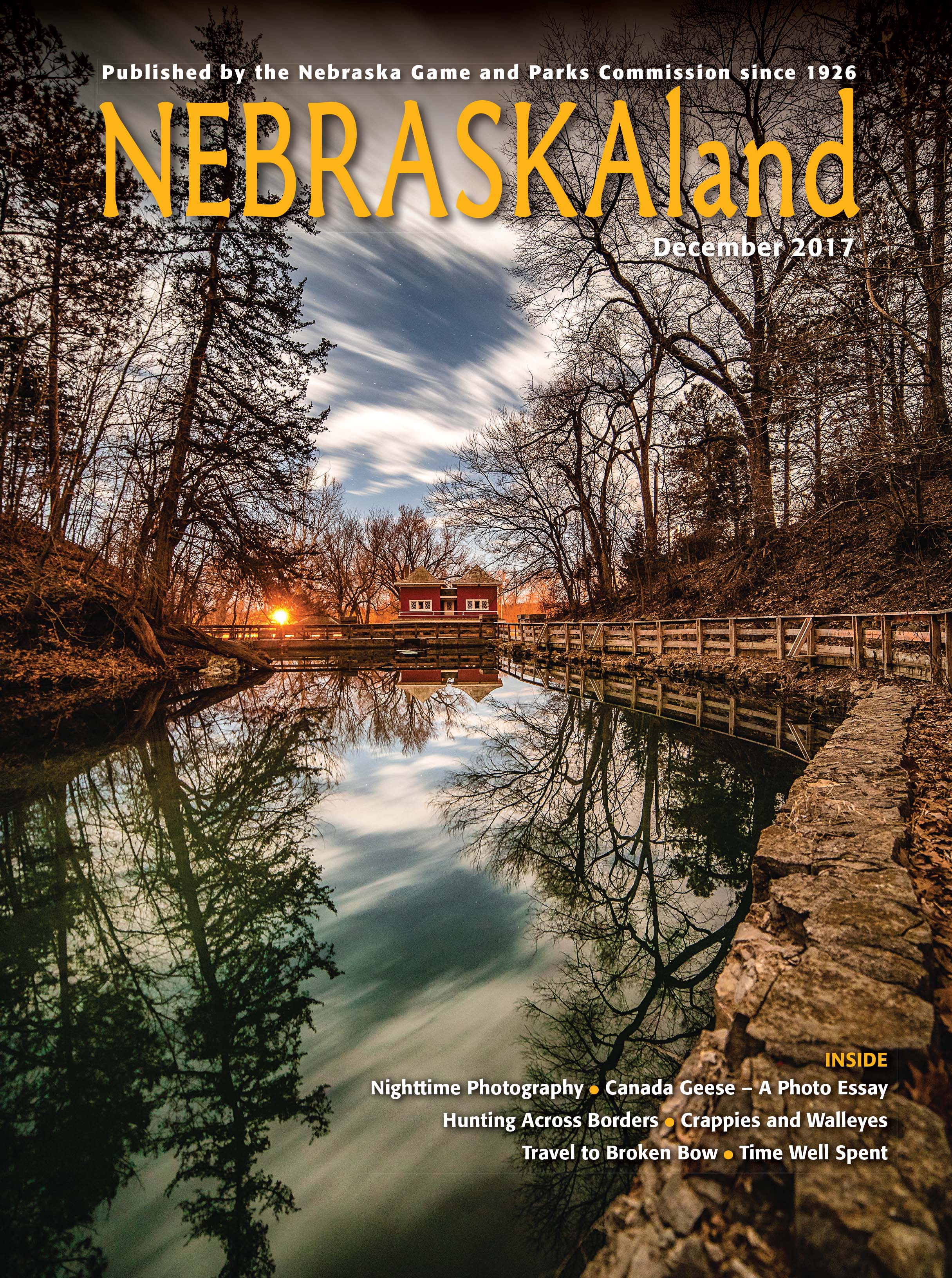
Cover: This photo of Schramm Park State Recreation Area's old
fish hatchery building (seen from the canyon ponds above) was
shot near midnight in February of 2016. See page 24 for more
nighttime photos. Photo by Zach Hanson.
THROUGHOUT 2017, NEBRASKALAND MAGAZINE WILL
PUBLISH ARTICLES ASSOCIATED WITH THE STATE'S 150YEAR CELEBRATION. LOOK FOR THIS LOGO TO READ ABOUT
NEBRASKA'S RICH HISTORY AND VIEW OUR INTERACTIVE
DIGITAL EDITION FOR MORE INFORMATION.
NEBRASKAland (VOL. 95 / NO. 10 ISSN 0028-1964) is published monthly, except
for the combined Jan./Feb. and Aug./Sept. issues, by the Nebraska Game and Parks
Commission, 2200 N. 33rd St., Lincoln, NE. Periodicals postage paid at Lincoln,
Nebraska, and additional mailing offices. POSTMASTER: Send address changes to
NEBRASKAland, P.O. Box 30370, Lincoln, NE 68503-0370.
2 NEBRASKAland • DECEMBER 2017
44
●
DECEMBER 2017 • NEBRASKAland 3
"This picture was taken in the early morning as the sun started peeking
through the trees in my neighbors' yard. It was such a beautiful morning
and a beautiful sight," said Margaret Foster of Lincoln.
Chris Clay took this photo of a bumblebee at Heron
Haven Nature Center in Omaha.
Congratulations to Tom Shield for winning the "Wild and
Scenic" photo competition at the Nebraska State Fair
with this sandhill crane image taken between Kearney
and Gibbon.
Opening day 2017 four-man limit in the Rainwater Basin with
Devin Heusinkvelt, Wade Backstrom, Jackson Ellis and Carson
Jones.
Casey Mitchell from Lincoln took this photo of an
active fox den in the middle of the city. He saw
mom, dad and nine kits.
4 NEBRASKAland • DECEMBER 2017
DECEMBER 2017 • NEBRASKAland 5
Nebraska Friendly
I’m writing to NEBRASKAland
to tell you how much I enjoy it. I
first subscribed to the magazine
in February after I decided I was
coming to Nebraska to watch the
eclipse. I thought it might give me
some tips on what to do and see
in Nebraska. It did, as we enjoyed
an outing at Rock Creek Station
(Homestead, too) after reading
about it in your magazine. Even
though our vacation has come
and gone I plan to renew my
subscription to your magazine.
However, what I really would
like to say is thank you to the
people of Nebraska. My wife,
youngest daughter (17) and
myself traveled to your state
to watch the eclipse. While we
stayed at a hotel in Kearney on
Aug. 21, we watched the celestial
event from Ravenna Lake in
Buffalo County.
We also took part in the town
of Ravenna’s festivals, from the
bands to the vendors. And yes,
we spent money! We enjoyed the
small-town atmosphere, charm
and hospitality to the utmost
maximum.
We spent a total of nine days
in your lovely state. Nebraska is
so big! We logged nearly 1,900
miles traveling from the Omaha
airport and back again seeing
such sights as Homestead to Fort
Robinson to Smith Falls and
everything in between.
I was surprised at how friendly
Nebraskans were and how they
were willing to help or give
advice on what to do and see to a
stranger. Even the police officer
that pulled me over for speeding
in Ogallala ended up offering
advice about Ash Hollow. It turns
out that by the end of our stay
we could actually tell who was a
native to Nebraska and who was
not, simply by their friendliness.
You put “southern hospitality”
to shame. We also learned of
your new state motto, “Nebraska.
Nice,” and found it to be perfectly
fitting.
Mike Sausser and family
Schuylkill Haven, Pennsylvania
6 NEBRASKAland • DECEMBER 2017
Hides for Vets
The Benevolent and Protective
Order of Elks, known as the local
Elks Lodge in most small towns,
is again accepting donated deer
hides from the beginning of the
November firearm deer season
through the end of the January
antlerless deer season.
Donated hides will be shipped
to a tannery to be turned into soft
leather and made into gloves for
veterans who use wheelchairs
or used for craft kits that are
distributed to veterans at Veterans
Affairs Hospitals across the world
as part of the Elks Help a Vet
program.
Before the hides can be
shipped, they have to have all
excess fat, flesh and both the head
and tail removed. Then table or
stock salt must be rubbed into all
fleshy surfaces. Volunteers at the
drop-off locations do most of this
work, but hunters are welcome to
do it themselves before dropping
off the hides. Care must be taken
in the skinning process, however,
as even small holes can result in
the hide being ruined during the
tanning process.
Contact your local Elks
Lodge for more
information.
Jeff Sneller
Lincoln Elks
Lodge
NEBRASKAland Magazine
ADMINISTRATION
CONSERVATION OFFICERS
Director Jim Douglas
Deputy Director Tim McCoy
Commissioners
Chairman - Rex Fisher, Omaha
Vice Chairman - Dick Bell, Omaha
2nd Vice Chairman - Robert Allen, Eustis
Mark Spurgin, Paxton
Rick Brandt, Roca
Pat Berggren, Broken Bow
Jim Ernst, Columbus
Norris Marshall, Kearney
Dan Kreitman, Wahoo
ADMINISTRATION (Lincoln)
Craig Stover (Administrator)
Duane Arp (Asst. Administrator)
Jeff Clauson (Asst. Administrator)
MAGAZINE STAFF
Communications Director Christy Firestone
Editor Jeff Kurrus
Art Director Tim Reigert
Associate Editor Jenny Nguyen-Wheatley
Regional Editors Eric Fowler, Julie Geiser,
Justin Haag
Contributing Editor Michael Forsberg
Regular Contributors Renae Blum,
Chris Helzer, Chris Masada, Gerry Steinauer
Photo Librarian Jaclyn Cruikshank Vogt
Circulation Donna Robinson
For address changes and questions about
your subscription, e-mail donna.robinson@
nebraska.gov or call 800-632-5263
Advertising Sales Manager
For advertising information contact
Shane G. Gilster, 402-742-0125
Email: shanegilster@gmail.com
NEBRASKAland Magazine Copyright 2017, all rights reserved.
NEBRASKAland is available in audio from the Nebraska Library
Commission Talking Book and Braille Service, Suite 120, 1200 N St.,
Lincoln, NE 68508. 800-742-7691. NEBRASKAland Magazine and the
Nebraska Game and Parks Commission reserve the right to reject any
advertising not in keeping with the agency mission.
Rates: $18 for one year; $33 for two years; $44 for three years. Nebraska
recipients must add appropriate sales tax. To subscribe call
1-800-NEBLAND (632-5263), or go online to: NebraskalandMagazine.
com.
COMMISSION
C
CO
COM
OM
MMIS
MIS
SSIO
S N OFFICES
OFFI
FF CES
FF
S
Headquarters/Southeast District Office
2200 N. 33rd Street Lincoln, NE 68503
Phone 402-471-0641
Northeast District Office
2201 N. 13th St. Norfolk, NE 68701
Phone 402-370-3374
Southwest District Office
301 E. State Farm Rd. North Platte, NE 69101
Phone 308-535-8025
Send your comments to:
Jeff Kurrus, Editor
NEBRASKAland Magazine
P.O. Box 30370
Lincoln, NE 68503
or e-mail Jeff.Kurrus@Nebraska.gov
Please include your postal address
and telephone number. Letters may be
condensed and edited. Photographs are also
welcome.
Bruce Thiel of Lincoln shared this photo of Mayberry Lake in Pawnee County.
Any program that receives federal funding from the National Park
Service, or the United States Fish and Wildlife Service prohibits unlawful
discrimination on the basis of race, color, religion, age, gender, marital
status, national origin, age, disability or political affiliation. Any person
who believes he or she has been discriminated against in any program,
activity, facility, or service, should contact the Nebraska Game and
Parks Commission, Lincoln, NE 402-471-0641, the Equal Opportunity
Commission, Lincoln, NE 402-471-2024, TTY/TDD 402-471-4693;
United States Fish Wildlife Service, Civil Rights Coordinator, 4401
N. Fairfax Drive, Arlington, VA 22203; Director, Equal Opportunity
Program, U.S. Department of Interior, National Park Service, 1849 C
Street NW, Mail Code 0008, Washington, D.C. 20240-0001.
Northwest District Office
East Hwy. 2, Box 725 Alliance, NE 69301
Phone 308-763-2940
Bassett Office
524 Panzer St., Box 508 Bassett, NE 68714
Phone 402-684-2921
Kearney Office
1617 First Ave. Kearney, NE 68847
Phone 308-865-5310
Ak-Sar-Ben Aquarium
21502 W. Highway 31 Gretna, NE 68028
Phone 402-332-3901
Omaha Office
8495 Frederick Street, Omaha, NE 68124
Phone 402-595-2144
402-471-5531
402-471-5531
402-471-5531
NORTHWEST (Includes counties covered)
Jim Zimmerman (District Supt.)
308-641-9590
Sean McKeehan
(Cheyenne, Morrill, Box Butte)
308-279-9133
Scott Brandt
(Kimball, Banner, Scotts Bluff)
308-631-0663
Dan Kling (Sioux, Dawes)
308-430-0572
Kyler Prochaska
(E 1/2 Dawes, N 1/2 Sheridan, W 1/2 Cherry) 308-430-3984
Terry Brentzel (Deuel, Garden, Grant) 308-458-7650
402-389-0444
Frank Miller (Cherry, Hooker)
NORTHEAST (Includes counties covered)
Tom Zimmer (District Supt.)
402-649-6138
402-760-0712
Dale Davis (Keya Paha, Brown, Rock)
402-340-3981
Jonathan Andreasen (Holt, Boyd)
Greg Hesse
(Greeley, Wheeler, Boone, S 1/2 Antelope)
402-843-6567
Mitch Johnson (Knox, Antelope, Pierce) 402-613-8612
402-762-5022
Jeff Jones (Knox, Cedar)
Jon Reeves
(S 1/2 Thurston, Burt, Washington)
402-889-8508
Andrew Heyer (Pierce, Madison, Stanton) 402-613-2241
Cory Krause
(Cuming, Wayne, Stanton, Dodge)
402-380-6410
Steve Oberg
(Colfax, Platte, Madison, Stanton, Nance)
402-910-3366
Owen Johnson
(Dixon, Dakota, N 1/2 Thurston)
402-266-1759
308-730-7050
Doug Pollard (Loup, Garfield, Valley)
SOUTHWEST (Includes counties covered)
Roger Thompson (District Supt.)
308-530-3097
308-202-0819
Matt Brandt (Sherman, Howard)
308-380-7331
Tim Williams (Hall, Hamilton, Merrick)
Pat George
(Harlan, Franklin, Phelps)
308-920-2762
Matt Andrews
(Gosper, Furnas, Frontier, Red Willow)
308-746-2418
Brian Piernicky
(Red Willow, Frontier, Hayes, Hitchcock)
308-340-6627
John Lee (Hitchcock, Dundy, Chase, Hayes) 308-414-1432
308-289-0427
Nicholas Fix (Keith, Perkins)
308-289-1169
Bryce Streger (Keith, Arthur)
308-760-0145
Sean Schultz(Keith)
Brandon O’Neal
(Lincoln, McPherson, Logan)
308-530-3157
Alex Hasenauer
(Lincoln, McPherson, Logan)
308-660-4671
Dale Johnson (Kearney, Buffalo)
308-440-3847
308-529-8146
Mike Thome (Dawson)
Ray Dierking (Custer, Thomas, Blaine) 308-870-0322
Taylor Dixon
(Dawson, N 1/2 Gosper, N 1/2 Phelps)
308-217-2108
SOUTHEAST (Includes counties covered)
Levi Krause (District Supt.)
402-949-0593
402-619-1355
Rich Berggren (Douglas)
402-616-5961
Dan Evasco (Sarpy)
402-210-0888
Heath Packett (Cass)
402-209-1506
Russell Mort (Otoe, Johnson)
William Krause
(Nemaha, Richardson, Pawnee)
402-274-8063
Matt Taylor (Thayer, Fillmore, Jefferson) 402-200-9597
402-806-9084
Dan Zuehlke (Gage, Saline)
402-890-6463
Dina Barta (Lancaster)
402-937-3422
Dudley Sorensen (Lancaster, York)
402-613-2312
Travis Shepler (Lancaster)
402-890-7140
Stacey Lewton (Lancaster, Seward)
402-443-6392
Mike Luben (Saunders, Butler, Polk)
Nebraska Wildlife Crimestoppers
1-800-742-7627
DECEMBER 2017 • NEBRASKAland 7
A Mammal
Brief
By Lindsay Rogers
8 NEBRASKAland • DECEMBER 2017
Lindsay Rogers is an outdoor
education specialist with the
Nebraska Game and
Parks Commission.
PHOTO BY JOEL SARTORE
Easily identified by the five solid stripes
on their back and reddish-brown rump, the
Eastern chipmunk (Tamias striatus) is found
throughout most of the eastern United
States, including eastern Nebraska. The
only other chipmunk species in Nebraska –
the least chipmunk (Tamias minimus) – is
found in the northern Panhandle.
The Eastern chipmunk is a primarily
ground-dwelling squirrel which feeds
on seeds, nuts and fruit. Their diet is
supplemented by insects, earthworms,
slugs, bird’s eggs and mushrooms. They will
carry food in their cheeks and often cache
or store food throughout their range. They do not
hibernate, but rather enter a state of torpor where they will sleep for
several days or weeks but wake to feed throughout the winter months.
During their active periods in the winter they will feed on cached food.
They are extremely vocal and can be heard making a series of chirps or their
high-pitched alarm call. ■
DECEMBER 2017 • NEBRASKAland 9
Travelogue
Visit Broken Bow
Travelogue Sponsor
●
Broken Bow
By Brenna McFadden, Nebraska Tourism Commission
B
PHOTO BY JULIE GEISER
roken Bow is a historic town that continues
to thrive and look to the future with its motto
“Rooted. But not standing still.” Named by a
settler who found a broken bow in a field at the
site of a former Indian camping ground, this
small and vibrant community offers unique places to
stay and eat as well as providing fun activities for the
whole family.
If you are planning to visit while you are traveling
along scenic Hwy. 2, make sure you book yourself a
place to stay at the Arrow Hotel. Traditional values and
incredible hospitality go hand-in-hand at this elegant
Western style hotel. Though it was built in 1928 and
is listed on the National Registry of Historic Places,
it has all the modern-day conveniences you could ask
for, including Wi-Fi, cable television with HBO and
The Arrow Hotel, and its Bonfire restaurant in its lobby, provide a
in-room coffee service. The Arrow Hotel can also
relaxing getaway for travelers through Broken Bow.
provide a fun and relaxed dining atmosphere at the
square is Ortello Dale, the home away from home store. This
Bonfire Grill and Pub located in the lobby. This is a one-ofstore has a family atmosphere and specializes in unique gifts
a-kind hotel experience that is sure to create fond memories.
and home décor.
The Arrow Hotel is located just off the city square, so
If you have an interest in art be sure to browse some of the
you can spend time admiring the local shops, and if you
beautiful pieces found at the Wild Rose Gallery. This gallery
are lucky you can take part in the Third Thursday concert
features regional artists and is dedicated to providing a place
festivities! Live music, food and drinks, shopping, games
and much more take place every third Thursday of the month for artists to display and promote their work while also
educating the public in the arts.
in the Downtown City Square. It is a great time for the
This small yet growing town has much to offer and is
community to come together and welcome visitors from all
continuing to bring in new and exciting additions to the
over with plenty of small-town charm and liveliness. One
community. With a great town square, beautiful park and
of the outstanding stores unlike any other that folks will
encourage you to visit while you are strolling around the city recreation areas, a new sports facility and a new add-on to
the Arrow Hotel, this is definitely a
flourishing community that is sure to
stun while you visit. So, start planning
and pack your bags for a weekend
getaway to Broken Bow. ■
While in the Area
Other places to stay, eat at and visit
in Broken Bow:
Dowse Bunkhouse
Kinkaider Brewing Co.
Legends Neighborhood Grill
Prairie Grounds Café & Gifts
PHOTO BY JULIE GEISER
Tumbleweed Cafe
Sylvester’s Bar and Lounge
Melham Park
Custer County Museum
Pleasure Lanes
Boneyard Creation Museum
Broken Bow's Melham Park.
10 NEBRASKAland • DECEMBER 2017
DECEMBER 2017 • NEBRASKAland 11
A Brief History
“Women, High Living, and
nd
d
Diamonds” for Omaha’s
Bartenders
By the Nebraska State Historical Society
cie
ieety
iety
y
O
maha in 1886 boasted about 1500
saloons manned by a host of
bartenders who ministered to the
he
city’s thirst for beer and hard liquor.
quuor
or.
or.
The Omaha Bee on Sept. 26, 1886, noted
teed the
th
he
“many things, interesting and curious, that might be written
about the Omaha bartenders.”
The Bee noted that each saloon usually employed two men
behind the bar. However, “not more than a score ... are firstclass bar tenders.”
This little shack was said to have been the first saloon
in Palisade, Nebraska. The story is that it was located
across the tracks because local women had petitioned
town officials to prohibit a saloon in town. Local men
honor the shack’s history in this 1915 photo. NSHS
RG5339-6
O
h b
95 17
Omaha
bar, 1910
1910. NSHS RG3542
RG3542-95-17
A first-class bartender, according to the Bee, should have
a number of attributes. “He must not only be a machine,
[but] an accurate machine at that – able to compound a list
of drinks as long as your arm – putting together the proper
ingredients in the proper proportions. He must be a close
student of human nature, affable and agreeable under all
circumstances and at all times ... If a customer is sleepy and
stupid, the man behind the bar must possess the ability to
give him a decoction which shall open his eyes and make
him feel wide awake and ready for business; if he, on the
other hand, [is] unable to sleep and in need of rest, the
bartender must call to his aid the magic of his art and give
him something to soothe his nerves and insure him a night of
sweet sleep.”
Bartenders were not paid high salaries, noted the Bee.
“Twenty dollars a week is the amount earned by the majority
of Omaha’s best drink-mixers. A few are paid $100 a month
and one or two perhaps a trifle over that amount.”
Although wages were not high, bartenders had the
reputation of spending freely. They were said to be “welldressed, gentlemanly fellows, who live well and know
how to spend their money. A bartender who
saves his money is a very rare exception. The
majority of this class of men prefer to spend it
on women, high living and diamonds.” ■
In 1930s Scottsbluff, “high living” included Storz beer and a game of pool. NSHS RG2528-6-22
12 NEBRASKAland • DECEMBER 2017
Visit the Nebraska State Historical Society’s
website at nebraskahistory.org.
DECEMBER 2017 • NEBRASKAland 13
14 NEBRASKAland • DECEMBER 2017
DECEMBER 2017 • NEBRASKAland 15
Santa Claus Is Coming...
Sustaining America's Diverse Fish and Wildlife
By Jeff Kurrus
On Dec. 9 at Eugene T. Mahoney State Park, Santa Claus
will make an appearance from 1:30-4:30 p.m. at the Peter
Kiewit Lodge. Photographs with Santa will be provided by
I
PHOTO BY JENNY NGUYEN
16 NEBRASKAland • DECEMBER 2017
NEBRASKAland Magazine, and participants will also be able
to decorate cookies, make Christmas cards for our soldiers
overseas and create holiday crafts. ■
PHOTO BY JEFF KURUS
By Kristal Stoner, Wildlife
Diversity Program Manager
n October, Nebraska Rep. Jeff
Fortenberry announced he
would introduce legislation
that would fund conservation and
habitat restoration projects across
the United States. Called the
Recovering America’s Wildlife Act,
the legislation would use existing
revenues from minerals and energy
taken from federal lands to fund
projects aimed at preserving and
restoring habitat for imperiled
species. Up to $1.3 billion annually
would be allocated to state wildlife
agencies.
“The Recovering America’s
Wildlife Act is an exciting new
policy approach to wildlife
management and care for our
Jeff Fortenberry, middle, speaking with Nebraska Game and Parks Commission biologists
natural resources,” Fortenberry said. Congressman
Gerald Mestl, left, and Kristal Stoner, right, about the introduction of the Recovering America's Wildlife Act.
“This legislation will help at-risk
species before they require the
crisis. Representatives from the outdoor recreation retail and
expensive, restrictive measures required by the Endangered
manufacturing sector, the energy and automotive industries,
Species Act. This smarter approach, using the existing
private landowners, educational institutions, conservation
state wildlife action plans, will create the conditions for
organizations, sportsmen’s groups and state and federal fish
preservation, conservation, and new economic dynamics.”
and wildlife agencies are all part of the alliance – and all are
Our nation’s wildlife and wild places are at risk.
invested in the future of our fish, wildlife and wild places.
Nationally, more than 12,000 species have been identified as
In August, the Nebraska Game and Parks Commission
threatened with extinction. In Nebraska, nearly 90 species
passed a resolution supporting the Alliance for America’s
are considered threatened with extinction, and an additional
Fish and Wildlife efforts to diversify and expand funding
680 are declining and warrant concern.
for the thousands of animals and plants that make Nebraska
This is not the first time Americans have faced a national
their home. Twenty-three other states have passed similar
wildlife crisis. In the late 19th and early 20th centuries,
state resolutions.
many species were in steep decline or on the brink of
“We can’t adequately address the changing needs of our
extinction. Elk, bison, bighorn sheep, black bears – even
constituents or the needs of all Nebraska’s fish and wildlife
white-tailed deer – had all but disappeared across the
with the resources we currently have,” said Nebraska Game
country. Realizing the gravity of the problem, Congress
and Parks Commission Director Jim Douglas. “This funding
took issue. In 1937 and again in 1950, Congress funded
source will ensure that future generations can enjoy thriving
game species conservation with an excise tax on firearms,
fish and wildlife populations."
ammunition and archery, fishing and boating equipment.
In Nebraska, the Recovering America’s Wildlife Act would
These funds, paid by the sportsmen and women who
have tremendous impact. It would fund three key areas
purchased sporting equipment, were directed to habitat
essential to the continued success of at-risk species: habitat
conservation projects and research. These conservation and
projects, research, and education efforts.
research projects over time led to the recovery of our game
If the Recovering America’s Wildlife Act were to pass, the
species, many of which are still thriving today.
Nebraska Game and Parks Commission would work with
Unfortunately, the current system was not designed to
private landowners across Nebraska to cooperatively improve
conserve the entire array of our nation’s biodiversity. There
are thousands of species under state management jurisdiction habitat for these declining species in a proactive, voluntary
manner. Commission biologists would work on public
that are not hunted or fished that have no comparable
sustainable dedicated funding source in place to support their areas to manage wild habitats for both people to enjoy and
for declining species to thrive. The agency would be able
conservation.
to support urban habitat development including pollinator
A group called the Alliance for America’s Fish and
gardens and green space, both of which are becoming
Wildlife is working with Fortenberry, other elected officials
increasingly important to wildlife. ■
and many other groups to face this rising fish and wildlife
DECEMBER 2017 • NEBRASKAland 17
Hit More Quail
18 NEBRASKAland • DECEMBER 2017
PHOTO BY JARROD SPILGER
By Jarrod Spilger
Nebraska bobwhite quail numbers have
been trending upward recently, thanks to good
weather and improved habitat conditions. That
means upland hunters will likely encounter a
few coveys while out chasing pheasants this
fall. Quail are always a welcome surprise, but
they can be difficult to hit.
That’s because quail are fast and have an
unnerving tendency to erupt from beneath one’s
feet and fly in every direction. The answer
to hitting more speedy, close-range quail is
spreader loads.
Spreader loads use specialized wads to
disperse the shot pattern more quickly than a
standard load. For older shotguns with fixed
full chokes, spreaders can help open up patterns
without altering the choke or barrel. They can also be used
with more open chokes for really wide patterns, which is
especially useful when hunting over pointers.
Since most quail are taken while hunting pheasants, I often
use a mid-range choke tube and initially load up for roosters.
If quail appear, I’ll simply shoot the heavy pheasant load on
the covey rise. I then load up with spreaders and go after the
singles. If I’m targeting quail specifically, I’ll use spreaders
right away.
Two of the best spreader loads I’ve tried are made by
Polywad and Kent. Polywad’s Spred-R line is available
in 12-, 16-, 20-, and 28-gauge in shot sizes 6, 7.5, and 8.
To order, visit polywad.com or call 800-998-0669. Kent’s
spreader load is only available in 12-gauge with number 8
shot. It can be ordered from Huntstuff Online, huntstuff.com,
757-482-3800. ■
Presented by
Wild Edibles - Broad-leaved Arrowhead
O Christmas Tree!
By Julie Geiser
By Julie Van Meter
State Entomologist, Nebraska
Department of Agriculture
A
s the weather turns cold most
edible plants will succumb to
winter’s wrath and will have to
wait for the return of spring to begin a
new life cycle.
But for now, one food source can
still be found: the arrowhead plant, or
wapato (Sagittaria), grows from a tuber
that is buried deep in the mud.
20 NEBRASKAland • DECEMBER 2017
PHOTO BY JULIE GEISER
Arrowhead Leaves
Arrowhead is an aquatic plant that
grows a long-stalked, arrowhead-shaped
leaf that can range in size depending on
the type of arrowhead. There are many
different species of arrowhead; the most
commonly harvested is the broad-leaved
arrowhead. As its name states, the leaf
shape looks like an arrowhead with a
point at the tip and two long lobes that
As its name states, the leaf shape looks like an arrowhead with a point at the tip and two
point downward, forming a sagittate or
long lobes pointing downward, forming a sagittate or arrowhead. The leaves grow over
arrowhead.
the water and can be a few inches to several feet above water.
The leaves can vary from 3 inches
to more than 3 feet in length. They can
The arrow arum's leaves have smaller lobes and are smooth
be narrow or over a foot wide, and plants can differ in size
along the outer edge. The leaf veins are arranged in two rows
when growing next to each other. The vein pattern of the
along opposite sides of a main vein. This plant can make you
plant starts where the crease in the lobes come together and
sick if eaten.
goes outward to the leaf edge. The leaves grow over
the water and can be a few inches to several feet above
Collecting Arrowhead Tubers
water.
Collecting tubers should be done starting in late fall
In the summer the wapato has a three-petaled flower that
when they are full-grown and the plant starts to die and turn
blooms on a spike separate from the leaves. During late
brown. In areas where water does not freeze, the wapato can
summer the flowers turn into small green balls. These balls
be harvested all winter or when there is no ice. They can also
turn brown in fall and break apart to release small, winged,
be collected in early spring, but they will shrink and die soon
floating seeds.
after that. Do not collect plants that are growing in stagnant,
standing water.
Arrowhead Tubers
Getting the plant out of the mud takes some work and
If you look up the history of
waders or hip boots, and is done by using a potato hook or
the wapato you will see images
three-tined garden rake and raking back and forth, moving
of Native Americans in the
the top layers of mud to release the tubers. If the tubers are
frigid water trying to loosen
ready to collect, they will float to the surface.
tubers from their muddy grasp.
Collecting can also be done with bare feet by moving the
These tubers are shaped like
mud and feeling the tubers and releasing them. While this
a potato, and they can be peamethod is more fun, it is a wet and muddy job.
sized to the size of an egg,
with larger plants producing
Preparing Arrowhead Tubers
larger tubers. Tubers grow at
E h tuber
b will
ill have
h
To prepare the tubers, remove the skirts with your fingers
the end of the stem of each plant. Each
a
and rinse them. Cut off the end with the shoot and the
pointed, curled piece sticking out of one end. The wapato
opposite end where the tuber was attached to the stem or
tuber will not have any roots protruding from it and will
rhizome. Then peel it like you would a potato, trying not to
vary in color from purple to reddish-brown to cream colored
waste too much flesh. Once peeled, boil them for about 30
depending on the water they grow in.
minutes, drain the water and use them like potatoes, alone or
One plant that could be mistaken for the wapato is the
in dishes that call for potatoes. They can be cold-stored, but
arrow arum (Peltandra virginica), which is an aquatic plant.
only for a month or less. ■
It also has an arrowhead-shaped leaf but is easy to identify.
W
hile there are many Christmas
tree farms in Nebraska, a large
number of the cut Christmas trees sold
here are grown and harvested in other
states such as Minnesota, Wisconsin
and Michigan. Some of these states are
under federal quarantine for plant pests
that can travel on Christmas trees.
Inspectors with the Nebraska
Department of Agriculture (NDA) visit
Christmas tree sales lots across the
state in November and December to
ensure all federal quarantines are being
followed. The inspectors verify that
the trees were properly inspected and
certified prior to shipment to Nebraska,
and also inspect the Christmas trees to
confirm that no quarantine pests are
present.
The quarantine pests of most concern
are gypsy moth (Lymantria dispar) and
pine shoot beetle (Tomicus piniperda).
Neither is currently found in Nebraska.
Gypsy moth is
present from the
New England states
west, to parts of
Wisconsin and
Illinois. This moth
Gypsy moth egg
lays egg masses
mass.
on the trunks of
PHOTO COURTESY OF
FERENC LAKATOS,
trees, including
UNIVERSITY OF SOPRON,
BUGWOOD.ORG
Christmas trees.
The eggs hatch out in the spring, and
the caterpillars feed on deciduous plant
foliage. The loss of foliage weakens the
trees and over time can result in tree
death.
To prevent its establishment in
Nebraska, NDA monitors for gypsy
moth through inspections of nursery
stock and firewood, in addition to
Christmas trees, and conducts an
annual statewide trapping program.
Pine shoot beetle is a small beetle
that can infest all species of pine trees,
including Christmas trees. Adults can
overwinter in twigs, or near the base
of the tree. This
pest can be found
from the New
England states
west to Minnesota
and Iowa. NDA
Larger pine shoot
inspectors check
beetle.
nursery stock and
PHOTO COURTESY OF
E. RICHARD HOEBEKE,
Christmas trees
CORNELL UNIVERSITY,
BUGWOOD.ORG
to monitor for the
presence of pine shoot beetle.
If you purchase a Christmas tree that
was not grown in Nebraska, make sure
to dispose of it properly. Christmas tree
recycling sites that chip or burn the
trees are an excellent means of disposal
and reduce the risk of any unwanted
pests emerging from the trees and
becoming established in Nebraska.
The risk of either of these pests
emerging while the Christmas tree is
in the house is virtually non-existent.
There is also no concern of these pests
causing damage to the home itself or
threatening human health. ■
DECEMBER 2017 • NEBRASKAland 21
Send Us Your Trail Cam Photos!
by Jerry Kane
Contact the Nebraska Game and
Parks Commission at 402-471-0641 or
visit OutdoorNebraska.org for more
information. Visit HuntSafeNebraska.
org for a list of hunter education
classes and BoatSafeNebraska.org for
a list of boating safety classes.
"Christmas at the Cody's"
is an annual celebration.
December 1
Bobcat Hunting and Trapping
December 10
White-fronted Goose Hunting
December 31
Archery Fishing
season opens
first segment closes
game fish season closes
December 1-3, 8-10, 15-17, 22-23
Christmas at the Mansion
December 16
Snipe Hunting
December 31
Underwater Spearfishing
Arbor Lodge State Historical Park,
Nebraska City
season closes
season closes
December 1-31
Cow Elk Hunting Season
December 16
Yule Log Festival
Paul Janning submitted this trail cam photograph of a coyote
running on private land near Spalding.
Platte River State Park, Louisville
Private and public land
December 1-31
Deer Hunting
December 16
Christmas Bird Count
Indian Cave State Park, Shubert
Muzzleloader Deer Hunting Season
December 2
Archery on Fire
December 16-17
Deer Hunting
DeSoto Muzzleloader Season
Platte River State Park, Louisville
December 5
Learn to Hunt Predators
Nebraska Game and Parks Outdoor
Education Center, Lincoln
December 8-10, 15-17, 22-23
Christmas at the Cody’s
Buffalo Bill Ranch State Historical Park,
North Platte
December 9
Nature’s Gifts: Decorations from the
Great Outdoors
December 19
Duck and Coot Hunting
season closes in Zones 2 and 4
December 22
Bighorn Sheep Hunting
season closes
December 26
Duck and Coot Hunting
season closes in Zone 1
December 30
Winterfest
Wildcat Hills State Recreation Area, Gering Ponca State Park, Ponca
December 9
Christmas at the Bowring
December 31
Archery Antelope Hunting
Bowring Ranch State Historical Park,
Merriman
season closes
December 9-17
Deer Hunting
December 31
Archery Deer and Statewide Whitetail
Buck Hunting
Boyer Chute National Wildlife Refuge
December 9, 16
Christmas in the Woods
Ponca State Park, Ponca
Mike Beelaert of O'Neill shared this image from a camera set
up by Bobbie Harte on Beelaert's land on the Niobrara River.
seasons close
December 31
Light Goose Hunting
first segment closes
Duck and goose hunting with
Ethan Teter of Sargent on a
warmwater slough off North Loup River
near Taylor.
22 NEBRASKAland • DECEMBER 2017
Please submit your trail camera photos by e-mail to:
nebtrailcam@gmail.com. Also include any information that will
help explain your photo.
NEBRASKAland
Visitor
Last issue’s winner of
the Visitor drawing was
David Powers of Omaha,
Nebraska, who found the army ant on
page 53.
Readers are encouraged to contact
NEBRASKAland within 10 days after
this issue’s publication with the
correct page number and name of
this issue’s “Visitor” – a critter found
in Nebraska. We will then gather the
correct entries and draw one to win a
NEBRASKAland mug.
To enter each month, write:
NEBRASKAland Visitor
2200 North 33rd Street
Lincoln, NE 68503
Or e-mail: Tim.Reigert@Nebraska.
gov with “Visitor” in the subject line
of the message.
HINT: This issue’s visitor is not on
page 4, 14, or 21.
North America has at least
twelve species of army ants,
and one species, Neivamyrmex
nigrescens, has been found in
Nebraska. An army ant colony
is large, with potentially tens of
thousands of individuals. The
colony does not make a permanent
nest, but moves as a unit across
the landscape, primarily at night,
using temporary shelters and
searching for food. Army ants are
voracious hunters, feeding on any
unlucky insect or even a small
animal that they come across, and
they particularly like other ants.
They raid ant colonies, killing the
adult ants, and carry off the larvae
and pupae for food. Female army
ants do not possess wings and
make no nuptial flight. Instead,
the males are winged and fly to the
female to mate. Army ants can
be found across a wide range of
h
habitats, including
pprairies,
ra
woodlands,
aand even suburban
areas.
Special thanks to Julie Van Meter,
Entomologis Nebraska
State Entomologist,
Department of Agriculture.
DECEMBER 2017 • NEBRASKAland 23
Night Lights
The St. Deroin cemetery at Indian Cave
State Park in Richardson County.
Nikon D750, Samyang 14mm f/2.8.
Exposure: f/2.8, ISO 3200, 30 seconds.
Story by Renae Blum
Photos by Zach Hanson
24 NEBRASKAland • DECEMBER 2017
DECEMBER 2017 • NEBRASKAland 25
T
ime slows down when you’re shooting photos at night. A single
shot can take half a minute to produce, so there’s plenty of time to
think, to plan the next image, to look up at the stars and appreciate
the serenity of the moment.
“It’s my sanctuary,” says Zach Hanson of Omaha. The 39-year-old
funeral director and father of two fell in love with night photography
several years ago during a camping trip, and now uses his hobby as a
way to de-stress from the pressures of the day.
“This is my therapy,” Hanson says. “When I go out at night, I find
peace in it.”
Hanson is self-taught, and takes pride in his hands-on methods. For
example, to darken particularly harsh light in the foreground, Hanson
will continuously move his hand or another object in front of the
light while the camera exposes the image, a technique he picked up
from a video about dark room techniques. It might be quicker to use a
filter, combine separate images or perform these actions afterward in
Photoshop, but Hanson prefers his “old-fashioned” style.
Above: Children with flashlights climb the Daugherty Tower
at Platte River State Park. Nikon D750, Samyang 14mm f/2.8.
Exposure: f/3.5, ISO 2000, 25 seconds.
Opposite: Waterfall at Platte River State Park. Nikon D750,
Samyang 14mm f/2.8. Exposure: f/2.8, ISO 6400, 30 seconds.
26 NEBRASKAland • DECEMBER 2017
DECEMBER 2017 • NEBRASKAland 27
Taking Pictures at Parks
Many off H
M
Hanson’s
’ photos
h
are taken
k at state
parks and recreation areas. He recommends
them as safe places to go when shooting
photos at night.
If you’d like to do nighttime photography
at a state park or recreation area, please
remember the following:
•
Before heading out, you need to contact
the park superintendent in advance to let
them know you are coming, and to discuss
any special considerations (restricted areas,
ongoing construction, events or activities,
known hazards, etc.).
•
• Do not enter or take photographs in
campground areas.
• Remain on trails or other publicly
accessible areas.
• Prepare for cooler temperatures and use
caution when walking in low visibility.
• Use a minimalist approach to avoid
disturbing wildlife.
• Practice Leave No Trace principles.
You will need a valid park permit if you are
driving a vehicle into a state park area.
■
Above: Light painting at Schramm Park State Recreation Area. Lights in the foreground
were created by Hanson shining a flashlight straight down at his feet as he walked; the
light painting was created with a headlight. Nikon D750, Samyang 14mm f/2.8.
Exposure: f/3.5, ISO 3200, 30 seconds.
Opposite: Enjoying a campfire at Indian Cave State Park. Nikon D750, Samyang
14mm f/2.8. Exposure: f/3.2, ISO 4000, 25 seconds.
28 NEBRASKAland • DECEMBER 2017
DECEMBER 2017 • NEBRASKAland 29
Zach’s Night Photo Tips
•
For equipment, a tripod and a remote shutter
release are the main essentials. An optimal lens
is wide-angle and fast, with a large aperture.
•
You may not need expensive equipment to
make pictures you’re proud of. “One of my first
shots at night that I really loved was taken with a
basic DSLR,
a kit lens,
and a tripod
from Costco
– so a $400
camera
and a $49
tripod. And
it’s still
one of my
favorite
nighttime shots,” Hanson says. For
astrophotography, he recommends a Samyang
14mm 2.8 lens: “It’s one of the cheapest you can
buy but it’s amazing at night.”
•
For lights, he has been known to use Tiki
torches, lanterns, flashlights, headlamps –
whatever is on hand.
•
• Choose your ISO based on the amount of light
available. “In western Nebraska, you won’t have
Set your camera on manual for full control of
your aperture and shutter speed.
to bump up your ISO because of how much light
is available from the stars. But closer to Omaha
or Lincoln, you have to shoot a little higher to
make those stars pop, and I’ll often turn down
highlights in post to get rid of some of that
city light,” Hanson says. “It can be hard to see
stars in a city photo if you don’t do that.” He’s
comfortable shooting up to an ISO of 6400 on
his full frame camera (a Nikon D750); on his old
crop sensor camera, a Nikon D3200, an ISO of
1600 was his limit.
•
Most of Hanson’s shots are between 25 and
30 seconds. After about 30 seconds, the camera
will pick up the movement of the stars and
produce star trails. Stars may start to streak after
20 or 25 seconds on a crop sensor camera.
T
o his surprise, Hanson regularly receives calls at work from people who have
been inspired by his photos. “Last week, somebody from a different state
tracked me down to say that she had lost her passion for photography, and she
saw a picture of mine and it rejuvenated her,” Hanson says. “Having people seek me
out because of my pictures was never something I set out to do. I started doing this
just for my own therapy, and it just turned into something a little more than I ever
thought it would be.” ■
To see more of Zach’s work, visit him on Facebook at Zach Hanson Photography.
30 NEBRASKAland • DECEMBER 2017
Above: This image of the
Platte River at Louisville
State Recreation Area
was taken about an hour
after sunset. Nikon D750,
Samyang 14mm f/2.8.
Exposure: f/3.5, ISO 1250,
25 seconds.
Zach Hanson lives in
Omaha, works as a funeral
director and has been
shooting night photography
for three years. He was
previously featured in
NEBRASKAland as the
first-place winner in the
“Recreation” category of the
2016 NEBRASKAland Photo
Contest. This is his first photo
essay for the magazine.
•
• Hanson uses the PlanIt! and PhotoPills apps
to plan his shoots. The apps include a dark
If you’re shooting stars, focus your camera on
them to get them as sharp as possible.
sky map, a sun/moon finder, visualizations of
the Milky Way, and times of sunrise/set and
moonrise/set, among other features.
•
Foreground is important. Choose a location
with something in it – a tree, a barn, a waterfall,
etc. – that will draw the eye. You don’t
necessarily need to light this area of the picture;
sometimes silhouettes are just as interesting.
•
Keep safety in mind when choosing a location.
Hanson sticks to state parks and recreation
areas, and goes with others when possible. ■
DECEMBER 2017 • NEBRASKAland 31
Time Well Spent
What to Do in December
By Renae Blum
D
on’t let chilly temps stop you from getting outdoors and having fun this month.
There’s still plenty of hunting and wildlife viewing opportunities, not to mention a
lot of fun holiday-themed park events. For a full list of Game and Parks events across
the state, visit Calendar.OutdoorNebraska.gov. ■
PHOTO BY MICHAEL SPEED
Late-season
Pheasant Hunting
Throughout the month
Statewide
There are still plenty of birds out
there, and some of the most exciting,
memorable hunts are still ahead.
Watch the Geminid Meteor Shower
PHOTO BY JEFF KURRUS
To increase your success during this
time of the year, think and hunt a little
differently. This could include simple
things like working the cover in an
opposite direction than usual, hunting at
a different time of the day, or even just
beginning at the spot in the field where
you normally end. Be sure to wear plenty
of orange and avoid any unnecessary
loud noises that would alert the birds.
Dec. 14-17 Statewide
You can view this bright, intensely-colored meteor shower anywhere with clear, dark skies Dec. 14-17. During the peak on Dec. 14,
you may see more than 120 meteors per hour. “This is one of the strongest meteor events during the year, and one to which most
enthusiasts look forward,” commented Monica Macoubrie from the Nebraska Game and Parks Commission.
Sesquicentennial
Events
Throughout the month
Statewide
Wildlife Viewing
Throughout the month
PHOTO BY JENNY NGUYEN
32 NEBRASKAland • DECEMBER 2017
PHOTO BY BOB GRIER
Bighorn sheep are currently in rut
– come out to Fort Robinson and
Chadron state parks for a chance to
see it. If you’re interested in wildlife
that is a little easier to spot, consider
participating in a Christmas Bird Count
event. Contact an Audubon center
near you for more information. Also,
stay tuned to the Nebraska Game and
Parks calendar page for additional bird
watching events.
PHOTO BY JENNY NGUYEN
Statewide
Celebrate the Season
Throughout the month
Statewide
To wrap up the year-long celebration
of Nebraska’s sesquicentennial, attend
the play SNOWCATCHER Dec. 3-4 at
the Tassel Performing Arts Center in
Holdrege. Written and performed by
Becky Boesen, this live performance
was inspired by the Schoolchildren’s
Blizzard of 1888, and gives a voice to
both the victims of the storm and to
the children of today who
are searching for a place
to truly call “home.” Find
more information and
other sesquicentennial
events at ne150.org/
calendar.
Make the holidays unique this year – celebrate at a state park! Enjoy ice skating,
holiday crafts, a Christmas meal, hayrack rides, a yule log scavenger hunt and more.
See details at OutdoorNebraska.org/winterfest.
DECEMBER 2017 • NEBRASKAland 33
The Le opold Tin gl e
Canada Goose Hunting in Nebraska
Story by Dr. Mark Vrtiska
Photos by Joe Braun and Doug Steinke
“My notes tell me that I have seen a thousand geese
this fall. Every one of these in the course of their
epic journey from the Arctic to the Gulf has on one
occasion or another probably served man in some
equivalent of paid entertainment.”
– Aldo Leopold, A Sand County Almanac
I
PHOTO BY DOUG STEINKE
34 NEBRASKAland • DECEMBER 2017
n his classic 1949 book A
Sand County Almanac, Aldo
Leopold, the father of wildlife
conservation, asked: “What
is a wild goose worth? I have
a ticket to the symphony. It
was not cheap … but I would
forego the experience for the
sight of the big gander that
sailed honking into my decoys
at daybreak this morning. I
saw him, I heard the wind
whistle through his set wings,
as he came honking from the
gray west, and I felt him so
that even now I tingle at the
recollection. I doubt not that
this very gander has given ten
other men a symphony ticket’s
worth of thrills.”
However, around the time
Leopold’s book was first
published, harvesting a Canada
goose in Nebraska was a
newspaper-worthy event. Even
after laws and regulations came
to protect them after market
hunting had decimated their
populations, Canada geese
remained a highly prized
species of waterfowl.
But the legal protection
coupled with strictly managed
harvest and the immense
restoration effort of local
populations by state wildlife
agencies completely changed
the status of the Canada
goose.
By the time Bob Devaney
arrived to coach football at
Nebraska and collected the
program’s first national titles
in the early 1970s, the harvest
of Canada geese in Nebraska
was averaging a little over
12,000 geese. By the time his
successor, Tom Osborne, had
collected three more titles
in the 1990s, the harvest of
Canada geese had grown to
around 72,000. Now, that
average has exceeded 100,000
in the last few years.
The easiest part of hunting
Canada geese nowadays is
that they can be found across
the state. After that, trying to
match wits with a flock of geese
becomes an investment in
scouting and locating, setting
decoys, concealing yourself or
blinds, knowing
the weather and the art of
calling.
When the match goes in
favor of the geese, which it
does often, its hard lessons
are learned. But when you
win the match, you know and
understand the tingle Leopold
expressed. ■
Blake Steinke is flagging at a distant flock of geese out of a vintage 1970-80s
oversized fiberglass goose decoy in Garden County.
DECEMBER 2017 • NEBRASKAland 35
PHOTO BY JOE BRAUN
These Canada geese (above) are
making an early lift-off just after
sunrise from the wetlands north
of Lake Cunningham in Douglas
County.
Gene Miller’s dog, Lucy (left),
wrestles with a large Garden
County Canada goose.
PHOTO BY DOUG STEINKE
PHOTO BY DOUG STEINKE
Late-season temperatures well
below zero means extra decoy
work for Ryan Brentzel and
Doug Biemiller (opposite) goose
hunting on a warmwater slough
in Garden County.
36 NEBRASKAland • DECEMBER 2017
DECEMBER 2017 • NEBRASKAland 37
PHOTO BY DOUG STEINKE
Gene Miller enjoys sitting outside next to his dogs Lucy
and Creame. It is a more intimate experience and, speaking
from past experience, the incoming geese barely notice his
presence.
38 NEBRASKAland • DECEMBER 2017
DECEMBER 2017 • NEBRASKAland 39
Justin Gill’s black Lab, Bella
(right), retrieves a red tarsal
banded goose on the Platte
River in Dawson County.
PHOTO BY DOUG STEINKE
PHOTO BY DOUG STEINKE
Tweaking the floater spread
for Andrew Schlueter
(opposite) is more enjoyment
than work.
After bathing, Canada geese will often
flap the water off their wings, providing a
great time to snap an action image.
PHOTO BY JOE BRAUN
40 NEBRASKAland • DECEMBER 2017
DECEMBER 2017 • NEBRASKAland 41
Crappies and Walleyes
Through the Ice
By Jeff Kurrus and Julie Geiser
For many first- and second-year ice anglers, there quickly becomes a
desire to catch larger and more varied species of fish. Here are a few
tips to shorten that learning curve.
F
or many first- or second-year
ice anglers, catching bluegills
becomes a doable endeavor
after a little time spent with a flasher
of some sort and a power auger to
increase the angler’s maneuverability.
But there remains a desire for many of
these anglers to catch larger fish, like
crappies and walleyes, beneath the ice
even though they don’t know how to
get started.
Here are those answers – sort of.
Crappies
“Folks ice fishing for bluegills won’t
do a whole lot different than what
they’re doing right now,” Nebraska
Game and Parks Commission Fisheries
Biologist Daryl Bauer said. “Because
crappies are larger than bluegills, a
bigger bait would be a start.” Baits
include ice fishing spoons, Swedish
pimples, and a minnow head itself.
In many waters, Bauer said, bluegills
and crappies will be cruising the
same habitat. However, where there
is significant vegetation, bluegills will
be more partial to that habitat while
crappies will lean toward some sort of
structure or suspended in open water.
These fish can be active any time of
the day, but they’ll often become more
aggressive in the evening or after
dark. Anglers can spot these fish on
a flasher by their tendency to appear
from below the bait and move upward
toward it.
Walleyes
“Walleyes are tough,” said Bauer.
“You can definitely catch them in
many of our reservoirs, but there are so
many baitfish, like shad and alewives,
that are cold-water stressed all winter
long and they make easy food for
walleyes.”
To have a chance at these finicky
fish, generally it’s a low, light bite with
jigging spoons or rattle baits. Look for
points and drop-offs and cut a number
of holes in an area, making sure the
lure presentation is different for each of
the holes. For example, have stationary
rods at various depths and one or
two jigging rods to give movement.
Once the fish become active, naturally
match the presentation because the
windows for success with these fish
can be small, so be prepared to make
adjustments quickly when the bite does
start.
PHOTO BY JULIE GEISER
Because ice fishing for species like
crappie and walleye is often a game
of hide-and-seek, if possible become
familiar with a body of water before
ever fishing it. Check out the Nebraska
Game and Parks Commission’s lake
maps section at OutdoorNebraska.org/
lakecontourmaps. These maps, which
cover more than 125 waterbodies in
the state, reveal contour changes and
structure, and can be used to help
pinpoint fishing locations before an
angler ever sets foot on the ice. ■
Gwen Bergstrom from North Platte holds a nice walleye from Lake Maloney.
42 NEBRASKAland • DECEMBER 2017
PHOTO BY JEFF KURRUS
Before You Fish
Crappies and bluegills
caught through the ice
from a Sarpy County farm
pond.
DECEMBER 2017 • NEBRASKAland 43
Hunting Across Borders
Haidar Kazem of Alvo is the typical Nebraska hunter.
His story, however, is not so typical.
Story and photos by Jenny Nguyen-Wheatley
“P
eople are always looking for
time to themselves,” said Haidar
Kazem of Alvo. “Hunting is my
time to myself.”
Half a mile in from the
parking lot was Haidar’s hunting
spot at Pawnee Lake State Recreation
Area (SRA). Weighed down by his
gear, a Thompson/Center .50 caliber
muzzleloader and bulky winter clothes,
we slowly made our way through the
grass and trees. He spoke briefly with
steaming breath.
A button buck presents an opportunity to Kazem during a muzzleloader hunt at
Pawnee Lake State Recreation Area.
“I just enjoy being outside. Look at
this frost shining on the ground – it’s
beautiful,” he whispered.
The dying yellow-green grass of
early December sparkled like diamonds
under the beam of Haidar’s headlamp.
As our boots crunched across a frozen
meadow, he pointed out two ovalshaped indentations in the field. Still
warm, those areas were without frost –
we must’ve just scared off two bedding
deer with our progress.
Warm sweat turned into an instant
chill by the time we reached the edge
of a bean field. If Haidar was to shoot
a deer that day, it would be a long
haul dragging it out. That’s one of the
challenges of hunting public land, but
Haidar seemed to do pretty well. He’s
been successful many times before.
“People might think this is crazy, but
I have not bought meat from the store
in nine years. We buy hotdogs for the
kids, but that’s it,” he said.
Thirty minutes before legal shooting
time, a healthy doe wandered within 20
yards of Haidar’s muzzleloader, but all
he could do was watch her feed. She
stayed for 15 minutes before jumping
into the woods, white tail flagging.
She must’ve heard other hunters
approaching, for when light broke the
horizon, gunshots rang all around us.
Endless V’s of ducks and geese flew
overhead, and Haidar half wished
he was at the lake with his duck call
instead.
With a cold front coming in, the
temperature was dropping quickly.
Finally around 9 a.m., two young deer
came wandering along the edge of the
bean field toward us. One lost interest
and fell away toward the woods. The
other deer approached, and as Haidar
reached for his muzzleloader, it
spooked and ran across the field.
For a split second, Haidar considered
shooting his quarry on the run, but
thought better of it. Fortunately, the
young animal made the fatal mistake of
stopping to look back at us, broadside.
Haidar made the shot, and smoke
filled the air – in classic muzzleloader
fashion – obscuring both our views. As
it cleared, we saw the deer buck. He
bounded straight for the trees.
Haidar Kazem of Alvo looks across Pawnee Lake near Lincoln before a waterfowl hunt.
44 NEBRASKAland • DECEMBER 2017
DECEMBER 2017 • NEBRASKAland 45
“I didn’t speak any English so it was very
difficult for me to understand the laws, the limits
on the fish and the size, number of rods – all
that stuff.”
laws, the limits on the fish and the size,
number of rods – all that stuff. That
was one of the most difficult things to
learn when I got here. I hated all the
laws at first,” he said.
Because Haidar didn’t get the
chance to finish high school before
he left Syria, he and a friend decided
to enroll with the Pine Ridge Job
Corps in Chadron to earn their degrees
and to improve their English. While
in Chadron, Haidar learned how to
pour concrete and was also given the
opportunity to learn how to hunt.
“The area there is cool. It doesn’t
look like most of Nebraska. We were
exposed to wild animals there, and I
talked to the staff and they mentioned
hunter education class. ‘You want to do
that?’ they asked me. And I asked, ‘For
what?’ ‘To hunt.’ And at that moment,
hunting was glued into my head.
‘What? Absolutely!’ I said. So from
there, I started reading about hunting.”
Haidar began trapping in Chadron.
The first time, he returned to his trap –
meant for coyote – and found what he
thought was a turkey.
“I walked up close to it, and this
thing stunk! And I thought: this is not
a turkey. I walked for two miles with
it in my hands – it bit me once – to
A blood trail left by the button buck that Kazem successfully shot at Pawnee Lake SRA.
We waited for a moment in silence.
Then Haidar looked at me and raised
his hands to eye level.
“My hands are still shaking,” he said.
“Ah, it never gets old.”
An impressive blood trail across the
bean field, through a meadow and over
a small ditch led to his button buck
lying a short distance into the forest.
Deer hunting doesn’t allow for much
conversation, but now with the less
delicate work of cleaning and dragging
the deer out ahead of us, Haidar and I
could finally talk freely.
In many ways, Haidar Kazem
exemplifies the average American
hunter. A true locavore, a Cabela’s
shopaholic and an earnest
outdoorsman, Haidar loves everything
about hunting: the early mornings,
the scouting, the opportunities to pass
down knowledge to his children, and
just simply being outside and watching
nature at work – he doesn’t care if he
goes home empty-handed. Haidar’s
type can be found in any field, in any
county, in any state, but his story is by
no means ordinary.
Haidar’s roots began in Syria where
he hunted as a boy and teenager. His
experiences there and his subsequent
immigration to the United States,
where he would continue hunting, has
46 NEBRASKAland • DECEMBER 2017
given him a broad perspective on what
it means to be a sportsman.
See All That Game
In 1999, Haidar Kazem immigrated
to the United States with his parents,
two sisters and one brother. His
parents, originally from Iraq, escaped
from Saddam Hussein in the late
1970s; three of his uncles had been
previously captured and killed under
Hussein’s regime.
“So my dad married my mom,
and he said, ‘We’re going to have a
honeymoon and we’re going to Syria,’
and then they never went back to Iraq,”
Haidar said. They left lots of family
behind, who are still living there.
Growing up in Syria, life “wasn’t as
bad as what you saw on TV.” Although
the political climate in the Middle East
has deteriorated in the last 20 years,
for most of Haidar’s childhood, Syria
enjoyed more freedoms than anywhere
else in the Middle East. And hunting
was a part of his young life, but it was
different.
“People hunted year-round in the
Middle East, and they don’t care if it’s
mating season or not mating season,”
said Haidar. Oftentimes, many of the
animals that people shot did not end up
on the dinner table.
The story of how his family ended
up in Nebraska is sitcom-worthy. After
all the paperwork and formalities, U.S.
immigration asked Haidar’s family
where they wanted to go.
“We didn’t know anything about the
U.S., so they gave us a map and said
we could pick a state,” Haidar said,
shaking with laughter.
“And it gets better. I told my dad,
‘How about Nebraska?’ So my dad
looked at the map and said, ‘It’s in
the middle of the country, right?’ And
I said, ‘Yeah, dad. It’ll be great! We
could go to New York in like 6 hours
and go to California in about 4 hours.’
You just can’t picture how big the
country is, even if you’ve read about it,
until you actually live in it. So we got
here and it’s not even close to what we
thought, and we were like, ‘Oh, [crap].’
“But then I saw all the game in
Nebraska, and I didn’t want to go
anywhere else.”
A Hunter’s Education
Haidar was 18 when he came to the
United States. Within two months of
moving to Nebraska, he began fishing.
“I didn’t speak any English, so it was
very difficult for me to understand the
Kazem drags his deer out at Pawnee Lake SRA during snow fall. The distance from where the
deer fell to his truck was about one mile.
DECEMBER 2017 • NEBRASKAland 47
are exposed to hunting the Nebraska
way. His wife, Chrystal, is Nebraska
born and raised.
“The first time I took my daughter
dove hunting, my wife said it was
way too early to take her. She was
4 years old at the time, and I asked
Nasreen: ‘Do you want to go early in
the morning when it’s dark still, or
do you want to do daytime?’ And she
said, ‘I want to do the early time.’ So
she got up at 4 a.m. with me, and I still
remember that day we went out and
she cheered me on every time I shot
something: ‘Go Dad!’ And the other
hunters kept giving us funny looks. ‘Go
Dad, shoot it!’” Haidar said. “She got
to keep a bird to play with it.
“I have a picture of my daughter
before duck opening day, and she had
her camouflage clothes on, which she
slept in so she could be ready to go in
the morning,” said Haidar, smiling.
He is teaching Yakub about hunting
in the same way.
Sam Tawfek of Lincoln hunts ducks and geese with Kazem in early December at Pawnee Lake SRA.
show to one of the instructors. He told
me that it was a turkey vulture and
that they eat dead animals. No wonder
why it stunk. I left my trap hidden
underneath a tree, but these birds can
smell – I thought that was insane. So
we let it go. The next day, I caught
another one. So after that I gave up on
trapping.”
Pheasant hunting was Haidar’s first
hunting experience, and since then,
he has hunted everything from deer to
waterfowl to upland and small game.
His gun dog, Sitka, is a part of the
family; Haidar had as many photos of
his German shorthaired pointer on his
iPhone as he did of his two children.
All the while, his understanding of
the American style of hunting has
grown. For to be a true sportsman,
conservation must be equally
appreciated.
Conservation
While selling wild game meat in
the United States is illegal, waterfowl,
for example, presents big business
opportunities in the Middle East,
Haidar said. Thousands upon thousands
48 NEBRASKAland • DECEMBER 2017
of ducks and geese are captured and
sold on the market by businessmen
who buy exclusive rights to private and
mostly government-owned marshes and
ponds all season long from November
through March.
“Iraq has some of the biggest
marshes in world, which provides a
good wintering ground for waterfowl
that migrate from Europe,” said Haidar.
“These companies feed ducks with
milo and wheat which they spread onto
the water. And they have nets sitting in
the water with a rope system that closes
in on the birds. They do not allow
hunters there. No shotguns. Believe
it or not, a single mallard can sell for
about $21-25. At the market, these
birds are sold alive with their wings
clipped and their feet tied up. It’s sad.”
Flamingos, whooping cranes, herons
– anything that flies – it dies, said
Haidar. Electrofishing is frowned upon
but people still practice it.
“We used to have lions, tigers and
cheetahs – we read about them in the
old stories and poems that were written
800-1,000 years ago. They are all gone
now. We still have hyenas – they’re
not aggressive like African hyenas, but
when people see them, they just shoot
them. They don’t even eat them. In
areas where people don’t respect the
law, there’s no game left.”
Today, the Persian fallow deer is
nearing extinction in the Middle East,
but despite some conservation efforts
and public pressure, people still shoot
them. The Saudi gazelle was declared
extinct in 2008.
“After a while, I realized what’s
happened in the Middle East and why
we don’t have animals there,” Haidar
said. “And the same thing happened
here when the first settlers came, but
people woke up and they knew that
they needed to do something about it
and they did. I realized: Yeah, all these
laws and regulations are a pain in the
butt, but your kids are going to hunt
eventually, not just you.”
Wild Game International
Not surprisingly, from one person
who eats a lot of wild game to another,
the conversation will inevitably steer
toward food. Haidar uses venison
like he does beef. Pheasant, turkey,
quail and waterfowl substitute
chicken.
“We do a little bit of Middle
Eastern, some American and
Mexican dishes. I like Mexican
food. My favorite thing to do with
scrap meat is tacos. We also make
kofta, which is Middle Eastern.
It’s basically ground meat grilled
on a stick, and it’s really good
with deer meat,” Haidar said.
That night, Haidar made
“chicken” pot pie with snow
goose, but he prefers this dish
with pheasant and turkey.
His friend Sam Tawfek of Lincoln,
who went duck hunting with us the next
morning at Pawnee Lake, makes an
excellent Iraqi dish with slow-roasted
duck or goose on top of rice pilaf with
onions, almonds, raisins and peas.
Haidar eats most wild game, but
because he is Muslim, he does follow
certain dietary restrictions.
“There are different kinds of
Muslims. And Shia Muslims, which
is what we are, we don’t eat rabbits.
Honestly, I don’t even know why. No
one has ever been able to explain that
to me. Sam’s not Muslim, so he can
eat it. I can pretty much eat most game,
but I also can’t eat crow – anything
that eats meat.”
While food is one common
denominator across all peoples and
cultures, the many ways – traditions –
in which that food is prepared makes
us who we are, even with wild game. It
was eye-opening to exchange different
ideas on how to cook the very same
animals.
Perspective
With all the gutting done, Haidar
made two trips to drag out his hunting
gear and deer at Pawnee. About
halfway back to the parking lot, a soft,
powdery snow came falling down. Like
a blanket of silence, all became quiet.
There was no wind, and Haidar kept
looking back onto the landscape to
appreciate the view.
Watching him take in the scenery,
it’s hard not to contemplate the
thought process of someone like
Haidar who has come so far – not only
geographically but also spiritually.
Hunting with him gave me the gift of a
different perspective, which made me
feel even more thankful of how blessed
we are in this state.
Every small turn in Haidar’s life has
led him to the Nebraska outdoors, and
it’s heartening to know that there’s no
other place he’d rather be. ■
A Family That Hunts
Together...
Like any proud father, Haidar
couldn’t help but talk about his
children. His 8-year-old daughter,
Nasreen, and 3-year-old son, Yakub,
Kazem and his daughter,
daughter Nasreen
Kamoona, hunting teal near Utica.
This ring-necked drake duck flew into Kazem’s sights and dropped.
DECEMBER 2017 • NEBRASKAland 49
The Holiday Seasons
And a time for every purpose.
By Roger Welsch
T
his time of year is often referred to as the “holiday
season,” but for a folklorist with a special interest in
traditional foodways, which is to say ME, November
and December are like a cultural laboratory where all
the petri dishes are in full flower. It’s a time when I
almost giggle at the thought of living in Nebraska, imbedded
as it is in dramatic seasonal changes and garnished with
an ethnic patchwork. For one thing, we have once again
survived harvest; I’m not a farmer other than in the sense
that living here we
are all farmers, but I
get some sense of the
ferocity of harvest ...
I’ve always thought
of it as a “campaign,”
complete with monster
moon machines
lurching across fields
and down roads,
everything in a rush,
eyes always to the
skies. Down through
time this has been
the point in the year
when Nebraskans from
Pawnee and Omaha to
Linda’s Czech relatives
could assess how well
the crops had done,
how much was in the
cellar and silo, should
livestock now be taken
for the larder, whether
that be buffalo or hogs.
And a time for
thanksgiving, long
before that holiday
had been established or observed. I may be wrong ... Linda
reminds me that I have been now and again ... but I see the
holiday of Thanksgiving as the truly American national
holiday. Whatever our historical, racial, cultural, or religious
backgrounds, on this one day we all sit down at roughly
the same time for approximately the same meal. And eating
together is a long-standing human way of establishing peace,
acknowledging relationships, and establishing trust. So
we eat and drink – probably too much, but that’s also
traditional – watch a football game (which, by the way, the
Pilgrims did, too!), and consider all this common to us as
Americans.
And then precisely a month later, we reverse course and
consider our differences, religious, cultural, ethnic, regional,
and familial. Or maybe how we are the same even in being
50 NEBRASKAland • DECEMBER 2017
different, whether we see this time of giving, love, light, and
joy as Christmas, Hanukkah, or solstice. I have celebrated
the day(s) with meals of carp and potatoes, lutefisk and
lefsa, handgames and frybread, dredl and menorah, glogg
and kringele, ham and yams, drums from a kiva and a deer
dance where an hour earlier a Catholic priest had celebrated
Mass. And more, the menu determined by a family’s specific
heritage, memories, faith, and history. You know the routine:
I’m sure I could ask each and every person reading this
“What do you do for
that ... you know ...
December holiday of
giving and light?” And
you’d know exactly
what I am asking for.
And every response
would be different.
Louise Pound, in a very
early work on Nebraska
folklore, wrote
something like, “No
reason to describe what
a Nebraska pioneer
[Christmas] celebration
is like because
everyone knows what
it is.” Well ... yes and
no. I know how MINE
goes. We don’t even all
agree on when to open
presents! Christmas
Eve? Christmas Eve
DAY? Christmas
morning? (Or like me,
shake, rattle, inspect,
deduct, and know
what’s in each package
a week before.)
Some Christmases of 40 years ago, however, stick in my
mind as true representations of the holiday brought to a fine,
maybe even perfect, edge. Some friends of mine owned
a small-town tavern, known well outside its immediate
neighborhood for fine steaks at reasonable prices. As usual,
the owners, husband and wife, closed the place for Christmas
Day. Sort of. Or more precisely, they OPENED the place
for the day; the cash register didn’t open. The kitchen was
as busy as ever, the taps were running, the bartender was
pouring drinks, a regular played the piano, the place was
jammed, you couldn’t hear yourself think for all the talking
and laughter. Plates were piled high, glasses were full. And
all the regulars were in their usual booths, perched on their
special bar stools.
The clientele was special, however. One could almost say
“select.” Not exactly elite, but A-list. Because for this one
day of feasting and celebrating, Dick and Beth’s specific
invitation was for “drunks, derelicts, and everyone nobody
likes.” (Dick liked to joke that I cost him stamps for three
different envelopes because my name showed up in all three
categories.) Oh, some of the fancier folks in the county
showed up but they came with the understanding that they
would be rubbing elbows, singing carols, sharing a booth,
and laughing with ... well, people they might not have
thought they had much in common with the rest of the year.
On that day we were ALL “drunks, derelicts, and everyone
nobody likes.”
And the food carried steaming from the kitchen was more
than matched by what came through the front door of the
tavern. Women brought cakes, cookies, pies, breads, canned
fruits and jellies, each in keeping with their family tradition,
and men brought in for bragging rights their special
preparation of the autumn’s hunt and harvest – smoked fish,
barbecued ribs, venison and elk jerky, goose sausage, bear
steaks, head cheese, turtle eggs ... Now and then someone
passed around a jug of homemade chokecherry wine or –
a special treat! – a jar of a forbidden fruit – moonshine!
And this folklorist sat there bedazzled by what he was
seeing: a celebration of individuality, but within a matrix of
community celebration. And within Dick and Beth’s very
special idea of what Christmas should mean. It was amazing.
There was no other feeling in that large room or long day
other than love.
On those Christmas days were we celebrating the birth
of Jesus or the miraculous endurance of the lamp oil in the
Temple? Or the great U-turn of the sun in the winter sky
promising the return of spring? Or ... what? I came away
from those celebrations with the feeling that we had just paid
respects to all those ideas and events. Including “peace on
earth, goodwill to men.” We had in fact celebrated not just
our own understanding of the season but all of them. And
the true fellowship of us all, no matter what our differences
otherwise. We had acknowledged the unity of our nation at
Thanksgiving, but on those Christmas dinners for “drunks,
derelicts, and everyone nobody likes,” we recalled that
even as unique individuals ... in some cases, VERY unique
individuals, we’re all still in this together. ■
Roger Welsch is an author, humorist,
folklorist and a former essayist for CBS
News Sunday Morning. He is the author
of more than 40 books, including his
most recent “Why I’m an Only Child and
Other Slightly Naughty Plains Folktales”
available from University of Nebraska
Press.
DECEMBER 2017 • NEBRASKAland 51
52 NEBRASKAland • DECEMBER 2017
DECEMBER 2017 • NEBRASKAland 53
Valentine NWR Update
Renovations planned for many Sandhills lakes.
By Eric Fowler
W
PHOTO BY ZAC BRASHEARS
fishing lake; and Willow lakes. The staggered schedule will
insure anglers always have several lakes to fish.
Current length limits on pike and bass are planned to
be rescinded starting this winter on Pelican Lake to allow
anglers to harvest them with legal methods. Additionally,
Commission biologists will trap, net and electro-fish lakes to
collect gamefish and transfer them to other area lakes. The
same process will be followed on the other lakes prior to
their scheduled renovation.
Following renovations, the Game and Parks Commission
is proposing to allow only five bluegills in a 15-panfish daily
limit to create a trophy bluegill fishery on Pelican Lake.
They will also propose new pike length limits with a 24-inch
minimum or no minimum with one fish over 34 inches on
lakes where they are present.
Because northern pike can affect the abundance and size
structure of gamefish species, they will not be restocked
in Hackberry and Pelican lakes, where they are currently
present. Those two lakes, as well as Duck, Rice, West Long
and Watts – the upper lakes in the system – will be managed
for bass and panfish. Dewey, Clear and Willow lakes will be
managed for pike, bass and panfish.
Fish and anglers won’t be the only beneficiaries to the
project. Aquatic vegetation and invertebrate abundance,
as well as waterfowl and shorebird use of the refuge, are
expected to increase as well. An Environmental Protection
Agency grant will fund a study that will look at the effects
of common carp, and the benefits of eliminating them,
across these environments. ■
Water control structures, such as this one in the ditch between
Hackberry and Dewey lakes, have been installed in the outlets
to most refuge lakes. They include solar-powered rotating drum
screens that keep vegetation from clogging the outlets.
The map below shows the general area around the refuge.
S
O
U
N
T
E
H
B
R
D
A
K
O
A
S
K
A
T
A
Valentine
Fort Niobrara
NWR
McKelvie
National
Forest
Valentine
NWR
Halsey
National
Forest
DECEMBER 2017 • NEBRASKAland 55
MAP BY TRISH
T
TRISHA
RISHA
RISH
A SCHLAK
SC
SCHLAKE,
HLAKE,
HLAK
E, GIS
E
GIS APPLI
A
APPLICATIONS
PPLICATI
PPLI
CATIONS
CATI
ONS DEVE
DEVELOPE
DEVELOPER
LOPER
LOPE
R
54 NEBRASKAland • DECEMBER 2017
PHOTO BY ERIC FOWLER
soon after a 2004 renovation.
Duck and Rice lakes were carp-free prior to these early
renovations and remain that way. West Long Lake has
remained carp-free since it was renovated in 1976. All
three continue to produce quality panfish and largemouth
bass. Biologists have found that when carp populations
reach a certain level, the body condition of gamefish begins
to decline. In the other fishing lakes – Watts, Pelican,
Hackberry, Dewey, Clear and Willow lakes – carp levels
were at or well above those levels when work began.
Biologists and engineers have been working together on
the current project, a cooperative effort between the Nebraska
Game and Parks Commission, its Aquatic Habitat Program
and the U.S. Fish and Wildlife Service (FWS), to find a way
to keep carp out of the refuge lakes once they are removed.
New or redesigned water control structures on the outlets
below each lake will keep fish from moving upstream into a
lake, even during periods of high water, and to allow FWS
personnel to manage water levels. Channels were dredged
between the outlets’ main lake bodies to insure maximum
drawdown prior to a renovation. The key piece to this puzzle
is a barrier constructed on the stream below Willow Lake,
the last lake in the system, which will prevent carp from
finding their way onto the refuge from private lakes to the
northeast.
Separated from the other lakes, Watts Lake was the test
subject for the process. Work began there
in 2014, and when it was renovated in
2015, managers were able to lower the lake
3 feet, drawing the water out of all of the
vegetation to all but insure a complete kill
of carp and cutting chemical costs in half.
Growth rates of the bass, bluegills, perch
and crappie stocked following the work have
been excellent, and anglers began pulling
keeper-sized fish from the lake this year.
Biologists expect the same at the rest of
the refuge lakes. “They were phenomenal
fisheries in the 1970s and 80s, and we
think this work will get them back to that
potential,” Commission Fisheries Biologist
Zac Brashears said.
A top-down approach to renovation
is tentatively set to begin in August or
September of 2018 with Pelican, School
and Whitewater lakes. The latter two lakes
aren’t open to fishing, but because of
their connections to those that are and the
presence of carp, they are being renovated.
Work will continue in 2019 at Hackberry
Lake; 2020 at Dewey Lake, and wrap up
Fisheries managers believe with carp removed, refuge lakes will again be capable
of producing trophy bluegills like this 11-incher sampled on Duck Lake.
in 2021 with Clear; McKeel, another nonith the construction side of a major project
to remove and keep common carp out of the
Sandhills lakes on the Valentine National Refuge
complete, the next phase – actually eliminating
the carp – will begin in late 2018 with the
renovation of three lakes, including Pelican Lake.
Native to Europe, bottom-feeding carp stir up sediments
and cloud the water, hampering the growth of the aquatic
vegetation that is the base of the food web, and the growth
and productivity of sight-feeding gamefish, including the
bluegill, yellow perch, black crappie, largemouth bass and
northern pike that thrive in Sandhills lakes. Carp found their
way onto the refuge in the 1930s when a ditch was dug from
Gordon Creek northwest of the refuge to alleviate low water.
Nine of the 36 lakes on the 71,516-acre refuge in Cherry
County are open to fishing. In the 1970s and 1980s,
rotenone, a chemical that kills gill-breathing organisms, was
used to remove carp from the seven fishing lakes where they
were present. The waters quickly cleared and the refuge
developed into a world-class fishery renowned for producing
trophy panfish.
The nature of Sandhills lakes, with cattail-lined shores
and adjacent marshes, however, made it difficult to kill all of
the carp in a lake, and the ditches and creeks connecting the
lakes allowed carp to find their way back in. That was most
recently seen in Hackberry Lake, where carp reappeared
The Most Secretive of Skunks
An Eastern spotted skunk found at the Valentine National Wildlife Refuge.
By Cara Pesek
A
56 NEBRASKAland • DECEMBER 2017
MISSOURI DEPARTMENT OF CONSERVATION
s soon as he saw the roadkill
on the side of Highway 83 in
the Valentine National Wildlife
Refuge, Melvin Nenneman was
pretty sure he was looking at
something special.
Nenneman, a wildlife biologist with
the refuge, made a U-turn so he could
investigate. What he found was indeed
special. It was an Eastern spotted
skunk – a small, rare skunk with spots
instead of stripes down its back that in
Nebraska is considered a Tier 2 species
of greatest conservation need. It didn’t
appear the skunk had been there for
long – it was curled up and looked like
it was sleeping.
“I’ve worked here for 15 years and
I’d never seen one of these animals
alive or dead,” Nenneman said.
Few people have. Since 2009
there have been only four confirmed
sightings of spotted skunks in
Nebraska, all in the northern part
of the state, said Mike Fritz, a
biologist for the Nebraska Game and
Parks Commission. Several other
unconfirmed reports trickle in each
year, too, including two in southeastern
Nebraska this past spring. Still,
fewer Nebraskans see spotted skunks
each year than they do endangered
whooping cranes, Fritz said.
Biologists surmise that populations
of spotted skunks – like many other
species – declined when white settlers
moved into the Great Plains and
began hunting and trapping them.
Their numbers rebounded some in the
1930s and 1940s when the landscape
was dotted with small farmsteads that
provided good habitat for the species.
Spotted skunks, which eat grubs,
grasshoppers and small mammals,
often lived under outbuildings where
mice were also present; when Fritz was
growing up near Falls City, Nebraska,
he remembers his father mentioning a
spotted skunk living under his granary.
In the 1950s and 1960s, spotted
skunks again began to decline, but
biologists aren’t exactly sure why,
The Eastern spotted skunk is considered a Tier 2 species in Nebraska.
Fritz said. They suspect it may have
had something to do with changing
agricultural practices and vanishing
habitat.
“It’s just a mystery,” said Kristal
Stoner, wildlife diversity manager for
the Game and Parks Commission. “We
don’t really know why they started to
decline, but they did.”
But how much, no one is quite
sure. Spotted skunks have small home
ranges, they are extremely secretive and
they’re rarely active during the daylight
hours, which makes them difficult to
study, said Fritz.
Nenneman’s skunk could shed some
light on this mysterious species. After
his discovery, word of the roadkill
skunk on the Valentine Refuge spread
among skunk researchers. Robert
C. Dowler, a professor of biology at
Angelo State University in San Angelo,
Texas, eventually contacted Nenneman
to ask if he could use DNA samples
from the skunk for a research project.
The spotted skunk’s carcass made its
way from the refuge to the Game and
Parks Commission headquarters in
Lincoln, and eventually to San Angelo.
There, Dowler was in the midst of a
three-year study looking at the genetic
range of the spotted skunk. There
are three subspecies of the Eastern
spotted skunk – among them the Plains
spotted skunk, which historically could
be found from Minnesota south to
Texas, including in Nebraska – and
Dowler wanted to see if the three were
genetically distinct. Preliminary results
show that the Plains spotted skunk was
indeed genetically distinct from spotted
skunks found elsewhere in the country.
There is still much more to learn
about the spotted skunk, and Dowler,
Fritz and other biologists are calling
on the public to help. Anyone who
believes they see a spotted skunk in
Nebraska should call Fritz at 402-4715419. The fact that spotted skunks are
found from time to time despite their
secretive nature suggest they may not
be quite as uncommon as previously
thought.
“These records indicate we still may
have some very small populations out
there,” Fritz said. “It’s just that no one
is out there to see them.”
Fritz, Nenneman and other biologists,
for their part, will continue to keep an
eye out for out-of-the-ordinary roadkill.
“As a biologist, I’m always looking
at dead stuff on the road,” Nenneman
said. “Keep your eyes peeled. You
never know what you’ll see.” ■
DECEMBER 2017 • NEBRASKAland 57
▲
I am an 85-year-old resident of Johnson, Nebraska, sending you
this 1940 picture of my classmate Jack Lintz (our graduation 1950) for
your request of Portraits from the Past.
Many years ago, our small rural town had a lake, called Johnson
Lake, located just south of the railroad tracks on the west side of
Highway 105. Each summer, local kids and other kids from miles
away enjoyed a fishing contest. Winners of the biggest fish in their
age bracket received a prize from the Johnson Sportsmen Club.
Jack Lintz is pictured with his fish and his grandfather, Don Parker.
Some years later nature took its course and with the help of a
dredge, the lake turned into farm ground.
I enjoy NEBRASKAland Magazine.
– Inez Gebers, Johnson, Nebraska.
▲
The two men in the photographs are
Daryl Calkins (Chadron) and Dan Kelly
(Alliance). They have been best friends
since childhood. Their time together has
revolved around hunting and walleye
fishing. Dan died of cancer last April. A
lot of great stories have been told the
last few months of all the hunting and
fishing adventures they have
been through together.
The picture to the right was taken on
their last hunt before both were
deployed to Vietnam in November 1966.
The picture above was taken after
they were out of the service, graduated
from CSC, and were married and busy
raising families in Chadron and Alliance.
Both have fished, hunted and trapped
in western Nebraska since the 1960s. It
was the hunting and fishing opportunities
that brought them both to Chadron to
attend college. Their love of the outdoors
has been passed to their children
and grandchildren.
– Eric Calkins, Chadron, Nebraska
Send contributions to: Portraits from the Past, NEBRASKAland Magazine, P.O. Box 30370, Lincoln, NE 68503-0370. Or e-mail to
Tim.Reigert@Nebraska.gov. Photos should show people enjoying Nebraska outdoor activities, such as camping, boating, hunting or fishing, and must have
been taken before 1980. We will give priority to unusual photos or activities. When possible, please include a story about the photograph and identify the
people, places and approximate date it was taken. Text may be edited and photos adjusted for reproduction. All photos will be returned.
58 NEBRASKAland • DECEMBER 2017
DECEMBER 2017 • NEBRASKAland 59
Pheasant and Sausage Quiche
An easy wild game breakfast pie.
By Jenny Nguyen-Wheatley
T
his is, hands down, one of my
favorite pheasant recipes. If you
have guests over for the holidays
and need to feed breakfast to
a large crowd, quiche is the
way to go. Cook the sausage, pheasant
and shallots beforehand and allow the
spinach to thaw and drain overnight.
Assemble quiches the next morning
and bake. Think of it as a breakfast pie.
Prep Time: 20 minutes
Cooking Time: 1 hour and 30
minutes
Servings: 8 (2 pies)
Ingredients:
2 deep-dish frozen pie crusts or
your favorite recipe
2 large shallots, thinly sliced
(about 1 cup)
1 tablespoon of butter
2 skinless, boneless pheasant
breasts
6 ounces pork breakfast sausage
Olive oil
10 ounces of chopped frozen
spinach, thawed
8 large eggs
21⁄2 cups of heavy
whipping cream
Generous pinch of ground
nutmeg
Kosher salt
1
⁄4 teaspoon of cayenne
pepper
Freshly cracked pepper
Red pepper flakes
Zest of one lemon, finely
grated
•
•
•
•
•
•
•
•
•
•
•
•
•
•
•
oven temperature to 325
degrees.
2. Brown pork breakfast sausage
in a pan over medium-high heat. Break
up the sausage with a wooden spoon.
Remove cooked sausage and drain on
paper towels.
3. Add more oil to the pan if
necessary. Pat pheasant breasts dry
with a paper towel and sprinkle salt
and pepper all over. Brown the breasts
in the pan until just cooked through,
about 3-4 minutes on each side. Cut
cooked pheasant breasts into small
cubes and set aside.
4. Clean out the pan if it gets too
“gunky.” Lower heat to medium and
melt 1 tablespoon of butter. Cook
sliced shallots in the butter with a
pinch of salt until lightly browned, but
do not burn. Remove and set aside.
5. Squeeze out as much liquid from
the spinach as humanly possible. To
assemble the quiches, spread a quarter
of the drained spinach at the bottom of
each pie crust, followed by layers of
divided cooked shallot, pork sausage
crumbles, pheasant cubes, another
layer of spinach and then more shallot.
6. To make the egg mixture, whisk
together 8 eggs, 2½ cups of heavy
cream, a generous pinch of nutmeg,
1
⁄4 teaspoon of cayenne pepper and 1
teaspoon of salt. Pour and divide the
egg mixture between the two quiches.
Place quiches on a rimmed cookie
sheet(s) and bake gently at 325 degrees
for 55 minutes.
Serve quiche
slices warm or hot
with freshly cracked
pepper, red pepper
flakes and some
lemon zest sprinkled
on top. ■
This recipe
and photograph originally appeared
on Jones Dairy Farm’s website at
jonesdairyfarm.com.
1. Preheat oven to 400
degrees Fahrenheit. Allow
frozen pie crusts to thaw for
10 minutes and then prick
holes all over the bottoms and
sides with a fork; this helps to
prevent the crust from rising
in the oven. Bake crusts in
the oven for 15 minutes, or
until cooked through and
lightly golden. Set aside
cooked crusts and lower
60 NEBRASKAland • DECEMBER 2017
DECEMBER 2017 • NEBRASKAland 61
Winterfest
S
ome traditions are passed down, while others are picked up by circumstance. Since
photographing for NEBRASKAland, Winterfest at Ponca State Park has turned from
work to an annual after-Christmas outing for my husband and me: flying fruitcakes,
cozy campfires, spicy wassail, a fun yule log race and woodland sprites complete
with fairy dust … When the yule log is found, listen for sleigh bells ringing. You’ll
hear local volunteer Brad Conrad and his Gypsy Vanner horse coming down the snowy
lane.
The yule log is delivered and all teams gather around a crackling campfire. The winners
saw off disks from the log and add them to the blaze. Our sprite recites a winter blessing,
and while all stand to listen by the warmth of nature’s “hearth,” Ponca State Park truly
becomes a winter wonderland.
Looking back at several years of photos, I see many repeat faces.
Winterfest has become a holiday tradition for many other families,
too. Make it yours this year on Dec. 30.
Jenny Nguyen-Wheatley
Oct. 31, 2017
62 NEBRASKAland • DECEMBER 2017
DECEMBER 2017 • NEBRASKAland 63
Position: 704 (16 views)