Volume 95, Issue 8, 2017
October 2017
- Identifier:
- nela.2017_095_08
- Title:
- Volume 95, Issue 8, 2017
- Issue Name:
- October 2017
- Date Issued:
- 2017-10-01
- year:
- 2017
- month:
- October
- Season:
- Autumn
- PDF filename:
- NL_95.08_2017_Oct_Spreads_Entire.pdf
- Publisher:
- Nebraska Game and Parks Commission
- Format:
- Periodical
- volume:
- 095
- issue:
- 08
- number:
- 095.08
- Decade:
- 2010s
- Type:
- Rights Holder:
- Copyright Nebraskaland Magazine/Nebraska Game and Parks Commission, all rights reserved.
- Extracted Text:
-
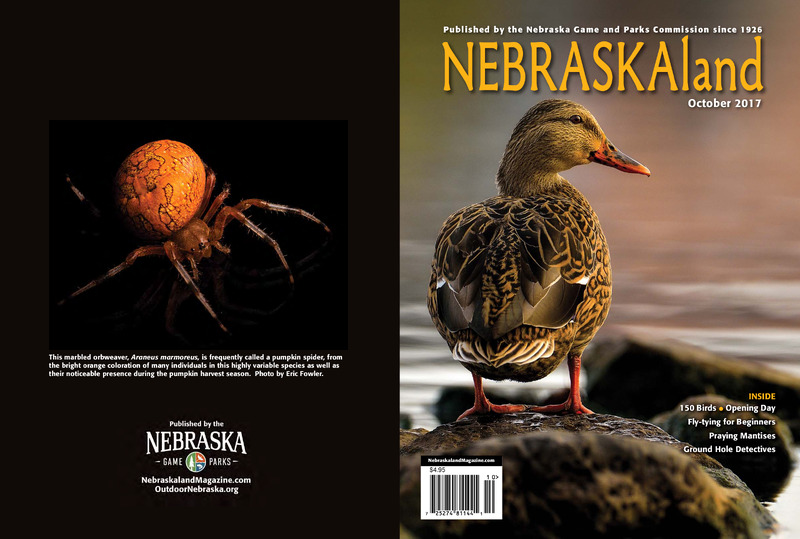
Publis hed by the Nebr a s k a Ga m e a nd Pa r k s C o m m is s io n si nc e 1926
NEBRASKAland
October 2017
This marbled orbweaver, Araneus marmoreus, is frequently called a pumpkin spider, from
the bright orange coloration of many individuals in this highly variable species as well as
their noticeable presence during the pumpkin harvest season. Photo by Eric Fowler.
INSIDE
150 Birds ● Opening Day
Fly-tying for Beginners
Praying Mantises
Ground Hole Detectives
NebraskalandMagazine.com
$4.95
NEBRASKAland Magazine
Volume 95
●
No. 8
●
October 2017
F EAT U R ES . . .
24 Bird by Bird – The 150 Bird Challenge
BY RENAE BLUM
30 Time Well Spent – What to Do in October
BY RENAE BLUM
32 60 Years in the Shack
STORY AND PHOTOS BY ERIC FOWLER
42 Nebraska's Praying Mantises
STORY AND PHOTOS BY CHRIS HELZER
46 Fly-tying for Beginners
STORY AND PHOTOS BY RYAN SPARKS
I N S I D E T H I S I S S U E ...
Mixed Bag – The Plains Harvest Mouse,
Travel to Norfolk, A Brief History of Floating to Omaha,
In Review, Wild Edibles – Roots, Open-water Fishing,
Hallowfest at Ponca State Park, Hunting Big Grass, the
NEBRASKAland Visitor and more .................................... 8
Page 49 – Grandpa Hunter ........................................... 52
Nature Notes – Ground Hole Detectives ................... 54
In the Field – Opening More Fields and Waters.........60
Portraits from the Past – Reader's Photos ............. 62
In the Kitchen – Venison Chili .................................. 64
The Last Stop – Nebraska's Rural Cemeteries .......... 66
46
●
42
●
24
●
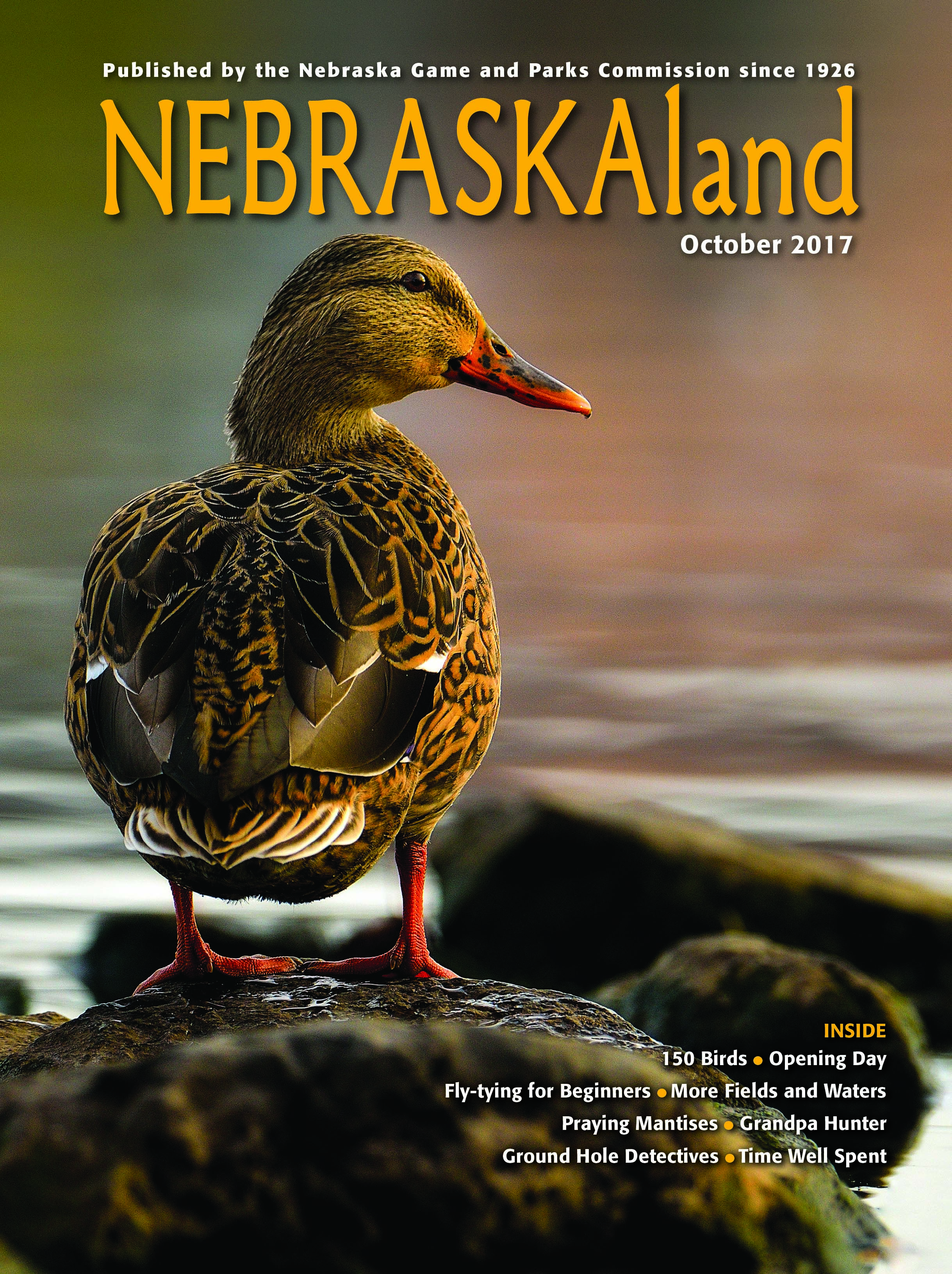
Cover: Chris Masada photographed this hen mallard duck at
Holmes Lake in Lancaster County.
THROUGHOUT 2017, NEBRASKALAND MAGAZINE WILL
PUBLISH ARTICLES ASSOCIATED WITH THE STATE'S 150YEAR CELEBRATION. LOOK FOR THIS LOGO TO READ ABOUT
NEBRASKA'S RICH HISTORY AND VIEW OUR INTERACTIVE
DIGITAL EDITION FOR MORE INFORMATION.
NEBRASKAland (VOL. 95 / NO. 8 ISSN 0028-1964) is published monthly, except
for the combined Jan./Feb. and Aug./Sept. issues, by the Nebraska Game and Parks
Commission, 2200 N. 33rd St., Lincoln, NE. Periodicals postage paid at Lincoln,
Nebraska, and additional mailing offices. POSTMASTER: Send address changes to
NEBRASKAland, P.O. Box 30370, Lincoln, NE 68503-0370.
2 NEBRASKAland • OCTOBER 2017
32
●
OCTOBER 2017 • NEBRASKAland 3
Three Dollar Bill
While going through some old
stuff, I found this, and I didn't want to
throw it away! It has something to do
with the Nebraska Centennial.
My late husband and sons were
always interested in "old memories."
I hope it has some importance. If
so, I hope to hear from you.
Isabelle Clinkenbeard
Louisville, Nebraska
Darla McGahan of Hendley saw this porcupine cross the road and sit in
the grass long enough for her to take a picture.
Dear Louis,
It appears you have a 1967 Bank
of De Soto three dollar bill note – a
Nebraska Centennial collectible
souvenir.
This novelty currency was produced
for the 1967 Nebraska Centennial.
The slogan on back reads "A
Three Dollar Bill is only 'different'
Nebraska is 'Unique'."
This is a reproduction of the
"Wildcat" notes issued by the
Nebraska banks in the 1850s.
– Editor
Bonnie James of North Platte snapped this photo of a
road between Seneca and Ringgold.
Solar Eclipse
I think Nebraska might
be the premier state to view
the solar eclipse!
I don't think there is a
more diversified published
outdoor magazine
in the country than
NEBRASKAland.
G. E. Dave Fuller
Lincoln, Nebraska
The sun sets behind the Bellevue Bridge, a truss bridge over the Missouri River that connects Mills County, Iowa, and Sarpy County,
Nebraska. Photo by Mike Welch of Bellevue.
4 NEBRASKAland • OCTOBER 2017
Sabine Kantenseter photographed this burrowing owl near
North Platte in July.
Just got the Aug/Sept.
issue today. I enjoyed the
"Total Eclipse of the Sun"
article. I am located 50 miles
from Carbondale, Illinois,
which is the spot of longest
totality in the country.
Sincerely,
Ray Fansler
Fairfield, Illinois
Earl Motschenbacher of Lincoln sent in this trailcam image of
fighting tom turkeys.
OCTOBER 2017 • NEBRASKAland 5
NEBRASKAland Magazine
Outdoor Plates
Mike Peters of Omaha grew up in
Ogallala, where many start hunting
and fishing when they are young. It
wasn’t until Peters was older that a
friend introduced him to waterfowling.
His message plate shows the time he
typically arrived at that friend's house
to head to the goose pit, despite being
told to be there at 4:30. If you have
an outdoor message plate you would
like to share, e-mail a high-resolution
JPEG to Eric.Fowler@Nebraska.gov,
along with your name, town and a brief
description.
Margaret Foster of Lincoln shot this photo of "Mr. Naughty," a
squirrel that continually raids her birdfeeders and garage.
Tiara Brown of Omaha shared this image of a resident horned
owl watching over Walnut Grove Park in Millard.
Statement of ownership and monthly circulation of
NEBRASKAland Magazine
Owner and publisher: Nebraska Game and Parks
Commission
Editor: Jeff Kurrus
Headquarters of Publisher and Publication:
2200 N. 33rd St., Lincoln, NE 68503
Stockholders, Bondholders, Mortgage and
Security Holders: None
Average number of copies
of each issue during
preceding 12 months
A. Total Copies Printed
(net press run) ........................ 20,600 ........... 19,899
B. Paid Circulation
1. Mail subscriptions ............... 17,058 ........... 16,484
3. Single-copy sales ................. 2,119 ............. 2,360
C. Total Paid Circulation.............. 19,188 ........... 18,854
D. Free Distribution
by Mail ......................................... 303 ................ 302
D. Free Distribution
Outside the Mail .......................... 457 ................ 466
E. Total Free Distribution ................. 785 ................ 800
F. Total Distribution...................... 19,973 ........... 19,654
G. Copies Not Distributed ................ 627 ................ 245
H. Total ........................................ 20,600 ........... 19,899
I. Percent Paid and/or
Requested Circulation ................96% ............... 96%
These Canada geese flew by Rachel Lech near Atkinson.
Send your comments to:
Jeff Kurrus, Editor
NEBRASKAland Magazine
P.O. Box 30370
Lincoln, NE 68503
or e-mail Jeff.Kurrus@Nebraska.gov
Please include your postal address
and telephone number. Letters may be
condensed and edited. Photographs are also
welcome.
Shelly Hellbusch of Belgrade shared this photo of a "beautiful,
old granary" in Nance County.
Enter Our Photo Contest
Don't forget to enter our NEBRASKAland Photo
Contest - see ad on page 8.
6 NEBRASKAland • OCTOBER 2017
Single issue
nearest to
filing date
"This nest was blown out of its tree during a storm by a
suspected, but unconfirmed, tornado in Cedar Creek on June
16 near Joe Fuxa's home," said photographer Karen Smith
of Omaha. "His wife, Terri, and daughter, Hanna, reacted with
MacGyver-meets-Audubon ingenuity by attaching the nest
back in the tree with a fish hook and diaper pin."
Any program that receives federal funding from the National Park
Service, or the United States Fish and Wildlife Service prohibits unlawful
discrimination on the basis of race, color, religion, age, gender, marital
status, national origin, age, disability or political affiliation. Any person
who believes he or she has been discriminated against in any program,
activity, facility, or service, should contact the Nebraska Game and
Parks Commission, Lincoln, NE 402-471-0641, the Equal Opportunity
Commission, Lincoln, NE 402-471-2024, TTY/TDD 402-471-4693;
United States Fish Wildlife Service, Civil Rights Coordinator, 4401
N. Fairfax Drive, Arlington, VA 22203; Director, Equal Opportunity
Program, U.S. Department of Interior, National Park Service, 1849 C
Street NW, Mail Code 0008, Washington, D.C. 20240-0001.
ADMINISTRATION
CONSERVATION OFFICERS
Director Jim Douglas
Deputy Director Tim McCoy
Commissioners
Chairman - Rex Fisher, Omaha
Vice Chairman - Dick Bell, Omaha
2nd Vice Chairman - Robert Allen, Eustis
Mark Spurgin, Paxton
Rick Brandt, Roca
Pat Berggren, Broken Bow
Jim Ernst, Columbus
Norris Marshall, Kearney
Dan Kreitman, Wahoo
ADMINISTRATION (Lincoln)
Craig Stover (Administrator)
Duane Arp (Asst. Administrator)
Jeff Clauson (Asst. Administrator)
MAGAZINE STAFF
Communications Director Christy Firestone
Editor Jeff Kurrus
Art Director Tim Reigert
Associate Editor Jenny Nguyen
Regional Editors Eric Fowler, Julie Geiser,
Justin Haag
Contributing Editor Michael Forsberg
Regular Contributors Renae Blum,
Chris Helzer, Chris Masada, Gerry Steinauer
Photo Librarian Jaclyn Cruikshank Vogt
Circulation Donna Robinson
For address changes and questions about
your subscription, e-mail donna.robinson@
nebraska.gov or call 800-632-5263
Advertising Sales Manager
For advertising information contact
Shane G. Gilster, 402-742-0125
Email: shanegilster@gmail.com
NEBRASKAland Magazine Copyright 2017, all rights reserved.
NEBRASKAland is available in audio from the Nebraska Library
Commission Talking Book and Braille Service, Suite 120, 1200 N St.,
Lincoln, NE 68508. 800-742-7691. NEBRASKAland Magazine and the
Nebraska Game and Parks Commission reserve the right to reject any
advertising not in keeping with the agency mission.
Rates: $18 for one year; $33 for two years; $44 for three years. Nebraska
recipients must add appropriate sales tax. To subscribe call
1-800-NEBLAND (632-5263), or go online to: NebraskalandMagazine.
com.
COMMISSION
C
CO
COM
OM
MMIS
MISSIO
S NO
OFFICES
FFICES
FF
FFI
S
Headquarters/Southeast District Office
2200 N. 33rd Street Lincoln, NE 68503
Phone 402-471-0641
Northeast District Office
2201 N. 13th St. Norfolk, NE 68701
Phone 402-370-3374
Southwest District Office
301 E. State Farm Rd. North Platte, NE 69101
Phone 308-535-8025
Northwest District Office
East Hwy. 2, Box 725 Alliance, NE 69301
Phone 308-763-2940
Bassett Office
524 Panzer St., Box 508 Bassett, NE 68714
Phone 402-684-2921
Kearney Office
1617 First Ave. Kearney, NE 68847
Phone 308-865-5310
Ak-Sar-Ben Aquarium
21502 W. Highway 31 Gretna, NE 68028
Phone 402-332-3901
Omaha Office
8495 Frederick Street, Omaha, NE 68124
Phone 402-595-2144
402-471-5531
402-471-5531
402-471-5531
NORTHWEST (Includes counties covered)
Jim Zimmerman (District Supt.)
308-641-9590
Sean McKeehan
(Cheyenne, Morrill, Box Butte)
308-279-9133
Scott Brandt
(Kimball, Banner, Scotts Bluff)
308-631-0663
Dan Kling (Sioux, Dawes)
308-430-0572
Kyler Prochaska
(E 1/2 Dawes, N 1/2 Sheridan, W 1/2 Cherry) 308-430-3984
Terry Brentzel (Deuel, Garden, Grant) 308-458-7650
402-389-0444
Frank Miller (Cherry, Hooker)
NORTHEAST (Includes counties covered)
Tom Zimmer (District Supt.)
402-649-8053
402-760-0712
Dale Davis (Keya Paha, Brown, Rock)
402-340-3981
Jonathan Andreasen (Holt, Boyd)
Greg Hesse
(Greeley, Wheeler, Boone, S 1/2 Antelope)
402-843-6567
Mitch Johnson (Knox, Antelope, Pierce) 402-613-8612
402-762-5022
Jeff Jones (Knox, Cedar)
Jon Reeves
(S 1/2 Thurston, Burt, Washington)
402-889-8508
Andrew Heyer (Pierce, Madison, Stanton) 402-613-2241
Cory Krause
(Cuming, Wayne, Stanton, Dodge)
402-380-6410
Steve Oberg
(Colfax, Platte, Madison, Stanton, Nance)
402-910-3366
Owen Johnson
(Dixon, Dakota, N 1/2 Thurston)
402-266-1759
308-730-7050
Doug Pollard (Loup, Garfield, Valley)
SOUTHWEST (Includes counties covered)
Roger Thompson (District Supt.)
308-530-3097
308-202-0819
Matt Brandt (Sherman, Howard)
308-380-7331
Tim Williams (Hall, Hamilton, Merrick)
Pat George
(Harlan, Franklin, Phelps)
308-920-2762
Matt Andrews
(Gosper, Furnas, Frontier, Red Willow)
308-746-2418
Brian Piernicky
(Red Willow, Frontier, Hayes, Hitchcock)
308-340-6627
John Lee (Hitchcock, Dundy, Chase, Hayes) 308-414-1432
308-289-0427
Nicholas Fix (Keith, Perkins)
308-289-1169
Bryce Streger (Keith, Arthur)
308-760-0145
Sean Schultz(Keith)
Brandon O’Neal
(Lincoln, McPherson, Logan)
308-530-3157
Alex Hasenauer
(Lincoln, McPherson, Logan)
308-660-4671
Dale Johnson (Kearney, Buffalo)
308-440-3847
308-529-8146
Mike Thome (Dawson)
Ray Dierking (Custer, Thomas, Blaine) 308-870-0322
Taylor Dixon
(Dawson, N 1/2 Gosper, N 1/2 Phelps)
308-217-2108
SOUTHEAST (Includes counties covered)
Levi Krause (District Supt.)
402-949-0593
402-619-1355
Rich Berggren (Douglas)
402-616-5961
Dan Evasco (Sarpy)
402-210-0888
Heath Packett (Cass)
402-209-1506
Russell Mort (Otoe, Johnson)
William Krause
(Nemaha, Richardson, Pawnee)
402-274-8063
Matt Taylor (Thayer, Fillmore, Jefferson) 402-200-9597
402-806-9084
Dan Zuehlke (Gage, Saline)
402-890-6463
Dina Barta (Lancaster)
402-937-3422
Dudley Sorensen (Lancaster, York)
402-613-2312
Travis Shepler (Lancaster)
402-890-7140
Stacey Lewton (Lancaster, Seward)
402-443-6392
Mike Luben (Saunders, Butler, Polk)
Nebraska Wildlife Crimestoppers
1-800-742-7627
OCTOBER 2017 • NEBRASKAland 7
A Mammal
Brief
By Lindsay Rogers
PHOTO BY KEITH GELUSO
Easily confused with
other harvest mice, the
plains harvest mouse
(Reithrodontomys
montanus) is distinguished
by its small size (2-6 inches)
and a dark stripe down its back.
An additional identifying
characteristic is its short tail,
which is shorter than the head
Lindsay Rogers is an outdoor education specialist
and body combined in length. The Latin
with the Nebraska Game and Parks Commission.
name “Reithrodontomys” means “groovetoothed mouse” in reference to the single groove
that runs down the back of each upper incisor.
Like the western harvest mouse, it is found throughout Nebraska, but the plains harvest mouse is more
limited in habitat and is generally found in grassland areas with highest densities in shortgrass prairies. Their
nest is built of grasses and is often elevated in the stems of grasses or shrubs. Plains harvest mice eat a variety
of foods including seeds, nuts, fruits and insects. They are known to store food in underground caches for use
in extreme winter weather. Like all rodent species, the plains harvest mouse serves as a food source for raptors,
snakes, owls and carnivorous mammals. ■
NEBRASKAland
P H O T O
C O N T E S T
FOR COMPLETE CONTEST RULES AND ENTRY, GO TO...
NebraskalandMagazine.com/photocontest
8 NEBRASKAland • OCTOBER 2017
OCTOBER 2017 • NEBRASKAland 9
Travelogue
Travelogue Sponsor
●
Norfolk
Visit Norfolk
By Brenna McFadden, Nebraska Tourism Commission
L
PHOTO BY JENNY NGUYEN
ocated in the northeastern
region of Nebraska, Norfolk
sits as the ninth-largest city in
the state and offers both small
and big town attractions to all
who visit. Avid nature seekers and
outdoor activity lovers travel from all
over to experience the Cowboy Trail,
which starts in Norfolk and runs 192
miles to Valentine. The multi-purpose
limestone trail gives folks a chance to
take a walk with their family, go for a
bike ride, run or travel on horseback,
all while enjoying beautiful views.
While exploring the trail near Norfolk,
you are bound to see hills dotted with
farmsteads and long winding rivers
lined with tall trees.
If you are looking for activities in
town be sure to get your history fix
at the Elkhorn Valley Museum. This
museum hosts permanent and rotating
exhibits that focus on the rich history
of northeastern Nebraska. One of the
permanent exhibits features local and
national celebrity Johnny Carson. It
also provides a hands-on activity center
geared for children ages 2 to 8, so
bring the whole family! You can also
try brushing up on your family history
by using the research center to look
through photographs and historical
Bicyclists ride the Cowboy Trail east of TaHaZouka Park in Norfolk.
documents.
When passing through Norfolk,
try to schedule your visit around the
first Friday of the month because you
do not want to miss the First Friday
exhibits at the Norfolk Arts Center. All
are welcome to gather and enjoy local
and original creations ranging from
writing, music, poetry, sculpting and
many other forms of art. The best part
is that admission is free.
After your adventures in Norfolk,
dine at a local favorite Black Cow
Fat Pig. This pub and steakhouse
features cuisine with locally sourced
ingredients, a full bar and large outdoor
patio.
Norfolk has much to offer to any
wanderer looking for a place to visit
with stunning views of the Nebraska
landscape and a town that holds the
history to northeastern Nebraska. ■
While in the Area
Fall is a beautiful time to spend
outdoors and with family. Here are
more places to see and activities
to do.
PHOTO BY JENNY NGUYEN
Nor-Sports Family Fun Center
Johnny Carson Theatre
Poppy’s Pumpkin Patch
TaHaZouka Park
Gobs & Gobbs of Fun
The Norfolk Arts Center hosts a number of exhibits throughout the year.
10 NEBRASKAland • OCTOBER 2017
OCTOBER 2017 • NEBRASKAland 11
A Brief History
Floating to Omaha:
Paul Boyton's Record Swim
By the Nebraska State Historical Society
T
12 NEBRASKAland • OCTOBER 2017
NSHS
S S RG2341-337
RG23
RG2
G 341
341 337
341-33
his longest.
housands of spectators cheered as Paul Boyton
Boyton’s arrival was a major event in each of the river
waded ashore from the Missouri River at Omaha in
towns he visited. Clad in his famous waterproof suit, he
October 1881. The champion swimmer and largerwas “The Hero of ‘Twenty Thousand Miles Over the Sea’”
than-life adventurer started his marathon swim down
in the words of the
the Yellowstone and
Omaha Bee. The
Missouri rivers at
Bee said on Oct. 31:
Glendive, Montana,
“For weeks past the
on Sept. 17, dragging
wires have heralded
with him Baby
Mine, a tiny craft
his gradual approach
loaded with supplies.
as it was made by
James Creelman, a
buffeting the waves of
correspondent for
the muddy Missouri
the New York Herald,
and encountering such
accompanied Boyton
dangers by flood and
in another boat as the
field as few men would
pair made their way
care to experience. [The
from Glendive to their
Missouri River had
destination city of St.
flooded spectacularly
Louis.
in April 1881.]
The Irish-born
Private telegrams and
Boyton, 32, was a
letters from the noted
veteran of astonishing
navigator announced
feats of long-distance
the time of his arrival
swimming. He had
in this city, which
served in the U.S.
was repeated to the
Navy during the
thousands of renders
Civil War, Benito
through The Bee, and
Juarez’s navy in
yesterday the only topic
Mexico, and in the
discussed in the streets
French navy during
was the probability of
the Franco-Prussian
his reaching here on
War. It was while
time.”
he was captain of
A Bee reporter
the Atlantic City
chartered a small boat
Lifesaving Service
and rowed upriver to
when he began to
meet and interview the
experiment with new
famous swimmer and
lifesaving equipment,
then accompanied him
particularly a rubber
as he waded ashore at
survival suit with
Omaha, describing his
inflatable air pouches
reception by “at least
invented by C. S.
ten thousand people.
Paul Boyton in his rubber suit from The Jewelled Tomb and Other Stories
Merriman of Iowa.
The lines of freight
(1899).
Boyton promoted
cars on the tracks are
the lifesaving suit
covered with a mass
around the world, performing challenging feats of swimming of spectators, and others step out from the doors; fences
while wearing it. He swam the English Channel in 1875 and
and poles are utilized, and every rock is a pedestal for some
swam many of the major rivers of Europe and America. In
sightseer anxious to get a good look at the swimmer.”
the United States, the Yellowstone-Missouri River swim was
The flamboyant Boyton didn’t disappoint the crowd. “On
Above: Omaha’s riverfront during the Missouri River
flood of April 1881, six months before Paul Boyton’s
swim.
rounding the bank, [he] stood erect in the water, his body
half out, and taking a bugle which hung from his miniature
vessel, he blew a blast, long and loud. A moment afterwards
he took from the same depository two detonating rockets,
which he sent up from his hands, lighting them from his
cigar ... Cheer after cheer went up, and the enthusiasm was
perfectly unbounded.”
Boyton’s trip downriver was far from easy. He complained
to the Bee of the Missouri’s quicksand, its “blue mud, soft
and sticky like glue,” and of shots fired at him by a party of
hunters near Blair. His short stay in Omaha was marred by
the death of a spectator, who after shouting that he could
swim as well as Boyton, jumped into the Missouri and
drowned. Boyton and Creelman eventually covered the more
than 1,600 miles from Glendive to St. Louis in just 64 days.
After his swimming days ended, Boyton found new outlets
for his considerable energies. In 1894 he opened an early
amusement park, Paul Boyton’s Water Chutes,
in Chicago, and later, an amusement park at
Coney Island. He died on April 19, 1924, in
Long Island, New York. ■
Visit the Nebraska State Historical Society’s
website at nebraskahistory.org.
OCTOBER 2017 • NEBRASKAland 13
14 NEBRASKAland • OCTOBER 2017
OCTOBER 2017 • NEBRASKAland 15
Open Water At Its Best
Wild Edibles - Roots
By Julie Geiser
During the fall and into the winter months, some of the
best edibles are available. After the edibles of summer are
gone, the roots of several plants can be utilized.
16 NEBRASKAland • OCTOBER 2017
Chicory roots, left, and dandelion roots, right, are used for coffee once
dried and baked. The roots of both plants can be difficult to dig up and
sometimes break off in the process.
plant. Do not peel them, and you don’t have to remove the
root hairs. Dry the roots on a rack for a week or two either
whole or cut into smaller pieces. These roots will last several
years once dry. Roast the dried roots for 20 to 60 minutes in
a 325 degree Fahrenheit oven; after 20 minutes check them
every 10 minutes for doneness. The roots should be very dry
and brittle and smell a bit like chocolate when done. There
are a wide variety of roasting instructions; the key is to
experiment. Roots not baked long enough have little flavor
and won’t snap in two, while over-baked roots will taste
burnt. The roots can be baked fresh but the roasting time will
be longer and should be done at a lower temperature; it is
more difficult to uniformly roast fresh roots.
Roasted roots can be stored whole or ground in a coffee
grinder, blender or with a mortar and pedestal, and stored
in an airtight container. The root powder can be used like
instant coffee by adding one or two teaspoons to a cup of
water and boiling for about two minutes on a stove top or in
a microwave. Boiling the mixture extracts more flavor from
the roots. Strain the mixture through a coffee filter before
drinking. Whether you prefer your coffee plain or with a
little cream, sugar or vanilla, the flavor is pleasing and tastes
like regular coffee. Drinking root coffee does act as a natural
diuretic.
As with any wild edible, be sure you’re not collecting from
an area that has been sprayed with chemicals and leave half or
more of the plants to go to seed to ensure a
crop for the next growing season. ■
PHOTOS BY JULIE GEISER
Chicory Root
Chicory root
(Cichorium) is another
vegetable and is
used similarly to the
dandelion. First-year
roots are typically small,
and many chicory plants
grow in hard, gravelly
soil, which can make
them challenging to dig
up without breaking the
roots, which oftentimes
makes them unsuitable
for the table.
Dandelion and chicory
roots can be stored over
Chicory flower growing in Lincoln
County.
winter in a root cellar
and will last a long
time in the refrigerator if kept in a plastic bag to prevent
them from drying out. Like dandelion roots, chicory roots
may also be used to make a delightful coffee drink. This is
an ancient tradition in Europe, and both plants are grown
commercially for this purpose. This caffeine-free drink is a
healthy alternative to the typical coffee we know and is full
of vitamins C, A, D, B and beta-carotene along with many
others.
To make coffee, dig and wash several roots from either
PHOTOS BY JULIE GEISER
Dandelion Root
Dandelions (Taraxacum) grow from a long taproot. A
first-year plant will have a root similar to that of a parsnip,
bearing a light color and its flesh almost uniform when cross
sectioned. An older plant’s root surface, however, is rougher
and darkens to a brown color. These roots will branch out
with smaller roots coming off the main taproot.
The best roots to gather are from large, young plants in
good growing conditions such as crop fields or gardens
where they get plenty of water and grow in good soil types.
These young plants have tender roots that make a great
vegetable for the table, though it is difficult to tell an old
plant from a new one unless you keep records and mark
plants, which many people don’t do. Even if you dig up
older plants, the roots can still be used in a coffee drink
described below.
Dandelion roots can be dug any time of year, but fall,
winter and early spring are hands-down the best time for
their flavor. Dig the roots with a shovel to get most of the
root. Wash and scrub them thoroughly and then boil. Serve
these with butter and salt as a side dish, in casseroles or with
other vegetables.
By Daryl Bauer
The best open-water fishing of the year is upon us.
Nebraska’s fish feed heavily this time of year getting ready
for the hard winter to come and to start developing eggs
and milt for next year’s spawn. I notice fish behavior and
fishing patterns transitioning to fall in late August and by
late September the fall bite is definitely on. If you are a
hard-core angler you probably already know this, but if
you are not, you probably should try this time of year.
With less activity and competition on the water, it’s the
perfect time to keep your open-water tackle ready a bit
longer. ■
Angler Robby Rowland fall fishes at Merritt Reservoir in Cherry County.
Dandelion
root coffee.
OCTOBER 2017 • NEBRASKAland 17
Hallowfest at
Ponca State Park
18 NEBRASKAland • OCTOBER 2017
PHOTO COURTESY OF PONCA STATE PARK
By Lynn Mellick
The 19th Annual Hallowfest at Ponca State
Park is scheduled for Oct. 14 and 21. Saturday
activities begin with crafts in the morning. Then
at 1 p.m., test your bowling skills at the pumpkin
rolling obstacle course. Judges will award prizes
for best distance in three age groups. Extremely
large pumpkins will be featured in the "brutus
division." Only one strong competitor will win
this prize.
For those who would rather test their creativity,
compete in the pumpkin carving contest from
1 to 3:30 p.m. Only pumpkins carved at the
contest's designated location and within an
allotted time frame will qualify. Judging begins
at sunset. All ages are welcome, and prizes will
be awarded in three age groups.
Each Saturday night will conclude with
haunted hayrack rides. This popular attraction
requires reservation, which will open Oct. 9 at 8
a.m.; seats typically sell out within two hours.
Ponca State Park encourages guests to decorate their
campsites and cabins to celebrate Halloween.
Test your bowling skills at Ponca State Park's pumpkin rolling obstacle course during
Hallowfest. Prizes will be awarded in each age division.
For more information, contact Ponca State Park at
402-755-2284. For a list of Halloween events at parks
statewide, visit OutdoorNebraska.org/Halloween. ■
PHOTO BY JUSTIN HAAG
Hunting Big Grass
In Review
By Justin Haag
BOOKS
Upland bird hunting properties with
public access, especially those with
large expanses of seemingly uniform
cover, can be intimidating.
“Where do I start?” “Won’t they just
run around me?” “It’s probably already
been hunted too much.” “Man, will that
be a lot of walking for nothing?”
Brian Piernicky, a conservation officer
in southwestern Nebraska, knows
birds often spend time in those tracts
people often overlook. If he is not in his
uniform enforcing game laws, there is a
good chance you will find him in upland
gear targeting public land for pheasants
and quail with his two German
shorthaired pointers. His productivity
keeps him going back.
It is no secret the most popular
method of harvesting birds from big
expanses of cover is buddying up. A
perpendicular row of hunters, spaced at
30 yards or so, keeps birds from slipping
around the edge and back into cover
behind the group. Hunting in groups
might be most effective, but Piernicky
and his dogs have flushed many birds on
solo outings of just an hour or so.
“A lot of my success on public
tracts last year was on wheat stubble,”
Piernicky said. “An obvious tactic is to
hunt the pockets of cover, if there are
any, on the edges of the fields. These
pockets often have stands of weeds and
thickets and are likely places to find
loafing pheasants and quail.”
If hunting stubble, walking “against
the grain” keeps birds from running the
rows and flushing out of range. Some
fields of stubble are better than others,
Piernicky said.
“I found that by targeting fields with
20 NEBRASKAland
20
NE
N
EBR
BRAS
BRAS
ASK
KA
Ala
land
nd • OCTOBER
OCTO
OC
TOBE
BER 2017
20
2
017
17
stubble that was taller than most yielded
more birds and they would hold better,”
he said. “Follow a dog into the wind and
do not walk solely in straight lines. The
birds in stubble run around a lot, and
changing direction can confuse birds
and add more shots in the field.”
Big tracts of Conservation Reserve
Program acres can even be productive
on a solo outing with the right approach,
he said.
“On those I try to zig-zag through and
not hunt in uniform lines and try to hit
areas other people might overlook,” he
said.
Time of day and weather are also big
factors and knowing feeding areas and
likely roosting areas can help.
“Around feeding times I will try to
hunt edges of the field by food sources,”
he said. “During cold periods birds will
be in the thicker cover, but in warm
periods they tend to avoid those areas.
Hunting the last hour of the day can be
very successful as birds move back into
the fields and go to roost.”
Is a dog necessary? Piernicky would
not think of going to the field without
them, of course, noting that watching
them work is one of the best parts of
the experience. If he did not have dogs,
though, he would target those small
patches of cover at field edges.
“Wheat stubble sites with small
pockets are ideal for someone without a
dog. Usually if there are birds in them,
they don’t hold real tight.”
Where will you be when the season
rolls around? Nebraska’s properties
with public access may be found in the
latest edition of Public Access Atlas,
accessible at OutdoorNebraska.org/
PublicAccessAtlas. ■
By Jeff Kurrus
For the diehard
Nebraska hunting
and history buffs,
take a look at
’s
author Ira Cotton’s
Nebraska Small
Game Hunting,
Fishing and
Trapping
Licenses, 19011909, which
reveals what thesee
ke each year
licenses looked like
year.
Orders can be made at
paperquestpress.com and four bindings
are offered.
Thumbing through and seeing the
various artwork used from year to year
is worth the purchase alone. It's a fun
book that helps us take a look at our
hunting heritage. ■
KNIFE SHARPENERS
By Margaret Hesford
I have had at least three other knife
sharpeners in the past 10 years and
none of them have worked as well as
this Chef’s Choice, Diamond Hone
Sharpener 445.
First, for
ease of
use, the
design is
exceptional
whether you are new
to the kitchen or an elderly person
with arthritis in your hands. Excess
pressure is unnecessary. Simply hold
with one hand and pull the knife
through the sharpener groove with the
other. Plus, since your holding hand is
so far away from the sharpener groove,
you feel safe.
My husband can also use this to
sharpen his hunting knives because it is
designed to work with longer blades.
The groove also rests about two
inches above my kitchen counter,
which keeps me from accidentally
damaging it.
Lastly, it can easily be used by lefthanded people – an added bonus to a
southpaw like myself. ■
Ponca State Park's Hallowfest is
a popular event in northeastern
Nebraska.
by Jerry Kane
Contact the Nebraska Game and
Parks Commission at 402-471-0641 or
visit OutdoorNebraska.org for more
information.
Visit HuntSafeNebraska.org for a
list of hunter education classes and
BoatSafeNebraska.org for a list of boating
safety classes.
September 30-October 1
Statehood: A New Beginning
Rock Creek Station State Historical Park,
Fairbury
September 30-October 1
Wheels of Transportation
Arbor Lodge State Historical Park,
Nebraska City
September 30-October 1
Youth Waterfowl Hunting
season in Zones 2 and 4
September 30-October 1
Living History Weekend
Fort Atkinson State Historical Park, Fort
Calhoun
October 1
Crow Hunting
season opens statewide
October 1
Haunted Hollow
Advance tickets sales begin for Indian
Cave State Park, Shubert
October 1
Muzzleloader Antelope Hunting
season closes
Kayaking a pond
at a Becoming an
Outdoors-Woman
workshop near
Halsey.
October 1-31
Paddlefish Snagging
October 14
Trunk or Treat
season in specific area of Missouri River
Calamus State Recreation Area, Burwell
October 3
Waterfowl Hunting Workshop
October 14
Howl in the Hills Night Hike
Nebraska Game and Parks Outdoor
Education Center, Lincoln
Wildcat Hills State Recreation Area, Gering
October 7
Dark Goose Hunting
season opens in North Central Unit
October 7
Light Goose Hunting
seasons open in Zone 1
October 14-15
Mountain Man Rendezvous
regular season opens statewide
October 7
White-fronted Goose Hunting
October 14, 20, 21, 27, 28
Haunted Hollow Hayrack Rides
season opens statewide
Indian Cave State Park, Shubert
October 7
Duck and Coot Hunting
October 14, 21, 28
Halloween Campsite Decorating
Contest
October 7-8
Youth Waterfowl Hunting
season in Zone 1
Indian Cave State Park, Shubert
October 14-29
Firearm Antelope Hunting
season in specific units
October 7-8
Victorian Times
Arbor Lodge State Historical Park,
Nebraska City
October 17
Deer Hunting Workshop
Yanney Heritage Park, Kearney
October 10
Upland Bird Hunting Workshop
October 19
Deer Hunting Workshop
Nebraska Game and Parks Outdoor
Education Center, Lincoln
Game and Parks southwest office, North
Platte
October 12
Deer Hunting Workshop
October 19
Growing Up WILD Educator Workshop
Lincoln Park Fire Station, Hastings
Beatrice
October 12
Deer Hunting Workshop
October 20
Nebraska Game and Parks Board of
Commissioners meeting, Omaha
Omaha Gun Club, Omaha
October 12
October 21
Growing Up WILD Educator Workshop Pink Pumpkin Walk
Scottsbluff
Indian Cave State Park, Shubert
October 13
Friday the 13th Night Hike and
Scary Movie
October 21
Pumpkin Carver’s Event
Fremont State Recreation Area, Fremont
October 13
Trick or Treat at the Town
Indian Cave State Park, Shubert
October 14
Halloween Campsite
Decorating Contest
Fremont State Recreation Area,
Fremont
October 14
Photography Show
Fremont State Recreation
Area, Fremont
October 14
Skulls, Skins,
Skeletons
Fremont State
Recreation Area,
Fremont
22 NEBRASKAland • OCTOBER 2017
October 14
Duck and Coot Hunting
Arbor Lodge State Historical Park,
Nebraska City
seasons open in Zones 2 and 4
NEBRASKAland
Visitor
Calamus State Recreation Area, Burwell
October 21-22
DeSoto October Muzzleloader
Deer Hunting season
October 21-22
Youth Pheasant, Quail and
Partridge Hunting
season statewide
October 30
Dark Goose Hunting
October 24
Deer Hunting Workshop
Season opens in East, Platte River,
Panhandle and Niobrara Units
Nebraska Game and Parks Outdoor
Education Center, Lincoln
October 30
Dove (all species) Hunting
October 26
Duck and Coot Hunting
season closes
seasons open in Zone 3
October 27
Trunk or Treat
Windmill State Recreation Area,
Gibbon
October 27-31
Camp and Treat
Red Willow Reservoir State
Recreation Area, McCook
October 28
Pheasant, Quail and Partridge
Hunting
October 21-22, 28-29
Vintage Halloween
Arbor Lodge State Historical Park,
Nebraska City
October 21-22
Youth Waterfowl Hunting
season in Zone 3
October 31
Bullfrog
season closes
October 28
Kayak Kids Essay Contest
Awards Ceremony
October 28
Haunted Hike Night
Rock Creek Station State Historical Park,
Fairbury
seasons close
Fort Atkinson State Historical Park,
Fort Calhoun
Indian Cave State Park, Shubert
October 21
Ranch Life in the 1860s
October 31
Raccoon and Virginia Opossum
Hunting
October 28
Trunk and Treat
Red Willow Reservoir State
Recreation Area, McCook
O’Neill
season opens
seasons open statewide
October 21
Jack-O-Lantern Junk and Craft Market
October 21
Monarchs on a Mission Educator
Workshop
October 31
Eurasian Collared-dove Only
Hunting
Windmill State Recreation Area,
Gibbon
October 29
Deer Processing Class
Fort Atkinson State Historical Park,
Fort Calhoun
October 29
Archery and Firearm Bull Elk
Hunting
seasons close
October 29
Antlerless Elk Hunting
private land and public land seasons
close
Pheasant hunting in Holt and
Antelope counties.
Last issue’s winner of
the Visitor drawing was
Merlin Miles of Fremont, Nebraska,
who found the silverfish on page 55.
Readers are encouraged to contact
NEBRASKAland within 10 days after
this issue’s publication with the
correct page number and name of
this issue’s “Visitor” – a critter found
in Nebraska. We will then gather the
correct entries and draw one to win a
NEBRASKAland mug.
To enter each month, write:
NEBRASKAland Visitor
2200 North 33rd Street
Lincoln, NE 68503
Or e-mail: Tim.Reigert@Nebraska.
gov with “Visitor” in the subject line
of the message.
HINT: This issue’s visitor is not on
page 3, 14, 23, 42, 43, 45, 46-51, or
68 (back cover).
Silverfish (Lepisma saccharina)
are common household pests,
frequently found in basements. The
insect is 1⁄3 to 1⁄2 inches long, with
two long antennae on its head and
three tail-like appendages on its
posterior. Their bodies are slender,
carrot-shaped, and silver to gray in
color. Silverfish prefer foods high
in protein, sugars and starches,
including cereal, flour, fabrics, and
glue and paste. They will even feed
on wallpaper and book bindings.
Silverfish prefer high humidity
and cool, dark spaces, and are
active at night. They are considered
a nuisance pest, usually causing
very little real damage. Control
is often accomplished by making
changes to their habitat. Fix
any leaky plumbing and use a
dehumidifier to reduce moisture.
Seal cracks and crevices, and get
rid of old papers and boxes where
silverfish may hide. Finally, remove
food sourc
sources from damp
areas
a eas or place in sealed
ar
containers.
con
Special thanks to Julie Van Meter,
State Entomologist, Nebraska
Department of Agriculture.
OCTOBER 2017 • NEBRASKAland 23
Bird by Bird
By Renae Blum
To celebrate Nebraska’s sesquicentennial, the Nebraska Game and Parks Commission set out
a challenge to the state’s birders: to spot as many species of birds as possible in 2017, with the
goal of reaching 150. Some have taken it a step further: doing so through photographs.
B
oni Edwards of North Platte spotted the blog post in
late March. Published by the Nebraska Game and
Parks Commission, the post encouraged birders to
take the agency’s “150 Bird Challenge”: finding and
identifying 150 species of birds in 2017 in honor of
Nebraska’s sesquicentennial.
Edwards posted the link to a small Facebook group of
amateur bird photographers, Bird Nerds of Nebraska.
“Challenge on!” she wrote.
Her friend JayDee Flohr responded: “Could be fun.
Photograph all 150 also!”
“Yes! I’m not counting them if I don’t have a picture for
A snowy owl, photographed by Boni Edwards, sits on a
flagpole at First National Bank in North Platte. Opposite is
an upland sandpiper that Edwards shot northeast of North
Platte. “They seem to like to pose for pictures,” she said.
24 NEBRASKAland • OCTOBER 2017
proof!” Edwards wrote back. Other members of the group
chimed in: “I’m in!” “Sounds like fun.”
And with that, the project had begun. Throughout the
months to come, the seven friends would travel hundreds of
miles, dilly-dally along deserted county roads, and spend
hours draped in camouflaged sheets, hoping to produce
photos of 150 species of birds by the year’s end.
Edwards and her Facebook friends weren’t the only ones
who would participate in the informal challenge. Elizabeth
Winter of Omaha got hooked after seeing people posting
bird photos on Facebook and talking about the challenge. As
of late August, she’d logged 142 species.
“I’ve never seen this many species of birds in my entire
life,” she said.
For most of the participants, the challenge proved to be
harder than they’d anticipated. “In the beginning it was very
easy,” Winter said. “But now that I have the most common
birds, it’s become harder. Previously I may have gotten four
or five birds a week; now if I get one bird a week it’s pretty
exciting.”
The self-proclaimed Bird Nerds made the challenge a
group effort, scheduling outings to take photos together,
helping each other with bird identification and alerting the
others about places they’d spotted new species.
“Taking pictures is only half the fun,” said Denise Wiese
of Doniphan. “I have met so many wonderful people who
share in this hobby. Getting together with them makes for a
wonderful day or weekend.”
Some species proved particularly elusive. Marsh wrens
managed to evade Winter’s camera all summer; Edwards
needed upwards of 20 hours one week to photograph a shy
swamp sparrow.
But bird by bird, the numbers began to rack up. Edwards
was first to cross the finish line. “It was awesome! I never
dreamed I could get 150 species. And now my goal is 200.”
As of late August, JayDee Flohr of Grand Island has
logged about 120 species. “I hope I can get 150, but if I
don’t, it’s still been a rewarding experience. Like the saying
goes, ‘It’s not the destination, it’s the journey.’”
Doing the challenge has enriched their lives, participants
say. They’ve enjoyed the opportunity for travel, learning
more about photography and Nebraska’s 461 bird species,
and simply getting to be outdoors. “Anytime you get outside
and do something, it’s worth it,” Winter said. ■
OCTOBER 2017 • NEBRASKAland 25
Photo challenge participant Denise
Wiese reflected, “It’s not about
getting the perfect picture, it’s about
getting in touch with nature. I have
learned how to catch wildlife in their
natural environment. It’s a great way
to relax and forget life’s worries.”
JayDee Flohr photographed this melanistic rooster pheasant in the wild north of Grand
Island. This variety of ring-necked pheasant is bred commercially and released on
private hunting areas for hunters seeking a “specialty” pheasant. “They are marketed
as having ‘special’ characteristics, but they are considered ring-necked pheasants
under game law,” said Game and Parks Upland Game Program Manager Jeff Lusk.
This male Baltimore oriole was photographed by Rita Flohr north of Grand Island. “This was taken at
8:54 a.m., so we had great morning light,” Flohr said. “This guy was all over the place, and I was trying
to get his face and eyes, so I ended up with this topsy-turvy shot.”
26 NEBRASKAland • OCTOBER 2017
This hybrid between a Bullock’s oriole
and Baltimore oriole was photographed
by Colleen Childers near the bluffs at
Fort Robinson State Park.
A meadowlark photographed by Denise
Wiese at her home in Doniphan.
Photographed by Denise Wiese, an American avocet wades through
Eagle Scout Lake in Grand Island.
OCTOBER 2017 • NEBRASKAland 27
Staying
Safe
in
n the Field
Taking the
Challeng
ge
in 2018
If you will be shooting photos in
an area where hunters might be,
keep yourself safe by:
Wearing hunter orange or
tying something of that color
nearby.
Taking note of other vehicles
in the parking lot. If you know
someone’s out there, try to either
locate them so you can avoid
them, wait until they leave, or pick
a different area.
Choosing a time of day to go
when hunters are less likely to be
out – later in the afternoon and
during the week are good bets.
Avoiding public lands during
the opening weekend of any
major season, especially pheasant
and firearm deer.
Going with someone else.
The sound of your voice may help
announce your presence.
If you do locate a hunting
party, do what a hunter would do
– stay at least 200 yards away.
Using common sense. “Don’t
put yourself in a bad situation.
Help yourself and others by
making it easy for others to know
you’re there,” said Mark Vrtiska,
Nebraska Game and Parks’
waterfowl program manager. ■
Thinking of doing
a similar photography
challenge next year?
Here are a few
tips on how to be successful.
In general:
Don’t assume you’ll have to
traverse the state, particularly if
you live in a good birding area. “I
saw 80 percent of my birds within
five to six miles of my house,”
Boni Edwards of North Platte
said. Photo challenge participant
Elizabeth Winter, who stuck
mostly to the Omaha, Bellevue
and Lincoln areas, had a similar
experience.
You’ll never know what you’ll
see (or won’t see) on any given
day, so if you strike out, just be
patient and keep trying. “I think
a lot of bird watching has to do
with luck,” Winter said.
Capitalize on spring and fall
migration.
Find friends to take photos
with, as well as someone to help
double-check identification. You’ll
likely find people willing to help
out with the latter in Facebook
birding photography groups.
Never, ever harass the birds.
Keep a respectful, safe distance.
Make use of the
excellent birding resources
out there. This year’s
participants went to
a variety of online
sources, including
nebraskabirdlibrary.org,
ebird.org, hotspotbirding.
com, the Merlin Bird ID
app, and nebraska
birdingtrails.com.
Helpful books
include The Sibley
Guide to Birds
by David Allen
Sibley, Stokes
Beginner’s Guide
to Shorebirds by
Donald Stokes and
Lillian Stokes, and
Birds of Nebraska
Field Guide by Stan
Tekiela. ■
•
•
•
•
•
•
•
Lynette Keeshan photographed this greater prairie-chicken
south of North Platte.
•
•
•
•
•
•
Above: A pair of western kingbirds display courting behavior northeast of North
Platte. Photo by Boni Edwards.
Below: Sandhill cranes posture on a Hall County sandbar. Photo by Denise Wiese.
Rita Flohr photographed this male yellow-headed blackbird at Bittern’s Call
Wildlife Management Area northeast of Darr.
28 NEBRASKAland • OCTOBER 2017
OCTOBER 2017 • NEBRASKAland 29
Time Well Spent
What to Do in October
By Renae Blum
T
here’s much to look forward to in October, including a new pheasant hunting season;
swaths of red, orange and yellow lighting up the trees; plenty of leisurely fishing and
a full menu of park events. Try the following events and ideas for starters. ■
PHOTO BY JUSTIN HAAG
Youth
Pheasant
Hunting
Season
Oct. 21-22
Fall Park Events
Statewide
PHOTO BY JEFF KURRUS
Nebraska’s youth pheasant
hunting season, held the weekend
before the season opener (Oct.
21-22), offers kids ages 15 and
younger the opportunity to hunt
without needing to compete for
birds with more experienced
hunters. To increase their chances
of success, pheasants will be
stocked at a number of wildlife
management areas ahead of
the season. Learn more at
OutdoorNebraska.org/upland.
Throughout the month
Statewide
Why wait for the 31st? At Nebraska’s state parks, you can celebrate Halloween at
events throughout the month. Activities include campsite decorating contests,
hayrack rides, pumpkin carving and trick-or-treating. Other October park events
include living history, nature walks and landscape painting events. Learn more at
Calendar.OutdoorNebraska.org.
Fall
Hunting
Seasons
Throughout the
month
Throughout the month
Statewide
PHOTO BY JULIE GEISER
PHOTO BY JULIE GEISER
PHOTO BY JENNY NGUYEN
Statewide
30 NEBRASKAland • OCTOBER 2017
Throughout the month
Statewide
Mushroom Hunting
A variety of delectable wild fungi can be found
in Nebraska at this time of year, including
chicken of the woods, giant puffballs and
oyster. Some species spring out of dead or
dying trees, others out of soil; study up on
what you’re looking for to ensure correct
identification and to make the search easier.
A good time to go mushroom hunting is a few
days after a heavy rain.
Sesquicentennial
Events
The 2017 pheasant
and quail hunting
season kicks off Oct.
28. This month holds
other opening dates
as well, including
firearm pronghorn
and many waterfowl
seasons; read more at
OutdoorNebraska.org/
huntingseasons.
Experience a day of festival fun in
not one, but three cities, during the
Steamboat Trace Trail Festival on
Saturday, Oct. 14. For a $10 bus ticket,
take a ride from Nebraska City to
Peru to Brownville, stopping to enjoy
live music, boat rides, wine tasting,
hayrack rides, living
history at Arbor Lodge
State Historical Park
and more. To learn more
about this and other
official sesquicentennial
events, visit ne150.org/
calendar.
OCTOBER 2017 • NEBRASKAland 31
60 Years in the Shack
An Opening Day Tradition
Story and photos by Eric Fowler
I
t all started 61 years ago. Well, it
actually started before that. For
John Jacobsen, however, a tradition
that has seen the Omaha man head
to Scotia to hunt opening day of
pheasant season began in 1956.
Every opener.
He hasn’t missed one.
And last year, just as he has every
other year, Jacobsen, known simply
as Jake to many, spent the eve of the
opener in what he lovingly calls “the
shack,” the same place his grandfather
lived. The milestone is a testament
to family values and a tradition that
his father and uncles began almost 70
years ago.
Family
George and Mabel Polinoski were
married in 1922. In 1929, with their
children, they moved into a two-story
white house that was once a hospital
on a hill overlooking Wallace Creek
in Scotia. At some point thereafter, the
water heater exploded, rocketing out of
the house and ending up a few hundred
yards over the hill. The fire ignited by
the explosion burned the house to the
ground.
Behind the house stood a small barn.
To the southeast stood a small, white
house. Doing what folks in the day
did, the Polinoskis made do with what
they had. Mabel and the four girls
moved into the house, which had two
bedrooms, a kitchen/dining room
and a living room. George
converted half of the barn
into a place for himself and the two
boys. They all ate meals together in the
house. Neither structure had running
water, but there were his and hers
outhouses.
In 1946, one of the girls, Opal,
married John Melvin Jacobsen. John
Jr., “Jake,” was born in 1948 in
Omaha.
Sometime around 1950, John Sr.’s
six brothers found out how good the
pheasant hunting was in the Scotia
area and the seven of them began
making an annual pilgrimage from
their homes in Omaha on opening
weekend. George was still living in the
shack. The Jacobsen brothers, as well
as the Polinoski boys, made it their
bunkhouse, lining the floor with cots.
Jim Jacobsen, his father John “Jake”
Jacobsen, Steve Schmidt and Tom Sands
relax in front of “the shack” in Scotia on the
eve of the 2016 pheasant opener.
32
3
2 NEBRASKAland
NE
N
EB
BR
RA
AS
SKA
KAllaan
nd
d • OCTOBER
OC
O
CT
TO
OB
BE
ER 2017
20
2
01
17
7
OCTOBER
OC
O
CT
TO
OB
BE
ER 2017
20
2
01
017
17
7 • NEBRASKAland
NE
EB
BRA
RAS
SK
KA
Allaan
nd 33
33
Jake and his father, John Sr., show off
their four-bird limits following an October
1964 hunt.
Schmidt, Jim Jacobsen, Sands and
John Dolton walk a hillside CRP field
near Scotia on opening day of the 2016
pheasant season.
Jake started tagging along on hunts
when he was just a boy, walking
alongside his dad and uncles through
the fields. On opening day in 1956, he
joined the hunt for real, toting a
.410 single shot that one of his uncles
gave him. “I thought I was pretty hot
stuff, being only 8 years old,” he said.
34 NEBRASKAland • OCTOBER 2017
By the time he reached high school,
Jake and his family had moved to
Chicago. The distance begged for more
time than a weekend, so father and
son met with the high school principal
to ask if it would be ok to miss some
school for the hunt. “He thought it was
great and gave me the whole week
off,” Jake said. “So we’d hunt with the
uncles on the weekend and during the
week dad and I would hunt.”
Jake’s grandparents on both
sides were part of those early
hunts: grandfathers in the field and
grandmothers in Scotia. Jake’s uncles
started bringing their kids, some of
whom kept coming even when their
fathers grew too old to hunt. Jake’s
wife came on some hunts, too, staying
back at camp while the men hunted.
Jake’s son, Jim, who lives in Omaha,
started coming to Scotia in 1985 when
he was 9 years old, started hunting
when he was 13, and while he didn’t
hunt opening weekend at first, he’s
hunted every year since. “I was a bird
dog there for a few years,” Jim said.
Jim’s son, Joe, is 11 years old and
about to become the fifth generation
of Jacobsens to join the hunt. He has
already been to the shack on clean-up
weekends in the fall, spending the day
Jim’s chocolate lab, Guinness, hydrates
after returning to the shack for lunch.
OCTOBER 2017 • NEBRASKAland 35
A “Scotia Hilton” sign is among the items that adorn the walls of the shack.
shooting cans with his BB gun. “He’s
getting close,” Jim said. “I’ll try to get
him up here on this hunt just to walk
with us like when I was a kid.”
For Jake, Jim and now Joe, there
have been summer family vacations
spent in Scotia, where the shack has
served as the cabin at night and the
days were spent swimming or running
set lines for catfish in the North
Loup River. In his college days, Jim
brought friends to the shack and they
would fish at Sherman or Davis Creek
reservoirs or Pibel Lake. Jake has
started coming up once or twice a year
with a neighbor to fish there or on
nearby Sandhills lakes.
“There’s been a lot of fun stuff
happen here,” Jake said.
The Polinoskis lived in the white
house until 1964, when they moved to
an apartment complex for seniors in
Ord. Jake’s folks bought the place in
1964 for $1 to keep it in the family.
Jim and Jake took ownership in 2011.
John Sr.’s last hunt was in 2001. All
but one of the Jacobsen brothers have
passed, John Sr. in 2008. His memorial
funded a Pheasants Forever habitat
project in the bottomlands along the
North Loup River south of Scotia.
“After dad died we kept a Kodak
film container of his ashes and Jim and
I scattered them out there,” Jake said,
pointing to the yard outside the shack
and choking back tears. “It was kind of
a bittersweet day.”
Friends
The group’s Husker spirt is carried into
the outhouse behind the shack.
36 NEBRASKAland • OCTOBER 2017
Jake lived and worked in McCook,
North Platte, Lincoln and Omaha
during a 41-year career with the
Nebraska Department of Roads before
retiring in 2011.
With more sometimes being better,
especially when hunting massive fields
of grass enrolled in the Conservation
Reserve Program, Jake started
inviting friends from work to fill spots
vacated by uncles and cousins.
Steve Schmidt of Lincoln was one of
the early invitees. He hunted in the late
1970s and early 1980s before life got
in the way. He started coming again
around 2000 and hasn’t missed a hunt
since.
Tom Sands of Martell worked with
Jake in McCook. He hasn’t missed a
hunt in Scotia since he started coming
in 1990. Not even in 2004, after he lost
everything in the Hallam tornado.
Two long-time regulars on the hunt
couldn’t make it in 2016. Many others
have made appearances. For years,
there was a waiting list of people who
wanted to come. Come one year and
you were guaranteed a spot the next;
don’t, and you risk losing yours to the
guy who filled in for you.
This year one of Jim’s friends filled
a spot, if only for a day, driving up
from Omaha in the wee hours of
Dolton, Schmidt, Jake and Sands watch as Jim gives his chocolate lab, Guinness, a treat during lunch on opening day.
The kitchen/dining room, mostly unchanged since the 1960s, take up half of the one-room shack.
opening day and heading home the
next morning.
“There have probably been 50-plus
people involved over these 60-plus
years,” Jake said. “The problem is we
can’t seem to keep the extras. They
come for a while and love it and then
something happens, either in their
personal life or work life or something,
and they can’t come back.”
The Shack
As long as Jake can remember, that
barn, built who-knows-how-long-after
Scotia’s founding in the 1870s, has
always been called “the shack.” It’s
been called other things, too, most
notably the Scotia Hilton.
When Jake’s grandfather moved in,
he boarded off one section of the barn
with plywood and added two windows
and a door, creating a room measuring
about 10 feet wide and 25 long. There
were two double beds on one end and
a table and countertop on the other.
In the middle was a wood stove that
burned corn cobs – “they didn’t burn
long,” Jake said – and coal before it
was replaced with a propane heater.
When the Polinoskis moved to Ord,
the Jacobsen boys remodeled the
shack, removing everything, flipping
the floor plan and filling the space with
cabinets, appliances and furniture they
had replaced in their own homes. They
painted the walls and put linoleum and
carpet over the plywood sheeting that
covers a dirt floor.
On one half is the kitchen, complete
with a sink but no running water.
That’s carried in buckets from the
hydrant outside and goes down the
drain to a septic tank. A few cabinets,
an old hutch and some pantry shelves
wrap around a dining table. There is a
stove and a refrigerator. The former is
part of a parade of hand-me-downs that
have made their way from the homes
of hunters. The latter is brand new,
bought in Ord the day before the 2016
season opened, the best option they
had after arriving to find the old fridge
had quit since they visited a few weeks
earlier.
On the other end you will find two
hide-a-bed couches and Jake’s recliner,
all positioned to watch an old tube-type
television wired to a satellite, allowing
the gang to catch the Husker football
games and any others of interest.
The north half of the barn is a
storage shed, in which they store a
grill, fryer, tools and other gear they
might need. Jake’s uncles built a porch
on the front of the shack, complete
OCTOBER 2017 • NEBRASKAland 37
with a floor of cobblestone brick
salvaged from an Omaha work site. In
the winter, they wrap the west and part
of the south side of the porch with a
custom-fitted tarp to shield the winter
winds.
Some walls of the shack have settled
in the past 100 years, and it’s listing to
the south a bit. A few years ago, they
had to shore up one wall on the shed
to raise a sagging roof. They’ve had to
patch the cedar shake roof more than
once. The hunters spend a weekend in
early fall each year fixing what needs
fixed. “We’ve just been holding the
place together the best we can,” Jake
said. “Every time we think we got stuff
right something else goes haywire.”
They’ve done less work on the
house, aside from patching a leaky roof
and paneling the living room. Apart
from the aged, peeling wallpaper, the
structure looks just as it did in the
1960s. There was running water – cold
only – for a short time, but the pipes
froze and broke decades ago and
weren’t fixed.
Between two hide-a-beds in the
shack and five more beds in the house,
there is room for seven hunters to sleep
comfortably, and they can make room
for more if need be.
Three Hunts
Years ago, the bunch settled into
a routine that included three hunts a
year: opening weekend, Veterans Day
weekend and one in mid-December,
with each beginning or ending a day or
more on either side of the weekend.
Jake said his wife used to question
the need for three trips. “I guess after
45 years, and I’ve been doing this same
thing on opening weekend for 60 and
the other hunts for the past 20 or 30,
she just expects it,” he said.
“For us old farts, our wives can’t
wait to get us out of the dang house,”
Sands added.
On each trip, the hunters eat like
men, and they speak of staples on the
dinner menu as sacred traditions. On
opening weekend, they grill burgers
and “Scotia steaks” slathered in
Worcestershire sauce. From then on,
aside from an occasional pot roast,
spaghetti dinner, Bohemian blood
sausage, or barbecue ribs, the main
course is typically deep-fried … frog
legs and gizzards, chicken wings and
gizzards, Rocky Mountain oysters and
gizzards. Sandwich fixings for lunch
often include sourdough rye bread and
braunschweiger.
“You can’t beat the food, that’s for
sure,” Schmidt said.
“We always eat way too much,” Jim
added.
Each hunter chips in $125 per
weekend, which covers all food, gas
and lodging. The leftovers go in a slush
fund to pay for upkeep, taxes and,
this year, a refrigerator. Jake pays the
utilities, which even during the fall,
never put the bill over the minimum.
The Hunting
Jake was born at just the right
time. The same year he carried a
shotgun for the first time on opening
day, 1956, Congress passed the Soil
Bank Act, which removed land from
production and converted it to grass for
conservation purposes and to reduce
crop surpluses. Pheasant hunting was
already good in the region. The firstever pheasant season in Nebraska was
held in adjacent Sherman and Wheeler
counties in 1927. Greeley County was
one of seven other counties opened to
hunting the following year. But during
the soil bank days, hunting was perhaps
the best it’s ever been.
“The birds were like chickens
running around,” Jake said.
The clan mostly hunted west of
Scotia, where there was more land
enrolled in the soil bank. “Some of
those areas just went on forever and
ever and ever,” Jake said. “When my
dad and uncles were here they had
eight or 10 guys, so you could make a
pretty good swath and you could spend
a lot of time in one place.”
There weren’t as many acres planted
to corn, but they hunted any dryland
field they could. “And there were birds
in it all the time because it was short
and weedy.”
They weren’t the only hunters in
town. “We saw license plates from
all over … Tennessee, Ohio, Florida,
Missouri, Michigan … including us.
We lived in Illinois,” Jake said. The
cafe in Scotia, long since closed, was
busy for the hunters’ breakfast and
again for lunch.
Pheasant numbers have been on a
roller coaster ride since the soil bank
ended in 1965. Most of the areas the
Jacobsens hunted are now pastures
that hold few, if any, birds. When bird
numbers dropped to the west of town,
they were able to find some good areas
to hunt to the east, and have stayed in
that neighborhood.
Bird numbers declined in the 1970s
and ‘80s as agriculture grew. Pheasants
boomed again after the Conservation
Reserve Program began in 1985 and
acres were once again shifted from
crops to grass. When corn prices
skyrocketed a decade ago, CRP acres
dropped, more fringe land was put into
production, and bird numbers again
fell.
But things are looking up. “It was
only in the last three or four years that
we’ve started to see more birds,” Jake
said.
While they’ve hunted some of
the same fields for years, their list
Tom Sands watches a hen flush from
a CRP field at sunrise.
38
3
8 NEBRASKAland
NE
N
EBR
RAS
AS
SKA
KAla
KA
Ala
lan
land
nd
d • OCTOBER
OCT
OC
TO
OBER
BER 2017
BE
201
20
17
7
OCTOBER
OC
O
CT
TO
OBER
BE
ER 2017
20
017
17 • NEBRASKAland
NE
EB
BR
RA
ASK
KAl
A aan
nd 39
nd
9
John “Jake” Jacobsen of Omaha went on his first pheasant hunt with his father and
uncles in Scotia on opening day in 1956 and hasn’t missed an opener there since.
is constantly changing, and not
simply due to the shift from crops to
conservation and back. Land changes
hands, and permission comes and
goes. The landscape has changed, too.
Many shelterbelts have disappeared
and weedy draws were leveled to make
room for center pivots.
But through connections and
friendships made over decades, the
group has more land to hunt than
they can cover in a weekend. They
reestablish those connections on fix-up
weekend every year. And on the day
before the season opens, they head
out into the countryside to do some
scouting, checking to see what grass
looks the best, and where the harvest is
done. Opening weekend is rarely good
to this bunch, as standing corn holds a
lot of birds and hunting pressure keeps
40 NEBRASKAland • OCTOBER 2017
them stirred. Their permission is rarely
exclusive.
When they talk about where to hunt
next, it is in their own sort of verbal
shorthand. They know the countryside
like the back of their hand. They have
been down practically every road in
the county and have their own special
names for many of them, names like
“no pheasant road” and “three pheasant
road,” which were the end result of
many hunts or a specific one. There’s
goldfish road, named for a guy who
lives there named Goldfish; piano road,
where an old schoolhouse fell apart and
an old piano sat for years; and evergreen
road, named for the trees that lined it.
There are places with names, too,
such as the railroad grass, what’s left
of a Burlington & Missouri River
Railroad line, built in 1887 and
abandoned in 1940, that is now grass,
weeds and trees.
While this hunting tradition began
because of good hunting, it hasn’t been
about the hunting for years.
“Everybody wants to get a shot but
nobody cares about limits,” Jake said.
“We’re pretty laid back. We’re not up
at the crack of dawn, and we don’t kill
ourselves and hunt all day long.
“There were years when we didn’t
even see any, let alone get any. A lot of
skunk days.”
Turkeys are doing well in the area,
and the group has taken advantage,
each buying at least one fall tag. A few
years ago, they got permission from a
farmer fed up with the turkeys eating
his guinea and peacock food. “We
had way more turkeys than we had
pheasants that weekend,” Schmidt said.
“The December trip is the best,” Jim
said. “If you get a little bit of snow
and it stays cold and the corn is out,
there’s nothing left but pockets of
grass. And there’s birds. There’s birds
everywhere.”
Last year’s opener was a skunk day.
They flushed plenty of pheasants, but
other than a rooster that used trees as
escape cover, only hens got up within
shotgun range. Later hunts produced
a limit of turkeys for the three with
permits and some pheasants, but they
were far from limits.
“Some hunts are better than others,”
Jim said.
“But they’re all good,” Schmidt said.
The Stories
These days, the trips to Scotia are
more about friends getting together,
continuing the tradition, and adding
chapters to a story that now has
volumes. There are plenty of stories.
“A lot of them we hear over and over
again,” Schmidt said with a laugh.
Many stories involve the weather. In
the early days, no one had four-wheel
drive pickups, and getting around on
snow-covered or muddy roads was a
challenge in cars. After a blizzard one
year, they followed the maintainer
out of town to reach their hunting
spots. More recently, the wind blew
someone’s truck off the road in the
snow. Jake fell through the ice crossing
the creek below the shack in a blizzard
Jim heads into a CRP field and the rising sun on the first walk of the 2016 pheasant season.
one year, and his pants were frozen by
the time he made it back.
“Then we see stuff like this trip,
when it’s too dang hot,” Jake said last
year, when the gang showed up at the
shack wearing shorts, and on opening
day it was 63 by 9:30 a.m. and the
mercury topped 80 by midday.
The one hunt Jake almost skipped
is one of the stories. He’d torn his
Achilles tendon before the December
hunt in 2004, and told the others he
wasn’t coming. Yes you are, they
insisted. Sands rounded up a motorized
scooter so he could get around the
shack and the yard and to and from the
outhouse. And Jake rode around and
sat in the car while others hunted.
Keeping It Alive
Jake, Sands and Schmidt readily
admit that their bodies may not have
that many hunts left in them. Jake, now
69, was relegated to blocker for most
of last season thanks to serious knee
troubles. He booked his surgery to have
a new one installed immediately after
last December’s hunt, and is anxious
to try it out this fall. Schmidt, 67, had
surgery in February 2016 to have discs
fused in a bad back. Sands, also 67,
says the ground gets rougher every
year. “I question my sanity every time I
come out,” he said wryly.
Jim, 41, fights a trick ankle that
often swells up. Even his chocolate lab,
Guinness, his third bird dog, is slowing
down at 9.
On the eve of the 2016 opener, Jake
broke out some of the good whiskey
and made a toast. “Here’s to 60 years
in the same building,” he said, adding
later that, “I doubt there’s going to be
a 70th.”
Jim is more optimistic. “If he’s
careful, maybe he could be a blocker.
Do it for old time’s sake and just go
stand at the end for a while. Like
grandpa.”
But as long as they are able, they
will keep coming.
“We’re good friends and we all just
enjoy being out here doing it, getting
out and walking and seeing the country
and the challenge of trying to get a few
birds even when pickings are slim,”
Sands said.
Jim said that as long as the shack
remains standing, he will keep coming
with his son and their friends. That is
what Jake wants to see.
“It is more about the family tradition
than it is about the actual hunt,” Jake
said. “My dad took me and he taught
me pretty much what I know about
pheasant hunting. I tried to teach
Jim a few things here and there, and
hopefully he’ll pass that on to Joe.”
Thanks to family and friends, as
time moved on, the trips to Scotia “just
seemed more important every year,” he
said.
“We didn’t shoot a bird today but
just being here, with these guys, means
a lot,” Jake said, choking back tears.
Sixty-plus years of memories can do
that. ■
OCTOBER 2017 • NEBRASKAland 41
Nebraska’s
Praying Mantises
A European mantis has a characteristic
black-rimmed white spot on
its front legs.
Story and photos by Chris Helzer
B
ecause of their size and distinctive look, praying
mantises are among Nebraska’s most recognizable
insects. Most escape notice because of their
camouflage and penchant for remaining stationary
while hunting, but when you see one on your
screen door or perched on a backyard flower, it’s hard to
ignore.
Predators
There are many predators in the insect world, but few as
audacious as the praying mantis. First of all, they’re big – big
enough to take down just about any invertebrate, and even
some small vertebrates. Their long, folded front legs have
scary-looking spikes to help ensure that any prey they grab
can’t escape. Mantises are well known for being extremely
well camouflaged, a quality they take full advantage of while
waiting to ambush unwitting victims. In addition, while
they’re sitting still, praying mantises can turn their heads 180
degrees to scan for prey (and for danger). They are the only
insects with that ability. Finally, once they catch their prey,
mantises have an unnerving way of feeding on them.
Many invertebrate predators, including species like
assassin bugs, robber flies and spiders, employ a venom
that quickly incapacitates their victims and liquefies their
insides. The predator then neatly and efficiently sucks out
and ingests, before discarding the otherwise intact carcass.
The mantis, on the other hand, grasps its victim in its strong
Of the three large mantis species found in Nebraska, the Carolina mantis is the only one native to the state. It doesn’t get much
more than 2 inches in length.
42 NEBRASKAland • OCTOBER 2017
OCTOBER 2017 • NEBRASKAland 43
capable predators, but they don’t
typically occur in sufficient abundance
to control outbreaks of pest insects.
In addition, they are just as likely
to kill and eat insects such as bees,
butterflies and other species gardeners
and farmers would like to keep around.
It’s not clear whether or not Chinese
mantises have any negative impact
on populations of the native Carolina
mantis or other insects.
Because of their size and fighting
ability, praying mantises have
relatively few enemies among their
insect peers. However, they can be
caught and eaten by vertebrates such
as frogs, lizards and birds, as well
as invertebrates such as ants and
spiders. In its native Asian range,
the big Chinese mantis is hunted by
the appropriately named Asian giant
hornet, the largest hornet in the world.
Mantis Senses
Egg cases (ootheca) of the Chinese praying mantis can contain up to 400 eggs.
spiked legs and proceeds to gnaw its
head off. It then chews and swallows
the more nutritious parts of its prey
while discarding the rest as it goes.
Nebraska’s Mantises
In Nebraska, there are three species
of large praying mantises (and a
few smaller “ground mantids” in
the western part of the state). Of
those three large species, the biggest
is the Chinese mantis (Tenodera
sinensis), which can reach lengths of
4½ inches. The Chinese mantis is an
introduced species to North America
and Nebraska, along with its smaller
colleague, the European mantis
44 NEBRASKAland • OCTOBER 2017
(Mantis religiosa). The Carolina
mantis (Stagmomantis carolina) is
native to Nebraska and is the smallest
of the three, only reaching lengths of
a little more than 2 inches. All three
can be variable in coloration, but are
usually found in combinations of green,
gray and/or brown.
The Chinese mantis was first
introduced to the United States
near Philadelphia in 1896. It is now
found in much of North America,
from Nebraska eastward. It has been
commonly introduced in various
locations for pest control. However,
its effectiveness in that role is limited,
and potentially even counterproductive.
Mantises are certainly extremely
Mantises have acute eyesight, helping
them both in hunting and in avoiding
detection by potential predators. Their
large, compound eyes are located on
either side of their broad head, giving
them stereoscopic vision. The fovea, a
small area toward the front of the eye,
enables increased visual acuity when
mantises are trying to see their prey
clearly, and their ability to rotate their
head allows them to follow prey as it
moves. Mantises have what appears to
be a dark pupil on their eyes, but that
spot is really a “pseudopupil” – not a
functional pupil – and is caused by the
way light is absorbed and reflected by
the component parts of the compound
eye. Similar to many other insect
species, mantises also have three
“ocelli,” or simple eyes, arranged in
a triangular formation near the base
of their antennae. The exact function
of these ocelli in insects is unknown,
but it’s thought that they likely help
with orientation, navigation or predator
detection.
While keen eyesight is an important
part of their lives, praying mantises
don’t appear to use hearing as an
important way to help find prey or
mates. While most animals have two
ears, mantises actually hear sounds
The largest of Nebraska’s mantises, the Chinese mantis, seen here feeding on a hawk or sphinx moth,
can reach lengths of 41⁄2 inches.
through a single opening on their thorax
between their legs. While hearing
may not be critical for many phases of
their lives, praying mantises rely on
hearing to help avoid being eaten by
bats. Male mantises fly at night when
tracking down females (by following
pheromone trails) and some species of
mantises use flight as a way to disperse
to new habitats. During nighttime
flights, a mantis can hear the sounds of
bat echolocation and can take evasive
action to avoid being caught while
flying. When it hears an approaching
bat, the mantis can turn sharply or go
into a steep spiral dive to the ground.
A Unique Insect
There is a lot about praying mantises
you probably don’t know about if you’re
not an entomologist. However, one
thing you do know about them might
actually be less true than you thought.
Many people have heard anecdotes
about female mantises decapitating
males during mating. While that
behavior does occur, it is most common
in captivity. Research shows that males
might lose their lives to females during
only about a quarter of mating events
in the wild, and scientists argue about
how much of that cannibalism might
be affected by the presence of human
observers.
Regardless, after mating, praying
mantises lay their eggs inside a frothy
mass produced by glands on the
female’s abdomen. That froth hardens
into the approximate consistency of
Styrofoam and provides insulating
protection to the eggs over the winter
until the eggs hatch in the spring. Each
mantis species has its own unique
ootheca (egg case) design, and those of
the Chinese mantis can contain up to
400 eggs.
Each spring, tiny nymphs emerge
from those mantis eggs and start
wandering around prairies, woodlands,
and yards across Nebraska. If you
see one in your neighborhood, take
a minute to appreciate how unique,
beautiful and fascinating praying
mantises really are.
They can be a lot of fun to watch – as
long as you’re not on their menu list. ■
Chris Helzer is
the Director of
Science for The
Nature
Conservancy in
Nebraska. He has
been a contributor
to NEBRASKAland
since 1994.
Chris blogs at prairieecologist.com.
l i t
OCTOBER 2017 • NEBRASKAland 45
Fly-tying for Beginners
Story and photos by Ryan Sparks
Fly-tying is the other half of fly-fishing
that many anglers are missing.
A
s fall turns to winter,
many fly anglers
reluctantly put their
rods away for the
year, dreading the cold
winter months to come. Winter means
reorganizing their fly boxes, cleaning
their fly line, and flipping through the
pages of fishing magazines, dreaming
of the warmer weather to come.
What few realize is that they can
extend their passion for fly-fishing
into a year-round endeavor and vastly
enrich their fishing by learning to tie
their own flies. Many fly anglers avoid
fly-tying for fear of difficulty, expense
or the time commitment they believe
it requires. What they find when they
finally try it is that, just like fly-fishing,
all it takes is patience, practice and a
desire to learn.
Why Tie?
There are many reasons why anglers
should tie their own flies. For one, it
cuts down on the cost of making wild
casts into the bushes. More importantly
though, fly-tying completely
immerses an angler in the art of flyfishing. Learning to tie flies leads to
understanding how fish relate and react
to their environment. A fly tyer can
create flies that are more effective and
more durable than those purchased
from a store. A tyer’s flies will vary
with their personality. Some tyers use
established fly patterns that are highly
successful, easily repeatable and quick
to tie. These anglers may crank out a
dozen flies in an hour, while other tyers
attempting to create something new and
innovative may take the same amount
Hunching over a fly-tying desk, reflecting on the year’s fishing, and dreaming
of the fishing to come is a pleasant way to spend a cold winter night.
of time to produce a single fly. Either
way, those who discover fly-tying
quickly realize there was another half of
fly-fishing they had been missing.
How to Learn
Many people think fly tyers only create small insect imitations, but this pile of large
musky and pike flies proves otherwise.
46 NEBRASKAland • OCTOBER 2017
Learning to tie does not involve a
tremendous investment of money. For
around $100, you can purchase a kit
that contains all the tools and materials
you need to start. These kits often
include books or DVDs that speed
up the learning process. Kits usually
contain an amount of tying material
that can easily make enough flies to
offset the cost of the kit. However, keep
in mind that in order to keep the price
low, the tools included in kits are often
lower quality than if you bought them
individually. If you know fly-tying is
something you will take a continued
interest in, you may want to consider
assembling your own collection of
tools and materials.
Regardless of whether you are
buying a kit or assembling everything
yourself, you will need a fly-tying vise
to hold your hook, a bobbin to hold
your thread, a bobbin threader, a pair of
scissors, a set of hackle pliers, a bodkin
and a whip finish tool. With these tools
you will have everything you need to
get started.
The instructions and photographs
on pages 50-51 give you a good start
into the world of fly-tying. While it
makes sense to start at the beginning, I
recommend working backwards for a
moment. The No. 1 obstacle beginners
struggle with is finishing their flies.
Nothing is more frustrating than
spending the time to tie a perfect fly
and having it ruined at the last moment
by an unsure hand with the whip finish
tool, or worse, making a few casts with
your fly and watching it come apart. It
is important to develop your skills with
the whip finish tool (see pages 50-51)
before attempting your first fly.
Start with a bare hook and begin
your thread at the eye of the hook by
making a series of overlapping turns
with the thread. Now, practice by
making a series of whip finishes. You
can practice the whip finish hundreds
OCTOBER 2017 • NEBRASKAland 47
Transforming a pile of feathers and fur into something lifelike requires an understanding of the
water you are fishing, the species of fish you are pursuing and the process of creating a successful fly.
of times on a single hook, but you will
likely have it down after 10 minutes of
practice. When you have mastered it,
cut the thread from the hook and reuse
the hook for your first fly.
Flies to Tie
The woolly bugger is perhaps the
most versatile fly ever invented. It
imitates nothing specifically, but
can resemble large nymphs, baitfish,
leeches, crayfish, worms, or anything
else that might interest a fish. Simply
put, the woolly bugger looks like a
meal to a fish, and because of this, it can
catch anything swimming in your local
water. I have personally caught bluegill,
crappie, bass, trout, pike, catfish and
even carp on a woolly bugger. Woolly
buggers can be tied in any size or color
you choose, but my personal favorite is
black because of the distinct silhouette it
gives in the water. White, chartreuse and
yellow are also very effective colors.
Many regard the Clouser minnow as
the best baitfish imitation ever created,
and it is one of the only flies that rivals
the woolly bugger in versatility. The
fly’s flat, narrow profile gives it an
erratic dip and dart action as it moves
through the water. Furthermore, the
location of the dumbbell eyes on top
of the hook shank makes it ride hook
point up, avoiding snags as it comes
through cover or is jigged along the
bottom. Like the woolly bugger, the
Clouser minnow can be tied in any
combination of colors and sizes to
imitate specific baitfish. However, it
is most productive when tied sparsely.
Variations sold at retailers often have
too much bucktail, limiting the action
of the fly.
Opposite: Tying flies allows you to imitate
anything a fish might eat. The hard part
is figuring out what the fish (trout in this
case) are feeding on.
Keeping the fly sparse improves the
action, makes it easier to cast and gives
it a translucent effect just like a real
baitfish. Generally, the top of the fly, or
the part that rides facing down, is tied
in white, but there are no hard rules in
fly-tying. Feel free to experiment until
you discover what works best.
Once you have learned these two
flies, you will have developed a set of
skills that are applicable to thousands
of other fly patterns. In the past, fly
tyers relied on learning new patterns
and techniques from other anglers or by
carefully studying books and manuals.
Thankfully, modern tyers have a
wealth of resources at their fingertips.
A quick internet search will yield
thousands of videos, articles, and blogs
about fly-tying. Due to this flood of
information, fly tyers are pushing the
boundaries of what was once thought
possible. From flies that imitate
the smallest insect life, to 18-inch
streamers that target large predatory
fish, fly tyers are revolutionizing the
world of fly-fishing.
There is something magical about
catching a fish on a fly you tied
yourself. Moreover, there is something
fulfilling about linking your hunting
and fishing by using items like deer
hair and pheasant feathers to catch fish.
Fly-tying is an endless cycle of
invention, testing and tweaking. Some
flies are an instant success, while others
take years of honing before they achieve
the desired result. Transforming a pile
of feathers and fur into something
lifelike requires an understanding of
the water you are fishing, the species of
fish you are pursuing and the process of
creating a successful fly. From a small
minnow to a top-water frog, fly tyers
can imitate anything in a fish’s diet. The
only limitation is your imagination. ■
A combination of natural and synthetic materials, this fly will catch anything from
aggressive brown trout to largemouth bass.
48 NEBRASKAland • OCTOBER 2017
OCTOBER 2017 • NEBRASKAland 49
Woolly Bugger
Hook: Dai-Riki #700 Size 4
Thread: Veevus D02 10/0
Tail: Black marabou
Flash: Pearl Flashabou
Body: Black rayon chenille
(large)
Hackle: Grizzly hackle,
palmered
Head: Black conehead
(large)
1. Before placing the hook in the vise, slip
the conehead over the point and slide it
to the eye. Secure the hook in the vise.
2. Attach the tying thread by making a
series of overlapping wraps. Run the
thread down the shank of the hook to the
bend. Tie in a marabou feather to your
desired length.
3. Secure the marabou with several
tight wraps of thread. Take a strand of
Flashabou twice the length of the tail,
fold it in half, and tie it in at the base of
the tail.
4. Prepare the hackle feather by stroking
the fibers back from the tip, then tie it in
at the base of the tail. Take a section of
chenille and remove the material from
a small section at the tip, exposing the
core. Use the core to tie the chenille in
alongside the hackle feather.
5. Advance the tying thread to just behind
the conehead and wind the chenille in
touching turns (palmering) until just
behind the conehead.
6. Secure the loose material with the tying
thread and cut the excess chenille. Wind
the hackle up to the conehead (top right)
in evenly spaced turns. Just behind the
conehead make two or three overlapping
wraps with the hackle to form a collar.
Secure and remove the excess.
7. Whip finish (right).
Clouser Minnow
Hook: Daiichi 2546 1/0
Thread: Veevus G02 200D
Tail: White bucktail
Body: Tying thread over
bucktail
Wing: Chartreuse bucktail
over pearl Flashabou
Eyes: Red dumbbell eyes
(large)
1. Secure the hook in the vise and
start the thread by making a series of
overlapping wraps. Make a number of
wraps to build up a thread base, then
secure the dumbbell eyes in front of the
base on top of the shank with a series of
figure-eight wraps. A drop of superglue
on the wraps adds durability to the fly,
but is optional.
2. In touching turns, wind the thread
down to the bend of the hook and back
again. This creates a solid foundation that
helps the bucktail stay in place. Take a
sparse section of white bucktail and tie
it in at the eyes to form a tail. In touching
turns, bring the thread down over the
bucktail to the bend of the hook and back
again to the eyes.
3. Keeping the thread attached, invert the
hook in the vise so that it sits hook point
up.
1. Hold the whip-finisher above the
handle to prevent it from turning. Loop
the thread in the hook of the tool.
2. Catch the thread in the guide notch on
the arm. Note that the point of the tool
hook is behind the thread.
3. Moving your fingers off the pivot point,
allowing the tool to spin so the thread is
in the shape of a b or an upside-down 4.
5. Take a sparse section of chartreuse
bucktail and tie it on top of the
Flashabou.
6. Trim the excess material and build a
neat head with the tying thread. Whip
finish. Another drop of superglue into the
thread wraps will help hold the eyes and
bucktail in place.
4. Raise the bobbin so the thread lies
along the hook shank. While holding
the handle sleeve, move the handle in a
circle around the hook shank so that the
thread coming directly from the bobbin
is trapped by the thread turning with the
whip-finisher. Five turns is the customary
number to secure the thread, but as little
as three may be used on smaller flies.
5. To finish the knot, slip the thread out
of the guide notch so that the loop is
held only with the tool hook. Pull on the
bobbin, using the tool hook to direct the
thread into position and seat the knot.
Trim the thread as close to the knot as
possible.
4. Take 5-10 strands of Flashabou and
fold them around the tying thread before
attaching them in front of the eyes.
Whip Finishing
Knowing how to properly
whip finish ensures your flies
won’t fall apart after a few
fish.
50 NEBRASKAland • OCTOBER 2017
OCTOBER 2017 • NEBRASKAland 51
Grandpa Hunter
Getting old isn’t as tough when you have the right hunting partners.
By Larry Kurrus
T
he human mind is amazing. In the absence of
photographic equipment, it can sometimes capture
images so clear it seems as if you can reach out and
touch them. And these images are perfect and without
flaw.
On the last Saturday of Nebraska’s firearm deer season,
I had just finished hunting with a friend near Tekamah and
stopped by a local gas station for a cup of hot chocolate and
a snack. While inside, we saw a young man in camouflage
who had to be about 16 years old.
My hunting partner asked if he had hunted and how he had
done.
“Grandpa shot a nice little buck,” the young man politely
answered. Then he exited through the front door.
A minute later, the front door opened again and there
appeared a grizzled old gent, gray-haired and gray-bearded,
with a cane in his right hand and a crumpled piece of paper
in his left. He was struggling to get inside without losing his
balance with both of his hands full – including the death grip
he seemed to have on the piece of paper.
Immediately, the grip made sense. It was the canceled
permit from the “nice little buck.” And the look on his face
also made sense: a combination of fatigue and memory from
the morning combined with a small grin of satisfaction that
captured the room of onlookers. He proceeded to the counter
without fanfare and was soon back out of the door.
Soon after, the young man came back in.
“Young man, after grandpa put that buck on the ground,
did you take care of it for him?” I asked.
“Yes sir, I did.”
“Good man,” I said. “I know he really appreciated that.”
On my way out to our own truck carrying my own
67-year-old body with me, thoughts of my future flashed in
my own head. I sure hope I can follow
in grandpa’s footsteps when I get older.
Then I thought about my two grandkids
and smiled.
You know, I think this is going to work
out just fine. ■
Larry Kurrus is a lifelong hunter and
angler living in Gretna.
PHOTO BY JEFF KURRUS
52 NEBRASKAland • OCTOBER 2017
OCTOBER 2017 • NEBRASKAland 53
Becoming a Ground Hole Detective
Get out the measuring tape for a day of sleuthing.
By Adam Jones
Mounds
PHOTO BY CHRIS HELZER
Ants near a series of underground holes.
54 NEBRASKAland • OCTOBER 2017
A key step to diagnosing holes is
investigating for mounds of soil. If
the holes have raised dirt covering or
surrounding their entrance, you can
narrow your list of suspects.
Ants, crickets, solitary bees, and
beetles: Holes are one-quarter to
one-half of an inch in diameter with
soil mounds extending up to 3 inches
across. Their tunneling helps to aerate
soil. Mole crickets, one of 13 species
of grasshoppers and crickets in the
PHOTO BY JULIE GEISER
Crayfish: Holes are 1 inch in
diameter, and are located near creeks,
ponds, or other wet areas. Crayfish
push up muddy soil out of their
burrow into a mini volcano shape
with a conical hole at the top. They’re
generally nocturnal, so during the day,
all you’ll see are the volcanoes, which
can be quite numerous.
Chipmunks or rats: This hole is 2
inches in diameter and often extends
deep into the ground under a shrub or
concrete slab.
Moles: These consist of several 2-inch
diameter holes with raised tunnels nearby.
A cicada killer wasp drags a cicada back
to its hole.
Cicada killers (cicada hawks): With
a 1⁄2- to 1-inch diameter hole or tunnel
used to drag paralyzed cicadas into,
these solitary wasps choose sites with
specific characteristics: well-drained,
light-textured soils in full sunlight that
are near trees harboring cicadas. Cicada
killer wasps, often seen carrying a
cicada, are large, black and pale yellow
wasps.
The adult female wasp will paralyze
the cicada with her venomous sting.
Then she carries the cicada into the
An eastern mole emerging from his hole.
PHOTO BY CHRIS HELZER
A crayfish comes out of its hole.
PHOTO BY JULIE GEISER
when the soil is moist, you may have
a healthy population of earthworms.
These annelids create 1-inch tall
piles of small, granular pellets of soil
(castings) with no visible holes.
Holes or “divots” 2 inches in
diameter, shallow, with no mound of
soil around them may be squirrels
digging buried nuts and other food.
Three- or four-inch wide, coneshaped holes may be a hint that skunks
and raccoons, active during the dark
of night, have been digging holes and
divots in the ground to look for grubs
and other insects. Both of these animals
have been known to peel back newly
laid sod.
There are some common clues for
animals that burrow, and noting the
following information will help you
sleuth out the particular critter.
PHOTO BY CHRIS HELZER
PHOTO BY CHRIS HELZER
A black widow spider clings to its web.
state, for example, are named because
they tunnel underground like moles and
create burrows with their shovel-like
front legs.
Solitary bees (or ground bees) and
beetles: Holes are surrounded by a
2-inch mound of loose soil in urban
and natural environments. These insects
prefer to live underground during their
adult stage. June beetles and Japanese
beetles burrow into the soil to lay their
eggs. You will also find fecal matter
around the entrance to the burrows. It
is often difficult to determine what may
be causing these particular holes. Part
of detective work includes the “stakeout,” and this is one of those times.
Wait and watch, and the hole will
eventually show you the critter.
These shallow holes are probably the
most commonly found. There is no soil
around burrow entrances. The holes
can range from 1 inch to as large as 36
inches in diameter.
Shrews: Shrew burrows, which are
1 inch in diameter, can be found in
open areas or woodlands, tunneling just
under the soil.
Voles: These 1- to 11⁄2-inch diameter
burrows leave no mound and are
probably the most common nonmounded hole. These nocturnal rodents
make surface runways and are often
found near the roots of plants.
The vole’s path can be easily
followed as it resembles a garden hose
left on the ground for a time which
killed the vegetation.
This burrow houses a thirteen-lined
ground squirrel.
Eastern chipmunks and thirteenlined ground squirrels: These
burrows, which are 2 inches in
diameter or less, are usually found near
rock gardens, stone walls and short
grass.
Muskrat: Muskrats create 4-inch
diameter holes near lakes, streams or
wetlands.
Skunks or raccoons: Although
these animals usually use other means
of housing, it is not uncommon to
find them in burrows 6-10 inches in
diameter. These holes do not feature
the animal’s signature scent.
Foxes: Considered a small hole at 7
inches in diameter, this burrow, found
with small animal bones around the
entrance, may be home to a fox. Holes
are generally taller than they are broad.
PHOTO BY JULIE GEISER
H
ave you ever been strolling
along a trail, or walking through
your backyard, and discovered
a series of small holes no
bigger than a dime? Maybe you
found a large, messy hole large enough
to reach into and wondered: how did
this happen? Did an animal create this
opening and why? Is it their home or
were they looking for food? Mysterious
holes can appear with no guilty party
in sight. When holes and excavations
appear, put on your detective hat and
look for hints as to what was there and
why it created the hole.
First, it is helpful to note the season,
location, habitat and hole size. Children
playing (children often find it fun to
make tunnels and forts in dirt), rotting
roots, and running water (sink hole)
issues are usually the go-to suspects,
but after ruling out these possibilities,
most likely you are looking for a wild
animal or even an insect.
Often you will see scratch marks or
shallow holes in the ground with no
mounds. There are many explanations
for these soil disturbances.
If you are observant, you may notice
small holes as if something were poked
into the ground with the absence of
mounds or loose soil. Most likely, the
miscreants are birds looking for food.
Most common in the spring and fall
Burrows
burrow. The wasp will lay an egg
under the left or right second leg of
the cicada. When the egg hatches, the
larvae begin to eat the cicada, while
taking care to keep it alive. Once the
larvae have had their fill, they spin a
cocoon in which they will change into
adult wasps.
A red fox outside of its den.
Groundhogs (woodchucks):
A groundhog will have a 10- to
12-inch diameter hole with 4 inches
of excavated soil. These burrows are
generally found near a garden, garage
or outdoor shed.
Badgers: These burrows, 12 inches
in diameter, are usually found in fields,
grasslands or prairies. Badger burrows,
known as setts, range in size from one
to more than 50 holes. They are usually
found on the edges of woods, but can
be found in virtually any habitat.
Armadillos: An armadillo burrow
will be 36 inches in diameter and
thoroughly plowed near flowerbeds. All
of the verified armadillo sightings in
Nebraska have been male. Although not
common in Nebraska, the armadillo has
slowly been extending its range north,
with one found as far north as Ord.
Is the Hole Active?
How can you tell if an animal hole is
active?
Check for tracks. This is especially
easy to see in the winter when plants
and flowers have died back. Next,
inspect the area for animal droppings
– guidebooks are helpful. Look for
signs of young animals at the burrow
entrance. In most cases the entrance
will be hard and clear of leaves and
debris. Look for loose dirt around the
hole. What is the size and shape of this
hole? Are there small mounds, hills, or
piles of soil in other areas? And finally,
are any plants (or grass) chewed or
damaged?
The next time you see new holes in
the ground, these hints may help you
solve the mystery. Now that you have
earned your detective hat, good luck
and happy sleuthing. ■
OCTOBER 2017 • NEBRASKAland 55
56 NEBRASKAland • OCTOBER 2017
OCTOBER 2017 • NEBRASKAland 57
58 NEBRASKAland • OCTOBER 2017
OCTOBER 2017 • NEBRASKAland 59
Even more public hunting land is available this season.
By Julie Geiser
W
MAP BY JOHN LAUX
ith the pheasant season
opener just around the
corner, many upland bird
hunters are looking for
places to hunt all across
Nebraska. But in a state that is 97
percent privately owned, obtaining
landowner permission to hunt, trap or
fish on private land can be challenging.
Fortunately, those taking to the fields
this season will find over 242,000
acres open to public hunting through
the Commission’s Open Fields and
Waters Program – a 10 percent increase
compared to last year.
Through OFW, Game and Parks
biologists work with hundreds of
private landowners each year, offering
Increasing public hunting access within the eight “Focus on Pheasant” (FOP) and
“Pheasant Opportunity Areas” (POA) is one of the top priorities identified in the
Commission’s Berggren Plan – a five-year initiative aimed at improving the pheasant
hunting experience in Nebraska.
PHOTO BY JULIE GEISER
A pointer retrieves a pheasant from an OFW area west of McCook in Red Willow County.
60 NEBRASKAland • OCTOBER 2017
financial incentives to those willing to allow public walkin access for hunting, trapping and/or fishing. Participating
landowners earn annual, per-acre payments and receive
liability coverage through the Nebraska Recreational
Liability Act. Annual payment rates are determined based
on the property location and habitat types enrolled. Often,
additional incentives are available to help improve wildlife
habitat on lands enrolled in OFW.
Funding for OFW comes from several sources, including
hunters. By purchasing a habitat stamp and hunting, fishing
or fur harvest permit, you are contributing toward the
OFW Program. Other funding is provided through USDA’s
Voluntary Public Access and Habitat Incentives Program
and the Pittman-Robertson Act, which is a federal excise
tax on firearms and ammunition distributed to states to fund
programs such as this one. Additionally, conservation groups
such as the National Wild Turkey Federation, Pheasants/
Quail Forever and others also contribute funds to OFW.
Increasing public hunting opportunities is one of the top
priorities in the Commission’s “Berggren Plan” – a fiveyear initiative aimed at improving the pheasant hunting
experience in Nebraska. This year, Game and Parks
biologists targeted many of the new OFW enrollments within
the eight priority areas identified in the plan. Staff utilized
signup bonuses, increased payment rates and targeted
promotion to boost enrollments within these areas.
For example, OFW enrollments in the Southwest Focus
on Pheasants area increased by 18 percent this year. Clearly
one of Nebraska’s strongholds for pheasants, this region
now boasts over 60,000 acres of land open to public hunting
through the OFW Program. Much of this land is comprised
of Conservation Reserve Program lands and tall stubble
fields – both of which provide high-quality habitat for the
birds and excellent hunting opportunities.
Across the southern and western portions of the Nebraska,
hunters will have access to over 21,500 acres of tall wheat
and milo stubble enrolled in the OFW Program. Tall stubble
is used extensively by pheasants and outside of CRP fields,
often representing some of the only remaining cover after
harvest each year. Although some hunters are beginning to
catch on to the opportunities they provide, tall stubble fields
generally receive less hunting pressure compared to other
types of habitat.
Adam Kester, the Commission’s southwest district
manager of the partners section, said stubble fields are
underutilized due to several reasons.
“Most hunters just prefer to hunt CRP – even though the
birds spend a good portion of their day in the stubble,” said
Kester. Another reason is because winter wheat acres move
around each year due to crop rotations. Kester said, “Hunters
tend to hunt many of the same fields year after year – those
they are familiar with or where they experienced past
success. That’s often not the case with stubble; it’s always
a moving target.” Lastly, due to the timing of harvest, tall
stubble fields are typically enrolled after the printing of the
Public Access Atlas.
Hunters are reminded to check the online versions of the
Public Access Atlas after Sept. 15 to view all the stubble
fields open to public hunting access. For hunters venturing
PHOTO BY JUSTIN HAAG
Opening More Fields and Waters
A group of pheasant hunters hunt on Open Fields and Waters
property north of Alliance.
to southwestern Nebraska this fall, stubble fields will also be
displayed in the Southwest Nebraska Stubble Access Guide.
To learn more about the Berggren
n
Plan visit OutdoorNebraska.org/
PheasantPlan. For a list of areas
open to hunting, consult the
Commission’s Public Access Atlas
available at district Game and
Parks offices, local vendors, and
online at OutdoorNebraska.org/
PublicAccessAtlas. Also look for
the Southwest Nebraska Stubble
Access Guide, which can be found
at the same locations as the Atlas,
in mid-October. ■
More to Hunt
Last year 220,830.1 acres were enrolled in OFW,
which included 82,287.99 acres of CRP. This year
242,148.7 acres are enrolled in OFW including
89,446.03 acres of CRP. These numbers include an
estimated 21,500 acres of tall stubble that biologists
finished enrolling by Aug. 31 of this year. Statewide this
is a net gain of 21,318.6 acres, a 10 percent increase
compared to 2016-17.
OCTOBER 2017 • NEBRASKAland 61
▲ My father, Olof Klanderud, and Henry Leader caught
four spoonbill, one carp and a sturgeon weighing 42
pounds. All were caught in an afternoon below the dam at
Gavins Point, November 1959. I was in the Navy at that
time but have had many great fishing and hunt trips in
Cedar County.
– Larry Klanderud, Bellevue, Nebraska
▲ My dad, Dean Simonson, right, and my uncle, Duane, in
Worms, Nebraska, in the early- to mid-1960s. The pheasant
populations were so high that for a few years, of your four-bird bag
limit, one could be a hen. My dad has been deceased since 1967,
and my uncle lives in Buffalo, Wyoming, while I live five miles from
Worms.
– Ron Simonson, Palmer, Nebraska
▲
This is a picture (circa 1954) of
me and my brother, Larry Hupka
(right), fishing at what we called
Medicine Lake but is now Harry
Strunk Lake State Recreation
Area. We spent many days fishing
lakes, farm ponds and rivers
around Nebraska with our father,
Glen Hupka, who was an avid
fisherman, and I am happy to say
Larry and I are fishing partners
to this day. Our dad passed away
several years ago, and we think
of him every time we wet a fishing
line.
– Marlin Hupka, Lincoln,
Nebraska
Send contributions to: Portraits from the Past, NEBRASKAland Magazine, P.O. Box 30370, Lincoln, NE 68503-0370. Or e-mail to
Tim.Reigert@Nebraska.gov. Photos should show people enjoying Nebraska outdoor activities, such as camping, boating, hunting or fishing, and must have
been taken before 1980. We will give priority to unusual photos or activities. When possible, please include a story about the photograph and identify the
people, places and approximate date it was taken. Text may be edited and photos adjusted for reproduction. All photos will be returned.
62 NEBRASKAland • OCTOBER 2017
OCTOBER 2017 • NEBRASKAland 63
Venison Chili with Queso
Fresco and Cilantro
A chili with south-of-the border influence.
By Jenny Nguyen
A
utumn is in the air, so it’s time
to think about chili. Lower in
fat and every bit as tasty as
traditional chili, there are as
many versions of venison chili
as there are beef.
My take on this classic, cold-season
dish is stew-like. This venison chili is
slow cooked with both ground and stew
meat and also three different kinds of
beans for a hearty, satisfying texture.
Not-so-secret ingredients include
a dash of brown sugar and molasses
to create depth and balance out heat.
Instead of the usual shredded cheddar
cheese, I top off this chili with
crumbled queso fresco and cilantro for
bright color and freshness.
Servings: 6-8
Prep Time: 15 minutes
Cooking Time: 4 hours
Ingredients:
11⁄2 pounds of ground venison
11⁄2 pounds of venison roast/stew
meat, cut into 1-inch cubes
1-2 tablespoons of olive oil
1 onion, chopped
1 teaspoon of dried, crushed red
pepper
1
⁄2 teaspoon of garlic powder
Kosher/sea salt, to taste
1
⁄4 teaspoon of ground black pepper
1
⁄2 teaspoon of cayenne pepper
5 tablespoons of chili powder
2 tablespoons of light brown sugar
1
⁄4 teaspoon of Hungarian/sweet
paprika
1 bay leaf
1 (15-ounce) can of red beans
1 (15-ounce) can of refried beans
1 (15-ounce) can of charro pinto
beans
1 cup of chicken/beef broth
1 (14.5-ounce) can diced tomato
1 (8-ounce) can of tomato sauce
2 tablespoons of molasses
Crumbled queso fresco cheese, for
garnish
•
•
•
•
•
•
•
•
•
•
•
•
•
•
•
•
•
•
•
•
•
64 NEBRASKAland • OCTOBER 2017
• Chopped cilantro, for garnish
1. Heat 1 tablespoon of oil in a large
heavy-bottom pot over medium-high
heat. Sprinkle salt all over venison stew
meat and brown – brown in batches.
Remove meat and set aside on a plate.
Add more oil to the pot if necessary
and brown ground venison – adding
a pinch of salt and breaking up meat.
Add chopped onion and sauté until
onion is translucent, 5-7 minutes. Add
the browned venison stew meat back
into the pot.
2. Add all other ingredients to the
pot, except the queso fresco cheese and
cilantro – do not drain beans. Bring to
a slight boil, then simmer on low for 3
to 31⁄2 hours or until venison stew meat
is tender, stirring occasionally. (Simmer
covered or uncovered depending on
how thick or thin you want your chili.
I cooked it uncovered at first and then
covered it when the chili thickened.)
3. Add salt to taste. Remove bay leaf
before serving/
storing. Garnish
with queso fresco cheese
and chopped cilantro. Serve with
cornbread. ■
This recipe
and photograph
originally appeared
on Jenny’s Food
for Hunters blog at
foodforhunters.com.
OCTOBER 2017 • NEBRASKAland 65
Coming Home: Nebraska’s Rural Cemeteries
I
’ve begun to think of visiting cemeteries as a sort of homecoming. Maybe that seems
morbid, but after recently burying my grandfather it feels a little more like I’ve got
roots in these places, like I can pull up a chair and tell them I like what they’ve done
with the place. The only difference now, really, is that he can’t tell me I should be
driving a Ford instead of a foreign car. Settled between a highway, Nebraska’s rolling
hills and lush farmland, my grandparents get to be close to the three things they loved
most: the open road, abundant soil and each other.
Even in churchyards filled with the names and ashes of people I never knew, the
cemetery is still a homecoming in that it has come to remind me
of all the things Nebraskans love best about our state: unrivaled
landscapes; quiet, fragrant mornings; and peace of mind. It’s no
wonder these people find rest in these rural Nebraska cemeteries;
they get to be closest to it all.
Sarah Kocher
August 4, 2015
66 NEBRASKAland • OCTOBER 2017
OCTOBER 2017 • NEBRASKAland 67
Position: 22 (324 views)