Volume 95, Issue 7, 2017
August-September 2017
- Identifier:
- nela.2017_095_07
- Title:
- Volume 95, Issue 7, 2017
- Issue Name:
- August-September 2017
- Date Issued:
- 2017-08-01
- year:
- 2017
- Season:
- Summer
- PDF filename:
- NL_95.07_2017_Aug_Sep_Spreads_Entire.pdf
- Publisher:
- Nebraska Game and Parks Commission
- Format:
- Periodical
- volume:
- 095
- issue:
- 07
- number:
- 095.07
- Decade:
- 2010s
- Type:
- Rights Holder:
- Copyright Nebraskaland Magazine/Nebraska Game and Parks Commission, all rights reserved.
- Extracted Text:
-
NEBRASKAland
Publis hed by the Nebr a s k a Ga m e a nd Pa r k s C o m m is s ion si nc e 1926
August-September 2017
Nebraska’s
Solar Eclipse
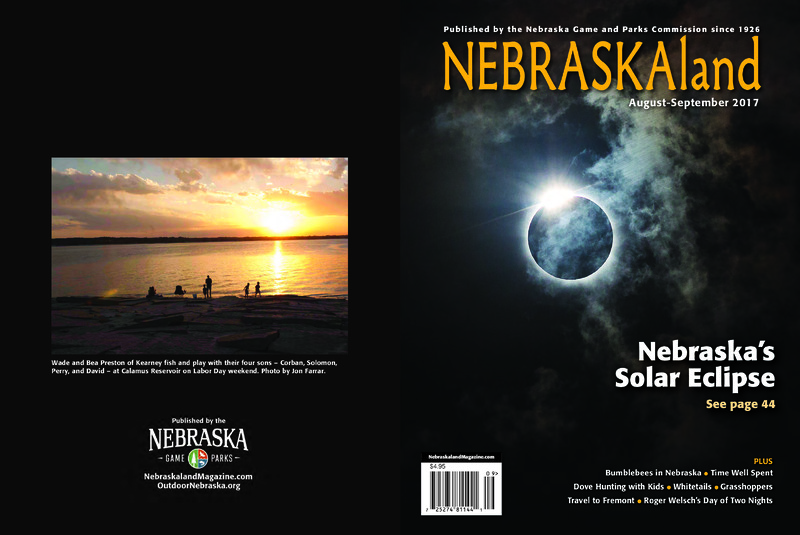
Wade and Bea Preston of Kearney fish and play with their four sons – Corban, Solomon,
Perry, and David – at Calamus Reservoir on Labor Day weekend. Photo by Jon Farrar.
See page 44
NebraskalandMagazine.com
$4.95
PLUS
Bumblebees in Nebraska l Time Well Spent
Dove Hunting with Kids l Whitetails l Grasshoppers
Travel to Fremont l Roger Welsch’s Day of Two Nights
NEBRASKAland Magazine
Volume 95
●
No. 7
●
August-September 2017
F EAT U R ES . . .
24 Bumblebees – Fuzzy Friends of Flowers
STORY AND PHOTOS BY CHRIS HELZER
30 Time Well Spent – What to Do in August/September
BY RENAE BLUM
32 Whitetails
STORY BY JEFF KURRUS, PHOTOS BY JOE BRAUN
40 Passing on the Hunt
STORY AND PHOTOS BY JENNY NGUYEN
44 Total Eclipse of the Sun
BY RENAE BLUM
50 Beauty of Grasshoppers
STORY AND PHOTOS BY CHRIS HELZER
I N S I D E T H I S I S S U E ...
50
●
Mixed Bag – The Pocket Gopher, Travel to Fremont,
Prickly Pear Cactus, A Brief History of Chariot Racing at
Nebraska Fairs, Upcoming Events and more ..................... 8
Page 49 – Roger Welsch's Day of Two Nights ............ 55
Nature Notes – Lemonweed ...................................... 56
Out and About – City Foxes ..................................... 58
Wilderness Workshop – Fishing When It's Hot ..... 60
Portraits from the Past – Reader's Photos ............. 62
In the Kitchen – Teriyaki Dove Skewers................... 64
The Last Stop – Foreground ...................................... 66
44
●
24
●
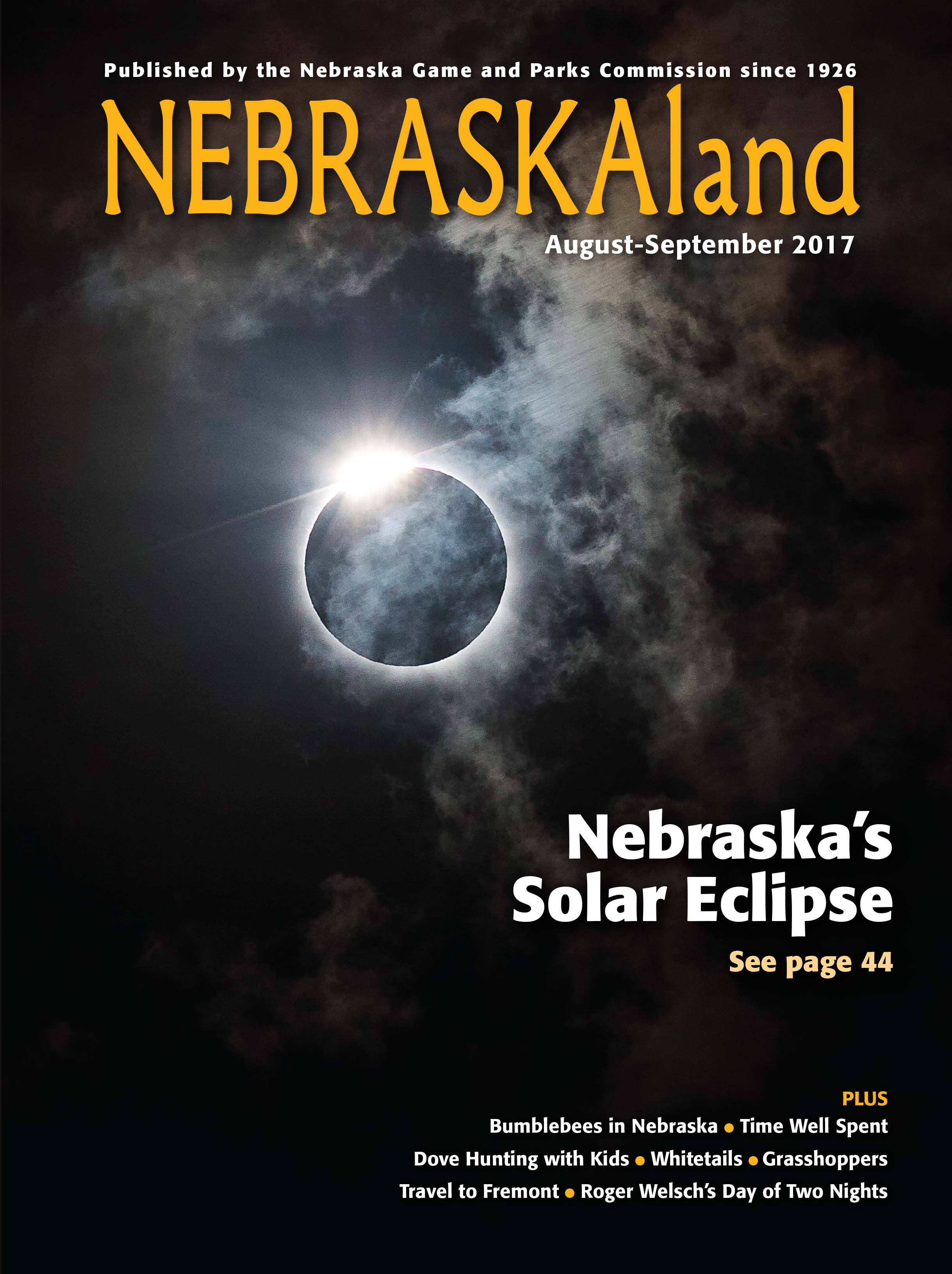
Cover: Nebraska prepares for a total solar eclipse on Aug. 21,
2017. See page 44 for the complete story. Photo by Stephen
Mudge.
THROUGHOUT 2017, NEBRASKALAND MAGAZINE WILL
PUBLISH ARTICLES ASSOCIATED WITH THE STATE'S 150YEAR CELEBRATION. LOOK FOR THIS LOGO TO READ ABOUT
NEBRASKA'S RICH HISTORY AND VIEW OUR INTERACTIVE
DIGITAL EDITION FOR MORE INFORMATION.
NEBRASKAland (VOL. 95 / NO. 7 ISSN 0028-1964) is published monthly, except
for the combined Jan./Feb. and Aug./Sept. issues, by the Nebraska Game and Parks
Commission, 2200 N. 33rd St., Lincoln, NE. Periodicals postage paid at Lincoln,
Nebraska, and additional mailing offices. POSTMASTER: Send address changes to
NEBRASKAland, P.O. Box 30370, Lincoln, NE 68503-0370.
2 NEBRASKAland • AUGUST-SEPTEMBER 2017
32
●
AUGUST-SEPTEMBER 2017 • NEBRASKAland 3
#NEGameAndParks
Windmill Last Stop
W
Dear NEBRASKAland,
I so enjoyed the article about
tthe windmills in the June issue
by Jeff Kurrus.
I was raised on a farm in
northcentral Iowa. When
we got running water Dad
decided to have the windmill
taken down, and
a I was going to do it. We
agreed on a price of $50 and, at the age of 15, this was huge.
I climbed to the top to begin my work and realized I was
afraid of heights. All I could do was hang on. So I went down
and started removing the numerous bolts and nuts.
While we were having lunch, we heard this crash. It had
blown over onto our garage. I have never seen my dad so
angry.
While visiting my father in a nursing home, he was 92, I
reminded him I had never received my pay, and he gave me a
big smile.
He had remembered.
Ron Reece
Lincoln, Nebraska
Denise Wiese of Doniphan took this photo of a Baltimore
oriole sitting on a wire fence south of Grand Island.
In Nebraska’s state parks, an adventure waits over every ridge and around every bend. Moments wait
to be had and memories beg to be shared. This fall, get outside and discover seventy-seven parks and
enjoy unlimited experiences. No matter what you choose to do outdoors—it’ll be time well spent.
To get inspiration for your park adventure, visit OutdoorNebraska.org/Explore.
"Following a long, rainy Monday, a rainbow brightened skies and lifted spirits at Lake Zorinsky," said Tiara Brown of Omaha.
4 NEBRASKAland • AUGUST-SEPTEMBER 2017
Share your images with us
AUGUST-SEPTEMBER 2017 • NEBRASKAland 5
NEBRASKAland Magazine
Outdoor Plates
Jon Wilke of rural Kearney is a
fishing addict, and his plate reflects
that. Year-round, when he's not
working, you can find him with a
chocolate Lab or two on Nebraska
lakes. His only mistake was hooking
his wife on fishing, as he now rarely
gets to go alone.
If you have a unique outdoor
message plate you would like to share
or know someone who does, e-mail a
photo (high-resolution, JPEG format
only, please) to Eric.Fowler@Nebraska.
gov, along with your name, hometown
and a brief description of the interests
expressed on your license plate.
Karen Kader of Omaha took this photo of water droplets on a
lupine plant during a rainy day.
From Our Social Media
ADMINISTRATION
CONSERVATION OFFICERS
Director Jim Douglas
Deputy Director Tim McCoy
Commissioners
Chairman - Rex Fisher, Omaha
Vice Chairman - Dick Bell, Omaha
2nd Vice Chairman - Robert Allen, Eustis
Mark Spurgin, Paxton
Rick Brandt, Roca
Pat Berggren, Broken Bow
Jim Ernst, Columbus
Norris Marshall, Kearney
Dan Kreitman, Wahoo
ADMINISTRATION (Lincoln)
Craig Stover (Administrator)
Duane Arp (Asst. Administrator)
Jeff Clauson (Asst. Administrator)
MAGAZINE STAFF
Communications Director Christy Firestone
Editor Jeff Kurrus
Art Director Tim Reigert
Associate Editor Jenny Nguyen
Regional Editors Eric Fowler, Julie Geiser,
Justin Haag
Contributing Editor Michael Forsberg
Regular Contributors Renae Blum,
Chris Helzer, Chris Masada, Gerry Steinauer
Photo Librarian Jaclyn Cruikshank Vogt
Circulation Donna Robinson
For address changes and questions about
your subscription, e-mail donna.robinson@
nebraska.gov or call 800-632-5263
Advertising Sales Manager
For advertising information contact
Shane G. Gilster, 402-742-0125
Email: shanegilster@gmail.com
NEBRASKAland Magazine Copyright 2017, all rights reserved.
NEBRASKAland is available in audio from the Nebraska Library
Commission Talking Book and Braille Service, Suite 120, 1200 N St.,
Lincoln, NE 68508. 800-742-7691. NEBRASKAland Magazine and the
Nebraska Game and Parks Commission reserve the right to reject any
advertising not in keeping with the agency mission.
Rates: $18 for one year; $33 for two years; $44 for three years. Nebraska
recipients must add appropriate sales tax. To subscribe call
1-800-NEBLAND (632-5263), or go online to: NebraskalandMagazine.
com.
This image was taken by Kristin Chandler at Walnut Creek Lake
in Papillion. "I think the tree coming out of the water, and how
it's barely intact, made for an interesting photo op," she said.
COMMISSION
C
CO
COM
OM
MMIS
MISSIO
S NO
OFFICES
FFICES
FF
FFI
S
Headquarters/Southeast District Office
2200 N. 33rd Street Lincoln, NE 68503
Phone 402-471-0641
FORT ROBINSON STATE PARK:
Yvonne Cornish – Love this place it's
beautiful there. Joseph Cannia – We will
visit this year and probably do that famous
trail ride up the buttes.
SUMMER PARK EVENTS:
Cameron Brumbaugh – I regularly enjoy
Nebraska state parks, but why are there none
with ATV trails?
Hey Cameron, We are looking at ATV
trails; however, it requires a certain size
landscape. It is in our long range plans.
– Thomas Slagle, NGPC Communications
Intern
6 NEBRASKAland • AUGUST-SEPTEMBER 2017
Northeast District Office
2201 N. 13th St. Norfolk, NE 68701
Phone 402-370-3374
Kate Ellingson of Lincoln sent in this
photo of pelicans chasing fish at Capitol
Beach Lake.
Send your comments to:
Jeff Kurrus, Editor
NEBRASKAland Magazine
P.O. Box 30370
Lincoln, NE 68503
or e-mail Jeff.Kurrus@Nebraska.gov
Please include your postal address and telephone number. Letters may be condensed
and edited. Photographs are also welcome.
JaNahn Niven of Weston shared a photo of her sons playing on their family
J
farm near North Bend. "I enjoy taking pictures, and these two are my
favorite subjects."
Any program that receives federal funding from the National Park
Service, or the United States Fish and Wildlife Service prohibits unlawful
discrimination on the basis of race, color, religion, age, gender, marital
status, national origin, age, disability or political affiliation. Any person
who believes he or she has been discriminated against in any program,
activity, facility, or service, should contact the Nebraska Game and
Parks Commission, Lincoln, NE 402-471-0641, the Equal Opportunity
Commission, Lincoln, NE 402-471-2024, TTY/TDD 402-471-4693;
United States Fish Wildlife Service, Civil Rights Coordinator, 4401
N. Fairfax Drive, Arlington, VA 22203; Director, Equal Opportunity
Program, U.S. Department of Interior, National Park Service, 1849 C
Street NW, Mail Code 0008, Washington, D.C. 20240-0001.
Southwest District Office
301 E. State Farm Rd. North Platte, NE 69101
Phone 308-535-8025
Northwest District Office
East Hwy. 2, Box 725 Alliance, NE 69301
Phone 308-763-2940
Bassett Office
524 Panzer St., Box 508 Bassett, NE 68714
Phone 402-684-2921
Kearney Office
1617 First Ave. Kearney, NE 68847
Phone 308-865-5310
Ak-Sar-Ben Aquarium
21502 W. Highway 31 Gretna, NE 68028
Phone 402-332-3901
Omaha Office
8495 Frederick Street, Omaha, NE 68124
Phone 402-595-2144
402-471-5531
402-471-5531
402-471-5531
NORTHWEST (Includes counties covered)
Jim Zimmerman (District Supt.)
308-641-9590
Sean McKeehan
(Cheyenne, Morrill, Box Butte)
308-279-9133
Scott Brandt
(Kimball, Banner, Scotts Bluff)
308-631-0663
Dan Kling (Sioux, Dawes)
308-430-0572
Kyler Prochaska
(E 1/2 Dawes, N 1/2 Sheridan, W 1/2 Cherry) 308-430-3984
Terry Brentzel (Deuel, Garden, Grant) 308-458-7650
402-389-0444
Frank Miller (Cherry, Hooker)
NORTHEAST (Includes counties covered)
Tom Zimmer (District Supt.)
402-649-8053
402-760-0712
Dale Davis (Keya Paha, Brown, Rock)
402-340-3981
Jonathan Andreasen (Holt, Boyd)
Greg Hesse
(Greeley, Wheeler, Boone, S 1/2 Antelope)
402-843-6567
Mitch Johnson (Knox, Antelope, Pierce) 402-613-8612
402-762-5022
Jeff Jones (Knox, Cedar)
Jon Reeves
(S 1/2 Thurston, Burt, Washington)
402-889-8508
Andrew Heyer (Pierce, Madison, Stanton) 402-613-2241
Cory Krause
(Cuming, Wayne, Stanton, Dodge)
402-380-6410
Steve Oberg
(Colfax, Platte, Madison, Stanton, Nance)
402-910-3366
Owen Johnson
(Dixon, Dakota, N 1/2 Thurston)
402-266-1759
308-730-7050
Doug Pollard (Loup, Garfield, Valley)
SOUTHWEST (Includes counties covered)
Roger Thompson (District Supt.)
308-530-3097
308-202-0819
Matt Brandt (Sherman, Howard)
308-380-7331
Tim Williams (Hall, Hamilton, Merrick)
Pat George
(Harlan, Franklin, Phelps)
308-920-2762
Matt Andrews
(Gosper, Furnas, Frontier, Red Willow)
308-746-2418
Brian Piernicky
(Red Willow, Frontier, Hayes, Hitchcock)
308-340-6627
John Lee (Hitchcock, Dundy, Chase, Hayes) 308-414-1432
308-289-0427
Nicholas Fix (Keith, Perkins)
308-289-1169
Bryce Streger (Keith, Arthur)
308-760-0145
Sean Schultz(Keith)
Brandon O’Neal
(Lincoln, McPherson, Logan)
308-530-3157
Alex Hasenauer
(Lincoln, McPherson, Logan)
308-660-4671
Dale Johnson (Kearney, Buffalo)
308-440-3847
308-529-8146
Mike Thome (Dawson)
Ray Dierking (Custer, Thomas, Blaine) 308-870-0322
Taylor Dixon
(Dawson, N 1/2 Gosper, N 1/2 Phelps)
308-217-2108
SOUTHEAST (Includes counties covered)
Levi Krause (District Supt.)
402-949-0593
402-619-1355
Rich Berggren (Douglas)
402-616-5961
Dan Evasco (Sarpy)
402-210-0888
Heath Packett (Cass)
402-209-1506
Russell Mort (Otoe, Johnson)
William Krause
(Nemaha, Richardson, Pawnee)
402-274-8063
Matt Taylor (Thayer, Fillmore, Jefferson) 402-200-9597
402-806-9084
Dan Zuehlke (Gage, Saline)
402-890-6463
Dina Barta (Lancaster)
402-937-3422
Dudley Sorensen (Lancaster, York)
402-613-2312
Travis Shepler (Lancaster)
402-890-7140
Stacey Lewton (Lancaster, Seward)
402-443-6392
Mike Luben (Saunders, Butler, Polk)
Nebraska Wildlife Crimestoppers
1-800-742-7627
AUGUST-SEPTEMBER 2017 • NEBRASKAland 7
A Mammal
Brief
By Lindsay Rogers
PHOTO BY JOEL SARTORE
Only two species
of pocket gopher are
found in Nebraska – the
northern pocket gopher,
limited to the extreme
western Panhandle, and the
plains pocket gopher, found
Lindsay Rogers is an outdoor education specialist
throughout the state. The plains pocket
with the Nebraska Game and Parks Commission.
gopher lives in diverse habitats, including
open grasslands, cultivated farmland and oak savannahs.
A nuisance to golfers, they can also be found in urban lawns, cemeteries and golf courses. They construct
extensive tunnel systems underground, creating the characteristic mound visible from the surface.
They are active day and night, but most digging takes place from dusk to dawn. They eat mainly fleshy roots
but will occasionally forage aboveground. They rarely drink water due to the high water content of their food
sources.
Although they are often considered a nuisance species, gophers are an ecologically important species. Not
only do they provide food for many predator species such as hawks, owls, snakes and carnivorous mammals,
but they also help aerate the soil and improve soil drainage. ■
CONNECT WITH US
For outdoor news and events,
subscribe to our
weekly e-newsletter.
Text “NGPC Newsletter”
to 468 311.
Or visit OutdoorNebraska.org
to sign up.
Follow us on your favorite social media
8 NEBRASKAland • AUGUST-SEPTEMBER 2017
AUGUST-SEPTEMBER 2017 • NEBRASKAland 9
Travelogue
Travelogue Sponsor
●
Visit Fremont and Dodge County
Fremont
By Kourtney Kaisershot, Nebraska Tourism Commission
N
PHOTO BY ERIC FOWLER
estled along the meandering
Platte River are small Nebraska
communities with a lot to offer.
Fremont and Dodge County
have surprises waiting for any
traveler looking for an authentic small
town Nebraska experience.
Those looking for adventure can
find it in Bryson’s Airboat Tours. The
Platte River might be a docile stream
of water passing through Nebraska, but
once you take a ride on one of Bryson’s
airboats, the river transforms into a
scenic speedway.
Looking for more ways to explore in
the area? Stay the weekend at one of
Dodge County’s many campgrounds
including Fremont Lakes State
Recreation Area and boat, fish, hike
and camp at one of Nebraska's most
diverse outdoor destinations.
You can also visit Camp Fontanelle
and zip line across a ravine through
150 acres of woods. When you are
looking to unwind after a long day
of activities, snuggle up in one of
the camp’s unique ‘treeboats’ perfect
for sleeping under the stars. Pop in a
movie in their outdoor screen projector
to enjoy before bed.
After the rush of adventure, visitors
should stop at the local restaurants
Boaters tube at Victory Lake at Fremont Lakes State Recreation Area.
in Fremont. This classic 50’s inspired
diner has every breakfast, lunch or
dinner item you would expect at a diner
with daily specials that are sure to
impress.
Whether you are a natural born
explorer or a cultural ambassador, a
visit to Fremont and Dodge County
is just what you’re looking for. Stay
for the day or camp for the weekend;
either way, visitors are bound to make
memories that will keep them coming
back. ■
favorited by the locals. Choose from
over 80 menu items at the Wooden
Windmill. Travelers will be impressed
when they pull up to this unique stop
and see a beautifully crafted windmill
as the entrance to the restaurant.
Visitors looking for the best barbeque
in town should look no further than
Huey’s Smokehouse BBQ or Baby
Huey’s Barbeque both located in
Fremont. Anyone feeling nostalgic
for when life was simple and the food
was greasy can stop in to Mel’s Diner
While in the Area
Arts and culture are also abundant
in this area. Take a tour of all the
museums, exhibits and antiques
that are available.
Louis E. May Museum, Fremont.
PHOTO COURTESY OF HUEY'S SMOKEHOUSE BBQ
Gallery 92 West/Fremont Area Art
Association, Fremont.
Musbach Museum, Scribner.
Glismann Collection and
Lueninghoener Planetarium
Midland University, Fremont.
Yankee Peddler West, Fremont.
Harold and Leona’s Toy Museum,
North Bend.
Huey's Smokehouse BBQ in Fremont has some of the best barbecue in the state.
10 NEBRASKAland • AUGUST-SEPTEMBER 2017
AUGUST-SEPTEMBER 2017 • NEBRASKAland 11
A Brief History
Chariot Racing at Nebraska Fairs
By the Nebraska State Historical Society
I
By
was no longer
a new
B the
h early
l 1900s,
1900 chariot
h i racing
i
l
sensation, but remained on the program at many fairs. Custer
County Republican, Aug. 25, 1904.
minute.”
The Nebraska State Fair continued to host such races during
the 1880s. Smaller fairs around the state also sponsored
them. The Buffalo County Fair at Kearney in 1887 advertised
“hippodrome and Roman chariot races by parties who came
especially from Illinois for that purpose.” The Adams County
Fair at Hastings in 1889 included “Ben-Hur chariot races,
[and] Roman mounted races” in its schedule of events.
NSHS RG3348-6-266
RG3348
RG3
348-6
348
6 266
6-266
f you’ve ever watched the famous chariot race scene in
the movie Ben-Hur (either the 1959 Charlton Heston
version or the forgettable 2016 remake), surely your first
thought was, “Why aren’t we doing this at our county
fair?”
Because that’s exactly what Americans thought after
reading Lew Wallace’s bestselling 1880 novel of the same
name. The novel, the result of seven years of research by the
retired Civil War general, included an exciting description of
Roman chariot racing that soon inspired imitation. The sport
became popular as entertainment at state and county fairs in
Nebraska and across the country.
Chariot racing was an attraction at the Nebraska State
Fair in 1881. The Columbus Journal on Aug. 17 announced
that the races would be at night under electric lights, a first
for the fair. “The audience in the amphitheatre will be able
to distinguish the horses and the colors worn by the drivers
... They will drive teams of four horses abreast, and have
agreed to make the run of a half-mile around the track in one
Roman chariot racing in the public imagination. Illustration in the Omaha Daily Bee, Oct. 21, 1906.
NSHS RG1431-76-18
The Red Cloud Chief on Sept. 17, 1889, reminded readers:
“Don’t forget the [Webster County] fair which commences
next Tuesday. Chariot races every day. Do not fail to come.
Every farmer in Webster county should make it a point to be
present.”
Not everyone was a fan. Some people complained that
such entertainment had nothing to do with a fair’s true
purpose: to educate the public and improve agriculture. The
Columbus Journal on March 25, 1885, called chariot racing
“one of the nonsensical attractions (?) of the State Fair” and
an “abuse of the object for which fairs are intended, having
no recommendation except that it is a ‘drawing’ feature to
swell the gate receipts.” The Columbus paper also reprinted
sarcastic commentary from the Nebraska State Journal: “We
observe that the board of managers of the State Fair have
retained the chariot race as a feature of the annual exhibition.
We are delighted to see it. The intimate relation between the
improvement of agriculture and the spectacle of a half-naked
woman driving four old plugs at a gallop around the race
track is so intimate and vital as to need no comment.”
But chariot racing remained popular until
other forms of entertainment – such as
automobile racing – took its place. Chariot
races are still a feature of some modern
rodeos. ■
Visit the Nebraska State Historical Society’s
website at nebraskahistory.org.
Chariot racing at the Red Willow County Fair in McCook
McCook, undated photo
photo. NSHS RG1431
RG1431-76-18
76 18
12 NEBRASKAland • AUGUST-SEPTEMBER 2017
AUGUST-SEPTEMBER 2017 • NEBRASKAland 13
14 NEBRASKAland • AUGUST-SEPTEMBER 2017
AUGUST-SEPTEMBER 2017 • NEBRASKAland 15
Homemade Decoys
By Justin Haag
About 15 years ago I constructed dove decoys out of
plywood, metal hooks and a little paint.
Nobody is going to mistake my work for a Michelangelo
or Rembrandt, but the doves are the only critics I care
about. I’m certain these decoys have helped me get a
closer look at more birds through the years than I would
have otherwise. The presence of dove-shaped silhouettes
hanging from a tree branch or a fence line seems to give
birds enough confidence to fly within shotgun range.
And there will always be a place for the homemade
decoys in my dove hunting set-up. They have a slim figure
and don’t take up much space in the bag. Plus, I made
them. ■
PHOTO BY JARROD SPILGER
By Jarrod Spilger
While dove hunting is relatively easy early on, by midSeptember pressured birds can become more difficult to
hunt. Dove calls, used in conjunction with decoys, can help
lure wary doves in closer to your set-up. Here’s how to use
them.
Several major call manufacturers, such as Faulk’s, Primos
and Haydel’s, offer dove calls. Air is blown through a
mouthpiece, while a hole located somewhere on the call’s
barrel regulates tone. A typical mourning dove vocalization
consists of a six note sequence: who-we-who, woo, woo,
woo.
To operate the call, cover the tonal hole with a finger for
the first, lower note of the sequence, then lift the finger to
uncover the hole for the second, higher “we” note. Cover
the hole again for the final four notes of the series. The first
three “who-we-who” notes are made very close together,
while the final three “woo” notes are drawn out with a breath
in between each.
Deploy decoys to grab the attention of passing doves, then
use calling to bring them within shotgun range, much like
a duck hunter employs calls to finish ducks. Use a mellow
call, like Faulk’s or Haydel’s, on calm days, and a higher
pitched call, like the Primos, on windy days. Visit
primos.com, haydels.com or faulkcalls.com for more details
PHOTO BY JUSTIN HAAG
Dove Calls
about each of these calls.
Calling doves doesn’t work all the time, but it works
often enough to make hanging a dove call around your neck
worthwhile. Keep this handy tool ready, because it may just
help you fill a late-season limit. ■
Kevin J. Murray Memorial Fishing Tourney
16 NEBRASKAland • AUGUST-SEPTEMBER 2017
absence. It is my way of paying him back for the wonderful
life he gave me and our children.”
The 13th Annual Kevin J. Murray Memorial Fishing
Tournament will take place Aug. 26, 2017, at Lewis and
Clark Lake near Crofton, Nebraska. Cash prizes are
awarded for biggest catches, along with a raffle and
buffet dinner. For more information and to register, visit
kevinjmurraymemorial.com. ■
PHOTO BY ERIC FOWLER
By Brandi Petersen
This summer, hundreds of fishermen will gather to
cast their lines and pay tribute to a friend and respected
Nebraskan, Kevin Murray. The Wayne native rose from
humble beginnings to the top of his field as a Kiewit general
superintendent, overseeing one of Omaha’s most iconic
buildings, the First National Bank Tower. Throughout his
life he displayed incomparable talent, determination and
work ethic, and shared those traits with his three daughters
through the simple pleasures he loved: hunting, camping and
family.
In October of 2004, Kevin drowned after being tossed
from his boat while fishing at Lewis and Clark Lake. In the
devastating weeks and months that followed, the Murray
family channeled their pain into a fishing tournament to
honor Kevin. The event, now in its 13th year, has raised
$104,000 dollars for scholarships for Wayne High School
students, as well as playground and weight room equipment,
welders for the tech department, field repairs and more.
“I think Kevin would be very proud of the event,” said
Sherry Murray, Kevin’s wife. “He would love sitting around
telling fish stories with all the guys after a day of fishing.
Together, we leave a mark in history, to the place where it
all started for us, Wayne High School in Wayne, America.
This has helped to heal the hole left in my heart with Kevin’s
The 13th Annual Kevin J. Murray Memorial Fishing Tournament will take
place Aug. 26, 2017, at Lewis and Clark Lake near Crofton.
AUGUST-SEPTEMBER 2017 • NEBRASKAland 17
150 Years of Nebraska
Storytelling
By Lynn Mellick, Ponca State Park
An official Nebraska sesquicentennial signature event,
150 Years of Nebraska Storytelling: A Conference
Celebrating Nebraska History Through Literature will be
at Ponca State Park Aug. 6-8, 2017.
This one-time event invites participants to explore
Nebraska history and the art of storytelling through
a series of educational experiences, including author
presentations, writer’s workshops, American Indian
perspectives and more.
The event will feature over 15 authors who have a deep
connection to Nebraska and a variety of genres. Speakers
include Nebraska Educational Television broadcasting legend
Ron Hull, Neihardt biographer and journalist Tim Anderson,
Nebraska State Poet Twyla Hansen, fiction and non-fiction
writer Karen Shoemaker, historian Jeff Barnes, non-fiction
writer Preston Love, Jr. and many more.
The three-day conference fee is $85, all meals included.
Lodging is an extra fee. Students and educators who plan on
commuting daily to and from the conference will receive a
20 percent discount on registration; students and educators
18 NEBRASKAland • AUGUST-SEPTEMBER 2017
RON HULL
TWYLA HANSEN
who plan to lodge at the park will receive a 30 percent
discount on registration.
Ponca State Park has four-bedroom mini lodges, twobedroom green cabins, RV sites and tent sites available.
To register for the 150 Years of Nebraska Storytelling
conference and lodging, please call Ponca State Park at
402-755-2284. Space is limited.
For additional details, contact Lynn Mellick at
Lynn.Mellick@Nebraska.gov. A park entry permit is
required for all vehicles. ■
Presented by
Larva found in rustic
log furniture.
Wild Edibles
Prickly Pear Cactus
By Julie Geiser
M
PHOTO BY ERIC FOWLER
any fruits can be harvested right now, such as sand
cherry and wild plum. But you may be surprised that
the fruit of the prickly pear cactus is also edible.
In the Opuntia family, there are many different kinds of
prickly pear cactus throughout the United States. They range
in size but are easily recognizable by their flattened, oblong
or round pads that are fused together at a joint. There are
four edible parts of the prickly pear: the flower, pads, fruit
and seeds. No species of prickly pear cactus is poisonous.
Flowers bloom around June to July. The petals are sweet
and typically yellow, but can be other colors depending on
the species. Harvesting should be limited to the petals only
to keep the reproductive parts intact to allow the plant to
fruit successfully.
The pads taste best early in the spring; smaller pads are
more tender and have fewer, shorter spines and glochids.
Prickly pear cactus grows on the edge of a lakeside cliff at
Swanson Reservoir on the Republican River.
20 NEBRASKAland • AUGUST-SEPTEMBER 2017
However, older pads can still
be utilized, and pads can be
harvested at any time. The pads
are considered a vegetable in many
parts of the world. Called nopales,
the pads are jointed and have small,
circular clusters called areoles on
them where the spines and glochids
are attached. The flowers grow
from areoles as do new stems,
which form new pads.
Furniture Pests
Flower
and young
fruit
Harvesting
To harvest nopales you will need heavy gloves, a longhandled fork or tongs and a knife. Grasp the pad with tongs
or spear it with the fork. Pads can be twisted off, but cutting
the pad with a knife an inch or so above its joint will leave a
stump for a new pad to regrow. Place pads in a metal bucket
or layer between crumpled newspapers in a cardboard box
to get them home. Spines and small glochids will lodge into
plastic containers, clothes, shoes and skin, so use caution
when collecting prickly pear.
Preparation
Making pads safe to eat can be tricky. Wash the pads under
running water, then place them in a large pot with enough
water to cover them. Bring to a boil, cover and cook over
medium heat for about 15 minutes or until pads are tender.
Then drain and let pads cool. Lay the pads on a hard surface,
and while holding the pad with pliers by the joint end, trim
one-quarter inch off the upper edge of the pad where there are
many spines. Remove other spines and glochids by scraping
them off with a table knife or potato peeler. Rinse and repeat
spine removal on the other side. Once clean, dice or cut the
pads into thin strips. The jelly-like pads have the flavor of
green beans, okra and green peppers, and much like okra,
nopales contain a natural thickening agent. You can also fry
them with onions, mushrooms, other vegetables and rice or
serve in soups, eggs or by themselves. Pads can be canned,
dried or frozen after parboiling.
The most commonly used part of the prickly pear is the
fruit called tuna. Ripening in July and August, the tunas
turn a deep red or purplish color when ripe. Harvesting
tunas is an extended season that stretches through October
and later in some areas. They are juicy when ripe but may
have a few spines along their upper rim and glochid-filled
areoles. Slice off the tough disk at the end of the fruit, hold
them with tongs and clean them by scrubbing under water
with a vegetable brush. They can be peeled and eaten raw or
cut in half and the juicy insides scooped out. Their flavor is
tangy and melon-like. The fruit contains seeds that can be
separated out by using a colander. Although the seeds are
edible, they will give your jaw a workout. Instead, ground
them to make flour or use as a soup thickener. Tunas can be
juiced, used in smoothies, jelly, wine or syrup.
Prickly pear is one of the most useful wild foods available.
You just have to find a patch or start some in your own
garden. Useful books about prickly pear are Nature’s Garden
by Samuel Thayer and Wild Seasons by Kay Young. ■
By Julie Van Meter
State Entomologist, Nebraska
Department of Agriculture
Firewood is well documented as a
pathway for moving plant pests, and as
such, state and federal regulations have
been enacted to minimize the potential
for spreading pests in firewood.
However, other wood products, even
seemingly “safe” products, may also
harbor insects.
Recently, several incidents of
exotic wood boring insects in rustic
log furniture have been discovered
in the United States. The furniture
was imported from various suppliers
oversees, and multiple species of
insects were recovered in the wood.
This has resulted in efforts by State
Departments of Agriculture, working
along with the U.S. Department of
Agriculture, retailers and importers,
to recover and destroy the infested
furniture. One recall of infested
log furniture from a single supplier
ultimately involved furniture in over
40 states. While records indicated no
Furniture with larval galleries. BOTH PHOTOS
COURTESY MINNESOTA DEPARTMENT OF AGRICULTURE
buyers in Nebraska purchased any of
the furniture, the situation highlighted
the potential for movement of plant
pests in non-traditional pathways.
The insects found in the furniture
included the brown fir beetle
(Callidiellum villosulum) and the
velvet longhorn beetle (Trichoferus
campestris). It is believed these
beetle larvae can remain viable in
dry wood, such as furniture, for long
periods of time before completing
their life cycle and emerging as adults.
Neither beetle is known to occur in
Nebraska, but both have the potential
to become established in U.S. forests
and cause significant damage to native
ecosystems and urban forests.
Most wood products entering the
U.S. are required to meet specific
certification requirements related to
plant pests before being imported.
However, problems can arise when
the wood is not properly heat treated
or fumigated prior to being exported.
Sometimes, too, a wood product is
not recognized as a pest pathway, and
migration steps are not required for
import.
Other examples of imported
household articles found infested with
plant pests include pet chews, potpourri
and even faux Christmas trees. The
Florida Department of Agriculture
discovered several species of insects
infesting wooden sticks imported as pet
chews, in 2016. In recent years, pine
cones in potpourri and faux Christmas
trees with real wood trunks were the
focus of national recalls when they
were found to be infested with exotic
insects.
These examples highlight the risk
for introduction of plant pests that
could be damaging to our state, and
help to illustrate why state and federal
regulations exist on the movement of
plants and plant products. ■
AUGUST-SEPTEMBER 2017 • NEBRASKAland 21
by Jerry Kane
August 1
Squirrel Season opens
August 1
Family Fishing Event
Prairie Queen Recreation Area, LaVista
August 1-3
Learn to Hunt Camp
Nebraska Game and Parks Outdoor
Education Center, Lincoln
August 2
Family Fishing Event Mormon Island
State Recreation Area (SRA) Lake No. 1,
Grand Island; Recharge Lake, York
August 2
Family Fun Night
Red Willow Reservoir SRA, McCook
August 3
Family Fishing Event
Holmes Lake, Lincoln
August 4
Bighorn Sheep
Final day for lottery applications
August 4
Family Fishing Event
August 12
Republican Valley Archery 3-D Shoot
Red Willow Reservoir SRA, McCook
Terry’s Pit, Terrytown
August 14
Fall Turkey Permits available beginning
at 1 p.m. Central Time
August 15
September 1
Elk Private land antlerless season opens Hunting
Seasons Open
August 15
for Cottontail,
Bullfrog Season opens
August 17
Nebraska Game and Parks Board of
Commissioners meeting
North Platte
August 17
Bighorn Sheep
Drawing for lottery permit
August 18
Outdoor Movie Night
Indian Cave SP, Shubert
August 19
Director’s Cup Archery Tournament
August 5
Kayaking
Nebraska Game and Parks Outdoor
Education Center, Lincoln
August 5-6
Living History Fort Atkinson State
Historical Park (SHP), Fort Calhoun
August 5, 12, 19, 26, September 2
Buffalo Steak and Free Movie Night
Platte River State Park (SP), Louisville
August 6-8
150 Years of Nebraska Storytelling
Ponca SP, Ponca
August 8-10
Learn to Hunt Camp
Nebraska Game and Parks Outdoor
Education Center, Lincoln
Antlerless Private Lane Only, Statewide
Whitetail Buck, Gifford Point Wildlife
Management Area, Youth, and Landowner
seasons open
Calhoun
September 15
Elk Archery bull season opens
September 2-4
Living History Fort Kearny SHP,
September 16
Antelope Muzzleloader season
Kearney
opens
September 2-10
Early Teal Hunting season in High
September 16-17
Missouri River Outdoor Expo
Buffalo Bill Ranch SHP, North Platte
Plains Zone
Ponca SP, Ponca
August 19
Ranch Life in the 1860s
September 2-17
Early Teal Hunting season in Low Plains
September 23
Woodcock Hunting season opens
Rock Creek Station SHP, Fairbury
Zone
August 19-21
Solar Eclipse Activities Statewide
September 3
Buffalo Cookout and Living History
August 18-20
Fun-Filled Weekend
Indian Cave SP, Shubert
August 20
Antelope Archery season opens
Fort Kearny SRA, Kearney
August 25-September 4
August 11-13
Becoming an Outdoors-Family Camp Nebraska State Fair Grand Island
Fort Kearny SRA, Kearney
August 29
Learn to Hunt Doves Workshop
August 12
Becoming an Outdoors-Family Camp Nebraska Game and Parks Outdoor
Education Center, Lincoln
22 NEBRASKAland • AUGUST-SEPTEMBER 2017
Indian Cave SP, Shubert
September 9
Night Owl 5K Run/Walk Niobrara SP,
Niobrara
September 9
Feathered Friends Wildcat Hills SRA,
Gering
September 9
Fly-Fishing Clinic Fremont Lakes SRA,
Fremont
September 10
Family Fishing Event Zoo Pond,
Scottsbluff
September 15
Fall Turkey Hunting season opens
September 24
World Heart Day Hike Johnson
Lake SRA, Elwood
September 30
Elk Firearm bull season opens
“Heading out to the Panhandle after
archery pronghorn with my daughter!”
– Ben Collingham
“For all the weekend warriors at the
lake to go home so fisherman can have
the lakes to themselves! Ha!”
– Clint Golden
“Pheasant hunting with family in
Hayes Center! My father-in-law grew
up in Hayes Center and introduced me
to pheasant hunting when I married his
daughter. He has since passed but his
family still lives on the homestead. The
farmhouse is celebrating 100 years this
year. I wouldn't miss spending opening
weekend on the farm chasing roosters!”
– Doug Byrnes
“Putting some venison back in the
freezer." – Martin Appel
“All of it! From squirrels to deer." –
Mark Tate
“I'm looking forward to elk season as
I drew my first ever antlerless elk tag
this year!" – Jared Olis
“Cold weather, whitetails, hoodies
and bonfires." – Ralph Spangler ■
September 30
Elk Public land antlerless season
opens
September 30
Beyond Becoming an OutdoorsWoman Nature Art Windmill SRA,
Gibbon
September 30-October 1
Youth Waterfowl Hunting season in
Zones 2 and 4
September 30-October 1
Living History Fort Atkinson SHP,
Fort Calhoun
PHOTO BY JUSTIN HAAG
Fort Kearny SRA, Kearney
September 1
Deer Archery, Season Choice, River
August 19
End of the Summer Celebration
August 21
August 11
Family Fishing Event Fort Kearny SRA Citizen Science Journaling
Lake 4, Kearney
Horseback riding at Fort
Robinson State Park near
Crawford.
Jackrabbit, Dove, Snipe,
Grouse, Rail, Raccoon and
Opossum
September 2-3
Living History Fort Atkinson SHP, Fort
on page 49.
Readers are encouraged to contact
NEBRASKAland within 10 days after
this issue’s publication with the
correct page number and name of
this issue’s “Visitor” – a critter found
in Nebraska. We will then gather the
correct entries and draw one to win a
NEBRASKAland mug.
To enter each month, write:
NEBRASKAland Visitor
2200 North 33rd Street
Lincoln, NE 68503
Or e-mail: Tim.Reigert@Nebraska.
gov with “Visitor” in the subject line
of the message.
HINT: This issue’s visitor is not on
page 3, 14, 21, 23, 24-29, 50-53, or
54.
From Facebook
We posed this question on the
Nebraska Game and Parks Facebook
page, and were given a number of
answers that only excited us more
about this upcoming fall season. Here
are a few of those responses:
August 13
Family Fishing Event
Iron Horse Lake, North Platte
Calamus SRA, Burwell
What are you
NEBRASKAland
most excited
Visitor
issue’s winner of
for this hunting theLastVisitor
drawing was
Doug
Echtenkamp
of Lincoln,
season?
Nebraska, who found the cuckoo wasp
Contact the Nebraska Game and Parks Commission at 402-471-0641 or
visit OutdoorNebraska.org for more information.
Visit HuntSafeNebraska.org for a list of hunter education classes and
BoatSafeNebraska.org for a list of boating safety classes.
Cuckoo wasps are bright, metallic
blue to green colored wasps. These
are solitary wasps, and do not
form colonies. Like the Cuckoo
bird, female cuckoo wasps lay
their eggs in the nests of other
bees and wasps. When the cuckoo
wasp larvae hatch, they then eat
the other bee or wasp eggs and
larvae. They may also eat the food
left by the nest builders, such as
insect larvae intended for their own
young. This is a form of parasitism,
termed kleptoparasitism. Adults can
be seen throughout the summer,
visiting flowers for pollen. Cuckoo
wasps can curl up into a ball,
similar to an armadillo, as a means
of defense. Cuckoo wasps are found
around the world, with over 150
species of cuckoo wasps found
in the United States. The most
common species in Nebraska is
probably the Chrysis
probab
smaragdula
(shown here,left).
(sho
Special thanks to Julie Van Meter,
State Entomologist, Nebraska
Department of Agriculture.
AUGUST-SEPTEMBER 2017 • NEBRASKAland 23
BFuzzyUMBLEBEES
Friends of Flowers
The American bumblebee
(B. pennsylvanicus) is
declining in many areas,
including eastern Nebraska,
but it is still fairly common
in central and western
Nebraska.
Story and photos by Chris Helzer
O
f the 46 bumblebee species
found in North America,
20 have been recorded
in Nebraska. Nebraska’s
bumblebee diversity is largely
due to the wide variety of habitat types
found within the state and its location
at the intersection between eastern
and western ecosystems. Because we
still have huge swaths of relatively
intact prairie, our state may provide
strongholds for bumblebees that are
experiencing declines elsewhere.
That’s good news for bumblebees,
but also good news for Nebraska
since bumblebees are among the most
fascinating and valuable pollinators.
Eggs to Queens
Like honeybees, bumblebees are
eusocial. Eusocial animals live in
groups, care for young cooperatively,
and divide up roles. Unlike honeybees,
which are perennial and founded by
swarms, bumblebee colonies are annual,
and founded by a single solitary queen.
As the colony matures, female worker
bees do all of the foraging and care for
the queen and her offspring, and males
are produced later in the season to mate
with reproductive females who will go
off to start new colonies.
Each spring, mated females (queens)
emerge from their winter shelter
and seek out locations to found new
colonies. The majority of bumblebee
nests are in abandoned small mammal
burrows, but others can be found
aboveground in hollow trees or stumps,
hay stacks, and other habitat with
cavities or that they can easily burrow
into. Competition for nesting sites can
be intense, and bumblebee queens
Pictured are common eastern bumblebees mating. The large female will overwinter
after mating and attempt to start her own colony in the spring.
24 NEBRASKAland • AUGUST-SEPTEMBER 2017
frequently kill each other in order to
secure prime locations. Once a nest
site is located and the queen modifies
it to her liking (often constructing wax
“pots” and filling them with regurgitated
nectar to get her through cold, rainy
spring weather), she starts collecting
pollen and nectar and begins laying
eggs. She raises the first generation
of her offspring by herself, and all
of them mature into female workers.
Those workers then take over all the
foraging and childcare duties, including
collecting food for the queen, who no
longer needs to leave the nest.
If the workers are able to find
sufficient food, the colony can grow
quickly. Queens produce females
from fertilized eggs and males from
unfertilized eggs. Workers don’t mate,
but can lay unfertilized eggs that turn
into males. Some females are fed
enough that they become potential
future queens. A healthy colony can
produce 20 or 30 queens by the end
of the year, and up to 100 or more in
some cases. Those queens mate with
males and then seek out protected
places in which to ride out the winter.
All of the remaining members of the
colony die at the end of the growing
season, including the original queen.
As relatively large and strong insects,
bumblebees can fly nearly a mile from
their nest to forage – much farther than
most other bee species. They are fairly
AUGUST-SEPTEMBER 2017 • NEBRASKAland 25
Conservation of
land to row crop
agriculture has left
pollinator habitat
restricted to field
edges and corners
in many parts
of the country,
making foraging
more difficult.
Carolina horsenettle holds its pollen
tightly enough that most bees have
difficulty accessing it, but bumblebees
can shake the pollen loose via buzz
pollination.
Above: A bumblebee sits on prairie blazing star at Spring Creek Prairie Audubon Center near Denton.
Below: The fuzzy bodies of bumblebees are very effective pollen collectors. This bee is accumulating
a big load of white pollen from the native thistles it has been feeding on.
generalist in their flower preference,
feeding upon a wide diversity of
flowers. They lap up nectar with long
tongues and collect pollen on their fuzzy
bodies. Periodically, a foraging bee will
wipe pollen from its body onto modified
structures on their back legs, called
pollen baskets, where they store the
pollen until returning to the nest.
Bumblebees are one of the few
groups of bees that can perform
“sonication,” or “buzz pollination.”
Some flowers hold their pollen tightly
enough that simply rubbing against the
anthers doesn’t remove much of it. A
bumblebee will grab onto the flower
and rapidly vibrate its flight muscles,
achieving a sonic resonance that
dislodges the pollen onto the bee.
Because only bumblebees and a few
species of solitary bee can easily access
the pollen, they are more likely than
other bees to visit flowers that require
buzz pollination. The plant benefits
because it loses little pollen except
to bees that are likely to visit another
flower of the same kind. Among
others, many members of the Solanacea
(nightshade) family benefit from buzz
pollination, including ground cherries,
nightshades, horsenettles, and buffalo
bur, as well as tomatoes. Because of
their special ability, bumblebees are
commonly used by tomato growers in
26 NEBRASKAland • AUGUST-SEPTEMBER 2017
commercial greenhouse operations.
The fuzzy bodies of bumblebees help
them collect pollen, but also insulate
them against cool weather. In addition,
though, bumblebees can shiver their
strong flight muscles, and warm their
body temperature up enough to fly. This
allows them to fly in temperatures as
low as 40 degrees Fahrenheit – lower
than many other bees and other insects.
A queen bee can use the same shivering
technique to keep her eggs and larvae
warm during cool spring temperatures.
Four of Nebraska’s bumblebees
are “cuckoo bees” and follow a very
different lifestyle from the others.
Cuckoo bees don’t collect their own
pollen or rear their own brood. Instead,
a queen cuckoo bumblebee enters the
nest of another bumblebee species and
either kills or subdues the queen. Then,
she forces the workers of that colony
to feed her and her young. None of the
cuckoo bee offspring become workers.
Instead, when those offspring leave
the nest, they mate, and the females
go find other nests to usurp. Some
cuckoo bees target a wide range of
bumblebee species, but others, like the
variable cuckoo bee, which appears to
focus on the American bumblebee, are
more specialized. Because there are no
workers, cuckoo bees are rarely seen
outside the nest, making it difficult to
AUGUST-SEPTEMBER 2017 • NEBRASKAland 27
This brown-belted bumblebee is feeding on the appropriately-named Rocky Mountain
Bee Plant in the Nebraska Sandhills.
know how abundant they are. The only
time they can be observed is during
mating and when queens are searching
for a colony to usurp.
According to the Xerces Society and
the IUCN North American Bumblebee
Specialist Group, nearly a quarter of the
46 bumblebee species in North America
are at risk of extinction. In Nebraska,
seven of our 20 species are considered
vulnerable and declining in population.
A study conducted between 1999 and
2002 by the University of Nebraska
and a variety of collaborators (the
Bumble Boosters program) found 19
out of the 20 bumblebee species, with
the only exception being the Morrison
bumblebee (Bombus morrisoni), which
was found historically only in the
extreme western parts of the state. The
study found several bumblebee species
in parts of Nebraska from which they
had not been previously reported.
However, not all of the news
was positive. Today, the American
bumblebee (Bombus pensylvanicus)
is found in much lower numbers
than it used to be, especially in the
eastern part of the state. The yellow
bumblebee is less abundant today as
well, though it has never been one of
the more numerous bumblebees in
Nebraska. Other bumblebee species are
declining across much of their historic
range in North America, but their
status in Nebraska is not well known
because few people are out looking for
bumblebees, especially in western parts
of the state.
Habitat Loss,
Pesticides and
Disease
Habitat loss is a major factor in the
decline of bumblebee populations, as
it is for other bee species and many
other organisms. Though bumblebees
are not habitat specialists the way
some other organisms are, in order to
support large colonies, they do need
abundant wildflowers, including a wide
diversity of flowering species through
the growing season, often from several
different habitat types.
Conversion of land to row crop
agriculture has left pollinator habitat
restricted to field edges and corners
in many parts of the country, making
foraging more difficult. In recent years,
many of those edges and corners have
also been converted to row crops. This
has not only made food more scarce,
but has also removed nesting habitat
from large swaths of the landscape.
In areas where habitat is less
fragmented, bumblebees and other
pollinators can still struggle to find
sufficient resources. Many grasslands
and woodlands have lost a number of
28 NEBRASKAland • AUGUST-SEPTEMBER 2017
their wildflower species because of
chronic overgrazing and/or broadcast
herbicide application. Much of the
remaining habitat is either hayed or
grazed, which can reduce or eliminate
the availability of flowers during some
or all of the growing season.
In addition to habitat loss and
fragmentation, bumblebees also suffer
from the same kinds of pesticide use
as other bees and insects. Neonictinoid
pesticides, in particular, have been
shown to have adverse impacts on bees
and other beneficial insects. Pesticide
and herbicide application can affect
bees indirectly by killing pollen and
nectar producing plants, and by causing
bees themselves to become sick or die.
Diseases are also listed as a major
factor in the decline of bumblebee
populations. The fungal pathogen
Nosema bombi, for example, affects
both bumblebees and honeybees.
Commercial greenhouse operations that
use bumblebees can be hot spots for the
fungus, and scientists are investigating
what impact those operations might
have on spreading the disease to wild
bumblebees.
Pollinator
Conservation
Bumblebee population declines
are almost surely a result of multiple
forces. Habitat loss and fragmentation
likely makes populations more
vulnerable to other stressors like
pesticides and disease. Successful
conservation of bumblebees and other
pollinators will mean addressing all of
those factors, but habitat is probably
the most important.
While it’s not feasible or desirable to
return the bulk of Nebraska’s cropland
to prairie, there are ways to make
agricultural landscapes much more
friendly to bees. Conserving habitat
between fields and in less productive
areas of cropland is very beneficial.
Bumblebees primarily nest in small
mammal burrows, and sometimes in
rotten trees or old hay bales. Removing
old shelterbelts and plowing up field
edges removes many potential nesting
sites for bumblebees.
One of the most important aspects
of pollinator conservation is the
availability of a diverse mixture
of flowering plants throughout the
growing season. Limited food results in
smaller bumblebees, which can’t forage
as far from the nest. Food limitations
also reduce the number of queens
produced by a colony. Roadsides can
be extremely valuable to foraging
pollinators, but mowing and herbicide
spraying eliminates many of the
flowers that bees and other pollinators
need. Pasture and hay meadow
management can also be critically
important in terms of ensuring
the persistence and availability of
wildflowers to bees.
Grazing systems and conservative
herbicide spraying regimens that
preserve plant diversity and allow
wildflowers to bloom in some areas
each year can play large roles in
pollinator conservation. Leaving edges
or corners of hay meadows uncut can
help reduce the impacts of losing huge
swaths of flowering plants during the
peak activity period of bumblebee
colonies.
Early spring is a particularly
vulnerable time for pollinators because
flowering plants are at a premium.
Many shrub species are especially
important resources to bumblebees and
other pollinators during the spring, so
allowing those to persist along field
and pasture edges or other locations
can be very beneficial. Spring is also a
time when dandelions, annual mustards
and other similar “weedy” plants
flourish, and those species can be
important for early season pollinators.
Allowing those plants to persist in
some areas can help bees make it
through a tough time of year.
Pollinator habitat is important in
both rural and urban areas of Nebraska,
and many bumblebee species occur
in both. Flower gardens that contain
a diversity of native wildflowers and
other pollinator-friendly species across
the entire growing season can make
valuable contributions to conservation,
and may increase fruit and vegetable
yields in small community or backyard
gardens. Leaving last year’s flowering
stems and piles of old vegetation or
sticks can provide important nesting
habitat for many bee species. Limiting
herbicide, fungicide, and pesticide use is
also important. Consult with Nebraska
Extension professionals for best beewise landscape practices in your area.
The Future
Pollinators play crucial roles in
keeping both ecological and agricultural
systems running effectively, and
bumblebees are key components of the
pollinator community. Their size and
abundance allows them to cover large
areas and pollinate numerous different
plant species.
Nebraska has a rich diversity of
bumblebee species, and our relatively
intact habitats across much of the state
should help support strong populations
of species that are declining elsewhere.
Managing our prairies and woodlands
to encourage diverse plant communities
and abundant nesting opportunities
for bumblebees and other pollinators
should be a top priority conservation
strategy. In addition, people living in
town and in more fragmented parts of
the state can also help conserve these
important and fascinating creatures. ■
If you want to help pollinators,
consider participating in the University
Native thistles, including the Platte thistle
shown here, provide critically important
resources for bumblebees and other
Nebraska pollinators.
of Nebraska’s Bumble Boosters
pollinator conservation education
programs, bumbleboosters.unl.edu
or Bumble Boosters on Facebook,
and Xerces Society’s Bumble Bee
Watch program, bumblebeewatch.org.
These projects provide both education
and the tools for helping pollinators
through research initiatives.
Thank you to Doug Golick at the
University of Nebraska-Lincoln and
Mike Arduser in Missouri for help with
this article.
Including native wildflowers in gardens is an important way to support both
bumblebees and many other pollinators.
AUGUST-SEPTEMBER 2017 • NEBRASKAland 29
Time Well Spent
What to Do in August and September
By Renae Blum
I
n August and September, make sure to get outdoors to catch the last
lingering, lazy days of summer as the season transitions into fall.
Start with the ideas here, and head to the Game and Parks calendar at
OutdoorNebraska.org for more park events.
PHOTO BY JEFF KURRUS
■
Nebraska Game
and Parks Outdoor
Encounter at the
Nebraska State Fair
Hunting Seasons Open
Throughout Aug. and Sept.
Aug. 25-Sept. 4
Hunters will welcome the opening of various seasons
throughout August and September, such as archery deer,
turkey and squirrel. For a full list of season dates, see the
calendar on pages 22-33 or visit OutdoorNebraska.org/
huntingseasons.
Grand Island
PHOTO BY ERIC FOWLER
Enjoy exploring this popular exhibit, which
features a 12-foot waterfall, a 5,600-gallon
fish aquarium, fishing and Nerf gun games,
shooting and archery ranges, trapper cabin,
sky fort, running stream and catch pond,
fossil dig and scavenger hunt game.
Season opens Aug. 15
Throughout Aug. and Sept.
Statewide
Statewide
PHOTO BY JEFF KURRUS
30 NEBRASKAland • AUGUST-SEPTEMBER 2017
Statewide
Join the Omaha Community Playhouse for
the world premier of Eminent Domain Aug.
25-Sept. 17, a 2016 Eugene O’Neil Playwrights
Conference finalist. The play tells a relevant
story of a Nebraska family farm threatened by the
construction of an oil pipeline and the ensuing
conflict that emerges within. It exposes the
struggle of preserving the Heartland’s farms and
the livelihood of the people who live here. To read
about other official sesquicentennial events, visit
ne150.org/calendar.
Put Out a Hummingbird
Feeder
Bullfrogging
Late summer nights in Nebraska are a perfect time to
go bullfrogging with friends and family, especially kids.
Greg Wagner writes: “An effective method to catch
a bunch of bullfrogs is to move slowly, shining the
shorelines with a good flashlight after dark. Spot the
frogs on land, keep the light directly on them so they’ll
freeze in position, and then ease in close enough to
catch them with a net or even by hand.” Take note that
bullfrogs are aquatic creatures, and thus you need a
current, valid Nebraska fishing permit in order to take
or attempt to take them.
Sesquicentennial Events
Throughout Aug. and Sept.
Statewide
It’s time to put out a hummingbird feeder if you have not already
done so. Joel Jorgensen, Game and Parks nongame bird
program manager, advises avoiding cheap feeders, as they tend
to leak and attract wasps and bees; cleaning the feeder every
few days; and putting in an ant moat filled with water between
the feeder and whatever you’re hanging it from (some feeders
will already have this feature). He also recommends making your
own nectar, first by boiling four parts of water and one part of
sugar, and then putting it in the refrigerator for a while.
AUGUST-SEPTEMBER 2017 • NEBRASKAland 31
W
Photos by Joe Braun
Story by Jeff Kurrus
T
he best story I have ever heard of buck
fever was told to me by a bowhunter who,
as he relived the nightmare, still couldn’t
seem to fathom the chance he had passed. He had
started bowhunting as an adult, and during one of
his first outings, he looked to his left and saw the
hugest white-tailed buck he had ever seen walking down the wooded trail in his direction. It was
a TV buck – large, white, symmetrical antlers
that had grown in seemingly all directions.
The hunter’s mouth remained open as the
deer slowly neared. With each step, the buck’s
impossibly large rack grew even larger. Unaware
of the hunter, the deer continued to saunter down
the trail, underneath the hunter’s stand, and then
out of sight.
When the deer finally disappeared, the hunter
said a silent “Wow” to himself and then, for
the first time, realized that he had become so
enamored with the buck that he had watched it
walk in the wide open beneath his stand without
ever thinking that he should have actually tried to
take a shot at him.
But that’s what a deer will do to you.
Before the season begins, many hunters will
plant food plots, manage trail cameras and read
deer studies from organizations like Quality
Deer Management Association just to learn a bit
32 NEBRASKAland • AUGUST-SEPTEMBER 2017
Every hunter’s trophy whitetail
looks different, but they all
carry the same undeniable
excitement and fear upon first
sight.
AUGUST-SEPTEMBER 2017 • NEBRASKAland 33
more about their favorite pastime. I’ve even talked to
hunters who claim to have torn both rotator cuffs in
their shoulders from the constant raising and lowering
of the arms while trimming shooting lanes.
Deer hunters who participate in these activities do so
for a number of reasons. The hope of a “monster” or
“Muy Grande” or any of the other from the long list of
names that define a big buck in deer camps across the
state is always there, but that has never been the sole
purpose for any hunter I’ve come across.
What these hunters will also tell you is that the
Left: A “basket” rack buck is a sign of
things to come for a deer hunter.
Above: Classy and cautious, a whitetailed buck walks along a ridge in Sarpy
County.
34 NEBRASKAland • AUGUST-SEPTEMBER 2017
simple joy of seeing deer in the first place
is why they keep coming back. And for
good reason. A deer is a portrait of both
elegance and attentiveness. Anyone who
has spent more than a few hours in a deer
stand will tell about the time that a deer
popped out of the ground, seemingly
appearing from nowhere.
These animals will frequently pause and
raise their nose in an effort to smell while
walking afield. They’ll also stomp their
hooves, direct their glance away, and then
suddenly wheel toward the hunter, waiting
for any movement. They are the epitome
of caution, ready to blow at you at any
moment when the situation becomes too
uncomfortable.
However, they are also reckless. Bucks in
AUGUST-SEPTEMBER 2017 • NEBRASKAland 35
Sight of a late-summer buck rub might
elicit a call between hunting partners that
could last an hour or more.
rut will chase does without
ever thinking of nearby
danger, and because of their
own patterns, I’ve seen
more than one deer catch
wind of me from a trail and
then turn in the opposite
direction and walk away
… only to return down the
same trail in 15 minutes
with a new outlook on life.
Because of this wide
display of unpredictable
behaviors, hunters are given
the ability to cross off
bucket list moments during
their hunting ventures.
Whether they’ve seen a
deer make a rub or a scrape,
or witnessed two bucks
fighting – these are stories
that a hunter can return
to camp with. While one
hunter will tell about the
buck that ran beneath his
stand after he accidentally
dropped his coffee mug,
the other hunter will play
topper, relaying the tale
about the doe “who kept
looking over its shoulder as
she neared. I just knew he
was coming behind her.”
Sometimes the buck does
come behind her, but many
more times he doesn’t.
Which is why we continue
to go. For there will always
36 NEBRASKAland • AUGUST-SEPTEMBER 2017
Above: A doe noses a twig, leaving scent
that will be picked up by a buck in the
area.
Right: An antler shed provides
confidence to a hunting group that an
area will be productive the following year.
be the story about the one
that got away, but even
more often the story will
be about the ones they saw.
For if you ask this curious
group of people – those that
chase their favorite animals
with a weapon in their hand
– the most common reason
they give is they hunt
because they love to watch
the animals.
AUGUST-SEPTEMBER 2017 • NEBRASKAland 37
They love the spasmodic, shivering
movement a deer will sometimes make
when it stops walking. They love the tiny
hairs on a deer’s nose that can be seen
from the bow stand in their early morning
light, and they love when the first part of
a deer they see walking over a ridgetop is
antlers.
Now, I must be honest – I’ve never
frozen to the point where I had forgotten
I was hunting in the first place when one
of these moments has happened to me.
But because of the speed at which my
heart beats every time I see a deer in the
field, I don’t think it’s out of the realm of
possibility.
Which is why I’m counting down the
days to Sept. 1. ■
Opposite: Seeing a buck afield is one of
hunting’s most exciting moments.
Above: Whether they are looking at a
buck or a doe, certain moments in a deer
hunter’s mind are etched forever.
38 NEBRASKAland • AUGUST-SEPTEMBER 2017
Joe Braun is a photographer who lives
in Omaha and is constantly in awe of the
beauty that can be found just beyond our
backyards. This is his first contribution to
NEBRASKAland.
AUGUST-SEPTEMBER 2017 • NEBRASKAland 39
Terry Bisgard of Omaha
dove hunts with his
sons, Caden and Cody,
near Tekamah in Burt
County, with Labrador
retriever Bub lying at
their feet.
Passing on the
HUNT
Q&A with Terry Bisgard, a hunter who is paying
it forward like his mentors did before him.
Story and photos by Jenny Nguyen
erry Bisgard of Omaha
hunts just about anything.
Early recollections include a
couple hunting trips with his
dad and uncle, and then later with
his mom. He then met a neighbor
who truly catapulted him into the
world of hunting: Steve Bott lived
just down the road, and before Terry
ever shot his first duck at 16, Steve
taught Terry how to call in waterfowl
better than most hunters.
Now 49, Terry’s passion for the
hunting sports has only grown.
He is on the committee of Ducks
Unlimited, National Wild Turkey
Federation, and Pheasants Forever
in Nebraska, and he is also on the
Mossy Oak Whitetail and Browning
prostaff teams. His Labrador
retrievers, Bub and Reba, hold
several national bird dog titles.
But as many milestones as Terry
has reached over the last 30 years
of hunting, the last three have been
the most defining. These days, his
favorite hunting partners are his
sons: Caden, age 7, and Cody,
age 5.
Last season, I got the chance to
hunt with Terry and his sons for
doves on his property near Tekamah.
After an evening of scanning the
skies, making faces, cracking jokes,
and playing with dead birds in the
golden light of a mild September
evening, I finally saw in action what
people meant when they said, “I
grew up around hunting.”
T
40 NEBRASKAland • AUGUST-SEPTEMBER 2017
Too young and small, the boys
didn’t shoot that day. Still, it was a
win-win: Terry got to hunt, while
Caden and Cody got to spend time
with their dad. Little did they know
– and the realization may not come
for many years yet – their dad was
thoughtfully passing on something
that is a basic part of him: his love of
chasing animals and the virtues that
go with it.
How did you get started on hunting?
Who took you?
My dad took me out when I was
really young with my uncle, about two
times. I loved it, but he never took me
again. My dad didn’t really hunt. So
my mom would take me in her car – a
green Buick – and I would just walk
around and shoot pheasants, and we’d
put them in the trunk. So it was really
my mom who encouraged it – it’s kind
of a cool story, really, if I think about
it. And that was over by Ceresco, near
Lincoln, where I shot my first pheasant
ever at Jack Sinn Memorial Wildlife
Management Area. I was 12 years old.
But it was actually my neighbor,
Steve Bott, who showed me the ropes.
Those guys [Steve’s friends] were
always blowing their duck calls in
their garage, and I heard it and started
hanging around. I was 13 when I met
Steve. By 15, I was teaching others
how to duck call, although I still had
not shot a duck at that point. Soon
after, Steve took me duck hunting for
the first time, finally.
What is it about hunting that you
love so much that you’re still doing it
to this day?
I just love being outside – the fresh
air. It’s not about how much game
you shoot; it’s more of the experience.
Remember all those ducks coming
in that day when you were hunting
with me? It was beautiful. You feel
that rush. I don’t care if I ever shoot
anything again, really. Now, it’s just
about being out there, and I’ll pass it
on to my sons.
AUGUST-SEPTEMBER 2017 • NEBRASKAland 41
Most importantly, like Steve Bott
taught me, you don’t “road” it. You
get permission from the landowner.
And when you shoot an animal, you
go find it. You don’t shoot another one
until you find the first one. Steve was
a stickler about that. You don’t run
around shooting a bunch of stuff and
count numbers and act cool. You have
to do it the right way. My sons will
never do that.
What do you have planned for the
boys next?
Caden will get his first rooster this
fall and with Bub, hopefully. Cody,
probably next year. We practice with
plastic bottles as targets. Once they get
a feel for the gun, I’ll start throwing
the bottle. They have little youth model
20 gauges.
And we’re getting started with
archery. The first deer they will ever
get will be with a bow.
Why are early teal and dove hunting
great for introducing children to
hunting?
The weather is good. You can hunt
in shorts, and the kids don’t have to sit
still or stay really quiet like they would
have to during deer season.
It’s also a sport that mom can go
sit and read a book. We’ve done
that. One year Steve’s daughter came
with us, and she was able to do her
homework. Her mom was also sitting
against the weeds on a picnic blanket.
And everything is pretty that time of
year – golden. Most of all, it’s a good
opportunity for us to be together as a
family and be involved in each other’s
lives.
Even though the boys aren’t ready
to shoot yet, I let them help me with
carrying ammo and setting up decoys.
I let them handle the birds and hold my
gun. And I’m talking to them the entire
time about safety and responsibility
and explaining it to them in ways they
can understand. To keep them happy,
I always make sure to bring water,
snacks and sunscreen with me.
Any ending thoughts?
I take my sons hunting because it’s
important to get away from the TV and
to maintain a connection with nature.
But also grab your neighbor kid. It’s
important to open up your garage and
reach out a little bit. I’ve had 10-15
kids go through the hunter safety
course just from the neighborhood.
Many of these kids, I could see that
they didn’t have a dad, and I would
try to get them going. Even if they’re
not interested in it – I just take them
anyway and give them the chance to
choose what they like or don’t.
Like what Steve did for you.
Exactly. Give back. And he wouldn’t
take me for a long time. I’d come up to
his house all the time, but he wouldn’t
take me hunting until I went through
the hunter safety course. That was a
good thing.
If you care about hunting, you have
to do your part to pass it on the right
way. ■
Left to right: Terry Bisgard of Omaha, Spencer Brooks and Steve Bott of Bennington
with Labrador retrievers Bub and Piper after a waterfowl hunt in Tekamah.
How did you begin introducing your
sons to hunting?
Caden was first. Teal hunting was his
first hunting trip.
[Terry showed me a photo of the
hunt on his phone.]
There he is blowing the duck call
while sitting in the weeds with Bub.
I had his sleeves rolled up so high
because his camouflage sweatshirt was
way too big for him. He was only 4. Of
course, he wasn’t shooting or anything,
but he was still along for the hunt.
What did he think about the hunt?
I killed three ducks, and he carried
all of them out to the truck. He just
loved it. He kept asking me questions.
“Dad, what’s this?” He was pointing to
the eyes and the beak …
Cody went duck hunting with me,
too. He got to hunt with me in the boat
blind. It was warm out – that early teal
season. Take advantage of that early
teal season.
They’ve also gone pheasant hunting
with me. One day, they walked a long
ways. My buddies and I hunted all
day, and the boys walked the whole
time with us. Whatever it took to get
through it, we just did it. Sometimes
they get tired – normal 3-year-old,
4-year-old stuff. I try to keep them
motivated. You know, “Come on guys,
hang in there. Let’s go!”
[Terry pulled out his phone again and
showed me a photo of his boys smiling
and standing in front of a truck with
many dead roosters. They were holding
toy shotguns.]
I’ve heard that they shot turkeys this
spring.
Turkey was the first game they shot.
I had the gun set up on a shooting
stick, and then I would get behind them
and look down the barrel as they pulled
the trigger. Caden shot his first turkey
when he was 5. He shot a second one
this spring. Cody shot his first turkey
this year.
What does it mean for you to have
your sons hunting with you?
This past season, I posted a picture
of my sons with their turkeys on
Facebook. My uncle, who just recently
passed away, commented:
“Teach them to hunt, and they’ll
never get into trouble.”
That really resonated with me. I do
everything with them. My sons are my
whole world.
Through hunting, I want to teach
them responsibility and to never shoot
over their limits. I want to teach them
to hunt ethically – to make clean shots,
and to take care of their game and
process it properly. At home, they help
with lots of the cleaning and cooking.
42 NEBRASKAland • AUGUST-SEPTEMBER 2017
Cody Bisgard plays with shotgun shells while dove hunting with his dad.
AUGUST-SEPTEMBER 2017 • NEBRASKAland 43
Total Eclipse
of the Sun
By Renae Blum
O
n Monday, Aug. 21, throngs of people across
Nebraska – and the United States – will be treated
to a sight that, for many people, seems to defy
description. Hotels and campgrounds across the state have
been booked solid for months by travelers from across
the globe hungering for the sight. What is it? A total solar
eclipse, the first on American soil since 1991, and the first to
sweep across the entire country since 1918.
To learn more about the eclipse, I visited with Dr.
Rebecca Harbison, a professor of practice of astronomy at
the University of Nebraska-Lincoln, to learn more about
this once-in-a-lifetime event. The information she provided
excited me even more.
What is a total solar
eclipse?
An eclipse happens
when you have the sun,
the moon and the Earth
all lined up. And a solar
eclipse occurs when the
moon is between the Earth
and the sun. So from the
Earth’s point of view – or
at least for some part of
the Earth – the moon is
blocking the sun. Or you
could think of it as, the
moon’s shadow is falling
on the Earth.
Historically, eclipses have caused great panic, viewed as omens
of death and destruction from the gods.
44 NEBRASKAland • AUGUST-SEPTEMBER 2017
What’s special about this particular eclipse?
One reason we make such a fuss about this eclipse is that
the line of totality is crossing the United States from Oregon
to South Carolina. Because the Earth is mostly covered in
ocean, sometimes a total eclipse can be really hard just to
get to.
A total solar eclipse is formed when the moon completely blocks our view of the sun. The August eclipse is unusual
because it crosses Nebraska and the continental United States.
Here, most of North America can just take a road trip.
It’s especially nice for Nebraskans, because the path of
totality cuts straight across the state, northwest to
southeast.
How is a total solar eclipse different from other types of
eclipses?
The total solar eclipse is when the sun is totally covered
by the moon. A partial solar eclipse is when the moon covers
only part of the sun. You’ll see one before and after a total
solar eclipse, or if you’re outside the path of totality.
There’s a third type of eclipse that’s not going to happen
this time. Sometimes when the moon lines up with the sun,
it’s slightly farther in its orbit from Earth and doesn’t cover
In order to see the total eclipse, and not just a partial eclipse,
you must be within the shaded portion of the map. Those
closest to the center line will enjoy the longest view of the
eclipse.
AUGUST-SEPTEMBER 2017 • NEBRASKAland 45
MAP COURESTY OF XAVIER JUBIER, ECLIPSE2017.ORG
ILLUSTRATION BY C. N. GOCHIN
PHOTO BY STEPHEN MUDGE
How rare is a solar
eclipse?
You might think solar
eclipses should happen
every month, since the
moon orbits the Earth. But
they don’t because the
moon’s orbit is slightly
tilted compared to the
Earth’s orbit around the
sun. Most months, the
moon passes above or
below the sun in the sky.
Only about twice a year do
we get a solar eclipse.
In addition, the moon’s shadow on the Earth is really
small – at least the dark part of the shadow, the umbra, the
place where the moon covers the whole sun and not just part
of it. It’s only about 50 miles across, more or less. So even
though we have maybe two solar eclipses a year, most of the
Earth that sees the eclipse will only see the partial eclipse.
Only a small patch of Earth will be in the line of totality.
Celebrating the
Eclipse at a Park
A number of parks will be holding special events to
celebrate
l b t th
the eclipse
li
on Monday,
M d
Aug.
A
21,
21 and
d iin th
the days
d
preceding. Below is a selected list of events; for the latest
details, visit OutdoorNebraska.org/eclipse.
Eclipse glasses will be available at these parks while
supplies last; bring your own to ensure you’ll have a pair for
safe viewing. A park entry pass is required at all park areas.
In the list below, an asterisk (*) by the park name indicates
that visitors can view the total eclipse there. A full list of parks
within the path of the total eclipse can also be viewed at
OutdoorNebraska.org/eclipse.
Buffalo Bill Ranch State Historical Park*
From 9 a.m.-5 p.m. on Aug. 21, join us at the park for an
eclipse-related scavenger hunt.
PHOTO BY ED ROSACK
Fort Kearny State Recreation Area*
On Aug. 21, enjoy plant journaling and Citizen Science
activities – gathering wildlife data for scientists to use –
from noon to 3 p.m.
Indian Cave State Park*
Partial eclipses are visible before and after a total eclipse. Those who are near, but not within the path of totality, will only see a
partial eclipse. This 2013 partial eclipse was photographed from behind Cocoa Beach Pier in Cape Canaveral, Florida.
the sun entirely, and you’ll get a ring of sun around the
moon. That’s called an annular eclipse.
There are also lunar eclipses, but that’s totally different;
that’s when the moon is going into the Earth’s shadow.
What solar features are visible during a total solar
eclipse?
During a total solar eclipse, what we see as the surface of
the sun, the photosphere, is covered. So we can see the
sun’s outer atmosphere, the corona. It’s so much fainter
that the only way to see it from Earth is to block the
photosphere.
PHOTO BY KEVIN SCHINDLER/LOWELL OBSERVATORY
Tell me more about the corona.
It’s very thin, and surprisingly it’s hotter than the surface
of the sun; the sun’s magnetic field heats it to millions of
degrees. It streams off of the sun, and some of it escapes
the sun entirely, forming what we call the solar wind. It’s a
stream of particles which occasionally causes things like the
aurora, or the Northern Lights, as it runs into the Earth and
is deflected by our magnetic field down into the skies near
the Poles.
Scientists believe this petroglyph in Chaco Canyon may depict
an eclipse from July 11, 1097 A.D. The curlicues may represent
the sun’s corona, and the dot to the upper left, Venus.
46 NEBRASKAland • AUGUST-SEPTEMBER 2017
What are the different stages of a total solar eclipse?
We have first contact, when the moon first starts to cross
the sun. That’s when the partial eclipse starts, and that
happens for a while. And then you have second contact,
when the moon has finished covering the sun. That lasts for
only a few minutes. Third contact is when the first bit of
sunlight comes back, and fourth contact is when the eclipse
ends and the moon finishes crossing the sun.
Observations of a 1919 eclipse helped confirm the theory of
relativity, which states that objects such as the sun warp
space-time, bending light. To test this, Sir Arthur Eddington
measured the apparent position of stars near the sun during
the eclipse, and compared it with their normal positions. They
indeed appeared different. Pictured is a negative of one of
Eddington’s photographs.
What’s an average amount of time for all of this to take
place?
First through fourth contact can last a few hours. Totality
can last up to 7 minutes, but that’s very unusual; 3-5 minutes
is more normal for the maximum that totality can last.
The festivities start with an eclipse-related outdoor movie
on Aug. 18. Aug. 19 and 20 activities include living history
demonstrations, horse trail rides, a buffalo stew cookout, a
presentation by Matthew “Sitting Bear” Jones and outdoor
movie showings. Glow-in-the-dark T-shirts will be available
for purchase.
Lake McConaughy State Recreation Area
Enjoy food, an eclipse presentation and a star party with
a local amateur astronomer starting at 5 p.m. on Aug. 19.
Lake Minatare State Recreation Area*
View the eclipse from the lighthouse, and enjoy
educational programs throughout the morning on Aug. 21.
Mormon Island State Recreation Area*
On Aug. 21, 10 a.m.-2:30 p.m., help scientists learn more
about the behavior of animals during an eclipse by recording
your observations in a diary. A map of locations where
animals are commonly seen in the park will be provided.
Niobrara State Park
What does the sky look like before, during and after the
eclipse?
For most of the partial eclipse, the sky will look normal.
Human eyes are really good at adapting to change in light.
During this time, you’ll notice that if you look at something
like a tree’s shadow, the dapples of light are crescentshaped. The shadows will also get sharper as the eclipse
progresses.
As totality approaches, the sky will darken, especially to
the west. The temperature will drop. Animals might become
confused because their internal clocks are telling them it’s
afternoon, but their eyes are telling them it’s nighttime. This
will be when about 90 percent of the sun is obscured.
During totality, the sky will be dark with a sunset glow
around the horizon, and you can see bright stars and planets
– Mars and Venus to the west, Mercury and Jupiter to the
east. You might be able to catch Venus about half an hour
before and after the eclipse. Then the entire thing runs in
reverse.
The park will be hosting a viewing of NASA’s live
streaming of the total solar eclipse from Carbondale,
Illinois, on the television in the Niobrara Group Lodge
starting at 10 a.m. You can also view a partial eclipse from
the Lodge platform.
Rock Creek Station State Recreation Area*
Come to the park at 2 p.m. and 6 p.m. on Aug. 20 for
a fun presentation about the eclipse by University of
Nebraska-Lincoln physics professor Gregory Snow.
Wildcat Hills State Recreation Area
On Aug. 19 at 9 a.m., come to Wildcat Hills State
Recreation Area to learn more about the eclipse and how
to view it safely.
Windmill State Recreation Area*
On Aug. 19 at 9 p.m., enjoy stargazing, viewing the
Perseid meteor shower and exploring the night skies with a
telescope. ■
When viewing an eclipse, do not photograph while driving or
stop in the road or park on roadways or bridges.
AUGUST-SEPTEMBER 2017 • NEBRASKAland 47
Penumbra
Umbra
SUN
PHOTO BY ERIC FOWLER
PHOTO BY JASON CHENOWETH
What makes Nebraska a good location to view the
eclipse? I’ve heard that the Sandhills are a particularly
good spot.
There are two factors. One is weather, particularly cloud
cover. Statistically, August in Nebraska tends to be nice and
clear for viewing. The second factor is the eclipse will last
longer the farther east you go – so we’ll get a longer viewing
period than the folks in the Rockies, for instance – and the
duration of maximum eclipse increases as you get closer to
the center line. So the Sandhills balance good weather and a
nice, long eclipse. Plus, it’s not a bad foreground, and there
are lots of open roads if you do need to hunt for a clear spot.
When was the last total solar eclipse in Nebraska, and
when will it next happen again?
We haven’t had a total solar eclipse in the state since
1954, and we won’t have one again in the next 50 years.
During the partial eclipse, small openings – such as the gaps
between the leaves of this willow tree – will form crescentshaped shadows. The openings act like a pinhole camera,
projecting an image of the eclipse onto a surface.
48 NEBRASKAland • AUGUST-SEPTEMBER 2017
What time of day will the eclipse take place here?
Around noon to 1 p.m. You can check specific times at
eclipse2017.org.
EARTH
The narrow umbra is the darkest part of the moon’s shadow
during an eclipse. Viewers within the umbra will see the total
eclipse, while people inside the lighter penumbra will view
the partial eclipse.
Solar eclipses are possible because the sun’s diameter is
about 400 times larger than the moon’s, and the sun is also
about 400 times farther away from the Earth than the moon.
That is why the sun and moon appear about the same size.
The Nebraska Sandhills is one of the best places in the state – and in the country – to view the eclipse. Among its benefits are good
weather, long eclipse viewing times, clear views and lots of open roads.
Any tips for viewing the eclipse?
The only time you should be looking up without eye
protection is when the sun is totally behind the moon. Then
it’s safe, and you should. Otherwise, use only approved
solar filters or indirect viewing methods. Never use sunglasses.
MOON
What should you do if things are looking overcast or
potentially cloudy?
Until a couple of days beforehand, or maybe even the day
of, you’re not going to be able to get a good estimate. But
I wouldn’t worry until the day of. Just take advantage of
the resources we have – forecasting, radar, cloud mapping,
social media. Remember that the eclipse is going to happen
whether you are ready or not. I would recommend getting
settled at least half an hour before totality.
Have you seen a total solar eclipse?
I’ve never seen one; I’ve been looking forward to this one
for 20 years. I can’t describe to you how excited I am.
Is it worth driving to get in the path of totality? Isn’t
seeing a partial eclipse just as cool?
Partial eclipses are cool – if one happens, I will go
check it out. But they don’t have the drastic effect on the
environment; their effect is much more subtle. If you have
the chance to see a total solar eclipse, I would take it. ■
To view an interactive Google map of where the path
of totality will fall across Nebraska, visit eclipse2017.org/
xavier_redirect.htm. To read information about viewing the
eclipse at a particular town, city or community in Nebraska,
visit eclipse2017.org/2017/states/NE.htm.
How to View the
Eclipse Safely
During an eclipse, the only
time you should be looking
up without eye protection is
when the sun is totally behind
the moon. Otherwise, you’ll
need to use special-purpose
solar filters, such as “eclipse
glasses,” or view the partial
eclipse indirectly via pinhole
projection.
“Simply take a piece
of cardboard, put a little
pinhole in it, and the sunlight
streaming through it will
project a crescent-shaped
image of the sun onto the
ground,” said Rebecca
Harbison, a professor of
practice of astronomy at
the University of NebraskaLincoln.
Approved eclipse glasses
are available online from
Rainbow Symphony (the
brand available at eclipse
2017.org), American
Paper Optics, Thousand Oaks
O
Optical, and TSE 17.
The American Astronomical
Society recommends
inspecting your solar filter
before use for any scratches
or damage, following the
directions printed on it, and
supervising children’s use of
them.
Also, you must have a solar
filter for any camera, telescope
or binoculars you are using.
How will you know when it’s
time to put the eclipse glasses
back on after taking them off
during the total eclipse?
“Use a timer,” Harbison said.
“You’ll also notice that the
west is starting to brighten up
and the end of the shadow is
approaching you, so out of the
corner of your eye stay aware
of that.” ■
Eclipse
glasses will
be available at
select state parks
and recreation areas.
AUGUST-SEPTEMBER 2017 • NEBRASKAland 49
Story and photos by Chris Helzer
G
patterns found on Nebraska’s grasshoppers,
rasshoppers are grasshoppers, right?
especially when you get close enough to really
Little green or brown things with long
admire them. Some of their visual characteristics
legs that eat your garden or compete
with your cows for food. Sure, they can help them hide from predators, while others are
used for communication or simply to identify
make decent fishing bait if you can’t
others of their own kind. Regardless, it’s hard to
find worms, but beyond that, you’d probably just
look at grasshoppers without bias and not marvel
as soon be rid of them. Well, friends, it’s a big
broad world out there, and you might be surprised at their beauty.
Of
by the
Nebraska’s
diversity, and
108
yes, beauty, of
grasshopper
grasshoppers.
species, only
There are
a few cause
at least 108
damage to
species of
crops or
grasshoppers
pastures.
found in
Some
Nebraska,
grasshopper
a diversity
species feed
reflective
exclusively on
of the wide
grasses and
range of
sedges, but
rainfall
others have a
amounts and
much broader
habitat types
diet and
found in the
still others
state. That
ABOVE: The painted grasshopper (Dactylotum bicolor) is a gorgeous flightless
specialize
diversity
grasshopper found in the dry grasslands of North America.
OPPOSITE: The cudweed grasshopper (Hypochlora alba) feeds almost exclusively on
on one or a
doesn’t
cudweed sagewort, and is perfectly camouflaged to hide on its favorite food plant.
few kinds
include
of broadleaf
grasshoppers’
plants. They use the tips of their antennae to help
close relatives, katydids and crickets, which are
them decide whether or not a plant is something
certainly interesting and attractive as well. The
they want to eat.
easiest way to tell them apart is that katydids and
While grasshoppers can be numerous enough to
crickets have antennae longer than their bodies
consume tremendous quantities of vegetation, high
and grasshoppers have short antennae.
numbers of grasshoppers also create a plentiful
While many grasshoppers are, indeed, little
supply of food for birds and other wildlife that
green or brown things with long legs, many are
depend upon them. Nebraska’s grasslands would
much more colorful than you might think. There
is incredible variety in the size, shape and intricate be much poorer without them. ■
50 NEBRASKAland • AUGUST-SEPTEMBER 2017
AUGUST-SEPTEMBER 2017 • NEBRASKAland 51
The coloration of the showy grasshopper (Hesperotettix
speciosus) is an excellent match for the leaves of annual
sunflowers, one of its favorite food plants.
The two-stripe grasshopper (Melanoplus bivittatus) is a large
grasshopper that feeds on a wide variety of wildflowers, but
also crops.
This is what many people envision when they think about grasshoppers. The differential grasshopper (Melanoplus differentialis) is
one of four species that can have impacts on Nebraska cropland, but they are also important components of prairies.
This slant-faced grasshopper (Mermiria sp) is part of a group called the
toothpick grasshoppers, and is well camouflaged for living in grasslands.
The green fool grasshopper (Acrolophitus hertipes) can
be recognized by the enlarged crest behind its head
and the uniform green color (except the antennae). It
prefers habitat with sparse vegetation and feeds almost
exclusively on broadleaf plants.
Bandwing grasshoppers, like this one (Pardalophora sp), display
colorful wings and often make a loud rat-a-tat sound as they fly.
The sound, called crepitation, which is created by the front and hind
wings rubbing past each other, can help with mate selection.
The plains lubber
(Brachystola
magna) is also
known as the
“homesteader.”
It is a massive,
intricately
patterned and
beautiful flightless
grasshopper that
feeds mainly on
broadleaf plants.
The red-legged grasshopper (Melanoplus
femurrubrum) is one of the most
abundant in Nebraska grasslands, where
it willingly eats grasses, wildflowers and
shrubs. Its abundance and broad diet also
combine to make it a pest in cropland
and gardens.
This bandwing grasshopper (Oedipodinae) is often found in Sandhills
blowouts, where it easily disappears against a backdrop of sand.
52 NEBRASKAland • AUGUST-SEPTEMBER 2017
Chris Helzer is
the Director of
Science for The
Nature
Conservancy in
Nebraska. He has
been a contributor
to NEBRASKAland
since 1994.
Chris blogs at prairieecologist.com
l i t
This is a nymph of a fuzzy
olive-green grasshopper
(Campylacantha olivacea).
AUGUST-SEPTEMBER 2017 • NEBRASKAland 53
J
u
r
s
P
u
i
e
t
h
t
18, 20
r
e
b
m
e
n
t
p
e
i
S
1
o y
17
Get ready – Nebraska’s solar eclipse is coming.
By Roger Welsch
Ma
Y
ou want a reason to come to Nebraska? Or maybe to
o
stay in Nebraska in August? Oh, I know what you’ree
thinking … “Nebraska in August.” Stinking hot and
humid. Nothing to do. Football hasn’t really started
and of course there’s nothing to do in Nebraska
except football. And Dannebrog of all places? Puh-leez! In
Dannebrog in August even the river goes away! Thanks, but
no thanks. I’ll be in Duluth or maybe Bangor or on Cape
Cod.
Ha! No you won’t! And if you aren’t here at noon on Aug..
21, 2017, you’ll kick yourself the rest of your life. Because
this will be a day with two nights. And I have it on good
authority all the motels in the area will be charging double
… for both nights. Because Dannebrog and a narrow ribbon
across our state is Ground Zero for a total eclipse of the sun
on that day. And you don’t want to miss it.
I was going to school in Bloomington, Indiana, in 1963
when there was a total eclipse of the sun and I was out on
the commons with all the other students, tossing around
a Frisbee, taking it easy, laughing off the silliness of just
another natural cosmic event. Eclipse? So what? Well, I can
tell you for a fact that a total eclipse of the sun is not just
another natural event. It is stunning. It jars your somatic and
psychic clock. A solar eclipse comes on slowly and so do
the uneasy feelings. What should be nothing at all becomes
something very unsettling. For one thing, the birds go dead
quiet. In fact they bed down. For them it’s just early night.
But I was surprised to find the thousands of students around
me doing the same thing, not exactly bedding down but
going uncharacteristically quiet, suddenly subdued. Knowing
what was going on, and that the sun would return, we just
aren’t used to having it go away in the middle of the day, in
clear blue sky.
We should have expected it would instantly get cooler, and
it did, but then the wind shifted. Again, different parts of the
earth in a very narrow band were shifting from summer hot
to night-time cool so it should have been expected that the
winds might move differently. But still, it was uncanny, just
a little creepy.
And the campus went dark. Some automatic lights came
on. Traffic turned on their lights. Had to. It was dark! Some
New Age hippie kids started to sing and chant. But mostly
it was dead quiet. A strange and wonderful experience. And
folks, it’s coming right here to us in Dannebrog.
And more. A contingent of Pawnee are coming back to the
homeland for the event and for several days will be singing
the old songs on the old ground. (When the Danes crossed
the river right here where I write this in April of 1871, 300
Pawnee were camped where my backyard is now.) And
their great-great-great grandchildren will be back to sing
the ancient songs and welcome the sun from its brief but
remarkable disappearance.
Visit Parks. Be Active. Win Prizes.
Learn more at NEGPP.org
54 NEBRASKAland • AUGUST-SEPTEMBER 2017
The Day of Two Nights
10th year
Old etching of Native Americans witnessing a total eclipse of
the sun.
You don’t have to come to Dannebrog, however, to
experience this remarkable event; the eclipse will cast a
narrow strip of darkness across the entire country. But since
you are already in Nebraska anyway, why not make it a
Nebraska solar eclipse? I once asked master musician and
National Heritage Award Winner Albert Fahlbusch why he
never went to Denver or Grand Forks to visit with other
hammered dulcimer makers and players; his answer has
become something of a watchword of mine ever since and
certainly applies here: “Why would I go somewhere else?
I’m in Nebraska?!” Why indeed. This cosmic event, rare
by any count, gives us a new contact with the great
workings of the universe around us, what the old Pawnee
called “Tawadahat” or “This Immensity.”
The Nebraska eclipse will remind us, like it or not, with
the connection we all have with our own star, the master of
our system that keeps us in orbit, gives us our seasons, our
days and nights, and dramatically reminds us of how much
we would miss it, even for these few moments at midday on
Aug. 21, 2017. ■
Roger Welsch is an author, humorist,
folklorist and a former essayist for CBS
News Sunday Morning. He is the author
of more than 40 books, including his most
recent “Why I’m an Only Child and Other
Slightly Naughty Plains Folktales” available from University of Nebraska Press.
AUGUST-SEPTEMBER 2017 • NEBRASKAland 55
Lemonweed grows in a
gravel draw above Blue Creek in
Garden County. The white flowers
of the ten-petal mentzelia can be
seen nearby.
Lemonweed
This strong-scented native
annual grows in seven
Nebraska counties.
By Gerry Steinauer, Botanist
Knox County, where it has not been
seen again.
The plant’s lemon scent does not
emanate from the yellow aster-like
flowers, but from golden-translucent
oil glands embedded in the leaves
and green flower bracts. The fragrant
oils are primarily composed of citral,
a mixture of terpenoids, which also
occurs in lemons, limes, oranges and
other plants.
Native Americans used the young
leaves of lemonweed to flavor foods,
such as stews, and the women used
the crushed leaves as a perfume.
Settlers made a tea of the leaves with
one author claiming it made “one of
the best wild teas in west Texas.” In
Brazil, a drink made from the leaves
of the closely related lemongrass (P.
brevipedunculata) is a folk remedy for
stress, anxiety and insomnia. Giving
possible credence to this cure, scientists
have found that oral application of
the plant’s citral-rich oils increases
sleeping time in mice. In plants, the
oils function as anti-bacterial and antifungal agents,
and they are now
included in food
preservatives
and medicines to
control parasites
and fungal
and bacterial
infections in
humans. They
are also added as
aroma compounds
to perfumes,
shampoos and
In Brazil, a drink made from the leaves of lemongrass (Pectis
soaps. ■
brevipedunculata), closely related to lemonweed, is a folk
Early Lemonweed
Collections
N
ebraska’s first collections of
lemonweed were made by
the Swiss-born, University of
Nebraska-educated botanist Per
Axel Rydberg, while on a botanical
expedition in western Nebraska.
On June 12, 1891, Rydberg and
his assistant Julius Flodman rode
a train from Lincoln to Perkins
County. From there, they traveled
by wagon, covering up to 20 to
25 miles a day, up the Lodgepole
Creek Valley, then northward
through the Wildcat Hills, returning
in August down the North Platte
River.
By day, they collected and
pressed nearly 480 species of
plants, many of which were new
records for the state. Most nights
they camped beneath the stars
in the still only partially settled,
prairie landscape.
One late August morning, the
31-year-old
Rydberg
picketed his
horse above
a sand-draw
that led down
to the South
Platte River
valley. As he
descended the
draw to collect
Rydberg
lemonweed and
other plants, one wonders if he
encountered a strong citrusy odor
as well. ■
PHOTO ABOVE AND OPPOSITE BY CHRIS HELZER
L
ast August, Chris Helzer of
The Nature Conservancy and
I were on a Sandhills ranch
in Garden County conducting
rare plant surveys. Traveling
on four-wheelers between survey sites
on the high prairie hills above Blue
Creek, Helzer abruptly hit the brakes,
rose from his seat and looked about
inquisitively. I pulled up alongside.
I need not ask why he stopped; the
answer was in the air … an incredibly
strong scent of lemons.
The source of the citrusy odor was
not hard to find, 30 yards upwind a
gravelly ravine bottom was thick with
the yellow blooms of lemonweed
(Pectis angustifolia). Also known as
lemonscent, lemon-scented pectis
and lemoncillo, the bushy-branched
annual is most abundant in the deserts
of the southwestern United States and
northern Mexico. Nebraska forms
the northeastern fringe of its range.
Here, the late summer bloomer is
found in five southwestern counties.
Preferring dry, nutrient-poor soils, it is
most abundant on dry sand and gravel
bars in the North and South Platte
River valleys. Over the last century,
lemonweed also has been collected
several times in Cherry County and
once, in 1908, far to the northeast in
remedy for stress, anxiety and insomnia.
56 NEBRASKAland • AUGUST-SEPTEMBER 2017
AUGUST-SEPTEMBER 2017 • NEBRASKAland 57
Out and About
City Foxes
A Facebook post leads to a mystery being solved.
By Cara Pesek
PHOTO BY SAM WILSON
L
indsey and Chris Chizinski
expected that they would
encounter predators from time
to time when they decided six
years ago to keep chickens in
their backyard in Lincoln.
Both are biologists; Chris is an
assistant professor at the University of
Nebraska-Lincoln’s school of Natural
Resources and Lindsey is a fisheries
biologist for the Nebraska Game and
Parks Commission. They are well
aware of the circle of life.
They were sad – but not especially
surprised – when over the years they
lost one chicken to a hawk and then
another.
“We made a conscious choice when
we got the chickens to let them have run
of the yard,” said Lindsey. “We knew
there was a higher risk of predation, but
that’s just something we accepted.”
A hawk was again the prime suspect
when they came home from work one
day this past spring to find a third
chicken bloodied and a fourth missing.
Chris posted a photo of the missing
chicken, Dolly, on Facebook, as well
as a short tribute. She was a favorite
chicken in their small flock.
A few hours later, he heard from a
friend, Larry Bond, who knew where
his chicken was.
Bond, who had happened to be
driving through the Chizinskis’
neighborhood that morning, had seen
Dolly in the jaws of a fox. He was so
surprised to see a fox nonchalantly
feasting on a chicken on a residential
street in broad daylight that he stopped
his truck to take a photograph. When
the fox didn’t immediately run off, he
captured it on video, too.
“When you have chicken you’re
devouring, apparently there are things
more important than the threat of a
photographer,” Bond said.
Whether or not they’re distracted by
a freshly killed chicken, foxes are more
common in Lincoln and other cities
than one might think, said Sam Wilson,
the furbearer and carnivore program
manager for the Nebraska Game and
Parks Commission.
Foxes compete with larger canids,
such as coyotes, for habitat and prey.
Coyotes kill foxes when they have the
chance, Wilson said.
But coyotes are less likely to venture
into city limits. Foxes take advantage
of this reluctance, and often live along
streams and in grassy fields within city
limits.
Lincoln, in particular, is a welcoming
place for foxes.
Beginning in 2003, the city took a
look at its park areas and how people
used them. Areas that received seldom
use were mowed less often during
the summer, and in some cases, were
seeded to shortgrass prairie or wild
flowers, said Chris Myers, parks
operations coordinator for the city’s
Parks and Recreation department.
By 2011, about 850 acres across the
city had been identified as passive park
areas and were allowed to grow, though
that number is a little bit lower now.
“We’re seeing more diverse wildlife
in those areas,” Myers said.
Myers is aware of a number of
resident foxes. There’s a den near the
Holmes Golf Course maintenance
shed, he said, and another at Mahoney
State Park. Additionally, he’ll receive
the occasional report of one running
through a drainage ditch.
58 NEBRASKAland • AUGUST-SEPTEMBER 2017
Myers enjoys hearing of fox and
other wildlife sightings in Lincoln.
Some colleagues even saw a few mink
in a stream where they had done some
water quality work. Bond has heard
them yipping at night in his central
Lincoln neighborhood, which is near a
large cemetery.
Wilson has had brushes with urban
foxes, too. For the past three years,
a pair of foxes has lived behind his
house. This year, there are seven kits,
which he has enjoyed watching with
his wife and two young sons.
“We watch them most evenings and
most mornings, and it’s been a lot of
fun for us,” he said.
Despite the lost chicken, Chris and
Lindsey Chizinski have enjoyed the
foxes, too.
They were incredulous that a friend
of theirs would stumble upon the
culprit in Dolly’s disappearance, and
even more surprised to learn there was
photographic and video evidence. Their
3-year-old son, Elvis, was so impressed
by the story that he told his class at
preschool about it. And as biologists,
Chris and Lindsey are pleased to see
him learning about the ecosystem in his
own backyard.
“For us it ended up being a great
learning experience,” Lindsey said. ■
AUGUST-SEPTEMBER 2017 • NEBRASKAland 59
Fishing When It’s Hot
Where to find fish in the summer heat.
By Julie Geiser
B
y August, Nebraska temperatures have taken their
toll on many anglers, but many fish are biting,
especially in the early mornings and evenings when
temperatures bring some relief.
Some people shy away from fishing in the heat
of summer because they’ve heard fish quit feeding when
it’s hot. Fish will feed heavily during the summer months,
but they feed in different locations than they do during the
cooler months. Finding those spots is the angler’s challenge
and finding the right spot can pay off.
In hot weather most fish spend their days in deeper,
cooler water, moving into the shallows at night and into the
morning hours to feed. Many anglers take advantage of that
tendency by waiting for the fish to arrive the hours before
and after dawn and dusk.
•
Try fishing the outside edges of weed beds near deeper
water for bass and large bluegills. Smaller bass and bluegills
will be found along the inside edges of the weed bed where
they can hide to escape larger
predators.
•
A small Beetle spin, a
chunk of worm or minnow
suspended below a bobber, a dry
ry
fly or a slowly-sinking fly pattern
ern are all
good hot weather bluegill baits..
•
White bass and wipers
are prime targets in August
on Nebraska reservoirs.
These voracious fish will be
pursuing vast schools of baitfish and gizzard shad, pushing
them to the surface for a feeding frenzy. Again, this will
most likely happen early and late in the day.
•
PHOTO BY JULIE GEISER
For bass, castt a spinnerbait or buzzbait
into shady, shallow
w water beneath
overhanging tree
branches and retrieve
ieve
it just beneath the
surface to attract a
fish’s attention.
It’s also hard to
beat slowly
crawling a
plastic worm
across the bottom of a body of water, along a submerged
weed bed, or along the edge of an underwater drop-off.
Here are a few ways of improving your chances of being
successful while fishing when it’s hot outside.
•
Fish the areas of the lake where the water is the coolest.
The deepest water may also be the coolest and drift fishing
there with lures or live bait may be productive. Other cool
water areas include spots where there are shoreline trees
with branches that hang out over the water, spots where
vegetation grows in shallow water, and man-made structures
such as boat docks that provide shade.
•
Stump fields, downed limbs and logs in the water and
weed beds also provide protection from the sun and attract
fish.
•
Flowing water is usually cooler than standing water, so
look for spots where a creek or stream flows into the lake. In
addition to being cooler, the moving water also washes food
into lakes and fish line up to feed.
60 NEBRASKAland • AUGUST-SEPTEMBER 2017
Register before hunting
Doves, Ducks,
Coot, Geese,
Rail, Snipe
or Woodcock
in 2016/2017
•
Crappie can be taken on minnow imitations fished in
deep water off shallow ledges,
submerged stream courses,, or
in shady spots such as under
nder
docks, in stump fields,
and in and around
weed beds and
brush piles. Rocky
reefs and sandbars
with steep drop-offs are
also spots where crappie
school in the summer.
• Nighttime is the best bet for cat fishing, especially in
August. Cats move into shore to feed at night, so it pays to
suspend bait, such as a bluegill, a glob of nightcrawlers, or a
chunk of cut bait near the bottom in five to 15 feet of water,
then sit back and wait for the action to begin. ■
Registration is free.
Register 24 hours a day at
OutdoorNebraska.org/HIP
or toll-free at 1-877-634-8687
(1877-NEHUNTS)
AUGUST-SEPTEMBER 2017 • NEBRASKAland 61
▲
This picture was taken of my dad, Larry Gathye, and Bob
Schmitz while grouse and duck hunting in October of 1964. The
photo was taken near Ainsworth. Roger Mason and Bob Mason
are not pictured but were and still are regular hunters with my
dad. Roger, Bob and dad still deer, grouse, turkey, and pheasant
hunt every year, plus go on many fishing trips throughout the
year. The car in the background is a 1958 Chevy. I started
tagging along with them at a very early age. Many of my fondest
memories are hunting with those guys.
– Butch Gathye, Gretna, Nebraska
▲
This is a photo of Guy Cole, age 79,
of Emmet.
When we took this picture, a grandson
asked Guy, “I suppose this will be the
last goose you will ever get?”
Guy just answered, “No it isn’t.”
– Lois Schaffer, O’Neill, Nebraska
▲
This is one of the first pheasants John
Bachman and I bagged. We started hunting
together in 1965 when we were first able
to drive. John and I have continued to hunt
together every year since and share many
wonderful memories.
Today, we still hunt together but our
hunting party has grown to include our
sons and grandkids. John and I have each
had several hunting dogs over the years
but we now rely on our sons to supply the
dogs.
A great family tradition.
– Dave Wennstedt, Papillion, Nebraska
Hunters
Helping the
Hungry
Your tax-deductible
donation will help reduce
hunger in Nebraska.
Learn more at
OutdoorNebraska.org/HHH
Send contributions to: Portraits from the Past, NEBRASKAland Magazine, P.O. Box 30370, Lincoln, NE 68503-0370. Or e-mail to
Tim.Reigert@Nebraska.gov. Photos should show people enjoying Nebraska outdoor activities, such as camping, boating, hunting or fishing, and must have
been taken before 1980. We will give priority to unusual photos or activities. When possible, please include a story about the photograph and identify the
people, places and approximate date it was taken. Text may be edited and photos adjusted for reproduction. All photos will be returned.
62 NEBRASKAland • AUGUST-SEPTEMBER 2017
AUGUST-SEPTEMBER 2017 • NEBRASKAland 63
Teriyaki Dove Skewers with
Bacon Fried Rice
Cook up something different with your breasted-out doves.
By Jenny Nguyen
L
ike most people, I really enjoy
dove poppers on the grill with
cream cheese and jalapeno.
But there are only so many
variations that I create from the
same basic dish. So knowing that doves
are delicious on the grill, I decided to
skewer the breasts and change up the
spices a bit.
Here’s an Asian-Hawaiian fusion
type dish: skewered dove breasts, tart
pineapple, green and red bell peppers
glazed with teriyaki sauce, all cooked
on a hot grill. Then finish the dish with
fried rice made with bacon, SPAM or
ham, or whatever you have on hand.
If you don’t have day-old rice, using
recently-cooked rice is fine.
Servings: 4
Prep Time: 20 minutes
Cooking Time: 30 minutes
Ingredients:
Breasts from 10 doves
Salt and pepper, to taste
1 red bell pepper
1 green bell pepper
Half a red onion
1 small pineapple
Vegetable oil, for brushing
Toasted sesame seeds
•
•
•
•
•
•
•
•
Teriyaki Sauce:
1
⁄4 cup of low-sodium soy sauce
1
⁄2 cup of water
2 tablespoons of corn starch
1 tablespoon of rice vinegar
3 tablespoons of packed light
brown sugar
1 tablespoon of honey
1 tablespoon of fresh ginger,
minced
2 cloves of garlic, minced
•
•
•
•
•
•
•
•
Fried Rice: all ingredients to taste
Day-old cooked white rice
Bacon, chopped (or sliced Chinese
sausages)
Fresh carrots, diced
Onion, diced
•
•
•
•
•
•
•
•
•
Frozen peas
1 egg
Low-sodium soy sauce
Sriracha sauce
Green onions, thinly sliced
1. To make teriyaki sauce, whisk
all ingredients in a small saucepan.
Simmer over low heat until thickened.
Take off heat and set aside. Next, cut
peppers, onion and pineapple into
squares/cubes and skewer with dove
breasts. If using wooden skewers, presoak in water for at least 30 minutes
to avoid burning. Brush vegetable oil
over skewers and season with salt and
pepper. Set aside.
2. If cooking with charcoal, prepare
grill for high-heat, direct cooking.
Meanwhile, make fried rice by
rendering chopped bacon over medium
heat in a large skillet. Next, add onion
and carrots and sauté until soft and the
onions are translucent. Turn heat to
64 NEBRASKAland • AUGUST-SEPTEMBER 2017
medium-high and add rice; mix rice so
that it’s mostly coated with the bacon
grease; add oil if necessary. Stir in soy
sauce, sriracha and pepper to taste. Add
the egg and sauté until rice is slightly
browned. Mix in frozen peas and stir
until peas are tender. Taste again for
seasoning.
3. Clean grill grates and brush with
vegetable oil. Cook skewers until
vegetables and dove breasts are slightly
charred on both sides, basting with
the teriyaki sauce. Dove should not be
cooked past medium. Serve skewers
with fried rice and extra teriyaki sauce
on the side. Garnish with green onion
and toasted sesame
seeds. ■
This recipe
and photograph
originally
appeared on Jones
Dairy Farm at
jonesdairyfarm.com.
AUGUST-SEPTEMBER 2017 • NEBRASKAland 65
Foreground
I
n my house, periodically watching the afternoon sky is a family affair. Often, the formation of clouds
before sunset forces me to leave the house in search of a vantage point from which to shoot.
What becomes the challenge is looking for a foreground. A windmill, a lake, an animal – all can
provide another element to a photo to further enhance an awe-inspiring sky. Yet I can’t use the same
foreground repeatedly.
On June 16, a storm came through eastern Nebraska that brought strong winds to the area. When the
storm left Gretna, I left my basement with my family and walked outside to assess our house’s damage, and
then saw many neighbors with their cell phones pointed toward the sky.
When I turned I saw the reason why – the clouds were amazing.
Barefooted, I grabbed my keys and cameras and headed toward gravel roads looking for a foreground,
only having a few minutes before it was entirely gone.
Unable to find what I was looking for, I stopped on the side of the road and began shooting, then started
adding some off-camera flash to the road and an adjacent cornfield in an effort to create some sort of
foreground.
I failed. The attached image is the best that I have from this shoot, one where my
last-minute prayers of a deer, or turkey, or even Bigfoot, were unanswered.
It’s the sky that got away, for the foreground I couldn’t find fast enough.
Jeff Kurrus
June 19, 2017
66 NEBRASKAland • AUGUST-SEPTEMBER 2017
AUGUST-SEPTEMBER 2017 • NEBRASKAland 67
Position: 820 (12 views)