Volume 95, Issue 6, 2017
July 2017
- Identifier:
- nela.2017_095_06
- Title:
- Volume 95, Issue 6, 2017
- Issue Name:
- July 2017
- Date Issued:
- 2017-07-01
- year:
- 2017
- month:
- July
- Season:
- Summer
- PDF filename:
- NL_95.06_2017_Jul_Spreads_Entire.pdf
- Publisher:
- Nebraska Game and Parks Commission
- Format:
- Periodical
- volume:
- 095
- issue:
- 06
- number:
- 095.06
- Decade:
- 2010s
- Type:
- Rights Holder:
- Copyright Nebraskaland Magazine/Nebraska Game and Parks Commission, all rights reserved.
- Extracted Text:
-
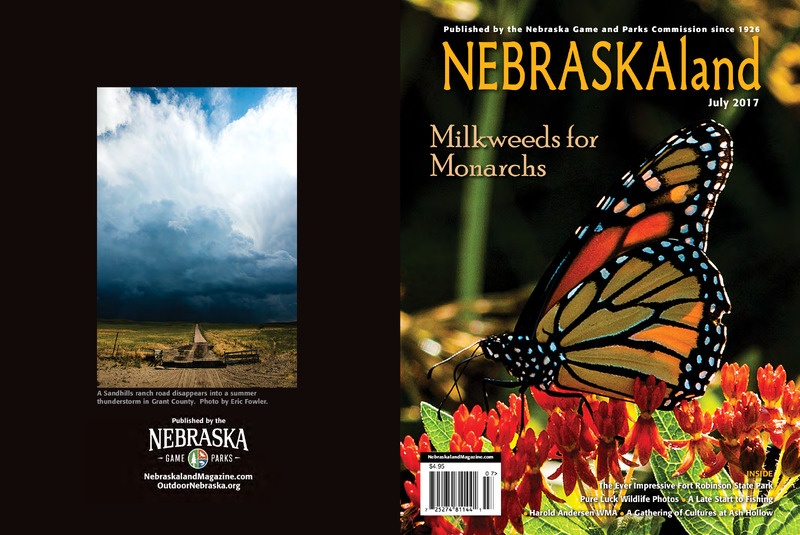
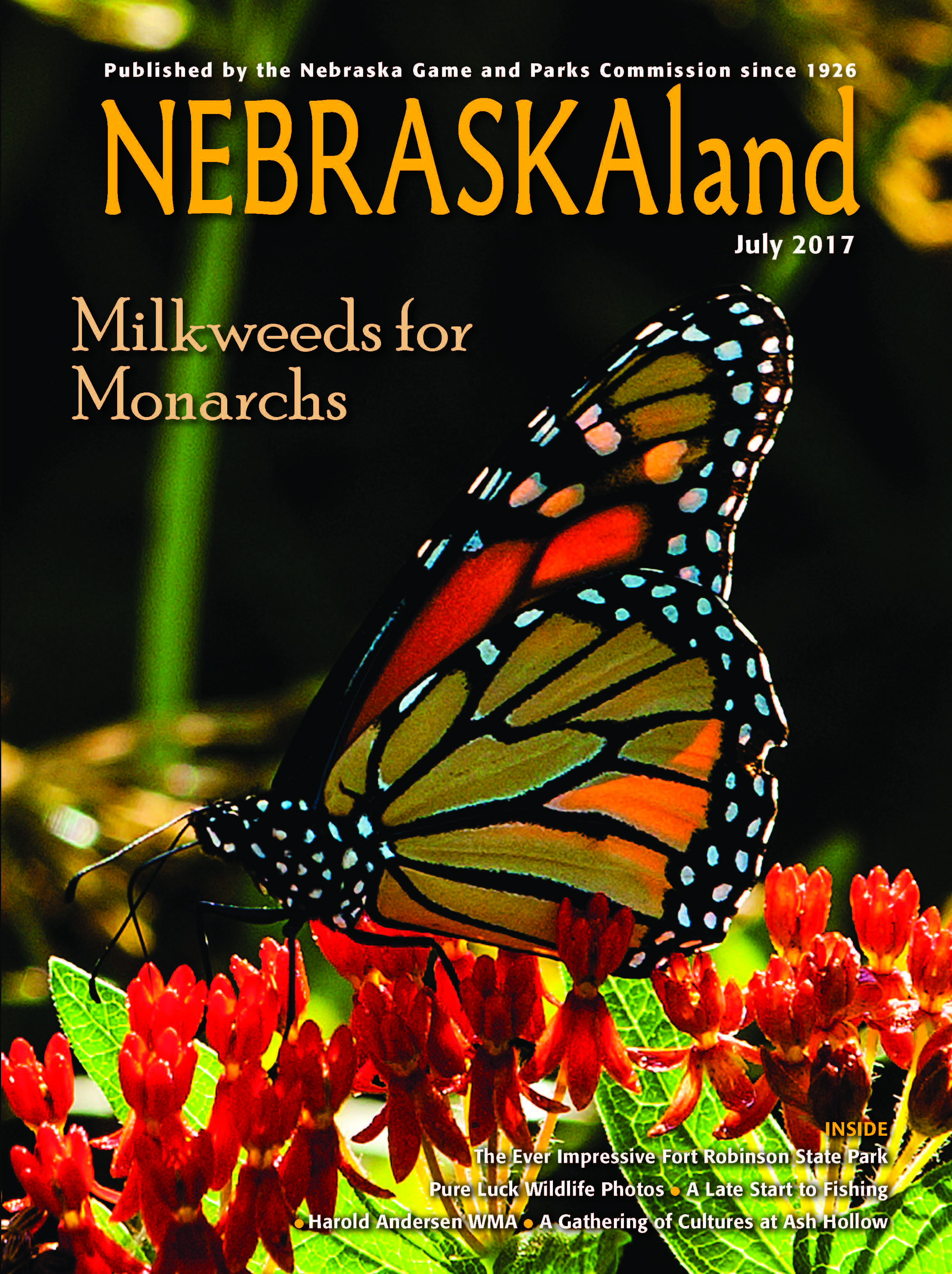
NEBRASKAland
Publis hed by the Nebr a s k a Ga m e a nd Pa r k s C o m m is s ion si nc e 1926
July 2017
Milkweeds for
Monarchs
A Sandhills ranch road disappears into a summer
thunderstorm in Grant County. Photo by Eric Fowler.
NebraskalandMagazine.com
$4.95
INSIDE
The Ever Impressive Fort Robinson State Park
Pure Luck Wildlife Photos l A Late Start to Fishing
l Harold
Andersen WMA l A Gathering of Cultures at Ash Hollow
NEBRASKAland Magazine
Volume 95
●
No. 6
●
July 2017
F EAT U R ES . . .
24 Fort Robinson State Park
The Ever Impressive
STORY AND PHOTOS BY JUSTIN HAAG
34 Time Well Spent – What to Do in July
B R
B
36 Wildlife Photography Through Pure Luck
Y ENAE LUM
(and curious animals)
STORY AND PHOTOS BY CHRIS HELZER
42 A Gathering of Cultures
BY RENAE BLUM
46 Jewel on the Middle Loup – Harold Andersen WMA
STORY AND PHOTOS BY ERIC FOWLER
52 Milkweeds for Monarchs
BY JENNY
NGUYEN
54 Starting Late – First-time Fishing for Adults
STORY AND PHOTOS BY JEFF KURRUS
36
●
I N S I D E T H I S I S S U E ...
Mixed Bag – The Raccoon, Travel to Northwestern
Nebraska, Edible Purslane and more .................................. 8
Nature Notes – Bee Flies ........................................... 58
Junior Journal – Total Solar Eclipse ......................... 59
Page 49 – Favorite Lure Memories.............................. 60
Outdoor Business – Small Grains, Big Results....... 64
Portraits from the Past – Reader's Photos ............. 66
In the Kitchen – Baked Fish Casserole ..................... 68
The Last Stop – The Big Show.................................. 70
THROUGHOUT 2017, NEBRASKALAND MAGAZINE WILL
PUBLISH ARTICLES ASSOCIATED WITH THE STATE'S 150YEAR CELEBRATION. LOOK FOR THIS LOGO TO READ ABOUT
NEBRASKA'S RICH HISTORY AND VIEW OUR INTERACTIVE
DIGITAL EDITION FOR MORE INFORMATION.
NEBRASKAland (VOL. 95 / NO. 6 ISSN 0028-1964) is published monthly, except
for the combined Jan./Feb. and Aug./Sept. issues, by the Nebraska Game and Parks
Commission, 2200 N. 33rd St., Lincoln, NE. Periodicals postage paid at Lincoln,
Nebraska, and additional mailing offices. POSTMASTER: Send address changes to
NEBRASKAland, P.O. Box 30370, Lincoln, NE 68503-0370.
2 NEBRASKAland • JULY 2017
54
●
42
●
24
●
Cover: A monarch butterfly feeds on a butterfly milkweed plant in
Lancaster County. Photo by Eric Fowler.
JULY 2017 • NEBRASKAland 3
Visitor
I was so happy to see this visitor
on page 21. I have land in Mills,
Nebraska, and a cabin. We enjoy seeing
deer and turkeys at our place. Thanks
again for a good magazine.
Helen Breland
Wiggins, Mississippi
I returned to Lincoln today and was
pleasantly surprised to find a package
from you containing a very sporty
mug, recognizing my submission
of the Visitor in the May edition of
NEBRASKAland Magazine. Thanks
for the mug and your efforts in making
the magazine one of the finest in the
country. As a subscriber of many years
the enjoyment that I receive as a reader
is a monthly pleasure.
My congratulations go out to all who
contribute in making your publication
a success.
Thanks again,
Frank Condello
Lincoln, Nebraska
"After a long flight north, this male indigo bunting probably needed to stop over at
the local watering hole and take a bath," said Ronald Hiett of Bellevue. Hiett took this
photo at Fontenelle Forest in May.
A photo of Chimney Rock in Morrill County by LaVerne James of North Platte.
4 NEBRASKAland • JULY 2017
JULY 2017 • NEBRASKAland 5
NEBRASKAland Magazine
Outdoor Plates
Sharill Luedtke of Martell borrowed
part of a line often used by Looney
Tunes star Tweety Bird to personalize
her Mountain Lion Conservation Plate:
“I tawt I taw a puddy tat.” After all ...
everyone has, she said.
If you have a unique outdoor
message plate you would like to share
or know someone who does, e-mail a
photo (high-resolution, JPEG format
only, please) to Eric.Fowler@Nebraska.
gov, along with your name, hometown
and a brief description of the interests
expressed on your license plate.
Kelly Keogh of Springview, Nebraska, calls this photo "Sandhills, the Good Life."
LaVerne James of North Platte shared
this photo of a fox kit near his home.
COMMISSIONERS
CONSERVATION OFFICERS
Director Jim Douglas
Commissioners
Chairman - Rex Fisher, Omaha
Vice Chairman - Dick Bell, Omaha
2nd Vice Chairman - Robert Allen, Eustis
Mark Spurgin, Paxton
Rick Brandt, Roca
Pat Berggren, Broken Bow
Jim Ernst, Columbus
Norris Marshall, Kearney
Dan Kreitman, Wahoo
ADMINISTRATION (Lincoln)
Craig Stover (Administrator)
Duane Arp (Asst. Administrator)
Jeff Clauson (Asst. Administrator)
MAGAZINE STAFF
Communications Director Christy Firestone
Editor Jeff Kurrus
Art Director Tim Reigert
Associate Editor Jenny Nguyen
Regional Editors Eric Fowler, Julie Geiser,
Justin Haag
Contributing Editor Michael Forsberg
Regular Contributors Renae Blum,
Chris Helzer, Chris Masada, Gerry Steinauer
Photo Librarian Jaclyn Cruikshank Vogt
Circulation Donna Robinson
For address changes and questions about
your subscription, e-mail donna.robinson@
nebraska.gov or call 800-632-5263
Advertising Sales Manager
For advertising information contact
Shane G. Gilster, 402-742-0125
Email: shanegilster@gmail.com
NEBRASKAland Magazine Copyright 2017, all rights reserved.
NEBRASKAland is available in audio from the Nebraska Library
Commission Talking Book and Braille Service, Suite 120, 1200 N St.,
Lincoln, NE 68508. 800-742-7691. NEBRASKAland Magazine and the
Nebraska Game and Parks Commission reserve the right to reject any
advertising not in keeping with the agency mission.
Rates: $18 for one year; $33 for two years; $44 for three years. Nebraska
recipients must add appropriate sales tax. To subscribe call
1-800-NEBLAND (632-5263), or go online to: NebraskalandMagazine.
com.
COMMISSION
C
CO
COM
OM
MMIS
MISSIO
S NO
OFFICES
FFICES
FF
FFI
S
Headquarters/Southeast District Office
2200 N. 33rd Street Lincoln, NE 68503
Phone 402-471-0641
Northeast District Office
2201 N. 13th St. Norfolk, NE 68701
Phone 402-370-3374
Richard Jones stitched 53 images together
to create this composite of the Great
Platte River Road Archway near Kearney.
Send your comments to:
Jeff Kurrus, Editor
NEBRASKAland Magazine
P.O. Box 30370
Lincoln, NE 68503
or e-mail Jeff.Kurrus@Nebraska.gov
Please include your postal address and telephone number. Letters may be condensed
and edited. Photographs are also welcome.
"Lucky Catch," by Casey Mitchell, was taken near his office at Wilderness Ridge in Lincoln, Nebraska.
6 NEBRASKAland • JULY 2017
Any program that receives federal funding from the National Park
Service, or the United States Fish and Wildlife Service prohibits unlawful
discrimination on the basis of race, color, religion, age, gender, marital
status, national origin, age, disability or political affiliation. Any person
who believes he or she has been discriminated against in any program,
activity, facility, or service, should contact the Nebraska Game and
Parks Commission, Lincoln, NE 402-471-0641, the Equal Opportunity
Commission, Lincoln, NE 402-471-2024, TTY/TDD 402-471-4693;
United States Fish Wildlife Service, Civil Rights Coordinator, 4401
N. Fairfax Drive, Arlington, VA 22203; Director, Equal Opportunity
Program, U.S. Department of Interior, National Park Service, 1849 C
Street NW, Mail Code 0008, Washington, D.C. 20240-0001.
Southwest District Office
301 E. State Farm Rd. North Platte, NE 69101
Phone 308-535-8025
Northwest District Office
East Hwy. 2, Box 725 Alliance, NE 69301
Phone 308-763-2940
Bassett Office
524 Panzer St., Box 508 Bassett, NE 68714
Phone 402-684-2921
Kearney Office
1617 First Ave. Kearney, NE 68847
Phone 308-865-5310
Ak-Sar-Ben Aquarium
21502 W. Highway 31 Gretna, NE 68028
Phone 402-332-3901
Omaha Office
8495 Frederick Street, Omaha, NE 68124
Phone 402-595-2144
402-471-5531
402-471-5531
402-471-5531
NORTHWEST (Includes counties covered)
Jim Zimmerman (District Supt.)
308-641-9590
Sean McKeehan
(Cheyenne, Morrill, Box Butte)
308-279-9133
Scott Brandt
(Kimball, Banner, Scotts Bluff)
308-631-0663
Dan Kling (Sioux, Dawes)
308-430-0572
Terry Brentzel (Deuel, Garden, Grant) 308-458-7650
402-389-0444
Frank Miller (Cherry, Hooker)
NORTHEAST (Includes counties covered)
Tom Zimmer (District Supt.)
402-649-8053
402-760-0712
Dale Davis (Keya Paha, Brown, Rock)
Greg Hesse
(Greeley, Wheeler, Boone, southern Antelope) 402-843-6567
402-340-3981
Jonathan Andreasen (Holt, Boyd)
Mitch Johnson (Knox, Antelope, Pierce) 402-613-8612
402-762-5022
Jeff Jones (Knox, Cedar)
Owen Johnson
(Dixon, Dakota, N 1/2 Thurston)
402-266-1759
Jon Reeves
(S 1/2 Thurston, Burt, Washington)
402-889-8508
402-719-1108
Dan Roberts (Dodge, Colfax)
Cory Krause
(Cuming, Wayne, Stanton, Dodge)
402-380-6410
Steve Oberg
(Colfax, Platte, Madison, Stanton)
402-910-3366
308-730-7050
Doug Pollard (Loup, Garfield, Valley)
Andrew Heyer (Pierce, Madison, Stanton) 402-613-2241
SOUTHWEST (Includes counties covered)
Roger Thompson (District Supt.)
308-530-3097
Taylor Dixon
(Dawson, Gosper, Phelps)
308-217-2108
308-202-0819
Matt Brandt (Sherman, Howard)
308-380-7331
Tim Williams (Hall, Hamilton, Merrick)
Pat George
(Harlan, Franklin, Phelps)
308-920-2762
Matt Andrews
(Gosper, Furnas, Frontier, Red Willow)
308-746-2418
Brian Piernicky
(Red Willow, Frontier, Hayes, Hitchcock)
308-340-6627
308-289-0427
Nicholas Fix (Keith, Perkins)
308-289-1169
Bryce Streger (Keith, Arthur)
Brandon O’Neal
(Lincoln, McPherson, Logan)
308-530-3157
Alex Hasenauer
(Lincoln, McPherson, Logan)
308-660-4671
Dale Johnson (Kearney, Buffalo)
308-440-3847
308-529-8146
Mike Thome (Dawson)
Ray Dierking (Custer, Thomas, Blaine) 308-870-0322
John Lee (Hitchcock, Dundy, Chase, Hayes) 308-414-1432
SOUTHEAST (Includes counties covered)
Levi Krause (District Supt.)
402-949-0593
402-619-1355
Rich Berggren (Douglas)
402-616-5961
Dan Evasco (Sarpy)
402-210-0888
Heath Packett (Cass)
402-209-1506
Russell Mort (Otoe, Johnson)
William Krause
(Nemaha, Richardson, Pawnee)
402-274-8063
Dan Zuehlke (Gage, Saline)
402-806-9084
402-890-6463
Dina Barta (Lancaster)
402-890-6465
Doug Kramer (Lancaster)
402-937-3422
Dudley Sorensen (Lancaster, York)
402-613-2312
Travis Shepler (Lancaster)
402-890-7140
Stacey Lewton (Lancaster, Seward)
402-443-6392
Mike Luben (Saunders, Butler, Polk)
Matt Taylor (Thayer, Fillmore, Jefferson) 402-200-9597
Nebraska Wildlife Crimestoppers
1-800-742-7627
JULY 2017 • NEBRASKAland 7
A Mammal
Brief
Lindsay Rogers is an outdoor
education specialist with the
Nebraska Game and Parks
Commission.
By Lindsay Rogers
8 NEBRASKAland • JULY 2017
PHOTO BY ERIC FOWLER
Procyon lotor
An extremely
adaptable animal, the
northern raccoon is
native to most of North
America including
Canada, the United
States and Mexico.
They can be found in
nearly any area with
accessible water, but
prefer wooded habitats.
Due to their adaptability,
raccoons are commonly
found in farmland, suburban and urban habitats where they forage for human foods including agricultural
crops, garbage and dog food. In non-urban areas, raccoons eat small mammals, crayfish, nuts and fruit – they
are true omnivores eating nearly anything they can find. Their front paws are remarkably human-like and allow
for catching prey and prying open fruits or nuts (and trash cans). Their Latin name “lotor” means “the washer”
and refers to their well-known behavior of washing their food. Population densities vary widely depending on
the habitat, but in general their numbers have risen since the turn of the century due to their ability to adapt to
human habitats. ■
JULY 2017 • NEBRASKAland 9
Travelogue
Travelogue Sponsor
Northwestern
Nebraska Trails
By Justin Haag
PHOTO BY ERIC FOWLER
A
s some travelers strive to get
off the beaten path this summer,
northwestern Nebraska has
hundreds of miles of paths to
help them do it.
The Pine Ridge region, with about
300 square miles of public land, has
a seemingly endless number of trails
to explore the forests, buttes, badlands
and grasslands that give this region its
diverse appeal.
The region has earned a recognition
by numerous national publications for
being a hidden jewel for horseback
riders, mountain bikers and others
looking for a backcountry experience.
Whether trails enthusiasts enjoy
exploring the countryside on rugged
single-tracks, two-track pasture trails or
gravel roads, they are sure to enjoy the
opportunities of northwestern Nebraska.
The trails within the Pine Ridge
escarpment take visitors through
ponderosa pine forests, high on rocky
buttes to the cold-water streams in
lower elevations.
Both Fort Robinson State Park,
with more than 100 miles of trails,
and Chadron State Park, with another
331⁄2, offer trails for a variety of users.
Mountain bike rentals and guided
Kristen O'Brien and Alex Helmbrecht enjoy the view on top of Red Cloud Buttes at Fort
Robinson State Park.
horseback rides are available at each
location. In addition, the Pine Ridge
Ranger District of the Nebraska
National Forest has hundreds of miles
of trails in Dawes County designated
for both motorized and non-motorized
recreational use.
Another out of the ordinary
experience awaits hikers and riders in
the grasslands and badlands of northern
Sioux County. The Hudson-Meng Trail
leads visitors between two fascinating
paleontology attractions on the remote
Oglala National Grassland. The threemile journey connects the Hudson-Meng
Bison Kill and Toadstool Geologic Park.
In 2015, an article in USA Today listed it
as one of the 10 best trails in the nation
for a memorable spring hike.
With a grant from the Nebraska
Tourism Commission, the Dawes
County Travel Board has worked with
local agencies and organizations to
identify a series of trail complexes
with convenient loops in the region.
That map and many other materials for
trails enthusiasts are available at the
Northwest Nebraska Visitors Center on
Highway 20 in Chadron.
For those who want to do their
scouting online, digital mapping
resources are available. Maps of the
region’s public lands and trails can
be found at maps.outdoornebraska.
gov, www.fs.fed.us/visit/maps and
DiscoverNWNebraska.com. ■
While in the Pine Ridge
While breaking from steps on the
trails of Northwest Nebraska, take
steps back in time at one of the
many museums in the area.
PHOTO BY JEFF KURRUS
Crawford Historical Society
Museum, Crawford
Hudson-Meng Bison Bonebed,
Crawford
Museum of the Fur Trade,
Chadron
Mari Sandoz High Plains Heritage
Center and C.F. Coffee Gallery,
Chadron State College
Dawes County Historical Museum,
Chadron
Sioux County Historical Museum,
Harrison
Dr. Jerry McLain rides a trail near The Cliffs Picnic Area southeast of Chadron.
10 NEBRASKAland • JULY 2017
JULY 2017 • NEBRASKAland 11
A Brief History
1930 Roller Coaster Disaster
By the Nebraska State Historical Society
B
anner newspaper headlines across Nebraska on July
25, 1930, announced a deadly roller coaster accident,
the worst in American history up to that date. The
mishap had occurred the evening before at Omaha’s
Krug Park, located at 2936 North 52nd Street, when a fourcar train loaded with passengers left its track and plunged
about thirty-five feet from the trestle of the “Big Dipper”
roller coaster. The Omaha World-Herald said on July 26:
“In the brief moment while the cars poised at the edge of
the track, two of them dangling over the side, passengers
screamed and clawed frantically at the ‘safety belts’ which
held them to the cars.”
Krug Park, established in 1895 as a beer garden by
German-American Charles Tietz, was later operated by
the Fred Krug Brewing Company as an amusement park.
Contemporary advertisements describe it as “Omaha’s
Polite Resort.” The Omaha Daily Bee on July 22, 1901,
reported that 21,685 people had passed through the gates the
previous day. “The only thing that kept this number from
being swelled to a much larger figure was the inability of the
street cars to carry more ... The dog and monkey show, with
the high jumps and parachute leaps of the animals, proved
as popular as ever and the shooting gallery, bowling alleys,
merry-go-round and myriad other attractions were the scenes
NSHS RG3348-6-266
of little pleasure parties from the time the grounds opened
in the morning until the gates were closed when the last cars
commenced to make their way to the city.”
The 1930 roller coaster mishap resulted in four deaths and
many injuries, causing a near panic at the park. The WorldHerald said on July 25: “Following the accident hysterical
crowds rushed to the scene and police had to divide time
between battling the crowds and aiding the injured ... The
accident occurred on the Fifty-second street side of the park,
three-fourths of a block north of the entrance. A crowd of
curious onlookers thronged the Fifty-second street side of
the park until nearly midnight. An extra detail of police were
necessary to handle the dense traffic that steered toward the
place when news of the tragedy spread.”
Omaha officials moved speedily to determine the cause
of the accident. City Commissioner John Hopkins, who
surveyed the scene, told the World-Herald that there had
evidently been some object on the track that derailed the
first car. It was later reported in the press that the accident
was caused by a loose bolt on a brake shoe. The brake shoe
fell under one of the front wheels. This derailed the first car,
which then pulled the other three with it. Three of the cars
overturned, pinning most of the occupants beneath them.
The unconscious victims were pulled from the wreckage and
taken to hospitals in private cars before ambulances arrived.
Following the accident, Krug Park was
closed for the evening at the suggestion of
Commissioner Hopkins but reopened the next
day, except for the roller coaster. Business
declined, however, and the park was closed
for good in 1940. ■
Above: Omaha’s Krug Park from a postcard mailed in
1906. Opposite: The Omaha World-Herald reported on
the crash in its July 25, 1930, issue with photos of the
damaged roller coaster.
Visit the Nebraska State Historical Society’s
website at nebraskahistory.org.
12 NEBRASKAland • JULY 2017
JULY 2017 • NEBRASKAland 13
Loaner Bikes at Fort Kearny SRA
14 NEBRASKAland • JULY 2017
PHOTO BY JULIE GEISER
By Julie Geiser
Lois and Jodie Bruning have been campground hosts
for five years at the Fort Kearny State Recreation Area.
During this time, they have often noticed kids who forgot
their bikes or had flat tires, and as a result missed out on
the chance to ride around the park and down the newly
finished hike/bike trail.
Since 2014, the Brunings have loaned bikes to anyone
who wants to ride. The bikes are available on the honor
system and people can simply stop by their camper and
take a bike for a spin – all they ask is that the bikes are
returned when people are done using them.
The Brunings offer 80-plus bikes in an assortment
of colors, sizes and brands; they even have some with
training wheels, along with scooters and mountain bikes.
Most of the bikes were purchased by Lois from an
online garage sale site. The bikes are maintained by Jodie
in an attachment he made for the back of their camper.
In the winter months the bikes are stored at the couple’s
farm, where Jodie gives each a tune-up before the busy
summer season.
This program is unique to Fort Kearny and is completely
funded and run by the Brunings. The program is a great
asset to the SRA and those who just want to ride. ■
JULY 2017 • NEBRASKAland 15
Wild Edibles – Purslane
By Julie Geiser
My favorite wild edible is purslane (Portulaca oleracea). I
admire its taste, texture, nutritional value and many different
uses, and I cannot wait for this succulent crop to sprout
every year. However, purslane is often sprayed or pulled, as
it is misunderstood as an unwanted weed that will spread and
take over an area throughout the summer months. You can
find it growing rampantly in lawns, cracks in city sidewalks,
roadsides, and vacant lots or crop fields.
The leaves, stems, flowers and seeds are all edible and
can be used many different ways. I love to pick the leaves
and stems directly from the plant and eat them, knowing
that these plants growing in my yard are free of pesticides.
However, always wash plants before use. Their flavor is
similar to watercress – slightly lemony and crunchy – and
the leaves and stems are great in place of lettuce or pickles
in a sandwich. Leaves, stems and flowers can be eaten raw
in salads and smoothies or sautéed in oil and used as a side
dish. They are also delicious in a stir fry mixed with other
vegetables and rice or used in casseroles and soups.
Young plants start to appear in June, and by July, they
are readily available and will begin flowering. Purslane is
a hardy, annual herb with numerous branches originating
from a central root. The branches and leaves are smooth,
fleshy and sometimes have a red or purple tinge to them.
Leaves resemble a small jade plant and are flat, oval and are
nearly opposite to randomly arranged on the branches. The
flowers are small and yellow, and they typically open in the
mornings when there is sunshine. The plant’s seeds are small
and contained in a capsule that opens into two parts. The
seeds and loose stems will reproduce a new plant; the seeds
can live up to 40 years in the ground and withstand extreme
cold temperatures.
If you wish to save the seeds, the plant can be seeded
indoors in the spring to get a jump-start on the growing
season. Purslane can also be transplanted and grown indoors
for a month or so after the summer growing season.
Purslane does have a poisonous look-alike called hairystemmed spurge (Euphorbia vermiculata), but it is easy
to distinguish the two plants. Hairy-stemmed spurge has a
milky sap that can be seen if you cut or snap the stem in two.
Purslane has been dated back to prehistoric times, and in
many parts of the world today, it is grown in gardens as a
valuable food source. It contains more omega-3 in its leafy
greens than eating fish or taking supplements, and it is also
full of other vitamins and minerals. Purslane’s other health
benefits include stimulating blood circulation, protecting
against osteoporosis, lowering bad cholesterol levels, and
preventing macular degeneration, cataracts and some cancers.
The only downside of purslane is that it contains oxalic
acid, which may cause the formation of kidney stones. If
you have problems with kidney stones, check with a doctor
before consuming. However, boiling purslane in water
eliminates much of the oxalic acid without losing other
nutrients. Before eating any plant, make sure to positively
identify it and do your research. ■
Purslane has numerous branches originating from a central root. By July the plant will take over the area where it is growing.
Resembling a small jade plant, purslane is delicious alone or with vegetables and rice or used in casseroles and soups.
16 NEBRASKAland • JULY 2017
JULY 2017 • NEBRASKAland 17
Backyard Monarchs
By Kristal Stoner
18 NEBRASKAland • JULY 2017
PHOTO BY JEFF KURRUS
Typically monarch butterflies arrive in Nebraska
from farther south in early June. The first generation
of butterflies to leave Mexico likely stop in Texas or
Oklahoma to lay eggs, and we see the second generation
in Nebraska. The monarchs in our backyards and fields
are looking for food both for their young and themselves.
Monarch caterpillars are specialists and feed only on
milkweed, so adult females will seek out one of the
species of milkweed found in Nebraska. Common,
swamp, whorled and showy milkweed are some of
the best for monarch caterpillars. Adult monarchs are
generalists, so they look for nectar from a variety of
blooming flowers.
You can create monarch habitat in your own backyard.
Monarchs thrive and reproduce in an area as small as
a 10-square-foot plot. Monarchs breed in Nebraska
all summer and go through several generations, so to
support the entire life cycle, they need both milkweed
and a variety of flowers, preferably native, that bloom
from spring until fall. Visit OutdoorNebraska.org/
monarch for a plant list for monarch gardens to take to
your local nursery. Visit the website Journey North at
learner.org/jnorth to track the monarch migration each
year. ■
Presented by
Chadron State Park
When It is Not an Emerald Ash Borer...
By Jeff Kurrus
Ponca State Park
Suitable for swimmers of all ages,
Ponca’s new aquatic center features a
heated zero-depth entry pool, 172-foot
long water slide, climbing wall, diving
board, and spray features for small
children. Older swimmers may enjoy pool
games such as basketball and volleyball.
The bathhouse offers a concession area
for all park visitors.
PHOTO BY JEFF KURRUS
Niobrara State Park
Conveniently located near the park’s
cabins, Niobrara State Park’s swimming
pool offers visitors a way to cool down in
the summer-time heat. This modern pool
is handicapped accessible by a recently
installed pool lift.
MARK DREILING, BUGWOOD.ORG
Eugene T. Mahoney State Park
This aquatic center boasts a zero entry
wave pool, two waterslides, and other
water-based activities for all ages. For
smaller crowds, visit from 6-8 p.m. during
the weekdays.
redheaded ash
borer is 1⁄2 inch
in length and has
a burnt reddish
color with distinct
yellow lines
across its back.
Adults emerge
in the spring and
lay eggs in bark
cracks.
The life cycle
of the banded
ash borer is very
similar; however,
the adult beetles
are darker in
color, with shorter
legs than the redheaded ash borer, and
have whitish bands instead of yellow.
Larvae of both species feed under the
bark before moving into the sapwood.
The adult exit holes of these borers are
round and larger than EAB exit holes.
Remember, not all borers are EAB,
and effective management requires
accurate diagnosis. ■
Ponca State Park
Fort Robinson State Park
Rain or shine, the indoor Olympicsized Lindeken Pool at Fort Robinson
State Park is popular among visitors. In
addition, the outdoor wading pool and
deck caters to sun-worshippers and the
youngest of water-lovers.
20 NEBRASKAland • JULY 2017
PHOTO BY JEFF FIELDS
Platte River State Park
This small pool offers families a quiet
setting between the towns of Louisville
and South Bend off of Highway 66. Once
you're done visiting the pool, take the
little ones down to Crawdad Creek at the
upper end of Jenny Newman Lake for
more water-related fun. ■
JULY 2017 • NEBRASKAland 21
WHITNEY CRANSHAW, BUGWOOD.ORG
Mahoney State Park
a clearwing moth, not a beetle, and
the adult is often confused for a wasp.
Larvae are round and white, feeding
under the bark then tunneling into
the sapwood, unlike EAB larvae that
remain just under the bark.
The exit holes of the ash-lilac
borer adults are round and 1⁄4 inch in
diameter, much larger than EAB’s 1⁄8inch D-shaped exit holes. The adult
moth will often
leave its pupal
skin stuck in the
exit hole as it
leaves the tree.
The banded
ash clearwing
(Podosesia
aureocincta) is a
closely related insect. However, these
adults emerge in the fall, while ashlilac borer adults emerge in spring.
Several round-headed borers are
known to infest ash trees, including
the redheaded ash borer (Neoclytus
acuminatus) and the banded ash
borer (Neoclytus caprea). The adult
STEVEN KATOVICH, BUGWOOD.ORG
Chadron State Park
For visitors who like scenery as they
swim, they will be hard-pressed to find a
better location than Chadron State Park.
The spacious outdoor pool overlooks the
picturesque Pine Ridge. As a bonus, the
bath houses were renovated in 2016.
PHOTO BY ERIC FOWLER
Being the hottest month of the year in
Nebraska, there is no better place to be
than poolside. And there are no better
places to do this than at a number of
Nebraska's state parks. Here is our list:
By Julie Van Meter
State Entomologist, Nebraska
Department of Agriculture
The exotic, invasive
emerald ash borer (Agrilus
us
planipennis), or EAB, wass
found infesting ash trees
in Nebraska in 2016.
However, a number
of native borers infest
ash trees, too, and treatment needs
d
differ depending on pest species.
Trees decline for many reasons, and
symptoms of decline are similar for
most pests. It is important to correctly
diagnosis the pest before making
management
decisions.
One of the most
common borers
of ash is the
native ash-lilac
borer (Podosesia
syringae), which
infests both
ash trees (Fraxinus spp.) and lilac
bushes (Syringa spp.). This insect is
GYORGY CSOKA, BUGWOOD.ORG
Poolside –
State Park Style
by Jerry Kane
July 1
Archery Fishing
July 4
Fourth of July Barbecue
July 12
State 4-H Camp
Archery fishing of game fish is allowed
statewide through Dec. 31
Fort Robinson SP, Crawford
Calamus Reservoir SRA, Burwell
July 5, 19
Family Fun Night
July 13
Family Fishing Event
Red Willow Reservoir State Recreation
Area (SRA), McCook
Lake Halleck, Papillion
July 1
Spearfishing
Underwater spearfishing of game fish
allowed in specific waters through Dec.
31 (see page 19 of 2017 Fishing Guide)
July 1
Rimfire Steel Plate Challenge
Platte River State Park (SP), Louisville
July 1-2
Living History
July 7
Lottery Permits
City Park, Holdrege
Final day to apply for Nebraska Super Tag
July 15
and Combo lottery permits
July 8
Bighorn Sheep Hike
Carp-O-Rama
Lake Maloney SRA, North Platte
July 15
Prairie Grass Hike
July 1-2, 4
Living History
July 15
Beyond BOW Niobrara and Missouri
River Kayaking Trip
July 1-4
Western and Wildlife Art Show
Fort Robinson SP, Crawford
July 1-14
Paddlefish
Paddlefish snagging permit application
period
July 1, 8, 15, 22, 29
Buffalo Steak Night and Free Movie
Platte River SP, Louisville
July 2
Sidewalk Chalk Art
Niobrara SP, Niobrara
Family Fishing Event
Riverside Discovery Center Pond,
Scottsbluff
July 10
Big Game Permits
Rock Creek Station SHP, Fairbury
Niobrara SP, Niobrara
Remaining big game hunting permits may July 15
be purchased, beginning at 1 p.m. Central Ranch Life in the 1860s
Rock Creek Station SHP, Fairbury
Time, through the close of the seasons
The wranglers of Fort Robinson
State Park make their way along
the parade route during the annual
Crawford Fourth of July celebration
July 22
Beyond BOW Native Plants and
Uses Event
Fort Hartsuff SHP, Burwell
July 25-27
Wilderness Awareness Camp
July 10-31
Deer Hunting Application
July 15
Kite Day Walk
Application period for Gifford Point WMA
special access permits for deer hunting
Niobrara SP, Niobrara
Nebraska Game and Parks Outdoor
Education Center, Lincoln
July 15
Geocaching
July 27
Family Fishing Event
July 11
Family Fishing Event
Oak Lake, Lincoln
July 11
Monarch Monitoring Project
Nebraska Game and Parks Northeast
District Office, Norfolk
Families fish at
the annual CarpO-Rama event
at Lake Maloney
State Recreation
Area in North
Platte.
Niobrara SP, Niobrara
Benson Park, Omaha
July 15
Republican Valley Archery 3-D Shoot
July 28
Family Fishing Event
Red Willow Reservoir SRA, McCook
Melham Park, Broken Bow
July 18
Family Fishing Event
July 29
Campfire Christmas in July
Lake Zorinsky, Omaha
Indian Cave SP, Shubert
July 19
Family Fishing Event
July 29
Jingle Bell Junk and Craft Market
Bowling Lake, Lincoln
July 20
Family Fishing Event
Skyview Lake, Norfolk
July 21
BASS State High School Fishing
Tournament
NEBRASKAland
Visitor
Last issue’s winner of
the Visitor drawing was
Leo Turner of Lisco, Nebraska, who
found the pine sawyer beetle on page
21.
Readers are encouraged to contact
NEBRASKAland within 10 days after
this issue’s publication with the
correct page number and name of
this issue’s “Visitor” – a critter found
in Nebraska. We will then gather the
correct entries and draw one to win a
NEBRASKAland mug.
To enter each month, write:
NEBRASKAland Visitor
2200 North 33rd Street
Lincoln, NE 68503
Or e-mail: Tim.Reigert@Nebraska.
gov with “Visitor” in the subject line
of the message.
HINT: This issue’s visitor is not on
page 15, 18, 21, 23, 35, 41, 52, 58
or 71.
From Facebook
We posed this question on the
Nebraska Game and Parks Facebook
page, and were given a number of
answers that only furthered our desire
to be outdoors this summer. Here are a
few of those responses:
July 14
Family Fishing Event
Wildcat Hills SRA, Gering
Fort Atkinson State Historical Park (SHP),
July 9
Fort Calhoun
Fort Kearny SHP, Kearney
A Camp out
Isn't Complete
Without...
Contact the Nebraska Game and Parks Commission at 402-471-0641 or
visit OutdoorNebraska.org for more information.
Visit HuntSafeNebraska.org for a list of hunter education classes and
BoatSafeNebraska.org for a list of boating safety classes.
Indian Cave SP, Shubert
Beyond BOW kayakers
prepare to paddle under
the Chief Standing Bear
Memorial Bridge on the
Missouri River.
“S'mores!” – Joe Holstedt
“Stargazing!” – Bobbi Holm
“Mosquitos.” – Milton A. Gabriel
“Friends, Fire, Stars.” – Zach Hanson
“A good strong campfire, with plenty
of coals in the morning to build back
up and make breakfast with.” – Nick
Fritsch
“Family.” – Ben Collingham
“Prairie.” – Benjamin Vogt
“Ticks.” – Tom Lynch
“A cooler on wheels.” – Chris
McKay
“Starry nights and a hammock!” –
Mary Gallagher
“Campfire.” – Katrina Lynne
“Family, friends, and being able to
relax and enjoy.” – Carol Kohn
“Comfortable lounge chairs!” – Jason
Ratkovec
“Fishing for dinner.” – Duane Long
“Marshmallows.” – Robbi Gould
“Peace and quiet. Solitude.” –
Stephanie Voge Brown
“The sound of crickets.” – Cindy
Frost
“Bug spray.” – Patty Burke
“Good friends and family, kids
exploring and s’mores.” – Karen Kader
“Me.” – Brad Cyriacks ■
Merritt Reservoir SRA, Valentine
July 21-23
Convergence on Sacred Ground
Ash Hollow SHP, Lewellen
Merritt Reservoir SRA, Valentine
22 NEBRASKAland • JULY 2017
PHOTO BY JUSTIN HAAG
July 22
TBF SAF State High School Fishing
Tournament
Several species of pine sawyer
beetles (Monochamus spp.),
including the white spotted,
northern, and Carolina, are found
infesting dead and dying conifers
across Nebraska. These longhorn
beetles range in body length
from about 0.75-1.5 inches, with
antennae longer than their body.
Female beetles lay eggs in a niche
they chew into the bark of the tree.
Larvae are legless, roundheaded
borers and feed under the bark
and into the sap- and heartwood,
creating tunnels filled with coarse
frass. It is possible to hear the
larvae feeding under the bark.
Eventually mature larvae pupate
and adult beetles emerge from
the tree, leaving round exit holes.
Adults, which can be found spring
through fall, will then
throug
feed on bark and
fee
evergreen needles,
eve
but they cause
little
damage.
da
Special thanks to Julie Van Meter,
State Entomologist, Nebraska
Department of Agriculture.
JULY 2017 • NEBRASKAland 23
Fort Robinson State Park
The Ever Impressive
Story and photos by Justin Haag
For almost as long as Nebraska has been a state, there has been a Fort
Robinson. The fort’s scenic grounds have had many uses on their way
to becoming the popular vacation getaway of today.
Trail rides are a favorite activity at the Fort.
A wrangler leads this group near Red Cloud Buttes.
24 NEBRASKAland • JULY 2017
JULY 2017 • NEBRASKAland 25
I
t does not take long for a visitor
of
o Fort Robinson State Park to
fall
fa in love with the place.
Even
the locals seem never to
E
become
weary of spending time
b
at northwestern
Nebraska’s flagship
north
attraction, with activities as diverse as
its expansive, beautiful landscape. One
observation penned by a newspaper
editor surely had it right:
“No visitor or tourist in that vicinity
neglects the opportunity of viewing and
enjoying an afternoon at the Fort. Filled
with sights so interesting and history so
thrilling that the same never grows old
or tiresome to the most familiar.”
Such praise has become common
enough for Fort Robinson that the
editor’s remark may seem trite.
Extraordinary, though, is that the
sentiments were written in 1907, 110
years ago and just a few decades after
the U.S Cavalry first set up camp in
this northwestern Nebraska setting.
From the beginning, visitors have
recognized Fort Robinson, with its
pine-studded buttes rising above
sweeping grasslands at the confluence
of two coldwater streams, as a
special place. As time goes on, those
attributes seem only to gain value.
Throughout almost all of Nebraska’s
150 years of statehood, Fort Robinson
has been making history, compiling
a story as rich as that of any other
Nebraska attraction. As Nebraska’s
largest state park, the fort continues
to offer a wide range of experiences
sure to be memorable for visitors
of all ages and interests. While
history remains a big part of the
fort’s appeal, much of its reputation
now centers on fun. It has become
the choice destination for families
wanting to experience a vacation rich
with horseback riding, swimming,
Carter P. Johnson Lake often attracts anglers and other visitors with small watercraft.
camping, fishing, hiking, biking,
hayrack rides, cookouts, floating the
river, watching a Broadway show or
just hanging out in a scenic place. Fort
Robinson is always sure to impress.
An Evolving
Mission
A mountain bluebird lands on a sunflower stalk near Cherry Creek Pond. Fort
Robinson State Park abounds with birds and wildlife viewing opportunities.
26 NEBRASKAland • JULY 2017
Fort Robinson State Park has its
roots in the U.S. military, dating back
to the 1870s and running up to the mid20th century. Historians regard it as
one of the most significant destinations
for reliving the days of the U.S.
Cavalry, the Indian wars and EuroAmerican settlement of the West.
Camp Robinson, as the military first
named the outpost, was established
in 1874 to provide security for the
Red Cloud Agency. The agency was
one in a series of such sites the U.S.
Government established to distribute
materials promised to displaced Native
Americans by treaty. In 1878, the name
changed to Fort Robinson, signifying
a more permanent existence. The U.S.
military retained a presence there
throughout World War II, using the site
for an evolving set of roles.
Certainly, history has not looked
favorably on all of Fort Robinson’s
years – most notably the early conflicts
between the cavalry and the Indians.
The most notorious event to happen
at Fort Robinson was the Cheyenne
Outbreak. During that episode of
almost three months in 1878-1879, the
army captured a band of 149 Northern
Cheyenne Indians led by Chief Dull
Knife south of Chadron and detained
them in barracks at the fort. The group
had escaped reservation lands in
present-day Oklahoma and was enroute
to their homeland on the northern
Plains. The situation became dire as
officials in Washington insisted that the
group return south, as the Indians were
just as insistent on moving north. In an
act of persuasion, the army barred the
windows of the barracks and refused
the Cheyennes food and fuel. On a
freezing January night, the Cheyennes
shot the guards with weapons they had
hidden and escaped from the barracks.
Several conflicts ensued in the buttes
and grasslands west and north of the
fort, resulting in the death of 64 of the
Indians and 11 soldiers. Most of the
Fort Robinson
State Park
Located near Crawford with 22,000 acres
straddling the border of Dawes and Sioux
counties, Fort Robinson is Nebraska’s
largest and westernmost state park.
surviving Indians were recaptured.
Camp Robinson was also the site
of the 1877 killing of Oglala Sioux
leader Crazy Horse. He surrendered
to U.S. troops in May 1877 at the end
of the Great Sioux War and was killed
JULY 2017 • NEBRASKAland 27
The park rodeo, which features park employees and others from the surrounding community, entertains visitors each Thursday
night during the summer.
on Sept. 5. The Sioux leader had been
falsely accused of threatening to kill
an army general, and a cavalry soldier
fatally stabbed him with a bayonet as
he resisted arrest.
Fort Robinson would later become the
home of the Ninth and Tenth Cavalry,
the all-black regiments dubbed “buffalo
soldiers” by the Plains Indians. Between
1885 and 1907, most of the soldiers at
the fort were African-American.
As time went on, the United States’
conflicts shifted to enemies outside its
borders and fewer troops were needed
on the Plains. The fort shifted gears
again and became a quartermaster
remount depot, charged with training
and breeding horses and mules for the
military. The fort gained a reputation
as the nation’s largest and best such
facility, and the soldiers there boasted
of being the world’s finest horsemen.
In the 1930s, the U.S. Olympic
equestrian team even trained at the fort.
A dancer’s headwear stands out against the sunset during the Fort Robinson
Intertribal Powwow.
28 NEBRASKAland • JULY 2017
Its final significant roles with the
military came during World War II as a
training center for the U.S. K-9 corps,
which readied dogs for use in battle,
and a German prisoner of war camp.
The K-9 training area housed 1,800
dogs as they became guards, scouts,
messengers and sled-pullers. About
5,000 dogs, half the number used
during WWII, received training there.
The POW camp was designed to hold
3,000 men, and its population primarily
consisted of German soldiers in the
Afrika Korps. The prisoners worked on
area farms, earning a wage set by the
Geneva Convention. Some even stayed
in the area after the war was over.
In 1947, the U.S. military abandoned
the fort. It was later transferred to the
U.S. Department of Agriculture for use
as a beef research station. In 1953, 90
buildings were considered dilapidated
beyond repair, labeled surplus and
demolished. The research station later
moved to the old Naval Ammunition
Depot at Hastings, making way for the
fort’s present role.
The fort’s latest chapter began in
the early 1960s when the Nebraska
Game, Forestation and Parks
Commission – one of the Game and
Parks Commission’s previous names –
obtained a 75-acre parcel of land within
the current park’s boundaries. The
federal government deeded over much
of the fort’s land to the Commission
in 1964, and the addition of the James
Ranch in 1972 created the park’s
expansive 22,000-acre complex.
Park visitors cool off and enjoy the swimming pool, while others embark on a stagecoach ride – a longtime popular attraction.
Family Time
Ever since the Nebraska Game and
Parks Commission assumed ownership of
Fort Robinson, visitors have considered it
a jewel of the state park system.
With its many lodging options and
diverse activities for all ages, Fort
Robinson has become a popular place
to gather with family and friends. As
one example of its prominence, USA
Today listed it as one of the best places
to have a family reunion.
Most visitors begin their Fort
Robinson experience at the lodge, with
its information booth, permit sales, fullservice restaurant, gift shop and hotel
style lodging. The stately building,
which serves as the park’s headquarters,
was constructed in 1909 as barracks.
Many of the fort’s original officers’
quarters now serve as lodging, while
other buildings have been modernized
to serve various purposes. Because
the buildings were constructed in
varying sizes during separate eras of
construction, groups as small as two and
as large as 60 people can gather under
one roof.
Even the 500-square-feet duplex
officers’ quarters made of adobe bricks
and covered with wood siding during
the fort’s earliest days are among the
lodging available to visitors. Families
often gather in “the bricks,” “the
adobes” and Comanche Hall, the
buildings adorning the north and west
sides of the park’s horseshoe drive.
Modern construction at the fort
appropriately blends with the park’s
historical appeal. In 2015, the fort
welcomed a reconstruction modeled
after officers quarters originally built in
1891, an impressive blend of modern
amenities in a historical package.
The Buffalo Soldiers Barracks was
reconstructed by the park at the turn of
the 21st century to serve as the primary
space for large meetings, wedding
receptions and other group events.
Included among them is the fort’s
annual Historical Christmas Dinner,
in which attendees dine from a menu
replicated from the fort’s military days
while dressed in period attire.
Fort Robinson’s campgrounds also
feature variety. Travelers will find
sites ranging from full RV hook-ups to
primitive tent sites. Most of the sites are
spacious with shade, some situated right
along Soldier Creek.
Visitors looking to cool off will enjoy
the indoor Olympic-size swimming
The Fort’s Many Roles
1873: Red Cloud Agency moved from North Platte River to White
River near Crawford.
1874: Camp Robinson established to provide security at Red Cloud
Agency
1877: Crazy Horse killed at Camp Robinson
1878: Camp Robinson named Fort Robinson, indicating permanent
status.
1879: Cheyenne Outbreak
1885: 9th Cavalry Regiment, known as the Buffalo Soldiers,
stationed at Fort Robinson
1919: Fort Robinson becomes Quartermaster Remount Depot
1942: K-9 Training Center established
1943: German POW Camp established
1949: USDA Beef Research Station opens
1962: Fort Robinson becomes Fort Robinson State Park
1972: James Ranch acquired, boosting park’s size to 22,000 acres
JULY 2017 • NEBRASKAland 29
A jeep makes its way down the trail after visiting the Cheyenne Buttes.
pool, a float down the White River on
rented tubes or kayaks, or a cold snack
from the Sutler’s Store activities center.
Top-notch entertainment is
offered during matinees and evening
performances at the Post Playhouse,
the highly acclaimed and independently
operated summer repertory theatre
featuring popular Broadway musicals
with professional actors. The playhouse
is celebrating its 50th anniversary
this year and has many special events
scheduled to mark the occasion.
Horses, of Course
Visitors to Fort Robinson soon
realize they are in horse country. A
sign at the entrance of the headquarters
evokes visions of the park’s history
as a cavalry post and remount station:
“Through These Portals Passed the
An adult bison grazes with a calf along Smiley Canyon Drive.
Pronghorn (Antilocapra americana) run below the scenic buttes at Fort Robinson State
Park.
30 NEBRASKAland • JULY 2017
World’s Finest Horsemen.”
Horsemen and horsewomen of all
skill levels revel in a landscape fit for
a Western movie while the park offers
opportunities for riders of various skills.
Riders who bring their own horses
can used marked trails or venture off
the beaten path to explore the area.
Annual gatherings of horse enthusiasts,
such as the American Paint Horse
Association, have bolstered the park’s
reputation as first-rate riding ground.
No special permission is required to
ride at Fort Robinson, but a few rules
have been established. To ensure park
safety and cleanliness, no riding is
allowed near lodging or camping areas.
Private horses also are not allowed
on the two trail ride routes while park
rides are in session. Overnight guests
with horses must rent a stall, but the
barn’s location near a campground
specially designed for equestrian
visitors and other lodging ensures that
animals will be nearby.
Also adding to the park’s Wild West
appeal are weekly rodeos to entertain
visitors during the summer. There are
also horse-drawn wagon tours, rides on
a vintage stagecoach, hayrack breakfast
rides and chuck wagon dinners.
Getting Around
the Park
If horses are not your preferred mode
of travel, there are plenty of other ways
to take in the park’s sights. A guided
jeep tour, for instance, takes visitors to
the top of the Cheyenne Buttes for an
amazing view of the park below.
With more than 100 miles of trails,
Fort Robinson is popular among hikers,
mountain bikers and cross country
skiers. Mountain bike rentals are
available at the park’s activities center
for those wanting to explore the area.
Well-maintained paved and gravel
roads course through the acreage.
A favorite drive within the park is
Smiley Canyon, which once served as
the main highway between Harrison
and Crawford. Once the site of
many accidents, the road was greatly
improved in the 1950s.
A Wild Park
At more than 34 square miles, Fort
Robinson features plenty of room for
the animals to roam, regardless of
their size. No other Nebraska park
features such diversity in big animals
exemplifying the spirit of the wild.
High in the buttes reside Rocky
Mountain bighorn sheep while herds
of pronghorn, American bison and
longhorn cattle graze among the
grasslands below. Even elk occasionally
enter the park, which is also home to
both mule deer and whitetails.
The park also features many smaller
wild mammals and offers outstanding
birdwatching opportunities. Even
casual observers have strong chances
of spotting golden eagles, wild turkeys,
prairie falcons and sharp-tailed grouse.
Of course, the park also is home to
many smaller avian species, such as
rock wrens in the upper elevations and
Bullock’s orioles and lazuli buntings
near the creeks. Woodpeckers and
other cavity nesters have taken a liking
to the areas burned by wildfire.
Hunting and
Angling
Records from the cavalry days
indicate that Fort Robinson has long
JULY 2017 • NEBRASKAland 31
enticed anglers. Numerous small ponds
complement the coldwater streams of
the park, providing ample fishing.
Multispecies anglers target Carter P.
Johnson Lake, Grabel Ponds, Ice House
Ponds and Cherry Creek Pond for
crappies, bluegills, catfish, rock bass
and trophy largemouth bass. “Carter
P.,” as the locals call it, is nearly the
perfect size for small watercraft, such
as a kayak. Others are small enough to
be thoroughly fished from the bank.
Both Soldier Creek and the White
River have populations of trout,
primarily in areas upstream from the fort
in the Soldier Creek Wilderness Area or
sites along the White accessible through
the Open Fields and Waters program.
From these waters anglers can harvest
a Nebraska “grand slam” of trout. All
of the state’s trout species – rainbows,
brooks, browns, tigers and cutthroats –
swim in the park or near it.
Fort Robinson also has long been
a popular base camp for hunters.
Its lodging units open for hunters
Aaron Schrotberger of Sidney casts a fly rod during an early morning fishing trip to
Grabel Ponds.
32 NEBRASKAland • JULY 2017
pursuing turkeys in the spring and stay
open through firearm deer season in
the fall. A sizable portion of the fort
is open to hunting, and a wealth of
public lands located nearby are open
to pursuing game. Within a short drive
are Petersen, Ponderosa, Gilbert-Baker,
and Bighorn wildlife management
areas, in addition to thousands of acres
managed by the U.S. National Forests
and Grasslands.
Back to History
To realize the importance of Fort
Robinson’s history, one only needs to
count historical markers throughout the
park. There are 16 of them, the most of
any single Nebraska attraction.
Thanks to help from partner
organizations, Fort Robinson State Park
features numerous resources for history
buffs. Although many of its buildings
have been removed through the years,
dozens remain standing to make the
attraction unique among most other
abandoned cavalry forts. At most other
such forts, buildings have long since
been demolished.
Since 1956, during the fort’s days as
a beef research center, the Nebraska
State Historical Society has operated
the Fort Robinson Museum and History
Center. It is housed in one of the fort’s
former post headquarters, constructed
in 1905. Centrally located and packed
with exhibits, the museum is the
recommended first stop for visitors
wanting to step back in time while
touring the historical grounds.
The historical society also operates
a reconstruction of the 1874 cavalry
barracks at the location of the Cheyenne
Outbreak’s beginning. One of the 1887
adobe barracks also has been furnished
with historical items and serves as an
interpretive site. In all, the historical
society operates about a dozen restored
or reconstructed buildings that are often
open to help visitors relive the past,
complementing about 65 buildings
operated by Game and Parks.
Another facility on site, the Trailside
Museum of Natural History, takes
visitors even further back in time.
Operated in the old post gymnasium
by the University of Nebraska-Lincoln,
it tells of the region’s rich resources
in paleontology and geology. It
features the Clash of the Mammoths,
A full moon hangs behind the water towers at Fort Robinson State Park.
a fossil display of two bull Columbian
mammoths that battled and died north
of Crawford with their tusks locked
together. A full-size mammoth skeleton
stands in the center of the building,
towering over visitors and exhibits.
Still an Attraction
Fort Robinson continues to make
history, these days by attracting
thousands of visitors from near and far.
In addition to Fort Robinson, nearby
Crawford and the numerous visitor
attractions in the Pine Ridge area make
the park a premier summer destination,
and there are always sights to see
throughout the winter, as well.
Just as that newspaper editor wrote
in 1907, an afternoon at “the fort” will
never grow old or tiresome. With almost
150 years to prove it, one can bet that
statement will be true for whatever
Want More History?
Books written by the late Thomas R. Buecker served as valuable
resources for this article. Buecker, the long-time curator of the Fort
Robinson State Historical Museum and History Center who died in
2015, developed a legacy as an authority of the fort with his
books, Fort Robinson and the American West 1874-1889 and Fort
Robinson and the American Century 1900-1948. The books, along
with a self-guided driving tour manual for the fort and many other
historical resources, are available for purchase at the fort’s headquarters, the historical museum or online at history.nebraska.gov.
birthday Nebraska is celebrating.
■
To learn more about Fort Robinson,
visit the web at OutdoorNebraska.org/
fortrobinson and postplayhouse.com.
For information about Nebraska’s
Sesquicentennial,
including programs,
projects, and events
celebrating Nebraska’s
150 years of statehood,
visit ne150.org.
JULY 2017 • NEBRASKAland 33
Time Well Spent
What to Do in July
By Renae Blum
J
uly is Nebraska’s hottest month. The temptation may be to stay inside
and bask in the air conditioning, but braving the heat can lead to some of
summer’s sweetest rewards. Read on for a few ideas to get started. For a full
list of events across the state, or for more information on events listed here,
visit OutdoorNebraska.org.
PHOTO BY ERIC FOWLER
■
Get Ready for Fall
Hunting
Fish for White Bass and
Wipers
Throughout the month
Statewide
PHOTO BY JEFF KURRUS
Opening day will be here before you know it,
so take a little time each week to make sure
you’re ready. To get in shape, start taking
walks and increase your distance as your
body allows. If a four-legged friend will be
with you on your hunts, bring this partner
along as well. It’s also a good time to return
to the archery range, as bow season for deer
begins Aug. 1. In addition, take inventory
of the ammunition you’ll need through the
season and start looking for sale items in
stores.
Throughout the month
Throughout the month
Statewide
Statewide
Game and Parks Fisheries Biologist Daryl Bauer writes: “July
and August can be great times to take advantage of schooling
activity by white bass and wipers on many Nebraska
reservoirs. During these months, these open-water predators
pursue the vast schools of open-water baitfish, especially
gizzard shad, and when they push one of those baitfish
schools to the surface, there is a feeding frenzy! That is most
likely to happen early and late in the day, but sometimes that
activity can last longer. Even if it does not, it offers at least a
couple hours of fast action each day.”
At the annual Fur Trade Days celebration in
Chadron (July 6-9), you can take part in canoe
racing, a parade, the Trader’s Market, a film
festival, softball tournament and more, along with
a traditional rendezvous. Come to Seward for an
annual Fourth of July celebration that has gained
national attention and was named an official
sesquicentennial event. For more information on
these and other happenings, visit ne150.org/calendar.
Monarch
Monitoring
Workshop
Kites and Castles
July 29
Lake McConaughy State Recreation Area
Spend an afternoon on a white sandy beach sculpting
a sand creation during this annual contest. While
you’re here, make a weekend of it and camp, boat
or fish at Lake McConaughy or Lake Ogallala state
recreation areas.
July 11
Nebraska Game and Parks northeast
district office in Norfolk
PHOTO BY ERIC FOWLER
PHOTO BY JULIE GEISER
34 NEBRASKAland • JULY 2017
Sesquicentennial Events
Participants at this hands-on workshop will
learn about monarch breeding populations
by recording and reporting observations in a
milkweed patch. Information collected will be
used by wildlife and conservation experts.
JULY 2017 • NEBRASKAland 35
Wildlife Photography
Through Pure Luck
A northern bobwhite
calls from a fence
post at the edge of
our family prairie
while I photograph
it through my truck
window.
(and curious animals)
Story and photos by Chris Helzer
M
ost wildlife photographers
spend huge amounts of time
and effort getting photos of
animals. They scout locations, build
blinds and then try not to think about
needing a bathroom while they sit
in those blinds for hours and hours,
waiting for something to happen. Those
people are crazy.
I am mostly a bug and wildflower
photographer. Bugs and wildflowers
are everywhere, and I don’t have to
plan ahead to photograph them. When
the light is good, I walk around with a
camera and take pictures. It’s a pretty
good gig.
Despite being a bug and flower
photographer, I do take wildlife
photos now and then. Rather than rely
on extensive planning and patience,
though, I get wildlife photos primarily
because I have a camera with me on
the rare occasions when an animal
inexplicably decides to hold still long
enough for me to photograph it. Sure, I
don’t get as many great wildlife photos
as guys like Eric Fowler and Mike
Forsberg, but I also spend a lot less
time trying to figure out how to pee
inside a tiny thatch-covered hut.
As inspiration to others who would
like to take wildlife photos but don’t
want to dedicate their lives to doing
so, I’m sharing some examples of
how these shoots work in real life. I
sincerely hope this will help many of
you get great wildlife photos without
really working at it.
Prairie Dog
A prairie dog contentedly chews on a leaf despite me crawling slowly toward it with a
camera.
36 NEBRASKAland • JULY 2017
Before she headed off to start
college, my daughter and I spent
a couple great days up along the
Niobrara River. One evening, we
were meandering around The Nature
Conservancy’s Niobrara Valley
Preserve and passed through a small
prairie dog town. As we drove the
pickup slowly into the town, we
enjoyed watching the prairie dogs
scurry back to their burrows, pause
at the edge of the hole, and then dive
to safety when we got too close.
However, one particular dog didn’t
follow the pattern. As we drove closer,
it just continued to stand and watch
us, and we noticed it had two small
pups feeding nearby. Eventually, I
stopped the truck so Anna could get
JULY 2017 • NEBRASKAland 37
I sincerely hope these strategies will
help many of you get great wildlife
photos without really working at it.
a good look at the prairie dog before
it eventually decided to dive down its
hole.
After a few minutes, it became clear
that this was a great opportunity. We
had accidentally stumbled upon a
prairie dog that wasn’t very bright. I
rolled down the window of my truck
and took a few photos. She didn’t
move. I slowly opened the door of
my truck and lowered myself and my
camera/tripod to the ground and peeked
out from behind the door. She took a
bite of a leaf. I slowly slid my tripod
past the edge of the door and took a
few photos from ground level. The
prairie dog pups cavorted endearingly.
About 10 minutes later, following a
series of slow and gradual movements
by me, I found myself lying prone
on the ground a mere 12 feet from
the mother prairie dog, who was still
feeding placidly while her kids ran
around nearby. I took approximately
six hundred thousand photos of her
standing up, eating a leaf, standing
up, looking around, and standing up,
before I finally got bored and crept
back to the truck so we could continue
our trip.
Red-tailed Hawk
This red-tailed hawk just stood and stared at me as I pulled up with an UTV, backed
around to get a better angle, and eventually crawled out to the ground within 15 feet of it.
38 NEBRASKAland • JULY 2017
Some friends and I were exploring a
Sandhills ranch on a beautiful August
day when we stopped our small
caravan of off-road vehicles to check
out a hawk standing in the middle of
the prairie. After close observation of
the bird through binoculars, the birders
in the group declared it a juvenile
ferruginous hawk. It later turned out it
was a red-tailed hawk, but that’s not
actually important to the story. Once
they had deciphered (incorrectly) the
species of the bird, the birders drove
on. As they passed near the hawk, it
flew from the ground to a nearby post
and then back to its original spot. My
friend and I decided we’d drive our
UTV a little closer to the hawk to see if
there was a reason it was sitting where
it was. We figured maybe it had caught
something interesting to eat.
As we drove closer, I kept expecting
the hawk to fly off to the same post it
had when our companions had driven
by. Instead, the hawk just peered at
us with its bright yellow eyes without
moving. Once we got within 25 feet
These pronghorn fawns were still wet from birth when I stumbled across them in the Sandhills. After a few quick photographs, I left
them alone.
or so, it dawned on me that I should
get my camera out of the bag and
photograph the bird. I took a few
photos, but the angle of light wasn’t
great, so I backed the UTV around
in a half circle to get a better angle
while the hawk continued to stare at
us. Eventually, I opened the door,
eased myself to the ground and took
more photos of the bird from about 15
feet away before we decided to catch
up with our friends. As we drove off
into the hills, the hawk was still on the
ground watching us go.
Pronghorn Fawns
I was driving through the Niobrara
Valley Preserve one afternoon, looking
at the results of various grazing
practices, when I spotted a pronghorn
ahead of me, a little to the side of
the trail road I was following. The
pronghorn stood with its head down,
apparently feeding. I kept driving,
wondering how long it would be until
she finally noticed my approach.
Eventually, she did raise her head, and
upon seeing a truck within 100 yards
of her, galloped up and over the hill. I
looked over at the spot she’d left to see
if I could tell what she’d been eating,
and saw a slight movement. I got out of
the truck to check it out.
When I got within a few yards, I
finally realized the pronghorn hadn’t
been distracted by food but because she
had been busily licking her newborn
fawn. A few steps later, I saw a second
fawn right behind the first. I never
would have approached the pronghorn
or her fawns if I’d known what was
going on ahead of time. But since I’d
already spooked their mom out of
sight, I figured I might as well take
a few quick photos, so I pulled my
camera out of the bag and did so. A
couple seconds later, I retreated quickly
to the truck and drove off so the mom
could return to her kids. The fawns
never moved the whole time.
Northern Bobwhite
Our family owns a little land south
of Aurora, including some prairie
we manage for both profit and
conservation. As I was driving a twotrack path along the south edge of the
property one day, I noticed a northern
bobwhite on a fence post ahead of me.
I stopped and rolled down the window
to listen to it calling. After a minute
or so, I decided to be on my way, and
drove on toward the post where the
bobwhite was sitting. I expected the
bird to fly once I got closer, but it
seemed intently focused on its song,
despite my approach. Sensing an
JULY 2017 • NEBRASKAland 39
This mule deer seemed more curious than frightened as I slowly moved toward it with my camera and photographed it.
it
opportunity, I opened my camera bag
and grabbed my 300mm lens.
Shortly thereafter, I found myself
parked right next to the quail, which
was still performing its two-note call
while I stuck my camera lens out the
window wishing (not for the first time)
that I owned a slightly longer lens.
Since it was the first and only time
I’ve photographed a quail, I took quite
a few photos, trying to use different
compositions, but I was pretty limited
by the fact that I was stuck in a truck
and the bird was standing on a post.
Mule Deer
I got up early one morning in
the Sandhills and climbed a steep
dune to watch the sunrise. After a
40 NEBRASKAland • JULY 2017
big red sun lifted itself above the
horizon, I wandered around a little,
photographing yucca and other flowers
in the early morning light. Just as I
started heading back toward breakfast,
I noticed a mule deer about 50 yards
ahead of me. Since she was standing
in beautiful light, I changed lenses on
my camera in case she decided to stick
around to be photographed.
I stood still for a few minutes to
see what the deer was going to do.
Eventually, she put her head down and
started feeding, walking a few steps
between bites. Every time she put her
head down, I took a couple quiet steps
of my own, gradually closing the gap
between us to about 25 yards. The
deer seemed perfectly content to keep
eating, while monitoring my presence
with one eye. I started talking to my
new acquaintance in a low voice and
continued to approach at an angle,
rather than directly at her. Within a
few minutes, I was close enough to get
some decent photos with my 300mm
lens. I followed a parallel path to the
deer for another 10 minutes or so,
moving when she moved, and stopping
to photograph her when she paused
to look up at me. Eventually, when
she meandered over the top of a small
rise, I wished her a good morning and
continued on my way toward sausage
and pancakes.
Grasshopper Sparrow
Several biologists and I were on a site
visit in the Sandhills on a hot summer
With a grasshopper in its mouth
mouth, this grasshopper sparrow seemed to be waiting for me to go away so it could feed its young in a
nearby nest. Once I realized what was happening, I moved on and left it alone.
day, and I was thirsty. I stopped my
ATV and dug my water bottle out of
my pack. As I was drinking, I saw a
flash of movement and looked over
to see a grasshopper sparrow on a
leadplant stem, maybe 10 feet away.
Just as I started pulling out my camera,
my companions came roaring past me
on their ATVs. Disappointed, I started
putting my camera back in my bag,
figuring I’d missed my chance at a nice
bird photo. To my surprise, however,
the sparrow stayed put, despite two
ATVs passing right by.
As I focused my camera on the
sparrow, I finally noticed the small
grasshopper in its mouth. I guessed the
bird was getting ready to feed hungry
chicks nearby and figured that was why
it didn’t immediately fly away when
the ATVs drove past. I took a couple of
quick photos and then drove my own
ATV away, hoping fervently that none
of us had driven over a nest. ■
A note on ethics: Despite my
seemingly cavalier perspective on
wildlife photography, I really do take
great care not to unnecessarily harass
wild animals. In most of the instances
discussed here, I found myself close to
an animal while I was simply driving
along a road or trail. I didn’t go
out of my way to purposefully chase
down animals that were minding their
own business. I never would have
approached the pronghorn or her
fawns if I’d known what was going
on ahead of time, and I stayed just
long enough to get a couple photos
before slipping quickly away without
spooking them. While it’s acceptable
to take advantage of accidental
encounters with wildlife, it’s never ok
to intentionally flush birds off their nest
or nighttime roost, or to do anything
else that might put an animal at risk or
cause it unnecessary distress.
Chris Helzer is
the Director of
Science for The
Nature
Conservancy in
Nebraska. He has
been a contributor
to NEBRASKAland
since 1994.
Chris blogs at prairieecologist.com
l i t
JULY 2017 • NEBRASKAland 41
A
GATHERING
OF
CULTURES
A signature sesquicentennial event at
Ash Hollow State Historical Park will
bring together five distinct historic
groups of the Ash Hollow area.
J
42 NEBRASKAland • JULY 2017
for what they contributed to the area,”
said DeAnn Beard, one of the event’s
organizers. “We wanted to provide an
arena for them to come and tell their
stories.”
Convergence on Sacred Ground
will feature numerous educational
and hands-on activities at five
encampments representing each of
the historic groups. At the pioneer
encampment, visitors can milk a cow,
gather eggs and churn butter; the fur
trader encampment will feature trading,
hide tanning and hawk and knife
throwing; reenactors will portray daily
life at the military encampment; and
Sandhills ranchers will demonstrate
cattle branding and herding, calf
roping, blacksmithing and horse
training at the cowboy encampment.
At the Native American encampment,
visitors can explore period-accurate
tipis and see demonstrations of
ABOVE: Commemorating the Oregon
Trail journey, the marker reads,
“Oregon Trail, Marked by the State of
Nebraska, 1912, Windlass Hill entrance
to Ash Hollow.”
RIGHT: This traditional necklace was
crafted by Drattling Leaf of Black
Hawk, South Dakota, who will be
displaying her work at Convergence
on Sacred Ground alongside 10-20
other Lakota artists.
PHOTO BY TYLER WARREN AT THE NARRATIVE
uly 21-23 will be a special
three days for the people of
Lewellen near Ash Hollow
State Historical Park. With the
signature sesquicentennial event
“Convergence on Sacred Ground,” they
expect to welcome 15,000 to 20,000
people to the area for the celebration,
recalling the scale of their landmark
centennial celebration in 1967.
But the event will be special for
other reasons as well. Convergence
on Sacred Ground will celebrate and
bring together five distinct historic
groups of the Ash Hollow area: Native
Americans, cowboys, fur traders,
pioneers and homesteaders, and the
United States military. The event’s title
is in honor of the Native American
people who once lived in Ash Hollow.
“Our event is an opportunity to
make history by inviting the Native
Americans back and honoring them
PHOTO BY JUSTIN HAAG
By Renae Blum
Sweet spring water
made Ash Hollow
State Historical
Ash Hollow State
Park near Lewellen
Historical Park
a major stopover
on the Overland
Trail and prompted
prehistoric Indians
to use it, too. Ruts
etched by westbound wagons are still visible on the bluffs. Today, the area’s
beauty and sweeping vistas continue to make this area a
popular destination for vacationers and travelers. The history,
archaeology and paleontology of the area are interpreted at the
visitor center, Ash Hollow Cave and exhibits and structures.
JULY 2017 • NEBRASKAland 43
dancing, drumming, bead making, and
moccasin making. Lakota Sioux elders
will perform an oral history.
“People can go to the village and talk
casually with them. It’s more informal and
one-on-one,” Beard said.
In addition to the encampments, lectures
and an interpretive center will provide
a fuller story of Ash Hollow history. A
separate display, The People’s Fair, will
showcase exhibits created by families,
organizations and businesses who have
contributed to Lewellen and the Ash
Hollow area in more recent times. Chuckwagon meals, wagon trail rides and river
rides will also be held each day at Ash
Hollow State Historical Park, followed by
live entertainment and other activities in
Lewellen in the evenings.
A number of groups came together to
make Convergence on Sacred Ground
a reality, including the Friends of
Ash Hollow, the Nebraska Game and
Parks Commission, the Nebraska State
Historical Society, the Brulé Lakota and
interested citizens. In recognition of the
quality of the event, a governor-appointed
commission has selected Convergence
PHOTO BY AARON NETT AT THE NARRATIVE
LEFT: Both Paul
Stover Soderman,
left, and Phil
Little Thunder
will present at
the event about a
tragic massacre
near Ash Hollow
in 1855 that links
their ancestors.
BELOW: Don and
Lynne Benker
of Skull Valley,
Arizona, visit a
replica sod house
at Ash Hollow.
BELOW: This painting by Jean Jensen,
“Evening in Ash Hollow - June 1847,”
portrays various Ash Hollow historic groups.
It will be on display.
PHOTO BY ERIC FOWLER
PHOTO BY ERIC FOWLER
LEFT: Aerial of Oregon Trail wagon ruts and
Highway 26 at Ash Hollow State Historical
Park.
COURTESY OF JEAN JENSEN
44 NEBRASKAland • JULY 2017
on Sacred Ground as an official
signature event celebrating Nebraska’s
sesquicentennial.
“Our hope is that people leave Ash
Hollow after this event understanding
something about the Native Americans
and the fur traders, cowboys, pioneers
and military that they didn’t understand
before,” Beard said. “And not just
from reading it out of a book, but from
having the opportunity to participate in
what life was like for these groups.”
Activities will take place at Ash
Hollow SHP on Friday, July 21, and
Saturday, July 22, from 8 a.m. to 5
p.m., and Sunday, July 23, from 8 a.m.
to 6 p.m., followed by entertainment
in Lewellen in the evenings. Ash
Hollow State Historical Park is located
on Highway 26, three miles south of
Lewellen or 30 miles northwest of
Ogallala in Garden County.
More information is available at
ash-hollow150th.com. ■
A Once-in-a-Lifetime
Opportunity
While
cataloguing
items in the
basement of the
Smithsonian
Institution, Dr.
James Hansen stumbled
upon a series of objects that
hearken back to one of the
Nebraska Territory’s darkest
events: the Battle of Blue
Water, also known as the
Harney Massacre. On Sept.
3, 1855, General William S.
Harney and his command
of 600 men attacked and
destroyed a Lakota village of
about 250 people near Ash
Hollow. Accounts estimate
that 86 people were killed,
including women and children;
five were wounded, including
Chief Little Thunder; and 70
taken captive.
Gouverneur Kemble Warren
collected some of the slain
Indians’ belongings and
sent them to his daughter
in upstate New York,
who donated them to the
Smithsonian. They have been
in the museum’s basement
ever since, viewed perhaps
once or twice, but never on
public display.
However, visitors to
Convergence on Sacred
Ground will have the once-ina-lifetime opportunity to view
these items, which have been
brought from the Smithsonian
specifically to be exhibited at
this event.
“And then they’ll go back to
the Smithsonian and this may
be the last time they’ll ever
be viewed. So it’s a big deal,”
said DeAnn Beard, who helped
organize the event.
The Little Thunder family
will be in attendance and will
speak at the event, sharing
the story of the Battle of
Blue Water and their family’s
history.
JULY 2017 • NEBRASKAland 45
Jewel on the
Middle Loup
Harold Andersen WMA
Story and photos by Eric Fowler
Just down the Middle Loup River from the
picturesque Danish community of Dannebrog
lies a quiet wildlife area named for an Omaha
native with Danish roots who, through his
years as publisher of the Omaha World-Herald
and as chairman of the Nebraska Game and
Parks Foundation, had a lasting effect on
Nebraska’s outdoor resources: the late Harold
Andersen.
Like a plume of smoke, a cloud rising above
the Middle Loup River is kissed by the last
rays of sunlight on a summer day at Harold
Andersen Wildlife Management Area near
Dannebrog.
46 NEBRASKAland • JULY 2017
JULY 2017 • NEBRASKAland 47
A bottomland pond created when the Middle Loup River changed its course is rimmed by vegetation, including golden glow, a
moist-soil loving sunflower.
Covering 272 acres and more than a mile of
riverfront, the area is a diverse mix of habitats.
A tangle of willows and cottonwoods guard
the riverbank. Below the high bank sits a
bottomland forest of cottonwood, mulberry,
hackberry and other trees, recently thinned of
invasive cedars to improve habitat for turkeys,
and a lowland meadow. The uplands above the
river are a sandy, mixed loess prairie dotted
with shrubs, guarded by a tree row on the
west, and food plots on the northeast.
48 NEBRASKAland • JULY 2017
Harold Andersen
WMA
Harold Andersen WMA is located 2 miles
north and 3 miles east of Dannebrog in
Howard County. An access road crossing
the area is open during the summer, and
a service road provides easy foot access
to the bottomland and river. The area,
purchased in 1984 with Nebraska Habitat
Stamp dollars, was named for the late
Harold Andersen, long-time publisher of
the Omaha World-Herald and Chairman
of the Nebraska Game and Parks
Foundation.
Shelf or bracket fungi, commonly known as artist’s conk, grow from the underside of a
fallen cottonwood in the bottomland forest.
JULY 2017 • NEBRASKAland 49
By Eric Fowler
H
COURTESY OF THE OMAHA WORLD-HERALD
arold Andersen put his time, pen and
voice behind many causes during and
after his 23 years as publisher of the
Omaha World-Herald. Nebraskans who
appreciate the state’s broad array of historical
and natural resources should be thankful those
resources were among “Andy’s” passions and
causes he supported.
Andersen was as honored for his work in his
civic and philanthropic endeavors as he was for
his work in the news industry. His philanthropic
work included serving as the chairman of the
Nebraska Game and Parks Foundation from its
founding in 1983 until 2005, and as a member of
the board until his death on December 15, 2015.
Under his leadership, the Foundation raised
tens of millions of dollars to support many
Nebraska Game and Parks Commission
fisheries, wildlife, parks and education projects
and programs, including:
Purchase of land for and/or funded major
•construction
projects at Rock Creek, Fort
Atkinson and Ashfall state historical parks
(SHP), and Platte River, Eugene T. Mahoney
and Ponca state parks (SP).
of land for Arthur Bowring Ranch
•SHPTheanddonation
Keller Park State Recreation Area, and
The shallows of the Middle Loup shimmer under the rising sun. At bottom, an eastern kingbird takes watch from an American plum
bush on the edge of the prairie.
There are catfish to be
caught in the river. In
the bottomlands, there
are deer, ducks and
turkeys to be hunted.
In the uplands, hunters
can find quail and
pheasants. And anyone
can find peace, quiet and
beauty that Andersen
would appreciate. ■
50 NEBRASKAland • JULY 2017
negotiating the lease for Smith Falls SP.
Half-price youth lifetime hunting and fishing
•permits
offered in drawings at special events.
and wildlife projects including funding
•anFish
in-stream flow study on the Platte River,
construction of goose pens for a reintroduction
project, and wetland construction at Kiowa
Wildlife Management Area (WMA).
At least some of Andersen’s interest in
Nebraska’s outdoor resources was sparked by
Gene Mahoney, for whom Mahoney SP was
named. When Mahoney became director of the
Commission in 1976, he convinced Andersen,
a world traveler, to discover Nebraska’s natural
resources with him. Those trips led to a lasting
friendship, opened Andersen’s eyes to what
Nebraska had to offer, and led to his first hunting
trip, as well as many fishing and canoe trips with
family, friends and business associates.
Andersen encouraged people to appreciate,
protect and explore the outdoors through his
own writing, through the outdoor writers he
employed, and through the “Know Nebraska”
tours the World-Herald and the Commission
sponsored.
d Th
Through
h his
hi connections,
ti
he
h brought
b
ht
others, and their donations, to the cause.
“He had a genuine interest and passion in our
mission and what we were trying to accomplish:
to get people outdoors in Nebraska, and educate
young people, the next generation if you will,
about opportunities in the outdoors. And he put
his own time, effort, sweat and money into it,”
said Roger Kuhn, the Commission’s assistant
director in charge of program development, who
worked with Andersen often during his tenure
with the agency.
Andersen’s efforts were significant enough that
the visitor center at Fort Atkinson SHP, a WMA
near Dannebrog and a cabin at Mahoney SP
bear his name.
Jim Douglas, director of the Commission,
said Andersen, through his work as a journalist
and the Foundation, helped foster a greater
appreciation of the state’s historical sites, helped
grow partnerships between the public and private
sector that elevated conservation efforts, and
“brought tremendous resources to bear in the
development and maintenance of our premier
park system as well as conservation of our
treasured wildlife resources,” Douglas said. “His
legacy will be everlasting.” ■
JULY 2017 • NEBRASKAland 51
Milkweeds
for Monarchs
M
ilkweed plants play a key role
in our prairie ecosystem. They
support the monarch butterfly
and a wide range of other pollinator
species including bees, moths, beetles
and flies that feed on the pollen, nectar,
leaves and stems of milkweeds. As a
pollinator forages, it also facilitates
the production of other plant seeds and
fruits, which ultimately enhance an
area’s biodiversity.
Additionally, pollinators provide
an important service to agriculture:
Many of Nebraska’s specialty crops
such as sunflowers, tree fruits,
melons, cucumbers, tomatoes, berries,
pumpkins and eggplants require or
benefit from pollinators. Pollinators
also indirectly improve dairy products
and meats as livestock can feed on the
pollinated plants.
To imagine a world without
pollinators is to imagine a world with
fewer species and a lot less food. If
native pollinators and honey bees are
allowed to decline too dramatically,
producers could someday become
pressed to pollinate crops by hand – a
time consuming and more expensive
way to go about business when
beneficial insects could be doing the
job much more efficiently. If pollinator
populations collapse, ecosystems and
economies will suffer.
The monarch butterfly is only one
pollinator species, but its at-risk status
indicates that not all is well in our
environment. Because of reduced
habitat, frequent mowing and pesticide
and herbicide applications, monarchs
and other pollinators are losing ground.
For example, not only have habitat
loss and additional stressors taken their
toll on butterfly populations, monarch
caterpillars also feed exclusively on the
disappearing milkweed plant.
Therefore, the Nebraska Game and
Parks Commission and other wildlife
agencies across the country have made
pollinators, monarchs and milkweeds a
priority.
“Recovery and conservation of the
monarch and other pollinators will
require a concerted effort by many
partners over a wide geographic area,”
said Commission Director Jim Douglas.
“The Commission is pleased to be a part
of this noble endeavor to save an iconic
species and hopes to enlist your help.”
Prairie Restoration
In 2016, the Nebraska Game and
Parks Commission responded by
launching a statewide conservation
strategy for monarchs and at-risk
pollinators. Planting milkweeds is
the project’s highest priority, and the
Cowboy Recreation and Nature Trail,
which stretches 321 miles across
the northern part of the state, holds
tremendous potential to increase
PHOTO BY JENNY NGUYEN
Milkweeds for Monarchs pollinator habitat project sign on the Cowboy Trail near Neligh.
52 NEBRASKAland • JULY 2017
PHOTO BY JENNY NGUYEN
By Jenny Nguyen
pollinator habitat and conserve
biodiversity. The trail’s right of way –
areas beside the trail – includes 4,000
acres of public conservation lands
suitable for native prairie restoration.
The goal is to plant 40,000 milkweed
seedlings and restore nearly 1,000
acres of native prairie grassland along
the Cowboy Trail and in at least 15 of
Nebraska’s state parks, according to
Commission Wildlife Biologist Melissa
Panella. The Nebraska Environmental
Trust and the National Fish and
Wildlife Foundation are funding these
restoration efforts. The project is
expected to carry through to 2018.
“More than two dozen organizations
have made commitments to pollinator
conservation in the state,” said Panella.
Northern Prairies Land Trust, Prairie
Plains Resource Institute, and the
Commission have plans to restore and
enhance monarch habitat in eastern
Nebraska. The Nebraska Wildlife
Federation and the Commission are
partnering to lead workshops and
conduct milkweed surveys.
In addition to planting milkweeds,
current haying, mowing, prescribed
burning and spraying practices have
also been adjusted to encourage the
comeback of native forbs and nectar
plants. Grant funding will also allow
for invasive tree-clearing projects –
mostly eastern red-cedar – along the
trail and in state parks. New acres
of pollinator habitat are also being
established in state parks.
In 2016, 15,000 milkweed seedlings
were planted on the Cowboy Trail
near Bassett and Neligh, 350 at Dead
Timber State Recreation Area near
Scribner and over 400 at Willow Creek
SRA near Pierce.
By the end of 2017, native seed
mixtures will have been planted on 77
acres of state park lands and 60 acres
on the Cowboy Trail. In addition to
the 10,000 milkweeds planted on the
Cowboy Trail this spring, a team of
seven AmeriCorps NCCC (National
Civilian Community Corps) volunteers
will plant 5,000 more milkweeds this
fall on trail sections in Neligh, Oakdale
and Long Pine, as well as at Niobrara
and Ponca state parks.
In 2018, the Commission plans to
seed 95 more acres on state park and
recreation areas plus 60 acres on the
Cowboy Trail.
Fourth- through sixth-grade students from O’Neill Elementary School plant milkweed
seedlings on the Cowboy Trail right of way in O’Neill.
Partnerships and
Education
Since the project’s launch, local
agencies such as the Nebraska
Department of Roads have jumped in
to help. NDOR has committed 100
person hours per year for three years
toward native prairie restoration along
rights of way for state highways 275
and 20, which run adjacent to the
Cowboy Trail.
In 2016, the AmeriCorps from
Vinton, Iowa, stayed two weeks to assist
Commission staff with milkweed planting.
They will return this year to donate their
services from Sept. 13 to Nov. 2.
Local support is paramount to
creating long-term conservation
awareness of the plight of monarch
butterflies and other pollinators.
Public education workshops through
the Monarchs on a Mission program
and citizen scientists are designed to
inform teachers, students, families
and landowners on the importance
of pollinators and how they can help
monarchs in their own communities.
Previous milkweed planting efforts
on the Cowboy Trail included the
assistance of students from O’Neill
Elementary School, Elkhorn Valley
Schools in Tilden, Pierce High School
and Battle Creek High School.
How You Can Help
To reverse the dramatic decline of
monarchs, current models call for
the planting of more than 1 billion
milkweed stems and restoring or
enhancing 7 million acres of land
with diverse pollinator-friendly plants
across the Midwest from Pennsylvania
to Nebraska. This translates to
approximately 125 million new stems
in Nebraska.
Citizens in towns and villages
along the Cowboy Trail right of way
are invited to assist the Commission
with the planting of 10,000 milkweed
seedlings this September and
October; milkweeds will be donated
by the Monarch Watch program at
the University of Kansas. Park staff
from Willow Creek State Recreation
Area, the Bassett Service Center,
and an AmeriCorps team will be
leading the effort. For dates and
locations, visit OutdoorNebraska.org/
volunteerschedule.
If you are unable to volunteer, you
can still help monarchs at home.
“Milkweeds are a vital component
of healthy, native grasslands, and they
can be a suitable choice for growth
in yards, gardens, rights of way, and
land that has been marginal for crop
production,” said Panella.
To keep track of the efforts in
Nebraska, the Commission has
created the Milkweed Tracker at
OutdoorNebraska.org/milkweedtracker
for landowners, students, and
conservationists to register their milkweed
planting efforts. If you are managing a
site for pollinators, have recently restored
a grassland, or added milkweeds to
your garden, register that information so
your milkweeds can be counted in the
statewide restoration effort.
For upcoming monarch-related
workshops, visit the Nebraska Project
WILD Facebook events page. ■
JULY 2017 • NEBRASKAland 53
Brad Feeken
admires a nice
largemouth bass he
caught on a Cass
County farm pond.
Introducing Adults to Fishing
Story and photos by Jeff Kurrus
“H
ow about the spinnerbait?”
Brad Feeken of Gretna
asked as we fished from
a john boat on a small
pond in Cass County.
“Buzzbait,” I responded.
“Buzzbait?”
“That’s the name of that lure,” I said.
“A spinnerbait is a little bit different.”
These are the types of conversations
that I have with my newest fishing
partner, 41-year-old Brad Feeken,
during our times on the water during
the spring and summer – times that
he would have never imagined having
even a few years ago.
Buzzbaits (top) are
traditionally fished on top
and their blade makes a lot of
commotion, while spinnerbaits
(bottom) are usually fished beneath
the surface.
54 NEBRASKAland • JULY 2017
Sit Still? No Way
While growing up in Hastings,
fishing was the last thing on Feeken’s
mind. “I hated the waiting,” he told me
on one of our first trips together. “Dad
would hand me a pole with a bobber
and I’d cast out.” Then it became
agony to a kid unwilling, or unable,
to stay still waiting for that bobber to
disappear.
So when I explained to him that
largemouth bass fishing was very
little, if any, sitting and waiting, he
dipped his toes back in the water. And
on our first trip together, as bass after
bass attacked our topwater offerings,
he tilted his head toward the heavens
above: “Dad! Why did you make me
fish with a bobber?!” He laughed, then
made another of what turned out to be
hundreds of casts that day.
These casts are perfect for his
mentality, as well as that of many
other adults looking for a weekend
passion, for two reasons. One, he can’t
sit still. Anyone who spends more
than a few minutes around him knows
he is in constant motion. Two, he’s a
perfectionist.
Feeken tilted his head toward the heavens
above. “Dad! Why did you make me fish
with a bobber?!” he laughed.
JULY 2017 • NEBRASKAland 55
The excitement
of fighting a
fish, including a
largemouth bass,
never gets old,
whether you’ve
fished for 50 years or
it’s your first time on
the water.
Teaching an Adult
In many ways, teaching an adult is the same as teaching a
child a new outdoor pursuit, except for one important difference
– adults learn faster. While a child’s mind is a sponge ready
to soak up any information you can pass on to them, they are
constantly battling against their own attention span. However,
an adult has the ability to pick up the technical aspects more
quickly. Plus, adults are generally more coordinated than kids,
so teaching a 40-year-old the nuances of a baitcasting reel, for
example, will often go smoother than teaching an eight-year-old.
Use the tactics that you’re explaining to the new angler as well.
Nothing helps more to introduce another strategy than to be
able to show them fish being caught a different way than they
already know.
Lastly, be confident enough to say “I don’t know” when you’re
unsure why fish are, or are not, active on a given fishing day. This
will further explain to your new fishing partner that their new
passion is a constant learning process, and that even though they
are new, you will both be learning together.
A crankbait’s shape, including
its lip, enables it to dive and stay
beneath the water when reeled.
So when I told him that, quite often,
the difference between catching and
not catching a fish, especially on farm
ponds, is making a cast two inches
from a stump versus two feet, he was
intrigued. Even a fishless cast can
provide satisfaction to an angler who is
striving to throw a lure exactly where
they want.
By Himself
Topwater, weedless
frog imitations
allow an angler to
fish these in heavy
structure with little worry
of becoming entangled.
56 NEBRASKAland • JULY 2017
Anyone that has ever introduced
another person to hunting or fishing
understands that there is a very
important day that eventually happens
to the new outdoor enthusiast – the day
they call you from the field.
A person is fully vested when they
begin to hunt and fish by themselves.
I saw it when I started fishing with
long-time NEBRASKAland contributor
Matthew Marx, who began fishing
in earnest in 2002 shortly after we
first met. Since then he has made
trips across the country in pursuit
of largemouth bass, northern pike,
muskies and a number of other
fish.
But it didn’t end with fishing. Marx
is there on every opening day dove
hunt now, is a crack rifle shot when
he’s in the stand on the opening day
of rifle season and loves stalking
turkeys with his bow – all of which
started from an afternoon water cooler
conversation we had years ago about
the outdoors when we were teaching
colleagues.
Now Feeken is right at the precipice
himself. When I recently told him
that my favorite place to largemouth
bass and northern pike fish is a mere
six-and-a-half hours away and that we
need to carve out a couple of very long
summer days to drive, fish, and drive
home again, he had one suggestion:
“We need at least one more day.”
My phone will be ringing very
soon. ■
Being Taught
Switching from hook-and-bobber fishing to a long list of
terminology and techniques including crankbaits, slow-rolling,
spinnerbaits, bottom-bouncing, fan-casting and more can be
daunting and very uncomfortable. Give yourself time. The more
you slowly start to learn from your partner, and then read and
see on your own, the more the puzzle pieces start to fit together.
Personally, fly fishing with wet flies seemed an impossible
task until I did it for the first time at Two Rivers State Recreation
Area’s trout lake last year. Once I learned to watch my line and
use the same stop-and-go line stripping techniques I use when
I’m using baitcasting gear for largemouth bass, I had enough
success to stay interested.
Next came a gradual gaining of knowledge, including
definitions of tippets, roll-casting and tapered line. In many
respects, the same types of tips I’m giving Feeken regarding
bass fishing are being given to me by other anglers regarding fly
fishing.
Now, under two years later, I’m planning a late-summer trout
fishing expedition to Nebraska’s Pine Ridge and the Black Hills of
South Dakota confident I’ll catch fish.
JULY 2017 • NEBRASKAland 57
junior journal
from NEBRASKAland‛s Trail Tales magazine for kids
Bee Flies
These little insects live double lives as pollinators and parasites.
interesting notes for readers of all ages
By Chris Helzer
by Lindsay Rogers and Donna Schimonitz
I
tube and into their body, and I’ve not
yet found anyone who can explain it.
It’s not shocking to learn that bee
flies are pollinators – they look the
part, after all. What you might not
guess from looking at them is that, as
larvae, they are voracious parasites.
There are many kinds of bee flies,
and each has its own preferred
target. Antlions, tiger beetles, moths,
grasshoppers and bees are all subjected
to parasitism by bee flies. Some bee
flies hover above and flick their eggs
into the burrows of ground-nesting
bees, where the bee fly larvae latch
onto and suck dry the bee larvae.
The species of bee fly shown here
is Systoechus vulgaris, which is
parasitic on grasshoppers. Female
grasshoppers use their ovipositors
(appendages on the rear end of their
body) to dig tunnels into the ground
where they insert their eggs. Bee flies
can sometimes be seen hovering noisily
above areas where this egg-laying is
taking place, chasing each other around
and periodically dropping down to lay
their own eggs near the nest tunnels
of grasshoppers. When the bee fly
larvae hatch out, they immediately
burrow into the tunnels where they
find and feed on the egg pods of
the grasshoppers. Because of this
behavior, bee flies have been credited
with helping to control the size of
grasshopper populations.
As you’re wandering the state this
summer, keep an eye out for bee flies.
You’ll have to look closely; they’re
only about one-third of an inch long
and look a lot like bees, but with a
narwhal-like protrusion out the front.
Your best chance of seeing them will
be while they’re hovering near or
landing on flowers as adults. When
you do find them, though, remember
you’re only seeing half of their identity.
As adults, they look like sweet, fuzzy,
slightly peculiar-looking bees, but in
their younger days, they sucked the life
out of the helpless children of other
insects. ■
Total Solar Eclipse: August 21, 2017
By Kevin M. Lee, National Science Foundation, Division of Undergraduate Education
magine that you are out walking
after lunch on a hot summer day.
Although there are no clouds in
the sky, you notice that it isn’t
that bright outside. About 20
minutes later you notice that the
sky is even darker. But it is the
middle of the day! The sun has
been covered up!
The event described above
is called a solar eclipse. Many
Nebraskans will experience a
total solar eclipse at about noon
on Aug. 21, 2017.
Eclipses occur due to the
positions of the sun, Earth and
the moon and the shadows that
Earth and the moon cause. All
three objects must line up for
an eclipse to occur. For a solar
eclipse, the moon is in between
the sun and Earth so that the sun
is blocked for some observers
on Earth. Even though the sun is
much larger than the moon, the
sun is also much farther away.
So, the two appear to be about
the same size in the sky.
On Aug. 21, 2017, as Earth
I
rotates, the shadow of the moon
will travel across the surface of
Earth. In the United States, it
will start in Oregon and move
eastward until it reaches South
Carolina about four hours later.
In Nebraska, the entire eclipse
will last about 2½ hours, but the
total covering of the sun (known
as totality) will only last about
2½ minutes near the middle of
the eclipse. Totality will be seen
from about half of Nebraska.
Locations further north and south
will only see a partial solar eclipse,
meaning that the moon will cover
up part of the sun, but not all of
it. Everyone in the continental
United States will at least see a
partial eclipse.
Looking directly at the sun is
always dangerous for your eyes
– so don’t ever do it! You can use
special eclipse glasses to view
the eclipse or project the eclipse
image onto a screen. You should
also plan for viewing the eclipse
on the Internet in case of cloudy
weather locally.
So why are total solar eclipses
of great interest to astronomers?
Typically the sun is too bright
to observe its faint outer region
(the corona of the sun). But
during a total solar eclipse, the
moon blocks out light from
the sun’s bright surface and
astronomers can learn about
the sun’s faint corona.
Looking Up!
Identify each of the following
pictures as a full eclipse, partial
eclipse or the sun’s corona.
© 2008 Druckmüller, Dietzel, Aniol & Rušin/NASA
nsects live surprisingly fascinating
lives, and bee flies are no
exception. Sure, they’re flies that
look and act much like bees, but
that’s just a tiny bit of their story.
These long-nosed little insects live
double lives as both pollinators and
parasites.
As pollinators, adult bee flies carry
pollen from flower to flower on their
fuzzy bodies. They are attracted to
those flowers by the promise of sweet
nectar, which they acquire through
their lengthy proboscis. When flowers
provide a platform to perch and feed
from, bee flies will happily sit and eat,
but their extraordinary ability to hover
and feed simultaneously gives them
access to even more opportunities.
Much like hummingbirds and sphinx
moths, bee flies can zip up to a flower,
hang in the air before it, and extract its
sugary reward. Scientific literature says
bee flies also eat pollen, but it’s unclear
how they would get those sticky pollen
grains through their long skinny mouth
NATURE CALENDAR
Prairie wildflowers begin to bloom:
Mid-June through September
D. Schimonitz
PHOTO BY CHRIS HELZER
58 NEBRASKAland • JULY 2017
Look for snakes basking in the
warm sun early in the morning:
All summer
Answers, top to bottom:
corona, partial eclipse, total eclipse.
Dragonflies lay eggs on ponds and
wetlands: Late July through August
American mink with kit photo by Getty Images
Mink kits traveling with mother along
stream banks: June- August
JULY 2017 • NEBRASKAland 59
Favorite Lure Memories
Time will tell if your favorite lure remains your favorite.
By Jeff Kurrus
I
60 NEBRASKAland • JULY 2017
in these pages, which I still
continue to fish today.
I also fish buzzbaits, like
Monte and Scott Mares from
Seward, and can recount a
number of days when that was
the lure to catch fish with,
and am taken down a different
path of memories after asking
Nebraska native Ryan Sparks
about his favorite lure: the lipless
crankbait. “My favorite is a Strike
King red eye shad in a natural color
like shad, white or silver.”
And this is what I like most about
this question – it’s so particular to a
time in your life. There will, of course,
be lures that stand the test of time,
but there is also a nostalgia to fishing
that reemerges every time an angler
opens their tackle box and sees a lure
from the past – the zara spook that
a pike hit so angrily at the Valentine
National Wildlife Refuge’s Clear
Lake that it scared me; the dark green
crankbait that nearly turned white in
one day from all the big bass hitting
it on a private lake in Omaha; or even
the black woolly bugger used while
fly fishing
for smallmouth bass
that changed my entire approach to
catching these bronze fighters.
Right now, above any other lure, I’d
fish with a 3⁄8-ounce tandem-bladed
black spinnerbait. It’s caught trophy
largemouth and smallmouth bass,
northern pike and walleye.
What I’m most interested in,
however, is if this lure will still be my
favorite five years from now. I’m also
interested to see if Jadlowski’s will still
be the square bill crankbait. If it is, I
can’t wait to hear the reasons why. But
if it’s not, I’m even more excited about
what lure replaced it. ■
PHOTOS BY JEFF KURRUS
n the June edition of
NEBRASKAland Magazine, writer
Jacob Jadlowski told about his
favorite fishing lure – the 1.5 Strike
King KVD Square Bill Crankbait
– and requested readers to send in their
favorites.
During the last month, I had a chance
to look at these responses from a
number of people that I have shared
time on the water with, and a few that
I haven’t. What became evident very
quickly was how answers to questions
like these change through the years,
depending on who you’re fishing with
and what you’re fishing for.
Personally, when I was still in
elementary school my dad nicknamed
me “Worm Man” for my affinity to
fish a plastic worm, and when I asked
this same question to my lifelong
friend and fishing partner Rob Gaia, he
accompanied his answer with our longstanding banter: “Crawdad-colored
plastic worm,” he wrote, “because I’m
better than you at worm fishing!” A
sentiment he hasn’t forgotten since our
youth.
However, as I continued to grow as
an angler in my early teens, I began to
fish more crankbaits, mainly crawfish
and frog-colored imitations, just like
one of my fishing partners at the time,
Mike Hammett, and for the same
reasons. “My favorite lure is still a
Bandit crankbait that’s chartreuse with
a black back,” he said. “It covers water
fast when I’m largemouth bass fishing
and I like to bump it off cover.”
I continued to fish crankbaits,
spinnerbaits and worms well into my
20s until I found myself fishing with
Paul Turner, a Georgia native stationed
with the Air Force in Bellevue. He
introduced me to a weedless scum frog,
which I can still remember drawing a
strike from a fish in a gigantic culvert
in eastern Nebraska’s Beaver Lake.
And while that particular brand of
scum frog was short lived, I spent the
next 10 years primarily fishing another
version that has been well chronicled
Currently, my favorite fishing lure is a tandem-bladed black spinnerbait, which I use
primarily to catch largemouth bass.
JULY 2017 • NEBRASKAland 61
62 NEBRASKAland • JULY 2017
JULY 2017 • NEBRASKAland 63
Small Grains, Big Results
Wheat may not be padding farmers’ wallets these days, but it remains a major asset for making our
state rich with pheasants.
Tall Stubble
Programs
By Justin Haag
W
will be humming with combine
harvesters this month.
John Laux, Nebraska Game and
Parks Commission upland habitat
and access program manager, said
pheasants and other upland game
birds thrive in areas of the state with
PHOTOS BY JUSTIN HAAG
hen pursuing ring-necked
pheasants and other upland
game birds, hunters often
find success by keying
on what farmers have
been growing in their fields. As no
coincidence, many of the best locations
Dan Lucht of Chadron shows off his limit of pheasants harvested during a walk
through an Open Fields and Waters property north of Alliance.
64 NEBRASKAland • JULY 2017
abundant small grains, namely wheat
and milo.
“The presence of winter wheat on the
landscape is a huge driver of pheasant
abundance in Nebraska, there’s no
doubt,” Laux said. “If you lay out a
map showing acres planted to wheat, it
pretty much mirrors the areas with our
highest pheasant densities.”
Research conducted by the
Cooperative Fish and Wildlife Research
Unit at the University of NebraskaLincoln reinforces this observation.
Researchers found that areas of the
state with abundant small grains and
fewer trees tend to support higher
pheasant densities. In Nebraska, most
of those small grain acres are in wheat.
Laux said wheat can provide suitable
cover for pheasants throughout the year
but its value during the nesting season
is what really sets it apart.
“Unlike corn and soybeans, winter
wheat is well-established by late April
or early May and remains undisturbed
throughout much of the nesting season.
If the wheat crop is far enough along
during nest initiation to provide
overhead concealment from predators,
they will nest it,” he said.
Winter wheat is not a preferred
nesting cover compared to undisturbed
grasslands such as those enrolled in
the Conservation Reserve Program.
However, recent research has suggested
that wheat complements these other
forms of nesting cover and creates
more usable space which, in turn,
improves overall productivity. UNL
researchers found a lower risk of nest
predation in CRP fields with a greater
proportion of wheat in the surrounding
landscape.
“Wheat increases the amount of area
that predators have to search to find a
nest,” Laux said. “The more disked or
fallow fields you have surrounding CRP
fields, the higher the likelihood that
predators will just key in on the CRP.”
Wheat harvest begins around the
Fourth of July in the southwestern part
The Nebraska Game and Parks
Commission and its partner
organizations have financial
incentives for landowners to leave
stubble for wheat and milo 14
inches or taller.
For more information, visit
OutdoorNebraska.org or contact
one of these representatives:
A juvenile rooster ring-necked pheasant (Phasianus colchicus) forages near a
wheat field in Sioux County.
of the state and ends in the northwest
as July turns to August. The peak
pheasant hatch in Nebraska occurs
during the first week of June and the
chicks usually become mobile well
before the combines start running. That
being said, many unsuccessful pheasant
hens will attempt to re-nest later in
the summer. For this reason, pheasant
production and brood survival often
improves with a delayed wheat harvest,
because of rain for instance. Too much
precipitation can also be detrimental to
pheasant reproduction, however.
Whether or not pheasants use a
wheat field after harvest depends a
lot on the farmer, and most modern
agriculture practices have not helped
the birds.
“Historically, once wheat was
harvested, farmers would allow annual
weeds to grow among the stubble
during late summer,” Laux said.
“Back then we didn’t have modern
day herbicides and this weedy growth
provided excellent cover and attracted
nutrient-rich insects for growing
pheasant chicks. Pheasants continued
to use this cover throughout the fall
and winter months and it provided
some amazing hunting opportunities.
With advances in weed control, wheat
stubble has lost much of its value to
pheasants, especially as brood cover.”
Laux said the harvesting technique
can also influence the amount of use by
pheasants. It can also result in financial
benefits for producers, as erosion is
minimal and less moisture is lost to
arid winds and the scorching sun.
“More and more producers are
converting stripper heads because they
leave taller residue in their fields which
results in more moisture savings. Tall
stubble is also better for pheasants so
it’s a win-win,” he said.
Small grains have been a key
component to the Commission’s
Berggren Plan, the dynamic initiative
adopted in 2016 to improve the
state’s pheasant hunting. Through the
Open Fields and Waters Program, the
Commission offers annual per acre
payments to farmers who provide
public hunting access. Increasing
hunting access on tall wheat and milo
fields is a priority across much of
western Nebraska. Last year alone,
there were 15,000-20,000 acres of tall
stubble available for public hunting
access.
The bad news is that Nebraska’s
wheat acreage has been declining. The
USDA National Agricultural Statistics
Service is reporting a 10 percent
decrease of acreage planted to winter
wheat this year compared to last, a
statistic that follows a long-term trend.
In Nebraska, producers planted 1.11
million acres of wheat for this coming
harvest, compared to more than 2
million a decade ago and more than
3 million in the early 1980s. The alltime record, since the statistics service
began keeping track, was 5.018 million
acres in 1949. This long-term decline
can be attributed to many different
factors but ultimately wheat acres have
Matt Steffl,
• Alliance:
308-763-2940
Alma: Logan Shoup,
• 308-920-0336
Shelley Steffl,
• Chadron:
308-432-6183
Platte: Adam Kester,
• North
308-535-8025
Justin Haahr,
• Kearney:
308-865-5308
been replaced by other crops, including
corn and soybeans, which are much
less beneficial to pheasants.
The benefits to upland game birds
usually are not enough to convince
farmers to incorporate wheat into their
cropping rotations. The Commission
and its habitat partners may offer some
incentives for small grains, but they
will likely never be enough to be a
major influence in the farm markets. If
Nebraska’s quality of pheasant hunting
ever returns to the glory days of the
1950s and ‘60s, though, one can bet
the presence of small grains will have
something to do with it. ■
JULY 2017 • NEBRASKAland 65
▲
This is a photo of me with a northern pike I caught in February 1967 at
Rock Creek Lake State Recreation Area. I was fishing with Floyd Nicholson
for trout at the time when a northern took the bait. A long battle ensued, and
when the victory was won, I was eligible for Master Fisherman honors with this
14-pound, one-half-ounce, 37-inch-long northern. It was caught on an eightpound line. At that time, I lived and taught school in Imperial.
– Dwight Hatch, Ogallala
▲
Attached are three photos taken during what
had become an annual trip to a ranch north of
Johnstown to get our Christmas trees. The trip
started during my last year as a science teacher
at Ainsworth High School. We went to a ranch
on Plum Creek where two of my students had
lived and were allowed to get a couple pine
trees. We moved to Grand Island in 1962 and
in 1963 decided to make a daylong trip to the
Plum Creek ranch the Friday after Thanksgiving.
On our last trip in 1965, my wife, Ann, fixed
lunch, a thermos of milk and coffee, and water
jugs, and we drove north to Plum Creek. After
talking to the rancher, we went Christmas tree
hunting and found our trees on the ridge above
the creek. After cutting our trees, we did some
exploring and found several fossils. This started
a fossil hunt which resulted in our collecting
eight or 10. On our way home via some back
roads, we got an up-close view of a private
small herd of bison.
The tree picture included Sue, Jean, Mariann,
Ann and Judi. Another shows mom and the girls
looking. The third photo shows Mariann and
Sue with a couple of the fossils collected. This
trip was one of many around Nebraska while we
lived there.
– Al Pogge, Quincy, Illinois
Send contributions to: Portraits from the Past, NEBRASKAland Magazine, P.O. Box 30370, Lincoln, NE 68503-0370. Or e-mail to
Tim.Reigert@Nebraska.gov. Photos should show people enjoying Nebraska outdoor activities, such as camping, boating, hunting or fishing, and must have
been taken before 1980. We will give priority to unusual photos or activities. When possible, please include a story about the photograph and identify the
people, places and approximate date it was taken. Text may be edited and photos adjusted for reproduction. All photos will be returned.
66 NEBRASKAland • JULY 2017
JULY 2017 • NEBRASKAland 67
Baked Fish Casserole
A down-home, meat-and-potatoes kind of meal.
By Julie Geiser
B
aked fish casserole is a
concoction my husband, Tom,
thought up several years ago. It
is a favorite at the Geiser table
and a hit with guests, too. This
is a meat-and-potatoes, stick-to-yourribs dish that is great any time of year
and, despite its name, is delicious.
Any type of game fish can be used in
this recipe, but we usually use panfish
such as bluegill or crappie, as the fillets
are a good size for casseroles. Game
fish with larger fillets also can be used,
but we cut the fillets in half, making
them single-serving size. Everything in
this casserole is precooked, then baked
until warm and bubbly. While Tom’s
baked fish casserole does take a little
more prep time than some other fish
dishes, it is worth the extra effort.
Servings: 4 to 6
Prep Time: 45 minutes
Bake time: 20 minutes
Ingredients:
6 to 8 pan-sized fish fillets
4 medium potatoes (can be peeled
or not)
8 slices bacon, cooked and
crumbled
1 9-ounce package of Béarnaise
sauce mix
Finely crumbled saltine crackers
2 eggs
1
⁄3 cup of milk
½ cup of roux (recipe below)
¼ cup of butter
¼ cup of chopped onion
1
⁄8 cup of all-purpose flour
Milk
31⁄8-inch thick slices of Velveeta
cheese
Steak seasoning to taste
Chives for garnish, optional
•
•
•
•
•
•
•
•
•
•
•
•
•
•
•
1. Wash and slice the potatoes into
⁄8-inch slices and boil in water until
you can easily pierce them with a
knife. While the potatoes are boiling,
fry the bacon in a skillet until crisp.
When cool, crumble bacon into a bowl
and set aside. When the potatoes are
1
68 NEBRASKAland • JULY 2017
cooked, drain the water and place them
in a greased 9-by-9 baking dish so they
cover the bottom of the dish.
2. Start the roux by melting the butter
in a skillet. Add the onion and slightly
brown before adding about 1⁄8-cup
of all-purpose flour to the butter and
onion. Stir the roux mix and add milk
until it is a gravy-like consistency. Add
the Velveeta slices and melt, stirring
constantly. Add more milk as needed.
Add a few dashes of your favorite steak
seasoning to the roux mix. Pour the roux
over the potatoes and sprinkle with half
of the crumbled bacon.
3. Beat the eggs and mix with 1⁄3-cup
of milk. Finely crush one packet of
saltine crackers in a gallon-size zipclose bag. Rinse fish fillets off, pat them
dry and place in the egg and milk wash,
and then dip into the saltines and fry in
the reserved bacon grease over medium
heat. Brown the fillets on both sides and
place over the potatoes, covering them.
4. Prepare the Béarnaise sauce mix
as directed on the package or make
your own homemade version and pour
over the fish. Sprinkle the remaining
crumbled bacon over the fish. Bake
in a 350 degree oven, uncovered, for
20 minutes or until you see the sauces
start to bubble. Top with cut chives if
desired and serve. ■
Julie Geiser is our magazine writer/
photographer
stationed in North
Platte. Her other
duties include
outdoor education,
youth mentoring
and the Becoming
an Outdoors-Woman
program.
JULY 2017 • NEBRASKAland 69
The Big Show
T
hroughout Nebraska people will be celebrating the Fourth of July with barbecues, family, friends
and fireworks. Front yards in many neighborhoods will be full of people in lawn chairs waiting for
darkness to take over the sky so the show of lights can begin.
While some communities have large displays put on for the entire town or city, there are always
those few that go overboard for fireworks; like kids in a candy shop with no spending limit, these
people fill the night sky with beauty. Everyone knows that one person who puts on a huge display every
year.
Last year, with my husband and camera in tow, we headed to the small town of Stapleton where D.L. Bay
goes overboard for the holiday simply for the love of shooting things off. The whole town shows up, setting
up lawn chairs and lining the streets with cars, and they wait. Next to a Quonset, music from the 1980s
signals to bystanders that the show is about to begin. As explosions, beautiful colors and bursts of sparkles
gleam in the sky, the crowd claps and screams their approval of the big show. Wherever you may be when
the fireworks fill the night sky, or who is lighting them, may you feel the same sense of pride and awe as
the residents gathered around that Quonset in Stapleton.
Julie Geiser
May 31, 2017
70 NEBRASKAland • JULY 2017
JULY 2017 • NEBRASKAland 71
Position: 511 (21 views)