Volume 95, Issue 4, 2017
May 2017
- Identifier:
- nela.2017_095_04
- Title:
- Volume 95, Issue 4, 2017
- Issue Name:
- May 2017
- Date Issued:
- 2017-05-01
- year:
- 2017
- month:
- May
- Season:
- Spring
- PDF filename:
- NL_95.04_2017_May_Spreads_Entire.pdf
- Publisher:
- Nebraska Game and Parks Commission
- Format:
- Periodical
- volume:
- 095
- issue:
- 04
- number:
- 095.04
- Decade:
- 2010s
- Type:
- Rights Holder:
- Copyright Nebraskaland Magazine/Nebraska Game and Parks Commission, all rights reserved.
- Extracted Text:
-
NEBRASKAland
Publis hed by the Nebr a s k a Ga m e a nd Pa r k s C o m m is s ion si nc e 1926
May 2017
Nebraska’s
Threatened and
Endangered
Species
See page 42
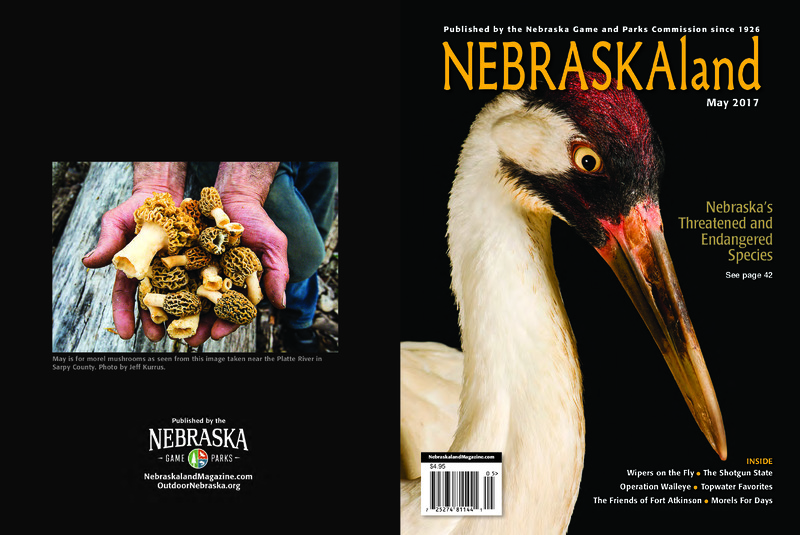
May is for morel mushrooms as seen from this image taken near the Platte River in
Sarpy County. Photo by Jeff Kurrus.
NebraskalandMagazine.com
$4.95
INSIDE
Wipers on the Fly l The Shotgun State
Operation Walleye l Topwater Favorites
The Friends of Fort Atkinson l Morels For Days
#NEGameAndParks
NEBRASKAland Magazine
Volume 95
●
No. 4
●
May 2017
F EAT U R ES . . .
26 Keeping the Past Alive – The Friends of Fort Atkinsonn
B R
B
34 Time Well Spent – What to do in May
B R
B
36 Wipers on the Fly
P
S
D
S
42 Extinction is Final
S
K
S
,
J S
48 Learning at Cedar Point
S
P
M H
54 A Family Fishing Restart
2
Y ENAE LUM
Y ENAE LUM
HOTOS AND TORY BY
TORY BY
OUG TEINKE
RISTAL TONER PHOTOS BY OEL ARTORE
TORY AND HOTOS BY
ARK
ARRIS
BY LINDSEY CHIZINSKI
56 Morels for Days
STORY AND PHOTOS BY JENNY NGUYEN
36
●
64 Connecting to Nature
B M
M
66 The Shotgun State – The Cornhusker Trapshoot
Y
ONICA
ACOUBRIE
BY JOEL W. HELMER
I N S I D E T H I S I S S U E ...
Mixed Bag – The Woodchuck, Travel to South Sioux
In Nebraska’s state parks, an adventure waits over every ridge and around every bend. Moments wait
to be had and memories beg to be shared. This summer, get outside and discover seventy-seven parks
City, Edible Dandelions, Favorite Topwaters and more ..... 8
Page 49 – Welsch Gets Prickly .................................... 70
In the Field – Saddling Up at a State Park ................ 74
Wilderness Workshop – Operation Walleye .......... 78
Outdoor Update – Aquatic Habitat Updates ............ 80
Portraits from the Past – Reader's Photos ............. 82
In the Kitchen – Wild Turkey Enchiladas ................. 84
The Last Stop – Finding No-No ................................ 86
42
●
56
●
and enjoy unlimited experiences. No matter what you choose to do outdoors—it’ll be time well spent.
To get inspiration for your park adventure, visit OutdoorNebraska.org/Explore.
THROUGHOUT 2017, NEBRASKALAND MAGAZINE WILL
PUBLISH ARTICLES ASSOCIATED WITH THE STATE'S 150YEAR CELEBRATION. LOOK FOR THIS LOGO TO READ ABOUT
NEBRASKA'S RICH HISTORY AND VIEW OUR INTERACTIVE
DIGITAL EDITION FOR MORE INFORMATION.
NEBRASKAland (VOL. 95 / NO. 4 ISSN 0028-1964) is published monthly, except
for the combined Jan./Feb. and Aug./Sept. issues, by the Nebraska Game and Parks
Commission, 2200 N. 33rd St., Lincoln, NE. Periodicals postage paid at Lincoln,
Nebraska, and additional mailing offices. POSTMASTER: Send address changes to
NEBRASKAland, P.O. Box 30370, Lincoln, NE 68503-0370.
26
●
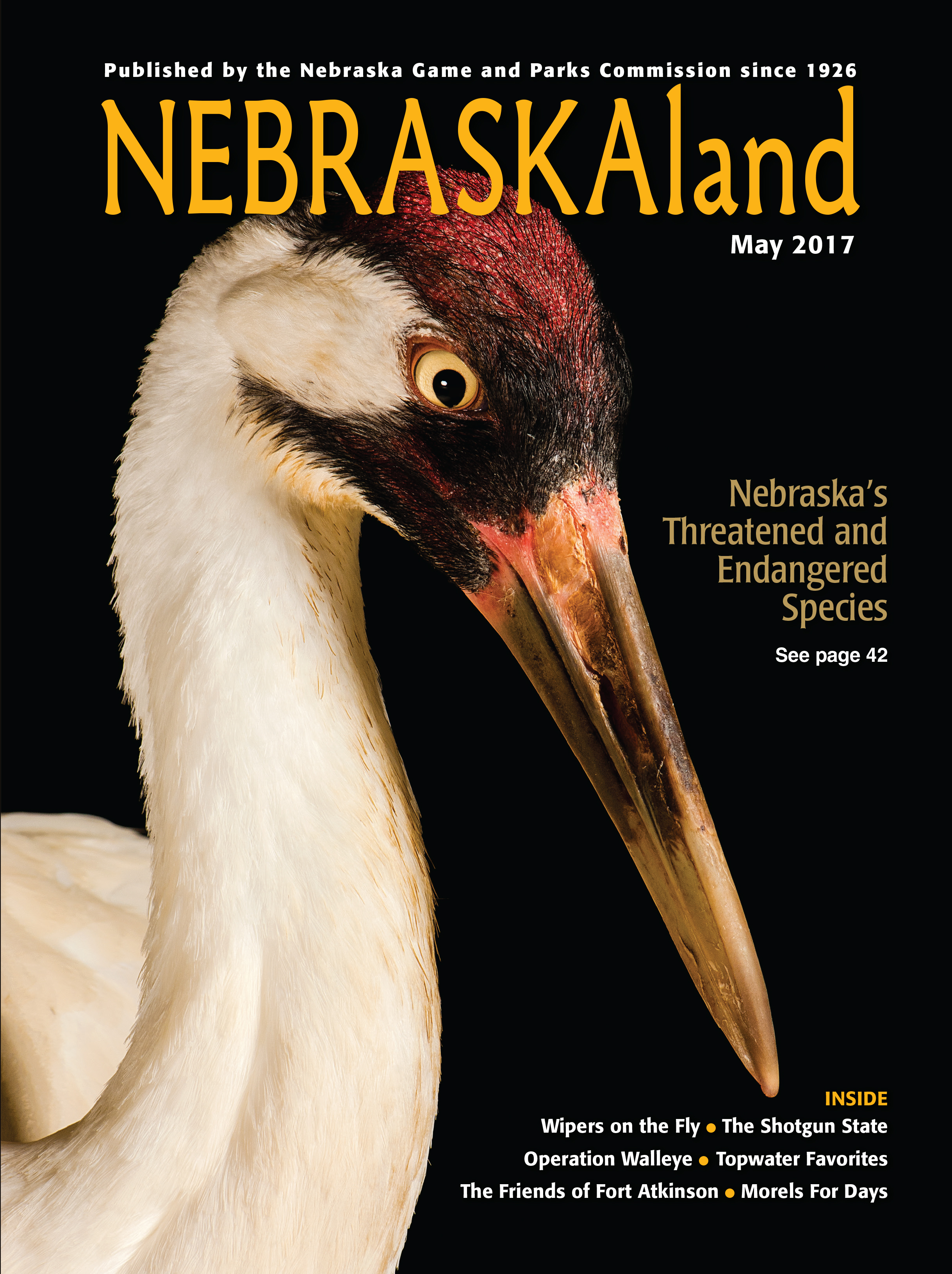
Cover: This image of Sara, a federally endangered whooping crane, is
part of the National Geographic Photo Ark project. Photo by Joel Sartore.
Images shared on Instagram by Nebraska State Parks visitors.
Share your• images
with us!
2 NEBRASKAland
MAY 2017
MAY 2017 • NEBRASKAland 3
Explore the
Outdoors
Saturday, May 13
11th Annual
9 a.m. - 4 p.m.
Celebrating 150 Years of
Nebraska’s Great Outdoors
Free for the whole family
"I spotted this horned lark north of
Minden while watching the cranes,"
said Bobbi Heitman of Minden. "He then
started turning his head like he was really
wondering what I was up to. He even
jumped up and down on the post like he
was trying to get my attention. He was
fun to watch."
Brenda Creigh of Grand Island shared this photo of a red-winged blackbird she saw
by the Alda Bridge Crane Viewing Site near the Platte River.
One morning in March, Brian
Ubben of Ceresco took this
sunrise photo with his Nikon
Coolpix camera near Lincoln.
• Atlatl and tomahawks
• Archery
• Fishing
• Bowfishing
• Kayaking
• Camping skills
• Shooting
• Climbing wall
• Outdoor cooking
• S’mores
• 6,000-gallon aquarium
and touch tank
• Crossfit challenge
• Fast draw
competition
• Elk calling contest
• Hunting and fishing demos
• Kids turkey gobbling contest
• Golf USA golfing course
Park Permit Required
Food vendors on site
Paul Bunyan Lumberjack
4 NEBRASKAland • MAY 2017
Byron Ferguson
Professional Archery Exhibition
Free Hotdog Roast
11 a.m. - 1 p.m. (or until gone)
MAY 2017 • NEBRASKAland 5
Find out more at FortKearnyExpo.com
NEBRASKAland Magazine
Outdoor Plates
Alan Hersch of Lincoln loves
to catch big bluegills, and takes a
moment to admire their “unmatched”
colors before releasing them. His wife
surprised him with his plate, and a
signed copy of the bluegill print that is
the Nebraska Habitat Stamp, when he
returned from a fishing trip.
If you have a unique outdoor
message plate you would like to
share, or know someone who does,
e-mail a photo (high-resolution, JPEG
format only, please) along with your
hometown and a brief description of
the interests expressed on your license
plate to Eric.Fowler@Nebraska.gov.
Scott Miller of Lincoln found this mule deer skull and antlers on
family land near Trenton in Hitchcock County.
Sabine Kantenseter of North Platte took this photo of an
adult bald eagle at Johnson Lake in February.
COMMISSIONERS
CONSERVATION OFFICERS
Director Jim Douglas
Commissioners
Chairman - Rex Fisher, Omaha
Vice Chairman - Dick Bell, Omaha
2nd Vice Chairman - Robert Allen, Eustis
Mark Spurgin, Paxton
Rick Brandt, Roca
Pat Berggren, Broken Bow
Jim Ernst, Columbus
Norris Marshall, Kearney
Dan Kreitman, Wahoo
ADMINISTRATION (Lincoln)
Craig Stover (Administrator)
Duane Arp (Asst. Administrator)
Jeff Clauson (Asst. Administrator)
MAGAZINE STAFF
Communications Director Christy Firestone
Editor Jeff Kurrus
Art Director Tim Reigert
Associate Editor Jenny Nguyen
Regional Editors Eric Fowler, Julie Geiser,
Justin Haag
Contributing Editor Michael Forsberg
Regular Contributors Renae Blum,
Chris Helzer, Chris Masada, Gerry Steinauer
Photo Librarian Jaclyn Cruikshank Vogt
Circulation Donna Robinson
For address changes and questions about
your subscription, e-mail donna.robinson@
nebraska.gov or call 800-632-5263
Advertising Sales Manager
For advertising information contact
Shane G. Gilster, 402-742-0125
Email: shanegilster@gmail.com
NEBRASKAland Magazine Copyright 2017, all rights reserved.
NEBRASKAland is available in audio from the Nebraska Library
Commission Talking Book and Braille Service, Suite 120, 1200 N St.,
Lincoln, NE 68508. 800-742-7691. NEBRASKAland Magazine and the
Nebraska Game and Parks Commission reserve the right to reject any
advertising not in keeping with the agency mission.
Rates: $18 for one year; $33 for two years; $44 for three years. Nebraska
recipients must add appropriate sales tax. To subscribe call
1-800-NEBLAND (632-5263), or go online to: NebraskalandMagazine.
com.
COMMISSION
C
CO
COM
OM
MMIS
MISSIO
S NO
OFFICES
FFICES
FF
FFI
S
Headquarters/Southeast District Office
2200 N. 33rd Street Lincoln, NE 68503
Phone 402-471-0641
Northeast District Office
2201 N. 13th St. Norfolk, NE 68701
Phone 402-370-3374
Kaitlin Smith of Martell sent this windmill
photo taken near Cambridge.
Send your comments to:
Jeff Kurrus, Editor
NEBRASKAland Magazine
P.O. Box 30370
Lincoln, NE 68503
or e-mail Jeff.Kurrus@Nebraska.gov
Please include your postal address and telephone number. Letters may be condensed
and edited. Photographs are also welcome.
Tiara Brown of Omaha sent in this photo of a cyclist at Zorinsky Lake. She said the abnormally warm weather in February melted
any remaining ice on the lake and prompted hundreds of people to flock to the trails for sunshine and exercise.
6 NEBRASKAland • MAY 2017
Any program that receives federal funding from the National Park
Service, or the United States Fish and Wildlife Service prohibits unlawful
discrimination on the basis of race, color, religion, age, gender, marital
status, national origin, age, disability or political affiliation. Any person
who believes he or she has been discriminated against in any program,
activity, facility, or service, should contact the Nebraska Game and
Parks Commission, Lincoln, NE 402-471-0641, the Equal Opportunity
Commission, Lincoln, NE 402-471-2024, TTY/TDD 402-471-4693;
United States Fish Wildlife Service, Civil Rights Coordinator, 4401
N. Fairfax Drive, Arlington, VA 22203; Director, Equal Opportunity
Program, U.S. Department of Interior, National Park Service, 1849 C
Street NW, Mail Code 0008, Washington, D.C. 20240-0001.
Southwest District Office
301 E. State Farm Rd. North Platte, NE 69101
Phone 308-535-8025
Northwest District Office
East Hwy. 2, Box 725 Alliance, NE 69301
Phone 308-763-2940
Bassett Office
524 Panzer St., Box 508 Bassett, NE 68714
Phone 402-684-2921
Kearney Office
1617 First Ave. Kearney, NE 68847
Phone 308-865-5310
Ak-Sar-Ben Aquarium
21502 W. Highway 31 Gretna, NE 68028
Phone 402-332-3901
Omaha Office
8495 Frederick Street, Omaha, NE 68124
Phone 402-595-2144
402-471-5531
402-471-5531
402-471-5531
NORTHWEST (Includes counties covered)
Jim Zimmerman (District Supt.)
308-641-9590
Sean McKeehan
(Cheyenne, Morrill, Box Butte)
308-279-9133
Scott Brandt
(Kimball, Banner, Scotts Bluff)
308-631-0663
Greg Hesse (Sheridan, Dawes)
308-760-3647
308-430-0572
Dan Kling (Sioux, Dawes)
Terry Brentzel (Deuel, Garden, Grant) 308-458-7650
402-389-0444
Frank Miller (Cherry, Hooker)
NORTHEAST (Includes counties covered)
Tom Zimmer (District Supt.)
402-649-8053
402-760-0712
Dale Davis (Keya Paha, Brown, Rock)
402-340-3981
Jonathan Andreasen (Holt, Boyd)
Mitch Johnson (Knox, Antelope, Pierce) 402-613-8612
402-762-5022
Jeff Jones (Knox, Cedar)
Owen Johnson
(Dixon, Dakota, N 1/2 Thurston)
402-266-1759
Jon Reeves
(S 1/2 Thurston, Burt, Washington)
402-889-8508
402-719-1108
Dan Roberts (Dodge, Colfax)
Cory Krause
(Cuming, Wayne, Stanton, Dodge)
402-380-6410
Steve Oberg
(Colfax, Platte, Madison, Stanton)
402-910-3366
308-730-7050
Doug Pollard (Loup, Garfield, Valley)
Andrew Heyer (Pierce, Madison, Stanton) 402-613-2241
SOUTHWEST (Includes counties covered)
Roger Thompson (District Supt.)
308-530-3097
Taylor Dixon
(Dawson, Gosper, Phelps)
308-217-2108
308-202-0819
Matt Brandt (Sherman, Howard)
308-380-7331
Tim Williams (Hall, Hamilton, Merrick)
Pat George
(Harlan, Franklin, Phelps)
402-705-9989
Matt Andrews
(Gosper, Furnas, Frontier, Red Willow)
308-746-2418
Brian Piernicky
(Red Willow, Frontier, Hayes, Hitchcock)
308-340-6627
308-289-0427
Nicholas Fix (Keith, Perkins)
308-289-1169
Bryce Streger (Keith, Arthur)
Brandon O’Neal
(Lincoln, McPherson, Logan)
308-530-3157
Alex Hasenauer
(Lincoln, McPherson, Logan)
308-660-4671
Dale Johnson (Kearney, Buffalo)
308-440-3847
308-529-8146
Mike Thome (Dawson)
Ray Dierking (Custer, Thomas, Blaine) 308-870-0322
John Lee (Hitchcock, Dundy, Chase, Hayes) 308-414-1432
SOUTHEAST (Includes counties covered)
Levi Krause (District Supt.)
402-949-0593
402-619-1355
Rich Berggren (Douglas)
402-616-5961
Dan Evasco (Sarpy)
402-210-0888
Heath Packett (Cass)
402-209-1506
Russell Mort (Otoe, Johnson)
William Krause
(Nemaha, Richardson, Pawnee)
402-274-8063
Dan Zuehlke (Gage, Saline)
402-806-9084
402-890-6463
Dina Barta (Lancaster)
402-890-6465
Doug Kramer (Lancaster)
402-937-3422
Dudley Sorensen (Lancaster, York)
402-613-2312
Travis Shepler (Lancaster)
402-890-7140
Stacey Lewton (Lancaster, Seward)
402-443-6392
Mike Luben (Saunders, Butler, Polk)
Matt Taylor (Thayer, Fillmore, Jefferson) 402-200-9597
Nebraska Wildlife Crimestoppers
1-800-742-7627
MAY 2017 • NEBRASKAland 7
Lindsay Rogers is an outdoor
education specialist with the
Nebraska Game and Parks
Commission.
A Mammal
Brief
By Lindsay Rogers
PHOT
PH
HOTO
HOT
O BY ERIC FOWL
LER
Marmota monax
Ranging over much of
the eastern United States,
the woodchuck can be
found in grasslands and
forest edges in eastern
Nebraska. Most individuals
will have two burrows – one
for summer near food sources
and one for winter near protective
cover. Each burrow will have numerous
chambers and several entrances.
Woodchucks are true hibernators, meaning they
remain inactive for the entire winter despite temperature rises. Males emerge from hibernation before females
to establish a mating territory, establish dominance among other males and search for a mate. Mating occurs
soon after females emerge from hibernation. Young leave their mothers by the time they are two months old.
They are diurnal and often seen foraging on vegetation in gardens, prairies and pastures. They feed almost
entirely on plants including alfalfa, clover and dandelion. They will also feed on bark, leaves, insects and
occasionally bird eggs. Although a rather stubby species, they are often observed sitting or standing on their
hind legs, making them appear taller. ■
Free Park Entry • Free Fishing Day
Saturday, May 20
Visit us at OutdoorNebraska.org for a list of fishing
clinics and park events offered on May 20.
8 NEBRASKAland • MAY 2017
MAY 2017 • NEBRASKAland 9
Travelogue
Travelogue Sponsors
South Sioux City to Niobrara State Park Road Trip
By Hannah Hundley, Nebraska Tourism Commission
W
PHOTO BY ERIC FOWLER
hat was once a popular route
for outlaws, thieves and
lawmen is now the perfect
route for those seeking
adventure and cultural
awakenings. This month’s Nebraska
road trip takes you from South Sioux
City, on the Outlaw Scenic Byway,
to the wonder-filled water bluffs of
Niobrara State Park.
Sioux City is a three-state
metropolitan area tucked in the
northeastern corner of Nebraska. Here,
visitors can find a thriving music and
arts culture. To the west, travelers
will encounter charming towns full of
hidden gems.
Enjoy a delightful farmers market,
craft fair and tearoom at St. James
Marketplace, two miles east of Wynot.
Next, gaze at the grandeur of some
of the most breathtaking historical
churches in the state, including Saints
Peter and Paul Catholic Church in Bow
Valley and the Immaculate Conception
Catholic Church in St. Helena. The
downstairs speakeasy tavern of the
Historic Argo Hotel in Crofton is
At Niobrara State Park in Knox County, 19 cabins overlook the Missouri River, giving an
impressive view of the valley below.
jewelry, blankets and other crafts.
Once you reach Niobrara State
Park, take a horseback trail ride led by
wranglers or go fishing in the nearby
rivers. There are also 14 miles of hiking
trails. Other areas of interest are the
Ponca Cemetery, Mormon Monument
and Standing Bear monument.
Tip: Try and find the highest hill in
the park for the most spectacular view
of the river and surrounding landscape
– it's the perfect place to watch the
sunset. ■
another must-see – rumor is that the
hotel is haunted. Then, try your luck
at the Ohiya Casino on the Santee
Reservation. This 12,000-square-foot
casino, operated by the Santee Tribe,
offers authentic American Indian
While in
South Sioux City
PHOTO BY JEFF KURRUS
The Immaculate Conception Church in Saint Helena in Cedar County is a beautiful
centerpiece to this northeastern Nebraska town.
10 NEBRASKAland • MAY 2017
Visit the 45,000 square foot Art
Center, which includes a hands-on
children's gallery.
Go back in time at a number of
historical attractions, including the
August 21, 1804 Lewis and Clark
campsite, Old St. John's and the 4th
Street District.
Spend a day at the Siouxland
Freedom Park to honor those – past,
present, and future – who so bravely
sacrifice for our nation's freedoms.
Take a look at visitsouthsiouxcity.
com for a complete list of local
attractions, including a month-bymonth calendar of events.
MAY 2017 • NEBRASKAland 11
A Brief History
Drive a "Fuller," Built in Nebraska
By the Nebraska State Historical Society
C
NSHS RG3463-1
harles Fuller built his first automobile
in 1898 in Angus, Nuckolls County,
Nebraska. Angus in 1900 had a population
of 500 and supported 12 businesses.
Today the town is gone. But from 1907 to 1909 it
was the home of the Angus Automobile Company,
employing 40 craftsmen who produced over 600
cars in its short life. Only one is known to have
been restored.
Charles Fuller left Angus in 1902 to work for
the St. Louis Motor Company and afterwards
worked for the Buckeye Manufacturing Company
of Anderson, Indiana, where he was instrumental
An early automobile designed and built by Charles M. Fuller at Angus,
Nebraska, in 1902. Fuller’s building is in the background.
NSHS RG3
RG3463-2
RG3463
463-2
463463
2
Interior of the Fuller machine shop at Angus, ca. 1905.
NSHS RG3463-32
A restored Model “A” Fuller automobile at the Nebraska Centennial Celebration, 1967.
12 NEBRASKAland • MAY 2017
in building the Lambert car. Fuller returned home with a
Lambert and convinced investors that he could build a better
car. He organized the Angus Automobile Company with a
capitalization of $50,000, each share selling for $10. On
February 16, 1907, production of the Fuller car began.
There were four models of the Fuller car. The best
seller was a five-seater touring car that sold for $2,500, a
comparatively high price for that day. The Fuller car used
only genuine leather upholstery, had 16 to 18 coats of paint,
and the best engine then available. Its brass needed to be
cleaned frequently, and owners noted that when cleaned, the
car shined “bright as gold in the sun.”
Unfortunately the success of the Fuller car was shortlived. In 1908 a demonstration was held at the Nuckolls
County Fair in which a Fuller car completed two laps of the
fairgrounds racetrack in 60 seconds, averaging 60 miles per
hour. The performance was so exceptional that a group of
Omaha businessmen offered to buy the Angus Automobile
Company. Charles Fuller wanted to accept
the offer, but the other stockholders did not.
The resulting dispute resulted in Fuller’s
decision to sever all ties with the company.
Without him, the business did not long
survive. ■
Visit the Nebraska State Historical Society’s
website at nebraskahistory.org.
MAY 2017 • NEBRASKAland 13
What Do You Do With a Baby Bird?
tub, then place paper towels or Kleenex
in the bottom. Secure the tub in a tree
where the bird was found by cutting
two holes about an inch apart in the tub,
then run string or wire through the holes
and wrap it around the tree. Make sure
your nest is placed high enough to keep
potential predators away, then place the
baby in the nest. The parent bird(s) will
hopefully find their baby and take care
of it.
If you find a feathered baby bird, you
can use the same procedure as above.
Keep in mind that fledglings will fly
out of their nest, usually unsuccessfully
on their first flights, and will end up on
the ground. Parent birds take care of
their young when this happens. Watch
the fledgling for a while and see if a
parent shows up to take care of it.
It is illegal to take in baby birds and
try to feed and take care of them. As
much as humans want to be kind and
help baby animals, sometimes they are
better off left alone. People sometimes
take a healthy bird out of the wild,
depriving them of the care of their
nearby parent. Nature can be seemingly
cruel at times, but it is how the animal
kingdom makes sure that the fittest
survive and the species live on. ■
PHOTO BY JEFF KURRUS
By Julie Geiser
Spring is a time when baby birds
hatch from their eggs. It’s also a time
for spring storms that can displace
babies from their nests, sending them
plummeting to the ground. Many
people find baby birds and wonder
what they can do to help; there are a
few things that can be done.
First, determine if the baby is a nestling
or fledgling. A nestling will have few
feathers, if any, and may still have its
eyes closed. If you find a nestling, wrap
it loosely with a paper towel or Kleenex
to keep it warm. Try to locate a nest near
where the bird was found. If the nest
is visible and is safe to reach, put the
baby bird back. It’s a myth that a mother
bird will not come back to her young if
touched by a human.
If the nest is too high or you do not
see a nest, make one by using a small
plastic sour cream or butter tub or
something similar. Wash and dry the
May is Nebraska’s
International Migratory
Bird Month
Events held statewide
Learn more at NebraskaBirdMonth.org
aBirdMont
nthh orrg
14 NEBRASKAland • MAY 2017
MAY 2017 • NEBRASKAland 15
Wild Edibles - Dandelions
By Julie Geiser
Dandelions are available spring through fall. This “weed”
is often pulled or sprayed as most people don’t know its
nutritional value. Dandelions are packed with vitamins, and
they are also delicious.
Dandelions are not native to North America, but were
brought here by immigrants that valued them as a food
source. The edible parts include the leaves, stems, buds,
yellow flowers and roots. All these parts can also be frozen
or dehydrated for later use in many recipes.
To harvest dandelions, gather them from areas that have
not been treated with chemicals, and also be cautious of
roadsides where dirt and exhaust fumes can cover plants.
Identifying dandelions is simple: Look for leaves that are
tooth-shaped and hairless, leaves and stems that grow from
the rootstalk in the soil, and a single stem with only one
flower. When broken, the stem contains a milky, white sap.
Dandelions have a thick root that may have small, hair-like
roots growing off it.
Dandelion leaves have a pleasant flavor similar to collard
greens. They taste best from plants that have not budded
and are great in salads. Older plant leaves may taste
bitter but can be boiled in water for three minutes or until
tender, which removes some of the bitterness. Aside from
salads, dandelion leaves can be used in soups, egg dishes,
casseroles, and they may be sautéed with a little oil and
garlic.
Flowers are slightly sweet and will take the flavor of other
ingredients they are cooked with. The green sepal that holds
the yellow petals together is bitter, so some people remove
the sepal before cooking by pinching it off. The petals are
also good in jellies, teas, made into vinegar, oil and wines
as well as in casseroles, cookies, biscuits, fried fritters and
more.
Buds that are still tightly closed and roundly shaped, not
oval, taste like mushrooms. The bitter sepal can be removed
before using. The buds are delicious whether pickled, boiled
or sautéed. They can also be battered and fried or put into
soups.
Dandelion stems are nature’s noodles. Cut the stems at
the base of the plant and cut off any flowers. Boil the stems
in water with a couple pinches of salt. Serve boiled stems
with Parmesan cheese and butter or on their own. The stems
can be used in casseroles or with other vegetables, and can
replace spaghetti noodles.
Dandelion roots also provide great nutrition and flavor. To
collect the root, moisten the soil around the plant and pull
the plant with a garden shovel or dandelion puller. Fresh
roots can be used in stir fry dishes and in casseroles. They
can also be made into coffee.
To roast dandelion roots to make coffee, scrub the roots
like you would a potato but do not peel. Place in a single
layer on a baking sheet and then bake in a 350-degree oven
for 1 hour and 15 minutes. When done,
the roots should be dry and crunchy.
Once cool, crush the roots in a blender
and store in a covered container. Use
ground roots in cakes, meat rubs, as
coffee, tea and to make root beer. ■
For more information on dandelions,
refer to The Ultimate Dandelion
Cookbook by Kristina Seleshanko and
Wild Seasons by Kay Young.
PHOTO BY JULIE GEISER
16 NEBRASKAland • MAY 2017
MAY 2017 • NEBRASKAland 17
u
r
s
P
u
i
e
t
h
t
18, 20
newspaper as a boot dryer, an insulator for cots, a firestarting
aid, an excellent headlight and windshield cleaner, and even
something to wrap frozen meats in while transferring them
in a cooler. You can also place layers of newspaper on top
of your cooler contents to add insulation and make your ice
last longer. Or go a step further and fill all of the airspace
between the contents and lid.
And I'm always looking for more uses, so if you use them
for a particular reason that's not listed here, drop me a note
at Jeff.Kurrus@Nebraska.gov. ■
r
e
b
m
e
n
t
p
e
i
S
1
o y
17
Ma
PHOTO BY JEFF KURRUS
By Jeff Kurrus
Some say the newspaper is
dead. I certainly hope not. Ever
since reading the transcripts to
one of Dick Turpin’s “Turpin Time”
videos about newspaper uses, I have
been on a quiet, yet constant, quest
to see how helpful our dailies actually
are to the life of an outdoor enthusiast.
It started with using newspapers to help
eliminate smells from fish and game coolers.
After washing out a cooler with soap and water, then drying
the inside of a cooler with a towel, I found through the years
that the fishy smell would remain long after I closed the
cooler. However, by inserting one more critical step, tossing
a dry newspaper inside of the cooler and closing it again, the
gamey smell soon dissipated. Turpin was exactly right.
Since hearing about this tactic and seeing it in action, I
began using newspapers with all of my coolers, then I went
and told my friends. They returned with their own list of
newspaper functions, including, but not limited to, using
J
Don't Just
Read the
Paper
Visit Parks. Be Active. Win Prizes.
Learn more at NEGPP.org
18 NEBRASKAland • MAY 2017
10th year
Presented by
Plant it Forward
Slowing Time with S'mores
By Lindsay Rogers, Wildlife
Education Specialist
My life – like that of most people
– is busy. Between two young
children, two mischievous dogs and
a ridiculously busy work schedule,
the fun stuff occasionally gets pushed
aside. We always make time for the big
stuff – going to the pumpkin patch, the
zoo and a week-long summer vacation.
But the day-to-day fun is often waylaid
by laundry, loading the dishwasher and
the arduous bedtime routine.
Realizing that time often goes faster
than I like, I set out last summer to
ensure our family had a relaxing,
smile-filled summer that would go
down as the best yet. I decided we
By Julie Van Meter
State Entomologist, Nebraska
Department of Agriculture
cookies (my son’s
favorite), Reese’s
peanut butter cups,
dark chocolate, white
chocolate, Hershey’s
cookies-n-cream
bars.
Weekly
(sometimes more)
we would leave the
dinner dishes in
the sink and gather
around the backyard
fire pit with the
Lucy with a “birthday cake Oreo” s’more at Lewis and Clark SRA.
patio table covered
in our s’mores
between two monster cookies. I
options. Very quickly my daughter
was in love. The next night it was
Lucy found her favorite: birthday cake
Oreos twisted open to allow for a warm marshmallows and Reese’s peanut
butter cups between traditional graham
marshmallow, the Oreo filling serving
crackers. This was not a s’more, it was
as her “chocolate.” My son Sam and I
amore!
took longer and were more interested
In the end, this simple project
in experimentation. In the end we
actually slowed time. I put playing
determined Sam likes nearly every
in the backyard before sweeping the
variation of the s’more.
floor and riding bikes before getting
It was not until our family vacation
to bed on time. The summer lingered
to Lewis and Clark Lake that I
with lazy trips to the pool, afternoon
found my favorites (there are two).
strolls through the zoo, swinging in
Around the campfire one night, I
the backyard and of course, plenty of
had the brilliant plan to sandwich the
s’mores. ■
traditional marshmallow and chocolate
Plant pests are taking a toll on
Nebraska’s trees. Dutch elm disease
continues to kill elms statewide. Pine
wilt has all but eliminated Scotch
pines from eastern Nebraska. In 2016,
emerald ash borer (EAB) was found
in Omaha, threatening the state’s 44
million ash (Fraxinus sps.) trees.
There are steps we can take to protect
the health of our trees, including proper
pruning, mulching and watering, and
also chemical treatments. Buying
firewood where you burn it helps
prevent the introduction of new pests to
non-infested areas. But what do we do
about the trees we’ve already lost?
The Nebraska Forest Service
estimates that since the 1970s,
Nebraska has lost 50 percent of its
community canopy cover. For every
tree planted, four are being removed.
This is more than just an aesthetic
concern; it is also an economic and
environmental concern.
Trees planted around a house can
significantly reduce heating and
cooling costs and increase a home’s
value. Trees improve water quality,
reducing soil erosion and runoff.
Crop fields protected by windbreaks
typically see increased yields, reduced
irrigation needs and reduced wind
erosion of soil. Livestock raised
with windbreak protection generally
have better weight gain, require less
supplemental feed and have increased
production and survival rates.
Wildlife benefits from trees, too,
even in a prairie state. Trees provide
food and shelter; think acorns for deer
and turkeys, and nesting sites for birds.
Trees also support large numbers of
insects, which play an important role in
the ecosystem and are a food source for
many larger animals.
What should we do to reverse this
loss of trees? Plant more trees. Realize
the loss of one tree is an opportunity to
plant another, or two or three. But what
tree should be planted?
Consider the reason for planting a
tree. Are you looking to shade your
house, create
a windbreak or add fall color? Size
matters – make sure the size and shape
of the tree at maturity will fit the site.
Think about the location of overhead
power lines, buildings and other objects
in the landscape.
Don’t forget factors like soil type,
plant hardiness and light and moisture
needs. Diversify the landscape by
planting a species not already present
on your property.
The Nebraska Forest Service has
developed a campaign to encourage
the replacement of trees called Plant it
Forward to rebuild community forests
and rural landscapes for the next
generation. This will be increasingly
important as trees are lost to EAB.
The campaign includes tree lists which
provide information on tree species
adapted to Nebraska, and can help
you make an informed decision when
choosing trees at a local nursery.
More information on the Plant
it Forward campaign can be found
online at nfs.unl.edu/ash-replacements.
Remember that the best time to plant a
tree is now! ■
Ever-silly Sam roasts his marshmallow at
Lewis and Clark State Recreation Area.
20 NEBRASKAland • MAY 2017
PHOTOS
PHOT
O OS BY
BY LI
LINDSAY
NDSA
S Y ROG
RO
ROGERS
OGERS
S
needed a project, something that could
be done at least weekly, that would
keep our enthusiasm and that would
involve the whole family. S’mores.
Making s’mores is fun, but this project
needed more “umph." Our task would
be to devise the greatest new s’mores
recipe. No longer would graham
crackers, marshmallows and chocolate
bars suffice.
My next step was heading to the
store. If it could be included in a
s’more, it was purchased. Fudge-stripe
cookies, birthday cake Oreos (my
daughter’s favorite), mint chocolate
One of the greatest – chocolate and marshmallow between two monster cookies.
MAY 2017 • NEBRASKAland 21
Caught on Camera
By Scott Schrage, University of Nebraska-Lincoln
It darts through the darkness of a chilly night in the
Nebraska Panhandle, drawn across the shortgrass prairie by
the wafting stench of a skunk. No larger than a house cat, it
accelerates to 25 miles per hour, then coasts within eyeshot
of a stake capped by a glob of petroleum jelly.
As the nocturnal sleuth approaches the skunk-scented lure,
a camera mounted on a nearby fence registers the movement
and heat. In a flash, the camera snaps a three-photo burst of
the elusive creature before it moves on to search for dinner.
Two weeks later, the University of Nebraska-Lincoln
undergraduate who planted the camera trap will sit down to
a computer that reveals what she was hoping to find: images
of the swift fox, once a common Great Plains predator
now residing on Nebraska’s list of endangered species. The
experience, part of a new one-credit course at the university,
exposes undergrads to biological fieldwork while furthering
a statewide conservation effort to map the distribution of the
swift fox. Faculty are also examining how the experience
can help students learn about the ecological factors affecting
canids, the family of mammals comprising foxes and
coyotes.
Since 2012, the Nebraska Game and Parks Commission
has worked with the university to determine which areas the
swift fox still inhabits. That knowledge can inform decisionmaking – whether to follow through on the building of roads,
for instance – that affects the prospect of swift fox survival
in the Cornhusker State. And clarifying where the species no
longer resides can offer clues about its decline while helping
state agencies save significant time, effort and money.
More than 50 students from the University of NebraskaLincoln and Chadron State College surveyed sites – many
private, some public; many rural, some suburban – during
the fall 2016 semester, after swift foxes raised their young
to independence and began venturing beyond their dens.
Though the swift fox remains the prized subject, many
different animals of interest wander by the cameras: other
fox species, coyotes, deer, owls, bobcats, badgers and more.
Those species' classifications, and where they were found,
then enter a database that is used to update a map of swift
fox distribution.
“To have a student get to pick a spot on the planet where
they put out this camera and not know what’s going to walk
by – but know that whatever walks by is adding to science
– I think that’s a unique opportunity,” said project leader
T.J. Fontaine. “It’s pretty exciting just to see how they’re all
responding to it.” ■
PHOTO COURTESY OF THE NEBRASKA CANID PROJECT
Students at the University of Nebraska-Lincoln and Chadron State College surveyed sites during the fall 2016 semester in the
Nebraska Panhandle to place camera traps in an effort to determine areas the swift fox still inhabits.
22 NEBRASKAland • MAY 2017
MAY 2017 • NEBRASKAland 23
150 Year
Activities
By Cara Pesek
Nebraska turns 150 years old in
2017, and the Nebraska Game and
Parks Commission will celebrate this
milestone all year long with special
events, challenges and other activities
showcasing the history and culture of
our unique state. These include:
by Jerry Kane
May 1
Family Fishing Event
Terry’s Pit, Terrytown
May 6
Mom’s Day Archery Fun
Shoot
Nebraska Game and Parks
Outdoor Education Center,
Lincoln
May 6
Take Pride in America
Day
Contact the Nebraska Game and Parks Commission
at 402-471-0641 or visit OutdoorNebraska.org
for more information. Visit HuntSafeNebraska.
org for a list of hunter education classes and
BoatSafeNebraska.org for a list of boating safety
classes.
Verdon Lake State
Recreation Area (SRA),
Verdon
May 6-7
Living History
May 20
Wildcat Hills Wildlands
Wildcat Hills SRA, Gering
Fort Atkinson State Historical Park
(SHP), Fort Calhoun
May 23
Family Fishing Event
May 13
Fort Kearny Outdoor Expo
Holmes Lake, Lincoln
Fort Kearny State Recreation Area
(SRA), Kearney
May 14
Mother’s Day Buffet
Fort Robinson State Park (SP),
Crawford
May 14
Family Fishing Event,
Riverside Discovery Center Zoo Pond,
Scottsbluff
May 15-June 2
Eligible landowners may apply for one
elk permit
May 17
Let’s Talk Trees
Lake Ogallala SRA, Ogallala
May 19
National Endangered Species Day
and Pizza Party
Lake McConaughy SRA, Ogallala
May 19-20
Spring Muster
May 25
Family Fishing Event
Halleck Lake, Papillion
May 25
Evening Acrylics
Commission has joined the Nebraska
Sports Council in the Nebraska 150
challenge – an effort to encourage
Nebraskans to run, walk, bike, hike,
swim, paddle or otherwise complete
150 miles or more of physical activity
throughout 2017.
To assist this effort, staff at
Nebraska’s state parks and recreation
areas will offer 150 miles of guided
hikes throughout the year. A schedule of
guided hikes is at OutdoorNebraska.org/
nebraska150/, with more to be added
throughout the spring, summer and fall.
May 26
I Spy
Lake McConaughy
SRA, Ogallala
May 27
Migratory Bird Day
Indian Cave SP, Shubert
May 27
Birds and Bikes
Ash Hollow SHP, Lewellen
May 20
Free Fishing and Park Entry Day
Lake McConaughy SRA,
Ogallala
Red Willow Reservoir SRA, McCook
May 20
Barbecue and Kids’ Fishing Derby
Fort Robinson SP, Crawford
24 NEBRASKAland • MAY 2017
This is a celebration of Nebraska’s
history and culture through literature
and the art of storytelling.
May 26
Take Aim at
Summer
Platte River SP,
Louisville
May 30
National Water a Flower Day
Lake McConaughy SRA,
Ogallala
May 31
Spring turkey seasons close
By Julie Geiser
There is nothing like the thrill of watching a topwater lure work its way back
through the water when suddenly from the depths or shallows, the strike happens.
Three proven and popular lures that can be used for multi-species of fish
including bass, crappie, white bass, northern pike and muskies are the Zara Spook,
buzzbaits and poppers.
These lures have been enticing fish to the water’s surface for years; they can be
seen and heard, and they all release vibrations of some sort.
All three can be used in deep or shallow water to catch fish off guard or make
them mad enough to bite. They all come in different sizes, shapes and colors to fit
whatever fish species, big or small, you are after.
The key to all of these is varying the speed and direction of the lure presentation
to find what the fish like. Don’t get in the rut of using these lures only in the
mornings and evenings – pull them out all day long and see if the bite is on. ■
150 Years of Storytelling
•Ponca
State Park on Aug. 1, 7-8
Nebraska 150 Challenge
• The
Nebraska Game and Parks
May 28
Fashion a Feeder
May 20
Republican Valley Archery 3-D
Shoot
July 21-23.
This gathering is an effort of the
Friends of Ash Hollow, Nebraska Game
and Parks Commission and Lakota
Sioux. The history of Native Americans,
settlers, cowboys, farmsteaders, fur
traders, pioneers and military will be
recognized during the event.
Lake McConaughy SRA,
Ogallala
Fort Hartsuff SHP, Burwell
No fishing or park entry permits
required this day
on Sacred Ground
•AshConvergence
Hollow State Historical Park on
My Favorite Topwater Lures
Zara Spook – Use a twitch and pause, twitch and pause retrieve that makes the lure
walk back and forth across the water’s surface.
Poppers – Known for slow retrieves to catch fish that are unwilling to chase faster
moving baits.
150 Bird Challenge
• The
challenge consists of listing all
of the bird species that you see or hear
in Nebraska in 2017, with a goal of
reaching 150 species.
Fish 150 Challenge
• The
Nebraska Game and Parks
Commission challenges you to
celebrate Nebraska’s 150th year of
statehood by catching 150 fish in
Nebraska waters in 2017. ■
Buzzbaits – Begin reeling as soon as it hits the water. This lure is great for flushing
fish out of shallow water as well as suspended fish.
NEBRASKAland
nd
Visitor
Last issue’s winner of
the Visitor drawing was
Brad Dietz of Pierre, South Dakota,
who found the springtail on page 57.
Readers are encouraged to contact
NEBRASKAland within 10 days
after this issue’s publication with
the correct page number and name
of this issue’s “Visitor” – a critter
found in Nebraska. We will then
gather the correct entries and draw
one to win a NEBRASKAland mug.
To enter each month, write:
NEBRASKAland Visitor
2200 North 33rd Street
Lincoln, NE 68503
Or e-mail:
Tim.Reigert@Nebraska.gov
with “Visitor” in the subject line of
the message.
HINT: This issue’s visitor is not on
page 2, 15, 21, 25, 35, 44, 46, 47,
48, 50, 53 or 86.
Springtails (Order Collembola)
are exceptionally small, wingless
creatures, between 3⁄64 and 1⁄8
inch in length. They live in moist
soil, feeding on decaying organic
matter. While insectlike, they are
no longer considered to be true
insects. Springtails get their
common name from an unusual
tail-like structure on the underside
of their abdomen, called a furcula,
which moves the springtail in a
unique way. The furcula is attached
at the rear of the abdomen, and
folds forward under the abdomen.
It is held in place by a structure
called a tenaculum. When the
tenaculum is released, the furcula
pushes down against the ground,
causing the springtail to appear
to jump, sometimes up to several
inches. Occasionally springtails
can be found in moist areas inside
homes. But they cause no struc
tural damage and do not bite, and
are more a nuisance
than a problem.
Special thanks to
Julie Van Meter,
State Entomologist, Nebraska
Department of Agriculture.
MAY 2017 • NEBRASKAland 25
Keeping the Past Alive
The Friends of Fort Atkinson
By Renae Blum
W
e emerged from the van in the dark, approaching
an entrance within 15-foot wooden walls
stretching out beyond us to the right and the left.
A sentry stopped our docent, who was dressed as a 19th
century Plains frontiersman.
“Who goes there?” the sentry asked. “State your purpose
at the gate.”
Permission granted, we moved through the entrance and
found ourselves along a boardwalk, dwarfed by an enormous
grassy quadrangle bordered by barracks. Following our
docent and the light of his lantern, we slipped into one room
after another, and for the next hour, we watched.
PHOTO BY CURT BLUM
PHOTO BY BOBBI ANDERSON
26 NEBRASKAland • MAY 2017
Lit by candlelight and burning fireplaces, the scenes
played themselves out: two women hand-making lace and
spinning wool, a duke and a colonel discussing the next
day’s buffalo hunt, ladies fussing over the cream in their
soup, a Native American man beset by typhoid coughing by
a fireplace.
It resembled live theater, but in actuality there were no
scripted lines, just ordinary people portraying a history of
this place, this fort, that they have come to know like the
back of their hands.
At Fort Atkinson State Historical Park in Fort Calhoun, a
group of passionate volunteers known as the Friends of Fort
Penny Ankenbauer, Denise Wenke and Donna Joyce portray soldiers’ wives during the annual candlelight tour at Fort Atkinson
State Historical Park. Volunteers bring Nebraska history to life each year at the park in Fort Calhoun.
MAY 2017 • NEBRASKAland 27
Fort Atkinson, 1820-1827
he first U.S. military post west of the Missouri River, Fort
Atkinson can claim a number of Nebraska firsts: first school,
hospital, library and military post. Established in 1820, Fort
Atkinson’s role was to protect the growing American fur trade
in the West, counteracting the encroaching presence of British
fur traders from the north, and keeping the peace between
traders and the Indian tribes of the region. It was also an early
experiment in pioneering the frontier, coming less than 15 years
after the end of the Lewis and Clark Expedition. Isolated on the
“Great American Desert,” the fort’s inhabitants quickly learned
that if they were to survive, they had to make or grow everything
they needed to live. Their success made Fort Atkinson a popular
spot for trappers to gather supplies, as well as a jumping-off
point for explorations of the West and trading expeditions to
Mexican settlements. From its spot on the Missouri River bluffs,
Fort Atkinson saw the fur trade become the dominant force for
American expansion and witnessed the opening of the American
West.
Compared to other similar forts of its day, Fort Atkinson was
large: At its height, it housed 1,200 soldiers – about one-sixth
of the standing U.S. Army. Roughly that many civilians lived
just beyond the wall of the garrison. It
operated like a small cit
city: the soldiers’
children attended sch
school on the fort’s
grounds, goods we
were sold at the
sutler store, and the necessities of
daily life were carried out at the
sawmill, gris
grist mill, bakery, the
blacksmith and armorer’s
shop, a
and at numerous
store
storehouses and barns.
Fo
Fort Atkinson’s
ttroops were also
farmers: They
grew corn, wheat,
o
oats and millet on
mor
more than 500 acres
of land
land.
Walkin
Walking through
the fort’s rreconstructed
buildings, yo
you’ll notice long
rectangular gu
gun ports built into
the barracks. His
Historically, they
were never used. F
Fort Atkinson itself
never experienced a battle or skirmish,
though it d
did send aid to a
party of fur trappers upriver
who’d been attacked by
A shako plate found on the
Indians in 1823.
site of Fort Atkinson. They
One of the most vital
were worn on the riflemen’s
buildings at Fort Atkinson
leather caps. Courtesy of the
Washington County Museum. was the Council House,
where Indian agent
Benjamin O’Fallon and sub-agent John Dougherty met with
representatives from local Indian tribes. The area surrounding
Fort Atkinson was occupied by tribes with diverse languages
and cultures, including the Oto, Missouri, Pawnee and Omaha.
This proximity was one of the reasons the site was chosen
in the first place. The fort’s relationship with these tribes was
friendly. Col. Henry Leavenworth made it clear to O’Fallon and
the commanding officers that while the fort should be prepared
to protect itself if necessary, they would also respect the
Indians’ rights and privileges.
In addition to its legacy as a peace-keeping institution, Fort
ILLUSTRATION BY H. CHARLES MCBARRON, COURTESY OF THE U.S. ARMY CENTER OF MILITARY HISTORY
“During the seven years of its existence, Fort Atkinson was
the focal point of a million square miles of American territory.”
– Historian Virgil Ney
T
PHOTO BY JENNY NGUYEN
A common sight during Fort Atkinson living history events is the marching soldiers. Fort Atkinson’s soldiers comprised about onesixth of the standing U.S. Army at the time. They were also farmers, tending more than 500 acres of land.
28 NEBRASKAland • MAY 2017
PHOTO BY NIKKI MCDONALD
Atkinson has brought history to life for the park’s visitors the past 22 years. Many
historical sites with a robust living history program have a paid staff to research
and interpret the site. Fort Atkinson’s living history interpreters are unpaid. In
addition to living history interpreters, the Friends’ 60-some members include
donors, docents and others who interact with the public on the park’s behalf.
Fort Atkinson State Historical Park offers six living history events each year, in
addition to the annual candlelight tour, which is by reservation only and sells out
quickly.
“It takes a tremendous amount of dedication from the people involved to put
on six events each year, and then the candlelight tour on top of that,” said living
history interpreter Dean Slader, who’s participated in living history activities for
more than 30 years. “Most parks I’m aware of put on just one event a year.”
On a typical weekend, visitors wander freely throughout the fort, watching
living history interpreters portray the roles of spinners, weavers, blacksmiths,
enlisted men, laundresses and others. All of the interpreters wear meticulously
researched, handmade attire, including period-correct shoes and eyewear. The
goal is to transport guests back in time, to educate them about a period in
Nebraska’s history that is rarely taught in school. Many activities are hands-on:
You can sample homemade butter and bread from the outdoor bake oven, grind
apples at a cider press, churn butter, sing hymns during a church service and feel
the ground shake from cannon fire.
Periodically, the interpreters also reenact what would have been common scenes
at the time. At an October event, the militia marched, with the sergeant scolding
unruly young privates to stay in line. The paymaster handed soldiers their wages,
chiding a few of them about how they’d likely fritter away their earnings at the
gambling table. Backed by hours of research into the fort’s logs and records, the
scenes are endless in their variety. One year, the group portrayed an amputation.
Living history interpreter Wade Davis remembers it well: Raising a racket
to attract as many eyeballs as possible, the soldiers shouted for others to make
way as they carried the “victim” of an accidental musket firing into the surgeon’s
For volunteers Kristy Ericson and her
daughter, Taylor, living history at Fort
Atkinson is a family affair.
Above: Fort Atkinson was established by the Yellowstone
Expedition in 1820. Here, Major Stephen H. Long, leader of
the scientific party of the expedition, holds council with
the Native Americans of the area in 1819. Below: Uniform
buttons found on the site. Courtesy of the Washington
County Museum.
At
Atkinson
was also a training ground for
future prominent military leaders. “Within
the regiments at Fort Atkinson were to
be found the seeds of the future combat
leadership of the last Seminole War, the
Mexican War and even the Civil War,”
wrote historian Virgil Ney.
e to
Fort Atkinson’s story came
clo in 1827. The Army had
d
a close
e
realigned its forces to the south, the
fur trade was secure, and more people were
settling southwest of the fort along the Santa
Fe Trail. Forts were needed elsewhere. The
troops and civilians abandoned Fort Atkinson,
and all traces of the garrison vanished. The onlyy
signs that the fort was once there were
m
ons
the musket
balls, uniform buttons
an antique coins that regularly appeared
and
a
after
spring plowing. Archaeology on the
g
grounds
began in the 1950s, and various
buildings were reconstructed over a
period of 25 years. The Nebraska Game
a Parks Commission established Fort
and
Atkinson
A
as a state historical park in 1963,
and,
an with the help of interested citizens
and potential partners, has developed a
tactical plan to propel the park into the future.
Park updates under consideration include new displays
and programming, additional events, lodging and camping
opportunities, and an updated visitors center. ■
MAY 2017 • NEBRASKAland 29
PHOTO BY JENNY NGUYEN
Living history interpreter Julie Ashton plays the hammered dulcimer for onlookers. About 15,000 people visit Fort Atkinson’s living
history events each year, learning more about a period in Nebraska’s history that isn’t often taught in schools.
30 NEBRASKAland • MAY 2017
Atkinson at night all the time; many of them sleep overnight
at the fort during living history weekends. It’s like going
camping, they say.
“It’s nice and quiet, and there’s no electricity,” said Kevin
Arnold of Omaha. “The kids will read books and play
games, all by candlelight.”
Meanwhile, the adults gather to talk, share stories
about the historical research they’ve done lately, and play
instruments together. Many of the interpreters said this is the
best part of being involved in the Friends – enjoying the rich
conversation and good company long into the evening, after
all the guests have gone.
Six generations of people have participated in the Friends
since it started in 1995. That’s how volunteers talk about
their community – in terms of family. Children accompany
their grandparents to watch them during a living history
weekend, and they’re soon bitten by the living history bug,
drawn to the drama of portraying a soldier or a laundress.
Husbands, wives, boyfriends and girlfriends visit Fort
Atkinson to find out what it is that has so engrossed their
significant others. Other children grow up with parents
who have volunteered for years. Kris and Kristy Ericson’s
two daughters, Lylah and Taylor, have been going to Fort
Atkinson’s living history events “since birth,” Kristy said.
MAY 2017 • NEBRASKAland 31
PHOTO BY NIKKI MCDONALD
quarters. The man – who in real life wore an artificial leg
from the knee down – was screaming and soaked in artificial
blood. Using an antique meat carving saw he’d found at a
thrift shop, the surgeon, Davis, began sawing away at the
“leg.” Visitors listened as the saw ground against a half-inch
of PVC pipe attached to the bottom of the table, and as the
wound was cauterized, smelled what seemed to be burning
flesh – out of sight, someone was searing a piece of steak
to produce the smell. After the demonstration, Davis spoke
to the crowd of onlookers about how amputations were
performed at the time. A doctor in the
audience later complimented him on how
realistic the presentation was.
But don’t come expecting a gory scene
like this – the reenacted amputation
was a one-time event, much to the
disappointment of visitors. “We had people
calling the visitor’s center for the next
WADE DAVIS
three years asking when we’d be doing it
again,” Davis said.
Once a year in November, the Friends put on the
candlelight tour, an attraction that the group developed in
response to a common request from visitors: they wanted to
see the fort at night. The living history interpreters see Fort
to making period clothing, to the art of interpreting history to
“A month after they were born, I was back on-site. We had
the public, and more. The visitor’s center keeps books about
cribs for them; I’d nurse them in the corner of the room. It’s
Fort Atkinson’s history available for checkout. “They’re
just a part of life for us.”
The majority of living history interpreters at Fort Atkinson going to read a lot,” Slader said.
All of this work is paying off. Visitors who’ve been to
are retirement age or older. Recruiting young people to
the most illustrious living history sites in the country –
join their ranks can be difficult, the Friends’ leaders say.
including Colonial Williamsburg, Plymouth Plantation and
After all, when you pit cell phones and computers against
historic Jamestown – tell the interpreters that Fort Atkinson
weekends spent reenacting Nebraska history, the technology
measures up, and even surpasses those sites in some ways.
tends to win. A life packed with activities is another
Take, for example, Fort Atkinson’s Sutler Store. Many
barrier for both kids and adults, leaving little room for the
historical sites have a gift shop of some kind, but that isn’t
investment of time and energy that living history requires.
what they do, said Heather Blazicevich, who runs the store
For dozens of people, though, Fort Atkinson is worth it.
alongside her sister, Morgan Cummings.
A number of them drive from out-of-state to participate in
“We try to sell things that are close to something that
living history weekends. Many have devoted themselves
would have been found in that era,” she said, such as
to learning obscure and sometimes extinct trades solely for
Jamestown glass, cookbooks published during the period,
living history purposes, including tinsmithing and coopering
and handmade ragdolls. They also sell items crafted by the
(making buckets and barrels, a vital trade in Fort Atkinson’s
site’s blacksmiths and tinsmith. The store is modeled after
day), leading to a level of expertise that continually
Fort Atkinson’s historic sutler store, which offered hundreds
impresses visitors and other interpreters.
“The amount of knowledge walking and
running around here is staggering,” Slader said.
“I’m pretty knowledgeable on ironwork and
steelwork of that period, because it’s part of
my blacksmith’s craft. But our chief of artillery
knows the artillery drill of the period as well as
anybody nationally. Others can tell you exactly
what the army did and how it worked, and how
a court martial went, and if you want to know
anything about it, they can tell you. It goes clear
across the board – carpenters, spinners, weavers,
tinsmiths, laundresses, cooks.
“They’re also articulate. They have the ability
to engage people, to feed off of their questions
and follow the direction that the visitor’s
question takes you. There’s no stock spiel; it
changes, it morphs. You do it for so long that it
becomes natural.”
Some interpreters spend hours reading
original documents, and regularly traveling to
Washington, D.C., to research Fort Atkinson
in the National Archives. Others gain the bulk
of their knowledge verbally, from talking with
fellow interpreters and listening to them interact
with the public. For everyone, the sharing
of knowledge, and of learning new things,
never truly finishes. It’s a rewarding journey,
volunteers say.
If there’s one thing that the Friends care
about, it’s getting the history right. Volunteers
never share information they aren’t absolutely
certain about, and will tell visitors if they
don’t know the answer to a question. Before a
new living history interpreter can gain official
membership, he or she must pass a written test
and sit for multiple interviews. They are also
observed during living history weekends and
mentored on how to present their personas to
the public. The Friends want to see newcomers
Living history interpreter Doug Appel works in the blacksmith shop. The
succeed, and have produced a 100-page
Friends’ volunteer blacksmiths fashion items for the fort such as wall hooks,
handbook to acclimate them to the fort’s history, hinges and chain.
Living History at
Nebraska Parks
Besides Fort Atkinson State Historical Park, six other
Nebraska parks educate visitors through living history
interpretation.
Ash Hollow State
Historical Park - Lewellen
Each year on Father’s Day
weekend, Ash Hollow State
Historical Park celebrates
its heritage through the Ash
Hollow Pageant. Costumed
volunteers tell the story
of Oregon-California Trail
pioneers through live music
and outdoor performances,
with a chuck wagon supper for
guests cooked over an open
campfire.
PHOTO BY JENNY NGUYEN
PHOTO BY NIKKI MCDONALD
Archaeology on the fort’s grounds started in the 1950s. It took about 25 years to reconstruct various buildings, including the
soldiers’ barracks, the Council House, the Trader’s Cabin, Powder Magazine and the Sutler Store.
Volunteer Tom Wood portrays fort commander Col. Henry
Leavenworth.
32 NEBRASKAland • MAY 2017
of items for sale to soldiers and civilians.
Running a successful living history program requires
an extraordinary amount of organization and oversight.
Someone is needed to manage new volunteers, make
schedules, plan events, coordinate volunteers, and develop
and maintain standards of quality for the program. Many
sites have found it impossible to do all of this without an
official organization of some sort. In the early 1990s, Fort
Atkinson superintendent John Slader decided it was time
for the park to form one of its own. He pitched the idea to
the people who were doing living history activities at the
fort at the time – those who were intrigued by the idea but
undecided on whether to go forward. In April 1995, they
called together an open meeting to discuss what to do.
“The auditorium at the visitor’s center was packed full,”
Davis recalled. “People were afraid, people were excited.
Some thought that if we had an official organization,
perhaps the living history wouldn’t be fun anymore.”
After several hours of discussion, the group unanimously
voted to form the organization. They named it the Friends
of Fort Atkinson, and adopted a set of bylaws introduced
by Davis, who had served as a labor union president. They
also voted in a Council of Administration, named after the
original council that oversaw various affairs at Fort
Atkinson, such as the setting of prices for the regimental
sutler.
Over all the years he’s been involved at Fort Atkinson,
throughout all the various characters he’s researched and
portrayed, Davis is most proud of his involvement in getting
the Friends started, a nonprofit organization that is still
going strong after more than 20 years. “It’s still serving its
same purpose, to promote and preserve the living history at
Fort Atkinson,” he said. ■
Living history events will be at Fort Atkinson State
Historical Park on the following weekends: May 6-7, June
3-4, July 1-2, Aug. 5-6, Sept. 2-3 and Sept. 30-Oct. 1. No
admission is charged, but a valid state park vehicle permit is
required. The candlelight tour is Nov. 4. The park is located
on the east side of Fort Calhoun off of U.S. Highway 75, and
about eight miles north of the I-680 and U.S. 75 interchange.
To learn more, visit fortatkinsononline.org.
Bowring Ranch State
Historical Park - Merriman
During Sod House Sunday,
the last Sunday in June,
visitors can learn more about
the lives of early settlers to
the Sandhills. Living history
demonstrations include
pioneer cooking, vegetable
and herb gardening, rug
making and other ranch crafts.
Buffalo Bill State Historical
Park - North Platte
In August, the park
has its end of summer
celebration, which includes
demonstrations of candle
making, blacksmithing, butter
making and other crafts. The
annual candlelight mansion
tour, during the first two
weekends in October, is by
reservation only, and gives a
unique perspective of Buffalo
Bill’s home, “The Mansion on
the Prairie.”
what life was like at this
1870s Plains fort. Volunteers
portray individuals such as
laundresses, the post surgeon
and the blacksmith, and the
cannons are fired all weekend
long. They visit the park again
in August for a more laidback
weekend of living history.
Fort Kearny State Historical
Park - Kearney
Volunteers portray a typical
day in the life of this 19th
century stage station during
Memorial Day weekend, the
Fourth of July weekend, and
Labor Day weekend. The
cannon is fired during each
event. A Pony Express re-ride
is also held in June.
Rock Creek Station State
Historical Park - Fairbury
Living history events at Rock
Creek Station State Historical
Park look a little different:
Rather than portraying specific
trades and crafts, volunteers
reenact the daily ranch
chores at this 1860s stage
and Pony Express station.
Their activities look different
depending on the time of year
and the time of day. Events
are every third Saturday from
May to October. The Rock
Creek Trail Days weekend in
June includes reenactments
and skits, and a buffalo stew
cookout on Saturday.
To learn more about these
Fort Hartsuff State Historical and other state historical
Park - Burwell
parks, visit OutdoorNebraska.
Each April, the Fremont
org/statehistoricalparks.
Pathfinders visit the park
for a weekend to portray
Bowring Ranch
Fort Hartsuff
Fort Atkinson
Ash Hollow
Buffalo Bill
Fort Kearny
Rock Creek Station
MAY 2017 • NEBRASKAland 33
Time Well Spent
Free Fishing and Park
Entry Day
May 20
Statewide
What to do in May
Relax with a Saturday of fishing or state park activities
without the need to purchase a fishing or park entry
permit for the day. See the online calendar for all
scheduled park events this day.
By Renae Blum
L
ooking for an excuse to hit the road or simply a few ideas for a sunny
weekend spent outdoors? The following ideas should keep you plenty
busy. To read more and learn about other upcoming events across the state,
visit OutdoorNebraska.org.
Sesquicentennial
Celebrations
Throughout the month
Statewide
■
Celebrations continue this month in honor
of Nebraska’s 150th birthday last March. The
following are a sampling of events; for a full
list and complete descriptions, visit
ne150.org.
Sip Nebraska
May 5-6
On May 7, the Omaha Symphonic Chorus
will present a concert featuring songs that
celebrate the singers’ ancestral heritages.
Starting May 3, the Bone Creek Museum of
Agrarian Art in David City will show “150
Artists, 150 Artworks, 150 Years of Nebraska
in Miniature,” a large-scale juried
art exhibit. Are you a creative
person? Starting May 30, you
can submit artwork in the “150
Nails” Contest sponsored by
the Buffalo County Historical
Society. Pieces must include –
you guessed it – 150 nails.
Eugene T. Mahoney State Park
PHOTO BY JEFF KURRUS
PHOTO BY DOUG CARROLL
Enjoy wine and hard cider tastings at
this annual wine festival held at Eugene
T. Mahoney State Park. The festival also
includes live music; food, artisan and craft
vendors; and wine education sessions. To
get tickets, visit sipnebraska.com. A limited
number of Mahoney’s cabins, lodge rooms
and campsites are reserved for festival
guests. Call 402-882-2448 to book your stay.
Plant for Pollinators
Ongoing
Fort Kearny
Outdoor Expo
Statewide
May 13
Fort Kearny State Recreation Area
PHOTO BY CHRIS MASADA
34 NEBRASKAland • MAY 2017
PHOTO BY ERIC FOWLER
Try fishing, archery, kayaking, outdoor cooking
and other hands-on outdoor activities at the
popular and family-friendly Fort Kearny Outdoor
Expo on May 13. All activities are free; just a
valid Nebraska Park Entry Permit is required.
Learn more at fortkearnyexpo.com.
Pollinators, including bees, butterflies, birds,
ants, and many other species, play a critical
role in our food production, economy and
natural landscapes. Help provide them with the
nourishment they need to survive by planting
sources of pollinator food and habitat. You
can find a list of recommended plants that are
native to the Midwest at OutdoorNebraska.org/
gardening.
MAY 2017 • NEBRASKAland 35
WIPERS
Terry Kruse admires the
first of several wipers he
caught on the fly during a
warm spring day.
ON THE FLY
Photos and story by Doug Steinke
hile you can catch wipers
on the fly almost any
time of the day, some days
are much better than others.
From my experience, below is
a description of the optimum
conditions that will put the odds
in your favor for catching a wiper
on a fly.
W
Season: April-June
Time: Late morning to sunset
Weather: Sunny day with a high
temperature of 60 degrees or
better with a 0-10 mph wind.
Rod: 5-8 weight
Line type: Floating
Leader: 6-9 feet of 20-pound
flourocarbon
Flies: Minnow imitation like a
4-inch Lefty’s Deceiver or a
2-4-inch Clouser Fly
Colors: All white, white/
chartreuse and/or blue/
chartreuse
Location: Lake McConaughy, on
the north side of the lake from
Martin Bay to Admirals Cove.
Technique: Most active wipers
will be in the top three feet of
the water column. Wade into the
water up to the knees or deeper
and fan cast at a 180-degree angle.
Yes, there will be times where
you’ll get a strike directly parallel
to the bank you’re standing off of.
After you complete the cast,
make 6-12-inch strips and watch
your line for any indications of
“strikes” and strip set* to hook
the fish. Apply as much pressure
to the fish as you can, and if
you do this long enough you’ll
eventually face a fish you won’t
be able to stop.
Wipers will take you all the way
down to just a few wraps of your
backing left on your reel. If this
happens, try to grab the backing
before the fish breaks it from your
fly reel. Re-tie and start all over.
* Strip setting is when you sense a “strike” or fish taking your fly. You need to grab
the line and while pointing the rod tip at the fish, violently pull the line back toward
you without lifting the rod. This is easier said then done. It takes practice.
36 NEBRASKAland • MAY 2017
MAY 2017 • NEBRASKAland 37
ABOVE: In early spring, a bronze 6-inch Sardinia saltwater streamer
can excel. Wipers target juvenile smallmouth until the alewife and shad
arrive in the shallows.
RIGHT: Wipers in general are a fairly hardy fish, but it is still just good
stewardship to keep them wet.
38 NEBRASKAland • MAY 2017
MAY 2017 • NEBRASKAland 39
“You’ll eventually face a fish you won’t
be able to stop.”
— Doug Steinke
ABOVE: Jim Langford, at left, and Kruse are my fly fishing mentors. I treasured
the opportunity to reciprocate the knowledge transfer by exposing them to
wipers on the fly.
OPPOSITE: There are not many things more satisfying than catching a fish on
your own hand-tied flies. Alewife streamers include (clockwise) the deceiver,
articulated and snagless type.
40 NEBRASKAland • MAY 2017
MAY 2017 • NEBRASKAland 41
Extinction is Final
Whooping Crane
Grus americana
Endangered
Story by Kristal Stoner, Wildlife Diversity Program Manager
Photos by Joel Sartore, Creator of the National Geographic Photo Ark
T
he thought of losing something forever triggers an
instinct to protect and preserve. Some charismatic
species naturally draw our attention. The threatened
river otter’s playful reputation has captured many hearts over
the years. Today, thanks to reintroduction efforts several
decades ago, the river otter is using most of Nebraska’s
major rivers and is under consideration for “delisting” or
removing it from protection under the Nebraska Nongame
and Endangered Species Conservation Act.
Sometimes, a threatened or endangered species acts like a
canary in a coal mine and can warn us about changes in the
environment. The classic example is the bald eagle, which
warned us of chemicals in the environment. But sometimes
the story is more complex. The pallid sturgeon decline
has taught us about the dynamic nature of big rivers and
floodplains, while the northern redbelly dace has taught us
about the importance of connected watersheds. Even the
minuscule American burying beetle is declining because of
habitat fragmentation. These are the stories that we know,
but there are undoubtedly other species declining that go
unnoticed.
Restoring an animal from the brink of extinction may
appear to have a narrow focus, but the solution often means
restoring ecosystems, with benefits beyond a single species.
Restoring grasslands for the American burying beetle means
that expansive grasslands are supporting many other declining
grassland species, as well as supporting cattle ranching.
Helping whooping cranes in Nebraska translates into
restoring wetland complexes, which also provides valuable
habitat for migrating flocks of shorebirds and waterfowl.
These wetlands also clean our drinking water.
The stories, and lessons, of each of these species are
worth listening to. After all, endangered means there is still
time. ■
River Otter
Lontra canadensis
Threatened
42 NEBRASKAland • MAY 2017
MAY 2017 • NEBRASKAland 43
Pallid Sturgeon
Scaphirhynchus albus
Endangered
Nebraska’s Threatened & Endangered Species
Common Name
Scientific Name
State Status
Federal Status
Numenius borealis
Grus americana
Sternula antillarum athalassos
Charadrius melodus
Charadrius montanus
Calidris canutus rufa
Endangered
Endangered
Endangered
Threatened
Threatened
Threatened
Endangered
Endangered
Endangered
Threatened
not listed
Threatened
Mustela nigripes
Canis lupus
Vulpes velox
Lontra canadensis
Glaucomys volans
Myotis septentrionalis
Endangered
Endangered
Endangered
Threatened
Threatened
Threatened
Endangered
Endangered
not listed
not listed
not listed
Threatened
Scaphirhynchus albus
Notropis topeka
Macrhybopsis gelida
Notropis heterolepis
Acipenser fulvescens
Chrosomus eos
Chrosomus neogaeus
Endangered
Endangered
Endangered
Endangered
Threatened
Threatened
Threatened
Endangered
Endangered
not listed
not listed
not listed
not listed
not listed
Nicrophorus americanus
Cicindela nevadica lincolniana
Endangered
Endangered
Endangered
Endangered
Sistrurus tergeminus
Threatened
not listed
Leptodea leptodon
Endangered
Endangered
Penstemon haydenii
Gaura neomexicana
ssp. coloradensis
Salicornia rubra
Platanthera praeclara
Spiranthes diluvialis
Panax quinquefolius
Cypripedium candidum
Endangered
Endangered
Endangered
Threatened
Endangered
Threatened
Threatened
Threatened
Threatened
not listed
Threatened
Threatened
not listed
not listed
BIRDS (6 Species)
Eskimo Curlew*
Whooping Crane
Interior Least Tern
Piping Plover
Mountain Plover
Rufa Red Knot
MAMMALS (6 Species)
Black-footed Ferret*
Gray Wolf*
Swift Fox
River Otter
Southern Flying Squirrel
Northern Long-eared Bat
FISH (7 Species)
Pallid Sturgeon
Topeka Shiner
Sturgeon Chub
Blacknose Shiner
Lake Sturgeon
Northern Redbelly Dace
Finescale Dace
INSECTS (2 Species)
American Burying Beetle
Salt Creek Tiger Beetle
REPTILES (1 Species)
Western Massasauga
MUSSELS (1 Species)
Scaleshell Mussel
PLANTS (7 Species)
Hayden’s (Blowout) Penstemon
Colorado Butterfly Plant
Salt Creek Tiger Beetle
Cicindela nevadica lincolniana
Endangered
44 NEBRASKAland • MAY 2017
Saltwort
Western Prairie Fringed Orchid
Ute Ladies’ Tresses
American Ginseng
Small White Lady’s Slipper
* Species of historical occurrence in Nebraska but no known populations exist in the state.
MAY 2017 • NEBRASKAland 45
Black-footed Ferret
Mustela nigripes
Endangered
Topeka Shiner
Notropis topeka
Endangered
Hayden’s (Blowout) Penstemon
Penstemon haydenii
Endangered
Piping Plover
American Burying Beetle
Charadrius melodus
Nicrophorus americanus
Threatened
Endangered
46 NEBRASKAland • MAY 2017
Through the Wildlife Conservation Fund, the Nebraska Game and Parks
Commission has helped protect Nebraska’s threatened and endangered species.
With donated dollars and grants, the Fund makes the following efforts possible:
habitat improvements, species reintroduction projects, educational programs for
kids, bird wildcams and more. To donate, visit nebraskawildlifefund.org.
Joel Sartore’s new photography
book, The Photo Ark: One Man’s
Quest to Document the World’s
Animals, offers a powerful message
through humor, compassion and
art to its viewers: to know these
animals is to save them.
To order, visit joelsartore.com.
MAY 2017 • NEBRASKAland 47
Learning at
Cedar Point
A Unique Biological Station
Story and photos by Mark Harris
O
n a remote country road in
western Nebraska, a young lady
bolts from an abruptly-stopped
SUV and sprints toward a flock of wild
turkeys. Unaccustomed to the threat
of women in gym shorts, the baffled
turkeys run halfheartedly at first, but as
the distance closes they fly. Tall weeds
impede their noisy launch and the last
one airborne is nearly nabbed. “That’s
the closest I’ve ever come,” the blond
girl says later. “They were young.”
University of Nebraska-Lincoln
senior Kate Durst never pictured her
college experience this way. College
is lectures and labs, assignments
and homework. Eyes glued to phone
screens, hordes of students winding
antlike between campus buildings
among unwary squirrels along manicured
pathways. But at the Cedar Point
Biological Station in Keith County,
phones don’t work, pathways are dirt,
and turkey carcasses are course material.
Squirrels are watchful here – for they may
become course material, too.
Like many others who have enrolled
at Cedar Point this season, Durst
is here to broaden her knowledge
of Nebraska’s natural world and to
improve her scientific skillset. She
chose Cedar Point’s Field Parasitology
course, where she has become the class
specialist in turkey parasites. She hopes
to eventually land a career in tropical
disease control and prevention. “I’m
getting hands-on experience here that
other UNL students don’t get,” she
Travis Doht and Shelby Lyon shift dirt from a pocket gopher’s mound to locate its entrance and lay a trap.
Grasshoppers make up the bulk of a greater prairie-chicken’s diet in late summer. The
bird that ate these will be examined for parasites in Cedar Point Biological Station’s lab.
48 NEBRASKAland • MAY 2017
said. “Cedar Point integrates a truly
academic setting with the area’s unique
nature, and that pushes me to explore.”
Set within cedar trees among
picturesque rolling hills southeast of
Lake McConaughy’s spillway, Cedar
Point lies at the juncture of Nebraska’s
tall grass and short grass prairies along
the southern region of the Sandhills
and the northern edge of the Platte
River Valley. This geographical
nexus provides uniquely diverse
flora and fauna for the University of
Nebraska field courses offered here,
such as fundamentals of biology,
ecology and evolution, ornithology,
field epidemiology, predator ecology,
literature and the environment, art and
nature, and photography.
Originally built in 1960 as a Girl
Scout camp, the University leased
Cedar Point in 1975 for fieldbased courses and research, and the
University Foundation purchased
the property in 1980. The Nature
Conservancy and the Nebraska
Environmental Trust purchased
surrounding land over the years,
growing the original 38 acres to more
than 500. With student-based research
as the central focus, Cedar Point now
hosts a broad range of research groups
every year.
While mornings and evenings are
for fieldwork, hot afternoons are better
suited for the laboratory. Today in the
Field Animal Behavior lab, two young
men linger over a water tub holding
two male crawdads. Submerged with
them is a ceramic structure offering
safe haven, but male crawdads don’t
get along; this space will not be shared.
Cedar Point
The University of Nebraska’s Cedar Point
Biological Station is a field research
facility and experiential classroom
located near Lake McConaughy and the
city of Ogallala in Keith County.
MAY 2017 • NEBRASKAland 49
This student finds a peaceful moment in the Cedar Point cafeteria before setting out
on another busy day of field research.
From left, Guin
Drabik, Carter
Shank and Masiel
Maza take a
moment to explore
nature on one of
many daily field
trips near Cedar
Point Biological
Station. Friendships
made here can last
a lifetime.
Fighting ensues. After the skirmish the
winner settles inside, cozy and hidden,
while the loser fidgets exposed and
vulnerable outside.
Paint-dotted for identification, two
crawdads that battled the first day
are swapped into the tub. One steers
clear of the other, yielding shelter to
the crawdad that gave it a thrashing
yesterday. This is enthusiastically
noted. Crawdads remember battles.
How long will they hold that
information – a day, a week, forever?
Though this experiment’s results
won’t alter the path of humanity, it
will inform these young men about the
scientific process, and someday they
may discover something greater.
Any student is welcome at Cedar
Point, though most are pursuing larger
scientific career goals in life science
fields such as biology, human health
professions, fisheries and wildlife,
veterinary practice or animal sciences.
“Students pick up a level of enthusiasm
for science and biology that they
didn’t have before they came,” said
Cedar Point’s Associate Director Jon
Garbisch. “This provides a focus on
what they want to do with their life.
Those who endeavor to take summer
courses here gain tangible skills and a
unique depth of specific knowledge.
We get the students who like being in a
hands-on learning environment where
they can put their fingers in the mud.”
Guin Drabik fits this mold. A city
girl who loves camping and riding
horseback, Drabik’s major is veterinary
science and she wants to become a
professor. This is her third session at
Cedar Point, and it’s not just nature
that draws her. “It’s about being around
like-minded people,” Drabik said.
“Like-minded” in this case denotes
focused, mature, hardworking students
who love sharing adventures. Students
in her parasitology course are young
natural-science brainiacs, wide-eyed
and enthusiastic about what lives in
animal guts. They chatter about the
amazing Anoplocephaloides variabilis
and the elusive Vexillata armandae.
In the late summer, coursework is
not the only challenge here. Masses of
midges, mosquito-like bugs without
the bite, plague the station. Higher up
where the bluffs turn to plains, great
swarms of blackflies pester, bouncing
North of Paxton, Annie Skradski checks traps set to capture jumping mice the night
before. Local ranchers cooperate with UNL’s researchers by allowing land access.
MAY 2017 • NEBRASKAland 51
for future studies in grassland
biodiversity.
heers
rs
Surrounding farmers and ranchers
allowing land access occasionally
lyy
stop by to see what the students
inss
are up to, but Cedar Point remains
enigmatic to most of the regional
al
population. “It’s like the Area 511
alls
of Ogallala,” said Durst. “The locals
knnow
w
know we’re here, but most don’t know
why.” But the local teachers know.
Cedar Point and UNL’s Environmental
Studies Program partner with Keith
County’s middle schools to provide
several days of exploration per season
learning about nature, catching bugs,
fishing, collecting plants, and building
friendships.
As an added incentive for faculty
to present courses here, professors’
families are allowed to tag along.
Playing children give the station a
summer-camp feel. These kids are
learning to love the outdoors just as
their professor parents do. Many will
attend courses here someday and all
will gain new friends.
“Friendship” is a catchword here.
Amid all the frenetically implanted
knowledge and experience, students
soon understand that their greatest
Situated next to
Lake Ogallala,
Cedar Point
Biological Station
will soon bustle
with activity this
hazy August
morning.
off faces and slipping up noses. Lake
Ogallala is the culprit; this is where
they breed. “It’s a weird balance of
working and just not letting it get to
you,” Drabik said. “It’s a mindset. My
second year was easier.”
Phone service is spotty. “You have to
walk to the top of a hill to get service,”
said Drabik. “My taller friends seem
to have an advantage. I found that
standing on a log helps, or sometimes
I’ll take a bucket to stand on.” Student
cabins purposefully lack Wi-Fi, and
that lack of social media creates a
fascinating throwback: groups of
students hanging out together talking.
“It keeps students from dispersing,”
added Garbisch. “They are happy
without internet access. It’s about
personal connection. They’re getting
dirty and having adventures, then sitting
around in the evening and talking about
it. It’s real. Quite a few students have
met their future spouse here.”
Cedar Point students earn four credit
hours in three intense weeks. Initial
panic often grips first-time students as
they realize how quickly the material
52 NEBRASKAland • MAY 2017
must be learned. “These students are
all high achievers,” said Scott Gardner,
professor and curator of parasitology
at the University of Nebraska State
Museum. “But they’re still not used to
working so hard. They need to collect
data for 12 days straight, synthesize it
all and then present it in a paper.”
“It was kind of scary at first,” said
Drabik. “The long hours seemed
insane. The hardest thing is keeping a
strong work ethic going, but as days
go by you just accept the demands and
throw yourself into it. If you don’t do
the work the data won’t be there.” As
it is in all science, data is everything
here, though sleep is a close second.
“Exhaustion is hard,” Drabik said,
“Sleep is beautiful.”
Many spend months more working
on their project in Gardner’s Lincoln
parasitology lab, and some projects
are published in scientific journals.
“This is an opportunity for students to
discover something completely new,”
Gardner said. “It’s an experience they
can receive in no other way.”
Because parasites are highly
prevalent in the wild, their place in
the larger puzzle of the ecosystem is
still being worked out. Gardner can
tell what has been eating what by
tracing parasites’ paths in the food
chain. “You can determine a lot about
animal distribution over a geographic
space,” Gardner said. “Parasites often
respond more quickly to environmental
changes than their hosts. They provide
an early warning signal for ecological
disturbances.”
Finding parasites means catching
the animal, dissecting it and then
carefully examining what’s inside.
“Most students have never dissected
an animal and are often reluctant at
first,” Gardner said. “But after seeing
so many parasites right before their
eyes, it becomes a fascination.” All
parasites and their hosts examined here
end up in the University of Nebraska
State Museum’s collections for future
DNA analysis. Rodents, rabbits, fish,
amphibians, bats and non-migratory
birds from the Cedar Point area
represent snapshots in time providing
readily available reference points
takeaway
y will be
human connections. “As I get older
this will be a place I hold close to my
heart,” said Durst, newly appointed
turkey-gut specialist.
College campuses can be impersonal,
and as technology gradually enables
students to attend in the mode of
passive anonymity, things remain oldschool at Cedar
Point ... and
proudly so. ■
Mark Harris
is the Associate
Director of the
University of
Nebraska State
Museum.
Masiel Maza adjusts the microscope’s light while Altangerel Dursahinhan searches animal organs for parasites which are everpresent in all of Nebraska’s wildlife.
MAY 2017 • NEBRASKAland 53
A Family
Fishing Restart
by Lindsey Chizinski, Aquatic Education Coordinator
P
54 NEBRASKAland
N
• MAY 2017
We equipped the kids with rods and reels from the
Nebraska Game and Parks Commission’s fishing trailer
and they headed for a spot on the sandy bank. My
husband, Chris, a volunteer fishing instructor, grabbed
a few juicy nightcrawlers from the cooler and showed
Paulette and the kids how to pinch off a thumbnailsized piece of worm and thread it on a hook. He then
gave them a quick casting lesson.
• Put your thumb on the button and hold it down
• Raise your pole so the tip points to the sky (but
make sure your hook doesn’t tangle up your line)
• Look toward the water and decide where you want
your bobber to go
Point
your rod in that direction as you lift your
•
thumb off the button and
let the bobber fly…
Simple, right? Paisley
will tell you it wasn’t quite
that easy. Her first attempt
got her line stuck in the
bush behind her. But she
soon got the hang of it
and cast, or in her words
“rolled,” her line right into
the water. Riley has fished
before, and he was casting
like a seasoned angler in no
time. Even my son, Elvis, 3,
was hitting the water with
about half of his casts.
They didn’t have to
wait long for satisfaction.
Within minutes, Paisley’s
orange and yellow bobber
ducked hard under the
water. With some help, she
wildly reeled her line in to
discover a bluegill on her
hook – her first fish ever.
She was so proud, and her
grin stretched ear-to-ear as
she displayed her fish for a photo. Rainy day? No matter!
Her bright pink raincoat and that smile chased all the
gloom away. I started to get a little nervous for Riley; no
one wants to be out-fished by a kid sister. But never fear;
For more information on the Nebraska Game
and Parks Commission’s Family Fishing program,
including Family Fishing Night dates, visit
OutdoorNebraska.org/familyfishing.
MAY 2017 • NEBRASKAland 55
PHOTOS BY JEFF KURRUS
aulette Lovino was raised with the Atlantic Ocean
in sight. Just two doors down from her home on
Long Island was a dock where her father, a native
New Yorker, launched his boat to head into the Sound
in search of fluke and flounder. Some of her fondest
memories of childhood involve crabbing and clamming
on local beaches. She remembers her father waking
her in the dead of night after he finished fishing and
carting her with her siblings down to the beach where
a blazing fire awaited. The kids would comb the beach
for horseshoe crabs while the adults conversed around
the fire.
As she recalls these memories of family and friends,
water is the common thread that weaves her stories
together. This thread continues as Paulette, now a
transplant to Nebraska,
recounts summer vacations
in Minnesota with her own
children and their family
friends. The memories
are different, with much
more time in the kitchen
preparing meals while the
kids and their dads passed
days on the lake catching
walleye. But the theme
remains the same – family,
friends, fishing, good food
and simply enjoying each
other’s company.
On a gray and drizzly
evening last September,
I met Paulette and her
grandchildren, Paisley, 5,
and Riley, 8, at Holmes
Lake in Lincoln for the
final Family Fishing Night
of the season. Despite
the rain, Paulette was
eager for her grandkids
to experience the joy and
excitement of fishing that
she remembers from her
youth. I have to admit, however, that I wasn’t sure they
would last five minutes in the unfortunate weather of
that day before opting for a warmer, dryer alternative.
They proved me wrong.
he reeled in a largemouth bass about
10 minutes later. This wasn’t Riley’s
first fish; he’s caught bluegill at Holmes
before, but it was the biggest, and I think
he was just as satisfied with it as Paisley
with her first fish.
Paulette recalls that both children were
fascinated with that bass. Chris opened
its mouth and showed them how water
moves past the gills for a constant supply
of oxygen. All three kids bravely felt the
scales and examined the eyes and fins
and – “What’s that?” … “That’s where
it poops” – before gently placing it back
in the water and waving goodbye as it
swam away. Of course, Elvis attempted
to follow the bass into the lake.
When I met with Riley and Paisley
recently to talk about their Family
Fishing experience, they mentioned the
rain but didn’t recall it as a negative.
Paisley gleefully told me in one breath
that her hair got all wet and she got
to have ice cream on the way home.
Paulette also mentioned that Paisley
now stops to chat with every fisherman
she sees when she rides her bike on the
Holmes Lake trail. And both kids told
me they are looking forward to spring
and another chance to go fishing.
I asked Paulette what motivated her
to bring the grandkids out on that rainy
day. She recalled her childhood and
her strong connection with water, how
spending time outdoors in general, and
near water in particular, enriches her
Above: Paisley Tolliver of Lincoln releases a crappie back into Holmes Lake in
Lancaster County. Opposite: Riley Tolliver poses with a bluegill caught at Holmes Lake.
life. We talked about how fishing is a
lifetime activity, something you can do
many things compete for the kids’ interest, things such as
alone or with friends, in youth and in senescence. And how
video games. Riley loves to spend time outdoors, but he also
somewhere in the story of her life, that thread, the common
loves Minecraft.
theme of fishing and enjoying the outdoors as family, was
Paulette wants to immerse the kids in nature play whenever
broken. She is trying to weave that back into the story, to
she spends time with them in hopes that these experiences
introduce her grandchildren to the natural world that she
will lead them in their own free time to choose, for example, a
loves and help them experience it as she has.
fishing pole as frequently as a screen. She appreciates events
It’s difficult, she says,
like Family Fishing Nights because she doesn’t need to recall
because so
all the small details of skills she hasn’t practiced in years.
She admits she was a little nervous to touch the worm that
gray September evening and welcomed the assistance from
a volunteer instructor to help her regain the confidence
of her youth. And even though she is more comfortable
now with pinching a worm in half, she still plans to join
us again at Family Fishing Nights for the opportunity
to gather with friends near water and, hopefully, catch
some more fish. ■
This morel mushroom was found at
DeSoto National Wildlife Refuge near
Missouri Valley, Iowa.
MORELS
FOR DAYS
Story and photos by
Jenny Nguyen
I
f someone asked me what about outdoor Nebraska makes
me happy most – that immediately puts a smile on my face –
the answer would be morel mushroom hunting. There’s just
something about finally emerging into the woods after a long,
dreary winter that makes me feel like a kid again – ready to
explore, witness the animals and trees wake, and deeply breathe in
the smell of moist earth and fresh spring rain.
Typically emerging in mid- to late-April and through May, the
arrival of morels not only signals the promise of warmer, milder
days ahead, but also a whole new year of great fishing, hunting,
camping, kayaking, horseback riding ... Like that first sip of
champagne on New Year’s Eve and the first egg of Easter wrapped
in one, morel mushroom hunting is a great way to welcome in and
celebrate spring. However, don’t go into the woods unprepared.
When to Look
Morels are fickle, only growing when conditions are just right,
which makes them a poor candidate for mass production. While
you won’t find this fungus fresh in any major grocery stores,
millions of Americans flock to the woods every year to search for
this wild prize. With a distinct honeycomb-like appearance as well
as possessing a richly nutty, meaty taste, morels are highly coveted
by home cooks, professional chefs and artists everywhere.
In Nebraska, some morel seasons are long, while others are
disappointingly short. Because conditions vary from year to year,
it’s hard to pinpoint exactly when mushrooms will grow. However,
experts generally agree that favorable daytime temperatures fall
between 60 and 70 degrees while nighttime temperatures should
hover around 40 degrees. Also take soil temperature into careful
consideration: the earth must be between 45 to 50 degrees for
morels to “pop.”
“Are the bur oak leaf buds the size of a fox squirrel’s ear? Are
any woodland violets sprouting? Have wild asparagus spears begun
to break the earth yet? Have you done that first mowing of your
lawn?” asked Greg Wagner in his March 27, 2017, blog post on
early season morels. Wagner has found morels as early as March
20 in southeastern Nebraska along the Platte River, but basically
alluded that morels will grow when and where they darn well
please.
Morels prefer moist, well-drained soils and are encouraged
56 NEBRASKAland • MAY 2017
MAY 2017 • NEBRASKAland 57
by spring rains followed by warm,
sunny days. When the air and soil
temperatures are right, and there
is precipitation, plan to look for
mushrooms the following day. But
while too little rain is not good for
morels, too much rain can negatively
affect harvest as well. Last year, I
had to pass on many morels that were
so saturated with water that they
“melted.” I’ve also observed that the
extra moisture seems to speed up
molding.
It’s hard to say when you should
begin and stop looking for morels,
but keep your eyes and ears open.
A mesh bag will allow mushroom
spores to redistribute throughout an
area as you hike.
Refer to the Nebraska Game
and Parks Commission’s Morel
Mushroom Report for clues from other
mushrooms hunters around the state:
Outdoornebraska.org/morel.
Where to Look
My first morel mushroom hunting
experience was with Mark Davis, a
former Omaha World-Herald journalist
who was also an avid mushroom
hunter. Davis had a keen eye for
Warm spring rains, like this one near Niobrara State Park early last May, encourage morel mushrooms to “pop.”
The growth of woodland violet coincides with the emergence of morel mushrooms in
northeastern Nebraska near the Missouri River.
58 NEBRASKAland • MAY 2017
mushrooms, as well as a system that he
and his friends developed for hunting
in groups. Every time a hunter finds
a mushroom, he or she will make a
unique whooping sound. This allows
companions to keep track of one other
in the woods, as well as raise the stakes
for friendly competition.
While I haven’t successfully adopted
Davis’s system of producing strange
bird noises in the woods, I did find
and pick my first morel mushrooms
that day – a thrilling experience, and
I learned a lot. Davis told me that the
most successful mushroom hunters
don’t go into the woods and search
randomly: They learn to read the trees.
River bottoms with open forests
of dying trees, most notably ash,
aspen, elm, and cottonwood trees, are
prime morel habitat. As mentioned
previously, morels love moist, welldrained, loose, loamy soil. Early in the
season, look for morels on south-facing
slopes where the soil is warmed by the
sun. As the season progresses, continue
searching for mushroom on northfacing slopes.
When you walk into the woods,
follow the dying or dead trees, Davis
said. Morels love to hang out at the
base of these trees, especially those
that have been stripped of their bark.
But as soon as you find a mushroom,
don’t pick it right away. Carefully
scan the areas around that morel. Often
when you find one morel, you will
find others that are part of the same
“patch.” Morels also like areas where
snake grass (Equisetum) exists, and
they’re said to likely grow in areas that
have been recently disturbed through
burning or flooding. Early-season
morels will be small and harder to find,
while late-season morels will be larger
and easier to spot. Wherever morels
may be found, though, never trespass
onto private property.
Still, no matter how much you’ve
read or heard about morels, you’ll
likely come to the conclusion that they
are one of the greatest mysteries of
our woods. They have popped up in
strange places such as in landscaping
wood chips, fireplaces and even
cracks in sheetrock wall, according to
MAY 2017 • NEBRASKAland 59
Eugenia Bone, author of Mycophilia:
Revelations from the Weird World of
Mushrooms.
I have a friend who wonders why
her property doesn’t produce morels
when it seemingly meets all the “right”
conditions. And in some areas, I’ll find
morels one year and then won’t see
them the next. No one really knows
why. Science has yet to crack the great
morel conundrum, but that only adds to
their allure.
If you prefer to wear hiking boots,
a good pair of gaiters will also offer
the same protection from brush. The
coverage also helps prevent ticks from
crawling up your pant leg, which is a
common annoyance during mushroom
season.
However, to find mushrooms others
haven’t seen, you’ll have to walk off
the beaten path. Exploring is fun until
you get caught in a nasty greenbrier
vine, which will invariably happen
sooner than later. Densely covered in
thorns, these vines can grow longer
than 30 feet and will hurt like the
dickens when lodged into your flesh.
The thought of savagely macheteing
lightweight brush pants or long chaps
will have to satisfy. A pair of work
gloves is also not a bad accessory to
have in the woods.
What to Bring
You don’t need much to begin
mushroom hunting. Some essentials are
a mesh bag, pocketknife and walking
stick, if you desire. I also carry bug
spray, inexpensive sunglasses – free
pair of Ray-Bans for anyone who
can find them at Whitetail Wildlife
Management Area – suntan lotion,
Spring in Nebraska is an exciting
water and snacks, and if I’m going
time of year – you can experience
to make a long day of it, I pack a
warm, sunny days or wet,
light lunch to enjoy in the
drizzly conditions. On
quiet woods or by a river
cloudy days, the April or
or stream. To keep track of
May air can still hold a
your progress, a map, GPS
slight chill. A waterproof,
unit, compass and/or outdoor
breathable windbreaker is
journal are other items to
my favorite top to wear
consider.
while mushroom hunting.
Using a mesh bag is
important. It will enable
It’s thin enough that I
air to circulate through the
won’t get too hot, but will
bag, allowing mushrooms
also help protect me from
to “breathe” and stay fresh.
any unexpected rain, sharp
Especially if it’s hot out,
limbs and thorns while
using a plastic bag will create
walking through the woods.
condensation, speeding up
I prefer jackets with zipper
decomposition. Many experts
armpit vents to keep me
also agree that using a mesh
cool, dry and comfortable.
bag will allow collected
Also consider wearing a
mushrooms to drop their
brightly colored jacket. Your
spores onto the forest floor
companions will have a
as you walk around, helping
better time keeping track of
to ensure the propagation
you, and any turkey hunters
of future morels. You can
in the area will have an
buy specially-made morel
easier time seeing you.
mushroom mesh bags, but
Sturdy, waterproof
reusing an onion bag will
wellingtons are my footwear
work just fine.
of choice. I’ve found myself
A pocketknife is a good
having to walk through mud
tool to have anytime you’re
and water puddles too often
out in the woods, but it’s
during morel season, and
my preferred way to harvest
the boots’ tall height also
mushrooms, especially
provides protection to your
legs from low thorns, bushes
when I have presentation
and poison ivy. Lightweight,
for photos and cooking
comfortable Muck Boots,
in mind. However you
harvest your morels, though,
or similar brands, are great
Jasmine Cutter of Delaware holds up a morel mushroom she
remember not to pull up
for mushroom hunting, but
found in Knox County.
the whole mushroom, roots
do yourself a favor and get
and all. Pinch or slice off
some support or comfort
insoles – many of these rubber boots
my way through the woods has crossed the mushroom near the base of the
stem. This will keep the root system
were not made for long periods of
my mind – you know, like in the
underneath the earth intact, helping the
walking. The extra arch support will
movies. But greenbriers are beneficial
patch to produce again next year.
pay off after a whole day of hiking.
for wildlife, so avoidance and a pair of
What to Wear
60 NEBRASKAland • MAY 2017
From left, Jackie Freeman and Bekah Jessen, both of Bloomfield, and Tim Nissen from Hartington, stop to search for morels during
a kayaking trip along the Missouri River last spring.
While most Nebraska public
properties are not large enough for
people to get lost, this certainly
does happen in other states. Still, be
careful not to lose track of time when
out in the woods – getting turned
around in the dark will ruin your day.
Other essentials include a headlamp/
flashlight, small first-aid kit, extra
food, extra sweater and matches.
Storing and
Prepping
If I plan to cook the mushrooms the
same day, I run water over them to get
rid of as much sand/dirt and insects as
possible. I may also cut bigger morels
in half to make sure no ants or rolypolies are hiding inside. After rinsing
the morels in water, I let them drip
dry in a colander for about an hour
or so before cooking. Allowing the
mushrooms to dry will help give me a
golden brown sear when I add them to
a rip-roaring hot pan, which will bring
out the mushroom’s nuttiness. Wet
mushrooms will just steam and boil in
the pan, which doesn’t help to develop
their flavor.
If you don’t plan on eating the
morels right away, they may be stored
in the refrigerator for several days. I
often don’t wash morels at all before
storage, unless they are noticeably dirty
or covered with insects. Usually, I just
brush them off with a paper towel. I
also avoid soaking morels for long
periods of time. This makes them soggy,
which can speed up decomposition
during storage. Much like storing green
vegetables wet, excessive moisture
invites rot. The drier mushrooms are,
the longer they will keep.
To store them in your refrigerator,
place morels in a bowl and cover with
a couple sheets of damp paper towels.
I rewet the paper towel every morning
after I get up, and depending on the
humidity in your refrigerator, you may
have to rewet the towel twice a day. I
may also rearrange the morels in the
bowl every couple days to keep them
well ventilated and discard rotted ones.
I’ve kept morels fresh this way for up
to a week.
To preserve mushrooms for longterm storage, Mark Davis has three
methods: frozen breaded, frozen
sautéed and dehydrated.
Frozen breaded: Clean morels
thoroughly then bread them in milk,
egg wash and then cracker crumbs.
Place them on wax paper on a cookie
sheet and set in the freezer. Once
frozen, store them in freezer bags
and fry as needed. Consume breaded
morels before 6 months, as mushrooms
will lose their flavor beyond that
period.
To freeze sautéed morels, lightly
sauté them in butter and freeze them
in their own juice in sandwich-size
Tupperware. When ready to eat, defrost
in the microwave and throw them
back into a hot pan to finish sautéing.
Consume before the next season begins
for best flavor.
Lastly, according to Davis, drying is
the best method for long-term storage
MAY 2017 • NEBRASKAland 61
measure.
The mushrooms are especially
delicious this way served over a
steak or burger. I made a wild turkey
burger with sautéed morels, avocado
and caramelized onions last season,
and it was oh, so good. You can find
the wild turkey and morel mushroom
burger recipe here: gameandfishmag.
com/recipes/wild-turkey-and-morelmushroom-burger.
Morels for Days
Morel mushroom hunting is like a
rite of passage for anyone interested in
cooking wild food. It certainly was for
me. Every spring, I get so excited that
I see them in my sleep. While morels
have been found in all 50 states, they
are most abundant in the Midwest
and eastward. We are so lucky that
this special fungus has a presence in
Nebraska. ■
Wild turkey burger with sautéed morel mushrooms, caramelized onion, avocado and
baby kale with a side of french fries.
Freeman found these morels on Goat Island during a kayaking trip down the Missouri River.
of morels: “Use non-metal screens or a
long, shallow box, commonly used at
butcher shops, with newspapers in the
bottom. Only use this method on dry,
windy days, changing the paper twice
a day until crispy dry. Keep a brick
or heavy rock in the box to prevent
having to hunt the ‘shrooms again
when the wind blows the box over.
You can also use a dehydrator. The key
is to fully dry the mushroom to avoid
mold. I then place them in a zip-close
bag and store in the freezer. They will
last for years dried.”
Cooking Morels
Battered and fried is the way to
prepare morels in the Midwest, but
several people have told me that
fried morels don’t often sit well with
62 NEBRASKAland • MAY 2017
their stomachs. If we eliminate the
possibility of food allergies, the most
likely reason is that the morels were
not cooked long enough.
Morels should never be consumed
raw – this can send you to the hospital.
Still, they need to be fully cooked to
keep you from frequenting the toilet.
According to Hank Shaw, who has an
awesome fried morel mushroom recipe
on his website Hunter Angler Gardener
Cook, morels need a substantial batter
that will hold up to a longer cooking
time, allowing the mushroom to fully
steam inside. A light dusting in flour
will not do.
“You need to fry your morels for
longer than you’d think … Six minutes
per morel seems to work fine. To
get there, you actually don’t want
to fry your morels at ragingly hot
temperatures; 325°F to 350°F is the
sweet spot,” Shaw wrote.
To find Shaw’s recipe, visit
honest-food.net/fried-morels-recipe.
I may be in the minority, but
sautéed morels satisfy me most.
Once I get my pan, oil and/or butter
hot, the mushrooms go into the pan,
where they will lose much of their
moisture and then form a brown crust,
which intensifies their flavor; I stir
occasionally and never overcrowd the
pan. After, fresh herbs such as minced
shallot, scallion, onion, garlic, chives
and/or parsley are added, followed by
a splash of whiskey, cognac, brandy
or white wine to add another layer
of flavor – whatever I have on hand.
Once the alcohol evaporates, I take the
morels off the heat, season to taste and
swirl in a pat or two of butter for good
Jessen and her niece, Ella Jessen, pose for a photo with their best-looking morels of the day.
MAY 2017 • NEBRASKAland 63
CONNECTING TO NATURE
Legacy in Environmental Education
By Monica Macoubrie and Jamie Bachmann
A
students is to arm their educators with the tools they need to
immerse their classrooms in outdoor Nebraska. Using this as
a focus, the Legacy in Environmental Education Discovery
(LEED) educator workshop was launched.
This free, two-day intensive educator workshop happens
annually at a different or biologically unique landscape
(BUL) across Nebraska. A biologically unique landscape
is an area that has a large array of biological diversity in
Nebraska. These landscapes are selected based on known
occurrences of natural communities and at-risk species.
PHOTOS BY JULIE GEISER
s modern society takes a hold on us, we become less
connected to the natural diversity of our great state.
It seems that Nebraska students are more connected
to the wildlife of faraway places they see on television or
their tablets than what is right outside their backdoors. How
many times have your kids seen a polar bear, Siberian tiger
or African elephant out of the kitchen window? Instead, you
are more likely to see a goldfinch, kangaroo rat or even a
garter snake. Students should learn about this wildlife, too.
A prescription for this lost sense of place for our state’s
T.J. Walker, left, discusses plant life with teachers at a LEED workshop at Chester Island Wildlife Management Area south of Brady.
64 NEBRASKAland • MAY 2017
Previously, the workshops have been in the southeast
prairies, lower Niobrara River, middle Niobrara, Oglala
National Grasslands and the Loess Canyons BUL. Our
goal is to engage educators in the outdoor classroom where
they and their students live, familiarizing them with their
unique habitat, wildlife, geography, history and conservation
concerns.
For 2017, the workshop will be held at Indian Cave
State Park in Schubert. This area is located in the extreme
southeastern portion of the state, where the majority of the
habitat is eastern deciduous forest containing oaks, hickories
and basswood. This location supports a high diversity of
native flora and fauna that is found nowhere else in the
state.
Local natural resource professionals from a variety of
conservation agencies including the Nebraska Game and
Parks Commission, Pheasants Forever, Northern Prairies
Land Trust and local area colleges are all invited to present
at this workshop. They come to share their expertise and
knowledge on a variety of topics including fire ecology,
plant identification,
bbird mist netting, small
mammal trapping,
m
ggeologic history,
rreptile and amphibian
iidentification, land
management, citizen
m
sscience and aquatic
macroinvertebrates.
m
Not only will educators
ggain knowledge in
tthese subject areas, but
tthey will also immerse
tthemselves in hands-on
ttraining and experiences
tthat guide many of the
ccurrent research projects
ggoing on at Indian Cave
State Park. For instance,
S
tthis year educators will
aattempt radio telemetry
oon timber rattlesnakes.
This species is considered
T
a “species in need of
cconservation,” yet has a
ssecure population at this
pparticular site. Participants
will use equipment to track
w
iindividual snakes that have
bbeen tagged for population
sstudies at this BUL for
tthe past three years.
Participants will also mist
P
nnet for bats and identify
sspecies caught, identify
aat-risk plants, learn about
iinvasive species specific
tto this area and collect
macroinvertebrates in the
m
llower Platte River.
Teachers learn a variety of skills at LEED workshops, including
the study of macroinvertebrates from canal water.
Workshop participants receive Nebraska-specific
educational resources and are trained to use environmental
education curriculum guides that reinforce interdisciplinary
education. Interdisciplinary or multidisciplinary education
creates connections between core subject areas such as math,
science and literature instead of compartmentalizing them.
For example, one lesson in wildlife population fluctuations
and limiting factors will cover science, math, conservation
education and expressive arts.
The goal of the LEED workshop is to immerse formal
classroom educators into unique landscapes across Nebraska.
Studies show that teachers who are familiar with an area,
or have extensive knowledge about a subject, are more
likely to teach it to their students. Our goal is to get students
passionate about Nebraska. Working together as classroom
educators, environmental educators, natural resource
professionals and landowners, we hope to inspire the
growth of deep roots in the place Nebraska students call
home. ■
Over the last six years the Legacy Education in
Environmental Discovery workshop has trained more than
120 educators across the state. If you or someone you
know may be interested in attending the LEED workshop
on June 26-27, 2017, at Indian Cave State Park, please
email Monica.Macoubrie@Nebraska.gov. All teachers who
participate in this free workshop will have lodging, meals
and transportation between sites paid for. Registration is
limited to 20 formal classroom teachers.
MAY 2017 • NEBRASKAland 65
The Shotgun
State
The Cornhusker Trapshoot
celebrates its 48th year.
T
PHOTO BY DOUG CARROLL
aking a walk down the quartermile long row of trap houses
during the Cornhusker Junior/
Senior High School Trapshoot is
something every Nebraskan should
do at least once. It is a unique sensory
experience. First is the noise –
thousands of rounds of shotgun shells
exploding and mixing together with
the talking, clapping, and cheering
of friends, family,
teammates, and
coaches. Then
the smell of spent
gunpowder mingling
in the air with grilling
burgers, funnel cakes,
and barbecue. Finally,
and most importantly,
the wonderful feeling
you get seeing
thousands of young
people safely and
responsibly handling
firearms while
competing in trap
shooting.
This spring marks
the 48th year for
the Cornhusker
Trapshoot, one of
the nation’s longest
running and largest
tournaments of its kind. From May 4-6
more than 2,500 high school and junior
high competitors from Nebraska and
across the nation will descend on the
Nebraska Trap Shooting Association’s
home grounds near Doniphan, swelling
the town’s population from 840 into the
thousands. It is an event like no other.
66 NEBRASKAland • MAY 2017
What brings these young shotgunners
to Doniphan is American trap. In
this event squads of five shooters
position themselves on stations, called
posts, 16 yards from an automated
thrower located inside a trap house.
At the shooters’ command the
thrower launches a 4¼-inch clay
pigeon randomly somewhere within
a 34-degree angle. According to the
official rules book, the
clay must fly about 50
yards, meaning it is
moving at a brisk 42
mph. After shooting
at five clays the squad
rotates to the next
post until a round of
25 is complete. High
school competitors
shoot three rounds of
“sixteens” on Friday
and then are moved
farther back based
upon their score. This
“handicap” event on
Saturday consists of
75 targets, for a final
total of 150. Junior
competitors shoot
100 targets from the
16-yard line on day
one of the tournament.
The Cornhusker Trapshoot began
rather inconspicuously in 1970 as
a friendly duel between Northeast
Community College and Chadron
State College. Organized by Dave
Wells and Jim Carlisle, the event grew
quickly, with a high school division
added in 1972. Three years later the
PHOTO BY BOB GRIER
By Joel W. Helmer, Trapshooting Coach
SPECTATORS watch as trapshooters ready to shoot at the Cornhusker Junior/Senior High School Trapshoot in Doniphan.
event expanded to two days with the
Nebraska Game and Parks Commission
now sponsoring the event and awarding
the coveted Cornhusker Cup to the top
overall high school shooter. In 1976,
the event moved to its current location
in Doniphan and by 1978 included not
only a third day of competition but also
a junior division for 6th-8th graders.
Over the next several decades,
attendance at the state tournament
grew steadily but slowly. Then
things began to change. New high
school and 4-H teams began popping
up around the state and rosters of
existing teams grew. For example,
as recently as 2010 there were only
1,150 competitors at the Cornhusker
Trapshoot, half as many as now. In the
more heavily populated eastern third of
Nebraska, where many teams belong
to the Eastern Nebraska Trapshooting
Conference, the growth has been
phenomenal. In the last 15 years, the
conference has tripled in membership
from 500 to more than 1,600,
necessitating dividing the conference
into three divisions and expanding the
weekend tournaments to two days.
What is happening in Nebraska is
also taking place nationally, especially
across the Midwest. I attended the
Minnesota State High School Clay
Target League championship several
years ago and was astonished to see
more than 5,000 competitors. This
summer they are expecting over 8,000.
Minnesota’s league is managed by
the USA High School Clay Target
League, which now has affiliates in
20 states. The Scholastic Clay Target
Program, a youth development program
established by the National Shooting
Sports Foundation, is another major
player, with its national tournament in
Ohio attracting thousands of shooters.
Others compete through their 4-H
clubs, with the 4-H Shooting Sports
National Championships now held
at Heartland Public Shooting Park in
Grand Island each June.
So why this sudden interest in trap
shooting? Ted Vasko, Creighton Prep’s
head coach, points to the “all inclusive”
nature of the sport. “Most coaches do
not cut athletes from the team. Everyone
gets to participate.” This contrasts with
the hyper-competitiveness and early
specialization of more traditional sports,
making it difficult for many to get
playing time or even a spot on the team.
All-inclusive also means young
women competing alongside young
men. Marian High School’s long-time
head coach Bruce Esser points to the
increasing participation by girls as a
major factor in the growth of the sport.
“From my perspective as a girls’ school
MAY 2017 • NEBRASKAland 67
bring trailers and have cook-outs. I
have parents of graduates tell me how
much they miss Saturdays at the range.
A few years ago a group of parents
missed their Saturday shoots so much
they continued meeting over breakfast
after the season was over.”
The shotgun sports are also growing
because busting clays is just plain
fun. Nothing beats watching a clay
turn to dust. And for beginners it’s
a sport where they can improve
quickly and literally see their success
explode in front of their eyes. In
PHOTO BY JOEL W. HELMER
coach the biggest increase has been in
participation by girls. For example, in
2000 our conference had only 25 girls,
but last year there were 220.” Coach
Vasko agrees: “The shooting sports
do not limit you by size and strength.
Anyone can compete.”
Parents and young people also enjoy
the family atmosphere surrounding
the sport. Keith Brunkow, coach of
one of the state’s largest teams at
Norris High School, explains: “The
atmosphere surrounding a shoot is a
family atmosphere; teams put up tents,
CONCORDIA UNIVERSITY shooters practice on a range in Seward County.
68 NEBRASKAland • MAY 2017
today’s technology-saturated culture
young people are conditioned to
seeing immediate results, whether
it’s playing video games or using
social media. Shooting clays provides
instant gratification while getting
young people outside and away from
their screens. Regardless of the why,
parents, coaches, and administrators
appreciate the life skills and lessons
the shooting sports teach children.
Handling a shotgun at a young age
demands both responsibility and
accountability. Coach Vasko believes
that parents feel this generation is more
protected than they were and therefore
not given enough responsibility. “Being
given responsibility of a firearm is
often the first adult thing they get to
do,” he said, “and despite what we are
sometimes led to believe, I think young
people want responsibility. I think they
embrace it.” Rob Cooksey, head of
schools at Concordia Lutheran Schools
of Omaha, started a team last year and
the response has been overwhelmingly
positive. “Trap shooting broadens
our ability to add value to a student’s
education and for many students it
is a primary motivation to do well in
school. One of our junior high shooters
was struggling with ineligibility prior to
shooting. He is now doing much better
after finding a home on the trap team.”
Another often-overlooked benefit
is to the state’s local gun clubs. Many
clubs in Nebraska and around the
country were struggling to stay afloat
as membership aged and interest
waned. With the influx of new
shooters, clubs are now struggling
to accommodate increasing demand.
Some are now planning to build
additional trap ranges and skeet fields.
Terry Kriz, owner of Oak Creek
Sporting Club near Brainard, has seen
the change firsthand. “The increase in
PHOTO BY DOUG CARROLL
Trapshooting is an all
inclusive sport – young
women are competing
alongside young men – which
points to a major factor in
the increasing participation
in this shooting sport.
COMPETITORS prepare to shoot at the Cornhusker Trapshoot as a scorer
looks on.
high school and college shooting teams
has helped gun clubs across Nebraska
immensely. The daily traffic at my
facility has grown by 5-10 percent in
the last few years due solely to high
school and college shooters.” Skeet
Hiers, manager of Lincoln Trap and
Skeet Club, agrees: “It has helped
our facility a lot. And we encourage
young people by letting them shoot at a
discounted rate.”
Universities in Nebraska and other
states are taking notice. Although
collegiate shooting teams have existed
in Nebraska for many years, they
were mainly student-led club teams
with limited funding from the schools.
Smaller, private universities are stepping
in with scholarships and financial
support. Midland University in Fremont
and Hastings College began shooting
teams in 2013, with both experiencing
rapid growth. The following year I
formed a team at Concordia University
in Seward, while Doane University
began its program this fall. Nebraska
has fast become a hotbed for collegiate
shooting. At last year’s national
tournament in San Antonio, Texas,
there were 697 students representing 76
universities. This is double the number
of just four years ago.
For young shooters interested
in competing in college, the main
difference is the higher level of
competition and number of disciplines
shot. Although American trap is
common, collegiate tournaments
include multiple disciplines such as
American skeet, double trap, wobble
trap, sporting clays, five-stand and some
international events as well. The good
news for college coaches is that more
high school shooters are expanding their
shooting repertoire as the opportunities
for college scholarships increase. I
encourage all of our young shooters
in Nebraska to keep working hard
in school and on their shooting. The
opportunity for you to keep competing
and enjoying the shooting sports is only
going to grow. ■
Coaching
My experience in starting
and coaching a team at
Concordia University has
been amazing. The initial
team of five grew quickly
to a roster of 20 this past
fall, necessitating hiring
an assistant coach. Our
roster, which includes seven
women, consists mainly of
Nebraska students but also
includes shooters from MN,
SD, TX, CO, WI, and KS.
At Concordia, we treat our
shooting team like the other
athletic teams by offering
scholarships and covering the
costs of ammunition, fees and
travel. It has been rewarding
working with these young
adults who have put the time
and effort into becoming
excellent and well-rounded
shooters.
MAY 2017 • NEBRASKAland 69
“…that d***ed cactus”
Suggested scientific name “Paininthebutkus nebraskansis”
By Roger Welsch
O
ne of the reasons I love this
piece of ground we live on is
that it provides a spectrum of
Plains ecologies, rising from
the Middle Loup River, which
gives us acres of wetlands and riparian
woodlands. Then there is a belt of
river terraces with tall grasses such
as big bluestem and thickets of plum
and chokecherry brush. A hundred
yards farther it rises into wind-formed
Sandhills with short grass, junipers,
and ... that d***ed cactus. Sorry about
the language but in our family that has
become a set phrase: “… that “d***ed
cactus.”
In the lower climes there are some
large “beaver-tail” prickly pear
(Opuntia) and I find it in my heart to
forgive it what little pain it inflicts.
The waxy yellow flowers are gorgeous
on those rare occasions when the plant
blooms, the “pear” fruits make lovely
jelly and even the “paddles” are edible
for salads and soups. So it is pleasant
enough as a neighbor. I don’t bother it
and it doesn’t bother me.
That can’t be said for “that d***ed
cactus,” justifiably labeled “leaping
cactus” because even when I am
careful walking around the uplands, the
stuff sees me coming, crouches in wait,
and then leaps at any exposed flesh or
loose clothing. I don’t think there has
been a time in my 40-year tenure here
that I have walked the uplands without
bringing back a few specimens of the
accursed stuff.
Once in the house it jumps free
and hides under the furniture or rug,
waiting for bare feet to stray its way
and once again it earns its name ... in
fact, all three names – opuntia fragilis
(fragile only in the sense that parts
of it detach easily and latch onto the
unwary), “leaping cactus” and “that
d***ed cactus.”
On those occasions when I find it
hooked into my shoes, pant legs, or
most distressingly on the seat of my
overalls, and with pliers (a stick won’t
do it) pull the blasted offender off my
70 NEBRASKAland • MAY 2017
person, I have learned never to toss
it aside because that’s exactly what it
wants.
Within seconds of hitting the ground,
it sends forth roots and cheerfully
adapts to its new home, directly in the
path where Linda will next walk out
to her studio to feed the cat. And there
will be not a doubt in her mind how
“that d***ed cactus” made its way into
Fortress Welsch: “Rog! Check your
shoes when you come back from a
hike!”
I know what you’re thinking: just get
rid of the stuff. Easily said. It flourishes
when doused with herbicides. When
dug up it simply sends up new needle
balls from the roots. And if you saw
how many tens of thousands of the
wretched pain inflictors populate this
place, you’d know how impossible that
would be.
I’ve used propane torches to burn
large areas, and with some success:
rabbits found the de-spined cactus
flesh delicious and feasted for a while
… until new segments sprang up from
the roots with needles sharper than
were there before. A friend suggested
that I water a patch and see if that
would do the job. Nope, of course
this cactus, unlike all others, loves
water.
I’ve even thought about taking out
advertisements in coastal newspapers
warning readers that anyone coming
to Nebraska to harvest my cactus for
its wonderful hallucinatory properties
will be prosecuted to the full extent of
the law. Which would be none because
“that d***ed cactus” doesn’t even offer
that commercial potential.
So over the years we have had to
adopt the attitude expressed by author
Joyce Meyer: “You may have been
given a cactus, but you don’t have to
sit on it.” Or an alternative phrasing
that I think should be the Nebraska
state motto: “It could be worse.”
Although in the case of “this d***ed
cactus” it’s hard to imagine how it
could be worse. ■
Roger Welsch is an author, humorist,
folklorist and a
former essayist for
CBS News Sunday
Morning. He has
authored more than
40 books and has
contributed to the
magazine since 1977.
MAY 2017 • NEBRASKAland 71
Golf Guide
72 NEBRASKAland • MAY 2017
MAY 2017 • NEBRASKAland 73
Saddling Up at a Nebraska State Park
A Quick Guide
By Renae Blum
H
PHOTO BY ERIC FOWLER
PHOTO BY JUSTIN HAAG
orsewoman Suzanne Ridder has ridden most of the
equestrian trails at every state park, state recreation
area and state historical park in Nebraska that has
them, excepting two (“They’re on my list this year,”
Ridder said). While she believes there is no bad place
to go horseback riding, Ridder appreciates state parks and
recreation areas for “the amount of acres you have to ride, the
scenic places you get to see and the amenities,” she said.
Those living in or visiting Nebraska have a wealth of
choices for riding at state parks, Ridder said. Her favorites
close to home in southeastern Nebraska are Rock Creek
With the Red Cloud Buttes serving as the backdrop, a wrangler leads a trail ride at Fort Robinson State Park.
Riders enjoy autumn colors at Lewis and Clark State Recreation
Area in Knox County.
“the absolute premier horseback riding in the state”: Fort
Robinson State Park, located three miles west of Crawford.
The park offers 20 miles of equestrian trails, large barns
and a number of lodging choices for riders, including lodge
rooms and cabins. The American Paint Horse Association’s
annual trail ride at Fort Robinson has drawn riders from
across the country and as far away as Germany. “I ask them,
why this ride, why Fort Robinson? And they say it’s the only
place where you can get all this in one location – the trees of
Blain Sullivan (gray), Heather (blue) and Larry Ehrlich ride out of
horse camp at Rock Creek Station State Historical Park.
74 NEBRASKAland • MAY 2017
PHOTO BY JUSTIN HAAG
Niobrara State Park in Knox County offers guided trail rides that
overlook the Niobrara and Missouri rivers.
PHOTO BY ERIC FOWLER
Station State Historical Park and the adjoining Rock
Creek Station State Recreation Area, located 6 miles east
of Fairbury in Jefferson County. The parks feature 6 miles of
equestrian trails and a group equestrian campground with 20
individual corrals. The state historical park contains visible
Overland Trail wagon wheel ruts and is famous as the place
where gunfighter Wild Bill Hickok got his bloody start. “I
love history, so that’s a big draw for me,” Ridder said. “I also
enjoy the camaraderie of the group campground.”
Also in southeastern Nebraska is Indian Cave State Park,
located 12 miles north of Falls City. Ridder recommended
visiting the park during the fall, when the hardwood forest
puts on an impressive display of color. A primitive group
campground is available for riders at Indian Cave, along with
Visitors
enjoy
State Park
Dawes
Vi i
j a trail
il ride
id at Chadron
Ch d
S
P k in
i D
County.
PHOTO BY JENNY NGUYEN
PHOTO BY ERIC FOWLER
miles of hilly equestrian trails.
Pawnee State Recreation Area and Branched Oak
State Recreation Area are great choices near Lincoln with
camping amenities, Ridder said. Pawnee’s amenities include
a primitive camp with picnic tables, drinking water and fire
rings, while Branched Oak’s horse camp offers 15 electrical
rock pad campsites, an accessible mounting ramp, hitching
posts and corrals. In addition, Two Rivers State Recreation
Area near Yutan features “a neat riverside trail and a beautiful
scenic area,” Ridder said. “The equestrian campground is all
primitive, and like Rock Creek Station, it’s a group camp.
You can also put up portable pens for your horses.”
Northwest Nebraska contains what Ridder considers
A horse grazes at Two Rivers State Recreation Area’s equestrian
campground.
the Pine Ridge, the prairies, and the buttes, where you can
see for miles. It’s a unique location,” Ridder said.
In northeastern Nebraska, Ridder highlighted Lewis and
Clark State Recreation Area near Crofton, which offers 6.5
miles of trails and an equestrian campground with corrals,
water, restrooms and picnic areas. “It’s a nice horse camp
and the trails take you up into the hills with a beautiful view
of the lake,” Ridder said. Niobrara State Park is a great day
ride as well, she said, with 120 acres of free range riding and
an equestrian campground with primitive camping.
Both Willow Creek State Recreation Area and Danish
Alps State Recreation Area are also great multi-use areas,
Ridder said, with opportunities to fish, boat and hunt along
with equestrian campgrounds and other amenities. The 321mile Cowboy Recreation and Nature Trail beginning in
Norfolk is another option for horseback riders, she said.
Those without horses of their own can rent one for a
guided trail ride at Buffalo Bill State Historical Park,
Chadron State Park, Eugene T. Mahoney State Park, Fort
Robinson State Park, Indian Cave State Park, Niobrara
State Park, Platte River State Park and Ponca State Park.
For more information on these and other locations, visit
OutdoorNebraska.org. ■
MAY 2017 • NEBRASKAland 75
Multi-Species Lottery
Opportunities
For residents and nonresidents
Convergence on
Sacred Ground
July 21-23, 2017
Plan to come experience history in Ash
Hollow, refuge to the Native Americans,
Nebraska cowboys and farmsteaders,
fur traders, military and pioneers during
the 1860’s.
• Lively Discussions
by Historians
• Exhibits
• Trail and
wagon rides
• Music
• River rides
• Petting zoo
• Food
• Living Histories
• Interactive
activities
Multiple Entry Super Tag
Includes tags for elk, deer,
antelope and turkey
$10
per entry
Lewellen, NE
Check out our website:
www.Ash-Hollow150th.com
Nonresidents are eligible
Resident Super Tag
Includes tags for elk, deer,
antelope and turkey
$25
single entry
Nebraska residents only
Application period for
all lotteries
Now - July 7, 2017
Combo Multi-Species
Lottery also offered
Learn more at
OutdoorNebraska.org/SuperTag
76 NEBRASKAland • MAY 2017
MAY 2017 • NEBRASKAland 77
Operation Walleye
There is no time like the nighttime.
By Jake Jadlowski
F
Berkley Flicker Minnow
Smithwick Suspending Super
Rogue Jr.
Rapala Jointed Shad Rap
78 NEBRASKAland • MAY 2017
rugged and
satisfying
about chasing
walleyes when everyone
eryone
ryone else is
sleeping.
In the dark, though, relying
on and trusting your electronics
is crucial. We use a Lowrance
Elite-7 TI with the Navionics
chip. Combining GPS navigation,
down-scan, side-scan, and chirp
– the mysteries of the deep come
alive. The Elite-7 TI unit is also
equipped with internal Wi-Fi.
Using iPads and iPhones, we are
able to connect to the Lowrance
unit and mirror its screen on our
tablets and smartphones. And
with the help of a handy DeWalt
USB charger that hooks up to my
drill batteries, we are able to keep
all four guys with eyes underwater all night without losing
power. The driver, the guy on the front deck, and the two out
of the back never have to abandon their post.
But as cool as we thought our electronic system was,
which also included newly installed LED under-dash light
strips and a Bose bluetooth player, we struggled with
efficiency. We didn’t know how much line we had out, we
all had different crankbaits tied on, and we were running
them at different depths. It was hard to pattern walleyes with
that much inconsistency in our game plan. It was time for a
new one.
Since we were staying up for days at a time, we tried to
make the miserable Monday morning that always follows a
little more worth it. We attempted to turn night trolling into
“Operation Walleye.” We expanded the budget to include
planar boards. Turns out those are hard to see at night. In an
attempt to illuminate them, we used glow sticks. Apparently,
we can stay awake longer than they can. They were replaced
with waterproof LED lights to keep the planar boards lit up
all year long.
Next, we upgraded to trolling rods and line counters. If
we wanted to know the depths our cranks were running, we
needed to know how much line we were letting out. And by
PHOTOS BY JEFF KURRUS
or as long as I can
remember I’ve been a
fisherman, or at least I’ve called
myself one. Thanks to my old man, there was always
time to squeeze in a week in Minnesota between
the end of baseball season and the beginning of the school
year. I grew up catching bluegill, which was the gateway to
largemouth bass and the spark to fantasize about big pike.
Largemouths and northerns, that was life. At least it was
until a couple of years ago.
On the way home from our yearly trek to Minnesota, a
couple of buddies and I stopped in South Dakota. At the time
I was still looking down on lazy walleye fisherman, but after
I hooked up with a bottom bouncer walleye for the first time,
it was game over. Our new addiction quickly turned into
weekend walleye excursions and 18-hour days on the water.
Bottom bouncing, jigging, and trolling – we chased limits
and trophies and we chased them hard. I was all in; actually,
we were probably too in. It didn’t take long before fishing
sunup to sundown wasn’t satisfying the addiction. One of
my buddies said he read something about catching walleyes
under a full moon. Challenge accepted. Either we got
lucky or someone was right. But we haven’t looked back.
Our craving of choice these days is trolling crankbaits for
walleyes under the cover of darkness.
There is something mysterious and unknown about the
nighttime. Maybe it’s the darkness or the moonlight or
the silence. I don’t know. Maybe it’s because you feel like
you’re in the middle of the ocean. There’s just something
Anglers set off at sunset for a night of walleye fishing at Sherman Reservoir in Sherman County.
this point, our crankbait collection was pretty impressive. In
order to determine depth with a wide variety of cranks, we
again turned to technology. More specifically, the Precision
Trolling App. Simply enter trolling speed, line type, lure and
a payment of $2 per lure – a small price to pay. And without
any equations, bad math or guessing the Precision Trolling
App tells you how much line to let out to make a certain
crankbait run at a desired depth.
“Operation Walleye” was a full go. Except it got
confusing. Four guys with multiple lines in the water gets
chaotic very quickly when someone hooks up. “Operation
Walleye” turned into a frenzy immediately. Between keeping
the boat on track, frantically reeling in, fighting snags
and grabbing the net, we kept forgetting who was using
what rod in what position and how much line was out. In
addition to some simple boat organization, we solved this
problem without technology. No cell phones, iPads, or fancy
Lowrance units. We bought a whiteboard.
On our not so high tech white board, we labeled each
position in the boat and wrote down the rods that were being
used at each post. We also included the type of crankbait
and how many feet of line was being let out. With our new
system in place, we were able to get back to fishing at full
strength as quickly as possible. And once somebody catches
fire, we use his information to mirror his set up at each post.
Multiple cranks running at the same depth over the right
structure under the cover of darkness might be the most fun
you can have in a fishing boat.
I know we’re kind of crazy. This probably isn’t for
everybody and I don’t know how long we can keep it up.
But if you’re feeling shorthanded by daylight hours, try your
luck under a night sky. The walleye don’t disappear when
the sun goes down. We’ve been pulling cranks at night for
a couple of years from the Nebraska Sandhills and potholes
of South Dakota to the northern waters of Minnesota, and
I haven’t had this much fun fishing since I was dreaming
about catching my first pike off the dock in Minnesota.
There’s something satisfying about
watching the sun rise, set, and rise again
without ever leaving the boat. Here’s to
long nights, big walleyes, great company,
and full livewells. Fish hard, sleep later. ■
Jake Jadlowski is a high school history
teacher and freelance writer in Gretna
who loves to hunt and fish.
MAY 2017 • NEBRASKAland 79
Aquatic Updates
Angler opportunities improving at lakes across the state.
By Eric Fowler
N
ow deep, clear and teeming with
fish, it looks like the third time
is a charm for Arnold Lake.
The Village of Arnold teamed
up with the Nebraska Game
Forestation and Parks Commission in
the early 1930s to buy 40 acres south
of town for a park, the centerpiece of
which is a small, spring-fed lake.
Through the years, the lake, which
was only 4 to 6 feet deep, suffered from
dense aquatic vegetation and periodic
fish dieoffs. The village received a
Nebraska Environmental Trust grant and
help from the Nebraska Game and Parks
Commission to hydraulically dredge
30,000 cubic yards of silt from the lake
in 1997, deepening it to 10 feet.
The benefits were short-lived for
reasons discovered when the latest
attempt to rehabilitate the lake through
the Commission’s Aquatic Habitat
Program began in 2011. When the lake
was drained and crews began to remove
sediment, saturated soil oozed out of
the banks and filled spots that were just
excavated. Engineering used fabric mat
to stabilize the banks, allowing it to be
deepened to 12 feet.
The project also built five fishing
points, one of them accessible by
wheelchair, to get anglers closer to deep
water; replaced the outlet structure;
and installed a new boat ramp. Below
the surface, shoals, rubble piles and
spawning beds were also installed to
provide fish habitat.
Adult largemouth bass – stocked when
the work was completed and the pond
began refilling in 2013 – are reaching
the 21-inch minimum length limit, and
fingerling bass that were stocked are
reaching 15 inches and providing plenty
of angling action. Bluegills will reach
the 8-inch range this year, giving anglers
the chance to take home a meal, as will
the 10-inch channel catfish stocked in
2014 and 2016. Black crappies were
stocked in 2016.
The angling opportunities are proving
to be popular for kids of all ages in
the town of 600, a goal of similar
community lake projects like this that
have been completed under the Aquatic
Habitat Program. “We try to develop
amenities and also fisheries that are well
suited for families and children,” said
Mark Porath, head of the program in the
Commission’s Fisheries Division.
The Commission transferred the
state recreation area to the Village of
Arnold in 2010. The community has
added several improvements, including a
shower house to serve campers using 20
campsites with electrical hookups and
numerous primitive sites for tents. ■
Ready to Fish
The project at Arnold Lake is one
of many that have been completed,
are underway or are planned through
the Commission’s Aquatic Habitat
Program (AHP), which began
in 1996, and the Angler Access
Program (AAP), which began in
2010. Using funds paid by anglers
through the Aquatic Habitat Stamp,
as well as matching funds from other
programs, including the federal Sport
Fish Restoration Program (SFR) and
71 other partners, the programs have
spent $68 million to improve aquatic
habitat at 96 Nebraska waters and
improve angler access at 52 others.
Work has been done at the
following lakes for a few years,
but fish are now reaching keeper
proportions.
Watts Lake, Valentine National
Wildlife Refuge
AHP and U.S. Fish and Wildlife
Service. 230-acre Sandhills lake
renovated in 2015 to remove carp.
Perch and bluegills should reach
keeper size by fall or winter. Bass are
numerous and growing.
Rat and Beaver WMA, Valentine
AHP. 450-acre Sandhills lakes
renovated in 2014 to remove carp.
Crappie and bluegills should reach
keeper size by fall or winter. Bass
are numerous and growing. Yellow
perch should reach 12-inch minimum
length limit by 2018.
Lake Yankton, Cedar County
332-acre lake below Gavins Point
Dam renovated in 2014 to remove
rough fish that entered in flood of
2011. High density of bass in 12- to
15-inch range and bluegills in 8-inch
range. Channel catfish, crappies and
walleyes need more time to grow.
Joint effort among the Commission,
South Dakota Game, Fish and
Parks and the U.S. Army Corps of
Engineers. No gas motors allowed.
Sandy Channel SRA, Elm Creek
AAP and SFR. New boat ramps
on Lakes 2 and 4; six fishing pads
on Lakes 2, 4 and 8, one wheelchair
accessible; cleared trees and brush
and graded shoreline to improve
access on Lakes 2, 4 and 8 and to
restore swim beach on Lake 8.
Jenny Newman Lake, Platte River
State Park, Cass County
AHP and AAP. New fishing pier,
improved shoreline access and ADA
trail. Also created a stream with
waterfalls to aerate well water that
feeds lake. ■
80 NEBRASKAland • MAY 2017
MAY 2017 • NEBRASKAland 81
My brothers and I owe our love of
the outdoors to our father, Anton “Tony”
Partusch (left picture), who always took us
hunting and fishing with him. He is shown
here after one of our fishing trips in 1967.
The other image (right picture), was taken
after my brother (Larry-pictured right) and I
(left) returned from an overnight fishing trip
to East Twin Lake, near Pleasant Dale, in
1972.
We also enjoyed many trips together
camping and fishing on sandbars on the
Platte River near Louisville, Nebraska. Larry
has since moved to Anchorage, Alaska, but
we still get together as often as possible
for fishing trips. We will always treasure
the memories of all of our fishing trips in
Nebraska.
Thank you!
– Tom Partusch, Omaha
▲ This 1956 photo taken in my grandfather’s barn, north of Brule, shows my uncles and my grandfather after a successful duck hunt. Left
to right: Jim McMillan,
McMillan Doug McMillan,
McMillan Tom McMillan,
McMillan Sam McMillan (my mother’s brothers),
brothers) and Harold Fenwick (my father’s father).
father) My
grandfather’s duck blind was located near Lewellen.
– Jan Nielsen, Arthur
Send contributions to: Portraits from the Past, NEBRASKAland Magazine, P.O. Box 30370, Lincoln, NE 68503-0370. Or e-mail to
Tim.Reigert@Nebraska.gov. Photos should show people enjoying Nebraska outdoor activities, such as camping, boating, hunting or fishing, and must have
been taken before 1980. We will give priority to unusual photos or activities. When possible, please include a story about the photograph and identify the
people, places and approximate date it was taken. Text may be edited and photos adjusted for reproduction. All photos will be returned.
82 NEBRASKAland • MAY 2017
MAY 2017 • NEBRASKAland 83
Wild Turkey Enchiladas
A Mexican family recipe adapted to wild game.
By Jenny Nguyen
I
t is now spring and most turkey
hunters are out in the woods with
one goal in mind: to shoot the
biggest, “baddest” toms they can
call into their decoys. While these
old turkeys may look awesome on your
walls, their meat may not be the best.
Still, many of us want to do right by
the animals we shoot by salvaging as
much meat as possible.
But the question remains: What to do
with these tough, old legs? You can do
lots, really. Any tough meat is edible as
long as you cook it long enough. And it
could be delicious.
This is an adaptation of my fiancé’s
mother’s recipe for chicken enchiladas.
You can use turkey breast here – it will
cook faster, but don’t underestimate
those legs and thighs. Wild turkey
enchiladas are an easy way to utilize
some of the more underrated parts of a
wild turkey.
Servings: 6-8
Prep Time: 3 to 4 hours
Cooking Time: 45 minutes
Ingredients:
4 wild turkey legs and thighs,
cooked and shredded
2 cloves of garlic, minced
Half a brown onion, chopped
1
⁄2 teaspoon of cumin
1
⁄2 teaspoon of dried oregano
1
⁄2 teaspoon of chili powder
Cayenne pepper, to taste
16 ounces of mild enchilada sauce
12 Mission corn tortillas
12 to 16 ounces of Mexican-style
shredded cheese
2.5-ounce can of sliced black
olives, drained
Manteca/pork lard for cooking
Salt and pepper, to taste
Cilantro, chopped
Hot sauce, optional
•
•
•
•
•
•
•
•
•
•
•
•
•
•
•
1. Place skinless turkey legs in a slow
cooker and submerge with water and/or
chicken stock. Set slow cooker on high
and cook 3 to 4 hours or until meat
becomes tender. Remove turkey legs
84 NEBRASKAland • MAY 2017
Once you get the hang of making enchiladas
enchiladas, they become an easy
easy, quick meal
meal.
PHOTO BY JENNY NGUYEN
from cooking liquid and allow them to
cool. Once cooled, remove meat from
bones (so many pin bones!) and shred
with forks.
2. Preheat oven to 350 degrees F. In
a skillet, heat 2 tablespoons of manteca/
pork lard over medium-high heat. Add
chopped onion to the fat and cook until
softened and translucent, about 3-5
minutes. Add minced garlic and cook for
30 seconds. Add shredded turkey meat,
cumin, chili powder, cayenne pepper
and oregano. Cook meat until slightly
browned and crusty, stirring occasionally.
Add salt and pepper to taste.
3. Spray a baking dish with cooking
spray. To assemble the enchiladas,
form an assembly line – it’s easier
to have an extra set of hands to help.
Pour some enchilada sauce into a plate.
Keep shredded cheese and olives
close by. Take out another empty plate.
4. First, heat 1 teaspoon of lard over
medium heat in a small skillet. Place
one corn tortilla in the lard and warm
through on both sides so it becomes
pliable. Then coat the warmed tortilla
on both sides with enchilada sauce and
place onto the empty plate. Fill with
shredded turkey, shredded cheese and
olives. Roll up tortilla and place in the
baking dish. Repeat, using more lard
as necessary to heat tortillas. Once
enchiladas are snugly laid in the baking
dish in one layer, pour more enchilada
sauce over the top.
5. Sprinkle shredded cheese and
more olives over the enchiladas. Bake
in a 350-degree oven until cheese is
melted and slightly toasted, about 20
to 30 minutes. Sprinkle chopped
cilantro over enchiladas before
serving. Offer extra enchilada sauce
and/or hot sauce on
the side. ■
This recipe
and photograph
originally appeared
on Jenny’s Food
for Hunters blog at
foodforhunters.com.
MAY 2017 • NEBRASKAland 85
Finding No-No
O
ne day last spring, not wanting to fill our limits too quickly at Two Rivers SRA’s Lake No. 5, my
fiancé, Rick, threw out a worm on his second rod to see if he could entice a catfish. We didn’t
expect to catch anything – didn’t know what other fish were in the lake, but the worm sat at the
bottom while Rick continued to fish for trout.
Some time went by and we almost forgot about it. Toward the end of our morning, though, the
silent rod began to twitch and bend. Rick nearly tripped when he dropped his first rod to run to the second,
and as I watched him reel in the fish, which did put up a good fight, I saw flashes through the water that I
did not expect.
Now, I may be no fish expert, but I was pretty sure, as I racked my brain, that there is no such thing
as neon orange-colored fish in Nebraska. Rick reached down into the water and pulled up the thing. And
there it was, a fat goldfish, nonchalantly dangling at the end of his line, as beautiful and shiny as they look
to children at the fair. The fish offered a fun photo opportunity. But while this strange catch thoroughly
amused us and other fishermen close by, there’s a more serious message here. Who the devil thought it was
a good idea to release their pet fish into a public pond?
There are two responsible choices when disposing an unwanted, exotic pet fish:
Either put Nemo up for adoption or, as a friend said when she saw this picture, “This
is how invasive species explosions happen. Club the little [mongrel].”
In case you’re wondering … No, we didn’t eat it. Nor did we throw it back.
Jenny Nguyen
March 27, 2017
This spring, answer them. Because few places offer the three permits, large
bird population, thousands of acres of public land and high hunter success
rates that make Nebraska one of the top turkey hunting states in the country.
Plan your hunt at OutdoorNebraska.org.
86 NEBRASKAland • MAY 2017
MAY 2017 • NEBRASKAland 87
Position: 853 (10 views)