Volume 94, Issue 10, 2016
December 2016
- Identifier:
- nela.2016_094_10
- Title:
- Volume 94, Issue 10, 2016
- Issue Name:
- December 2016
- Date Issued:
- 2016-12-01
- year:
- 2016
- month:
- December
- Season:
- Autumn
- PDF filename:
- NL_94.10_2016_Dec_Spreads_Entire.pdf
- Publisher:
- Nebraska Game and Parks Commission
- Format:
- Periodical
- volume:
- 094
- issue:
- 10
- number:
- 094.10
- Decade:
- 2010s
- Type:
- Rights Holder:
- Copyright Nebraskaland Magazine/Nebraska Game and Parks Commission, all rights reserved.
- Extracted Text:
-
Publis hed by the Nebr a s k a Ga m e a nd Pa r k s C o m m is s io n si nc e 1926
NEBRASKAland
December 2016
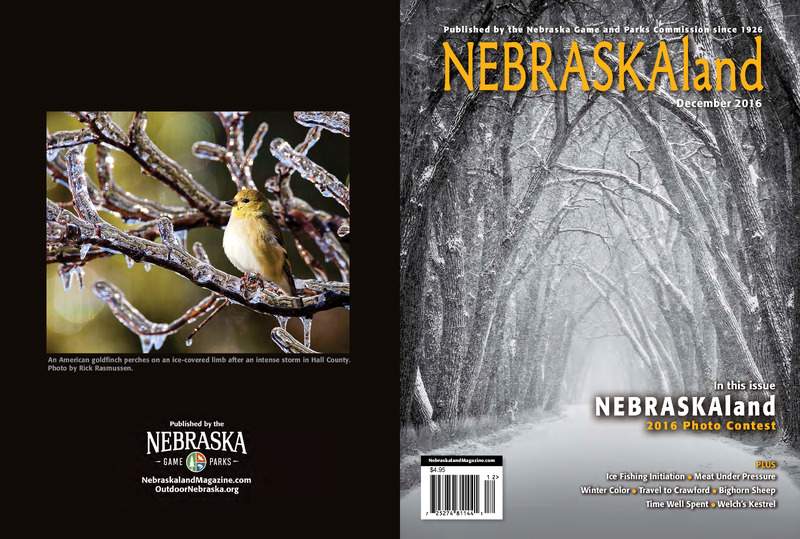
An American goldfinch perches on an ice-covered limb after an intense storm in Hall County.
Photo by Rick Rasmussen.
IIn
n this
this issue
issu
ue
N EBRASKAland
2 0 1 6 Phot o Con t e s t
NebraskalandMagazine.com
$4.95
PLUS
Ice Fishing Initiation ● Meat Under Pressure
Winter Color ● Travel to Crawford ● Bighorn Sheep
Time Well Spent ● Welch’s Kestrel
NEBRASKAland Magazine
Volume 94
●
No. 10
●
December 2016
F EAT U R ES . . .
22 One Way to Start
2
A Personal Introduction to Ice Fishing
STORY AND PHOTOS BY JEFF KURRUS
32 Time Well Spent – What to Do in December
BY RENAE BLUM
34 2016 Photo Contest
PHOTOS BY NEBRASKALAND MAGAZINE READERS
50 Meat Under Pressure
BY GERRY STEINAUER
56 Winter's Colors
PHOTOS AND STORY BY CHRIS HELZER
62 Small Harvest – Big Impact
STORY AND PHOTOS BY JUSTIN HAAG
22
●
I N S I D E T H I S I S S U E ...
Mixed Bag – Holiday Gift Guide, Thirteen-lined Ground
Squirrel, Travel to Crawford, A Brief History of Prairie
Dog Towns Sold to Englishmen, Ponca State Park Winter
Activities, Upcoming Events, and more .......................... 10
Page 49 – Welsch's Return of the Kestrel .................... 60
In the Field – Holiday Tradition................................. 72
Wilderness Workshop – Muzzleloading Tips .......73
Portraits from the Past............................................ 76
In the Kitchen – Bacon-wrapped Goose Breast ........ 80
Junior Journal – From Trail Tales for Kids ............... 81
The Last Stop – Christmas Vacation.......................... 82
34
●
62
●
WHEN YOU SEE THIS SYMBOL IN THE PAGES OF
N
NEBRASKALAND MAGAZINE, VISIT
NEBRASKALANDMAGAZINE.COM AND VIEW OUR INTERACTIVE
DIGITAL EDITION FOR MORE INFORMATION.
D
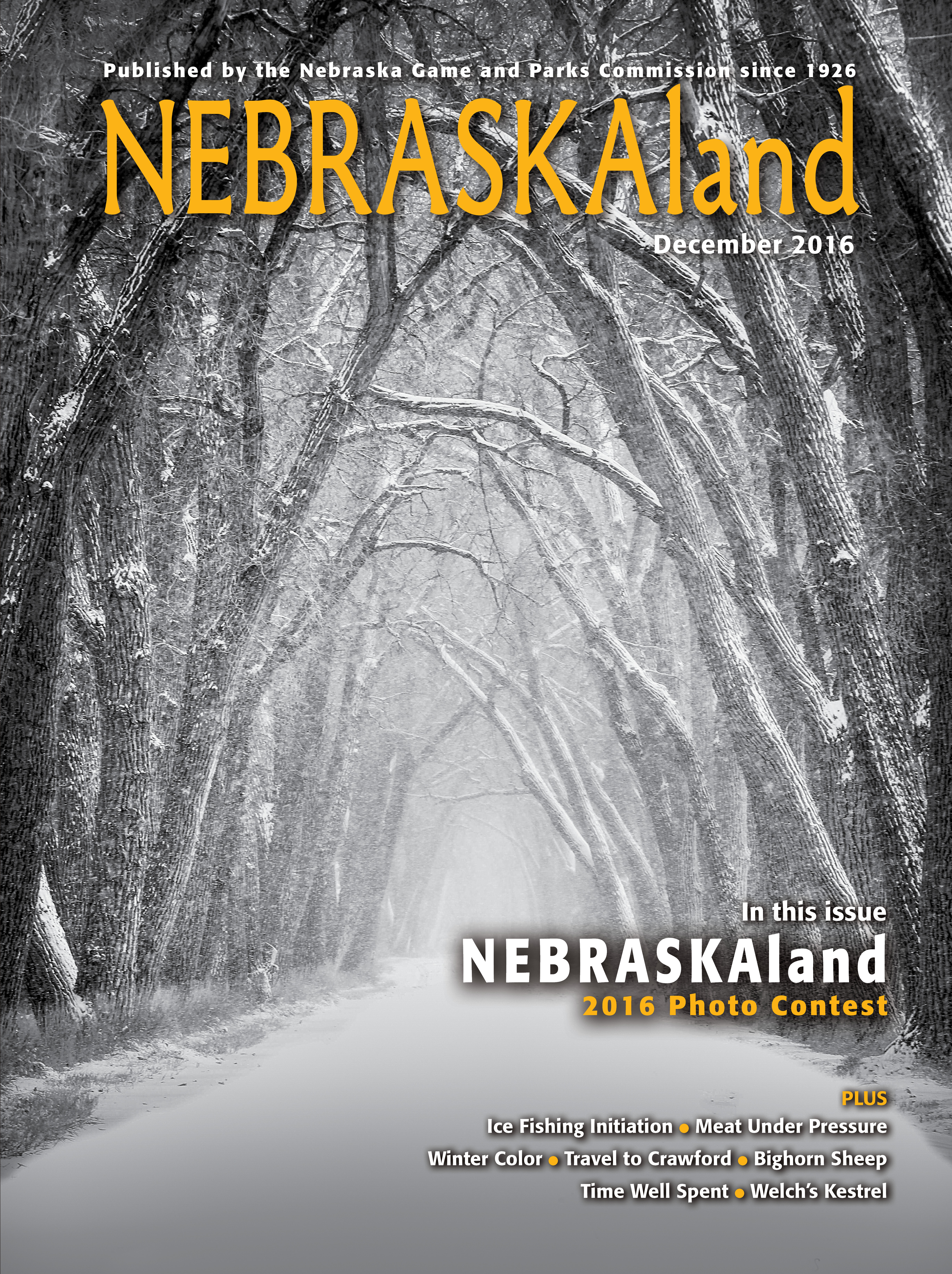
Cover: "Untouched Snow on Willow Island Road" by Richard
Jones was one of the entries in this year's Photo Contest. See
story on page 34.
NEBRASKAland (VOL. 94 / NO. 10 ISSN 0028-1964) is published monthly, except
for the combined Jan./Feb. and Aug./Sept. issues, by the Nebraska Game and Parks
Commission, 2200 N. 33rd St., Lincoln, NE. Periodicals postage paid at Lincoln,
Nebraska, and additional mailing offices. POSTMASTER: Send address changes to
NEBRASKAland, P.O. Box 30370, Lincoln, NE 68503-0370.
2 NEBRASKAland • DECEMBER 2016
56
●
DECEMBER 2016 • NEBRASKAland 3
Ivy Lunbery of Alliance shot this photo of a turkey
vulture sitting on a fence post near Whitman.
Sabrina Nicholson of Curtis said of this piebald deer,
deer "I've been
photographing him since he was a baby. This is the second year rack –
hoping he makes it through another deer season."
Zach Hanson of Omaha took
this photo of backpackers at
Indian Cave State Park. "We
get together and camp one
weekend per month, from
October - April, no matter
the weather forecast. Fall
is by far my favorite time to
camp and winter is a close
second," Hanson said.
Hello NEBRASKAland Readers
The Benevolent and Protective
Order of Elks, known as the local
Elks Lodge in most small towns,
is again accepting donated deer
hides from the beginning of the
November firearm deer season
through the end of the January
antlerless deer season.
Donated hides will be shipped
to a tannery to be turned into soft
leather and made into gloves for
veterans who use wheelchairs
or used for craft kits that are
distributed to veterans at Veterans
Affairs Hospitals across the world
as part of the Elks Help a Vet
program.
Before the hides can be
shipped, they have to have all
excess fat, flesh and both heads
and tails removed. Then table or
stock salt must be rubbed into all
fleshy surfaces. Volunteers at the
drop-off locations do most of this
work, but hunters are welcome to
do it themselves before dropping
off the hides. Care must be taken
in the skinning process, however,
as even small holes can result in
the hide being ruined during the
tanning process.
Contact your local Elks Lodge
for more information.
Jeff Sneller
Lincoln Elks Lodge
Mark Deane of Papillion sent us this photo of Ivy Shaw during
a kayaking trip down the Platte River between Eugene T.
Mahoney State Park and Louisville State Recreation Area in
Cass County.
4 NEBRASKAland • DECEMBER 2016
DECEMBER 2016 • NEBRASKAland 5
NEBRASKAland Magazine
Outdoor Plates
Gary Fredrick of St. Paul shows
his love for deer hunting, something
he’s been doing for 42 years, on his
message plate.
If you have a unique outdoor
message plate you would like to
share, or know someone who does,
e-mail a photo (high-resolution, JPEG
format only, please) along with your
hometown and a brief description of
the interests expressed on your license
plate to Eric.Fowler@Nebraska.gov.
Lindsey Keller
captured this photo
while looking for
fall footage near
Raymond.
Tanner Podraza
took this photo in
late September of a
tractor near harvest
season in Platte
County.
From the Editor: After publication of
our November issue, we came across
the following information concerning
the November Brief History entitled
"Game Day 1922."
Nebraska's 1922 win over Notre
Dame's famed "Four Horsemen"
marked the first loss by the legendary
quartet between 1922 and 1924. The
1923 Cornhuskers repeated the feat
with a 14-7 win over the Fighting Irish
in Lincoln on Nov. 10, 1923. Those
Irish teams, coached by the great Knute
Rockne, finished their three-year run
with the "Four Horsemen" sporting a
27-2-1 record, with both losses coming
to the Huskers.
Send your comments to:
Jeff Kurrus, Editor
NEBRASKAland Magazine
P.O. Box 30370
Lincoln, NE 68503
or e-mail Jeff.Kurrus@Nebraska.gov
Please include your postal address and telephone number. Letters may be condensed
and edited. Photographs are also welcome.
Any program that receives federal funding from the National Park
Service, or the United States Fish and Wildlife Service prohibits unlawful
discrimination on the basis of race, color, religion, age, gender, marital
status, national origin, age, disability or political affiliation. Any person
who believes he or she has been discriminated against in any program,
activity, facility, or service, should contact the Nebraska Game and
Parks Commission, Lincoln, NE 402-471-0641, the Equal Opportunity
Commission, Lincoln, NE 402-471-2024, TTY/TDD 402-471-4693;
United States Fish Wildlife Service, Civil Rights Coordinator, 4401
N. Fairfax Drive, Arlington, VA 22203; Director, Equal Opportunity
Program, U.S. Department of Interior, National Park Service, 1849 C
Street NW, Mail Code 0008, Washington, D.C. 20240-0001.
6 NEBRASKAland • DECEMBER 2016
COMMISSIONERS
CONSERVATION OFFICERS
Director Jim Douglas
Commissioners
Chairman - Mark Spurgin, Paxton
Vice Chairman - Rex Fisher, Omaha
2nd Vice Chairman - Dick Bell, Omaha
Dr. Kent Forney, Lincoln
Robert Allen, Eustis
Pat Berggren, Broken Bow
Mick Jensen, Blair
Norris Marshall, Kearney
Dan Kreitman, Wahoo
ADMINISTRATION (Lincoln)
Craig Stover (Administrator)
Duane Arp (Asst. Administrator)
Jeff Clauson (Asst. Administrator)
MAGAZINE STAFF
Communications Director Christy Rasmussen
Editor Jeff Kurrus
Art Director Tim Reigert
Associate Editor Jenny Nguyen
Regional Editors Eric Fowler, Julie Geiser,
Justin Haag
Contributing Editor Michael Forsberg
Regular Contributors Chris Helzer, Gerry
Steinauer
Photo Librarian Jaclyn Cruikshank Vogt
Circulation Donna Robinson
For address changes and questions about
your subscription, e-mail donna.robinson@
nebraska.gov or call 800-632-5263
Advertising Sales Manager
For advertising information contact
Shane G. Gilster, 402-742-0125
Email: shanegilster@gmail.com
NEBRASKAland Magazine Copyright 2016, all rights reserved.
NEBRASKAland is available in audio from the Nebraska Library
Commission Talking Book and Braille Service, Suite 120, 1200 N St.,
Lincoln, NE 68508. 800-742-7691. NEBRASKAland Magazine and the
Nebraska Game and Parks Commission reserve the right to reject any
advertising not in keeping with the agency mission.
Rates: $18 for one year; $33 for two years; $44 for three years. Nebraska
recipients must add appropriate sales tax. To subscribe call
1-800-NEBLAND (632-5263), or go online to: NebraskalandMagazine.
com.
COMMISSION
C
CO
COM
OM
MMIS
MISSIO
S NO
OFFICES
FFICES
FF
FFI
S
Headquarters/Southeast District Office
2200 N. 33rd Street Lincoln, NE 68503
Phone 402-471-0641
Northeast District Office
2201 N. 13th St. Norfolk, NE 68701
Phone 402-370-3374
Southwest District Office
301 E. State Farm Rd. North Platte, NE 69101
Phone 308-535-8025
Northwest District Office
East Hwy. 2, Box 725 Alliance, NE 69301
Phone 308-763-2940
Bassett Office
524 Panzer St., Box 508 Bassett, NE 68714
Phone 402-684-2921
Kearney Office
1617 First Ave. Kearney, NE 68847
Phone 308-865-5310
Ak-Sar-Ben Aquarium
21502 W. Highway 31 Gretna, NE 68028
Phone 402-332-3901
Omaha Office
8495 Frederick Street, Omaha, NE 68124
Phone 402-595-2144
402-471-5531
402-471-5531
402-471-5531
NORTHWEST (Includes counties covered)
Jim Zimmerman (District Supt.)
308-641-6138
Sean McKeehan
(Cheyenne, Morrill, Box Butte)
308-279-9133
Scott Brandt
(Kimball, Banner, Scotts Bluff)
308-631-0663
308-760-3647
Greg Hesse (Sheridan, Dawes)
308-430-0572
Dan Kling (Sioux, Dawes)
Terry Brentzel (Deuel, Garden, Grant) 308-458-7650
402-389-0444
Frank Miller (Cherry, Hooker)
NORTHEAST (Includes counties covered)
Tom Zimmer (District Supt.)
402-649-8053
402-760-0712
Dale Davis (Keya Paha, Brown, Rock)
402-340-3981
Jonathan Andreasen (Holt, Boyd)
Mitch Johnson (Knox, Antelope, Pierce) 402-613-8612
402-762-5022
Jeff Jones (Knox, Cedar)
Owen Johnson
(Dixon, Dakota, N 1/2 Thurston)
402-266-1759
Jon Reeves
(S 1/2 Thurston, Burt, Washington)
402-889-8508
402-719-1108
Dan Roberts (Dodge, Colfax)
Cory Krause
(Cuming, Wayne, Stanton, Dodge)
402-380-6410
Steve Oberg
(Colfax, Platte, Madison, Stanton)
402-910-3366
Randy Pomplun
(Nance, Greeley, Wheeler, Boone)
308-550-0489
308-730-7050
Doug Pollard (Loup, Garfield, Valley)
SOUTHWEST (Includes counties covered)
Roger Thompson (District Supt.)
308-530-3097
308-202-0819
Matt Brandt (Sherman, Howard)
308-380-7331
Tim Williams (Hall, Hamilton, Merrick)
Pat George
(Clay, Adams, Nuckolls, Webster)
402-705-9989
308-920-0367
Rich Routh (Franklin, Harlan, Phelps)
Matt Andrews
(Gosper, Furnas, Frontier, Red Willow)
308-746-2418
Andrew Heyer (Dawson, Gosper, Phelps) 402-613-2241
Brian Piernicky
(Red Willow, Frontier, Hayes, Hitchcock)
308-340-6627
308-289-0427
Nicholas Fix (Keith, Perkins)
308-289-1169
Bryce Streger (Keith, Arthur)
Brandon O’Neal
(Lincoln, McPherson, Logan)
308-530-3157
Alex Hasenauer
(Lincoln, McPherson, Logan)
308-660-4671
308-440-3847
Dale Johnson (Kearney, Buffalo)
308-529-8146
Mike Thome (Dawson)
Ray Dierking (Custer, Thomas, Blaine) 308-870-0322
SOUTHEAST (Includes counties covered)
Levi Krause (District Supt.)
402-949-0593
402-619-1355
Rich Berggren (Douglas)
402-616-5961
Dan Evasco (Sarpy)
402-210-0888
Heath Packett (Cass)
402-209-1506
Russell Mort (Otoe, Johnson)
William Krause
(Nemaha, Richardson, Pawnee)
402-274-8063
402-806-9084
Dan Zuehlke (Gage, Saline)
402-890-6463
Dina Barta (Lancaster)
402-890-6465
Doug Kramer (Lancaster)
402-937-3422
Dudley Sorensen (Lancaster, York)
402-613-2312
Travis Shepler (Lancaster)
402-890-7140
Stacey Lewton (Lancaster, Seward)
402-443-6392
Mike Luben (Saunders, Butler, Polk)
Nebraska Wildlife Crimestoppers
1-800-742-7627
DECEMBER 2016 • NEBRASKAland 7
8 NEBRASKAland • DECEMBER 2016
DECEMBER 2016 • NEBRASKAland 9
A Mammal Brief
By Lindsay Rogers
Once limited to prairies, the thirteen-lined
ground squirrel (Ictidomys tridecemlineatus)
can now be found in well-grazed pastures,
cemeteries, mowed roadsides, golf courses,
parks and even urban backyards. They are
easily distinguished from tree squirrels and
other ground squirrels by their smaller
size (6-12 inches long) and their
characteristic stripes extending along
their backs.
They are quick and small, but if you are
fast you can often see them standing on hind
legs surveying the land. Once spotted, they quickly
jump into their burrow to escape. They can also be heard giving alarm calls when in danger from predators
including hawks, snakes and weasels. Because they are an important food source for so many species, most
young do not make it through the first year and adults rarely live more than a few years.
In fall, thirteen-lined ground squirrels rapidly gain weight to sustain themselves through winter hibernation.
In mid to late September, they enter true hibernation, meaning they allow their body temperature to drop just
above freezing and their heart rate to drop from 200 beats per minute to just 20 beats per minute. They arouse
from hibernation in March with males emerging first. ■
10 NEBRASKAland • DECEMBER 2016
JOEL SARTORE/ NATIONAL GEOGRAPHIC PHOTO
T ARK
RK
K
Thirteen-lined
Ground Squirrel
Lindsay Rogers is an outdoor
education specialist with the
Nebraska Game and Parks
Commission.
DECEMBER 2016 • NEBRASKAland 11
Background photo: Red Cloud Buttes at Fort Robinson
Travelogue Sponsors
By Hannah Hundley, Nebraska Tourism Commission
Crawford
n some places, the cheerful spirit of the holidays come and
g with the season ... but in this true northwestern town,
go
it is felt all year round. This December, travelers will be
jingl their bells all the way to Crawford, Nebraska – where
jingling
the greetings are as warm as the hot chocolate. Along the way,
they’ll enjoy the scenic views of the Pine Ridge area, but it
won’t take long before all the colorful lights coming from Fort
in.
Robinson State Park capture their attention and draw them
on
Robins
Fort
ills”,
Sandh
Known as the “Garden Beyond the
rolling
ite,
exquis
of
is made up of more than 22,000 acres
s, and the park’s own buffalo and longhorn herds.
landscape, compelling Old West history, rustic campground
Crawford. It operated from the early days of the
This impressive fort is only 3 miles from the main streets of
gs have survived
Old West until after World War II. Many of the original buildin
gs have been
buildin
Other
today.
park
the
the test of time and remain in use at
these
year,
Every
ticity.
authen
fort’s
the
reconstructed in efforts to preserve
on’s
Robins
Fort
for
lights
as
Christm
l
historic buildings are wrapped in colorfu
invited
are
rs
travele
2016,
3-31,
Dec.
annual Light Up the Fort event. From
decorative
to marvel at this magical light display, along with the many other
the
quite
it
g
makin
–
pines
snowy
charms tucked in and around the fort’s
winter wonderland!
people in,
Don’t be fooled though – it may be the pretty lights that draw
ss
kindne
of
acts
e
genuin
and
es
but it’s the smiling faces, warm welcom
is
rd
Crawfo
of
town
jolly
The
stay.
around every corner that make them
The
alike.
s
hunter
game
and
lovers
a popular destination for both nature
shops
locals will tell the visitors the best trails for hiking and the best
pe and
antelo
elk,
deer,
of
variety
a
for shopping. In addition, there are
“Big
the
as
title
its
rd
Crawfo
g
bighorn sheep roaming around, earnin
the
all
from
break
a
take
to
time
Game Capital of Nebraska.” When it’s
over
head
can
s
visitor
,
action
winter
to Q’s Dairy Sweet for a much
needed cup of hot cocoa.
No matter how one prefers to spend
their holidays, visitors will find it hard
Crawford
to leave this part of Nebraska empty
handed – or empty hearted. Whether
it’s a family photograph in front of the
lit-up lodge at Fort Robinson, a furry
new prize from a successful
hunting trip in the
Pine Ridge, or even
a trip to nearby
Toadstool Geologic
Park, Crawford has
something special
for everyone’s
stocking this year. ■
Light up the fort!
Ponderosa
Area near Wildlife Mana
gement
Crawford
Toadstool
ark
eologic P
G
12 NEBRASKAland • DECEMBER 2016
Hunting at Peterson
Wildlife Management Area
near Crawford
DECEMBER 2016 • NEBRASKAland 13
A Brief History
There's Millions in It!
By Patricia C. Gaster, Nebraska State Historical Society
A
good story – even if based more on fiction than fact
– has always been popular among the newspaperreading public. One such tale involving a shrewd
Nebraskan, prairie dogs and a gullible English
nobleman, appeared in the Omaha Daily Bee on Dec. 17,
1885, under the headline “There’s Millions in It!” The
story, attributed to the Chicago Herald, explained how
an unnamed, down-on-his-luck Nebraskan disposed of a
worthless homestead claim.
“Last spring,” the homesteader said, “I went out into
Western Nebraska and homesteaded a quarter section. I
hadn't seen the land, but took it supposin’ it was all right.
But when I got there I found it already inhabited. About 150
acres of the 160 were covered with a prairie-dog town. Well,
I concluded to settle down and see what I could do, and I'm
mighty glad now that I did. About two weeks ago I was up
to the railroad station trying to get trusted for some bacon
and flour and terbacker, an' feelin’ right smart discouraged.
I was out of money and grub, and the winter was comin' on
fast, an' I couldn't see any way out of it but to eat prairie
dogs, an' they're mighty hard to catch. But that day was
the turning point in my luck. While I was at the station an
Englishman got off the cars an' said as how he was out west
lookin’ for a place to make an investment. Said he'd heard o'
the fur business, and wanted to know if he was out in the fur
country yet.”
Quickly the homesteader saw an opportunity, and invited
the nobleman out to see his land. “An' he went out with me,
an' I showed him the prairie-dog town, an', as luck would
have it, it was a bright sunny day, an’ the dogs was out
scootin' around by the hundreds. ‘Talkin' about furs,' I says,
'what d'yo think of that? I've been six years growin’ these
mink, . . . an' they double every year.’” The homesteader
told his fascinated guest that “they're worth $1 apiece.
There's millions in it.” In less than an hour the Nebraskan
sold out to the Englishman for $7,000 cash and took
a train East.
Nebraskans may have laughed, but less than five years
later, on June 23, 1890, a similar story (this time attributed
to the Chicago Tribune) appeared in the Bee. In the second
version of the now well-known story, Nebraska merchant C.
A. Hastings regaled a Tribune reporter with the experience
of Lord Wynford, who had stopped at North Platte “during
his tour of the prairies. He seemed greatly pleased with the
wild west and intimated that he would like to invest some
money in something good. There was a smart young Irish
lawyer in the town whose parents had had some unpleasant
dealings with Lord Wynford in the old country. This young
lawyer had lived in North Platte about two years. He came
there to examine a claim he had purchased on paper. To his
disappointment his farm was nothing but a prairie dog town.”
The lawyer called on Lord Wynford and offered for sale
what he called “the most profitable investment in America.”
The pair then drove out to the homestead to inspect what the
lawyer called his “mink farm.” The farm “delighted Lord
Wynford and on returning to the city he gave $500 for the
dog town. He owns it now and the good-for-nothing place is
called ‘the lord’s mink farm.’”
In both 1885 and 1890 a number of newspapers around
the country reprinted the stories of the Nebraskan who
unloaded a worthless homestead on an English nobleman
by convincing him that prairie dogs were mink. It seems
unlikely that the tales could have been true, but they
delighted newspaper readers then and now and made good
copy. ■
Visit the Nebraska State Historical Society’s website at
nebraskahistory.org.
NSHS RG3
RG3761-23-12
RG3761
761 23
76123-1
12
12
Lithograph on a card of a “Prairie Dog City.”
14 NEBRASKAland • DECEMBER 2016
DECEMBER 2016 • NEBRASKAland 15
Ponca State Park
Winter Activities
16 NEBRASKAland • DECEMBER 2016
PHOTO BY JENNY NGUYEN
By Lynn Mellick, Ponca State Park
Celebrate Christmas in the Woods at Ponca State Park!
Activities will be offered every Saturday Nov. 26 - Dec.17,
including crafts, cookie decorating, educational programs,
free family photos and lighted hayrack rides. We will
also kick off the beginning of the Third Annual Snowman
Building Contest Nov. 26 - March 19.
Come build a snowman near the mini lodges or Resource
and Education Center. When your snowman is complete,
stop by the Resource and Education Center to register your
entry. Photos will be taken and displayed throughout the
winter season in the center’s lobby and on the Nebraska
Northeast Parks Facebook page. Prizes will be awarded for
first, second and third place.
On Dec. 31 – New Year’s Eve – Ponca State Park
celebrates Winterfest, a day full of family-fun activities and
friendly competition. There will be crafts in the morning, the
National Fruitcake Fling at high noon, a 3K Yule Log Quest
in the afternoon and guided hayrack rides at dusk.
For more information on the Ponca State Park Snowman
Building Contest, discount lodging packages, Winterfest and
Christmas in the Woods, contact the park at 402-755-2284 or
ngpc.ponca@nebraska.gov. ■
A showshoeing challenge will be held at Ponca State Park's Yule
Log Quest during Winterfest on Dec. 31.
DECEMBER 2016 • NEBRASKAland 17
Junior Duck Stamp
Competition Underway
By Justin Haag
Students in kindergarten through
12th grade are encouraged to show
off their skills as waterfowl artists
by entering the 2017 Federal Junior
Duck Stamp Competition.
Each year, hundreds of entries from
students throughout Nebraska are
judged in late March or early April at
the Gering Civic Center. The deadline
to enter is March 15.
CREIGHTON SCOTT
Last year’s contest was won by
Creighton Scott, a 16-year-old student
of the Debie Plog Art Studio in Omaha. Scott used color
pencil to portray a king eider flying over water with
snow-covered mountains in the background. The king
eider is a large sea duck that spends most of the year in
coastal marine environments and breeds on the Arctic
An Annual
Hibernation
Procession
tundra in June and July.
■
For details about the competition, contact Lydia Patrick,
Nebraska’s contest coordinator, at lydia_patrick@fws.gov.
More information and contest guidelines may be found at
fws.gov/juniorduck.
Chadron State Park - Winter Getaway
was new in 2015, has proved popular among park visitors
of all ages. Also, the park can serve as a base for visitors
enjoying other popular winter activities in the region, such as
ice fishing.
During winter, the park’s modernized duplex cabins are
available by reservation. Each of the six quarters has a living
room, kitchen, bathroom and two bedrooms – one with a
queen bed and another with two singles. A minimum twonight stay is required, but most people won’t want to leave
once they’re there.
The online reservation system isn’t active for Chadron
State Park in winter, so to reserve a cabin call the park’s
office at (308) 432-6167. ■
PHOTO BY JUSTIN HAAG
By Justin Haag
Located in the heart of the Pine Ridge, Chadron State
Park serves as a prime getaway for travelers to enjoy winter
scenery and activities.
The park’s trail system provides opportunities for crosscountry skiing, snowshoeing and hiking. A sled run, which
By Dan Fogell
Winter. Some like it, but I’d
venture to bet that like me,
most do not. It’s cold, windy,
and the days are short. We
all know someone who heads
south every November to get
away from it. We call them
“snowbirds.” Animals don’t
seem to like it either. Some
head south like the snowbirds
do. But most have no way of
reaching those little latitudes
and must find a way to avoid
harsh Plains winters.
Those most affected are the
ectotherms, such as insects,
amphibians and reptiles. They
can’t produce body heat, and
they lack fur and feathers
– features that give endotherms a
thermoregulatory advantage. Thus, they
must get out of the cold.
A successful overwintering strategy
is the limiting factor, determining
whether an animal can exist at
Nebraska’s latitudes. Depending on
their strategy, some disappear from
the landscape sooner. Some are more
cold-tolerant and can wait until the last
minute, though none can stay active all
winter. And if temperatures are mild,
some will still poke their heads out and
enjoy the sun.
18 NEBRASKAland
18
NE
N
EBR
EBR
BRA
AS
S
SKA
KA
K
Ala
Ala
land
d • DECEMBER
DEC
DE
CE
EMB
MBE
ER
R 2016
20
01
16
Turtles
Turtles are next. Box turtles dig in
just below the surface and stay all
winter. Aquatic turtles dive down to
the muddy bottoms of lakes and rivers
and bury themselves with the frogs.
It’s important that they get there before
ice forms on the surface. On mild days
they often emerge and bask for a bit
but go back to the mud as the day cools
down. Snapping turtles have even been
seen walking on top of ice-covered
lakes.
Snakes
Last to go down are the snakes.
Older, experienced snakes know how
long they can push their luck before the
winter cold sets in and may wait until
the last possible minute. And while you
won't see them on subfreezing days,
snakes have been spotted on sunny,
50-something degree winter days. In
Nebraska I’ve seen adult garter snakes
every month of the year. Younger
snakes are more naïve, and their timing
may be off, but they are often the first
to enter hibernation. The absolute
last snakes to hibernate are babies
– the young of the year. Having no
experience, they either follow scent
trails from other snakes or hibernate
wherever they happen to be when it
turns cold. Sadly, the latter often results
in a suboptimal overwintering site and
death.
The procession of herpetofauna into
their winter hiatus is not random, but
rather methodical. Balancing when
to enter hibernation with life history
decisions like conserving energy,
avoiding freezing temperatures and
staying warm enough to escape
predation involves instinct,
experience and even a little luck.
The wrong decision can mean the
difference between surviving the night
and surviving the entire winter. ■
DECEMBER 2016 • NEBRASKAland 19
PHOTOS BY DAN FOGELL
Lizards and Amphibians
First down are lizards and
amphibians. An unlikely pairing, I
agree, but once you know why you’ll
understand. Insects disappear each
winter too, and they happen to be food
for lizards and amphibians. Though
they could stay out later, they would
use crucial energy reserves that could
not be replenished. So down they go.
Lizards and toads dig deep into sandy
soil, and frogs bury themselves in
the sediment under water. But on an
unseasonably warm day you often see
bullfrogs along the water’s edge.
Women's Wellness Weekend
By Lynn Mellick, Ponca State Park
The third annual Women’s Wellness Weekend Retreat returns Jan. 13-15 at
Ponca State Park. Come find inner peace, inspiration among instructors and new
friends, take time to pamper yourself, and leave relaxed at this intimate gathering.
This three-day retreat offers over 25 sessions covering a variety of topics that will
teach you how to improve your body and mind.
The weekend will kick off with inspirational guest speaker Jill Miller. Past
classes have included yoga, dancing, aromatherapy, bird watching, acupuncture,
meditation, stress management, self-defense, hiking, Dutch oven cooking and
much more.
On Saturday during breaks, purchase jewelry, health and beauty products, and
other wares from a variety of vendors. By appointment, take advantage of services
such as massages, manicures, pedicures and facials. Then at lunch, enjoy a fashion
show, where you can discover new, stylish looks for home, work and vacation. At
the end of the day, a wine and cheese social will precede an elegant dinner party
and evening activities.
Sunday will include a morning exercise class and time to gather one last time
before departing for home.
Registration is limited and fills up quickly. If you would like to receive
information relating to Ponca State Park’s Women’s Wellness Weekend Retreat,
contact Lynn.Mellick@Nebraska.gov. ■
by Jerry Kane
Contact the Nebraska Game and
Parks Commission at 402-471-0641 or
visit Outdoornebraska.org for more
information. Visit huntsafenebraska.
org for a list of hunter education
classes and boatsafenebraska.org for
a list of boating safety classes.
December 1
Bobcat
December 10-18
Deer
December 31
Antelope and Deer
Bobcat hunting and trapping season
opens
Boyer Chute National Wildlife Refuge deer
season
December 1-31
Deer and Elk
December 11
Deer Processing Class
Hunting seasons close for archery
antelope and deer, the Mule Deer
Conservation Area, and statewide whitetail
buck deer
December 2-23
Christmas at the Mansion
Fresh venison cooking, Fort Atkinson SHP, December 31
Fishing
Fort Calhoun
Underwater spearfishing season and
December 11
archery fishing season for game fish ends
White-fronted Goose
Arbor Lodge State Historical Park (SHP),
Nebraska City
First segment of white-fronted goose
hunting season closes
December 3
Archery Fun Shoot
December 14-31
Christmas Bird Count
Nebraska Game and Parks Outdoor
Education Center, Lincoln
Indian Cave SP, Shubert
December 3
Archery on Fire
Platte River State Park (SP), Louisville
December 3
Fort Robinson Historical Christmas
Dinner
Fort Robinson SP, Crawford
December 3-31
Light Up the Fort
Snipe hunting season closes
December 17
Yule Log Quest
Platte River SP, Louisville
December 17
Christmas at the Bowring
Bowring Ranch SHP, Merriman
Fort Robinson SP, Crawford
December 17-18
Deer
December 4
Shootout at Salt Creek
DeSoto December Muzzleloader deer
season
Nebraska Game and Parks Outdoor
Education Center, Lincoln
December 4
Deer Processing Class
Sausage making, Fort Atkinson SHP, Fort
Calhoun
December 4, 11, 18
Best Shots Rifle Class
Nebraska Game and Parks Outdoor
Education Center, Lincoln
December 6
Learn to Hunt Predators
Nebraska Game and Parks Outdoor
Education Center, Lincoln
December 20
Duck and Coot
Duck and coot hunting seasons in Zone 2
Low Plains and High Plains (first segment)
and Zone 4 closes
December 22
Bighorn sheep
Bighorn sheep hunting season closes
December 27
Duck and Coot
Duck and coot hunting season in Zone 1
closes
Last issue’s winner of
the Visitor drawing was
Adelene Vock of Nebraskaa City
City,
Nebraska, who found the banded
woollybear tiger moth on page 30.
Readers are encouraged to contact
NEBRASKAland within 10 days
after this issue’s publication with
the correct page number and name
of this issue’s “Visitor” – a critter
found in Nebraska. We will then
gather the correct entries and draw
one to win a NEBRASKAland mug.
To enter each month, write:
NEBRASKAland Visitor
2200 North 33rd Street,
Lincoln, NE 68503.
Or e-mail:
Tim.Reigert@Nebraska.gov
with “Visitor” in the subject line of
the message.
HINT: This issue’s visitor is not on
page 21.
The banded woollybear
(Pyrrharctia isabella) is a medium
sized tiger moth, native throughoutt
the continental U.S., including
Nebraska. These nondescript mothss
are dirty white to yellowish-brown
in color, with black dots on their
wings and a line of dots down the
abdomen. While the adults get
little notice, their caterpillars are
familiar to all. Banded woollybear
caterpillars are about 2 inches long
when mature and covered in
bristles, with black at each end
of their body and a reddish band
in the middle. As the caterpillars
age and molt, they may have more
reddish and fewer black bristles.
In the fall the caterpillars become
wanderers, crossing roads and fields,
looking for places to hibernate
through the winter, such as in leaf
litter and under rocks. The caterpillars will briefly become active
again in the spring,
then pupate before
emerging as adults.
December 16
Snipe
PHOTO BY JENNY NGUYEN
Muzzleloader deer and public and private
land cow elk hunting seasons
NEBRASKAland
an
nd
Visitor
Special thanks
to Julie Van Meter, State
Entomologist, Nebraska
Department of Agriculture.
Learn yoga, breathing and stretching exercises at Ponca State Park's Women's
Wellness Weekend Retreat on Jan. 13-15.
20 NEBRASKAland • DECEMBER 2016
DECEMBER 2016 • NEBRASKAland 21
m
moth
caterpillar
ca
aterpillar
One Way to Start
A Personal Introduction to Ice Fishing
I
t gets cold in Nebraska. Even so-called “light”
winters, during which natives barely adorn a heavy
jacket, had always been too cold and long for me. I’ve
been with NEBRASKAland for 10 years, huddled in my
home for all of these winters unwilling to venture into
the cold for more than a few hours at a time.
Until last winter. I finally decided I had enough. I
needed to figure out why every serious ice angler was
telling me how great their winter passion was. I had
seen those people sitting on buckets on frozen water
for years – those older, often miserable looking anglers
holding a miniaturized jigging pole in one hand and their
chin in the other. It looked awful. Little did I know these
folks were having the time of their lives.
My first ice fishing excursions were from stories
for this magazine – my trip to Calamus Reservoir with
photographer Michael Forsberg in 2008 with the Mares
brothers and my covering of the Cork Thornton Ice
Fishing Tournament at Merritt Reservoir in 2011. What I
didn’t know at the time was that the small bits of vital
information I had kept from those trips would prove
beneficial down the line.
THE START
Besides my work-related excursions, I began
dabbling on the ice two winters ago. I picked up a hand
auger on sale ($25) at Scheels in Omaha and talked
my dad, who is a consummate caster of crankbaits for
largemouth bass on open water, into vertical jigging
through an 8-inch hole. We used a few spare spring
fishing crappie jigs for our lures, unwilling to tip these
yet with any sort of live bait.
Our production was sporadic at best. We’d catch a
few fish – bass, bluegill and crappie – but spent much
more time cutting holes than fishing. After just a few
holes, we’d each choose one, and jig repeatedly until
Opposite: Kevin Greene of Omaha shows a channel
catfish caught on a tip-up through the ice last
winter on a private pond in west Omaha.
22 NEBRASKALand • DECEMBER 2016
Story and photos
by Jeff Kurrus
we got a strike. If we caught anywhere near half-adozen fish, I was elated.
But we were also learning. Toward the end of the ice
fishing season, I borrowed a power auger from a friend,
and dad and I cut about a dozen holes on a pond close
to my home. Once we returned the auger, we kept
these holes open for the remaining weeks by using
our hand auger. During this time, my then 5-year-old
daughter, Madeline, caught more fish than anyone. Her
jigging pole remained in constant motion.
I used her same jigging technique on our last fishing
day of the winter, adding one more aspect to make me
feel even more comfortable: braided line. I was curious
if I could feel fish just as well through the ice as I can
with braided line in open water, and I quickly found that
I could. Bluegill after bluegill came from the hole, and
for the first time fishing over ice, I could feel my lure
like I could when I was bass fishing in the summer. For
a second, I was comfortable. The fish were stacked
into this area and they were feeding heavily. When I
called my dad after my trip, I reported that I had caught
10, more fish than we had ever caught together. I was
convinced it couldn’t get any better.
I was wrong.
A PARTNER
Kevin Greene of Omaha owns a landscaping business
which keeps him working sunrise to sunset from
the spring to the fall. I’d see him at Nebraska football
parties at a mutual friend’s house in the fall, and each
time we were together we’d talk about fishing. He had
grown up in Connecticut and spent time fishing on
both coasts, mainly for saltwater fish, but ice fishing
appealed to him because, like me, he struggled through
the gloomy winters. We had found brief refuge earlier
in the winter by snowboarding together while our kids
sledded, but a mid-winter melt took away our board
DECEMBER 2016 • NEBRASKAland 23
and left us once again searching for something to
escape our cabin fever.
Because of this fever, shortly after Thanksgiving I
bought a gas-powered auger ($300) to give ice fishing a
real go. It wasn’t a top-of-the-line auger, which could go
for several hundred dollars more, but I thought it might
provide me the ability to cut a few more holes than I
was currently doing.
With this power, and a couple of ice fishing rod-andreel combos ($30 apiece), we started fishing together.
On one of these days, Kevin and I went with a group of
people, including NEBRASKAland’s Jenny Nguyen, to
a private lake in west Omaha. We cut a series of holes
across a three-acre cove about 20 feet from each other,
a perimeter of sorts, and then drilled an X across it. This
pattern not only gave us several holes to fish, but also
gave my kids, now at ages 3 and 6, a place to play.
And play they did. They pulled each other on the
sled, loaded fish on and off the sled, giving them a
ride as they did, and delivered supplies to each angler
on the ice. It was in the upper 20s with no wind and
the perfect winter day to be outside. It also became a
perfect day to learn, as nearly every one of us worked
to catch fish while one of us didn’t seem like she was
working at all.
GAME CHANGER
Since I was a kid, I have learned to watch the hands
of other anglers if they are catching fish. Are they
reeling fast or slow? Are they twitching with their
wrists or with their entire arms? But I had yet to apply
this common practice to ice fishing until this particular
day.
A number of bluegill
and channel catfish were
caught last season by
copying Jenny Nguyen’s
stationary “jigging”
technique, including one
productive day on a lake
near Yutan.
PHOTO BY JENNY NGUYEN
24 NEBRASKALand • DECEMBER 2016
EQUIPMENT
The colder it gets, the more I must be sure
my feet stay warm. I do this by wearing
Wood n’ Stream’s Cold Weather series, a
comfortable hunting boot that allows me to
fish all winter long. Plus, they are waterproof.
To stay upright, Kevin and I wear Hillsound
Freesteps6 and YakTrax XTR crampons, taking
no chances of slipping in slush ice with each
model’s aggressive spikes. At the least, ice
cleats should be standard equipment to
prevent falls.
While all of us were periodically catching fish at best,
Jenny was into fish repeatedly – hand-sized bluegill
after bluegill, able to take home her limit of 15 in less
than an hour and continuing to catch and release fish
long after that. What was she doing with her hands?
Absolutely nothing. She would lower her purple Lindy
Slick jig, tipped with a waxworm, down to the bottom
of the lake, where her line would go slack, and reel up
about a foot and simply wait. No bobbing, no jigging.
The more fish she caught, the more interest she drew
from the rest of us. We cut holes within feet of her and
had some success, but not matching success. So then
we looked at her lure next. She was using a 1⁄16 ounce jig.
“How much did it cost?” Kevin asked.
“On clearance at $1.88,” Jenny replied.
Everyone went back to the tackleboxes, trying to
find the closest thing that matched Jenny’s jig. We
continued to catch bluegill until my rod bent double,
but the pull on the other end was not a bluegill. All of
DECEMBER 2016 • NEBRASKAland 25
us gathered around, a group of friends curious what
monster lurked beneath the ice. We found out a couple
minutes later as a 20-something-inch channel catfish
came through the hole. This fish was a game changer.
We all perked up a little bit more the rest of the
afternoon, and added a few more channel cats to
the already impressive number of bluegill on the ice.
However, I couldn’t get my mind off of Jenny’s jig and
the additional cost of my newfound passion, a passion
which had kept my kids happily on the ice since early
that morning. We had found our winter activity – but
could we afford it?
FINGERNAIL POLISH
A few days later, while working in Papillion, I had a
few minutes to spare and dropped into Dick’s Sporting
Goods. I scanned the shelves for ice fishing jigs, each
in the same price range as Jenny’s, then saw the red
clearance sign seemingly shining in the distance. On
this rack were two boxes of lead 1⁄16 ounce jig heads,
with a 10-count each,for $1.40. I could handle 14 cents
a jig, if only I could get some color on them. But I
already knew just the place to start.
Painting jig heads with fingernail polish is one way
to save money when buying ice fishing supplies.
That night, Madeline and I set up a
painting area in the living room and asked
my wife to gather all of her fingernail polish.
She brought out three shoe boxes full of
every color imaginable.
We agreed not to talk about her
purchases as long as we didn’t talk about
mine, and Madeline and I started painting.
We imagined the color of Jenny’s jig and
copied it, and then started painting lures in
shades similar to bass fishing crankbaits.
I passed the other set of jigs along to
Kevin for him to paint, and we put them
to work the following week with excellent
results. We cut 20 to 30 holes, lowered our
lures until our lines went slack on the lake
bottom, and then we reeled about a foot and
began by using Jenny’s stationary tactic.
The fish didn’t mind the cheaper jig
imitations, and we caught more panfish
that day than we ever had, hopping from
hole to hole in an effort to find schools of
fish across the lake. If we didn’t pick up a
fish relatively soon, we moved.
We used this approach for the entire
morning, sharing information with each
other on what holes had produced and
which ones hadn’t, what colors we were
catching fish on and if we were jigging or
Kevin Greene watches the Vexilar while jigging for crappies
stationary or something in between.
and bluegill on a private pond in Sarpy County.
However, we had also spent a fair amount
of time fishing holes that weren’t producing,
the basics of the finder on Lawrence Youngman Lake
an act that Kevin had a counter for in the coming days.
in west Omaha, also applying what we had already
ELECTRONICS
Alex Wade of Omaha poses with a crappie from Lawrence Youngman Lake as his dad Scott looks on.
26 NEBRASKALand • DECEMBER 2016
Scott Wade, a friend of Kevin’s, has been ice
fishing since he was a kid, and he’s the guy with the
knowledge and gear: various ice fishing rods and
tackle, sleds, shelters and a Vexilar.
I had seen a Vexilar in action before, the electronic
machine that features a circular dial filled with various
combinations of red, green, and yellow lights that
notes not only the depth of the water, but also the fish
that are under the transducer’s cone angle. With the
Vexilar’s sensitivity set just right, an angler could even
see his or her own jig raising and lowering on the dial.
However, prices for a fish finder like this range from
$300 to well over $1,000, an investment neither Kevin
nor myself wanted to make quite yet. We learned
learned, and caught more than 60 bluegills and crappie
within our group of three adults and two teenage boys.
Scott let us borrow his Vexilar for a few days. Kevin and
I took the same approach we had used before, except
for the addition of me dropping the Vexilar transducer
into each new hole Kevin cut, making a quick judgment if
I had marked any fish and moving to the next hole.
After about 20 holes, Kevin would pause and look
back to me. I’d point to the holes where I thought fish
might be, and we’d divide and start fishing. In every
instance after this until the end of the season, when
we marked fish we had strikes within the first five
minutes using an assortment of wax-worm tipped,
fingernail polish-painted, jig heads.
Kevin and I ordered a new Vexilar of our own,
splitting the cost ($250 apiece) for a device we would
DECEMBER 2016 • NEBRASKAland 27
nearly always be using together. On our next trip, we
furthered our success, finding trophy-size bluegill at
Summit Lake State Recreation Area and two private
lakes in eastern Nebraska. We couldn’t wait until our
next trip on the ice.
TIPS AND TIP-UPS
As the winter progressed, so did my trips to fisheries
biologist Daryl Bauer’s office at the Nebraska Game
and Parks Commission. We’d recount our trips, and I’d
ask a lot of questions.
He introduced me to the 10-minute rule, used when
trying to find fish in new holes. If you don’t have a
strike in 10 minutes, it is time to move. Toward the end
of the winter, I said one word that once again upped
our ice fishing ante. “Tip-ups?” I asked.
“Perfect for kids,” Bauer said. “They love to set them
up. When someone yells ‘flag!’ it’s great.”
“Brand?” I asked.
“There are a lot. I use the HT Polar ones,” he said.
At $13 apiece, we began to use them too, baiting
ICE FISHING DEFINITIONS
Cut: To drill a hole in ice. More importantly,
it’s the language that ice anglers use. I’ve
never heard an ice veteran utter the word
“drill.”
Madeline Kurrus is all
smiles during her favorite
season of the year,
jigging for bluegill and
crappies at a farm pond
in Sarpy County.
Mark: Ice fishing language detailing if fish
have been located (e.g. We marked several
fish this morning on our Vexilar).
Spud bar: A necessary piece of ice-fishing
gear that is a long, straight metal bar used to
test ice thickness.
Swedish pimple: This
long-celebrated jigging
lure has been used by ice
anglers for generations.
Teardrop: This teardropshaped ice fishing lure is
one of the standards seen
throughout the winter on
lakes across the state.
Tip: To include additional
bait to an ice-fishing
lure, such as a waxworm
(also known as a ‘waxie’), minnow, mousie,
mealworm or nightcrawler (also known
simply as a ‘crawler’).
Tip-up: A device (see below) used in ice
fishing in which a wire attached to a rod is
tripped, raising a signal flag when a fish takes
the bait.
Crappies can be caught through the ice with a
myriad of lures, including fingernail-polish-painted
jig heads.
28
8 NE
NEBR
NEBRASKALand
BRASKA
BR
ASKA
AS
ALan
nd • DECEMBER
DEC
DECE
CE
EMB
MBER
ER
R 2016
201
0 6
DE
D
DECEMBER
ECE
CEMB
MBER 2016
MB
201
016
6•N
NEBRASKAland
EBRA
EB
RASK
RA
ASKAl
KAllan
and
d 29
9
mystery of “was this a fluke” that forces us to lower
our jigs into the hole again.
One February night at a party, Kevin and I were
already counting down the days to the next winter
more than 300 days away when Kevin turned to me
and asked, “What if we go north?”
“How far north?” I asked.
“As far as we need to go,” he said with a smile. “One
more round.”
Permission for a trip farther north came quickly, as
our wives approved, as did the wives of everyone else
standing in the room. It was peer pressure at its finest.
“I have a friend in Bruce, South Dakota,” our friend
Terry Mayfield said. He then made a quick call and
found out that local lakes near that area still had 10
inches of ice. And Bruce was just four short hours away.
Five days later, Kevin and I were high-fiving our way
up north for a two-day trek, wondering if what we had
learned in Nebraska would translate to the Dakotas.
It immediately did. We found fish on both days,
introducing another set of friends to what we had been
Even one or
two bluegill
can make for
a memorable
experience on
the ice, since
all fish caught
on hardwater
are trophies,
especially for
newcomers.
SPRING SADNESS
The coming of spring has never hurt more than it
did a few short weeks after we first started using our
30 NEBRASKALand • DECEMBER 2016
tip-ups. A few warmer days, days that would have once
been a welcome sight, were met with a surprise of
anger and resentment by Kevin and I. He soon would
be gearing up for landscaping season, and I would soon
be traveling west to view sandhill cranes in central
Nebraska for my own spring migration.
It was hard to explain to others, but we now
knew the joy that those die-hards sitting on a bucket
had been feeling for so many years, for there is an
indescribable level of excitement that accompanies
hooking a fish as you stand on the ice, a split-second
PHOTO BY JENNY NGUYEN
them with waxworms or chicken liver.
Before long on our first trip, flags shot into the air as
we found more than a few channel catfish on our lines.
Which led me, of course, to revisit Bauer and relay
another story of ice fishing success.
“Wait until you hook into a northern pike,” he said, his
eyes glowing. As were mine.
experiencing for the last few months.
They received not only a brief tutorial of what we had
learned from ice fishing, but also witnessed the party
atmosphere that can occur when 500 groups of anglers
decide that spring is coming and they want one more
day of winter Mardi Gras of their own.
It was the perfect cap to our season. On the way
home, Kevin and I compared notes on the year, two
friends that had bonded on a block of ice reminiscing
our successes as well as next winter’s needs.
Did we “need” a second Vexilar? How about a fourwheeler? Should we look into floating bibs? How many
more rods should we be looking for? Should we buy a
shelter?
As we stand on the ice somewhere this month, our
excitement for the passion continues to grow, and we
hope to see you on the ice as well this winter. If you’re
hesitant, ask yourself one question: Am I waiting for
spring to arrive?
If your answer is yes, then I have an idea what you
can do to kill time while you are waiting. ■
The author is tackled by his son Eli while friend Matthew Marx looks on. There may be no better way to get
kids hooked on fishing than introducing them to winters on the ice.
DECEMBER 2016 • NEBRASKAland 31
Time Well Spent
What to Do in December
By Renae Blum
T
PHOTO BY ERIC FOWLER
rees to decorate, cookies to bake, gifts to wrap and parties to attend – we are
definitely in the thick of the holiday season. You may feel like there’s not a minute
to spare. That’s when it’s especially important to unplug from the stress and take time to
relax with family and friends. The events below allow you to do just that. For a complete
list of upcoming events across the state, or for more information on any of the activities
listed here, visit Calendar.OutdoorNebraska.org. ■
Winterfest at State
Parks
Light Up the Fort
Various Dates
Fort Robinson State Park
Dec. 3 – 31
Statewide
The historic grounds of Fort Robinson State Park are always
a visual treat – but hardly more so than in December, when
volunteers and park staff drape sparkling Christmas lights over
many of the park buildings. Take a drive to see it; it’ll definitely get
you in the holiday spirit. Contact the park at 308-665-2900 if you’d
like to volunteer to put up lights.
PHOTO BY JENNY NGUYEN
Winterfest at Nebraska state parks is all
about celebrating this special time of year
with family and friends. Try old-fashioned
holiday activities such as horse-drawn
hayrack rides, ice skating, sledding, a yule
log quest and more. Visit OutdoorNebraska.
org/winterfest for a full list of events. Don’t
forget, many state parks have reduced rates
on cozy cabins and other lodging right now,
making for an inexpensive and memorable
getaway during one of the most peaceful
and beautiful seasons to visit a Nebraska
state park.
Open Hunting Seasons
Various dates
Ice Skating
Thanksgiving weekend
through March, as weather
permits
Christmas Bird Counts
Eugene T. Mahoney State Park
PHOTO BY ROCKY HOFFMANN
32 NEBRASKAland • DECEMBER 2016
Dec. 14 – Jan. 5
PHOTO BY JEFF KURRUS
Take part in one of the most festive
of winter traditions this year – try ice
skating! The ice skating pavilion at
Eugene T. Mahoney State Park offers
breathtaking views of the Platte River
valley and offers guests plenty of space
to practice their skills. Skate rental is
available. Call 402-471-1414 for admission
and pricing.
PHOTO BY JUSTIN HAAG
December is a great
month for hunting in
Nebraska – many seasons
are open, and there’s less
competition afoot, as the
frenzy of season openings
is mostly past. Take
advantage of free time
from work or school to
hunt for species such as
pheasant, turkey, grouse and deer.
Indian Cave State Park
Calling all birders – we need your help! Christmas Bird Counts are
an annual tradition across the nation in which participants identify
as many species as possible over a 15-mile radius. You’ll have the
chance to aid scientists and conservation efforts while engaging in
some friendly competition and stretching your legs.
DECEMBER 2016 • NEBRASKAland 33
2016 P ho t o
C o nt est
BEST OF SHOW
Lightning Storm at Orleans, Nebraska
Harlan County
Photo by Rudy Gonzales
34 NEBRASKAland • DECEMBER 2016
DECEMBER 2016 • NEBRASKAland 35
WILDLIFE
FIRST PLACE – Avocet Rain Dance
Garfield County
Photo by Chris Petersen
SECOND PLACE – Family Outing
Sarpy County
Photo by Roy Liesegang
THIRD PLACE – Canadas
and Bluewings
Knox County
Photo by Roy Swoboda
DECEMBER 2016 • NEBRASKAland 37
FIRST PLACE – Stormy Spring Sunrise
Madison County
Photo by Roy Swoboda
FLORA
SECOND PLACE – All Kinds of Beautiful in Toadstool Geologic Park
Sioux County
Photo by Derrill Grabenstein
THIRD PLACE – Looking for the Sun
Saunders County
Photo by Nathaniel Johnson
38 NEBRASKAland • DECEMBER 2016
DECEMBER 2016 • NEBRASKAland 39
SCENIC
FIRST PLACE – Sunset Reflections at Niobrara River
Cherry County
Photo by Ryan Lindbeck
40 NEBRASKAland • DECEMBER 2016
DECEMBER 2016 • NEBRASKAland 41
SCENIC
SECOND PLACE – Untouched Snow on
Willow Island Road
Dawson County
Photo by Richard Jones
THIRD PLACE – Waiting to Strike
Lancaster County
Photo by Jare Godfrey
42 NEBRASKAland • DECEMBER 2016
DECEMBER 2016 • NEBRASKAland 43
RECREATION
FIRST PLACE – Under the Stars
Nemaha County
Photo by Zach Hanson
44 NEBRASKAland • DECEMBER 2016
DECEMBER 2016 • NEBRASKAland 45
RECREATION
THIRD PLACE – Energy!
Saline County
Photo by Bernadette Korslund
SECOND PLACE – Dropping a Line at Branched Oak Lake
Lancaster County
Photo by Derrill Grabenstein
46 NEBRASKAland • DECEMBER 2016
DECEMBER 2016 • NEBRASKAland 47
YOUTH
FIRST PLACE – Black and White
Douglas County
Photo by Mckenna Robinette
With more than 1,100 images submitted,
the 2016 NEBRASKAland Magazine
Photo Contest featured tremendous work
in the categories of Wildlife, Flora, Scenic,
Recreation and Youth, displaying the
beauty of the entire state.
Judged by NEBRASKAland Magazine’s
staff, paring down the images was difficult
– especially the Best in Show winner,
which went to Rudy Gonzales and his
image “Lightning Storm at Orleans,
Nebraska.”
But there is one more winner yet to be
revealed – the winner of the Reader’s
Choice Award. This winning photograph
will be published in our January-February
2017 edition.
We thank everyone who has made this
year’s contest such a success, and we look
forward to seeing even more outstanding
photographs entered next year.
– NEBRASKAland Magazine Staff
48 NEBRASKAland • DECEMBER 2016
DECEMBER 2016 • NEBRASKAland 49
Meat
Under
Pressure
Canning is a perfect
way to preserve,
tenderize and
enhance your
harvest
By Gerry Steinauer, Botanist
P
PHOTO BY GERRY STEINAUER
ondering how to make that tough, longbearded turkey you shot edible? Have a
deer hanging in the shed and little freezer
space? Love catching hard-fighting carp, but
grimace at the thought of eating such bony fish?
If so, you might consider canning your harvest.
In the days before freezers, Nebraskans, by
necessity, were well-versed in the methods
of canning fish and game, as it was – along
with smoking and salting – their only way of
preserving meats. However, with the appearance
of home freezers in the mid-1900s, canning meats
became a mostly lost art, though a few old-school
hunters, fishers and their kin have maintained the
tradition. Canning meat in pressure cookers not
only conserves it, but also tenderizes tough cuts,
disintegrates bones in fish and, best of all, makes
for tasty, easy-to-prepare meals.
Canned pheasant hot out of the pressure cooker. The liquid in the jars will gel upon cooling.
My mother-in-law, Lucille Kostel of Wagner,
South Dakota, taught me what is now my favorite
recipe for canning game birds. Having lived on
50 NEBRASKAland • DECEMBER 2016
The author bags a pheasant on Ducks Unlimited
Verona complex wetlands in Hamilton County.
PHOTO BY JENNY NGUYEN
Canning Game
a farm her entire life among hunters, she has
pressure cooked and stored countless jars of
pheasant, wild and tame duck and goose, as well
as chicken, pork and beef.
My first lesson came a few years ago on a
snowy December morning in the same kitchen
where Lucille learned canning as a child, while
she labored next to her grandmother over a cobburning stove. The pheasant hunting had been
good, and a few limits of cleaned birds filled
a cooler on the back porch. First, we filleted
the breast and thigh meat from the bones and
cut these into several pieces. I was tasked with
coating them with a mixture of wheat and corn
flour, garlic powder, onion powder, salt and
pepper. Lucille then fried the meat in her homerendered lard (olive oil will also work, but the
final product won’t be quite as flavorful) until
well-browned. Hot out of the skillet, she packed
the pieces tightly into clean and pre-heated
canning jars, then poured steaming broth (made
by simmering the pheasant carcasses for several
hours with vegetables and spices) into the jars,
filling the space between the meat chunks and
DECEMBER 2016 • NEBRASKAland 51
PHOTOS BY GERRY STEINAUER
Canned pheasant breast over garden-grown mashed potatoes is hard to beat.
to within an inch of the rim. A mixture of water and chicken
bouillon will also work if you do not have time for broth
making. I then ran a butter knife down along the edge and
middle of the jars to remove any air pockets where bacteria
can survive pressure cooking. And finally, the jars were sealed
and cooked at 15 pounds of pressure for 90 minutes.
Floured meat will thicken the broth into a dense gravy and
give the pheasant a freshly fried taste. I savor the fall-offthe-bone tender meat right out of the jar and on sandwiches.
I also heat it in a pan with a little milk to dilute the gravy
and ladle it over mashed potatoes or rice.
Lucille has also canned both wild and domestic ducks
and geese using this method. As liquid to fill the jars she
uses broth made from the birds’ carcasses, melted lard or
rendered duck or goose fat.
Another method I use to can both pheasant and wild turkey
breast and thigh meat is to first season it with salt, pepper,
dried sweet basil and rosemary, then brown it un-floured in
butter or olive oil. The meat is then packed into quart jars
followed by a teaspoon of canning salt, a chicken bouillon
52 NEBRASKAland • DECEMBER 2016
cube and simmering water. Without flour, the liquid in the jars
does not form a gravy. Turkey breast is especially delightful
canned this way. Pheasant drum sticks and wings, which some
hunters find too tough to eat, I simply pack into jars raw along
with a teaspoon of canning salt and simmering water. These
make quick, nutritional snacks.
Fowl are not the only game that can be canned. My friend,
Mark Dietz of Papillion, raves about his canned deer meat.
“I use only the prime cuts, mostly roasts from the upper hind
and front quarters and avoid using any meat with gristle or
tendons, such as that from the lower legs,” Deitz said. First
trimmed of all fat, he cuts the roasts into inch-square pieces
which are then tightly packed raw into quart jars. On top
of the meat he adds two tablespoons of au jus base (a thick
paste) and no additional broth, water, or canning salt. He
then pressure cooks the meat.
”Everybody loves it,” Deitz said, “It is great right out
of the jar, in French dip sandwiches or in stroganoff.
Sometimes I eat it over potatoes or rice with gravy made
from the juice left over in the jars.”
Canning will tenderize the meat of tough, old tom turkeys and other game.
Canning Carp
In addition to being a deer hunter, Dietz is also an avid
bow fisherman. Each year he and his buddies hold their own
carp-o-rama on the Platte River in Sarpy County. “When the
river rises in early June, the carp move into the backwaters
to spawn. They will come to the surface to suck cottonwood
fluff [attached to the seeds] and that is when we shoot
them,” Dietz said.
They arrow mainly common carp, some grass carp and
a few silver carp. “They all go to the canner,” Dietz said.
“The best are the grass carp as they are pure white meat.
They are pretty common in the Platte and we shoot three- to
30-pounders.” Dietz explained that any fish with somewhat
oily meat, such as catfish, trout, suckers and northern pike, are
good for canning. Carp and drum are his personal favorites.
To prepare the carp for canning, Dietz fillets them just like
any other fish, but cuts around the thick ribs. He removes
the skin and the fishy-tasting red meat along the lateral line
and near the tail. Some bones remain in the fillets, but not
to worry, these are dissolved by the vinegar in the canning
solution and high pressure cooking. Dietz cuts the fillets into
about one-inch cubes and tightly packs them raw into pint
jars. To the jars he then adds a teaspoon of canning salt and one
tablespoon each of white vinegar and vegetable oil (this solution
can also be used for canning deer and other game). “Once
cooked, the carp is as pure white and boneless as albacore tuna,
and we use it just like tuna,” Dietz said, beaming.
Dietz’s favorite canned carp recipes are those of his longtime friend and canning mentor, Gene Hunt, superintendent
at Fort Kearny State Historical Park. “My friends call it
‘Gene Hunt’s World Famous Carp Dip,’ and I’ve been
making it for over 30 years,” Hunt said. The recipe is rather
simple: drain a pint of canned carp, put it in a bowl, add a
bit of diced onion, bell pepper and French’s Mustard and
mix. Hunt prefers French’s Mustard as it contains added
spices, but any mustard will do. To decrease the “wimp
factor” he sometimes adds a bit of jalapeno, cayenne or
habanero pepper to the dip, depending on the crowd he is
serving.
Carp patties are also a Hunt creation. In a bowl, mix
DECEMBER 2016 • NEBRASKAland 53
Canning Cautions and Tips
hen canning low-acid foods such as
W
fish and game, poorly sealed jars or
undercooking may allow the survival of
PHOTO BY GERRY STEINAUER
Th Friday night salmon patties of my childhood are no
The
match for a Gene Hunt carp patty.
ma
CUNDALL
PHOTO BY DOUG
ld a stringer
d Jason Wallace ho
are
Mark Dietz (left) an
on carp (left) that
ss carp and a comm
gra
er
Riv
tte
Pla
of
.
prime for canning
54 NEBRASKAland • DECEMBER 2016
For more on canning meat, see information from
the University of Wisconsin Extension: http://bit.
ly/2e2vs0o, University of Minnesota Extension:
http://bit.ly/2fEGcT4, and Oregon State University
Extension: http://bit.ly/2feXDH8.
•
•
•
PHOTO BY GERRY STEINAUER
to
together
a pint of drained, canned carp, two eggs and
six to eight soda crackers, and then form it into thin
si
ppatties. Fry the patties in a lightly oiled pan until
the edges are browned and the patties are heated
th
through. Because the meat is already cooked, it
th
ttakes little pan frying. Salt, pepper, crushed garlic or
oother spices can be sprinkled onto the patties while
ccooking. Hunt prefers his carp sandwiches with just
mayo and lettuce.
m
Hunt cans only carp caught from rivers with
sandy bottoms, such as the Platte and Loups, or
from reservoirs fed by such rivers, such as the
Calamus and Sherman, as the flesh of these fish is
firmer, less oily and better tasting than that of fish
from sandpits, ponds or mud-bottomed streams.
One reason Hunt cans fish and game is that
it allows him to utilize tough or bony meat that
others might discard. “I believe we should honor
the animals we harvest by using all of their meat,”
Hunt said. The local fame he has attained for his
carp dip and patties is also satisfying. ■
the bacteria Clostridium botulinum or its
spores. The bacteria produces the toxin
botulinum that, when ingested, causes
botulism, a rare but serious disease;
symptoms include nausea, blurred vision,
paralysis and even death. Clostridium is
common in our soils and waters and is
easily transferred to meat. It prefers lowacid and low-oxygen environments, and
therefore can subsist and grow in sealed
jars of meat.
The bacteria’s heat-resistant spores
are killed during cooking only when
temperatures reach a minimum of 248
degrees F for at least 30 minutes. The
temperature in most pressure cookers set
at 15 pounds of pressure reaches 250
degrees, well above the 212 degrees of
conventional boiling or simmering, killing
the bacteria and its spores. Because of the
danger of botulism, meats should always
be canned in a pressure cooker and
never in a water bath (an unpressurized
pot of boiling water). Most recipes call for
pressure cooking meats at 15 pounds of
pressure for 60 to 90 minutes. Properly
canned, meats will remain preserved for
several years.
Pressure cookers are sealed vessels
with interlocking lids to withstand high
pressure, a gasket to prevent air escape,
and a valve to release steam to maintain
constant pressure. Trapped steam
increases the cooker’s internal pressure
allowing the temperature to rise above
the boiling point of water. When pressure
canning, always use quality heat-tolerant
canning jars, such as those made by
Mason or Ball, and avoid reusing pickle
or mayonnaise jars as they may crack.
Canning jars can be bought at most
grocery stores, but can often be acquired
more cheaply at garage or estate sales.
Avoid using jars with cracks or nicks on the
rim.
Another tip: When canning meat or
other foods, only use canning or pickling
salt. Regular or table salt is not pure
sodium chloride. It contains the additive
calcium silicate, which, during canning,
can cause the salt to settle to the bottom
of the jars or cause clouding within the
jars.
Though modern-day stainless steel
pressure cookers are safe, remain
cautious when cooking with high pressure.
Foremost, never put your face near the
steam relief valve, as you could get
scalded, and never take the lid off after
cooking until the pressure has equalized,
as steam or boiling water may rush out.
Always read the instructions that come
with pressure cookers regarding their
operation and how to can specific foods.
You might consider having a mentor the
first time you can meats. ■
Browned pheasant is packed into clean, preheated canning jars.
DECEMBER 2016 • NEBRASKAland 55
Hues of Hibernation
Photos and story by Christopher Helzer
W
inter landscapes in Nebraska tend to be dominated
by the grays and browns of dormant vegetation.
Periodic snowfalls can provide welcome highlights on
those drab landscapes, but even the white snow eventually
turns a dull gray and then melts away completely.
Finding other colors during winter requires attention to
detail - spotting a flash of red as a bird flits from one gray
tree to another, or noting the subtle blue tones in an
Opposite: A Rorschach image appears in the burned bark of a ponderosa pine tree at The Nature Conservancy’s
Niobrara Valley Preserve.
Above: Wild rose leaves often persist well into the winter, adding a dash of red color to brown prairies.
56 NEBRASKAland • DECEMBER 2016
DECEMBER 2016 • NEBRASKAland 57
expanse of white snow. Careful observers
will discover red or gold leaves still
clinging to branches, and clusters of green
moss and other plants hardy enough to
hold on to their chlorophyll through the
coldest months. Even grays and browns
can be captivating, especially if they have
interesting texture or are reflecting golden
light from early or late day sun.
Above: Mosses and sedges are still
green at the end of December along a
springbranch canyon waterfall at The
Nature Conservancy’s Niobrara Valley
Preserve.
Left: The bold zebra stripes and red hood
of a red-bellied woodpecker contrast
starkly with the snowstorm behind it.
Opposite: Snow and ice provide welcome
sparkling texture and highlights to winter
landscapes, especially in early and late day
light.
58 NEBRASKAland • DECEMBER 2016
DECEMBER 2016 • NEBRASKAland 59
The period between
vibrant fall foliage
and spring green-up
can seem interminably
long, but winter
isn’t completely
monochrome. Even in
the middle of dreary,
snowless landscapes,
little splashes of color
are waiting for those
who are willing to go
find them. ■
Winter is a good time to
embrace the rich variety
of brown tones across a
landscape. Interesting texture
and golden light at low sun
angles can enhance the
beauty of Illinois bundleflower
(opposite, top) and partridge
pea seed pods (opposite,
bottom) as well as big,
bearded bison.
60 NEBRASKAland • DECEMBER 2016
DECEMBER 2016 • NEBRASKAland 61
Small
Harvest –
Big Impact
Nebraska may not issue many permits
for bighorn sheep hunting, but the
rare hunts have been a big asset for
conservation efforts.
Story and photos by Justin Haag
Terry Bogle poses with
the bighorn sheep
he harvested near
Crawford, which would
later be confirmed as
a state record. Bogle
won the permit by
entering the lottery.
In the background are
landmarks Crow Butte,
at left, and Little Crow
Butte.
W
hen it comes to exalting the unique,
rugged characteristics of the Panhandle’s
landscape, perhaps no better “poster
children” exist than the Rocky Mountain
bighorn sheep (O. c. canadensis). They
are always sure to turn some heads when they’re spotted in
Nebraska’s Pine Ridge or Wildcat Hills, where they cling to
the steep terrain and complement the scenery, along with the
regions’ other big game species.
Visitors to western Nebraska who see one of these
charismatic animals are sure to list it as a highlight, and
62 NEBRASKAland • DECEMBER 2016
they’re usually quick to tell friends and share the photos they
capture of the animals.
For those encounters, they can largely thank the
contributions of hunters who make the Game and Parks
Commission’s conservation efforts possible. Whether it is
through the state’s permit auction and lottery, or through
membership in a conservation organization, these hunters
have provided funding for the species’ reintroduction and
management. Todd Nordeen, a Nebraska big game manager
who supervises the bighorn sheep program, said the hunting
program has provided critical funding and that the state’s
conservation efforts for the species wouldn’t be possible
without it.
A Rare Opportunity
Just 20 hunters have had the rare opportunity to pursue
bighorn sheep in Nebraska since reintroduction efforts
for the species began in the 1980s, and they’ve all been
successful. In 2015, the 19th and 20th sheep were harvested.
One of those sheep qualified as a state record trophy and the
other earned the distinction of being the first harvested in
the Wildcat Hills region of the North Platte River valley in
modern times.
Similar to most Nebraskans who win the lottery permit,
Terry Bogle of Lincoln wasn’t overly familiar with the
species that he had become lucky enough to pursue after
his name was drawn from the 2,307 applicants who paid
a $25 entry. Although he’s an avid deer hunter, exposure
to bighorn sheep in eastern Nebraska only presents itself
through television shows, media accounts or perhaps a trip
to the zoo.
Accompanied by his hunting buddy, Bob Dykeman of
DECEMBER 2016 • NEBRASKAland 63
Hunters fortunate enough to obtain a bighorn sheep permit experience hikes over and around the hills, buttes and escarpments of
western Nebraska.
A bighorn ram grazes in the
Nebraska National Forest near
Chadron. Commission wildlife
staff monitor bighorn sheep in
the Pine Ridge throughout the
year, which guides decisions
about the hunting season.
One horn on this ram shows
considerable wear, known as
brooming.
64 NEBRASKAland • DECEMBER 2016
Lincoln, and staff members of the Commission, Bogle set
out on his northwestern Nebraska adventure last December.
Nebraska bighorn sheep hunters are awarded four nights
lodging at Fort Robinson State Park and four days of
accompaniment by Commission staff. The staff members
help the hunters find a highly sought-after mature ram with
trophy qualities, which can sometimes be challenging to
identify for those who haven’t had bighorn sheep hunting
experience. Finding a trophy ram is advantageous for both
parties, because those are the animals almost all hunters are
seeking, and are also the ones that are best to harvest from
a management perspective. Not surprisingly, Nebraska’s
hunt has developed a reputation for high quality rams. The
hunt gives permit holders an opportunity to ask questions
and learn about Nebraska’s effort to repopulate the species
in western regions of the state where they were extirpated
largely because of human activity in the early 20th century.
Bogle certainly left northwestern Nebraska satisfied.
“This whole experience has been outstanding and has
exceeded my expectations,” said Bogle, who stayed at
Fort Robinson State Park and spent an evening and one
full day scouting before harvesting a magnificent ram near
northwestern Nebraska’s most prominent landmark, Crow
Butte. “It’s given me a greater appreciation for what the
Game and Parks Commission does.”
Bogle’s ram was later confirmed as a state record with
an official net score of 190 5/8 on the Boone and Crocket
scale – a formulation of the horns’ length plus four points
of circumference. In addition to being a record, it qualified
for Boone and Crocket’s prestigious “Records of North
American Big Game” publication.
A Coveted Hunt
Barbara Sackman of Long Island, New York, the other
2015 permit holder, was no stranger to bighorn sheep before
her trip to the Gering area. Sackman and her husband,
Alan, are world-renowned hunters who have received many
honors from conservation organizations – the most recent
being Barbara’s prestigious 2015 Weatherby Hunting
and Conservation Award. She won the permit through an
auction administered by the Wild Sheep Foundation, one
of the conservation organizations that has been integral to
Nebraska’s sheep reintroduction and management efforts.
Nebraska is a coveted bighorn sheep destination for people
such as Sackman, a veteran hunter who has especially taken
a liking to bighorn sheep hunting and was looking to harvest
a specimen from the Rocky Mountain subspecies for the
first time. The sheep, harvested at Cedar Canyon Wildlife
Management Area near Gering, was her 29th bighorn and
complemented a list that included Himalayan tahr, Barbary
sheep and Arabian addax.
While the hunts are still in some of Nebraska’s most
rugged areas, they aren’t quite as challenging as those of
DECEMBER 2016 • NEBRASKAland 65
“From people who are unfamiliar with our region, we often
hear, ‘We don’t want to hunt sheep in a cornfield.’ The
Nebraska bighorn sheep hunting experience is certainly not
that, and it’s far from being a guaranteed hunt.”
Johnny Barta, the 2014 bighorn sheep permit lottery
winner from the eastern Nebraska village of Western,
Nebraska, said one of the biggest bonuses to the hunt
was the opportunity to expose his adult son, Justin, to
northwestern Nebraska’s beauty.
“A highlight was being out here seeing these buttes with
my son because he’s never been here before,” Barta said.
A Big Impact
Barbara Sackman is joined by her husband, Alan, while posing with the ram she harvested at Cedar Canyon Wildlife Management
Area near Gering. The Sackmans, who have harvested numerous species of wild sheep throughout the world, chose Nebraska to
experience hunting a Rocky Mountain bighorn.
other regions, where hunters travel by horseback into the
mountains and move up and down steep slopes ranging
in thousands of feet of elevation. Even Nebraska’s most
difficult topography features buttes and escarpments with
less than 500 feet of elevation change.
“Sheep can be a very tough, difficult and challenging hunt.
Nebraska’s bighorn sheep hunters are sure to leave with
a trophy. In the Boone and Crockett scoring system,
measurements are taken for each horn’s length and four points
of circumference.
66 NEBRASKAland • DECEMBER 2016
There aren’t as many permits across the country as there are
for other big game, so any opportunity to harvest a bighorn
sheep is highly sought after by sheep enthusiasts,” Nordeen
said. “Nebraska’s not quite as difficult as other bighorn
sheep hunting states in terms of terrain. We also have better
access and opportunities to get close. In some places, a
hunter might send in for 20-plus years to get preference
points. By the time he gets a permit, he’s not a youngster
anymore.”
Also aiding hunters’ chances is the timing of the hunt.
Nebraska’s hunting season is set in December during the rut,
similar to other Nebraska big game species. The rams, which
can be difficult to locate for most of the year, are on the
move and more likely to be seen during this period.
“That time of year, they’re more mobile and looking for
mates,” Nordeen said. “They’re generally around and we can
get a better look at the rams that are out there.”
Despite being comparatively less challenging, the sheep
reside in some of Nebraska’s roughest landscape, and
hunters shouldn’t assume it will be easy. Nordeen notes
that one of the hunters passed on taking a trophy ram and
later regretted it because it could not be located again. He
eventually opted for a smaller specimen.
“With our success rate being 100 percent, maybe some
people will foresee that it’s an easy hunt,” Nordeen said.
Since the first hunt in 1998, $627,900 has been raised
through the $25 permit application fee in the 14 years a
permit has been offered by lottery, with an average of
about 1,800 entries per year. Another $638,000 has been
raised from the seven permits that have been awarded by
auction. Almost all of that money goes toward bighorn sheep
management, or at least toward management of big game.
A number of factors go into deciding whether or not
permits are issued each year. The Commission looks at total
population and the population of rams and number of mature
rams. Deaths from outbreaks of disease are also considered.
The Commission has yet to issue more than two permits
per hunting season. Since 1998, there have been five years in
which no permits were issued. In 12 of the years that there’s
been a hunting season, only one lottery permit was issued –
such is the case for 2016. Those permits are only awarded to
Nebraska residents.
“When you have small herds like we do, it’s difficult to
put a percentage or number on a threshold. With disease
events that limit lamb production, you can have a pretty
significant age gap,” Nordeen said. “You could have 6-, 8or 10-year-old quality rams, but then you might not have any
more rams that are close to that in age.”
Part of the Hunting Heritage
After years of monitoring bighorn sheep, one might
expect Commission staff members to become attached to the
animals and wince at the thought of them reaching the end
of their lives. Nordeen said that’s not the case.
“When we’re looking at some of these older-aged rams
that are close to being at the end of their lives anyway,
getting harvested by a hunter is a good thing for them
compared to going off somewhere and slowly dying on their
own,” he said. “Those hunting dollars come back to the
conservation of the species.”
Similar to other big game animals, a harvested bighorn
sheep serves as a resource for meat and is another respected
part of Nebraska’s rich hunting heritage.
In December, Brett Roberg of Kearney will become the
21st hunter to pursue a bighorn sheep in Nebraska and will
be working to fill the tag he won in this year’s lottery. Those
who support conservation can be reassured that his hunt
will help ensure that bighorn sheep are around to serve as a
poster species for the Panhandle’s beauty for generations to
come. ■
Bighorn Sheep in
Nebraska
Bighorn sheep are native to Nebraska, but
they haven’t always been present within
its borders. Audubon’s bighorn sheep
(O.c. auduboni) once roamed the butte
country of the Nebraska Panhandle, but
they disappeared from the landscape in the
early 1900s because of disease, unregulated
hunting and habitat loss. Sadly, that
subspecies became extinct in 1925.
In an effort to remedy the negative
consequences brought on by humans, Rocky
Mountain bighorn sheep (O.c. canadensis)
from Custer State Park in South Dakota, were
reintroduced to Nebraska in an enclosure
at Fort Robinson State Park in 1981. Those
sheep were released to the wild in 1988 and
1993. Release efforts of sheep from Montana,
Canada and Colorado in 2001, 2005, 2007 and
2012 have resulted in about 320 sheep that
reside in areas of the Pine Ridge between
Harrison and Chadron, and the Wildcat Hills
south of Gering and east to McGrew.
Using proceeds from the hunts and from
conservation partners, many of the sheep
have been fitted with collars, and their
movements are monitored by staff. The
monitoring helps keep tabs on population
and herd health – both important factors in
conservation and decisions about hunting
seasons.
The reintroduction efforts certainly haven’t
been without their challenges. Bighorn sheep
are highly susceptible to disease, the main
one being Pasteurella pneumonia. While
domestic sheep owners can vaccinate against
the malady when problems arise, it’s usually
unfeasible to capture and treat wild sheep in
the same manner. ■
Workers collar a bighorn ram during one of the
Commission’s capturing efforts.
DECEMBER 2016 • NEBRASKAland 67
Return of the Kestrel
A Raptor Recovery Story
By Roger Welsch
M
y father was a German of the Old School – he
didn’t say much but when he did, it was a good
idea to listen. By way of conserving his breath and
energy (especially when it came to his only child),
he often expressed his ancient wisdom in proverbs.
He once cautioned me against making hasty generalizations
by saying, “Rog, be careful when you paint with a broad
brush.” He wanted me to consider the individual rather than
characterizing large groups with too hasty stereotypes. Good
advice. And one that I find tends to apply to our relationships
with creatures other than our fellow human beings.
Raptors, for example, get a bad “rap.” (See what I did
there?) We have seen kestrels take small songbirds at our
feeder, and even while we know this is the way of nature
and the world, it’s still uncomfortable to see a small rabbit
or pocket gopher fall prey to the stalkers and swoopers. We
lost chickens to red-tailed hawks and even eagles – so many,
in fact, that we finally gave up on poultry. It’s a story as old
as Abel and Cain and yet as modern as the Wild West stories
of struggles between homesteaders and cowboys – herdsmen
and meat eaters versus farmers and grain eaters. So even I
was surprised last year when I found myself, gentle Linda,
and old friend and hunter, Mick, struggling to rescue an
injured raptor.
Mick had spent the weekend here and was just in the
process of leaving. In fact, he had exited our door, and we
thought he was on his way back to Lincoln when he came
bursting back in sputtering, “There’s a kestrel down. And
your cat has it.” We dropped everything and went running
out to the yard. First we persuaded Boo Cat that she was not
going to finish that kill. Unfortunately, however, in doing
that we also frightened the bird that fluttered out of the yard
and straight into our garage. Which is where everything goes
that doesn’t go somewhere else.
The kestrel made its way under a table where the cats lived
and back behind some old camping gear, coolers and sacks
of aluminum cans awaiting recycling. Which meant we had
to pretty much dismantle most of the garage and Mick had
to crawl through a narrow slot to get behind all the junk to
catch the bird. I found a welding glove for him to wear while
grabbing because the fierce aspect of the kestrel – its talons
and beak but mostly the fiery glint in her eyes – suggested
that she was not appreciating our efforts. Mick finally did
grasp the bird and then….
Well, now what? A bird in the hand may be worth two
in the bush but in a panic like ours, it was worth about 20
points on our blood pressure. Linda scrambled to find a pet
carrier but then again the question was “Now what?!” Some
clattering old synapses in my brain slammed shut and I
remembered that up in town, just a mile away, two friends
are active in raptor recovery, a program for rehabilitating,
68 NEBRASKAland • DECEMBER 2016
and when possible, releasing back into the wild birds just
like this one. Mick and I made a mad dash into town,
pounded on Blake’s door until we roused him, explained
hurriedly what had happened and what we had, and asked if
he could help us. Once he had us calmed down, he worked on
doing the same for the kestrel, getting it into one of his cages,
and promising us he’d do what he could to save this bird.
And that’s the thing about it that struck me as curious:
there are millions (if not billions) of birds in this world.
We see them constantly out our windows and doors. I don’t
know what their mortality rate is but I suspect in this jungle
a lot of them die every day. Every hour. Every minute. So
why was this one individual suddenly of such apparent
importance to us? Perhaps because it was injured? Because
of its beauty? Maybe that there are far fewer kestrels than
sparrows? I don’t know but for these brief, frantic moments
there were four Nebraskans investing a lot of emotional
energy into this little lady of the fiery eyes.
Over the next few months I occasionally asked Blake if
he’d heard anything about “our” kestrel. It turned out the
bird had a broken wing but it was recovering and might be
eligible for return to the wild. Or if not, she could serve as
an educational tool when Blake visited schools or talked to
groups about raptor recovery centers, this one as it turned
out centered in Fontenelle Forest near Omaha. Okay, we had
done our part, all that we could. And that could have been
the end of the matter.
But it wasn’t. One day six months later Blake called and
said the kestrel was ready to release, and he and his partner
Vicki would like to bring it back down here to release. Wow.
And so our Lady of the Garage came back home. Again that
could have been the end of the story, but it turned out she
had acquired a male admirer who was also rehabilitating at
the Center and he would be set loose at the same time. And
the event was as spectacular as we ever could have hoped.
I held the female only briefly but long enough to see again
that steely, defiant look. And then she was out of my hand
and off in the direction of the river, swooping and swirling as
if to show that she hadn’t forgotten a thing about her niche
in this environment. Then she settled at the top of a nearby
cottonwood. And called.
We set the male loose and he flew directly to her and
for a moment they sat together, watching us. I’d like to
think it was a moment of gratitude but even this hopeless
old romantic is not that goofy. They were probably thinking
something more like, “What the heck was that all about?”
And then they were off, again toward the river. That’s a
lot of trouble for a lot of people to salvage two wounded
birds. Was it worth it? That single moment of seeing the two
head off toward the river was worth more than the price of
admission, believe me. Now every time I see a kestrel here
I wonder, “Is that her? You know … my
kestrel?” ■
Keep the Raptor Recovery Center
at Fontenelle Forest in mind for such
occasions, or better yet, support their
efforts in rescuing birds like our kestrel:
facebook.com/FFRaptorRecovery/.
DECEMBER 2016 • NEBRASKAland 69
70 NEBRASKAland • DECEMBER 2016
DECEMBER 2016 • NEBRASKAland 71
Sprucing Up a Holiday Tradition
Tips for Muzzleloading Season
Not all Christmas trees are created equal.
Follow these simple instructions to make this season your best ever.
By John Duplissis, Nebraska Forest Service
By Julie Geiser
C
that they manage their lands “to protect
wildlife habitat and watersheds, to
conserve soil and to provide recreation
for their communities.”
So artificial or natural? I will let you
decide.
T
Which Species Makes the Best
Christmas Tree?
Cleaning
hristmas trees are a tradition
for many Nebraska families.
The look, the smell, the warmth
their lights provide on the most
frigid of December evenings – it
is easy to appreciate why trees are often
the focal point of holiday celebrations.
However, when it comes to choosing
the perfect centerpiece, not all
Christmas trees are created equal.
72 NEBRASKAland • DECEMBER 2016
PHOTO BY JUSTIN HAAG
One approach to answering this
question was undertaken by the
Canadian sustainability firm, Ellio.
Its analysis – at least in regards to the
science – showed that “the natural tree
is a better option than the artificial tree,
in particular with respect to impacts on
climate change and resource depletion.
Natural tree production has positive
impacts on climate change because
natural trees sequester CO2.” In all
fairness to the authors and the report,
they noted that if you kept and used
your artificial tree for more than 20
years, the artificial tree was a more
sustainable option.
A more obvious reason to go natural
is the support it provides for Nebraska
businesses. If you are interested in
local products and sustainable forest
management, “choose and cut” tree
farms are a one-stop shop. The first
“choose and cut” tree farm was
established in Lincoln by the late
Walt Bagley and his wife Virginia in
1963. Since then, many operations
have evolved into certified, sustainably
managed
ma
businesses.
bu
For
Fo example,
Christmas
Ch
tree
tr producers
carrying
an
ca
American
A
Tree
T Farm
System
S
certification
c
must
demonstrate
Pine trees have an aroma that most
people enjoy, making them a popular
choice for Christmas trees and other
décor during the holidays.
Stevens Point, Fraser firs consistently
ranked the highest in all of their tests
(measuring water uptake, sap flow
and needle retention). Based on the
data collected, this study ranked these
species in the following order:
• Fraser fir
• balsam fir
• Scotch pine
• Black Hills spruce (white spruce
variant)
Where Can I Find a “Choose
and Cut” Christmas Tree
Producer?
Overall, there has been a pretty
dramatic decline in the number of
businesses that are still in operation.
Around 20 farms can be found in
eastern and central Nebraska, down
from 50 in the late 70s. An updated list
is kept by the Nebraska Department
of Agriculture, which includes driving
directions, when the farms are open,
and what types of trees are available.
For a list of Nebraska tree farms, visit
http://bit.ly/christmastreesne. ■
After purchasing a new gun, remove
the oil from the gun by cleaning the
barrel. This same process can be done
to clean the gun after shooting. Use
a tub of very hot water mixed with
a drop of dishwashing soap. Put the
muzzle end of the barrel into the water
and pump a rod with a cleaning patch,
moving it up and down the inside of
the barrel. This action creates a vacuum
and will pull the water up into the
barrel to clean it. This works for both
types of muzzleloaders.
On an inline, remove the breech plug
and soak it in breech plug cleaner while
cleaning the barrel. Use a toothbrush
to clean the threads where the breech
plug screws in. Use a small wire to
clean the fire hole in the breech plug.
Inlines don’t require the tub bath and
are simple to clean with bore cleaners
for inline guns.
For caplocks, remove the nipple and
soak it in the tub of hot water while
you clean the barrel; clean the port in
the nipple with a nipple pick to remove
any oil or debris.
The hotter the water the better when
cleaning the barrel; it will dry the barrel
faster as it heats the metal, but run
several dry patches through the bore
until they come out dry. Next, run a
patch with bore butter through the bore
to season the barrel and protect it from
rust, which keeps the gun accurate.
Bore butter is a non-petroleum based
lubricant that will season the barrel. For
inlines use breech plug grease on the
threads before screwing the plug in the
barrel. Then reassemble the gun.
Shooting
Always remember the powder, patch,
PHOTO BY JULIE GEISER
Which is Better – An Artificial
or Natural Christmas Tree?
Historically, choice and selection
of trees was a regional matter. Not
long ago one could guess what part
of the country a person was from just
by asking what species of Christmas
tree they preferred. Folks from the
Northeast tended to prefer balsam
fir, with white pine running a close
second. Folks in the Lake States also
liked balsam fir, but red (Norway) and
Scotch pine were runners-up. Moving
westward you would find Fraser and
Douglas firs as top picks, but Colorado
blue spruce was also popular.
Today it is very likely you could find
all of these trees for sale in Nebraska.
But which species makes the best
Christmas tree? Here are a few things
to consider.
First and foremost, how important is
smell to you? The firs, and, to a lesser
extent, the pine trees, have a strong
and pleasant aroma that most people
enjoy. Spruces also tend to have a
strong fragrance, but many folks
do not find it as pleasant as the firs or
pines.
What about ornaments? Each year
my wife and I purchase ceramic
ornaments that are special to us and
our family. These ornaments tend to
be fairly large and heavy, and we like
them to be prominently displayed.
This means we need a tree with short
needles and relatively strong branches.
Firs and spruces are great options as
pines will often bend and droop under
the weight of heavier ornaments.
Another issue for most folks is
needle retention and needle dryness
(whether the tree is fire prone). Based
on a study done by Dr. Les Werner
at the University of Wisconsin –
he muzzleloading deer season
runs the entire month of
December, and hunters will be
hitting the field with traditional
and the newer inline guns.
Keep these tips in mind regardless of
which muzzleloader you shoot.
ball combination for caplocks; even
with inlines the powder always goes
first. This mistake is usually made by
every muzzleloader shooter at some
point. To remedy this problem purchase
a CO2 cartridge load remover. It beats
trying to pull a chunk of lead back up
through a barrel. These tools attach to
the breech of the muzzleloader and fire
the load out the muzzle with ease.
In addition, choices for powder and
bullet combinations are sometimes
overwhelming as there are so many
types to choose from. The best
advice is to read the manufacturer’s
suggestions for proper bullet and
powder amounts and types. You can
always tweak powder loads and bullet
types the more you shoot, and it is a
good starting point. From there you
can find which combinations
shoot most effectively from your
muzzleloader.
Once you find the loads that work
best in your rifle, load the gun the
same way every time. When starting
a ball or bullet use a short starter first.
If using bullets or sabots, use a short
starter that will not deform the bullet
tip, and don’t start the bullet crooked.
Then proceed with the ramrod to seat
the load, marking the ramrod after it is
loaded. This tells you that the powder
and ball or sabot is seated in the same
spot every time.
Keeping the powder dry can also
be a challenge. There is nothing like
hearing a fizzle instead of a kaboom
when you squeeze the trigger. Place a
piece of electrical tape on the end of
the barrel. Cut the tape so it fits over
the muzzle and press it down firmly;
shooting through the tape has no effect
on the shot. On inlines the breech is
fairly protected from moisture getting
in, while caplocks are not. I place a dot
of fingernail polish on the nipple of my
caplock to keep moisture out. When
you are ready to fire, simply pluck the
polish off and place the percussion cap
on the nipple.
When shooting, increase your
success with open sights by trying a
peep sight. Peep sights help prevent
aiming errors by increasing the sight
radius, or the distance between the
front and rear sight. Using fiber optic
sights is another option for aiming and
is better than using plain iron sights.
Also, invest in a few speed loaders
– these gadgets will decrease loading
time when getting another shot off
quickly is crucial. Pre-load these plastic
tubes with powder or pellets, patch and
ball or a bullet.
Finally, know the rules and
regulations before you go hunting. The
Nebraska Big Game Guide lists legal
weapons, calibers and scope use for
muzzleloaders on page 48. ■
DECEMBER 2016 • NEBRASKAland 73
74 NEBRASKAland • DECEMBER 2016
DECEMBER 2016 • NEBRASKAland 75
NOVEMBER 2015 • NEBRASKAland 75
I loved to fish and hunt and have done it all my life. Left
picture is me from 1984 with a few bass. In 1996 I caught a
7 lb. 12 oz. largemouth on only 6-pound line. I fished mostly
around Hickman and a few farm ponds.
I deer hunted 63 straight years and got a deer 61 times
including this last year. I am 88 years old now and have
decided to stop deer hunting. Picture on right is me with deer
near Gothenberg in 1984. Most deer I hunted near Lincoln.
I’ve gotten one 18-pointer and lots of 4 and 5 point deer.
– Fred Hansel, Lincoln, Nebraska
▲
This picture was taken around 1964 at my dad’s
farm in Hooper. I am the rider. If you look at the left
rear leg of the horse, you can see the dust cloud as
the horse slipped. She then fell over backwards with
me still in the saddle. Lucky for me I ended up sort
of on the side of the horse on my left leg. I was hurt
but not too bad, missed about one week of work.
This was a neat horse to ride but you better hang
on. I still have horses but nowadays I just enjoy
looking at them. I now live in Minnesota. My brother
Dale Alberts took the picture; he lives in Cedar
Bluffs, Nebraska.
– Robert Alberts, Dent, Minnesota
Send contributions to: Portraits from the Past, NEBRASKAland Magazine, P.O. Box 30370, Lincoln, NE 68503-0370. Or e-mail to
Tim.Reigert@Nebraska.gov. Photos should show people enjoying Nebraska outdoor activities, such as camping, boating, hunting or fishing, and must have
been taken before 1980. We will give priority to unusual photos or activities. When possible, please include a story about the photograph and identify the
people, places and approximate date it was taken. Photos will be returned.
76 NEBRASKAland • DECEMBER 2016
DECEMBER 2016 • NEBRASKAland 77
78 NEBRASKAland • DECEMBER 2016
DECEMBER 2016 • NEBRASKAland 79
junior journal
from NEBRASKAland‛s Trail Tales magazine for kids
Marinated Bacon-wrapped
Goose Breasts
interesting notes for readers of all ages
Please excuse the Easter-like table cloth. Is winter over yet?
by Lindsay Rogers and Donna Schimonitz
By Jenny Nguyen
1
1
2
4
This recipe and photo
originally appeared on
Jones Dairy Farm’s website,
jonesdairyfarm.com.
80 NEBRASKAland • DECEMBER 2016
o you ever wonder what animals
do to survive winter? Nebraska’s
wildlife species do one of three things –
migrate, hibernate, or stay active.
Let’s take a look at each of these
survival tactics.
D
MIGRATORS
Waterfowl migrate south because
they need food. Waterfowl such as
geese and ducks feed mainly on
aquatic (water) plants and insects.
When the water freezes in Nebraska
they can’t find enough food. The
warmer weather in the south means
they will have plenty of food.
Monarch butterflies that hatch
in Nebraska migrate south to the
mountains in central Mexico before
migrating back north in the spring.
When they arrive in Texas they mate,
lay their eggs, and die. When the
next generation is ready, they fly
a little farther north. It will take
three generations of monarchs
to make it back to Nebraska the
next summer.
Did you know that some of our
“winter resident” animals actually
come from areas to our north? When
they can’t find food up north, they
migrate south to Nebraska. A good
example is the dark-eyed junco.
STAY ACTIVE
You may notice squirrels and rabbits
are active in winter. Raccoons may
sleep for several days during severe
cold, but otherwise are active.
Chickadees, white-breasted nuthatches,
and tufted titmice will hang out all
winter in a flock to help find food and
watch for danger. White-tailed deer,
foxes and great-horned owls are all
active throughout the winter. To
survive the cold, these species must
eat a lot. This extra food helps create
extra energy, which goes into keeping
their body warm.
HIBERNATORS
Hibernation is a form of dormancy,
or inactivity, that some animals use
to survive winter. For some animals,
this means truly sleeping throughout
the winter. They do not eat, drink
water or move around. But, they still
breathe the same amount of oxygen.
These animals are known as “true
hibernators.” Examples of Nebraska
true hibernators are little brown bats,
woodchucks and some ground squirrels.
Other animals will go into “torpor,”
which means they will sleep for long
periods of time, but will occasionally
wake up, eat and move around. Skunks
and bears are good examples.
Then other animals go into what is
known as “brumation.” This means
that they are not truly asleep, but
rather slowed down. They do not eat,
but still need water. They slow down
their breathing and need less oxygen.
Snakes go into brumation.
What Do I Do
For Winter?
Identify if these animals migrate,
hibernate or stay awake.
NATURE CALENDAR
Squirrels gather in nests to conserve
energy: All winter
American goldfinch males begin molting
into bright yellow breeding plumage:
Late February
Woodpeckers feeding on suet and bird
feeders:Throughout the winter
Bullfrogs begin hibernation:
Early to late November
Getty Images
1. Remove silver skin, leftover shot and feathers from wild
goose breast. Rinse under cold water, pat dry with paper
towels and sprinkle generously with salt and pepper. Place
goose breast into a zip-top bag or small bowl.
2. Before placing into marinade, crush or rub rosemary
and thyme between your fingers to release their oils.
Combine rosemary, thyme, garlic, chili pepper, red wine
and olive oil. Whisk marinade to emulsify oil and wine, and
pour over goose breast. Cover and refrigerate for 4 hours or
overnight; flip breast halfway through.
3. One hour prior to cooking, remove goose from
refrigerator to bring to room temperature. Prepare grill
for medium-heat cooking.
Remove breast from
marinade and wrap with
bacon. If needed, use
toothpicks to keep bacon
together. I took some of the
peppers and wrapped it with
the breast as well.
4. Grill bacon-wrapped
goose breast until bacon is
cooked through and goose
is cooked to preferably
medium-rare, but not past
medium. If bacon cooks too
quickly and flares, move
breast to a cooler part of
grill and cook until desired
doneness is reached. Allow
breast to rest for 5 minutes
before cutting. Cut breast into
thin medallions to serve. ■
By Deborah Woracek, Fontenelle Forest Nature Center
Fox squirrel photo by Getty Images
PHOTO BY JENNY NGUYEN
Servings: 2
Prep Time: 4 hours
Cooking Time: 10-15 minutes
Ingredients:
wild goose breast
• 11 large
sprig
rosemary
• 4 sprigsofoffresh
fresh
• 2 cloves of garlic,thyme
minced
• Mild or hot chili pepper,
• ⁄ cup of red wine sliced
• ⁄ cup of olive oil
• Kosher salt and cracked pepper, to taste
• Thick-cut smoked bacon
•
Answers top to bottom: hog-nosed snake hibernates,
rainbow trout stays active, mallard duck migrates.
T
his recipe is long overdue. I didn’t last year, but my
first two years working with the magazine, I go out
to photograph the goose banding in the summer with
the Commission’s wildlife division. It’s always a fun,
but sometimes-chaotic time – imagine a rodeo, but
instead of cattle you got angry, confused geese. Anyway,
one of the guys asked me to dedicate a goose recipe to the
goose banding crew. Well, here it is. And I thought I’d better
include bacon in it.
On a different note, I’m excited to announce that my
book Hunting for Food is available for sale at Nebraska
Game and Parks Commission district offices and online gift
shop – just in time for the holiday
season! Co-authored by my partner,
Rick Wheatley, Hunting for Food
received a nonfiction wildlife honor
award from the Nebraska Center for
the Book this year!
Winter is a Busy Time of Year!
DECEMBER 2016 • NEBRASKAland 81
Christmas Vacation
E
ven when I was a teenager, no
longer pining for G.I. Joe and
Transformer action figures,
Christmas never lost its luster.
For my desires then consisted
of daybreak mallards, later afternoon
bobwhites and evening brunettes.
My best friend Rob and I, along with
my dad and an assorted pile of other
friends, would lug a pile of misshapen and
poorly painted decoys into flooded timber
adjacent to the Mississippi River outside
of Memphis, Tennessee. If we so happened
to talk a flock of greenheads below the
cypress trees, we had a shot to empty our
guns every time.
A long walk back up the steep hill among
the cypress knees would lead us back to the
house for eggs, biscuits and a late-morning
nap.
I’d switch my waders for brush pants
in the afternoon, and meet up with family
friend Rick Hearn and his English pointers,
Rebel and Sambo, to look for coveys along
ditchrows and dikes all across northwestern
Shelby County. Nothing was better than
watching one of these dogs go on point.
We’d bust the covey, kill a couple of birds
and look up minutes later to see the dog
again on point having found a single.
We’d finish the day around sunset, and
I’d head to the house and take a shower for
the evening festivities.
I’m reminded of this every year around
this time, especially lately with Nebraska’s
increasing quail numbers.
About a year ago, I started hunting with
family friend Brian Sparks in Cass County
and his English pointers, walking ditchrows
and shelterbelts reminiscent of what I
walked during my high school and early
college days.
With my Browning Light Twelve still across the crook of
my arms, I sometimes feel like I’m 17 again. Except that
I’m a bit more sore after each walk than I was on those days,
and my hunts sometimes get cut off because I have to pick
up the kids from school.
But everything else is about right – the excitement that
happens when a dog goes on point, the sound quail make
when they flush and even the smell in the air after a shotgun
has been fired.
The only major difference is my nightly activities. No
82 NEBRASKAland • DECEMBER 2016
more evening excursions for my friends
and me. My evening brunettes? That’s
changed too – for the one that I desired
most when I was a teenager has been
my wife for nearly 20 years.
Neither this time of year, nor that
brunette, has ever lost its luster.
Jeff Kurrus
October 13, 2016
DECEMBER 2016 • NEBRASKAland 83
Position: 1281 (1 views)