Volume 94, Issue 9, 2016
November 2016
- Identifier:
- nela.2016_094_09
- Title:
- Volume 94, Issue 9, 2016
- Issue Name:
- November 2016
- Date Issued:
- 2016-11-01
- year:
- 2016
- month:
- November
- Season:
- Autumn
- PDF filename:
- NL_94.09_2016_Nov_Spreads_Entire.pdf
- Publisher:
- Nebraska Game and Parks Commission
- Format:
- Periodical
- volume:
- 094
- issue:
- 09
- number:
- 094.09
- Decade:
- 2010s
- Type:
- Rights Holder:
- Copyright Nebraskaland Magazine/Nebraska Game and Parks Commission, all rights reserved.
- Extracted Text:
-
Publis hed by the Nebr a s k a Ga m e a nd Pa r k s C o m m is s io n si nc e 1926
NEBRASKAland
November 2016
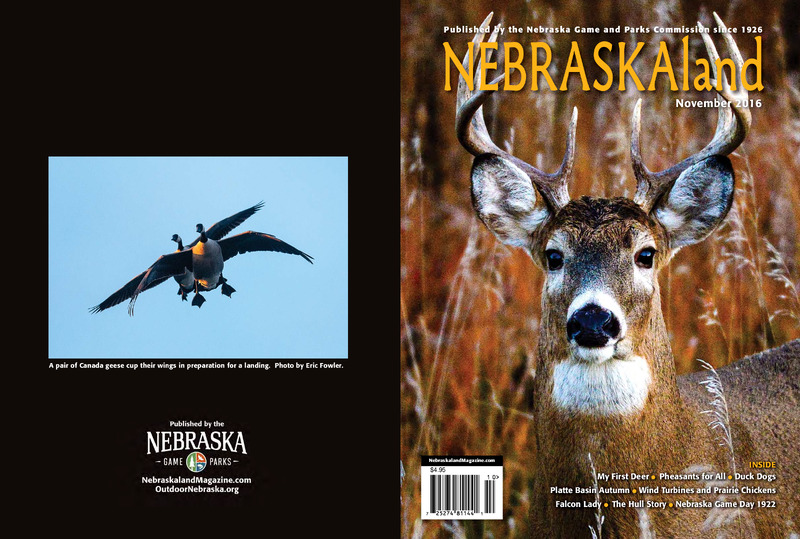
A pair of Canada geese cup their wings in preparation for a landing. Photo by Eric Fowler.
NebraskalandMagazine.com
$4.95
My First Deer ●
INSIDE
Pheasants for All ● Duck Dogs
Platte Basin Autumn ● Wind Turbines and Prairie Chickens
Falcon Lady ● The Hull Story ● Nebraska Game Day 1922
NEBRASKAland Magazine
Volume 94
●
No. 9
●
November 2016
F EAT U R ES . . .
22 Duck Dogs
P
S
D
S
30 Time Well Spent – What to Do in November
2
HOTOS AND TORY BY
OUG TEINKE
BY RENAE BLUM
32 Pheasants For All
An interview with John Laux
STORY AND PHOTOS BY JEFF KURRUS
40 Platte Basin Autumn
PHOTOS AND STORY BY JARE GODFREY
46 Think of the Chickens
The effects of wind turbine farms on greater
prairie-chickens
STORY AND PHOTOS BY JENNY NGUYEN
52 A Passion for Peregrines
B R
B
54 Ponca's Snowy Blessing
Y ENAE LUM
40
●
PHOTOS AND TEXT BY JEFF KURRUS
I N S I D E T H I S I S S U E ...
Mixed Bag – Eastern Spotted Skunk, Travel to Ashland,
A Brief History of Game Day 1922, How We Hunt,
Reading Whitetail Signs, Asian Longhorned Beetles,
Upcoming Events, Visitor Winner and more ................... 10
Page 49 – Welsch's Where Time Stands Still .............. 60
In the Field – My First Deer Gallery ......................... 62
Nature Notes – Turtles and Temperature ................... 64
Wilderness Workshop – Easy Tree Planting ........66
Outdoor Update – Biodegradable Shotshells .........70
Portraits from the Past............................................ 74
In the Kitchen – Vietnamese Shaking Venison.......... 76
The Last Stop – Through the Seasons ....................... 78
32
●
54
●
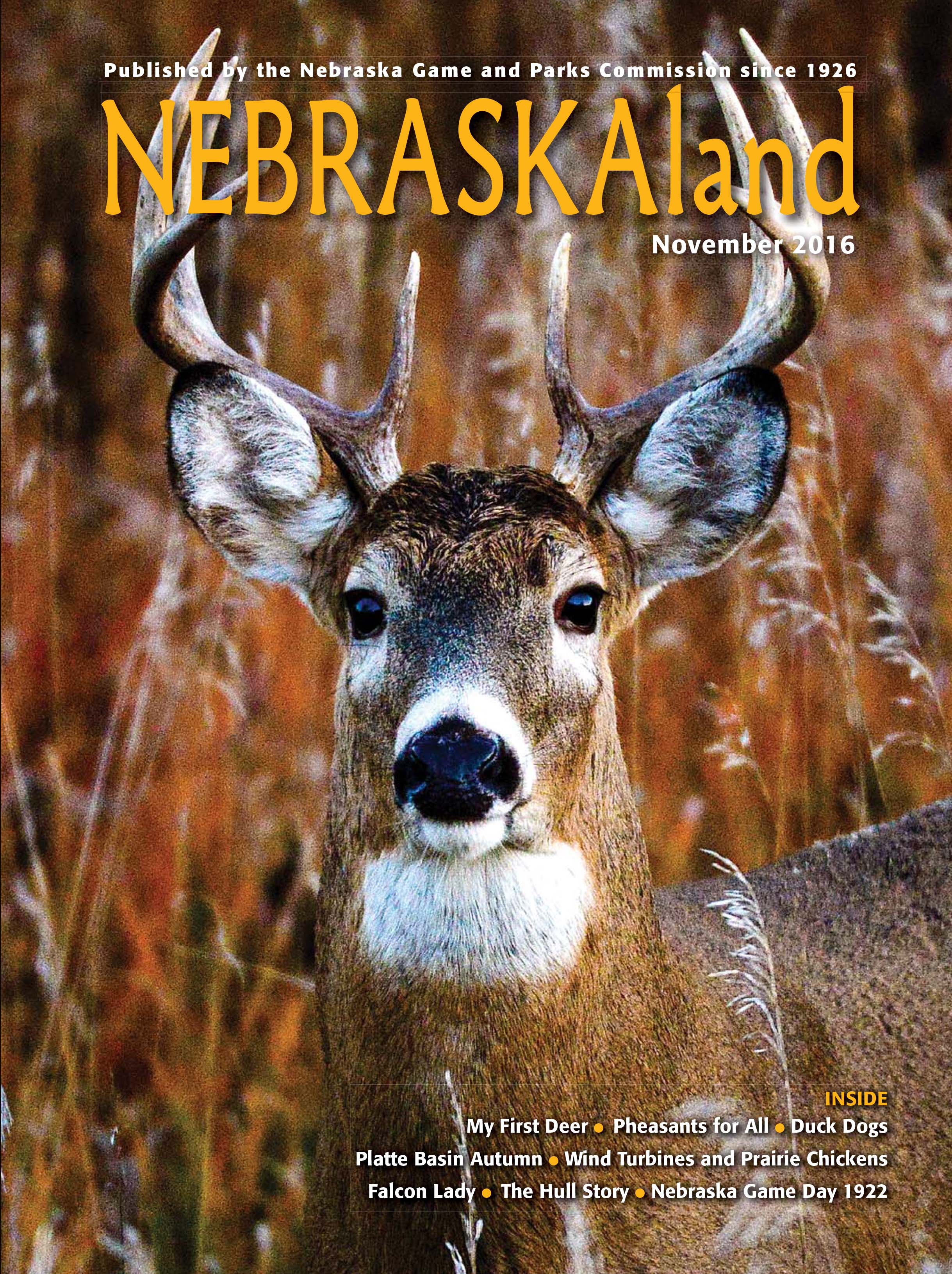
Cover: A white-tailed deer of any size is a trophy for first-time
hunters this time of year. See our first deer gallery on page 62.
Photo by Steve Zechmann.
NEBRASKAland (VOL. 94 / NO. 9 ISSN 0028-1964) is published monthly, except
for the combined Jan./Feb. and Aug./Sept. issues, by the Nebraska Game and Parks
Commission, 2200 N. 33rd St., Lincoln, NE. Periodicals postage paid at Lincoln,
Nebraska, and additional mailing offices. POSTMASTER: Send address changes to
NEBRASKAland, P.O. Box 30370, Lincoln, NE 68503-0370.
2 NEBRASKAland • NOVEMBER 2016
46
●
NOVEMBER 2016 • NEBRASKAland 3
On a foggy morning in Hastings, Paul Julian snapped this photo of a jogger at sunrise.
"I grew up in Gering and
always enjoyed being able to
see the Scotts Bluff National
Monument. I moved away
almost 8 years ago, but I
still go back to visit family
often and when I do, I always
head out to the Monument
to photograph the beautiful
scenery," said Lindsey Keller
of Lincoln.
A Note from the Nebraska Game
and Parks Commission
This year marks the 20th
anniversary for Nebraska’s
mentored youth hunting program,
which has grown to be one of the
largest in the nation.
Nebraska’s mentored youth
hunting program began with six
Pheasants Forever chapters –
Cornhusker, Elkhorn Valley, Great
Plains, Loup/Platte Ringnecks,
Otoe County, and Republican
Valley – in 1996. These chapters
wanted to do something to address
declining hunter numbers that
at the same time provided kids
the opportunity to experience
the excitement of hunting in
Nebraska.
In particular, they wanted to
focus on youth who didn’t have
a parent, uncle, aunt, grandparent
or older sibling to pass on
Nebraska’s rich hunting tradition.
That first year, 207 volunteer
mentors took 118 kids hunting
who might not have otherwise had
a chance to go.
Working in cooperation with
the Nebraska Game and Parks
Commission, as well as volunteers
from the National Wild Turkey
Federation and Ducks Unlimited,
Pheasants Forever has expanded
the program to include more than
1,000 volunteers who each year
help approximately 800 youth
experience the camaraderie,
beautiful scenery and thrill that
a Nebraska hunting trip offers.
Since its inception, the program
has allowed 13,000 Nebraska
youth to hunt.
Passionate volunteers and
generous donors are to thank
for the success of this program.
To give you an idea as to their
dedication, volunteers are already
planning for the 2017 programs.
For more information,
visit Outdoornebraska.gov/
mentoredhunts.
– Jeff Rawlinson
Nebraska Game and Parks
Commission Education Manager
This mule deer doe posed for Ivy Lunbery near a highway in Hyannis.
The meadowlark is known for its beautiful song. "Often as I drive along a country
road, I pass one sitting on a fence post," Ivy Lunbery said.
4 NE
NEBRASKAland
N
EB
BR
RAS
ASK
KA
Aland
land
la
nd • NOVEMBER
NO
N
OVE
VEMB
MBE
ER
R 2016
20
01
16
NOVEMBER 2016 • NEBRASKAland 5
State Fair Winner
Congratulations to Lorvey Stark,
of Lincoln, whose photograph of
a black-throated bunting southeast
of Anselmo was the winner of
the "Wild and Scenic Nebraska"
category at the Nebraska Stair Fair.
Stark captured the photograph
during a weekend trip to the
Sandhills with friend Mark Lukin.
"Mark and I were attracted by
the huge pile of corn just off the
highway and stopped to take photos
of the grain bins and the corn pile.
As we were leaving the area, the
bunting and several other birds
landed near us on the dry weeds.
It stayed with us and posed for
several shots."
Canon 70D, Tamron 150-600 mm
Exposure: 1/800 sec., f/6.3, ISO 200.
Zach Hanson of Omaha
took this photo last August
at Indian Cave State Park.
Hanson said, "I took my
camera off of my tripod and
used the deck railing for this
shot. Long story short, I left
my tripod behind and went
home. The next weekend was
the first time I realized what
I did – I knew exactly where I
left it. I waited until Monday to
call the park office to see if by
chance someone turned it in.
To my surprise someone did
turn it in. Saved me several
hundred dollars and helped
renew my faith in humanity."
6 NEBRASKAland • NOVEMBER 2016
NOVEMBER 2016 • NEBRASKAland 7
Bug Cup
Dear Mr. Reigert,
I just received my NEBRASKAland
cup in the mail. I am so thrilled to
finally receive this. I have been looking
for the bug for over 5 years now, and
there is quite a story behind it, but don't
think I can tell it now.
Most of the time I don't have the bug
named right but it is still lots of fun.
We really enjoy this magazine, all the
great articles, pictures, recipes and just
learning more about this great state we
live in.
Keep up the good work and again
thank you so much, you have made this
lady's day!
Janelle Downing
Norfolk, Nebraska
Curt Blum of Lincoln sent in this image of
a robberfly that has caught a damselfly.
Dear Janelle, you have made my day!
It is not that often (unfortunately)
that I hear back from our readers to
learn “their” story.
And, your compliments are very
welcome, especially on this Friday.
Thank you again for writing to me,
and for being such a loyal subscriber.
With warmest regards,
Tim
FIREARM DEER HUNTING
STARTS NOVEMBER 12TH
Don't forget that on Nov. 12–20
firearm hunters take to the field.
If you are hunting small game,
please be aware of deer hunters
and, above all, wear HUNTER
ORANGE as well to be seen.
Send your comments to:
Jeff Kurrus, Editor
NEBRASKAland Magazine
P.O. Box 30370
Lincoln, NE 68503
or e-mail Jeff.Kurrus@Nebraska.gov
Please include your postal address and telephone number. Letters may be condensed
and edited. Photographs are also welcome.
This time-lapse composite image of "The Orbiter" ride at the Lancaster County Fair was taken by Curt Blum.
8 NEBRASKAland • NOVEMBER 2016
Any program that receives federal funding from the National Park
Service, or the United States Fish and Wildlife Service prohibits unlawful
discrimination on the basis of race, color, religion, age, gender, marital
status, national origin, age, disability or political affiliation. Any person
who believes he or she has been discriminated against in any program,
activity, facility, or service, should contact the Nebraska Game and
Parks Commission, Lincoln, NE 402-471-0641, the Equal Opportunity
Commission, Lincoln, NE 402-471-2024, TTY/TDD 402-471-4693;
United States Fish Wildlife Service, Civil Rights Coordinator, 4401
N. Fairfax Drive, Arlington, VA 22203; Director, Equal Opportunity
Program, U.S. Department of Interior, National Park Service, 1849 C
Street NW, Mail Code 0008, Washington, D.C. 20240-0001.
NEBRASKAland Magazine
COMMISSIONERS
CONSERVATION OFFICERS
Director Jim Douglas
Commissioners
Chairman - Mark Spurgin, Paxton
Vice Chairman - Rex Fisher, Omaha
2nd Vice Chairman - Dick Bell, Omaha
Dr. Kent Forney, Lincoln
Robert Allen, Eustis
Pat Berggren, Broken Bow
Mick Jensen, Blair
Norris Marshall, Kearney
Dan Kreitman, Wahoo
ADMINISTRATION (Lincoln)
Craig Stover (Administrator)
Duane Arp (Asst. Administrator)
Jeff Clauson (Asst. Administrator)
MAGAZINE STAFF
Communications Director Christy Rasmussen
Editor Jeff Kurrus
Art Director Tim Reigert
Associate Editor Jenny Nguyen
Regional Editors Eric Fowler, Julie Geiser,
Justin Haag
Contributing Editor Michael Forsberg
Regular Contributors Chris Helzer, Gerry
Steinauer
Photo Librarian Jaclyn Cruikshank Vogt
Circulation Donna Robinson
For address changes and questions about
your subscription, e-mail donna.robinson@
nebraska.gov or call 800-632-5263
Advertising Sales Manager
For advertising information contact
Shane G. Gilster, 402-742-0125
Email: shanegilster@gmail.com
NEBRASKAland Magazine Copyright 2016, all rights reserved.
NEBRASKAland is available in audio from the Nebraska Library
Commission Talking Book and Braille Service, Suite 120, 1200 N St.,
Lincoln, NE 68508. 800-742-7691. NEBRASKAland Magazine and the
Nebraska Game and Parks Commission reserve the right to reject any
advertising not in keeping with the agency mission.
Rates: $18 for one year; $33 for two years; $44 for three years. Nebraska
recipients must add appropriate sales tax. To subscribe call
1-800-NEBLAND (632-5263), or go online to: NebraskalandMagazine.
com.
COMMISSION
C
CO
COM
OM
MMIS
MISSIO
S NO
OFFICES
FFICES
FF
FFI
CES
S
Headquarters/Southeast District Office
2200 N. 33rd Street Lincoln, NE 68503
Phone 402-471-0641
Northeast District Office
2201 N. 13th St. Norfolk, NE 68701
Phone 402-370-3374
Southwest District Office
301 E. State Farm Rd. North Platte, NE 69101
Phone 308-535-8025
Northwest District Office
East Hwy. 2, Box 725 Alliance, NE 69301
Phone 308-763-2940
Bassett Office
524 Panzer St., Box 508 Bassett, NE 68714
Phone 402-684-2921
Kearney Office
1617 First Ave. Kearney, NE 68847
Phone 308-865-5310
Ak-Sar-Ben Aquarium
21502 W. Highway 31 Gretna, NE 68028
Phone 402-332-3901
Omaha Office
8495 Frederick Street, Omaha, NE 68124
Phone 402-595-2144
402-471-5531
402-471-5531
402-471-5531
NORTHWEST (Includes counties covered)
Jim Zimmerman (District Supt.)
308-641-6138
Sean McKeehan
(Cheyenne, Morrill, Box Butte)
308-279-9133
Scott Brandt
(Kimball, Banner, Scotts Bluff)
308-631-0663
308-760-3647
Greg Hesse (Sheridan, Dawes)
308-430-0572
Dan Kling (Sioux, Dawes)
Terry Brentzel (Deuel, Garden, Grant) 308-458-7650
402-389-0444
Frank Miller (Cherry, Hooker)
NORTHEAST (Includes counties covered)
Tom Zimmer (District Supt.)
402-649-8053
402-760-0712
Dale Davis (Keya Paha, Brown, Rock)
402-340-3981
Jonathan Andreasen (Holt, Boyd)
Mitch Johnson (Knox, Antelope, Pierce) 402-613-8612
402-762-5022
Jeff Jones (Knox, Cedar)
Alex Thomas
(Dixon, Dakota, N 1/2 Thurston)
402-241-7615
Jon Reeves
(S 1/2 Thurston, Burt, Washington)
402-889-8508
402-719-1108
Dan Roberts (Dodge, Colfax)
Cory Krause
(Cuming, Wayne, Stanton, Dodge)
402-380-6410
Steve Oberg
(Colfax, Platte, Madison, Stanton)
402-910-3366
Randy Pomplun
(Nance, Greeley, Wheeler, Boone)
308-550-0489
308-730-7050
Doug Pollard (Loup, Garfield, Valley)
SOUTHWEST (Includes counties covered)
Roger Thompson (District Supt.)
308-530-3097
308-202-0819
Matt Brandt (Sherman, Howard)
308-380-7331
Tim Williams (Hall, Hamilton, Merrick)
Pat George
(Clay, Adams, Nuckolls, Webster)
402-705-9989
308-920-0367
Rich Routh (Franklin, Harlan, Phelps)
Matt Andrews
(Gosper, Furnas, Frontier, Red Willow)
308-746-2418
Andrew Heyer (Dawson, Gosper, Phelps) 402-613-2241
Brian Piernicky
(Red Willow, Frontier, Hayes, Hitchcock)
308-340-6627
308-289-0427
Nicholas Fix (Keith, Perkins)
308-289-1169
Bryce Streger (Keith, Arthur)
Brandon O’Neal
(Lincoln, McPherson, Logan)
308-530-3157
Alex Hasenauer
(Lincoln, McPherson, Logan)
308-660-4671
308-440-3847
Dale Johnson (Kearney, Buffalo)
308-529-8146
Mike Thome (Dawson)
Ray Dierking (Custer, Thomas, Blaine) 308-870-0322
SOUTHEAST (Includes counties covered)
Levi Krause (District Supt.)
402-949-0593
402-619-1355
Rich Berggren (Douglas)
402-616-5961
Dan Evasco (Sarpy)
402-210-0888
Heath Packett (Cass)
402-209-1506
Russell Mort (Otoe, Johnson)
William Krause
(Nemaha, Richardson, Pawnee)
402-274-8063
402-806-9084
Dan Zuehlke (Gage, Saline)
402-890-6463
Dina Barta (Lancaster)
402-890-6465
Doug Kramer (Lancaster)
402-937-3422
Dudley Sorensen (Lancaster, York)
402-613-2312
Travis Shepler (Lancaster)
402-890-7140
Stacey Lewton (Lancaster, Seward)
402-443-6392
Mike Luben (Saunders, Butler, Polk)
Nebraska Wildlife Crimestoppers
1-800-742-7627
NOVEMBER 2016 • NEBRASKAland 9
A Mammal Brief
Eastern Spotted Skunk
By Lindsay Rogers
Lindsay Rogers is an outdoor education specialist
with the Nebraska Game and Parks Commission.
10 NEBRASKAland • NOVEMBER 2016
PHOT
TO CO
COUR
URT
URT
TESY
TE
SY OF TH
THE MISSOU
MIS
RI DEPARTMEN
NT OF CONSERVATION
Coming in at about half the
size of the striped skunk, the
eastern spotted skunk
(Spilogale putorius) is easily
differentiated by not only size,
but also coloration. Striped skunks
have two characteristic white
stripes along either side of their
backs. Spotted skunks have multiple
bands or spots and white-tipped tails.
Spotted skunks, similar to striped
skunks, are omnivores with a large part of their diet coming from insects, small animals, bird eggs and berries
or fruit. Spotted skunks are the only North American skunk species that can easily climb. As such, they are often
found in woodland areas including riparian wetlands and forests, but can also be found in prairies and cropland.
Historically, eastern spotted skunks could be found statewide, but their population has declined since the
1940s. Fur harvest records report a harvest of 35,260 individuals in 1944, declining to only 33 by 1982. A similar
population decline was documented in surrounding states, and biologists are not certain of the cause of their
decline. Presently, spotted skunks are protected year-round in Nebraska and reports of them are rare.
If you see an eastern spotted skunk, please report your sighting to Nebraska Game & Parks Commission
Furbearer Specialist Sam Wilson, sam.wilson@nebraska.gov. ■
NOVEMBER 2016 • NEBRASKAland 11
Background photo: Memphis Lake State Recreation Area near
Ashland offers a reflective palette of reds.
Travelogue Sponsors
By Erin Lenz, Nebraska Tourism Commission
Ashland
one of the 10 most beautiful towns in Nebraska, this
o
oted
has scenic golf courses, fun family activities and a
a
area
ful state park. Ashland, Nebraska, located between
b
beauti
it
Lincoln and Omaha, is the perfect break from the large cities
you
keep
will
that
feel
own
sits between. It’s vibrant with a small-t
coming back for more.
there is plenty
Spend a long weekend at Eugene T. Mahoney State Park, where
Peter Kiewit
the
at
or
cabin
a
in
ght
overni
Stay
to do in the fall and winter seasons.
. In the
theatre
the
in
movie
or
rant
Restau
Lodge, and enjoy a meal in the Lodge
Ashland
ng at
boardi
paddle
go
park,
water
the
at
around
spring and summer seasons, splash
on horseback. Walk up
the Owen Marina, play a game of mini golf or take a trail ride
and hike through the
Valley
River
Platte
the
of
the water tower and enjoy the views
activities the
winter
the
enjoy
cold,
turns
many nature trails close by. When it
fishing and
ice
,
skating
ice
skiing,
y
countr
park offers such as sledding, crossrides.
k
holiday activities like bonfires and hayrac
ns
For wildlife lovers, take the family on a ride through Lee G. Simmo
h
throug
April
open
park,
This
Conservation Park and Wildlife Safari.
ile wildlife
October, is like an interactive zoo. Drive through the four-m
bison, whiteelk,
ing
includ
s
animal
adventure and come face-to-face with
tailed deer, antelope and waterfowl.
pace
Ashland is also home to the Strategic Air Command and Aeros
space
ts,
aircraf
of
feet
square
00
300,0
Museum. Visitors can walk through
a
take
to
forget
don’t
and
aut,
Astron
crafts and exhibits like The Heartland
flying.
of
feeling
the
ence
ride on the flight simulators to experi
s
Golfers can stay and play at Ashland’s two public 18-hole course
built
is
Horse
Iron
Club.
Golf
Quarry Oaks Golf Club and Iron Horse
Oaks,
around an old rock quarry and the championship course, Quarry
is nestled in the Platte River Valley.
d
Cellar 426 and Glacial Till Tasting Room are two places in Ashlan
rd
vineya
a
is
426
Cellar
wines.
with award-winning, Nebraska-crafted
and tasting room located on a hilltop
overlooking a 360-degree view. Glacial Till Tasting
Palmyra,
Room carries Nebraska wines that come from the vineyard in
located 27 miles south of Ashland.
Dine at a local favorite, Cheri
O’s, that offers breakfast, lunch
and old-fashioned ice cream.
Round the Bend Steakhouse
& Saloon is a family-owned
steakhouse, and Parker’s
Smokehouse serves great
BBQ.
It isn’t a question as to why
this part of Nebraska is one
of the 10 most beautiful.
Ashland has much to offer,
so spend time exploring it.
For more information go to
ashland-ne.com/. ■
SAC and Aerospace Museum
Kids get a
Wildlife S look at bison at
afari Park
the
Iron Horse Golf Club
m
ew fron
i
v
r
a
l
u
c
la d
12 NEBRASKAland
Ash2016
Spectra 4•2NOVEMBER
n
i
6
Cella
NOVEMBER 2016 • NEBRASKAland 13
A Brief History
Game Day 1922
By David L. Bristow, Nebraska State Historical Society
NSHS RG2758-105-10
M
emorial Stadium hasn’t always been the home
of Cornhusker football; it just seems that way.
Between 1909 and 1922, the team played at
Nebraska Field, more or less at the same location
as the present-day stadium. The field ran east-west instead
of north-south.
Nebraska Field was packed with 16,000 fans for the
stadium’s final game, a 14-6 Nebraska victory over Notre
Dame on November 30, 1922. Nebraska had a big rivalry
with Coach Knute Rockne’s Fighting Irish, and games
between the two teams were always well-attended.
Today, good seats at Memorial Stadium cost a lot of
money. At Nebraska Field, cheapskate fans could watch the
game with a little creativity and determination. In the photo
at right, spectators perch on rooftops, ladders, makeshift
scaffolding, a tree just outside the stadium and even a
telephone pole. By comparison, the top of the stadium
awning was a veritable luxury box.
How did people get up on the awning, anyway? A photo
from a different angle provides a clue. Notice the boards
nailed to the back corner post – they appear to be a crude
ladder. It’s something for today’s fans to ponder while
making the long climb to the East Stadium’s lofty upper
deck. ■
On ladders, trees, poles, roofs, an awning (and even in the
bleachers!), Nebraska fans watch their team defeat Notre
Dame, November 30, 1922.
Visit the Nebraska State Historical Society’s website at
nebraskahistory.org.
NSHS RG2
RG2758-102-740
RG2758
758-102
758758
102-740
102102
740
Another view, same day, of Nebraska Field's awning-covered bleachers.
14 NEBRASKAland • NOVEMBER 2016
Only agile fans got skybox seating
seating.
NOVEMBER 2016 • NEBRASKAland 15
How We Hunt
By Caitlyn Gillespie
On a clear, chilly morning this past October, the distant
cackle of pheasants greeted hunters arriving at Conservation
Reserve Program (CRP) fields, signaling the return of upland
bird season in Nebraska. They may also have seen Lyndsie
Wszola, a master’s student in the Nebraska Cooperative Fish
and Wildlife Research Unit at the University of Nebraska,
who is studying how pheasant hunters and pheasants interact
in the fields they share.
“One of the premises of this research is that people
are predators,” Wszola explained. And just like any other
predator, hunters don’t necessarily walk in perfectly straight
lines through vegetation. While some fields may be open and
easy to walk through, others have denser, taller grass and
forbs, which can make traversing them more difficult. What
that means is that even though every hunter moves through a
field slightly differently, hunters tend to walk through parts
of some fields more than others.
To figure out how hunters use a field, Wszola first
measures the vegetation on several public-access CRP fields
in her southwestern Nebraska study site, where Coop Unit
researchers have been radio-tagging and tracking pheasants
since 2012. She then recruits volunteer pheasant hunters to
wear a GPS-enabled wristwatch during their hunt, which
tracks the route hunters take through a field. Ultimately,
she’ll have data that shows how both hunters and pheasants
16 NEBRASKAland • NOVEMBER 2016
are using the same places.
Why does it matter? Wszola is curious to learn whether
pheasants respond differently depending on how many
hunters are using fields and where people are walking. And
a bird’s response to hunters may even be different depending
on the vegetation within the field.
“To us, it may not seem very different if five hunters
walk through one hectare of this field versus another,” she
said. "Things may look very different from a pheasant’s
perspective, though." For example, in places where the
vegetation is denser, there’s more cover for pheasants to hide
as hunters walk by. That may make pheasants less likely to
move to a new place, a behavior that pheasants use to try to
avoid predators, including people.
Last fall, Wszola collected data from more than 70
pheasant hunts and this fall she hopes to collect even
more. She’ll use the information she collects to help figure
out where hunters typically walk, and whether hunter
movements influence how the birds are using the same
fields.
From a management perspective, she hopes that her
research will provide insights that will help both hunters and
pheasants alike. “We really need to consider the behavioral
ecology implications of how we manage these fields and
what really draws people,” she said.
Visit trackyourhunt.unl.edu to watch Wszola working with
hunters in the 'Track Your Hunt' video, and to learn how to
volunteer to carry a GPS unit during your hunt.
NOVEMBER 2016 • NEBRASKAland 17
Presented by
Reading Whitetail Signs
Bug Banter
By Julie Geiser
Be On Alert for
Asian Longhorned
Beetle Infestation
F
PHOTO BY JENNY NGUYEN
Deer tracks can give hunters many clues.
18 NEBRASKAland • NOVEMBER 2016
By Julie Van Meter
State Entomologist, Nebraska
Department of Agriculture
Sometimes a deer scrape (foreground) and tree rub can be
found together.
trails leading to feeding areas. Seasonal food sources will
change trail use. Bedding areas have mashed vegetation from
resting deer. Don’t spend too much time here, or you might
scare deer out of the area; find a trail where deer can be
intercepted moving to or from bedding areas.
Rubs are important signs when hunting bucks. A series of
rubs shows the path a buck follows, at least on some days.
Setting up on fresh rub lines can increase the amount of deer
a hunter will see.
Rubs may also provide useful clues. Mature bucks are
usually much more aggressive than smaller bucks. Trees that
have been ripped to shreds are most likely from a mature
buck – the larger the tree, the larger the buck. Rubs can
indicate the direction a buck travels; bucks will usually rub
the side of the tree from which they approach. After finding
multiple rubs in a row, it is possible to determine the exact
path traveled by the deer.
Scrapes are cleared oval areas on the ground where a buck
pawed out vegetation and urinated over its tarsal glands to
attract does in heat. The best scrapes are fresh and damp
with little debris on them. Most will have a tree branch
overhead that a buck has bent or broken and left scent on.
Placing a stand or blind downwind of these scrapes can be
worthwhile whether hunting for bucks or does, as does will
visit the scrapes and check for scents left behind.
Typically a mature buck will make several scrapes along
a corridor. He will actively check all the scrapes by running
along a single trail. Examine the area closely to determine
how the buck enters and leaves the area of each scrape to
decide the best place for a stand.
Although it is extra work, scouting can make a difference.
Learning how to read deer signs will show you the way to
more successful hunting. ■
PHOTO BY JEFF KURRUS
or better strategies to hunt white-tailed deer, learn what
major types of deer signs look like and what they mean.
But first, print maps of hunting areas to mark signs as you
find them and make notes on deer sightings, observations
about their movements, and game trails before or during the
season. If you have a good GPS unit, save these coordinates
and the device will lead you back to the same spots.
The major types of signs to watch for are droppings,
tracks, trails, feeding and bedding areas, rubs and scrapes.
The amount of droppings you see indicates how many
deer are nearby, and the freshness indicates whether deer
are currently using that area. Droppings can also tell you
something about the particular deer that left them. Extremely
large clumps are a sign that a large deer is in the area. And
because mature deer often defecate as soon as they leave
their beds, droppings near thick cover might give you an idea
where that large deer is living and which direction it travels.
A set of deer tracks may also provide important
information. If a track is dry and eroded, it is an old track.
If it’s fresh and well-defined, the track may be only hours
old. If you find large hoofprints, a mature buck probably
made it. Does often travel in groups, so if you find a single
set of tracks, it’s likely the tracks are from a buck. When
walking, a large buck has a longer distance between tracks
than an average deer, and bucks are prone to dragging their
hooves.
The best game trails often lead to thick bedding cover or
dense escape areas. Finding where several trails merge into
a heavier, single path increases odds of seeing deer. Using
a trail camera or doing early-morning and late-evening
scouting will help you determine if deer are using trails
during the day or strictly at night. Rookie hunters sometimes
waste too much time hunting nighttime travel corridors.
These are usually open areas and easily accessible.
Watch for feeding areas with fresh deer signs, and look for
The Asian longhorned beetle (ALB)
(Anoplophora glabripennis) is an
emerging threat to hardwood trees in
the U.S. A federal quarantine prohibits
the movement of hardwood firewood
out of infested areas because, much
like the emerald ash borer, ALB can
easily be transported in firewood.
The Asian longhorned beetle is a
large, beautiful beetle. Adult beetles are
approximately three-quarters of an inch
to 11⁄2 inch long.
They have a shiny black body with
white spots, long black antennae with
white bands, and feet that may appear
bluish in color. The larvae are creamy
white and grub-like, and grow rather
large before pupating. Female beetles
chew out niches in the bark and lay
eggs in those niches.
Signs of an ALB infestation include
large round exit holes, up to threeeighths of an inch in diameter, bark
niches and coarse, sawdust-like frass on
the ground and branches. Trees infested
with ALB may exhibit branch or crown
die-back. Repeated infestations will
eventually result in tree death. Nebraska
has several species of trees that could
be infested by ALB, including maples,
box elder, elm, birch and ash.
ALB has not been found in
Nebraska. But there is concern that
it could be introduced to the state,
especially through infested firewood.
So the next time you are out among
the trees, remember that you have an
opportunity to help protect our state’s
trees from invasive pests. Take a few
minutes to look at the trees around you.
Determine if the trees have a healthy
canopy. Dead branches, die-back
and early leaf drop may indicate pest
problems. Look for large emergence
holes on the upper branches and trunk
that may indicate an ALB infestation,
or frass accumulating in the branch
crotches or base of the
tree.
If you see an adult
beetle, try to capture it
or take a picture. Report any suspected
ALB infestations to the Nebraska
Department of Agriculture at
402-471-2351.
For more information on ALB, visit
beetlebusters.info. Finally, to help
protect all our trees from invasive pests,
buy locally harvested firewood at your
camping destination, and don’t bring
leftover firewood home with you. ■
Adult Asian longhorned beetle and bark
niches.
KENNETH R. LAW, USDA APHIS PPQ, BUGWOOD.ORG
NOVEMBER 2016 • NEBRASKAland 19
Candlelight tour at Fort Atkinson State
Historical Park in Washington County.
Hawk Migration
Paula Hoppe, Certified Master Naturalist
The cool, gray skies of autumn carry the familiar sight of ducks and geese,
arrayed across the firmament in vast, undulant squadrons. The calls of veteran
birds leading the young of the year on their first trip toward southern horizons
reminds us of the approaching winter. However, there is another migration
underway that isn’t as familiar. Raptors – including eagles, hawks, falcons, and
vultures, among others – also move southward through the state as the days
shorten.
Turkey vultures may begin heading south as early as August, with peak
migration occurring in October.
Swainson’s hawks, with their brown bibs and white throat patches, can often
be seen soaring in circles, or “kettling” over fields from mid-September through
October. Keen hunters, they scour the ground in search of small mammals and
insects as they refuel on their way to Argentina. It is not uncommon to see them
sitting on the ground.
Broad-winged hawks are small, compact raptors. Look for a short, narrow tail
and stocky, pointed wings. Like Swainson’s hawks, they gather into large groups
called kettles, and travel long distances (up to 5,000 miles!) on their trek from
breeding to wintering grounds.
Bald and golden eagles are on the move from October through December,
though some may remain on their breeding grounds for the winter if they can find
adequate food.
Peregrine falcons migrate during September and October. To spot them, look for
long, pointed wings, streaking on the belly and a checkerboard-like pattern under
the wings.
One reason hawk migration is less conspicuous than that of ducks and geese
is that raptors don’t generally form large flocks, though Swainson’s and broadwinged hawks offer notable exceptions. While migrating, raptors tend to follow
topographic contours that cause the formation of updrafts and thermal currents
on which the raptors can soar with very little energy expenditure. It is along these
corridors that the greatest opportunities to observe raptor migration exist. ■
by Jerry Kane
Contact the Nebraska Game and
Parks Commission at 402-471-0641 or
visit Outdoornebraska.org for more
information. Visit huntsafenebraska.
org for a list of hunter education
classes and boatsafenebraska.org for
a list of boating safety classes.
November 1
Late Doe/Fawn Antelope
season opens
November 1
Raccoon, Opossum, Long-tailed
Weasel, Mink, Red Fox, Gray Fox and
Badger
hunting and trapping seasons open
November 1
Muskrat and Beaver Trapping
season opens
November 2, 3, 9, 10, 16, 17, 30
Explore Archery
Nebraska Game and Parks Outdoor
Education Center, Lincoln
November 5
Candlelight Tour
Fort Atkinson State Historical Park,
Fort Calhoun
November 5
Archery Fun Shoot
Nebraska Game and Parks Outdoor
Education Center, Lincoln
November 5-6
River Valley Artisans and Craft Market
Eugene T. Mahoney State Park (SP), Ashland
November 5-6
Firearm Hunter Sight-In
November 12-20
Deer Hunting
Nebraska Game and Parks Outdoor
Education Center, Lincoln
firearm deer and restricted statewide buck
seasons
November 6
Veterans Appreciation Day
November 15
Crow Hunting
Platte River SP, Louisville
November 7
Woodcock Hunting
season closes
November 7
Tickets go on sale for Historical
Christmas Dinner
Fort Robinson SP, Crawford
November 9
Rail Hunting
season closes
First segment of crow hunting
season closes
November 18
Rifle Fun Shoot
Nebraska Game and Parks Outdoor
Education Center, Lincoln
November 19
Holiday Craft Workshop
Nebraska Game and Parks Outdoor
Education Center, Lincoln
November 19
Introduction to Handguns
Nebraska Game and Parks Outdoor
Education Center, Lincoln
November 20
Fort Robinson Longhorn and Buffalo
Sale
Crawford
November 29
Bighorn Sheep Hunting
season opens
November 29
Learn to Hunt Muzzleloader Deer
Fall fishing with spoons, slabs, and
lures for northern pike at Merritt
Reservoir in Cherry County.
PHOTO BY JUSTIN HAAG
Nebraska Game and Parks Outdoor
Education Center, Lincoln
Last issue’s winner of
the Visitor drawing was
Mike Carlson of Wausa,
Nebraska, who found the
snowberry clearwing moth on
page 74.
Readers are encouraged to contact
NEBRASKAland within 10 days
after this issue’s publication with
the correct page number and name
of this issue’s “Visitor” – a critter
found in Nebraska. We will then
gather the correct entries and draw
one to win a NEBRASKAland mug.
To enter each month, write:
NEBRASKAland Visitor
2200 North 33rd Street,
Lincoln, NE 68503.
Or e-mail:
Tim.Reigert@Nebraska.gov
with “Visitor” in the subject line of
the message.
HINT: This issue’s visitor is not on
pages 8, 17, 19, or 21.
The snowberry clearwing moth
(Hemaris diffinis) is native to
Nebraska and much of the U.S.
east of the continental divide. It
is a medium-sized moth, with a
wingspan of 1.5-2 inches, and is
related to the whitelined sphinx
and tomato hornworm moth. It is
often confused for a bumblebee or
hummingbird due to its black and
yellow coloration and ability to
hover over flowers while feeding.
Adult moths feed on a variety
of flowers, unfurling their long
proboscis to get to the nectar
deep in a flower. The caterpillars
are more host specific, feeding
on dogbane, snowberry and
honeysuckle. Caterpillars are
typically pale green with a “horn”
at the end of their bodies, similar
to other hornworm caterpillars.
However, snowberry clearwing
caterpillars do little
damage and are not
considered pests.
Special thanks
to Julie Van Meter, State
Entomologist, Nebraska
Department of Agriculture.
A golden eagle perches on a tree high above Larabee Creek near Whiteclay.
20 NEBRASKAland • NOVEMBER 2016
NOVEMBER 2016 • NEBRASKAland 21
Duck Dogs
Photos and story by Doug Steinke
The strong bond between retriever and
hunter is something every waterfowler should
experience.
Chase watches over his master Spencer Holzfaster
making the final touches on the day’s decoy spread on
the North Platte River in Keith County.
22 NEBRASKAland • NOVEMBER 2016
NOVEMBER 2016 • NEBRASKAland 23
Above: Bella is admiring the birds
taken during the late specklebelly
season in Dawson County.
Left: Wriggs supervises owner Spencer
Holzfaster on a warm water slough in
Lincoln County.
Below: Gauge (Craig Reininger) and
Deke (Travis Reininger) team up to
bring back a Canada goose in a field off
of the South Platte River.
24 NEBRASKAland • NOVEMBER 2016
NOVEMBER 2016 • NEBRASKAland 25
Above: Kevin Jenny and his dog, Sully, enjoy a
relaxing moment on an afternoon Platte River
hunt near Kearney.
Left: Cory Steinke’s dog, Oakley, retrieves the
only mallard of the day during a chilly morning
on the Platte River in Dawson County.
Below: Aspen enjoys the early season gray ducks
in the Rainwater Basin near Sutton.
Life Cycle
First comes the warm little fuzz ball, trying to learn not to trip over her paws. You,
the hunter, have prepared for this journey by viewing every YouTube training video and
purchased the best puppy starter kit from the local sporting goods store. Then comes the
magical moment when you throw out a rolled up sock and your puppy brings it back. You
know you are well on your way.
Synergy is the creation of a whole that is greater than the sum of its parts – that’s the
span of years during the relationship between hunter and retriever. The two of you become
a near perfect team. Like a fine knife, the only way to hone a better edge is repeated use,
and time accumulated in the field sharpens this teamwork. During the prime years no
words or whistles can relay the meaning of the message as well as eye-to-eye contact.
Now, what makes a successful hunt takes on a new meaning not measured in bag limits.
The main goal now is to get out, get one bird, and allow your best friend as many last
retrieves as you can. The lifespan of a dog is agonizingly short. Though you used to press
for perfection, you are happy to wait as she takes her time getting back. She has earned her
keep, her place sleeping alongside you as another year of ducks migrate south.
26 NEBRASKAland • NOVEMBER 2016
NOVEMBER 2016 • NEBRASKAland 27
A Hunter and His Retriever
When you picked me up it was love at first sight.
You called it days of training. I just thought it was called instincts.
I know the difference between the click of the door when you head off to work and
the click of the gun safe.
Neither snow nor rain nor sleet nor gloom of foggy mornings will ever be an
excuse not to take me hunting.
I appreciate how you feed me the most scientifically correct dog food, but I’ll take
scrambled eggs, pancakes and bacon in a blind over that every day.
We work as a team. For me to do my part means your shots can’t miss.
When the day is done all I’m thinking about is doing it all over again tomorrow.
Opposite: Ignoring the zero-degree temperature in
Lincoln County, Wriggs is always ready to go.
Above: Ted Peterson holds a quick team meeting
with his Lab Cooper after the first bagged bird of
the morning on the Platte River near Lexington.
28 NEBRASKAland • NOVEMBER 2016
Doug Steinke has been a nature
photographer for 8 years and works
out of Grand Island. His photography
emphasis has been on landscapes,
waterfowl and fishing. He has been
contributing to NEBRASKAland
Magazine since 2008.
NOVEMBER 2016 • NEBRASKAland 29
Time Well Spent
Deer Hunting
Statewide
The firearm deer season is Nov. 12-20.
Archery season continues through Dec.
31. Don’t miss out on this treasured
tradition in Nebraska; if you haven’t
already, buy your permit now at
Outdoornebraska.org/deer.
What to Do in November
By Renae Blum
F
PHOTO BY JEFF KURRUS
all is in full swing, and the holidays
will be here before you know it.
Before things get too hectic, here are
a few great activities to try this month.
For a complete list of upcoming events
across the state, or for more information
on any of the activities listed here, visit
Calendar.OutdoorNebraska.gov. ■
River Valley Artisans
and Craft Market
Nov. 5-6
Eugene T. Mahoney State Park
Pheasant, Quail and
Grouse Hunting
Good news, hunters – the outlook for upland game hunting in
Nebraska this year is good. Bird numbers were up statewide in
2015, and the pheasant harvest was up 26 percent last year. High
quail numbers are also expected.
PHOTO BY JENNY NGUYEN
PHOTO BY ERIC FOWLER
Statewide
Need holiday gift ideas? This is your spot.
The River Valley Artisans and Craft Market at
Eugene T. Mahoney State Park showcases the
handiwork of artists and craftsmen and women
from across the state. Stop by to chat with the
artists, enjoy food from the Lodge Restaurant
and pick out unique, handmade items,
including jewelry, pottery, homemade jams and
jellies, and small furniture.
Tickets Go on Sale
for 21st Annual
Historical Christmas
at Fort Robinson
State Park
Veterans
Appreciation Day
at Platte River
State Park
Nov. 7 at 8 a.m.
Nov. 6
Platte River State Park
PHOTO BY JUSTIN HAAG
30 NEBRASKAland • NOVEMBER 2016
The Roger G. Sykes Outdoor Heritage
Education Complex at Platte River State
Park is a great place to relax and sharpen
your firearm and archery skills. On Nov. 6
from 10 a.m. to 4 p.m., the first 100 visitors
with a military ID will receive a token for a
free shooting activity.
PHOTO BY ERIC FOWLER
One of Fort Robinson’s most popular events,
the Historical Christmas event on Dec. 3 is a
chance to gather with friends and family and
enjoy a Christmas dinner similar to what the fort’s
inhabitants might have had long ago. Starting
Nov. 7 at 8 a.m., tickets are available in person at
Fort Robinson, the Chadron Visitors Center, and
Herren Brothers True Value in Harrison. Tickets
sell out rapidly, so make sure to grab your spot
early!
NOVEMBER 2016 • NEBRASKAland 31
Pheasants
for All
An Interview with Nebraska
Game and Parks Upland
Habitat and Access Program
Manager John Laux
Story and photos by
Jeff Kurrus
Q:
How important is pheasant hunting to
Nebraska?
Pheasants are clearly the prized game bird in
oour state, and that hasn’t changed even though
our numbers have. Historically, pheasant hunting brought a
huge boost to our state’s rural economies, but this is pretty
localized today. Still, the tradition of pheasant hunting is
very strong in Nebraska. People still want pheasants, and
the build-up around the species is great. In this regard,
pheasants are also very important for habitat conservation
efforts in Nebraska. Pheasants utilize different habitat types
throughout the year – from weedy transitional areas to heavy
grass. A wide variety of grassland birds and other wildlife
species rely on grasslands in different stages of succession,
so when you manage for pheasants you benefit many other
species at the same time.
Q:
So your management of pheasants can
help nongame birds as well?
Absolutely – there’s a lot of overlap. This is
a big
bi opportunity with our state’s new five-year pheasant
management plan, the Berggren Plan for Pheasants. While
the pheasant on the plan’s cover is a larger indicator of what
the priority of the plan is, the habitat goals outlined in the
plan benefit the entire grassland ecosystem, from grassland
birds to pollinators.
Q:
When and what caused the pheasant
decline in Nebraska?
Pheasants were introduced in the early 1900s and
quickly
i kl bbecame established throughout much of Nebraska.
Populations peaked in the late 1950s and have declined ever
since. Pin-pointing the direct cause of pheasant population
decline can be challenging; however, we know that weather
events and habitat loss have contributed significantly to the
problem. Agricultural land use changes over the years have
greatly reduced the amount of suitable pheasant habitat in our
32 NEBRASKAland • NOVEMBER 2016
Pheasants remain critical to the fabric of the Nebraska outdoors, as seen in various parts of the state, including the southwest.
state. Pheasants thrived in the early-mid 1900s because they
were placed in ideal habitat. Farming operations were small
and more diversified. Crop fields were weedy, providing
ideal brood cover and winter food sources. Crop rotations
included small grains. Many areas were left undisturbed
each year. Grasslands were more abundant and were grazed
haphazardly when conditions allowed, and haying was a slow
process that provided sufficient time for birds to nest.
Fast-forward to today’s landscape and there are some
drastic differences. Advances in ag technology have made
farming much more efficient – fields are larger and “weedfree,” row crops have largely replaced small grains, and
few areas go undisturbed. In the absence of small grains,
weedy crop fields and grasslands in general, pheasants in
many areas of the state are now heavily reliant on CRP to
fulfill their habitat needs, and when the CRP goes away, so
do the birds. Most remaining habitat is also very isolated
and this raises additional concerns. Research has shown
that the negative impacts of severe weather and predation
are even more profound on pheasant populations occurring
in fragmented landscapes. Someone before me said it
best: “Pheasants are no longer the reliable by-product of
agriculture as they once were.”
Q:
So what are the steps to help build
pheasant populations and the challenges
that go along with those steps?
With our state being 97 percent privately owned, the
key will be continuing to work with private landowners to
NOVEMBER 2016 • NEBRASKAland 33
The pheasant population is continuing its upswing from the 2012 drought, with
numbers expected to be similar to last season.
create and improve habitat. But to truly build the population,
this has to occur on the landscape scale. With the Berggren
Plan, we’ll be ramping up our efforts to impact more acres
– at least in targeted areas of the state. But realistically
we can’t do all this alone. We’ll need to continue working
cooperatively with new and existing partners to deliver
habitat, influence Farm Bill policy and secure additional
conservation funding.
The biggest challenge I see is that we are working in an
agricultural landscape that is always changing. There will
always be pressure to make farming more and more efficient,
and historically, this has not been good for pheasants. At
the same time, changes can also lead to opportunities. We’ll
need to think of innovative ways to create more habitat in
34 NEBRASKAland • NOVEMBER 2016
targeted areas and incorporate wildlife benefits into these
changing agricultural systems. For example, cover crops are
trending right now and represent an opportunity to create
pheasant habitat along with all the other agronomic benefits.
Q:
What do you think is the state of
Nebraska’s pheasant population as well as
hunting opportunities?
I think we’re continuing on our upswing from
the 2012 drought. We saw a pretty big increase in hunter
harvest last year and hope to see the same again this year.
We had a pretty mild winter throughout most of the state,
so we carried a pretty good breeding population into the
Mark Bazis carries an over-and-under shotgun while pheasant hunting in a Sarpy County CRP field.
nesting season as indicated by our rural mail carrier surveys.
There are always some isolated areas that get hit with
severe weather during the nesting season but nothing was
real widespread this year. We’ve had a good amount of
precipitation throughout the summer and fall in most areas
of the state, a tremendous wheat crop in western Nebraska,
and the habitat in our core pheasant areas is looking good.
Farmers I’ve been in contact with have seen relatively good
numbers of birds compared to years past.
The one thing that echoes throughout the state are the
excellent quail numbers this year. We had a remarkable year
last year, and assuming even average production, this year
should be just as good if not better. People are seeing quail
in areas they haven’t seen quail in years.
Q:
Will birds find habitat if you create it?
In most areas of Nebraska that’s still true, but
th
there are a few caveats. Pheasants almost always
respond positively when you plant CRP. At a very localized
scale, adding CRP will result in more birds – at least up to a
certain point. But the thing we are starting to find is that the
bird response to a 50-acre CRP planting in one area of the
state differs greatly from that observed following the exact
same planting in another part of the state. So in an applied
sense, this means that not all CRP acres are created equal,
and that the surrounding landscape often dictates the degree
to which pheasants will respond to a management action, or
in this case, planting CRP. The Nebraska Cooperative Fish
NOVEMBER 2016 • NEBRASKAland 35
Above: Northern bobwhite quail are a great option for upland bird
hunters this year, as numbers continue to increase.
Right: Chris Vrtiska’s dog, Yasha (left), a Saint Usage Spaniel,
and Mark Vrtiska’s dog, a Vizsla named Tessie, pose after a
private land hunt in Platte County.
and Wildlife Research Unit recently developed a pheasant
habitat suitability model that shows areas of the state
where you can expect greater pheasant responses to habitat
establishment or management actions. The model also allows
biologists to simulate changes in landcover, such as adding
or removing CRP, and predicts the associated bird response.
These support tools have helped us determine where we will
have the greatest return on investment and prioritize areas
based on their resilience to future land use changes.
Q:
Would a person manage their land different
for quail than pheasants?
In general, pheasants and bobwhite quail share
many off the
th same basic habitat needs. But there are some
differences between the two species that land managers
should consider when managing specifically for quail. For
example, bobwhite home ranges are typically much smaller
than that of pheasants, and quail also don’t fly as far when
they are flushed. Thus, for quail, all of the essential habitat
elements must be present in very close proximity to one
another. This is also true for pheasants but at a much larger
scale. So what this means is that you don’t have to own a
quarter or half-section to effectively manage for bobwhites.
Another difference I see with quail lies in their preference
of “early-successional” habitat. This habitat type is
stimulated by disturbance and consists of bare ground
intermixed with annual grasses and broadleaf plants. Both
species use early-successional habitat during brood-rearing,
but bobwhites seem to be closely tied to it throughout much
of the year. Unlike pheasants, quail tend to avoid grasslands
dominated by thick stands of grass. This is why bobwhites
are typically found on the edge of CRP fields rather than
in the middle of a field. Grasslands that receive some form
of periodic disturbance, such as prescribed fire, disking or
grazing, are much more functional to bobwhites. So for
bobwhites, a greater proportion of the overall area should
consist of early-successional habitat, and management
activities should be implemented periodically to create
36
6 NEBRASKAland
NEBR
NE
B ASKA
ASKA
AS
KAla
land
la
n • NOVEMBER
nd
NOVE
NO
VEMB
VE
MB
BER
E 2016
201
16
NO
N
NOVEMBER
OVE
EMB
MBER
ER 2016
ER
20
01
16 • NEBRASKAland
NEB
EBRASK
EBRA
RA
AS
SK
KAl
A an
nd 37
3
Bill Heard shoots at a bobwhite quail during
a covey rise on an upland bird hunt on
private land in Cass County near
Weeping Water.
varying stages of plant succession. For example, one could
strip-disk one-third of a field each year for three successive
years and then start back over in year four.
Shrub thickets and other forms of functional woody cover
created by edge-feathering represent another important
habitat element for bobwhites that is especially important
during the winter months. During this time, bobwhites do
not stray far from woody cover, yet they continue to have
very high energetic demands that force them to feed. Quail
management often focuses on creating functional woody
cover in close proximity to reliable food sources to help
them survive extreme winter weather events.
Q:
What can a hunter do to help increase
upland bird numbers?
For one, you as a hunter should know that
bby buying
b i a small game permit and habitat stamp you
are already contributing towards habitat conservation in
Nebraska. These funds are used to restore and improve
habitat and also help support our public access programs.
Another way to contribute is to volunteer with a local habitat
organization such as Pheasants Forever, Ducks Unlimited, or
the National Wild Turkey Federation, among others. Many
of these organizations raise money to fund habitat projects
and support youth mentor hunts, and provide an opportunity
for you to give back to the resource.
Another thing that hunters can do is to hunt responsibly.
In my opinion, this goes well beyond any financial
contribution hunters could ever make. If a landowner has a
bad experience with a hunter on their property who didn’t
obey the rules, he likely won’t think very highly of hunters.
38
8 NEBRASKAland
NEBR
NE
B ASKA
ASKA
AS
KAla
land
la
n • NOVEMBER
nd
NOVE
NO
VEMB
VE
MB
BER
E 2016
201
16
Acting irresponsibly in the field devalues not only hunters,
but also the wildlife. I’m aware of some instances where
landowners consider having certain wildlife species or a
given hunting opportunity on their land as a burden because
they don’t want to attract that type of hunter ever again. Do
your part – respect the land, follow the rules, and take time
to thank a landowner for providing habitat and/or a place to
hunt. We need landowners to value wildlife and the hunting
opportunities their land provides – don’t give them a reason
not to.
Q:
Even though we can’t predict the weather,
where do we see Nebraska’s pheasant
hunting going in the next five years? Ten
years?
This will be dependent upon the availability of pheasant
habitat in Nebraska, which at the landscape scale is driven
largely by commodity prices and federal Farm Bill policies.
Right now we have low commodity prices, and landowner
interest in CRP is very high. With promotion, interest in
CRP could be even higher, but the current acreage limit is
hampering enrollment. Big decisions will be made in the
next Farm Bill (2018), and these will have huge implications
on the availability of pheasant habitat as well as the future
of pheasant hunting in Nebraska. If the amount of habitat
increases and Mother Nature helps us out along the way,
pheasant hunting should improve.
Q:
From a personal standpoint, where do you
hunt?
I mainly hunt close to home in south-central
Nebraska. I hunt quail periodically on our family farm
Nebraska
in Franklin County, but I’m really no different than most
hunters – most of my upland hunting occurs on public lands.
I spend a lot of time hunting Open Fields and Waters (OFW)
properties in Furnas County and sometimes venture farther
west than that. There are many spots over there and some
great mixed bag opportunities that are pretty tough to beat.
Some of the best bird habitat in my area occurs on public
lands, so there’s really no reason to go look anywhere else –
that’s what it’s there for.
Q:
Are there places in the state you think are
underutilized?
I definitely do – I think there are underutilized
areas in nearly every part of the state. I think most pheasant
hunters would agree that they spend 99 percent of their time
hunting CRP fields. Hunting CRP can be very productive, but
many hunters overlook the fact that pheasants utilize other
habitat types throughout the season, and even throughout
their daily routine. Other types of habitat, some seasonal
in nature, can provide excellent hunting opportunities.
Some of my favorite spots in south-central Nebraska are
winter calving pastures. Certain years, the weedy cover is
phenomenal and other years not so much but they are always
spots I check out each year. In the Panhandle, it might be
a 0.5-acre tree or shrub planting in the middle of nowhere.
When the weather gets nasty, these areas draw in birds from
near and far that were produced in surrounding wheat fields.
Although hunting opportunities are typically short-lived,
unharvested crop fields, especially sorghum or cane, can also
provide some great hunting in certain parts of the state.
As far as public land, tall wheat and milo stubble fields
enrolled in our OFW program in western Nebraska provide
excellent hunting opportunities, but for some reason they
just don’t get used as much as CRP fields. Due to the
timing of wheat and milo harvest, these fields are added
to the online version of the atlas (OutdoorNebraska.org/
publicaccessatlas) and printed right before season in our
“Stubble Access Guide.” I think this keeps some of these
tracts under the radar, but there are many pheasant hunters
who just won’t stray from hunting CRP fields. This year, we
have over 19,000 acres of tall stubble fields open to public,
walk-in hunting. Hunting stubble is definitely a different
hunt, prime for wide-ranging pointers that like to cover
ground or large hunting parties with blockers. But many of
these enrollments also contain unfarmed pockets which are
great for flushing dogs too.
For those that enjoy hunting CRP, another thing to
consider is adjusting your hunting strategy. Pheasants aren’t
dumb and quickly pick up on hunter tactics, especially on
public land. The Nebraska Cooperative Fish and Wildlife
Research Unit is looking at this right now, examining how
hunter use influences pheasant behavior. Not surprisingly,
hunters heavily use portions of CRP fields close to parking
lots, OFW signs and field edges. If you think about it, the
effective coverage area of most hunters and their dogs
represents only a fraction of the entire field.
I know it’s easy to get discouraged and move on when
you see another party has hunted a spot, but this research has
shown that in many cases the birds are still there, occupying
portions of the field that hunters by human nature tend
to avoid. So the key here is to mix things up, try to hunt
differently than others, and don’t overlook other habitat
types used by pheasants. ■
NO
N
NOVEMBER
OVE
EMB
MBER
ER 2016
ER
20
01
16 • NEBRASKAland
NEB
EBRASK
EBRA
RA
AS
SK
KAl
A an
nd 39
3
Platte Basin Autumn
Photos and story by Jare Godfrey
This past autumn, as my time in nursing school
A burned root system comes to
rest along the shores of the Platte
River near North Platte.
40 NEBRASKAland • NOVEMBER 2016
came to a close, I was blessed to have a month
free from responsibilities. I planned to use this
time revisiting my hometown of North Platte and to
build a small portfolio of landscape images, strictly
along the Platte rivers bordering this small city. I
am no greenhorn when it comes to exploring these
rivers; much of my childhood was spent wandering
along their banks with my best friend, Chelsey, the
Chow.
The 26 years that I had lived in North Platte
usually consisted of my daily pilgrimage to one of
the rivers for a walkabout, beginning with yoga
on a large rock overlooking the South Platte, hot
summer days spent tubing down the North Platte,
or swimming at the spot I affectionately dubbed
“the bathtub.” Many of my fondest memories
involve these rivers, and the beauty to be found
here is quite inspiring. Yes, I knew these rivers
well, but I have been away for some time.
Much has changed since I called this city home,
although the rivers remain strong and beautiful
as ever, continuing as two of the many arteries
delivering water from the Rocky Mountains to
these United States, through the Missouri and
Mississippi rivers, leading finally into the ocean.
To the untrained eye, this stretch of the Platte
may seem to be nothing more than a chaotic
juxtaposition of sand, wood, rock and water. We
NOVEMBER 2016 • NEBRASKAland 41
must learn to “switch gears” from the busy, chaotic life that surrounds us,
and forget much of what our society has taught us. With television and other
media, we are constantly bombarded with information, pictures and music.
With such a large volume of information vying for our attention, we cannot
possibly take it all in. So to adapt, we ignore anything that is not deemed
worthy in those first few seconds.
The problem with this, however, is that many of the most visually rewarding
scenes require patience, pre-visualization, and time spent unlocking the
beauty.
The goal of this project was to honor this area of Nebraska, which holds
a great deal of importance to me, by showcasing its natural beauty and to
stimulate a sense of
adventure in others
by showing images
that were made not
in a national park
with mountains on
the horizon, but in
a very “common”
and accessible area.
Novelist Marcel Proust
once said, “The real
voyage of discovery
consists not in seeking
new landscapes but in
having new eyes.” This
quote explains perfectly
the feelings I have for
this project. Although
I had spent 26 years
exploring these rivers,
I had never witnessed
LEFT: A sandbar constantly changes as
the current flows around and through
the sand, truly an amazing spectacle
to witness.
OPPOSITE: The last light of the day
kisses the tops of the trees while the
moon rises through the soft, pink sky.
42 NEBRASKAland • NOVEMBER 2016
NOVEMBER 2016 • NEBRASKAland 43
them appearing so beautiful and alive.
I remember being under the stresses of nursing school months
before, looking forward longingly to the moments I was planning
to share with nature. I could hike alone, make photographs as
I pleased, and relax by a small fire. It seemed so far away at
the time, but as I finally sat barefoot and alone along the bank,
tending that small fire, I couldn’t help but smile, knowing that
when I had imagined these moments they seemed absolutely
perfect.
And they were. ■
These tiny flowers, no bigger
than a dime, are an example
of the beautiful world right
at the feet of all of us if we
stop and look.
44 NEBRASKAland • NOVEMBER 2016
The author sits by a campfire on
the Platte River near North Platte.
A leaf lies dead as autumn fast approaches, leaving nothing but its intricate skeleton.
NOVEMBER 2016 • NEBRASKAland 45
Think of the Chickens
increasingly dotted by wind turbines.
Currently, there are 18 completed wind
farms scattered throughout Nebraska,
with plans by energy companies to
build more. Welcomed or not, many
Nebraskans have taken notice of these
gangly newcomers. But do the chickens
really care?
The effects of wind turbine farms on
greater prairie-chickens
The Greater
Prairie-Chicken
Story and photos by Jenny Nguyen
W
from all directions. They are male
greater prairie-chickens (Tympanuchus
cupido), stout and nearly comical,
scurrying at the break of dawn to take
their positions. As if in a trance, the
chickens all begin to stomp their feet,
lower their heads and puff up their
plumage to show dominance. And with
each bow, tails snap up boldly toward
the heavens and black feather “ears”
rise like antennas, revealing large,
orange air sacs on their necks that
inflate and deflate with each “boom.”
An unusual long, low hum escapes
from each male hoping to attract a
hen: whooo-doo-doooh … whooo-doodoooh … whooo-doo-doooh …
Periodically, two males may fight – a
brief scrimmage of taunting clucks,
ruffled wings and claws. The most
dominant male wins center stage,
catching the attention of the hens
walking along the lek’s perimeter.
Most of the other males are ignored as
the females attempt to reach the most
impressive suitor.
An annual mating ritual that lasts
from late March through May, the
prairie chickens’ dance has awed
inhabitants and visitors to the Great
Plains for hundreds of years. Their
presence in the Sandhills is both fixture
and magic, but recently, something in
the Nebraska landscape is changing.
What was once an uninterrupted
view of land and sky is now becoming
Wind turbines spin
at twilight on the
Nebraska Public
Power District’s
wind farm near
Ainsworth.
PHOTO BY JENNY NGUYEN
46 NEBRASKAland • NOVEMBER 2016
Greater prairie-chickens are a Tier
1 species of conservation concern in
Nebraska, although they are a game
bird. Populations in Nebraska and
Kansas are stable, but the species has
declined almost everywhere else in
its range (see map on page 48). The
Tier 1 designation reflects this decline
elsewhere and is intended to provide
protection to one of the last strongholds
of the species in the country.
“Prairie chickens are on people’s
radars, as I like to describe it,” said
Dr. Larkin Powell, conservation
biologist and conservation ecologist at
the University of Nebraska-Lincoln.
“Nebraska and Kansas harbor most of
the prairie chickens
in North America.
So we need to take
care of them and
that’s a reason why
most people are
interested.”
Similar to many
other species of
concern, habitat
DR. LARKIN POWELL
loss was the driving
force that extirpated the greater prairiechicken from most of its historic range.
Prairie chickens need contiguous
pieces of grassland, and everywhere
that they have disappeared from has
become cropland. Today, the greater
prairie-chicken has found sanctuary in
the open ranges of cattle country – in
the Sandhills, a sandy region which is
difficult to farm, and the rocky Flint
Hills in eastern Kansas.
“Essentially, the range where they
are now, they have been protected by
cattle ranching. So it’s a good lesson
in seeing the interactions between the
stewards – owners – and the land. The
ranchers are helping, though probably
unknowingly, to preserve the species
because of their ranching activities
PHOTO BY JENNY NGUYEN
e’re in the Sandhills, just 3
miles south of Ainsworth,
where wind turbines stand
like outlanders in pristine cowboy
country. Their blinking red lights
flash through the night, seeming like
UFOs hovering across the desertlike landscape, while the silver
moon reveals the turbines’ towering
silhouettes against the inky night sky.
All is silent, except the slow, steady
cadence of revolving blades. And with
a single stroke, a band of color and
light appears over the long horizon.
From a distance, a strange cackling
noise and a rush of feather approaches.
The birds arrive like clockwork,
one by one, crashing onto the grass
Two male greater
prairie-chickens fight
on a lek.
that keep the land as nice grasslands,”
Powell said.
And similar to many grassland
species, greater prairie-chickens do not
like trees near their breeding grounds,
as trees can hide lurking predators that
may swoop down at these groundnesting birds. With more and more
wind farms being built in the Sandhills,
the big question is – do the chickens
equate wind turbines to trees? Will
wind farms affect breeding habits and
ultimately harm the survival of this
species of conservation concern?
Wind Energy
There’s a lot of wind in Nebraska.
The Great Plains region holds high
potential for wind-energy production.
The vast expanse of the Sandhills,
dominated by a complementary
ranching industry, is where energy
companies have been looking to build.
Hence, as a pilot project, the Nebraska
Public Power District built a 36-turbine
wind farm near Ainsworth in 2005.
Since then, more wind farms have been
built all across Nebraska, neo.ne.gov/
statshtml/89.htm.
Compared to other fuel sources, wind
energy is considered clean, sustainable
and cost-effective. Powell doesn’t see
the construction of new wind farms
slowing down in Nebraska.
Although the Nebraska Game and
Parks Commission cannot make the
final call on whether a company can or
cannot build, developers often seek its
review of proposed projects to avoid
unforeseen environmental impacts,
according to Michelle Koch, the
Commission’s environmental analyst
supervisor.
“Wind energy companies want to
ensure that their ‘green’ reputation
stays intact. They are also required to
get a state permit from some type of
agency, whether it’s us or another one,
to make sure they’re not impacting
species,” Koch said. “Although prairie
chickens are not a listed species, these
companies still try to do what we ask
them to do.”
However, with wind energy being
still new to the region, there haven’t
been enough studies and data to make
solid recommendations regarding
NOVEMBER 2016 • NEBRASKAland 47
to be able to weigh those two things
and provide better recommendations in
the Sandhills and in Nebraska.”
Project Design
MAP COURTESY OF THE UNIVERSITY OF NEBRASKA-LINCOLN
The project had three purposes:
to provide information to aid in the
management of prairie grouse in
Nebraska in relation to wind-power
development, to be able to make
informed decisions regarding the sitting
of towers and facilities, and lastly,
to determine at what distance from
facility infrastructure are effects on
prairie chickens negligible.
The data collected included
observing bird movement relative to
structures during breeding, nesting
and brooding; the collection of fecal
samples and feathers to test for
stress hormone levels at variable
distances from the facility; raptor and
mammalian predator surveys to assess
mortality on grouse around wind
turbines; and sound analyses to look
for changes in male booming behaviors
around turbine noise.
The project was mostly funded
by the Pittman-Robertson Federal
Aid in Wildlife Restoration Act,
which includes excise taxes on guns,
ammunition and archery equipment.
Range map of the greater prairie-chicken with past and current distribution areas.
48 NEBRASKAland • NOVEMBER 2016
“The prairie chicken is a game bird
in Nebraska so those monies from
the PR fund could be used for it,”
Powell said. “Interestingly, in other
states where prairie chickens aren’t
a game bird, they couldn’t use those
funds for a research project. We also
had a student who was funded by the
National Science Foundation to do
telemetry work.”
In 2012, Commission District
Wildlife Biologist Bill Vodehnal of
Bassett began reconnaissance work to
consult with landowners and NPPD
in Ainsworth. Vodehnal had been
monitoring greater prairie-chickens
and sharp-tailed grouse in his district
several years prior, and during the
project, he assisted in educating the
researchers on how to capture and
handle birds. Site visits to locate leks
were also conducted by a core team of
researchers at UNL, which included
Powell, Dr. Mary Bomberger Brown
and Dr. Walter H. Schacht.
Dr. Jennifer Smith was hired as the
post-doctoral research associate who
would manage field operations with
graduate students and technicians.
Field data collection took place from
late February through Aug. 1 of 2013
and 2014 at the NPPD wind farm near
Ainsworth, which is located on private
lands.
Microphones were set up to record
sounds on leks to determine
changes between calls closer and
farther away from wind turbines.
before, was right up her alley.
“Energy production is continuously
expanding across the nation driving
changes in land use. But, if you change
a landscape, how does it affect the
wildlife living there?” Smith said.
Field Work
Data
To collect data, Smith and two
graduate students from UNL – Cara
Whalen and Jocelyn Olney – lived
in Ainsworth for five months out of
each year. Though they raised a few
eyebrows initially, the ranching town
of nearly 2,000 eventually warmed up
to them and affectionately referred to
them as “the chicken girls.”
Smith, who was born and raised
in the United Kingdom and earned
a doctorate at the University of
Birmingham in England, made the shift
to Nebraska after a short post-doctoral
study at Virginia Tech. Throughout
her academic career, birds have always
been her predominant interest.
So when Powell advertised for a
research associate, the prospect of
studying wind turbines and prairie
chickens in the Sandhills of Nebraska,
a place where Smith had never set foot
From subzero temperatures to
scorching 100-degree weather to
watching tornado-producing cells
racing across the plains, the field
researchers worked in all sorts of
weather from early spring through
summer. The dramatic variability
of Nebraska weather was one of the
things that surprised Smith most.
“I fell in love with the prairies.
When you get out there, it’s beautiful
and the biodiversity is so great. It’s a
fascinating system to work in,” Smith
said.
To study bird movement, field
workers captured and banded 79
female and 70 male prairie chickens. A
few of the banded birds ended up being
shot by hunters during the September
through January hunting seasons.
These bands were returned to the
Commission to provide the researchers
with additional information on bird
movement.
Seventy-nine females total were
radio- or satellite-tagged to keep track
of nesting and brooding; 69 females
had traditional VHF radio-transmitters
while 10 were tagged with more
expensive satellite tags. Additionally,
five males were radio-tagged. Once
per day, field technicians had to drive
out with an antenna to determine
the locations of radio-tagged birds.
Satellite tags, however, provided more
convenience. They were programmed
to send signals to a satellite 10 times
per day, which the researchers were
able to receive on their computers.
To record sound, a grid of
microphones was set out on leks to
record male prairie chickens booming
during the mating season. Whalen
wanted to see if male vocalizations
changed in frequency or duration as
they danced near the wind turbines.
In the 2013 field season, Whalen also
recorded behavioral observations with
video cameras.
Once mating was completed, the
researchers then followed the fate
of nests. Radio- or satellite-tagged
females were located by telemetry
to record the number of eggs at each
nest, how many eggs hatched, and by
the end of August, how many chicks
survived. In addition to nest data,
information on vegetation and nest
locations relative to turbines was also
recorded.
But in foggy and cold conditions,
researchers were prohibited from
entering the wind farms.
“Water freezes on the blades and
as the weather warms up, ice can slip
off and it could kill you,” Powell said.
“You have to wear hard hats. When
there’s ice, they don’t let anyone on the
property.”
Although that may have put a stop
to the study on some mornings, the
researchers usually had other tasks
to catch up on, such as checking trail
cameras for mammalian predators and
scanning the skies for raptors. Smith
spearheaded those parts of the project,
which explored more indirect effects
on the survival of prairie chickens.
“I evaluated predation across the
landscape, with the idea that the wind
farm can change the distribution of
predators and that could have a knockon effect on the chickens,” Smith said.
Are avian predators avoiding wind
NOVEMBER 2016 • NEBRASKAland 49
PHOTO BY JENNY NGUYEN
wildlife. Past reports of prairie
chickens avoiding power lines, wind
turbines, homes or other anthropogenic
features in a landscape have been
mostly anecdotal and not based on
strong data, Powell said.
Furthermore, the U.S. Fish and
Wildlife Service’s guidelines of buffer
zones around leks, locations where
the prairie chickens do their dancing
and breeding in the spring, are based
on information known for sage grouse
around oil or natural gas facilities,
which are much louder and more active
than wind turbines.
Thus, in 2011, the Commission
called for a study on the effects of wind
turbines on greater prairie-chickens
in the Sandhills. Powell, with a team
of other faculty members, graduate
students and technicians at UNL, began
research in late 2012. They chose the
NPPD wind farm south of Ainsworth
as their study site, as it was the only
one completed in the Sandhills at the
time.
“Wind farms could provide extra
income for farmers and ranchers. It’s
a clean energy source,” Powell said.
“So on one side, you want to be able to
allow those things, if possible, but on
the flip side, you also want to protect
species. So our research was important
PHOTO BY JENNY NGUYEN
Dr. Jennifer Smith, then research
associate at UNL, setting up traps
near Ainsworth to band and tag
prairie chickens.
Are avian predators avoiding wind
turbines, therefore suggesting wind
farms may actually be a safer place for
prairie chickens to mate and nest?
– Dr. Jennifer Smith
turbines, therefore suggesting wind
farms may actually be a safer place
for prairie chickens to mate and nest?
On the other hand, could mammalian
predators be attracted to wind farms?
“If a crow flies into a turbine blade,
it dies and drops below. So would a
scavenger be more prone to look for
food near the turbine because of the
potential for carrion?” Powell said.
Most people naturally assume that
relations between the research team and
NPPD might have been contentious.
But that wasn’t the case at all.
“They have a whole team of
environmental experts who are
interested in how their infrastructure
affects the environment around them.
50 NEBRASKAland • NOVEMBER 2016
We approached them with a ‘We don’t
know what’s going to happen’ attitude.
We had some thoughts on what we
would find, but we went into it with a
very open mind,” Powell said.
And as far as the ranchers, “the
nice thing about this project was that
many of the landowners like prairie
chickens. Most hunt them,” he said.
“The most interested ranchers up there
asked questions. ‘So where is this one
today?’ ‘Where is this one nesting
on my land?’ So there was a shared
enthusiasm for the project.”
Smith and the field team enjoyed
working with the landowners
immensely.
“I just really enjoyed talking to
the landowners about what they do.
It was a pleasure,” Smith said. “We
understand that the land is their
livelihood, but it was also really
important for them to understand what
we were doing as well. Renewable
energy is great, but we’ve got to work
out the best way forward in terms
of energy production for the human
population. At the same time, we have
to think about how decisions affect
wildlife. There has to be a balance.”
Findings
In November 2015, Larkin and his
team of researchers presented their
findings to the Nebraska Wind and
Solar Conference. For the wind-energy
industry in Nebraska, their presentation
provided some relief, though not
without reservations. Overall, the data
showed that the NPPD wind farm
had little effect on the greater prairiechicken population near Ainsworth.
The conclusions were reached by
comparing results between data
collected at the NPPD site and other
prairie chicken leks not located near
wind turbines.
With nesting and brooding, the
researchers found no evidence that
wind turbines had any effects on where
the females built their nests or took
their broods. Interestingly, researchers
observed that the chickens were less
likely to place their nests near roads;
most hens nested at least half a mile
away.
When studying the chickens’
movement within their home ranges,
data again provided no suggestion of
any kind of avoidance of the wind
farm. The birds moved freely around
the turbines.
In March and April of 2013,
technicians also gathered fresh feces
of male greater prairie-chickens
after watching their behaviors. This
information was analyzed by a graduate
student mentored by Dr. LaReesa
Wolfenbarger at the University of
Nebraska-Omaha. In the end, they
found no evidence that the wind
turbines had any effects on the birds’
stress hormone levels.
Mammalian predators of various
species were also observed at trail
camera sites. Data has determined that
the surveys provided weak evidence
that coyotes, specifically, were
avoiding wind turbines.
Similarly, the raptor surveys showed
weak evidence that avian predators
were avoiding the turbines as well.
These findings did not translate into
any increased or decreased survival of
hens, according to Powell. Hens that
were spending more time closer to the
wind turbines had the same survival
probability as hens that spent more
time farther away from the turbines.
“There may be potential for turbines
to change predator dynamics, but
we didn’t find any effects of the
turbines on survival on hens using that
landscape,” Powell said. However,
observations of male greater prairiechickens suggest a different hypothesis.
To study behavior, researchers
separated behaviors into two
categories: breeding and non-breeding.
Breeding behaviors include aggression,
combat, getting into position to dance,
and showing off to a female. Nonbreeding behaviors include standing,
feeding, and feather maintenance. What
the researchers found was that male
greater prairie-chickens closer to the
wind turbines spent less time in non-
breeding behaviors, and therefore they
spent more time displaying breeding
behaviors than males farther away from
the wind turbines.
“One non-breeding behavior is
actually standing and scanning for
predators instead of being engaged
in mating,” Powell explained. “So
the prairie chickens have to fight and
display, but they also have to stop and
check out the scene every once in a
while to make sure that they’re safe.
One idea to explain that is maybe they
don’t have to stop as much to check out
for predators in the air because there
are fewer predators in the air.”
Powell and his team also found
some compelling data from the sound
recordings of the prairie chickens
booming, which were sent to acoustic
experts Dr. Edward J. Walsh and
Dr. JoAnn McGee at the Boys Town
National Research Hospital in Omaha
for analysis. In addition to gaining a
solid baseline on sound at different
distances from the lek, there were a
few aspects in the birds’ vocalizations
that were affected. Male prairie
chickens that were closer to the wind
turbines displayed booms that were
longer in duration and with higher
sound pressure levels.
“So basically, the amount of energy
they were using to produce their boom
– you can almost think of it as how
much they were shouting to boom –
was higher,” Powell said.
Furthermore, ambient background
noise was also recorded before the
chickens arrived in the early mornings.
The acoustic experts found that the
ambient background noise that was half
a mile away from the wind farm was
significantly higher than on other leks
farther away. This evidence suggests
that the chickens closer to the turbines
are perceiving additional sound,
which would explain why they were
“shouting” more.
How will these findings affect the
wind-power industry in Nebraska?
“If anything, our results will
make it potentially a little easier for
wind energy. But people seem to be
proceeding with caution, but maybe
with a little less anxiety on some
fronts,” Powell said.
“That NPPD site was one of the first
to be built, so it’s a smaller facility.
Now, some of these are built with 105
Hunting Prairie Chickens
season, which includes
• Grouse
prairie chickens and sharp-tailed
grouse, begins Sept. 1, 2016 and
ends Jan. 31, 2017.
with a hunting permit and
• Along
habitat stamp, a special grouse
permit is required to hunt on the
east zone (east of U.S. Highway
81). West zone hunting requires
no special permit.
zone daily bag/possession
• East
limit is 3/3 birds and West zone
is 3/12.
the 2016 Hunting Guide
• Check
for more information. Find
online hunter education at
huntsafenebraska.org.
or 110 wind turbines. That’s the next
question. So if this wind farm would’ve
been 105 instead of 36, would there
have been differences? We don’t know.
Even with what we found, I think there
is still a bit of caution to extrapolate
that there are no effects of wind energy
on prairie chickens.”
Decisions
Come spring, the wind turbines
will continue to hum while the prairie
chickens take up dancing again.
Busloads of photographers and birders
will arrive in the Sandhills to witness
this remarkable ritual – an earnest
display of romance that has captivated
so many hearts. These birds are one
of the prairie’s greatest enchantments,
and through partnership between all
who depend on and love this landscape,
hopefully we will be able to enjoy the
prairie chickens’ charms for a long
time yet.
Having spent the last 15 years
studying the Sandhills, Powell’s work
is not possible without cooperation
from landowners, as 97 percent of
Nebraska is privately owned.
“It’s the decisions that people are
making on their farms and ranches
that drive what goes on in our wild
landscapes. Hopefully, we’ve given a
bit more information to folks to help
them make those decisions.” ■◗
NOVEMBER 2016 • NEBRASKAland 51
A Passion for
Peregrines
By Renae Blum
Lincoln woman documents the daily lives of the Capitol peregrines for
an audience of hundreds.
Dinan,
the
peregrine
chick
Di
h latest
l
i falcon
f l
hi k to hatch
h h at the
h Lincoln
Li
l
Capitol building, was banded at three weeks of age to allow
researchers to identify and track him in the future.
peregrines.”
Spring and summer 2016 were eventful for the birds.
Alley laid five eggs in April. Just when it appeared any of
the eggs had failed to hatch, a single eyas emerged. Nearly
all peregrine eggs hatch after 33-35 days of incubation;
this youngster waited until day 36. “It was our Hail Mary
pass,” commented Nebraska Game and Parks Nongame Bird
Program Manager Joel Jorgensen.
Then, in early June, the adult male, 19/K, dislocated the
elbow in his left wing, which was surgically put back in place.
During his nearly four-month recovery at Fontenelle Forest’s
Raptor Recovery, Alley fed the chick and taught it how to fly
by herself. “She was a great single parent,” Jeanne said.
Throughout it all, Jeanne has been a passionate, dedicated
observer, spending hours of her time most days monitoring
the birds’ whereabouts and documenting their activities for
her Facebook group. She isn’t a trained photographer, but
she’s familiar with a photographer’s working habits. “I’ll
come home some nights with 1,500 photos, only 20 of which
are any good,” she says. “But that’s the great thing about
digital cameras; you can take as many shots as you want
52 NEBRASKAland • NOVEMBER 2016
NOVEMBER 2016 • NEBRASKAland 53
PHOTO BY RENAE BLUM
PHOTO BY JEANNE HIBBERT
PHOTO BY MIKE FORSBERG
I
t’s a cloudy mid-September day in Lincoln, and Jeanne
Hibbert is on a mission.
Fresh off her shift at Windstream as a digital services
technician, Jeanne strides toward the north side of the
Nebraska Capitol building, stops at the base of the steps and
aims her Canon point-and-shoot camera lens toward the very
top. She’s not here for the architecture, grand as it is – she’s
here “for the birds,” as she puts it: the family of peregrine
falcons who call the Capitol home. Almost immediately
she spots her target, Alley, the adult female, and begins
snapping photos with the zoom cranked to the max. To the
inexperienced eye, Alley is almost invisible, a faraway dot
half-hidden behind a pillar. But Jeanne knows where to
look. “She’s in the same spot as she was this morning,” she
says.
While Jeanne is doing this, two people stop to talk to
her – a Capitol staffer and a construction worker, both
of whom know her by name. They each have the same
questions: What’s the news today, Jeanne? Any action? The
construction worker, Charlie Horner, belongs to Jeanne’s
Facebook group, Peregrine Falcons Lincoln Ne, which
boasts more than 550 followers from across the United
States and as far away as Russia, Indonesia and Egypt.
Horner joined the group after talking with Jeanne, which
sparked his own interest in the birds.
“I’ve made a lot of
friends doing this,”
Jeanne says.
“I’m happy to
help spread
the word
about
the
and delete the rest.” She also records all
footage from the Nebraska Game and
Parks Commission’s streaming video
of the falcon nest, checking it later for
interesting moments she can turn into
screenshots or video. (“I fast-forward a
lot,” she says.)
Nearly all of Jeanne’s Facebook
posts have more than a dozen “likes.”
Commenters regularly ask peregrinerelated questions and share their
knowledge with others. Many take time
to thank Jeanne personally for her work.
“Without you none of us would be able
to observe ‘our’ falcons once they leave
the box,” wrote Mary Frost of Lincoln.
“You have made me addicted to the
falcons.”
Jeanne says she’s always been
interested in wildlife and birds of prey.
She first noticed the peregrines in 2006
while parking for work across from the
Capitol. “That’s when I decided to carry
my camera and see if I could get some
pictures of them flying around,” she
says. Hoping to share her photos with
others, Jeanne started her Facebook
page in 2012. She’s amazed at how the
group has grown, and says that having
an interested and engaged group to
share photos and video with has spurred
her to spend more time at the Capitol.
She’s enjoying a bit of a break at the
moment, though.
“I spend the most time with the
falcons from early spring, when they
Jeanne Hibbert has been keeping an eye on Lincoln’s resident peregrines since 2005,
start mating, to late summer, while the
a passion that keeps her busy most of the year.
juveniles are here,” she says. Jeanne
and her Facebook group noted when the
chick – named Dinan, for former Game
Alley quickly tossed the bird to Dinan, who was following
and Parks Nongame Bird Program Manager John J. Dinan
just below her. Dinan easily grabbed his lunch and flew
– first left his nest, as well as when he was last spotted,
back to the Capitol to eat it. Thanks to Jeanne and her
on Aug. 21. “I believe Dinan is now on his life journey,”
camera, falcon enthusiasts across the world got to see how a
Jeanne says.
peregrine teaches her young to hunt.
Do the peregrines have personalities? Jeanne is matter-ofWhat does the future hold for the Capitol peregrines?
fact: “I like to think they have personalities and emotions
Jeanne predicts that Alley may be advertising for a new mate
– when you see them with their chicks, it does look like
soon; at 15 years of age, 19/K is pretty old for a peregrine.
love. But I know that most of what they do is solely by
Alley will have many potential mates to choose from – she
instinct, to breed and to eat. They do seem to have habits
and 19/K have defended their nest from many intruders over
and preferences, though.”
the years.
Recently, Jeanne had the great luck to capture photos of
Whatever happens, Jeanne is excited to watch it unfold. “I
an in-flight food drop: Alley was flying over the Capitol
never get tired of watching the peregrines,” she says. “They
fountain when she suddenly folded her wings and dove
continually surprise me.”
toward a smaller bird. (This particular predatory move,
To see Jeanne’s photos and video, visit her Facebook page,
known as a “stoop,” has marked peregrines as the fastest
Peregrine Falcons Lincoln Ne. Streaming video of the falcon
member of the animal kingdom – they’ve been clocked
nest is available at Outdoornebraska.org/falconcam. ■
at 242 miles per hour.) Snatching her prey in her talons,
Photos and story by Jeff Kurrus
W
e thought we would beat the storm,
one that would eventually drop eight
inches of snow onto northeastern Nebraska
one week before Thanksgiving. We were
wrong. As we pulled into South Sioux
City, the red brake lights of cars could be
seen in all directions. It was an apocalyptic
gridlock reminiscent of a television zombie
outbreak.
Two hours later, after finally wedging
our way out of town heading west on
Highway 20, we were greeted by blowing
snow. An hour later, we were finally
at Ponca State Park, our family of four
snowed in.
We make a trek each winter to Ponca
State Park with a group of friends, but
we’ve always done so on open roads and
hiked through open woods. We visit the
overlooks, fish, carve pumpkins and spend
a little time away at one of our favorite
Nebraska destinations.
However, this year would be different.
One, we didn’t know if any of our friends
would be able to make it through the snow
and ice. Two, what were we going to do in
this world of white?
We quickly found out the next morning.
Above: Ponca State Park mini-lodge cabins after a winter snowstorm. Whitetail cabin is pictured.
Opposite: A winter landscape image at Ponca State Park in Dixon County features white-tailed deer tracks.
54 NEBRASKAland • NOVEMBER 2016
NOVEMBER 2016 • NEBRASKAland 55
Day 1
O
ur first set of friends showed
up, followed by the next, and
then the third. The roads coming in
weren’t perfect yet, but they were
improving. “What’s the plan?”
Terry Mayfield, one of the dads,
asked upon his arrival.
“I have a trunk full of sleds
and snowboards,” my wife Laura
answered, which was met by
simultaneous approval.
“But I want to see the snakes
first,” said 11-year-old Gavin
Greene, one of the kids in our party.
Even when it’s 20 degrees, Ponca
still offers the opportunity to see
snakes during their Critter Corner
seminar in the Missouri National
Recreational River Resource and
Education Center. With Ponca’s
Chris Chase leading it, our group
touched and adorned various animal
pelts and even held Big Mama, a
bullsnake.
When the seminar ended, we
loaded up our cars, crept carefully
to a sled hill located near the Turkey
Ridge Campground, and spent the
next 6 hours on one of the most
entertaining sled hills our group had
ever been on. We watched each other,
from a three-year-old to a 50-yearold, zoom down on our sleds and
tumble down on our snowboards
– and we had the entire hill to
ourselves. The snow-covered park
was a ghost town.
Near dark, we ventured back to
our mini-lodge, cooked dinner and
settled in for a night of college
football, cards and music. There was
no place any of us would rather be.
56 NEBRASKAland • NOVEMBER 2016
Above, left: Chris Chase, an
educator at Ponca State Park
in Dixon County, gives a Critter
Corner seminar to attendees. He
is holding a bullsnake named
Big Mama.
Left: Mira Greene, of Omaha,
works her way down the sled hill
on a kid’s snowboard.
Above, right: Terry, Dayzee and
Betsy Mayfield pile on their sled in
a failing, but fun, attempt to make
it down the snow-covered hill.
Right: Three-year-old Eli Kurrus
rides a snowboard.
NOVEMBER 2016 • NEBRASKAland 57
Day 2
The Aftermath
A
E
last group of friends,
the Chins, made
an appearance Sunday
morning from Omaha,
which wouldn’t make
much sense unless they
were visiting a place like
Ponca. Even though they’d
be driving four hours
between their trips to and
from Ponca, they knew the
possibilities of their day.
Eleven-year-old George
Chin pulled his tackle
box from the car and,
with Gavin, headed to the
trout pond. Sister Grace
teamed up with the other
teenage girls and helped the
younger kids make postHalloween cookies, while a
few of the adults went back
to the education center to
look at the Lewis and Clark
display and watch various
birds come to the feeders.
Shortly after, it was back
to the sled hill. We spent
the rest of the afternoon
flying down the hill on
snowboards and sleds, our
entire group laughing our
way up and down, and up
and down again. It never
got old.
Right: Grace Chin of Omaha holds up
a Halloween cookie at the Osprey minilodge.
Opposite: A house sparrow visits one of
the bird feeders at the Missouri National
Recreational River Resource
and Education Center.
58 NEBRASKAland • NOVEMBER 2016
George Chin of
Omaha is all smiles
after catching a
rainbow trout at the
pond.
ach family faded
back toward the city
throughout the afternoon,
agreeing to do it again
the next fall. Since that
weekend, I’ve heard
from each of the families
throughout the year, who
all agreed that the snowcovered trip to Ponca would
go down in history as one of
the best, if not the best, in
our time visiting.
What Ponca State Park
showed us was that it
doesn’t matter what the
weather is. If it’s raining,
we’ll play in the minilodges. If it’s autumn-like,
we’ll hike the trails, ride the
roads, and look for wildlife.
And if it snows, all we need
are the sleds. And a camera.
For the world totally
opens up at Ponca when it’s
blanketed by white. ■
Winter Reservations
Cabin Notes: With 15 mini-lodge
cabins and two “green” cabins open
during the winter, Ponca State Park
in Dixon County has whatever you
need to fulfill your winter family
needs.
Use these lodging options, and
their discounted off-season rates,
as a home base for winter fun at one
of Nebraska’s most beautiful state
parks.
For reservations, visit
Outdoornebraska.org and click on
Reservations.
NOVEMBER 2016 • NEBRASKAland 59
Where Time Stands Still
But Ol’ Rog doesn’t.
By Roger Welsch
A
s I write this we are bracing for what is predicted to
be a major winter storm. Ignoring for the moment
that TV weather-guessers have an average that
would keep them on a minor league farm team if
they were pitchers, we nonetheless drag out the
heavy coats and boots, haul in some firewood, check the
generator and brace ourselves. Because here on the Nebraska
plains, you never know.
I love winter and cold, snow and wind, and I sneer
contemptuously at the sissies who flee to warmer climes.
I don’t care how many Husker sweatshirts they own, they
are not Nebraskans. Given a choice, I’d go north. The best
vacation I have had in this long life was 10 days far above
the Arctic Circle in northern Greenland. Linda says that in a
previous life I must have been an Inuit. Summer and winter
I sleep on the back porch with the windows open. I love
winter camping. (No bugs!)
But when a Plains blizzard does blast in, it’s not something
to toy with. We worry about the power going down. We
live at the dead end of a power line, so if anything happens
along the way from wherever our power originates, we lose
lights, heat, water, everything. I make sure the generator is
fueled and ready to go. I check the tractor’s fuel and block
heater because if the lane drifts full, we’re stuck here for a
long time. Linda makes a run to town for groceries. I try to
accumulate whatever writing work I can accomplish without
my computer and lights if we do wind up snowed in. Linda
fills some buckets to flush the toilets because like everything
else in our home, the pump requires electric power. We
gather flashlights, candles, some movies if we manage
to keep power, and then close doors and check windows.
Linda puts a roast in the oven to build up some heat and to
stockpile food for … for whatever.
It hasn’t always been that way. We moved out here to
“the middle of everywhere” in 1987 but before that I had an
ancient (1872) oak and walnut log house down by the river.
I didn’t have to worry about the power going out during the
long months I spent down there because there was no power,
no lines to ice up and go down. I didn’t have to worry about
starting a vehicle because 1) I probably had to leave it up in
town because I couldn’t get through the gate at the highway
and 2) the kind of cars I drove wouldn’t start even in good
weather. If worse came to worst, one crank on the old Allis
Chalmers WC tractor would get me through the deepest
drifts, but often as not I strapped on snowshoes and walked
over the hill to town, sometimes for nothing more than to get
the mail or share a drink with a friend at the tavern.
Water? Snow is water, and there was a pitcher pump in
the lean-to. No pipes to freeze. As long as I had trimmed
the wicks and filled the reservoirs, the kerosene lamps never
failed. There’s no flushing in an outhouse so I didn’t have
to worry about plumbing there. If I had taken the trouble
60 NEBRASKAland • NOVEMBER 2016
to cut, split, stack some good wood – cottonwood is fine
for the day; ash, oak, and maple for night – and hauled out
ashes from the old Vogelsang barrel stove, the house was
warm and the coffee hot. In fact, after a few days, or better
yet weeks, when warmth had penetrated those old hardwood
walls, I could neglect the fire for many hours and never get
uncomfortable. There was no computer, so No. 2 pencils
and a Big Chief notepad recorded my thoughts just fine. As
for entertainment, when I wasn’t busy taking care of all of
the above, I kept a good store of books, watched for eagles
along the river and worked at my frailing techniques on
an old banjo. When the kids were with me, we played all
manner of thinking games – Twenty Questions, what living
person would we like to have dinner with? What historical
person? What character from Nebraska literature?
When I taught at the University of Nebraska I sometimes
heard students referring to this kind of thing as “living the
simple life.” But no, actually it is the opposite: it is the
complicated life, because I had to take care of everything
myself. Sure, when we flip a switch to turn on a television
set, a lot of complicated things are set in motion, but my part
in the process is next to zero. If something goes wrong along
the line, I’m finished. I have to call someone else who knows
about electricity or plumbing or computers or wells or ...
whatever to fix it.
I believe that is what those of us who enjoy real camping
seek … that sense of self-reliance and the satisfaction that
comes from being in control of our lives. There is a peace
that comes of that even beyond the quiet and calm of nature
– even in the depths of the most ferocious winter storm.
A couple days ago I spent a day with some buddies at the
campfire in front of the cabin just sitting, talking, sipping
good whiskey, laughing at stories, and listening to the geese
fly and the crows scold. We didn’t worry about anything
because there was nothing that needed worrying, and those
big things we left back in civilization were beyond our reach
for those few hours.
As usual, we missed the appointed hour and then showed
up at the house a couple hours late for supper. Linda was a
trifle miffed at our irresponsibility and asked, “Don’t you
guys ever look at the time down there?”
I told her in all truth: “Dear, there isn’t any time down
there.”
So bring on the blizzard. We’re ready. It’s all out of our
hands now, so we might as well relax and forget the world
where time still matters. ■
Roger Welsch is an author, humorist, folklorist and a
former essayist for CBS News Sunday Morning. He is the
author of more than 40 books, including his most recent
“Why I’m an Only Child and Other Slightly Naughty Plains
Folktales” available from University of Nebraska Press.
Welsch stands still (for just a moment) in front of his ancient 1872 oak and walnut log house down by the river.
NOVEMBER 2016 • NEBRASKAland 61
My First Deer
Don’t wait another year.
By Jeff Kurrus
E
very deer season comes with anticipation. Regardless
of how many times trail cameras have been checked,
or how much field scouting has been done, there’s no
telling what’s going to happen when a hunter walks
into the field on opening morning.
But what happens if a hunter is not there? What happens if
a person interested in getting started puts off this outdoor rite
of passage for another year?
Below are a few examples of hunters who didn’t put off
their first hunts for another season, those whose outdoor
memories now include the blow-by-blow account of what
happened last year when they killed their first deer. Oh, what
stories they are.
So enjoy these few examples from last season, start your
own by visiting Outdoornebraska.org for a permit, and then
send your images and story to nebtrailcam@gmail.com. ■
M h
Matthew
Post,
P
age 12, shot
h hi
his fi
first d
deer, a 4x4 mulie,
li with
iha
Remington 700 .243 rifle.
Chris Clemens got his first deer at age 52 on Nov. 15, 2015, near
O’Neill. He was beyond proud of his buck.
On Nov. 21, 2015, Emma Berry shot her first deer, a mulie, in
Chase County.
62 NEBRASKAland • NOVEMBER 2016
William Culjat, age 14, took his first deer near Comstock. He is
pictured here with his uncle Joe.
NOVEMBER 2016 • NEBRASKAland 63
Temperature Matters
Determining turtle gender.
By Dan Fogell
F
irst off, I want to say that this is
not a recipe for poached turtle
eggs. That said, we all know
the difference between boys
and girls. Boys have an X and
a Y chromosome, and girls have two
X’s. At least that’s how it works for
mammals. It’s a little different with
birds and a lot of reptiles, as males
have two similar chromosomes and
females have two different ones. But at
least males and females are genetically
different. For most of Nebraska’s
turtles, however, this is not the case.
Temperature-dependent sex
determination is pretty much the rule
for all of Nebraska’s turtles except for
the softshells. This means that whether
they are males or females is determined
solely by the temperature at which they
incubated while they were developing
in eggs (a trait that turtles share with
the crocodilians, by the way). All
species of turtle lay eggs. Think about
turtle embryonic development in terms
of trimesters, much like we think of
human pregnancies.
During the first trimester the sex is
undetermined. Every egg in a turtle’s
nest has the potential to hatch as
either a male or a female. The second
trimester, however, is referred to as
the thermosensitive period. This is
when the developing turtle gets its
gender.
During this period, an enzyme
responsible for fluctuations in levels
of sex hormones is triggered by
temperature. The enzyme converts
male sex hormones, or androgens,
into female hormones, or estrogens.
How active the enzyme is depends
on the temperature. If the enzyme is
not very active, androgens will not be
converted into estrogens and the turtle
will develop male sex characteristics.
But if the enzyme is very active, it
then converts much of the male sex
hormone into estrogen, which causes
the developing turtle to become a
female. So, by the third trimester, the
sex has been determined and cannot be
64 NEBRASKAland • NOVEMBER 2016
Above: A hatchling painted turtle. Below: a nesting snapping turtle with eggs.
reversed.
Cooler temperatures do not activate
the enzyme as much as warm
temperatures do. Therefore, males will
hatch out of eggs incubated at cooler
temperatures (less than 80 degrees
Fahrenheit) and females will hatch
out of warmer eggs (greater than 86
degrees Fahrenheit). Eggs incubated at
temperatures between 80-86 degrees
will randomly develop as either male
or female. Since all turtles dig nests
(another trait shared with crocodilians),
those eggs at the top (nearest to the
surface) have a better chance of
hatching as females, and those buried
deeper and cooler are likely to become
males.
I know what you’re thinking: Can
a changing climate have any effect
on this physiological marvel? As
temperatures during turtle nesting
season become warmer, there is strong
potential for females to significantly
outnumber males. Fewer males
available for breeding means some
females may not find mates. No mating
means no babies, which means a
reduced population. Also, since fewer
males would be contributing genes to
future generations, genetic diversity
would suffer. Population decline
coupled with reduced genetic diversity
are never encouraging characteristics
for a species’ survival.
Turtles have a lot of interesting traits:
shells, a lack of teeth, really long lives
… but to me, the fact that temperature
determines whether they will be boys
or girls tops the list. ■
Dan Fogell
is an author,
herpetologist and
biology professor
at Southeast
Community College
in Lincoln.
NOVEMBER 2016 • NEBRASKAland 65
Antique Guide
Tree Planting Made Easy
Choosing the right time to plant is critical to success.
By Kyle Martens, Nebraska Forest Service
P
lant the seed, watch
it grow. It sounds
simple enough. Yet,
when you think about
what Nebraska’s
trees endure, you realize
there’s nothing cliché about
it. Trees are incredibly
adaptable, but they aren’t
invincible.
Picking the right time to
plant can be as important
as the type of tree that is
planted. Fall couples two
important factors for trees:
moderate temperatures and
dormancy. As heat, humidity
and winds begin to taper
off in August, trees begin
diverting energy into their
root systems in preparation
for winter and spring. What
that means for us is that
as long as the ground is
workable, newly planted
trees will do well even late
into the fall (evergreens are
an exception; stick with
spring plantings).
In the Arbor Day state, it
is easy to become enamored
by the variety of trees that
are available. For novice
tree planters, we recommend
selecting native trees.
Natives come equipped with natural
resistance to the state’s weather and
insects, and truthfully, they were the first
pioneers to settle a landscape that was
dominated by grass. What better way to
tie into Nebraska’s tree planting heritage
than by adding more American lindens,
bur oaks and hackberries to the scenery?
There are many other factors
that should be considered before
sinking your shovel into the dirt.
Soil characteristics such as drainage
and PH, proximity to infrastructure,
the availability of sunlight, and the
potential for contact from herbicides
or fertilizers are all important to think
about prior to planting day.
66 NEBRASKAland • NOVEMBER 2016
Once you have your trees and sites
selected, you will want to take some
care to ensure the tree’s new home
is set up for the long haul. Each hole
should be shaped like a saucer that
is wider than the root system but
no deeper than the root’s mass. The
bottom of the hole should be firm
to prevent settling (augers have a
reputation for causing settling and are
not recommended).
Plant the tree so the base of the
trunk is at the original ground level or
slightly higher. The first lateral roots
should end up just under the soil (1-2”
deep) and the root flare (the area at
the base of the trunk that swells out
to become the support for
roots entering the soil)
should be visible at ground
level. Shake excess soil
from the root system and
make sure that all roots are
loose and can be spread
out in the hole. Use the
original soil from the hole
to backfill, breaking up
clods and chunks as much
as possible. Adding water
during this process can help
remove air pockets and
moisten the roots.
Mulching and staking are
often overlooked during
plantings. Mulch individual
trees with a 2- to 4-inch
layer of wood mulch
extending from the trunk
to at least the outer extent
of the tree’s leaves. Do
not use rocks, and give the
tree some space around the
trunk; overcrowding is never
a good thing. Bracing a tree
is not a necessity unless it is
exposed to winds. Believe
it or not, most trees benefit
from wind disturbance. If
you do brace a tree, use only
broad, belt-like materials
that are attached to the
trunk. Never use wire and
remove the staking within one year.
After planting, keep the root zone
moist but not waterlogged. In general,
a newly planted tree should receive
about one inch of moisture per week,
including rainwater, during the first
growing season. Use a moisture meter
to check the root zone frequently for
moistness – don’t just guess. Many
trees are lost to either under- or overwatering.
As with most things in nature, there
are always caveats. If you would like
more information on how to plant for
success or a list of trees that do well in
Nebraska, visit us at nfs.unl.edu/treecare.
NOVEMBER 2016 • NEBRASKAland 67
68 NEBRASKAland • NOVEMBER 2016
NOVEMBER 2016 • NEBRASKAland 69
NOVEMBER 2015 • NEBRASKAland 69
The Hull Story
Shotgun shells continue to change with the times, some of which
include advancements to make them better for the environment.
By Justin Haag
W
70 NEBRASKAland • NOVEMBER 2016
The Bio-Wad, a “photodegradable”
shotgun wad, is featured in Kent’s
Velocity steel loads.
fisherman’s bait container – both trash,”
said Jeff Hoffman, the Commission
assistant division administrator who
oversees the state’s many wildlife
management areas. “WMAs are
primitive areas with few facilities,
including trash barrels, because we
would rather spend money on habitat
management than hauling trash.”
In an upland area where shots at
prairie grouse come between lengths
of extensive hiking, what’s left behind
might be hardly noticeable. Visit the
confines of a waterfowl hotspot where
stationary hunters regularly harvest
incoming ducks and geese, however,
and you are sure to notice some wads
and hulls cluttering the landscape as
evidence of past successful hunting.
While some of what’s left behind can
be attributed to sloppiness, other factors
are sure to blame. Tracking down wads
after they are blasted from a shotgun
barrel can be nearly impossible at some
places, and even hulls can fly meters
away when ejected from automatic,
pump and some break-action shotguns.
Such items that become concealed by
lush vegetation in the fall may become
visible after the landscape turns matted
and brown in winter.
The metal head of shotgun shells,
commonly referred to as the brass,
will eventually corrode and most
Dr. Jason McDevitt, who serves
as GreenOps Ammo’s CEO, said the
product still needs refining before
becoming commercially available,
but that the wad has gained favorable
attention after review by one of the
nation’s largest ammunition suppliers.
They hope to someday see it being
used on a large scale, especially in
marine environments.
“Based on our conversations with
hunters and shooters, many would be
happy to pay a premium for a wad that
didn’t litter the land or water, provided
it still performed up to expectations,”
McDevitt said. “Obviously,
maintaining performance is the key,
and we want to make sure we do not
launch a product unless it meets or
exceeds all performance specifications
and environmental specifications.
Unfortunately, the product will carry
a premium price tag, but hopefully
the price difference will fall close
to negligible once sales hit a
reasonable volume.”
In some cases, environmentally
friendly components are actually
favored for how well they function.
Hevi-Shot, for instance, uses
biodegradable forest products for its
Speedball pellet accelerator, which is
credited for improving performance,
and has substituted plastic beads
with flaxseed at the other end of the
cartridge as a better way to aid the
crimping process. The seed, which is
demolished upon firing, is not only
biodegradable but is less expensive,
said Ralph Nauman, the company’s
president.
Of course, a long-time method for
stretching the dollar and extending
the life of materials is to reload spent
hulls. Some shotgunners not only reload
cartridges, but also opt for biodegradable
components when doing so.
Such components may be hard
to come by, though, and even
shells already on the marketplace,
such as Kent’s Velocity line with
the photodegradable wad, and the
Gamebore’s Silver Steel waterfowl
loads with the Bio-Wad, are scarce
when doing a search with major online
retailers.
Understandably, many shotgun
owners are going to be most influenced
by performance, price and availability,
and retailers will cater to what the
shooters want. If manufacturers
produce more eco-friendly alternatives
that function as well as the time-tested
models, and do it for a competitive
price, more hunters will surely jump on
board. After all, hunters have led the
way in North America’s conservation
efforts and are always looking for ways
to retain the beauty of the lands from
which they pursue their game.
Nature-friendly components aside,
one of the best ways for shooters to
ensure hunting lands remain litter-free
is to pick up after themselves and after
one another. While one hunter might
not be able to track down a wad or hull,
a future visitor may stumble across it.
With a “leave a place better than you
found it” approach, hunting lands will
remain free from litter of all kinds and
improve the visit for those who follow
in every hunter’s footsteps. ■
PHOTOS BY JUSTIN HAAG
though. The first paper cartridges
were introduced in the 1860s and
found popularity with upland hunters.
Waterfowl hunters jumped on board
when those casings, known as hulls,
were later waxed and lacquered. While
the less durable components may not
have been ideal for reloading purposes,
they were more economical and, as a
bonus that may or may not have been
considered at the time, decomposed
much more quickly than their metal
predecessors. It’s not likely that you’ll see
many of those old paper hulls still lying
around at your favorite hunting spots, as
they’ve been consumed by time.
Following the trend of countless
consumer products of the era,
Remington revolutionized the field
in the 1960s as the first American
manufacturer to introduce hulls made
of plastic – still used almost exclusively
by shotgun shell manufacturers today.
The plastic’s resiliency to moisture
made them desirable to hunters who
didn’t want to worry about water
causing a misfire. The same properties
that make them popular, however,
are not always
favorable after
shots have
been fired and
the landscape
becomes
“decorated”
with the hulls
and the internal
component that
separates the
metal shot from
the gunpowder –
the wad.
“Hunters
might consider
shell hulls to
be a product of
the hunt and of
the landscape,
but they are no
A shotgun wad remains after a waterfowl hunt at Fliesbach
Wildlife Management Area.
different than a
hen hunters take to the field
and notice spent shotgun
shells or wads at their feet,
a mental scene of a flushed
bird or an approaching flock
may follow – along with hopes that a
veritable replay will soon ensue. Some,
however, might have other thoughts.
How long has that cartridge been there,
for instance? And, if nobody picks it
up, how long will it be there before it
disappears?
Shotgun shells have considerably
evolved since their invention, and
continue to experience changes –
one of which is for environmental
considerations.
In a detailed history of shotgun shells
in a 2005 NEBRASKAland article, Jon
Farrar reported that the first scattergun
hulls in the 1800s looked much like
today’s rifle cartridges with an entire
casing of brass. Any costs associated
with production were largely offset by
their resiliency to moisture and aptness
for reloading.
The production expense of metal
eventually gave way to other materials,
shotgun hulls and wads are made
from either high- or low-density
polyethylene – referred to as HDPE
or LDPE, respectively. Those plastics
are at or near the top of the scale for
decomposition properties. How fast
both brass and plastic breaks down
depends a lot on its exposure to the
elements. A spent hull or wad is likely
to stay above ground and receive ample
exposure to water and sun, speeding its
decomposition to a period measured in
years instead of decades and centuries.
Regardless, most surely agree
that any litter is bad litter. Some
manufacturers have taken notice and
are marketing products that break down
more rapidly. West Virginia-based
Kent Cartridge and its sister company
Gamebore of England are recognized
as leaders in this area.
In some of its game and target
loads, the companies offer Bio-Wad,
a fiber alternative to the plastics that
is reminiscent of the paper products
of yesteryear. Also in their line of
products is a photodegradable wad, a
plastic product designed to deteriorate
quickly when exposed to light.
Company spokeswoman Linda
Barnhart said decomposition of the
Bio-wad begins from the moment
a shot is fired, with heat from the
discharge aiding the process. With a
little ensuing moisture, such as pond
water or precipitation, the wad can
completely break down in weeks or
months compared to the years as it
takes plastics.
“The exact time it takes to break
down depends on a lot of variables,”
Barnhart said. “We put a few of the
wads in water and within just a few
hours they started to open.”
Going one step further, scientists
at the College of William and Mary’s
Virginia Institute of Marine Science
have been developing a wad using
polyhydroxyalkanoates, or PHAs. The
PHAs are polyesters that are produced
by bacterial fermentation and found
naturally the world over. The goal of
the institute’s effort, which has formed
the start-up company GreenOps Ammo,
is to create a wad that has many of
the same performance characteristics
of plastic but transforms to water
and carbon dioxide when swiftly
biodegrading.
It can take years for a shotgun shell hull to decompose in the field.
NOVEMBER 2016 • NEBRASKAland 71
72 NEBRASKAland • NOVEMBER 2016
NOVEMBER 2016 • NEBRASKAland 73
Lonnie Shafer and Sally, winter
1966.
Lonnie Shafer with Sally and
Penny, November 1968.
Alfred Shafer and
Penny, November
1969.
Lonnie Shafer and Sally, December 1969.
▲ In the 1960s, my dad Alfred Shafer and I used our beagles as bird dogs to hunt pheasants and quail. As the photos indicate, they did a
good job. Both Penny and Sally would trail pheasants and flush them. They also excelled at tracking down rooster ring-necks that only had
broken wings after being shot. The 1966 photo was taken in Hayes Center. The daily bag limit was four roosters that year.
The other three photos were taken in Orleans where I was teaching and living at the time. Dad was a farmer living in rural Shubert. He
traveled to Orleans to hunt on opening day of the 1969 pheasant hunting season. Although Dad is not in the 1968 photo, he helped bag some
of the birds on that day.
– Lonnie Shafer, Exeter, Nebraska
▲
This 1958 photo shows Leon Schuette on the family farm east of
Hooper, holding the big boar raccoon that had been killing our ducks.
His younger brother, Delbert Schuette, holds a yardstick to emphasize
the size of this convicted and tried duck killer.
Submitted by big brother Larry.
– Larry Schuette, Raymond, Nebraska
▲ Pictured are my father Leonard “L.S.” Van Ackeren (far right
with hat) and two of his friends that I have been unable to identify.
The picture was taken in the Osmond, Nebraska, locker after a
successful deer and elk hunt near Pinedale, Wyoming, circa 1948.
My father owned the drug store in Osmond for many years.
– Ron Van Ackeren, Bassett, Nebraska
Send contributions to: Portraits from the Past, NEBRASKAland Magazine, P.O. Box 30370, Lincoln, NE 68503-0370. Or e-mail to
Tim.Reigert@Nebraska.gov. Photos should show people enjoying Nebraska outdoor activities, such as camping, boating, hunting or fishing, and must have
been taken before 1980. We will give priority to unusual photos or activities. When possible, please include a story about the photograph and identify the
people, places and approximate date it was taken. Photos will be returned.
74 NEBRASKAland • NOVEMBER 2016
NOVEMBER 2016 • NEBRASKAland 75
from NEBRASKAland‛s Trail Tales magazine for kids
Vietnamese Shaking Venison
A popular Vietnamese beef dish made with venison.
By Jenny Nguyen
T
PHOTO BY JENNY NGUYEN
ranslated, the actual dish is called
shaking beef. It’s “shaking”
because of the shaking motion
you make with the pan when you
sauté the meat. This is a popular
dish, and I have found that venison
works just as well.
Following that note, I’d like to take
this opportunity to congratulate my
colleague Hank Shaw on his latest
cookbook: Buck, Buck, Moose. Most of
what I know about cooking wild game
I owe to Hank. If you find what I do
h interesting,
here
b
believe
me when
I tell you that I’ve
o
only
scratched the
s
surface
compared
to
t what Hank
Shaking venison is simply marinated and served with lightly dressed greens and rice.
has
h been able to
discover and create
with wild game. He is a master, and his
2 tablespoons of oyster sauce
new book – all 304 delicious pages of
2 cloves of garlic, minced
it – is the most thoughtful
venison cookbook/guide I have
thoug
11⁄2 teaspoons of sugar
ever had the pleasure of reading. You will learn everything
Salad:
you need to know about hunting and cooking antlered game,
4 cups of watercress (only tender leafy parts) or arugula
from nose to tail, with beautiful photographs by Holly
1 shallot, thinly sliced
Heyser that accompany step-by-step instructions.
11⁄2 tablespoons of unseasoned rice vinegar
Buck, Buck, Moose includes over 100 recipes from all over
11⁄2 teaspoons of sugar
the world, featuring centuries-old classics to meticulously
Kosher salt, to taste
invented recipes, including his own interpretation of
Freshly cracked pepper, to taste
Vietnamese shaking venison. You will also find steps on how
2 tablespoons of water
to make broth and stock; how to use the flanks, shanks and
the ribs; how to use “the wobbly bits” – offal; and how to
1. In a small bowl, combine marinade ingredients and
perfect your skills in sausage-making and cured meats.
venison. Cover and refrigerate for at least 20 minutes or up
If you love to experiment with game, this book deserves a
to overnight. In a large bowl, combine all salad ingredients
place on your kitchen counter. Also check out Hank’s James
except the watercress/arugula; do not toss until ready to eat.
Beard Award-winning blog, Hunter Angler Gardner Cook, at
2. Thirty minutes before cooking, take meat out of the
honest-food.net.
refrigerator to come to room temperature. Next, heat peanut
oil in a large pan over high heat. Add venison cubes in one
Servings: 2
layer, and allow it to sear on this first side for 1 minute. Then
Prep Time: 30 minutes
shake the pan (or flip with tongs) to sear the other sides for
Cook Time: 4-7 minutes
30 seconds each. Cook venison for about 4 minutes total or
Ingredients:
until nicely browned and medium-rare.
1 pound of venison tenderloin or roast, silver skin
3. Toss arugula or watercress into
removed, cut into 3⁄4-inch cubes
dressing. Add a pinch of salt and pepper,
1 tablespoon of peanut oil
to taste. Move greens to a serving dish
Cooked jasmine rice, for serving
and pile cooked venison on top. Serve
Marinade:
immediately with hot jasmine rice. ■
1
⁄2 teaspoon of freshly cracked black pepper
1 tablespoon of soy sauce
This recipe and photograph originally
1 teaspoon of fish sauce
appeared on foodforhunters.com.
•
•
•
•
•
•
•
•
•
•
•
•
•
•
•
•
76 NEBRASKAland • NOVEMBER 2016
NOVEMBER 2016 • NEBRASKAland 77
Through the Seasons
S
etting out trail cameras before the deer season is a great scouting tool for hunters. Cameras can capture the areas deer
are using and whether a particular area has does or bucks traveling through its corridors.
Taken during a particular deer season a few years ago, the trail camera photo above has significant meaning as I
never did see this buck during any of the hunting seasons after that. The trail image was taken on an early-season trail
to a food source, and once the food source was gone so was this buck.
Hunters often wonder if the bucks captured on camera or the one that got away made it through the months of deer
seasons. I am no different; I’m always trying to find distinguishing features on deer to remember them by, whether it is
antler points and shape, facial markings, a scar or other characteristics.
I usually keep trail camera images of the larger bucks so I can compare them to bucks throughout the year and into the
next deer seasons – always hoping to see how they’ve grown and if they are still in the area.
As winter became spring that year I headed to the woods in search of antler sheds. I found a few chalky white sheds lying
in the brown grasses of years prior and some small sheds that rodents have been eating to fulfill their calcium needs. When I
reached the end of the tree claim, lo and behold, I came across a set of sheds almost perfectly placed on a deer trail. Before
touching them, I snapped some photos to prove my great find. Normally, a pair of sheds is not easy to find, especially so
close together. After gathering them, I eagerly took them home to compare them to the buck photos
captured earlier and was able to match them up to their regal owner.
For a hunter, it is nice to know that the big deer made it through the hunting seasons, and it is a bonus
to find both sets of sheds. As the season approaches again, I can only hope for another glimpse of the
deer that left me with the memory of its photo and sheds.
Julie Geiser
September 26, 2016
78 NEBRASKAland • NOVEMBER 2016
NOVEMBER 2016 • NEBRASKAland 79
Position: 188 (37 views)