Volume 94, Issue 6, 2016
July 2016
- Identifier:
- nela.2016_094_06
- Title:
- Volume 94, Issue 6, 2016
- Issue Name:
- July 2016
- Date Issued:
- 2016-07-01
- year:
- 2016
- month:
- July
- Season:
- Summer
- PDF filename:
- NL_94.06_2016_Jul_Spreads_Entire.pdf
- Publisher:
- Nebraska Game and Parks Commission
- Format:
- Periodical
- volume:
- 094
- issue:
- 06
- number:
- 094.06
- Decade:
- 2010s
- Type:
- Rights Holder:
- Copyright Nebraskaland Magazine/Nebraska Game and Parks Commission, all rights reserved.
- Extracted Text:
-
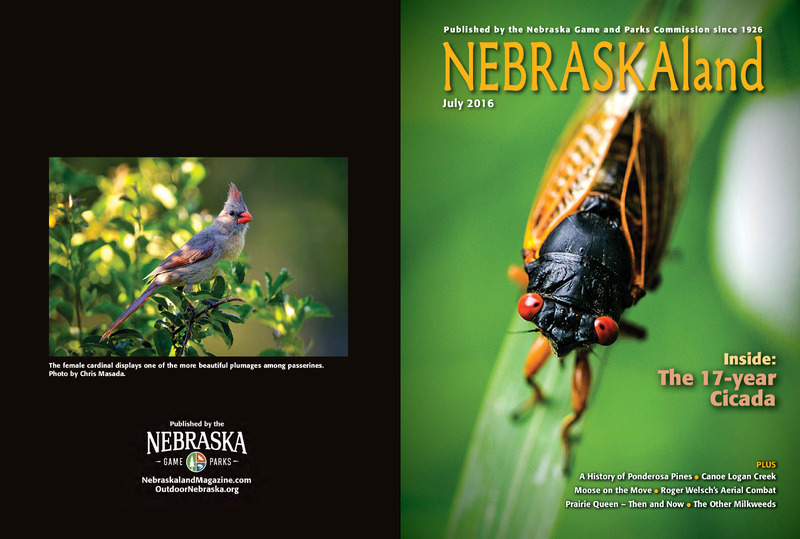
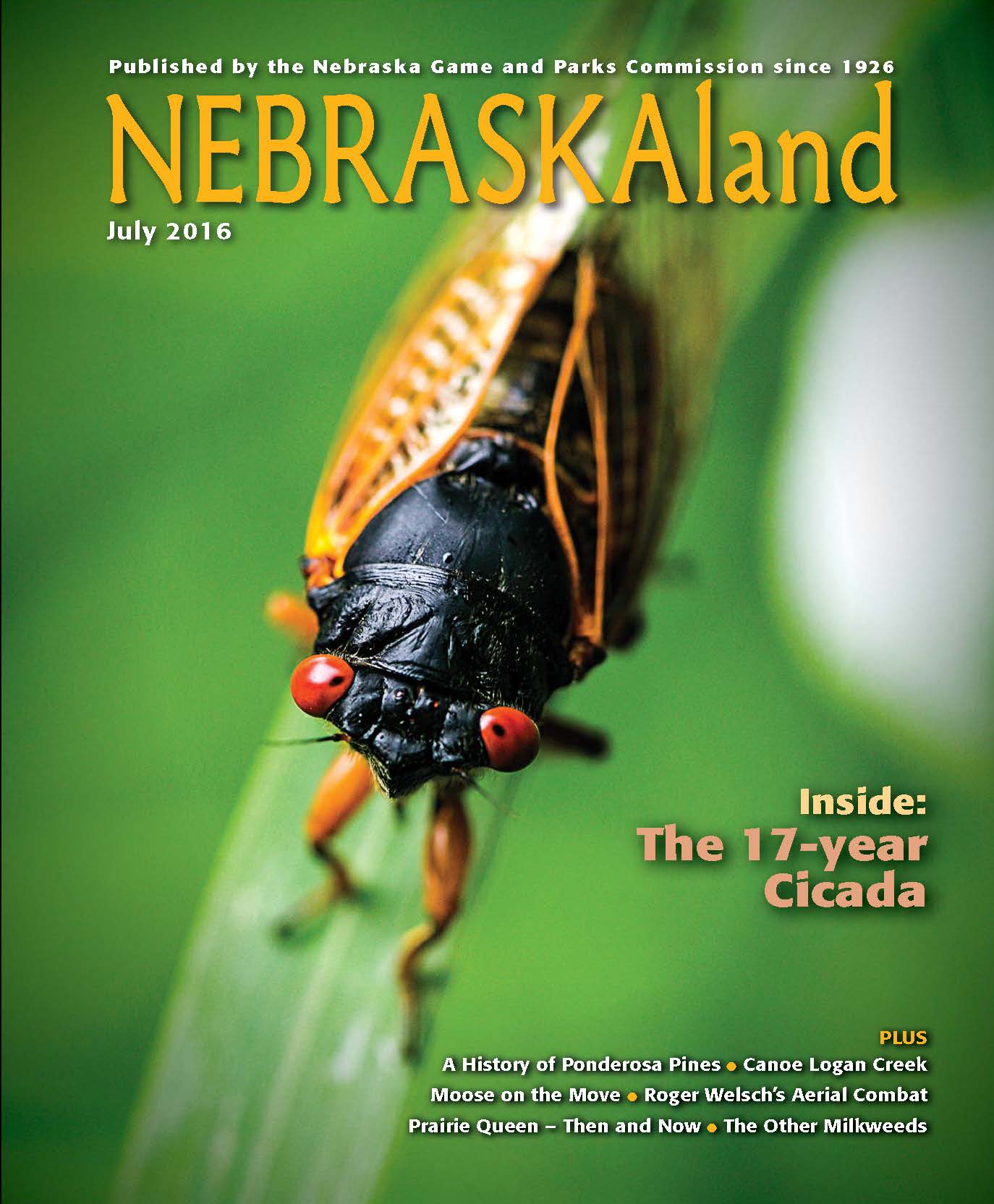
Publis hed by the Nebr a s k a Ga m e a nd Pa r k s C o m m is s io n si nc e 1926
NEBRASKAland
July 2016
The female cardinal displays one of the more beautiful plumages among passerines.
Photo by Chris Masada.
Inside:
The 17-year
Cicada
PLUS
A History of Ponderosa Pines ● Canoe Logan Creek
Moose on the Move ● Roger Welsch’s Aerial Combat
Prairie Queen – Then and Now ● The Other Milkweeds
NEBRASKAland Magazine
Volume 94
●
No. 6
●
July 2016
F EAT U R ES . . .
22 When It's Hot
B NEBRASKA
M
28 Purple Plague
B J
N
30 The Long Wait
2
Y
Y ENNY
LAND
AGAZINE STAFF
GUYEN
BY ALEX WILES
34 A History of Ponderosa Pine
BY GERRY STEINAUER
42 Time Well Spent – What to Do in July
R
B
44 Moose on the Move
BY ENAE LUM
BY JUSTIN
HAAG
48 Near the Water – A Day at Fremont Lakes SRA
STORY AND PHOTOS BY ERIC FOWLER
54 The Other Milkweeds
S
P
C H
58 Seeing the Change at Prairie Queen
TORY AND HOTOS BY HRIS
42
●
ELZER
STORY AND PHOTOS BY JEFF KURRUS
I N S I D E T H I S I S S U E ...
Mixed Bag – The Virginia Opossum, Travel to
Northwestern Nebraska, Ghost Counties, Under the Pond
Surface, Fireworks in the Parks and more .......................... 8
Along the Road – Paddling Logan Creek................ 64
Page 49 – Roger Welsch – Aerial Combat................... 67
In the Field – Pinnacle of the Pines ........................... 68
Portraits from the Past............................................ 74
In the Kitchen – Thai-style Turtle ............................. 76
The Last Stop – Big Bang Boom ............................. 78
54
●
34
●
Cover: A periodical cicada, also known as a 17-year cicada, is
shown on the private land of Jarel Vinduska in Sarpy County.
Photo by Jeff Kurrus.
NEBRASKAland (VOL. 94 / NO. 6 ISSN 0028-1964) is published monthly, except
for the combined Jan./Feb. and Aug./Sept. issues, by the Nebraska Game and Parks
Commission, 2200 N. 33rd St., Lincoln, NE. Periodicals postage paid at Lincoln,
Nebraska, and additional mailing offices. POSTMASTER: Send address changes to
NEBRASKAland, P.O. Box 30370, Lincoln, NE 68503-0370.
2 NEBRASKAland • JULY 2016
44
●
JULY 2016 • NEBRASKAland 3
Dear NEBRASKAland,
My son Isaac shot his first
deer this year near Long Pine,
Nebraska, hunting with me, his
grandfather and uncle. All four of
us had a wonderful time.
Thanks to the Nebraska Game
and Parks Commission for
making it as easy and affordable
as possible to get youngsters
interested in hunting.
We have to wait 11 months, but
we are already looking forward to
next season! Until then, we will
enjoy the memories and chew on
deer jerky.
Sincerely,
Bradley King
Urbandale, Iowa
"D
"Dear
NEBRASKAland,"
NEBRASKAl
d " wrote B
Barry Y
Young off Cl
Clatonia,
i N
Nebraska,
b
k
"My son Brock turned 6 years old three days before he was fortunate
enough to harvest his first gobbler this year. It was a magical moment I
had played over and over in my mind since the day he was born. There
are amazing and overwhelming emotions involved with this experience,
and I wish all fathers get to experience something like this with their
children."
Toadstool
Geologic
Park.
Submitted
by Li
Lindsey
Keller
Lincoln.
T
d t lG
l i P
k S
b itt d b
d
K
ll off Li
l
Pi
d on this
hi trail
il camera iimage are two coyotes,
Pictured
one of which is urinating on a deer scrape, from Dan
Leuenberger's farm in Johnson County.
Scotts Bluff National Monument in Gering. Photo by Lindsey Keller.
Richard Jones submitted this image of steel wool photography taken at Jeffrey Lake in Brady.
4 NEBRASKAland • JULY 2016
This jackrabbit was photographed by
Brandi Hild on her property north of
Brady.
Nebraska Farm LIfe. Photo by Lindsey Keller.
JULY 2016 • NEBRASKAland 5
NEBRASKAland Magazine
Outdoor Plates
Max Muller has been a hunting
enthusiast since he was old enough to
shoulder a gun, and primarily hunts
deer, but his work as a volunteer
Nebraska Hunter Education instructor
since 2010 was the inspiration for his
license plate.
If you have a unique outdoor message
plate you would like to share, or know
someone who does, e-mail a photo of
it (high-resolution, JPEG format only,
please) to Eric.Fowler@Nebraska.
gov, along with your name, hometown
and a brief description of the interests
expressed on your license plate.
CCONNECT WITH US
For outdoor news and events,
subscribe to our
weekly e-newsletter.
Text “NGPC Newsletter”
to 468 311.
Or visit OutdoorNebraska.org
to sign up.
Follow us on your favorite social media
COMMISSIONERS
CONSERVATION OFFICERS
Director Jim Douglas
Commissioners
Chairman - Mark Spurgin, Paxton
Vice Chairman - Rex Fisher, Omaha
2nd Vice Chairman - Dick Bell, Omaha
Dr. Kent Forney, Lincoln
Robert Allen, Eustis
Pat Berggren, Broken Bow
Mick Jensen, Blair
Norris Marshall, Kearney
Dan Kreitman, Wahoo
ADMINISTRATION (Lincoln)
Craig Stover (Administrator)
Duane Arp (Asst. Administrator)
Jeff Clauson (Asst. Administrator)
MAGAZINE STAFF
Communications Director Christy Rasmussen
Editor Jeff Kurrus
Art Director Tim Reigert
Associate Editor Jenny Nguyen
Regional Editors Eric Fowler, Julie Geiser,
Justin Haag
Contributing Editor Michael Forsberg
Regular Contributors Chris Helzer, Gerry
Steinauer
Photo Librarian Jaclyn Cruikshank Vogt
Circulation Donna Robinson
For address changes and questions about
your subscription, e-mail donna.robinson@
nebraska.gov or call 800-632-5263
Advertising Sales Manager
For advertising information contact
Shane G. Gilster, 402-742-0125
Email: shanegilster@gmail.com
NEBRASKAland Magazine Copyright 2016, all rights reserved.
NEBRASKAland is available in audio from the Nebraska Library
Commission Talking Book and Braille Service, Suite 120, 1200 N St.,
Lincoln, NE 68508. 800-742-7691. NEBRASKAland Magazine and the
Nebraska Game and Parks Commission reserve the right to reject any
advertising not in keeping with the agency mission.
Rates: $18 for one year; $33 for two years; $44 for three years. Nebraska
recipients must add appropriate sales tax. To subscribe call
1-800-NEBLAND (632-5263), or go online to: NebraskalandMagazine.
com.
COMMISSION
C
CO
COM
OM
MMIS
MISSIO
S NO
OFFICES
FFICES
FF
FFI
CES
S
Headquarters/Southeast District Office
2200 N. 33rd Street Lincoln, NE 68503
Phone 402-471-0641
Northeast District Office
2201 N. 13th St. Norfolk, NE 68701
Phone 402-370-3374
Southwest District Office
301 E. State Farm Rd. North Platte, NE 69101
Phone 308-535-8025
Send your comments to:
Jeff Kurrus, Editor
NEBRASKAland Magazine
P.O. Box 30370
Lincoln, NE 68503
or e-mail Jeff.Kurrus@Nebraska.gov
Please include your postal address and telephone number. Letters may be condensed
and edited. Photographs are also welcome.
Zach Hanson took this photo of a red barn under a full moon.
6 NEBRASKAland • JULY 2016
Any program that receives federal funding from the National Park
Service, or the United States Fish and Wildlife Service prohibits unlawful
discrimination on the basis of race, color, religion, age, gender, marital
status, national origin, age, disability or political affiliation. Any person
who believes he or she has been discriminated against in any program,
activity, facility, or service, should contact the Nebraska Game and
Parks Commission, Lincoln, NE 402-471-0641, the Equal Opportunity
Commission, Lincoln, NE 402-471-2024, TTY/TDD 402-471-4693;
United States Fish Wildlife Service, Civil Rights Coordinator, 4401
N. Fairfax Drive, Arlington, VA 22203; Director, Equal Opportunity
Program, U.S. Department of Interior, National Park Service, 1849 C
Street NW, Mail Code 0008, Washington, D.C. 20240-0001.
Northwest District Office
East Hwy. 2, Box 725 Alliance, NE 69301
Phone 308-763-2940
Bassett Office
524 Panzer St., Box 508 Bassett, NE 68714
Phone 402-684-2921
Kearney Office
1617 First Ave. Kearney, NE 68847
Phone 308-865-5310
Ak-Sar-Ben Aquarium
21502 W. Highway 31 Gretna, NE 68028
Phone 402-332-3901
Omaha Office
8495 Frederick Street, Omaha, NE 68124
Phone 402-595-2144
402-471-5531
402-471-5531
402-471-5531
NORTHWEST (Includes counties covered)
Jim Zimmerman (District Supt.)
308-641-6138
Sean McKeehan
(Cheyenne, Morrill, Box Butte)
308-279-9133
Scott Brandt
(Kimball, Banner, Scotts Bluff)
308-631-0663
308-760-3647
Greg Hesse (Sheridan, Dawes)
308-430-0572
Dan Kling (Sioux, Dawes)
Terry Brentzel (Deuel, Garden, Grant) 308-458-7650
402-389-0444
Frank Miller (Cherry, Hooker)
NORTHEAST (Includes counties covered)
Tom Zimmer (District Supt.)
402-649-8053
402-760-0712
Dale Davis (Keya Paha, Brown, Rock)
402-340-3981
Jonathan Andreasen (Holt, Boyd)
Mitch Johnson (Knox, Antelope, Pierce) 402-613-8612
402-762-5022
Jeff Jones (Knox, Cedar)
Alex Thomas
(Dixon, Dakota, N 1/2 Thurston)
402-241-7615
Jon Reeves
(S 1/2 Thurston, Burt, Washington)
402-889-8508
402-719-1108
Dan Roberts (Dodge, Colfax)
Cory Krause
(Cuming, Wayne, Stanton, Dodge)
402-380-6410
Steve Oberg
(Colfax, Platte, Madison, Stanton)
402-910-3366
Randy Pomplun
(Nance, Greeley, Wheeler, Boone)
308-550-0489
308-730-7050
Doug Pollard (Loup, Garfield, Valley)
SOUTHWEST (Includes counties covered)
Roger Thompson (District Supt.)
308-530-3097
308-202-0819
Matt Brandt (Sherman, Howard)
308-380-7331
Tim Williams (Hall, Hamilton, Merrick)
Pat George
(Clay, Adams, Nuckolls, Webster)
402-705-9989
308-920-0367
Rich Routh (Franklin, Harlan, Phelps)
Matt Andrews
(Gosper, Furnas, Frontier, Red Willow)
308-746-2418
Andrew Heyer (Dawson, Gosper, Phelps) 402-613-2241
Brian Piernicky
(Red Willow, Frontier, Hayes, Hitchcock)
308-340-6627
308-289-0427
Nicholas Fix (Keith, Perkins)
308-289-1169
Bryce Streger (Keith, Arthur)
Brandon O’Neal
(Lincoln, McPherson, Logan)
308-530-3157
Alex Hasenauer
(Lincoln, McPherson, Logan)
308-660-4671
308-440-3847
Dale Johnson (Kearney, Buffalo)
308-529-8146
Mike Thome (Dawson)
Ray Dierking (Custer, Thomas, Blaine) 308-870-0322
SOUTHEAST (Includes counties covered)
Levi Krause (District Supt.)
402-949-0593
402-619-1355
Rich Berggren (Douglas)
402-616-5961
Dan Evasco (Sarpy)
402-210-0888
Heath Packett (Cass)
402-209-1506
Russell Mort (Otoe, Johnson)
William Krause
(Nemaha, Richardson, Pawnee)
402-274-8063
402-806-9084
Dan Zuehlke (Gage, Saline)
402-890-6463
Dina Barta (Lancaster)
402-890-6465
Doug Kramer (Lancaster)
402-937-3422
Dudley Sorensen (Lancaster, York)
402-613-2312
Travis Shepler (Lancaster)
402-890-7140
Stacey Lewton (Lancaster, Seward)
402-443-6392
Mike Luben (Saunders, Butler, Polk)
Nebraska Wildlife Crimestoppers
1-800-742-7627
JULY 2016 • NEBRASKAland 7
PHOT
OTO
O BY
BY JEFF
F KU
KURRUS
S
A Mammal Brief
Virginia Opossum
By Lindsay Rogers
Didelphis virginiana
As North America’s only marsupial,
Virginia opossums give birth to
drastically underdeveloped young
which are about the size of a grape.
These nearly helpless young
have surprisingly strong front legs
which allow them to crawl into their
mother’s pouch. If they safely make
the journey into the pouch, the young will continue to grow and develop for another 3-4 months.
Historically Virginia opossums were found in Central America north to the southern and southeastern
United States. With the increase of human populations and changing climate, they have increased their
range which now extends into Canada. Individuals in more northern climates often seek shelter in
buildings. Additionally, their hairless ears and tails often show signs of frostbite.
Contrary to popular belief, “playing ‘possum” is rare and typically seen in young adults. More often,
opossums become aggressive or simply flee when faced with danger. ■
Lindsay Rogers is an outdoor education specialist with the
Nebraska Game and Parks Commission.
8 NEBRASKAland • JULY 2016
JULY 2016 • NEBRASKAland 9
Travelogue Sponsor
By Justin Haag
Old West Trail Rodeo
and Fur Trade Days
s, buckskinners and other hearty souls will again
o
owboy
in northwestern Nebraska culture and heritage during
revel
r
the
t region’s two premier community celebrations, just days
apart iin early July. They are Crawford’s Old West Trail Rodeo
and Chadron’s Fur Trade Days.
The Old West Trail Rodeo, sanctioned by the Professional
th
the
Rodeo Cowboys Association, is in its 70 year and stands as
July
of
centerpiece of one of the region’s most popular Fourth
celebrations.
Crawford’s historic Second Street and an
Along with the rodeo, the celebration features a parade down
A little louder scene can be found outside of the
afternoon of live music and family activities in the city park.
through the mud.
city limits, where race drivers put vehicles to the test in a sprint
the history
to
tribute
th
Entering its 40 year, Chadron’s Fur Trade Days pays
the city. The
of
east
just
showcased at the renowned Museum of the Fur Trade
le, takes
examp
for
celebration’s primitive rendezvous along Bordeaux Creek,
of
inners
bucksk
the
visitors back in time and provides a snapshot of how
can
Ameri
Native
and
yesteryear lived. Other activities, such as a ranch rodeo
bring
who
actors
film festival, honor the region’s heritage, as do the local
life during a tour
some of the Pine Ridge’s most prominent characters back to
of the city cemetery.
l World
Few events get as much attention as the local Rotary club’s annua
of
rs
throwe
Championship Buffalo Chip throw, however. In that event,
dung,
golden
of
all ages square off to take a shot at winning a plaque
distinctive
and perhaps top the event’s standing record of 187 feet. The
at the
parade
competition is one of the many activities following the
.
square
ouse
celebration’s hub, the bustling Traders’ Market at courth
cabins
and
s
round
Among the region’s lodging options are the campg
of two state parks – Fort Robinson and
Chadron. Each has special activities
planned for the respective celebrations.
Fort Robinson State Park is the site of the annual
Crawford and
Western & Wildlife Art Show, a juried exhibit that
Chadron
features the outstanding work of more than two
dozen artists from at least five states. Chadron State
Park challenges visitors to show their skills on land
and water in the annual Crooked Arrow Obstacle
Course and Kiwanis Fur Trade Regatta, a wet and wild
appeal,
canoe race around the park’s lagoon. If those competitions don’t
or
Run
maybe visitors will opt for a race by foot in the White River
Colter Run.
Whether it’s bucking bulls or tossing turds, there’s surely
ys,
enough happening at these two celebrations to entertain cowbo
Pine
buckskinners and any other drifters who may wander into the
Ridge. Discovernwnebraska.com
Crawford 4th of July Celebration
Old West T
princess at rail Rodeo jun
ior
Crawford
e Day
Fur Traaddron
in Ch
10 NEBRASKAland • JULY 2016
s parade
July 1-4 Crawford Fourth of July Celebration and
Old West Trail Rodeo
July 6-10 Chadron Fur Trade Days
JULY 2016 • NEBRASKAland 11
Colton’s Nebraska, published 1874 (copyright 1873), finally omitted the nonexistent counties, correcting errors that had been in
circulation since 1867. Croft Collection.
One of the many maps that copied the mistake, New Rail Road and Township Map of Nebraska shows the nonexistent Lyon, Taylor,
Monroe, Harrison, Jackson and Grant counties, and mistakenly places Julesberg, Colorado, inside Nebraska. Croft Collection.
A Brief History
Western Nebraska’s “Ghost” Counties
By Joy Carey and David Bristow, Nebraska State
Historical Society
ne incorrect map led to more than a decade of
confusion regarding six nonexistent counties in
western Nebraska. How did such a mistake happen,
and why did it take so long to fix it?
The mystery has been solved by Brian Croft of Scottsbluff,
an English instructor at Western Nebraska Community
College and avid map collector. Croft’s research shows not
only how maps were compiled in the frontier days, but also
how little known the Panhandle was to mapmakers, and even
to many Nebraskans.
The story begins in 1855, when Nebraska’s first territorial
legislature began organizing counties. Nebraska’s original
eight counties grew to 40 by 1861. County creation slowed
during the Civil War, then picked up again when Nebraska
became a state in 1867. During this time commercial
mapmakers strove to keep up with all the changes.
In mid-1867, the well-known Colton mapmaking company
of New York published Colton’s Township Map of the State
O
12 NEBRASKAland • JULY 2016
of Nebraska, which showed the counties of Lyon, Taylor,
Monroe, Harrison, Jackson and Grant. Collectively, the six
counties covered almost one-fifth of the state’s land. There
was just one problem: the counties didn’t actually exist.
Most people didn’t know that. Even Nebraska’s genuine
boundaries were new, and many people had only a vague
idea of what was actually out there. General Land Office
maps don’t show the six counties, but Colton maps were
so well known that other companies often copied their
information. The more the mistake was repeated, the more
legitimate the counties seemed. In 1870 the ghost counties
even fooled U.S. Census workers, who also followed the
Colton map by mistakenly placing Julesburg, Colorado, in
Nebraska.
Meanwhile, Colton’s steel plate engraving process made it
difficult to erase information without starting over. The firm
didn’t remove all six counties from their maps until 1873,
and some of the ghost counties appear on other companies’
maps as late as 1877.
For many years historians had no idea where the Colton
firm got its information, or if it was just making things up.
Then Croft discovered an obscure legislative bill in the
archives of the Nebraska State Historical Society. Passed
by the legislature in 1867, the bill organized the counties
just as shown on the Colton map. Somehow the company
had gotten word of it and went to press before learning
that the governor never signed the bill into law. But by
then it was too late. It took a decade to sort things out, and
nearly a century-and-a-half to unravel the mystery of why it
happened. ■
Brian Croft’s article, “Mapping Nebraska, 1866-1871,”
appeared in the Winter 2014 issue of Nebraska History,
published by the Nebraska State Historical Society. Visit
the Nebraska State Historical Society’s website at
Nebraskahistory.org
JULY 2016 • NEBRASKAland 13
I-80 Lake
Improvements
By Julie Geiser
One of the best places to fish in
Nebraska is the popular Interstate 80
lakes. The lakes lie adjacent to the
interstate and are heavily used by locals
and those traveling the I-80 corridor.
These lakes are not only great for
fishing, but allow camping and hunting
unless otherwise posted. The lakes are
part of the Nebraska Game and Parks
Commission’s wildlife management
areas and the lakes and fish are managed
by the Commission's fisheries division.
Major angler access improvements
had not been done at these I-80 lakes.
Trees and brush were overgrown
around shorelines, hampering bank
anglers from gaining access to the
water, and launching a boat in some of
these lakes was not an easy task.
In 2016, improvements for seven
I-80 lakes were made possible by
the Commission’s Aquatic Habitat
and Angler Access programs funded
by the purchase of fishing permits
and partially with federal Sport fish
Restoration Program funds collected
through an excise tax on fishing
equipment and motorboat fuel.
Birdwood, Hershey, Fremont
Slough, West Maxwell, West Brady,
Brady and West Gothenburg wildlife
management areas each received
concrete boat ramps and angler access
pads, with one pad at each lake being
ADA (Americans with Disabilities Act)
approved, and some lakes received
considerable tree clearing.
Birdwood WMA just west of
North Platte saw the majority of the
improvements with an ADA-approved
wooden fishing pier, four angler access
pads and an ADA-approved concrete
boat ramp.
The angler access pads are a great
addition to each lake allowing better
access to the water for anglers of all
ages. The pads make it easier for bank
anglers to fish parallel to the shoreline
in deeper water and casting along weed
beds can now be done.
“Almost every day there are people
out using the new angler access pads,”
said Jared Lorensen, Commission
fisheries biologist and manager of the
I-80 Lake project. “The improvements
made it possible for anglers that don’t
have a boat to get out into deeper water
and fish without having to worry about
trees and other obstructions.”
In all, construction consisted of
19 angler access pads, 1 wooden
angler access pier, 7 boat ramps and
approximately 4 acres of tree clearing.
“Each lake is a little different in design
but all function well and allow better
access for anglers,” Lorensen said.
Along with better bank access, the
improved boat ramps allow for larger
boats than before. Many of these
lakes allow boats with gas motors
with a 5-mph/no wake restriction.
Check the 2016 Fishing Guide or the
2016 Boating Guide for a listing of
regulations. ■
Jim Einspahr and his
daughters, Ava, at left and
Allie, fish at Birdwood
Wildlife Management Area
in Lincoln County off one
of the new angler access
fishing pads built in 2016.
PHOTO BY JULIE GEISER
14
1
4 N
NE
NEBRASKAland
EB
BR
RA
AS
SK
KA
Ala
laand
nd
n
d • JULY
JU
UL
L
LY
Y 2016
20
01
16
JULY 2016 • NEBRASKAland 15
16 NEBRASKAland • JULY 2016
JULY 2016 • NEBRASKAland 17
Presented by
By Paula Hoppe, Certified Master
Naturalist
Just under the surface of a healthy
pond, there are an assortment of
creatures with adaptations that enable
their habitation of this interface between
water and air. Water striders, their
long legs covered in tiny hairs, take
advantage of the water’s surface tension
to glide about, feasting on mosquito
larvae that rise to the surface to breathe.
Life at the boundary layer is also fraught
with the dual hazards of sky and sea.
The split eyes of whirligig beetles allow
them to watch for predators coming
from both above and below.
With their oar-like hind legs, water
boatmen trawl the depths of the
water, feeding on plants and algae
using a soft, tubular mouth. Named
for their habit of swimming upside
down, water backswimmers, though
similar in appearance to boatmen, are
predatory, and have a piercing mouth-
18 NEBRASKAland • JULY 2016
part which can inflict a painful bite.
They eat other insects, small fish and
even tadpoles. Many aquatic insects,
including boatmen and backswimmers,
carry oxygen on their body in the form
of air bubbles, allowing them to stay
submerged for long periods.
Diving deeper we find voracious
predators. These are the larvae of
insects we might find more familiar
above the water. Dragonfly and
damselfly larvae, or nymphs, may
spend one to three years under the
surface, prowling the depths for
unsuspecting prey. While hunting, the
lower jaws of dragonfly nymphs reach
out like an extra set of arms to grasp
other insects and small fish.
The caddisfly has a unique way of
avoiding such predators. Using material
found in its environment – sticks,
pebbles and the like – it creates a
cylindrical case that camouflages and
protects it against attack.
Midge fly larvae, sometimes called
bloodworms, are an important food
source for many aquatic organisms.
The hemoglobin-like substance that
Bug Banter
Damselfly nymph
PHOTO COURTESY OF
NEBRASKALAND ARCHIVE
Under the
Surface
gives them their red color aids in the
absorption of oxygen from the water
as they feed on algae and detritus in
the hypoxic environment at the pond’s
bottom.
Mayflies, depending upon the species,
spend two weeks to two years in the
water as larvae feeding on decaying
plant matter. They then emerge from
the water, usually en masse to complete
their life cycle. Living only one to three
days the adult mayfly has no mouth.
Its one purpose is to find a mate and
reproduce, and it dies quickly after and
falls to the water, food for the many
hungry mouths below.
Just under the surface of a healthy
pond is an amazing world of
biodiversity, a complex ecosystem
worthy of our attention. ■
Surveys on Invasive
Plant Pests
By Julie Van Meter
State Entomologist, Nebraska
Department of Agriculture
Invasive species are a serious threat
to the state of Nebraska, with the
potential to cause millions of dollars
in damage to the state. Early detection
of invasive species improves the odds
for successful eradication, or allows
for a management plan to be developed
to limit its impact. The Nebraska
Department of Agriculture (NDA)
Entomology Program conducts surveys
across the state for invasive plant pests.
State parks and campgrounds are
surveyed because of the high risk for
pest introductions. Visitors' vehicles
and firewood are prime pathways for
the introduction of invasive species.
NDA are setting and monitoring
various insect traps across the state,
including select state parks and
campgrounds.
Visitors may notice insect traps
while exploring their favorite park or
camping area. These traps are part of
an early detection program to protect
our parks from invasive species, and
while they may cause a few second
looks, they pose no danger to humans.
The Emerald ash borer (Agrilus
planipennis) is an exotic beetle from
Asia, first discovered in the U.S. in
2002, but not yet found in Nebraska.
Ash borer traps are large, bright purple
triangles, resembling box kites, hung
high in ash trees.
Traps are baited with an attractant
and coated with a sticky substance to
‘trap’ the insect on contact. Traps were
set in May and will remain up until late
August.
Another invasive species of concern
is the gypsy moth (Lymantria dispar).
Gypsy moth caterpillars feed on a wide
variety of broadleaf trees, and repeated
infestations can weaken and kill trees.
Gypsy moths are not established in
Nebraska, but hitchhiker moths are
occasionally caught in traps.
This year, NDA will set and monitor
approximately 500 traps statewide. The
wax-covered cardboard
traps are 10-by-5-inch
and triangular shaped.
Trap placement began in
April and traps will remain up until
fall.
Thousand cankers disease of black
walnut is a pest complex involving
the walnut twig beetle (Pityophthorus
junglandis) and a fungus (Geosmithia
morbida). The beetles carry the fungus
on their bodies and spread the fungus
spores to uninfested trees. Lindgren
funnel traps, which look like a series
of black funnels suspended from a pole
or tree, will be used to monitor for the
beetles, which have not yet been found
in Nebraska.
Firewood helps spread these plant
pests. Help protect our state by using
locally harvested firewood whenever
you camp. Do not take firewood
camping; get it when you arrive. Leave
leftover firewood behind; don’t bring it
back with you.
For more information on NDA’s
plant pest surveys, visit our web site
at http://www.nda.nebraska.gov/plant/
entomology/index.html. ■
JULY 2016 • NEBRASKAland 19
by Jerry Kane
and Parks Outdoor Education Center,
Lincoln
July 12, 19, 26
Explore Bowhunting Nebraska Game
July 5, 12, 19, 26
Introduction to Competition Pistol
Shooting Nebraska Game and Parks
and Parks Outdoor Education Center,
Lincoln
Outdoor Education Center, Lincoln
Contact the Nebraska Game and
Parks Commission at 402-471-0641 or
visit OutdoorNebraska.org for more
information. Visit HuntSafeNebraska.
org for a list of hunter education
classes and BoatSafeNebraska.org for
a list of boating safety classes.
July 5, 19
Women’s Firearm Series:
Introduction to Handguns
Nebraska Game and Parks Outdoor
Education Center, Lincoln
Fireworks at
the Parks
By Jerry Kane
July 13
Introduction to Shotguns
and Trap Shooting
Visitors to seven state recreation
areas will be allowed to touch off
fireworks on Independence Day,
according to the Nebraska Game and
Parks Commission. Those visitors
should use extra caution with fireworks
wherever dry conditions and high fire
hazard exist.
Branched Oak State Recreation Area
(SRA) near Malcolm, Fort Kearny
SRA near Kearney, Memphis SRA
near Memphis, Fremont Lakes SRA
near Fremont, Two Rivers SRA near
Venice, Pawnee SRA near Emerald
and Wagon Train SRA near Hickman
will permit fireworks from 8 a.m.
until midnight on July 4 only. Signs
at recreation areas will point the way
to designated fireworks sites and their
boundaries will be clearly marked. Use
of fireworks elsewhere in state areas or
at other times is prohibited.
Only fireworks approved for sale in
Nebraska by the state fire marshal are
permitted, and visitors must dispose
of fireworks safely. Minor children
must be supervised when discharging
fireworks. Use, possession and the
discharging of fireworks is at the sole
risk of the users. ■
Platte River SP, Louisville
July 14
Family Fishing Event Skyview Lake,
Norfolk and Lake Halleck, Papillion
July 6, 13, 20, 27
July 15
July 1
Beyond BOW Summer Shooting
Family Fishing Event City Park, Holdrege
Final day to apply for Nebraska Super Tag Series: Rifles Platte River SP, Louisville
July 15
and Combo lottery permits
July 7
Creatures of the Night (Summer
July 1
Speaker Series) Fort Robinson SP,
Project WILD Outdoor Classroom:
Archery fishing of game fish is allowed
Crawford
Fort-Building Basics Norfolk
statewide through Dec. 31
Underwater spearfishing of game fish
allowed in specific waters through Dec.
31 (see page 21 of 2016 Fishing Guide)
July 1
National Park Service Program
Niobrara State Park (SP), Niobrara
July 1
Pine Ridge Wildflowers (Summer
Speaker Series) Fort Robinson SP,
Crawford
July 1-4
Western and Wildlife Art Show
Fort Robinson SP, Crawford
July 1-14
Paddlefish snagging permit application
period
July 2
Critter Corner Nebraska Game and
Parks Outdoor Education Center, Lincoln
July 2
Archery Fun Shoot Nebraska Game
July 8
Creatures of the Night (Summer
July 15
National Park Service Program
Speaker Series) Chadron SP, Chadron
Niobrara SP, Niobrara
July 15-16
Beyond BOW Niobrara and Missouri
Parks Outdoor Education Center, Lincoln River Kayaking Trip
July 8
Rifle Fun Shoot Nebraska Game and
July 9
Family Fishing Event
Red Willow Reservoir State Recreation
Area (SRA), McCook
Niobrara SP, Niobrara
July 16
Carp-O-Rama
Lake Maloney SRA, North Platte
July 9
National Park Service Special Event
July 16
Bighorn Sheep Hike
Niobrara SP, Niobrara
Wildcat Hills SRA, Gering
July 9
Growing Up WILD Prairie Loft Center
July 16
Plant Identification Tour
for Outdoor Learning, Hastings
Calamus Reservoir SRA, Burwell
July 9
3-D Archery Shoot
Red Willow Reservoir SRA, McCook
July 16
Teddy Roosevelt: Rough Rider
President Two Rivers SRA, Waterloo
July 9, 23
Family Fun Night
July 16
Geocaching Niobrara SP, Niobrara
Red Willow Reservoir SRA, McCook
and Parks Outdoor Education Center,
Lincoln
July 19
July 9, 23
Family Fishing Event
Fishing Clinic Two Rivers SRA, Waterloo Lake Zorinsky, Omaha
July 2-3
Living History Fort Atkinson State
July 11
Historical Park (SHP), Fort Calhoun
July 2-4
Living History Fort Kearny SHP, Kearney July 11, 13
Introduction to Civilian Marksmanship
July 2, 16
Buffalo Cookout and Entertainment Platte River SP, Louisville
Niobrara SP, Niobrara
July 11, 18, 25
Outdoor Skills Club Nebraska Game
July 3
and Parks Outdoor Education Center,
Sidewalk Chalk Art with Bird and
Lincoln
Emerald Ash Borer Program
Niobrara SP, Niobrara
July 11-31
Application period for Gifford Point
July 4
Wildlife Management Area special access
Fourth of July Barbecue
permits for deer hunting
Fort Robinson SP, Crawford
July 5-6
Wild Woods Survival Nebraska Game
July 20
Remaining big game hunting permits may Family Fishing Event
be purchased, beginning at 1 p.m. Central Bowling Lake, Lincoln
Time, through the close of the seasons
July 12
Family Fishing Event
Oak Lake, Lincoln
July 22
Family Fishing Event
Melham Park, Broken Bow
July 22
The Rescue of Andromeda and
Other Things to See in the Night Sky
(Summer Speaker Series) Chadron SP,
Chadron
July 23
Kite Day Niobrara SP, Niobrara
July 23
CNPPID 75th Anniversary Event
Lake McConaughy SRA, Ogallala
July 23
Family Fun Day Victoria Springs
SRA, Anselmo
July 23
Tandy Leather/Animal Hides
and Leather Two Rivers SRA,
Waterloo
July 23
Beyond BOW Beginning Kayaking
Lake Wanahoo SRA, Wahoo
July 23
Bighorn Sheep Hike
Fort Robinson SP, Crawford
July 23
Calamus Clean Up Day
Calamus Reservoir SRA, Burwell
July 23
State High School Fishing
Tournament Elwood Reservoir
July 26
Pollinators Workshop O’Neill
July 28
Family Fishing Event
Benson Park, Omaha
July 29
Pre-Settlement Bison (Summer
Speaker Series) Fort Robinson SP,
Crawford
July 30
Christmas Decorating Contest
Campfire Christmas in July
Jingle Bell Junk and Craft Market
Indian Cave SP, Shubert
July 30
Kites and Castles Contest
Lake McConaughy SRA, Ogallala
July 30
Beyond BOW Ladies Day at the
Range Weeping Water Gun Club,
Weeping Water
PHOTO BY ERIC FOWLER
July 1
NEBRASKAland
and
Visitor
Last issue’s winner of
the Visitor drawing was
Max Porter of Alma, Nebraska
who found the earthworm on page 65.
Readers are encouraged to contact
NEBRASKAland within 10 days
after this issue’s publication with
the correct page number and name
of this issue’s “Visitor” – a critter
found in Nebraska. We will then
gather the correct entries and draw
one to win a NEBRASKAland mug.
To enter each month, write:
NEBRASKAland Visitor
2200 North 33rd Street,
Lincoln, NE 68503.
Or e-mail:
Tim.Reigert@Nebraska.gov
with “Visitor” in the subject line of
the message.
HINT: This issue’s visitor is not on
pages 1, 18, 21, 30-33, or 54-57.
Earthworms are familiar
creatures. Maybe you used one
to bait a hook, saw them in your
garden or chased a terrified
“friend” around the school
yard with one. But what do you
really know about earthworms?
Earthworms are recyclers, feeding
on decomposing organic matter
and returning nutrients to the
soil in their excrement. Their
actions increase soil microbial
activity and improve infiltration
and water-holding capacity in soil.
Earthworms are hermaphrodites,
having both male and female
reproductive parts. The band
sometimes seen on an earthworm
is the clitellum, indicating sexual
maturity. Many earthworms are
found in North America, and the
shape of the tail, nose and clitellum
species
can help with spec
identification.
Special thanks to Julie Van
Meter, State Entomologist,
Nebraska Department of
Agriculture.
Branched Oak State Recreation Area.
20 NEBRASKAland • JULY 2016
JULY 2016 • NEBRASKAland 21
When It’s Hot
ebraska’s hottest month, July is too often
N
when many of even the most die-hard
outdoor enthusiasts head for the AC and
binge watch their favorite TV episodes. But
there is a sense of strange accomplishment
that comes when spending a day with sweat
dripping off of your face, where any shade
is good shade and any sort of assistance
from the Great Plains wind is quite often the
heat’s best medicine.
\
his is summer at its best. And while
T
there’s nothing better than lying on the
couch after a long day in the sweltering heat,
PHOTO
PHOT
HOTO BY
BY E
ERI
R C FOWLER
LER
E
PHOTO
PHOT
O BY JUS
USTIN
U
T N HA
HAAG
A
it takes being in that heat in the first place to
make that late-day drink that much sweeter.
Here are a few activities to get you there. ■
Archers pull their arrows from targets
during the State Games of America archery
competition held at the Nebraska Game and
Parks Commission’s Outdoor Education
Center in Lincoln last August.
22 NEBRASKAland • JULY 2016
As one of America’s most popular summertime activities, rodeo is practically linked to heat.
One night each week, Fort Robinson State Park employees and others from the region give
visitors a taste of cowboy culture. In this scene, Chad Brennan ropes a calf for the event’s agediverse group of spectators.
JULY 2016 • NEBRASKAland 23
PHOT
PHO
P
HOT
H TO BY
Y ERIC
ERI
RIIC FO
OW
WLER
WLE
LER
LE
E
Left: When the fish are
biting, cares of the air
temperature are sure to
fade. Let the largemouth
bass help get you through
the days, as Kiera Haag is
doing here.
Above: A family relaxes
around their cabin in the
Weigand-Burbach Area
at Lewis and Clark Lake
State Recreation Area near
Crofton.
PHO O BY
PHOT
B JUSTIN
JUS
USTIN HAAG
AA
AAG
24 NEBRASKAland • JULY 2016
P
PHO
PHOT
OB
BY ERI
ER
R C FO
OWLER
WLE
E
Right: Lacey and Seth
Gould of Wasau paddle
their kayaks past limestone
and shale bluffs at Lewis
and Clark Lake SRA.
JULY 2016 • NEBRASKAland 25
PHOT
HOT
OTO B
BY JU
JUS
USTI
TIN
N HAA
HAAG
H
HA
AAG
Above: A red-headed woodpecker brightens the scene on a sultry day at Pressey
Wildlife Management Area. Even in July, when avian species are keeping a low
profile while replacing their feathers, birdwatchers can find some diamonds in
the rough.
Below: Sailboats cruise the waters of Lewis and Clark Lake SRA.
PHOT
TO BY
BY ERI
E C FOWLER
Above, right: Children play on a floating foam mat in front of the Bloomfield Area
campground at Lewis and Clark Lake SRA.
PHO O BY
PHOT
B ERI
ERIC
RIC FOWLER
FOWLER
W
WLE
PH O B
PHOT
BY JUS
US
ST
TIN
I HAAG
Opposite: Nebraska’s state parks have many activities that are “cool” no matter
the time of day. The stagecoach ride at Fort Robinson State Park remains a
favorite way for visitors to catch a breeze.
26 NEBRASKAland • JULY 2016
JULY 2016 • NEBRASKAland 27
Purple
Plague
beetles – also from Europe – are host specific, meaning they
eat only purple loosestrife plants.
Each year, Hanzlik’s students raise and release 5,0007,000 Galerucella beetles in a section of wetlands between
the Niobrara golf course and the Missouri River. They
carefully monitor and manage this area in hopes of lowering
purple loosestrife densities. The students target .2 to .5
purple loosestrife plants per square meter, meaning in
sample areas that have been divided into quadrants with
PVC squares for study, they hope to find only 1 plant per
every 2-5 quadrants, Hanzlik said.
Purple loosestrife is not useful as feed, cover or nesting for
wildlife, and its invasion also negatively impacts recreational
and eco-tourism opportunities.
“When we first started [conservation efforts] in 2005,
populations of purple loosestrife were intense, ranging from
30 up to 100 plants per square meter. Thick growths like
this totally inhibit wildlife passage except for the tiniest of
creatures,” said Hanzlik. “Large mammals and waterfowl
will actively avoid these areas. Considering these areas are
some of the few public-hunting areas around Niobrara, the
plant has a drastic effect on hunting success rates.”
By Jenny Nguyen
Tenth grade students at
Niobrara High School fight
purple loosestrife in their
backyard. Their awardwinning project has been
recognized by the EPA.
Life Cycle
F
rom June through September,
you may see explosions of
purple flowers along some
Nebraska waterways. As
beautiful as they are, purple
loosestrife (Lythrum salicaria) is a
noxious weed, an ornamental plant from
Europe first introduced to the northeastern
United States for landscaping in the 1800s.
Since then, this invasive species has invaded
much of Nebraska’s wetland habitats, quickly
taking over slow moving, shallow areas
along rivers, creeks and ditches, and drastically
lowering the areas’ biodiversity, productivity and
economic value.
Hungry Beetles
Galerucella beetles (Galerucella
calmariensis) feed on purple
loosestrife plants.
28 NEBRASKAland • JULY 2016
2005 has turned into a year-long, comprehensive
conservation program passed from one 10th grade class to
the next.
With collaboration and support from the Nebraska Game
and Parks Commission, U.S. Army Corps of Engineers,
Lower Niobrara Natural Resource District, Missouri
National Recreational River and several County Invasive
Species boards, the students are helping to combat purple
loosestrife by biological means: Galerucella beetles. These
PHOTO BY MIKE FORSBERG
In Niobrara, Nebraska, purple loosestrife is
a problem, but it also serves as a learning
opportunity in wetland conservation for
Sharla Hanzlik’s 10th grade biology
class at Niobrara High School.
What started as a one-day
community service event in
During the dig, which fell on May 18 this year, students
dug up and collected young purple loosestrife plants near
Niobrara State Park and replanted them in pots, or buckets,
at the school. The pots are covered and the plants are
maintained as food to raise Galerucella beetles for release
in July 2016. The class obtained breeding populations of
beetles from Montana, but in the last couple years, they have
been able to “round up” enough beetles locally, Hanzlik
said.
At this point in the spring, hibernating beetles in the
bottomlands that were released by last year’s class in July
2015 have already emerged from the soil and are actively
feeding and breeding. They lay eggs and the adults live out
the summer, continuing to feed on purple loosestrife plants
until the first frost kills them.
Beetles obtained this year are raised at the school. They
lay clutches of eggs on the stems of the potted purple
loosestrife plants and will hatch into larvae in about
two weeks, around the beginning of June. They will eat
voraciously for a few weeks then return to the soil to pupate.
The beetles emerge in 2-3 weeks and are ravenous.
“This puts us at early July 2016 when dispersion takes
place. The new beetles will quickly consume all of our
captive purple loosestrife plants within days or even hours,”
Hanzlik said. “In the fall, this generation of beetles will
hibernate in the soil and surround the roots of wild plants.”
The process starts all over again the following spring as this
year’s beetles become next year’s parent stock, bolstering
the wild population.
Typically, Hanzlik’s biology class maintains 300-450 pots
per year, but unfortunately due to construction of a new
parking lot at Niobrara High School, 2016’s project has been
scaled down to 100 pots. However, the class is working on
designing a greenhouse to give the project more permanency
in subsequent years.
Hard-earned Rewards
Though purple loosestrife is challenging to control,
Hanzlik’s students are making an impact on populations
in their study area. Previous to the Missouri River flood in
2011, introduced Galerucella beetles reduced the population
down to almost “native-equivalent levels,” the maximum
population for an individual species to be considered nonthreatening to others.
However, the flood presented new complications to the
project, after which purple loosestrife populations again
exploded. But the students persevered and once again saw
decreased levels of purple loosestrife in 2013-2015.
“This spring is the first where I feel we have regained
control of this area again,” Hanzlik said.
Niobrara High School’s purple loosestrife project is one of
its community’s pride and joys, evidenced by the numbers
of parents, community members, biologists and weed
specialists who come out to assist the students each year.
The project “gives students the opportunity to do real
science work while engaging them in problem-based
learning,” said the United States Environmental Protection
Agency when it awarded Niobrara High School its Region 7
President’s Environmental Youth Award in 2011.
Proving that high school students can make a difference,
their ongoing study at Niobrara will assist biologists in future
studies and management of this unwanted weed. ■
Young purple loosestrife plants are transplanted into pots to
raise Galerucella beetles at Niobrara High School.
JULY 2016 • NEBRASKAland 29
The Long
Wait
By Alex Wiles
Last summer parts of Nebraska
experienced one of nature’s
most fascinating
phenomena – the emergence
of periodical cicadas,
commonly known as
17-year cicadas.
This is their unique
story.
30 NEBRASKAland • JULY 2016
JULY 2016 • NEBRASKAland 31
PHOTO BY JEFF KURRUS
A 17-year cicada is shown on a leaf on private
land near the Platte River in Sarpy County.
I
n the summer of 2015, Nebraska and several other
states in the Midwest bore witness to one of the biggest
natural spectacles in the world, and it all revolved
around insects. The emergence of periodical cicadas, also
known by the name of their genus “Magicicada,” only
happens once every 17 years and lasts just a few weeks.
This event is much harder to overlook than other insect
occurrences, though, due to the extremely loud calls of
the cicadas as they congregate.
There are around 150 species of cicadas in the United
States, but their bright red eyes and deafening calls
make periodical cicadas unmistakable. Before long
they overwhelm trees and call with a persistence that
comes from the fact that they only have several weeks
to complete their life cycle. This particular group of
periodical cicadas known as Brood IV, or the Kansan
brood, consists of three different species that all emerge
in unison and cover approximately the same area of the
country. Cicadas are not locusts and will not decimate
crops as other mass emergences of insects can. They also
do not sting or cause injury, so it is a great privilege to be
able to watch, and listen to, this rare event that happens
right in our backyard.
The vast majority of the life of a periodical cicada is
spent underground as a juvenile. These 17 years are not
slept away in a dormant state, as the nymphs burrow
around feeding off of the xylem fluid of plant roots and
grow, however slowly. As they emerge, they are one step
away from adulthood and are not yet fully developed, so
they must climb onto nearby vegetation and molt their
exoskeleton one last time. Casting off this shell (known
as an exuvia), they are vulnerable and cannot yet fly, so
they must stay on this low lying perch and hope they do
not become prey for one of the many animals that takes
advantage of this sporadic occurrence. Because they are
such visible and vulnerable insects, periodical cicadas
must rely on the odds that come from strength in numbers
to avoid being eaten. Local predators take full advantage
of these easy meals and consume them en masse to such
an extent that there have been noted booms in predator
populations in the years following an emergence.
However many are eaten during this time period, the
tactic of relying on others being eaten first works for
some, and the lucky ones are able to complete their life
cycle, replenishing the population for another generation.
Crawling higher up into the trees, the males will
congregate and begin calling in an effort to attract their
Two periodical cicadas mate as an empty exoskeleton clings to the branch below.
PHOTO BY JEFF KURRUS
Magicicada larvae hatch out of the notches in twigs and will fall to the ground to bury
themselves and begin developing.
PHOTO BY ALEX WILES
The first instar of a periodical cicada is smaller than a grain of rice and barely visible
to the naked eye.
underground from tree to tree, they will form
small chambers called cells and feed off of the
fluid in roots as they grow. For 17 years they
will live this way, going through the process of
ecdysis (molting their exoskeleton) up to three
times until they are ready to emerge in the same
fashion their parents did so long ago.
Periodical cicadas, like many other species
in the world, currently face a number of
challenges that threaten their future. For
example, the fungus Massospora cicadina will
attack the adults once they emerge from the
ground and are trying to reproduce. Of greater
concern, however, is the shrinking amount
of suitable habitat available for them due to
human development. These species rely on the
undisturbed, sunlit edges of the forests in which
they congregate, which are becoming more and
more of a commodity. We will have to wait
another 17 years to experience this phenomenon
again, but it is important to consider these
circumstances if we are to continue enjoying
them for generations to come. I, for one, think
that they are well worth the wait. ■
Above: Pictured are empty exuvia of periodical cicadas. This is
the final molt in the process of becoming an adult and happens
shortly after emerging from the ground.
Below: Adult Magicidas possess red eyes and congregate in
large numbers when they emerge from the ground.
PHOTO BY ALEX WILES
PHOTO BY ALEX WILES
32 NEBRASKAland • JULY 2016
PHOTO BY JEFF KURRUS
female counterparts. The noise
produced creates a cacophony
of sound that is impossible to
miss. If you listen closely, you
may even be able to pick up
variations in their calls, which
are produced from a membrane
just behind their wing known as
a tymbal. Different species have
unique calls that are discernible
from one another. In addition,
each individual species has a
variety of calls with different
meanings. The most obvious
of these is the call to attract
females, and, though females
cannot respond because they
lack noisemaking tymbals, they
give a quick flick of their wings
that produces a small sound in
response to the males’ efforts.
Once a suitor is identified, the
males will change their call by
increasing frequency and pitch
that communicates courtship
as he continues in his efforts to
woo the female. If something
disturbs them during this
process, the males can also emit
an alarm call in an effort to
ward off whatever is distracting
them.
After mating, a female will
carve many small notches into
thin branches on trees where
she will deposit her eggs. This
carving will damage only the
youngest and most fragile of
branches, so trees typically
survive the process relatively
unscathed. Breeding and
depositing their eggs are the
last efforts the adults will go
through in their lives, dying
shortly thereafter to return
nutrients to the soil and to feed
other organisms. The eggs will
hatch in short order, and the
freshly emerged nymphs will
drop to the ground and begin
burrowing in earnest. Moving
Alex Wiles is an
environmental educator
at Fontenelle Forest near
Bellevue while he pursues
a career in conservation
photography. This is his
second appearance in
NEBRASKAland Magazine.
JULY 2016 • NEBRASKAland 33
A History of
Ponderosa Pine
The Iconic Tree of the West
By Gerry Steinauer, Botanist
Scottish explorer and botanist David
Douglas, while on an expedition in
eastern Washington, documented
the pine as a species new to science,
bestowing it with the scientific name
Pinus ponderosa. The Latin term
ponderosus means “of great weight and
significance.”
A Far Ranging
Species
The most drought- and fire-tolerant
of all western pines, ponderosa pine
wandered down from the Rocky
Mountains onto the grassy plains
of Nebraska. Here, it grows on the
Panhandle’s Wildcat Hills and Pine
Ridge escarpments and follows the
steep and rugged Niobrara River
valley eastward to Rock County.
Isolated stands in deep loess canyons
in Garfield and Custer counties are the
species’ eastern most outposts on the
North American continent.
Range wide, ponderosa pine occurs
from southwestern Canada southward
and eastward following the Rockies
through every western state and into
central Mexico, occupying elevations
ranging from sea level to 10,000 feet.
A genetically diverse and adaptable
species, it survives as a gnarled
dwarf on the desert fringe of the
Southwest, while reaching 250 foot-tall
splendor on the moist, lower slopes
of the Cascade Range in Oregon and
Washington.
The untouched western ponderosa
pine forests could be expansive.
In 1857, Lieutenant Edward Beale
34 NEBRASKAland • JULY 2016
PHOTO BY JUSTIN HAAG
D
uring the summer of 1982, my
job as a graduate student was to
find old-growth ponderosa pine
forest in the Black Hills; the following
summer I would help document the
stands’ unique flora. With leads from
foresters, my searches inevitably led
me to deep canyons, rocky slopes
or other backcountry inaccessible to
sawyers of the yesteryear.
Standing beneath the towering
“yellowbarks,” I often felt primordial
enchantment, while my thoughts drifted
to times past. What history had these
trees witnessed as they grew from
saplings to towering giants? How many
lightning strikes, droughts and wildfires
had they survived?
Also impressed by lofty and
majestic ponderosa pines, in 1829 the
Ponderosa pines hug the rocky slopes of the Wildcat Hills in Banner County. Limber pine is the state’s only other pine species.
It grows in a single small stand in Kimball County.
traveling in central Arizona wrote
that “a vast forest of gigantic pine,
intersected frequently with open glades
... was traversed by our party for
many days.” Extending into eastern
New Mexico this forest was 25 to 40
miles wide and almost 300 miles long.
Great Plains ponderosa pine forests, in
comparison, were mere shadows of the
sweeping mountain stands – and rather
recent immigrants.
During the peak of the Wisconsin
Glaciation (12,000 to 20,000 years
ago) the northern Plains were too cold
for ponderosa pine and supported
white spruce forests and grasslands.
Westward during this period, the pines
were forced southward to refuges in
the mountains of southern Arizona
and New Mexico, and into Mexico,
though some stands may have persisted
in sheltered locations farther north.
As the glaciers retreated northward
and the post-glacial climate warmed,
ponderosa pine began to spread out of
its southern refuges. There is evidence
the species reached eastern Colorado
near Fort Collins about 6,000 years
ago and likely migrated into Nebraska
after that. Some botanists, however,
speculate ponderosa pine arrived in our
state as early as 9,000 to 10,000 years
ago.
During its post-glacial residence
here, ponderosa pine expanded its
range southward and eastward, possibly
via river valleys, during cool and moist
periods and retreated during extended
droughts, some which lasted centuries.
The Custer and Garfield county
stands are likely vestiges of one such
expansion.
Shaped by Fire
For eons, fire has shaped nearly all
North American forest types, both
deciduous and coniferous. Ponderosa
pine forests are no exception. Prior
to the arrival of Native Americans
from Siberia about 13,000 years ago,
summer lightning strikes were the
sole fire source. Human-set blazes,
both intentional and accidental,
greatly increased the frequency of
fires throughout North America.
Native Americans burned dense,
JULY 2016 • NEBRASKAland 35
pine forests and woods were mostly
ground fires, consuming only grass and
fallen pine needles and branches. Such
blazes killed many small ponderosa
pines, but a few large trees whose thick,
flaky bark protected the vulnerable
cambium layer – where new growth is
initiated and found just below the bark
– from the fire’s heat, survived. Selfpruning lower branches and thick bud
scales added further protection.
Occasionally, during drought years,
the fires burned hotter and flaming
The Sawyer’s Blade
An 1875 photo of Crow Butte in the Pine Ridge of Dawes County. Frequent wildfires
kept the pines from venturing down from the rocky, fire-protected Butte onto adjacent
prairie.
36 NEBRASKAland • JULY 2016
In 1874, A.A. Sloan, a member of a
survey party that followed the central
Niobrara River for over 100 miles,
wrote in a northeastern Nebraska
Pine logs thinned from the Nebraska National Forest near Chadron after the 2012 wildfire
wildfire. These logs were bound for the boilerdriven heating and cooling plant at Chadron State College.
newspaper: “Saw plenty of pine timber
on the north side of the Niobrara, whose
banks are covered with beautiful pines
and various other kinds of timber ... The
bluffs back from the bottoms are full
of springs, and covered with tall pines
from two to three feet in diameter; and
sufficient in quantity to supply several
mills for many years to come.”
As early as the mid-1800s, lumberhungry settlers in northeastern
Nebraska had their eyes on the
“beautiful pines” found along the
central Niobrara. In 1859, Dr. B.Y.
Shelley, a prominent citizen of the
town of Niobrara located at the river’s
mouth in Knox County, made the first
attempt to harvest this timber. Hoping
to take advantage of the June rise of
the Missouri River from mountain
snowmelt, which backed water up
into the lower Niobrara, forming
“to all appearance near its mouth, a
large navigable river,” he schemed
to float logs down the Niobrara to
his hometown. Shelley and his party
struck out for “the pinery ... on
the banks of [Long] Pine Creek” a
Niobrara tributary in Brown County.
In short order they cut 53 “very fine
pine logs” and floated them down the
Long Pine where they lodged in the
sandy bottoms at its mouth. While
washing out a channel to run the logs
to the Niobrara’s main channel, the
sawyers had a run in with “20 rather
cross Indians of the Two Kettles band
of Sioux” who took claim of the logs.
Avoiding a fight, Shelley abandoned
his bounty and high-tailed it back
home. Even without the confrontation,
Shelley’s adventure was doomed
for failure, as the Niobrara was too
shallow, sandy and braided for rafting
logs. With no railroads or roads leading
to the area, the Niobrara pines were
safe for a few more decades.
Around 1880, as the region was
settled and towns erected, sawmills
sprang up in the central Niobrara
valley to meet the growing demand for
lumber. One such mill, a combination
flour mill and sawmill, built in 1892
and owned by William Kuhre, was
located at the mouth of Fairfield Creek
a mile upstream from the present day
Norden Bridge spanning the Niobrara.
“They put a dam across the Fairfield
forming a pond, and water flowing
through the spillway turned paddles
powering the mill,” said Doug Kuhre,
great-great-grandson of William whose
family still owns the mill site. Steampowered saws were also operating in
the valley.
MAP BY TIM REIGERT
nearby small pines or burning pitch
runs on a tree’s trunk carried the fires
into the crowns of large pines. In
dense stands, the crown fires easily
leaped from tree to tree, especially
when windy, killing or damaging
large numbers of them. These severely
burned forests were ecologically
valuable, providing early successional
habitats for many plant species, and
the dead and dying trees supporting
specialized insect and bird species.
In the central Niobrara valley, the
pine woods, bordered by Sandhills
prairie on the uplands, burned on
average every 3.5 years between
1830 and 1900, and every 8.5 years
between 1901 and 1950 after active
fire suppression by residents. Whereas,
the pinelands on our drier western
escarpments, surrounded by lighterfueled shortgrass prairie, burned
on average every 10 years between
1650 and 1900, but every five years
between 1830 and 1900 after firesloppy Euroamericans entered the
region, but before fire suppression. A
region’s fire frequency is determined
by examination of fire scars within
the growth rings of both living and
dead trees. The scars form when the
cambium layer is damaged by a fire’s
heat; this usually occurs on the upslope
side of a tree where litter gathers and
fires burn hot.
In 1876, Colonel Richard I. Dodge,
a member of an 1875 scientific
expedition to the Black Hills, wrote of
the region’s fire-shaped ponderosa pine
woods: ”Large and fine saw-logs are
to be found, and in very considerable
numbers, but rarely in large bodies.”
Old and large trees, which by some
means escaped the fires were “scattered
through the young forests.” Dodge
estimated that 40 percent of the Black
Hills was young forest, 10 percent was
“wind-shaken, or injured by lightning
or fire,” 10 percent was “good lumber,”
and grassy openings comprised the
remaining 40 percent. Nebraska’s
presettlement pinelands likely had a
similar structure.
PHOTO BY JUSTIN HAAG
PHOTO BY GERRY STEINAUER
When mature
mature, the bark of ponderosa pine
turns orange to yellow in color.
NSHS RG5895-8
shaded forests to thin trees creating
open, sunny woodlands with lush
grass, wildflower, and fruit-bearing
shrub understories, providing food for
themselves and the game they hunted.
Plains grasslands were also set ablaze
as bison were attracted to the fresh
regrowth, these fires sweeping through
woodlands in their path.
The frequent presettlement fires
limited Nebraska’s ponderosa pines
to the somewhat fire-protected
escarpments and river bluffs, with the
trees forming mostly open woodlands
and savannas (grasslands with widely
scattered trees). Dense pine forests
were found only in deep, cool and
moist canyons and north-facing slopes
where fires burned sporadically and
with low intensity. The Loess Hill pine
stands “were usually in deep rifts in
the hills, running more or less at right
angles to the river plain [North, Middle
and South Loup], with sides so steep
and broken as to form an adequate
protection against the annually
recurring prairie fires,” wrote H.W.
Foght in his 1906 book The Trail of
the Loup. Pine seedlings that sprouted
in the thick grass of adjacent prairie
survived only until the next fire.
The fires that burned through the
Distribution of ponderosa pine in Nebraska (source: 2003 Native Vegetation of
Nebraska Map by Kaul and Rolfsmeier).
JULY 2016 • NEBRASKAland 37
private land or the Nebraska National
Forest, and possibly in the Wildcat
Hills and central Niobrara River valley.
But these stands are likely few and far
between. It’s unfortunate, as old-growth
pine forests provide unique habitats
for rare plants, such as orchids and
wintergreens, and bird and bat species.
Wildfire and the
Future of Nebraska
Pinelands
PHOTO BY SOLOMAN BUTCHER
A single century of settlement has
wrought extreme change to Nebraska’s
pine ecosystems and to the fires that
forged them. Historically, they were
an open mosaic of both young and
old pines, where frequent fires limited
tree densities and fuel loads. While
logging has removed nearly all the
stately large trees, fire suppression has
led to a proliferation of young pines
and abundant ground fuels. Nickerson
wrote of the Pine Ridge: “An acre
that had 30 to 50 ponderosa pines
before European settlement might
now have 2,000 to 3,000 trees.” Such
overcrowded, fuel-heavy forests are
literal tinderboxes.
Today, when lightning or humans
“William cut mostly pine, but also
some cottonwood and elm. It was
rough cut lumber used for corrals
and barns,” said Kuhre. “It is my
understanding that the big pines in
the river valley were already cut by
this time. So they logged pines in the
Sandhills between the Fairfield and
the Niobrara and hauled them down
the bluff to the mill with horse-drawn
wagons.” At the time, settlers were also
felling legions of trees for fence posts
and firewood for cooking and heating
homes. Tree ring analyses indicate
that few Niobrara pines escaped the
settler’s ax. Nearly all the oldest pines
in the valley today began their growth
after 1900.
Foght wrote of the “giant cedars
and pines” in the Loess Hill canyons:
“Out of them the best dwellings in
the settlements were erected; and so
sought after were they that settlers
would come from two and three days’
journey to get the coveted timber.
Great oxloads of cedars were carted
all the way to Grand Island, a distance
of fully eighty miles, and sold to the
Union Pacific Railroad Company [to
make ties].”
In the NEBRASKAland 1993 special
issue “A Walk in the Woods” Doak
38 NEBRASKAland • JULY 2016
Nickerson with the Nebraska Forest
Service wrote that early undocumented
reports suggested that during the last
decades of the 1800s more than 100
sawmills operated in the Pine Ridge,
and similar to the Niobrara, most of
the escarpment’s large pines were cut,
creating the uniform century-old forests
we see today. Between 1900 and 1960,
with the railroads completed and with
less local demand for lumber, only a
few small, part-time sawmills operated
in the Ridge. During the 1960s, smaller
pines were cut and the logs railed to
Wisconsin paper mills, but by 1970,
this pulpwood market dried up. In
the mid-1980s, high timber demand
nationwide justified limited cutting of
large pines in the Ridge and trucking
the logs to major sawmills in the Black
Hills. High fuel prices and the opening
of more federal lands to logging in
the Black Hills in the early 2000s shut
down the marginally profitable Pine
Ridge operations. Commercial logging
of ponderosa pine in Nebraska is now
almost non-existent. Some Pine Ridge
logs, mainly those cut during thinning
operations, are chipped and used to fuel
the boiler-driven heating and cooling
plant at Chadron State College.
Today, never-cut, old-growth
ponderosa pine woods in Nebraska
are a true rarity. Foresters in the Black
Hills define old-growth as stands
with 10 or more trees per acre with a
minimum trunk diameter of 16 inches
and an age of at least 160 years. This
definition holds for Nebraska’s oldgrowth pine stands as well.
“I know of one roughly 10-acre oldgrowth stand on the rugged GilbertBaker Wildlife Management Area
(WMA) in western Sioux County,” said
Greg Schenbeck, Commission wildlife
biologist stationed near Crawford. The
stand’s largest trees have trunks 16
to 20 inches in diameter, big pines by
Nebraska standards. Scattered even
larger pines with trunks pushing 30
inches wide grow along Monroe Creek
at Gilbert-Baker. “Deep in the shady,
wet canyon they have their feet in the
water and are reaching for the sun,”
said Schenbeck.
According to Schenbeck, a small
old-growth pine stand survived
on the Ponderosa WMA south of
Crawford, but the trees burned during
a 2012 wildfire. He hopes to conduct
surveys in coming years to document
other uncut stands on the WMAs he
manages. Other small old-growth pine
stands could exist in the Pine Ridge on
large pines survived, their seeds have
sprouted young trees. The pines on the
Petersen are probably now at about
presettlement levels.”
Schenbeck, however, has concerns
about some severely burned areas of the
Ridge. “The 2006 Roberts Fire hit areas
of the Nebraska National Forest hard,
but around Indian and Cunningham
creeks, a few nice pine stands survived.
They looked like classic pine savanna
with big, old fire-resistant trees,” said
Schenbeck. “But when the area burned
again during the 2012 wildfires, all
the dead and downed trees from the
2006 fire burned so hot we lost most
of the remaining living pines. It was
discouraging. Without the downfall, the
re-burn would have been less intense
and the big pines would have survived.”
Schenbeck also worries about the
non-native cheatgrass invading areas
with scorched, exposed soils, slowing
or preventing the recovery of native
vegetation.
In areas severely burned during
the 2012 Pine Ridge wildfires, the
Nebraska Forest Service and other
conservation groups are trying to save
“green islands” of still living pines
from future wildfires by cutting nearby
dead standing pines which are mostly
piled and burned in winter, reducing
PHOTO
PHOT
O BY BOB GRI
G ER
E
Kuhre flour mill and sawmill on Fairfield Creek photographed in 1900.
trigger a wildfire during the heat and
dryness of late summer they can burn
with a never-before-seen intensity and
magnitude. Major wildfires burned in
the Pine Ridge in 1989, 2006, 2007
and 2012. The 2012 fires alone burned
nearly 77,000 acres of forest; mostly
as intense ground fires, but in areas
the flames crowned out large swaths
of pines, threatened homes and put a
well-justified fear into the hearts of
local residents. In 2012, wildfires also
raged in the central Niobrara valley.
The Fairfield Creek Fire burned almost
67,000 acres of pine and cedar woods
and prairie. To date, the less densely
wooded Wildcat Hills have escaped
the recent wave of high-intensity
fires. Climate change, bringing more
droughts and hotter summer days, will
exacerbate the wildfires.
But all is not doom and gloom, at
least from an ecological perspective.
Once viewed as unilaterally destructive,
an increasing number of scientists are
viewing severe fires as a natural and
needed component in ponderosa pine
ecosystems. “We lost about 600 acres
of pines on the Petersen WMA during
the 1989 Fort Robinson Fire,” said
Schenbeck. “Fortunately, most areas
where the pines crowned out reverted
to beautiful mixed-grass prairie. Where
A crown fire rages through an unnaturally dense pine
forest during the 1985 McIntosh Fire in the Pine Ridge.
JULY
NEBRASKAland
JJU
ULY
LY 2016
201
016 • N
NE
EBR
BRAS
ASK
KA
Aland
laan
nd
d 39
39
Pine Ridge Wildfire Research
By Carissa Wonkka, Dirac Twidwell and
Dave Wedin, University of Nebraska
W
fuels. These groups also work with
landowners in unburned forests to thin
smaller pines and cedars as protection
against crown fires and to make homes
and towns more fire-safe.
Thinning, however, has limitations.
Hand crews with chainsaws cannot
cut on hillsides with slopes greater
than 60 to 70 percent, while tracked
and wheeled machines can cut only on
grades up to 35 to 45 percent. At costs
typically exceeding $500 per acre,
thinning is prohibitively expensive at
a large scale. Furthermore, thinning
does not reduce the accumulated needle
layer below pines, which, in areas,
is three to five inches thick. During
wildfires, the needles can smolder
for days, baking the roots and lower
trunk of living trees, killing them.
Also a concern, the soil disturbance
from thinning can set the stage for the
invasion of cheatgrass, smooth brome
and other weeds.
In some western pine ecosystems,
prescribed fire, conducted during the
cool and moist winter or spring, is used
to reduce tree densities and ground
40 NEBRASKAland • JULY 2016
fuels. Winter fires are sometimes set
when the sun-exposed, south- and
west-facing slopes are snowless, while
the sheltered and snow-covered northand east-facing exposures act as fire
breaks. Prescribed fire in Nebraska’s
pine ecosystems has never really
caught on. In April of 1998, the Game
Commission pulled off the last large
prescribed fire in the Pine Ridge, a
1,200-acre burn on the Ponderosa
WMA. “The fire did great things.
It took out many patches of small
pines, and only a few bigger ones, and
reduced needle litter,” said Schenbeck.
Unfortunately, prescribed fire is
not easily implemented in the rough
topography and heavy fuels of our pine
ecosystems. It requires well-trained
crews, ample resources, such as water
pumper units, and just the right weather
– not too windy, hot, dry or wet. Everincreasing housing development in the
Pine Ridge and, to a lesser extent our
other pine regions, makes prescribed
fire even more challenging. Neighbors
don’t appreciate the smoke and there
are risks to the homes if the fire
escapes. Also, after the recent rash of
large wildfires, many local residents
have little tolerance for any fire in the
landscape, despite the known benefits
of prescribed burning. Some ranchers,
however, have realized that fewer pines
mean more prairie grass for their cattle.
A combination of careful tree
thinning followed by periodic
prescribed fire to lessen ground fuels
and pine regeneration can make
areas of our overstocked pine forests
healthier and less prone to severe
damage from wildfires. In some cases,
prescribed fire alone might suffice. The
question remains, however, whether
either practice can be conducted at a
meaningful scale, as tens of thousands
of acres need treatment.
In all likelihood wildfires will
continue in Nebraska’s pine forests.
Hopefully, most burned areas will
continue to revert to pine woodlands
and savannas with more natural
tree densities and a century from
now, Nebraskans will still have the
opportunity to stand beneath majestic
ponderosa pines and feel enchanted. ■
e are part of a team of University
of Nebraska researchers pondering
the impacts of the eight large wildfires
that have burned in the Pine Ridge since
1989. Among the questions we are seeking
answers to: 1) what is the
present status and future of
the ponderosa pine in the
Pine Ridge? 2) how have the
fires influenced the region’s
rare plants? 3) are the fires
promoting non-native plants?
And most importantly, can
we limit the damage of future
wildfires? Here are some of our
early findings.
Satellite photos after a
wildfire can be used to measure
the severity of its impacts to
soils and vegetation. Previously,
researchers from the Wildland
This stand of ponderosa pine survived the 2012 wildfire with little damage.
Fire Leadership Council used
such photos to determine the relative
burned. Interestingly, though the 2012
damage the eight wildfires caused to
wildfires burned more area, they were less
ponderosa pine forests in the Pine Ridge.
severe than the previous fires.
Areas within a wildfire’s perimeter where
A major concern for ranchers and
most large pines were killed were classified conservationists is the establishment and
as high-severity fires, areas where roughly
spread of non-native invasive plants on
half the large pines were killed were labeled their land after wildfires. Last summer,
moderate-severity fires, and areas that did
we conducted extensive inventories for
not burn or where only few large pines were cheatgrass, smooth brome and non-native
killed were minimal-severity fires.
thistles in the Pine Ridge to determine
This past year, we analyzed the Pine
the wildfires’ impact on these unwanted
Ridge fire severity maps and found some
species. We found that fire severity did not
interesting results. Though it is often
influence the chance of their invasion. Time
assumed that wildfires severely burn and
since a wildfire, however, influenced their
destroy the entire pine forest, we found
distribution and abundance with older fires
the severity of the Pine Ridge fires ranged
generally having fewer of these invasive
widely. More than 15 percent of ponderosa
plants, meaning native vegetation recovers
forest was severely burned in only four of
well after a fire given time. Cheatgrass is
the eight wildfires. The highest proportion
the most prevalent invasive plant across
was during the 2006 Sioux Fire where 35
the Pine Ridge, occurring in 67 percent of
percent of the forest was severely burned,
sampled plots. ■
PHOTO BY GERRY STEINAUER
PHOTO BY GERRY STEINAUER
Its pine forests burned during the 1989 Fort Robinson Fire, much of the Petersen WMA in Sioux County has reverted to beautiful
mixed-grass prairie and pine savanna.
followed by 28 percent during the 1989 Fort
Robinson Fire, 20 percent during the 2007
Soldier Creek Fire and 17 percent during
the 2012 Wellnitz Fire. Within a wildfire’s
perimeter, it was far more likely for pine
stands to escape the fire or be exposed
to minimal damage than to be severely
JULY 2016 • NEBRASKAland 41
Time Well Spent
What to Do in July
By Renae Blum
I
t is officially park season, and there is no limit to the activities and events you can
enjoy this month. You can celebrate the Fourth with a barbecue, or get into the winter
holiday spirit with a Christmas in July celebration. For a full list of this month’s events,
or for more information on any of the activities listed here, visit
Calendar.OutdoorNebraska.gov. ■
PHOTO BY JUSTIN HAAG
Fort Robinson
Fourth of July
BBQ
July 4
Bighorn
Sheep Hike
PHOTO BY JUSTIN HAAG
Celebrate the Fourth at a
Nebraska state park! Before
heading out for this hamburger
barbeque, stop by nearby
Crawford’s annual parade,
and later in the evening, enjoy
Crawford’s rodeo and fireworks
display. Stay overnight at Fort
Robinson’s historic lodging
quarters, or at one of its many
campsites, and experience more
of what the park has to offer, like
Jeep and horse-drawn tours of
the park and excellent equestrian
trails.
Fort Robinson State Park
July 23
First, you’ll learn a little more about
bighorn sheep, including their
adaptations for survival and the current
research being conducted. Then you’ll
head out with your hiking boots for
a climb in search of these amazing
creatures.
Niobrara State Park
Feel the breezes stir, and watch as a
bouquet of colors lift into the sky. Bring
your favorite kite, or borrow one from
the park, and enjoy Kite Day with your
friends and family.
July 30
Indian Cave State Park
July 5-6
PHOTO BY JENNY NGUYEN
Don’t let the heat fool you: July is a
perfect time to get into the Christmas
spirit, as this ever-popular event proves.
Kids will love the jingle bell horsedrawn sleigh rides, visits with Santa,
and ornament crafts. The whole family
can enjoy a variety of outdoor games,
including a scavenger hunt and yule log
quest.
PHOTO BY LEXI CHRISTIANSEN
Nebraska Game and Parks Outdoor Education Center
42 NEBRASKAland • JULY 2016
Kite Day
Campfire
Christmas in July
Wild Woods Survival
Workshops
You never know when you’ll hear the call of the wild – it may be this
summer. Brush up on your wilderness survival abilities over two
days by mastering new skills: primitive shelter building, hunting, fire
building, outdoor cooking and more.
July 23
PHOTO BY JEFF KURRUS
Fort Robinson State Park
JULY 2016 • NEBRASKAland 43
MONOOSE
THE
MOVE
A big animal has garnered big attention
in Nebraska in recent months.
By Justin Haag
A
44 NEBRASKAland • JULY 2016
here at once. Their best estimate puts
the count at two bulls and three cows
ranging from 2-4 years of age.
At least a couple of those animals
haven’t exactly been stealthy while
moving eastward. Since late winter
2014-2015, moose sightings of one or
more of the five specimens have been
made near, and occasionally even in,
communities from west to east. They
include Gering, Crawford, Bridgeport,
Lodgepole, Rushville, Tryon, North
Platte, Maywood, Thedford, Merna,
Broken Bow, Ord, Cody, Valentine,
Sutherland, Orchard, Verdigre, North
Loup and Scotia.
Although Commission staff can’t
be certain, the location and order of
sightings suggest the moose are moving
in to the state along the North Platte
River Valley at the Wyoming border
and traveling eastward. The specimens
also appear to be of the Shiras (Alces
alces shirasi) subspecies native to
the Rocky Mountains, furthering
suspicions they are likely migrants
from the West. While many other
moose populations in North America
are on the decline, the population in the
Snowy Range of the Rocky Mountains
in Colorado and Wyoming is thriving.
Colorado wildlife officials arranged
for a transplant of two dozen moose to
PHOTO BY JUSTIN HAAG
s the largest deer species in
the world, moose are sure to
get noticed when they enter
a scene. In a state such as
Nebraska, not historically
known as “moose country,” even more
people are sure to turn their heads
when the big knobby-kneed creatures
make an entrance. With an upsurge of
moose sightings in Nebraska during the
past year, the species hasn’t gotten this
much attention here since the Rocky
and Bullwinkle Show was airing on
Saturday morning television.
Moose sightings, while rare, are not
new to Nebraska – at least in recent
history. Confirmed sightings of at
least one moose have been recorded
in the Panhandle each of the past five
years. While most of the sightings
have been in the North Platte River
valley near Gering, moose have
been seen as far east as Clear Creek
Wildlife Management Area near Lake
McConaughy in those years.
In 2015 and 2016, however,
moose expanded to what is surely an
unprecedented range for Nebraska.
From observations and encounters,
wildlife officials have noticed enough
distinguishing characteristics to believe
at least five wild moose could be living
in the state, the most ever known to be
A moose, which is believed to be a young cow, crosses Center Lake at Bridgeport State Recreation Area.
that area in the late 1970s and the
population soon flourished.
Researchers in recent years have
witnessed moose moving northeast
from the Snowy Range in the southcentral part of Wyoming into the
Laramie Range. Moose have been
occasionally seen north of that range
in Casper, Wyoming, along the North
Platte River. The Big Horn and Wind
River ranges to the west and northwest
of there, while farther away, also have
moose populations. It’s conceivable
animals could be moving in from there,
too.
It’s when moose become stubborn
against leaving populated areas that
they get the most attention. Because
of social media and other technology,
including at least one Facebook page
devoted to tracking a moose’s travels
in the state, word travels fast when
one of the big animals is observed. As
images from mobile devices spread
across the Internet, people begin
wanting to get a look and photo of
their own. Inevitably, harmless wildlife
watching turns into people invading
the animals’ space, setting up the
potential for a dangerous encounter.
Considering countless reports of moose
attacking humans in other states, it’s
the possibility for a bad ending that
puts public safety officials on edge.
The first moose to make headlines
last year was a young cow that had
taken up residence on an island at
Bridgeport State Recreation Area’s
Center Lake and didn’t want to leave
the park. Reports of people getting
close to the potentially dangerous
animal, including children throwing
rocks at it, prompted parks and wildlife
officials to impose a boating ban for
nearly a month beginning in May. The
ban was lifted in mid-June after the
moose was successfully evicted from
the scene by Commission staff after
numerous attempts.
The next high profile moose
encounter with the public occurred
within the city limits of North Platte
when the Commission and local law
enforcement successfully tranquilized
Locations and order of sightings
suggest that moose are moving into
the state from the North Platte River
Valley at the Wyoming border and
heading eastward.
JULY 2016 • NEBRASKAland 45
Natural History of Moose
The Largest of the Hooved Species
By Julie Geiser
hiras moose weigh up to 1,000 pounds and
are more than 6 feet at the shoulder. Its larger
counterpart, the Alaskan-Yukon species, is the largest
of all the moose with adult males weighing from 1,200
to 1,600 pounds and adult females tipping the scales
at 800 to 1,300 pounds.
Moose are distinguishable from other ungulate
species by their long legs, heavy body, stocky neck
and humped shoulders. They also sport a long,
droopy, giraffe-like nose along with a skin flap or “bell”
under their chin. Moose hair is usually dark brown
to black with lower legs lighter in color. Calves are
reddish brown and are not spotted like other young in
the deer family. Moose hairs are long and hollow for
excellent insulation in the cold and for buoyancy while
swimming.
Males or “bull” moose grow the largest antlers of any
mammal. Moose antlers are palmated or shaped like
the palm of a hand with outstretched fingers. Palms
are different than other deer that have antlers with a
branch-like shape. Moose antlers are grown in spring
and normally shed in winter every year.
The largest moose live in the boreal forests of
Alaska and Canada, while smaller moose inhabit the
northeastern United States, Montana, Idaho, Wyoming,
Utah and Colorado.
Typically, moose are limited to areas that have cool
temperatures as they do not sweat. Moose have more
body mass that produces heat than surface area to
release it. Moose inhabit forested areas with snow
cover in the winter near lakes, rivers, wetlands and
bogs. During the summer moose stay in shaded areas
and cool themselves in water. Living in Nebraska,
where temperatures reach 80 degrees Fahrenheit and
above, is hard for moose to tolerate, but a few seem to
find a way to survive the hot summer months.
The word “moose” comes from the Native American
Algonquins, and means “twig eater.” Moose are
browsers that consume large quantities of stems and
twigs of woody plants in fall and winter, sometimes
pawing through a foot of snow to reach food.
Moose do not have upper incisors or canines and nip
off plants between a bony upper palate and their lower
incisors.
Moose graze, browse and feed on green growth,
wild flowers, leaves, aquatic vegetation and shoots of
deciduous plants in spring and summer. They are good
swimmers despite their massive size, often submerging
themselves to feed on aquatic plants below the water
surface.
Moose are solitary animals, only seeking company
during the mating season or when a cow is with
her young. They are sexually segregated due to
differences in nutritional needs because of body size.
Cows with calves seclude themselves from other
moose to reduce being singled out by predators.
S
the young bull, loaded it into a
livestock trailer and moved it to a
nearby wildlife management area. That
moose, which was sighted numerous
times at locations along Interstate 80,
probably got the most attention of all,
considering the area’s large population
and media market. Before being moved
it was spotted near North Platte’s world
famous railroad site, Bailey Yard, and
was seen strolling streets and alleys on
the west side of town.
And, just this March, Commission
wildlife personnel used an electroshock
Taser gun designed for wildlife to
briefly debilitate a stubborn moose
that had outstayed its welcome in
North Loup, population 297, in Valley
County. The buzz from the Taser’s
projectile did no lasting harm to the
animal, but the undesirable experience
apparently provided enough of a
deterrent to make the moose run and
not return to the village.
Nebraska has had a few other high
profile moose episodes in the past, albeit
not as many in such a short period.
In 2010, a moose was killed when
being struck by two vehicles on
Nebraska Highway 71 near Scottsbluff.
The state’s moose history also includes
one that entered the northeastern part
46 NEBRASKAland • JULY 2016
of the state along the Niobrara River
in the early 2000s, probably a migrant
from Minnesota. It lingered in the
Norfolk area and eventually triggered
a nuisance call for sparring with a
farmer’s dog. It was later found dead of
pneumonia near Osmond.
If moose are native to Nebraska,
historical accounts of it are scarce.
In August 1977, the Chadron Record
reported a cow moose had been
living in northwestern Nebraska for
the previous four years. Described in
the article as “a big ugly thing” by
conservation officer Cecil Avey, it had
been seen north and south of Gordon
and northeast of Hemingford before
settling in near three coldwater streams
– Hat, Soldier and Cottonwood creeks
– of Sioux County. Was it the first
in Nebraska? The article says it was
believed to be, but it’s hard to know.
Maps showing the historic range of
moose place the area for the western
subspecies (Alces alces andersoni),
found in the upper Midwest and
western Canada, being pretty close
to Nebraska’s northeastern corner. It
wouldn’t be all that surprising if an
occasional moose ventured down the
Missouri River to Nebraska.
Could it be that the habitat conditions
of Nebraska have changed through
the years to be more suitable for
the big creatures? They thrive in
mixed deciduous forests, and there
are certainly more of those trees
throughout the state than before
Euro-American settlement. The river
corridors in the west are definitely
more forested than years past.
Time will tell if the frequency of
moose encounters of recent months
is just an anomaly, or if moose are
finding enough of what they need
in Nebraska to stick around until
the novelty of their presence wears
off. Until we know for sure, wildlife
professionals will join the public in
keeping watch of their travels. ■
Information for this report was
provided by Brett Jesmer, who studies
moose populations for the Wyoming
Cooperative Fish and Wildlife
Research Unit, and Nebraska Game
and Parks Commission Wildlife
Division staff, including Todd Nordeen,
Big Game Disease and Research
Program Manager; District Managers
Lance Hastings, Tom Welstead
and Micah Ellstrom; and Karie
Decker, Interim Wildlife Division
Administrator.
PHOTO BY JULIE GEISER
This young bull moose was first
sighted in this tree claim in the yard
of a rural home near Sutherland. The
bull eventually wandered into North
Platte on two separate occasions.
Active at sunrise and sunset, moose are able to run
silently through dense forests. Although moose appear
awkward, they can run at speeds up to 35 mph.
Moose pose a challenge for public safety for those
unfamiliar with their behavior. Living in Nebraska most
of us fit into that category. Moose tend to follow river
systems, coincidentally where many towns are located.
When people and moose come into contact they can
become aggressive. In Alaska, where they are plentiful,
there are more attacks on humans by moose than any
other animal, including grizzly bears and black bears
combined. Moose often enter communities to graze on
shrubs, trees and garbage when natural food sources
are scarce. Hunger can put moose in a bad mood
along with months of trekking through high snow or
being harassed by people or pets.
The moose in Nebraska have not attacked any
humans, and wildlife officials are trying to avoid any
occurrences. The Nebraska moose have shown
aggressive posture when humans get too close. If
people don’t respect these magnificent animals and
approach them, officials fear it could be just a matter of
time before someone gets hurt.
Knowing what moose are going through during
certain times of the year will help those who may
encounter them. In the winter moose are tired of
walking through snow and hungry from a diet of twigs,
making them less tolerant of those standing in the way
of good food. If moose venture into a community, keep
your distance and do not corner them. Walk the other
way, stay in your vehicle and let the moose go about
their business to avoid confrontations.
Spring is when calves are born and a cow will not
let anything get between her and her young; she will
do whatever it takes to protect them. If you encounter
moose while in remote areas, turn and move the other
direction to give them plenty of room.
The rut or breeding season begins in the fall and the
bulls will be looking for love, which may include fighting
with another bull, thrashing their antlers and getting
pretty frisky.
Signs that a moose is becoming disturbed by
humans or their pets are very noticeable and caution
should be used. Ears pinned flat against the head and
raised hair along the back and rump is a sign for you
to exit in the other direction and give the moose its
ground. Licking of the lips, bucking and bluff charges
may be displayed when a moose has had enough.
Under no circumstances should moose be
approached to pet or feed. They may look friendly, but
can change their mind at a whim. If you are charged by
a moose, try and run as moose won’t chase very far.
Stay behind something solid; people can run around a
tree faster than a gangly moose can.
When a moose charges it often kicks forward with
its front hooves. If a moose knocks you down it may
stomp and kick with all four feet. Curl up in a ball and
protect your head with your hands and hold still. Do not
move or get up until the moose moves away or it may
keep up the attack.
JULY 2016 • NEBRASKAland 47
Fremont Lakes SRA
Sun seekers are
silhouetted by the
late afternoon sun
on the beach at
Victory Lake.
A Day at Fremont Lakes SRA
Story and photos by Eric Fowler
People like water. Throughout Nebraska, and the world, they are drawn to
it. The coasts, lakeshores and riverbanks are prime real estate. Many who
can’t live there make it a point to vacation there, setting up a temporary
home in a cabin, camper or tent near water. The prime sites are the ones
where you can take a few steps and dip your toes and cool off on a hot
summer’s night. Fremont Lakes State Recreation Area has plenty such sites.
A boat pulls a pair of tubes on Victory Lake at Fremont Lakes SRA in Dodge County.
48 NEBRASKAland • JULY 2016
JULY 2016 • NEBRASKAland 49
A woman goes airborn on her personal watercraft on Victory Lake.
A family plays a game of keep-away on a beach at Victory Lake.
People come from throughout eastern Nebraska to visit the lakes, 20
sandpits covering 300 acres combined, located 3 miles west of Fremont.
In the 40 acres of parkland between the maze of lakes there is room for
200 campers and 600 tents, most with a lake outside your door and none
more than 100 yards from water. But the area isn’t just for campers. Fine
sand swim beaches, picnic areas, good fishing and lakes open to tubers,
wakeboarders, water-skiiers and Jet Skis keep the area abuzz on a summer
weekend.
Campers eat dinner at their lakeside campsite at Victory Lake, their boat a few steps
away if they want to take one more ride.
50 NEBRASKAland • JULY 2016
JULY 2016 • NEBRASKAland 51
The fun starts slowly, as the early risers light a breakfast fire and sip
coffee, or beat the crowd to their favorite fishing hole. By afternoon, the
beaches are full and boats are busy making lap after lap around Victory
Lake with tubers in tow. As the sun moves toward the horizon, the
activity slows. People head for their camp for dinner. They kick back
in their lawn chairs around the evening fire, sip a cold something and
watch the sun set over the water. Because that’s what people like to do,
especially on a hot summer’s evening. ■
Visitors linger and swim on a beach at Victory Lake, ready to take another spin on their personal
watercrafts.
Siblings wet a line from their campsite at dusk on Lake No. 16.
A family relaxes around their campsite on Lake No. 16, illuminated by the glow of their campfire.
52 NEBRASKAland • JULY 2016
JULY 2016 • NEBRASKAland 53
Story and photos by Chris Helzer
M
ilkweeds are getting a lot of attention lately,
and it’s about time. They are among the
most fascinating of Nebraska’s plants, but
are largely ignored. Unfortunately, the main
reason for the recent interest in milkweeds
is the decline of the monarch butterfly. Monarchs deserve
attention, and milkweeds certainly play a critical role in their
life cycle. However, paying attention to milkweeds only
because of monarchs is like going to a NASCAR race only
because you’re a fan of loud noises. There is much more to
Nebraska’s milkweeds than just caterpillar food.
First of all, it’s important to recognize that there is more
than one kind of milkweed. Common milkweed, the big tall
pink-flowered plant seen most commonly in road ditches
and crop fields is the species most people visualize when
they think of milkweed. However, common milkweed is
only one of 17 Nebraska milkweed species, and one of 72
species in the U.S. and Canada. While milkweed’s public
relations image has been dominated by “Big Pink” –
common milkweed and a few similar species – only four of
Nebraska’s species have pink flowers. There is a milkweed
with rose red flowers, one with orange flowers, and the
remaining 11 species have either white or greenish-white
flowers. The species also vary tremendously in height, leaf
shape and habitat.
One of the most fascinating aspects of milkweed plants
is their pollination story. I covered this extensively in a
July 2015 NEBRASKAland article “A Series of Fortunate
Accidents.” Rather than having grains of pollen that stick
to the hairs of visiting bees and butterflies, milkweeds have
little packets of pollen stuck together in little gel packs
called pollinia. Those pollinia are hidden inside the flowers
and can only be removed when an insect’s leg accidentally
slips through a slit in the flower and hooks the pollinia
on its way out. Pollination is only completed if that same
insect happens to slip that same leg into a slit on a different
flower and leave the pollinia behind. It’s a unique, crazy and
wonderful pollination strategy that, by itself, should endear
you to milkweeds.
Successful pollination leads to seed production, and
Green milkweed
Showy milkweed
Swamp milkweed
Sand milkweed
Spider milkweed
Butterfly milkweed
Common milkweed is the best known species of milkweed to most Nebraskans.
54 NEBRASKAland • JULY 2016
JULY 2016 • NEBRASKAland 55
One would think with latex,
cardenolides, and other defense
structures such as dense hairs (on many
milkweeds), milkweed plants would
be pretty well immune to herbivorous
insects. Monarch caterpillars, though,
are not the only creatures that have
figured out how to deal with the array
of challenges presented by milkweeds.
Other insects, including long-horned
milkweed beetles, milkweed bugs,
dogbane beetles and others have
adaptations that let them feed on
milkweed plants. Interestingly, studies
of the evolutionary development of
those adaptations show that, for the
most part, each insect species evolved
its defense independently of the others.
In most cases, including that of the
Large milkweed bug on butterfly milkweed in Lincoln Creek Prairie, Aurora, Nebraska.
monarch, not only can the insects
consume the toxin safely, the toxin
in their body then helps prevent the
insects from being eaten by predators.
the seeds of milkweed plants are wonderfully suited to
Monarch butterflies are an iconic insect in North America
wind dispersal. All of Nebraska’s milkweeds have the
and their dramatic population declines have been linked to
characteristic floss (pappus) that allows the seed to float
two main factors: the loss of habitat – particularly prairies
away even under a light breeze. In addition to its primary
with good plant diversity – and declines in milkweed
purpose of transporting seeds, that floss has been used
populations. The majority of monarchs that reach Mexico
commercially for stuffing everything from pillows to life
each winter fed on common milkweed as caterpillars,
preservers. In addition, of course, fluffy milkweed seeds
making that species very important. However, other species
against a golden background of prairie grasses is one of the
are also eaten by caterpillars, including some that help
most recognized images of autumn in Nebraska’s prairies.
Milkweed is named for the white latex that seeps out when monarch generations traveling north during the spring
when/where common milkweed is not available. At least
leaves or stems are injured. That latex is different from the
12 of Nebraska’s milkweed plants have been known to host
sap used by plants to carry nutrients from roots to leaves
and back. Latex production happens in a separate network of monarch caterpillars, and continuing research may increase
that number. However, the vast majority of monarch use
cells that can transport the substance to the site of a wound.
Other plants create latex as well,
including spurges, dandelions, and
(most famously) rubber trees. While
humans have found productive
uses for latex, the toxic, sticky
substance is most valuable to plants
as a defense mechanism against
herbivory. All Nebraska milkweed
species except the orange-flowered
butterfly milkweed produce latex.
Latex helps with defense
against insects, but milkweeds
have additional weapons in their
arsenal, including cardenolides
(a kind of steroid and heart
arresting toxin). Cardenolides are
produced throughout a milkweed
plant and are toxic to most
creatures, including humans. The
concentration of cardenolides
varies by milkweed species, with
the lowest concentrations found
Red milkweed beetle on whorled milkweed. This beetle and the milkweed bug shown
in butterfly milkweed, swamp
above are two species that have adaptations to allow them to safely feed on milkweed
leaves and stems.
milkweed and whorled milkweed.
56 NEBRASKAland • JULY 2016
seems to be on common, showy, swamp and whorled
milkweeds.
As important as milkweed is to monarch butterflies,
caterpillar food is only one of many roles milkweed
plays in Nebraska’s ecosystems. At the very least,
milkweed flowers are among the state’s most valuable
nectar sources for pollinator insects, including many
pollinator species that are declining in population. In
addition to their functional contributions, milkweeds’
unique pollination strategy, their deployment of toxins
as defense mechanisms, and their charming fluffy seeds
combine to make milkweeds appealing and worth having
around.
As you walk through the prairies and woodlands of
Nebraska this year, keep your eyes out for milkweeds.
You’ll see some that are as tall as you and others that
don’t even reach as high as your ankles. Some will be
standing upright and others lying prostrate on the ground.
Their leaves can be broad or skinny and their flowers
can be pink, red, orange, or greenish white. You can find
milkweeds at the top of a dry sand dune, at the edge of
a wetland, and just about everywhere in-between. The
important thing is to find them somewhere and appreciate
them as the valuable, interesting fellow organisms they
are. Oh, and did I mention they’re important to monarch
butterflies? ■
milkweed (Asclepias amplixicaulis) –
• Bluntleaf
far eastern edge of the state.
milkweed (Asclepias arenaria) – western
• Sand
2/3 of state (not in southeastern corner).
milkweed (Asclepias asperula) –
• Antelope-horn
just barely makes it into southern Nebraska.
milkweed (Asclepias
• Engelmann’s
engelmanniana) – western Panhandle and
southwestern Nebraska.
milkweed (Asclepias incarnata) –
• Swamp
statewide in wet habitats.
milkweed (Asclepias lanuginosa) – rare
• Woolly
and scattered across most of the state except
the Panhandle.
milkweed (Asclepias latifolia) –
• Broadleaf
southwestern Nebraska.
milkweed/Dwarf milkweed (Asclepias
• Plains
pumila) – western 2/3 of state.
milkweed (Asclepias purpurascens) –
• Purple
only in very southeastern corner.
milkweed (Asclepias speciosa) –
• Showy
statewide except southeastern third.
milkweed (Asclepias stenophylla) –
• Narrow-leaf
statewide.
milkweed (Asclepias sullivantii) –
• Sullivant’s
eastern half of the state.
milkweed (Asclepias syriaca) – not in
• Common
Panhandle.
milkweed (Asclepias tuberosa) –
• Butterfly
eastern half.
milkweed (Asclepias verticillata) –
• Whorled
statewide.
milkweed (Asclepias viridiflora) –
• Green
statewide.
milkweed (Asclepias viridis) –
• Spider
southeastern quarter.
Monarch butterfly caterpillar on a milkweed leaf. Monarchs
depend upon milkweeds as their only larval food source.
Chris Helzer is the Eastern
Nebraska Program Director for The
Nature Conservancy. He has been a
contributor to NEBRASKAland since
1994 and his first full-length article
was “The Closer View” in June 1995.
JULY 2016 • NEBRASKAland 57
Seeing the
Change at
Prairie Queen
Story and photos by Jeff Kurrus
H
aving wet a line in a number of states throughout the
country, I have never seen a lake more fishable, especially
from the shore, as Prairie Queen Recreation Area in Sarpy
County.
With a design team led by Nebraska Game and Parks
Commission fisheries biologist Steve Satra, construction began in
October 2012 on this one-of-a-kind lake and it was opened to the
public March 31, 2015.
At a modest 135 acres, the lake is the furthest example from a fish
bowl one can imagine. With underwater shoals, various rock and
gravel locations, man-made fish attractors and aquatic vegetation,
there seems to be a never-ending amount of structure to fish. And
it’s structure anglers can get to, whether in a boat or on land.
There is a four-mile paved walking trail encircling the lake, with
foot access to the waterline in too many spots to count. Five riprap
breakwaters can be fished from, as well as various spots on both
the north and south ends of the lake where shorebound anglers can
reach flooded timber.
Nearly two years ago, I had the opportunity to photograph
Prairie Queen when the lake was near completion but had yet to
fill. A few weeks ago, I revisited it and was given a small glimpse
of what additional fishing opportunities there are just under
the surface. Drop-offs, buried gravel and underwater shoals and
fallen trees can be found on numerous parts of the lake, and a
more detailed list of fish attractors can be found at the Lake Maps
section at OutdoorNebraska.org, a map which also includes contour
changes.
For those in the eastern part of the state, the lake is a stone’s
throw from Lincoln and on the southwestern edge of Omaha in the
city of Papillion’s jurisdiction. Yet once people start to learn about
this lake, they won’t just be coming from down the street to fish it.
They’ll be driving from miles in all directions, with anglers shaking
their heads as they leave for the day. “We just couldn’t fish all of
it,” they’ll say, giving them another reason to return to the most
fishable lake around. ■
58 NEBRASKAland • JULY 2016
Fish habitat is closely tied to the
surrounding land features, as seen here
in the northwest arm looking east. A mix
of shoreline and fringe wetlands in the
shallows with deep waters and flooded
standing trees nearby make great edge
habitat for a variety of juvenile and adult
fish species.
Prairie Queen
Recreation Area
Constructed by the Papillion Creek
Watershed Partnership, Prairie Queen
Recreation Area is a gem in the heart of
the Papillion, Omaha and La Vista area.
JULY 2016 • NEBRASKAland 59
PHO O BY ER
PHOT
PHO
E C FOWLER
ERI
FOWLER
LER
R
Various cove habitats, as seen here looking north at the west end of the north arm, gives shore and boat anglers options for
multiple fish species, including bluegill, largemouth bass, channel catfish and crappie.
An aerial view of Prairie Queen Recreation Area looking south above the damn as it fills with water (above) to its current state
(below) reveals a number of structure options for anglers fishing from both the shore or a boat.
PHOT
HO O BY
HOT
B ERI
ER C F
ER
FOWLER
WLE
LER
60 NEBRASKAland • JULY 2016
JULY 2016 • NEBRASKAland 61
Coves, like this one on the south shore of the north arm, are valuable nursery areas for juvenile fish. This cove was a shallow
drainage from the uplands before excavation and rock riprap protection was added.
This aerial view looking east above shows the amount of submerged structure in both the north (left part of photo) and south arms
of Prairie Queen Recreation Area.
This multipurpose breakwater constructed on the old Cornhusker Road base provides Prairie Queen wave protection, fish habitat
and angler access to deep water. Werner Park, home to the Omaha Storm Chasers baseball team, can be seen in the background.
Looking west just north of the east parking area reveals a number of habitat changes since Prairie Queen’s construction. These
include cove enhancement near more than 30 feet of water with standing trees in the foreground and rock riprap in the background.
Pictured is the primary outlet structure, located on the dam of Prairie Queen, that is extremely valuable to manipulate the reservoir’s
water levels in an effort to enhance fish habitat when needed.
Old creek channels with drop-offs, as seen by this one in the northwestern corner of the lake, provide great edge habitat from deep
to shallow water. These gentle slopes are places where emergent and submergent vegetation also grows. Also pictured is a let
down structure and a large box culvert passing under 132nd Street, both excellent fish habitat as well.
62 NEBRASKAland • JULY 2016
JULY 2016 • NEBRASKAland 63
Along the Road
Logan Creek Dredge
Access with Parking
Paddling Logan Creek
Thurston
Access points provide new life to kayaking destination.
Walthill
By Jeff Kurrus
START
A
fter a flood control project that started sometime before 1917 and was
completed about 1926 straightened and deepened Logan Creek in northeastern
Nebraska, this waterbody simply became known as “The Dredge” to many.
However, with the creation of public access points at Pender, Bancroft and
Oakland, this scenic paddling location is slowly returning to its original name –
Logan Creek.
In 2011, locals, including Bancroft native John Ross, began working with
organizations (see Sidebar) to provide the access points. “Locals thought that Logan
Creek could give people one more thing to do in the area and bring a few dollars to
these small towns,” said Ross. “People have been kayaking and canoeing Logan Creek
for years, but they’ve always got in and out on private land. Now we have public access
for parking.”
With this public access, Ross said, paddlers can expect a leisurely 3-4 hour float
from Pender to Bancroft and 6-8 hours from Bancroft to Oakland. Being less than
two hours from both Omaha and Lincoln, with places for snacks and drinks in each of
these towns, paddlers can spend a full day viewing various bird species including great
horned owls, blue herons and Canada geese, as well as other animals like muskrats,
beavers and white-tailed deer.
“It’s a slow, wandering stream,” said Ross. “Perfect for the entire family.” ■
s
Pender
Rosalie
s
Bancroft
s
Canoe access with public parking
Bridges over creek (not all public)
Lyons
Logan Creek
Public access points (with public parking)
for Logan Creek are now located in the
towns of Pender, Bancroft and Oakland.
END
Partners in Providing Access
s
Oakland
MAP ARTWORK BY TIM REIGERT
PHOTOS BY JEFF KURRUS
The following organizations made public access
possible:
The Nebraska Loess Hills Resource Conservation
and Development Council; Lower Elkhorn Natural
Resources District, Cuming County; Cuming County
Visitors Bureau; the Elkhorn Valley chapter of
Pheasants Forever; the USDA Natural Resources
Conservation Service and the Nebraska Game and
Parks Commission.
Cathy
C
th Simonson
Si
(f
(foreground)
d) and
dP
Peggy R
Renz k
kayak
kL
Logan C
Creek
k llastt J
July.
l
64 NEBRASKAland • JULY 2016
JULY 2016 • NEBRASKAland 65
Aerial Combat in Nebraska Skies
Ever since I was a kid, I’ve been fascinated with flying.
By Roger Welsch
I
’ve been fascinated with flying since I was a kid. How
does that work? A machine up in the sky? To this day
I’m not convinced machines can really fly. But they
do and I always wanted to be a part of that wonder. As
soon as I was old enough, I joined the Civil Air Patrol,
hoping of getting into an airplane, even if it was only a
stinking C-119 “Flying Coffin” or tiny Korean War era
reconnaissance two-seater. Then it was Air ROTC at UN-L,
the Nebraska Air National Guard, ostensibly to fulfill a
seven-year military obligation but actually still with the
hope of wangling more rides in flying machines. Any kind
of flying machines. Refuelers, T-6 and T-33 trainers, C-45s,
whatever had wings and a pilot. While others dozed during
ROTC classes and CAP meetings where aerial combat films
were shown, I sat in the front row, riveted to the screen,
pulling imaginary Gs, dodging Stukas or MIGs, firing the
50-calibers or rockets air-to-ground or air-to-air.
Despite what seems to be the best efforts of commercial
airlines to destroy the pleasures of air travel, I’m still the
guy in the window seat with his nose pressed against the
window, especially when over Nebraska, looking for telltale
landmarks. Especially that big W in the Middle Loup River
northwest of Grand Island, where our home is. Linda knows
I’m not reliable when running errands around here when
the air is still and aerial applicators – spray planes – are in
action. She knows I’ll be sitting somewhere on a gravel road
watching the fantastic gymnastics of a twisting, swirling
plane, dodging power lines and silos, probably gathering
corn silk in the wheel housing. To get into the air, I’ve taken
on strenuous, even dangerous, assignments in high risk
areas like northern Greenland, Bosnia and even Texas! One
of the most glorious days of my life was spent in an F-16
over Nebraska, coming in low enough over this place, Linda
later reported, that the dogs retreated into the house and she
dropped to her knees. I was in my glory.
All of which came back to me a couple days ago when
Linda and I were sitting on the back patio, enjoying a
pleasant afternoon, contemplating our good fortune in living
in such a beautiful place when suddenly, with no warning,
aerial warfare broke out right before our eyes and all those
old war films and flying experiences came rushing back to
me.
You have read here before that I have a special
affection for crows, as seen in the August/September
2012 NEBRASKAland story “Just Be Caws – Speaking of
Crows.” Actually for all birds and wildlife but especially
for the family of six to seven crows (the number depends
on which cousins or uncles happen to be visiting) that are
long residents of this place. I know them by their calls and
by their sometimes unpleasant temperaments and this day, it
seemed, was a day when they were at their most ferocious
and ready for all-out combat.
66 NEBRASKAland • JULY 2016
Crows aren’t the only ones who claim this territory
and today the red-tailed hawk that often sits in the big
cottonwood between our house and river did something
to rile my crow friends and they were in full “mobbing”
mode. The battle was on. The spectacle and noise was
amazing. It was Sopwiths versus Fokkers, Zeros and Hellcat
Corsairs. MIGs vs. F-80 Sabres. Swirling, attacking, diving
in the most intricate dog fight moves from more than a
century of aerial combat. I believe the redtail just pulled an
Immelmann! That was a Thech Weave! And a Double Loose
Deuce! The swirling fighters attacked the larger craft from
above and behind to avoid the tail gunner’s range of vision.
It got to the point where I anticipated telltale oil smoke
coiling behind the hawk! Maybe it was just a few plucked
feathers, the detritus of falling shell casings. For a while I
thought I heard the rattle of machine guns but it turned out
only to be the hawk’s defiant scream and the raspy angry
snarl of the attacking crows .50 caliber guns. Ok, they were
just growling their ugliest snarls but it might just as well
have been nose guns.
Whew! The U.S. Air Force could do worse than study the
aerial combat that goes on in our backyard, if they haven’t
already. By the time the hawk retreated up river and the
crows returned triumphant to their usual perches and their
nasty rasp-calls calmed down I was exhausted and Linda
was looking at me funny. Again. “What were those sounds
you were just making, Rog? Did you swallow something
wrong?”
“Nope. Linda, that was just Snoopy and the Red Baron
duking it out over the trenches in France
and me being a wing man, fighting off the
accursed Bosh,” I explained. And they say
there’s nothing to see in Nebraska. ■
Roger Welsch is an author, humorist
and folklorist. He has written for
NEBRASKAland Magazine since 1977.
JULY 2016 • NEBRASKAland 67
Pinnacle of the Pines
A Nebraska champion stands strong.
By Justin Haag
I
n the northwestern corner of the state
stands one ponderosa pine tree among
many. With a trunk that splits into
two beams about 20 feet from the
ground and a notable absence of green
branches on its lower third, it won’t receive
the distinction as the prettiest tree in the
Pine Ridge. It has something else going for
it, however. Since last year, the 105-foot
tall specimen, estimated to be more than a
century old, has been listed as the state’s
largest ponderosa pine on record.
Located along Monroe Creek in the
Gilbert-Baker Wildlife Management Area
north of Harrison, the tree’s height is
one of three measurements that make it a
“champion” on the Nebraska Champion
Tree Register, a program administered
by the Nebraska Community Forestry
Council, the Nebraska Forest Service and
the University of Nebraska Extension.
That big trunk, with a circumference of
11.2 feet, and its average spread of 43 feet
helped it garner 249 points, eclipsing the
232 points of the previous record holder
– a 75-foot tree from west of Lincoln that
had gained the top spot after the previous
champion, also in Sioux County, was
among thousands that burned in the 2006
wildfires.
Foresters Nick Zaczek and Fred
McCartney, who measured and nominated
the tree, took pride in bringing the title
back to the forests of the Pine Ridge. Of
more than 90 species on the register, no
more than five are from the Panhandle,
after all. Nebraska’s many hardwood
species grow better on the lush landscape
at the eastern end of the state compared to
the shortgrass prairies and butte country of
the west.
This new champion’s location in the
creek bottom positions it for ample
moisture, while decades of growth have
pushed its treetop to rival the elevation of
other pines growing on the ridge above the
creek. Foresters also say the Pine Ridge of
Sioux County has an advantage over other
pine-bearing regions of the state, and even
nearby. Because of an elevation of about
5,000 feet, the region often catches more
snowfall and other precipitation. ■
68 NEBRASKAland • JULY 2016
This 105-foot ponderosa pine tree at Gilbert-Baker Wildlife Management Area, which
has a trunk four feet in diameter, earned the Nebraska Forest Service’s distinction
as state champion in spring 2015.
JULY 2016 • NEBRASKAland 69
70 NEBRASKAland • JULY 2016
JULY 2016 • NEBRASKAland 71
72 NEBRASKAland • JULY 2016
JULY 2016 • NEBRASKAland 73
NOVEMBER 2015 • NEBRASKAland 73
▲
The “Fox Diggers” of Pleasant Valley Township in Dodge County
after a successful hunt May 6, 1945. Pictured are brothers John
(sitting left) and Joe (standing left) Grovijohn; neighbor Leroy Black
(standing right) and friend Nick Grouse (sitting right). The four men
were well-known in the area for their hunting exploits. As the name
implies, the men were not opposed to digging the foxes out of their
dens ... thus their name and the shovels in the picture.
Coyote hunts also provided popular winter entertainment of the
day for all the neighborhood. Hunts consisted of multiple men and
boys “circling” the coyotes in a section of land. Even if not many
coyotes were gathered, dozens of jackrabbits would be had.
– Jim Spath, North Bend, Nebraska
▲
Here is a picture taken in Lancaster County of members
of my family. Pictured right is my Grandfather W.E.
Studnicka. My father Ed Studnicka is in the middle and
the boy on the far left I do not know. They were fishing at
Camp Creek about 1918. I grew up in Nebraska but now
Live in Arizona but look forward to reading your magazine.
Thank you.
– Bill Studnicka, Wickenburg, Arizona
Send contributions to: Portraits from the Past, NEBRASKAland Magazine, P.O. Box 30370, Lincoln, NE 68503-0370. Or e-mail to
Tim.Reigert@Nebraska.gov. Photos should show people enjoying Nebraska outdoor activities, such as camping, boating, hunting or fishing, and must have
been taken before 1980. We will give priority to unusual photos or activities. When possible, please include a story about the photograph and identify the
people, places and approximate date it was taken. Photos will be returned.
74 NEBRASKAland • JULY 2016
JULY 2016 • NEBRASKAland 75
Thai-style Turtle and Potato Curry
sweet and sour turtle …
This curry recipe is mostly for kicks and giggles. Most of
you reading will probably never get the chance to eat turtle
in your lives, and those who do probably won’t change your
tried and true ways.
Curry? What? Go home, weird Asian girl.
But bear with me. If anything, you can try this recipe with
chicken or pork. It’ll taste just as good, sans weird pile of
reptile bones in your trash.
If you’re interested in learning how to catch and clean
turtle, check out our book Hunting for Food or come to
the Missouri River at Ponca State Park on Sept. 17-18.
Ben will discuss how he catches snapping turtles and also
demonstrate cleaning. He usually brings samples.
Everything tastes great with potatos. Even turtle.
By Jenny Nguyen
Servings: 4-6
Prep Time: 20 minutes
Cooking Time: 2 1/2 hours
Ingredients:
1 tablespoon of oil
15 Baby Dutch Yellow potatoes, halved (or 2 medium
russet potatoes, peeled and diced)
Half an onion, chopped
1 (14 ounce) can of unsweetened coconut milk
2 tablespoons of yellow Thai curry
2 bay leaves
Fish sauce, to taste
1 pinch of sugar
Zest of one lime or lemon
Chopped cilantro for garnish
Cooked jasmine rice or bread for serving
A
pair of old sneakers, a pitchfork and a sturdy
burlap sack – that’s all you need to look for
snapping turtles, said Ben Rutten, a recently retired
Commission biologist who goes turtle hunting with
his family every summer near Cedar Rapids. While
writing our book Hunting for Food, Rick and I were invited
to one such hunt in July, and it was one of the gnarliest
things that we’ve ever had the pleasure of witnessing.
The both of us stood on the bank, slack-jawed, as Ben
and his nephews pulled angry snapping turtles out of murky,
hot swamp water with their bare hands. Held by the tail, the
turtles would snap and hiss dangerously as they came up.
We, along with the little kids on the bank, kept a respectful
distance as the snappers were handed over to braver souls
who placed them in burlap sacks. I asked the hunters if
they’ve ever been bitten, and they said, “Oh, yeah,” but
nothing so serious that would scare them away from this
summer family tradition.
After the hunting, the live turtles were transferred into
76 NEBRASKAland • JULY 2016
metal drums partially filled with water to allow them to
“purge” for about a week. If you’ve ever caught a whiff
of a freshly caught turtle out of a bog in mid-July, you’ll
understand why this step is so important. One of Ben’s
nephews showed us how to clean a turtle afterward, and it
was a riveting experience, to say the least.
We then went back to the Ruttens’ barn for a picnic of
steamed turtle prepared by Ben’s sister, Kim, caught from a
previous hunt. Before, I’ve been told by several people that
turtles taste like seven different kinds of meat – including
shrimp. Well, I think that claim is a stretch, but the turtle was
delicious nonetheless. I thought it resembled different parts
of a pig in taste and texture; you got your lighter, lean meat
reminiscent of pork loin, and you got your darker meat that
resembles that of pork shoulder or butt. You know when you
boil pig’s feet or hocks and the broth turns jelly-like as it
cools? Snapping turtles offer the same property. I bet, if one
tried hard enough, the possibilities could be endless – pulled
turtle sandwiches, turtle terrine, potted turtle, turtle stew,
Turtle Stock
11⁄2 pounds of turtle meat (on the bone)
4 ribs of celery, chopped
1 carrot, chopped
1 yellow or white onion, quartered
6 cups of water
1 whole stalk of lemongrass
•
•
•
•
•
•
1. Bruise the lemongrass stalk by gently pounding it with
a mallet or rolling pin to allow it to release its flavors better.
If necessary, cut the stalk into smaller sections or bend to
fit inside the pot. Combine turtle, celery, carrot, quartered
onion, water and lemongrass in a stock pot. Bring to a
simmer (but never let it boil), cover and cook for 1.5 hours,
or until turtle meat is tender and can be pulled away from
the bone. Best to check after 1 hour – you don’t want your
meat to overcook and get mushy.
2. Once tender, remove turtle pieces from the pot, and
then remove the meat from the bones. Set meat aside and
discard bones. Pour stock through a fine strainer lined with
cheesecloth. Discard spent vegetables. Set strained stock
aside.
3. Next, add potatoes into a pot and cover with water. Add
a pinch of salt and bring to a boil. Parboil potatoes until just
tender, but not cooked all the way. Drain and set aside.
4. In a wok, heat oil over medium-high heat. Add chopped
onion and sauté until translucent, about 5 minutes. Lower the
PHOTO BY JENNY NGUYEN
PHOTO BY JENNY NGUYEN
A hearty Thai-inspired soup made of curry, coconut milk, homemade turtle stock, tender snapping turtle meat and yellow potatoes.
•
•
•
•
•
•
•
•
•
•
•
A hunter pulls a snapping turtle out of the water by the tail.
Next, it is promptly placed in a burlap sack for safe transport.
heat to medium, then scoop out the top thicker and creamy
layer of coconut milk from the can and add it to the wok;
in the can, the coconut milk will look solid white, almost
like lard, while the bottom layer is a more coconut juice-like
liquid. Allow the coconut to liquefy and bubble for a couple
minutes, and then add the yellow curry. Stir well to combine.
5. Next, add the rest of the coconut milk (the translucent
part), turtle meat, potatoes, bay leaves and enough turtle
stock to cover all the ingredients. Stir well and bring to a
boil. Then simmer for 30 minutes until desired consistency is
reached – add more stock if needed. Keep the extra stock on
hand in case if you need to loosen up the curry again when
reheating leftovers.
6. Add zest, fish sauce and sugar to
taste. Remove bay leaves before serving.
Ladle soup into individual bowls, sprinkle
cilantro on top and serve with jasmine rice
or crusty bread. ■
This recipe and photograph originally
appeared on Jenny’s Food for Hunters
blog at Foodforhunters.com.
JULY 2016 • NEBRASKAland 77
Big Bang Boom
E
very Fourth of July there’s a funny photo that goes around Facebook. It’s Queen Elizabeth II,
wearing her customary stern expression, and in bold letters the meme says, “The colonies are quite
rowdy today.”
I see it every year and every year it makes me laugh. Why yes, Your Majesty. The colonies are
rowdy today, indeed. But I had no idea to what extent until I experienced the Big Bang Boom, a
jaw-dropping fireworks show hosted in Norfolk, Nebraska.
In 2014, with no other plans, I staked out my bit of lawn at Skyview Park on Independence Day
weekend. With a camera and tripod in tow, I figured I’d get a few photos while I was at it. In a modest
city such as Norfolk, I’ll be honest – I only expected the standard fireworks display. But when the sun
went down, I quickly realized how sorely I had underestimated this community’s enthusiasm.
That night explosions, colors and smoke engulfed the entire park. Intense streaks of light illuminated
the night sky while casting vibrant hues that danced upon the lake, choreographed
to the pulse of familiar patriotic tunes. In between the opening and closing of the
camera’s slowed shutter, I looked around me and watched in raptures the thousands
of glowing faces in the crowd, their expressions oscillating between awe and pride,
in unison with the dimming and blazing of the volleys of light before them.
Jenny Nguyen
July 5, 2014
78 NEBRASKAland • JULY 2016
JULY 2016 • NEBRASKAland 79
Position: 443 (23 views)