Volume 94, Issue 3, 2016
April 2016
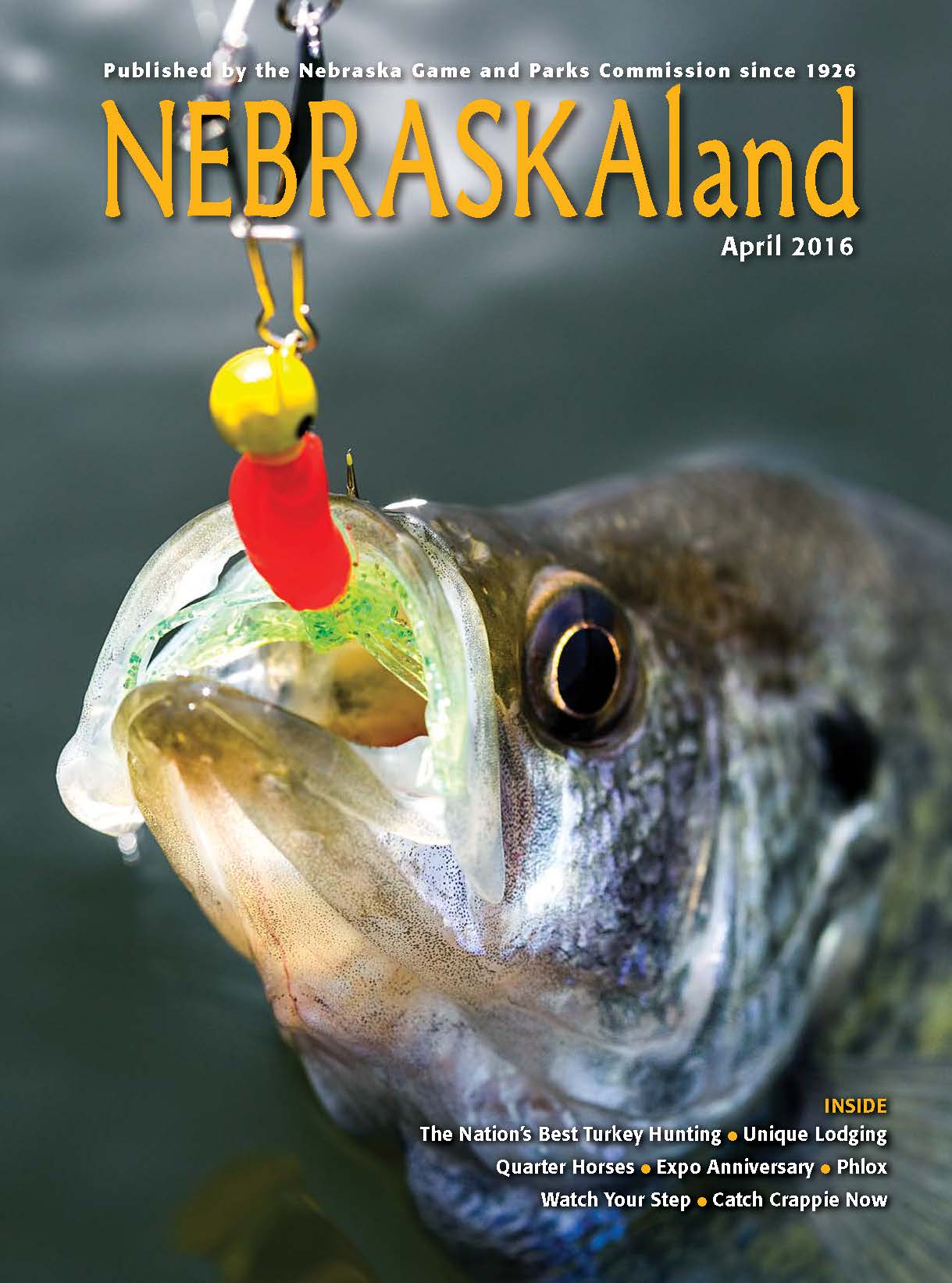
- Identifier:
- nela.2016_094_03
- Title:
- Volume 94, Issue 3, 2016
- Issue Name:
- April 2016
- Date Issued:
- 2016-04-01
- year:
- 2016
- month:
- April
- Season:
- Spring
- PDF filename:
- NL_94.03_2016_Apr_Spreads_Entire.pdf
- Publisher:
- Nebraska Game and Parks Commission
- Format:
- Periodical
- volume:
- 094
- issue:
- 03
- number:
- 094.03
- Decade:
- 2010s
- Type:
- Rights Holder:
- Copyright Nebraskaland Magazine/Nebraska Game and Parks Commission, all rights reserved.
- Extracted Text:
-
P ublis hed by t he N ebr a s ka Ga me a nd Pa r ks Commis s ion si n c e 1926
NEBRASKAland
April 2016
Eastern gray squirrels feed below a bird feeder next to a
woodland home in Nemaha County. Photo by Eric Fowler.
NebraskalandMagazine.com
$4.95
INSIDE
The Nation’s Best Turkey Hunting ● Unique Lodging
Quarter Horses ● Expo Anniversary ● Phlox
Watch Your Step ● Catch Crappie Now
NEBRASKAland Magazine
Volume 94
●
No. 3
●
April 2016
FEATU RES. . .
24 Watch Your Step
P
S
A W
32 The Crappies of Spring
J
H
34 Sandhills Speedsters – The Quarter Horse
HOTOS AND TORY BY LEX
BY USTIN
ILES
AAG
STORY AND PHOTOS BY MARK HARRIS
40 Phlox – A Nebraska Sampler
B J
H. L
44 A Place of Bounty – Wood Duck WMA
Y AMES
OCKLEAR
STORY AND PHOTOS BY JENNY NGUYEN
46 The Nation's Best – Turkey Hunting in Nebraska
B N
M
S
52 Time Well Spent – Unusual Places to Stay Overnight
R
B
54 An Expo for the Outdoors
Y
EBRASKALAND
AGAZINE TAFF
BY ENAE LUM
24
●
BY JULIA PLUGGE
INSIDE THIS ISSUE...
Mixed Bag – Eastern Mole, Travel to Landmark
Country, Pershing for President, Upcoming Events ........8
Wilderness Workshop – Photo Tip ...................60
Page 49 – Roger Welsch's "A Perfect Place" .............. 61
Outdoor Business – Lynn Berggren ........................ 62
Nature Notes – Prairie Crabapple ............................. 65
Portraits from the Past ..................................68
In the Kitchen – Three Goose Recipes .................72
The Last Stop – A Fishing Photographer .................. 74
34
●
32
●
ON THE W EB . . .
WHEN YOU SEE THIS SYMBOL IN THE PAGES OF
N
NEBRASKALAND MAGAZINE, VISIT
NEBRASKALANDMAGAZINE.COM AND VIEW OUR INTERACTIVE
DIGITAL EDITION FOR MORE INFORMATION.
D
This spring, answer them. Because few places offer the three permits, large
bird population, thousands of acres of public land and high hunter success
rates that make Nebraska the best turkey hunting destination in the country.
Plan your hunt at OutdoorNebraska.org.
2 NEBRASKAland • APRIL 2016
NEBRASKAland (VOL. 94 / NO. 3, ISSN 0028-1964) is published monthly, except
for the combined Jan./Feb. and Aug./Sept. issues, by the Nebraska Game and Parks
Commission, 2200 N. 33rd St., Lincoln, NE. Periodicals postage paid at Lincoln,
Nebraska, and additional mailing offices. POSTMASTER: Send address changes to
NEBRASKAland, P.O. Box 30370, Lincoln, NE 68503-0370.
65
●
Cover: Catching crappie
crappie, like this one from a Sarpy County farm pond,
pond
is a spring tradition statewide. To read more, see page 32. Photo by Jeff
Kurrus.
APRIL 2016 • NEBRASKAland 3
Access Granted
Great article on getting permission to hunt and fish. For years
I hunted grouse north of Springview. Even after many years of
hunting I always had to go through much of the permission process
again. This would cost a lot of time I could have been hunting, as
they might not be home or would have to ask their spouses.
That changed after I did what I taught my students in Hunter
Education class. Fill out and sign a Nebraska Hunter Identification
card and give it to the landowner. Include your name, address, phone
number and vehicle license number.
After I did this, a phone call a few days before I wanted to hunt
was all it took. It even got me on land that I could not get on before
I used the card. Now I hand them the card and then introduce myself.
John Ross
Pender, Nebraska
Thank You, Nebraska
I’m from northern Minnesota, but my mother is
originally from the Norfolk area and my aunt and
uncle live there. I’ve been visiting them and hunting
pheasants in Nebraska whenever I can for nearly 30
years.
The attached picture is from a great day of
hunting last Nov. 23 near Madison – a great day
of hunting in Nebraska made possible by the
graciousness of a private landowner allowing me
to pursue my passion and obtain a renewable food
resource!
Thanks for considering the photo, thought it
might be nice as a celebration of hunting if there is
ever room in an upcoming issue.
Sincerely,
Tim Kresien
Hibbing, Minnesota
Piebald Mule Deer
He is a bit of a celebrity in this area and everyone was
hoping he made it through the rifle season. I couldn’t
find him for quite awhile, and then one day I spotted
him all proud with his first antlers.
Sabrina Nicholson, Curtis, Nebraska
Prairie Dog Supporter
Dear NEBRASKAland,
On behalf of Wachiska Audubon Society, the local chapter
of the National Audubon Society, I would like to thank you
for your recent article
in the Dec. 2015
NEBRASKAland
Magazine entitled
"Prairie Dog Town
Tenants." This article
gives Nebraskans a
great insight into all
of our native wildlife
that inhabit prairie
dog towns and how
important these towns
are to all the different
species.
Jessica Umberger
President, Wachiska Audubon Society
A frosty morning southwest of Rockville. Photo by Darlene Dethlefs.
Jake Kroeger captured this photo of a hawk near a deer carcass east of Schuyler.
Paul Julian's photo of
a bald eagle at Harlan
County Reservoir.
4 NEBRASKAland • APRIL 2016
Outdoor Plates
Al Thomas has a plate for both of
his great passions: bird hunting and
bird carving. Inspirations for the latter
come from the former for the retired art
teacher from Omaha.
If you have a unique outdoor
message plate you would like to share,
or know someone who does, e-mail a
photo (high-resolution, JPEG format
only, please) of it to Eric.Fowler@
Nebraska.gov, along with your name,
hometown and a brief description of
the interests expressed on your license
plate.
Jack Irons sent in this trail cam photograph of tom turkeys from behind his home
south of Brock.
APRIL 2016 • NEBRASKAland 5
NEBRASKAland Magazine
Aaron Beckman captured this
camera trap photo of a red fox
urinating on a log in
Knox County.
For Your Mature Citizens
Please continue publishing articles
like “Europeans, Cranes and a
Daughter,” “The Missouri River
through Lewis and Clark Lake” and
“Out-musseled” in the March issue.
The other "outdoor" magazines –
Field and Stream, Outdoor Life and
Sports Afield – have gone to one-page
attention getters, resulting in minimal
information. Articles cited above
cover the topic in depth so the reader
actually learns something about the
topic. I know the millennials' attention
span is short when it comes to printed
material, but we "mature citizens"
enjoy reading in-depth articles.
Bruce A. Block
Puyallup, Washington
Only in China
I wanted you to know just how much I enjoyed your recent
magazine story "Europeans, Cranes and a Daughter." That was
extremely well done. You are so fortunate to have a daughter
who shares your passion. I know what that is like because of my
relationship with my son.
As I read the story I couldn't help but remember my last trip to
China where I saw their red-crested cranes, cousins of our sandhill
cranes. I was in the city of QiQiHar on a medical mission. One day
our hosts announced they were taking us to a bird sanctuary to see
their cranes. We were told we needed to get there by 10:00 because
that was when the cranes flew and I wondered, just how did they
know the cranes would fly at exactly that time.
We arrived at the sanctuary, walked about a mile on a boardwalk
through a marsh to an area where 400 or so people were waiting.
It was then I found out how they knew when the cranes would fly.
That was when their keepers let them out of their cage. The keepers
walked up to the enclosure with buckets of birdseed and opened the
gate. The cranes followed them down a path to the water where they
took off, flew in a half-circle and landed. Then they followed their
keepers back to the cage where they were fed birdseed and waited
until the next group of tourists came to watch them fly.
Only in China.
David Fowler
Ogallala, Nebraska
6 NEBRASKAland • APRIL 2016
Correction: In the March issue, it was
stated that melodrama performances
at the Mahoney Park Theater take
place year-round. However, the
melodrama season starts on May 27
and ends Oct. 23 this year.
Through April 10, Medicine Wagon
Productions puts on three full-length
plays that are not melodramas – so
no throwing popcorn please.
For a complete winter schedule each
year, visit Melodrama.net/story2.
-Editor
Send your comments to:
Jeff Kurrus, Editor
NEBRASKAland Magazine
P.O. Box 30370
Lincoln, NE 68503
or e-mail Jeff.Kurrus@Nebraska.gov
Please include your postal address and telephone number. Letters may be condensed
and edited. Photographs are also welcome.
Gary Panzer photographed these two bull elk about 30
miles north of Scottsbluff.
Any program that receives federal funding from the National Park
Service, or the United States Fish and Wildlife Service prohibits unlawful
discrimination on the basis of race, color, religion, age, gender, marital
status, national origin, age, disability or political affiliation. Any person
who believes he or she has been discriminated against in any program,
activity, facility, or service, should contact the Nebraska Game and
Parks Commission, Lincoln, NE 402-471-0641, the Equal Opportunity
Commission, Lincoln, NE 402-471-2024, TTY/TDD 402-471-4693;
United States Fish Wildlife Service, Civil Rights Coordinator, 4401
N. Fairfax Drive, Arlington, VA 22203; Director, Equal Opportunity
Program, U.S. Department of Interior, National Park Service, 1849 C
Street NW, Mail Code 0008, Washington, D.C. 20240-0001.
COMMISSIONERS
CONSERVATION OFFICERS
Director Jim Douglas
Commissioners
Chairman - Mark Spurgin, Paxton
Vice Chairman - Rex Fisher, Omaha
2nd Vice Chairman - Dick Bell, Omaha
Dr. Kent Forney, Lincoln
Robert Allen, Eustis
Late Lynn Berggren, Broken Bow
Mick Jensen, Blair
Norris Marshall, Kearney
Dan Kreitman, Wahoo
ADMINISTRATION (Lincoln)
Craig Stover (Administrator)
Duane Arp (Asst. Administrator)
Jeff Clauson (Asst. Administrator)
MAGAZINE STAFF
Communications Director Christy Rasmussen
Editor Jeff Kurrus
Art Director Tim Reigert
Associate Editor Jenny Nguyen
Regional Editors Eric Fowler, Julie Geiser,
Justin Haag
Contributing Editor Michael Forsberg
Regular Contributors Chris Helzer, Gerry
Steinauer
Photo Librarian Jaclyn Cruikshank Vogt
Circulation Donna Robinson
For address changes and questions about
your subscription, e-mail donna.robinson@
nebraska.gov or call 800-632-5263
Advertising Sales Manager
For advertising information contact
Shane G. Gilster, 402-742-0125
Email: shanegilster@gmail.com
NEBRASKAland Magazine Copyright 2016, all rights reserved.
NEBRASKAland is available in audio from the Nebraska Library
Commission Talking Book and Braille Service, Suite 120, 1200 N St.,
Lincoln, NE 68508. 800-742-7691. NEBRASKAland Magazine and the
Nebraska Game and Parks Commission reserve the right to reject any
advertising not in keeping with the agency mission.
Rates: $18 for one year; $33 for two years; $44 for three years. Nebraska
recipients must add appropriate sales tax. To subscribe call
1-800-NEBLAND (632-5263), or go online to: NebraskalandMagazine.
com.
COMMISSION
C
CO
COM
OM
O
MMIS
MIS
SSIO
S NO
OFFICES
F CES
FF
FFI
S
Headquarters/Southeast District Office
2200 N. 33rd Street Lincoln, NE 68503
Phone 402-471-0641
Northeast District Office
2201 N. 13th St. Norfolk, NE 68701
Phone 402-370-3374
Southwest District Office
301 E. State Farm Rd. North Platte, NE 69101
Phone 308-535-8025
Northwest District Office
East Hwy. 2, Box 725 Alliance, NE 69301
Phone 308-763-2940
Bassett Office
524 Panzer St., Box 508 Bassett, NE 68714
Phone 402-684-2921
Kearney Office
1617 First Ave. Kearney, NE 68847
Phone 308-865-5310
Ak-Sar-Ben Aquarium
21502 W. Highway 31 Gretna, NE 68028
Phone 402-332-3901
Omaha Office
8495 Frederick Street, Omaha, NE 68124
Phone 402-595-2144
402-471-5531
402-471-5531
402-471-5531
NORTHWEST (Includes counties covered)
Jim Zimmerman (District Supt.)
308-641-6138
Sean McKeehan
(Cheyenne, Morrill, Box Butte)
308-279-9133
Scott Brandt
(Kimball, Banner, Scotts Bluff)
308-631-0663
308-760-3647
Greg Hesse (Sheridan, Dawes)
308-430-0572
Dan Kling (Sioux, Dawes)
Terry Brentzel (Deuel, Garden, Grant) 308-458-7650
402-389-0444
Frank Miller (Cherry, Hooker)
NORTHEAST (Includes counties covered)
Tom Zimmer (District Supt.)
402-649-8053
402-760-0712
Dale Davis (Keya Paha, Brown, Rock)
402-340-3981
Jonathan Andreasen (Holt, Boyd)
Mitch Johnson (Knox, Antelope, Pierce) 402-613-8612
402-762-5022
Jeff Jones (Knox, Cedar)
Alex Thomas
(Dixon, Dakota, N 1/2 Thurston)
402-241-7615
Jon Reeves
(S 1/2 Thurston, Burt, Washington)
402-889-8508
402-719-1108
Dan Roberts (Dodge, Colfax)
Cory Krause
(Cuming, Wayne, Stanton, Dodge)
402-380-6410
Steve Oberg
(Colfax, Platte, Madison, Stanton)
402-910-3366
Randy Pomplun
(Nance, Greeley, Wheeler, Boone)
308-550-0489
308-730-7050
Doug Pollard (Loup, Garfield, Valley)
SOUTHWEST (Includes counties covered)
Roger Thompson (District Supt.)
308-530-3097
308-202-0819
Matt Brandt (Sherman, Howard)
308-380-7331
Tim Williams (Hall, Hamilton, Merrick)
Pat George
(Clay, Adams, Nuckolls, Webster)
402-705-9989
308-920-0367
Rich Routh (Franklin, Harlan, Phelps)
Matt Andrews
(Gosper, Furnas, Frontier, Red Willow)
308-746-2418
Andrew Heyer (Dawson, Gosper, Phelps) 402-613-2241
Brian Piernicky
(Red Willow, Frontier, Hayes, Hitchcock)
308-340-6627
308-289-0427
Nicholas Fix (Keith, Perkins)
308-289-1169
Bryce Streger (Keith, Arthur)
Brandon O’Neal
(Lincoln, McPherson, Logan)
308-530-3157
Alex Hasenauer
(Lincoln, McPherson, Logan)
308-660-4671
308-440-3847
Dale Johnson (Kearney, Buffalo)
308-529-8146
Mike Thome (Dawson)
Ray Dierking (Custer, Thomas, Blaine) 308-870-0322
SOUTHEAST (Includes counties covered)
Levi Krause (District Supt.)
402-949-0593
402-619-1355
Rich Berggren (Douglas)
402-616-5961
Dan Evasco (Sarpy)
402-210-0888
Heath Packett (Cass)
402-209-1506
Russell Mort (Otoe, Johnson)
William Krause
(Nemaha, Richardson, Pawnee)
402-274-8063
402-806-9084
Dan Zuehlke (Gage, Saline)
402-890-6463
Dina Barta (Lancaster)
402-890-6465
Doug Kramer (Lancaster)
402-937-3422
Dudley Sorensen (Lancaster, York)
402-613-2312
Travis Shepler (Lancaster)
402-890-7140
Stacey Lewton (Lancaster, Seward)
402-443-6392
Mike Luben (Saunders, Butler, Polk)
Nebraska Wildlife Crimestoppers
1-800-742-7627
APRIL 2016 • NEBRASKAland 7
A Mammal Brief
Eastern Mole
By Lindsay Rogers
Lind
Li
Lind
ndssa
ay Roge
Ro
oge
gerrs
s is
an out
utd
utdo
do
oo
orr edu
duca
ca
ati
tion
ion
n
ssp
pecia
ecia
ec
iali
l stt witth th
li
he
N brra
Ne
as
ska Gam
ame a
an
nd
Pa
P
ark
rks Co
Comm
C
mmis
mm
mis
issi
sssiion
on.
on.
Scalopus aquaticus
If you were to spend
your life tunneling
underground you
would definitely
need large, shovellike webbed feet
with sizeable
claws to help dig.
You would not need
eyes. Combine those
two characteristics and
you have the eastern mole. This
tubular-shaped species has thick fur
which is darker in northern locations and more silver or tan in southern areas. Unlike most mammal
species whose fur lays in one direction, the fur of the eastern mole does not lay in any direction which
helps facilitate both forward and backward motion in its narrow tunnels. Their extremely large front feet
have webbing between the toes to help push soil as they dig. They are often found in the moist loamy
soils of the eastern United States. Their westward expansion is thwarted by more rocky soils. These
insectivores feed primarily on worms and insects. They have huge appetites and can eat 25-75 percent of
their body weight daily. ■
8 NEBRASKAland • APRIL 2016
APRIL 2016 • NEBRASKAland 9
Travelogue Sponsors
By Justin Haag
Landmark Country
pp riately dubbed “Landmark Country,” the state’s
pprop
n Panhandle has served as eye candy for generations
wester
w
of travelers in the North Platte valley – among the most
n
otablee being the westward emigrants of the 1800. In moder
notabl
and
bluff
Scotts
–
times, the Panhandle’s Twin Cities region
the
Gering – has become not only a great “stopping point along
of
blend
nice
a
for
g
lookin
way,” but a destination for travelers
city amenities and natural attributes.
With the many wildlife management areas, a federal wildlife
refuge, and numerous properties of the Platte River Basin
in thousands of
Environments, hikers, hunters and other nature lovers revel
ments of
escarp
and
buttes
many
The
.
access
acres of land open to public
nent
compo
ant
import
an
are
and
y
scener
ful
the Wildcat Hills provide beauti
n the
betwee
history
al
tologic
paleon
with
rich
r
of the Fossil Freeway, a corrido
Nebraska Panhandle and the Black Hills of South Dakota.
can’t miss
Similar to those travelers of the 1800s, modern day nomads
above the
feet
800
ng
toweri
ent
Monum
al
Nation
sight of the Scotts Bluff
summit can see
cities below. On a clear day, one standing at the monument’s
approximately 100 miles away.
Wildcat Hills
Another great view of the North Platte valley can be found at
Gering. The
State Recreation Area and Nature Center, 11 miles south of
t (see related
nature center is under construction for a big expansion projec
scene from the
story on page 58), but people can still enjoy the spectacular
g a picnic at
SRA’s four miles of trails through rugged terrain, or by enjoyin
one of the park’s unique stone shelters.
55-foot
Speaking of views from high places, be sure to visit the famed
of
lighthouse at Lake Minatare State Recreation Area northeast
Scottsbluff. The lake, located on the
North Platte National Wildlife Refuge,
attracts anglers of walleye and many
other species – along with countless other water
lovers. Both RV and primitive camping sites are
Scottsbluff
available at the lake, which is open mid-January
Gering
through mid-October.
Other popular attractions in the Twin Cities
include the Legacy of the Plains Museum,
Riverside Discovery Center zoo, and the historic
hout the
Midwest Theater. Authentic ethnic cuisine can be found throug
From
rants.
region, in addition to a wealth of fast food and family restau
hotel
ized
recogn
the unique Barn Anew Bed & Breakfast to nationally
chains, lodging is plentiful.
Community celebrations – including Labor Day weekend’s wildly
valley
popular Old West Balloon Fest introduced in 2015 – keep the
Trail
n
Orego
’s
hopping throughout spring, summer and fall. Gering
ation,
celebr
uous”
Days lays claim to being Nebraska’s oldest “contin
marking its 95th year this July.
With so many sights to see and things to do, travelers who visit
if
Nebraska’s Landmark Country won’t want to leave – regardless
the
On
west.
farther
wagon
d
they were planning to take their covere
Web: Visitscottsbluff.com
Boating at Lake Minatare SRA
Class at W
Nature Ce ildcat Hills
nter
Hills
t
a
c
d
l
i
W
SRA
10 NEBRASKAland • APRIL 2016
APRIL 2016 • NEBRASKAland 11
NSHS, RG2378-11-2
NSHS, RG2378-18-03
Lt. John J. Pershing (seated, center) with cadet battalion officers at the University of Nebraska, 1895. Pershing served as a military
instructor at the university from 1891 to 1895. RG2378-18-03
A Brief History
Pershing for President in 1920
From the Nebraska State Historical Society
M
12 NEBRASKAland • APRIL 2016
Pershing’s supporters faced a daunting task: build a
statewide organization before the April 1920 presidential
primary. Rival candidates Leonard Wood, former Chief of
Staff of the United States Army, and Senator Hiram Johnson
were far ahead.
The strategy for capturing the 16 Nebraska votes at
the Republican convention was to present Pershing as a
“favorite son” candidate and rely on voter loyalty to a fellow
Nebraskan. Nebraska voters went to the primary polls on
April 20, 1920. The final tally found Johnson the victor
with 63,262 votes; Wood, 42,385; and Pershing, 27,669.
Nebraska’s “favorite son” carried only Lancaster County
by the slim plurality of 35 percent and was second choice
in another 10 counties near Lancaster. Pershing’s name
never appeared before the Republican convention, which
nominated Warren G. Harding for President. Harding went
on to become the 29th President of the United States.
A number of factors were responsible for Pershing’s
failure. Cautious and reserved by nature, he did little
personal campaigning and was often indecisive at crucial
moments. His localized campaign lacked the organization
and financing necessary to upset rival candidates, who had
entered the contest earlier and with more resources.
Pershing served as U.S. Army Chief of Staff from July
1921 to Sept. 1924, when he retired from military service.
He spent his remaining years serving on commissions and
NSHS,
NSHS
S S, RG2378-2-3
RG
G2378
3 8-2-3
23
any Nebraskans know that Nebraskan William
Jennings Bryan was a serious contender for
president in 1896, 1900, and 1908, but they
probably don’t know that adopted Nebraskan Gen.
John J. Pershing also tried for the highest office in the land
in 1920. Like most professional soldiers, Pershing lacked a
permanent residence, but he had lived in Lincoln from 1891
to 1895 and graduated from UNL’s law school in 1893. He
also established the Pershing Rifles, a military fraternal
organization for college-level students, in 1894. It is the
oldest continuously operating U.S. college organization
dedicated to military drill.
Pershing’s success as supreme commander of the
American Expeditionary Forces in World War I carried
over to political popularity. Thousands of people lined Fifth
Avenue in New York City when he returned to the United
States from Europe and celebrated him as a hero. When
approached with the possibility of running for president,
Pershing consulted long-time friend and Lincoln lawyer (and
future Vice President of the United States) Charles Gates
Dawes before consenting to run.
Dawes and mutual friend, Mark Woods of Lincoln,
established a “Pershing for President” boom in Nebraska.
Gen. Pershing inspects an honor guard in London, Aug. 8, 1919.
Pershing (left) in Lincoln, Nebraska, with his own relatives and
those of Governor Samuel McKelvie (back row, third from left),
on New Year’s Day, 1920.
traveling. He died in July 1948. He never lived in Nebraska
again, but his presidential bid demonstrates the connections
Lincoln had to the national political stage during this time
period. ■
Visit the Nebraska State Historical Society’s website at
Nebraskahistory.org.
APRIL 2016 • NEBRASKAland 13
Public Mushrooms
By Jeff Kurrus
When first-timers consider hunting morel mushrooms on public
land, they think river properties. So let's go there first. The following
river-adjacent properties are excellent locales for spring morels.
Eugene T. Mahoney State Park
Indian Cave State Park
Louisville State Recreation Area
Platte River State Park
Schramm Park State Recreation Area
Two Rivers State Recreation Area
•
•
•
•
•
•
•
•
•
•
•
•
But this short list is merely a start. Once you visit these, broaden
out your search to other similar-looking places throughout the state
to find one of nature's most delectable dinners. ■
14 NEBRASKAland • APRIL 2016
PHOTO BY DOUG CARROLL
However, rivers aren't the only locations where morel mushrooms
can be abundant. When you're contemplating morel hunting, think
about old-growth forest and creek edges. Once you widen to these
parameters, the following public areas come into play:
Branched Oak State Recreation Area
Burchard Wildlife Management Area
Grove Lake Wildlife Management Area
Pawnee Lake State Recreation Area
Twin Lakes Wildlife Management Area
Yellow Banks Wildlife Management Area
APRIL 2016 • NEBRASKAland 15
Snakes in
Trees
16 NEBRASKAland • APRIL 2016
Bug Banter
Black Walnut Trees
in Danger
By Julie Van Meter
State Entomologist, Nebraska
Department of Agriculture
Nebraska’s black walnut trees
(Juglans nigra) are at risk from a pest
called Thousand Cankers Disease of
Walnut (TCD). This pest has not been
found in Nebraska, but threatens the
state’s black walnut trees.
TCD is caused by a combination of
the walnut twig beetle (Pityophthorus
juglandis) and a fungal disease
(Geosmithia morbida). The beetle is
native to the southwest U.S., where it is
a minor pest of Arizona walnut (Juglans
major). The fungal spores are carried
on the body of the beetle, and infect
the tree as the beetle tunnels through
the bark. Each infection site becomes a
small canker. These grow and coalesce,
creating very large cankers which girdle
Black rat snakes will climb trees in search of food, including birds, chicks and bird
eggs.
While juvenile black rat snakes will sometimes have white mixed in between their black
scales, within two years or so these blotches darken to their adult black color.
are strongly patterned with dark
grayish-brown blotches on a light gray
background, though they are no less
arboreal. They just use smaller trees
and bushes to climb in and hunt.
In fact, the difference in color
offers them a little camouflage in the
brush while they are small and rather
defenseless. Within two years or so,
however, the blotches and background
tend to darken to the adult black color.
Then they start moving into bigger
trees.
Black rat snakes are not the only
snakes that climb. In fact most snakes
can, though they usually don’t, and
some are better at it than others. In
the
the tree
th
treee and
tr
an ultimately kill it.
The walnut
wal
wa
The
twig beetle is very small,
and because
becau of their small size, their
exit holes are extremely difficult to
see on tree bark. It is easier to look for
the disease symptoms, which include
yellowing and thinning of the tree
canopy, and wilting of foliage. Dark
cankers form under the bark, around
the tunneling of the beetle, and may
cause a dark stain on the bark surface.
It is difficult to differentiate many of
these symptoms from other causes,
such as drought.
The native range of black walnut
extends from the east coast through the
South and Midwest, to the eastern edge
of the Plains states. In Nebraska, black
walnut can be found in the eastern
part of the state, primarily in riparian
areas. This includes forests along the
Missouri River, and rivers and streams
leading into the central part of the state.
Black walnut is a very important part
of the native ecosystem in Nebraska.
The nuts are utilized by many animals,
from squirrels to turkey to deer, for
food.
Insects,
including
the caterpillar of the Luna butterfly
(Actias luna) feed on walnut foliage.
Additionally, black walnut contributes
economically to the state through the
harvest of both timber and nuts. Should
TCD become introduced to Nebraska,
the results could be devastating.
Firewood is recognized as an
excellent means of transporting
damaging plant pests from one location
to another, and walnut firewood could
easily bring TCD into Nebraska.
Infested logs and burls are another
potential pathway for disease spread.
Because of this, the Nebraska
Department of Agriculture (NDA) has
enacted a TCD quarantine, prohibiting
the movement of certain items,
including walnut trees, wood, and
all hardwood firewood, from known
TCD infested states. The full text of
the quarantine and a list of specific
regulated articles can be found on the
NDA website at www.agr.ne.gov.
PHOTO
PHOT
O BY DAN FOG
FOGELL
GELL
By Dan Fogell
There I was, listening to a pair of
blue jays screaming at the top of their
lungs while frantically flapping around
high up in a cottonwood tree. I’m not
a birder, but everybody knows what a
blue jay is, so I know I got the species
right. But I don’t know males from
females because they look the same, so
I assumed they were a couple of males
fighting for the privilege of some
lovely lady’s company.
But then I saw something I know
a little more about: a snake. A large
black rat snake to be precise. It
maneuvered through branches and
finally descended to the ground where,
of course, I had to catch and play with
it. Picking it up while trying to avoid
a bite is always challenging, but once
secured I noticed that it had recently
eaten. And when I say recently, I mean
like a few minutes ago. It turns out
that those blue jays weren’t combatting
males but were a pair, defending their
chicks in their nest. I have to say…
they lost this battle.
Black rat snakes, also called black
snakes, pilot snakes and western
rat snakes are well known for their
climbing skills. Their body is even
shaped to improve their talent for
vertical ascent. Imagine chopping
a snake in half (try not to enjoy it
TOO much). In cross section, most
snakes are round, or somewhat oval.
But black rat snakes have a cross
section shaped like a slice of bread:
rounded on top with corners on the
bottom. Those corners can grip vertical
surface features and help propel the
snake nearly straight up trees, walls,
and other structures. As a result, even
though they are called “rat snakes” they
subsist on a diet of adult birds, chicks
and bird eggs.
Obviously, by virtue of their common
name they are black in color and
virtually patternless, though sometimes
with a little red or white mixed in
between their black scales. But only
as adults, and as adults they are one
of Nebraska’s largest snakes – often
approaching seven feet in length.
When they hatch out of eggs they
Presented by
Nebraska I have seen garter snakes,
water snakes, brown snakes and even
rattlesnakes up in trees. Most of them
were probably not up there for food,
so it’s hard to know why an animal
with no legs would opt to leave the
safety of the ground. Maybe to avoid
predators, or to thermoregulate out on
the branches. Or maybe just simple
curiosity.
Whatever the reason, snakes climbing
in trees seems unnatural. But they do
it, and in Nebraska the black rat snakes
are the best at it. And the next time
you hear a couple of birds that won’t
stop screaming from high up in a tree,
look up. Maybe you’ll get a surprise. ■
APRIL 2016 • NEBRASKAland 17
Turkey Facts
By Paula Hoppe
An increase in light of lengthening
days triggers behavioral changes in
turkeys associated with reproduction.
This prompts, among other things, an
increase in gobbling. Here are a few
more facts about one of Nebraska's
most prized game birds, the wild
turkey.
Adult toms average about 18
pounds, but can weigh up to 30
pounds. Adult females average 10
pounds.
Nesting of wild turkeys in
Nebraska usually occurs between
mid-April to early July. Habitat must
include trees for roosting and cover
for nesting. Nests are usually only a
shallow depression, placed in the open,
under shrubby cover, at the foot of a
tree.
Hens lay one egg a day. A
complete clutch averages 10-14 eggs,
and only after all are laid will the
28-day incubation period begin.
Young turkeys, or poults, are first
•
PHOTO BY JENNY NGUYEN
•
•
•
18 NEBRASKAland • APRIL 2016
brooded on the ground. During this
time, mortality can be 50-70 percent
due to weather or predation. Thus,
communication between the hen and
her poults is very important. Turkeys
have an extensive vocal repertoire of
about 20 different sounds, which poults
learn early if they want to survive.
As summer progresses, family
groups of hens and their poults begin
to flock together as protection from
predators. Usually, tom turkeys remain
aloof or in small groups of two or
three. ■
•
APRIL 2016 • NEBRASKAland 19
From Your Window
By Nebraska State Historical Society
After an 18 month, $8 million
renovation, the Nebraska History
Museum in Lincoln will reopen to
the public on Friday, April 1, 2016.
We’re looking forward to a weekend
of activities featuring Nebraska’s rich
music, dance and storytelling heritages,
and new exhibits to include:
PHOTO BY JEFF KURRUS
Woodhouse's Toad
PHOTO BY JEFF KURRUS
By Adam Jones, Watchable Wildlife Biologist
As you look out your window in the early spring you may
notice an influx of birds and other animals coming home
with the sounds of renewed songs, buzzing and chatter.
Spring weather brings to your yard some of the largest
concentrations of animals of the entire year.
Birds such as vireos, flycatchers and goldfinches are some
of the first birds to arrive, heading north from their wintering
grounds now that the weather is warming, days are longer and
food and water sources are more plentiful.
Eastern red and hoary bats can also be seen, migrating
short distances from Kansas and Missouri. But other
mammals, such as the big-brown and silver-haired bats, never
left. They have been hiding in caves and buildings. Red fox,
raccoons and opossums, along with mice, emerge from dens
to forage for food.
Many insects, such as lady beetles, mourning cloaks and
mosquitos appear from rocks, holes in the ground, woodpiles
or cracks in your homes. You may also observe butterflies
and bees collecting nectar from a variety of flowers,
including pasque flower, juneberry and chokecherry. You
will also see many species of ants mining for food in the
soil while, near a lake or pond, you may see mayflies and
damselflies.
In the evening, if you are near water sources such as ponds,
ditches or wetlands listen for the distinctive call of the chorus
frog. They have just returned to the surface from beneath the
frozen ground or under rocks. They are very loud for their
small size and have a rattling call that sounds like running
your finger over a comb. The Woodhouse's toad, small-mouth
salamander and tiger salamander can also be viewed.
Bullsnakes, ring-necked and garter snakes emerge from
their winter dens to sun themselves as soon as it is warm
enough. They are not alone, as some snakes hatch in the
winter, so you will find adults and young foraging on early
spring insects and small mammals.
To enhance your experience enjoying the vast array of
wildlife gathering during this exciting time of year, keep
a set of binoculars handy, start a sketchbook of interesting
sightings or have a camera ready for those unexpected
moments. ■
Nebraska
History
Museum
Re-opens
•
“Nebraska Unwrapped:
Selections from the Collections”
includes a wide range of materials
the Nebraska State Historical Society
(NSHS) holds in trust for the people
of the state. Artifacts range from
a 1,000-year-old hoe made from a
bison scapula, ancient corn kernels,
to the grasshopper plow that helped
settlers break the sod in the 1870s.
Noted Ponca Chief Standing Bear’s
head ornament, the sewing box
given to former slave Ruth Cox
by Frederick Douglass, First Lady
Maxine Morrison’s “Mad Men”-era
inaugural gown, and the hood worn by
a Nebraska Ku Klux Klansman connect
Hand cornhusker
from 1933 National
Corn Husking
Championship.
Opossum
to convey particular meanings.
“Nebraska’s Enduring
Quilt Heritage: New
Acquisitions” looks at
quilts that tell stories of
migration, politics and
events both joyous and
memorial. Featured
quilts were added to
the museum holdings
over the last 10 years,
many not previously
displayed.
“American Dreams
in the Cold War:
Photos by Barbara
and Ralph Fox”
chronicles mid-century
moments including
news, commercial and
personal images by the
husband/wife team from the
1950s-60s.
Because all of our permanent
exhibitions had to be disassembled
in order for the necessary installation
of vapor barriers, we’ll be offering a
variety of more temporary exhibits
as we work to create an exciting
new long term experience that will
immerse visitors in the 12,000 years
of Nebraska’s human stories. We’ll
also be offering hands-on educational
offerings for all ages as our new
History Learning Center is developed.
In addition, because this is a project
funded with public dollars, the museum
will also unveil a 1 percent for Art
public project, “Inside Outside,” on the
front of the building facing Centennial
Mall. This project depicts some of the
artifacts the museum holds in trust for
the people of our state.
•
•
Opening Weekend Events
In addition to the museum's new
exhibits, the following events will also
take place opening weekend.
20 NEBRASKAland • APRIL 2016
PHOTO BY JUSTIN HAAG
Tiger Swallowtail Butterfly
visitors to the stories of Nebraskans
both notable and notorious.
“Photographers and the Plains
Indian” is an exploration of how
photographs influence Americans’
perceptions of Plains tribal people
and how both photographers and their
native subjects used early photographs
•
World War II-era jacket of
Ruth Diamond Levinson.
p.m. Hands-on history, music, dance
and talks from a variety of cultural
traditions.
Continuing Programs
Public programming will continue
after opening weekend. A general
museum tour will be available daily at
2 p.m. beginning April 4. No advance
reservations required.
Family activities, curator chats,
movie screenings and more will be
offered each Saturday and Sunday
afternoon.
Join NEBRASKAland Magazine
editor and children’s book author Jeff
Kurrus who will present “The Tale
of Jacob Swift” at 2 p.m. Saturday,
April 16. Visit Nebraskahistory.org or
call 402-471-4782
for the detailed
schedule. ■
•
Ribbon-cutting and Remarks from
Governor Pete Ricketts: Friday, April
1, 5:15 p.m. Russell Rock and Jeanine
Centuori, artists who created “Inside
Outside” on the building exterior,
are also expected along with other
dignitaries.
Free Family Fun Days: Saturday,
April 2 and Sunday, April 3, 1-4:30
•
Unassisted
triple play
baseball from
1920 World
Series.
APRIL 2016 • NEBRASKAland 21
Bowfishing for Carp
Fort Atkinson is where grizzly-mauled
frontiersman Hugh Glass confronted
John Fitzgerald, one of the two men
who left him for dead.
by Jerry Kane
Contact the Nebraska Game and Parks Commission at
402-471-0641 or visit OutdoorNebraska.org
for more information.
Visit HuntSafeNebraska.org for a list of hunter education classes
and BoatSafeNebraska.org for a list of boating safety classes.
Nebraska Game and Parks Outdoor
Education Center, Lincoln
April 1-10
Cranes and History
Fort Kearny State Historical Park (SHP),
Kearney
April 1, 8, 15, 22, 29
Explore Archery
Nebraska Game and Parks Outdoor
Education Center, Lincoln
April 2
Archery Fun Shoot
Nebraska Game and Parks Outdoor
Education Center, Lincoln
April 2
Critter Corner
Nebraska Game and Parks Outdoor
Education Center, Lincoln
April 5, 12, 19, 26
Outdoor Skills Discovery Program
April 16-17
Spring Muster
Nebraska Game and Parks Outdoor
Education Center, Lincoln
Fort Hartsuff SHP, Burwell
April 5, 19
Ladies Day at the Range
Application period begins for bighorn
sheep lottery permit
Nebraska Game and Parks Outdoor
Education Center, Lincoln
April 22
April 6
Statewide crow hunting season closes
April 6, 13, 20, 27
Introduction to Gun Safety and
Technique
Nebraska Game and Parks Outdoor
Education Center, Lincoln
April 7
Spring Turkey Hunting Workshop
Ak-Sar-Ben Aquarium, Gretna
April 7, 14
.22 Pistol League
April 2
Nebraska Game and Parks Outdoor
Education Center, Lincoln
Outdoor archery range closed to
public, Nebraska Game and Parks
Outdoor Education Center, Lincoln
April 7, 14, 21
I Can Camp Series
April 2-3
Platte River Art Show
Eugene T. Mahoney State Park (SP),
Ashland
April 4
Spring Turkey Hunting Workshop
Nebraska Game and Parks Outdoor
Education Center, Lincoln
April 4, 11
Centerfire Challenge
Nebraska Game and Parks Outdoor
Education Center, Lincoln
April 5
Light Goose Conservation Order closes
in Rainwater Basin and West zones
Nebraska Game and Parks Outdoor
Education Center, Lincoln
April 18
Nebraska Game and Parks Commission
meeting, Chadron
April 29
Arbor Day
Game and Parks offices closed
April 30
Indoor archery range closed to public,
Nebraska Game and Parks Outdoor
Education Center, Lincoln
April 30
5th Annual Outdoor Adventure
Indian Cave SP, Shubert
April 30
Living History
Fort Atkinson SHP, Fort Calhoun
April 30-May 28
Roger G. Sykes Outdoor Heritage
Education Complex open on
weekends, Platte River SP, Louisville
April 7, 14, 21, 28
Explore Archery
Nebraska Game and Parks Outdoor
Education Center, Lincoln
April 9
Spring youth shotgun turkey season
opens
April 9
Angry Cow Trail Run
Rock Creek Station SHP, Fairbury
April 14-17
Coalition of Historical Trekkers
Fort Atkinson SHP, Fort Calhoun
April 15
April 5
Women’s Introduction to Handguns Light Goose Conservation Order closes
Nebraska Game and Parks Outdoor
Education Center, Lincoln
in East Zone
April 5, 12, 19, 26
Best Shots Rifle Marksmanship for
ages 10-16
Spring shotgun turkey season opens
Nebraska Game and Parks Outdoor
Education Center, Lincoln
22 NEBRASKAland • APRIL 2016
April 16
April 16
Hooked for Life Kids Fishing Event
Swanson Reservoir SRA, Trenton
A father and son fish from the
dock at the Outdoor Discovery
Program at Fort Kearny State
Recreation Area.
NEBRASKAland
and
Visitor
PHOTO COUTESY OF DYLAN TEGTMEIER
April 1
Basic Archery Instructor Training
By Dylan Tegtmeier
If you’re like me, maybe you’re not the best fisherman in the world, but you’re
pretty good at archery, and you love a good fried carp. Then bow fishing is the
sport for you. There are many bow fishing kits you can buy at sporting goods
stores but it’s rare to find these for less than $50. Again, if you’re like me and
you’re creative and
hate spending money
on something you can
make, you could easily
make your own bow
fishing kit for less than
10 bucks! Imagine
watching a 15-yearold kid row his kayak
up to the dock toting a
stringer of 11 carp, and
across his lap sat an old
bow with a rusty tin
cup where the stabilizer
should be with a string
coming out of it going
The author poses with a carp he shot from his kayak.
up to an old hunting
arrow. Yep, that was me
not but a couple years ago, and here is how I did it.
First and foremost, you’ll need an old bow to use as your bow fishing bow. Next
just find a bolt that will fit the stabilizer hole, usually a 5/16 X 24 size bolt will
work. Next find a container to hold your fishing string. I used a rusty old tin can
for this, but you could use the bottom half of a pop bottle or even a plastic cup.
And just drill a hole toward the top of the container where your stabilizer bolt will
fit through and screw your stabilizer and cup onto your bow. Now you need some
bow fishing string, which you could buy a good 25 yards for 10 bucks, or you
could use any other light weight string that you think could hold a monster carp.
Just tie one end of the string to the bolt that is screwed into your bow and tie the
other end to your bow fishing arrow. I would suggest buying a bow fishing arrow.
They’re already rigged up for the task and are much safer than making your own
arrow.
But if you really want to make your own bow fishing arrow, you’ll need an
old hunting arrow, a light washer with a diameter twice that of your arrow, a
bow fishing arrow tip, and some duct tape. Start by drilling out the center of the
washer so your arrow can easily slide through it. Then drill a smaller hole on
the edge of the washer where you will attach your bow fishing line. You’ve just
made your arrow slider, now you’ll need a slider stop. Depending on the type
of arrow rest you’re using, this can be tricky. If you’ve got a whisker biscuit or
drop away you shouldn’t run into many problems. I just wrapped an inch-wide
section of duct tape around the nock end of my arrow until it was stacked thick
enough that the slider couldn’t come off. Now, with your stopper and slide on
the arrow, screw your bow fishing tip to the end, and you are ready to go. You
may want to add some weight to your arrow to make it fly slower. With any bow
fishing, the arrow doesn’t need to go very fast, in fact, it’s best if it doesn’t fly at
warp speeds because any damage or knots in your string or apparatus will cause
very dangerous situations if you’re shooting too fast. To add weight to your bow
fishing arrow, just put some sand in the shaft and screw your tip back on. Always
remember to only work with what you feel safe with.
Visit OutdoorU.org and start your own pathway to exciting and memorable
experiences in the outdoors. Get outside
See the step-by-step process of
S
and see what the Nebraska outdoors has for
making your own bowfishing
m
equipment.
e
you. ■
Last issue’s winner of
the Visitor drawing was
Lucas Kleinschmit of Fordyce,
Nebraska, who found the burying
beetle on page 38.
Readers are encouraged to contact
NEBRASKAland within 10 days
after this issue’s publication with
the correct page number and name
of this issue’s “Visitor” – a critter
found in Nebraska. We will then
gather the correct entries and draw
one to win a NEBRASKAland mug.
To enter each month, write:
NEBRASKAland Visitor
2200 North 33rd Street,
Lincoln, NE 68503.
Or e-mail:
Tim.Reigert@Nebraska.gov
with “Visitor” in the subject line of
the message.
HINT: This issue’s visitor is not on
pages 20, 23, 24-31 or 70.
Burying beetles (Nicrophorus
sps.), a type of carrion beetle, feed
on dead animals. These large black
beetles with orange banding on
their elytra range from 0.5 to 1.5
inches in length, depending on
species. There are 11 species of
Nicrophorus beetles in Nebraska,
including the Margined burying
beetle (N. marginatus), shown, and
the American burying beetle (N.
americanus), which has been on
the Federal Endangered Species
list since 1989. Burying beetles
are important to the environment,
helping recycle organic material.
Scent organs on their antennae
help to quickly locate fresh dead
animals. They then literally bury
their food by excavating under it,
to protect it from other insects and
animals. Females stay
in the underground
chamber, tending
the larvae that feed
o the dead animal
on
unt
until the larvae pupate
e
and emerge
as adults.
Special thanks to Julie Van Meter,
State Entomologist, Nebraska
Department of Agriculture.
APRIL 2016 • NEBRASKAland 23
Watch Your
Step
Photos and story by Alex Wiles
T
here’s a whole world at your
feet, with color and complexity
unmatched at our own scale.
This world is visible to you, if you look
closely, and provides a spectacle that
will continue to impress the deeper
one delves. Sadly, this world is often
overlooked by those who either do
not know of its existence or are fixated
on things much larger and higher up.
When I moved to Nebraska several
years ago I fell into this same trap,
dwelling on the larger elements of
nature and ignoring the goldmine
of biodiversity that lives on a much
smaller scale.
A red milkweed beetle (Tetraopes tetrophthalmus) peers out
over the edge of a leaf. By ingesting milkweed, these beetles
become distasteful and potentially toxic to predators, a
defense mechanism also employed by monarch butterflies.
24 NEBRASKAland • APRIL 2016
APRIL 2016 • NEBRASKAland 25
Digging Deeper
26 NEBRASKAland • APRIL 2016
▲ Six-spotted fishing spiders
(Dolomedes triton) possess excellent
vision, which helps them hunt aquatic
animals such as other invertebrates,
tadpoles and occasionally small fish.
▲
I have always been fascinated by reptiles and
amphibians, which I consider a key part of the
unnoticed microcosms at our feet. It was during
my time searching for these animals, though, that
I couldn’t help but notice all of the other aspects
of their environments that make life possible.
The insects, spiders, flora and fungi in these
areas seemed to have no limit to their diversity
and I continually discovered things that I knew
absolutely nothing about. The more I looked, the
more I felt as though I were missing the bigger
picture and focusing on only a small piece of the
puzzle. Digging deeper (literally and figuratively),
I developed a new fixation: trying to find and
identify every piece that I could and form a deeper
understanding of this ecological network.
While everyone may not have the time or an
interest in searching for the small species that are
the basis of an ecosystem, you would be surprised
at how much you can see just through casual
observation. Insects alone make up 80 percent
of the animals in the world, and there are over
10,000 species that can be found just in the state of
Nebraska. With these odds, the casual observer is
sure to find something new and interesting on a
regular basis. All it takes is a good pair of eyes (or
a magnifying glass) and curiosity. Insects are not
the only things that can be encountered on these
small-scale safaris. Fungus, though not something
that people generally identify as glamorous, can
be found almost everywhere. There is such a vast
array of colors and shapes that mushrooms and
other fungi display, it’s hard not to deem some of
them at the very least interesting, if not beautiful.
Even certain species of plants can be easy to miss if
not looked at closely. Keep your eyes peeled and if
you see something familiar, take a closer look
and you may be surprised with what more you will
find.
Fungus is an integral part of the
nutrient cycle in an ecosystem, helping
to decompose organic materials and
return them to the earth. They can
also prove to be very interesting, such
as these dead man’s fingers (Xylaria
polymorpha) that eerily resemble their
namesake.
APRIL 2016 • NEBRASKAland 27
Bridging the gap between
the micro and macro worlds,
amphibians have an active
role in both. This American
toad (Anaxyrus americanus)
is excellent at his job of pest
control, yet also falls prey to
larger mammals, birds and even
fish. They are very sensitive to
fluctuations in water quality so
it is important to pay attention
to their health, because it may
just indicate issues that can
affect us as well.
28 NEBRASKAland • APRIL 2016
▲ Hunters abound even in the insect
world. This spotted lady-beetle
(Coleomegilla maculata) is beautiful,
but also helps keep other smaller
insect numbers in check.
▲
▲
A Place for Everything
Life at this small scale has
developed a plethora of novel ways
by which it can grow. Metamorphosis
is one of the most drastic changes
any life form on this planet can go
through and is what will eventually
allow this caterpillar (Hypena sp.) to
sprout wings and fly.
I’ve often heard people complain of the presence
of insects, spiders, reptiles, and other small
animals, questioning their mere existence and
usefulness to the world. While there are any
number of unique roles that these organisms play,
the vast majority of them serve as an excellent
source of food and are the very basis of a giant
web of life. This miniature world is at the forefront
of supplying energy to the world at our level.
Many of these animals and plants are considered
a nuisance, but we would be lost without them in
some capacity, so we might as well enjoy what we
can about them and marvel at their uniqueness.
Another important benefit frequently overlooked
is that the species that make up this microcosm
are known as indicator species. They are at the
forefront of change in an environment and their
decline is often our first sign of any negative impact
that is occurring. Because they are so small and
intimately linked with the soil and water, they are
highly susceptible to changes, whether natural
or human caused. Frogs, for example, have been
shown to be sensitive to chemical pollution in
waterways. The chemical atrazine that runs off of
crops and into waterways can even change a male
frog into a female. This is just one of the many
instances where small species that are easy to
overlook may end up sending us critical warnings
while we can still resolve the problems.
APRIL 2016 • NEBRASKAland 29
▲
This group of insects shows a
colony of large milkweed bugs
(Oncopeltus fasciatus) at various
stages of development. The young
are called nymphs and are smaller
versions of the adults, gradually
turning darker red and black as they
age.
▲
Caterpillars come in a wide range
of appearances, some of which
can easily be seen as comical. This
banded tussock moth caterpillar
(Halysidota tessellaris) does not
have to hide its gaudy appearance
because, like many caterpillars,
it eats toxic plants that make it
dangerous to eat.
The Little Things
The further you look into the seemingly
mundane parts of nature, the more
surprised you may find yourself at how
rich and complicated it can be. By all
means, enjoy the big mammals, birds,
trees and other natural giants around us.
Just be aware that you may be missing out
on some of the most interesting parts of
life that take place right under our noses.
After all, it’s the little things in life that
mean the most. ■
Alex Wiles is an animal care specialist
at Fontenelle Forest near Bellevue while
he pursues a career in conservation
photography. This is his first appearance in
NEBRASKAland Magazine.
30 NEBRASKAland • APRIL 2016
APRIL 2016 • NEBRASKAland 31
The Crappies
of Spring
When spring arrives, both crappies and anglers
can be found moving into the shallow.
By Justin Haag
F
or most of the year, crappies are roving creatures
difficult to track down. There one day, gone the next,
as the saying goes. But for a period each spring, as
the water warms up, their behavior becomes more
predictable. They make their annual move into the
shallows and anglers follow.
Spring Feast
A common misconception among anglers is that these
highly sought-after fishes are spawning as they enter the
shallows shortly after ice-out, but reproduction comes later.
As the water warms, so does activity among small insects,
crustaceans and other aquatic life. It’s this smorgasbord of
nutrition that attracts the hungry crappies. They’re there to
eat – which makes them much more vulnerable to being
eaten.
As water temps reach the low 60s, crappies begin to
spawn. While their nests are often found on sandy or
gravelly bottomed areas with cover, the nests aren’t as
apparent as sunfish which sweep the bottoms clean.
Males, which can become nearly all black during this time
of year, stick around to guard eggs and newly hatched fry.
These males are aggressive and much easier to catch than
females.
The Catch
Because crappies are “on the hunt and fight” in the spring
they’re usually quick to bite, providing a great target for all
ages of anglers fishing from boat or shore.
While one can find success by investing heavily in
“artificial” methods, one ageless approach may still be the
best – a small minnow dangling beneath a bobber. For as
long as humans have been putting minnows on a hook,
crappies have been biting on them.
Because the crappies will most likely be swimming near
structure, such as submerged trees and other vegetation
which hold prey and provide protection, it’s beneficial to
use a heavier line – strong enough to straighten a stubborn
snagged hook by pulling. Crappies aren’t known to be great
fighters, so a hefty hook isn’t necessary.
Worms and other live bait can also prove productive, as
can artificial baits such as Berkley Gulp Alive. Anglers who
don’t mind casting among the obstacles will get strikes on
marabou jigs, curly tails, spinnerbaits and basically any other
lure that mimics a minnow, crayfish or small insect.
In late spring and into summer, as crappies move to deeper
water, one can use a slip-bobber to reach the depths and
increase the size of bait to match growing forage. Because
crappies often suspend themselves at various depths, an
electronic fish-finder comes in handy. Anglers without the
aid of electronics often find success by lowering bait by
trial-and-error or casting artificials with the countdown
method – letting the lure sink at various counts until they get
a strike.
Where to Go
Crappie can be found throughout the state, including the
farm pond in Sarpy County where this crappie was caught.
32 NEBRASKAland • APRIL 2016
Crappie can be found in Nebraska waters from east to
west, north to south. Small- to medium-sized reservoirs
tend to provide some of the best crappie fishing. Despite the
varying habitats in the state’s crappie waters, they’re not
hard to find in spring if one knows their behavior.
“Crappies are crappies wherever they swim,” said
A Black and White Issue
The Differences Between
Crappies’ Subspecies
John McIntyre of Wahoo holds up a stringer of crappie
near a pier at Wanahoo State Recreation Area.
Daryl Bauer, a fisheries biologist for the Game and Parks
Commission. “Behaviors will be very similar, but they may
be applied in different ways depending on the habitat.”
In larger reservoirs, they will move into bays and coves
where there might be woody cover. In Sandhills lakes they
behave the same, but sans bays and woody cover they
feed among bulrushes and cattails, perhaps deep into the
cover. For sandpits and interstate lakes, the previous year’s
submerged vegetation in northwest corners may be best,
Bauer said.
The Commission’s 2016 fishing forecast lists Wanahoo
State Recreation Area as the site receiving the most crappie
per survey net, with a great majority of those fish being
between 8-10 inches. Others with good numbers of crappies
topping eight inches included Wehrspann Lake in south
Omaha, Branched Oak Reservoir near Raymond, and Island
and Blue lakes north of Oshkosh. For those seeking big
crappies, Bauer lists Branched Oak, Czechland, Wildwood,
Olive Creek, Burchard, Sherman, Plum Creek, Midway and
Hackberry as best bets.
If an angler resides in Nebraska, there are likely to be
ding
crappies not far away. Whether people have been finding
success by returning to the same spots year after year,,
or they are new to the fishing game, a trip to the
shallows this spring is sure to yield positive results
– yes, crappie ones, not crappy ones. ■
Both black crappies (Pomoxis nigromaculatus)
and white crappies (Pomoxis annularis) can be
found in Nebraska’s waters. Probably because of
the names, many are quick to judge if it’s one or
the other by looking at how much black is present
on their scales. Because lightness and darkness
of appearance for both varies by location for each
subspecies, one must look at other indicators.
Black crappies have seven or eight spines on
their dorsal fins while whites have just five or six.
Whites have dark vertical bars on their sides and a
single black spot near each gill, while blacks have
a more speckled appearance. While both can be
found in various degrees of water clarity, whites
don’t mind a murkier environment.
er water
Both prefer
ures in the
temperatures
70s, but can
emps
survive temps
into the
80s.
APRIL 2016 • NEBRASKAland 33
Sandhills
Speedsters
The Quarter Horse
Story and photos by Mark Harris
S
peeding by pastures along
Nebraska’s roads, most don’t
wonder about scattered horse
herds – a horse is a horse.
But nestled within grassy
pockets of this state are phenomenal
animals honed to perfection over
many generations. Tailored by
training, splendid by design, these are
Nebraska’s equine athletes, the quarter
horses.
Near the town of Ericson in
sprawling hills split by the clear,
sandy-bottomed Cedar River, a quiet
horse-breeding powerhouse creates
hundreds of future superstars per year –
the Pitzer Ranch. Here, a dozen studs,
all related to one legendary stallion
born in 1961, impregnate 350 to 400
mares annually. Half are artificially
inseminated; Mother Nature lacks
precision, so recipes are written for
21st century horse herds. Regardless
of how they came to be, beginning in
May, lanky little foals arrive wobbly
but vigor-filled.
In days past, all these horses would
be destined for ranch work or rodeo
competition, but the Pitzers are shifting
with the times. “There are fewer true
Thoughtful breeding produced this week-old foal. Recipes are written for 21st century quarter horse herds.
Young quarter horses’ personalities determine their life paths. Those with the desire to
sprint and a penchant for training will become rodeo competitors and may sell for up
to $150,000.
34 NEBRASKAland • APRIL 2016
horsemen than there used to be,” said
Jim Brinkman, grandson of ranch
founder Howard Pitzer. “These days
we’re looking for those that act like a
Labrador puppy.” Riders’ skill levels
are more variable than older days.
“Horses need to be gentler,” Brinkman
said. “Compare it to lap dogs versus
coon dogs.” Today’s quarter horse
market calls for personality above all.
Great Plains cattlemen don’t rely as
heavily on horses to control their herds
as they once did. Zippy all-terrain
vehicles are replacing the ranch horse.
Despite this shift, basic Pitzerhorse elements haven’t changed.
Individual differences in biomechanics,
personality, and training set their paths
in becoming hobby horses, ranch
workers or competitors. Nothing is
random in producing quality quarter
horses. “You let the horse tell you what
it wants to be,” said Brinkman. “If
they’re good at certain things you go
that way. Some want to be sport horses
and some want to be family pets – the
trail horses.” Everyone in the Pitzer
family rides new horses regularly,
looking for traits. The most exceptional
are destined for the rodeo circuit: calf
roping, barrel racing, steer wrestling or
team roping.
As quarterbacks and linebackers
perform only one position career-long,
so do rodeo horses. It’s big business,
especially team-roping events which
dot the country year-round. The
roping community’s competitor base
is huge and so are the prize winnings.
“Spending $50,000 on a horse is no
big deal to some folks because they
may win it all back the next weekend,”
Brinkman said. A fully trained roping
horse, a “finished horse” as they’re
called, sells for up to $150,000. A
good trail horse is much less, but still
costs as much as a new pickup truck.
Equestrians want quality, and the Pitzer
Pitzer
Ranch
Located near the town of Ericson,
Nebraska, the Pitzer Ranch produces and
trains up to 400 quarter horses per year.
Some will become family pets, others will
work cattle and in the rodeo arena some
will become legendary.
APRIL 2016 • NEBRASKAland 35
brand name is respected in riding
circles. “Riding is entertainment for
most folks out west,” said Brinkman.
“They don’t go to the mall or the
movie house. They ride.”
New colts are scrutinized and some
are selected to join a small group that
might become studs. Mares are often
purchased to keep bloodlines fresh,
but better Pitzer fillies are kept around
to breed one day. Certain physiques
and personality make the cut, but
trainability trumps physical qualities.
As in people, the best athlete in the
world must train well to perform at
an elite level. Breeding for color is a
factor, too; buckskin, roan, palomino
and gray are current best sellers.
Contrary to typical western movie
scenes, training is a loving process.
Foals have first human contact at three
to four months old when they are
Clayton Schlenger leads new horses through a calm and loving training sequence with much petting in between.
Two-year-old novices progress from never being saddled to riding in the pastures all within one day.
Days old and innocent, this youngster ventured too close to the cameraman. Mother is
coming to nudge him away . . . repeatedly.
36 NEBRASKAland • APRIL 2016
caught and led around the training pen
for 20 minutes. Other than occasional
hoof trimmings, this is their only close
human interaction for two years, which
is when school begins.
All new horses get the same start.
Standing in the center of a small round
pen, the trainer urges the horse to run
perimeter circles. The horse first learns
to “WHOA!” as the trainer throws his
arms up and cuts off the horse’s path.
Once the stop command is understood,
the next stages follow with much
petting and rest in between. Trained
in sequence to tolerate a halter, then a
saddle blanket, a saddle, and finally a
rider, a novice learns it all within only
two hours.
Lanky, mild-mannered trainer,
Clayton Schlenger, said rest is a
horse’s best reward. “I like to let
them almost fall asleep in there so
they think it’s easy,” he said. Though
a horse occasionally goes ballistic,
said Schlenger, “Once I get on top
they realize it isn’t that big of a deal.”
Arena riding quickly follows, and soon
Schlenger and beginner are out riding
the hills. “I like to make their first day
a big one,” he said. Trainees are set
loose with the herd after their epic day
to be left alone for another year when
ranch training will begin.
During ranch training, individual
quirks are exposed and trainers alter
horses’ behaviors accordingly. “Every
horse is different,” Schlenger said.
“Some are afraid of the rope. Heck,
some are afraid of cattle!” What is the
best part of a horse’s day? “Sleepin’!”
he said. “The point when you’re done
riding them.” All colts and fillies
get the basics in ranch work, but
those displaying superior abilities or
eagerness to work will move on to
specialty rodeo training.
Pitzer offspring owners have the
chance to show what their horses are
made of every year at the Pitzer Horse
Ranch Invitational. Every September,
seventy-some horses and their owners
come from around the U.S. to compete
in a series of diverse events. Most
are standard rodeo speed events, but
the biggest spectacle is the Ranch
Trail Course. Like a back-country
steeplechase mixed with ranch tasks,
the course is designed to test the
physical and mental limits of horse and
rider.
As horses arrive by trailer in the
early morning mist, they call out to
each other. Whinnying at full throat
is not just heard, it’s felt. Deep chests
APRIL 2016 • NEBRASKAland 37
release trumpeting vibratos through
flared nostrils, and then they wait
prick-eared for responses. This is a
homecoming for most of these horses;
their mothers are here.
The obstacle course changes yearly,
so contestants never know exactly
what to train for, but one quality is
always needed: speed. One by one
they compete – load a massive log
onto a trailer, cross the Cedar River,
traverse a small wooden bridge, skip
through a pile of dead trees, jump a
ditch, splash through a marsh, drag a
caged goat from point to point (goat
looking equally confused at each turn),
cross the river once more, then push
through a metal gate next to a firespitting branding-iron oven. Add fullon sprinting between each challenge
and that’s a ranch trail course. Men
compete against women on this course
– the horses are the stars.
Lakota Pappan of Steelville,
Missouri, took second place on her red
roan barrel-racing horse. As if running
for its life, Lakota’s horse attacked
each obstacle fearlessly and with
attitude, just as great quarter horses
should. Receiving my compliments,
Lakota smiled, patted her mare’s neck
and beamed, “She’s my baby.” That
gesture sums up everything I have ever
witnessed about horse folks and their
horses.
Pitzer horses are born to run and
destined to be loved, and within this
arrangement between animals and
humankind, some animals will become
legendary. ■
As times have changed, so
have breeding practices.
Today’s horses need
to behave more like a
Labrador puppy.
Mark Harris is the Associate
Director of the University of Nebraska
State Museum.
TOP: Horses watch their kin compete as
riders socialize at the Pitzer Horse Ranch
Invitational, the ultimate test of a ranch
horse’s skill and speed.
MIDDLE: Women compete against men
in the ranch course and this is fair; the
horses are the stars. Lakota Pappan and
her horse thump across a wooden bridge
at a gallop. They will take second place.
BOTTOM: The chaotic power of a
horse sprinting through water is
remarkable. Horses and riders are equally
determined; this is what they love.
38 NEBRASKAland • APRIL 2016
APRIL 2016 • NEBRASKAland 39
Phlox
A Nebraska Sampler
By James H. Locklear
T
he wooded hills of Omaha’s Lauritzen Gardens are
a world apart from the windswept heights of Scotts
Bluff. Separated by 400 miles and 3,600 feet of
elevation, the only thing these places would seem to have in
common is that they occur within the borders of Nebraska.
But they do share a botanical connection. Both places are
adorned with phlox.
The genus Phlox is composed of about 60 species of
wildflowers which, with two exceptions, are all native to
North America. These species are related to one another by
the distinctive shape and structure of their flowers. Termed
salverform, a phlox flower has a long slender tube that
spreads abruptly into five petal-like lobes.
Phlox species occur in an amazing array of habitats across
North America, from southern forests to alpine meadows
and from desert grasslands to the Arctic Coast. And they
often own these habitats, in an ecological sense. In a number
of plant communities, a species of Phlox is one of the more
common wildflowers present and in some cases so abundant
(and showy) that ecologists designate it as a principal
indicator species of that plant community.
The genus has two centers of diversity, an eastern one in
the Appalachian Highlands and a western one in the Rocky
Mountains and Great Basin. Located in the middle of the
country, Nebraska has a modest but respectable total of six
species, two easterners and four westerners.
from rose-pink to white with the center or “eye” of the
flower often a slightly different hue, either darker or lighter
in color.
Some early descriptions of the tallgrass prairie mention
encounters with vast fields of prairie phlox, stretching off to
the far horizon. Today, prairie phlox is limited to scattered
remnants of this once-oceanic grassland, including a number
of tallgrass preserves in eastern Nebraska.
Western Phlox
You can still experience horizon-to-horizon sweeps
of grassland in the Nebraska Sandhills and much of the
Panhandle, and these plant communities harbor their own
suite of phlox species.
Plains phlox (P. andicola) is a somewhat shrubby, tufted
plant (up to 4 inches tall) that prefers sandy soils. It occurs
in the western part of the Nebraska Sandhills and in the
sandsage prairie region of southwestern Nebraska. It also
occurs in association with outcrops of sandstone bedrock in
the Nebraska Panhandle.
Plains phlox typically begins flowering in May and in
years of abundant precipitation will produce a scattering of
clean white blossoms well into the summer. It can spread
into small colonies from its underground stems, but more
often just pops up in open spaces between clumps of prairie
grasses.
Eastern Phlox
40 NEBRASKAland • APRIL 2016
PHOTO BY JIM LOCKLEAR
PHOTO BY NEAL S. RATZLAFF
PRAIRIE PHLOX is associated with the tallgrass prairies of Nebraska and typically blooms beginning in mid-May.
Where I work at Lauritzen Gardens in Omaha, timber
phlox (Phlox divaricata) is one of the joys of an early
spring walk in the woods. This species is a familiar sight in
deciduous forests and woodlands from the Atlantic Coast
to the eastern edge of the Great Plains. In Nebraska, timber
phlox mostly clings to the wooded corridor of the Missouri
River where it occurs in oak-hickory forest.
Timber phlox is a spring ephemeral, meaning it flowers in
early spring as trees begin to put out their new leaves, then
goes dormant as the canopy fills in and shade increases on
the forest floor. It usually begins to bloom around mid-April
in eastern Nebraska. The flowers are sometimes said to be
blue, but the color is more of a violet-purple.
Our other easterner is prairie phlox (P. pilosa), which
also reaches the western limits of its range in Nebraska. A
species of grassy savannas in the eastern United States, it is
associated with tallgrass prairie in the Midwest. It blooms
later than timber phlox, typically beginning around midMay. The flower color tends toward pink, but can range
TIMBER PHLOX in Nebraska are found in the wooded
corridor of the Missouri River in oak-hickory forests.
APRIL 2016 • NEBRASKAland 41
PHOTO BY JIM LOCKLEAR
leaves are very small and so crowded and closely pressed
against each stem that a plant could easily be mistaken for
some kind of moss. Until spring, that is, when the silvery
foliage all but disappears beneath a profusion of tiny white
flowers.
Moss phlox has a limited range in Nebraska, primarily
the southwestern part of the Panhandle in the Kimball
Grasslands. Here it occurs in rocky habitat where the
sandstone bedrock of the Ogallala Group is exposed on
upland divides and on bluffs and other broken topography.
Moss phlox thrives in this dry, windswept habitat where it is
often the most common species among the array of cushion
and mat-forming plants that turn these “barrens” into
miniature gardens in the spring.
HOOD’S PHLOX flourishes in Nebraska’s Panhandle
region and is the most widespread of the western species.
PHOTO BY JON FARRAR
PLAINS PHLOX are found in the western part of the Sandhills and the sandsage prairie region of southwestern Nebraska.
42 NEBRASKAland • APRIL 2016
it is associated with sagebrush shrubland, where it is part of
a thin understory of low-growing wildflowers and grasses.
In my opinion, the beauty of Hood’s phlox is much more
favorably displayed on the rocky top of Scotts Bluff.
One of the ways phlox deal with really tough
environments is to simply go small. Moss phlox (P.
muscoides) is a case in point. The shoots of this cushionforming species are very short (2 inches or less) and the
From the Wild to the Garden
PHOTO BY JIM LOCKLEAR
Alyssum-leaf phlox (P. alyssifolia) is another Great Plains
species. While common in and about the nearby Black Hills
of South Dakota, this is Nebraska’s rarest phlox, limited to
Dawes County in the far northwest corner of the state. It is a
plant of rocky bluffs, ridges and badlands.
Unlike the more upright plains phlox, alyssum-leaf phlox
grows as a mound of stems and shoots (3-4 inches tall)
that radiate out from a central crown. The leaves are small
but not as narrow and needle-like as many of the western
species. The flowers are relatively large and showy, purple
to pink in color, and produced in abundance in late spring
and early summer.
The Nebraska Panhandle is famous for its dramatic
geology, with iconic landforms like Courthouse Rock and
Crow Butte. It is in these settings that Hood’s phlox (P.
hoodii) flourishes. Hood’s phlox is a mat forming species,
but its leaves and flowers are considerably smaller than
alyssum-leaf phlox and its stems shorter (2-3 inches tall),
resulting in a more compact, low-profile plant that can
hunker down out of the wind and maximize the scant
moisture available in such dry habitat.
When not in bloom, a Hood’s phlox plant is a rather
nondescript carpet of interwoven stems and tiny, needlelike leaves. But during the height of its spring flowering
season, it will be blanketed with sparkling white flowers.
Hood’s phlox is the most widespread of the western species,
ranging from the Great Plains through the Rockies into the
Pacific Northwest. Throughout most of its vast distribution
Most phlox species are highly attractive to pollinating
insects. Nectar produced at the base of the flower tube
compels butterflies and moths to unfurl their threadlike
proboscises and probe the flower, picking up pollen in the
process. Western species have smaller flowers with shorter
tubes and are important pollen sources for native bees. As
these insects move from flower to flower they transfer pollen
grains and facilitate the fertilization needed to produce the
next crop of seed.
Timber phlox is an important floral resource for a variety
of insects in early spring, with documented visitors including
14 species of butterflies, six moths, three flies and nine
bees. Twenty-three different species of butterflies have been
observed visiting prairie phlox, including a number that are
now imperiled due to the destruction and fragmentation of
tallgrass prairie. Five different species of ground-nesting
solitary bees have been found to forage on the flowers of
moss phlox.
Along with rewarding insect visitors with nectar and
pollen, many phlox species lure potential pollinators to
their flowers through the use of olfactory signals – what
we consider fragrance. To the human nose, the fragrance of
phlox flowers resembles cloves, honeysuckle, lilac and even
vanilla. The strength of fragrance seems to vary between
species. In the Kimball Grasslands region of Nebraska,
where large colonies of moss phlox occur, you can often
smell the plants before you see them.
ALYSSUM PHLOX are common in the Black Hills of
South Dakota and is Nebraska’s rarest phlox.
The Reverend Charles Simmons Harrison (1832-1919)
was a Nebraska minister with a passion for “the floral
world.” He established a nursery in York around 1876 that
would eventually have clientele throughout the United
States. He developed many new varieties of garden phlox,
as well as iris and peonies. In 1906, he published A
Manual on Phlox, a booklet packed with information on
growing phlox along with admonishments to plant flowers,
well, everywhere. “Adorn the farm home,” promised the
PHOTO BY JIM LOCKLEAR
Pollinator Magnets
MOSS PHLOX thrives in tough environs like the Kimball
Grasslands in the southwestern part of the Panhandle.
theologian-nurseryman, and “your young girls will be
cultivated ladies and your boys gentlemen instead of boors.”
The reverend’s zeal for phlox in the garden was sparked
by an almost otherworldly vision from the wild. He recounts
a wagon trip across the tallgrass prairie of Minnesota that
found him awash in prairie phlox. “One day I drove through
a garden of thousands of acres of wild Phloxes. I never can
forget the scene. All around I was greeted with those happy,
smiling faces, and all the air was incense laden. Far as the
eye could reach I was surrounded by those great masses of
loveliness. I was in raptures.”
Thankfully, wild gardens of phlox can still be found in
Nebraska. ■
Jim Locklear is director of conservation
at Lauritzen Gardens in Omaha. He is
author of the book, Phlox: A Natural
History and Gardeners Guide, published
by Timber Press in 2011. He was surprised
and happy that the publisher chose a photo
of prairie phlox for the cover of the book,
which Jim took at Dieken Prairie not far
from his home in Lincoln.
APRIL 2016 • NEBRASKAland 43
A Place of Bounty
Story and photos by Jenny Nguyen
Wood Duck Wildlife Management Area in Stanton County is
a beautiful place to visit and enjoy year-round.
W
ood Duck Wildlife
Management Area (WMA)
has just about everything.
Created by centuries of flooding and
the erratic movements of the wayward
Elkhorn River, the area features
over 1,800 acres of wetlands, oak
woodlands, eastern riparian habitat,
and to the west, a slice of Sandhillstype prairie that is rare in eastern
Nebraska. This Stanton County jewel
is one of the state’s most diverse
WMAs, capable of holding such
species as Blanding’s turtles, bald
eagles, burrowing owls, jackrabbits,
ornate box turtles and prairie chickens
as well as unique plant species such as
marsh marigold and wild rice. Healthy
stands of cottonwood trees support a
thriving population of wood ducks, the
area’s namesake species bestowed in
1966 when the first 223.5 acres were
purchased.
Hunting and wildlife viewing
opportunities abound from fall through
spring. Wood Duck’s cattail marshes
and small pools offer migrating and
breeding waterfowl such as bluewinged teal, mallards and puddle ducks
an ideal place to stop and rest. About
15 white-tailed deer were harvested out
of Wood Duck WMA during the 2015
November rifle season, and the WMA’s
oak woodlands hold turkeys. Rabbit
hunting is favorable due to recent tree
clearing and the availability of brush
piles, while grasslands that were once
crop ground now hold pheasants and
some quail. Walk the treelines in the
more open areas of the WMA and you
may kill a few doves. But as popular
as Wood Duck WMA is to hunters, the
area’s recreational opportunities don’t
end here.
Spring brings a different kind of
life – the promise of fruit in late
summer and early fall. White bouquets
of elderberry flowers grow fragrant
along road ditches and trails in May,
while foliage on hibernating trees
begins to sprout. Wild plum thickets
fully develop in summer, showing off
small, olive-like green fruit. Grape
vines grow wild along the Elkhorn’s
oxbows, tendrils whipping, wrapping
and reaching the tallest points of host
trees. Morel mushrooms may be found
growing in the woods’ sandy soil.
Wood Duck’s oxbow lake, once
called Loe’s Lake, offers some fishing,
including bullhead, carp, bluegill,
sunfish and bass, while catfishing is
good on the Elkhorn River.
Fruit picking is a highlight for many
locals in late summer and fall, when
the skins of juicy, sun-ripened wild
plums turn from orange and yellow
to blush-red. Grape vines burden low
bushes with heavy canopies, laden with
clusters of inky black fruit ready to
be cut with old pocket knives to take
home for grape jelly and juice. Song
and game birds love elderberries, while
two-legged browsers may prefer to
make pies, jam or wine. Gooseberries
are abundant, too.
The summers also mean playing in
the sandy Elkhorn River, to cool and
wash off dog-day itches. Frogs and
toads hide under the shade of bright
green vegetation, not waiting to be
caught by inquisitive girls and boys.
Though Wood Duck is mostly flat
and does not boast the great vistas
and views of other WMAs, the fiery
sunrises and sunsets that reflect upon
the marshes are sights to behold.
Its seemingly misplaced wedge of
Sandhills is big enough to make you
feel like you’re out in the real thing. ■
Top: Daisy fleabane can be found at Wood
Duck Wildlife Management Area in Stanton
County.
Middle: A young opossum climbs a tree to
get away from the photographer.
Bottom: Elderberries ripen in late summer
and fall. They can be used to make all kinds
of desserts, beverages and preserves.
Cain Johnson of Norfolk fishes for largemouth bass in the oxbow lake at Wood Duck Wildlife Management Area in Stanton County.
44 NEBRASKAland • APRIL 2016
APRIL 2016 • NEBRASKAland 45
The Nation’s Best
Turkey Hunting in Nebraska
By NEBRASKAland Magazine Staff
There has never been a better time to turkey hunt in
Nebraska. With a long season, plentiful public land and three
permits allowed per hunter, the glory days are here.
Scouting
PHOTO BY ERIC FOWLER
To pinpoint roosting locations, glass
areas during the late afternoons for
turkeys or use locator calls, such as
crow calls, to see if a tom will respond.
On follow-up scouting trips, slip
quietly into an area in the afternoon
and look for tracks, droppings and
feathers, and always listen for gobblers
in an area. Stay until after dark, then
slip back out to not disturb birds.
To find strutting grounds, listen for
turkeys in the mornings. Once you’re
close to these spots, look for drag
marks from a tom’s feathers on the
ground. You can also analyze scat.
Droppings shaped like a “j” will be a
tom, while straight scat will be a jake.
Hen droppings will be in a clump and,
during the spring, where there are hens
there will be toms.
Finding travel routes are important
for times when the birds fly a different
direction off the roost, roost in a
Jennifer Sorensen peers out the window of a tent-blind while hunting turkeys northwest
of Naper in Boyd County.
46 NEBRASKAland • APRIL 2016
different area or you miss a shot. Scout
hard to pattern birds and their travel
routes to and from the roost, strutting
grounds, loafing and feeding areas.
Hunt travel routes during the midafternoon; get comfortable and use a
blind to hide movement when possible
or move slowly through an area
looking and listening all the time.
Farms
Many farms where people hunt
turkeys consist of grain fields and
shelterbelts. Because moving is at a
minimum in areas like these, hunters
should place themselves near a roosting
or feeding location. Scout birds on
afternoons before the hunt and also talk
to the landowner, who may be able to
pinpoint roosting locations as well.
When hunting birds from the roost,
keep your distance to at least 75 yards
away and, if hunting with more than
one person, place each hunter on
opposite sides of the roosting location
to increase the likelihood that one of
you gets a shot. For if the tom is with
hens, then there’s a good chance he’s
going to follow them wherever they go.
However, if you can get the tom
to respond to you early, even if he
doesn’t come your way, hold your
ground because he won’t forget you’re
there. This is when a hen decoy comes
into play. He’ll swing back your way,
probably in the midday when his hens
leave him to lay eggs, and you’ll have
a chance at calling him in.
Conversely, if the tom is with a
breeding flock and won’t budge,
try interrupting the boss hen with
challenge calls. She may just get mad
A tom turkey pokes his
head out from behind a
tree in Sarpy County.
PHOTO BY JEFF KURRUS
N
ebraska has the best turkey
hunting in the nation – with a
long season, plentiful public
land and three permits per hunter – as
well as diverse terrain and habitat.
From farms to forest, turkeys can be
found in all 93 counties with the state
featuring three subspecies – Merriam’s,
Easterns and Rios. Regardless of where
you plan to hunt and the type of birds
you’re chasing, scouting must be done
to find roosting areas, strutting grounds
and travel routes. Here is what you’re
looking for.
APRIL 2016 • NEBRASKAland 47
Locations to Hunt: Farm-hunting
locations exist in most areas of the
state, especially the east and central.
Knock on doors and you’ll eventually
find a farmer who will allow you to
hunt.
Hills and Canyons
The best part about hunting hills
and canyons is the amount of space
you have the opportunity to cover.
These locations are perfect for buddy
hunts and for those hunters who love
PHOTO BY ERIC FOWLER
enough to bring the group with her
along with a gobbler you’re after. You
might also be able to use this technique
by gobbling at the group of birds, which
may force the tom to temporarily leave
the flock to challenge a nearby rival.
The most important aspect to
remember when hunting farms is
location. Food is everywhere, so
putting yourself near a food source
isn’t good enough. Place yourself near
the roost or in the direction that birds
go when they leave the roost, and
you’ll find turkeys.
PHOTO BY JUSTIN HAAG
Tom turkeys move across a cut corn field near Wahoo.
Roger Christianson (left) visits with his guide, landowner Randy Schommer of Chadron,
during a Pine Ridge turkey hunt.
48 NEBRASKAland • APRIL 2016
to move. Glass for birds from high
vantage points, yet never walk the
ridge lines, as turkeys will spot human
silhouettes and head the other direction.
Keep just below the ridge line and
yelp every 30 yards or so. If yelping
doesn’t get a response, try a locator call
and hope for a gobble back. However,
keep in mind that canyons often echo
and carry sounds more efficiently than
other landscapes. Toning down your
call may be in order.
Glassing for bird locations will
allow you to see the direction birds
are headed so you can get in front of
them for an ambush as long as you
stay unseen from their watchful eyes.
If spotted, turkeys will be over several
hills and disappear before you know it.
If you get in front of birds and set up
a decoy to call a tom in, be prepared to
move if he hangs up because he’s with
other hens, comes to a fence line or has
to go downhill. If possible, try to lure
him in to going uphill.
Locations to Hunt: The Loess
Canyons located in south-central
Nebraska have ample hill and deep
canyon hunting. In Lincoln County,
more than 8,825 acres of land is open
to the public for hunting as part of
the Open Fields and Waters Canyon
Access Initiative. Hunters also flock
to the Pine Ridge and Wildcat Hills
regions of the Panhandle, which feature
thousands of acres of public land.
Forest
The forest hunt is unique because it
is a test of patience, even more so than
hunting farms. You will know when
turkeys are on the ground, but because
of the woody acoustics, it may be
tough to pinpoint exactly where birds
are when they start responding to you.
Because of this, you will have to move
extremely slowly when hunting in the
woods, for birds will quite often work
their way around you – later in the
season they may completely circle you
– before coming within gun range.
If you move quickly, you’ll probably
see birds, but it will be their backsides
as they are running away. A couple of
good options for hunting in the woods
are focusing on decoy placement and
where you set up. Try to place your
decoys in areas that the sun can hit on
your decoy on clear days. In these open
areas, where toms will often scratch
for food, travel through and strut, these
decoys are rays of sunshine for toms
that are all alone and in desperate need
of company.
When breeding is at its peak, use
a hen and jake decoy combination;
mature gobblers seldom tolerate a
jake putting the moves on any hens
in the neighborhood. Luring a twoor three-year old bird is easy using
this approach – these may not be the
dominant bird in the area but may still
be a nice long-beard that is looking for
a hen that the dominant male hasn’t
claimed.
Also be sure to match the
camouflage of the area you’re hunting
as well; if possible, use a blind. Creek
corridors, which feature deciduous
trees, often attract high turkey traffic
while small groups of gobblers can
be found in upland pines and cedars.
Also think about setting in an area
where there are big thickets or small
hills where you can change location,
even if it’s not a long distance, to fool
a bird that is hesitant to coming in to
your decoys. This is where camouflage
becomes a big key as well.
Locations to Hunt: Some of the
most popular notable areas of the
state for pursuing turkeys is in the
timbers of national forests and adjacent
wildlife management areas and private
property. Turkeys can be found in the
Samuel R. McKelvie National Forest
near Valentine, the Pine Ridge Ranger
District near Chadron and the Bessey
Ranger District near Halsey.
APRIL 2016 • NEBRASKAland 49
PHOTO BY JUSTIN HAAG
aforementioned blind locations. If no
sandbars are available, set decoys up in
a clearing along the edge of the river
so they are in view from the other side
of the river. Using a blind will conceal
movement and allow for a more
comfortable hunt.
Glassing a river bottom for turkeys
can be productive mid-morning to
afternoon – turkeys will fill their craw
with gravel and get a drink in river
bottoms before moving on to roost for
the night or traveling to breeding or
feeding areas.
If on the move, use the bank of the
river to sneak up on a tom. You may
need to throw on some hip or muck
boots to travel in the river bottom along
the bank ridge, but use this edge to
your advantage to conceal movement.
Use the bank to call from or crawl
up onto the bank to get in place for a
perfect shot.
Locations to Hunt: From the
Niobrara River in the north to the
Republican in the south, and the
Platte in between, it is often said that
Nebraska has more miles of river
than any other state. There’s no doubt
a river nearby if you’re hunting in
Nebraska.
With ample terrains to turkey hunt,
along with affordable permits and the
opportunity to shoot three bearded
turkeys during the spring season, these
are the glory days of Nebraska turkey
hunting. ■
Two tom turkeys walk the border of Chadron State Park and the Nebraska National Forest attempting
to attract hens.
Nebraska’s turkey hunting
opportunities are among the best
in the nation. Not only are turkeys
abundant, with populations in
every county, but the permits
are affordable and unlimited in
quantity. In addition:
● Good hunting opportunities
are available on more than
500,000 acres of public and
public-access land.
● Nebraska’s spring season
is among the longest around.
Archery season opened March 25.
Youth shotgun season opens April
9 and the regular shotgun season
50 NEBRASKAland • APRIL 2016
begins April 16. All seasons close
May 31.
● At $23 for residents and $95
for nonresidents, permits are
affordable. Plus, youth age 15
and under can buy a permit for
just $5.
● Spring hunters are allowed
up to three permits, good for one
turkey each.
● Hunters have high success and
satisfaction rates.
● The northwestern region of
the state provides opportunities
to hunt the highly sought-after
Merriam’s subspecies.
River Bottoms
River bottoms provide unique
challenges to turkey hunters, as well
as some benefits. Knowing where
birds are roosting gives you an
idea of possible locations to set up.
Look for tracks on sandbars to see if
birds have a travel route across the
river. If there is any natural cover, put
a blind or a series of blinds along the
routes or make natural blinds from
branches and weeds to hide in when
you’re ready to hunt.
If you’re trying to lure a big tom
across the river, hope you’re upwind
of a bird so your calls reach him.
Use a hen and jake decoy in the early
season, placing them on sandbars
when possible while using one of your
By Julie Geiser
Pre-breeding and Flock
Dispersal
Winter flocks are made up
of three groups: hens and
female offspring, older toms
and jakes. Gobbling and hen
noises increase as pecking
orders are established in each
flock and flocks disperse. Now
is the time to challenge boss
hens and toms.
Call toms with hen yelps
and fighting purrs or rattles.
Dominant hens will belt
out yelps and sharp cuts –
duplicate her and challenge
her dominance, hoping a tom
will follow her to the fight.
Less dominant toms will fall
for hen calls and jakes will
chase virtually any hen sound.
Breeding Phase
Winter flocks have broken
up and most breeding will
occur with minimal gobbling.
Hunting can be frustrating as
big toms get henned-up and
don’t respond to calls. But
once hens start tending to
nests, more gobbling will occur
and so will opportunities.
Don’t call aggressively. Set
up close to a roosted tom
and yelp softly as he hits the
ground, hopefully before live
hens get to him.
As the season progresses
and hens are nesting, keep
gobblers interested with sweet
yelps, clucks and subdued
purrs.
Post-breeding
This second season is
considered the best time to
call in a wary tom. Most hens
are incubating eggs while
toms are eager to breed;
lusty gobblers will respond to
almost any hen call.
PHOTO BY JULIE GEISER
Turkey Hunt Now
Turkey
Breeding
A hen turkey and her poults fly into a tree in Lincoln County to roost for the night.
APRIL 2016 • NEBRASKAland 51
Time Well Spent
Cabooses
Two Rivers State
Recreation Area
Unusual Places to Stay Overnight
By Renae Blum
H
otels are nice, but sometimes you need to ditch more traditional options and stay
in – let’s say, an Indian tipi or a remodeled caboose. These are just a few unique
lodging options you can find at a Nebraska state park or recreation area. Read on to
learn about some options sure to pique your curiosity. ■
PHOTO BY JEFF KURRUS
All aboard! These 10 donated Union
Pacific cabooses have found new life
as lodging quarters at Two Rivers State
Recreation Area. It’s a great option for
families with kids who are looking for a
memorable vacation experience.
Up to six people can stay in a caboose,
with two bunk beds in the rear of the
caboose and two mattresses in the
cupola. The kitchenette contains a stove,
refrigerator, sink and cabinet space. The
cabooses are air-conditioned and have a
modern bathroom and shower. You can
enjoy your meals outside on the deck,
which is outfitted with a picnic table and
grill. The cabooses are available from
April 15 through the end of September.
Historic Lodging
Tipis
Fort Robinson State
e Pa
Park
k
Fort Robinson is full of history. An active military post from
1874 to 1948, the fort was the site of the tragic Cheyenne
Outbreak, the last great gathering place of the Sioux Nation
and a World War II POW camp. Today, quarters where the fort’s
officers and soldiers slept have been converted into lodging for
park visitors.
You can stay in the 1909 enlisted men’s quarters, or in the
former officers’ quarters, which date from 1874 to 1909. These
options sleep between two and 20 people. Comanche Hall sleeps
up to 60 people, making it perfect for a family reunion or other
large group. All options have kitchens, baths and bedrooms;
larger cabins also feature living rooms. Cabins are furnished
with blankets, towels, stoves, refrigerators, silverware and
cooking utensils. Lodging is available from April 1 through Nov.
30. To make a reservation to any of these destinations, call the
Nebraska State Parks reservation call center at (402) 471-1414.
Platte
Plat
tte Riv
River State Park
PHOTO BY ERIC FOWLER
Forget tents! My six-year-old self would
have jumped at the chance to sleep in an
Indian tipi, pretending I was Pocahontas.
Platte River State Park has four canvas
tipis for guests to stay in, each with
enough space for six to eight people. A
genuine tipi rested on the ground, these
are situated on steady, even wooden
platforms with a fire ring, grill and pit
toilet nearby.
The “Hay Bale” Cabins
Ponca State Pa
Park
PHOTO BY JEFF KURRUS
PHOTO BY JUSTIN HAAG
52 NEBRASKAland • APRIL 2016
Yes, you read that right – cabins made (partially) from
straw. Densely-packed hay bales form the insulation for the
two cabins’ outer walls. Primitive though it might seem, this
style of insulation is actually quite efficient. It’s part of an
overall effort to make these cabins as “green” as possible.
Other green elements in these cabins include geothermal
heating and cooling, recycled building materials and ecofriendly lighting and wastewater treatment.
The cabins have two bedrooms with queen-sized beds, a
modern kitchen and bathroom, a dining area, a big-screen
TV, cable, wireless Internet, a gas grill and an outdoor deck.
Bedding, towels, cooking utensils, dishes and tableware are
provided. The two cabins are open year-round.
APRIL 2016 • NEBRASKAland 53
An Expo for
the Outdoors
Celebrating 10 Years at Fort Kearny
By Julia Plugge, Outdoor Education Specialist
I
A boy eats a s’more at the Fort Kearny
Outdoor Expo, one of the many “handson” activities the event has to offer
participants of all ages.
Fort Kearny SRA
PHOTO BY JULIE GEISER
54 NEBRASKAland • APRIL 2016
PHOTO BY ERIC FOWLER
t started as a simple event with community
members teaching kids about the outdoors.
Now, 10 years later, the Kearny Outdoor Expo
has grown to a three-day celebration connecting
thousands to the great outdoors. With the goal of
wanting to empower youth, the first two days of
this year’s expo will educate over 2,500 fourth,
fifth and sixth grade students about fishing,
archery, kayaking, camping, outdoor cooking
and other activities, while also teaching about
Nebraska’s fish and wildlife species. Steadily
expanding each year, now over 115 pre-registered
classrooms will travel as far as 200 miles for this
fun, interactive day at the park.
On Saturday, the public day has become the
headline event for more than 30,000 outdoor lovers
of all ages. Over the past nine years, the Expo
has expanded to more than 50 hands-on learning
activities and featured exhibitors. The event has
evolved into a memorable experience for the entire
family, as more than 300 volunteers make this
event possible.
We are excited to bring the community together
every May to revel in the wealth of outdoor
opportunities we have right here in Nebraska. ■
The Fort Kearny Outdoor Expo is located
at Fort Kearny near Minden, and will
become one of Nebraska’s largest towns
on the weekend of the Expo, May 5-6.
Youth work up the climbing wall at the Fort Kearny Outdoor Expo.
APRIL 2016 • NEBRASKAland 55
Explore the
Outdoors
Outdoor Discovery
T
hroughout Nebraska, school students grades
4-7 are invited to participate in the Outdoor
Discovery Program, as it provides youth with
additional opportunities for numerous hands-on
adventures in the outdoors. In addition, these
activities are designed to correlate with Nebraska’s
state educational standards in science, history,
math, reading and writing.
These opportunities include engaging in shooting
sports, fishing, archery, outdoor cooking, kayaking,
wildlife identification, scheduled demonstrations, live
animal displays, camping games and more.
Below are the dates for this year’s Outdoor
Discovery events:
PHOTO BY ERIC FOWLER
Platte River State Park: April 13-14
Scottsbluff Trails West YMCA Camp: April 26-27
Fort Kearny State Recreation Area: May 5-6
For more information on the Game and Parks
Commission’s outdoor education programs, visit
Outdoornebraska.gov/ODP.
Saturday, May 7
10th Anniversary
9 a.m. - 4 P.m.
Free for the whole family
• Chance to win a kayak courtesy
of Cabela’s
• Live Animal Presentations
Tatuana Zamudio of Kearney shows a fish print she made
at the 2012 Fort Kearny Outdoor Expo.
• Fishing
• Archery
• Kayaking
• Bowfishing
• Shooting
• Camping Skills
• Outdoor Cooking
• Climbing Wall
• Crafts
• S’mores
PHOTO BY ERIC FOWLER
Park Permit Required
Conservation Officer Mitch Johnson shows participants the basic paddling strokes before they hit the water at the Kayaking exhibit
at the 2014 Expo.
56 NEBRASKAland • APRIL 2016
Find out more at FortKearnyExpo.com
APRIL 2016 • NEBRASKAland 57
from NEBRASKAland‛s Trail Tales magazine for kids
Wildcat Hills Projects Bring Excitement
The Panhandle park has a new shooting complex and is undergoing an expansion to its nature center.
By Justin Haag
B
ig developments are underway
at the Wildcat Hills State
Recreation Area and Nature
Center south of Gering. Not
only is there a new shooting
complex at the park along Highway
71 south of Gering, but the nature
center is in the midst of a large
expansion to its building. Both are
expected to be a big draw for the park,
which already attracts thousands of
visitors each year.
The new shooting complex boasts
a range to sight in high-power rifles,
as well as stations for target shooting
with .22 caliber rifles and archery
equipment. Also included is a fivestand shotgun range and a building that
houses an indoor air rifle range.
It is opening to the public on a feebased system, as well as providing
a safe and comfortable place for
educational programs. It has been
designed with youth groups and
families with children in mind,
expanding capacity in the region for
learning programs and competitions.
The expansion to the Wildcat
Hills Nature Center, which serves as
headquarters for the Game and Parks
Commission’s educational programs
in the region and the 700-acre Wildcat
Hills State Recreation Area, is expected
to be complete late this summer or
fall. It will add 8,720 square feet, more
than doubling the size of the existing
5,300-square-foot structure.
Highlighting the nature center
expansion, when staff moves back
into the building from their temporary
location at the park’s shop to the
south, will be exhibit space and a large
multipurpose room, both of which are
sure to be a popular venue for many
events and educational activities. In
addition to providing a more adequate
area for the array of nature education
programs at the center, groups will be
allowed to rent the facility for a variety
of events such as meetings, conferences
and weddings.
An upper level will be added to the
building, featuring an observation
deck for visitors to fully enjoy the
spectacular view of the rugged
evergreen-studded park and the North
Platte Valley below.
The exhibit spaces will highlight
the region’s rich wildlife and plant
resources, including displays that
interpret the region’s unique geology
and paleontological history. The new
displays will complement the center’s
existing trove of educational resource
material and will entice guests to
experience the park’s extensive trail
system. Mounted bird and mammal
displays, an outdoor bird viewing
area and an offering of some live
amphibians and reptiles entertain many
school groups and other visitors each
year. ■
The projects were made possible with
capital development funds appropriated
to the Game and Parks Commission,
along with a wealth of matching
partner funds provided from donations.
CONCEPTUAL ARTWORK BY STUDIO 120
Construction at the Wildcat Hills Nature Center is more than doubling the size of the existing structure and providing space for many
uses, including exhibits.
58 NEBRASKAland • APRIL 2016
APRIL 2016 • NEBRASKAland 59
My Photo Tip: HDR Photography
The Perfect Place
Use high dynamic range photography to open up landscape photos.
The river is my neighbor.
By Jenny Nguyen
By Roger Welsch
I
magine. There’s a beautiful sunset or sunrise in front
of you. The clouds are highlighted, showing gorgeous
purples and pinks. The foreground is bathed in warm
light and illuminated just right. You want to capture the
moment by taking a photo.
If you shoot in Auto mode, there’s no telling what your
photo will look like. But let’s say you’d like your foreground
to be in focus, so you pick an AF point somewhere in the
foreground and take the photo. After reviewing, you’ll
quickly realize that what you’re seeing on the camera LCD
screen is nowhere close to what your eyes are seeing in front
of you; while the foreground is adequately exposed, your sky
has been completely washed out. So you might try to expose
for the sky, but then the exact opposite happens. Though
your sky is exposed correctly, your foreground is now hidden
in a big blob of indeterminate shadow.
We’ve all been there. Why isn’t your camera seeing a
scene the same way your eyes do? There’s a simple answer
for that – cameras are nowhere near as advanced as our
eyes, as far as being able to simultaneously adjust to a wide
range of lighting conditions in a single environment. To
compensate for this lack of adjustability, high dynamic range
(HDR) photography has become a go-to technique for many.
HDR photography is taking two or more images of various
exposures and merging them together to get one perfectly
exposed image. To do this, you will need a tripod and editing
software, such as Photomatix, Easy HDR or Photoshop. My
Canon 5D Mark III has decent built-in HDR capability that
is quite easy to use. I tell the camera to take three different
exposures of the same scene, and then it instantly gives me
the final blended image in jpeg format.
If your camera doesn’t have this capability, adjust
the exposure value (EV) compensation feature on your
camera to manually take three photos of the same scene.
Underexpose the first photo, choose an exposure that’s in the
middle for the second photo, then overexpose the first photo.
For example, this final picture taken at Niobrara State Park
is actually three images merged together. The first image
was taken at EV -1, the second at EV 0, and the third at EV
+1. By blending all three exposures – either with a HDRcapable camera or with HDR software on your computer,
the result is an image that retains details in both the sky and
foreground. This is also a good technique for taking photos
inside buildings to find a happy medium between harsh light
streaming through windows and dark interiors. The real
estate industry loves HDR photography.
But as cool and useful as HDR photography is, it does
have its place. Not all scenarios require this technique. There
are too many HDR photos floating around on the internet
that don’t even look like they were taken on planet earth,
made worse by the tendency of many photographers to over
edit. This is just one technique that can help you close the
gap between what you see in real life and what you can
show in a photo. Use it wisely. ■
A HDR blended image of Niobrara State Park at sunset in Knox County. The three images used were taken at EV -1, EV 0 and EV +1
at f/11.
60 NEBRASKAland • APRIL 2016
I
have long argued that when it comes to Nebraska
weather, averages mean absolutely nothing because this
“hulking giant” as one distractor once called the state I
love is about exciting extremes, not boring averages. So,
even while early visitors saw this as the Great American
Desert – and with good reason, because it sure didn’t offer
the kind of rainfall they were used to in their homeland!
– we are defined in large part by our water. There is the
Missouri on the East; they called her
the Old Harlot because she changed
beds so often.
Down the spine of our state is
our namesake, the Nebraska, now
mistakenly called the Platte. (Just to
get this straightened out, let’s change
the name of the river back to the
Nebraska or change the name of the
state to Platte.) The perversity of that
river found expression in the remark
that the Platte is a river that runs
upside down – sand on the top, water
on the bottom. I write this in hopes it
will wind up in your hands on a nice,
warm day because today great blocks
of ice are piling up at bends and
bridges, backing up water onto roads
and into front yards.
When I bought my patch of
Nebraska with its quarter mile frontage
on the Middle Loup, known to this
day to the Pawnee and Omaha as the
Plenty Potatoes River because of the
abundance of food along its banks, I explored the wetlands,
sloughs and edges, making plans for what I presumed would
be a lifetime of enjoying the river as my neighbor. I found
one perfect place where a huge old cottonwood bent out
over the water. I eased into the river and found that under
that tree was an eight-foot deep pool, perfect for diving and
swimming. So, I hung a rope out off the tree and over the
water, anticipating what memories I and my children would
find here on summer afternoons. When I returned weeks later,
I found the rope hanging over a sandbar that stretched out a
hundred yards to the nearest water. I would have considered
the effort wasted except for the fact that only a few weeks
later I came back to the spot again to find the river back at
my bank. But the tree was gone, torn out of the ground and
carried off in a raging flood, now replaced once again with
quiet water and white sand.
For 30 more years I kept a journal in which I recorded on
each visit to the river where the channels and islands were,
and how the banks were building or dissolving. The lesson
was clear: like everything else in Nebraska what seemed
transient was permanent; what was clearly ephemeral never
changed. My river never went dry but then again its vagaries
were never predictable. What some might think to be the
most boring river on earth – ”middle” is in its name, after
all – surprises me again and again. As I wrote this in the
dead of winter, I think of warm days “butt-bouncing,” lying
back in the cool, shallow waters and drifting slowly down
stream, every now and then my keel making contact with
the clean, white sand bottom. Or, I can wonder if again this
spring I will see gigantic slabs of ice slamming into the
highway bridge, piling up in huge walls, blocking the water
and sending it over the banks, threatening my old log house
in the bottom ground.
Even in flood, my river gives up the unexpected. Once
an ice gorge blocked the entire river just below my ground,
piling ice against my old cottonwood trees to a height of
eight or 10 feet. The next spring I amazed visitors by taking
them down to the river where the ice had now melted and the
river was again placid and pointing to beaver gnawed bark
10 feet above the ground, remarking
simply, “We probably should get out of
here before it gets dark and those giant
Nebraska beaver come back to finish
this job.” ■
Roger Welsch is an author, humorist
and folklorist. He has appeared in
NEBRASKAland Magazine since 1977.
APRIL 2016 • NEBRASKAland 61
Remembering Lynn Berggren
Nebraska Game and Parks Commissioner Passes.
By Jerry Kane
PHOTO TOP BY JEFF KURRUS. PHOTO LEFT BY JENNY NGUYEN
L
ynn Berggren, a Nebraska
Game and Parks Commissioner
from Broken Bow, passed
away Tuesday, Feb. 16. He had
represented District 6 (21 counties)
on the commission since 2007.
“During his tenure as commissioner,
Lynn was an ardent supporter and
advocate for wildlife conservation, habitat
management, and improving opportunities
to enjoy the outdoors,” said Nebraska
Game and Parks Director Jim Douglas.
“Lynn served with passion, dedication and
was always looking for innovative ways to
better serve the public. He will be greatly
missed by Nebraska’s citizens and the
Game and Parks family.”
Berggren strongly believed that outdoor
recreation made life great in Nebraska. He was dedicated to
improving Nebraska’s natural resources, ensuring that the
state had the best wildlife habitat management practices, and
Commissioners Lynn Berggren (right) and Bob Allen share a
meal of pan-seared pheasant. Lynn (below left) hunts at Grove
Lake Wildlife Management Area located near Royal.
PHOTO BY JENNY NGUYEN
creating fishing access and parks opportunities for all.
Pheasants were one of Berggren’s passions. He initiated
efforts for reviving Nebraska’s pheasant populations and
played a large role in the commission’s new pheasant
planning initiative.
A champion for all outdoor users, Berggren especially
welcomed new hunters, anglers and youth. He helped
improve facilities and access to fishing across Nebraska,
such as a handicap-accessible access improvement project at
Johnson Lake in 2015.
Berggren shared his passion for the outdoors with others
every chance he got. He heavily promoted all the good
things about outdoor recreation, especially family time
and memories created through fishing and hunting. He
blogged about fishing with his friends and family, pheasant
and waterfowl hunting excursions and his love for outdoor
recreation, always advocating for people to go enjoy the
outdoors and take a kid with them.
Douglas said Berggren was a sincere and genuine person,
and a great representative who listened to sportsmen and
women and shared their ideas on conservation, hunting
and angling at the commission. He was a leader in his
community, supporting and maintaining the vibrancy of the
Nebraska One Box Pheasant Hunt and many opportunities
for youth outdoor recreation.
Berggren was in his final year serving on the commission.
Berggren is survived by his wife, Jeanne; son, Pat
and his wife, Tristan; son, Kevin; daughter, Becky; and
grandchildren Katelyn and Kaleb. ■
62 NEBRASKAland • APRIL 2016
APRIL 2016 • NEBRASKAland 63
Prairie Crabapple – a Species on the Edge
This little tree now appears to be rare in our state.
By Gerry Steinauer, Botanist
A
64 NEBRASKAland • APRIL 2016
APRIL 2016 • NEBRASKAland 65
PHOTOS BY GERRY STEINAUER
cloudy, dreary day last April found me
hunting mushrooms at Indian Cave State
Park. Although having trudged up and
down steep wooded hills for nearly an
hour, my bag contained but a single,
lonely morel and my enthusiasm waned. Then,
cresting a ridge, I spied a small, white-flowering
tree across a grassy opening. Could this be the
rare prairie crabapple? It was. Mushroom hunting
forgotten, I returned to my car for my camera
with a quickened step.
Also called the Iowa crabapple, Malus ioensis
ranges across the Midwest growing in the partial
shade of open oak woods and woodland edges.
In Nebraska it prefers limestone-derived soils
and is limited to southeastern counties along the
Missouri River, the exception being two isolated
populations along the Niobrara River in Brown
Prairie crabapple petals range in color from white to rose-pink; although, I
and Holt counties. Native Americans made use of have only seen white-flowered individuals at Indian Cave State Park.
the hard, yellow, waxy-skinned apples and may
have deliberately or accidentally moved seed to
establish these far-flung populations.
A coarse shrub or small tree reaching 20 feet
in height, prairie crabapple has reddish brown
to gray bark, which is thin and fissured, and
crooked branches armed with stout 1.5 inch-long
thorns to dissuade browsers. The main stem is
often surrounded by a thicket of basal sprouts
that are especially thorny. The sprouting habit
and thorns make it an undesirable ornamental;
although, domestic cultivars have been
developed, one being the Bechtel’s Flowering
Crabapple. Our native crabapple is distinguished
from common ornamental crabapples from
Eurasia by its shallow-lobed leaves, more
prominent thorns and larger, up to 1.5 inch-wide,
yellowish fruits.
Prairie crabapple’s sweetly fragrant, white to
To dissuade browsers, prairie crabapples are armed with sharply-pointed,
rose-pink flowers open in early spring, and the
sometimes branched thorns (modified twigs).
fruits ripen in September and October. They are
best harvested in late autumn after the leaves have fallen and intolerant hackberry, ironwood and rough dogwood, and
are now too shady for the crabapple. Historically, Native
can be stored for weeks before use. Eastern tribes buried
Americans and early settlers frequently set fire to the
the bitter, acidic fruits over winter to mellow their flavor; a
woods limiting tree densities. Over the last decade, I have
valuable practice passed on to early settlers who used the
encountered only five prairie crabapples in Indian Cave’s
apples to make cider, jelly and preserves. Few birds and
nearly 2,400 acres of woodlands. The species is, however,
mammals eat the fruits.
notoriously hard to find unless in bloom.
In his 1973 book Woody Plants of the North Central
The consistent use of prescribed fire in oak woodlands
Plains, Kansas botanist H. A. “Steve” Stephens wrote that
can thin tree densities enhancing habitat for the crabapple.
the prairie crabapple was “fairly common in southeastern
This practice is now underway at Indian Cave, but few other
Nebraska.” Unfortunately, this little tree now appears to be
woodlands in the region. So for now, the prairie crabapple
rare in our state. Due to fire suppression, many of our once
remains: a species living on the edge. ■
open oak woods have developed thick subcanopies of fire-
66 NEBRASKAland • APRIL 2016
APRIL 2016 • NEBRASKAland 67
NOVEMBER 2015 • NEBRASKAland 67
These photos of my uncle Everett “Fuzzy” Stilwell were
taken sometime between the 1930s and 1950s. The picture
with the hides and coyote head skins was taken on the
Valentine Wildlife Refuge southwest of Valentine where Fuzzy
stayed when he trapped for the Refuge. As I recall, he was
paid so much for every coyote head skin he turned in. He
did on many occasions have the talent to call in coyotes; he
could make a call like a rabbit in distress, and it would attract
coyotes in, which he then shot.
When he trapped for the government, he stayed in a
bunkhouse on the east side of the Refuge buildings. In the
off season, when he wasn’t trapping for the government, he
worked for a rancher during the haying season. In between, he
hunted and fished and literally lived off the land. He had a jeep
which had a flatbed, and he built a small camper in which he
kept a sleeping bag, fishing gear and guns and ammo.
The Omaha World-Herald did an article on him in the 1950s
in which he was referred to as “The Viking of the Sandhills.”
Fuzzy spent his life in Cherry County and was the eldest of 15
siblings. He never married, but after the World-Herald article,
he had at least two proposals from ladies who wanted to
marry up with him.
– Fran Crowe
McCool Junction, Nebraska
Send contributions to: Portraits from the Past, NEBRASKAland Magazine, P.O. Box 30370, Lincoln, NE 68503-0370. Or e-mail to
Tim.Reigert@Nebraska.gov. Photos should show people enjoying Nebraska outdoor activities, such as camping, boating, hunting or fishing, and must have
been taken before 1980. We will give priority to unusual photos or activities. When possible, please include a story about the photograph and identify the
people, places and approximate date it was taken. Photos will be returned.
68 NEBRASKAland • APRIL 2016
APRIL 2016 • NEBRASKAland 69
May 1 - Sept. 16, 2016
nebraska
MAHONEY STATE PARK
PREMIER WINE
EXPERIENCE
MAY 6 & 7, 2016
ToastNebraska.com
Learn more at NEGPP.org Team registration begins April 1, 2016
70 NEBRASKAland • APRIL 2016
APRIL 2016 • NEBRASKAland 71
Three goose recipes that will take care of snacks, lunch and dinner.
By Julie Geiser
B
y the time April is here many goose hunters will have
a freezer full of goose meat. Finding different ways
of preparing that meat can be a challenge in many
households. At our house we love goose hunting
and goose meat – from big Canadas to snows taken
during the Light Goose Conservation Order.
Goose jerky is a hit with everyone. Mix your own spices
or order them like we do from suppliers like LEM for a
variety of jerky flavors.
One of my favorite comfort foods is a creamy goose roast
made in the crock-pot. The meat will melt in your mouth and
is a quick and easy way to prepare a savory meal.
Corned goose is another delicious way to prepare goose.
Use it for Reuben sandwiches, casseroles, or chip meat
gravy over toast or mashed potatoes. Serve sliced pieces as
an appetizer or a snack with cheese and crackers, or chop
corned goose in a blender to incorporate into your favorite
dip. Corned goose will also freeze well, ready for those lastminute meals, picnics or gatherings.
Goose Jerky
Prep Time: 9 hours
Cooking Time: 2.5 hours
Ingredients:
5 pounds of goose meat
1 LEM seasoning
g ppackage
g or 4 ounces of homemade
•
•
1. Cut the silver skin off the goose breast, turn breast on
its side and cut a pocket into each breast. Using ¼ cup of
instant coffee granules per breast, rub the granules inside the
pocket and on the outside of the meat. Season each breast
inside and out with remaining seasonings.
2. Next, stuff each breast with as much of
the carrots, celery and onion as you can,
then wrap each breast with 3 or 4 slices
of bacon, overlapping the bacon as
you go to hold the bacon ends
in place. Use toothpicks if
needed.
3. Place breasts with the
cut or pocket-side up in a
crock-pot, and then cover
with a can of your favorite
cream soup. Add more
carrots, celery and onion
on top of the soup. Cook
on high for about 6-8 hours
(depending on the crock-pot
used) or until meat is tender and falls
apart with a fork.
seasoning to process 5 pounds of meat
1. Wrap the breast meat separately in wax paper and freeze
until it is slightly frozen; this will make it easier to slice the
breasts into thin, uniform strips.
2. Cut meat across the grain into 1⁄8-inch strips with a sharp
knife or electric slicer. Add water to seasonings, following
directions on the package. Place the strips of meat into the
marinade for at least 8 hours; overnight is better to get good
flavor.
3. Remove the strips from the marinade and place on a
cookie sheet. Place in a 200 degree oven and leave the oven
door cracked open. Bake for 1 hour and 15 minutes per
side or until desired texture and dryness is reached. Or you
can use a dehydrator. Store jerky in baggies. Refrigerate or
freeze for later use.
Goose Breast Roast
Servings: 4
Prep Time: 20 minutes
Cooking Time: 6-8 hours
Ingredients:
2 goose breasts
6-8 slices of bacon
1 cup of carrots, thinly sliced
1 cup
p celery,
y, thinly
y sliced
•
•
•
•
Corned Goose
Servings: 1 goose breast makes 3 Reuben sandwiches
Prep Time: 7 days
Cooking Time: about 2 hours
Ingredients:
4-6 goose breasts (sliced in half to reduce thickness,
optional) or 8-10 duck breasts
2 ½ tablespoons of Tender Quick
1 tablespoon of brown sugar (add more for a sweeter
taste)
½ tablespoon of ground
mustard seed
½ tablespoon of
ground bay
leaves
•
•
•
•
•
PHOTO BY DOUG STEINKE
NEBRASKAland
APRIL
2016
72
7
2 NE
N
EB
BR
RA
AS
SK
KA
Ala
land
land
nd • A
PRIIL
PR
L2
01
0
16
PHOTOS BY JULIE GEISER
cup of onion, chopped
• ½Lemon
pepper, season salt, Mrs. Dash or your favorite
•
seasonings to taste
cup instant coffee granules
• ½1 can
• cream of mushroom, chicken or celery soup
What to Do With All That Goose
of black pepper
• ½⁄ tablespoon
of ground paprika
• ½ tablespoon
tablespoon
ground allspice
• ½ tablespoon ofof garlic
powder
•
1
3
1. Begin by cutting the silver skin off the meat.
2. Mix all the spices in a blender. Then place meat in a
1 gallon plastic baggie. Coat the meat with the spices and
shake well; be sure that all meat is covered with spices.
3. Place the baggie in the refrigerator and cure for 7 days.
Make sure that bag is lying flat – no meat should overlap.
Squeeze or move meat pieces and flip the bag over once a
day during the 7 days.
4. After seven days bake the meat in an
oven bag. Cut holes in the top of the oven
bag and use flour in the bag as the oven
bag directions state. Place meat in the
oven cooking bag and cook at 325
degrees for 1:45 to 2 hours. Remove
meat from the oven bag immediately
or the meat will get
mushy. Slice and
eat or freeze. ■
S a video on how
See
tto prepare corned
goose.
g
APRIL 2016 • NEBRASKAland 73
A Fishing Photographer
R
ods, reels and tackle … and camera.
This is the checklist for a fishing photographer, one who doesn’t know if they are on the clock
until something happens. That “something” is usually active fish. As a photographer who loves
to shoot fighting fish, I would not always suggest April as the best time when largemouth bass
images are the desired choice.
May and June are usually the top months for this, as the frequency of catches, and opportunities for
action shots, increase. Yet last April, while fishing at Papio D-4 lake in north Omaha, the fish provided a
month’s worth of action photos by lunchtime.
Fish repeatedly slammed into our spinnerbaits and crankbaits, as the often-stated
declaration “There he is …” was voiced by my fishing partner.
I’d put down my rod and reel, move to a float cushion in the john boat’s
flatbottom, and go to work.
In an effort to not put any additional stress on the fish, set-up shots are not
encouraged. I shoot what I can, all the way to the angler’s hand, then trade
my camera back for my rod-and-reel and get back to fishing hoping, almost
immediately, that my fishing gets interrupted once again.
Jeff Kurrus, Editor
March 3, 2016
74 NEBRASKAland • APRIL 2016
APRIL 2016 • NEBRASKAland 75
Position: 737 (15 views)