Volume 93, Issue 10, 2015
December 2015
- Identifier:
- nela.2015_093_10
- Title:
- Volume 93, Issue 10, 2015
- Issue Name:
- December 2015
- Date Issued:
- 2015-12-01
- year:
- 2015
- month:
- December
- Season:
- Autumn
- PDF filename:
- NL_93.10_2015_Dec_Spreads_Entire.pdf
- Publisher:
- Nebraska Game and Parks Commission
- Format:
- Periodical
- volume:
- 093
- issue:
- 10
- number:
- 093.10
- Decade:
- 2010s
- Type:
- Rights Holder:
- Copyright Nebraskaland Magazine/Nebraska Game and Parks Commission, all rights reserved.
- Extracted Text:
-
Publis hed by the Nebr a s k a Ga m e a nd Pa r k s C o m m is s ion si nc e 1926
NEBRASKAland
December 2015
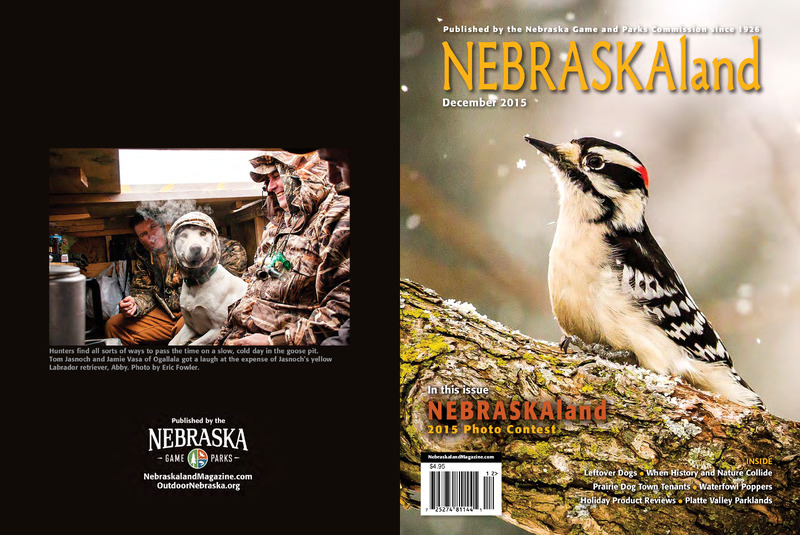
Hunters find all sorts of ways to pass the time on a slow, cold day in the goose pit.
Tom Jasnoch and Jamie Vasa of Ogallala got a laugh at the expense of Jasnoch’s yellow
Labrador retriever, Abby. Photo by Eric Fowler.
IIn
n tthis
his iissue
ssue
N EBRASKAland
2 0 1 5 Pho to C o ntes t
NebraskalandMagazine.com
$4.95
INSIDE
Leftover Dogs ● When History and Nature Collide
Prairie Dog Town Tenants ● Waterfowl Poppers
Holiday Product Reviews ● Platte Valley Parklands
GIVE THE GIFT OF THE
OUTDOORS
NEBRASKAland Magazine
Volume 93
●
No. 10
●
December 2015
F EAT U R ES . . .
20 Intersection of History and Nature
PHOTOS AND STORY BY JAY JILG
26 Prairie Dog Town Tenants
STORY BY KRISTAL STONER, PHOTOS BY JOEL SARTORE
28 2015 NEBRASKAland Photo Contest
PHOTOS BY NEBRASKALAND MAGAZINE READERS
This holiday season, give a year
full of fun and memories by giving
Nebraska state park, fishing and
hunting permits.
44 Leftover Dogs
STORY AND PHOTOS BY ERIC FOWLER
50 Time Well Spent – What to do in December
52 Burning Out of Season
STORY AND PHOTOS BY GERRY STEINAUER
And don’t forget a
NEBRASKAland subscription as a
guide for places to go and things
to do.
20
●
I N S I D E T H I S I S S U E ...
Mixed Bag – Porcupines, Travel to the Platte Valley
Parklands, Brief History, Upcoming Events and more .....6
Nature Notes – Wishing for Woods .....................56
Product Review – In Time for the Holidays ..........57
Portraits from the Past ..................................62
In the Kitchen – Waterfowl Poppers ....................64
The Last Stop – The Witching Hour ....................66
44
●
52
●
O N TH E W EB . . .
WHEN YOU SEE THIS SYMBOL IN THE PAGES OF
N
NEBRASKALAND MAGAZINE, VISIT
NEBRASKALANDMAGAZINE.COM AND VIEW OUR INTERACTIVE
DIGITAL EDITION FOR MORE INFORMATION.
D
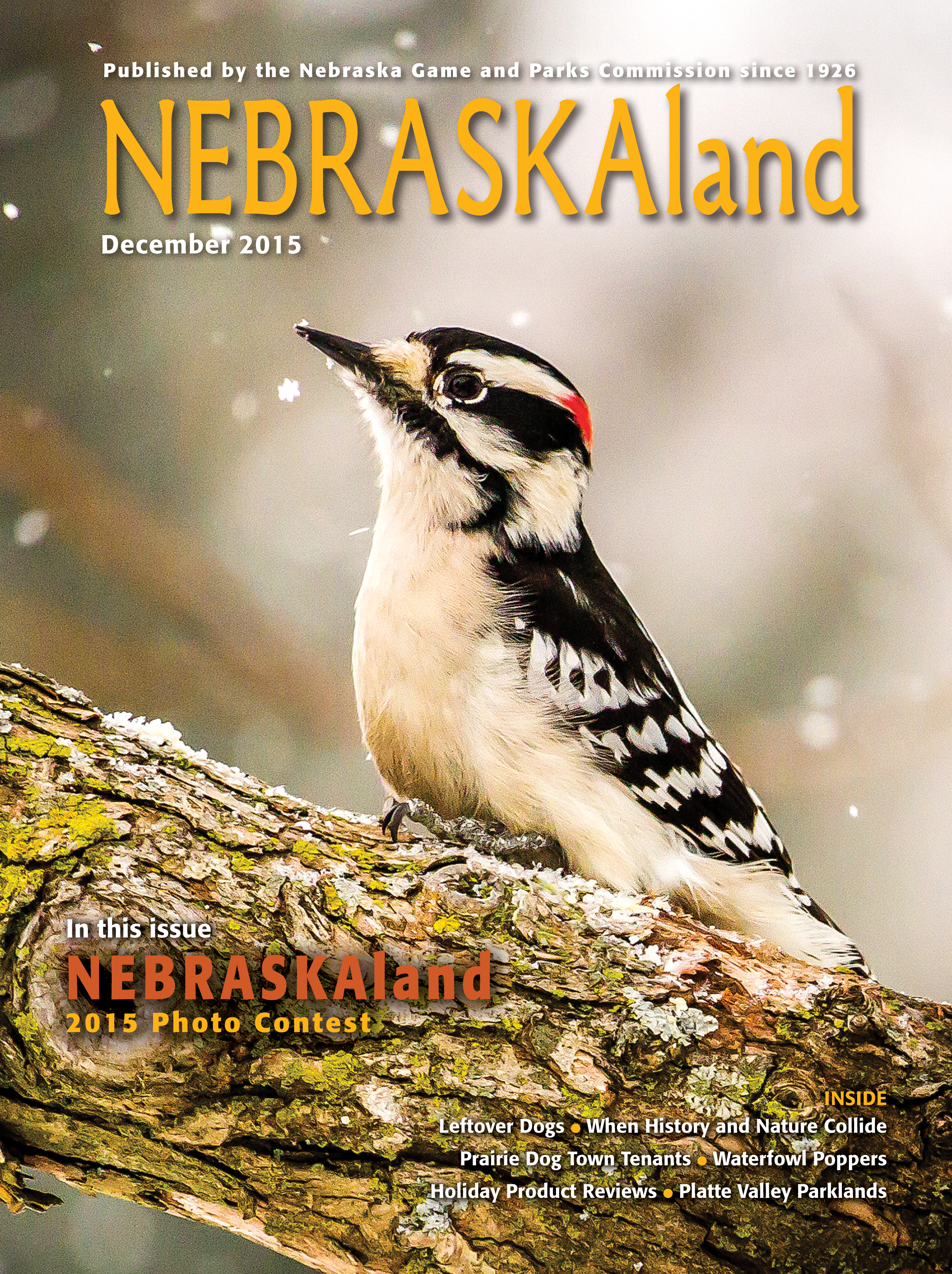
Cover: This photo of a downy woodpecker was one of more than
1,000 images submitted to this year's NEBRASKAland Photo
Contest. See the story on page 28. Photo by Kelvin Nygren.
NEBRASKAland (VOL. 93 / NO. 10, ISSN 0028-1964) is published monthly, except
for the combined Jan./Feb. and Aug./Sept. issues, by the Nebraska Game and Parks
Commission, 2200 N. 33rd St., Lincoln, NE. Periodicals postage paid at Lincoln,
Nebraska, and additional mailing offices. POSTMASTER: Send address changes to
NEBRASKAland, P.O. Box 30370, Lincoln, NE 68503-0370.
Find more ideas at OutdoorNebraska.org
2 NEBRASKAland • DECEMBER 2015
50
●
DECEMBER 2015 • NEBRASKAland 3
NEBRASKAland Magazine
Outdoor Plates
Kent Mann has hunted white-tailed
deer most of his adult life, long enough
to know that deer hunters are like
fishermen and known to embellishment
and overstatement of the truth. His
message plate is an ode to those “White
Tales.”
If you have a unique outdoor
message plate you would like to
share, or know someone who does,
e-mail a photo (high-resolution, JPEG
format only, please) along with your
hometown and a brief description of
the interests expressed on your license
plate to Eric.Fowler@Nebraska.gov.
Steve Frederick of Scottsbluff didn't capture the image of
the lighthouse he envisioned when he went to Lake Minatare
on a foggy morning in September, but did capture three
mule deer bucks out for a morning walk along the lake's
northeastern shore.
And Trail Tales Too
Every month we learn something when we read
NEBRASKAland Magazine. We are also sending Trail
Tales to our grandchildren. It's a big hit for them.
Diane Frohardt, via e-mail
This grasshopper was photographed by Judy Foreman on
Nebraska Game and Parks Commission property in Lancaster
County.
COMMISSIONERS
CONSERVATION OFFICERS
Director Jim Douglas
Commissioners
Chairman - Dr. Kent Forney, Lincoln
Vice Chairman - Rex Fisher, Omaha
2nd Vice Chairman - Mark Spurgin, Paxton
Robert Allen, Eustis
Dick Bell, Omaha
Lynn Berggren, Broken Bow
Mick Jensen, Blair
Norris Marshall, Kearney
Dr. Mark Pinkerton, Wilber
ADMINISTRATION (Lincoln)
Craig Stover (Administrator)
Duane Arp (Asst. Administrator)
Jeff Clauson (Asst. Administrator)
MAGAZINE STAFF
Communications Director Christy Rasmussen
Editor Jeff Kurrus
Art Director Tim Reigert
Associate Editor Jenny Nguyen
Regional Editors Eric Fowler, Julie Geiser,
Justin Haag
Contributing Editor Michael Forsberg
Regular Contributors Chris Helzer, Gerry
Steinauer
Photo Librarian Jaclyn Cruikshank Vogt
Circulation Donna Robinson
For address changes and questions about
your subscription, e-mail donna.robinson@
nebraska.gov or call 800-632-5263
Advertising Sales Manager
For advertising information contact
Shane G. Gilster, 402-742-0125
Email: shanegilster@gmail.com
NEBRASKAland Magazine Copyright 2015, all rights reserved.
NEBRASKAland is available in audio from the Nebraska Library
Commission Talking Book and Braille Service, Suite 120, 1200 N St.,
Lincoln, NE 68508. 800-742-7691. NEBRASKAland Magazine and the
Nebraska Game and Parks Commission reserve the right to reject any
advertising not in keeping with the agency mission.
Rates: $18 for one year; $33 for two years; $44 for three years. Nebraska
recipients must add appropriate sales tax. To subscribe call
1-800-NEBLAND (632-5263), or go online to: NebraskalandMagazine.
com.
COMMISSION
C
CO
COM
OM
MMIS
MIS
SSIO
S ON OFFICES
SI
OFFI
FF CES
FF
C S
Headquarters/Southeast District Office
2200 N. 33rd Street Lincoln, NE 68503
Phone 402-471-0641
Northeast District Office
2201 N. 13th St. Norfolk, NE 68701
Phone 402-370-3374
This great blue heron was photographed
at Prairie Queen Recreation Area in Sarpy
County by Justin Pence.
Send your comments to:
Jeff Kurrus, Editor
NEBRASKAland Magazine
P.O. Box 30370
Lincoln, NE 68503
or e-mail Jeff.Kurrus@Nebraska.gov
Please include your postal address and telephone number. Letters may be condensed
and edited. Photographs are also welcome.
Jeff Briggs took this photo of fall colors
at Holmes Lake in Lincoln last year in
late October.
4 NEBRASKAland • DECEMBER 2015
Any program that receives federal funding from the National Park
Service, or the United States Fish and Wildlife Service prohibits unlawful
discrimination on the basis of race, color, religion, age, gender, marital
status, national origin, age, disability or political affiliation. Any person
who believes he or she has been discriminated against in any program,
activity, facility, or service, should contact the Nebraska Game and
Parks Commission, Lincoln, NE 402-471-0641, the Equal Opportunity
Commission, Lincoln, NE 402-471-2024, TTY/TDD 402-471-4693;
United States Fish Wildlife Service, Civil Rights Coordinator, 4401
N. Fairfax Drive, Arlington, VA 22203; Director, Equal Opportunity
Program, U.S. Department of Interior, National Park Service, 1849 C
Street NW, Mail Code 0008, Washington, D.C. 20240-0001.
Southwest District Office
301 E. State Farm Rd. North Platte, NE 69101
Phone 308-535-8025
Northwest District Office
East Hwy. 2, Box 725 Alliance, NE 69301
Phone 308-763-2940
Bassett Office
524 Panzer St., Box 508 Bassett, NE 68714
Phone 402-684-2921
Kearney Office
1617 First Ave. Kearney, NE 68847
Phone 308-865-5310
Ak-Sar-Ben Aquarium
21502 W. Highway 31 Gretna, NE 68028
Phone 402-332-3901
Omaha Office
8495 Frederick Street, Omaha, NE 68124
Phone 402-595-2144
402-471-5531
402-471-5531
402-471-5531
NORTHWEST (Includes counties covered)
Jim Zimmerman (District Supt.)
308-641-6138
Sean McKeehan
(Cheyenne, Morrill, Box Butte)
308-279-9133
Scott Brandt
(Kimball, Banner, Scotts Bluff)
308-631-0663
308-760-3647
Greg Hesse (Sheridan, Dawes)
308-430-0572
Dan Kling (Sioux, Dawes)
Terry Brentzel (Deuel, Garden, Grant) 308-458-7650
402-389-0444
Frank Miller (Cherry, Hooker)
NORTHEAST (Includes counties covered)
Tom Zimmer (District Supt.)
402-649-8053
402-760-0712
Dale Davis (Keya Paha, Brown, Rock)
402-340-3981
Jonathan Andreasen (Holt, Boyd)
Mitch Johnson (Knox, Antelope, Pierce) 402-613-8612
402-762-5022
Jeff Jones (Knox, Cedar)
Alex Thomas
(Dixon, Dakota, N 1/2 Thurston)
402-241-7615
Jon Reeves
(S 1/2 Thurston, Burt, Washington)
402-889-8508
402-719-1108
Dan Roberts (Dodge, Colfax)
Cory Krause
(Cuming, Wayne, Stanton, Dodge)
402-380-6410
Steve Oberg
(Colfax, Platte, Madison, Stanton)
402-910-3366
Randy Pomplun
(Nance, Greeley, Wheeler, Boone)
308-550-0489
308-730-7050
Doug Pollard (Loup, Garfield, Valley)
SOUTHWEST (Includes counties covered)
Roger Thompson (District Supt.)
308-530-3097
308-202-0819
Matt Brandt (Sherman, Howard)
308-380-7331
Tim Williams (Hall, Hamilton, Merrick)
Pat George
(Clay, Adams, Nuckolls, Webster)
402-705-9989
308-920-0367
Rich Routh (Franklin, Harlan, Phelps)
Matt Andrews
(Gosper, Furnas, Frontier, Red Willow)
308-746-2418
Andrew Heyer (Dawson, Gosper, Phelps) 402-613-2241
Brian Piernicky
(Red Willow, Frontier, Hayes, Hitchcock)
308-340-6627
308-289-0427
Nicholas Fix (Keith, Perkins)
308-289-1169
Bryce Streger (Keith, Arthur)
Brandon O’Neal
(Lincoln, McPherson, Logan)
308-530-3157
Alex Hasenauer
(Lincoln, McPherson, Logan)
308-660-4671
308-440-3847
Dale Johnson (Kearney, Buffalo)
308-529-8146
Mike Thome (Dawson)
Ray Dierking (Custer, Thomas, Blaine) 308-870-0322
SOUTHEAST (Includes counties covered)
Levi Krause (District Supt.)
402-949-0593
402-619-1355
Rich Berggren (Douglas)
402-616-5961
Dan Evasco (Sarpy)
402-210-0888
Heath Packett (Cass)
402-209-1506
Russell Mort (Otoe, Johnson)
William Krause
(Nemaha, Richardson, Pawnee)
402-274-8063
402-806-9084
Dan Zuehlke (Gage, Saline)
402-890-6463
Dina Barta (Lancaster)
402-890-6465
Doug Kramer (Lancaster)
402-937-3422
Dudley Sorensen (Lancaster, York)
402-613-2312
Travis Shepler (Lancaster)
402-890-7140
Stacey Lewton (Lancaster, Seward)
402-443-6392
Mike Luben (Saunders, Butler, Polk)
Nebraska Wildlife Crimestoppers
1-800-742-7627
DECEMBER 2015 • NEBRASKAland 5
A Mammal Brief
North American
Porcupine
By Lindsay Rogers
Erethizon dorsatum
6 NEBRASKAland • DECEMBER 2015
PHOTO BY JOEL SARTORE
Although they have relatively poor
eyesight and are slow moving, don't
think the porcupine is unprotected.
Porcupines are covered by
nearly 30,000 quills, each with
specialized barbs on the tip to ensure
they stick into any offending predator.
Many believe that porcupines can
throw or shoot their quills at
predators. This myth is not true,
Lindsay Rogers is an outdoor
but quills release easily from
education specialist with the
the porcupine once stuck in
Nebraska Game and Parks
an enemy. The back, sides
Commission.
and tail are intermixed with
both quills and soft fur;
their stomach is covered with only hair. These large rodents feed on plant material such as buds, stems
and fruit, and are especially fond of the sugary cambium layer located just under the bark of trees.
In Nebraska, porcupines are most common in the rocky terrain of the western conifer forests. Eastern
expansion has been seen in recent years, with some species being found near the Missouri River. ■
DECEMBER 2015 • NEBRASKAland 7
Travelogue Sponsors
By Jeff Kurrus
Platte Valley Parklands
can spend the entire month of December
f
family
from one Platte Valley Parkland to the next
driving
d
t ever running out of things to do.
withou
w
Start inside at Ak-sar-ben Aquarium to see a collection of
the state’s frogs, fishes and the like, then allow your young
ones to spend a little time in the hands-on education room,
complete with animal pelts, bones and even games to play.
Next, put on your heavy jacket for a hike through Schramm
Park State Recreation Area or nearby Platte River State Park
where winding woodland trails greet you once you leave the
north to
blacktop. If being outside remains your pleasure, then travel
center,
Eugene T. Mahoney State Park to ice skate at the park's activity
n of the
sled down the toboggan run or hike through this park's versio
Platte River bluffs.
Air
There is also time for indoor activities nearby at the Strategic
4,
Jan.
until
display
on
is
exhibit
t
curren
Their
and Space Museum.
logy
techno
and
e
scienc
,
matics
mathe
the
on
2016, and focuses
com
behind the game of football – a Nebraska favorite. Sasmuseum.
their
visit
and
next
d
Ashlan
of
town
Venture over to the
line of shops, including the Glacial Till Tasting Room
(Glacialtillvineyard.com) and its host of wines, or the
Cooper Studio and Gallery to see original artwork.
't
You must also remember at least one more thing – you haven
ouse
Steakh
Bend
the
Round
at
eat
to
eaten yet! Have a bite
stay
(Roundthebendsteakhouse.com) just south of Mahoney, or
rant.
Restau
Lodge
The
at Mahoney and enjoy
For lodging, you can stay
at one of Platte River's
cabins or at Mahoney for
a campground stay, a
cabin, a room in the Peter Kiewit Lodge
or even in one of the park's
new four-bedroom miniPlatte Valley
lodges.
Regardless of your plans,
Parklands
set aside plenty of time
for your day, or days, in
s.
the Platte Valley Parklands.
eum
Strategic Air and Space Mus
A Winter
Cabin at M
ahoney
oom
Glac
ing R
t
s
a
T
l
l
i
ial T
DECEMBER 2015 • NEBRASKAland 9
NSHS, RG5366.PH-22
NSHS
RG5366
RG
5366.PH
5366
PH 22
PH-
NSHS, RG1013-PH30-11
Blocks and other toys at the base of a
Christmas tree.
J. Sterling Morton and his newspaper staff in Nebraska City on
May 29, 1899.
A Brief History
Christmas Trees Opposed by
J. Sterling Morton
By Patricia C. Gaster,
Nebraska State Historical Society
J.
Sterling Morton (1832-1902) had a distinguished
political career in this state, serving twice in the
territorial legislature, as territorial secretary from
1858 to 1861, and on two occasions as acting
territorial governor. He also served as secretary of the
U.S. Department of Agriculture under President Grover
Cleveland from 1893 to 1897. His chief legacy, however, is
his promotion of tree planting on the prairies, and upon his
initiative, the State Board of Agriculture in 1872 established
Arbor Day.
In 1898 Morton established The Conservative, a weekly
newspaper, in his hometown of Nebraska City to further his
economic and political views and to promote agriculture and
tree planting. He surely would have applauded the modern
advent of the artificial Christmas tree, for on Nov. 23, 1899,
he used his newspaper to attack the custom of cutting down
10 NEBRASKAland • DECEMBER 2015
healthy trees for use as holiday decorations.
Morton wrote:
“Millions upon millions of the straightest,
most symmetrical and vigorous hemlocks,
spruces, pines and balsams, will soon be aboard
freight cars and going towards cities to be put
into homes for Christmas trees, which shall bear tin bells,
dolls, bon bons, glass bulbs and all sorts of jimcracks for the
amusement of children. The generations following will want
for lumber which these Christmas trees would have made.”
Reaction in the Nebraska press to Morton’s criticism of
Christmas trees was mixed. The Courier (Lincoln) on Dec.
9, 1899, agreed with him, saying, “The fragrant fir hung
with presents, glittering with lights, and surrounded by the
beautiful, happy faces of children is a pleasant sight. But it
costs the life of a tree and we cannot afford it.” The Kearney
Daily Hub said on Dec. 13: “There are a great many of us
. . . who have not stopped to think about it at all . . . and
it seems now that attention has been called to the wanton
destruction aforesaid, that it ought to be stopped. But he
[Morton] shouldn’t deprive us of our Christmas trees without
offering us something else.”
Today, realistic artificial Christmas trees, some prelit, and living, potted trees for sale or rent have enabled
many to dispense with a cut tree for holiday decoration.
Traditionalists can still visit a commercial Christmas tree
farm to select a living tree. ■
Visit the Nebraska State Historical Society’s website at
Nebraskahistory.org.
DECEMBER 2015 • NEBRASKAland 11
Paid Advertisement
12 NEBRASKAland • DECEMBER 2015
DECEMBER 2015 • NEBRASKAland 13
Elks Lodge
Seek Hides
PHOTO BY JEFF KURRUS
By Connor Graham
The Benevolent and Protective Order
of Elks, known as the local Elks Lodge
in most small towns, is again accepting
donated deer hides from the beginning
of the November firearm deer season
through the end of the January
antlerless deer season.
Donated hides will be shipped to a
tannery to be turned into soft leather
and made into gloves for veterans
who use wheelchairs or used for craft
kits that are distributed to veterans at
Nebraska Bird Library
Veterans Affairs Hospitals across the
world as part of the Elks Help a Vet
program.
Before the hides can be shipped,
they have to have all excess fat, flesh
and both heads and tails removed,
then table or stock salt must be rubbed
into all fleshy surfaces. Volunteers
at the drop-off locations do most of
this work, but hunters are welcome to
do it themselves before dropping off
the hides. Care must be taken in the
skinning process, however, as even
small holes can result in the hide being
ruined during the tanning process.
Contact your local Elks lodge for
more information. ■
Pine Siskin
PHOTOS BY JULIE GEISER
14 NEBRASKAland • DECEMBER 2015
Some winter
months are mild
and allow for
many days on the
water. If it gets
cold and the lakes
freeze, drill some
holes and pick up slabbing where you left off when the water
wasn’t frozen.
Slabbing is a productive fall and winter technique at Lake
McConaughy, Harlan County Lake, Merritt, Elwood and
Sherman reservoirs and wherever walleye swim. ■
PHOTO BY BOB GRIER
Song or calls: Rising “tsee,” and harsh “chee”
in flight. Song is huskier version of American
goldfinch.
Description: Sexes similar. Brown above and
pale below with prominent dark streaking overall.
Yellow on wings and tail is conspicuous in flight;
yellow undertail coverts. Two whitish wing bars;
deeply notched tail. Bill is thinner than in other
finches. Juvenile is similar to adults but has
overall yellow tint.
Habitat: Migrants are found in both wooded
and treeless areas, often feeding in small flocks on
weed seeds. Breeding occurs in both coniferous
and deciduous trees, and in ornamental plantings
in diverse rural, suburban and urban settings.
Where in Nebraska: Irregular but sometimes
common spring and fall migrant and winter visitor
across the state. Occasional summer resident.
Field Notes: Winter range is erratic. May flock
with American goldfinches in winter.
Fun Facts: Pine grosbeak adults when breeding
develop pouches to carry food to their young. ■
To learn about more birds visit:
NebraskaBirdLibrary.org.
Slabbing for Winter Walleye
By Julie Geiser
When the transition from fall into winter begins and
trolling lures such as crankbaits don’t produce walleye bites,
switch your fishing techniques to slabbing.
Slabs are lead or metal spoons, ranging from ¼ to more
than 2 ounces in weight, that come in many different
shapes and colors, typically sporting a treble hook. Bomber,
Kastmaster, Hopkins, or the John Boy slab, which is locally
made in Ogallala, are a few name brands that can be
purchased from local sporting goods stores or online.
To rig the slab, tie a barrel swivel to your line and hook it
to a monofilament leader tied to the slab. This keeps the line
from twisting so when that lunker walleye hits, the line will
be strong enough for the challenge.
There are many techniques that can be used to present a
slab, but in colder water, vertical jigging from a boat is often
the most effective. Drop the slab to the bottom, then raise
and lower your rod tip from one to several feet, allowing
your slab to rise off the bottom then flutter back down.
Repeat this motion until you have a strike. Most strikes
occur as the slab falls back to the bottom, so keep slack out
of the line so you can feel a bite when it happens.
Fish may sit at the bottom not actively chasing
baits. If this seems to be the case, tweak your
technique by only lifting the slab 2-4 inches
and hold it off the bottom. Let any waves
move the bait. If you don’t get a hit right
away, drop the slab back to the bottom,
then lift and hold again.
When fishing slabs, use your sonar to
find fish that are relating to structure
in relatively deep water. Fish as
straight down from the boat as
possible, using your electric
trolling motor to hold the
boat in position and let the
fun begin.
Sponsored by
y
DECEMBER 2015 • NEBRASKAland 15
My Photo Tip:
Season’s Gift
A Snapping
Turtle for
Christmas?
Christmas lights provide a welcome opportunity for
winter photographers.
By Justin Haag
PHOTOS BY JUSTIN HAAG
Fort Robinson State Park provides a great venue for photographing Christmas lights, as community volunteers join park staff in
decorating the many historical buildings creating a festive atmosphere for its annual dinner.
16 NEBRASKAland • DECEMBER 2015
that you’re willing to take care of one
for a long time. They can potentially
outlive you. Finally, know the laws.
Technically to take a snapping turtle
from the wild you need a fishing
license, and if you decide to release
your turtle at any point, it is illegal to
release it anywhere other than where it
was captured.
You might still be shaking your head
and thinking I’m crazy, but I maintain
that snapping turtles are awesome pets
… as far as turtles go. Leave the box
turtles where they are, and maybe help
them across the road. But if you really
want to experience the joy of keeping
a native Nebraskan turtle, consider the
snapper. ■
Send Us Your Trail Cam Photos!
John Boitnott captured this trail cam photo of a bobcat and its
rabbit dinner near Bruning in Fillmore County.
Please submit your trail camera photos by e-mail to:
nebtrailcam@gmail.com. Also include any information that will
help explain your photo.
DECEMBER 2015 • NEBRASKAland 17
PHOTO BY DAN FOGELL
The vibrant scenes of Christmas lights stand out during a time of
year known for being dark and gray and provide opportunities for
photography.
Christmas lights can be photographed during any time of the night,
but the best opportunity for an attractive shot comes at twilight. With the
evening sky between sundown and nightfall, some details of a building
or other subject are still visible and the scene is still dark enough for the
lights to stand out.
Don’t just point and shoot with a camera, though. With such a low light
situation, get a noise-free, in-focus exposure by using a low ISO, slow
shutter speed and small aperture. A tripod and the use of a cable release or
self-timer will be necessary to keep the camera steady.
With good timing and a little know-how, a photographer’s holiday light
photos can be a gift that keeps on giving. ■
By Dan Fogell
Before you go shaking your head
and saying “this guy’s crazy,” give this
story a chance. How many times have
you stumbled across a “lost turtle” in
Nebraska? Perhaps one was crossing
a road and you stopped to “save” it,
or a baby turtle showed up in a very
unlikely place leaving you wondering
where the heck it came from. Maybe
you even considered taking it home
as a pet. You would be surprised how
often this happens.
Box turtles are the most common
“rescued” turtles in Nebraska, and
I wish I had a dollar for every one
that was handed over to me by said
rescuers. They have a cuteness about
them, and people like to bring them
home. But their saviors eventually
figure out they make poor captives so
they either release them (illegally by
the way) or try to get someone else to
adopt them. And the fact is that most
of Nebraska’s native turtles make
terrible pets. While I am not condoning
or encouraging collecting turtles for
pets, I will simply say that if you are
tempted to bring home a “rescued”
turtle, then there is one exception to the
“terrible pet turtle” rule: the snapping
turtle. Here’s why.
First, they are very low maintenance.
A container that holds water is an
acceptable minimal enclosure, though
a nice filtered aquarium is better and
will be more aesthetically pleasing in
your living room. They eat readily and
will feed on food pellets, but they will
also eat frozen fish, too. In fact you can
train them to take food from tweezers
(you could also use your fingers, but
they ARE still snapping turtles). After
a short time in captivity they will even
interact with you and recognize you as
their provider. They might even beg for
food. Mine gets excited every time I
enter the room and expects to be fed.
Before bringing one home, I offer
a few tips. First and foremost, do
research. As with any new pet you
should know the basics about what
it needs for survival. Second, be sure
NEBRASKAland
and
Visitor
by Jerry Kane
Contact the Nebraska Game and Parks Commission at 402-471-0641 or visit OutdoorNebraska.org for more information.
Visit HuntSafeNebraska.org for a list of hunter education classes and BoatSafeNebraska.org for a list of boating safety
classes.
November 29
Families on Target
Nebraska Game and Parks
Outdoor Education Center,
Lincoln, 10 a.m.,
402-471-6141
November 30
Dad’s Day at the Range
December 5
Fort Robinson Historical
Christmas Dinner
Fort Robinson SP, Crawford
December 5, 12, 19
Christmas in the Woods
Ponca SP, Ponca
Nebraska Game and Parks
Outdoor Education Center,
Lincoln, 1 p.m., 402-471-6141
December 5-Jan. 1, 2016
Light Up the Fort
December 1
December 6
Shootout at Salt Creek
Bobcat hunting and trapping
season opens
December 1-15
Ladies’s Day at the Range
Nebraska Game and Parks
Outdoor Education Center,
Lincoln
December 1-22
Bighorn sheep hunting
season
December 1-31
Muzzleloader deer hunting
season
December 1-31
Public land and private land
cow elk hunting seasons
December 2
Predator Calling
Workshop Nebraska Game
Fort Robinson SP, Crawford
Nebraska Game and Parks
Outdoor Education Center,
Lincoln
December 7, 14, 21
First Steps Pistol Class
Nebraska Game and Parks
Outdoor Education Center,
Lincoln
December 12
Archery on Fire Nebraska
Game and Parks Outdoor
Education Center, Lincoln
December 15
December 28
Duck and coot hunting
season in Zone 2 Low
Plains and High Plains (first
segment) closes
First segment of light goose
hunting regular season
closes
December 15
Duck and coot hunting
season in Zone 4 closes
December 16
Christmas with the Cody’s
Buffalo Bill Ranch State
Historical Park, North Platte
December 19
Christmas Bird Count for
Families Nebraska Game
Christmas Bird Count
Platte River State Park (SP),
Louisville
Indian Cave SP, Shubert
Archery, Mule Deer
Conservation Area and
Statewide Whitetail Buck deer
hunting seasons close
December 19
Christmas at the Bowring December 31
Bowring Ranch State
Historical Park, Merriman
SP, Louisville
December 25
Christmas Day Game and
Parks offices closed
18 NEBRASKAland • DECEMBER 2015
December 31
and Parks Outdoor Education December 31
Underwater spearfishing
Center, Lincoln
season ends
and Parks Outdoor Education December 12-20
December 22
Center, Lincoln
Boyer Chute National Wildlife Duck and coot hunting
Refuge deer season
season in Zone 1 closes
December 4
First segment of whiteDecember 14
December 23, 28, 29, 30
fronted goose hunting
Ticket sales end for
Discovery Day Nebraska
season closes
Christmas at the Bowring
Game and Parks Outdoor
December 5
December 14-Jan. 5, 2016 Education Center, Lincoln
Archery on Fire
Nebraska Game and Parks
Outdoor Education Center,
Lincoln
Snipe hunting season closes December 31
Archery antelope hunting
December 18-22
season closes
December 19-20
DeSoto December
December 12
Classic Christmas Eugene Muzzleloader deer season
T. Mahoney SP, Ashland
December 21-23, 26-30
Roger G. Sykes Outdoor
December 12
Heritage Education Complex
Jingle Bell Run Eugene T. open to public, Platte River
Mahoney SP, Ashland
December 29
First Steps Pistol Class
Archery fishing season for
game fish ends
January 2
Family Yule Log
Platte River SP, Louisville
January 2
Winterfest Ponca SP, Ponca
January 2
Rifle Fun Shoot Nebraska
Game and Parks Outdoor
Education Center, Lincoln
January 3
Introduction to
Competitive Archery
Nebraska Game and Parks
Outdoor Education Center,
Lincoln
January 11
First day of sales for 2016
spring turkey permits
Dreaming of a White Christmas?
By Tony Mucia and Deborah Bathke
Have you ever wondered if this year will be a white Christmas? Waking up on
Christmas morning, looking out the window and seeing the bright reflection of
snow is a great memory for many. But how likely is it that this Christmas will
have snow? Using more than six decades of historical weather records in your
county, you can now see the probability of a white Christmas.
For some, a white Christmas may just mean that a few snowflakes are falling.
Meteorologically speaking, the National Oceanic and Atmospheric Administration
(NOAA) defines a white Christmas as one in which there is an accumulation
of at least one inch of snow on the ground. On the map shown here, the darker
colors represent a higher probability while the lighter colors represent a lower
probability.
The results are similar to what you would expect, with the northern most
counties having the greatest likelihood of a white Christmas. Pierce, Hooker
and Rock counties boast 49, 52 and 53 percent chance of a white Christmas,
respectively. Chase, Deuel, Perkins, Webster and Greeley have less than a 20
percent chance.
To compute the statistics for the map, snow depth data was obtained from the
NOAA's Applied Climate Information System for every Christmas day from 1950
to 2014 at stations across the state. These values were then averaged to create a
county average for each year. Unfortunately, not every county had all 65 years of
snow depth data reported. So to calculate a county’s probability, the number of
years that had at least one inch of snow on the ground was divided by the total
number of years that the county had snow depth data.
Keep in mind that this map only shows the probability based on historical data,
not current or future conditions. The actual conditions for 2015 may vary widely
from these probabilities because the weather patterns present this winter will
determine whether there is snow on the ground or if it will fall on Christmas
day.
Note: Tony Mucia is an undergraduate student in the Meteorology-Climatology
program at the University of Nebraska-Lincoln, and Deborah Bathke is an
Associate Professor of Practice, Department of Earth and Atmospheric Sciences,
UN-L. ■
Last issue’s winner of
the Visitor drawing was
Dennis Coats of Hastings, Nebraska,
who found the dung beetle on page 57.
Readers are encouraged to contact
NEBRASKAland within 10 days
after this issue’s publication with
the correct page number and name
of this issue’s “Visitor” – a critter
found in Nebraska. We will then
gather the correct entries and draw
one to win a NEBRASKAland mug.
To enter each month, write:
NEBRASKAland Visitor
2200 North 33rd Street,
Lincoln, NE 68503.
Or e-mail:
Tim.Reigert@Nebraska.gov
with “Visitor” in the subject line of
the message.
HINT: This issue’s visitor is not on
pages 4, 7, 11, 27, or 30.
The shiny black beetle is a dung
beetle, (Geotrupes). Nebraska is
home to more than 50 species,
many of which are brown to
black, though some, such as
the "splendid" dung beetle are
quite colorful. Dung beetles are
coprophagous, meaning they eat
the dung or excrement of other
animals. They can be found on all
continents except Antarctica, and
in all types of habitats. They have
a strong sense of smell, which they
use to locate dung even across
long distances. While all dung
beetles feed on dung as both
larvae and adults, the means by
which they utilize dung separates
them into three distinct types:
Dwellers – live within a pile
p off
dung, burrowing, laying
ying eggs,
and feeding within the
he pile.
Tunnelers – excavatee tunnels
below the dung and
move dung into the
tunnels. Rollers – roll
ll
dung into a ball, andd roll it
away from the largerr dung
pile, to their tunnel.
Special thanks to Julie
J li V
Van M
Meter,
State Entomologist, Nebraska
Department of Agriculture.
DECEMBER 2015 • NEBRASKAland 19
Intersection of
History and
Nature
Photos and story by Jay Jilg
I
remember, as a young boy, visiting my grandparents’
ranch in the Sandhills of rural Rock County. Sometimes my
cousins and I would play in the area where the old dump
used to be and dig up relics from the past. These little pieces
of buried bottles and cans, and the stories they could tell from
a time long past, would fascinate me.
When I began photography full time, I was already a history
enthusiast and quickly gravitated to the historical processes
of photography. I found myself drawn away from digital
photography and into processes of the past. I began by
making simple silver gelatin prints, and moved back in time
to working with bromoil prints, tintypes and salt prints. I even
began making my own cameras and lenses.
ABOVE: Blue Birds, C-Print, Sioux County
OPPOSITE: Agate Academic, Toned Silver Gelatin Print, Agate Fossil Beds National Monument
20 NEBRASKAland • DECEMBER 2015
DECEMBER 2015 • NEBRASKAland 21
I
use a number of cameras, from homemade, to large and medium
format, in making my negative images. Back in the darkroom, I
begin the task of converting the negative glass plate or film into
a final image. Because these are historic photography processes,
similar to the old survey photographs of the American West, there
is not the instant gratification you get with digital cameras. Most of
the time I am not even sure what the image looks like until days or
weeks later.
ABOVE: Feast, Salt Print,
Homestead National Monument
LEFT: Osage Hedgerow, Salt
Print, Homestead National
Monument
OPPOSITE: Smith Falls, Silver
Gelatin Print, Cherry County
22 NEBRASKAland • DECEMBER 2015
DECEMBER 2015 • NEBRASKAland 23
J
ust like the buried bottles and cans on my
grandparents’ ranch, each image tells a
story of what once was. Each is a
moment in history that holds untold stories,
yet to be unearthed. ■
W
ith many of my
photographs, I try
to combine the
history of the landscape
with the people that have
utilized it over the years.
From photographing Native
American Indian artifacts,
fossil bed quarries, and
old homestead sites, there
is always a component of
both nature and human
intervention on the landscape.
24 NEBRASKAland • DECEMBER 2015
OPPOSITE ABOVE:
Homestead, Silver Gelatin
Print, Custer County
OPPOSITE BELOW: Burr
Oak, Silver Gelatin Print, Clay
County
RIGHT: Burrowing Owl, Silver
Gelatin Print, Custer County
This is Jay Jilg’s first photo
essay for NEBRASKAland
Magazine.
DECEMBER 2015 • NEBRASKAland 25
Prairie Dog
Town Tenants
The Burrowing Owl is aptly named because it
nests in holes in the ground. This small owl can dig
its own burrow, but often uses one already created
by prairie dogs. The burrowing owl is declining
in many states and is considered a Species of
Greatest Conservation Need in Nebraska.
Prairie Dog – The landlord of the town.
What wildlife lives in
these unique habitats?
Story by Kristal Stoner, photos by Joel Sartore
The Black-footed Ferret is a
member of the weasel family
and is the only ferret native to
North America. Prairie dogs are
ferrets’ main source of food, and
they use the prairie dog tunnels
for shelter. This mammal is not
found in Nebraska, but was
once found across the Great
Plains. It is now one of the
most endangered animals in the
world.
American Bison
once migrated
through the
Great Plains
and changed
the landscape
in their wake.
They grazed
vegetation
very short,
and created a
patchwork of
prairie habitats
that many plant
and animal
species relied
upon.
The Golden Eagle is one of the largest raptors in North
America and can be found nesting in western Nebraska.
It feeds on a variety of prey, mostly rabbits, squirrels
and prairie dogs. Unlike its relative, the bald eagle, the
golden eagle seeks wide open areas with very little
development.
The American Badger is
in the Mustelidae family
and closely related to
weasels, otters and ferrets.
This stocky carnivore has
distinctive stripes and even
though this is a common
mammal, it is rarely seen
as it is primarily nocturnal.
They are well adapted to
digging out their own dens,
which can have multiple
entrances and be over 4 feet
in depth.
The Prairie Vole is a small
mammal, similar to the
mouse, that makes prairies its
home across the Great Plains.
Unlike most mammals, prairie
voles are monogamous and
will protect their mates, and
both parents care for the
young.
The Red Fox is an adaptable creature that lives in a variety of habitats
including forests, grasslands, mountains, deserts and even suburbs.
Their diet is almost as variable as the places they are willing to live:
They eat carrion, rodents, insects and even fruit.
The Coyote is found throughout
Nebraska and increasing its range
nationally. These mammals form
packs and their howling and yipping
serve to communicate with family
members and to notify neighboring
coyotes of their presence.
The Kangaroo Rat is actually not a
rat or a mouse. More related to the
pocket gopher, it has massive hind
legs that allow it to leap nine feet
at a time. It is primarily a seed eater
and has a strong hoarding habit.
26 NEBRASKAland • DECEMBER 2015
Pronghorn Antelope are actually not antelope
at all, although they appear similar to antelope
of the Old World. Pronghorn are among North
America’s fastest land mammals and can reach
speeds of 35 miles per hour and maintain that
speed for miles. Not built for jumping, they are
often seen going under fences rather than over.
The Black Widow Spider
earns its name because after
mating, the female may
consume the male. There
are many species of widow
spiders and they are found in
temperate regions all over the
world, including shortgrass
prairies.
The Prairie Rattlesnake is famous for its warning
system: a series of hollow keratin segments that form
a rattle on the end of its tail. The rattle is actually a
defense system, because this snake prefers to scare
away a threat rather than strike.
The Striped Skunk has a wonderful
defense system that rarely injures other
animals but nonetheless is extremely
effective. Skunks can dig their own dens,
but if something else, such as prairie
dogs, provides a home for them, they will
readily move in.
The Cottontail Rabbit is highly adaptable
and can survive in many habitats, including
farms and suburban areas. It is very
territorial in defending its home range.
DECEMBER 2015 • NEBRASKAland 27
2 01 5 P h o t o
Cont e s t
W
ith more than 1,000 images submitted,
the 2015 NEBRASKAland Magazine
Photo Contest was a tremendous success.
With categories of Wildlife, Flora, Scenic,
Recreation and Youth, NEBRASKAland’s
readers came out in full force, presenting the
outdoor beauty of the entire state.
Judged by NEBRASKAland Magazine’s staff,
paring down the images was difficult. The
photographs on the following pages were
chosen as Best of Show and first, second and
third place for each category.
One final category has yet to be judged. Our
Reader’s Choice award can be voted on from
Nov. 15-Dec. 1 at NebraskalandMagazine.com.
The winning photograph will be published in
our January-February 2016 edition.
We thank everyone who has made this year’s
contest such a success, and we look forward
to seeing even more outstanding photographs
entered next year.
– NEBRASKAland Magazine Staff
BEST OF SHOW
Prowling Swift Fox
Photo by Carla Goranson
28 NEBRASKAland • DECEMBER 2015
DECEMBER 2015 • NEBRASKAland 29
WILDLIFE
SECOND PLACE – Downy Woodpecker in the Snow
Photo by Kelvin Nygren
FIRST PLACE – Feeding Bluebird
Photo by Don Brockmeier
THIRD PLACE – Male Prairie
Chickens Fighting on the Lek
Photo by Kevin Hice
30 NEBRASKAland • DECEMBER 2015
DECEMBER 2015 • NEBRASKAland 31
SECOND PLACE – Frosty Yucca
FLORA
Photo by Mike Peterson
FIRST PLACE – Sunset at Martin’s Prairie
Photo by Adrian Olivera
THIRD PLACE – Water Lily at
Rock Creek State Recreation
Area
Photo by Ronald Allen
32 NEBRASKAland • DECEMBER 2015
DECEMBER 2015 • NEBRASKAland 33
SCENIC
FIRST PLACE – Downtown Omaha
Photo by Tyler Roberts
34 NEBRASKAland • DECEMBER 2015
DECEMBER 2015 • NEBRASKAland 35
SCENIC
THIRD PLACE – Age is Beauty
Photo by Joel Jones
SECOND PLACE – Sunrise Reflected
Photo by Bill Kesler
36 NEBRASKAland • DECEMBER 2015
DECEMBER 2015 • NEBRASKAland 37
RECREATION
FIRST PLACE – Lake Mac Beach Fire
Photo by Bill Kesler
38 NEBRASKAland • DECEMBER 2015
DECEMBER 2015 • NEBRASKAland 39
RECREATION
THIRD PLACE – Catch Summer Before It Snows
Photo by Giri Mohanan
SECOND PLACE – A Message From
Heaven
Photo by Brad Goetsch
40 NEBRASKAland • DECEMBER 2015
DECEMBER 2015 • NEBRASKAland 41
YOUTH
FIRST PLACE – Sparrow
Photo by Emily Morrow
THIRD PLACE – Sunset Over a Field of Rye in
Northeastern Nebraska
Photo by Chance Jacobsen
SECOND PLACE – Rockford
Lake Sunset
Photo by Mason Bletscher
42 NEBRASKAland • DECEMBER 2015
DECEMBER 2015 • NEBRASKAland 43
Leftover
Dogs
Story and photos
by Eric Fowler
Two dogs prove what holds true for
many found in shelters: Just because
someone didn’t want them doesn’t
mean they can’t be man’s best friend.
Sean Conaway of Omaha takes aim at
a chukar partridge pointed by Sadie,
his German shorthaired pointer, on a
hunt at Oak Creek Sporting Club near
Brainard. Conaway adopted the dog
from the Great Plains Pointer Rescue.
44 NEBRASKAland • DECEMBER 2015
DECEMBER 2015 • NEBRASKAland 45
F
or many, the next hunting dog,
or family dog, must come in
the form of a puppy. They
want to pick the best dog for
them, make that early bond and ensure
it’s trained as they like.
Too often, those responsibilities
and the rest that come with a dog are
more than some people can handle.
Overwhelmed, they quit on the dog,
which then finds itself in a shelter on
“death row,” hoping someone will
give it another chance, or worse yet,
roaming the countryside hoping it can
find its next meal.
These dogs are the leftovers. Some
people are happy to give them a new
home. In most cases, they find the
problem was with the people who
last owned the dog, not
the dog. That includes
the hunting dogs that
supposedly can’t. Often,
they can hunt. And they
come without the price tag
and training hurdles that a
puppy sometimes does.
knew she knew how to work a field,” he
said. “She covered every inch.”
Sadie pointed birds, honored other
dogs’ points and even reminded herself
that she could retrieve after another
dog beat her to a bird, all of which told
Conaway “She’s a trained hunter. She
does everything a shorthair should do. I
thought that was hilarious. That was the
easiest training session I’ve had.”
bellies bloated. But they were adorable.
So they drove to Columbus and bought
some dog food. The puppies inhaled it
and then got sick … in the back seat
of T.J.’s car. T.J. and his uncles had
planned on staying for the weekend but
packed up and headed back to Lincoln.
Yoakum’s uncle kept the female in
the trio and his cousin the other male.
“They’re both just awesome dogs,” he
said.
While mushroom hunting the next
spring, he was amazed at both the
Not long ago, T.J. Yoakum had no
ability and determination of Little Bear
use for pit pulls. He stereotyped the dog when he tried to jump a ravine and,
the same way that many others do: they
with no urging, tried again. Yoakum
are bred to fight and bite, and usually
had seen dog jumping events on TV,
owned by thugs.
so he took Little Bear to Pawnee Lake
and soon had the dog flying off the end
That all changed on a fishing trip on
of the dock to retrieve
a bottle. They entered a
jumping competition in
Omaha shortly thereafter
and Little Bear won.
He’s since won several
other competitions, and
even placed second at a
national event in St. Louis
in 2014, with a jump that
still ranks second in the
world.
German shorthaired
Yoakum and his uncle
pointers have a bad rep. Yes
are even training their dogs
they are more high strung
to hunt pheasants. And on
and have more energy than
occasion, Little Bear, who
other dogs. But they are
is out-of-his-mind crazy
fine pets, family dogs and
at jumping events, calms
hunters.
down, dons a sweatshirt
Sean Conaway has two,
and makes hospital and
Sadie and Coco. For the
nursing home visits.
past two years, he’s often
“He’s the best dog I’ve
added a third as a foster
ever owned, and truly my
home for the Great Plains T.J. Yoakum of Lincoln takes a rooster retrieved by his pit bull, Little
best friend,” said Yoakum.
Pointer Rescue. The rescue Bear, on a hunt at Pheasant Haven near Elkhorn. Yoakum found the
dog abandoned on the Loup River.
“Every pit bull I’ve met
is where he found and
has been the nicest dog
adopted Sadie in 2014, who
ever. My prejudice toward them is
has turned out to be a fine bird dog.
the Loup River near Columbus in 2011
And Coco, who was a great hunter but
with his uncle and cousin. While driving totally gone.”
retired after she began suffering from
along the river, they came across three
seizures, now is happy to jump in bed
pit bull puppies running down the road.
with Conaway’s wife, Dana, when he
They stopped and when Yoakum sat on
and Sadie head to the field.
the ground, one of the puppies jumped
“To me, they’re the best family dogs
in his lap and “claimed” him. Before
I’ve had,” he said.
they got up, the dog had a name: Little
Conaway doesn’t understand why
And when it’s time to hunt, Conaway
Bear, for his grandfather, Harold, who
anyone would abandon their dog. He’s
said it’s humorous watching Sadie tap
was nicknamed Bear. “I already had a
heard what they call reasons. He calls
dance around the house, “smiling from
bloodhound named Harold,” Yoakum
them excuses. Some are harder to
ear to ear.”
said.
understand, and stomach, than others.
Conaway had no idea what to expect
“They were in pretty rough shape,”
“For whatever stupid reason, these
from Sadie when they headed to the
he said of the puppies, which were
people would rather just dump them
field the first time. “Right away you
about 8 weeks old, emaciated, and their off at the pound,” Conaway said.
Pit Bulls
Yoakum tosses a
training dummy for
Little Bear at a Super
Retriever Series
event at Scheels in
Lincoln. The dog has
excelled in jumping
events and currently
holds the second
longest mark in the
world.
Shorthairs
That Dog Don’t
Hunt
46 NEBRASKAland • DECEMBER 2015
DECEMBER 2015 • NEBRASKAland 47
Pup in a Box
I helped perpetuate a stereotype
a few years ago when I put my
12-week-old lab puppy in a box
under my Christmas tree and
snapped a gob of photos, one of
which ended up on the cover of
NEBRASKAland. In reality, however,
giving someone a dog for Christmas
is a really bad idea.
Give a puppy to the kids at
Christmas, and it may end up like
many of the toys they open,
forgotten and neglected. And then guess who’s taking care of
it. But you should probably plan on training, feeding, walking
and cleaning up after it anyway.
And ladies, don’t even think about giving your husband
a hunting dog for Christmas. Picking a dog is a personal
endeavor that should involve the future owner personally
visiting the litter and picking what feels to be the best for
him. If you’re really serious, you might even pick the breeder
before puppies are even born. It’s not a task you should take
on for someone else.
And perhaps most importantly, the perfect dog for you
might not be ready at Christmas. Just because it is a hunting
breed doesn’t mean it will be a good hunting dog. A pet store
Labrador retriever may come from stock that hasn’t seen the
field in generations.
And even if you do find a breeder with a line of dogs you
would like, what are the odds that litter will be born Nov.
13? What is the significance of that date? Top trainers say a
puppy should be brought home at 7 weeks of age in order to
form the greatest bond with their master and, believe it or
not, to start their training. Nov. 13 is 7 weeks from Christmas
morning.
If you’re planning on getting a dog anyway and the stars just
happen to align and your pup will be ready Dec. 25, go ahead
and wrap one up. Otherwise, wrap up a gift certificate that
says “We’re getting a dog, let’s start looking for the perfect
one for us.” Then start the search for a reputable breeder or a
rescue and pick the dog that’s right for you.
“Especially breeders. A lot of rescue
dogs are coming from breeders. Once
they’re done breeding them, it’s straight
to a kill shelter.
“I believe that’s where Sadie came
from. It’s obvious she’s had multiple
litters, but the way she hunts and the
way she acts at home, I don’t know why
someone would get rid of her unless
they were done with their purpose for
her.”
Janell Ford started the Great Plains
Pointer Rescue in 2008 in memory of
her shorthair, Ace, who she rescued
48 NEBRASKAland • DECEMBER 2015
from the Nebraska Humane Society.
She said they will never know the story
behind most of the 80 or so German
shorthair and English pointers her
group rescues and places each year.
They know some are from people who
have fallen on hard times. Others are
the product of what she calls the “dump
season.”
“We’ll get all of the dogs that don’t
hunt,” Ford said. “They’re found left in
the field.”
Ford said those guilty of abandoning
their dogs are what she calls “hobby
hunters. They’re not really into it. They
go out and they spend thousands of
dollars on a dog that doesn’t want to
hunt and they get frustrated and don’t
know what to do.”
Ford also gets other “crazy calls”
from people threatening to shoot their
dog if she doesn’t come get it. You can
sense the disgust in her voice for the
niche of hunters who, unlike many who
treat their dogs as family, consider their
dogs as tools.
Left for Dead?
Yoakum can only guess who
would’ve dumped the litter of pit bull
puppies he found, or the survivors
anyway, on the Loup River. Or why
they did it.
“Maybe they didn’t look pit bull
enough or weren’t big enough,” he
said. “If they would’ve left them in
a box outside the front door of the
vet, they would’ve had a much better
chance than out in the middle of
nowhere.”
He found another dog, a brindle
mastiff, while mushroom hunting this
year that he assumed was abandoned.
It was taken in by a no-kill shelter in
Ashland and now has a new home.
“People shouldn’t own a dog
if they’re not ready for that
responsibility,” Yoakum said.
“Everyone in my family, if we get a
dog, it’s a life-long commitment. You
have that dog until they die or you die.
“At the same time … I think most
people in the world would benefit from
having a non-human companion.”
Adopt Me
Collectively known as pit bulls,
American pit bull terriers, American
Staffordshire terriers, Staffordshire
bull terriers and other similar breeds
were once a favorite family pet in the
U.S., and still are by those who know
the breed well. Yet because of their
undeserved and sometimes sensualized
reputation as fighting dogs, they are
incredibly hard to place in homes
once they arrive at a shelter. One
study estimates that 93 percent are
euthanized. Another says one in 600 is
adopted.
Shorthairs and English pointers
fare better in a shelter, but their
Sadie works through the grass in search of pheasants with Conaway and Bobby Nelson on a tract of land enrolled in the U.S.D.A.
Conservation Reserve Program and the Commission’s Open Fields And Waters Program near Lincoln.
reputation as high-energy dogs and
their personalities can also make them
difficult to place. “A lot of times the
pointer breed will be really susceptible
to what we call kennel shock,” Ford
said. “They start to lose weight or become
depressed, and they don’t show well.
“They’re such social dogs, and if
they’re not getting all of that exercise
and attention they need, they start to
deteriorate and then people really won’t
take a look at them. I try to swoop in
there and get them out of there and
bring out their best again.”
Of the 70 to 80 million dogs owned
as pets in the U.S., an estimated 3.9
million enter animal shelters each year.
While most are reunited with their
owners or adopted, about one-third are
euthanized. That number is declining
thanks to groups like the Great Plains
Pointer Rescue, which takes pointers
from shelters in Minnesota, Iowa and
Nebraska and sends them to one of
more than 20 volunteers who give
dogs a foster home until a permanent
home can be found. Nearly every breed
of dog has a similar network of local
and regional rescue groups, and other
no-kill shelters serve any breed.
Conaway has fostered six dogs for
the rescue during the past two years.
He admits he’s almost “foster failed”
each time. That’s the term coined
for those who adopt dogs they are
fostering. He and Dana get attached to
the dogs and it’s hard to let them go,
more so for his 11- and 12-year-old
children. But if they chose to keep a
dog, they wouldn’t have room to foster
any more, and that would leave the
rescue short of a home it needs.
“When you meet the families that
adopt these dogs, it makes it easier,”
Conaway said.
They keep in touch with the new
owners, and Conaway is always happy
when they send photos of the dogs after
a successful bird hunt. “Yep, if someone
just gave them a chance they’d have a
heck of a hunting dog,” he said.
There are no guarantees a hunting
breed adopted from a shelter or rescue
will hunt. But the same holds true for
a puppy from a well-bred hunting line.
Ford admits that some simply don’t
have the nose or the desire to hunt.
When situations allow, however,
Ford asks volunteers like Conaway to
take dogs to the field and see if they
have the ability and desire to hunt. “If
they do want to hunt, we find them a
hunting home because that’s where
they’ll be happy,” she said.
For the rest of the dogs, Ford looks
for people with a sense of humor and
energy required to own a shorthair or
English pointer, and also a home where
the dog will live indoors and be part of
the family.
“We’re just another option for people
to look at,” he said. “There are some
dogs out there that have already been
trained to do what you want. They’re
great dogs, they’re already house
trained ... they’ve got everything under
their belt.”
Not bad for leftovers. ■
DECEMBER 2015 • NEBRASKAland 49
Time Well Spent
What to do in December
I
n between last-minute shopping and time in front of the fireplace, try
to squeeze in these family friendly events across the state to make your
holiday season the most memorable yet. ■
PHOTO BY JUSTIN HAAG
Winterfest Events
Dec. 12
Eugene T. Mahoney State Park
Light Up the Fort
Dec. 5, 12, 19
Ponca State Park
Beginning Dec. 5
PHOTO BY JEFF KURRUS
Holiday events are held across the state,
including Ponca State Park’s Christmas in
the Woods and Eugene T. Mahoney State
Park’s Classic Christmas, where family
events, including a visit from Santa Claus,
will take place. NEBRASKAland Magazine
photographers will be on site to welcome
St. Nick as well. Visit Outdoornebraska.org
for a full schedule of events at each of these
locations.
Fort Robinson State Park
Fort Robinson State Park will ring in the holiday season with
its annual Light Up the Fort and Christmas Dinner on Dec. 5.
Community members join in the effort to decorate the park’s
many historical buildings, which will shine bright that evening
through New Year’s Day. Each year the annual feast features
the menu from a different time in the fort’s history, and many
attendees get into the spirit by dressing in attire from the period.
This year, 1891 is in the spotlight.
Muzzleloader Deer Season
All Month Long
Statewide
Archery on Fire
Platte River State Park
Dec. 12
Nebraska Outdoor
Education Center
Dec. 14-Jan. 5
PHOTO BY ROCKY HOFFMANN
50 NEBRASKAland • DECEMBER 2015
Christmas Bird Counts
PHOTO BY JEFF KURRUS
Join other families for free archery
lessons, crafts and campground games
on Dec. 5 at Platte River State Park
and Dec. 12 at the Nebraska Outdoor
Education Center in Lincoln. All
equipment will be provided in addition to
food and warm beverages.
PHOTO BY JUSTIN HAAG
Hunters will take to the
field this month for deer
hunting’s muzzleloader
season, complete with
powder, smoke and
hopefully venison roast.
Dec. 5
Dec
Statewide
Christmas Bird Counts will take place Dec. 14-Jan. 5. These
counts were initiated in 1900 as an alternative to Christmas
hunts and there are now more than 2,300 counts worldwide.
Nebraska’s first count was in Lincoln in 1908 and currently there
are approximately a dozen active counts held across the state.
Visit Noubirds.org and search under Activities for specific times
and locations across the state.
DECEMBER 2015 • NEBRASKAland 51
Burning Out
of Season
Summer, Fall and Winter
Prescribed Fires
Story and photos by Gerry Steinauer, Botanist
T
he flames crept through the
green grass, billowing white
smoke skyward. Occasionally,
they snaked up through the spreading
branches of scattered cedars, slowly
engulfing them and spewing a distinct
oily, black smoke. Drawn by the plume,
droves of swallows plunged before the
fire, snatching fleeing insects.
This Pawnee County tallgrass prairie
burn was not a traditional spring
prescribed fire, as it happened on a hot
day last August. The encroachment
of eastern red cedars and brush into
grasslands and increasingly erratic
spring weather has some Nebraska
conservationists and landowners
burning in the fall, winter and even
during the heat of summer.
A Winter Burn
For Rod Christen of Pawnee
County, prescribed fire is critical to
his ranching operation. In the 1980s,
Christen along with his father, Richard,
Smoke lingers during a late January tallgrass prairie and oak woodland prescribed burn in Jefferson County.
PHOTO BY CHRIS HELZER
Bruce Winter, with the United States Fish and Wildlife Service, watches over a summer
burn on The Nature Conservancy’s Platte River Preserve in Hall County.
52 NEBRASKAland • DECEMBER 2015
experimented with burning their native
tallgrass pastures. “We were pretty
unsophisticated back then, to ignite
the fire we pulled a burning tire tied
behind a three-wheeler,” said Christen
with a laugh. In the late 1990s, they
began burning again using more
refined techniques and pumper units
and drip torches rented from a local
grazing association.
Christen now annually burns 150
to 250 acres to set back the cedars,
buckbrush, sumac, dogwoods and
honey locust invading his pastures and
displacing forage. “Prescribed fire is
also the only economical way for me to
clean up the pastures I rent from people
without the means to control woody
species,” said Christen. “And using
fire is way more fun than spending all
summer on a four-wheeler spraying
herbicide. We can’t keep up with the
brush by just spraying.”
On Dec. 12 of last year, Christen,
along with a crew of seven, burned a
200-acre rented pasture a few miles
from his home. “The pasture had old
brush piles and a million little cedars
that needed burning,” said Christen.
“The fire also cleaned off the old grass
thatch, which will make for good
grazing next summer.”
While the day’s temperatures
hovered in the high 30s, the humidity
stayed above 50 percent and the winds
were only 5-10 miles per hour, the
fire was effective. At dusk, with the
fire over, still burning brush piles
illuminated the charred skeletons of the
cedars.
“Why do we burn in spring? Because
that is when we have always been
told to burn,” said Kent Pfeiffer, a
Northern Prairies Land Trust ecologist
stationed in Beatrice who was on the
burn that day. “It is tradition, one that
arose mostly in other places, such
as the Kansas Flint Hills.” There
ranchers have been spring burning
pastures since the 1880s to promote
big bluestem, Indian grass and other
summer-growing tall grasses. Yearling
cattle are then heavily stocked on the
lush grass regrowth. “This fire and
grazing system really does not apply
to Nebraska where we mostly graze
cow-calf pairs and finish fattening
cattle on corn,” said Pfeiffer. Concerns
that burning off grass in fall and winter
will cause soil moisture loss, winter
kill plants, and destroy wildlife habitat
have been proven mostly unfounded.
This is not to say that spring burning
is not beneficial. Late spring burning,
for example, sets back smooth brome,
Kentucky bluegrass and other nonnative, cool-season grasses that invade
prairies and out-compete native plants.
Safety is the prime reason both Pfeiffer
and Christen prefer fall and winter
burning to spring burning. “Winds
this time of year are fairly stable,
whereas spring winds can shift from
one direction to another making fires
unpredictable,” said Pfeiffer. “Also in
spring, the afternoon humidity often
DECEMBER 2015 • NEBRASKAland 53
The burn crew enjoys the warmth of a still burning brush pile after Rod Christen’s December burn.
drops so low that fires become flashy.
Burning this time of year is more
relaxed. I can actually sleep the night
before a fire.”
A Summer Burn
Last year, Pawnee County landowner
John Hill left 30 acres of his tallgrass
pasture un-grazed to build fuels for a
late-summer burn. Like Christen, his
goal was not only to hit encroaching
woody plants, but also to create a wide,
burned-out break for a larger fire the
coming winter.
At mid-morning on Aug. 21, Pfeiffer
and seven others gathered to assist Hill
with the effort. When the burn started
the sky was overcast, the humidity
was about 65 percent and the wind
was feeble. The initial backfire’s less
than foot-tall flames burned into the
Krista Lang sets the headfire during Christen’s burn.
54 NEBRASKAland • DECEMBER 2015
wind at a glacial pace. Around 11
a.m., however, the wind picked up and
the sun popped out from behind the
clouds, dropping the humidity to about
50 percent and the fire burned with
more intensity. When lit, the headfire,
pushed by the wind, moved more
quickly, meeting the backfire within
20 minutes and ending the burn. While
the crew ate lunch, hawks circled high
above searching for an easy meal of
fire-displaced rodents.
Although the fire was far from
a raging inferno, its impacts were
deceptively destructive. While
relatively few of the pasture’s three- to
10-foot tall cedars were consumed by
flames, many had their foliage slowly
sizzled by the prolonged heat rising
from below. In a matter of hours, they
would fade from green to a deathdefining copper-orange in color. Steam
audibly whistling from the heated,
sap-filled stems of deciduous shrubs
signaled their demise.
In southeastern Nebraska, August and
September are the months most suitable
for summer burning. “In June and July
the grass generally contains too much
moisture to burn,” said Pfeiffer. “Fire
behavior in grasslands is all about fuel
moisture, which is primarily driven by
humidity and in summer also by soil
moisture content as plants are actively
taking up water. If the humidity is over
85 percent, prairie grass generally does
not burn well. What is nice about the
late summer daytime humidity is that
it generally stays above 40 percent.
Below this point, prairie fires can
burn hot and fast. The air temperature
doesn’t matter all that much as long as
the humidity stays high; we once did a
grassland burn when it was over 100° F
and it went well.”
Under the right conditions, Pfeiffer
believes summer prescribed burns
could be used nearly statewide. In
large prairie landscapes, such as the
Sandhills, where wildfires can burn
from horizon to horizon, slow burning
summer fires may be an effective and
safe way to control cedars. “If a fire
did escape, it would be easy to catch,”
said Pfeiffer.
Getting southeastern Nebraska
landowners to conduct summer
prairie burns, however, has been a
hard sell. “For many people, summer
fires just seem too strange. Whoever
thinks about burning in August? And
cattlemen hate to give up green grass,”
said Pfeiffer. “If it rains or there is
good soil moisture, the pastures will
green up a few weeks after a burn and
provide excellent forage through the
fall and into early winter, a time when
good forage is hard to come by.”
Summer fires have other advantages.
High summer air temperatures increase
the overall heat of fires, thus having
a greater impact on woody plants
than burns in other seasons. Also
summer flowering and fruiting expends
energy reserves reducing the post-fire
sprouting ability of deciduous shrubs
and trees. The tender, late-season
sprouts are also susceptible to winter
freeze off. Summer burns are also
patchy, leaving plenty of un-burned
habitat for wildlife. And because they
temporarily stress the dominant warmseason grasses, seedlings of prairie
wildflowers have a better chance
to establish the following summer,
providing long-term benefits to
pollinators and other wildlife.
For those Nebraska landowners
tied to spring burning, it might be
time to break tradition and burn out of
season. ■
The Green Glacier
olatile oils in the leaves
of eastern red cedar and
their inability to sprout after
being top-killed make them
highly susceptible to fire. Prior
to Euroamerican settlement
of the Plains, prairie fires, set
mostly by Native Americans,
limited cedars to steep, fireprotected stream bluffs and
islands, and in the west, rocky
outcrops. Nebraska settlers
acknowledged their presence
with place names such as
Cedar River, Cedar Rapids and
Cedar Bluffs.
With settlement came the
control of wildfires, and cedars
began creeping out from
their refuges onto adjacent
grasslands. After the Dust
Bowl, the widespread planting
of cedar windbreaks provided
an abundant source of the birddispersed seeds and a green
glacier of cedars began its
spread in earnest across our
state.
The Nebraska Forest Service
estimated that between 2005
and 2010, 25,000 acres of
Nebraska grasslands were
converted annually to cedar
woodlands and 13,000 acres
of other woodlands types, such
as oak woods, were overtaken
by cedars. In the Loess Hills
grasslands of central Nebraska,
cedar coverage can balloon
from five to 90 percent in as
little as 25 years. More dire,
there are an estimated 300
million cedar seedlings in the
state to feed the green glacier
in coming years.
Cedar encroachment has
severe consequences for
both our state’s ecology and
economy. “Cedars displace
native prairie plants, and as
little as three to 10 percent
tree coverage in grasslands
V
can cause declines in prairie
chickens and other grassland
bird populations,” said Dr.
Dirac Twidwell, a rangeland
ecologist with the University
of Nebraska-Lincoln. When
dense, cedars can cut livestock
production by as much as 75
percent and become a wildfire
threat. Eastern red cedar- and
Ashe juniper-fueled wildfires
in Oklahoma and Texas,
for example, now burn with
the catastrophic intensity of
California chaparral fires.
Cedar control can be
expensive. Mechanical cutting
or shredding can cost $50 to
$1,000 per acre depending on
tree density and topography,
whereas herbicide control is
also expensive and not always
effective. A complicating factor,
a few years after mechanical
and herbicide control, young
cedars often reestablish from
seed.
Periodic prescribed fire is the
only practical way of controlling
cedars and is most effective in
the early stages of infestation.
When stands become tall and
dense with little grass fuel
remaining below, prescribed
fires often lacks the intensity
to kill cedars. In the Edwards
Plateau of Texas, Twidwell has
successfully experimented
using prescribed fire under
extreme burn conditions to
restore cedar- and juniperchoked grasslands.
“The Edwards Plateau is
constant cedars. The future
of the Sandhills and other
Nebraska grasslands will be the
same unless we band together
and develop strategies for their
control,” said Twidwell. “No
other state has effectively acted
in time. Nebraska has a chance
to be the first.”
DECEMBER 2015 • NEBRASKAland 55
Wishing for Woods
Christmas Gift Ideas
A lifelong obsession with trees.
Even more ways to spread holiday cheer to your outdoor enthusiast.
By Stephanie J. Cleary
Reviewed by Jeff Kurrus
T
56 NEBRASKAland • DECEMBER 2015
“forest.” It’s what any city kid
enchanted by trees must do.
Forests are magical places,
and I wanted to know them
intimately. Hanscom Park
had enough trees to meet my
requirements. I’d ride my
bike down the winding road
through its center and speed
across the grass to the “forest”
on the northeastern edge. The
foliage was thick enough to
block out Park Avenue, so I
was on the lookout for deer
and woodchucks. I never saw
any. Dewey Park was a disappointment
as well. Sure, the thicket of trees could
hide me from the tennis players, but
no matter how hard I tried to make it
“woods,” it was just not the real deal.
To my delight, my family started
vacationing annually in Black River
Forest outside of Hatfield, Wisconsin.
This wasn’t a child’s wish for woods,
this was miles and miles and miles of
forest. Real animals – porcupines and
bears and owls – called this wild place
home. The trees stretched their leafy
arms in every direction from our cabin.
We spotted a deer as we drove the
winding path toward the cabin. It froze
on the side of the road, then in a flick of
white, it disappeared into the wood.
This love affair with trees continued
into my adult life. Our last family trip
to Hatfield was two decades ago, but
I’ve been ordered to neighboring Fort
McCoy for military training several
times. Each trip, I pack a lunch and
wander around the tree line, greeting the
pines, oaks and aspens like old friends.
When we started house hunting,
my husband wanted a two-car garage
and a finished basement. I wanted a
big yard and mature trees. Finally, we
found a home in Omaha’s Florence
neighborhood. My house is great, with
huge windows, a big kitchen and tons of
closet space. But honestly, the best thing
about it is the backyard.
Finally, I have woods. I would have
been happy with a couple of tall trees to
T
hroughout the year
NEBRASKAland Magazine tests
a number of products so you
don't have to. Here is a list of
some of the best we've come
across in 2015. ■
PHOTO BY JUSTIN HAAG
he first tree I ever loved was a
white pine, or Pinus strobus, that
grew next to our front porch.
Branches canopied out to shade
our terraced front garden, and
the tree grew taller every year – 50 feet
tall, taller than my house, taller than the
power lines, taller than anything else in
our South Omaha neighborhood.
When I was little, I couldn’t reach the
branches. I’d drag a bucket next to its
crackled trunk and jump, hands clasping
for a good hold on a long limb. Legs
kicking and body squirming, I’d monkey
onto a branch, showering twigs and
needles to the ground. Older, I learned
to jump alone and pull myself into
the tree’s embrace with just my arms.
Always, I would stand a moment on
the bottom limb, looking up. Soft, flat
needles would brush against my face
and tickle my ears. The evenly spaced
branches invited me to climb higher.
Sometimes I’d climb as far as I could,
branches bending under my weight until
they were too spindly to support me.
Every summer from third grade on,
I was lucky enough to spend a week
at Hummel Day Camp. I learned the
difference between a red oak (pointy
leaves ... like a pin ... pins are like
needles ... needles draw blood ...
blood is red) and a white oak (leaves
are rounded, like they are broken ...
brrrrroken …”brrr” means cold …
cold means snow ... snow is white).
Counselors taught us to identify all
kinds of trees native to Nebraska. To this
day I recognize catalpas, cottonwoods,
elms, gingkoes, magnolias, locusts,
birches, lindens, ashes, and a forest of
other trees. I know that hawthorn berries
are delicious snacks for turkeys and that
you can’t brew coffee with pods from
a Kentucky coffeetree. I know that the
cottonwood is Nebraska’s state tree now,
but it used to be the elm.
I never wanted to leave. After that
first glorious week, I sought out trees
wherever I could find them. I convinced
myself that any collection of at least 10
trees was “woods” and 30 trees was a
shade the yard, but I got so much more
than that. All around, pines and ashes
and maples reach toward the sky and
circle our house. The fence between
my yard and my neighbors is lined with
mulberry and ash trees. The backyard
ends in woods so thick I can’t see any
of the houses to the north. Sitting on my
patio, it is easy to believe that there are
no other houses around. This isn’t just a
copse of trees, it is a wood.
Our first morning in our new home,
I stood in the kitchen making bacon
and eggs. Movement outside caught my
eye, and I nearly dropped the spatula.
There, five feet from my window,
stood a deer. I froze. I could make out
individual spots on her long neck, and
her dark eyes had the longest lashes. She
looked at me and went back to her own
breakfast, munching on leaves.
I know now that three deer call the
woods behind our house their home.
One of them looks like something out
of a hunting magazine. His antlers are
amazing. The other is young, smaller
than the doe. When we got dogs, I
was afraid their smell would keep the
deer at bay, but it hasn’t. Yesterday
the young one stood on my patio
and ate petunias out of a big, blue,
clay pot. The other two stood by the
fence, eating leaves. When they go, it
is nothing more than a flash of white
through the woods, and a rustling of
branches. But they don’t go far. This is
their home. ■
NEBRASKAland Magazine freelancer
Mark Harris’s coffee table book Rodeo
Nebraska chronicles Mark’s travels
across the state – 82 events in 62 separate
locations – in search of everything rodeo. And while Mark’s photos are the main
feature in this 240-page publication, his words are the real star here, guiding
the reader into the rodeo world that is so important to so many Nebraskans.
Rodeonebraskabook.com.
Timex’s Expedition Sierra Rugged Field
Chrono watch has a traditional look that
allows me to wear it either in the woods
or at a dinner party. Stylish and rugged, the
watch is shock resistant, water resistant up
to 100 meters and features a night-light. See
their complete line of watches, including the
Expedition Grid Shock model, at Timex.com.
While my colleague Eric Fowler promoted STABILicers Maxx ice
cleats in our November edition, I’m fonder of a little more aggressive ice
fishing option – the Hillsound Trail Crampon Ultra. Slipping is not an option
in these strap-on versions, and they give me something I’ve never had before
when walking on slick ice – peace of mind. Hillsound.com.
With wall and car chargers in every direction, I
never would have fathomed any sustained use for
the myCharge All Terrain portable unit for my cell
phone and iPad. Boy, was I wrong. Compatible
with both iPhone and Android devices, this charger
has become my go-to on frosty mornings in the
deer stand when my phone drains quicker than I
need it to. Shop.mycharge.com.
I qquickly became a fan of Wood n’ Stream boots a little more than a year
ag
ago when I started wearing them quail hunting. Then I began wearing them
ffishing, then bow hunting and now working around the house. With their
durability and comfort, they’ve become my go-to boot for all situations.
And now I’m introducing their line of odor-control boots, including a 2,040
gram Thinsulate model, that will be just as important during muzzleloader
season as my rifle itself. See their complete line at Weinbrennerusa.com.
DECEMBER 2015 • NEBRASKAland 57
58 NEBRASKAland • DECEMBER 2015
NOVEMBER 2015 • NEBRASKAland 59
60 NEBRASKAland • DECEMBER 2015
DECEMBER 2015 • NEBRASKAland 61
▲ Our three pits, with four men each, usually limited out by 10:30 a.m. in the 1970s. Then we would go to this garage and, with everyone
helping, the geese were cleaned in a couple hours. We did this for several days over several years with the same crew.
– Roger Boerkircher, Cozad, Nebraska
▲
Pictured is my dad, Homer Clemens,
of Neligh, Nebraska, returning from
checking his trapline.
Dad carried a 1911 Remington auto 12
gauge and was a crack shot. He always
brought home ducks and pheasants he
shot while trapping.
Note the year of his license plate
[1951]. He bought his first new vehicle
ever in 1950.
– Lyle Clemens, Kenesaw, Nebraska
Send contributions to: Portraits from the Past, NEBRASKAland Magazine, P.O. Box 30370, Lincoln, NE 68503-0370. Or e-mail to
Tim.Reigert@Nebraska.gov. Photos should show people enjoying Nebraska outdoor activities, such as camping, boating, hunting or fishing, and must have
been taken before 1980. We will give priority to unusual photos or activities. When possible, please include a story about the photograph and identify the
people, places and approximate date it was taken. Photos will be returned.
62 NEBRASKAland • DECEMBER 2015
DECEMBER 2015 • NEBRASKAland 63
Bacon-Jalapeno Waterfowl Poppers
An updated version of a go-to recipe.
By Jenny Nguyen
T
his recipe is not new. Many
hunters serve their duck, geese
and dove breasts this way, but I
did make a couple tweaks. First,
I marinated and seasoned the
breasts before filling them with cream
cheese, jalapeno and wrapping them
in bacon. Second, I basted the bacon
with a wet mixture of brown sugar and
warm spices, such as cinnamon and
nutmeg, before taking the poppers off
the grill. This gives them a sweetness
that pairs well with the bacon’s
saltiness – I like to call these poppers
“meat candy.”
Duck breasts can be cut up into
smaller pieces and then butterflied to
fill. Goose breasts are much larger and
thick, and at times, they do tend to
be less tender than ducks, especially
breasts from a big Canada goose. I
would cut up those breasts into smaller
pieces, place them between two sheets
of plastic wrap and lightly flatten with
a mallet. Not only will this help to
tenderize the meat, it will also make
the pieces easier for you to fill and
wrap in bacon.
I served these poppers at the
Missouri River Expo at Ponca State
Park in September, and they were a big
hit. They were gone as quickly as I put
them out.
When making these, resist the
temptation to snack at the grill, or there
will be none left for your dinner guests!
Servings: 2 appetizers (10 poppers)
Prep Time: 30 minutes
Cooking Time: 10-15 minutes
Ingredients:
2 duck breasts or equivalent goose,
cut into 10 pieces
5 slices of bacon, cut into halves
Cream cheese
1 jalapeno, cored/seeded and
julienned (matchsticks)
10 toothpicks
Marinade:
2 tablespoons of olive oil
2 tablespoons of red wine vinegar
1 garlic clove, minced
•
•
•
•
•
•
•
•
64 NEBRASKAland • DECEMBER 2015
teaspoon of dried, crushed
• ½rosemary
• Freshly ground pepper, to taste
Brown Sugar Glaze:
of brown sugar
• 3½tablespoons
teaspoon
of
• ½ teaspoon of nutmeg
• 1½ tablespoonscinnamon
of water
•
1. Butterfly duck/goose. Lay the
butterflied pieces between two pieces
of plastic wrap, and then lightly pound
with a mallet to flatten meat. This will
make the meat easier to work with.
2. In a medium size bowl, whisk
together olive oil, red wine vinegar,
minced garlic, rosemary and freshly
ground pepper. Add meat, mix well and
marinate for at least 20 minutes. To
make the glaze, combine brown sugar,
nutmeg, cinnamon and water. Mix well
and set aside.
3. Remove the duck from the
marinade and fill with cream cheese
and jalapeno matchsticks. Then roll
everything together with half a slice of
bacon. Spear a toothpick through the
poppers to keep everything intact for
grilling.
4. Grill (or broil) the poppers until
the bacon is cooked on all sides. When
they’re just about done, baste with the
brown sugar glaze. Remove toothpicks
and serve.
This recipe and photograph
originally appeared on Jenny's Food
for Hunters blog at Foodforhunters.com.
DECEMBER 2015 • NEBRASKAland 65
The Witching Hour
I
call it the witching hour, when the sun has long sunk and the moon is the only source of light
to illuminate the darkness. In the winter, the wind howls, hounding every bush and tree to
sway and moan, like looming shadows marching in. Any creaking and snapping and bumping
carries in the bitter blast, and the violent rattling of crunchy leaves, stubbornly clinging to
retired limbs or loudly boiling over the forest floor, muffles the world beyond these woods
like padded walls. No witches or goblins are in sight, but the woods do come alive with other
creatures that love the night.
I am sitting on the icy ground, waiting by the bridge at Smith Falls State Park. My eyes and
camera search longingly in the dimming lunar glow. It always amazes me, whether I’m shooting
with a camera or a gun, how animals possess the ghostly ability to appear and disappear,
seemingly springing and flying from thin air – one moment there and the
next, gone.
Jenny Nguyen
January 18, 2014
66 NEBRASKAland • DECEMBER 2015
DECEMBER 2015 • NEBRASKAland 67
Position: 467 (22 views)