Volume 93, Issue 8, 2015
October 2015
- Identifier:
- nela.2015_093_08
- Title:
- Volume 93, Issue 8, 2015
- Issue Name:
- October 2015
- Date Issued:
- 2015-10-01
- year:
- 2015
- month:
- October
- Season:
- Autumn
- PDF filename:
- NL_93.08_2015_Oct_Spreads_Entire.pdf
- Publisher:
- Nebraska Game and Parks Commission
- Format:
- Periodical
- volume:
- 093
- issue:
- 08
- number:
- 093.08
- Decade:
- 2010s
- Type:
- Rights Holder:
- Copyright Nebraskaland Magazine/Nebraska Game and Parks Commission, all rights reserved.
- Extracted Text:
-
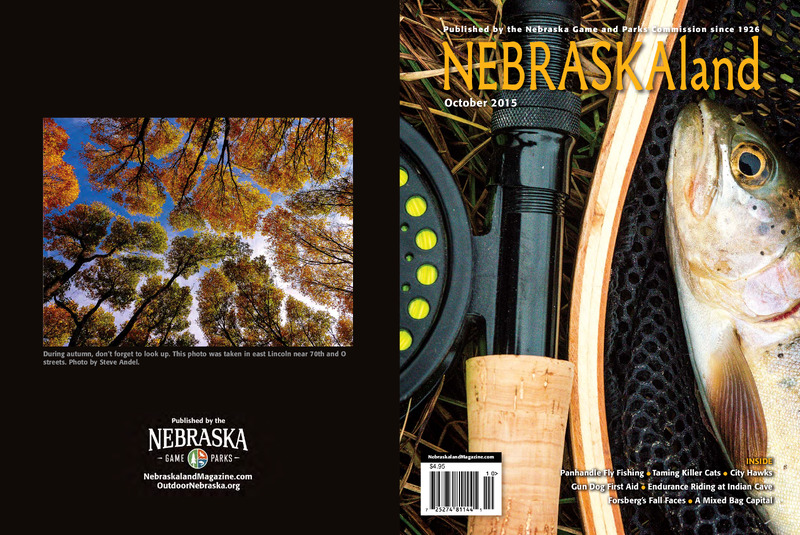
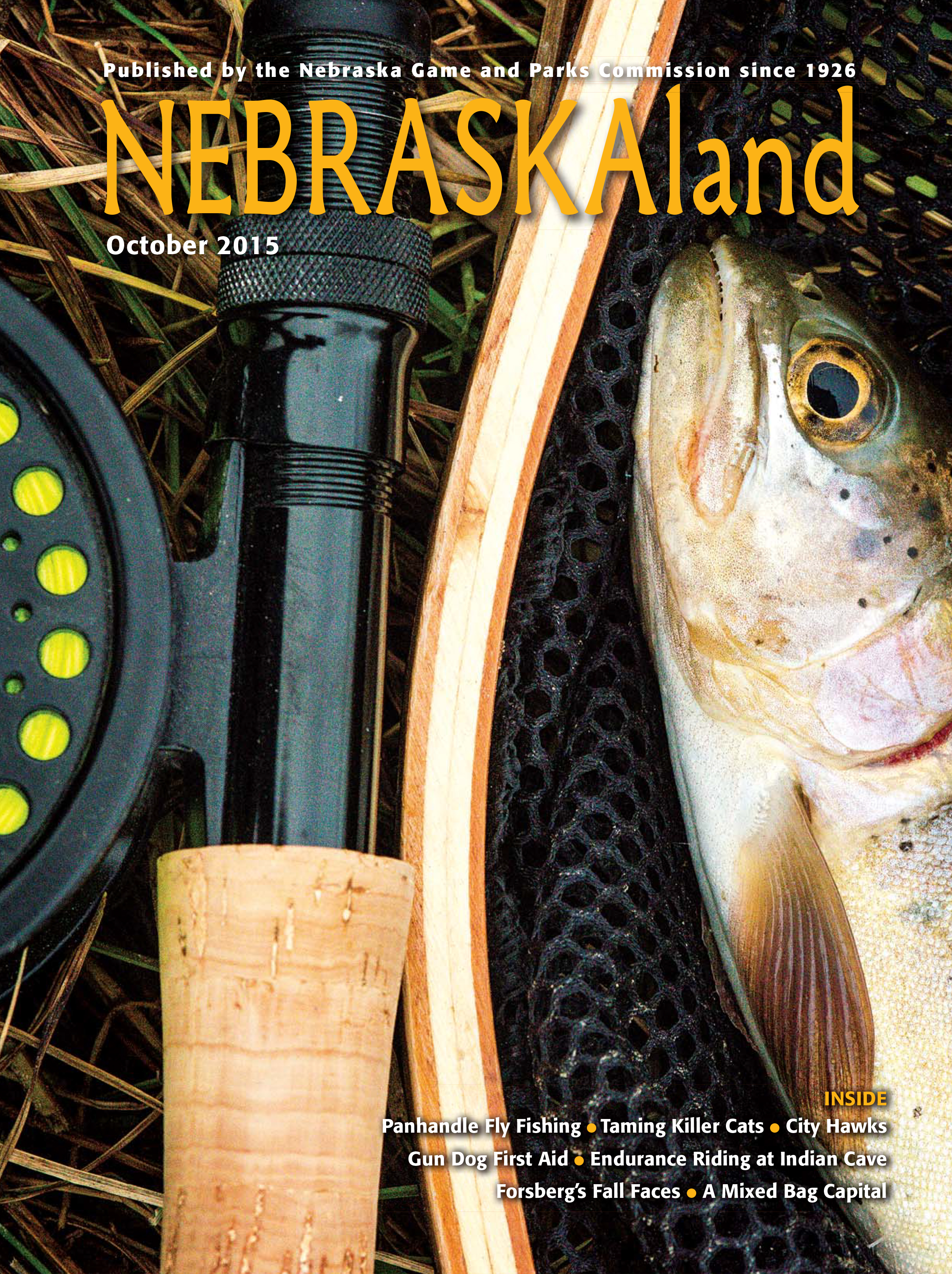
Publis hed by the Nebr a s k a Ga m e a nd Pa r k s C o m m is s ion si nc e 1926
NEBRASKAland
October 2015
During autumn, don’t forget to look up. This photo was taken in east Lincoln near 70th and O
streets. Photo by Steve Andel.
NebraskalandMagazine.com
$4.95
INSIDE
Panhandle Fly Fishing ● Taming Killer Cats ● City Hawks
Gun Dog First Aid ● Endurance Riding at Indian Cave
Forsberg’s Fall Faces ● A Mixed Bag Capital
NEBRASKAland Magazine
Volume 93
●
No. 8
●
October 2015
F EAT U R ES . . .
22 A Walk on the Beach – Big Alkali Lake
P
S
G
S
28 While it Lasts
S
P
E F
30 Gun Dog First Aid
S
P
J
N
36 What to Do with a Bird-eating Cat
B G
S
38 Fall's Wild Faces
P
S
M
F
42 Riding the Distance
HOTOS AND TORY BY
ERRY TEINAUER
TORY AND HOTO BY RIC OWLER
TORY AND HOTOS BY ENNY
Y
GUYEN
ERRY TEINAUER
HOTOS AND TORY BY
ICHAEL ORSBERG
STORY AND PHOTOS BY JENNY NGUYEN
46 City Hawks
P
S
A
52 Pine Ridge Streaming
HOTOS BY TEVE NDEL
46
●
STORY AND PHOTOS BY JUSTIN HAAG
I N S I D E T H I S I S S U E ...
Mixed Bag – Pronghorns, Travel to Hastings, A Birdman
at the Fair, Cowboy Trail, Pheasants and Quail Forecast,
Tree stand Safety, Upcoming Events and more ..............6
In the Field – The Mixed Bag Capital...................58
Portraits from the Past ..................................66
In the Kitchen – Crawfish Mac and Cheese ...........68
The Last Stop – Mating Monarchs ......................70
O N TH E W EB . . .
38
●
52
●
WHEN YOU SEE THIS SYMBOL IN THE PAGES OF
N
NEBRASKALAND MAGAZINE, VISIT
NEBRASKALANDMAGAZINE.COM AND VIEW OUR INTERACTIVE
DIGITAL EDITION FOR MORE INFORMATION.
D
Cover: Stockings of cutthroat trout at Open Fields and Waters
properties along the White River west of Fort Robinson State
Park have provided another unique opportunity for Nebraska
anglers. See the story on page 52. Photo by Justin Haag.
NEBRASKAland (VOL. 93 / NO. 8, ISSN 0028-1964) is published monthly, except
for the combined Jan./Feb. and Aug./Sept. issues, by the Nebraska Game and Parks
Commission, 2200 N. 33rd St., Lincoln, NE. Periodicals postage paid at Lincoln,
Nebraska, and additional mailing offices. POSTMASTER: Send address changes to
NEBRASKAland, P.O. Box 30370, Lincoln, NE 68503-0370.
2 NEBRASKAland • OCTOBER 2015
22
●
OCTOBER 2015 • NEBRASKAland 3
Olsen's Owls
From June until the first of August
we saw as many as six screech owls in
our backyard at one time. They have
since moved on, but we were thrilled to
have them for that time. We hope they
return in the future.
Jim Blake
Lincoln, Nebraska
S
Summer
Heat, 1936
H
I enjoyed
tthe article
aabout the
hheat of
1936. I
was born
on June 4,
1936. My mother always told me about
how hot it was when I was a baby. She
would lay me on the floor in front of
the screen door and wring a dish towel
out of cool water. As the breeze blew
through the wet towel, it kept me cool.
Faith Keil
Allen, Nebraska
Howard Greene of Sutherland submitted this photo of Snake River Falls in Cherry
County.
My Dream
Would you consider this cicada photo? It's in black and
white, but my goal is to have a photo in your magazine
sometime in my life!
Suz Swanson
Hastings, Nebraska
Correction: In Gerry Steinauer's
article "The American Plum" in the
Aug/Sept issue of NEBRASKAland
Magazine, Sherri Seifer's name, of
Rafter 7S Jellies, was misspelled.
Statement of ownership and monthly circulation of
NEBRASKAland Magazine
Owner and publisher: Nebraska Game and Parks
Commission
Editor: Jeff Kurrus
Headquarters of Publisher and Publication:
2200 N. 33rd St., Lincoln, NE 68503
Stockholders, Bondholders, Mortgage and
Security Holders: None
Average number of copies
of each issue during
preceding 12 months
Luke Meduna of North Platte
photographed this yucca on
June 22 on top of Mexican Canyon
Overlook in Fort Robinson State
Park. The Northern Lights can
be seen in the background.
Single issue
nearest to
filing date
A. Total Copies Printed
(net press run) ........................ 21,858 ........... 21,259
B. Paid Circulation
1. Single-copy sales ................. 2,174 ............. 2,190
2. Mail subscriptions ............... 18,446 ........... 18,057
C. Total Paid Circulation.............. 20,630 ........... 20,256
D. Free Distribution
by Mail ...................................... 2,472 ............. 1,228
D. Free Distribution
Outside the Mail .......................... 374 ................ 504
E. Total Free Distribution ................. 780 ................ 910
F. Total Distribution...................... 21,410 ........... 21,166
G. Copies Not Distributed ................ 448 .................. 93
H. Total ........................................ 21,858 ........... 21,259
I. Percent Paid and/or
Requested Circulation ................96% ............... 96%
Send your comments to:
Jeff Kurrus, Editor
NEBRASKAland Magazine
P.O. Box 30370
Lincoln, NE 68503
or e-mail Jeff.Kurrus@Nebraska.gov
Please include your postal address and telephone number. Letters may be condensed
and edited. Photographs are also welcome.
Any program that receives federal funding from the National Park
Service, or the United States Fish and Wildlife Service prohibits unlawful
discrimination on the basis of race, color, religion, age, gender, marital
status, national origin, age, disability or political affiliation. Any person
who believes he or she has been discriminated against in any program,
activity, facility, or service, should contact the Nebraska Game and
Parks Commission, Lincoln, NE 402-471-0641, the Equal Opportunity
Commission, Lincoln, NE 402-471-2024, TTY/TDD 402-471-4693;
United States Fish Wildlife Service, Civil Rights Coordinator, 4401
N. Fairfax Drive, Arlington, VA 22203; Director, Equal Opportunity
Program, U.S. Department of Interior, National Park Service, 1849 C
Street NW, Mail Code 0008, Washington, D.C. 20240-0001.
4 NEBRASKAland • OCTOBER 2015
NEBRASKAland Magazine
COMMISSIONERS
CONSERVATION OFFICERS
Director Jim Douglas
Commissioners
Chairman - Dr. Kent Forney, Lincoln
Vice Chairman - Rex Fisher, Omaha
2nd Vice Chairman - Mark Spurgin, Paxton
Robert Allen, Eustis
Dick Bell, Omaha
Lynn Berggren, Broken Bow
Mick Jensen, Blair
Norris Marshall, Kearney
Dr. Mark Pinkerton, Wilber
ADMINISTRATION (Lincoln)
Craig Stover (Administrator)
Duane Arp (Asst. Administrator)
Jeff Clauson (Asst. Administrator)
MAGAZINE STAFF
Communications Director Christy Rasmussen
Editor Jeff Kurrus
Art Director Tim Reigert
Associate Editor Jenny Nguyen
Regional Editors Eric Fowler, Julie Geiser,
Justin Haag
Contributing Editor Michael Forsberg
Regular Contributors Chris Helzer, Gerry
Steinauer
Photo Librarian Jaclyn Cruikshank Vogt
Circulation Donna Robinson
For address changes and questions about
your subscription, e-mail donna.robinson@
nebraska.gov or call 800-632-5263
Advertising Sales Manager
For advertising information contact
Shane G. Gilster, 402-742-0125
Email: shanegilster@gmail.com
NEBRASKAland Magazine Copyright 2014, all rights reserved.
NEBRASKAland is available in audio from the Nebraska Library
Commission Talking Book and Braille Service, Suite 120, 1200 N St.,
Lincoln, NE 68508. 800-742-7691. NEBRASKAland Magazine and the
Nebraska Game and Parks Commission reserve the right to reject any
advertising not in keeping with the agency mission.
Rates: $18 for one year; $33 for two years; $44 for three years. Nebraska
recipients must add appropriate sales tax. To subscribe call
1-800-NEBLAND (632-5263), or go online to: NebraskalandMagazine.
com.
COMMISSION
C
CO
COM
OM
MMIS
MIS
SSIO
S ON OFFICES
SI
OFFI
FF CES
FF
C S
Headquarters/Southeast District Office
2200 N. 33rd Street Lincoln, NE 68503
Phone 402-471-0641
Northeast District Office
2201 N. 13th St. Norfolk, NE 68701
Phone 402-370-3374
Southwest District Office
301 E. State Farm Rd. North Platte, NE 69101
Phone 308-535-8025
Northwest District Office
East Hwy. 2, Box 725 Alliance, NE 69301
Phone 308-763-2940
Bassett Office
524 Panzer St., Box 508 Bassett, NE 68714
Phone 402-684-2921
Kearney Office
1617 First Ave. Kearney, NE 68847
Phone 308-865-5310
Ak-Sar-Ben Aquarium
21502 W. Highway 31 Gretna, NE 68028
Phone 402-332-3901
Omaha Office
8495 Frederick Street, Omaha, NE 68124
Phone 402-595-2144
402-471-5531
402-471-5531
402-471-5531
NORTHWEST (Includes counties covered)
Jim Zimmerman (District Supt.)
308-641-6138
Sean McKeehan
(Cheyenne, Morrill, Box Butte)
308-279-9133
Scott Brandt
(Kimball, Banner, Scotts Bluff)
308-631-0663
308-760-3647
Greg Hesse (Sheridan, Dawes)
308-430-0572
Dan Kling (Sioux, Dawes)
Terry Brentzel (Deuel, Garden, Grant) 308-458-7650
402-389-0444
Frank Miller (Cherry, Hooker)
NORTHEAST (Includes counties covered)
Tom Zimmer (District Supt.)
402-649-8053
402-760-0712
Dale Davis (Keya Paha, Brown, Rock)
402-340-3981
Jonathan Andreasen (Holt, Boyd)
Mitch Johnson (Knox, Antelope, Pierce) 402-613-8612
402-762-5022
Jeff Jones (Knox, Cedar)
Alex Thomas
(Dixon, Dakota, N 1/2 Thurston)
402-241-7615
Jon Reeves
(S 1/2 Thurston, Burt, Washington)
402-889-8508
402-719-1108
Dan Roberts (Dodge, Colfax)
Cory Krause
(Cuming, Wayne, Stanton, Dodge)
402-380-6410
Steve Oberg
(Colfax, Platte, Madison, Stanton)
402-910-3366
Randy Pomplun
(Nance, Greeley, Wheeler, Boone)
308-550-0489
308-730-7050
Doug Pollard (Loup, Garfield, Valley)
SOUTHWEST (Includes counties covered)
Roger Thompson (District Supt.)
308-530-3097
308-202-0819
Matt Brandt (Sherman, Howard)
308-380-7331
Tim Williams (Hall, Hamilton, Merrick)
Pat George
(Clay, Adams, Nuckolls, Webster)
402-705-9989
308-920-0367
Rich Routh (Franklin, Harlan, Phelps)
Matt Andrews
(Gosper, Furnas, Frontier, Red Willow)
308-746-2418
Andrew Heyer (Dawson, Gosper, Phelps) 402-613-2241
Brian Piernicky
(Red Willow, Frontier, Hayes, Hitchcock)
308-340-6627
308-289-0427
Nicholas Fix (Keith, Perkins)
308-289-1169
Bryce Streger (Keith, Arthur)
Brandon O’Neal
(Lincoln, McPherson, Logan)
308-530-3157
Alex Hasenauer
(Lincoln, McPherson, Logan)
308-660-4671
308-440-3847
Dale Johnson (Kearney, Buffalo)
308-529-8146
Mike Thome (Dawson)
Ray Dierking (Custer, Thomas, Blaine) 308-870-0322
SOUTHEAST (Includes counties covered)
Levi Krause (District Supt.)
402-949-0593
402-619-1355
Rich Berggren (Douglas)
402-616-5961
Dan Evasco (Sarpy)
402-210-0888
Heath Packett (Cass)
402-209-1506
Russell Mort (Otoe, Johnson)
William Krause
(Nemaha, Richardson, Pawnee)
402-274-8063
402-806-9084
Dan Zuehlke (Gage, Saline)
402-890-6463
Dina Barta (Lancaster)
402-890-6465
Doug Kramer (Lancaster)
402-937-3422
Dudley Sorensen (Lancaster, York)
402-613-2312
Travis Shepler (Lancaster)
402-890-7140
Stacey Lewton (Lancaster, Seward)
402-443-6392
Mike Luben (Saunders, Butler, Polk)
Nebraska Wildlife Crimestoppers
1-800-742-7627
OCTOBER 2015 • NEBRASKAland 5
A Mammal Brief
Pronghorn
Although the fossil record indicates there were previously
many members of the Antilocapridae family, the pronghorn
is now the only living member. It is endemic to North
America and is found throughout the western United
States.
Pronghorns are known for their speed; they can reach
speeds of 60 mph when sprinting. They can maintain longdistance speeds of 40 mph. Although the cheetah is faster
when sprinting, it cannot match the pronghorn’s sustained
running stamina or speed. ■
Lindsay Rogers is an outdoor
education specialist with the
Nebraska Game and Parks
Commission.
6 NEBRASKAland • OCTOBER 2015
PHOTOS BY BOB GRIER (TOP) AND JUSTIN HAAG
By Lindsay Rogers
OCTOBER 2015 • NEBRASKAland 7
PHOTO
Travelogue Sponsors
R
E GEISE
BY JULI
By David Bristow
Hastings
Hastings
seum.
gs Mu
n
i
t
s
a
H
The
Y
SOCIETY RG2923-2-9
NEBRASKA STATE HISTORICAL
Hastings History
BY JIM H
EADLE
The L
Fridayarokr hosts live music
Saturday
nightos.n
PHOTO
ngg
he Navy probably isn’t the first thing
m
me
name
the
hear
you
when
of
think
you
yo
not immediately think of ships
might
you
And
”
ska.
Nebra
gs,
“Hastin
“H
n igloos
and sailors as you drive past the endless acres of funny earthe
II.
along Highway 6 — but they tell a naval story of World War
ided driving
You can see the remains of Hasting's war history on a self-gu
.org.
history
tour planned by the Adams County Historical Society, Adams
l and
Natura
of
m
The city’s top attraction, however, is the Hastings Museu
m
museu
ipal
Cultural History, which boasts of being the largest munic
between Chicago and Denver, Hastingsmuseum.org.
Many visitors come not for history but for sports. The Smith
host
Softball Complex and newly renovated Duncan (baseball) Field
l
schoo
many tournaments and is the current host of the state high
for
gs
softball tournament. Race and car enthusiasts come to Hastin
named
Motorsport Park Hastings (MPH), a 2.15-mile road course
,”
by Forbes Magazine as one of its “Best Places to Speed Legally
Racemph.com.
rants.
Downtown Hastings features a mix of local shops and restau
—
It’s a good place to park the car and go exploring on foot
s
something the city encourages with its fountains, bronze statue
e,
and historic buildings. The Back Alley Bakery is a local favorit
with fresh pizza and bread from its wood-fired brick oven. The
rt
Lark hosts live music with its popular Listening Room Conce
Series, Hastingsdowntown.com.
Kool-Aid Days is this town's largest extravaganza, with various
.
events planned over a 3-day schedule each year, Kool-aiddays
com. ■
War news from the Pacific had mostly been
bleak during the first half of 1942. Then came
reports of the stunning U.S. naval victory at
Midway on June 3-7. Just days later, on the
10th, the government announced plans for
what would become the nation’s largest naval
munitions plant. It would be built near Hastings.
It all happened quickly. The government
forced the sale of 49,000 acres of farmland;
construction began in July and was completed
early in 1943. For Hastings, which suffered
through years of declining population during the
newcomers
was both a bonanza and a headache. A flood of
Great Depression, the Naval Ammunition Depot
gouging
price
of
lained
ight. Some plant workers comp
resulted in a housing shortage. Rents doubled overn
s.
omer
their homes and welcome newc
and discrimination. Others saw the community open
0 military and civilian workers by the end of the
10,00
with
The depot itself was enormously productive,
erous
percent of the U.S. Navy’s munitions. It was dang
war. At one point it was producing more than 40
, killing
1944
15,
Sept.
ate explosions. The worst happened
work. Twenty-two people died there in four separ
d was
recor
safety
t's
depo
hundred miles away. Even so, the
at least nine and injuring 53. The blast was felt a
in 1966.
excellent by wartime standards. The plant closed
OCTOBER 2015 • NEBRASKAland 9
NSHS, RG3340-3-49
Above, Charles F. Walsh and his plane at Chadron, Sept. 13, 1911. Below, Walsh flying at Chadron same day.
A Brief History
A Birdman at the Fair
By Patricia C. Gaster,
Nebraska State Historical Society
10 NEBRASKAland • OCTOBER 2015
NSHS,
NSHS RG3340-3-50
RG3340
RG
3340-3-5
-3-50
3 50
T
he star attraction of the 1911 Dawes County Fair in
Chadron, Sept. 12-15, was the twice-daily exhibition
flights by barnstormer Charles F. Walsh (1877-1912),
a native of California. Walsh, flying a Curtiss biplane,
was advertised by the Chadron Journal on Sept. 15 to be
“the first aviator to make a flight in northwestern Nebraska.
Our skies are used to ducks and other birds but never before
have they had bird men going and coming as gracefully as
the eagle.”
Walsh experienced only a slight mechanical problem with
an engine switch during his flights at Chadron. But he wasn’t
so lucky at Kearney, where during a previous exhibition
flight on Aug. 4, the plane ran into a telephone wire and
crashed into a cottonwood tree. Walsh, unhurt, arranged for
another plane to be shipped to Kearney and on Aug. 9 made
six successful flights before a crowd of about 4,000 people.
From Kearney, Walsh traveled to Fremont where he ran
into legal difficulties after his exhibition flight’s emergency
landing damaged a farmer’s cornfield.
Shortly after his appearance at Chadron in midSeptember, Walsh was in Neligh, where “after the first
flight the machine was wrecked and the driver thrown out.”
Fortunately, the aviator wasn’t hurt. In October, Walsh made
exhibition flights in Beatrice at the Gage County Fair, Oct.
2-6, where he told the Beatrice Express on Oct. 5 that he had
been flying for a year and a half and that “there is very little
danger in a straight-away flight. It is cutting the fancy stunts
that has caused the death of so many of the birdmen.”
Walsh’s words now seem prophetic. His flying career
came to an abrupt end scarcely a year later, when
he plunged to his death on Oct. 3, 1912, during an
exhibition flight in Trenton, New Jersey. He was reportedly
attempting his crowd-pleasing “dip of death” stunt at the
time. ■
Visit the Nebraska State Historical Society’s website at
Nebraskahistory.org.
OCTOBER 2015 • NEBRASKAland 11
Paid Advertisement
12 NEBRASKAland • OCTOBER 2015
OCTOBER 2015 • NEBRASKAland 13
Ride the Cowboy Trail
by Horse
Nebraska Bird Library
By Jenny Nguyen
Song or calls: Song is series of warbling notes
that end in “zeee,” lacks musical trills and rolls.
Description: Adult male has brown cap and
brown upperparts; front of head, throat, breast and
rump are usually red but can vary from orange
to yellow; underparts are streaked with brown.
Females and juveniles are brown-streaked overall;
lack white facial markings.
Habitat: Open woods, river bottom thickets,
scrubby vegetation, ranchlands and residential
areas.
Where in Nebraska: Locally common
permanent resident in both eastern and western
Nebraska. Least common in the Sandhills.
Status: Eastern and western populations are
a result of rapid immigration into the state from
both directions during recent years. The entire
state will likely be colonized within a few years.
Fun Facts: House finches were originally
introduced in Long Island, New York, in 1940
where they flourished and have since spread all
over the United States. ■
To learn about more birds visit:
NebraskaBirdLibrary.org.
Schedule:
donation
Camping: East City Park, $10/night - full hookups, showers
Day 3 – Thursday, Oct. 15: Ainsworth to Bassett, 18.4 miles
Boarding: Bassett Livestock Barn, Free
Camping: Bassett City Park, Free - full hookups, showers
Day 4 – Friday, Oct. 16: Bassett to Stuart, 22.9 miles
Boarding: Stuart Rodeo Grounds, cost TBD
Camping: Stuart City Park, $10/night - full hookups,
showers
For more information, e-mail The Farm at Butterflat Creek
at lcstava@msn.com or jenny.nguyen@nebraska.gov. ■
PHOTO BY JEFF KURRUS
Travel Day – Monday, Oct. 12: Valentine
Boarding: Cherry County Fairgrounds, $15/night/horse
Camping: Valentine City Park, $5/night - showers, no
hookups
Day 1 – Tuesday, Oct. 13: Valentine to Wood Lake, 23.2 miles
Boarding: Mark Stoner's in Wood Lake, $15/night
Camping: Wood Lake City Park, Free - full hookups
Day 2 – Wednesday, Oct. 14: Wood Lake to Ainsworth, 21.5 miles
Boarding: Sandhills Animal Health Center, free-will
House Finch
PHOTOS BY JENNY NGUYEN
Challenge yourself and your horse on this four-day,
86-mile journey from Valentine to Stuart while experiencing
the beauty of northern Nebraska this October. We will travel
approximately 20 miles per day, and invite experienced
riders to join us for all or part of the trail.
Riders are responsible for their own horse(s), travel, board,
feed, trailering, tack and equipment, camping/hotel, food,
water, fees, etc. All horses must be Coggins tested and up-todate on vaccinations. Horses should be comfortable with
wooden bridge crossings and some traffic. Ride at your own
risk.
Sponsored by
y
Capturing the Historical Treasures of Nebraska
Through Your Lens
PHOTO BY ERIC FOWLER
By Kim Einspahr
From Adams to Antelope, Scottsbluff to Sheridan, Dundy
to Douglas – each of Nebraska’s 93 counties is home to
historic and hidden treasures from the past. Photographers
14 NEBRASKAland • OCTOBER 2015
are being called to submit original photographs for an
exhibit entitled “Bridges: Sharing Our Past to Enrich the
Future” that will serve as a bridge to link history, generations
and culture.
The call runs through Jan. 4, 2016
and is sponsored by the Hildegard
Center for the Arts, in partnership with
the Nebraska Tourism Commission
and the Nebraska State Historical
Society.
All submitted photos will become
part of a virtual exhibit, and selected
photos will be included in a statewide
traveling exhibit to celebrate Nebraska’s
Sesquicentennial in 2017, may appear
in Nebraska Tourism printed materials
and will be featured in a digital
catalog.
Judging will be conducted by
NEBRASKAland contributor Joel
Sartore, George Tuck and Steve and
Bobbie Olson. For details and to submit
photos, visit Hildegardcenter.org. ■
OCTOBER 2015 • NEBRASKAland 15
PHOTO BY JENNY NGUYEN
Pheasant and Quail
Increasing Statewide
By Justin Haag
Rejoice, pheasant hunters. The Game and Parks
Commission’s annual Upland Game Hunting Outlook
indicates Nebraska’s abundance of upland game is on
the rise.
Surveys and staff reports indicate that pheasant
populations are up in all areas of the state compared to
last year, with the southwestern and Panhandle regions
expected to provide the best hunting opportunities.
Relatively mild winter conditions and timely moisture
triggered gains in bird health and habitat. Not only have
birds had more cover this year, but lush conditions also
have brought about an abundance of insects for them to eat.
Pheasants aren’t the only game species thriving from the
improved conditions. Numbers are up for sharp-tailed grouse,
quail and cottontails, as they, too, have rebounded from
challenges posed by drought and severe winter weather
between 2009 and 2013.
Details may be found in the full report, which may be
found by searching “2015 Upland Game Hunting Outlook" at
OutdoorNebraska.org.
Send Us Your Trail Cam Photos!
My Photo Tip:
The Poor
Man's Remote
16 NEBRASKAland • OCTOBER 2015
PHOTO BY JUSTIN HAAG
By Justin Haag
My favorite time for landscape
photography is as I’m facing a rising or
setting sun. In order to get a sharp image
of the entire scene in low light, I place
the camera on a tripod with a small
aperture and slow shutter speed.
With the shutter open for several
seconds, any movement of the camera
can sabotage an image’s sharpness.
Even pushing the button can move the
camera enough to cause blur.
To combat this issue, I sometimes
follow the tried and true method of
plugging in a remote cable release. It
keeps your hands far from the camera
body and eliminates movement. For the
sake of convenience, though, I usually
find myself resorting to what fellow
NEBRASKAland staffers refer to as
“the poor man’s remote.” That is, the
self-timer.
Most DSLRs allow the timer to be
Hitler’s
Impact on the
Great Plains
Examined
adjusted, with a default of 30 seconds
or so in order for the photographer
to push the button and get situated
in a family photo. With one minor
adjustment, it also works great for
landscape photography. By setting the
timer to its fastest setting, two seconds
on my camera bodies, any movement
caused by my finger hitting the button
settles before the shutter opens. Also, at
two seconds, there’s little to no change
in the scene.
One of the only challenges for me
with this method is remembering to
change the camera back from self-timer
mode. It usually pops into mind at my
next location, as I’m pushing the button
and watching a fast moving animal
escape the frame during that twosecond delay. ■
Damon Shada captured a photo of these white-tailed deer on
private land north of Ainsworth.
Please submit your trail camera photos by e-mail to:
nebtrailcam@gmail.com. Also include any information that will
help explain your photo.
By Jeff Kurrus
In the 2015 winter edition of Great
Plains Quarterly, author Larkin Powell
writes that even though Hitler never
managed to bomb America, his war
with the United States and the world
made a lasting and
surprising impact onn
Nebraska wildlife.
The article servess
as a reminder of
the many historical
factors that continuee
to shape habitat
today. More
information can be
found at
Unl.edu/plains. ■
OCTOBER 2015 • NEBRASKAland 17
from NEBRASKAland‛s Trail Tales magazine for kids
Never Leave
the Field Early
Again
PHOTO BY JULIE GEISER
By Julie Geiser
Pocket gun cleaning kits are
recommended tools for every hunter.
They eliminate the need to leave the
field early when your gun barrel gets
clogged. Lightweight and compact, the
kits can fit inside a coat pocket or day
pack. They make cleaning snow, mud
or debris in the barrel simple, allowing
hunters to resume the hunt in minutes.
Pocket kits are a must for pistol and
rifle shooters or wing hunters; kits
come in multiple calibers and gauges
for rifles, handguns and shotguns and
are reasonably priced ranging from
around $13 on up. Homemade kits
should include memory-flex cleaning
rod(s) to fit your firearms, brass jags,
obstruction removers, T-handle, small
bottle of gun cleaning solution and oil,
brass patch holder, all caliber/gauge
patches, and brass bore brushes for
desired caliber/gauge sizes.
Most kit supplies have universal
A typical kit the author carries when she is out in the field hunting.
screw-on attachments. You can also
purchase stand-alone supplies at most
sporting goods stores to customize your
own kit.
Other items to add might include a
compact coated cleaning rod, cotton
swabs, folded cleaning cloth, compact
bore light, bore snakes, zip ties,
toothbrush cut to fit the container or
pouch, a small folding knife or multitool, lens cleaning cloth for optics and
a small flathead screwdriver.
Cleaning kit items can be stored
in small plastic containers, zippered
pouches sold at sporting goods or
department stores, or small plastic
bottles with a wide mouth like ketchup
or mayonnaise bottles. ■
More Public
Hunting Land Open
18 NEBRASKAland • OCTOBER 2015
PHOTO BY ERIC FOWLER
By Eric Fowler
Three new U.S. Army Corps of Engineers
properties covering nearly 1,000 acres on the
Missouri River floodplain in southeastern
Nebraska are now open for hunting, fishing,
hiking and bird watching.
The properties, acquired from willing sellers
under the Missouri River Recovery Program,
were mostly in crop production but were
prone to flooding. They will have a mixture of
early-succession plant communities associated
with flooding disturbance, including willows,
cottonwoods and a variety of early-successional
plants valued by wildlife. They also include
wetlands, but the amount of water in the sites will depend on
river stage and rain and snowfall.
Hunting opportunities include deer, dove, pheasant, quail,
rabbit, turkey and waterfowl. Only non-toxic shot is allowed.
One of the sites, Sonora Bend in Nemaha County, is
currently accessible only from the Missouri River. The
other two, Civil Bend in Cass County and Cottier Bend
in Richardson County, can be accessed from the river or
adjacent county roads.
For more on these and other Corps’ sites along the
Missouri River, go to Moriverrecovery.usace.army.mil and
click on the Maps tab.
Civil Bend USACE - Cass County; 3½ E, 1 S of Union;
381 acres in two separate tracts
Sonora Bend USACE - Nemaha County; 2 N of
Brownville; river access only; 190 acres
Cottier Bend USACE - Richardson County; ½ W, 6½ N of
Rulo; 388 acres. ■
OCTOBER 2015 • NEBRASKAland 19
Deer Stand Safety
by Jerry Kane
Contact the Nebraska Game and
Parks Commission at 402-471-0641 or
visit OutdoorNebraska.org for more
information. Visit HuntSafeNebraska.
org for a list of hunter education
classes and BoatSafeNebraska.org for
a list of boating safety classes.
September 24
Introduction to Trapping Workshop
October 3-4, 23-24
Pioneer Longrifle Rendezvous
October 17-18
Indian Cave SP, Shubert
October 21
Upland Game Hunting Workshop
October 3-5
Autumn Harvest Art Show
Eugene T. Mahoney State Park (SP),
Ashland
October 22
Waterfowl Hunting Workshop
Muzzleloader antelope hunting season
closes
Nebraska Game and Parks Outdoor
Education Center, Lincoln
October 4, 11, 18, 25
Living History
October 23
Arbor Lodge SHP, Nebraska City
October 6, 20
Ladies Day at the Range
September 26
Nebraska Game and Parks Outdoor
Education Center, Lincoln
September 26
Public land antlerless elk hunting
season opens
Nebraska Game and Parks Outdoor
Education Center, Lincoln
October 4
Nebraska Game and Parks Outdoor
Education Center, Lincoln
Firearm bull elk hunting season opens
Youth waterfowl hunting season in Zone 3
Nebraska Game and Parks Board of
Commissioners meeting, Fairbury
October 24
Duck and coot hunting seasons open in
Zone 3
October 24-25
October 9
Trick or Treat at the Town
DeSoto October muzzleloader deer
season
October 24-25
October 9-18
German Short Hair Dog Trials
Youth pheasant, quail and partridge
hunting season
Fort Robinson SP, Crawford
October 25
Pressey Wildlife Management Area,
Oconto
October 10
Howl in the Hills Night Hike
Archery and firearm bull elk hunting
seasons close
September 26-27
Centennial Bass Club Tournament
Wildcat Hills Nature Center, Gering
October 25
Lake McConaughy State Recreation
Area, Ogallala
October 10
Duck and coot hunting seasons open in
Zone 1
Private land and public land antlerless
elk hunting seasons close
Crow hunting season opens statewide
October 10, 16, 17, 23, 24
Haunted Hollow Hayrack Rides
October 1-31
Indian Cave SP, Shubert
Paddlefish snagging season
October 10, 17
Hallowfest Ponca SP, Ponca
October 2-4
Becoming an Outdoors-Woman
Workshop
Nebraska National Forest, Halsey
October 3
Dark goose hunting season opens in
North Central Unit
October 3
Light goose hunting regular season
opens
October 3
White-fronted goose hunting season
opens
October 3
Duck and coot hunting seasons open in
Zones 2 and 4
October 3-4
Youth waterfowl hunting season in
Zone 1
October 3-4
Living History Weekend
Fort Atkinson State Historical Park
(SHP), Fort Calhoun
October 3-4
Historic Firearms Display
Fort Hartsuff SHP, Burwell
20 NEBRASKAland • OCTOBER 2015
October 27
Deer Hunting Workshop
Nebraska Game and Parks Outdoor
Education Center, Lincoln
October 28
Dark goose hunting season opens
in East, Platte River, Panhandle and
Niobrara Units
October 10, 17, 24
Halloween Decorating and Costume October 28
Contests
Deer Hunting Workshop
Indian Cave SP, Shubert
Ak-Sar-Ben Aquarium, Gretna
October 10-25
October 29
Deer Hunting Workshop
Firearm antelope hunting season
October 11
Family Rendezvous
Platte River SP, Louisville
Chadron State College, Chadron
October 30
Deer Hunting Workshop
October 12
Columbus Day
NGPC District Office, North Platte
Game and Parks offices closed;
Nebraska Game and Parks Outdoor
Education Center is open
Dove (all species) hunting season
closes
October 15
Introduction to Trapping Workshop
Nebraska Game and Parks Outdoor
Education Center, Lincoln
October 17
Living History
Rock Creek Station SHP, Fairbury
October 17
Pumpkin Carvers
Calamus SRA, Burwell
October 30
October 31
Eurasian collared-dove only hunting
season opens
October 31
Pheasant, quail and partridge hunting
seasons open
October 31
Raccoon and Virginia opossum hunting
seasons close
October 31
Bullfrog season closes
PHOTO
PHOT
O BY JEF
JEFF
F KURRUS
KURRUS
Indian Cave SP, Shubert
September 26
Nebraska Youth Smallbore
Silhouette Invitational
October 1
NEBRASKAland
and
Visitor
By Jeff Kurrus
According to the Tree Stand Manufacturers Association, 82 percent of hunters
who fall from tree stands are not wearing full body harnesses, and falls from a
tree stand are the leading cause of injuries during the gun deer season, according
to studies in both Wisconsin and Ohio. But don't wait until firearm season to
begin wearing a full body harness. Start now, and visit Tmastands.com for more
information on staying safe when you're off the ground during deer season. ■
This photo was taken from 20 feet up in a climbing stand on the private land of Chris
Polenz in Sarpy County. Neither you nor I can survive this fall, so wear a full-body
safety harness anytime you are hunting off the ground in any capacity.
Wish I Was Fishing...
W
By Sarah
S
Kocher
For most fisherfolk, there are only two types of days: days
F
when we’re fishing, and days when we wish we’re fishing.
wh
Fortunately, Rich Tosches’s book, Zipping My Fly: Moments
Fo
in the Life of an American Sportsman, has provided an
aadequate alternative for the latter.
Zipping My Fly sweeps the reader through anecdotes
based on Tosches’s many fly-fishing adventures. The
stories, elaborate in themselves, border on fantastical
when touched with Tosches’s humor. Half his comedy gets its charm
ffrom its
it repetition;
titi
his
hi one-liners make you feel as though you can see Tosches
sitting at his computer, giggling to himself as he types about Monica Lewinsky
and the breeding habits of sheep (and, of course, fly-fishing). This is paired with
humor so ridiculous, you’re laughing at the surprise of its randomness as much as
the punchline.
The stories themselves also encompass a pleasing variety, excellent for all
who already enjoy or would like to learn more about the many aspects of the
sport: tying flies, international fishing trips, tournaments, the sport’s challengess –
including, but not limited to, aggressive cows – and, among other things, hooking
kin
ng
your own ears with your fly rod.
Tosches nails the delicate balance between encouraging his readers to keep
turning pages and to get outdoors themselves (hooking ears not recommended.)) ■
Last issue’s winner of
the Visitor drawing was
Wayne Cross of Madison, Nebraska,
who found the firefly on page 29.
Readers are encouraged to contact
NEBRASKAland within 10 days
after this issue’s publication with
the correct page number and name
of this issue’s “Visitor” – a critter
found in Nebraska. We will then
gather the correct entries and draw
one to win a NEBRASKAland mug.
To enter each month, write:
NEBRASKAland Visitor
2200 North 33rd Street,
Lincoln, NE 68503.
Or e-mail:
Tim.Reigert@Nebraska.gov
with “Visitor” in the subject line of
the message.
HINT: This issue’s visitor is not on
pages 4, 12, 21, 53, or 70.
The Eastern firefly (Photinus
pyralis) is common in Nebraska,
and relatively large, with adults
approximately ½-inch in length.
Its head is protected by the
reddish-yellow pronotum, with a
black spot in the center. Its wings
are concealed by pliable black
wing covers, unlike most beetles
which have hard wings covers.
Fireflies are active mostly at night,
when you’ll see their flashes of
light on a summer evening. But
does that light also make them a
target for predators? The answer
is no; in fact, just the opposite.
Fireflies contain chemicals that
taste bitter and may even be
poisonous to predators. Their
lights act similarly to bright
coloration, warning hungry birds
and spiders that a firefly is not
a tasty treat. Should a firefly be
attacked, it can release drops of
blood,
bl od,
bloo
d known
kno
know
k
as reflex bleeding,
to deter
deet the predator,
which
whiic quickly learns to
look
look
lookk
lo elsewhere.
Spe
Special
ec thanks to Julie Van Meter,
S
State
Entomologist, Nebraska
Department of Agriculture.
Photo from Thinkstock.
OCTOBER
OC
OCTOBE
CTOBE
ER 2015 • NEBRASKAland 21
A Walk on the Beach
Big Alkali Lake
Photos and story by Gerry Steinauer
A
friend and I traditionally hunt grouse in early October on
the remote Valentine National Wildlife Refuge located in the
heart of the Cherry County Sandhills. We stay nearby at the
Game Commission’s quaint Alkali Fish Camp nestled on the shore
of Big Alkali Lake. Mornings before our mid-day hunts and evenings
following, I often walk the beach, enjoying the Sandhills autumn.
Last year, Big Alkali’s waters were low, exposing a wide, vegetated
shoreline. Most plants, including scattered willows and cottonwoods
hugging the high-water line, were ablaze in yellow, though the
abundant bulrushes remained green, harvesting the last rays of the
lowering sun. Above the beach, the endless, grassy dunes were frosthardened a rustic red.
On most outings, the only sounds were the wind rattling leaves
and the unceasing, gentle lapping of waves. The chatter of summer
birds had long faded, but not all had abandoned the beach to the
coming chill. Occasionally, dull-colored sparrows darted about the
rushes and southbound shorebirds and waterfowl had recently left
long-toed impressions in the wet shoreline sand. Tracks also told of
the midnight wanderings of several raccoons, a doe and fawn deer
and a lone coyote. Soon Big Alkali’s waters would ice over, silence
the waves and leave only the sound of the wind. ■
22 NEBRASKAland • OCTOBER 2015
The October sun sets over Big Alkali Lake. The 823-acre lake
reaches nearly 12 feet in depth, placing it among the deepest
of Sandhill lakes.
OCTOBER 2015 • NEBRASKAland 23
ABOVE: Hardstem bulrush is
abundant in the shallows of
Big Alkali. A hard sand bottom,
moderate alkalinity, and the
presence of invasive carp allow few
species of aquatic plants to survive
in the lake.
RIGHT: A first year rosette of
fourpoint evening-primrose grows
prostrate on the loose, dry sands
of the upper beach. This beautiful,
yellow-flowered biennial is found
in sandy habitats over much of the
state.
OPPOSITE: Hardstem bulrush
remains green well into autumn,
harvesting the last rays of the
lowering sun.
24 NEBRASKAland • OCTOBER 2015
OCTOBER 2015 • NEBRASKAland 25
ABOVE: The tracks of a foraging
raccoon wander along the wet
shoreline sands.
LEFT: Brisk fall winds rustle the
stems of common reed. Stands of
this native grass often reach 12 feet
in height. The introduced European
variety of the plant is an aggressive
invader of sandbars and wetlands in
the state.
OPPOSITE: A summer nest, possibly
that of a red-winged blackbird,
lingers among decaying rushes.
26 NEBRASKAland • OCTOBER 2015
OCTOBER 2015 • NEBRASKAland 27
While It Lasts
The Colors of Fall
By Eric Fowler
T
he stroke of the paintbrush starts in the northwestern corner of
Nebraska, near Fort Robinson State Park, and sweeps across the
state to Indian Cave, turning the green leaves of summer hues of
yellow, red, orange and purple.
It starts with the sumac, which turns a fiery red in some years
even before September arrives. Vines in the understory are
next, with Virginia creeper and wild grape turning shades of
red. By mid-September, green ash is ablaze in yellow. When
October comes, yellow has begun flowing from west to east in
the cottonwoods that tower above the rivers. By the middle of
28 NEBRASKAland • OCTOBER 2015
the month, burr oaks along the forested bluffs of the Platte and
Missouri rivers in eastern Nebraska have begun to turn dusty
brown, with red and black oaks adding spots of red.
Mother Nature’s painting may be more vibrant one year
than the next. If she so chooses, it might remain on display into
November. Or she might send a chill down from the north, erasing
the color and leaving the slate clean for the year to come.
Enjoy fall while it lasts. It’s never long enough. ■
OCTOBER 2015 • NEBRASKAland 29
Gun Dog First Aid
Story and photos by Jenny Nguyen
In case your four-legged hunting partner
gets injured in the field.
H
unting dogs are a special group. They love the hunt
just as much as their masters, and they are family
just as much as they are working partners. Energetic,
athletic and brave, with hearts as true as steel, good gun
dogs will stay quietly by your side in the duck blind, run
twice the distance you do in the field and retrieve the last
bird of the day with as much fervor as the first.
However, the outdoors does have its hazards. From minor
cuts to more serious injuries, be prepared when your fourlegged hunting companion goes down.
Bleeding
Many injuries in the field will involve some form of
bleeding. Most are superficial and will require little more
than direct pressure and a bandage, but heavy bleeding can
be unnerving. If this occurs, stay calm and attempt to stop
the bleeding on site.
Field Treatment
There are two types of bleeding: arterial and venous.
Arterial bleeding is “usually more forceful, bright red, and
pulsating; it will be going away from the heart. Venous
bleeding will be more constant, bluish and going toward the
heart,” said Dr. Randy Acker in his book Field Guide to Dog
First Aid.
Superficial Wounds – For superficial wounds, apply
direct pressure over the wound with a clean cloth or
gauze sponges until bleeding stops, then flush wound with
an antiseptic cleanser such as saline solution or diluted
chlorhexidine; sterile water is also an option. Bandage with
more gauze sponges, or non-stick Telfa pad, and then apply
vet wrap or first-aid tape. Bleeding should stop within five
minutes under normal circumstances. For large cuts that
require stapling, see “Cuts from Barbed Wire.”
Forceful Bleeding – For more forceful bleeding, apply
pressure above the wound (toward the heart) for arterial
bleeding, and apply pressure below the wound for venous.
When the wound stops bleeding, flush it out with sterile
water or antiseptic solution. Then bandage with gauze or
Telfa pad and then vet wrap. See a veterinarian immediately.
Uncontrolled Bleeding – If you have the sinking feeling
that a wound will not stop bleeding,
apply pressure while the dog is
immediately transported to the nearest
veterinarian. An extra set of hands will
help here.
Cuts from
Barbed Wire
These cuts are common when hunting
in the Midwest. Without thinking, a dog
may run right through a fence to chase
game. Cuts vary from small nicks to
larger lacerations that need immediate
attention. While hunting near barbed
wire, be sure to keep a close eye on your
dog and check for cuts regularly.
Lacerated ear margins can bleed profusely due to high blood vessel density. A
styptic pencil can be used to quickly clot small wounds.
30 NEBRASKAland • OCTOBER 2015
Field Treatment
Body – Small cuts are simply treated
with antibiotic ointment, gauze and
bandage, while larger cuts may require
a skin stapler – a must-have tool for
sportsmen who like to hunt with their
dogs in remote areas. When you’re miles
Sandburs can cause skin irritation and infection. Carry a metal comb in your first-aid kit to remove them from your dog’s hair.
First-Aid Kit Essentials
W
ork with your veterinarian to customize a
first-aid kit that is right for your dog and your
style of hunting. Here are some items that you may
want to have in your kit:
Instruments: hemostat/needle nose pliers, thumb
forceps/tweezers, scissors, toenail clippers,
thermometer, skin stapler, metal comb
Cleansers and Antibiotics: antiseptic solution
(saline or diluted chlorhexidine), eyewash (saline
solution), eye ointment, antibiotic ointment
Dressing/Bandages: gauze pads/rolls, cast
padding, nonstick pads (Telfa), first-aid waterproof
adhesive tape, vet wrap, elastic wrap (Elastikon)
Other Items: muzzle, medical gloves, anesthetic
for wound suturing (Lidocaine) and hypodermic
needles, anesthetic for eyes (proparacaine drops),
newspaper/magazine for splinting, antihistamine for
insect bites/stings and weed allergies ■
OCTOBER 2015 • NEBRASKAland 31
Muzzled Dogs Can’t Bite
A
dog in pain and fear may bite, no matter
how much he or she loves you. When
treating an injury that may cause high levels of
discomfort to your dog, such as bandaging a
broken leg or skin stapling, it is a good idea to
apply a muzzle. Carry a store-bought muzzle
inside your first-aid kit or apply a make-shift
muzzle using a string or shoelace.
To make a muzzle, cautiously lay a string or
shoelace on the bridge of the dog’s nose. Tie
an overhand knot underneath the nose then
bring both ends of the string behind the neck
and tie together. ■
and miles away from the nearest veterinarian and your dog
has a large laceration that is susceptible to infection, a skin
stapler is an easy, effective way to close large cuts without
messing with a needle and thread.
First, make sure severe bleeding has stopped (see
“Bleeding”), and then clean the wound. If necessary, muzzle
your dog and inject local anesthesia (Lidocaine) around the
edges of the wound with a small, 25-gauge needle. Point
the arrow of the stapler the same way the cut is running and
press, placing staples one-quarter inch apart. Staples should
stay in for two weeks to allow for healing before removal
by a veterinarian or with a skin staple remover tool. If you
suspect that the laceration is more severe than skin deep, see
a veterinarian immediately, who may reopen the wound for
closer examination.
Lacerated Ear Margins – Ear flaps can bleed due to a
variety of reasons: excessive scratching, barbed wire or even
fights with another dog. Because dogs’ ears have so many
blood vessels, they can bleed profusely when cut. Dogs also
32 NEBRASKAland • OCTOBER 2015
tend to shake their heads and scratch when irritation occurs,
which prevents the wound from clotting correctly. To treat
a bleeding ear in the field, dog trainer and hunt guide Aaron
Schroder at Pheasant Bonanza carries a styptic pencil in his
first-aid kit. The styptic pencil is rubbed onto the wound to
promote clotting. Cold water or ice and pressure work, too.
Once bleeding stops, flush the wound with sterile water
or antiseptic solution. To prevent the wound from opening
up again due to head shaking or scratching, cut a sock so
that it fits over the injured ear. Tape the sock in place and
then wrap the entire ear to the dog’s head with vet wrap. An
Elizabethan collar may be used at home to prevent the dog
from pulling off the bandage.
Foot and Pad Injuries
A cut foot pad is a common injury that comes with
hunting. Thorns, sandburs, cactus, loose barbed wire, glass,
and trash are all things that can cut up a dog’s feet. While
running, dogs may also catch their nails on plant matter,
resulting in torn or damaged nails. These injuries are
typically not serious.
Field Treatment
Foot Pad – Examine the affected area carefully and
remove any foreign objects with a hemostat or needle nose
pliers. Clean wound with antiseptic solution and apply
antibiotic salve. For larger cuts, bandage the foot with the
following layers: Telfa pad over the actual wound, then
wrap leg in a figure eight pattern with cast padding, and then
stretchy tape (Elastikon) to keep everything in place. Wrap
again with waterproof adhesive white tape for extra support,
especially to hold splints (see sidebar page 35). Wrap should
be snug, but not so tight that it cuts off circulation.
If a foreign object has broken off inside the pad,
pain, swelling, redness and lameness will persist. See a
veterinarian as soon as possible to prevent tetanus.
Nails – Torn or severely damaged nails should be removed
to prevent infection. Before you begin, muzzle your dog.
Then grasp nail firmly with needle nose pliers or a hemostat
and pull out the entire nail in a quick, forceful motion.
Stop any bleeding with a styptic pencil. Wash out toe with
antiseptic solution and bandage. Nail injuries usually heal
quickly and extracted nails usually grow back. Try to keep
nails trimmed at all times to avoid damage throughout the
hunting season.
If you cannot extract the entire nail, trim the nail as short
as possible in a 45 degree angle, but avoid cutting into
the quick (live part of the nail). Bandage the foot to avoid
further damage and infection.
Foxtails and Sandburs
As unimposing as they seem, foxtail seeds can pose many
problems to gun dogs. As these seeds dry in late summer and
fall, the seed heads fall off the plant and break into smaller
segments. One look under a magnifying glass will show you
tiny barbs on the bristles. These seeds can make their way
between a dog’s toes, inside the eyes, ears and nose, and can
cause infection if not treated.
Sandburs are common in parts of
Nebraska, and can be especially bothersome
to dogs with longer hair. Not only do they
stick to fur like magnets, they also can cause
skin irritation and infection. Some dog
owners will choose to clip their dog’s hair
before hunting season.
Field Treatment
Feet – Check your dog’s feet after
every hunt. Look for redness and swelling
between the toes, often draining with puss
and frequent licking by your dog, indicating
that a foxtail seed may have lodged inside.
Seeds may be difficult to locate, and probing
may cause your dog pain – muzzle your
dog before investigating. If the seed is deep,
break through the abscess with a hemostat
and remove the seed. Apply antiseptic.
Wounds should heal within three days.
Eyes – While a dog is running through the
field, a foxtail seed may get stuck behind the
dog’s third eyelid, indicated by excessive
blinking and pawing. If untreated, this can
lead to a corneal ulcer. If you can easily see
Flotation vests for waterfowl dogs provide extra warmth, buoyancy and chest
the seed and it has not penetrated the cornea,
protection while hunting in cold, open water.
carefully remove the seed with tweezers or
a moistened Q-tip. If handy, proparacaine
sometimes with hair inside the wound. With tweezers,
anesthetic drops will deaden eye tissues for easier access
remove hair from the wound and remove the pellet if
to the foreign object, stop pain and help decrease pawing.
possible. Wash out the wound and apply antibiotic ointment.
Finally, use a saline solution to wash out the eye. For objects If you can’t find the pellet or want to ensure that you didn’t
buried deep inside the eye, do not attempt to remove them.
miss any, have your dog x-rayed.
See a veterinarian immediately.
Ears – Symptoms include shaking of the head, scratching
of the ear and head tilting. If you can see the seed, remove
it with your fingers or tweezers. If you can’t see it, see a
Though rare, drowning may occur while waterfowl
veterinarian to avoid damage to the eardrum.
hunting. Unusually cold water, inclement weather and
Nose – A foxtail seed that has made its way into a dog’s
fatigue can cause drowning in hunting dogs. Use good
nose will cause violent sneezing. If not removed, it can
judgement – consider the weather, the water temperature,
cause bleeding and infection. If you can see the seed, pull it
water depth, your dog’s physical limitations and the distance
out with tweezers. If you do not, see a veterinarian. General
of the retrieve. Sometimes, an excited dog will jump in
anesthesia may be required.
the water and try for a long retrieve that is unsafe. Sleet,
Hair – Examine your dog carefully, especially under
snow and wind – weather that is characteristic of waterfowl
the legs and abdomen. Carry a heavy-duty metal comb
hunting – do not help the situation. If your gut says no, call
to remove sandburs from your dog’s hair. For stubborn
back your dog immediately.
sandburs, use a detangler or cooking oil to help release the
burs.
Field Treatment
Cardiopulmonary resuscitation (CPR) should be performed
on a dog that is not breathing and has no heartbeat. To
check for heartbeat, lay the dog on its right side and feel for
Occasionally, hunting dogs may be sprayed by gunshot
the heartbeat under the chest behind the left elbow. Before
pellets. Whether by careless shooting, not waiting for the
performing CPR, check for and remove any obstructions in
bird to flush high enough or freak accident, “instances
the dog’s mouth. If no heartbeat is detected, close the dog’s
of long-range peppering by shotgun are usually not
mouth and breathe into the nostrils until you see the chest
emergencies,” Acker said, unless the injury involves the
rise. Then perform four chest compressions over the heart
eyes. In extreme cases, pellets may penetrate through the
area. Repeat one breath to four chest compressions “15 times
per minute until dog regains consciousness or until five
abdomen and cause peritonitis.
minutes have gone by,” Acker said.
Some hunters use flotation vests on their dogs. These vests
Field Treatment
are often made with neoprene that provides insulation and
Look for holes in the skin with bruising around them,
Drowning
Gunshot Wounds
OCTOBER 2015 • NEBRASKAland 33
Porcupine Quills
An excited dog will throw caution to the wind. I’ve seen it
once while fox hunting – hounds will glue their noses to the
ground and unknowingly barge in too closely to a startled
porcupine. A few quills here and there are generally not an
emergency, but many in the dog’s mouth or eyes can be. In
this case, the immediate attention of a veterinarian is needed,
who may administer anesthesia to remove the quills.
Field Treatment
If only a few quills have penetrated the skin, these can
be removed in the field with a hemostat or needle nose
pliers. With an excited dog, restrain its legs with duct tape
or rope, and if needed, force its mouth open with a stick or
belt held horizontally to the back of the mouth. Hold down
the skin with your other hand and pull out the quill firmly
with pliers, but try not to break any quills. Broken quills are
difficult to locate and can also migrate to other parts of the
dog’s body, causing infection. Do not remove any quills that
have penetrated a dog’s eyes; see a veterinarian as soon as
possible.
Hypoglycemia
Top: Offer hunting dogs plenty of water and shade to prevent
dehydration and heat stroke in warm weather.
Left: Remove porcupine quills with needle nose pliers or
hemostat. If your dog has been severely hit with more than just
a few quills, see a veterinarian.
buoyancy to assist hunting dogs on long retrieves and extra
cold days on open water. Additionally, they can provide
chest and belly protection to sharp objects, snags and tree
limbs in the water. Vests can be especially helpful to older
dogs.
Heat Stroke
Early season hunting typically occurs in warm weather,
beginning in August and early September. Though highly
preventable, heat stroke can hit a dog quickly, leading to
damage of internal organs and even death. Hunters who
train their dogs in the summer should also be extra careful.
Field Treatment
To prevent heat stroke, make sure your dog is wellconditioned. Rest or rotate dogs regularly and provide
water and shade.
Signs of heatstroke include “rapid, noisy breathing;
salivation; possible vomiting; dog is down and unable to
get up; may be comatose; high body temperature (104-107
degrees) and staggering,” Acker said. If heat stroke occurs,
cool down dog immediately with cool water, such as placing
the dog in a lake or stream. Or, place the dog in front of an
air conditioner or fan for at least 10 minutes.
34 NEBRASKAland • OCTOBER 2015
Hypoglycemia is the condition of critically low blood
sugar and may occur in humans and dogs. In anticipation
for the hunt, many dogs will not eat. They will hunt hard
and then get low blood sugar. Blood sugar, or glucose, is
the body’s main source of energy. Low levels will result in
decreased energy and possibly loss of consciousness.
Field Treatment
“Dogs will stagger and look like they are going to
seizure,” said Dr. Kent Forney, a Nebraska Game and Parks
Commissioner who owns the Nebraska Animal Medical
Center in Lincoln.
Try to get your pet to eat, especially before a hunt. “I
get up about 4 a.m. to feed my dogs and go back to bed,”
Forney said. “Then at lunch I give them something they will
eat, usually a can of food. This gives them the energy they
need.”
Dr. Melissa Heithold of the Wayne Veterinary Clinic
suggests: “Carry corn syrup or honey packets. If the dog is
unable to take a meal, apply syrup or honey to the gums,”
and it will get absorbed.
Words from a Veterinarian
“An ounce of prevention is worth a pound of care,” Forney
said. “Work with your dog every day so they are ready for
hunting. Then once you are done with the hunt, the dog
comes first. Wipe them down with a towel, look in their eyes
for weed seeds. Check the chest and abdomen for cuts. Check
the feet. Feed them and give them water. Give them a clean
dry bed. Then have a drink. Never before.” ■
Special thanks to Dr. Melissa Heithold and Nebraska
Game and Parks Commissioners Dr. Kent Forney and
Dr. Mark Pinkerton for their expertise.
Bandaging a Paw
T
he foot bandage is a must-know technique
for gun dog owners. Use it to treat injury to
foot pads, laceration on the legs, fractured limbs
and to prevent infection. Before bandaging a
foot, make sure bleeding has stopped. Flush the
wound with sterile water or antiseptic wash and
then apply antibiotic ointment. Bandage should
be snug, but not so tight that it cuts off circulation.
Replace bandage if it begins to smell or becomes
wet.
Supplies:
Telfa Pads – Non-stick padding over the wound
to promote healing.
Cast Padding – Provides even pressure over
wound to prevent further bleeding.
Elastikon – Stretchy tape to keep padding in
place. Very sticky – use sufficient cast padding
underneath to minimize contact to fur.
First-Aid Medical Tape – Adhesive tape that
provides support for splints and water protection.
Splint Materials – Use sticks or a rolled-up
newspaper or magazine.
Directions:
Clean wound
3rd layer:
White
and apply
Tape
Telfa pad
directly over
the wound.
Wrap the
leg with cast
2nd layer:
Elastic
padding in a
1st layer:
Tape
figure-eight
Padding
pattern; an
extra thick
layer of cotton
1
should be
2
applied for
5
fractures.
end
3
Then wrap
Elastikon
4
over the cast
padding in
Foot Bandage Wrap Sequence
the same
pattern. If
a fracture is present, use white tape to apply a
stick on both sides of the leg so that they cover
a joint above the fracture and a joint below the
fracture for support. If no sticks are present, as
may be the case when hunting in open grassland,
carry newspaper or a magazine. The size of the
bandage, or how far you wrap up the leg, will
depend on the injury. ■
OCTOBER 2015 • NEBRASKAland 35
What to Do With a
Bird-eating Cat
Story and photos by Gerry Steinauer, botanist
I
t was four summers ago, and I
would see him in our garden or
sitting on the wood pile, always
slinking away as I approached. I
told my wife Grace about the stray
cat hanging around. Then one day,
while Grace was in the backyard, the
stray approached her and she petted
him. Seeing that he was half-starved and
sickly, she fed him and that cinched it.
His new hangout was our back porch.
He was neutered and declawed; certainly this was someone’s pet, either
lost or abandoned. Our plan was to
36 NEBRASKAland • OCTOBER 2015
in our garage and his days are spent
roaming the neighborhood, lounging in
the sun, and doing other cat things.
As for his other issue, he is a natural
born killer, his hunting skills likely
honed while fending for himself as
a stray. The dead mice left on our
back porch did not bother me, nor the
deceased rabbits and squirrels. The
local rabbit colony often browsed my
young beets and bean sprouts to the
ground, and the dang squirrels have the
bad habit of snatching the nearly ripe
pears from our tree. The population
of both could stand a little thinning. It
was the piles of feathers he left on the
porch that bothered me.
The cat wasn’t killing the pesky
non-native house sparrows, European
starlings or Eurasian collared-doves.
No, KR was knocking off cool native
birds – American robins, a cedar
waxwing, a brown creeper, a whitecrowned sparrow or two. I feared his
list of species killed would soon top my
life list of birds observed. The carnage
peaked in spring when migrants were
passing through, the resident birds were
distracted with mating and nesting and
defenseless fledglings were about.
His murdering came to a head one
day two winters ago when our friend
Jeanine, an avid birder, was visiting.
Having just left through the back door,
she poked her head back inside and
bluntly said, “There’s a dead cardinal
out here,” then departed. That did it,
the killer KR had to be tamed.
I searched the internet for a solution.
One site sold bells to hang on the cat’s
collar and another, battery powered
beepers to warn prey that danger is
lurking. Both are apparently somewhat
effective, but many bell-wearing cats
learn to become stealthier hunters,
silencing the bells and reducing their
feathered warbler beyond recognition
to species and two fledgling robins. I
estimate his bird killing has declined
80 to 90 percent. The website’s
testimonials seemed true, though KR’s
hunting of mice, rabbits and squirrels
remains unimpeded.
A recent study published in
the journal Global Ecology and
Conservation found the collars
similarly effective. Conducted in St.
Lawrence County, New York, the study
compared the hunting success of cats
wearing the Birdsbesafe collar to that
of cats without the collars. The collarwearing cats killed 19 times fewer
birds in spring than the collar-less
cats, and 3.4 times fewer birds in fall.
According to the Birdsbesafe website
the collars resulted in an overall 87
percent reduction in bird killing. The
collars had a less dramatic and clearcut reduction in mammal kills, similar
to my observations. This is, however,
only one study. More research is likely
needed to determine the Birdsbesafe
collar’s true effectiveness.
In addition to that of birds, KR’s
collar has drawn the attention of others.
For example, when our plumber came
over to fix a leaky faucet he said with a
smirk to Grace, “My little brother told
me there was a cat in this neighborhood
that wears a clown costume. So you’re
its owner?” “Yes, that’s us,” Grace
responded. Perhaps the little brother
was in the carload of high school kids
who drove by our yard pointing and
laughing at KR.
A little embarrassment, however, is
worth the benefits. An ornithologist
recently estimated that if only one
percent of house cats in the United
States wore the Birdsbesafe collars it
could save 1.7 million birds annually.
This is significant. ■
A Predatory Nature
M
iddle Eastern farmers first
domesticated the wildcat (Felix
sylvestris) possibly as early as 12,000
years ago to protect stored grain from
rats and mice. Though now considered
a separate species, the domestic cat
(F. catus) has maintained its predatory
instincts. A recent study estimated that the
United States’ 95 million house cats and
30 to 100 million feral cats annually kill
1.3 to four billion wild birds, ranging from
songbirds to gamebirds, in addition to six
to 22 billion small mammals. Feral cats
make two-thirds of the kills.
This camera-toting tabby participated in a recent study in Georgia
For comparison, a 2010 publication
to determine the year-round hunting habits of domestic cats.
estimated that 100 million to a billion
birds are killed each year in the US flying
into windows, 174 million die from impacts with high tension lines, and 60 million meet their end
colliding with cars. This older source estimated that domestic cats kill 100 million to nearly a billion
birds annually.
To study their year-round hunting habits, researchers in Georgia recently attached small video
cameras to 60 free-ranging house cats. They found that one-third of the cats were killing or
capturing wildlife, averaging one kill for every 17 hours outside. Besides birds, among the cameratoting cats’ kills were chipmunks, voles, lizards, frogs and small snakes. Interestingly, the feline
foragers brought only about one-fourth of their kills back to their residence. Roughly one-half their
victims were left uneaten at the kill site and about one-fourth were eaten nearby.
Despite carnivorous cats, crash-inducing windows and high wires and speeding automobiles, it is
important to remember that destruction of native habitats remains the top threat to our birds. ■
PHOTO BY KERRIE ANNE LOYD
KR sporting his
Birdsbesafe
collar.
keep him until we found his owner, but
we never did and he was ours for good.
I called him Spike, but Grace disliked
the name. Then I suggested we call
him Keith Richards. Like the Rolling
Stones guitarist, the cat had a tousled
look, an attitude and same apparent
ability to survive a life of hard living.
We compromised and named him KR.
KR came with issues. For one,
like many male cats, he marked his
territory, which when inside, included
our furniture: and therefore, he stayed
an outdoors cat. At night he is locked
effectiveness. The beepers were
expensive.
Then I found “Birdsbesafe” collars
(Birdsbesafe.com). These wildly
colored and patterned, two-inch wide
bands fit over a cat’s standard collar.
Their website claims that songbirds see
bright colors especially well. A stalking
cat wearing the collar will be instantly
noticed and the “birds simply fly to
safety!” There were also testimonials:
“Gorilla used to kill over a bird a week
without the collar; now he’s down to
about 1 or 2 a year, minus fledglings.”
Of course, I didn’t believe a word
of it, but the collars were only about
10 dollars, so I bought one. Though
large, KR didn’t fight the collar and
wore it with apparent dignity. A month
went by, no dead birds, then another
month. In the two years he has worn
the Birdsbesafe collar he has deposited
on our porch only a cardinal, a yellow-
OCTOBER 2015 • NEBRASKAland 37
Fall’s Wild Faces
Photos and story by Michael Forsberg
A
sk a seasoned hunter or
fisherman what they enjoy
most about their time afield
in the wild places of Nebraska during
fall, and their answers may surprise
you. First they may tell you about the
hunt, or the fish that got away or the
bounty they are bringing home to the
table. But almost always those answers
meander off into why they are out
there in the first place: for solitude and
solace, for the companionship with
others, and perhaps most of all the
intimate encounters they experience
with the wildlife they see.
These are some of the wild faces of
Nebraska we may experience this fall
during the most glorious of all months:
October.
Mule Deer
Mule deer are creatures that require
vast tracts of open grasslands and
live in the western half of the state.
During early settlement, they were
nearly hunted out of Nebraska but have
long since recovered to more stable
populations thanks to careful game
management practices and stewardship
of their grassland realm. During the
month of October, the bucks are
entering the fall rut. Those bucks that
are dominant begin to gather their
harems and will soon breed.
A herd of mule deer gather on a sandhills prairie hillside in Garfield County.
38 NEBRASKAland • OCTOBER 2015
A great horned
owl peers out
from its perch in a
cottonwood grove in
Saline County.
OCTOBER 2015 • NEBRASKAland 39
any other North American canid, but
they are highly tuned hunters feeding
on grasshoppers, birds and rodents
like prairie dogs. The kits’ survival
over the coming winter will in large
measure be determined by how well
they have learned to hunt and the
quality of native habitat that surrounds
them.
Beaver
American avocets in their gray winter plumage take flight from a Pelican Lake wetland at Valentine National Wildlife Refuge in
Cherry County.
American Avocet
A
D
Destined
for the Texas Gulf Coast,
Am
American avocets in their winter
plu
plumage lift off from a Sandhills
lak
lakeshore where they bred earlier in the
su
summer. Migration along the Central
Fly
Flyway from Canada to Mexico is
in full swing as the mid-continent
po
population of ducks and geese,
sh
shorebirds and cranes are all moving
sou
south racing winter that will lock
mu
much of the land up in snow and ice.
La
Lakes, rivers and wetlands throughout
the state are critical stopover habitats
as upwards of 20 million migratory
bir
birds move north to south along this
int
international aerial highway from
pra
prairie potholes to playa basins in the
he
heart of North America.
Nature’s premier water engineer, the
dams, lodges and wetland complexes
that the beaver creates become habitats
for an entire ark of species that span
the food web from tiny aquatic insects
to long and lanky river otters. Beavers
are most active at night, but in the fall
season their constant motion spills
over into the daytime as they begin
to stockpile young cottonwood and
willow branches for food, and bulk up
their engineered infrastructure for the
coming winter.
Coyote
After wolves were extirpated from
the Great Plains more than a century
ago, the coyote became top dog filling
After a nighttime swim, a beaver emerges on the bank of the Platte River in
Hall County.
a vital role in the prairie ecosystem.
By late October, this elusive and
highly intelligent canine predator
has put on its winter coat and will
increasingly be seen hunting along
rivers, streams and lakeshores where
migrating waterfowl are beginning to
concentrate, and where small mammals
are building up their caches for the
cold months ahead. ■
SSwift
w Fox
A swift fox trots down a two-track trail road in the shortgrass prairie of Dawes County.
40 NEBRASKAland • OCTOBER 2015
Only the size of a small house
O
cat
cat, the swift fox is a creature of the
we
western Great Plains and found in
the shortgrass prairies of western
Ne
Nebraska. By October, their young
pu
pups, called “kits,” are old enough
to hunt on their own and begin their
fal
fall dispersal from their parents and
the
their natal dens. Swift foxes spend
mo
more time belowground in dens than
A coyote pauses in the timber at Calamus Reservoir Wildlife Management Area in Loup County.
OCTOBER 2015 • NEBRASKAland 41
Riding the
Distance
Story and photos by
Jenny Nguyen
Indian Cave State
Park welcomes
the Nebraska
Endurance and
Competitive Trail
Ride Association
every fall.
C
ompetitive trail riders are
one of the most eclectic
groups of equestrians on
the planet. From Wranglers
to shorts to neon-colored
breeches; from draft crosses to
Arabians to sure-footed mules and
ponies – riders and mounts of all
disciplines and breeds can be found
at competitive trail rides (CTRs), an
equestrian sport that tests horse and
rider skills and endurance.
Indian Cave State Park near Shubert
is the location of one CTR, put on
by the Nebraska Endurance and
Competitive Trail Riding Association
(NECTRA), which is sanctioned by
the national organization, the North
American Trail Ride Conference
(NATRC). The Nebraska club was
founded in 1974, and they have been
returning to Indian Cave to ride for
nearly four decades, making it the
oldest CTR in the nation. Every fall,
NATRC riders come to compete over
the same set of winding trails – some of
which are not open to the public – that
offer views of the Missouri River from
the park’s many hills and bluffs.
Not a Race
Margaret Reynolds of Kansas City,
MO, and her Quarter Horse Dun
Come Unzipped (“Sanka”) waiting
to time out for the day’s ride.
42 NEBRASKAland • OCTOBER 2013
Approximately 42 competitors came
to Indian Cave State Park last year,
which offers specific amenities for
riders in its equestrian campground (see
sidebar page 45). Riders arrived Friday
to set up camp, check in with accredited
NATRC veterinary and horsemanship
judges to ensure the horses were fit to
compete, and go over the trail map,
rules and expectations for the next
Veterinary judge Carrie Porter of Atlanta checks mucous membranes and capillary
refill of Rushcreek Allie, an Arabian mare belonging to Brenda Messick’s of Ceresco.
day’s ride.
Unlike endurance riding, which is
a test of speed where the first horse to
cross the finish line wins, a competitive
trail ride is not a race, and the fastest
team may not necessarily be the best
team. Rather, a CTR is a test of pace.
Teams (horse and rider) have a set
amount of time to complete the trail,
depending on their division, and early
or late arrivals into camp are penalized.
CTRs are designed to demonstrate the
bond between horse and rider: how well
riders can pace their horses, how wellbehaved teams are on the trail, how
well trail challenges are performed, and
how well-conditioned horses are found
at veterinary check points. Depending
on a rider’s division, teams may cover
up to 40-60 miles in a single weekend.
There are four divisions of
competition: novice, competitive/
pleasure (CP), open, and distance
only. Novice is for riders and horses
new to CTR; CP is for experienced
riders who prefer the distance and
pace of the novice division and are
often members who offer mentoring to
novice riders; open division is reserved
for highly experienced riders with
well-conditioned and trained horses;
and distance only is for competitors
who do not want to compete for awards
but receive credit for their mileage.
Novice and CP riders typically cover
30-40 miles in a two-day competition
at 3 to 5 mph, while open division
competitors cover 50-60 miles in a
two-day competition at 4 to 6 mph.
Designed to demonstrate high levels of
skill and training, trail challenges are
more technical in the open division.
Additionally, novice and open
divisions are divided into three classes:
junior (riders age 10-17), lightweight
(rider and tack weighing under 189
pounds) and heavyweight (rider and
tack weighing 190 and above). The
competitive pleasure division is not split
into any classes. National awards may be
won in both open and CP divisions.
In the 2014 competition, the oldest
rider to compete was 72-year-old
Noreen Altwegg of Kansas, and the
youngest rider was her grandson,
14-year-old Ryan Clamm.
A Sport for All
“NATRC is the melting pot of the
horse world,” said Sarah Rinne, vice
president of the NECTRA and national
vice president of the NATRC. Not
only do riders of varying ages and
backgrounds compete, but competitive
trail riding is also open to any horse
breed and type of conformation (body
build and structure), as long as the
horse is healthy and fit to cover the
distance satisfactorily. The sport is
not about pedigrees and expensive
equipment.
Indian Cave State Park
Indian Cave State Park is located 10 miles
south and 5 miles east of Brownville on
Nebraska Spur 64E.
OCTOBER 2015 • NEBRASKAland 43
Helen Smith of Ashland, NE, and her horse Sasha, a Quarter Horse, Arabian and Thoroughbred cross, take their 10-minute break
before presenting to veterinary and horsemanship judges.
Reiners, ropers, barrel racers,
pleasure riders, hunters, jumpers and
dressage riders could all be found at
the CTR at Indian Cave State Park in
2014, while the following breeds were
present: Spanish Mustang, Quarter
Horse, Arabian, half Arabian, Paint,
Rocky Mountain Horse, Missouri Fox
Trotter, Spotted Saddle Horse, Morgan
Horse, Thoroughbred, mule, Appaloosa,
Hungarian, and grade (unregistered)
horses.
“A horse with a sound mind that is
respectful makes the ride much safer
and enjoyable,” Rinne said. “Aside
from conformation, soundness and
fitness develop with experience and
miles. Most horses can be successful
with conditioning and training.” Long
Slow Distance (LSD) is the training
regimen recommended to beginners.
“Conditioning long miles with
less speed develops skeletal strength,
muscle endurance and metabolic
efficiency. Trying to condition with
too much speed and stress early into
training with an unfit horse is more
likely to result in injury or muscle
44 NEBRASKAland • OCTOBER 2015
damage that takes months to repair,”
Rinne said.
The Ride
Many long-time competitors rode in
specialized endurance riding saddles,
while most new competitors tacked up
with what they already own, whether
English or western. All carried plenty
of water in their saddle bags, along with
a knife, a sponge dangling from a rope
to cool down their horses at water stops,
and a rope and halter. A trail map was
given to each rider, while an accurate
watch was necessary for pacing.
On Saturday morning, teams timed
out with their division to ride on a
clearly marked trail. In addition to
completing the trail within a set time,
horse and rider were also expected to
fulfill several judged check points with
a horsemanship judge and two pulse
and respiration checks (P&R) with a
veterinary judge along the trail.
Each horse and rider had their own
scorecard and all started out with 100
points; the rider’s scorecard evaluated
horsemanship skills and safety, while
the horse’s scorecard focused on
condition, soundness and trail ability/
manners. Point deductions occurred
throughout the ride. Riders are able to
take their scorecards home to practice
the skills needing improvement or more
work conditioning and training with
the horse, Rinne said. Year-end awards
are based upon accumulated points
throughout the ride season.
Rider’s skill and equitation (form),
as it applied to long distance riding,
horse care, sportsmanship and safety
on the trail, were judged, while trail
challenges ranged from a combination
of maneuvers such as backing, side
passing and turns on the fore- and
hindquarters.
“Those skills may be applied to
challenges such as backing around
a tree or up an incline, side passing
over a log, and getting
around natural terrain.
Opening, passing
through and
closing a gate
is common,”
Rinne said. With the exception of gates,
bridges and permanent structures,
challenges may not utilize man-made
or fabricated objects.
The horse’s scorecard was completed
by the veterinary judge, who evaluated
the horse’s stress and physical
condition during the ride. These checks
are helpful in detecting metabolic
complications and lameness.
Riders dismounted when they
reached P&R checks. Teams had 10
minutes to recover before examination
by a veterinary judge, during which
riders did all they could to cool down
their horses. Volunteers from the club
and the park followed closely behind
to haul fresh water to competitors on a
truck.
Sweaty saddles and pads were taken
off, and the sponges and water came
out. Many riders used water bottles
to spray down their horses’ necks and
legs, while others cooled down their
horses with hand fans. Sometimes,
gently rubbing horses’ ears and faces
or speaking softly will help to calm
them down; each person had a different
method of cooling down their horse.
If the horse’s pulse and respiration
count (breaths in a 15-second count)
did not meet criteria after 10 minutes
of rest, point deductions occurred. In
extreme cases, veterinary judges may
pull a horse from competition, though
most riders will take this step on their
own accord in the best interest of the
horse, Rinne said.
Upon completion of the ride on
Saturday, which lasted five hours for
the novice and CP divisions and 6.5
hours for the open division, veterinary
judges performed another thorough
health check of all horses to ensure
their fitness for the next day’s ride. A
Saturday night briefing was held to go
over the trail on Sunday.
Sunday’s ride was much like the
first day, but with a new set of trail
challenges. All teams were on the trail
for a total of five hours, though the
open division traveled
farther and faster
in that time. At
the end, the veterinary judge conducted
one last examination, which marked the
completion of the ride.
In the competitive trail ride at Indian
Cave State Park in September 2014,
the open sweepstakes (overall) winner
was Pistol Annie, a mule ridden by Patti
Dollarhide of Kansas, and the novice
sweepstakes winner was T-Bone B
Blacky, a Morgan, ridden by Kerri Ross
of Nebraska. The competitive pleasure
division took a high point combined
horse and rider score; the prize was
awarded to Lethal Status, a paint
horse, ridden by Sharron Ankersen of
Nebraska. Prizes were also awarded to
the winners of each class.
Join
That a mule, a Morgan and a Paint
Horse were the 2014 sweepstakes
winners demonstrates almost any
horse and rider can be successful in
competitive trail riding, as long as
teams possess soundness of mind and
body. Though it may take months of
training for a new member, CTR is a
great sport to meet fellow equestrians
and to keep horses and riders in shape
throughout the year.
The Nebraska Endurance and
Competitive Trail Riding Association
is always open to new members, both
riders and non-riders. In addition to
Indian Cave State Park, the organization
has held CTRs at various locations
throughout Nebraska including Rock
Creek Station State Historical Park,
Halsey National Forest, Chadron State
Park, Branched Oak State Recreation
Area, Turkey Creek Ranch and Fort
Robinson State Park. Outside of CTRs,
members also volunteer their time to
maintain trails and amenities at many of
these locations.
“People do not have to compete to
be an asset to our organization,” Rinne
said. “Our sport does not function
without valuable volunteers, and each
and every person’s contributions are
appreciated.” ■
For more information, contact
Sarah Rinne at
saddle1up@live.com
or Nectra.info.
NECTRA’s
Influence on
Indian Cave SP
The Nebraska Endurance
and Competitive Trail Riding
Association (NECTRA) was
founded in 1974. In addition
to organizing competitive trail
riding events and advocating
the sport, the NECTRA has
always been active in building
and maintaining the existence
of trails for all outdoor users.
The founding members of the
club were the same people
who put in trails at Indian
Cave State Park – prior to their
work, no trails existed there.
The organization has
continued to donate both
labor hours and financial
support to Indian Cave SP,
including improvements to
equestrian campgrounds by
purchasing hitching rails, trail
supplies such as culverts for
crossings, and members also
built a picnic pavilion in the
horse campground, NECTRA
Vice President Sarah Rinne
said.
“This is an important part
of the work that we do –
without trails we do not have
a venue for our sport. We
care about trail preservation
and maintenance for all trail
users,” Rinne said.
Today, Indian Cave SP
offers 16 miles of equestrian
trails, 12 horse corrals
and numerous tie posts at
each primitive campsite in
the equestrian area. Each
campsite has a picnic table
and fire ring. A water wagon is
provided during the summer
and fall seasons (weather
dependent), and a new
vault toilet is provided in
the camp as well, said Kevin
Holliday, Indian Cave’s park
superintendent.
OCTOBER 2015 • NEBRASKAland 45
City Hawks
From February 2014 until March 2015, Steve Andel watched two
red-tailed hawks along Antelope Creek in Lincoln. He witnessed
them eat, mate and rear chicks, becoming fascinated with their
daily routines. The raptors blended into a cityscape, first trying
to build a nest on top of a parking garage before eventually
constructing one in a pine tree. Once they had chicks, they
would trade places throughout the day – one hunting while one
guarded the nest – the routines of these city hawks continuing
through the seasons above the Capital city.
46 NEBRASKAland • OCTOBER 2015
Photographs by Steve Andel
Lincoln photographer spends
more than a year photographing
hawks in the Capital city.
Above: Two hawk chicks sit in their
nest. They are about one month old
and not able to get food on their own
yet. The male and female bring food to
them, which is about 4-5 times a day.
Right: During the spring and summer
months the hawks would catch and eat
a lot of snakes. Many times they would
eat them quickly, slurping down the tail
end of the snake like spaghetti.
OCTOBER 2015 • NEBRASKAland 47
Above: During mating season the male would catch
food and bring it to the female. Here, the male has
caught a vole and is flying to the female.
Right: Street lights provide a great perch for the hawks.
They use them while they’re hunting. In this photo the
hawk is scanning the ground for food at sunset.
Opposite Top: The male hawk eats a duck in the middle
of a baseball field. The duck was already dead when
the hawk came upon it. He must have been happy to
find food since it was the middle of winter when food is
hard to find.
Opposite Bottom: Nest building is split between the
female and male hawks. Both gather nesting materials
from the surrounding area. The female is shown here
bringing a large twig in her mouth to add to the nest.
48 NEBRASKAland • OCTOBER 2015
OCTOBER 2015 • NEBRASKAland 49
Opposite: Distracted by eating a freshly caught
squirrel, the female allows a close-up photo.
Being city hawks, they are used to humans
being around.
Above: A young hawk, only two months old,
clings to a power line above Lincoln.
Left: Mating season for the hawks lasts from
mid-February until the end of March. The hawks
would mate twice a day around the same time
each day. Mating would take place on light
poles and in trees.
Steve Andel is a professional photographer
living in Lincoln. This is his first photo essay
for NEBRASKAland Magazine.
V
View
more of
Steve’s photos.
S
50 NEBRASKAland • OCTOBER 2015
OCTOBER 2015 • NEBRASKAland 51
For many, fall and spring means hunting. Some outdoorsmen along the
streams of northwestern Nebraska will put down the shotgun and rifle, at
least for a little while, and pick up the fly rod.
D
ressed in dark on a crisp fall day, Vance Haug of
Chadron quietly stalks his prey, checking every
nook and cranny along his familiar path. Careful
not to make any sudden movements, he moves
with a steady hand on his gear. With the sun low
on the western horizon, he finally catches a glimpse of the
creature he’s been seeking, resting in the shade of a steep
embankment. Quietly, with patience and precision, he aims
and places his shot. Before long, he is holding the animal of
his pursuit in his grasp.
It’s a familiar hunting story. But this isn’t a deer or
elk that he’s gripping for a photo. Rather, it’s one of the
beautiful trout species swimming in a pristine Pine Ridge
stream of northwestern Nebraska. On this day, Haug is
carrying a fly rod instead of a rifle, and he’s sneaking up on
browns and cutthroats on the White River near Crawford.
Story and photos by Justin Haag
The Other White River
Scott Johnson of
Chadron tries to lure a
trout from the south fork
of Soldier Creek on a
crisp fall day.
When anglers in northwestern Nebraska say they’re
planning to go fly fishing on the White, the first thing that
comes to the mind of many from outside the area is the river
by the same name that flows through Arkansas. An Internet
search for “White River Fishing” is sure to lead you to that
area and all of its resorts and outfitters.
Nebraska’s White, while a fraction of the size of its
southern peer, is increasingly becoming a destination for
anglers who opt to fish by fly in a quiet location.
Rising from springs southeast of Harrison, the White River
is the picture of a pristine mountain stream as it winds its
way through a narrow riverbottom dotted with hardwoods
beneath the rocky, ponderosa pine-covered hills of the Pine
Ridge. Its waters are crystal clear when it spills out of the
hills onto the shortgrass prairie southwest of Crawford. As
it flows northeast through the plains and picks up flows
from other Pine Ridge streams, it cuts through clay soils that
gradually tint its waters to the shade that gave the river its
name. In northeastern Dawes County, the river enters South
Dakota.
Three segments of the river totaling more than seven
miles west of Fort Robinson State Park have been opened to
fishing through the Nebraska Game and Parks Commission’s
Open Fields and Waters program, which provides money to
landowners in exchange for public access.
The section lies in one of the most scenic areas of the Pine
Ridge, a narrow valley characterized by steep canyon walls
of butte rock, lush grass and a mix of ponderosa pines and
deciduous trees that provide appealing fall color. The area
appeals to both naturalists and history buffs. The ghost town
of Glen is along White River Road, as are remnants of an
old railroad line that served Fort Robinson and Crawford.
The White River changes dramatically in a short distance
before it leaves the state. The clear babbling brook at its
western vicinity flows in contrast to its muddy appearance in
northeastern Dawes County, where one is much more likely
to land a catfish than a trout.
In the western portion of Sioux County, the river can
be crossed by a good hop in most places. For anglers who
prefer their feet not leave the ground, knee boots or hip
waders will keep pants dry. With such a narrow stream,
anglers soon learn they must be stealthy, though.
“They spook easy and a white shirt tends to give you
away,” Haug said, kneeling low to the ground to keep his
profile hidden to the wary trout. Dark clothing or even
camouflage works best.
Haug has come to know well many of the hot spots along
the Open Fields and Waters portions of the winding creek,
focusing on deeper pools where the river’s path takes sharp
turns. Areas where the water runs slower and deeper often
hold fish, and he’s caught some dandy browns and a lot of
cutthroats, brookies and rainbows. Anglers do well when
matching flies with the insects found nearby, from small
nymphs to big grasshoppers. While the thrill of the topwater
bite from a fly rod is tough to match, some anglers find
success with spinning gear just letting a nightcrawler drift
downstream. The cutthroats, which in this area are Snake
River fine-spotted subspecies common in the northern Rocky
Mountains, bite most readily of all the fish in the creek, he
said.
Angler success along the White is something Commission
officials like to see. Since 2011, fisheries biologists have
When one fishes the streams of the Pine Ridge, sights both big
and small are sure to please the eye. In this case, it’s whirligig
beetles casting shadows on the bottom of Bordeaux Creek.
OCTOBER 2015 • NEBRASKAland 53
Streams of the Pine Ridge commonly flow over rocky bottoms, such as this section of
West Ash Creek near Crawford. The rocks, combined with the cool groundwater that
feeds the creeks, provides suitable breeding habitat for brook and brown trout.
stocked about 10,000 trout, ranging
from 6 to 11 inches long, in the public
access portions of the river.
“We have stocked a lot of browns
and rainbows, and have put cutthroats
in there whenever they’re available,”
said Joe Rydell, a fisheries biologist in
the northwestern district. “It’s a unique
area to our state and adds to our diverse
fishing opportunities.”
Soldier On
As far as opportunity goes, the
White isn’t the only stream in the Pine
Ridge. In Dawes, Sheridan and Sioux
counties, as many as 17 creeks have
54 NEBRASKAland • OCTOBER 2015
trout. Several have sections with rocky
bottoms that are ideal for spawning,
and most are fed by groundwater and,
consequently, cool enough in places to
support natural reproduction of brook
and brown trout.
Most of the creeks’ miles are on
private property and accessible only
by permission, but some have stretches
of public access. Besides the White,
the other stream with considerable
public access is Soldier Creek and
its branches, accessible from Fort
Robinson State Park and Soldier Creek
Wilderness Area.
Scott Johnson, another Chadron
angler, is often lured to the banks of
Vance Haug sneaks up on trout along the White River. Haug dresses in dark clothes and keeps a low profile in order to not
spook the wary fish.
Soldier Creek. He said stream fishing
in northwestern Nebraska hasn’t really
caught on like it has in other places.
“I’ve fished at popular fly-fishing
destinations farther west, and I always
have just as good of time fishing on
Soldier Creek as I do those other
places,” he said. “People don’t realize
that there are some nice fish swimming
in these creeks. Most days I come over
here I’m the only one fishing. When
I do run into people, they’re usually
hikers and are surprised to see what
I’m doing.”
Johnson said fishing on Soldier
Creek is best before Memorial Day and
after Labor Day. Fishing is possible in
summer but becomes more challenging
because vegetation crowds the narrow
streams. During fall the trout are
looking their best, taking on vibrant
colors for the spawn.
Soldier Creek’s best fishing is on
the Wilderness Area, a federal tract
designated for minimum human
disturbance, providing the energetic
angler an opportunity to hike and
explore a region known for being
natural. Wilderness Areas have special
rules: no mechanical vehicles, not even
bicycles, are allowed, for instance.
Three forks of the creek flow through
the Wilderness Area and converge on
the western edge of Fort Robinson.
From there, the stream flows to Carter
P. Johnson Lake and to the White
River near the park’s headquarters.
Both the south and the middle forks
provide good fishing opportunities,
while the north is mostly dry. A onemile hike up the middle fork leads
anglers to the four Wood Reserve
ponds, which encompass roughly four
acres and have also been stocked with
hundreds of rainbows, brookies and
cutthroats in recent years. Earlier this
year, the Commission implemented a
two-trout limit in the entire Wilderness
Area to maintain a quality fishery.
In addition to stocking in the
Wilderness Area and the White River,
the Commission put brook trout in
Bordeaux, Chadron, East Ash, West
Ash and Beaver creeks earlier this
decade.
Tigers by the Tail
Johnson’s most notable catch along
Soldier Creek came in May 2013.
While the fish had familiar hues of
copper and gold, its distinct wormlike scale pattern pointed to a slightly
different species than the browns
OCTOBER 2015 • NEBRASKAland 55
The Nebraska Game and
Parks Commission lists eight
trout streams that have public
access in the three counties
of northwestern Nebraska –
Sheridan, Dawes and Sioux.
There’s at least nine others on
private property that can be
fished by permission.
● Beaver Creek (Sheridan):
Northwest of Hay Springs. Brook
trout. Private.
● Big Bordeaux Creek (Dawes):
Southeast of Chadron. Brook
and brown trout. Public access
from Bordeaux Creek Wildlife
Management Area and U.S. Forest
Service land. Remainder private.
● Chadron Creek (Dawes): South
of Chadron. Brook and brown
trout. Public access at Chadron
State Park, otherwise private.
● Dead Horse Creek (Dawes):
Southwest of Chadron. Brown
and brook trout. Private.
● East Ash Creek (Dawes):
Southeast of Crawford. Brook
trout. Public access on U.S. Forest
Sowbelly
Creek
Monroe
Creek
Service land. Remainder private.
● East Hat Creek (Sioux):
Northeast of Harrison. Brook and
brown trout. Private.
● Larabee Creek (Sheridan):
North of Rushville. Brown and
rainbow trout. Private.
● Little Bordeaux Creek (Dawes):
Southeast of Chadron. Brown
trout. Private.
● Monroe Creek (Sioux): - North
of Harrison. Brook trout. Public
access on the Gilbert-Baker
Wildlife Management Area.
Otherwise private.
● Pine Creek (Sheridan): South
of Rushville. Brown trout. Private.
● Soldier Creek (Dawes): West of
Crawford. Brook, brown, rainbow
and tiger Trout. Public access at
Fort Robinson State Park and
Soldier Creek Wilderness Area.
Daily bag limit of two trout on
Wilderness Area.
● Sowbelly Creek (Sioux):
Northeast of Harrison. Brook
trout and brown trout. Public
access at Coffee Park (closed for
Fort Robinson
State Park
flood repairs as of press time).
Remainder private.
● Squaw Creek (Dawes):
Southeast of Crawford. Brook
trout. Public access at Ponderosa
Wildlife Management Area.
Remainder private.
● West Ash Creek (Dawes):
Southeast of Crawford. Brook
trout. Public access on U.S. Forest
Service land. Remainder private.
● West Hat Creek (Sioux): East
of Harrison. Brook trout. Private.
● White Clay Creek (Sheridan):
Northwest of Rushville. Brown
trout. Private.
● White River (Dawes): West
of Fort Robinson State Park.
Brown trout, cutthroat trout, and
rainbow trout. Public access at
Fort Robinson and on private land
through Open Fields and Waters
Program. Remainder private. ■
Chadron
Creek
Little
Bordeaux
Creek
DAWES
East Hat
Creek
Chadron
State Park
West Hat
Creek
Soldier
Creek
White
River
SIOUX
Squaw
Creek
West
Ash Creek
Dead
Horse
Creek
East Ash
Creek
Hay
Springs
Larabee
Creek
White
Clay
Creek
Rushville
SHERIDAN
Big
Bordeaux
Creek
Pine
Creek
BOX BUTTE
56 NEBRASKALAND • OCTOBER 2015
MAP BY TRISHA
TRISH
TRISH
RISHA
A SCHLAK
SC
SCHLAKE,
HLAKE
E,, NGPC
NGPC GIS APPL
APPLICAT
APPLICATIONS
ICATIONS
ICAT
IONS DEV
DEVELOP
DEVELOPER
ELOPER
ELOP
ER
Harrison
Beaver
Creek
Chadron
Crawford
Pine Ridge brookies look
best in the fall when they
take on vibrant
colors for the spawn.
and brookies he’d been landing.
Instead, it was a hybrid between
those two species known as tiger
trout, a rare catch in Nebraska.
Johnson, at the urging of a friend,
applied for a Master Angler Award.
His application caught the eye of
fisheries biologist Daryl Bauer, who
would later determine the 12-ounce
fish to be a state record.
Bauer said the Commission
has not yet stocked tiger trout
in Nebraska’s streams. Rather,
they’re occurring naturally. As an
indicator that brooks and browns are
hybridizing outside of Soldier Creek,
Johnson’s catch was eclipsed in
April 2015 by a 13½-inch, 14-ounce
specimen Tim Engelland of Gering
caught from West Hat Creek in
Sioux County.
Tiger trout in other parts of the
nation have grown to be several
pounds, so neither of Nebraska’s
state record fish of recent years is
considered to be large by national
standards. Anglers can be impressed,
though, that such a species is making
its presence known on its own in the
Cornhusker State.
The Commission is cueing on the
success of those fish and has begun
raising tiger trout in its hatchery
system. They’ll be given some
time to grow before being released
in Nebraska’s streams, providing
another draw for anglers. You can
bet the state record will again be
broken in years to come.
On the Hunt
Regardless of size, the trout
streams of the Pine Ridge are a
unique part of Nebraska’s diverse
angling scene and offer a chance at
fish species not readily found
in other locations. In a land
known for its unique topography
and the presence of charismatic
creatures such as bighorn sheep,
elk, mule deer and pronghorn, it
seems only fitting that species
familiar to the mountains of the
West also exist below the water’s
surface.
As hunting season gears up,
you can bet there will be a set of
outdoorsmen who walk the
streams of northwestern Nebraska
seeking to bag a trophy. The prized
bag of which they will boast
through stories and photos, however,
will possess the colorful scales
of the eye-catching trout rather
than hefty antlers and horns of the
region’s likewise alluring big game
species. ■
OCTOBER 2015 • NEBRASKAland 57
2015 HUNTING SEASON DATES
A Letter from the Mixed Bag Capital
BIG GAME
Fall Turkey.............. Sept. 15-Jan. 31
Pronghorn
Archery .....................Aug. 20-Dec. 31
Muzzleloader............Sept. 19-Oct. 4
October Firearm .............. Oct. 10-25
Late Doe/Fawn......... Nov. 1-Jan. 31
Choosing what to hunt could be the toughest part.
By Jerrod Burke
T
he term “mixed bag” summons up various images
in people’s minds. For me it is a term that defines
opportunities found in the southwestern portion of the
state. In this case and in this area, the term "mixed
bag" refers to enormous fish and game opportunities.
No matter if you are on the water or in the field, it is very
possible to harvest multiple species.
Just this past hunting season such an opportunity presented
itself. My son Logan, son-in-law Brandon and I embarked
on a mixed bag quest on a snow-covered day in December.
First we discovered four turkeys slowly working their way
across a corn field. We positioned ourselves in the best
possible location to intercept these birds. As the birds moved
in closer, it became clear that two of the birds were going to
remain out of range of our secluded position, but it looked
possible that two of the birds would pass inside shotgun
range for Logan and me. After a few more minutes the birds
were getting close. Logan was in the best position to get a
shot, so I told him to pick one out and take the shot when he
was ready. I would then try to harvest the second bird before
he was able to depart. Logan’s shotgun barked and one bird
Elk
Archery Bull .......... Sept. 15-Oct. 25
Firearm Bull ........... Sept. 26-Oct. 25
Private Land Antlerless
.............. Aug. 15-Oct. 25, Dec. 1-31
Public Land Antlerless
.............Sept. 26-Oct. 25, Dec. 1-31
went to the ground. The second bird hesitated just a moment
before he began his escape. I quickly got in position and was
able to put the second bird in the bag.
So with a couple of nice turkeys in the bag, we decided
to change locations, pick up my dad, Larry, and give some
upland bird hunting a try. I unloaded my Gordon setters,
Abbie and Willie, and they went to work. About 15 minutes
into the hunt Willie pulled up on a staunch point. Brandon
was first on the scene and in a moment a covey of 20-plus
quail burst into the air. Brandon was able to put two birds
in the bag. Dad and I were able to add three singles to the
bag on points by Willie and Abbie. We then decided to let
the rest go for another day. We moved on to another nearby
location, released the dogs and within moments a rooster
flushed with a loud cackle. A quick shot from Logan’s side
by side added this rooster to the mixed bag. We decided that
was enough for this day and retired to the house to clean
birds and recall the moments of more great memories made
in what I have come to call the Mixed Bag Capital.
I have lived in this area my entire life and have been
fortunate to participate in many outings of this type. I was
Bighorn Sheep ...................Dec. 1-22
Striped Skunk ...................Year-round
WATERFOWL
Dark Goose
East, Panhandle, Niobrara &
Platte River ................ Oct. 28-Feb. 9
North Central ............. Oct. 3-Jan. 15
Light Goose
Statewide ...................Oct. 3-Dec. 28,
Jan. 23-Feb. 9
Light Goose Conservation Order
Rainwater Basin ... Feb. 10-April 5
East Zone..............Feb. 10-April 15
Deer
Archery ......................Sept. 1-Dec. 31
West Zone ............. Feb. 10-April 5
Statewide Whitetail Buck
White-fronted Goose
....................................Sept. 1-Dec. 31
Statewide ..................... Oct. 3-Dec. 4,
Mule Deer Conservation Area
Jan. 30-Feb. 9
....................... Nov. 14-22, Dec. 1-31
Muzzleloader ....................Dec. 1-31 Early Teal
Low Plains .........................Sept. 5-20
November Firearm ........ Nov. 14-22
High Plains ..................... Sept. 12-20
Restricted Statewide Buck
............................................ Nov. 14-22 Duck
Youth ......................... Sept. 1-Jan. 15
Zone 1 ...................... Oct. 10-Dec. 22
Landowner .............. Sept. 1-Jan. 15
Zone 2
Season Choice......... Sept. 1-Jan. 15
Low Plains...............Oct. 3-Dec. 15
River Antlerless ...... Sept. 1-Jan. 15
High Plains ...... Oct. 3-Dec. 15 and
Gifford Point WMA ................Sept. 1Jan. 6-27
Jan. 15 Zone 3
DeSoto Oct. Muzzleloader
Low Plains................ Oct. 24-Jan. 5
............................................. Oct. 24-25
High Plains ....... Oct. 24-Jan. 5 and
DeSoto Dec. Muzzleloader
Jan. 6 -27
............................................ Dec. 19-20
Zone 4 .........................Oct. 3-Dec. 15
Boyer Chute NWR ......... Dec. 12-20
Coot
Zone 1 ...................... Oct. 10-Dec. 22
SMALL GAME
Zone 2
Pheasant, Quail, Partridge
Low Plains...............Oct. 3-Dec. 15
........................................Oct. 31-Jan. 31
High Plains ...... Oct. 3-Dec. 15 and
Youth Pheasant, Quail, Partridge*
Jan. 6-27
................................................ Oct. 24-25
Zone 3
Low Plains................ Oct. 24-Jan. 5
Grouse* ....................... Sept. 1-Jan. 31
High Plains ....... Oct. 24-Jan. 5 and
Cottontail, Jackrabbit
Jan. 6 -27
....................................... Sept. 1-Feb. 29
Zone 4 .........................Oct. 3-Dec. 15
Squirrel......................... Aug. 1-Jan. 31 Youth
Zone 1 ..................................... Oct. 3-4
Dove .............................Sept. 1-Oct. 30
Zone 2 .............................. Sept. 26-27
Eurasian Collared-Dove
Zone 3 ................................ Oct. 17-18
................................................Year-round
Zone 4 .............................. Sept. 26-27
Snipe ...........................Sept. 1-Dec. 16 Crow
Jerrod Burke (right),
his son Logan Burke
and their two dogs,
Willie and Abbie,
are advocates for
the ample hunting
opportunities,
including pheasants,
in southwestern
Nebraska.
PHOTO COURTESY OF PHEASANTS FOREVER
58 NEBRASKAland • OCTOBER 2015
Raccoon, Virginia Opossum, Longtailed Weasel, Mink, Red Fox, Gray
Fox, Badger Nov. 1-Feb. 29
Virginia, Sora Rail ..... Sept. 1-Nov. 9
Woodcock .................Sept. 19-Nov. 2
FURBEARERS
Raccoon, Virginia Opossum
.....................................Sept. 1-Oct. 31
Muskrat, Beaver
..................................Nov. 1-March 31
Bobcat ..........................Dec. 1-Feb. 29
honored
to represent
southwestern
Nebraska for
10 years as a
Commissioner for
the Nebraska Game
and Parks.
Boundless
opportunities are
available on public and
private lands. Properties
enrolled in the Open Fields
and Waters program have
more than once put game in the
bag. Public waters offer outstanding fishing
and waterfowl hunting. When a particular
species is targeted, you must always be
prepared to take advantage of other species
you may encounter. The only thing left
to decide is which species might be your
favorite. With pheasants, quail, ducks,
geese, turkey, doves, cottontail, squirrel,
white-tailed deer, mule deer, elk, walleye,
crappie, catfish, bass, wiper, muskie, perch,
drum, bullhead, bluegill, raccoon, bobcat,
coyote, beaver, fox, and mink, among others
to choose from – the issue is which one?
You just never know what the next pocket,
canyon or cove may hold. Luckily, for those
taking advantage of the Mixed Bag Capital,
there is no need to choose.
The Mixed Bag Capital is a special and
exciting place that is near and dear to the
heart of many and should be experienced
by everyone. ■
Statewide ...................Oct. 1-Nov. 15,
Jan. 20-April 6
Special Public Health Hazard
Order ........................Nov. 16-Jan. 19
*Special regulations at some hunting
sites. See the 2015 Hunting Guide for
more details.
PLEASE NOTE: This is not a complete list
with regulations, methods, etc. Please
see all of the 2015 hunting guides for
more details.
OCTOBER 2015 • NEBRASKAland 59
60 NEBRASKAland • OCTOBER 2015
OCTOBER 2015 • NEBRASKAland 61
62 NEBRASKAland • OCTOBER 2015
OCTOBER 2015 • NEBRASKAland 63
64 NEBRASKAland • OCTOBER 2015
OCTOBER 2015 • NEBRASKAland 65
▲
Pictured is my cousin Marion Tiller and myself in 1946
at our farm in Frontier County. Marion was home on leave
from the Air Force during World War II. He and his dad
were from Oklahoma and came up to hunt with me for
several years. You can see the many pheasants that we
shot one day.
My granddad came to the area in the late 1800s in a
covered wagon and settled here. My granddad, my dad
and then I farmed it for several years. My son Jim and
family live on it today.
– Robert W. Tiller, McCook, Nebraska
▲
These two boys are my sons: Don, age 10, and Jim, age 9. This is
when they were at our farm with their new shotguns. These were the
first 20 gauge guns for them. They loved to hunt and fish with me. Both
like to hunt since growing up. This picture was taken in 1965. Today,
I am 85 years old and don't get to hunt as much with them and their
children as I would like to.
– Robert W. Tiller, McCook, Nebraska
▲
This picture was taken at Victoria
Springs, north of Broken Bow in June
1969 of our two oldest children, Scott
6, and Anna, 4. We were camped
there for a few days and the fishing
was great, as they both caught several
trout.
– Bud and Shirley Gillespie,
Broadwater, Nebraska
Send contributions to: Portraits from the Past, NEBRASKAland Magazine, P.O. Box 30370, Lincoln, NE 68503-0370. Or e-mail to
Tim.Reigert@Nebraska.gov. Photos should show people enjoying Nebraska outdoor activities, such as camping, boating, hunting or fishing, and must have
been taken before 1980. We will give priority to unusual photos or activities. When possible, please include a story about the photograph and identify the
people, places and approximate date it was taken. Photos will be returned.
66 NEBRASKAland • OCTOBER 2015
OCTOBER 2015 • NEBRASKAland 67
Crawfish Mac and Cheese
An American classic made with Gruyere, Irish cheddar cheese and crayfish.
By Jenny Nguyen
F
resh crustaceans are hard to
find in Nebraska, and they often
do not figure into this writer’s
budget. Having lived near the
ocean for most of my life, crab,
lobster and shrimp were some of my
favorite foods to eat. Sadly, moving to
Nebraska meant that I would have to
give up seafood. That has been mostly
true – though when my paycheck
allows it, I have found some nice
seafood restaurants in Omaha. And
occasionally, I do find a few treasures
at the grocery store.
But seafood in Nebraska is not a
water-to-table experience. I am not
eating locally or sustainably, and
at times, I do feel guilty about that,
though not guilty enough to give it up
altogether; I was born and raised by
the ocean – it’s in my blood. While I
may not forfeit my appetite for seafood
anytime soon, there is one crustacean
that does exist naturally in the
Midwest. Crayfish, crawfish, crawdads,
mudbugs, yabbies – whatever you
call them, are commonly found in
Nebraska waters. Though a freshwater
crustacean, they are related to lobsters
and taste pretty darn close, albeit they
are much smaller in size.
Crayfish are relatively easy to catch,
and if you live by a canal, this is
about the time of year to catch them
during low water. Julie Geiser wrote
a fantastic how-to story on catching
crayfish in the 2014 October issue of
NEBRASKAland. If you can’t find it,
give Donna Robinson a call at
402-471-5490 for back issues.
Prep Time: 30 minutes
Cooking Time: 40 minutes
Ingredients:
1 pound of cooked crayfish tail
meat, peeled
1 pound of cellentani pasta, or
equivalent
1 quart of whole milk
4 cups of Gruyere (or Swiss)
cheese, shredded
2 cups of Kerrygold Reserve
Cheddar, shredded
1 stick of butter (8 tablespoons),
divided
½ cup of all-purpose flour
•
•
•
•
•
•
•
salt, to taste
• kosher
teaspoon of nutmeg
• ½pinch
cayenne pepper
• 1 cup ofof Panko
breadcrumbs
• fresh parsley, chopped
•
1. Preheat oven to 375º Fahrenheit.
Cook pasta according to package
directions for al dente. Drain well.
2. Heat milk in a saucepan, but do
not boil. In a large non-stick pot, melt
6 tablespoons of butter and then add
½ cup of flour. Cook over low heat
for 2 minutes, stirring constantly with
a whisk. Still whisking, add the hot
milk and cook for 1-2 minutes, until
thickened and smooth.
3. Take mixture off the heat. Add the
Gruyere, Irish cheddar, salt, cayenne
pepper and nutmeg and stir until the
cheese melts. Stir in the cooked pasta
and crayfish. Pile the mixture into
baking dishes.
4. Melt the remaining 2 tablespoons
of butter and combine with Panko
breadcrumbs. Sprinkle over mac and
cheese. Bake for 30-40 minutes, or
until pasta is browned on top and
cheese sauce is bubbly.
Sprinkle freshly chopped
parsley on top before
serving. ■
PHOTOS BY JENNY NGUYEN
This recipe and
photograph originally
appeared on Jenny's
Food for Hunters blog at
Foodforhunters.com.
68 NEBRASKAland • OCTOBER 2015
OCTOBER 2015 • NEBRASKAland 69
Mating Monarchs
L
ooking into the sun, at first I thought that odd-shaped creature fluttering off in the distance
was a small prairie sparrow of some kind, loping along as if its own weight was too heavy,
struggling to fly. But when this winged creature lit on the stalk of a tall prairie plant, I
quietly moved closer and couldn't believe my eyes. It was two mating monarch butterflies.
In more than 20 years of photographing on the prairie, I had never seen this before. It was
a poignant moment to be sure.
Monarchs are diminishing in number throughout North America due to continued habitat loss
of both their prairie ecosystem and their forested wintering grounds in Mexico. But somehow this
experience deep in the grasslands of the Nebraska Sandhills gave me some hope.
Each spring succeeding generations of short-lived monarchs move up
the Great Plains as far north as Canada, following the prairie bloom. In fall
they make an astonishing long-distance migration to the forested highlands
of central Mexico. I doubt these monarchs are the generation that will
make the long distance journey to their wintering grounds, but hopefully
their next generation will, continuing an ancient migratory tradition as long
as we allow them to do so. In large measure, it's up to us.
Michael Forsberg
August 19, 2015
70 NEBRASKAland • OCTOBER 2015
OCTOBER 2015 • NEBRASKAland 71
Position: 583 (19 views)