Volume 93, Issue 7, 2015
August-September 2015
- Identifier:
- nela.2015_093_07
- Title:
- Volume 93, Issue 7, 2015
- Issue Name:
- August-September 2015
- Date Issued:
- 2015-08-01
- year:
- 2015
- Season:
- Summer
- PDF filename:
- NL_93.07_2015_Aug_Sep_Spreads_Entire.pdf
- Publisher:
- Nebraska Game and Parks Commission
- Format:
- Periodical
- volume:
- 093
- issue:
- 07
- number:
- 093.07
- Decade:
- 2010s
- Type:
- Rights Holder:
- Copyright Nebraskaland Magazine/Nebraska Game and Parks Commission, all rights reserved.
- Extracted Text:
-
Publis hed by the Nebr a s k a Ga m e a nd Pa r k s C o m m is s ion si nc e 1926
NEBRASKAland
August-September 2015
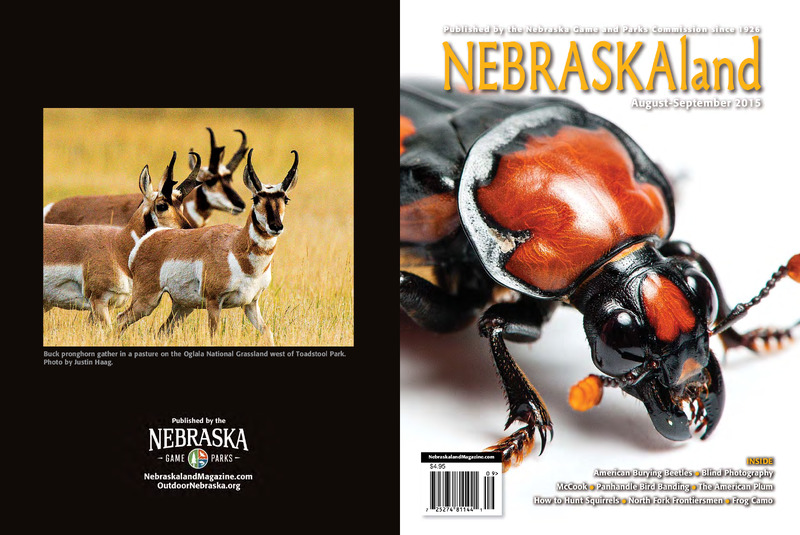
Buck pronghorn gather in a pasture on the Oglala National Grassland west of Toadstool Park.
Photo by Justin Haag.
NebraskalandMagazine.com
$4.95
INSIDE
American Burying Beetles ● Blind Photography
McCook ● Panhandle Bird Banding ● The American Plum
How to Hunt Squirrels ● North Fork Frontiersmen ● Frog Camo
NEBRASKAland Magazine
Volume 93
●
No. 7
●
August-September 2015
F EAT U R ES . . .
22 Blind Time
PHOTOS AND STORY BY MICHAEL FORSBERG
30 North Fork Frontiersmen
STORY BY LARAYNE TOPP AND PHOTOS BY JENNY NGUYEN
34 Banding Together
STORY AND PHOTOS BY JUSTIN HAAG
36 Life after Death
The American Burying Beetle
STORY AND PHOTOS BY ERIC FOWLER
44 The American Plum
A Worthy State Fruit
STORY AND PHOTOS BY GERRY STEINAUER
48 Big Changes to Hunter Education
BY CARA PESEK
50 Squirrel Quest
STORY AND PHOTOS BY JEFF KURRUS AND JULIE GEISER
I N S I D E T H I S I S S U E ...
Mixed Bag – White-tailed Deer Fawns, Camo Frogs,
22
●
34
●
Travel to McCook, 1890s Rainmakers, Night Owl Run,
Invasives at Agate Fossil Beds, My Photo Tip, Upcoming
Events and more ...................................................6
Outdoor Update – Artist Todd A. Williams ...........56
Portraits from the Past ..................................58
In the Kitchen – Broiled Dove ...........................60
The Last Stop – I Smelt a Badger .......................62
44
●
O N TH E W EB . . .
WHEN YOU SEE THIS SYMBOL IN THE PAGES OF
N
NEBRASKALAND MAGAZINE, VISIT
NEBRASKALANDMAGAZINE.COM AND VIEW OUR INTERACTIVE
DIGITAL EDITION FOR MORE INFORMATION.
D
NEBRASKAland (VOL. 93 / NO. 7, ISSN 0028-1964) is published monthly, except
for the combined Jan./Feb. and Aug./Sept. issues, by the Nebraska Game and Parks
Commission, 2200 N. 33rd St., Lincoln, NE. Periodicals postage paid at Lincoln,
Nebraska, and additional mailing offices. POSTMASTER: Send address changes to
NEBRASKAland, P.O. Box 30370, Lincoln, NE 68503-0370.
2 NEBRASKAland • AUGUST-SEPTEMBER 2015
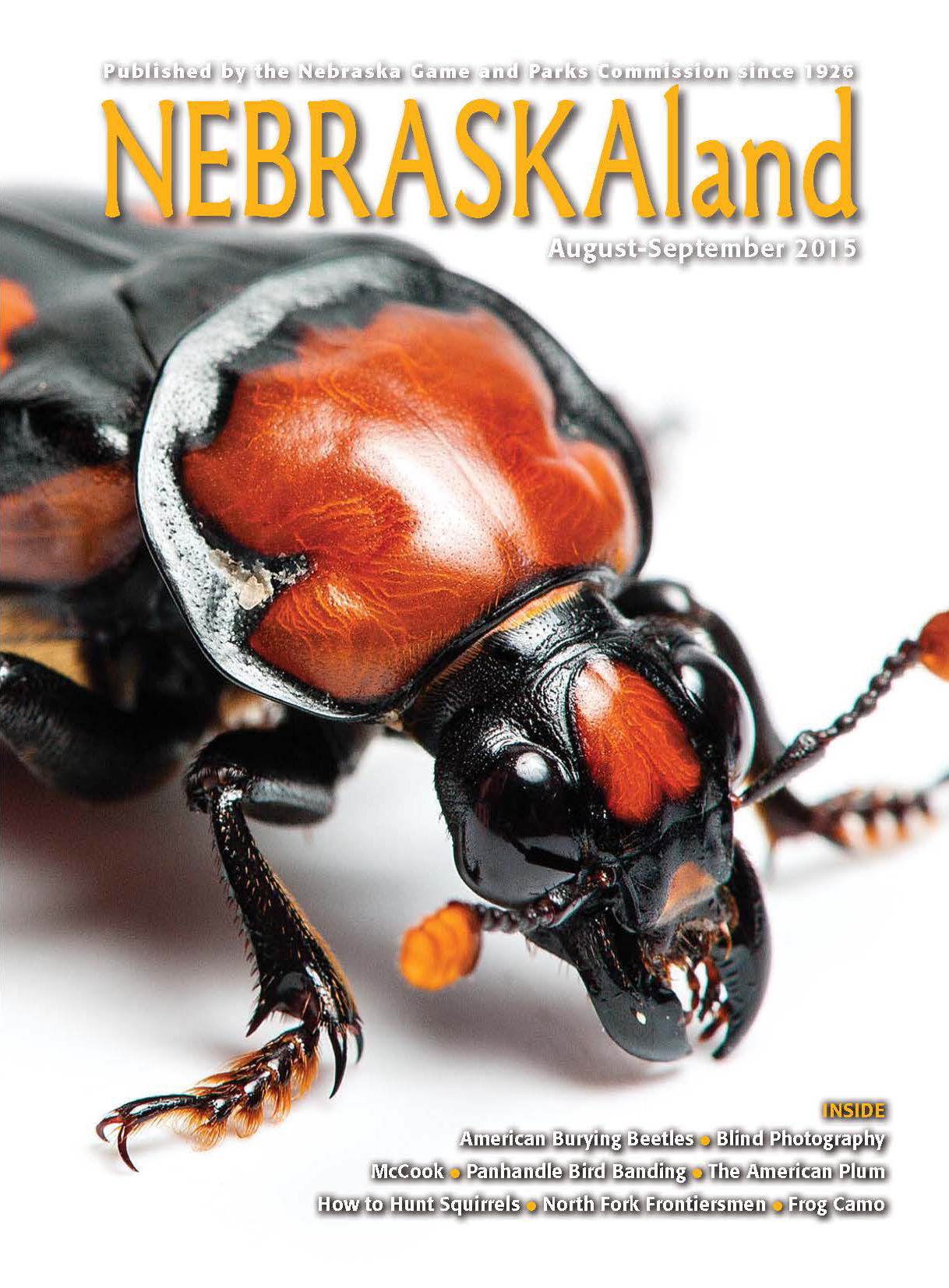
Cover: The American burying beetle is one of two endangered insects in
Nebraska. See the story on page 36. Photo by Eric Fowler.
AUGUST-SEPTEMBER 2015 • NEBRASKAland 3
Visitor Letter
I just received our July copy of
NEBRASKAland and, after reading
it the first time, it was time to find
the visitor – which I found on page
29, upper right hand corner on the
photo of the article by Matthew
Marx. The visitor is a stick insect, or
Phasmatodea.
As always, great articles and photos
in this issue. Finding the visitor is an
added feature to the magazine and
something I and lots of other readers
look forward to.
Rich Ryan
Omaha, Nebraska
Kevin Hice photographed these prairie chickens on April 4, 2015 on private land in
Brown County south of Long Pine.
Brent Hall photographed this 17-year
cicada on his parent's acreage near
Humbolt.
Outdoor Plates
Tim Jordening shot his first sharp-tailed
grouse when he was 16 and can’t wait for
his 39th season to open this September.
He hasn’t had his plate, which lists the
Nebraska bag limit, nearly as long as
he’s been following his dog through the
Sandhills in search of sharpies and prairie chickens.
hi k
If you have a unique outdoor message plate you would like to share, or know
someone who does, e-mail a photo (high-resolution, JPEG format only, please)
along with your hometown and a brief description of the interests expressed on
your license plate to Eric.Fowler@Nebraska.gov.
That's Not A Shrew
Congratulations on an excellent
magazine. As a lifelong Nebraskan,
farmer and avid outdoorsman, the
articles and photographs remind me of
what a diverse and beautiful state we
live in. However, try as I might I can't
find the least shrew on page six of the
July issue. It is an excellent picture of
what appears to be a least weasel.
Matt Schuetz
Stanton, Nebraska
Matt, below is what a least shrew
looks like, as you already know. We
regret the error.
– Editor
COMMISSIONERS
CONSERVATION OFFICERS
Director Jim Douglas
Commissioners
Chairman - Dr. Kent Forney, Lincoln
Vice Chairman - Rex Fisher, Omaha
2nd Vice Chairman - Mark Spurgin, Paxton
Robert Allen, Eustis
Dick Bell, Omaha
Lynn Berggren, Broken Bow
Mick Jensen, Blair
Norris Marshall, Kearney
Dr. Mark Pinkerton, Wilber
NORTHWEST
Officer
City
Jim Zimmerman (S) Gering
Greg Hesse
Scott Brandt
Dan Kling
Frank Miller
Sean McKeehan
Terry Brentzel
MAGAZINE STAFF
Communications Director Christy Rasmussen
Editor Jeff Kurrus
Art Director Tim Reigert
Associate Editor Jenny Nguyen
Regional Editors Eric Fowler, Julie Geiser,
Justin Haag
Contributing Editor Michael Forsberg
Regular Contributors Chris Helzer, Gerry
Steinauer
Photo Librarian Jaclyn Cruikshank Vogt
Circulation Donna Robinson
For address changes and questions about
your subscription, e-mail donna.robinson@
nebraska.gov or call 800-632-5263
Advertising Sales Manager
For advertising information contact
Shane G. Gilster, 402-742-0125
Email: shanegilster@gmail.com
NEBRASKAland Magazine Copyright 2014, all rights reserved.
NEBRASKAland is available in audio from the Nebraska Library
Commission Talking Book and Braille Service, Suite 120, 1200 N St.,
Lincoln, NE 68508. 800-742-7691. NEBRASKAland Magazine and the
Nebraska Game and Parks Commission reserve the right to reject any
advertising not in keeping with the agency mission.
Rates: $18 for one year; $33 for two years; $44 for three years. Nebraska
recipients must add appropriate sales tax. To subscribe call
1-800-NEBLAND (632-5263), or go online to: NebraskalandMagazine.
com.
COMMISSION
C
COM
CO
OM
OMMIS
MIS
SSIO
SION O
SI
OFFICES
FF CES
FF
FFI
CES
S
Headquarters/Southeast District Office
2200 N. 33rd Street Lincoln, NE 68503
Phone 402-471-0641
NANCY HALLIDAY
Northeast District Office
2201 N. 13th St. Norfolk, NE 68701
Phone 402-370-3374
Southwest District Office
301 E. State Farm Rd. North Platte, NE 69101
Phone 308-535-8025
Send your comments to:
Jeff Kurrus, Editor
NEBRASKAland Magazine
P.O. Box 30370
Lincoln, NE 68503
or e-mail Jeff.Kurrus@Nebraska.gov
Please include your postal address and telephone number. Letters may be condensed
and edited. Photographs are also welcome.
Alan Shadduck took this photo of a storm cell passing over Hastings this summer.
4 NEBRASKAland • AUGUST-SEPTEMBER 2015
Any program that receives federal funding from the National Park
Service, or the United States Fish and Wildlife Service prohibits unlawful
discrimination on the basis of race, color, religion, age, gender, marital
status, national origin, age, disability or political affiliation. Any person
who believes he or she has been discriminated against in any program,
activity, facility, or service, should contact the Nebraska Game and
Parks Commission, Lincoln, NE 402-471-0641, the Equal Opportunity
Commission, Lincoln, NE 402-471-2024, TTY/TDD 402-471-4693;
United States Fish Wildlife Service, Civil Rights Coordinator, 4401
N. Fairfax Drive, Arlington, VA 22203; Director, Equal Opportunity
Program, U.S. Department of Interior, National Park Service, 1849 C
Street NW, Mail Code 0008, Washington, D.C. 20240-0001.
Northwest District Office
East Hwy. 2, Box 725 Alliance, NE 69301
Phone 308-763-2940
Bassett Office
524 Panzer St., Box 508 Bassett, NE 68714
Phone 402-684-2921
Kearney Office
1617 First Ave. Kearney, NE 68847
Phone 308-865-5310
Ak-Sar-Ben Aquarium
21502 W. Highway 31 Gretna, NE 68028
Phone 402-332-3901
Omaha Office
8495 Frederick Street, Omaha, NE 68124
Phone 402-595-2144
Phone (308)
(office) 763-2940
(cell) 641-6138
Rushville
760-3647
Gering
631-0663
Harrison
430-0572
Valentine
402-389-0444
Bridgeport
279-9133
Oshkosh
458-7650
SOUTHWEST
Officer
City
Phone (308)
Roger Thompson (S) N. Platte (office) 535-8025
(cell) 530-3097
Ray Dierking
Brkn. Bow
870-0322
Michael Thome
Cozad
529-8146
Matt Andrews
Elwood
746-2418
Dirk Greene
Imperial
882-0015
Dale Johnson
Kearney
440-3847
Brian Piernicky
McCook
340-6627
Brandon O’Neal
N. Platte
530-3157
Nicholas Fix
Ogallala
289-0427
Bryce Streger
Ogallala
289-1169
Rich Routh
Rep. City
920-0367
Tim Williams
Grand Is
380-7331
Pat George
Kenesaw
402-705-9989
Matt Brandt
Loup City
202-0819
Andrew Heyer
Cozad
402-613-2241
Alex Hasenauer
Wellfleet
660-4671
NORTHEAST
Officer
Tom Zimmer (Sup.)
City
Norfolk
SOUTHEAST
Officer
Levi Krause (Sup.)
William Krause
Mike Luben
Dan Zuehlke
Heath Packett
Douglas Kramer
Dina Barta
Stacey Lewton
Dudley Sorensen
Russell Mort
Dan Evasco
Rich Berggren
Travis Shepler
City
Louisville
Auburn
Colon
Cortland
Eagle
Lincoln
Lincoln
Lincoln
Waverly
Nebr. City
Papillion
Waterloo
Lincoln
Phone (402)
949-0593
274-8063
443-6392
806-9084
210-0888
890-6465
890-6463
890-7140
937-3422
209-1506
616-5961
619-1355
613-2312
ADMINISTRATION
Officer
Craig Stover (Adm.)
Duane Arp (Ass.)
Jeff Clauson (Ass.)
City
Lincoln
Lincoln
Lincoln
Phone (402)
471-5531
471-5531
471-5531
Phone (402)
(office) 370-3374
(cell) 649-8053
Dale Davis
Bassett
760-0712
Steve Oberg
Columbus
910-3366
Daniel Roberts
Fremont
719-1108
Randy Pomplun
Fullerton
308-550-0489
Jeff Jones
Hartington
762-5022
Jon Reeves
Kennard
889-8508
Doug Pollard
Ord
308-730-7050
Alex Thomas
Ponca
241-7615
Cory Krause
West Point
380-6410
Jonathan Andreasen O’Neill
340-3981
Mitch Johnson
Wausa
613-8612
Nebraska Wildlife Crimestoppers 1-800-742-7627
AUGUST-SEPTEMBER 2015 • NEBRASKAland 5
A Mammal Brief
White-tailed Deer Fawn
By Lindsay Rogers
One of the most well-known large mammals of North
America is the white-tailed deer. This stately species
was once extirpated, or eliminated, from Nebraska due
to overhunting and a lack of game regulations. With the
introduction of game laws and hunting seasons in the
early 1900s, Nebraska’s population is now at an estimated
250,000.
PHOTO BY JOEL SARTORE
One of the main reasons white-tailed deer have returned to
the state in such great numbers is their ability to reproduce.
Breeding takes place starting in mid-October, peaks in midNovember and continues into December. Nearly 70 percent of
does produce twins; approximately 140 fawns are born for each
100 does in the population. Fawns are born starting in May and
continuing into late summer with the majority born in June. At birth,
fawns weigh between five and eight pounds. They are ruddy to deep
tan in color with characteristic white spots. The white spots are
amazing camouflage. Fawns will lay among the leaves in the forest
floor for hours at a time as the mother leaves to feed. The white
spots mimic the speckled sun shining through the forest canopy. ■
Lindsay Rogers is an outdoor education specialist with the Nebraska Game and Parks Commission.
6 NEBRASKAland • AUGUST-SEPTEMBER 2015
AUGUST-SEPTEMBER 2015 • NEBRASKAland 7
Travelogue Sponsors
Named in honor of Alexander McDowell McCook, a Brigadier
General in the Union Army during the American Civil War.
92AM
CIETY RG19
ORICAL SO
STATE HIST
NEBRASKA
By David Bristow
McCook
35
-7
ik many Nebraska communities, McCook began as
ike
a railroad town. In 1882 the Burlington and Missouri
d needed a division point between Lincoln and
R
Railroa
r. Rather than build at the existing towns of Indianola
Denve
D
or Culbertson, the railroad started a town halfway between,
in
where it owned land. McCook soon became the largest city
southwestern Nebraska.
But on the morning of May 31, 1935, McCook residents
weren’t thinking about the railroad. It was the Republican River
that had them worried. Flood waters came rushing through the
of the city power
valley as a wall of water, leaving 40 men trapped on the roof
feared the building
They
shore.
plant. Hundreds of people watched helplessly from
water.
of
t
would collapse, but no one dared swim the torren
men
Someone came up with a bold plan. Using the power lines, the
lf
himse
pulled
man
on the roof pulled a rope to the building. Then a
safety.
to
men
carry
across and brought back a telephone cable car to
ed,
Two men were rescued this way before the water tower collaps
he
water;
taking the line with it and sending one man into the
receded
survived, but the rest of the men were stuck until the water
McCook's City Power Plant – 19
McCook
ER
E GEIS
BY JULI
PHOTO
Norris
e
g
r
o
e
G
SenatoHr istoric Site
State
BY JULI
E GEISE
R
Barnett P
Republicanark along the
River’
PHOTO
the next day.
ska,
Not everyone was so fortunate. Across southwestern Nebra
–
people
100
the Republican River Flood of 1935 killed more than
.
history
one of the deadliest natural disasters in Nebraska
The following years saw the construction of several flood
control dams along the Republican and its tributaries – so many
d
that the Nebraska Tourism Commission has accurately dubbe
lies
k
McCoo
southwestern Nebraska “Prairie Lakes Country.”
within a half-hour’s drive of three of these scenic lakes—
Swanson, Red Willow and
Medicine Creek – each of
which is a state recreation area
with ample facilities for boating, camping, fishing
g
(bass, crappie, northern pike, walleye and others) and huntin
(pheasant, quail, waterfowl, and white-tailed and mule deer).
rants,
In McCook itself, downtown has historic buildings and restau
er
summ
specialty shops, a fine arts gallery, a historic theater and free
Norris
on
concerts at the Norris Park band shell. The Bieroc Cafe
s by national
Avenue is known for year-round live folk music performance
and
dinner
for
artists, and the Loop Brewing Company is a must-stop
drinks.
(1861Norris Avenue takes its name from U.S. Senator George Norris
His
y.
centur
1944), one of the most influential statesmen of the 20th
Square
e
Heritag
house is open as a state historic site and is part of the
ors
walking tour, which includes the homes of three Nebraska govern
and a house designed by Frank Lloyd Wright.
ging
McCook is also home to Heritage Hills Golf Course, a challen
River
lican
Repub
18-hole links course located on hills overlooking the
y
scener
the
valley – where the deadly floods are long gone, but
remains. Gotomccook.com. ■
AUGUST-SEPTEMBER 2015 • NEBRASKAland 9
NSHS, RG2545-9
During the 1890s some theorized that smoke particles blown into the clouds would precipitate rain. These men appear to be trying
that process.
A Brief History
Nebraska's Rainmakers
By Patricia C. Gaster,
Nebraska State Historical Society
ears ago pioneers believed that
rain followed the plow; the
evaporation from land surfaces
and the conservation of runoff
water caused a proportionate increase
in the rainfall. But after the cycle of
wet years had passed, the dry 1890s
brought ruin to farmers in semi-arid
regions.
During Nebraska’s severe drought
of 1894, professional rainmakers
promoted the “concussion theory,”
based on the popular observation that
the detonation of high explosives
sometimes caused rain. Some theorized
that smoke particles blown into the
clouds would precipitate rain.
Frank Melbourne was one of the best
known of a small group of rainmakers
active in the Great Plains during
Y
the 1890s. A native of Australia, he
came west from Ohio in 1891 with
his brother and worked in Nebraska,
Kansas and Colorado. He popularized
the idea of manufacturing gas on the
ground, thus creating a cloud which
ascended and united with the upper air,
causing rainfall.
Melbourne was highly publicized and
charged high prices for his services, but
refused to discuss his methods in detail
– though he claimed that his method
was capable of doubling the world’s
arable area.
Pioneer doctor William B. Swisher
was another well-known rainmaker of
that era. According to the Nebraska
State Journal, in 1893 Swisher
contracted with J. H. McMurtry of
Lincoln to make it rain over the capital
city for the sum of $500. Swisher set
up his apparatus and took credit for a
“small sized squall” afterward – and
then sued when McMurtry refused to
pay.
Though not required to demonstrate
his apparatus, Swisher set it up in
10 NEBRASKAland • AUGUST-SEPTEMBER 2015
the courtroom for people to see. The
Journal described two stone churns
with inverted funnels, an iron box with
a hinged cover, a battery and electric
wire, and accessories consisting of “a
pair of old balances, a wash basin, a
glass funnel, two bottles, a glass dish,
a small pitcher and a quart tin cup.
Among the weights of the scale is a
rattlesnake’s rattle.”
A University of Nebraska professor
testified that rain had been forecast for
the day Swisher promised to create
a shower; the professor also showed
maps to prove that the rain was general
over the whole region. In reply,
Swisher “swore positively that he made
the rain that fell in Lincoln, but did not
give his reasons for so believing.” The
judge awarded Swisher a judgment of
$50.
In time the dry years ended and the
rainmakers went on, perhaps, to other
money-making schemes. ■
Visit the Nebraska State Historical
Society’s website at Nebraskahistory.org.
AUGUST-SEPTEMBER 2015 • NEBRASKAland 11
Paid Advertisement
12 NEBRASKAland • AUGUST-SEPTEMBER 2015
AUGUST-SEPTEMBER 2015 • NEBRASKAland 13
Nebraska Bird Library
Sponsored by
y
Turkey Vulture
PHOTO BY ERIC FOWLER
Song or calls: Usually silent, but over coveted animal
carcasses groups of vultures may hiss, flop or fight.
Description: Sexes similar. Adult uniformly dark
brown with small, red, unfeathered head; white tipped
bill. In flight, wings held in shallow V; pale gray
primaries contrast with dark wing linings and body,
giving wings two-toned appearance; tail narrow and
fairly long, extending beyond feet. Immature similar to
adult, but with dark head and bill.
Food: Feeds on carrion and locates by sight and
smell.
Habitat: Open plains, sandhills or areas offering
visual foraging. Cliffs, crevices, abandoned buildings or
other cavities are used for nesting sites.
Where in Nebraska: Common regular spring and
fall migrant throughout the entire state and locally
uncommon regular breeder statewide.
Field Notes: At night, groups of a few up to 100
roost together in trees and then leave in late morning
when thermals develop.
Fun Facts: The turkey vulture will defecate on its
own legs, using the water in the feces to cool itself
down. ■
To learn about more birds visit:
NebraskaBirdLibrary.org.
Niobrara State Park's
Night Owl 5K Run/Walk
By Jenny Nguyen
14 NEBRASKAland • AUGUST-SEPTEMBER 2015
PHOTOS BY JENNY NGUYEN
Join Niobrara State Park’s third annual Night Owl 5K Run/
Walk on Sept. 12. Race for first place or jog/walk at your own
pace. Bring your own glow sticks, necklaces and bracelets
to light up your run. Headlamps or flashlights are strongly
recommended. This nighttime race is open to all ages and preregistered participants will receive a T-shirt and a wristband.
Following the race, an award ceremony will be held at the
Group Lodge. If you have a wristband, enjoy a buffalo burger
meal with coleslaw, beans and ice cream. Registration begins
at 7 p.m. and the race will begin at 8 p.m. To register, contact
Niobrara State Park at 402-857-3373; pre-register for $20
or $25 on the day of the event. Spectators are invited to the
buffalo burger dinner for $12 per person. ■
AUGUST-SEPTEMBER 2015 • NEBRASKAland 15
Now You See Me
Lowering the Yellow Flag
By Dan Fogell
When I was really young I thought all frogs were green.
Maybe it was all the children’s books I had with green frog
illustrations, or that the most common frogs where I grew
up were actually called “green frogs.” Then one day on a
camping trip I found a light brown frog with black spots. A
little library research told me it was a northern leopard frog.
Good name, I thought. How come it had spots? Why wasn’t
it green?
It turns out that many frogs are not green. They can be
gray, blue, red, black, yellow or a combination of colors.
They can be spotted, striped or have all kinds of strange
colored shapes on them. There are even frogs that can
change their skin color throughout the day, or even in just a
few minutes. Why, you ask? What kind of survival strategy
do frogs have invested in their skin color?
Green is easy. It’s the color of the vegetation in the ponds
where frogs often live – including lily pads, duckweed,
even the algae that grows on the water surface – so there is
an obvious camouflage advantage. But not all frogs live in
ponds. Some live in mud along the shore. Some live in grass
near the water. Some live in trees. And each of these species
has a skin color and pattern that affords it an amazing
camouflage. Even the light brown, spotted skin of leopard
frogs makes them difficult to find in grass along the water’s
edge. Here in Nebraska, having light brown skin with stripes
or spots provides excellent camouflage in grass, which is a
common habitat feature alongside ponds, lakes and streams.
Our treefrogs here have the special ability to change
their color and their pattern when necessary. They’re called
Cope’s gray treefrogs, and they may be gray, green or
even white. Sometimes they have a pattern, and sometimes
they don’t. This versatility in color and pattern is due to
physiological changes to cells called chromatophores in the
frog’s skin.
Temperature changes and certain hormones can make
these cells either express color or not, thus changing both
their color and pattern and making them hard to detect on
either leaves, bark or other substrates. But when they jump,
treefrogs use a different strategy involving skin color –
something known as flash coloration. On the inside of their
thighs, treefrogs are very brightly colored – usually yellow
or orange, so that when they leap they “flash” their bright
colors. This is an advertisement saying “I taste terrible, so
don’t bother eating me.” The bad taste comes from poison
glands found throughout the frog’s skin. All frogs have
poison glands in their skin, but at least treefrogs are nice
enough to warn you.
Speaking of warnings, camouflage is not always the best
strategy. Some tropical frogs don’t even try to hide. They
are bright yellow, red, fluorescent green and blue. These are
the dart frogs or poison arrow frogs of Central and South
America. And although all frogs have poison glands, these
frogs have especially toxic, even deadly poisons in their skin.
In nature, bright colors (called aposematic coloration) often
mean “stay away” and these little frogs definitely follow
that rule. They don’t mind letting you know where they are
By Justin Haag
Visitors to a popular Panhandle attraction are seeing
fewer blooms of one particular pretty flower – and that’s
being considered a good thing.
o many settlers of European descent who moved to the
High Plains from the eastern United States in the 19th
century, flowers were used to brighten the landscape and add
a touch of “the old country” to a new homestead.
When someone planted a small stand of yellow flag irises
near a pond on James Cook’s storied Agate Springs Ranch
in Sioux County, it’s doubtful the family ever could have
imagined the scene a little more than a century later.
Over years, the irises from the Cooks’ ranch amazingly
spread eastward eight miles down the Niobrara River, near
its headwaters where it flows through grasslands in the
manner of a small creek. Each spring, more irises bloomed
than the last, making a spectacular show of yellow during
their short blooming period and delighting many visitors
to Agate Fossil Beds National Monument. With the Cooks’
ranch just to the west of the tourist attraction’s border, most
of the irises would bloom on public property easily viewed
from the road.
The show has proven to be too much of a pretty thing,
however. Research showed the plants were not only
negatively affecting water quality, but were also changing the
stream’s flow. In many places, for instance, plants had grown
in from the sides and caused the active channel to deepen
and the water to flow faster. The characteristics of the river’s
flow are considered to be important along the upper Niobrara
Nebraska treefrogs have the special ability to change their color
and pattern when necessary.
A plains leopard frog hides in grass and mud, camouflaging its
entire body.
PHOTOS BY DAN FOGELL
The lack of camouflage of poison dart
frogs of Central and South America
warns predators to "stay away."
because they’re pretty confident nothing
is going to eat them. ■
PHOTO BY JUSTIN HAAG
16 NEBRASKAland • AUGUST-SEPTEMBER 2015
T
with rare minnow species such as the redbelly dace and
finescale dace.
Nick Sanderson, the Sioux County weed superintendent,
worked with the Nebraska Game and Parks Commission to
gain approval from the Department of Environmental Quality
to have the irises sprayed with Habitat, a herbicide approved
for aquatic applications. Sanderson said funding has been
a huge hurdle for the project, but the Nebraska Weed
Management Area Coalition has helped secure grants from
the Nebraska Environmental Trust and a few other sources.
The first contracted spraying was last fall, but iris can be a
stubborn plant.
“We put a huge dent in them, but it’s a little discouraging
to see how many survived. We knew we weren’t going to
get rid of all of them overnight,” he said. “We’re making
headway, and you can see grass growing in places that were
covered with iris last year.”
Of course, the High Plains of western Nebraska isn’t
the only place yellow flag iris, or Iris pseudocoris, has
been considered a problem. A number of states have even
prohibited the pretty plant. Irises are a popular variety for
beginning gardeners, but people are advised to plant them in
dry locations where there’s no risk of its seeds and rhizomes
moving along waterways and competing with other shoreline
vegetation.
With such hearty characteristics, yellow flag irises will be
showing their color for centuries to come – hopefully just
not along the Niobrara River of Sioux County. ■
Dan Fogell is a herpetologist
and author of A Field Guide to the
Amphibians and Reptiles of Nebraska.
AUGUST-SEPTEMBER 2015 • NEBRASKAland 17
My Photo Tip:
Using Light
Leafy Masterpieces
By Eric Fowler
People sometimes show me their
photos and beaming with pride say,
“Isn’t that nice?”
Too often I say, “It is. But why didn’t
you go back when the light was nice?”
You may have found the perfect
scene, the perfect location from
which to photograph it and nailed the
composition, but if it's noon and the
light is cold and flat, you don’t have a
great photo.
Sometimes all it takes to get all of
those elements to come together on your
first visit is a little homework that can
start at home on your phone or computer.
Check the weather to see how much
cloud cover there will be, or if there
might even be fog, and to see when the
sun will rise and set. The Photographer’s
Ephemeris will tell you the latter, but its
best feature shows you where the sun
will meet the horizon, which can help
you get in the right location for the best
composition. The satellite view in that
app, or Google Earth or Maps, will help
you scout a location.
But sometimes, you simply need to
lace up your boots, go for a hike and
scout a location with every intention
of returning to get the photo you
want. That’s what I did to capture a
set of images of the Niobrara River at
Chat Canyon Wildlife Management
Area south of Nenzel in 2013. I knew
propensity for fog to rise from the river
on a cool morning meant there would
be a good chance of capturing a striking
image at sunrise. But light can change
quickly, and I didn’t want to be searching
for the perfect spot while it was. So I
spent a day hiking to every high point
with an unobscured view of the river.
From those points, I surveyed the
scene and pulled out my phone and
checked the TPE app to see where the
sun would rise. I snapped some photos
on that cloudy day that weren’t bad.
But I knew where I wanted to be when
I returned two days later. After an
hour’s drive – some of it on Sandhills’
two tracks – and a half-mile hike
through a dew-soaked prairie, sweet
light hit the scene and my “homework”
and scouting paid off.
Sometimes you’re lucky and are in
the perfect spot when the light is right.
Don’t be afraid to go back if it’s not. As
a wise photographer once told me, “The
harder I work, the luckier I get.” ■
18 NEBRASKAland • AUGUST-SEPTEMBER 2015
PHOTOS BY ERIC FOWLER
By Lindsay Rogers
As summer comes to a close and fall approaches, it is a
great time to look at leaves. There are many different kinds
of leaves – the broad, lobbed leaves of a bur oak; the giant,
triangular leaves of a catalpa tree; or the thin, needle-like
leaves of a ponderosa pine. Whatever the shape, leaves
serve one purpose for the plant – to convert the sun’s energy
and carbon dioxide into food through a process called
photosynthesis.
I, however, can think of many purposes for a leaf. Shade
is a great benefit in the hot summer sun. Or try using a few
leaves to create a masterpiece. Gather a few leaves (several
different kinds or shapes work best),
a few pieces of paper, a bottle of
glue or a glue stick and some
crayons or markers.
Arrange the leaves to create a
butterfly (pine needles work well
for antennae), a wild turkey
(thin wildflower leaves
work well for a
giant turkey tail)
or a completely
new animal
creation.
Use your
imagination! ■
AUGUST-SEPTEMBER 2015 • NEBRASKAland 19
Thank You, Perry Myers
by Jerry Kane
Contact the Nebraska Game and
Parks Commission at 402-471-0641
or visit OutdoorNebraska.org for more
information. Visit HuntSafeNebraska.
org for a list of hunter education
classes and BoatSafeNebraska.org for
a list of boating safety classes.
June 29-July 2
Outdoor Adventure Camp Nebraska
Game and Parks Outdoor Education
Center, Lincoln, 402-471-6141
Squirrel season opens
Niobrara State Park (SP), Niobrara,
10 a.m.-2 p.m., 402-857-3373
Danish Alps Recreation Area and the 226-acre Kramper Reservoir, located
near Hubbard, is now open. Built by the Papio-Missouri River Natural
Resources District with fish habitat designed by the Game and Parks
Commission, the lake offers camping, no-wake boating and hiking, and holds
bass, bluegill, walleye, crappie and catfish. A grand opening is set for Aug. 1.
August 1
Buffalo Cookout and Ponca
August 7
Cultural Night Niobrara SP, Niobrara, 6 National Park Service Campground
p.m., 402-857-3373
Program Niobrara SP, Niobrara, 7 p.m.,
August 1-2
402-857-3373
Living History Fort Atkinson State
August 8
Historical Park (SHP), Fort Calhoun, 10
a.m.-5 p.m., 402-468-5611
Waterfowl Hunting Safety Workshop
and Parks Outdoor Education Center,
Lincoln, 6:30-8:30 p.m., 403-471-6141
August 12
Family Fishing Event
Holmes Lake, Lincoln, 6-8 p.m.
August 13
Family Fishing Event
August 1-2
Pioneer Longrifle Rendezvous
Niobrara SP, Niobrara, 10 a.m., 402-8573373
Indian Cave SP, Shubert, 402-471-5427
August 8
Dutch Oven Cooking
August 15
Wildcat Hills SRA and Nature Center,
Gering, 9 a.m., 308-436-3777
August 15
Living History Rock Creek Station SHP,
August 8-9
Bow Sight In Nebraska Game and
Fairbury, 9 a.m.-5 p.m., 402-729-5777
August 4
Family Fishing Event
Independence Landing, Seward, 6-8 p.m.
August 4-6
BB Gun Camp Nebraska Game and
Parks Outdoor Education Center,
Lincoln, 12:30-4:30 p.m., 402-471-6141
August 4, 18
Ladies Day at the Range
Nebraska Game and Parks Outdoor
Education Center, Lincoln, 6:30-8 p.m.,
402-471-5662
August 5
Family Fishing Event
City Park Pond, Pawnee City, 6-8 p.m.
August 5, 12, 19, 26
Beyond Becoming an OutdoorsWoman (BOW) Shotgun Class
Platte River SP, Louisville, 402-471-5547
August 6
Family Fishing Event Mormon Island
Parks Outdoor Education Center,
Lincoln, noon-5 p.m., 402-471-6141
August 8-9
Becoming an Outdoors-Family
Workshop Fort Kearny SRA, Kearney,
402-471-5547
August 9
Archery paddlefish season closes
Recharge Lake, York, 6-8 p.m.
Private land antlerless elk season opens
August 20
Archery antelope season opens
August 22
Lewis and Clark Heritage Day
Ponca SP, Ponca, 402-755-2284
August 23
Family Fishing Event
Terry’s Pit, Terrytown, 4-7 p.m.
August 28
August 9
National Park Service Campground
Nebraska Water Wonders: Water
Program Niobrara SP, Niobrara, 7 p.m.,
Usage in Nebraska Lake McConaughy 402-857-3373
SRA, Ogallala, 2 p.m., 308-284-8800
August 10
Fall turkey permits available beginning
at 1 p.m. Central Time
August 28
Nebraska Game and Parks Board of
Commissioners meeting, Burwell
August 28
August 10 and 12
Drawing for bighorn sheep lottery permit
State Recreation Area (SRA) Lake No. 1, Rimfire Sporter Clinic Platte River SP,
August 29
Louisville, 6-8 p.m., 402-471-5547
Grand Island, 6-8 p.m., 308-385-6211
Carp-a-Thon Alexandria SRA,
August 11
August 7-9
Alexandria, 10 a.m.-2 p.m., 402-729-5777
Family Fishing Event Halleck Lake,
Ponca Pow-Wow
August 30
Papillion, 6-8 p.m.
Niobrara SP, Niobrara, 402-857-3373
Nebraska Water Wonders: History of
August 11
August 7
Kingsley Dam Lake McConaughy SRA,
Bighorn sheep lottery applications end Best Shot Camp Nebraska Game
Ogallala, 2 p.m., 308-284-8800
20 NEBRASKAland • AUGUST-SEPTEMBER 2015
How Does HIP Help?
By Dr. Mark Vrtiska
The Harvest Information Program (HIP) has been in place since 1999. Prior to
that time, estimating U.S. harvest for migratory birds such as doves and waterfowl
was problematic. Each state had some sort of estimate, but all methods differed.
Thus, the U.S. Fish and Wildlife Service (USFWS), in cooperation with state
wildlife agencies, developed HIP to provide a consistent, nation-wide sampling
frame of migratory bird hunters to estimate harvest of all hunted, migratory birds.
Not having reliable and consistent harvest estimates could possibly jeopardize
hunting seasons if those opposed to hunting take the USFWS – or possibly states
– to court on the basis that hunting is having an effect on a population. Having
those estimates solidifies that hunting seasons are not imposed on species in a
“haphazard” manner, and allows migratory bird managers to make observations
and decisions about regulations.
When individuals sign up for HIP – which they are required to do in every state
they hunt migratory birds – they are providing a stratified (based on the number of
particular migratory birds they harvested) sampling frame for estimating harvest.
Most people are confused and believe harvest is estimated from the questions they
have to answer, and that’s incorrect. They are simply stratified into two or more
groups. The USFWS then samples hunters from each of these groups to estimate
harvest.
HIP data also have been used to provide sampling for various surveys that have
asked hunters their preferences and opinions regarding hunting seasons and other
regulation matters. So, it’s been invaluable from that standpoint as well.
While HIP is required legally, it’s an extremely important program that the
USFWS and states use to better manage and maintain migratory bird hunting
seasons. ■
NEBRASKAland
and
Visitor
PHOTO BY JEFF KURRUS
August 1
Discover the Real Missouri River
PHOT
PHO
O O BY ERI
ERIC
C FOWLER
FOW
August 1
By Jeff Kurrus
Perry Myers’s dad was an advocate of gun safety. When Perry, now living in
Omaha, was young, gun safety was paramount in the field. “Dad would let me
carry a gun when I started hunting, but it couldn’t be loaded,” he said. “Slowly we
could shoot a little.”
When he found out through friend and
Nebraska Game and Parks Commissioner
Mick Jensen that Mick was heavily
involved with teaching gun safety, it was
a no-brainer what Perry wanted to do
with two of his father’s guns. “I knew
my father would rather they be donated
than sold,” he said, and followed through
with this notion by donating them to the
Nebraska Game and Parks Commission.
The shotguns, a Mossberg model
183, .410 bolt action and a Remington
model 11-48, 28 gauge semi-automatic,
will now be used to support the
Nebraska hunter education program,
said Commission Education Manager
Jeff Rawlinson. “Each year more than
8,000 kids learn the principles of safe
Director Jim Douglas (left) accepts gift
gun handling and responsibility,” he said. on behalf of the Nebraska Game and
“These firearms will be used as training Parks Commission from Perry Myers at
Eugene T. Mahoney State Park.
aids in these classrooms.” ■
Last issue’s winner of
the Visitor drawing was
Millie Simcox of Wolbach,
Nebraska, who found the
walkingstick on page 29.
Readers are encouraged to contact
NEBRASKAland within 10 days
after this issue’s publication with
the correct page number and name
of this issue’s “Visitor” – a critter
found in Nebraska. We will then
gather the correct entries and draw
one to win a NEBRASKAland mug.
To enter each month, write:
NEBRASKAland Visitor
2200 North 33rd Street,
Lincoln, NE 68503.
Or e-mail:
Tim.Reigert@Nebraska.gov
with “Visitor” in the subject line of
the message.
HINT: This issue’s visitor is not on
pages 1, 4, 12, 21, or 36-40.
Walkingsticks are large, elusive
insects that get their name from
the strange appearance of their
bodies; they literally look like
sticks. This appearance acts as a
camouflage, making it difficult for
predators such as birds and other
insects to see them. Walkingsticks
can be found in a variety of
habitats in Nebraska, from forests
to prairies. The walkingstick
hidden in last month’s issue is
a short-horned walkingstick,
Parabacillus species, usually found
in prairies. Short-horned refers
efers
to the very short antennaee of
of
o other
this genus, as compared to
walking sticks that have mu
much
uch
longer antennae. Walkingsticks
stticks
n plant
p t
are herbivores, feeding on
leaves, and are most activee at
night. One notable skill: Ny
Nymphs
ymphs
hs
ity
ty to
(immatures) have the ability
regenerate a lost leg, which
ch
h is
handy since they can easily
lyy
break off, especially when
grabbed by a predator.
Special thanks to Julie Van M
Meter, S
State
Entomologist, Nebraska Department of
Agriculture. Photo from Thinkstock.
Bugguide.net is a popular site for identification.
AUGUST-SEPTEMBER 2015 • NEBRASKAland 21
Blind
Time
Photos and story by Michael Forsberg
S
pending hours or days in a blind waiting for animals
that may or may not appear can be a sacred practice
of sorts. It teaches the virtues and values of patience,
observation, listening and just being. You become finely
tuned to the world around you, and that in itself is its
own reward. But every once in awhile those photos you
imagine in your mind’s eye can be conjured into existence,
and it makes those ants in your pants, frozen water bottles
and sore muscles even more worth it.
As a wildlife photographer for 20 years, I cut my
teeth working as a staff photographer and writer for
NEBRASKAland in the 1990s, at a time when the other
staff that I would learn so much from had a combined
experience of over 100 years in the field and had just
about as many different kinds of blinds as they did years
of experience. And what I didn’t learn from Jon Farrar,
Bob Grier, Ken Bouc, Rocky Hoffman, Tom Keith, and
Don Cunningham, I learned on the fly through trial and
mostly error.
I remember the first story I did for the magazine was
photographing wintering bald eagles at Lake McConaughy. Jon Farrar suggested I use
a cardboard box that held a refrigerator. Looking back now, I am pretty sure he was
joking, but I didn’t know any different so I went to a local furniture store and pulled one
out of the garbage, cut holes for a lens port, and slung an old white bedsheet over the
top of it all that I stapled in place and anchored in a snowdrift with rocks. It held up for
about a week along the shoreline before it was torn apart by the winter winds, but it
worked.
22 NEBRASKAland • AUGUST-SEPTEMBER 2015
A female northern harrier (above)
and its day old chick at a nest in the
prairie pothole region of North Dakota.
Working with biologists, I placed a small
remote camera at the nest that I could
trigger with a walkie-talkie remote from
a distance away. I sat in an L. L. Rue
portable blind (right) from 100 yards
away watching the harrier hunt wetlands
and bring food back to the nest. It would
feed about three times a day. Each time it
descended into the grass I knew it was at
the nest and I would fire off a few frames.
AUGUST-SEPTEMBER 2015 • NEBRASKAland 23
I used four of these one-person
tents on the swift fox project
and on many other shoots
around the plains like on greater
sage grouse leks in the UL
Bend Wilderness along the
Upper Missouri River in eastern
Montana. Sadly, all four tents
ended up destroyed either by
cows or storms, and to my
knowledge, the tent is not made
anymore.
A
nother early story
I attempted was
photographing
cranes on the Platte River.
But I didn’t want sunset
shots of birds in the
distance; I wanted to get
close. So I went to a place
in west Lincoln that had
an assortment of defective
plastic fertilizer tanks that
were for sale, bought one
shaped like a pop can for 20
bucks, and had Tim Reigert,
longtime art director for the
magazine, use a sawzall to cut it lengthwise in half
with openings on both ends so it was just the right
length for me to lay down in and shoot from the edge
of a sandbar. I figured it would be impenetrable to
heavy snow, impossible to be shredded by winds and
impervious to cows. What I didn’t realize was that
24 NEBRASKAland • AUGUST-SEPTEMBER 2015
I spent parts of three years photographing the
natural history of swift foxes in Buffalo Gap
National Grassland in South Dakota. My blind
of choice there was a sturdy but packable oneperson tent, the Slumberjack predator bivy,
sold by Cabela’s. It was a camo tent, had two
entrances and was easy to sleep in. I would
place additional camo netting over the top to
cut down on any shine from the windows and
fabric.
AUGUST-SEPTEMBER 2015 • NEBRASKAland 25
The homemade blind of garden fence, zip
ties, camo material and native vegetation
is a favorite today. It’s fast, light and
inexpensive. I fashioned one on a prairie
slough next to the Platte River channel
to photograph wintering mallard ducks
at Audubon’s Rowe Sanctuary. I was also
rewarded with a small band of deer that
would play regularly in front of the blind,
chasing ducks and each other like dogs
do.
thick plastic doesn’t breathe
and condensation built up
on the ceiling from my
breath in the humid cold
and dripped on me all night,
freezing my clothes to my
sleeping bag and forming a
thin coating of ice over my
camera and lens. It was the
coldest night I ever spent.
Finally, I remembered my
Sometimes your vehicle is your best
blind, especially on a ranch or farm
where animals are used to the regular
comings and goings of the farmer or
rancher in their daily activities. The
thing animals don’t like is to see your
shadow or movement in the vehicle,
so minimizing movement and placing
curtains of camo material or other fabric
on windows is a huge help.
grandparents using a roll
of garden fence that they
shaped and molded and
affixed with mesh fabric
with plastic zip ties to keep
the rabbits out of their
garden patch. I thought that
simple bundle of materials
could be purchased about
anywhere and would
provide a perfect base to
make my own blinds of
26 NEBRASKAland • AUGUST-SEPTEMBER 2015
AUGUST-SEPTEMBER 2015 • NEBRASKAland 27
any shape or size. Those lightweight, inexpensive blinds are still usually my first choice
today.
Each photographic situation in nature demands a little different approach, so the tool
bag for blinds has become diverse and selection is made for the situation. Today some
blinds I use are homemade, some are manufactured and bought off the shelf and some
blinds are not really blinds at all. I’ve included a handful of my favorite blinds here with
the images that they helped create.
But just like hunting from a ground blind or tree stand, the most important thing is
you have to be out there, spend the time, do your homework, get into place before the
animals arrive, then don’t leave the scene until after they do. If you do those things, build
trust and honor your subject, in the end you will be rewarded beyond measure by the
beauty and nuances of our natural world, whether you make photographs or not. ■
The most involved blind was built
with the help of a rancher friend of
mine for a golden eagle nest on a
cliff face in Sioux County, Nebraska.
We put four t-posts in the ground
and built a plywood box frame
anchored to the posts with bailing
wire on a side slope across a small
canyon from the nest, then took rock
slabs from the area and stacked
those around and on top of the roof.
Built in the fall when the eagles
had dispersed, it was in place in
the spring and remained in use for
several years.
28 NEBRASKAland • AUGUST-SEPTEMBER 2015
Michael Forsberg is a professional
nature photographer and contributing
editor to NEBRASKAland. To
see more of Mike’s images, visit
MichaelForsberg.com.
AUGUST-SEPTEMBER 2015 • NEBRASKAland 29
North Fork
Frontiersmen
Story by LaRayne Topp
Photos by Jenny Nguyen
T
he frontiersman stepped out from beneath the shadowy
canopy of evergreens. He lifted a black powder measure
to the barrel of his muzzleloader. The powder horn at
his side was etched with delicate scrimshaw in the images
of snake and bear, its stopper intricately carved in the shape
of a man’s hand. A knife, its handle fashioned from the
jawbone of a black bear with the teeth intact, was attached
to a possibles bag of hand-stitched leather. One can only
imagine the hours a mountain man would have spent,
kneeling by a warm fire on cold winter nights, carving and
shaping the tools he’d need for the next day’s hunt.
Members of the North Fork Frontiersmen of the Elkhorn
River can tell you just how many hours. For the past
30 years, members of the club have held mountain men
rendezvous to spend time with others interested in the
history of the first white men who scouted un-trapped
streams, barely a step ahead of restless pioneers looking for
good farmland. These men and women come to sharpen
their muzzleloading shooting skills and hone their frontier
skills, and to talk around the campfire about the frontiersmen
who once explored the Far West, trapping beaver and other
animals in Rocky Mountain country in the first half of the
1800s. Back then, buckskinners had only themselves to rely
on for food and shelter, trading the furs from animals they
shot and trapped for necessary supplies.
Held in Battle Creek in recent years, the location of the
shooting grounds has varied since the club’s existence, but
the enthusiasm of the North Fork Frontiersmen has never
wavered. At one time, they registered over 100 shooters at
their meet; however, a typical shoot will bring in 60 to 70
shooters plus their families.
dormant for years while he filled his free time with other
outdoor activities, such as hunting and fishing. So when
Miller found out that his neighbor picked up a muzzleloader,
so did he. Miller soon discovered the existence of
muzzleloader clubs across the state as well as on the national
level.
When Vance Willets, now of Grand Island, placed an ad in
the Norfolk Daily News in 1983 to gauge interest in forming
a local club, Miller and wife Barb knew it was time to quit
thinking about it and join. So did others from throughout the
area, and the North Fork Frontiersmen was born.
The club reached nearly 40 members in its first year.
Officers were chosen and the club met once a month, at
the shooting range if weather permitted. By 1984, the club
had located a few acres of pastureland near Norfolk for the
club’s first competitive shoot.
“It’s difficult to find places to hold the shoots,” Miller
said. “Neighbors may complain, plus there are the questions
of liability and responsibility. It’s not necessarily easy.”
Miller’s interest in muzzleloading is fed by serving as field
representative and regional coordinator for the High Plains
area of the National Muzzle Loading Rifle Association, a
position that requires him to promote the organization and
the sport in general.
For some, black powder and lead is the club’s main draw.
Take Tom and Lola Brockman, for example, who have been
North Fork members since 1989 and enjoy the camaraderie
found at meetings, but originally, black powder was their
primary attraction. Tom’s interest in black powder firearms
began when he came into possession of his grandfather’s
1865 musket; Norwich Arms was originally commissioned
to manufacture the muskets for use in the Civil War, and
Some knives and tools Frank Novotny has accumulated for his
mountain man re-enactments.
Powder and Lead
The palisade shoot is a timed event where shooters try to knock
down as many animal-shaped targets as possible with their
muzzleloaders.
30 NEBRASKAland • AUGUST-SEPTEMBER 2015
Early on, meetings were at the local community college.
Stories swapped and lessons learned included presentations
on mountain man history, firearms, tools and period
clothing, many led by college professor and history buff
Gary Miller.
Miller was just a “little guy,” he said, when he became
fascinated with a colorful book about Sioux Indian chiefs.
He soon began to search out stories about American
Indians and white immigrant settlements and the history
of the Wild West. He read all he could about the exploits
of Davy Crockett, Daniel Boone’s early years on the
Kentucky frontier, and author James Fenimore Cooper’s
Leatherstocking Tales, with its Natty Bumppo character
inspired in large part by Daniel Boone.
“My interest was always there,” Miller said, but it lay
A member tidies her camp at the North Fork Frontiersmen rendezvous at Yellow Banks Wildlife Management Area.
AUGUST-SEPTEMBER 2015 • NEBRASKAland 31
sell targets for the shoot and tickets for the club’s drawings.
They use targets that are standardized throughout the state
and national muzzleloading organizations.
“True blue shooters will buy every target available to see
how they can do,” said Frank Novotny, another long-time
member of the Frontiersmen.
Re-enactment
Ron and Mary Jones prepare lunch at their camp.
Brockman’s musket was retooled after the war into a
shotgun.
Tom and two friends initially attended classes taught by
Miller, and learned they could buy black powder through the
North Fork Frontiersmen, but only if they were members.
Brockman admitted the purchase of black powder was a
backdoor approach to becoming a member, but soon after
joining, Brockman headed off to a Red, White and Blue
Muzzleloaders’ Rendezvous outside of Grand Island. He
slept in his car outside of the rendezvous grounds while
watching the mountain men on the “other side of the fence.”
Hooked, he promised himself the next year he would attend
the rendezvous as a full-fledged member to camp with the
other mountain men.
Today, Tom and Lola Brockman join long-time members
at rendezvous who have been baptized with frontier names,
such as “Old Buffalo,” “Griz,” “Two Feathers” and “Little
Fox.” As club officers, they work behind the scenes to help
keep the Frontiersmen club going, arriving early at shoots
to set up camp. They are also in charge of the knife and
tomahawk throws.
Since joining, Brockman has also made and fine-tuned
much of the trappings he takes to shoots and rendezvous,
including wooden table and chairs, a cooking stove, knives
and walking sticks. Lola Brockman and other members are
in charge of the “shack” at the North Fork shoot, where they
32 NEBRASKAland • AUGUST-SEPTEMBER 2015
While many members head for the cloud of smoke at
the firing line, others like Frank Novotny come for the
re-enactment. Novotny enjoys making the clothing, tools
and other trappings frontiersmen once used, from powder
horns and leather knife sheaths, to moccasins and capotes to
weather the cold. He has carved measures and stoppers from
deer antler, stitched his possibles bag and fashioned buckles
for it. He has used a forge to make small tools and a number
of knives. Like the frontiersmen would have made their tools
from whatever steel was on hand, Novotny used old knives
to make suitable patch knives and hunting knives, plus
added new handles on throwing hawks.
Frank and his wife Lana Novotny are both devoted
members of the North Fork Frontiersmen. Frank was an
Omaha city boy when he first picked up a shotgun and
picked off rabbits and pheasants at his uncle’s farm along
the eastern edge of Nebraska. He tried his hand at archery
next, and when he was in his late teens he spotted an ad in
a Dixie Gunworks’ catalog for a single shot Spanish black
powder shotgun. It was a plain and inexpensive shotgun,
Novotny said, but it sparked his interest in re-enactment of
the mountain man period.
When Novotny saw a flyer in a Norfolk newspaper for a
North Fork Frontiersmen meeting, he knew he had to check
it out. Novotny purchased a 20-gauge flintlock smoothbore
or trade gun, and built a percussion muzzleloader from a
kit. He became a regular at meetings of the North Fork
Frontiersmen, bringing along his wife and two daughters.
As youngsters, his daughters regularly beat the boys their
age at the firing line. As they’ve left home, Frank has
begun to interest his 5-year-old grandson in black powder.
Using their acquired skills as fontiersmen, Novotny and
many other members have also made many period pieces to
donate to the club’s fall raffle, including handmade leather
possibles bags or knives with deer antler handles, which
help to fund the club’s various activities. Winning ticket
holders might also win a new rifle, a gift certificate to a
local business or a Terry Redlin print, for instance. Area
businesses also donate other prizes.
Women on the Frontier
“There are fewer women than men, but almost all shoot,”
Gary Miller said. Female members such as Jane and husband
Brad Becker attend shoots because of their love of history
and because it’s fun.
While not a big-time shooter, Lana Novotny has tried her
hand at throwing the tomahawk, and she plans to pick up
a fry pan and sling it in the air at the next meet like other
North Fork Frontiersmen women who have practiced this
tradition. But if you ask Lana, one of her favorite times of
Bill Jeffries (left) and Dave Schramm compete in the palisade shoot, a timed event where shooters try to knock down as many
animal-shaped targets as possible from a small replica of a frontier fort, dubbed Fort Elkhorn.
the rendezvous is when she and Frank share their own type
of rendezvous – a moonlight walk through the campsite. She
recalls one of their first walks.
“The first time out was a night of full moon, shining upon
the white canvas with silhouettes of teepee and lodges on
the prairieland. Other nights the warm glow of the campfires
and lanterns lit and candlelight glowing set the camp off
under the protective cover of moon and stars.”
The Fall Shoot
The club’s fall shoot happens every year in early
September. Truly engaged members show up fully dressed
as early 1800s trappers, hunters, buckskinners and mountain
men, while others wear flip-flops and blue jeans. But all
follow the rules of safety, as patrolled by the range officers
who are set apart by red sashes.
“It’s kind of like being a referee to see if things are fair
for everyone,” Miller said, “but we’ve never had to kick
anybody out for unsafe behavior.”
North Fork Frontiersmen and families typically set up
camp on Thursday or Friday, with a chili feed on Saturday
night. The North Fork Shoot often ends with a dessert cookoff, where the men use Dutch ovens to bake their chosen
desserts. Three are selected by the crowd and a winner is
chosen.
In addition to the shooting range, a well-used attraction at
the fall rendezvous is the palisade shoot. Metal silhouettes
of woodland animals are set up near a replica of a frontier
fort, dubbed Fort Elkhorn. The event is timed, and shots are
made through portholes or over the top of the wall of the old
stronghold.
“We borrowed the idea from Gary, South Dakota,” Miller
said. “It’s a fun activity and popular.”
Spectators are welcome. “Tin teepees” are not allowed
onto the campground, although they may camp in a separate,
designated area. To match the true spirit of the mountain
men way of life, “There are no plastic Tupperware boxes in
the camp,” Tom Brockman said.
All efforts are made to replicate the atmosphere of an
authentic, old-time rendezvous, where trappers traded
pelts for goods. It was a place where trailblazers could
meet with the hivernants who came down from the Indian
villages and others, often highly-educated and successful
businessmen. All played their part in opening the West,
founding the trails across the plains and passes through the
mountains that guided early explorers and the first wagon
trains. ■
The 2015 North Fork Frontiersmen Muzzleloaders
annual shoot and rendezvous is scheduled Sept. 12 – 13 at
Yellowbanks Wildlife Management Area near Battle Creek.
AUGUST-SEPTEMBER 2015 • NEBRASKAland 33
Banding Together
Story and photos by Justin Haag
An annual cooperative project in the
Panhandle is uncovering information
about the region’s bird life – for both
researchers and children.
A
s the big Blue Bird bus rolls
down the highway, most of
the children aboard haven’t
given much thought to what
species of birds are flying
outside its windows. It will be a different story for the children as they return
to the school later that day.
The children, who are participating
in one of the Panhandle’s most popular
field trips, are about to be immersed
in avian life at one of the Rocky
Mountain Bird Observatory’s two
banding stations. For the past eight
years, the Colorado-based conservation
organization has partnered with the
Nebraska Game and Parks Commission
to offer banding stations in the conifers
of the Wildcat Hills State Recreation
Area near Gering and Chadron State
Park near Chadron.
The banders use mist nets to catch
the birds, collect data and band them
for future identification and migration
tracking.
The banding stations serve not
only as a way to monitor numbers
and species of birds in these special
habitats, but also to educate children
and the general public about birds.
In addition to demonstrating the bird
banding process and educating about
the birds that have been caught, the
stations provide games and activities
that help explain bird life. Some lucky
students even get to handle and release
the banded birds, under the guidance of
the observatory staff.
As the observatory’s education
coordinator for Nebraska, Alexandra
Mayes has developed a special
appreciation for the stations’ value as
an educational tool.
“Birds are among the only wild
Holly Garrod of Evergreen, Colorado, a seasonal employee of the Rocky Mountain Bird
Observatory, releases a banded dark-eyed junco at Wildcat Hills State Recreation Area.
34 NEBRASKAland • AUGUST-SEPTEMBER 2015
Josh Lefever, a seasonal employee for the Rocky Mountain Bird Observatory, demonstrates the banding process to a
group of students from Gordon and Rushville under the Sawmill Shelter at Chadron State Park.
Garrod holds a spotted towhee in a
“photography grip.”
animals that kids are going to see
every day, so this is a great way to get
them interested in nature,” said Mayes,
who is responsible for organizing and
leading the school programs. “If the
kids start looking for birds, they’re
going to notice a lot of other things in
the outdoors.”
In addition to hosting numerous
school groups each fall, the banders
also present public programs at the
parks. They give park-goers and
birdwatchers a unique opportunity to
get a close look at birds they usually
only see through binoculars.
In addition to the educational
component, the stations are obtaining
valuable data.
The pines of western Nebraska
provide a unique opportunity for
birders, and the stations provide a
way for the organization to monitor
fall migrations of species – primarily
songbirds.
“Our banding contributes to
the documentation of bird species
distribution and the occurrence of rare
or unusual species in the state,” said
Nancy Gobris, biologist and banding
coordinator for the bird observatory.
The Wildcat Hills banding station
began in 2007 with Chadron State
Park’s added a year later. Through
the years, a total of 6,462 birds of 91
species have been caught and banded at
the two locations.
The 4,216 birds caught at the
banding station at Wildcat Hills make
up almost two-thirds of the total.
While Chadron State Park, which
experienced a wildfire in 2012, may
not have captured the overall numbers,
its diversity slightly exceeds that of the
Wildcat Hills with 70 species compared
to 68. It has topped Wildcat Hills in
numbers and diversity the past two
years.
The first dusky flycatcher to ever
be banded in the state was caught at
Chadron State Park in 2013. Other
occasional prized catches at the stations
have been the mountain chickadee, pine
warbler, red-naped sapsucker, Steller’s
jay and lesser goldfinch.
At both locations, chipping sparrows
have outnumbered other birds caught in
the nets, especially so at Wildcat Hills.
Also numbering in the hundreds are red
crossbills, black-capped chickadees,
pine siskins, spotted towhees, darkeyed juncos and house finches. Two
warbler species, orange-crowned and
Wilson’s, are common at Chadron State
Park.
What will 2015 bring to the mist
nets? With August upon us, the banders
will soon find out. One thing’s for sure,
they’re certain to attract a number of
big Blue Birds – Blue Bird buses, that
is. ■
Chadron SP
Wildcat Hills SRA
The Pine Ridge of northwestern Nebraska
and the Wildcat Hills south of Gering
provide habitats distinctive from other
regions of Nebraska.
This Event’s for
the Birds
T
he banding stations
are coming off a record
year for numbers of species
caught at both locations in
the Panhandle and expect to
have another solid year in
2015. Plan to get a first-hand
look at the operations.
This year’s bird banding
stations of the Panhandle will
be in operation from Aug. 24
to Oct. 9.
Public banding events will
be Labor Day weekend at
Chadron State Park and Sept.
12 at the Wildcat Hills Nature
Center and State Recreation
Area, both during the
mornings.
The events are free, but
vehicles entering the park
must have a Nebraska park
entry permit.
AUGUST-SEPTEMBER 2015 • NEBRASKAland 35
The male and female
American burying beetles
are easily identified by
the orange patch above
their jaws: the female’s is
a triangle and the male’s a
larger rectangle.
Story and photos by Eric Fowler
S
omewhere in Nebraska right
now, a beetle is emerging
from its natal den, which just
happens to be what’s left of
a dead bird, or maybe a dead baby
bunny, buried a few inches under the
ground. The beetle’s parents located
and buried the carcass in June, laying
eggs that hatched into larvae that fed
on the carcass until it was time to
pupate and turn into an adult insect.
While it is one of many carrion
beetles – insects that feed on nearly
anything dead – this one is special. The
American burying beetle was the first
insect in Nebraska to be listed as an
endangered species by the U.S. Fish
and Wildlife Service. It has become
the poster insect for some who would
rather not see pipelines and power lines
built in Nebraska.
But when the black and orange insect
was listed as an endangered species in
1989, we barely knew it still existed
in Nebraska. As it turns out, that was
because no one had really looked. The
listing and some accidental discoveries
prompted more searches, and we
now know Nebraska may have more
of the colorful insect than any of the
six states where it can still be found.
And thanks to research spawned by
pipelines and other projects of the sort,
we know more than ever about the
American burying beetle. And we’re
learning more each year, knowledge
that will help sustain and even expand
populations here and elsewhere.
Clean-up Crew
The American burying beetle
(Nicrophorus americanus) is one of
about 570 species of carrion beetles
found worldwide, and at 1½ inches
long, it is the largest of the 31 found in
North America. Nebraska is home to 18.
Carrion beetles are part of nature’s
clean-up crew, which has a roster that
includes turkey vultures, raccoons,
ants, flies, bacteria and fungi. Using
specialized organs on the tips of their
antennae, these insects can smell a
dead mouse within an hour of death
from up to two miles away. Strong
fliers, carrion beetles are active in
their search, following the scent trail
to their prize, and are among the first
of the scavengers to arrive. They feed
on whatever they find – dead birds,
mammals, fish and even other insects
– wherever they find it. By doing this
they help recycle nutrients into the soil
and remove a possible breeding ground
for flies that are not only annoying, but
also spread diseases, a direct benefit
to everyone from cattlemen and their
livestock to picnickers.
There are two subfamilies of carrion
beetles that differ primarily in their
breeding habits. Silphinae lay their eggs
near a carcass, and when they hatch,
beetle larvae feed on fly larvae. The
American burying beetle is part of a
smaller group called Nicrophorinae that
takes a much more unique approach,
burying a carcass on which its young
will feed.
During the breeding season in lateMay through June, American burying
beetles search for just the right size
corpse, preferring dead birds and
mammals weighing 3 to 7 ounces. Quail,
meadowlarks, 13-lined ground squirrels,
pocket gophers, young pheasants and
rabbits, and other species, young and
36 NEBRASKAland • AUGUST-SEPTEMBER 2015
old, fit this bill. A male that finds such
a carcass will broadcast pheromones to
attract a female. If more than one pair
is present, a fight ensues that is usually
won by the largest individuals.
The winning pair works together to
remove soil from beneath the carcass,
plowing through it like a bulldozer
until it is below ground level and then
pushing soil over it. If the soil where
the animal died is too hard and the prize
small enough, the beetles turn on their
backs, crawl under it, lift it with their
legs and methodically move it to a spot
where the soil is softer. They can move
a mouse up to six feet.
Burying their food reduces the chance
they will have to share it with others,
be it vertebrates or insects, especially
other carrion beetles and flies. Flies
quickly lay eggs, which soon hatch into
maggots, a direct competitor with beetle
larvae. But because flies are active
during the day and most burying beetles
are diurnal, the nocturnal American
burying beetle has the advantage and
often wins the race by having the
carcass buried before sunup. If some
flies do lay eggs, phoretic mites,
hitchhikers on the beetles, will eat the
eggs, one of many mutually beneficial
relationships that occur in the natural
world. The underground brood chamber
also protects the beetles from predators
that may eat them, a list that includes
bats, opossums, shrews and even the
northern leopard frog.
Once a carcass is buried, the beetles
remove its hair or feathers and work the
mass into a compact ball, secreting a
saliva-like substance as they go that will
slow decomposition. The female then
lays 10 to 30 eggs in an underground
chamber above the carcass. When the
eggs hatch in a few days, the parents
feed the young, regurgitating partially
digested food. Soon, the larvae are able
to feed on the carcass on their own, yet
the parents continue to care for them,
warding off any predators that may find
their way into the brood chamber. This
care is a rarity in the insect world. If
the carcass the parents chose isn’t large
enough to support the brood, the adults
will cannibalize smaller larvae to ensure
survival of the rest.
After about two weeks, when nothing
but bones remains, the parents leave
and the young pupate remain in the
soil next to the carcass. They emerge
as adults about a month later. The
parents continue to feed on carrion,
but soon, with their short life cycle of
slightly more than a year complete,
they die. The young adults will feed
into September or October, when they
burrow into the ground. They remain
there until the following spring. Unlike
some insects that migrate and others
that freeze solid and resume their life at
the spring thaw, overwintering burying
beetles remain at or below the frost line,
moving up and down in the soil profile
to stay cold but avoid freezing.
Rediscovery in
Nebraska
The American burying beetle was
once found in 35 states and three
Canadian provinces in eastern North
America. Its decline was first noted in
the 1880s and nearly complete by the
1920s. Today its numbers and range
have been cut by 90 percent. It is
found only in Rhode Island, Arkansas,
Oklahoma, Kansas, South Dakota and
Nebraska, the latter four of which
straddle the edge of its historic range.
A limiting factor in the western
portion of the beetle’s historic range
was annual rainfall. Soils must stay
moist after they burrow into the ground
in the fall and emerge in the spring. If
it dries out, the beetles will die. Soil
type can also inhibit the beetle’s range.
Those with higher clay content are
simply too hard for the insect to dig
through. The species has been found to
prefer loam or sandy soils.
Within its historic range, habitat
conversion – primarily through
agriculture and the tillage, irrigation,
and insecticide and pesticide use that
comes with it – is the prime cause of
the American burying beetle’s decline.
Additionally, most appropriately sized
AUGUST-SEPTEMBER 2015 • NEBRASKAland 37
Estimated Current Range of the
American Burying Beetle in Nebraska – 2014
prey is available in large blocks of
grasslands and woodlands, much of
which has been lost to the plow and
saw. While farming isn’t compatible
with beetles, ranching is. The insects
do fine in grasslands that have been
hayed or grazed. Light pollution and
the effect it might have on nocturnal
species may also be a factor.
By the time the American burying
beetle was added to the federal list of
endangered species in 1989, the only
documented populations anywhere in
the country were in Oklahoma and
Rhode Island. At the time, only sparse
records existed in Nebraska, including
one from Lincoln County a year earlier.
But with a federal listing comes
awareness, and later, research. In
1992, several American burying
beetles were found during surveys for
mammals on the Valentine National
Wildlife Refuge in Cherry County, and
another that somehow died in a boat
during the winter. In 1994, a girl from
Keya Paha County pinned one in her
insect collection that was entered in
the state fair, much to the surprise of
entomologists who saw it. Building
on these discoveries, researchers
have since found that the Sandhills
region stretching from Cherry to Knox
counties and from northern Custer
County north into South Dakota is
home to the state’s – and perhaps the
nation’s – largest population of beetles.
Another accidental discovery of
American burying beetles was made by
a Central Nebraska Public Power and
Irrigation District biologist conducting
shrew surveys in 1994. An expanded
search identified another healthy
population of beetles in the rugged
Loess Canyons region stretching from
the Platte River between North Platte
and Lexington south to Curtis.
“Historically, 200 years ago,
American burying beetles occurred
throughout eastern
Nebraska,” said Dr.
Wyatt Hoback, an
entomologist who
has spent much of
his career studying
the species. “There
are historic records
WYATT HOBACK
from Lancaster
and Antelope counties. But those
populations no longer exist, and that’s
because of human disturbance.”
Research
Not surprisingly, the Loess Canyons
and eastern Sandhills regions represent
the remaining areas in Nebraska with
sufficient unbroken grasslands and
rainfall to support American burying
beetles. But threats to the insect remain
in both areas, and have driven research
that has increased the understanding of
the insect.
The federal Endangered Species
Act and Nebraska’s own version of
the law requires that projects not harm
a listed species. The U.S. Fish and
Wildlife Service and Nebraska Game
and Parks Commission work with
project planners to find ways to avoid
harming species, come up with ways to
minimize losses, or to compensate for
losses through habitat acquisition and
Several other species of burying beetles
are usually caught in baited pitfall traps
used to survey American burying beetles.
In this trap are Gold-necked carrion
beetle (Nicrophorus tomentosus), easily
identified by the yellow hairs on its
thorax, and the margined burying beetle
(Nicrophorus marginatus).
38 NEBRASKAland • AUGUST-SEPTEMBER 2015
restoration in other locations. Highway
projects were among the first to raise
the question about how the work might
affect the beetle, and neither road
planners nor researchers were sure
what the soil disturbance that came
with such projects meant for the insect.
Similar questions were raised
by the initial and revised route of
TransCanada’s proposed Keystone XL
Pipeline, which would carry oil 1,179
miles from Alberta, Canada, to Steel
City, Nebraska, where it would connect
to the existing pipelines that would
carry it on to refineries in the Midwest
and on the Gulf Coast. TransCanada’s
first Keystone pipeline was completed
in recent years, following a less direct
route from Canada to Texas that also
crossed eastern Nebraska. Currently,
the possible effects of Nebraska
Public Power District’s R-Project, a
planned 345,000-kilovolt transmission
line that will stretch 225 miles from
NPPD’s Gerald Gentleman Station near
Sutherland north to Thedford and east
into Holt County, are being analyzed.
Hoback has been a part of much
of the research these projects have
spawned. He began studying American
burying beetles in 1998 while at the
University of Nebraska-Lincoln.
As an entomology professor at the
University of Nebraska-Kearney
from 1999 to 2014, he led numerous
research projects and population
surveys conducted by his students.
For many summers, he has worked
as an independent consultant for
companies such as TransCanada.
Now at Oklahoma State University,
his research and field work on beetles
continues in Nebraska and elsewhere.
Studies conducted for the Nebraska
Department of Roads identified several
strategies that could lessen the effects
of projects on the beetles. Those
studies found that beetles prefer moist
loam soil, even more so if it’s covered
with grass and leaves. As such, Hoback
determined that mowing roadsides
prior to projects and removing the cut
vegetation decreases soil moisture and
makes it less likely that beetles, which
are highly susceptible to water loss
and desiccation, could be breeding,
wintering or simply spending the day
underground in those areas. Removing
roadkill that could attract beetles to a
project area was also recommended.
Wyatt Hoback places a spot of blue paint on the shield of an American burying beetle
captured in a pitfall trap during population surveys in Holt County that will let him
know if he recaptures the beetle on a later date.
Hoback also used dead lab rats
monitored with infrared video cameras
to study the effectiveness of the “baitaway stations” that were being used to
draw beetles away from construction
areas and thought to be an effective
avoidance measure. Video from one
such station in 2009 pictured 15
American burying beetles 15 minutes
after sunset. Three hours later, an
opossum arrived and immediately ate
a beetle. In the minutes that followed,
and in a later visit the same night, the
opossum ate six more. The study found
that other predators including leopard
frogs arrived and dined on beetles and
other insects at the sites.
“Bait-away stations not only attracted
predators of the beetle, but they also
didn’t hold beetles there,” Hoback said.
“Beetles would feed and then go back
to the work zone.”
That finding led to studies that
measured the effectiveness of trapping
beetles and relocating them to other
areas. Five-gallon buckets were buried
to ground level, baited with a rat and
partially covered so insects but little
else could get in. This trapping method
is now the standard throughout the
beetle’s range thanks to research in
Nebraska that found it to be more
effective and reliable than methods
using smaller containers and baits that
were being used elsewhere.
The traps have been shown to attract
nearly all of the beetles within a half
mile – a 500-acre area – during five
nights of trapping. Traps were placed
every mile through the study sites and
beetles that were captured were marked
with a spot of paint and moved 3 to 7
miles east of the project site, putting
them on the downwind side of the
prevailing winds. From 2007 to 2012,
more than 2,500 beetles were moved a
few miles from the construction sites,
and none returned, Hoback said.
This work raised questions about
what happened to the beetles after
they were moved, and led to another
project that moved two related species
of carrion beetles. “When we moved
those beetles, we had equal recaptures,
whether they had been moved or not,
suggesting that the process of moving
doesn’t impact the beetles,” Hoback
said. “So this looks to be a safe and
effective conservation measure in
situations where a large area with a lot
of beetles is going to be disturbed.”
More recent work in areas where
beetles were removed has shown that
the insect has returned. “As long as the
habitat is still suitable, the beetles will
come back,” Hoback said.
Hoback’s research and that of
his graduate students, including
Jess Jurzenski, whose work was
instrumental in the development of a
model and range maps for the species,
is now being used to determine if
AUGUST-SEPTEMBER 2015 • NEBRASKAland 39
Phoretic
mites
hitch a ride on
the underside of
American burying
beetles and eat fly
eggs found on carrion
the beetles stop to eat.
conservation measures will be required
for any projects that cross through
American burying beetle range.
“Every site in the state that had a
five-gallon bucket with a rat for at
least five days was used to generate
that model,” Hoback said. Researchers
then looked at the characteristics of
the habitat in areas where beetles had
been captured, including soil type,
soil moisture, and the amount of
agricultural activity, and then placed
more traps in areas with similar
habitat that hadn’t yet been surveyed.
“Through time, we ended up with
more than 1,000 different spots that
we had sampled for American burying
beetles,” Hoback said. Any area with
a 1 percent chance of catching a
beetle is now included in the range
where conservation measures must be
considered.
Estimating the population of an
insect that spends most of its time
underground and is only active above
ground at night is difficult. However,
Hoback said they have estimated
the population to be as high as 200
beetles within the 500 acres covered by
some traps. The highest densities are
found in Cherry, Brown, Rock, Holt,
Loup and Garfield counties, where he
estimates there are tens of thousands of
beetles.
Other research has looked at the
effects of soil compaction on beetles to
determine if those that have burrowed
into a roadside for the day or a pasture
for the winter could be harmed by
mowers, vehicles or construction
equipment. Only 1 to 4 percent
died in the study. To address similar
concerns, Hoback’s students
also looked at the depths
at which American
burying beetles
and surrogate
species
spent the
winter and
found them
to remain near
the frost line. “The
closer they can be to
32 F, the less energy
resources and reserves
they’ll use,” said Hoback. “If
they get too cold, they’ll freeze and
they’ll die.” About 30 to 40 percent
of the beetles don’t survive winter, a
percentage typical in insects.”
Pipelines
and Power
For projects such as pipelines that
require a federal permit and could
affect threatened or endangered
species, companies must consult with
the U.S. Fish and Wildlife Service,
which will issue a biological opinion
that says whether or not the project
will put the species in jeopardy of
extinction. The U.S. Department of
State and TransCanada did just that
for the Keystone XL pipeline, not only
for the American burying beetle, but
also for 11 other listed species along
the route and two other species that
are nearing the point they could make
the list, said Bob Harms, a biologist in
the Service’s Grand
Island office who
has worked on the
pipeline project and
others.
For the pipeline’s
initial route, the
Service determined
BOB HARMS
in 2011 that the
project would not jeopardize the
species, even though it crossed a
portion of the eastern Sandhills where
beetle numbers were among the
highest in the state. That finding was
challenged by environmental groups,
but before it became a major issue,
opposition arose to the pipeline’s route
through the eastern Sandhills, where
it would be in direct contact with the
Ogallala Aquifer. The outcry led to a
40 NEBRASKAland • AUGUST-SEPTEMBER 2015
new route being selected that avoided
the Sandhills, and the Service withdrew
its opinion at the request of the State
Department and restarted its review
process.
The Service’s biological opinion for
the new Keystone XL route, issued in
2013, produced the same result. In both
cases, Harms said, population surveys
had estimated the number of beetles
present to be low enough that they
could withstand such a disturbance,
especially considering the ability to
trap and relocate beetles. “After that
disturbance ends, they could move
back into those areas disturbed by the
pipeline,” Harms said. “The beetles
would be impacted because they would
be handled by surveyors, but they
wouldn’t be injured or killed.”
After the Service’s first biological
opinion was issued, the parties
anticipated the State Department would
approve the project, and TransCanada
started the process to trap and relocate
beetles from the route in the fall of
2011, hiring Hoback and others to do
the work. It would be the last chance
to do so until the following June, when
the project was to start. It also gave
Hoback a chance to further his trap and
relocate research and account for most
of the 2,500 beetles he has monitored.
The company also mowed some areas
along the pipeline route to discourage
beetles from returning.
The work drew the ire of
environmental groups opposed to the
pipeline and led to a lawsuit from the
Center for Biological Diversity and
others. That suit led to a change in the
Service’s approval process, where trap
and relocation and mowing, avoidance
and minimization measures that were a
part of the pipeline project could only
be authorized by a biological opinion.
Whether such work will ever be
needed is not yet known, as legislation
passed by Congress to move the
Keystone XL project forward was
vetoed in February by President Barack
Obama. The fate of the project remains
with the State Department.
When impacts to the beetle or
other threatened and endangered
species are unavoidable, the Service
may ask companies to compensate
for temporary and permanent loss of
habitat for the species. TransCanada
agreed to create a conservation fund to
acquire and manage land in Nebraska
for the American burying beetle. The
developers of the 400-megawatt Grande
Prairie wind farm agreed to do the
same. The project, owned by BHE
Renewables, a subsidiary of Berkshire
Hathaway Energy, and set to begin this
fall near O’Neill, will be the largest
wind farm in the state.
Hoback said similar conservation
measures are regularly part of projects
that cross beetle habitat in Oklahoma.
“It’s kind of like creating a park system
for the beetle,” he said.
Harms said the American burying
beetle has played a role in planning
for the R-project, NPPD’s power line.
He said the utility recognized it would
cross through American burying beetle
range and rightly coordinated with
the Service and the Commission in
anticipation of applying for a permit
to allow for the incidental take of
beetles during construction and project
maintenance. While the disturbance
won’t be as great as it would for a
pipeline, tower footings and roads
will affect the insect. Harms couldn’t
say whether or not the Service would
approve the permit once NPPD applies
for it, but that they would first work
with the utility to develop a habitat
conservation plan that specifies
avoidance, minimization, and habitat
compensation measures for the
beetle. A final environmental impact
statement for the project, the Service’s
evaluation of how a project might
affect the environment, is expected to
be complete by late next year, Harms
said. Construction is tentatively set to
begin in 2017.
Loess Canyons
Within the Loess Canyons region,
the American burying beetle population
appears to be stable and may even
be growing. If habitat work there
continues, it could
continue to grow.
T.J. Walker, head
of the Commission’s
Habitat Partners
section in the
agency’s North
Platte office, has
T.J. WALKER
been conducting
annual surveys for the insect in the
Loess Canyons area in southwestern
University of Nebraska-Kearney graduate student Adrienne Conley of Ocono Falls,
Wisconsin, peels away layers of soil from a tube to determine the depths at which
the American burying beetle and similar carrion beetles spent the winter as Elizabeth
Jorde of Tracy, Minnesota, pulls another tube from the ground.
Nebraska each August since 2007, the
longest running survey in the state.
He and other Commission staff set
28 traps about five miles apart along
county road and highway right-of-ways
throughout the region.
Walker said the survey data isn’t
perfect. Beetles aren’t active and
easily trapped when it’s hot and dry,
conditions that are common that time
of year. “When conditions are good it
probably gives us a fairly good idea of
the population,” he said.
But trapping has shown that there
tend to be more American burying
beetles where there are fewer eastern
red cedar trees. Walker said they
catch the most beetles in two traps
set in a 14,000-acre area that burned
in a wildfire south of Gothenburg
in 2002, wiping out nearly all of
the cedars in the process. “It’s still
somewhat speculative, but we think
the main reason is an increase in
cedars decreases wildlife diversity.
So it reduces the potential available
food items that beetles can feed upon,”
Walker said.
The 338,000-acre Loess Canyons
region is one of 40 areas deemed a
Biologically Unique Landscape by
the Commission through its Natural
Legacy Program, part of a nationwide
effort to address the needs of declining
wildlife. Cedars exploded in the area
in recent decades, spreading from
the deep canyons into prairies and
reducing the amount of forage available
for cattle and the amount of habitat
available for wildlife at the rate of
2 percent per year. “In the northern
parts of the canyons, it’s really not
uncommon to see 50 to 60 percent of
these properties or more infested with
cedar trees,” Walker said. “If people
don’t take care of them, the next thing
you know you’re losing ridgetops
and valleys.” When that happens, the
cost of grazing livestock escalates to
the point where it leaves landowners
“struggling to justify owning their
property.”
People are taking care of them.
In 2002, a group that included
ranchers, the Commission, the USDA
Natural Resources Conservation
Service, Pheasants Forever, U.S.
Fish and Wildlife Service, and other
conservation interests formed the Loess
Canyons Rangeland Alliance. The
group has since worked to stem cedar
encroachment, acquiring a considerable
amount of equipment its members have
used to conduct prescribed burns on
more than 20,000 acres in the region,
including cooperative efforts that have
neighbors working together on burns
that cross property lines. Often this
work follows mechanical removal of
the trees. The group’s success has led
to the formation of the Central Platte
Prescribed Burn Association in the
eastern portion of the Loess Canyons.
Additionally, one of six coordinating
wildlife biologists in the state is
dedicated to the region. These staff
AUGUST-SEPTEMBER 2015 • NEBRASKAland 41
work with landowners to improve
habitat in unique landscapes through a
partnership between the Commission
and Pheasants and Quail Forever,
including projects to stem the cedar
invasion.
While the American burying beetle
surveys haven’t been running long
enough to say for certain, Walker
said it appeared that a few traps set in
areas where landowners had removed
cedars were beginning to catch more
beetles prior to the drought in 2012. An
in-depth look at the survey data and a
comparison to the percentage of trees
around each trap is set to begin soon.
The correlation between American
burying beetle numbers and cedar
trees has brought additional funding
to the battle through state and federal
grant programs to benefit endangered
or declining species. A federal grant
paid for about three-fourths of the cost
of Wapiti Wildlife Management Area,
a 1,920-acre tract in the heart of the
Loess Canyons.
Cedar removal at Wapiti and
throughout the region has benefitted
other species native to the Loess
Canyons grasslands, most of which
prefer wide-open spaces or areas with
a low density of trees. This includes
bobwhite quail, grassland songbirds,
mule deer, elk, and birds that prefer the
edge of deciduous woodlands, which
had been degraded by cedar growth in
the understory. “We’ve even had a little
bit of movement of prairie chickens
into areas that were formerly not
suitable,” Walker said.
“We’re not going to eradicate cedars
from the landscape. It’s not possible.
Our goal is to recapture what we can
and get landowners to a point where
they can manage them and keep them
in check.”
Changed
Perceptions
The efforts of the Commission
and other partners have made to help
landowners battle cedar encroachment
in the Loess Canyons, and the
additional funding the American
burying beetle has brought to the fight,
has played a part in changing the
perception landowners have toward
the insect. Initially, Walker said some
feared the insect’s presence would limit
what they could do on their land. Now
some are proud to have it there.
“The fortunate thing was there was
a public enemy number one – the
cedar tree – that was shared between
our goals for grassland health and
the American burying beetle and the
landowners’ goals for rangeland,”
Walker said.
A similar shift occurred in the
Sandhills, where landowners also
feared endangered species implications.
“Those same landowners were happy to
find out they had beetles because it was
another road block to the [Keystone
XL] pipeline,” Hoback said.
Hoback has found it isn’t hard
to change perceptions. “Up in the
Sandhills, whenever I meet a landowner
and I tell them a little bit about the
beetle and its biology, I tell them to
keep doing what they’re doing if they
raise cows or harvest hay in meadows.
The beetles are very compatible with
those land uses,” Hoback said.
“Most people, once they learn about
it and really understand how the beetle
is unique and what it does that’s good
for humans, they like having it around.
It’s more of an education gap that made
people think, ‘Oh crap! I’ve got an
endangered species.’ Or ‘Why are we
putting so many resources into a stupid
beetle?’ It really is a unique part of the
North American wildlife and I think
people are appreciating it.”
Hoback and others who work
with the insect certainly appreciate
it. And they are happy there are so
many, possibly tens of thousands in
the Sandhills alone. “Our population
in Nebraska, especially in northern
Nebraska, is probably the largest
population remaining in the country,”
Hoback said, adding that the Oklahoma
population would rank second.
But there continue to be threats to
the beetle in Nebraska and elsewhere,
including the primary cause for its
initial decline: the conversion of
grassland to cropland. From 2007 to
2012, 2.8 million acres of grassland
were plowed to farm in Nebraska,
including a nation-leading 55,000 acres
in 2012 alone. “The conversion due to
high grain prices had a huge effect on
the American burying beetle and other
wildlife species that use grasslands
in the Sandhills,” said Harms. Other
42 NEBRASKAland • AUGUST-SEPTEMBER 2015
Commission biologists Adam Kester (left) and Justin Haahr check pitfall traps set for American burying beetles at Wapiti WMA
in Lincoln County. The area, located in the Loess Canyons south of Maxwell, was purchased in part with federal funds to
benefit the insect, and is also home to elk, deer, turkeys and other wildlife.
concerns include construction of wind
farms and power lines in American
burying beetle range, both leading
to temporary and permanent loss of
habitat and fragmentation of large
blocks of intact habitat, Harms said.
With continued habitat loss in
existing ranges, researchers are
attempting to expand the insect’s range.
Of the reintroductions of the insect to
its historic range in Missouri, Ohio and
on Martha’s Vineyard in Massachusetts,
only Missouri’s attempts, which began
in 2012 in the southwestern corner of
the state have met success. “Until we
understand what’s going on – either
we’re not introducing them into the
right habitat or there’s not a prey
base or the winters are different or
whatever – we can’t say the beetles are
doing very well because it’s still been
eliminated from more than 90 percent
of its historic range,” Hoback said.
“A lot of our research has focused on
why the beetle still lives here, how to
conserve this population and eventually
get beetle established elsewhere and
move it from endangered to threatened
or even recovered.”
Biologists are attempting another
reintroduction of American burying
beetles in Ohio this year. In June, they
collected 10 pairs from the Sandhills,
and they will gather 20 more in August.
Initial attempts in Ohio used beetles
from Oklahoma. Believing they needed
beetles more adapted to cold, they
received 30 pairs collected in Nebraska
in September of 2013, but that attempt
also failed. They hope the timing of
the collection will have some success,
and that the pairs collected in June
might even breed there. Through his
experience with another endangered
species, the Salt Creek tiger beetle,
Harms said he’s found that “You’ve
got to be willing to try new things and
think outside the box in the world of
species reintroduction.”
Research will continue, and Hoback
hopes someday it might even unlock
the secrets of the secretions the beetles
use to preserve the carrion they bury.
“They could potentially contribute
antibiotics for humans or livestock,
or a way to preserve meat at room
temperature,” he said.
For now, those who work with the
insect appreciate the value it already
contributes: removing a breeding
ground for flies that can transmit
disease, and the way they do it.
“With the burying beetle, those
carcasses turn into more burying
beetles,” he said. “It’s crazy to think
about the entire life cycle.”
Or maybe, if you have a queasy
stomach, it’s better not to. ■
AUGUST-SEPTEMBER 2015 • NEBRASKAland 43
The American Plum
A Worthy State Fruit
Story and photos by Gerry Steinauer, Botanist
Found nearly statewide in a variety of habitats, this
native shrub bears delicious fruit, is harvestable by the
gallon and is heavenly for jam and jelly.
N
eb
ebraska
has designated a state
bbird, a state flower, a state
insect and even a state rock,
in
but no state wild fruit as have some
other states. North Dakota has the
chokecherry, for example, and Ohio
the pawpaw. If our legislature should
decide to bestow this title, I would
lobby hard for the American plum
(Prunus americana), often referred to
simply as the wild plum. Here are my
reasons.
This native shrub represents nearly
the entire state, being found in all but
a few Panhandle counties, and it grows
in a wide range of habitats including
woodland edges, prairies, old fields,
fence lines and road ditches. Of course,
AMERICAN PLUMS ripen on the bush at Peterson Wildlife Management Area in
Sioux County.
44 NEBRASKAland • AUGUST-SEPTEMBER 2015
its most vote-worthy attribute is the
delicious fruit, harvestable by the
gallon and heavenly for preserves.
I realize Sandhills jelly-makers
might rally behind the chokecherry
or sand cherry, both common in the
region and also excellent for jam and
jelly, while eastern pie-bakers might
support the Missouri gooseberry, as
cream pie made of its fruit cannot be
beat, whereas vintners might promote
the wild grape. Although these are all
worthy candidates, in my opinion, they
share a liability placing them a rank
below the plum: their fruits are too tart
or astringent to be enjoyed fresh. Some
might argue that wild raspberries and
strawberries are our finest tasting wild
fruits. I agree, but they cannot hold a
candle to the plum with regard to fruit
size, abundance and ease of picking.
The plum’s thick, somewhat tart,
skin may be its only flaw – but what
candidate doesn’t have a skeleton in the
closet? This issue is easily overcome
when eating the fruits fresh. I simply
pop the whole plum into my mouth,
burst it open with a bite to release the
sugary pulp and discard the unwanted
skin and pit. I know others, fond of
tartness, who eat the skin, too. Also,
when baked in pies and other desserts
the skin’s sourness is overcome by the
addition of sugar.
I think my case for the American
plum is solid. What more could
Nebraskans ask of a wild fruit?
A Thicketforming
Shrub
The American plum’s core
distribution extends from North Dakota
east to Rhode Island and south to
Oklahoma and northern Florida with
isolated populations to the north, west
and south. It has been speculated that
prior to Euro-American settlement,
Native Americans introduced the plum
to the Great Plains from farther east as
a food source. Some tribes grew the
plum in orchard-like settings, selecting
sweet-fruited varieties.
Usually a suckering, thicket-forming
shrub reaching about 10 feet in height,
the American plum rarely takes the
form of a small, single-trunked tree.
Specimens with foot-wide trunks
and 20 to 35 feet in height have been
reported in Nebraska. The national
champion American plum growing in
Virginia is an 18-foot tall monster with
a trunk 3.8 feet in diameter. Over 200
forms of the plum have been selected
for domestic cultivation, including nonsuckering and thinner-skinned varieties.
The plum’s white flowers, arranged
THE FRAGRANCE OF PLUM blossoms is one of the joys of spring. The shrub above
flowers on the Prairie Plains Resource Institute’s Ratzlaff Prairie in Hamilton County.
in clusters of three to five, appear
before or as the leaves develop in
mid-April through early-May. When
in full bloom, a plum thicket is a thing
of beauty, appearing snow white on
the greening spring landscape and
emanating a perfumed fragrance. The
fruits ripen from yellow to orange
and finally to deep red or purple in
mid-August through September. They
vary in shape from bush to bush,
from oval to round, and in size, from
slightly larger than a marble to the
girth of a ping pong ball. Fruit size
may be partially due to genetics, but
may also reflect growing conditions.
A plum bush growing alone in a
glacial rock pile on our South Dakota
farm, free of competition from other
vegetation, consistently produces large,
scrumptious plums.
A member of the Rose family, the
American plum has close relatives
in the state. The wild-goose plum
(P. hortulana), a tall, thicket-former
with red fruits, was last seen in
Nebraska along the Nemaha River
in Richardson County in 1940. Also
rare, the red and red-yellow fruited
Chickasaw plum (P. angustifolia) was
last collected in 1897 from a pasture
in Adams County. These two species
are both more common southward
into Kansas and might still be found
in Nebraska. Also in the genus Prunus
are the chokecherry (P. virginiana), a
common shrub found nearly statewide,
and the sand cherry (P. pumila), a
AUGUST-SEPTEMBER 2015 • NEBRASKAland 45
PLUMS BY THE BUCKET lay on the porch to ripen. The author’s mother-in-law Lucille
Kostel and her daughter Grace proudly pose with their harvest.
diminutive shrub of sandy soils. A tree
of rich woodlands, the black cherry (P.
serotina) grows only in southeastern
Nebraska. Its fruits, small, dark purple
to black and bitter, are relished by birds.
A Harvest of
Plums
“Plumming expeditions innumerable”
have occurred in Nebraska beginning
with Native Americans who, living
on the fruit-meager Plains, eagerly
awaited the fall harvest. The naturalist
George Bird Grinnell wrote, “Near
the [Cheyenne] camps the wild plums
seldom ripen because the children pick
and eat them green; but in places at a
distance many plums were gathered
by the women, and were stoned, dried
in the sun, and kept for winter. When
the ripe plums thus dried were cooked
by boiling, they became almost like
cooked fresh plums.” The Pawnees
reportedly dried them unpitted.
Like the Cheyenne children, I,
too, anticipate the plumming season,
46 NEBRASKAland • AUGUST-SEPTEMBER 2015
periodically biking to thickets on
the outskirts of Aurora and giving
the reddest plums the bite test for
ripeness. If juicy and sweet I’ll return
with a bucket. I’ve become a serious
plum gatherer only recently, since
my mother-in-law, Lucille Kostel of
Wagner, South Dakota, taught me
the art of fruit canning. My largest
seasonal plum harvest to-date has
been about 15 to 20 gallons, a pittance
compared to that of Sherri Seifer,
owner of Rafter 7S Jellies, a business
located on her families’ Sandhills
Ranch north of Paxton. The name
Rafter 7S comes from their ranch’s
cattle brand.
“Some years I’ll harvest over 600
pounds of wild plums for the making
of jams, jellies and syrup,” Siefer said.
Wild plum jelly is her second best
seller, topped only by chokecherry
jelly. “Last year was a good year, the
plums were so plump and juicy they
were splitting,”Siefer said. The picking
crew consists of herself and whichever
of her three college-aged children
is home and willing to help. Seifer
usually picks within 30 miles of home,
but will range as far as 60 miles when
plums are scarce, making several return
trips to fruit-laden thickets over the
harvest season.
Late spring frosts are Seifer’s
nemesis, as hers is a business sensitive
to the whims of nature. She said there
are usually some plums every year,
but good crops come about one out
of three years. In these years, she will
harvest large quantities, freezing many
plums unpitted for future lean harvests;
the frozen fruits stay good for several
years. Seifer sells her jellies and syrups
online, at farmers markets and at
GROW Nebraska stores.
“They are popular because I make
them the old-fashioned way, one small,
hand-stirred batch at a time,” Siefer
said. “Customers say our jellies remind
them of those their grandma used to
make.”
My mother-in-law learned how
to make plum preserves from her
grandmother. While some people use
only the pulp or juice for jam and
jelly, Lucille, raised on a farm where
nothing was wasted, makes use of the
WILD PLUMS, sliced and pitted, make a delicious pie. A little fresh cream drizzled over the top enhances the flavor.
LUCILLE’S “pit sauce” complete with
plum skins, pulp and pits is a family
favorite.
entire plum: skin and all. After picking
a batch of plums she will lay them out
on the porch for a few days to fully
ripen. When soft, the plums are rinsed
in water, then placed in a large pot
and put on the stove and brought to a
steady boil for a half hour. When the
skins burst releasing the pulp and juice,
the juice is ladled off the top, strained
and is ready for jelly making. In years
of plenty, she cans juice, and it remains
good for seven to eight years.
The kettle’s remains – pulp, skin, and
pits – are placed in an open roasting
pan. For every eight cups of this
mixture she adds three cups of sugar
and then bakes it for an hour at 350
degrees Fahrenheit, stirring it every 10
minutes to prevent burning. Reducing
the temperature to 250 degrees F
Lucille then bakes it another half hour
or so until the mixture is thick and
dark red in color. During the baking
some pits come to the top and these
are scooped off, but many remain in
the sauce. Lucille has assured me the
pits never split open; the seeds inside
contain the bitter tasting and poisonous
hydrocyanic (prussic) acid. While
the sauce is still piping hot, she adds
two tablespoons of lemon juice as a
preservative for every eight cups and
then places it directly into canning jars.
“I can’t remember my Grandma’s
Czech name for it, but I think it
translated to ‘pit sauce,’” Lucille said.
“She served it with fresh cream and we
kids loved it.” I also love it with ice
cream or just plain. The pits are simply
spit out while eating.
Humans are not the only creatures to
partake of plums. Sharp-tailed grouse,
squirrels, raccoons, white-tailed deer,
fox and coyotes also eat them. In late
summer, I often see coyote scat packed
with plum pits. Judging from the scat,
I think coyotes would also advocate for
the American plum as Nebraska’s state
fruit. ■
Gerry Steinauer has been with
th
the Commission since 1989. Before
fore
that, he worked
for the Nature
Conservancy. This
is the 55th article
Gerry has written
and photographed
for NEBRASKAland
Magazine.
AUGUST-SEPTEMBER 2015 • NEBRASKAland 47
Big Changes to
Hunter Education
By Cara Pesek
Hunter education programs evolve to meet the needs of a
changing population.
48 NEBRASKAland • AUGUST-SEPTEMBER 2015
students attend a two-hour Hunt Safe session where a trained
volunteer instructor will make sure they understand shoot/
don’t shoot scenarios, equipment safety and tree stand
safety.
Also new this year, hunters ages 16 and older are able to
complete their hunter education requirements online without
any follow up.
The traditional 10-hour classroom course will still be
offered for those who learn best in a classroom setting,
though the field day option will not. The new online course
is intended as another option for busy families and young
hunters used to learning in new ways.
“Today, online is key, and that is where young hunters
want to find their information,” Rawlinson said. “They want
it in short bursts. They want to be able to access it from their
smartphone. We’ve continued to evolve the program to meet
the needs of our new hunters.”
The new online course and Hunt Safe session offer many
benefits, said Wendy Horine, hunter education coordinator
for Nebraska Game and Parks. First is the convenience.
Soon, Hunt Safe sessions will be available on a recurring
basis in locations across the state, so hunters should have no
trouble finding one that is convenient to them. Photographs
and videos in the online class illustrate scenarios that
sometimes were difficult to explain in a classroom setting.
And students can save the hunter education manual to their
smartphone and access it whenever they have a question.
In recent years, many other states have also begun offering
online hunter education courses, Rawlinson said. Initially,
some worried whether an online course was as safe as a
traditional classroom course, but data shows no increase in
hunting accidents in states that offer hunter education online.
“Safety is critical in the field,” Rawlinson said. “We only
are modeling these changes now because we’ve seen other
states implement similar changes with great success.”
The changes will also allow for expanded education for
hunters of all experience levels statewide.
“A lot of these kids go through hunter education, and
then they ask ‘What’s next?’” Horine said. She is hoping
the implementation of the Hunt Safe sessions – which are
PHOTO BY JENNY NGUYEN
F
our decades ago, fish and wildlife agencies across the
United States first began offering hunter education
classes.
The concept originated to combat the high number
of hunting accidents among those who had never been
taught the basics of gun handling and safety. So in 1974,
states began offering hunters classes in how to safely and
responsibly handle firearms. Instructors also touched on
conservation and the modern conservation model – in which
revenue generated from the sale of hunting permits, firearms,
ammunition, archery equipment and fishing tackle are used
for projects designed to benefit fish and wildlife, ensuring
that future generations would be able to hunt, fish and enjoy
the great outdoors.
Since that time, hunting accidents have declined
significantly across the country, and the hunting public
has been instilled with a sense of pride about its role in the
conservation of America’s wildlife and wild places.
“Today our hunters are more educated than they ever
were,” said Jeff Rawlinson, education manager for the
Nebraska Game and Parks Commission.
“The hunter education program has been
one of the most successful education
programs that state fish and wildlife
agencies have ever implemented.”
After 41 years, the program has
evolved. What started as a classroom only
JEFF RAWLINSON
experience has expanded to include an
online home study course and field day, for
example. They were popular options, ones that met the needs
of a changing population with evolving learning styles.
This year, Nebraska’s hunter education program is
evolving again.
This summer, Nebraska Game and Parks has replaced the
field day component of the home study course with a twohour Hunt Safe session. The online class is designed to be
completed over the course of six or eight hours, and students
can work at their own pace as they have time. Game and
Parks recommends that hunters age 15 and under complete
the course with the help of a parent. Once completed,
Under the direction of hunter education instructor Nick Tramp (left), student Jamin Cyr (middle) and conservation officer Alex
Thomas (right) demonstrate how to safely hold a firearm at Ponca State Park.
less time and labor intensive
than the defunct field
day – will give Game and
Parks staff and volunteers
time to plan workshops
and demonstrations to help
young hunters find success
in the field.
A statewide series of
turkey hunting workshops
last fall was well attended,
as was a demonstration in
Lincoln on how to field dress
a deer. She, Rawlinson and
others at Game and Parks are
planning more workshops
and demonstrations this year.
And just as it has for
the past 40 years, hunter
education will continue to
evolve to meet the needs of
new hunters.
“We want our hunters to
be the safest hunter in the
field,” Rawlinson said, “but
we also want to give them
more skills to put to use out
in the field.” ■
Hunter Education Requirements
Firearm hunter education is required in Nebraska for all hunters ages 12
through 29 who:
Hunt any game species with a firearm or air gun. Hunters must carry proof of
successful completion while hunting.
Bowhunter education is required in Nebraska for all hunters ages 12
through 29 who:
Hunt deer, elk, antelope or mountain (bighorn) sheep with bow and arrow or
crossbow. Hunters must carry proof of successful completion while hunting.
Hunters age 11 to 15 may complete hunter education in the following ways:
By taking an online course followed by participation in a two-hour Hunt Safe
session. There is a fee for the online course.
By completing the traditional 10-hour classroom course. This is a no-cost
option.
Hunters age 16 and older may complete hunter education in the following ways:
By taking an online course with no other requirements. There is a fee for the
online course.
By completing the traditional 10-hour classroom course. This is a no-cost
option.
For more information or to find upcoming classes, visit HuntSafeNebraska.org. Those who have not
completed a hunter education course may obtain an Apprentice Hunter Education Exemption Certificate.
AUGUST-SEPTEMBER 2015 • NEBRASKAland 49
Squirrel
Quest
By Jeff Kurrus
and Julie Geiser
I
n another lifetime, kids grew up
with a .410 shotgun or .22 rifle in
their hands hunting for squirrels
beside mom or dad. The kids were
never still enough, never quiet enough,
but eventually a just-too-curious or
absentminded squirrel would leave
their nest and rest just long enough for
the youngster to get a shot. The squirrel
would fall from a limb, that barely
audible ummph sound briefly echoing
through the quiet woods as the child
handed the gun to their accompanying
adult as fast as they could to retrieve
their first kill.
Well … in the eyes of many that
seems so long ago. Squirrel hunts have
been replaced by, more than anything,
the urbanization of our youth and the
umpteen entertainment options they
By Jenny Nguyen
Servings: 2
Prep Time: 4½ hours
Cooking Time: 5 minutes each side
into a small container, about ¼
cup, for dipping later. Pour the
rest of the marinade into a ziplock bag and then add the squirrel
pieces. Massage the bag to evenly
distribute marinade. Refrigerate for
at least 4 hours or overnight.
2. Prepare grill. Cook squirrels
directly over the coals, about 5
minutes each side or until cooked
through. Do not overcook. Serve
immediately.
50 NEBRASKAland • AUGUST-SEPTEMBER 2015
now have. What’s been lost is the
small-person-hunting-small-things
mentality that previous generations
grew up with. Starting with small skills
and learning the ways of the woods
will build knowledge and the passion
to pursue other animals. Plus, for all
ages, squirrel hunting remains one of
the most enjoyable activities one can
do in the fall and winter – a pastime
suitable for hunters old and new. As
long as the hunter remembers – or is
taught – where to start.
Foxes and Grays
In Nebraska, two squirrels are
predominantly hunted – the eastern fox
and the eastern gray squirrel. Both tree
squirrels, each have long, bushy tails
used for multiple purposes, including
sunshade, balance and a diversionary
tactic against predators. Each also
uses a series of barks to communicate
with other squirrels against predators,
including raptors, snakes and foxes.
The eastern fox squirrel, which are
usually rusty colored but can be many
shades darker or lighter, resides in
much of Nebraska – from the Missouri
River to the Pine Ridge. Their habitat
consists of open forests with little
understory vegetation near waterways,
making them the perfect creek,
shelterbelt and neighborhood squirrels,
where open views abound.
Squirrels are susceptible to predators,
as they will sometimes move a mile or
more to gather food. Yet even when
food is close by, they can be seen in
PHOTO BY JEFF KURRUS
1. Combine marinade ingredients
in a food processor, pulse until
smooth and spoon out some sauce
PHOTO BY JENNY NGUYEN
Ingredients:
● 2 squirrels, cut into pieces
Marinade Ingredients:
● 4 tablespoons of vegetable oil
● juice of 2 limes
● 2 tablespoons of white wine
vinegar
● 4 scallions, chopped
● 1 tablespoon of ground allspice
● 1 serrano chili pepper, roughly
chopped
● 3 cloves of garlic
● 1 tablespoon of fresh peeled
ginger, roughly chopped
● 2 tablespoons of brown sugar
● ½ teaspoon of dried thyme
● ¼ teaspoon of cinnamon
● 1 teaspoon of kosher salt
PHOTO BY ROCKY HOFFMANN
Jerk Squirrel
This is how many of us
may remember our first
times afield –with squirrel
gun in hand. While not
done as frequently as in
yesteryear, it remains a
wonderful way to interest
a new hunter in the
outdoors.
Look for a clear head shot with a safe background when squirrel hunting.
AUGUST-SEPTEMBER 2015 • NEBRASKAland 51
Squirrel Cleaning Steps
Clean squirrels as soon as possible after they’ve been shot.
Warm squirrels are easier to skin than cold squirrels.
Squirrel calls are
used to mimic
young squirrels as
the hunter attempts
to coerce adult
squirrels into
openings for
a clear shot.
1. Turn the squirrel upside down and lay its tail on a counter,
tailgate, tree stump, etc., so that the underside of its tail is facing
up. Cut through the base of the tail, being careful not to cut
through the skin on the other side. Next, slice a few inches of the
skin on both sides of the tail down its back and use your fingers
to help separate the skin from the meat.
2
●
3. Continuing to use your
foot to hold the tail, peel
the skin off its hind legs
upwards, stopping at the
base of the paws.
4. Next, cut the front legs
from the paws by cutting
away from you. Then
separate the body from the
head. Then cut the paws off
the hind legs. If the squirrel
is male, trim off its testicles
and penis.
3
●
4
●
Eastern fox squirrels, while typically red, can also show color variations, including
patches of gray, white and black.
52 NEBRASKAland • AUGUST-SEPTEMBER 2015
5
●
5. Hold the now skinless squirrel
abdomen side up in one hand. With
a sharp knife, blade turned upward,
cut through its sternum and all the
way down to the anus. Be careful
not to puncture any innards.
PHOTO BY JON FARRAR
Undergraduate Hunting
A first hunt of any species should
be filled with excitement, wonder and
simplicity. Hunting squirrels should
be no different. Because they’re tree
●
6. Then pull the entrails out,
starting from the windpipe and
separating at the rectum, and
discard.
7
●
6
●
7. Rinse squirrel under cold water and pat dry. Freeze in vacuumed
sealed bags if you’re not going to use it soon. ■
AUGUST-SEPTEMBER 2015 • NEBRASKAland 53
PHOTOS BY JENNY NGUYEN
cutover corn and bean fields in open
view of predators. They will also eat
a variety of mast as well as seasonal
foods, including flowers, insects and
seeds.
The eastern gray squirrel is probably
the most common tree squirrel in
North America, typically found in
the dense, unbroken hardwood tracts
along the Missouri River in eastern
Nebraska. In this state, the gray
squirrel’s habitat is extremely small, as
fragmentation away from the Missouri
has caused this squirrel’s range to
decrease.
Their silver-gray color matches the
bark of beech, maple and hickory trees,
and they are mast eaters, consuming
various nuts, including white oak
acorns and beechnuts, and burying
more for later – thus proliferating the
forest where they live.
2. Lay the squirrel on the
floor. With one foot, step
1
on the tail, and with your
hands, hold the squirrel’s
back legs. Using your foot as an anchor, pull the squirrel’s legs upward to peel
the skin up to the base of its head. Continuing to hold onto the legs with one
hand, use your other hand to pull the front legs free out of its skin. Stop at the
base of the paws.
PHOTO BY JEFF KURRUS
PHOTO BY ERIC FOWLER
Eastern gray squirrels in Nebraska are found along the Missouri River corridor at
areas like Indian Cave State Park near Shubert.
By Jenny Nguyen
The Rock Trick
T
Squirrel Dogs are a Squirrel Hunter’s Best Friend
Carry a small pile o
of rocks in your
pocket. If a squirrel sspots you and moves
to the other side of a tree, keep still for a
e
few minutes then thr
throw a rock on the side the
squirrel is on, tricking it to move to the side off the tree
where you are on. Wo
Work with a hunting partnerr in the same way
way.
Sitting on opposite si
sides, your partner will then entice the squirrel to
move to your side, gi
giving you a safe shot. –JG
sunrise and sunset near den and nest
areas in the woods. Active dens are tree
cavities worn smooth around the edges,
and active nests are big, leafy and
look structurally sound. Leaf nests that
look ragged or have daylight shining
through them are probably not being
used.
Now, if you take the preceding
information and read no further, you’ll
be introduced to a passion that gets a
lot less attention than it should. But
if you read on, then you might just
develop a love for an age-old sport
that, after its best days, will excite you
enough to keep you up at night before
opening day.
Grad School Squirrels
Like any other outdoor passion,
squirrel hunting can get as complicated
as you want it to be. But the next step
to learning more about squirrel hunting
is identifying food throughout the
hunting seasons. In many parts of the
state, where nut trees aren’t abundant,
look for squirrels eating seeds, conifer
cones, fruit and berries, lichens,
buds, roots, leaves, twig, bark, fungi,
vegetation and insects.
In areas with plentiful nut trees, such
as the eastern part of the state along the
Missouri River, look for acorns to ripen
from September to October. Other nuts
include shagbark hickory along the
Missouri River south of Omaha and
hazelnuts in southeastern Nebraska.
Once these trees are identified in the
woods, quietly walk to the area and
Both rifles and shotguns are used by squirrel hunters.
Bot
This Ruger 10/22 (left) with a 3x9x40 Tasco scope costs about
Thi
$250, while the break-action 12-gauge single-barrel shotgun
$25
costs about $70, both affordable options for the beginning
co
squirrel hunter.
s
sit for 20-30 minutes. If there
is no activity, move to the next
food area after glassing with
binoculars. Even if you are in
a patch of woods for the first
time, use this slow approach
technique – listening for squirrel
chatter, small limbs snapping or
the sound of an animal on the
ground – and be quick to stop if
a squirrel is spotted. Keep those
sounds in your memory to use
for later hunts. There’s a good
chance that the squirrel is not
near a nest, so be patient and wait
for the squirrel to reappear and
offer a safe shot.
During the early part of the
season, in August and September,
use a squirrel call that sounds like
a juvenile in distress. You can
also bark with that same call in
an attempt to draw out curious
squirrels, especially yearlings.
Or, while holding two quarters,
tap the edge of one on the flat
part of the other, and then rub
the edges of the quarters together
PHOTO BY ELIZABETH KINTZ
squirrels, locate a section of timber.
Regarding a weapon of choice, you
have several options, including
incl
bow,
pistol or even a slingshot.
slingshot But the
most oft-used choices are shotgun or
.22 long rifle. Shotguns usually
u
range
from .410 to 12-gauge, with
w shot size
being from 6 to 7½. A modified
m
to
full-choke barrel is recommended
recom
due
to the desire to group as many
m
pellets
as possible at your quarry and this
weapon is often used in the
t early part
of the season when leaves
leave are on the
trees. Any number of .22 rifles can
be used, including a Ruger
Rug 10/22 or a
Remington Model 597, once
o
the leaves
fall or when you want a more
m
difficult
challenge. Whether hunting
hunti with a
shotgun or rifle, head shots
sho are the best
placement, keeping meat shot free.
Camouflage depends on
o the time
of year, but use common sense and
match what you see in the
th woods
and camouflage yourself
yoursel from head
to toe. Cover yourself up with
with
grass or make small blinds
b
nearby tree limbs to help break
up your outline. The less you
move, the more chance
cha
you have
If you
of shooting a squirrel.
squi
happen to shoot
sho and miss,
just wait. The
T squirrel
will usually
usuall come back
to investigate
investig 20-30
minutes after
af a shot has
been taken.
taken
Because
Becau squirrels
are early risers
and late afternoon
feeders, hunt at
feeder
The first time I saw a squirrel hunting dog, I was with
a colleague in northwestern Tennessee. Because of my
colleague’s past missteps afield, I was doubtful early
on about that morning’s squirrel hunting plan. But my
confidence quickly increased as his dog was released
from the truck and was, within five minutes, barking
uncontrollably against a large red oak tree. But there
was no squirrel there, and my hope quickly left.
“No, the squirrel’s there,” my friend said. “We just
haven’t found him yet. He’ll stretch his body fully out
against the bark and won’t move until we’re gone.”
Yet I still didn’t see him … until … I did see him. Just
as my partner said, the fox squirrel
p
had pinned
himself against the
tree’ trunk. One shot from me
tree’s
and the squirrel thudded to the
grou
ground.
I became a believer.
H
Hunting
with a squirrel dog is
thr
thrilling,
and there are multiple
sit on the web dedicated to
sites
th sport which gets a lot more
this
at
attention
throughout more
e
eastern
and southern states.
A good start to your research
w
would
be Squirrel Dog Basics
by David A. Osborn. -JK
Hunting with a squirrel dog is an exciting alternative
to traditional squirrel hunting methods.
to mimic a squirrel cutting, or
feeding. Making small
ll rustling
movements inn leaves
with your hands
nds
or feet may
also attract
curious
squirrels.
Throughout
ut
the season,
hunting after a rain or
snowstorm is a must – especially
if it’s a sunny day – because
squirrels will come out to forage
and feed. As the season draws
into late fall, look for waste
grain near tree lines.
Regardless of when you
hunt, it will be fun. Some of
our fondest memories in the
woods come from our first days
afield as well as times we’ve
hunted as adults – alone with an
animal that deserves much more
company from hunters. ■
Squirrel hunting season opens
Aug. 1, 2015 through Jan. 31, 2016.
Full camouflage is strongly advised when squirrel
hunting, especially when working in open country
where visibility is high.
AUGUST-SEPTEMBER 2015 • NEBRASKAland 55
Legacy of Nebraska
Artist Todd A. Williams paints 93 counties.
By Jeff Kurrus
W
ith Nebraska's 150th sesquicentennial
approaching in 2017, Central City-born artist
Todd A. Williams will create at least 93 oil
paintings, each representing a county in
Nebraska. The idea first came to Williams after
spending time in both Vienna, Austria and Prague, capitol
of the Czech Republic, creating collections of paintings
that represented both the past and present of these iconic
European cities.
Then, in 2012, he approached Nebraska State Historical
Society Executive Director Mike Smith about his idea to
create a similar project in his home state. “I wanted to travel
throughout Nebraska and capture the spirit of the state from
the eyes of an artist,” Williams said.
So Williams has worked with Smith’s staff to gain more of
a historical perspective of the state, while also attempting to
simply reveal the beauty of Nebraska’s variety of landscapes.
Working off of photos, sketches and memories, Williams is
accomplishing these goals.
An exhibition at the Nebraska History Museum will debut
March 1, 2017, and will feature close to 125 paintings. For
more information, visit Toddwilliamsfineart.com. ■
Niobrara State Park, Knox County. Oil 9" by 12" (plein-air).
Lake Fremont, Dodge County. Oil 15" by 30".
William Frederick (Buffalo Bill) Cody, Lincoln County. Oil 20" by 16".
56 NEBRASKAland • AUGUST-SEPTEMBER 2015
End of Day, Pierce County. Oil 12" by 16".
ALL IMAGES © COPYRIGHT 2015 TODD WILLIAMS FINE ART. ALL RIGHTS RESERVED.
Sandhill Cranes, Buffalo County. Oil 24" by 30".
AUGUST-SEPTEMBER 2015 • NEBRASKAland 57
This is a photo taken sometime in the 1940s
on Lake McConaughy.
It shows my father, Otto Poppe, and my aunts
Dorothy Varner (mother's sister) from Cook,
Nebraska and Clara Lipps (mother's sister-inlaw) from Louisiana going for a joy ride in the
fishing boat.
The photo below is my parents' (Otto and
Elva Poppe) farmhouse that I grew up in. It was
salvaged and moved 10 miles west of Grant,
Nebraska. It was in the Platte River bottom and
when the dam closed, the towns were under
water – caused by Lake McConaughy (around
1940). It is shown here after the move with
equipment in the yard.
My grandfather Fred Poppe, from Cook,
bought the farm in the late '20s.
My father and mother then moved there later
and Dad farmed the land.
They are all deceased now, but I believe the
house is still standing today.
– Eldon Poppe, Lincoln, Nebraska
Send contributions to: Portraits from the Past, NEBRASKAland Magazine, P.O. Box 30370, Lincoln, NE 68503-0370. Or e-mail to
Tim.Reigert@Nebraska.gov. Photos should show people enjoying Nebraska outdoor activities, such as camping, boating, hunting or fishing, and must have
been taken before 1980. We will give priority to unusual photos or activities. When possible, please include a story about the photograph and identify the
people, places and approximate date it was taken. Photos will be returned.
58 NEBRASKAland • AUGUST-SEPTEMBER 2015
AUGUST-SEPTEMBER 2015 • NEBRASKAland 59
Broiled Dove
Like the best Thanksgiving turkey you've ever had, just a bit smaller.
By Jenny Nguyen
P
lucking a dove is so easy; there
is no reason not to do it. The
feathers come off quickly and
with a few snips using a good
pair of kitchen shears, the feet,
head and guts are no sweat to remove.
You wouldn’t think so, but one can
get a lot more meat by cooking and
eating these little birds whole – grilled,
broiled or fried. You’ll find good meat
around the thighs, wings and back,
and I love the skin, which keeps the
muscles moist.
I use whatever seasonings I have on
hand, but a good sprinkle of salt and
pepper is all that is required to bring
out the sweetness and rich flavor of
dove, which is a darker meat. Its taste
is far superior to many wild birds,
striking a perfect compromise between
wild duck and pheasant. Think dark
meat on the best Thanksgiving turkey
you’ve ever had, and multiply that
satisfaction by 10. It’s too bad they’re
so small. Because my ratio of birds to
shotgun shells is embarrassing, I treat
them like they will be my last meal.
•
•
•
•
•
•
1. To flatten a dove, cut along the
back of the dove with kitchen shears.
With the now open cavity facing you,
gently bend the sternum toward you
until you feel a soft crack, which will
flatten the bird. Turn broiler on to
“low.” Place a roasting rack with a
roasting pan in the broiler to allow it to
heat up for a few minutes.
2. Rub doves with olive oil. Then
generously sprinkle salt all over doves
PHOTOS BY JENNY NGUYEN
Servings: 2
Prep Time: 5 minutes
Cooking Time: 7-10 minutes
Ingredients:
4 whole doves
kosher salt, to taste
few pinches of Herbes de Provence
(or your choice of seasoning)
few pinches of paprika (Hungarian
paprika, preferred)
olive oil
1 tablespoon of melted butter
on both sides. Rub Herbes de Provence
between your fingers then rub it over
doves. Place doves breast side down in
the broiler and cook on “low” for 5-6
minutes.
3. Take roasting rack with doves
out of the broiler and increase heat to
“high.” Turn doves over so that the
breasts are facing up. Paint breasts
with melted butter then evenly sprinkle
with paprika. Place doves back into
the broiler and cook on “high” for 2-3
60 NEBRASKAland • AUGUST-SEPTEMBER 2015
minutes, or until breasts are golden
brown. Do not overcook; meat should
be slightly pink inside. Serve doves
by themselves, with a
salad, rice or
pilaf. ■
This recipe and
photograph originally
appeared on Jenny's
Food for Hunters blog
at Foodforhunters.com.
AUGUST-SEPTEMBER 2015 • NEBRASKAland 61
I Smelt a Badger
R
ecent flooding along the South Platte River system has effected wildlife in various ways.
To photograph the animals impacted, I traveled many backroads. Along one road there
was a high and dry spot where I noticed a freshly dug badger den.
Not having any badger photos in my portfolio, I set up to capture an image of the
creature.
The first day I waited near the den in the early morning and late evening. I could tell by the
fresh tracks that the badger was using the den, but no photos were taken this day, as no badger
was seen.
The water had been up for so long I knew the badger wouldn’t be going anywhere soon and
with six-inch to foot high waters, I figured it wasn’t finding any food.
I dug through the freezer at home and found left-over smelt from ice fishing, thawed the fish
and headed back to the den the next day. I threw smelt around the entrance hole. The badger,
however, waited me out until after dark; when I returned the next morning, the smelt was gone.
Finally on day four of stalking the den the badger took the bait and I was victorious. My
portfolio now includes badger photos.
Julie Geiser
June 17, 2015
62 NEBRASKAland • AUGUST-SEPTEMBER 2015
AUGUST-SEPTEMBER 2015 • NEBRASKAland 63
Position: 737 (15 views)