Volume 93, Issue 6, 2015
July 2015
- Identifier:
- nela.2015_093_06
- Title:
- Volume 93, Issue 6, 2015
- Issue Name:
- July 2015
- Date Issued:
- 2015-07-01
- year:
- 2015
- month:
- July
- Season:
- Summer
- PDF filename:
- NL_93.06_2015_Jul_Spreads_Entire.pdf
- Publisher:
- Nebraska Game and Parks Commission
- Format:
- Periodical
- volume:
- 093
- issue:
- 06
- number:
- 093.06
- Decade:
- 2010s
- Type:
- Rights Holder:
- Copyright Nebraskaland Magazine/Nebraska Game and Parks Commission, all rights reserved.
- Extracted Text:
-
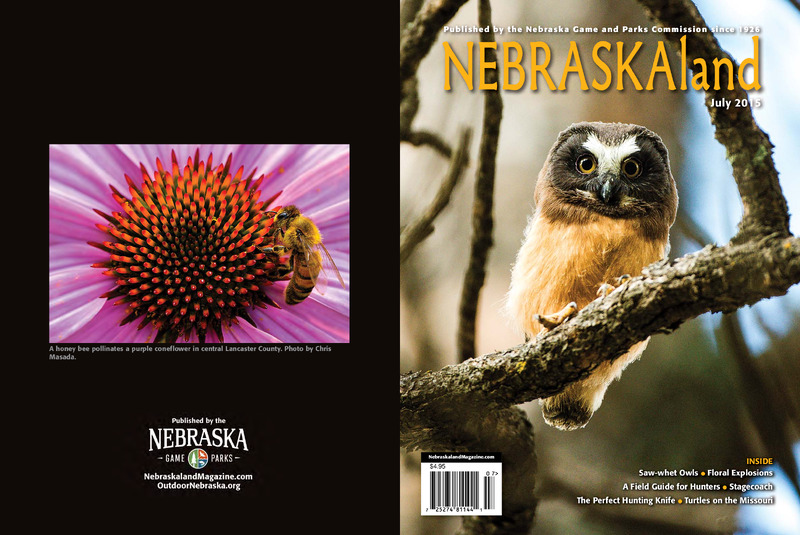
Publis hed by the Nebr a s k a Ga m e a nd Pa r k s C o m m is s ion si nc e 1926
NEBRASKAland
July 2015
A honey bee pollinates a purple coneflower in central Lancaster County. Photo by Chris
Masada.
NebraskalandMagazine.com
$4.95
INSIDE
Saw-whet Owls ● Floral Explosions
A Field Guide for Hunters ● Stagecoach
The Perfect Hunting Knife ● Turtles on the Missouri
NEBRASKAland Magazine
Volume 93
●
No. 6
●
July 2015
F EAT U R ES . . .
24 Saw What? – Baby Saw-whets in Nebraska
STORY AND PHOTOS BY JUSTIN HAAG
28 The Ultimate Deer Knife
B M M
30 Stagecoach
P
S
E F
38 A Field Guide for Hunters
Y
ATT
ARX
HOTOS AND TORY BY RIC OWLER
An interview with the authors of Hunting for Food
BY JEFF KURRUS
40 A Series of Fortunate Accidents
STORY AND PHOTOS BY CHRIS HELZER
42 Yellowbanks WMA
STORY AND PHOTOS BY JENNY NGUYEN
44 Floral Explosions
40
●
STORY AND PHOTOS BY CHRIS HELZER
48 Turtles on the Missouri
STORY AND PHOTOS BY JENNY NGUYEN
I N S I D E T H I S I S S U E ...
Mixed Bag – Least Shrews, Harrison, Too Hot to Sleep
Inside in 1936, Product Reviews, the White-breasted
Nuthatch, Photographing Fireworks, Painting Decoys,
White-tailed Deer Signs, Upcoming Events and more .....6
Outdoor Update – Salt Creek Tiger Beetles ..........54
Junior Journal................................................57
In the Kitchen – Catfish Po' Boys .......................60
The Last Stop – Nebraska’s Mountain Views .........62
54
●
48
●
O N TH E W EB . . .
WHEN YOU SEE THIS SYMBOL IN THE PAGES OF
N
NEBRASKALAND MAGAZINE, VISIT
NEBRASKALANDMAGAZINE.COM AND VIEW OUR INTERACTIVE
DIGITAL EDITION FOR MORE INFORMATION.
D
NEBRASKAland (VOL. 93 / NO. 6, ISSN 0028-1964) is published monthly, except
for the combined Jan./Feb. and Aug./Sept. issues, by the Nebraska Game and Parks
Commission, 2200 N. 33rd St., Lincoln, NE. Periodicals postage paid at Lincoln,
Nebraska, and additional mailing offices. POSTMASTER: Send address changes to
NEBRASKAland, P.O. Box 30370, Lincoln, NE 68503-0370.
2 NEBRASKAland • JULY 2015
30
●
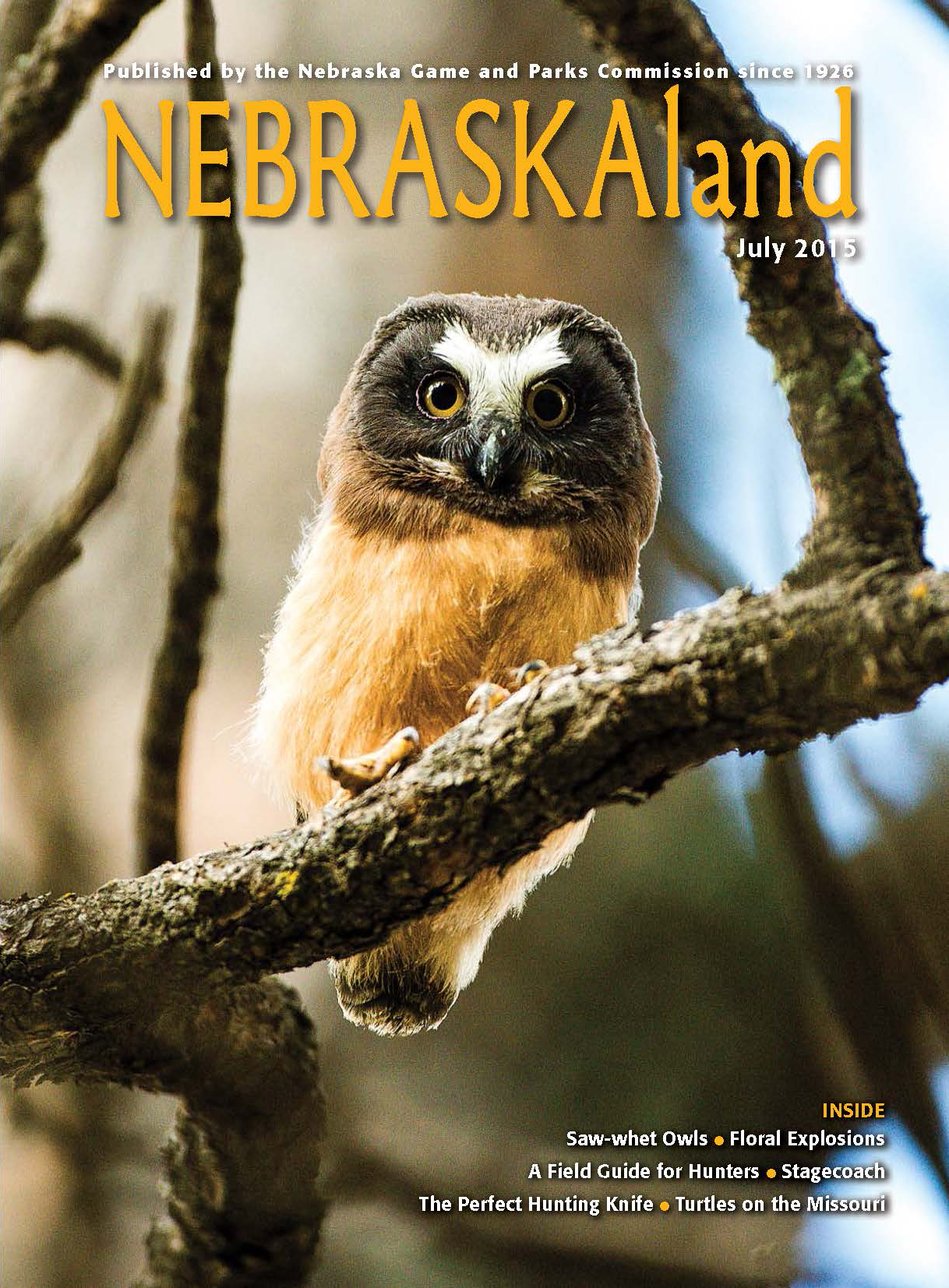
Cover: This diminutive saw-whet owl was photographed in the Wildcat
Hills of Nebraska’s Panhandle. The name comes from the sound of its call
being similar to that of a knife on a whetstone. See the story on page 24.
Photo by Justin Haag.
JULY 2015 • NEBRASKAland 3
Nebraska
on My
Mind
Photos and story
by Michael Forsberg
When I was a
kid, Dad would
always honk the
horn of our intrepid
Volkswagen 412
as we would cross
the state line back
into Nebraska from
wherever it was
we had been during
our summer family
vacations.
plant
A Rocky Mountain bee
firework,
opens like a blooming
on
revealing a visiting ladybug,
in July.
the Sandhills prairie
33
JUNE 2015 • NEBRASKAland
• JUNE 2015
32 NEBRASKAland
Honking for Nebraska
I wanted to send my congratulations
on the excellent “Nebraska On My
Mind” article written by Michael
Forsberg in the June issue of
NEBRASKAland.
I too honk the car horn when me and
my family enter Nebraska on our way
home from visiting relatives in Denver.
I was glad to hear someone else does
this crazy ritual. Normally I hit the
horn with the “There’s no place like
Nebraska” tune when we cross into
Nebraska.
Being born and raised on a
northeastern Nebraska farm, I also have
a fond love of the land as described by
Mr. Forsberg.
My two daughters, now grown, also
made sure we honked the horn upon
entering Nebraska. My wife, being a
native of Colorado, at first thought this
“honking” was nuts but now completes
the tradition when it’s her turn to drive
us home across the state line.
Yes, there is No Place Like
Nebraska!
Douglas A. Koopman
Hastings, Nebraska
A Canada goose flies over Pioneers Park
in Lancaster County. Photo by Mitch
Tranmer.
Outdoor
O
d
Plates
Pl
The license plate on Gary Kurtzer’s
vehicle lets others know what he’s
likely to have inside. The Lincoln man
has fished year-round for largemouth
bass for more than 40 years in the Salt
Valley Lakes and elsewhere.
If you have a unique outdoor
message plate you would like to
share, or know someone who does,
e-mail a photo (high-resolution, JPEG
format only, please) along with your
hometown and a brief description of
the interests expressed on your license
plate to Eric.Fowler@Nebraska.gov.
Message in the Magazine
Now, you can send a message
to NEBRASKAland Magazine at
Facebook.com/nebraskalandmagazine
and your comment or photograph may
appear on these pages.
– Editor
Four-year-old Wyatt Niebuhr holds up a
bluegill while fishing with his dad on a
lake in Hall County. Photo by Kay Niebuhr.
Andrew Nelson of Orting, Washington,
shot this white-tailed buck on private land
in Cherry County. Photo by Rusty Lurz.
Correction
In the May 2015 issue on the Portraits
of the Past page we incorrectly identified
Guy Stinson as Gary. The letter also
stated that Guy and his yearly hunts
with friends Ben and Frank Parr and
Dr. Sievers ended in 1944. In fact, their
hunts actually ended in November of
1941, just before full United States
involvement in World War II.
Send your comments to:
Jeff Kurrus, Editor
NEBRASKAland Magazine
P.O. Box 30370
Lincoln, NE 68503
or e-mail Jeff.Kurrus@Nebraska.gov
Please include your postal address and telephone number. Letters may be condensed
and edited. Photographs are also welcome.
Cece Grimes took this eastern fox
squirrel image in downtown Lincoln in
Lancaster County.
4 NEBRASKAland • JULY 2015
Paul Pack photographed this great blue heron with a bluegill in its beak on a private
pond in Dawson County.
Any program that receives federal funding from the National Park
Service, or the United States Fish and Wildlife Service prohibits unlawful
discrimination on the basis of race, color, religion, age, gender, marital
status, national origin, age, disability or political affiliation. Any person
who believes he or she has been discriminated against in any program,
activity, facility, or service, should contact the Nebraska Game and
Parks Commission, Lincoln, NE 402-471-0641, the Equal Opportunity
Commission, Lincoln, NE 402-471-2024, TTY/TDD 402-471-4693;
United States Fish Wildlife Service, Civil Rights Coordinator, 4401
N. Fairfax Drive, Arlington, VA 22203; Director, Equal Opportunity
Program, U.S. Department of Interior, National Park Service, 1849 C
Street NW, Mail Code 0008, Washington, D.C. 20240-0001.
COMMISSIONERS
CONSERVATION OFFICERS
Director Jim Douglas
Commissioners
Chairman - Dr. Kent Forney, Lincoln
Vice Chairman - Rex Fisher, Omaha
2nd Vice Chairman - Mark Spurgin, Paxton
Robert Allen, Eustis
Dick Bell, Omaha
Lynn Berggren, Broken Bow
Mick Jensen, Blair
Norris Marshall, Kearney
Dr. Mark Pinkerton, Wilber
NORTHWEST
Officer
City
Jim Zimmerman (S) Gering
MAGAZINE STAFF
Communications Director Christy Rasmussen
Editor Jeff Kurrus
Art Director Tim Reigert
Associate Editor Jenny Nguyen
Regional Editors Eric Fowler, Julie Geiser,
Justin Haag
Contributing Editor Michael Forsberg
Regular Contributors Chris Helzer, Gerry
Steinauer
Photo Librarian Jaclyn Cruikshank Vogt
Circulation Donna Robinson
For address changes and questions about
your subscription, e-mail donna.robinson@
nebraska.gov or call 800-632-5263
Advertising Sales Manager
For advertising information contact
Shane G. Gilster, 402-742-0125
Email: shanegilster@gmail.com
NEBRASKAland Magazine Copyright 2014, all rights reserved.
NEBRASKAland is available in audio from the Nebraska Library
Commission Talking Book and Braille Service, Suite 120, 1200 N St.,
Lincoln, NE 68508. 800-742-7691. NEBRASKAland Magazine and the
Nebraska Game and Parks Commission reserve the right to reject any
advertising not in keeping with the agency mission.
Rates: $18 for one year; $33 for two years; $44 for three years. Nebraska
recipients must add appropriate sales tax. To subscribe call
1-800-NEBLAND (632-5263), or go online to: NebraskalandMagazine.
com.
COMMISSION
C
COM
CO
OM
OMMIS
MIS
SSIO
SION O
SI
OFFICES
FF CES
FF
FFI
CES
S
Headquarters/Southeast District Office
2200 N. 33rd Street Lincoln, NE 68503
Phone 402-471-0641
Northeast District Office
2201 N. 13th St. Norfolk, NE 68701
Phone 402-370-3374
Southwest District Office
301 E. State Farm Rd. North Platte, NE 69101
Phone 308-535-8025
Northwest District Office
East Hwy. 2, Box 725 Alliance, NE 69301
Phone 308-763-2940
Bassett Office
524 Panzer St., Box 508 Bassett, NE 68714
Phone 402-684-2921
Kearney Office
1617 First Ave. Kearney, NE 68847
Phone 308-865-5310
Ak-Sar-Ben Aquarium
21502 W. Highway 31 Gretna, NE 68028
Phone 402-332-3901
Omaha Office
8495 Frederick Street, Omaha, NE 68124
Phone 402-595-2144
Greg Hesse
Scott Brandt
Dan Kling
Frank Miller
Sean McKeehan
Terry Brentzel
Phone (308)
(office) 763-2940
(cell) 641-6138
Rushville
760-3647
Gering
631-0663
Harrison
430-0572
Valentine
402-389-0444
Bridgeport
279-9133
Oshkosh
458-7650
SOUTHWEST
Officer
City
Phone (308)
Roger Thompson (S) N. Platte (office) 535-8025
(cell) 530-3097
Ray Dierking
Brkn. Bow
870-0322
Michael Thome
Cozad
529-8146
Matt Andrews
Elwood
746-2418
Dirk Greene
Imperial
882-0015
Dale Johnson
Kearney
440-3847
Brian Piernicky
McCook
340-6627
Brandon O’Neal
N. Platte
530-3157
Nicholas Fix
Ogallala
289-0427
Bryce Streger
Ogallala
289-1169
Rich Routh
Rep. City
920-0367
Tim Williams
Grand Is
380-7331
Pat George
Kenesaw
402-705-9989
Matt Brandt
Loup City
202-0819
Andrew Heyer
Cozad
402-613-2241
Alex Hasenauer
Wellfleet
660-4671
NORTHEAST
Officer
Tom Zimmer (Sup.)
City
Norfolk
SOUTHEAST
Officer
Levi Krause (Sup.)
William Krause
Mike Luben
Dan Zuehlke
Heath Packett
Douglas Kramer
Dina Barta
Stacey Lewton
Dudley Sorensen
Russell Mort
Dan Evasco
Rich Berggren
Travis Shepler
City
Louisville
Auburn
Colon
Cortland
Eagle
Lincoln
Lincoln
Lincoln
Waverly
Nebr. City
Papillion
Waterloo
Lincoln
Phone (402)
949-0593
274-8063
443-6392
806-9084
210-0888
890-6465
890-6463
890-7140
937-3422
209-1506
616-5961
619-1355
613-2312
ADMINISTRATION
Officer
Craig Stover (Adm.)
Duane Arp (Ass.)
Jeff Clauson (Ass.)
City
Lincoln
Lincoln
Lincoln
Phone (402)
471-5531
471-5531
471-5531
Phone (402)
(office) 370-3374
(cell) 649-8053
Dale Davis
Bassett
760-0712
Steve Oberg
Columbus
910-3366
Daniel Roberts
Fremont
719-1108
Randy Pomplun
Fullerton
308-550-0489
Jeff Jones
Hartington
762-5022
Jon Reeves
Kennard
889-8508
Doug Pollard
Ord
308-730-7050
Alex Thomas
Ponca
241-7615
Cory Krause
West Point
380-6410
Jonathan Andreasen O’Neill
340-3981
Mitch Johnson
Wausa
613-8612
Nebraska Wildlife Crimestoppers 1-800-742-7627
JULY 2015 • NEBRASKAland 5
A Mammal Brief
Least Shrew
Lindsay Rogers is
an outdoor education
specialist with the
Nebraska Game and
Parks Commission.
By Lindsay
i
Rogers
Although small and mouse-looking, the least shrew (Cryptotis parva)
is more closely related to hedgehogs than mice. Least shrews are
found across the eastern United States from eastern Mexico to
New York. In Nebraska, they are found in all areas except the
Panhandle. Like all shrews, least shrews are insectivores; they
feed primarily on insect larvae and centipedes, but will also eat
spiders and snails. They have huge dietary needs often eating
60-100 percent of their body weight in food daily. Shrews are
often considered an economic benefit as they
consume large amounts of potentially
harmful insects. ■
NGPC PHOTO LIBRARY
6 NEBRASKAland • JULY 2015
JULY 2015 • NEBRASKAland 7
Travelogue Sponsors
By Justin Haag
Harrison
h travelers on the two-lane blacktop of U.S. Highway
hen
2
20 go as far northwest as they can get in Nebraska,
th
they’ll surely not miss a road sign that has triggered
many llaughs. “Harrison: Next Four Exits.”
The sign, made in green and designed to match the familiar
the
markers along Interstate 80, has been a longstanding joke in
along
g
travelin
Sioux County seat, population 247. When one is
the quiet highway, which is alternately known as the Bridges
to Buttes Scenic Byway, though, it’s no joke: People are wise
to take one of the many “exits” that lead to the region’s trove
forest, badlands,
Harrison
of scenic gems. Unique buttes and rock formations, Pine Ridge
the time to look.
take
who
s
visitor
await
wildlife
of
ance
abund
an
and
nds
grassla
for its
A good place to start is a drive on Pants Butte Road, known
winds
which
Road,
n
fantastic view from high above, and Sowbelly Canyo
as
peeled
eyes
through a wooded area of steep country. Keep your
observing
this area provides what may be Nebraska’s best chance for
where
Park
Coffee
bighorn sheep. Along the latter road sits the quaint
a
of
fashion
the
in
Sowbelly Creek and trout ramble over river rocks
mountain stream.
r
Just north of Harrison is Monroe Canyon and the Gilbert-Bake
where
ation
Wildlife Management Area, a popular hunting destin
of
elk, wild turkey, mule deer and whitetails roam under a forest
towering ponderosa pine trees.
Straight south from Harrison are rolling grasslands that lead
to the slowly meandering Niobrara River, a hardly recognizable
waterway to those who know it as the busy canoeing destination
180 miles east. Just off the highway in this valley is the
impressive Agate Fossil Beds National Monument, which
features the many Miocene Epoch mammal fossils that have
been discovered at the site.
Lodging and dining in Harrison
includes the historical Harrison House Hotel on
Main Street, a bed and breakfast originally established in 1886
experience
by the Chicago Northwestern Railroad. For those wanting an
and Drifter
away from “the big city,” there’s the High Plains Homestead
northeast
ds
Cookshack situated in the wide open grasslands and badlan
phere,
atmos
of town. A stay at this site, known for its food and Old West
nHudso
the
will put the traveler near the Oglala National Grassland and
of
tion
Meng Bison Kill, another fossil site which features the excava
e as
an ancient breed of bison that were killed by the Alberta Cultur
ape
landsc
like
many as 11,200 years ago. Just up the road is the moonof
thinks
of Toadstool Geologic Park, a must-see for anyone who
Nebraska as just fields of corn, beans and wheat.
gems
The region also is a popular destination for those looking for
y to
Count
in a literal sense, not just figuratively. Many come to Sioux
known
only
hunt the state gemstone – blue chalcedony, more comm
as blue agate.
sure
From magnificent elk herds to spectacular rocks, this area is
always
it’s
,
to have what the traveler is hunting. And conveniently
■
easy to get off at the right exit when you’re in Sioux County.
n.
Coffee Park is a must-see destinatio
Gilbert-Ba
abundant ker WMA is
with wildl
ife.
PHOTOS BY JUSTIN HAAG
Park si.s
c
i
g
o
l
o
e
G
r
Toadsotroiotle among visito
a fav
JULY 2015 • NEBRASKAland 9
NSHS, RG2183-1936-725
Nebraska State Capitol, July 1936.
A Brief History
It’s Too Hot to Sleep
Inside
By Patricia C. Gaster,
Nebraska State Historical Society
uring the Great Depression
Nebraskans became accustomed
to living under trying
conditions. People had to cope
not only with hard economic times,
but with the intense heat accompanied
by drought that plagued this state and
much of the rest of the country.
The relentless heat was hard on
everyone who suffered through the
summer of 1936. The heat wave
started in late June, when temperatures
across the United States exceeded 100
degrees. Temperatures reached record
levels in July. On July 25, 1936, the
Lincoln Journal Star’s banner headline
said it all: “Mercury 114; Breaks
Record Here.” The Star reported: “The
merciless heat followed the hottest
night in all Lincoln history. The lowest
D
10 NEBRASKAland • JULY 2015
temperature of the dark hours was 91.”
Many people suffered from heat
stroke and heat exhaustion, particularly
the elderly. In the era before airconditioning and public swimming
pools, most people could rely only on
fans and blocks of ice for some degree
of cooling.
Ruth Godfrey Donovan and her
family lived in a small apartment in
downtown Lincoln. Donovan said,
“The iceman was still making his daily
rounds at that time. I prepared for his
coming by placing a large washtub
in the center of the living room floor.
Then I watched for him. When I saw
his small truck in front I rushed out
and asked for a fifty pound piece of the
delightfully cold product. He would
bring it into the apartment and place it
in the tub. Then I turned a strategically
placed electric fan to blow on the block
of ice. For several hours I gloated over
the cooling breezes!”
She recalled a neighbor’s homemade
air conditioner, “the wonder of the
year,” which consisted of little more
than an old automobile radiator in the
living room. “The window behind it
was open slightly, just enough to allow
a garden hose to be passed in to the
coils of the radiator and another piece
of hose to go from the coils and out of
the window. An electric fan was placed
behind the radiator and blew a steady
stream of air on the coils. The mixture
of cold water going through and the air
from the fan produced cool air for the
room!”
Some people could swim in lakes
and rivers, and cities opened fire
hydrants. Many slept outdoors. The
photo above, from the MacDonald
Studio Collection at the Nebraska State
Historical Society, depicts residents
of Lincoln sleeping on the lawn of the
Nebraska State Capitol to escape the
heat.
The summer of 1936 was the hottest
and driest ever recorded. The heat
wave and drought largely ended in
September, though fields and lawns
remained parched. ■
Visit the Nebraska State Historical
Society’s website at Nebraskahistory.org.
JULY 2015 • NEBRASKAland 11
Paid Advertisement
12 NEBRASKAland • JULY 2015
JULY 2015 • NEBRASKAland 13
Nebraska Bird Library
Sponsored by
y
White-breasted Nuthatch
Product Reviews
By Jeff Kurrus
PHOTO BY DOUG CARROLL
Song or calls: Low, repeated, nasal “yank.”
Song is whistled series on one pitch, “whee,
whee, whee.”
Description: Sexes similar. Blue-gray above;
white below; black crown and nape; all-white
face; extent of rust below is variable.
Habitat: Generally found in fairly mature
floodplain forests during the breeding season.
During the rest of the year it inhabits a wider
variety of habitats, and can also be seen at
residential birdfeeders.
Where in Nebraska: Common permanent
resident in eastern Nebraska. Breeds as far
west as the Pine Ridge area and to at least Hall
County along the Platte.
Field Notes: These birds are essentially
nonmigratory, and will store food during the fall
for winter in crevices behind loose tree bark.
Fun Facts: White-breasted nuthatches creep
down tree trunks head first in search of insects
and other food. ■
To learn about more birds visit:
NebraskaBirdLibrary.org.
Frogglez swimming goggles for kids
feature a tangle-free design ideal for
little heads. With a strap made from
neoprene fabric, they have become
my young daughter's go-to
goggle for her trips to Eugene
T. Mahoney State Park's aquatic
center. Frogglezgoggles.com.
The Vivitar Life Cam Wearable Camcorder is a bit different from the
camcorders of your youth. This one easily fits in your pocket and boasts
1080 HD, a 2.4x digital zoom and built-in Wifi. It's also compatible
with iPhone and Android. Vivitar.com.
Wood N' Stream once again features a series of boots worth sharing.
Their Flyway models – noninsulated, waterproof and breathable –
prove to be one of the most comfortable boots we've worn. Perfect
for bank fishing in the summer and those warm bow hunting
days in the early fall. Weinbrennerusa.com.
14 NEBRASKAland • JULY 2015
PHOTOS BY JEFF KURRUS
The Titan watch from Reactor, with its Never
Dark technology, has become the first watch – with
its durability, look and feel – to make me leave my
smartphone in my pocket. A must-have for outdoor
enthusiasts. View all models at Reactorwatch.com.
JULY 2015 • NEBRASKAland 15
Hot Item: Propane
Coffeemaker
Everywhere Signs
By Jeff Kurrus
W
hite-tailed deer can be scouted all year. Here are a few different ways to
analyze what you’re seeing in the woods and what the signs mean.
PHOTO BY JUSTIN HAAG
4. Rubs – Whitetails rub on trees to
announce their presence in an area,
and will begin to appear once their
antlers harden in late summer and early
fall. Traditionally, tree width tends to
coincide with buck size, and broken
branches can be an indicator of how tall
or wide a buck’s rack may be.
PHOTO BY JEFF KURRUS
PHOTO BY JENNY NGUYEN
PHOTO BY JEFF KURRUS
1. Trails and Tracks – Some people
think game trails are distinct for
individual species – like a raccoon
has its own road, a bobcat another,
etc. Game trails that don’t go directly
to and from a burrow are used by all
animals, including deer. Pay attention
to the locations of game trails,
especially when more than one of these
trails cross. Most of the time these
trails will be near fence lines and field
edges, and are paths connecting where
whitetails eat, sleep and drink.
By Justin Haag
The old enamelware percolator over a morning campfire
may be fun but it doesn’t exactly excel at brewing a lot of
coffee in a hurry at the campsite. That’s why the Coleman
Portable Propane Coffeemaker has reached essential status
among my camping equipment.
The coffeemaker works much similar to an electrical unit
but with the freedom of propane. No longer am I required
to camp at a place with electricity in order to brew the
morning pot of coffee with speed and convenience. Just
a level surface and a
cylinder of propane get
the job done.
One word of caution:
The shiny stainless
steel carafe looks great
and holds up to the
rigors of the trail, but
it won’t keep your
coffee hot for long.
After brewing, I pour
the pot of coffee into
a thermos and it stays
hot until it’s gone. ■
PHOTO BY JENNY NGUYEN
2. Bedding Areas – In the summer these areas will be scattered across a
landscape because of does protecting their fawns and will be made up of multiple
grass laydowns of various sizes. Look near thickets, tallgrass areas and the ends
of ridges. During this time, bucks will often bed alone. In the winter, however,
these areas will consist of evergreens and other forms of thermal cover. Know
where these areas are, but don’t get too close throughout the season.
PHOTO BY JEFF KURRUS
3. Scat – Deer scat usually looks like
black marbles or raisins. It can further
confirm whitetail use of a game trail
or bedding area and give a pretty good
indication of how many deer are using
an area.
16 NEBRASKAland • JULY 2015
5. Scrapes – Not far from rubs are
ground areas where leaves, grass and
other material have been replaced by
bare earth. Deer will use their hooves
to scrape away these areas and will
urinate in these spots. Also search for
overhanging limbs above these scrapes
where a buck will rub his eyes, mouth
and forehead to leave scent to further
announce his presence.
Whether a hunter or photographer,
look for these signs next time afield for
a better chance at locating whitetails. ■
JULY 2015 • NEBRASKAland 17
Fireworks Photos
By Justin Haag
Bucket List
18 NEBRASKAland • JULY 2015
“ahhhs” are occurring.
No Noise – It’s best to let the fireworks make the noise,
not your photos. Noise, which used to be referred to as grain
in film days, becomes a problem with high ISO settings. Set
the ISO at 100 for sharp, noise-free photos.
Independence! – When shooting digital it’s easy to see
what’s working and what isn’t. The Fourth of July is all
about independence, so break away from your camera’s
automatic settings and bravely go manual to record the
“rocket’s red glare.” Your forefathers of photography would
be proud. ■
inexpensive child’s training ring
for comfort to sit on. Those
night trips to an outhouse will
be eliminated. More expensive,
regular toilet seats that fit over
five-gallon buckets are also
available.
Store clothes in buckets to
keep them dry and out of the
rain. Make a bucket for each
person, and label buckets with a
permanent marker to eliminate the
guesswork of what’s inside.
Be creative and put your favorite
camping items in five-gallon buckets.
They’re inexpensive and stack easily in a
garage or shed, ready for the next camping adventure.
■
Soldiers Point
the Way at
Fort Atkinson
By Jenny Nguyen
Park-goers will notice new characters
as they drive into Fort Calhoun to visit
Fort Atkinson State Historical Park
this season. Standing on the north and
south sides of town are four threedimensional iron soldiers. Each at ninefeet tall, they point the way to the park;
one is painted in the likeness of Steve
Kemper, a previous park superintendent
at Fort Atkinson, and another looks
like John Slader, the fort’s current
superintendent. And on the east side of
Highway 75 in the Super Bee Orchard
property stands a new directional sign.
The project was part of an effort
to make the historical park more
visible. The Nebraska Game and Parks
Commission provided $14,000 in
grant funding, while the city of Fort
Calhoun provided assistance from its
Keno Funds. Local businesses such
PHOTO BY JENNY NGUYEN
By Julie Geiser
Five-gallon buckets are one of my favorite tools to take
tent camping. They can be used to keep items clean and dry,
to store camp water, a place to sit around the campfire, a
nightstand inside a tent, and they are easy to carry. Here are
some other ideas.
A bucket can be used for storing cleaning items and to
wash clothes or dishes at camp. Place an ice cream bucket
or another smaller bucket inside and use that to store smaller
items such as a bottle of dish soap and wash cloths in a
plastic bag. Don't forget disposable wipes, Clorox spray and
hand sanitizer.
Fill another bucket with paper plates, disposable cups,
plastic utensils and other kitchen items.
If you have young children, a bucket makes a great potty;
line the bucket with a heavy-duty trash bag and buy an
PHOTO BY JUSTIN HAAG
With Fourth of July upon us, impressive fireworks
displays throughout the state will provide ample
opportunity for photographers. Many shutterbugs
will be satisfied by snapping a few shots with their
mobile phones for sharing on social media, but
those of you with DSLR cameras should aim higher.
Here are basic tips, a declaration if you will, to
make the most of your fireworks photography.
Don’t Flash – A direct flash will do nothing to
improve your fireworks photos and will likely hurt
them. Turn it off.
Keep it Steady – A tripod with a remote release
is all but required for getting sharp firework photos
with no blur. If you don’t have a tripod, try to find
something besides your shaky hands to keep the
camera steady.
Setting the Scene – No need to buy any special
lenses. An average focal length lens will be
adequate to compose a scene for fireworks. My
favorite fireworks photos have something in the
scene besides just the pyrotechnics. Look around.
Are the bursts reflecting off the lake? Is there a
crowd of people or landmark below? Can you
use the silhouette of an interesting shape in the
foreground?
Being Sharp – Some assume they need to open their
aperture wide because it’s night, but your subject is bright
enough it’s not necessary. You can use f/8 and higher and
ensure the subjects in your scene stay in focus. If your
camera lens is searching to find the fireworks, switch to
manual focus.
Shutter Control – Generally, try to have the shutter open
from the time the firework explodes to the end of its burst.
The bulb setting on your camera, with the use of a remote,
allows you to open and close the shutter as the “oooohs” and
An iron soldier stands by the welcome sign in Fort Calhoun, the location of Fort
Atkinson State Historical Park. Three other soldiers can be found in town.
as Black Dog Steel in Tekamah, artist
Art Clausen, Tri-County Grading
and volunteers were instrumental
in completing and installing the
soldiers and sign. Future plans call for
additional landscaping, brickwork, a
welcome sign and smaller five-foot
soldiers to line the streets in Fort
Calhoun.
This season's living history dates
are July 4-5, Aug. 1-2, Sept. 5-6,
Oct. 3-4 and a Candlelight Tour on
Nov. 7. For more information, visit
FortAtkinsonOnline.org. ■
JULY 2015 • NEBRASKAland 19
Painting Decoys
By Julie Geiser
After the waterfowl season this year
I noticed many of our plastic decoys
were in dire need of repainting. These
decoys have been used for over a
decade – their paint has faded and
chipped, but they are still in good
condition. Repainting your old decoys
is a great way to save some money.
Choosing paint colors is easy – get
color samples from a paint store that
look similar to the ones on newer
decoys or photos and match them with
either a matte/flat spray paint or satin
exterior latex paint or use both.
Start by getting all the mud, debris
and old paint off by placing the decoys
in a decoy bag and power wash them
at home or at the car wash; use a wire
brush to get loose paint off or do both
according to your needs.
Fix any shot holes in the decoys with
paintable silicon and let dry before
continuing.
Next, line up all the drake decoys in
a well-ventilated area and the hens in
another. Then paint the base coat on
the body of the decoys first, starting
with the drakes then the hens – this
way a routine can be followed to
make painting go faster. The following
techniques can be used for other duck
and goose decoys, too.
These mallard decoys have the basecoat
painted on the body and bills.
Colors
The colors I used for my
decoys are listed below. Not
everyone will have access
to the same colors so match
colors using a newer decoy
or copy the colors off a photo.
Bill: Marigold color spray
paint (a yellow/green color is
best).
Body: Sand color spray paint
(a tan/gray color is needed).
Head: Behr paint color Alpine
View (dark green).
Neck ring: Flat white.
Chest, back and sides: Home
Depot paint color Argo (dark
burgundy).
Tail: Flat black.
Bill: Sunburst Yellow (a
yellow/orange color is best).
Body base coat: Khaki spray
paint (light tan, golden brown
color needed).
Body top coat: Behr paint
color Coal (dark brown).
20 NEBRASKAland • JULY 2015
DRAKES:
Paint the bill. Cover the back and
sides of the drake with newspaper or
a plastic bag to avoid overspray on
the basecoat. Holding the keel of the
decoy, point the bill down and spray
paint. I purposely paint some of the
yellow on the cheeks of the drake for
a little sparkle. Brush painting with
exterior house paint versus spray paint
may be easier for some and is just as
effective.
Paint the green head of the drake. I
prefer brush painting to spray paint on
the head so I don’t have to mask off the
bill, making the painting go faster.
Paint black on the tail and head with
a sponge brush or bristle brush. Make
sure the paint is dry between paint
coats; usually by the time you get to
the last drake the first is ready for more
paint. Use newspaper to mask off areas
if spray painting on the tail; if using a
brush there’s no need to mask. Brush
the black on the top, back and sides
of the head leaving plenty of green
showing. Note the pattern that the
black color makes from a newer decoy
or photo and mimic that pattern.
Brush the burgundy color on the
chest, sides and back; paint all the
white patches around the neck and tail
areas with a brush. Making the white
color patterns larger than normal is
advisable as the birds will see these
distinguishing marks from the air.
Painting the iridescent blue on the
wings is optional. When resting in the
water most mallards do not have the
blue displayed.
The topcoat of the hen mallard is done by
brush painting a darker brown color over
the basecoat. Follow the pattern of the
dark brown by looking at a newer decoy
or photos.
HENS:
Paint the bill. Mask off the bill
and cover the back and sides of the
hen with newspaper or a plastic bag
to avoid overspray on the basecoat.
Holding the keel, point the bill down
and spray paint.
Paint the tail black. Use newspaper to
mask off areas if spray painting on the
tail; if using a brush there’s no need to
mask.
Using a sponge or bristle brush, paint
the darker brown on the head, cheeks
and back; note the patterns that the
Once repainted, these old plastic mallard
decoys are ready for a few more seasons.
dark brown color makes from a newer
decoy or photo and mimic that pattern.
Brush white paint on the tail area.
To finish, paint the brown pattern on
the bill of the hens and fill in nostrils
of drakes with the corner of a sponge
brush. With a permanent black marker
fill in the eyes and very tip of the bill.
If the decoy has glass or realistic plastic
eyes, cover them with tape before
starting to avoid painting over them.
TIPS:
Use fine grit sandpaper to smooth out
paint-chipped areas.
If you mess up, simply touch the
area up with spray paint or paint and a
brush.
Don’t worry if your painting is not
perfect – if the ducks are close enough
to notice imperfections, you should be
shooting anyway.
Pints of exterior latex paint will paint
over two dozen decoys.
If the entire body doesn’t need to be
painted, touch up painting can be done
on a smaller scale.
Do not use gloss paint, it will look
unnatural.
Spraying paint onto paper and
dipping a brush into it works just as
well as using paint from a pint jug for
smaller touch ups or details.
Let the newly painted decoys dry for
a few days then finish by spray painting
with a flat/matte clear coat to seal the
paint.
It takes an afternoon to get through a
couple dozen decoys, but it’s time and
money well spent. ■
NEBRASKAland
P H O T O
C O N T E S T
FOR COMPLETE CONTEST RULES AND ENTRY, GO TO...
NebraskalandMagazine.com/photocontest
JULY 2015 • NEBRASKAland 21
July 7
Family Fishing Event Optimist Lake,
by Jerry Kane
Contact the Nebraska Game and
Parks Commission at 402-471-0641
or visit OutdoorNebraska.org for more
information. Visit HuntSafeNebraska.
org for a list of hunter education
classes and BoatSafeNebraska.org for
a list of boating safety classes.
June 29-July 2
Outdoor Adventure Camp Nebraska
Game and Parks Outdoor Education
Center, Lincoln, 402-471-6141
Auburn, 6-8 p.m.
Nebraska Game and Parks Board of
Commissioners meeting, Sidney
July 7
Ladies Day at the Range Nebraska
July 16
Super Tag Nebraska Super Tag permit
drawing
Game and Parks Outdoor Education
Center, Lincoln, 6:30-8 p.m., 402-471-5662 July 16
July 8
Family Fishing Event
Holmes Lake, Lincoln, 6-8 p.m.
July 8, 15, 22, 29
Beyond Becoming an OutdoorsWoman (BOW) Rifle Class
Platte River SP, Louisville, 402-471-5547
July 9
Family Fishing Event
Halleck Lake, Papillion, 6-8 p.m.
July 1
Archery Fishing of game fish is allowed July 10, 24
statewide through Dec. 31
Friday Night Guest Speaker Series
Chadron SP, Chadron, 7 p.m.,
July 1
Underwater Spearfishing of game fish 308-432-6167
allowed in specific waters through Dec.
July 11
31 (see page 22 of 2015 Fishing Guide)
Carp-O-Rama Lake Maloney State
Recreation Area (SRA), North Platte,
July 1-4
8 a.m.-4 p.m.
Western and Wildlife Art Show
Fort Robinson State Park (SP), Crawford, July 11
308-665-2900
Bighorn Sheep Hike Wildcat Hills
Nature Center, Gering, 9 a.m.,
July 1-14
Paddlefish Snagging permit application 308-436-3777
period
July 11
Archery paddlefish season opens
July 3
Super Tag Final day to apply for
July 11-12
Nebraska Super Tag and Combo lottery
Cabela’s Regional Walleye
permits
Championship Lake McConaughy SRA,
Ogallala, 308-440-7018
July 3
National Park Service Program
July 13
Niobrara SP, Niobrara, 7 p.m., 402-8573373
July 3, 17, 31
Friday Night Guest Speaker Series
Family Fishing Event Clark’s Pond,
July 17
Families on Target Archery
Nebraska Game and Parks Outdoor
Education Center, Lincoln, 6-7:30 p.m.,
402-471-6141
July 17-18
Beyond BOW Niobrara and Missouri
River Kayaking Trip Niobrara SP,
July 17-18 – 20
Target 3-D Shoot/Bow Sight-In Day
Nebraska Game and Parks Outdoor
Education Center, Lincoln, 402-471-6141
July 18
National Park Service Event Discover
Park Pond, Omaha, 6-8 p.m.; Laing
Lake, Alliance, 6-8 p.m.
July 18
Family Fun Day Victoria Springs SRA,
July 25
The Dam Run 5K Run/Walk
Anselmo, 11 a.m.-3 p.m., 308-749-2235
July 18
Geocaching Niobrara SP, Niobrara,
10 a.m., 402-857-3373
July 18
Mahoney XL Sanctioned C-Tier Disc
Golf Tournament Eugene T. Mahoney
SP, Ashland, 402-944-2523
Louisville, 6-8 p.m., 402-471-5547
Calamus SRA, Burwell, 308-346-5666
July 13-17
Outdoor Skills Camp for ages 8-15,
July 18-19
Centennial Bass Club Tournament
Niobrara, 6 p.m., 402-857-3373
Nebraska Game and Parks Outdoor
Education Center, Lincoln, 402-471-6141
Lake McConaughy SRA, Ogallala,
303-601-1723
July 4
Fourth of July Barbecue Fort
July 13-31
Application Period for Gifford Point
July 20
Family Fishing Event Zoo Pond,
Robinson SP, Crawford, 11 a.m.-1:30 p.m., Wildlife Management Area special access Scottsbluff, 4-7 p.m.
308-665-2900
permits for deer hunting
July 21
Family Fishing Events Bowling Lake,
July 4-5
Living History Fort Kearny State
July 14
Family Fishing Event Arrowhead
Historical Park (SHP), Kearney, 308-8655305; Fort Atkinson SHP, Fort Calhoun,
402-468-5611
Meadows Golf Course Pond, Curtis, 6-8
p.m.
July 4-5
Pioneer Longrifle Rendezvous
Game and Parks Outdoor Education
Parks Outdoor Education Center, Lincoln, Center, Lincoln, 6:30-8 p.m., 402-471-5662
6:30-8:30 p.m., 403-471-6141
Indian Cave SP, Shubert, 402-471-5427
Lincoln, 6-8 p.m.; Legion Park Pond,
Sidney, 6-8 p.m.
July 21
Ladies Day at the Range Nebraska
July 21-23
BB Gun Camp Nebraska Game and
July 5
July 15
Sidewalk Chalk Art and Emerald Ash Family Fishing Event North Park Lake, Parks Outdoor Education Center, Lincoln,
Borer Program
Holdrege, 6-8 p.m.
402-471-6141
Niobrara SP, Niobrara, 402-857-3373
22 NEBRASKAland • JULY 2015
July 22
Family Fishing Events Benson
the Real Missouri River, Niobrara SP,
Niobrara, 10 a.m., 402-857-3373
Remaining big game hunting permits may July 18
be purchased, beginning at 1 p.m. Central Living History Rock Creek Station SHP,
Time, through the close of the seasons
Fairbury, 9 a.m.-5 p.m., 402-729-5777
July 14, 28
Best Shot Camp Nebraska Game and
1. A Pinecone.
Niobrara, 308-660-6955 or 402-890-6463
July 18
Calamus Cleanup
July 4, 18
Buffalo Cookout and Nebraska
Humanities Program Niobrara SP,
By Lindsay Rogers, Wildlife
Education Specialist
Below you will find 10 different
natural objects perfect for a July
scavenger hunt with your young ones.
Head outside and look, really look, and
you will find them!
Sutton, 6-8 p.m.
July 13 & 15
Rimfire Sporter Clinic Platte River SP,
Fort Robinson SP, Crawford, 7 p.m.,
308-665-2900
Look Around,
Nature's
Waiting
July 16
Lake McConaughy SRA, Ogallala,
308-284-6023
2. A Seed from a tree … any tree, but it
must be a tree!
3. Three
leaves from
different
plants.
July 25
Kites and Castles Contest Lake
McConaughy SRA, Ogallala, noon,
308-284-8800
4. A yellow flower.
July 25
Kite Day Niobrara SP Niobrara, 1-3
p.m., 402-857-3373
July 25
Campfire Christmas in July Indian
Cave SP, Shubert, 402-883-2575
5. An
oval
rock.
July 25
State High School Fishing
Tournament Lewis and Clark Lake
6. A leaf that
is partially
eaten.
SRA, Crofton, 580-765-9031
July 25
Beyond BOW Beginning
Kayaking Workshop Lake Wanahoo
7. A cicada’s
exoskeleton.
SRA, 402-471-6009
July 26
National Park Service Parent’s
Day Program Niobrara SP, Niobrara,
8. A stick that
looks like the
letter “Y.”
11 a.m., 402-857-3373
July 28
Family Fishing Event Carney Park,
O’Neill, 6-8 p.m.
July 29
Family Fishing Event Melham Park,
Broken Bow, 6-8 p.m.
July 30
Family Fishing Event Auble Pond,
Ord, 6-8 p.m.
9. A natural object
with a hole in it.
10. Something
orange.
When you have found all these items,
gather them together and take a picture.
E-mail the image to me and I’ll send
you a prize! You can e-mail me at
lindsay.rogers@nebraska.gov. ■
NEBRASKAland
and
Visitor
Last issue’s winner of
the Visitor drawing was
Lee Saunders of Waterloo,
Nebraska, who found the June bug
on page 3. Readers are encouraged
to contact NEBRASKAland within 10
days after this issue’s publication
with the correct page number and
name of this issue’s “Visitor” – a
critter found in Nebraska. We will
then gather the correct entries and
draw one to win a NEBRASKAland
Magazine mug.
To enter each month, write:
NEBRASKAland Visitor
2200 North 33rd Street,
Lincoln, NE 68503.
Or e-mail:
Tim.Reigert@Nebraska.gov
with “Visitor” in the subject line of
the message.
HINT: This issue’s visitor is not on
pages 3-4, 12, 23, 40-41, 54, or 64.
Scarab beetles make up a very
large family of short, oval, stout
bodied beetles. The June beetle,
a well-known member of this
family, ranges in color from light
gold, to reddish brown, to almost
black. It gets its common name
from its tendency to emerge in
May and June. These beetles are
attracted to light, and you can
often find them in the evening,
around your porch light. There
are several species of June beetles
(Phyllophaga spp.) found in
Nebraska, and it takes from one
to four years to reach maturity,
depending on species. The larvae
of June beetles are white and
c-shaped; these are the common
white grubs in lawns. Adult
females lay eggs in the soil in midsummer. After hatching, the grubs
live underground,
feeding on roots
until pupating,
before emerging
in spring.
Special thanks to Julie Van Meter, State
Entomologist, Nebraska Department of
Agriculture. Photo from Thinkstock.
Bugguide.net is a popular site for identification.
JULY 2015 • NEBRASKAland 23
Saw What?
Baby Saw-whets in Nebraska
Story and photos by Justin Haag
An Ashland man
has logged many
miles studying
birds in Nebraska.
In 2014, he
met his goal of
documenting a
northern saw-whet
owl nest – a first for
the state.
Wayne Mollhoff of Ashland holds a
northern saw-whet owl chick near West
Ash Creek southeast of Crawford. The
chick hatched in one of 27 nesting boxes
that Mollhoff placed in nine counties.
W
ayne Mollhoff of Ashland
approaches life with vigor
and curiosity. He does
a lot of running, both literally and
figuratively. Much of the retired Army
lieutenant colonel’s running since
retirement has been directed toward
Nebraska’s bird life – and, in recent
years, an owl just seven inches long
has been getting most of his attention.
For about three decades, Mollhoff
has been volunteering to research and
24 NEBRASKAland • JULY 2015
gather information about Nebraska’s
avian species. One of his largest efforts
was in 1984-1989 when he recruited
“an army” of 125 people from across
the state to compile information for
the first Nebraska Breeding Bird Atlas.
The process and resulting document,
which was updated in 2006-2011,
has been a valuable resource to state
wildlife managers and birders.
While a lot was learned from the
atlas, one species in particular that
wasn’t found breeding in Nebraska
piqued Mollhoff’s interest most: the
northern saw-whet owl.
Birders have long known that sawwhets can be found in Nebraska.
Compared to many other bird species
in the state, however, there has
been little documentation about the
diminutive owl. With a small body,
large head, and cat-like face it ranks
pretty high on the cute meter, even if
its nocturnal, reclusive nature makes
it difficult to study. The saw-whet is
said to get its peculiar name from its
“tooting” call that sounds something
similar to an old steel saw being
sharpened with a file. They use their
incredible hearing to precisely locate
prey – mainly small mammals such as
deer mice.
Despite the lack of confirmation,
birders have long suspected saw-whet
breeding in Nebraska.
Mollhoff said the first evidence of
nesting by saw-whets in the state was
a second-hand account relayed in 1899
at the first Nebraska Ornithologists’
Union meeting. An attendee of that
conference wrote in a research paper
that he was told of a set of five saw-
Crawford
Gering
Nest boxes in the Wildcat Hills near
Gering and the Pine Ridge near
Crawford have the distinction as the first
documented northern saw-whet breeding
sites in Nebraska.
whet eggs collected near Nebraska
City about seven years prior. Since
then, occasional sightings of the
secretive bird were recorded at sites
ranging from Lincoln County in the
central part of the state to northwestern
Nebraska’s Pine Ridge, further raising
suspicions of breeding. A road-killed
saw-whet in juvenile plumage was
found in Antelope County in 2002,
all but confirming nesting in the state.
Young birds had also been seen on the
Valentine National Wildlife Refuge
and near Chadron State Park.
“Previously we all ‘knew’ they
were found in the conifers of the Pine
Ridge,” Mollhoff said. “Except that a
guy working with them in northwest
South Dakota found the biggest
concentration to instead reside in
deciduous-filled ravines.”
So, in 2012 Mollhoff took the owl
by the beak, so to speak. He built 27
nest boxes and began traveling the
state. He placed the boxes in locations
saw-whets had been reported or that
had habitat suitable for them. With
cooperation of land managers and
biologists from agencies such as
Nebraska Game and Parks and the U.S.
Forest Service, he placed boxes on
state and federal property in Johnson,
Lincoln, Thomas, Cherry, Sheridan,
Antelope, Dawes, Sioux and Scotts
Bluff counties.
Making a nest attractive for a
saw-whet owl requires getting off
the ground and Mollhoff’s climbing
This mixed media drawing by John James Audubon from the 1800s depicts a pair of
northern saw-whet owls. A second-hand report of saw-whet nesting was made at a
meeting of Nebraska ornithologists in 1899, but it would be more than a century later
before a nest would be confirmed in the state.
experience comes in handy. Research
shows that they most frequently bear
young in tree holes eight to 44 feet
high. He makes his boxes with threeinch holes for entrances and sized to
match tree cavities where nests have
been found in other states.
“Most of my boxes are in or near the
pines, but are also placed in deciduous
areas, too, just out of curiosity,” he
said.
The project wasn’t immediately a
success. During the first two seasons,
eastern screech-owls took to nesting in
three of the boxes, but no saw-whets.
The boxes also attracted northern
flickers, American kestrels, and even
bluebirds and house wrens on occasion.
In year three, however, patience paid
off. A box placed about as far west as
one can get in the state would attract
the birds Mollhoff was seeking – even
though it wasn’t immediately apparent.
In March 2014, he found no birds but
JULY 2015 • NEBRASKAland 25
a depression in the sawdust covered
floor of the nest box in a ponderosa
pine tree in the Wildcat Hills Wildlife
Management Area south of Gering. A
month later, he returned to find five
warm eggs at the box which, in the
dark of night, he mistakenly figured
were those of a screech-owl. On May
10, however, he was surprised and
elated when he approached the same
box and saw a northern saw-whet owl
peering down at him. In the box, he
found four owlets about two weeks
old and an unhatched egg – the first
documented saw-whet owl nest in
Nebraska.
Mollhoff returned to the
nest several times that spring,
documenting the chicks’
development. Considering that the
first two seasons were unsuccessful
in the search for saw-whets, Mollhoff
wasn’t sure what to expect when
making rounds at nest boxes in 2015.
Would it be one-and-done or would
he once again be looking saw-whets
in the eye?
The answer came early as he was
checking a box in Dawes County on
Feb. 12. It was holding the state’s
second documented saw-whet nest,
confirming suspicions that the Pine
Ridge provided suitable nesting
habitat. The eggs, which were
laid and hatched extremely early
in the season compared to those
documented in other states, were
in a box on an ash tree along West
Ash Creek in the Nebraska National
Forest. Six owlets hatched and
fledged from that nest.
And the other boxes? Much to his
delight, Mollhoff discovered April
2 that saw-whets had returned to
the same box as the first nest in the
Wildcat Hills. Seven eggs, generally
considered to be the most a female
will produce, were laid at that site.
Mollhoff recruited Jerry Toll
of Omaha, who has extensive
experience banding saw-whets, to
place leg bands on the chicks at West
Ash Creek and the Wildcat Hills
Mollhoff climbs a ponderosa pine at the
Wildcat Hills Wildlife Management Area.
The box was placed about 25 feet from
the ground, a height which research
shows is within preferred nesting range
for the species.
26 NEBRASKAland • JULY 2015
Northern
saw-whet
huddle
the nestt b
boxes. A ttotal
N
th
h t chicks
hi k h
ddl iin one off th
t l off 11
saw-whet chicks were banded this year, also a first for Nebraska.
this year with hopes to gain future
data about the owls. Historically, their
distribution and migration patterns
have not been well understood.
Perhaps these owls will be captured
at banding sites such as those of
Project Owlnet, a collaboration of more
than 100 locations focusing primarily
on saw-whet owls. The sites, mostly
on the East Coast and Upper Midwest,
use the owls’ familiar call to lure them
into mist nets. By chance, the Rocky
Mountain Bird Observatory’s annual
bird-banding site at Wildcat Hills
Nature Center captured a saw-whet last
fall.
Mollhoff said the biggest challenge
to his project has been the distance
involved. A round trip to check the
boxes, which occurs at least monthly
during breeding season, is about 1,400
miles.
But, Mollhoff is used to challenges.
He joined the Army in 1965 and did
a tour in Vietnam and was mobilized
again for two years during the second
Gulf War. He doesn’t show much
sign of slowing down, either. Despite
suffering a broken foot during a 10k
race last Thanksgiving, he’s not only
back to climbing trees but also is back
to running.
With diligence and a well-placed
box, more treasures such as saw-whet
eggs and chicks just might greet the
retired military man when he reaches
the pinnacle of his climbs. The rewards
come in the form of new data – not
to mention, looking into a box and
seeing the attractive face
of a saw-whet owlet.
Something that ranks so
high on the cute meter,
he says, is well worth the
trouble. ■
V
View
additional
ssaw-whet owl photos.
The adult female northern saw-whet owl
keeps a watchful eye from the nest box at
the Wildcat Hills Wildlife Management Area
near Gering.
Leaving Ladies
The nesting behavior of the northern saw-whet
owl often raises people’s eyebrows, especially
women.
The female leaves the male behind to roost at
another location when the owlets reach 18 days.
He continues hunting for small mammals to feed to
the owlets. Because eggs are laid as many as three
days apart, the oldest of the owlets is often more
advanced than younger siblings and are believed to
help feed deliveries to younger ones in the nest.
Don’t give the male and young too much credit,
though. The female keeps the nest clean and tidy,
but things get messy when she leaves. Sound
familiar, ladies?
Before owlets fledge, the nest has a thick layer of
feces, pellets and decaying prey parts.
JULY 2015 • NEBRASKAland 27
The Ultimate Deer Knife
By Matthew Marx
Photos by Jeff Kurrus
The best blade shape for hunting is the drop point (see
knife photo on opposite page). The tip is lowered in a
convex curve from the spine, which gives the blade both
increased control and point strength. A clip point (like
the famous Buck 110 folder) has a concave “cut-out” at
the tip, which creates a sharper point, but less strength.
Buck 110 Folder Clip Point
Choosing the right knife can be a daunting task – especially when a specific
task deserves a specific knife. So what makes a good “deer knife?”
T
he knife – perhaps mankind’s oldest tool
at 2.5 million
milli years – has a special place
in any hunter’s
hunt
field kit. There are as
many kinds
kind of knives as there are uses,
and as many opinions
opin
about knives as there
are hunters. While
Whi most knives perform more
than just one task,
task it’s important to remember
that no single knife
kn can do everything. With so
many styles, designs,
des
features and materials
to choose from, it can be hard to figure out
what yourr idea
ideal knife should be. If you are
a hunter – and the primary function of your
blade is field ddressing a deer – then there
are a few thin
things to consider.
Size M
Matters
The most common
c
mistake novice
hunters mak
make is buying a knife that is too
large. Perh
Perhaps Hollywood is to blame
for this: while Bowie knives, “Rambo”
knives and fantasy knives might look
great on film, they are poor choices
when fi
field dressing game. The ideal
field kknife should have a blade
length of only three to five inches.
(If yo
you do your own processing at
home
home, then you might switch to a
hatch
hatchet or hack saw to remove the
antl
antlers or cut through the thicker
leg bones.) The blade thickness
sho
should be between .11 and .17
inc
inches. Anything less is a pocket
kn
knife and anything more is a
bbushcrafting knife.
Matthew’s custom Fallkniven
F1, while technically a
survival knife, is great for
field dressing deer.
28 NEBRASKAland • JULY 2015
Know When to Fold ‘Em
Folding knives are compact and handy. Many hunters
swear by them in the field, and there is certainly nothing
wrong with field dressing a deer with one. Make sure,
however, that you buy a quality brand with a sturdy
blade lock. The last thing you want is to fold the blade
onto your fingers, or for a cheap blade to snap off at
the weak spot (which is usually at the fold). Folding
knives are also more difficult to clean, especially when
deer fat gets into the folding mechanism, which it
invariably will. I prefer a fixed-blade knife with a full
tang (the blade and handle are one piece of continuous
metal). They say the greatest tool a hunter can have is
confidence, and for me, a fixed blade gives me the most
confidence.
The Blade’s the Thing
The best knife is a sharp knife. That being said, you
should sharpen your knife before you get to the field.
How you sharpen a knife depends on the grind. With
steel, you are balancing
See
S more
hardness and toughness.
information
on knife
i
Hardness is measured on
sharpening.
s
the Rockwell Scale, and
hunting knives should
have a score of 58-60. Toughness (in metallurgy) is
its ductility, or ability to resist shattering. If a knife is
too hard it might break; if it’s too soft it won’t hold an
edge. Metallurgy has come a long way in the last few
generations of modern hunting knives. I recommend a
“modern” stainless steel blade, which seems to come in
an endless variety of confusing numbers and letters –
SV30, D2, VG10. Even among stainless steels there are
vast differences, and you get what you pay for. Some
blades are even “laminated” so that the core of the blade
and the outside are two different steels. High quality
and high cost tend to go together, but there are many
mass-produced brands that use acceptable stainless steel.
Avoid carbon steel since it will rust. Also avoid blades
that are hard to clean such as “anniversary editions” with
engraved pictures; keep those in your display case with
the fancy Damascus steel.
While both are fine for hunting, you are less likely to
nick a deer’s internal organs with a drop point, which,
if you’ve ever done it, is unpleasant, to say the least
(and could taint the meat). Blade shapes like the tanto,
sheep’s foot, spear and dagger are not for deer hunting.
The author with a deer he
harvested near Tekamah in Burtt County
County.
Tanto
Sheep’s Foot
Spear
While serrations can sometimes be useful to
o cut
tendons (they’re made to cut rope), they are hard to
sharpen and generally unnecessary. Some hunting knives
nives
feature a few serrations near the bottom of the blade to
offer some “toothiness” if you should need it (which you
probably won’t). Sometimes, hunting blades will feature a
choil for your index finger – an unsharpened area between
the guard and the sharp edge – to give more control. But
this defeats the purpose of having a guard and exposes
your index finger to the edge should you slip, which can
happen when your hands are covered in blood.
Get a Grip
Dagger
For years I usedd a knife
F
k if with
i h a gut hook.
h k It’s
I ’ a great way
to “unzip” the front of the deer’s belly without risking
puncturing the internal organs. However, once you are
inside of the deer’s body cavity – especially when you
are “up to your elbows” – the gut hook only gets in the
way, snags on viscera, and is generally bothersome. It’s
also unnecessary. With a little practice, you will learn to
pull the skin of the deer upward while making the long
incision.
For many hunters, the grip is important for aesthetic
reasons, and I’m no different. I’ve had custom grips
(scales) made for perfectly functional knives. A good grip
is, well, grippy. Remember, your hands will be bloody,
and you don’t want them to slip. Rubber is a functional
material, but I prefer antler, bone, or wood based purely
on looks and feel. Avoid grips that are laminated, though,
since they are slippery. Stacked leather looks and feels
great, but can be difficult to clean because it absorbs
liquid. All hunting knives should have a single guard on
the side with the edge, even if it is just a small bump.
A double guard (one on the back) is unnecessary and is
designed for fighting. Avoid deep finger grooves, sharp
corners, and bumpy logos since these will just give you
blisters. Above all, the grip should feel comfortable in
your hand. A good deer knife combines function, safety,
comfort and aesthetics. ■
Gut Hook
Matthew Marx is an instructor at the University of
Nebraska-Omaha. He has a passion for deer hunting,
bass fishing and camping. Matthew’s first story for
NEBRASKAland, entitled “Out in the Cold,” was in the
January-February 2008 issue.
JULY 2015 • NEBRASKAland 29
Stagecoach
Photos and text by Eric Fowler
Spend a day at Stagecoach State Recreation Area south
of Hickman and you’ll notice something: It can be quite
loud out there.
Matt and Renee McGinn and Brad Dewey, all of Lincoln,
fish and relax in camp as a whisp of fog rises from
Stagecoach Lake on a cool August morning.
30 NEBRASKAland • JULY 2015
JULY 2015 • NEBRASKAland 31
On a busy summer weekend, you’ll
hear kids laughing as they ride their
bikes through the campground, reel in
another fish or roast marshmallows
over a campfire. You‘ll hear the din
of an outboard motor at idle, slowly
pushing anglers toward their favorite
fishing hole in search of walleye, bass,
bluegills or channel catfish. Or the
slosh of a paddle pushing a canoe or
kayak across the water.
LEFT: Tyler McDonald of Lincoln
intently watches his bobber while
fishing with his sister, Meghan.
RIGHT: Brian and Kim Otto
of Lincoln and their children,
Kailey, Braddon and Kellen, enjoy
a summer morning in camp.
Stagecoach offers 30 sites with
electrical hookups in the main
campground on the southwest side
of the park.
32 NEBRASKAland • JULY 2015
In the fall, you’re likely to hear a hunter calling
“whoa” to his dog, urging it to hold point on a
covey of quail it found in the uplands around the
lake or the bottoms along the creek feeding the
lake from the south. Or the thump of a bow or
crack of a rifle or muzzleloader during deer season.
Or hunters trying to call a flock of Canada geese
Stagecoach SRA
Stagecoach SRA features a 195-acre
lake and 607 acres of land. The area
offers 30 campsites with electrical
hookups and more without, no-wake
boating, fishing and picnicking.
JULY 2015 • NEBRASKAland 33
into their decoys. In the spring, those same
hunters might trade their honks for purrs, putts
and gobbles when turkey season opens. In the
winter, you’ll hear the crunching of cleated boots
and the whir of an ice auger as anglers probe
the depths through holes they make in the ice.
And those Canada geese can make a real
racket. Many of them nest and raise their broods
at the lake, especially on islands built during a
1991 aquatic habitat improvement project that
was among the first of many that has improved
fishing on this and other lakes in the Salt Valley.
For many of us, the noises are exactly the kind
we want to hear. If it’s not for you, don’t worry.
Oftentimes, you will find you only have to share
the lake with the geese. Or at least it will seem
that way. And you’ll hear nothing but deafening
silence. And that’s why people go. ■
ABOVE: Golden yellow cottonwood
leaves sparkle on a fall evening.
LEFT: Elmer Burcham, who died
in 1883, is one of three Burcham
children buried in a cemetery on
the north side of the lake. While
several headstones have been
stolen through the years, according
to genealogy web sites, 14 people
from four families are buried
there, the first in 1868.
RIGHT: Matt McGinn of Lincoln
shows off a stringer of channel
catfish caught from the bank in
front of his camp. The lake holds
good populations of catfish and
walleye, as well as a few bass and
bluegills.
34 NEBRASKAland • JULY 2015
JULY 2015 • NEBRASKAland 35
The freezing spray from crashing waves coated
rocks with ice before the wind died, hoarfrost
accented the scene, and the lake succumbed
to the cold on a frigid night last winter.
36 NEBRASKAland • JULY 2015
JULY 2015 • NEBRASKAland 37
A FIELD GUIDE
FOR HUNTERS
By Jeff Kurrus
JK: Tell me about the evolution of the book.
RW: The book itself started from us both growing up in
different eras, but both growing up watching cooking shows
and loving the outdoors. We created our Food for Hunters
blog, where we share wild game recipes. Then last year an
editor at the publishing company F+W Media asked us if we
wanted to write a book. We went for it.
JK: Why did F+W approach you in the first place?
JN: They saw our blog where over the last few years
we have made a reputation for ourselves in the hunting
community, especially with food bloggers. I was constantly
pushing recipes on social media. Then we had a deer chili
recipe that Deer and Deer Hunting magazine, which is
owned by F+W, shared on their website.
JK: How many people visit your site?
JN: We have about 16,000 hits a month right now and that
will go up to about 35,000 during hunting season. About
700,000 in three years.
JK: What was your original goal with the blog?
JN: We wanted to share recipes. We hadn’t even thought
of a book. We wanted to show people what you could do
with wild game besides wrap it in bacon – even though
there’s nothing wrong with that either.
RW: People who don’t know say that venison is tough.
Well, it’s really not. If you take care of it right, you’ll have
some of the best meat around. We started this for fun. When
we got our 100th hit, we were like …
JN: Yes!
RW: “Can you believe it?” we said. It really turned into
something that had been a dream for both of us.
PHOTO BY JENNY NGUYEN
JK: Where do the recipes come from?
JN: Everywhere. A lot of it I make up, but a lot comes
from dishes I’ve had in Southern California growing up.
I recently made a Thai curry dish with snapping turtle,
because I thought that turtle has a similar texture to pork.
Even if turtle meat is gamey, curry is so flavorful that it
hides it well. So I tried it. And we’ll do the same with dishes
from all over the world. We also collect a lot of cookbooks
and adapt recipes for pheasant, quail or whatever else.
Hunting for Food includes 176 pages of instruction and color
photos on how to hunt, field dress and cook fish and game.
38 NEBRASKAland • JULY 2015
JK: Do you write your recipes as you go?
JN: Exactly. I have a small notepad I keep in the kitchen
for notes and measurements.
RW: It’s like doing a science experiment.
JN: For example, we made a morel mushroom chowder
recipe last week. It was a basic chowder recipe, but I didn’t
have white wine so I skipped it.
PHOTO BY JENNY NGUYEN
W
ith their first book, Hunting For Food,
being released this month, NEBRASKAland
Associate Editor Jenny Nguyen and co-author
Rick Wheatley sat down to chat with me
about this project, their blog and their goals
with introducing people to wild game.
At the end of each chapter are cooking tips, techniques and recipes. The book’s pheasant chapter, one in 13, features a recipe on
aged, brined and roasted whole pheasant.
RW: I tasted it and thought it was missing something.
It was good, but it still needed something else. When
something is missing or doesn’t taste right, we’ll cross
things out, add more ingredients or tweak measurements.
JK: Do you drive yourself crazy as you try to figure
them out?
JN: Sometimes. I may be cooking and ‘the cream is
curdling,’ or something else isn’t going right. We’re not
trained cooks. We just learn as we go along.
RW: That’s the thing. These recipes are not complicated,
but they can be made to look elegant. You can have a fine
meal without going out.
JK: Your book shows what it looks like from the time
an animal is harvested until it’s on the table. What was
your role in the book’s design?
RW: We worked off a very good outline from the
publisher, but then they put the ball in our court.
JK: How did you choose your cleaning methods?
RW: We worked with what we knew how to do already.
Jenny cleans things a bit differently than I do, but we looked
for what we thought was the best method.
JK: What are your favorite recipes?
RW: Our venison dishes are our favorites. There are
just so many things you can do. As far as a single dish, we
butterflied a roast, stuffed it with fresh crab and tied it with
cooking twine. Then we grilled it.
JN: My favorite is the very first recipe we had on the blog
– venison backstraps with a blackberry, balsamic vinegar
sauce with blue cheese sprinkled on top. It’s my go-to dish if
I’m introducing wild game to friends.
JK: So how would you describe this book? It has a
little natural history, cleaning methods for 13 different
game and fish species, and recipes for each. So it’s not a
cookbook?
RW: It’s more of a field to table guide with step-by-step
photos. I like to look at this as a clear and easy introduction
to the new person who is interested in hunting. There’s
always that question, “What do I do with it now?” once the
animal’s on the ground. More than likely they are going to
cook it like domestic meat, and they may have just ruined
it. The book provides a starting point, and then people can
experiment on their own. Also, another goal is to show to
non-hunters that wild
game is a renewable
resource, a healthy wayy
to eat, and it’s always
going to be there if we
take care of the land.
If you protect the land,
you will protect the
species that live there.
JN: And food
is a great way to
communicate all those
things. ■
To obtain your
copy of Hunting for
Food, visit
Foodforhunters.com
beginning July 15.
JULY 2015 • NEBRASKAland 39
A Series of
Fortunate
Accidents
POLLINIA
By Chris Helzer
The pollination strategy for milkweed is so impossibly
crazy there’s no way it should work.
M
ilkweed plants have recently
gained a lot of attention
because they are the plant
of choice for monarch butterfly
caterpillars. Loss of habitat and
changes in agricultural practices have
decreased milkweed populations across
the state, leaving fewer places for
monarchs to lay eggs.
At the same time, if you look at the
reproductive strategy for milkweed
plants, it’s kind of shocking they’ve
survived as long as they have.
Milkweed pollination is literally (and
I don’t mean that figuratively) a series
of accidents strung together. That any
milkweed plant produces seeds seems
nothing short of miraculous.
To start with, an insect has to be
attracted to the milkweed flower,
POLLINIA
This giant milkweed bug (on butterfly milkweed) already has pollinia stuck to two of its
legs.
40 NEBRASKAland • JULY 2015
The abundance of milkweed seeds
floating around in the fall shows that
the accidental pollination strategy of
milkweed is successful.
presumably by the sweet sugary nectar
inside. That’s not difficult – many
insects enjoy sweets, and milkweed
nectar seems to be particularly tasty.
However, the next step requires the
insect to accidentally step into one of
the tiny slits between the anthers on the
side of a blossom. There is certainly
no incentive for the insect to do that,
in part because those slits can be tight
enough
e
that insects can’t always get
t
their
leg back out.
Once the insect’s leg is in the flower,
i will immediately try to extract it.
it
As
A it does so, it may snag a pair of
waxy
w
orange gobs of pollen called
the
t “pollinia” with its foot. That’s the
critical
next step of the process for
c
the
t milkweed. If the insect pulls its
leg
l out without pollinia stuck to it, the
milkweed
m
loses.
However, even if pollinia stick to the
leg
l of a visiting insect, the milkweed
hasn’t
h
yet won. In order to complete
the
t pollination process, the pollinia
have
h
to be deposited inside a different
flower
– hopefully on a different
f
milkweed
plant altogether. This
m
requires
a couple of things to happen;
r
the
t insect has to travel to a different
milkweed
plant and it has to refrain
m
from
removing what has to be a pretty
f
awkward
sticky mass hanging off its
a
leg
l before it makes that trip.
Assuming an insect makes it to
another
flower with the pollinia still
a
attached,
there are still several steps
a
This paper wasp tried to clean the pollinia from its legs but wasn’t having any luck. It was sliding its leg through its mouthparts, but
the pollinia remained afterward.
to go. First, the insect has to make the
same mistake it made earlier and stick
its leg into another anther slit. Not only
that, but also it has to step in the slit
with the same leg as before – the leg
with the pollinia attached. Then, when
it pulls its leg out again (assuming
it can) it needs to leave the pollinia
behind in just the right place, a small
spot at the base of the stigma lobe, so
pollination can occur.
To review, here are the steps needed:
1. Insect attracted to flower.
2. Insect accidentally steps into
anther slit.
3. Insect pulls both its leg and
pollinia out of the slit.
4. Insect visits another flower.
5. Insect accidentally sticks the same
leg into another anther slit.
ANTHER SLITS
ANTHER SLITS
The anther slits on a milkweed flower. This is the tiny hole an insect must step into
and out of (twice) in order for pollination to occur.
6. Insect successfully extracts its leg
and leaves the pollinia at the base
of the stigma lobe.
This is the actual pollination strategy
for milkweed, one that has somehow
allowed milkweed to survive and
produce seeds for many thousands
of years. While it seems crazy to
rely on the missteps of others for
success, it’s hard to argue with the
rresults. Milkweed, and its many insect
““partners” can make plenty of seeds.
B
But it’s up to us to make sure there
aare places for those seeds to land
aand grow. We can also help increase
tthe number of milkweed plants by
ttweaking land management practices
aand adding milkweeds to landscaping
aand restoration projects. ■
Chris Helzer is the Eastern Nebraska
P
Program
Director for the Nature
Conservancy.
C
He has been a
H
ccontributor to
NEBRASKAland
N
ssince 1994 and
hhis first fullllength article
w
was“The Closer
V
View” in June
1995.
JULY 2015 • NEBRASKAland 41
Yellowbanks WMA
Story and photos by Jenny Nguyen
W
Yellow Banks Park
The dance pavilion’s concrete foundation is
the only remaining structure of Yellow Banks
Park. The park was a recreation resort that
existed on present-day Yellowbanks WMA in
the 1920s and 1930s.
Thee
Hermit
ermit
Yellow Banks was
always a popular
campground, even before
ore
the resort existed. Those
se
who have spent time
there during the late1800s will most likely
have heard of “Uncle
Johnny” the hermit,
a local legend who
haunts the forests.
Under the headline
“Johnny, the Hermit,
Going Insane,” The
Norfolk News wrote onn Friday,
ere is a mystery
August 17, 1906, “There
U l
wrapped up in the life off Uncle
Johnny. Nobody seems to know the
truth of his story… a little, dried up
old man who has lived a hermit’s life
at the Yellow Banks ever since anyone
can remember.” In August of 1907, the
newspaper reported, “Living alone
out in the wildwood for forty-one
years, this hermit has lost his mind.
For some years he has been deranged
and today he is insane at all times.
Much of the time he knows nothing at
all.” Though John McKerihan is long
gone, living Battle Creek residents
continue to pass down the myth of the
old hermit.
McKerihan had two homes, a log
cabin and a dugout about the size of
a cellar at Yellow Banks. He raised
white Angora goats and walked around
the woods with a stick, usually with an
extra pair of shoes tied to it. He was
usually seen barefoot and oftentimes
with a shoe on one foot and a boot on
the other. Files at the Commission’s
Norfolk district office on Yellowbanks
WMA include brief accounts written
by longtime local Mary Blair. She
wrote, “I can remember high school
classmates of mine from Meadow
Grove warning me not to go down into
KUCHAR
Crumbled with weeds growing
through its cracks, a concrete
foundation is hidden among
encroaching trees in the southwestern
area of the WMA. Rusted metal
clips that once held a maple dance
floor are still attached to its surface.
Hard to believe, but they are the only
remains of Yellow Banks Park, a large
recreation resort that opened June 3,
1928.
Admission was 10 cents per person
and 10 cents per vehicle. An estimated
15,000 people showed up from all
over Nebraska and nearby states at
the grand opening. Practically its own
city, the park offered 50 cottages, a
café, shoe-shining parlor, barbershop,
beauty parlor, popcorn stand, two
large confectioneries, bathhouse,
filling station, dance pavilion, a large
amphitheater that seated 3,000 and
other concessions. It had its own
electric light plant.
The park was 20 years ahead of its
time, wrote Gary and Lenora Kuchar
in their book, They Called it Meadow
Grove. Dances accompanied by local
bands and orchestras took place in the
pavilion, while rodeos and ballgames
happened outside. A merry-go-round
was one of the park’s highlights, as
well as tennis, horseshoe and croquet
courts. At that time, the Elkhorn
River flowed to the south, providing
visitors plenty of boating, swimming
and fishing opportunities. Many Battle
Creek locals believe that bandleader
and television personality Lawrence
Welk played at the pavilion, though
in a letter, Welk said he couldn’t
recall.
Yellow Banks was a great place for
vacations, large gatherings, picnics
and ethnic, family and community
celebrations. A Prohibition-era park,
a bootlegger could be found in every
crowd. Moonshine was hidden in
gallon tins and fruit jars, and often
mixed with soda or non-alcoholic
“near-beer,” the only beverages
legally sold on the grounds. Business
was good until the Great Depression,
when everything came to a halt.
Yellow Banks Park closed its doors
in December of 1937. Equipment was
sold off piece by piece and the dance
pavilion torn down. Over time, the
river swung north – most of the park is
underwater now.
OF GARY
AND LENO
RA
42 NEBRASKAland • JULY 2015
have survived, and their location on the
floodplains of an ever-changing river
is a rare occurrence in Nebraska.
In 2015, the striking yellow banks
still stand, but more steeply than what
they were. Rivers will gradually move
over time, as evidenced by scars seen
from satellite images from above,
but big rain events can drastically
change their course and the face of the
surrounding land, too. Battle Creek
locals who have been around long
enough to watch the river change may
also know stories about Yellow Banks
Park and the old hermit.
COURTESY
ith exposed banks of yellow
clay cut by time and the
Elkhorn River, Yellowbanks
Wildlife Management Area (WMA)
in Battle Creek has been a named
landmark for nearly a century. Though
only acquired by the Nebraska Game
and Parks Commission in the early
1960s and expanded in 1984, the
area has long held an identity of both
history and legend. Now wild and
trafficked by mostly deer and turkey
hunters, there is little evidence –
save some crumbling concrete – that
anything ever happened there.
Currently 664 acres, the WMA
is composed of mostly riparian and
oak woodlands, with some grassland.
White-tailed deer, turkey, rabbits
and squirrels thrive there, as well as
eastern woodland plants such as wild
columbine (Aquilegia canadensis)
and jack-in-the pulpit (Arisaema
triphyllum), the later of which bears
clusters of distinctive bright-red fruit
in late summer and fall. Though
historically logged, the oak woodlands
Yellow Banks Park in Madison County
featured a dance pavilion where local
bands and orchestras played. It also
offered 50 cottages, as well as tennis,
croquet, horseshoe courts and much
more. All structures were torn down
during the Great Depression.
Locals Onieta Hannen (left), Ruth Crook and
Clarence Rosenau sit outside the dugout of
hermit John McKerihan at Yellow Banks near
Battle Creek in Madison County.
the Yellow Banks at night. They used
to say ‘the old hermit will get you.’”
In truth, Uncle Johnny was not
as frightening as the old myths and
newspapers said. McKerihan was
friendly, and he often brought gifts
during his visits with neighbors to buy
goods such as eggs and milk. Though
his history is unclear, before arriving
at Yellow Banks in 1862, he resided
in West Point and served as the first
treasurer of Cuming County. During
his appointment, he moved to Yellow
Banks and took the county funds with
him for safe keeping. When a new
treasurer was elected, McKerihan
walked all the way back to West Point
to return the county assets – a grand
total of 75 cents.
Steeped in more history than two
pages can tell, Yellowbanks WMA is
still heavily used today. Its variable
terrain, abundance of wildlife and
scenic overlooks of the Elkhorn River
and the namesake yellow banks make it
a popular destination for local hunters,
hikers and mushroom seekers alike. ■
JULY 2015 • NEBRASKAland 43
Floral
Explosions
Story and photos by Chris Helzer
P
Prairie gentian is a very showy annual wet prairie plant. Floral explosions in wetlands
and low-lying sites often come after extended flooding or other events that suppress
the vigor of dominant grasses, sedges and rushes, leaving space for annuals such as
prairie gentian.
44 NEBRASKAland • JULY 2015
ioneers. Trailblazers. Colonizers.
Society celebrates those who
see an opportunity and grab it.
Individuals who identify a gap and fill
it. We call them nimble, adaptable,
bold and resourceful. Or at least we do
if they’re people. If they’re plants, we
usually call them weeds.
Plants are in constant competition
with each other for resources, and
they employ a variety of strategies
in that struggle. Some plants take
an incremental approach. They
move slowly but are difficult to
dislodge. Many of the most familiar
prairie grasses such as big bluestem,
switchgrass and buffalograss (not to
mention invasives such as smooth
brome, Kentucky bluegrass and reed
canarygrass) are in this “occupier”
Above: These four-point evening primroses at the Nature Conservancy’s Platte River Prairies are biennials that germinated in huge
numbers following the 2012 drought and bloomed in 2014. Below: The drought of 2012 weakened plant communities, especially on
sites like this one that were burned and grazed that year. During the recovery from that drought many showy wildflowers flourished
across the state. In this July 2012 photo, most perennial grasses have already given up on their year’s growth and entered
dormancy. Most of the green is western ragweed, a plant that grows well in the absence of strong grass competition.
category. These grasses form tall
and/or dense mats of vegetation
aboveground and thick masses of
roots belowground, both of which
monopolize resources and help prevent
other plants from gaining or keeping
a foothold. You wouldn’t call them
sprightly, but occupiers hold their
position and slowly and surely expand
their dominance until something more
powerful weakens them.
Historically, there were four major
forces that could stop those dominating
occupiers: fire, grazing, drought and
flooding. Today, herbicides, mowing
and cultivation can be added to that list.
JULY 2015 • NEBRASKAland 45
themselves unpalatable to grazing
animals, or produce thick fibrous
tissues that are difficult to bite, chew
and digest. A number of them also
invest in rapidly-growing long taproots
and other features that help them
thrive in soil too dry for many of their
competitors.
As a result, in the aftermath of a
season of drought, intensive grazing,
summer wildfire or flooding, the
landscape often erupts in a spectacular
display of color. These kinds of
flower shows have been happening for
many thousands of years and provide
evidence that natural communities
are healthy and resilient. Flushes of
colonizing plants provide vital shortterm supplies of food and habitat
for wildlife and pollinators. Dense
patches of relatively fibrous or badtasting plants also provide weakened
grasses a safe place to hide from large
grazing animals during their vulnerable
recovery period.
Most importantly, despite being
labeled as weeds and disparaged as
unproductive and useless, colonizing
plants fade away as the conditions
that enabled them disappear. They are
not competitive under good growing
conditions; they are easily pushed aside
by dominant grasses and other strong
perennial plants.
Trying to eliminate “weedy” plants
during or after droughts, intensive
grazing bouts, or other similar events
doesn’t bring back “desirable”
plants any faster; it just favors more
colonizers. Rather than fighting against
floral explosions we should celebrate
them the same way we would if they
were people. Remember? Pioneers.
Trailblazers. Colonizers. ■
Historically,
there were four
major forces
that could stop
those dominating
occupiers: fire,
grazing, drought
and flooding.
Chris Helzer is the Eastern
Nebraska Program Director for the
Nature Conservancy. He has been a
contributor to NEBRASKAland since
1994. See his other story in this issue
about milkweed plants on page 40.
Shell-leaf penstemon is a perennial plant, but a poor competitor. Because cattle
don’t find it tasty, it often thrives in intensively grazed pasture, and can increase
in abundance quickly when given the opportunity. Here it is blooming in profusion
following a year of drought, fire and grazing.
Long-term intensive grazing removes the
tops of plants, but also shrinks the size
of roots beneath. As a result, temporary
space opens up for colonizing plants.
As long as it is paired with adequate
rest periods, intensive grazing can help
promote overall plant diversity – an
important factor in overall wildlife habitat
and grassland health.
46 NEBRASKAland • JULY 2015
An actively growing grass plant that is
abruptly chopped off by fire, grazing
or mowing suddenly loses its ability
to turn light into food. Severe drought
and flooding can have much the same
impact. When something like that
happens, a normally dominant grass
doesn’t just lose its ability to shade
out competing plants aboveground, it
also has to abandon large portions of
its root system belowground because
it can no longer feed them. The result
is a sudden abundance of space, light
and nutrients in and around those
weakened plants. However, those
resources are only available for a short
time – until those occupiers recover
from whatever knocked them back. If
anything was going to take advantage
of that opportunity, it would have
to be nimble, adaptable, bold and
resourceful.
Welcome to the life of an
opportunistic (weedy) plant. Most of
the plants in the “colonizer” category
are annuals or biennials which
germinate from seed and produce
copious amounts of new seed within
a year or two. Others are perennial
plants that happen to be able to
establish quickly from seed or rapidly
expand their footprint via rhizomes
(underground stems). Colonizers,
however, don’t tend to stick around
very long. As big dominant grasses
regain their strength, colonizers wither
(literally) under the competition from
those gorillas and vacate territory as
quickly as they took it.
Ah, but while they’re around,
colonizers often live spectacular
lives. Because most rely on producing
lavish amounts of seed (which drops
to the ground and lies in wait until
the next opportunity arises) they
often produce lots of large, showy
flowers. In addition, since they can’t
afford to be hindered during their
brief opportunity to grow, flower and
make seed, successful colonizing plant
species have developed strategies
to resist forces such as grazing or
drought that suppress their competition.
Many produce chemicals that make
The big yellow four-point evening primrose (far left) is a biennial, and upright prairie coneflower (yellow/dark tops) and hoary
vervain (purple) are perennials that respond very quickly from seed when grasses are weakened. This site had been grazed
intensively during the previous year. It was not being grazed during the year of the photo but the tallgrasses were still short and
weak – leaving abundant space for these showy colonizers.
JULY 2015 • NEBRASKAland 47
Niobrara reach
Turtles on the Missouri
Story and photos by Jenny Nguyen
Since 2005, the Nebraska Game and Parks Commission began an extensive turtle monitoring project on the Missouri River. Spanning 385 miles, the survey is the largest and
first of its kind. Findings will aid researchers in understanding the connection between
turtle populations and the health of the river.
T
he Missouri River is a complex
system that supports an
abundance of fish and wildlife.
In addition to the endangered
pallid sturgeon, least tern and
threatened piping plover, there is
another group of inhabitants that is less
talked about: river turtles. In 2005, the
Nebraska Game and Parks Commission
began an extensive monitoring project
on the Missouri River, a survey that
would span 385 miles and touch
Nebraska, South Dakota, Iowa and
Missouri borders. With the status of
Missouri river turtles unknown, this
project would be the largest and first of
its kind.
Turtle Behavior
As recognizable as turtles are, the
conservation world knows relatively
little about them. Although many
studies have been conducted on sea
turtles, the life histories of river
turtles have remained mysteries. In
Nebraska’s range of the Missouri
River, species found are the
common snapping turtle (Chelydra
serpentina), painted turtle (Chrysemys
picta), false map turtle (Graptemys
pseudogeographica), smooth softshell
(Apalone mutica), spiny softshell
(Apalone spinifera), and also a couple
of red-eared sliders (Trachemys scripta
elegans), a common pet turtle whose
range is normally farther south.
River turtles are ectotherms, or
“cold blooded,” meaning that they
depend on outside sources for heat.
All species mentioned are omnivores,
consuming both plant and animal
matter, including fish, shellfish and
insects. Common snapping turtles are
opportunistic hunters and will also eat
birds, small mammals, amphibians and
other reptiles, such as frogs and snakes,
though studies have shown that 75 to
90 percent of their diet actually comes
from vegetation.
The Missouri River provides habitat
for all these species. Common snapping
turtles spend most of their time lying
on the bottom, preferably in water with
muddy bottoms and lots of vegetation,
found in the backwaters of the
Missouri. Western painted turtles, false
maps, both species of softshells and
red-eared sliders are all basking turtles,
meaning that they like to spend time
out of the water to lie on logs, rocks or
sandbars on bright, sunny days.
Painted turtles prefer freshwater that
is quiet, shallow and muddy, while
false map turtles prefer large rivers,
where moderate currents, vegetation,
snags and floating logs are found.
Noah Luedtke (left), Cynthia Watson,
Elizabeth Grimes, Ryan Ruskamp and
Jacob Johnson pull in a turtle trap
near Niobrara to collect data for the
Commission’s study on Missouri River
turtles.
48 NEBRASKAland • JULY 2015
The study’s design
requires 25 turtle
traps to be set in each
of the four reaches of
the Missouri River, which
include sections by Niobrara,
Ponca, Blair and Brownville.
The traps are set one mile
apart and checked the following
morning.
Ponca reach
Also preferring large rivers,
spiny and smooth softshell
turtles favor living in water
with medium to fast currents.
Though both species like to
bask, they also spend much
time underwater and have
the ability to absorb oxygen
in the water through their
skin and cloaca
(rectum). Lastly,
while not common
Blair reach
in the Missouri
River, red-eared
sliders prefer
muddy-bottomed,
permanent waters with
plentiful vegetation.
According to Prairie
Fire newspaper,
Oma
ha
they are abundant
in Nebraska’s
metropolitan
ponds as a result
of “lazy pet
owners.”
Sio
City ux
N
Project
Beginnings
In 2004, the
Missouri
River Natural
Resources
Committee
proposed
to conduct
a river-wide
turtle status study
in the Missouri
River from the
Rocky Mountains
of Montana to St.
Louis, Missouri.
The committee
JULY 2015 • NEBRASKAland 49
Brownville reach
After this false map turtle was scanned with a special reader and determined that it
was not a recapture, a biologist inserts a passive integrated transponder (PIT) tag into
its hind left leg for future reference.
consisted of representatives from the
fish and game agencies of the Missouri
River Basin, but in the end, only
Nebraska and Montana took on the
project, and only Nebraska continues
the study today.
Nebraska biologists knew the
importance of determining what
population changes might be occurring
in the Missouri River system. “Reptiles
and amphibians are good indicators
of ecosystem conditions,” said Gerald
Mestl, the Commission’s Missouri
River Program manager. “They have
long life spans and they respond to
changing environmental conditions
through reproductive success.” Turtle
surveys are another tool, along with
fish population and water quality
surveys, to look at the health of the
river.
Originally a wildlife division project,
the study was handed over to the
Missouri River Program, the same
team that handles the pallid sturgeon
broodstock collection effort each
spring. In addition to bringing together
the wildlife and fisheries divisions,
the Commission had two partners in
the study. The National Park Service,
which manages the upper two reaches
as the Missouri National Recreational
River, provided the Commission with
staffing. And the United States Army
Corps of Engineers provided the
passive integrated transponder (PIT)
50 NEBRASKAland • JULY 2015
tags that help researchers track turtle
movements. A PIT tag is a small, glassencapsulated tag that is inserted into a
turtle’s hind leg for tracking – the same
technology biologists use to tag pallid
sturgeons. PIT tags, put simply, are the
same tags often used in pets. They are
implanted and therefore cannot fall
off.
Sampling
The project finished its second round
of sampling last summer; each round
spans three years. The first round
of sampling ran from 2005 to 2007
and the second from 2012 to 2014.
The team will take a break and then
conduct another round of sampling in
a few years. The Commission does
not have the resources to conduct
sampling every year, yet this approach
will still allow biologists to see trends
and changes in turtle populations, said
Mestl.
Sampling includes four reaches: the
unchannelized section above Lewis
and Clark Reservoir by Niobrara, the
reach below Gavins Point Dam down
to Ponca/Sioux City, and the two
channelized reaches above and below
the Platte River, Blair and Brownville.
Each section requires four days of
sampling, Monday through Thursday.
On Monday, traps are set out, baited
with pieces of common carp, and
habitat measurements are recorded at
each trap, including location, habitat
features, water temperature, oxygen
level, turbidity, water depth, flow
and much more. Traps – specialized
turtle hoop nets – are set at every river
mile for 25 miles, ideally at the same
locations each year. This is easy to do
on the channelized river, “but up on the
two unchannelized sections, the river
changes all the time. The channel can
be on one side or the other every year,”
said Ryan Ruskamp, a Commission
biologist who is the lead on the project.
On Tuesday, the team comes back
to check traps, re-bait and process any
turtles caught. All turtles are scanned
with a special reader to see if they have
been tagged; recaptures account for
10 percent of total catch to date. Then
length, weight and sex are recorded
before release. This process repeats
until Thursday when all traps are
pulled for transfer to the next segment
of river. The team starts at the segment
by Niobrara almost every year and
makes it way downriver.
De-listing the False Map
So far, the team has handled 3,056
turtles in six years, and the study
experienced a major achievement in
just its first round. One of the big
questions the Commission wanted
to answer first was the status of the
false map turtle in the river. A popular
pet species, false maps were placed
on the Nebraska Heritage Program
list as imperiled in the state in 1989.
However, in later years, that status was
questioned.
“Those of us who have been on
the river a long time have always
wondered about the status of false
maps. Because if you sit on the river,
and you got 30 heads looking at you,
it’s hard to think that the species is
close to disappearing,” said Mestl.
“Some of us questioned that status,
but none of us knew enough about it
to make specific recommendations. So
for us, this project is giving us some
perspective on the turtles in 385 miles
of the Missouri River.”
In 2010, data allowed the
Commission to remove false map
turtles from the Nebraska Heritage
Program list. The team found that
A common snapping
turtle snaps its beak-like
jaws when pulled into the
boat.
JULY 2015 • NEBRASKAland 51
Noah Luedtke finds a smooth softshell turtle basking on a sandy beach of the Missouri
River.
and more accurate. Although young
turtles will grow new scales on their
shells that can be used to estimate
age – similar to growth rings on a
tree – the rings stop growing after
six or seven years. In the future, PIT
tags will allow biologists to talk about
age and behavior within the different
species more accurately as they collect
recaptures from year to year.
The Future
In one of the traps, biologists found a common snapping turtle, two softshell turtles, a channel catfish and an eaten common carp.
false maps actually dominated their
catch and that the species was not as
threatened as originally believed.
Seeing Patterns
Still, with only two rounds of
sampling, it might be too early to
make any meaningful conclusions on
the Missouri River and the state of its
turtles. But Ruskamp and Mestl are
seeing some interesting things. For
example, segments one (Niobrara) and
four (Brownville) have more snapping
turtles than segments two (Ponca) and
three (Blair). “Those are two of the
most productive fish reaches, one and
four. Is that cause and effect? I don’t
know. But those are the two healthiest
52 NEBRASKAland • JULY 2015
reaches from several standpoints mostly
because of the tributaries. The Niobrara
dumps in all that sediment and nutrients
in one, and then the Platte dumps in
sediment into segment four,” said
Mestl. However, they are only seeing
this pattern in snapping turtles. The
same does not hold for other species.
“We turn around and look at
false map turtles and there were
almost 1,000 caught in segment two
throughout the six years, compared
to about 460 in segment one,” said
Ruskamp. Segment two does not
provide the same nutrients that the
Niobrara supplies in segment one, but
for unknown reasons, it is “false map
heaven,” indicating that false maps
may require different habitat conditions
than snapping turtles.
Nebraska’s two softshell species
also do not mirror one another.
Spiny softshell turtles do better in
the channelized river than smooth
softshells.
“Softshells fascinate me,” said Mestl.
“In the unchannelized river (segments
one and two), we don’t have very big
populations, but they’re similar. Then
we get into the channelized river, and
we have one species but not the other
– no smooth. So there’s something
going on there that we can probably
talk about once we find out more about
both turtles’ life histories.”
The team is also learning about
turtle movement and other behavior in
ways that few researchers have seen
before. One of the things that shocked
Ruskamp most was how often he
would find a turtle in a trap one day
and then catch it again the next day in a
different trap a mile up or downstream.
Other researchers on the Missouri
River have also recaptured turtles
during smaller studies. “We have
seen turtles swim upriver 25 miles, to
probably nest, and then return home.
The turtles appear to be gathering
at certain locations to nest. They
just don’t nest anywhere. But they
are willing to swim, and who would
imagine that turtles would swim 25
miles upriver? I’m just amazed by that,
personally,” said Mestl.
And due to PIT tagging technology,
aging turtles will become easier
Additional rounds are only going to
become more valuable as the project
continues, and in a few years biologists
will begin a third round of sampling.
“We really didn’t anticipate
becoming turtle scientists, and being
able to talk about turtles is something
that is new,” said Mestl. “For us, this
was another monitoring project, and
that is, by and large, what we do. We
usually describe numbers and changes
in our fish populations. But because
of the design of this project, I think
we are going to be able to document
some turtle behavior that’s never been
captured before.”
How will this study fit in the turtle
world? Is it unique? Will its findings
affect the understanding of river turtles
worldwide or will it be more important
locally? More rounds will tell. ■
Demand for Turtles
Turtle populations receive
pressure from several directions.
“They get hit at multiple levels,
as a food product, a medical
product, a research product
and a pet product,” said Gerald
Mestl, Missouri River Program
Manager. “The Asian markets will
take almost any turtle the United
States can ship. There’s a huge
market for live turtles and every
turtle has a market. Depending
on the species, they’re almost all
vulnerable.”
Although the commercial
harvesting of turtles in Nebraska
is illegal, arrests do happen from
time to time on the Missouri
River, mostly targeting snapping
turtles for the local food trade;
in the current market among the
right buyers, turtle meat can sell
for as much as $30 per pound.
While overharvesting problems
are relatively small in Nebraska,
in surrounding Midwestern
states and in the South – where
the commercial harvesting of
aquatic turtles remains legal –
overharvesting is a hot-button issue.
JULY 2015 • NEBRASKAland 53
Salt Creek Tiger Beetle
Production booming in the lab.
By Eric Fowler
M
54 NEBRASKAland • JULY 2015
PHOTO BY ERIC FOWLER
ajor advancements in captive breeding have
scientists cautiously optimistic about the future
of the Salt Creek tiger beetle, the nation’s most
endangered insect, and this year will allow them to
take further steps to expand the wild population of
the insect, which last year numbered just 143.
The captive breeding program begins in July with the
capture of 15 pairs of adult beetles from their rare saline
wetland habitat north of Lincoln. Those adults are allowed
to breed and lay eggs in petri dishes filled with saline soil
under the watchful eye of keepers at the Henry Doorly Zoo
in Omaha. When the eggs hatch, the larvae are transferred
to rearing containers and fed fruit flies and crickets through
the summer. The insects are kept in incubators that mimic
the climate and daylight conditions of the wild, and as is the
case in the wild, they become less active, or even inactive,
in the winter. In the spring, as temperatures warm, the larvae
become active again and feeding resumes. In late May
or early June, they are released into the wetlands. While
wild tiger beetles spend two years as larvae, captive-reared
insects emerge as adults in just one, a convenient result of
the constant food supply they are given by zookeepers that
speeds their growth.
During the first two years of the program, which began
in 2011, just 29 larvae were produced and only 11 survived
to be released. Last spring, 832 larvae were produced, an
exponential increase from an already impressive 332 reared
in 2013, and about 60 percent of those survived through the
winter.
Mike Fritz, a biologist with the Nebraska Game and Parks
Commission, which is partnering in the program with the
U.S. Fish and Wildlife Service, the University of NebraskaLincoln, the Henry Doorly Zoo and the Lincoln Children’s
Zoo, with additional help from the City of Lincoln, Lower
Platte South Natural Resources District and the Saline
Wetland Conservation Partnership, said with so many larvae
produced in 2013, they opted to keep 25 at the zoo and allow
them to emerge as adults to boost the breeding stock. “Those
adults laid far more eggs than the wild ones,” Fritz said,
noting that about two-thirds of this year’s larvae came from
the seven captive females that emerged.
With another windfall in the breeding program this
year, the scientists are again hedging their bets. In May,
they released 416 larvae at four sites in the saline wetland
complex to supplement wild populations. They also kept
back 25 larvae that will be allowed to emerge as adults and
breed, and the 100 or so adults they expect to emerge from
another 190 rearing containers that have been left untouched
will be released to hopefully breed in the wild.
That decision could prove fortuitous, as heavy rains and
flooding on Little Salt Creek a week after larvae were
released inundated many sites where wild tiger beetles live
Using a piece of sewing thread, Sarah Jenkins, keeper of
butterflies and insects at the Henry Doorly Zoo in Omaha,
“fishes” a Salt Creek tiger beetle larvae from its burrow in a
petri dish where the egg from which it hatched was laid. This
new technique, which takes advantage of the insect’s predatory
nature, has led to much greater survival of larvae than the
previous method of simply breaking apart the soil to retrieve the
larvae and transferring them to rearing containers.
and caused bank erosion that buried others, conditions that
affected release sites as well. Similar flooding is suspected to
have trimmed the wild population from 365 in 2013 to 143
in 2014.
“We know we still have some alive, but that probably
resulted in mortality in some of those larvae,” Fritz said.
“It may be very critical that we have those [captive-reared]
adults out there to supplement the low wild population.”
Fritz said they may rely solely on captive-reared adults for
breeding this year if the annual survey again shows a low
count of wild adult beetles.
The Salt Creek tiger beetle was listed as endangered in
2005. In 2014, the U.S. Fish and Wildlife revised the amount
of habitat deemed critical for the species’ recovery, including
1,110 acres along Little Salt, Rock, Haines Branch and
Oak creeks. All of the habitat is in Lancaster and Saunders
counties. Only 35 acres of habitat hold beetles, a fraction
of the 20,000 acres of saline wetlands that historically
were found in the region but lost to urban and agricultural
development and stream channelization.
A revision of the species’ recovery plan is underway and
expected to be complete this year. With that in hand, the next
true test of the breeding program will come when larvae or
adults are released in areas that previously held tiger beetles,
allowing researchers to monitor survival that is difficult due
to the presence of wild beetles in release sites. ■
JULY 2015 • NEBRASKAland 55
from NEBRASKAland‛s Trail Tales magazine for kids
56 NEBRASKAland • JULY 2015
JULY 2015 • NEBRASKAland 57
▲ This old photo was taken in December of 1957 after squirrel hunting on
my brother-in-law’s farm south and east of Nebraska City. In those days
we hunted mostly squirrels, rabbits and quail as there were not many
pheasants in southeast Nebraska. The canyon-like woodlands there with
their oak trees were very different than the woodlands on the farm east of
Greenwood where I grew up. In the picture from left to right are my brotherin-law, Lloyd Cook (deceased); my brothers – Fred, Don, Ray, and Chuck;
and myself. My oldest brother, John (deceased) took the picture.
– Roger Hammer,
Lincoln, Nebraska
▲
This photo was taken in November of 1979. In the photo, Rudolph Pavlik Jr.,
proudly shows off his trophy from that deer season, taken west of Verdigre.
This is just one of many memories from the almost 50 years of hunting at
"The Shack." I wasn't born yet at the time of this photo, but I did have the
pleasure to hunt with Junior when I was a young boy. What a great experience
it was every time! I would've loved to hear the conversation about the cart
used to haul this deer (as you can see in the photo it was in tip-top shape).
The one thing I will always remember about him is how genuine he was. Even
though Junior is no longer with us, we know that he watches over us every
hunting season at "The Shack!"
– Justin Stark
Syracuse, Nebraska
Send contributions to: Portraits from the Past, NEBRASKAland Magazine, P.O. Box 30370, Lincoln, NE 68503-0370. Or e-mail to
Tim.Reigert@Nebraska.gov. Photos should show people enjoying Nebraska outdoor activities, such as camping, boating, hunting or fishing, and must have
been taken before 1980. We will give priority to unusual photos or activities. When possible, please include a story about the photograph and identify the
people, places and approximate date it was taken. Photos will be returned.
58 NEBRASKAland • JULY 2015
JULY 2015 • NEBRASKAland 59
Catfish and Coleslaw Po' Boys
Not Filet-O-Fish.
By Jenny Nguyen
I
Servings: 2
Prep Time: 10 minutes
Cooking Time: 6-8 minutes
Ingredients:
½ to ¾ pound of catfish fillet(s)
½ cup of your favorite fish fry
breading mixture
canola oil, for frying
3 cups of shredded cabbage
½ cup of shredded carrot
½ cup of mayonnaise
•
•
•
•
•
•
60 NEBRASKAland • JULY 2015
PHOTO BY JENNY NGUYEN
ate catfish from time to time while
growing up, but I had no idea
how good it could taste until I got
to Nebraska. I suspect that most
of what I ate before was farmed.
Sometimes it tasted okay, and other
times, it was fishy. I rarely ordered
catfish at restaurants, and my family
rarely bought it fresh at the grocery
store. We just never knew what we
would get. And no, there were no
places nearby to catch our own fish to
eat.
My first summer in the Cornhusker
State, a friend took me onto the
Missouri River. I caught my first
catfish. They were small, but good for
eating. I went home and fried some
up for dinner, and then I had it again
for breakfast the next morning with
a tomato basil salad on the side. It
is on my list of favorite breakfasts –
though if one were a hobbit, I guess
it would’ve been considered a proper
“elevenses.”
Then I had fish out of the Niobrara
River. They were five pounders, which
in my opinion is the perfect eating size
for river catfish. The fillets were thick,
yet delicate, sweet and succulent, and
it was quite honestly one of the best
fish I’ve eaten in my life. Occasionally
I may sound like a snob, but I have to
admit, breaded and fried catfish is my
favorite way to devour this fish, with
malt vinegar, Louisiana Hot Sauce and
greasy fries on the side.
And, fried catfish tastes great in a
sandwich. Well, most anything tastes
great in a sandwich.
teaspoon of rice/white wine/
• 1apple
cider vinegar
1
teaspoon
• 1 teaspoon ofof sugar
Hot Sauce
• salt and freshlyLouisiana
ground
black
• pepper to taste
vine tomato, sliced
• 1tartar
(optional)
• 1 loafsauce
of fresh French baguette
•
1. To make coleslaw, combine
cabbage, carrot, mayo, vinegar, sugar,
hot sauce, salt and pepper, then taste to
make sure the flavors are balanced. Too
dry, add more mayo. Too sweet, add
more vinegar. Too tart, add more sugar.
Cover and store in the refrigerator to let
flavors blend.
2. In a skillet, heat half an inch of
canola oil. Rinse catfish fillets in cold
water and shake off excess water. Trim
bloodline off fillets (reduces “fishy”
taste), and then cut fillets to desired
size. Coat pieces well with breading
mixture, and then fry catfish for about
3 minutes on each side, or until golden
brown. Drain on paper towels.
3. If desired, toast French bread
slightly. Cut French bread in half
lengthwise. Assemble sandwich with
coleslaw at the bottom,
tomato and then
catfish. ■
This recipe and
photograph originally
appeared on Jenny's
Food for Hunters blog
at Foodforhunters.com.
JULY 2015 • NEBRASKAland 61
Nebraska: Home of Mountain Views
W
hen NEBRASKAland produced Beautiful Nebraska last year, an exceptional compilation of photos representing
the state’s scenic and natural attributes, we received many accolades from readers. One letter about our special
edition wasn’t entirely complimentary, however.
A line in our publication stated that Nebraska has no mountain views, but has countless other scenic attributes.
The reader pointed out in his letter that we do have mountain views. On a clear day from the right spot, observers
can see Laramie Peak in Wyoming (bottom photo) and Harney Peak in South Dakota (top), he noted.
In October I stumbled upon both of those views while photographing other subjects. I was riding shotgun with a rancher
through his pasture near Harrisburg in western Banner County when he pointed westward to Laramie Peak, which at 10,276
feet of elevation is the most prominent point in the Laramie Range. And, I was stalking elk with a rancher
in northwestern Sheridan County last fall when he directed my attention to Harney Peak, which is the
highest natural point in the Black Hills and South Dakota at 7,242 feet.
So, yes, we stand corrected. Nebraska does have mountain views. Really, when it comes to beauty,
there’s not much Nebraska doesn’t have.
Justin Haag
April 22, 2015
62 NEBRASKAland • JULY 2015
JULY 2015 • NEBRASKAland 63
Position: 150 (42 views)