Volume 93, Issue 4, 2015
May 2015
- Identifier:
- nela.2015_093_04
- Title:
- Volume 93, Issue 4, 2015
- Issue Name:
- May 2015
- Date Issued:
- 2015-05-01
- year:
- 2015
- month:
- May
- Season:
- Spring
- PDF filename:
- NL_93.04_2015_May_Spreads_Entire.pdf
- Publisher:
- Nebraska Game and Parks Commission
- Format:
- Periodical
- volume:
- 093
- issue:
- 04
- number:
- 093.04
- Decade:
- 2010s
- Type:
- Rights Holder:
- Copyright Nebraskaland Magazine/Nebraska Game and Parks Commission, all rights reserved.
- Extracted Text:
-
Publis hed by the Nebr a s k a Ga m e a nd Pa r k s C o m m is s ion si nc e 1926
NEBRASKAland
May 2015
Nebraska
Powwows
A Celebration
of Nations
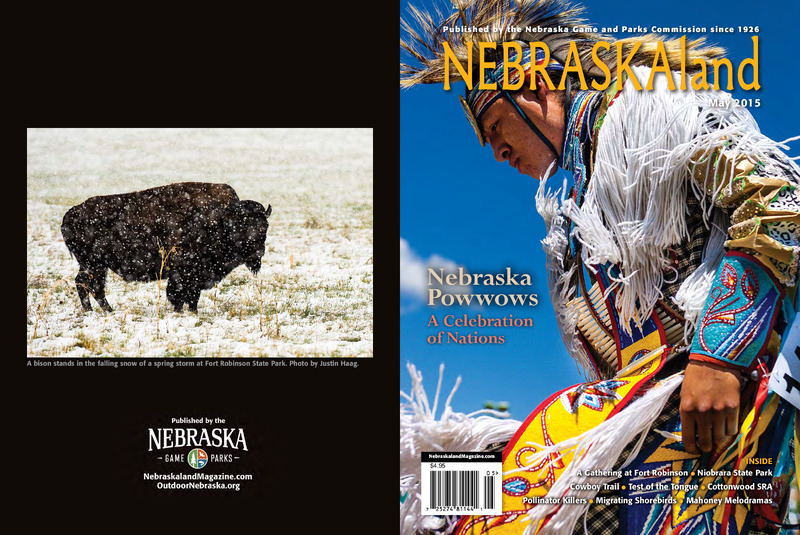
A bison stands in the falling snow of a spring storm at Fort Robinson State Park. Photo by Justin Haag.
NebraskalandMagazine.com
$4.95
INSIDE
A Gathering at Fort Robinson ● Niobrara State Park
Cowboy Trail ● Test of the Tongue ● Cottonwood SRA
Pollinator Killers ● Migrating Shorebirds ● Mahoney Melodramas
NEBRASKAland Magazine
Volume 93
●
No. 4
F EAT U R ES . . .
●
May 2015
38
●
20 Riding the Rails – Nebraska’s Cowboy Trail
STORY AND PHOTOS BY JENNY NGUYEN
30 The Test of the Tongue
STORY AND PHOTOS BY JUSTIN HAAG
32 Nebraska Powwows – A Celebration of Nations
BY AMY KUCERA
38 Death Among the Flowers
STORY AND PHOTOS BY CHRIS HELZER
42 Moving through Grasslands
PHOTOS AND STORY BY MICHAEL FORSBERG
48 Cottonwood Cure
STORY AND PHOTOS BY JUSTIN HAAG
52 One-of-a-Kind Coach
BY CARA PESEK
D EPARTM EN T S . . .
From Our Readers...........................................4
Mixed Bag.......................................................6
Travelogue – Columbus .........................................8
A Brief History – Free Auto Camps ........................10
Nebraska Bird Library – Bobolinks ....................15
Nature Notes – Landscaping with Native Prairie Plants ......54
Portraits from the Past ..................................58
In the Kitchen – Baked Venison Ziti.........................60
The Last Stop – Throwing Popcorn .........................62
48
●
20
●
O N TH E W EB . . .
WHEN YOU SEE THIS SYMBOL IN THE PAGES OF
N
NEBRASKALAND MAGAZINE, VISIT
NEBRASKALANDMAGAZINE.COM AND VIEW OUR INTERACTIVE
DIGITAL EDITION FOR MORE INFORMATION.
D
NEBRASKAland (VOL. 93 / NO. 4, ISSN 0028-1964) is published monthly, except
for the combined Jan./Feb. and Aug./Sept. issues, by the Nebraska Game and Parks
Commission, 2200 N. 33rd St., Lincoln, NE. Periodicals postage paid at Lincoln,
Nebraska, and additional mailing offices. POSTMASTER: Send address changes to
NEBRASKAland, P.O. Box 30370, Lincoln, NE 68503-0370.
2 NEBRASKAland • MAY 2015
42
●
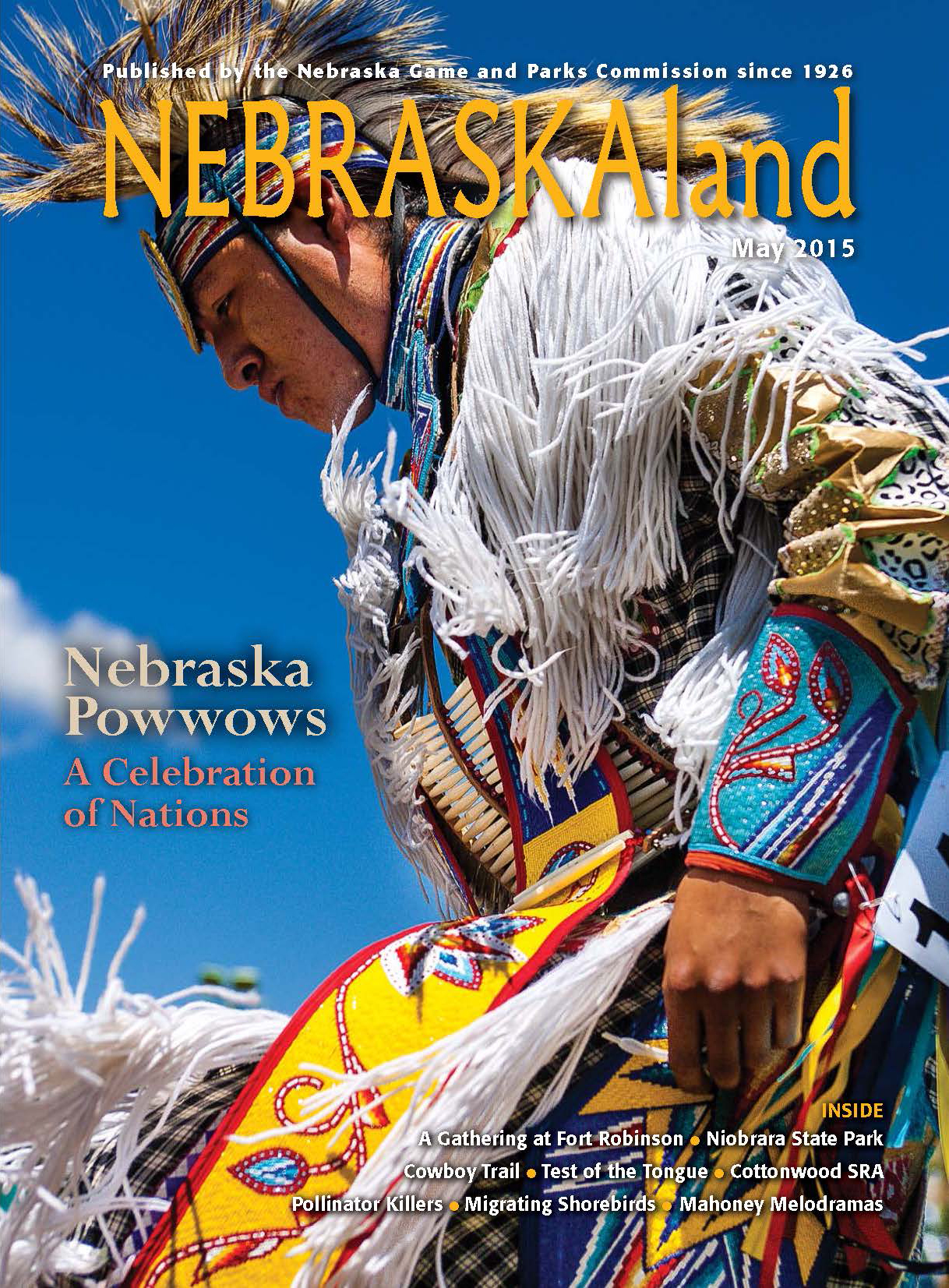
Cover: A grass dancer participates in the Intertribal Gathering Powwow at
Fort Robinson State Park near Crawford. Photo by Jenny Nguyen.
MAY 2015 • NEBRASKAland 3
retired on 50 acres along the Calamus
and have noticed the past few years a
decline in both milkweed and monarch
butterflies. Thanks for the great article.
Bill Ihm
Via e-mail
Monarch Praise
I just read Eric Fowler’s article on
monarchs in the April edition of
NEBRASKAland Magazine, and I
want to tell you it’s the best, most
accurate, and most beautifully
illustrated piece of writing I’ve seen so
far!
The newspaper coverage seems to be
lacking in correct details, but you’ve
said so much so well and have quoted
the best people who really know about
monarchs.
Rosemary Thornton
Lincoln, Nebraska
Hailee Schievelbein, 17, of Omaha won
“Best of Show” in the 2015 Nebraska
Junior Duck Stamp contest with her
colored pencil drawing of an emperor
goose. The piece was among more than
500 entries from across the state that
were judged in Gering on March 27.
Read
the blog post “How Great
R
Though
T
Waterfall Art” for more
iinformation and the results from
tthe 2015 Nebraska Junior Duck
Stamp contest.
Your April article regarding
monarchs is a real inspiration to me. I
immediately enrolled in the Monarch
Watch project and ordered two plots
of milkweed native to my area. I’m
Ivy Daniel Forbes captured “rush hour” along the Platte River near Kearney during sunset.
4 NEBRASKAland • MAY 2015
COMMISSIONERS
CONSERVATION OFFICERS
Director Jim Douglas
Commissioners
Chairman - Dr. Kent Forney, Lincoln
Vice Chairman - Rex Fisher, Omaha
2nd Vice Chairman - Mark Spurgin, Paxton
Robert Allen, Eustis
Dick Bell, Omaha
Lynn Berggren, Broken Bow
Mick Jensen, Blair
Norris Marshall, Kearney
Dr. Mark Pinkerton, Wilber
NORTHWEST
Officer
City
Jim Zimmerman (S) Gering
MAGAZINE STAFF
Outdoor Plates
Milford Smith of Odell has fished
nearly all of the rivers and streams in
Nebraska, and most of the reservoirs
too, in the 75 years since he was born
in Long Pine. To help make sure his
grandchildren can too, they all have
lifetime fishing permits.
If you have a unique outdoor
message plate you would like to
share, or know someone who does,
e-mail a photo (high-resolution, JPEG
format only, please) along with your
hometown and a brief description of
the interests expressed on your license
plate to Eric.Fowler@Nebraska.gov.
Communications Director Christy Rasmussen
Editor Jeff Kurrus
Art Director Tim Reigert
Associate Editor Amy Kucera
Regional Editors Eric Fowler, Julie Geiser,
Justin Haag, Jenny Nguyen
Contributing Editor Michael Forsberg
Regular Contributors Chris Helzer, Gerry
Steinauer
Photo Librarian Jaclyn Cruikshank Vogt
Circulation Donna Robinson
For address changes and questions about
your subscription, e-mail donna.robinson@
nebraska.gov or call 800-632-5263
Advertising Sales Manager
For advertising information contact
Shane G. Gilster, 402-742-0125
Email: shanegilster@gmail.com
NEBRASKAland Magazine Copyright 2014, all rights reserved.
NEBRASKAland is available in audio from the Nebraska Library
Commission Talking Book and Braille Service, Suite 120, 1200 N St.,
Lincoln, NE 68508. 800-742-7691. NEBRASKAland Magazine and the
Nebraska Game and Parks Commission reserve the right to reject any
advertising not in keeping with the agency mission.
Rates: $18 for one year; $33 for two years; $44 for three years. Nebraska
recipients must add appropriate sales tax. To subscribe call
1-800-NEBLAND (632-5263), or go online to: NebraskalandMagazine.
com.
Greg Hesse
Scott Brandt
Dan Kling
Frank Miller
Sean McKeehan
Terry Brentzel
Phone (308)
(office) 763-2940
(cell) 641-6138
Rushville
760-3647
Gering
631-0663
Harrison
430-0572
Valentine
402-389-0444
Bridgeport
279-9133
Oshkosh
458-7650
SOUTHWEST
Officer
City
Phone (308)
Roger Thompson (S) N. Platte (office) 535-8025
(cell) 530-3097
Ray Dierking
Brkn. Bow
870-0322
Michael Thome
Cozad
529-8146
Matt Andrews
Elwood
746-2418
Dirk Greene
Imperial
882-0015
Dale Johnson
Kearney
440-3847
Brian Piernicky
McCook
340-6627
Brandon O’Neal
N. Platte
530-3157
Nicholas Fix
Ogallala
289-0427
Bryce Streger
Ogallala
289-1169
Rich Routh
Rep. City
920-0367
Tim Williams
Grand Is
380-7331
Pat George
Kenesaw
402-705-9989
Matt Brandt
Loup City
202-0819
Andrew Heyer
Cozad
402-613-2241
Alex Hasenauer
Wellfleet
660-4671
NORTHEAST
Officer
Tom Zimmer (Sup.)
City
Norfolk
SOUTHEAST
Officer
Levi Krause (Sup.)
William Krause
Mike Luben
Dan Zuehlke
Heath Packett
Darin Gress
Douglas Kramer
Dina Barta
Stacey Lewton
Dudley Sorensen
Russell Mort
Dan Evasco
Rich Berggren
Travis Shepler
City
Louisville
Auburn
Colon
Cortland
Eagle
Hebron
Lincoln
Lincoln
Lincoln
Waverly
Nebr. City
Papillion
Waterloo
Lincoln
Phone (402)
949-0593
274-8063
443-6392
806-9084
210-0888
768-8665
890-6465
890-6463
890-7140
937-3422
209-1506
616-5961
619-1355
613-2312
City
Lincoln
Lincoln
Lincoln
Phone (402)
471-5531
471-5531
471-5531
Phone (402)
(office) 370-3374
(cell) 649-8053
Dale Davis
Bassett
760-0712
Steve Oberg
Columbus
910-3366
Daniel Roberts
Fremont
719-1108
Randy Pomplun
Fullerton
308-550-0489
Jeff Jones
Hartington
762-5022
Jon Reeves
Kennard
889-8508
Doug Pollard
Ord
308-730-7050
Alex Thomas
Ponca
241-7615
Cory Krause
West Point
380-6410
Jonathan Andreasen O’Neill
340-3981
Mitch Johnson
Wausa
613-8612
Message in the Magazine
Now, you can send a message
to NEBRASKAland Magazine at
Facebook.com/nebraskalandmagazine
and your comment or photograph may
appear on these pages.
–Editor
COMMISSION
C
COM
CO
OM
OMMIS
MIS
SSIO
SION O
SI
OFFICES
FF CES
FF
FFI
CES
S
Send your comments to:
Jeff Kurrus, Editor
NEBRASKAland Magazine
P.O. Box 30370
Lincoln, NE 68503
or e-mail Jeff.Kurrus@Nebraska.gov
Please include your postal address and
telephone number.
Letters may be condensed and edited for
clarity. Photographs are welcome and will
be returned.
Northwest District Office
East Hwy. 2, Box 725 Alliance, NE 69301
Phone 308-763-2940
Ak-Sar-Ben Aquarium
21502 W. Highway 31 Gretna, NE 68028
Phone 402-332-3901
ADMINISTRATION
Officer
Craig Stover (Adm.)
Duane Arp (Ass.)
Jeff Clauson (Ass.)
Any program that receives federal funding from the National Park
Service, or the United States Fish and Wildlife Service prohibits unlawful
discrimination on the basis of race, color, religion, age, gender, marital
status, national origin, age, disability or political affiliation. Any person
who believes he or she has been discriminated against in any program,
activity, facility, or service, should contact the Nebraska Game and
Parks Commission, Lincoln, NE 402-471-0641, the Equal Opportunity
Commission, Lincoln, NE 402-471-2024, TTY/TDD 402-471-4693;
United States Fish Wildlife Service, Civil Rights Coordinator, 4401
N. Fairfax Drive, Arlington, VA 22203; Director, Equal Opportunity
Program, U.S. Department of Interior, National Park Service, 1849 C
Street NW, Mail Code 0008, Washington, D.C. 20240-0001.
Omaha Office
8495 Frederick Street, Omaha, NE 68124
Phone 402-595-2144
Nebraska Wildlife Crimestoppers 1-800-742-7627
Headquarters/Southeast District Office
2200 N. 33rd Street Lincoln, NE 68503
Phone 402-471-0641
Northeast District Office
2201 N. 13th St. Norfolk, NE 68701
Phone 402-370-3374
Southwest District Office
301 E. State Farm Rd. North Platte, NE 69101
Phone 308-535-8025
Bassett Office
524 Panzer St., Box 508 Bassett, NE 68714
Phone 402-684-2921
Kearney Office
1617 First Ave. Kearney, NE 68847
Phone 308-865-5310
MAY 2015 • NEBRASKAland 5
Prairie Vole
By Lindsay Rogers, Outdoor
Education Specialist
Found across Nebraska in all types of prairie,
fencerows and fallow fields, the prairie vole is in
the Cricetidae family which includes mice, rats
and lemmings. The prairie vole is similar to the
meadow vole with the only noticeable difference
6 NEBRASKAland • MAY 2015
being the longer tail on the prairie vole.
They eat mainly seeds, grasses and grain,
although they may occasionally feed on insects
when available. Prairie voles are crepuscular,
meaning they are active mainly at dawn and
dusk but daytime activity increases in the winter
months.
Predators include hawks, owls, snakes, foxes
and other medium-sized mammals. As protection
from predators, prairie voles often create
elaborate grass tunnels. ■
NGPC PHOTO LIBRARY
A Mammal Brief
MAY 2015 • NEBRASKAland 7
Travelogue Sponsors
By Jenny Nguyen
Columbus
icknamed the “Crossroads of America,” Columbus
sits at the junction of U.S. routes 30 and 81. Founded
by a group of citizens from Columbus, Ohio, who
sought to build a township along the proposed route of the
transcontinental railroad, settlers arrived at the confluence of
the Platte and Loup rivers in Nebraska Territory in 1856, and
they made it home. Today, the Union Pacific railroad still runs
through Columbus, and the town is as vibrant as ever.
From fireworks to horse racing, Columbus is the place to
be in warm summer months, especially at AgPark, where the
outdoor
Platte County Fair is scheduled for July 8-12. For camping and
acres of land
265
ins
mainta
which
t,
Distric
recreation, look to the Loup Power
and
North
lakes
and
parks
five
its
en
and 1,100 acres of water betwe
and more.
Babcock where visitors can camp, fish, bike, hike, boat, swim
ation
destin
r
popula
a
is
Area
ement
Nearby, Wilkinson Wildlife Manag
nts.
pheasa
shoot
to
place
great
a
as
for waterfowl hunters, as well
Water
Families needing to cool down can check out Pawnee Plunge
to
forget
don’t
there,
you’re
While
Park located in Pawnee Park.
lifestop at the Andrew Jackson Higgins Memorial, where sits a
the
was
s
Higgin
native,
bus
Colum
A
size replica of a Higgins Boat.
WWII.
during
boats
0
20,00
than
inventor and supplier of more
Thirsty or hungry? Though “Buffalo Bill” Cody no longer haunts
Glur’s Tavern, the bar remains one of the oldest taverns in
t has
America. Built in 1876 and still open today, the establishmen
us
delicio
,
setting
c
histori
the
for
yet to miss a beat. Visitors stay
.
burgers and never-ending drinks
For a wider selection of food and handcrafted drinks,
r’s
Gottberg Brew Pub is a favorite among locals. Run by Duste
Restaurant, which is next
door, the pub looks like the
inside of a grain bin and boasts
a fun atmosphere along with unique, smallbatch beers, sodas and good food.
Or stop by La Riviera Taco Truck located
th
the corner of 23rd and 10 for lunch or late-night
snack of tasty tacos. Choose from the
usual beef, pork, and chicken or
authentic favorites such as
chorizo, lingua (tongue) or
intestines.
For more
information on
Columbus, visit
Columbusne.us,
Agpark.com
and
Loup.com. ■
One of the nation’s oldest taverns
Columbus
Cool own
at
this sudm
mer. the water park
on
gins
n Hig
o
s
k
c
a
J
Andreowrial
Mem
MAY 2015 • NEBRASKAland 9
NSHS, RG3542-124-1
John Nelson’s photograph shows a homemade auto camper.
A Brief History
Free Auto Camps
By Patricia C. Gaster,
Nebraska State Historical Society
L
ong distance travel in the early
days of the automobile was
difficult, and comforts along the
way were few. Motorists pitched
their own tents and cooked their own
meals in the auto tourist camps that
soon sprang up along the nation’s
roads. Some were free; others were
operated by a commercial businessman.
Pay camps, with more conveniences,
soon became common.
The relative advantages and
disadvantages of the free auto camp for
its sponsoring town were discussed by
the magazine Trade Exhibit (Omaha)
on Oct. 1, 1926: “There is a great
difference of opinion about the merits
of the free camp. Some towns have
gotten away from it, claiming that
it brought motor tramps who hung
around, in some cases even living on
the town….
“Certainly in a town of any size,
where many tourists stop, it is
almost essential to have some sort of
supervision. This costs money. If the
10 NEBRASKAland • MAY 2015
town feels that the benefits derived
offset the expense and the undesirable
features, then it undoubtedly pays to
continue the free camp.
“There is no question but that a nice
camp does make a favorable impression
on the large number of tourists who
are not of the ‘tramp’ variety. The
majority of them reciprocate by making
purchases in the town – gasoline and
oil if nothing else, but usually groceries
as well. Some of them would rather
pay and have the benefit of the added
protection. Others would rather seek
the free camp.”
The Trade Exhibit closed its article
on the advantages and disadvantages of
the free auto camp with the following
poem skewering the typical “Flivver
Hobo”:
He owns a dented tin machine,
A roll of ragged bedding,
Perhaps sufficient gasoline
To last to where he’s heading;
Some pots and pans, a dirty tent,
Some rusty spades and axes –
He needs no home, he pays no rent,
He never heard of taxes!
The Flivver Hobo is a tramp
I met in hordes last summer,
At many a town’s Free Auto Camp –
A most accomplished bummer. ■
MAY 2015 • NEBRASKAland 11
Paid Advertisement
12 NEBRASKAland • MAY 2015
MAY 2015 • NEBRASKAland 13
Nebraska Bird Library
Sponsored by
y
Bobolink
Song or calls: Song is loud, bubbling
“bob-o-link,” often given in flight; also other
“twanging” phrases.
14 NEBRASKAland • MAY 2015
PHOTO BY MIKE FORSBERG
Description: Sharply pointed tail feathers.
Breeding male is entirely black below; black
head, wings, and tail; buffy hindneck; white
scapulars and rump. Female is buffy overall
with dark streaking on back, rump, and sides;
dark striping on head. Juvenile similar to
female but lacks striping below.
Habitat: Usually found in ungrazed to
lightly grazed medium to tall-grass prairies,
wet meadows, and retired croplands.
Sometimes found in small grain fields.
Where in Nebraska: Common spring and
fall migrant and summer resident across the
state, being most common in central Nebraska
and less common in eastern and western
areas.
Fun Facts: The bobolink’s round trip
migration is about 12,500 miles long. ■
To learn about more birds visit
NebraskaBirdLibrary.org.
MAY 2015 • NEBRASKAland 15
Buffalo Cookout at Niobrara
State Park
PHOTOS BY JENNY NGUYEN
By Jenny Nguyen
Travel back in time at one (or all) of Niobrara State Park’s Buffalo
Cookouts this summer. On select Saturday evenings from May through
September, come enjoy buffalo burgers, homemade coleslaw, beans
and ice cream with fellow park-goers and locals while listening to folk
songs, tales and re-enactments of Nebraska history. Entertainers include
American folk musicians John and Susan McNeill, poet and musician
Michael McDonald, Woody Guthrie history and songs performed by
Kathryn N. Benzel and Mike Adams, a humanities program on American
explorer Jean Baptiste Charbonneau by Darrel Draper, and a Ponca
Cultural Night presented by Ponca Warrior Society dancers, buffalo
skinners, tool makers and storytellers.
Buffalo Cookout dates are May 23;
June 20, 27; July 4, 18; August
1; and Sept. 5. Cookouts are
at the cookout shelter and
serving begins at 6 p.m.
Cookout tickets are available
American folk musicians John and Susan McNeill
for purchase at the park
perform at Niobrara State Park.
office, adults (13 years and
older) $12 and children $8. Register before the cut-off limit and signup time;
you must register before noon on that Saturday. Programs are free and will
follow immediately after serving. A minimum of 25 persons is required to hold
cookouts. For additional information about programs, call Niobrara State Park at
402-857-3373. ■
Chief Standing Bear and
the Trail Ahead
By Amy Kucera
First documented by Lewis and Clark in 1804 near the
present-day town of Ponca, the Ponca Tribe had villages
along the Niobrara River in northeastern Nebraska since their
migration from the Ohio River valley in the 1700s.
After a series of treaties, the U.S. government illegally
gave Ponca lands to the Santee (Dakota) Sioux Tribe as
part of 1868 Treaty of Fort Laramie negotiations. The U.S.
goverment then forced the Ponca to relocate to modern-day
Oklahoma, a route now known as the Ponca Trail of Tears.
Chief Standing Bear made history after he was arrested
while returning to his homelands to bury his son. The results
of his 1879 trail, Standing Bear vs. Crook, established that he
was legally recognized as a person by right of law.
The Chief Standing Bear Symposium, an extension of the
annual Breakfast Commemoration, is a celebration of his
legacy, as hosted by the Nebraska Commission of Indian
Affairs and University of Nebraska. The May 14-15 event in
Lincoln features a variety of presenters including television
coorespondent Hattie Kaufman, author Sherman Alexie,
activist Winona LaDuke and a concert by Buffy St. Marie.
For more information, visit Unl.edu/plains/2015symposium. ■
T
Travel
with Peru State State College students as they tour
tthe Chief Standing Bear Trail.
16 NEBRASKAland • MAY 2015
MAY 2015 • NEBRASKAland 17
Nebraska International
Migratory Bird Month
by Jerry Kane
Contact the Nebraska Game and Parks Commission at 402-471-0641 or visit
OutdoorNebraska.org for more information.
Visit HuntSafeNebraska.org for a list of hunter education classes and
BoatSafeNebraska.org for a list of boating safety classes.
April 30 to May 1-2
Cornhusker Trap Shoot
May 7, 14, 21
Explore Archery
Doniphan, cornhusker-trap.com Nebraska Game and Parks
Outdoor Education Center,
May 1
Lincoln, 2:30 and 4:30 p.m.,
Explore Archery
403-471-6141
Nebraska Game and Parks
May 8
Outdoor Education Center,
Lincoln, 6-7 p.m., 402-471-6141 Outdoor Educational
Rendezvous Niobrara SP,
May 1-2
Niobrara, 402-857-3373
Toast Nebraska
Eugene T. Mahoney State
May 9
Park (SP), Ashland, 1-10 p.m., Lucky Bucket Brewing 7K
402-944-2523
Eugene T. Mahoney SP,
Ashland, 402-944-2523
May 2
Take Pride in America Day May 9
Cleanup at Verdon Lake
Family Fishing Event
May 16
Family Adventure Day
Johnson Lake SHP, Elwood,
10 a.m.-2 p.m., 308-785-3685
May 16
Bird Watching Tour
Ash Hollow SHP, Lewellen,
308-778-5651
May 16
Wildlands Day
Wildcat Hills Nature Center,
Gering, 308-436-3777
May 16
Southwest Reservoirs
Family Funfest
May 23
Summer Hours Begin at
Roger G. Sykes Outdoor
Heritage Education Complex,
Platte River SP, Louisville,
402-471-5547
May 23
Migratory Bird Day
Indian Cave SP, Shubert,
7 a.m., 402-883-2575
May 23
Birding
Platte River SP, Louisville,
8:30-10:30 a.m., 402-234-2217
Medicine Creek SRA,
Cambridge, 308-697-4667
May 23
Early Bird Hike
May 2
Grand Opening
May 16
Barbecue and Kids’
Fishing Derby
Niobrara SP, Niobrara,
7-8:30 a.m., 402-857-3373
Fort Robinson SP, Crawford,
10:30 a.m. 308-665-2900
Fort Robinson SP, Crawford,
308-665-2900
State Recreation Area (SRA),
Verdon, 9 a.m., 402-883-2575
Fort Kearny SRA, Kearney,
9 a.m.-4 p.m., 308-865-5305
May 9
International Bird
1891 Officers Quarters opens, Migration Day Ponca SP,
May 2
Grassland Bird Bonanza!
Sherman Reservoir SRA,
Loup City, 10 a.m.-2 p.m.,
308-745-0230
May 2-3
Living History
Ponca, 402-755-2284
May 9
Fort Kearny Outdoor
Discovery Program Fort
Kearny SRA, 308-865-5305
May 10
Mother’s Day Buffet
Fort Robinson SP, Crawford,
10:30 a.m.-2 p.m., 308-665-2900
Fort Atkinson State Historical
May 10
Park (SHP), Fort Calhoun,
Mother’s Day Buffet
402-468-5611
Ponca SP, Ponca, 402-755-2284
May 2-3
Outdoor Cooking Camp
Ponca SP, Ponca,
402-755-2284
May 10
Birding
Platte River SP, Louisville,
8 a.m.-noon, 402-234-2217
May 2-3, 22-24
May 13
Pioneer Longrifle
Rendezvous Indian Cave SP, Beginner Birding Event
Shubert, 402-883-2575
Fort Hartsuff SHP, Burwell,
308-346-4715
May 4, 11, 18
May 15
Firearm Introduction to
Safety and Marksmanship Nebraska Game and Parks
Nebraska Game and Parks
Outdoor Education Center,
Lincoln, 6:45 p.m., 403-4716141
May 6, 13, 20, 27
Beyond Becoming
an Outdoors-Woman
handgun classes
Platte River SP, Louisville,
402-471-5547
18 NEBRASKAland • MAY 2015
Commission meeting,
Ogallala
May 16
Free Fishing and Park
Entry Day
No fishing or park entry
permits required this day
May 16
Fishing Clinic Alexandria
May 23
Mist Netting and Bird
Identification Program
May 16
How Birds, Butterflies and
Pollinators Can Benefit
from Wildflower Plantings
and Gardens
Niobrara SP, Niobrara,
10-11:30 a.m., 402-857-3373
Rock Creek Station SHP,
Fairbury, 402-729-5777
May 26
Family Fishing Event
May 16
Run Wild 10K, 5K and
Kids’ Run
Crystal Cove, South Sioux
City, 6-8 p.m.
Eugene T. Mahoney SP,
Ashland, 402-944-2523
May 17
Family Fishing Event
Riverside Zoo pond,
Scottsbluff, 4-7 p.m.
May 23-25
Living History Fort Kearny
SHP, Kearney, 308-865-5305
May 27
Family Fishing Event
Halleck Lake, Papillion,
6-8 p.m.
May 27
Family Fishing Event
May 18-June 5
Neligh Park Lake, West Point,
6-8 p.m.
Eligible landowners may
apply for one elk permit
May 28
Family Fishing Event
Holmes Lake, Lincoln, 6-8 p.m.
Fort Robinson Inn Restaurant May 28
opens for season, Fort
Explore Archery
Robinson SP, Crawford, 308Nebraska Game and Parks
665-2900
Outdoor Education Center,
Lincoln, 4:30 p.m., 403-471-6141
May 22
Open House, Roger G. Sykes
May 30
Outdoor Heritage Education
Bird Walk
Complex, Platte River SP,
Lake Wanahoo SRA, Wahoo,
Louisville, 402-471-5547
8:30-11 a.m., 402-359-5165
May 22
May 23
SRA, Alexandria, 402-729-5777 Official opening of summer
state park activities
May 31
Spring turkey seasons close
By Lindsay Rogers, Wildlife Education Specialist
To us, the life of a migratory bird might seem amazing – winters in a warm
location like Argentina or the beaches of Central America and summers in
the pristine Nebraska Sandhills or the Platte River. But in reality, the life of
a migrating bird is hard. Not only is the migration itself hard, but now these
migrant species must rely on sound habitat conservation in both its wintering and
breeding locations – and many spots along the way.
To celebrate migratory birds, their journey, and the critical role they play in
our ecosystems, International Migratory Bird Day was established in 1993.
Typically celebrated on the second Saturday of May, the Nebraska celebration
has been extended throughout the month of May. Across the state, conservation
organizations and agencies have worked together to plan events, classes and
festivals for all Nebraskans to attend. Join us by finding an event in your area on
the Nebraska Migratory Bird Month website, Nebraskabirdmonth.org. ■
A Western meadowlark
forages at Box Butte
Reservoir State
Recreation Area in
Dawes County.
NEBRASKAland
and
Visitor
Last issue’s winner of
the Visitor drawing was
Lindsay Vivian of Oakland,
California, who found the funnel
weaver on page 11. Readers are
encouraged to contact NEBRASKAland
within 10 days after this issue’s
publication with the correct page
number and name of this issue’s
“Visitor” – a critter found in
Nebraska. We will then gather the
correct entries and draw one to win
a NEBRASKAland Magazine mug.
To enter each month, write:
NEBRASKAland Visitor
2200 North 33rd Street,
Lincoln, NE 68503.
Or e-mail:
Tim.Reigert@Nebraska.gov
with “Visitor” in the subject line of
the message.
HINT: This issue’s visitor is not
on page 3, 4, 7, 12, 19, or 38-41.
This spider is in the family
Agelenidae, the funnel weavers.
These are generally medium sized
(body length of 1/3" to 2/3"),
brown to grayish spiders, usually
with banding on the legs. They
do not spin a typical web. Instead
they create a dense, horizontal,
sheet-like web, low to the ground,
with a funnel shape at one end,
often hidden in vegetation. The
spider hides in that funnel, waiting
for prey, typically insects and
mites. The web isn’t sticky, but
prey finds it slow and difficult to
walk across; the spider has no
such problem. When prey enters
the web, the spider rushes out to
subdue it. Spiders inject venom
through their fangs, or chelicerae,
to immobilize prey.
Digestive fluids
then break down the
tissue of the prey,
and the spider sucks
that liquefied tissue
back up as a meal.
Special thanks to Julie Van Meter, State
Entomologist, Nebraska Department of
Agriculture. Photo by Chris Helzer.
Bugguide.net is a popular site for identification.
MAY 2015 • NEBRASKAland 19
Riding the Rails
Nebraska’s Cowboy Trail
Story and photos by Jenny Nguyen
One hundred ninety-five miles, 11 companions, 7 days, 2 flat tires,
and 1 ukulele: that’s what it took to ride the Cowboy Trail.
“B
ut ... that’s halfway across the
state,” I said, panic quickly
taking over after receiving the
assignment to pedal the Cowboy Trail
from NEBRASKAland Magazine editor
Jeff Kurrus in the early spring of 2013.
“I don’t even own a bicycle!”
I had just moved to Nebraska a few
months prior to join the magazine staff.
At that point, I had only been on a
bicycle a handful of times in my life,
and the thought of pushing along a
195-mile long dirt path on two skinny
tires, in the middle of nowhere, made
me ill.
My coworker and friend, Jamie
Bachmann of Norfolk, must have felt
intensely sorry for me, because she
volunteered to go with me even though
she had a husband, two boys and a
garden to care for at home. Turns out,
Jamie used to ride competitively and
(thank God) knew how to fix a flat tire.
Her eldest son loaned me his mountain
bike.
Neither one of us knew much about
the Cowboy Trail. Trying to get in
shape was one thing, but the logistics
of traveling nearly 200 miles, not
including detours for food, water
and sleep, was an entirely different
consideration. After much research, we
decided that we would ride the trail in
the spring of 2014, invite anyone who
would like to join us and take it slow.
The following text is our daily
journal entries highlighting the most
memorable moments of our trip. It can
also serve as an itinerary and resource
for those wanting to follow our route.
We highly recommend picking up a
copy of Keith Terry’s
Nebraska’s Cowboy
Trail: A User’s Guide,
an invaluable resource
full of information
on the trail, towns,
amenities, important
contacts and historical
tidbits.
Saturday, May 17, 2014:
Norfolk to Neligh
(36.5 Miles)
Jim Kropatsch, the owner of these socks, is an avid bicyclist from Columbus. Now in
his 70s, Jim continues to ride competitively and recreationally every chance he gets.
20 NEBRASKAland • MAY 2015
There was still frost on the ground
when I got up that Saturday morning.
The temperature was in the 30s – too
cold for bike shorts I thought, as I
shivered all the way from home to
TaHaZouka Park, where all riders
would meet in Norfolk. There were
11 riders total. Bob Trautwein and
Jim Kropatsch, long-time cyclists who
were both in their 70s, drove up from
Nebraska Game and Parks Commission outdoor educator Jamie Bachmann and Jim Kropatsch ride across the 145-foot tall bridge
near Long Pine.
their home in Columbus that morning.
Carine Stava and her husband, Larry,
from Bennington, who would follow
us in their truck and camper, arrived
in Norfolk the night before. Kathy
Wiegert, Verna Simons, Amanda
Warrick and her two young sons,
Devyn and Tyson, from Norfolk would
ride with us part of the way. Nancy
Schucker came out from Battle Creek
to make the journey with us as far as
O’Neill.
Jim had several panniers filled with
essentials and his tent strapped to
his Surly Long Haul Trucker touring
bicycle. He told me he was carrying
70 pounds. I could tell Jim was a little
worried, which made me doubt the
Burley Nomad trailer attached to my
own bicycle. I had clothes for both
warm and cold weather, two camera
bodies and lenses, a two-man tent for
Jamie and me, sleeping bag, sleeping
pad, snacks, emergency food, toiletries,
a first-aid kit, extra water and other
camp supplies. Bob and Jamie were
also hauling trailers behind their bikes.
Except for Carine, none of us had
outside support to carry gear, which we
later realized was a big mistake.
After saying goodbyes to our
significant others, we were on the trail
shortly after 8 a.m. Jamie and I told
MAY 2015 • NEBRASKAland 21
Keller State
Recreation Area
HXyL Valentine
Nio
bra
ra
R
Long Pine State
Recreation Area
ive
13.2 Miles
r
iver
ra R
a
iobr
N
Arabia
Niobr
ara R
(no amenities)
iver
10 Miles
El
kh
Wood Lake HXy
or
nR
ive
r
11 Miles
HXyL
Johnstown HX
10.5 Miles
HXyL Ainsworth
Bassett
9.3 Miles
9.1 Miles
HXyL
10.9 Miles
12 Miles
Newport
Long Pine HXyL HXy
Stuart
9.9 Miles
Atkinson HXyL
10.1 Miles
7.7 Miles
Emmet
(no amenities)
O’Neill HXyL
9.6 Miles
Inman HXy
13.6 Miles
El
AREA ENLARGED
H
X
y
L
or
Ewing HXy
nR
AMENITIES KEY
ive
r
FOOD
CAMPING
Broken bridge
before town
MOTEL/HOTEL
22 NEBRASKAland • MAY 2015
5.3 Miles
(no amenities)
7.3 Miles
5.6 Miles
HXy Meadow Grove
HXy Battle
7.7 Miles
BIKE SUPPLY STORE
everyone
e
that if needed, they could
stop
in Battle Creek at Tilly’s Gas
s
Shop
for a quick break. While the
S
others
rode past the new Cowboy Trail
o
Bridge
outside of town, Jamie and I
B
stayed
with Amanda and her sons. The
s
boys
told us that was the farthest they
b
had
h ever ridden on their bicycles. We
hung
h
out at the bridge while Jamie
showed
s
the boys insects and plants by
the
t river. When Amanda and her sons
left,
l
we got back on the trail to play
catch-up
c
with the others. We passed
through
t
Battle Creek without stopping.
I had brought two bottles of water and
a hydration pack with a 2-liter bladder,
more
m
than enough to get to Meadow
Grove,
G
which was 18 miles from our
starting
s
point.
The limestone gravel grew soft and
deep
d
the farther away we got from
Battle
B
Creek. Even for those of us with
mountain
m
bikes and wide tires, it was
slow
s
going, especially for the lucky
ones
o
with trailers. Later, we found
out
o that Bob had decided to get off
the
t trail and hop onto Highway 275.
His road bike had narrow tires that
Clearwater HX
Neligh HXyL
Tilden HXyL
Oakdale
9.3 Miles
WATER
HARDWARE STORE
The author picks wild asparagus along
the trail east of O’Neill.
12.3 Miles
10.6 Miles
Creek
were not suitable for the trail’s loose
limestone surface. “I learned by early
afternoon that I had brought the wrong
bike,” said Bob, who wished he had
wider tires and rode the highway that
parallels the trail for most of its length
from Meadow Grove.
We regrouped at the Sportman’s
Family Grill in Meadow Grove,
located just across the highway.
Carine’s husband Larry met us there
for lunch, and it gave us a chance to
bond as a group. The service and food
were great, and the ladies were happy
to refill our water bottles. Jim even
bumped into an old friend.
From there, we pushed on to Tilden,
where the trail was rough and loose. It
was a painful crawl, my tires and trailer
dragging slowly through the gravel.
Fortunately, the surface did improve
some after Oakdale. The trail didn’t
seem to faze Nancy. I’ll bet she stuck
with me and Jamie just to be polite.
With fewer amenities in Oakdale,
we stocked up before leaving Tilden,
where we had the Branding Iron
Steakhouse & Lounge, PDQ Shoppe
and Thriftway Market from which to
choose. Sore and tired, we finally made
it to Riverside Park in Neligh, where
we would camp. Carine and Bob were
already there. Verna and Jim went into
town to check into the Deluxe Motel.
Kathy ended her journey here, as she
had to work the next day. Riverside
Park was a nice camp with clean
toilets, showers and full hook-ups.
After pitching our tents in the grass, we
had dinner at the White Spot Bar and
Grill. The drinks were cold and plenty.
I slept well that night, even if it was on
the ground.
Sunday, May 18: Neligh to
O’Neill (45 miles)
The ride to O’Neill would be our
longest and hardest ride. The night
before, we all agreed to ride out early
to beat a westerly wind that would
pick up later in the day. And when
Larry heard how tough the trail was, he
offered to haul all our bags and gear in
his camper, which relieved us beyond
imagination. Bob must’ve really hated
his trailer, because he vowed to sell it
once he got home.
The morning ride out of Neligh was
quiet and beautiful. It showed clear,
blue skies and the sun shined a soft
golden color all around us. Bob rode
with us for a little while before hopping
back onto the highway. Carine, Jim,
Verna and Nancy were ahead, while
Jamie and I brought up the rear.
Shortly after, my phone buzzed. It
was Carine, who had just gotten a flat
tire from the notorious goathead thorns
that torment cyclists worldwide. Nancy
was with Carine, and neither of them
had a spare inner tube. Having brought
plenty, Jamie and I picked up the pace
to help her. We had liners installed
in our tires before we left, so the
goatheads didn’t bother us.
Just before Clearwater, we found
the bridge over the Elkhorn River is
still awaiting repairs after being washed
out by flooding in 2010, as is a section
of trail near town. So we doubled back
and traveled north on 516½ Avenue
to meet with Highway 275, which led
us to town. We had already ridden 10
NorfolkHXyL
N
iver
rn R
o
Elkh
TaHaZouka
Park
miles that morning before stopping at
the Shell Gas Station for coffee and
breakfast sandwiches; unfortunately,
the Clearwater Café is closed on
Sunday. On a side note, if you’re ever
in town at dinner time, check out the
L Bar B Steak House, which serves
delicious New York steaks. After
breakfast, we returned to the trail,
which runs right next to the highway
near the gas station.
Near Ewing, another river bridge
was temporarily closed. It was located
only a few yards from the highway, so
we hopped onto the blacktop and rode
to the Ewing City Park. Nancy, Jamie
and I stopped there for a short break
and to refill our water bottles.
Riding on the road, Bob arrived in
O’Neill quickly and the others weren’t
far behind. Bob called Jamie to see
what was taking us so long. Jamie and
I were knee-deep in grass by the trail
in search for asparagus, which grows
wild every spring. Although we found
a few good spears, most of what we
found were sad, limp stalks that did not
survive the recent frost. There was a
MAY 2015 • NEBRASKAland 23
MAP BY TRISHA SCHLAKE, NGPC GIS APPLICATIONS DEVELOPER
kh
We stopped at Long Pine State Recreation Area to camp for two nights. Tents were pitched by Long Pine Creek, bicycles scattered
all about, and smelly bike shorts hung on a makeshift clothesline.
man on the trail looking for asparagus
with his young granddaughter, too.
When we finally arrived in O’Neill,
we met up with the others and rode
into town to have lunch at the Blarney
Stone. Guinness was on tap and it
tasted so good.
Bob, Jamie and I set up camp at
Carney Park, which also had showers,
flushing toilets and full hook-ups for
Carine and Larry’s camper. We had
dinner that night at Tia Zia, a Mexican
restaurant in town. Verna and Jim
bunked at the Super 8. It would be
Nancy’s last stop with us, and I was
sad to see her go. Our group was now
down to six.
Light rain came down that night,
and I remember waking up to a loud,
eerie chattering of birds in the trees
above my tent. It was as if the tent was
surrounded by jungle, and the time was
3 a.m.
Monday, May 19: O’Neill
to Stuart (28 miles)
Bachmann made peach cobbler in a Dutch oven while we
camped at Keller Park State Recreation Area.
24 NEBRASKAland • MAY 2015
Carine was on the
tr
trail before anyone
eelse. Jamie, Bob
aand I woke up to the
ddelicious smell of
ccoffee and cinnamon,
ccourtesy of Larry.
A light breakfast of
ggranola and energy
bbars on the trail had
to suffice, as we
le
left O’Neill early
th
that morning to beat
aanother wind. We
ccalled Verna and Jim
to let them know
th
that we would meet
in Atkinson to find
something decent to eat.
Jamie and I fell back again. We
chatted casually as we rode, not in
any hurry. When our eyes fell on
something growing by the side of
the trail, we brought our bikes to a
screeching halt and screamed in unison,
“Morels!” They were the biggest morel
mushrooms we have ever seen, and we
found more and more the harder we
looked. Needless to say, that made us
late for breakfast again.
Jamie and I pulled into the Atkinson
Livestock Auction to meet with
the rest of the crew. There’s a little
restaurant in the sale barn, and they
cooked up a mean breakfast, which
tasted amazing after riding all morning
without a decent meal. We showed
everyone our morel mushrooms and
said that we would cook them in
Stuart that night.
Before getting back on the trail, I
advised Carine to ease up and enjoy the
scenery, because she was riding like
she had a death wish. Carine would be
the only person in our group to ride the
entire Cowboy Trail without cheating
on the highway. When Jamie and I
caught up with the group before Stuart,
Carine had a surprise for us – she had
found more morel mushrooms while
taking a short break by herself near
some dying trees and water. They were
the first morels she has ever picked,
and she saw large turtles and many
birds during her respite, too. Jamie and
I were so proud of her.
The ride from O’Neill to Stuart
was relatively short and pleasant,
considering our long ride the day
before. Jamie, Bob, Jim, Verna and
I stayed at The Sister’s House, a
beautiful Victorian home that became
the residence of over 100 religious
women of the School Sisters of St.
Francis when St. Boniface Church
purchased the house in 1920. The
public can now reserve the house
for private parties and meetings; it
was perfect for weary Cowboy Trail
travelers. Nearby, St. Boniface Church
was a sight to behold. Carine and Larry
stayed in their camper at Stuart Park,
which had hook-ups and showers.
There was still plenty of daylight
left. Jamie took out her ukulele and
sang for us on the porch. It was
pleasantly warm, and the soft breeze
that afternoon felt good on our skin
under the shade of the house. We got to
know each other better that afternoon.
We learned that Jim Kropatsch used to
work for a medical equipment company
in Columbus, that he has ridden the
Katy and Mickelson trails in Missouri
and South Dakota, respectively,
participated in many marathons and
races, and that he is a two-time cancer
survivor. Bob Trautwein is a retired
librarian in Columbus; he and his
wife Judith now spend their time
traveling the world. Carine Stava and
her husband, Larry, run an equestrian
center, The Farm at Butterflat Creek in
Bennington, where she teaches hunter
jumper and foxhunting. Verna Simons
is an avid cyclist; she rides with a
group in Pierce every week and was
preparing for the Bicycle Ride Across
Nebraska (BRAN) right after her ride
with us. Jamie and I could not help
but admire our older companions, and
hoped that we would possess half the
heart and drive when we “grow up.”
Later in the day, I rode into town
to get some ingredients at the Stuart
Locker on Main Street. Jamie roasted
the asparagus we found near O’Neill
in the house. Larry gave me some
butter and whiskey for my sautéed
morel mushrooms. We served them as
Bob Trautwein and Bachmann ride on the trail west of Neligh on the second day of
the trip.
appetizers before dinner, and they were
a big hit.
At the Cast Iron Bar and Grill that
evening, we ran into Dave Harlan,
who manages parks in the area from
the Game and Parks Commission’s
Bassett office. Dave said he and staff
dragged his section of the trail before
we arrived, and we thanked him for it.
Stuart was one of our most memorable
nights on the Cowboy Trail.
Tuesday, May 20: Stuart
to Long Pine (32 miles)
After a good night’s sleep in an
actual bed, Jamie made us breakfast
before we left. She had to go back to
Norfolk to attend her son’s play that
evening, but would meet us in Long
Pine the next morning. So it was just
Carine, Bob, Jim, Verna and me now.
I felt a little nervous without my trail
buddy, so I picked up the pace that day
to ride with Jim. (Actually, it was more
like Jim riding ahead and waiting for
me catch up.)
The wind was favorable. We rode
past Newport, which did have a few
amenities including Grandma’s Park,
Myrna’s Market, H&H Lounge and
Sunny’s Café and Truck Stop.
We all met in Bassett at the Range
Café for some lunch. The café was part
of the Bassett Lodge, and it served up
great burgers, sandwiches, salads and
root beer floats. Of all the restaurants
on our journey, the Range Café was
my favorite. The employees were used
to seeing cyclists, and were more than
happy to refill our water bottles.
When Jamie and I planned the trip,
we decided that we would have a rest
day at Long Pine State Recreation
MAY 2015 • NEBRASKAland 25
Area
(SRA) to
A
t do
d some fishing
fi hi andd
hiking. So when we reached Long
Pine, I led us off the trail and took
Main Street north through town. Jim
and I bought fresh strawberries at
Anderson’s Market. Dave Harlan
pulled into the parking lot and told us
that we were welcome to use the Crew
Quarters Bunkhouse to shower that
evening.
Leaving Long Pine, we turned left
onto Eighth Street and took the winding
road down to the SRA. Having set up
camp, Larry was there waiting for us
at the bottom of the hill at the bridge.
He helped us with our bikes as we
hopped over the railing to reach the
campground.
We would’ve had to ride
c
o
over
a steep hill and around to enter
through
the park’s entrance if Larry had
t
not
n found this short cut. Unfortunately,
V
Verna
had to leave us that afternoon to
prepare
for BRAN. Out of 11 riders that
p
started
out in Norfolk, only five would
s
m
make
it to the end.
Camp at Long Pine SRA was
picturesque
with abundant wildlife,
p
thick
pine trees and a cold, fast-flowing
t
crystal
clear stream. Songbirds of all
c
colors
visited our camp, while curious
c
turkeys
lingered nearby. I pitched up
t
my tent over soft spring grass and
felt relieved to know that we didn’t
have to ride the next day. Jim made a
makeshift clothesline under the picnic
shelter to hang our smelly bike shorts.
Bob took out some Spam and crackers,
which Jim and I devoured because we
were so hungry. Carine decided to pass
on the snack and fell asleep under the
sun in her comfy camp chair instead.
Larry took us to the bunkhouse in town
to shower before dinner.
That evening, Larry cooked a
wonderful dinner of grilled steak, beans
and stir fried potatoes. We expressed
our thanks for the great meals we had,
for surprisingly good weather and
for all the beautiful Nebraska sights
we had seen, including our “gem” of
a camp at Long Pine SRA. We fell
asleep in our tents to the babbling of
the creek just 10 feet away.
Wednesday, May 21: Rest
Day in Long Pine
The smell of campfire smoke woke
me. Jamie, who arrived early that
morning, was preparing coals for a
Dutch oven breakfast when I popped
my head out of the tent. She made us
biscuits and sausage gravy, which hit
the spot.
We spent most of the morning and
afternoon around camp. Larry caught
some brown trout out of the creek,
while Jamie gave us a small lesson on
the biodiversity and ecology of Long
Pine Creek. We savored our rest by the
campfire before heading out to Keller
Park SRA to do some fishing that late
afternoon.
Commission staff at the Bassett
office were there to greet us. We can
never thank them enough for feeding
us that night, grilled venison dogs with
all the sides and fixings. Following
dinner, we hiked out to the ponds at
In Johnstown, Bachmann, Kropatsch and Carine Stava stop in to visit with Ruth Trobee, the owner of the L-Bow Room. They
savored ice-cold cream sodas and munched on fried snacks while Ruth gave a brief history of the building.
26 NEBRASKAland • MAY 2015
Keller where Carine caught her first
rainbow trout. I told her that she had to
kiss it, and she actually did it, because
Carine is a good sport in that way.
Larry caught a 10-pound catfish and
several trout. Jim and Bob did not fish,
but enjoyed the beautiful evening at
Keller nonetheless. It was so nice for
Jamie and me to catch up with staff.
At bedtime, Jamie and I stayed up
way too late for “girl talk,” while Bob
was in the next tent, wondering when
we would finally shut up.
Thursday, May 22: Long
Pine to Wood Lake
(30.8 miles)
After a light breakfast, Larry helped
us climb back onto the road from camp.
Jim and Jamie were the only ones bold
enough to ride their bikes up the steep,
winding road to get back into town. The
rest of us walked. Once we got back
onto the trail, we shortly came to the
bridge over Long Pine Creek, which
was magnificent with its dizzying 145foot drop into the green valley below.
This bridge is a must-see and, in my
opinion, is much more breathtaking
than the more well-known bridge in
Valentine. That day’s section from Long
Pine to Wood Lake was beautiful.
We had gone from cultivated lands in
Norfolk, to the pine trees and valleys of
Long Pine, to the open, rolling, treeless
grasslands of the Sandhills.
Almost 10 miles from Long Pine,
Jamie, Jim and I stopped into the
Silver Circle Bar in Ainsworth, which
happened to be open on a Wednesday
morning, to fill our water bottles. The
locals there suggested that we stop in
at the L-Bow Room in Johnstown,
which was another 10 miles away.
Jamie and I caught up with Bob
in Johnstown, who told us that Jim
had just gotten a flat tire and that
Carine was helping him. There in
Johnstown, we met a painter named
Robert Johnson, who had artwork of
country scenery displayed on his front
yard. Johnson came out and invited
us into his home, which was also his
studio. He was kind, and shared with
us his story. He seemed thankful for
our company, and we parted feeling
thankful for his. Shortly after, Carine
and Jim rolled into town.
Ruth Trobee, the owner and operator
of the L-Bow Room in
Johnstown, was a warm
and chatty woman. Her
bar had a log cabinlike feel, adorned with
western and country
trinkets on the wall. A
great bison mount hung
prominently in the main
dining room; Ruth said it
used to be a pet that kept
jumping over its owner’s
eight-foot fences. She
gave us a tour and brief
history lesson of the
building, which was built
in the 1800s, and said
that country artists Blake
Shelton and Mark Wills
have tossed back a few
in her establishment.
Bob left early, but Jim,
Carine, Jamie and I
stayed awhile to chat
and drink some orange
and black cherry cream
sodas. Ruth generously
offered to deliver food
to us if we had trouble
finding nourishment in
Wood Lake.
We reached Wood
Lake in the early
Carine Stava of Bennington caught her first rainbow trout
at Keller State Recreation Area.
afternoon. Although
it was a small town of
53, the Wood Lake Campground
some one-lane traffic on Highway 20.
was modern and well-kept, with clean
Before leaving, we took as much water
flushing toilets, water and electricity.
as we could because there would be no
While the rest stayed at camp, Jamie
water or amenities until Valentine.
and I rode into town to hang out at the
Bob stayed on the highway. Jim rode
Wood Lake Café. Tired and hungry,
hard to catch up with Carine on the
we indulged on fried drummies, pie
trail. Although we missed it, Jim and
and mindlessly watched a Twilight
Carine told us later that some sections
marathon on TV until the rest of the
before Valentine were in bad shape
crew showed up for dinner. Bob and
from cattle being driven on it. These
Jim treated us that night. Hard to
sections were loose and sandy, while
believe, but Wood Lake was our last
other parts were marked by terrible
night together before the last stretch to
washboards. “It became so rough that I
Valentine the following day.
could hardly control my bicycle,” said
Jim. “It was like riding on the rumble
bars on the side of a highway.”
Friday, May 23: Wood
Jamie and I enjoyed a leisurely ride
Lake to Valentine
as we hopped back and forth between
(23.2 miles)
the trail and blacktop. We stopped
Carine left an hour early. Bob, Jim,
briefly to say hello to some curious
Jamie and I returned to the Wood
horses and a mule. Then we found a
Lake Café for breakfast. We met a
box turtle crossing the trail that wanted
dozen ranchers there who were having
nothing more than to be left alone. I
breakfast at a large table. They warned
strangely remember having to pee a
us about the rough trail ahead and
lot that day. When out in the open like
MAY 2015 • NEBRASKAland 27
Cowboy Trail
History
By Kirk Nelson, Assistant Division
Administrator, Planning and Programming
I
n 1994 the Rails to Trails Conservancy gifted to the
Nebraska Game and Parks Commission the longest
rails to trails conversion in the nation, the Cowboy
Trail. Born in the 1870s as a route to Black Hills gold,
this 321-mile railroad corridor created and supplied
settlements across northern Nebraska.
Stava, Kropatsch, Trautwein and Bachmann enjoy the view of the Niobrara River Valley at the end of the Cowboy Trail in Valentine.
that, you try to find a ditch and hope
that no one sees your bum. In one
section, there was no ditch, so we had
to tinkle behind a historical marker.
There was no wind and the Sandhills
was exceptionally stunning that
morning. The damp smell of spring
was in the air, birds chirped all around
us, and the green land gently rolled
ahead as far as we could see. I love the
Sandhills for its quietness, a silence
that is so different from anywhere else.
Some miles past Wood Lake, Jamie
and I encountered large writing etched
into the trail’s surface that said, “Hi
Jamie + Jenny + Friends!” Although
mysterious, it was a welcomed message
that lifted our spirits and told us that
we were getting close. It wasn’t until
later that we found out it was Kelly
Corman and his wife Jen from the
Bassett office who wrote the words.
When we finally reached the bridge
over Valentine, Jim, Carine, Bob and
our rides home were there waiting
for us. After photos, hugs, high-fives
and soaking in the views over the
vast Niobrara River Valley, it became
apparent that our unbelievable 19528 NEBRASKAland • MAY 2015
mile journey together was coming to
an end. I looked forward to sleeping in
my own bed. I looked forward to not
having to ride another 30 miles on an
uncomfortable bicycle seat. I looked
forward to being able to shower every
day again. But I did not look forward to
parting with my new friends, who were
the best Cowboy Trail companions a
person could ever hope for.
Riding in the car back to Norfolk
and watching the miles and miles
of trail from a moving vehicle – so
effortlessly – and replaying what
happened there was like an out-ofbody experience, which was most
bittersweet.
Almost a year later, I still don’t miss
the bike, but the memories of laughter,
learning and camaraderie still tug at
my heart strings. I miss the exceptional
kindness that we met, from all the
people who fed us and filled our water
bottles, who shared their history with
us, and welcomed us into their lives, if
only for a brief moment by the trail – a
true testament of Nebraska “Nice.”
I deeply cherish this journey, for
it provided a rare opportunity for
strangers to know one another in a
most meaningful and dearest way.
■
Additionally, the author would like
to thank Nebraska Game and Parks
Commission Northeast District staff for
their humor and support on this bicycle
trip.
Soon after the trains stopped in 1992, the
conservancy purchased the right-of-way and thus
began this rail-to-trail project partnership. When
completed, the Cowboy Trail will be the world’s
longest rails-to-trails cycling and hiking trail.
Currently, about two-thirds of the route has been
surfaced: the 195-mile stretch between Norfolk and
Valentine. Some surfaces are paved, while most of
the trail is covered with finely crushed limestone.
The remaining western 126 miles between
Valentine and Chadron is under various stages of
development.
For years, the Commission has been working with
communities along the Cowboy Trail to develop and
promote the trail. A major interruption of this effort
occurred in 2010, when the Elkhorn River flooded
causing millions of dollars in damage to the trail’s
infrastructure, some of which has not yet been
rebuilt.
To find out more about the Cowboy Trail, visit
Outdoornebraska.gov and search Cowboy Trail.
Bike Riding Recommendations
A
multi-day trip on the Cowboy Trail can
either be enjoyable or miserable. Follow the
recommendations below to make your bike trip as
comfortable as possible.
Ride bicycles with wider tires, such as mountain
or hybrid bicycles; road bikes with thin tires will
sink into the trail’s limestone surface.
Avoid traveling during winter months, for obvious
reasons, and because certain amenities may not be
available during this time of year at city parks, such
as water and restrooms.
Having support, someone to follow you and carry
your camping gear in a vehicle, will make your trip
easier and more enjoyable. The trail’s limestone
surface is not ideal for hauling extra weight on your
bicycle. Expect to travel an average speed of 10
miles per hour.
Each member of your group should carry a
cell phone and charger. Radios would work, too,
because riders may get separated.
A smartphone is indispensable when it comes to
weather. We checked for wind and rain every day to
determine when to be on the trail the next morning.
Travel from Valentine to Norfolk for a slightly
downhill slope and to avoid the westerly wind.
Remember to line your tires or use puncture
resistant tires. The Texas sandbur seeds (puncture
vine) that grow along the trail are unavoidable;
•
•
•
•
•
•
•
bring extra inner tubes, tire repair kit, bike multitool, tire pressure gauge and small tire pump.
Bring more comfortable footwear for walking
around camp — your feet will thank you.
Dress in layers to combat unexpected weather,
especially rain
gear and high
visibility
clothing.
Always carry
extra water
because towns
can be many
miles apart.
Hydration packs
are easy to use
on the trail.
Other items
to bring in your
saddle bag:
sunscreen, lip
balm, sunglasses,
bike gloves,
first-aid kit, head
lamp/flashlight,
anti-chafe balm,
insect repellent
In case of a flat tire, bring a tire repair
and snacks.
kit and extra inner tubes.
•
•
•
•
MAY 2015 • NEBRASKAland 29
The Test of the Tongue
From the majestic bighorn
sheep (right) curling its lip to the
slithering garter snake (below)
sticking its tongue out, many
animals use a special sense for
survival and reproduction.
Story and photos by Justin Haag
How snakes and other animals use a special sense for survival
V
omeronasal. The name itself is a mouthful.
The vomeronasal system is regarded as the
most important survival tool of snakes and
other reptiles, which employ the special sense by
moving their tongues in and out of their mouths. The
casual observer who is creeped out by the tongue
should know that the snake is just trying to get a
“whiff” of what’s around it. It’s a much more sensitive
approach than that of humans, for instance, who pick
up scents by filtering air through the nose.
The forked tongues of snakes pick up airborne
particles which give clues of any nearby predators,
prey, or mates. Once the tongue is retracted, it touches
the vomeronasal organ, which consists of two tiny bulblike structures midway between the eyes and nose that
send information to the brain through nerves. How
much a given reptile species relies on the system can
be determined by how deep the fork of the tongue is.
Many mammals, from elephants to mice, also
use a vomeronasal organ – alternately known as
a Jacobson’s organ. Ungulates such as bighorn
sheep and elk use this special sense when they curl
their upper lip during mating season. Known as the
flehman response, when animals engage in this
physiological behavior, they are allowing easy passage
for pheromones and other scents to make their way to
their Jacobson’s organ at the roof of the mouth. The
action helps them determine the sex and individual
identity of other members of their species.
Whether or not humans have a functional
Jacobson’s organ has been a controversial topic, but
most evidence says no. Although a small infolding in
the nose has been observed and studied by scientists,
it looks quite different from the vomeronasal organ of
other species and no nerves can be found connecting
it to the brain.
Regardless of whether or not this nasal infolding
gives us humans any degree of a sixth sense, it seems
we do an adequate job of using our noses to detect
Mom’s cooking or the chosen fragrance of the opposite
sex. Consequently, it’s probably best if you keep your
tongue in your mouth and your lip uncurled. ■
30 NEBRASKAland • MAY 2015
MAY 2015 • NEBRASKAland 31
Nebraska
Powwows
A Celebration of Nations
By Amy Kucera
J
Emily Little Hoop awaits her turn to participate in the youth traditional dance category at the annual
Fort Robinson Intertribal Gathering in the Pine Ridge region of northwestern Nebraska.
32 NEBRASKAland • MAY 2015
PHOTO BY JENNY NGUYEN
u as the sun pulses over the prairie horizon to signal
ust
the dawn, the powwow drum beat heralds dancers
th
tto rise and move toward the center of the powwow
ccircle.
Led by honored elders, veterans and tribal members
holding flags and eagle staffs, the grand entry begins as
the grounds soon fill with the vivid colors of intricately
woven regalia.
The men lead the lively procession, wearing horn
caps and headdresses, porcupine hair roaches, feathered
bustles, bone breastplates, beaded cuffs, buckskin
fringe and ribbon shirts. They are followed by women
with eagle plumes fastened into finely braided hair and
feathered fans gripped in hands, while others move
in brightly beaded gowns and crowns, vibrant fringed
shawls and jingle dresses shining in the sun.
As the children enter, the drum beats are accompanied
by voices echoing in song with the chorus of beads, bells
and shells ringing in unison.
A mix of excitement and pride swells and carries
dancers into the evening, as they swirl around the circle
and drift between the past and future, just as the smoke
of sage and cedar that scents the summer night. ■
MAY 2015 • NEBRASKAland 33
2015 POWWOW CALENDAR
Fort Robinson Intertribal Gathering
Powwow, Crawford
June 12-14
Located on the parade grounds of the historical
Fort Robinson State Park near Crawford, the 16th
annual Intertribal Gathering Powwow is hosted
by the Friends of the Intertribal Powwow.
Isanti Dakota Wacipi, Santee
June 20-21
The Santee Sioux Tribe hosts an annual
traditional powwow with contest specials near
Santee in northeastern Nebraska.
Winnebago Homecoming Celebration
Powwow, Winnebago
July 24-26
Omaha Tribe Harvest Festival
Powwow, Macy
August 7-10
In Macy, the Umonhon Hedewachi, also known
as Omaha Tribe Harvest Festival Powwow, will
count its 211th year for gathering.
Ponca Tribe of Nebraska Powwow,
Niobrara
August 7-9
Fort Omaha Intertribal Powwow,
Omaha
September 12
The Fort Omaha Intertribal Powwow at the
historic Fort Omaha Metropolitan Community
College campus in Omaha features educational
demonstrations and dance specials.
ABOVE: Drummers under a constructed arbor at Fort Robinson
State Park.
ABOVE, RIGHT: A jingle dress hangs from a post at a campsite.
BELOW, LEFT: Powwows bring vendors selling traditional
goods, such as braided sweetgrass and decorative bells.
BELOW, RIGHT: Youth jingle dress dancers take in cotton candy
and tipi demonstration at the Fort Omaha Powwow.
PHOTO BY AMY KUCERA
34 NEBRASKAland • MAY 2015
The 45th Anniversary of the Indian Center, Inc.
will be honored during their 7th annual powwow,
which includes contests, social dances and a
gourd dance each day.
PHOTO BY JENNY NGUYEN
A traditional powwow, this year will mark the
21st annual event since the Ponca Restoration
Act, a law that reinstated the tribe’s federal
recognition in 1990. Located at the historic Ponca
Agency and museum grounds, visitors can walk
an interpretive trail to the Ponca earth lodge.
Indian Center Powwow, Lincoln
August 14-16
PHOTO BY JENNY NGUYEN
The Indian Club Powwow is held annually in
Lincoln on the Indian Center grounds. This is the
annual fundraiser for the Indian Club of Lincoln,
a group established in 1952.
PHOTO BY JENNY NGUYEN
Indian Club Powwow, Lincoln
August 1-2
PHOTO BY JUSTIN HAAG
The oldest memorial powwow in the nation,
the Winnebago Homecoming Celebration
Veteran’s Memorial Park honors warriors of the
past, present and future and commemorates the
return of Winnebago war chief Little Priest and
Company “A” Fort Omaha Scouts, 34th Nebraska
Volunteers in 1866. More than $60,000 in contest
prizes are awarded to powwow participants with
an additional $30,000 in drum contest prizes.
MAY 2015 • NEBRASKAland 35
POWWOW DANCE STYLES
MEN’S DANCE
PHOTO BY JENNY NGUYEN
PHOTO BY AMY KUCERA
Men’s Traditional
The dance simulates the warrior preparing
for battle. A dancer will crouch close to
the ground and stand up at different times
through the dance. At times, the drum uses
heavy beats that represent the sound of
gunfire.
Fancy Dance
With fast steps and flashy regalia, the dance
originated in the 1950s to attract visitors. The
dancer requires strength and endurance to
keep up the pace.
Grass Dance
Believed to have originated when men
would locate a village site, the men would
trample on the grass in a ceremonial dance.
The movement of fringe of the dancer’s
regalia sways and resembles the movement
of prairie grasses.
Chicken Dance
Mimicing the quick, strutting moves of the
prairie chicken, men’s dance regalia includes
a porcupine hair roach, breech cloth, feather
bustle and are often decorated with round
bells and mirrors.
ABOVE: Quick movements make up the men’s fancy dance at the
Indian Center in Lincoln.
BELOW: Youth grass dancers line up for grand entry at Fort Robinson
State Park.
A youth jingle dancer awaits the next song at Fort Robinson State Park.
PHOTO BY JUSTIN HAAG
36 NEBRASKAland • MAY 2015
Women’s Traditional
Representing the grace and modesty of
a woman, dancer’s steps include a bounce
style, zigzag or side-step. With a fringe shawl
folded over one arm, dancers will also hold
an eagle feather fan, which is raised in honor
of the men and the drum.
Jingle Dress
This healing dance was received to the
Ojibwe through a vision by a medicine man
to cure his daughter. Rolled-up snuff can
lids are attached to bright colored ribbons
that sway and sound during the quick zigzag
steps of the dancer.
Fancy Shawl
Brightly decorated shawls with long ribbon
or fringe appear as wings with a dancer’s
quick, twirling movements said to mimic the
moves of a butterfly. Many dancers wear calfhigh beaded moccasins.
View
more images of Nebraska powwows.
V
PHOTO BY JENNY NGUYEN
WOMEN’S DANCE
A colorful fancy shawl dancer at Fort Robinson State Park.
MAY 2015 • NEBRASKAland 37
DEATH AMONG
THE FLOWERS
Ah, the life of a butterfly ...
Story and photos by Chris Helzer
“O
h look! There’s a pretty
flower! Mmmm … sweet
nectar!”
“Woo Hoo! Another pretty
flower! Mmmm … sweet
nectar!”
“And another one! Mmmm … sweet
nectar!”
“Ooh! That’s an extra pretty one!
Mmmm … sweet ... Hey! What the ...?”
AAAAUUGHH!
And once again, nature reminds us
that the world is not all sweetness and
light.
In the Africa savanna, crocodiles lie
hidden in watering holes, knowing their
patience will be rewarded because their
prey animals have to drink eventually.
All the crocs have to do is wait.
In Nebraska prairies, there are
no crocodiles. As far as you know.
However, there are crab spiders,
praying mantises, ambush bugs and
numerous other tiny predators that
employ the same deadly strategy.
Instead of water, the intended prey
of these little killers needs nectar and
pollen. The predators just have to sit
on or near a pretty flower and wait.
They’ll come alright. They’ll come …
Mmmm … sweet nectar!
If you look carefully as you walk
around a prairie, you’ll be surprised at
how many tiny predators you can find.
Some, such as crab spiders and ambush
bugs, sit right on flowers; their success
Left: This unwary orange sulphur butterfly
was caught by a waiting crab spider
on a hoary vervain flower at the Nature
Conservancy’s Platte River Prairies.
Above, right: A crab spider waits on
purple poppy mallow at the Nature
Conservancy’s Platte River Prairies. Its
front two sets of legs are extra long –
perfect for grabbing prey.
Opposite: An ambush bug is wellcamouflaged on a goldenrod flower at
Lincoln Creek Prairie in Aurora.
38 NEBRASKAland • MAY 2015
MAY 2015 • NEBRASKAland 39
Left: A praying mantis nymph on
blazing star. Mantids can grab prey with
astonishing speed.
Left: A windflower in sand prairie along
the Platte River turned out to be a great
place for this crab spider to catch a fly.
Middle, right: This fuzzy crab spider is a
very common hunter in grasslands but
is rarely noticed because of its excellent
camouflage.
Middle: This Chinese mantis is busily
consuming the remains of a sphinx moth
it captured on a pitcher sage plant.
Bottom: A common checkered skipper
feeds on ragwort flowers in a Nature
Conservancy prairie along the Platte
River. Despite an abundance of predators,
pollinators still abound in many natural
areas as long as they have sufficient
habitat quality.
Bottom: A jumping spider sits quietly
beneath a flower in a Platte River
wetland.
relying on both camouflage and their
prey’s desperate need for food. Both
the spider and ambush bug employ
the same strategy for dispatching their
prey – when the unwary insect gets
close enough, the predator quickly
grabs it and gives it a venomous
injection with its mouthparts. That
venom immobilizes the prey, and also
liquefies its insides so the crab spider
or ambush bug can literally suck it dry.
Other predators, such as praying
mantises or jumping spiders (and other
free-ranging spiders), often conceal
themselves near a flower, rather than
on it. Usually, they pick a spot just far
enough away to be unnoticed, but close
enough for pouncing. Mantises seem
particularly adept at grabbing sphinx
moths as they hover in front of a
flower, extracting nectar with their long
tongues. They then gnaw their way
through the moth’s fuzzy bodies like
a little kid eating cotton candy. Both
jumping spiders and mantises will hunt
insects wherever they can find them, so
they’re less specialized on flowers than
ambush bugs or many crab spiders.
However, they seem to take advantage
of the easy pickings on flowers fairly
40 NEBRASKAland • MAY 2015
diseases add to life’s perils. As if all
that wasn’t enough, pollinators still
have to worry about whether or not
death is lurking by every flower they
find.
And yet, pollinators are still here.
Their numbers are lower than they used
to be, but the survivors are out there
collecting food for themselves and their
kids while simultaneously ensuring
future generations of the plants they
harvest from. It’s a lucky thing for us
they’re still there. We need the plants
they pollinate for our own food, as
well as for the roles they play in the
ecosystems we depend upon for life.
However, there is another
constituency that is glad for the
continued survival of pollinators. They
find them very tasty! ■
frequently.
Once you start noticing these little
hidden assassins, you’ll see them
everywhere. At that point, you might
start wondering how any pollinators
survive at all. It is indeed a difficult,
dangerous world for Nebraska’s
prairie pollinators. Much of the state’s
native grassland has been converted
to farmland. In many of the remaining
prairies, wildflower numbers have been
reduced by chronic overgrazing and/
or broadcast herbicide application.
Wide swaths of grassland are cut for
hay each summer, abruptly removing
entire fields of food for bees, butterflies
and other pollinators. Agricultural
pesticides and both native and imported
MAY 2015 • NEBRASKAland 41
Moving Through
Grasslands
Photos and story by Michael Forsberg
L
ong-billed curlews. Marbled godwits. Wilson’s phalaropes.
American avocets. Greater yellowlegs. Their names are as
curious as their appearances.
With more than 60 species of shorebirds in North America,
some of these mostly small to medium-sized birds with
thin bills and long legs can appear as odd in appearance as
masquerade ball characters.
Perhaps their most distinctive features are their bills: some
are very long, some very short, curved up, curved down, or
straight. Each bill is smartly designed for the prey that they
hunt while wading the shallows and patrolling shorelines
of lakes, rivers, sandbars and open grasslands, picking and
probing their way for small terrestrial and aquatic insects,
worms and other assorted proteins.
Take the American avocet for example, with its thin and
sensitive upturned bill that it sweeps back and forth just
under the water’s surface for brine shrimp like a person
cleaning the sidewalk with a broom. Or the formidable longbilled curlew, as tall as a red-tailed hawk, and as proficient a
hunter with its nearly eight-inch long downward curved bill
stalking grasshoppers in the Nebraska prairie in summer as it
is probing for aquatic insects in the sand and surf of the Texas
Gulf Coast in winter.
Collectively, these far-flung shorebirds can migrate from
wintering grounds as far south as Central America and travel
as far north as the Arctic tundra and the edge of the Bering
Sea to breed. A few hardy species such as the greater and
lesser yellowlegs will show up in Nebraska as early as March
with the big pulse of migrating waterfowl and cranes, but the
vast majority will push through quietly in April and May.
42 NEBRASKAland • MAY 2015
Arriving to prairie
nesting grounds in the
northern Great Plains,
this long-billed curlew
raises its wings in
territorial display.
MAY 2015 • NEBRASKAland 43
A
ccording to the Commission’s Non-Game Bird
Program Manager Joel Jorgensen, 41 species of
shorebirds move through Nebraska and the Great
Plains each year along the Central Flyway, and 14 of
those species regularly breed or have documented
breeding records in the state.
By early June, most of Nebraska’s breeding
shorebirds will be settled on nests near wetlands,
lakes and rivers across the state. By late summer they
will begin to gather again in loose flocks.
Left: An American avocet
hunts for insects following the
contour of an alkaline lake’s
shoreline in the Nebraska
Sandhills.
Above: A trio of marbled
godwits take flight across
the prairie in mid-May after
just arriving to their breeding
grounds.
Opposite: In late summer, a
Mountain plover races across
a prairie dog town on the
shortgrass prairie.
44 NEBRASKAland • MAY 2015
MAY 2015 • NEBRASKAland 45
Top: A lesser yellowlegs wades in the shallows
of a prairie slough among migrating mallards
on the Platte River.
Left: An upland sandpiper peers out from tall
prairie grass near its nest.
46 NEBRASKAland • MAY 2015
PHOTO BY JOEL SARTORE
Above, right: A willet stands its ground as
waves from stiff winds on a prairie lake bring
with it a smorgasbord of insects in the surf.
S
oon they will begin their migratory journey
winging back south toward warmer climes,
marking time for all of us during nature’s endless
cycle of the seasons in these Great Plains. ■
Michael Forsberg is a professional nature
photographer and contributing editor to
NEBRASKAland. To see more of Mike’s
images, visit MichaelForsberg.com.
MAY 2015 • NEBRASKAland 47
If you want, or need, to get away from it all for the unofficial start
of summer, don’t overlook the lesser traveled state recreation areas.
Story and photos by Justin Haag
An American bullfrog sits along the bank at Cottonwood Lake.
late night conversation from nearby campsites is something
I had learned to accept and sometimes enjoy. Because we
pretty much had the property to ourselves, however, we
heeded the advice and pitched a tent on the other end of the
park.
Arthur Bowring Sandhills
Ranch State Historical Park
Bear C
reek
Merriman
Kiera and Sawyer Haag swing at the Cottonwood Lake State Recreation Area playground near Merriman.
Lean
der C
f you’re like me, a case of spring fever has morphed
into
in a full-blown case of summer hyperpyrexia by
the
th time Memorial Day weekend rolls around. The
state’s
st
most popular parks and recreation areas are
the
th chosen cure for thousands as they flock to sandy
beaches
b
with big campers, motorboats and Jet Skis in
tow
tow.
With my wife stuck near home for work obligations last
Memorial Day weekend, I had pretty much written off a
family excursion with our pop-up camper. Our children, 11
and 7 years old, weren’t so sure, however. They, too, had the
fever.
48 NEBRASKAland • MAY 2015
The prescription on that Friday before Memorial Day was
a drive east from Chadron on the Bridges to Buttes Scenic
Byway to Cottonwood Lake State Recreation Area, the
quaint little Sandhills lake near Merriman that I’d stopped
at a few times but had never camped. As our truck entered
Cottonwood, carrying a tent, two kayaks and just the bare
necessities, we weren’t sure what kind of crowd we’d meet.
The bad news: One campsite had been taken. The good:
About three dozen remained.
At Cottonwood, it was easy to find a spot with two
of my favorite attributes – shade and shoreline. All the
campsites are near water and trees. The cottonwoods, which
stand as an apt namesake, provide canopy throughout the
area.
In our aim to choose the perfect spot, we stopped to take
a look around near the park’s only other visitors. The Hay
Springs couple, about retirement age, immediately walked
over and exchanged pleasantries. After telling us how much
they enjoy the park, they gave us fair warning: “We will
have some friends showing up in a little bit and we like to
stay up late talking,” said the husband. “You’re certainly
welcome to camp by us, but we just want to tell you in case
you’d rather not be bothered by it.”
Having camped at other lakes on Memorial Day weekend,
reek
Cottonwood
Lake SRA
Cottonwood Lake State Recreation Area is located just south of
Bowring Ranch State Historical Park and Merriman.
MAY 2015 • NEBRASKAland 49
MAP BY TRISHA SCHLAKE, NGPC GIS APPLICATIONS DEVELOPER
Cottonwood Lake
State Recreation Area
wait for another day. We got off the water before noon and
packed up for home.
A Cure for the Fever?
If you’re looking for the modern amenities of a full-scale
resort with electricity, WiFi and warm showers, Cottonwood
Lake might not be your place. If you want to get off the
pavement (barely), enjoy a little fishing and the serenity of a
Sandhills lake, it will be hard to find a better destination.
I know of at least three satisfied visitors. The true measure
of our overnighter’s value was evidenced by scribbled
text on sticky notes made by my daughter after we arrived
home. The trip had given her reason to ask what other
camping spots we could visit in the upcoming summer. As
we discussed destinations near home, she daydreamed of
weekends ahead and made a checklist of almost every park
in the Panhandle.
Alas, weekends would soon be consumed by the kids’
games of baseball and softball and that checklist went to the
backburner. Along with their upcoming at-bats, though, our
last-minute decision to camp at Merriman will be etched into
their summer memories for years to come.
If you’re looking to alleviate the spring-to-summer fever
and to truly get away from it all on Memorial Day weekend,
a lesser-visited state recreation area such as Cottonwood fills
the prescription nicely. ■
Kiera Haag proudly displays a bluegill she caught at
Cottonwood Lake.
A great blue heron stands near the entrance of Cottonwood Lake State Recreation Area near Merriman.
An Easy-to-Reach
Sandhills Lake
Just off the pavement a half-mile east of Merriman,
Cottonwood Lake is certainly easy to access. It always tugs
at my steering wheel for a brief stop as I’m driving down the
scenic byway. The park is managed by the superintendent of
Bowring Ranch State Historical Park, another popular tourist
attraction just north of Merriman.
From my previous stops, I had already learned that
Cottonwood Lake is a first-rate location for birding. A blue
heron rookery is near the lake, and its mixture of marsh,
open water and trees attracts a wide variety of avian species
and other wildlife.
Trumpeter swans
are among the
species that have
nested there.
After a simple
Dad-style supper,
we took a walk.
The lake is listed
at 60 acres, and it
was every bit at
capacity and more
as the wet spring
had pushed water
over the banks in
A hen blue-winged teal swims in the
many places. The
shallows.
50 NEBRASKAland • MAY 2015
plant life was lush and thriving. A Sandhills lake is a great
place to explore nature. As birds flew from tree to tree the
large population of bullfrogs reveled in flooded grass. Both
provided entertainment – as did the playground’s vintage
seesaws and swing set.
There’s enough to pique a person’s interest during the
day, but perhaps one of the park’s greatest assets is in
what I didn’t notice after the sun went down. Even though
Cottonwood Lake is just off the highway and near town,
it might as well be in the middle of nowhere. Noise pollution
that night was at a minimum. We heard no cars, no radios –
not even voices from “those rowdy retirees” across the way
in the 240-acre park. Other than the echoes of wildlife, such
as the frogs and the flock of Canada geese that landed nearby
as we were enjoying the evening campfire, the place was
silent.
With a restful night of sleep and a breakfast of powdered
doughnuts behind us, we soon boarded the kayaks for fishing
on a lake suitable for full-size boats and even bank anglers.
The lake fills with vegetation later in the year, but it is
ready for fishing in spring and early summer. Northern pike,
bluegill, largemouth bass, black crappie, green sunfish and
yellow perch are all there for the taking.
We didn’t fish long, but it was enough to make me want to
return. The bluegill soon took a liking to the crawlers, and a
nice-sized pike let me have a good look before severing the
spinnerbait from my line with a quick turn of his body. The
rising wind, however, would mean it was time to row toward
shore and that my tango with that northern would have to
Sawyer Haag enjoys time at the campfire.
MAY 2015 • NEBRASKAland 51
One-of-a-Kind Coach
An expert aims to assist youth as a volunteer at the
Nebraska Outdoor Education Center in Lincoln
By Cara Pesek
J
52 NEBRASKAland • MAY 2015
firearm range and classrooms. The
center is open to anyone, but its
focus is youth and families, and the
environment more closely resembles
a rec center than a shooting range.
It’s the type of place that offers youth
classes, day camps and even birthday
parties.
Outdoor Education Center staff
members are both avid outdoorsmen
and women and veteran instructors.
Their goal is to ensure that Nebraska’s
outdoor heritage is passed down
from generation to generation, even
to children whose parents may never
have hunted or shot a bow and arrow.
Archery is a gateway for hunting and
fishing, Rawlinson said. But archery
students who don’t go on to become
hunters and anglers still gain important
skills. Among other benefits, the sport
helps youth to develop focus and selfconfidence.
“We know (archery) programs are
absolutely good for people’s lives,”
Rawlinson said.
At those breakfast meetings,
Rawlinson and Robertson discussed
a wide array of issues, including how
to reach youth who were beginners.
Robertson urged Rawlinson to
offer JOAD. This national program
teaches archery to young people,
provides opportunities for awarding
achievement, and helps archers to
enjoy the sport recreationally, learn the
skills they need to begin bowhunting
or to enter the world of competitive
archery shooting.
Now JOAD is a cornerstone of
the Outdoor Education Center’s
programming, and Robertson is at its
helm.
“To be a really good archer, you
don’t have to be a really good athlete,
you don’t have to be a really good
student,” Robertson said. “You just
have to learn to shoot a bow and then
be dedicated to it.”
To Robertson, it’s rewarding to
watch a new shooter improve. And he
believes the reward of archery extends
far beyond the thrill of hitting the
target.
“Anytime you have success, it builds
confidence and self-image is improved.
Not everyone needs that, but some kids
do.”
Robertson himself didn’t become
interested in archery until he was an
adult. He bowhunted in the 1960s and
1970s, and then, in the 1990s, began
taking his stepsons to 3-D archery
tournaments after a television program
about an archery exhibition shooter
inspired Robertson to dust off his old
equipment.
“It happens to a lot of people,” he
said. “You just shoot a few arrows. I
got out my old stuff and thought I’d go
to the range and shoot for an hour or
so, and I was there all day.”
Robertson’s stepsons eventually
moved on to baseball, but Robertson
continued to travel to regional 3-D
tournaments, where he often placed
and sometimes won. In the early
2000s, he began shooting in bulls-eye
tournaments as well. Not long after,
he also volunteered as a coach for
the National Archery in the Schools
program (NASP).
Through NASP, Robertson got his
first taste of teaching, and he was
hooked. Around the same time, he
received a book written by KiSik
Lee, the U.S. Archery head coach.
Robertson was intrigued by Lee’s
approach, which was strict, disciplined
and scientific. He found an instructor
in Kansas who had studied under Lee
and began the process of becoming
a U.S. Archery certified instructor.
Robertson worked his way through
PHOTO BY AMY KUCERA
an Robertson is a fixture at
the Nebraska Game and Parks
Outdoor Education Center in
Lincoln.
Most people who frequent the
center, which opened in the spring of
2014, would probably recognize the
tall 72-year-old retired firefighter;
Robertson is in the midst of a second
career as a volunteer archery coach
and the coordinator of the center’s
Junior Olympic Archery Development
(JOAD) program.
He’s also arguably one of the
best archery coaches in the region.
Robertson holds a Level 4 Olympic
Archery Coach designation, the
second highest level of coach under
the U.S. Olympic Archery Training
Program. He’s trained with KiSik Lee,
the program’s head coach, who has
coached more Olympic medals than
any other coach in Olympic archery
history. Nationwide, fewer than 150
coaches hold the same credentials as
Robertson, and he’s the only Level 4
coach in Nebraska.
His affiliation with the Outdoor
Education Center is a feather in the
cap of the Nebraska Game and Parks
Commission’s education program, said
Jeff Rawlinson, the agency’s outdoor
education manager.
“Nebraska will be turning out some
of the best archers in the Midwest for
sure,” Rawlinson said.
Long before the Outdoor Education
Center opened last May, Rawlinson
and Robertson began meeting for
breakfast, brainstorming about things
center staff could do to interest
youth and families in outdoor skills,
particularly shooting sports.
The first facility of its kind in the
state, the Outdoor Education Center
features both indoor and outdoor
archery ranges, as well as an indoor
Jan Robertson assists Aliece Aylor at the Outdoor Education Center in Lincoln. Jan is one of fewer than 150 coaches to hold a
Level 4 Olympic Archery Coach designation – and the only one in Nebraska.
increasingly difficult certifications
and eventually was certified a Level 4
coach by Lee himself.
Nowadays, Robertson focuses
much of his attention on identifying
promising archers and helping them
develop into excellent ones.
Last year, one of his students was
invited to take part in a select camp
at the U.S. Archery training facility
in California. Only the best of the
best are invited to the camp. Now,
that student’s dream is to make the
Olympic team.
“My goal is to get someone there,”
Robertson said. “Most of them aren’t
going to. I’ve worked with several
students who have developed very
well, but they were typically young
and they get into something else like
volleyball or drama. Or they get a
boyfriend or girlfriend. Suddenly,
archery is not so interesting anymore.”
Even with those students, though, it’s
worth it, he said.
“It’s really fun to find someone with
that potential,” Robertson said. “No
matter how far they go, it’s rewarding
to see how far they progress.”
Rawlinson, too, would love to see
one of Robertson’s students compete
at the national level. Even more
important, though, is the range of
opportunities Robertson’s involvement
in the Outdoor Education Center makes
possible for archers of all levels.
“Now that the facility is open and
Jan is here, what he’s allowing us to
do is have a complete archery program
that appeals to the newest archers, all
the way up to coaches,” Rawlinson
said. “We’re really in a great position
here to make archery widely available
to anyone who wants to be involved
in it, at whatever level they want to be
involved.” ■
The Center
The Nebraska Outdoor Education
Center opened last April and has
been a huge success because of
its family-friendly atmosphere and
variety of activities.
Indoor Complex Hours:
Mon., Tues., Fri.: 12 pm-8 pm
(closed Wed. & Thurs.)
Sat.: 10 am-8 pm
Sun.: 12 pm-6 pm
Outdoor Range Hours:
Open 365 days/year,
sunrise to sunset
For more information visit
Outdoornebraska.org and search
Outdoor Education Center.
MAY 2015 • NEBRASKAland 53
Landscaping with Native Prairie Plants
A low-maintenance habitat for butterflies and bees
By Callie Rietfors
C
Buffalo bean
Side-oats grama
Junegrass
Prairie dog-toothed
violet
Little bluestem
Porcupine grass
54 NEBRASKAland • MAY 2015
PHOTOS
PHOT
OS BY
BY GERRY
GERRY STEI
STEINAUE
STEINAUER
NAUER
NAUE
R
reate a vibrant
atmosphere in your
yard by bringing
some prairie into it.
In addition to native
wildflowers’ and grasses’
decorative appeal, they also
provide habitat for pollinators
such as bees and butterflies.
Because native plants are
adapted to Nebraska’s
environmental conditions, they
require less maintenance than
most ornamentals, no fertilizer
This backyard prairie in Aurora was planted with a mix of seeds and seedlings.
and little watering. If you
landscape entirely with prairie
plants, you won’t have to mow.
When planning your landscape, choose a variety of species
that bloom at different times throughout the season. This will
provide pollinators with a consistent food source. Short and
mid-height grasses with mainly mid-height wildflowers are
a good combination for smaller yards. In backyard prairies,
such as the one pictured above, you may want to avoid
tallgrasses and aggressive rhizomatous wildflowers such as
most goldenrods, sunflowers and meadow anemone, which
can spread and dominate. If you want to include some taller
Sullivant's milkweed blooms
in early summer and is a great
species – such as compass-plant or tall grasses such as big
wildflower for pollinators such
bluestem, indiangrass, or switchgrass – you could use them
as bees and butterflies.
as isolated landscape plants surrounded by mulch or rock.
Below is a short list of native species that would do well in a way to remove the thatch in
smaller area (most of which are perennials).
fall is to obtain a burn permit.
Prairie dog-toothed violet is
Become familiar with the plants’ preferred soil type
one of the first tallgrass prairie
and sunlight requirements; prairie plants require a sunny
Native Plant Sources
wildflowers to bloom in spring.
location. You can plant a mix of plants, starting with seeds or
You can collect your own
seedlings from a greenhouse, as they grow in a prairie. Or,
seeds from wild plants, or you
for a more manicured look, you can grow individual plants
can buy seed of individual plants or seed mixes, which can
surrounded by mulch. For backyard prairies, the simplest
be a cheaper and less time-consuming option for novices.
Some dealers also sell seedlings. If purchasing a seed mix,
be cautious of what you’re buying and who you’re buying
it from. Some prairie seed mixes contain cultivars, which
Butterfly milkweed
Sullivant’s milkweed
have been bred for vigorous growth, or non-native plants –
Common milkweed
Purple prairie-clover
advertised as wildflowers – that may spread to the wild. Ion
White prairie-clover
Purple coneflower
Exchange Ionxchange.com and Prairie Moon
Dotted gayfeather
Rough gayfeather
Thickspike gayfeather
Foxglove penstemon
Nursery Prairiemoon.com are two regional
Shell-leaf penstemon
Prairie phlox
seed dealers that sell non-cultivar seed and
Prairie ragwort (biennial)
Missouri goldenrod
seedlings. ■
For more information about planting
native species, check out Gerry Steinauer’s
A Guide to Prairie and Wetland Restoration
in Eastern Nebraska available at
Prairienebraska.org.
MAY 2015 • NEBRASKAland 55
56 NEBRASKAland • MAY 2015
MAY 2015 • NEBRASKAland 57
▲
This is a picture of my daughter, Kimberly, and myself with a 19½ pound pike I
caught in a backwater slough south of Emmet on the Elkhorn River in 1962 or 63'.
– Lyle Clemens, Kenesaw, Nebraska
▲
This picture of my dad, Gary Stinson Sr., was taken
in 1939 at Lisco, Nebraska. Dad was a store owner in
Norfolk and he hunted with Ben Parr, a liquor salesman
from Omaha, Frank Parr, a mortgage banker from Los
Angeles, California, and Dr. Sievers, a dentist from Los
Angeles. Their last hunt together was in Nov. 1944.
– Jim Stinson, Norfolk, Nebraska
▲
This is a picture is of my greatgrandfather, Clarence Archie Strong,
who was born in 1880 and died in
1969. This picture was taken around
1935. On the left is his nephew,
Thomas Strong Jr., born in 1915. This
picture would have been taken in Holt
County.
– Dan Strong, Columbus, Nebraska
Send contributions to: Portraits from the Past, NEBRASKAland Magazine, P.O. Box 30370, Lincoln, NE 68503-0370. Or e-mail to
Tim.Reigert@Nebraska.gov. Photos should show people enjoying Nebraska outdoor activities, such as camping, boating, hunting or fishing, and must have
been taken before 1980. We will give priority to unusual photos or activities. When possible, please include a story about the photograph and identify the
people, places and approximate date it was taken. Photos will be returned.
58 NEBRASKAland • MAY 2015
MAY 2015 • NEBRASKAland 59
Baked Venison Ziti
Lonely bag of venison burger, meet your fate.
By Jenny Nguyen
I
PHOTO
PHOT
O BY JENNY
JENNY NGUYE
NGUYEN
N
GUYEN
GUYE
N
f you’re a deer hunter,
you’re probably
reaching the bottom of
your freezer by now.
All the loins and steaks
have been eaten, and now
you’re left with scraps
from the neck and quarters.
These cuts will usually be
turned into ground meat, to
be made into Memorial Day
hamburgers, Sunday Italian
meatballs and weeknight
meatloaf. And if you really
know what you’re doing,
you might even turn most
of your deer into sausage.
I like ground meat fine,
but I can’t say that it is
my favorite. I would much
rather use these cuts for
kebabs, stew meat or keep
them as larger roasts for
Baked venison ziti is a simple pasta dish that requires few ingredients.
slow cooking. Though I’m
prejudiced, I cannot deny
ground venison’s versatility and creative possibilities.
16 ounces ziti pasta, cooked and drained
I have made almost everything under the sun with ground
2 cups of shredded mozzarella, divided
venison. Aside from the exception of a quality juicy beef
1 cup grated Parmesan cheese, divided
burger – which simply can’t be beat – I can’t say that I really
miss ground beef. Ground venison can do anything that
1. Preheat oven to 350 degrees Fahrenheit. Over mediumground beef can. And what’s more, it’s lean and better for
high heat, cook the venison, garlic, and onion for 6-8
you. Don’t you just hate having to drain beef taco meat, or
minutes, or until the venison browns, breaking up chunks of
that pool of fat sitting at the bottom of your meatloaf pan?
meat. Then stir in spaghetti sauce, chicken broth, oregano
Gross. You won’t have this problem with ground venison.
and parsley. Reduce heat and simmer for 15 to 20 minutes,
If you like pasta, then you will love this venison ziti. I
or until thickened.
hope that you will find it so easy that it becomes a regular in
2. In a large bowl, toss the cooked ziti pasta and sauce
your household. Serve it with a bottle of Chianti or merlot,
together. Spray a 9x13-inch baking dish, or several smaller
and it’ll be grand.
baking dishes with cooking spray. Spoon a layer of ziti into
the bottom of the dish. Sprinkle with a layer of Parmesan,
Servings: 8
then a layer of mozzarella. Repeat until you fill up the
Prep Time: 5 minutes
baking dish, like layered lasagna.
Cooking Time: 1 hour
3. Bake in a 350 degree oven for 20 to 30 minutes, or
Ingredients:
until the cheese on top gets bubbly and golden. Cut into
large pieces to serve and garnish with extra
1 pound of ground venison
chopped parsley. ■
½ cup chopped onion
2 garlic cloves, minced
This recipe and photograph originally
3½ cups of your favorite meatless spaghetti sauce
appeared on Jenny's Food for Hunters blog.
1 cup chicken broth
at Foodforhunters.com.
1 tablespoon of chopped fresh oregano (or 1 teaspoon
Read Jenny's NEBRASKAland blog
R
dried)
""Midland Musings."
1 tablespoon fresh parsley and extra for garnish
•
•
•
•
•
•
•
•
•
•
60 NEBRASKAland • MAY 2015
MAY 2015 • NEBRASKAland 61
VILLAIN
POPCORN
Throwing Popcorn
I
’m amazed anytime a person tells me they didn’t know what to do with their free time.
Just the other day an adult was relaying how bored he was over the weekend. Bored.
Really? My first suggestion when someone mentions boredom is to encourage them to go
outside; my second is to see something they’ve never seen before in their life.
One afternoon last summer my family decided on the latter, as we bypassed the pool and
pond, and instead attended a melodrama at Eugene T. Mahoney State Park near Ashland. It
was there that we watched a play of sorts, one in which the actors overacted on purpose, and
the audience overbooed – on purpose, as well.
And we threw popcorn – a lot of it – every time the villain came on the stage. It went
against everything we teach in our own home – to chastise the entertainers so much that
we’re throwing food at them – so it took a while for my daughter to get the courage to give a
full-speed pitch at the antagonist. But once she got her arm loose, it was a full-on interactive
experience that we will be once again attending this year.
If you’re lucky, you’ll drop in for an unconventional melodrama, too, during a stay at
Mahoney. And if you’re really lucky, one of the actors may actually catch
one of the kernels, pop it in their mouth and never miss a single line of
dialogue.
Jeff Kurrus, Editor
April 1, 2015
62 NEBRASKAland • MAY 2015
MAY 2015 • NEBRASKAland 63
Position: 737 (15 views)