Volume 93, Issue 3, 2015
April 2015
- Identifier:
- nela.2015_093_03
- Title:
- Volume 93, Issue 3, 2015
- Issue Name:
- April 2015
- Date Issued:
- 2015-04-01
- year:
- 2015
- month:
- April
- Season:
- Spring
- PDF filename:
- NL_93.03_2015_Apr_Spreads_Entire.pdf
- Publisher:
- Nebraska Game and Parks Commission
- Format:
- Periodical
- volume:
- 093
- issue:
- 03
- number:
- 093.03
- Decade:
- 2010s
- Type:
- Rights Holder:
- Copyright Nebraskaland Magazine/Nebraska Game and Parks Commission, all rights reserved.
- Extracted Text:
-
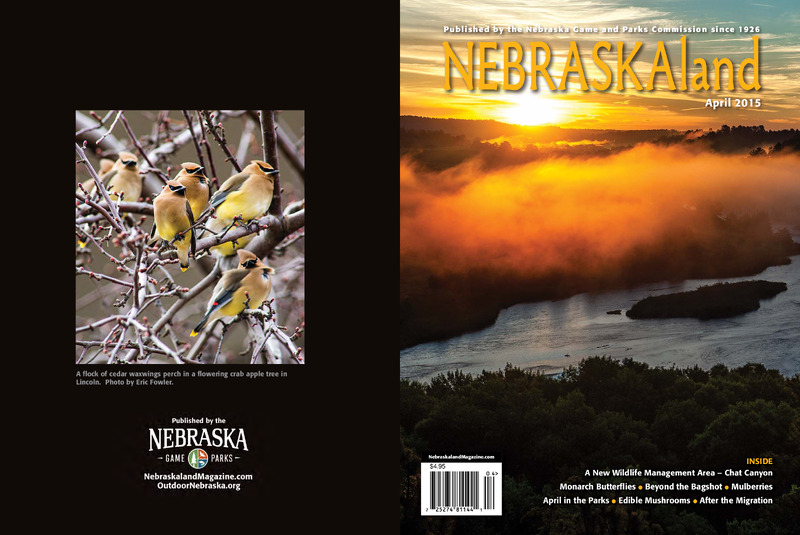
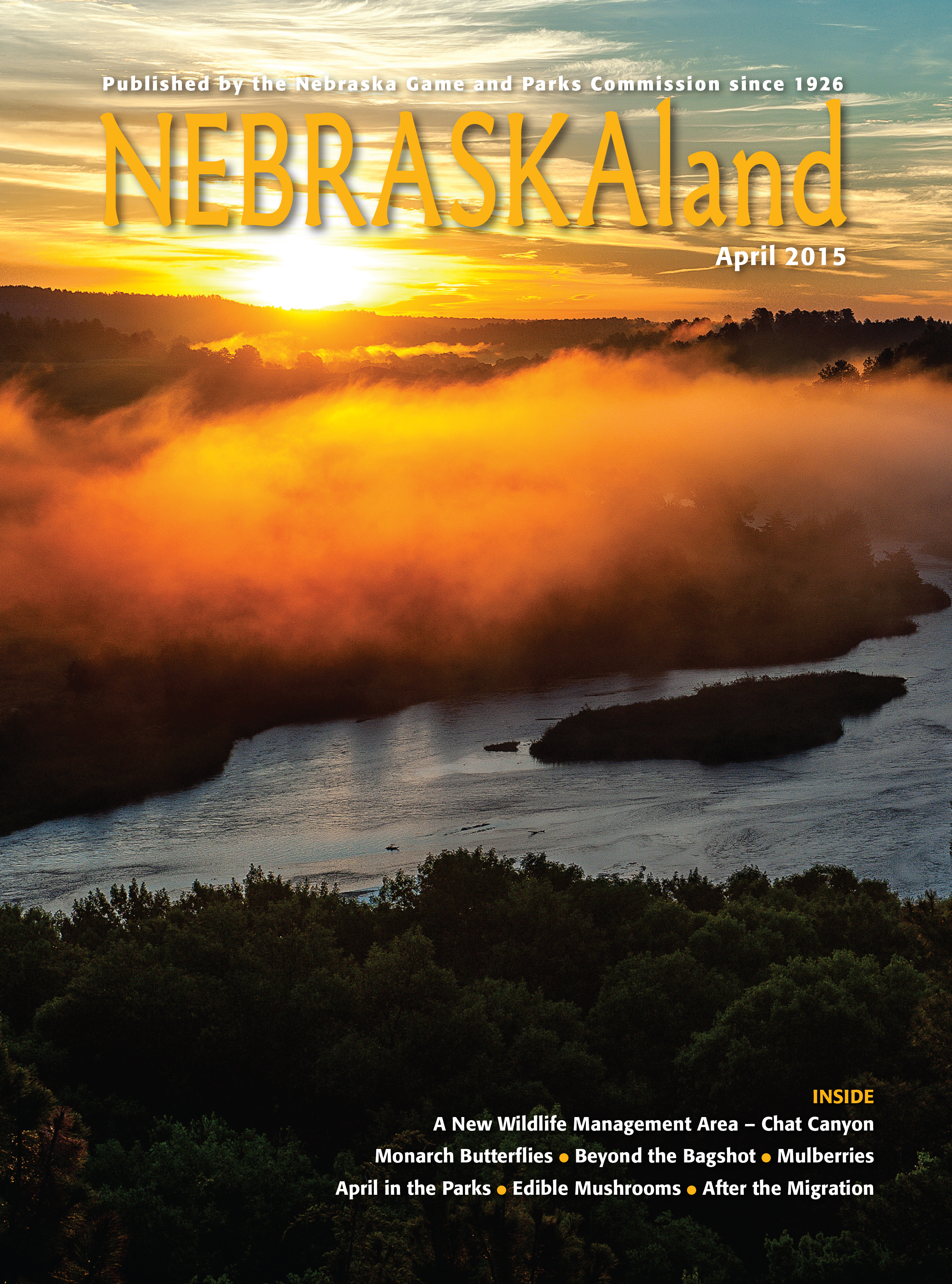
Publis hed by the Nebr a s k a Ga m e a nd Pa r k s C o m m is s ion si nc e 1926
NEBRASKAland
April 2015
A flock of cedar waxwings perch in a flowering crab apple tree in
Lincoln. Photo by Eric Fowler.
NebraskalandMagazine.com
$4.95
INSIDE
A New Wildlife Management Area – Chat Canyon
Monarch Butterflies ● Beyond the Bagshot ● Mulberries
April in the Parks ● Edible Mushrooms ● After the Migration
NEBRASKAland Magazine
Volume 93
●
No. 3
●
April 2015
38
●
F EAT U R ES . . .
20 After the Migration
P
S
M
F
26 Mushrooms Through the Seasons
HOTOS AND TORY BY
ICHAEL ORSBERG
STORY AND PHOTOS BY JULIE GEISER
30 Monarchs – One of the World’s Great Mysteries
STORY AND PHOTOS BY ERIC FOWLER
the Bagshot
38 Beyond
B J K
40 White Mulberry
Y EFF
URRUS
Mixed Emotions and the Price for Pancakes
STORY AND PHOTOS BY GERRY STEINAUER
44 April in the Parks
BY JEFF KURRUS
50 Chat Canyon – Preserving a Nebraska Gem
STORY AND PHOTOS BY ERIC FOWLER
D EPARTM EN T S . . .
From Our Readers...........................................4
Mixed Bag.......................................................6
Travelogue.......................................................8
A Brief History .............................................10
Nebraska Bird Library ..................................15
Junior Journal................................................56
Portraits from the Past ..................................58
In the Kitchen ...............................................60
The Last Stop ................................................62
30
●
26
●
O N TH E W EB . . .
WHEN YOU SEE THIS SYMBOL IN THE PAGES OF
N
NEBRASKALAND MAGAZINE, VISIT
NEBRASKALANDMAGAZINE.COM AND VIEW OUR INTERACTIVE
DIGITAL EDITION FOR MORE INFORMATION.
D
NEBRASKAland (VOL. 93 / NO. 3, ISSN 0028-1964) is published monthly, except
for the combined Jan./Feb. and Aug./Sept. issues, by the Nebraska Game and Parks
Commission, 2200 N. 33rd St., Lincoln, NE. Periodicals postage paid at Lincoln,
Nebraska, and additional mailing offices. POSTMASTER: Send address changes to
NEBRASKAland, P.O. Box 30370, Lincoln, NE 68503-0370.
2 NEBRASKAland • APRIL 2015
20
●
Cover: Fog rises at sunrise from the Niobrara River at Chat Canyon
Wildlife Management Area southeast of Nenzel. Photo by Eric Fowler.
APRIL 2015 • NEBRASKAland 3
COMMISSIONERS
CONSERVATION OFFICERS
Director Jim Douglas
NORTHWEST
Officer
City
Jim Zimmerman (S) Gering
Commissioners
Chairman - Dr. Kent Forney, Lincoln
Vice Chairman - Rex Fisher, Omaha
2nd Vice Chairman - Mark Spurgin, Paxton
Dick Bell, Omaha
Lynn Berggren, Broken Bow
Mick Jensen, Blair
Norris Marshall, Kearney
Dr. Mark Pinkerton, Wilber
Puppy Poses
This is my new German shorthair,
Drake, and his first quail. He is 9
weeks old today and just wanted to
share this picture with your magazine
and fans.
Matt Williams
Elk Creek, Nebraska
It looks like he is off to a good start.
–Editor
Great Guide for Fishing
I found a little green stink bug on
page 27 as I read through another
great issue – thanks especially for
Kathy Keylon from Beatrice sent us this sunrise view from her bedroom window.
the beginner’s guide for fishing. That
will come in very handy with nieces
and nephews! I don’t know what the
insect’s real name is, but it stinks.
John F. Montag SJ
Via email
Coincidence
There is a green stink bug on page
27, next to the sentence about stink
bait ... coincidence? Hmm.
Rob Mercer
Stanton, Nebraska
Outdoor Plates
Jason Lambley now owns an
outfitting business in Canada, but
developed his love for hunting when
growing up in Morse Bluff. His mother
Lois keeps the plates he had before
he headed north that show his favorite
duck and his love for goose hunting.
His current Manitoba plate reads “I
HNT 4U.”
If you have a unique outdoor
message plate you would like to
share, or know someone who does,
e-mail a photo (high-resolution, JPEG
format only, please) along with your
hometown and a brief description of
the interests expressed on your license
plate to Eric.Fowler@Nebraska.gov.
Message in the Magazine
Now, you can send a message
to NEBRASKAland Magazine at
Facebook.com/nebraskalandmagazine
and your comment or photograph may
appear on these pages.
–Editor
MAGAZINE STAFF
Communications Director Christy Rasmussen
Editor Jeff Kurrus
Art Director Tim Reigert
Associate Editor Amy Kucera
Regional Editors Eric Fowler, Julie Geiser,
Justin Haag, Jenny Nguyen
Contributing Editor Michael Forsberg
Regular Contributors Chris Helzer, Gerry
Steinauer
Circulation Donna Robinson
For address changes and questions about
your subscription, e-mail Donna.Robinson@
Nebraska.gov or call 800-632-5263
Advertising Sales Manager
For advertising information contact
Shane G. Gilster, 402-742-0125
Email: shanegilster@gmail.com
NEBRASKAland Magazine Copyright 2014, all rights reserved.
NEBRASKAland is available in audio from the Nebraska Library
Commission Talking Book and Braille Service, Suite 120, 1200 N St.,
Lincoln, NE 68508. 800-742-7691. NEBRASKAland Magazine and the
Nebraska Game and Parks Commission reserve the right to reject any
advertising not in keeping with the agency mission.
Rates: $18 for one year; $33 for two years; $44 for three years. Nebraska
recipients must add appropriate sales tax. To subscribe call
1-800-NEBLAND (632-5263), or go online to: NebraskalandMagazine.
com.
COMMISSION
C
COM
CO
OM
OMMIS
MIS
SSIO
SION O
SI
OFFICES
FF CES
FF
FFI
CES
S
Headquarters/Southeast District Office
2200 N. 33rd Street Lincoln, NE 68503
Phone 402-471-0641
Northeast District Office
2201 N. 13th St. Norfolk, NE 68701
Phone 402-370-3374
Southwest District Office
301 E. State Farm Rd. North Platte, NE 69101
Phone 308-535-8025
Chris Clay from Omaha sent this image of the Platte River at sunset across the street from Schramm Park State Recreation Area.
4 NEBRASKAland • APRIL 2015
Greg Hesse
Scott Brandt
Dan Kling
Frank Miller
Sean McKeehan
Terry Brentzel
Phone (308)
(office) 763-2940
(cell) 641-6138
Rushville
760-3647
Gering
631-0663
Harrison
430-0572
Valentine
402-389-0444
Bridgeport
279-9133
Oshkosh
458-7650
SOUTHWEST
Officer
City
Phone (308)
Roger Thompson (S) N. Platte (office) 535-8025
(cell) 530-3097
Ray Dierking
Brkn. Bow
870-0322
Michael Thome
Cozad
529-8146
Matt Andrews
Elwood
746-2418
Dirk Greene
Imperial
882-0015
Dale Johnson
Kearney
440-3847
Brian Piernicky
McCook
340-6627
Brandon O’Neal
N. Platte
530-3157
Nicholas Fix
Ogallala
289-0427
Bryce Streger
Ogallala
289-1169
Rich Routh
Rep. City
920-0367
Tim Williams
Grand Is
380-7331
Pat George
Kenesaw
402-705-9989
Matt Brandt
Loup City
202-0819
Andrew Heyer
Cozad
402-613-2241
Alex Hasenauer
Wellfleet
660-4671
NORTHEAST
Officer
Tom Zimmer (Sup.)
City
Norfolk
SOUTHEAST
Officer
Levi Krause (Sup.)
William Krause
Mike Luben
Dan Zuehlke
Heath Packett
Darin Gress
Douglas Kramer
Dina Barta
Stacey Lewton
Dudley Sorensen
Russell Mort
Dan Evasco
Rich Berggren
Travis Shepler
City
Louisville
Auburn
Colon
Cortland
Eagle
Hebron
Lincoln
Lincoln
Lincoln
Waverly
Nebr. City
Papillion
Waterloo
Lincoln
Phone (402)
949-0593
274-8063
443-6392
806-9084
210-0888
768-8665
890-6465
890-6463
890-7140
937-3422
209-1506
616-5961
619-1355
613-2312
City
Lincoln
Lincoln
Lincoln
Phone (402)
471-5531
471-5531
471-5531
Phone (402)
(office) 370-3374
(cell) 649-8053
Dale Davis
Bassett
760-0712
Steve Oberg
Columbus
910-3366
Daniel Roberts
Fremont
719-1108
Randy Pomplun
Fullerton
308-550-0489
Jeff Jones
Hartington
762-5022
Jon Reeves
Kennard
889-8508
Doug Pollard
Ord
308-730-7050
Alex Frohberg
Ponca
241-7615
Cory Krause
West Point
380-6410
Jonathan Andreasen O’Neill
340-3981
Mitch Johnson
Wausa
613-8612
Send your comments to:
Jeff Kurrus, Editor
NEBRASKAland Magazine
P.O. Box 30370
Lincoln, NE 68503
or e-mail Jeff.Kurrus@Nebraska.gov
Please include your postal address and
telephone number.
Letters may be condensed and edited for
clarity. Photographs are welcome and will
be returned.
Northwest District Office
East Hwy. 2, Box 725 Alliance, NE 69301
Phone 308-763-2940
Ak-Sar-Ben Aquarium
21502 W. Highway 31 Gretna, NE 68028
Phone 402-332-3901
ADMINISTRATION
Officer
Craig Stover (Adm.)
Duane Arp (Ass.)
Jeff Clauson (Ass.)
Any program that receives federal funding from the National Park
Service, or the United States Fish and Wildlife Service prohibits unlawful
discrimination on the basis of race, color, religion, age, gender, marital
status, national origin, age, disability or political affiliation. Any person
who believes he or she has been discriminated against in any program,
activity, facility, or service, should contact the Nebraska Game and
Parks Commission, Lincoln, NE 402-471-0641, the Equal Opportunity
Commission, Lincoln, NE 402-471-2024, TTY/TDD 402-471-4693;
United States Fish Wildlife Service, Civil Rights Coordinator, 4401
N. Fairfax Drive, Arlington, VA 22203; Director, Equal Opportunity
Program, U.S. Department of Interior, National Park Service, 1849 C
Street NW, Mail Code 0008, Washington, D.C. 20240-0001.
Omaha Office
8495 Frederick Street, Omaha, NE 68124
Phone 402-595-2144
Nebraska Wildlife Crimestoppers 1-800-742-7627
Bassett Office
524 Panzer St., Box 508 Bassett, NE 68714
Phone 402-684-2921
Kearney Office
1617 First Ave. Kearney, NE 68847
Phone 308-865-5310
APRIL 2015 • NEBRASKAland 5
A Mammal Brief
Black-tailed Jackrabbit
By Lindsay Rogers, Outdoor
Education Specialist
6 NEBRASKAland • APRIL 2015
PHOTO BY JUSTIN HAAG
With their characteristic large
back legs, it should come as no
surprise that the black-tailed
jackrabbit is an excellent jumper.
They are able to leap nearly 20 feet
in one bound and can reach speeds of
30-35 miles per hour. They live in
hot, arid areas primarily in the
southwestern United States.
In Nebraska, they can be found across
the state, but are more common in
central and western areas. To cope with
the extreme heat, they often lower their
metabolism, take shelter in the shade
and become active during the cooler
temperature at night. They have blood
vesicles near the surface of their large
ears to help with cooling. Jackrabbits feed
entirely on plants and rely on their food
for most of their water consumption. ■
APRIL 2015 • NEBRASKAland 7
By Julie Geiser
Eustis
he village of Eustis, known as the “Sausage Capitol of
Ne
Nebraska,”
is nestled in the hills between the Platte and
Republican rivers, only 13 miles south of Interstate 80 in
Re
Frontier County.
Frontie
Founded by mostly German immigrants, Eustis keeps its
heritage alive with its June celebration known as Wurst Tag
(Sausage Day). Wurst Tag activities include the early morning
volksmarch and 5K obstacle course and village parade. There
are heritage contests, games, demonstrations, a car show and
displays.
The day concludes with a large German dinner with authentic
Eustis
sausages and pretzels made by Eustis bakers. Enjoy some
Nachtische (a German dessert) and hit the polka and American
street dance under the stars for live entertainment.
Along with rolling hills, visitors will encounter deep, rugged
canyons beautiful and unique for photographers and outdoor
enthusiasts. Plum Creek, Gallagher Canyon, Johnson and Elwood
lakes give visitors easy access to several water sports, fishing,
hunting, camping, boating and golfing.
The lakes are connected by a series of canals where floating
down the canal between Gallagher Canyon and Plum Creek
Lake on an inner tube, canoe or kayak offers a different
outdoor experience. The area provides beneficial habitat
where many species of animals and birds can be seen.
Anglers catch channel catfish, sauger, walleye and a variety
of panfish that thrive in the canals and lakes. Paddlefish have
also been released at
Gallagher in hopes
to provide another
type of fishing for anglers in
the future.
Eustis is also home to the Village Piemaker. This enterprise makes
15 different varieties of ready-to-bake fruit pies delivered to outlets
across Nebraska and the United States, producing 12,000 pies a
week.
Gregg Wolf and Doug and Deb Breinig started the Lone Wolf
Wurst Meats Company in 2011, and produce summer sausage,
polish sausage, brats, hard-tack meat sausage and marinated
prime rib. Many of the recipes for the sausages are more than
100 years old. Wolf’s grandfather, an immigrant from Germany,
made these same recipes on the farm and hung the sausages in
his attic to dry.
The village of Eustis remains a pleasant surprise for visitors,
connected to its history while providing the fun, and food,
people have come to love. ■
Canoe fishing at Gallagher Canyon
The Eustis
ustis
les from E
German M
arket
Plan your visit to Eustis.
P
Edib
APRIL 2015 • NEBRASKAland 9
A Brief History
Bootlegger’s Carnival
By Patricia C. Gaster,
Nebraska State Historical Society
NSHS RG0813-40
T
he passage of the 18th
Amendment to the U.S.
Constitution outlawed the
manufacture and sale of liquor
nationwide, but statewide prohibition
was already in effect in Iowa and
Nebraska. In 1916, Iowa went dry
and Nebraska voters adopted a
prohibitory amendment to their state
constitution that took effect in May
1917. Enterprising individuals soon
learned how to profit by flouting the
law. The Dakota County Herald on
May 24, 1917, reprinted an article from
the Sioux City (Iowa) Journal reporting
the bootlegging then rampant in that
vicinity:
“When Iowa went dry January
1, 1916, bootlegging increased in
Sioux City. For the first few months
everybody who had a taste for this
profitable business indulged himself.
May 1, 1917, the first day of statewide prohibition in Nebraska.
But when the police raiding squad
started its work the ranks soon were
thinned. The man with the clever
idea survived, and his unimaginative
neighbor was run out of business.”
One unusual method for transporting
illegal liquor involved horse collars. “A
short time ago a number of metal horse
collars were shipped into Dakota City.
The collars are used only for heavy
draft work and in the artillery branch
of the army. The great numbers of this
kind of harness where there was no
apparent need aroused the suspicions of
the authorities.
“An investigation was made and it
was found that each collar contained
several gallons of whisky. Every horse
in Dakota county is now eyed with
suspicion.”
The newspaper reported many
other novel hiding places for booze,
including pianos, ash barrels in back
yards, and dry goods boxes with false
bottoms. “One day one of the raiding
squad noticed that the gas jet in a house
that they were visiting was damp. He
opened the jet and applied a match. A
fine stream of ice cold beer squirted
into the air. A tank was found in the
attic which was connected with a gas
pipe to the sitting room on the first
floor.”
Bootlegging continued even after
the 18th Amendment, banning liquor
nationwide, was ratified in January
1919. Nebraska was not one of
the 36 states (out of a total of 48
then) that later voted to ratify the
21st Amendment to repeal national
prohibition, but in November 1934
Nebraskans did vote to repeal the
state’s constitutional prohibition by a
60- to 40-percent margin. ■
Must-Haves for the Tackle Box
10 NEBRASKAland • APRIL 2015
PHOTO BY JEFF KURRUS
NSHS RG3334-41
Fred Bargemann’s Saloon, Bancroft, before prohibition.
By Julie Geiser
Don’t let the first fishing
excursion of the year be a disaster.
Aside from a fishing license,
fishing guide with rules and
regulation and a Nebraska Park
Entry Permit (if fishing state parks
or state recreation areas) here is a
list of the top 15 items that are a
must-have in every tackle box:
1. Extra fishing line
2. Needle-nose pliers
3. Extra hooks
4. Hook sharpener
5. Clippers
6. Bug spray
7. Water
8. Swivels
9. Sinkers of assorted sizes
10. A few different jigs, plastics
and lures
11. Multi-tool
12. Super glue
13. Head lamp
14. First aid kit
15. Tape measure/scale combo. ■
APRIL 2015 • NEBRASKAland 11
Paid Advertisement
Mobile Field Guides
By Callie Rietfors
Rather than lug around field guides
on nature walks, lighten your load
by downloading a few useful apps to
your smartphone instead. These are
some of the best wildflower and bird
identification apps available for Apple,
Android and most tablets.
Audubon Wildflowers by Green
Mountain Digital ($4.99)
In addition to photos and descriptions
of nearly 2,000 North American
wildflowers, this app includes range
maps, sightings and NatureShare for
users to post their observations. Search
species by shape, family or name, or
by such advanced options as color,
habitat, leaf or flower. The guide also
includes additional information about
identification of wildflowers, the parts
of a flower, habitats and classification.
Wildflowers of the Great Plains
Full Version by Immersion Media
($3.99)
Browse 500 native Great Plains
species by common or scientific name,
12 NEBRASKAland • APRIL 2015
or use the advanced search with such
options as color, height, habitat, month,
leaf or stem. The app includes photos,
detailed descriptions, a notepad,
a glossary and plant morphology
sketches. There is also a light version
of this app available at no cost, which
has 25 plant species.
Audubon Birds Pro by Green
Mountain Digital ($9.99)
Find birds with eBird by providing
your location for a listing of recent
sightings in the area, or search by
such options as family, name, habitat,
color, song or call, or locomotion.
Access range maps, images, sound
recordings, descriptions and similar
birds for 821 species. NatureShare
and additional information about bird
conservation, history, birding, plumage
and classification are also included.
Merlin Bird ID by Cornell Lab of
Ornithology by Cornell University
(free)
This app’s 5-question ID simplifies
identification for the novice. Provide
the location and date
of sighting, size and
color of the bird, and thee
bird’s actions – eating att a
feeder, flying – to determine
mine
possible species. Features
es
include photos, descriptions,
ions,
sound recordings and range
nge
maps for 400 North American birds.
The Sibley eGuide to the Birds of
North America by mydigitalearth.
com ($19.99)
With more than 6,600 painted
illustrations of 813 species, this app’s
filter option narrows birds by their
occurrence in your location. Use the
side-by-side comparison feature to
listen to sound recordings and view
images, descriptions and range maps of
any two species at once. Also provided
in the app are an introduction taken
from The Sibley Guide to Birds and
information about bird topography. The
free light version of this app provides
all the features of the full version for
30 species. ■
APRIL 2015 • NEBRASKAland 13
Nebraska Bird Library
Nebraska’s
Largest Outdoor
Classroom
Song or calls: Rich, low “chew” notes.
Song is a series of rich, gurgling notes.
Description: Male is dark, glossy
purplish-blue overall, with wings and
forked, duller black tail. Female and
juvenile are glossy purple above and gray
below. Typical swallow flight of short
glides alternating with rapid flapping.
Habitat: Found in urban, suburban,
and rural habitats, usually near water, and
always where suitable nesting cavities are
available.
Where in Nebraska: Common spring
and fall migrant and summer resident
across most of Nebraska. Presently
Ogallala, Lewellen, and Crescent Lake
represent the approximate western limits.
Fun Facts: Purple martins gather in
large flocks prior to migration. In fact,
more than 30,000 have been estimated to
roost in one area of downtown Omaha,
Nebraska. ■
To learn about more birds visit
NebraskaBirdLibrary.org.
PHOTO BY THINKSTOCK
14 NEBRASKAland • APRIL 2015
Purple Martin
PHOTO BY JULIE GEISER
By Cara Pesek
Learn to shoot a bow and arrow, climb a
mountain, paddle a kayak and much more
May 9 during the Fort Kearny Outdoor
Expo at Fort Kearny State Recreation
Area.
This annual event, often referred to as
Nebraska’s largest outdoor classroom, offers
dozens of outdoor activities for youth and
families free of charge. Children and adults
will be able to try shooting sports, kayaking,
bank fishing, archery, assorted camping
games, outdoor cooking, bow fishing,
slingshot shooting and rock climbing.
Game and Parks staff will give
demonstrations including Dutch oven
cooking, setting up a campsite and fishing
demonstrations, and there will be adventure
hunts, contests and food vendors, too.
For more information about this great
event, visit OutdoorNebraska.org. ■
Sponsored by
y
APRIL 2015 • NEBRASKAland 15
Wild Asparagus
PHOTO BY ERIC FOWLER
16 NEBRASKAland • APRIL 2015
Work was completed in December on a 20-acre backwater on the Missouri River at Indian Cave State Park near Schubert. The U.S.
Army Corps of Engineers’ project will provide shallow water habitat for endangered pallid sturgeon, and also provide calm water for
visitors to fish, a nice option to the swift waters of the Missouri. Anglers can expect to catch flathead and channel catfish, bluegills,
crappies, largemouth bass, carp and other fish in the backwater, which is 3,000 feet long, 50 to 250 feet wide, and 5 to 15 feet deep.
PHOTOS BY JULIE GEISER
By Julie Geiser
I look forward to spring every year – not only to
warmer weather and spring showers, but spending
time driving back roads to hunt for asparagus in the
ditches.
I find myself constantly looking for the dried
asparagus plants from the previous year. The
brownish, pale yellow plants along the ditch and
fencerows look much like any of the other dead
weeds from the past year. But the dead asparagus
plant is a little different, and once you train your eye
to spot them, can be easy to find.
The old asparagus plant is about three feet tall
and has a main trunk, unlike dried weeds from the
previous year that have visible forking stems. Usually
the asparagus plant will have beautiful lacy foliage – The asparagus plant appears brighter than the other straw-colored dead
plants around it.
however, the wind and weather over the fall, winter
and early spring will take its toll, breaking off the
outer edges.
Once you locate the old plants and memorize what
they look like, spotting the new plants of the spring
is easy to do. I like to mark locations on my GPS,
which makes locating the the scrumptious green
sprouts much easier.
Asparagus grows in a variety of places – it likes
water, but not saturated. It grows in well-drained soil
in ditches, riverbeds and alluvial plains where there
is plenty of moisture available. It prefers full sun, but
will grow in heavier soil and partially shaded areas.
Asparagus (comes from the Persian word asparag,
which means sprout), is a green sprout with a
purplish-green spear at their top. The plants typically
live eight to 10 years – the thicker the spear, the
older the plant. Thinner spears are usually tenderer,
but when gathering them I never get picky.
Asparagus can be prepared in many ways – cut asparagus into bite-sized
Gathering and storing the spears is easy, simply
pieces, dip in egg batter then coat in crushed saltine cracker crumbs
cut or snap them off about six to eight inches below before deep frying until golden brown.
the top of the spear. At home, hold the stalks upside
down under water to flush any sand or dirt that might be caught in
the spear tips, wrap the stem ends in a wet paper towel and seal the
asparagus in a plastic bag to store. The spears will last several days
in the refrigerator.
Asparagus lasts for about a year when frozen and can be used
in all recipes including casseroles, soups, steamed or in stir fry.
To freeze, simply blanche or steam the sprouts and place in a
freezer bag or container, be sure to get all the air out of the bag or
container, label and date the asparagus.
Vacuum sealing asparagus is another great way and arguably the
best way to preserve the texture and flavor of asparagus. The sealer
draws the air out of the vacuum bags to provide an air tight seal.
This allows quick and easy freezing without blanching or steaming.
When using frozen asparagus, do not thaw before cooking or
adding to recipes to keep the quality and crispness of the spears.
The tender green sprouts are tasty and can be added to almost
any dish. They are delicious in omelets, sauté them in butter and
garlic with a twist of lemon, slip them on the grill, add chopped
Deep fried asparagus sprinkled with cheese makes a
great spring-time treat.
sprouts to soups or try them in a favorite casserole. ■
APRIL 2015 • NEBRASKAland 17
“New” Lakes
to Fish
by Jerry Kane
Contact the
Nebraska Game and Parks
Commission at 402-471-0641
or visit OutdoorNebraska.org
for more information.
Visit HuntSafeNebraska.org
for a list of hunter education
classes and BoatSafeNebraska.org
for a list of boating safety
classes.
April 1-6
Fort Kearny State Historical Park (SHP)
visitor center open for crane viewing
and history, Kearney, 308-865-5305
April 1-14
Archery paddlefish permit application
period
April 2
Just the Basics fishing workshop,
Nebraska Game and Parks Outdoor
Education Center, Lincoln, 6:30 p.m.,
402-471-6141
April 4
Spring Eggstravaganza
Ponca State Park (SP), Ponca,
402-755-2284
April 4
Bird Banding Workshop
Ak-Sar-Ben Aquarium, Gretna, 9 a.m.,
402-332-3901
April 5
April 18
Lymphomathon
Eugene T. Mahoney SP, Ashland, 9 a.m.,
402-944-2523
April 18-19
Great Plains Garrison Troop Muster
Fort Hartsuff SHP, Burwell, 308-346-4715
April 20
Application period begins for Super Tag
and Combo lottery permits
April 20
Application period begins for bighorn
sheep lottery permit
April 24
Arbor Day, Game and Parks offices
closed
April 24
Team Walleye Circuit
Open tournament rules meeting,
Lewis and Clark SRA, Crofton,
6 p.m., 308-224-2033
Light Goose Conservation Order closes
April 25
in Rainwater Basin and West zones
April 6
Statewide crow hunting season closes
April 8
Bird Watching 101
Johnson Lake State Recreation Area
(SRA), Elwood, 308-324-8484
April 11
Spring youth shotgun turkey season
opens
Crofton Kids’ Fishing Clinic
By Eric Fowler
Maple Creek Reservoir near Leigh
is proving once again that fishing is
excellent at new reservoirs, producing
largemouth bass, bluegills, channel
catfish and even walleyes in both size
and quality.
Completed and restocked in 2010
and opened in 2011, the Lower Elkhorn
Natural Resources District (NRD) flood
control project was built with design
and funding help from the Nebraska
Game and Parks Commission that
will benefit the fishery and anglers
for years to come. Nebraska Highway
91 crosses the upper end of the lake,
slowing inflow and trapping sediment
to maintain water quality.
A second breakwater crossing the
middle of the lake provides another
buffer as well as a bridge for trails that
circle the area. Additional breakwaters
will prevent shoreline erosion and also
provide angler access. Numerous trees
were left standing and underwater
shoals and gravel spawning beds built
as fish habitat. Picnic areas and RV
and tent campgrounds round out the
recreation area.
“It has good bank and boat access
for anglers,” said Steve Satra, the
Commission’s lake program specialist
who helped design the reservoir. “Water
clarity is good and it grows a lot of
aquatic vegetation, which is important
to the fish community. When you start
putting all that together, you’re going
to see some pretty good looking fish,
and we are.”
Other new reservoirs are also
providing excellent fishing, as are old
ones that have been rehabilitated under
the Commission’s Aquatic Habitat
Program (AHP) and federal programs
it administers, including the Sport Fish
Restoration (SFR).
Work on both includes building
structures such as the ones used at
Maple Creek to maintain good water
quality, provide varied depth and
fish habitat. Rehabilitating older
reservoirs often also includes removal
of sediment, stabilizing shorelines and
building new boat ramps.
Fish thrive when vegetation is
flooded as the lakes are filled or
refilled. Anglers can expect to see
good sized bass, keeper-sized panfish,
and quality channel catfish three to
four years after a lake is stocked.
Some of the top “new” lakes are listed
here.
Arnold Lake, Arnold: AHP
project, stocked in 2013-14. Small but
numerous largemouth bass and some
keeper bluegills.
Big Indian 11a, Beatrice: SFR and
Lower Big Blue NRD rehabilitation,
stocked in 2011. Good numbers of
bass and bluegills.
Burchard WMA, Burchard: AHP
and SFR project completed in 2013.
Lake lowered but not drained for
project to maintain quality fish
population. Slow to fill and new boat
ramp not yet in service, but open to
fishing.
Hedgefield WMA, Hickman: SFR
rehabilitation, stocked in 2010-11.
Good numbers and size for bass and
bluegills.
Iron Horse Trail Lake, Du
Bois: AHP, SFR and Nemaha NRD
rehabilitation, stocked in 2011-12.
Reservoir boasts one of the highest
bass densities in the state, and some
larger bass and bluegill.
Lone Star Recreation Area,
Tobias: New Little Blue NRD
reservoir completed in 2007 with
SFR. Fish slow to start but now good
numbers of quality bass and a few nice
crappies.
Victoria Springs SRA, Anselmo:
AHP project, stocked in 2013-14. Small
but numerous largemouth bass and some
keeper bluegills. The park’s paddleboats
are back on the water as well, no longer
shut down by excessive vegetation in
summer thanks to deeper water.
Lakes Closed for work:
Fish populations have been removed
for rehabilitation work at the following
waters: Conestoga SRA, Emerald;
Lake Helen, Gothenburg; Rat and
Beaver Lake, Valentine; Watts Lake,
Valentine. ■
NEBRASKAland
and
Visitor
Last issue’s winner of
the Visitor drawing was
Mara Dobesh of Wahoo, who
found the stink bug on page 27.
Readers are encouraged to contact
NEBRASKAland within 10 days
after this issue’s publication with
the correct page number and name
of this issue’s “Visitor” – a critter
found in Nebraska. We will then
gather the correct entries and draw
one to win a NEBRASKAland
Magazine mug. To enter each
month, write:
NEBRASKAland Visitor
2200 North 33rd Street,
Lincoln, NE 68503.
Or e-mail:
Tim.Reigert@Nebraska.gov
with “Visitor” in the subject line of
the message.
HINT: This issue’s visitor is not
on page 3, 7, 19, 30-37 or 56.
Several species of stink bugs
can be found in Nebraska,
including the brown, green and
twice-stabbed stink bug. Most feed
on plants, using straw-like mouth
parts to inject digestive enzymes
into plants and suck up fluids.
Some, however, such as the spined
soldier bug, feed on other insects.
Adults overwinter in leaf litter and
vegetation, emerging in spring
to lay eggs on the underside of
leaves. Nymphs emerge from the
eggs, looking similar to adults
but lacking fully developed wings.
They undergo five instars before
reaching full maturity. This
type of development, with three
distinct life stages, is called simple
metamorphosis. Some insects,
such as butterflies, undergo
complete metamorphosis, with
four distinct life
stages: egg, larva,
pupa and adult.
Lewis and Clark SRA, Crofton, 4 p.m.,
402-388-2477
April 25
Midwest Regional Cass County
Championship of the World Disc
Golf Tourney
Anglers fish for panfish among flooded trees at
Maple Creek Recreation Area near Leigh.
Eugene T. Mahoney SP, Ashland, 10
a.m., 402-944-7604
April 25
Beyond Becoming an OutdoorsWoman Horses and Camping
Eugene T. Mahoney SP, Ashland, 8 a.m., Weekend
April 11-12
Platte River Art Show
402-944-2523
Platte River SP, Louisville, 402-471-6009
April 15
April 25-26
Light Goose Conservation Order closes Team Walleye Circuit
in East Zone
Open tournament, Lewis and Clark SRA,
Crofton, 308-224-2033
April 18
April 18
Outdoor Adventure
Indian Cave SP, Shubert, 8 a.m.,
402-883-2575
18 NEBRASKAland • APRIL 2015
April 27
Family Fishing
Terry’s Pit, Scottsbluff, 5 p.m.,
402-471-5447
PHOTO BY ERIC FOWLER
Spring shotgun turkey season opens
Special thanks to Julie Van Meter,
State Entomologist, Nebraska Department
of Agriculture. Photo by Chris Helzer.
Bugguide.net is a good site for identification.
APRIL 2015 • NEBRASKAland 19
After the
Migration
Photos and story by Michael Forsberg
S
pring migration season along the Platte River is a whirlwind
of wild wings, unpredictable weather and far-flung visitors
from across the region and around the globe. This convergence
provides the spectacle to one of the great winged migrations left
on earth. But once the spring crane migration season ends, there is
a palpable and collective exhale, the way a stadium feels once the
crowd has dissipated after an intense football game.
20
0 N
NE
EBR
RA
AS
SKA
KAlaan
nd
d • AP
APRI
RIL 2
20
01
15
5
APRIL
AP
RIIL 2015
2015
20
1 • NEB
BR
RA
ASK
SKAl
Alan
and 21
1
T
he viewing blinds that provided windows of
wonder and collected thousands of gasps,
wide smiles and even tears, now sit empty,
their windows left flung open to let those
memories flow back out as a gift to the river
and be carried downstream.
O
ut along the braided river, the roar of
cranes has been replaced by the busy
murmurings of resident ducks and geese
establishing nests, and the brilliant, colorful
flashes of songbirds, neo-tropical migrants,
as they begin to arrive and flit among the
budding cottonwood trees.
I
n a farmer’s field the cold wet sting of a
spring blizzard, winter’s last breath, has
melted into the land to mingle with the earthy
fragrance of freshly tilled soil as a new crop is
prepared to plant.
22 NEBRASKAland • APRIL 2015
APRIL 2015 • NEBRASKAland 23
T
he page has turned in our endless
progression of seasons in the central Platte
River Valley. But feathers and fluff carried by
the wind will linger awhile longer, pinned up
like ticker tape along the riverbanks and in the
prairies, reminding us of this ancient passage
that marks time in our lives. ■
24 N
NE
EBR
BRAS
ASKA
KAla
laand • AP
APRI
RIL
RI
L 20
015
AP
A
PRI
R L 20
2 15 • NEB
EBRA
RASK
RA
SKAl
Alan
a d 25
an
Mushrooms Through the Seasons
While the most popular
popular, morel mushrooms are just one of a select number of edible
fungi species in Nebraska.
Story and photos by Julie Geiser
N
ebraska’s mushroom hunters
typically consist of those
seeking the sponge-like morel
mushroom that appears in the sandy
soils of the state’s major river valleys
each spring. Once the morel season
has dissipated, most mushroom
collectors assume that the mushroom
season is over – yet die hard hunters
know that the collecting has only
begun.
The key to fungi hunting starts
by learning the habits of favored
mushrooms – timing is everything: a
few days too early and mushrooms will
not be visible, hidden under a mulch
layer of leaves, dirt and wood; too late
and they will be gone – all dried up or
occupied by bugs.
Starting in spring the desirable
morel mushrooms start to appear after
a nice rain or snow melt with warm
temperatures following.
Morels
The morel (Morchella) is one of the
most unmistakable fungi. All morels
have a round to cone-shaped cap that is
honeycombed with pits and ridges that
resemble a sponge. Morels have a short
stalk and are hollow through the cap
and stem and host a warm brown to tan
or yellowish color.
False morels should not be mistaken
for morels and should not be eaten.
They will have a cotton-like fiber in the
stem. Sliced long ways the difference
is noticeable as false mushrooms
are not hollow. The cap will not be
honeycombed and pitted like the
morel and will be red-brown, brown or
yellow-brown.
Widely scattered or clustered morels
can be found in a variety of places;
they like loose, sandy soil with high
humidity and decaying vegetation
that can be found in wooded areas,
hardwood forests with ash and elm
trees, riparian woodlands, fruit orchards
and sandy soils near rivers and streams.
Look for them under conifers and in
ravines and deciduous woodlands;
recently burned areas and disturbed
areas will also produce morels.
Scan for early morels in dense
underbrush and around fallen trees
and river banks on south-facing slopes
and open areas in woodlands where
the sun can penetrate the ground –
later on, hit the shaded and northfacing slopes. Use a walking stick to
carefully move leaves and debris out
of the way to reveal morels hidden on
the forest floor. Once you train your
eyes to “see” morels collecting will be
easier.
When gathering, pinch the morel at
the base and gently twist to break the
stem or carry a small knife to cut the
stems. Then place the mushrooms in a
mesh bag. This allows your morels to
breath, keeping them fresh and it lets
some of the bugs fall out.
The morel season can last several
weeks in Nebraska depending on
local conditions – soil moisture
and temperature are contributing
factors of the morel’s arrival. Many
morel collectors look for warm rains
followed by sunny days with night
temperatures above 45 degrees and
ground temperatures of 50-60 degrees
to prompt the fruiting body of this
mushroom to arrive. A morel will
emerge, grow and die in about four to
six days. Many hunters heed old-time
advice and head to the woods when
the lilacs bloom. Be on the lookout for
morels from mid-to-late April through
May.
Sliced, breaded, seasoned and fried,
morels are a delectable treat. There
are many creative ways to cook and
eat morels and many ways to preserve
them for future use. Always be sure
to cook morels before eating them to
prevent illness.
Sulfur Shelf
ILLUSTRATION BY TIM REIGERT
Morels are one of the most unmistakable mushrooms with their cone-shaped,
honeycombed cap encompassed with pits and ridges that resemble a sponge.
26 NEBRASKAland • April 2015
True morels (top) are hollow, while
false morels (bottom) contain a stalk
throughout the mushroom.
The sulfur shelf, more commonly
known as chicken-of-the-woods, is
a mushroom that should be admired
for not only its flavor but its unique
beauty. It looks like something you
would find on a coral reef.
This large, fleshy fungi starts small
or fingerlike and soon becomes fanshaped with overlapping clusters
stacked on top of one another. Its
smooth to suede-like surface is often
uneven or wrinkled.
The sulphur shelf has no real stem
and its caps grow in large, individual
“shelves” ranging from two to 10
inches across and up to 10 inches long.
The caps have whitish to yellowish
The sulfur shelf, or chicken-of-the-woods, mushroom is easy to distinguish with its
bright colors and is a good mushroom for the beginner collector.
April 2015 • NEBRASKAland 27
The shaggy mane is both an urban and
suburban mushroom – it is so widely
distributed it can occur almost anywhere.
Get shaggy manes to the frying pan
quickly as they deteriorate rapidly.
Turkey Tail
T
fruits from the ground opposed to
growing on trees. From pastures,
roadsides, gardens, lawns and parking
lots the shaggy mane is both an urban
and suburban mushroom – it is so
widely distributed it can occur almost
anywhere.
Not only are these mushrooms edible
but they are delicious with a light taste
and great texture. Slice in half, dip in
egg batter and bread crumbs and then
sauté. But get them to the pan soon
after picking, as they can deteriorate
rapidly, or freeze them for future use.
Look for shaggy manes in late
summer and fall.
Giant Puffballs
pores on the underside with no gills.
This mushroom is easy to distinguish
with its bright colors and is a good
mushroom for the beginner collector as
it has no look-alikes.
Its colors range from red-orange to
bright orange, yellow-orange and sulfur
yellow or salmon when the fungi is
young. The flesh is thick, soft and full
of water when fresh and will become
tough, lose some color and eventually
crumble with age.
Masses of sulfer shelf grow on dead
stumps and logs of hardwoods or
conifers and will sometimes appear on
live trees or on roots and buried wood.
This mushroom doesn’t need much
moisture to fruit.
Picking smaller, knobby caps as they
first emerge are the best for eating. To
harvest larger or older mushrooms, trim
off the tender flesh near the outer edges
of the cap, remove any hard, woody
flesh, and then cook. When cut, the
tender flesh will leak a clear, watery
juice.
This variety tastes and looks much
like lemony chicken when cooked. It
is good sautéed, deep fried, baked or
28 NEBRASKAland • April 2015
used in soups. However, some people
may have an adverse reaction to this
mushroom so try a small taste the
first time to see how it makes you
feel.
Then remember where you first
found them, because they will appear
on the same stumps year after year
showing up in late summer and early
fall.
Shaggy Mane
Shaggy mane is distinctive and easy
to recognize – they grow solitary or in
tight groups, preferring hard ground
and grassy areas with rich or disturbed
soil. This mushroom has an elongated
shaped, shaggy cap with brownish
upturned scales and a straight, semismooth stem.
This mushroom is also known as
“inky cap,” as the gills and often the
caps digest themselves at maturity,
turning into an inky black fluid that
will drip to the ground. This autodigestion helps disperse spores into the
air to produce a future crop.
This 2- to 6-inch tall mushroom
Giant puffballs are sought-after
delicacies that are large, round to
oblong “balls” that grow alone or
in groups on the ground in pastures,
meadows, grasslands, along roads and
other open places. Puffballs may be
baseball-sized or as large as a soccer
ball.
Young puffballs have a white,
spongy interior, which is when they
are prime for eating. As they age they
become brown and discolored. At that
time their skin will crack and trillions
of powdery internal spores will be
released.
Correctly identifying this mushroom
is crucial. Puffballs should have a
thick, white flesh inside; don’t eat
anything with a brown, black, purple
or yellow interior. The white flesh
should not have gills in it – if there
is any evidence of gills, dispose of
immediately.
Deadly amanitas look similar to
a puffball with a universal veil that
surrounds the young mushroom.
Slicing the mushroom will help
identify a puffball from an amanita
as the embryonic outline of a cap,
gills and stem of the amanita will be
revealed.
Puffballs should be used soon after
harvesting or refrigerated for future
use. They have a rich, nutty flavor,
and absorb flavors that they are cooked
with. Puffballs are good fried in a
Always cut puffball mushrooms in half to check color and for the embryonic outline of
a cap, gills and stem of the deadly amanita mushroom.
batter, sautéed alone or with vegetables
and occur in late summer and fall. It
is imperative to know what mushrooms
you are collecting – some species of
mushrooms in Nebraska are poisonous.
The morel, sulfer shelf, shaggy mane
and puffball described here are some of
the most recognizable of the edibles. It
is unwise to eat any mushroom when in
doubt about genus and species, so stick
to these Nebraska edibles if you’re a
beginning mushroom hunter. These are
more than enough to keep you busy
throughout the year. ■
Sliced quarter-inch thick, puffballs can be dipped in an egg batter, coated with flour
and cinnamon and fried until golden brown like French toast. Top with a pear slice.
he turkey tail is a small, fan-shaped
mushroom that boasts a tough
texture but is leathery and supple when
fresh.
The fans resemble that of a strutting
tom turkey, are covered with fine hairs
and have bands of contrasting colors
ranging from white, gray, brown, yellow,
buff to bluish, reddish or black and
sometimes greenish from algae. Its
flesh is thin and has virtually no stalk.
This polypore mushroom has a long
history of medicinal use in China dating
back to the mid-1300s during the
Ming Dynasty because of its immuneboosting capabilities. Turkey tails
are most popularly known as being
a natural source of the anti-cancer
Polysaccharide-K or PSK, which is a
carbohydrate found in the fruit bodies
and in the mycelium of turkey tails.
Turkey tails can be consumed by
drinking the tea made by boiling them
for a prolonged period of time. Some
mushroom hunters will chew the fresh
caps like gum or use them to make
ornaments or jewelry.
This mushroom typically grows in
rows, tiers, or overlapping clusters
on logs, stumps or fallen branches of
hardwoods, thriving mostly on decaying
matter. At times it will thrive on live
trees, but rarely appears on conifers.
Turkey tails are commonplace and
widely distributed year-long, and can
even be found fruiting during winter.
The turkey tail is often researched as
a medicinal mushroom.
April 2015 • NEBRASKAland 29
Monarchs
Habitat loss
threatens colorful
insect’s future
Story and photos by Eric Fowler
T
he migration of the monarch butterfly, an icon of
the insect world if there is one, is one of the great
mysteries of the world. The drastic decline – 90
percent in 20 years – in the number of monarchs making that
annual fall flight to central Mexico is no mystery. Habitat
loss, especially in the upper Midwest, is the primary cause of
the species’ decline.
Whether the decline can be reversed, or even stopped,
so that migration can continue is yet to be seen. But work
is underway on many fronts. On one, environmental
groups have proposed giving monarchs protection from
the Endangered Species Act. On another, many groups are
working to plant more milkweed, with some monarch lovers
even tossing seed bombs out their car windows to propagate
the species on roadside ditches. The decline in this colorful
native plant is believed by many to be the root cause of
the monarch’s decline. The species only lays its eggs on
milkweed, which serves as the food source for its larvae.
And with fewer plants on which to lay eggs, there have been
fewer adults to complete the migration.
The Monarch’s Year
The life of each monarch we see in Nebraska, and every
one east of the Rocky Mountains for that matter, can be
traced to a volcanic mountain range in central Mexico.
There, a super generation of monarchs that lives longer than
any other spends the winter.
Tens of millions of the butterflies arrive in November
and cluster on oyamel fir trees in south facing slopes at
elevations of 10,000 feet. There, it is cold enough to slow
the insects’ metabolism, but not cold enough to freeze them
to death. Monarchs can’t handle cold like some insects, a
fact that drives their migration. These overwintering sites
were only discovered in 1975. To that point, they were
known only to local villagers, who have since become
guides for tourists who come to witness the spectacle, and
caretakers of the land, much of which has been protected by
the Mexican government.
Monarchs begin flying north in March, following the
emergence of milkweed. When they leave Mexico, they
30 NEBRASKAland • APRIL 2015
push the play button on
sexual development that
had been in suspension
since they began their
southward migration
months earlier. This
super generation, with
its wings weathered
and less colorful that
monarchs we see, lays
eggs from northern
Mexico and Texas to
as far north as Kansas,
Missouri and Virginia,
and then dies. The
generation it produces
continues the northward
movement, fanning
out across the United
States and into southern
Canada, where it also
reproduces and dies.
The offspring of this
second generation are the monarchs we see throughout the
summer. They begin as eggs laid from late-May through
July. Some emerge early enough to produce a fourth
generation from eggs laid from late June through August.
Unlike earlier generations, which are able to reproduce
within days of emerging, these third and fourth
generation adults emerge in reproductive diapause, with
their reproductive organs stalled in state of suspended
development. These changes, and the start of the migration,
are triggered by shorter days, cooler temperatures and
changes to the milkweed plants. In the northern monarch
range, migration begins in late August. Migrating monarchs
typically begin to arrive in northern Nebraska in earlySeptember. By the end of the month, most monarchs have
left the state.
Native to North and South America, monarchs spread to
Hawaii, Spain, Portugal, Australia and New Zealand and
other parts of the world in the 1800s, most likely with help
A pair of monarch butterfiles feed on butterfly milkweed nectar (A. tuberosa) in a restored prairie in Lincoln. The species only lays
its eggs on milkweed, and the decline of the native wildflower has been tied to the monarch’s decline. Other milkweeds
native to Nebraska include common, swamp, prairie, whorled and showy.
from man. But the North American monarch is the only
butterfly in the world that migrates. Other butterflies and
moths emigrate, moving to find warmer weather or food, but
their young make the return flights.
Monarchs west of the Rockies, which make up 5 percent
of the world’s population, follow a similar routine, but
migrate only as far south as southern California. Scientists
still aren’t sure how the rest of North America’s monarchs
find their way to Mexico, some traveling up to 3,000 miles,
an amazing feat for a bird, much less an insect. Yet by
November, nearly every surviving butterfly from east of the
Rocky Mountains has arrived in a small, mountainous area
west of Mexico City.
In Mexico, the wintering monarch population, which
are known to occupy only 11 to 14 sites, is estimated by
surveying the area the butterflies cover. In the winter of
2013-14, that number hit an all-time low of 1.65 acres, down
from a high of 51.8 acres in 1996-97. Researchers estimate
this 90 percent decline had left just 33 million monarchs.
Things improved slightly this year, with monarchs covering
2.8 acres.
But in the past, winter storms in the mountains have led
to catastrophic population declines. With so fewer monarchs
remaining, the effects of such losses could be much more
dire for the rest of the population.
Milkweed and Monarchs
Logging in the monarch’s winter home, and the possible
loss of roost trees, was feared as the major threat to the
butterfly until recently. With the creation of reserves by
the Mexican government, that threat has been minimized.
Researchers only recently realized the loss of milkweed
throughout the insects’ range is of equal concern.
The metamorphosis of a monarch begins as a pinheadsized egg that females lay on the underside of the leaf on
APRIL 2015 • NEBRASKAland 31
Pollinators
of native wildflowers. “The more you have, the
better,” said Pete Berthelsen, director of habitat
partnerships for Pheasants Forever, noting that
variety helps ensure that there will be wildflowers
in bloom from April through October.
Biologists have discovered that “great pollinator
habitat is great habitat for all kinds wildlife,”
he monarch butterfly isn’t the only insect that
Berthelsen said, especially pheasants and quail.
is in decline. Pollinators in general, including
Under a canopy of wildflowers, chicks have plenty
butterflies, moths, flies, native bees, non-native
of room to move around and chase the insects that
honey bees, ants, birds, bats, and other species
make up 95 percent of a chick’s diet.
are becoming fewer.
The Farm Bill Wildlife Biologist program, a
Why should you care? Because pollinators
partnership between Pheasants Forever, the USDA
help about 85 percent of the worlds’ flowering
Natural Resources Conservation Service and the
plants reproduce, including many of the fruits,
Nebraska Game and Parks Commission and other
vegetables and nuts that we eat, as well as those
state wildlife agencies, is promoting the use of
eaten by wildlife. Moving pollen from the male
high-diversity mixtures for CRP that include 30
to female parts of a single plant, or from one
to 50 species of wildflowers, including milkweed,
plant to another, is what produces seeds or fruit.
and are no more than 50 percent grass. “The great
Honeybees, imported from Europe in the 17th
news is those mixtures don’t have to cost any
century to pollinate crops, do this for at least
more than what the old traditional mixtures did,”
90 commercially grown crops in North America.
Around the world, 87 of the top 115 food crops – 35 Berthelsen said. Those old mixes still in use a few
years ago often included just five grasses and
percent of the global food – depend on pollinators.
a few forbs, and soon grew into a solid stand of
Monarch populations are down 90 percent in the
grass that provided winter cover for pheasants and
past 20 years. The number of honeybee hives is
quail, but had little value the remainder of the year.
down 60 percent from 1942.
Chris Helzer manages prairies for The Nature
There are many factors causing the decline,
Conservancy in the Platte River Valley in central
especially the widespread use of herbicides
Nebraska that have been restored with up to 230
and insecticides and habitat loss. The latter is
species of grasses and forbs. “If you’ve got good
something everyone – homeowners, acreage
plant diversity and you have scale, those are the
owners, farmers, ranchers and public land
two things that are critical for almost every wildlife
managers – can help reverse by turning grass into
species you could be interested in,” he said.
pollinator habitat.
One of the biggest challenges in the creation
Whether planting a backyard “butterfly garden”
of pollinator habitat continues to be the thought
or enrolling land in the USDA Conservation
of what is and isn’t a weed. Helzer has worked to
Reserve Program, the key is to plant many types
change that perception among
county weed superintendents,
farmers and anyone else who
will listen, but still sees many
people “spray everything that’s
not grass. That’s going to take a
long time to change, I’m afraid.
“Plants that we might think
of as weeds are really good
pollinator habitat,” he said. “Like
hoary vervain or native thistle or
milkweed. Those are the three
top butterfly plants on the Platte
River and they’re considered
weeds by most farmers and
sprayed.”
Cattlemen can help the cause
with pollinators, too. Helzer has
watched cows eat the flowers
off every milkweed plant in
a pasture. Using a rotation
that rests pastures every few
The State Farm Lincoln Operations Center converted 8¼ acres of turf to native grasses
years will ensure that the plants
and wildflowers, creating pollinator habitat and saving $16,000 a year in mowing,
can flower, produce seed, spread
fertilizer and weed control and 2 million gallons of water in irrigation.
Why and How You Can Help
T
32 NEBRASKAland • APRIL 2015
Several Nebraska businesses provide
native, local ecotype seed, plants or
consulting services to assist you in
developing monarch or pollinator habitat.
Asclepias Seed Company, Ogallala Seed and products made from milkweed.
BuyMilkweed.com.
Bluebird Nursery, Clarkson - Wholesale
and retail sale of native plants, including
several milkweeds. BluebirdNursery.com.
Monarch Gardens, Lincoln - Consulting
for home and business gardening with
native plants. MonarchGard.com.
Nature Hills Nursery, Omaha - Milkweed
and other native plants. NatureHills.com.
Prairie Legacy Inc., Western - Consulting
and native seed for prairie restoration.
PrairieLegacyInc.com.
Shoestring Acres Seed, Lincoln - Native
grass and wildflower seed. ShoestringSeed.com.
Stock Seed Farms, Murdock - Native
grass and wildflower seed. StockSeed.com.
•
•
•
•
•
•
•
rhizomes and persist in the landscape.
Drive past acreages sprouting around every
city in Nebraska and you will find that many
people want to take the city to their country
home, turning their entire lot into a fescue or
bluegrass lawn. A good example can be found
on one side of Cunningham Lake on the north
edge of Omaha, where a few eight acre acreages
are mowed from one property line to the next.
On the other side of the lake, Jan Glenn’s
yard only stretches 50 feet from her home.
From there, she watches foxes, deer, turkeys
pheasants and other wildlife that live in the tall
native grasses and wildflowers covering the rest
of her acreage that was part of her family’s farm.
“It’s my entertainment,” she said, noting that
she still spends more time than she would like
mowing the little turf she has. “It’s a symphony
and moving pictures at the same time. It’s just
gorgeous. It’s my peace.”
Acreage owners, businesses or even cities can
benefit on several fronts from converting grass
to pollinator habitat. At the State Farm Lincoln
Operations Center, the company saves $16,000
a year in maintenance after converting 8¼ acres
of turf to short-grass prairie. “Now we have zero
maintenance other than mowing every couple
of years,” Warren Gran, administrative services
supervisor. “It’s worked out really well.”
Creating and maintaining pollinator habitat
does take some work. But the long-term savings
and the benefits to pollinators and wildlife are
worthwhile, and those who enjoy watching them,
certainly make the work worthwhile. ■
any of the 27 species of milkweed plants native to
North America. Females lay hundreds of eggs in their
2- to 5-week reproductive lives, but they only lay one
egg per plant to ensure that larvae, which emerge in
three to eight days, will have enough food to satisfy
their voracious appetite.
The larvae are adapted to the sticky, toxic latex sap
the milkweed plant contains, even absorbing the toxins
to make them taste bad, a defense against would-bepredators, as they go through five instar, or growth,
stages. They emerge as a 2- to 5-millimeter-long, green
caterpillar and molt between each stage, adding their
characteristic black, yellow and white bands by the
second stage. They eat constantly and by the time they
pupate, they grow to 25 to 45 millimeters in length and
increase their weight 2,000 times, all in a period of just
nine to 14 days.
When they are ready to pupate, they spin a silk mat
on a plant, hang up-side-down, shed their skin a final
time and form a bright green, gold-trimmed chrysalis.
Ten to 14 days later, the adult butterfly emerges, its
black and orange wings becoming visible through the
chrysalis just before this happens. Within a few hours,
their wings are dry and they can fly. Within a few days,
they will mate and start laying eggs. Two to five weeks
later, they die.
The likelihood of adults finding milkweed on which
to lay eggs, however, is not as good as it once was.
A common plant in native prairies, milkweed was
also common in and around crop fields in the Corn
Belt. That began to change in the mid-1990s with the
introduction of genetically modified crops that were
resistant to Roundup and other systemic herbicides
known as glyphosates. Farmers once used tillage
to control plants that would compete with crops for
sunlight, water and soil nutrients, but the process was
inefficient and always missed some “weeds.” The
development of herbicides allowed them to control
grass or broadleaf plants without tillage, but not both.
Now farmers can efficiently use glyphosate to kill
everything but the genetically-modified corn, soybeans
or other crops they plant. Roundup Ready soybeans
were introduced in 1996, and corn in 1998, and today,
approximately 94 percent of soybean fields and 89
percent of corn fields are planted to glyphosateresistant varieties.
Other areas where milkweed grows have been
disappearing at an alarming rate. High crop prices in
recent years, which some say are due in part to the
Federal mandate for ethanol, encouraged producers
to farm more acres. Between 2008 and 2011, 23.6
million acres of grassland were converted to cropland.
In Nebraska from 2007 to 2012, 2.8 million acres of
grassland were plowed to farm, including a nationleading 55,000 acres in 2012 alone.
While crop prices have fallen, the loss of prairie may
not be over. Much of the grassland that was converted
APRIL 2015 • NEBRASKAland 33
PHOTO BY JOEL SARTORE
Millions of monarch butterflies roost in oyamel fir trees on the Sierra Chincua near Angangueo, Mexico. Monarchs from east of the
Rocky Mountains fly up to 3,000 miles to winter in this mountain range before flying back north to start the next generation.
had been enrolled in the federal Conservation Reserve
Program. Just 24 million acres are now enrolled nationwide
in the program, which pays farmers to plant highly erodible
and marginally productive cropland to grass, providing
benefits to wildlife and improving water quality. That is
down from a high of 36.8 million acres in 2007. The current
acreage enrolled matches the program cap form 2016 and
beyond. Nebraska had 791,000 acres enrolled in December,
down from 1.34 million acres in 2007.
Urban development continues to gobble up acres as well.
And even in grasslands, ranging from roadsides to CRP
fields, milkweed and anything else that isn’t a grass is often
sprayed by farmers and land managers who consider them
weeds. In pastures, cattle feast on milkweed flowers, and
season-long grazing leaves none to reproduce.
A 2012 study by Iowa State University and University of
Minnesota researchers found that in the Midwest from 1998
to 2011, milkweed production declined by 58 percent and
monarch butterfly production dropped by 81 percent. Both
numbers have increased since.
Studies and Solutions
Chip Taylor has been studying insects at the University of
Kansas since 1969 and began a tagging study of monarchs
in 1992 that grew into a program called Monarch Watch.
Tagging programs that began in the 1930s eventually led
34 NEBRASKAland • APRIL 2015
researchers to the wintering grounds in Mexico, but “There
was a lot about the migration that still wasn’t known,”
Taylor said.
The program, with the help of volunteer taggers who come
in the form of school teachers and students, youth groups,
nature centers, individuals and others, has tagged about 1.2
million monarchs. About 16,000 tags have been recovered,
mostly in Mexico where the program pays locals 50 pesos
for each tag they recover.
Taylor said those recoveries have shown that while
monarchs breed throughout the eastern United States in
the summer, most of the individuals that arrive in Mexico
originate along a corridor between Texas and Minnesota,
and in the upper Midwest – eastern Nebraska, the eastern
Dakotas, Minnesota, Wisconsin, Iowa, Illinois, Michigan
and parts of Indiana and Ohio. “If you look at the corn and
soybean distribution you will pretty much define where most
of the monarchs come from that reach Mexico,” Taylor said.
Taylor said he first became aware of the milkweed decline
in farm country after receiving a letter from a concerned
Nebraska farmer in 2004. The farmer told Taylor he was
using Roundup Ready corn and soybeans, that it was
eliminating the milkweed he used to have and he believed
the butterflies would soon be gone too.
“I said ‘Oh crap’ and realized he was right,” Taylor said.
“Nobody was concerned about habitat loss at that time. That
didn’t come into the picture until it was quite clear five
or six years later that the [monarch]
population was going down.”
In 2005, Taylor started the Monarch
Waystation program with the goal of
creating small patches of milkweed
and other pollinator habitat in home
gardens and public parks across the
monarch’s range to ensure at least
some would find places to lay their
eggs. Taylor expects the program will
hit 10,000 waystations this year, but
that is only scratching the surface. “We
need 9 or 10 million of those things to
really restore habitat,” he said.
So he and others at KU have
developed other programs, including
Bring Back the Monarchs, a
nationwide program aimed at restoring
20 milkweed species for monarch
caterpillars and other wildflowers
for adult butterflies and other
pollinators. The program will provide
free milkweed plugs to schools and
nonprofits who want to help the
cause. A spinoff of that program, The
Milkweed Market, began in 2013 and
is collecting milkweed seeds from
across the country, raising plugs in a
nursery and selling those plants back
to gardeners in the region they came
from. This year they expect to sell
more than 100,000 plugs.
Others are promoting the need to
plant milkweed and other wildflowers
to help stem the decline in pollinators.
In the fall, milkweed pods open and the wind will catch the silky parachutes on the
On a small scale, “guerilla gardeners”
seeds and carry spread them throughout the countryside.
are creating balls of mud, clay and
milkweed seed and tossing them out on
spans the continent, and a program to solve it would be
public lands and road ditches to help
“extraordinarily large.”
propagate the species. Bigger efforts include the Monarch
“The question is, what is it going to take and who is going
Joint Venture, a group of state and federal agencies, nongovernmental organizations and academics that is working to to step up do it,” Taylor said. “This is one of those allhands-on-deck-sort of situations.”
conserve the species through the North American Monarch
Taylor said it will take help from private citizens, the
Conservation Plan, created in 2008 by many of the same
agricultural community, and park and highway managers to
people and their counterparts in Canada and Mexico.
stem the tide. “Basically we have to look at every landscape
The Center for Biological Diversity, Center for Food
out there and ask ‘can we put milkweed in that habitat?’
Safety, Xerces Society and Dr. Lincoln Brower, a monarch
“The problem we’ve run into with monarch butterflies is
researcher, filed a petition with the U.S. Fish and Wildlife
we’ve created these huge holes in their environment. We’ve
Service asking that the Monarch be given the protection
created this incredibly fragmented landscape out there and
of the Endangered Species Act. The service announced
eliminated milkweed in huge areas of the country, and now
in December that such protection may be warranted, and
the question is how can we address this. Milkweed is not
initiated a year-long review process to determine whether it
that hard to bring back. It can be done.”
will be listed or not.
And if that can happen, the monarch migration, one of the
While he believes it could be soon if the continued loss
world’s great wildlife spectacles, will continue. As will the
of habitat isn’t stopped, Taylor doesn’t think the monarch
insect’s uncanny ability to teach school children the magic
is currently threatened or endangered, and isn’t sure
of metamorphosis.
listing it as such would help. The problem – habitat loss –
APRIL 2015 • NEBRASKAland 35
Raising
Monarchs
A School Project
Turned to a Passion
ach year, millions of school
children learn about one of
the amazing feats of the natural
world – metamorphosis – with
the help of one of America’s best
known insects: the monarch
butterfly.
Shauna Groenewold’s interest
in monarchs started on that
same front 20 years ago when
she helped her daughter, Kalyn,
raise them from egg to caterpillar
to butterfly for a science fair
project.
“I initially discovered how easy
it was, and it was fun. I enjoyed
it. So I just kept doing it,” she
said.
Like frogs and salamanders,
butterflies became another on
the list of “weird pets” for the
mother and daughter who were
allergic to pet dander. And that’s
how Groenewold describes
raising them. “It’s sort of like
taking care of any other pet.” she
said, “except not as demanding.”
Feeding monarchs requires
milkweed, and lots of it. Without
a ready supply, you won’t be
able to support the larvae.
Groenewold and her husband,
Mike, a horticulturist, have plenty
of milkweed and other pollinatorfriendly plants in their flower
garden, which is certified as
a Monarch Waystation though
MonarchWatch.org.
The Groenewolds grow swamp,
butterfly and common milkweed.
“Some people don’t like common
milkweed because it’s been
associated with weeds,” she
said. “But more and more people
are incorporating it in their
landscape because they realize it
has really pretty flowers and it’s
so fragrant.”
When they hatch, monarch larvae are only 2 to
5 millimeters long.
E
36 NEBRASKAland • APRIL 2015
Shauna Groenewold clips a leaf from a milkweed plant on which a monarch butterfly
laid an egg in her backyard butterfly garden in Lincoln.
Groenewold usually finds
her first monarch egg in
May when her milkweed
plants are only 3 inches tall.
While monarchs have few
predators, rearing them in
captivity does increase their
likelihood of survival. But
Groenewold, who has reared
as many as 58 monarchs
in a single year, doesn’t
expect her work to make a
difference in the continental
population on that front.
Raising awareness of the
The egg laden leaf is placed in plastic container
species decline and its
to hatch.
habitat needs, however,
might. So she speaks to
garden groups and others,
and takes adult butterflies
to work and gives them to
coworkers so their children can
release them.
And for the past two summers
she has participated in a
nationwide tagging program
through Monarch Watch and
put small stickers on about 30
monarchs she has either reared
or caught in her yard. She hasn’t
had a tag recovered in Mexico
yet, but knows the odds are long
since there are millions that
make the journey and only 1
percent of all tags are recovered.
Monarch eggs are nearly small enough to
“I’m hopeful,” she said. ■
fit through the eye of a needle.
Groenewold’s homemade monarch rearing cage includes a locker rack, a box, a
fast-food cup to hold water and milkweed in a laundry bag.
When they are ready to pupate, caterpillars
suspend themselves from a silk web.
Butterflies emerge with wrinkled
wet wings that straighten in a few
minutes.
Groenewold places tags from
MonarchWatch.org on the wings of
some of the butterflies she raises or
catches in her garden.
A monarch pupae looks different after the
caterpillar molts for the last time (foreground)
than it does a few hours later (background).
Before it emerges, the wing pattern of the
butterfly is visible through the pupa covering.
Tagged monarchs are released within a day of emerging.
APRIL 2015 • NEBRASKAland 37
BY JUSTIN HAAG
PHOTO B
Beyond the
Bagshot
LEFT: Kevin Rice of Bayard casts from the shoreline as
night falls and a campfire burns at Lake Minatare State
Recreation Area. RIGHT: George Chin fishes from the
bank at Lewis and Clark State Recreation Area.
B JEFF KURRUS
PHOTO BY
By Jeff Kurrus
I
PHOTO
t’s an oft-repeated notion that anglers fish for
everything but the fish – that the sights and sounds
away from the water draw us back again and again.
Well, it’s a little white lie for sure. Show me an angler
who never pulls a fish from the water and I’ll show you a
future golfer.
But there does remain some truth with this notion, that
it’s the peripheral of our passion that actually makes
fishing such great time spent. For while I spend a minute
or two showing friends photographs of my biggest fish
etours to what else
elsse
after each trip, the discussion always detours
I saw during my trip.
From watching a snapping turtle that
is a better angler than me to a loon
trying to keep its chick away from the
same pike I’m looking for, days on the
water have little to do with the fish
anglers are trying to catch – as long as a
selfless fish can allow itself to be hooked
every once in a while. ■
BY JEF
F KUR
RUS
ine in an
ABOVE: Crankbaits sh
rpy County.
Sa
in
x
bo
kle
tac
angler’s
38 NEBRASKAland • APRIL 2015
OP
PPO
OSI
SITE
SIT
TE
E:: A comm
mmo
on lloo
on
oon
oo
n ch
hick
ick att
atttem
te
em
mpt
pts
p
ts tto
o st
ssta
ta
ay
ay
safe at Spitzer Lake in
Ottter T
Taiill County, Minneso
ABOVE: A snapping tur
ta.
tle eats a bluegill fro
ma
stringer on a private
lake in Burt County.
Dan Burchfield of Casper, Wyoming, lands
a northern pike
while wading at Box Butte Reservoir State
Recreation Area.
APRIL 2015 • NEBRASKAland 39
PHOTO BY JUSTIN HAAG
AG
PHOTO BY JEFF KURRUS
RRUS
Canada goose and goslings walk along the bank at Prairie View Lake in Douglas County.
RUS
F KUR
BY JEF
PHOTO BY JEFF KUR
RUS
PHOTO
White Mulberry
Mixed emotions and the price for pancakes
Story and photos by Gerry Steinauer, botanist
L
ast July, the mulberry trees in our South Dakota
farmyard were flush with ripe berries and I planned to
make a haul. Early one morning I grabbed a plastic ice
cream pail from the basement and set out picking berries,
tediously one-by-one, from a large, century-old tree. I was
soon interrupted, “Get the mulberry sheets,” hollered my
mother-in-law Lucille from the back porch. Confused,
I asked “What?” In a tone that seemed to question my
common sense, she repeated, “Get the mulberry sheets. They
are in the oak dresser in the hallway. Spread them out below
and shake the branches.” “Oh, I get it.” I thought. “How
practical.”
Sure enough, in the bottom drawer were two well-worn,
purple-splotched white sheets, so I grabbed one and headed
back to the tree and spread it below. I then gave the overhanging branch a good shake and the plump blackberry-like
fruits fell like manna from heaven onto the sheet. I dragged
the sheet below another branch and shook again – more
mulberries. In 10 minutes, it was laden with well over a
gallon of ripe fruit. I picked out a few stems, leaves and
unripe berries, filled my pail and was off to the kitchen.
Natural History
GATHERING MULBERRIES in the author’s farmyard near Wagner, South Dakota.
40 NEBRASKAland • APRIL 2015
In its native China, white mulberry (Morus alba) is the
primary food of silkworms, and in the early 1600s the
species was introduced to our eastern seaboard to raise
silkworms. In 1624, to stimulate silk production, the Virginia
legislature passed a law requiring every male resident to
plant at least four white mulberry trees. “Mulberry mania”
– the widespread planting of white mulberry plantations in
eastern states – peaked in the early 1800s, but was a shortlived craze. In the late 1830s, cold winters in the north
and disease in the south caused mass die-offs of plantation
mulberries and the North American silk industry soon
withered.
Though the plantation trees were dying, the weedy and
prolific mulberry had long been escaping plantings and
establishing in the wild. Birds relish the fruits, as the purple
droppings on your windshield attest, and are proficient seed
dispersers. Ornamental and windbreak plantings aided the
species’ expansion and today white mulberry grows in all
the lower 48 states except Nevada.
Herbaria specimens from the 1880s indicate white
mulberry was then established in only a few eastern
Nebraska counties. By the mid-20th Century, however, it
was a widespread vagrant growing in vacant lots, fence
rows, road ditches and creek bottoms throughout eastern
and central Nebraska. To the bane of conservationists
and cattlemen, it has also invaded woodlands and prairies
displacing native flora and livestock forage.
A low-branched, sometimes bushy tree, white mulberry
often has several main trunks and can reach 50 feet in
height. The shallow, furrowed bark is yellow-brown and the
sapwood and roots a vibrant yellow. The wood is described
as durable, flexible and elastic, and was once valued in
making sporting goods, such as tennis and badminton
rackets and hockey sticks. It is still used to make furniture
and house and boat building materials. In China and Europe,
the fibrous wood is used to make paper. I favor mulberry for
firing my wood stove, it being readily available, hot burning
and easily split with one swing of the ax.
White mulberry stands out as one of the last trees to leaf
out in spring and to shed leaves in autumn. The serratededged leaves have one to five shallow to deep lobes,
characteristic of the species. Some trees, though, especially
older individuals, also have unlobed leaves. The unwary
might confuse these trees for the native red mulberry (M.
rubra) which have mostly unlobed leaves, though with more
extended and sharply pointed tips. Red mulberry grows
in deciduous forests throughout the eastern United States,
including the eastern one-fifth of Nebraska. It has a single
trunk with dark brown bark, which further distinguishes it
from white mulberry.
The small, green male and female flowers of white
mulberry occur in separate drooping catkins and appear
in late April and May before and as the leaves emerge.
Although male and female catkins can occur on the same
tree, usually a tree has only female or male flowers and this
Red mulberry has mostly
unlobed leaves.
White mulberry usually
has 1 to 5 lobed leaves.
APRIL 2015 • NEBRASKAland 41
THIS MULTIPLE-TRUNKED white mulberry has survived over a century of winters on the Great Plains.
explains why some trees are fruitless.
The up to three-fourth inch long fruits
ripen in June and July in a succession
of colors from green to white to red to
purplish-black, though ripe fruits are
occasionally white. The name “white”
mulberry refers either to the white
immature fruits or the sometimes white
mature fruits.
The Sweet Purple
Fruit
MULBERRY PANCAKES are best served with real butter and warm syrup.
42 NEBRASKAland • APRIL 2015
That July morning, I froze my
berries in zip-close bags. For several
days afterward, I added a handful of
fresh picked berries to the batter of
my morning whole grain pancakes
and for good measure threw another
handful on top the finished stack. They
were quite tasty. The frozen berries I
planned to bake into scrumptious pies
or muffins for the family to enjoy
when we returned to the farm for
Christmas. That never happened … I
got distracted with pheasant hunting,
which somehow took priority over
baking. The berries, however, did not
go to waste. I discovered that Lucille
had been including them in her ritual
bowl of morning cereal and had already
put a good dent in my stash. She would
eventually finish them.
Mulberries are often described as
blackberry-like in flavor, sweet, but
slightly tart, some say with a hint of
vanilla. For me, their flavor is uniquely
“mulberry-like,” and my unrefined
taste buds discern not the faintest hint
of blackberry or vanilla. The flavor,
size and juiciness of the berries tend to
vary from tree to tree and year to year.
A tree may have sweet, juicy berries,
while its neighbor’s fruits are rather
dry, bland or unpleasant tasting. I have
walked away from mulberry trees with
big, tempting fruit spitting purple pulp.
For me, even the best mulberries
play second fiddle to wild raspberries,
strawberries or plums, though I know
others who favor mulberries. Don’t get
me wrong, when my path crosses a tree
with tasty berries I will eat my fill. As
a young child playing along a creek
in my hometown of Millard I once ate
heartily from a mulberry tree, then,
wanting some for later, stuffed the front
pockets of my new jeans with the soft
berries. Returning home, with jeans
purpled-stained with guilt, my mother
was not pleased, and, like my motherin-law years later, unimpressed with
my mulberry harvesting technique.
The fruits of both white and red
mulberry can be used in desserts
including pies, cakes and cookies,
and in jams, jellies, and syrups. Kay
Young, author of Wild Seasons –
Gathering and Cooking Wild Plants
of the Great Plains, said that tartness
can bring out the mulberry flavor and
often adds gooseberries or rhubarb to
her mulberry desserts. I have eaten
commercially dried mulberries which
were excellent – chewy with a figlike flavor. These can serve as a raisin
substitute and be ground into flour.
Mark Dietz, a friend and self-described
mulberry connoisseur from Papillion,
has assured me that mulberries make
excellent wine. He has also eaten red
mulberries, which I have not, and
declares them sweeter and finer fare
than white mulberries. Red mulberry
is a far less prolific fruit producer than
white mulberry, however, and being
a high-branched tree, its fruits can be
difficult to reach.
White mulberry is a tree for which
I have mixed emotions. I find the
sprawling, gnarled trees in our
farmyard stately and their shade
refreshing on a hot summer day. While
cutting the invading young mulberries
from our tree belts and fencelines, is
anything but fun, I suppose it is the
price for having sweet mulberries with
my pancakes. ■◗
Caring for
Mulberry Fruit
From Kay Young’s book
Wild Seasons.
n whatever
manner you
take
mulberries
from the tree,
transport
them home
in shallow
containers so
that the bottom
layers of fruit
will not be
crushed. To
avoid spoilage and to remove
the tiny insects that are
sometimes present between
the segments of the fruit,
sort the mulberries as soon
as possible after they have
been picked, then soak them
for about 3 minutes in salt
water – ¼ cup salt to 1 gallon
of water. Drain the salty water
and very gently rinse the
mulberries in clear water. It is
important to handle the fruits
gently. Because mulberries
soon become moldy even
when refrigerated, it is best to
keep them no more than 24
hours after they have been
picked.”
– Kay Young
Fresh-picked mulberries, cleaned
and ready for eating, baking or
freezing for later use.
APRIL 2015 • NEBRASKAland 43
April in
the Parks
The wait-’til-next-month month
PHOTO BY JUSTIN HAAG
By Jeff Kurrus
Above, right: While April showers may bring
many May flowers, a Pasque flower comes
as a welcome sight as winter loosens its
grip at Chadron State Park. Known also as
the Easter plant, its flowering begins as
early as late March and peaks in April. In
Nebraska, the flower is found primarily in
the northern Panhandle.
PHOTO BY JEFF KURRUS
Below, right: Mourning doves become an
increasingly familiar sight in Nebraska
during their annual northward migration
which runs from March-May.
44 NEBRASKAland • APRIL 2015
For many Nebraskans, April is the “wait-’til-next-
month” month. Outdoor excursions are delayed a few
weeks because of April’s unpredictable weather. Yet the
photographers of NEBRASKAland Magazine are not
afforded this opportunity. We treat this transitional
month just like we do any other by capturing every
image we can in hopes of convincing you that today is
the best day to start your spring adventures.
And there’s no better place to start than Nebraska’s
state parks and recreation areas. From the Panhandle
to the southeast, variety awaits those willing to visit
just a little earlier than normal this time of year. ■
PHOTO BY JUSTIN HAAG
Left: The cabooses for overnight lodging
at Two Rivers State Recreation Area near
Yutan are a short walk from the area’s trout
lake, a spring favorite for visitors.
APRIL 2015 • NEBRASKAland 45
PHOTO BY ERIC FOWLER
PHOTO BY JUSTIN HAAG
Above, left: The distinct sounds of the
Boreal chorus frog, such as this one at
Red Willow State Recreation Area, begin
filling the air as wetlands increasingly
come alive.
Opposite: Similar to the landmarks
documented by the westward pioneer,
sites such as this one at Ash Hollow
State Historical Park stand ready to greet
visitors regardless of the season.
PHOTO BY JUSTIN HAAG
Right: Fort Kearny State Recreation Area
offers visitors photo and viewing
opportunities of cranes and other
migratory birds.
46 NEBRASKAland • APRIL 2015
PHOTO BY JULIE GEISER
Above, right: Anglers walk the dam at
Calamus State Recreation Area, pulling
crankbaits behind long rods in search of
spawning walleyes.
APRIL 2015 • NEBRASKAland 47
Opposite: Combine fishing and
wildlife watching at places like Eugene T.
Mahoney State Park near Ashland, where
this nesting goose was defending its
lakeside nest during a visit last April.
Above: Grace Lovell of Adams shows her
mother, Anita, and brother, Jonah,
something she found while searching the
forest floor for morel mushrooms with
her family at Indian Cave State Park
during the park’s annual Outdoor
Adventure.
PHOTO BY JEFF KURRUS
PHOTO BY JEFF KURRUS
Right: Largemouth bass fishing
opportunities abound statewide this
month, especially at destinations such
as Box Butte Reservoir, Lake Wanahoo,
Louisville, Mormon Island, Sandy
Channel and Summit Lake state
recreation areas and Smith Lake
Wildlife Management Area where
bass numbers are high.
48 NEBRASKAland • APRIL 2015
APRIL 2015 • NEBRASKAland 49
April in
the Parks
The wait-’til-next-month month
PHOTO BY JUSTIN HAAG
By Jeff Kurrus
Above, right: While April showers may bring
many May flowers, a Pasque flower comes
as a welcome sight as winter loosens its
grip at Chadron State Park. Known also as
the Easter plant, its flowering begins as
early as late March and peaks in April. In
Nebraska, the flower is found primarily in
the northern Panhandle.
PHOTO BY JEFF KURRUS
Below, right: Mourning doves become an
increasingly familiar sight in Nebraska
during their annual northward migration
which runs from March-May.
44 NEBRASKAland • APRIL 2015
For many Nebraskans, April is the “wait-’til-next-
month” month. Outdoor excursions are delayed a few
weeks because of April’s unpredictable weather. Yet the
photographers of NEBRASKAland Magazine are not
afforded this opportunity. We treat this transitional
month just like we do any other by capturing every
image we can in hopes of convincing you that today is
the best day to start your spring adventures.
And there’s no better place to start than Nebraska’s
state parks and recreation areas. From the Panhandle
to the southeast, variety awaits those willing to visit
just a little earlier than normal this time of year. ■
PHOTO BY JUSTIN HAAG
Left: The cabooses for overnight lodging
at Two Rivers State Recreation Area near
Yutan are a short walk from the area’s trout
lake, a spring favorite for visitors.
APRIL 2015 • NEBRASKAland 45
PHOTO BY ERIC FOWLER
PHOTO BY JUSTIN HAAG
Above, left: The distinct sounds of the
Boreal chorus frog, such as this one at
Red Willow State Recreation Area, begin
filling the air as wetlands increasingly
come alive.
Opposite: Similar to the landmarks
documented by the westward pioneer,
sites such as this one at Ash Hollow
State Historical Park stand ready to greet
visitors regardless of the season.
PHOTO BY JUSTIN HAAG
Right: Fort Kearny State Recreation Area
offers visitors photo and viewing
opportunities of cranes and other
migratory birds.
46 NEBRASKAland • APRIL 2015
PHOTO BY JULIE GEISER
Above, right: Anglers walk the dam at
Calamus State Recreation Area, pulling
crankbaits behind long rods in search of
spawning walleyes.
APRIL 2015 • NEBRASKAland 47
Opposite: Combine fishing and
wildlife watching at places like Eugene T.
Mahoney State Park near Ashland, where
this nesting goose was defending its
lakeside nest during a visit last April.
Above: Grace Lovell of Adams shows her
mother, Anita, and brother, Jonah,
something she found while searching the
forest floor for morel mushrooms with
her family at Indian Cave State Park
during the park’s annual Outdoor
Adventure.
PHOTO BY JEFF KURRUS
PHOTO BY JEFF KURRUS
Right: Largemouth bass fishing
opportunities abound statewide this
month, especially at destinations such
as Box Butte Reservoir, Lake Wanahoo,
Louisville, Mormon Island, Sandy
Channel and Summit Lake state
recreation areas and Smith Lake
Wildlife Management Area where
bass numbers are high.
48 NEBRASKAland • APRIL 2015
APRIL 2015 • NEBRASKAland 49
Chat Canyon
Preserving a
Niobrara Gem
Story and photos by Eric Fowler
T
he Niobrara River is an incredible showcase of
biological diversity and scenic beauty. Thanks to a
first-of-its kind partnership, a small piece of it, known
as Chat Canyon Wildlife Management Area (WMA), is a
demonstration site that is now open to all to explore and for
youth to hunt.
Located southeast of Nenzel in Cherry County, the 460acre parcel includes 2¼ miles of Niobrara River frontage
lined with mixed hardwood forest and wetlands. Ponderosa
The sun shines through fog rising from the Niobrara River on a fall morning at Chat Canyon Wildlife Management Area.
Opposite: Prairie wild rose, an important fall and winter food for sharp-tailed grouse and prairie chickens, grows in the uplands.
50 NEBRASKAland • APRIL 2015
Nenzel
Located southeast of Nenzel in Cherry
County, Chat Canyon is a 460-acre
wildlife management area with a unique
biodiversity of plant and animal species.
Despite its bright yellow
chest, loud song and
conspicuous display
flights, the yellow-breasted
chat, the namesake of
Chat Canyon WMA, is
easily overlooked because
of its skulking nature
and the denseness of its
brushy haunts.
PHOTO BY BRIAN E. SMALL
pine and eastern red cedars grow in the canyons that rise
more than 150 feet from the river to Sandhills prairie.
Water seeping from the Ogallala aquifer forms streams and
waterfalls in a few of those canyons on the south side of
the Niobrara. Some flow into riverbottom wetlands, but all
add to the Niobrara’s flow, just as so many others do on the
river’s course across northern Nebraska.
Rocky Mountain elk, white-tailed and mule deer, wild
turkeys, northern river otters, sharp-tailed grouse, greater
prairie chicken, waterfowl, shorebirds, bald eagles, least
terns, piping plovers, whooping cranes and numerous
songbirds, including the yellow-breasted chat, for which the
APRIL 2015 • NEBRASKAland 51
Aromatic aster is one of many wildflowers found on the area.
area is named, live there or visit.
“This place is one of the most beautiful pieces of land I’ve
ever seen,” said Jackie Canterbury. “It’s pretty stunning.
And secluded. It’s a wild place.”
Canterbury and Jack Gustafson sold the land to the
Nebraska Forest Service, which funded the majority of
the $565,000 purchase price with a U.S. Forest Service
Forest Legacy Grant. A $235,000 grant from the Nebraska
Environmental Trust was another major funding source
for the acquisition, which, with assistance from the
Conservation Fund, was also funded in part by the National
Wild Turkey Federation and the Nebraska Game and Parks
Commission. The area was transferred to the Commission,
which will oversee management with help from the
Nebraska Forest Service.
The land could have been sold to others, possibly for
much more than the appraised value. But Canterbury, a
California native now living in Wyoming and self-described
“public land junkie” who has studied birds throughout the
world, didn’t want to see it developed into riverside homes
or simply grazed by cattle. She spent seven years studying
the songs of yellow-breasted chats that mate and nest in the
thickets along the river, research that earned her a doctoral
degree from the University of Nebraska.
“I think one of the most important things that really brings
A game trail leads through an understory choked with eastern red cedar on the north-facing slopes leading to the Niobrara River.
As part of its plan to use the area as a demonstration site, the Nebraska Forest Service will thin the ponderosa pine forest and
remove invasives such as cedars to improve the overall forest health and reduce the chances of catastrophic wildfires.
52 NEBRASKAland • APRIL 2015
A ponderosa pine grows in a restored prairie on the north side of the Niobrara that features a mix of grass and wildflowers.
people together is a piece of land and
being in wild places, and that’s kind of
what I wanted to give,” Canterbury said.
“I’m honored for somebody to get it that
will protect it and not develop it. That’s
my goal.”
That the Nebraska Forest Service
was able to purchase the property came
about after it was unable to close a deal
in its initial target area under the Forest
Legacy program: The Pine Ridge. The
national competitive grant program
aims to protect quality forest lands
that are under a threat of subdivision
or fragmentation. That could’ve easily
occurred on the north side of the river,
where easy access by county road
could’ve made lots on a terrace above
the river attractive to those wanting their
own piece of paradise, said Scott Josiah,
director of the Nebraska Forest Service.
“I’m thrilled,” he said. “I think it was
a fantastic use of public money and
protects a unique property.”
The Forest Legacy Program also
requires that forests continue to be
managed through thinning and even
timber harvest. That fits perfectly into
the Forest Service’s goal of improving
the health of the state’s forests.
“Because a fair number of landowners
along the Niobrara River haven’t yet
thinned their forest, this can serve as
a demonstration of how to do it in a
Solitude at Chat Canyon WMA
oung hunters,
h
birdwatchers
bi d
h
and
d other
h nature lovers
l
will
ill find
fi d plenty
l
to enjoy at Chat Canyon Wildlife Management Area when it officially
opens to the public April 1. And thanks to the remoteness of the area,
they are likely to have the 460 acres to themselves.
Access to the north side of the river via Anderson Bridge Road, a gravel
county road known locally as the River Road, isn’t difficult. Access to
the south side, however, requires a 4-wheel drive to navigate three-plus
miles of two-track trail roads through the Samuel R. McKelvie National
Forest and an easement across private property that separates the
wildlife management area from the forest.
Parking lots are being developed, but other than some short stretches
of trail roads that will be maintained as service roads, visitors will need
to follow game trails or blaze their own walking paths through the
grassland or forest to access the far corners of the property.
Hunting access on the property will initially be limited to youth, special
needs hunters and anyone with a valid elk permit for the Niobrara
River Unit. Youth will be able to reserve the north or south side of the
property through the Pass Along the Heritage (PATH) program, primarily
for fall or spring turkey seasons and archery, muzzleloader or firearm
deer seasons.
Reservations can be made online at OutdoorNebraska.org/PATH.
With few pieces of public land on which to hunt elk in the region, the
addition of this one will be welcome to those with a permit.
Hardy paddlers can drag their canoe or kayak from the north parking
lot to the Niobrara River, but they will find easier access upriver at the
public access point on Spur 16F south of Nenzel. From that launch, it’s
a two-mile float to the west end of the property and two more miles
in which adventurers can stop for a hike or find the perfect spot to
stop and set up a backcountry camp. From the east end of the area, it’s
another eight river miles to Anderson Bridge Wildlife Management Area
and another good access point next to the bridge.
APRIL 2015 • NEBRASKAland 53
they purchased it in 1996.
“If you’re a connoisseur of habitat, there’s every habitat
around,” Canterbury said. “Grassland and forest and
wetlands. It’s pretty amazing and very cool.”
“It’s a beautiful mix of different plant communities and
ecotypes,” said Josiah.
And now, it is there for all of us to enjoy. ■
A spike bull elk runs along a fenceline at Chat Canyon Wildlife Management Area. Elk found their way back into the Niobrara River
Valley in the 1990s after more than 100 years of absence and numbers are increasing. They are thought to use the Chat Canyon
area most often in the winter, and visit sporadically the rest of the year.
Bush morning glory blooms on a September day in the prairie
north of the Niobrara River.
54 NEBRASKAland • APRIL 2015
way that protects and preserves the integrity of the site
and the land,” Josiah said. “We can do it to maximize the
management of wildlife as well as protecting the forest
from the risk of wildfire and pests. We’re hoping eventually
that these techniques and approaches rub off on more
landowners.”
Thinning forests will prevent catastrophic wildfires like
the ones that burned hundreds of thousands of acres in the
Pine Ridge and Niobrara River Valley in 2006 and 2012.
Those fires raced through overcrowded stands of trees. In
the Niobrara Valley, cedars choked the understory of many
pine forests and served as a ladder that carried the flames
into the forest crown. In areas that are thinned, fire can stay
on the ground where it is easier to fight.
The Niobrara River Valley is just one of many places in
Nebraska where cedars are spreading. In 1983, there was
an estimated 42,000 acres of cedar forest in Nebraska. In
2005, that total had ballooned to 172,000 acres. By 2010, it
had doubled to 350,000 acres. “We’ve got to get this under
control so we don’t have these catastrophic wildfires,”
Josiah said.
Once the forest is thinned and fire breaks established,
the Commission envisions using prescribed fire and shortterm, high intensity grazing, or a combination of the two, to
replicate the historic disturbances under which the grasslands
and forest evolved. This will help increase the diversity of
plant life and also control regrowth of cedar trees in areas
where they were removed.
Canterbury had already burned and reseeded 50 acres
of grasslands on the north side of the river to restore the
diversity of grasses and wildflowers that had been lost to
years of grazing, which hasn’t occurred on the area since
The National Wild Turkey Federation’s
$13,655 contribution to the purchase of
Chat Canyon Wildlife Management Area
came though its Save the Habitat. Save
the Hunt. initiative.
The program aims to increase the number of hunters,
which fund the majority of wildlife management in the
United States through the purchase of hunting permits
and the payment of excise taxes on their equipment, by
improving game populations and increasing access.
The goal of the program is to raise $1.2 billion to
conserve or enhance more than 4 million acres of
upland wildlife habitat, create 1.5 million hunters and
open access to 500,000 acres for hunting, shooting and
outdoor enjoyment.
Marsh fern grows in the moist riverbottom soils on the area.
Water seeping from the Ogallala Aquifer in a canyon on the south side of the river feeds a stream that flows over a small waterfall.
APRIL 2015 • NEBRASKAland 55
junior journal
from NEBRASKAland‛s Trail Tales magazine for kids
interesting notes for readers of all ages
by Lindsay Rogers and Donna Schimonitz
The Threat to Bats
Let’s Go for a Hike!
Shaun Dunn, Nebraska Game and Parks Commission
in 2006 and has been moving west
ever since. And while WNS has not
been found in Nebraska, it has been
suspected or confirmed in several
states close to Nebraska, including
Illinois, Iowa, Minnesota, Missouri,
and Oklahoma. If WNS makes it to
Nebraska there could be a negative
impact to our crops and farmers.
Of the 47 bat species in the United
States, only seven have been found to
be affected by WNS. The fungus seems
to mostly affect the bats that hibernate
in caves and mines in large numbers.
Other species of bats hibernate in
small groups in trees, barns, or other
sheltered areas, perhaps preventing
the fungus from growing on them. But
scientists need to do more research to
see what species are affected by WNS.
Hopefully, Nebraska’s bats will not
be affected as seriously as some states
where WNS kills entire populations or
groups of bats. In the United States,
some scientists estimate more than five
million bats have been killed by WNS
so far. Scientists will be monitoring
bats in Nebraska to look for evidence
of WNS over the next few years.
Bats are fascinating mammals and
are vital to many ecosystems in
Nebraska and the rest of the world.
Jeff Kurrus
Jeff Kurrus
Thinkstock
Thinkstock
ebraska has 13 species of bats, all
of which are insectivorous (they
eat insects). This is helpful to farmers
because the bats eat the insects that
eat the farmers’ crops. By having bats
around, farmers need less insecticide
to control pest insects.
Unfortunately, a fungus is infecting
many bats when they are hibernating
(sleeping through the winter). This
fungus is called White-Nose Syndrome
(WNS), because the fungus grows
on the bats’ ears, nose, and wings,
turning those areas white. It’s a coldloving fungus that spreads easily from
bat to bat while they are in their
hibernaculum (where bats hibernate,
such as a cave, mine, or other cool,
dark, moist location). The bats huddle
together in groups of a few dozen
to several thousand in the biggest
hibernaculums. When the bats huddle
together, the fungus can easily move
from one bat to another and infect
the whole colony within a short time.
White-Nose Syndrome causes the
bats to wake up many times during
the winter when there is no food for
the bats to eat. As a result, the bats
starve and eventually die, sometimes
hundreds of them in a single cave.
It was first found in New York state
NATURE CALENDAR
■ White pelicans migrate
through: April through May
■ Look for Morel Mushrooms:
Mid-April through early June
■ Spadefoot toads emerge from
hibernation with first rains of
spring: March through early April
56 NEBRASKAland • APRIL 2015
American white pelicans photo by Jon Farrar
■ Chokecherry in bloom:
May through early June
Being prepared for your hike
is really important. Here is
a checklist of supplies you
should bring depending on
how long you will be hiking.
F Trail Map
F Water
F Snacks
F Simple First Aid Kit
F Sunscreen
F Bug Spray
Optional items to bring:
F Camera
F Binoculars
F Field Guides
F Journal and Pencil
ANSWERS: White-tailed Deer (Doe), Garter Snake,
Silver-spotted Skipper, American Kestral
N
Identify the Nebraska
animal in each photo.
APRIL 2015 • NEBRASKAland 57
▲ Jackrabbit hunt in 1929 on Peter Johnson's farm (my great-grandpa)
31⁄2 miles west of Colon, Nebraska. Pictured (L-R) Ernest Johnson (my
grandfather), two cousins and Albert Johnson (my great-uncle). Jacks as big
as the dog. I still hunt this farm, but no jacks today.
– Larry Johnson, Malmo, Nebraska
▲ This is a photo of my grandfather, Frank Cornwell,
and Daisy, his favorite hunting dog. Frank, who
lived in North Platte his whole life, was the town
blacksmith. His shop, formerly Van Cleave and
Cornwell, and later, Cornwell Blacksmith, was on
West 6th Street. Frank was a lifelong hunter, and
shared his love of hunting with his sons Dean and
Wes. He was known to say, "When it’s so cold, you
can’t stay warm at home in bed with your wife, you
might as well go hunting.” The writing on the back is
that of my grandmother, Bertha, who apparently had
the photograph tinted and enlarged as a Christmas
gift in 1940.
– Karen Cornwell, Los Angeles, California
▲
Top: My grandfather Monroe Brunt
antelope hunting with friend Smalley in the
sandhills north of Lewellen.
Bottom: Trout caught by my grandfather
Monroe Brunt and his friend Neil Dunbar in
North Platte east of Lewellen in May, 1947.
They were going to college in Chadron at the
time. They caught them with fly rods. I still
have the tackle box shown in the picture.
– Ryan Hurlbutt, Kearney, Nebraska
Send contributions to: Portraits from the Past, NEBRASKAland Magazine, P.O. Box 30370, Lincoln, NE 68503-0370. Or e-mail to
Tim.Reigert@Nebraska.gov. Photos should show people enjoying Nebraska outdoor activities, such as camping, boating, hunting or fishing, and must have
been taken before 1980. We will give priority to unusual photos or activities. When possible, please include a story about the photograph and identify the
people, places and approximate date it was taken. Photos will be returned.
58 NEBRASKAland • APRIL 2015
APRIL 2015 • NEBRASKAland 59
Wild Turkey and Brown Rice-Quinoa Soup
A simple, healthy soup packed with protein.
By Jenny Nguyen
W
ild turkey, like many game birds, greatly benefit
from special treatment. I am a huge fan of
brining birds, and when possible I also like
to age them. But for a simpler method, using
wild turkey breasts, and even legs, in soup is an
equally satisfying, yet easy meal. This stretches the meat
further, and eliminates concern for overcooking it.
If I had to pick only one type of dish to eat, it would be
soup. Chicken and rice soup is one of my favorites, and
recreating it with wild turkey made perfect sense. To make
the soup more interesting, I chose brown rice and quinoa.
Brown rice holds up better than white rice and quinoa
is delicious and high in protein. If you’re one who only
likes to eat soup in cold weather, hurry and make this now
before the milder temperatures of spring are truly here to
stay.
Servings 4-6
Prep Time: 15 minutes
Cooking Time: 1 hour
Ingredients:
1. Cook quinoa and brown rice mix according to package
directions, set aside. Then in a pot, bring broth and water to
a boil. Add turkey breast(s) and boil for 10 minutes, or until
cooked through. Remove turkey and allow to cool before
shredding into smaller pieces. Set aside. Return broth to a
simmer and cover.
2. Heat 1 tablespoon of olive oil in a sauté pan over
medium-high heat. Add carrot, celery, red bell pepper, onion
and a pinch of salt, sauté for 5-7 minutes or until onions turn
translucent. Remove vegetables from the pan and set aside.
Heat butter then brown shredded turkey with a pinch of salt
until lightly browned.
60 NEBRASKAland • APRIL 2015
PHOTO BY JENNY NGUYEN
of wild turkey breast
• 11 pound
of uncooked quinoa and brown rice mix
• 4 cup
of low sodium chicken broth
• 4 cups
of water
• ¼cups
cup
of
carrot
• ¼ cup of diced
diced
• ¼ cup of diced celery
bell pepper
• ½ cup of diced red
onion
• 1 tablespoon of butter
• 1 tablespoon of olive oil
• 2 sprigs of fresh thyme
• 2 bay leaves
• 1 teaspoon of dried parsley, or 1 tablespoon of fresh
• chopped parsley
teaspoon of paprika
• ½kosher
and black pepper
• Tabascosaltsauce,
optional
•
Making turkey soup with brown rice and quinoa is a more
nutritious, high-protein alternative to white rice.
3. Add to the broth turkey, sautéed vegetables and as much
quinoa/brown rice as you want. Add thyme, paprika, bay
leaves and parsley. Add a pinch of salt and pepper, cover
and simmer for at least 30 minutes to allow flavors to marry.
It will also allow rice to soften and thicken up the soup.
Adjust seasonings, remove bay leaves and serve with bread
or crackers. Add a couple drops of Tabasco sauce in your
soup if you’d like. ■
This recipe and photograph originally
appeared on Jenny's Food for Hunters blog
at Foodforhunters.com.
R
Read
Jenny's NEBRASKAland blog
""Midland Musings."
APRIL 2015 • NEBRASKAland 61
Sharing History
PHOTO BY DON CUNNINGHAM
I
NSHS RG5899-8-3
t’s always a good feeling to put a face to a name, particularly if one
has been following a Nebraskan writer’s historic stories in magazines
for as long as their own history of reading magazines goes.
Even better when that very writer strolled into my office one
morning, just as I was beginning my own history as a Nebraskan
writer for a magazine.
“Tom Buecker,” he stuck out his hand and gave a firm shake.
“Nebraska State Historical Society.”
He was well-known and respected as a curator at the Fort Robinson
Museum for 26 years following eight years at the Neligh Mill State Historical Site, and had
been contributing to NEBRASKAland Magazine since 1979, before moving to Lincoln to work
at the Nebraska History Museum in 2011.
Naturally, I had questions. But he shot
first, after a quick glance at my desk. “I
see you like old photographs,” he said
with smiling eyes.
The next afternoon, it was I gazing
happily through old photographs at his
his desk. He had invited me to visit and
shared rarely seen – most never-before
published – stereoscopic images of
the Red Cloud Agency circa 1870s, a
recent acquisition of the Nebraska State
Historical Society.
He was as lively as the 15th Street
intersection outside his downtown
Museum window as we examined scenes
Tom Buecker pictured at Fort Robinson State Park
of the Plains Indian life on the landscape.
in 2001.
We speculated into the afternoon: the
authenticity of early photographs, deciphering the white handwritten captions and sharing
stories his research had uncovered. It was a collection that would complement his latest
manuscript, Last Days of Red Cloud Agency, with publication scheduled for the fall of 2016,
a compilation of his meticulous research and extension of his previous publications describing
the extensive history of Fort Robinson.
I walked away with more questions than ever, but knowing he had helped me to answer the
one that I hadn't even thought to ask: Why is it vital to know our history, and continue to share
it with others?
A Lakota man
The moment word came of
in full headdr
ess at Fort R
obinson, 1870
Tom's passing at the Kennard
s.
House, I knew our history as
Nebraskans would change. Even
en
in his final moments, he was
caring for a historic structure,
as he did the others – the manyy
monuments of history that hadd
stood tall, witnessed much andd
shared many a good story –
reminding us that our history
is always a part of us.
Just as he will always be.
Amy Kucera, Associate Editor
February 10, 2015
62 NEBRASKAland • APRIL 2015
APRIL 2015 • NEBRASKAland 63
Position: 842 (11 views)